
Porto Highlights Audio Tour: Architectural Charms and Riverside Wonders
Porto breathes through its blue tiles and bloodstained history. Beneath the polished facade of granite cathedrals lie centuries of political betrayal and hidden rebellions that define the soul of this city. Unlock these secrets with an immersive self guided audio tour. Navigate the winding streets at your own pace to uncover the whispered scandals and forgotten tragedies that casual travelers always walk past. Why did a desperate secret society choose the shadows of the Clérigos Tower for their final stand? What dark, forbidden pact remains etched into the side of the Carmo Church? Is it true that the staircase in the Lello Bookstore holds a curse from the city’s most scandalous era? Trace the echoes of past uprisings and feel the pulse of a city built on defiance. Transform your walk into a cinematic journey through time. Start your exploration now and face the truth behind the tiles.
Tour preview
About this tour
- scheduleDuration 120–140 minsGo at your own pace
- straighten5.3 km walking routeFollow the guided path
- location_on
- wifi_offWorks offlineDownload once, use anywhere
- all_inclusiveLifetime accessReplay anytime, forever
- location_onStarts at Bolhão Market
Stops on this tour
lock_open 3 free previews · 11 unlock with purchase
Look for the monumental granite-and-iron block with arched openings, iron railings, and stacked levels that wrap an entire city block like a market dressed for civic…Read moreShow less
Open dedicated page →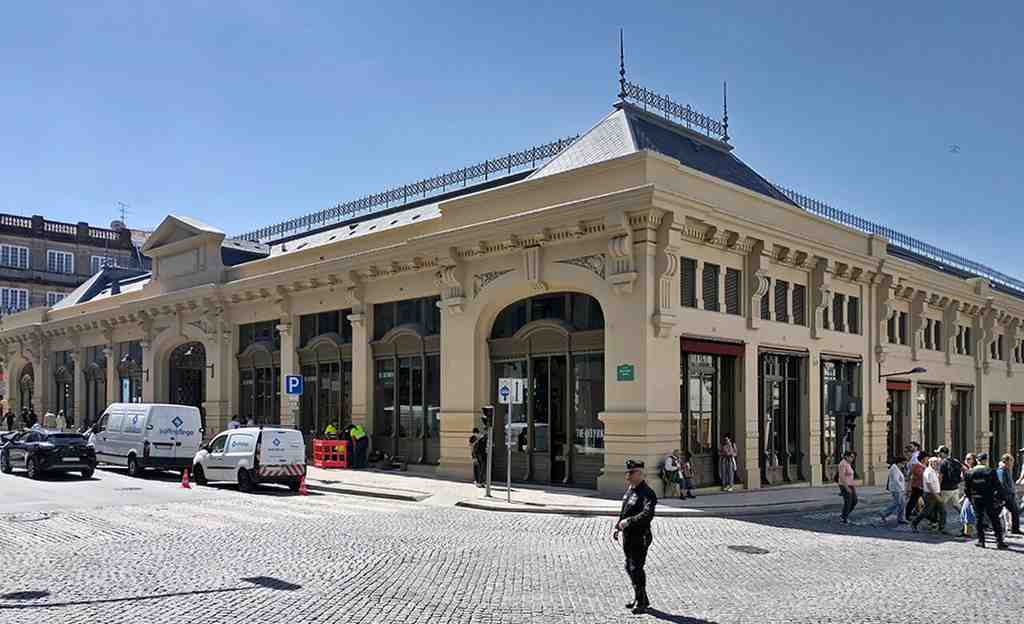
Bolhão MarketPhoto: Petnog, Wikimedia Commons, CC BY-SA 4.0. Cropped & resized. Look for the monumental granite-and-iron block with arched openings, iron railings, and stacked levels that wrap an entire city block like a market dressed for civic duty.
Welcome to Bolhão, Porto’s everyday heart... not a pretty extra, but the place where the city has long argued, shopped, gossiped, and fed itself. Across two floors, traders have sold fish, meat, vegetables, and flowers here, while the outer ring held small street-facing shops for everything from fabric to perfume. In other words: if you wanted to understand Porto, you came where people actually bought dinner.
The name goes back to a muddy field and a tiny spring bubble - a bolha de água, a bubble of water - that rose here before the market. In eighteen thirty-nine, the city decided to gather scattered food markets into one organized place. Porto likes order, but only after a healthy amount of chaos.
The building in front of you took its monumental form in nineteen fourteen, when architect Correia da Silva gave Bolhão its lasting face. He mixed reinforced concrete - quite forward-looking at the time - with metal structure, wooden roofs, and granite stonework. The result feels sturdy and public-minded, almost as if a market and a city hall had a practical child. If you check the image on your screen, you can catch that grand, block-filling presence clearly.
Take a moment and study the different levels and entrances. From Rua Formosa, Rua de Sá da Bandeira, Rua Alexandre Braga, and Rua de Fernandes Tomás, the building meets the streets at different heights. That’s your clue that Bolhão was designed for movement, trade, and real working life first... monument second.
And yet it became both. The market earned protection as a public-interest monument in two thousand and six, then again in two thousand and thirteen. That matters, because Bolhão spent decades in decline. Engineers found serious structural problems back in the nineteen eighties. Later, one redevelopment plan would have handed the market to private operators for seventy years, with luxury housing, a shopping center, and only a sliver left for traditional trade. Porto answered with petitions, court fights, and a rather stubborn civic refusal to let daily life be erased.
One face of that persistence was Cindinha dos Frangos. At eighty-two, she still kept her stall and remembered starting work here at age five, hoping she might return to the historic building “if I’m alive and well.” She did not talk about heritage like a museum curator. She lived it.
After more than four years of reconstruction, Bolhão reopened on the fifteenth of September, two thousand twenty-two, with its traditional market still at the core. So this place tells you something essential about Porto: even groceries can become civic memory.
From here, we’ll head toward a different kind of inheritance - tile, faith, and public grandeur - at the Church of Saint Ildefonso, about a seven-minute walk away. And if you plan to come back inside later, Bolhão generally opens daily except Sunday, with shorter hours on Saturday.
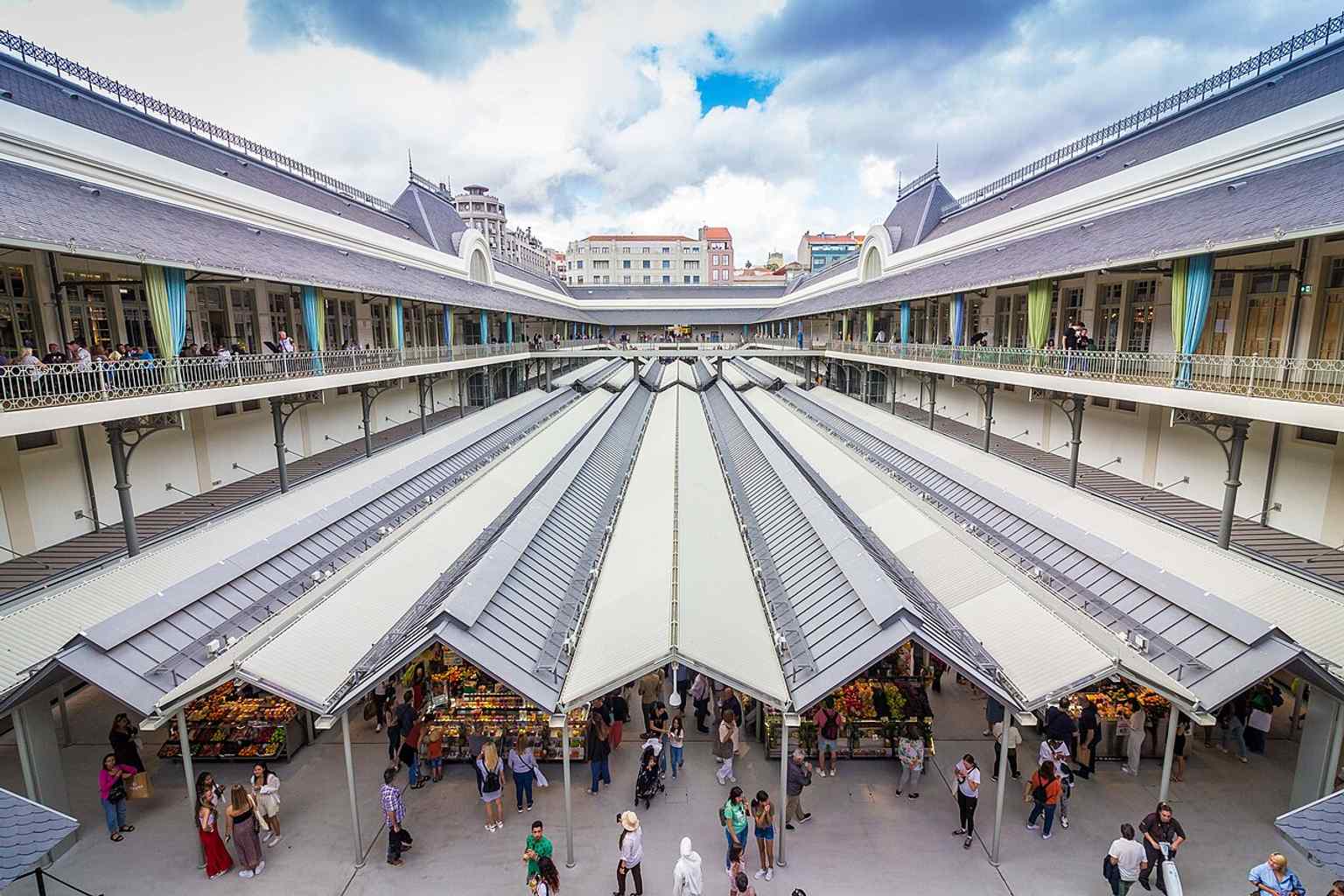
The renovated main façade of Bolhão Market, Porto’s iconic neoclassical marketplace, reopened to the public in 2022 after a long restoration.Photo: Vimacopeca, Wikimedia Commons, CC BY-SA 4.0. Cropped & resized. 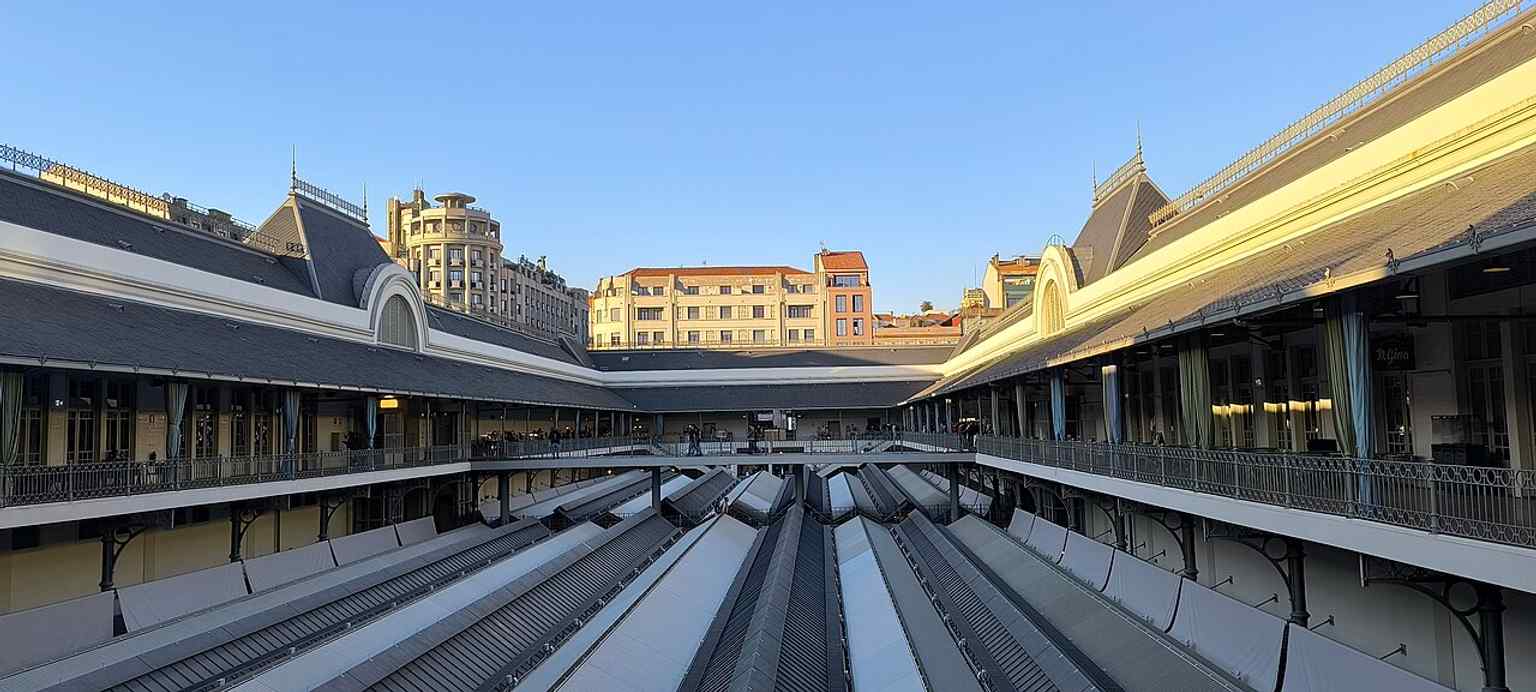
A wide street-level view of Bolhão Market showing its monumental presence in the Baixa, where the city concentrated its traditional food trade.Photo: Brunnaiz, Wikimedia Commons, CC BY-SA 4.0. Cropped & resized. 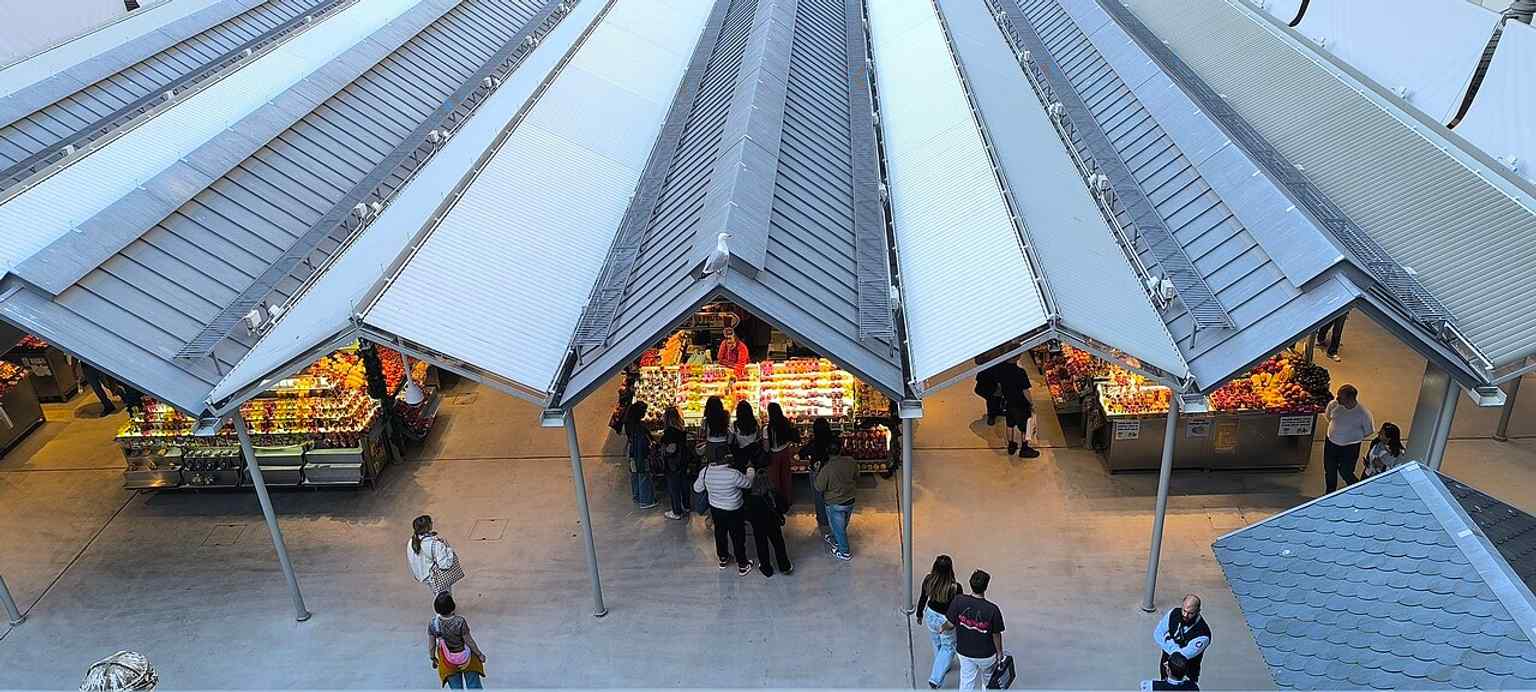
Another exterior view of Bolhão Market, useful for showing the building’s scale and the urban setting around its main entrances.Photo: Brunnaiz, Wikimedia Commons, CC BY-SA 4.0. Cropped & resized. 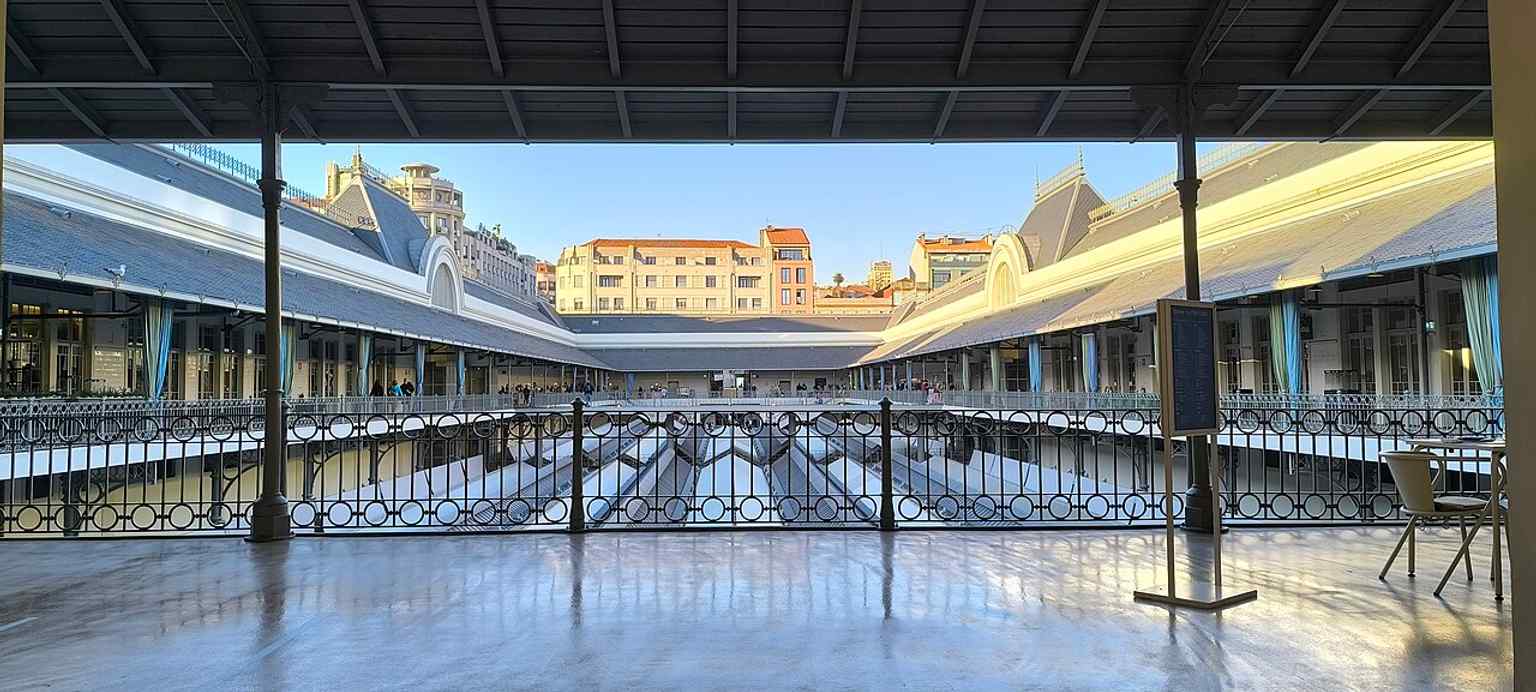
Bolhão Market from the street, highlighting the restored public face of a building that has been a Porto landmark since 1914.Photo: Brunnaiz, Wikimedia Commons, CC BY-SA 4.0. Cropped & resized. 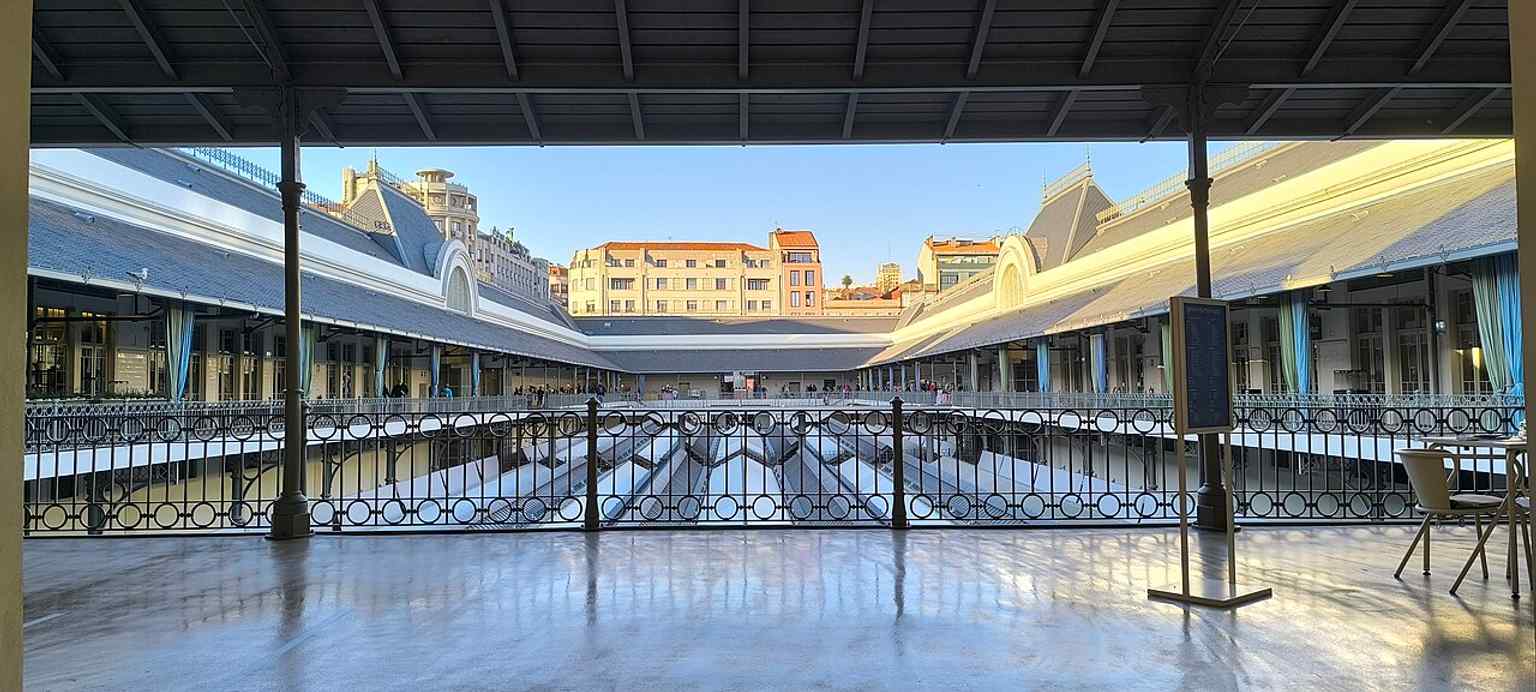
A broad view of the market building, echoing its role as a major public market for fresh produce, flowers, meat, and fish.Photo: Brunnaiz, Wikimedia Commons, CC BY-SA 4.0. Cropped & resized. 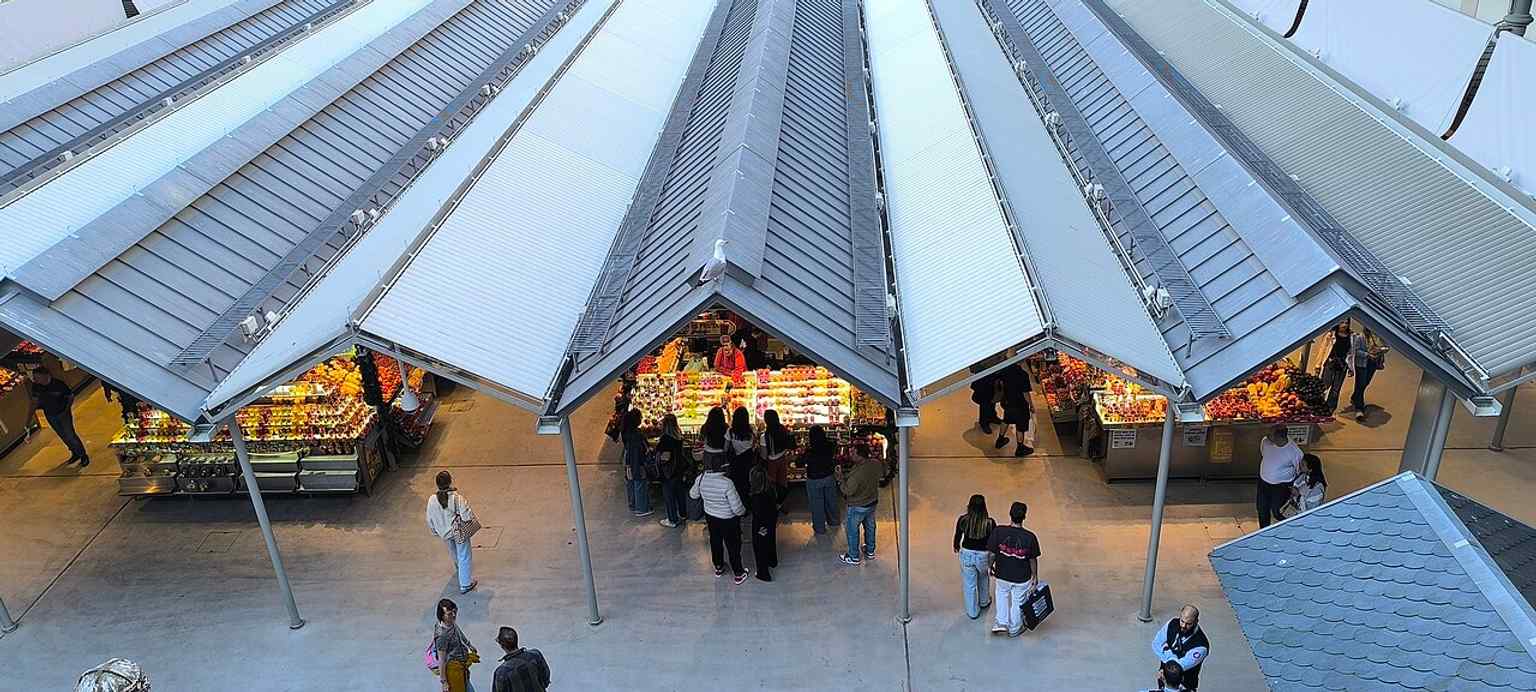
The market’s long frontage in the city center, part of the 2022 reopening that brought Bolhão back as a living traditional market.Photo: Brunnaiz, Wikimedia Commons, CC BY-SA 4.0. Cropped & resized. In front of you stands a granite church with twin bell towers and a blue-and-white azulejo façade, marked by a niche where Saint Ildefonso stands above the entrance. At first…Read moreShow less
Open dedicated page →In front of you stands a granite church with twin bell towers and a blue-and-white azulejo façade, marked by a niche where Saint Ildefonso stands above the entrance.
At first glance, Santo Ildefonso looks straightforward enough... a handsome eighteenth-century church keeping watch near Batalha Square. But Porto is rarely that tidy. Hidden Porto begins with places like this, where later surfaces sit over older names, and older names sit over older ground. What you see is only the newest clear sentence in a much longer story.
Most people remember the tiles, and fair enough: around eleven thousand azulejos, painted ceramic tiles, cover the façade. Jorge Colaço designed them in nineteen thirty-two, filling the front with scenes from the life of Saint Ildefonso and images from the Gospels. Behind that famous skin, though, the church itself is older and sterner, built in granite, and its body stretches into an elongated octagon rather than a simple box. If you want a better sense of that shape, take a quick look at the side view in the app.
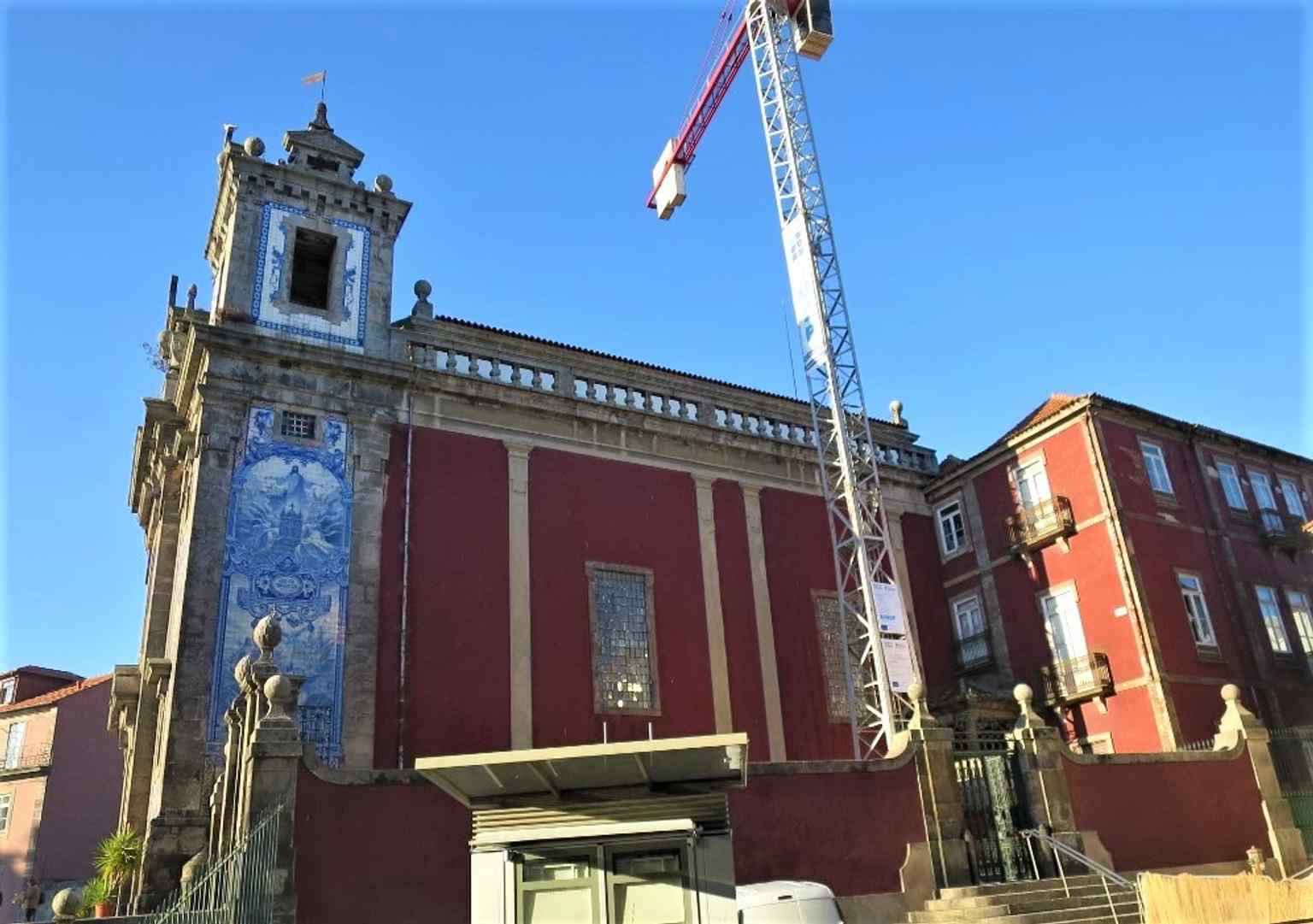
One of the side elevations of the church, useful for showing the elongated octagonal massing of the granite building.Photo: Senhormario, Wikimedia Commons, CC BY-SA 4.0. Cropped & resized. The church honors Ildephonsus of Toledo, a Visigoth bishop from the seventh century. But the local memory here runs deeper than the name on the front. Long before this building, a chapel called Santo Alifon stood on this spot. Bishop Vicente Mendes mentioned it in twelve ninety-six, which is the sort of small written clue historians treasure with perhaps a touch too much enthusiasm. When that old chapel grew dangerous and unstable, workers pulled it down in seventeen oh nine and started again. They finished the main body by seventeen thirty, then completed the towers and façade by seventeen thirty-nine.
Inside, another layer waits. Nicolau Nasoni - keep that name with you - designed the main retable, the grand carved screen rising behind the altar. Miguel Francisco da Silva carved and installed it in seventeen forty-five, so even the church’s great centerpiece came together in stages, by more than one hand. If you glance at the interior image, you can see that baroque drama gathered around the sanctuary.
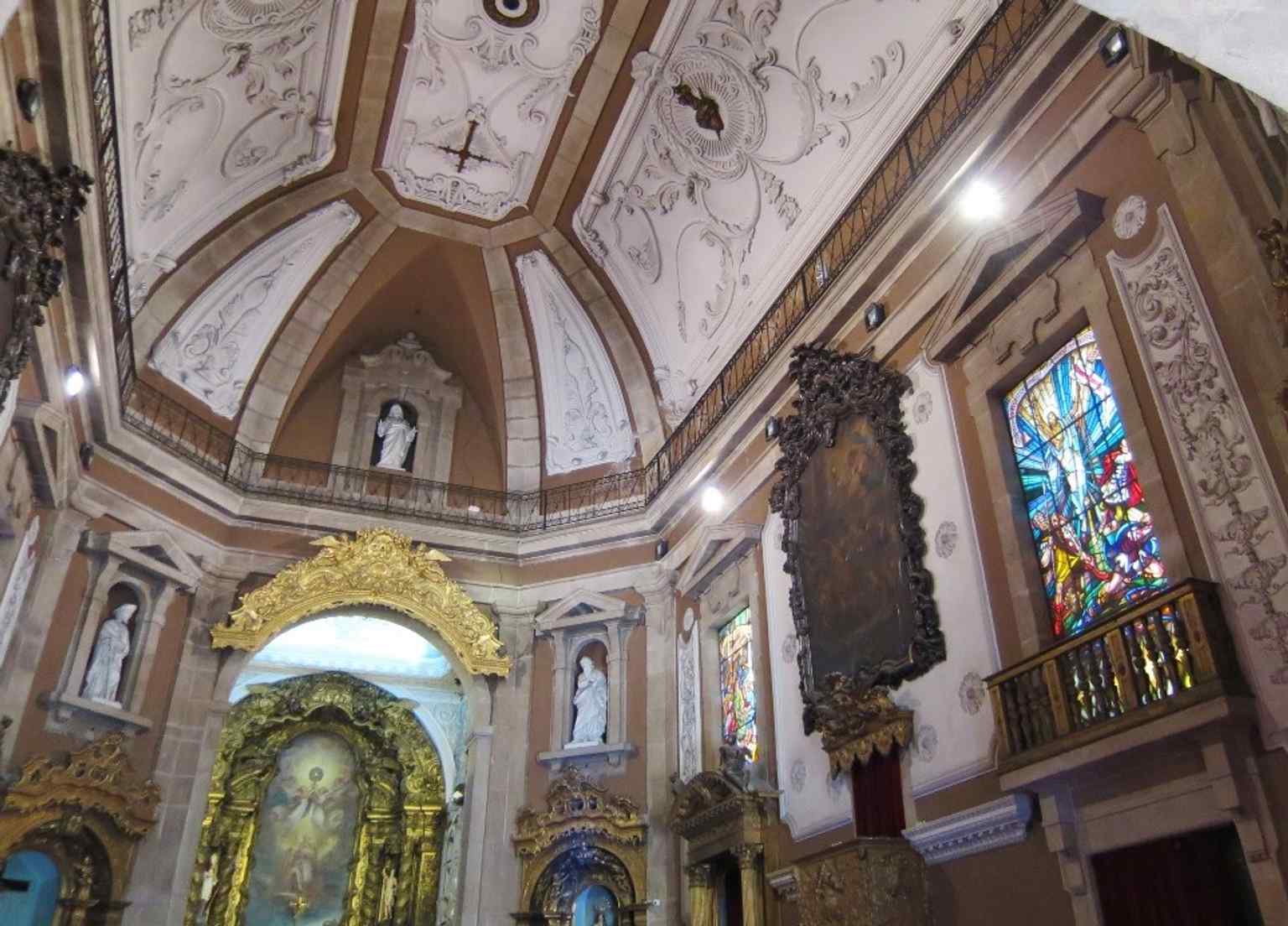
The church interior, where the celebrated baroque retable designed by Nicolau Nasoni anchors the sanctuary.Photo: Senhormario, Wikimedia Commons, CC BY-SA 4.0. Cropped & resized. And here’s the detail locals tend to enjoy quietly: this church still stands over Santo Alifon’s old ground. In nineteen ninety-six, restorers working in the narthex - the entrance porch - uncovered nineteen graves from the earlier chapel’s churchyard. So the plain granite shell, the baroque interior, and the ceramic façade all sit above a buried parish memory.
The church took real damage too: a severe storm hit it in eighteen nineteen, and artillery struck it during the Siege of Porto in eighteen thirty-three. Porto has a habit of repairing what history breaks, then folding the repair into its identity.
When you’re ready, head on to São João National Theatre, about a four minute walk from here... and keep Nasoni, and that buried chapel, in the back of your mind. If you want to return inside later, opening hours vary by day, with short morning and afternoon windows and more limited access on Monday and Sunday.
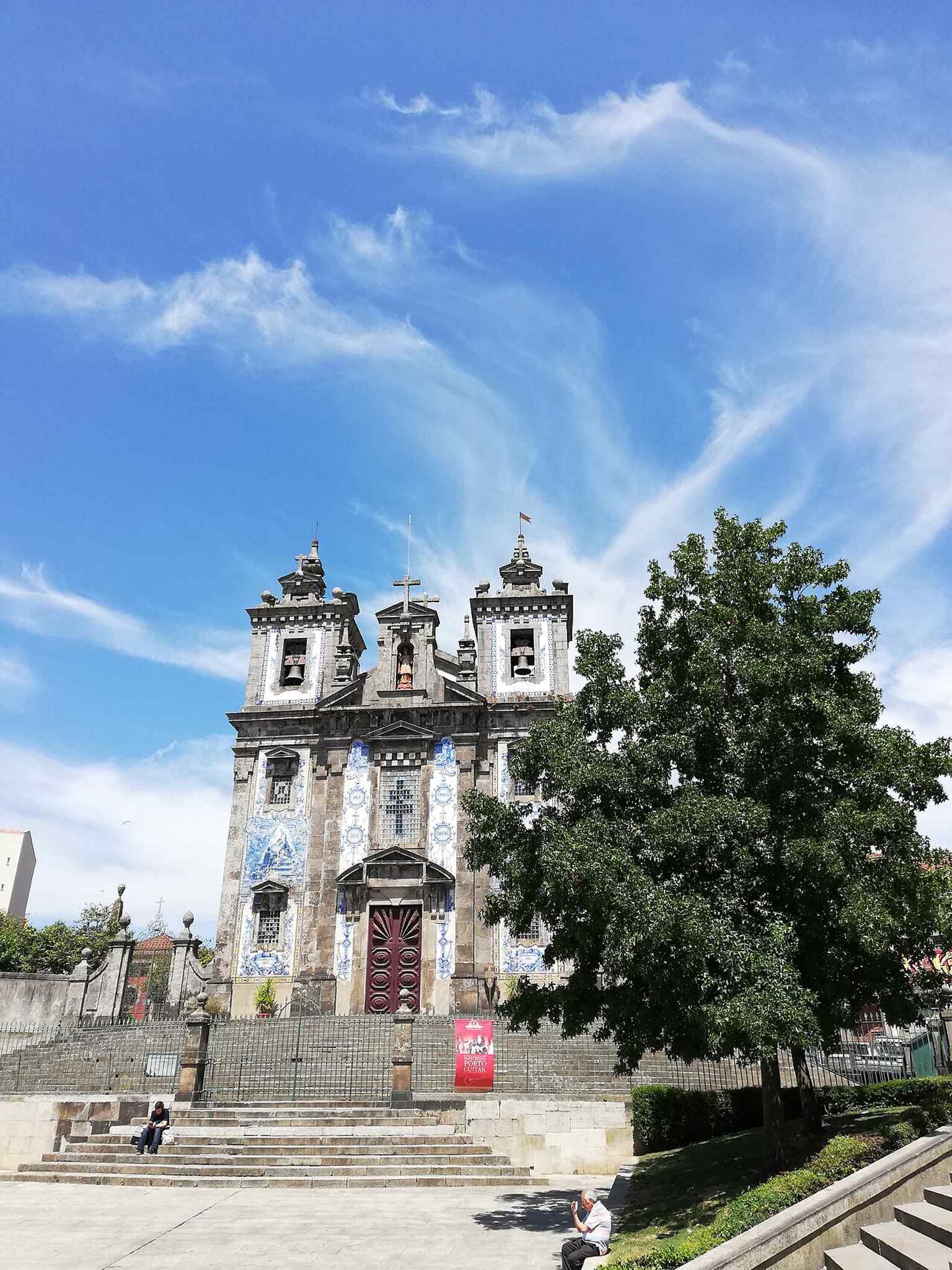
A full daylight view of the church’s famous blue-and-white azulejo façade, added in 1932 and now its most recognizable face.Photo: Asublif, Wikimedia Commons, CC BY-SA 4.0. Cropped & resized. 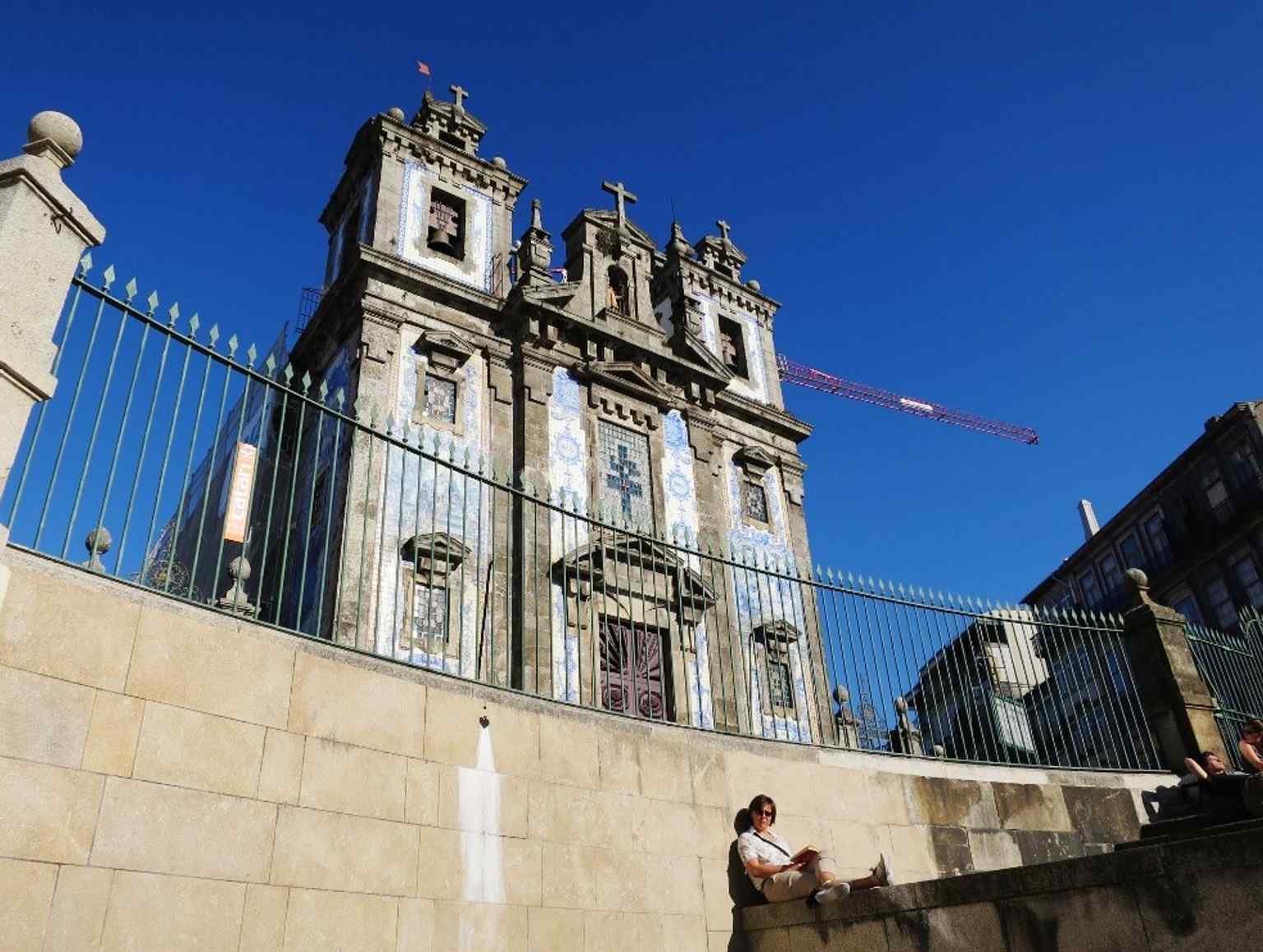
The main façade in a clear, centered view, showing the twin bell towers and the plain granite structure behind the tilework.Photo: Senhormario, Wikimedia Commons, CC BY-SA 4.0. Cropped & resized. 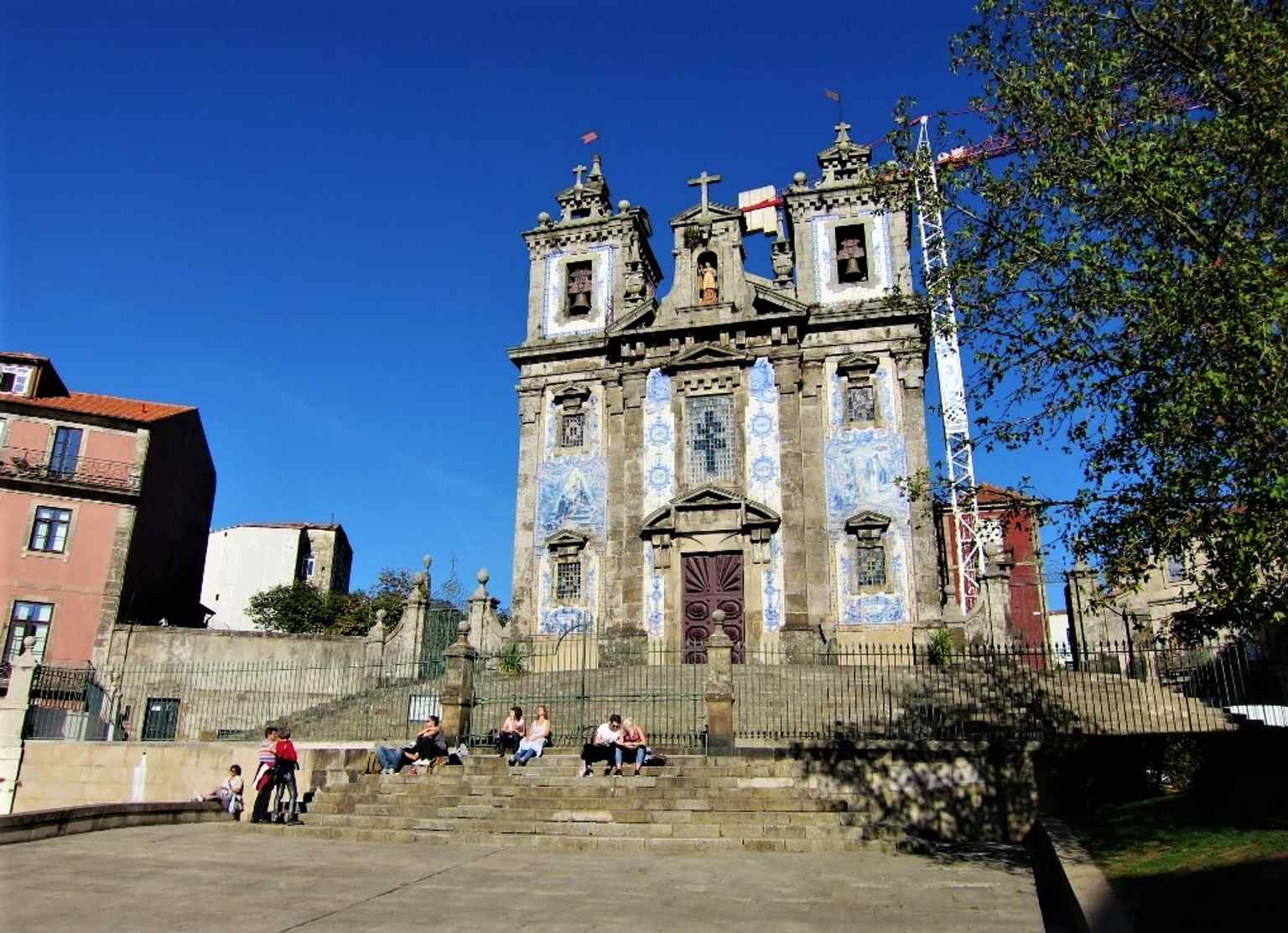
Seen from Batalha Square, this view places the church in its busy urban setting near Porto’s historic pedestrian heart.Photo: Senhormario, Wikimedia Commons, CC BY-SA 4.0. Cropped & resized. 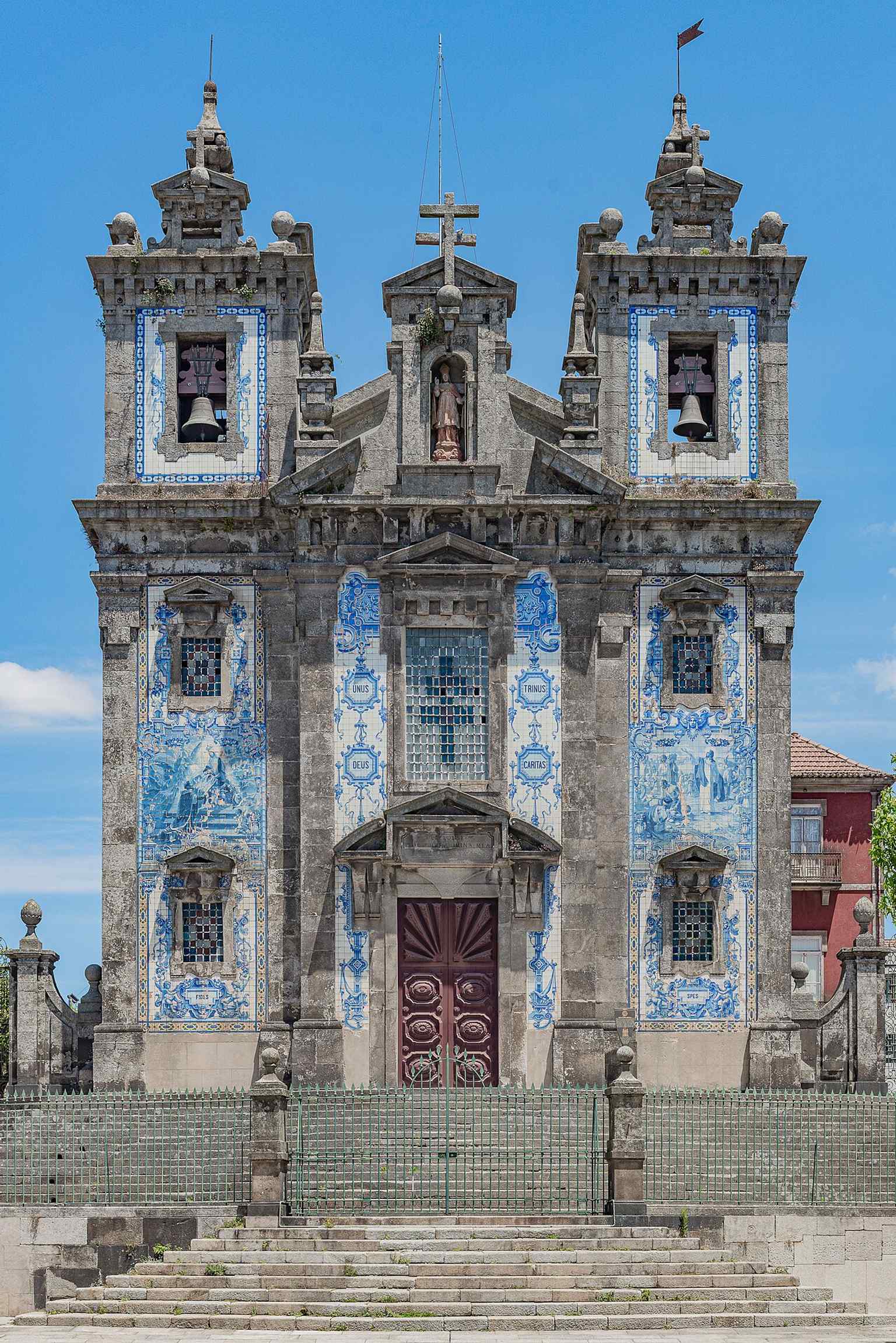
A high-resolution contemporary exterior that captures the full height of the façade and bell towers in one frame.Photo: T meltzer, Wikimedia Commons, CC BY-SA 4.0. Cropped & resized. 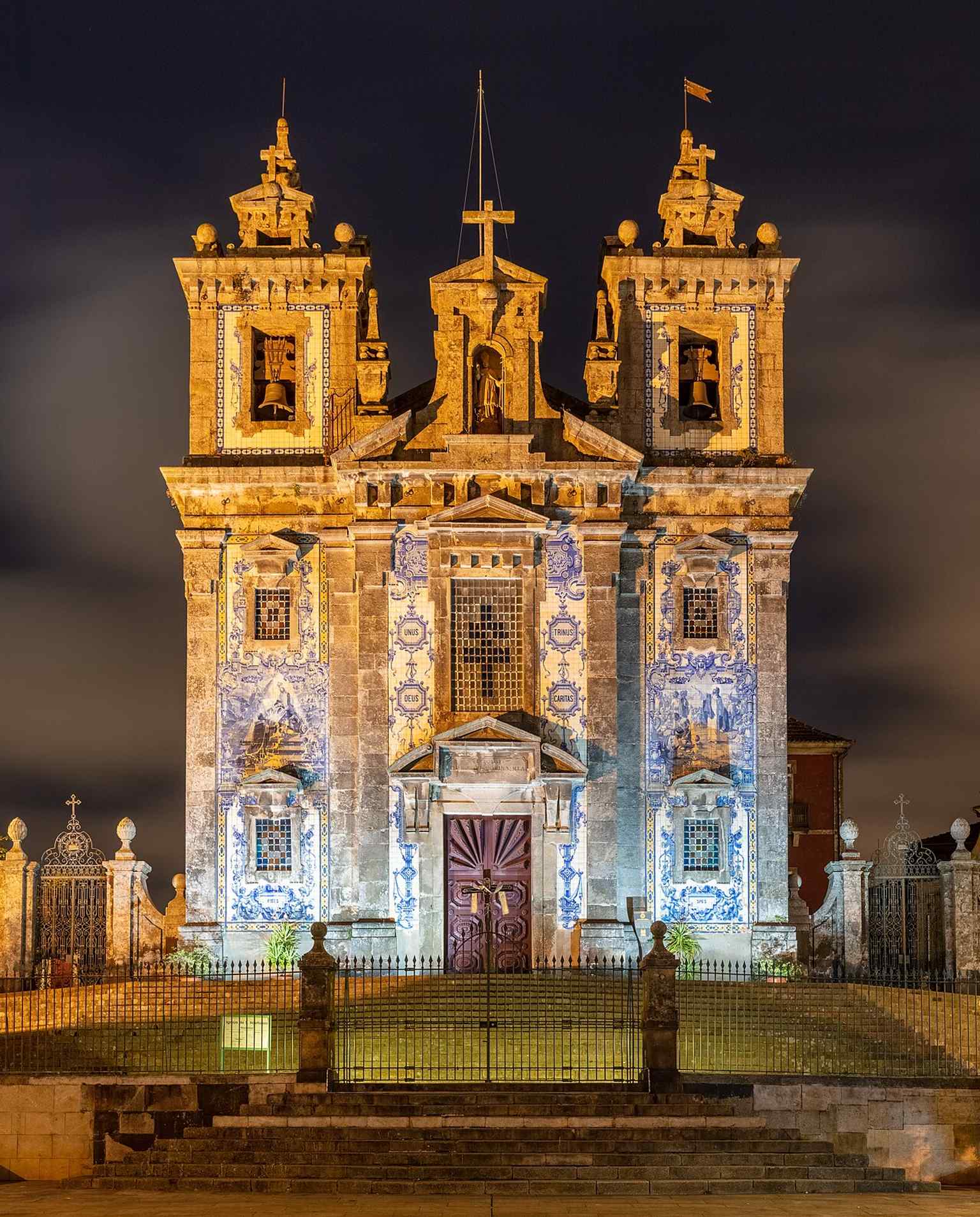
Night photography emphasizes the 1932 azulejo façade and the church’s dramatic presence after dark in central Porto.Photo: Diego Delso, Wikimedia Commons, CC BY-SA 4.0. Cropped & resized. 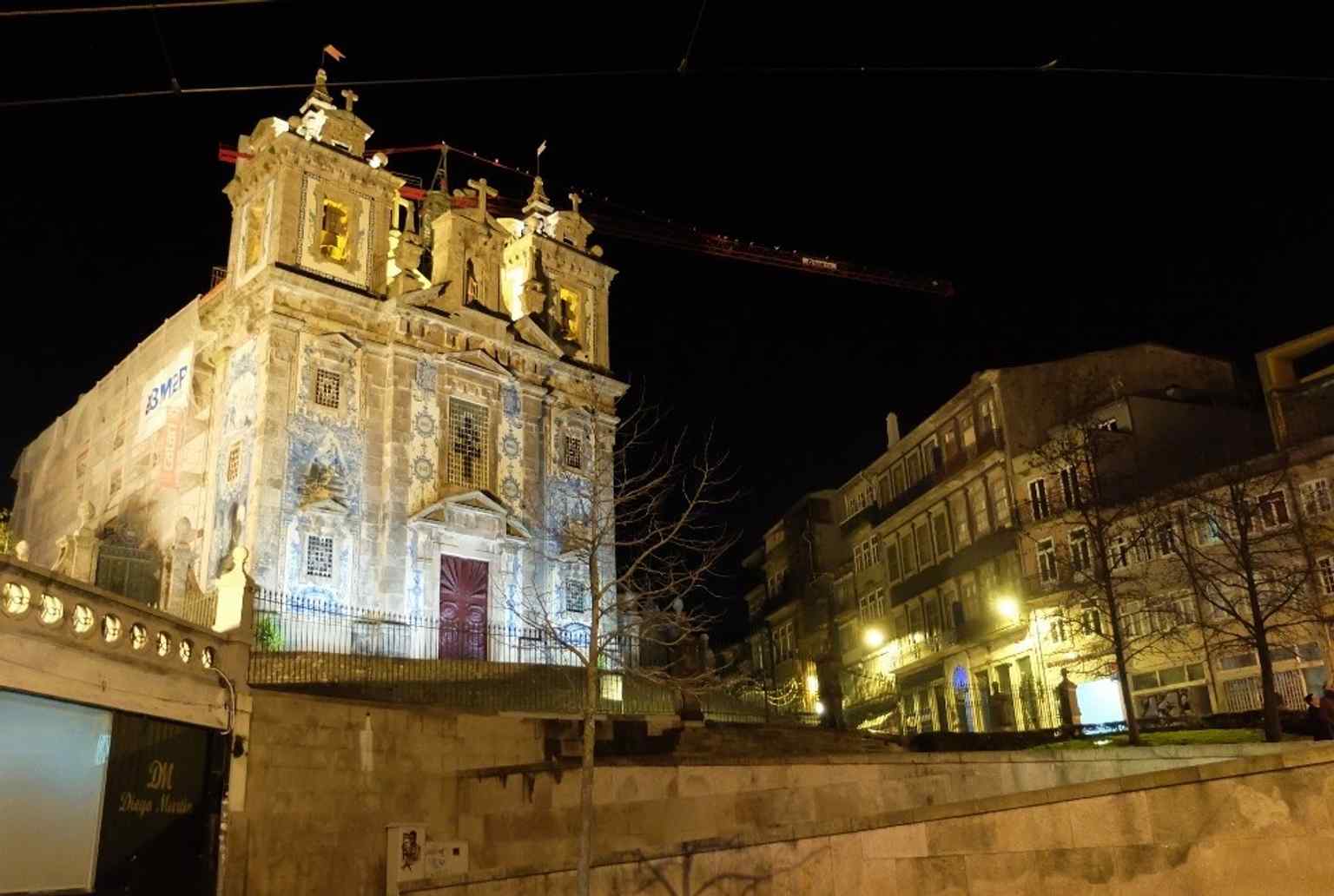
A nighttime overall view that highlights the twin towers and the church’s strong silhouette in the city center.Photo: Senhormario, Wikimedia Commons, CC BY-SA 4.0. Cropped & resized. 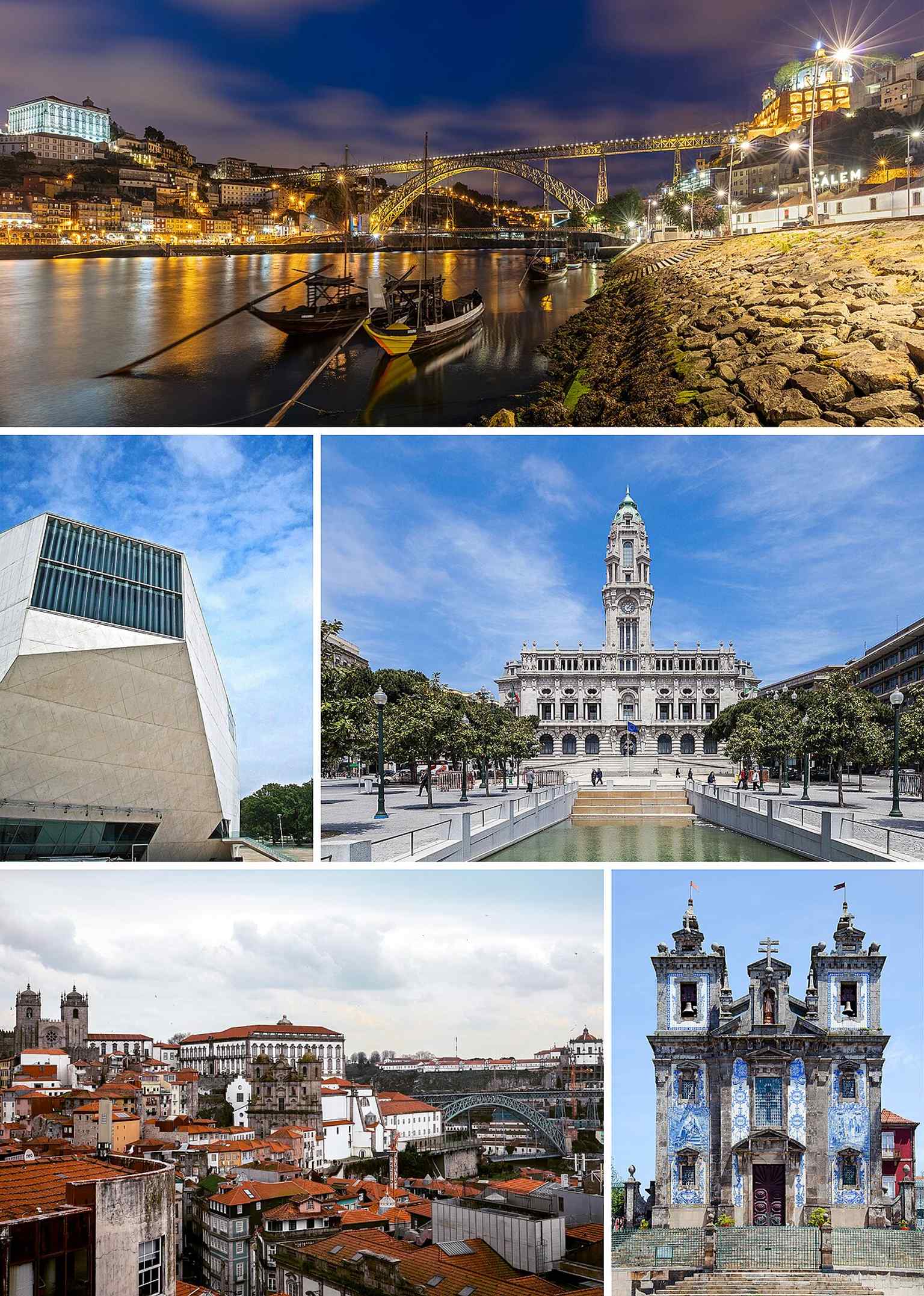
A Porto skyline montage that includes Santo Ildefonso, helping place the church within the city’s broader historic fabric.Photo: see sources above, Wikimedia Commons, CC BY-SA 4.0. Cropped & resized. On your left, the São João National Theatre is a pale stone block with three arched entrances, tall Ionic columns, and a high central gable marked by sculpted reliefs. This place…Read moreShow less
Open dedicated page →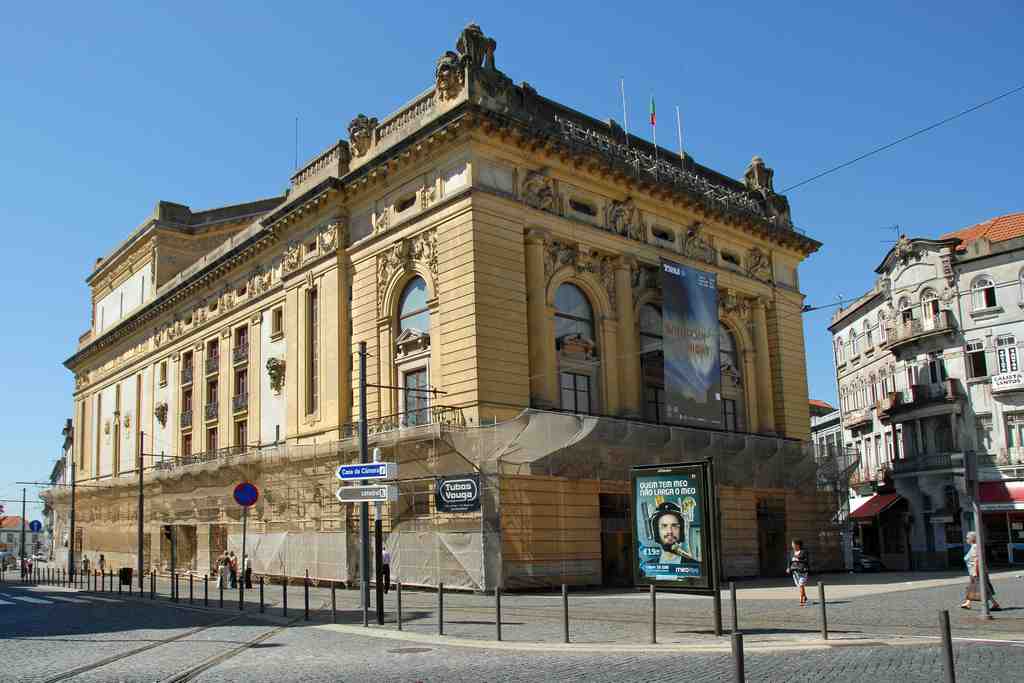
São João National TheatrePhoto: António Amen, Wikimedia Commons, CC BY-SA 3.0. Cropped & resized. On your left, the São João National Theatre is a pale stone block with three arched entrances, tall Ionic columns, and a high central gable marked by sculpted reliefs.
This place began as Porto showing off... and honestly, the city did it with style. In seventeen ninety-six, the Italian Vicente Mazzoneschi helped bring the first theatre here to life, and it opened in seventeen ninety-eight as the Teatro do Príncipe, honoring the prince-regent John, later King John the Sixth. For Porto’s elite, this was not just a building for plays. It was a social stage: a place to arrive, be noticed, and judge everyone else’s outfit under candlelight.
Trade wealth does that. A city built on buying, selling, shipping, and bargaining does not spend all its money on warehouses and wine lodges. It also funds culture, status, and public image. Merchants wanted profit, of course, but they also wanted polish... somewhere grand enough to prove Porto was not merely industrious, but important.
Inside the original theatre, the main hall curved in a horseshoe shape, meaning the seating wrapped around the stage in a broad U. Four rows of boxes climbed the walls, and the royal family’s box sat right in the middle on the second level, because subtlety was not the point. The acoustics were excellent. The ceiling carried painted decoration, the stage wall changed hands between artists, and until eighteen thirty-eight the light came from tallow candles, later oil lamps... which sounds romantic right up until you remember what happened next.
On the night of the eleventh to the twelfth of April, nineteen oh eight, fire tore through the theatre and destroyed the interior. Porto did not spend long mourning. The civil governor quickly named a commission to push a new theatre forward, as if the city had decided that losing its stage was intolerable for even a moment.
The rebuilding came with its own little drama. Engineer Isidro de Campos publicly denounced the tender conditions, forcing a new competition a week later. In the end, José Marques da Silva won. He is a good figure to remember here: Porto later called him its last classical and first modern architect, which fits this façade rather well. He gave the city something sober, ceremonial, and very self-possessed. If you glance at the details on your screen, you can see the reliefs that personify Kindness, Pain, Hatred, and Love... a neat summary of theatre, politics, and most family dinners.
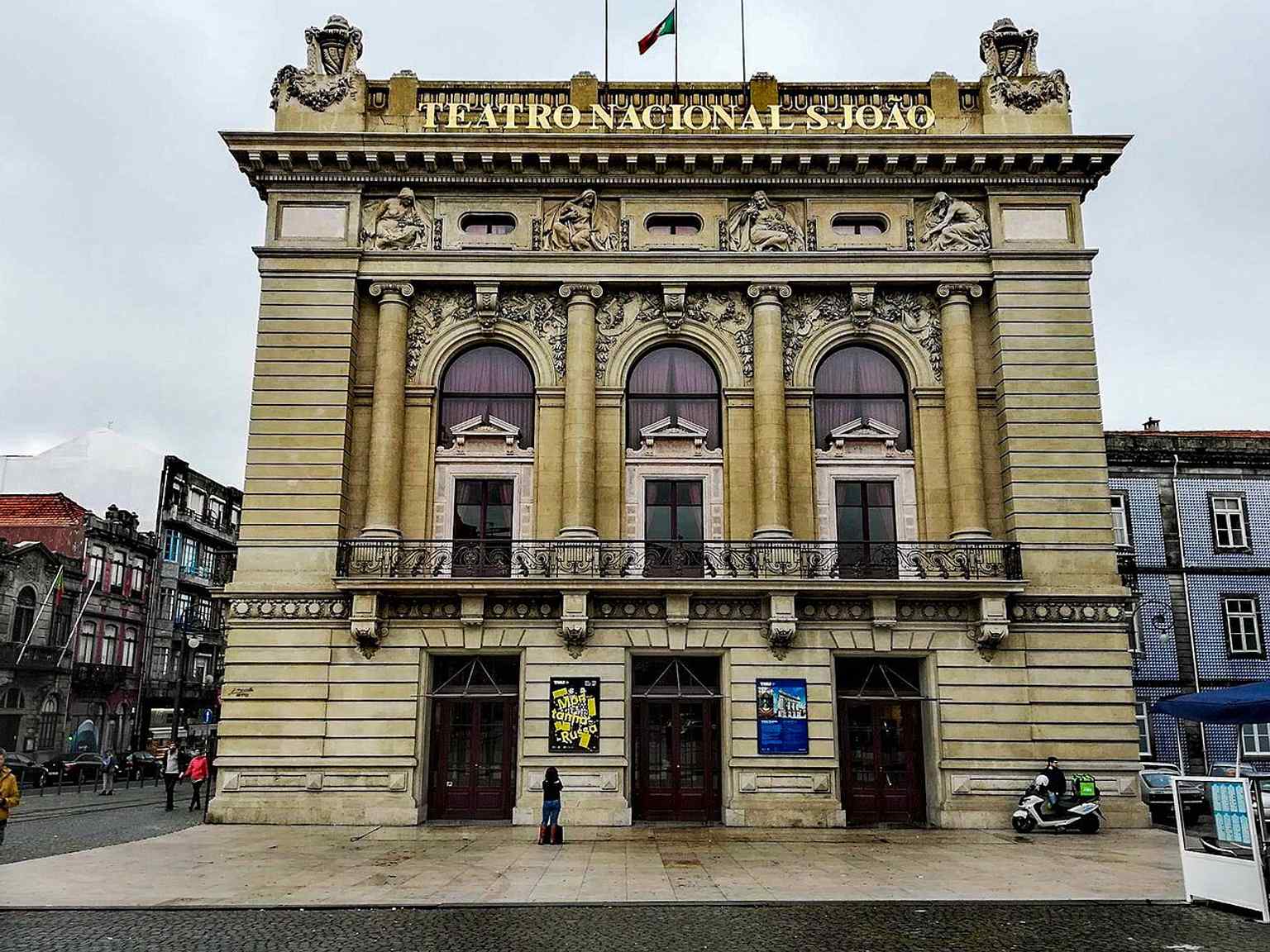
Facade detail of the São João National Theatre, where the decorative reliefs symbolize human passions like Kindness and Love.Photo: Ivan Stesso, Wikimedia Commons, CC BY-SA 4.0. Cropped & resized. Work started in nineteen eleven, the building finished in nineteen eighteen, and on the seventh of March, nineteen twenty, the new theatre opened with Verdi’s Aida. If you check the interior image in the app, you’ll see how the foyer still carries that sense of public performance before anyone even reaches a seat.
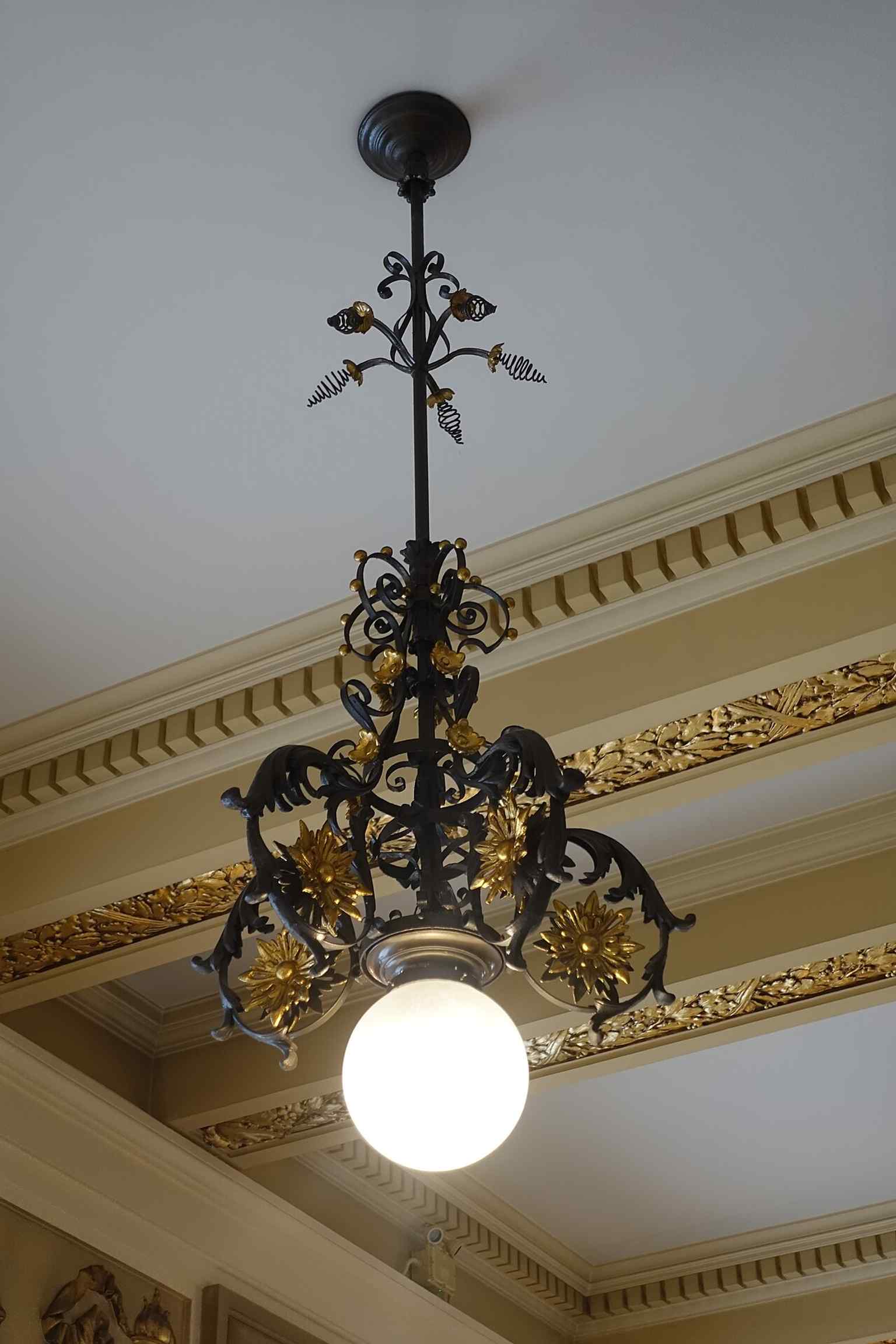
Inside the theatre’s foyer, part of the grand entrance sequence that leads to the horseshoe-shaped auditorium.Photo: Joseolgon, Wikimedia Commons, CC BY 4.0. Cropped & resized. The building kept adapting. In nineteen thirty-two it even operated as a cinema, São João Cine. Then, after passing through private hands, the state bought it back in nineteen ninety-two, restored key public spaces and stage systems, and reopened it as the Teatro Nacional São João. Same address, new chapter... Porto is good at that.
From here, the drama spills out of the auditorium and into the city itself; in about ten minutes, Avenida dos Aliados shows how Porto gave urban ambition a much bigger stage. If you want to come back inside later, the theatre is usually closed on Monday, open from two to seven Tuesday through Saturday, and from two to five on Sunday.
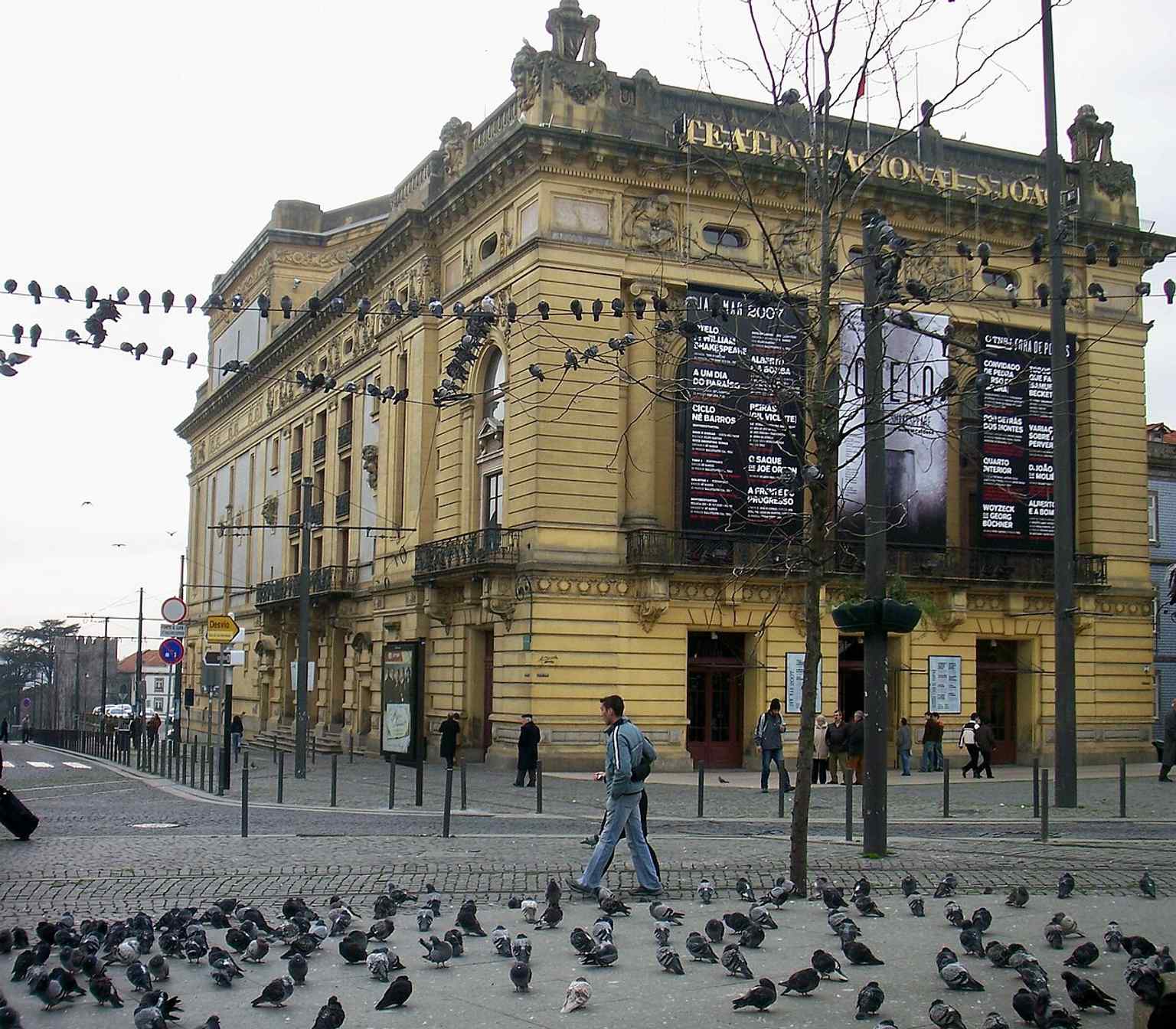
Front view of Porto’s São João National Theatre, the rebuilt 20th-century facade that replaced the 1908 fire-damaged house.Photo: (AntoniusJ), Wikimedia Commons, Public domain. Cropped & resized. 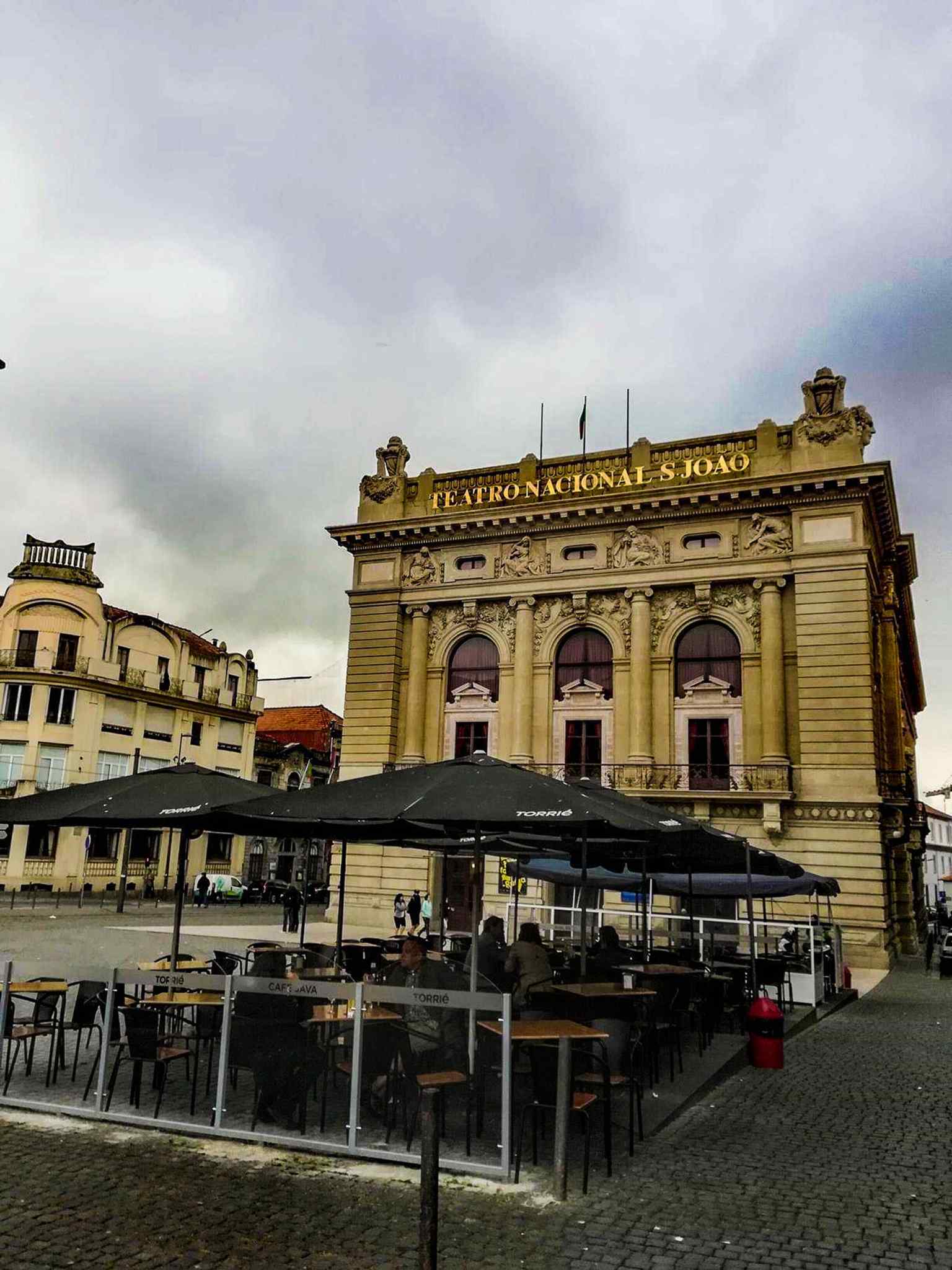
The theatre’s main facade and entrance on Praça da Batalha, showing the sober classical design by José Marques da Silva.Photo: Ivan Stesso, Wikimedia Commons, CC BY-SA 4.0. Cropped & resized. 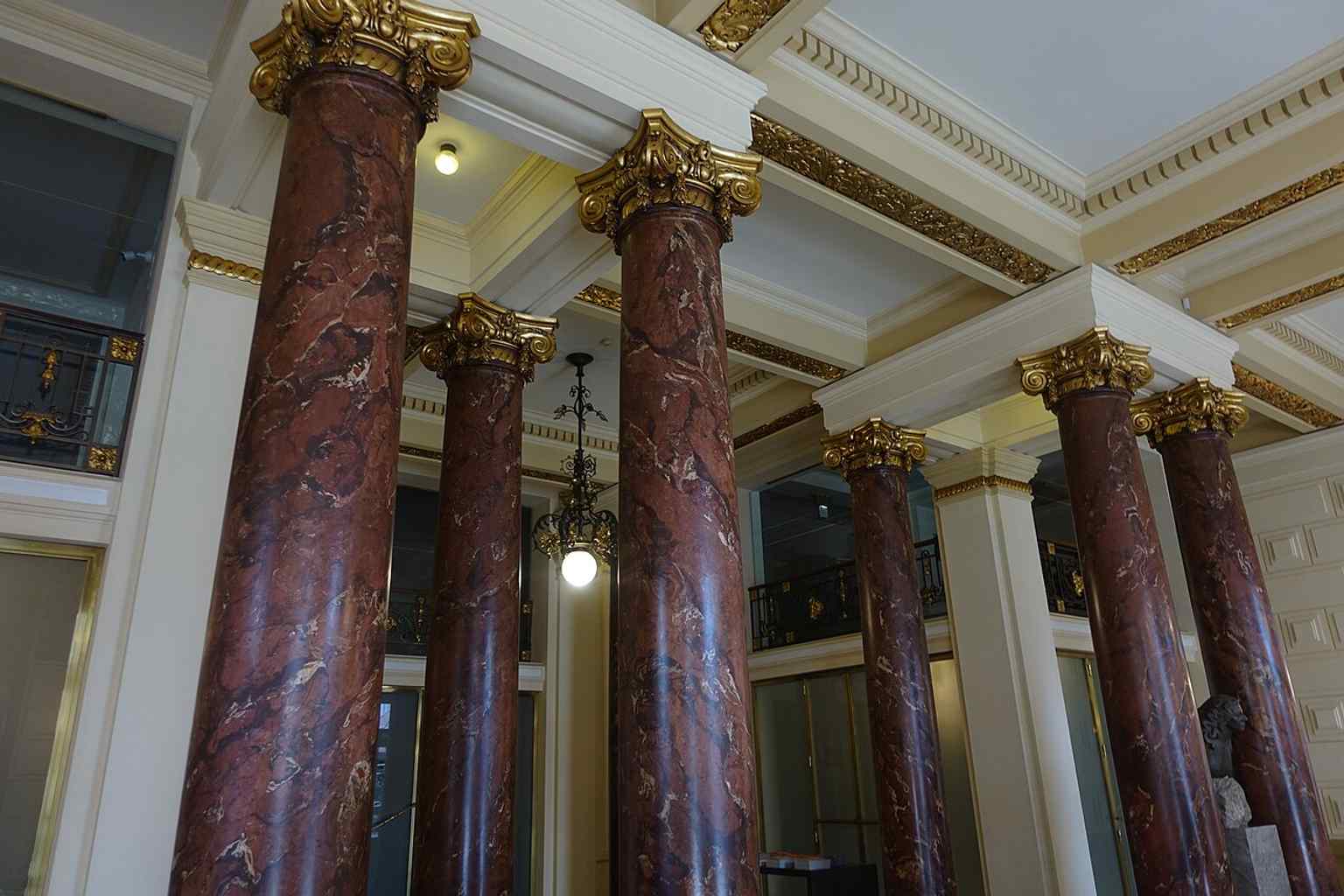
A wider interior view of the foyer and circulation spaces, matching the building’s layered public rooms described in the source text.Photo: Joseolgon, Wikimedia Commons, CC BY 4.0. Cropped & resized. 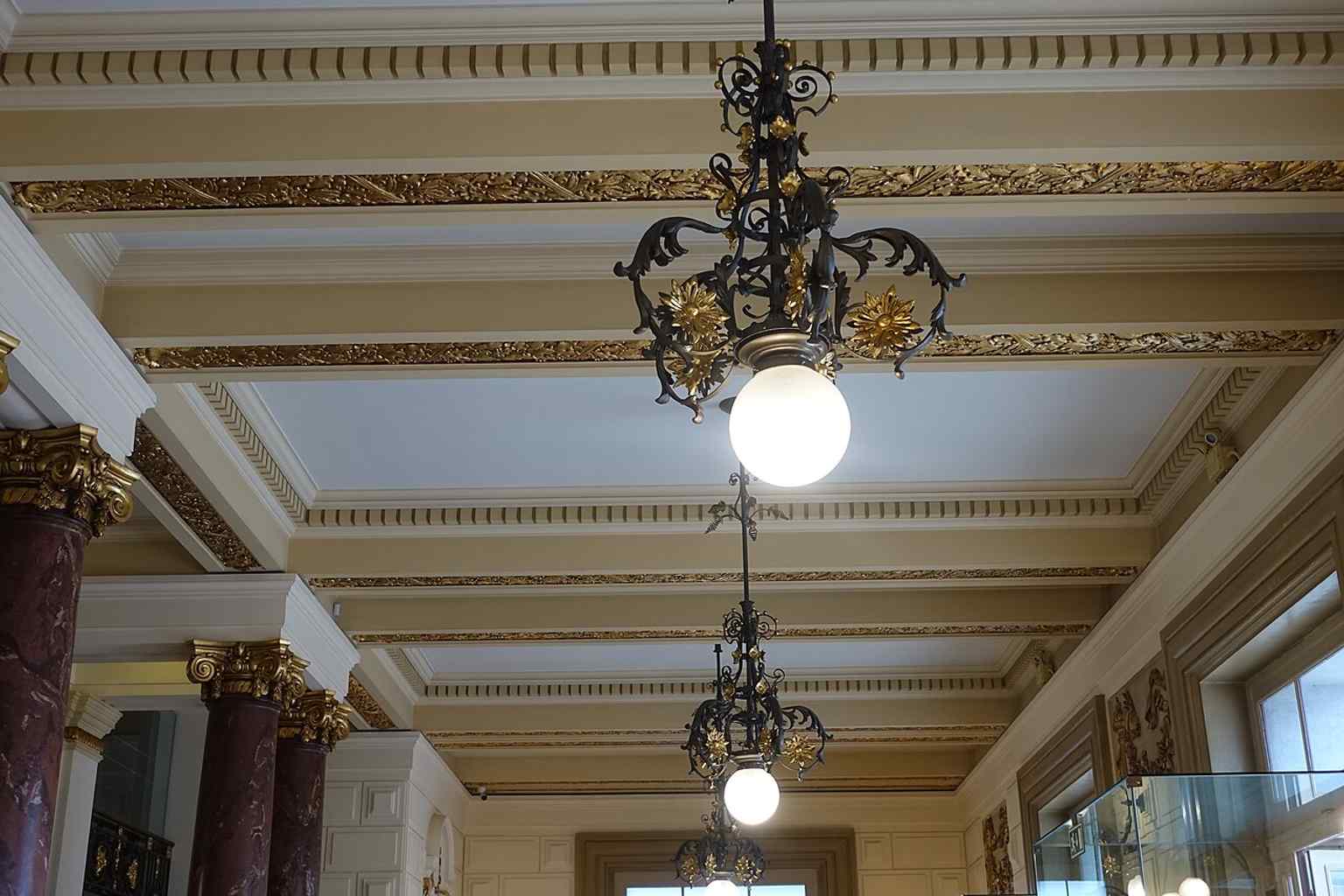
Another interior view of the São João Theatre’s elegant foyer, highlighting the restored public areas reopened in 1992.Photo: Joseolgon, Wikimedia Commons, CC BY 4.0. Cropped & resized.
Show 11 more stopsShow fewer stopsexpand_moreexpand_less
On your right, Avenida dos Aliados opens as a wide granite boulevard climbing between pale stone facades, many crowned with domes and lantern-like turrets, with the great block of…Read moreShow less
Open dedicated page →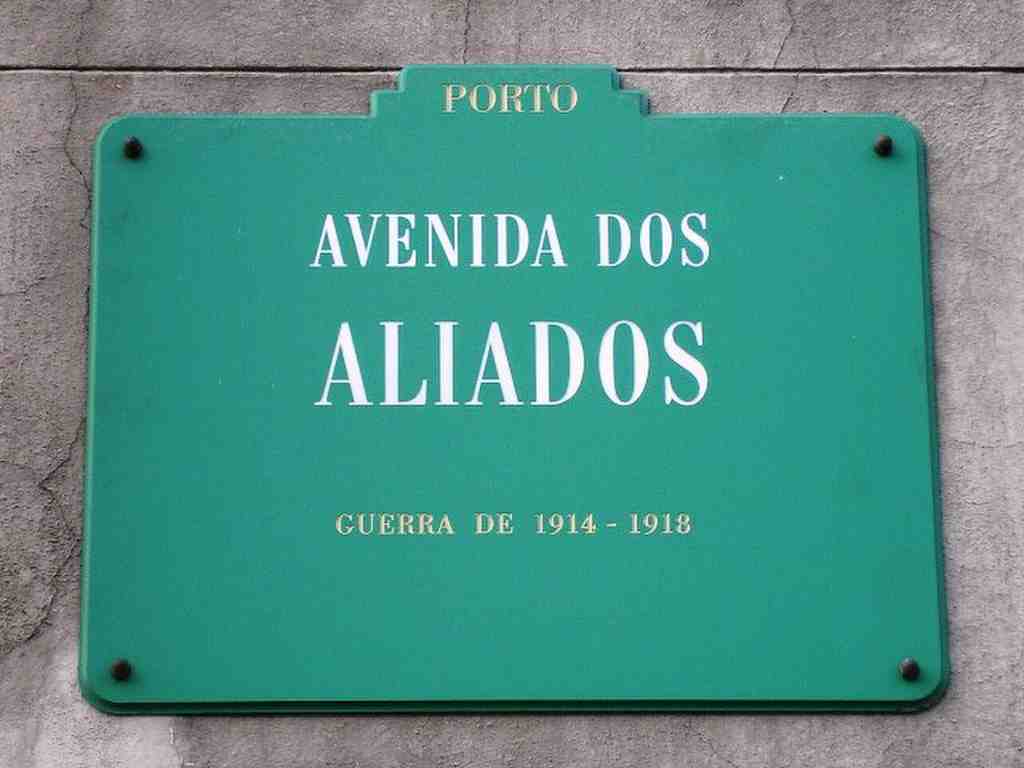
Allied AvenuePhoto: Manuel de Sousa, Wikimedia Commons, Public domain. Cropped & resized. On your right, Avenida dos Aliados opens as a wide granite boulevard climbing between pale stone facades, many crowned with domes and lantern-like turrets, with the great block of City Hall holding the top.
This is Porto making a public statement. The creation of Avenida dos Aliados was not a simple street improvement; it was a planned rewrite of the old center, cutting through a tighter, messier web of lanes so the city could present itself as modern, orderly, and important... preferably all at once.
Before this avenue, this ground held short streets and alleys locals called the lavadouros, along with two busy parallel roads, Rua de Dom Pedro and Rua do Laranjal. In nineteen fifteen, the English planner Barry Parker came to Porto to study the crowded center. He wrote a small but influential report, Memórias sobre a projetada Avenida da Cidade, laying out how a new civic avenue might open the place up and give it some breathing room. City leaders approved the plan on the twenty-ninth of November, nineteen fifteen. Then everyone started arguing.
And I do mean properly arguing. The fiercest dispute centered on the Paços do Concelho, the City Hall: where it should stand, what shape it should take, what kind of city it should represent. The Industrial Association of Porto disliked the whole affair so much it did not even attend the official inauguration. Nothing says civic harmony like skipping the ribbon cutting.
The work began on the first of February, nineteen sixteen, with President Bernardino Machado present. The ceremony involved dismantling the “first stone” of the old baroque palace on Praça da Liberdade, where the municipal government had sat since eighteen sixteen. So this avenue began with demolition as public theater: one Porto taken apart so another Porto could step forward.
But Parker did not get everything he wanted. Architect José Marques da Silva, already known here for São Bento Station and the São João Theatre, pushed back hard against Parker’s design. That resistance helped shape the avenue you see now, a compromise between imported planning ideas and local architectural muscle. One visible trace of Marques da Silva’s hand is the former A Nacional insurance building near the lower end.
If you glance at the image on your screen, you’ll see the statue of Dom Pedro the Fourth marking where this monumental center begins. Around that axis, the avenue became the city’s reception room: banks and insurance firms shifted here from the older commercial area around São Domingos and Rua do Infante, and financial power followed them. Keep that in mind for later... Porto’s money has a habit of rearranging the map.
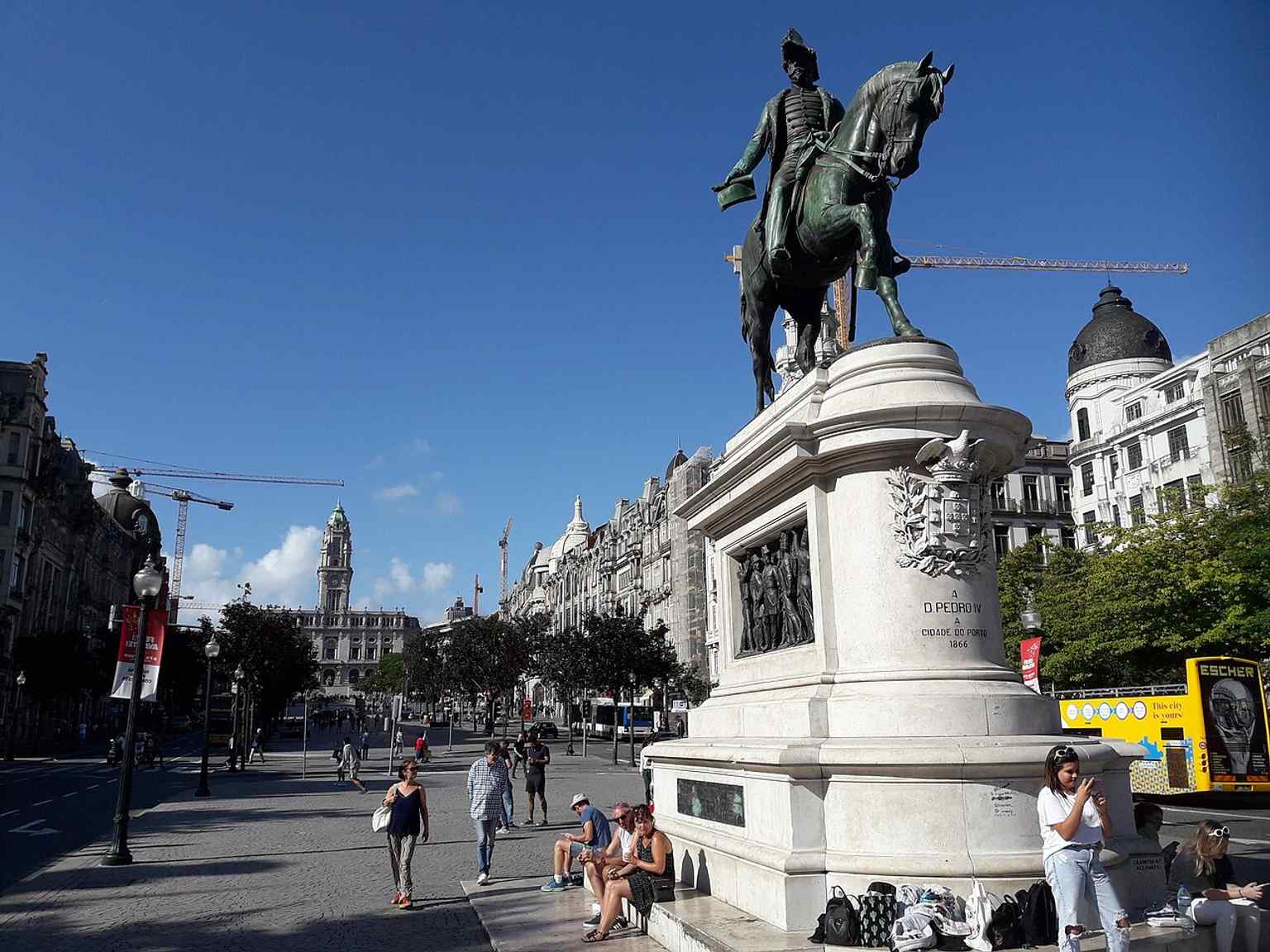
The statue of D. Pedro IV marks the square at the lower end of Avenida dos Aliados, where the city’s monumental center begins.Photo: Pere López Brosa, Wikimedia Commons, CC BY-SA 4.0. Cropped & resized. Even in the twenty-first century, Aliados kept provoking battles. When Álvaro Siza Vieira and Eduardo Souto Moura redesigned the avenue around the new metro station, they removed the old gardens, paved the central strip in granite, widened sidewalks, and tried to merge Aliados with Praça da Liberdade into one continuous urban space. Critics protested in two thousand and five around the Dom Pedro statue, carrying banners and even coffin-shaped installations to mourn what they called the death of the city’s heart. Porto does not do quiet disagreement.
So Aliados is more than grandeur. It is ambition, argument, demolition, and reinvention cast in stone. And from this boulevard-sized act of self-confidence, we head toward one of Porto’s slyer tricks: at Carmo Church, the city hides a very narrow house between sacred walls, an architectural evasion with excellent manners.
On your left, look for a pale granite church front rising in a rippling baroque shape, topped with stone statues and paired with a huge blue-and-white tile wall along its…Read moreShow less
Open dedicated page →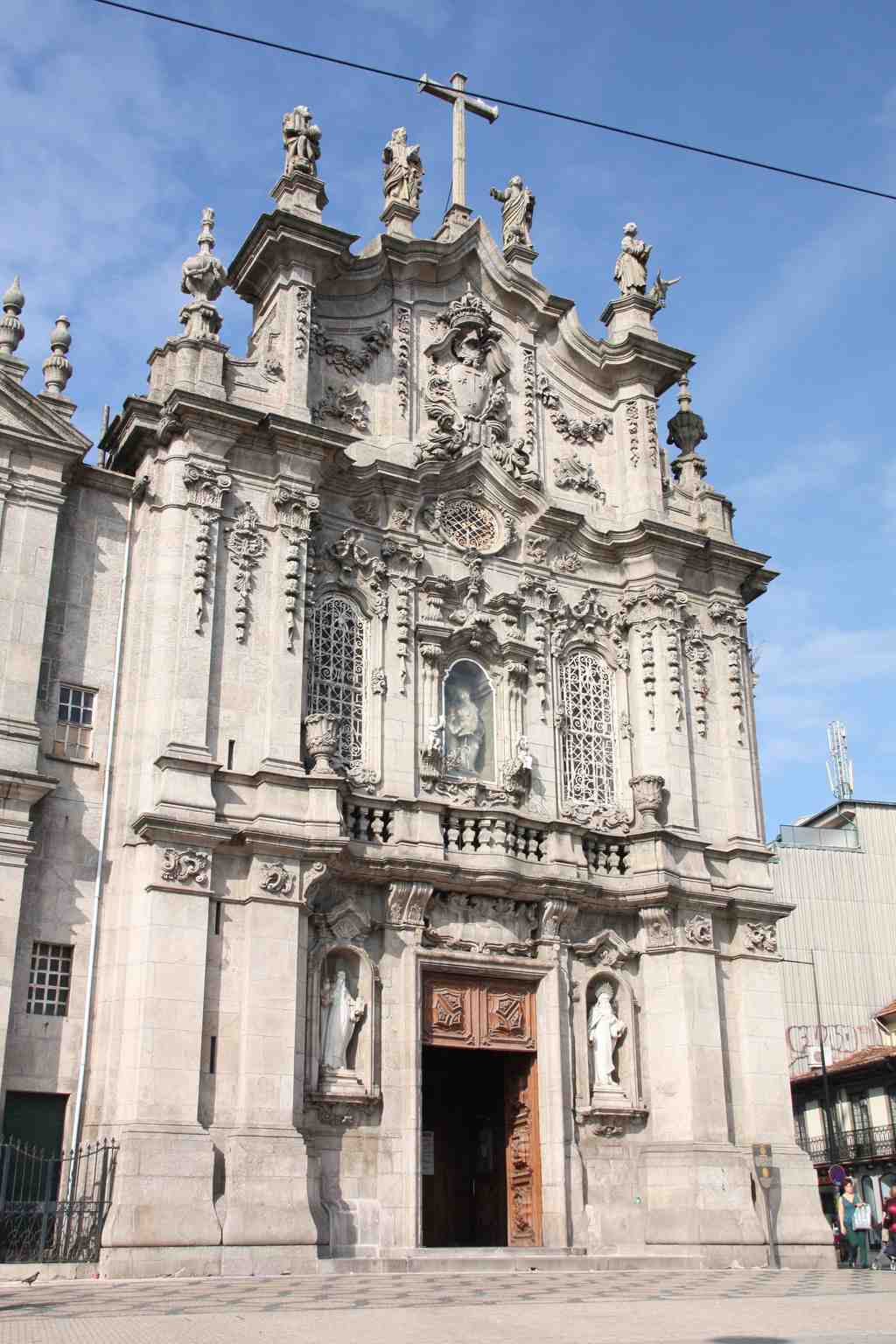
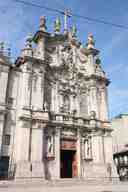
Carmo Church (Porto)Photo: User:Otourly, Wikimedia Commons, CC BY-SA 3.0. Cropped & resized. On your left, look for a pale granite church front rising in a rippling baroque shape, topped with stone statues and paired with a huge blue-and-white tile wall along its side.
This is Carmo Church, and it tells one of Porto’s favorite kinds of stories: the city runs into a rule, then answers it with elegance and a slightly mischievous workaround. In seventeen fifty-two, the Carmelite Third Order - a brotherhood of lay members linked to the Carmelite tradition - received this plot beside the older Carmelitas church. They wanted their own church here. There was just one snag: urban rules did not allow two churches to stand directly attached.
So architect José Figueiredo Seixas got clever. Between the two churches he inserted the Casa Escondida, the Hidden House, a wafer-thin building just over one and a half meters wide. Officially, problem solved. When the law says “not touching,” Porto apparently replies, “Fine... we’ll add a house.”
Look for the join between the two churches for a moment. Not the grand front, not the statues above... the narrow seam where most people assume there is only stone and symmetry. That tiny slice is the whole trick.
Local legend, naturally, improved the story. People said the house existed to prevent any improper contact between friars and nuns by stopping the two religious communities from sharing a wall. Charming story... but not documented fact. Over roughly two hundred and fifty years, the hidden house had much more practical lives. Historian Joel Cleto notes that chaplains stayed there, and at times doctors connected to the Carmelite hospital did too. There is even a tradition that the little space hosted discreet meetings in politically uneasy times. A legal loophole, then lodging, then whispered backdrop to city life. Very Porto.
Now lift your eyes to the facade itself. Seixas gave the church its late baroque and rococo drama between seventeen fifty-six and seventeen sixty-eight. Above the entrance, Saint Anne appears in relief, the church’s patron and a figure the Carmelites especially venerated. In the niches by the door stand the prophets Elijah and Elisha, spiritual models for the order. Higher up, the four Evangelists and the pointed finials show the pull of Italian baroque, especially the style associated with Nicolau Nasoni - a name that will matter again before long.
If you want the side of the church on your screen, have a glance now. That immense tile panel dates to nineteen twelve. Silvestre Silvestri designed it, Carlos Branco painted it, and workshops in Vila Nova de Gaia produced it. It tells scenes tied to the founding of the Carmelite order and Mount Carmel, and it turns the whole side elevation into a ceramic billboard for faith.
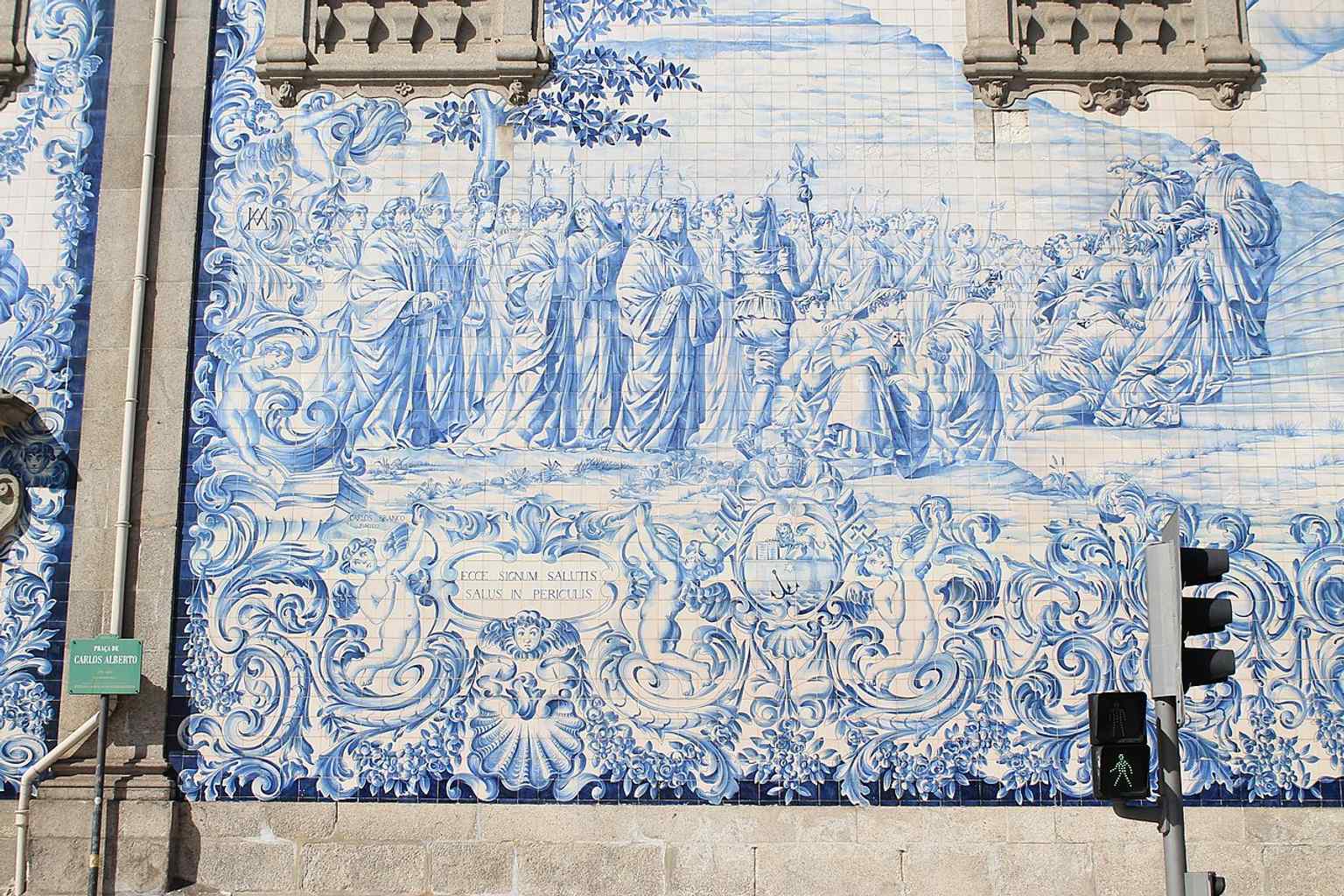
The famous blue-and-white azulejo wall beside the church — a 1912 tile panel celebrating Carmelite origins and Mount Carmel.Photo: Jsamwrites, Wikimedia Commons, CC BY-SA 4.0. Cropped & resized. Inside, the church continues with gilded carving, sculpture, and paintings arranged around the Passion of Christ. If you peek at the interior image in the app, you’ll see how lavishly the Carmelites answered restraint with ornament.
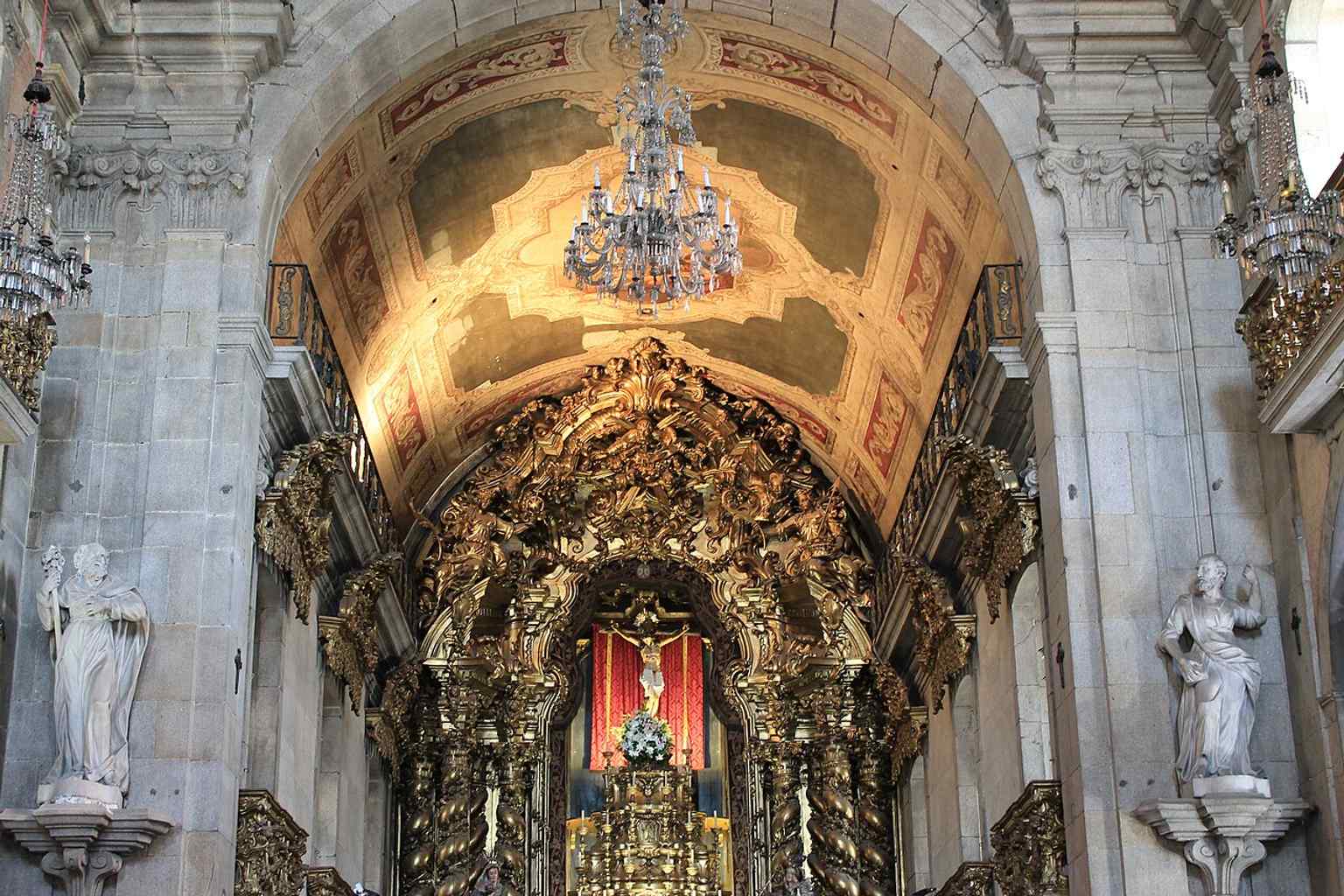
The main altar inside Carmo Church, where the rich gilded carving reflects the church’s ornate Rococo interior.Photo: John Samuel, Wikimedia Commons, CC BY-SA 4.0. Cropped & resized. The pair of churches, together with their almost invisible house, gained national monument status in two thousand and thirteen, and since two thousand and eighteen the Casa Escondida has opened to visitors instead of just teasing them from the outside.
That is the pleasure here: realizing the strangest part was never hidden very well... only politely overlooked. When you’re ready, continue about five minutes to Lello Bookstore, where Porto hides another spectacle in plain sight. If you want to come back inside later, the church generally opens from nine thirty A-M to five P-M.
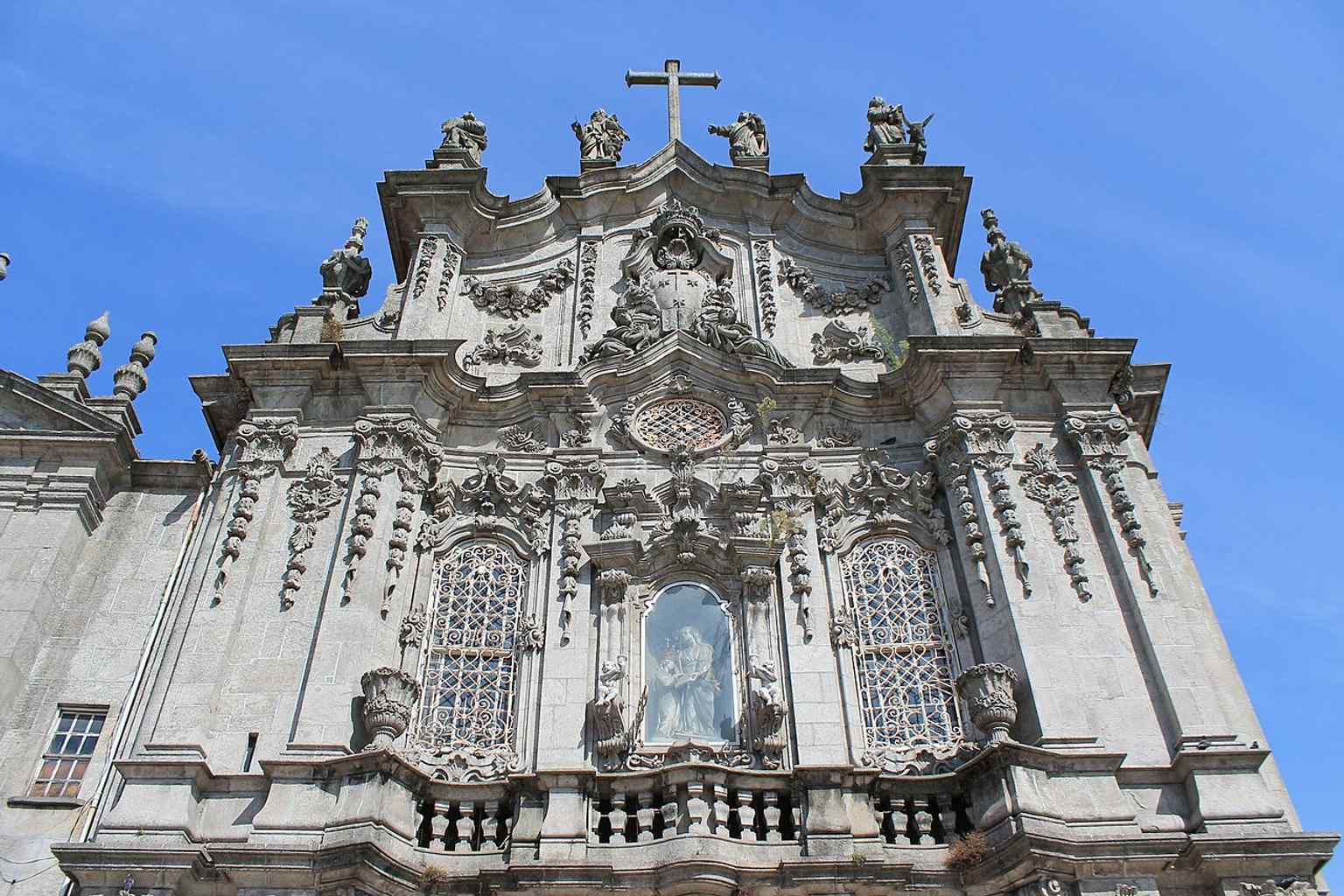
The paired Carmo and Carmelitas churches side by side — a rare urban workaround that created one of Porto’s most curious historic ensembles.Photo: Jsamwrites, Wikimedia Commons, CC BY-SA 4.0. Cropped & resized. 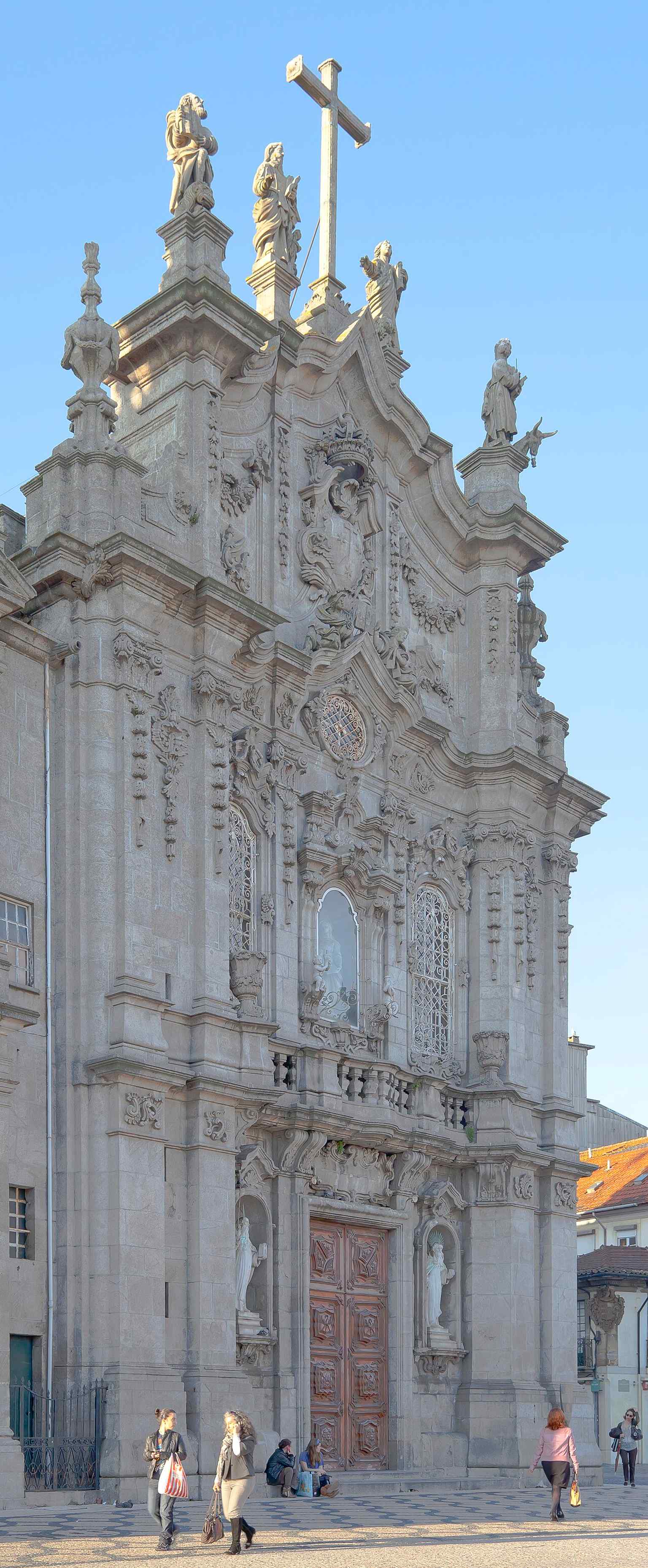
The Carmo Church facade in full height, showing the ornate Baroque-Rococo front that defines this landmark on Rua do Carmo.Photo: Diego Delso, Wikimedia Commons, CC BY-SA 3.0. Cropped & resized. 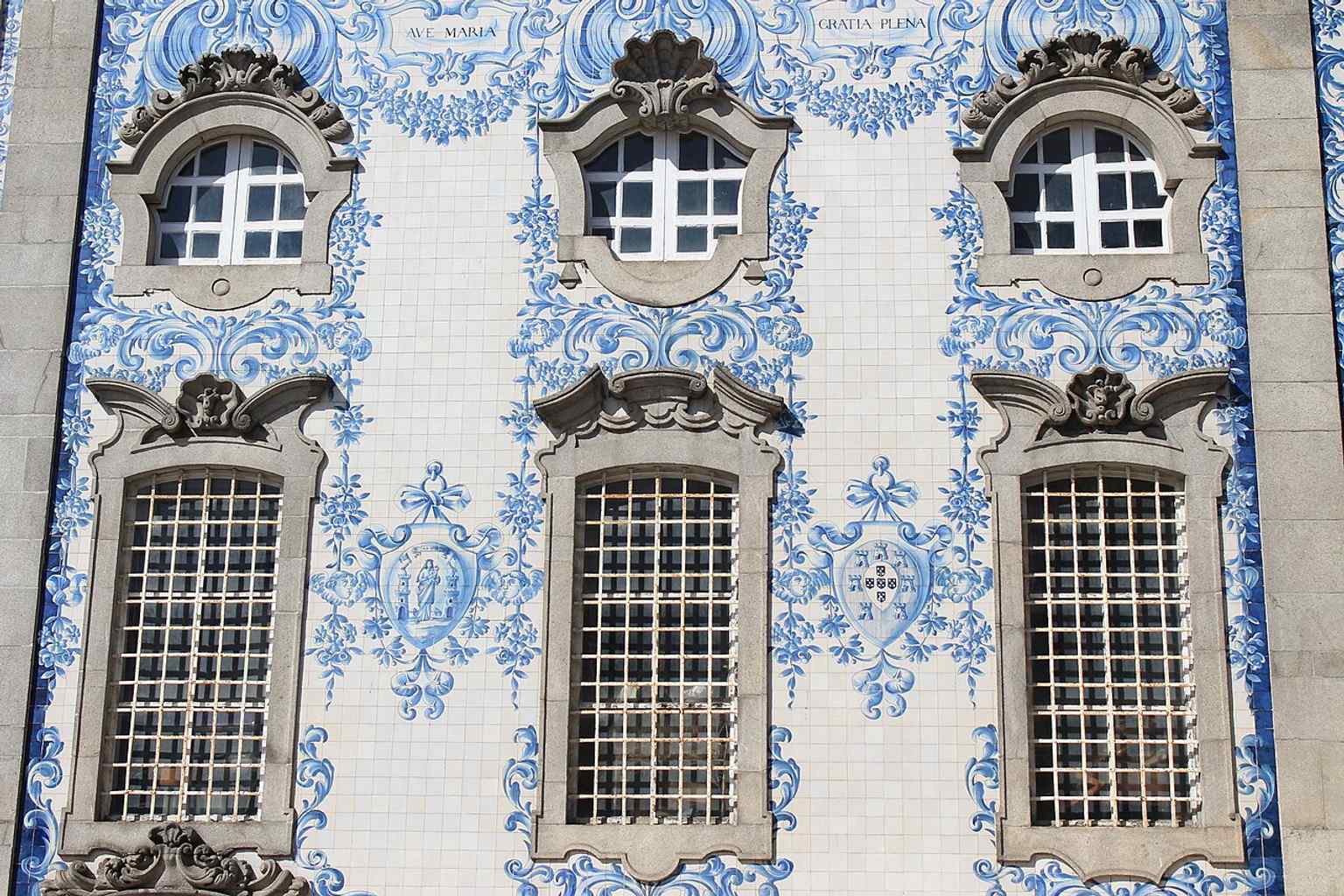
Another view of the vast azulejo-covered side wall, one of the church’s most striking features when walking past the complex.Photo: John Samuel, Wikimedia Commons, CC BY-SA 4.0. Cropped & resized. 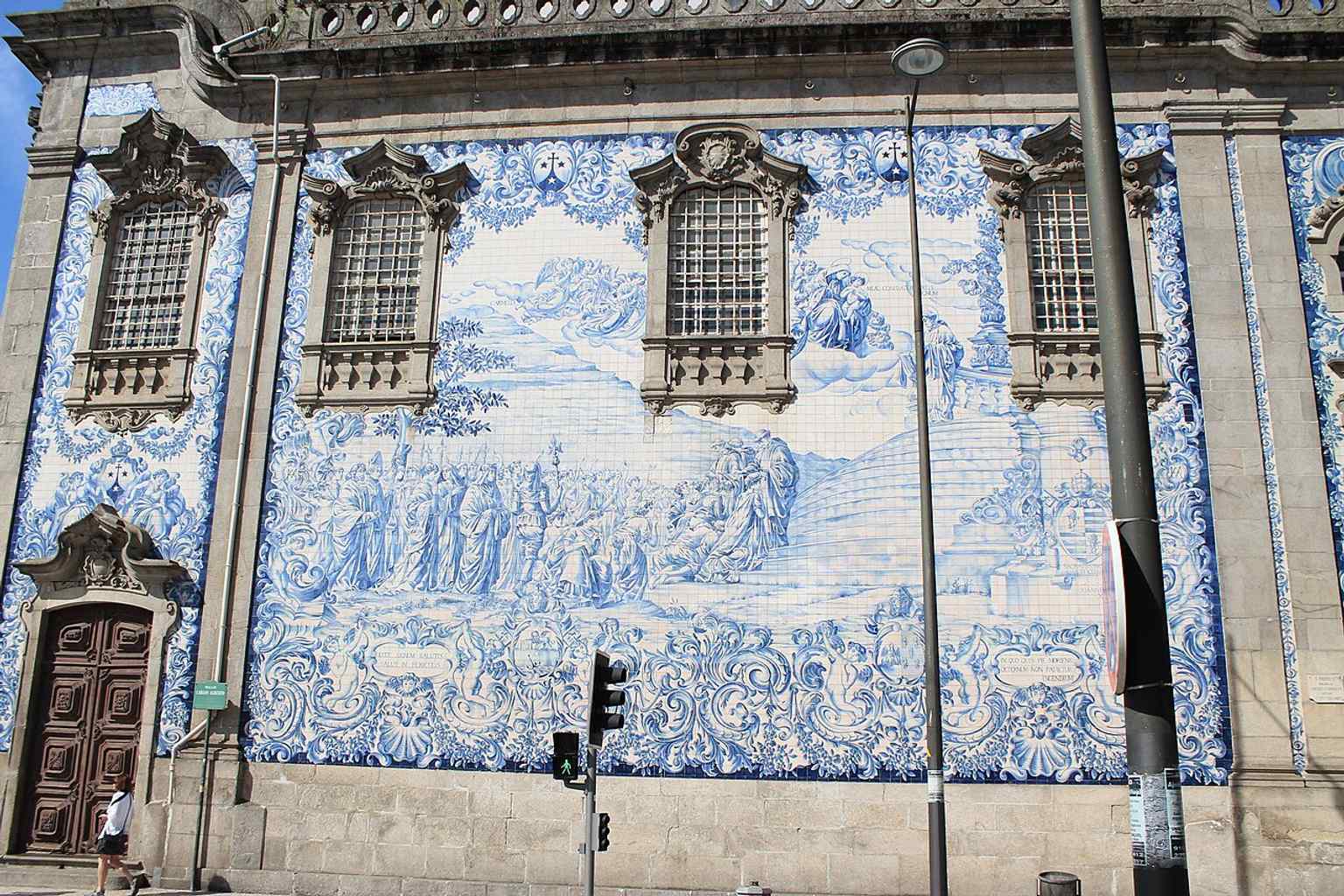
A closer look at the tiled facade, highlighting the monumental 20th-century ceramic decoration on the church’s side wall.Photo: John Samuel, Wikimedia Commons, CC BY-SA 4.0. Cropped & resized. 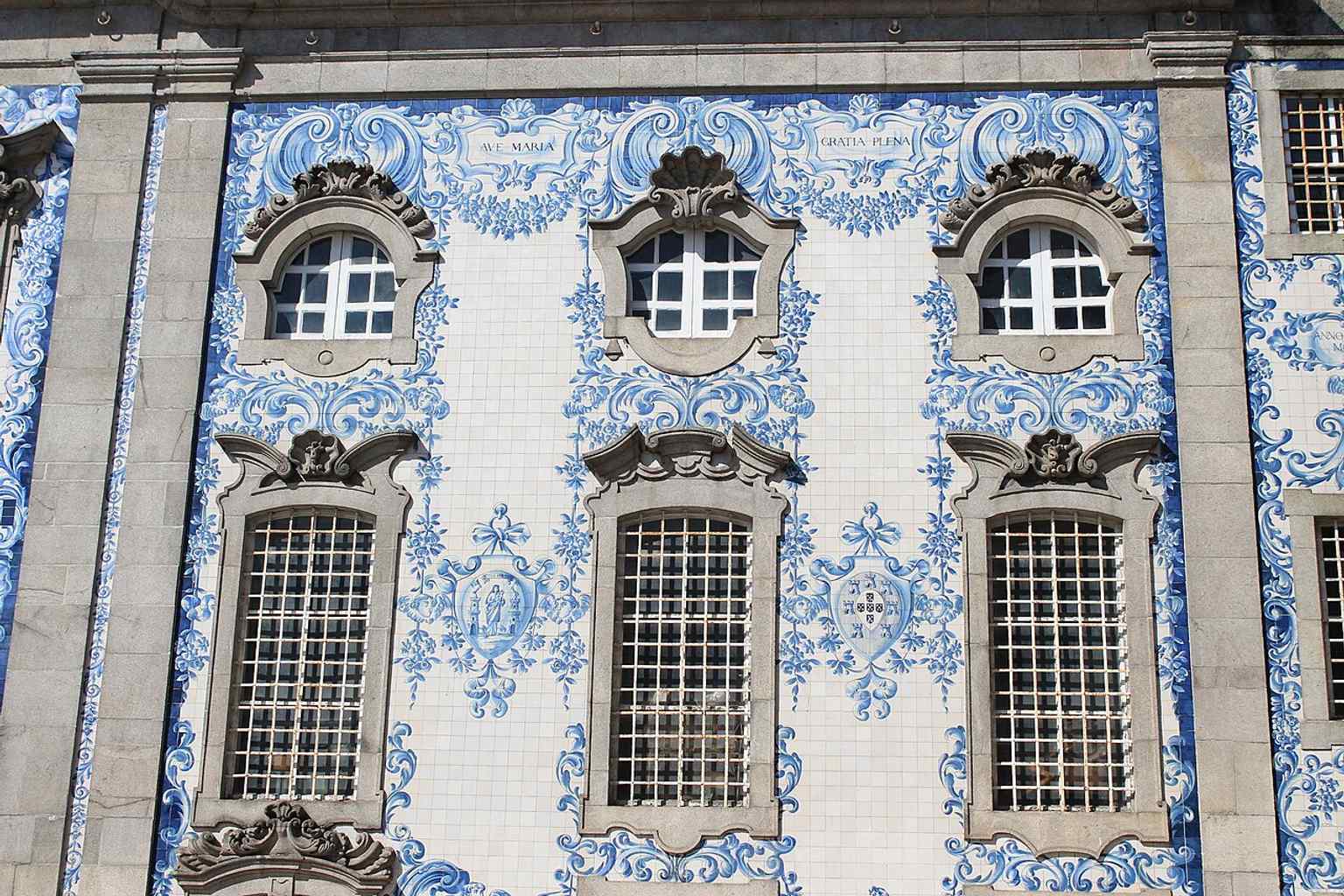
The azulejo panel from a different angle, emphasizing how the side elevation became a landmark in its own right.Photo: John Samuel, Wikimedia Commons, CC BY-SA 4.0. Cropped & resized. 
A broader interior perspective that helps convey the church’s richly layered sacred space beyond the facade.Photo: John Samuel, Wikimedia Commons, CC BY-SA 4.0. Cropped & resized. 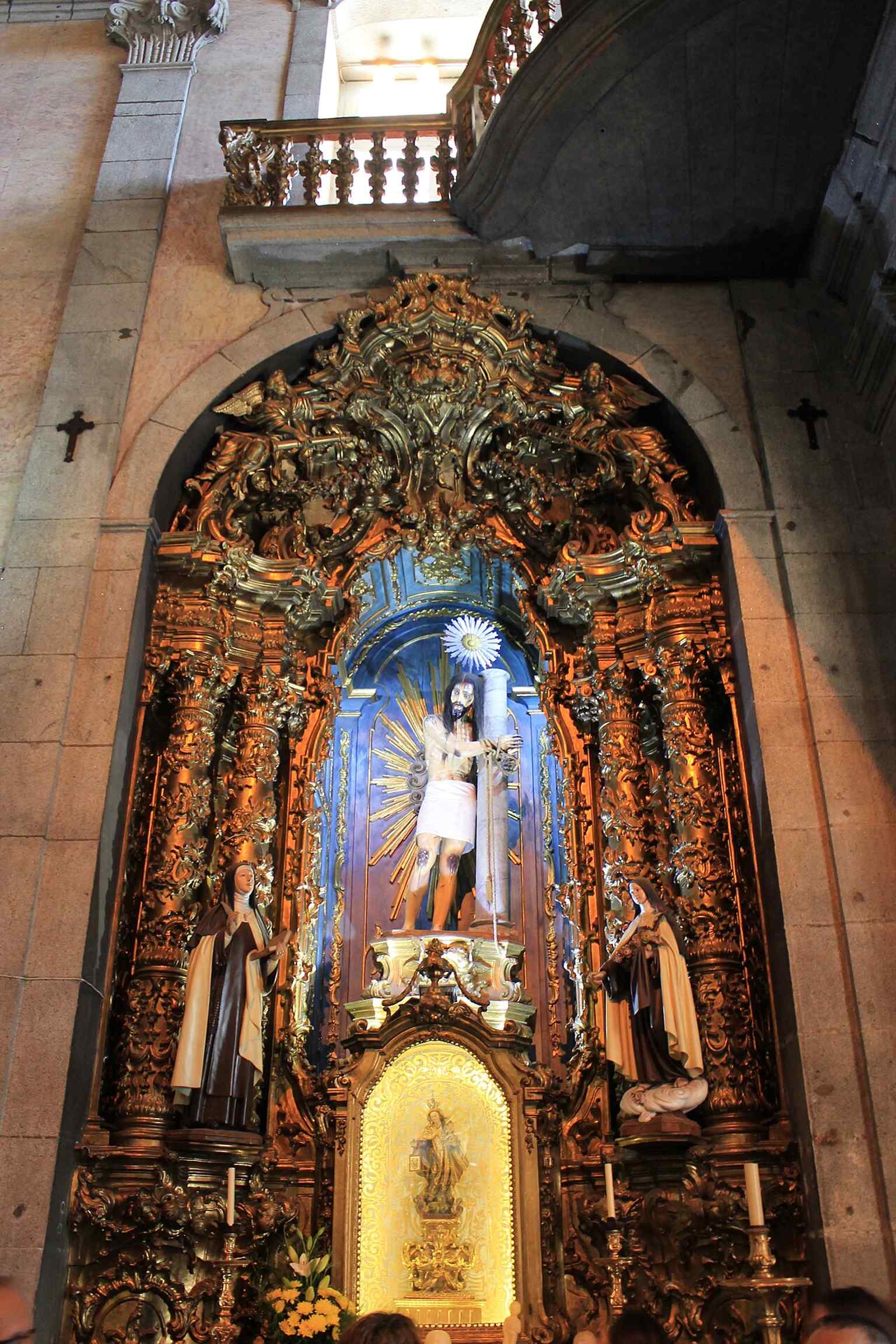
One of the interior views that reveals how the church’s artwork and liturgical furnishings fill the nave with baroque detail.Photo: John Samuel, Wikimedia Commons, CC BY-SA 4.0. Cropped & resized. 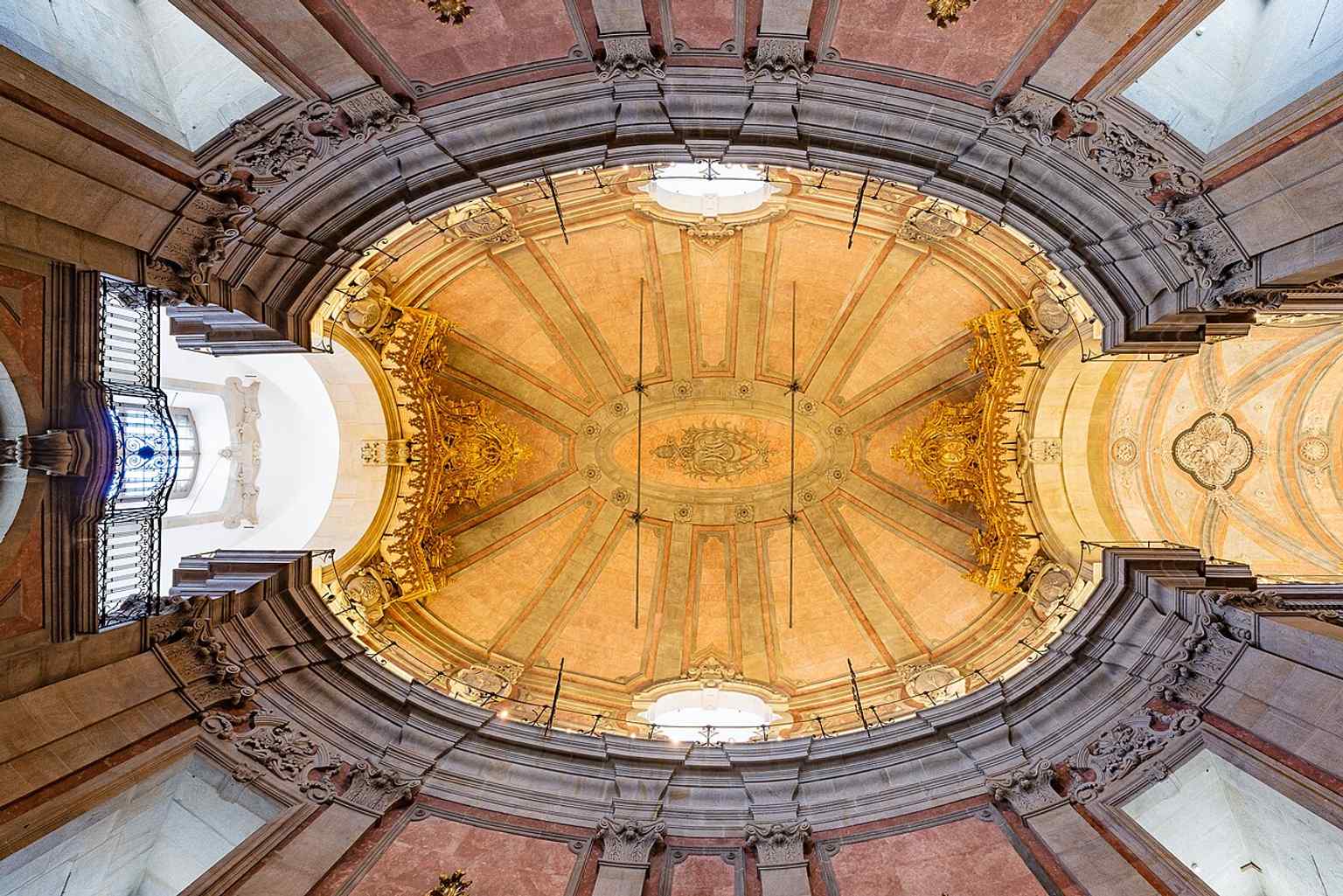
The painted ceiling, part of the church’s elaborate interior program that leads the eye upward above the gilded altars.Photo: T meltzer, Wikimedia Commons, CC BY-SA 4.0. Cropped & resized. 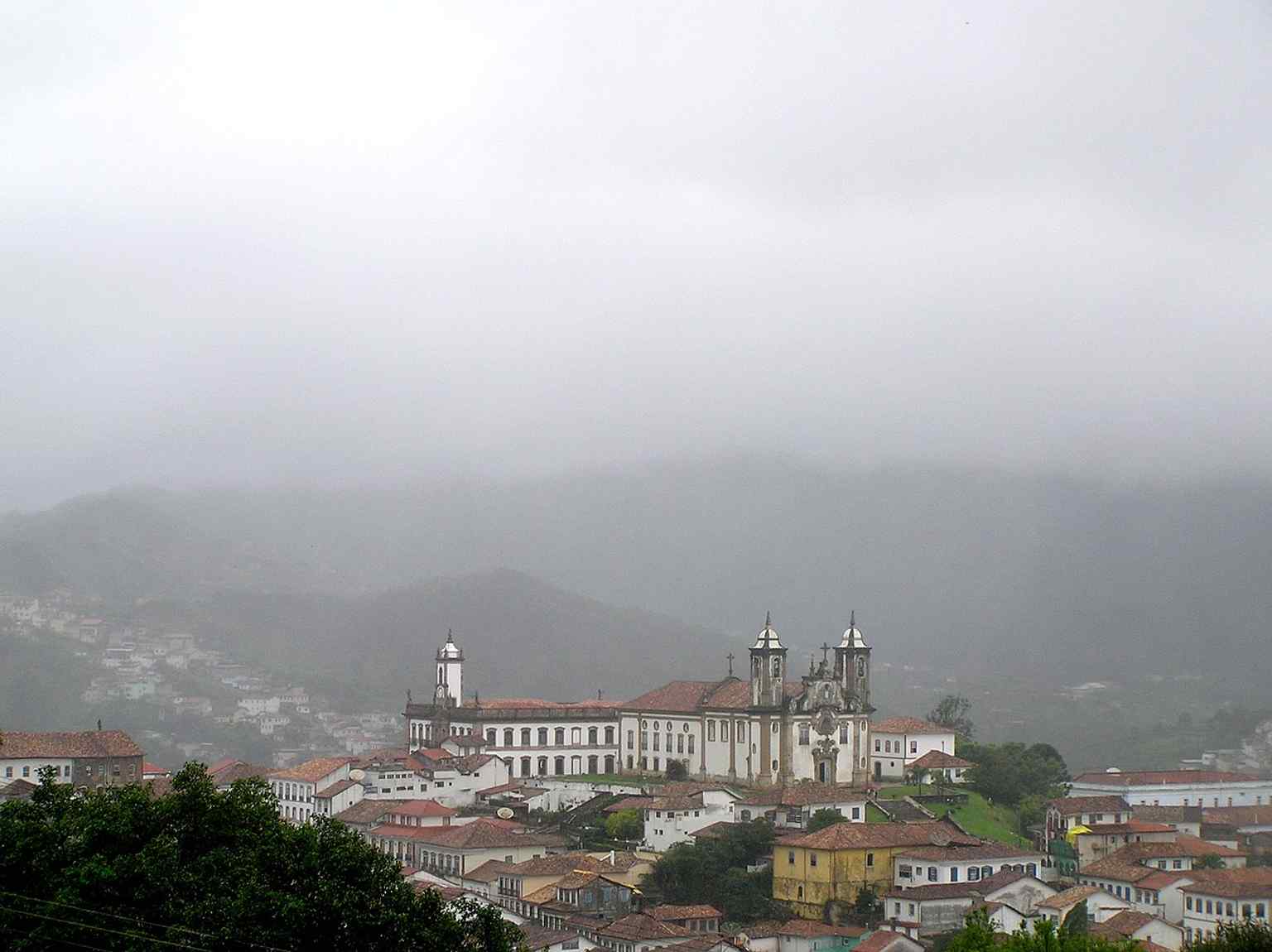
A historic city view where Carmo Church appears in the urban skyline, underscoring its long-standing place in Porto’s center.Photo: Morio, Wikimedia Commons, CC BY-SA 3.0. Cropped & resized. On your right, look for a narrow stone façade with a broad arched entrance, lace-like neo-Gothic trim, and the words “Lello e Irmão” set beneath the three upper windows. This is…Read moreShow less
Open dedicated page →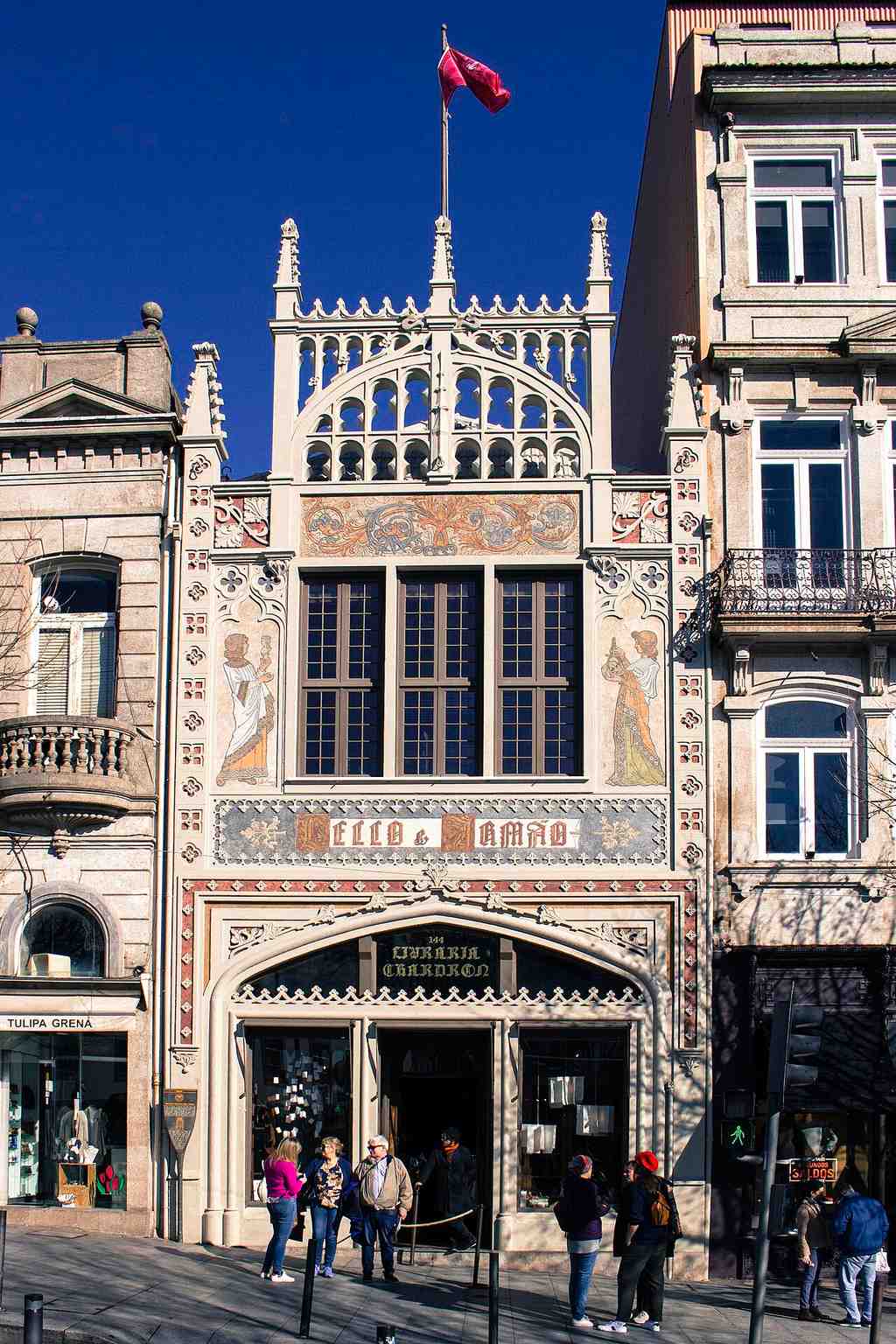
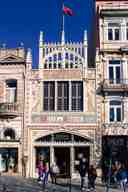
Lello BookstorePhoto: Bene Riobó, Wikimedia Commons, CC BY-SA 4.0. Cropped & resized. On your right, look for a narrow stone façade with a broad arched entrance, lace-like neo-Gothic trim, and the words “Lello e Irmão” set beneath the three upper windows.
This is Livraria Lello, imagination made architectural: a bookstore where the building seems to have read too many novels and decided to become one. It is also a very Porto kind of idea... a business that learned early that selling books could mean selling beauty, myth, and a little well-managed awe.
The story starts in eighteen sixty-nine with Ernesto Chardron, a French bookseller and publisher who opened his shop on Rua dos Clérigos. Chardron mattered because he did more than stock shelves. He published major Portuguese writers, including Camilo Castelo Branco, and helped shape what people in this city could read and argue about. He died young, at forty-five, but the business survived, changed hands, and in eighteen ninety-four José Pinto de Sousa Lello bought it. José and his brother António kept the older Chardron legacy, then did something bolder: they gave the firm a new body here on Rua das Carmelitas.
In nineteen oh six, engineer Francisco Xavier Esteves opened this building, and Porto’s cultural crowd turned up for the inauguration: Guerra Junqueiro, Abel Botelho, Aurélio da Paz dos Reis, Afonso Costa. Not bad for a shop opening. Most bookstores are pleased if someone remembers to buy a bookmark.
Take a look up at the façade. The Belgian painter Joseph Bielmann placed figures representing Art and Science beside the windows, as if the place needed formal introductions. The whole front works like a stage set, announcing that inside, books are not merely merchandise. They are actors.
If you check the image on your screen, you’ll see the famous red staircase curling through the interior like something halfway between a ribbon and a dare. That staircase helped make Lello one of the world’s most admired bookstores, but the deeper story is less obvious: this place has always been a publisher, a family enterprise, and a machine for reinvention.
The famous red staircase, often cited as the store’s most photographed feature and part of the mythic appeal behind its global fame.Photo: Old Pionear, Wikimedia Commons, CC BY-SA 4.0. Cropped & resized. Look at the other image when you like, and notice the great glass ceiling. It carries the motto Decus in Labore, meaning “dignity in work.” In twenty sixteen, conservators dismantled that skylight for the first time ever: fifty-five glass panels, about eight meters long and three and a half meters wide altogether, created by the Dutch artist Gerardus Samuel van Krieken. After restoration, the interior recovered a brightness people had nearly forgotten.
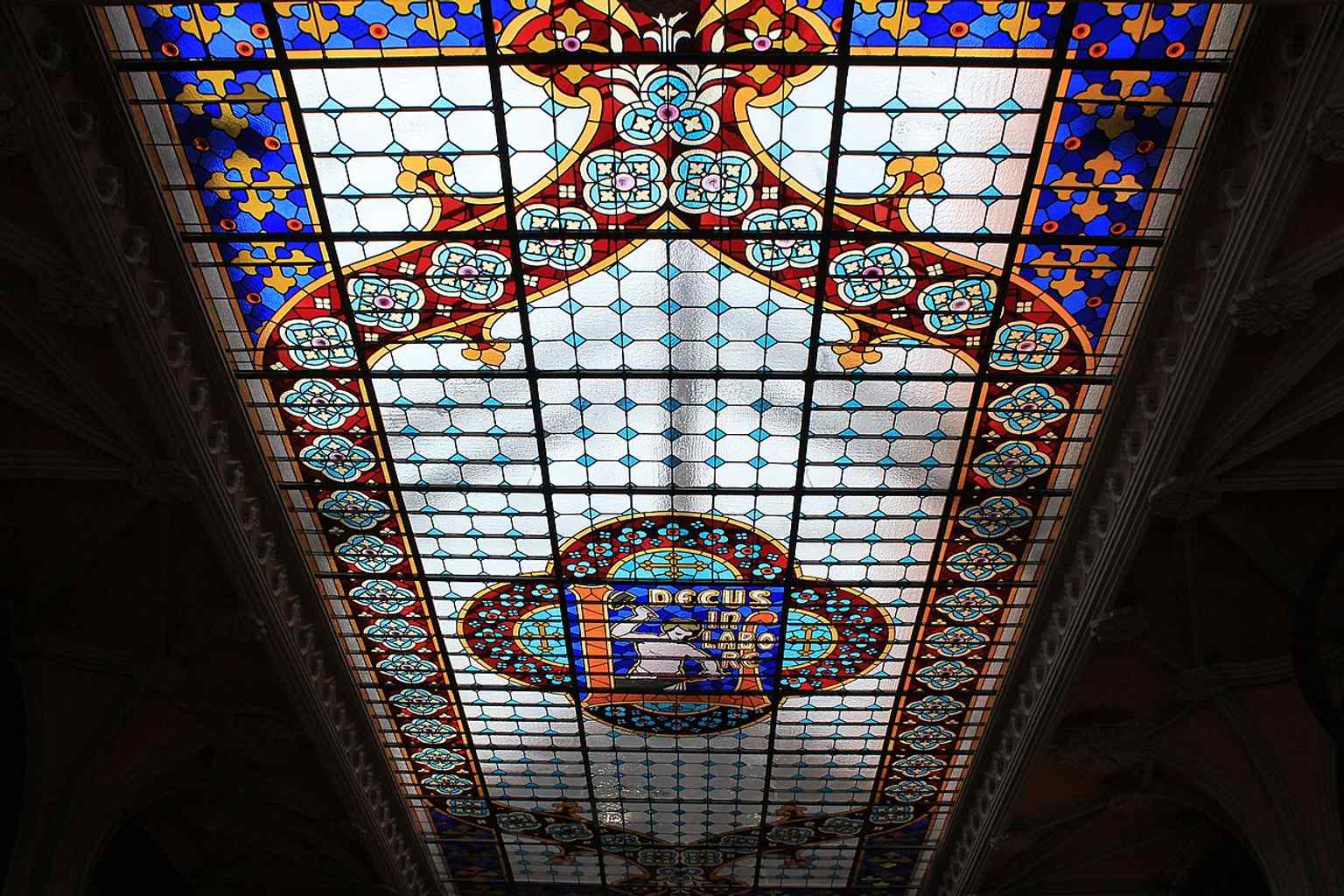
The famous glass ceiling, a key part of the 2016 restoration that revived the light once lost beneath the shop’s enormous skylight.Photo: John Samuel, Wikimedia Commons, CC BY-SA 4.0. Cropped & resized. Then came modern pressure. In twenty fifteen, Lello began charging entry, with the ticket deducted from a book purchase, to control visitor numbers and fund conservation. Purists grumbled; sales tripled in three months. Porto, as usual, found a way to turn strain into strategy.
And yes, the Harry Potter legend hovered here for years. In twenty twenty, J. K. Rowling said she had never entered the bookstore and denied it inspired Hogwarts. Oddly enough, that only clarified the truth: Lello does not need borrowed magic. It manufactures its own.
In about five minutes, head to the Church and Tower of the Clerics, where Porto trades literary fantasy for a stone landmark that still poses a fine question... when this city builds upward, is it aiming at heaven, status, or simply spectacle? Lello is generally open daily from nine in the morning to seven thirty in the evening.
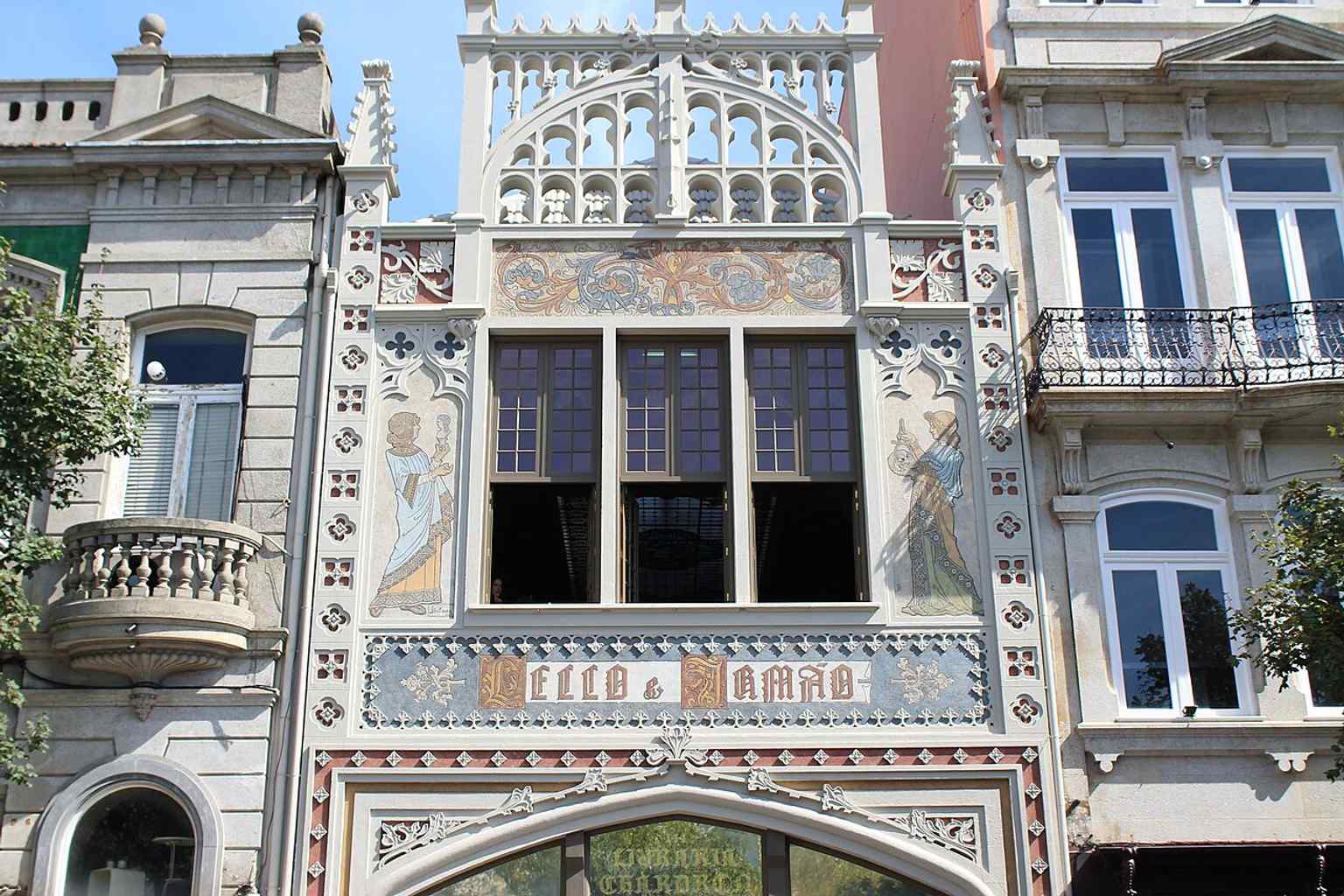
The iconic neo-Gothic façade on Rua das Carmelitas, whose original 1906 design helped make Lello one of the world’s most admired bookstores.Photo: John Samuel, Wikimedia Commons, CC BY-SA 4.0. Cropped & resized. 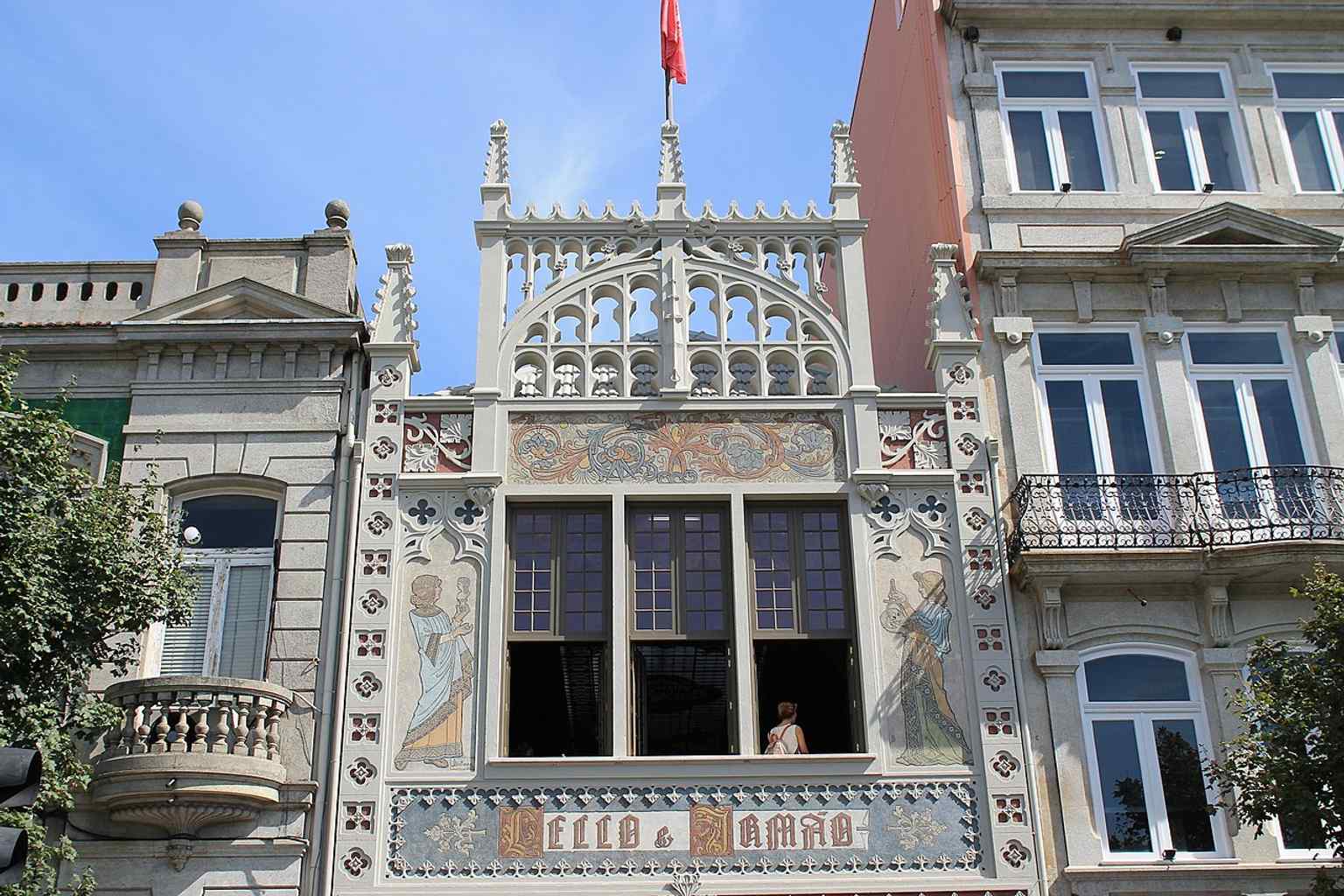
A clear street-level view of the bookstore’s ornate frontage, with the arched entrance and decorative stonework that define its historic character.Photo: John Samuel, Wikimedia Commons, CC BY-SA 4.0. Cropped & resized. 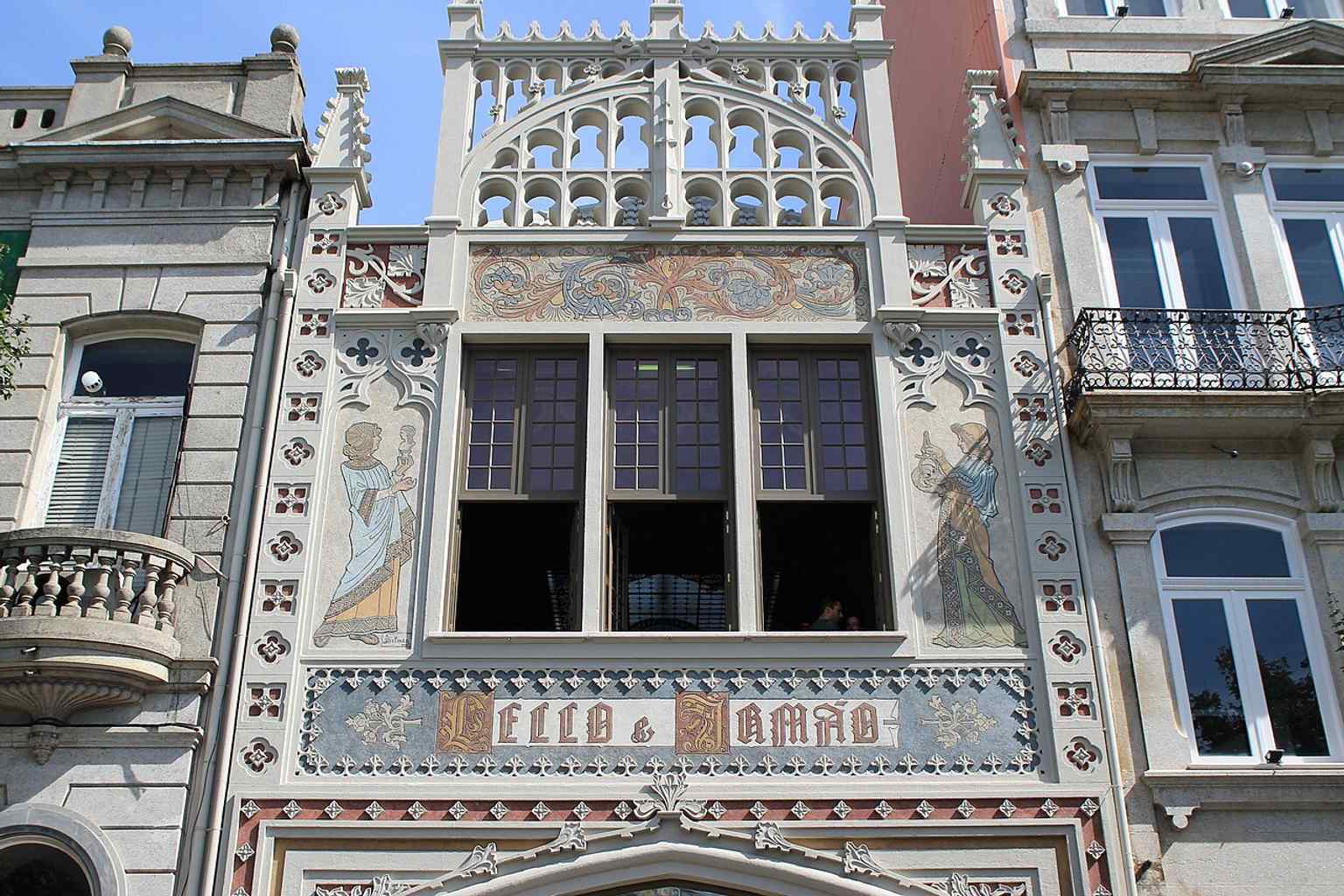
Another exterior angle showing how the building stands out in Porto’s historic center, where Lello has drawn visitors for generations.Photo: John Samuel, Wikimedia Commons, CC BY-SA 4.0. Cropped & resized. 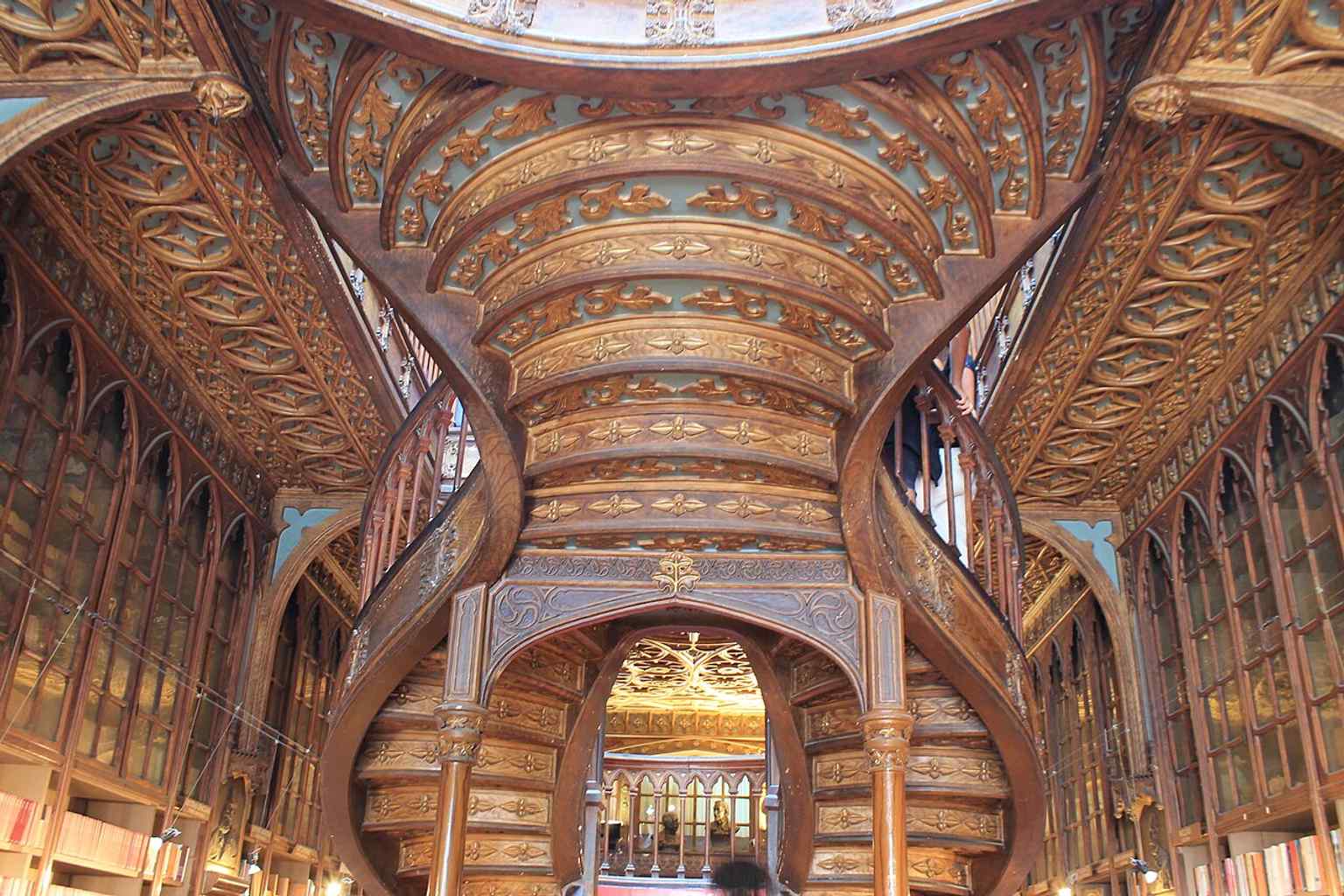
A wider interior view that combines the staircase and upper galleries, capturing the theatrical layout that impressed early visitors in 1906.Photo: John Samuel, Wikimedia Commons, CC BY-SA 4.0. Cropped & resized. 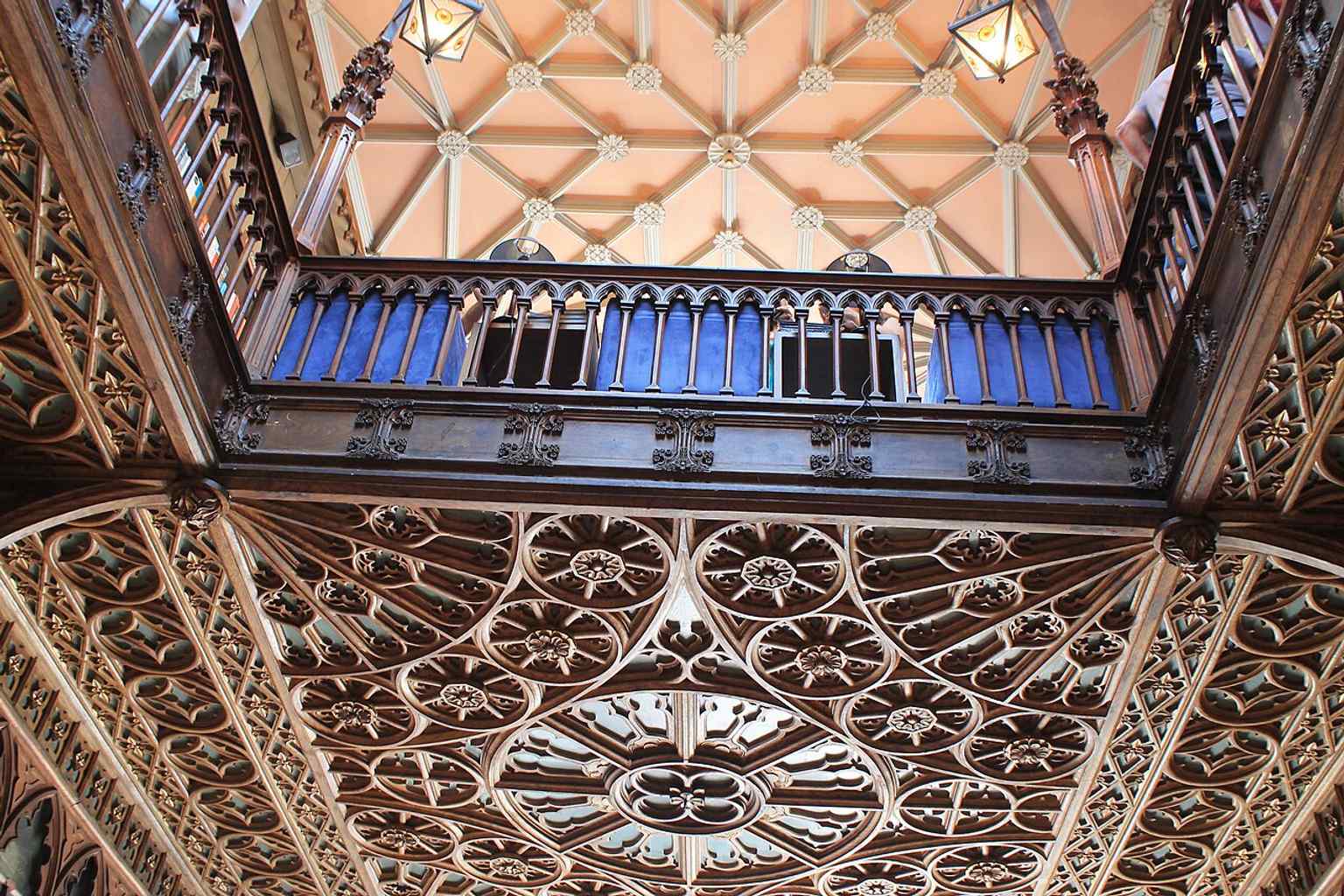
An elegant interior perspective showing the layered bookshelves and neo-Gothic detailing that make the shop feel more like a literary monument.Photo: John Samuel, Wikimedia Commons, CC BY-SA 4.0. Cropped & resized. 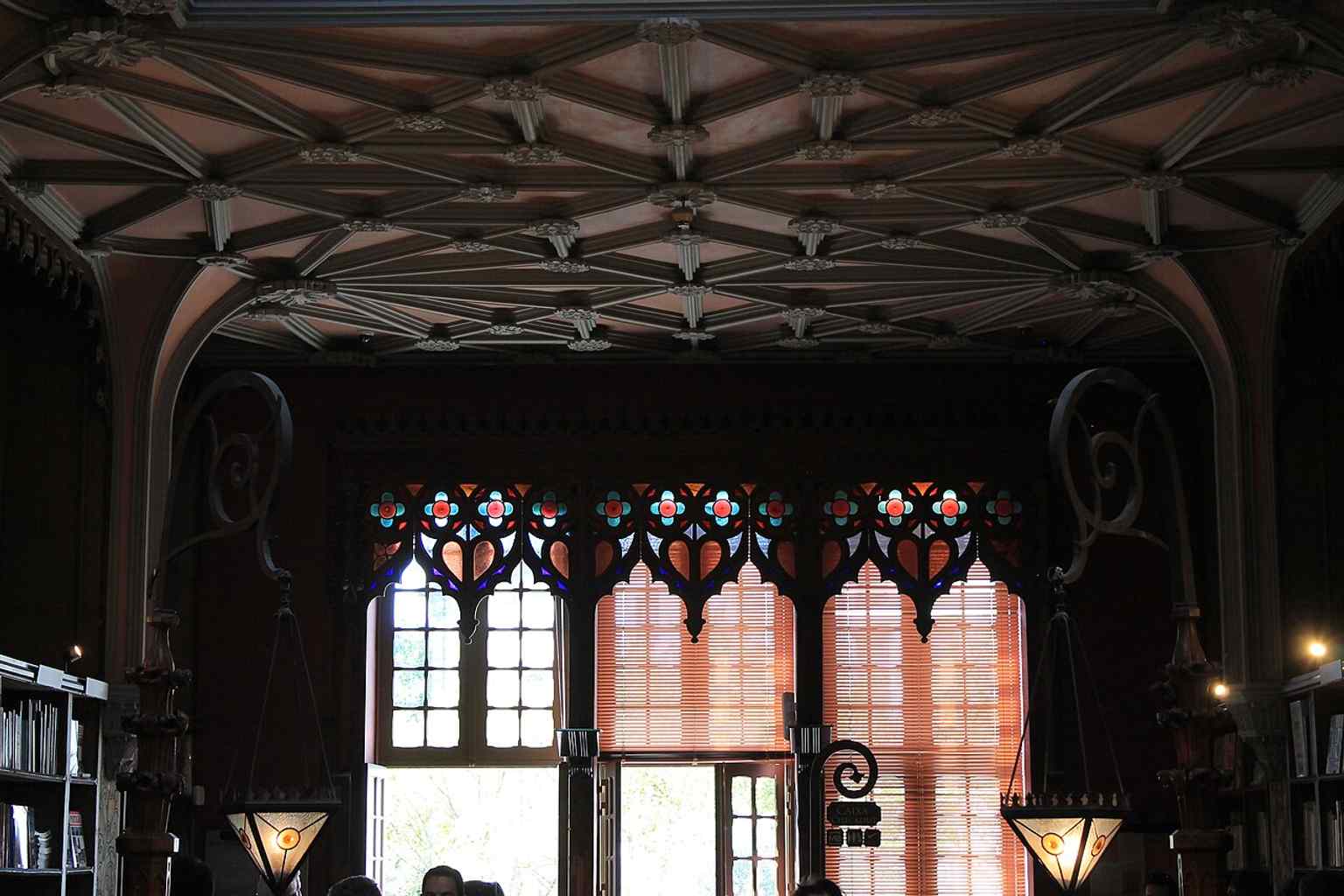
A deep view into the reading space, useful for showing the bookstore’s restored interior and its atmosphere as a living cultural venue.Photo: John Samuel, Wikimedia Commons, CC BY-SA 4.0. Cropped & resized. 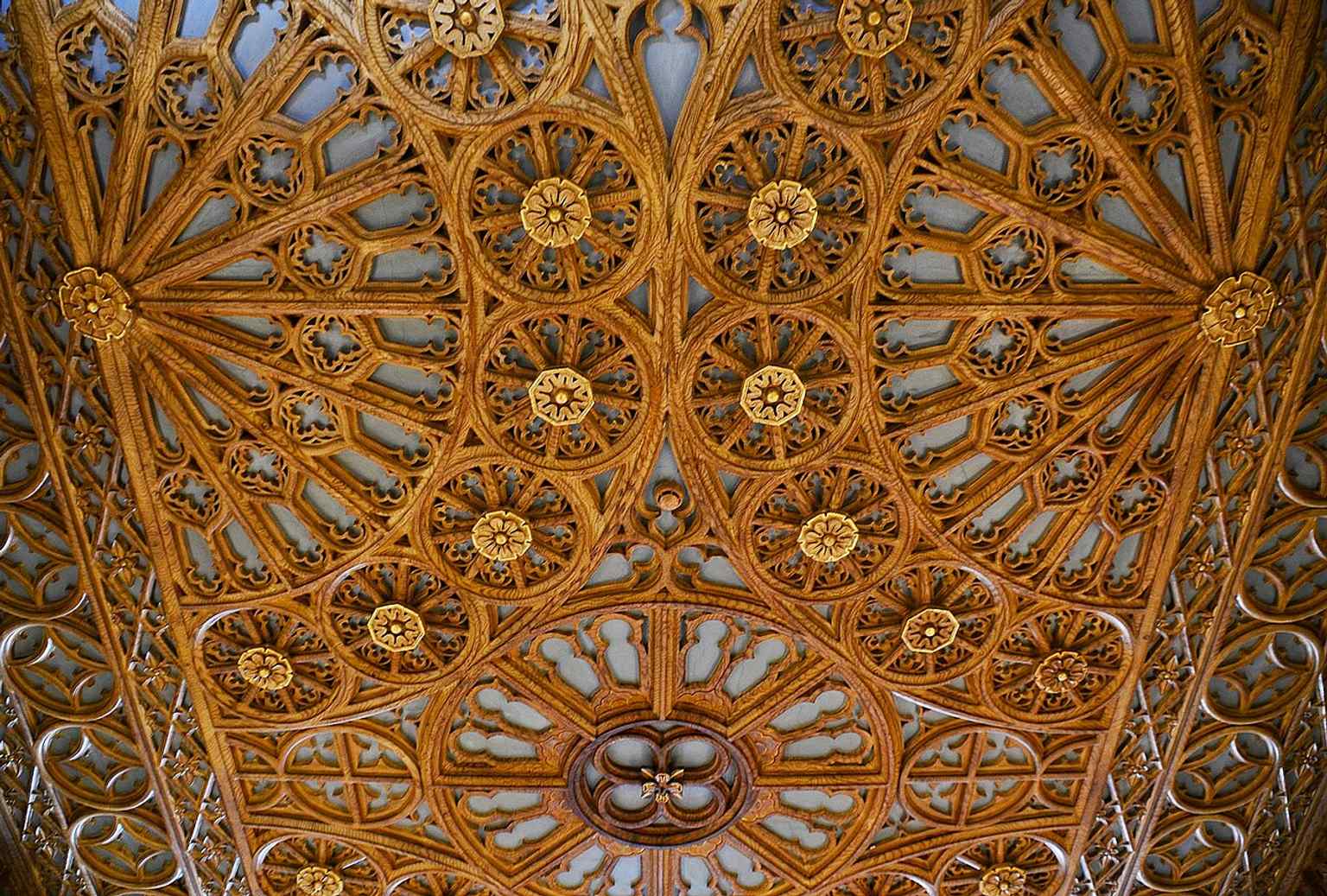
The decorated ceiling and skylight area, echoing the 2016 restoration that brightened the interior after work on the glass roof.Photo: Old Pionear, Wikimedia Commons, CC BY-SA 4.0. Cropped & resized. 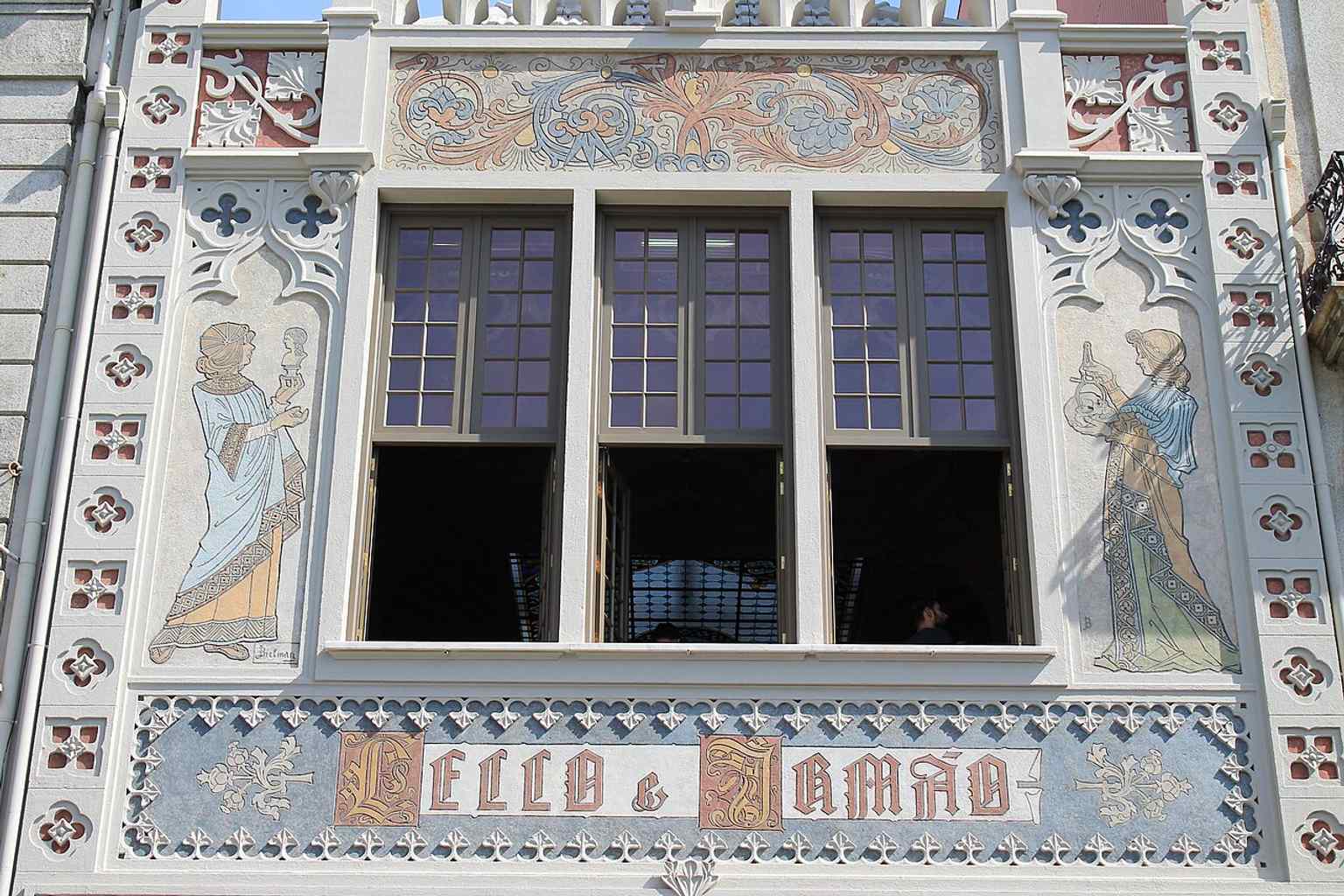
A close look at one of Lello’s signature windows, reflecting the ornate neo-Gothic craftsmanship seen throughout the building.Photo: John Samuel, Wikimedia Commons, CC BY-SA 4.0. Cropped & resized. 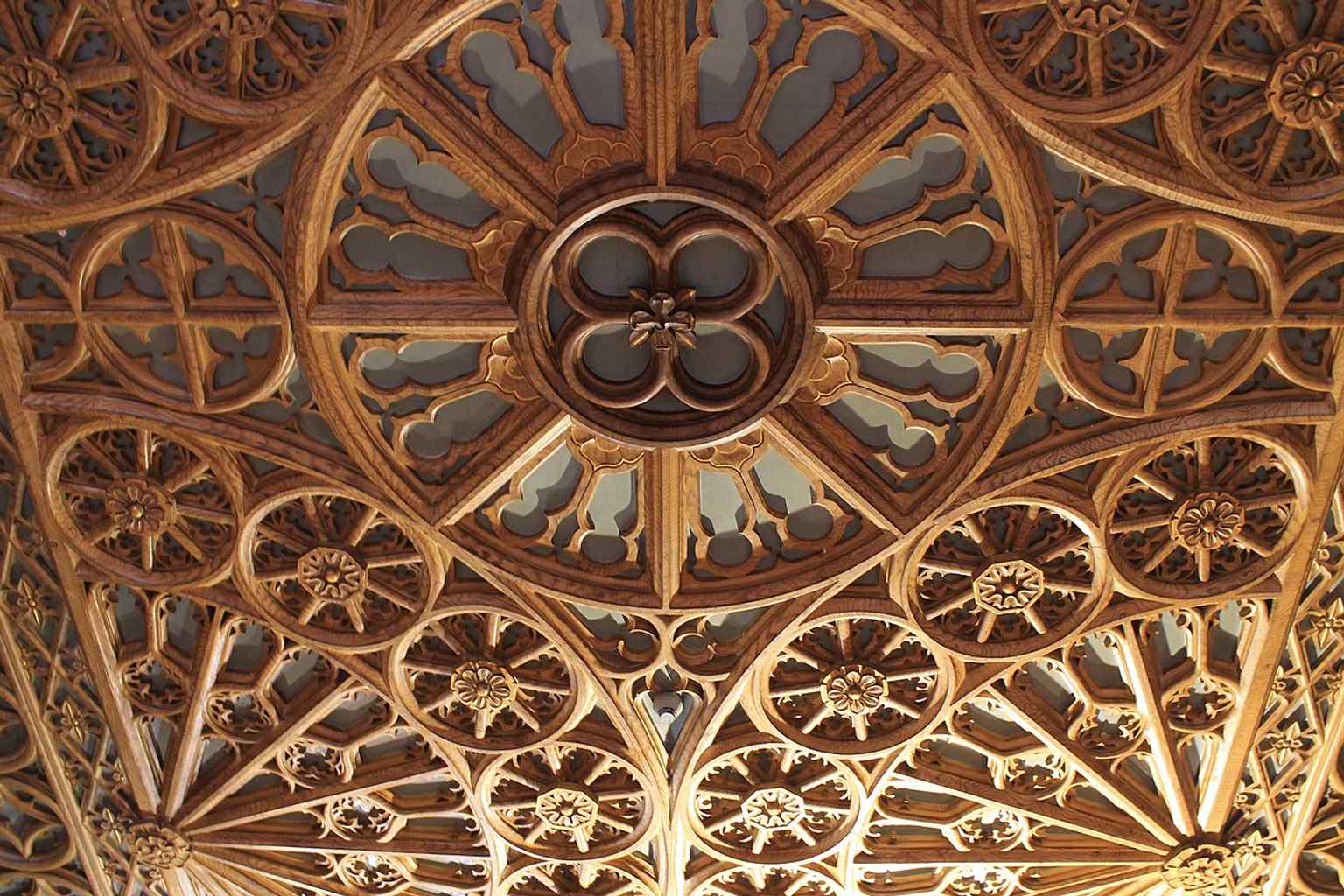
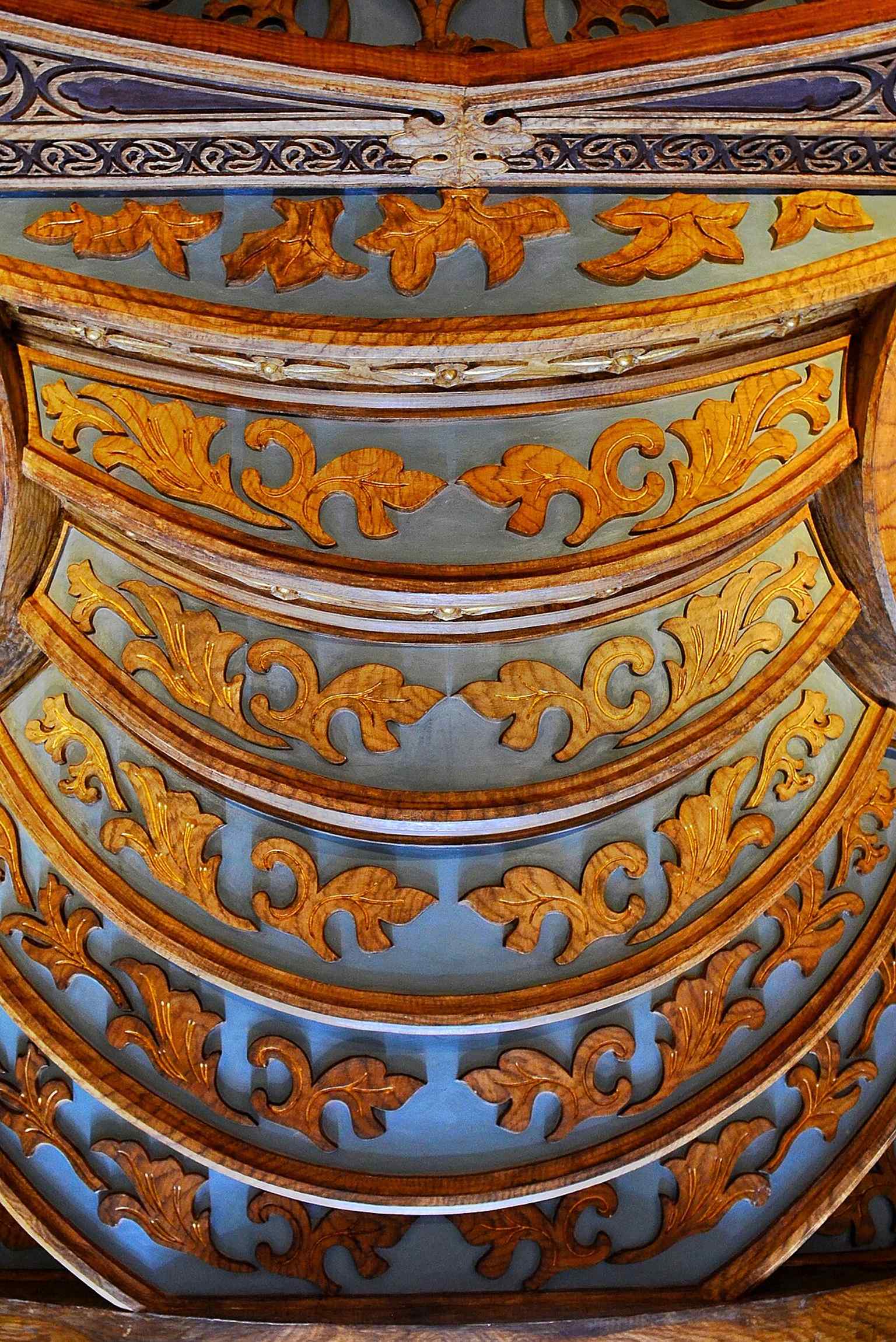
Wood-carved interior ornamentation that highlights the fine decorative work mentioned in descriptions of the bookstore’s architecture.Photo: John Samuel, Wikimedia Commons, CC BY-SA 4.0. Cropped & resized. 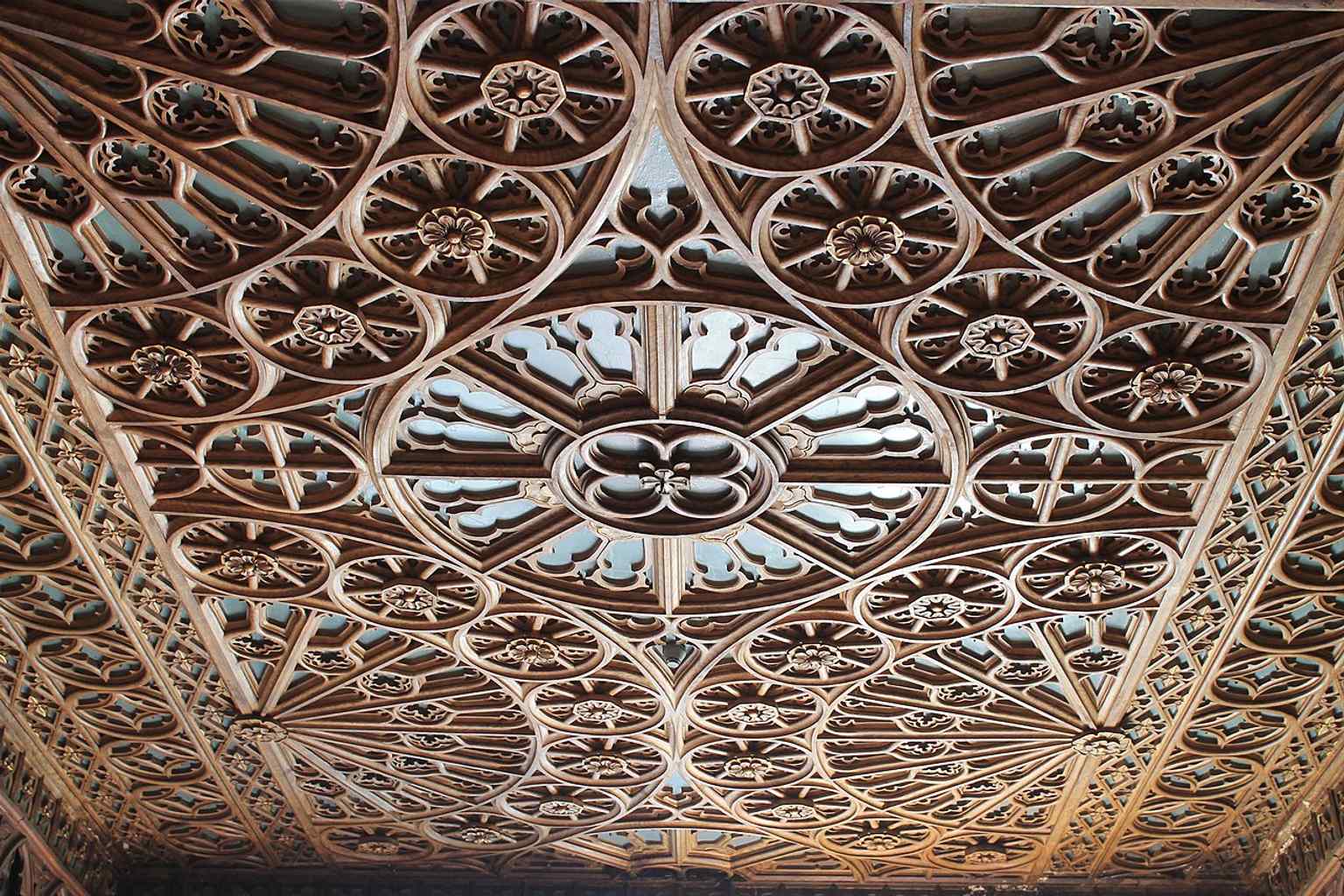
A richly carved wooden ceiling detail, showing the handcrafted artistry that gives Lello its historic, bookish atmosphere.Photo: John Samuel, Wikimedia Commons, CC BY-SA 4.0. Cropped & resized. 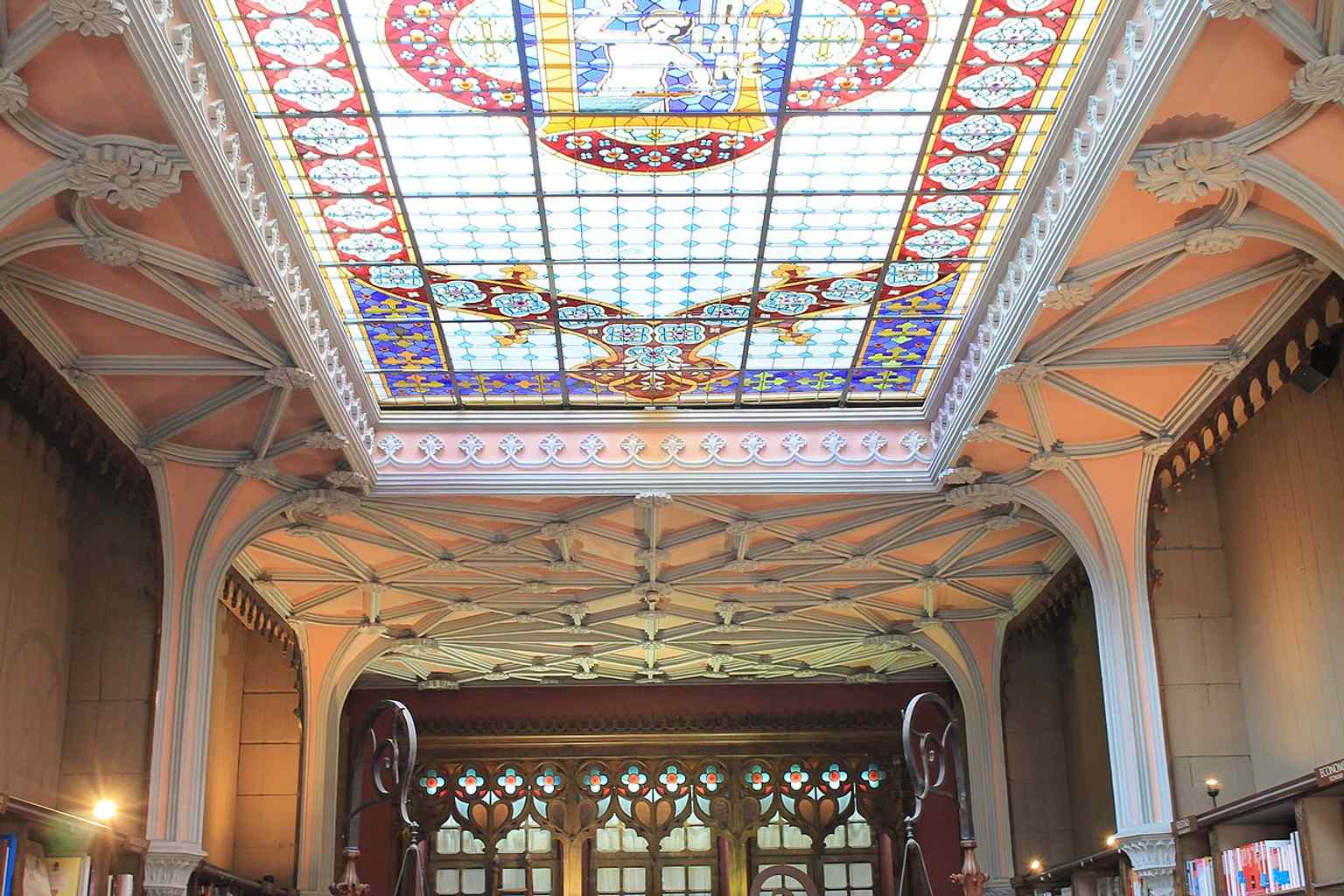
The restored glass ceiling and surrounding windows, tying directly to the landmark 2016 conservation work on the rooftop vitral.Photo: John Samuel, Wikimedia Commons, CC BY-SA 4.0. Cropped & resized. 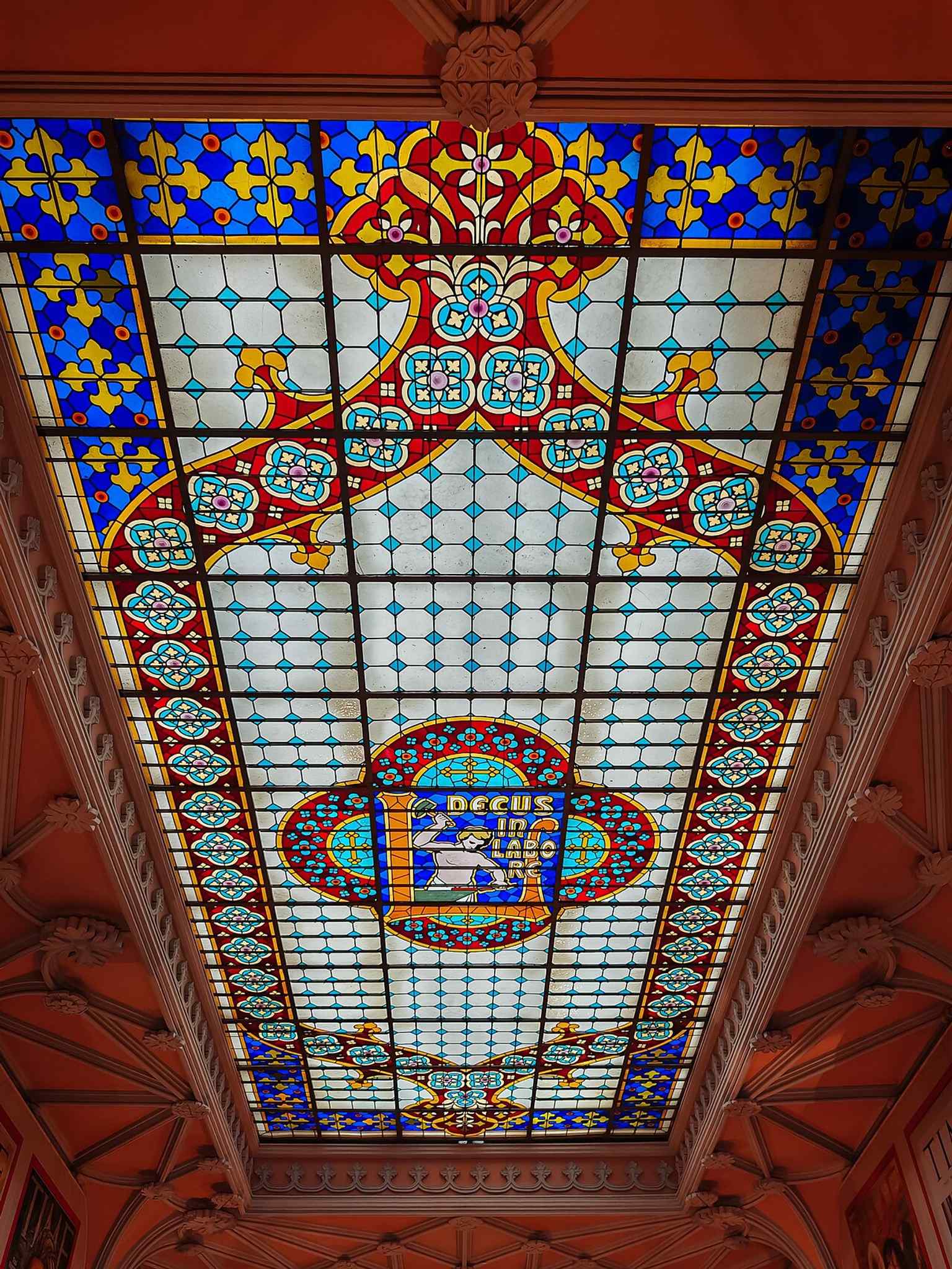
A modern interior view from 2025, showing how Lello continues to operate as both a bookstore and a major cultural attraction.Photo: 19bfc03, Wikimedia Commons, CC BY-SA 4.0. Cropped & resized. On your left, the Clérigos Tower and church rise in pale granite as a narrow, curving Baroque façade beside a tall six-tiered bell tower crowned with a cross. This is Porto’s…Read moreShow less
Open dedicated page →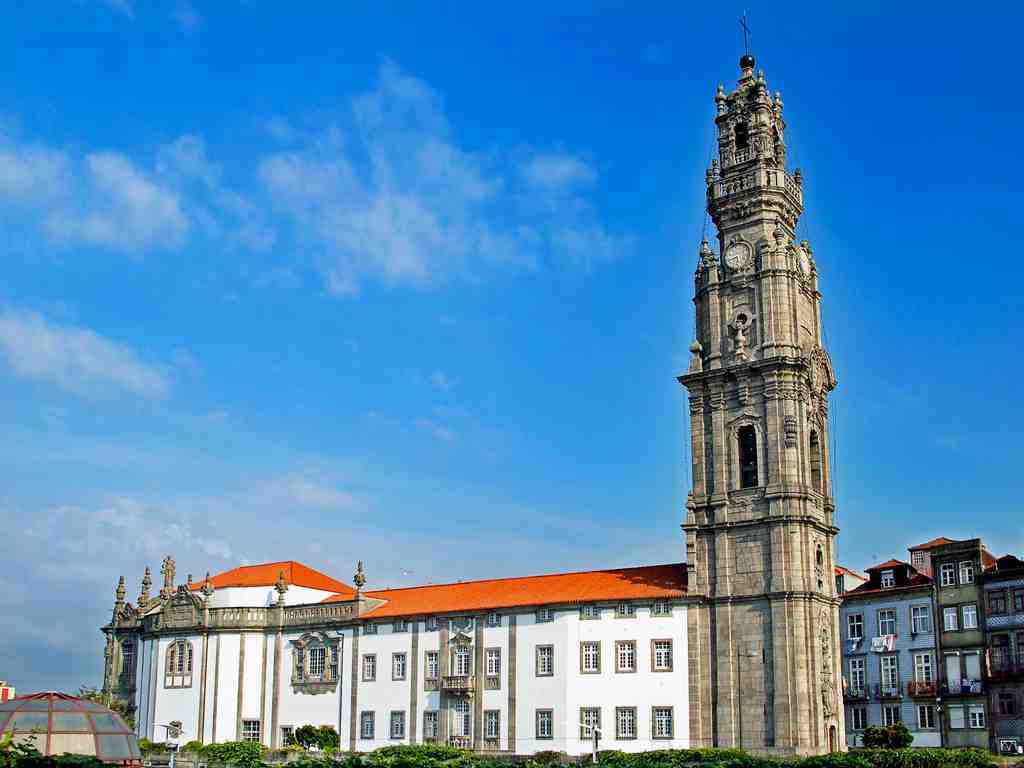
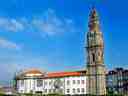
Church and Tower of the ClericsPhoto: António Amen, Wikimedia Commons, CC BY-SA 3.0. Cropped & resized. On your left, the Clérigos Tower and church rise in pale granite as a narrow, curving Baroque façade beside a tall six-tiered bell tower crowned with a cross.
This is Porto’s vertical signature... the landmark that keeps appearing above rooftops like the city has decided one dramatic gesture is better than a dozen modest ones. And it is not just famous; it is charged with purpose. The church, the tower, and the connecting House of the Brotherhood together tell the story of a city that kept turning pressure into form.
The story starts with need, not grandeur. In the early seventeen hundreds, Porto had many priests, and quite a few of them ended their lives poor, ill, or alone. So in seventeen oh seven, three brotherhoods joined forces to care for clergy in poverty, sickness, and death. Even choosing the main patron saint caused a small argument, so they settled it by drawing a name from an urn. Theology by lottery... surprisingly efficient. Our Lady of the Assumption won.
Then they chose this site, which had a rather grim reputation because it stood near the old place where condemned people were executed and buried. That ugliness did not stop them. In seventeen thirty-one, the Brotherhood asked Nicolau Nasoni, an Italian from Tuscany who had arrived by way of Malta, to design a proper home for their work. He stayed with the project for more than three decades. First came the church, then the Brotherhood’s house, then the tower between seventeen fifty-four and seventeen sixty-three.
If you glance at the app image, the façade makes Nasoni’s style obvious: granite pushed into curves, niches, broken lines, scrolls, and stone decoration that almost behaves like carved wood. He made the front relatively narrow, which tricks the eye into reading it as even taller. Inside, he gave the church an oval main hall - the nave, the central worship space - and double outer walls with passageways after he abandoned his first plan for twin side towers. So even the structure carries a memory of revision.
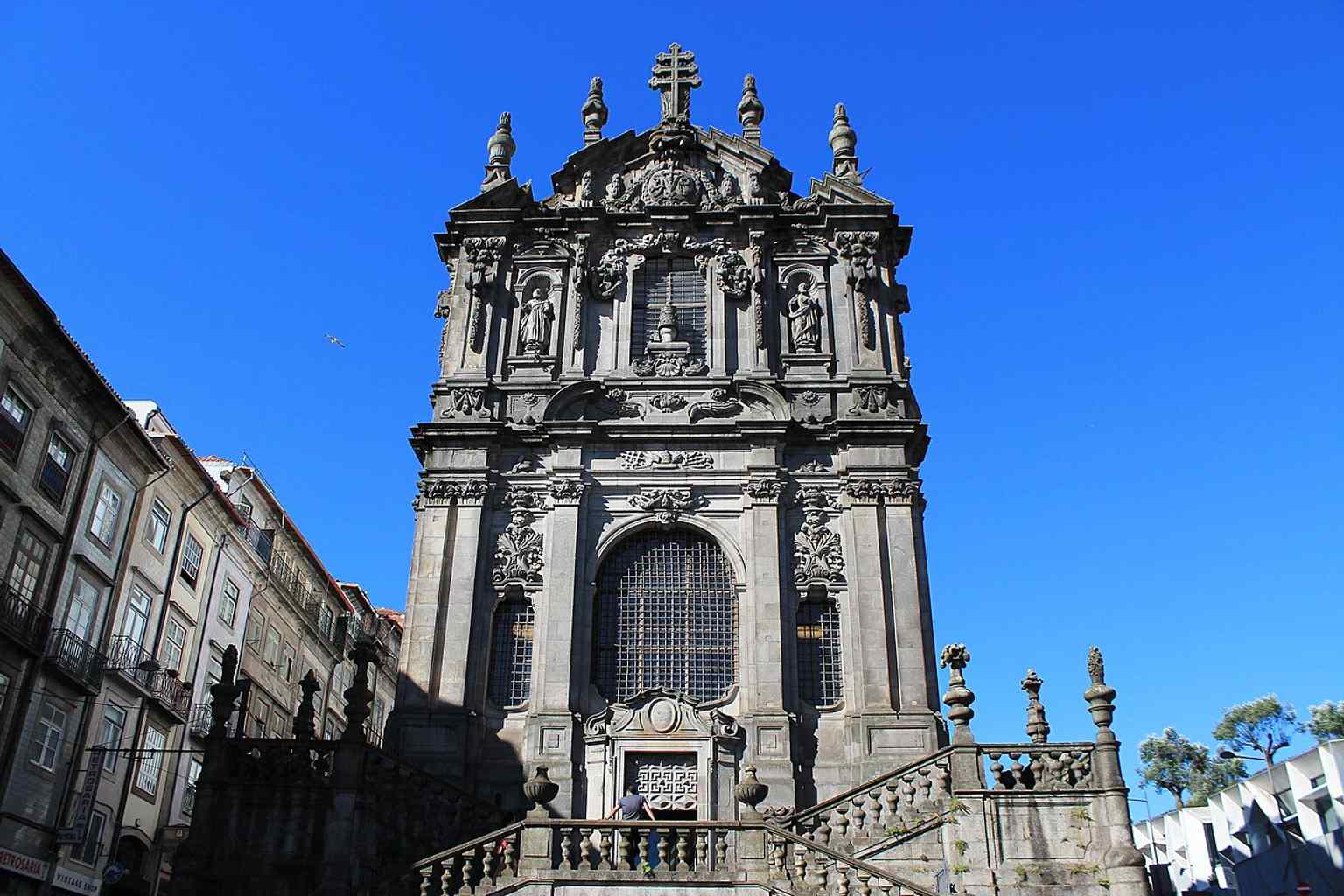
A clean frontal view of the Baroque church façade, whose narrow profile and sculpted stonework make the Clérigos one of Porto’s most theatrical landmarks.Photo: John Samuel, Wikimedia Commons, CC BY-SA 4.0. Cropped & resized. And then there is the mystery. Nasoni invested so much of himself here that records say the Brotherhood buried him in this church as a “poor cleric.” The problem is... no one can point to the exact grave. During restoration in two thousand and fourteen, an electrician unexpectedly found an eighteenth-century crypt. Investigators uncovered twenty-six bodies, including António de Santo Ilídio, the bishop-elect of Aveiro, and they identified four possible candidates whose remains could fit Nasoni’s profile. But certainty never arrived. Porto, very typically, let its most famous monument keep one of its best secrets.
The tower itself stands about seventy-five meters high, with six levels and two hundred twenty-five steps. It did more than ring bells. It marked time, served as a commercial telegraph, and signaled approaching boats on the Douro. So even this spiritual landmark kept one eye on trade.
Ahead, the city leans toward the river, where commerce will soon start dressing itself as power at the Stock Exchange Palace, about a ten-minute walk from here. If you want to come back inside later, the complex is generally open every day from nine in the morning to seven in the evening.
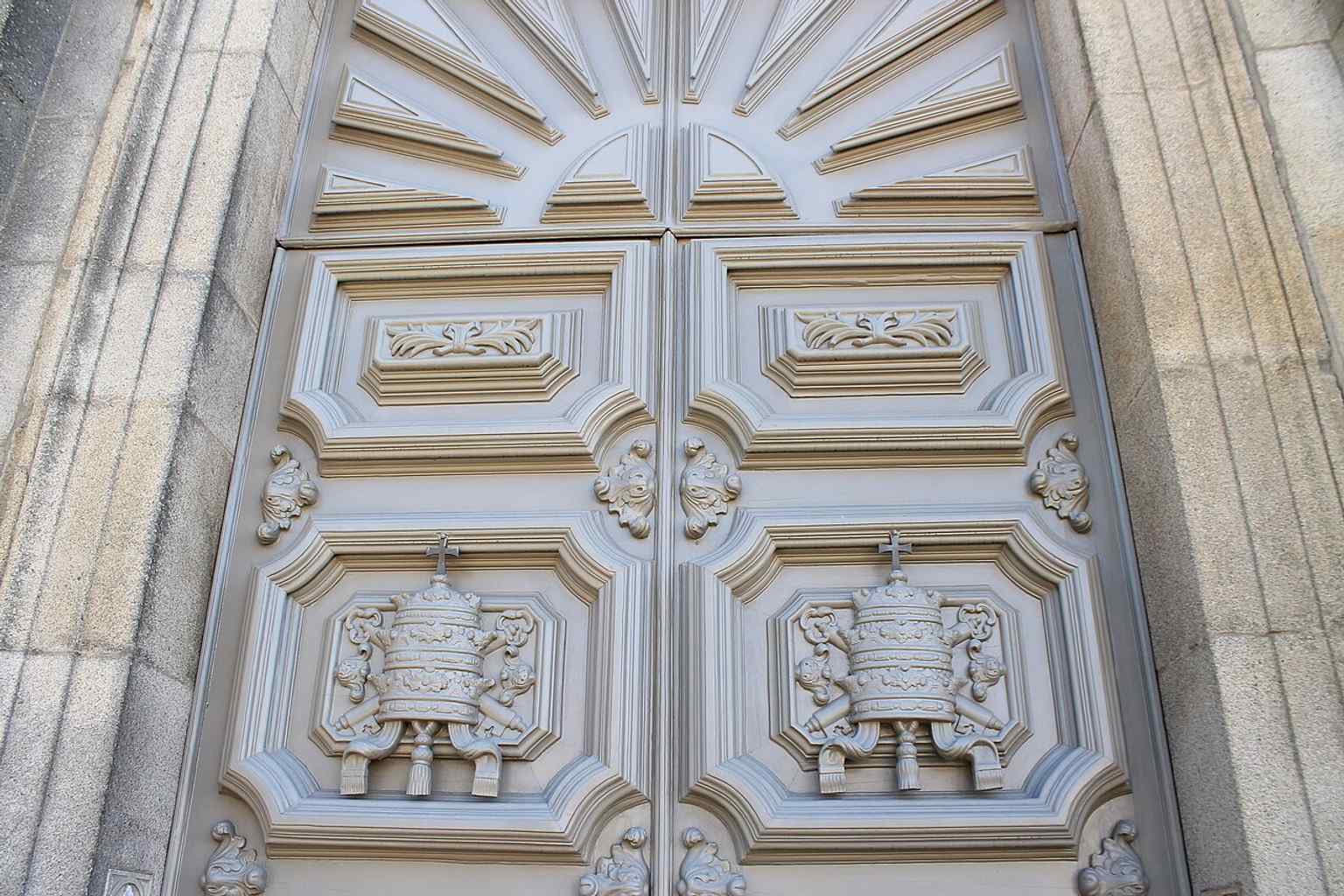
The side portal of the church, a good close look at Nasoni’s rich granite ornamentation and the layered Baroque design.Photo: John Samuel, Wikimedia Commons, CC BY-SA 4.0. Cropped & resized. 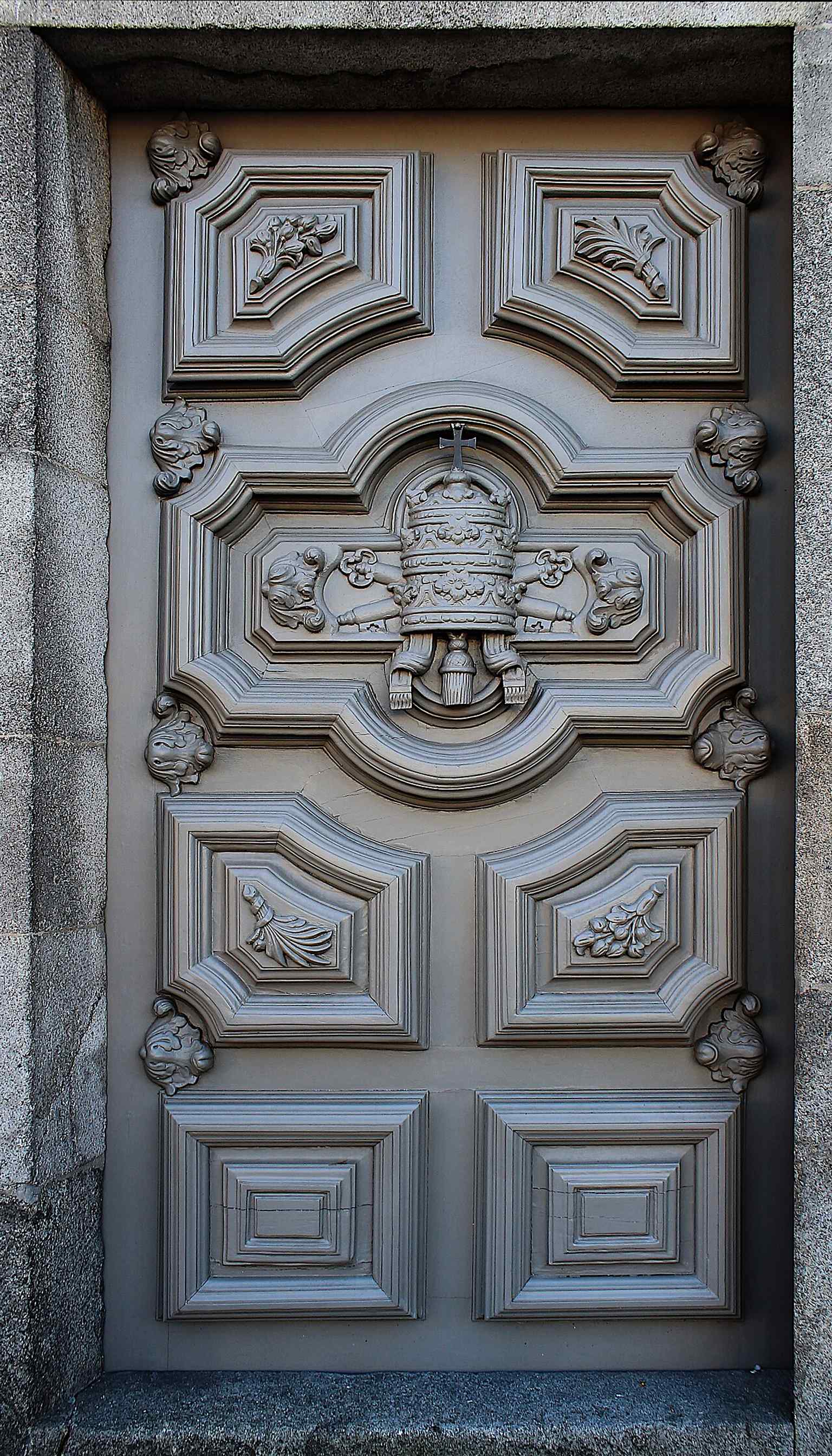
The lateral doorway seen in isolation, useful for showing how the church’s exterior is full of smaller architectural surprises beyond the main façade.Photo: John Samuel, Wikimedia Commons, CC BY-SA 4.0. Cropped & resized. 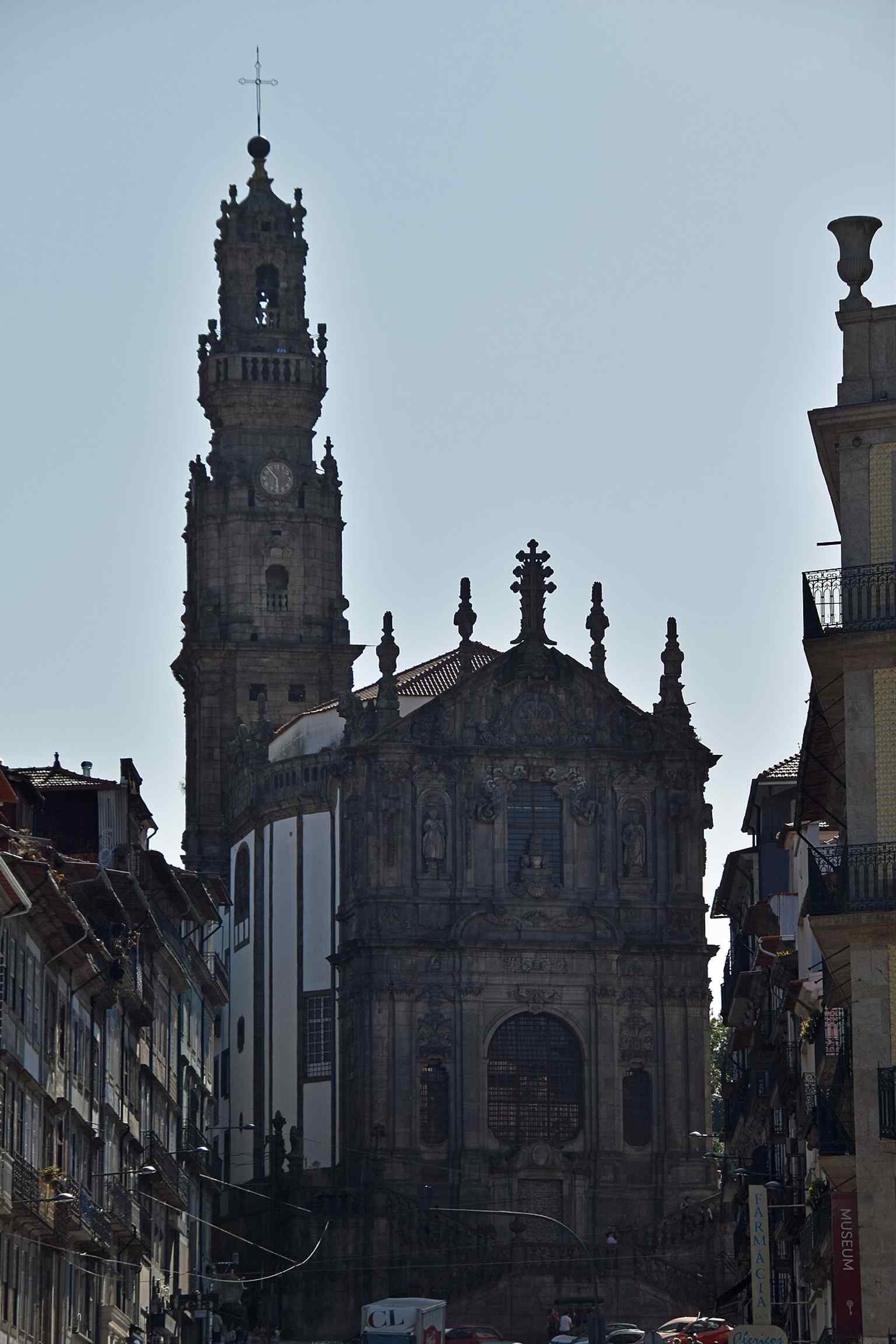
The tower in a modern view, highlighting the six-storey granite bell tower that became the city’s best-known skyline marker.Photo: Thomas Dahlstrøm Nielsen, Wikimedia Commons, CC BY 4.0. Cropped & resized. 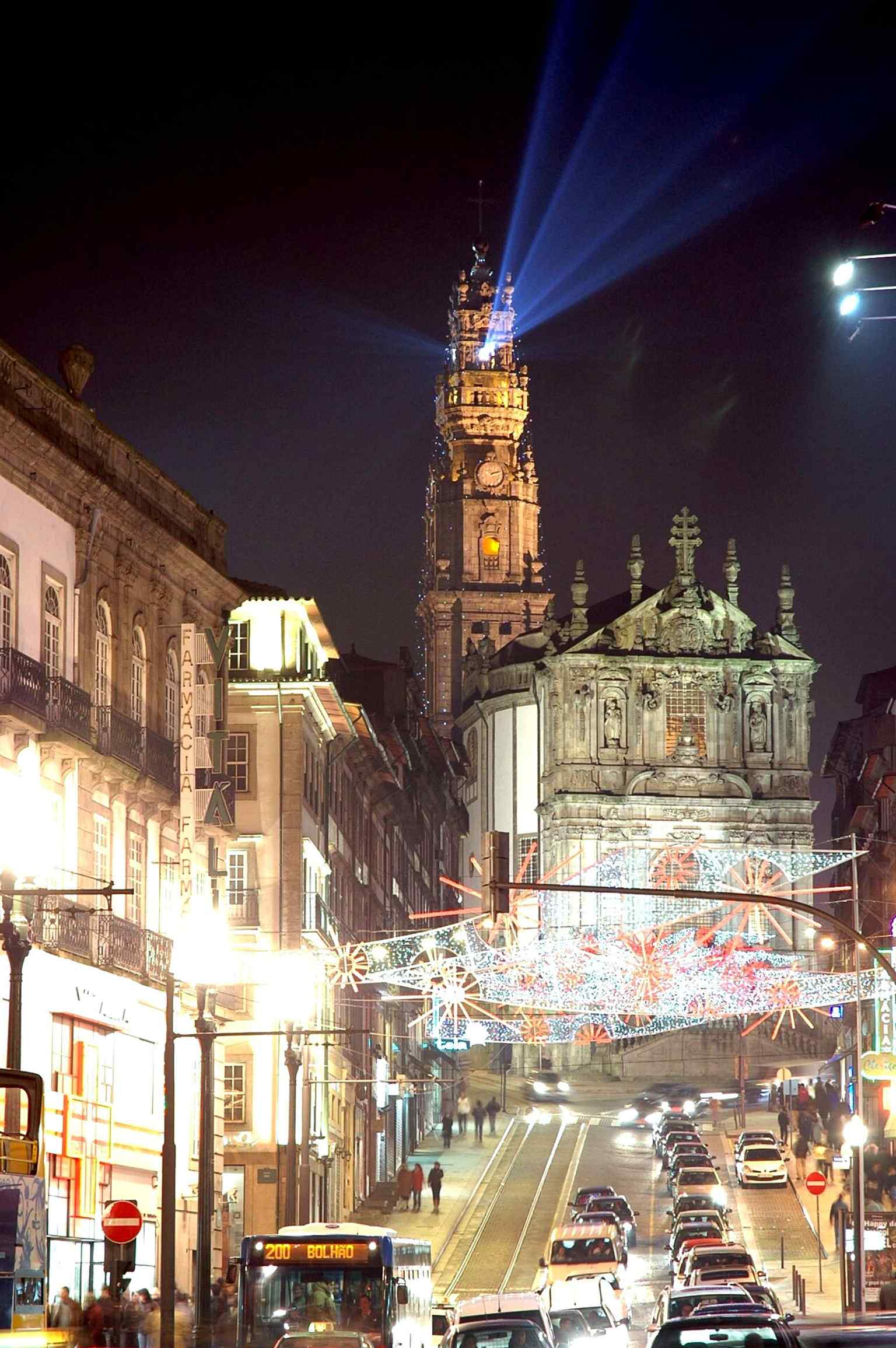
The Clérigos Tower at night, when the illuminated silhouette turns Porto’s most famous ex-libris into a dramatic city beacon.Photo: Josep Renalias, Wikimedia Commons, CC BY-SA 3.0. Cropped & resized. 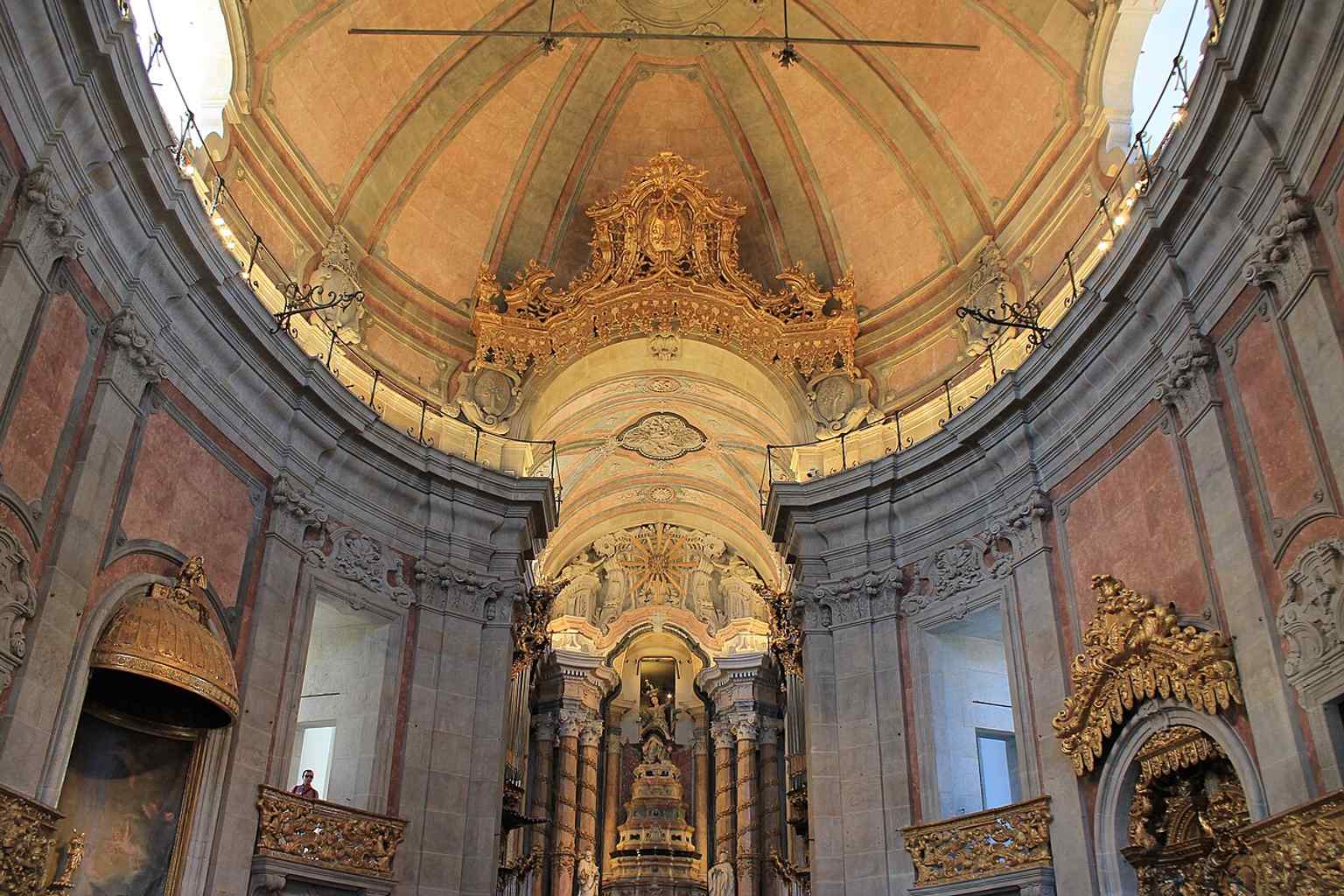
Another interior perspective that helps convey the bright granite nave and the unusual sense of depth created by the double walls and side passages.Photo: John Samuel, Wikimedia Commons, CC BY-SA 4.0. Cropped & resized. 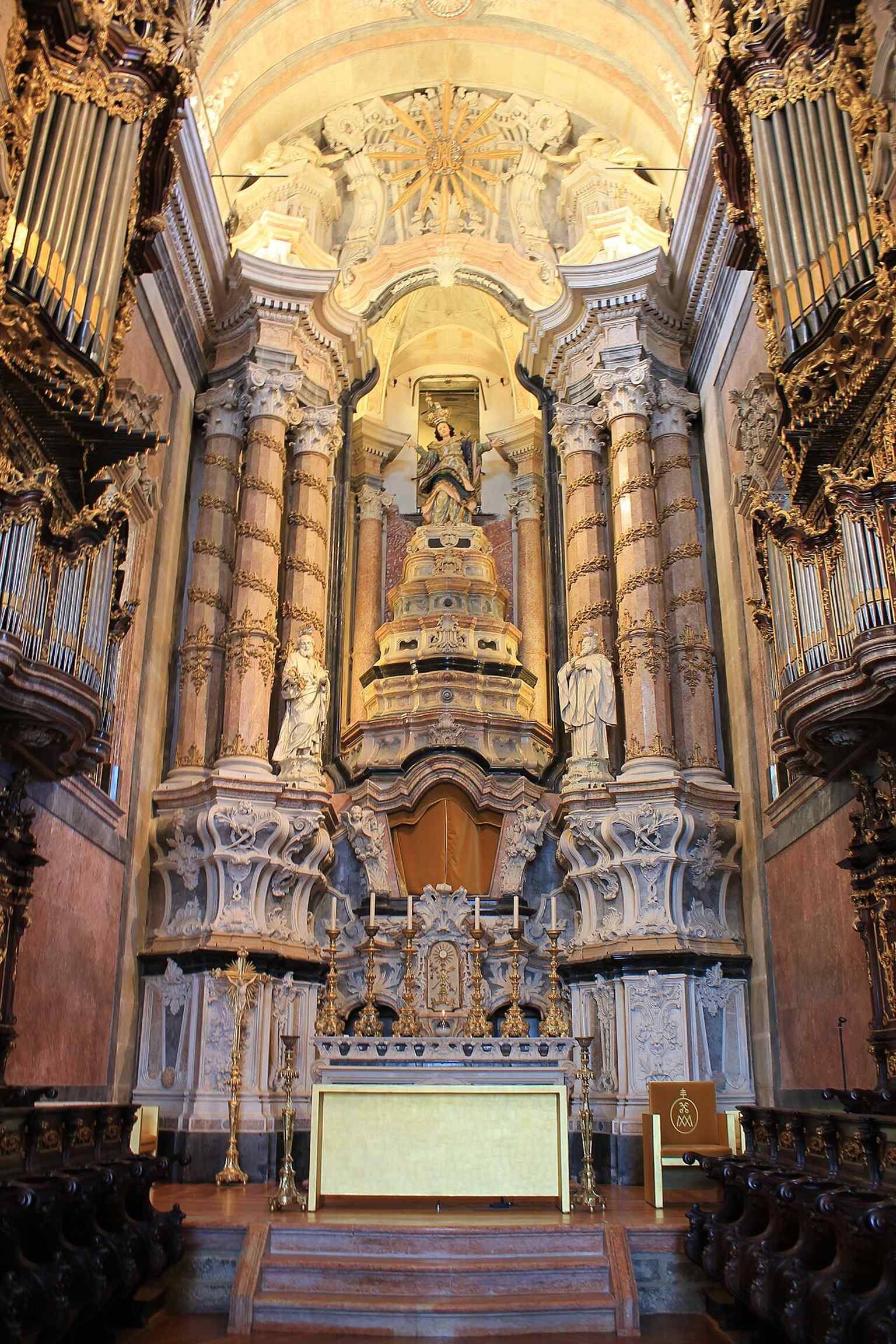
The main altar in the capela-mor, where the richly colored marble retable and central image of Our Lady of the Assumption stand out.Photo: John Samuel, Wikimedia Commons, CC BY-SA 4.0. Cropped & resized. 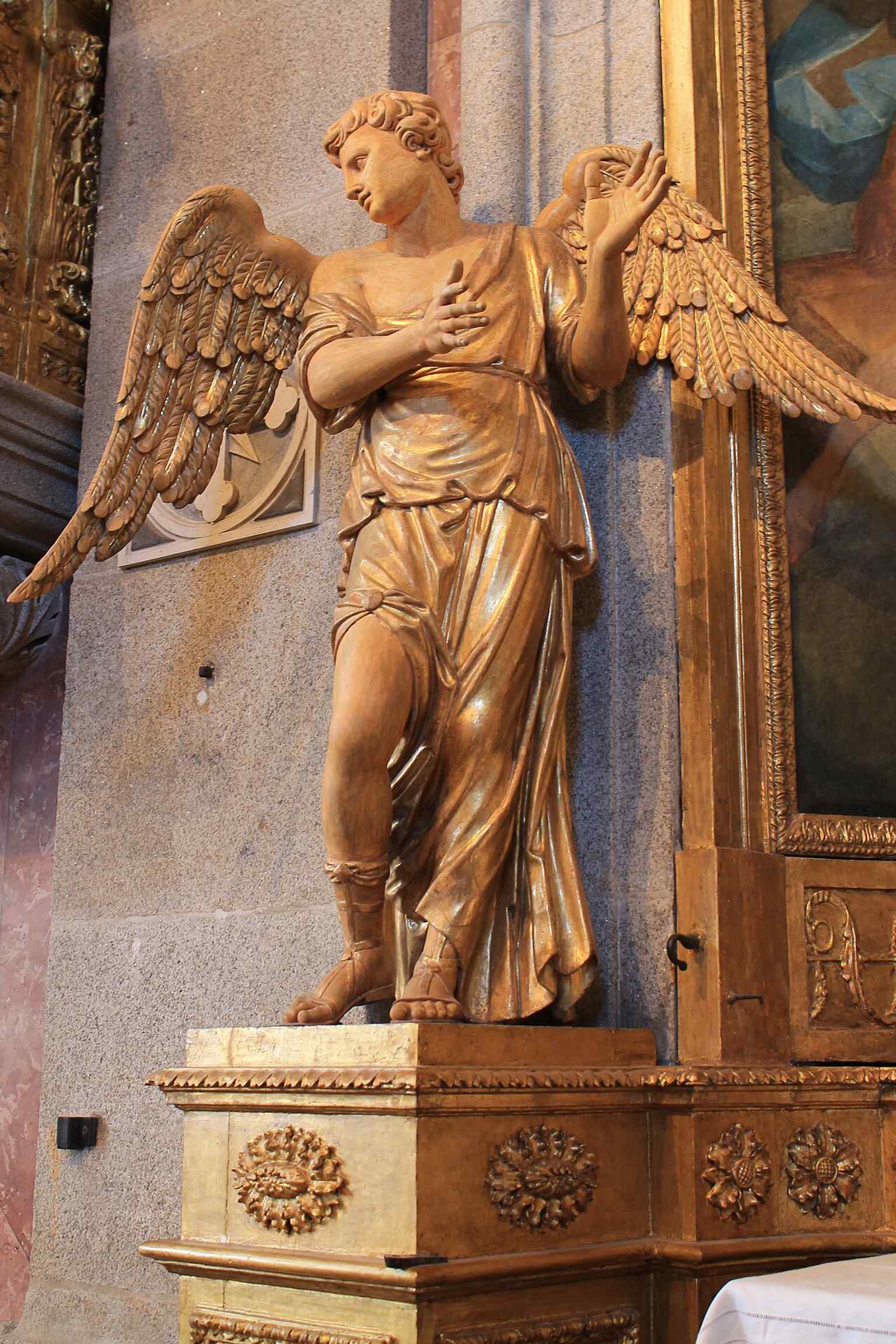
A close interior detail with angels, echoing the church’s exuberant decoration and its strong sculptural program.Photo: John Samuel, Wikimedia Commons, CC BY-SA 4.0. Cropped & resized. 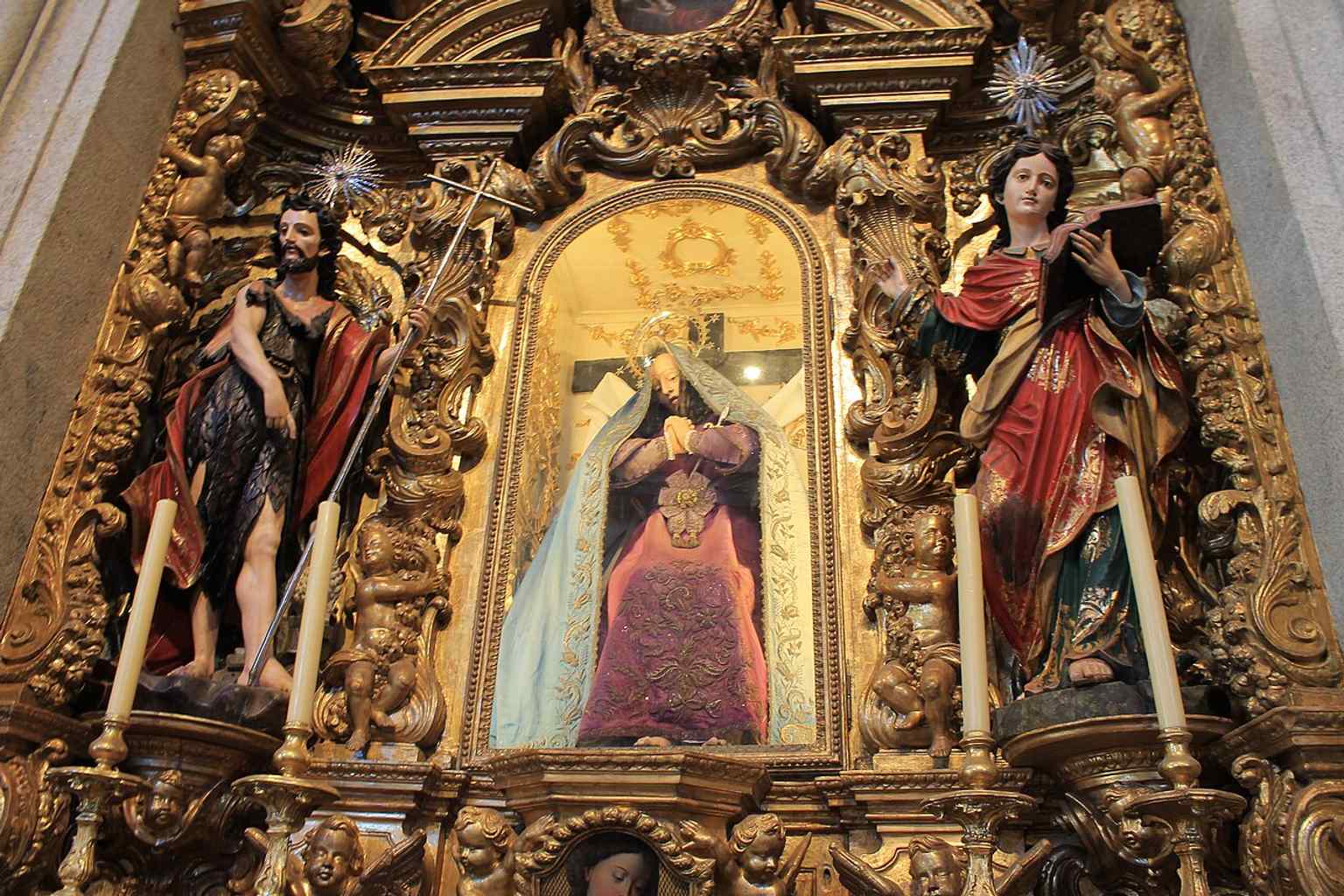
A view toward the church’s decorated interior elements, useful for showing the layered worship spaces described in the source text.Photo: John Samuel, Wikimedia Commons, CC BY-SA 4.0. Cropped & resized. 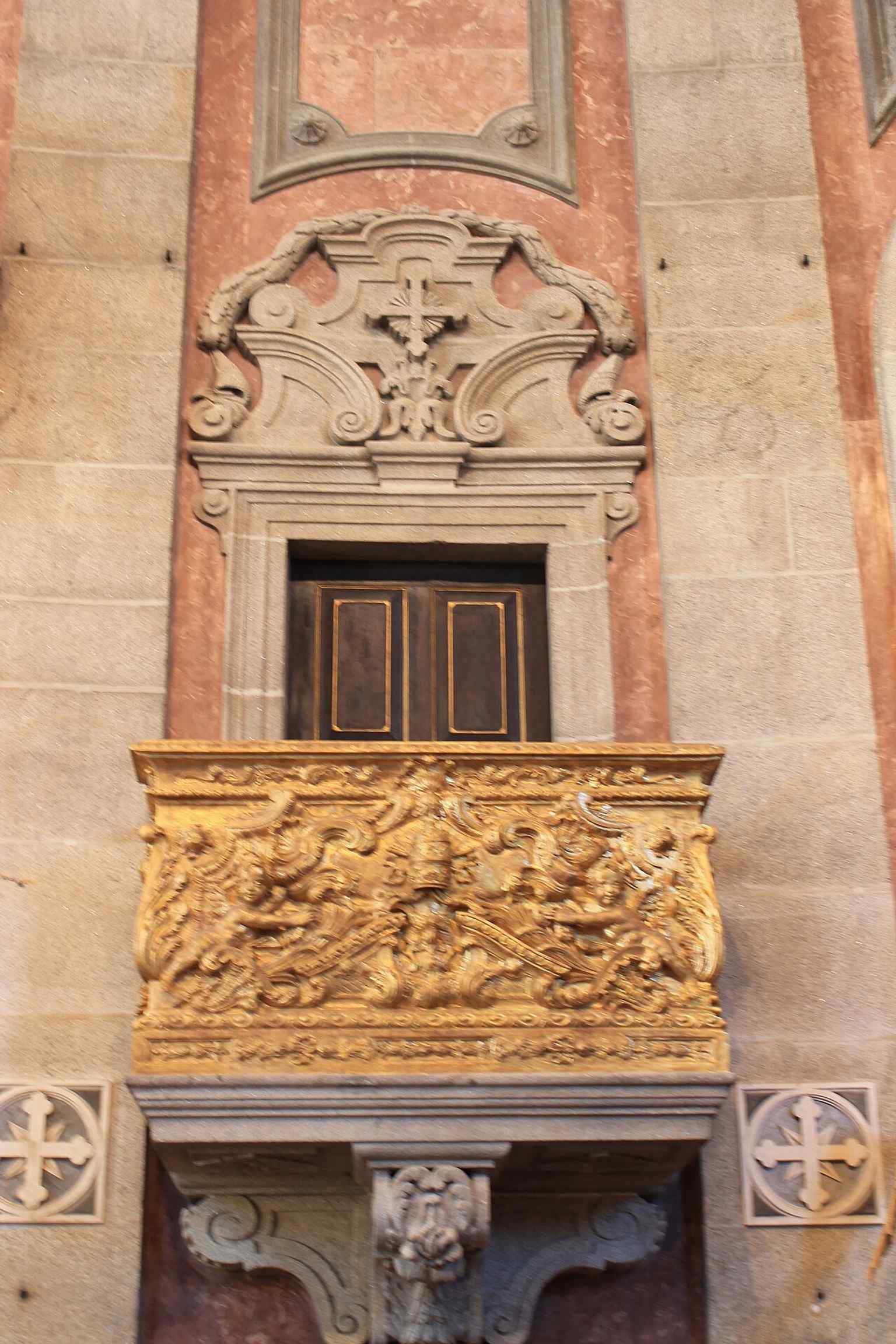
A look at one of the ornate interior features, reflecting the baroque richness that fills the church beyond the main altar.Photo: John Samuel, Wikimedia Commons, CC BY-SA 4.0. Cropped & resized. 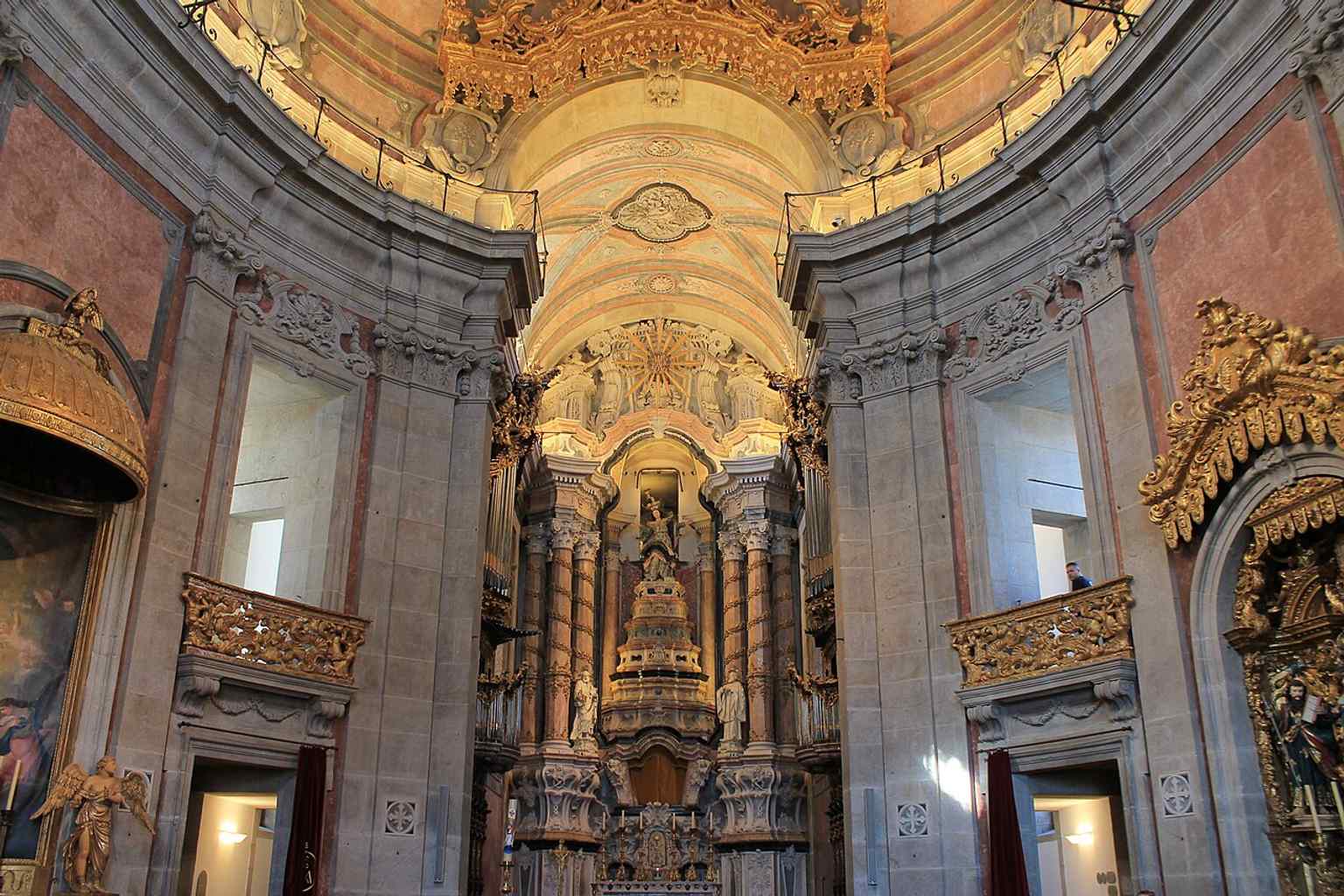
An interior view that reinforces the church’s long nave and the dramatic interplay of granite architecture and sacred furnishing.Photo: John Samuel, Wikimedia Commons, CC BY-SA 4.0. Cropped & resized. In front of you stands a broad granite palace with a strict, symmetrical façade, rows of tall arched windows, and a central entrance crowned by a sculpted coat of arms. The…Read moreShow less
Open dedicated page →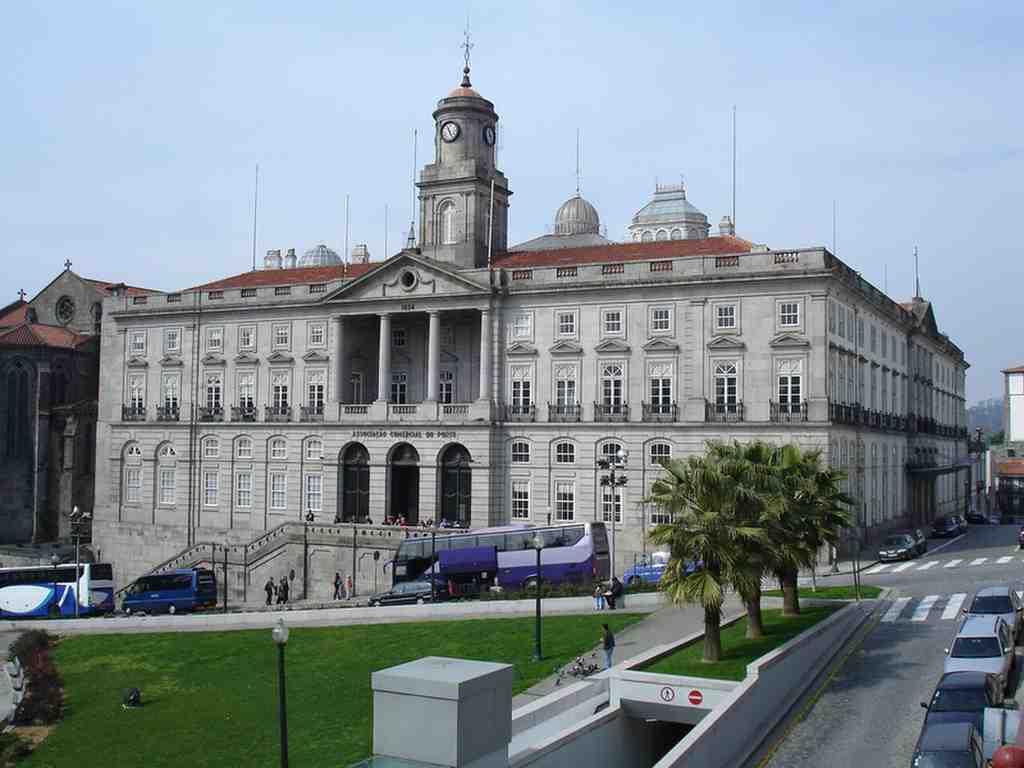
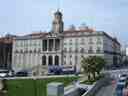
Stock Exchange PalacePhoto: Zelwy, Wikimedia Commons, CC BY-SA 3.0. Cropped & resized. In front of you stands a broad granite palace with a strict, symmetrical façade, rows of tall arched windows, and a central entrance crowned by a sculpted coat of arms.
The surprise here is that this palace begins with a fire. On the twenty-fourth of July, eighteen thirty-two, during the Siege of Porto, flames tore through the old Convent of São Francisco behind this frontage. The church survived. Much of the convent did not. So beneath this polished seat of commerce lies a scorched memory... stone reused after disaster, not erased.
Two years later, the Crown gave Porto’s merchants permission to take over the ruins for the Commercial Tribunal and the Commercial Association. That choice says a lot about this city. A religious complex broke apart in war, and trade stepped in, organized itself, and claimed the ground. Porto’s merchants had even been forced to discuss business out in the open on Rua dos Ingleses after their old exchange closed, which is a very dramatic way to hold a meeting.
On the sixth of October, eighteen forty-two, José Henriques Soares, the Baron of Ancede, laid the first stone, and Joaquim da Costa Lima led the overall design. By eighteen fifty, the main front and first floor were up, and the directors proudly said the building was rising beautifully from the ruins. They were not being modest.
Look at the façade and you can read the ambition: nineteenth-century neoclassical order, a dash of Tuscan severity, and a touch of English neo-Palladian taste - that means architecture inspired by the balance and symmetry of Andrea Palladio, filtered through Britain. In plain English: sober, rich, and eager to look permanent.
Inside, the real theater begins. In the eighteen sixties, Alfred Allen coordinated major works here, while Francis Sheilds created the iron-and-glass roof over the Pátio das Nações, the Nations Courtyard. Then Gustavo Adolfo Gonçalves e Sousa took charge and designed the famous Arab Room. He borrowed motifs from the Alhambra in Granada and from Owen Jones’s design book, then covered the room in stucco - molded plaster decoration - with gold-highlighted Arabic lettering across the walls and ceiling. It took eighteen years and opened in eighteen eighty during the Camões celebrations. That is where visiting heads of state are still honored. Subtle it is not.
There is irony tucked into the grandeur. The palace’s decoration was finally declared complete in nineteen oh nine for the visit of King Manuel the Second... just as the monarchy was nearing its end. After the Republic arrived in nineteen ten, officials inventoried and emptied the building, and someone even shot at a portrait of King Carlos the First. Porto does enjoy making a point.
Today this remains the home of the Commercial Association, but it also hosts public visits and civic events. And beside this monument to mercantile power stands the church that survived the blaze which made all this possible. That is where we go next: Saint Francis, only about three minutes away. If you want to come back inside here later, visits usually run daily from nine in the morning to six thirty in the evening.
On your left, look for a dark granite Gothic façade with a round rose window above a tall portal, and a stone Saint Francis set between twisted columns. At first glance, São…Read moreShow less
Open dedicated page →On your left, look for a dark granite Gothic façade with a round rose window above a tall portal, and a stone Saint Francis set between twisted columns.
At first glance, São Francisco looks stern and medieval... which is only half the truth. This church began in the fourteenth century as part of a Franciscan convent, but its story is less pure devotion and more long negotiation. The Franciscans were friars, and the lay brotherhoods attached to them were organized groups of ordinary townspeople who handled worship, charity, burial, and, not incidentally, influence. In a city like Porto, that mattered.
The friars received land here in twelve thirty-three. Then the trouble started. They argued with the bishop of Porto over the limits of that land, and the works kept stalling until a pope stepped in in twelve forty-four and confirmed the Franciscans’ claim. Even holy real estate needed paperwork.
The first church here was modest, just a single hall. The larger building in front of you took shape from thirteen eighty-three, after King Dom Fernando, a strong protector of the Franciscans, pushed the project forward. Builders finished it in fourteen ten: three naves, meaning three parallel interior aisles, five bays, a projecting transept crossing the main body of the church, and a three-part east end braced by buttresses. Structurally, it stayed remarkably intact, which is why many people consider it Porto’s best Gothic church.
But the surprise is inside. In the first half of the eighteenth century, craftsmen wrapped much of the interior in gilded woodcarving - walls, columns, side chapels, even the vaulting overhead. If you look at the ceiling image in the app, you’ll see what happened when restraint left the room entirely. It’s magnificent.
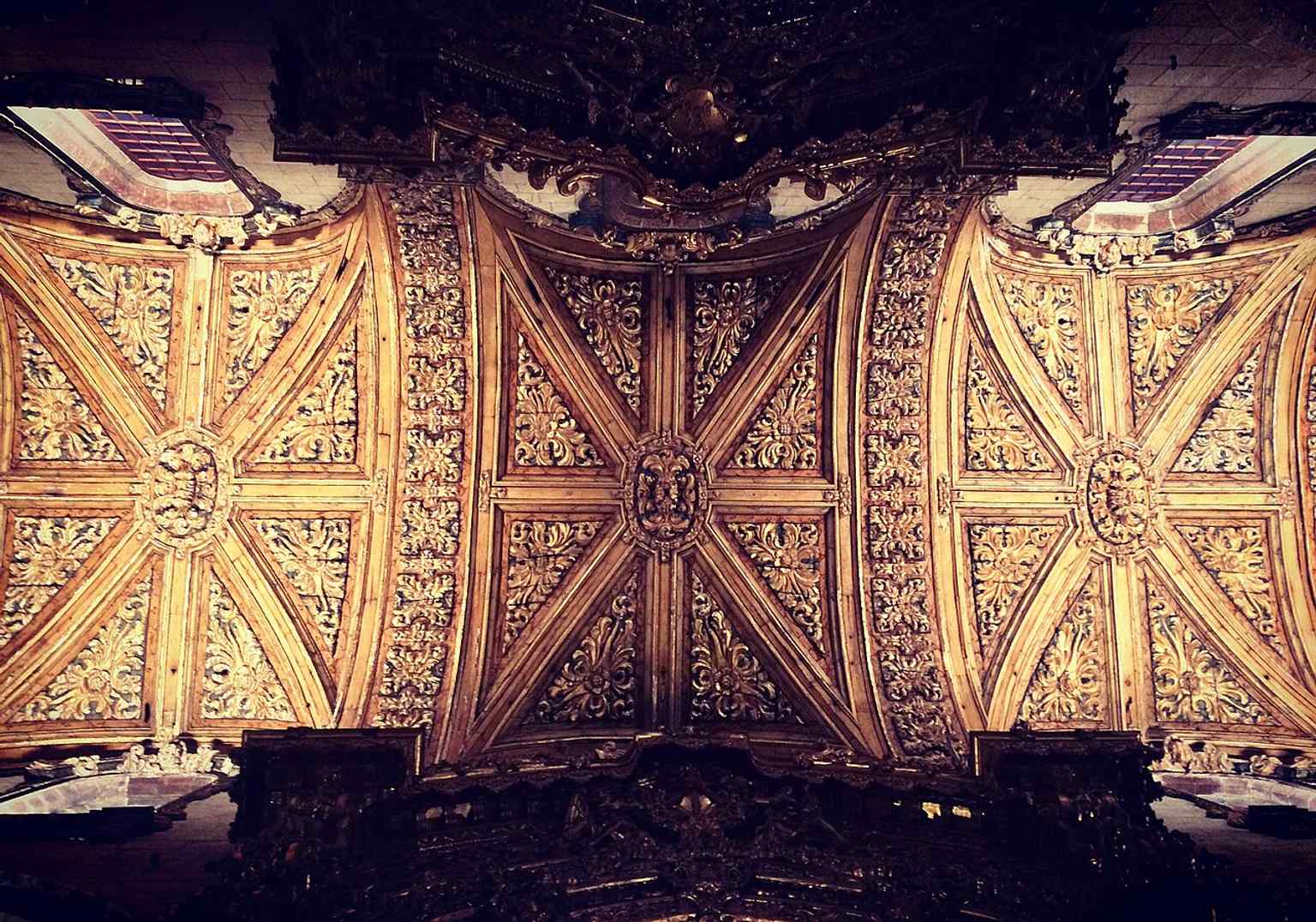
The gilded ceiling is part of the great 18th-century campaign that covered much of the interior in Baroque talha dourada.Photo: Patricia Santos, Wikimedia Commons, CC BY-SA 4.0. Cropped & resized. That splendor can make the institution seem seamless and powerful from the start. It wasn’t. Between sixteen thirty-three and sixteen thirty-nine, the brothers of the Third Order - a lay Franciscan group - still met in borrowed convent chapels while they slowly bought what they needed: an altar, a cupboard for wax candles, a painted Saint Francis by Manuel Lopes, and an image of Saint Elizabeth of Hungary. Grandeur arrived late; first came improvisation.
There are older layers too. Near the portal survived a mural of Nossa Senhora da Rosa, attributed to António Florentim from the time of King João the First. It shows the Virgin holding a rose, with kneeling figures beside her, and it remains one of the oldest intact mural paintings in Portugal. So before the gold came, there was paint... and before certainty, a lot of institutional scrambling.
Then came fire, more than once. After one blaze destroyed a shelter for poor brothers and women under the Order’s care, Nicolau Nasoni designed a new Casa do Despacho in seventeen forty-seven. In eighteen thirty-three, Miguelite gunfire at the end of the siege set the convent buildings ablaze. The ruined cloister later gave way to the Stock Exchange Palace nearby. Commerce moved into the footprint of devotion with impressive efficiency.
And under this whole complex lies a catacomb cemetery, where brothers and benefactors were buried from seventeen forty-nine to eighteen sixty-six. Charity, memory, status, and salvation all shared the same address.
Next, we head to Casa do Infante, where Porto offers a famous origin story... and the evidence raises one careful eyebrow. If you want to come back inside later, São Francisco is open daily from nine in the morning to seven in the evening.
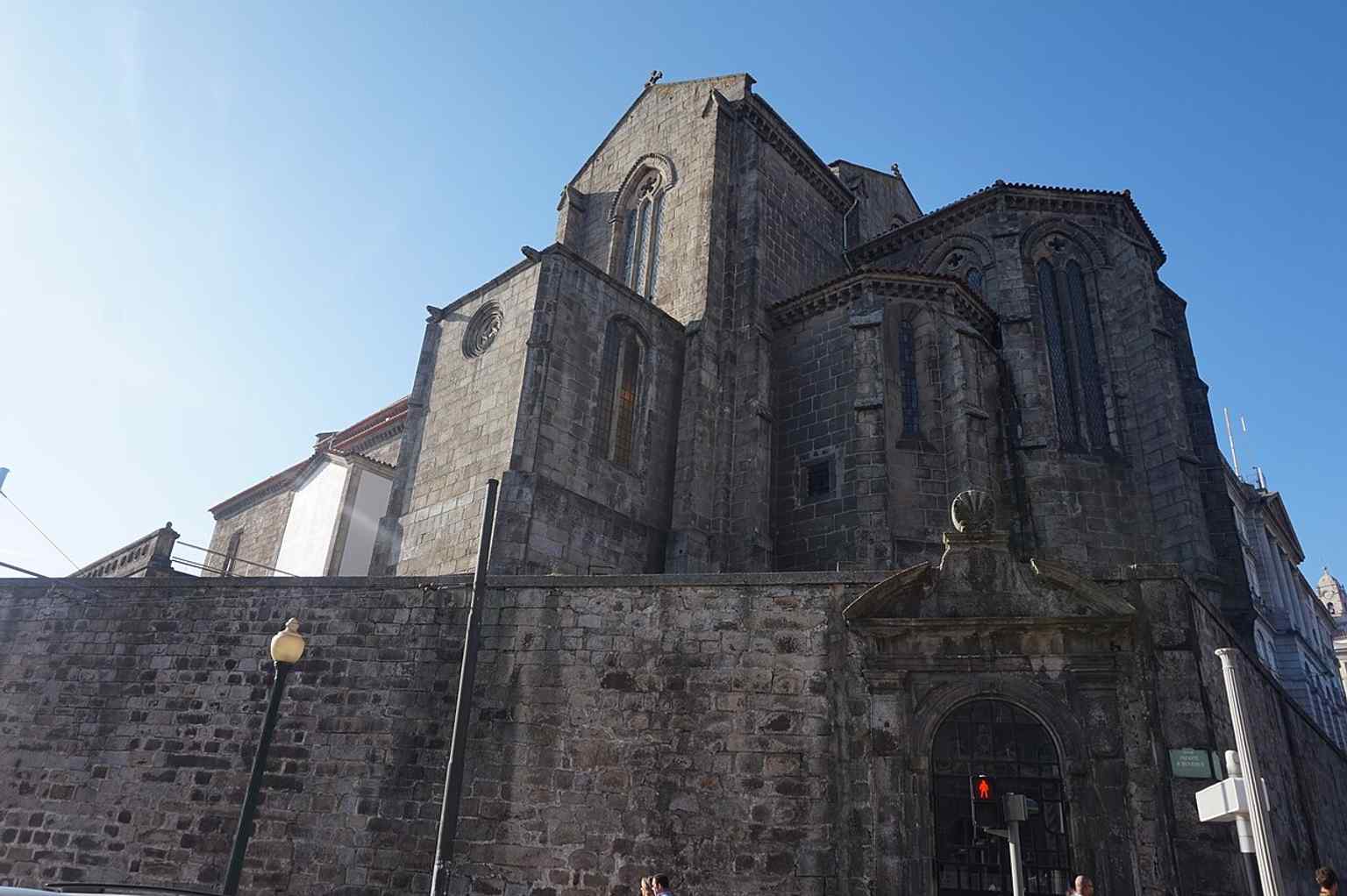
A clear full view of the Gothic church in Porto, the landmark’s main exterior before the interior was transformed with Baroque gilded woodwork.Photo: Onizuka2222, Wikimedia Commons, CC BY-SA 4.0. Cropped & resized. 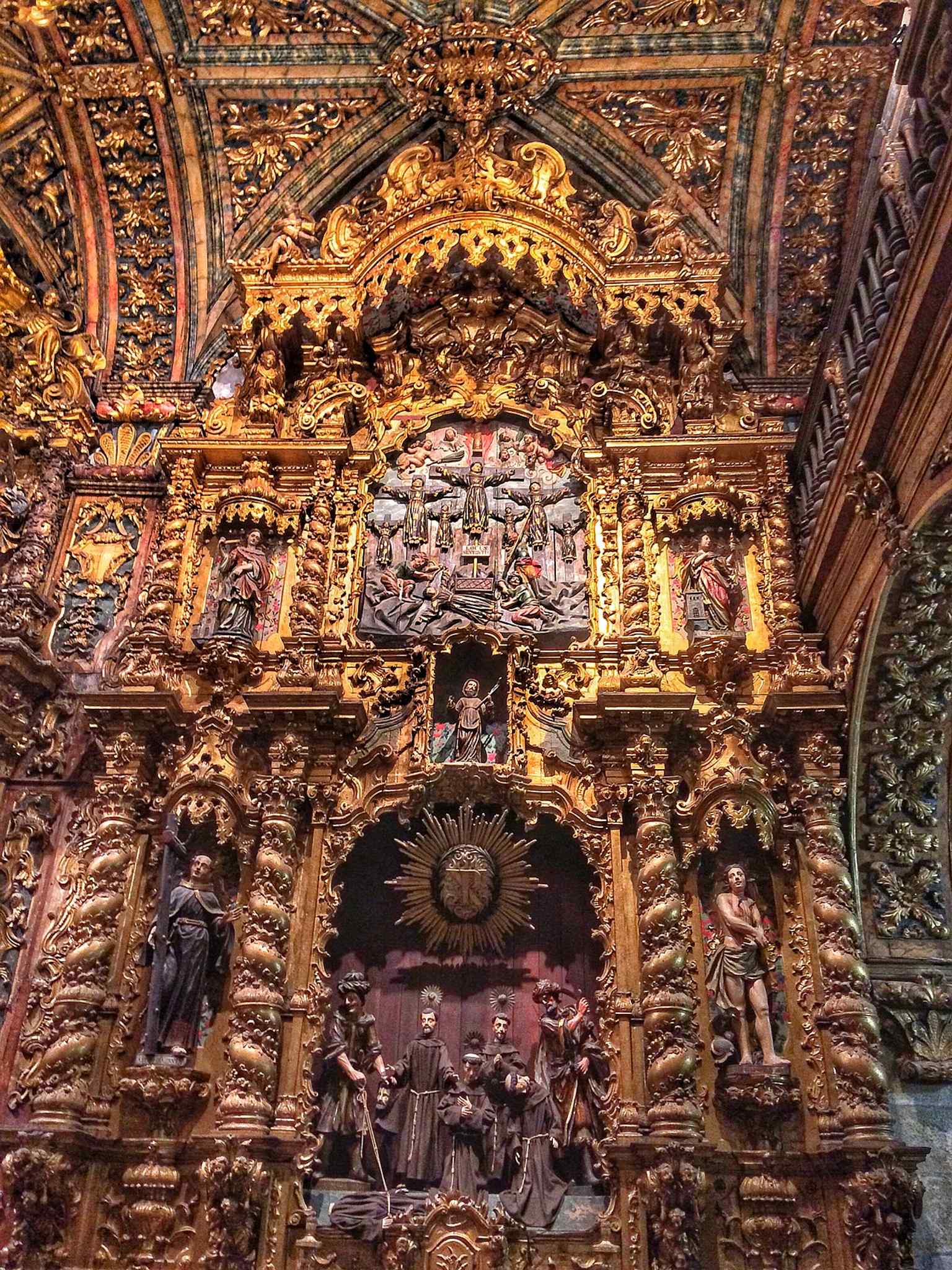
The retable of the Martyrs of Morocco, part of the major 18th-century decorative cycle that reshaped the church’s chapels.Photo: Patricia Santos, Wikimedia Commons, CC BY-SA 4.0. Cropped & resized. On your left, Casa do Infante is a sturdy stone block with a rectangular four-storey façade, rows of canopied windows, and a large arched doorway crowned by a royal coat of…Read moreShow less
Open dedicated page →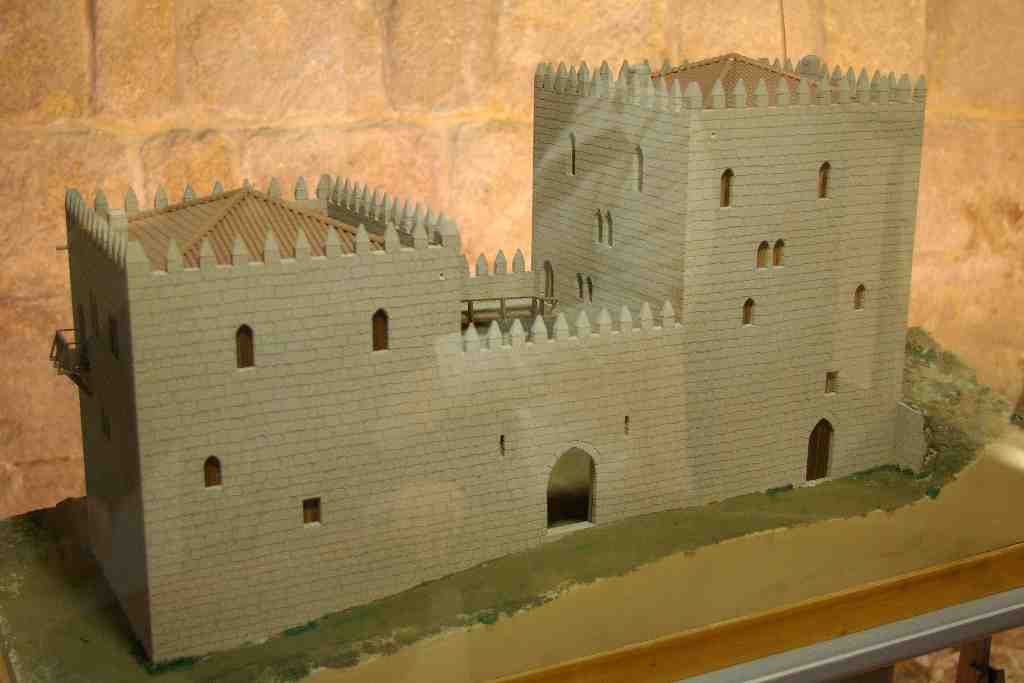
Casa do InfantePhoto: Manuel de Sousa, Wikimedia Commons, CC BY-SA 4.0. Cropped & resized. On your left, Casa do Infante is a sturdy stone block with a rectangular four-storey façade, rows of canopied windows, and a large arched doorway crowned by a royal coat of arms.
For all the legend wrapped around it, this building begins with something very practical: taxes. Porto can be wonderfully romantic, but somebody always had to count the cargo. A royal decree in thirteen twenty-five set this place in motion on top of an earlier Roman residence, and by the mid-fourteenth century King Afonso the Fourth used it to tighten royal control over the Douro. Goods came up the river, officials assessed them, coins were minted here, merchandise was stored here, and employees even lived here. In other words, this was not a poetic little townhouse. It was a machine for power.
Municipal records describe it as Porto’s first customs house and, in its day, one of the city’s largest medieval buildings. Archaeologists later worked out that it once had two tall towers linked by a courtyard. That matters, because the crown wanted this riverfront building to be seen. Afonso the Fourth was in conflict with the Bishop of Porto, and customs duties on river traffic helped shift authority away from the bishop and toward the king. Where the Stock Exchange Palace turned trade into grandeur, this place turned trade into rules.
Then comes the part Porto loves, and historians approach with slightly raised eyebrows: the Prince Henry birthplace legend. Chronicler Fernão Lopes wrote that Infante Dom Henrique, Prince Henry, son of King João the First and Queen Philippa, was born in Porto on the fourth of March, thirteen ninety-four. We know he was baptized here in the city. We do not know, with courtroom certainty, that he entered the world in this exact building. But because this was the only royal building in Porto, and because it had living quarters, people long believed the royal household stayed here. So the story stuck... not as proof, exactly, but as a memory with paperwork trailing behind it.
If you look at the image on your screen, you can see how later generations leaned into that memory: the entrance gained a Neo-Manueline commemorative plaque in eighteen ninety-four, helping turn an old customs house into a patriotic birthplace shrine. A working fiscal building became a symbolic cradle of the Age of Discovery. Porto, as usual, refused to waste a good story.
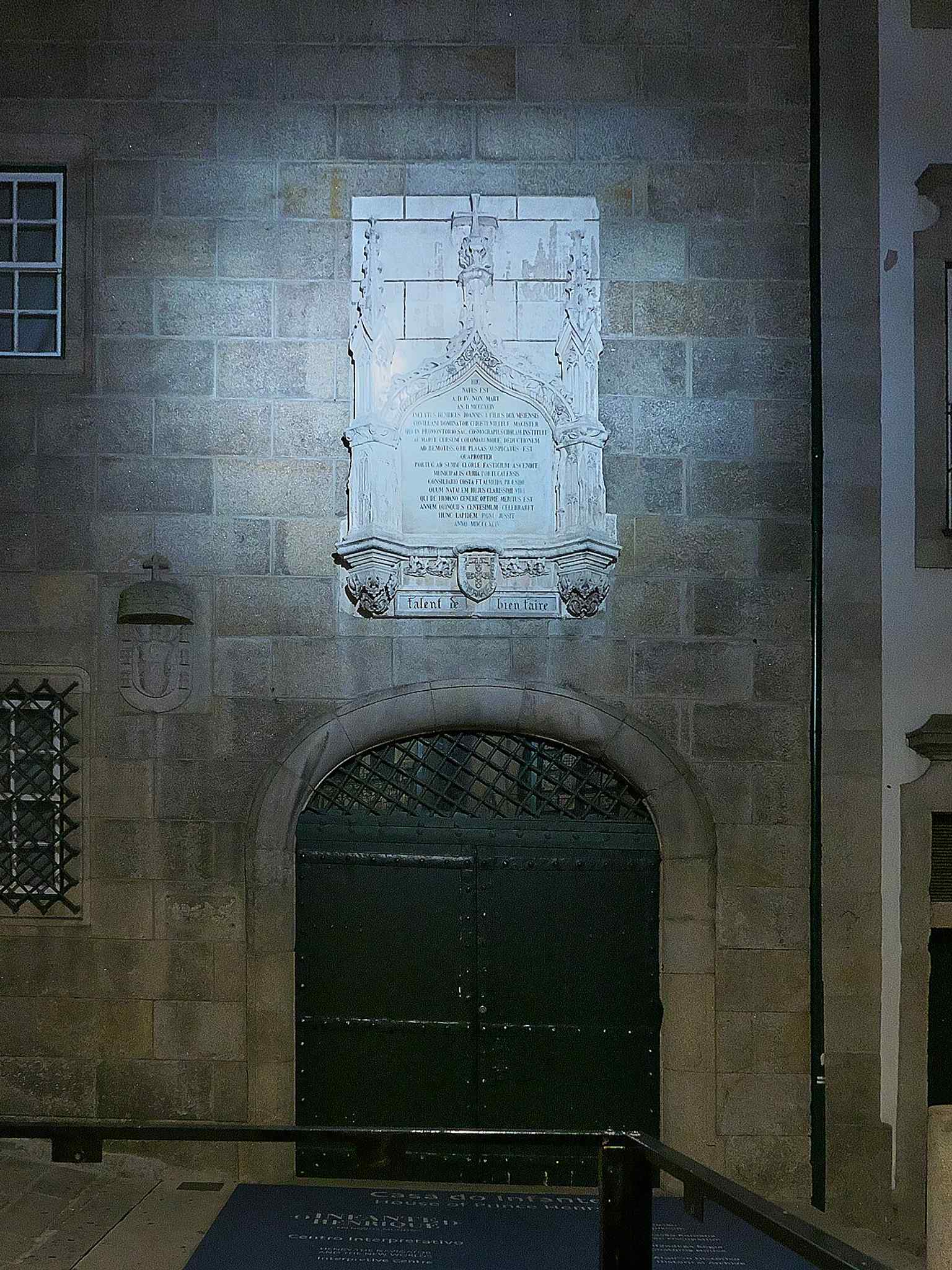
The principal entrance of the House of the Prince, where later commemorative plaques helped turn a former customs house into a memorial site.Photo: Jl FilpoC, Wikimedia Commons, CC BY-SA 4.0. Cropped & resized. The building you see now is mostly the result of a major rebuilding in sixteen seventy-seven under King Pedro the Second, directed by the Marquess of Fronteira. The towers were cut down, the street front rose higher, and the courtyard survived at the core. Later still, in the twentieth century, the site became the city’s historical archive. Inside, it now stores Porto’s documentary memory, and excavations in the nineteen nineties uncovered Roman foundations and mosaic pavements below, as if the ground itself were muttering, “Nice legend... but I’ve been here longer.” If you check the app, one interior image shows that newer role as the city’s memory vault.
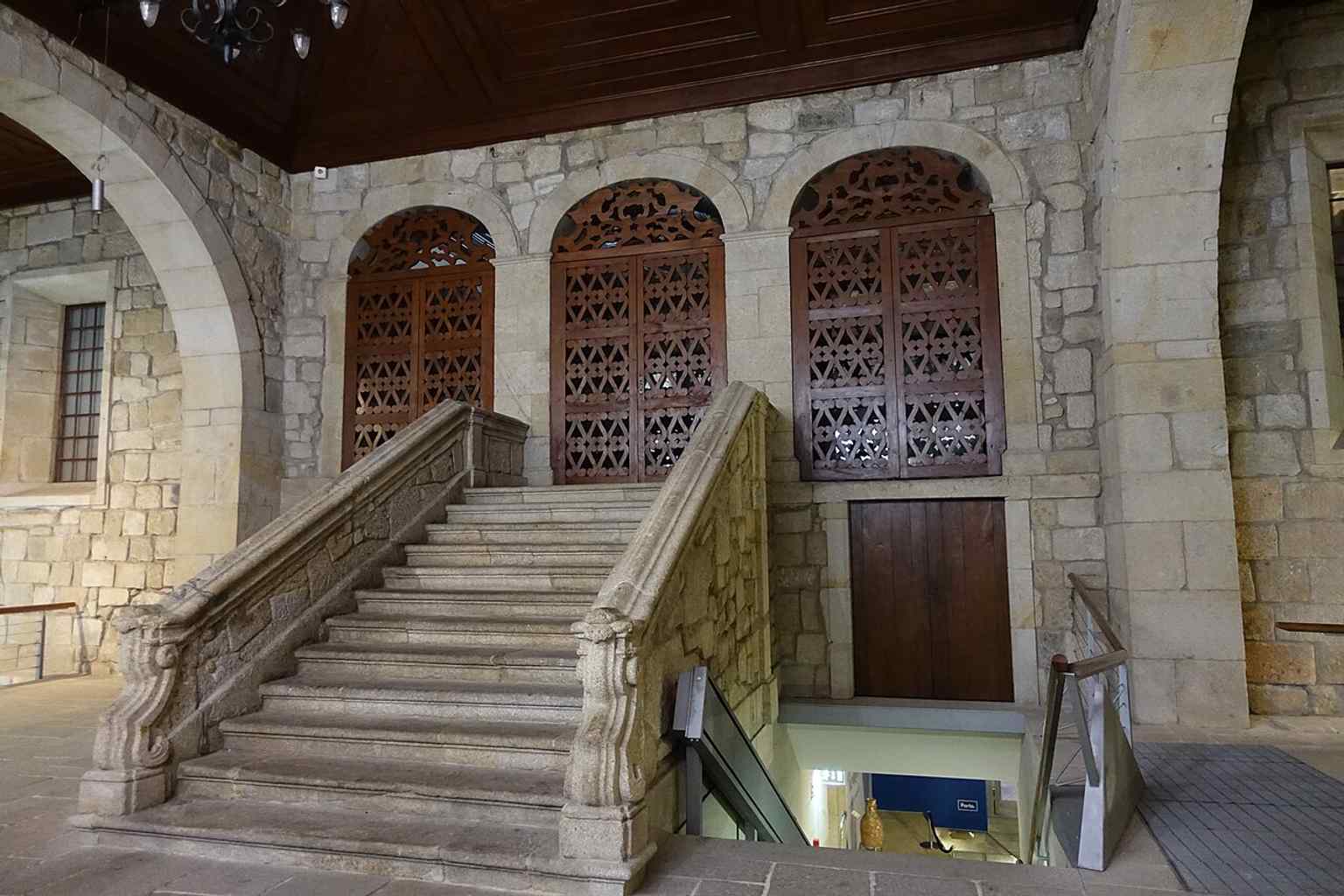
Inside Casa do Infante’s archive museum spaces, reflecting its modern role as Porto’s historical memory vault.Photo: Joseolgon, Wikimedia Commons, CC BY-SA 4.0. Cropped & resized. So here is the question this place leaves hanging: when a city tells a story for centuries, does that story become part of the truth, even when the evidence stays incomplete? Casa do Infante never fully resolves that tension. It simply stands here by the river, holding customs records, royal ambition, a prince’s uncertain beginning, and older Roman traces beneath them all.
When you’re ready, continue on to Ribeira Square, about a three-minute walk away, where the riverfront opens the story wider. If you plan to come back inside later, it’s closed on Mondays and usually open from ten in the morning to five thirty in the afternoon the rest of the week.
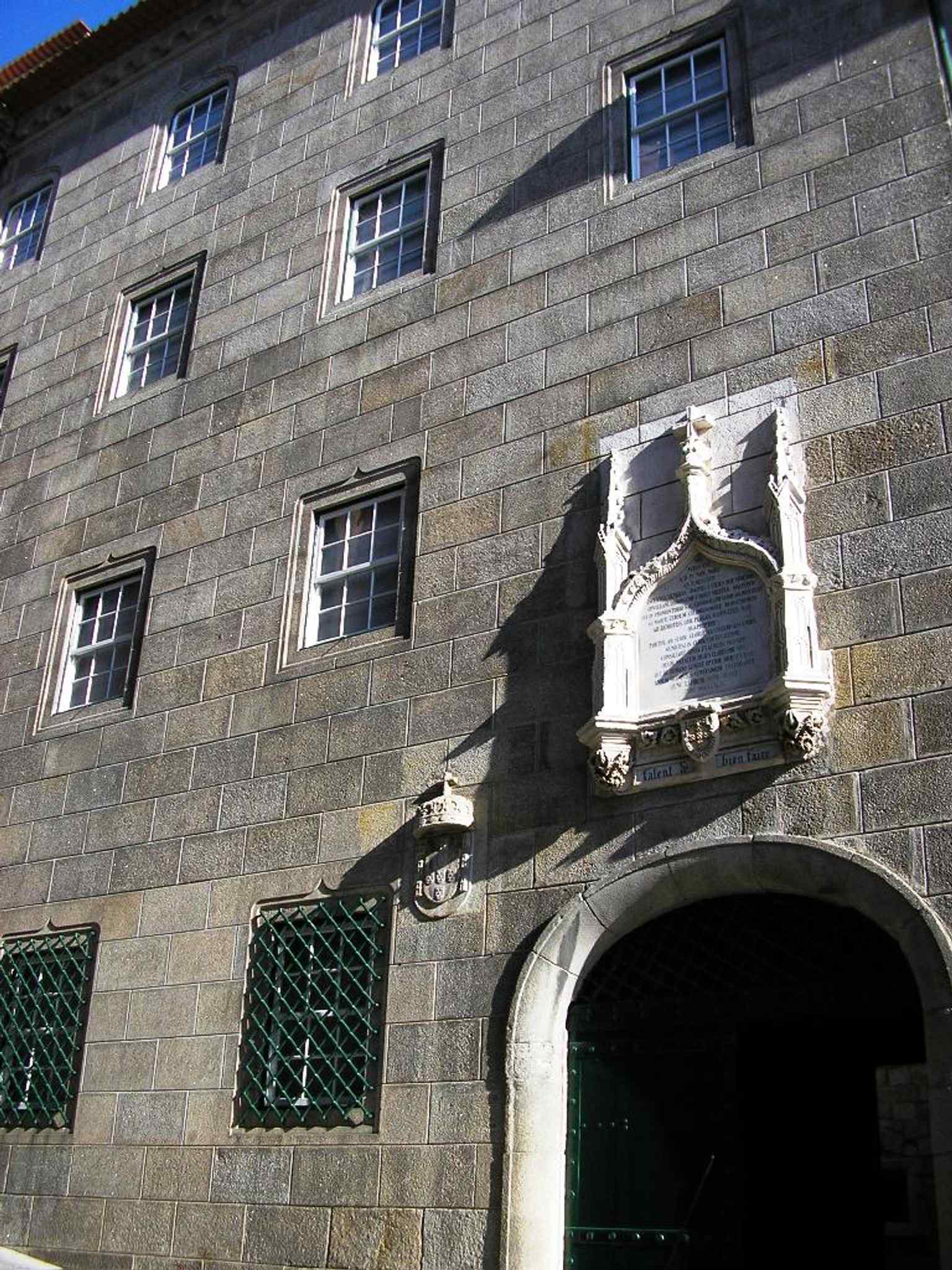
The Casa do Infante’s historic façade in Porto, the riverside customs house long linked to Henry the Navigator’s birthplace legend.Photo: Manuel de Sousa, Wikimedia Commons, Public domain. Cropped & resized. On your left, look for a broad stone square framed by tall, narrow facades and anchored by a baroque granite fountain with a deep central niche. This is Ribeira... Porto’s old…Read moreShow less
Open dedicated page →On your left, look for a broad stone square framed by tall, narrow facades and anchored by a baroque granite fountain with a deep central niche.
This is Ribeira... Porto’s old river gateway, the place where the city met the Douro to make its living. The name itself comes from the riverbank, and that sounds simple enough, but for centuries this edge of town carried the weight of survival. Royal letters already mention the square and quay in thirteen eighty-nine, which tells you this was no side street. It was the front door for goods, fish, labor, rumor, and the occasional scoundrel who preferred a busy crowd to a tidy conscience.
Try to picture the medieval version. Sellers shouting over one another. Craftsmen hauling stock. Curious onlookers underfoot. Ox carts grinding through the space. Stevedores, the dock workers who loaded and unloaded ships, moving barrels and bundles between quay and town. Before the polished image settled in, Ribeira was dense, noisy, and commercially vital in a very unromantic way. If Bolhão showed you Porto’s everyday heart, and the Bolsa showed you trade in formal dress, this square is the older bloodstream underneath both.
Most visitors never clock the hidden trick of the site. Around thirteen seventy, when the Cerca Nova, the New Wall, enclosed this part of the city, Ribeira lost its direct open access to the river. From then on, people and goods had to pass through the Porta da Ribeira at the southeast corner... a gate that has vanished completely. So even here, at the water’s edge, Porto managed to put a doorway between itself and the world. Very Porto, really.
Then came the fire of fourteen ninety-one. It tore through the commercial core, and not as an abstract disaster either. A property owner named João Martins Ferreira saw houses of his damaged in the blaze. That detail matters. Big city catastrophes always land on individual shoulders. Afterward, the rebuilding gave Ribeira more order: paved ground, houses with columns, a little more discipline imposed on all that medieval commotion.
In the eighteenth century, João de Almada e Melo pushed the square again toward grandeur, and the British consul John Whitehead backed plans for arcades and a more unified frontage. They wanted a proper corridor for moving goods inland through São João, São Domingos, Flores, and on toward Almada Street. The whole idea was practical and theatrical at once: better circulation, better image, more authority written onto stone.
If you check the image on your screen, the fountain on the north side comes into focus. City officials ordered it in seventeen eighty-three to replace an older seventeenth-century fountain, and three years later it stood here as a baroque showpiece. The niche lost its original figure long ago; in two thousand, sculptor João Cutileiro gave it a new Saint John the Baptist. Nearby, archaeological digs in the nineteen eighties uncovered fragments of an older fountain, and José Rodrigues turned those stones into the controversial Cubo da Ribeira. Some hated it. Locals answered with, “The cube is ours.” That settled the matter in the most Porto way possible.
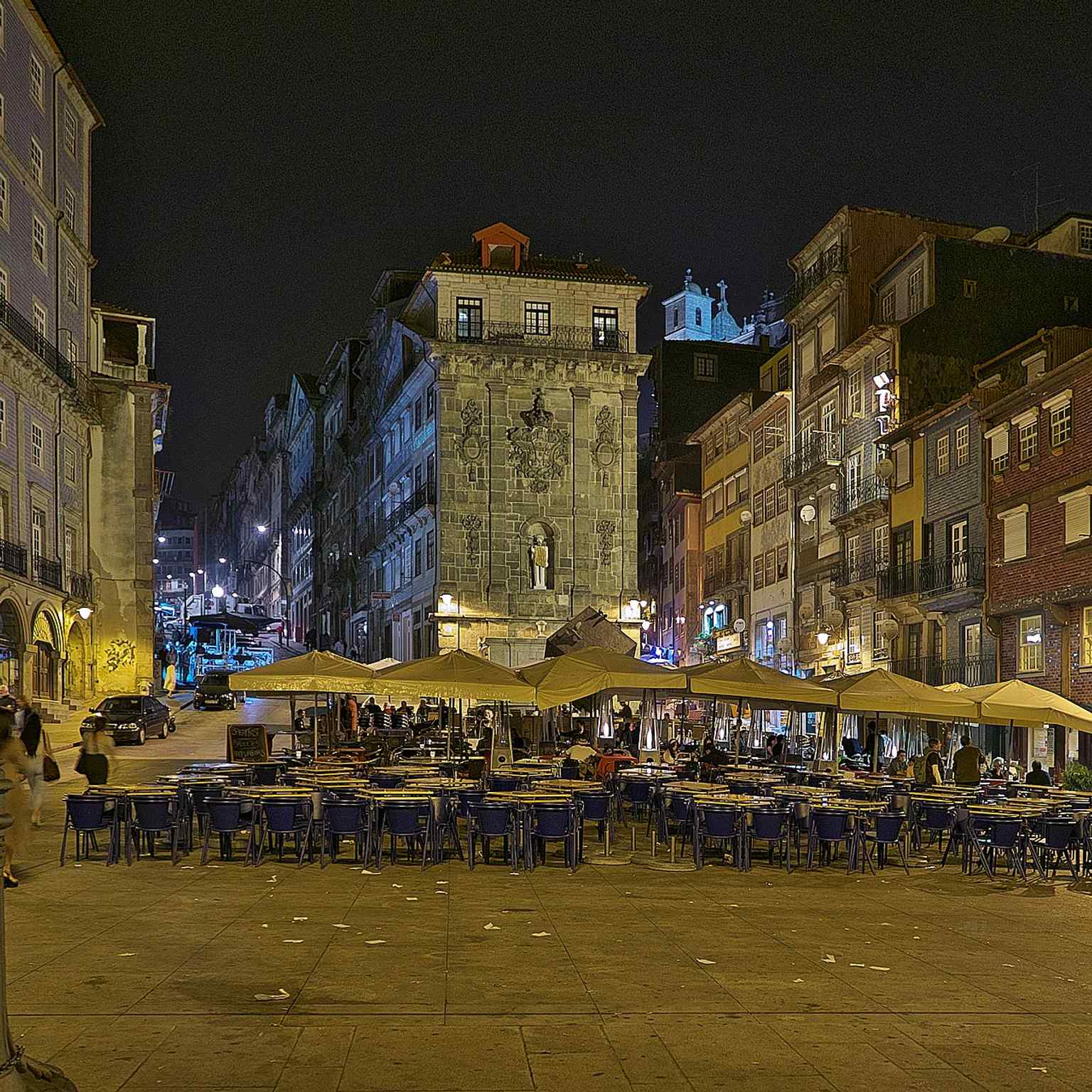
Praça da Ribeira in Porto, with the 1783 Chafariz da Rua de São João — the baroque fountain that became the square’s landmark.Photo: Jl FilpoC, Wikimedia Commons, CC BY 3.0. Cropped & resized. The square and its surrounding streets have held protected status since nineteen seventy-one, but Ribeira’s real protection is memory. This is where Porto learned to turn crowding, trade, damage, and redesign into character.
Now lift your eyes uphill. Above this river threshold sits the place that watched it all with episcopal authority... the Episcopal Palace. Head that way when you’re ready.
On your right, the Episcopal Palace shows itself as a long white Baroque block with rows of windows, a dark granite portal, and a balcony crowned by a bishop’s coat of arms. This…Read moreShow less
Open dedicated page →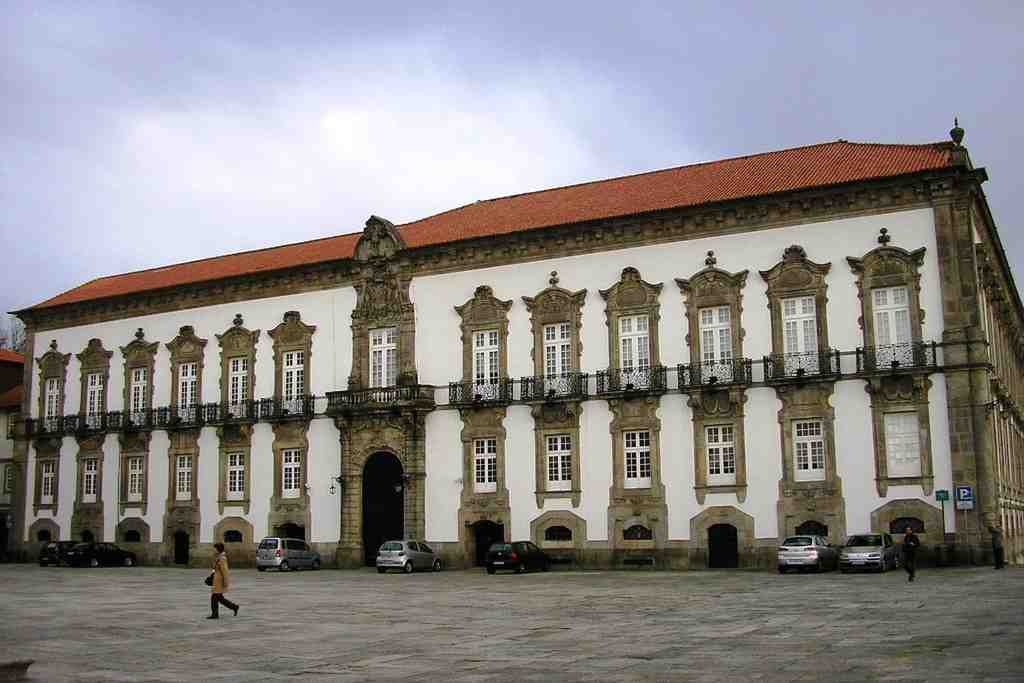
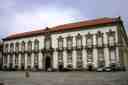
Episcopal Palace, PortoPhoto: Manuel de Sousa, Wikimedia Commons, Public domain. Cropped & resized. On your right, the Episcopal Palace shows itself as a long white Baroque block with rows of windows, a dark granite portal, and a balcony crowned by a bishop’s coat of arms.
This hill was Porto’s upper command post. Down by the river, merchants counted cargo and coin; up here, beside the cathedral, bishops watched over souls, law, and a very useful view of the city below.
The story begins early. By the time of Bishop D. Hugo, in the early twelfth century, there was already a bishop’s residence beside the cathedral. One stubborn survivor from that older house is still here: a narrow late-Romanesque slit window near the right side of the main door. Porto does this a lot... it rebuilds grandly, but it rarely throws everything away.
In thirteen eighty-seven, this palace witnessed the marriage of John the First of Portugal and Philippa of Lancaster. So yes, this hill has handled both salvation and statecraft with a fairly straight face.
What you see now mostly comes from a sweeping eighteenth-century remake. The Italian architect Nicolau Nasoni, the same restless imagination behind Clérigos, likely drew the project in seventeen thirty-four. Miguel Francisco da Silva then took on the actual building work from seventeen thirty-seven. Progress crawled, partly because Porto went for years without a confirmed bishop, and money was tight. Authority, it turns out, looks impressive from a distance and surprisingly expensive up close.
The man most tied to the palace’s completion is Bishop Rafael de Mendonça. His coat of arms sits over the main portal, as if signing off on the whole operation. Even then, the original plan had to shrink. What survived is still a fine piece of late Baroque and Rococo civil architecture, but also a reminder that institutions improvise, even when they pretend not to.
This building changed roles when the city did. During the Siege of Porto in eighteen thirty-two, the bishop fled, and Peter the Fourth’s liberal troops turned the palace into a stronghold against Miguel the First. Later, from nineteen sixteen until nineteen fifty-seven, the city council moved in and used it as Porto’s town hall. Then, in nineteen forty, redevelopment cleared away neighboring buildings, leaving the palace more exposed than it had been for centuries.
If you check the image on your screen, you can peek at the monumental staircase inside - a grand U-shaped climb with painted walls, stucco decoration, and a glass dome above. Since two thousand and sixteen, part of the palace has opened as a museum, though the bishop still uses parts of it, including the Audience Hall. Power here never really moved out; it just learned to share.
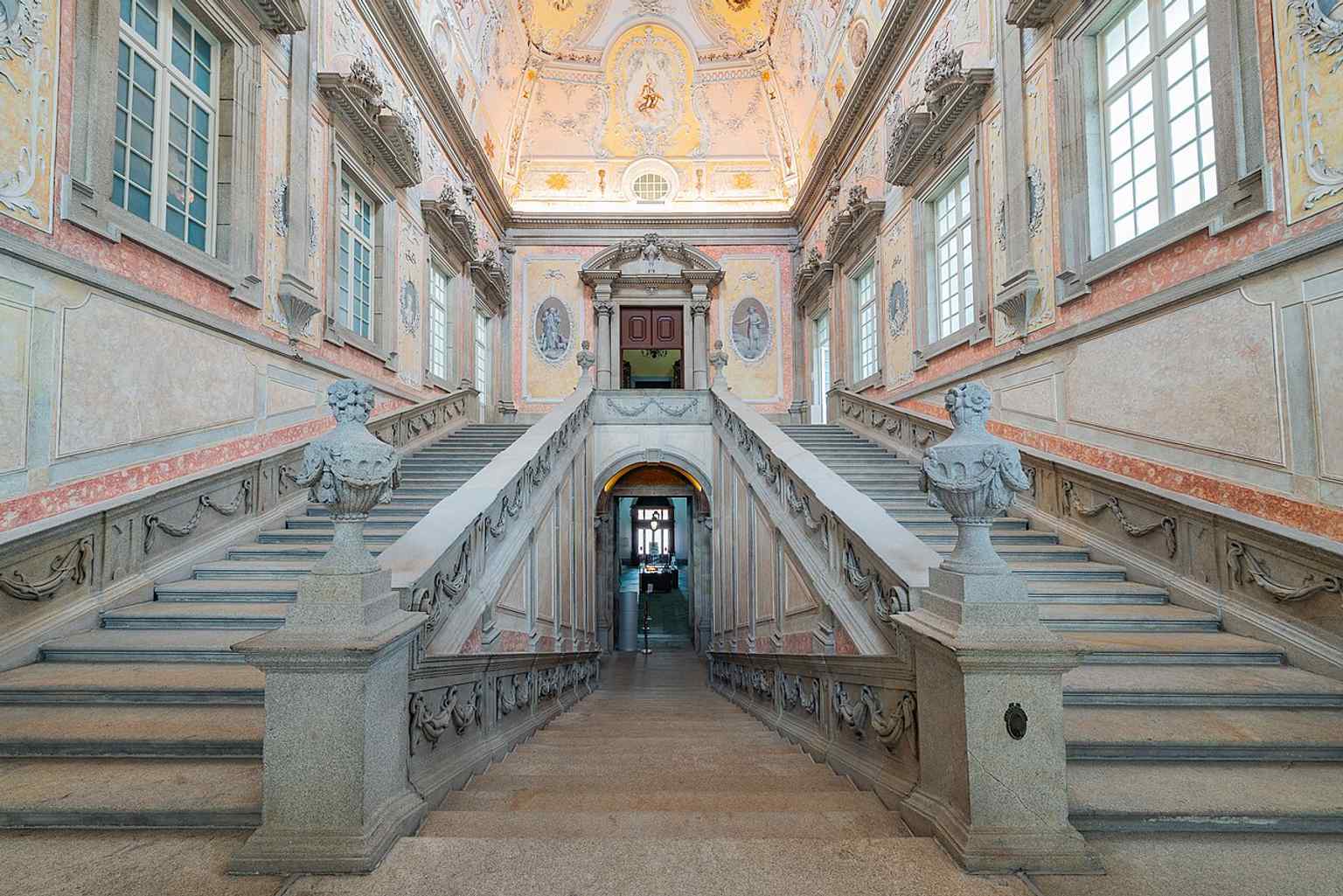
A wider interior view showing the ceremonial atmosphere of the palace, whose monumental staircase is the museum’s highlight.Photo: T meltzer, Wikimedia Commons, CC BY-SA 4.0. Cropped & resized. From here, the palace prepares you for the older heart of the hill: the cathedral itself. Head there next. If you want to return inside later, the museum generally opens Monday through Saturday from nine to one-thirty and from two to five-thirty, and it stays closed on Sunday.
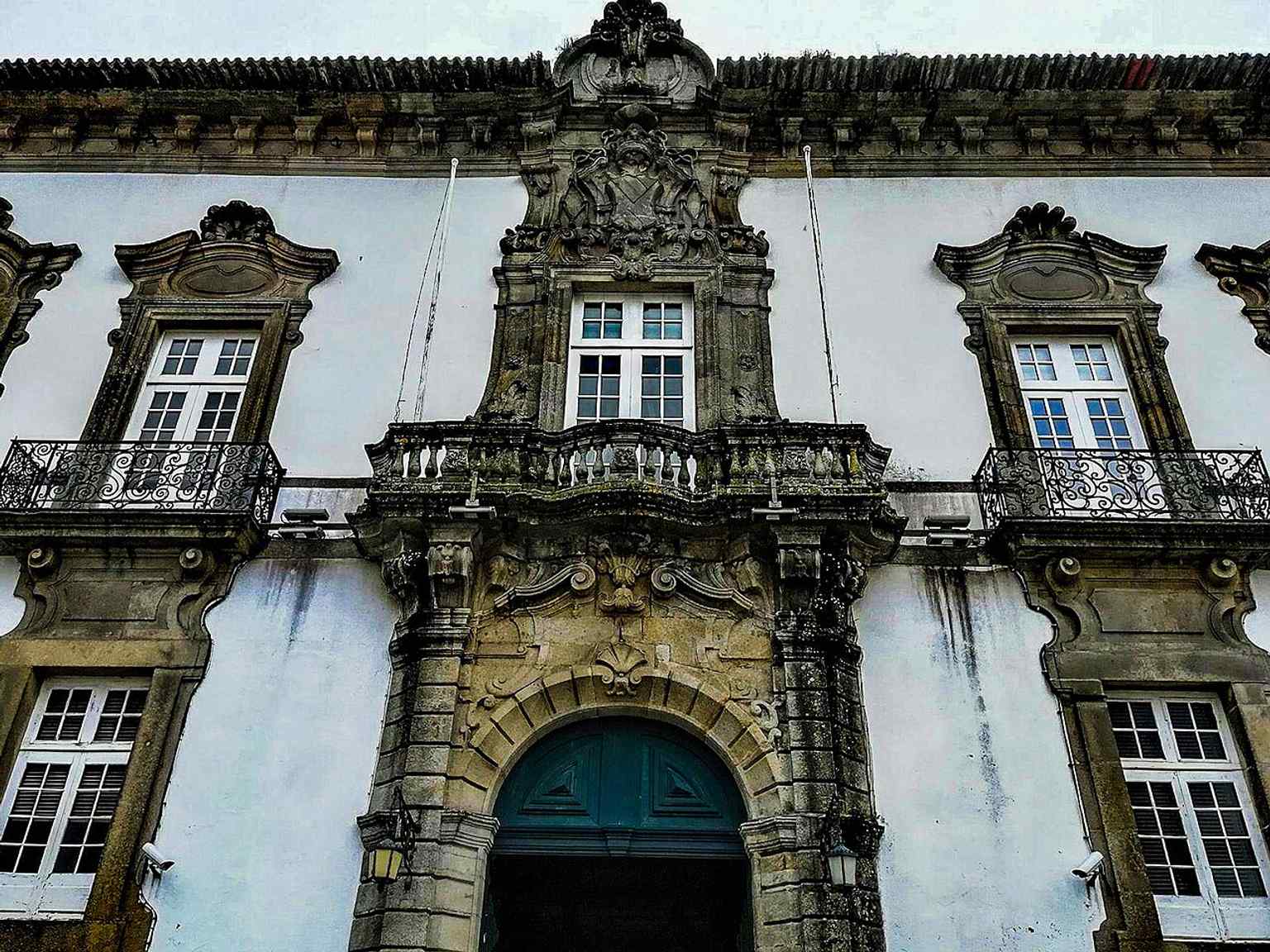
The white Baroque façade of Porto’s Episcopal Palace, the bishop’s residence beside the cathedral and a landmark of the city skyline.Photo: Ivan Stesso, Wikimedia Commons, CC BY-SA 4.0. Cropped & resized. 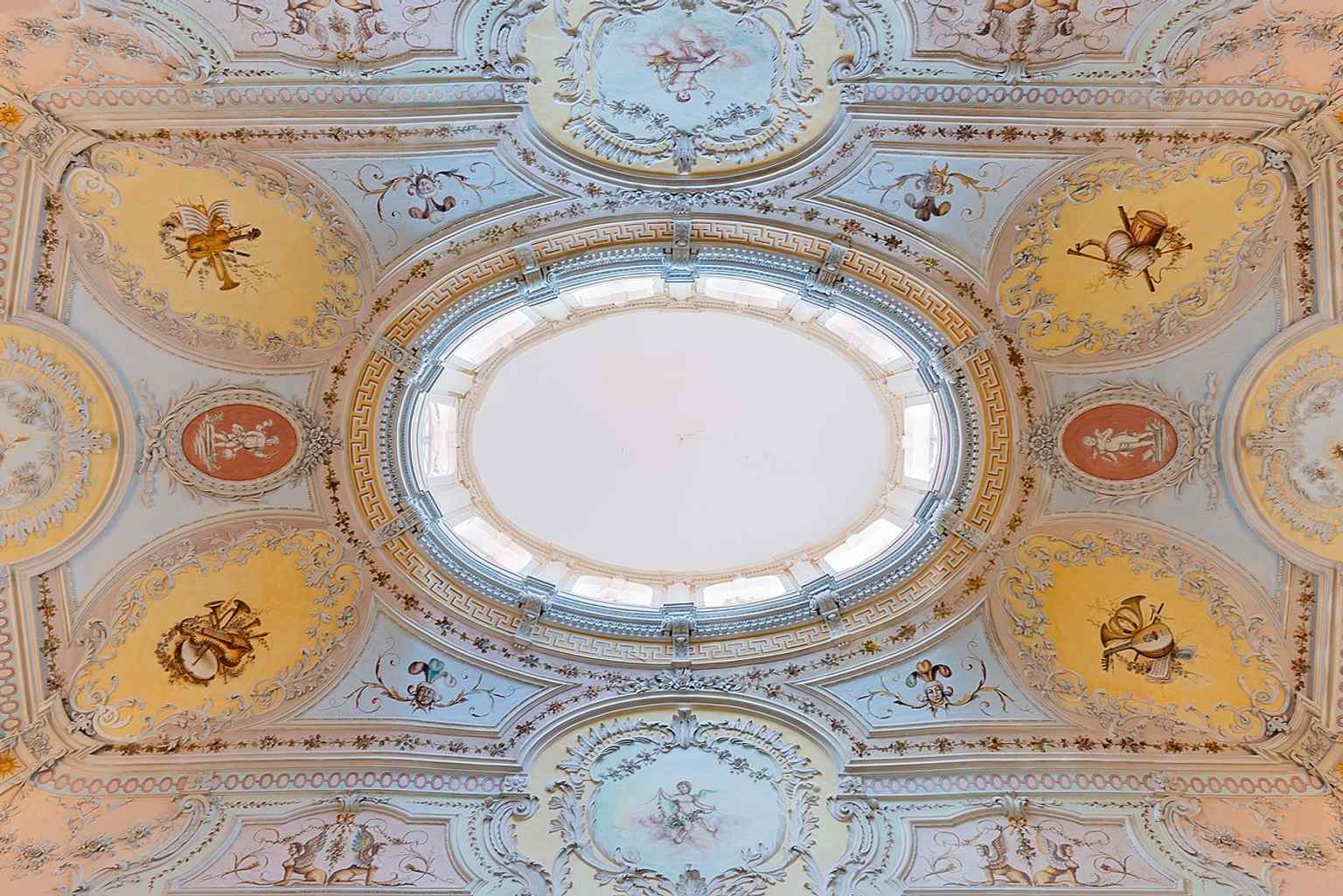
An interior view of the palace’s museum rooms, where the former episcopal residence now presents Porto’s church history.Photo: T meltzer, Wikimedia Commons, CC BY-SA 4.0. Cropped & resized. 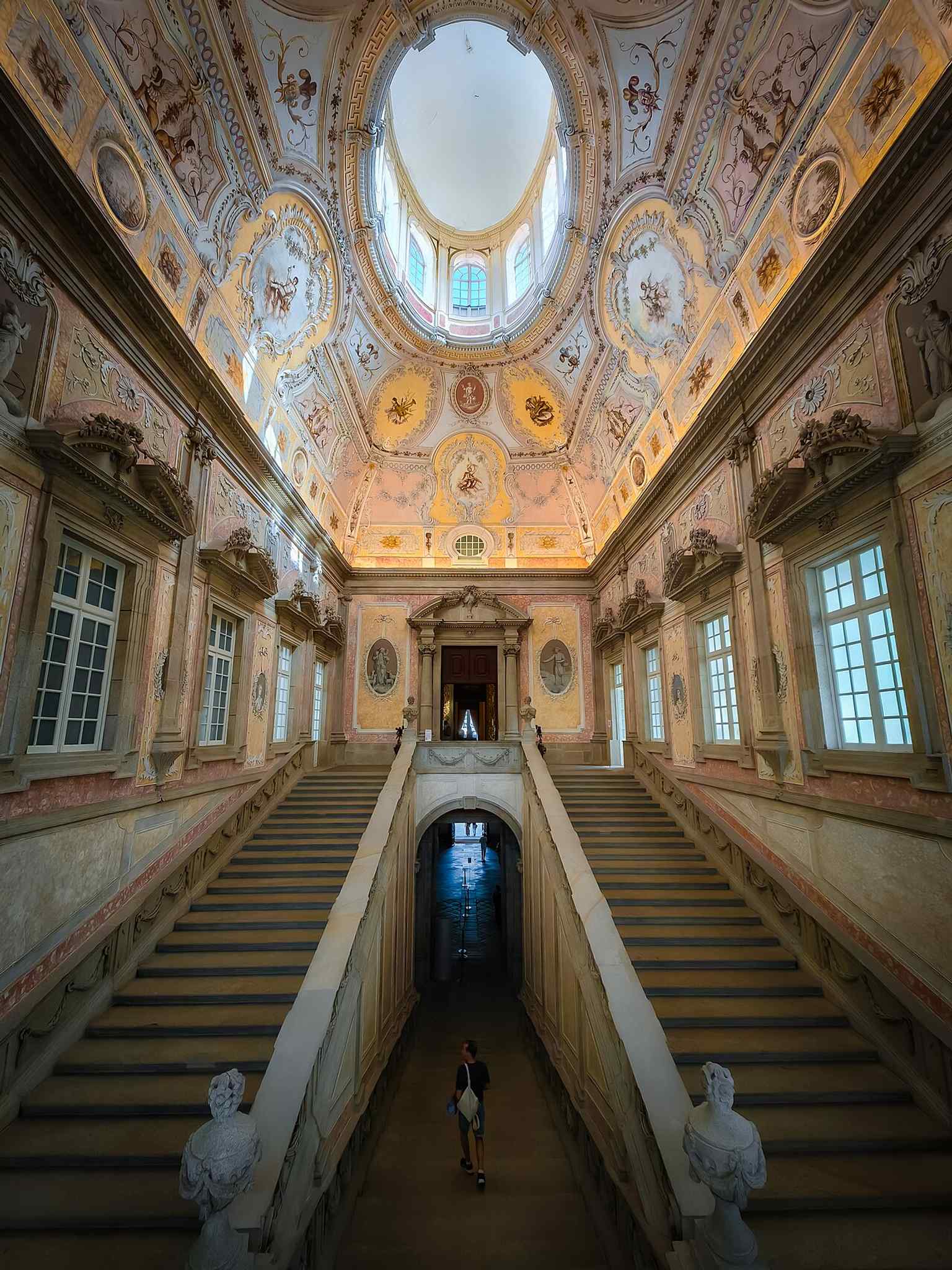
Another interior of the Episcopal Palace, reflecting its 18th-century rebuild and its current role as a museum and living bishop’s residence.Photo: 19bfc03, Wikimedia Commons, CC BY-SA 4.0. Cropped & resized. On your left, look for a pale granite church with a broad, blocky front, two square towers capped by cupolas, and a round rose window tucked beneath a battlement-like arch. This…Read moreShow less
Open dedicated page →On your left, look for a pale granite church with a broad, blocky front, two square towers capped by cupolas, and a round rose window tucked beneath a battlement-like arch.
This is where Porto’s memory piles up in stone. The cathedral stands on the site of an older chapel linked to Henry of Burgundy and his wife in eleven oh eight. An earlier church still stood here in eleven forty-seven, and then, in the later twelfth century, people began the building you see now. They kept working on it into the sixteenth century. Later generations added Baroque flourishes in the eighteenth century and made more changes in the twentieth. So yes... this place has had a long life and many editors.
And yet the heart of it still reads as Romanesque, the older medieval style of thick walls, heavy shapes, and a certain refusal to be delicate. The front is famously plain, almost severe. Those two towers stand square and solid, each braced by buttresses, the stone supports that help hold the walls steady. Below the battlement-like arch sits the rose window, a small round note of elegance in all this muscular masonry. Even the main hall inside, with its stone roof, relied on flying buttresses, those outer supports that carry weight away from the walls, making it among the earlier buildings in Portugal to use them.
Take a second and really study the bulk of it. Does it feel like a church, a fortress, or a building that preferred not to choose? Medieval builders did enjoy keeping their options open.
Up here on the hill, that double identity mattered. This was not only a place for prayer. It marked power. It anchored the upper city. And it held some of the moments Porto kept closest. In thirteen eighty-seven, King John the First and Philippa of Lancaster were blessed here and then married here on the fourteenth of February. That marriage helped secure the long alliance between Portugal and England, and Philippa later became remembered as the mother of Portugal’s Illustrious Generation. One wedding, in one cathedral, and suddenly the city is tied to a much larger map.
The cathedral also belongs to the story of Prince Henry the Navigator, because he was baptized here. If you look at the image in the app, you can see the baptistery linked to that early chapter in Portugal’s age of exploration. And another image shows the Gothic cloister, later enriched with Baroque azulejo tiles by Valentim de Almeida, a neat reminder that this building never stopped absorbing new centuries.
The baptistery, tied to the cathedral’s role in early Portuguese history and to the baptism of Prince Henry the Navigator.Photo: John Samuel, Wikimedia Commons, CC BY-SA 4.0. Cropped & resized. Nicolau Nasoni, the architect you met at Clérigos, joined that process too. He arrived in Porto in seventeen twenty-five to work on the sacristy and chancel, and in seventeen thirty-six he added a Baroque loggia to the cathedral’s side. In seventeen seventy-two, builders replaced the old Romanesque main portal. In eighteen oh one, during the War of the Oranges, Spanish soldiers briefly seized the cathedral before local residents drove them out. And when Napoleon’s troops entered Porto in eighteen oh nine, legend says a sacristan, or perhaps canon Pedro Breiner, saved the great silver altarpiece by disguising it with plaster or bargaining for its survival. However the story happened, the point is clear: people fought to keep this place intact.
That feels right for this hilltop church. Altered many times, never erased... still unmistakably itself.
From here, the story is ready to open outward. Next, head to the Dom Luís the First Bridge, about a seven-minute walk away, where all this gathered stone suddenly turns into a single span across the river. If you want to come back inside later, the cathedral is generally open every day from nine in the morning to six thirty in the evening.
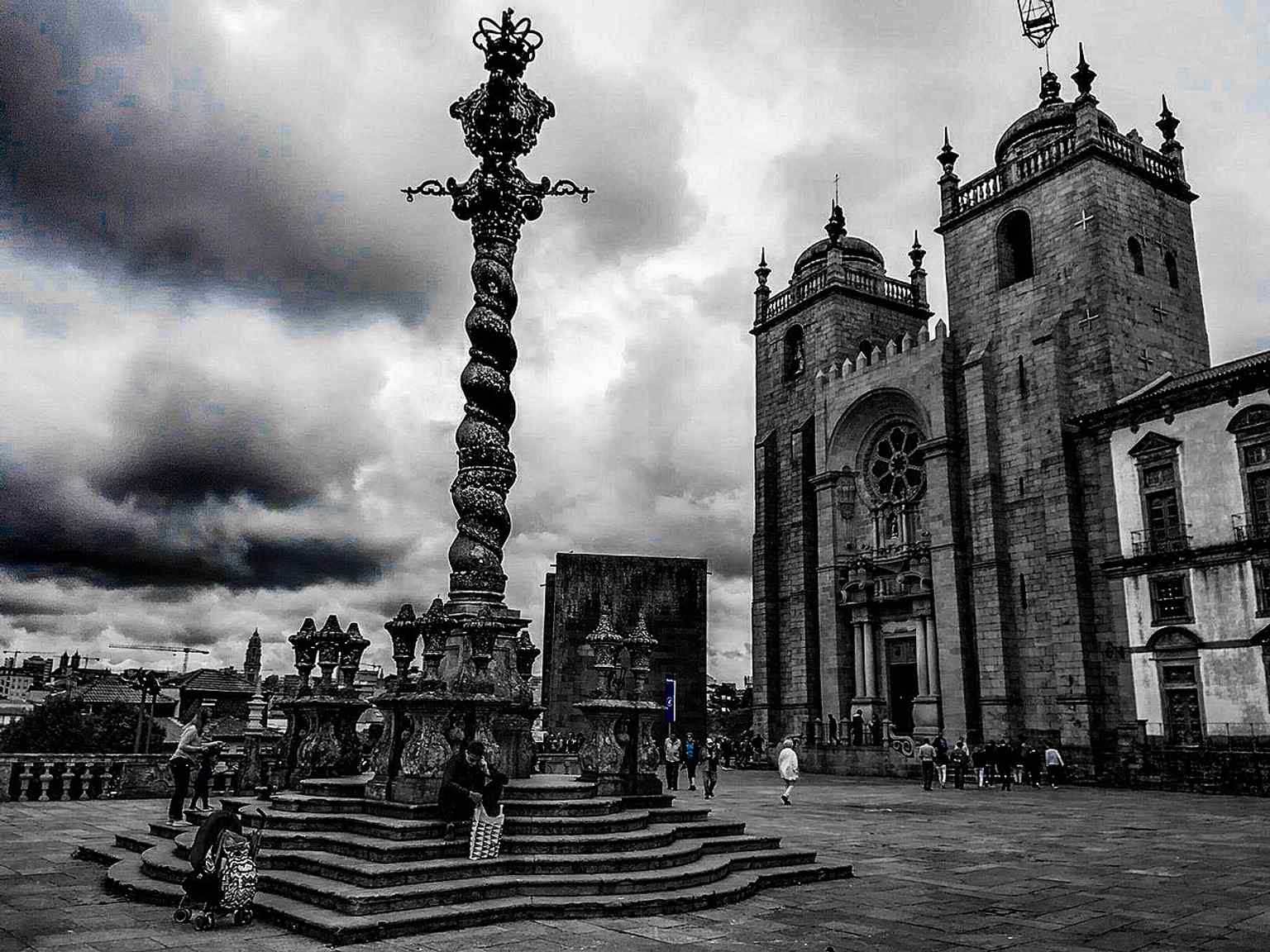
A classic exterior view of Porto Cathedral under dramatic clouds, showing the fortress-like Romanesque façade that defines the landmark.Photo: Ivan Stesso, Wikimedia Commons, CC BY-SA 4.0. Cropped & resized. 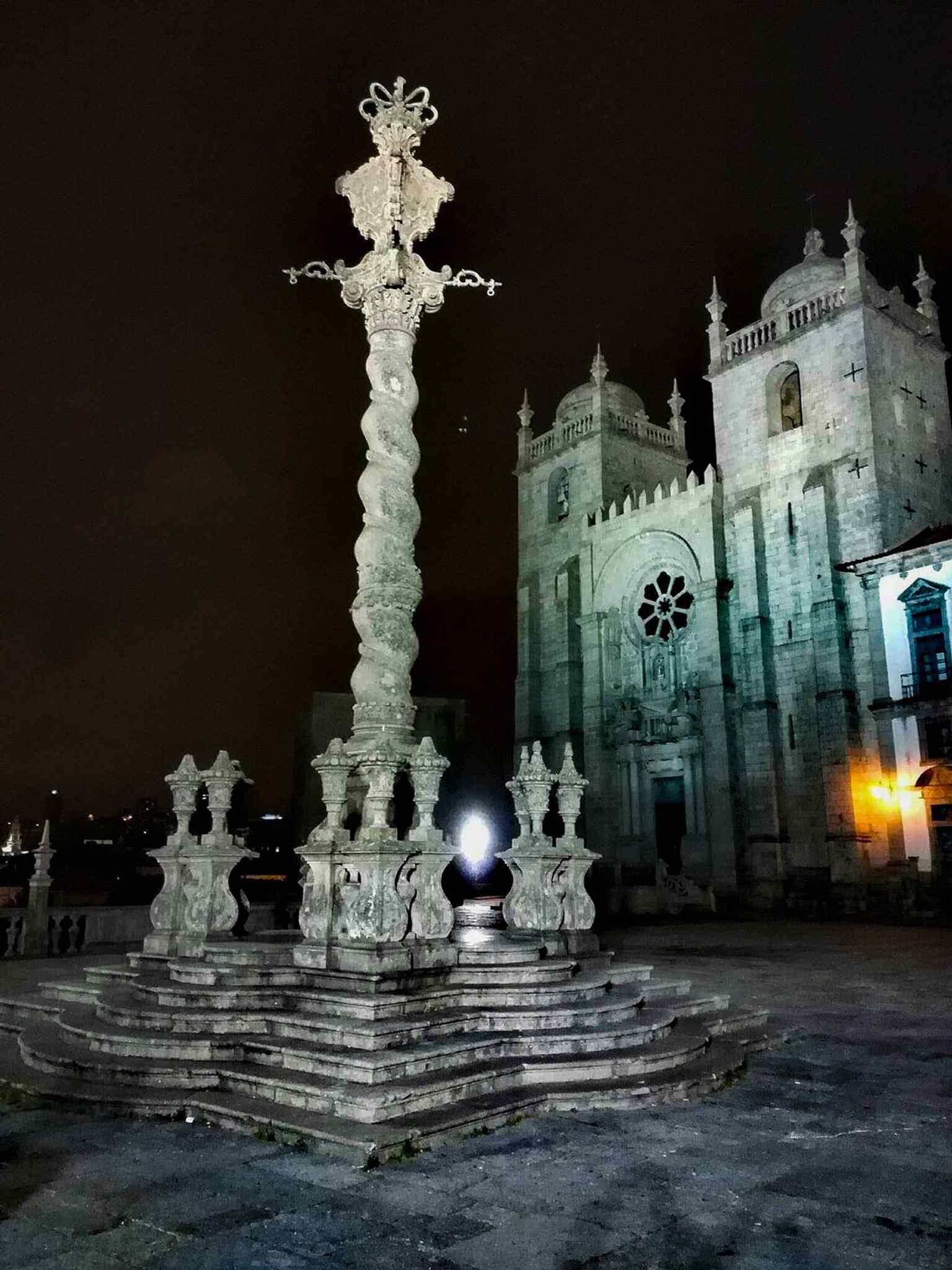
The cathedral seen from outside, with its sturdy towers and plain medieval walls that make it feel more like a stronghold than a church.Photo: John Samuel, Wikimedia Commons, CC BY-SA 4.0. Cropped & resized. 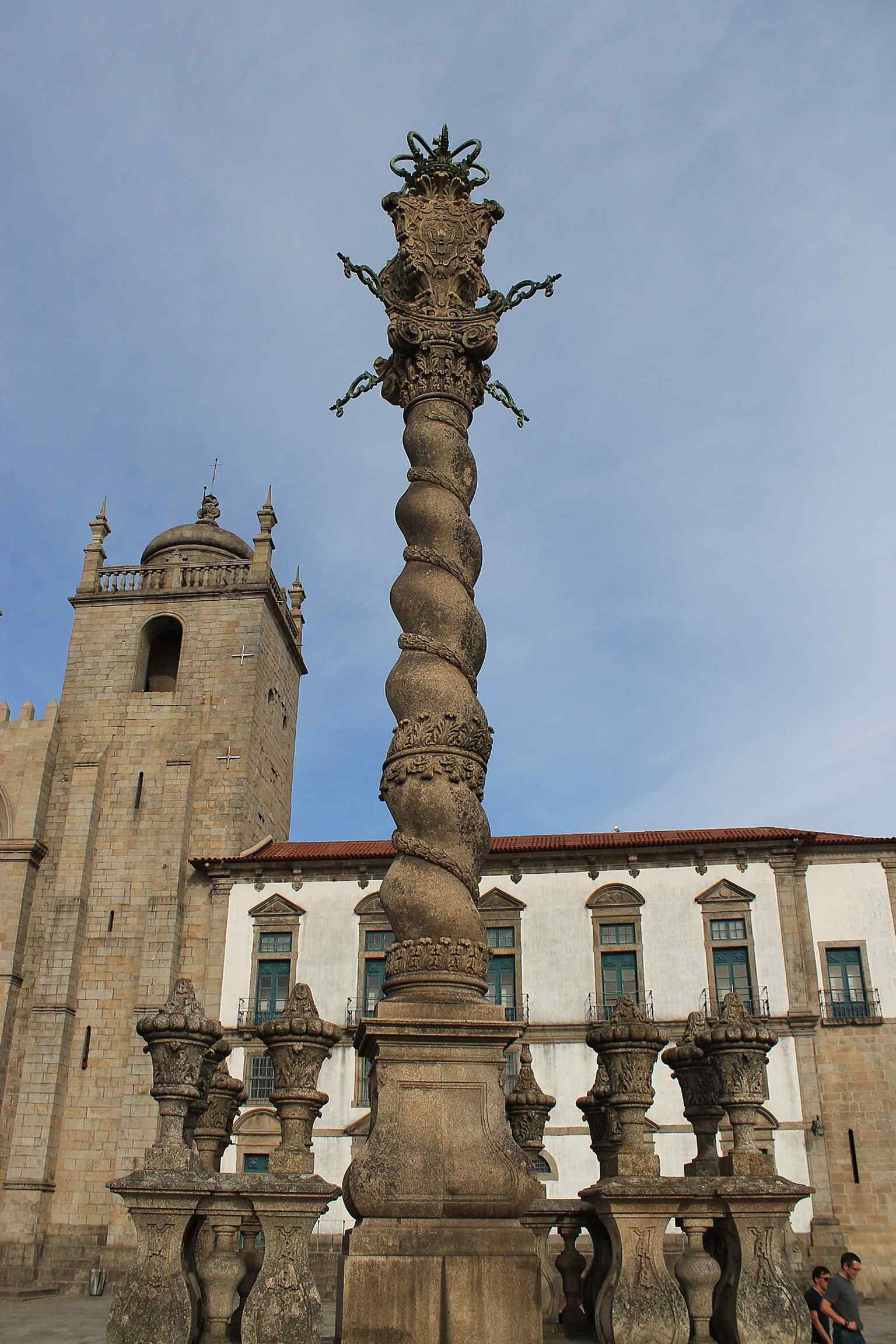
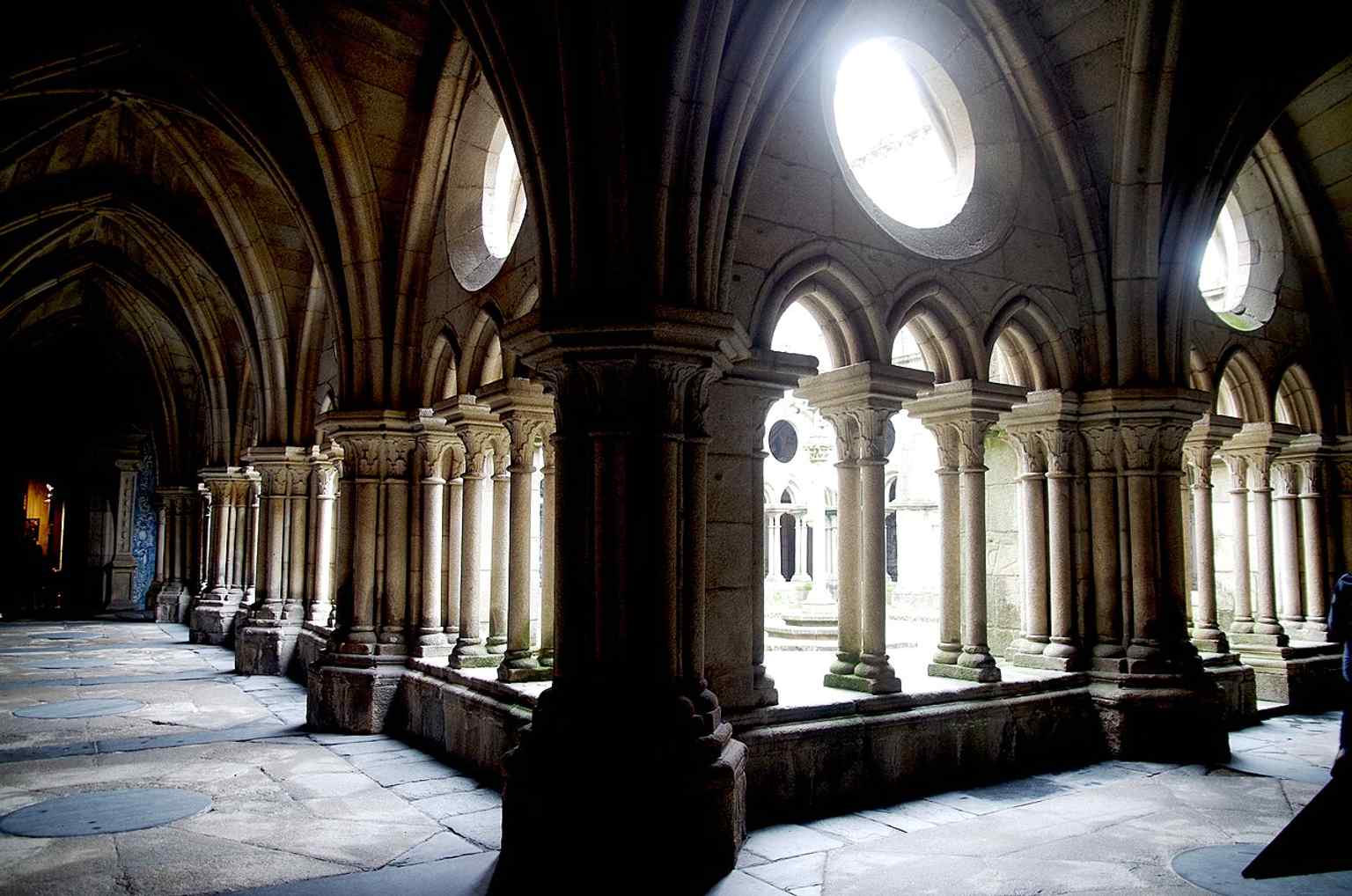
The Gothic cloister, begun in the 14th century, one of the cathedral’s most atmospheric spaces and a link to its royal history.Photo: Cardilio, Wikimedia Commons, CC BY-SA 4.0. Cropped & resized. 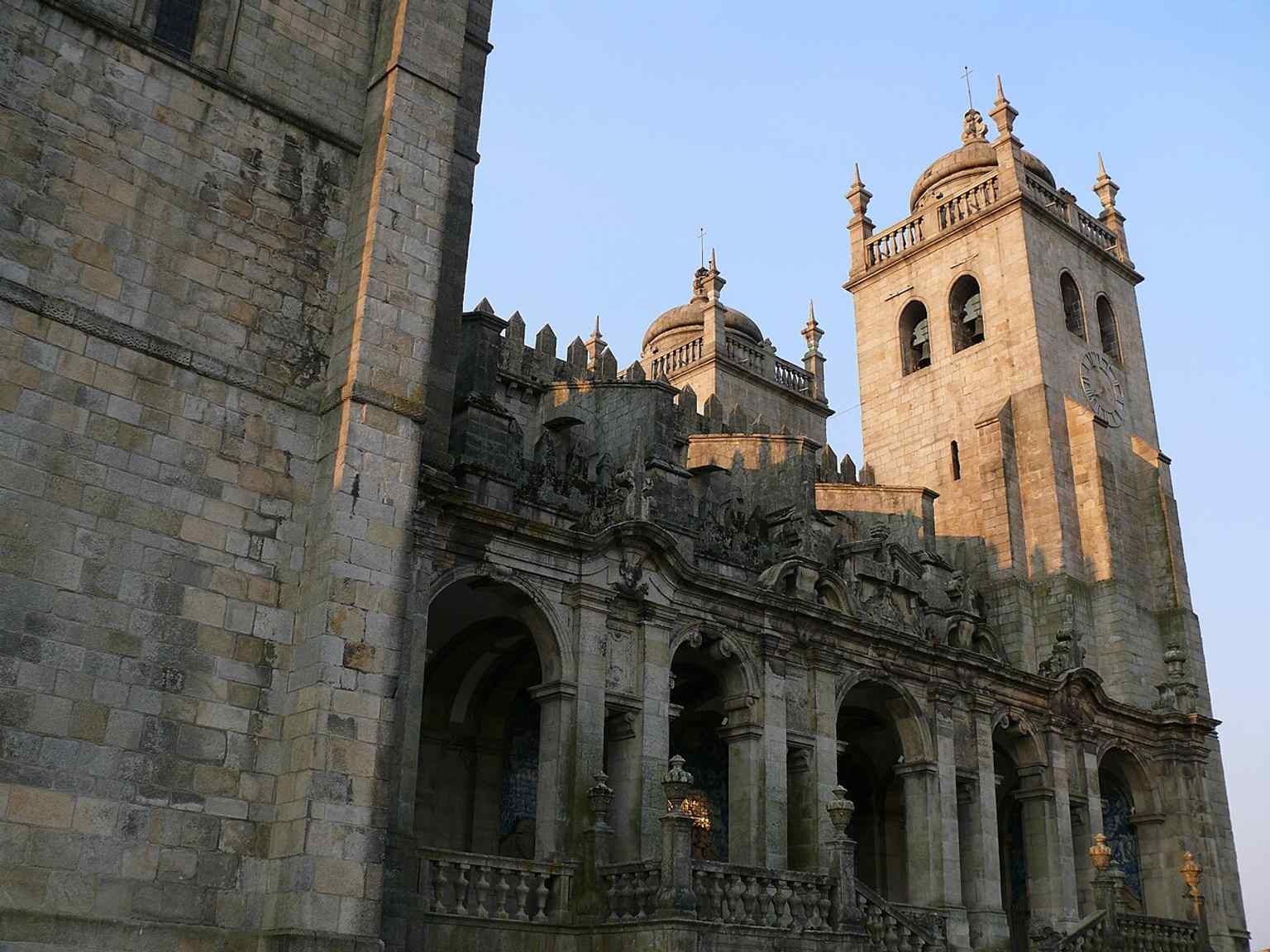
The cloister’s azulejo-lined galilé, where painted tilework adds a later Baroque layer to the cathedral’s Gothic setting.Photo: John Samuel, Wikimedia Commons, CC BY-SA 4.0. Cropped & resized. 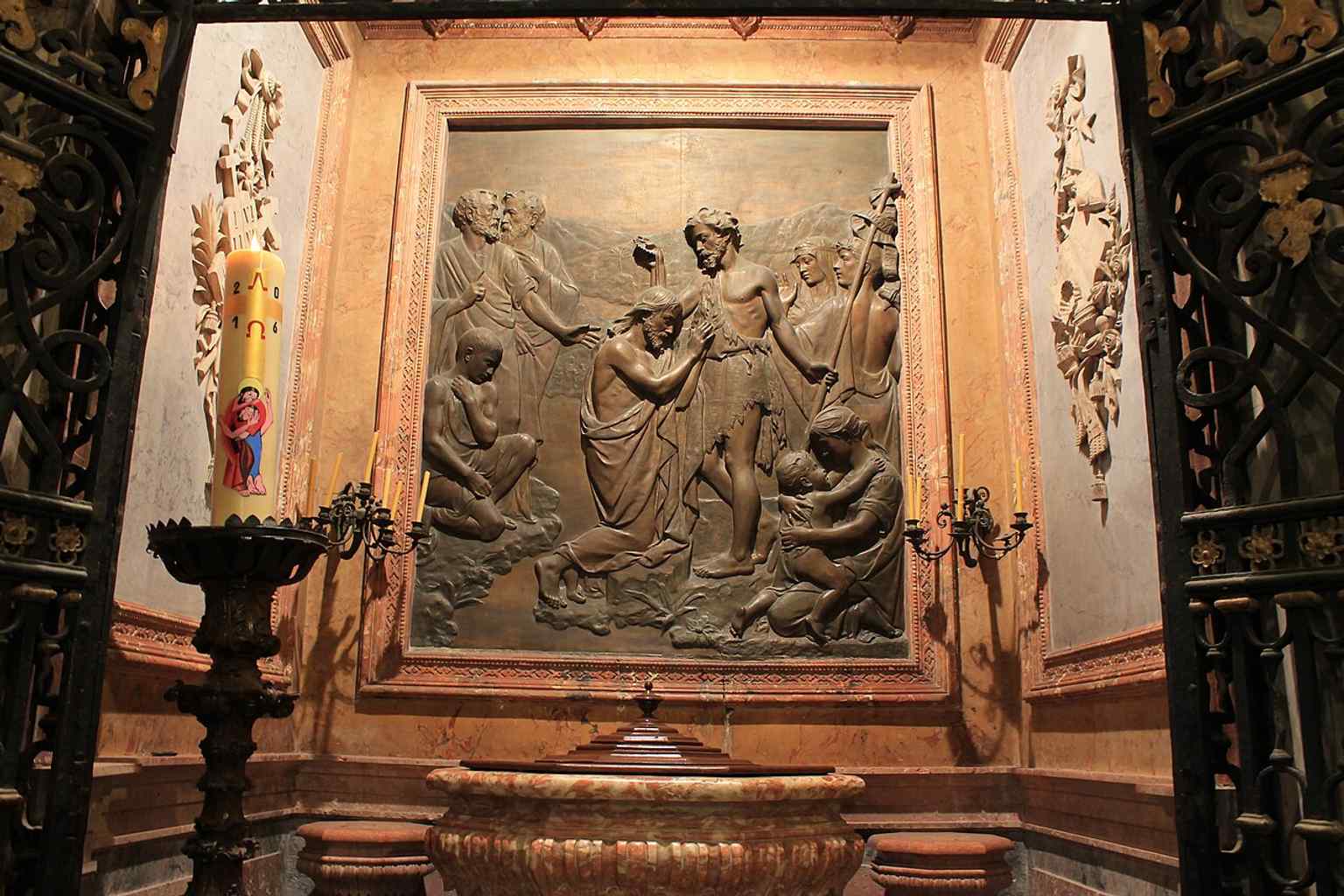
A chapel in the cathedral with ornate Baroque decoration, reflecting the later artistic layers added to the medieval building.Photo: John Samuel, Wikimedia Commons, CC BY-SA 4.0. Cropped & resized. 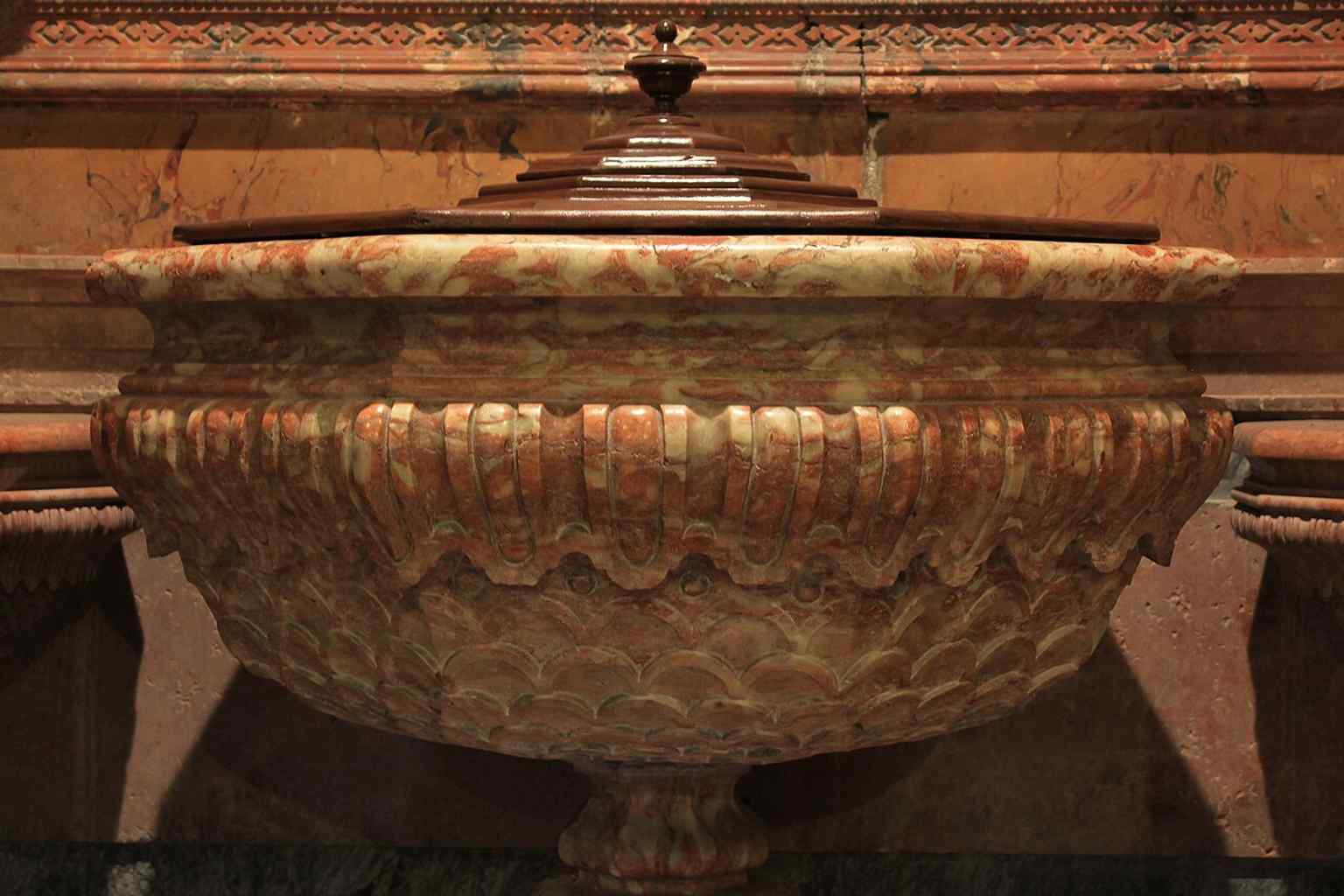
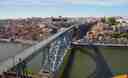
The altar of Nossa Senhora da Vandoma, part of the cathedral’s interior chapels and its long tradition of devotional art.Photo: John Samuel, Wikimedia Commons, CC BY-SA 4.0. Cropped & resized. Look for the huge iron arch with two straight metal decks stacked above the Douro, its latticework skeleton tying Porto to Gaia in one unmistakable sweep. This is Dom Luís the…Read moreShow less
Open dedicated page →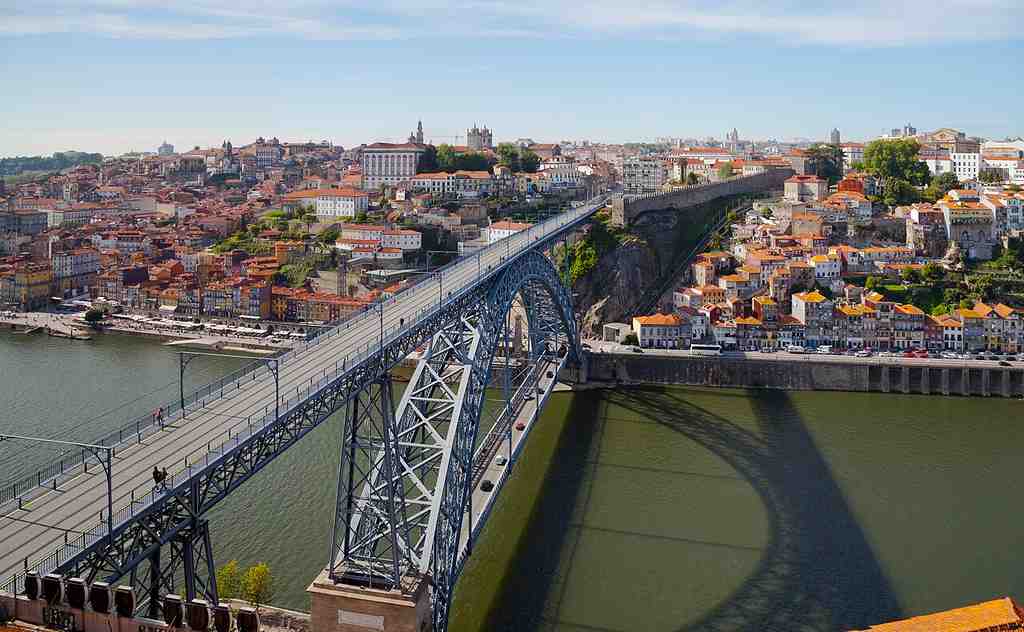
Dom Luís I Bridge (Porto)Photo: Diego Delso, Wikimedia Commons, CC BY-SA 3.0. Cropped & resized. Look for the huge iron arch with two straight metal decks stacked above the Douro, its latticework skeleton tying Porto to Gaia in one unmistakable sweep.
This is Dom Luís the First Bridge... though even the name has a Porto twist. Officially, the old plaques use the spelling Luiz the First, and the story that locals dropped the royal title because the king skipped the opening is probably just a good rumor that refused to die. Porto does enjoy a stubborn legend.
What you’re facing is more than a crossing. It’s an argument in iron. In the late eighteen hundreds, trade in Porto surged, factories spread through the eastern districts, and traffic between Porto and Vila Nova de Gaia outgrew the old suspension bridge that stood here before. So the government called for something bigger and smarter: not one deck, but two, so the river level and the upper city could both connect properly. That requirement quietly knocked aside a proposal from Gustave Eiffel’s firm. Yes, that Eiffel.
The winning design came from the Belgian engineer Théophile Seyrig, who had already worked with Eiffel on the Maria Pia Bridge... and then split from him in eighteen seventy-nine. So this bridge carried a little personal drama inside all that public utility. Seyrig returned with his own design, working with Société de Willebroeck, beat Eiffel in the Douro competition, and left his former partner behind. Around here, that counts as elegant professional revenge.
Construction started in eighteen eighty-one. The upper deck opened on the thirty-first of October, eighteen eighty-six, timed to match King Luís the First’s birthday. The lower deck followed in eighteen eighty-eight, and then the bridge truly began its working life. And work it did. Crossing was not free at first; from the first of November, eighteen eighty-six, people paid tolls just to get over the river. Pedestrians only escaped that charge in nineteen thirteen. Vehicles and even animals kept paying until the first of January, nineteen forty-four. Nothing says modern progress quite like paying by the hoof.
If you glance at the app image now, you can see why this design mattered so much. Two decks turned a river obstacle into a layered piece of city planning. The upper level now carries Metro Line D and pedestrians; the lower one serves local traffic, bicycles, and walkers. That double life is the whole point.
And if you look at the close detail on your screen, notice that iron webbing. Engineers call that a truss, the crisscross skeleton that spreads weight through the structure. In its day, the great central arch was celebrated as the largest metal arch in the world. The whole bridge stretches about three hundred eighty-five meters and weighs roughly three thousand forty-five tons, but somehow it still reads like lace... if lace had ambitions.
It has kept changing without surrendering itself. Repairs in recent years tackled corrosion, replaced rivets and steel plates, strengthened the lower deck, and reduced vibrations from heavy crowds. Since nineteen eighty-two it has held protected status as a property of public interest, and since nineteen ninety-six it has stood within Porto’s UNESCO World Heritage site.
From here, Porto finally makes its case in one view: river and hill, warehouse and cathedral, market life and merchant money, stone faith above and working water below. A city stacked in levels, argued over by kings, bishops, traders, engineers, and ordinary people with somewhere to be. And in the middle of it all, this bridge does what Porto has always done best... turn pressure into form, and division into connection.
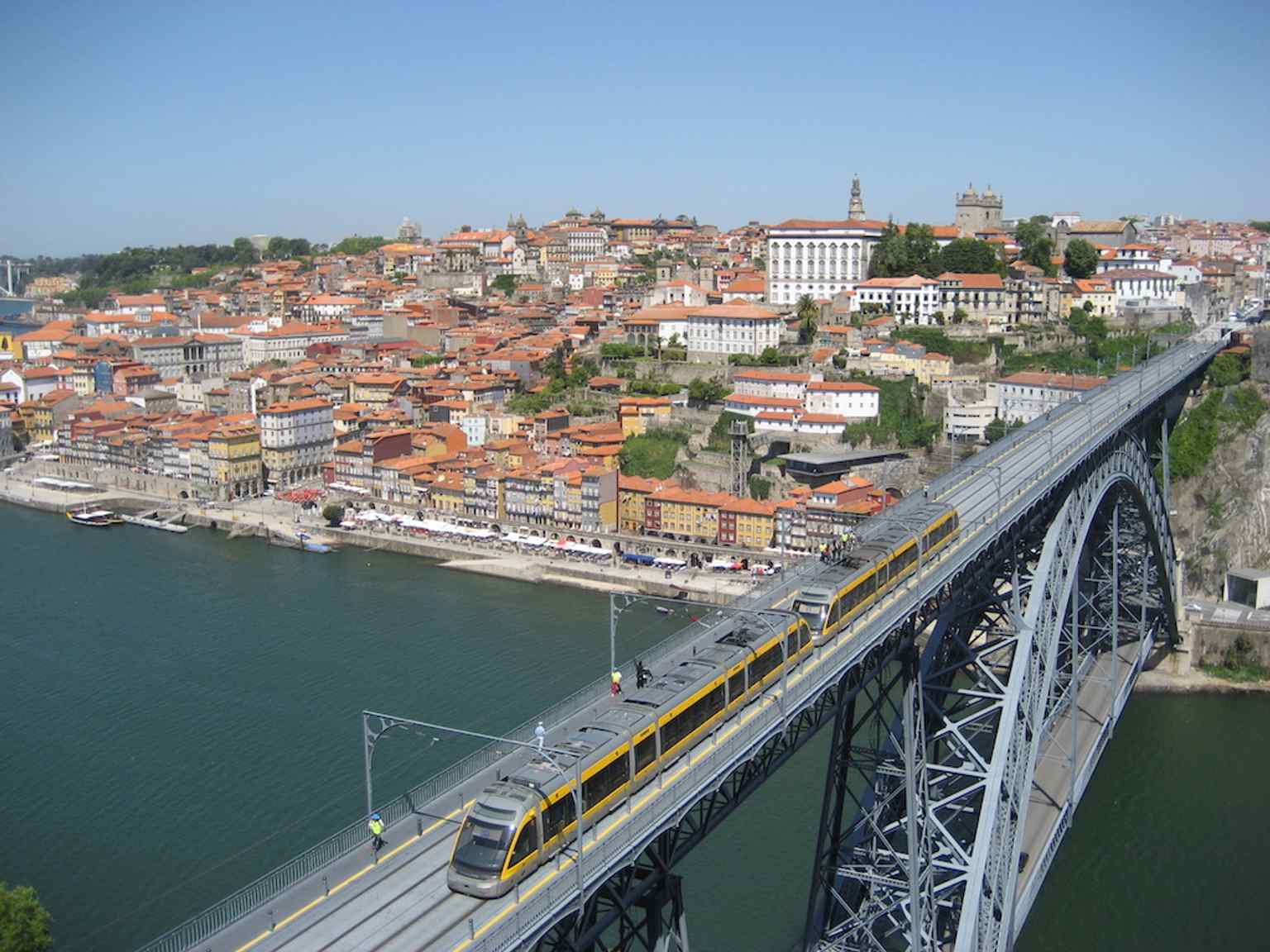
A panoramic view from Serra do Pilar with the bridge spanning the Douro — one of the city’s signature UNESCO-era postcard scenes.Photo: Ernstkers, Wikimedia Commons, CC BY-SA 4.0. Cropped & resized. 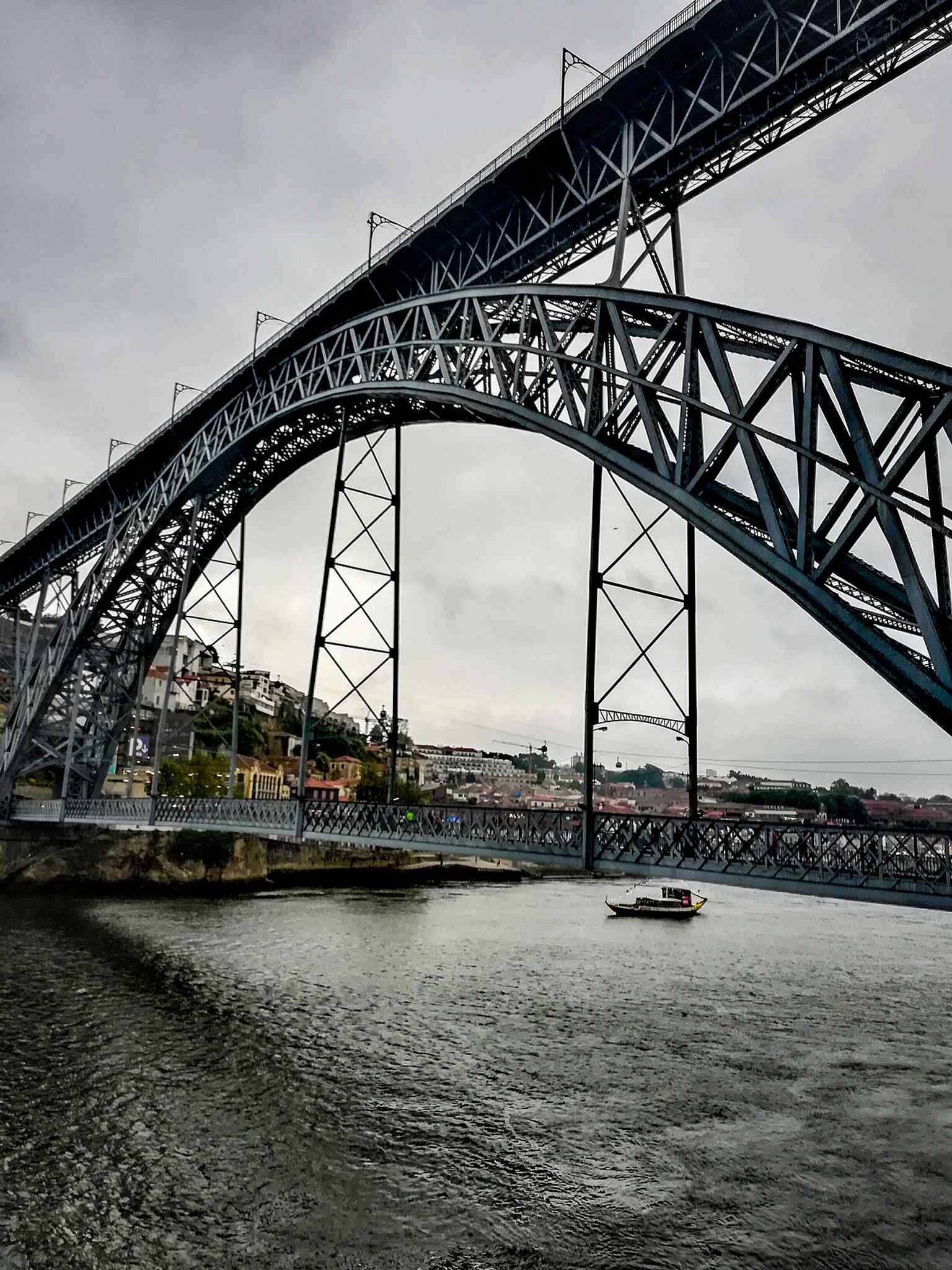
A crisp, close view of the iron bridge structure — useful for showing the metal filigree that replaced the old suspension bridge.Photo: Ivan Stesso, Wikimedia Commons, CC BY-SA 4.0. Cropped & resized. 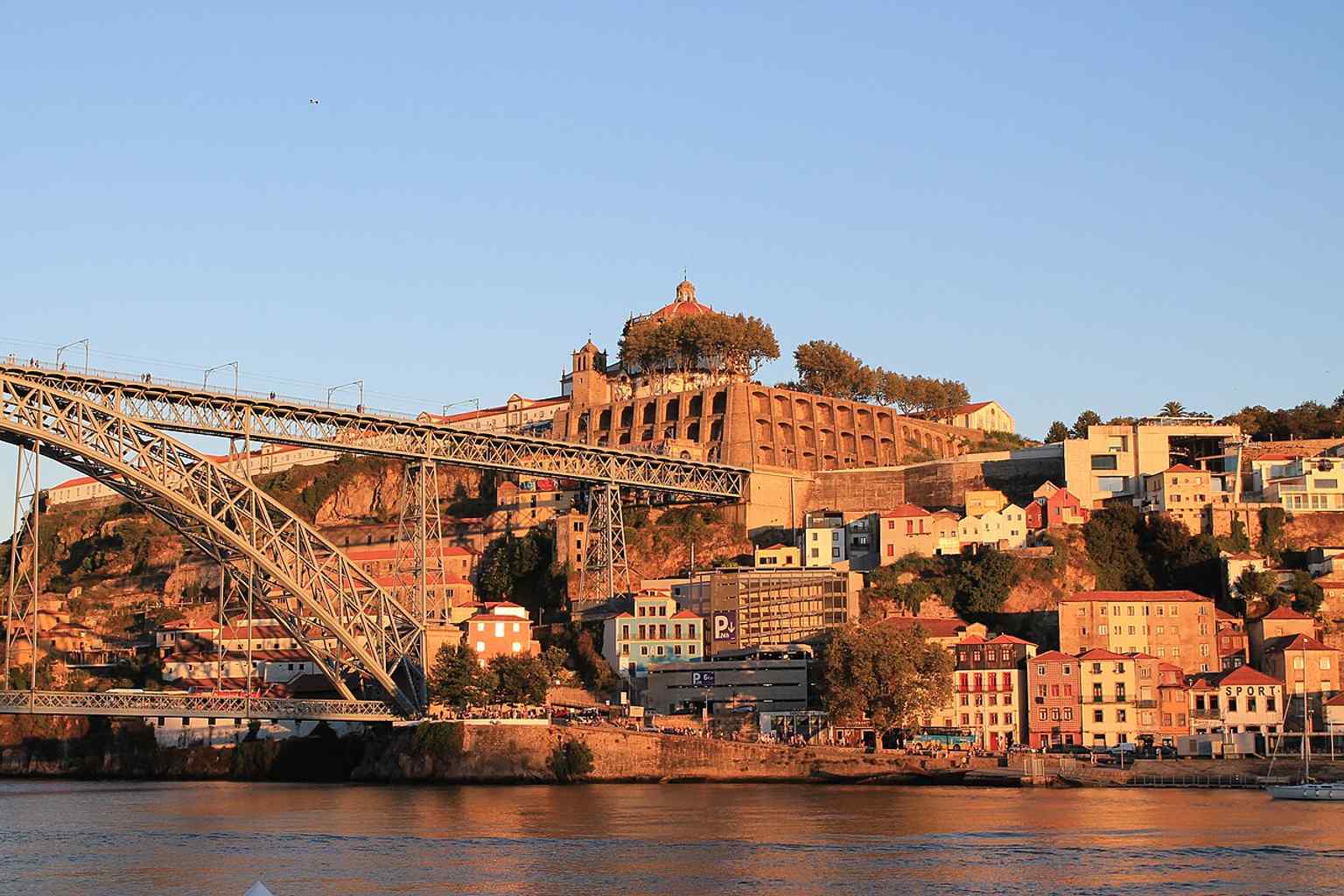
A sunset view of the bridge, echoing its long-standing status as one of Porto’s most iconic landmarks since the 19th century.Photo: John Samuel, Wikimedia Commons, CC BY-SA 4.0. Cropped & resized. 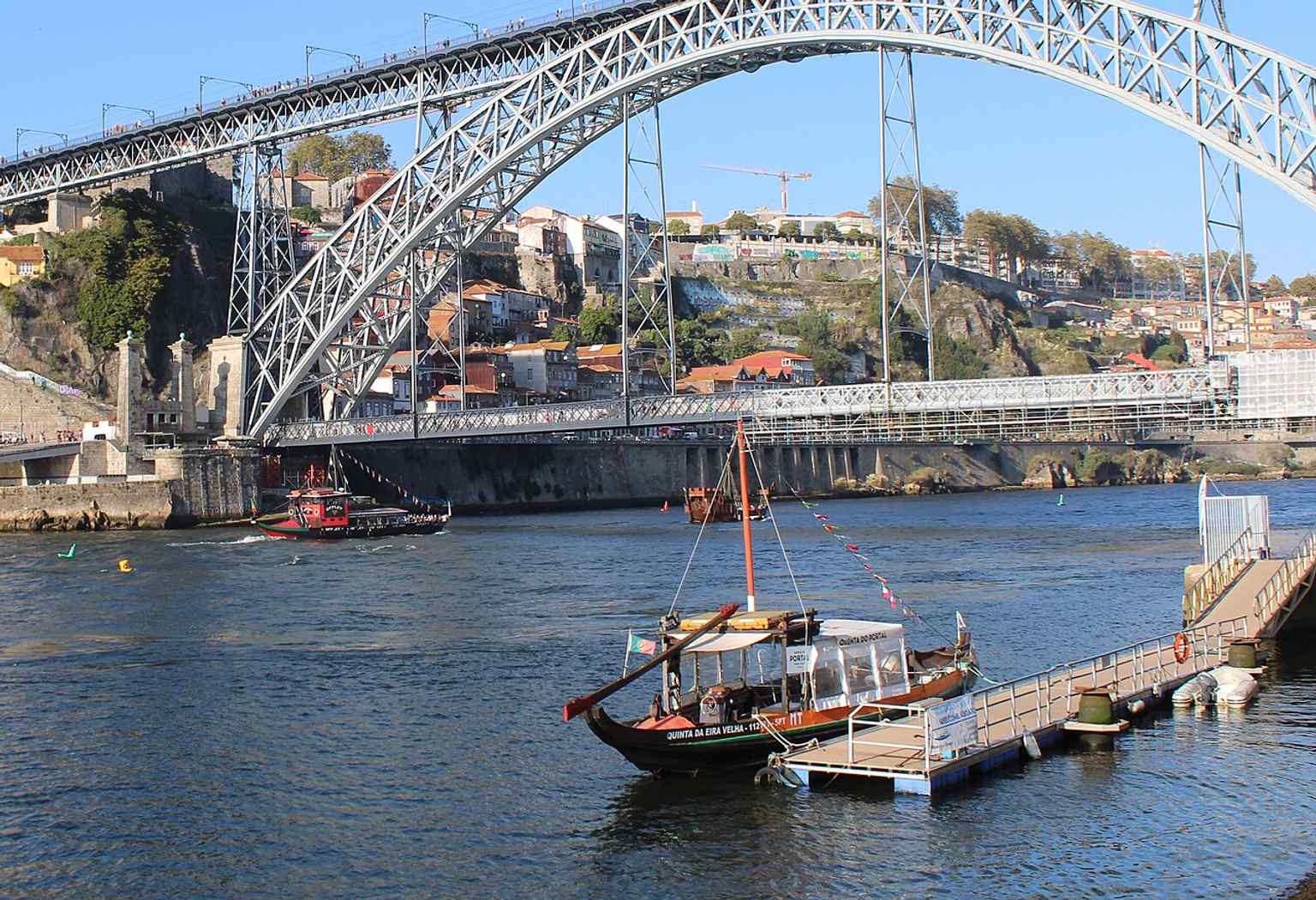
Boats passing beneath the bridge underline the Douro crossing that originally replaced the old suspension bridge and transformed river traffic.Photo: René Hourdry, Wikimedia Commons, CC BY-SA 4.0. Cropped & resized. 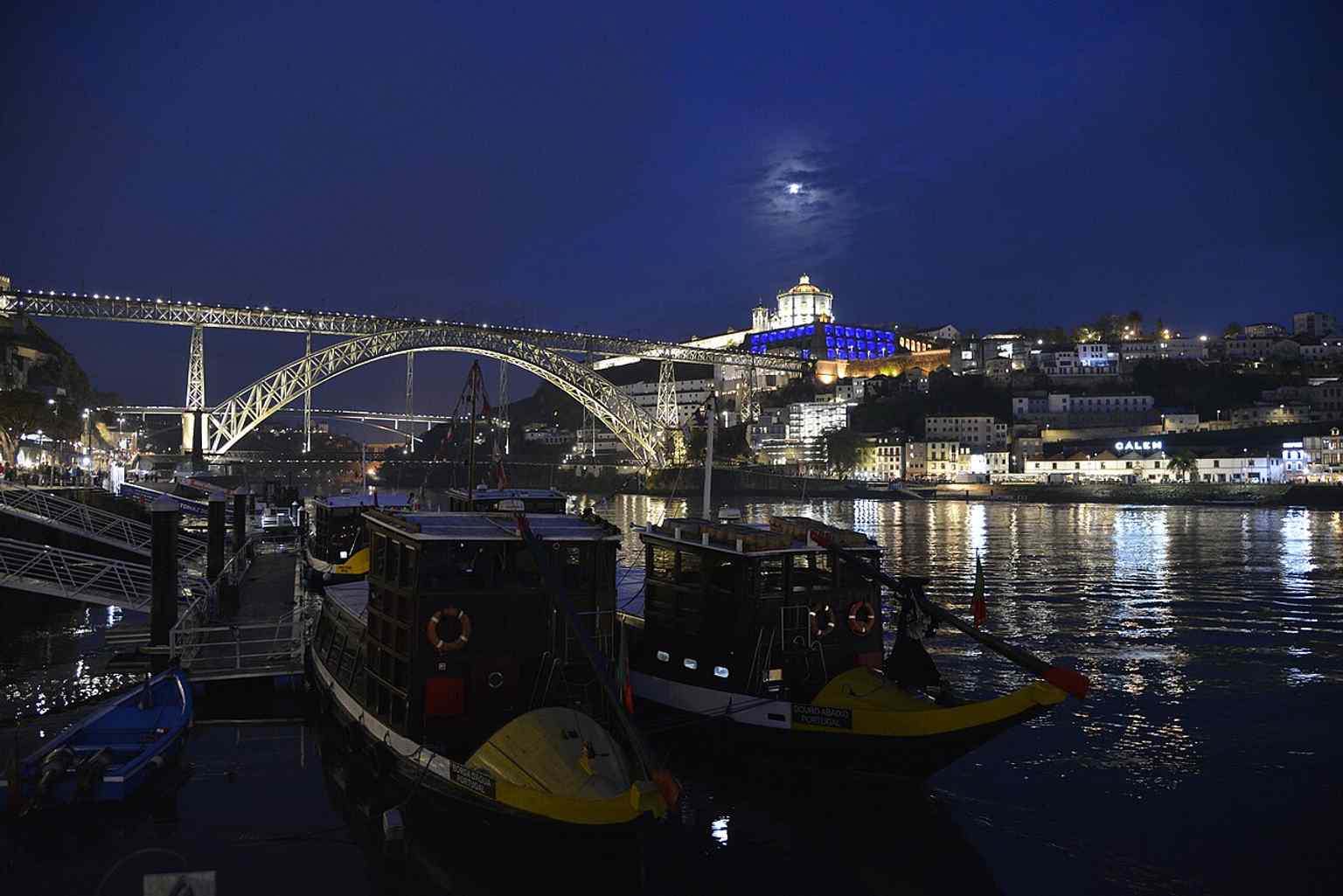
A recent detailed view of the bridge from the Porto side, useful for showing its current condition as a protected UNESCO landmark.Photo: Yiyi, Wikimedia Commons, CC BY-SA 4.0. Cropped & resized.
Reviews
Frequently asked questions
How do I start the tour?
After purchase, download the AudaTours app and enter your redemption code. The tour will be ready to start immediately - just tap play and follow the GPS-guided route.
Do I need internet during the tour?
No! Download the tour before you start and enjoy it fully offline. Only the chat feature requires internet. We recommend downloading on WiFi to save mobile data.
Is this a guided group tour?
No - this is a self-guided audio tour. You explore independently at your own pace, with audio narration playing through your phone. No tour guide, no group, no schedule.
How long does the tour take?
Most tours take 60–90 minutes to complete, but you control the pace entirely. Pause, skip stops, or take breaks whenever you want.
What if I can't finish the tour today?
No problem! Tours have lifetime access. Pause and resume whenever you like - tomorrow, next week, or next year. Your progress is saved.
What languages are available?
All tours are available in 50+ languages. Select your preferred language when redeeming your code. Note: language cannot be changed after tour generation.
Where do I access the tour after purchase?
Download the free AudaTours app from the App Store or Google Play. Enter your redemption code (sent via email) and the tour will appear in your library, ready to download and start.
If you don't enjoy the tour, we'll refund your purchase. Contact us at [email protected]
Checkout securely with 






.jpg)
%20(29802).jpg)
%20(58463).jpg)
%20(81142).jpg)
%20(86324).jpg)


.jpg)


.jpg)
.jpg)


.jpg)
.JPG)


%2001.jpg)
.jpg)


