
On your left, look for a broad stone square framed by tall, narrow facades and anchored by a baroque granite fountain with a deep central niche.
This is Ribeira... Porto’s old river gateway, the place where the city met the Douro to make its living. The name itself comes from the riverbank, and that sounds simple enough, but for centuries this edge of town carried the weight of survival. Royal letters already mention the square and quay in thirteen eighty-nine, which tells you this was no side street. It was the front door for goods, fish, labor, rumor, and the occasional scoundrel who preferred a busy crowd to a tidy conscience.
Try to picture the medieval version. Sellers shouting over one another. Craftsmen hauling stock. Curious onlookers underfoot. Ox carts grinding through the space. Stevedores, the dock workers who loaded and unloaded ships, moving barrels and bundles between quay and town. Before the polished image settled in, Ribeira was dense, noisy, and commercially vital in a very unromantic way. If Bolhão showed you Porto’s everyday heart, and the Bolsa showed you trade in formal dress, this square is the older bloodstream underneath both.
Most visitors never clock the hidden trick of the site. Around thirteen seventy, when the Cerca Nova, the New Wall, enclosed this part of the city, Ribeira lost its direct open access to the river. From then on, people and goods had to pass through the Porta da Ribeira at the southeast corner... a gate that has vanished completely. So even here, at the water’s edge, Porto managed to put a doorway between itself and the world. Very Porto, really.
Then came the fire of fourteen ninety-one. It tore through the commercial core, and not as an abstract disaster either. A property owner named João Martins Ferreira saw houses of his damaged in the blaze. That detail matters. Big city catastrophes always land on individual shoulders. Afterward, the rebuilding gave Ribeira more order: paved ground, houses with columns, a little more discipline imposed on all that medieval commotion.
In the eighteenth century, João de Almada e Melo pushed the square again toward grandeur, and the British consul John Whitehead backed plans for arcades and a more unified frontage. They wanted a proper corridor for moving goods inland through São João, São Domingos, Flores, and on toward Almada Street. The whole idea was practical and theatrical at once: better circulation, better image, more authority written onto stone.
If you check the image on your screen, the fountain on the north side comes into focus. City officials ordered it in seventeen eighty-three to replace an older seventeenth-century fountain, and three years later it stood here as a baroque showpiece. The niche lost its original figure long ago; in two thousand, sculptor João Cutileiro gave it a new Saint John the Baptist. Nearby, archaeological digs in the nineteen eighties uncovered fragments of an older fountain, and José Rodrigues turned those stones into the controversial Cubo da Ribeira. Some hated it. Locals answered with, “The cube is ours.” That settled the matter in the most Porto way possible.
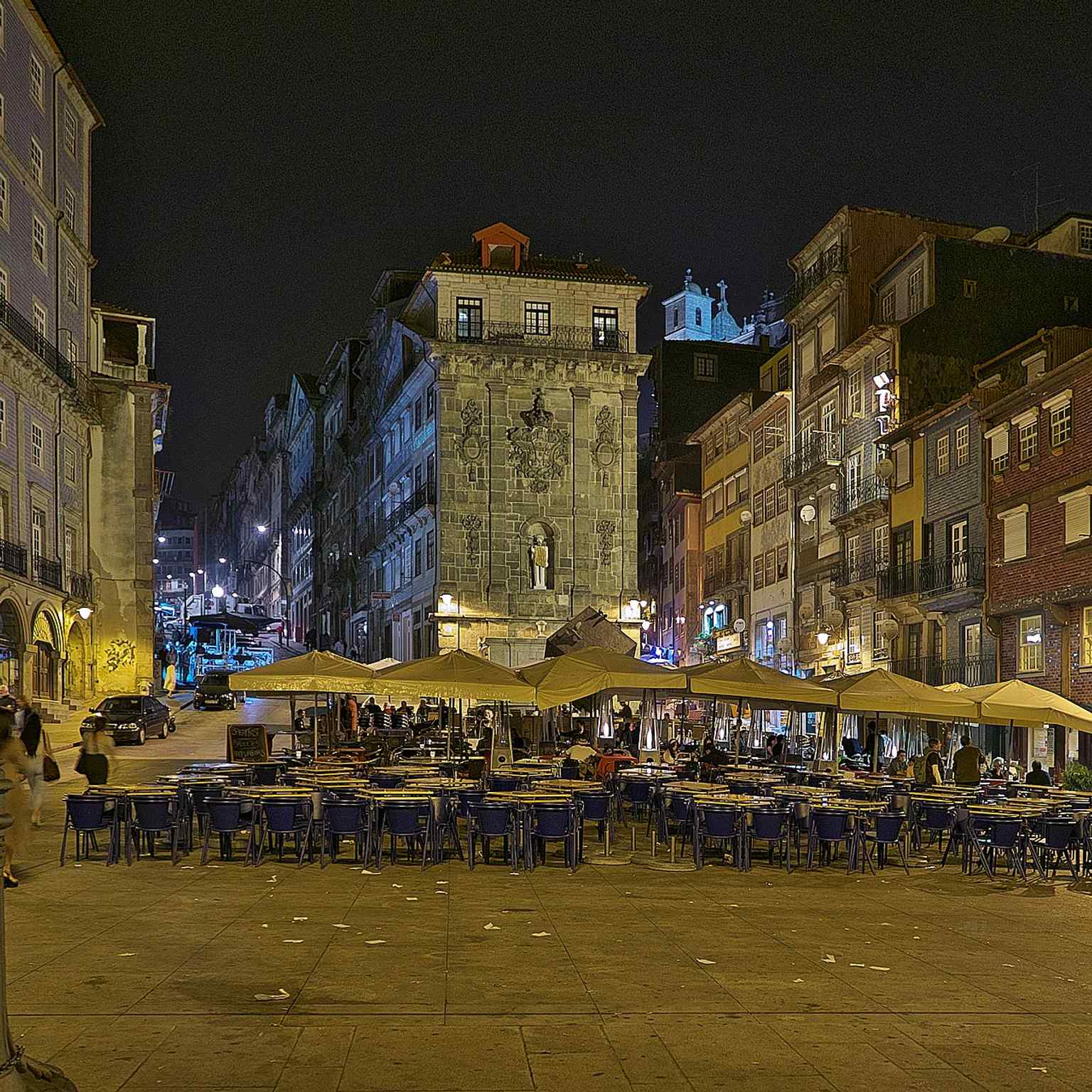
The square and its surrounding streets have held protected status since nineteen seventy-one, but Ribeira’s real protection is memory. This is where Porto learned to turn crowding, trade, damage, and redesign into character.
Now lift your eyes uphill. Above this river threshold sits the place that watched it all with episcopal authority... the Episcopal Palace. Head that way when you’re ready.





