
Vilnius Highlights Audio Tour: Architectural and Historical Treasures
Beneath the baroque spires of Vilnius lies a city built on the bones of duels, burning rebellions, and secrets whispered behind heavy palace gates. History here is not written in textbooks but etched into the very cobblestones you walk upon today. Unlock these hidden chapters with a self-guided audio tour designed to bypass the surface. Traverse the halls of the Grand Dukes and the quiet corridors of power to uncover the scandals most tourists never hear. Why did a grand cathedral vanish from sight for an entire generation? What dark pact was signed within the Presidential Palace walls during the dead of night? Who left a single bloodstained glove on the steps of the palace? Roam through centuries of political upheaval and raw human drama. Transform your walk into a cinematic journey where every corner pulse with the echoes of the past. Begin your descent into the shadows now.
Tour preview
About this tour
- scheduleDuration 110–130 minsGo at your own pace
- straighten5.0 km walking routeFollow the guided path
- location_on
- wifi_offWorks offlineDownload once, use anywhere
- all_inclusiveLifetime accessReplay anytime, forever
- location_onStarts at Gate of Dawn
Stops on this tour
lock_open 3 free previews · 12 unlock with purchase
Look for a pale plastered gateway with a broad arch, a square chapel set above it, and small firing openings still visible in the wall. Welcome to Vilnius through a place that…Read moreShow less
Open dedicated page →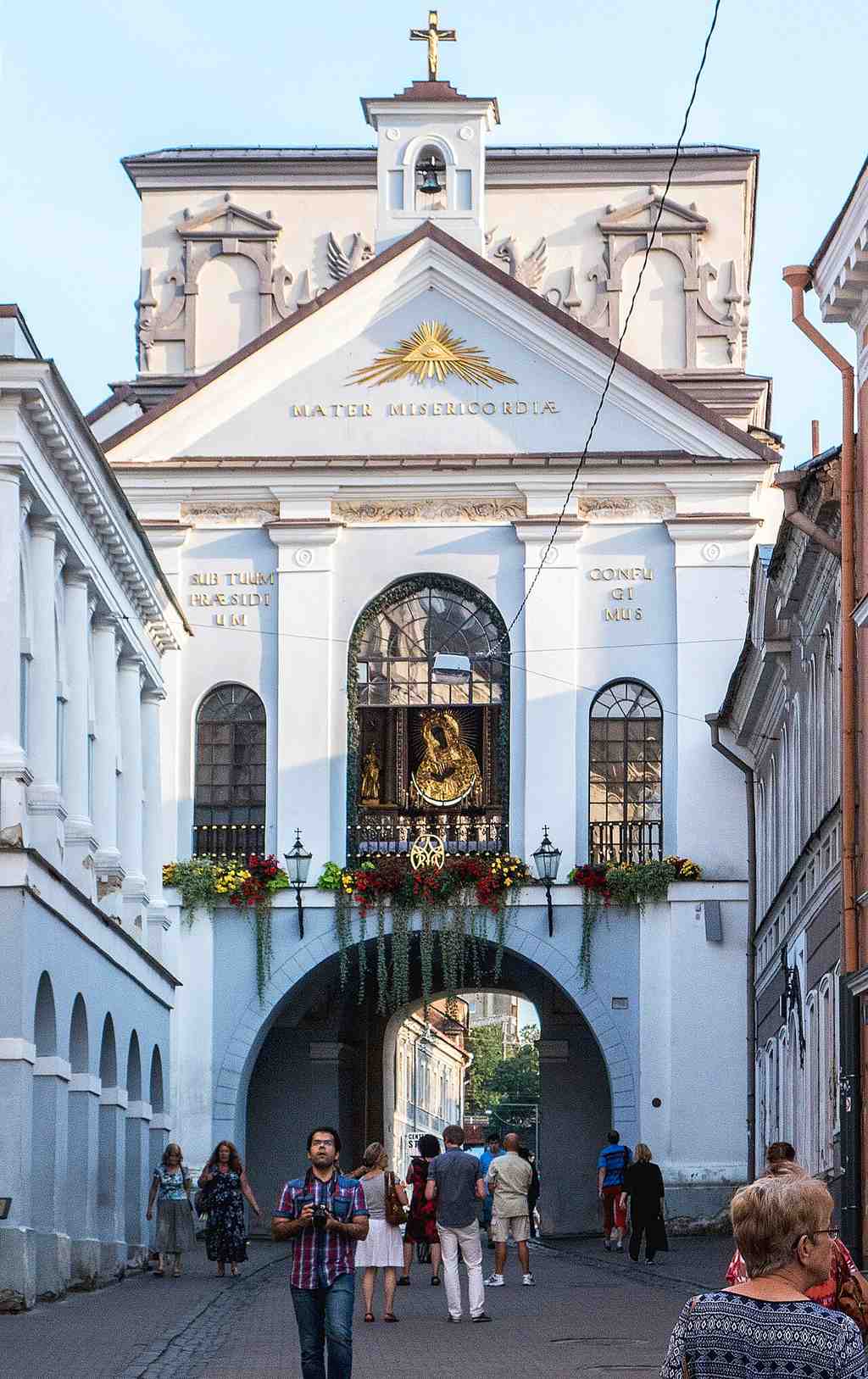
Gate of DawnPhoto: Jerzy Strzelecki, Wikimedia Commons, CC BY-SA 3.0. Cropped & resized. Look for a pale plastered gateway with a broad arch, a square chapel set above it, and small firing openings still visible in the wall.
Welcome to Vilnius through a place that began with a very practical job: keep enemies out. Between fifteen oh three and fifteen fourteen, city builders raised this as one of nine gates in the defensive wall. The slits on the outside were not decorative. They were there so someone inside could shoot through them... which is a fairly direct form of urban planning.
And yet almost immediately, this military entrance picked up another duty. People placed an image of the Virgin Mary here, and the gate started doing double work: guarding the city with force, and guarding it with prayer. That mix matters in Vilnius. Here, public power and private faith rarely stayed in separate rooms for long.
Before I go on, take a second and study the exterior. Find those defensive details, then imagine pilgrims approaching the very same structure expecting mercy instead of arrows.
Even the name refused to settle down. Locals and documents used Sharp Gate, Medininkai Gate, the Latin Porta Acialis, the Polish Ostra Brama, and eventually the Lithuanian Aušros Vartai. Some linked that last name to Mary as the Morning Star, others to the gate’s southeast direction toward first light. In other words, this place belonged to several traditions at once, and each one tried to name it a little more firmly than the others.
In the sixteen twenties, the Discalced Carmelites - a strict branch of Catholic friars known for a life of prayer and simplicity - settled right beside the gate near the Church of Saint Teresa. They did not invent devotion here, but they nurtured it, organized it, and spread its fame. In sixteen sixty-eight they got permission to build a wooden chapel inside the gate, and by sixteen seventy-two the sacred image hung there again with full ceremony. If you want a sense of how this fortress slowly turned into a shrine complex, glance at the image on your screen showing the gate beside Saint Teresa’s.
One Carmelite friar, Hilarion, later gathered the gate’s miracle stories into print in seventeen sixty-one. He opened with the story of a two-year-old child who fell from a second-floor window onto stone pavement and, after the parents prayed to Our Lady here, reportedly recovered by the next day. That kind of story traveled fast. So did the wartime ones. During the Swedish occupation in seventeen oh two, tradition says a bullet struck the painting itself, and commander Antoni Nowosielski later offered a silver votive gift in thanks after the defense of the gate. In Vilnius, survival often arrived wearing armor and carrying a candle.
When the city tore down its walls between seventeen ninety-nine and eighteen oh five, this gate survived because people revered the image too much to lose it. So a fortification outlived the fortifications. If you want, compare the before-and-after view in the app; it’s a neat little jump from interwar Wilno to modern Vilnius.
The shrine kept gathering meaning after that: under Tsarist pressure, in Polish and Lithuanian memory, in the Divine Mercy devotion, and during visits by Pope John Paul the Second and Pope Francis. Pilgrims from different Christian traditions all came here. For a single gateway, it has carried an absurd amount of human expectation.
And that is a fine way to begin. If even an entrance can change its meaning this completely, what else in Vilnius is hiding a second life? When you’re ready, head to the Church of Saint Casimir, about five minutes away. If you want to come back inside later, the shrine is generally open daily from seven to seven.
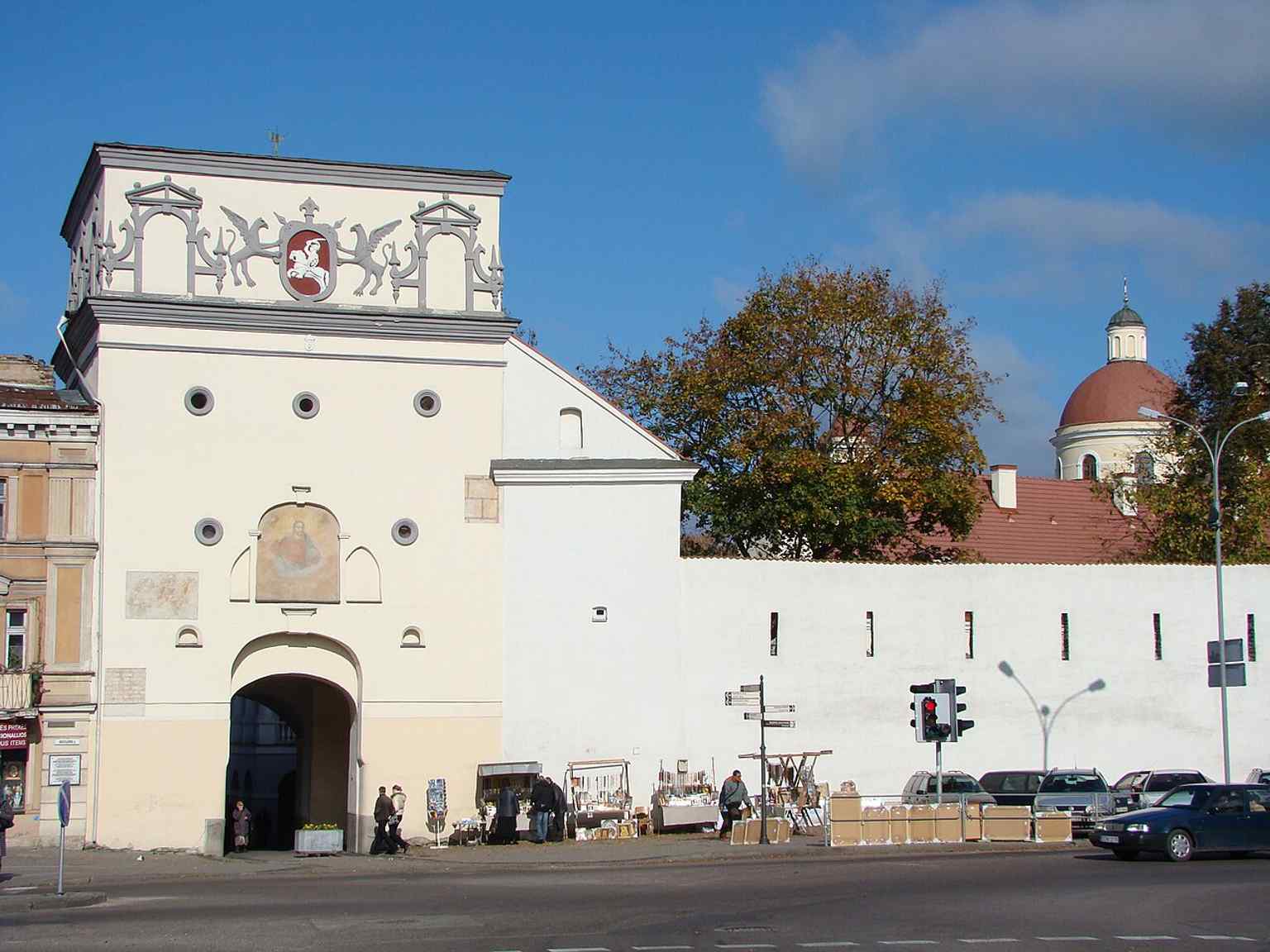
A clear street-level view of the Gate of Dawn in Vilnius Old Town, the last surviving city gate and a famous Marian pilgrimage site.Photo: Umnik, Wikimedia Commons, Public domain. Cropped & resized. 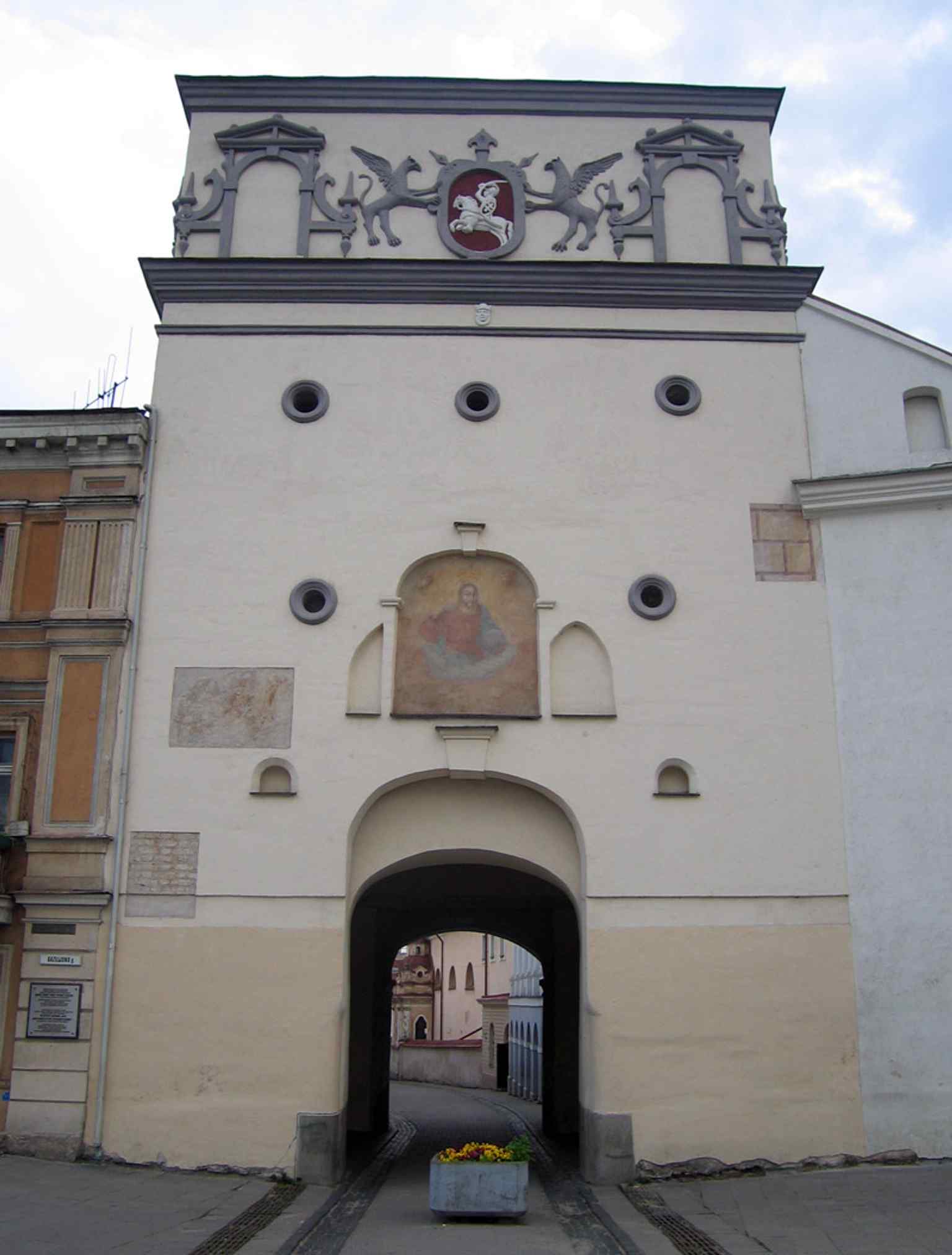
The outside of the gate shows its defensive character, with the city-gate opening and historic fortification details still visible.Photo: Arz, Wikimedia Commons, CC BY-SA 3.0. Cropped & resized. 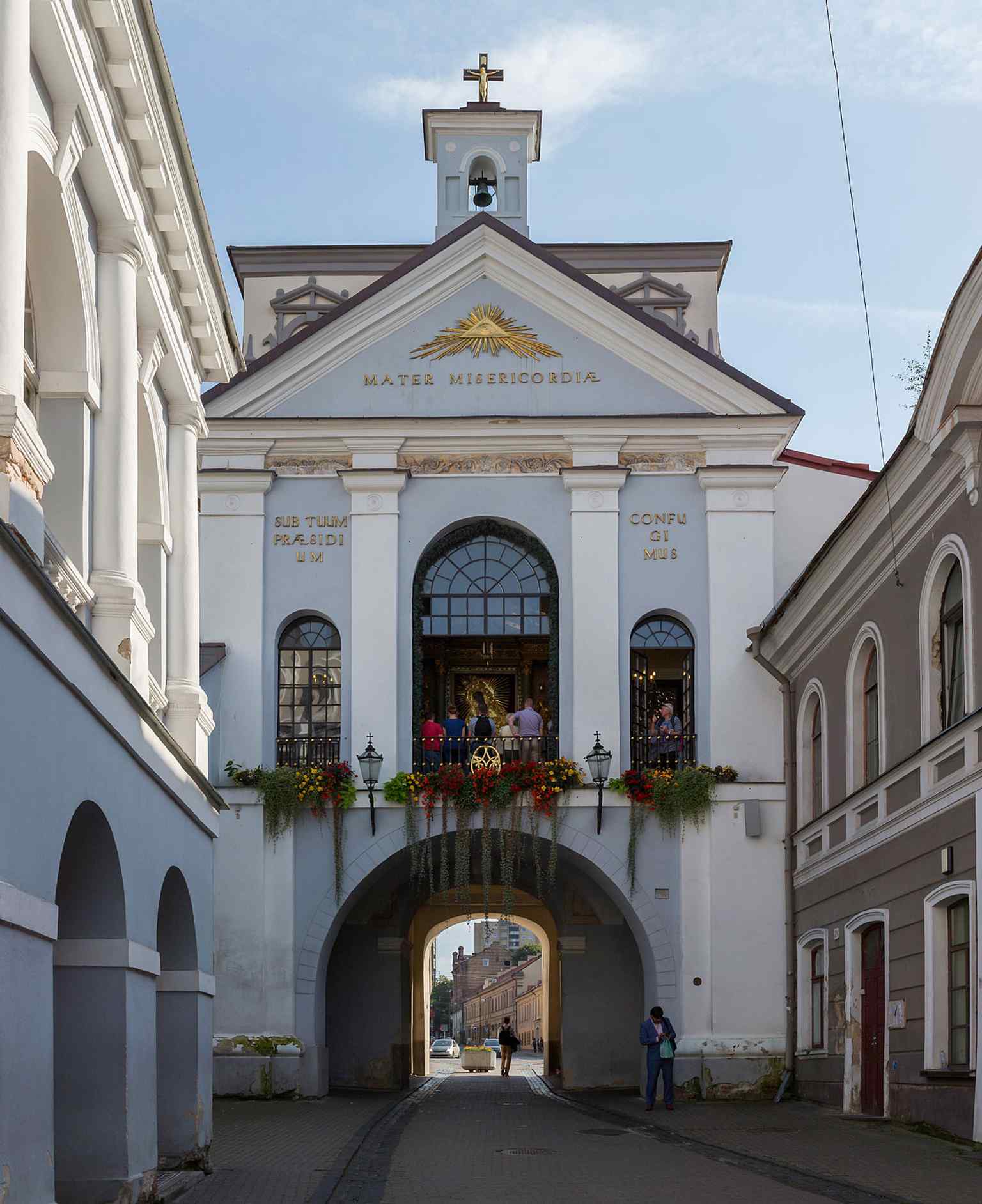
An exterior view from the old town side, useful for showing how the gate stood apart after the city walls were demolished.Photo: Diliff, Wikimedia Commons, CC BY-SA 3.0. Cropped & resized. 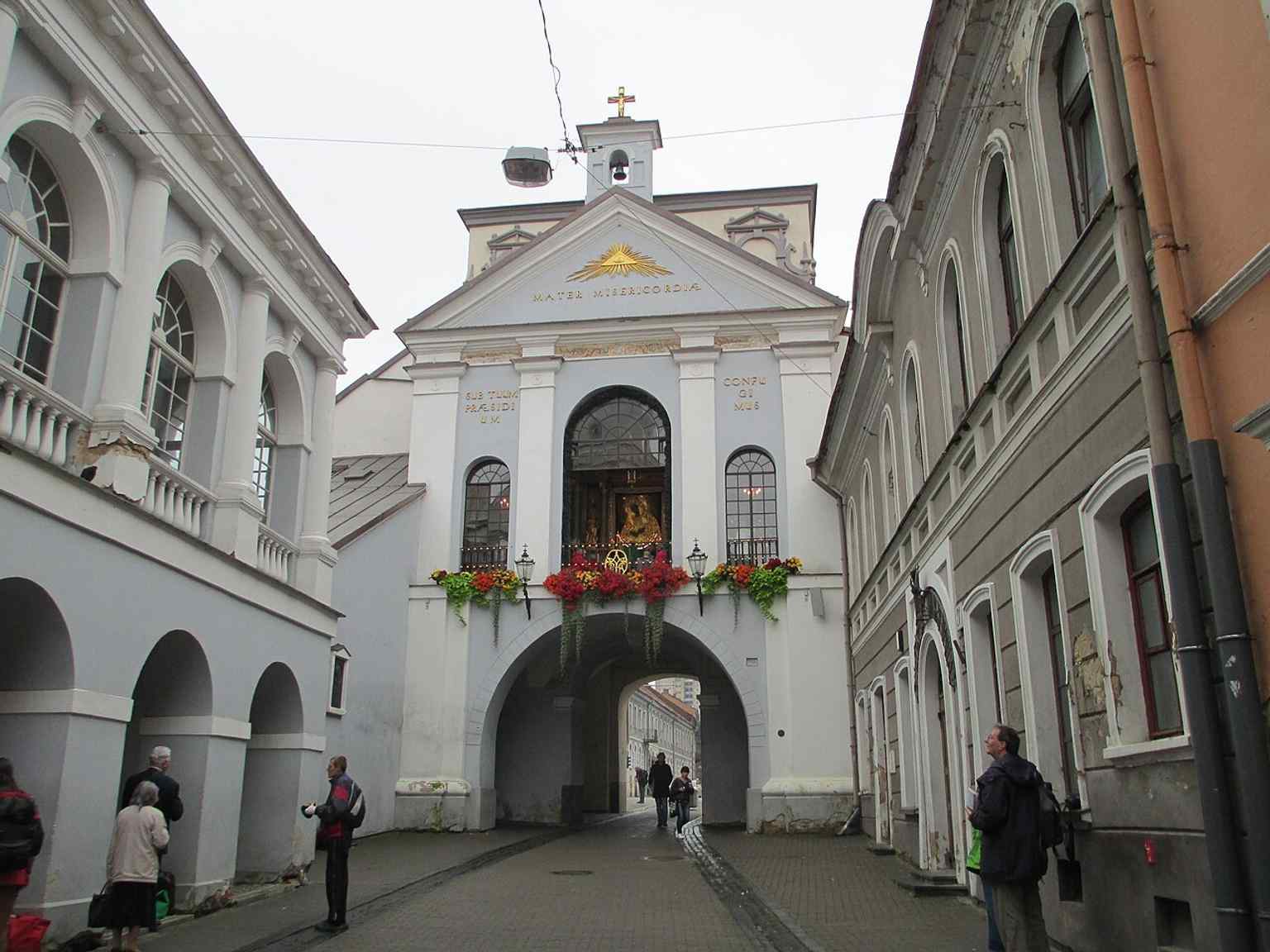
The interior passage of the gate, showing the chapel space tucked within the arch and the narrow devotional setting.Photo: Avi1111, Wikimedia Commons, CC BY-SA 3.0. Cropped & resized. 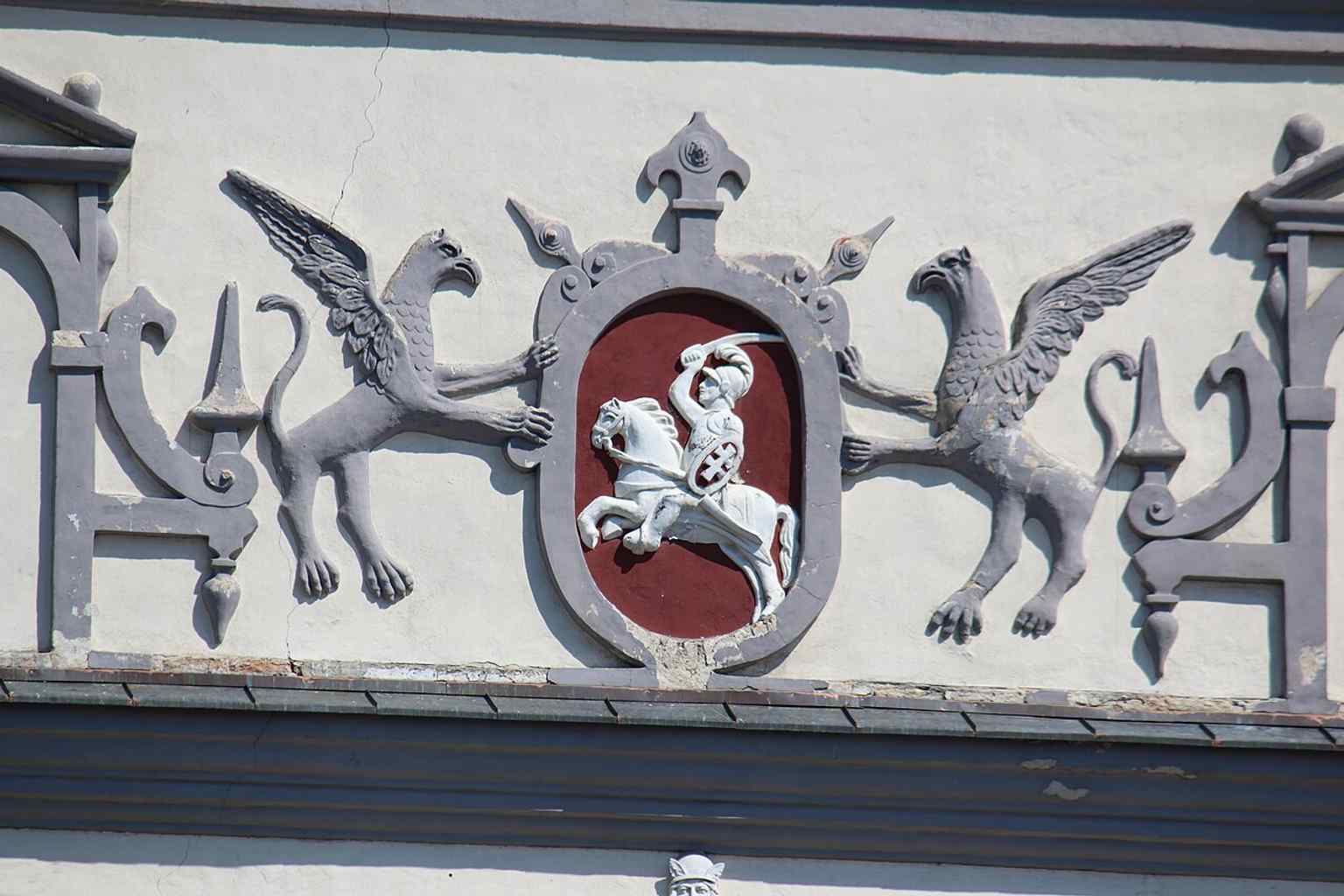
The Lithuanian coat of arms on the gate recalls how the shrine became a national symbol as well as a religious one.Photo: FrDr, Wikimedia Commons, CC BY-SA 4.0. Cropped & resized. 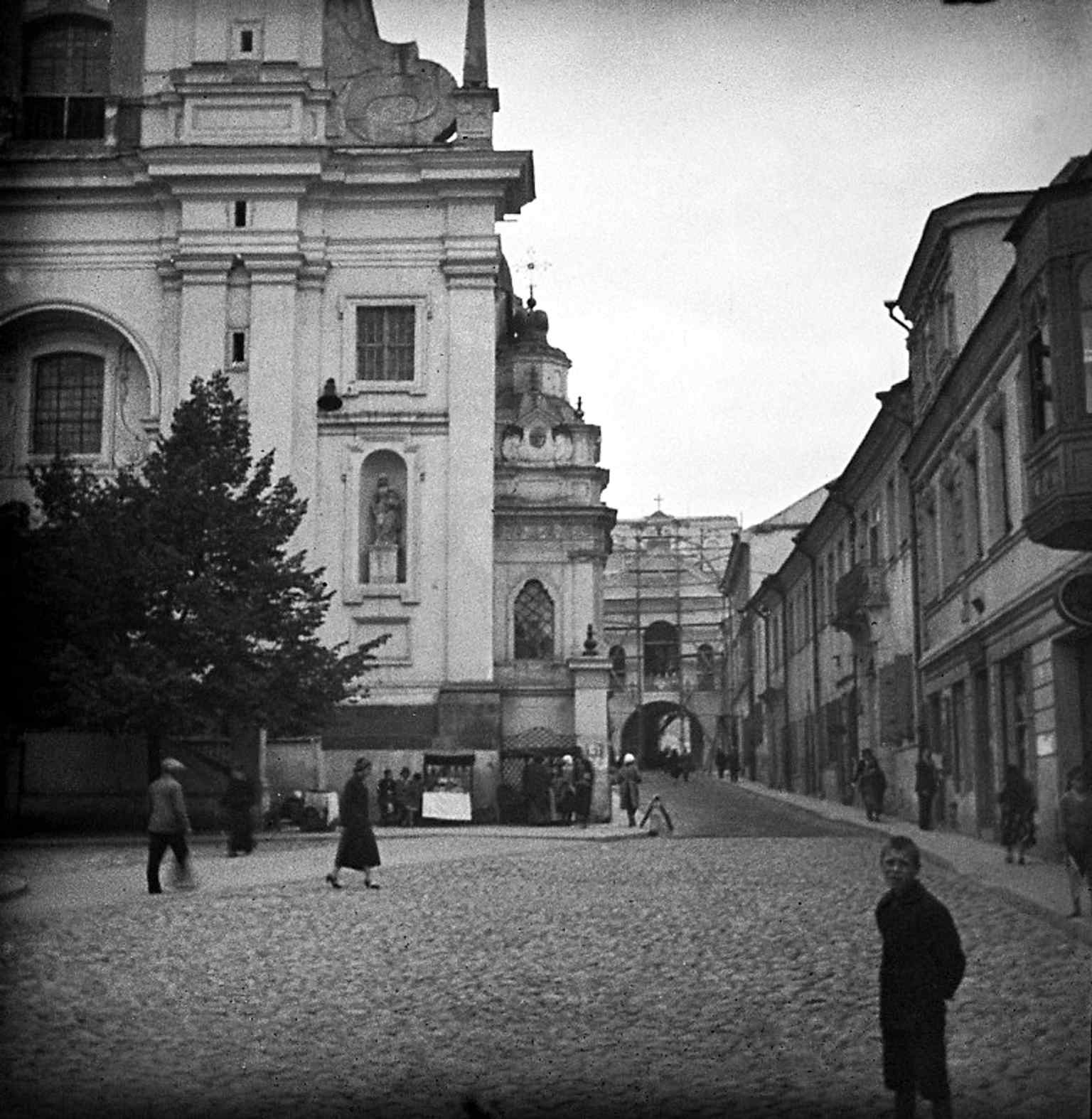
A black-and-white view of Ostra Brama around 1930, preserving the historic appearance of the Gate of Dawn before modern restoration.Photo: Zygmunt Szczotkowski, Wikimedia Commons, Public domain. Cropped & resized. 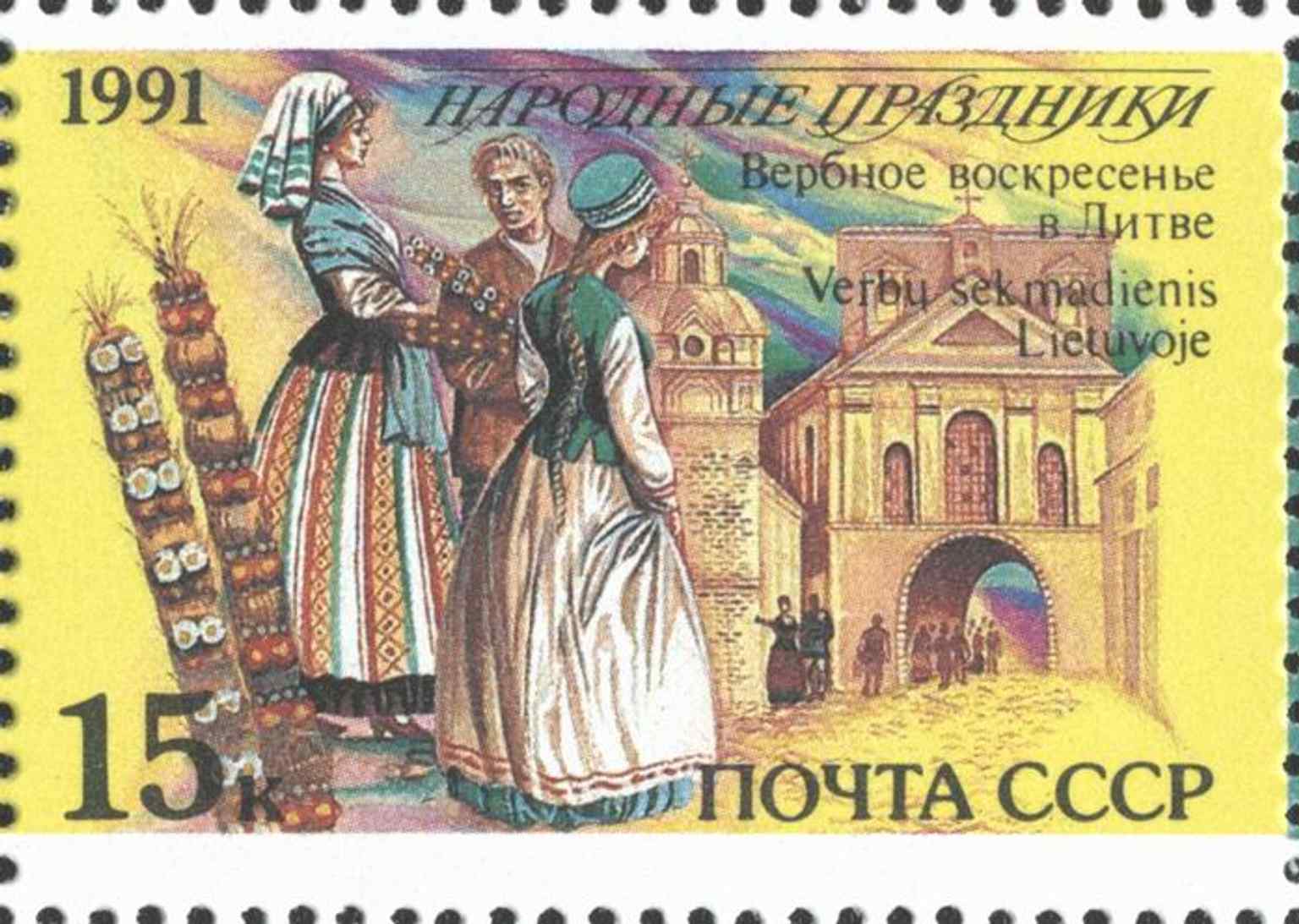
A postage stamp featuring the Gate of Dawn, showing how the shrine became a widely recognized cultural symbol in Lithuania.Photo: Scanned and processed by Mariluna, Wikimedia Commons, Public domain. Cropped & resized. 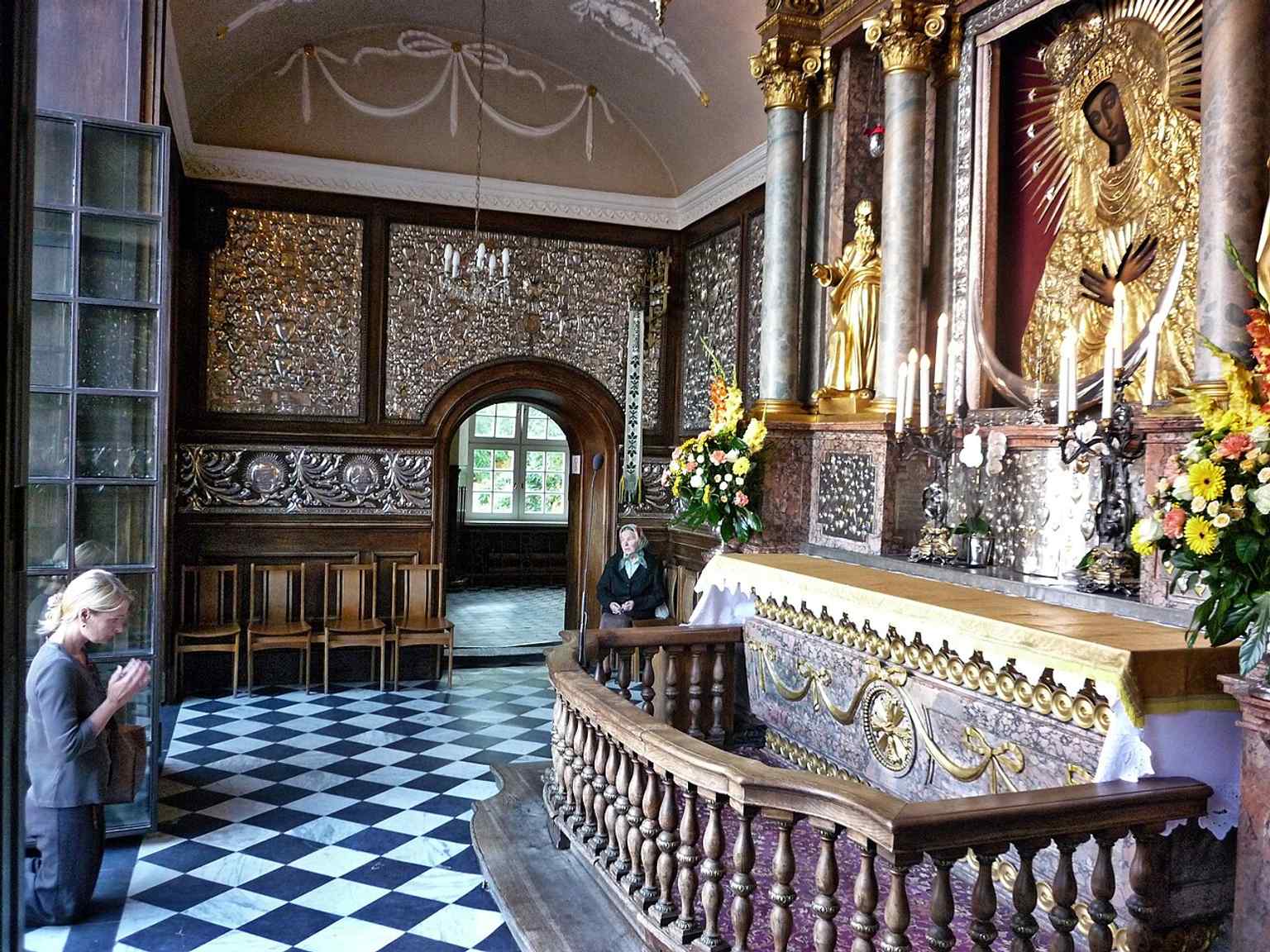
Prayer inside the chapel, echoing the long tradition of Masses and multilingual devotion at the shrine.Photo: Fczarnowski, Wikimedia Commons, CC BY-SA 4.0. Cropped & resized. 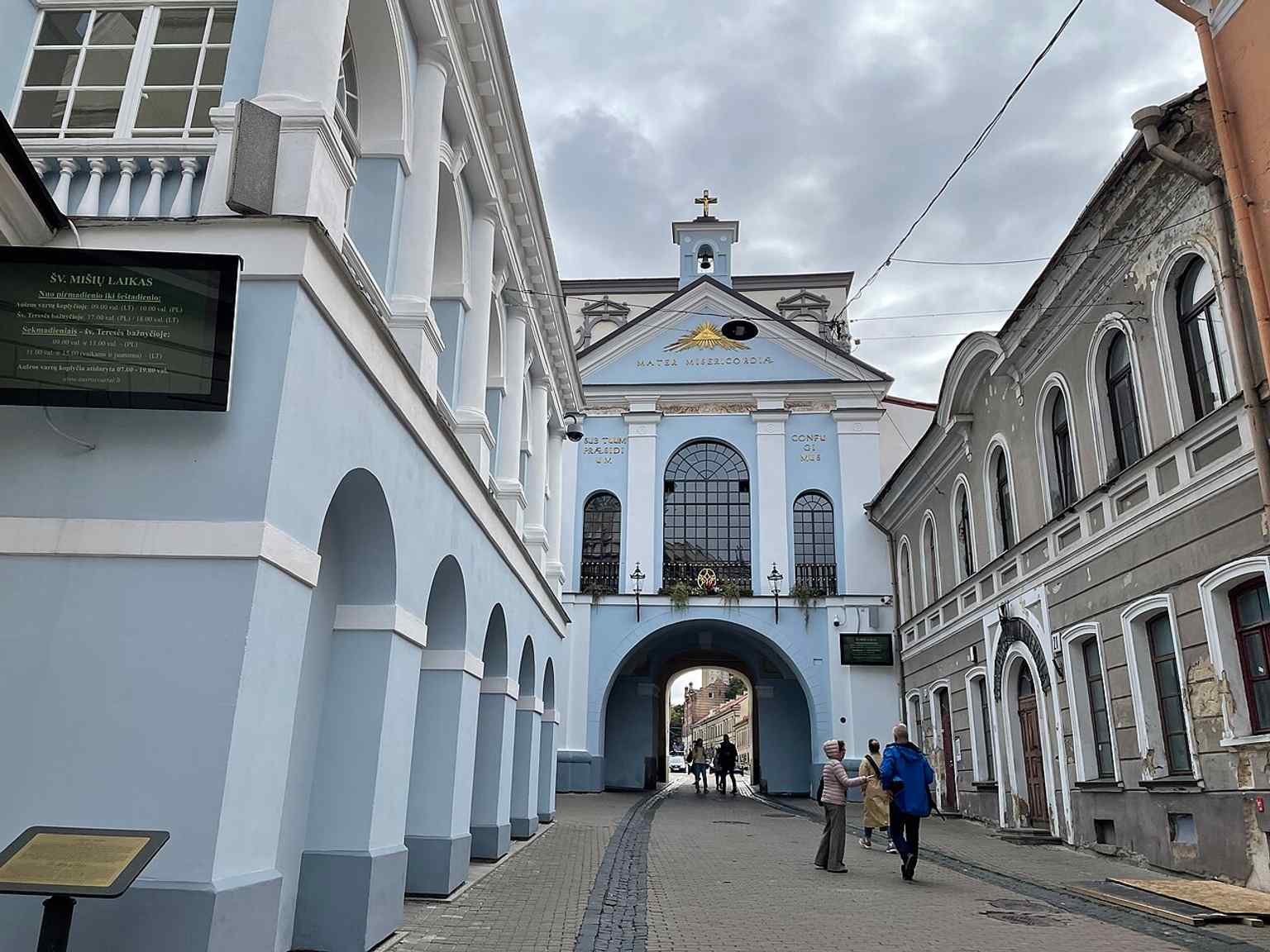
A winter view of the southern gate, with the chapel windows above the street where pilgrims can still venerate the icon.Photo: Ypsilon from Finland, Wikimedia Commons, CC0. Cropped & resized. 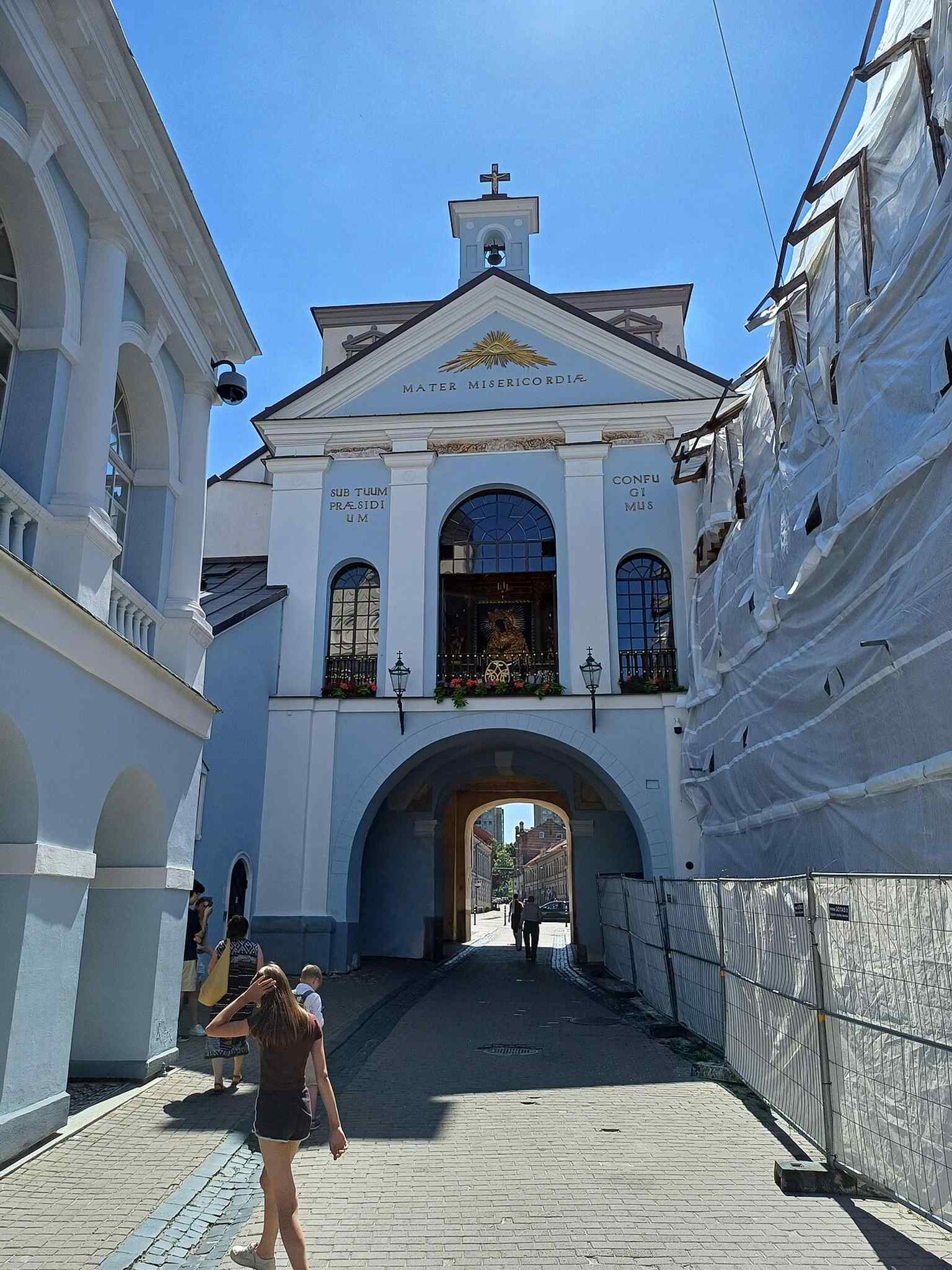
A recent portrait of the Gate of Dawn, the city’s enduring landmark and one of Lithuania’s most important pilgrimage sites.Photo: Radosław Botev, Wikimedia Commons, CC BY 3.0 pl. Cropped & resized. On your left stands a pale plaster church with a tall symmetrical Baroque façade, twin towers, and a crowned lantern rising above the dome. This is the Church of Saint Casimir,…Read moreShow less
Open dedicated page →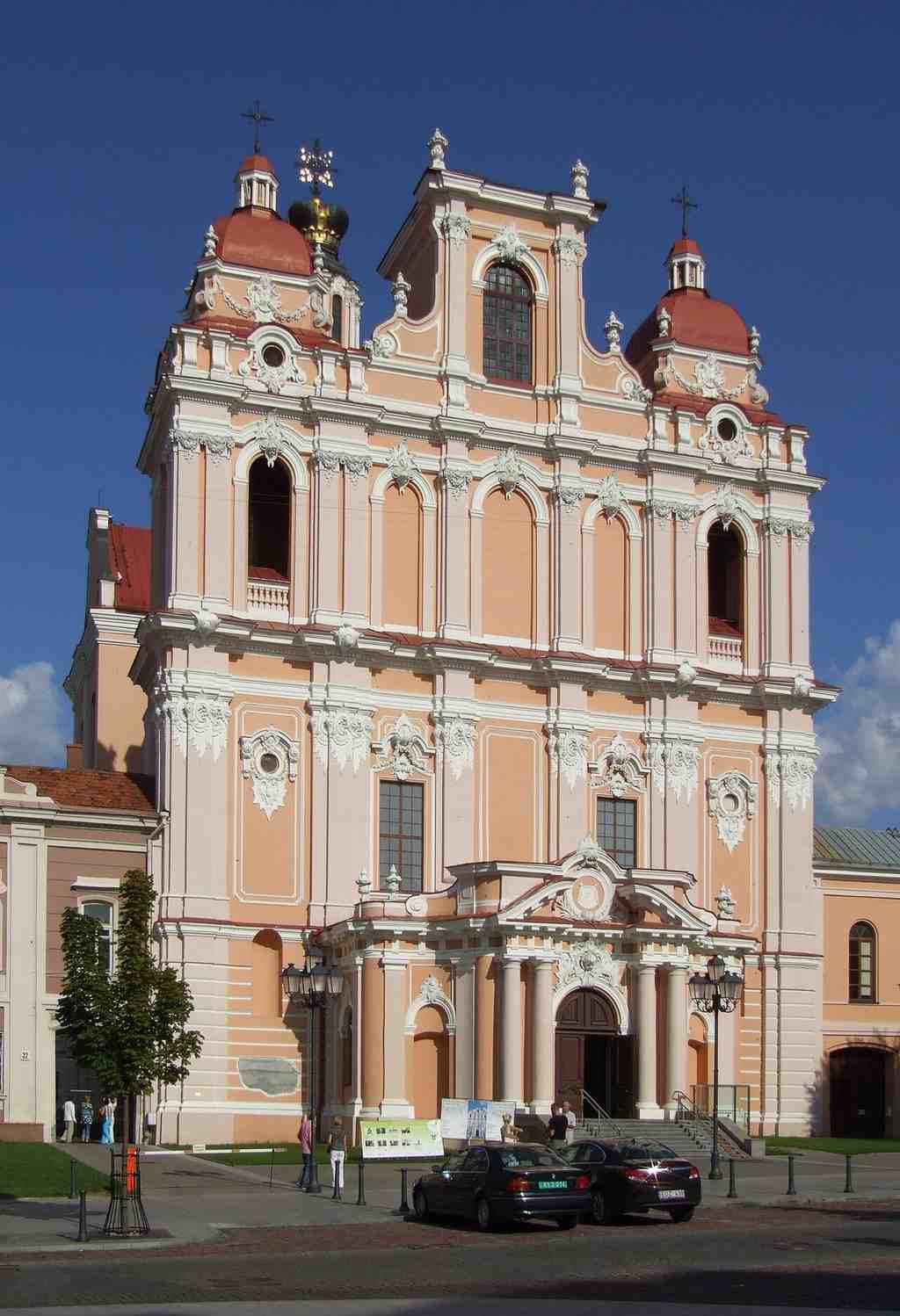
Church of St. Casimir, VilniusPhoto: Pudelek, Wikimedia Commons, CC BY-SA 3.0. Cropped & resized. On your left stands a pale plaster church with a tall symmetrical Baroque façade, twin towers, and a crowned lantern rising above the dome.
This is the Church of Saint Casimir, one of the earliest Baroque churches in Vilnius. Baroque, by the way, means architecture that aims to persuade through drama: bold shapes, strong symmetry, and a sense that stone itself has learned how to make an entrance.
Saint Casimir was a royal prince of Lithuania and Poland, and when the Church canonized him in sixteen oh four, his memory became valuable in two ways at once: spiritually, as a local holy figure, and politically, as a prestige symbol a city could rally around. Saints, it turns out, are excellent for devotion and public relations.
The Jesuits understood that better than most. They were Catholic educators and missionaries, but in cities like Vilnius they also acted as stage-managers of belief, using schools, sermons, music, and architecture to shape how faith felt in public. They began this church on the twelfth of May, sixteen oh four, only weeks after Casimir's canonization, with money from major Lithuanian nobles like Lew Sapieha and Jan Karol Chodkiewicz, plus King Sigismund the Third Vasa and his son, Cardinal Karol Ferdynand Vasa.
Tradition says seven hundred Vilnius residents dragged the cornerstone here in procession from the Antakalnis hills. The design came from Jan Frankiewicz, a pupil of Giovanni Maria Bernardoni, and he looked to Il Gesù in Rome, the great Jesuit model, then borrowed ideas from churches in Kraków and Lublin and added those towers. Construction finished in sixteen sixteen, and the interior was completed in sixteen eighteen.
One man who served here gives the place a sharper human edge: Andriejus Bobola, a Jesuit preacher and confessor. He later fell into Cossack hands and they tortured him to death in sixteen fifty-seven. When the Church canonized him in nineteen thirty-eight, this building carried not just grandeur, but martyrdom too.
And yet prestige here came with rivalry. Even though the royal court funded the church, it did not want this place to become the main center of Saint Casimir's cult. In sixteen thirty-six, when officials translated the saint's relics in a major ceremony, the procession bypassed this church entirely. Holiness, yes... but carefully managed holiness.
In the app, have a look at the before-and-after image: Kaiser Wilhelm the Second once posed beside this façade in nineteen seventeen, and the building has outlasted the armies around it. Under Russian rule it became Orthodox, in nineteen fifteen the Germans turned it into a Lutheran garrison prayer house, and in nineteen sixty-three the Soviets made it a Museum of Atheism before believers reconsecrated it in nineteen ninety-one.
If you check the interior photo, you will see the nave, the church's main central hall, where its famous acoustics now carry organ concerts once again. Leopoldas Digrys pushed that musical revival forward, and the modern Oberlinger organ installed in two thousand and three gave the church its full voice back.
In Vilnius, saints were never only heavenly figures; they also shaped very earthly contests over influence. From here, Town Hall Square is about a five-minute walk away, where civic power starts speaking in its own register. If you want to come back inside later, it is generally open from eleven in the morning to seven in the evening, closed on Saturdays, and opens earlier on Sundays.
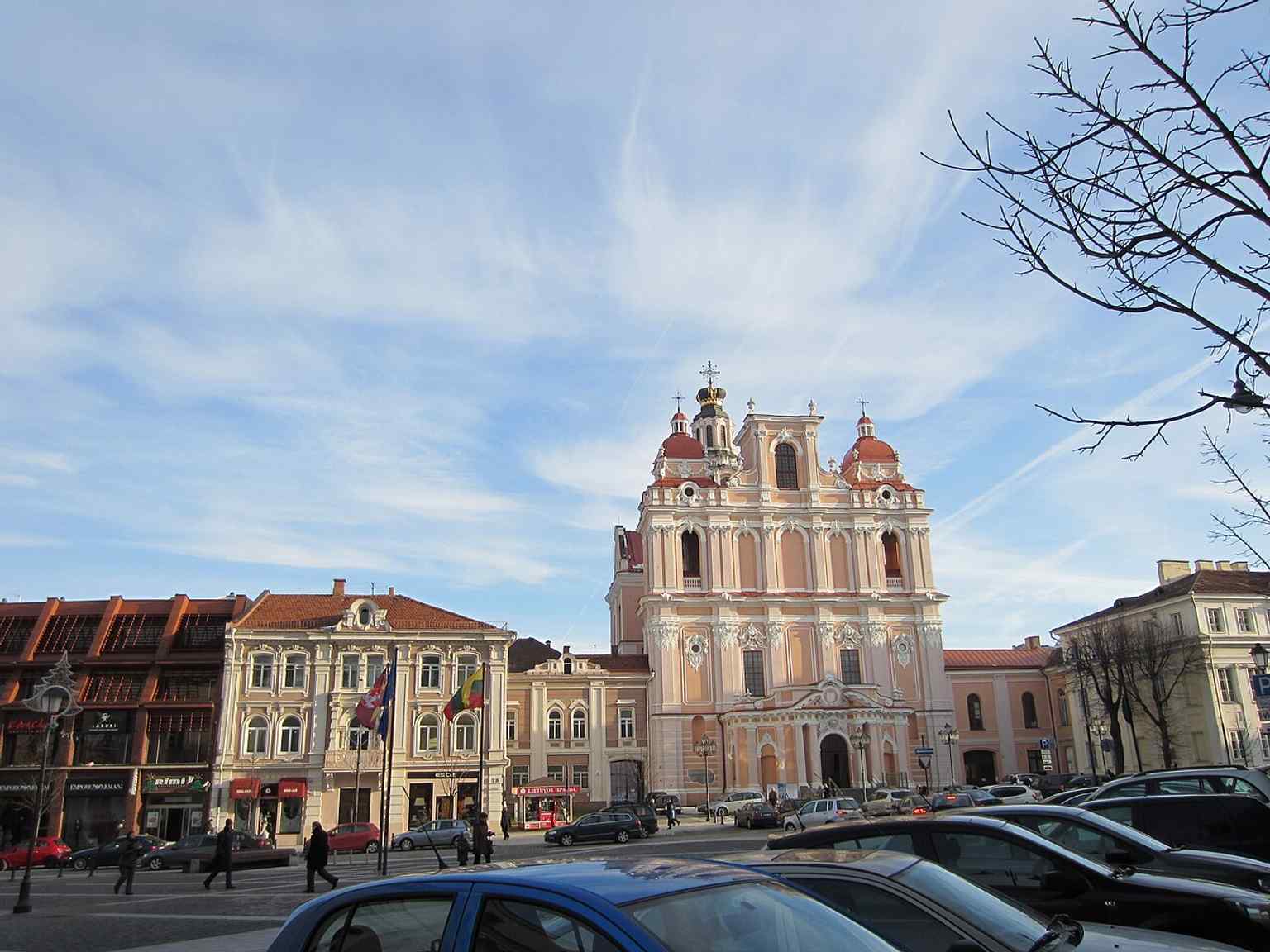
A clear front view of St. Casimir’s Church, the oldest Baroque church in Vilnius and a landmark just off Town Hall Square.Photo: DV, Wikimedia Commons, CC BY-SA 3.0. Cropped & resized. 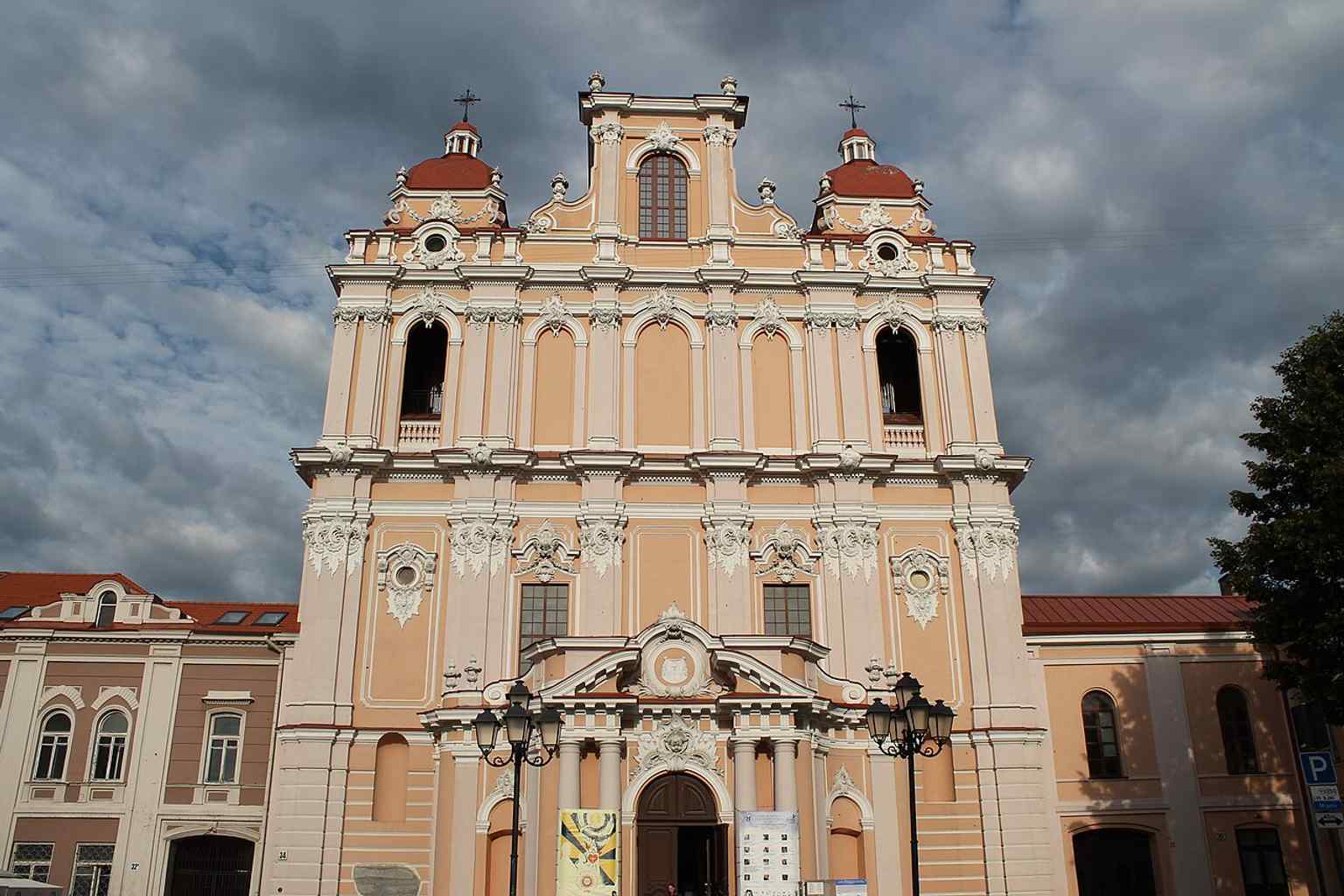
The church framed by trees and sky, showing the distinctive Baroque silhouette that made it a model for later Vilnius churches.Photo: John Samuel, Wikimedia Commons, CC BY-SA 4.0. Cropped & resized. 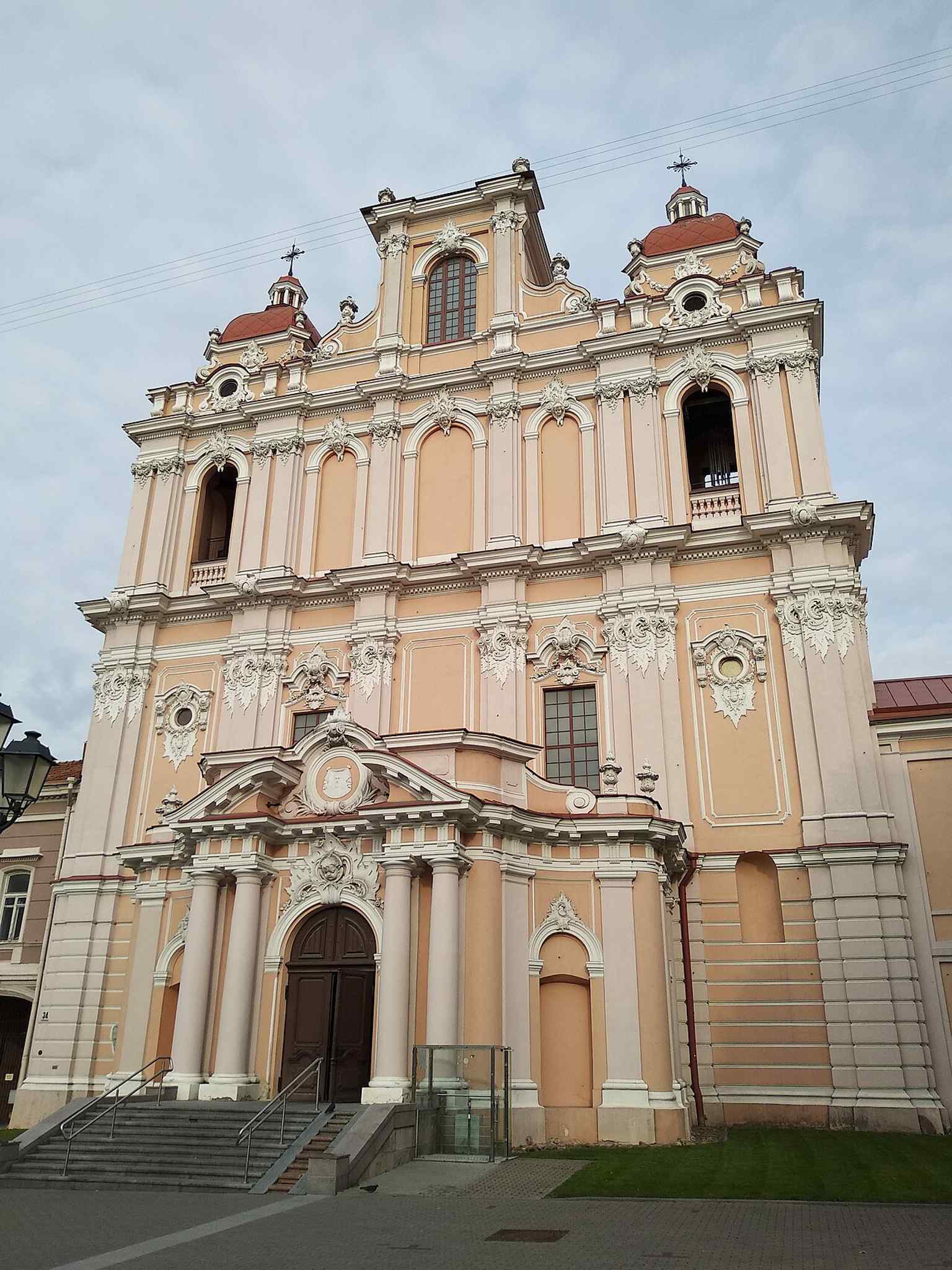
A full-height exterior view that captures the church’s façade and dome, echoing the ambitious Jesuit Baroque design from the early 1600s.Photo: Zala, Wikimedia Commons, CC BY-SA 4.0. Cropped & resized. 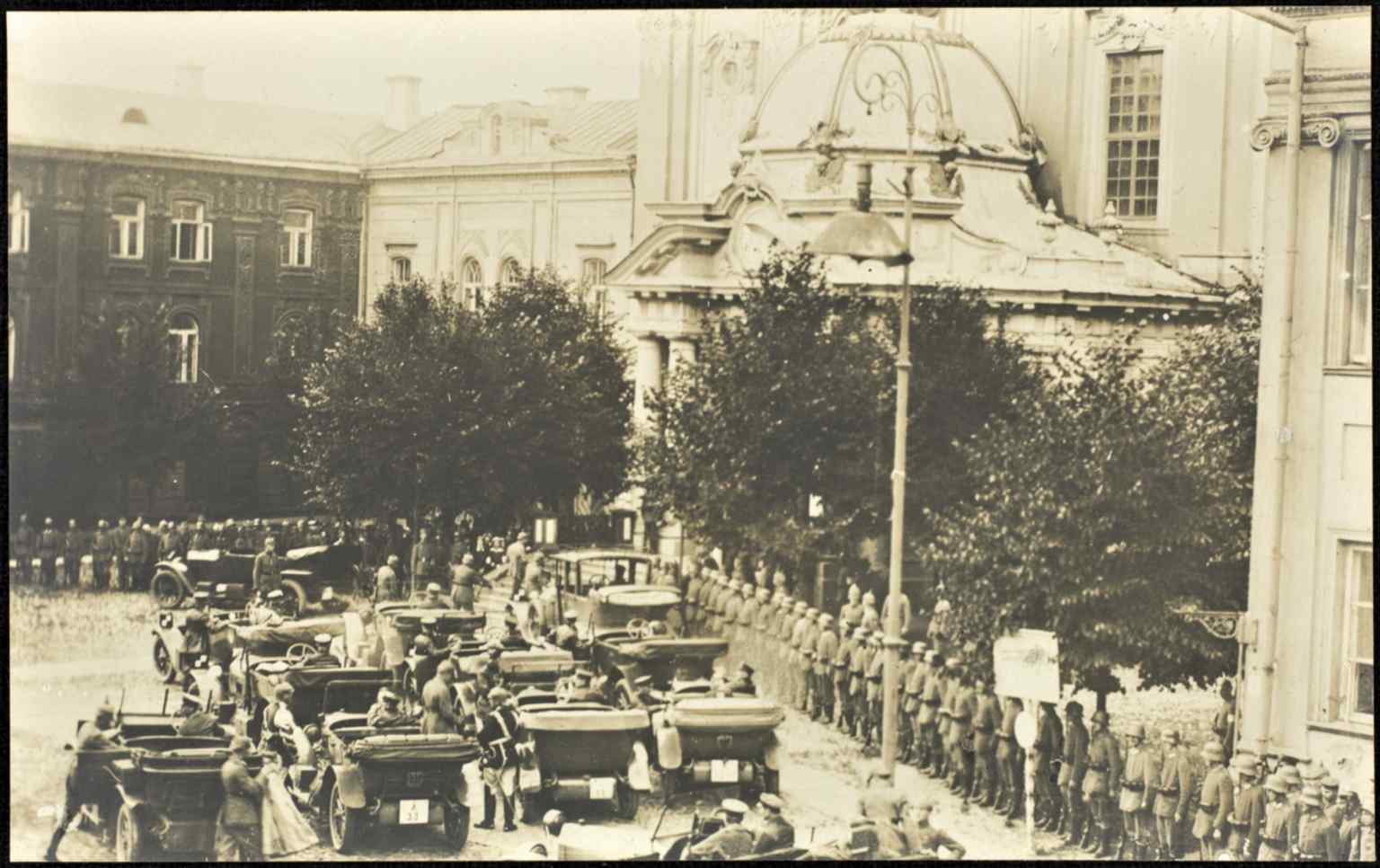
German Emperor Wilhelm II beside the church in 1917, a rare wartime glimpse of St. Casimir’s in occupied Vilnius.Photo: Unknown authorUnknown author, Wikimedia Commons, Public domain. Cropped & resized. 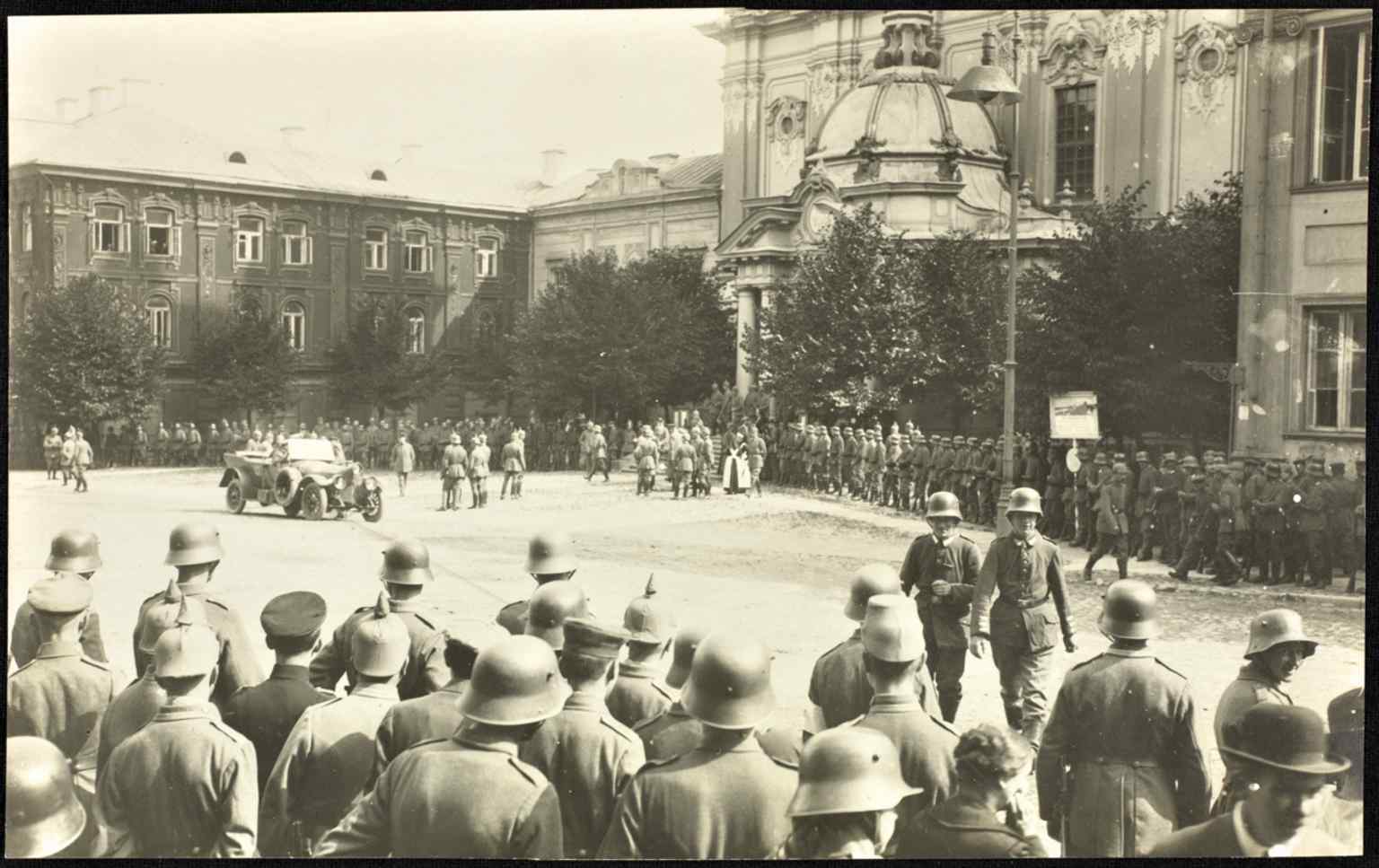
Another 1917 documentary view of the church during Wilhelm II’s visit, useful for showing the building in a historic street setting.Photo: Unknown authorUnknown author, Wikimedia Commons, Public domain. Cropped & resized. On your right, the Town Hall shows itself with a pale stone facade, a broad triangular pediment, and a row of tall classical columns above a short flight of steps. This square is…Read moreShow less
Open dedicated page →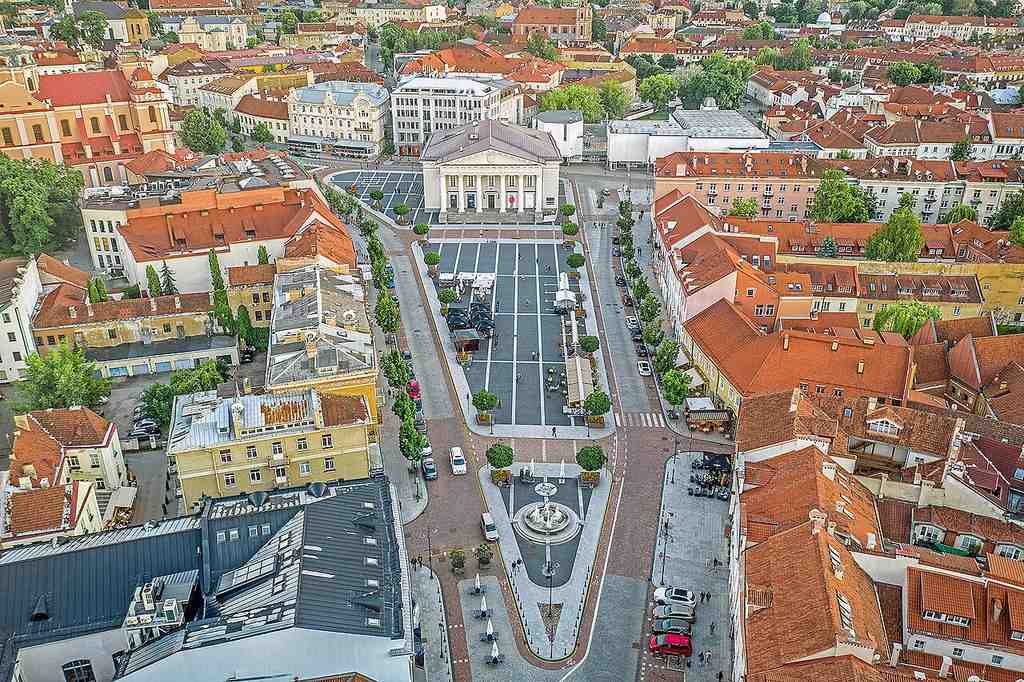
Town Hall Square (Vilnius)Photo: BigHead, Wikimedia Commons, CC BY-SA 4.0. Cropped & resized. On your right, the Town Hall shows itself with a pale stone facade, a broad triangular pediment, and a row of tall classical columns above a short flight of steps.
This square is Vilnius out in the open. Churches shape the soul of a city, but squares handle its arguments, its bargains, and, now and then, its public melodrama. Town Hall Square began as a triangular market in the fifteenth century, right where trade routes crossed in the heart of the Old Town. Inns gathered nearby, then merchants, then craftsmen. Once people start buying, selling, gossiping, and complaining in the same place, a city government usually appears... and here it did.
The magistrate put up a town hall here, recorded in the sixteenth century. But civic authority came with some rather blunt stage props. Next to the hall stood a pillory called the pilat, where offenders were tied up for corporal punishment. Until the middle of the seventeenth century, the square also held a gallows and an execution scaffold. So yes, the same ground that hosted trade also hosted consequences. Vilnius did not separate shopping from moral instruction very carefully.
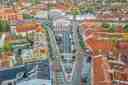
If you glance at the overhead image in the app, you can see how the streets still pour into this space from several directions, like the whole district reporting to one open room. That is the key to this place. You could not really avoid it.
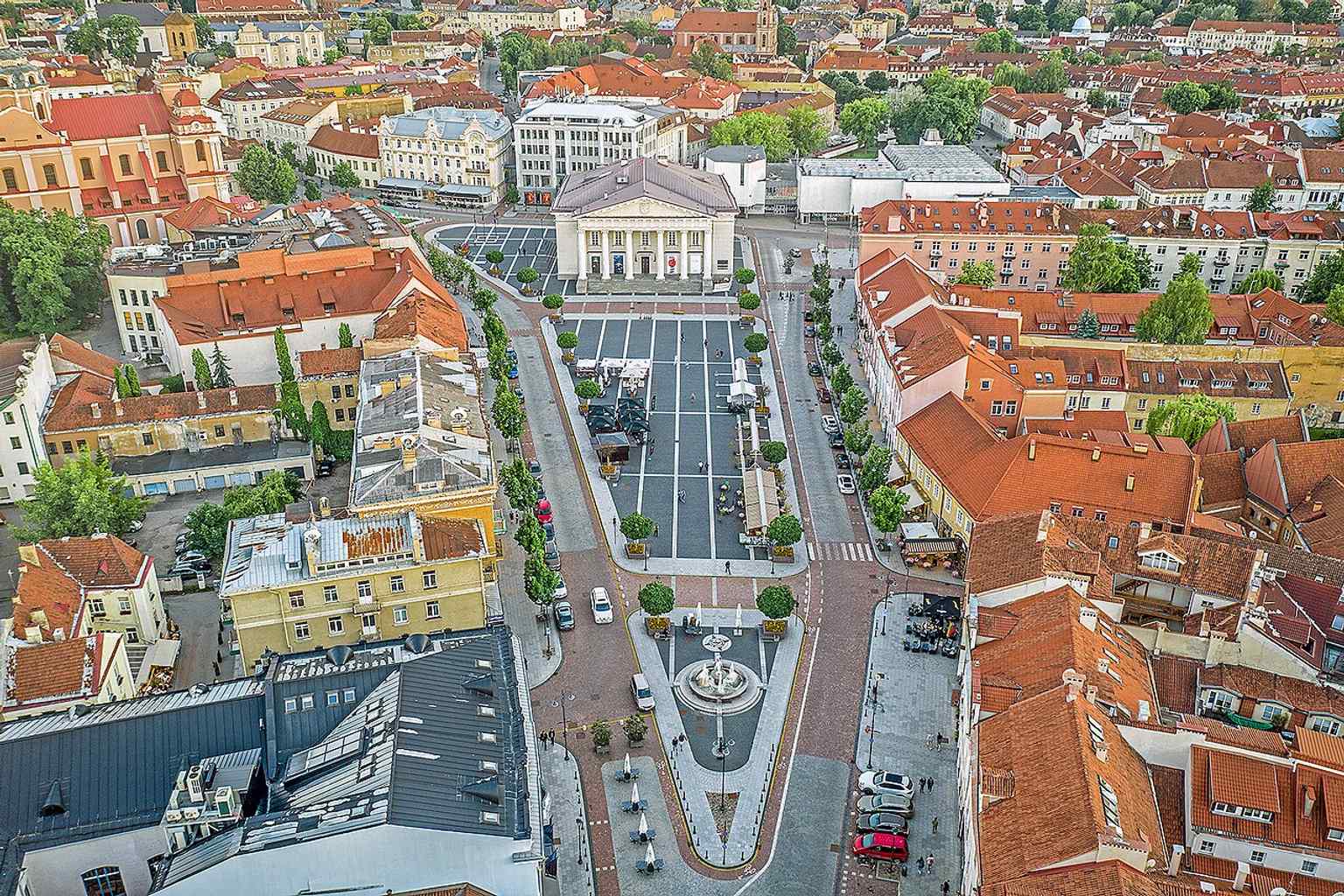
An overhead view of Town Hall Square, showing how the historic market-place opens into the Old Town street network.Photo: BigHead, Wikimedia Commons, CC BY-SA 4.0. Cropped & resized. The building you see now took shape in seventeen ninety-nine, when architect Laurynas Stuoka-Gucevičius finished the new classical Town Hall. It looks orderly, almost serene. The local trick is to remember what sat beneath that calm facade. Sources from the seventeenth and eighteenth centuries place a prison in the tower and cellars, and architects only carried out the first official investigations of those spaces in the nineteen nineties. Public ceremony above, confinement below. Neat, elegant, and a little chilling.
One man fused this square to history in a single moment. On the twenty-fourth of April, seventeen ninety-four, Jakub Jasiński came here after liberating Vilna from Russian troops and proclaimed the Lithuanian uprising. Words spoken in an open square can turn into action very fast. Jasiński’s own story did not end neatly. Within weeks, other leaders removed him for being too radical and for pressing too hard on Lithuanian autonomy, and later he died in the Battle of Praga.
This square also watched Napoleon’s retreating army pass through in eighteen twelve, and later it swapped governance for performance. After the magistrate moved out in eighteen forty-four, the Town Hall became the city theater. From eighteen forty-five to nineteen twenty-four, people came here for plays and some of Vilnius’s earliest opera performances. Same building, different drama.
If you look at the image with protest posters on the Town Hall, that is not some odd modern interruption. It is the square behaving exactly like itself, a platform for public messages and public nerves.
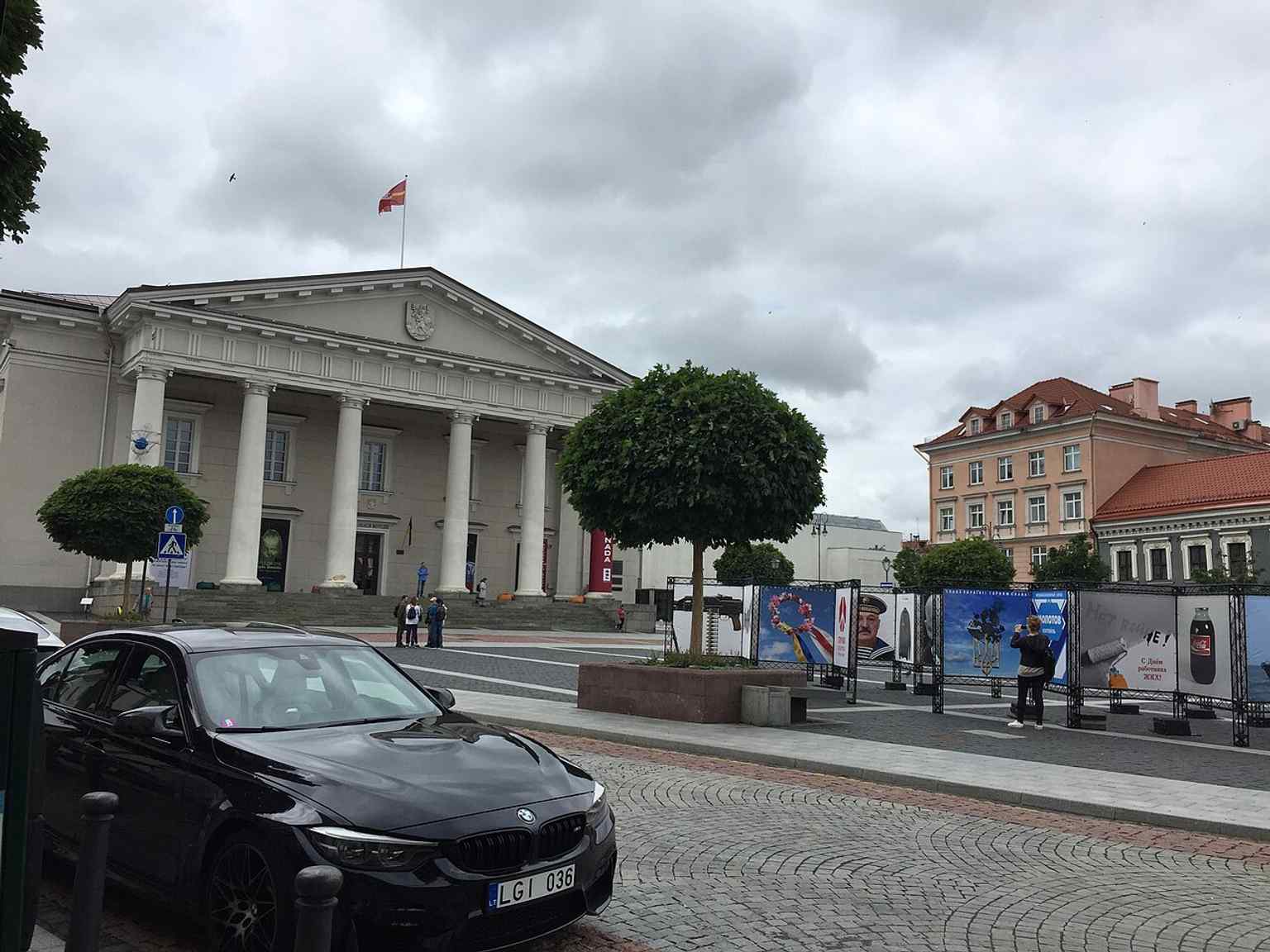
The Town Hall fronted by protest posters — a reminder that this square has long been a stage for public events and political messages.Photo: Crannofonix, Wikimedia Commons, CC BY-SA 4.0. Cropped & resized. Try to picture hearing Jasiński’s proclamation right here. Would this square have sounded like hope, fear, or both? In Vilnius, the biggest turns often happened not behind walls, but in places everyone had to cross. In about three minutes, we’ll head toward the Great Synagogue of Vilna, where another kind of city life once gathered its own force.
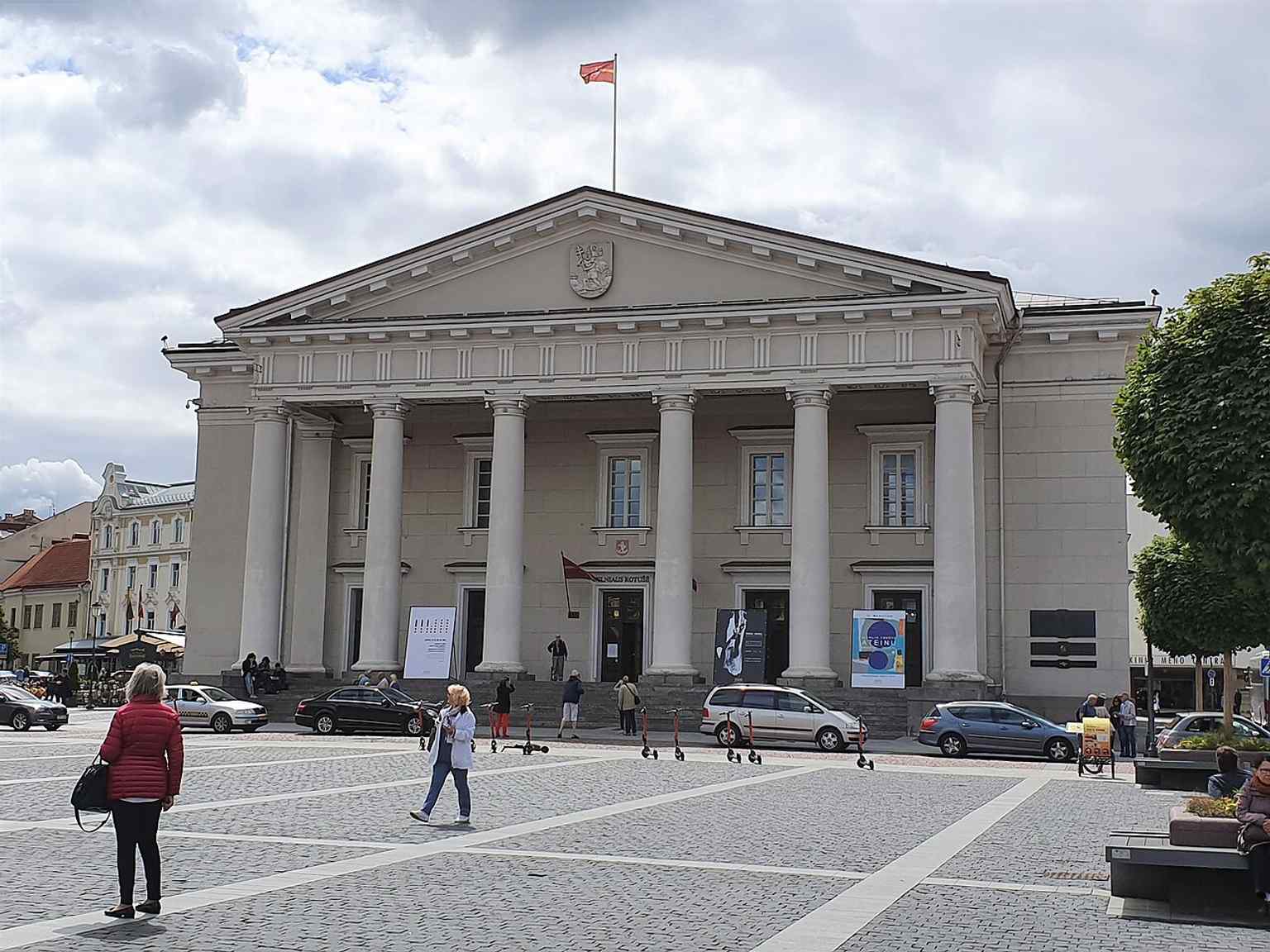
Vilnius Town Hall on the square’s edge — the classical 18th-century building that replaced the earlier city hall and became the square’s defining landmark.Photo: Pofka, Wikimedia Commons, CC BY-SA 4.0. Cropped & resized.
Show 12 more stopsShow fewer stopsexpand_moreexpand_less
Look to your left for a low stone memorial in an open paved space, with dark granite blocks and the traced outline of a vanished building marking the synagogue’s former…Read moreShow less
Open dedicated page →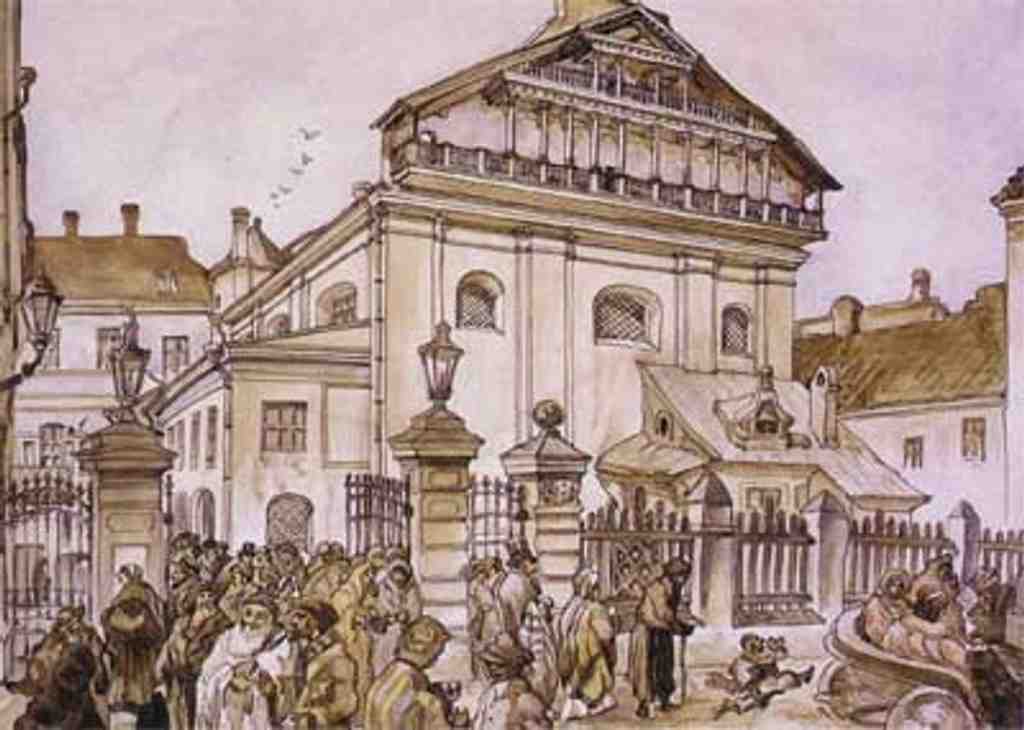
Great Synagogue of VilnaPhoto: Juozas Kamarauskas, Wikimedia Commons, Public domain. Cropped & resized. Look to your left for a low stone memorial in an open paved space, with dark granite blocks and the traced outline of a vanished building marking the synagogue’s former footprint.
This is the Memory of the Great Synagogue... and memory is doing most of the architecture now.
From the outside, the synagogue that stood here looked only about three stories high. Inside, it rose more than five, because Jewish builders in the sixteen hundreds had to work around restrictions that kept synagogues from standing taller than churches. So they dug down. If you glance at the cutaway model on your screen, you can see that sunken design clearly. Vilnius likes this trick: one city on the surface, another tucked into records, foundations, and stubborn fragments below.
The Great Synagogue opened in sixteen thirty-three, on a site already used for Jewish prayer since the fourteen forties. It was no lone building. This was the center of the Shulhoyf, a packed courtyard of prayer houses, study rooms, kosher meat stalls, and the Strashun Library, an early public Jewish library in Eastern Europe. One nearby study hall belonged to the Vilna Gaon, the city’s great Jewish scholar, and after he died, people left his chair empty out of respect. That tells you a lot about this place: scholarship here had its own gravity.
Most tourists miss the small human clues. One heavy iron door carried a Hebrew inscription saying it was a gift from a society of Psalm reciters in sixteen forty-two. Not a king, not a bishop... a prayer society. Another gate came from a tailors’ guild. The building even had a kuna, a pillory - a wooden shaming device that locked a person’s head and hands in place for public punishment. So this was not just a holy place. It was a whole community, complete with generosity, rules, arguments, and the occasional alarming enthusiasm for discipline.
If you open the model image, you’ll see how grand it became inside. Four huge columns framed a three-tiered bimah - the raised platform for Torah reading - and a richly carved Holy Ark stood to the east.
In eighteen forty-eight, during a cholera epidemic, Rabbi Yisrael Salanter stood on that bimah before thousands on Yom Kippur, the holiest fast day, and ate a piece of cake. A dramatic move, yes, but the point was deadly serious: saving life came before ritual fasting.
Then came destruction. Nazis looted and burned the synagogue in nineteen forty-one. Soviet authorities later demolished the ruins and replaced the site, trying to erase the possibility of return. But the deep foundations survived, and archaeologists found the bimah, patterned floor tiles, and even a silver Torah pointer... proof that the city never fully gives up what it tried to bury.
Stay with that for a beat... a city can lose a world and still keep its outline.
When you’re ready, head to the Church of Saint Nicholas, about a four-minute walk away. If you want to revisit this site later, the memorial area generally opens on weekdays from ten in the morning to three in the afternoon.
On your left is a bright white, angular concrete-and-glass building pierced by a broad arched opening, a clean modern block with a gateway carved straight through its…Read moreShow less
Open dedicated page →On your left is a bright white, angular concrete-and-glass building pierced by a broad arched opening, a clean modern block with a gateway carved straight through its middle.
This is the M-O Museum, and it matters because it proves Vilnius did not stop making itself once the churches, squares, and old institutions were finished. It is a bridge to modern Vilnius... not just preserving memory, but choosing, funding, and arguing over what deserves to join it.
That choice starts with two people: Danguolė Butkienė and Viktoras Butkus, Lithuanian scientists and philanthropists who began collecting art in two thousand and eight. With art historian Raminta Jurėnaitė and other critics, they built a collection that paid serious attention to Lithuanian art from the nineteen sixties onward, especially the long cultural loosening after Stalin. Some of these works had been ignored or pushed aside in Soviet times because they did not fit the approved line. So this museum is not only about taste. It is also about recovery.
Before this building existed, their project lived for about a decade as a museum without walls through the Modern Art Centre, or M-M-C. They published more than thirty art books, sent a traveling museum into schools and communities, and treated education as part of the mission, not a decorative extra. A surprisingly radical idea for a museum... namely, helping people actually use it.
The site itself came with an argument. The old Lietuva Cinema stood here before the museum. When demolition plans appeared, citizens protested, signed petitions, and even won a court stop for a time. The cinema did not vanish quietly. Eventually the site was cleared, a time capsule went into the ground in two thousand and seventeen, and the museum opened on the eighteenth of October, two thousand and eighteen. The founders called it a gift to everyone and said they had spent nearly twenty million euros creating it, one of the first private cultural patronage projects of this scale in independent Lithuania.
Architect Daniel Libeskind designed the building with Do Architects, and he later said that although this was his smallest project, it was one of his favorites. He also used a circular form here for the first time, in the museum’s interior spiral staircase. If you glance at the aerial image on your screen, you can see how the building works almost like an urban passage rather than a sealed box. That was intentional: a symbolic gate between the medieval Old Town and the newer city beyond.
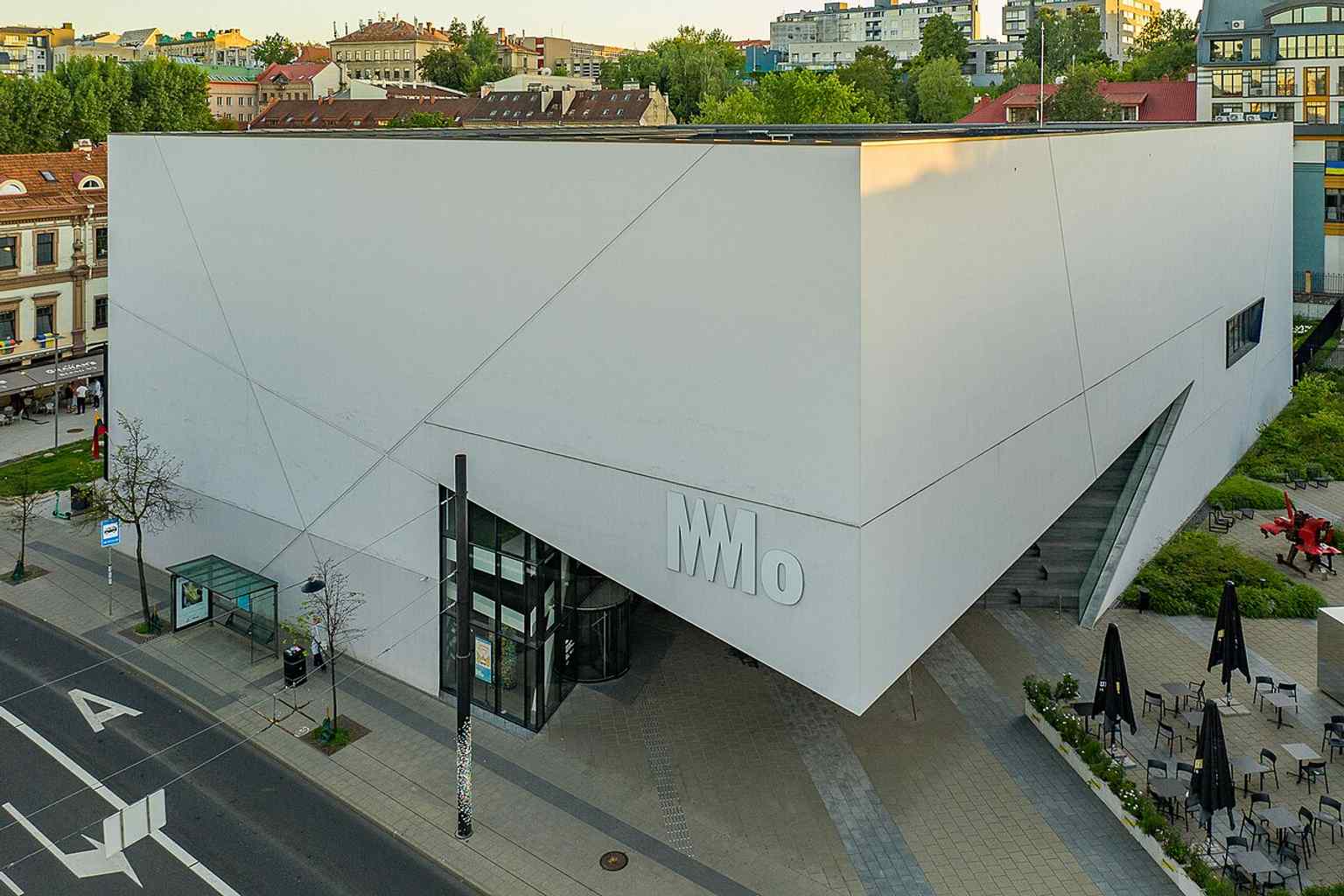
Aerial view of MO Museum’s distinctive angular building in Vilnius, opened in 2018 as one of Daniel Libeskind’s favorite projects.Photo: Augustas Didžgalvis, Wikimedia Commons, CC BY-SA 4.0. Cropped & resized. Inside, the collection now holds about six thousand works, from painting and photography to sculpture and video, tracing Lithuanian modern and contemporary art across censorship, independence, and reinvention. If you check the artwork image in the app, you get a small taste of that range. And the museum has not acted shyly since opening: in its first year it ran more than eight hundred tours, two hundred and eighty film screenings, and educational activities for nearly seven thousand children. By two thousand and twenty-four, it was partnering with the Centre Pompidou in Paris to place Lithuanian contemporary art into a much wider conversation.
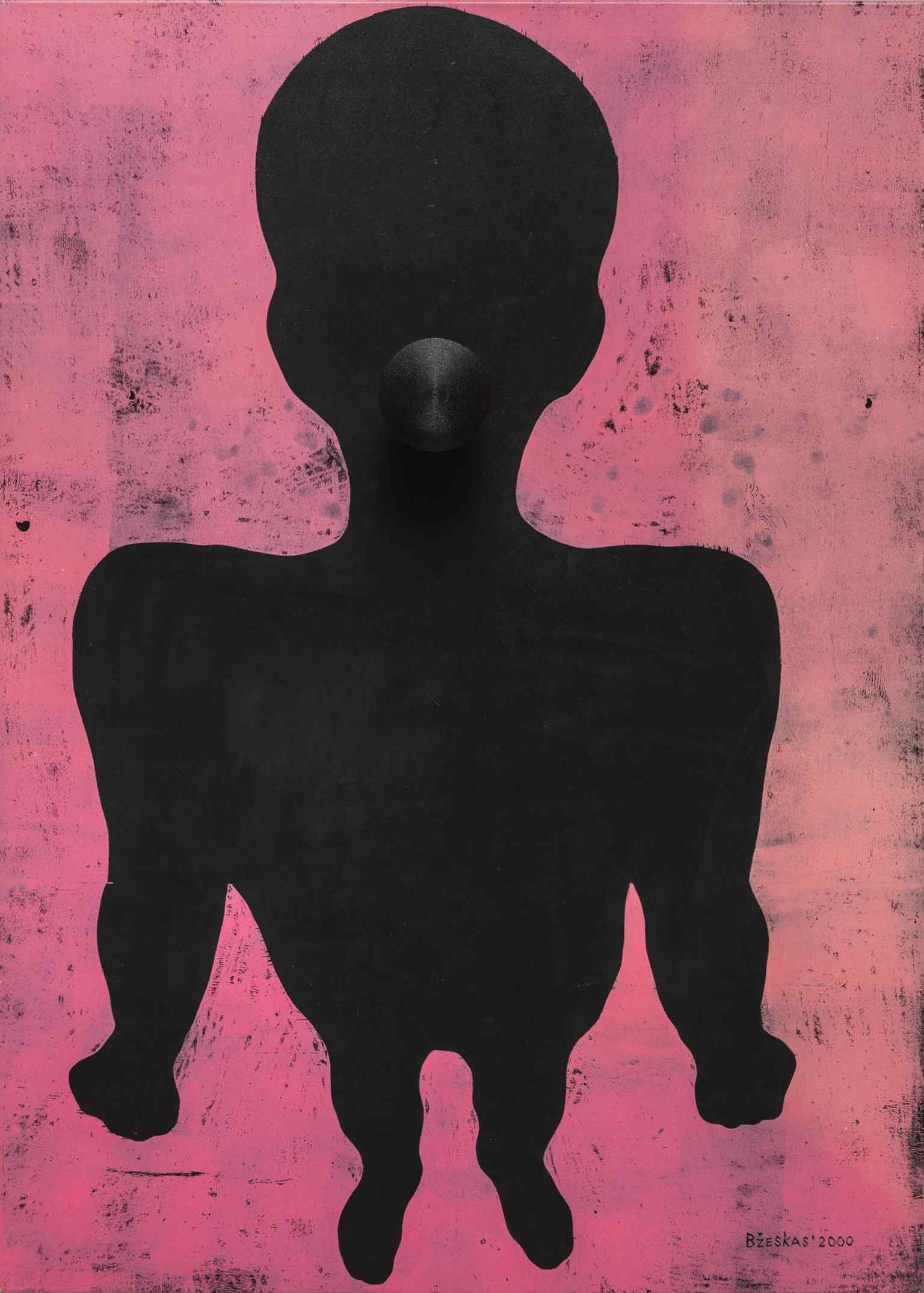
A contemporary artwork from MO Museum’s collection, reflecting the museum’s focus on Lithuanian modern and contemporary art from the 1960s to today.Photo: ZilvinasKa, Wikimedia Commons, CC BY-SA 4.0. Cropped & resized. So when we return to older seats of authority next, keep this place in mind. Every age redesigns what a city wants to remember... and who gets to do the choosing. The Presidential Palace is about an eleven-minute walk from here. If you want to come back inside later, the museum is open from ten in the morning to eight at night most days, and closed on Tuesdays.
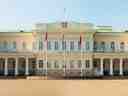
On your left stands a pale stucco palace, broad and symmetrical, marked by a central row of white columns beneath a triangular pediment. This is the Presidential Palace, and it…Read moreShow less
Open dedicated page →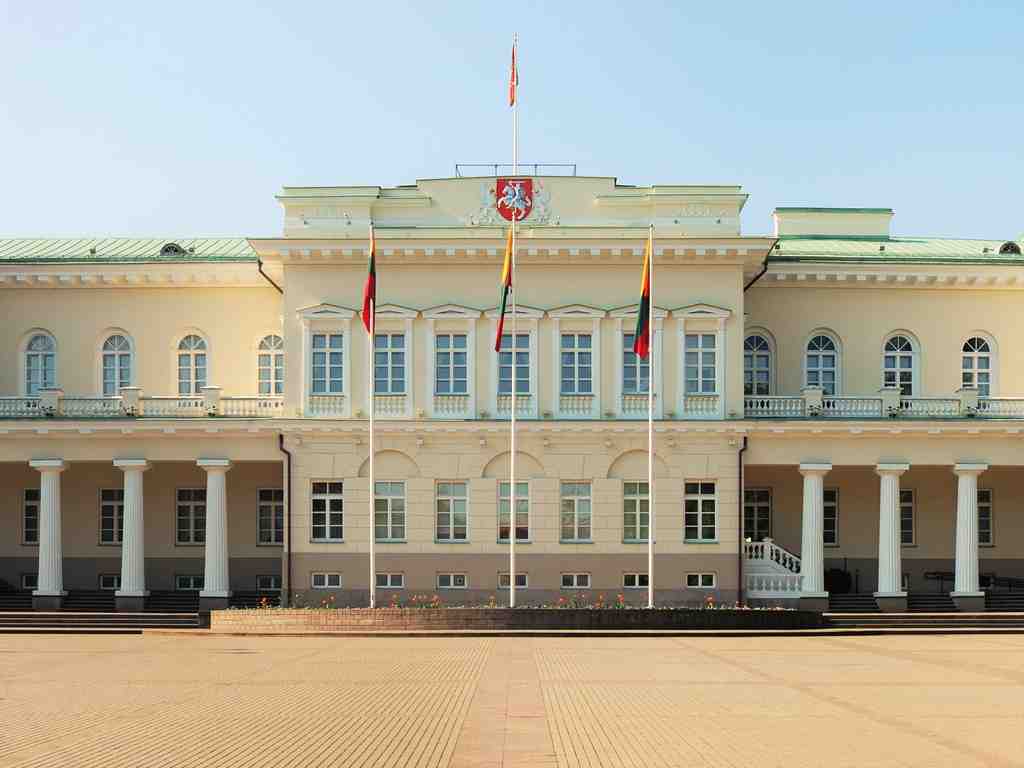
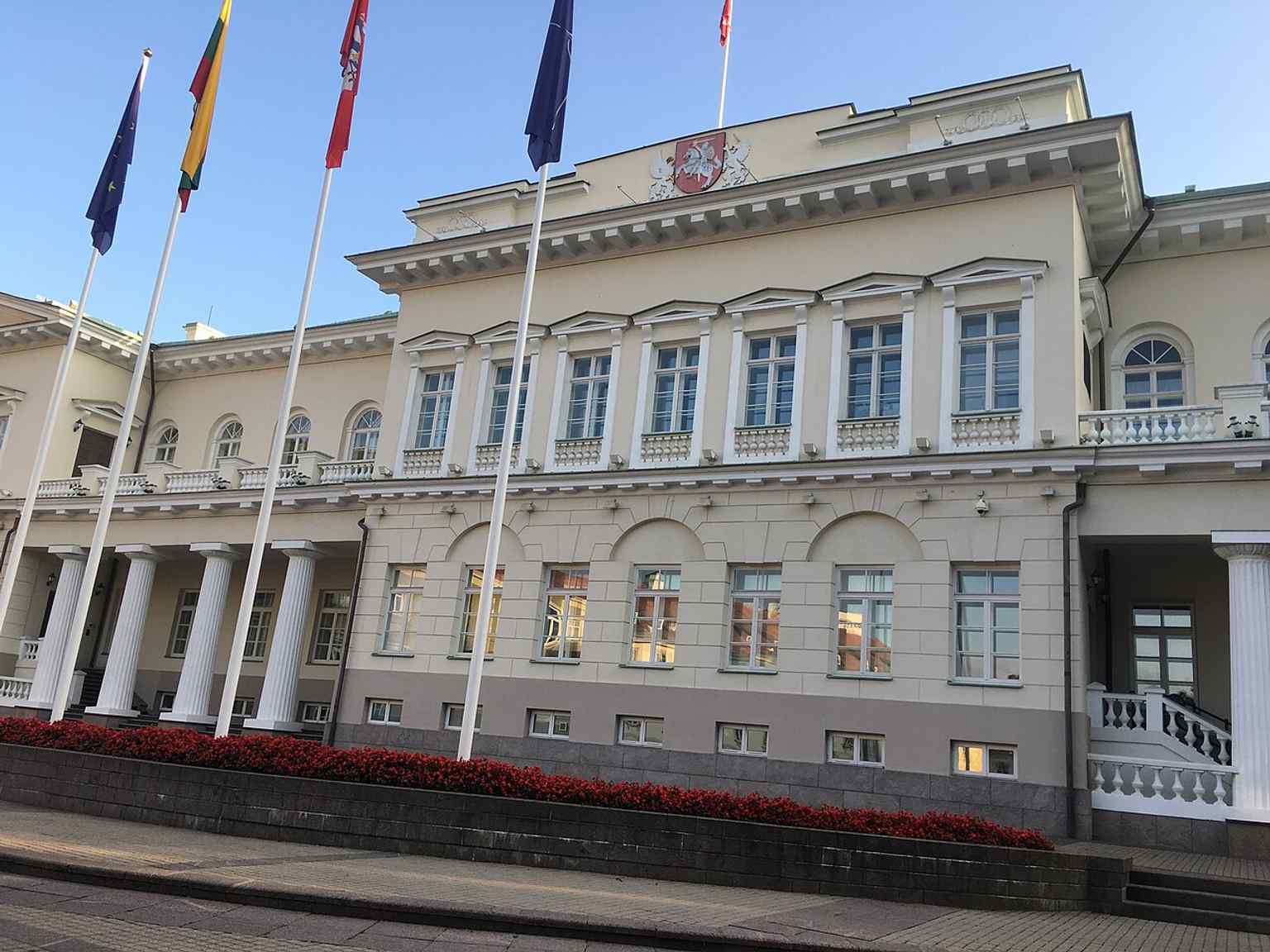
Presidential Palace, VilniusPhoto: Marcin Białek, Wikimedia Commons, CC BY-SA 3.0. Cropped & resized. On your left stands a pale stucco palace, broad and symmetrical, marked by a central row of white columns beneath a triangular pediment.
This is the Presidential Palace, and it is very much alive as statehood, not a museum piece pretending to be important after retirement. Lithuania’s president works here, receives guests here, and lets the building keep doing what this site has done for centuries: turn authority into architecture.
That story starts deep in the medieval city. In the fourteenth century, Jogaila, Grand Duke of Lithuania, gave this land to the Vilnius diocese, and the first bishop of Vilnius, Andrzej Jastrzębiec, began building a residence here. So before it became a palace of presidents, it was a bishops’ palace. Power in Vilnius did not move neatly from sacred to secular... it kept reusing the same addresses.
Even the square helps tell that story. You are standing by Simonas Daukantas Square, named for Simonas Daukantas, a Vilnius University alumnus who wrote the first history of Lithuania published in Lithuanian in the nineteenth century. A palace of rulers facing a square named for a historian... that is a very Vilnius arrangement.
This plot had political weight long before modern Lithuania. Earlier Goštautas residences stood here in the sixteenth century. Later, kings of the Polish-Lithuanian Commonwealth, Russian emperors, and even the future French king Louis the Eighteenth all passed through. Then came Napoleon, who gives the place its sharpest human profile. In eighteen twelve, after entering Vilnius through the Gate of Dawn and ordering a pontoon bridge when the Russians burned the Green Bridge, he stayed in the city for nineteen days and moved into this palace. Rumor said the Russians had mined it. They had not. A nice change of pace for an invading emperor.
From here, Napoleon organized Lithuanian military units, received noblemen and officials, and staged the rituals of command. But outside the ceremony, the city paid. Residents faced extra taxes and requisitions, churches turned into food stores, monasteries into hospitals. Here again, rule and belief did not replace one another; they collided in the same streets.
After fires in the eighteenth century damaged the older residence, architects including Laurynas Gucevičius helped reshape it, and in the nineteenth century Vasily Stasov gave it the Empire-style form you see now, especially those colonnades across the façade. If you check the image on your screen, the older view shows that imperial posture before the building became a modern presidency. And the grand staircase inside makes the point even more plainly: authority likes an entrance.
After Lithuania regained independence in nineteen eighteen, the palace housed the Foreign Ministry and the E-L-T-A news agency. After war and occupation, it served military officers, then artists. Since nineteen ninety-seven, it has been the official presidential seat. Algirdas Mykolas Brazauskas became the first Lithuanian president to actually live and work here, and Lithuanians even use the word Prezidentūra to mean not just the building, but the presidency itself.
On Sundays at noon, the Honour Guard raises the presidential flag here wearing reconstructed medieval armor. It is a wonderfully direct message: the modern republic keeps its paperwork, but it has not forgotten its dukes.
Next, another form of authority steps forward: learning, argument, and the making of minds. Walk about five minutes to the Church of Saint Johns. If you plan to return, the palace keeps regular weekday office hours from eight to five and is closed on weekends outside special events.
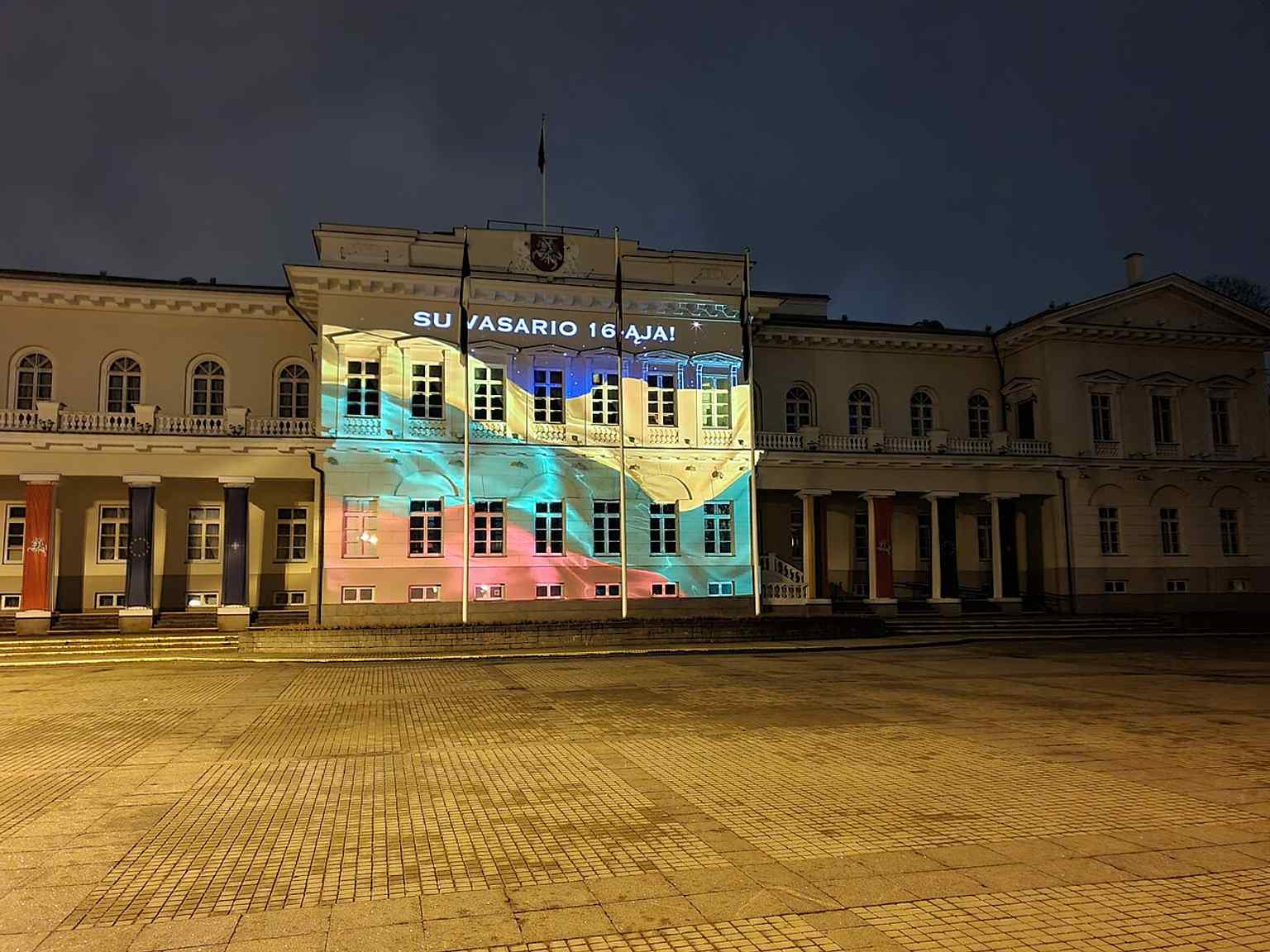
Flags and the festive frontage highlight the palace as Lithuania’s official presidential workplace, especially on national celebration days.Photo: DrUtrecht, Wikimedia Commons, CC BY-SA 4.0. Cropped & resized. 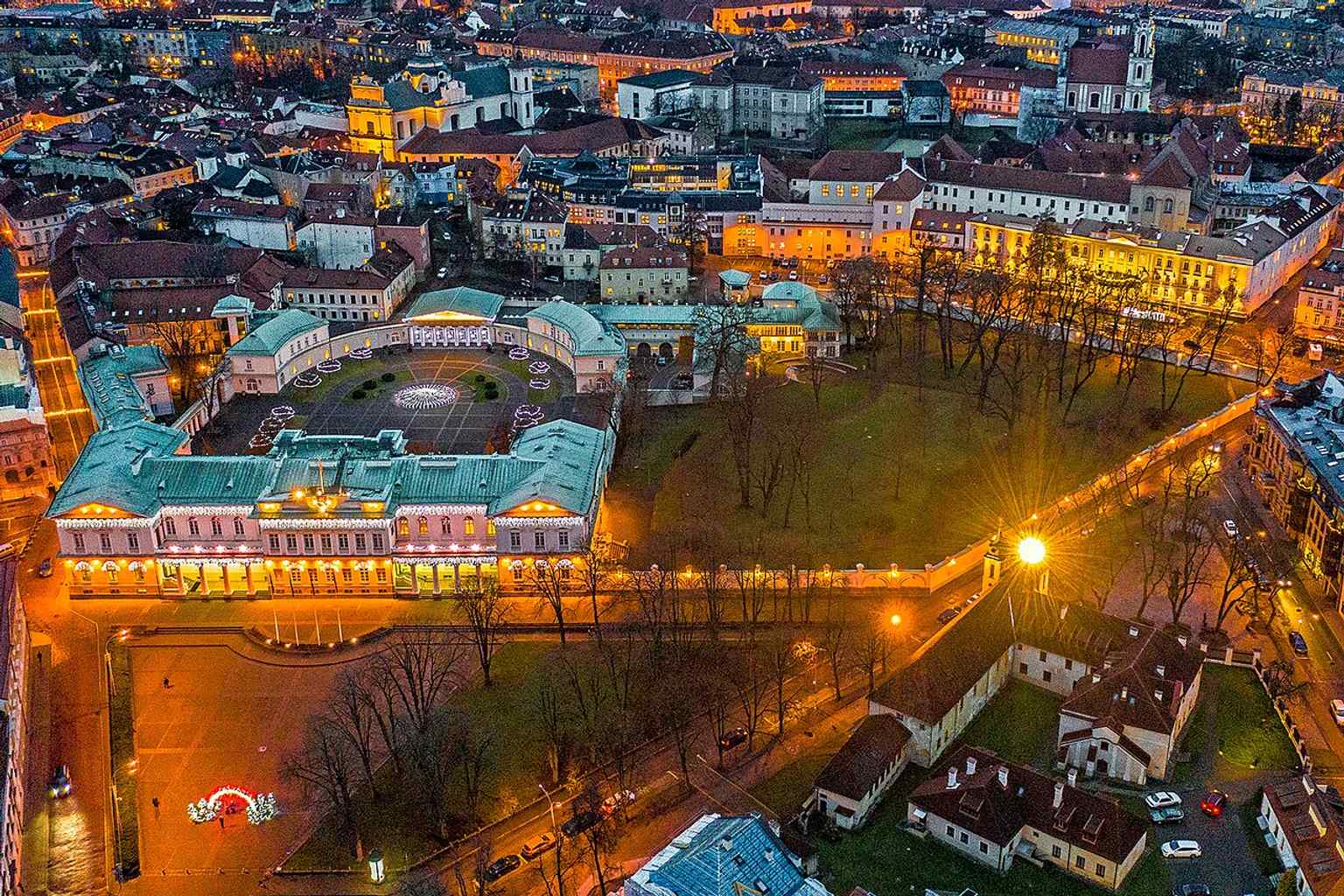
A night view of the Prezidentūra emphasizes its prominent presence on Simonas Daukantas Square, named after the Lithuanian historian who helped shape national identity.Photo: Augustas Didžgalvis, Wikimedia Commons, CC BY-SA 4.0. Cropped & resized. 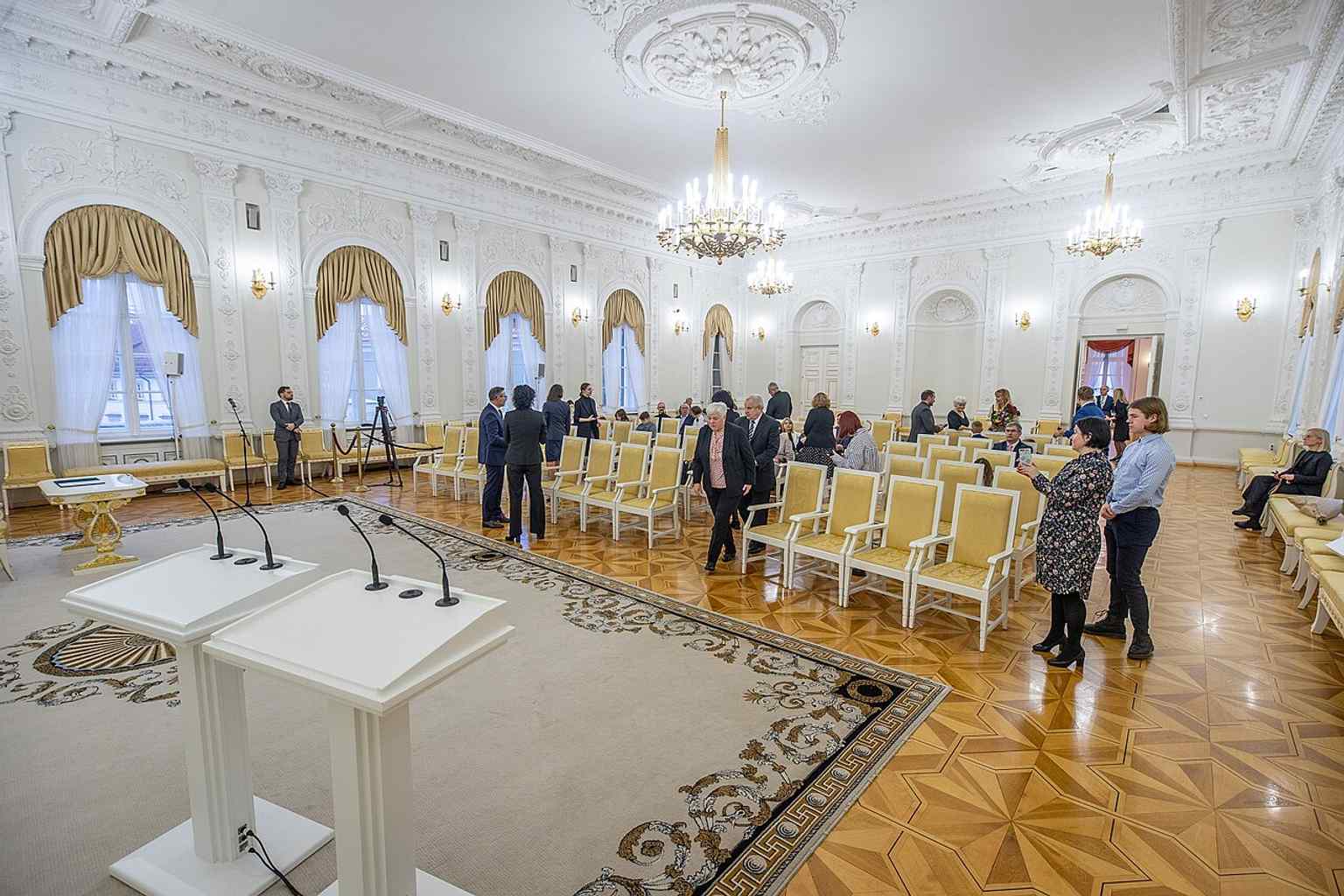
The White Hall is one of the palace’s ceremonial interiors, echoing its long role in receptions, negotiations, and official state events.Photo: BigHead, Wikimedia Commons, CC BY-SA 4.0. Cropped & resized. 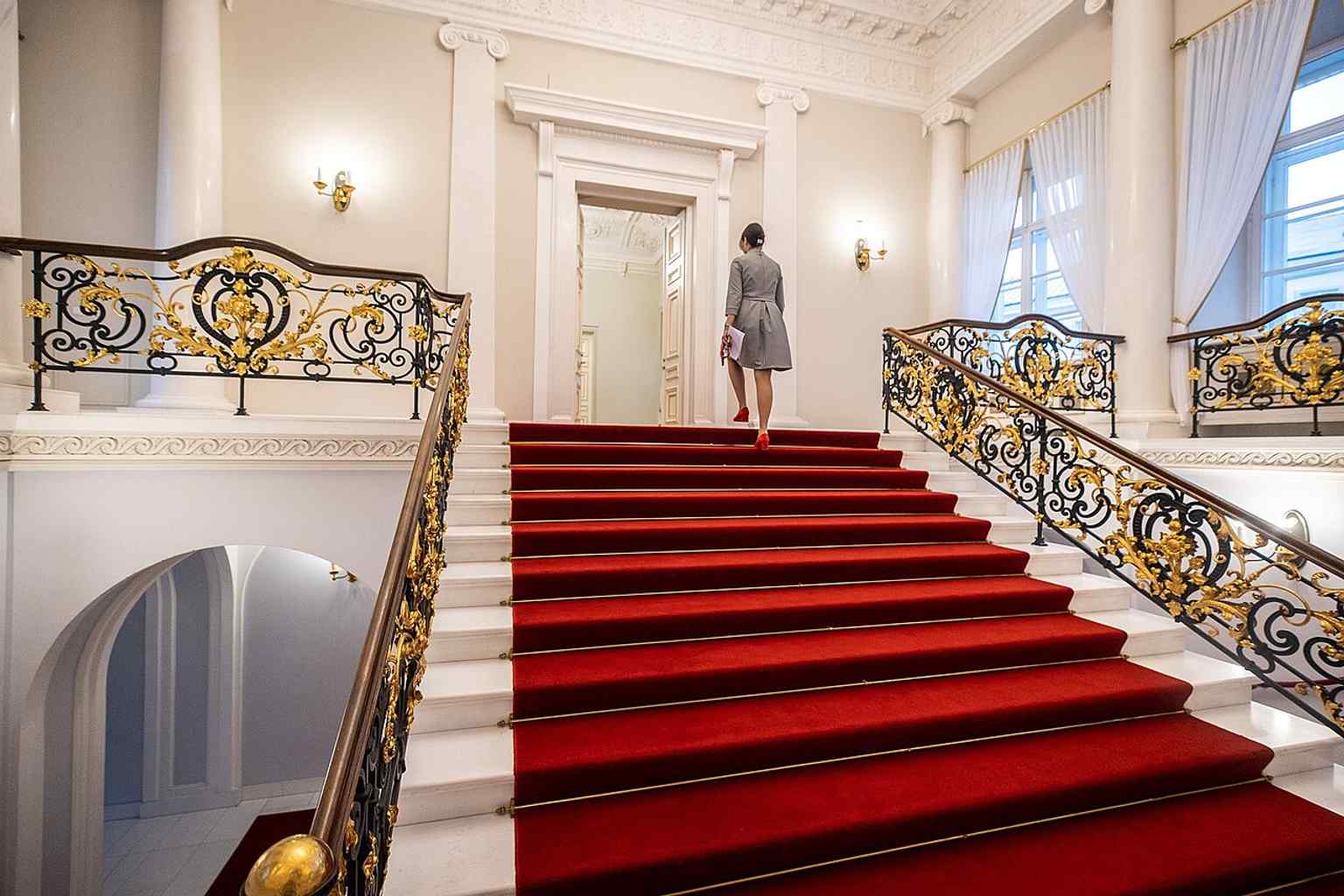
The grand staircase reflects the palace’s formal Empire-style reconstruction and the ceremonial route used by visiting dignitaries.Photo: BigHead, Wikimedia Commons, CC BY-SA 4.0. Cropped & resized. On your right is Saint Johns Church, and it does not behave like a modest university chapel. It dominates the whole ensemble, as if scholarship itself needed a stage set. For…Read moreShow less
Open dedicated page →On your right is Saint Johns Church, and it does not behave like a modest university chapel. It dominates the whole ensemble, as if scholarship itself needed a stage set. For centuries, this church and Vilnius University worked as one machine: students prayed here, theologians preached here, theses were defended here, and rulers were greeted here. In other words, learning in Vilnius did not hide in libraries. It spoke out loud.
The church began in the late fourteenth and early fifteenth centuries, and its bones are still Gothic: a tall hall church, meaning one broad interior with three naves, or aisles, and a slightly irregular string of chapels. Then the Jesuits took that structure and turned it into something more ambitious. They used this place for sermons, public debates, diploma ceremonies, even performances. Faith, rhetoric, prestige... all under one roof. Very efficient.
Take a moment and look up at the tower. It rises in five narrowing sections and reaches about sixty-nine meters, one of the tallest bell towers in Vilnius Old Town. If you open the app image, you can see how completely it commands the university courtyards. That was the point. The church did not merely stand beside learning; it visually ruled the campus.
But here is the turn in the story. What you see is not one untouched masterpiece. It is a survivor with stitched scars. In sixteen fifty-five, Moscow's army devastated the church during its assault on Vilnius. After the great fire of seventeen thirty-seven, architect Johann Christoph Glaubitz rebuilt it as late Baroque, adding a grand organ loft, side chapels, and a theatrical sanctuary of altars. If you glance at the interior image on your screen, you can feel that Baroque confidence still at work.
Then, in eighteen twenty-seven and eighteen twenty-eight, architect Karol Podczaszynski stripped much of that interior away. Cartloads of broken altars, stucco, and sculpture went off to the dump. Restoration, apparently, can be very good at destroying things.
One person to remember here is Father Alfonsas Lipniunas. During the Nazi occupation, he preached rebellious sermons from this pulpit. Later the Nazis imprisoned him in Stutthof, where he died. So this church was not only a place where ideas were polished for applause. It was also a place where words carried risk.
That is what makes Saint Johns so important. It holds prayer, performance, war damage, censorship, rescue, and return. Even its great organ migrated here from Polotsk in the nineteenth century and only sounded again after restoration in two thousand.
Now we step deeper into the same world. The church is one chamber; the university is the larger instrument. Walk on to Vilnius University, just a minute away.
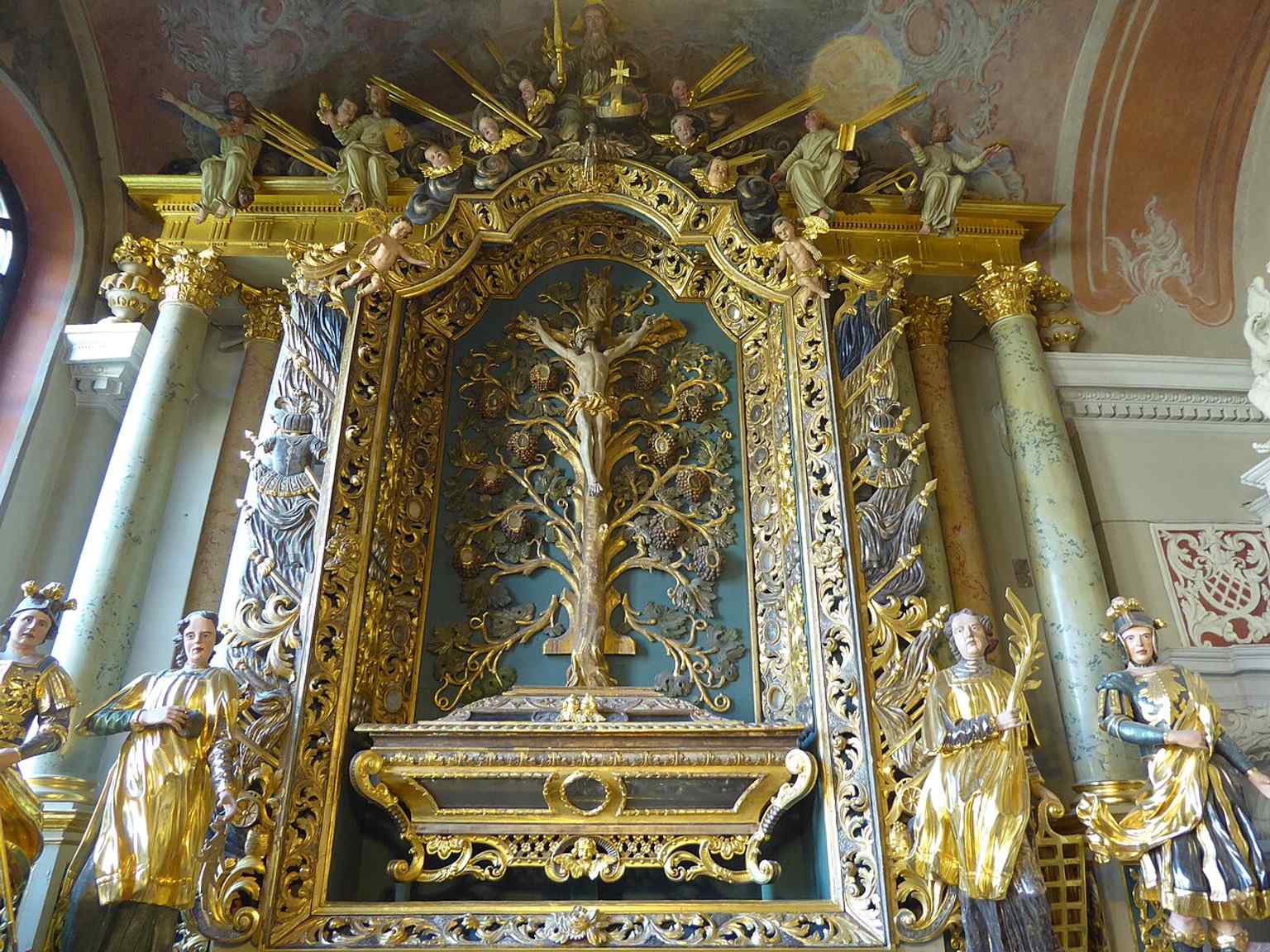
A side altar inside St. John’s Church, echoing the many chapels and altars that once filled the presbytery before the 19th-century simplification.Photo: Syrio, Wikimedia Commons, CC BY-SA 4.0. Cropped & resized. 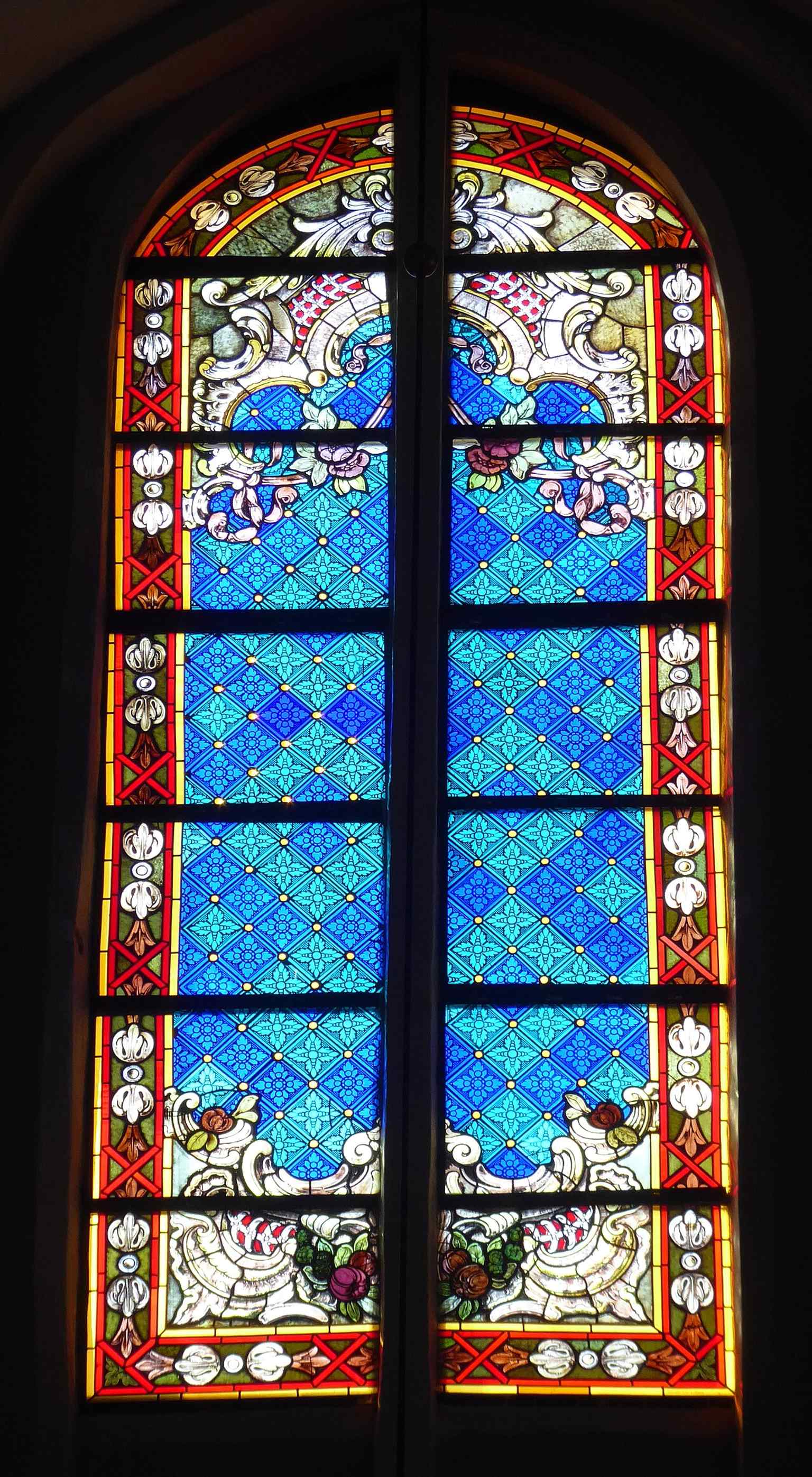
A stained-glass window from the church interior, part of the restored fabric revealed in the 1970s restoration campaign.Photo: Syrio, Wikimedia Commons, CC BY-SA 4.0. Cropped & resized. 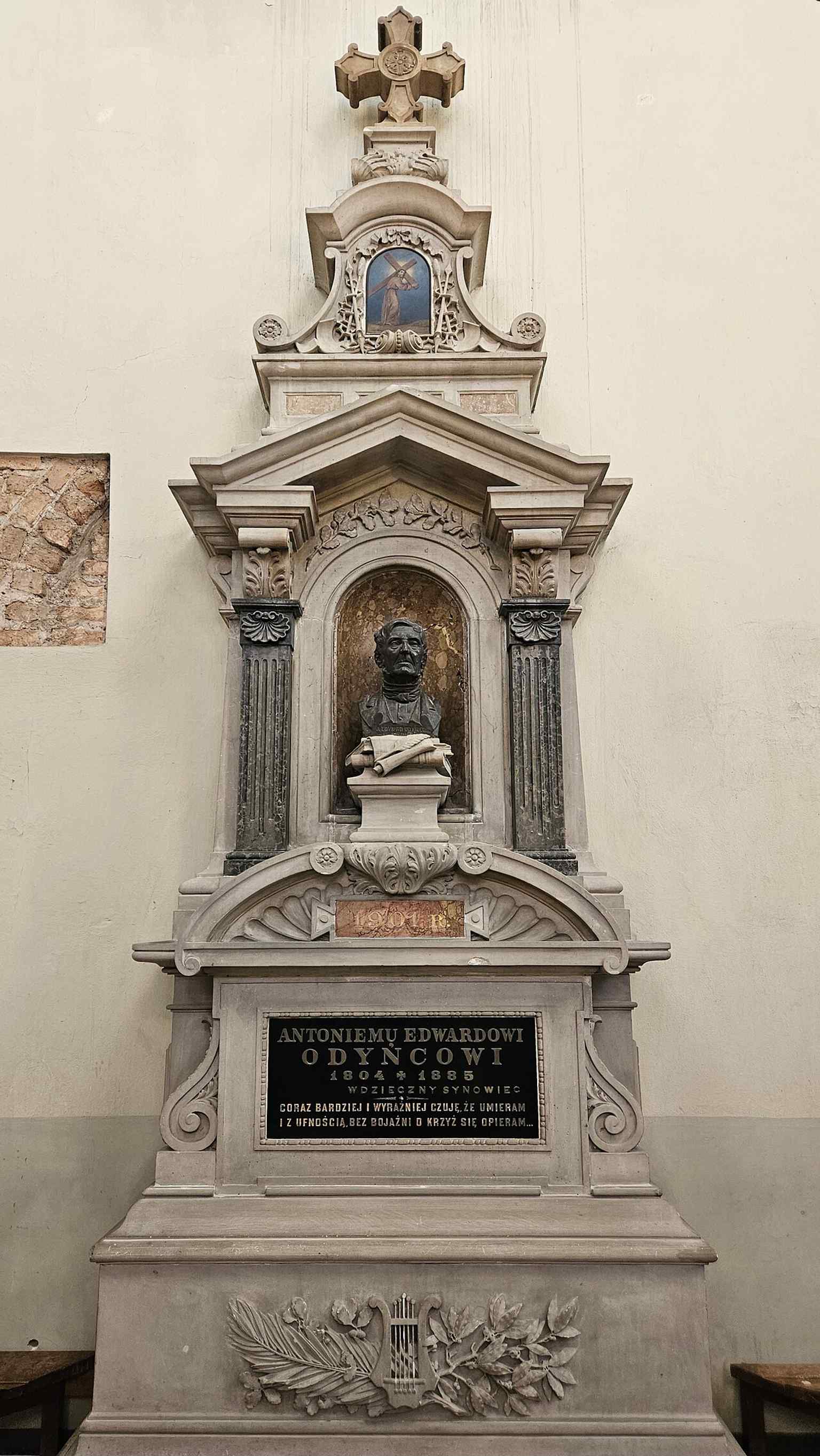
A memorial monument inside the church, one of several commemorations that turned St. John’s into a historic archive of Vilnius intellectual and religious life.Photo: Bornholm, Wikimedia Commons, CC BY-SA 4.0. Cropped & resized. 
A 1794 Lithuanian sermon delivered in the Church of St. Johns — a reminder that the church was also a stage for preaching and public life.Photo: Mykolas Pranciškus Karpavičius, Wikimedia Commons, Public domain. Cropped & resized. On your left, Vilnius University appears as a pale stucco ensemble of long baroque facades and arched windows, marked by the soaring white bell tower of Saint Johns. This place…Read moreShow less
Open dedicated page →On your left, Vilnius University appears as a pale stucco ensemble of long baroque facades and arched windows, marked by the soaring white bell tower of Saint Johns.
This place looks settled, almost smug about it... and that is the trick. Vilnius University is one of the oldest universities in Central and Eastern Europe, but its real story is not calm continuity. It is survival.
King Stephen Báthory founded it in fifteen seventy-nine as a Jesuit academy, and for a long stretch it was the only university in the Grand Duchy of Lithuania. The Jesuits planted the seed, but it grew into something much larger: a whole organism of courtyards, library rooms, observatory spaces, printing presses, and generations of students trying to look more prepared than they felt. Its library began in fifteen seventy, and King Sigismund the Second Augustus donated two thousand five hundred books, which was a serious intellectual flex.
But this institution kept getting broken by politics. After the failed November Uprising against the Russian Empire, Tsar Nicholas the First shut the university in eighteen thirty-two. It reopened only after the First World War, then changed hands again under Lithuanian, Soviet, Nazi, and Soviet rule. Same city, same stones... completely different flags, languages, and rules.
And here is the human story that changes the picture. Librarian Ona Šimaitė used her university work as cover to enter the Vilnius Ghetto during the German occupation. She smuggled in food and forged papers, carried letters and books, searched for hiding places for Jewish children, and once carried a Jewish student out in a sack. The Gestapo arrested her three times and sentenced her to death in nineteen forty-four. She survived, and later became the first Lithuanian recognized as Righteous Among the Nations. So yes, this is a university of lectures and degrees. It was also, at its bravest, a place where one woman turned access into rescue.
Today the university is still Lithuania’s leading research institution, with more than twenty-four thousand students, international programs in English, and research stretching from laser physics to biotechnology. Professor Virginijus Šikšnys, one of the pioneers of gene editing, worked here too. Not bad for a place founded when lectures were in Latin and heating was probably more theoretical than practical.
If you glance at the before-and-after image in the app, you can see how the Great Courtyard and bell tower were carefully restored before the tower reopened in twenty nineteen.
Vilnius turns out to be as much a city of ideas as a city of monuments. Next, in about six minutes, the Cathedral of the Theotokos will show you an older sacred tradition running alongside the Latin one.
If you want to come back, university offices generally keep weekday hours from seven thirty in the morning to late afternoon, close earlier on Friday, and shut on weekends.
The main Vilnius University campus in the Old Town, where the university’s historic ensemble still anchors academic life today.Photo: CAPTAIN RAJU, Wikimedia Commons, CC BY-SA 4.0. Cropped & resized. 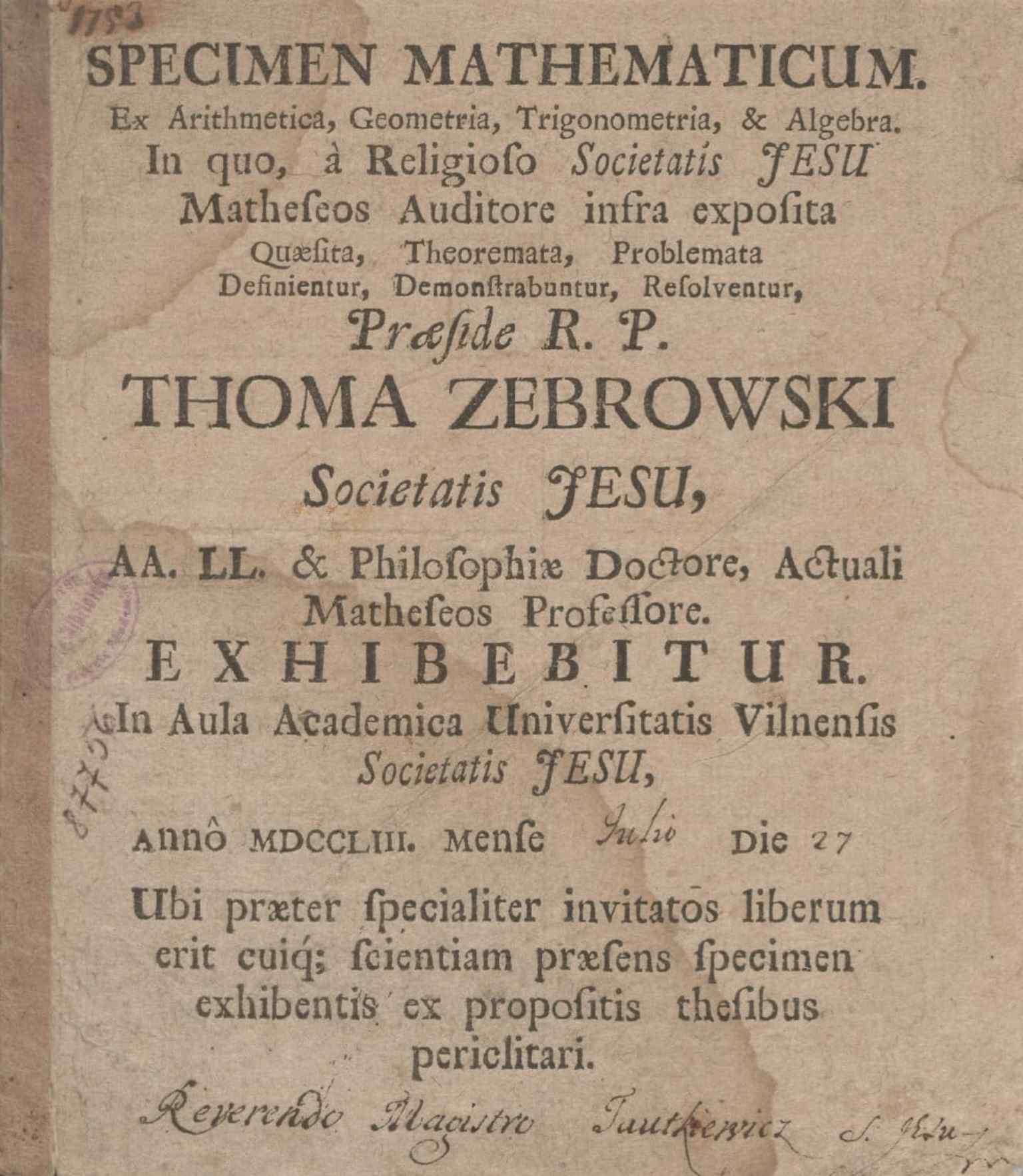
A Latin mathematics exam from 1753, echoing the university’s early scholarly life and its long tradition of advanced study.Photo: Tomas Žebrauskas (1714–1758), Wikimedia Commons, Public domain. Cropped & resized. 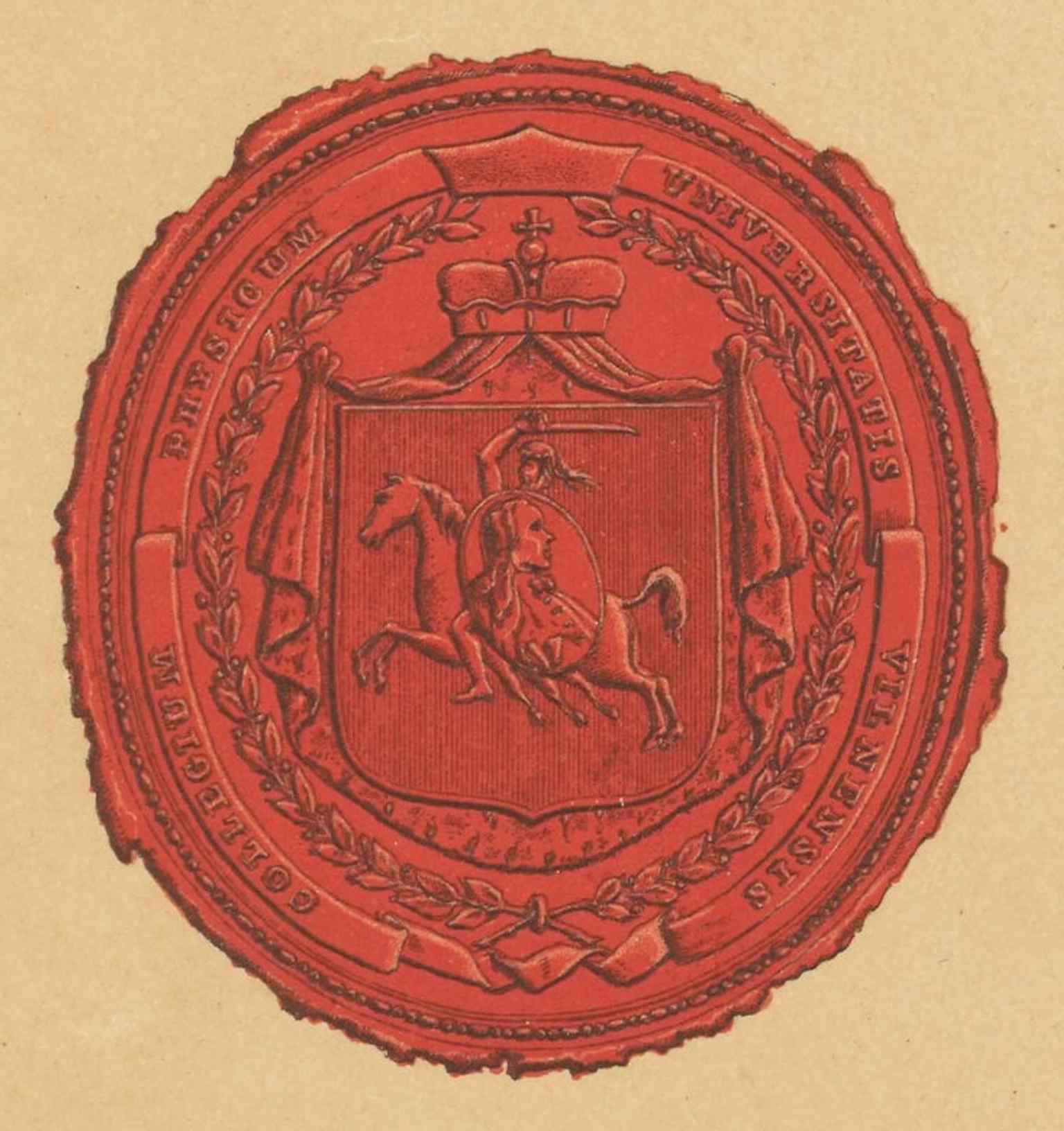
An 18th-century seal with the Vytis, showing how the university’s identity was tied to the Grand Duchy of Lithuania.Photo: Unknown authorUnknown author, Wikimedia Commons, Public domain. Cropped & resized. 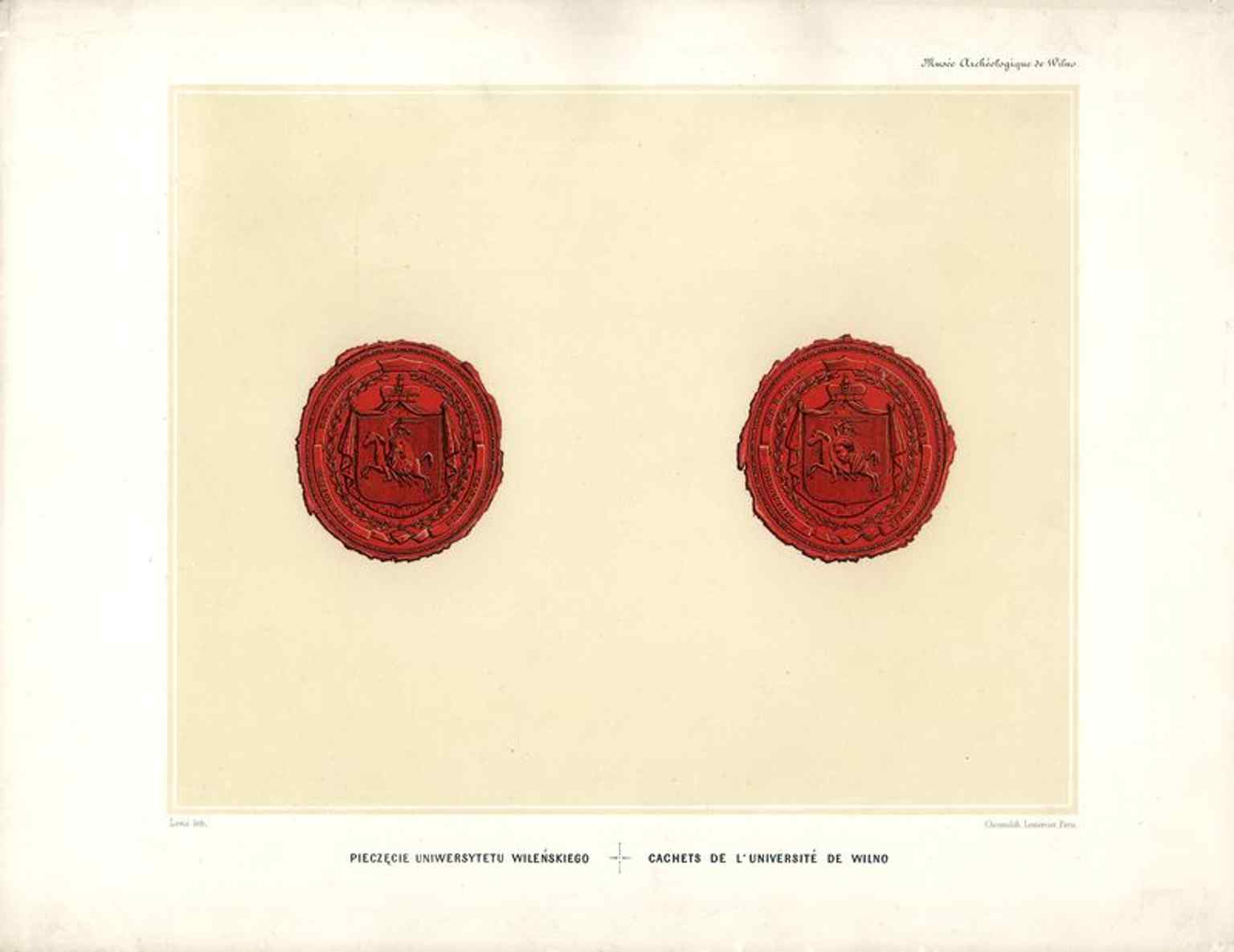
A 19th-century university seal with the Lithuanian Vytis, a symbol that appears across the institution’s historic emblems.Photo: Vilnius University (seals), Lietuvos nacionalinis dailės muziejus / Lithuanian National Museum of Art (image), Wikimedia Commons, CC BY-SA 4.0. Cropped & resized. On your right is a building that quietly upends a neat version of Vilnius history. Long before Lithuania officially became Christian, Orthodox Vilnius was already here in stone.…Read moreShow less
Open dedicated page →On your right is a building that quietly upends a neat version of Vilnius history. Long before Lithuania officially became Christian, Orthodox Vilnius was already here in stone. This cathedral is among the city’s oldest surviving churches, and tradition places its beginnings in the reign of Grand Duke Algirdas in thirteen forty-six, tied to the Orthodox court around him. Either way, the point stands: dynastic politics and faith were sharing the same address very early on.
Kievan architects shaped it, and Saint Alexius, the Metropolitan of Kiev and all Rus', blessed the project in thirteen forty-eight. So while the Grand Duchy still had the reputation of being Europe’s last pagan state, this place already served a growing Christian population. That is the surprise here: Vilnius did not step from paganism into one tidy Catholic story. It was messier, richer, and much more interesting.
One person who holds that story together is Helena of Moscow, daughter of Ivan the Third and wife of Grand Duke Alexander Jagiellon. She was symbolically married here in fourteen ninety-five, and when she died in fifteen thirteen, they buried her here too. So this church became both a spiritual center and a family vault for rulers whose marriages doubled as foreign policy. Romance, in royal life, rarely got to travel alone.
The building then lived several different lives, some of them rather rude. After the dome collapsed in fifteen oh six, Prince Konstanty Ostrogski restored it in fifteen twenty-two. In sixteen oh nine, the Uniate Church took it over after the Union of Brest, which brought some Orthodox communities into communion with Rome while keeping Eastern rites. Fires followed, including one in seventeen forty-eight that left the cathedral abandoned and reused for other purposes.
Then came one of Vilnius's more bizarre reinventions: Vilnius University bought the neglected building in eighteen oh eight, and by eighteen twenty-two Karol Podczaszyński had remodeled it in Neoclassical style. Inside, a former cathedral hosted an anatomical theatre for public dissections, plus lecture halls, a library, barracks, and storage. Nothing says sacred continuity quite like a cadaver under academic supervision.
In the eighteen sixties, during the Russification campaign, Count Mikhail Muravyov pushed it back into Orthodox hands, and architect Nikolai Chagin rebuilt it in a style imitating medieval Georgian churches. Take a peek at the before-and-after image in the app to see how dramatically the nineteenth-century rebuild changed its face. If you glance at your screen, the interior image shows the five-tier iconostasis - the wall of painted holy images separating altar and nave - installed in eighteen sixty-four, unique in Lithuania.
War damaged it again in the twentieth century, and repairs dragged on until nineteen fifty-seven. That long recovery suits the place. This church teaches a hard lesson: Vilnius was spiritually diverse before it was officially Christian, and every era here left fingerprints instead of clean replacements. From here, continue to the Church of St. Francis and St. Bernardino, about a three-minute walk away. If you want to return later, the cathedral is generally open every day from seven thirty in the morning until eight in the evening.
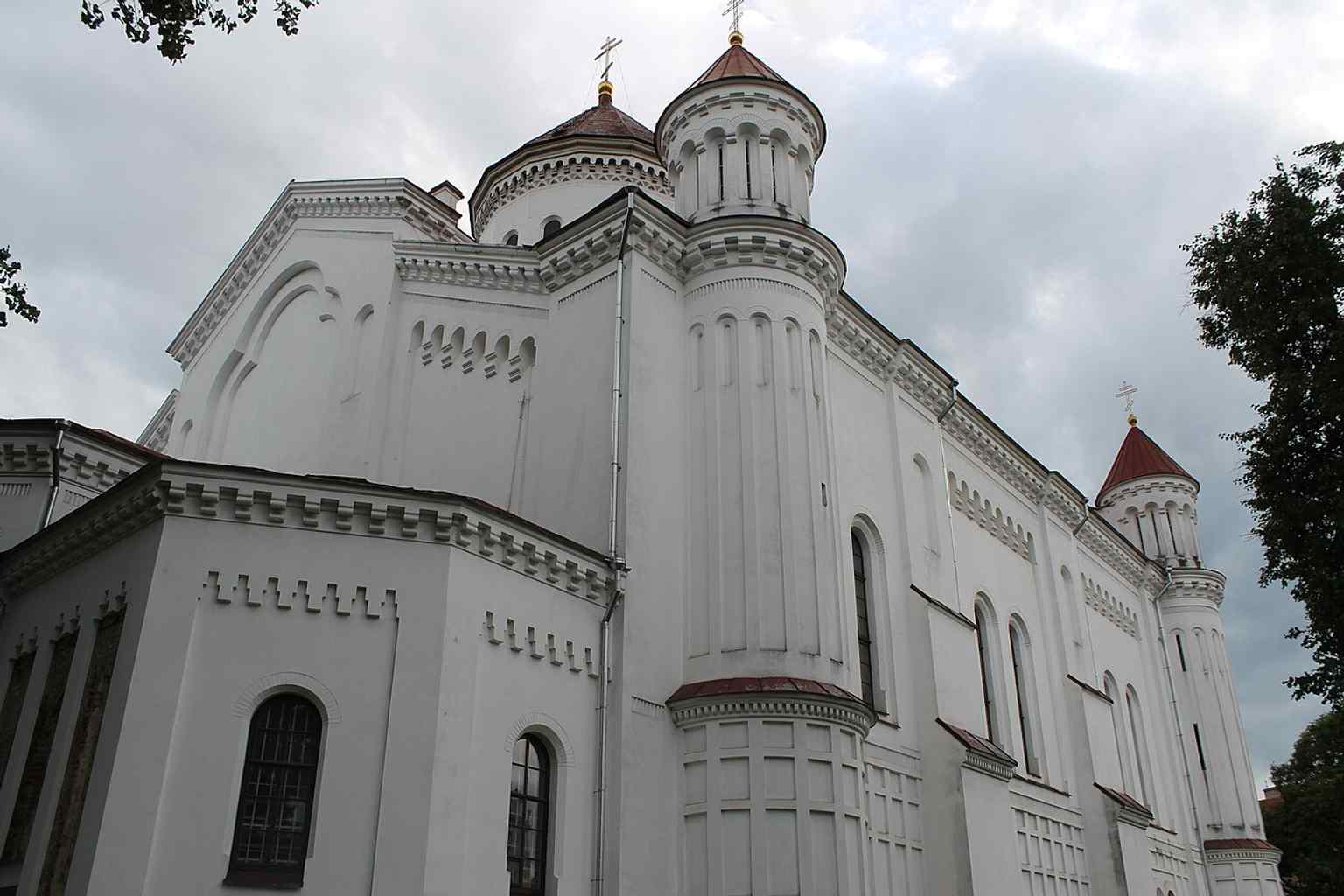
The white Orthodox cathedral in Vilnius, the church of the Dormition of the Theotokos, seen as a living parish today.Photo: John Samuel, Wikimedia Commons, CC BY-SA 4.0. Cropped & resized. On your left, look for a broad red-brick Gothic church with pointed-arch windows, stout buttresses, and a tall gable framed by two octagonal towers. This is the Bernardine…Read moreShow less
Open dedicated page →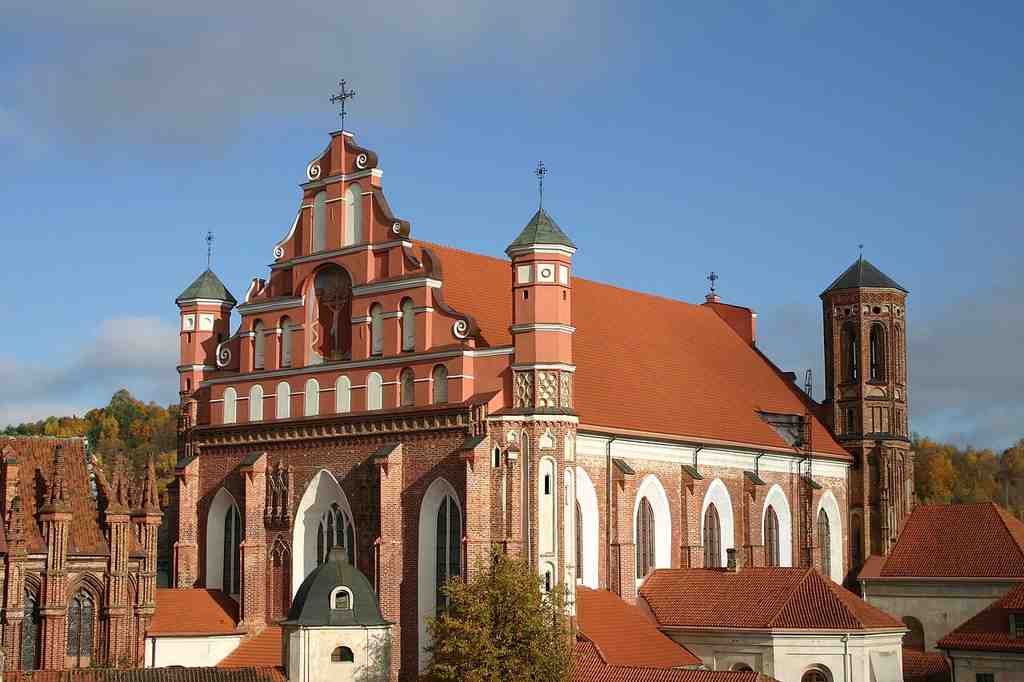
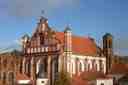
Church of St. Francis and St. Bernardino, VilniusPhoto: Povilas, Wikimedia Commons, Public domain. Cropped & resized. On your left, look for a broad red-brick Gothic church with pointed-arch windows, stout buttresses, and a tall gable framed by two octagonal towers.
This is the Bernardine Church, dedicated to Saint Francis of Assisi and Bernardino of Siena... and it carries an almost absurd amount of Vilnius inside one building. Monks first put up a wooden church here in the fifteenth century, then replaced it with brick, and in the early sixteen hundreds they folded it into the city’s defensive wall. That is why this holy place has shooting openings in its walls. Nothing says “welcome to worship” like architecture prepared for arrows.
The scale matters. Legend says the Bernardines preached so well that crowds kept coming, so they built bigger. If you glance at the image on your screen, you can see the interior still feels built for a serious audience: a vast central hall, called the nave, divided by eight tall pillars.
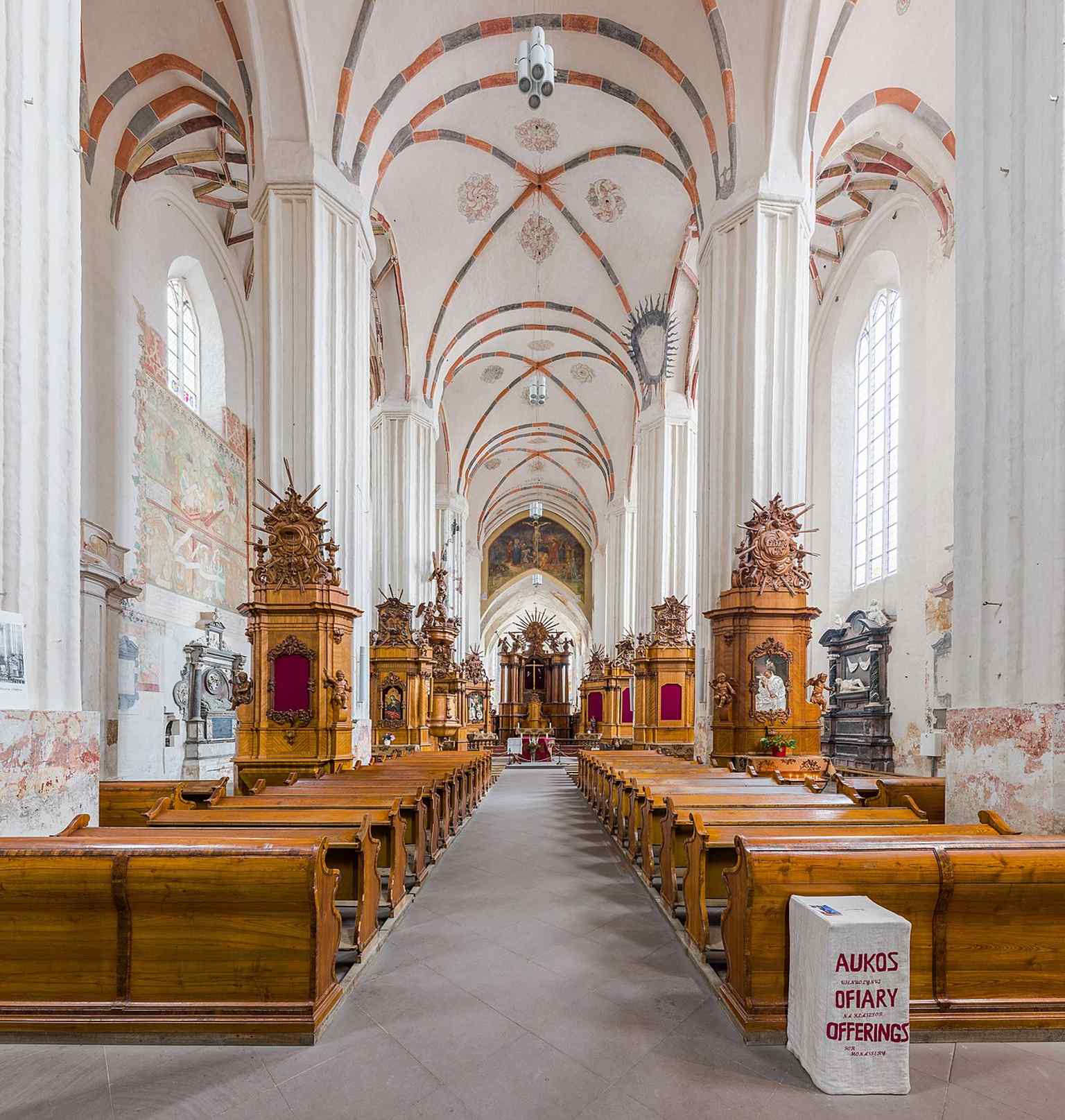
Wide view of the Gothic nave inside Bernardine Church, showing the tall pillars and scale that made it one of Vilnius’s largest sacral buildings.Photo: Diliff, Wikimedia Commons, CC BY-SA 3.0. Cropped & resized. But this church also collected stranger things: fear, rumor, and local devotion. One name stayed attached to the place for centuries: Simonas Kerelis, a seven-year-old Vilnius boy. In fifteen ninety-two, people turned his death into a ritual-murder accusation, the kind of story cities tell when panic outruns decency. The Bernardines buried him here, then moved him in sixteen twenty-three to a marble grave outside. Pilgrims came, offerings piled up, and a local cult grew around him... until the war with Moscow in sixteen fifty-five to sixteen sixty-one tore through Vilnius, destroyed the sarcophagus, and shattered that whole world. A memorial plaque on the wall is what remains.
Inside, another survivor hangs on by stubbornness alone: the huge painting St. Bruno. The Miracle in the Church. Leonas Bazilijus Sapiega commissioned it in sixteen seventy-four, and Johann Gotthard Berchhoff painted it with a wink. Sapiega appears in one corner wearing fashionable seventeenth-century clothes, while the scene itself is supposed to happen in the year ten eighty. Historical accuracy clearly took a short lunch break. During the Soviet period, when the church was closed and handed to the Art Institute, the painting decayed, parts were stolen, and what remained went into museum storage. Restorers finally returned it here in two thousand eleven.
Most visitors miss the quieter survivors. Fragments of one of Lithuania’s oldest large Baroque organ fronts still remain here, dating from seventeen sixty-four to seventeen sixty-six and linked to the organ builder Nicolaus Jantzon. And the wall paintings, uncovered only in nineteen eighty-one, mix Gothic style with Renaissance storytelling in a way that is genuinely rare.
If you want one more image, look at the church pairing in the app: this larger, fortress-like mass beside the famously delicate neighbor. That contrast is perfect. Bernardine Church holds layers, scars, and half-lost memories; next door, St. Anne gets all the elegant applause. We’re heading there next, about a one-minute walk away.
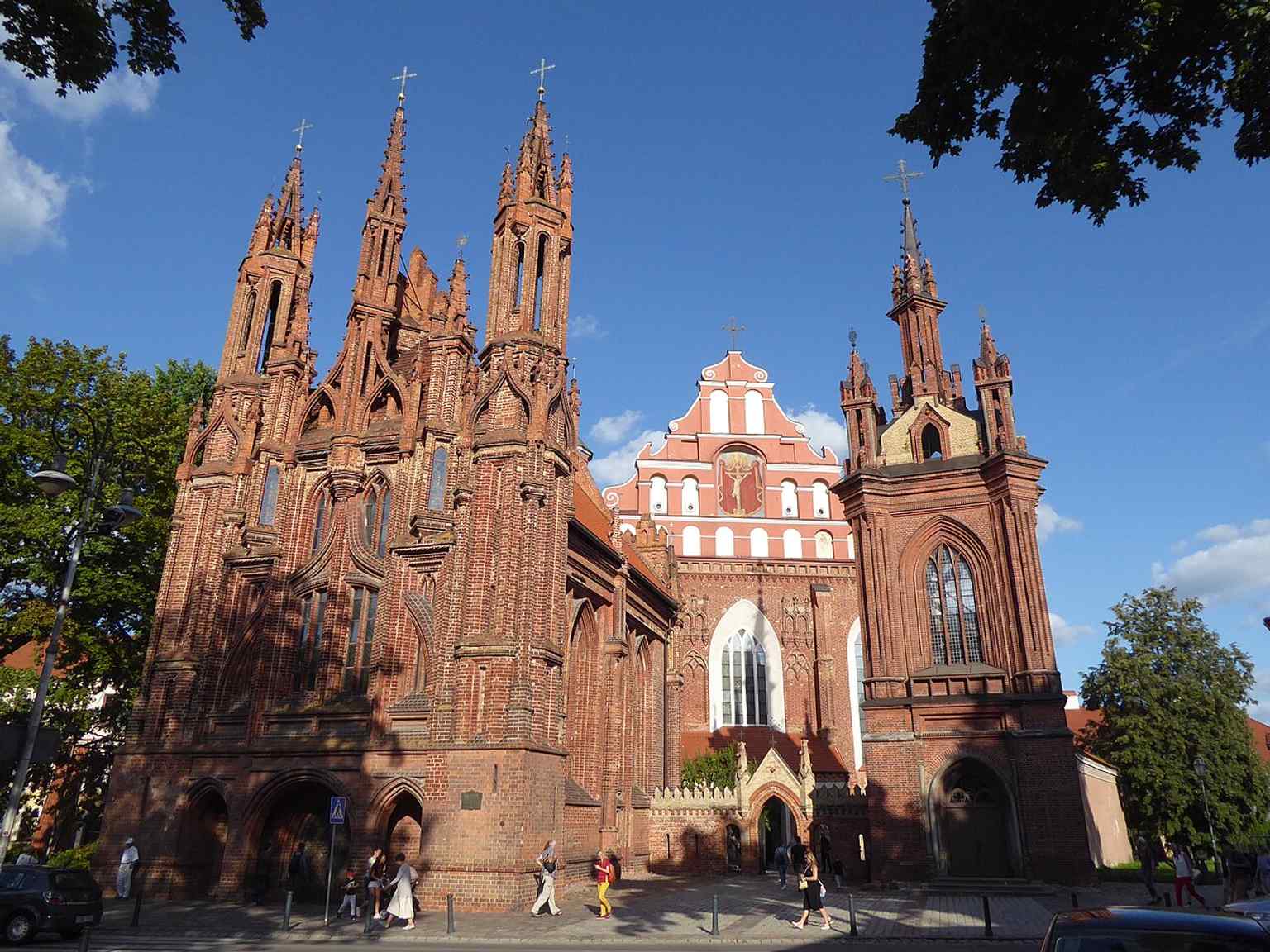
St. Anne’s Church in front with Bernardine Church behind it — the famous Vilnius ensemble the source text highlights as a unique Gothic pairing.Photo: Syrio, Wikimedia Commons, CC BY-SA 4.0. Cropped & resized. If you plan to come back inside later, the church is generally open daily, with hours varying by day.
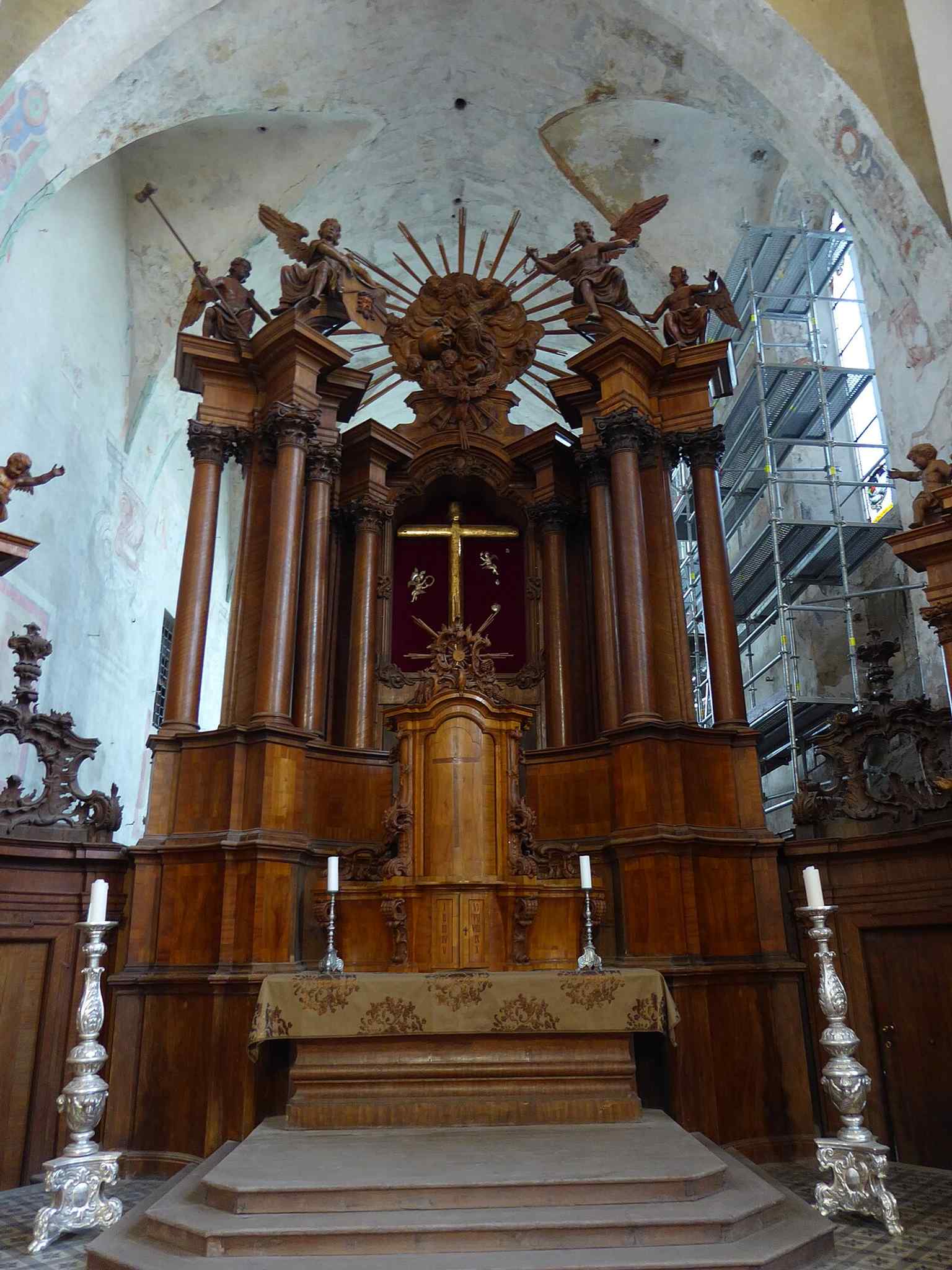
The main altar inside the church, where centuries of worship continued even after the building was repurposed in Soviet times and later returned to the Franciscans.Photo: Syrio, Wikimedia Commons, CC BY-SA 4.0. Cropped & resized. 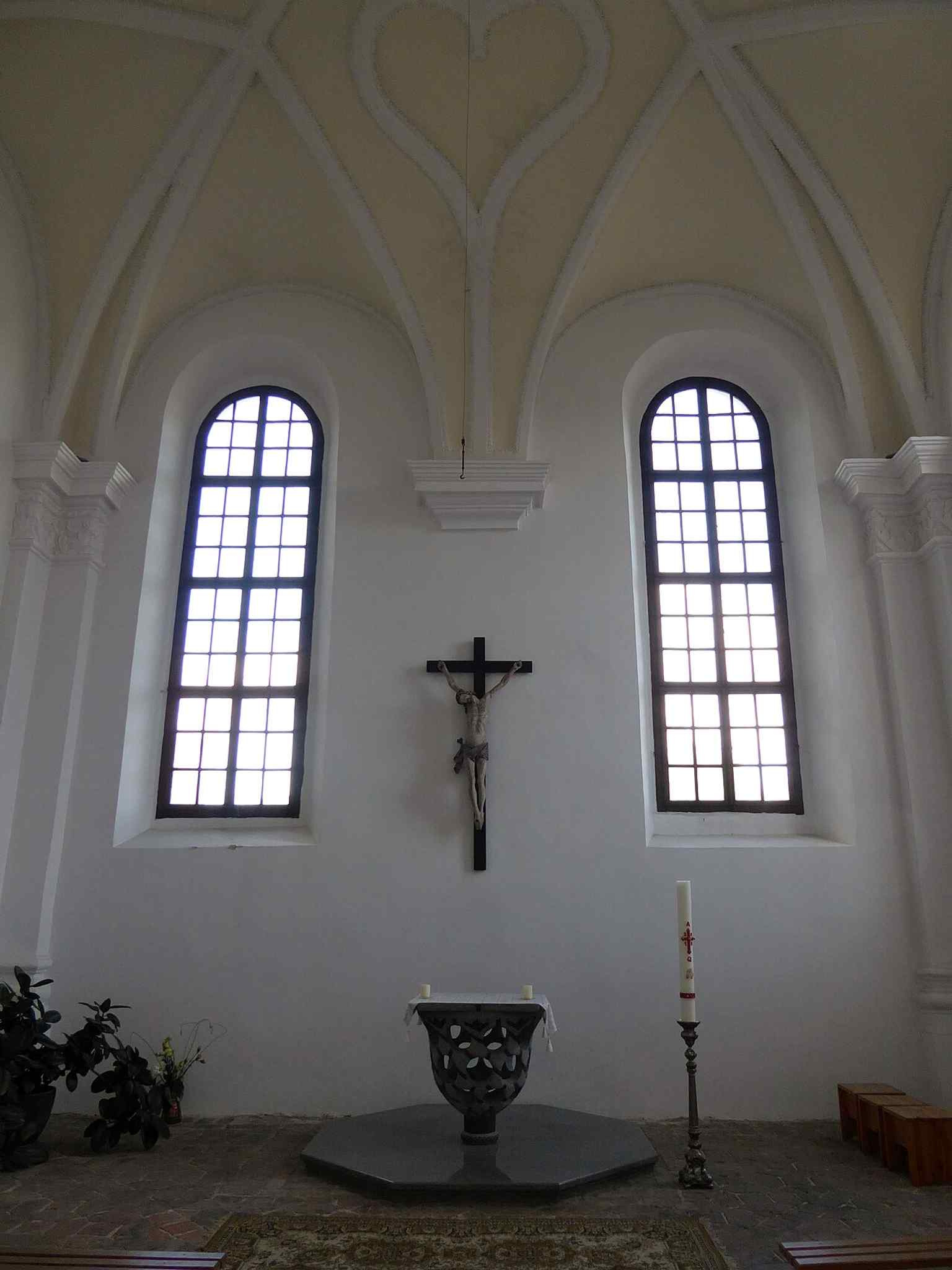
A side chapel in the Bernardine Church, part of the richly decorated interior that preserves important layers of Renaissance and Baroque rebuilding.Photo: Syrio, Wikimedia Commons, CC BY-SA 4.0. Cropped & resized. On your right, look for a red brick church with a tall, narrow Gothic facade, pointed arches, and lace-like vertical towers that seem almost too delicate to be made of clay. St.…Read moreShow less
Open dedicated page →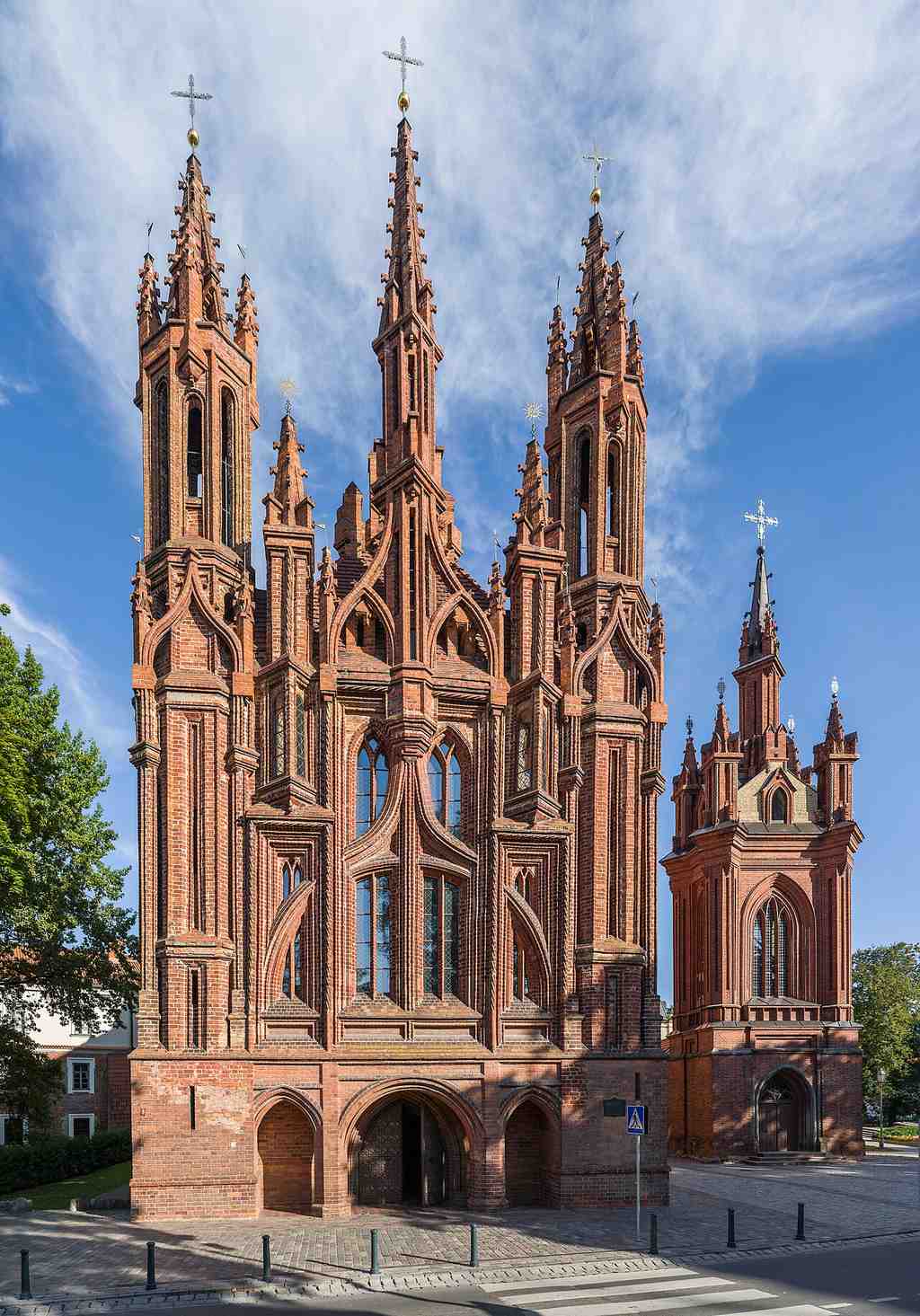
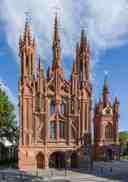
Church of St. Anne, VilniusPhoto: Diliff, Wikimedia Commons, CC BY-SA 3.0. Cropped & resized. On your right, look for a red brick church with a tall, narrow Gothic facade, pointed arches, and lace-like vertical towers that seem almost too delicate to be made of clay.
St. Anne’s has that rare trick of looking both precise and improbable... as if someone sketched a prayer in brick and then somehow persuaded it to stand up for more than five centuries. This church rose here around fourteen ninety-five to fifteen hundred, when Alexander Jagiellon, King of Poland and Grand Duke of Lithuania, backed the construction of the present building. Remarkably, the exterior you’re seeing has changed very little since then. In a city that has been burned, rebuilt, renamed, argued over, and prayed through, that is no small achievement.
The first church here had been wooden, built for Anna, Grand Duchess of Lithuania, the first wife of Vytautas the Great. Fire destroyed it in fourteen nineteen. After that, things became a little murky in the most Vilnius way possible: sixteenth-century Vilnius may have had two or even three churches dedicated to St. Anne, including one inside the castle walls. So later writers argued for centuries over which Anne was which, who founded what, and who actually designed this one. Historians do love a tidy answer... Vilnius does not always provide one.
Before I go on, take a moment and study the facade. Let your eyes climb the repeated brick patterns, the pointed arches, the narrow vertical lines that pull everything upward. The rhythm is so intricate that the whole front seems to tremble, almost like movement frozen in place. If you want a closer look at those patterns, there’s a good detail shot on your screen.
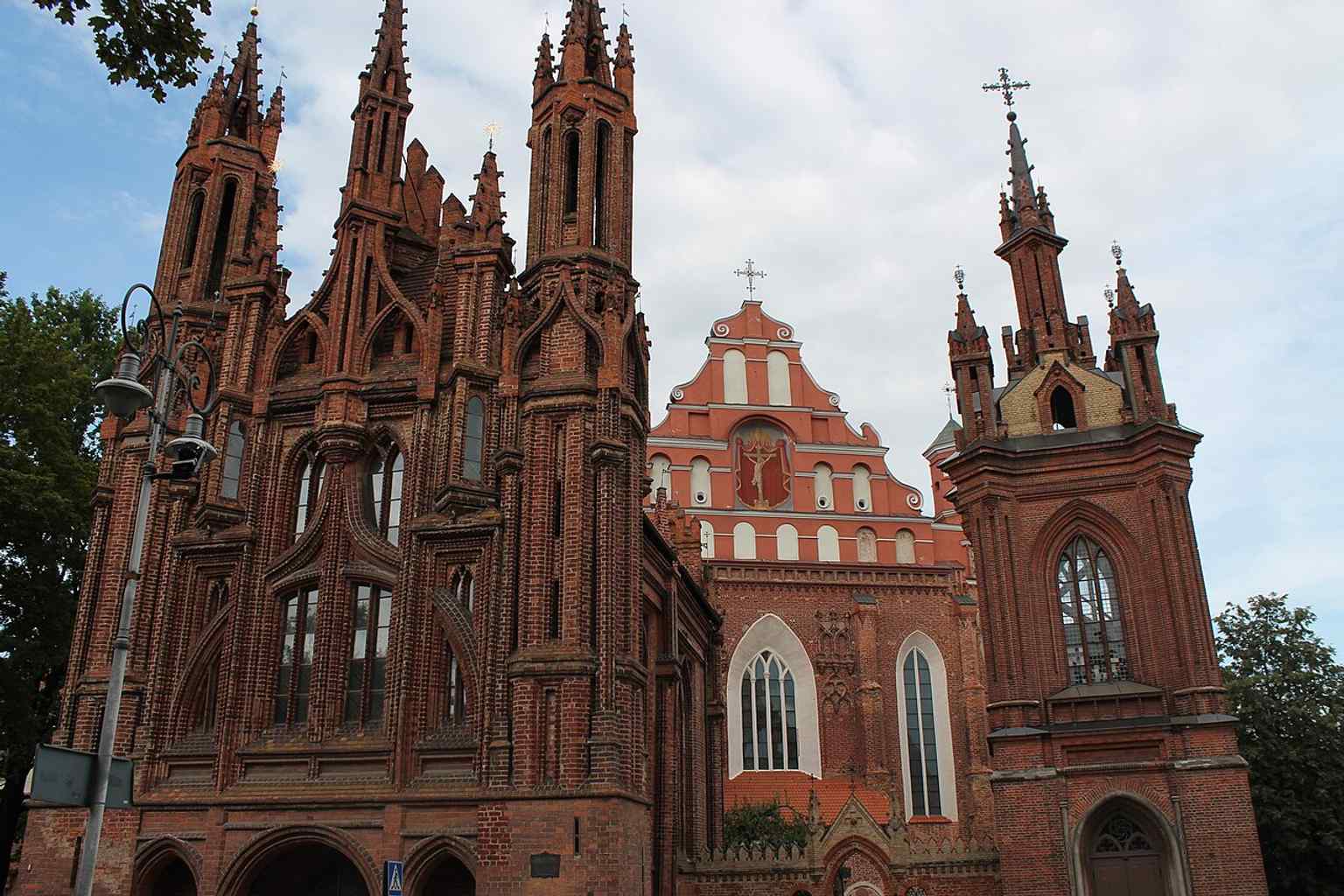
A close look at the façade’s red brick patterns and pointed arches, showing why St. Anne’s is celebrated as a masterpiece of Brick Gothic.Photo: John Samuel, Wikimedia Commons, CC BY-SA 4.0. Cropped & resized. Architects call this Brick Gothic, and here it turns flamboyant - meaning more ornate, more playful, more daring than the stern Gothic you might expect. The builders used thirty-three different kinds of clay bricks, framing Gothic arches inside rectangular shapes so the front feels both symmetrical and alive. Lithuanian art historian Vladas Drėma even saw echoes here of the Columns of Gediminas, one of Lithuania’s old dynastic symbols. So this facade is not just decorative; it quietly speaks the language of power as well as faith.
And then there is Napoleon. Legend says that when he saw St. Anne’s in eighteen twelve, he wished he could carry it back to Paris in the palm of his hand. Lovely line... probably polished later by writer Adam Honory Kirkor. The less romantic truth is that Napoleon’s retreating soldiers used the church as a warehouse and burned its wooden furnishings, damaging the stone altars. So no, he did not pocket it like a souvenir. The church stayed, scarred but standing, which feels more impressive anyway.
If you’re curious, the before-and-after image in the app shows how the churchyard and its surroundings changed while the facade kept calmly stealing the show.
That persistence mattered later too. During Soviet occupation, when many Catholic churches fell silent, St. Anne’s remained open. And in nineteen eighty-seven, near this church and the Adam Mickiewicz monument, protesters with the Lithuanian Liberty League publicly demanded the withdrawal of Soviet troops and the return of independence. Even here, beauty did not retire from history; it kept its place in the argument.
Now we head toward Vilnius Cathedral, about an eight-minute walk away, where the city’s sacred heart and ceremonial center come fully into view. If you want to come back inside St. Anne’s later, it generally opens from four to seven P-M on weekdays and from nine A-M to five P-M on weekends.
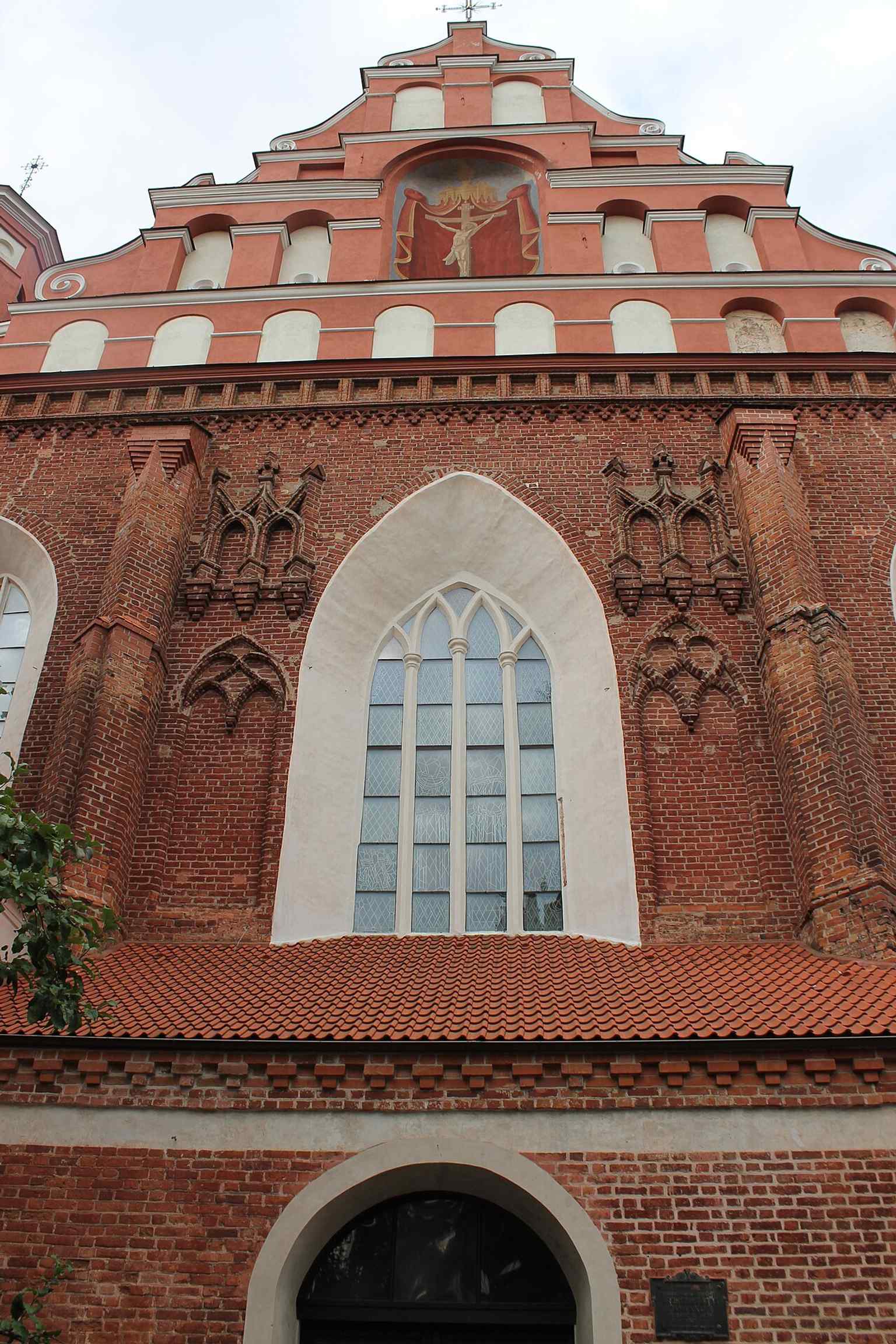
A sharply framed façade shot that highlights the church’s symmetrical front and intricate Gothic detailing in the Old Town setting.Photo: John Samuel, Wikimedia Commons, CC BY-SA 4.0. Cropped & resized. 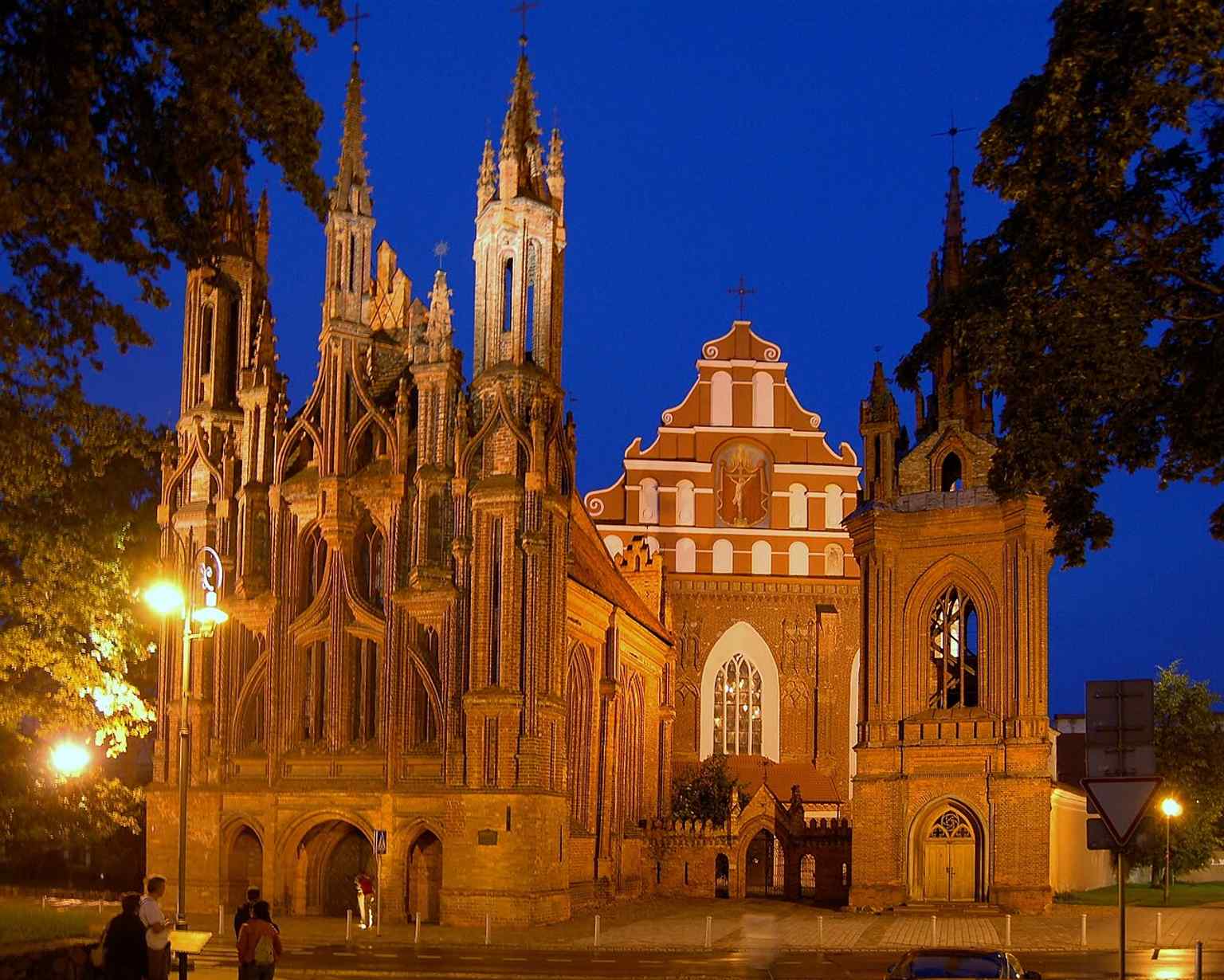
A night view from 2006, capturing the church as a living landmark long after the 20th-century restorations.Photo: Bahnfrend, Wikimedia Commons, CC BY-SA 4.0. Cropped & resized. On your left, Vilnius Cathedral is a broad white stone building shaped like a classical temple, with tall columns across the front and three statues standing along the…Read moreShow less
Open dedicated page →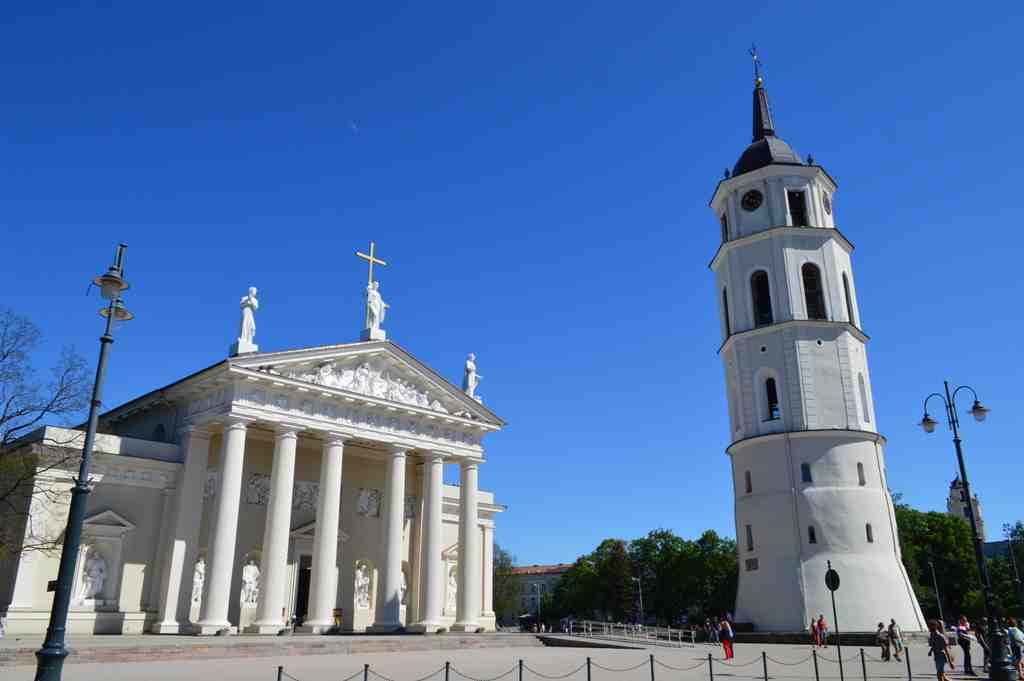
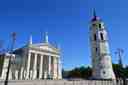
Vilnius CathedralPhoto: Scotch Mist, Wikimedia Commons, CC BY-SA 4.0. Cropped & resized. On your left, Vilnius Cathedral is a broad white stone building shaped like a classical temple, with tall columns across the front and three statues standing along the roofline.
For all its calm symmetry... this is one of the most rewritten places in Vilnius. The official name is the Cathedral Basilica of Saint Stanislaus and Saint Ladislaus, and it became the main Catholic church in Lithuania. But this ground started arguing about belief long before the present facade showed up. Sixteenth-century writers claimed a stone temple to Perkūnas, the Baltic thunder god, once stood here. Then King Mindaugas, after converting in twelve fifty-one, likely ordered the first cathedral. After his death in thirteen sixty-three, the site returned to pagan worship. So yes, even Lithuania’s most important Catholic church began as a place with commitment issues.
In thirteen eighty-seven, when Lithuania officially accepted Christianity, builders raised a new Gothic cathedral here. That one burned. Vytautas the Great then pushed forward a larger Gothic version for his planned coronation in fourteen twenty-nine. The coronation never happened, but the building still mattered. Inside these walls, Lithuanian rulers were ceremonially affirmed, and until fifteen sixty-nine the bishop placed Gediminas’ Cap, the coronation cap of Lithuanian rulers, on the monarch’s head here. In fifteen eighty, Bishop Merkelis Giedraitis presented Stephen Báthory with a sword and a pearl-decorated hat blessed by Pope Gregory the Thirteenth, a ceremony meant to say, politely but firmly, that Lithuania still considered itself very much somebody.
This cathedral also gathered memory into its side chapels and underground burial chambers. Vytautas rests here. So do Saint Casimir, Alexander Jagiellon, and Barbara Radziwiłł. In Saint Casimir’s Chapel, legend says a relic of Saint Stanislaus from Krakow may be hidden, tying Vilnius to Polish devotion as tightly as politics ever did. If you want a peek at that chapel’s rich Baroque interior, have a look at the image in the app.
The building you see now owes a lot to Laurynas Gucevičius. In seventeen sixty-nine, a southern tower collapsed, smashed a neighboring chapel, and killed six people. Bishop Ignacy Jakub Massalski then ordered a total rebuilding, and Gucevičius gave the cathedral this severe Neoclassical form in the late eighteenth century. It looks steady, even rational... which is impressive for a place that survived fires, war damage, Soviet use as a warehouse, and the stripping of its copper roof under German occupation in nineteen sixteen.
And still it kept becoming itself again. In nineteen eighty-eight, when the cathedral returned to believers, Mass was celebrated outside at the doors. During the reconsecration in nineteen eighty-nine, Archbishop Julijonas Steponavičius lay crosswise before the altar in public repentance. Modern Lithuania still comes here after presidential inaugurations too. So this is not just a church. It is where pagan memory, royal ritual, Catholic devotion, and national ceremony keep sharing the same address... alongside the Orthodox and Jewish centers that shaped Vilnius too.
If you check the before-and-after image in the app, the cathedral stays almost uncannily steady while the horse-drawn square around it turns into the open plaza you see now.
From here, power steps out from prayer almost without a gap, because the Palace of the Grand Dukes stands right beside it.
If you want to go inside later, the cathedral usually opens from seven in the morning to six in the evening, and until seven on Sundays.
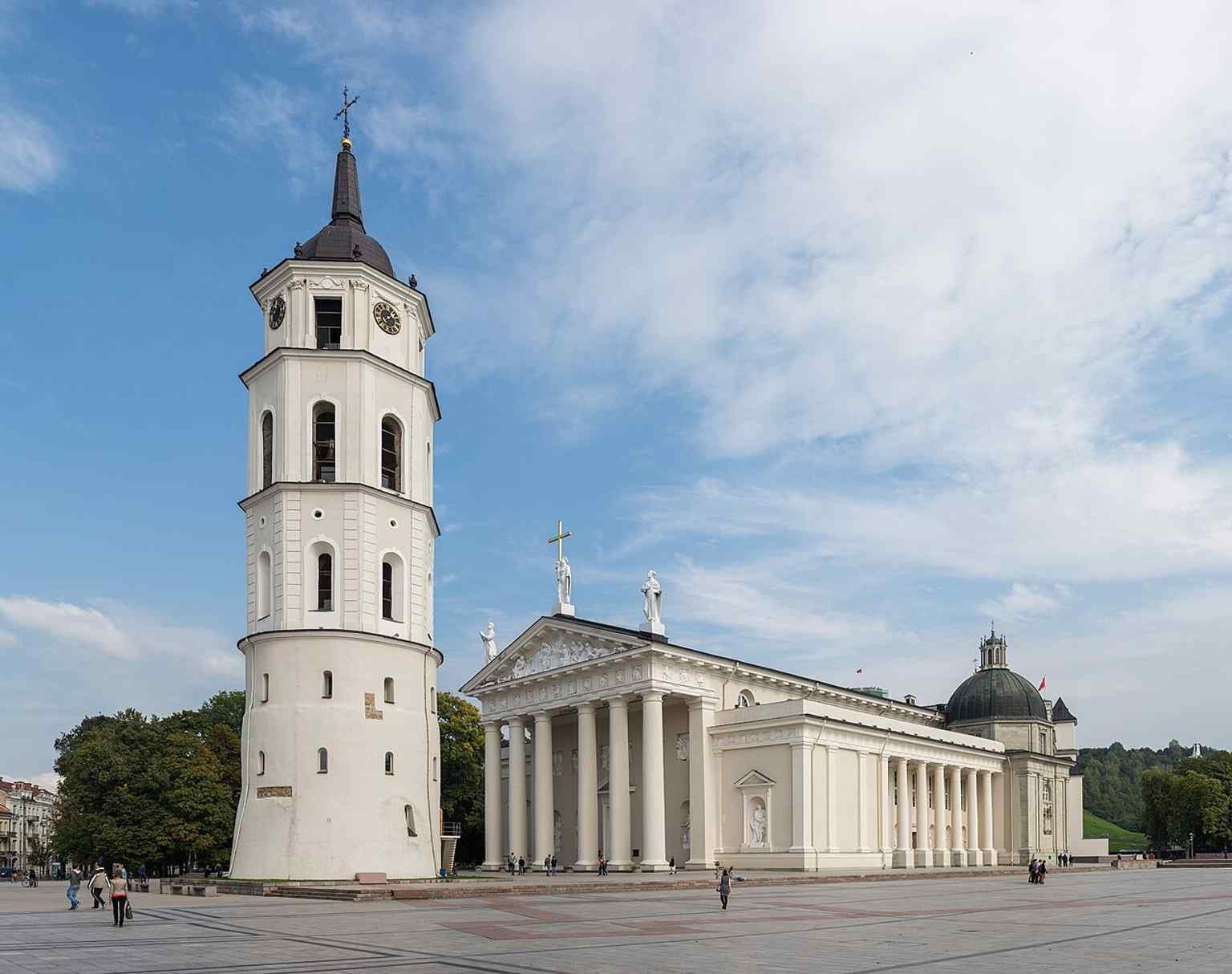
The cathedral and its belfry from the southwest — a classic view of Vilnius Cathedral beside Cathedral Square, the heart of Lithuania’s Catholic life.Photo: Diliff, Wikimedia Commons, CC BY-SA 3.0. Cropped & resized. 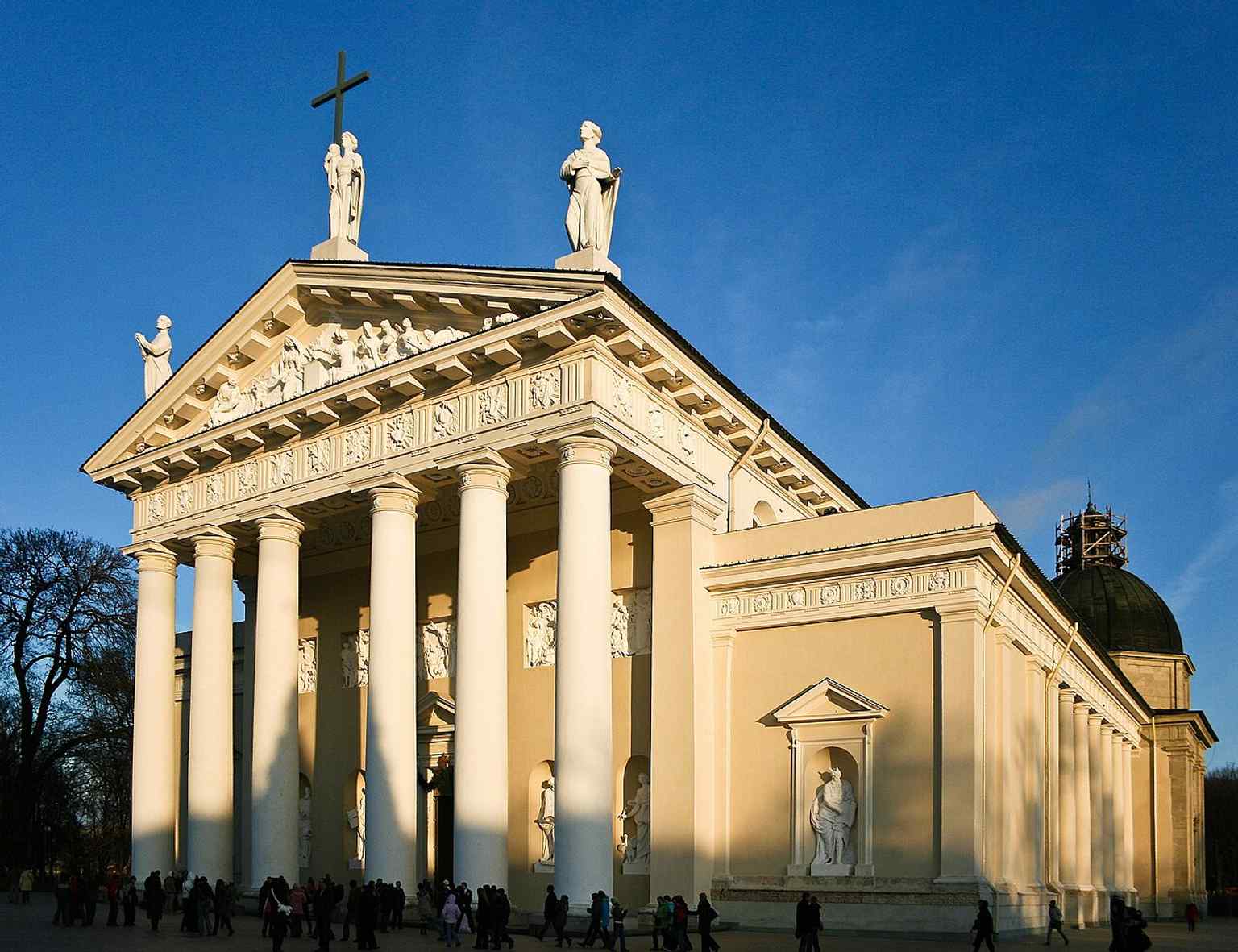
The west facade in winter light — this neoclassical front reflects Laurynas Gucevičius’s 18th-century rebuild after earlier fires and collapses.Photo: Juliux, Wikimedia Commons, CC BY-SA 3.0. Cropped & resized. 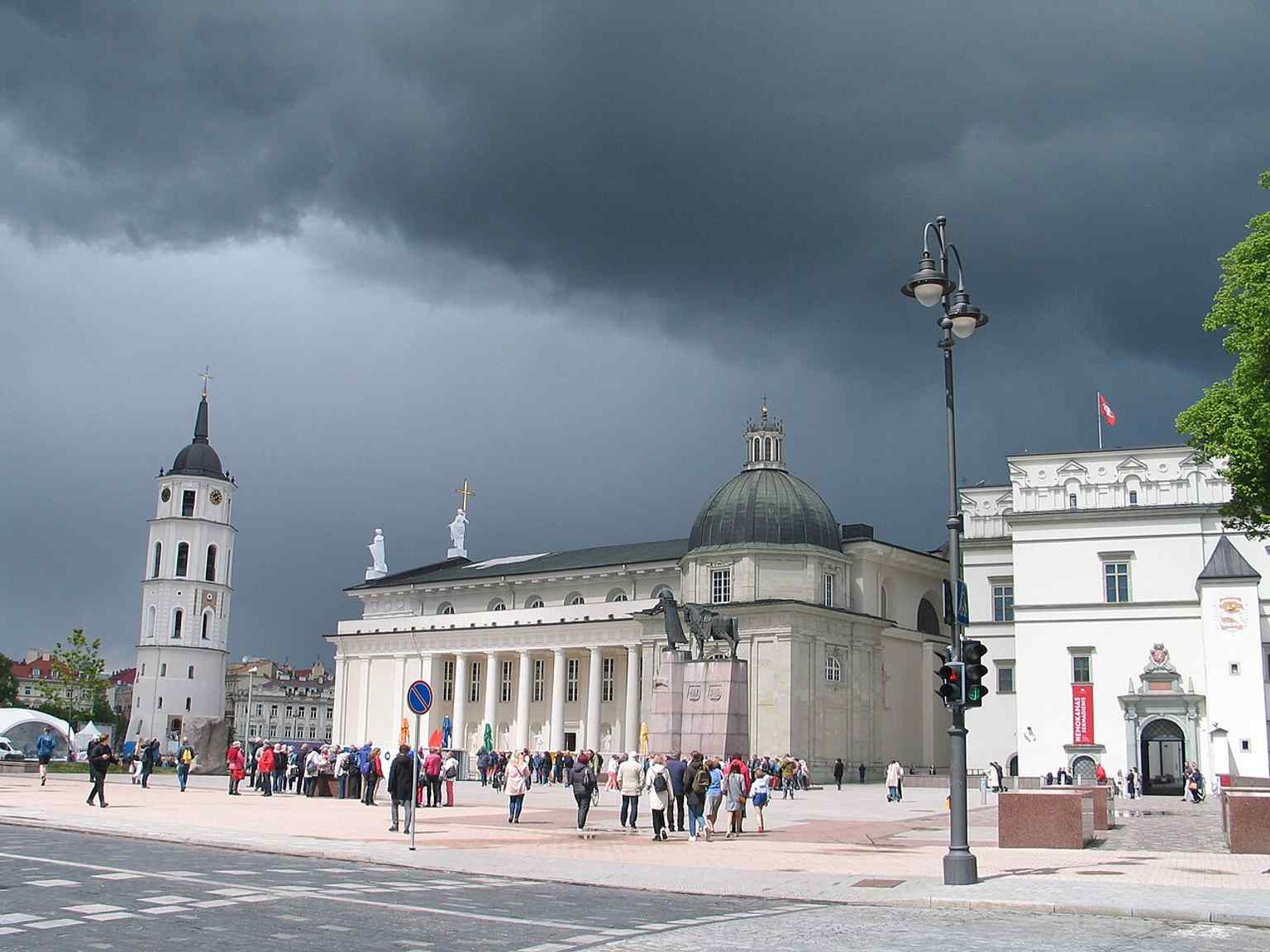
Cathedral Square with the cathedral as its anchor — the setting for national ceremonies and public gatherings around the basilica.Photo: Андрей Романенко, Wikimedia Commons, CC BY-SA 4.0. Cropped & resized. 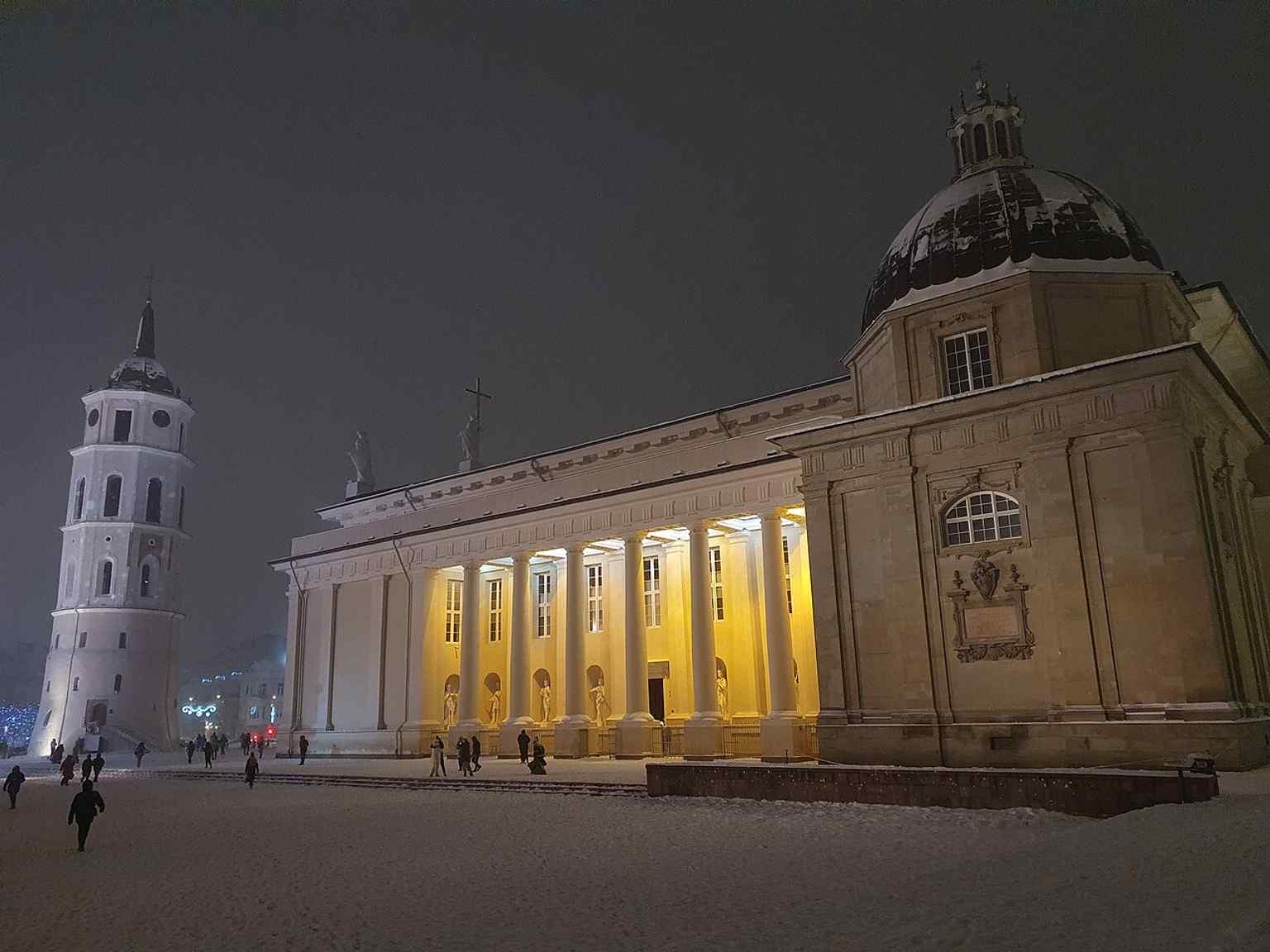
Vilnius Cathedral and its belfry at night in snow — a striking modern cityscape around one of Lithuania’s most important landmarks.Photo: Pofka, Wikimedia Commons, CC BY-SA 4.0. Cropped & resized. 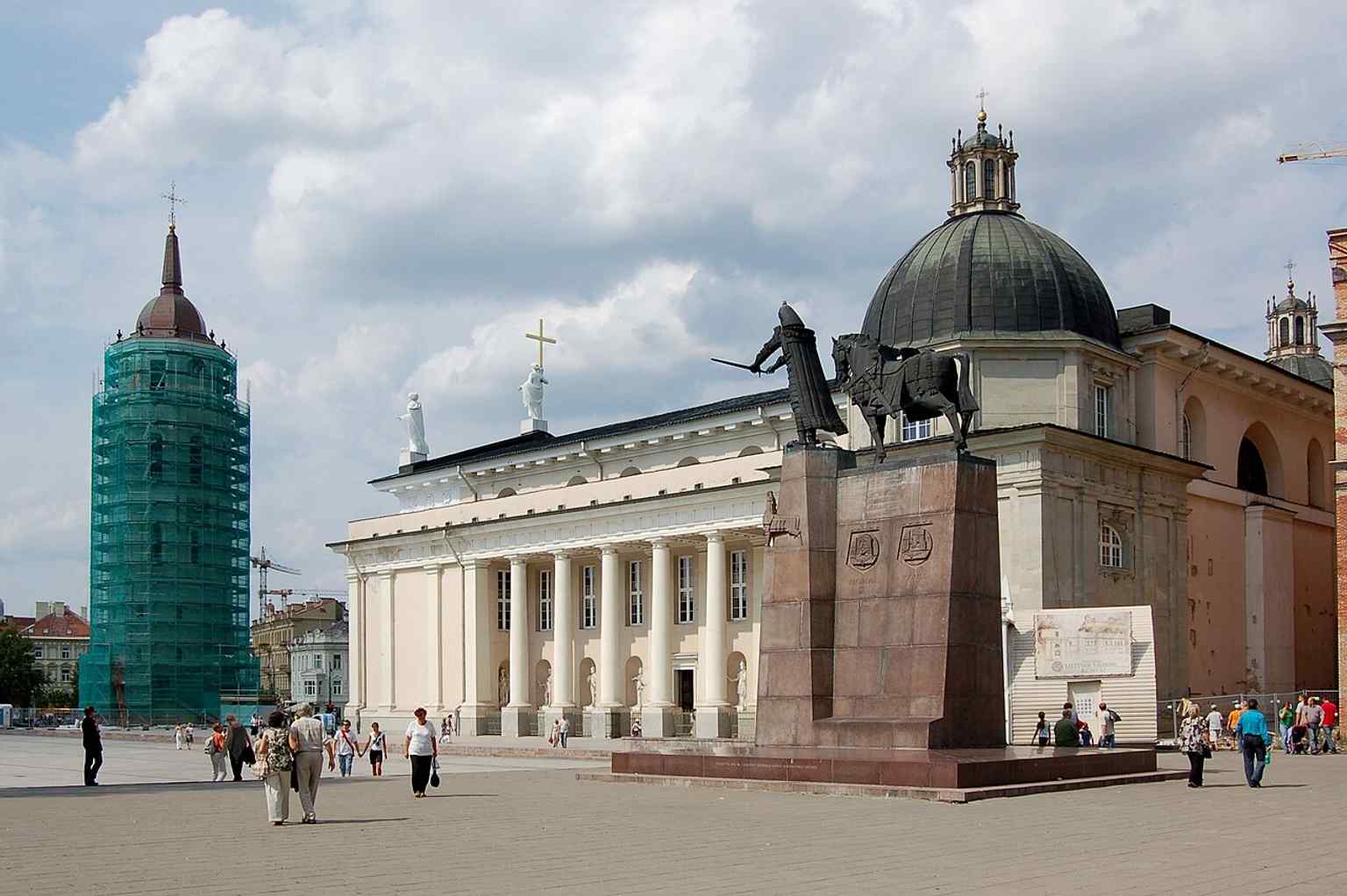
The cathedral during renovation in 2006, with the belfry under work — a reminder of the major post-independence restoration that refreshed the complex.Photo: Bahnfrend, Wikimedia Commons, CC BY-SA 4.0. Cropped & resized. 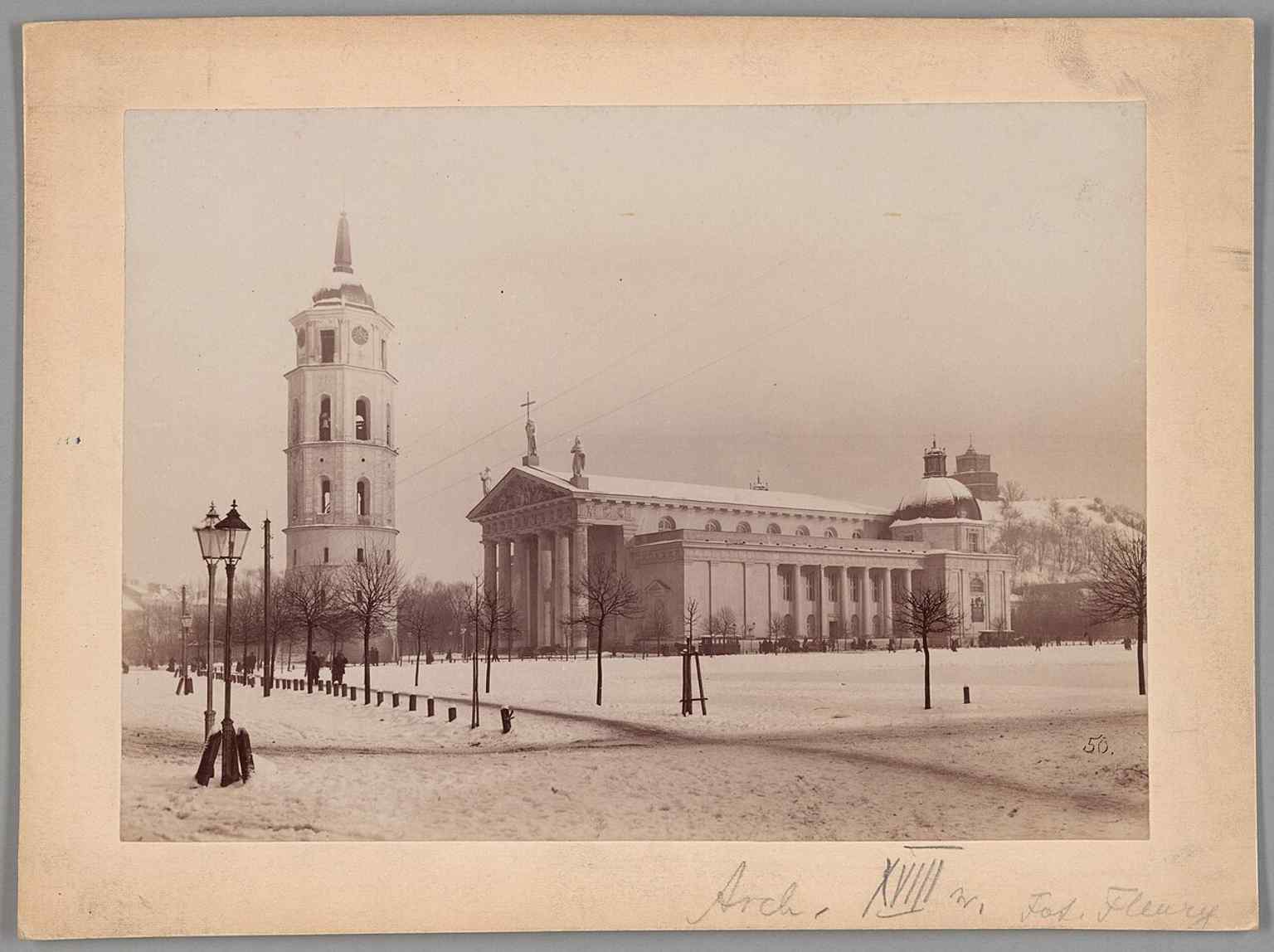
A late-19th-century view of the cathedral and square — useful for showing how the landmark looked before modern changes to Vilnius.Photo: Stanisław Filibert Fleury, Wikimedia Commons, Public domain. Cropped & resized. 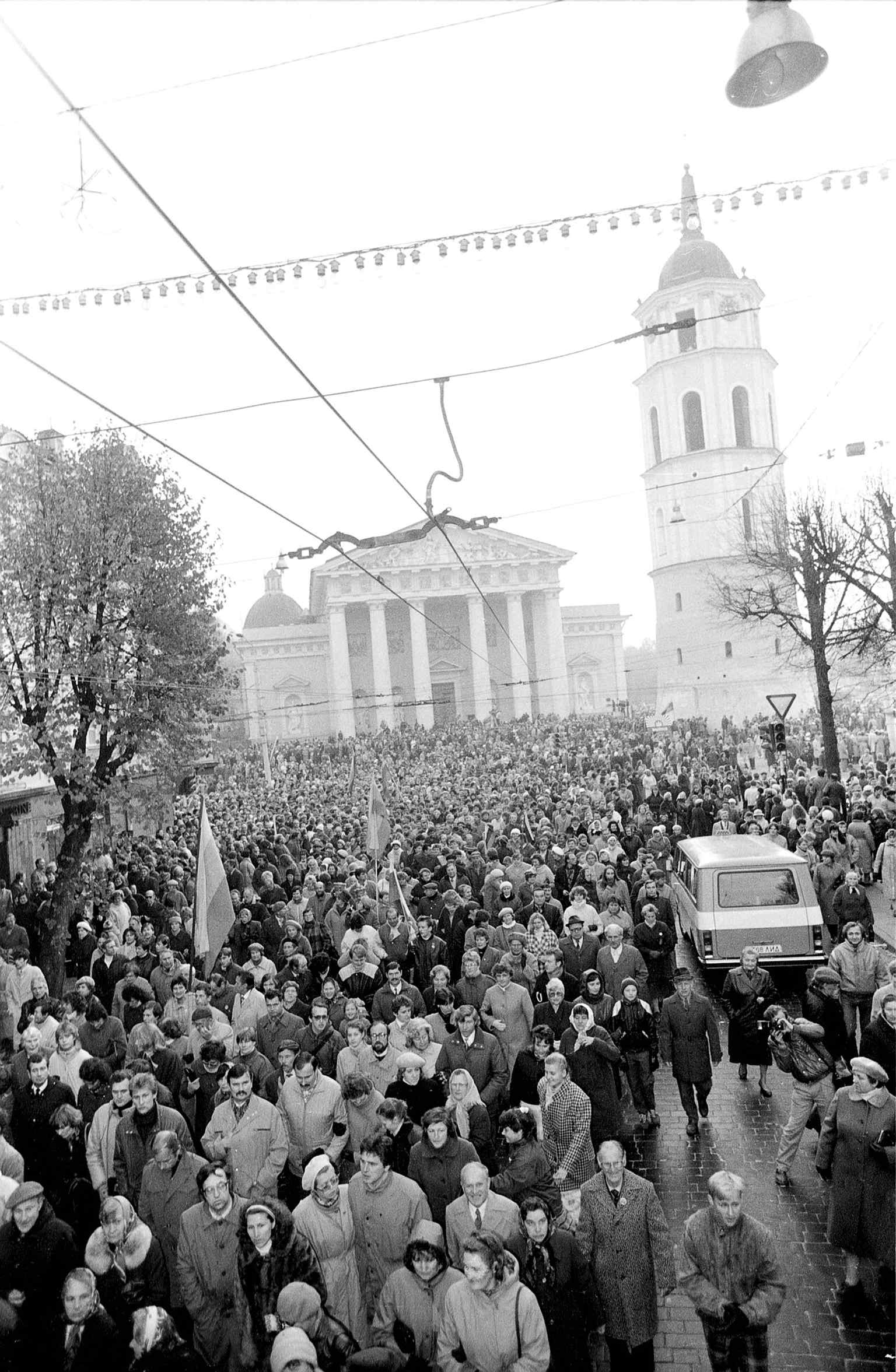
The crowd gathered after the 1988 mass restoring the cathedral to the Catholic community — a powerful image of the end of Soviet-era suppression.Photo: Photographer Gediminas Svitojus. Lithuanian Central State Archives., Wikimedia Commons, CC BY 4.0. Cropped & resized. 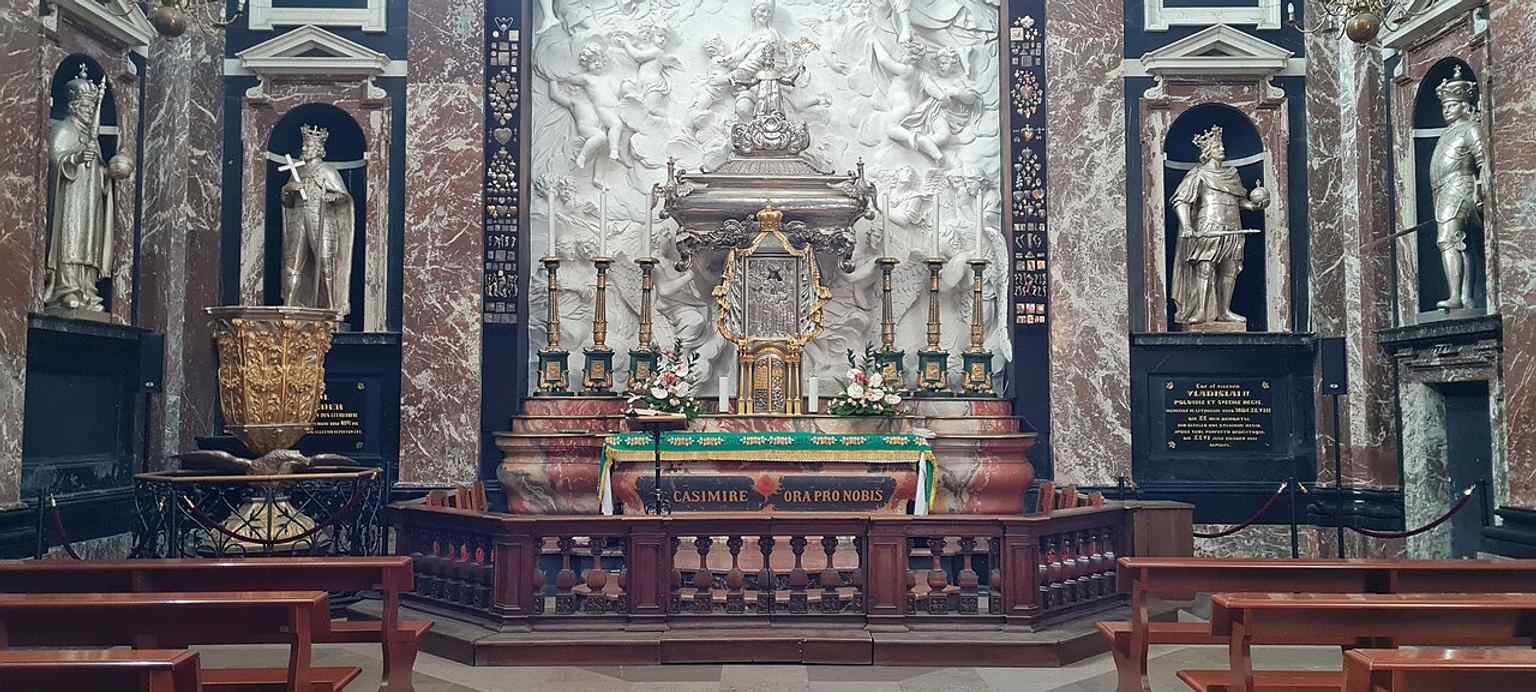
Inside the chapel area of the cathedral — one of the side chapels that became a focal point of devotion and royal remembrance.Photo: Derbrauni, Wikimedia Commons, CC BY 4.0. Cropped & resized. 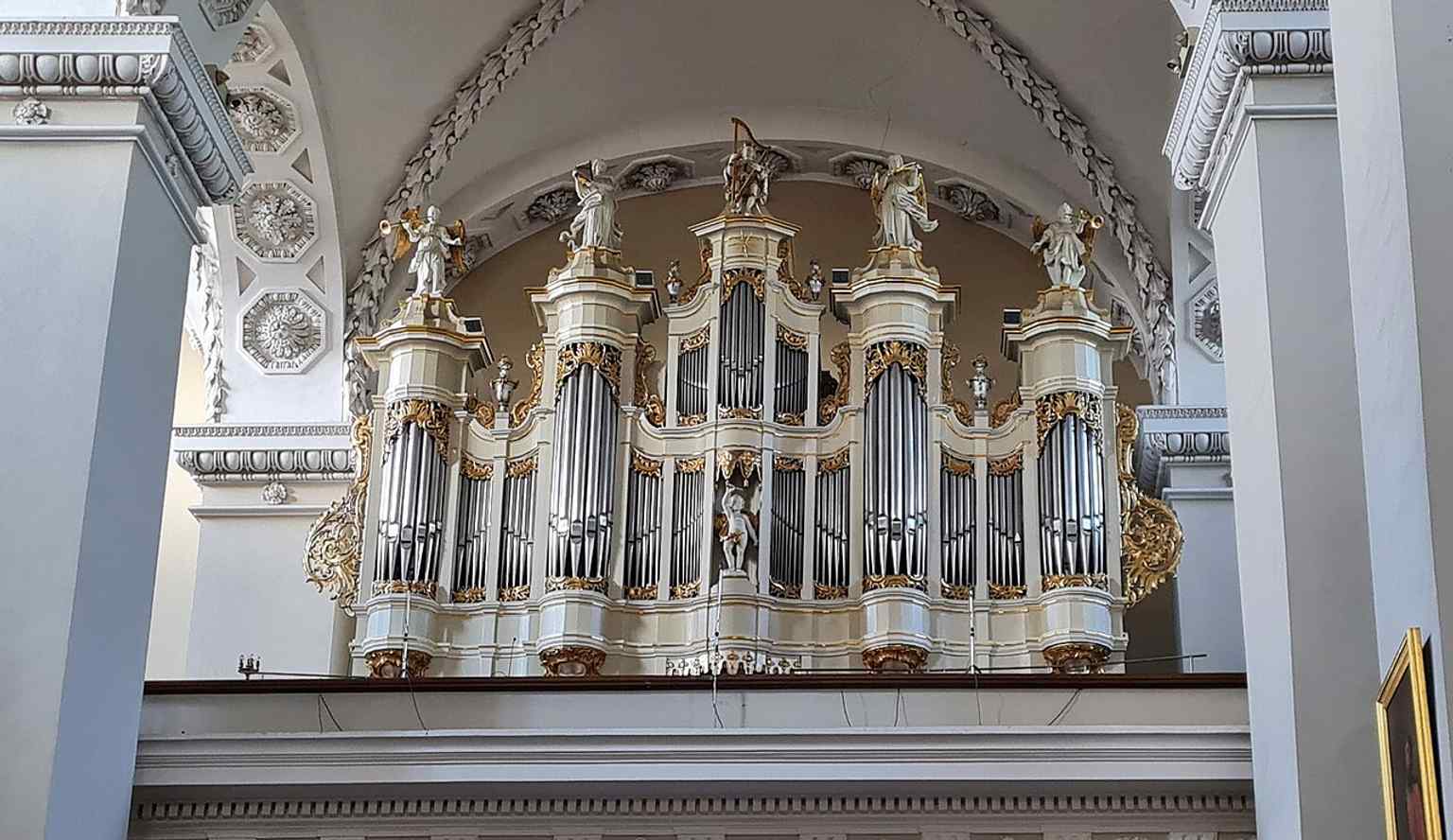
The cathedral’s pipe organ inside the nave — a good interior detail showing the active liturgical life of the basilica today.Photo: Derbrauni, Wikimedia Commons, CC BY 4.0. Cropped & resized. On your right, look for the broad pale-plastered palace with its rectangular wings, rows of evenly spaced windows, and a square corner tower that gives the whole façade a calm,…Read moreShow less
Open dedicated page →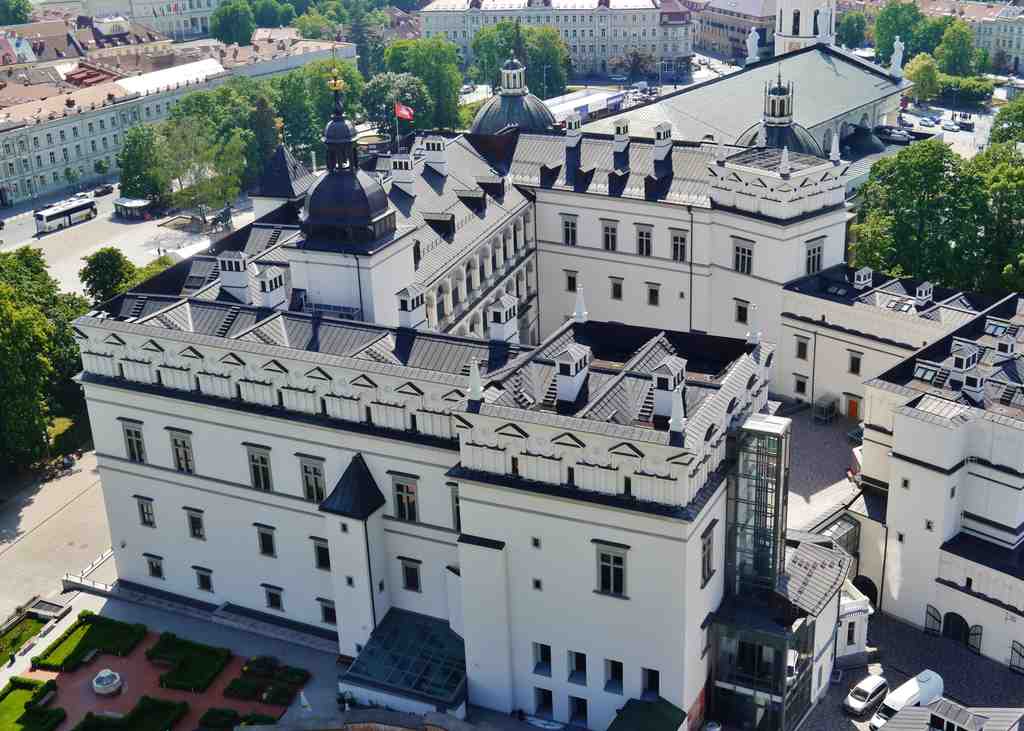
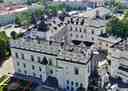
Palace of the Grand Dukes of LithuaniaPhoto: Zairon, Wikimedia Commons, CC BY-SA 4.0. Cropped & resized. On your right, look for the broad pale-plastered palace with its rectangular wings, rows of evenly spaced windows, and a square corner tower that gives the whole façade a calm, official look.
This is one of Vilnius's boldest historical arguments: can a building be genuine if the present rebuilt it to restore what the past erased?
For centuries, the answer here would have seemed simple. The rulers of the Grand Duchy of Lithuania lived and governed on this site from the fifteenth century on. Grand Duke Alexander Jagiellon moved his residence here and received ambassadors. Then Sigismund the Old expanded the palace in a new Renaissance style, the style of measured symmetry and classical order. He spent one hundred thousand gold ducats on it - an enormous sum by any standard. In other words, this was not a modest home improvement.
His queen, Bona Sforza, still feels oddly close. She wrote in fifteen thirty-nine about the palace garden, and archaeologists later found a stove tile here bearing her serpent coat of arms. That matters. It means the story is not just patriotic imagination with good lighting. The soil answered back.
And the soil answered with even older news. Most visitors never realize that this ground mattered long before any palace stood here. Archaeologists trace a fortified wooden settlement on this site to the early medieval period, long before any palace stood here. So beneath the royal residence, and beneath the modern museum, lies an even earlier seat of power... timber, earth, defense, survival.
If you glance at your screen, that old drawing gives you the ghost of the lost palace before it vanished from the cityscape.
The original residence grew splendid. Sigismund the Second Augustus was crowned Grand Duke of Lithuania here in fifteen twenty-nine. Courtiers filled the rooms with books, tapestries, diplomats, and ceremony. Later, the Vasa rulers added early Baroque flair, and the palace even hosted Lithuania's first opera. Then came disaster: war, fire, plunder, abandonment. By eighteen oh one, officials under the Russian Empire ordered the remains demolished and sold off as brick and stone. A palace that had staged crowns and operas ended as building material. History can be efficient that way.
The rebuilt palace you see now rose only after independence returned. Archaeologists dug, argued, uncovered basements, walls, painted plaster, and fragments of later buildings. Critics said a reconstruction without complete visual evidence would fake the past. Supporters said the absence itself had been political, the result of conquest and erasure. So Lithuania rebuilt it between two thousand two and two thousand eighteen, partly folding surviving older fragments into the eastern wing.
That makes this place more than a replica. It is a statement about who gets to restore a broken historical memory, and on what evidence. Like the M-O Museum used modern architecture to make culture present, this palace uses reconstruction to make statehood visible again.
If you look at the aerial image on your phone, you can see how firmly the palace now anchors the lower castle landscape. And that is your cue for the final climb: head up to Gediminas's Tower, about an eight-minute walk away, where these layers of hill, court, church, ruin, and rebuilding come together in one view. If you want to return inside later, the museum is generally open daily from ten to six, with later hours until eight from Thursday through Saturday.
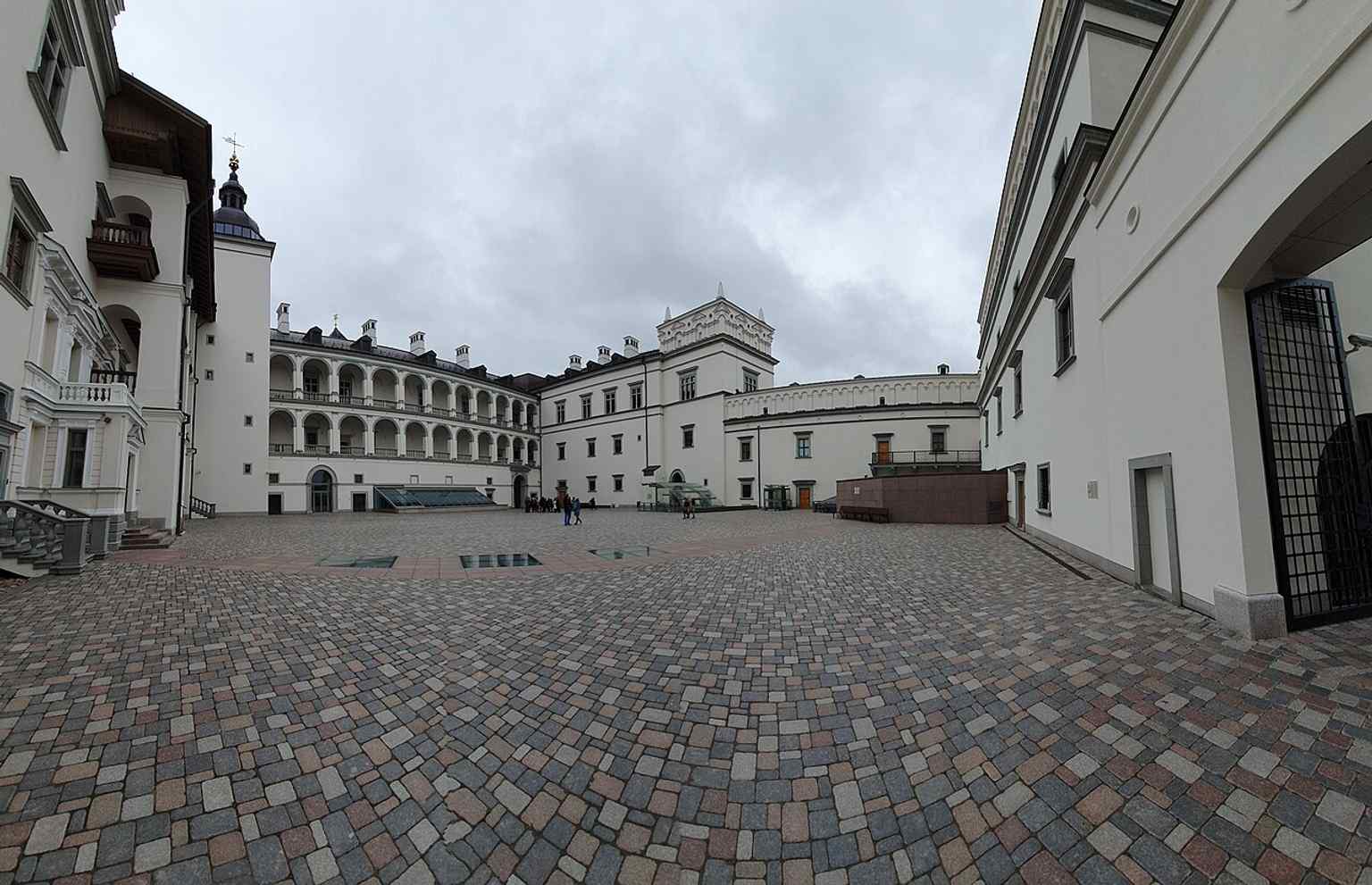
A wide panorama of the Grand Courtyard, the ceremonial heart of the rebuilt palace complex used for major state events.Photo: Pofka, Wikimedia Commons, CC BY-SA 4.0. Cropped & resized. 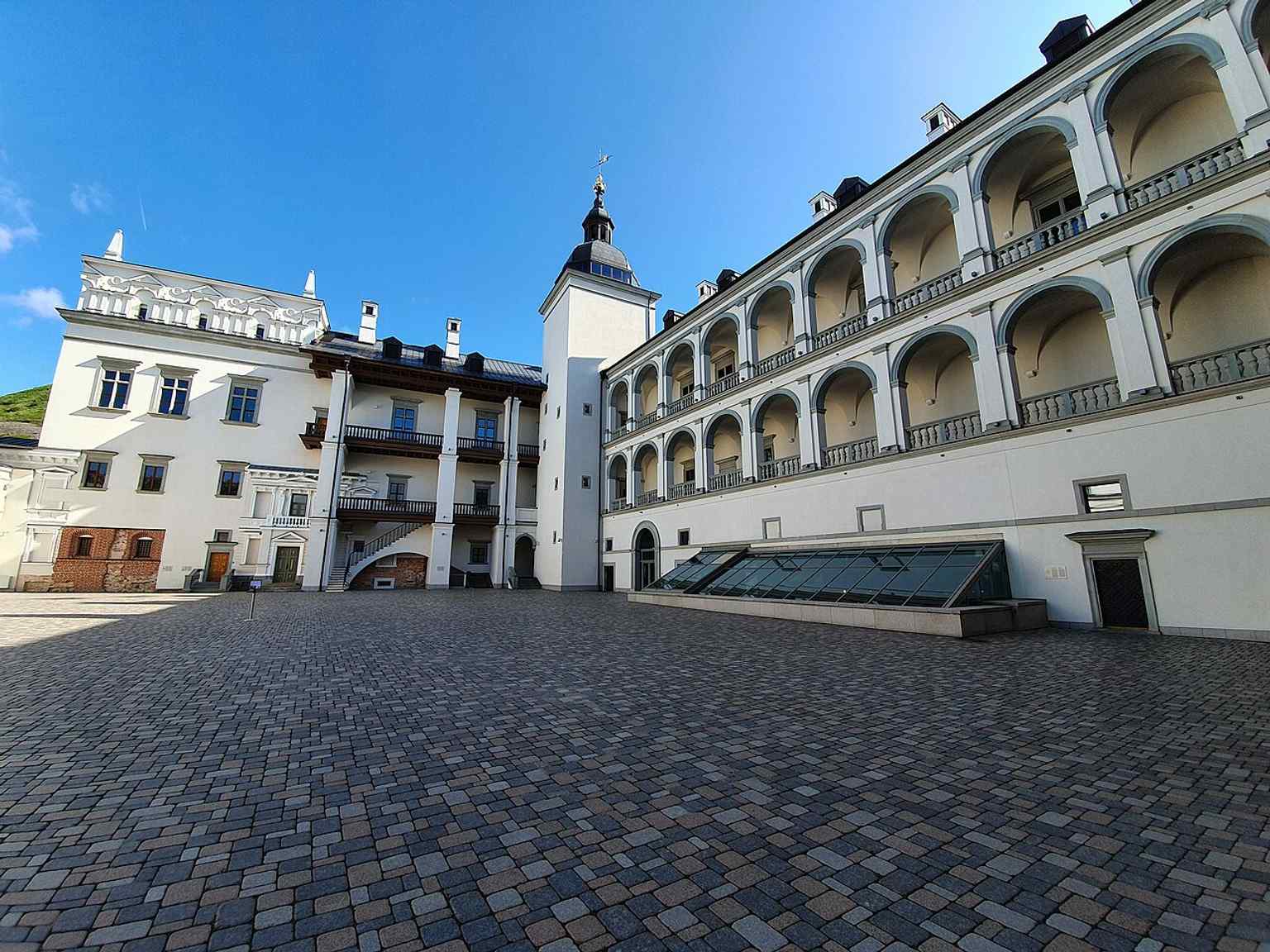
The Grand Courtyard framed by the palace wings and balconies — a strong image of the 2018 reconstruction in Renaissance style.Photo: Pofka, Wikimedia Commons, CC BY-SA 4.0. Cropped & resized. 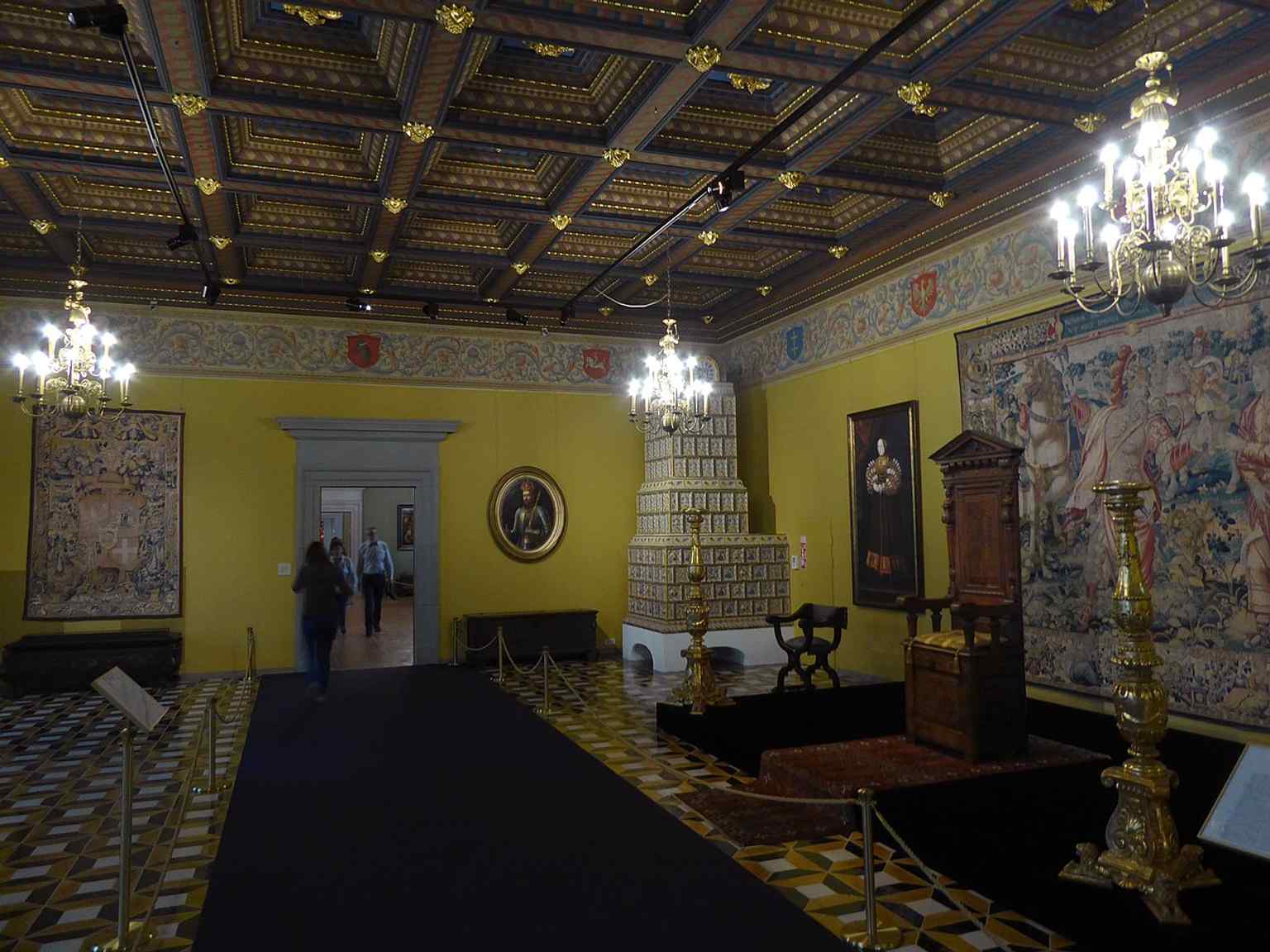
A formal state room with a throne-like setting, echoing the palace’s role as the political center of the Grand Duchy of Lithuania.Photo: Syrio, Wikimedia Commons, CC BY-SA 4.0. Cropped & resized. 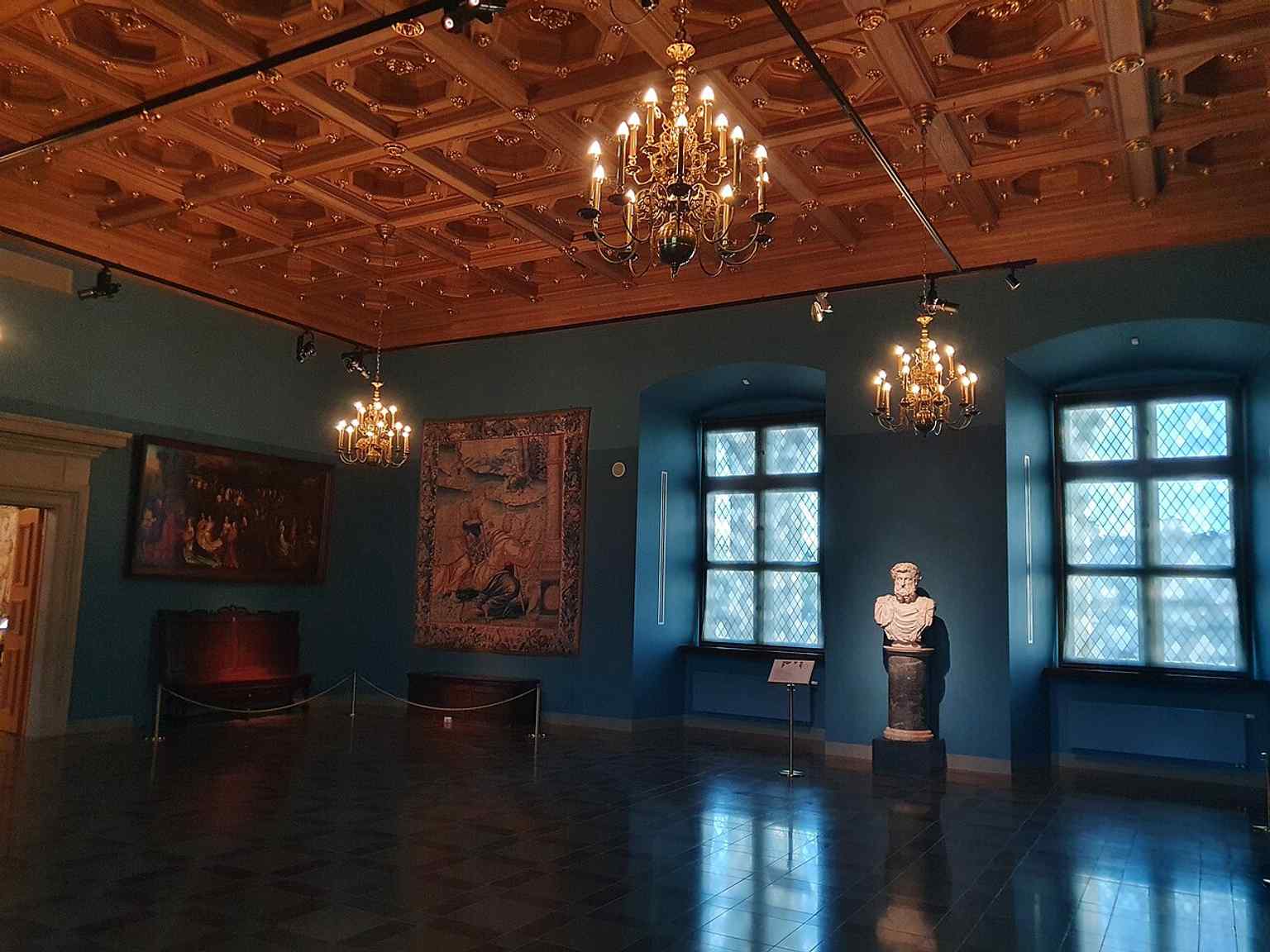
The Blue Room, decorated to evoke the royal residence’s luxury and the splendor described in accounts of Sigismund II Augustus’s court.Photo: Pofka, Wikimedia Commons, CC BY-SA 4.0. Cropped & resized. 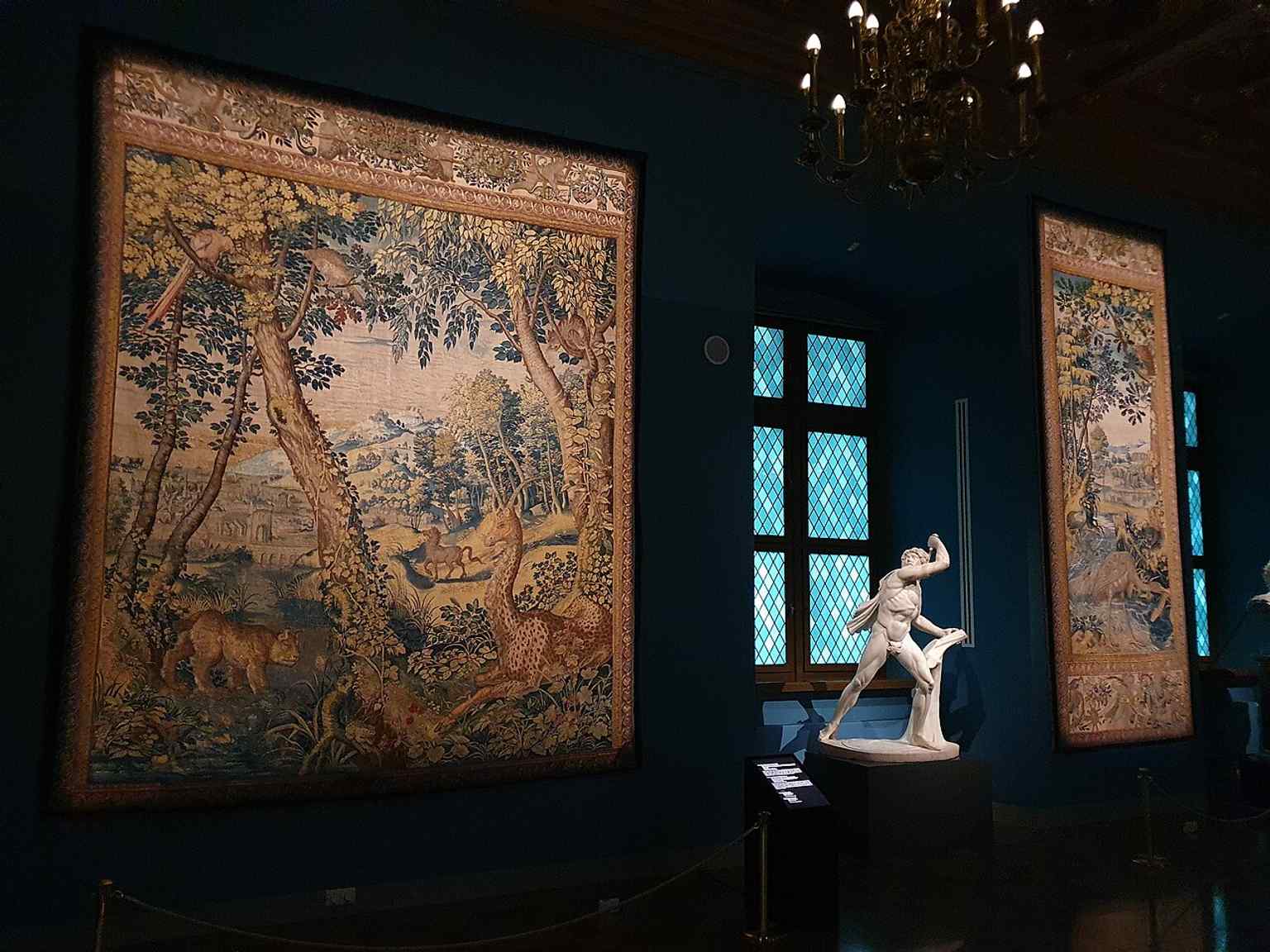
The Blue Room filled with Jagiellonian tapestries, recalling Sigismund II Augustus’s legendary collection of textiles.Photo: Pofka, Wikimedia Commons, CC BY-SA 4.0. Cropped & resized. 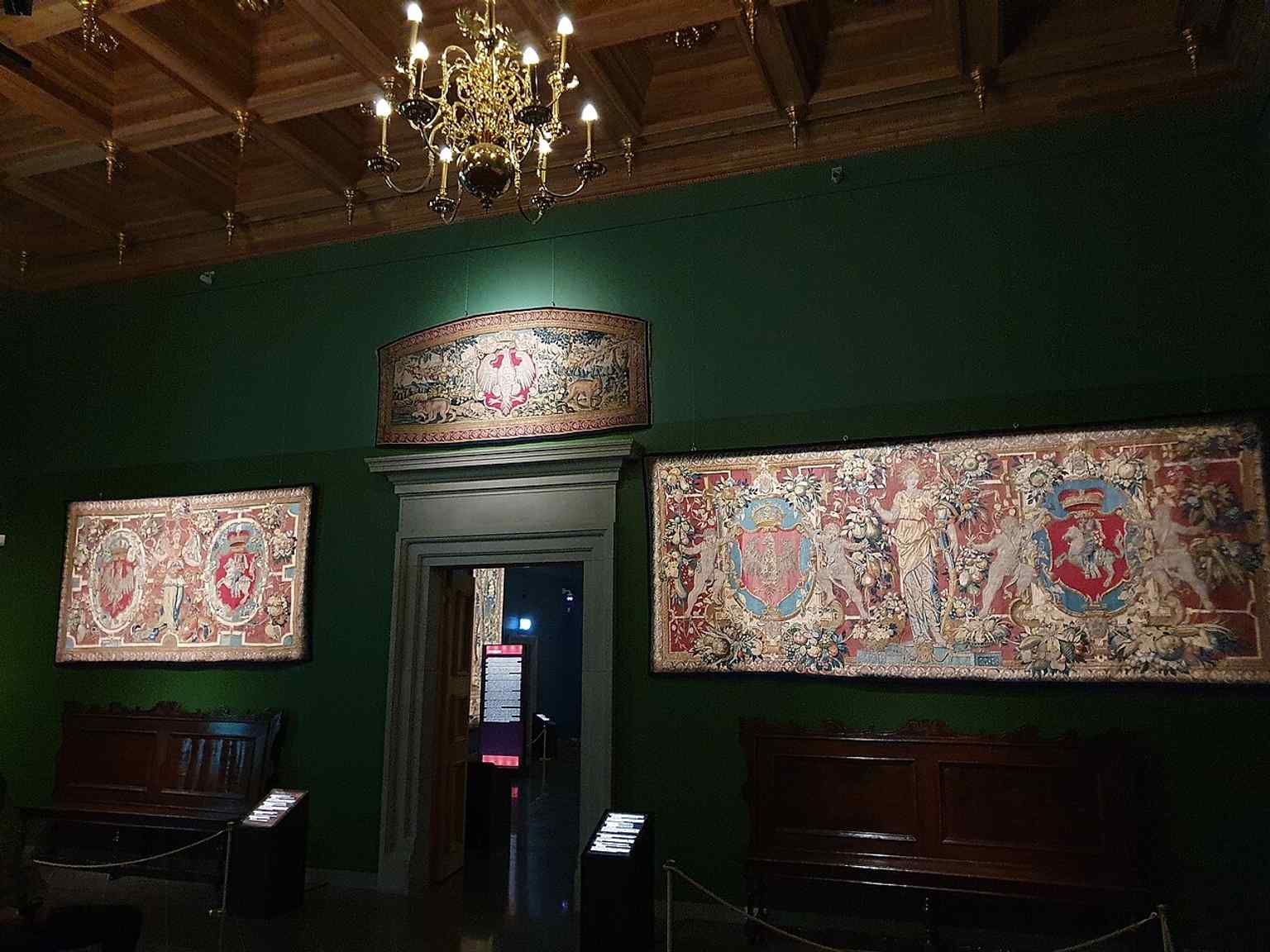
The Green Room’s tapestry display highlights the Polish Eagle and Lithuanian Vytis, symbols central to the Polish–Lithuanian Commonwealth.Photo: Pofka, Wikimedia Commons, CC BY-SA 4.0. Cropped & resized. 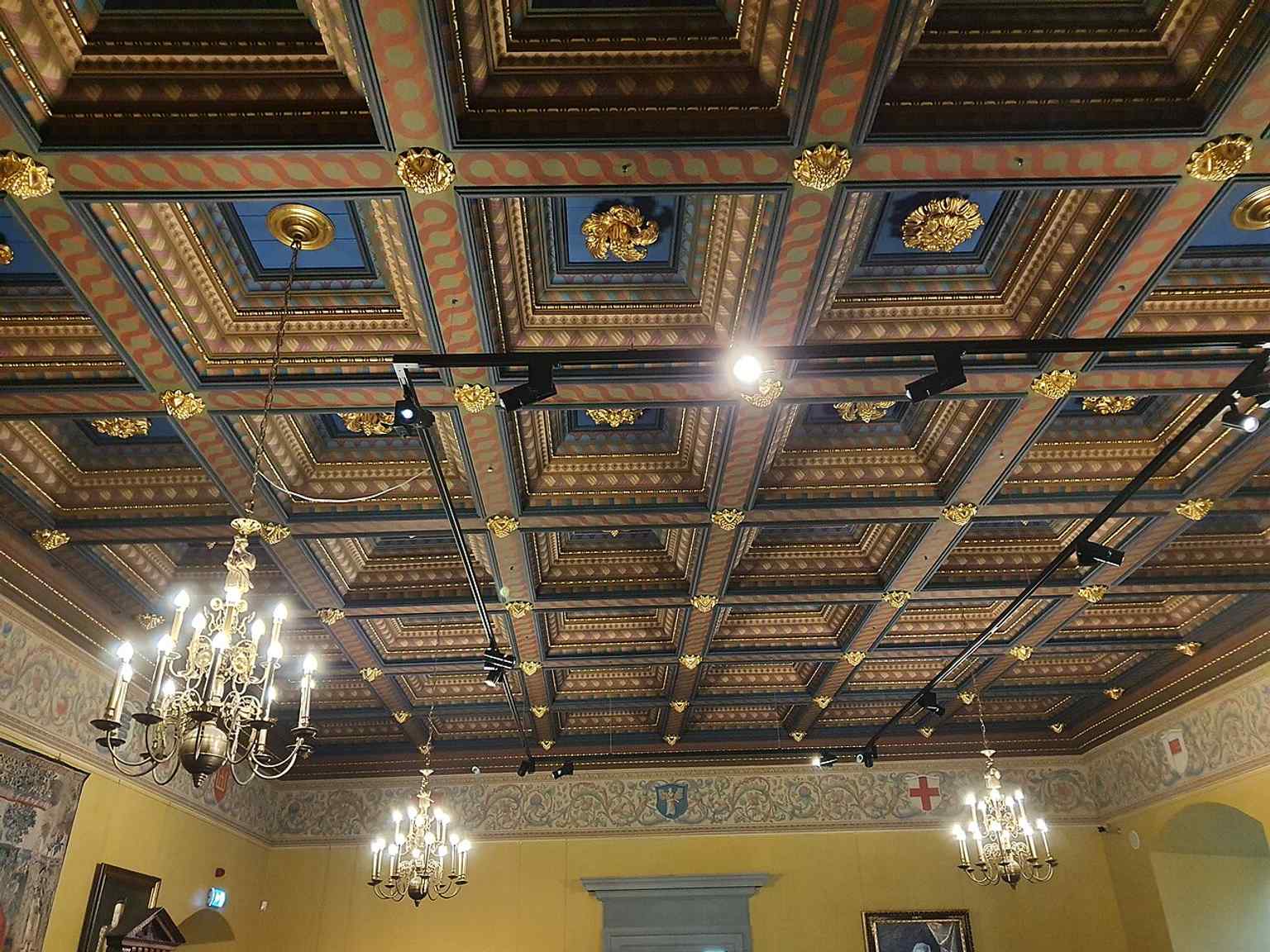
The coffered ceiling in the Lower Representative Hall shows the Renaissance-inspired finish used in the rebuilt palace interiors.Photo: Pofka, Wikimedia Commons, CC BY-SA 4.0. Cropped & resized. 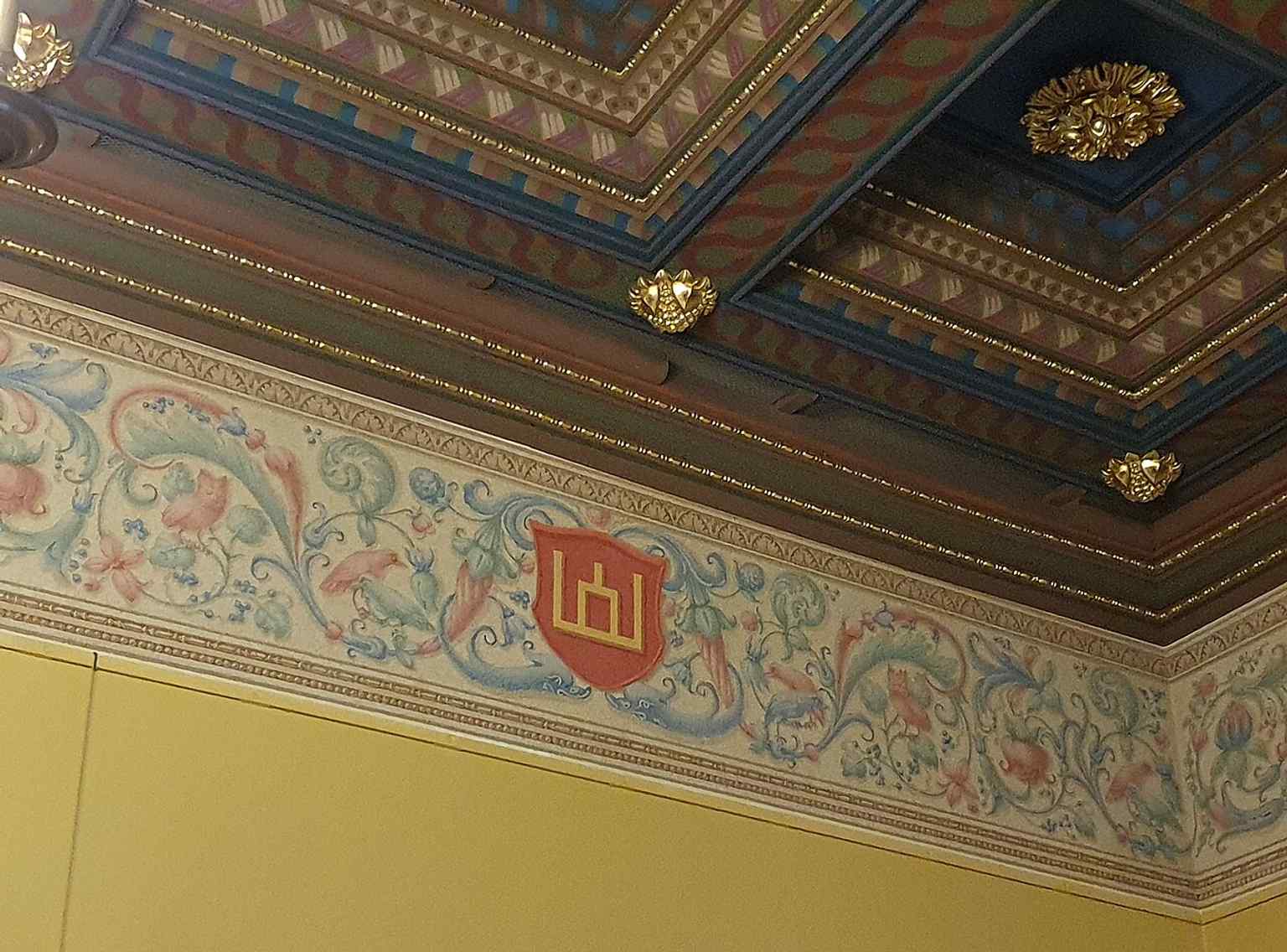
A wall with the Columns of Gediminas, a dynastic symbol tied to Lithuanian rulers and the palace’s historic identity.Photo: Pofka, Wikimedia Commons, CC BY-SA 4.0. Cropped & resized. 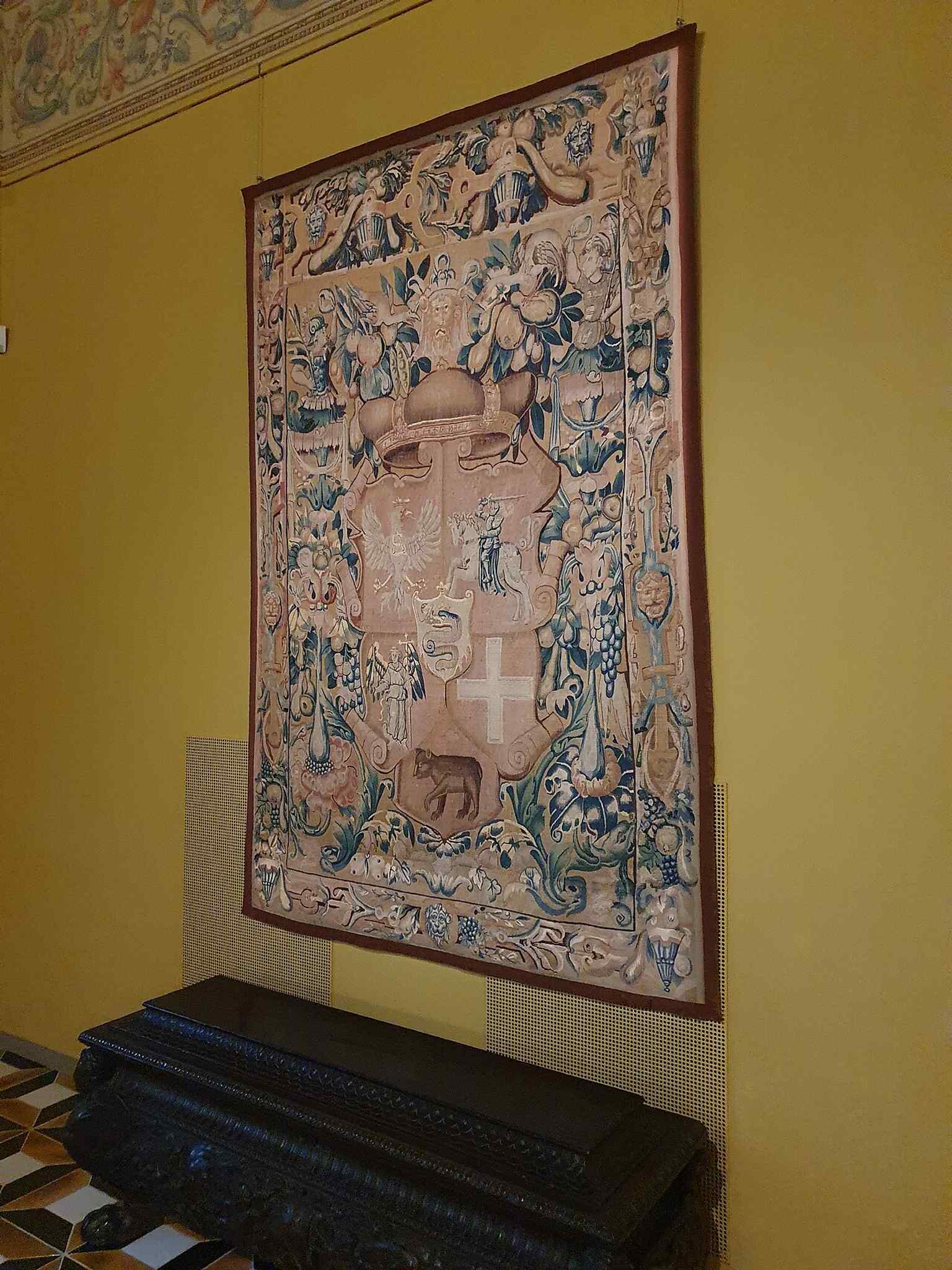
An authentic Jagiellonian tapestry from the 16th century, the kind of treasure that made the palace famous across Europe.Photo: Pofka, Wikimedia Commons, CC BY-SA 4.0. Cropped & resized. 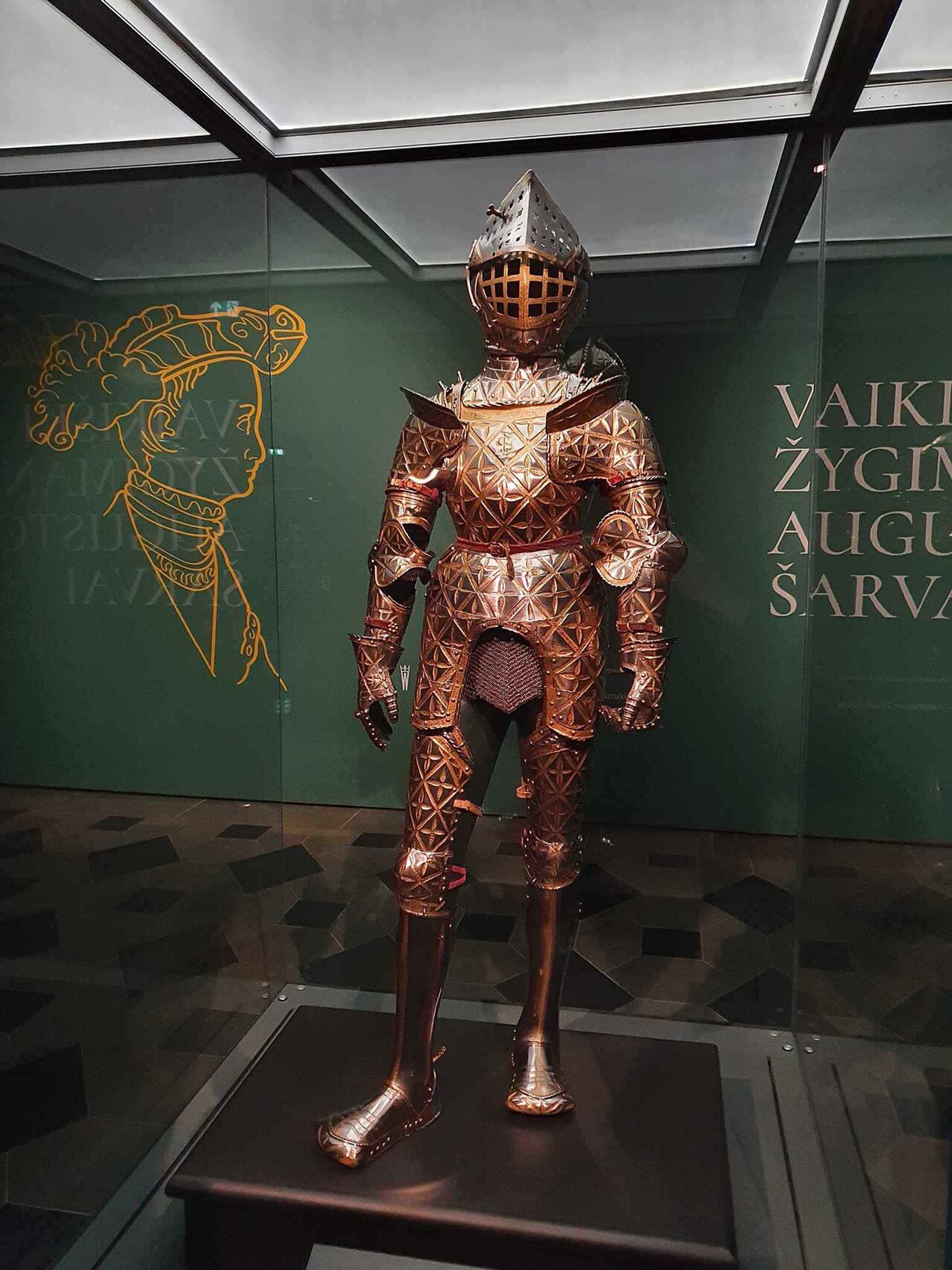
Child armor of Sigismund II Augustus, reminding us that the palace housed royal courts from an early age of dynastic power.Photo: Pofka, Wikimedia Commons, CC BY-SA 4.0. Cropped & resized. 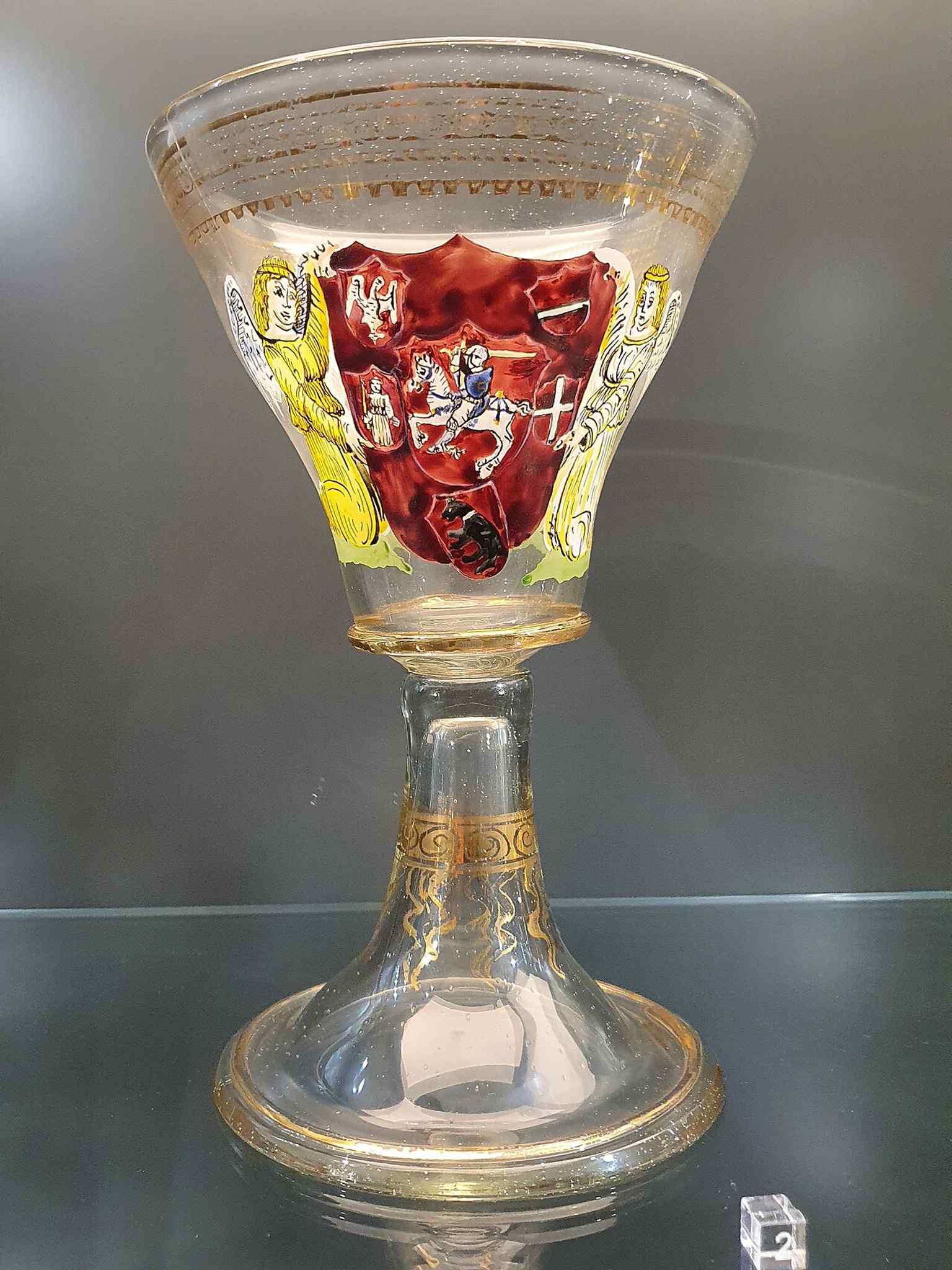
A copy of Alexander Jagiellon’s goblet bearing the Lithuanian Vytis, linking the palace to its late-15th-century royal residents.Photo: Pofka, Wikimedia Commons, CC BY-SA 4.0. Cropped & resized. 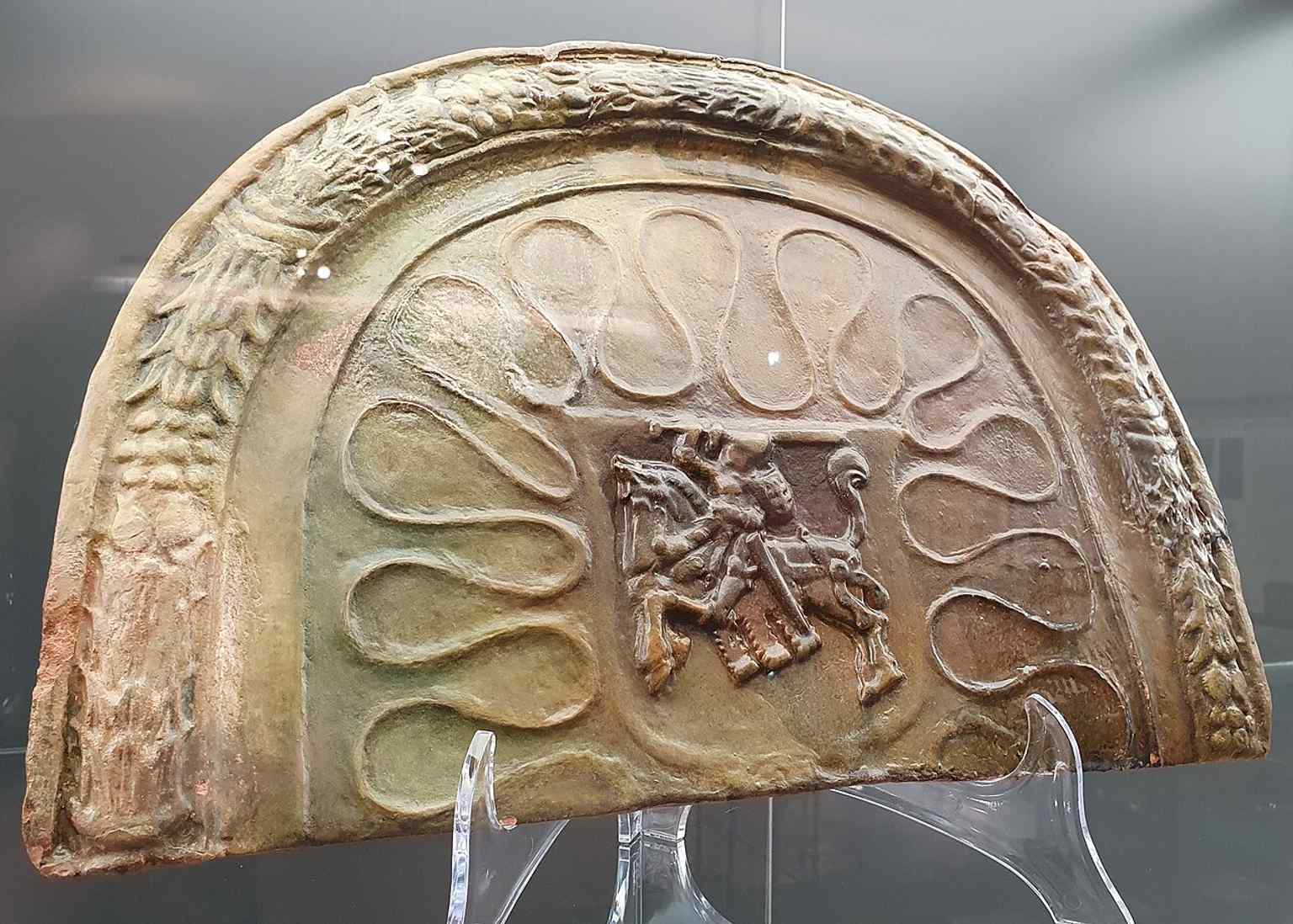
A 16th-century stove tile with the Lithuanian Vytis, a small object that reflects the richly finished palace interiors.Photo: Pofka, Wikimedia Commons, CC BY-SA 4.0. Cropped & resized. 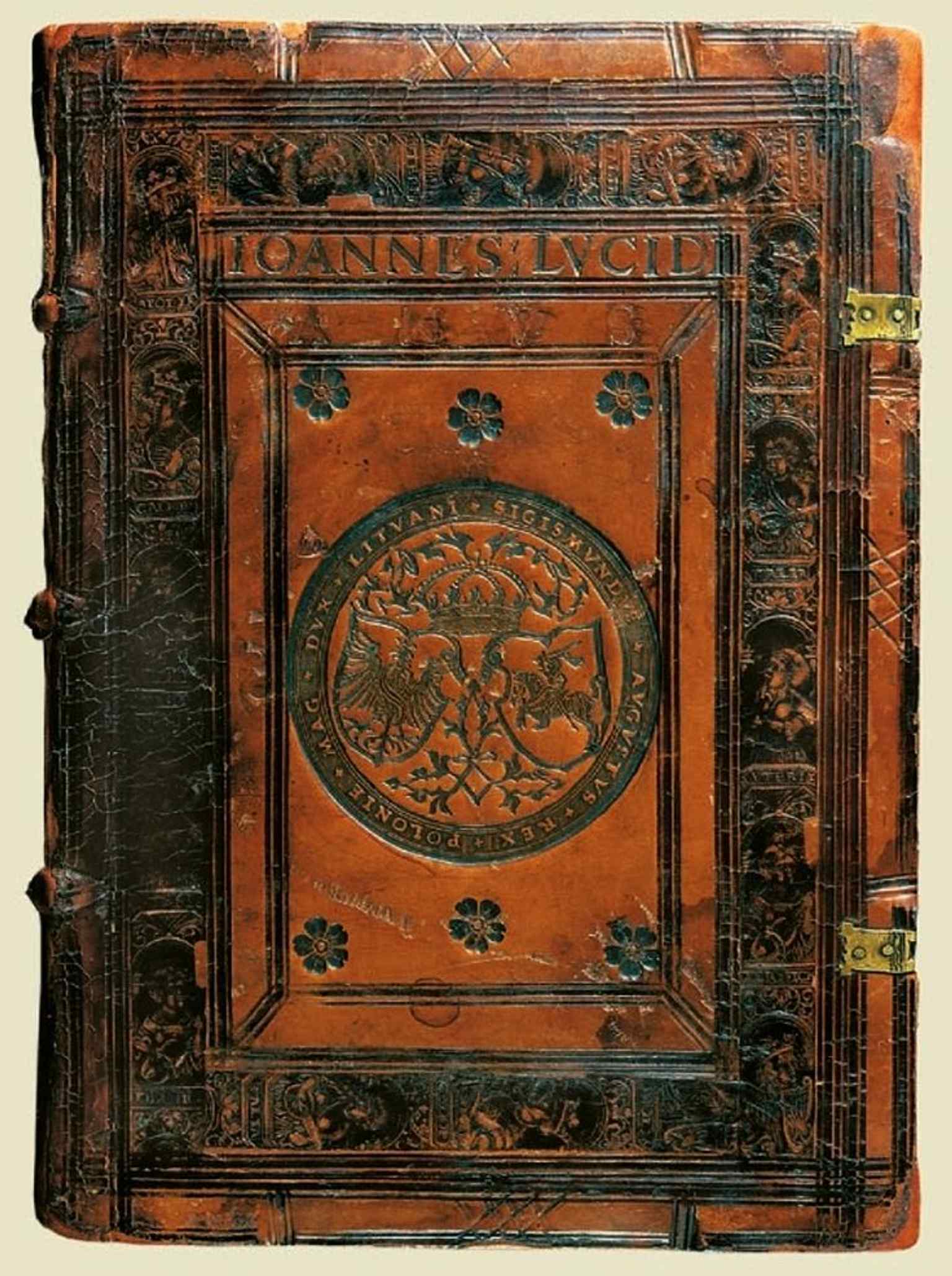
A book cover from Sigismund II Augustus’s former library, evoking the palace’s reputation as a center of learning and court culture.Photo: Unknown authorUnknown author, Wikimedia Commons, Public domain. Cropped & resized. On your right, Gediminas’s Tower is a sturdy red-brick cylinder with a square upper section and a crenellated lookout that makes it look like the last surviving tooth of a…Read moreShow less
Open dedicated page →On your right, Gediminas’s Tower is a sturdy red-brick cylinder with a square upper section and a crenellated lookout that makes it look like the last surviving tooth of a vanished castle.
This is what remains of the Upper Castle, perched on Gediminas Hill like Vilnius’s oldest witness. Grand Duke Gediminas began with wooden fortifications here in the fourteenth century, and Grand Duke Vytautas followed with the first brick castle, completed in fourteen oh nine. What you see now carries another layer: in nineteen thirty-three, the Polish architect Jan Borowski rebuilt the upper part into the familiar three-story tower. If you want a quick visual of that change, take a look at the before-and-after image in the app... it shows how the ruined top became today’s crenellated lookout.
The legend, naturally, refuses to be modest. Gediminas camped here after a hunt and dreamed of an iron wolf howling like a hundred wolves. His pagan court interpreter, Lizdeika, told him the dream meant he should build a city here, one whose fame would travel far. Not a bad piece of career advice.
But this hill never belonged only to legend. The tower served as a military lookout, yes, but also as a prison for troublesome nobles and rebels... the sort of people rulers preferred to keep close and quiet. And here’s the part most visitors miss: archaeologists uncovered the remains of twenty men on this summit, tied to the uprising of eighteen sixty-three to eighteen sixty-four against Russian rule. Some had been buried face-down, their hands bound, lime scattered over them to erase them faster. Instead, history dragged them back into view. In twenty nineteen, people reburied them with honors at Rasos Cemetery, and the tower exhibition now tells their story under the title Unforgotten Rebels.
If you glance at the image of the tower with the Palace of the Grand Dukes below, you can see how power gathered around this hill and kept changing costumes.
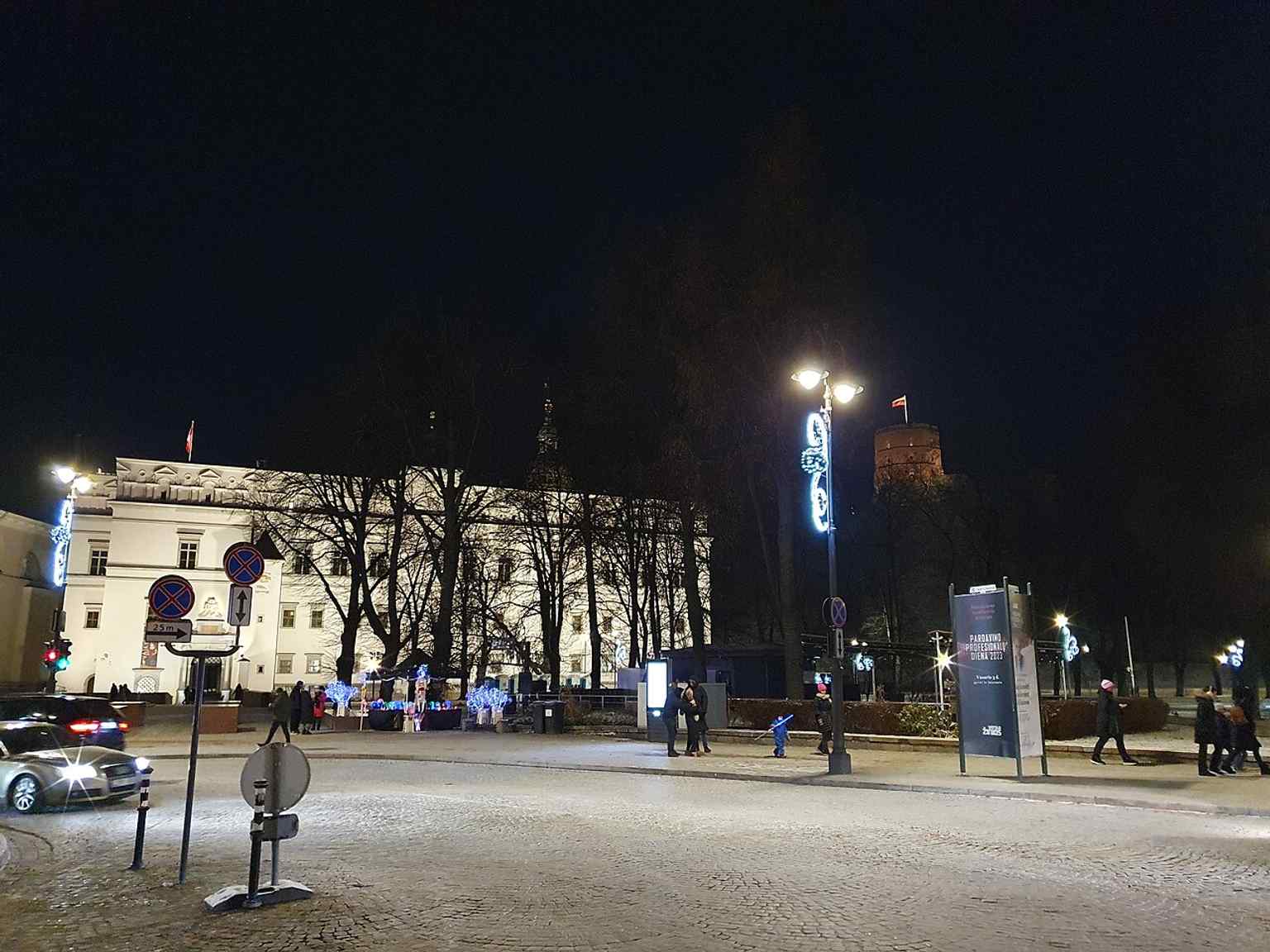
The tower beside the restored Palace of the Grand Dukes, showing the castle complex at the heart of Vilnius.Photo: Pofka, Wikimedia Commons, CC BY-SA 4.0. Cropped & resized. One man fixed that symbolism forever. On the first of January, nineteen nineteen, Kazys Škirpa led Lithuanian volunteers up here and raised the tricolor. They fired gun salutes and sang the anthem. Five days later, Bolshevik forces took Vilnius and tore away the yellow and green, leaving only the red stripe. That brief moment became almost mythic. The flag returned here in nineteen eighty-eight during the independence movement, and in nineteen eighty-nine the Baltic Way turned this tower into part of a public declaration of unity.
Even the hill remains unstable, with landslides and repairs reminding everyone that symbols need maintenance... literally.
So from here, which Vilnius feels strongest to you: the fortress, the city of church towers, the seat of state power, the scholarly capital, or the city marked by losses you cannot see, like the vanished Great Synagogue? The best answer is probably all of them at once. From this height, Vilnius stops looking like separate monuments and starts reading as one living body, stitched together from stone, absence, defiance, and memory.
If you want to go inside later, the tower museum is open every day from ten in the morning until eight in the evening.
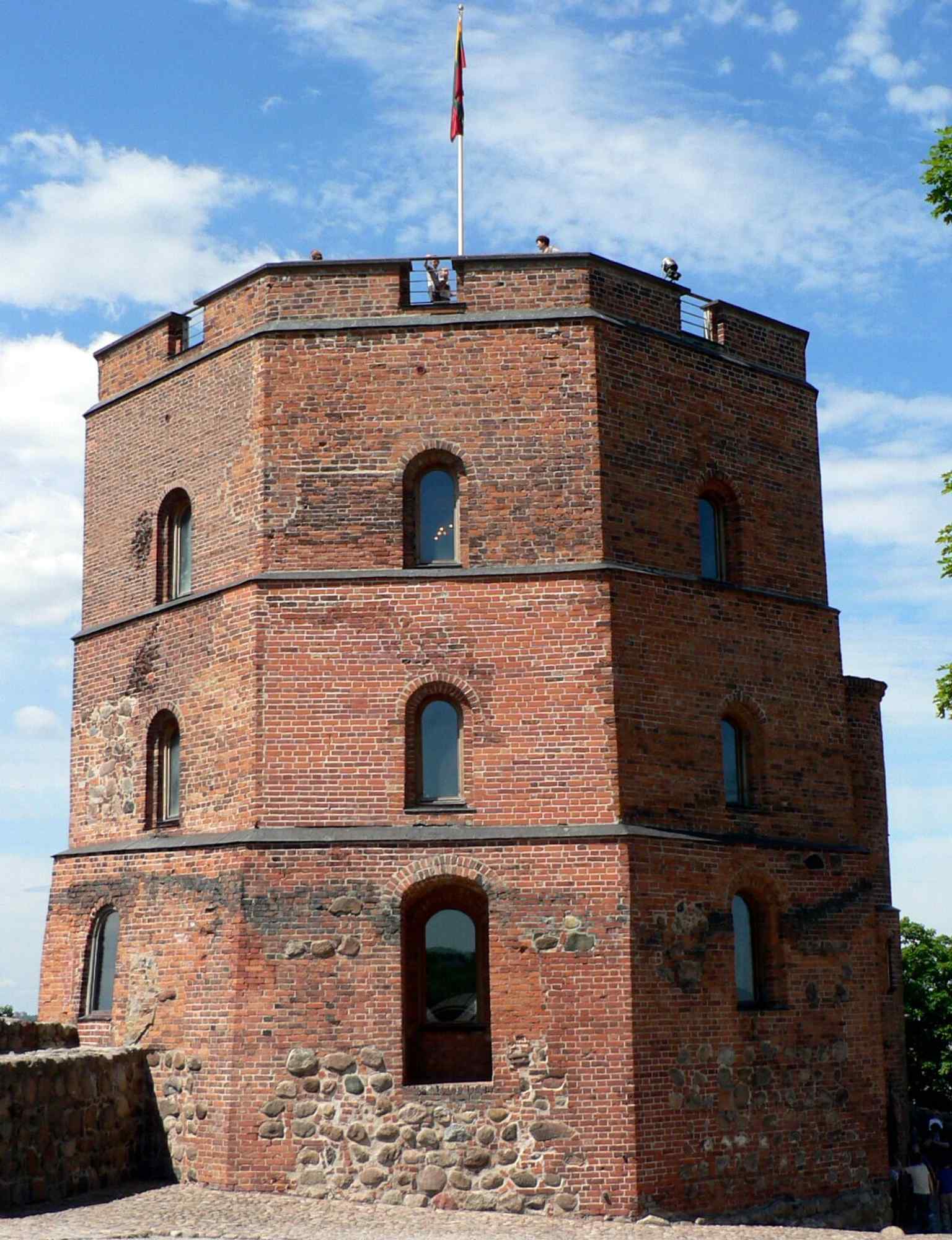
The surviving tower on Gediminas Hill — the last remaining part of the Upper Castle of Vilnius.Photo: Cropped by me, Wikimedia Commons, CC BY-SA 3.0. Cropped & resized. 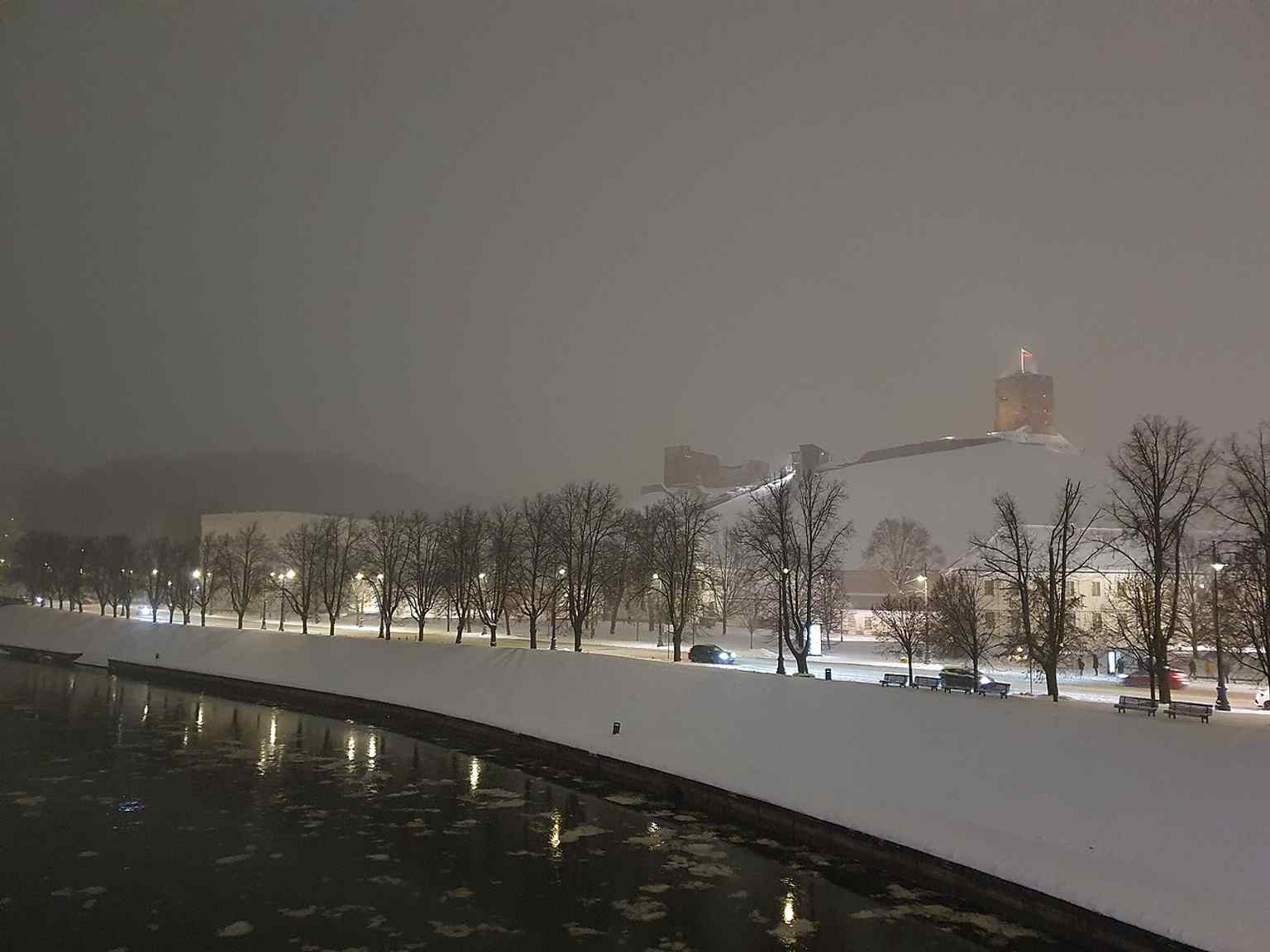
Winter view of the Upper Castle complex — a reminder that the hill must be stabilized and protected from erosion.Photo: Pofka, Wikimedia Commons, CC BY-SA 4.0. Cropped & resized. 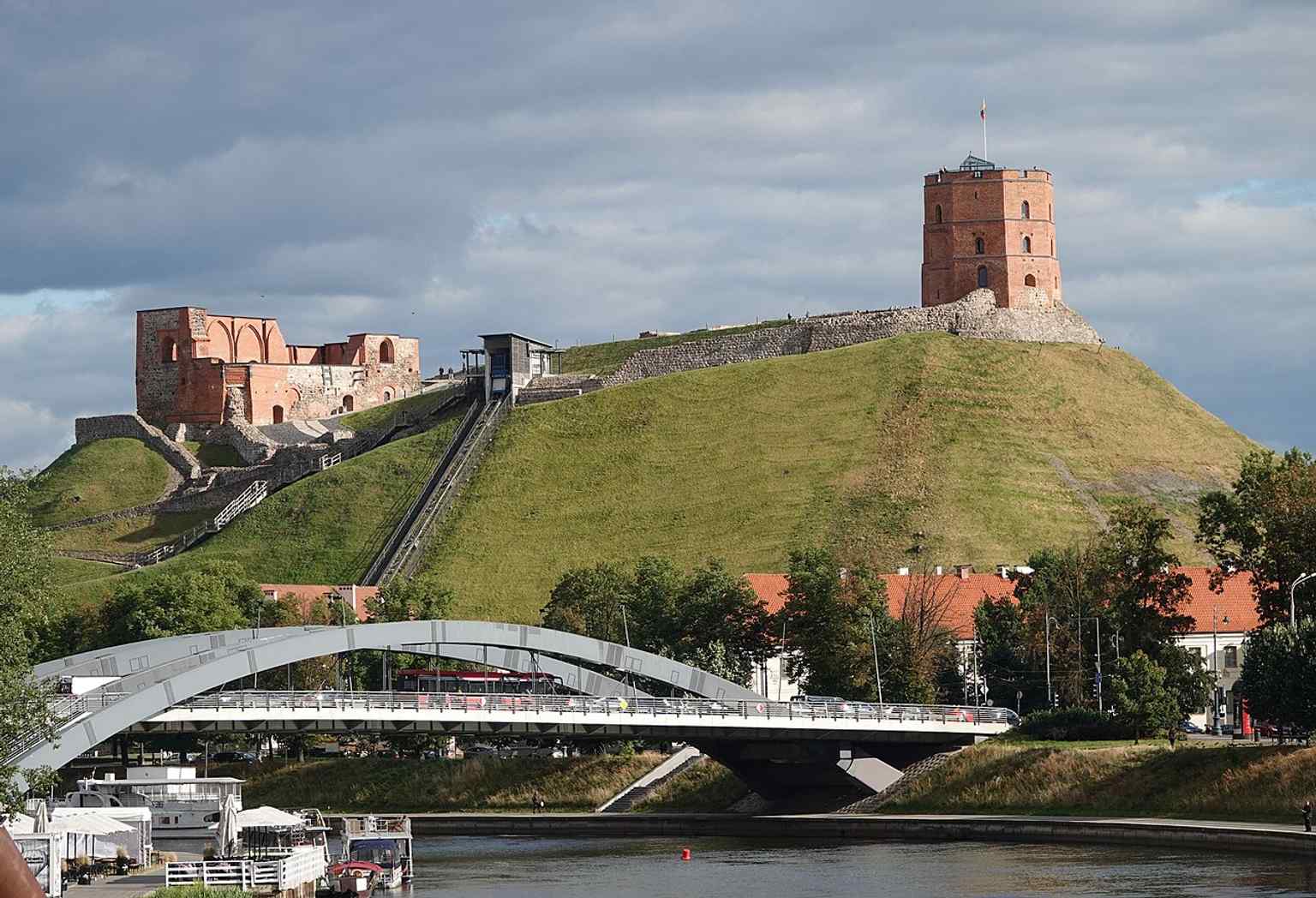
A close exterior view of Gediminas Tower, the hilltop symbol that watches over Vilnius.Photo: Nenea hartia, Wikimedia Commons, CC BY-SA 4.0. Cropped & resized. 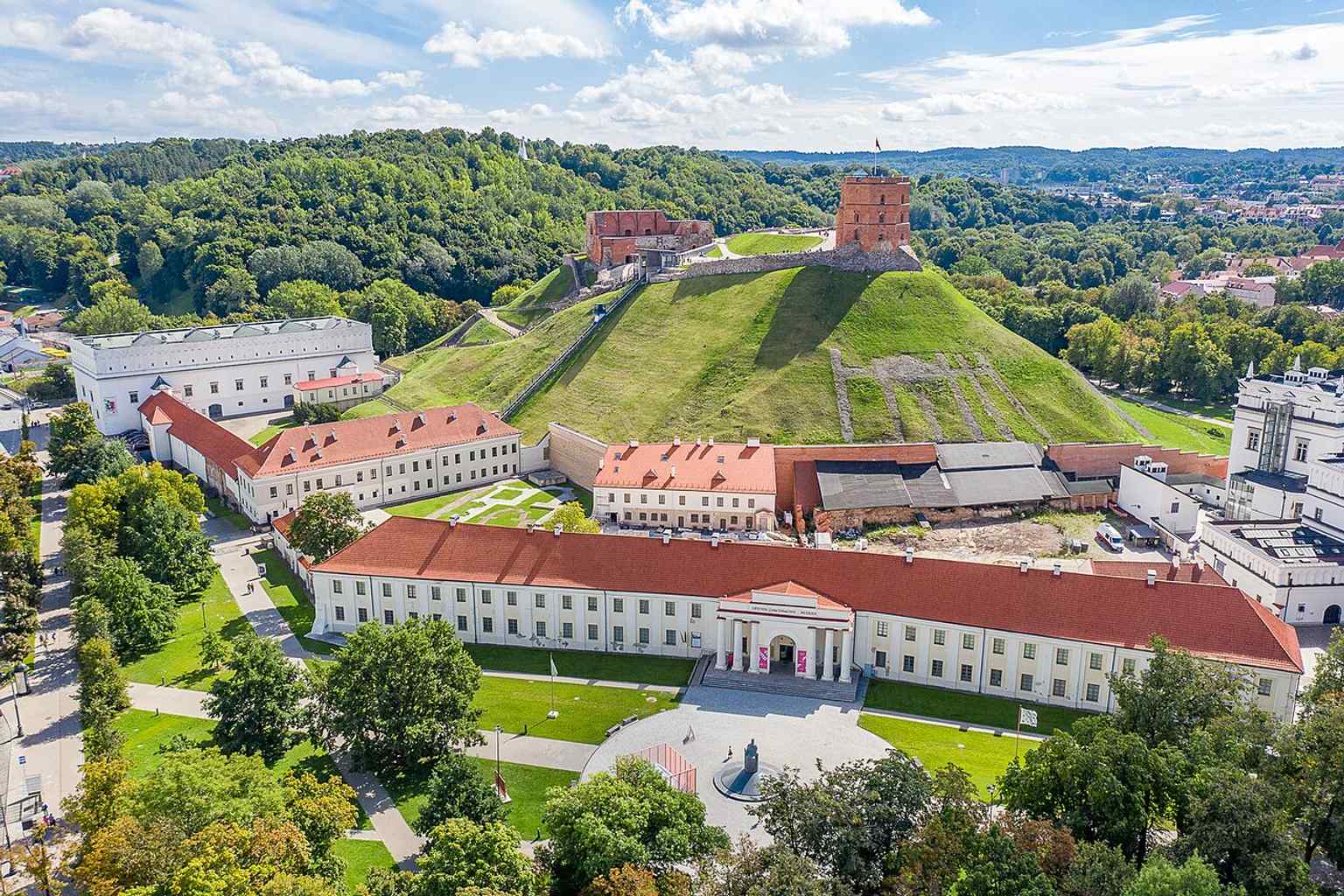
The National Museum complex at the castle site, where archaeology and interpretation explain the tower’s past.Photo: Augustas Didžgalvis, Wikimedia Commons, CC BY-SA 4.0. Cropped & resized.
Frequently asked questions
How do I start the tour?
After purchase, download the AudaTours app and enter your redemption code. The tour will be ready to start immediately - just tap play and follow the GPS-guided route.
Do I need internet during the tour?
No! Download the tour before you start and enjoy it fully offline. Only the chat feature requires internet. We recommend downloading on WiFi to save mobile data.
Is this a guided group tour?
No - this is a self-guided audio tour. You explore independently at your own pace, with audio narration playing through your phone. No tour guide, no group, no schedule.
How long does the tour take?
Most tours take 60–90 minutes to complete, but you control the pace entirely. Pause, skip stops, or take breaks whenever you want.
What if I can't finish the tour today?
No problem! Tours have lifetime access. Pause and resume whenever you like - tomorrow, next week, or next year. Your progress is saved.
What languages are available?
All tours are available in 50+ languages. Select your preferred language when redeeming your code. Note: language cannot be changed after tour generation.
Where do I access the tour after purchase?
Download the free AudaTours app from the App Store or Google Play. Enter your redemption code (sent via email) and the tour will appear in your library, ready to download and start.
If you don't enjoy the tour, we'll refund your purchase. Contact us at [email protected]
Checkout securely with 





.JPG)


%20on%20the%20Gate%20of%20Dawn%20in%20Vilnius%2C%20Lithuania.jpg)


.png)


%2C%201794.jpg)

%2C%20Vilnius%2C%2027%20July%201753.jpg)
%20(2).jpg)
%2C%20middle%20of%20the%2019th%20century.jpg)


.jpg)


.jpg)
%20(2).jpg)


%2C%20manufactured%20in%20Brussels%2C%20Flanders%2C%20circa%201560.jpg)


%2C%20exhibited%20in%20the%20yellow%20room%20of%20the%20Palace%20of%20the%20Grand%20Dukes%20of%20Lithuania%20in%20Vilnius%2C%20Lithuania.jpg)

%20belonging%20to%20Aleksandras%20Jogailaitis%2C%20featuring%20the%20Coat%20of%20arms%20of%20Lithuania%20Vytis%20(Waykimas).jpg)
%2C%20made%20in%20the%20middle%20of%20the%2016th%20century.jpg)
%2C%201557.jpg)

.jpg)

.02.jpg)
