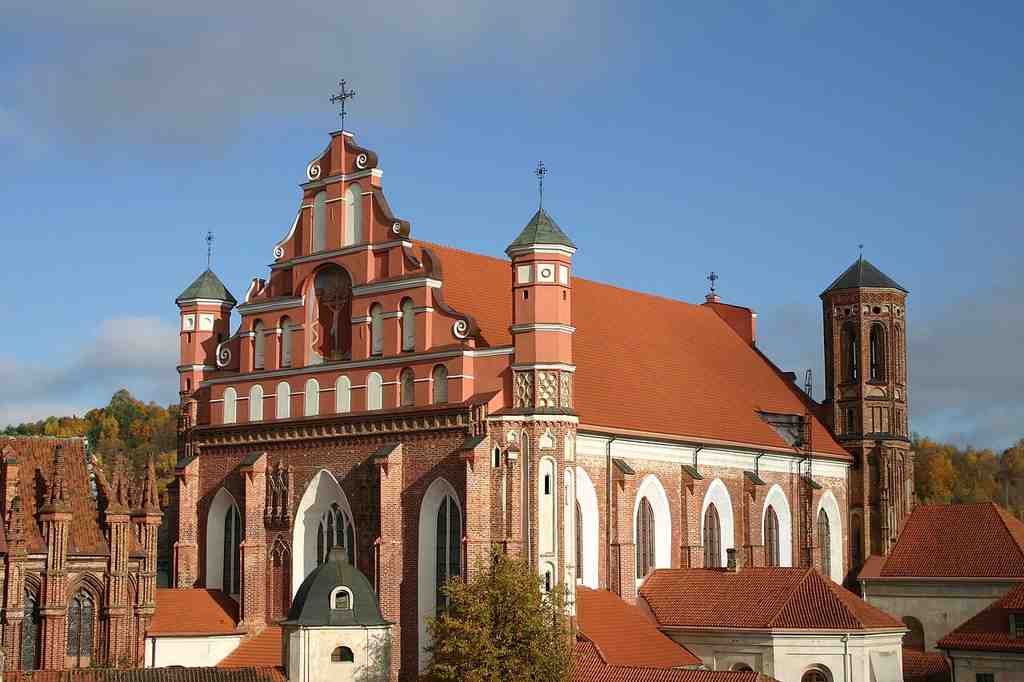
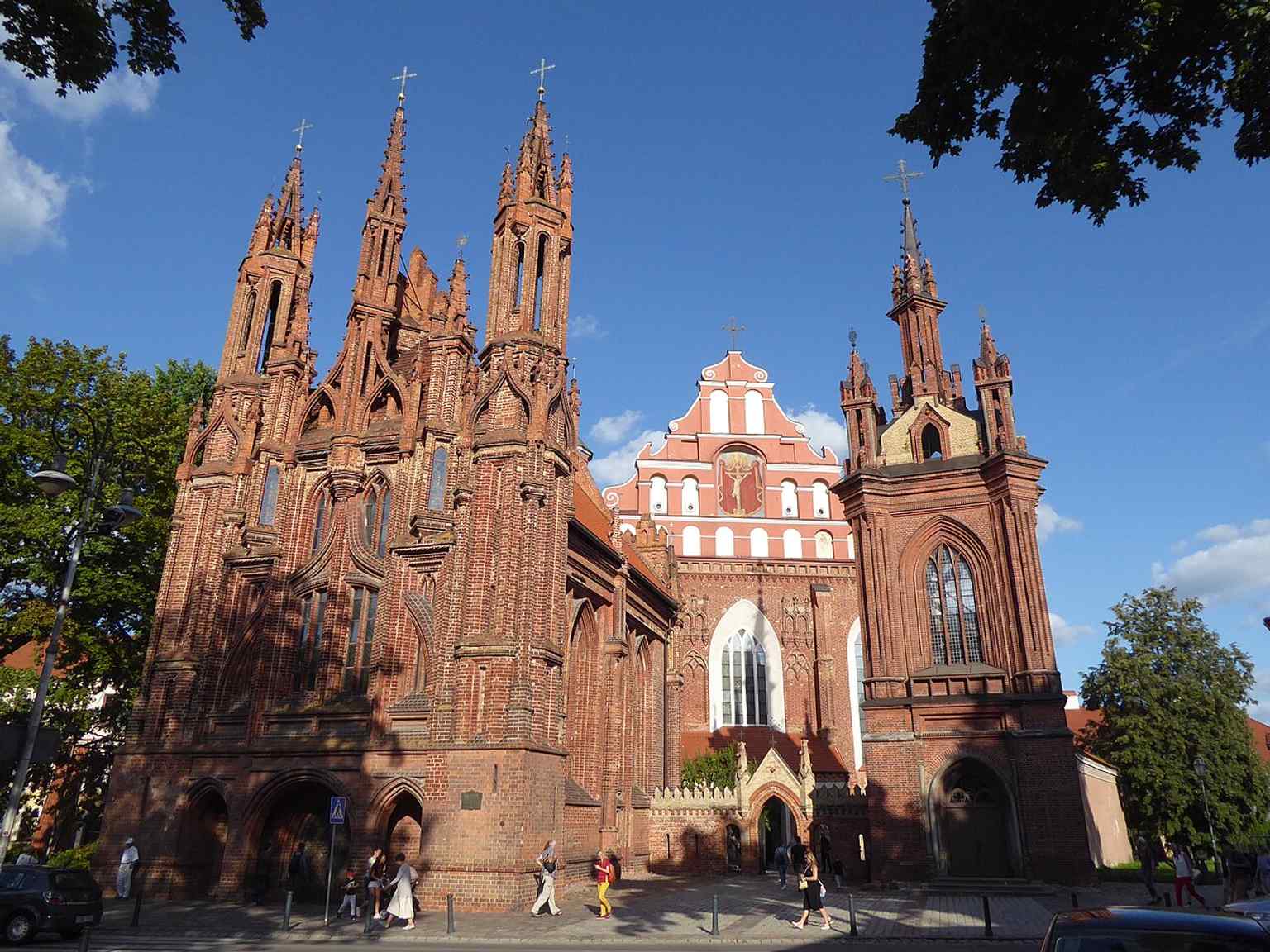
On your left, look for a broad red-brick Gothic church with pointed-arch windows, stout buttresses, and a tall gable framed by two octagonal towers.
This is the Bernardine Church, dedicated to Saint Francis of Assisi and Bernardino of Siena... and it carries an almost absurd amount of Vilnius inside one building. Monks first put up a wooden church here in the fifteenth century, then replaced it with brick, and in the early sixteen hundreds they folded it into the city’s defensive wall. That is why this holy place has shooting openings in its walls. Nothing says “welcome to worship” like architecture prepared for arrows.
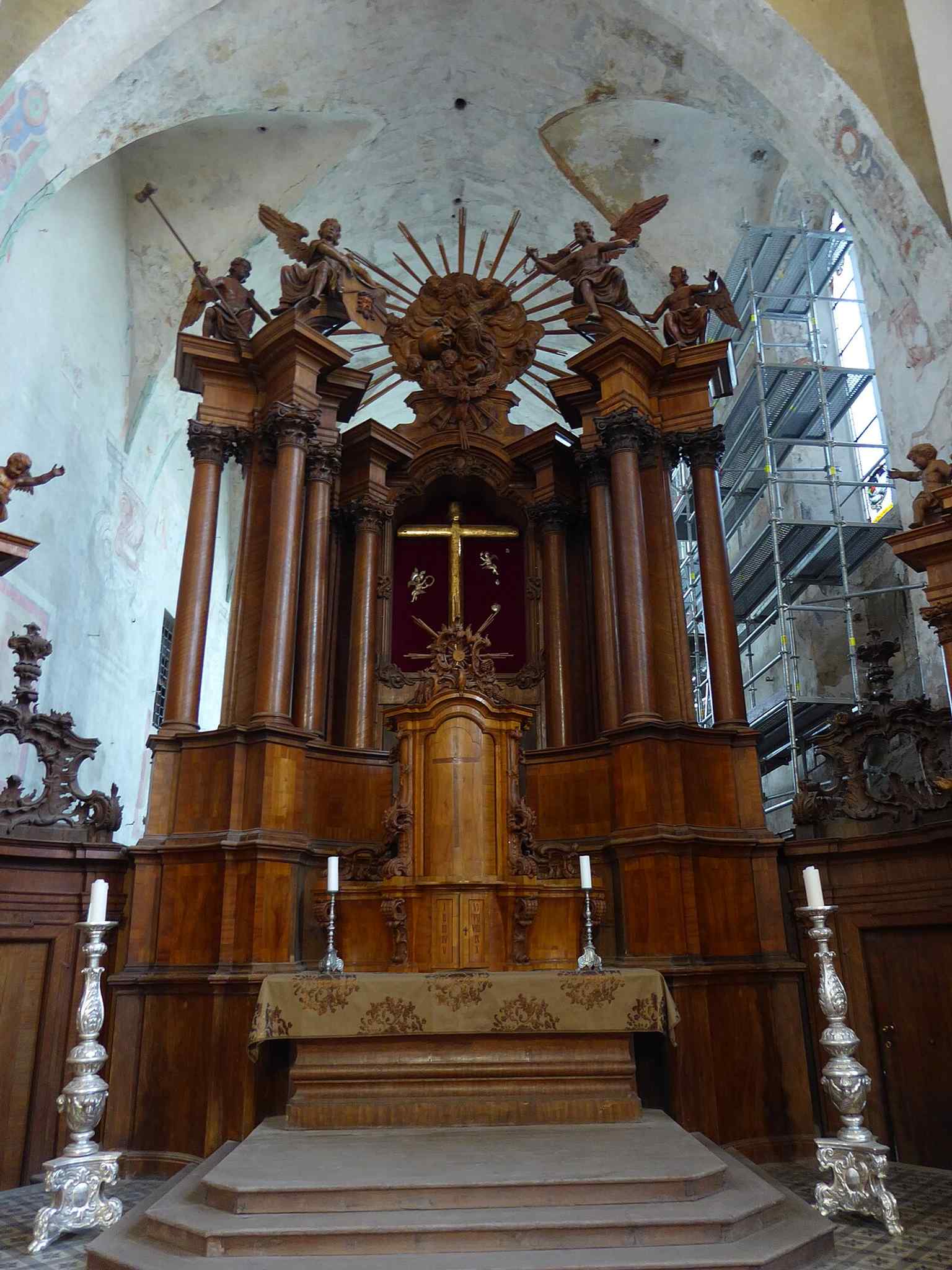
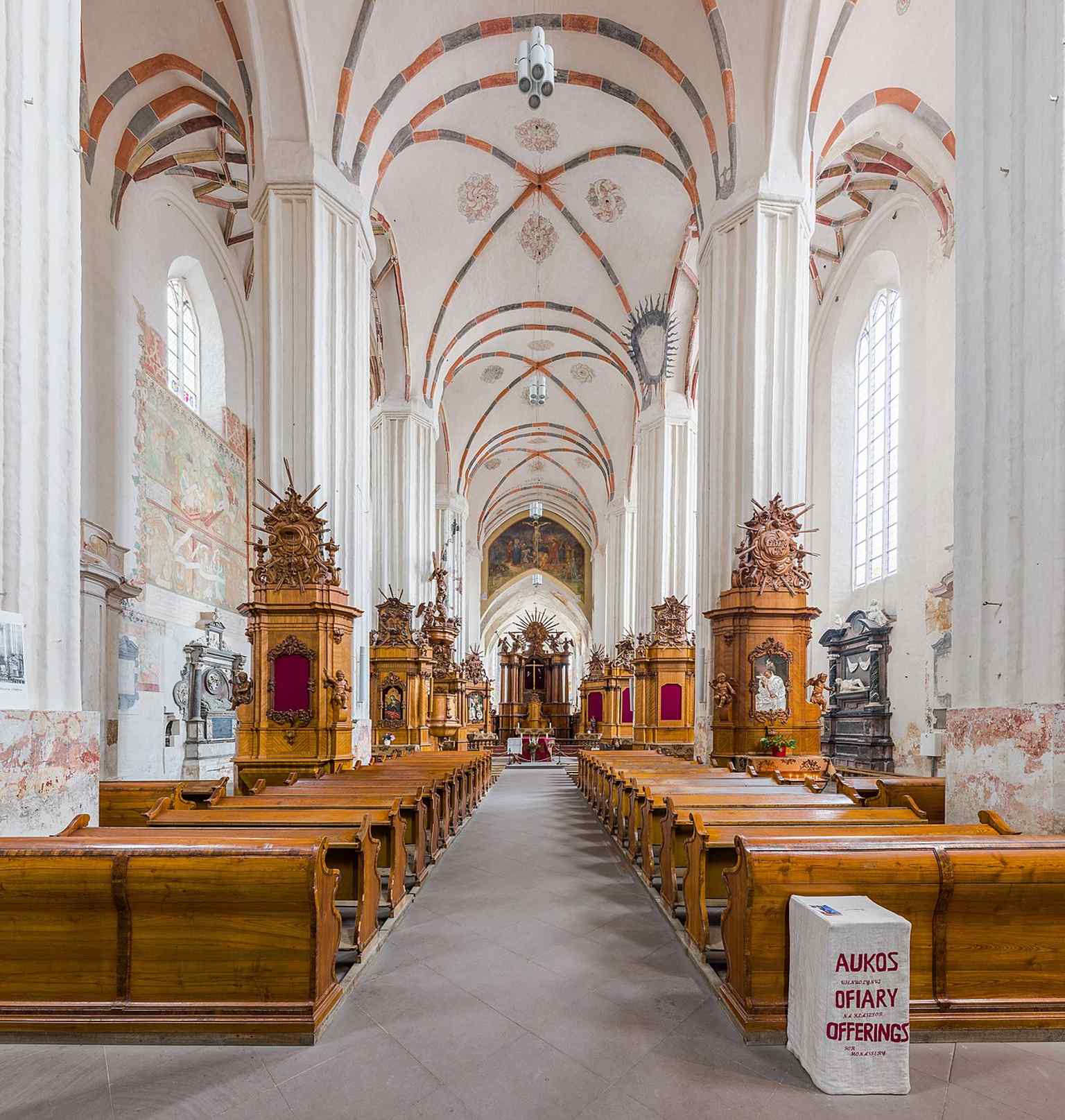
The scale matters. Legend says the Bernardines preached so well that crowds kept coming, so they built bigger. If you glance at the image on your screen, you can see the interior still feels built for a serious audience: a vast central hall, called the nave, divided by eight tall pillars.
But this church also collected stranger things: fear, rumor, and local devotion. One name stayed attached to the place for centuries: Simonas Kerelis, a seven-year-old Vilnius boy. In fifteen ninety-two, people turned his death into a ritual-murder accusation, the kind of story cities tell when panic outruns decency. The Bernardines buried him here, then moved him in sixteen twenty-three to a marble grave outside. Pilgrims came, offerings piled up, and a local cult grew around him... until the war with Moscow in sixteen fifty-five to sixteen sixty-one tore through Vilnius, destroyed the sarcophagus, and shattered that whole world. A memorial plaque on the wall is what remains.
Inside, another survivor hangs on by stubbornness alone: the huge painting St. Bruno. The Miracle in the Church. Leonas Bazilijus Sapiega commissioned it in sixteen seventy-four, and Johann Gotthard Berchhoff painted it with a wink. Sapiega appears in one corner wearing fashionable seventeenth-century clothes, while the scene itself is supposed to happen in the year ten eighty. Historical accuracy clearly took a short lunch break. During the Soviet period, when the church was closed and handed to the Art Institute, the painting decayed, parts were stolen, and what remained went into museum storage. Restorers finally returned it here in two thousand eleven.
Most visitors miss the quieter survivors. Fragments of one of Lithuania’s oldest large Baroque organ fronts still remain here, dating from seventeen sixty-four to seventeen sixty-six and linked to the organ builder Nicolaus Jantzon. And the wall paintings, uncovered only in nineteen eighty-one, mix Gothic style with Renaissance storytelling in a way that is genuinely rare.
If you want one more image, look at the church pairing in the app: this larger, fortress-like mass beside the famously delicate neighbor. That contrast is perfect. Bernardine Church holds layers, scars, and half-lost memories; next door, St. Anne gets all the elegant applause. We’re heading there next, about a one-minute walk away.
If you plan to come back inside later, the church is generally open daily, with hours varying by day.