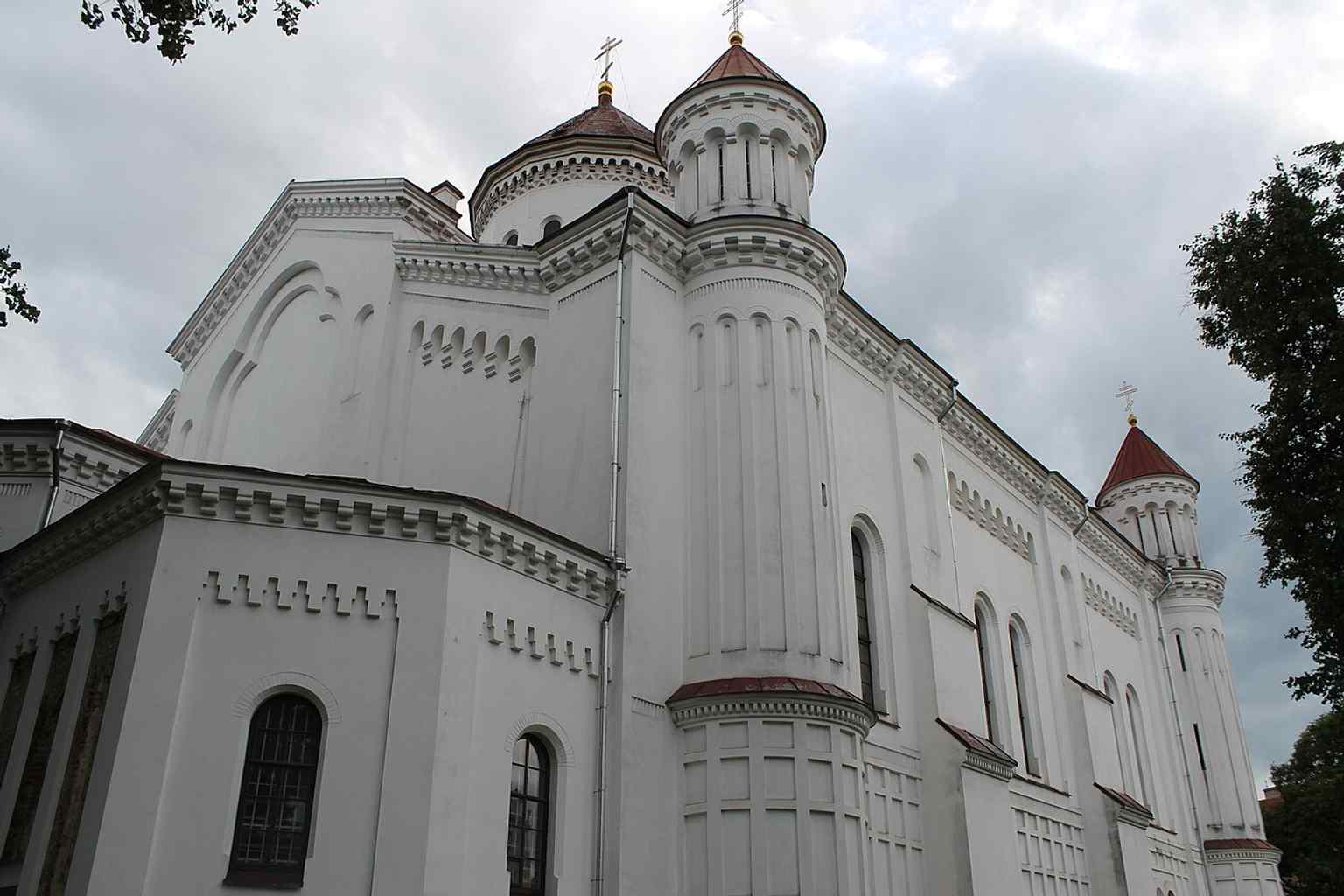
On your right is a building that quietly upends a neat version of Vilnius history. Long before Lithuania officially became Christian, Orthodox Vilnius was already here in stone. This cathedral is among the city’s oldest surviving churches, and tradition places its beginnings in the reign of Grand Duke Algirdas in thirteen forty-six, tied to the Orthodox court around him. Either way, the point stands: dynastic politics and faith were sharing the same address very early on.
Kievan architects shaped it, and Saint Alexius, the Metropolitan of Kiev and all Rus', blessed the project in thirteen forty-eight. So while the Grand Duchy still had the reputation of being Europe’s last pagan state, this place already served a growing Christian population. That is the surprise here: Vilnius did not step from paganism into one tidy Catholic story. It was messier, richer, and much more interesting.
One person who holds that story together is Helena of Moscow, daughter of Ivan the Third and wife of Grand Duke Alexander Jagiellon. She was symbolically married here in fourteen ninety-five, and when she died in fifteen thirteen, they buried her here too. So this church became both a spiritual center and a family vault for rulers whose marriages doubled as foreign policy. Romance, in royal life, rarely got to travel alone.
The building then lived several different lives, some of them rather rude. After the dome collapsed in fifteen oh six, Prince Konstanty Ostrogski restored it in fifteen twenty-two. In sixteen oh nine, the Uniate Church took it over after the Union of Brest, which brought some Orthodox communities into communion with Rome while keeping Eastern rites. Fires followed, including one in seventeen forty-eight that left the cathedral abandoned and reused for other purposes.
Then came one of Vilnius's more bizarre reinventions: Vilnius University bought the neglected building in eighteen oh eight, and by eighteen twenty-two Karol Podczaszyński had remodeled it in Neoclassical style. Inside, a former cathedral hosted an anatomical theatre for public dissections, plus lecture halls, a library, barracks, and storage. Nothing says sacred continuity quite like a cadaver under academic supervision.
In the eighteen sixties, during the Russification campaign, Count Mikhail Muravyov pushed it back into Orthodox hands, and architect Nikolai Chagin rebuilt it in a style imitating medieval Georgian churches. Take a peek at the before-and-after image in the app to see how dramatically the nineteenth-century rebuild changed its face. If you glance at your screen, the interior image shows the five-tier iconostasis - the wall of painted holy images separating altar and nave - installed in eighteen sixty-four, unique in Lithuania.
War damaged it again in the twentieth century, and repairs dragged on until nineteen fifty-seven. That long recovery suits the place. This church teaches a hard lesson: Vilnius was spiritually diverse before it was officially Christian, and every era here left fingerprints instead of clean replacements. From here, continue to the Church of St. Francis and St. Bernardino, about a three-minute walk away. If you want to return later, the cathedral is generally open every day from seven thirty in the morning until eight in the evening.