
Ljubljana Audio Tour: Old Town Charms
Ljubljana wears a mask of baroque charm, but beneath the emerald river and cobblestones lie scars of political betrayals and ghosts of brutal uprisings. This self-guided audio tour peels back the layers of the capital. Navigate past the bustling Prešernov trg and up to the imposing Ljubljana Castle to uncover the hidden archives and scandalous secrets that mainstream guidebooks dare not whisper. Which ancient secret is buried beneath the foundations of the Ljubljana Cathedral? Why did a nobleman meet his tragic end in a hidden alleyway during a forgotten revolution? How did a single illicit letter nearly topple a powerful dynasty? Stroll through shifting shadows as history comes alive. Feel the pulse of centuries past, transform your perception of these familiar facades, and master the art of uncovering the truth in plain sight. Start your investigation now and see the city as it truly is.
Tour preview
About this tour
- scheduleDuration 110–130 minsGo at your own pace
- straighten4.5 km walking routeFollow the guided path
- location_on
- wifi_offWorks offlineDownload once, use anywhere
- all_inclusiveLifetime accessReplay anytime, forever
- location_onStarts at Dragon Bridge
Stops on this tour
lock_open 3 free previews · 13 unlock with purchase
The landmark before you is a gently arching bridge made of pale reinforced concrete, most easily recognized by the imposing, green patinated copper dragons standing guard on stone…Read moreShow less
Open dedicated page →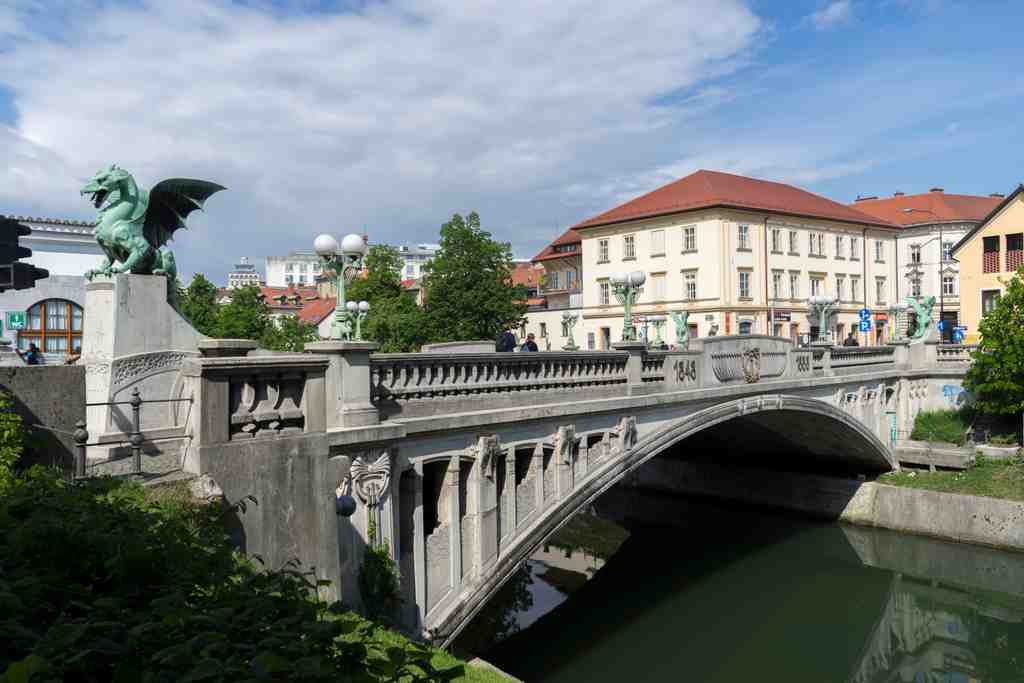
Dragon BridgePhoto: Thomas Ledl, Wikimedia Commons, CC BY-SA 4.0. Cropped & resized. The landmark before you is a gently arching bridge made of pale reinforced concrete, most easily recognized by the imposing, green patinated copper dragons standing guard on stone pedestals at each corner.
Looking at this solid structure, it is hard to imagine it was born from absolute ruin. In 1895, a catastrophic earthquake ripped through Ljubljana, destroying much of the medieval city. Among the casualties was the old oak crossing known as the Butchers' Bridge that used to sit right here. The devastation was absolute, but it provided an unprecedented opportunity to start fresh. Enter Mayor Ivan Hribar. He was a man with a relentless, ambitious vision. He saw the rubble not just as a tragedy, but as a rare chance to build a modernized, forward looking city that embraced the latest artistic styles.
Part of that modern vision meant ditching traditional stone. To stretch the city's reconstruction budget, the authorities made a radical choice to use reinforced concrete. But there was a bit of imperial risk management going on, too. The Austro Hungarian authorities were terrified of testing this relatively new construction method in their capital of Vienna. So, they essentially used Ljubljana as a provincial testing ground. If the massive thirty three meter arch collapsed, the political fallout would be a mere ripple compared to a disaster in the imperial heartland.
But the bridge held perfectly. The architect, Jurij Zaninović, designed it in the Vienna Secession style, a movement famous for its elegant, geometric natural motifs and meticulous architectural details. If you check your screen, you can see a close up of the ornate lamp posts he designed, which were originally fueled by gas and considered an absolute marvel of urban lighting.
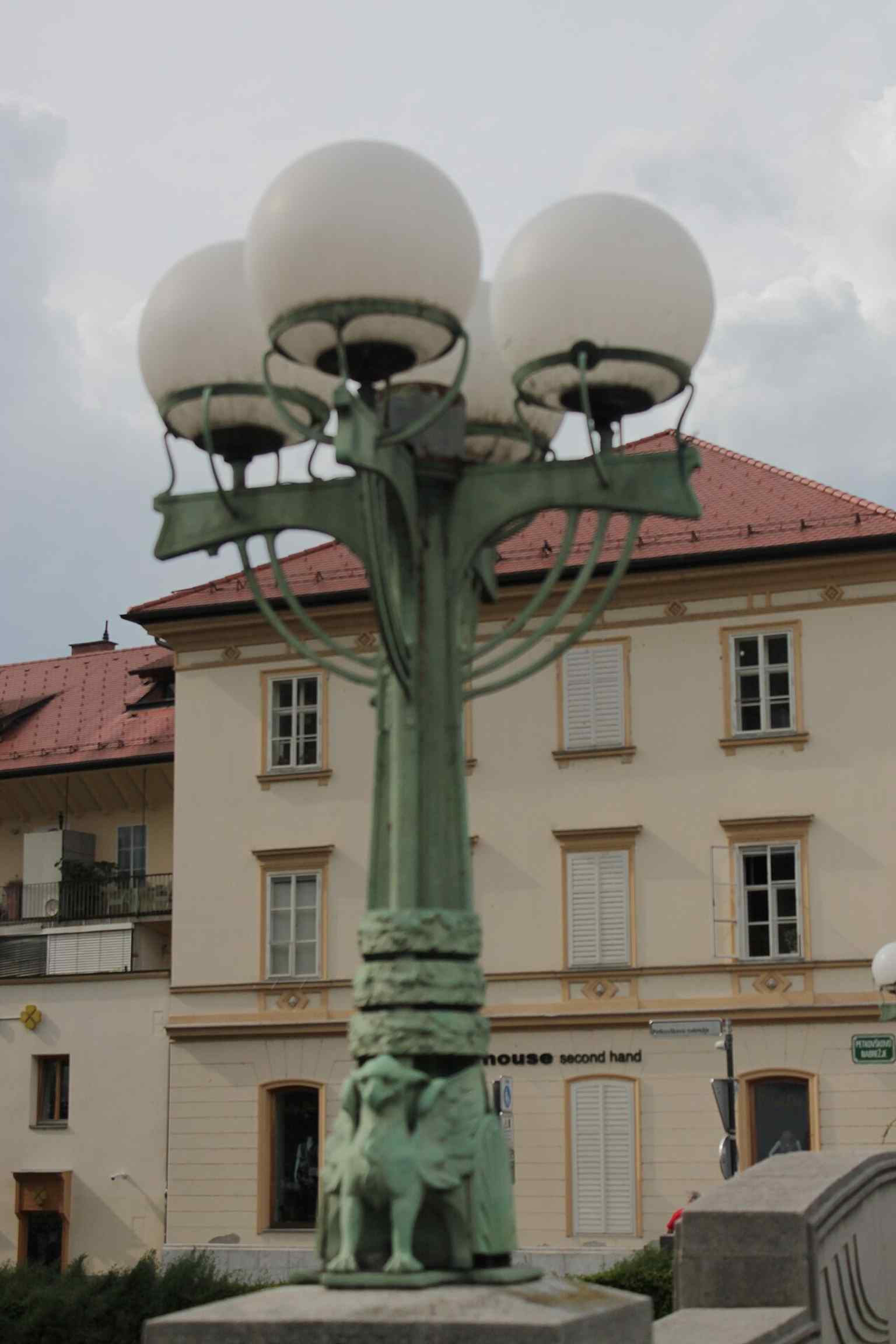
An ornate lamp post on the bridge, originally gas-fueled and now electrified, showcases the detailed Art Nouveau aesthetic envisioned by architect Jurij Zaninović for the bridge's balustrades and other decorative elements.Photo: John Samuel, Wikimedia Commons, CC BY-SA 4.0. Cropped & resized. Yet, the greatest twist in the history of this iconic crossing is that it was never actually supposed to have dragons. The original plans submitted to the city featured winged lions, the traditional symbol of the Venetian Republic. It was an unplanned pivot when Zaninović decided to use the dragon instead, a creature tied to local folklore. By adding these mythical beasts, he symbolically linked the city's modern rebirth to its heroic, prehistoric origins.
The four main statues were cast from copper sheets to save weight, with each weighing about one and a half tons. Over the decades, the copper developed its deep green patina. Feel free to pull up a detailed photo of their fierce, judging glares on your app. The legend goes that Jason of the Argonauts founded the city after slaying a dragon here in the marshes. But locals have their own cheeky myth... they claim the dragons will wag their tails when a virgin crosses the bridge. Because the dragons absolutely refuse to budge, young women nicknamed it the mother in law bridge, saying the statues perfectly mirrored the stubbornness of a skeptical mother in law.
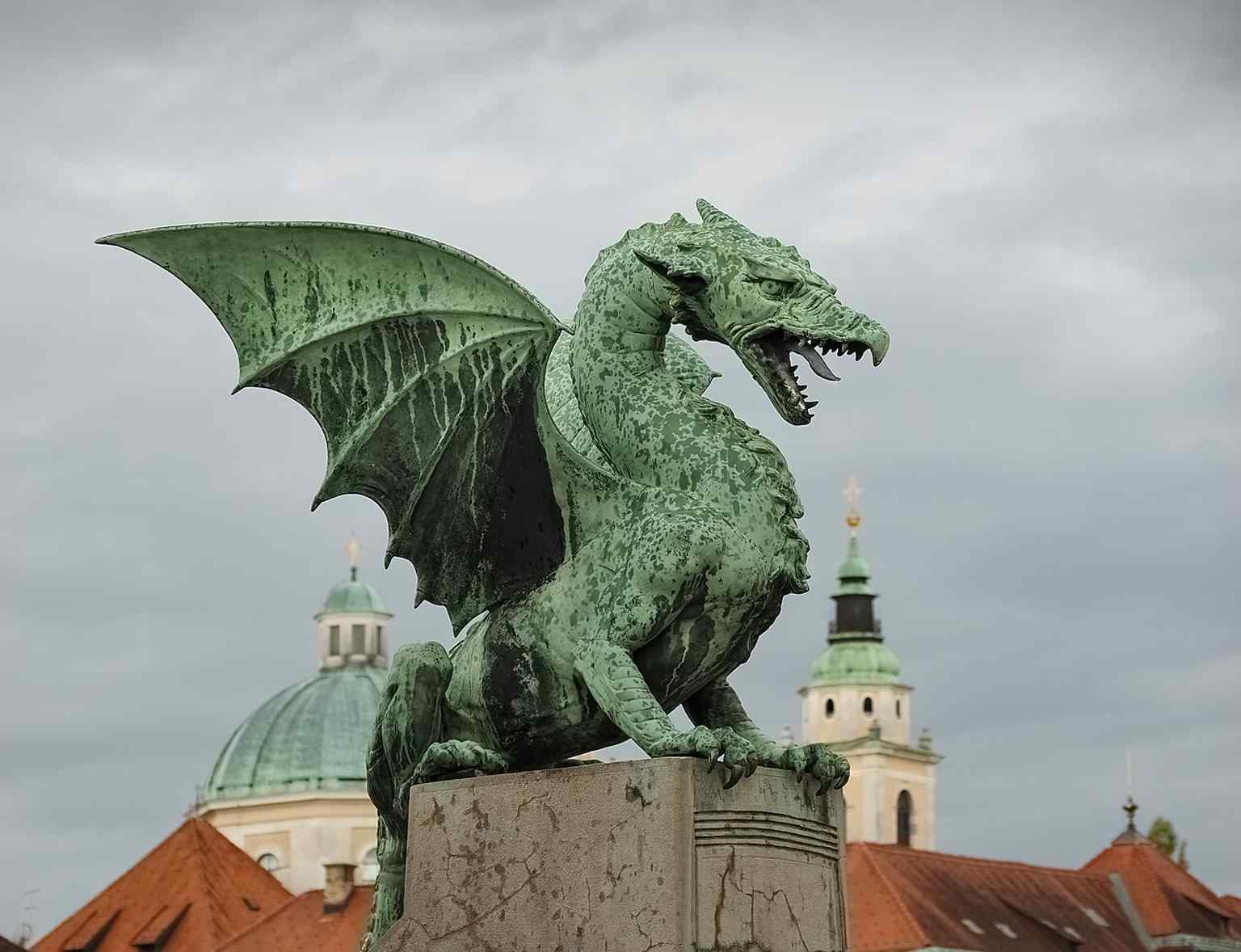
This close-up captures the 'fierce, judging glare' of the dragons, which local legend claims will wag their tails when a virgin crosses the bridge, leading to its cheeky nickname: 'the mother-in-law bridge'.Photo: Petar Milošević, Wikimedia Commons, CC BY-SA 4.0. Cropped & resized. Since it functions as a public road, the bridge remains open twenty four hours a day, meaning those watchful guardians never clock out. When you are ready, let us follow the river downstream... we are heading to the Ljubljana Central Market, just a five minute walk away.
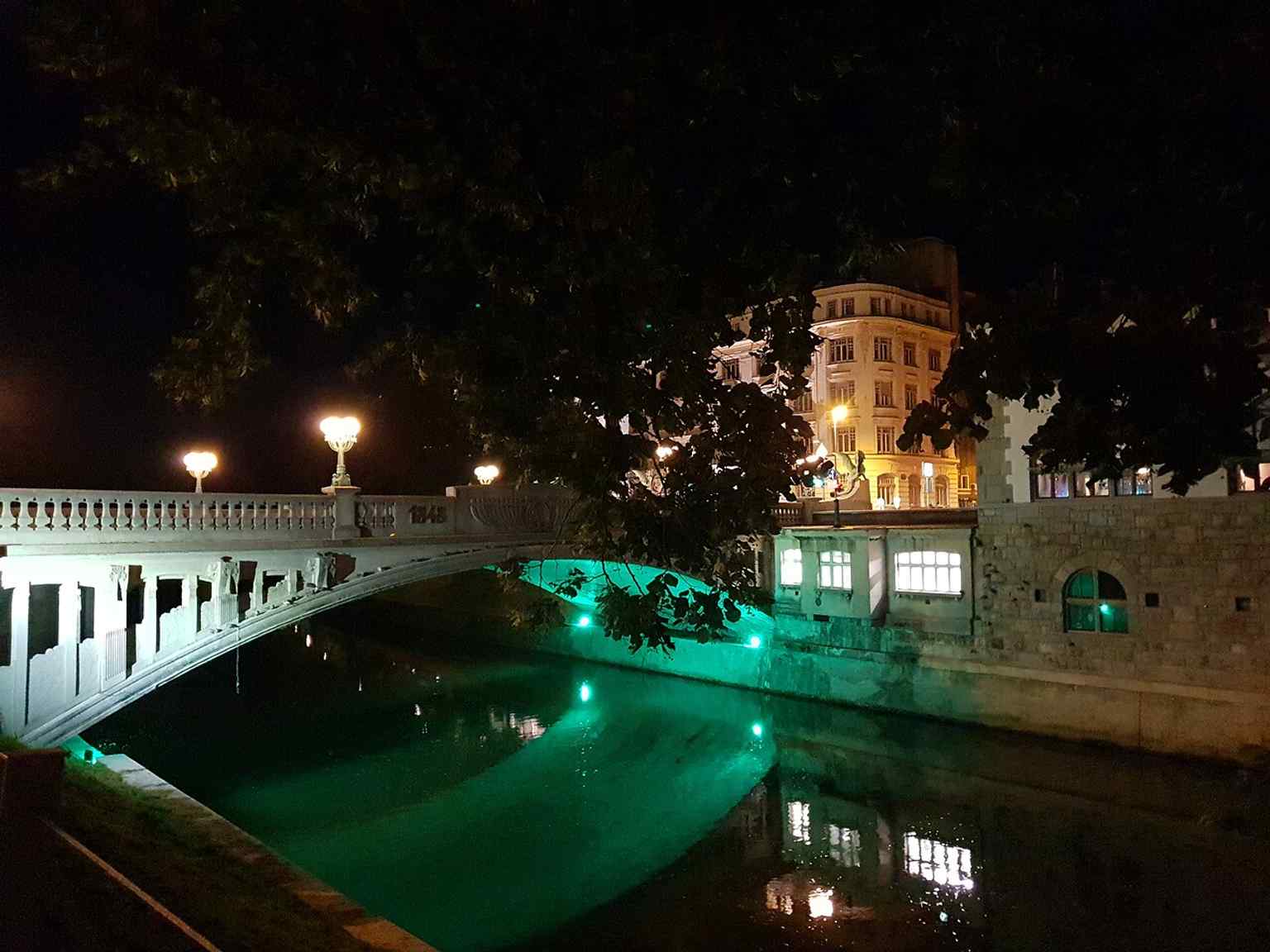
At night, the Dragon Bridge illuminates, showcasing its twenty ornamental lamps that were originally fueled by gas and were considered a pinnacle of urban lighting at the turn of the century.Photo: Saška Grušovnik, Wikimedia Commons, CC BY-SA 4.0. Cropped & resized. 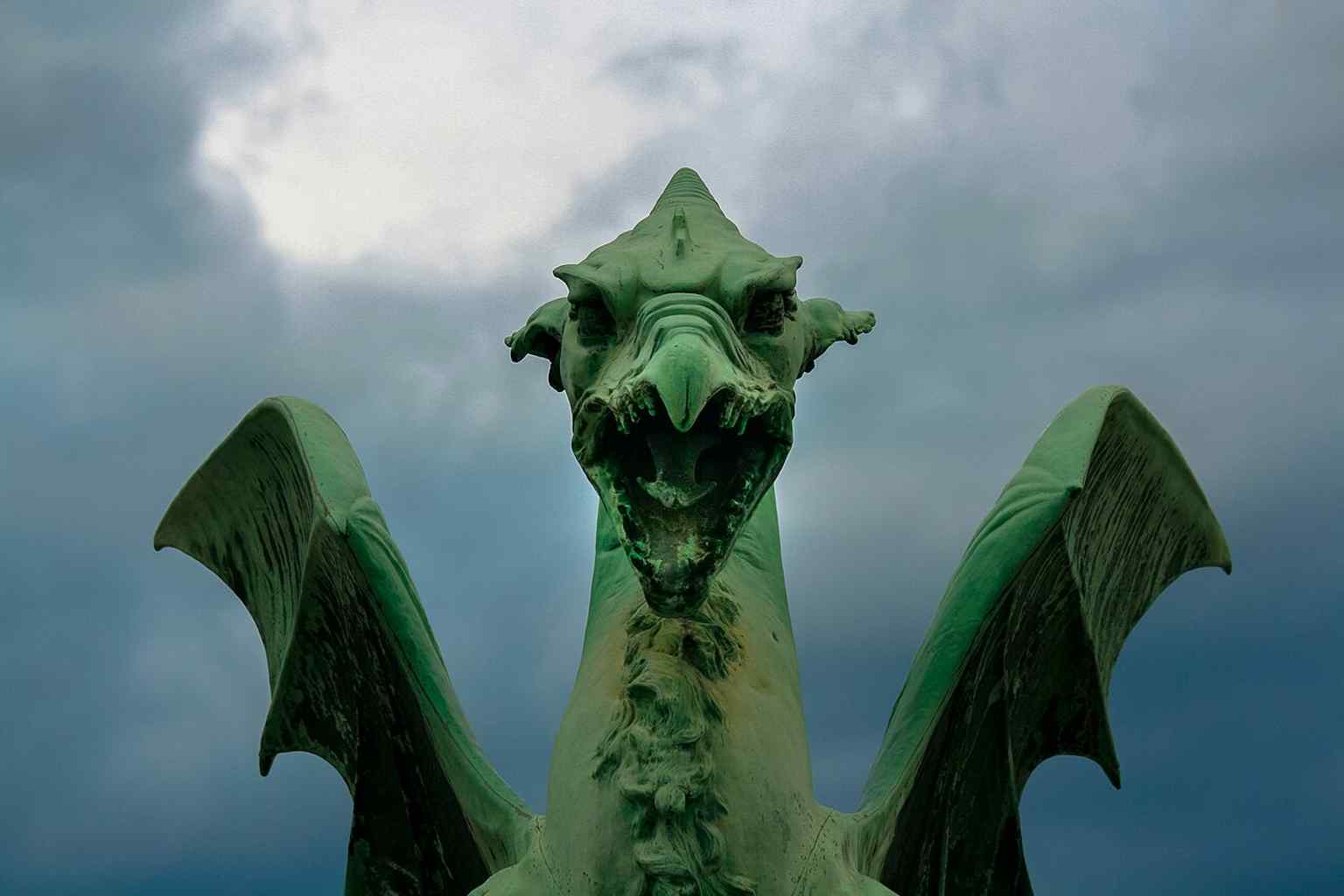
One of the four main copper dragons, weighing 1.5 tons each, adorns the bridge. These dragons developed a deep green patina that Zaninović reportedly anticipated as part of the bridge's evolving aesthetic.Photo: Bob Ramsak, Wikimedia Commons, CC BY-SA 4.0. Cropped & resized. 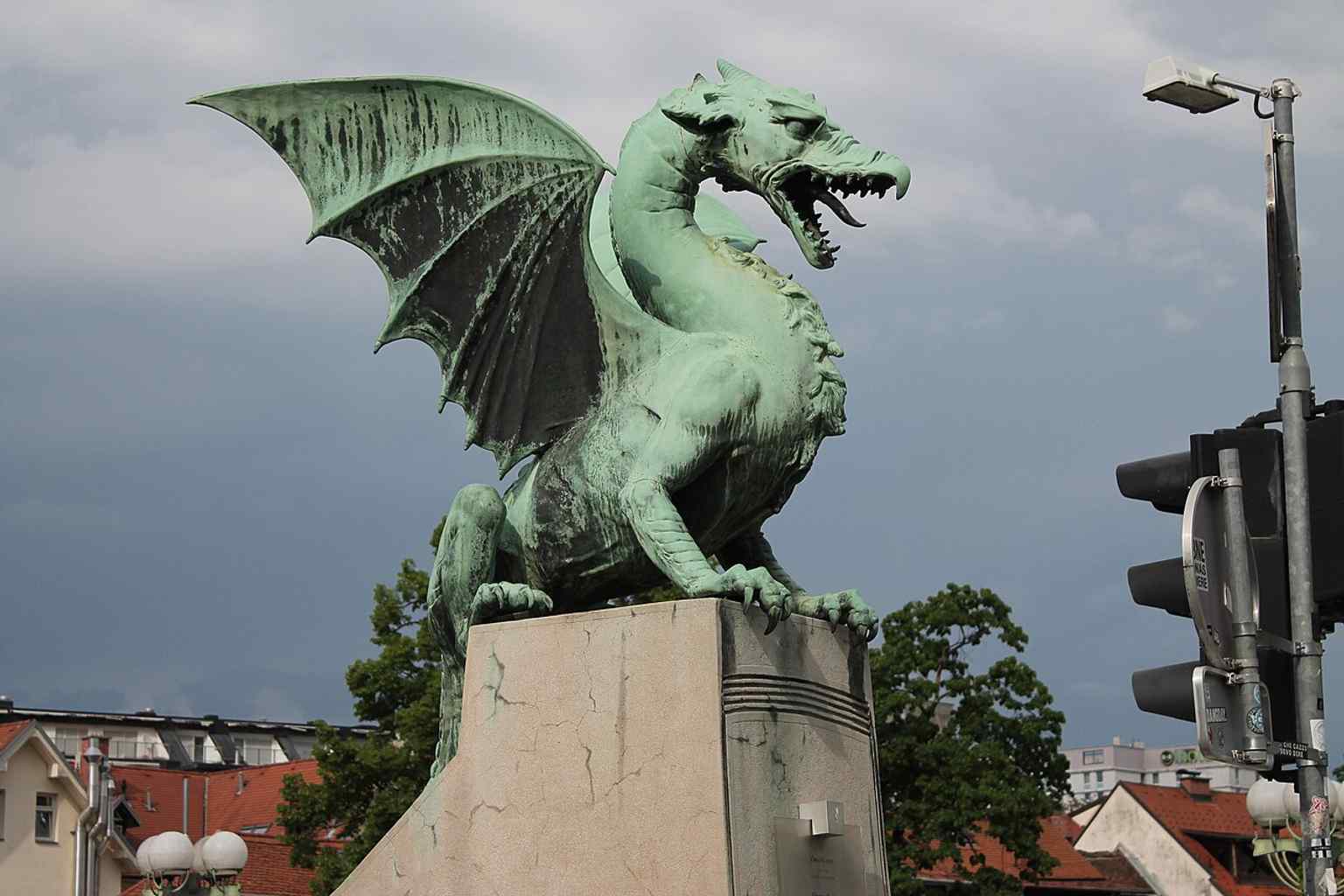
The bridge is guarded by four large dragon statues on pedestals at its corners, along with sixteen smaller dragon statues, all designed by Jurij Zaninović.Photo: John Samuel, Wikimedia Commons, CC BY-SA 4.0. Cropped & resized. 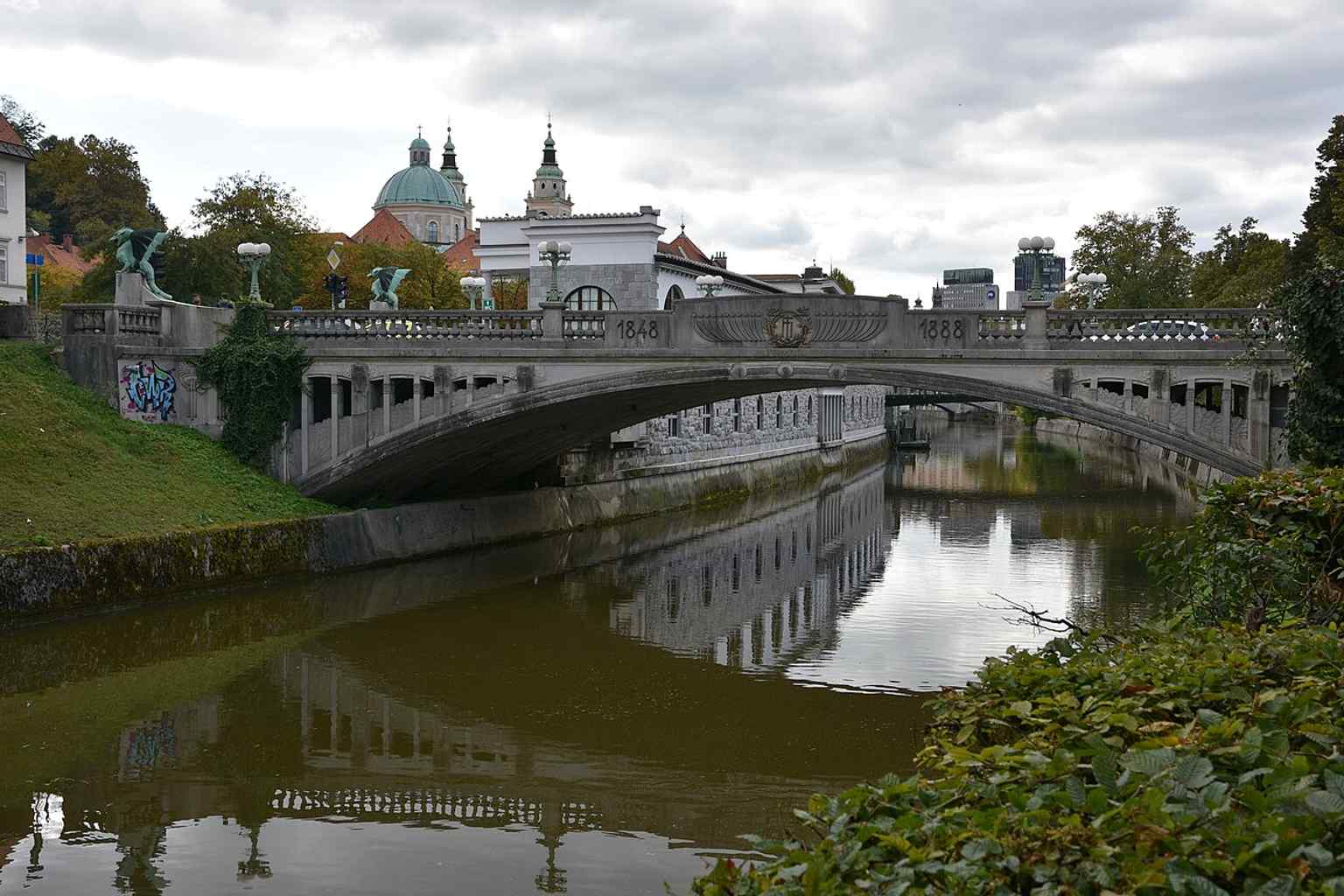
The Dragon Bridge elegantly crosses the Ljubljanica River in Ljubljana, a key part of Mayor Ivan Hribar's vision for a 'new Ljubljana' built in the latest artistic styles after the 1895 earthquake.Photo: Arths-at, Wikimedia Commons, CC BY-SA 4.0. Cropped & resized. 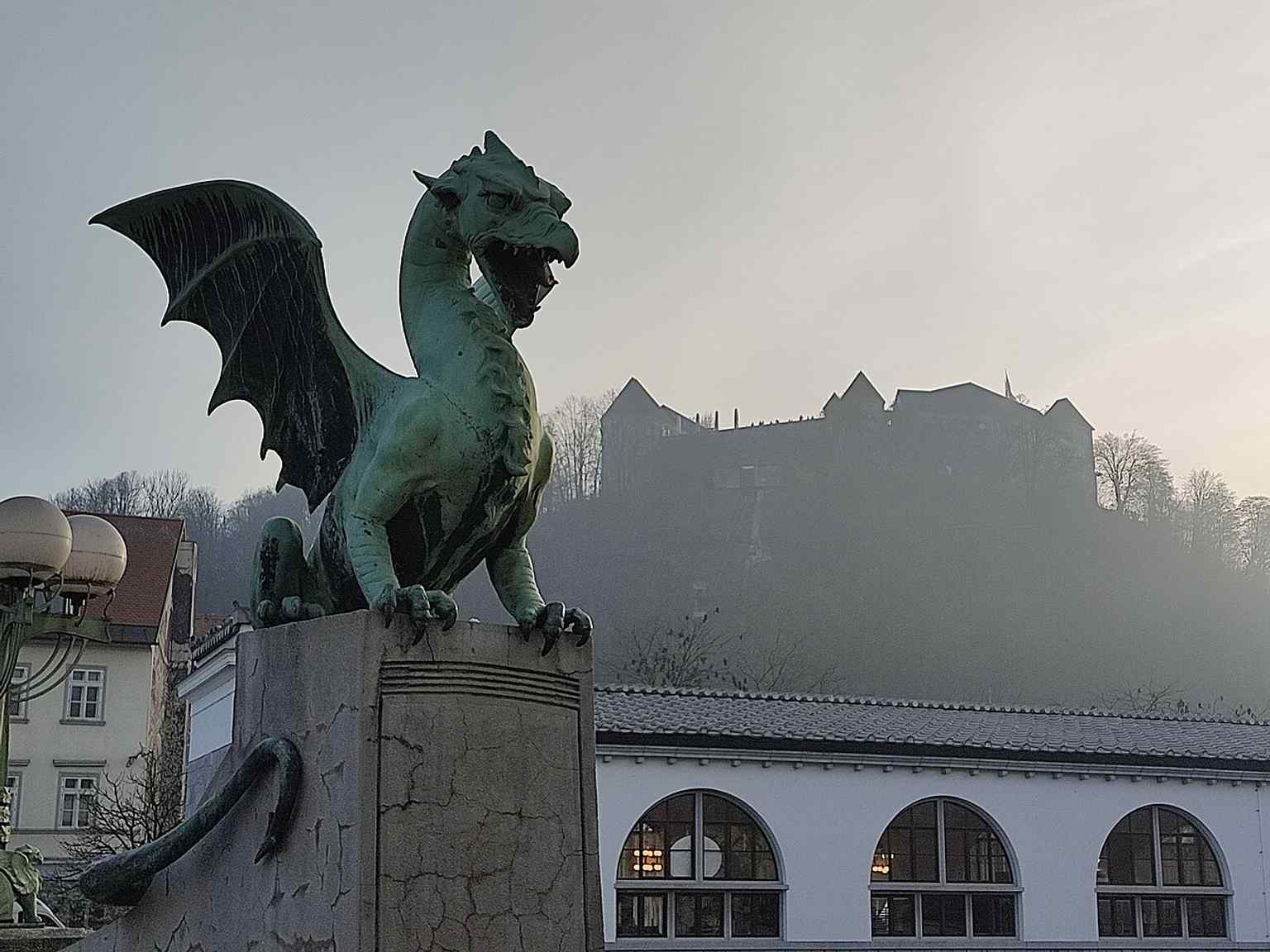
Designed as a symbol of Ljubljana's modernization, the Dragon Bridge was a radical choice for its time, employing reinforced concrete because it was significantly cheaper than traditional stone, stretching the city's reconstruction budget.Photo: Viktar Palstsiuk, Wikimedia Commons, CC BY-SA 4.0. Cropped & resized. Looking to your left, you will spot the pale yellow facade of Ljubljana Cathedral, defined by its twin square towers and a prominent octagonal green dome resting over the eastern…Read moreShow less
Open dedicated page →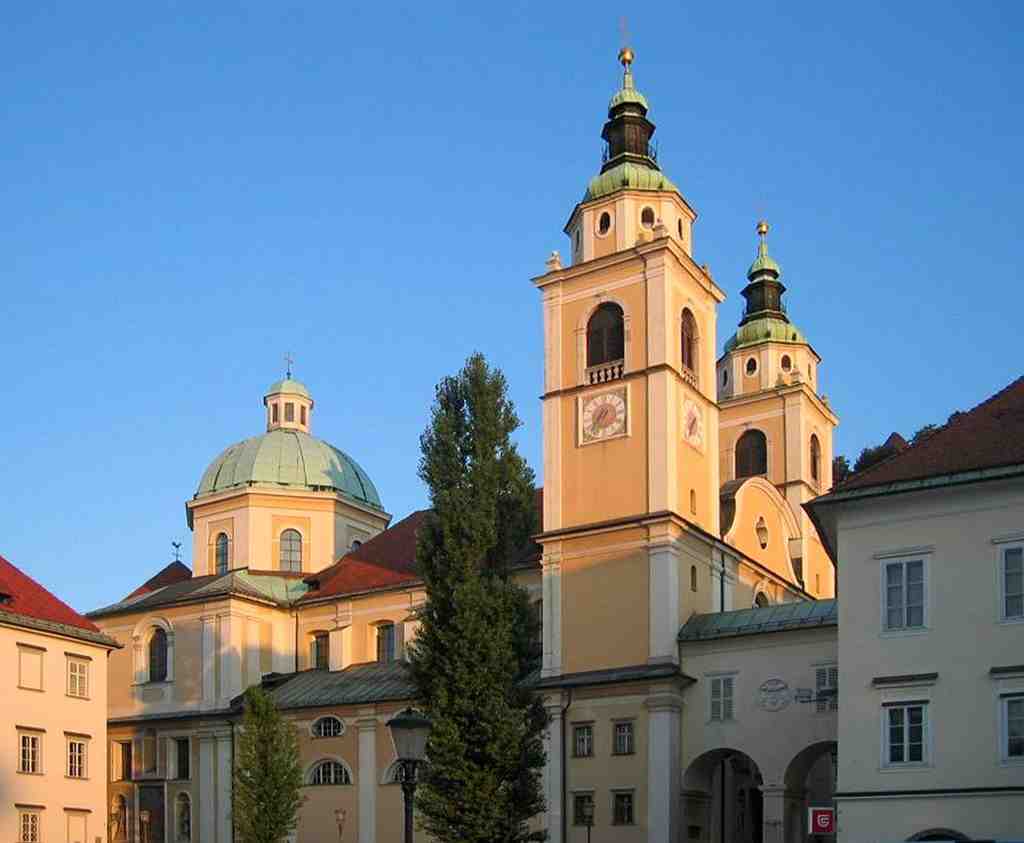
Ljubljana CathedralPhoto: Žiga, Wikimedia Commons, Public domain. Cropped & resized. Looking to your left, you will spot the pale yellow facade of Ljubljana Cathedral, defined by its twin square towers and a prominent octagonal green dome resting over the eastern wing.
The story of this site is an endless cycle of ruin and rebirth, where each catastrophic fire only fueled the desire to build something grander. Long before this elegant structure stood here, a medieval church was reduced to ash in 1361, rebuilt, and then burned to the ground again in 1469. Check your screen for an engraving showing the old Gothic structure that stood here before the Baroque rebuild. That second blaze was a crushing blow, widely believed to be an act of arson by Ottoman raiding parties. Yet, the ashes had barely cooled before locals started planning a new spiritual center.
By 1700, the daunting task fell to Dean Janez Gregor Dolničar, who found himself trying to build a masterpiece right in the middle of a massive city wide construction boom. He spent years as the project's main agitator, wrestling with soaring wages for masons and severe shortages of materials just to get the foundation laid.
The budget was stretched so thin by these shortages that they could not even afford a real stone dome. So, they simply faked it. They hired an Italian master painter, Giulio Quaglio, to create a cupola finta, which is a painted illusion on a flat wooden truss that looks exactly like a soaring dome. You can take a look at your app to see some of Quaglio's magnificent interior frescoes. His painted dome was so convincing that in 1703, a bird flew into the cathedral and repeatedly attempted to fly out through one of the painted windows. That wooden optical illusion served as the ceiling for over a hundred and thirty years before the real octagonal dome you see outside was finally built in 1841.
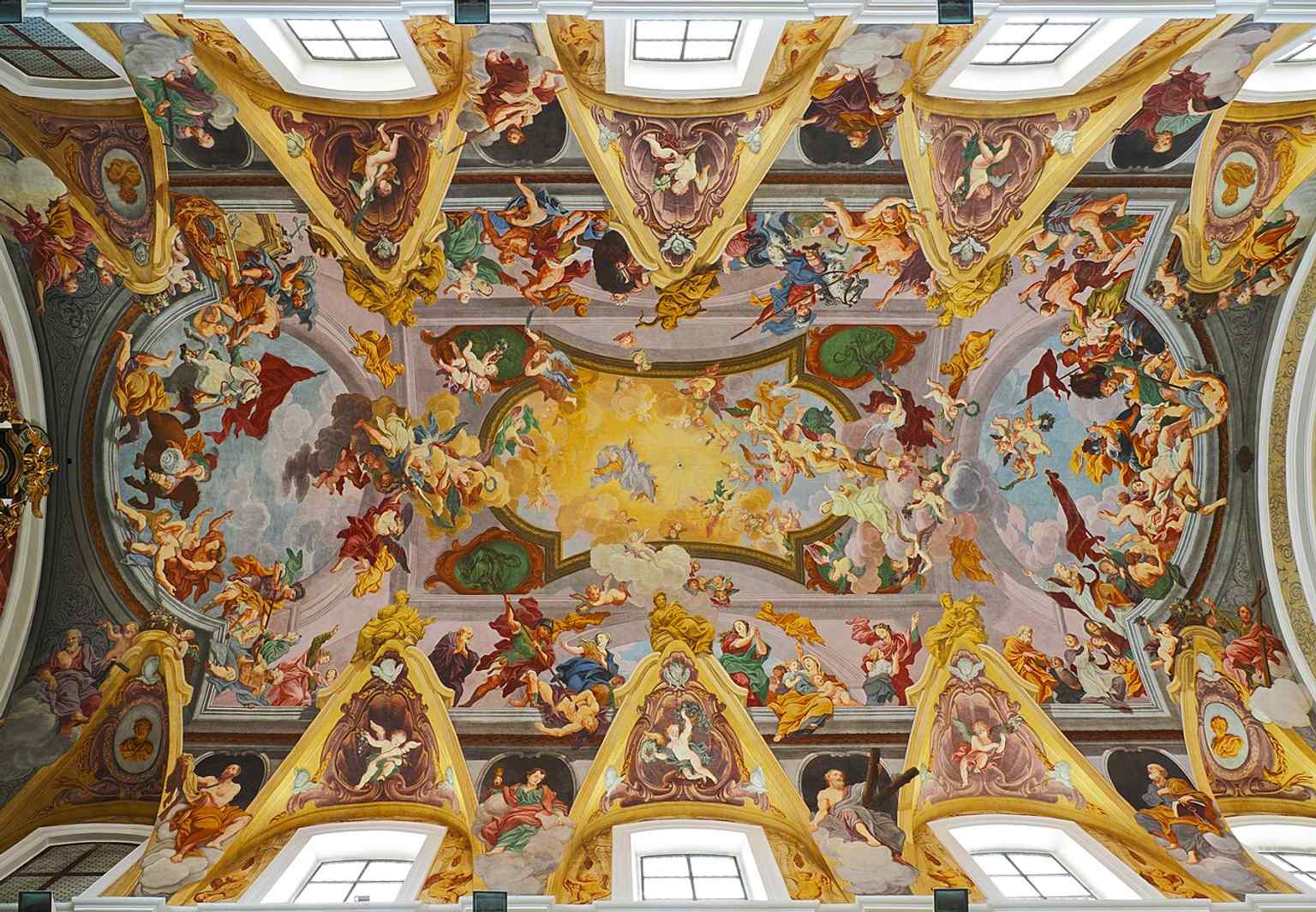
These magnificent Baroque ceiling frescoes are the work of Italian master Giulio Quaglio, whose self-portrait, alongside scenes of Saint Nicholas's miracles, can be found in the presbytery.Photo: Petar Milošević, Wikimedia Commons, CC BY-SA 4.0. Cropped & resized. You can feel that same stubborn ambition on the cathedral doors. The front entrance, called the Slovene Door, completely lacks traditional handles. People just grab a piece of the bronze sculpture itself, polishing it to gleaming gold with thousands of hands. The side entrance tells a much darker story. It features a portrait of Anton Vovk, a twentieth-century archbishop. He survived a brutal assassination attempt in 1952 where he was doused in gasoline and set on fire at a train station. Despite horrific burns, he survived and kept working. His face on that door is a quiet, permanent testament to enduring through the unthinkable.
Even the earth itself tried to tear this place down. The 1895 earthquake severely cracked the western gable, the decorative upper wall between the two towers. For almost a century, they had to use a simpler, safer triangular roofline until finally reconstructing the original curved Baroque design in 1989.
If you want to step inside, the cathedral is usually open daily from late morning through the afternoon, though Sunday hours are split into shorter windows. For now, let us head toward the vivid colors of Prešeren Square, where the Church of the Annunciation is waiting for us just a short six minute walk away.
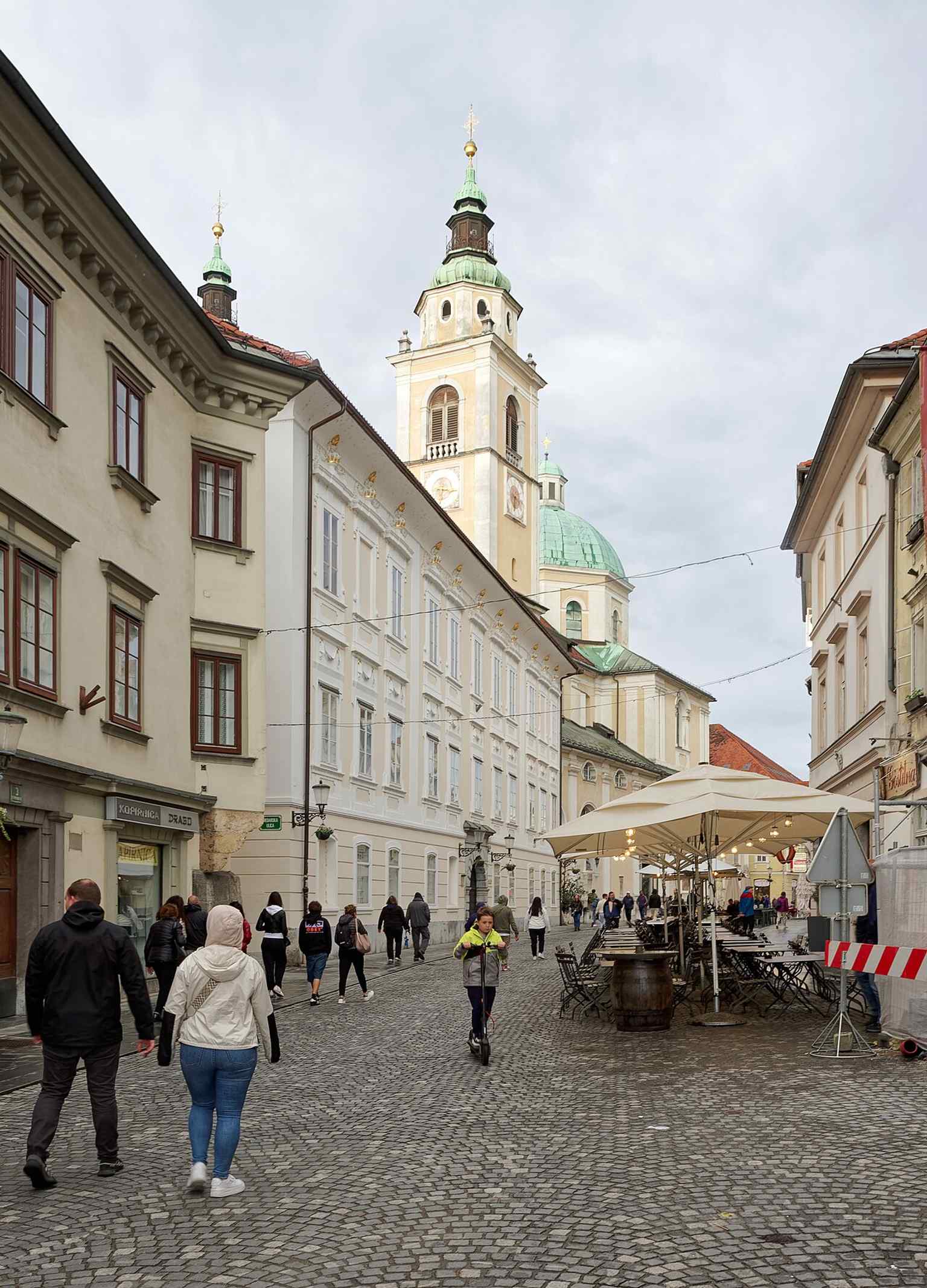
Ljubljana Cathedral, with its distinctive green dome and twin towers, stands prominently in Cyril and Methodius Square, an easily recognizable landmark of the city.Photo: Jakub Hałun, Wikimedia Commons, CC BY 4.0. Cropped & resized. 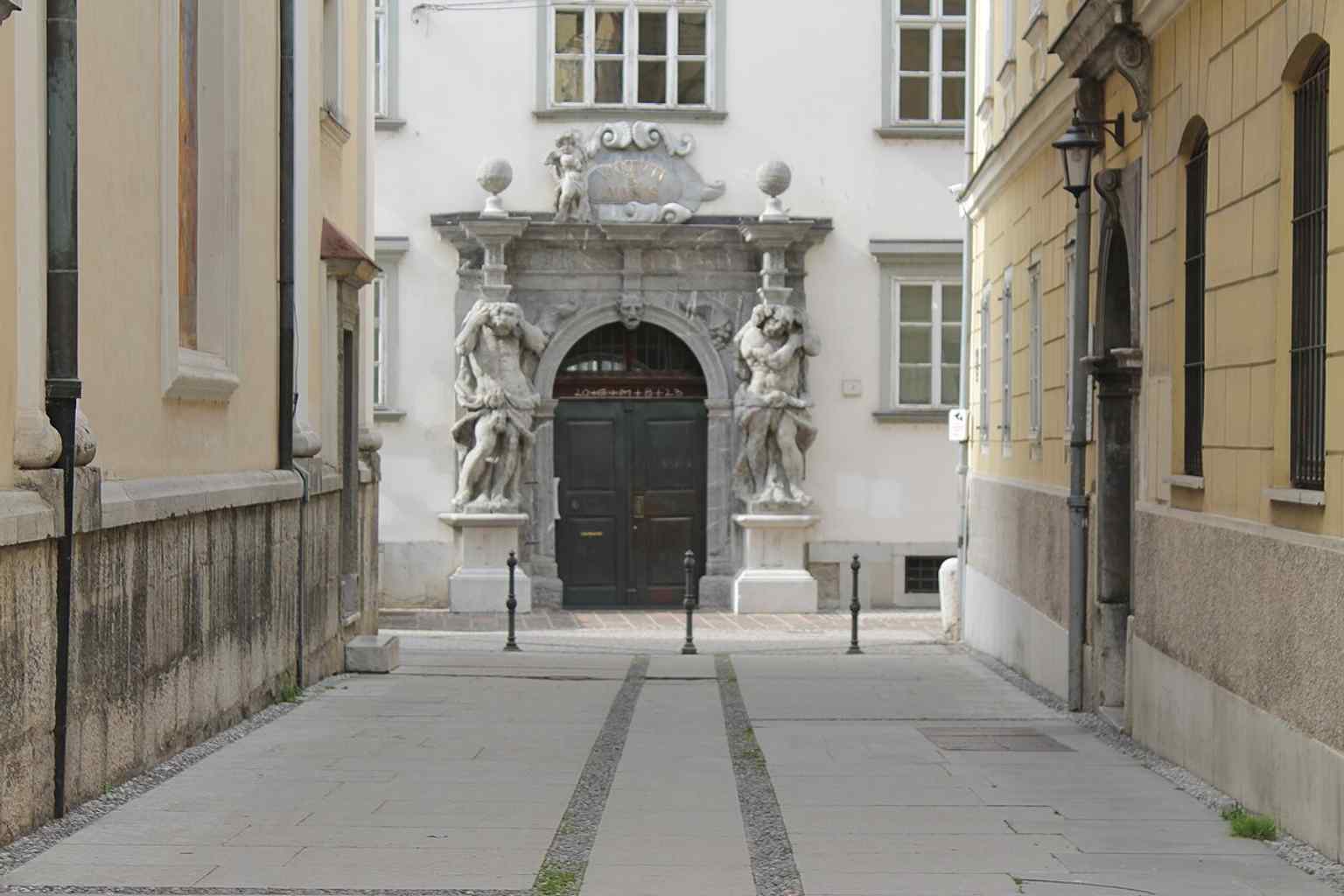
The eastern facade showcases the octagonal dome, built by Matej Medved in 1841, which replaced Giulio Quaglio's 'cupola finta'—an illusionistic fake dome that served for over 130 years.Photo: John Samuel, Wikimedia Commons, CC BY-SA 4.0. Cropped & resized. 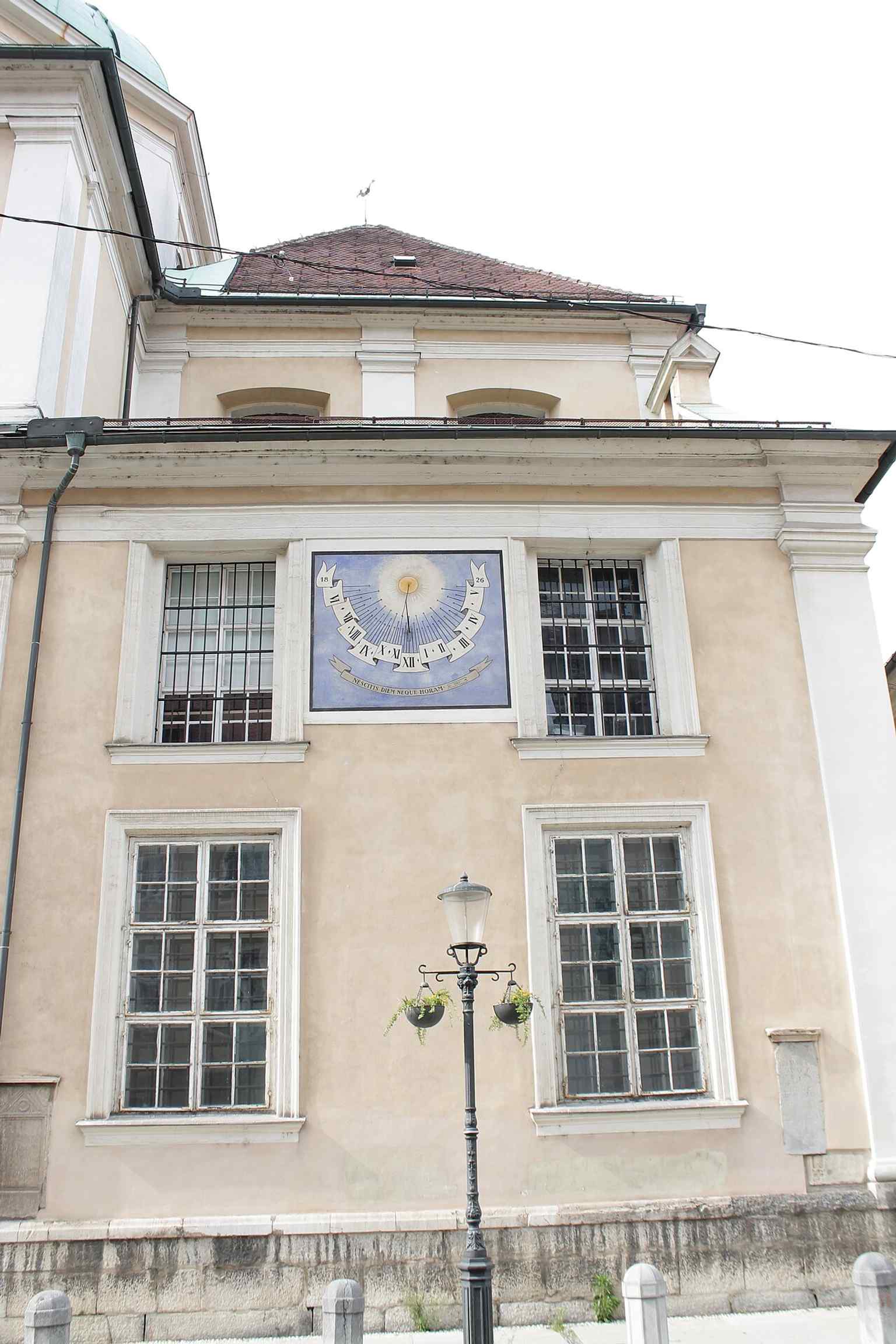
This sundial on the southern facade, dating to 1826, bears the Latin motto 'Nescitis diem neque horam' ('You don't know the day or the hour'), reminding onlookers of life's brevity.Photo: John Samuel, Wikimedia Commons, CC BY-SA 4.0. Cropped & resized. 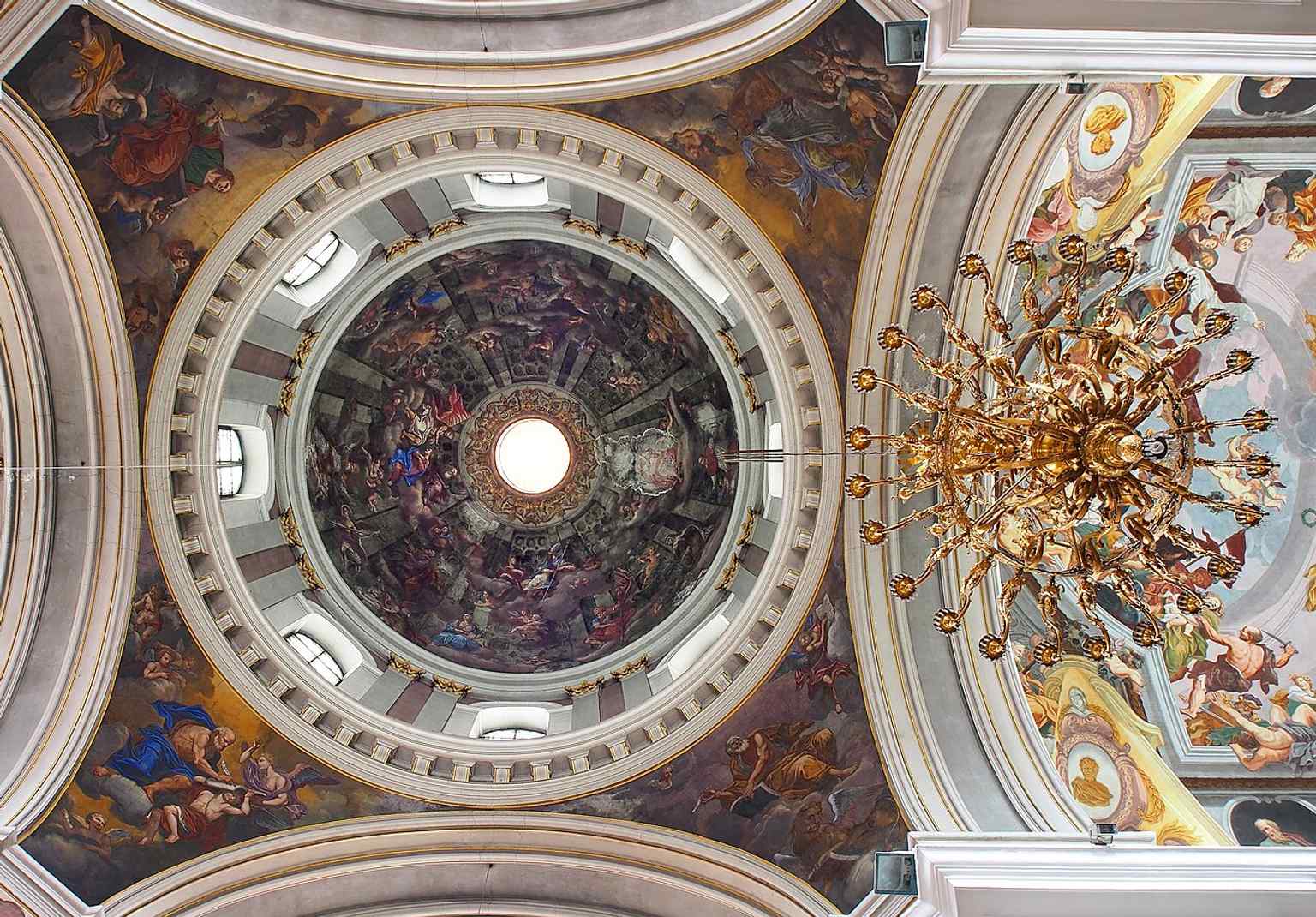
The frescoes within the cupola, painted by Matej Langus in 1843–44, depict the Holy Spirit and angels, and the glorification of Saint Nicholas, surrounded by angels and saints.Photo: Petar Milošević, Wikimedia Commons, CC BY-SA 4.0. Cropped & resized. 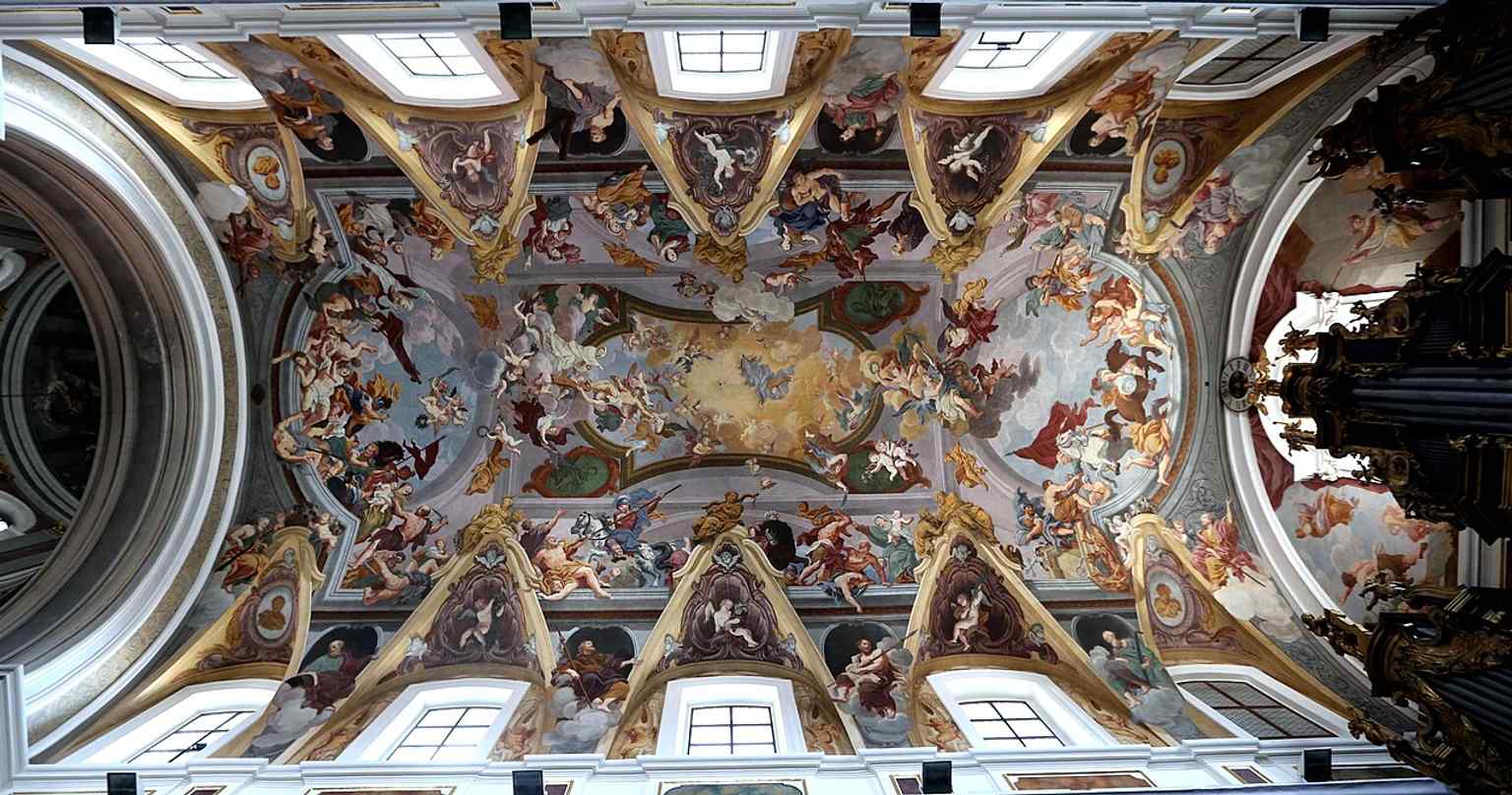
The opulent interior is adorned with significant Baroque elements, including the altar angels by the brothers Paolo and Giuseppe Groppelli and Francesco Robba, contributing to the 'Gesamtkunstwerk' (total work of art).Photo: Thaler Tamas, Wikimedia Commons, CC BY-SA 4.0. Cropped & resized.
Show 13 more stopsShow fewer stopsexpand_moreexpand_less
Look to your left and find the towering early Baroque church, defined by its smooth salmon-pink facade, a sweeping triangular pediment, and two square bell towers rising behind…Read moreShow less
Open dedicated page →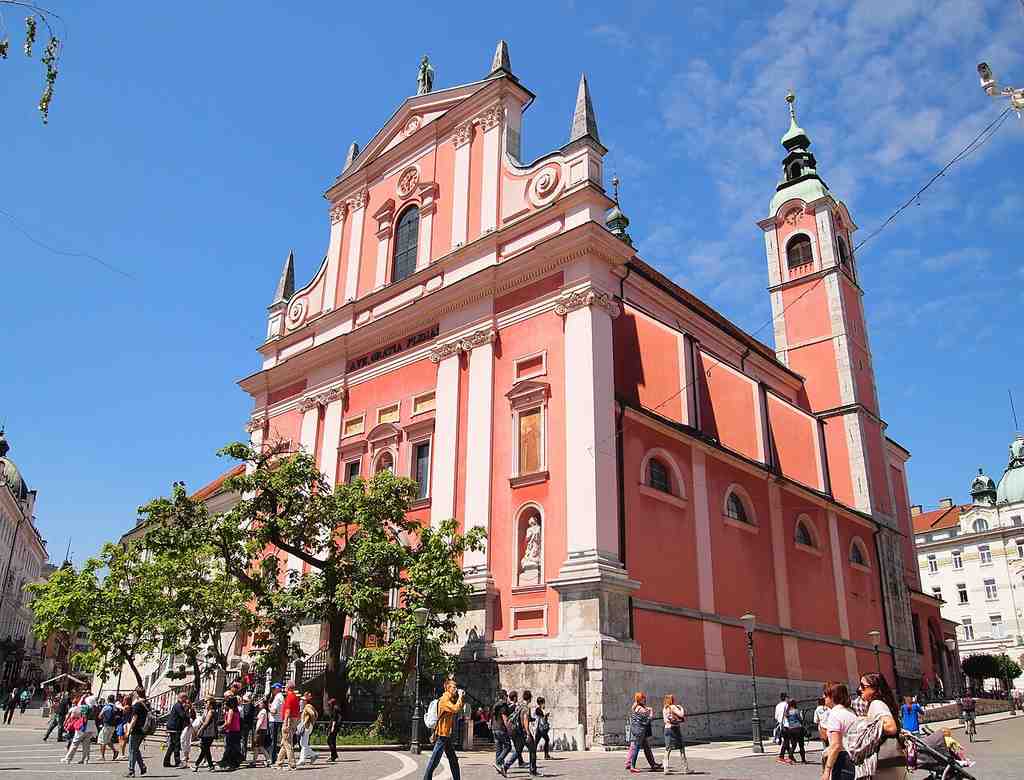
Church of the Annunciation, LjubljanaPhoto: Tiia Monto, Wikimedia Commons, CC BY-SA 3.0. Cropped & resized. Look to your left and find the towering early Baroque church, defined by its smooth salmon-pink facade, a sweeping triangular pediment, and two square bell towers rising behind it. It is hard to miss, standing out vibrantly against the surrounding architecture.
Take a glance at your screen to see a wider shot of this striking facade. That distinctive salmon pink is not a modern aesthetic choice, nor was it the original color. When the church was first built in the mid seventeenth century, it was painted stark white. But in the late eighteenth century, the city underwent the Josephinian Reforms. These were a series of strict imperial decrees by Emperor Joseph II that aggressively reorganized or shut down religious orders. The reforms forced the original occupants, the Augustinian monks, out of the building. The Franciscans then moved in and painted the entire church a bold, deep red, a color symbolizing their religious order. Over decades of harsh sunlight, that fierce red faded into the soft salmon pink you see today. When the time came for renovations, purists suggested repainting it red, but the citizens had grown so attached to the faded pink that the Franciscans deliberately preserved it.
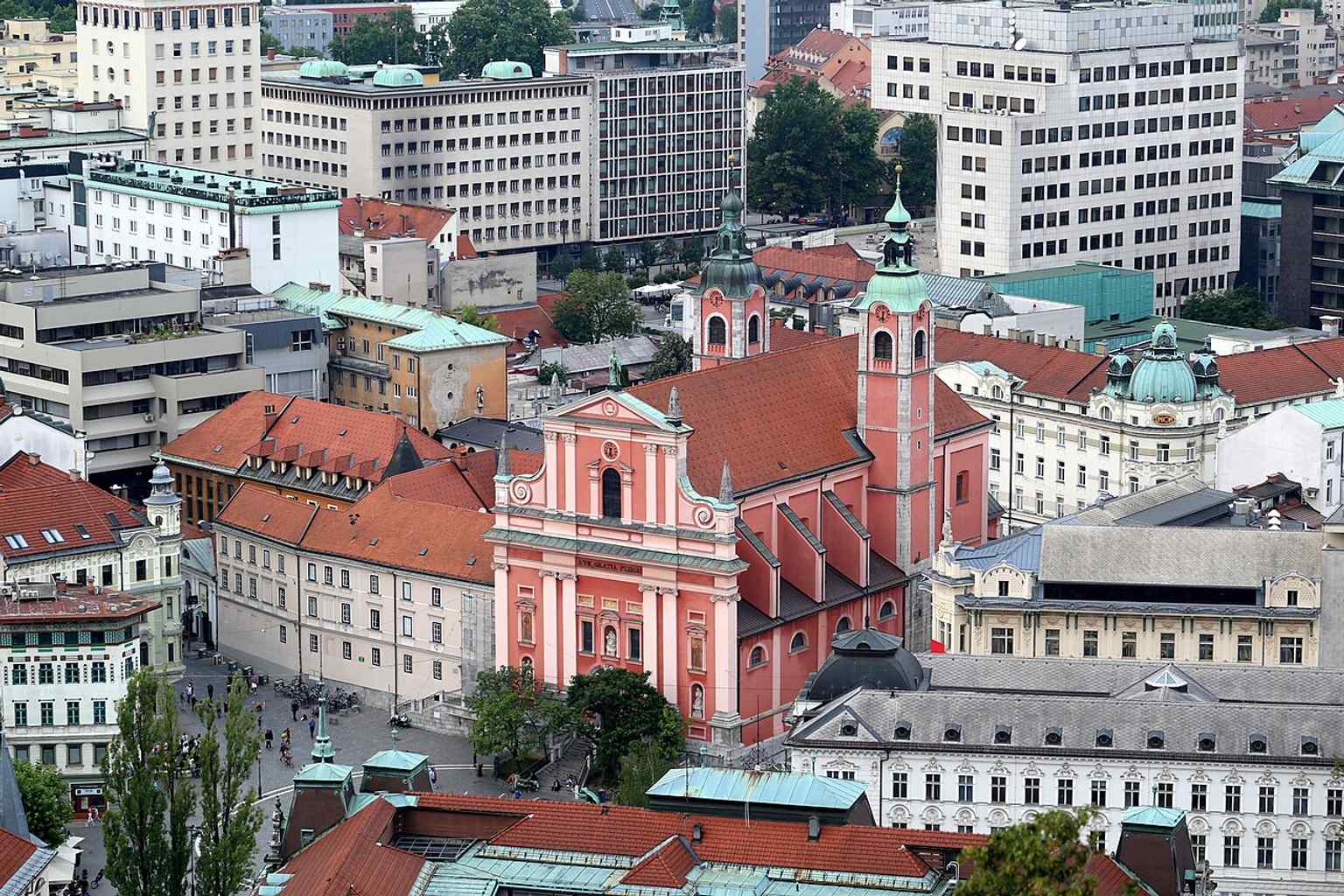
The Church of the Annunciation on Prešeren Square, known for its distinctive salmon-pink color, a shade adopted after the Franciscans took over in the church in the 18th century.Photo: Thaler Tamas, Wikimedia Commons, CC BY-SA 4.0. Cropped & resized. Behind that cheerful exterior lies a rather devastating origin story. In 1645, a fire severely damaged the old church on this site. Around the same time, a wealthy local noble named Baron Konrad Ruessenstein received unbearable news. His son, Janez Karel, had died unexpectedly while studying in Rome. Heartbroken, the Baron decided to take the entirety of his late son's inheritance and donate it to rebuild this church.
He had only one condition. He required the builders to include a Loreto chapel, a specific type of Catholic shrine modeled after the purported home of the Virgin Mary in Nazareth, which would serve as a family tomb and a permanent memorial for his boy.
Check your app again for a close up of the grand main entrance. If you look just above those central doors, you will see a massive stone coat of arms held up by two lions. That is the Ruessenstein family crest, sitting there as a quiet, heavy reminder of a father's grief.
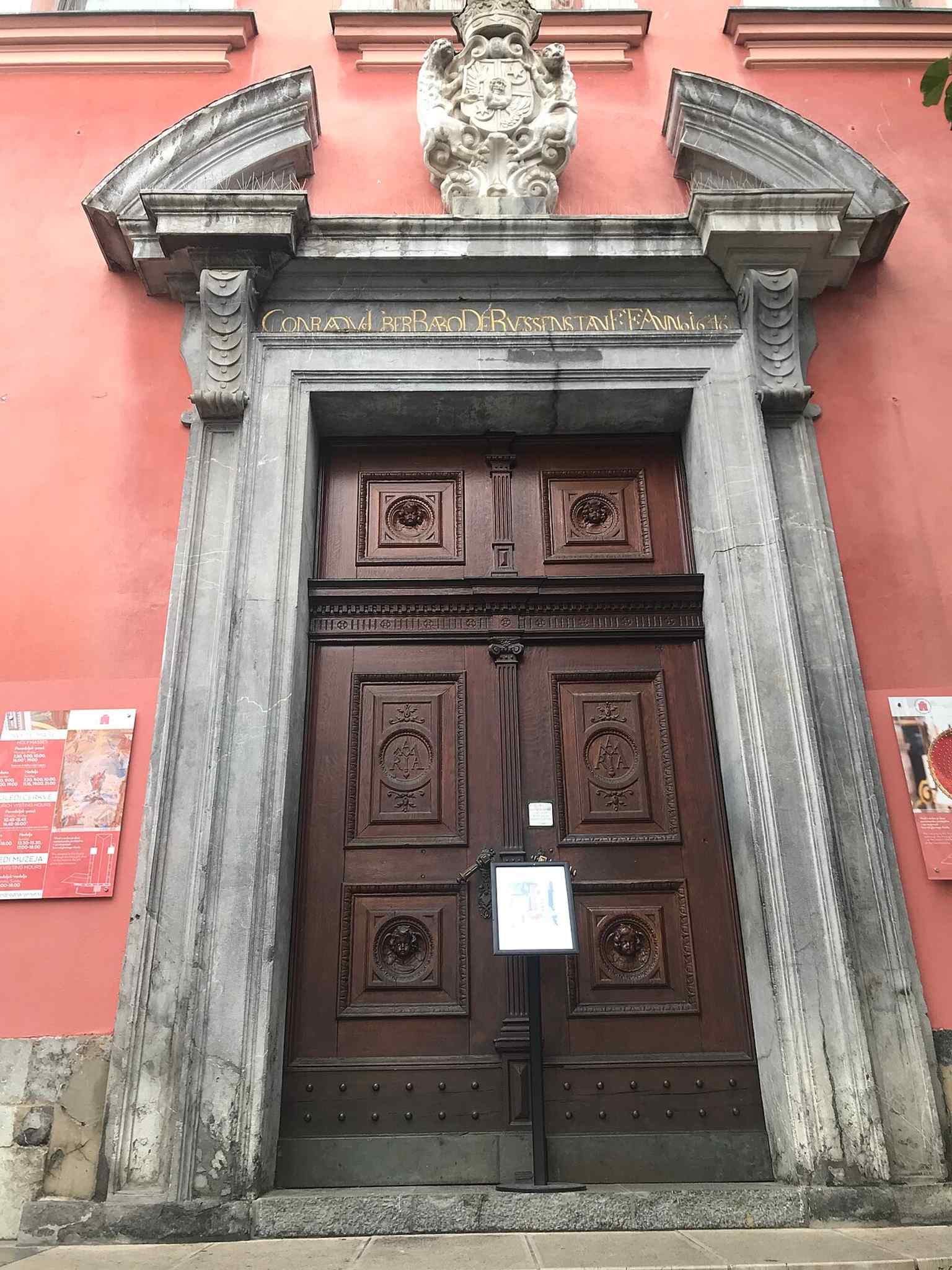
The grand main entrance of the church, above which the powerful stone coat of arms of the Ruessenstein family, who generously funded the church's reconstruction, is displayed.Photo: Antimuonium, Wikimedia Commons, CC BY-SA 4.0. Cropped & resized. Look all the way up to the very top of the pediment, the large triangular section crowning the front wall. That copper statue of the Madonna is the largest of its kind in Ljubljana, added in 1858 to replace an older wooden statue. Since the copper figure is hollow, it quickly became a highly sought after luxury condominium for local pigeons, eventually requiring protective spikes to keep the birds out.
Let us stay right here in the square for a moment to appreciate a few more details of the exterior, before we head just a few steps over to explore more of the Franciscan Church of the Annunciation. If you want to see the interior later, the church is open most days from mid morning to late afternoon, with a short break for lunch.
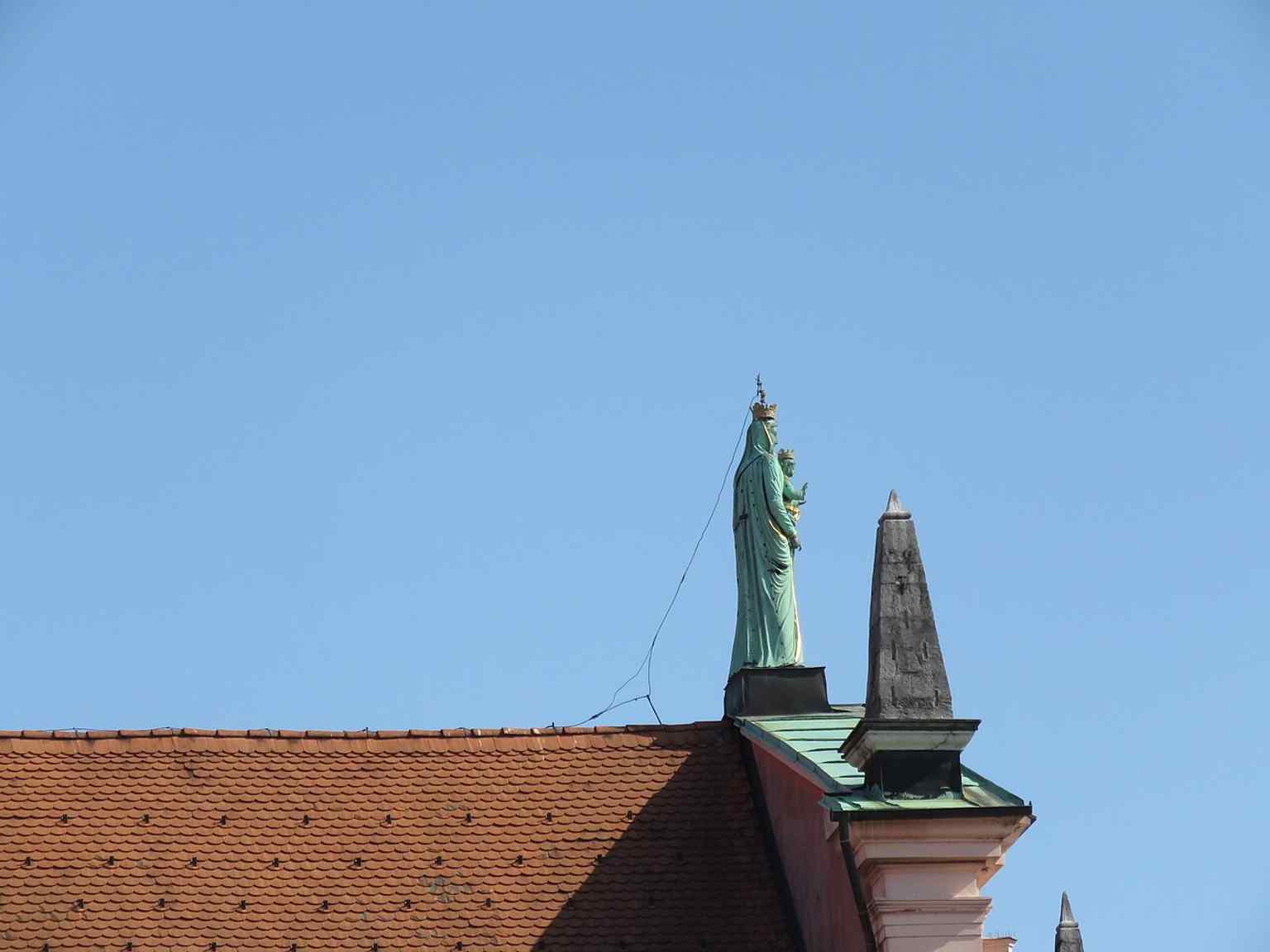
The largest copper Madonna statue in Ljubljana crowns the church's pediment, replacing an older wooden "Black Madonna" in 1858.Photo: G-Cup, Wikimedia Commons, CC BY-SA 4.0. Cropped & resized. 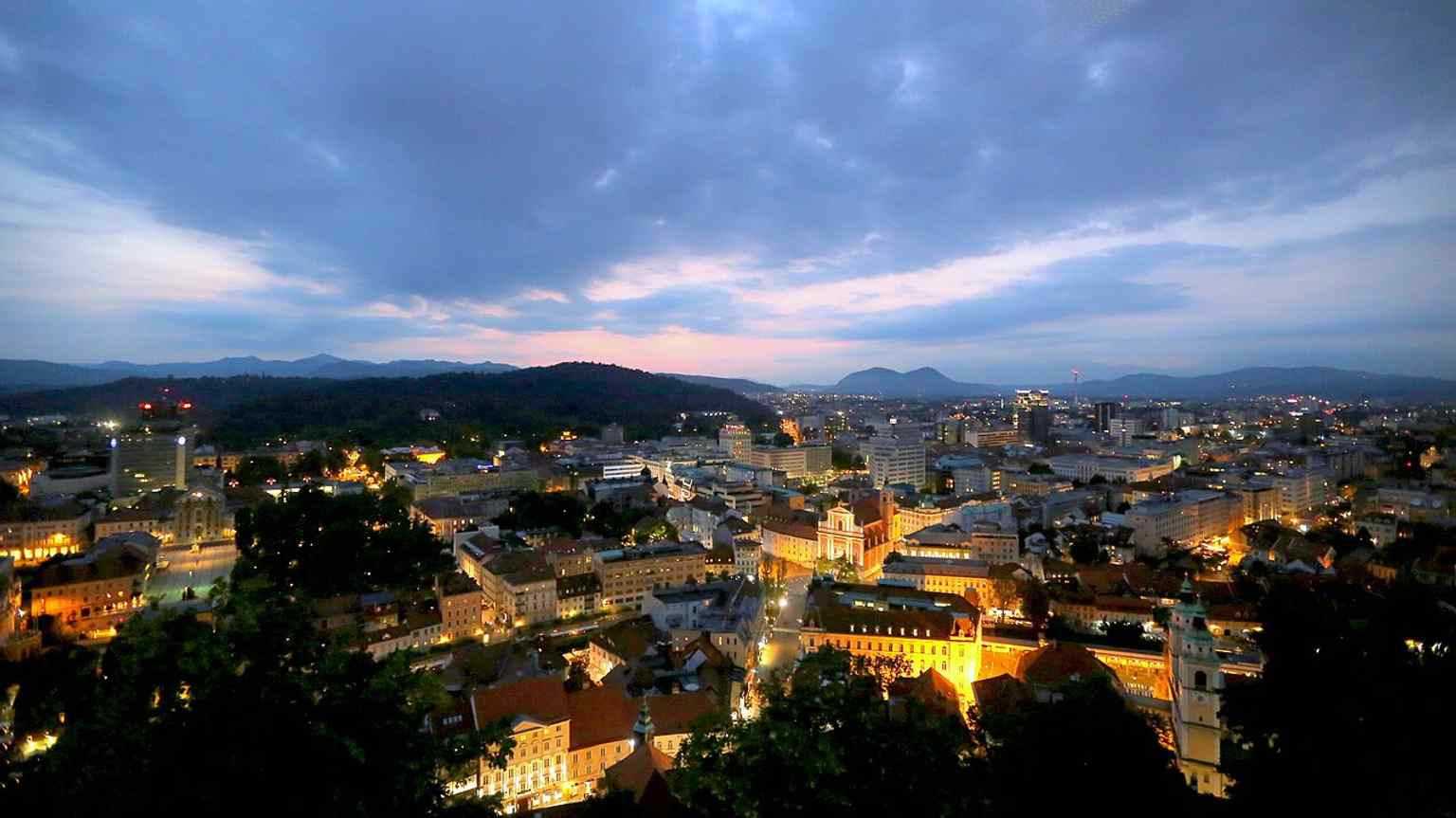
An aerial view of the Franciscan Church of the Annunciation, showcasing its strategic location on Prešeren Square next to the Ljubljanica River.Photo: Thaler Tamas, Wikimedia Commons, CC BY-SA 4.0. Cropped & resized. 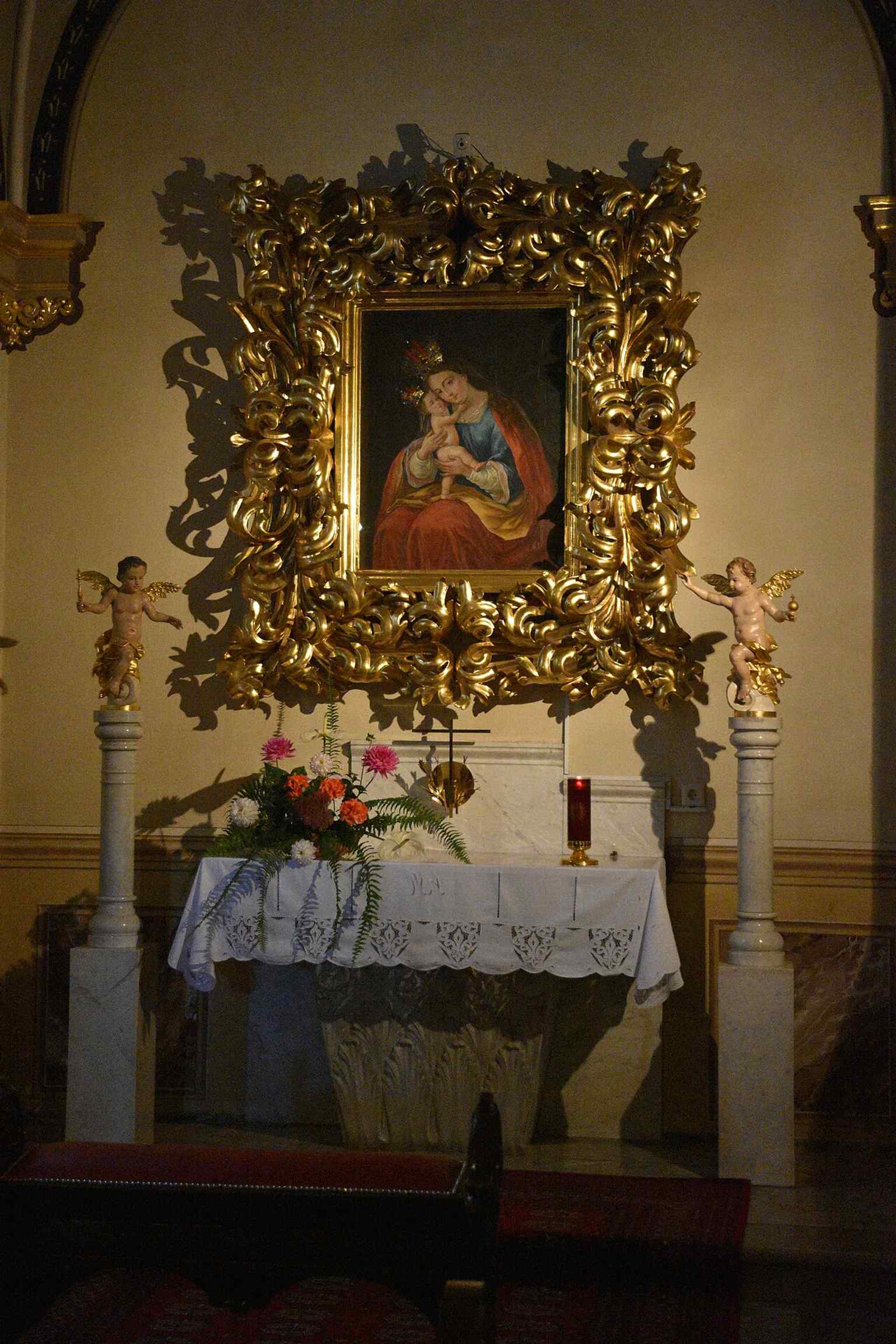
The monumental Baroque main altar, a masterpiece created by Venetian sculptor Francesco Robba, though he died before its full completion in 1757.Photo: Arths-at, Wikimedia Commons, CC BY-SA 4.0. Cropped & resized. 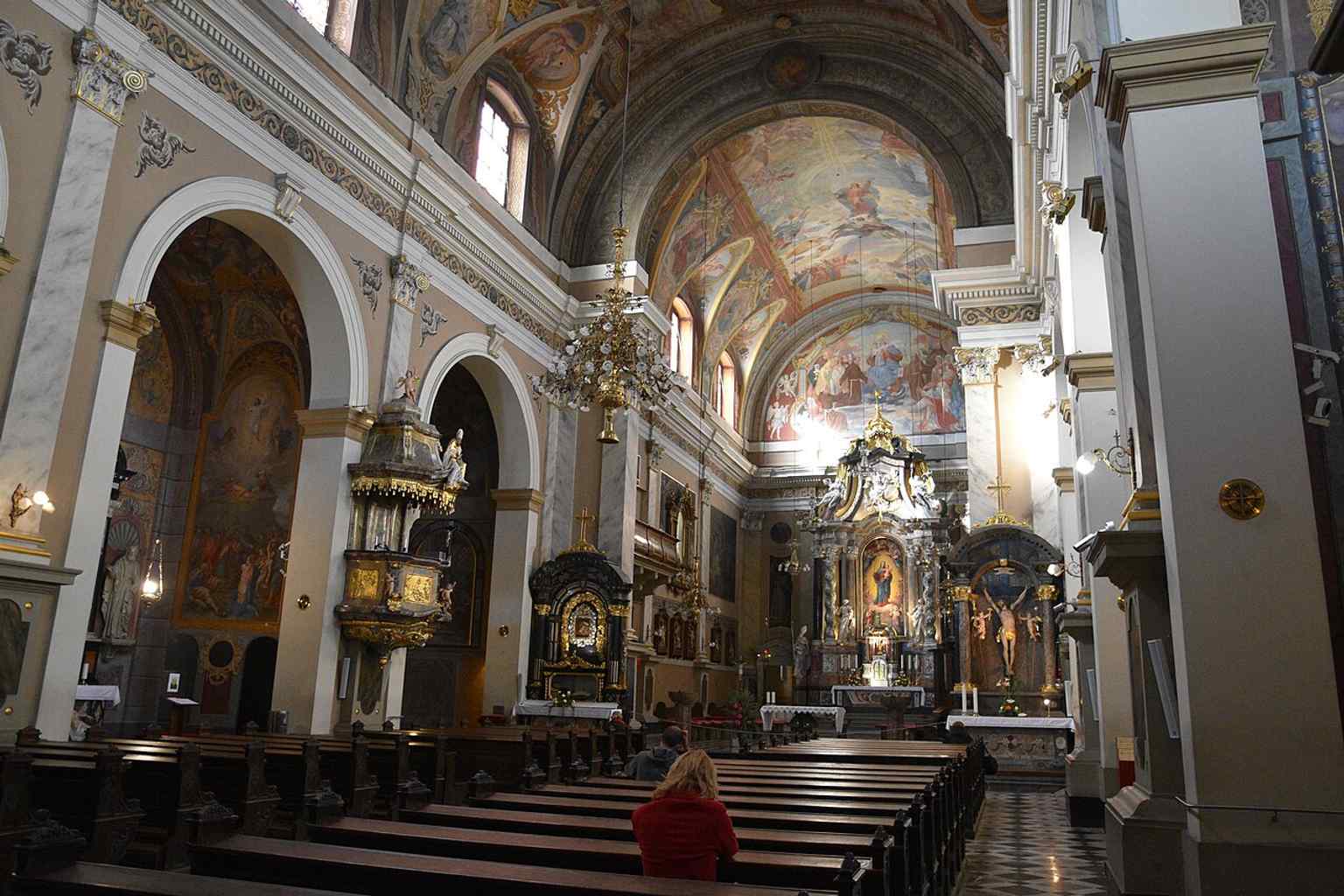
The vibrant ceiling frescoes, painted in the 1930s by Matej Sternen in an illusionistic Baroque style after the originals were destroyed in the 1895 earthquake.Photo: Arths-at, Wikimedia Commons, CC BY-SA 4.0. Cropped & resized. The building towering on your left features a grand, salmon-pink stucco facade divided by tall white pilasters, topped with a sweeping curved gable and flanked by a square bell…Read moreShow less
Open dedicated page →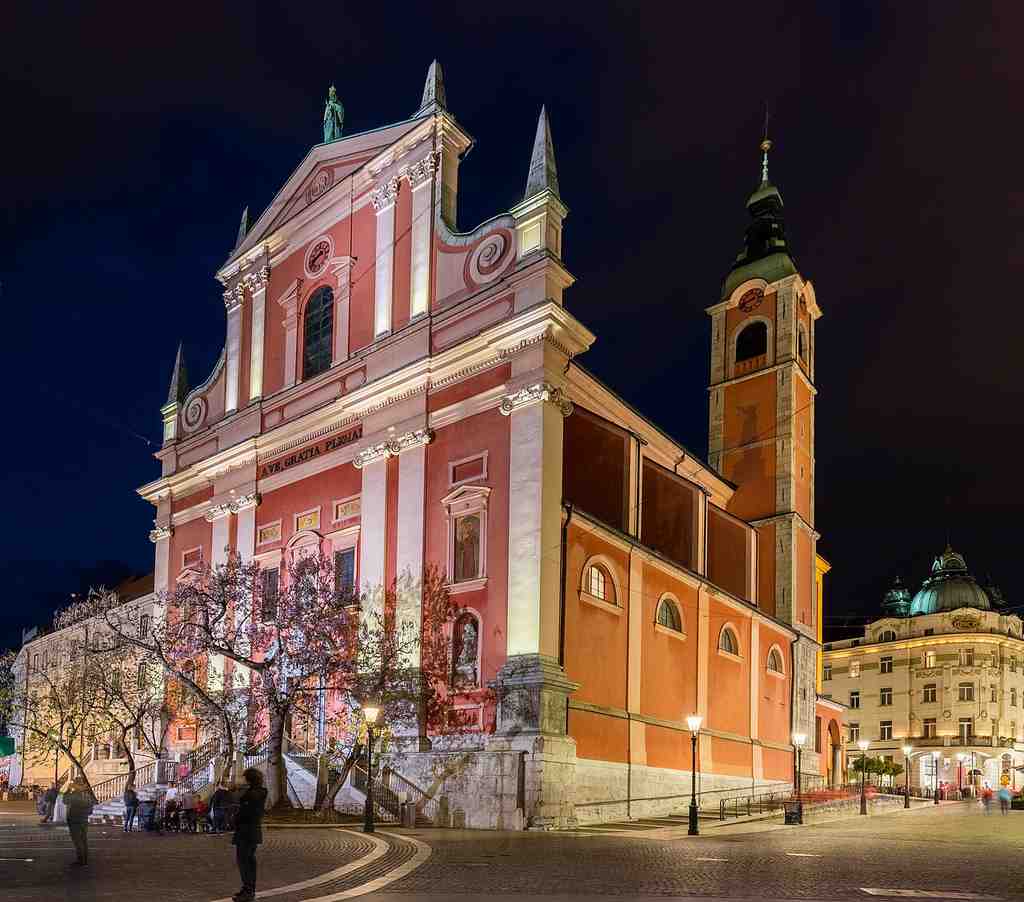
Franciscan Church of the AnnunciationPhoto: Diego Delso, Wikimedia Commons, CC BY-SA 4.0. Cropped & resized. The building towering on your left features a grand, salmon-pink stucco facade divided by tall white pilasters, topped with a sweeping curved gable and flanked by a square bell tower.
That distinctive pink was not always so delicate. Take a look at the image on your screen to see how it anchors the area. Though you now know the story behind this legally protected faded pink facade, the interior holds secrets of its own.
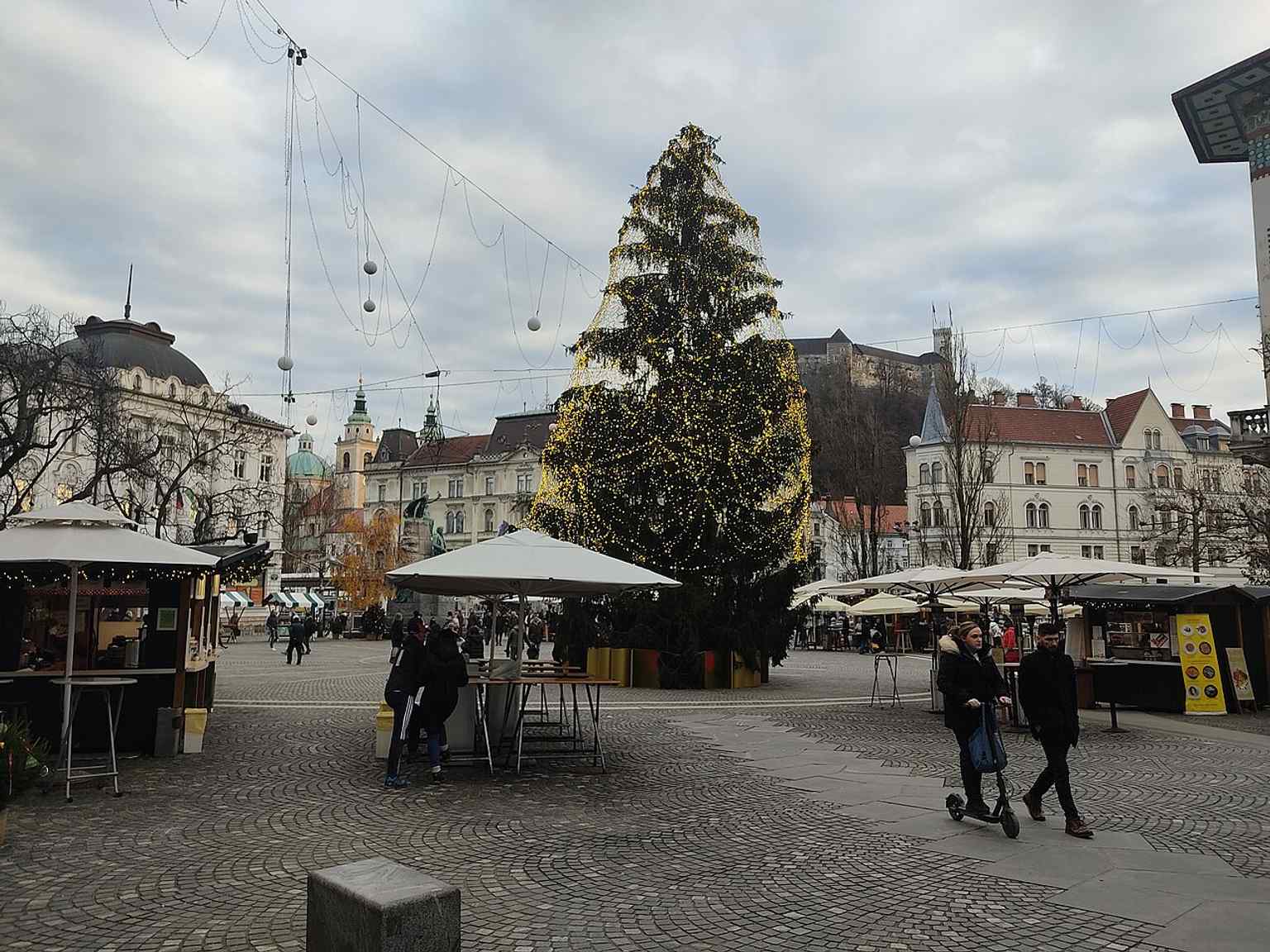
The Franciscan Church dominates Prešeren Square with its distinctive salmon-pink facade, a color so beloved by citizens that authorities made it the monument's official, protected appearance.Photo: Viktar Palstsiuk, Wikimedia Commons, CC BY-SA 4.0. Cropped & resized. Inside, the church holds a monumental Baroque main altar designed by the celebrated Italian sculptor Francesco Robba. Robba originally came to Ljubljana from Venice for a temporary commission, but he fell in love with a local woman and stayed for good, pouring his personal devotion into the intricate marble craftsmanship.
Yet, beneath this romance lies a more eerie sacrifice and immense physical toll. To the left of Robba's grand altar rests a glass-fronted coffin holding the preserved skeletal remains of Saint Deodatus, a seventh-century French bishop who abandoned his power to live as an isolated mountain hermit, offering a stark, spooky contrast to the gilded splendor.
Look high up at the very top of the curved facade... can you spot the tall copper Madonna keeping watch? That statue of Our Lady of Loretto weighs over four hundred kilograms, representing an enormous, agonizing physical labor to hoist above the city back in 1858.
The art inside tells a deeper story of creation and sudden ruin. In the mid-nineteenth century, painter Matevz Langus spent years painstakingly covering the vaulted ceiling... the soaring arched roof over the central hall... with beautiful frescoes. Tragically, he died of cholera just hours before the grand consecration of his work. Decades later, the devastating Easter earthquake of 1895 cracked the architecture wide open, sending his masterpiece crashing down. The space remained bare and scarred until the 1930s, when another artist meticulously painted new illusions of depth to bridge the gap between the building's origins and its modern survival.
The church is open to visitors most days between mid-morning and late afternoon if you want to explore the interior yourself. But for now, let us pull our eyes away from the fading walls and take in the wide expanse right at our feet, as we move fully into Preseren Square.
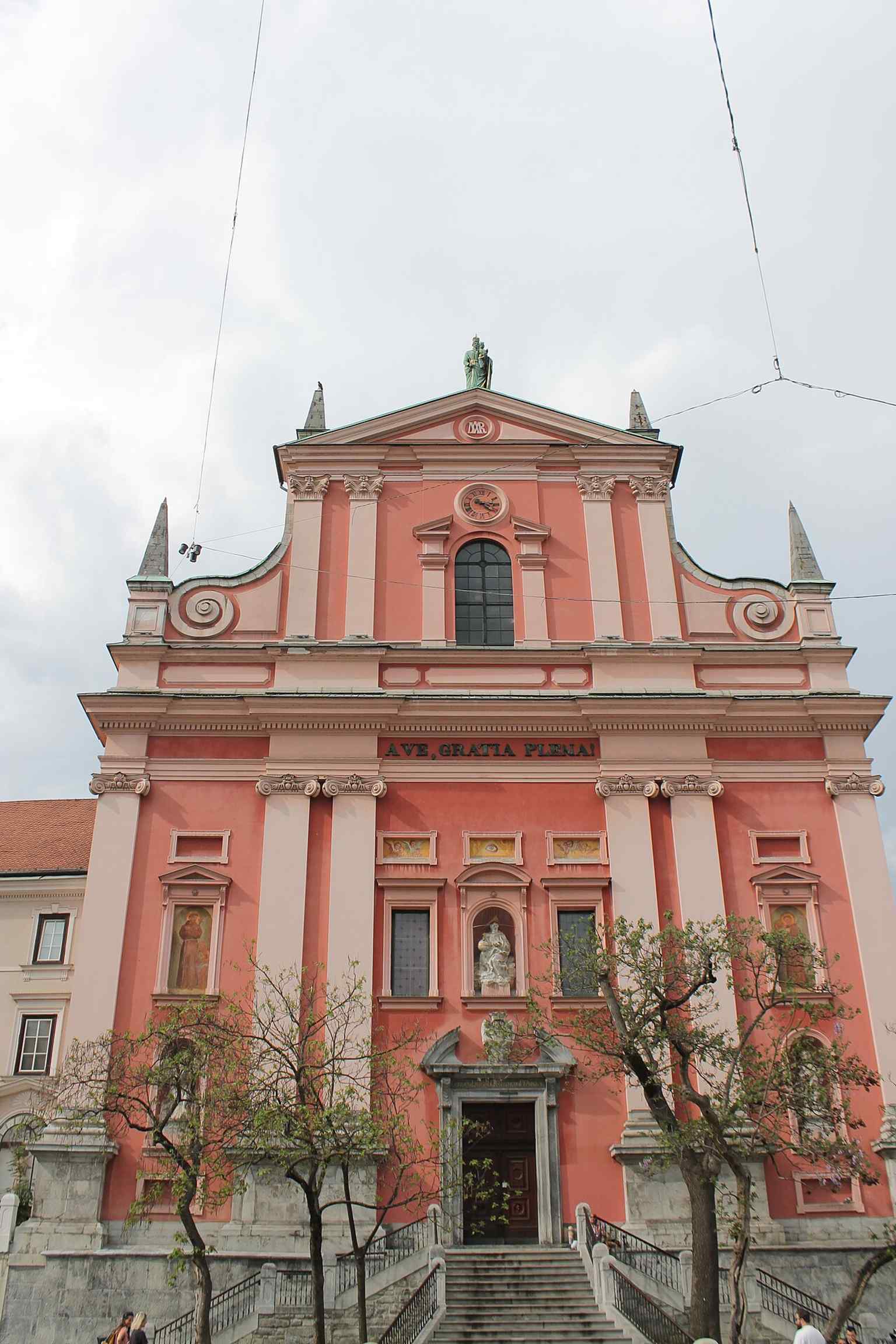
This vibrant facade, now a soft salmon-pink, was originally a bold red, symbolizing the Franciscan order, but faded over centuries to its officially protected hue.Photo: John Samuel, Wikimedia Commons, CC BY-SA 4.0. Cropped & resized. 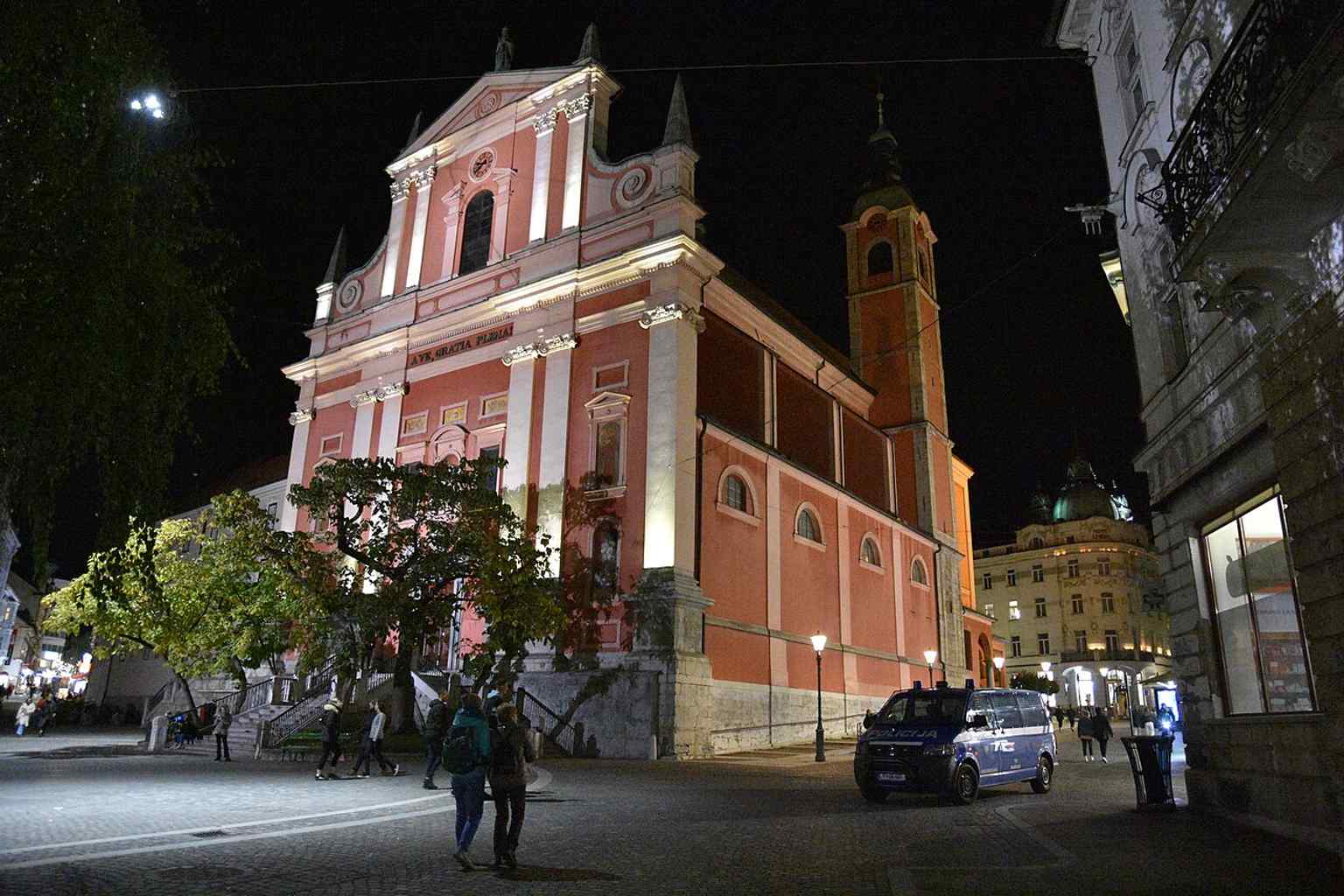
See the Franciscan Church of the Annunciation illuminated at night, a landmark originally built by the Augustinians between 1646 and 1660 before becoming a Franciscan site in the late 18th century.Photo: Arths-at, Wikimedia Commons, CC BY-SA 4.0. Cropped & resized. 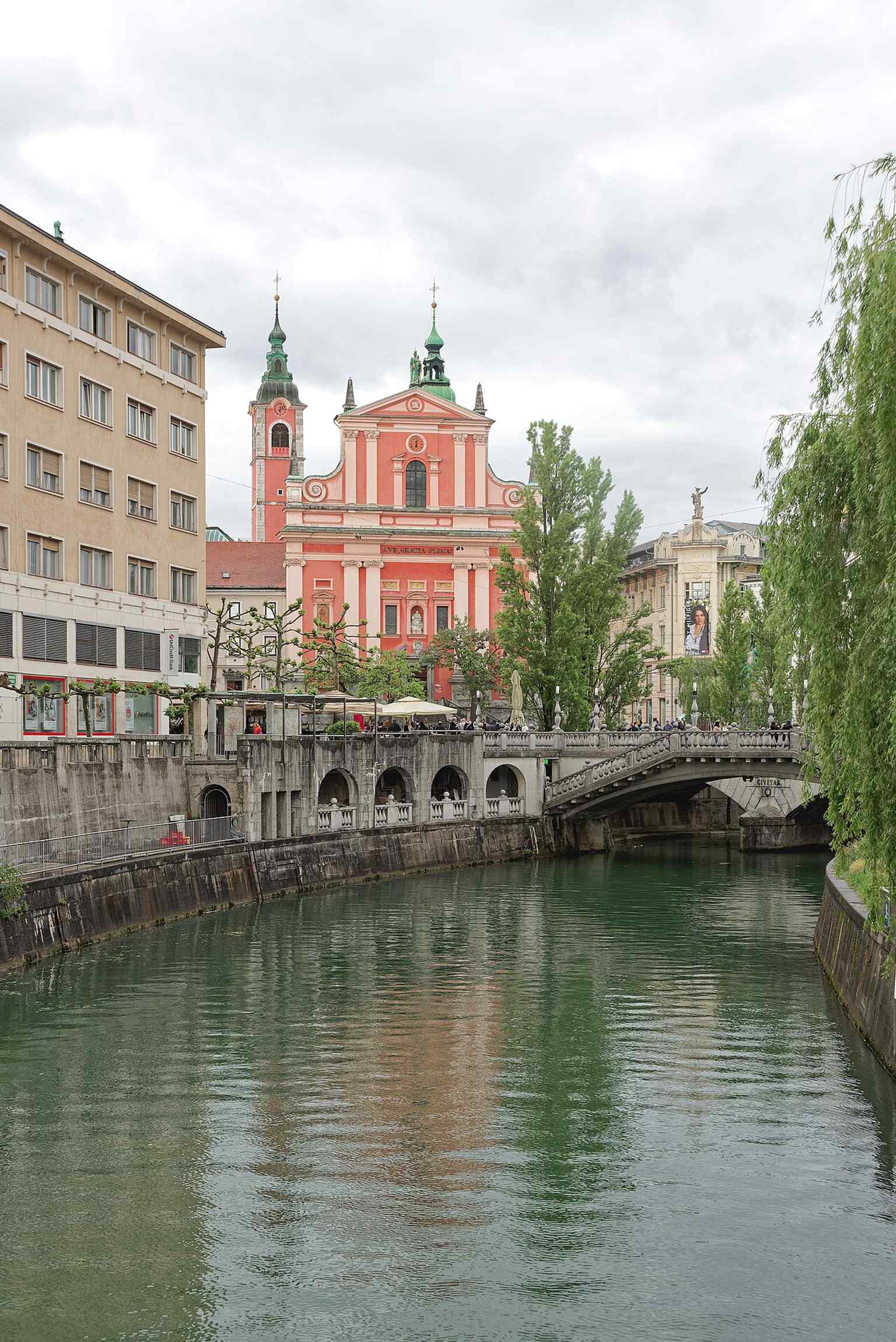
The Franciscan Church stands prominently by the Ljubljanica River, a central location chosen by the Franciscans after relocating from their original 13th-century monastery.Photo: Jakub Hałun, Wikimedia Commons, CC BY 4.0. Cropped & resized. 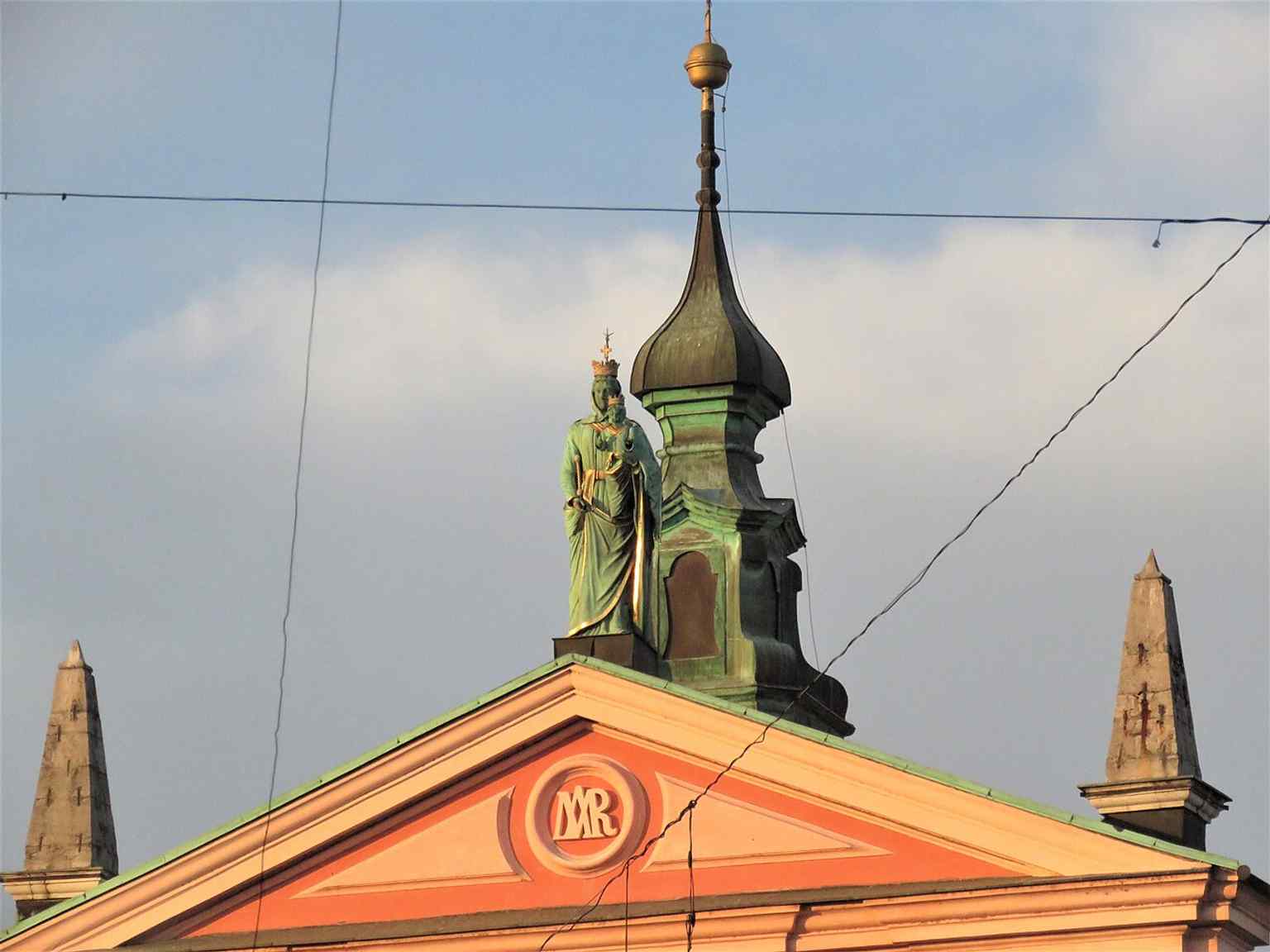
High atop the facade, this nearly four-meter-tall copper statue of Our Lady of Loretto, cast in 1858, is the largest Madonna statue in Ljubljana.Photo: G-Cup, Wikimedia Commons, CC BY-SA 4.0. Cropped & resized. 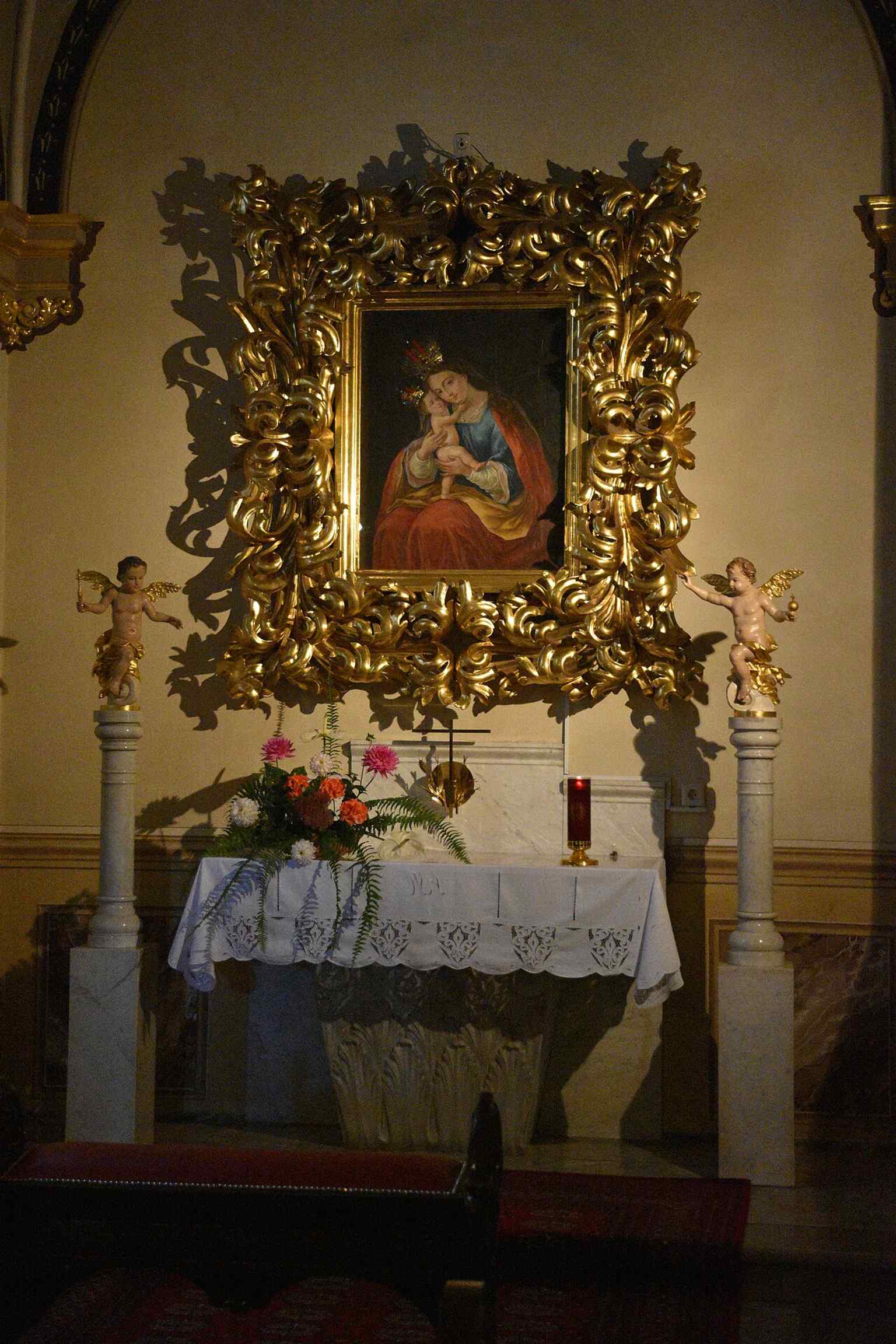
Admire the monumental Baroque main altar, a remarkable achievement by celebrated Italian sculptor Francesco Robba, who settled in Ljubljana after falling in love with a local woman.Photo: Arths-at, Wikimedia Commons, CC BY-SA 4.0. Cropped & resized. 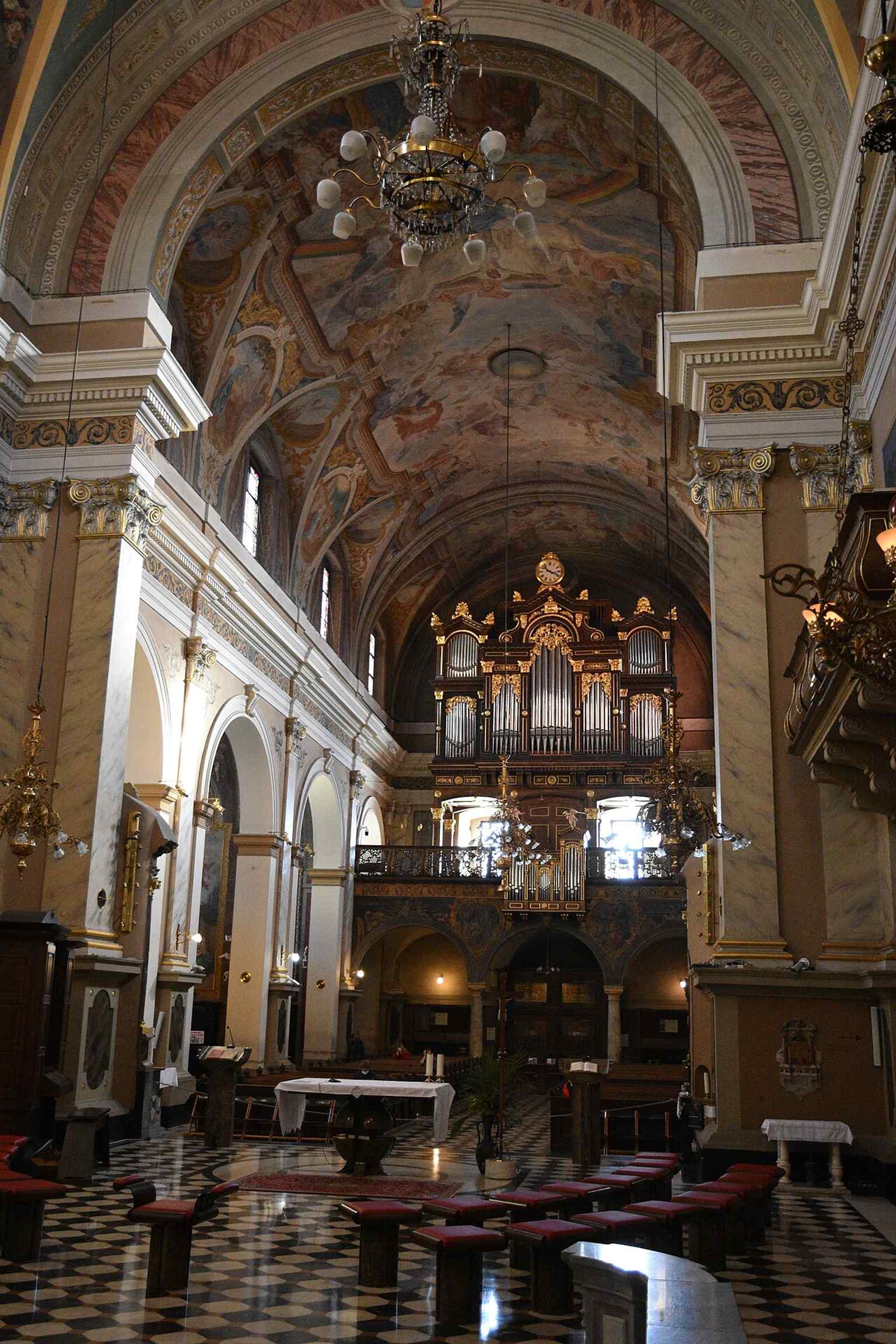
To the left of the main altar lies this glass-fronted coffin, containing the preserved skeletal remains of Saint Deodatus, offering a stark contrast to the church's gilded Baroque splendor.Photo: Arths-at, Wikimedia Commons, CC BY-SA 4.0. Cropped & resized. 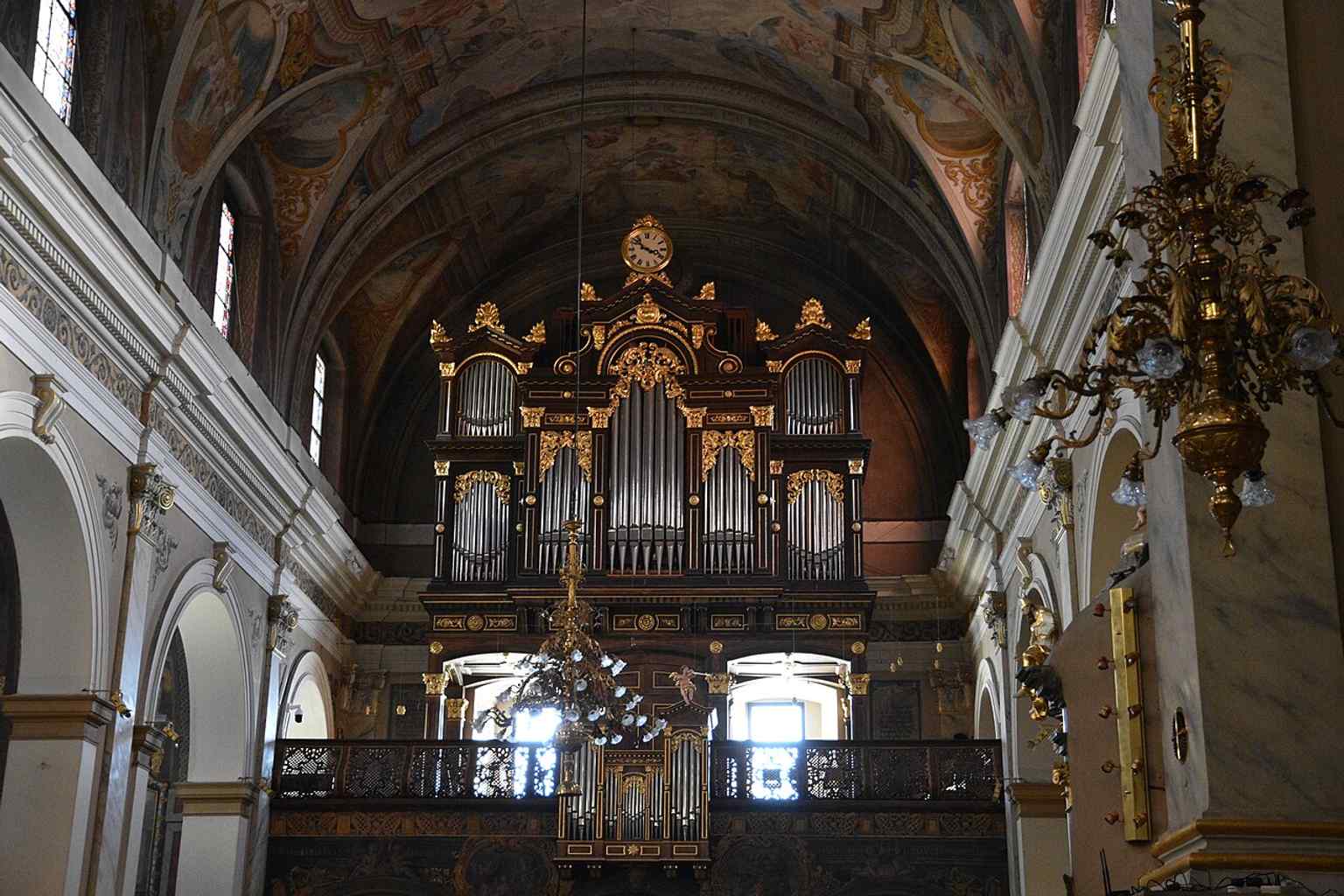
Gaze up at the ceiling frescoes, meticulously restored in the 1930s by Slovenian Impressionist Matej Sternen, who worked in the Baroque 'trompe-l'œil' style to recreate their original grandeur after the 1895 earthquake.Photo: Arths-at, Wikimedia Commons, CC BY-SA 4.0. Cropped & resized. 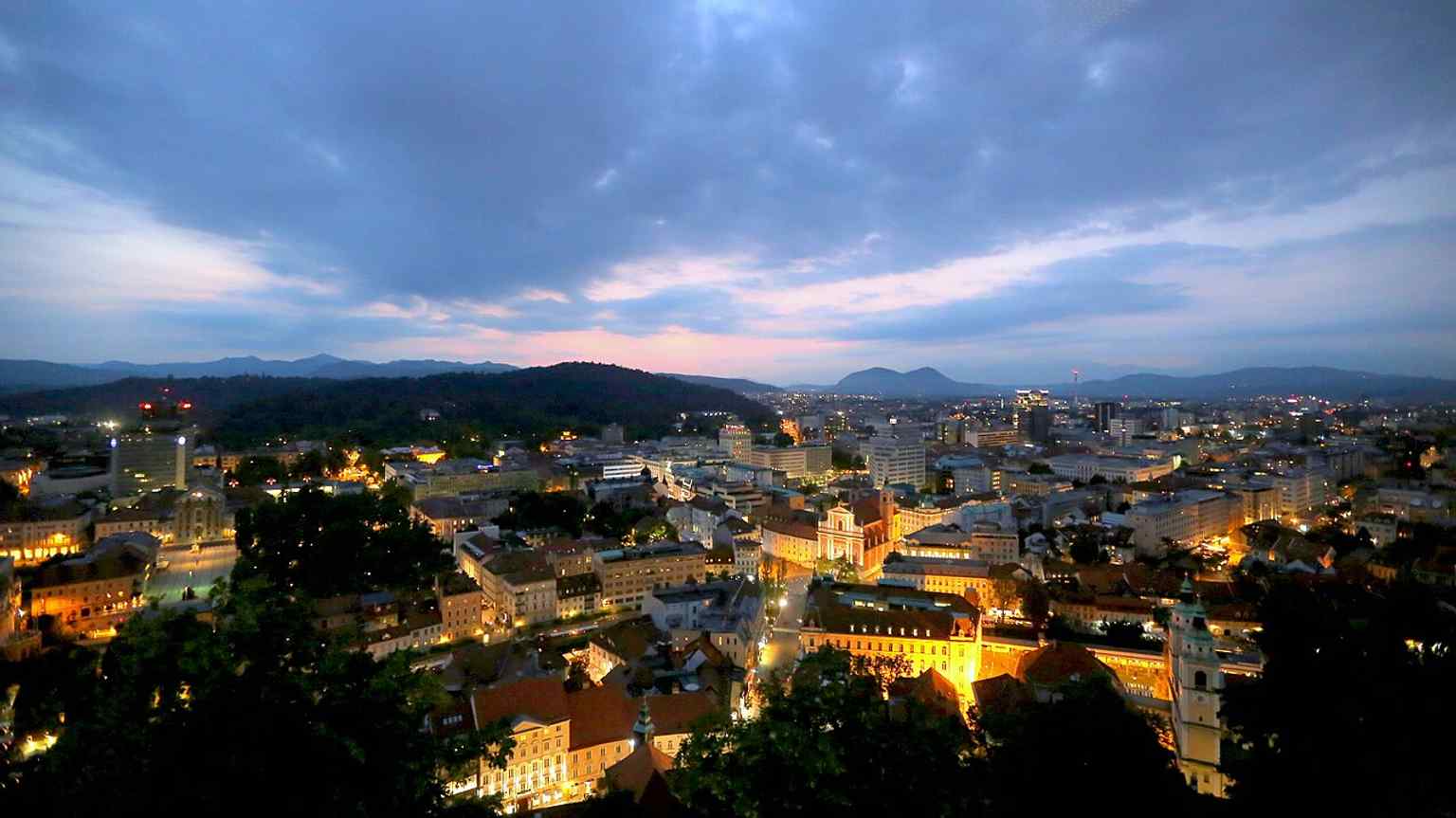
An aerial view shows the prominent red roof and position of the Franciscan Church, whose facade remained unfinished for decades until its completion between 1703 and 1706.Photo: Thaler Tamas, Wikimedia Commons, CC BY-SA 4.0. Cropped & resized. 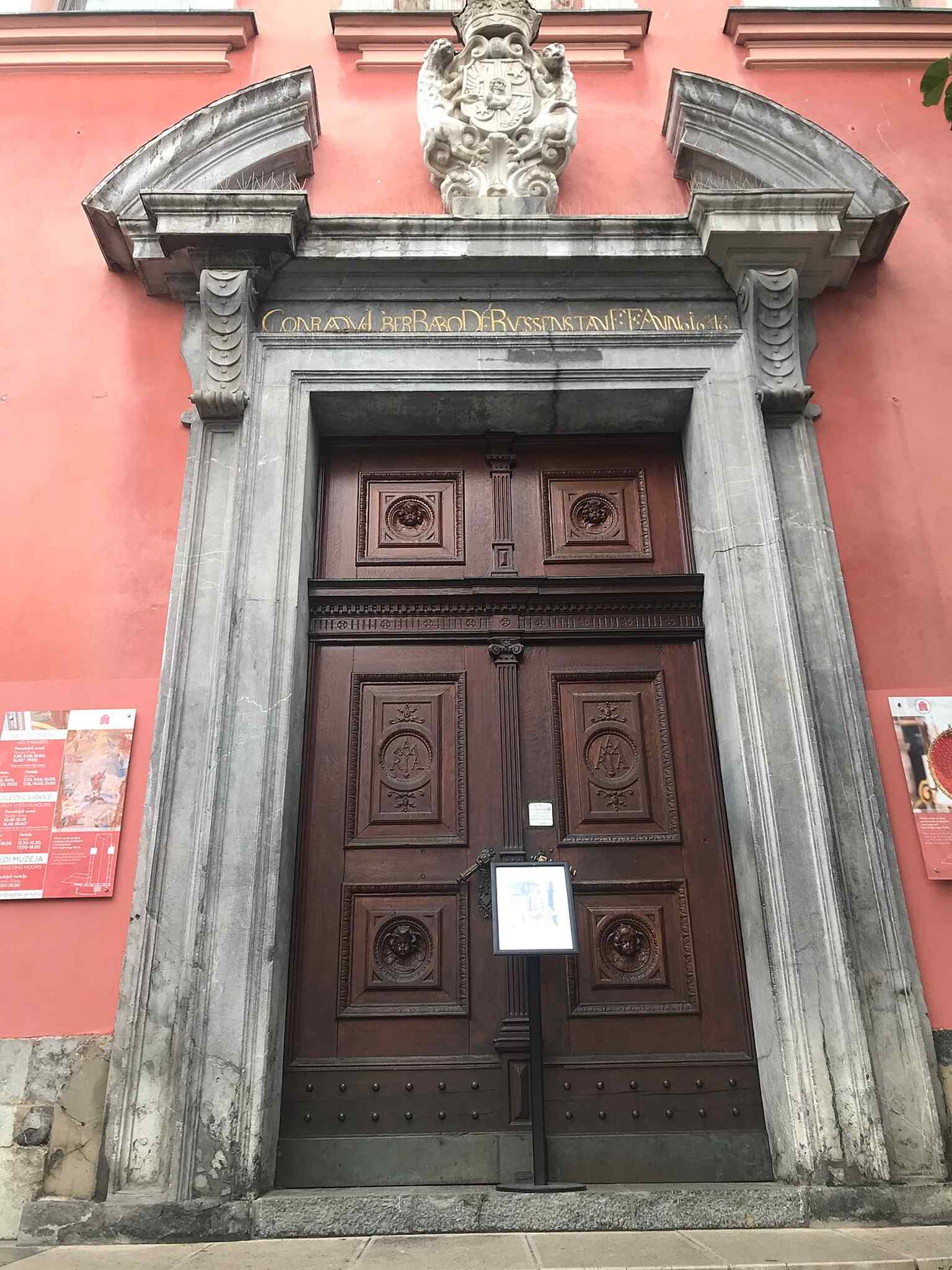
This main door welcomes visitors to a church whose foundations were laid by the Augustinians, beginning its construction between 1646 and 1660 to replace an older church on the site.Photo: Antimuonium, Wikimedia Commons, CC BY-SA 4.0. Cropped & resized. 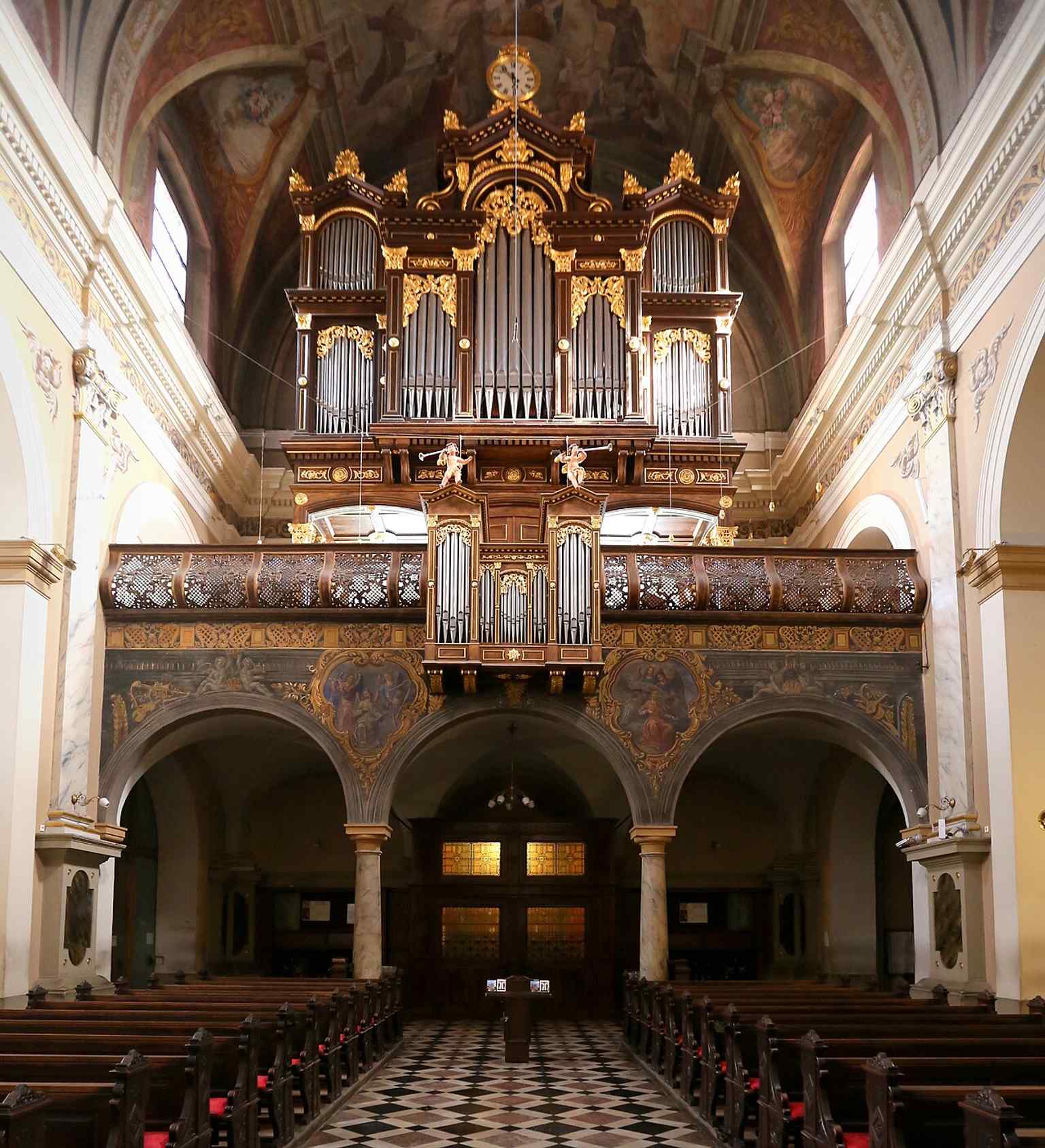
Step inside to appreciate the church's Baroque interior, which was transformed in the mid-19th century by Matevž Langus's frescoes, though much of his work was tragically ruined by the 1895 earthquake.Photo: Thaler Tamas, Wikimedia Commons, CC BY-SA 4.0. Cropped & resized. This space has always been a crossroads, but its grand appearance was born from a catastrophe. As you've heard, the 1895 earthquake shattered much of Ljubljana's old layout,…Read moreShow less
Open dedicated page →Welcome to Prešeren Square. Take a moment and just watch the flow of the people here. This is the pulsing heart of Ljubljana. If you check out the aerial view on your screen, you can see how the square acts like a giant funnel. A whole network of streets pours down into this single open space, converging right at the gateway to the old medieval town across the river.
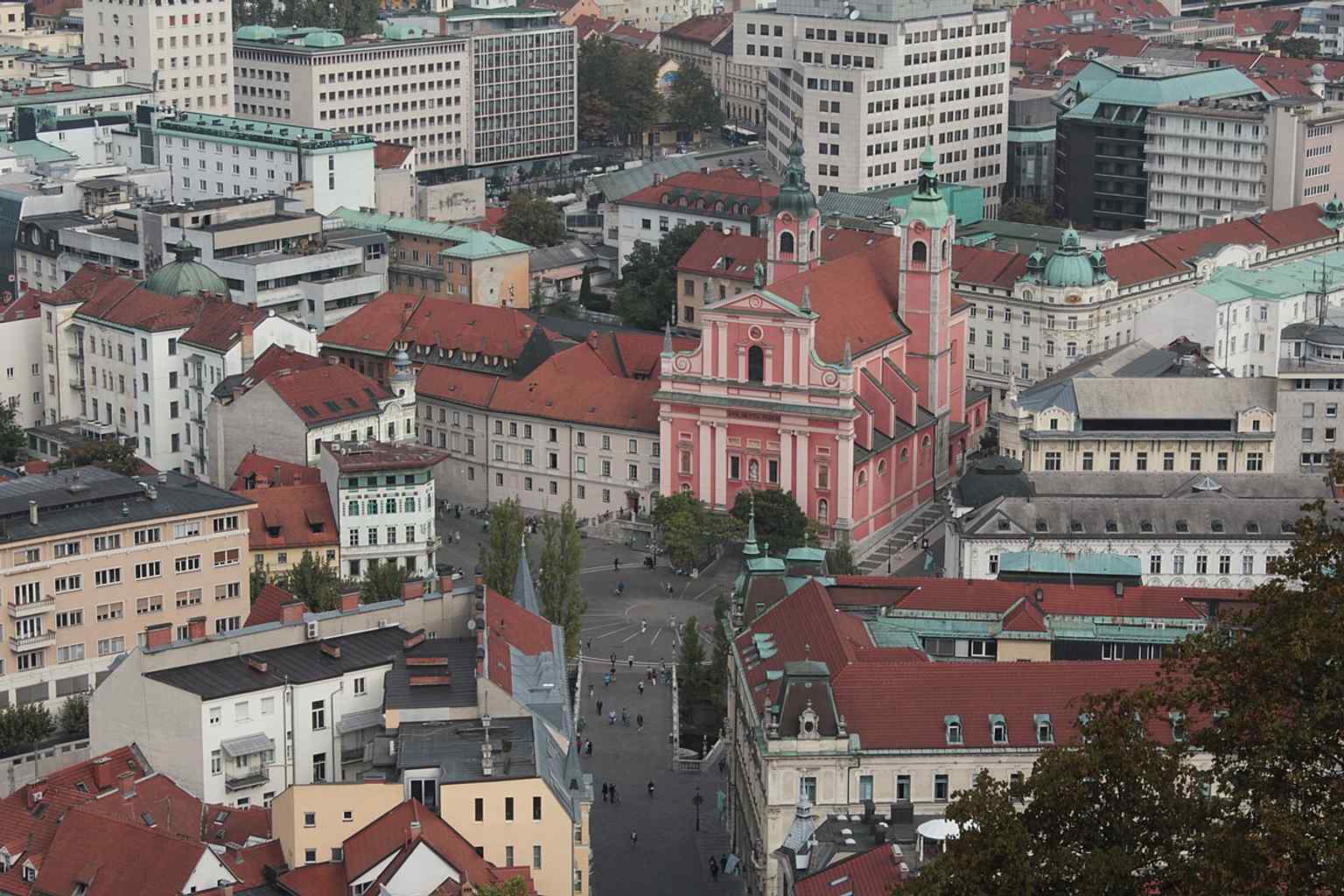
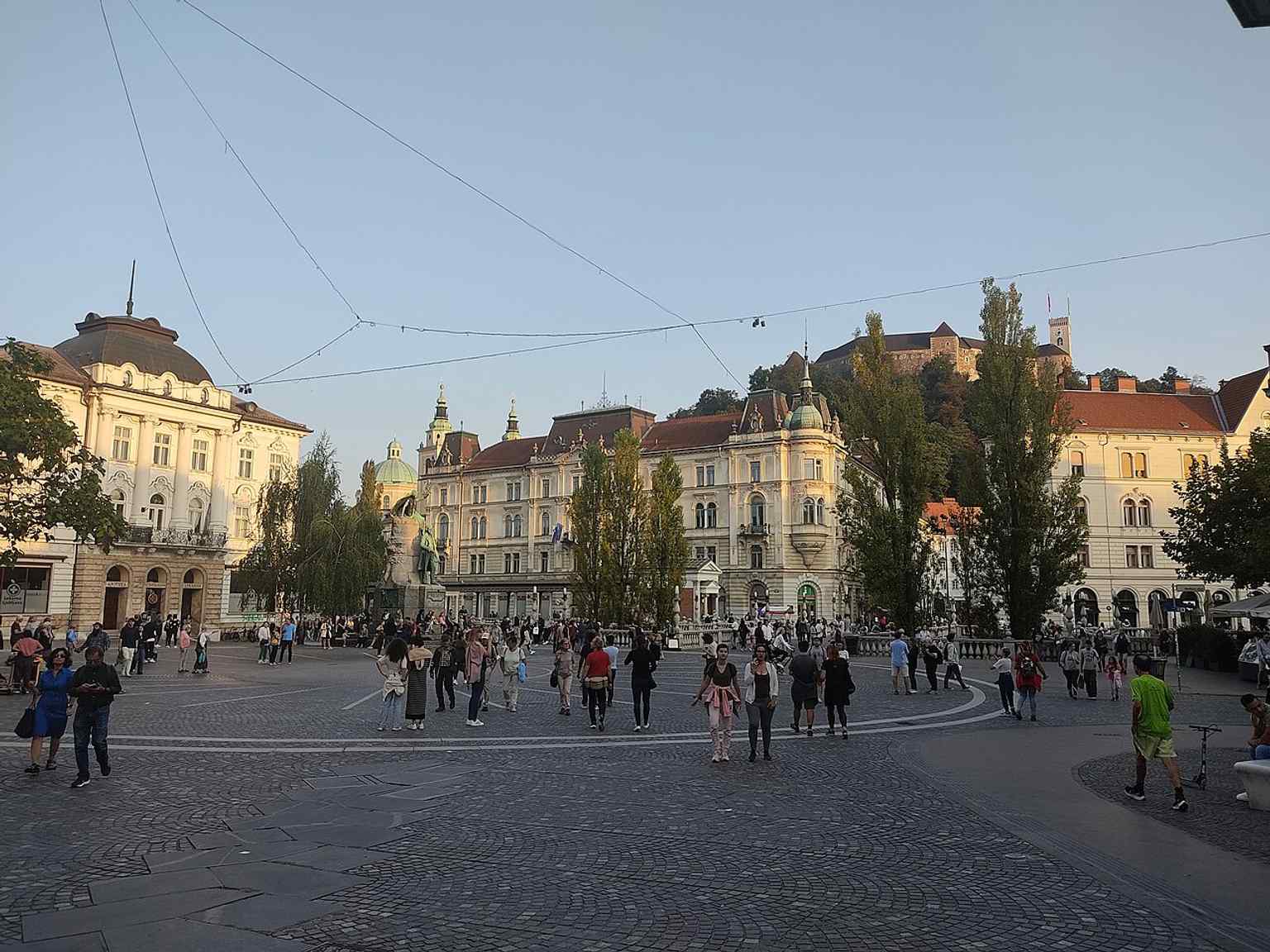
An aerial perspective from Ljubljana Castle reveals Prešeren Square's strategic location as a funnel-shaped crossroads on the left bank of the Ljubljanica River, opposite the medieval city center.Photo: Valerio2468, Wikimedia Commons, CC BY-SA 4.0. Cropped & resized. This space has always been a crossroads, but its grand appearance was born from a catastrophe. As you've heard, the 1895 earthquake shattered much of Ljubljana's old layout, forcing an intense drive to rebuild and reinvent. If you look over at number 1, that is the Hauptmann House. It was one of the very few buildings to survive the quake intact, and its owner capitalized on that sturdy foundation by giving it a stunning makeover in the Viennese Secession style, an elegant, geometric architectural trend of the early twentieth century. Notice those striking colored ceramic tiles forming a checkerboard pattern near the roof.
But the real drama of the square revolves around the man standing in the middle of it. That is the monument to France Prešeren, Slovenia's greatest romantic poet. When it was unveiled in 1905, it sparked one of the biggest cultural scandals of the era. The problem wasn't the poet... it was the woman hovering above him.
Pull up the next image on your app to see the bronze muse holding a laurel branch over his head. The local Archbishop, Anton Bonaventura Jeglič, was absolutely horrified. He wrote a furious letter to the mayor, calling the muse a lascivious and shamelessly nude figure that insulted religious feelings, especially since she was perched right across from the church entrance. The Archbishop demanded she be removed or, at the very least, given some clothes. The mayor refused. In protest, the Archbishop supposedly ordered the church doors to be kept closed at certain hours so his flock wouldn't be corrupted by the sight.
This detail shot of the Prešeren Monument highlights the muse figure that, upon its unveiling in 1905, sparked a major cultural scandal due to the archbishop's outrage over its "lascivious" and "shamelessly nude" depiction.Photo: Viktar Palstsiuk, Wikimedia Commons, CC BY-SA 4.0. Cropped & resized. For all that fuss, Prešeren himself isn't even looking at his scandalous muse. Follow his bronze gaze across the square, over to Wolfova street. He is staring forever at a small relief on a building over there. It is a portrait of Julija Primic, the wealthy woman he loved from afar but who never returned his affection.
Look down at your feet for a second. The ground you are standing on is a work of strict mathematical harmony. In 1987, architect Edvard Ravnikar redesigned the paving to bring order to the space. He laid out a massive circle of white Macedonian marble. That circle is exactly 41.5 meters across, matching the precise dimensions of the nearby Triple Bridge. Ravnikar actually wanted to put a modern fountain right in the center, but the locals hated the idea so much that he had to abandon it.
Because it is a public plaza, the square is completely open twenty four hours a day, always ready for the next protest, festival, or late night rendezvous. We are going to slip away from the crowds now. Turn your attention toward the large monastic complex attached to the red church, and let us make the very short walk to the Franciscan Library.
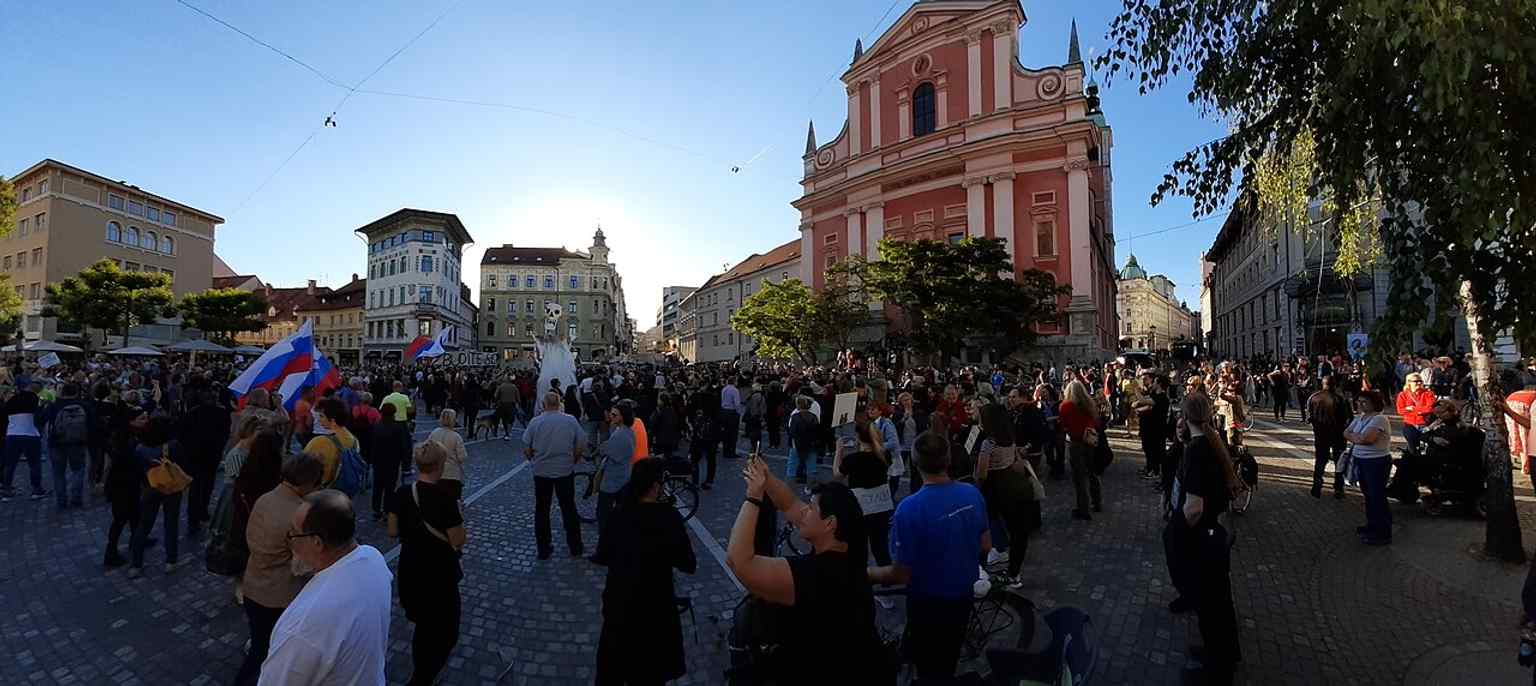
This image captures a 2020 anti-government protest, highlighting Prešeren Square's enduring role as a central gathering place for public demonstrations and dissent, a tradition that continued from World War II.Photo: Yerpo, Wikimedia Commons, CC BY-SA 4.0. Cropped & resized. 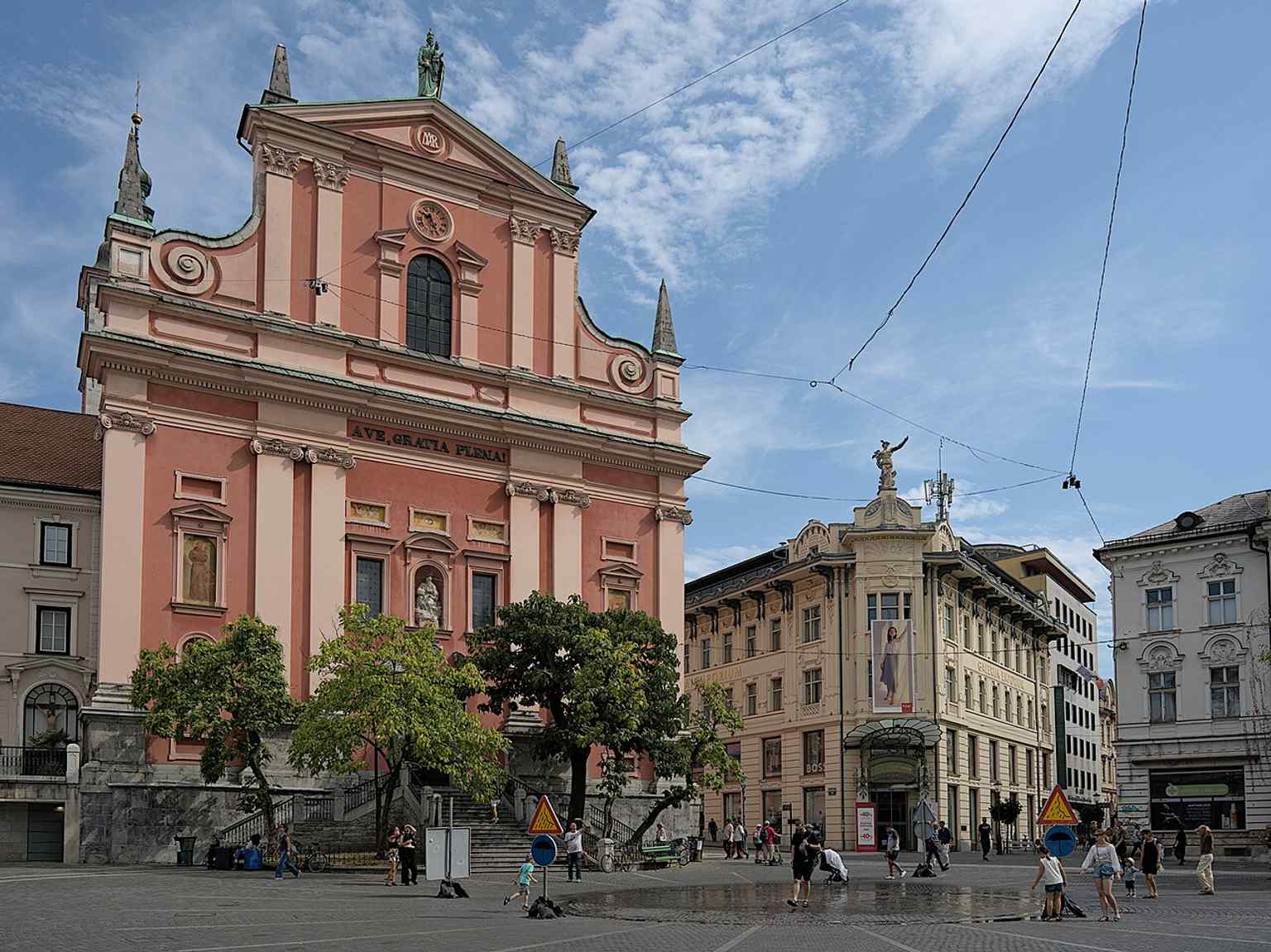
A summer view of Prešeren Square, featuring the Urbanc Department Store with its distinctive Art Nouveau facade, a building designed in 1902 and noted for combining strict Viennese Secession with lighter French Art Nouveau elements.Photo: This Photo was taken by Miha Peče. Feel free to use my photos, but please mention me as the author. I would much appreciate if you send me an email [email protected] or write on my talk page, for my information. Please do not upload an edited image here without consulting me. I would like to make corrections only at my own source to ensure that the changes improve the image and are preserved.Otherwise you may upload an edited image with a new name. Please use one of the templates derivative or extract., Wikimedia Commons, CC BY-SA 4.0. Cropped & resized. 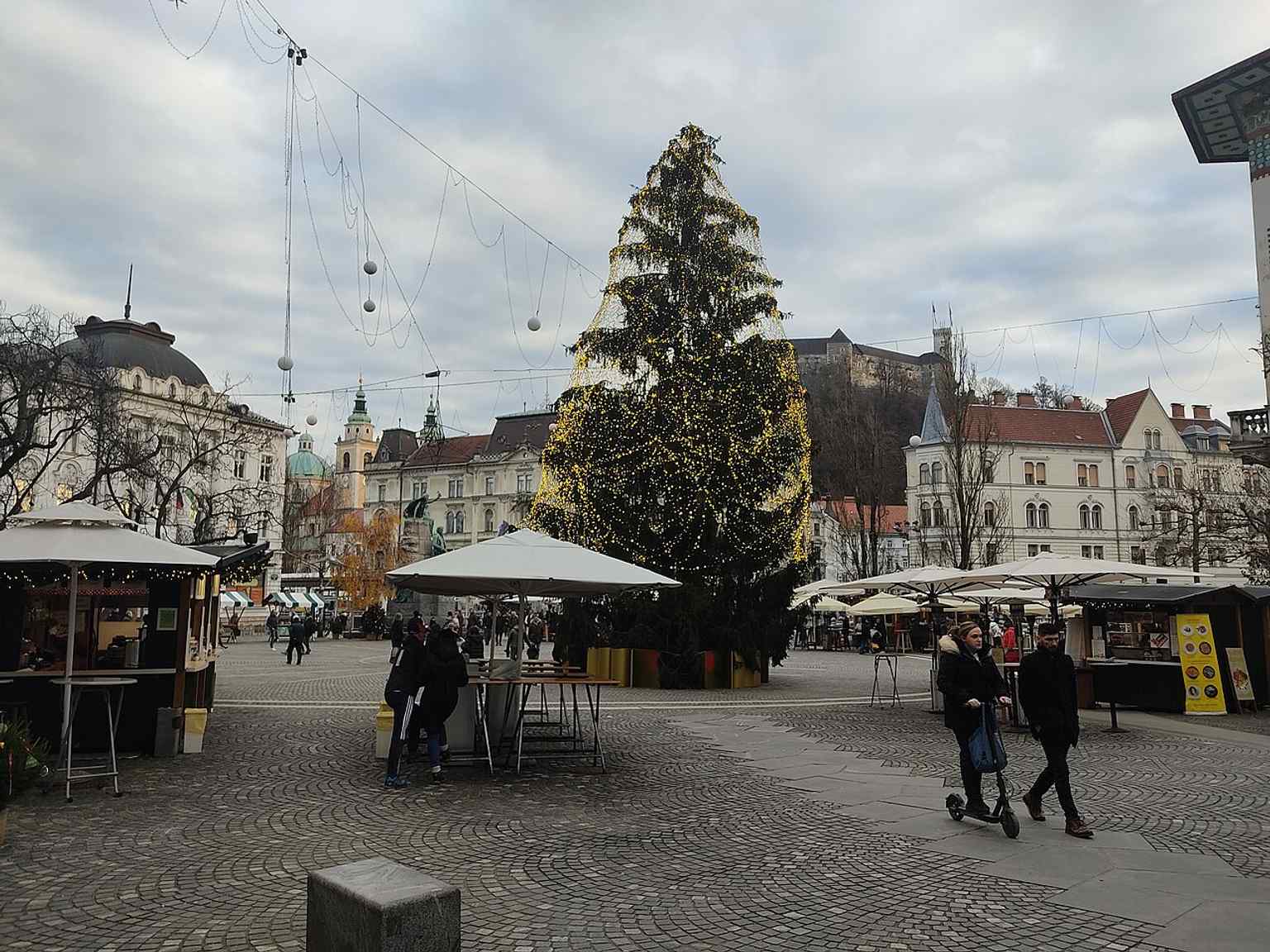
A clear view of the Franciscan Church of the Annunciation, showcasing its distinctive red facade, which symbolizes the Franciscan order, and the copper statue of Mary, the largest in Ljubljana, atop its pediment.Photo: Viktar Palstsiuk, Wikimedia Commons, CC BY-SA 4.0. Cropped & resized. 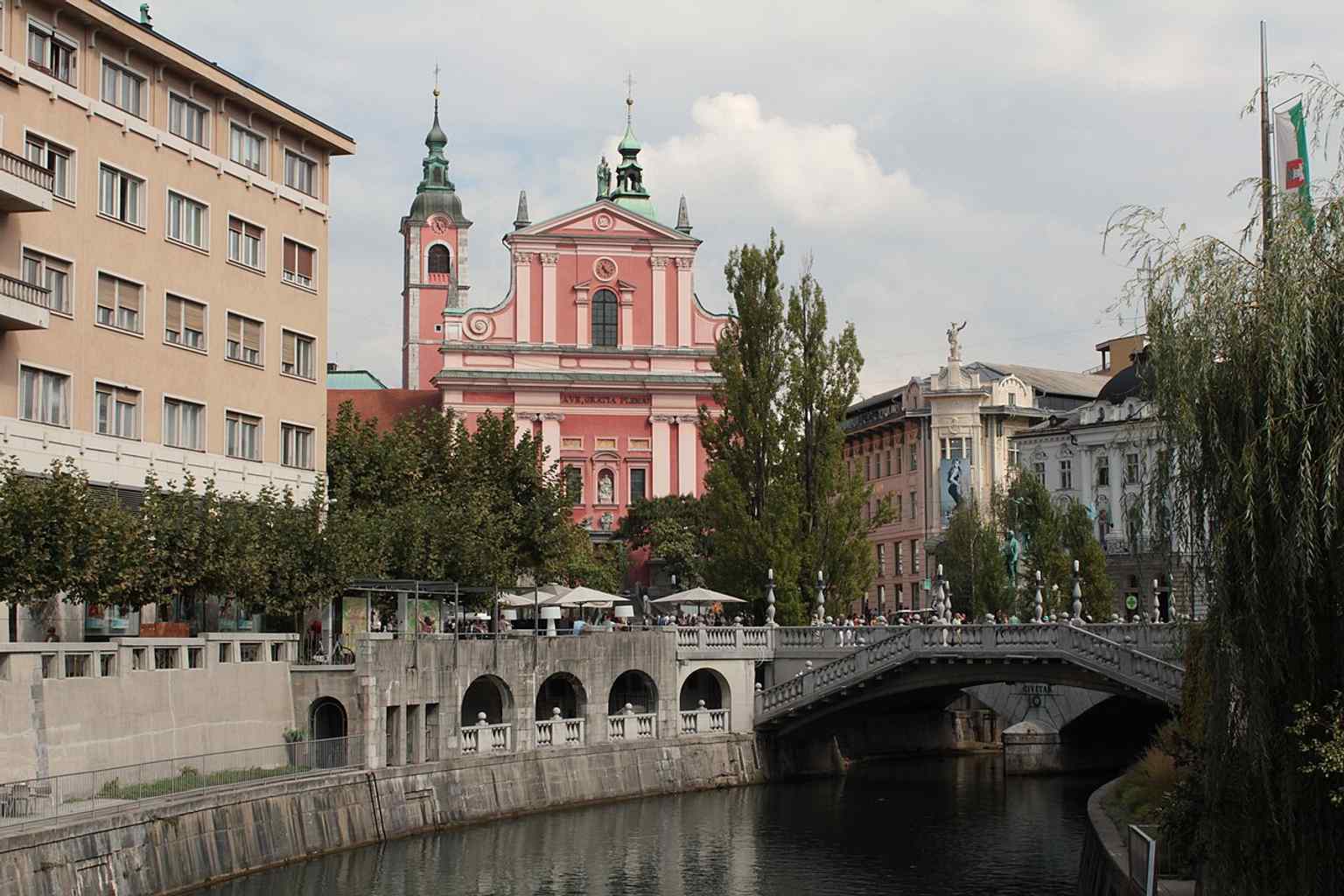
This image perfectly illustrates the Triple Bridge, designed by Jože Plečnik with its distinctive white balustrades, which extends Prešeren Square's functional and visual space across the Ljubljanica River.Photo: Valerio2468, Wikimedia Commons, CC BY-SA 4.0. Cropped & resized. 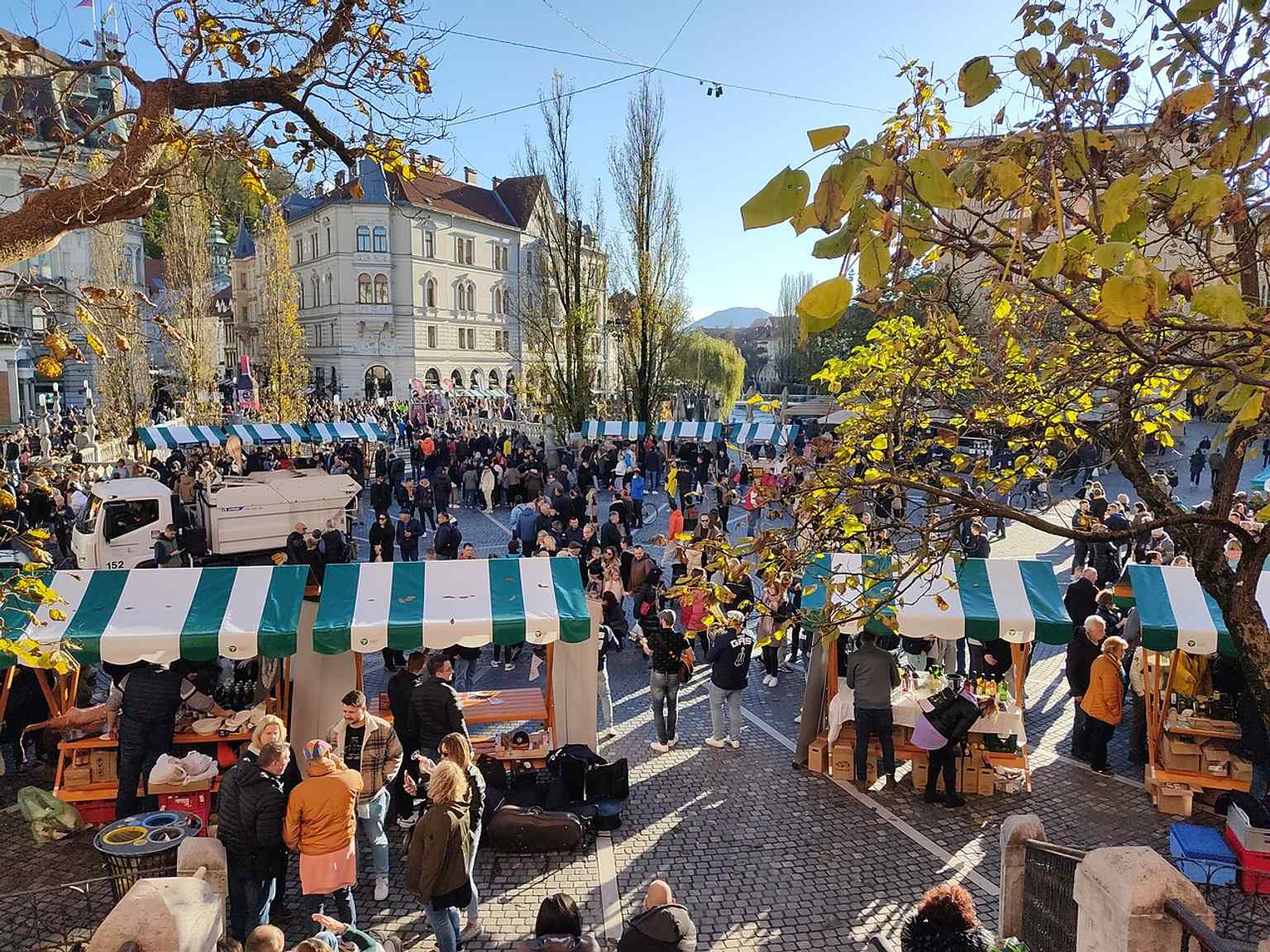
A street-level view of Prešeren Square, showcasing the Hauptmann House at number 1, which features a distinctive facade renovated in 1904 in the Viennese Secession style, adorned with colorful ceramic tiles.Photo: Viktar Palstsiuk, Wikimedia Commons, CC BY-SA 4.0. Cropped & resized. On your right is the Franciscan Library. If you check your screen, the first image shows the somewhat modest exterior of what was, for centuries, a highly restricted space. A…Read moreShow less
Open dedicated page →On your right is the Franciscan Library. If you check your screen, the first image shows the somewhat modest exterior of what was, for centuries, a highly restricted space. A secret garden of learning, open only to the brothers and a few lucky scholars. But in November 2023, for the first time in its nearly eight hundred year history, the doors were finally thrown open to the public.
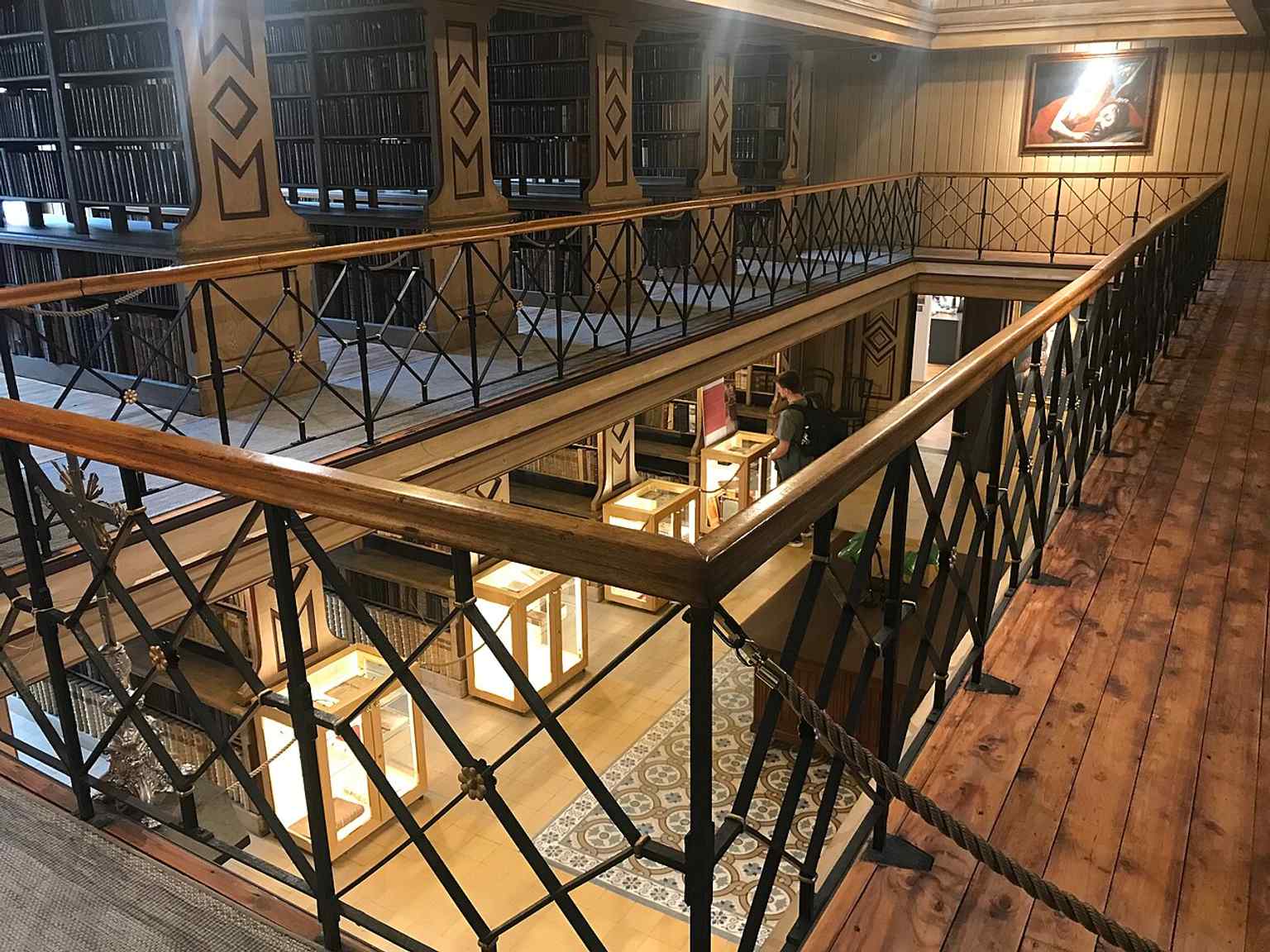
See the exterior of the Franciscan Library, which, despite its central location, was known as a 'secret garden' of learning for centuries until its public opening in November 2023.Photo: Antimuonium, Wikimedia Commons, CC BY-SA 4.0. Cropped & resized. This building is a masterclass in survival, born from necessity. When the devastating 1895 earthquake struck, the city had to rethink how it built. An architect named Raimund Jeblinger came up with an engineering marvel for the library. He installed a revolutionary self supporting iron skeleton entirely separated from the outer walls, giving it incredible seismic resistance. You can see the robust exterior housing this structure in the second photo on your app. Inside, however, you would never know it was framed in iron, as it is completely wrapped in warm, three story wooden paneling.
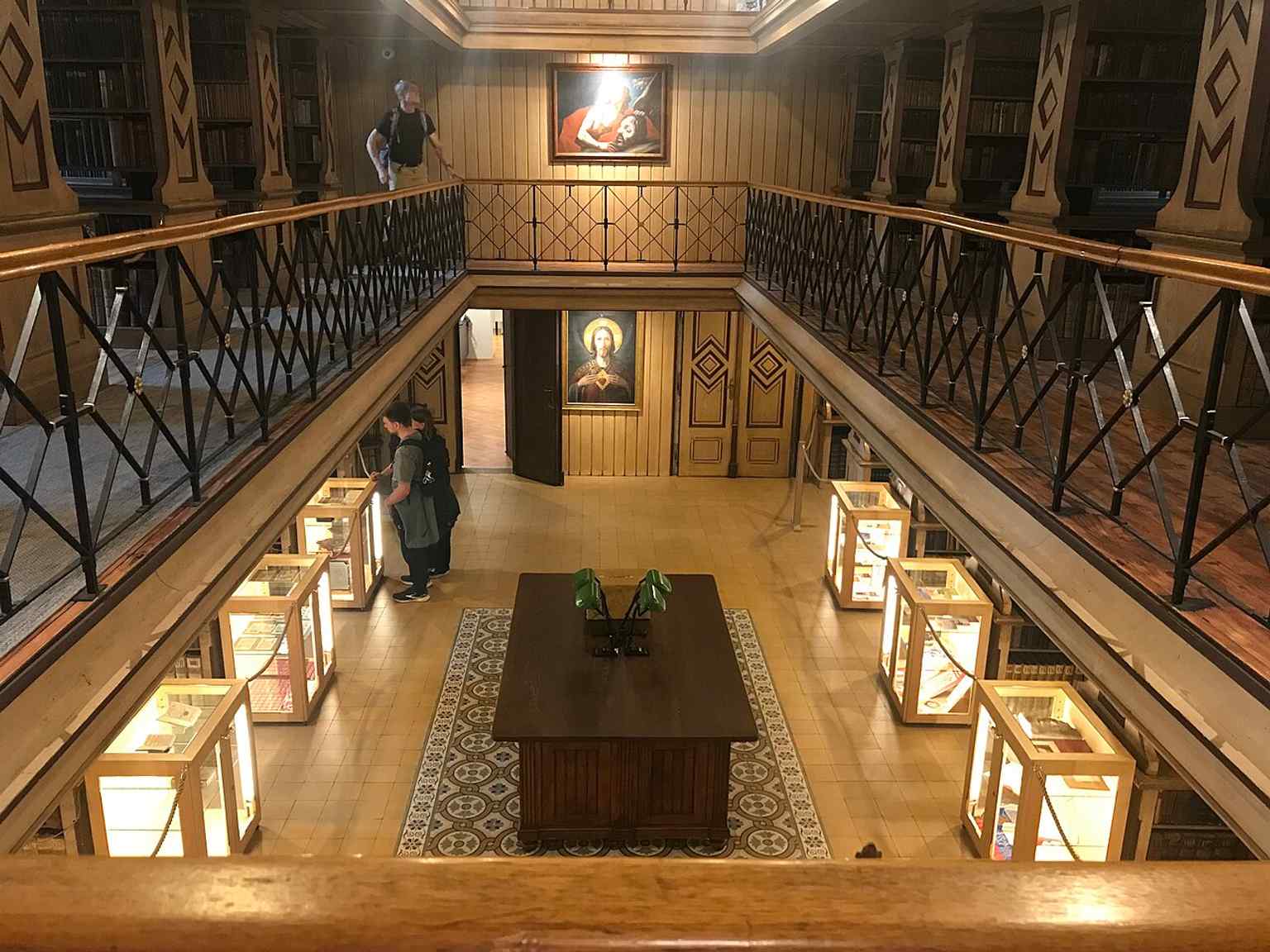
This is the Franciscan Library building, which underwent a significant renovation after the devastating 1895 Ljubljana earthquake, incorporating a revolutionary self-supporting iron skeleton for seismic resistance.Photo: Antimuonium, Wikimedia Commons, CC BY-SA 4.0. Cropped & resized. They did not just plan for the earth shaking. They planned for fire. Above the ornate coffered ceiling lies a thick layer of sand. Why? It is a brilliant, entirely mechanical fire suppression system. If a fire were to break out in the attic, the ceiling would burn and collapse, dumping tons of sand directly onto the flames to smother them, saving the priceless books below. It is beautifully pragmatic.
And the books certainly needed protecting, because they have had a turbulent journey. In the late sixteenth century, the Franciscans had to temporarily leave Ljubljana. They left their books behind, and the administrator of the local imperial hospital simply helped himself to the collection. The monks eventually had to use a bishop to legally pry their stolen treasures back. The library ultimately landed right here in 1784, thanks to those late eighteenth-century imperial mandates that shuffled monastic orders and properties. The Franciscans inherited this space and brought their shifting collection with them.
Much of the library's greatness comes from one highly ambitious eighteenth century monk named Žiga Škerpin. He was not just a theorist but a relentless traveler who scoured the printing houses of Venice, Rome, and Lyon to build a universal library for the local brothers. Today, that collection holds seventy thousand items. Down in the vault, they protect a fifteen eighty four edition of the Dalmatin Bible, the first translation of the Bible into Slovenian, complete with the signature of its Protestant pioneer, Primož Trubar. They even have the first edition of the famous epic poem Baptism on the Savica, featuring a personal dedication from the poet France Prešeren himself.
The library is open every day from eleven in the morning to six in the evening, should you want to marvel at that wooden interior yourself.
Now, let us leave the quiet preservation of history and step onward to the domain of the dramatic arts, as we make the one minute walk over to the Ljubljana City Theatre.
Before you stretches a vast rectangular plaza paved in light stone grids, flanked on one side by a dense canopy of tall trees, and anchored at the far end by a grand church with a…Read moreShow less
Open dedicated page →Before you stretches a vast rectangular plaza paved in light stone grids, flanked on one side by a dense canopy of tall trees, and anchored at the far end by a grand church with a distinctive wave like facade. If you walk along the park area, you will spot a gilded statue of a man in a toga, a replica of a tombstone found right here, reminding us that this very ground was once part of ancient Roman Emona.
But this space has been broken and rebuilt more times than you might guess. Back in the early eighteen hundreds, this area was little more than a ditch next to the crumbling ruins of a monastery for Capuchin friars. Then, the Congress of the Holy Alliance chose Ljubljana for a major political summit in eighteen twenty one. Driven by a sudden need to impress the crowned heads of Europe, the city rapidly filled the ditch and cleared the ruins to create a massive, elegant parade ground. If you look at the second image on your app, you will see the Kazina building. That is where Europe's elite danced at extravagant balls while military parades marched right where you are standing.
A century later, the great architect Jože Plečnik brought his own demanding vision to the square. He decided the park's dense, leafy chestnut trees had to go. Why? Because their thick branches blocked the view of the surrounding architecture. He insisted on planting plane trees instead, since their sparser canopies would let the buildings shine through. The locals were absolutely furious about losing their shaded walkways, but Plečnik stubbornly pushed the project through anyway.
The city's survival instincts were put to the test here during the Second World War. As extreme food shortages gripped the occupied city in nineteen forty two, the authorities actually allowed these manicured park lawns to be plowed into what they called war fields. Families planted potatoes, and later soy, right here in the center of the city to keep themselves from starving. During that same occupation, Italian forces decided to destroy the large bronze statue of the Yugoslav King that stood in the square. They did not use explosives. Instead, they painstakingly sawed the metal horse and rider into pieces, wanting a slow, symbolic erasure of the monarchy rather than a quick blast.
Even in modern times, this ground keeps giving up its secrets. In two thousand eleven, workers dug a massive underground parking garage beneath the plaza. Beneath the pavement, archaeologists were stunned to uncover completely unknown ancient burial mounds from the eighth century BC, along with more Roman foundations. The drive to modernize had accidentally unearthed the city's deepest roots.
This grand plaza is open twenty four hours a day, so you can always come back to explore its paths. For now, let us continue our walk by heading back toward the river to find a rather peculiar crossing. Your next stop, the Fish Bridge, is just a two minute stroll away.
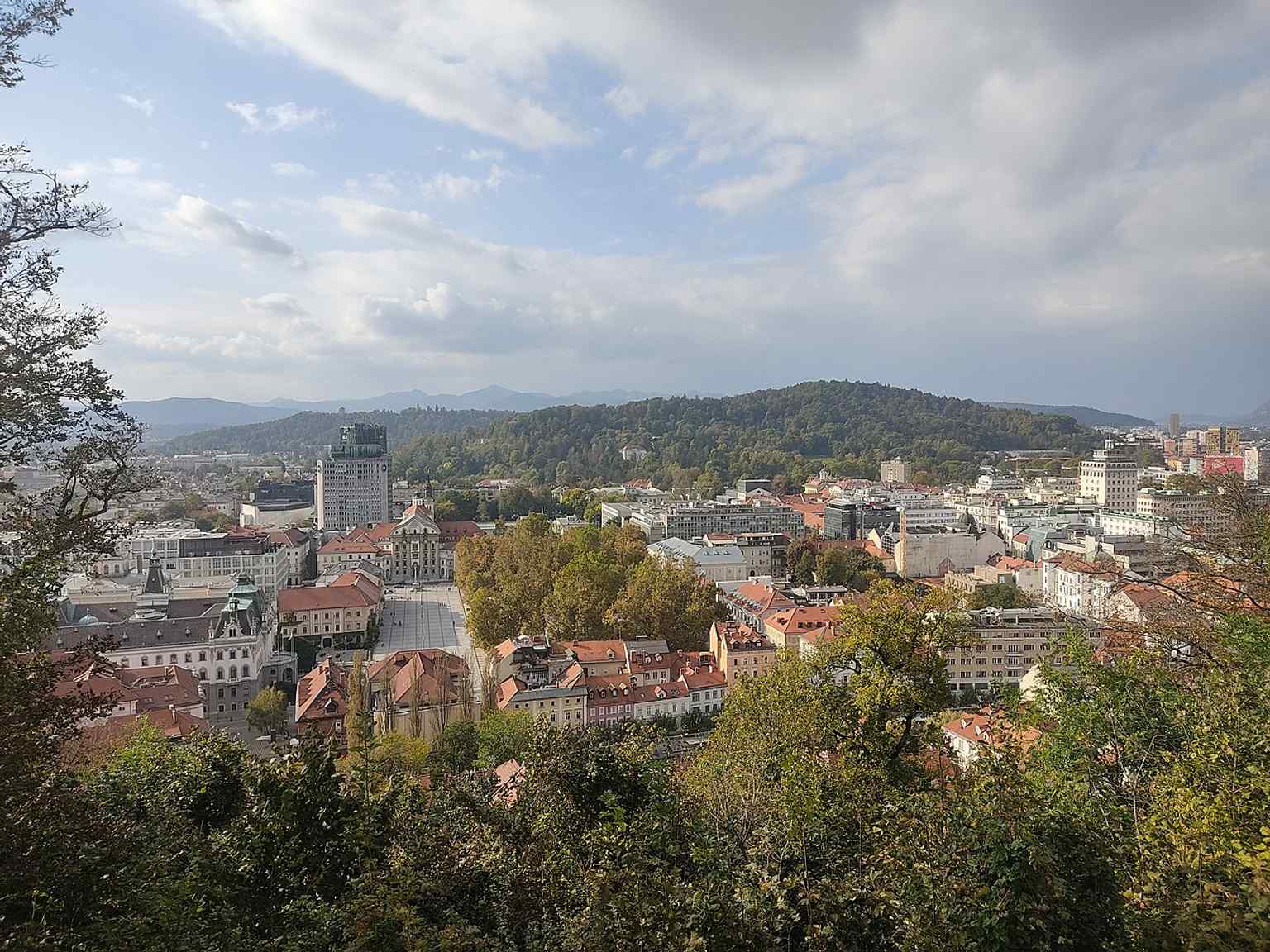
A panoramic view of Congress Square, which, along with Park Zvezda, was inscribed on the UNESCO World Cultural Heritage list in 2021 as part of Jože Plečnik's urban designs.Photo: Viktar Palstsiuk, Wikimedia Commons, CC BY-SA 4.0. Cropped & resized. Before you is the Fish Bridge. It looks like a sleek, permanent piece of modern engineering, doesn't it? But its existence sparked quite a turf war over how this city should…Read moreShow less
Open dedicated page →Before you is the Fish Bridge. It looks like a sleek, permanent piece of modern engineering, doesn't it? But its existence sparked quite a turf war over how this city should look.
To understand why, take a look at the third image in your app. Notice how the steel deck tapers down to just twenty-five centimeters at the edge. The architects made it as thin as physically possible to protect what urbanists call a visual corridor, meaning an unobstructed line of sight down the river. For decades, the great architect Jože Plečnik and his followers vehemently opposed building a bridge here. Plečnik designed the access stairs leading down to the water, but he deliberately stopped there. He believed a crossing would ruin the open perspective between his famous Triple Bridge and the Shoemakers' Bridge. He prioritized art over the convenience of a shortcut.
But in 1991, a group of rebellious architecture students decided people actually needed a way across. Led by a student named Peter Gabrijelčič, they built a temporary wooden footbridge. To save money, they used salvaged Siberian larch beams left over from a renovation of the Triple Bridge. It was only supposed to stay up for a five-year experiment. It ended up staying for over twenty.
Eventually, the city's ambition to modernize caught up with reality. The damp river air and the winter salt used to melt ice caused the old wood to rot from the inside out. Locals knew it as a notorious slippery trap, a terrifying ordeal of worn-out timber and frost. By 2014, the decay was so bad that when the city finally dismantled the bridge, they had to chop it to pieces right on the spot.
A competition was held for a permanent replacement. And in a rare twist of fate, the winner was none other than Peter Gabrijelčič, now a prominent professor, essentially replacing his own student project. Naturally, it brought drama. Critics accused him of plagiarism, claiming his minimalist design looked remarkably like a memorial bridge in Croatia. Gabrijelčič fought back. He argued that high-tech, minimalist structures simply share a common visual language.
If you look at the fourth image on your screen, you can see his defense in action. He designed this transparent, low-profile structure as a direct, respectful response to Plečnik's existing stone bases and the narrowness of the river at this exact point.
The new bridge opened in 2014. To ensure it never became an ice trap again, the builders integrated an electric heating foil beneath the walking surface. It is a brilliant piece of engineering, though its price tag of roughly six hundred sixty-three thousand euros sparked intense political debate, with opponents of the mayor calling it luxury infrastructure.
But looking at it now, it is hard to deny how well it navigates the tension between preserving an old master's vision and serving a dynamic, changing city. And since this open-air crossing is accessible twenty-four hours a day, every day of the week, you can enjoy that perfectly preserved river view whenever you please.
When you are ready, let's continue down the embankment toward the Kresija building.
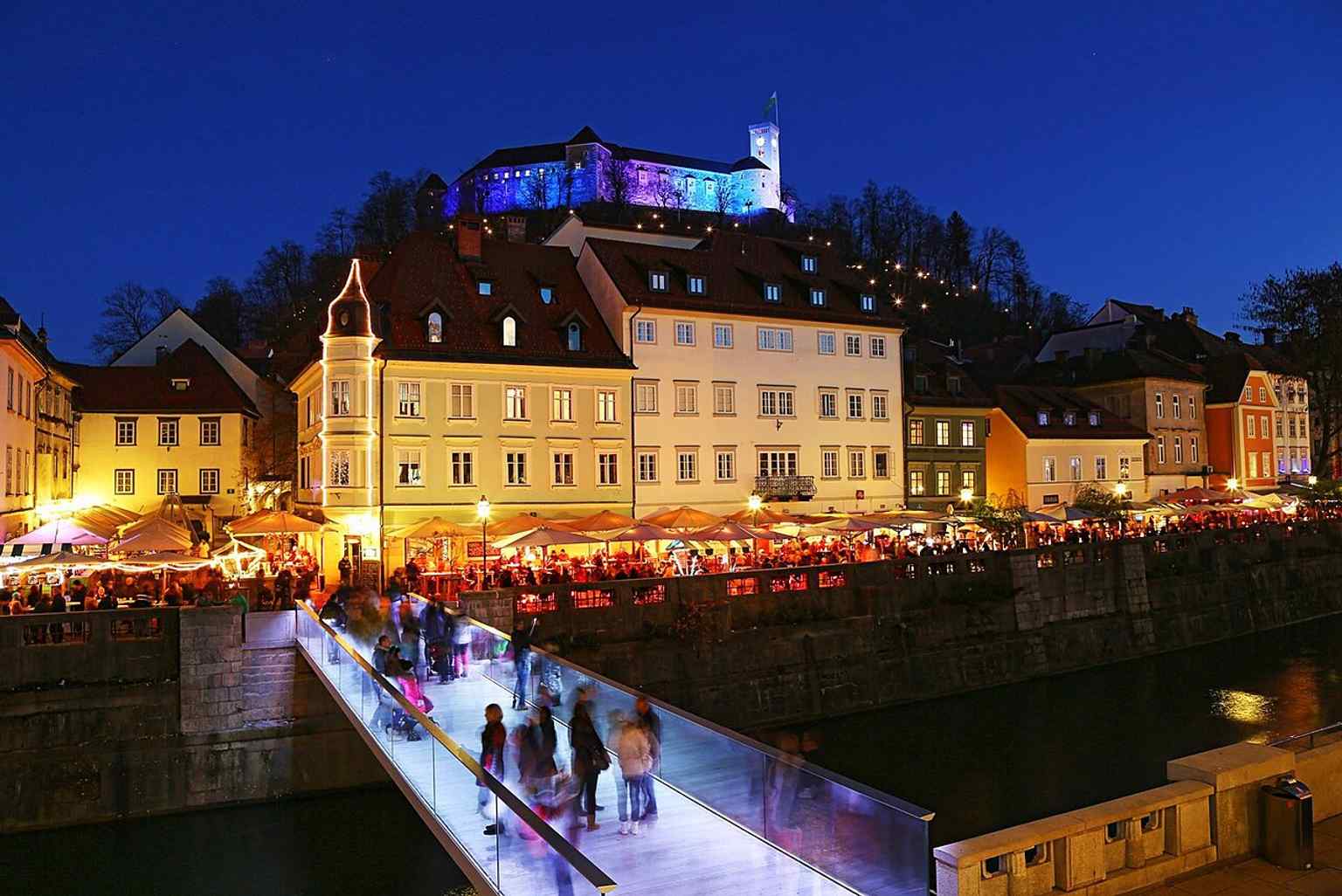
The modern Fish Bridge, seen here glowing at night, connects Kongresni trg with Stara Ljubljana, a link that urbanists like Maks Fabiani foresaw as early as 1895.Photo: Aleš Kravos, Wikimedia Commons, CC BY-SA 4.0. Cropped & resized. On your left is the Kresija Building, a massive pale stone structure defined by its repeating ground-level arched colonnade and a central wrought-iron balcony topped with a…Read moreShow less
Open dedicated page →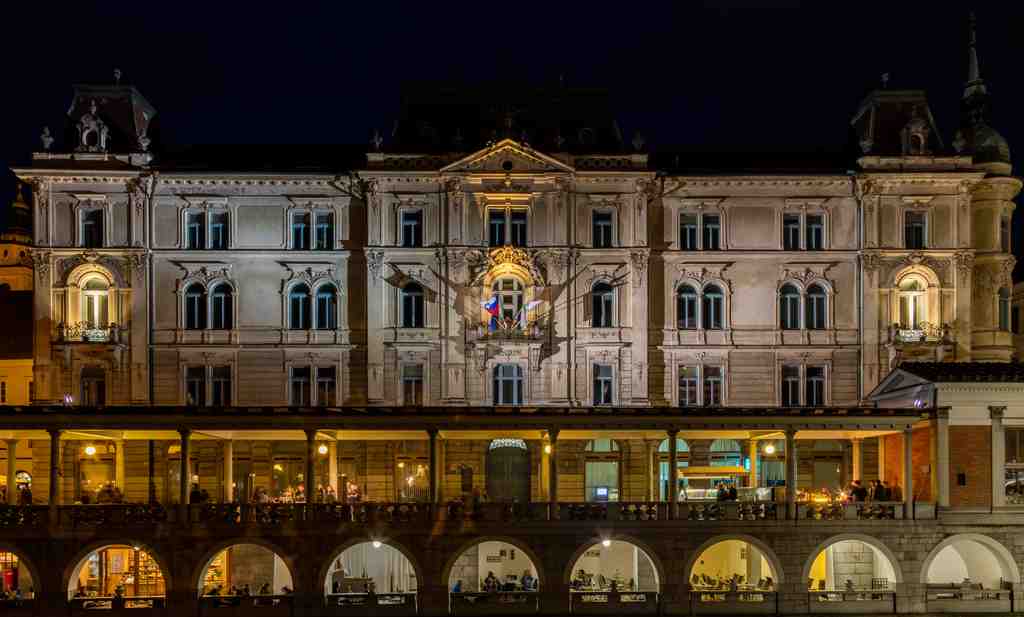
Kresija BuildingPhoto: Diego Delso, Wikimedia Commons, CC BY-SA 4.0. Cropped & resized. On your left is the Kresija Building, a massive pale stone structure defined by its repeating ground-level arched colonnade and a central wrought-iron balcony topped with a prominent coat of arms.
Today, it projects an air of absolute authority and order. But for over a century, this very address held a much heavier burden. Long before this grand administrative palace was built, a foundling hospital stood on this exact site. It was the desperate last resort for mothers who simply could not care for their infants. Built into the wall of that old hospital was a cylindrical, revolving box. A mother could approach from the street, place her baby inside the compartment, and ring a bell. An attendant inside would rotate the box, bringing the child into the ward. It was an anonymous, heartbreaking exchange, designed to prevent infants from being abandoned in the river.
The site also housed a medical school established in 1753 by Gerard van Swieten. He was the personal physician to Empress Maria Theresa and an Enlightenment pioneer. Interestingly, he is famous for scientifically disproving the empire's vampire hysteria, replacing folklore with empirical clinical training.
Then came the 1895 earthquake. The tremors devastated the city. While neighboring buildings collapsed completely, the old hospital somehow remained standing, though just barely. For years, its skeletal remains were propped up by a massive system of wooden poles, a haunting symbol of the disaster.
If you want to see how this space evolved, take a look at the before and after image on your screen, showing how the horse-drawn era gave way to the vibrant riverbank of today.
Eventually, the ruined hospital was demolished, making way for Mayor Hribar and his ambitious vision of reconstruction. He wanted a grand gateway to the city center, much like the ones in Prague. The Kresija Building was constructed in 1898 with a sober Neo-Renaissance facade, a style that revives the symmetry and grandeur of classical European architecture. This orderly design was meant to balance the highly decorative merchant palace across the way. You can check out the historical photo in your app to see the building when it was freshly completed.
Look up at the main balcony facing the embankment. See those two statues flanking the town's coat of arms? Those are genii, protective spirits from classical mythology. One holds a book and a torch, representing Knowledge, while the other represents Justice. They were bold declarations of the city's rising autonomy, transforming a place of quiet desperation into a majestic monument of civic pride.
Today it houses the visitor center and municipal offices, which are usually open from 10 AM to 6 PM, with shorter hours on the weekend.
Now, direct your attention just ahead toward the elaborate stone monument coming into view... we are taking a one-minute walk over to the Robba Fountain.
On your left stands a soaring ten-meter stone obelisk rising from a trefoil-shaped basin, surrounded by three gleaming white marble figures clutching water jugs. This monument was…Read moreShow less
Open dedicated page →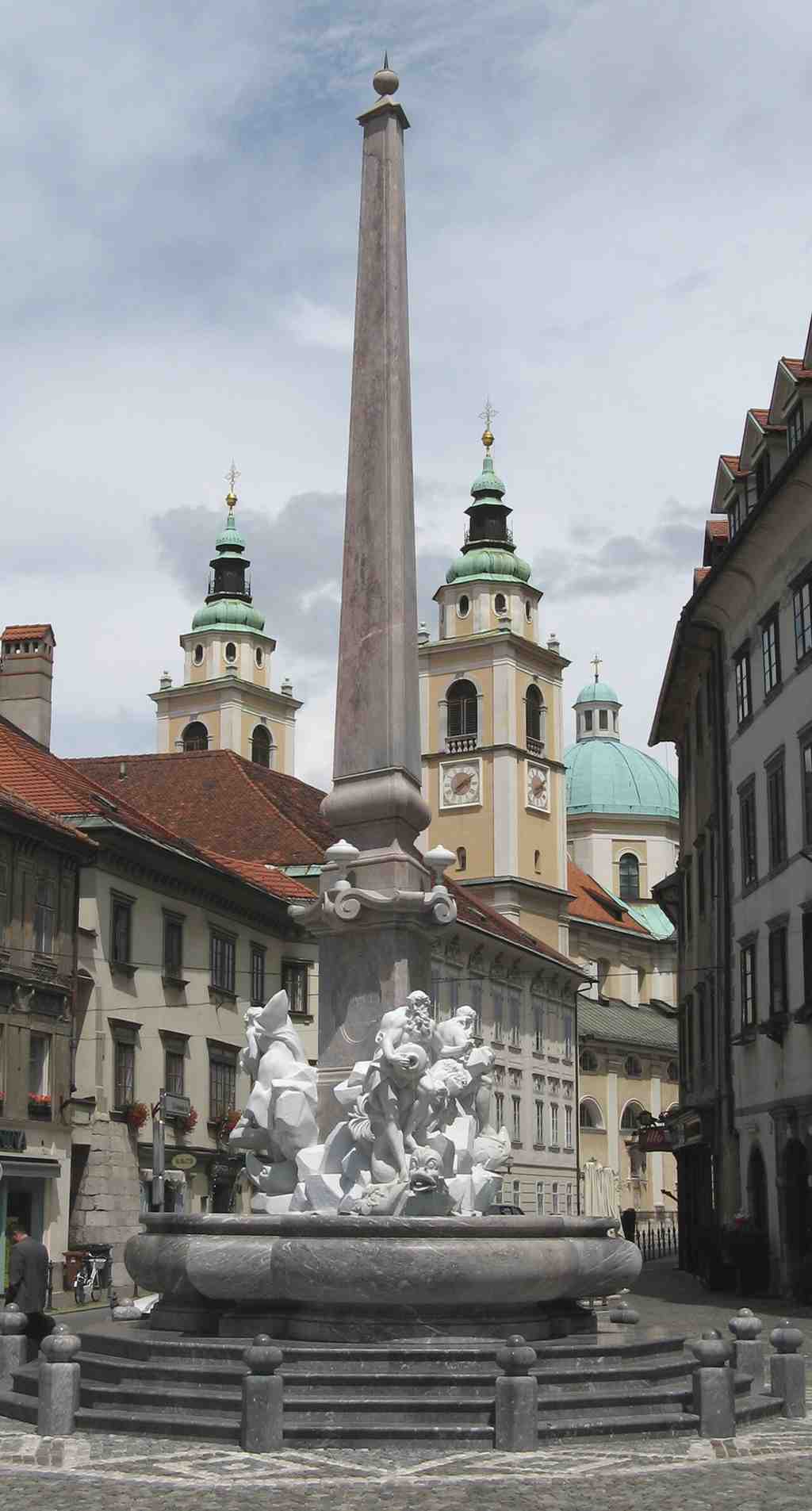
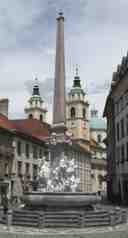
Robba FountainPhoto: User:Kaktus999, Wikimedia Commons, Public domain. Cropped & resized. On your left stands a soaring ten-meter stone obelisk rising from a trefoil-shaped basin, surrounded by three gleaming white marble figures clutching water jugs. This monument was born of a small city's ambition to look like Rome, and it is the masterpiece that ultimately destroyed its creator.
In 1743, the city magistrate wanted a grand statement of power that also served a practical purpose as a public well. They turned to the city's most prestigious craftsman, an honorary citizen and State Engineer named Francesco Robba. He envisioned an all-white marble triumph, drawing inspiration from the magnificent fountains of Rome. He cleverly designed a trefoil, or three-lobed, basin to mirror Ljubljana's ancient town seal. Look up at that tall obelisk. If you step back and look from the right angle, you will notice it creates a perfect visual triangle with the twin towers of the cathedral behind it, a brilliant trick of Baroque urban planning.
At the base, three muscular river gods carved from pure Carrara marble pour water from their jugs. Today they represent the three main rivers of the region, but securing that marble is where the tragedy begins. Robba ordered the precious stone from Venice. But disaster struck when the transport ship sank off the coast of Trieste. Because he had fronted the money himself, the shipwreck was a catastrophic financial loss. He could not afford to buy replacement marble for the entire structure. To keep the project alive, Robba was forced into a scandalous compromise, substituting local gray limestone for the basin and the obelisk. The city authorities were so protective of the surviving white marble figures that they actually posted a night guard here to stop thieves from chipping away the luxurious stone.
Even with these compromises, the work dragged on for years. Hauling just the obelisk from a local quarry took thirteen days and required up to twenty pairs of oxen. By the time it was finally unveiled in 1751, the city claimed their funds were dry and refused to pay the full commission. Bankrupt and embittered by his masterpiece, Robba abandoned his home and fled to Zagreb, dying in obscurity just two years later.
Over the centuries, the fountain became a beloved national symbol. You can check your phone for a photo showing seventy years of change in this square, transforming from a busy thoroughfare into the pedestrian plaza you see today. But decades of pollution eventually ate away at the original carvings. After intense debate, the authentic fountain was moved indoors for protection, and what you see before you is an exact replica installed in 2006. If you want to see the original stones, take a look at the image in your app showing the fountain safely housed in the National Gallery.
This square is open twenty four hours a day, so you can always come back to admire it. For now, let us keep moving toward the headquarters of the archdiocese, just a one minute walk from here.
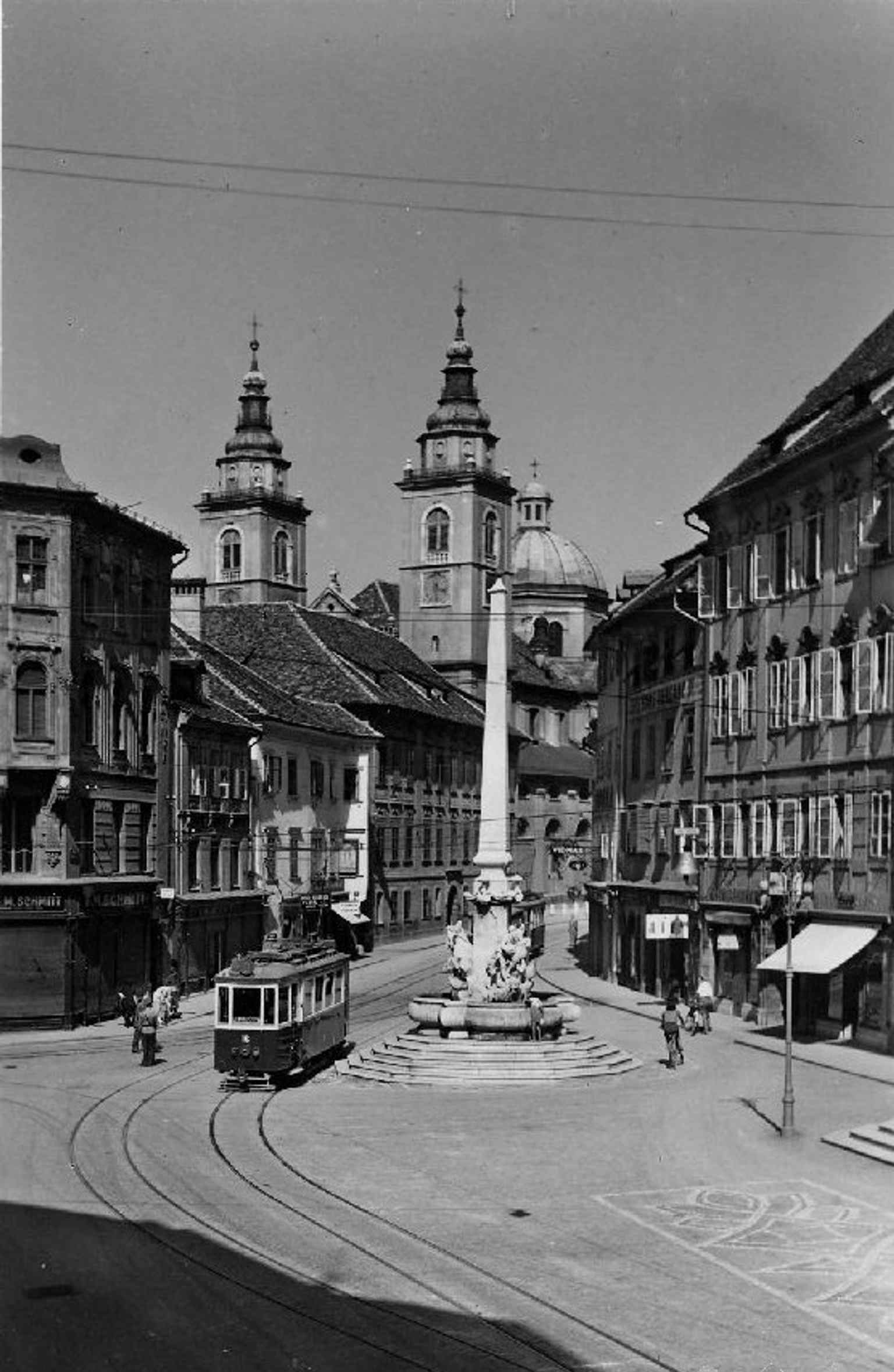
A 1941 postcard showing the fountain in Town Square, decades before the original was moved for preservation.Photo: Vekoslav Kramarič, Wikimedia Commons, Public domain. Cropped & resized. On your left stands the Archdiocese of Ljubljana, a long, pale building featuring aligned rows of rectangular windows and a dark arched entryway, positioned right beside the…Read moreShow less
Open dedicated page →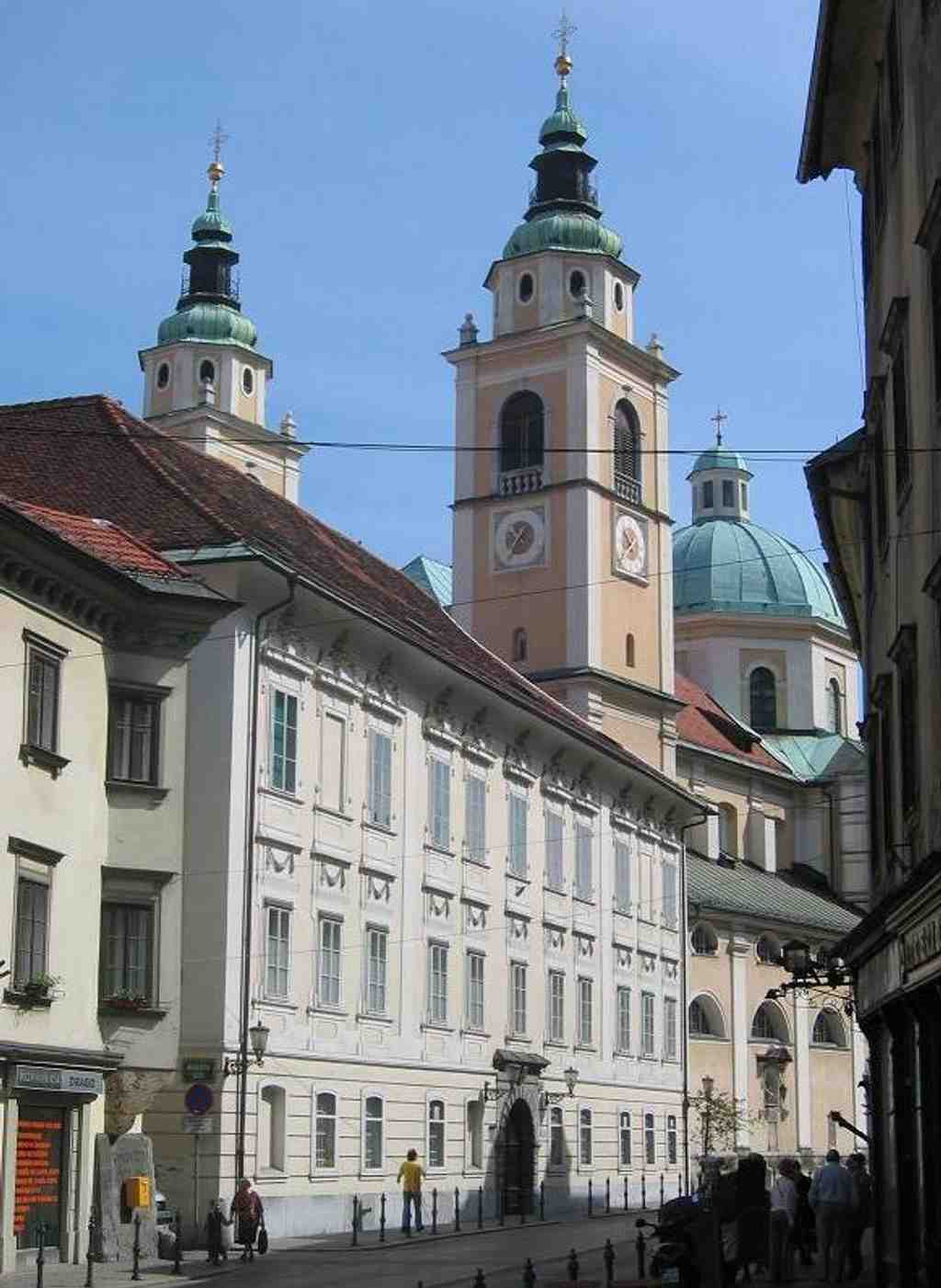
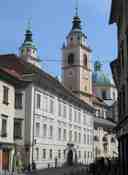
Archdiocese of LjubljanaPhoto: Žiga, Wikimedia Commons, Public domain. Cropped & resized. On your left stands the Archdiocese of Ljubljana, a long, pale building featuring aligned rows of rectangular windows and a dark arched entryway, positioned right beside the soaring green copper domes of the cathedral. Take a look at your screen to see how the administrative building flows directly into the church itself.
This site is the administrative heart of the Catholic Church in Slovenia, and its story is one of profound survival, soaring ambition, and deep human flaw. The diocese was established back in 1461. Its first leader, Sigmund Lamberg, was an intellectual who helped turn Ljubljana into a hub for scholarship, hoarding massive collections of books. But early progress hit a wall when the original cathedral burned to the ground in 1469, a disaster many blamed on raiding Ottoman forces.
Rebuilding took centuries of starts and stops, culminating in the highly ornate Baroque cathedral you see today.
But not all illusions here have been harmless, and the modern history of the archdiocese has required a different kind of endurance. The leadership has faced intense scrutiny and controversy in recent years. In 2012, the Vatican took the rare step of ordering Archbishop Alojz Uran to leave Slovenia and move to Italy. It was a disciplinary action in response to persistent allegations that he had broken his vows of celibacy and fathered two children, claims he consistently denied. Only a year later, his successor, Anton Stres, resigned due to his involvement in a massive financial collapse in a neighboring diocese.
Even more recently, in 2023, the archdiocese was rocked when the Vatican dissolved the Loyola Community, a religious order co-founded here in the 1980s. The closure followed harrowing allegations of systematic abuse by its co-founder, a high-profile artist, marking a profound global scandal.
Yet, as you learned when looking at the cathedral doors, the archdiocese has also been led by figures of undeniable personal fortitude, like Archbishop Anton Vovk, who survived unimaginable attacks and absolutely refused to resign.
This institution has endured literal fires, financial ruins, and moral reckonings, constantly forced to rebuild itself from the ashes of its own history. If you need to visit the administrative offices, keep in mind they operate on weekday mornings but are closed on the weekends. Now, let your eyes drift up toward the hill above us... it is time for our final ascent to Ljubljana Castle, about a fourteen minute walk away.
Up on your right, you will see a sprawling complex of rough stone walls and dark pitched roofs, anchored by a tall, white square clock tower rising above the fortifications.…Read moreShow less
Open dedicated page →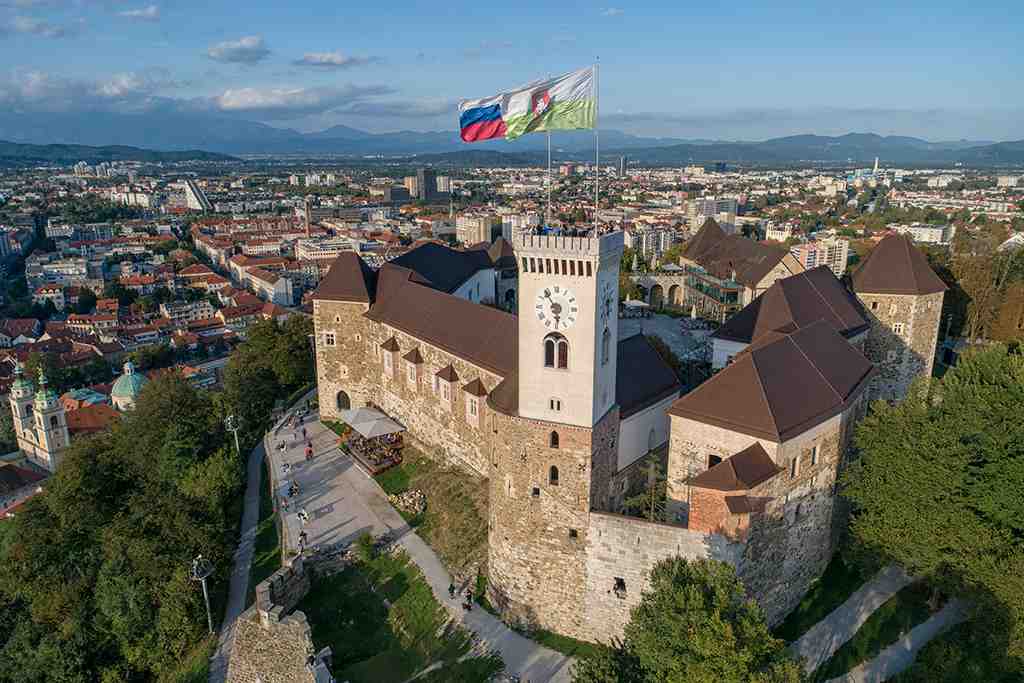
Ljubljana CastlePhoto: LjGrad, Wikimedia Commons, CC BY-SA 4.0. Cropped & resized. Up on your right, you will see a sprawling complex of rough stone walls and dark pitched roofs, anchored by a tall, white square clock tower rising above the fortifications. People have been climbing this exact hill for over four thousand years. Long before the stone walls you see today, Bronze Age tribes stood right here, looking out over the basin. Eventually, the Romans arrived and built a watchtower to protect their ancient settlement, Emona. This hill has always been a place of survival and ambition, a strategic pivot point holding fast no matter which empire claimed it.
But the most enduring story of this hill goes back even further, straight into myth. According to legend, the Greek hero Jason and his Argonauts sought refuge in the nearby marshes. They were hoping for a safe harbor to ride out a harsh winter. Instead, they heard a bone-chilling shriek. A giant, flying beast rose from the swamp waters, spitting fire and noxious fumes, destroying half their makeshift village. As the story goes, Jason heroically slew the monster, supposedly choking it with its own flames.
Over the centuries, that terrifying swamp monster underwent quite a rebrand, becoming the very dragon that guards the town today. Take a glance at your screen to see a detail of the entrance bridge, where a sculpture of this legendary beast sits proudly.
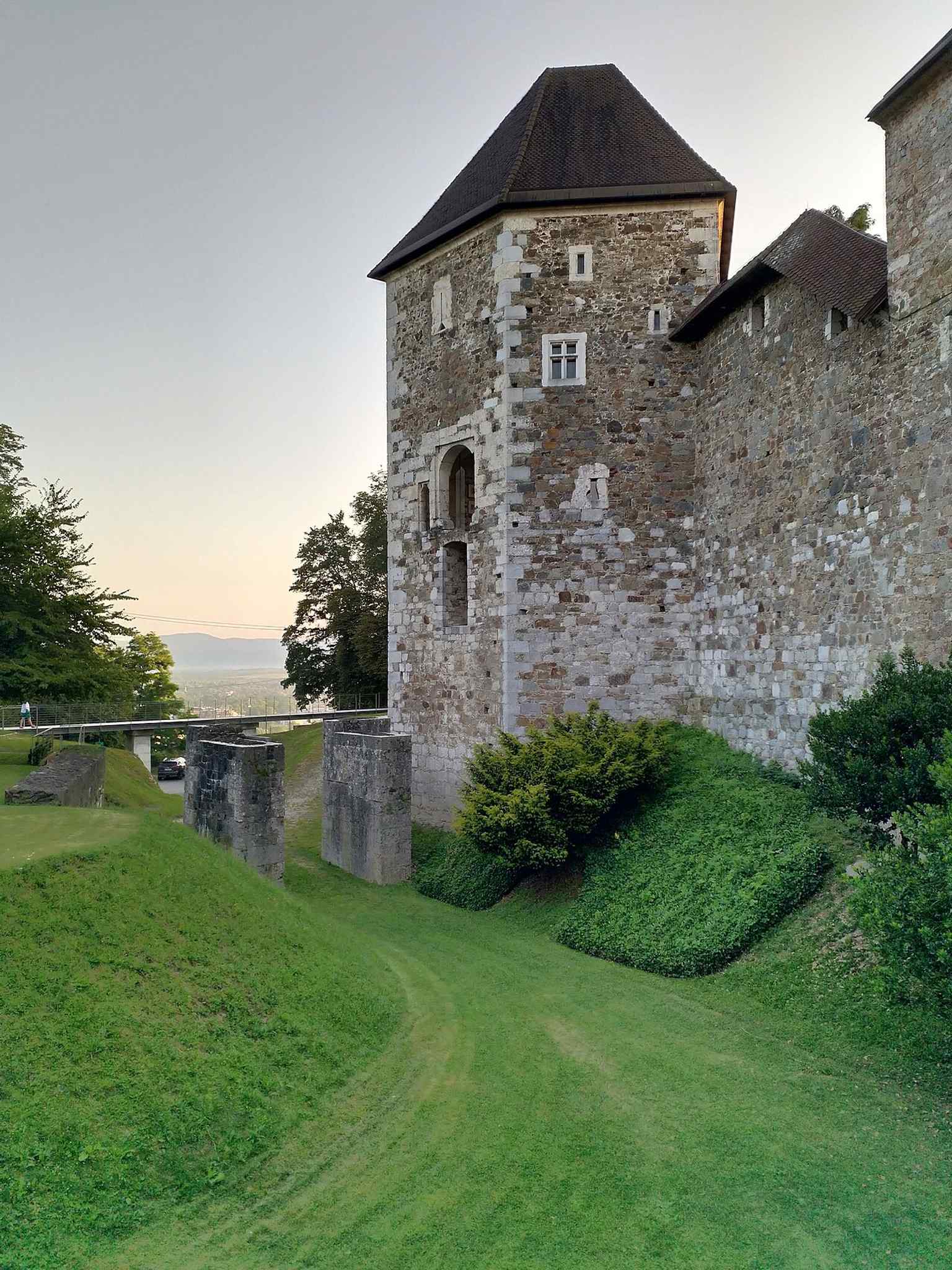
The castle's entrance bridge, restored to its medieval appearance, features a sculpture of the legendary dragon, a symbol of Ljubljana that evolved from a terrifying monster to a guardian.Photo: Robert Jahoda, Wikimedia Commons, CC BY-SA 4.0. Cropped & resized. This fortress has survived everything from medieval sieges to a near-demolition in the late eighteenth century. At the time, penny-pinching administrators in Vienna viewed the crumbling fortress as a useless financial drain and proposed dismantling it to sell the stones as scrap. Fortunately, regional leaders fiercely opposed the plan, arguing it was a vital historical monument. They saved the castle, allowing it to endure into the modern era. Rising proudly above the capital for centuries, the imposing silhouette of Ljubljana Castle remains largely unchanged, though the hill's once-sparse slopes have grown into a lush, forested canopy over the decades, as you can see by checking the comparison image on your screen.
Through disaster, ambitious artistic renovations, and the heavy passage of time, the castle remains the undeniable focal point of the capital. If you want to explore the inner courtyards or the panoramic tower, the complex is open every day from nine in the morning until seven in the evening.
For now, let us head toward the subterranean paths beneath the castle, as we transition down to our next destination, the Tunnel under the city.
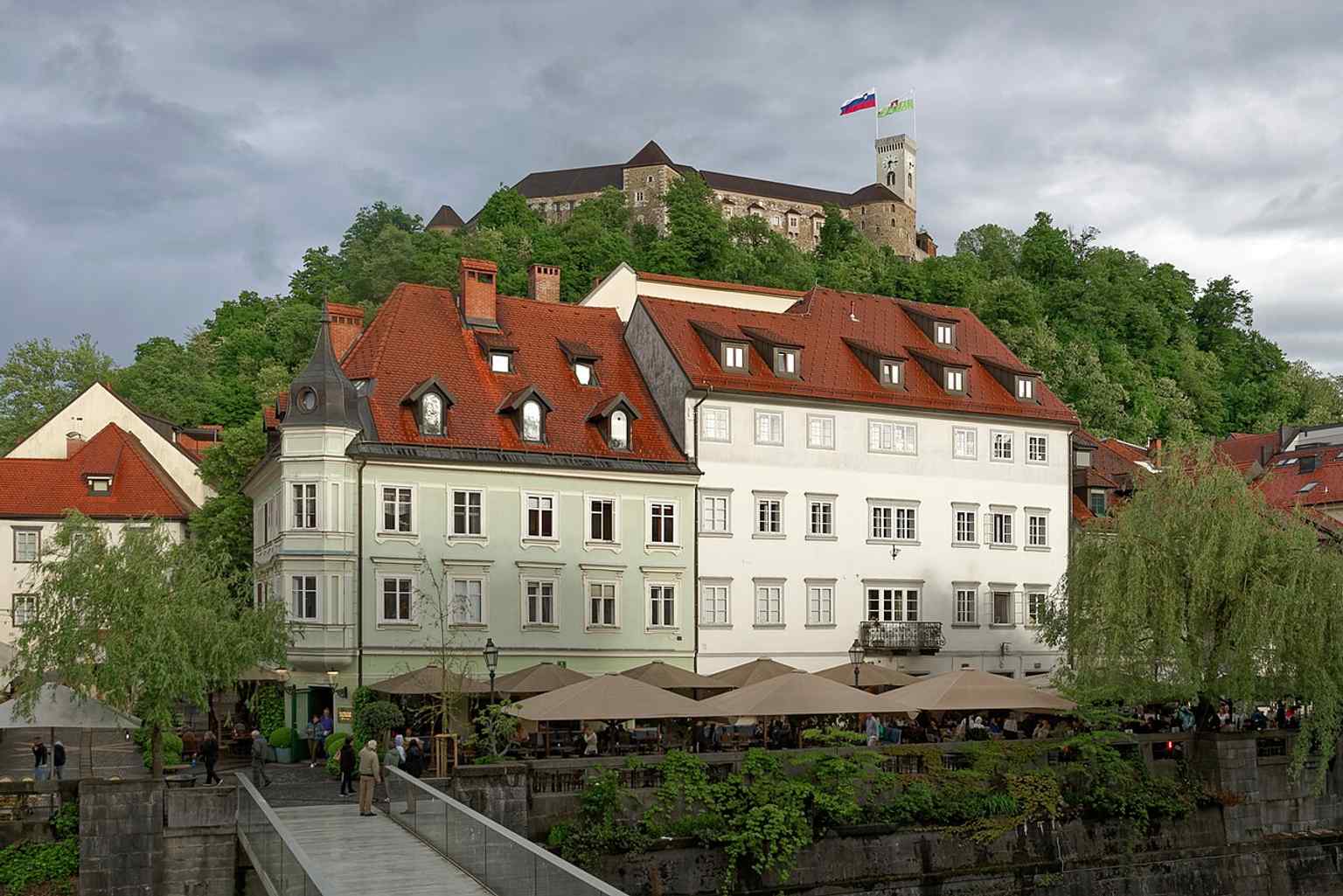
A commanding view of Ljubljana Castle, a landmark that acquired its present outline through an almost complete overhaul in the 15th century and serves as the capital's key cultural venue today.Photo: Jakub Hałun, Wikimedia Commons, CC BY 4.0. Cropped & resized. 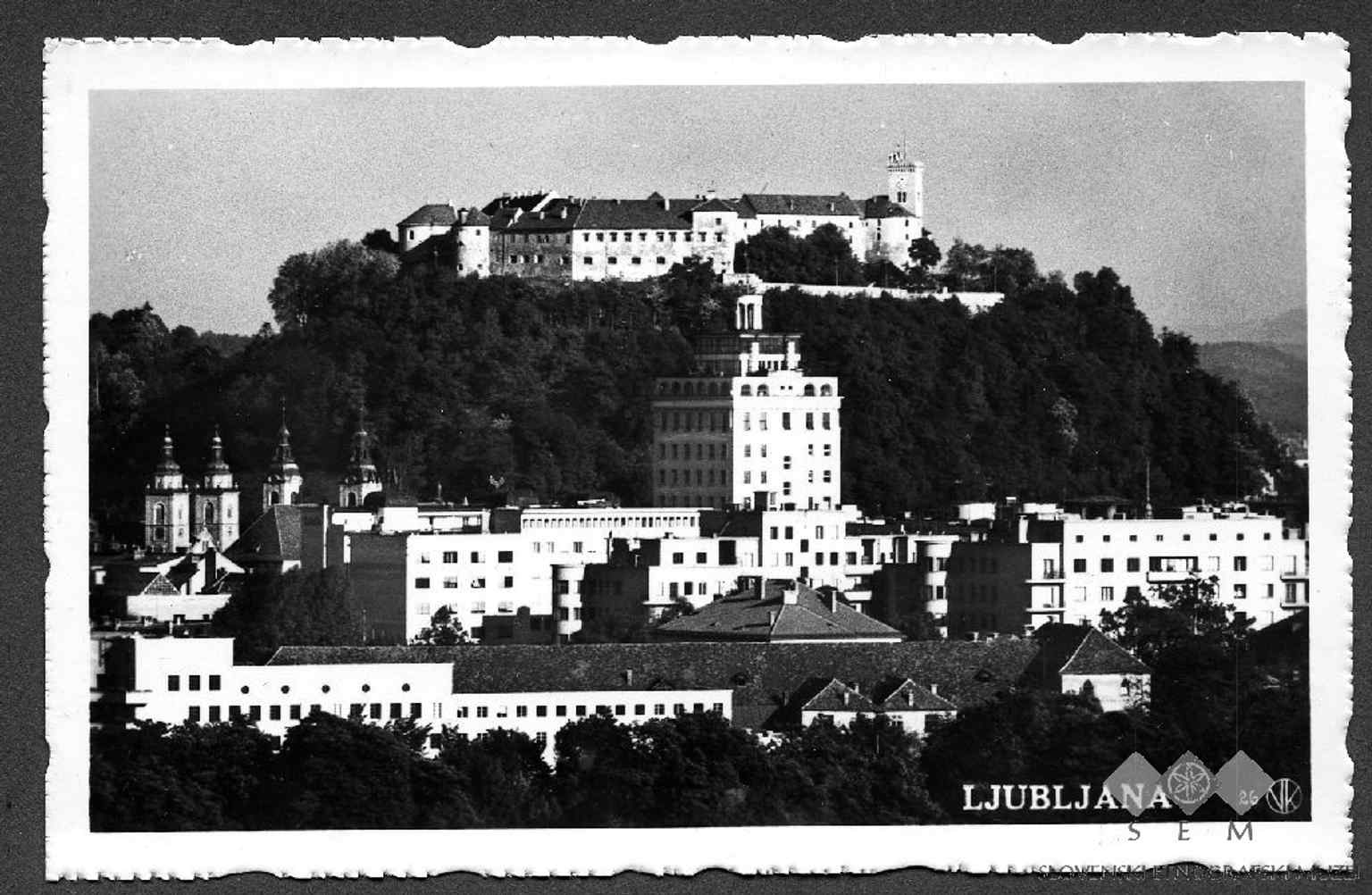
This 1933 postcard shows Ljubljana Castle before its extensive modern renovations, offering a glimpse into its appearance when poor families still resided within its walls as envisioned by Mayor Ivan Hribar.Photo: Vekoslav Kramarič, Wikimedia Commons, Public domain. Cropped & resized. 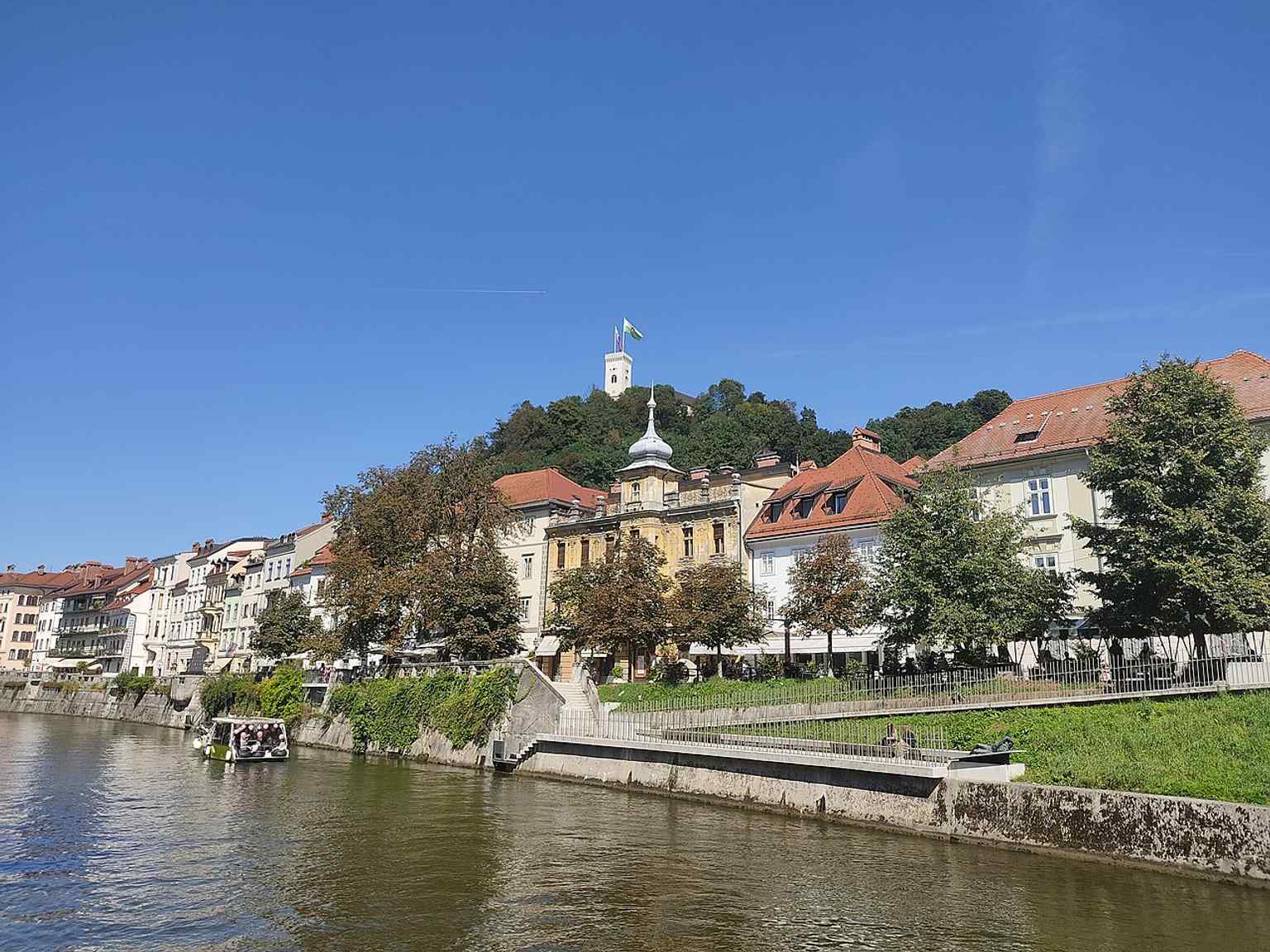
Ljubljana Castle sits atop Castle Hill, a site continuously settled for over 4,000 years, from the Bronze Age to a Roman army stronghold and the first wooden fortifications.Photo: Viktar Palstsiuk, Wikimedia Commons, CC BY-SA 4.0. Cropped & resized. 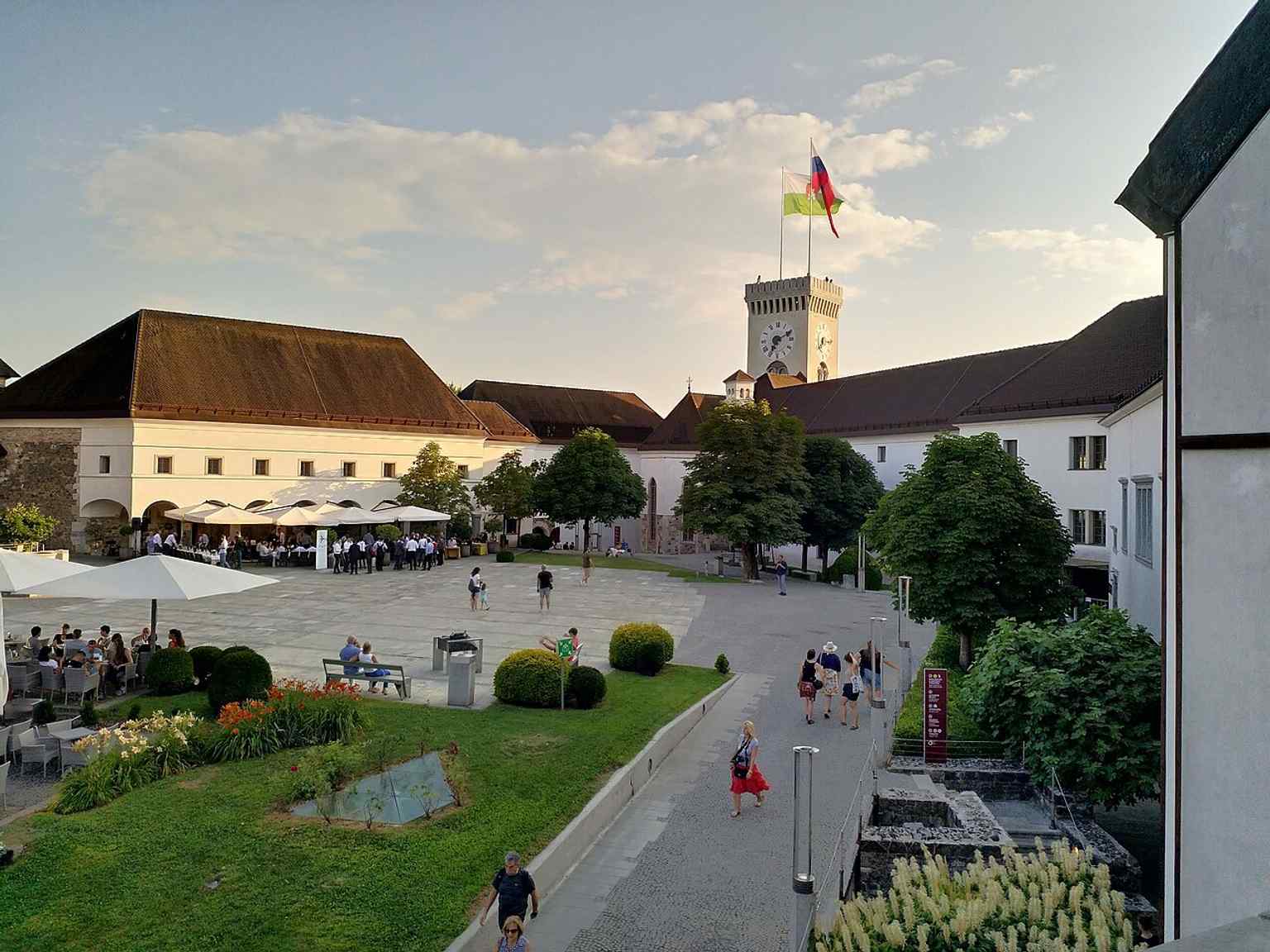
The castle's inner courtyard, a dynamic meeting point that once gathered armies and later served as a walking space for famous prisoners like Silvio Pellico and Ivan Cankar.Photo: Robert Jahoda, Wikimedia Commons, CC BY-SA 4.0. Cropped & resized. 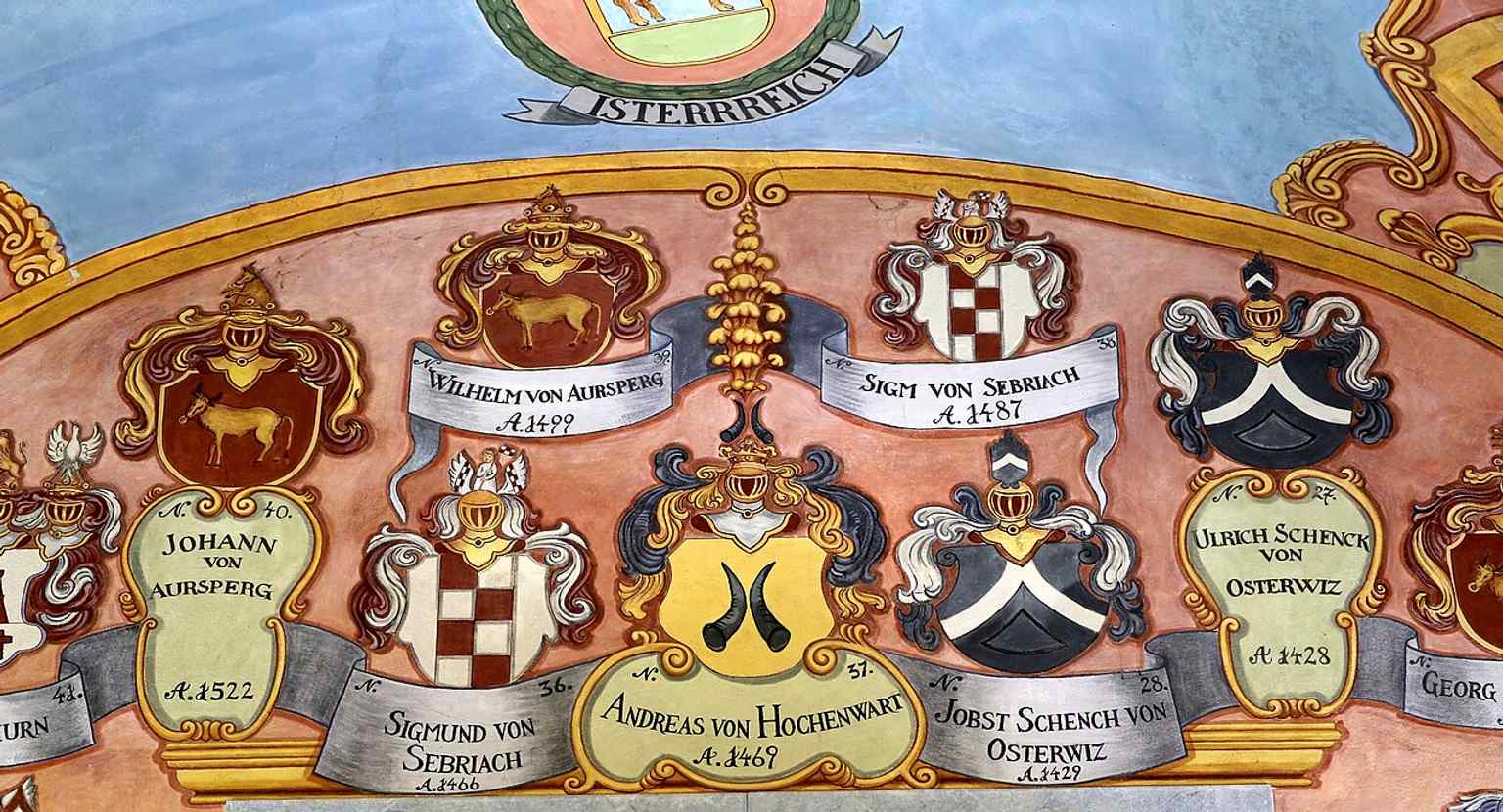
This intricate Baroque ceiling in St. George's Chapel, restored in 1747, features the coats-of-arms of provincial governors, reflecting the castle's administrative significance.Photo: Thaler Tamas, Wikimedia Commons, CC BY-SA 4.0. Cropped & resized. 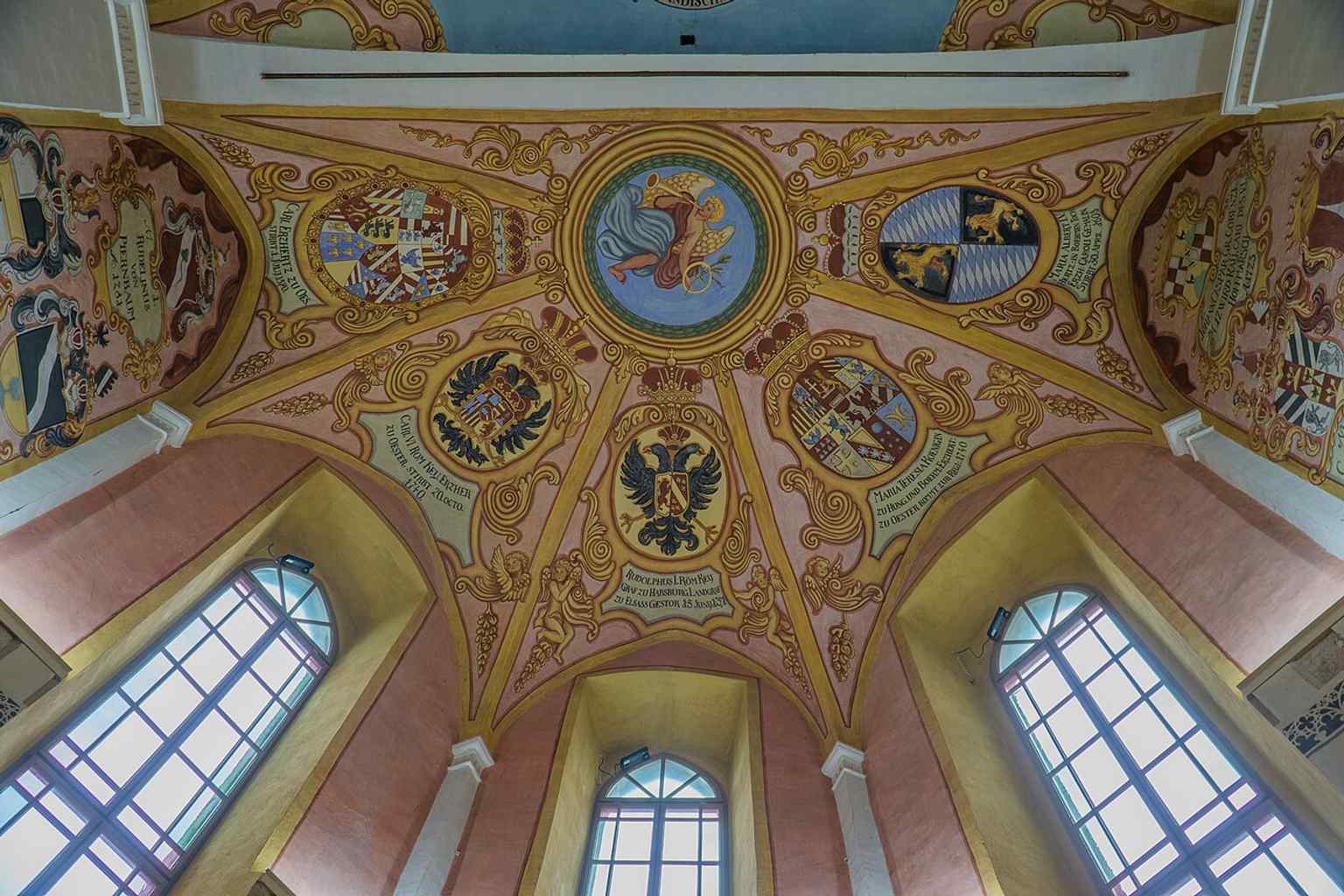
The exterior of the Castle Chapel of St. George, consecrated in 1489, is connected to a local legend crediting Saint George with defeating the dragon, a Christianized version of the city's ancient myth.Photo: Sumitsurai, Wikimedia Commons, CC BY-SA 4.0. Cropped & resized. 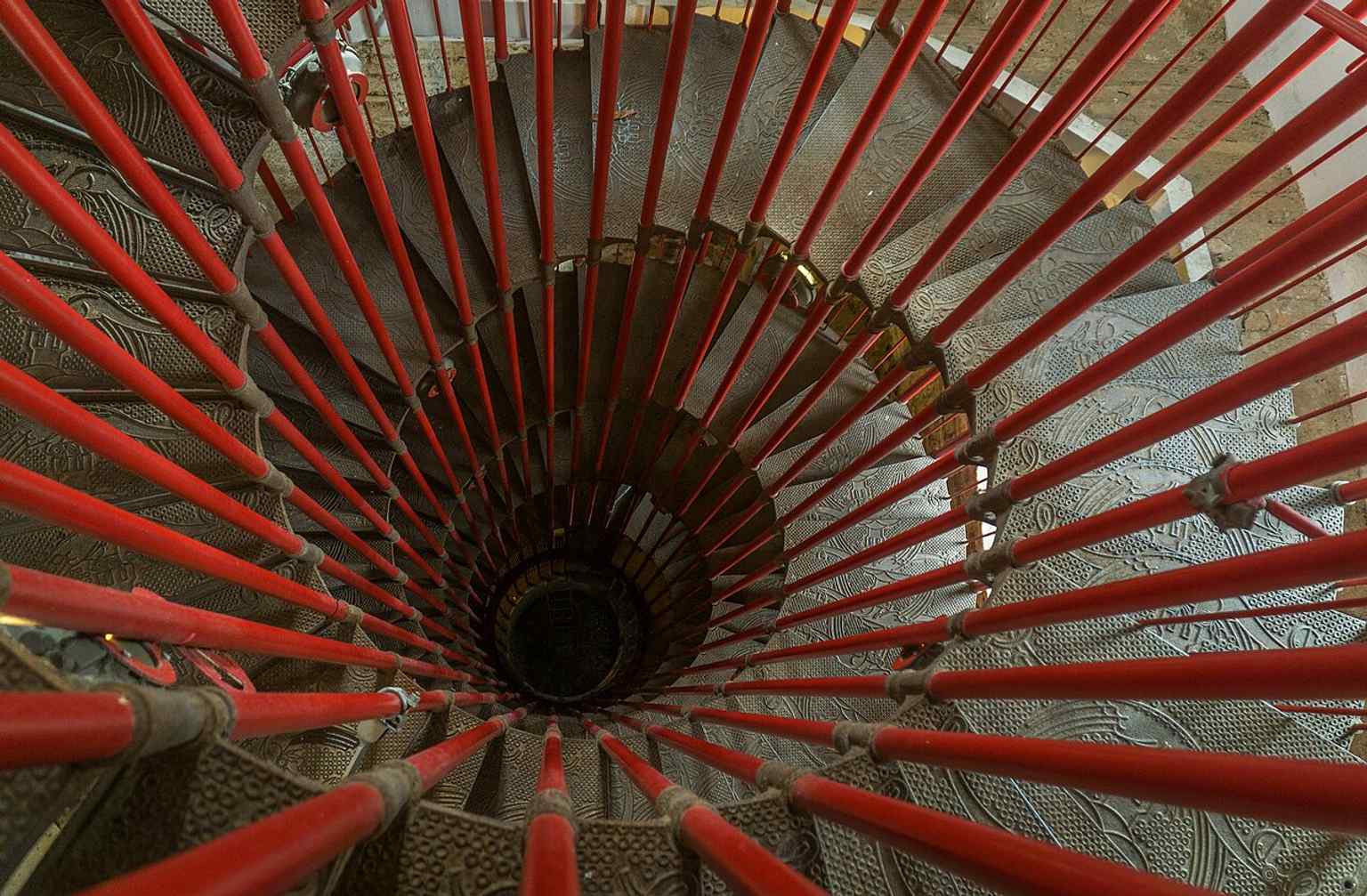
The distinctive double spiral staircase inside the Panoramic Tower, built between 1845-1848, was designed to prevent soldiers from crossing paths, a key logistical feature of the fortress.Photo: Sumitsurai, Wikimedia Commons, CC BY-SA 4.0. Cropped & resized. 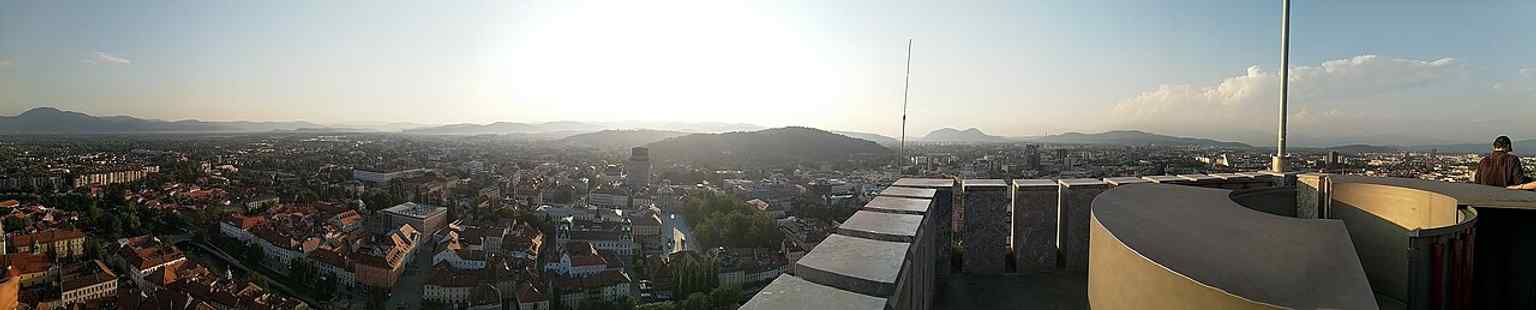
A sweeping view from the Panoramic Tower, once home to a fire watchman, offering distant glimpses of the Julian Alps and Kamnik-Savinja on a clear day.Photo: Robert Jahoda, Wikimedia Commons, CC BY-SA 4.0. Cropped & resized. 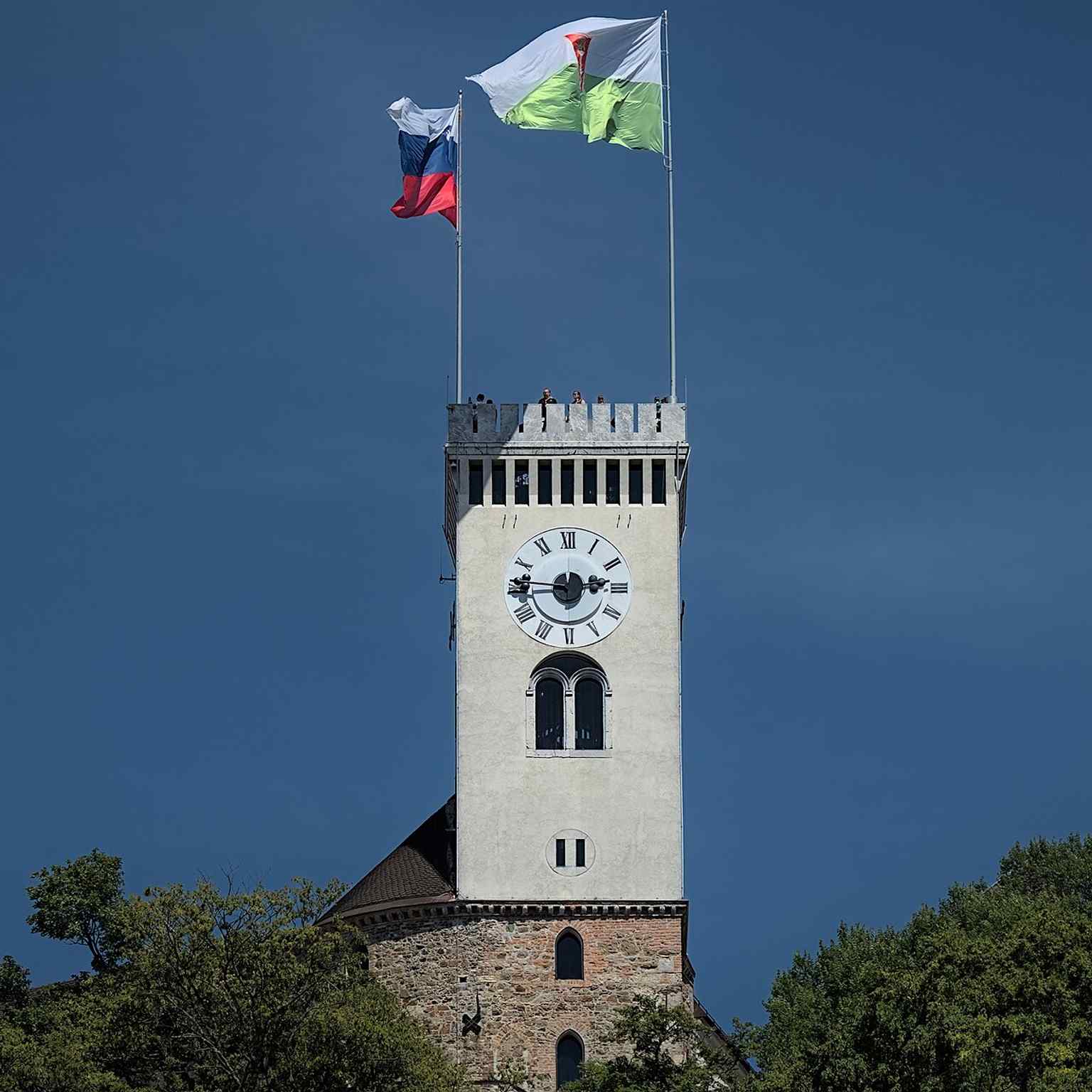
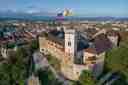
The Viewing Tower of Ljubljana Castle, rebuilt in masonry in the 1840s, proudly flies the national and city flags, representing its continued role as a civic and historical symbol.Photo: This Photo was taken by Miha Peče. Feel free to use my photos, but please mention me as the author. I would much appreciate if you send me an email [email protected] or write on my talk page, for my information. Please do not upload an edited image here without consulting me. I would like to make corrections only at my own source to ensure that the changes improve the image and are preserved.Otherwise you may upload an edited image with a new name. Please use one of the templates derivative or extract., Wikimedia Commons, CC BY-SA 4.0. Cropped & resized. 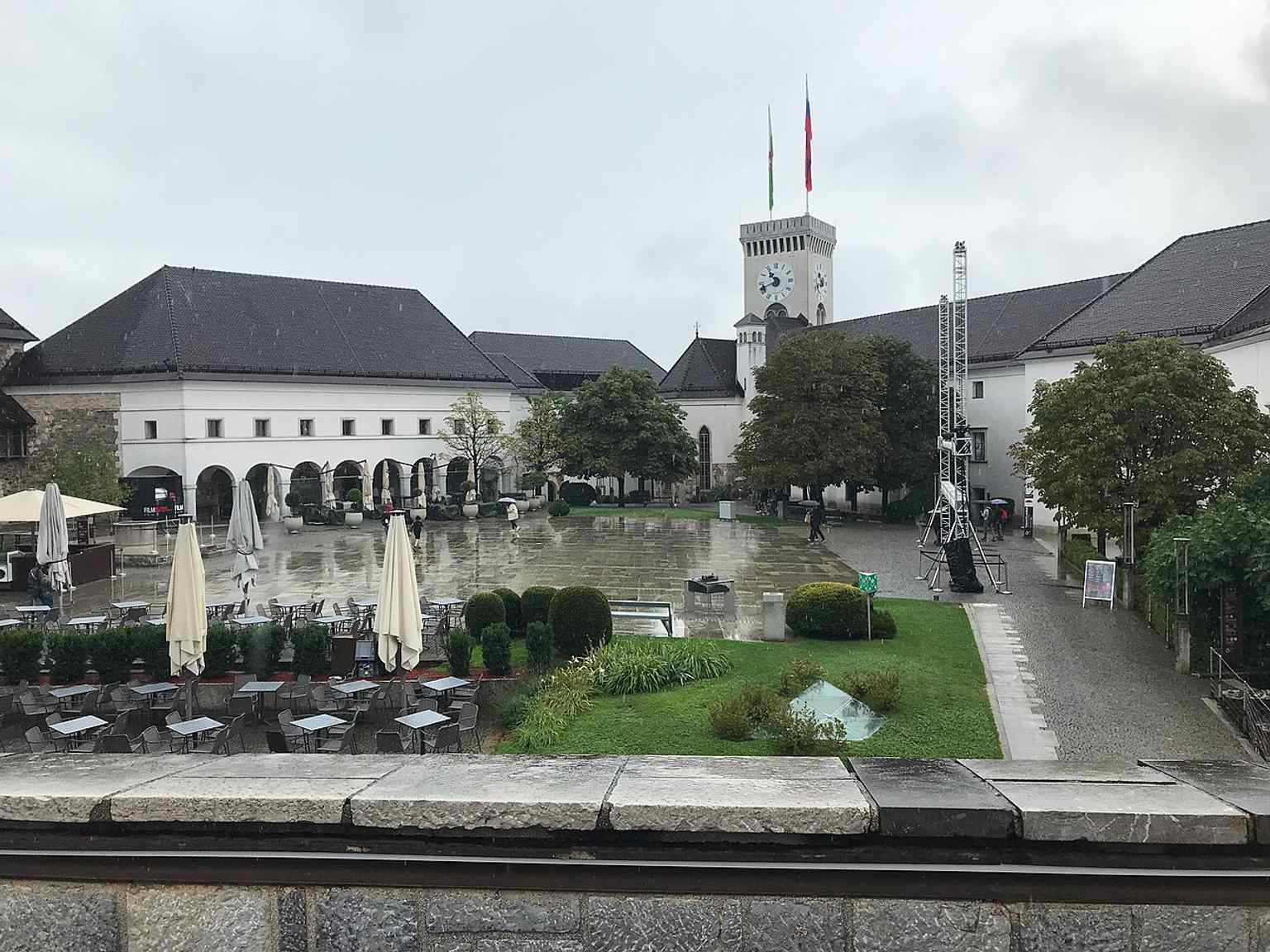
A glimpse into the castle's adaptable interior spaces, which transitioned from medieval strongholds to a military hospital, barracks, and even a notorious prison in the 19th century.Photo: Antimuonium, Wikimedia Commons, CC BY-SA 4.0. Cropped & resized. 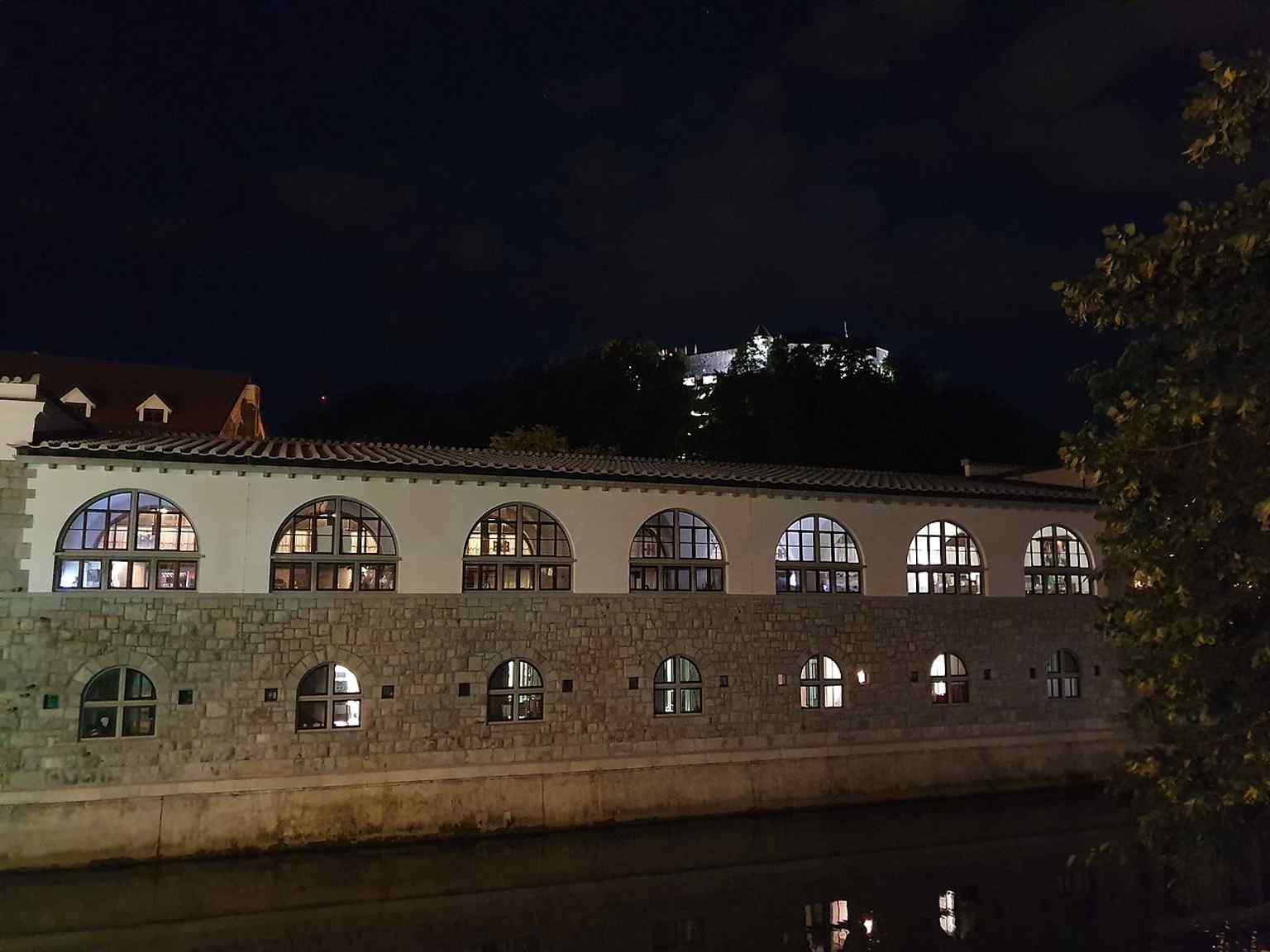
Ljubljana Castle illuminated at night, highlighting its modern role as a major cultural venue, hosting weddings and events after extensive renovations began in the 1970s.Photo: Saška Grušovnik, Wikimedia Commons, CC BY-SA 4.0. Cropped & resized. You are looking at a massive, semi-circular tunnel arch framed by a sturdy retaining wall of rough-hewn, light-grey stone blocks set directly into the hillside. This is the…Read moreShow less
Open dedicated page →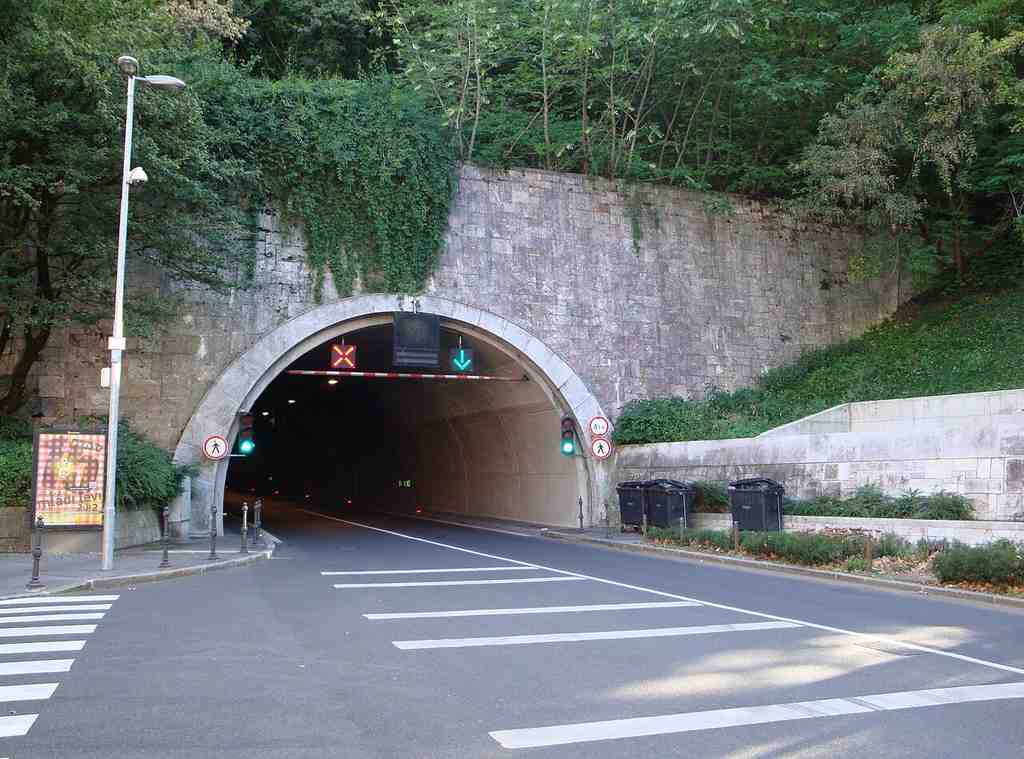
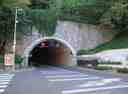
Tunnel under the City, LjubljanaPhoto: Mich973, Wikimedia Commons, CC BY-SA 3.0. Cropped & resized. You are looking at a massive, semi-circular tunnel arch framed by a sturdy retaining wall of rough-hewn, light-grey stone blocks set directly into the hillside.
This is the Tunnel under the City, spanning 487 meters through Castle Hill, and it is a perfect example of how urban progress rarely comes without a heavy price. The story of this passageway begins just before World War Two, when city planners decided to cut a shortcut through the mountain. They started digging, but only made it about eleven meters deep before the war forced them to stop.
As bombs began to fall on Ljubljana, those eleven meters of unfinished rock suddenly gained a new purpose. The tiny cave became a vital air-raid shelter, protecting the lives of locals who huddled inside.
When the war ended, builders decided to start fresh from the opposite side of the hill. But bringing this vision to life meant destroying a piece of the city's heritage. To make room for the massive northern entrance, authorities demolished the Institute of Saint Martha, an old historic building that had long served as a home for maidservants. The decision sparked a bitter public debate. If you had to sacrifice a historic building to modernize a city, would you make that call?
The builders did, but the mountain did not surrender easily. As engineers drilled deeper, they encountered a geological nightmare. The hill was plagued by what geologists call clay smear, which is essentially slick layers of wet clay sandwiched between rock, acting like a slip-and-slide for the mountain's foundations. The drilling caused violent vibrations to ripple up to Ljubljana Castle right above them. The castle's stone walls began to crack, and a massive water cistern ruptured completely, sending water flooding out.
Despite the destruction, the tunnel finally opened in 1959. A grand ribbon-cutting ceremony unleashed a giant convoy of cars and motorcycles. City planners proudly declared that this modern marvel would solve Ljubljana's traffic problems for all time. As you can probably guess, it is now one of the city's most congested bottlenecks. Feel free to check out the before and after image in your app to see how this imposing portal has stood the test of time.
The tunnel's structure, however, had its own hidden flaws. Decades later, ceramic tiles began peeling off the walls and crashing onto the road. Inspectors closed it down in 2009 for a massive 5.7 million euro renovation, and what they found inside was terrifying. At one point, the interior concrete wall had separated from the main supporting structure by a full five centimeters, meaning a massive collapse was narrowly avoided. Take a look at your screen to see the interior just before this desperate structural rescue.
Oh, and there is one last secret hidden in the dark. Deep inside, a vertical shaft runs straight up from the tunnel ceiling to the bottom of the old castle well. Officials claim it was just for running electrical wires, but locals have always whispered that it was built as a secret escape route for city elites.
Let us emerge from the shadow of the hill and head toward our final stop. It is about a thirteen-minute walk from here to the Slovenian Academy of Sciences and Arts.
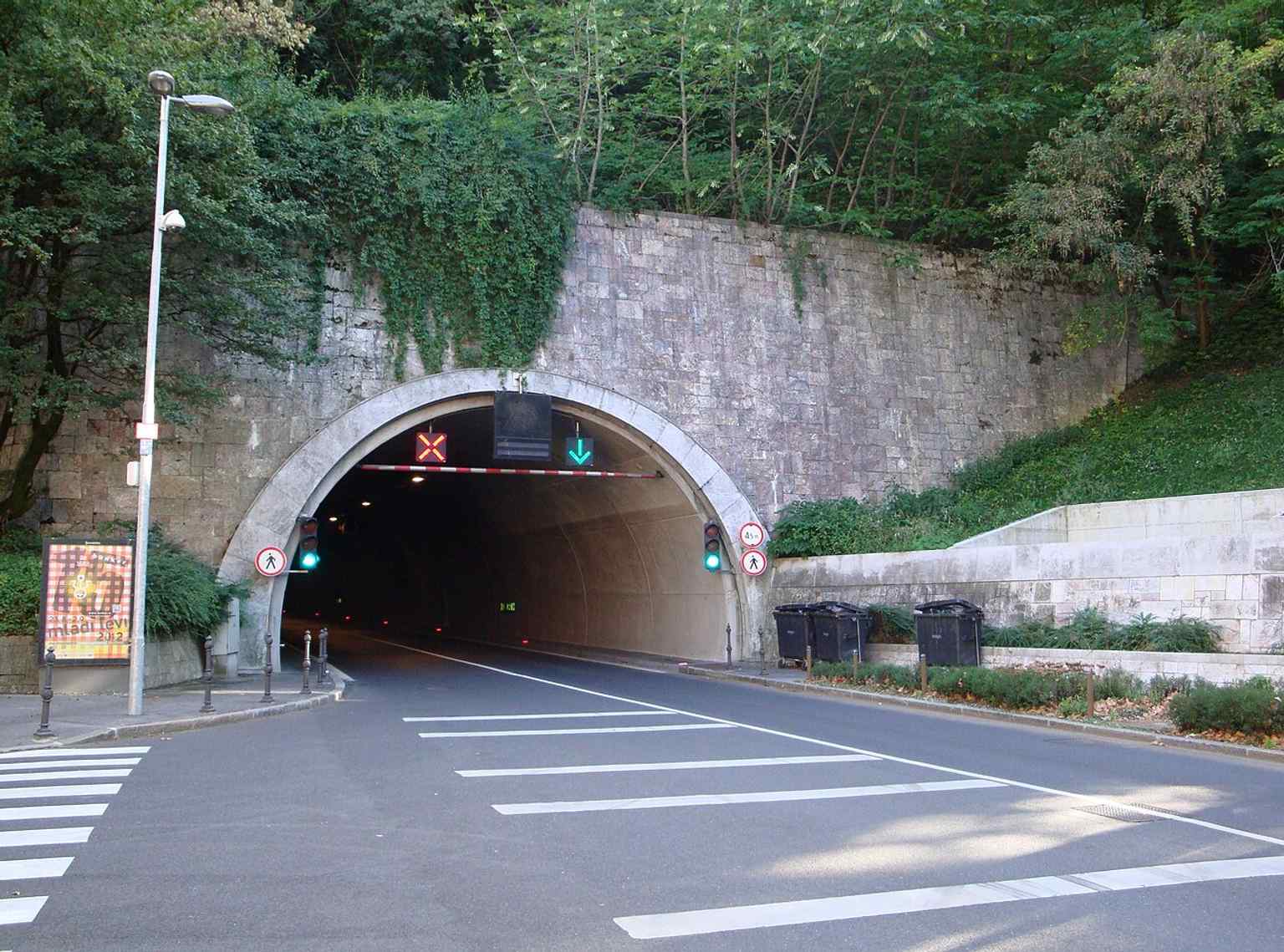
The tunnel's modern interior, refurbished in a 2009 renovation which cost 5.7 million Euros and addressed issues like falling ceramic tiles and structural instability.Photo: Mich973, Wikimedia Commons, CC BY-SA 3.0. Cropped & resized. 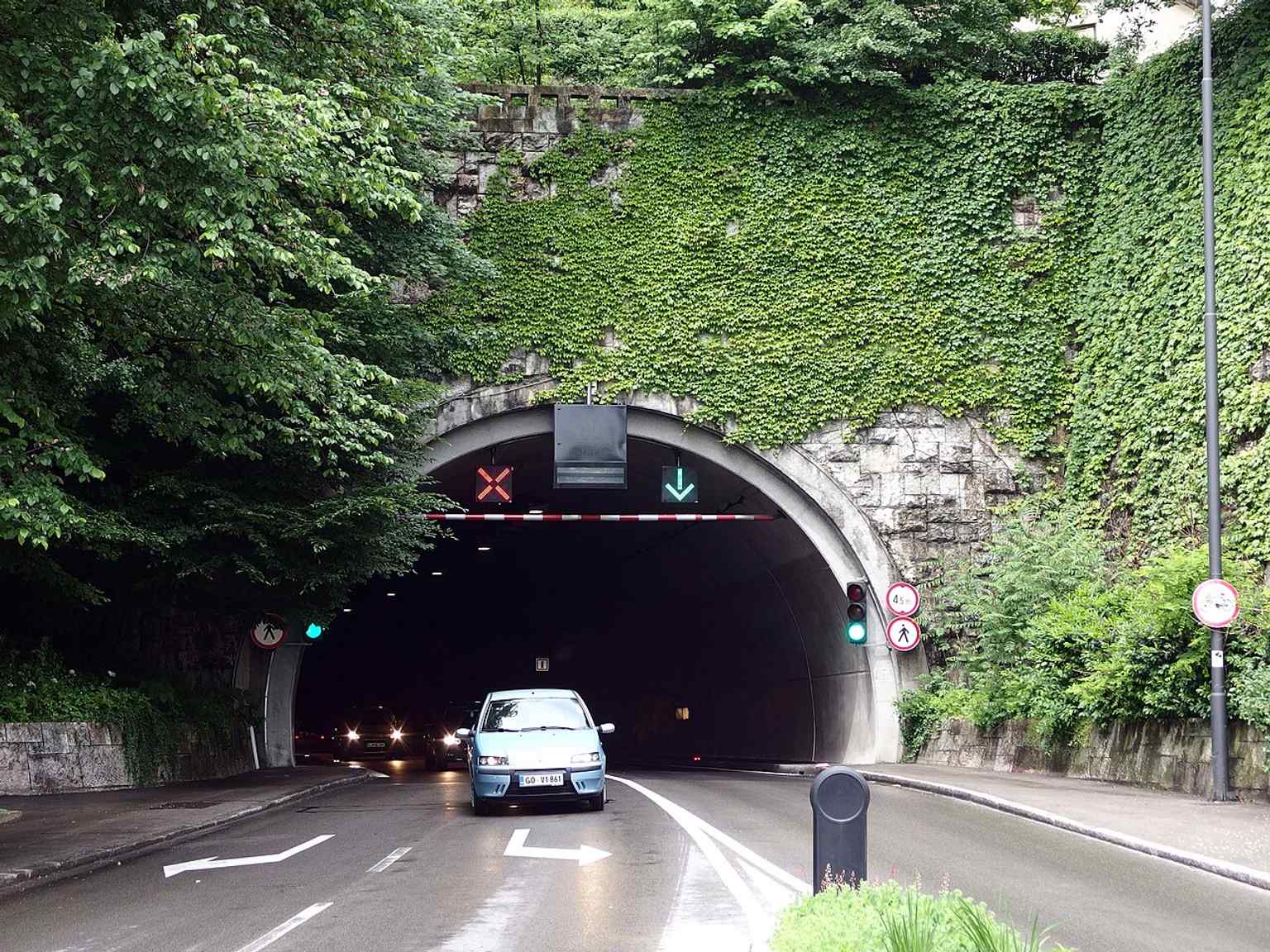
An exterior view of the tunnel's entrance, which was envisioned in 1959 to solve Ljubljana's traffic problems 'for all time' and now accommodates thousands of vehicles daily.Photo: Mark Ahsmann, Wikimedia Commons, CC BY-SA 3.0. Cropped & resized. 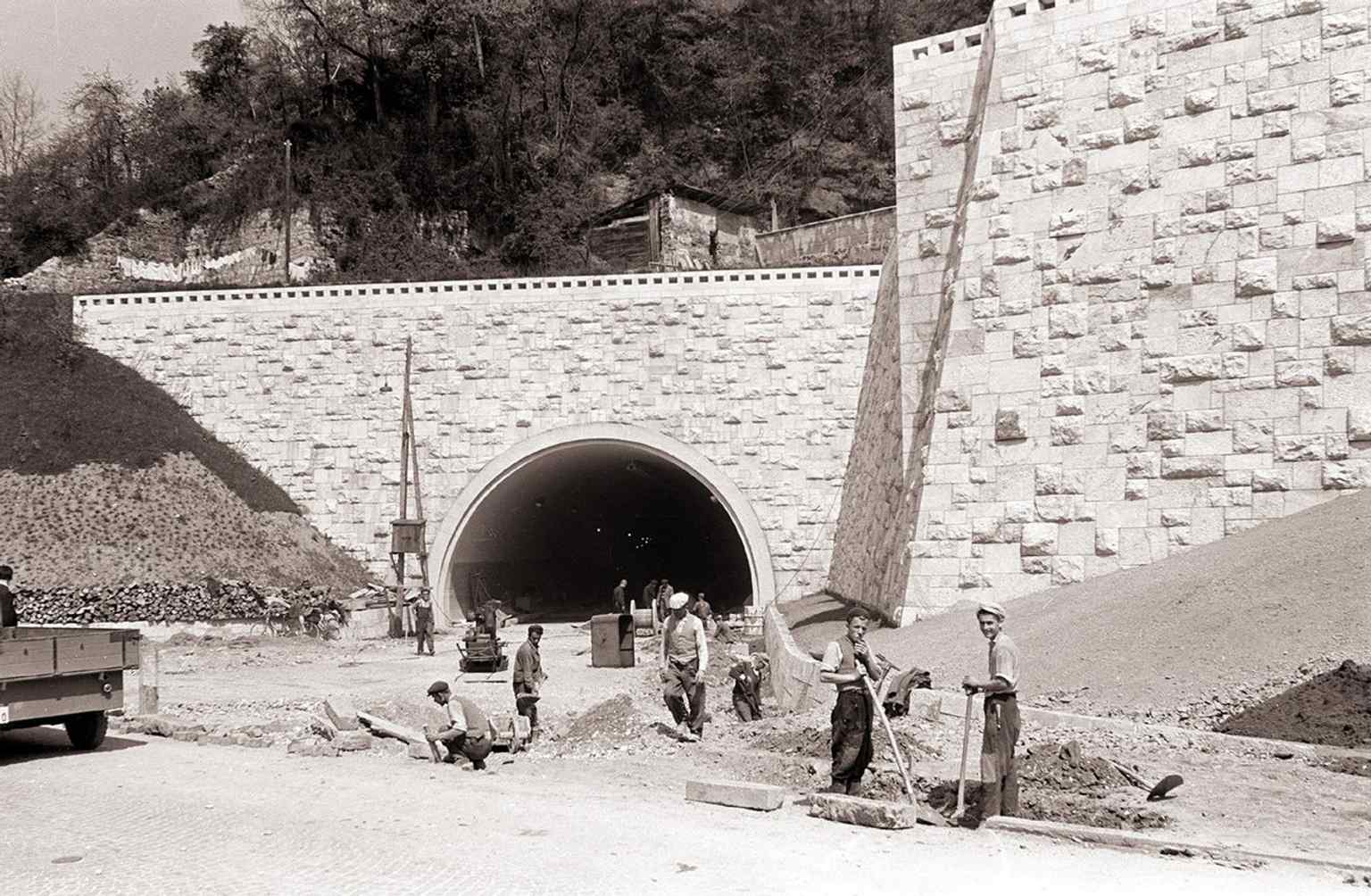
Workers completing construction of the tunnel in 1959. Initial plans date back to the Kingdom of Yugoslavia, and the first few meters dug served as a bomb shelter during WWII.Photo: Unknown authorUnknown author, Wikimedia Commons, Public domain. Cropped & resized. 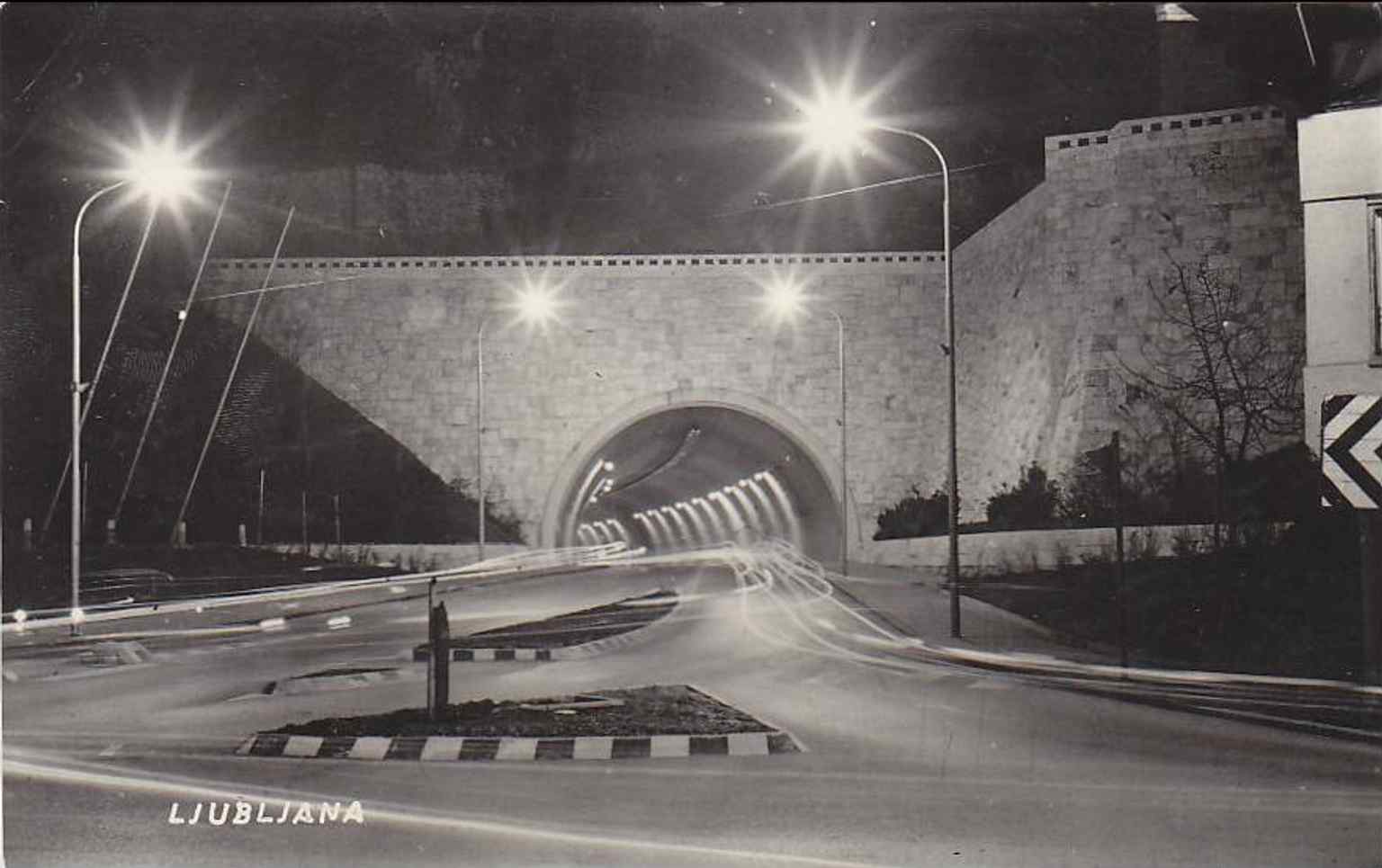
A 1965 postcard showing the tunnel's portal. Its opening in 1959 was a grand event, with Bojan Polak cutting the ribbon as a convoy of cars and motorcycles drove through.Photo: Unknown authorUnknown author, Wikimedia Commons, Public domain. Cropped & resized. To your left stands the Lontovž Palace, a stately building distinguished by a pale facade, a prominent triangular pediment featuring a circular clock, and a grand arched wooden…Read moreShow less
Open dedicated page →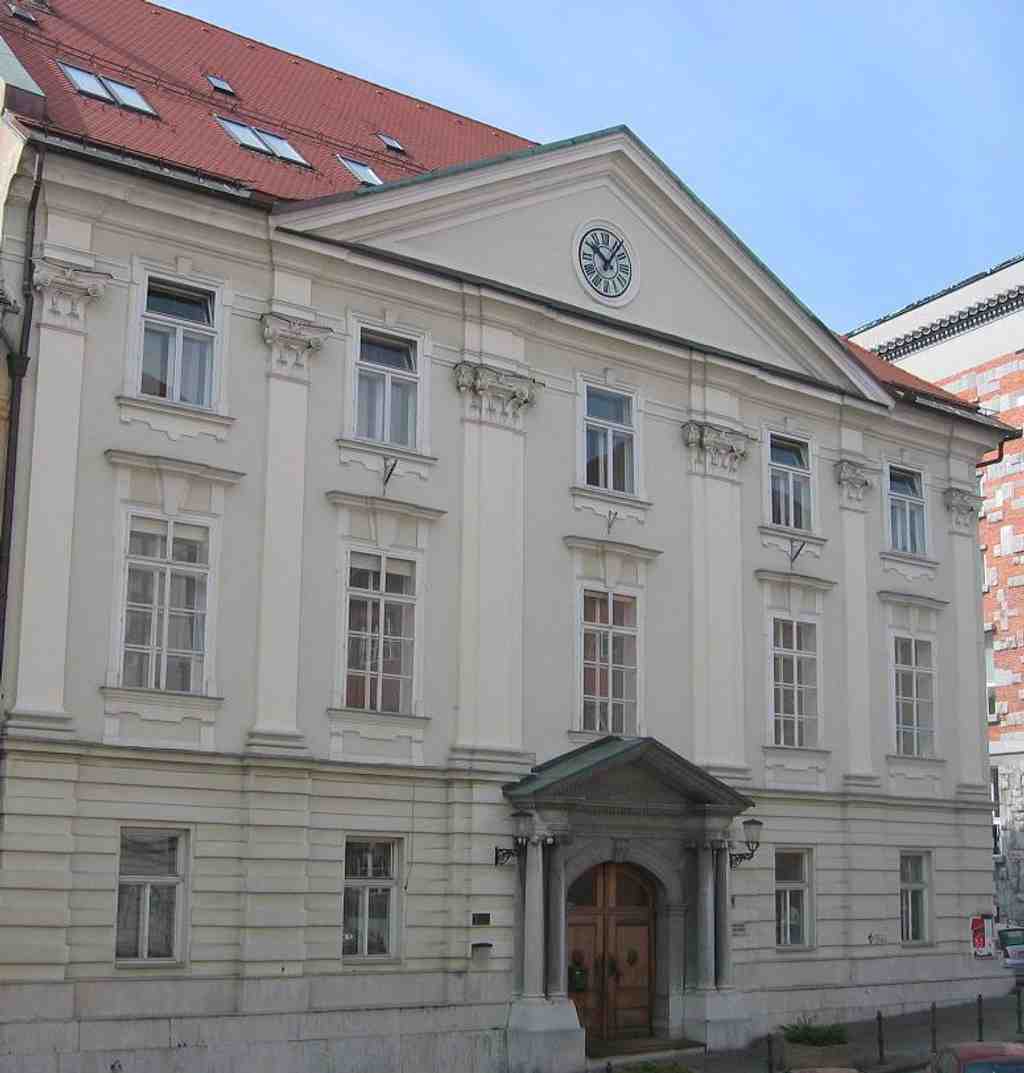
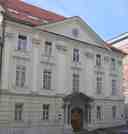
Slovenian Academy of Sciences and ArtsPhoto: Žiga, Wikimedia Commons, Public domain. Cropped & resized. To your left stands the Lontovž Palace, a stately building distinguished by a pale facade, a prominent triangular pediment featuring a circular clock, and a grand arched wooden doorway framed by stone columns. Take a look at your screen for a clear view of this historic exterior.
This is the headquarters of the Slovenian Academy of Sciences and Arts. Beneath these very floorboards lies ground that is far older than the institution itself, including ancient Roman city walls and an early Iron Age Hallstatt burial site. The academy's own roots reach back to 1693, starting as a tight-knit society of twenty-three industrious men. They met securely behind closed doors until their grand public debut in 1701, an elegant affair illuminated by white wax torches. Among those early visionaries was the historian Janez Gregor Dolničar, the same determined figure who championed the city's grand cathedral. He was so vital to the group's energy that when he died in 1725, that first iteration of the academy effectively died with him.
But the ambition to protect and nurture Slovenian culture always returned, even in the darkest times. During the Italian occupation in the Second World War, a resistance strategy known as the cultural silence was enacted, where Slovenian cultural workers boycotted all state-sponsored events. Yet the academy remained a fierce battleground of ideas. You had the Vidmar brothers, for instance. Josip Vidmar was a leader in the communist-led Liberation Front. His brother, Milan Vidmar, a world-class chess grandmaster, played a highly dangerous political game of his own, using his influence with the collaborationist mayor to officially secure the word Slovenian in the academy's name in 1943. You can imagine the tension at family dinners.
After the war, the drama only deepened. In 1945, the new national government stripped the academy of its autonomy. The bizarre twist here is the family paradox. The government enacting this takeover was led by Boris Kidrič, while the academy's president, fighting desperately to preserve its scholarly integrity, was his own father, France Kidrič. Political loopholes were eventually created to admit state leaders like Josip Broz Tito as honorary members, simply because their deeds were deemed to have a special significance, regardless of any actual academic credentials.
Yet, through every political storm, the pursuit of knowledge here never stopped. In fact, it reached across the globe. In 2023, a research team from this very academy used aerial laser mapping to discover a massive, forgotten Mayan city swallowed by the Mexican jungle, complete with fifteen-meter-high pyramids.
As we conclude our journey together, this building feels like the perfect final note. It embodies the relentless drive of a place that refuses to be erased. Through occupations, political purges, and shifting empires, the visionary minds of this city have always found a way to preserve their language, advance their sciences, and protect their art. That enduring intellectual fire, that quiet but unbreakable determination... that is the true spirit of Ljubljana.
Frequently asked questions
How do I start the tour?
After purchase, download the AudaTours app and enter your redemption code. The tour will be ready to start immediately - just tap play and follow the GPS-guided route.
Do I need internet during the tour?
No! Download the tour before you start and enjoy it fully offline. Only the chat feature requires internet. We recommend downloading on WiFi to save mobile data.
Is this a guided group tour?
No - this is a self-guided audio tour. You explore independently at your own pace, with audio narration playing through your phone. No tour guide, no group, no schedule.
How long does the tour take?
Most tours take 60–90 minutes to complete, but you control the pace entirely. Pause, skip stops, or take breaks whenever you want.
What if I can't finish the tour today?
No problem! Tours have lifetime access. Pause and resume whenever you like - tomorrow, next week, or next year. Your progress is saved.
What languages are available?
All tours are available in 50+ languages. Select your preferred language when redeeming your code. Note: language cannot be changed after tour generation.
Where do I access the tour after purchase?
Download the free AudaTours app from the App Store or Google Play. Enter your redemption code (sent via email) and the tour will appear in your library, ready to download and start.
If you don't enjoy the tour, we'll refund your purchase. Contact us at [email protected]
Checkout securely with 





.jpg)
.jpg)


%2003.jpg)


.jpg)


.jpg)


%2001.jpg)


![This Photo was taken by Miha Peče. Feel free to use my photos, but please mention me as the author. I would much appreciate if you send me an email [email protected] or write on my talk page, for my information. Please do not upload an edited image here without consulting me. I would like to make corrections only at my own source to ensure that the changes improve the image and are preserved.Otherwise you may upload an edited image with a new name. Please use one of the templates derivative or extract.](https://upload.wikimedia.org/wikipedia/commons/d/d3/Pre%C5%A1ernov_trg1.jpg)


.jpg)
.jpg)


.jpg)


![This Photo was taken by Miha Peče. Feel free to use my photos, but please mention me as the author. I would much appreciate if you send me an email [email protected] or write on my talk page, for my information. Please do not upload an edited image here without consulting me. I would like to make corrections only at my own source to ensure that the changes improve the image and are preserved.Otherwise you may upload an edited image with a new name. Please use one of the templates derivative or extract.](https://upload.wikimedia.org/wikipedia/commons/d/de/StolpLjGrad.jpg)


