
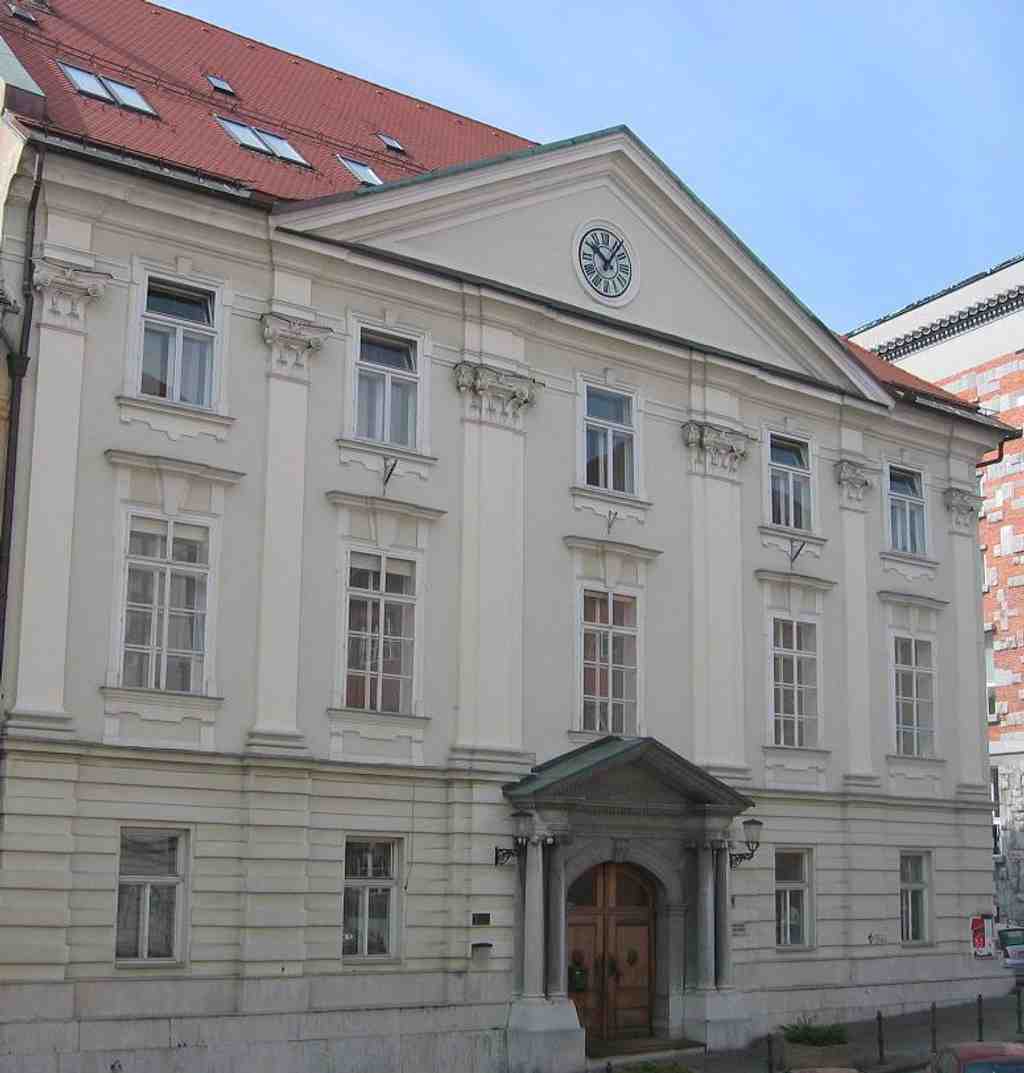
To your left stands the Lontovž Palace, a stately building distinguished by a pale facade, a prominent triangular pediment featuring a circular clock, and a grand arched wooden doorway framed by stone columns. Take a look at your screen for a clear view of this historic exterior.
This is the headquarters of the Slovenian Academy of Sciences and Arts. Beneath these very floorboards lies ground that is far older than the institution itself, including ancient Roman city walls and an early Iron Age Hallstatt burial site. The academy's own roots reach back to 1693, starting as a tight-knit society of twenty-three industrious men. They met securely behind closed doors until their grand public debut in 1701, an elegant affair illuminated by white wax torches. Among those early visionaries was the historian Janez Gregor Dolničar, the same determined figure who championed the city's grand cathedral. He was so vital to the group's energy that when he died in 1725, that first iteration of the academy effectively died with him.
But the ambition to protect and nurture Slovenian culture always returned, even in the darkest times. During the Italian occupation in the Second World War, a resistance strategy known as the cultural silence was enacted, where Slovenian cultural workers boycotted all state-sponsored events. Yet the academy remained a fierce battleground of ideas. You had the Vidmar brothers, for instance. Josip Vidmar was a leader in the communist-led Liberation Front. His brother, Milan Vidmar, a world-class chess grandmaster, played a highly dangerous political game of his own, using his influence with the collaborationist mayor to officially secure the word Slovenian in the academy's name in 1943. You can imagine the tension at family dinners.
After the war, the drama only deepened. In 1945, the new national government stripped the academy of its autonomy. The bizarre twist here is the family paradox. The government enacting this takeover was led by Boris Kidrič, while the academy's president, fighting desperately to preserve its scholarly integrity, was his own father, France Kidrič. Political loopholes were eventually created to admit state leaders like Josip Broz Tito as honorary members, simply because their deeds were deemed to have a special significance, regardless of any actual academic credentials.
Yet, through every political storm, the pursuit of knowledge here never stopped. In fact, it reached across the globe. In 2023, a research team from this very academy used aerial laser mapping to discover a massive, forgotten Mayan city swallowed by the Mexican jungle, complete with fifteen-meter-high pyramids.
As we conclude our journey together, this building feels like the perfect final note. It embodies the relentless drive of a place that refuses to be erased. Through occupations, political purges, and shifting empires, the visionary minds of this city have always found a way to preserve their language, advance their sciences, and protect their art. That enduring intellectual fire, that quiet but unbreakable determination... that is the true spirit of Ljubljana.




