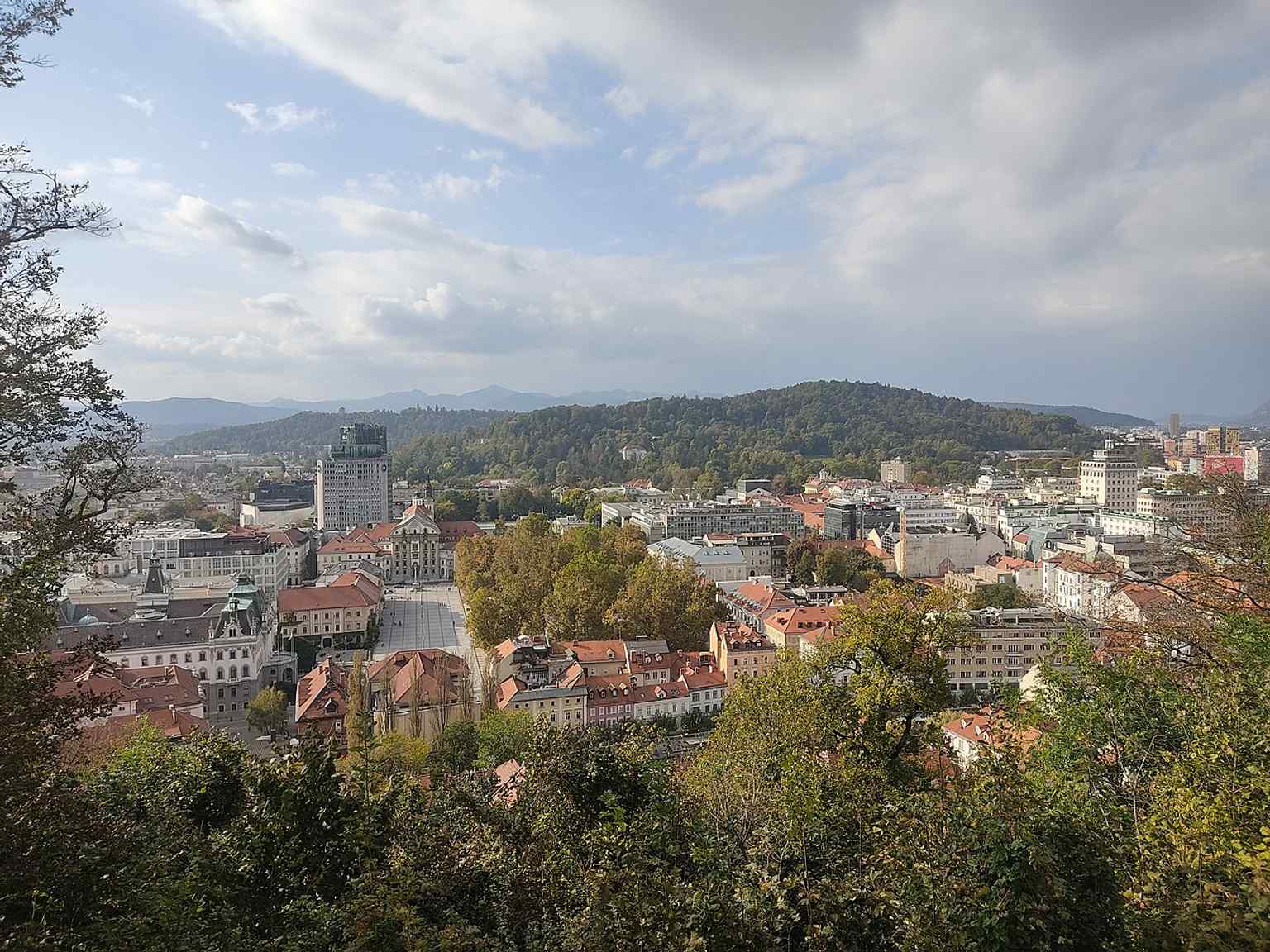
Before you stretches a vast rectangular plaza paved in light stone grids, flanked on one side by a dense canopy of tall trees, and anchored at the far end by a grand church with a distinctive wave like facade. If you walk along the park area, you will spot a gilded statue of a man in a toga, a replica of a tombstone found right here, reminding us that this very ground was once part of ancient Roman Emona.
But this space has been broken and rebuilt more times than you might guess. Back in the early eighteen hundreds, this area was little more than a ditch next to the crumbling ruins of a monastery for Capuchin friars. Then, the Congress of the Holy Alliance chose Ljubljana for a major political summit in eighteen twenty one. Driven by a sudden need to impress the crowned heads of Europe, the city rapidly filled the ditch and cleared the ruins to create a massive, elegant parade ground. If you look at the second image on your app, you will see the Kazina building. That is where Europe's elite danced at extravagant balls while military parades marched right where you are standing.
A century later, the great architect Jože Plečnik brought his own demanding vision to the square. He decided the park's dense, leafy chestnut trees had to go. Why? Because their thick branches blocked the view of the surrounding architecture. He insisted on planting plane trees instead, since their sparser canopies would let the buildings shine through. The locals were absolutely furious about losing their shaded walkways, but Plečnik stubbornly pushed the project through anyway.
The city's survival instincts were put to the test here during the Second World War. As extreme food shortages gripped the occupied city in nineteen forty two, the authorities actually allowed these manicured park lawns to be plowed into what they called war fields. Families planted potatoes, and later soy, right here in the center of the city to keep themselves from starving. During that same occupation, Italian forces decided to destroy the large bronze statue of the Yugoslav King that stood in the square. They did not use explosives. Instead, they painstakingly sawed the metal horse and rider into pieces, wanting a slow, symbolic erasure of the monarchy rather than a quick blast.
Even in modern times, this ground keeps giving up its secrets. In two thousand eleven, workers dug a massive underground parking garage beneath the plaza. Beneath the pavement, archaeologists were stunned to uncover completely unknown ancient burial mounds from the eighth century BC, along with more Roman foundations. The drive to modernize had accidentally unearthed the city's deepest roots.
This grand plaza is open twenty four hours a day, so you can always come back to explore its paths. For now, let us continue our walk by heading back toward the river to find a rather peculiar crossing. Your next stop, the Fish Bridge, is just a two minute stroll away.