
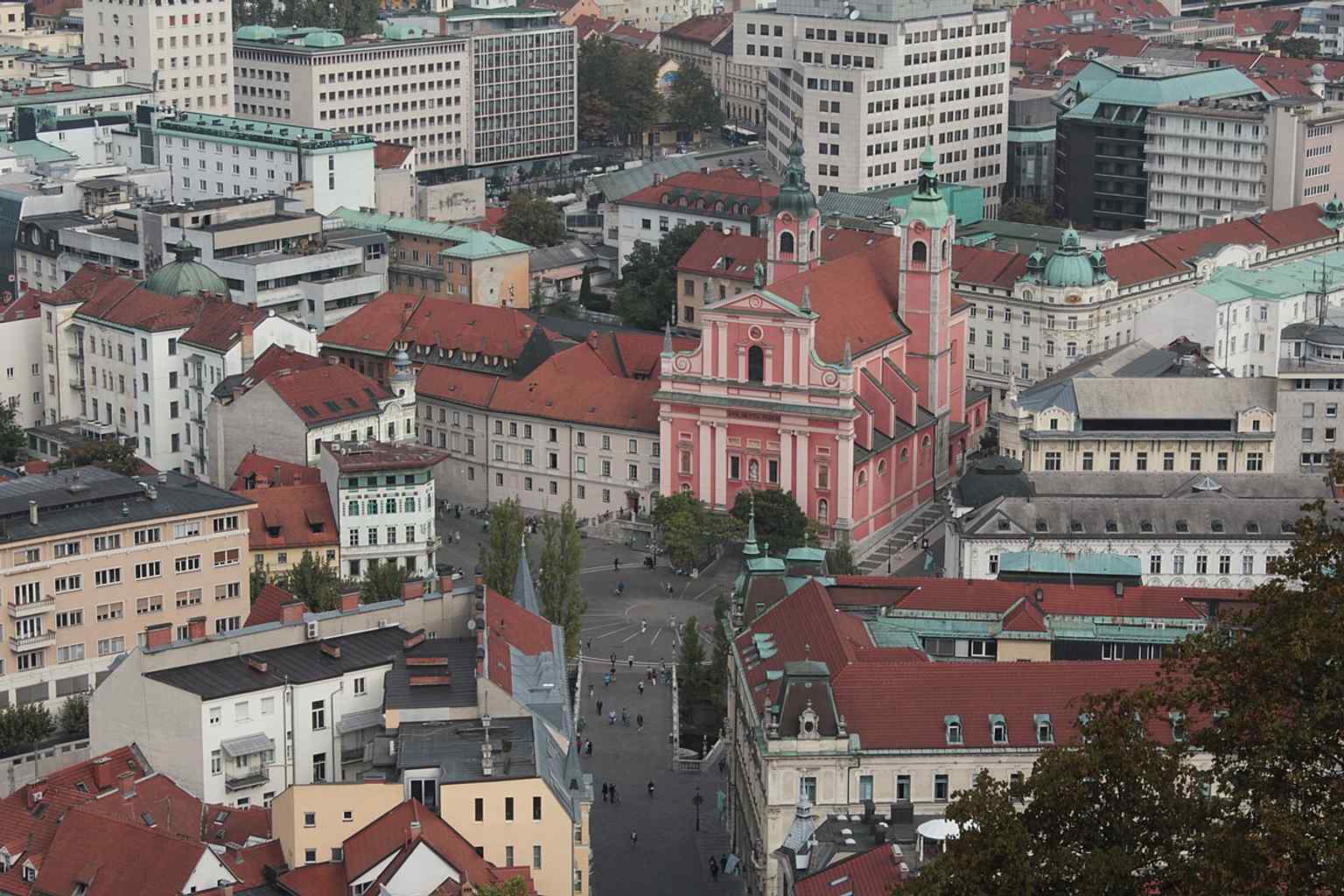
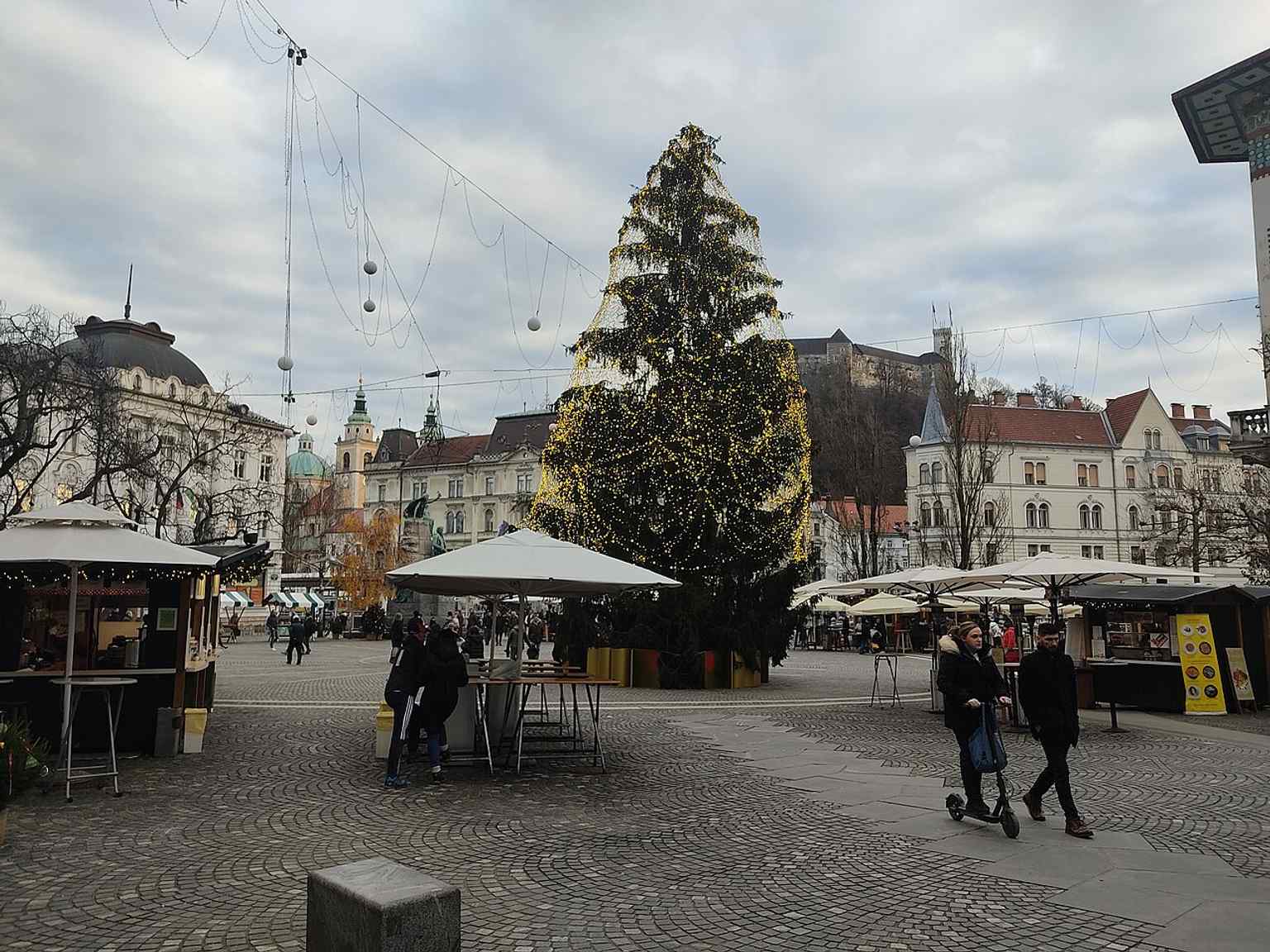
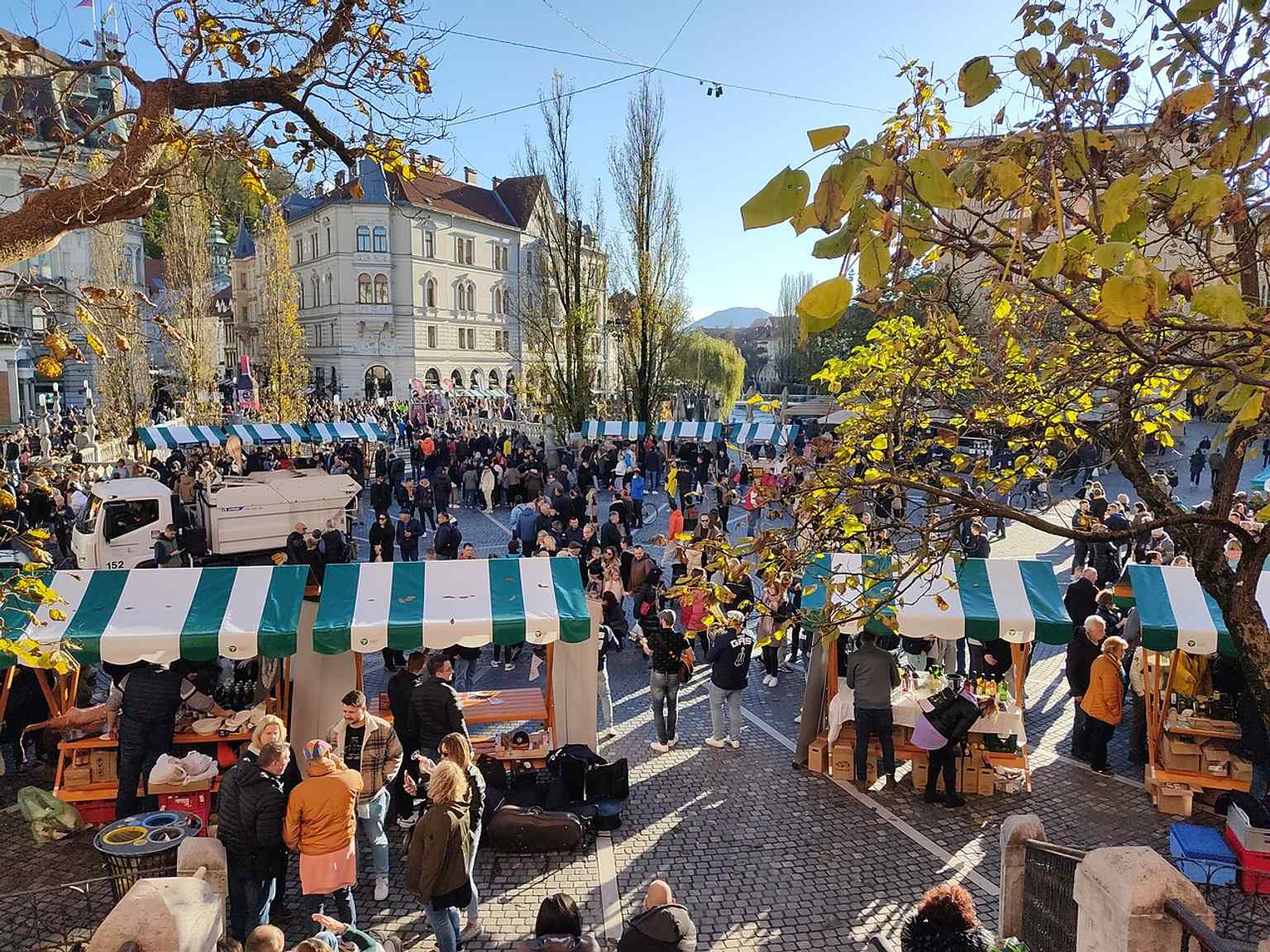
Welcome to Prešeren Square. Take a moment and just watch the flow of the people here. This is the pulsing heart of Ljubljana. If you check out the aerial view on your screen, you can see how the square acts like a giant funnel. A whole network of streets pours down into this single open space, converging right at the gateway to the old medieval town across the river.
This space has always been a crossroads, but its grand appearance was born from a catastrophe. As you've heard, the 1895 earthquake shattered much of Ljubljana's old layout, forcing an intense drive to rebuild and reinvent. If you look over at number 1, that is the Hauptmann House. It was one of the very few buildings to survive the quake intact, and its owner capitalized on that sturdy foundation by giving it a stunning makeover in the Viennese Secession style, an elegant, geometric architectural trend of the early twentieth century. Notice those striking colored ceramic tiles forming a checkerboard pattern near the roof.
But the real drama of the square revolves around the man standing in the middle of it. That is the monument to France Prešeren, Slovenia's greatest romantic poet. When it was unveiled in 1905, it sparked one of the biggest cultural scandals of the era. The problem wasn't the poet... it was the woman hovering above him.
Pull up the next image on your app to see the bronze muse holding a laurel branch over his head. The local Archbishop, Anton Bonaventura Jeglič, was absolutely horrified. He wrote a furious letter to the mayor, calling the muse a lascivious and shamelessly nude figure that insulted religious feelings, especially since she was perched right across from the church entrance. The Archbishop demanded she be removed or, at the very least, given some clothes. The mayor refused. In protest, the Archbishop supposedly ordered the church doors to be kept closed at certain hours so his flock wouldn't be corrupted by the sight.
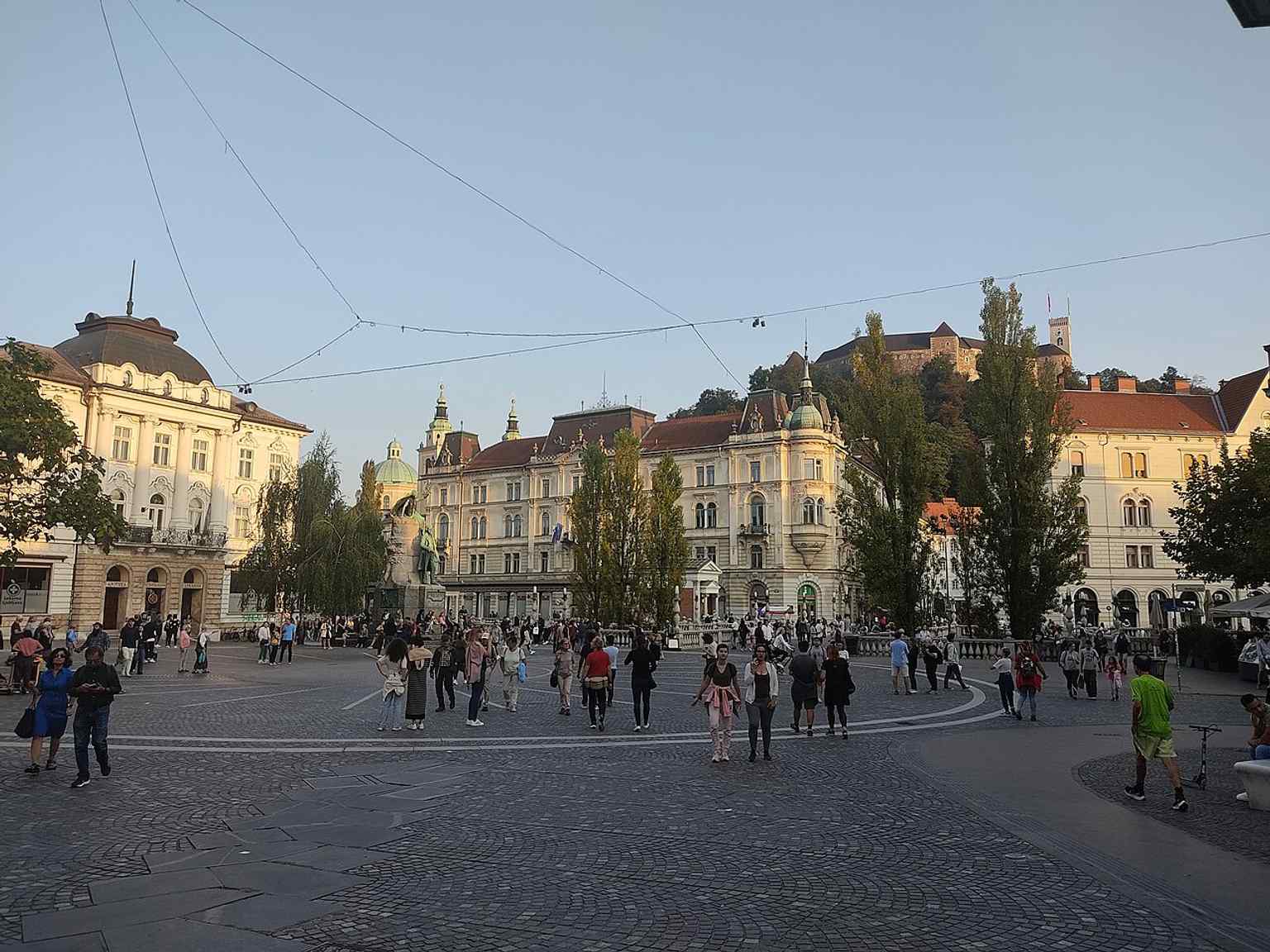
For all that fuss, Prešeren himself isn't even looking at his scandalous muse. Follow his bronze gaze across the square, over to Wolfova street. He is staring forever at a small relief on a building over there. It is a portrait of Julija Primic, the wealthy woman he loved from afar but who never returned his affection.
Look down at your feet for a second. The ground you are standing on is a work of strict mathematical harmony. In 1987, architect Edvard Ravnikar redesigned the paving to bring order to the space. He laid out a massive circle of white Macedonian marble. That circle is exactly 41.5 meters across, matching the precise dimensions of the nearby Triple Bridge. Ravnikar actually wanted to put a modern fountain right in the center, but the locals hated the idea so much that he had to abandon it.
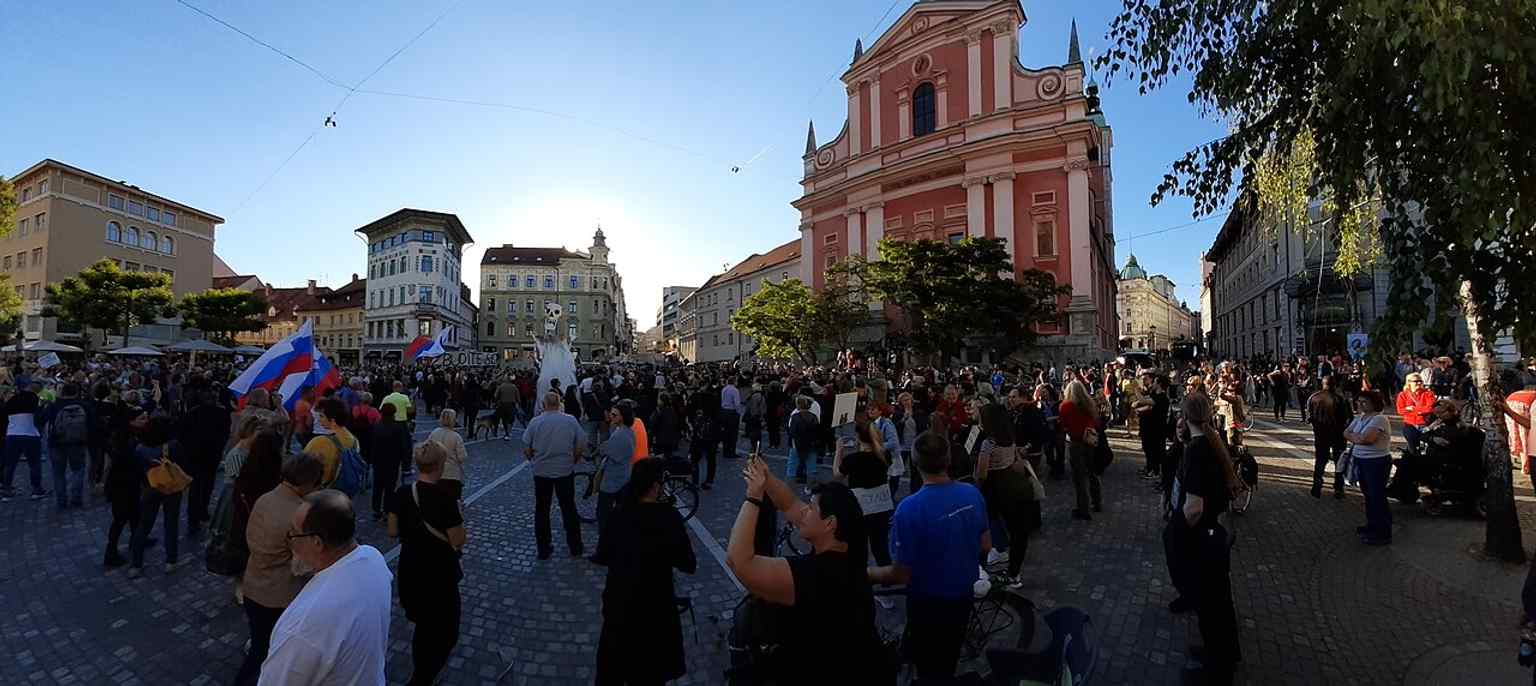
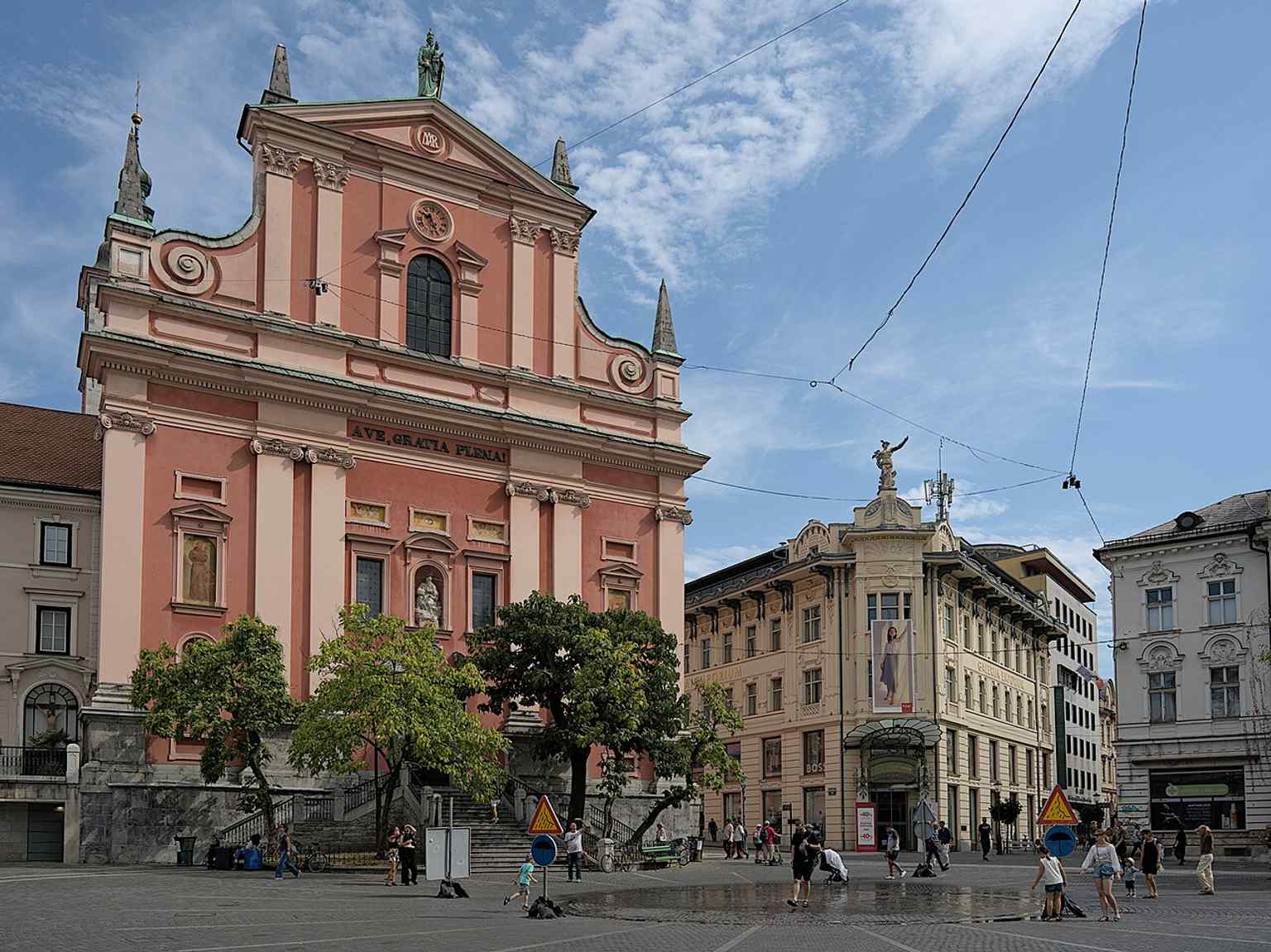
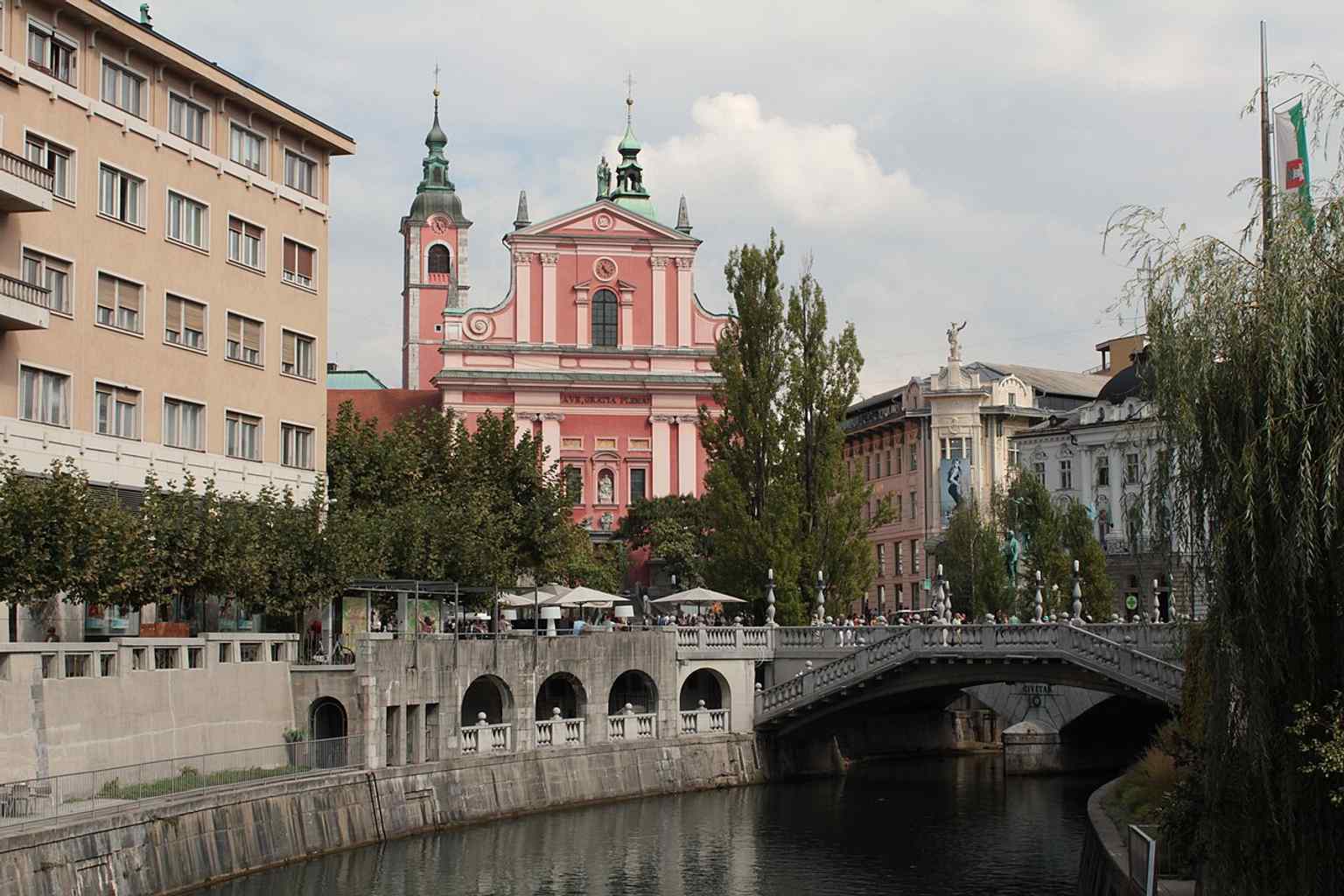
Because it is a public plaza, the square is completely open twenty four hours a day, always ready for the next protest, festival, or late night rendezvous. We are going to slip away from the crowds now. Turn your attention toward the large monastic complex attached to the red church, and let us make the very short walk to the Franciscan Library.






![This Photo was taken by Miha Peče. Feel free to use my photos, but please mention me as the author. I would much appreciate if you send me an email [email protected] or write on my talk page, for my information. Please do not upload an edited image here without consulting me. I would like to make corrections only at my own source to ensure that the changes improve the image and are preserved.Otherwise you may upload an edited image with a new name. Please use one of the templates derivative or extract.](https://upload.wikimedia.org/wikipedia/commons/d/d3/Pre%C5%A1ernov_trg1.jpg)


