
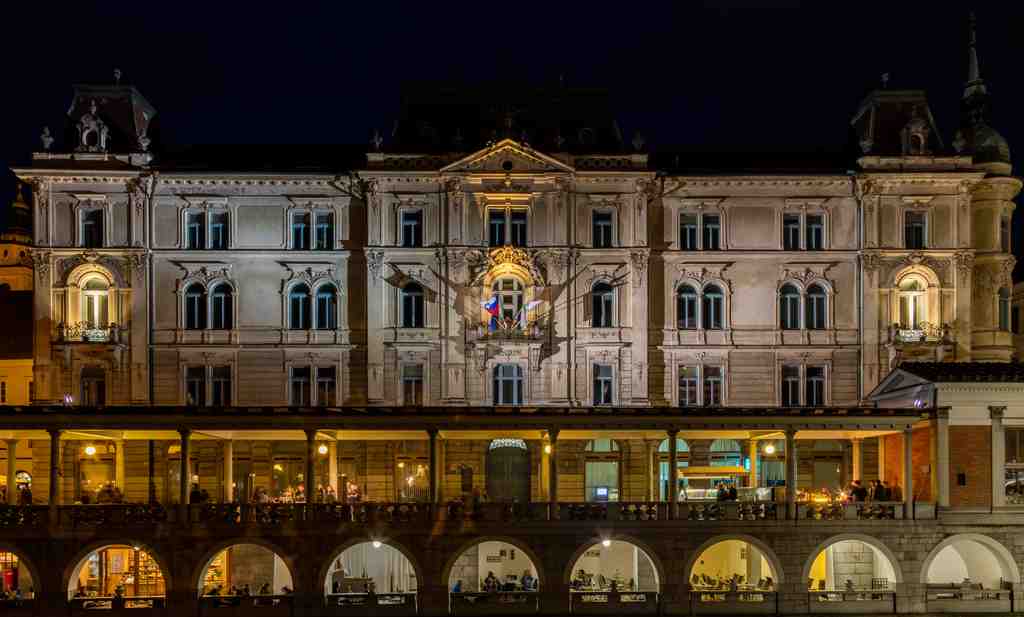
On your left is the Kresija Building, a massive pale stone structure defined by its repeating ground-level arched colonnade and a central wrought-iron balcony topped with a prominent coat of arms.
Today, it projects an air of absolute authority and order. But for over a century, this very address held a much heavier burden. Long before this grand administrative palace was built, a foundling hospital stood on this exact site. It was the desperate last resort for mothers who simply could not care for their infants. Built into the wall of that old hospital was a cylindrical, revolving box. A mother could approach from the street, place her baby inside the compartment, and ring a bell. An attendant inside would rotate the box, bringing the child into the ward. It was an anonymous, heartbreaking exchange, designed to prevent infants from being abandoned in the river.
The site also housed a medical school established in 1753 by Gerard van Swieten. He was the personal physician to Empress Maria Theresa and an Enlightenment pioneer. Interestingly, he is famous for scientifically disproving the empire's vampire hysteria, replacing folklore with empirical clinical training.
Then came the 1895 earthquake. The tremors devastated the city. While neighboring buildings collapsed completely, the old hospital somehow remained standing, though just barely. For years, its skeletal remains were propped up by a massive system of wooden poles, a haunting symbol of the disaster.
If you want to see how this space evolved, take a look at the before and after image on your screen, showing how the horse-drawn era gave way to the vibrant riverbank of today.
Eventually, the ruined hospital was demolished, making way for Mayor Hribar and his ambitious vision of reconstruction. He wanted a grand gateway to the city center, much like the ones in Prague. The Kresija Building was constructed in 1898 with a sober Neo-Renaissance facade, a style that revives the symmetry and grandeur of classical European architecture. This orderly design was meant to balance the highly decorative merchant palace across the way. You can check out the historical photo in your app to see the building when it was freshly completed.
Look up at the main balcony facing the embankment. See those two statues flanking the town's coat of arms? Those are genii, protective spirits from classical mythology. One holds a book and a torch, representing Knowledge, while the other represents Justice. They were bold declarations of the city's rising autonomy, transforming a place of quiet desperation into a majestic monument of civic pride.
Today it houses the visitor center and municipal offices, which are usually open from 10 AM to 6 PM, with shorter hours on the weekend.
Now, direct your attention just ahead toward the elaborate stone monument coming into view... we are taking a one-minute walk over to the Robba Fountain.




