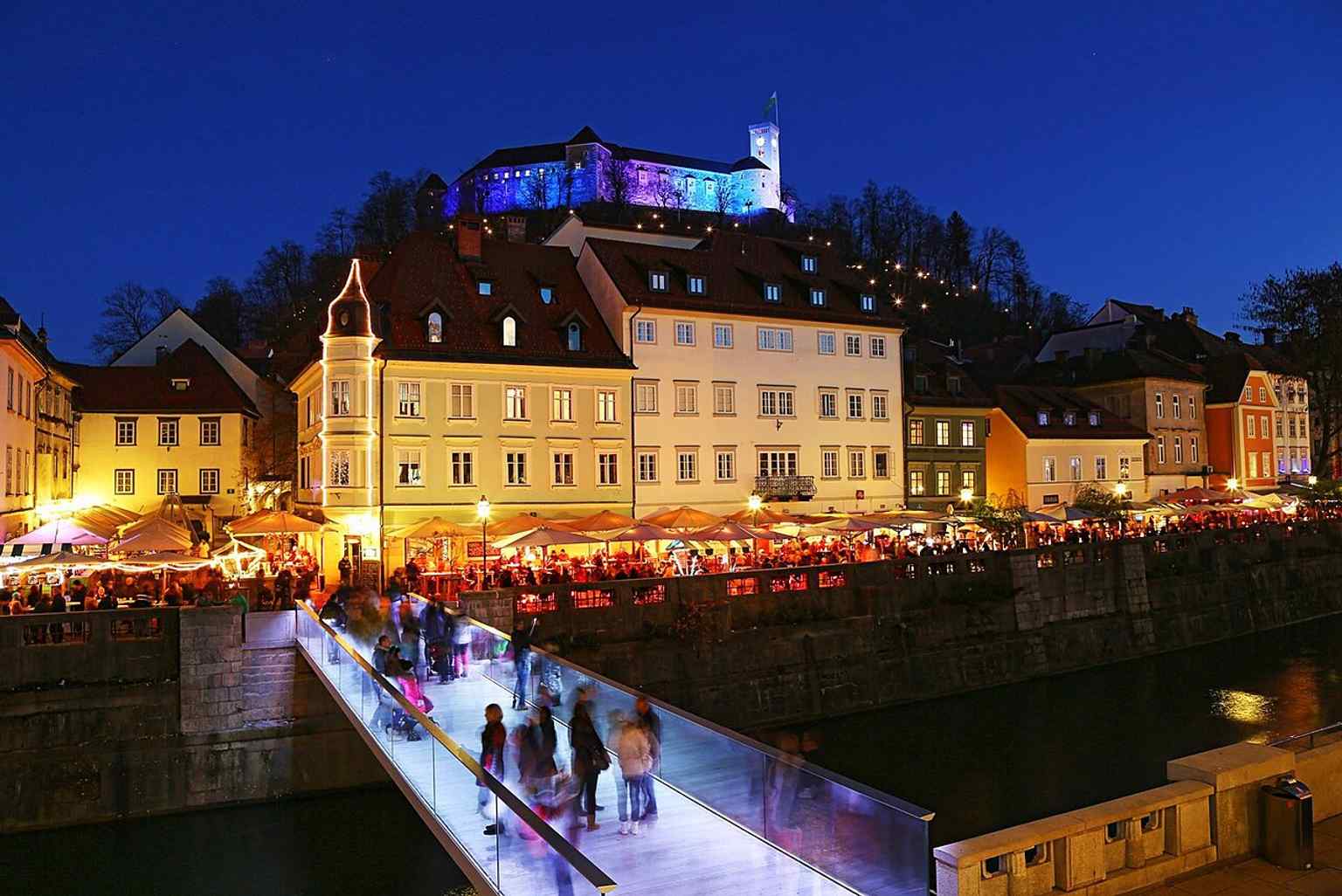
Before you is the Fish Bridge. It looks like a sleek, permanent piece of modern engineering, doesn't it? But its existence sparked quite a turf war over how this city should look.
To understand why, take a look at the third image in your app. Notice how the steel deck tapers down to just twenty-five centimeters at the edge. The architects made it as thin as physically possible to protect what urbanists call a visual corridor, meaning an unobstructed line of sight down the river. For decades, the great architect Jože Plečnik and his followers vehemently opposed building a bridge here. Plečnik designed the access stairs leading down to the water, but he deliberately stopped there. He believed a crossing would ruin the open perspective between his famous Triple Bridge and the Shoemakers' Bridge. He prioritized art over the convenience of a shortcut.
But in 1991, a group of rebellious architecture students decided people actually needed a way across. Led by a student named Peter Gabrijelčič, they built a temporary wooden footbridge. To save money, they used salvaged Siberian larch beams left over from a renovation of the Triple Bridge. It was only supposed to stay up for a five-year experiment. It ended up staying for over twenty.
Eventually, the city's ambition to modernize caught up with reality. The damp river air and the winter salt used to melt ice caused the old wood to rot from the inside out. Locals knew it as a notorious slippery trap, a terrifying ordeal of worn-out timber and frost. By 2014, the decay was so bad that when the city finally dismantled the bridge, they had to chop it to pieces right on the spot.
A competition was held for a permanent replacement. And in a rare twist of fate, the winner was none other than Peter Gabrijelčič, now a prominent professor, essentially replacing his own student project. Naturally, it brought drama. Critics accused him of plagiarism, claiming his minimalist design looked remarkably like a memorial bridge in Croatia. Gabrijelčič fought back. He argued that high-tech, minimalist structures simply share a common visual language.
If you look at the fourth image on your screen, you can see his defense in action. He designed this transparent, low-profile structure as a direct, respectful response to Plečnik's existing stone bases and the narrowness of the river at this exact point.
The new bridge opened in 2014. To ensure it never became an ice trap again, the builders integrated an electric heating foil beneath the walking surface. It is a brilliant piece of engineering, though its price tag of roughly six hundred sixty-three thousand euros sparked intense political debate, with opponents of the mayor calling it luxury infrastructure.
But looking at it now, it is hard to deny how well it navigates the tension between preserving an old master's vision and serving a dynamic, changing city. And since this open-air crossing is accessible twenty-four hours a day, every day of the week, you can enjoy that perfectly preserved river view whenever you please.
When you are ready, let's continue down the embankment toward the Kresija building.