
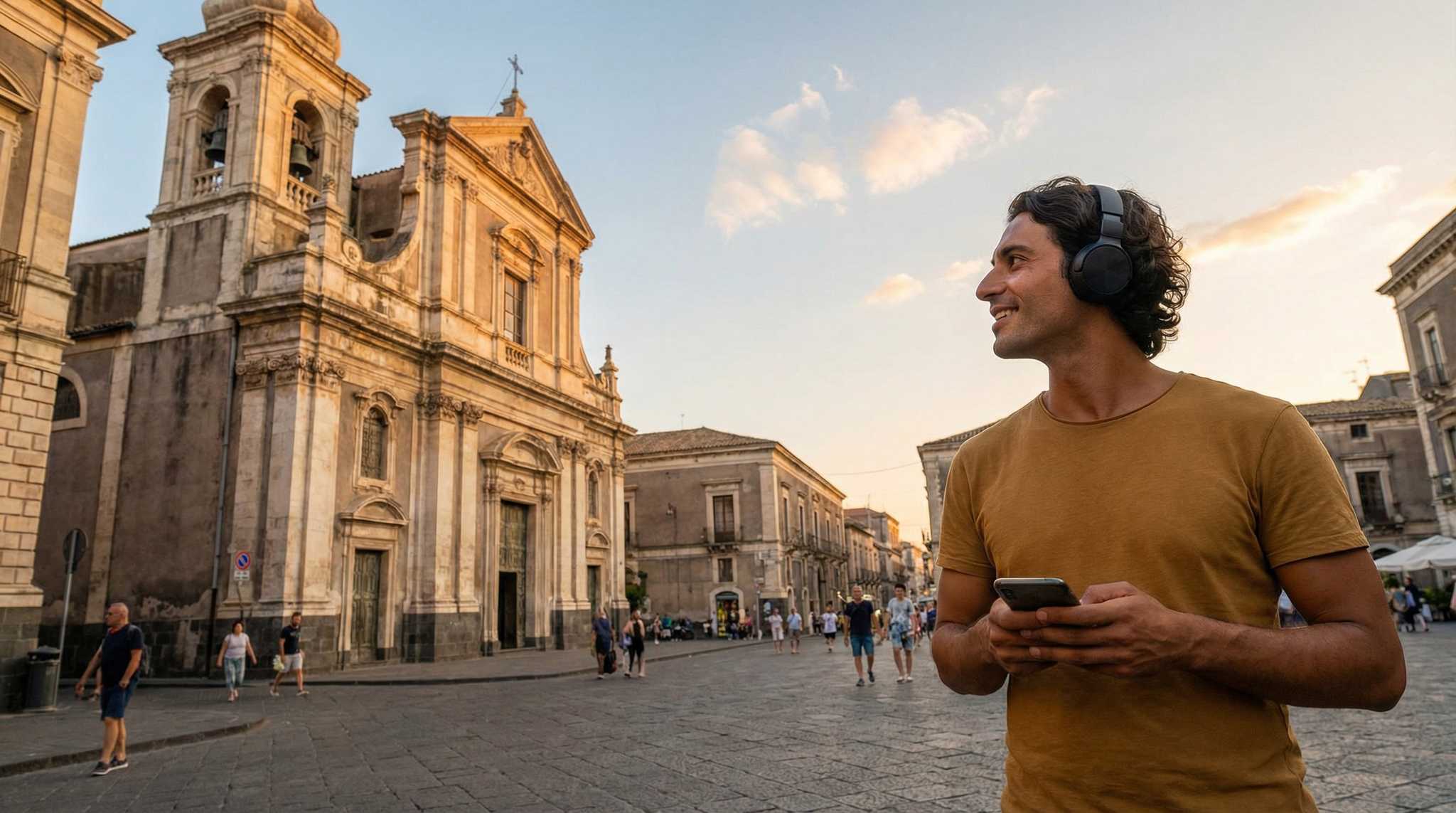
Catania Audio Tour: Echoes of Empires and Baroque Splendor
Lava once swallowed whole streets here—now ancient secrets flicker beneath Catania's restless stones. This self-guided audio tour leads you down winding alleys and beneath grand domes, sharing stories lost to hurried travelers and whispered only by the brave. What deadly oath, sworn at the Cathedral of Sant'Agata, shattered an empire's trust? Which forbidden ritual still leaves cold echoes beneath the Achillian Baths? Why did a single painting in the Basilica Maria Santissima dell'Elemosina spark a bizarre midnight scandal that drew spies from three continents? Move through shadow and sunlight as invisible threads connect past rebellions, fiery devotion, and unlikely conspiracies. Each step lets you peel back another layer of Catania—finding turmoil, faith, and secrets where others see only stones and silence. Begin now and let the city’s molten heart guide you into stories that tremble just beneath your feet.
Tour preview
About this tour
- scheduleDuration 80–100 minsGo at your own pace
- straighten2.5 km walking routeFollow the guided path
- location_onLocationSan Gregorio di Catania, Italy
- wifi_offWorks offlineDownload once, use anywhere
- all_inclusiveLifetime accessReplay anytime, forever
- location_onStarts at Biscari Museum
Stops on this tour
lock_open 3 free previews · 11 unlock with purchase
Look to your right for the broad, straight lava-stone avenue lined with pale Baroque facades and iron balconies, the unmistakable spine of Via Etnea running through Catania’s…Read moreShow less
Open dedicated page →Look to your right for the broad, straight lava-stone avenue lined with pale Baroque facades and iron balconies, the unmistakable spine of Via Etnea running through Catania’s historic centre.
What you are facing is not simply an old quarter. It is the old nucleus of Catania, drawn and redrawn so many times that the city learned to keep its memory in layers rather than in one clean story.
This is the buried city beneath the city. Under your feet lie Greek Katane, Roman Catanae, Arab Qaţânîah, Norman Catania, and the eighteenth-century Baroque city that rose after calamity. Each age covered the last, but never quite silenced it.
The first version began in seven hundred and twenty-nine B C, when Greek settlers from Chalcis, led by Tucle, founded Katane over an earlier Sicel settlement. Within a century it had grown important enough to attract the poet Stesichorus and the philosopher Xenophanes. Then came conquest, rebuilding, and renaming: Dionysius of Syracuse destroyed it around four hundred and three B C, and the Campanians repopulated it. Under Rome, Catanae declined, then revived after Etna’s eruption in one hundred and twenty-two B C buried it in ash. The Roman Senate even excused the city from taxes for ten years so it could recover. Baths, theatres, basilicas, aqueducts, and public buildings returned.
Later, after the western Roman Empire fell in four hundred and seventy-six, raids battered the city again. The citizens asked Theodoric, king of the Ostrogoths, for permission to rebuild their walls with stone taken from the ruined Roman amphitheatre, and he agreed. Even that is Catania in miniature: one age dismantled so another might endure.
Now pause for a moment and look carefully along the streets around you. Notice the broad, straight Baroque lines, then the odd interruptions, the changes in level, the hints of narrower older lanes. You are looking at a city redesigned, not wiped clean.
The great turning point came after the earthquake of sixteen ninety-three. It killed about sixteen thousand and fifty people out of a population of just under nineteen thousand, and it shattered almost everything. Yet the city did not move. Juan Francisco Pacheco, the Duke of Uzeda, sent Giuseppe Lanza, the Duke of Camastra, to oversee a new plan here on the same ground. Camastra, working with the military engineer Carlos de Grunenbergh, ordered wide straight streets and larger squares, partly for dignity, partly for survival. New buildings could rise only to three storeys, and streets had to follow set widths measured in canne, an old local unit of length.
If you glance at the image on your screen, you can see that new logic clearly in Via Etnea, the great north to south axis cut through the rebuilt city. And in Piazza Duomo, where civic power, religious authority, and ceremonial display stand close together, the city turned reconstruction into a public statement.
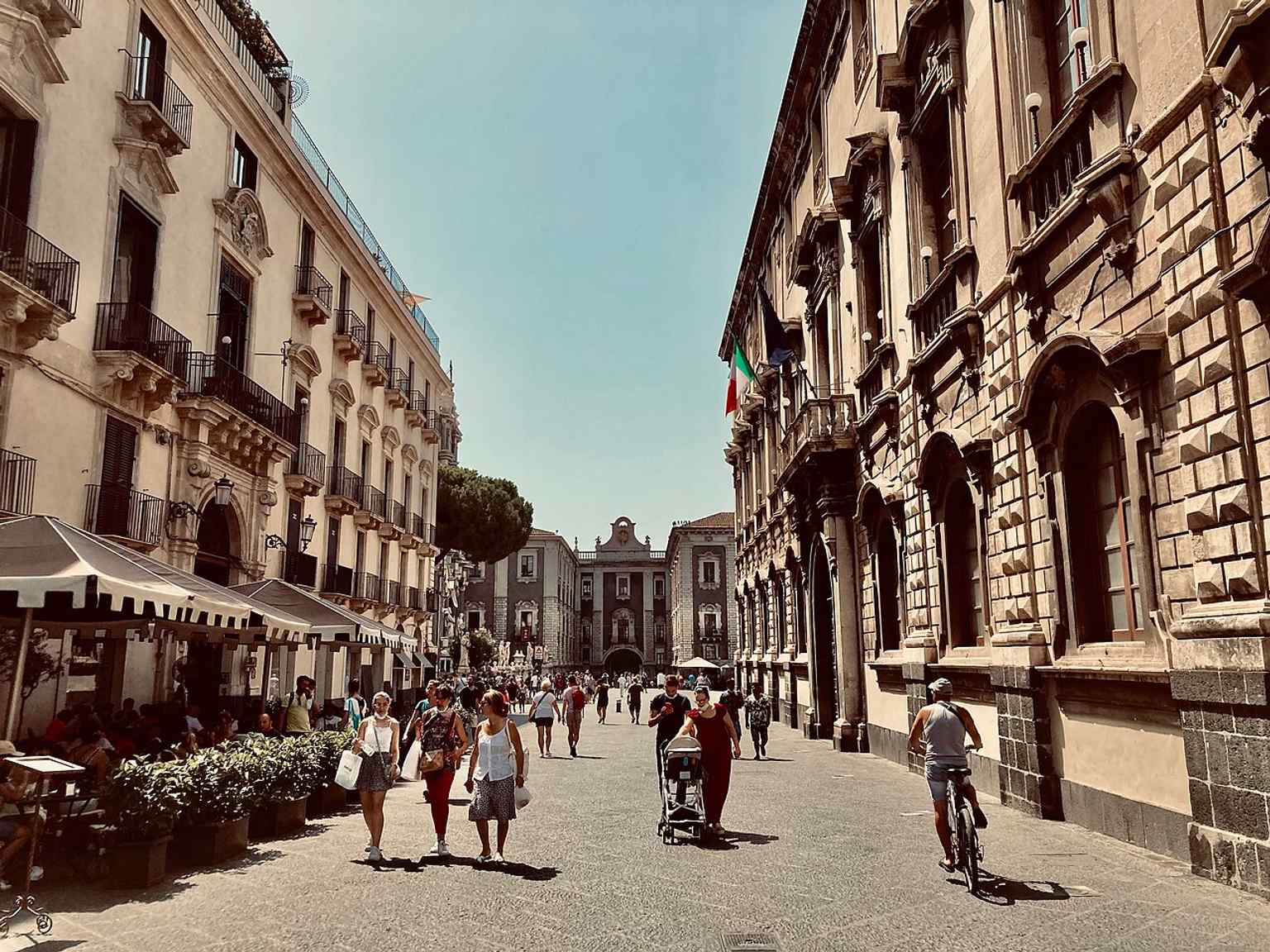
A broad view of Catania’s historic center along Via Etnea, the main axis rebuilt after the 1693 earthquake in the new Baroque city plan.Photo: Ambra82, Wikimedia Commons, CC BY-SA 4.0. Cropped & resized. Even later centuries kept altering the fabric: lava in sixteen sixty-nine changed the western edge, bombs damaged buildings in nineteen forty-three, and the demolition of San Berillo in the twentieth century left another scar. Catania never stopped revising itself.
To see how the city kept rebuilding through its institutions, we shall next walk to one of its oldest institutions: the University of Catania, about six minutes away.
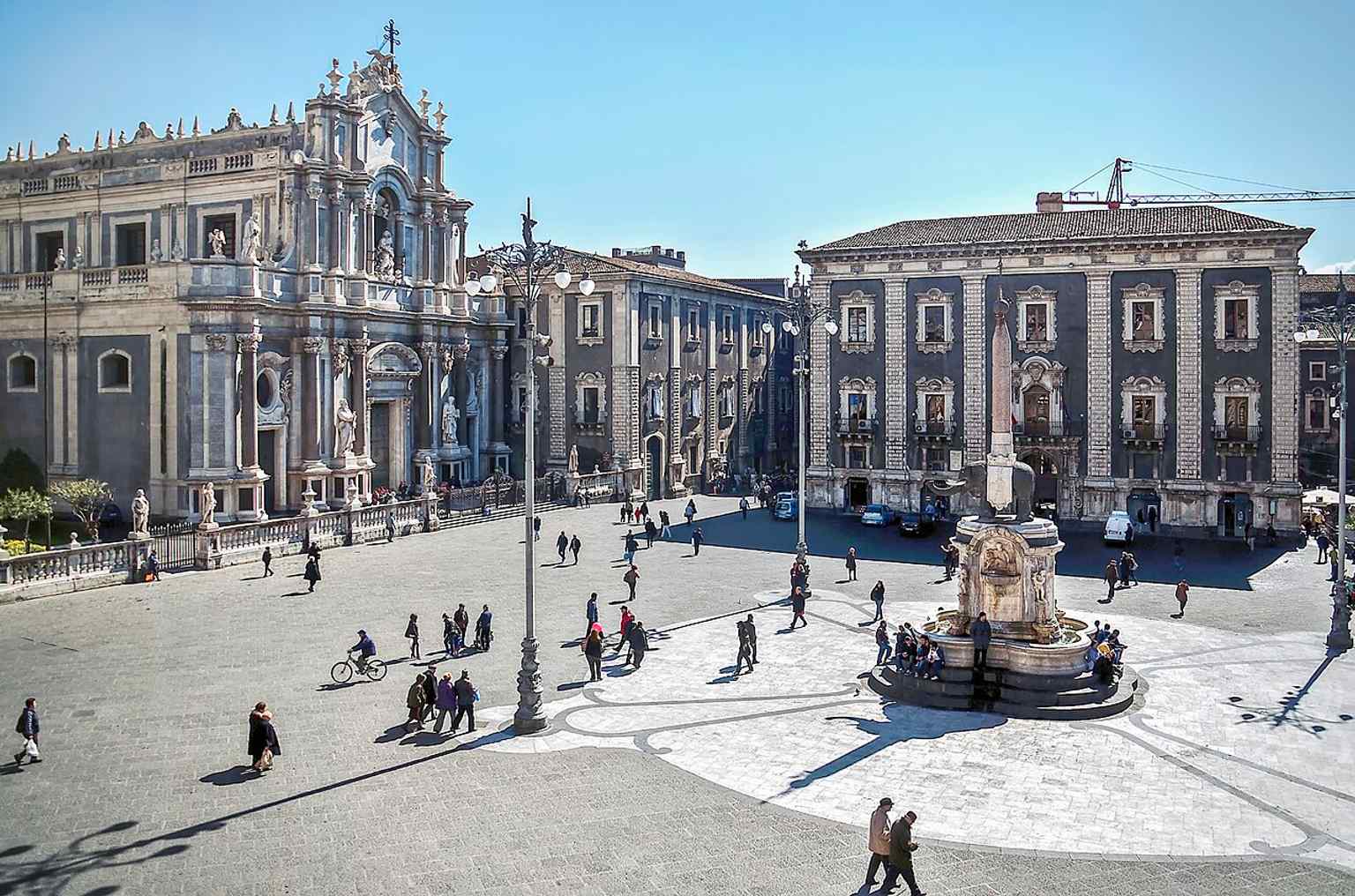
Piazza Duomo, the civic and religious heart of the old town, where the cathedral, city hall and Porta Uzeda meet in one monumental space.Photo: Dariolp83, Wikimedia Commons, CC BY-SA 4.0. Cropped & resized. 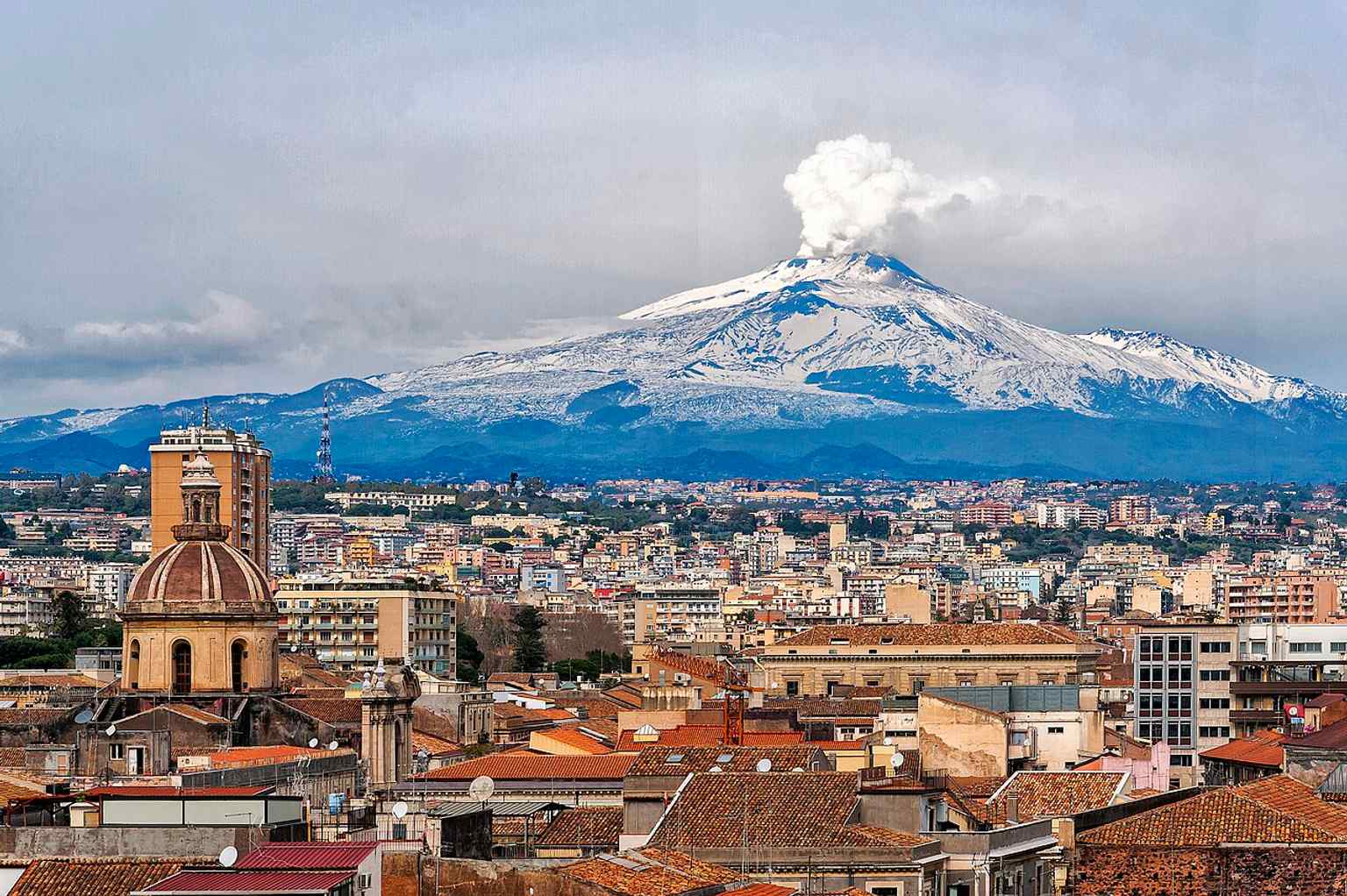
An elevated panorama over the historic center with Mount Etna in the background, echoing how the city’s landscape is shaped by volcanic history.Photo: Dariolp83, Wikimedia Commons, CC BY-SA 4.0. Cropped & resized. On your left stands a broad pale-stone Baroque façade, lined with tall arched windows and centered on a grand portal with a projecting balcony above it. This is the University of…Read moreShow less
Open dedicated page →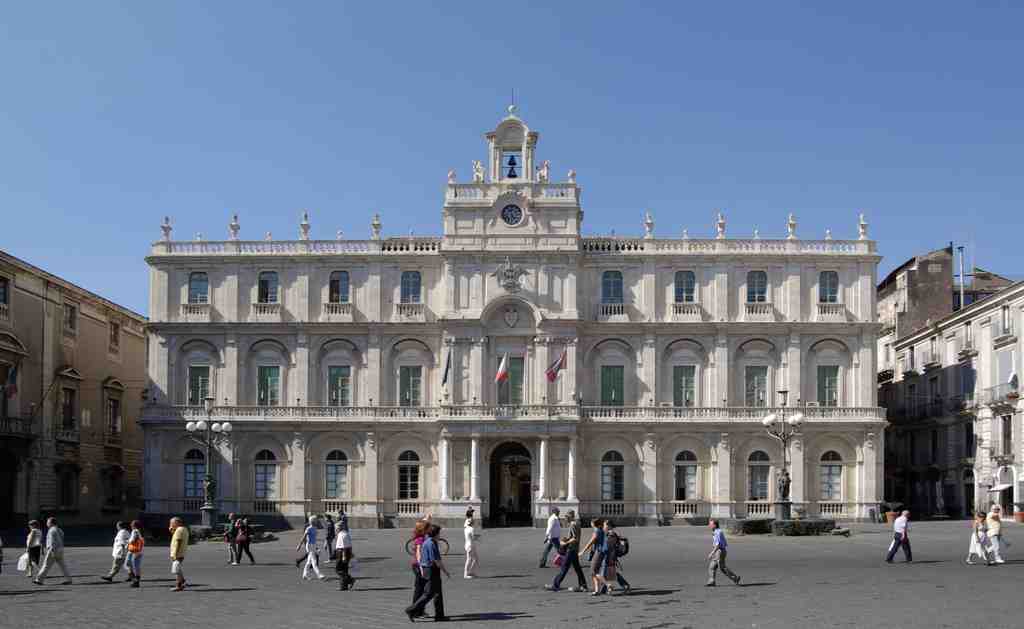
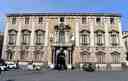
University of CataniaPhoto: Berthold Werner, Wikimedia Commons, CC BY-SA 3.0. Cropped & resized. On your left stands a broad pale-stone Baroque façade, lined with tall arched windows and centered on a grand portal with a projecting balcony above it.
This is the University of Catania, founded in fourteen thirty-four: the oldest university in Sicily, and one of the city’s clearest claims to importance. Not importance dressed in silk or incense alone, but authority of another kind: the power to teach, to examine, and to say, officially, who had earned a degree.
That mattered enormously. In the Kingdom of Sicily, this university held the rare privilege of granting legally valid titles, from licenses to bachelor’s degrees to doctorates. Students from Palermo’s Dominican college had to come here to finish that journey. A city that could certify knowledge did not merely admire learning; it governed through it.
One man helped set that in motion. Pietro Rizzari pressed the civic senate to petition King Alfonso the Fifth on the nineteenth of October, fourteen thirty-four. Alfonso agreed to found the Studium Generale, a full university. Then, on the eighteenth of April, fourteen forty-four, Pope Eugene the Fourth sealed it with a formal decree from Rome. By the end of fourteen forty-five, six professors had begun public lessons in theology, law, medicine, philosophy, logic, mathematics, and the liberal arts. In fourteen forty-nine, the first degree went to a man from Syracuse named Antonio Mantello. One can picture him leaving with something more valuable than parchment: public recognition.
If you glance at the image in the app, you can see how firmly the palace presents itself to the square. It does not hide like a cloistered school. It addresses the city. The university did not always stand here. Its earliest courses took place near the cathedral. In sixteen eighty-four it moved into the old San Marco hospital, and then the earthquake of sixteen ninety-three shattered that building. Catania answered in a familiar way: it began again. From sixteen ninety-six, builders raised this new palace on the ruins of the old one. Giovanni Battista Vaccarini, one of the great architects of Sicilian Baroque, shaped much of its character, along with Francesco and Antonino Battaglia. Inside, Vaccarini gave it monumental staircases and a black-and-white stone courtyard, and the great ceremonial hall, the Aula Magna, later gathered generations of scholars under painted ceilings.
Here, memory is preserved in stone, in ritual, and in collections. Stone keeps the institution visible. Ritual survives in examinations, graduations, and the repeated formal acts that link one generation of students to the next. Collections do the quieter work: in seventeen fifty-five, the abbot Vito Maria Amico helped open the university library here, beginning with books bought from the historian Giambattista Caruso, and later enlarged with volumes taken from Jesuit colleges after the order’s expulsion.
That habit of storing knowledge kept growing. By the late seventeen hundreds, the university had around two thousand students and thirty chairs, especially in law and medicine. It later added botany, observatories, and gardens; and still later, its humanities found a home in the vast Benedictine monastery we shall meet ahead, where modern classrooms now occupy monastic grandeur and even older remains.
And that is the distinctly Catanian point: scholarship here rarely stands far from devotion. Very often, they occupy the same ground, and sometimes the same broken foundations. When you are ready, we shall continue to the Basilica Maria Santissima dell’Elemosina, only about a minute away.
Show 11 more stopsShow fewer stopsexpand_moreexpand_less
On your left, look for a pale limestone façade with flowing curved tiers, a broad staircase, and a small central bell crown topped by an iron cross. This basilica carries one of…Read moreShow less
Open dedicated page →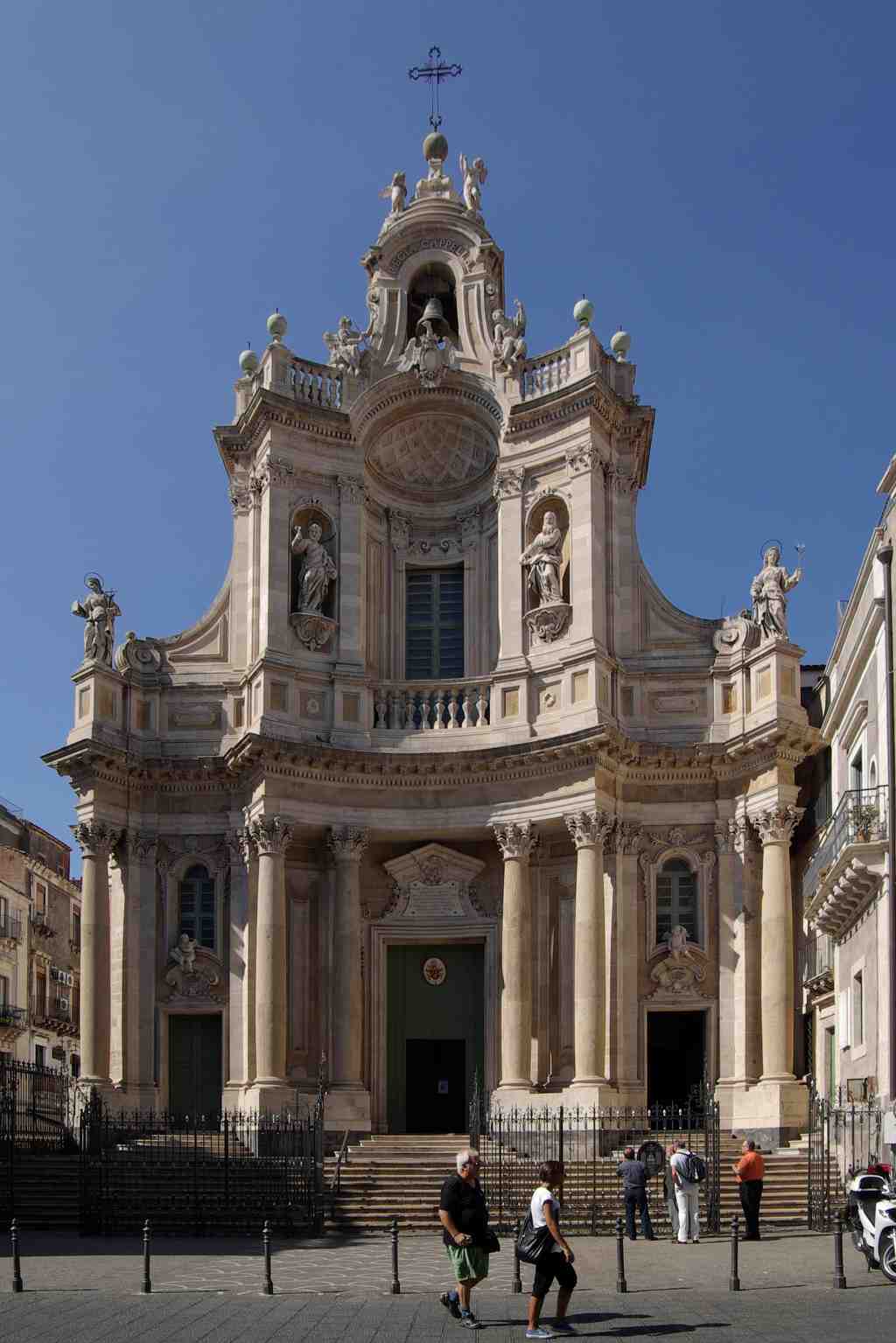
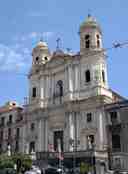
Basilica Maria Santissima dell'ElemosinaPhoto: Berthold Werner, Wikimedia Commons, CC BY-SA 3.0. Cropped & resized. On your left, look for a pale limestone façade with flowing curved tiers, a broad staircase, and a small central bell crown topped by an iron cross.
This basilica carries one of Catania’s gentlest stories. Before it became this late-Baroque showpiece, this ground had already lived several lives, each one leaving a different religious memory behind.
Its title, dell’Elemosina, sounds as though it belongs to alms or charity, but it actually reaches back to a Byzantine image of the Madonna Eleùsa, meaning the Merciful Virgin. In fourteen eighty-two, Albanian refugees fleeing the Ottoman advance from Scutari brought that icon into Sicily. The old legend says they camped at a place called Callicari, near Catania, and hung the image on a fig tree for the night. By morning, the branches had grown around it so tightly that no one could free it. The refugees read that not as an obstacle, but as a decision. The Madonna, they believed, had chosen to remain on this island.
The original icon stayed in the place of the miracle and helped give rise to Biancavilla, where it became a patron image. But this church adopted the same title and placed a faithful copy on its high altar. That matters in a city like Catania. Here, belonging is not always secured by papers or boundaries. Sometimes it survives because a community keeps telling one story, carrying one image, repeating one act of devotion.
Then came the Val di Noto earthquake of sixteen ninety-three, the catastrophe that shattered much of south-eastern Sicily. Here in Catania it levelled this church, along with much of the city, and forced people to rebuild not only walls but the very order of streets. The new plan widened the main routes and drew them straighter, so the rebuilt church turned to face the city’s great spine, Via Etnea, instead of keeping its old orientation.
In the image on your screen, you can see how Stefano Ittar later gave that new front a remarkable sense of movement, almost like a giant pipe organ worked into stone. Above, an inscription still remembers the church’s older dignity as the Regia Cappella, the Royal Chapel of the kings of Sicily.
And yet rebuilding here did not proceed nobly and smoothly. Don Michelangelo Paternò Castello, Baron of Sigona, fought the new campanile, the bell tower, with extraordinary persistence. He claimed the bells would disturb the peace of his household. He sued, appealed, and kept appealing, until work on the church was suspended and an order even arrived from Rome to demolish the entire fabric. Only after the baron died in seventeen sixty-nine did the crisis loosen its grip, allowing Ittar to complete the façade before you.
If you open the interior view on your phone, the long central hall leads your eye toward the high altar, where the copied icon of the Madonna dell’Elemosina still gives the whole building its heart.
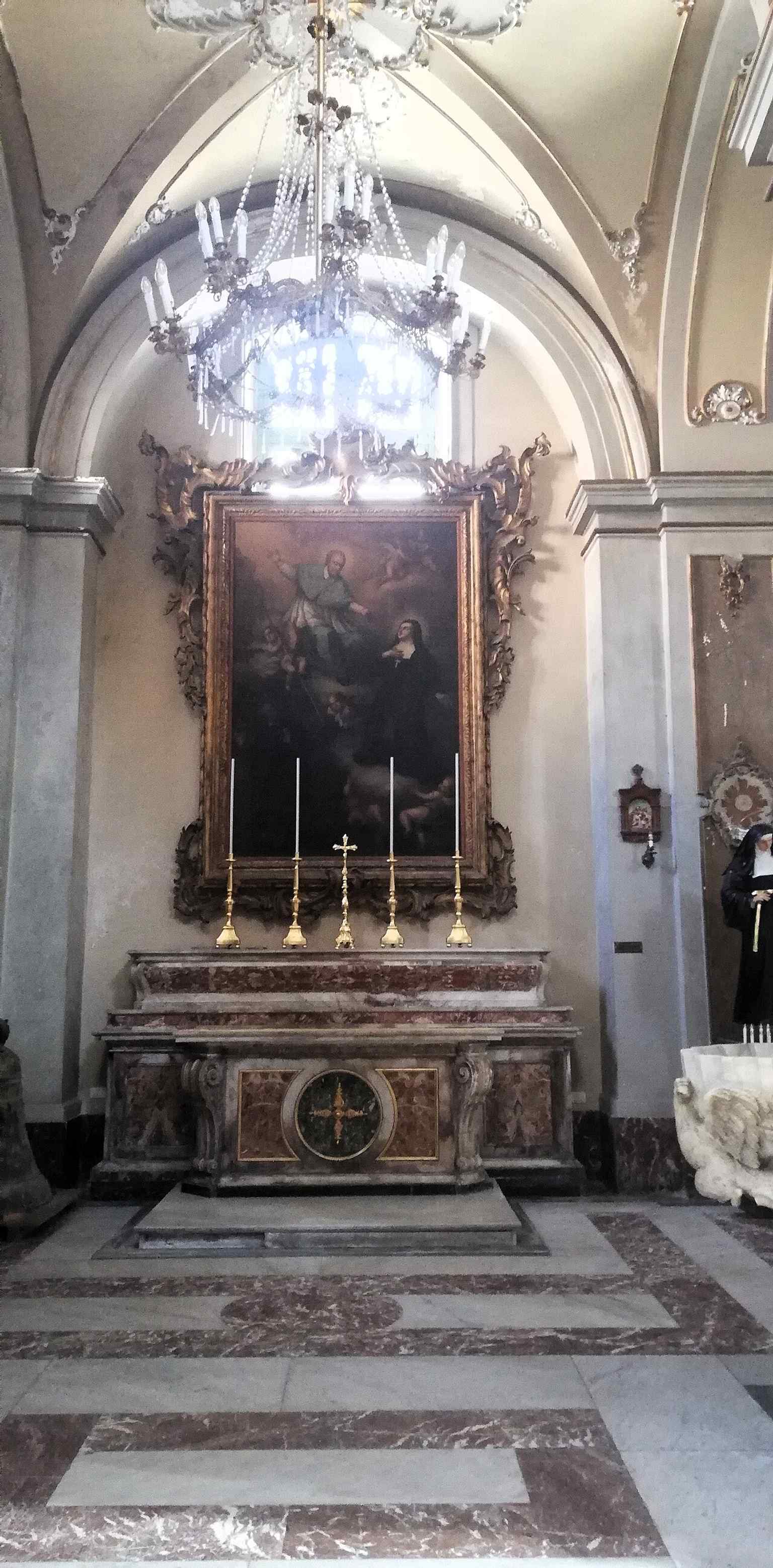
A wider interior composition that helps show the basilica’s long central axis and the sense of depth toward the high altar.Photo: Effems, Wikimedia Commons, CC BY-SA 4.0. Cropped & resized. And notice this quiet hint of what comes next: Sant’Agata stands on the façade too. If one image of the Virgin could anchor a scattered people, one saint could anchor an entire city. We’ll meet her properly at the cathedral, only a short walk from here.
If you want to return for the interior, the basilica is usually open Tuesday to Sunday from nine to noon and from four to eight, and it stays closed on Monday.
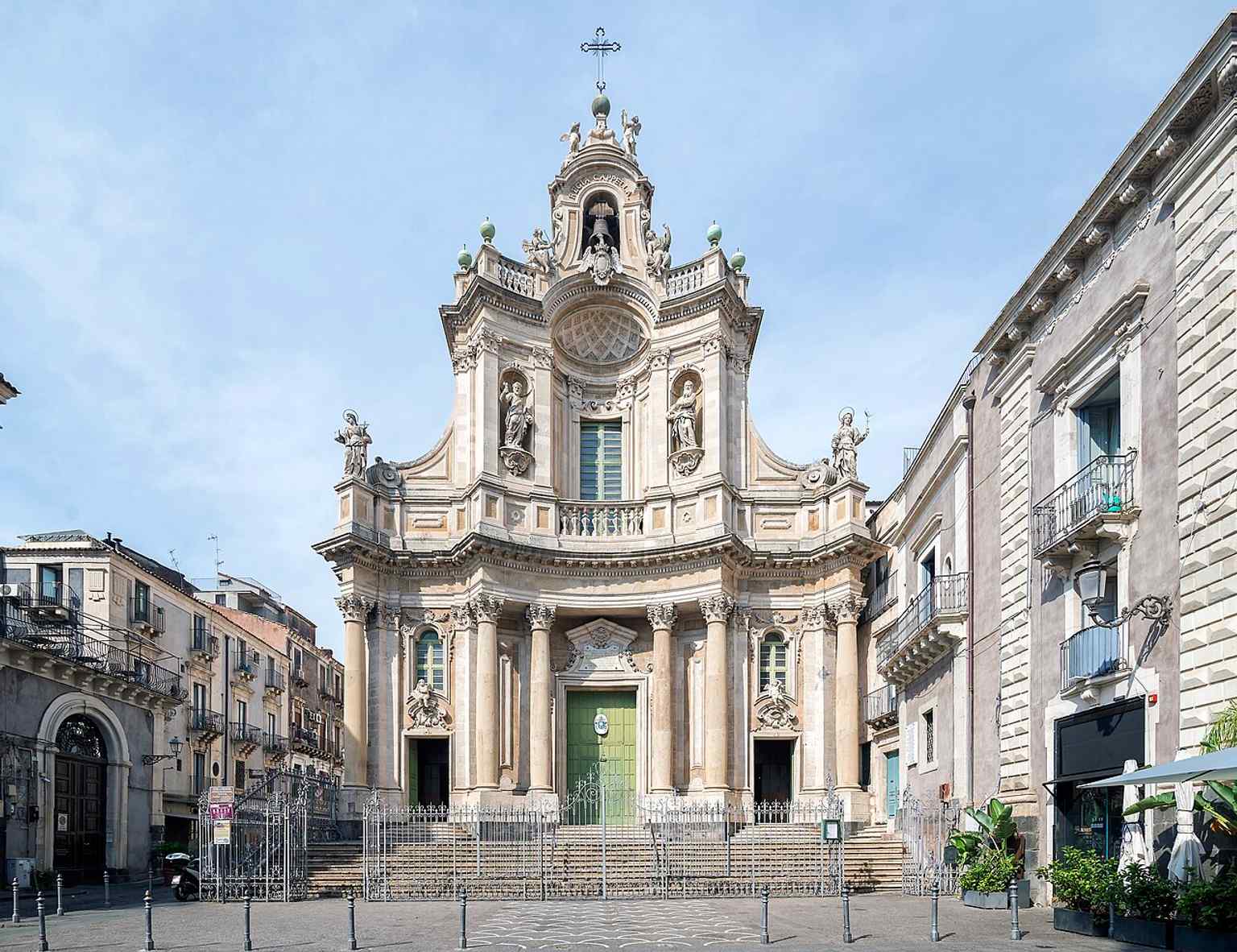
A strong full-frontal view of the late-Baroque façade, with the statues of Sant’Agata, Santa Apollonia, Saint Peter and Saint Paul described in the source text.Photo: Dariolp83, Wikimedia Commons, CC BY-SA 4.0. Cropped & resized. 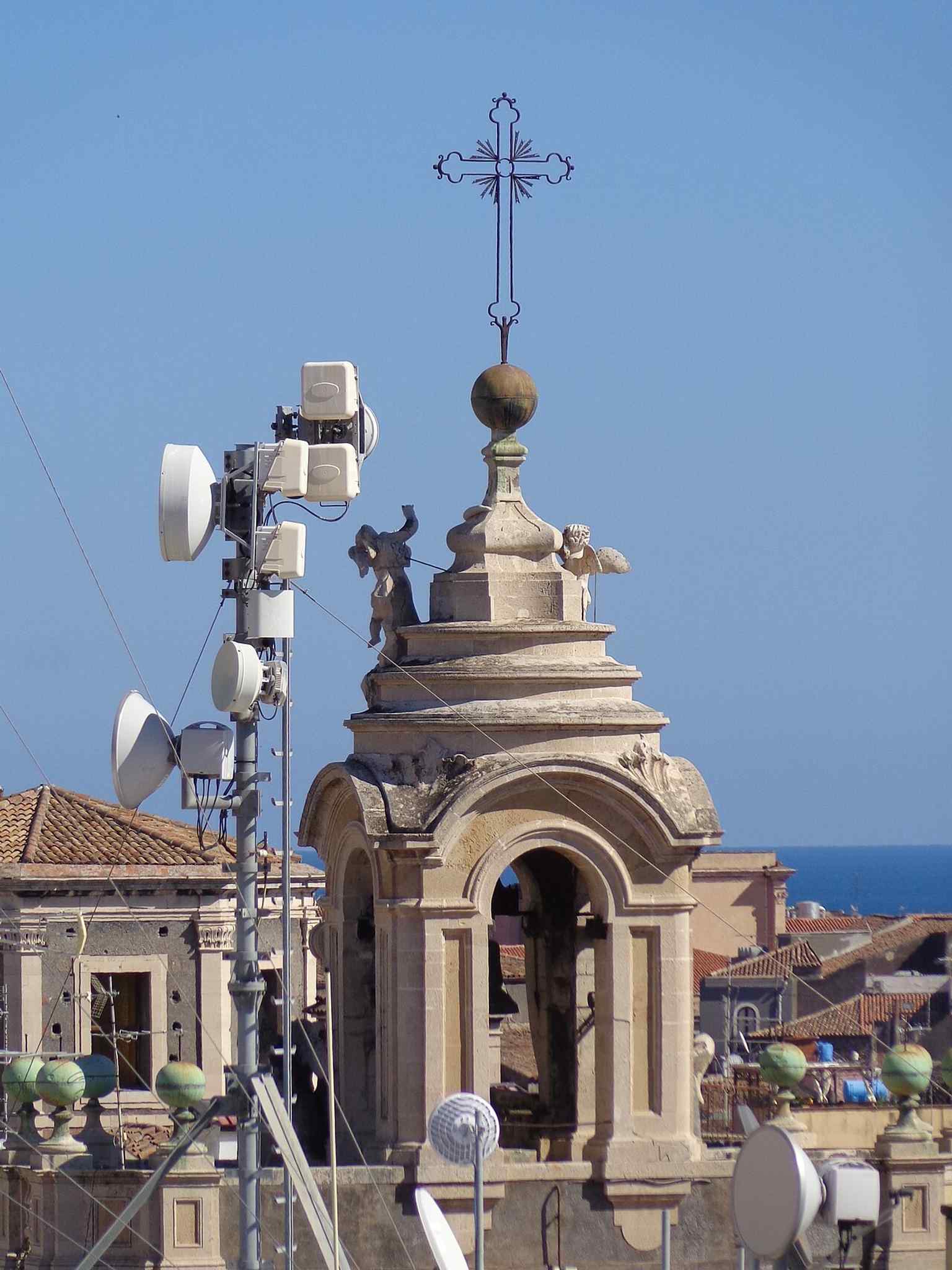
A view of the bell tower from nearby San Giuliano, useful for telling the long architectural history and the 18th-century completion of the basilica’s tower.Photo: Effems, Wikimedia Commons, CC BY-SA 4.0. Cropped & resized. 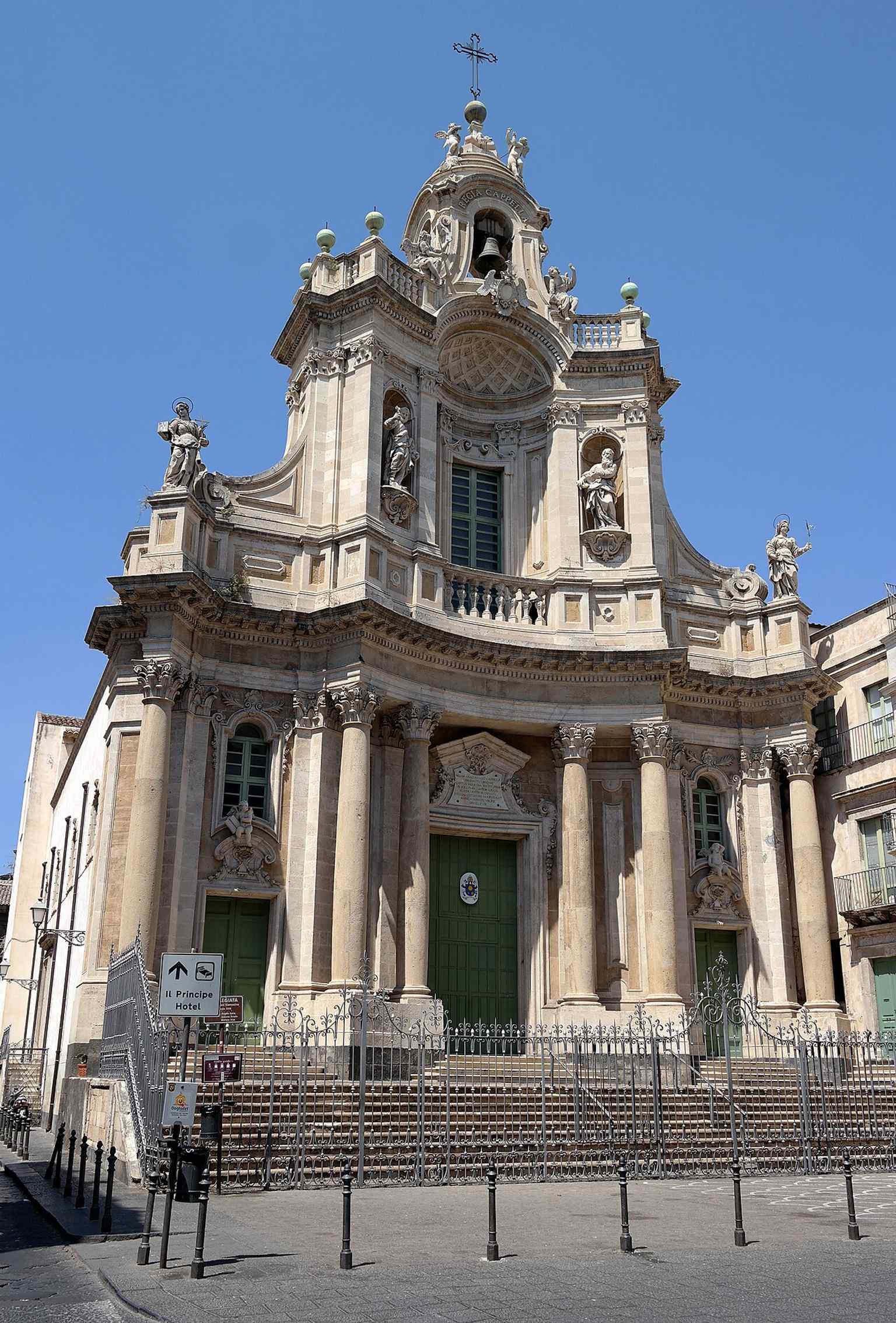
A clean modern exterior shot that shows the basilica rising directly along Via Etnea, exactly where the rebuilt church was realigned after the 1693 earthquake.Photo: Luca Aless, Wikimedia Commons, CC BY-SA 4.0. Cropped & resized. 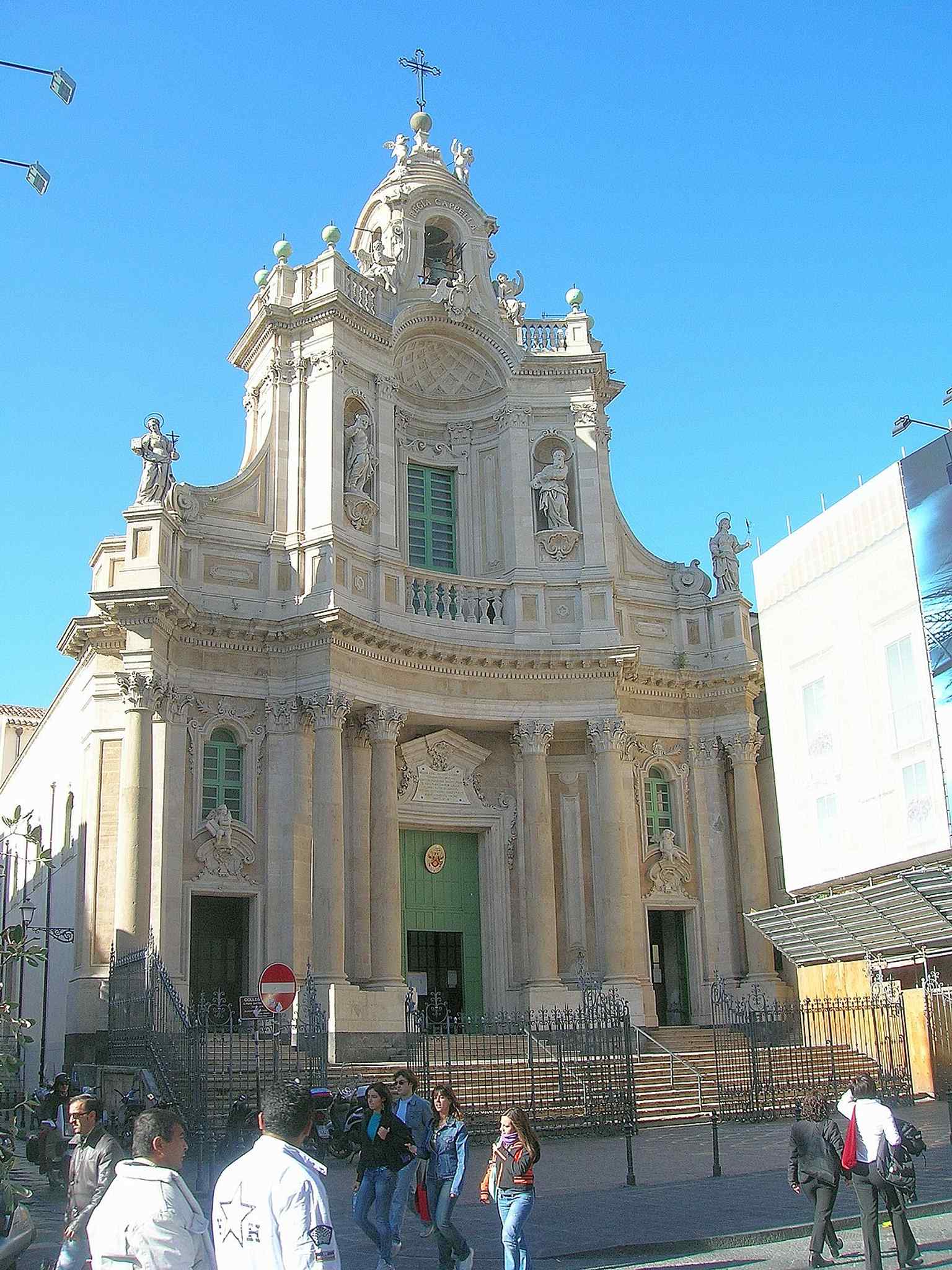
A broad exterior view of the church, helpful for conveying its placement in the city center and its scale as the former Collegiata.Photo: The original uploader was Triquetra at Italian Wikipedia., Wikimedia Commons, CC BY-SA 3.0. Cropped & resized. 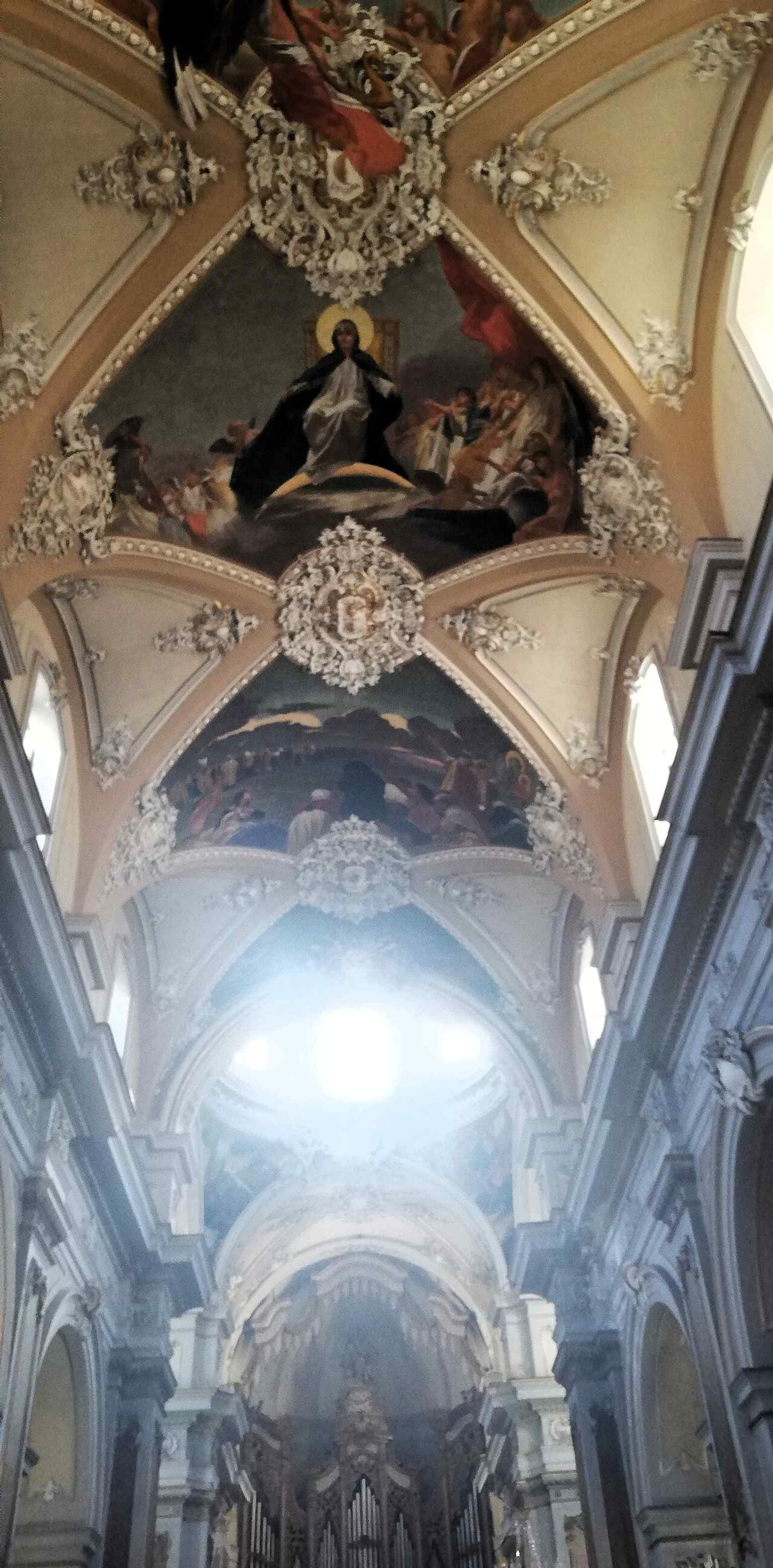
Inside the basilica, this image highlights the frescoed vault that Giuseppe Sciuti painted at the end of the 19th century.Photo: Effems, Wikimedia Commons, CC BY-SA 4.0. Cropped & resized. 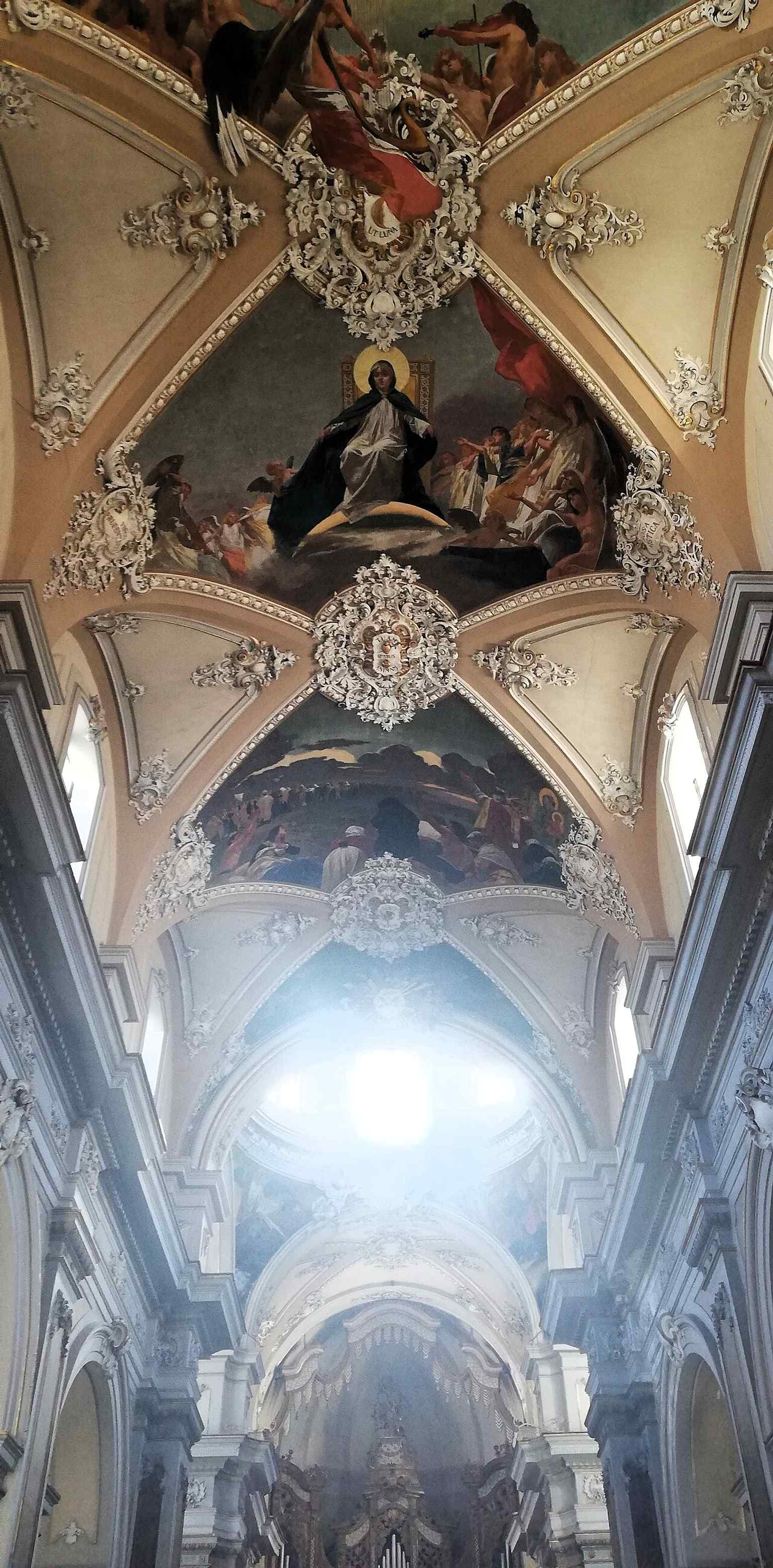
Another interior view of Sciuti’s painted ceiling, evoking the dramatic biblical scenes that transformed the nave into a visual sermon.Photo: Effems, Wikimedia Commons, CC BY-SA 4.0. Cropped & resized. 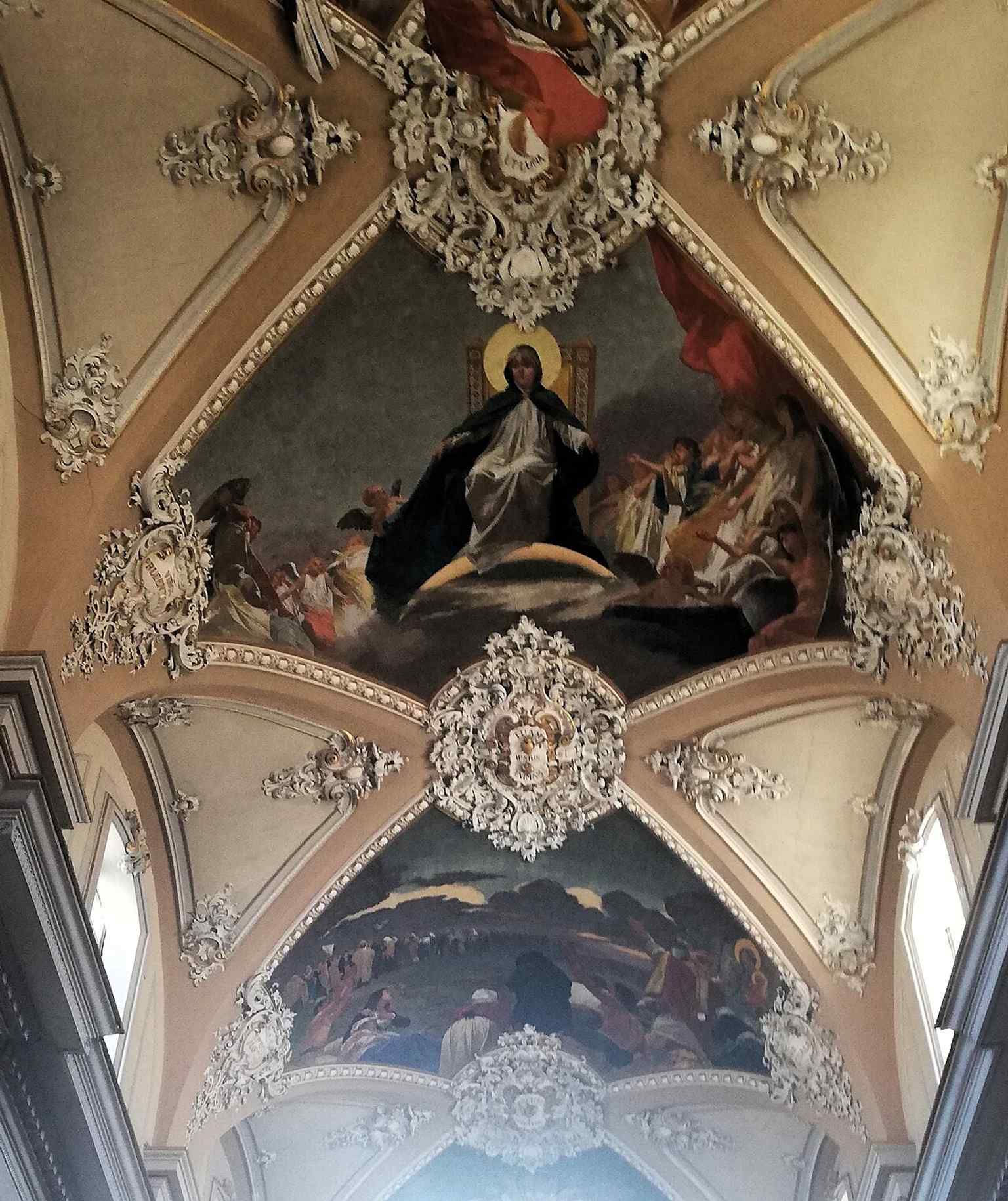
A closer look at the interior decoration, showing the rich painted and sculpted surfaces that distinguish the basilica’s three-nave layout.Photo: Effems, Wikimedia Commons, CC BY-SA 4.0. Cropped & resized. 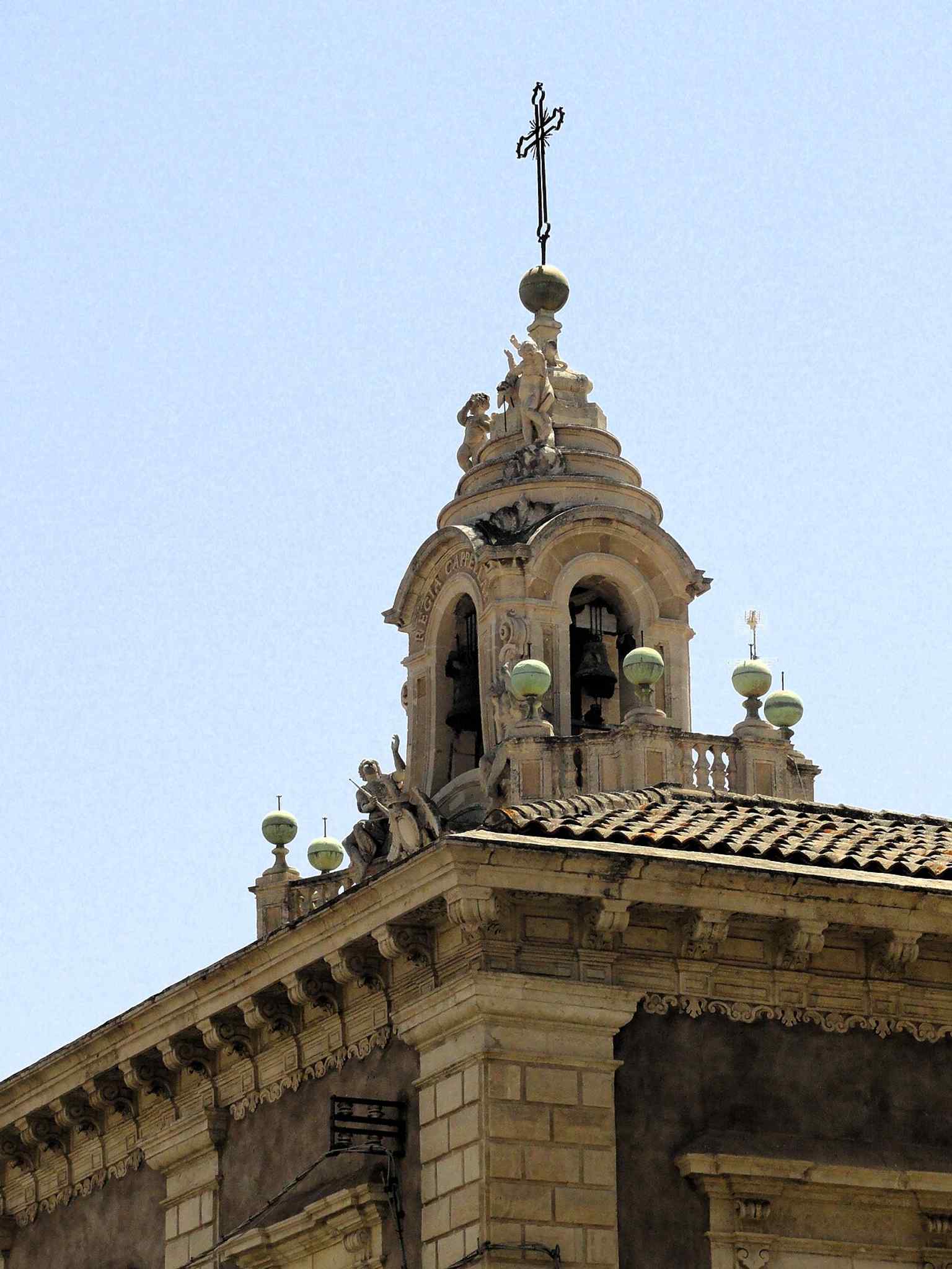
An interior detail likely centered on devotional art and furnishings, echoing the basilica’s role as a shrine to the Madonna dell’Elemosina.Photo: Effems, Wikimedia Commons, CC BY-SA 4.0. Cropped & resized. 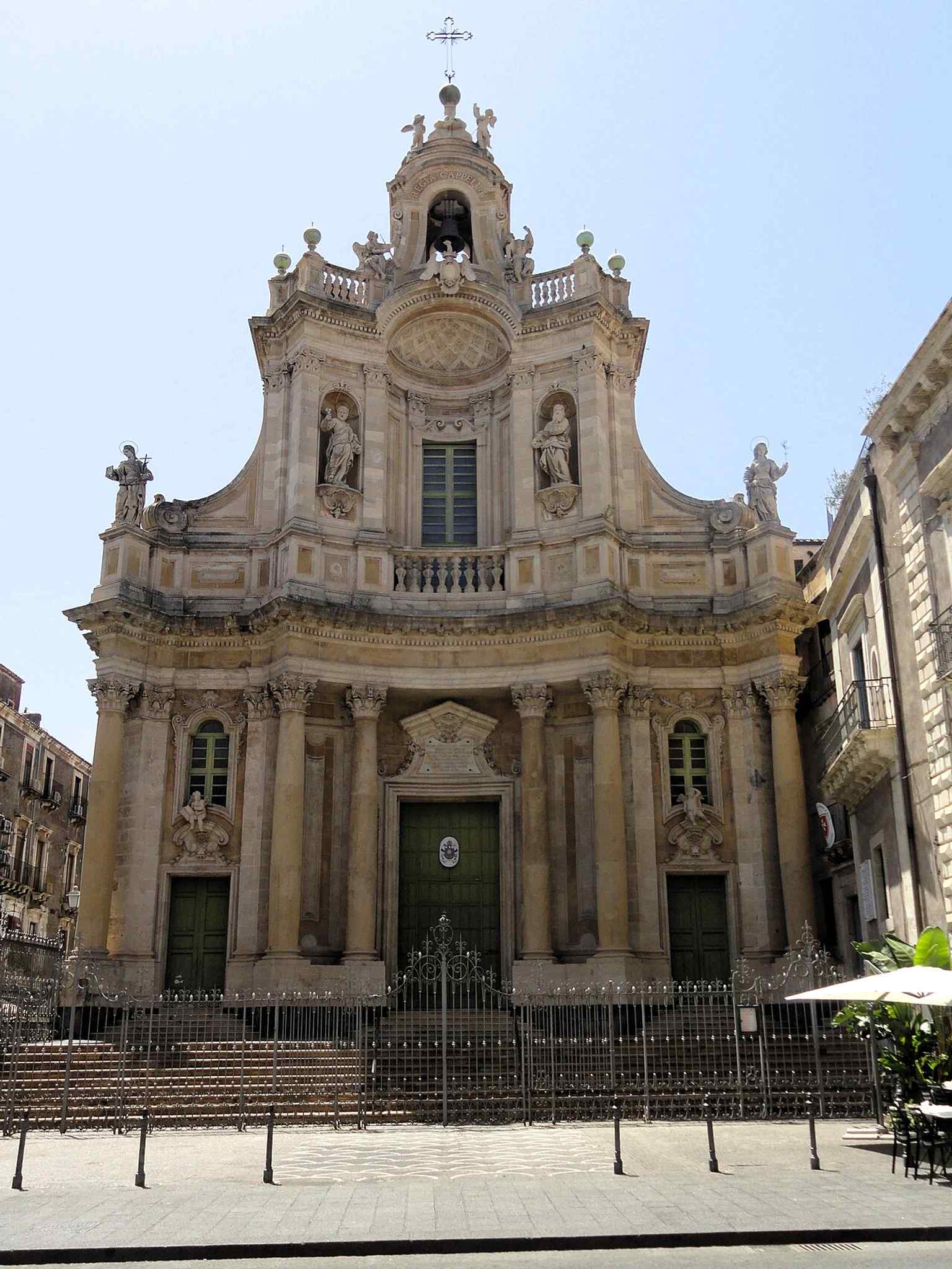
A more recent interior view that can support the story of the basilica’s survival, restoration, and continued worship after wartime damage.Photo: Effems, Wikimedia Commons, CC BY-SA 4.0. Cropped & resized. On your left, the cathedral stands out with a pale marble façade in three rising tiers, a row of dark granite columns, and a great dome lifting behind the roofline. This is the…Read moreShow less
Open dedicated page →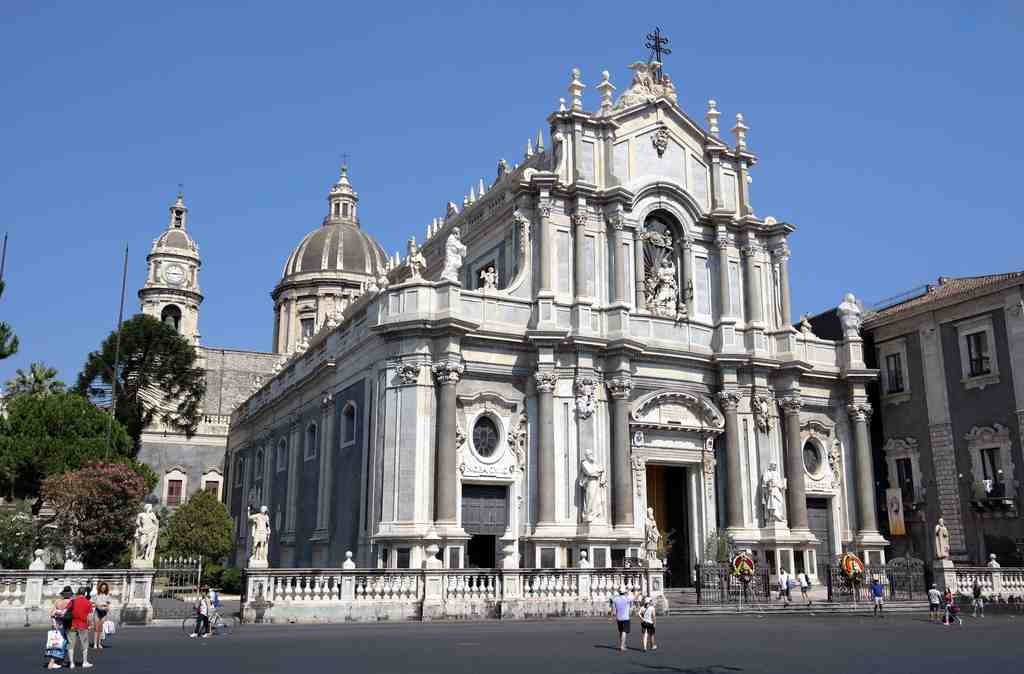
Cathedral of Sant'AgataPhoto: Luca Aless, Wikimedia Commons, CC BY-SA 4.0. Cropped & resized. On your left, the cathedral stands out with a pale marble façade in three rising tiers, a row of dark granite columns, and a great dome lifting behind the roofline.
This is the Cathedral of Sant'Agata, the chief church of Catania and, in a rather deeper sense, its emotional centre. Agata was a young Christian martyr, killed in the ancient Roman period, and the people of this city have never treated her as a remote figure from a prayer book. They have held her as protector, neighbour, witness, and warning to anyone foolish enough to threaten Catania.
That feeling shaped this place from the beginning. Count Roger the First re-established the diocese after the Norman conquest, and Abbot Angerio came from Calabria to lead the new cathedral, consecrated in the late eleventh century. He built it over earlier Roman remains, and he gave it the character of an ecclesia munita, a fortified church: part house of worship, part place of defence. Even then, Catania did not begin from a clean slate. It built by reusing what earlier ages left behind.
The most cherished story here belongs to two former Byzantine soldiers, Gisliberto, a Frenchman, and Goselmo, a Calabrian. In ten forty, the general George Maniakes had carried Agata's relics away to Constantinople. They stayed there for eighty-six years, until, legend says, Agata appeared to Gisliberto in a dream and ordered him to bring her home. On the seventeenth of August, eleven twenty-six, the relics returned in triumph, and the city received them with a devotion so intense that it still shapes Catania's identity.
Then came the blows. In eleven sixty-nine, during the feast of Agata, an earthquake brought down the roof. Archbishop Giovanni d'Aiello died under the collapse, along with forty-four monks and a vast number of worshippers. In sixteen ninety-three, the great Val di Noto earthquake nearly erased the cathedral again. Only the Norman apse and parts of the earlier structure survived. What you see now is not a replacement so much as a carefully argued reply to disaster: Girolamo Palazzotto shaped the interior, and Giovanni Battista Vaccarini gave the cathedral its grand marble front in the eighteenth century.
In the image on your screen, you can see that Baroque façade clearly: ceremonious, balanced, and determined to look the catastrophe in the eye. Look closely at the real building too: those ancient granite columns in the first order are older than the façade itself, a reminder that Catania never wastes a survival.
Over the central portal stand Agata, Saint Euplius, and Saint Berillus. And on the façade appears the strange sequence N-O-P-A-Q-V-I-E, linked to a local legend that Emperor Frederick the Second spared Catania after reading a warning not to offend Agata's homeland. That is how this city thinks of her: not simply as a saint in heaven, but as a force with civic jurisdiction.
If you check the interior image in the app, the Norman apse still frames the high altar, proving that the older cathedral remains inside the later one like a memory that refused eviction.
So here is a question to carry with you: what does it mean when a city places its deepest trust not in a ruler, nor an army, but in a martyr remembered generation after generation?
And yet, for all this apparent permanence, something older still lies directly below this sanctuary: Roman baths, where imperial Catania continues to wait underground, and that is where we go next. If you plan to enter later, the cathedral generally opens in the morning and again in the late afternoon, with a slightly later opening on Sundays.
On your left, look for the stone ramp descending beside the cathedral into a narrow barrel-vaulted passage, a curved tunnel cut beneath the great church above. This is one of…Read moreShow less
Open dedicated page →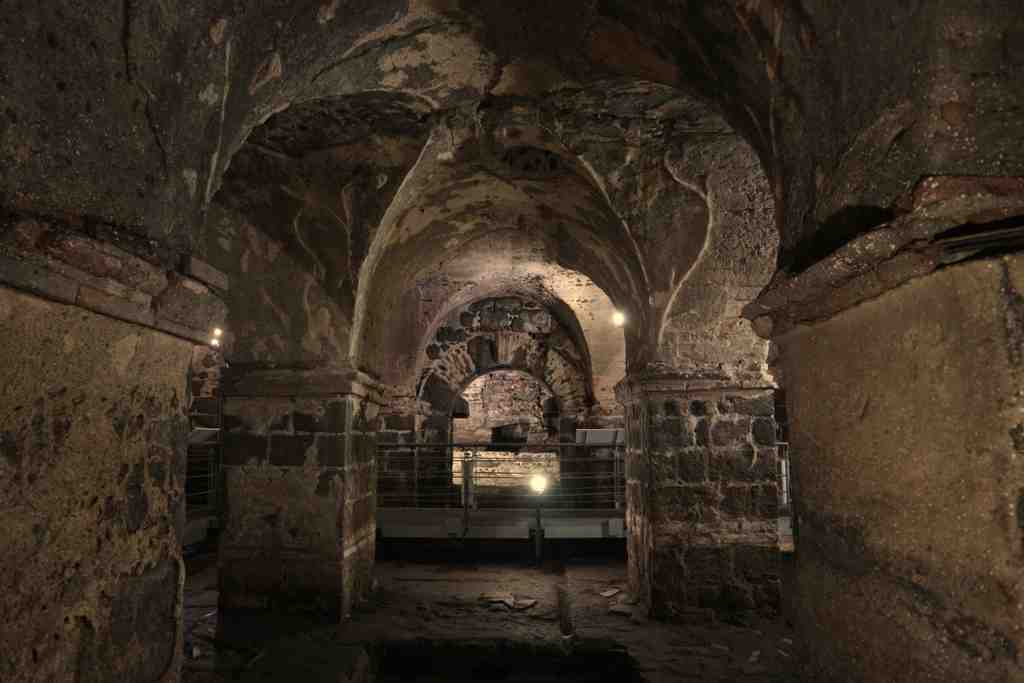
Achillian BathsPhoto: Daniele Napolitano, Wikimedia Commons, CC BY-SA 4.0. Cropped & resized. On your left, look for the stone ramp descending beside the cathedral into a narrow barrel-vaulted passage, a curved tunnel cut beneath the great church above.
This is one of Catania’s most startling truths made physical: Roman baths below, cathedral above. The Achillian Baths date from roughly the fourth or fifth century, though some scholars suspect parts may be even older, perhaps from the third. What survives is only a fragment, tucked under Piazza del Duomo, but even that fragment changes how you read this square. The Christian city did not clear the Roman one away; it settled over it, claimed its ground, and gave old prestige a new sacred purpose. That happened all across the Mediterranean, but here the layering is almost indecently direct.
In the year ten eighty-eight, Bishop Ansgerio chose this very area for Catania’s cathedral and monastery. By ten ninety-four, the cathedral stood here, quite literally occupying the old thermal enclosure. Sacred meaning rose on top of imperial infrastructure. The result is not neat replacement, but coexistence.
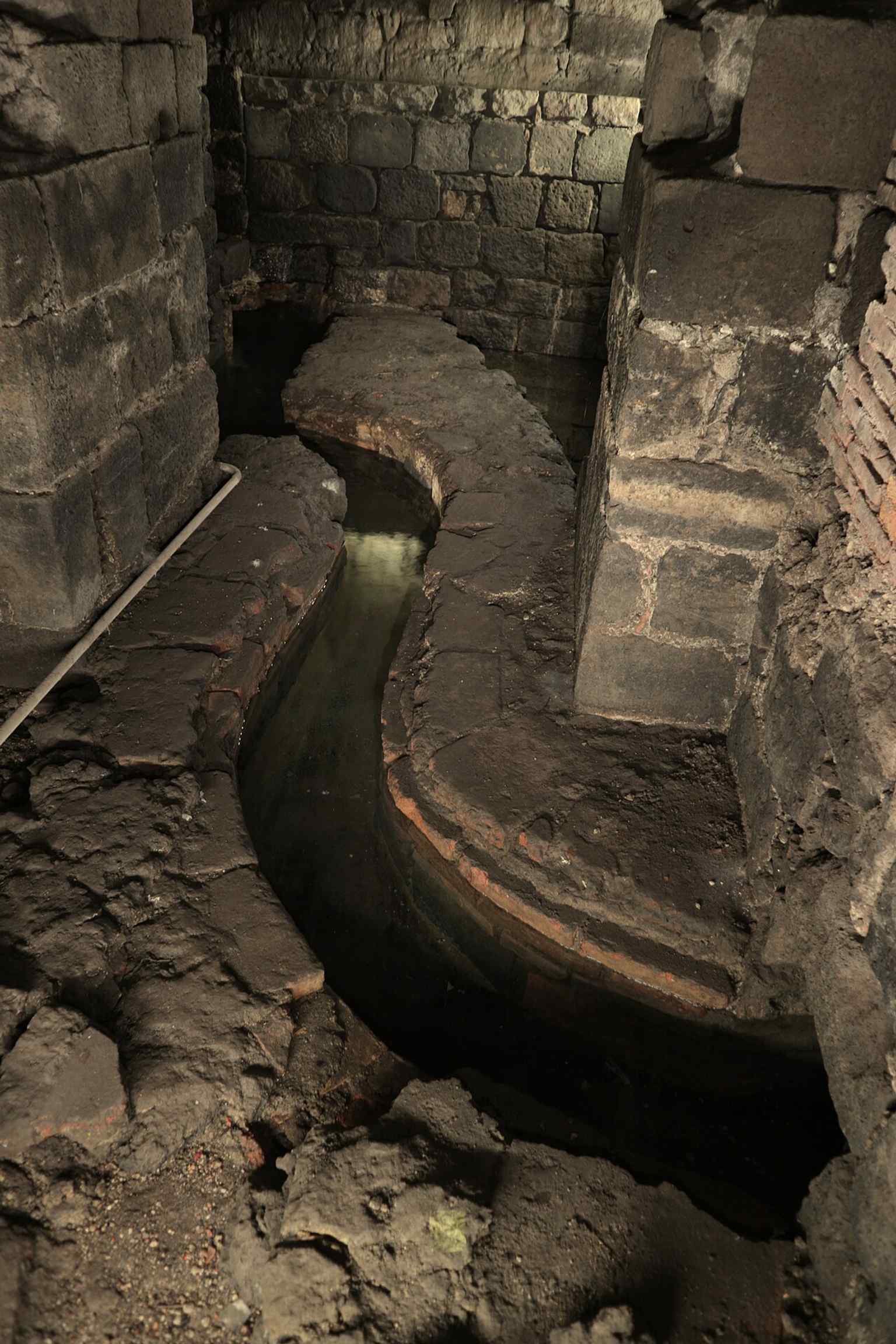
In the image on your screen, you can see the access corridor: a long, dim barrel vault threading between the cathedral foundations and the baths. It leads to the best-preserved chamber, probably a frigidarium, the cold room, where a cross-vaulted ceiling rests on four square pillars. At the centre sits a small square basin, once faced with marble. Roman engineers fed and filtered water through parallel basins and channels, including an elegant S-shaped conduit uncovered in deeper excavation. Another room, the tepidarium, the warm room, used air channels for heat and even had a double-flight staircase rising to an upper level.
The vaulted access corridor leading into the thermal complex — the passage described in the source as the entry route beside Catania Cathedral.Photo: Daniele Napolitano, Wikimedia Commons, CC BY-SA 4.0. Cropped & resized. Most visitors never hear the old local version of the name. Scholars trace “Achillian” to a Greek inscription on a great marble slab, now in the civic museum at Castello Ursino, pieced together from fragments found over centuries. But older Catanesi preferred a livelier tale: they said the baths were named because a colossal statue of Achilles had been discovered in the depths and then lost again. One rather likes that. In Catania, myth clings to masonry with admirable stubbornness.
The man who dragged these baths back into view was Ignazio Paternò Castello, Prince of Biscari, who financed and directed the excavations in the eighteenth century. He found the complex buried under almost five metres of mud, lava grit, and wreckage left by the eruption of sixteen sixty-nine and the earthquake of sixteen ninety-three. He pushed on, then stopped in frustration when the tunnels ran under the heavy foundations of the cathedral and the Senate building. Dig further, and he feared he might bring the city above crashing down.
That danger never entirely left. The underground Amenano kept invading the site. After a restoration in nineteen ninety-seven, the water rose so abruptly it drowned the new walkways almost at once. Only the major engineering works completed in two thousand and six, including a massive steel plate beneath the square, finally gave these corridors some peace. If you want a closer look at the surviving masonry and the stubborn world of water management here, the app image is rather telling.
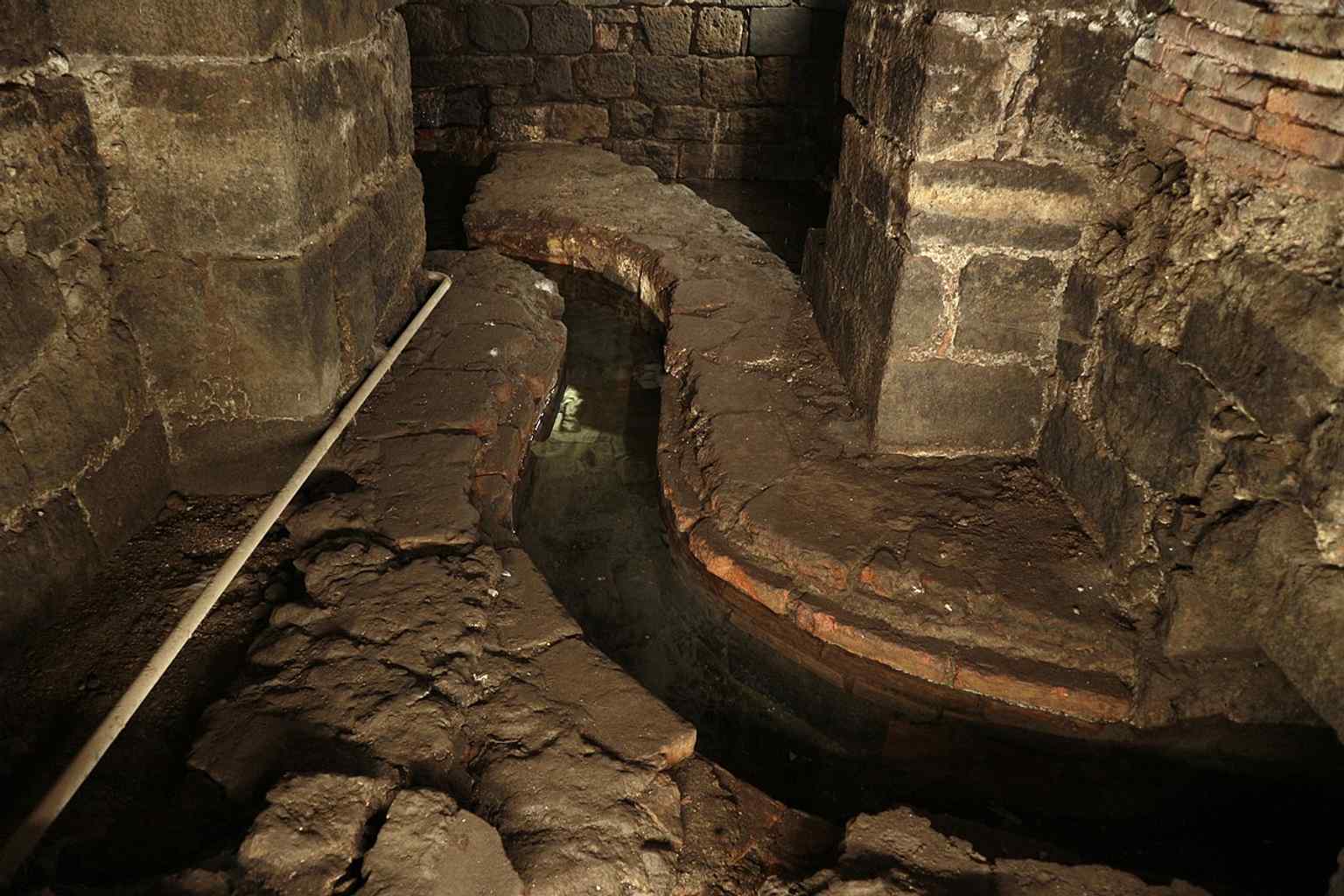
The drainage and water-management system of the baths, a key feature of this site whose preservation was always complicated by underground water.Photo: Daniele Napolitano, Wikimedia Commons, CC BY-SA 4.0. Cropped & resized. Now lift your gaze back to the open square above: church, palace, authority, ceremony. All of it stands over baths, channels, and buried stone. When you are ready, head toward Elephant Palace, about two minutes away. If you hope to go inside the baths later, opening hours are limited and vary by day, generally in the late morning with a few afternoon openings.
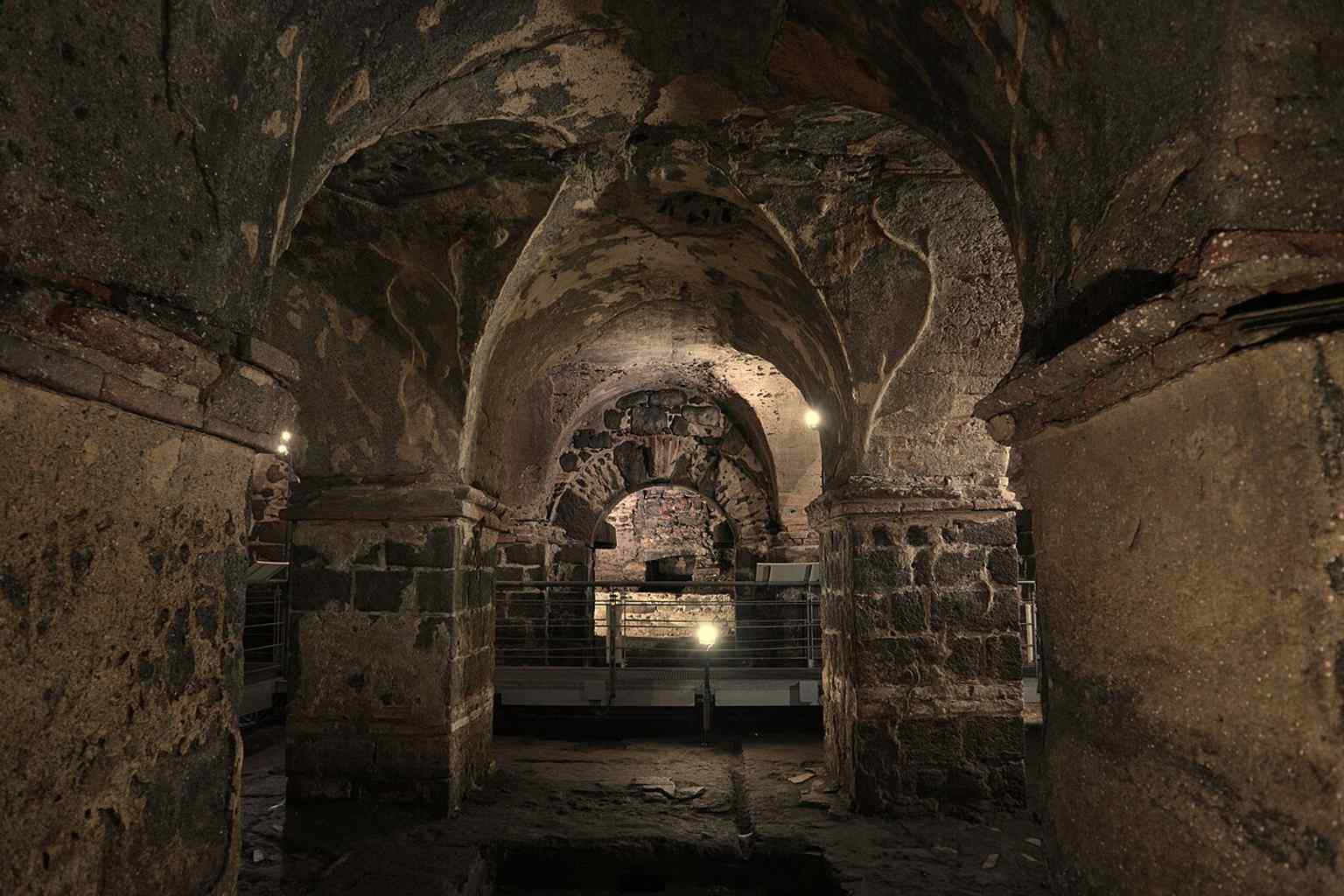
Inside the Achillian Baths, where the underground Roman rooms survive beneath Piazza del Duomo and were once repeatedly threatened by flooding from the Amenano.Photo: Daniele Napolitano, Wikimedia Commons, CC BY-SA 4.0. Cropped & resized. 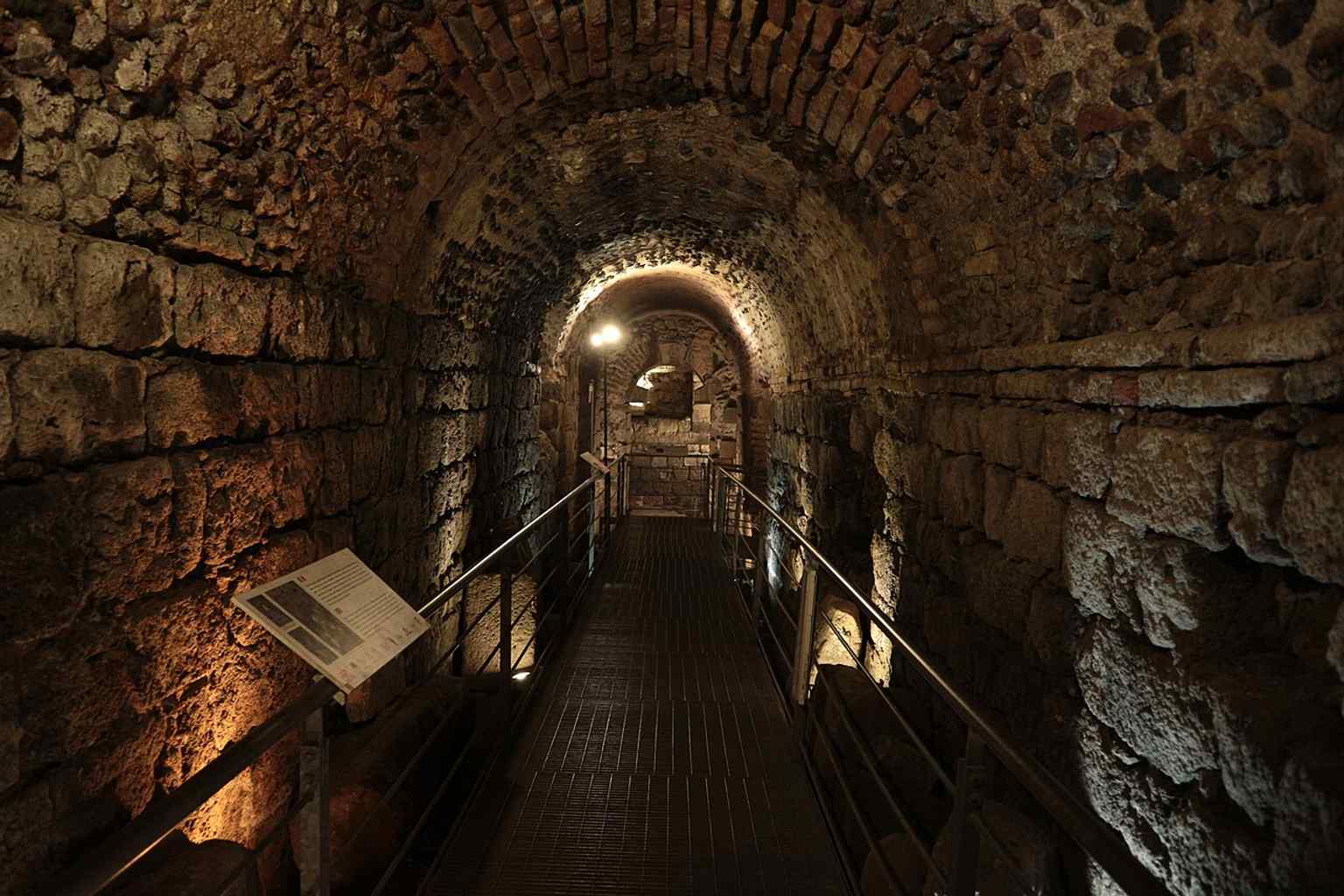
A closer view of the baths’ surviving masonry, showing the kind of underground structure that was buried for centuries by later city layers and earthquakes.Photo: Daniele Napolitano, Wikimedia Commons, CC BY-SA 4.0. Cropped & resized. On your right, look for a pale Baroque palace with three storeys, a portal framed by paired granite columns, and a central balcony carrying the city’s coat of arms beneath statues…Read moreShow less
Open dedicated page →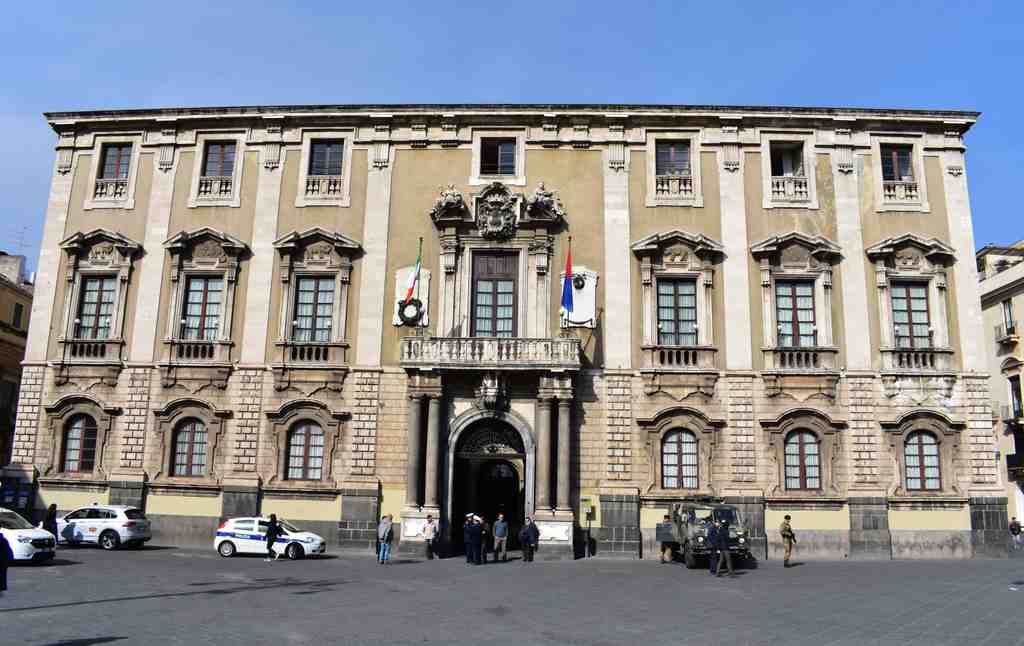
Elephant PalacePhoto: Francesco Lombardi, Wikimedia Commons, CC BY-SA 4.0. Cropped & resized. On your right, look for a pale Baroque palace with three storeys, a portal framed by paired granite columns, and a central balcony carrying the city’s coat of arms beneath statues of Justice and Faith.
This is the Palazzo degli Elefanti, Catania’s town hall, and municipal government is rarely modest about where it lives. Churches kept one kind of continuity in this city; the municipality kept another. Catania’s civic power and municipal identity lived here in decrees, ceremonies, records, arguments, and in the stubborn claim that the city could govern itself, even when everything around it lurched into crisis.
Before this palace stood here, the city’s rulers met in an older Aragonese building called the Loggia Senatoria. It mattered enough that the Sicilian parliament gathered there more than once between the thirteenth and sixteenth centuries. Then the earthquake of sixteen ninety-three flattened it. The civic leaders decided not merely to rebuild, but to answer disaster with a new public face.
That ambition quickly turned combative. The city wanted its new seat of power to stand up, visually and politically, to the great Seminary Palace across the square, the stronghold of ecclesiastical authority under Bishop Riggio. So this building became part town hall, part statement of intent.
The trouble, rather predictably, was money. The master builder Giovan Battista Longobardo began the work, but by seventeen oh one the funds had evaporated and construction stopped with the palace barely risen beyond its first level. For decades, civic pride had to wait for cash. Then, in seventeen thirty-two, the young architect Giovanni Battista Vaccarini took charge. He brought a more theatrical Baroque language, shaped by Bernini’s Rome, and he gave the noble floor balconies their distinctive elephant sculptures. That choice, together with the lava-stone Liotru that Vaccarini set in the square, persuaded the people of Catania to drop the old name Palazzo Senatorio and call it the Elephant Palace instead.
If you open the exterior image in the app, you can read the whole façade more clearly and catch how firmly it faces the square. Notice the stern rusticated lower level - stone blocks cut to look tough and weighty - softened above by pale plaster and white limestone trim.
Now for the part most visitors miss. This square looks serenely Baroque, but on the fourteenth of December, nineteen forty-four, a crowd of young anti-conscription protesters stormed this palace and set it on fire. Many were furious at being forced into military service after believing the war was effectively over for Sicily. The blaze destroyed the city archives, centuries of civic memory, and treasures from the Museum of the Risorgimento kept inside. If you glance at the staircase plaque on your screen, you are looking at the sort of object that survives as witness when paper does not.
The interiors were furnished again in their original style, and the palace reopened on the anniversary of the fire in nineteen fifty-two, returning to use as city hall the following year. That, too, tells you something about Catania: public authority here has had to rebuild not only rooms, but trust.
Soon, we leave the council chamber behind and head toward an older civic stage, where a city once tested itself through spectacle rather than votes: the Greek-Roman Theatre, about four minutes away. If you plan to come back later, the palace area is generally open from morning into the evening, with longer hours on Saturdays and Sundays.
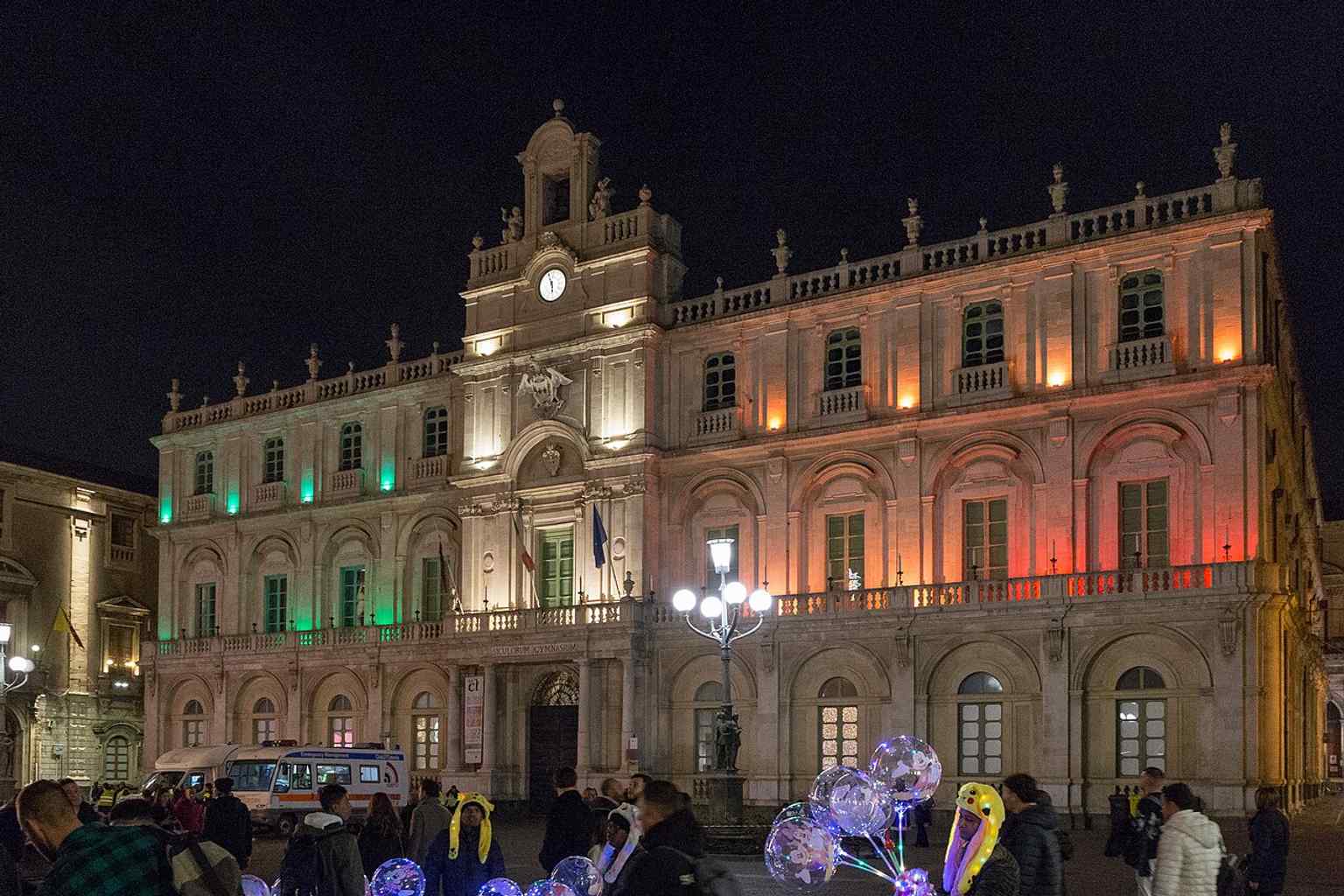
The Elephant Palace seen from the square beside Catania University — a good view of the baroque civic landmark facing Piazza Duomo.Photo: Pymouss, Wikimedia Commons, CC BY-SA 4.0. Cropped & resized. 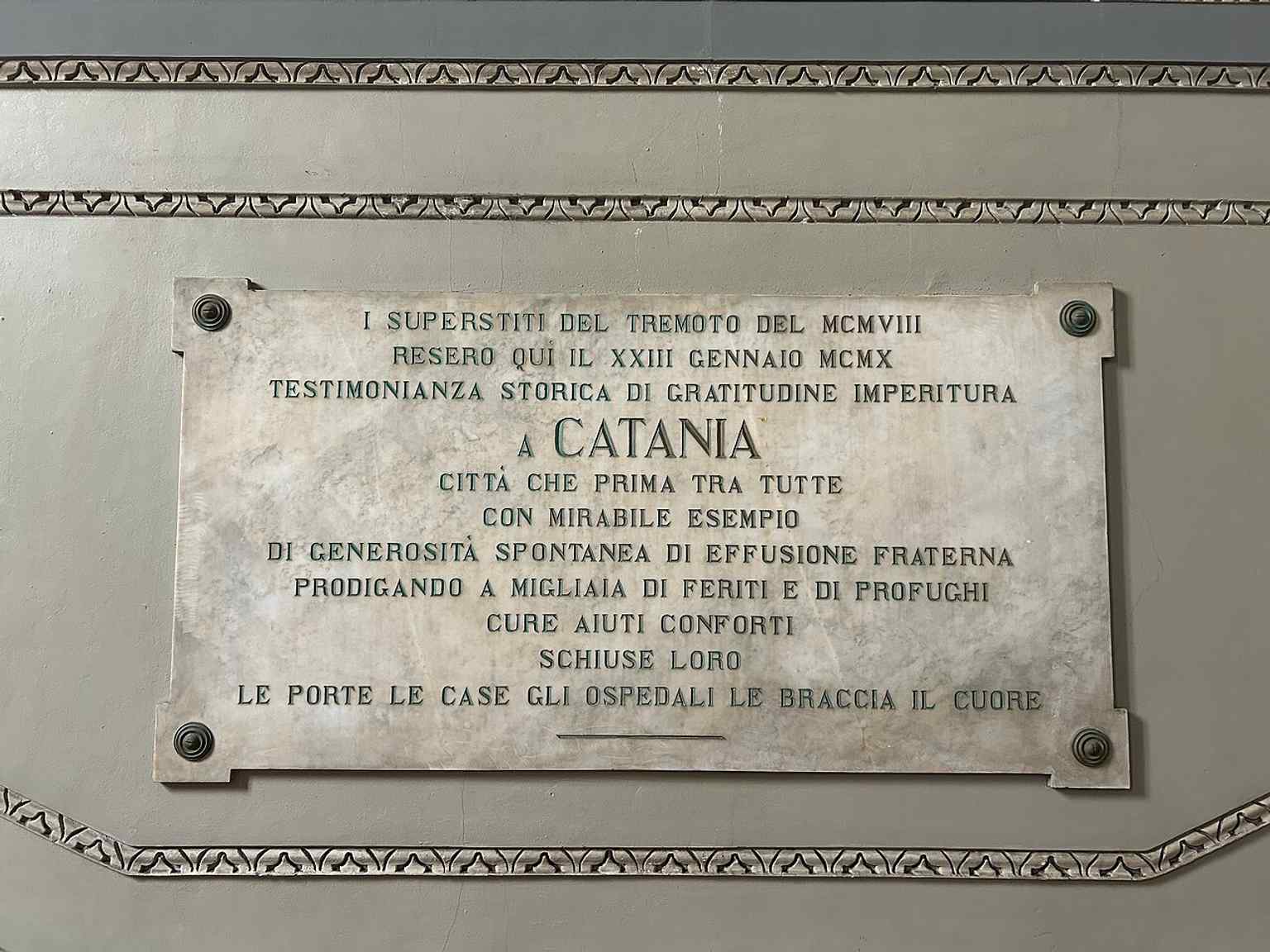
A commemorative plaque on the staircase, one of the interior details that anchor the palace’s layered civic history.Photo: GiovanniPen, Wikimedia Commons, CC BY-SA 4.0. Cropped & resized. On your right, look for a wide half-circle of dark lava-stone steps and pale masonry, hollowed like an open shell, with ancient arches still caught among later city…Read moreShow less
Open dedicated page →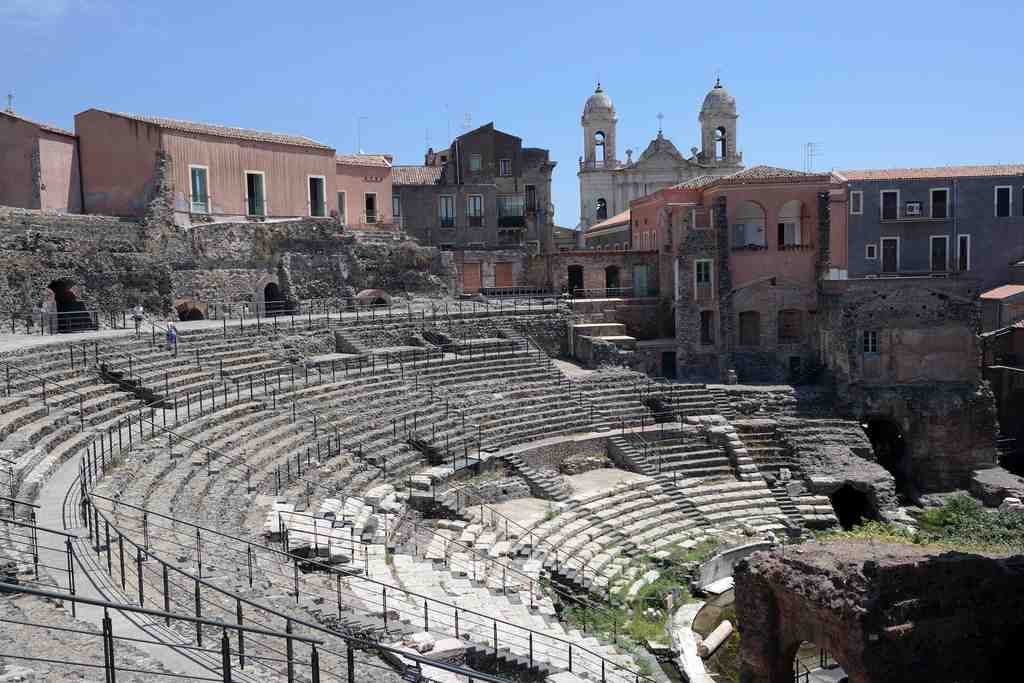
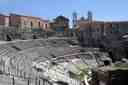
Greek-Roman Theatre of CataniaPhoto: Luca Aless, Wikimedia Commons, CC BY-SA 4.0. Cropped & resized. On your right, look for a wide half-circle of dark lava-stone steps and pale masonry, hollowed like an open shell, with ancient arches still caught among later city buildings.
This theatre tells you something essential about Catania: the city never really starts over. It rearranges itself, borrows from its own ruins, and carries old voices forward in new costumes.
The story begins in the Greek city of Katane. In the year four hundred and fifteen B.C., the Athenian statesman Alcibiades addressed the citizens in a theatre here in Catania, urging them to join Athens against Syracuse. Scholars argued for generations over whether that Greek theatre stood exactly here. Then archaeologists found heavy sandstone blocks marked with Greek letters, and later blocks bearing a sign thought to abbreviate Katane itself. So the Roman monument before you may well stand on the bones of the very theatre where politics played to a live audience.
That matters, because in Catania public spectacle was never just amusement. Greeks used the theatre as a civic chamber, Romans turned it into a machine for display, and later powers kept ruling through ceremony, procession, and the art of being seen.
Under Augustus, after Catania became a Roman colony, builders repaired the older structure. Then, in the second century A.D., perhaps with funding linked to Emperor Hadrian, they made it grand. The theatre took on its great semicircle, with a cavea, the seating bowl, nearly ninety-eight metres across; twenty-one rows of seats; black lava-stone stairways; and marble cladding that once gleamed against the dark volcanic structure. The orchestra, the round performance space below, measured about twenty-two metres across and was paved in patterned marble. Behind it rose an elaborate stage front with columns, niches, statues, and side towers for stair access. In the image in the app, you can see that Roman curve still asserting itself through the later cuts and scars.
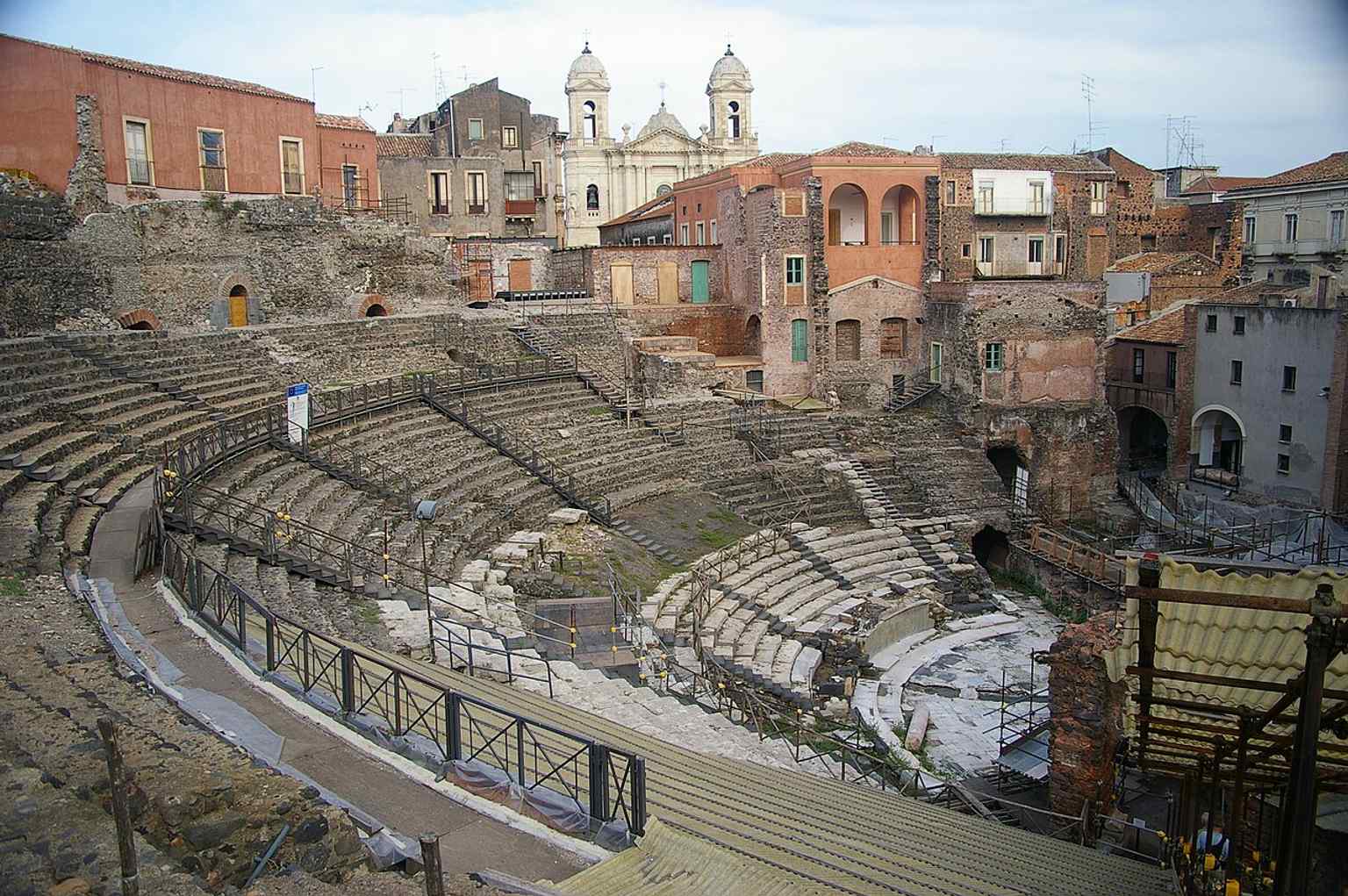
The ruined Greek-Roman Theatre of Catania seen in the city centre — a layered monument where Roman seating still survives above centuries of later reuse and excavation.Photo: Louisvhn, Wikimedia Commons, Public domain. Cropped & resized. And then comes the turn in the tale. What looks like an ancient ruin was, for centuries, a neighbourhood. By the early Middle Ages, people carved homes into the monument. A cattle butcher occupied the orchestra. Streets sliced through the seating. After the earthquake of sixteen ninety-three, people reused rubble from collapsed houses to found new ones directly on the cavea.
In the late nineteenth century, Paolo Orsi, the formidable archaeologist who led the antiquities office in eastern Sicily, pushed to clear these layers away after a local baron damaged part of the neighbouring Odeon. He helped rescue the theatre, certainly. But he also set in motion expropriations against families living over the ruins. So the monument you see today did not emerge from empty ground. It emerged from conflict between scholarship and home, between the ancient city and the living one.
Even the theatre’s splendour fed later Catania. Norman builders stripped marbles, columns, and lava blocks from here for the cathedral. In other words, some of the sacred grandeur you saw earlier may once have belonged to this stage.
From here, only a short two-minute walk takes you to San Francesco d’Assisi all’Immacolata, where pagan ground, medieval power, and Christian devotion press close together again. If you plan to go inside the theatre later, it generally opens daily from nine in the morning until seven in the evening.
On your right rises a pale limestone façade above a broad dark lava-stone staircase, with three doorways and two square little turrets capped by domes near the top. This church…Read moreShow less
Open dedicated page →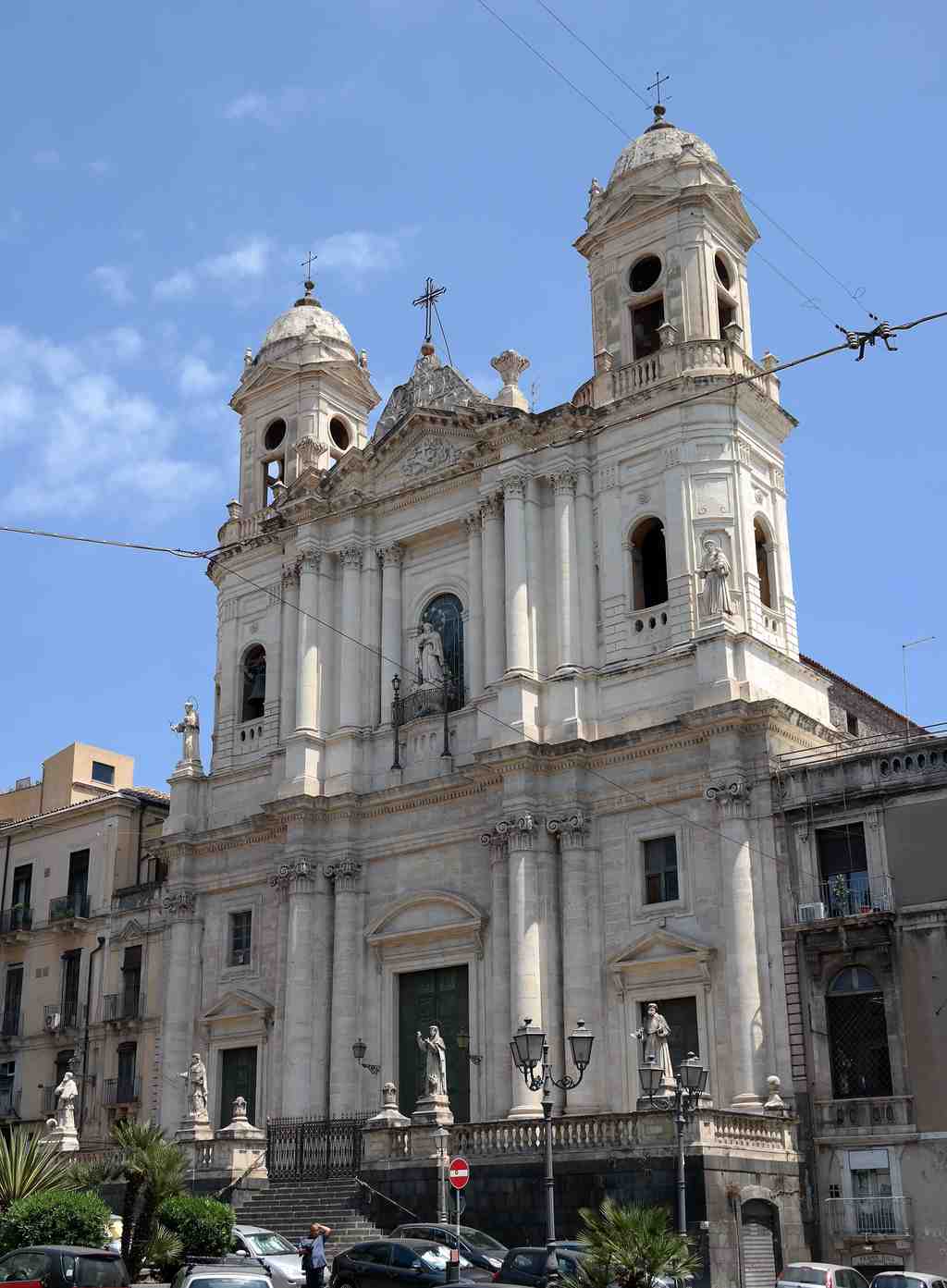
Church of St. Francis of Assisi at the Immaculate ConceptionPhoto: Luca Aless, Wikimedia Commons, CC BY-SA 4.0. Cropped & resized. On your right rises a pale limestone façade above a broad dark lava-stone staircase, with three doorways and two square little turrets capped by domes near the top.
This church carries sorrow very quietly. At first glance, it looks like a confident nineteenth-century front: sixteen half-columns, statues along the balustrade, and, above, the signs of Saint Francis carved into the pediment beneath an iron cross. But the ground under it has changed faiths, rulers, and meanings for centuries.
Long before any friar prayed here, this site held a pagan sanctuary linked to Demeter, the goddess of grain and the turning of life and death. So even here, in the middle of Christian Catania, the older sacred map never entirely vanished. One devotion settled over another.
The Franciscans arrived in Catania in the mid-thirteenth century, first near San Michele by Castello Ursino. Then, around twelve sixty, they moved here, where a church called the Speranza, or Hope, already stood. Hope is a rather apt predecessor, because the person who gave this place its defining shape came here not from triumph, but from loss.
Queen Eleonora d’Angiò enters this story in thirteen twenty-nine. Etna threatened the region that year, and she made a vow of thanks to the Virgin after escaping danger. Yet the deeper force behind her gift was grief. She had lost her husband, King Frederick the Third of Sicily, and two of her young children. After that, the queen withdrew from courtly splendour and intrigue and spent her final years in prayer and penitence. Instead of jewels and ceremony, she chose patronage. Instead of a private shrine of mourning, she gave Catania a convent and a church.
That is the turn in the tale: a royal wound became public architecture.
When Eleonora died in August of thirteen forty-one, people carried her body here with solemn honour. Her great marble tomb stood inside for more than three centuries, a monument not only to a queen but to the Aragonese presence in Sicily. In the image in your app, you can see how firmly the church still holds its square. Imagine that same authority once continued inside, where her tomb dominated the space.
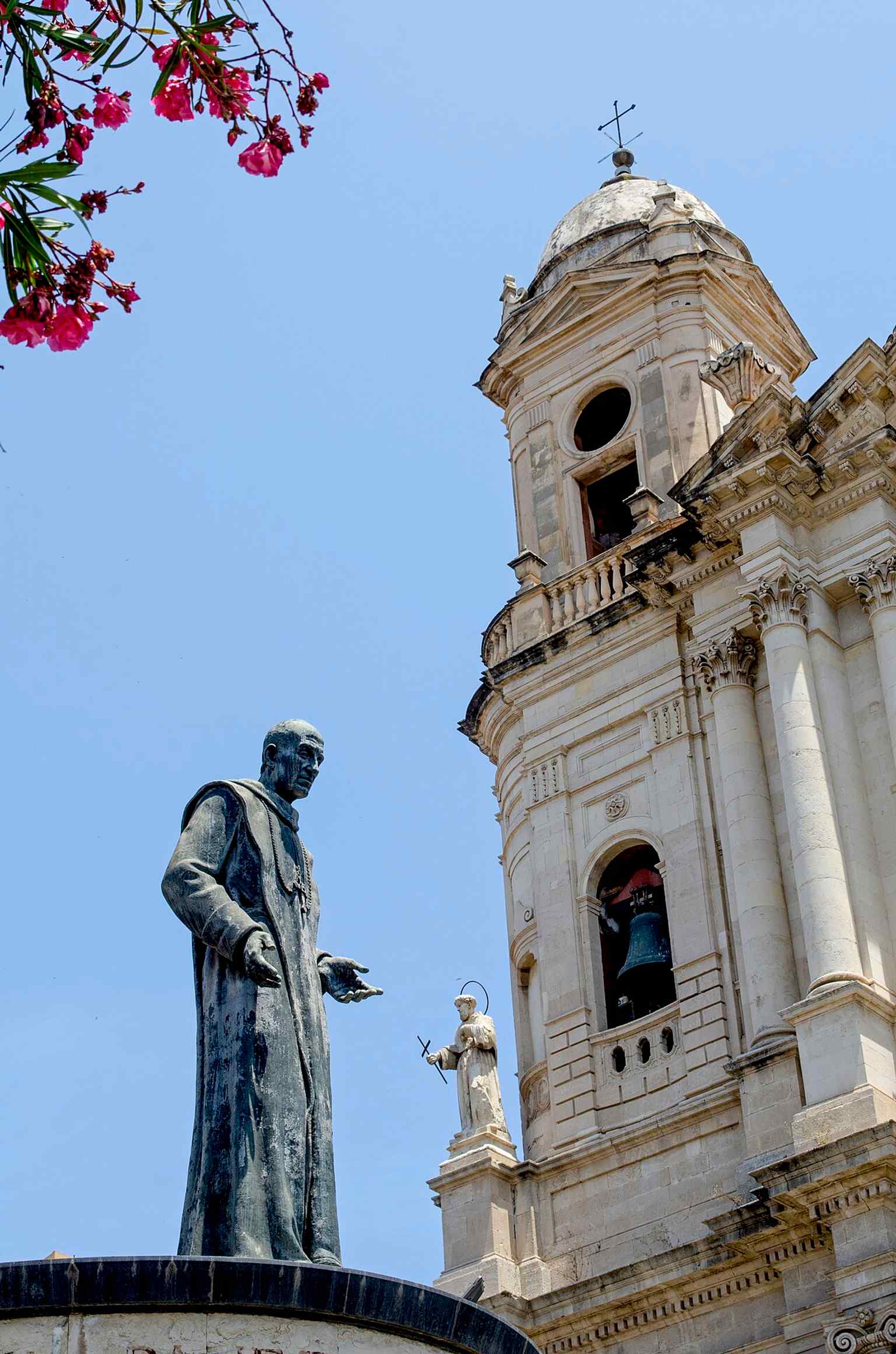
The church seen alongside the Cardinal Dusmet monument, a useful context view for the square outside the basilica.Photo: Mauripri, Wikimedia Commons, CC BY-SA 4.0. Cropped & resized. Then came the earthquake of sixteen ninety-three. It did not merely damage the church. The roofs crashed down onto Eleonora’s tomb and smashed the marble monument to pieces. Only a fragment of the front slab survives. Local legend says the friars hid her true remains within the rebuilt walls, as if the city could not bear to lose her twice.
What you see now rose from that ruin in late Baroque form, not as a fresh beginning, but as a careful act of recovery. Later, in the seventeenth century, the city senate even named the Immaculate a co-patron alongside Saint Agatha, binding Catania’s civic identity to this Franciscan church. Personal grief had widened into shared devotion.
In a moment, we’ll head to our next stop, where faith becomes almost theatrical in stone and space. Our next stop is the Church of San Giuliano, about three minutes away.
On your right, the Church of San Giuliano appears as a pale stone façade that bows outward in a smooth curve, enclosed by wrought-iron railings and backed by a lofty dome. This…Read moreShow less
Open dedicated page →On your right, the Church of San Giuliano appears as a pale stone façade that bows outward in a smooth curve, enclosed by wrought-iron railings and backed by a lofty dome.
This is where Via dei Crociferi reveals its true nature. It is not merely a street, but a carefully arranged corridor of monasteries and church fronts, where architecture directs movement and feeling with the confidence of a stage designer. San Giuliano is one of the four great Baroque church-monasteries here, and it plays its part with remarkable restraint.
The ground beneath it had an older life. This was part of the city’s first Greek and Roman quarter, and the church rose over the remains of a pagan temple. Long before this façade existed, a community of hermit nuns from Santa Sofia lived outside the walls. In the early thirteenth century they moved into the city, and a Benedictine monk named Father Rainaldo Scalciato helped turn that small religious venture into a stable enclosed monastery under the title of San Giuliano.
Then came the earthquake of sixteen ninety-three, the great rupture we have met again and again in Catania. It destroyed the earlier complex and killed sixty of the seventy-four nuns. Only fourteen survived. The community had to begin again almost from nothing.
Their move here, into Via dei Crociferi, was not just practical. In seventeen oh nine the Benedictines exchanged their old property for former buildings of the San Marco Hospital, placing the convent much closer to the ceremonial heart of the rebuilt city. From a loggia, an open gallery within the complex, cloistered nuns, many from Catania’s aristocratic families, could watch the nighttime procession of Saint Agatha pass below without breaking enclosure. Hidden, but very much present.
In seventeen forty-one, the architect Giuseppe Palazzotto began the new church, probably developing an earlier plan by Vincenzo Caffarelli, a priest of the Crociferi order. Gaspare Ciriaci shaped the façade between seventeen forty-three and seventeen forty-nine, drawing on Roman Baroque models. The whole church was finished around seventeen fifty-four, and the elegant iron fence arrived in the first half of the nineteenth century.
Pause for a moment and let your gaze run up the street. Notice how the domes, curves, and façades answer one another. After the ancient performances of the theatre, Catania learned to make an entire street behave like scenery.
In the historic image in the app, you can see San Giuliano before later governments cut into the convent world around it. After religious houses were suppressed in the nineteenth century, civic offices took over parts of the complex. In nineteen thirty-seven, the fascist state turned one wing into a barracks called Caserma Dux and erased the garden, the central fountain, and a Baroque entrance. In nineteen forty-eight, those rooms passed to the Chamber of Labour. Cloister, barracks, union offices: the city kept changing the script, but not the setting.
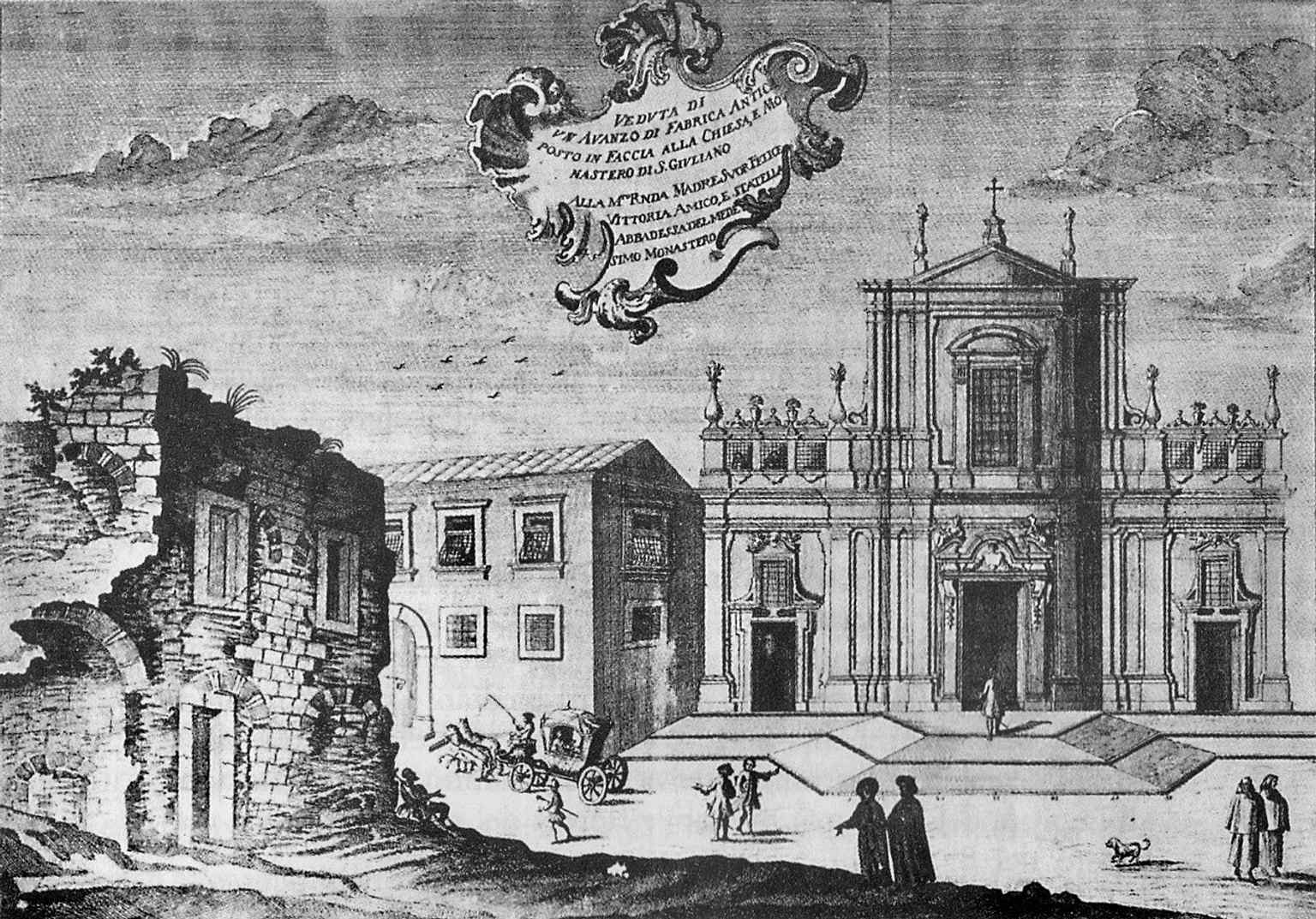
An 18th-century view of the San Giuliano façade in Via dei Crociferi, showing the monastery complex before later changes after the earthquakes.Photo: Autore ignoto, Wikimedia Commons, Public domain. Cropped & resized. Inside, the church opens in an elongated octagon under one of the highest domes in Catania. Giuseppe Rapisardi painted that dome in eighteen forty-two with Saint Peter handing the Gospel to Saint Berillo before ruined pagan architecture, a fitting image for this place, where each new order rises through the fragments of the last.
Now continue along Via dei Crociferi toward one of its grandest statements of learning and power, the Jesuit College.
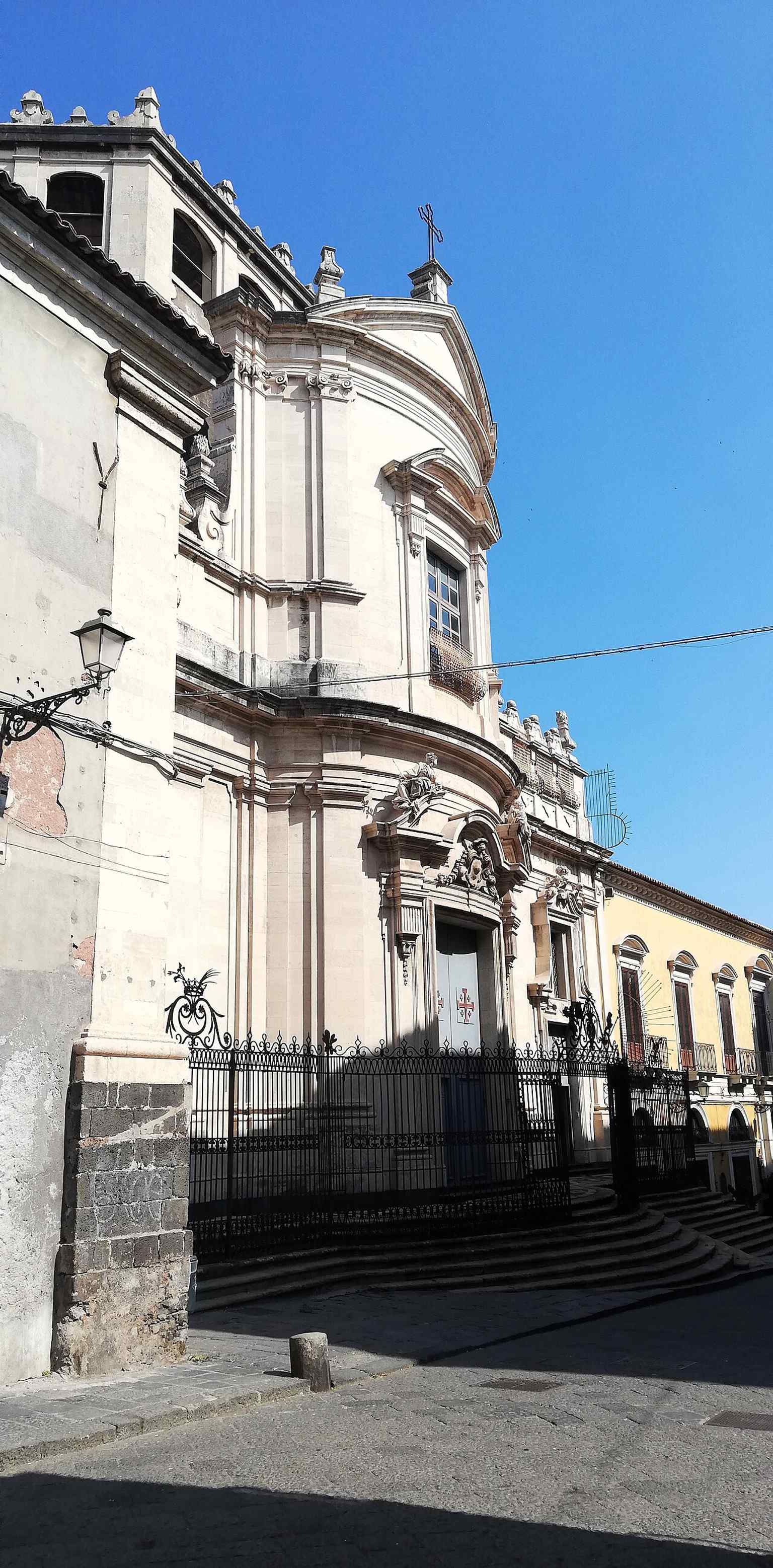
The church façade of San Giuliano in Catania, a graceful Baroque frontage on Via dei Crociferi opposite the Jesuit College.Photo: Effems, Wikimedia Commons, CC BY-SA 4.0. Cropped & resized. 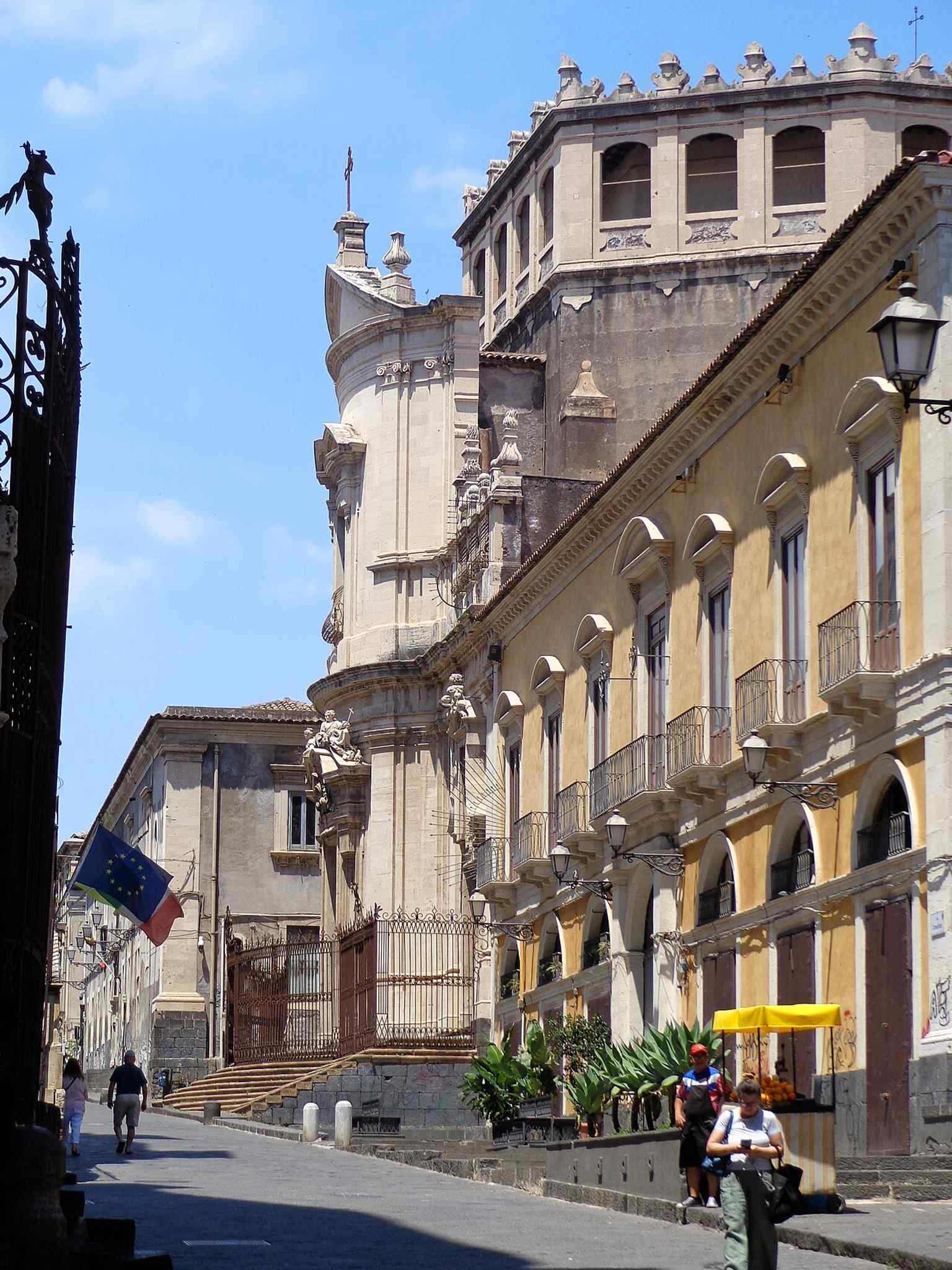
A second modern exterior view of San Giuliano, useful for showing the church’s elegant convex front and its ironwork enclosure.Photo: Effems, Wikimedia Commons, CC BY-SA 4.0. Cropped & resized. On your left, look for the great honey-coloured stone façade reached by a broad staircase, its long Baroque front cut with tall windows and joined to the church beside it. This…Read moreShow less
Open dedicated page →On your left, look for the great honey-coloured stone façade reached by a broad staircase, its long Baroque front cut with tall windows and joined to the church beside it.
This is the Jesuit College, one of the grandest houses the Society of Jesus ever raised in Sicily, and it tells you something essential about Catania: after disaster, the city did not merely repair itself. It reorganised its ideas, its teaching, and even its public stage.
The college you see belongs to the long rebuilding that followed the earthquake of sixteen ninety-three. But the story did not move in a straight line. Father Francesco Maria Bonincontro, the vice-rector, wanted the Jesuits to rebuild closer to the city’s prime urban axis, near what is now Piazza dell’Università. He had houses there already. Then came lawsuits, quarrels over boundaries, and bitter opposition. In the end, he had to give up that ambition and retreat here, to the older site on Via dei Crociferi. For the order, it felt like a political defeat. For Catania, oddly enough, it helped create one of the most theatrical streets in the city.
In the image on your screen, you can see how this frontage plays its part in that street-wide performance. Baroque here is not decoration for decoration’s sake. It teaches. The staircase lifts you, the façade composes your gaze, and the whole arrangement declares that faith and learning belong in public view.
Several minds shaped it over roughly forty years. Alonzo di Benedetto oversaw early foundations around seventeen oh one. Angelo Italia designed the church façade next door and likely set the broader scheme. Later, Stefano Masuccio and Francesco Battaglia carried the work onward. That is why the complex feels so layered: not one author, but a relay of them. The Jesuits also followed their own building rules, what they called the modo nostro, “our way”: separate spaces for the fathers, for teaching, and for service, all carefully ordered. Yet Catania bent even those rules. This college ended up with four courtyards, unusually many for a Jesuit complex, because the builders folded older surviving fragments into the new plan.
Most people never realise that one of the loveliest details lies behind the façade: a cloister, a quiet courtyard ringed by arches and columns, with black-and-white pebble paving laid in stripes, in the manner associated with Borromini. A severe institution, yes, but one with a taste for rhythm.
And there is a local twist worth keeping. When the Cathedral of Sant’Agata closed for restoration between seventeen ninety-five and the early nineteenth century, major religious ceremonies shifted into the adjoining church of San Francesco Borgia. Because of that temporary change, the infant Vincenzo Bellini was baptised there in eighteen oh one. Before he became Catania’s great operatic voice, he entered the city’s life in this orbit of cathedral ritual and Jesuit learning. In the app image, you can see that connection at a glance. After the Jesuits were expelled in seventeen sixty-seven, the college changed again: public school, craft college, poorhouse, tribunal, art institute. The purpose kept changing, but the building never stopped trying to shape minds.
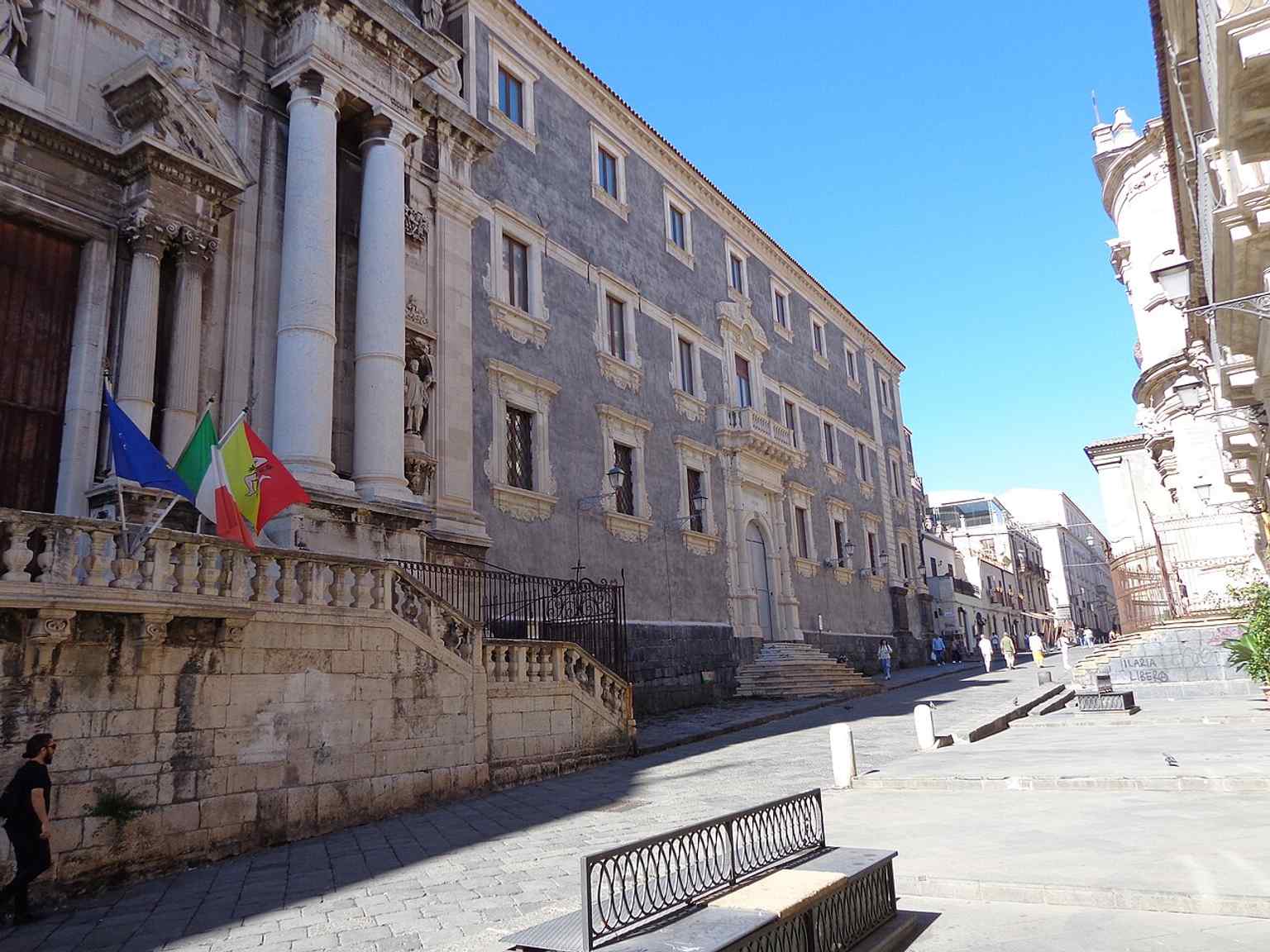
San Francesco Borgia beside the Jesuit College — the adjoining church where Vincenzo Bellini was baptized in 1801 during a temporary transfer of cathedral rites.Photo: Effems, Wikimedia Commons, CC BY-SA 4.0. Cropped & resized. And that, I think, is the clue for where we go next. Even among these grand façades, older Catania waits close by, where Christian worship settled into Roman remains. The Rotonda Thermal Baths are about three minutes away.
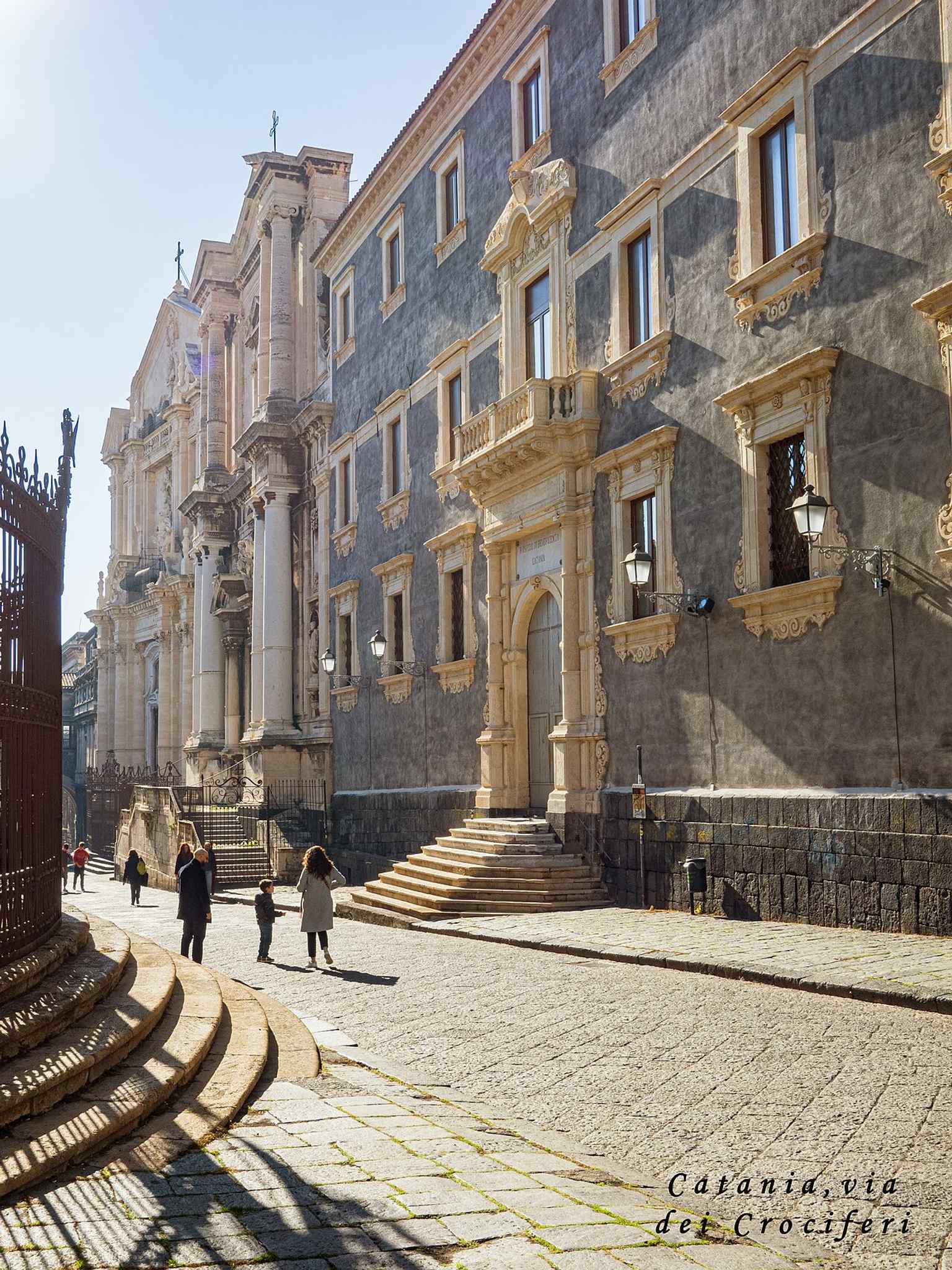
Via Crociferi with the Jesuit College and nearby Baroque churches — the scenic urban setting that made the complex part of UNESCO-listed late Baroque Catania.Photo: Pasquale Relvini, Wikimedia Commons, CC BY-SA 4.0. Cropped & resized. 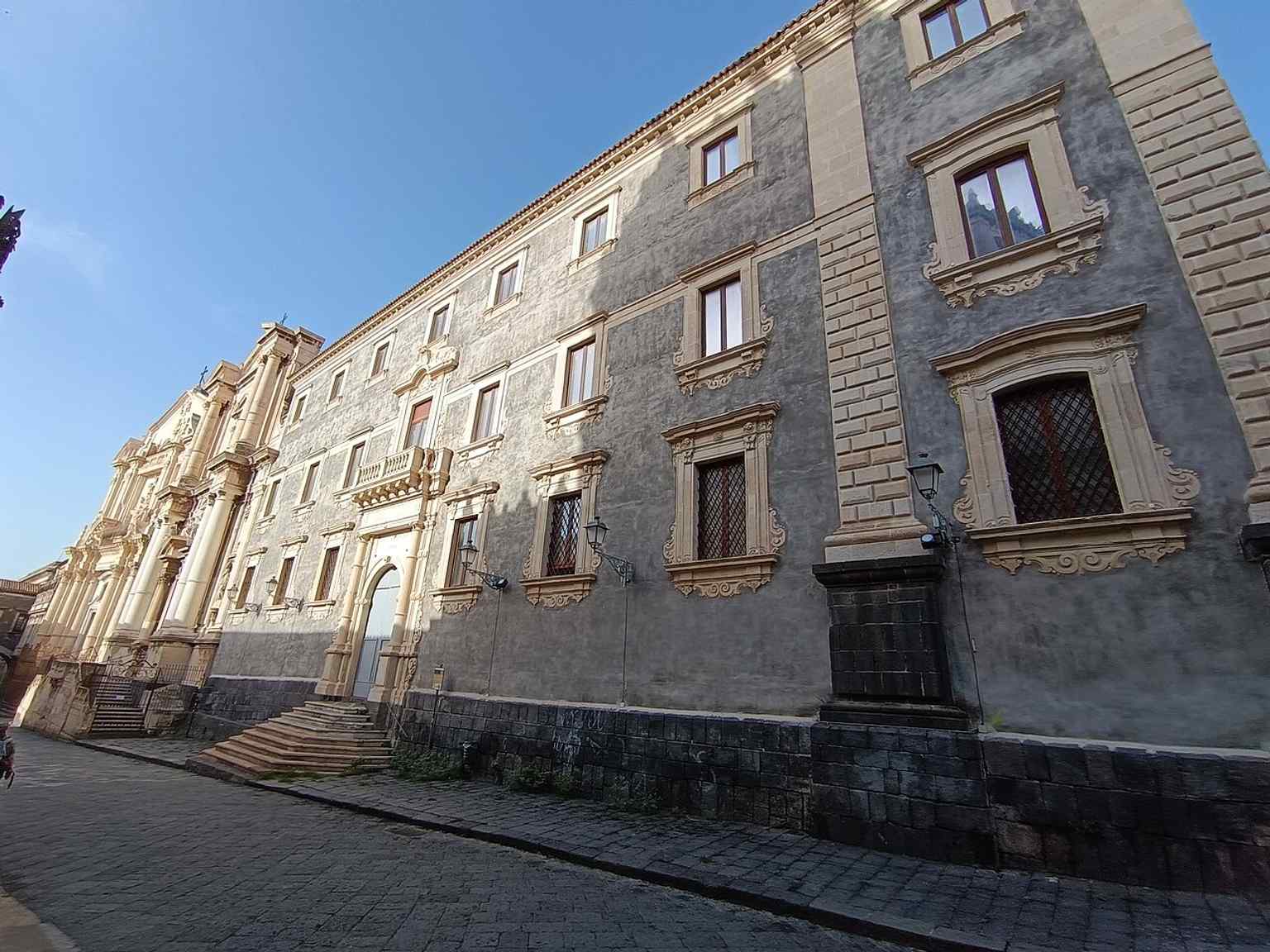
A close view of the Jesuit College façade, showing the monumental Baroque frontage of one of Sicily’s most impressive Jesuit buildings.Photo: Viaggiamocela, Wikimedia Commons, CC BY-SA 4.0. Cropped & resized. On your left stands a vast pale-stone church with an unfinished front of giant half-height columns, three dark portals, and a broad central window. This is San Nicolò l'Arena,…Read moreShow less
Open dedicated page →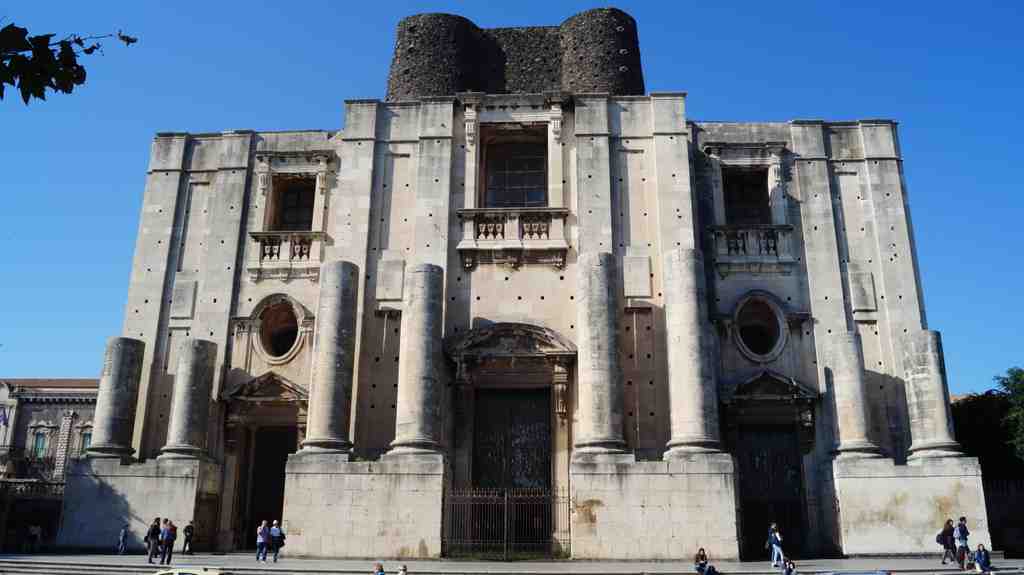
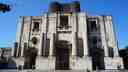
Church of San Nicolò l'ArenaPhoto: Nicolò Arena, Wikimedia Commons, CC BY-SA 4.0. Cropped & resized. On your left stands a vast pale-stone church with an unfinished front of giant half-height columns, three dark portals, and a broad central window.
This is San Nicolò l'Arena, the largest church in Sicily. The Benedictines of San Nicolò l'Arena were not simply monks at prayer. They were adaptive builders and preservers who kept shifting their ground when Etna threatened them, carried their learning with them, and eventually changed the scale of Catania. This church and the immense monastery behind it turned this whole district into a world of worship, study, and power.
Their story began at Nicolosi, where an earlier monastery stood on reddish volcanic soil. That is where Arena, or Rena, comes from: the burnt red sand of the place. In the sixteenth century the monks sought greater safety inside Catania’s walls, tired of eruptions and of raiders who made country life dangerous. They opened a city monastery in fifteen seventy-eight.
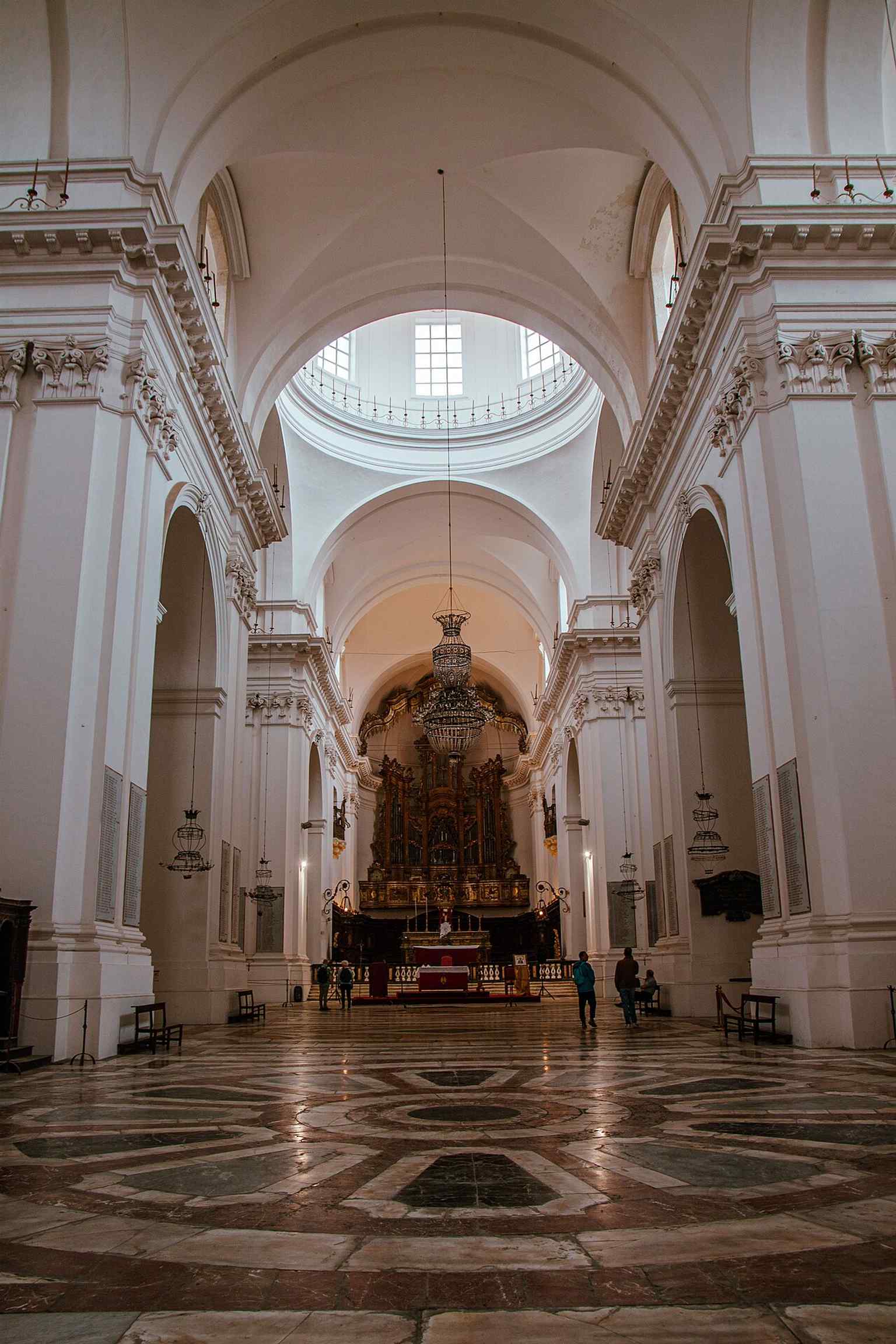
Then Etna answered again. In sixteen sixty-nine lava overran western Catania, swallowed the Benedictines’ bastion, and destroyed their first city church. The heat baked the ground so fiercely that it returned to that same red sand from which their name had come. So the monks began again, a little farther south. In sixteen eighty-seven the Roman architect Giovanni Battista Contini planned a church on a scale Catania had never seen, with a cross-shaped layout and a dome inspired by Saint Peter’s in Rome.
Then came the earthquake of sixteen ninety-three, and nearly thirty years of argument over whether to rebuild here or move elsewhere. At last the work resumed. One of the men who carried it forward was Stefano Ittar. After structural trouble appeared on the right side, he took over from his father-in-law Francesco Battaglia and, in seventeen eighty, raised the great dome that still commands the city. In the app image, you can see how that dome gathers the entire interior beneath it.
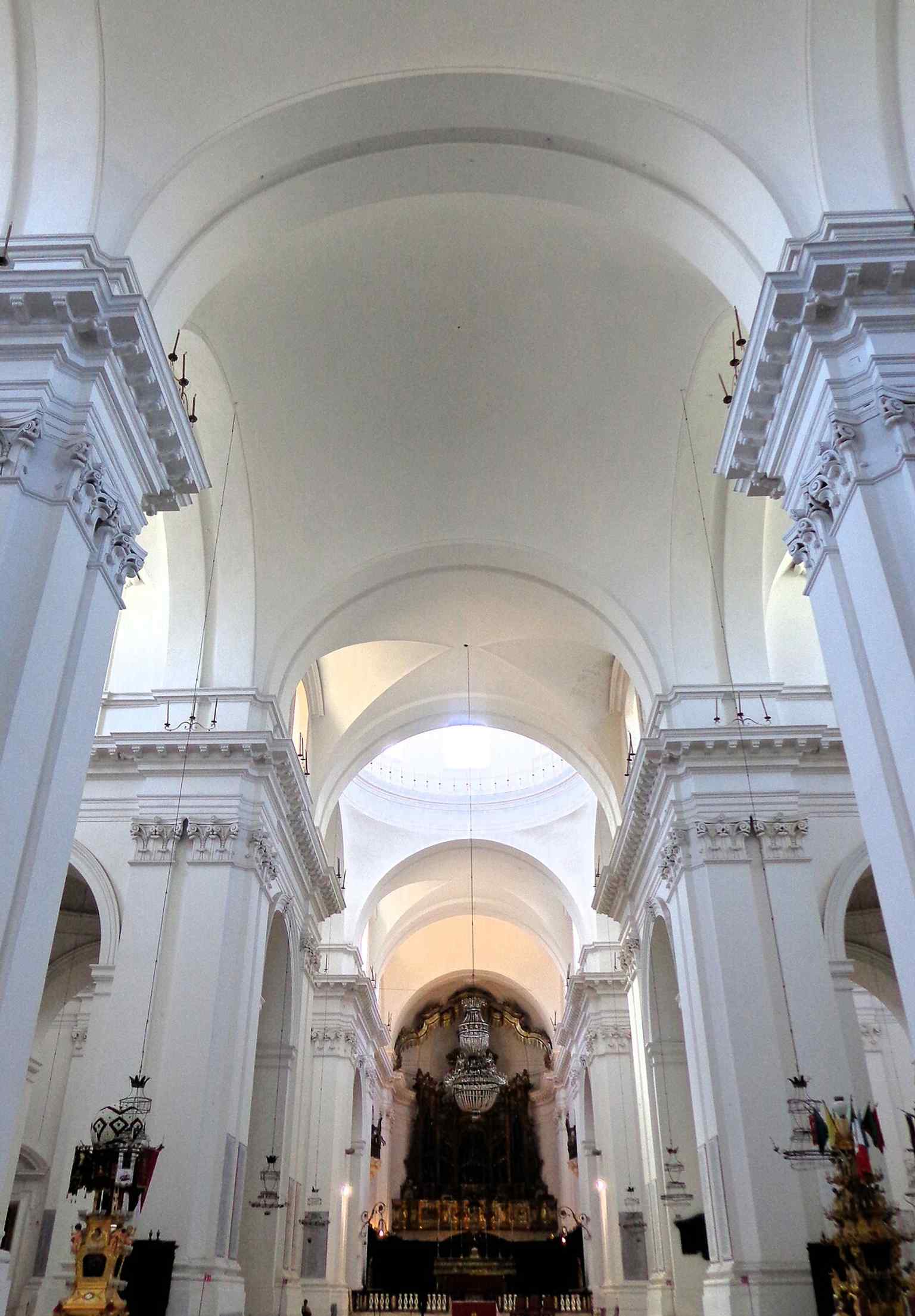
The soaring cupola and central crossing — one of the key features completed by Stefano Ittar and visible from deep inside the church.Photo: Effems, Wikimedia Commons, CC BY-SA 4.0. Cropped & resized. This immensity had a purpose. Every September, crowds came for the feast of the Santo Chiodo, a relic believed to be a nail from Christ’s crucifixion, kept in a glittering reliquary. The monks wanted a church that could hold a multitude and proclaim the strength of their monastery. Yet the unfinished front before you tells a quieter truth. Carmelo Battaglia Santangelo designed this grand facade, but in seventeen ninety-seven the Benedictines fell into a bitter dispute with their stone suppliers. Deliveries stopped, money tightened, and the columns remained cut short. When the Italian state confiscated the complex in eighteen sixty-six, the front stayed unfinished.
Even later, bombing in nineteen forty-three tore through parts of the church, and for decades it stood wounded before restoration slowly brought it back. That is why this place feels so moving near the end of a walk through Catania. It is not merely enormous. It has endured.
Take a moment to measure it with your eyes: the broken-off columns, the long mass of the church, the dome rising behind. Imagine the nerve it took to build something this ambitious in a city that had already taught its builders how fragile plans can be.
And yet the Benedictines did not build only in lava stone. They built with books, copied pages, and stored memory itself. In a couple of minutes, we will follow that quieter inheritance to the combined Civic Library and the A. Ursino Recupero collection. If you plan to go inside here first, the church generally opens every day from nine in the morning until five thirty in the afternoon.
The church’s unfinished Baroque façade on Piazza Dante — its massive columns were never completed after funding disputes and the 1866 confiscation.Photo: Cristina Morettini 95, Wikimedia Commons, CC BY-SA 4.0. Cropped & resized. 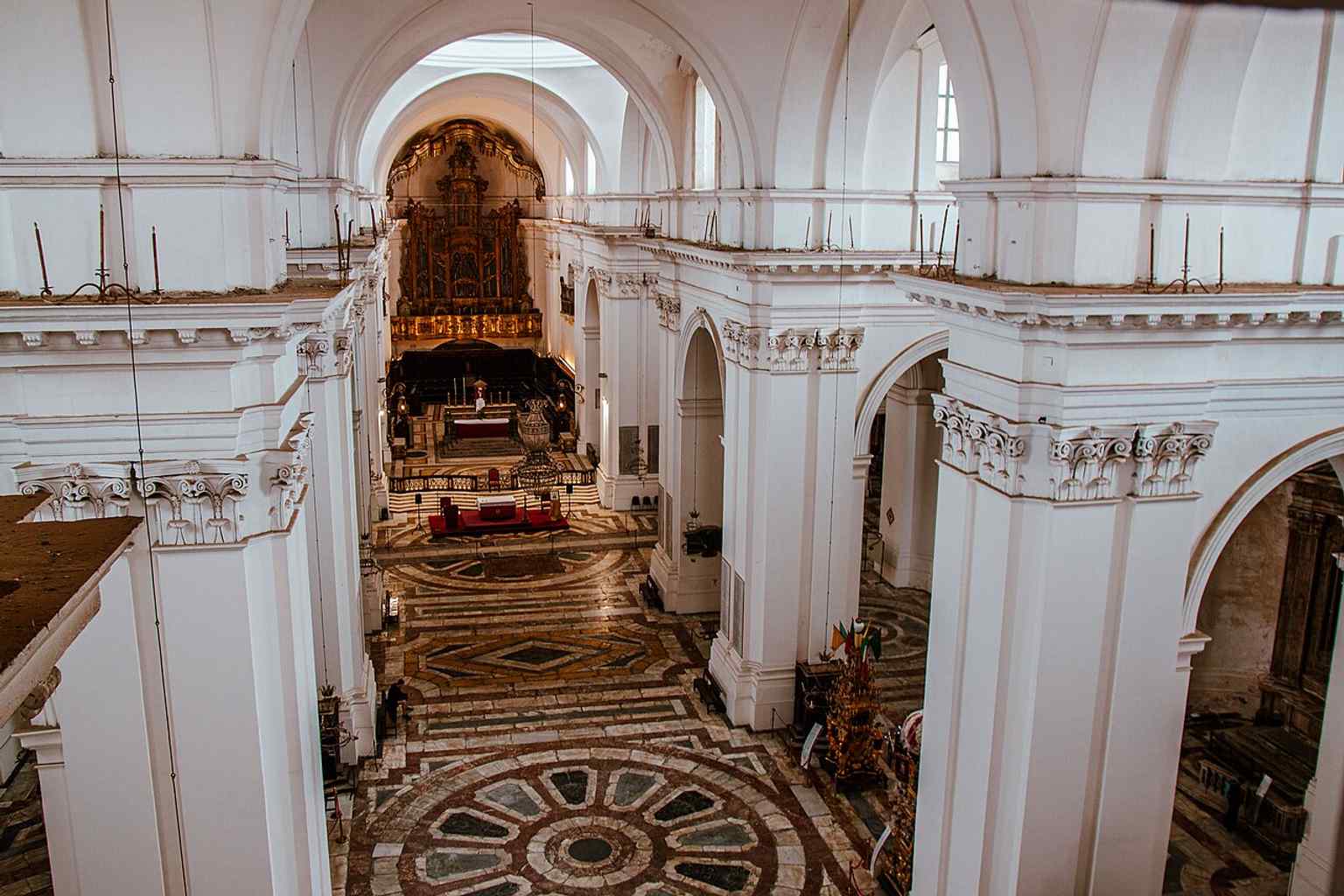
A wider exterior view that emphasizes the monumental scale of the largest church in Sicily, rebuilt after the 1669 Etna eruption.Photo: Cristina Morettini 95, Wikimedia Commons, CC BY-SA 4.0. Cropped & resized. 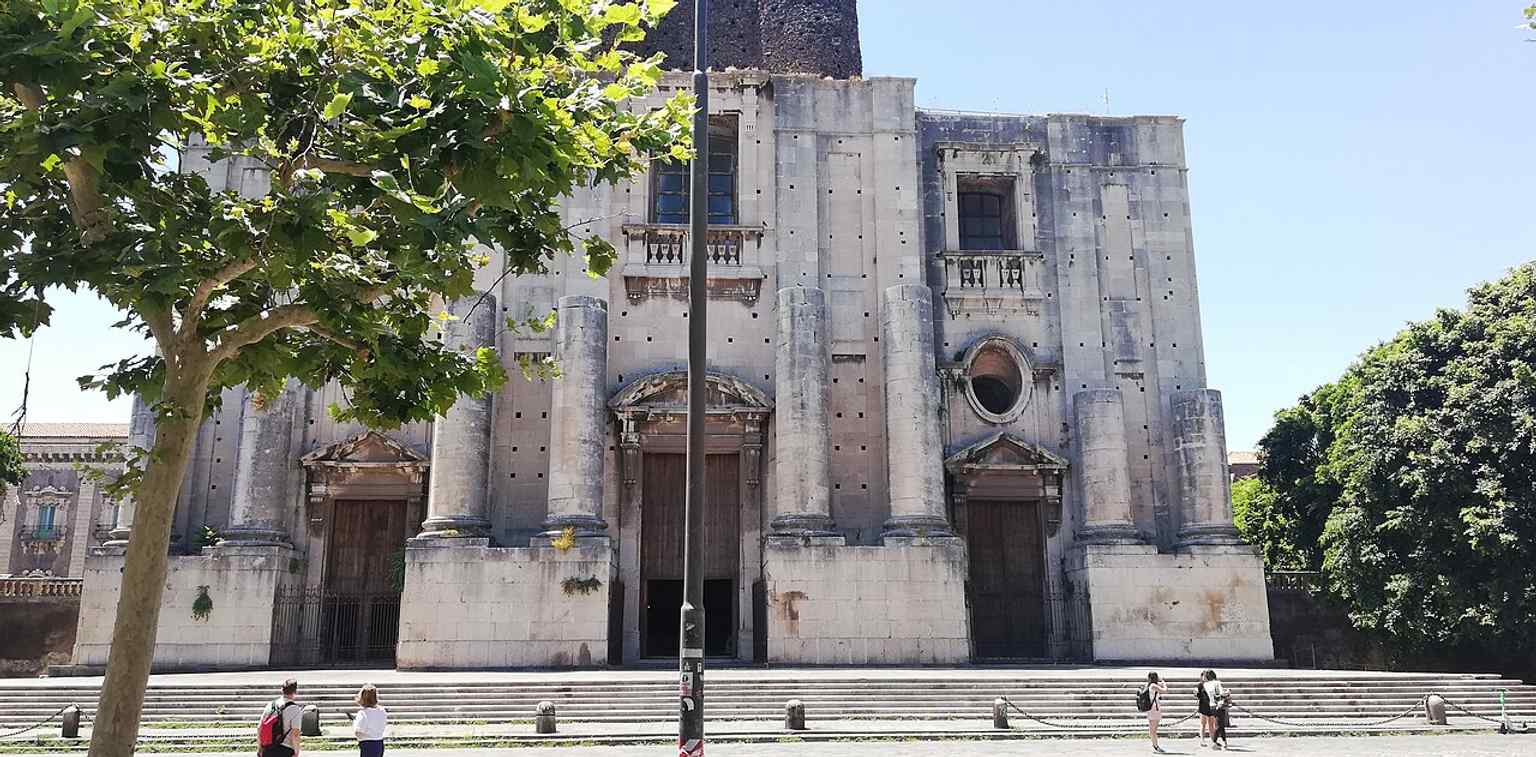
Side exterior masonry showing the enormous length of the building, a reminder that this was designed to hold huge crowds for major feasts like the Santo Chiodo.Photo: Effems, Wikimedia Commons, CC BY-SA 4.0. Cropped & resized. 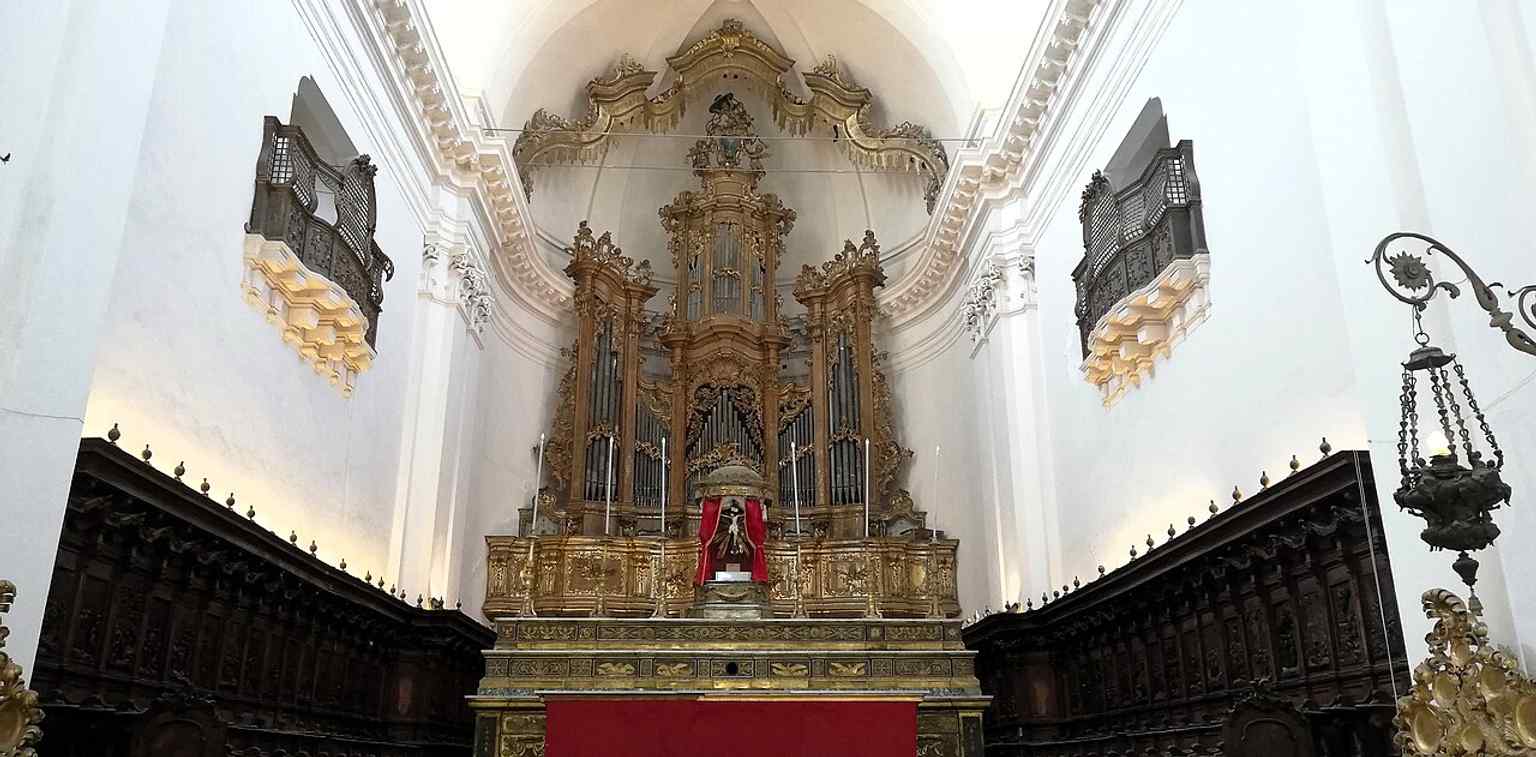
Another façade-angle view highlighting the unfinished front and the contrast between grand ambition and the halted construction.Photo: Effems, Wikimedia Commons, CC BY-SA 4.0. Cropped & resized. 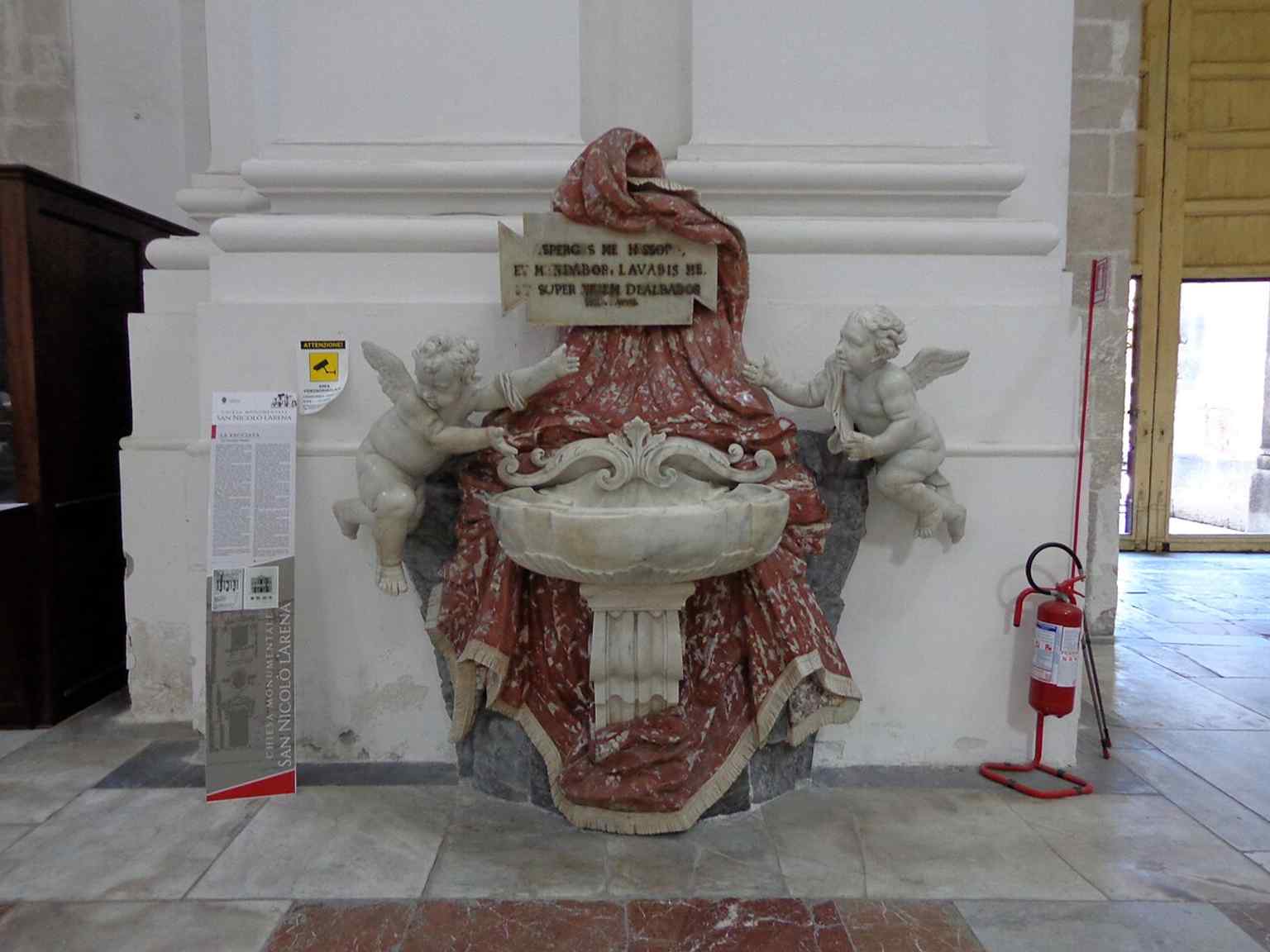
A dramatic look into the nave, where the cross-shaped plan and tall arches create the vast interior space described in the source.Photo: Effems, Wikimedia Commons, CC BY-SA 4.0. Cropped & resized. 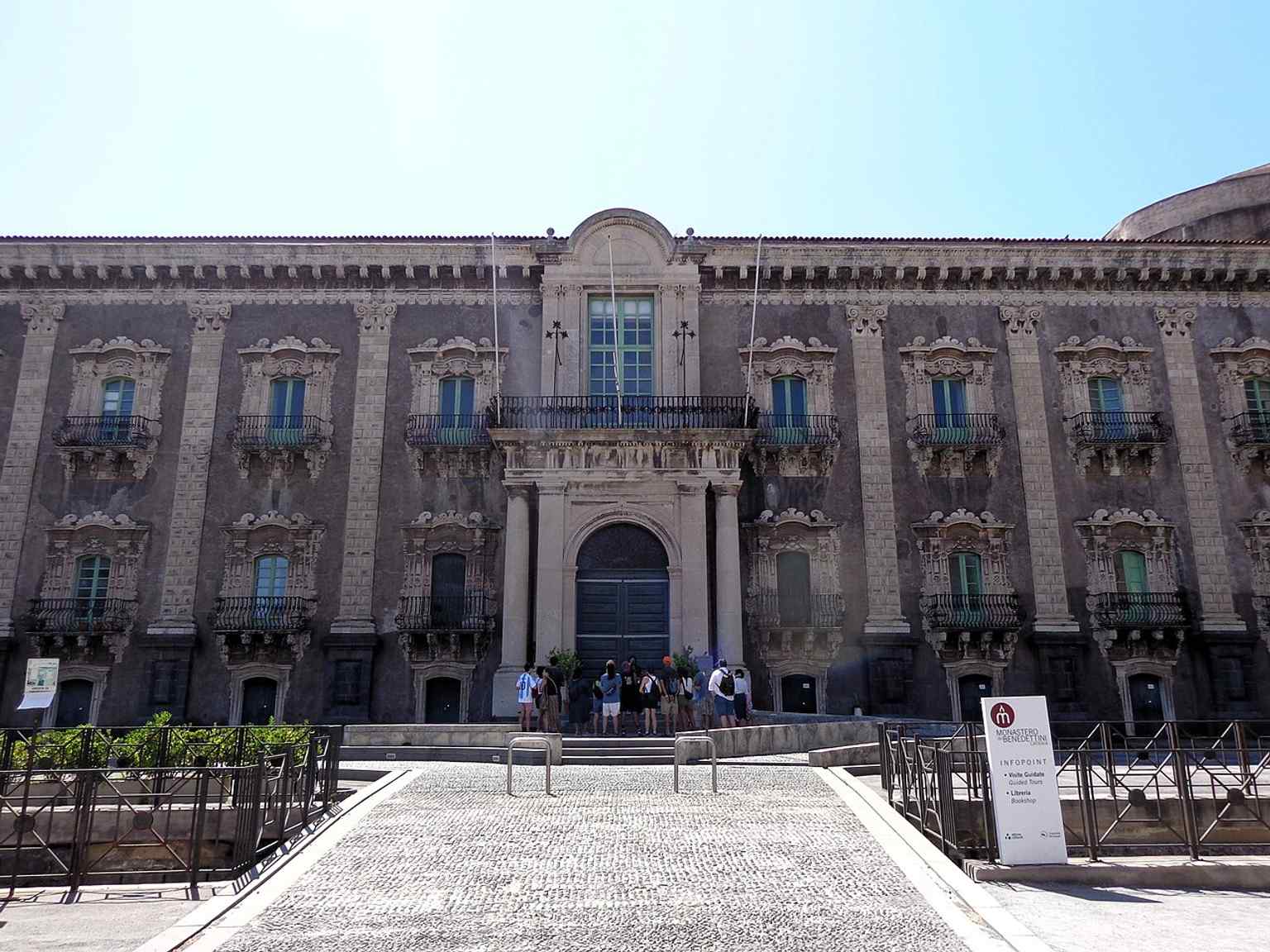
A closer interior view that helps convey the marble-lined side chapels and the richly decorated spaces funded by the Benedictines.Photo: Effems, Wikimedia Commons, CC BY-SA 4.0. Cropped & resized. 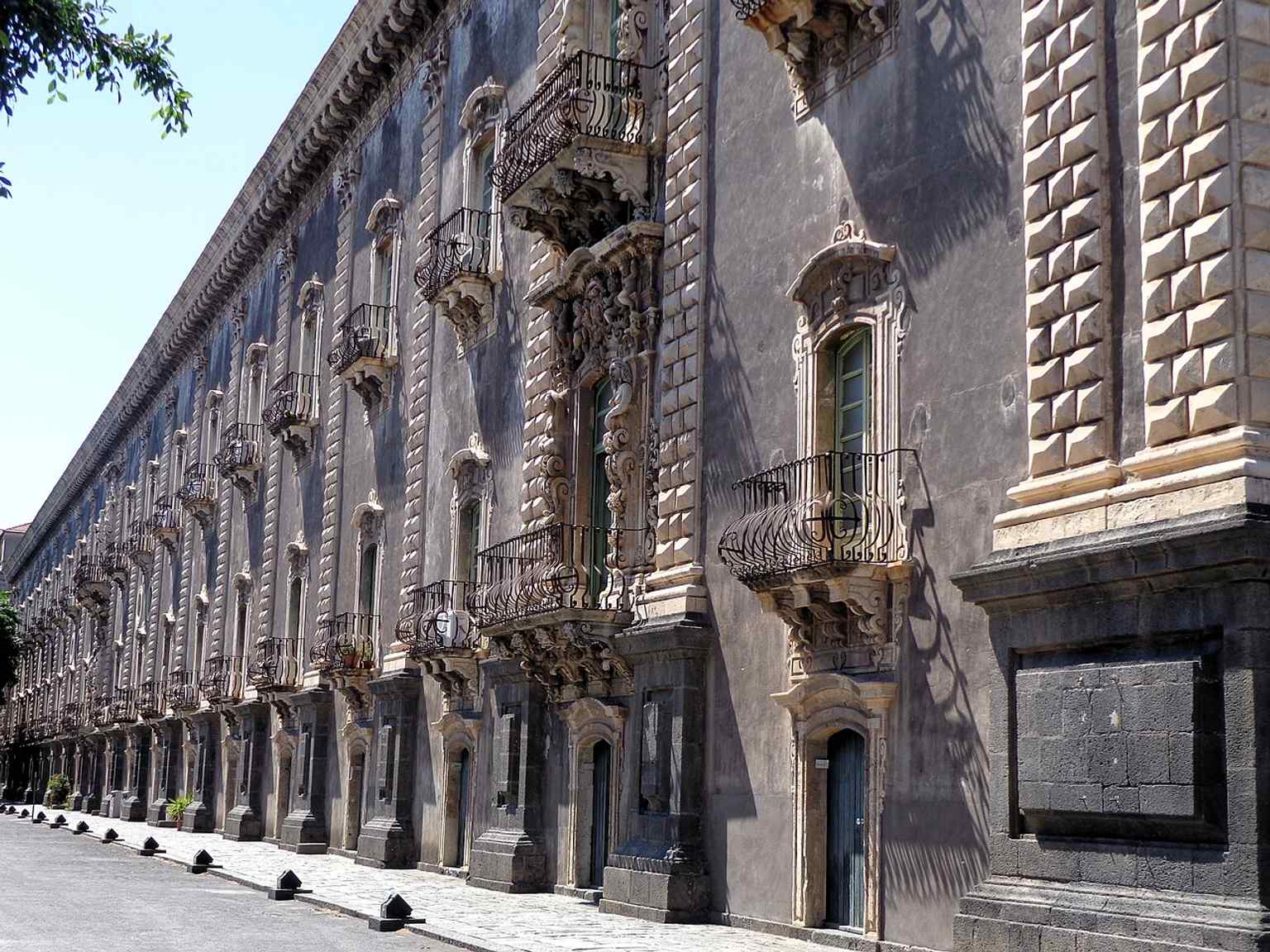
An interior detail emphasizing the ornate chapels and altar furnishings, part of the church’s celebrated late-Baroque program.Photo: Effems, Wikimedia Commons, CC BY-SA 4.0. Cropped & resized. 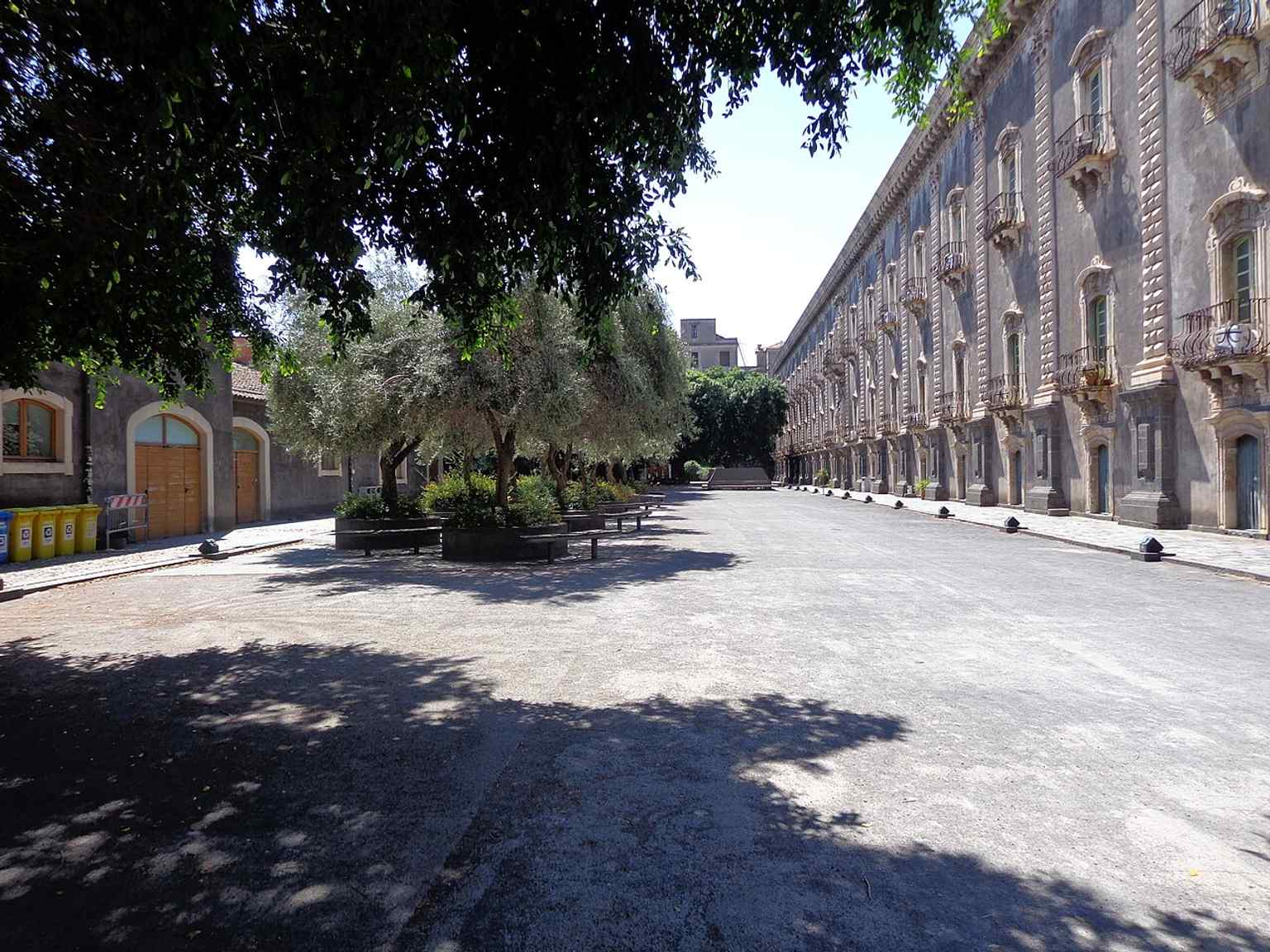
A closer view of the monumental interior architecture, where pilasters, cornices, and chapel decoration reflect the Roman Baroque influence.Photo: Effems, Wikimedia Commons, CC BY-SA 4.0. Cropped & resized. 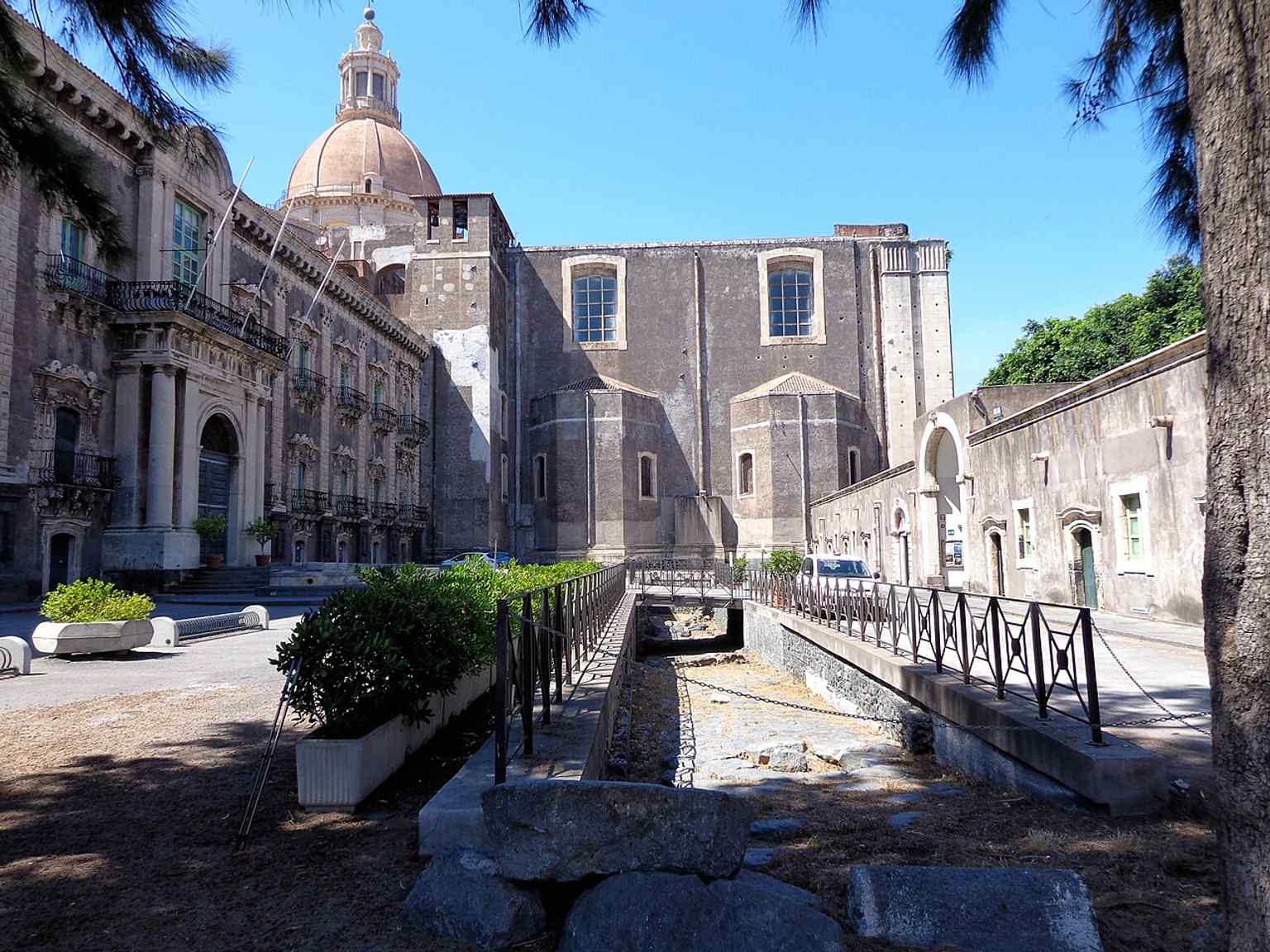
Another richly decorated interior detail, fitting for the source’s emphasis on precious marbles and elaborate chapels.Photo: Effems, Wikimedia Commons, CC BY-SA 4.0. Cropped & resized. 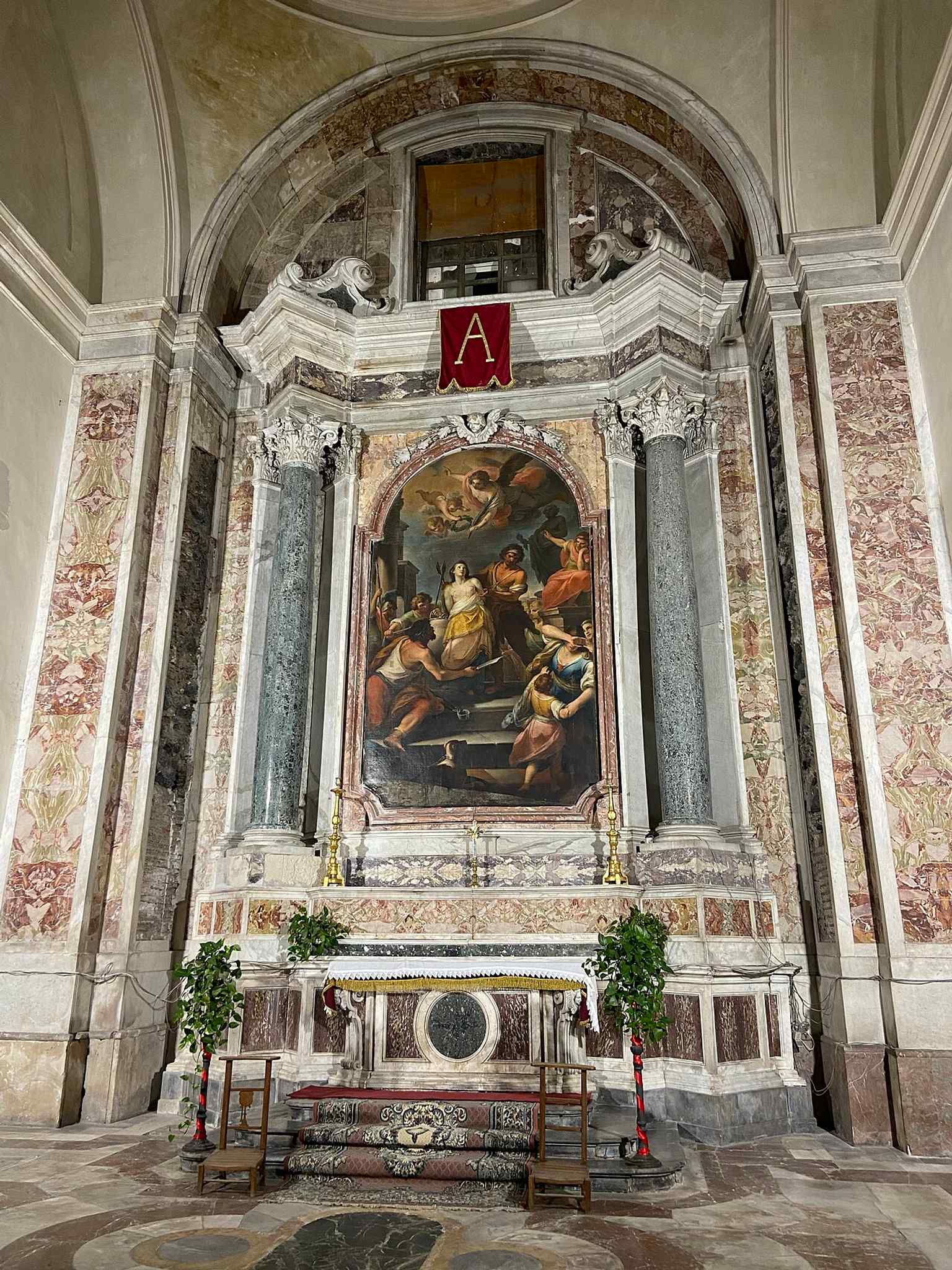
One of the side altars, showing the kind of marble-clad chapels commissioned by the abbots with paintings by major Italian artists.Photo: RiriRocker05, Wikimedia Commons, CC BY-SA 4.0. Cropped & resized. On your right, look for the pale stone entrance set into the long monastery wall, with a tall rectangular doorway, dark iron gate, and rows of austere windows above. This is a…Read moreShow less
Open dedicated page →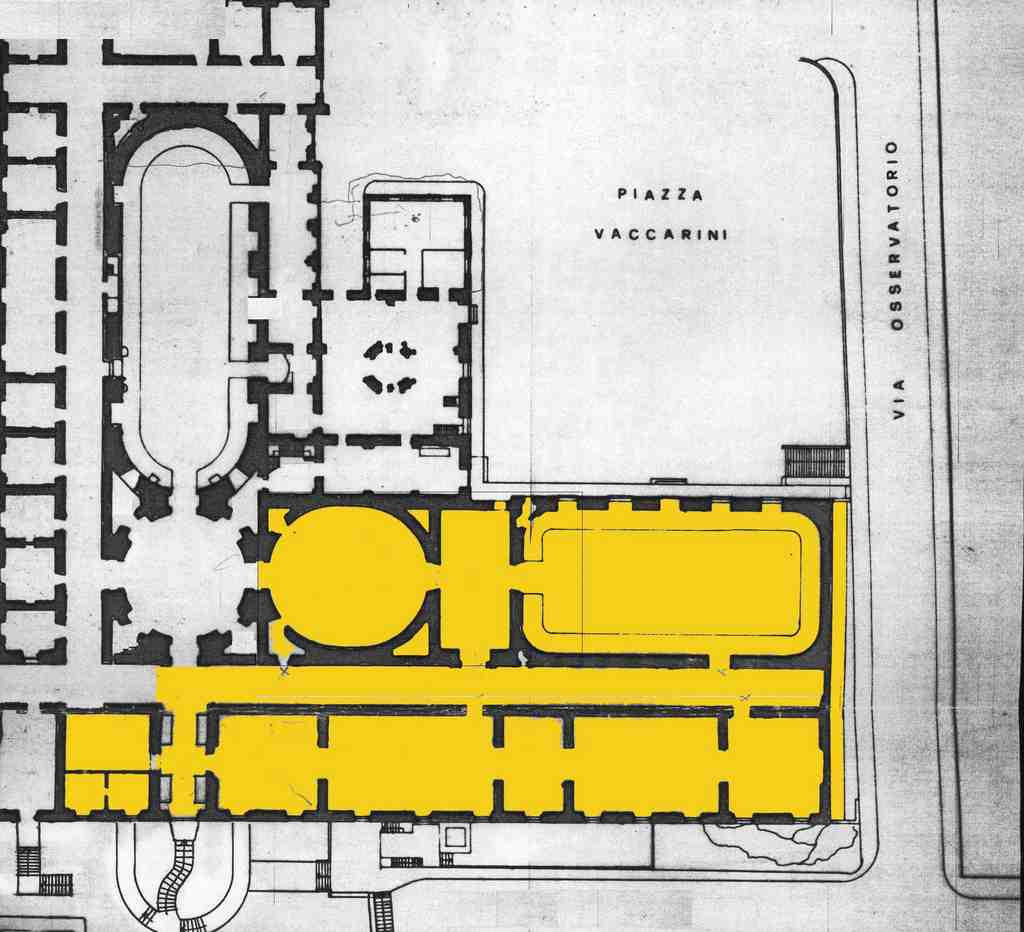
Biblioteche riunite Civica and A. Ursino RecoveryPhoto: Rita angela carbonaro, Wikimedia Commons, CC BY-SA 3.0. Cropped & resized. On your right, look for the pale stone entrance set into the long monastery wall, with a tall rectangular doorway, dark iron gate, and rows of austere windows above.
This is a fine place to end, because Catania keeps many of its memories in stone, but here it keeps them in paper, ink, bindings, catalogues, and patient human care. The united libraries called Civica and A. Ursino Recupero took shape in nineteen thirty-one, when the city joined its civic library to the collection of Baron Antonio Ursino Recupero. By the end of nineteen thirty-three, the two had physically come together here, in the north wing of the former Benedictine monastery, and the restored library opened to the public in nineteen thirty-four.
The setting matters. These rooms were not chosen at random. The libraries occupy the old Benedictine book spaces themselves: the monastic library, the former museum rooms, the Sala Guttadauro, the little refectory known as the Rotunda Room, and even the Corridoio dell’Elefante, the Elephant Corridor. In other words, the city did not simply store books here. It inherited a habit of study that monks had been building for centuries.
That habit began in Catania around fifteen seventy-eight, when the Benedictines moved down from Nicolosi and brought their books with them. Then came the earthquake of sixteen ninety-three. Part of the collection vanished in the ruins. But only fifteen days later, the monks built a wooden shelter for the surviving books and for scholars who still needed a place to read. That tells you something important about this city: after catastrophe, people here do not merely rebuild walls. They rescue meaning.
In the eighteenth century, the library flourished again. The monk Niccolò Riccioli e Paternò spent lavishly to furnish it and fill it with books. The prior Placido Scammacca went shopping in Rome for manuscripts, illuminated books, and incunabula, meaning books printed in the very earliest age of printing, before fifteen hundred and one. Among his finds was a Latin Bible from the thirteenth to fourteenth century, attributed to Pietro Cavallini, now counted among the most beautiful illuminated Bibles in the world. In the app, you can see the great Sala Vaccarini, the oval book hall that still preserves the monastery’s grandeur almost intact. Then came another rupture. In eighteen sixty-six, the new Italian state suppressed many religious houses and seized their property. The monastery ended, the last monks were turned out, and the books suffered damp and vandalism before the library revived in eighteen seventy-two as a civic institution. It absorbed not only the Benedictine collection, but thousands of volumes from other dissolved religious communities, and later the private library and memorabilia of the poet Mario Rapisardi, plus the immense Sicilian collection of Ursino Recupero.
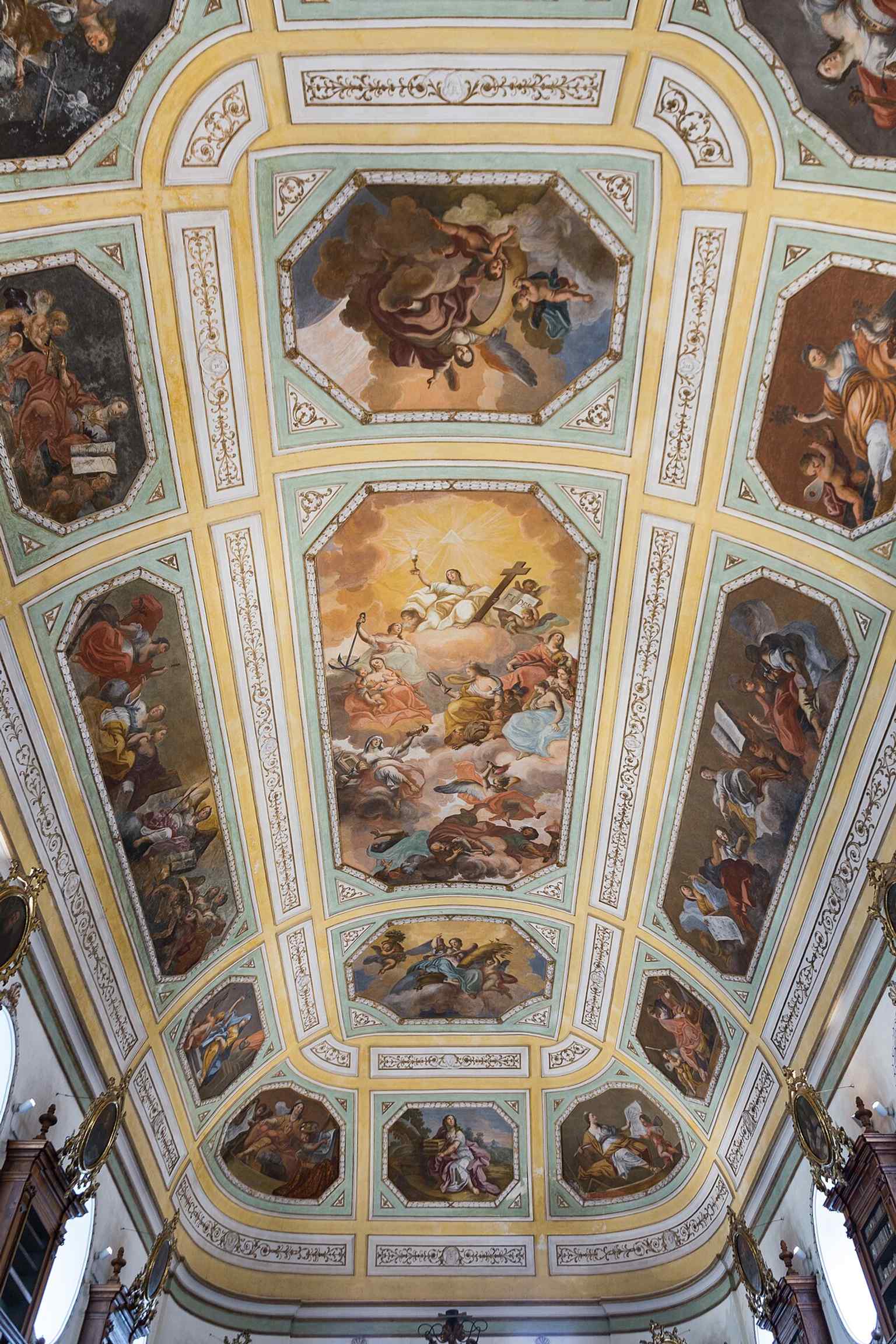
The oval Sala Vaccarini, the jewel of the library and one of the few 18th-century Catanese interiors preserved almost intact.Photo: Pymouss, Wikimedia Commons, CC BY 4.0. Cropped & resized. One man here deserves to be remembered: Federico De Roberto. Appointed honorary librarian in eighteen ninety-three, he wrote pages of I Viceré at a donkey-back desk, a sloped writing desk still preserved inside. More importantly, he badgered the city authorities for funding and fought to reopen a library that had stayed shut for more than twenty years. The app image shows that desk too. And in our own time, Rita Angela Carbonaro carried that same stubborn devotion. When funding collapsed after two thousand and nine and staff disappeared, she remained for years as the library’s only employee and director, even working without salary rather than let a collection of more than two hundred and seventy thousand volumes fall silent.
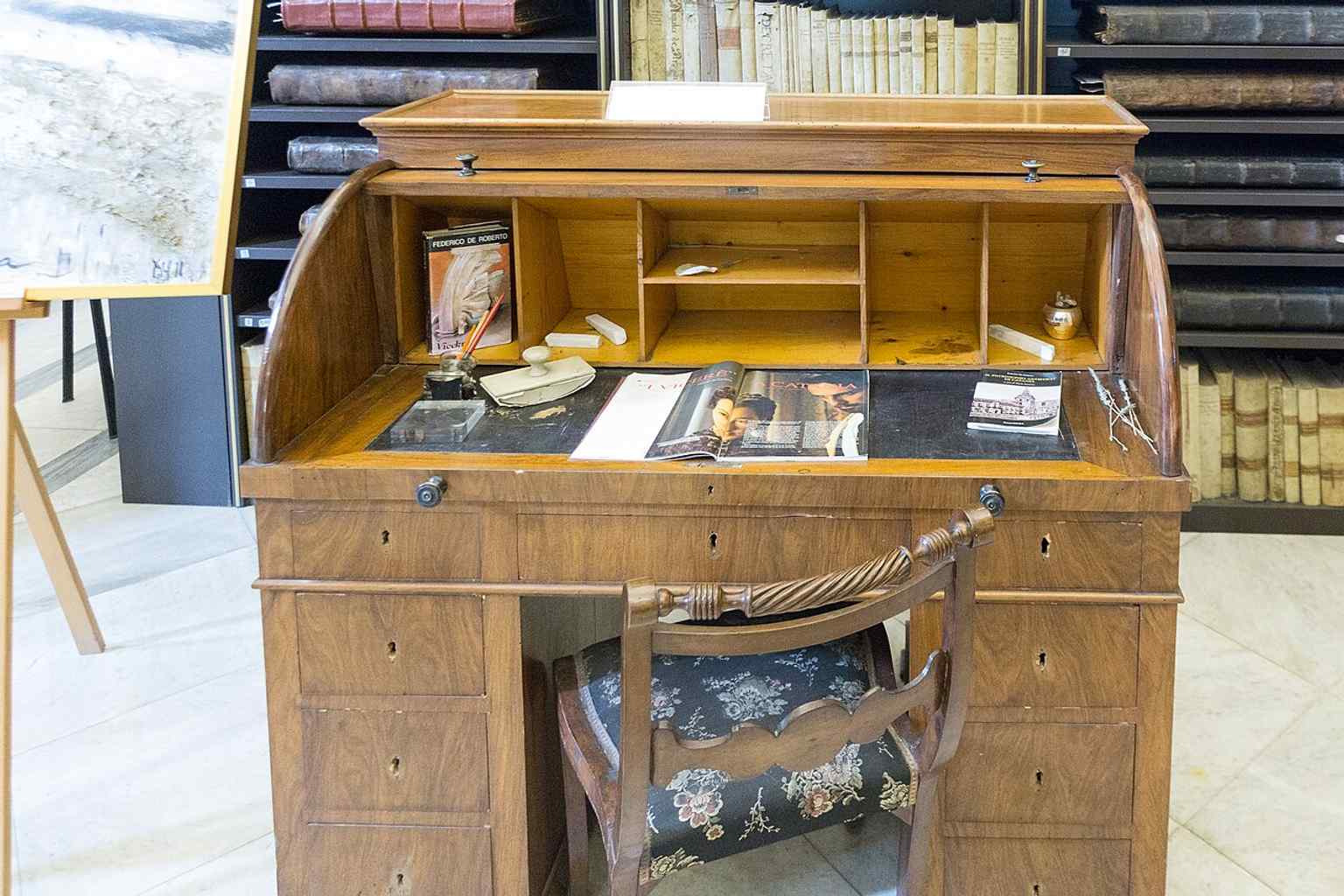
Federico De Roberto’s writing desk, a rare surviving object linked to the writer who served as honorary librarian here.Photo: Pymouss, Wikimedia Commons, CC BY 4.0. Cropped & resized. We have spent this walk among lava stone, saints, theatres, baths, cloisters, and facades. Here, at the end, the deepest layer is neither buried nor displayed. It is indexed, shelved, and handed on. What began as fragments now reads as one long act of remembrance.
If you plan to come inside another day, the library normally opens Monday through Friday from nine in the morning until noon, and stays closed on Saturdays and Sundays.
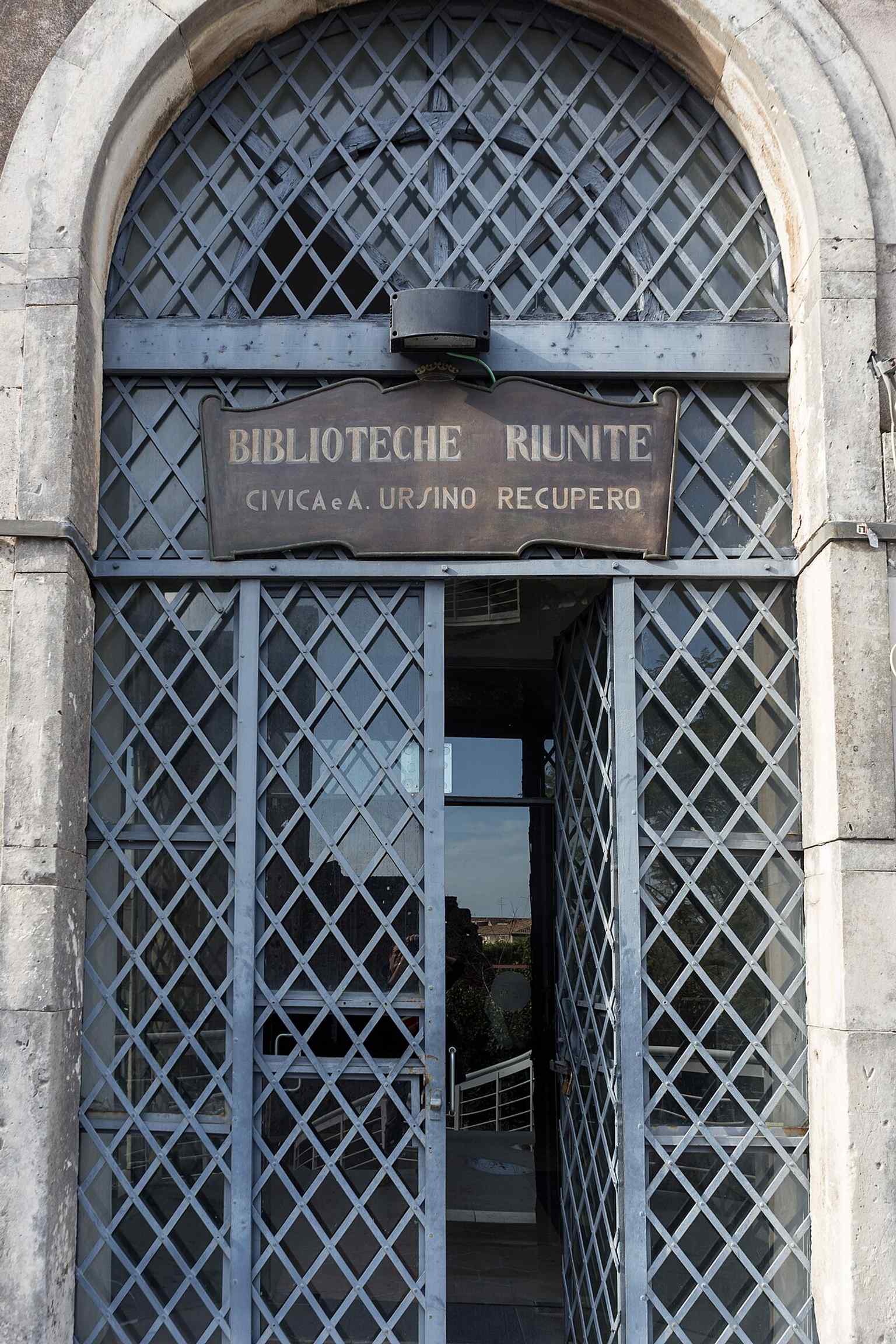
The library’s entrance in the old San Nicolò l’Arena monastery, where the Civica and Ursino Recupero collections were united in 1931.Photo: Pymouss, Wikimedia Commons, CC BY 4.0. Cropped & resized. 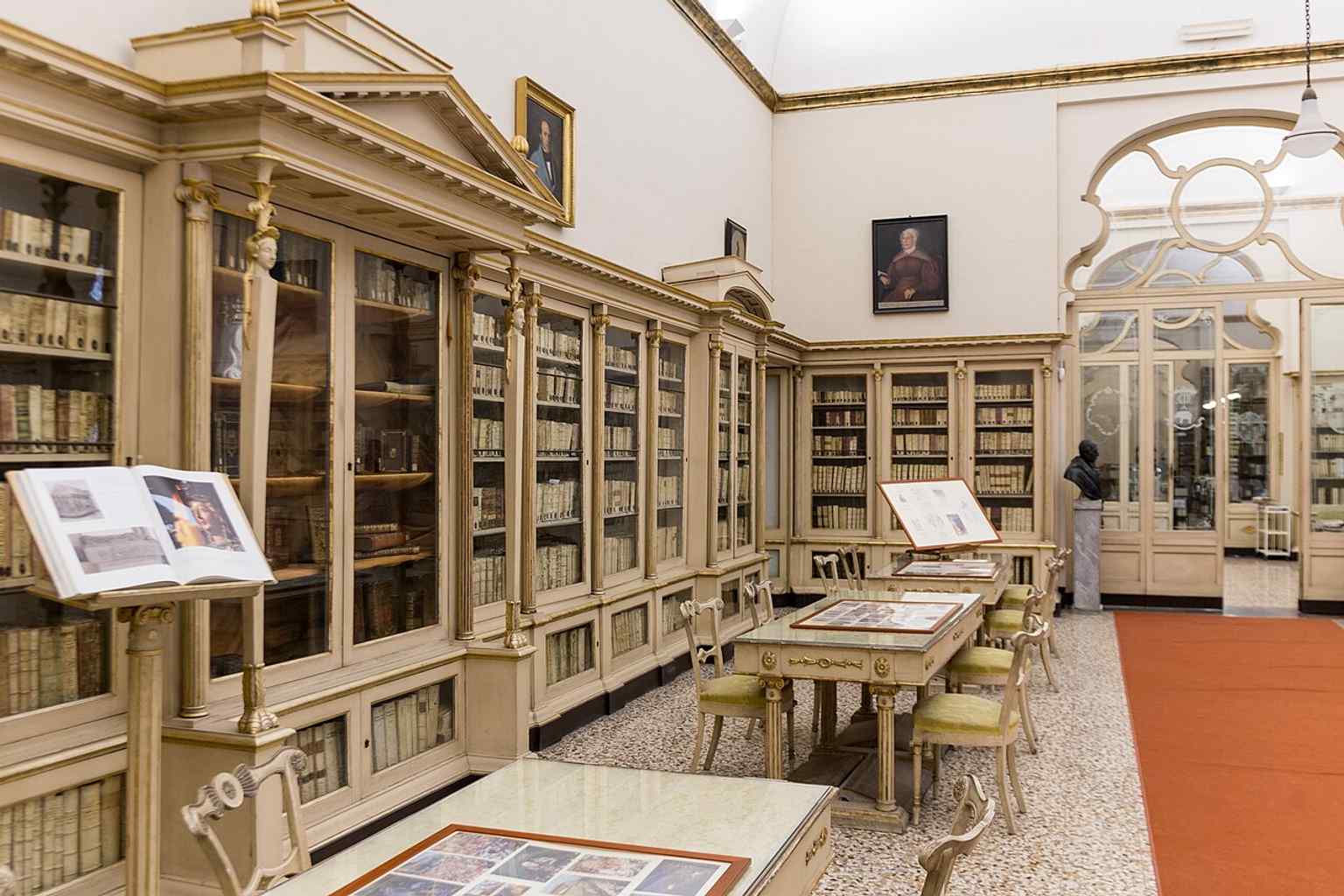
A broad reading room inside the historic monastic complex, showing how the collection now serves as a working public library.Photo: Pymouss, Wikimedia Commons, CC BY 4.0. Cropped & resized. 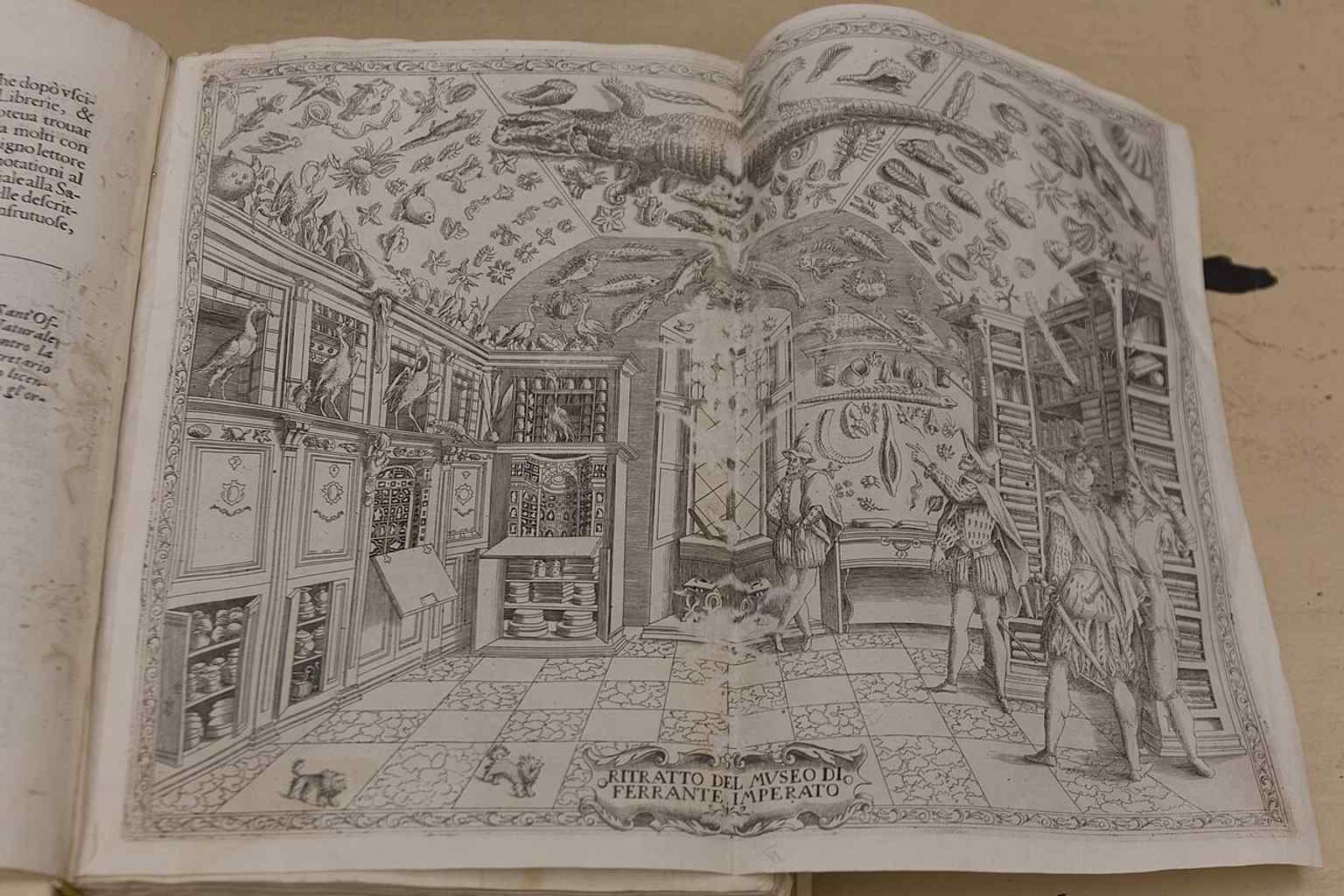
A reading-room view with botanical material on display, echoing the monastery’s long interest in natural science and study.Photo: Pymouss, Wikimedia Commons, CC BY 4.0. Cropped & resized. 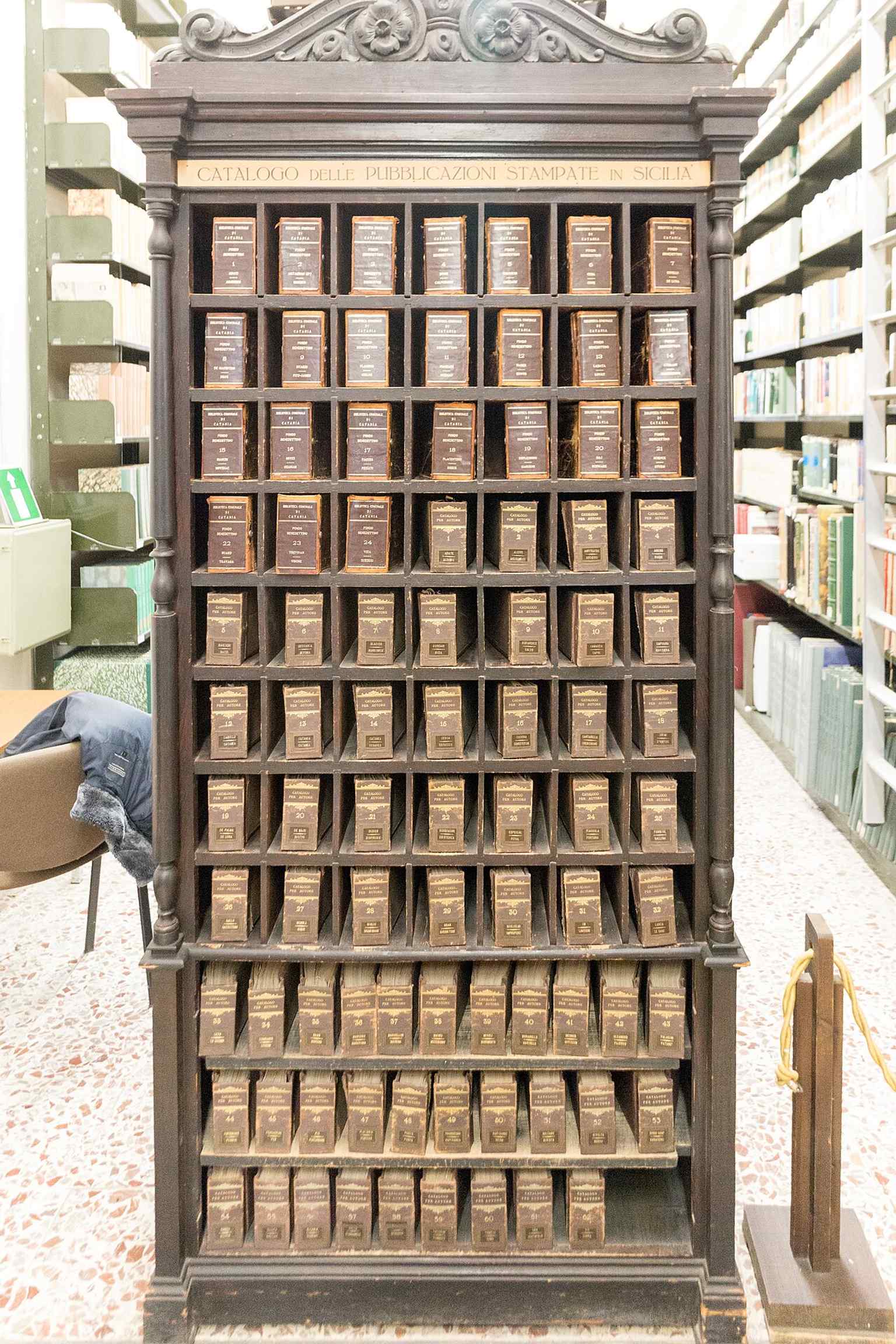
The Corridoio dell’Elefante, one of the named spaces occupied by the merged libraries within the former monastery.Photo: Pymouss, Wikimedia Commons, CC BY 4.0. Cropped & resized. 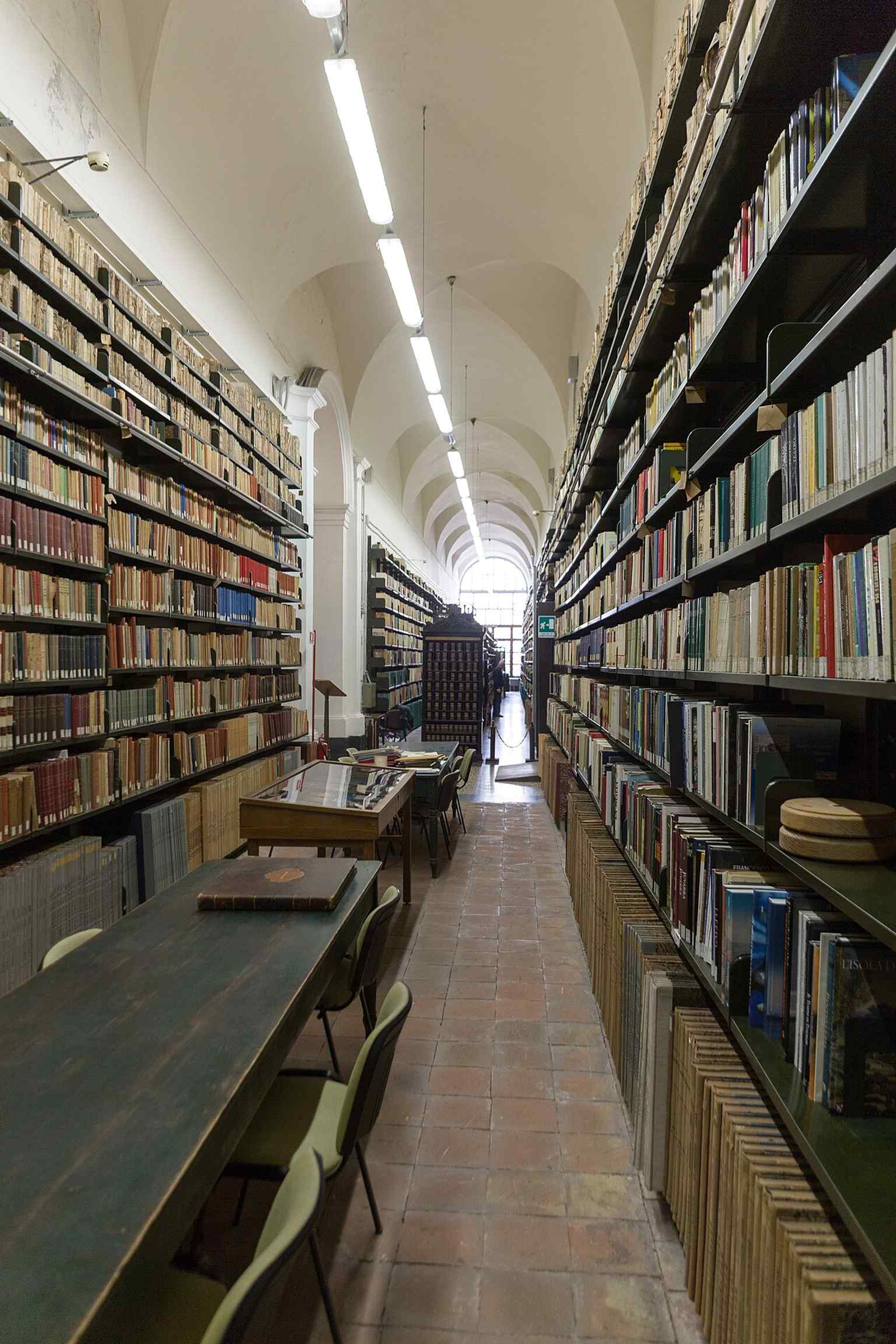
Another angle on the Elephant Corridor, a distinctive passage in the north wing of the Benedictine complex.Photo: Pymouss, Wikimedia Commons, CC BY 4.0. Cropped & resized. 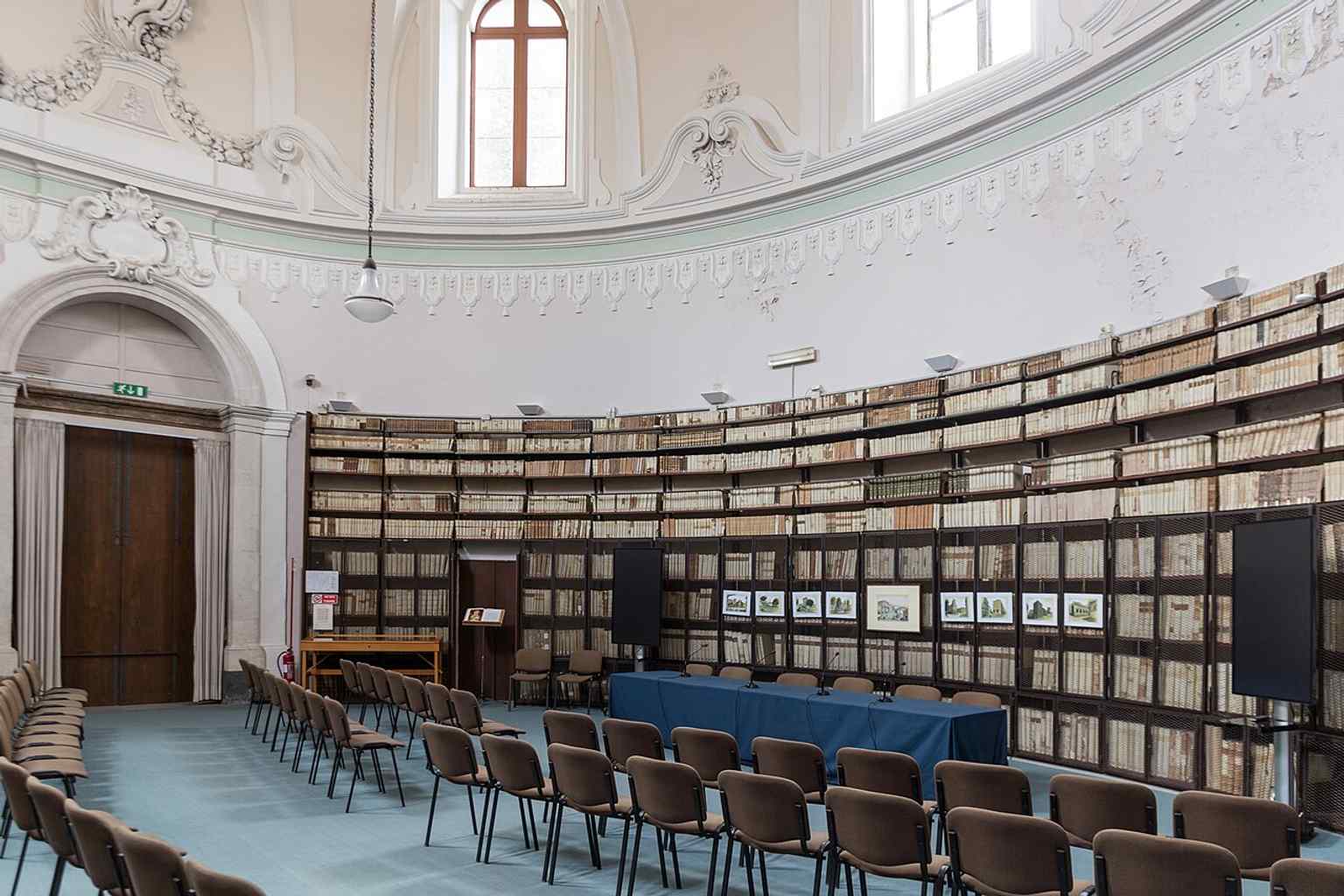
The small refectory, also called the Rotunda Room, one of the original monastic spaces now used by the libraries.Photo: Pymouss, Wikimedia Commons, CC BY 4.0. Cropped & resized. 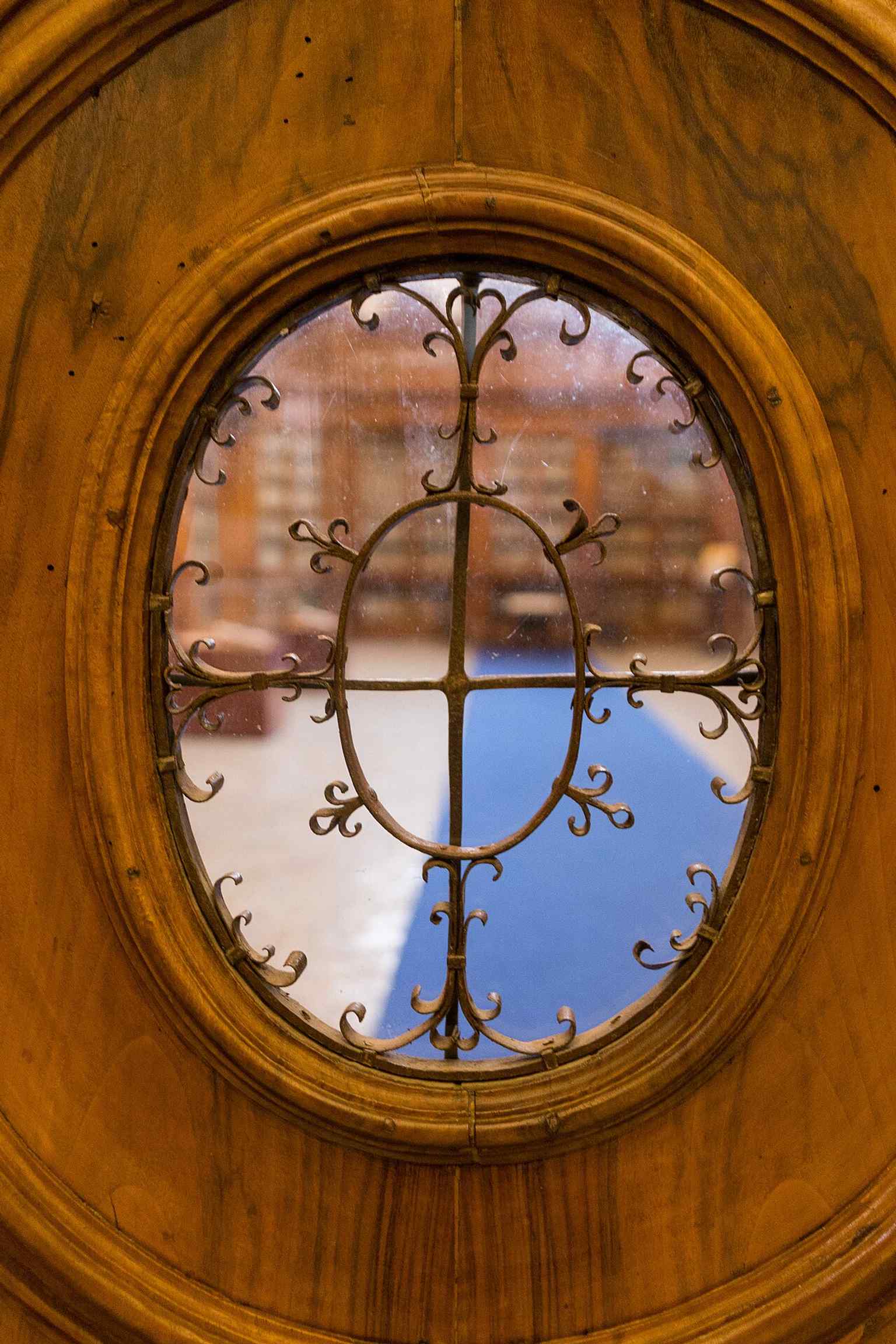
Another view of Sala Vaccarini, with its continuous wooden shelves and the atmosphere of the former Benedictine book hall.Photo: Pymouss, Wikimedia Commons, CC BY 4.0. Cropped & resized. 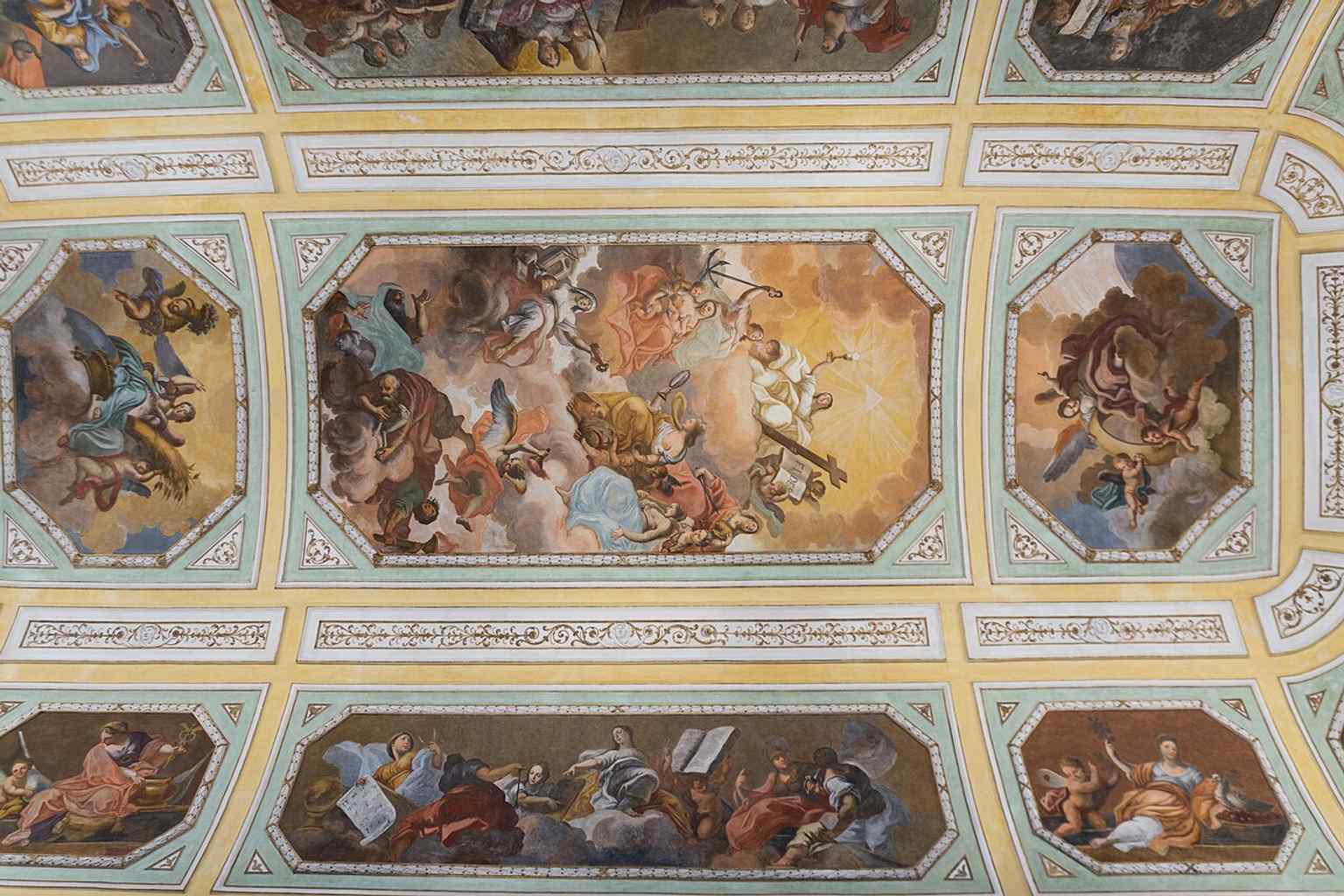
The decorated book hall in Sala Vaccarini, recalling the rare and precious volumes once gathered by the Benedictines.Photo: Pymouss, Wikimedia Commons, CC BY 4.0. Cropped & resized. 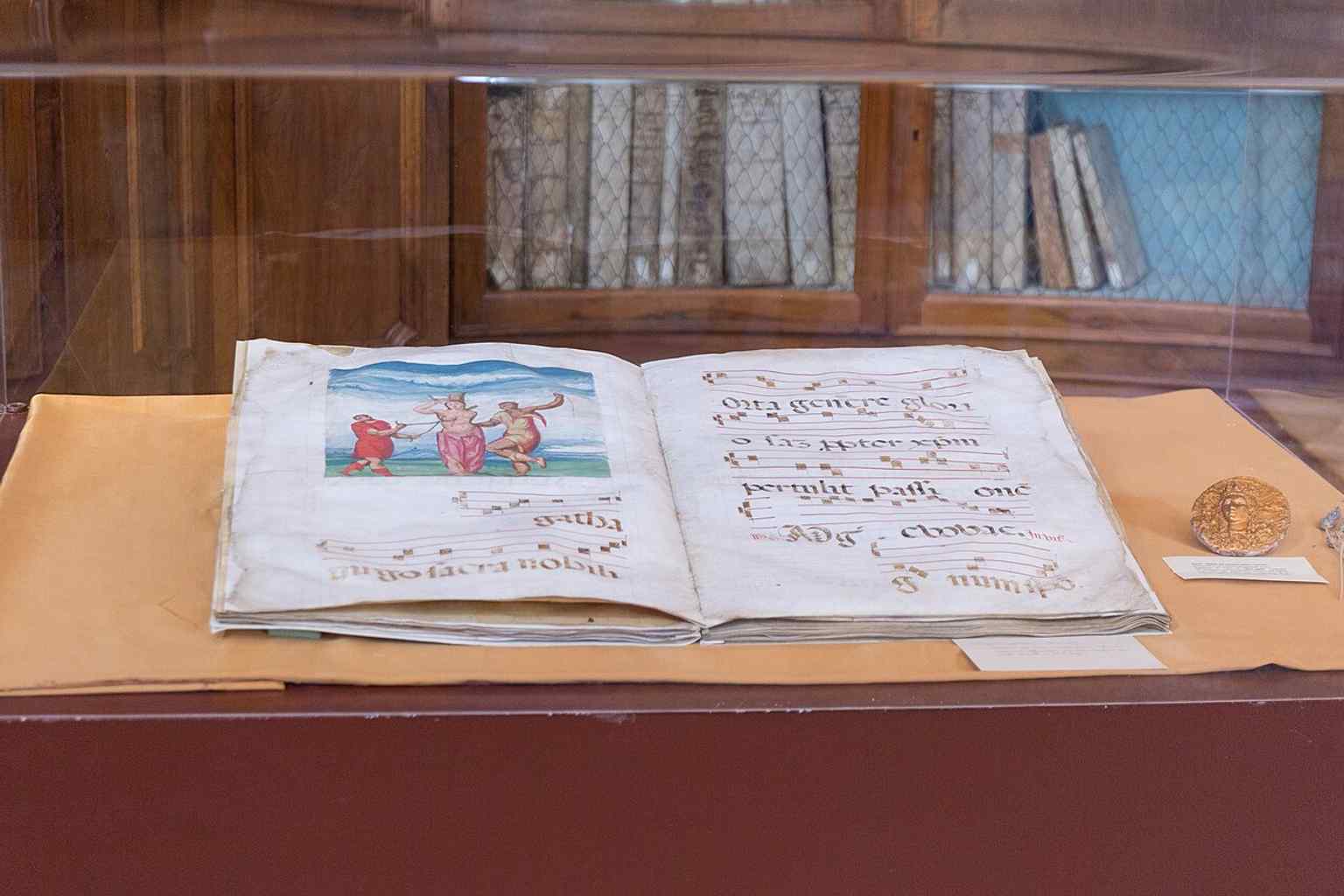
A wider look across Sala Vaccarini, where the original monastic library architecture still frames the collections.Photo: Pymouss, Wikimedia Commons, CC BY 4.0. Cropped & resized. 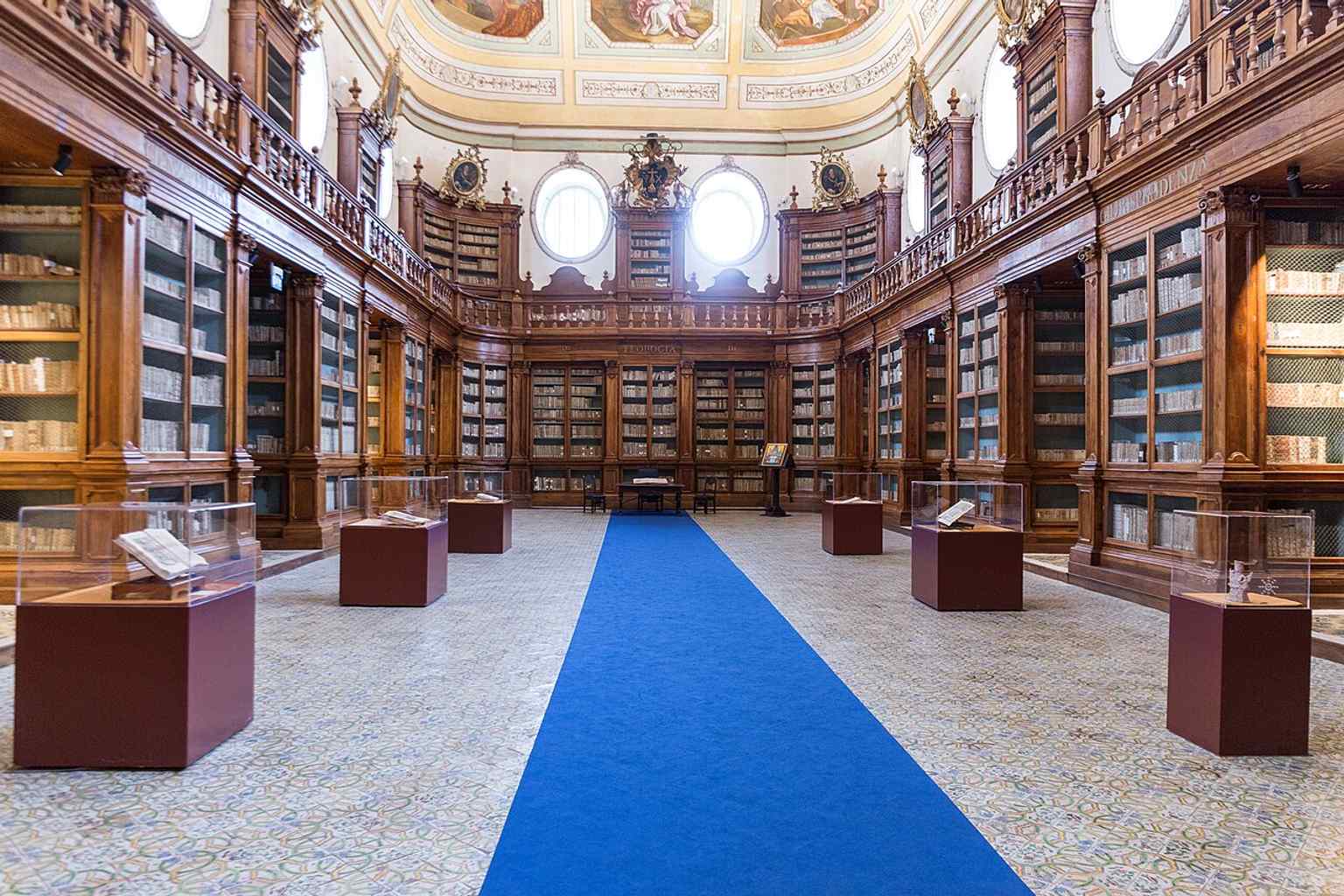
The richly furnished Sala Vaccarini, reflecting the library’s role as a guardian of manuscripts, incunabula, and rare editions.Photo: Pymouss, Wikimedia Commons, CC BY 4.0. Cropped & resized.
Frequently asked questions
How do I start the tour?
After purchase, download the AudaTours app and enter your redemption code. The tour will be ready to start immediately - just tap play and follow the GPS-guided route.
Do I need internet during the tour?
No! Download the tour before you start and enjoy it fully offline. Only the chat feature requires internet. We recommend downloading on WiFi to save mobile data.
Is this a guided group tour?
No - this is a self-guided audio tour. You explore independently at your own pace, with audio narration playing through your phone. No tour guide, no group, no schedule.
How long does the tour take?
Most tours take 60–90 minutes to complete, but you control the pace entirely. Pause, skip stops, or take breaks whenever you want.
What if I can't finish the tour today?
No problem! Tours have lifetime access. Pause and resume whenever you like - tomorrow, next week, or next year. Your progress is saved.
What languages are available?
All tours are available in 50+ languages. Select your preferred language when redeeming your code. Note: language cannot be changed after tour generation.
Where do I access the tour after purchase?
Download the free AudaTours app from the App Store or Google Play. Enter your redemption code (sent via email) and the tour will appear in your library, ready to download and start.
If you don't enjoy the tour, we'll refund your purchase. Contact us at [email protected]
Checkout securely with 






