
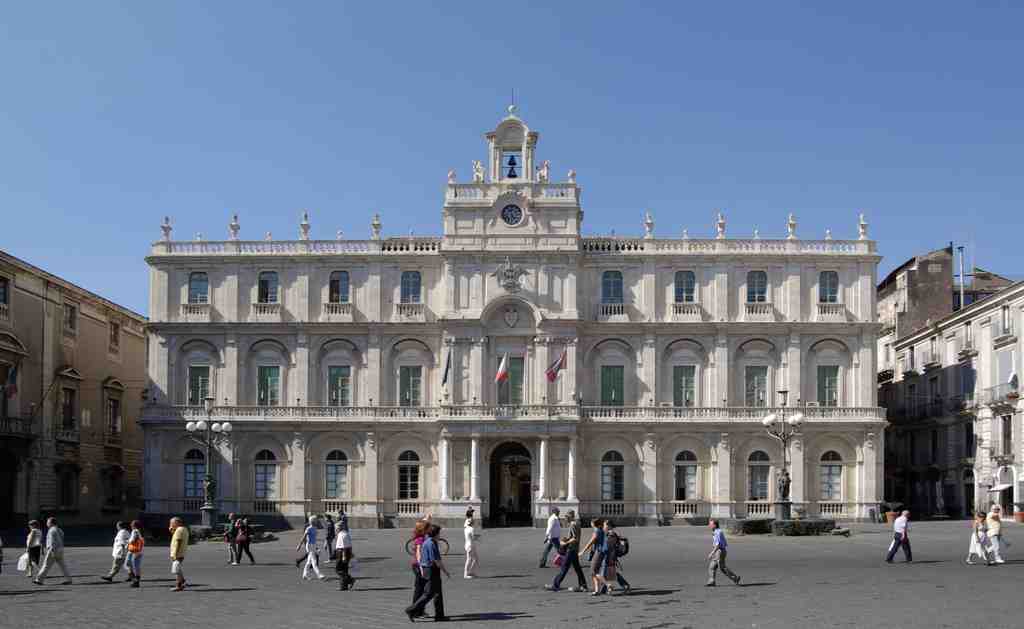
On your left stands a broad pale-stone Baroque façade, lined with tall arched windows and centered on a grand portal with a projecting balcony above it.
This is the University of Catania, founded in fourteen thirty-four: the oldest university in Sicily, and one of the city’s clearest claims to importance. Not importance dressed in silk or incense alone, but authority of another kind: the power to teach, to examine, and to say, officially, who had earned a degree.
That mattered enormously. In the Kingdom of Sicily, this university held the rare privilege of granting legally valid titles, from licenses to bachelor’s degrees to doctorates. Students from Palermo’s Dominican college had to come here to finish that journey. A city that could certify knowledge did not merely admire learning; it governed through it.
One man helped set that in motion. Pietro Rizzari pressed the civic senate to petition King Alfonso the Fifth on the nineteenth of October, fourteen thirty-four. Alfonso agreed to found the Studium Generale, a full university. Then, on the eighteenth of April, fourteen forty-four, Pope Eugene the Fourth sealed it with a formal decree from Rome. By the end of fourteen forty-five, six professors had begun public lessons in theology, law, medicine, philosophy, logic, mathematics, and the liberal arts. In fourteen forty-nine, the first degree went to a man from Syracuse named Antonio Mantello. One can picture him leaving with something more valuable than parchment: public recognition.
If you glance at the image in the app, you can see how firmly the palace presents itself to the square. It does not hide like a cloistered school. It addresses the city. The university did not always stand here. Its earliest courses took place near the cathedral. In sixteen eighty-four it moved into the old San Marco hospital, and then the earthquake of sixteen ninety-three shattered that building. Catania answered in a familiar way: it began again. From sixteen ninety-six, builders raised this new palace on the ruins of the old one. Giovanni Battista Vaccarini, one of the great architects of Sicilian Baroque, shaped much of its character, along with Francesco and Antonino Battaglia. Inside, Vaccarini gave it monumental staircases and a black-and-white stone courtyard, and the great ceremonial hall, the Aula Magna, later gathered generations of scholars under painted ceilings.
Here, memory is preserved in stone, in ritual, and in collections. Stone keeps the institution visible. Ritual survives in examinations, graduations, and the repeated formal acts that link one generation of students to the next. Collections do the quieter work: in seventeen fifty-five, the abbot Vito Maria Amico helped open the university library here, beginning with books bought from the historian Giambattista Caruso, and later enlarged with volumes taken from Jesuit colleges after the order’s expulsion.
That habit of storing knowledge kept growing. By the late seventeen hundreds, the university had around two thousand students and thirty chairs, especially in law and medicine. It later added botany, observatories, and gardens; and still later, its humanities found a home in the vast Benedictine monastery we shall meet ahead, where modern classrooms now occupy monastic grandeur and even older remains.
And that is the distinctly Catanian point: scholarship here rarely stands far from devotion. Very often, they occupy the same ground, and sometimes the same broken foundations. When you are ready, we shall continue to the Basilica Maria Santissima dell’Elemosina, only about a minute away.




