
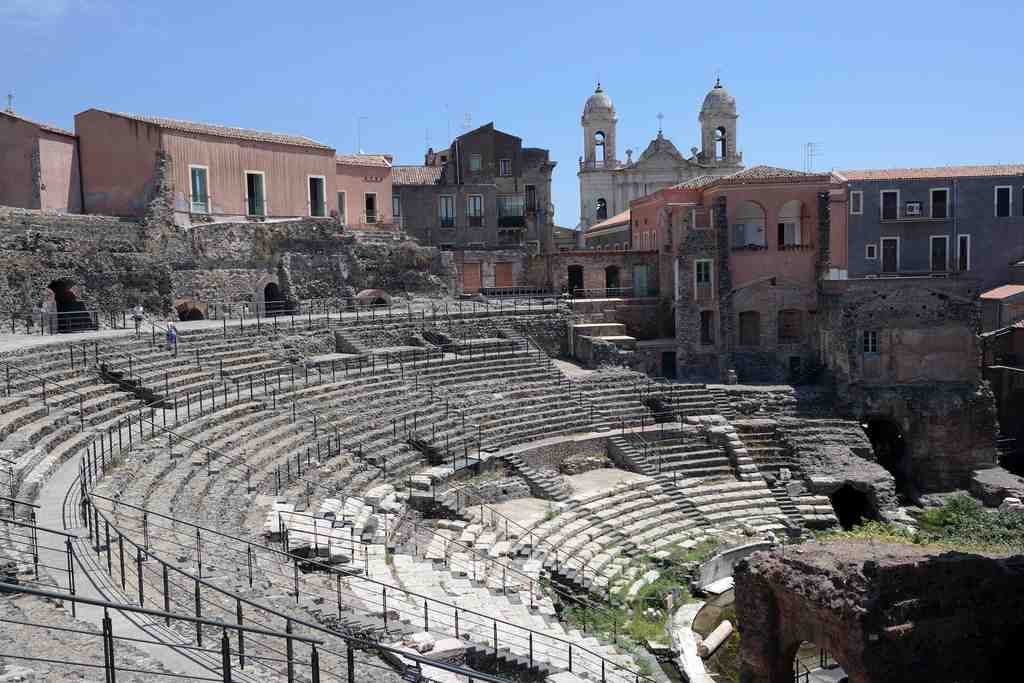
On your right, look for a wide half-circle of dark lava-stone steps and pale masonry, hollowed like an open shell, with ancient arches still caught among later city buildings.
This theatre tells you something essential about Catania: the city never really starts over. It rearranges itself, borrows from its own ruins, and carries old voices forward in new costumes.
The story begins in the Greek city of Katane. In the year four hundred and fifteen B.C., the Athenian statesman Alcibiades addressed the citizens in a theatre here in Catania, urging them to join Athens against Syracuse. Scholars argued for generations over whether that Greek theatre stood exactly here. Then archaeologists found heavy sandstone blocks marked with Greek letters, and later blocks bearing a sign thought to abbreviate Katane itself. So the Roman monument before you may well stand on the bones of the very theatre where politics played to a live audience.
That matters, because in Catania public spectacle was never just amusement. Greeks used the theatre as a civic chamber, Romans turned it into a machine for display, and later powers kept ruling through ceremony, procession, and the art of being seen.
Under Augustus, after Catania became a Roman colony, builders repaired the older structure. Then, in the second century A.D., perhaps with funding linked to Emperor Hadrian, they made it grand. The theatre took on its great semicircle, with a cavea, the seating bowl, nearly ninety-eight metres across; twenty-one rows of seats; black lava-stone stairways; and marble cladding that once gleamed against the dark volcanic structure. The orchestra, the round performance space below, measured about twenty-two metres across and was paved in patterned marble. Behind it rose an elaborate stage front with columns, niches, statues, and side towers for stair access. In the image in the app, you can see that Roman curve still asserting itself through the later cuts and scars.
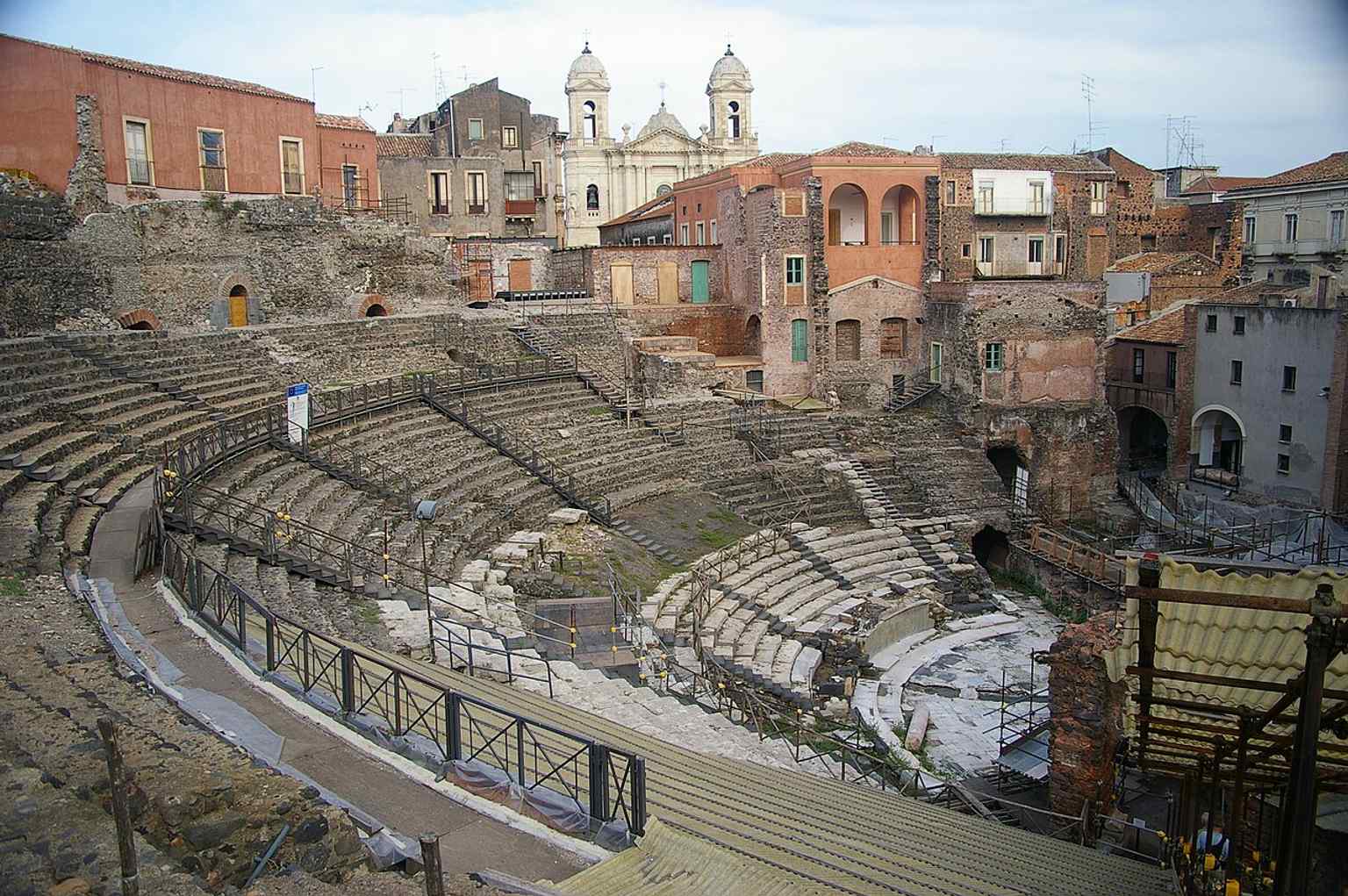
And then comes the turn in the tale. What looks like an ancient ruin was, for centuries, a neighbourhood. By the early Middle Ages, people carved homes into the monument. A cattle butcher occupied the orchestra. Streets sliced through the seating. After the earthquake of sixteen ninety-three, people reused rubble from collapsed houses to found new ones directly on the cavea.
In the late nineteenth century, Paolo Orsi, the formidable archaeologist who led the antiquities office in eastern Sicily, pushed to clear these layers away after a local baron damaged part of the neighbouring Odeon. He helped rescue the theatre, certainly. But he also set in motion expropriations against families living over the ruins. So the monument you see today did not emerge from empty ground. It emerged from conflict between scholarship and home, between the ancient city and the living one.
Even the theatre’s splendour fed later Catania. Norman builders stripped marbles, columns, and lava blocks from here for the cathedral. In other words, some of the sacred grandeur you saw earlier may once have belonged to this stage.
From here, only a short two-minute walk takes you to San Francesco d’Assisi all’Immacolata, where pagan ground, medieval power, and Christian devotion press close together again. If you plan to go inside the theatre later, it generally opens daily from nine in the morning until seven in the evening.





