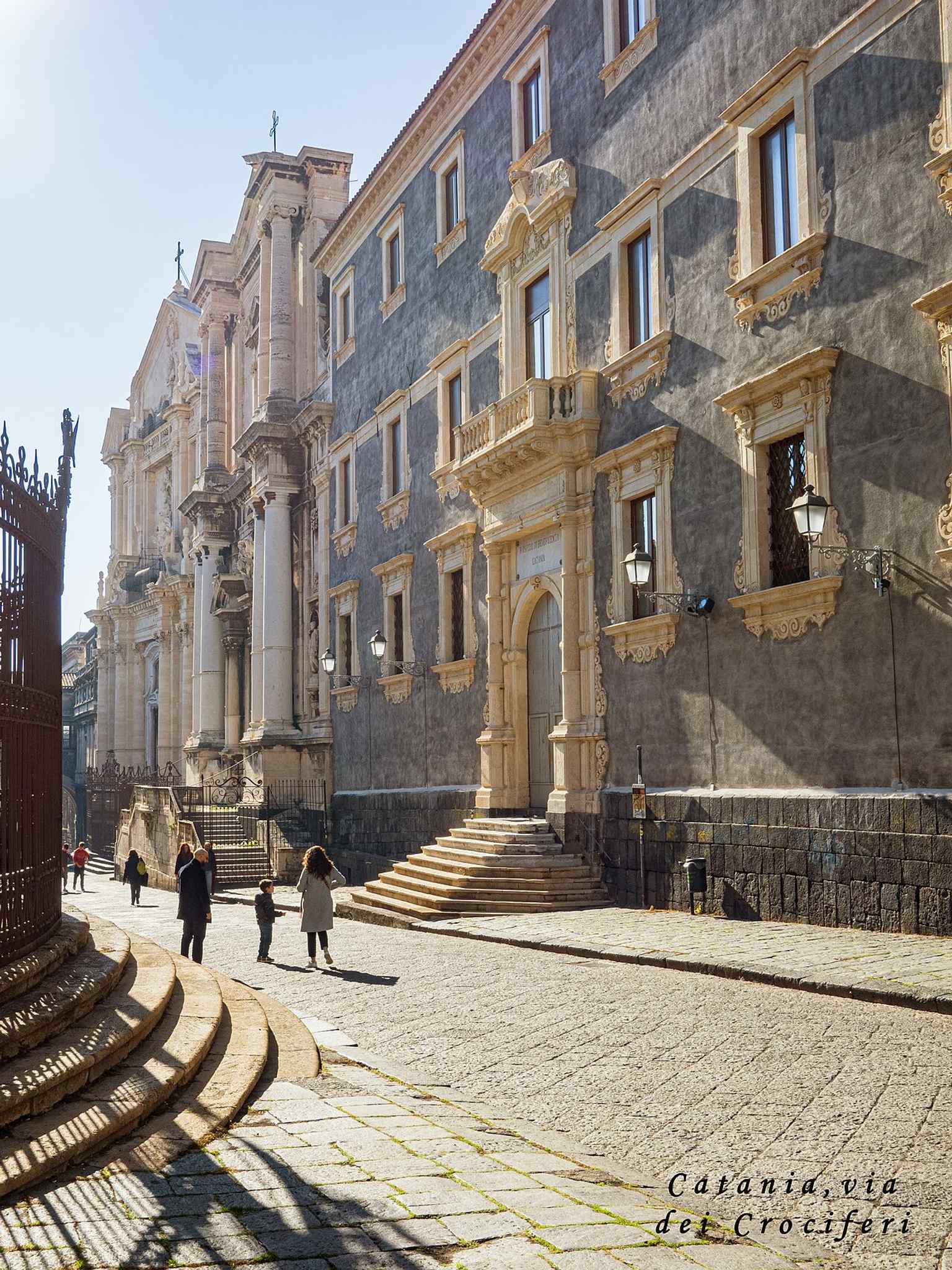
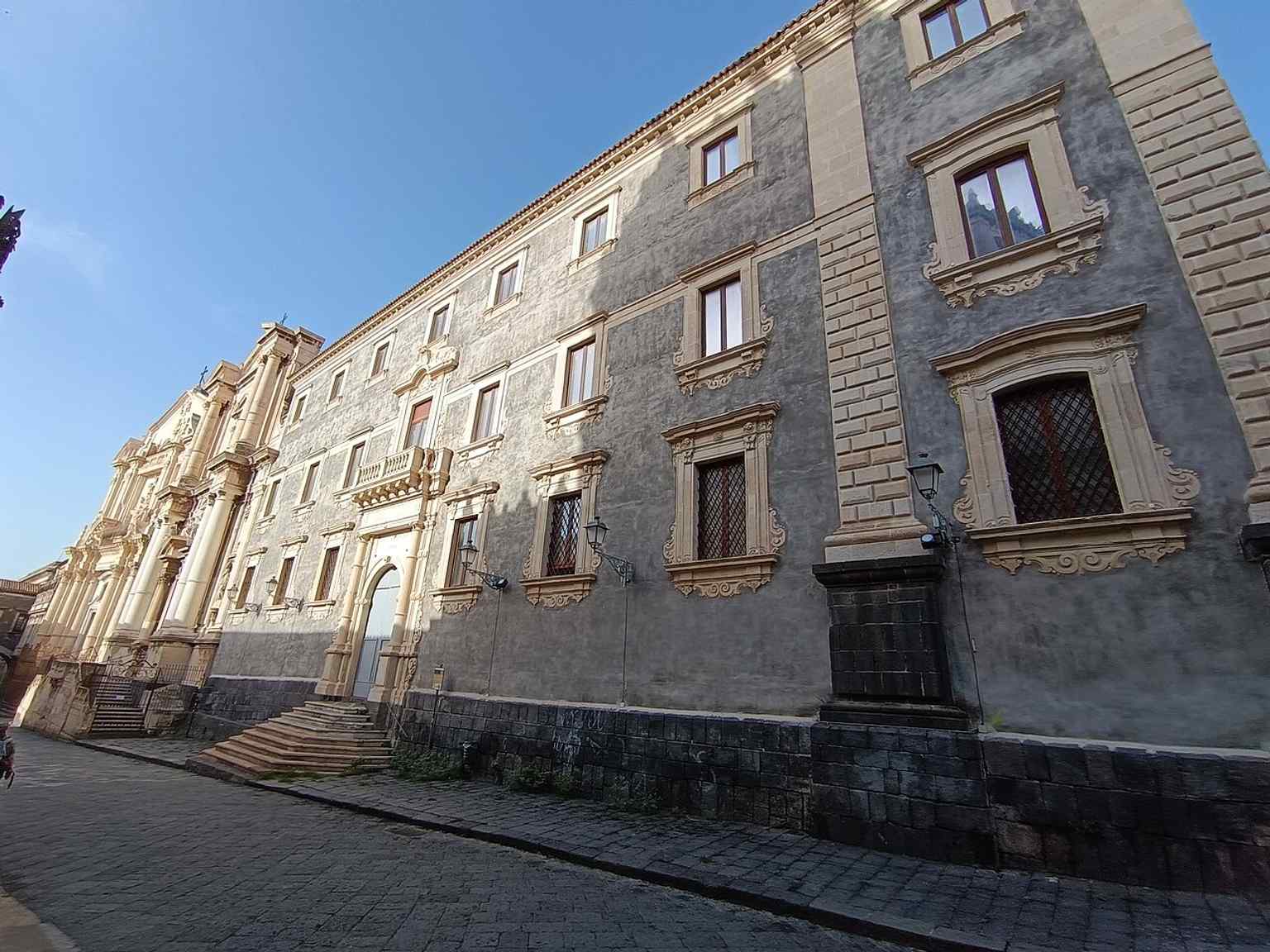
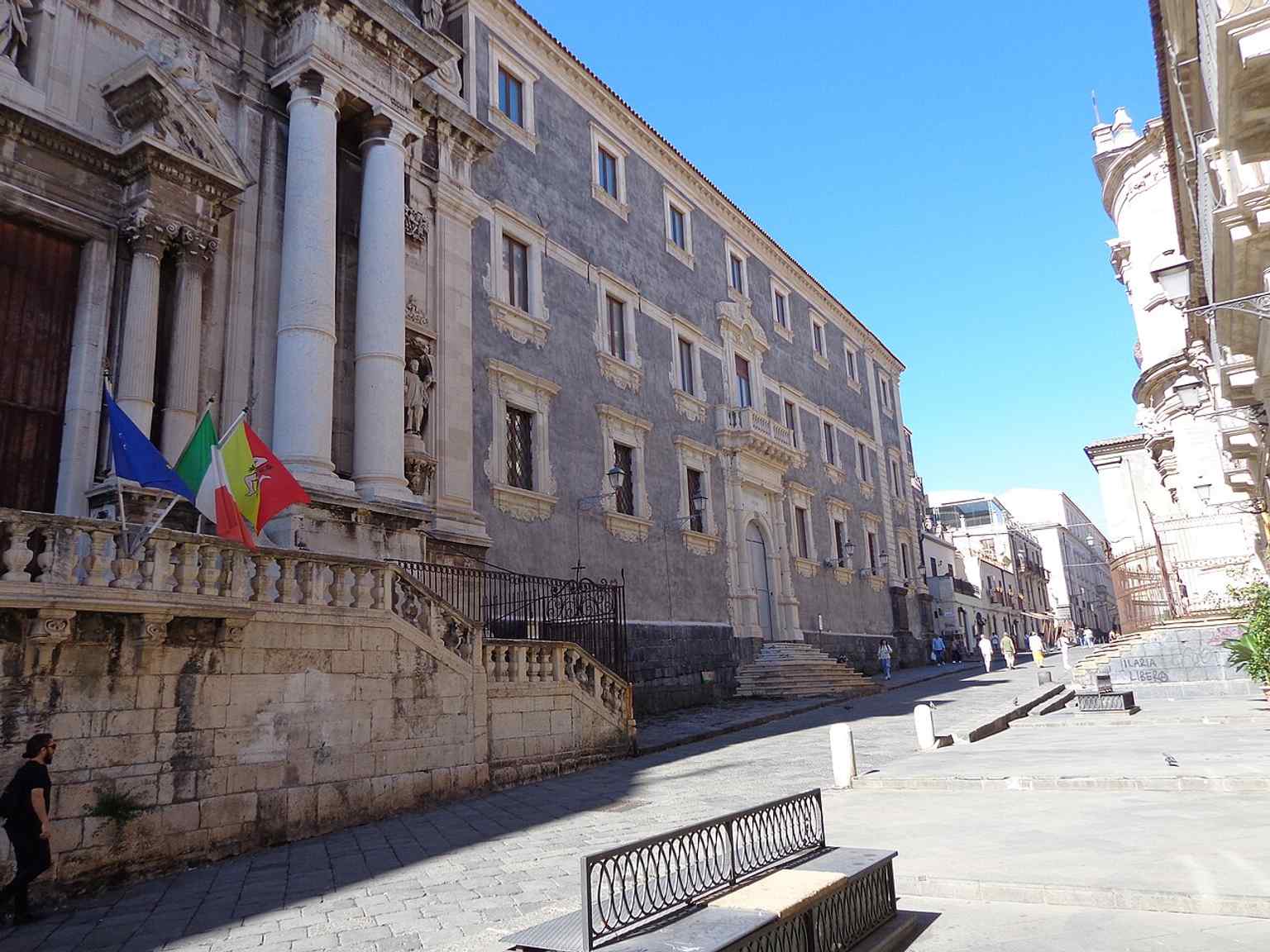
On your left, look for the great honey-coloured stone façade reached by a broad staircase, its long Baroque front cut with tall windows and joined to the church beside it.
This is the Jesuit College, one of the grandest houses the Society of Jesus ever raised in Sicily, and it tells you something essential about Catania: after disaster, the city did not merely repair itself. It reorganised its ideas, its teaching, and even its public stage.
The college you see belongs to the long rebuilding that followed the earthquake of sixteen ninety-three. But the story did not move in a straight line. Father Francesco Maria Bonincontro, the vice-rector, wanted the Jesuits to rebuild closer to the city’s prime urban axis, near what is now Piazza dell’Università. He had houses there already. Then came lawsuits, quarrels over boundaries, and bitter opposition. In the end, he had to give up that ambition and retreat here, to the older site on Via dei Crociferi. For the order, it felt like a political defeat. For Catania, oddly enough, it helped create one of the most theatrical streets in the city.
In the image on your screen, you can see how this frontage plays its part in that street-wide performance. Baroque here is not decoration for decoration’s sake. It teaches. The staircase lifts you, the façade composes your gaze, and the whole arrangement declares that faith and learning belong in public view.
Several minds shaped it over roughly forty years. Alonzo di Benedetto oversaw early foundations around seventeen oh one. Angelo Italia designed the church façade next door and likely set the broader scheme. Later, Stefano Masuccio and Francesco Battaglia carried the work onward. That is why the complex feels so layered: not one author, but a relay of them. The Jesuits also followed their own building rules, what they called the modo nostro, “our way”: separate spaces for the fathers, for teaching, and for service, all carefully ordered. Yet Catania bent even those rules. This college ended up with four courtyards, unusually many for a Jesuit complex, because the builders folded older surviving fragments into the new plan.
Most people never realise that one of the loveliest details lies behind the façade: a cloister, a quiet courtyard ringed by arches and columns, with black-and-white pebble paving laid in stripes, in the manner associated with Borromini. A severe institution, yes, but one with a taste for rhythm.
And there is a local twist worth keeping. When the Cathedral of Sant’Agata closed for restoration between seventeen ninety-five and the early nineteenth century, major religious ceremonies shifted into the adjoining church of San Francesco Borgia. Because of that temporary change, the infant Vincenzo Bellini was baptised there in eighteen oh one. Before he became Catania’s great operatic voice, he entered the city’s life in this orbit of cathedral ritual and Jesuit learning. In the app image, you can see that connection at a glance. After the Jesuits were expelled in seventeen sixty-seven, the college changed again: public school, craft college, poorhouse, tribunal, art institute. The purpose kept changing, but the building never stopped trying to shape minds.
And that, I think, is the clue for where we go next. Even among these grand façades, older Catania waits close by, where Christian worship settled into Roman remains. The Rotonda Thermal Baths are about three minutes away.