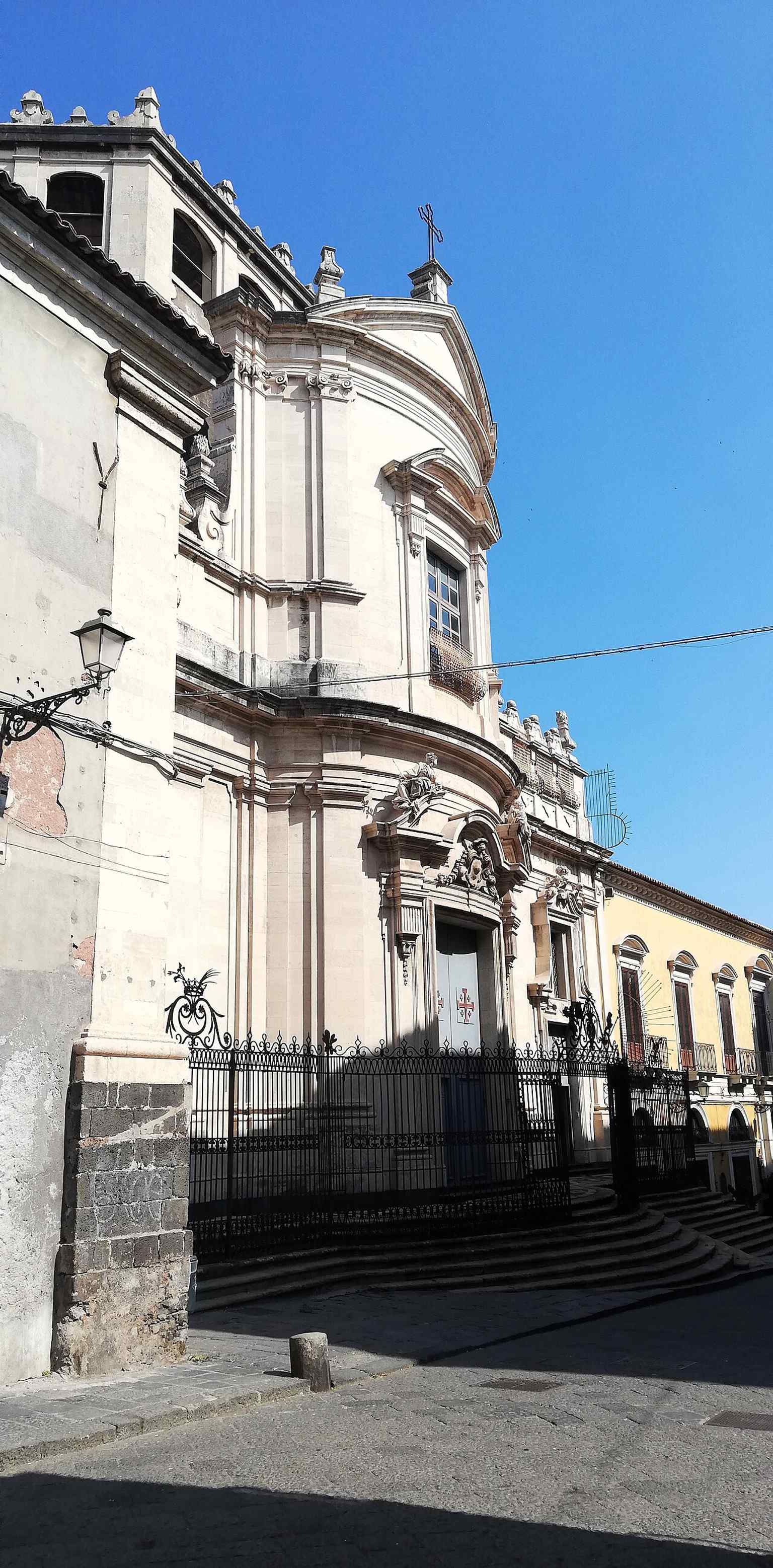
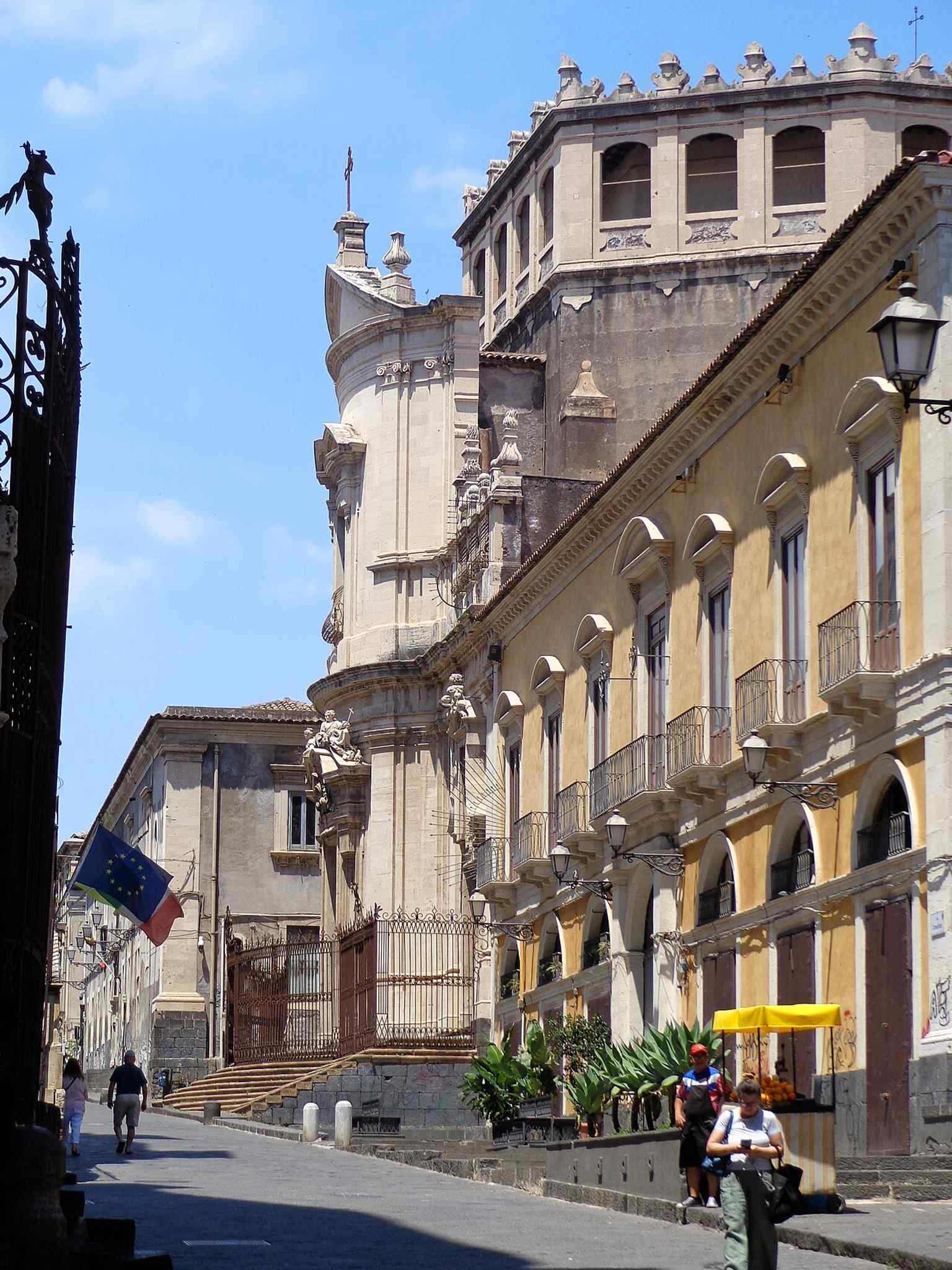
On your right, the Church of San Giuliano appears as a pale stone façade that bows outward in a smooth curve, enclosed by wrought-iron railings and backed by a lofty dome.
This is where Via dei Crociferi reveals its true nature. It is not merely a street, but a carefully arranged corridor of monasteries and church fronts, where architecture directs movement and feeling with the confidence of a stage designer. San Giuliano is one of the four great Baroque church-monasteries here, and it plays its part with remarkable restraint.
The ground beneath it had an older life. This was part of the city’s first Greek and Roman quarter, and the church rose over the remains of a pagan temple. Long before this façade existed, a community of hermit nuns from Santa Sofia lived outside the walls. In the early thirteenth century they moved into the city, and a Benedictine monk named Father Rainaldo Scalciato helped turn that small religious venture into a stable enclosed monastery under the title of San Giuliano.
Then came the earthquake of sixteen ninety-three, the great rupture we have met again and again in Catania. It destroyed the earlier complex and killed sixty of the seventy-four nuns. Only fourteen survived. The community had to begin again almost from nothing.
Their move here, into Via dei Crociferi, was not just practical. In seventeen oh nine the Benedictines exchanged their old property for former buildings of the San Marco Hospital, placing the convent much closer to the ceremonial heart of the rebuilt city. From a loggia, an open gallery within the complex, cloistered nuns, many from Catania’s aristocratic families, could watch the nighttime procession of Saint Agatha pass below without breaking enclosure. Hidden, but very much present.
In seventeen forty-one, the architect Giuseppe Palazzotto began the new church, probably developing an earlier plan by Vincenzo Caffarelli, a priest of the Crociferi order. Gaspare Ciriaci shaped the façade between seventeen forty-three and seventeen forty-nine, drawing on Roman Baroque models. The whole church was finished around seventeen fifty-four, and the elegant iron fence arrived in the first half of the nineteenth century.
Pause for a moment and let your gaze run up the street. Notice how the domes, curves, and façades answer one another. After the ancient performances of the theatre, Catania learned to make an entire street behave like scenery.
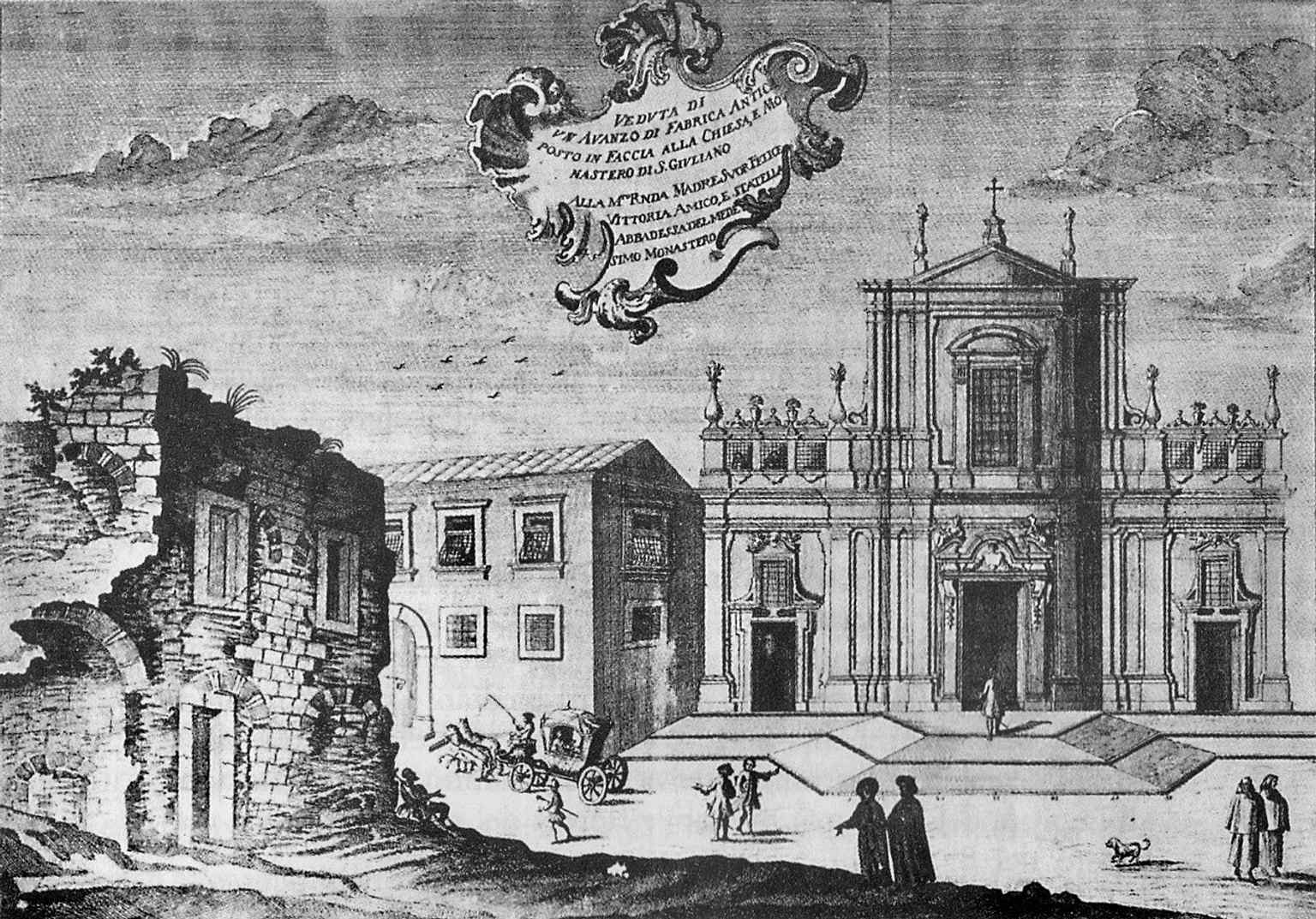
In the historic image in the app, you can see San Giuliano before later governments cut into the convent world around it. After religious houses were suppressed in the nineteenth century, civic offices took over parts of the complex. In nineteen thirty-seven, the fascist state turned one wing into a barracks called Caserma Dux and erased the garden, the central fountain, and a Baroque entrance. In nineteen forty-eight, those rooms passed to the Chamber of Labour. Cloister, barracks, union offices: the city kept changing the script, but not the setting.
Inside, the church opens in an elongated octagon under one of the highest domes in Catania. Giuseppe Rapisardi painted that dome in eighteen forty-two with Saint Peter handing the Gospel to Saint Berillo before ruined pagan architecture, a fitting image for this place, where each new order rises through the fragments of the last.
Now continue along Via dei Crociferi toward one of its grandest statements of learning and power, the Jesuit College.