
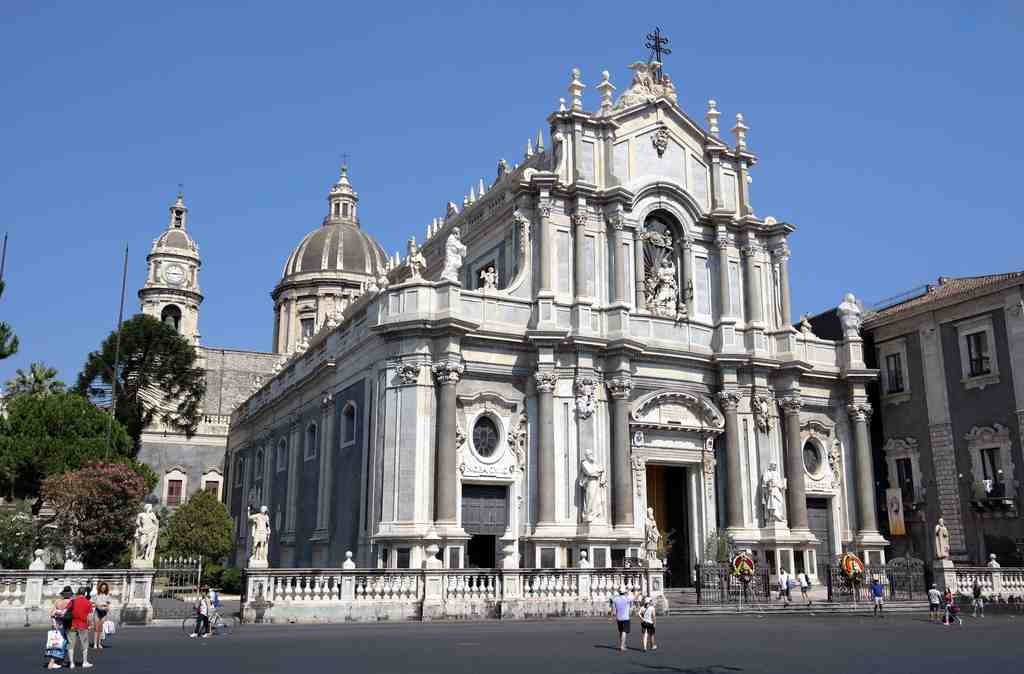
On your left, the cathedral stands out with a pale marble façade in three rising tiers, a row of dark granite columns, and a great dome lifting behind the roofline.
This is the Cathedral of Sant'Agata, the chief church of Catania and, in a rather deeper sense, its emotional centre. Agata was a young Christian martyr, killed in the ancient Roman period, and the people of this city have never treated her as a remote figure from a prayer book. They have held her as protector, neighbour, witness, and warning to anyone foolish enough to threaten Catania.
That feeling shaped this place from the beginning. Count Roger the First re-established the diocese after the Norman conquest, and Abbot Angerio came from Calabria to lead the new cathedral, consecrated in the late eleventh century. He built it over earlier Roman remains, and he gave it the character of an ecclesia munita, a fortified church: part house of worship, part place of defence. Even then, Catania did not begin from a clean slate. It built by reusing what earlier ages left behind.
The most cherished story here belongs to two former Byzantine soldiers, Gisliberto, a Frenchman, and Goselmo, a Calabrian. In ten forty, the general George Maniakes had carried Agata's relics away to Constantinople. They stayed there for eighty-six years, until, legend says, Agata appeared to Gisliberto in a dream and ordered him to bring her home. On the seventeenth of August, eleven twenty-six, the relics returned in triumph, and the city received them with a devotion so intense that it still shapes Catania's identity.
Then came the blows. In eleven sixty-nine, during the feast of Agata, an earthquake brought down the roof. Archbishop Giovanni d'Aiello died under the collapse, along with forty-four monks and a vast number of worshippers. In sixteen ninety-three, the great Val di Noto earthquake nearly erased the cathedral again. Only the Norman apse and parts of the earlier structure survived. What you see now is not a replacement so much as a carefully argued reply to disaster: Girolamo Palazzotto shaped the interior, and Giovanni Battista Vaccarini gave the cathedral its grand marble front in the eighteenth century.
In the image on your screen, you can see that Baroque façade clearly: ceremonious, balanced, and determined to look the catastrophe in the eye. Look closely at the real building too: those ancient granite columns in the first order are older than the façade itself, a reminder that Catania never wastes a survival.
Over the central portal stand Agata, Saint Euplius, and Saint Berillus. And on the façade appears the strange sequence N-O-P-A-Q-V-I-E, linked to a local legend that Emperor Frederick the Second spared Catania after reading a warning not to offend Agata's homeland. That is how this city thinks of her: not simply as a saint in heaven, but as a force with civic jurisdiction.
If you check the interior image in the app, the Norman apse still frames the high altar, proving that the older cathedral remains inside the later one like a memory that refused eviction.
So here is a question to carry with you: what does it mean when a city places its deepest trust not in a ruler, nor an army, but in a martyr remembered generation after generation?
And yet, for all this apparent permanence, something older still lies directly below this sanctuary: Roman baths, where imperial Catania continues to wait underground, and that is where we go next. If you plan to enter later, the cathedral generally opens in the morning and again in the late afternoon, with a slightly later opening on Sundays.




