
La Rochelle Highlights Audio Tour: Coastal Heritage and Maritime Wonders
Beneath the limestone facade of La Rochelle lies a city built on the bones of defiant rebels and salted by centuries of maritime blood. You are standing in a harbor where the tide pulls back to reveal secrets buried deep under the weight of history. This self-guided audio tour navigates the labyrinthine streets beyond the standard maps. Unlock hidden narratives and hushed scandals that remain shielded from the casual wanderer. Did the stones of Saint Nicholas Tower witness a brutal betrayal during the Great Siege? What dark pact was signed within the hushed corners of Saint-Sauveur? And why does a solitary relic in the Maritime Museum still spark a local superstition about cursed voyages? Trace the arc of past rebellions and political firestorms. Walk the narrow alleys where history pulses beneath your feet. Transform your visit into an immersive quest for truth. Press play and claim the ghosts of the port.
Tour preview
About this tour
- scheduleDuration 120–140 minsGo at your own pace
- straighten5.3 km walking routeFollow the guided path
- location_onLocationLa Rochelle, France
- wifi_offWorks offlineDownload once, use anywhere
- all_inclusiveLifetime accessReplay anytime, forever
- location_onStarts at Aquarium de La Rochelle
Stops on this tour
lock_open 3 free previews · 13 unlock with purchase
In front of you stands a broad modern block of pale concrete and glass, stretched in long horizontal bands with a rounded entrance canopy marking the Aquarium de La Rochelle.…Read moreShow less
Open dedicated page →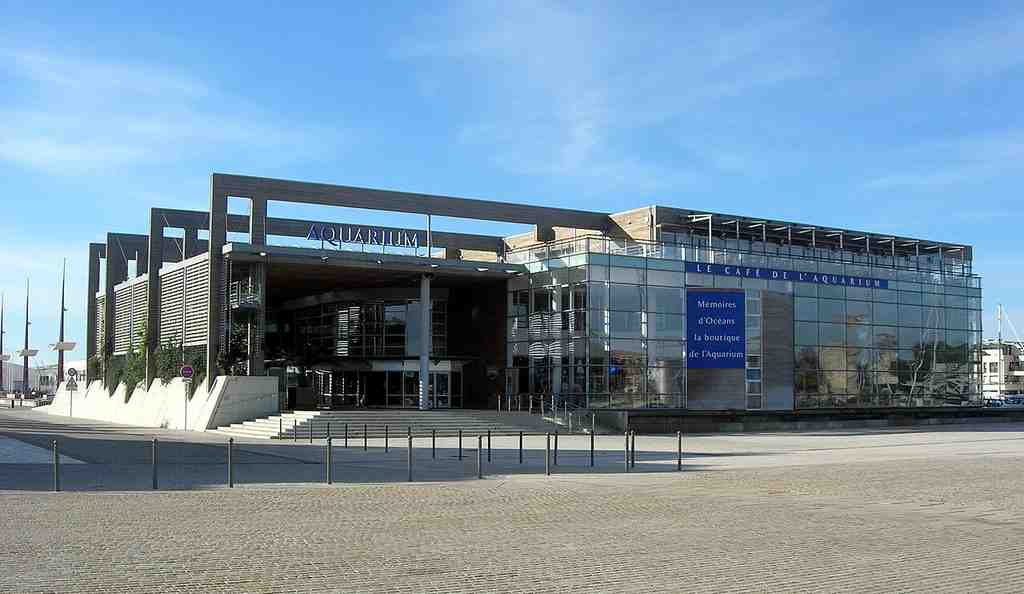
Aquarium de La RochellePhoto: CaptainHaddock, Wikimedia Commons, CC BY-SA 3.0. Cropped & resized. In front of you stands a broad modern block of pale concrete and glass, stretched in long horizontal bands with a rounded entrance canopy marking the Aquarium de La Rochelle.
For a city famous for ships, merchants, and stubborn stone towers, starting with an aquarium seems almost suspiciously modern... but it makes perfect sense. Picture René Coutant in the early nineteen-fifties, a horticultural engineer tinkering with seawater aquariums long before this place existed. Most visitors never realize that this major attraction began as something much smaller: René opened a public aquarium here in La Rochelle in nineteen seventy, just two hundred and fifty square meters, after years of quiet experimentation with living saltwater.
That small beginning grew into a family story. René handed the work to his children, Roselyne and Pascal, in nineteen seventy-five. Then the sea, in a way, reminded them that it offers wonder and risk in the same breath. The same water that fills these tanks with reef fish, sharks, jellyfish, and turtles has always fed port cities, fired curiosity, and made fortunes. It also strands animals, destroys plans, and refuses to behave like a tidy museum object. Oceans are magnificent... and gloriously uncooperative.
In nineteen eighty-five, fire destroyed the family aquarium at Ville-en-Bois. René had died the year before, so Roselyne and Pascal had to rebuild without him. They spent three years creating the Grand Aquarium, which opened in nineteen eighty-eight and ranked among the biggest in France at the time. Near the marina at Les Minimes, it covered more than one thousand six hundred square meters, with thirty-six aquariums holding five hundred and fifty thousand liters of seawater. Within twelve years, seven million people came through. That is not a hobby gone well. That is a local institution announcing itself.
Success pushed the next reinvention. In two thousand one, the aquarium moved here, close to the old harbor and right into the city’s daily life. Now it spreads across more than eight thousand four hundred and forty-five square meters, with three million liters of seawater, seventy-three display tanks, one hundred and fifty quarantine aquariums, and more than twelve thousand animals from six hundred species. If you check the image on your screen, you can peek inside those great interior basins. Another glance shows one of the aquarium’s jellyfish displays, those floating creatures that look elegant right up until you remember they are basically drifting nerve nets.
What I like most is that this place does more than exhibit marine life. Inside, elevators guide visitors downward as if descending into the sea, and children get their own low observation points... a smart choice, since fish have shown very little interest in redesigning themselves for adult eye level. The aquarium also runs a sea turtle care and studies center. Between October of twenty twenty-three and June of twenty twenty-four alone, the team returned one hundred and thirty-seven loggerhead turtles and one green turtle to the ocean. So this building doesn’t just display the sea; it studies it, repairs some of the damage, and sends living pieces of it back out again.
That instinct matters in La Rochelle. Here, marine knowledge becomes memory, business, rescue work, and family inheritance all at once. At the next stop, the Maritime Museum, five minutes away, the boats themselves take over as witnesses. If you plan to come back inside later, the aquarium opens every day from nine in the morning to eight in the evening.
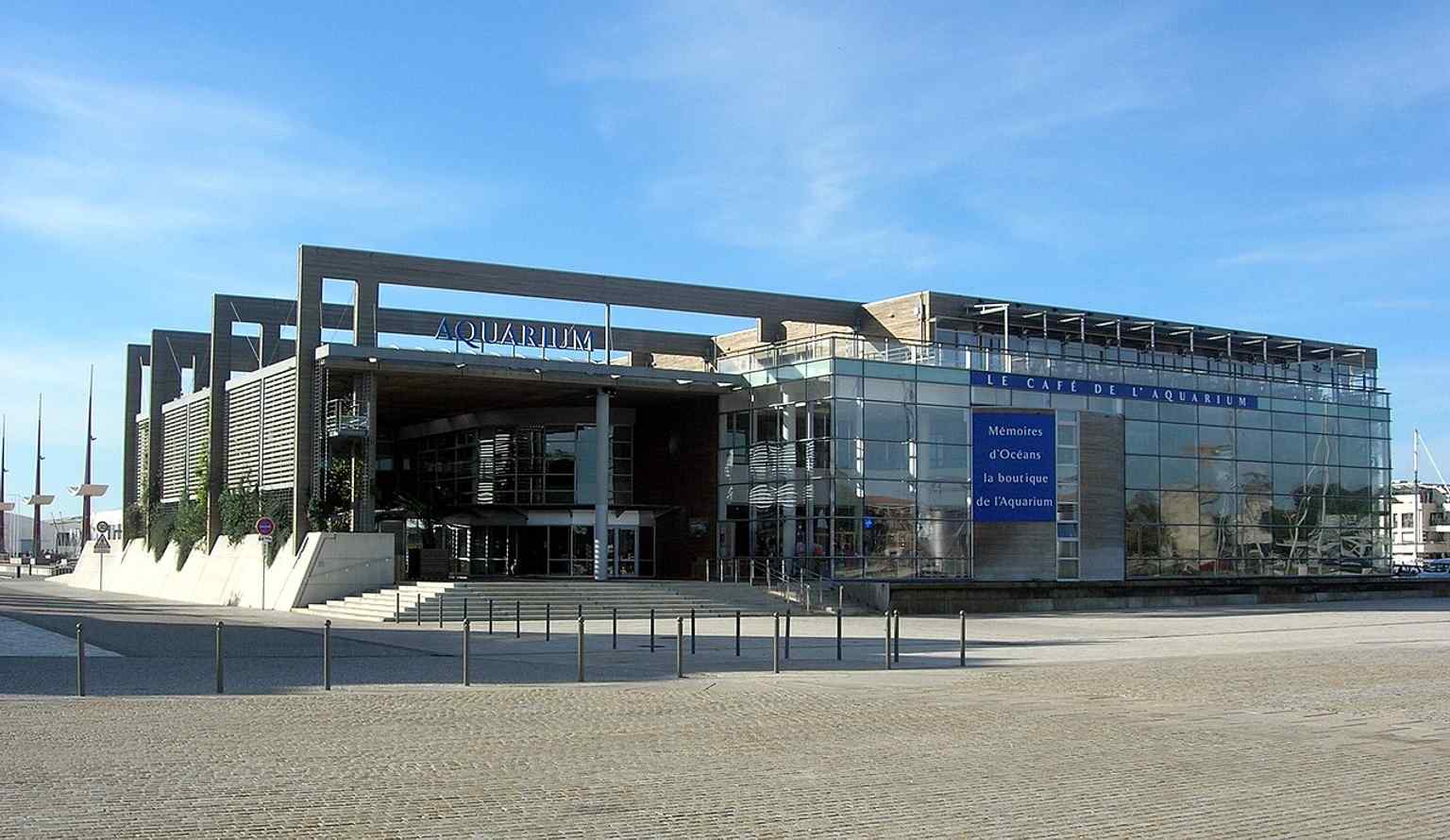
The main façade of Aquarium de La Rochelle, the family-run aquarium that became one of the largest public aquariums in Europe after its 2001 move.Photo: No machine-readable author provided. CaptainHaddock assumed (based on copyright claims)., Wikimedia Commons, CC BY-SA 3.0. Cropped & resized. 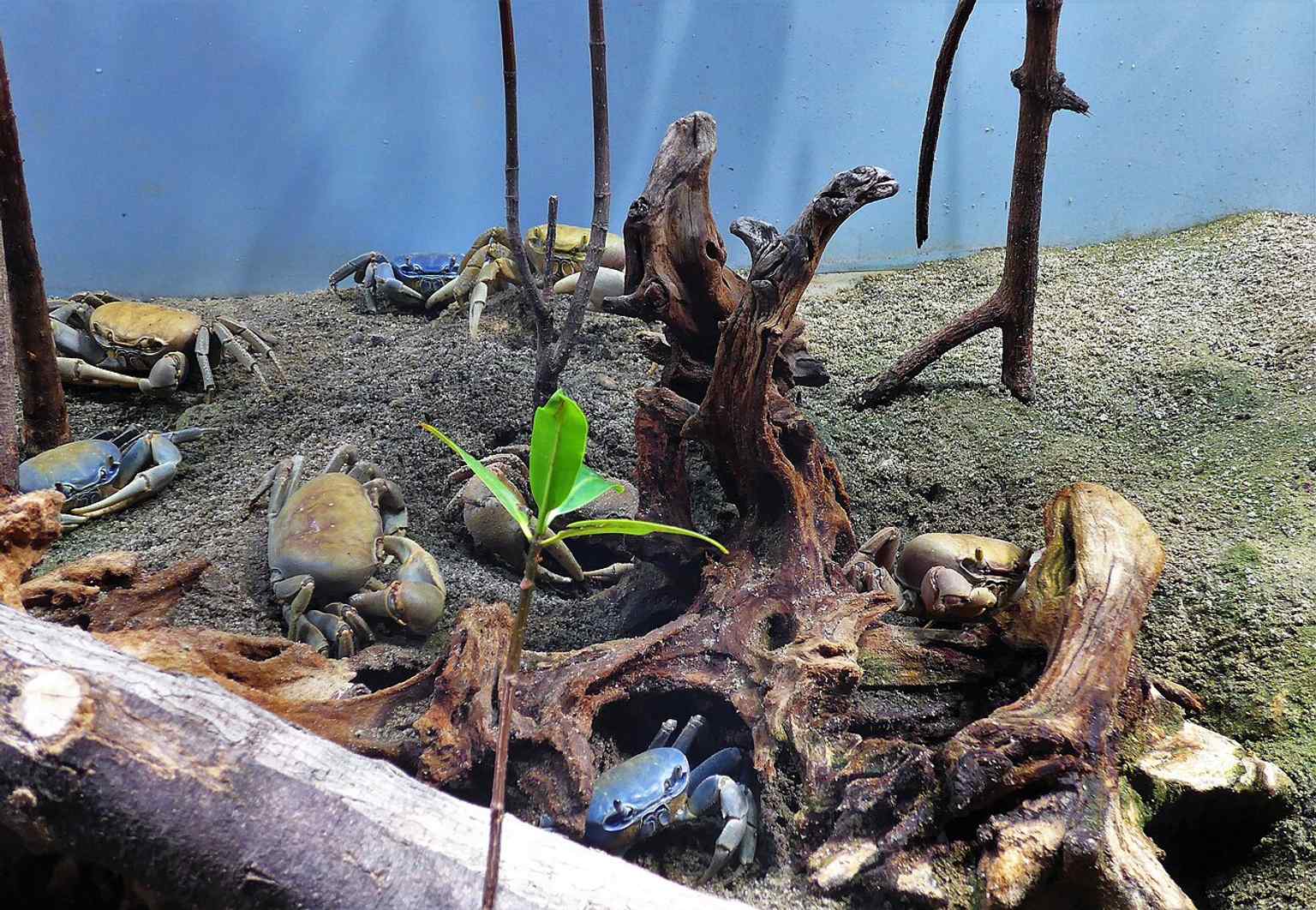
Close-up of crabs and other marine arthropods on display, echoing the aquarium’s diverse collection of species from local seas and beyond.Photo: Celeda, Wikimedia Commons, CC BY-SA 4.0. Cropped & resized. 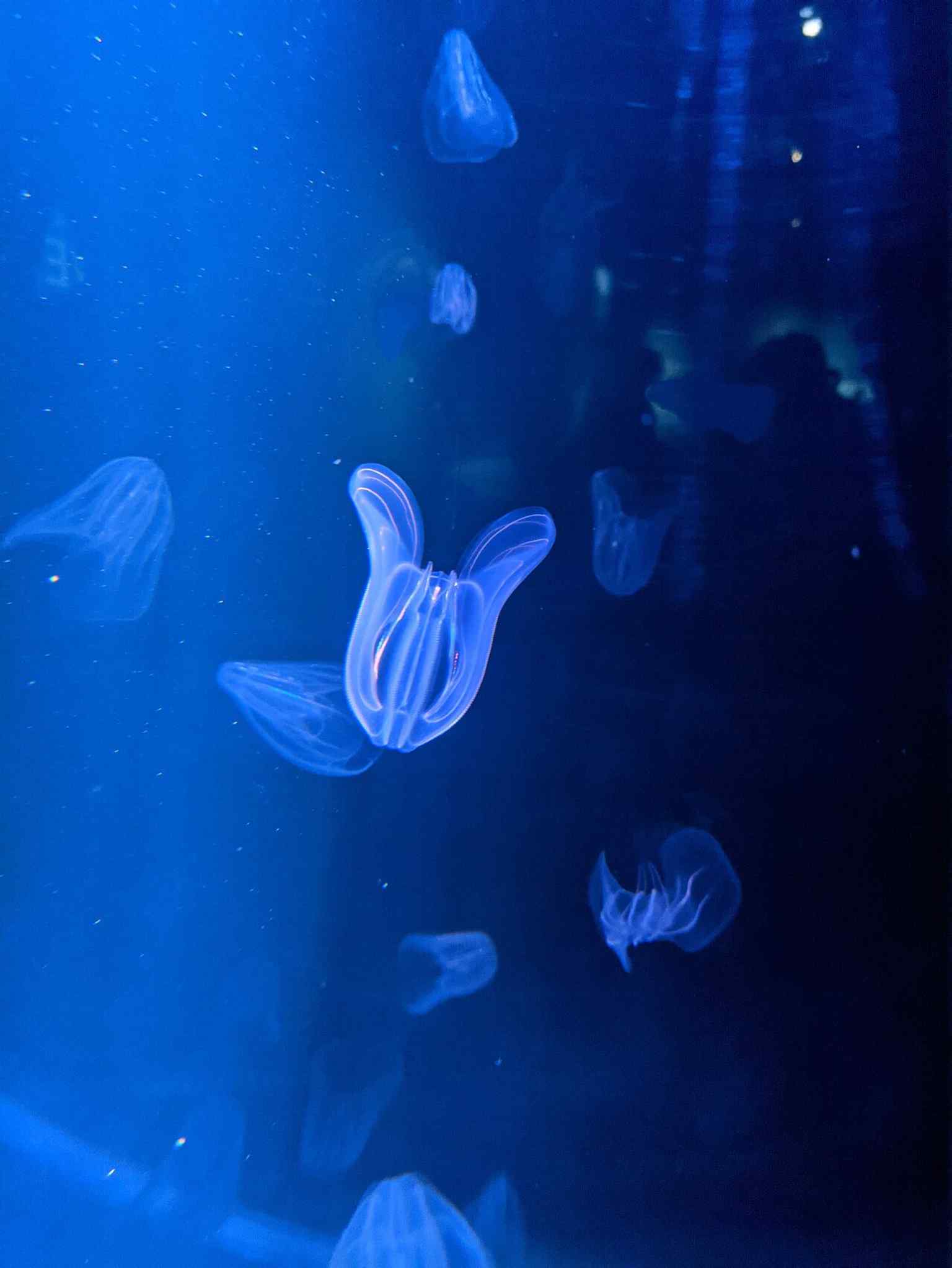
A jellyfish exhibit, fitting the aquarium’s dedicated jellyfish area with tropical and temperate species.Photo: MagentaCaracal, Wikimedia Commons, CC BY-SA 4.0. Cropped & resized. In front of you rises a pale limestone fortress, round at its core but pushed into a jagged, turreted outline, with a crown of crenellations that seems just slightly off balance.…Read moreShow less
Open dedicated page →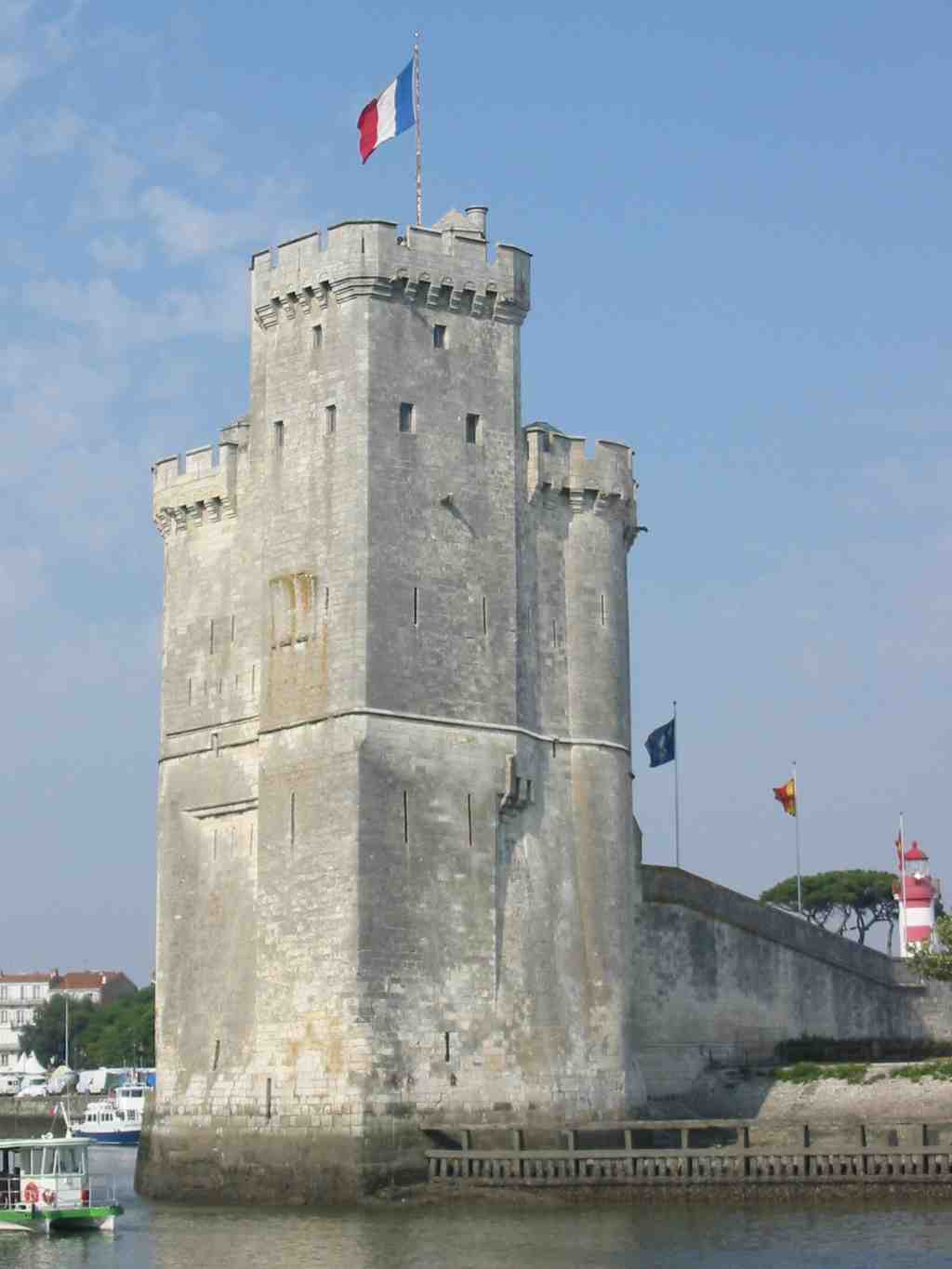
Saint Nicholas TowerPhoto: Brice Rothschild, Wikimedia Commons, CC BY-SA 3.0. Cropped & resized. In front of you rises a pale limestone fortress, round at its core but pushed into a jagged, turreted outline, with a crown of crenellations that seems just slightly off balance.
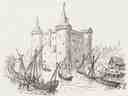
This is Saint Nicholas Tower, one of the Three Towers of La Rochelle: Saint-Nicolas here, the Chain Tower across the water, and the Lantern Tower farther along the coast. Together they became the city’s stone signature, the guardians everyone remembered when arriving by sea. You’ll keep spotting them as the harbor story unfolds, because La Rochelle liked to make its power visible.
Saint-Nicolas began in the mid-fourteenth century on awkward ground: marsh, mud, and wishful thinking. Builders drove long oak piles deep into the slime, packed them with stone, and laid a platform for the foundations. It still was not enough. The weight of the tower pushed the base off true, and the whole thing tilted more than twenty centimeters to the east. In other words, the tower started leaning almost from birth and never really quit. Most visitors miss that it still leans today... not as a romantic flourish, but because medieval engineers were wrestling with a swamp.
Local legend gave the problem a more elegant explanation. People said the fairy Mélusine dropped the stones that began the tower. That story softens the place just a little. It is easier to forgive a crooked fortress if a fairy had a hand in it.
Take a second and study its stance and weight. The mass looks steady, but there is a faint unease in it, as if the tower has been bracing itself for centuries.
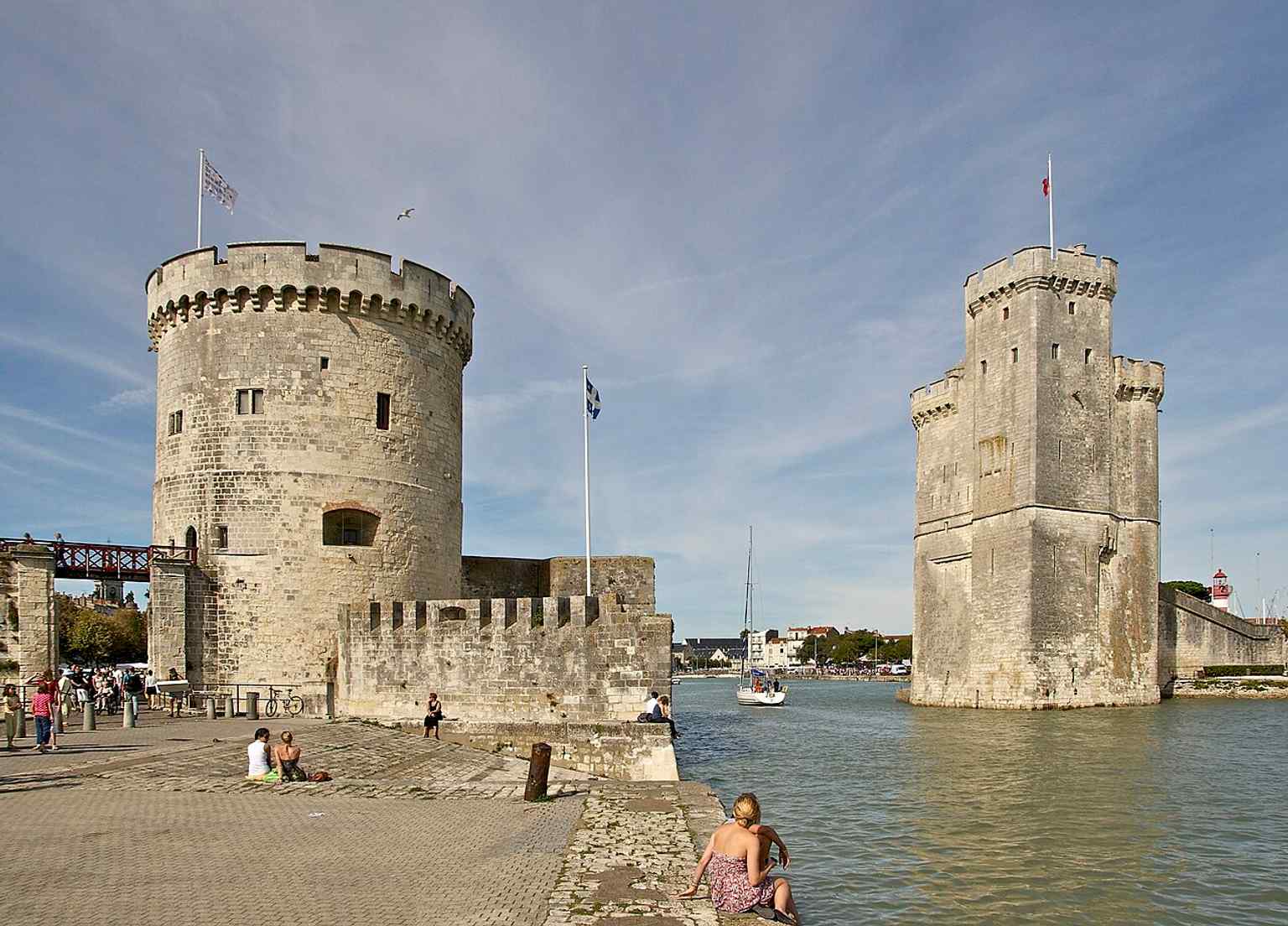
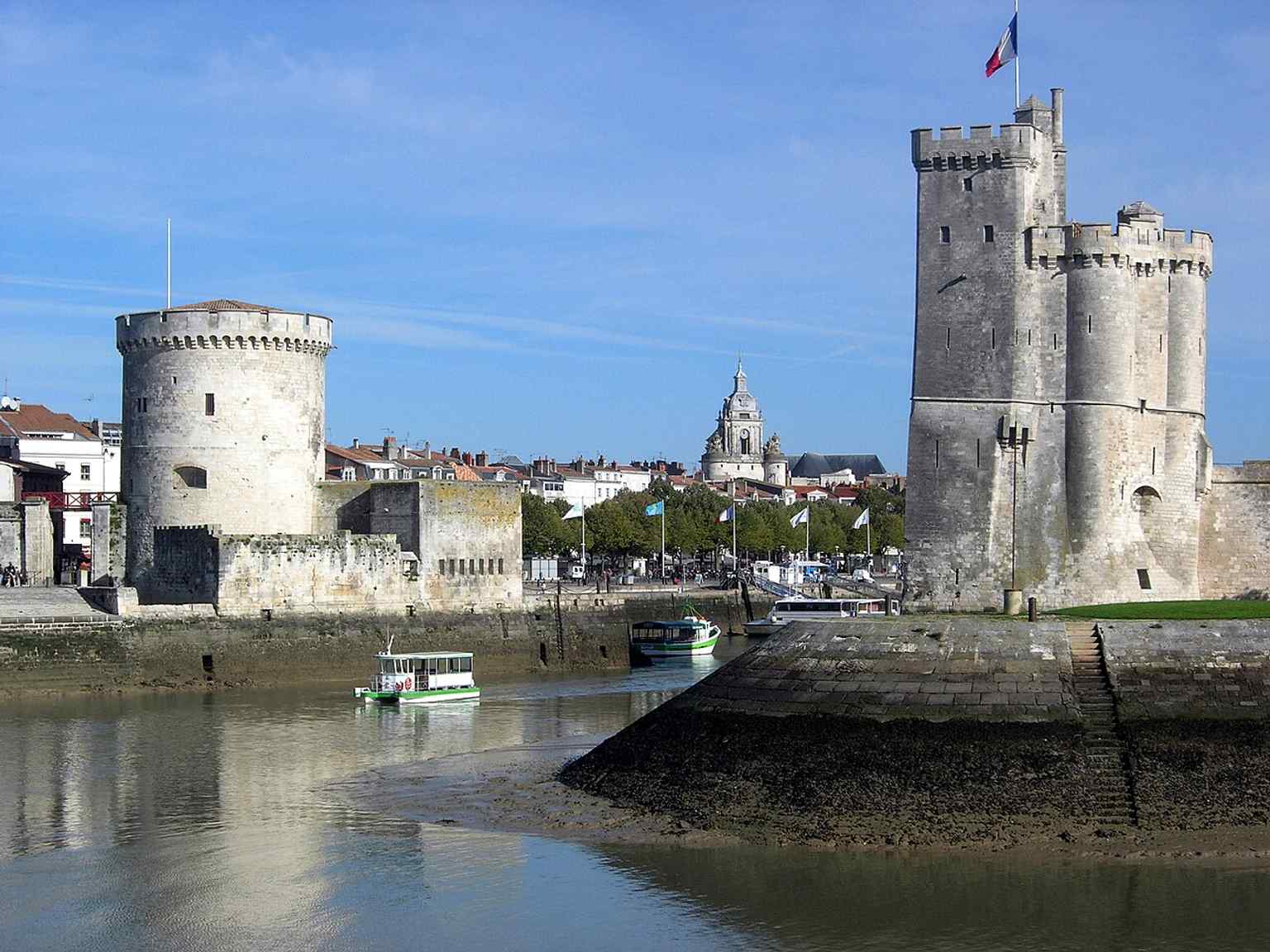
It had good reason. This tower stood isolated on the south side of the harbor mouth and controlled the narrow passage in. A chain attached here could stretch across to the tower opposite and close the port completely. If you glance at the image on your screen, you can see that harbor gateway exactly as sailors faced it, framed between the two towers. Saint-Nicolas did not just scare enemies; it checked traffic, enforced taxes, and watched who came to profit from the sea.
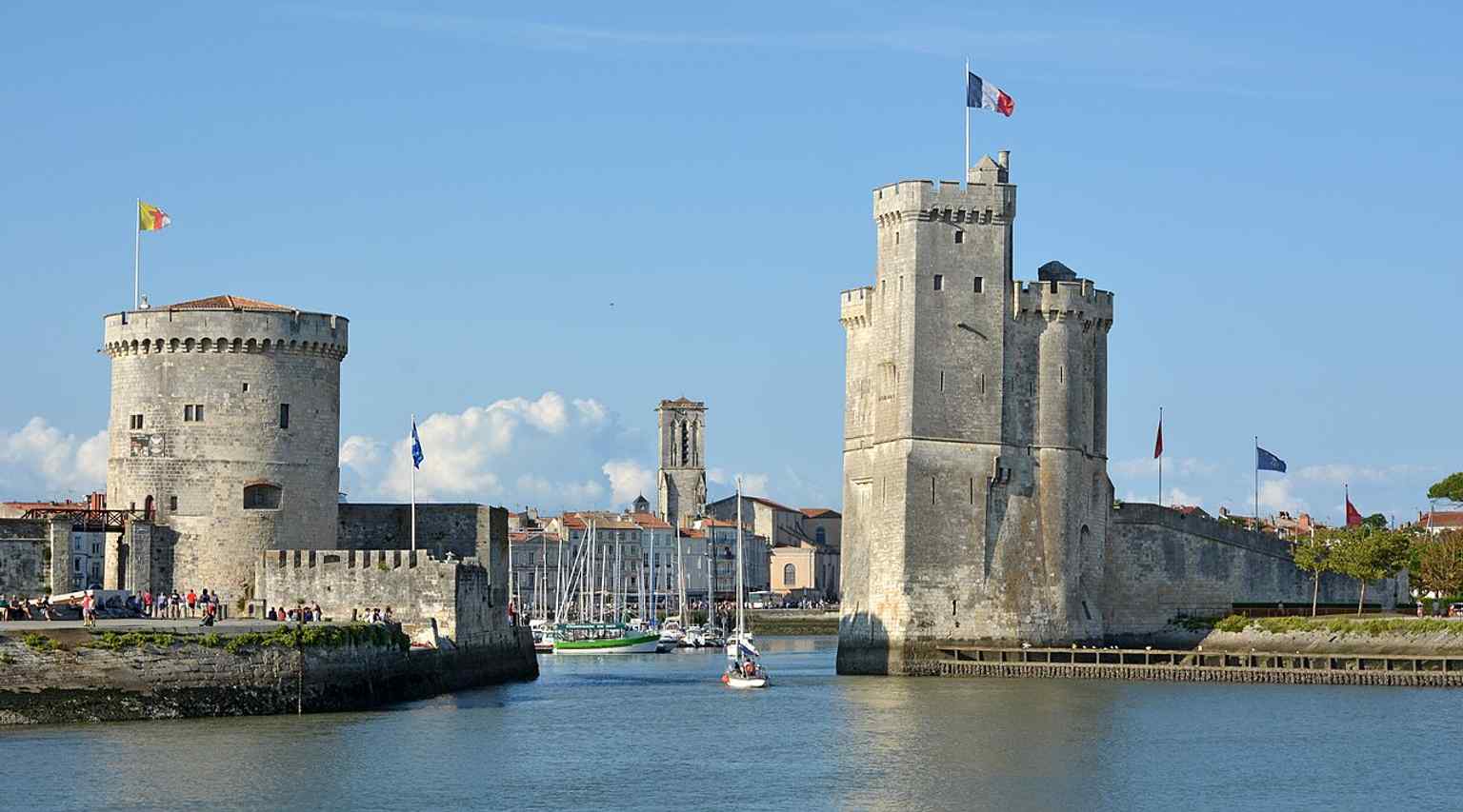
The harbor channel framed by Saint Nicholas Tower and the Chain Tower — exactly the dramatic gate that once closed off the port with a tethered chain.Photo: Pline, Wikimedia Commons, CC BY-SA 3.0. Cropped & resized. Its own construction followed the politics of that sea. The treaty of Brétigny in thirteen sixty handed La Rochelle to the English and halted the work. In thirteen seventy-two, after the English were beaten and forced out, King Charles the Fifth renewed the alliance with the city, and Bertrand du Guesclin’s campaign helped make La Rochelle French again. Builders finally finished the tower in thirteen seventy-six, even correcting the upper part so it stands truer than the sinking base below.
Then came the Fronde, the mid-seventeenth-century uprising against royal authority, and things got personal. The deeply unpopular Count of Daugnon turned Saint-Nicolas into a fortress against La Rochelle itself, cutting it off with a moat and fortifying it like a private sulk with cannons. When royal troops arrived in sixteen fifty-one, Daugnon fled to Bordeaux and left his lieutenant, de Besse, trapped here. After the Chain Tower exploded in the fighting, the last defenders crowded into Saint-Nicolas. De Besse refused surrender, threatened to ignite the powder, and died in the final assault, struck down as the tower became the last hard knot of resistance.
Later, the crown kept the tower, soldiers and prisoners used it, and restorers in the nineteenth and early twentieth centuries saved its battered silhouette. If you want, have a quick look at the before-and-after image; the tower barely budges, while the waterfront around it changes completely.
And yet for all this stone, chains, and gunfire, sailors still needed one simpler thing to enter safely... a light. For that, head on to the Phare du quai Valin, about a six-minute walk from here.
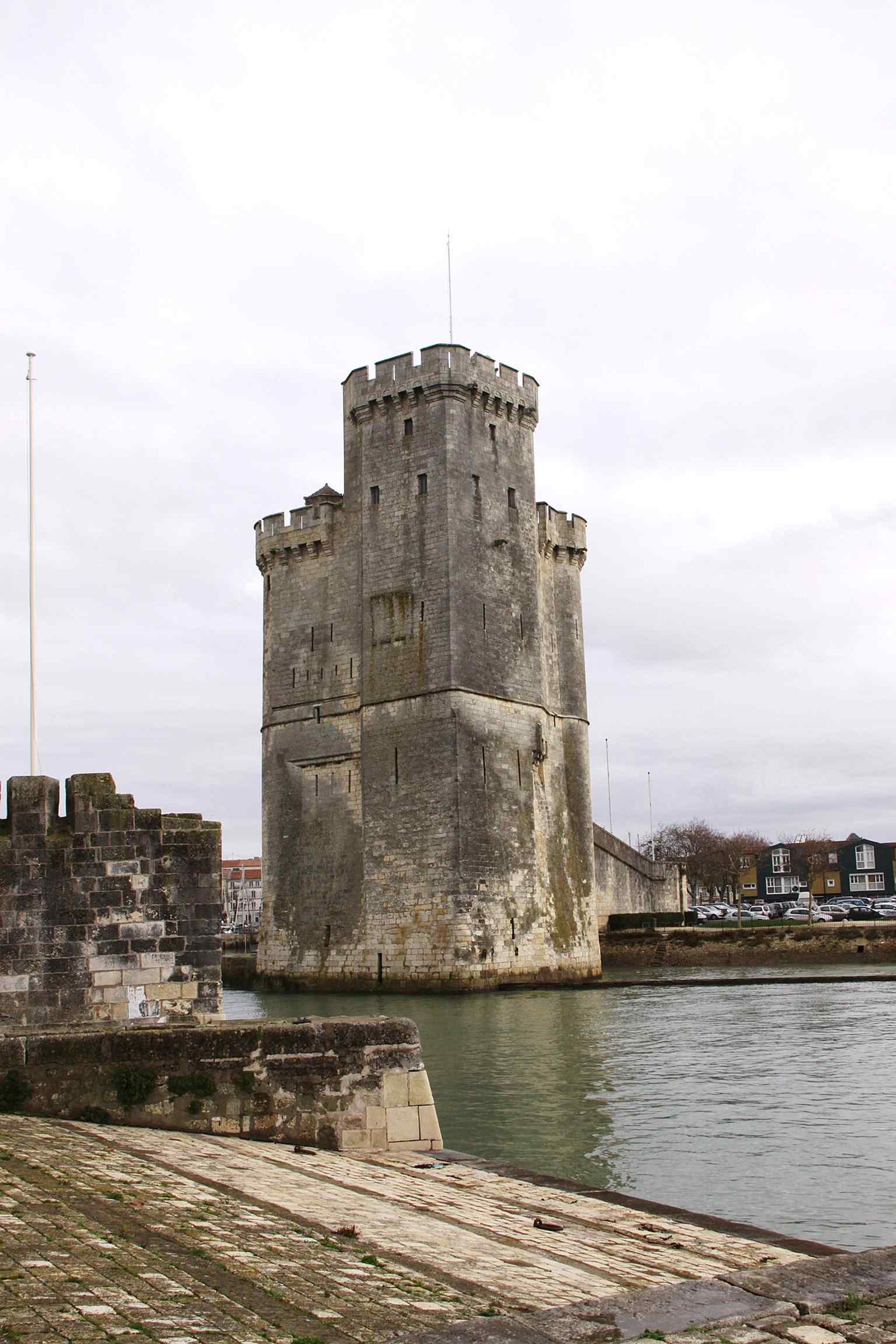
A strong frontal view of Saint Nicholas Tower from the harbor approach, showing the monument standing at the entrance to La Rochelle’s Old Port.Photo: Jean-Pierre Bazard Jpbazard, Wikimedia Commons, CC BY-SA 3.0. Cropped & resized. 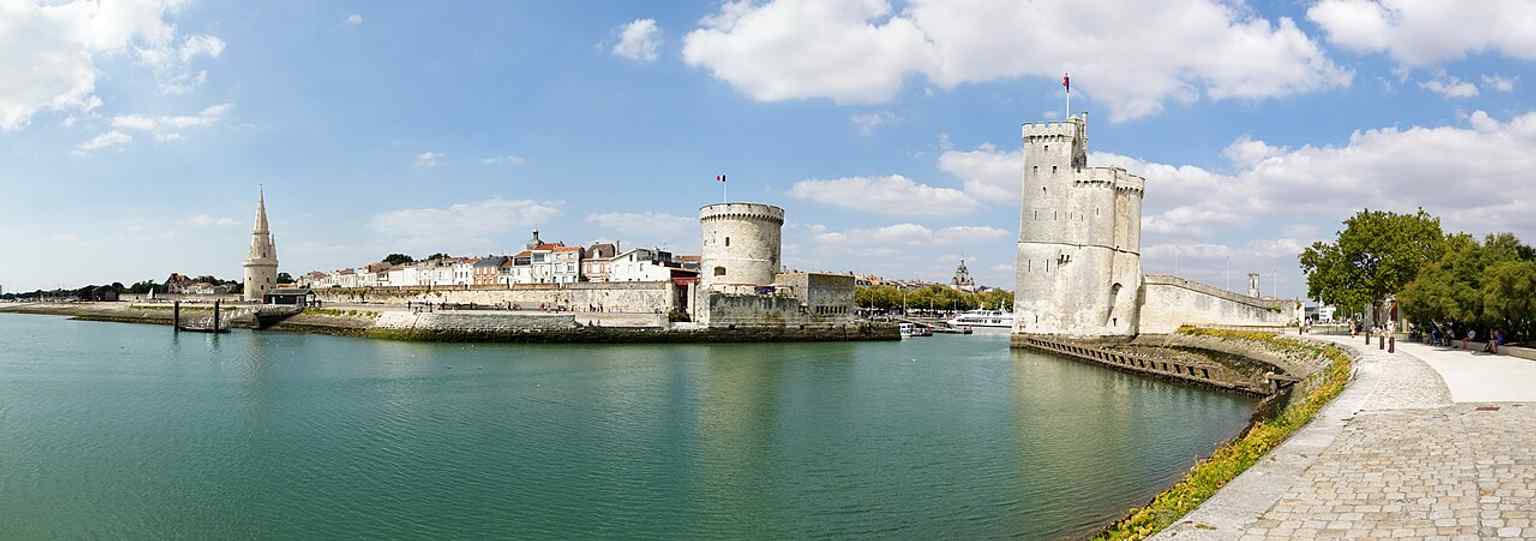
A wide panorama of the three towers of the Old Port, placing Saint Nicholas Tower in its full historic waterfront setting.Photo: François de Dijon, Wikimedia Commons, CC BY-SA 4.0. Cropped & resized. 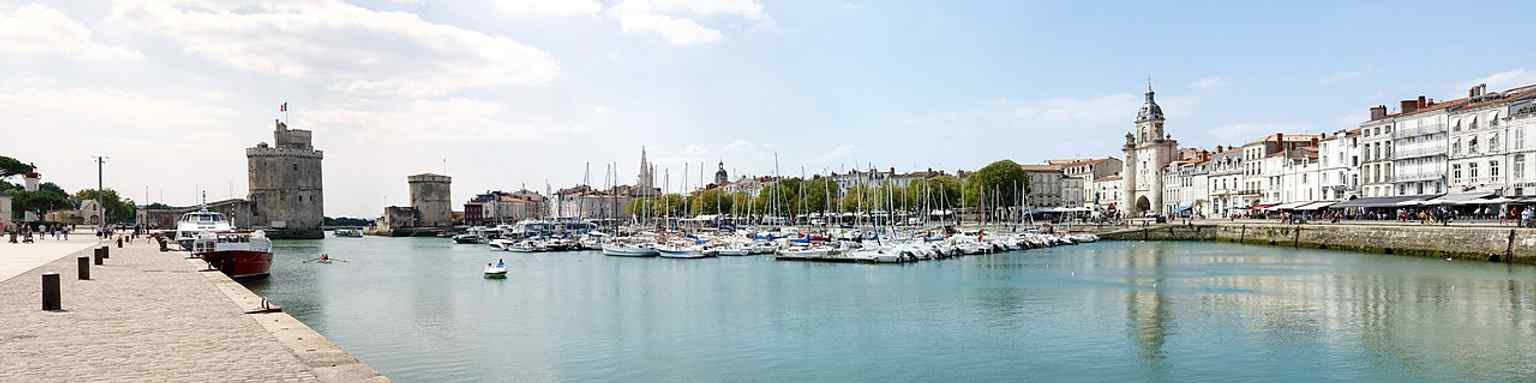
A sweeping port view with Saint Nicholas Tower, the Chain Tower, and the Old Port — ideal for explaining how the towers guarded the harbor entrance.Photo: François de Dijon, Wikimedia Commons, CC BY-SA 4.0. Cropped & resized. 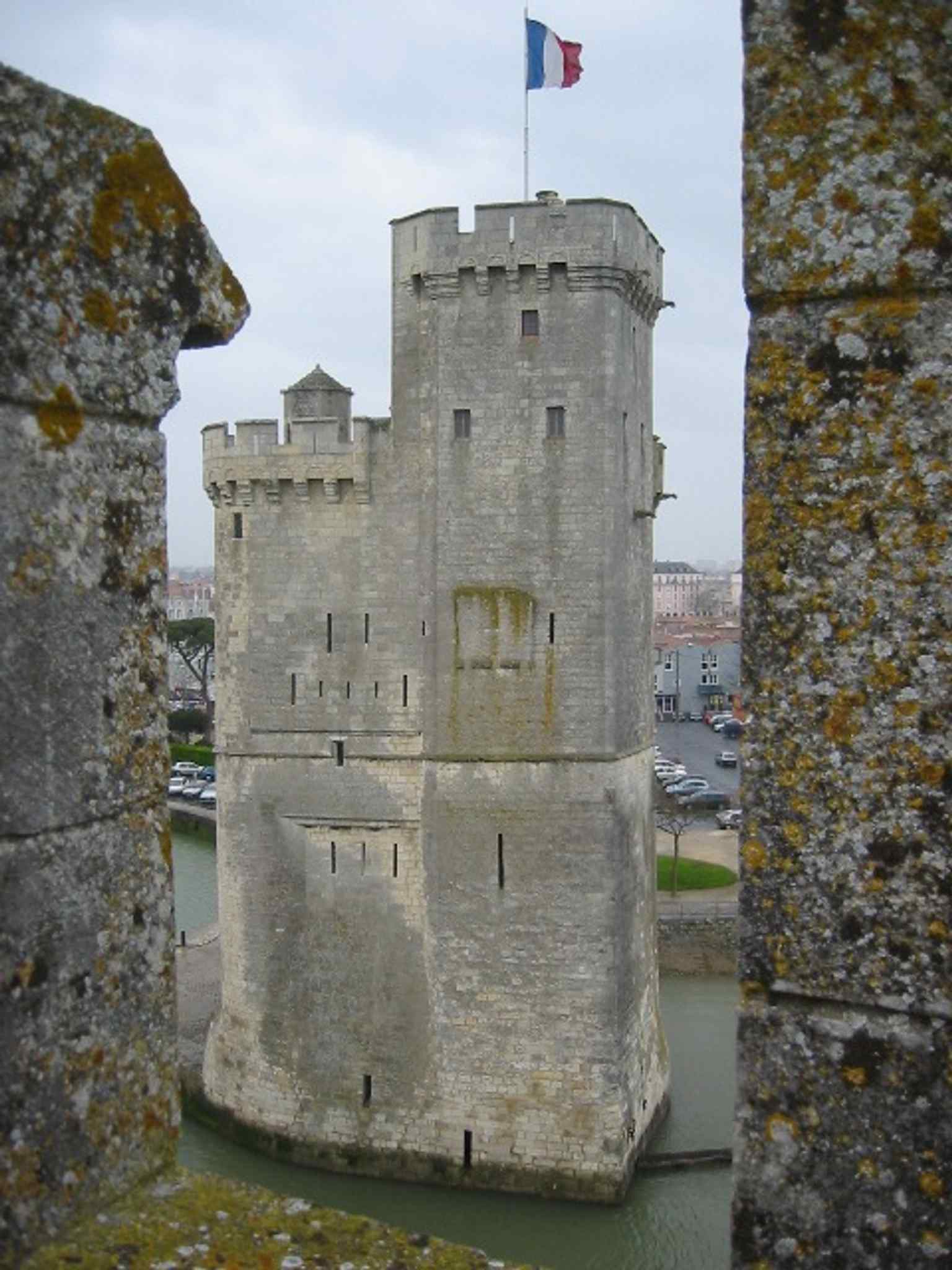
Saint Nicholas Tower seen from the Chain Tower, a classic angle that highlights the two towers that formed La Rochelle’s iconic gateway.Photo: Ganelon at English Wikipedia, Wikimedia Commons, Public domain. Cropped & resized. 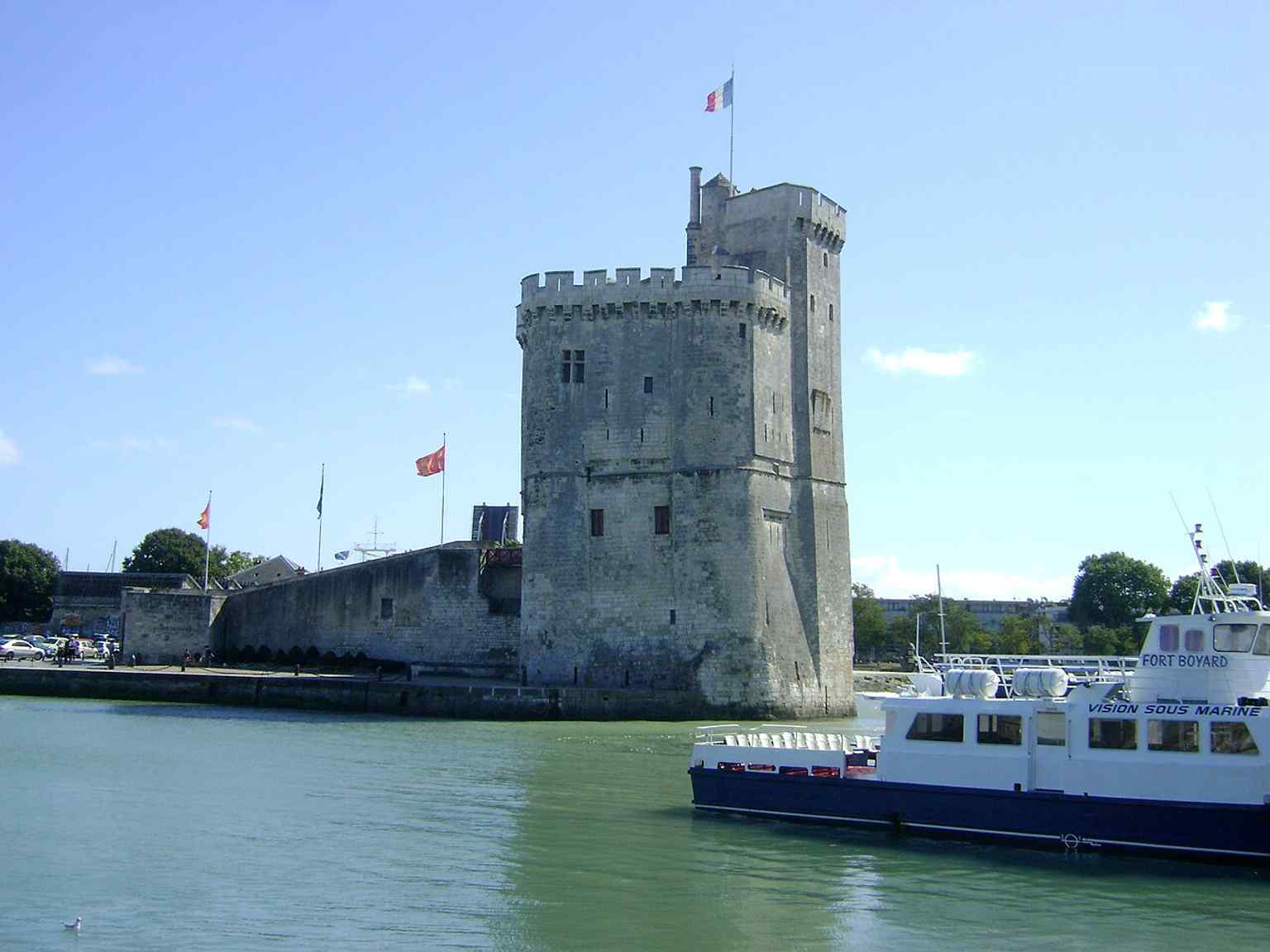
A clean documentary-style image of Saint Nicholas Tower, useful for the monument’s official heritage status and long military history.Photo: Guiguilacagouille, Wikimedia Commons, CC BY-SA 3.0. Cropped & resized. 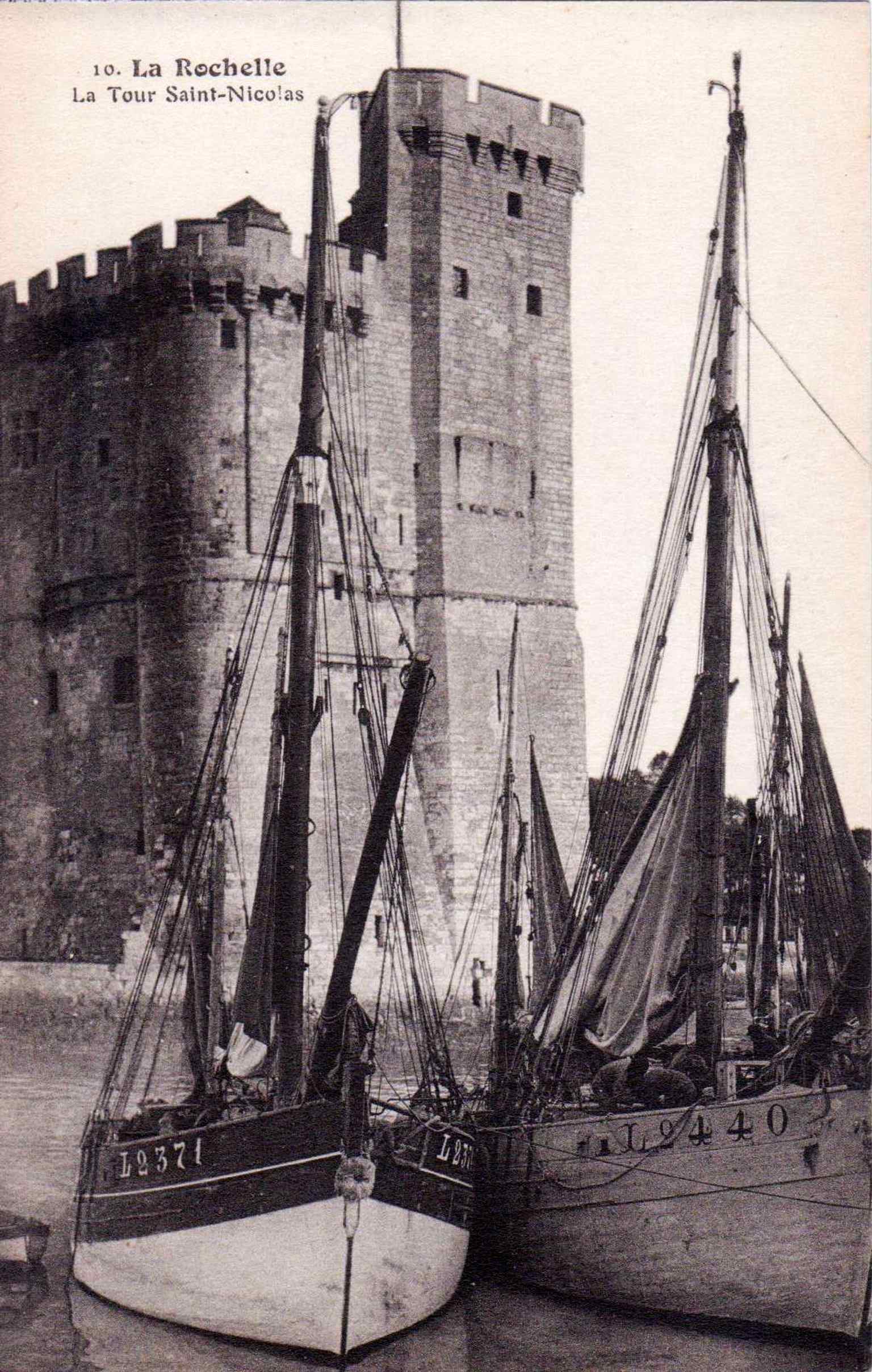
A vintage postcard view of Saint Nicholas Tower from around 1910, showing how the tower has long been an emblem of La Rochelle.Photo: Publisher: Nouveautés Parisiennes - La Rochelle., Wikimedia Commons, Public domain. Cropped & resized. 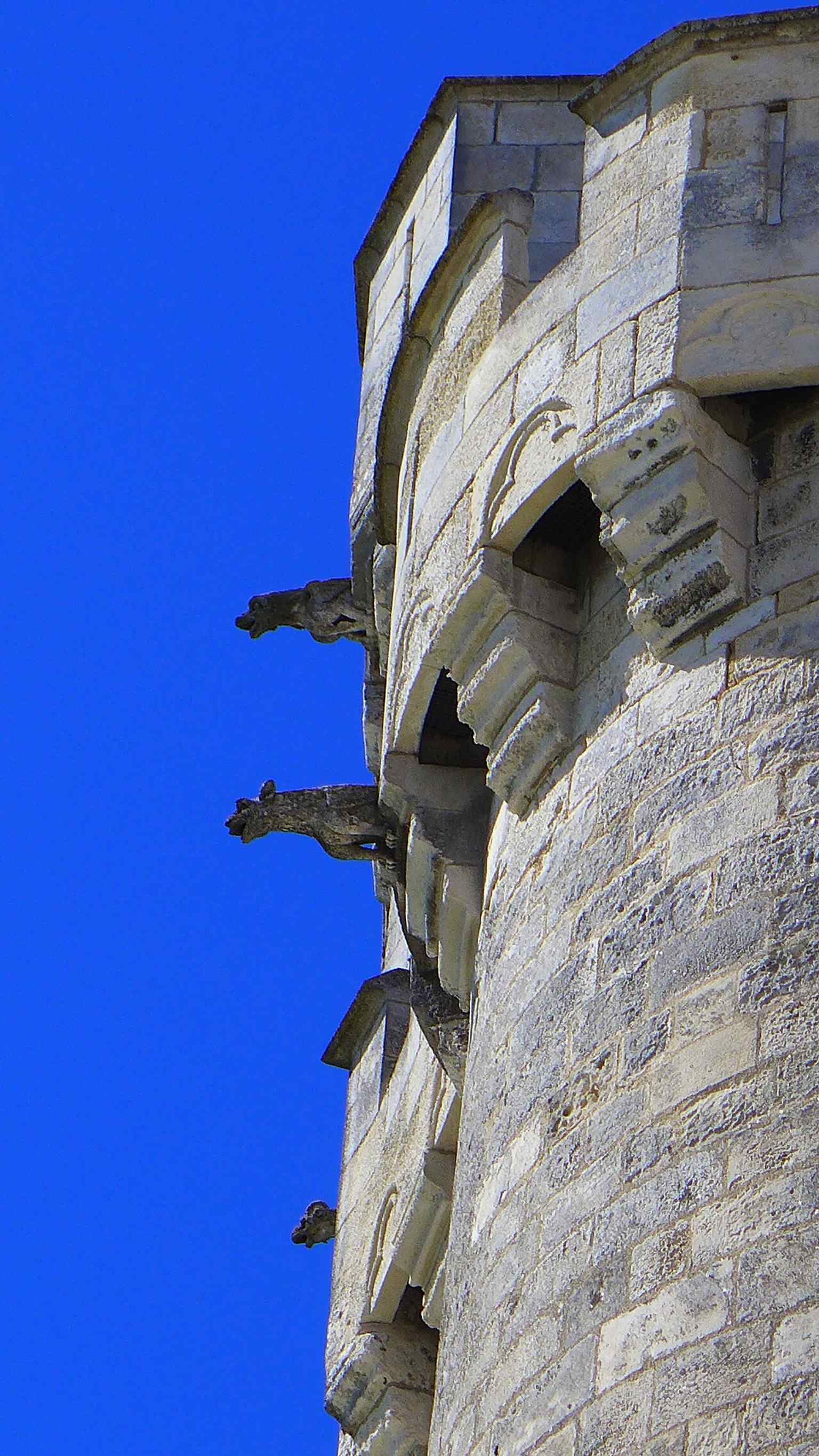
Close-up of the tower’s gargoyles, a reminder of the Gothic defenses and sculptural details preserved in later restorations.Photo: Aubry Françon, Wikimedia Commons, CC BY-SA 4.0. Cropped & resized. 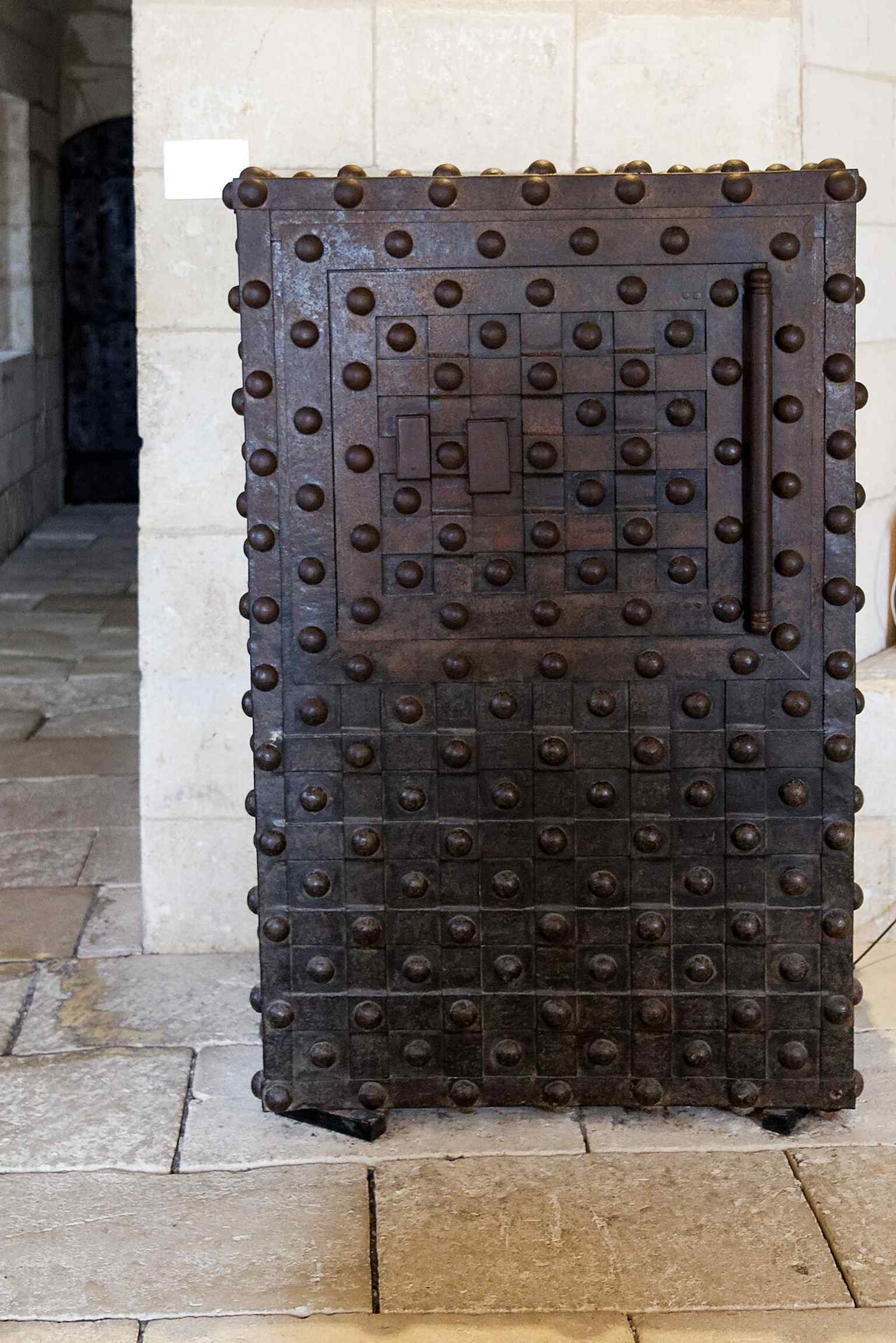
An old chest inside the tower, evoking the room used by captains and the tower’s former role as a guarded military residence.Photo: François de Dijon, Wikimedia Commons, CC BY-SA 4.0. Cropped & resized. 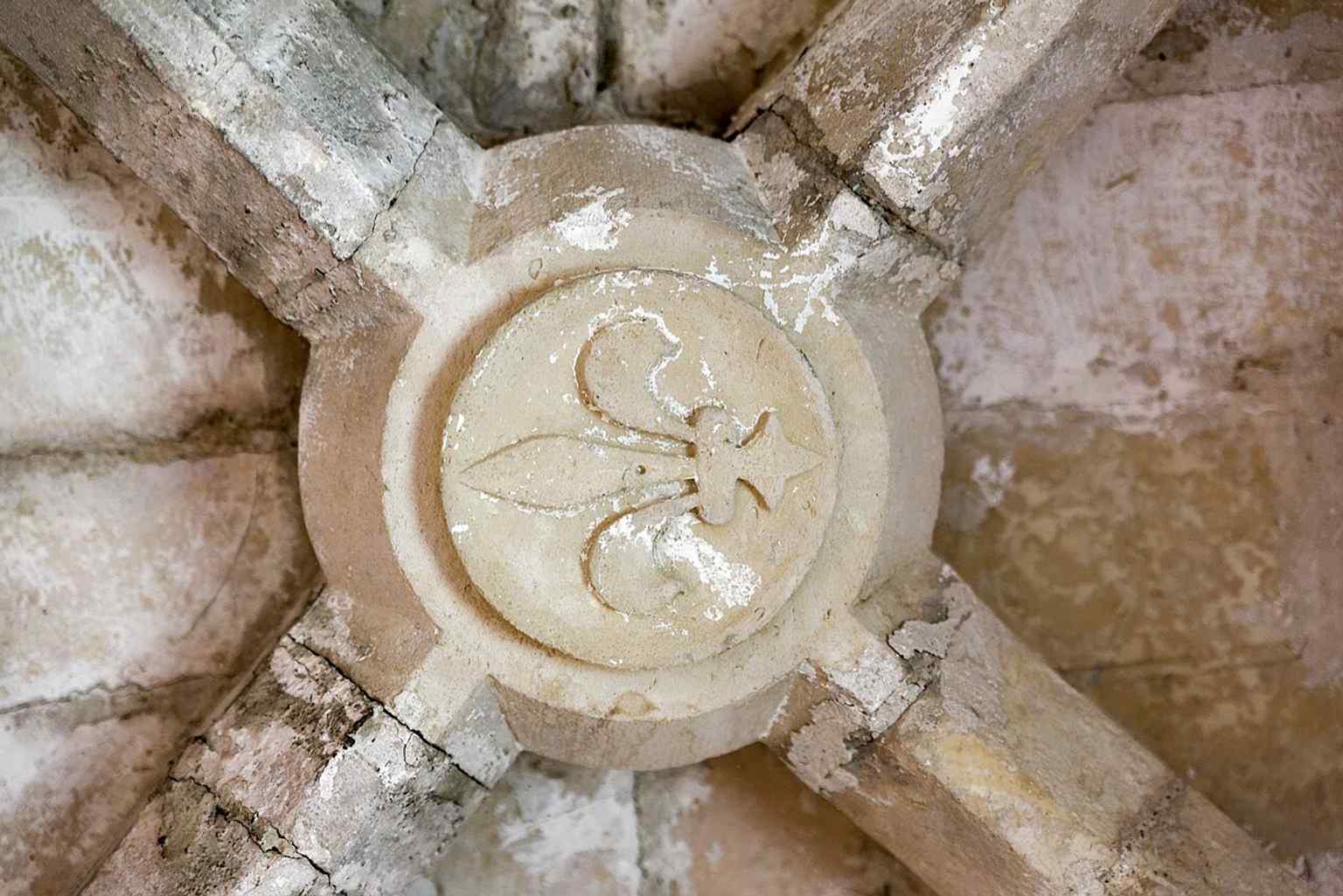
A vault keystone inside Saint Nicholas Tower, one of the Gothic interior details that survive in its layered medieval spaces.Photo: François de Dijon, Wikimedia Commons, CC BY-SA 4.0. Cropped & resized. 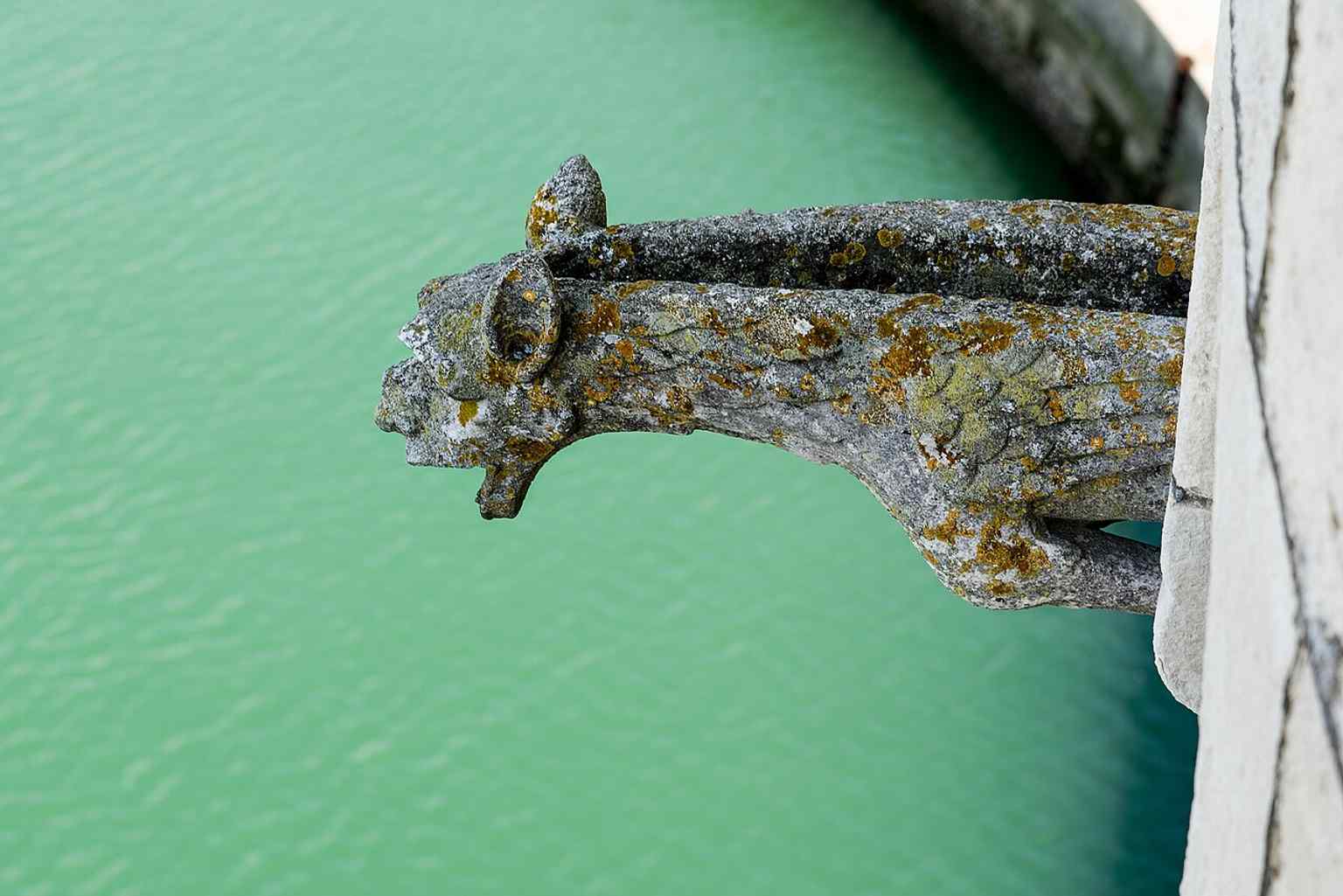
A close view of a gargoyle, linking the tower’s decorative stonework to its defensive, rain-shedding medieval architecture.Photo: François de Dijon, Wikimedia Commons, CC BY-SA 4.0. Cropped & resized. 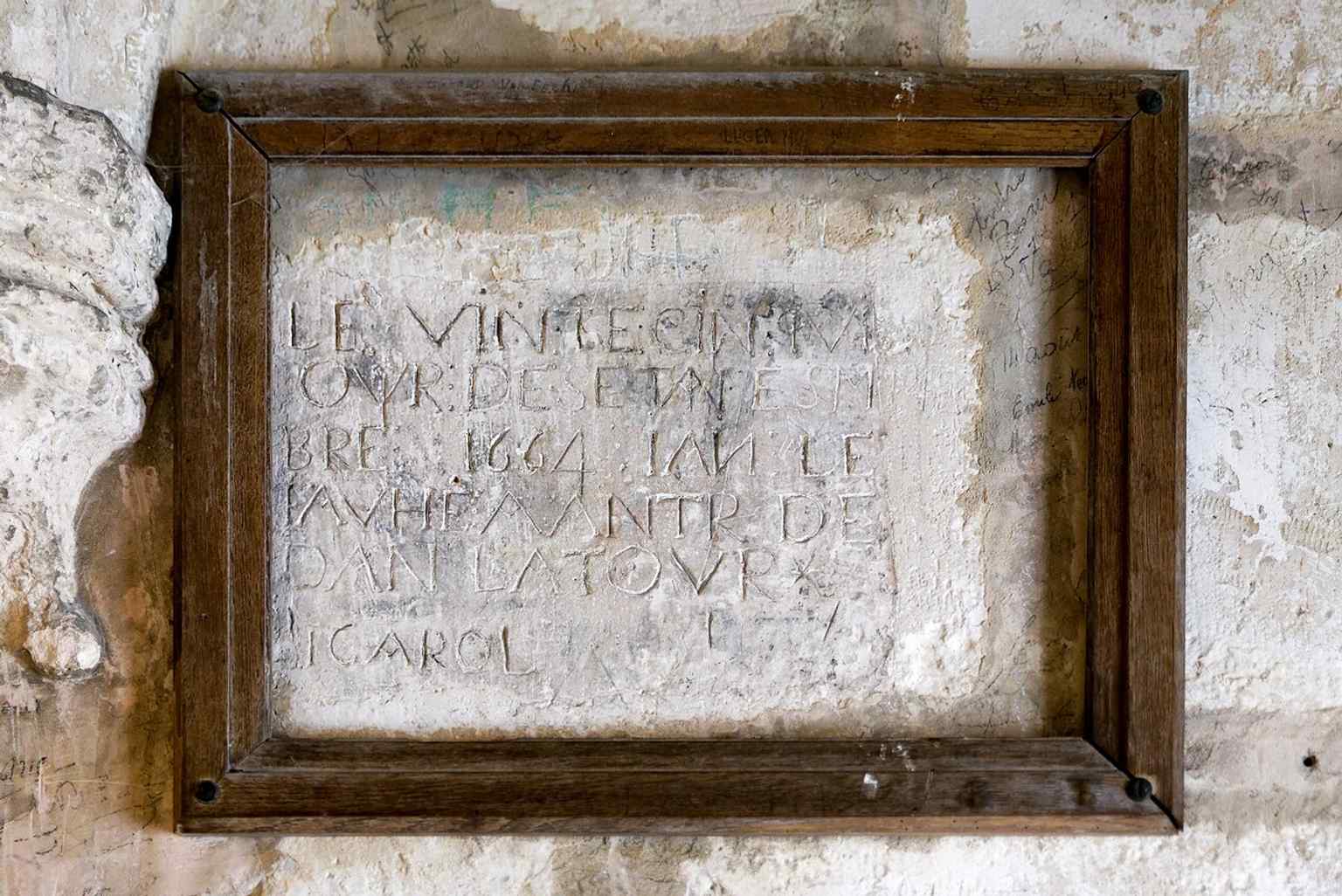
Traces of old graffiti on the tower walls — a small but vivid reminder that Saint Nicholas Tower was also used as a prison.Photo: François de Dijon, Wikimedia Commons, CC BY-SA 4.0. Cropped & resized. 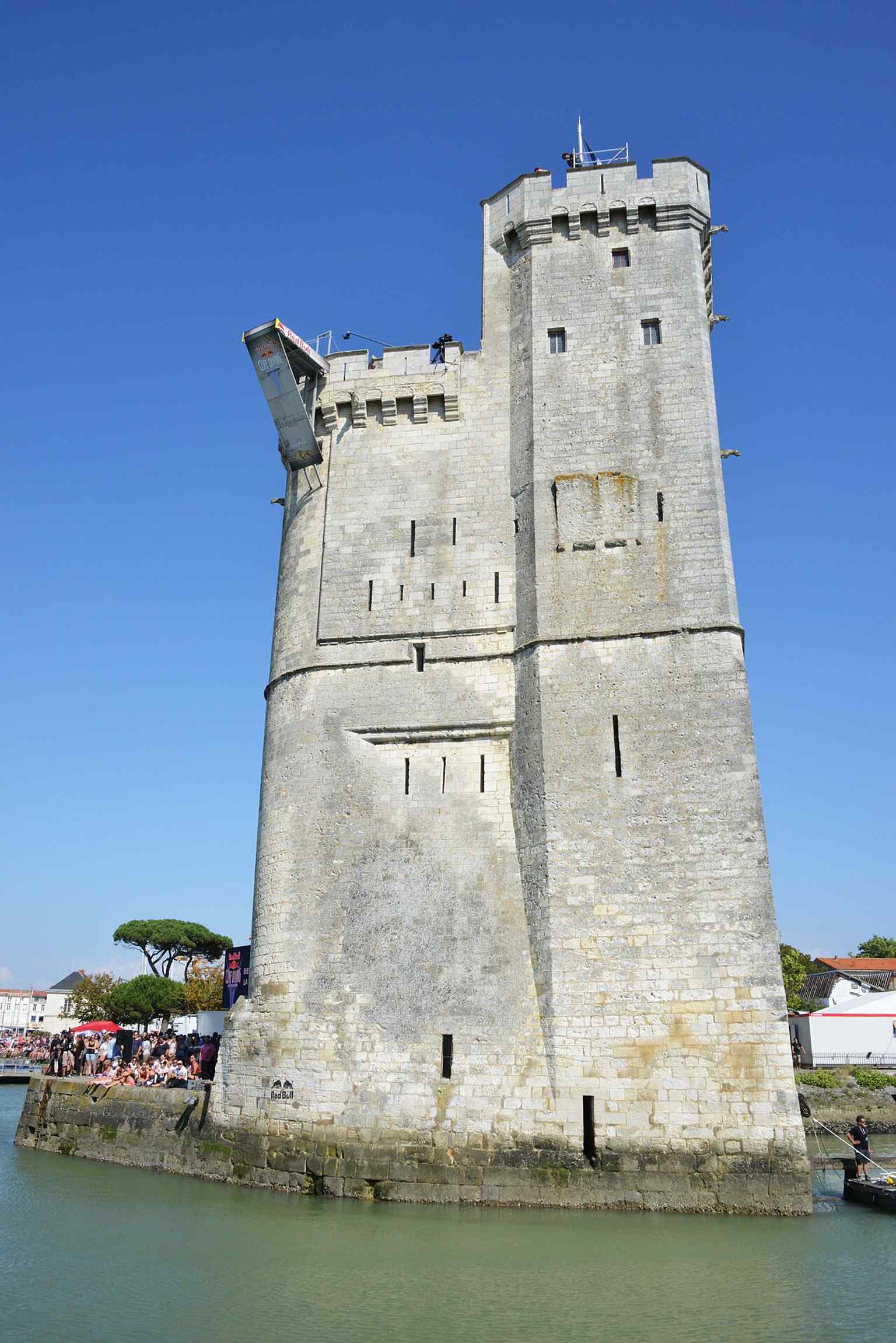
The tower with the Red Bull Cliff Diving platform installed, showing Saint Nicholas Tower’s surprising modern life as a sporting stage.Photo: Jean-Pierre Bazard Jpbazard, Wikimedia Commons, CC BY-SA 3.0. Cropped & resized. 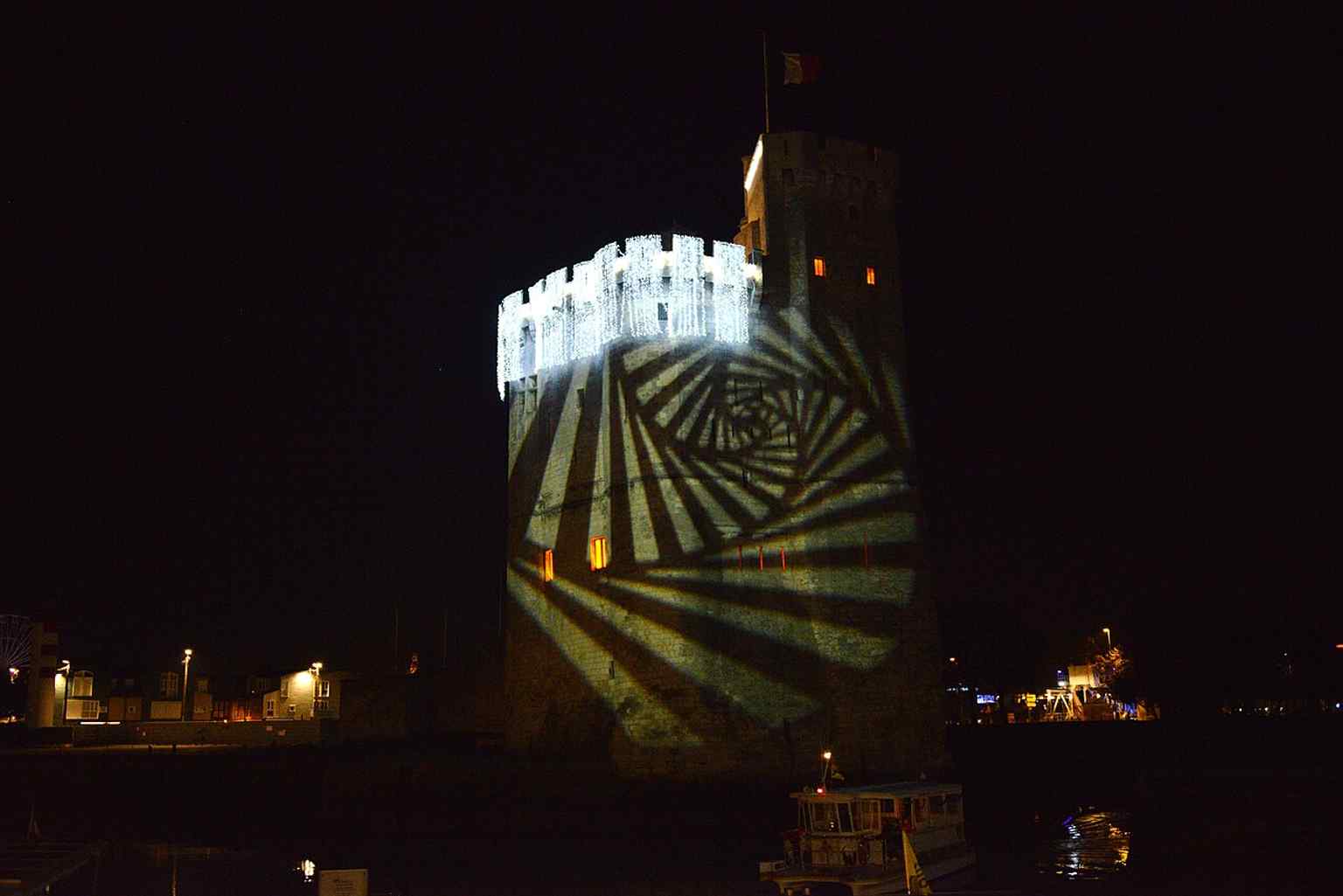
Saint Nicholas Tower illuminated for the year-end festivities, a contemporary night view that contrasts with its centuries of military use.Photo: Jean-Pierre Bazard Jpbazard, Wikimedia Commons, CC BY-SA 3.0. Cropped & resized.

Show 13 more stopsShow fewer stopsexpand_moreexpand_less
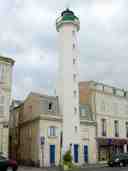
Look for a slim white-stone octagonal tower with a lantern on top, built right into the facade of a two-story house with a mansard roof. This little lighthouse is easy to…Read moreShow less
Open dedicated page →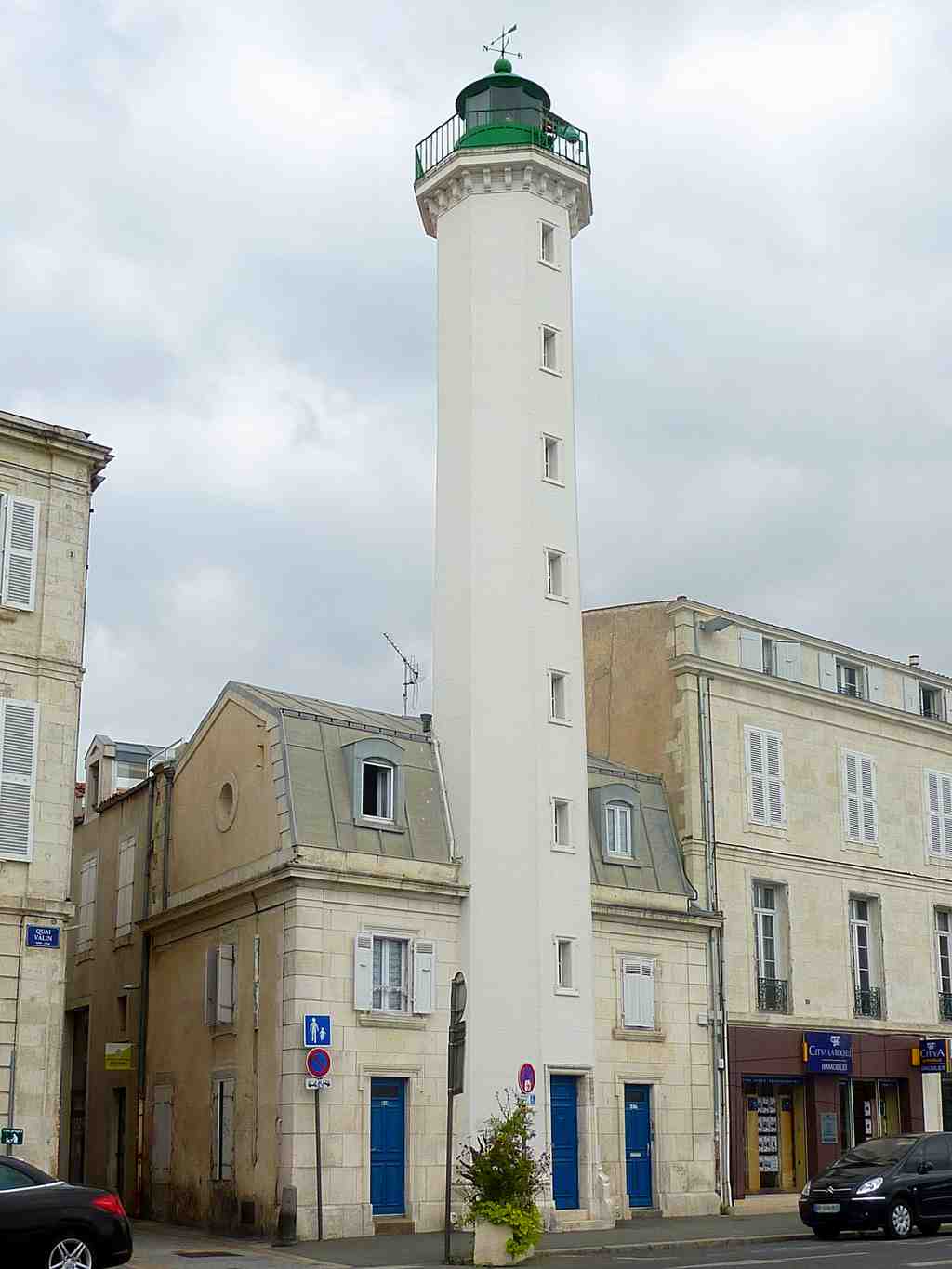
Phare du quai ValinPhoto: Patrick Despoix, Wikimedia Commons, CC BY-SA 3.0. Cropped & resized. Look for a slim white-stone octagonal tower with a lantern on top, built right into the facade of a two-story house with a mansard roof.
This little lighthouse is easy to miss... which is mildly ironic, since its entire job is to be noticed at exactly the right moment. The Phare du quai Valin stands at the edge of the yacht basin, one of the three basins of La Rochelle’s historic port, and it belongs to a system of guidance more precise than dramatic. An alignment light works in pairs: a sailor lines up one light with another, and when the two sit in the right visual line, the boat is on the safe course into harbor. If the lights drift apart, so has the boat. Simple in principle, unforgiving in practice.
Here, the local trick is to imagine its partner across the water. Most people stroll past and see a neat little urban lighthouse. Sailors saw a pair: the green Quai Valin beacon here and the red Gabut light near Saint Nicholas Tower. Together they marked the approach into the old port channel, the one framed by the Chain Tower and Saint Nicholas Tower. For a city that lived by trade, that kind of precision mattered as much as walls or cannons.
The name Valin carries its own kind of authority. René-Josué Valin was an eighteenth-century Rochelais jurist whose commentary on the Great Ordinance of the Navy of sixteen eighty-one made him a major authority on maritime law, which is why this spot honors not just navigation but the rules that made seafaring legible to courts, merchants, and captains alike.
La Rochelle had long relied on an earlier harbor light, a reminder that precise guidance has always mattered here. So in eighteen fifty-two, the city created this quieter, smarter pair of harbor lights. In eighteen fifty-five, workers raised this one higher so its white beam would not get lost among the city’s growing lights. In nineteen thirty-seven, engineers electrified it and gave it a white light with two occultations every six seconds - two brief disappearances, like a measured blink.
It still works, automated and unstaffed, with its optic set about twenty-three point three meters above the sea. No grand keeper, no museum staging, no theatrics... just accuracy.
And now we leave that world of measured movement for something sturdier on land: Saint-Sauveur, a church La Rochelle kept rebuilding whenever disaster tried to settle the argument.
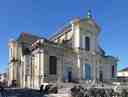
On your right, Saint-Sauveur appears as a pale stone church with a broad classical façade, four Corinthian columns, and a tall Gothic bell tower rising behind it. Saint-Sauveur…Read moreShow less
Open dedicated page →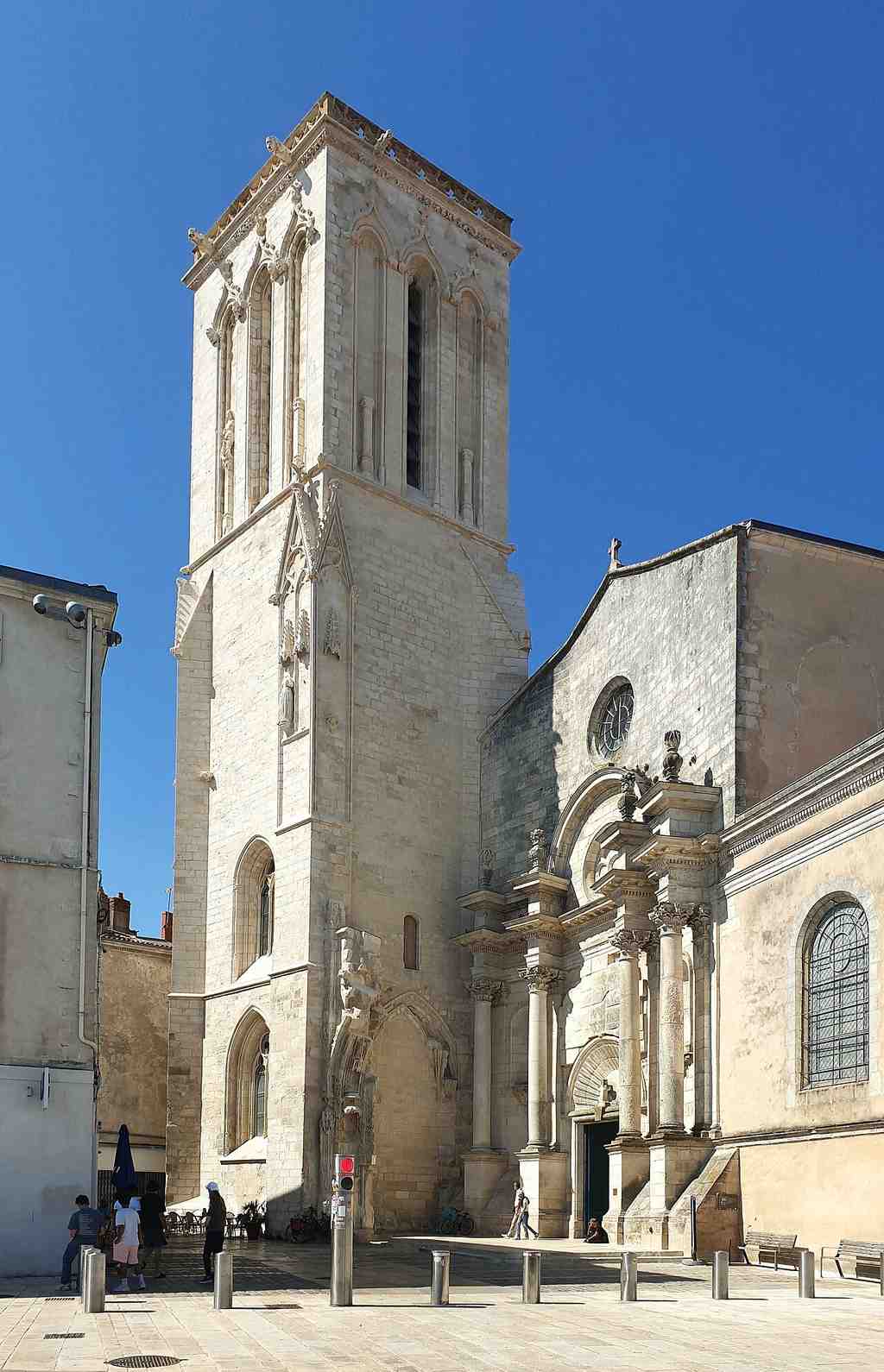
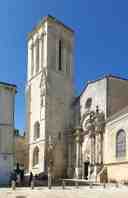
Saint-Sauveur Church in La RochellePhoto: Chris06, Wikimedia Commons, CC BY-SA 4.0. Cropped & resized. On your right, Saint-Sauveur appears as a pale stone church with a broad classical façade, four Corinthian columns, and a tall Gothic bell tower rising behind it.
Saint-Sauveur looks composed now, but this church has spent centuries being broken, patched, burned, rebuilt, and asked to carry on anyway. Monks from the Île d’Aix founded the first church here in eleven fifty-two after Pope Eugene the Third gave his approval, and it began life under another name: Sainte-Madeleine. In twelve seventeen, Bishop Ponce de Pons made it a parish, which meant this was not just a holy place, but part of the machinery of everyday city life.
That first building did not last. Fire destroyed it in fourteen nineteen. The town rebuilt it in flamboyant Gothic - the late medieval style with curling, flame-like stonework - and finished the porch in fourteen ninety-two. Contemporary writers admired it: lead on the roof, rich sculpture inside, even a colored burial scene carved by Michel Colombe. Near the port, it would have served sailors, traders, families, and people preparing to cross the Atlantic.
This is also where the Catholic-Protestant struggle in La Rochelle starts to feel personal. Before the city became famous for its Protestant identity, places like this anchored a firmly Catholic town. In fifteen sixty-one, Catholics and Protestants here even worked out a practical arrangement: they used the same church at different hours and, split the candle bill. Civilized, efficient... and not built to last.
On the ninth of January, fifteen sixty-eight, Mayor François Pontard raised the revolt against Catholics, jailed priests and opponents, and let crowds sack the churches. Then fear of siege pushed the city further: people needed stone for defenses, so they demolished most of Saint-Sauveur and hauled the rubble off to build the Bastion du Gabut. From that grand church, only the bell tower and bits of portal survived, mostly because the tower made a useful lookout and gun platform. If you glance at the app, image three shows that survivor clearly.
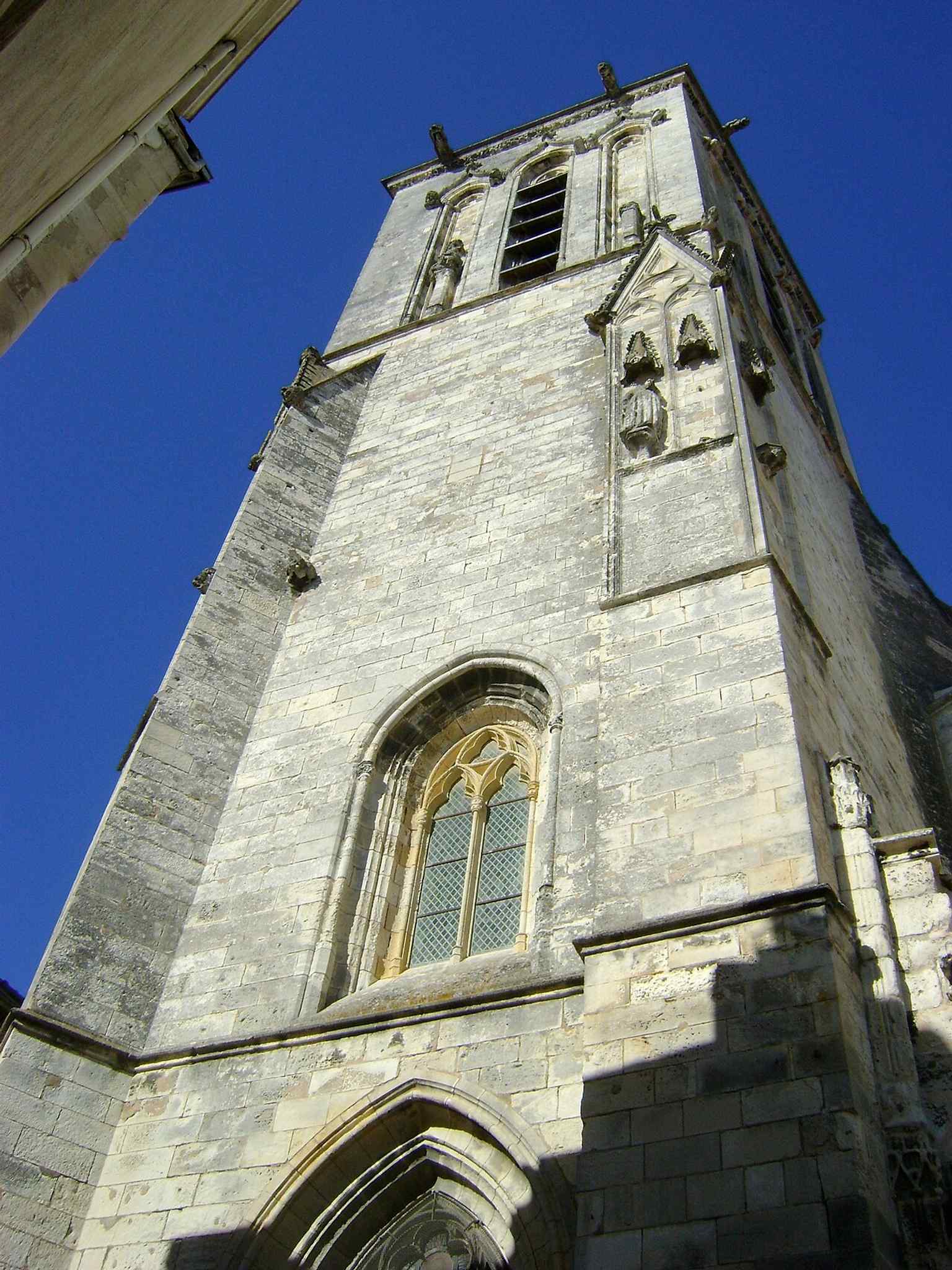
The bell tower, the main medieval survivor of the earlier churches, preserved even after the destruction and wartime use of the site.Photo: Guiguilacagouille, Wikimedia Commons, CC BY-SA 3.0. Cropped & resized. What followed was not one clean restoration, but a long argument with gravity and history. In sixteen thirty-three, with money short, the bishop allowed worship in a makeshift chapel inside the base of the tower. A new church rose from sixteen fifty-two to sixteen seventy-nine, then fire consumed it in seventeen oh five. So the building in front of you is really the fourth Saint-Sauveur, rebuilt from seventeen oh eight to seventeen eighteen, while keeping the entrance façade from sixteen seventy-nine.
Even the neighboring fabric got recycled. The old Maubec gate became part of the sacristy, and the historian Jaillot lived there and died there in seventeen forty-nine - which is a very La Rochelle arrangement, really: part fortress, part house, part church. During the Revolution, officials closed Saint-Sauveur and turned it into a naval food store. Later, the structure kept shifting and cracking. In nineteen ninety-five, after a falling stone nearly hit the beadle, the city finally launched the massive restoration that reopened the church in two thousand and eight. If you check the interior view on your screen, image eleven gives you the result: a restored central hall, rebuilt vaults, and a church that survived by accepting reinvention.
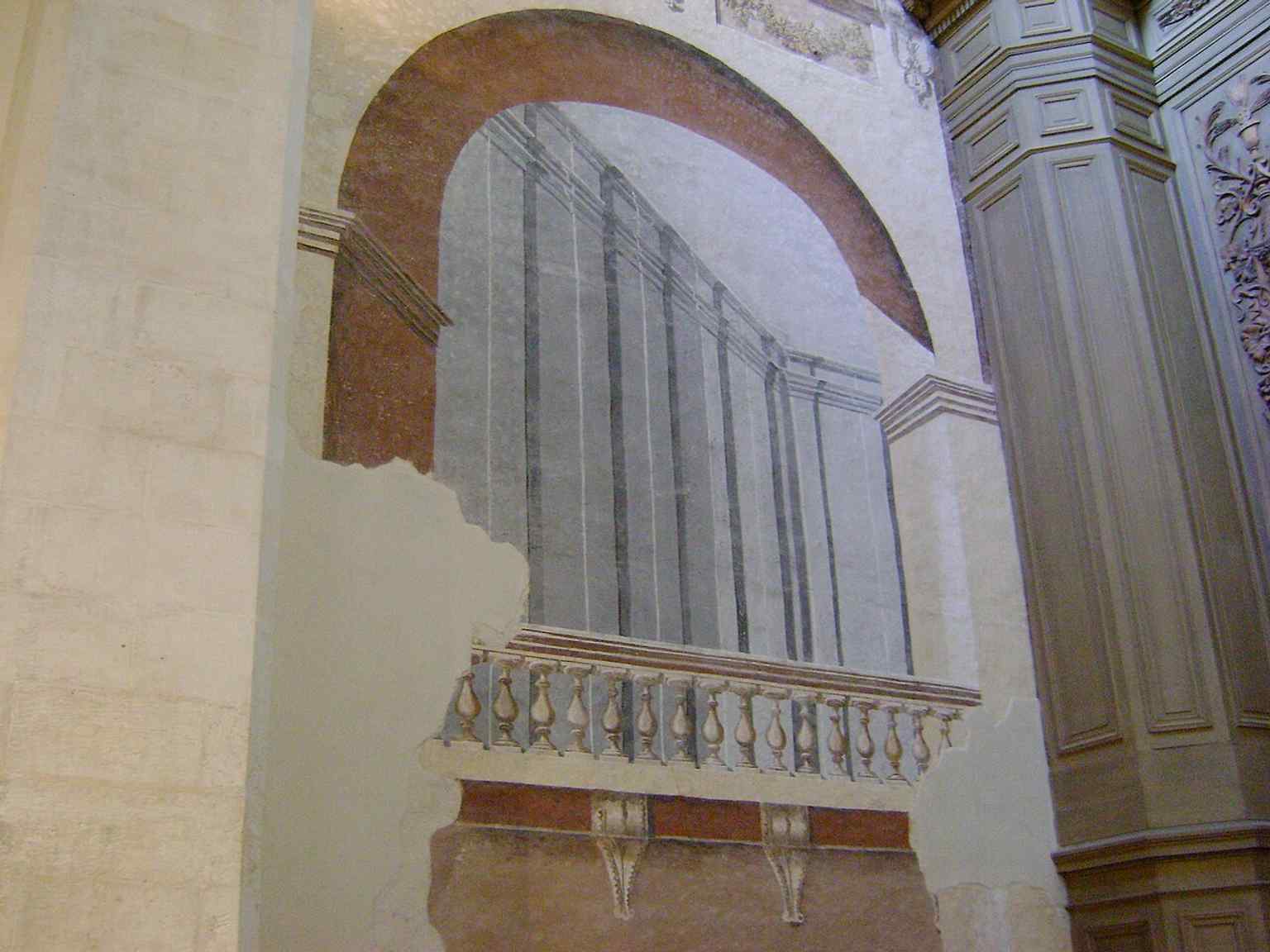
An interior perspective that conveys the church’s three-nave layout and the feeling of a restored but historically layered space.Photo: Guiguilacagouille, Wikimedia Commons, CC BY-SA 3.0. Cropped & resized. In a moment, we head to the Protestant temple, where the city’s religious balance tips much more openly. If you want to return inside later, Saint-Sauveur is generally closed on Monday, open Tuesday through Saturday from ten to twelve thirty and two thirty to six, and on Sunday from four to seven.
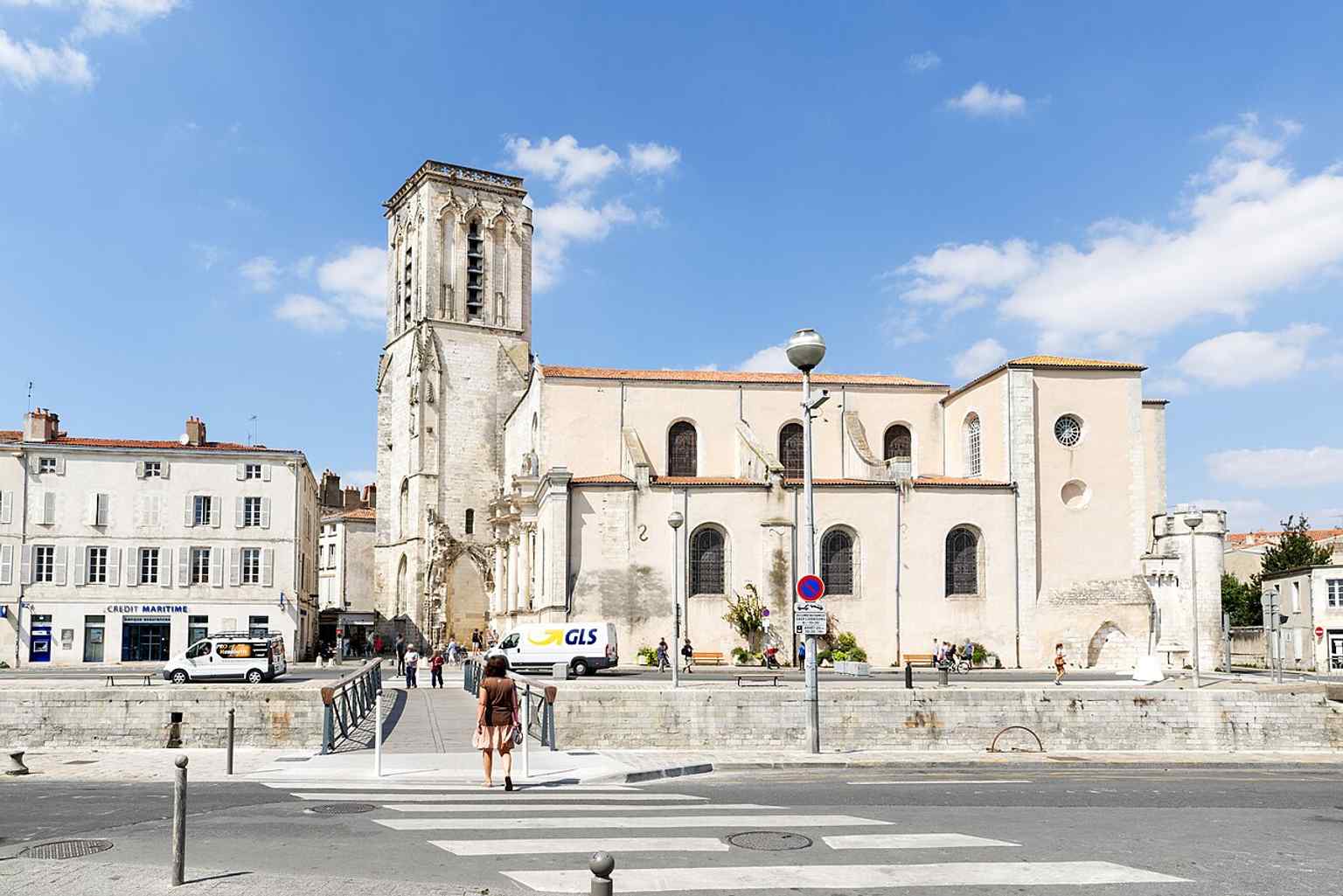
A crisp modern view of Saint-Sauveur’s façade, showing the church after its long restoration campaign that reopened the building in 2008.Photo: François de Dijon, Wikimedia Commons, CC BY-SA 4.0. Cropped & resized. 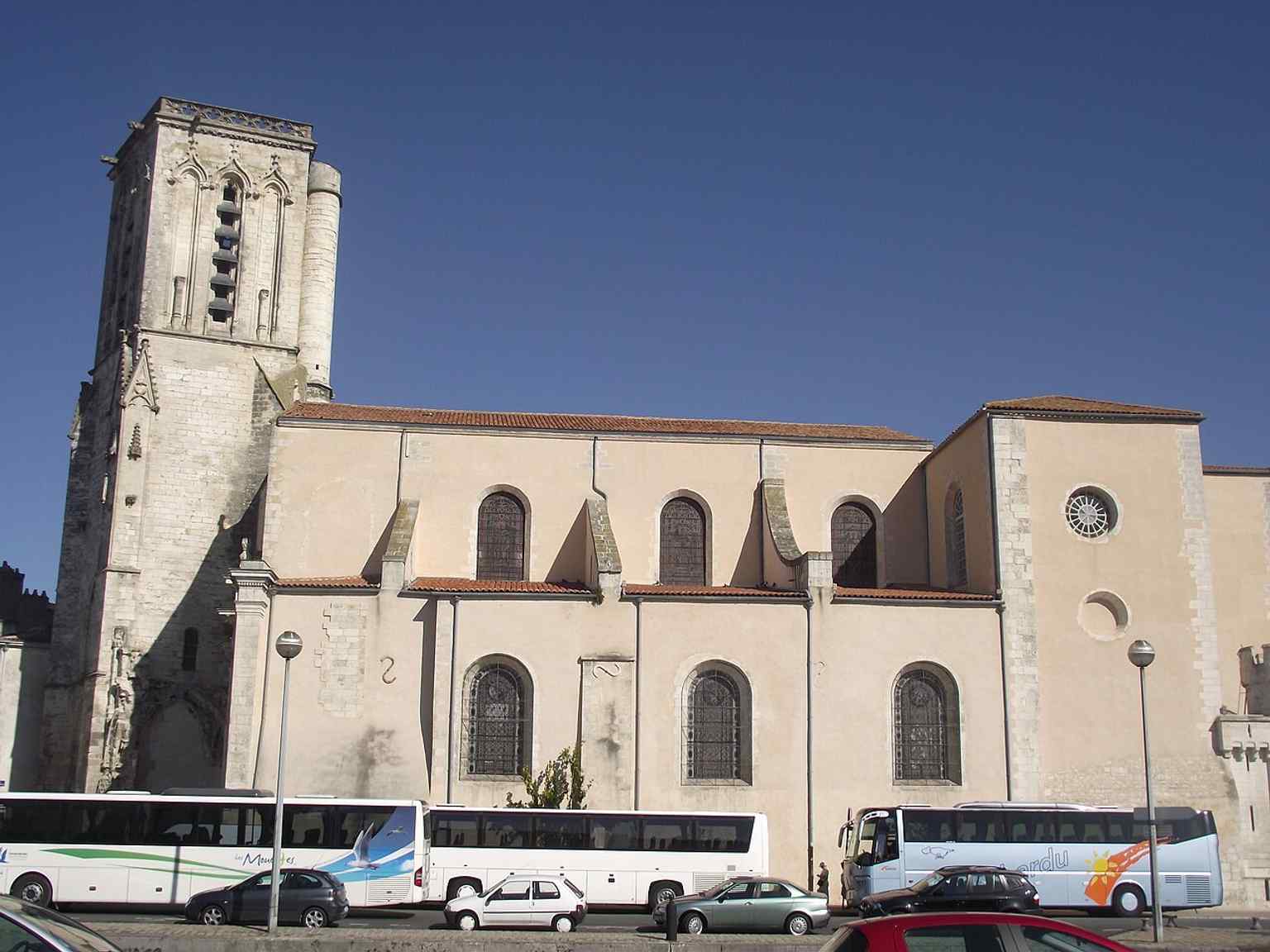
A wide exterior shot that captures the church’s tucked-away setting near the Old Port, as described in the tour text.Photo: Pichasso, Wikimedia Commons, CC BY-SA 3.0. Cropped & resized. 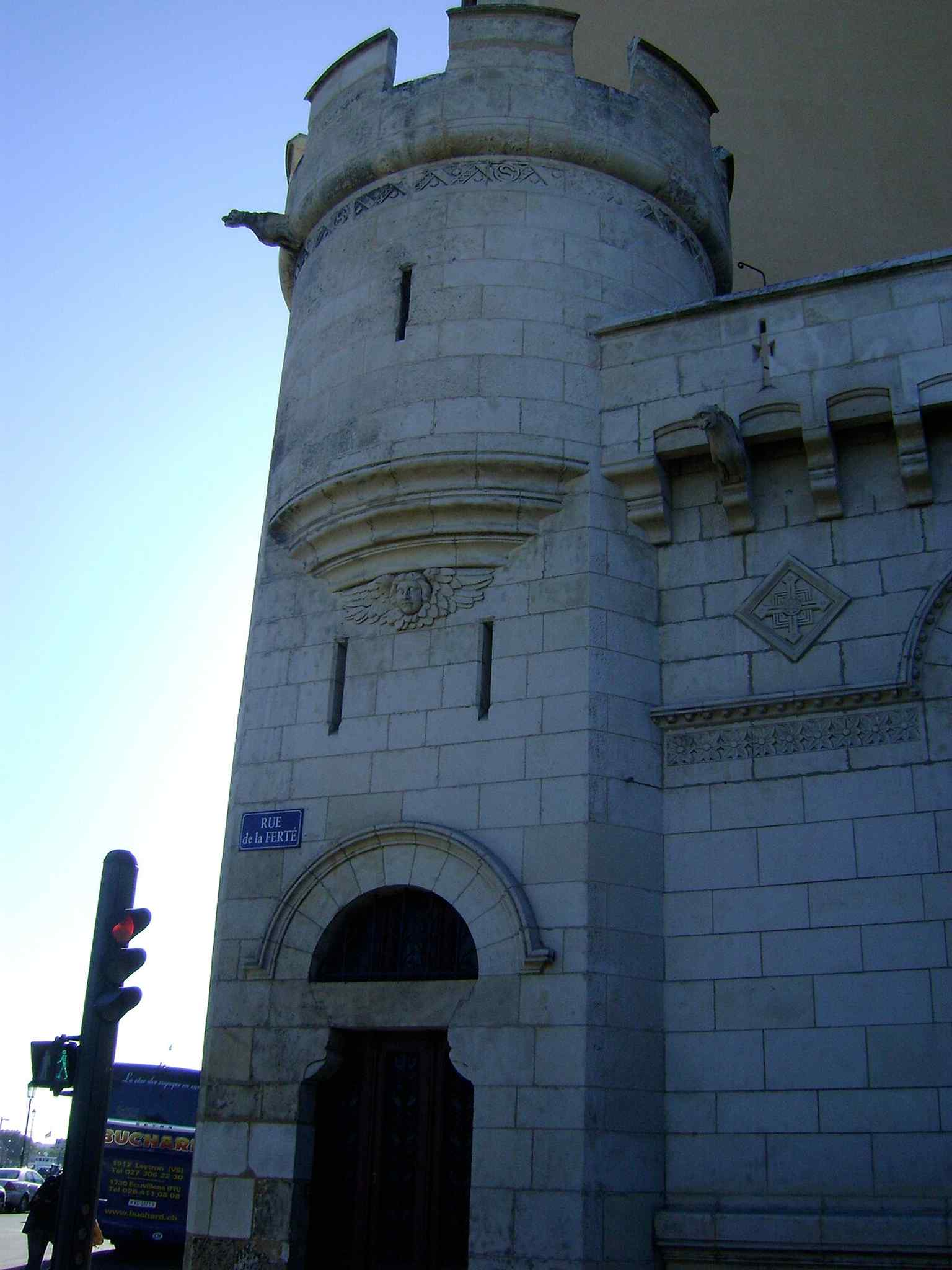
The small exterior turret recalls the layered rebuilding of Saint-Sauveur, where later additions had to fit around older masonry.Photo: Guiguilacagouille, Wikimedia Commons, CC BY-SA 3.0. Cropped & resized. 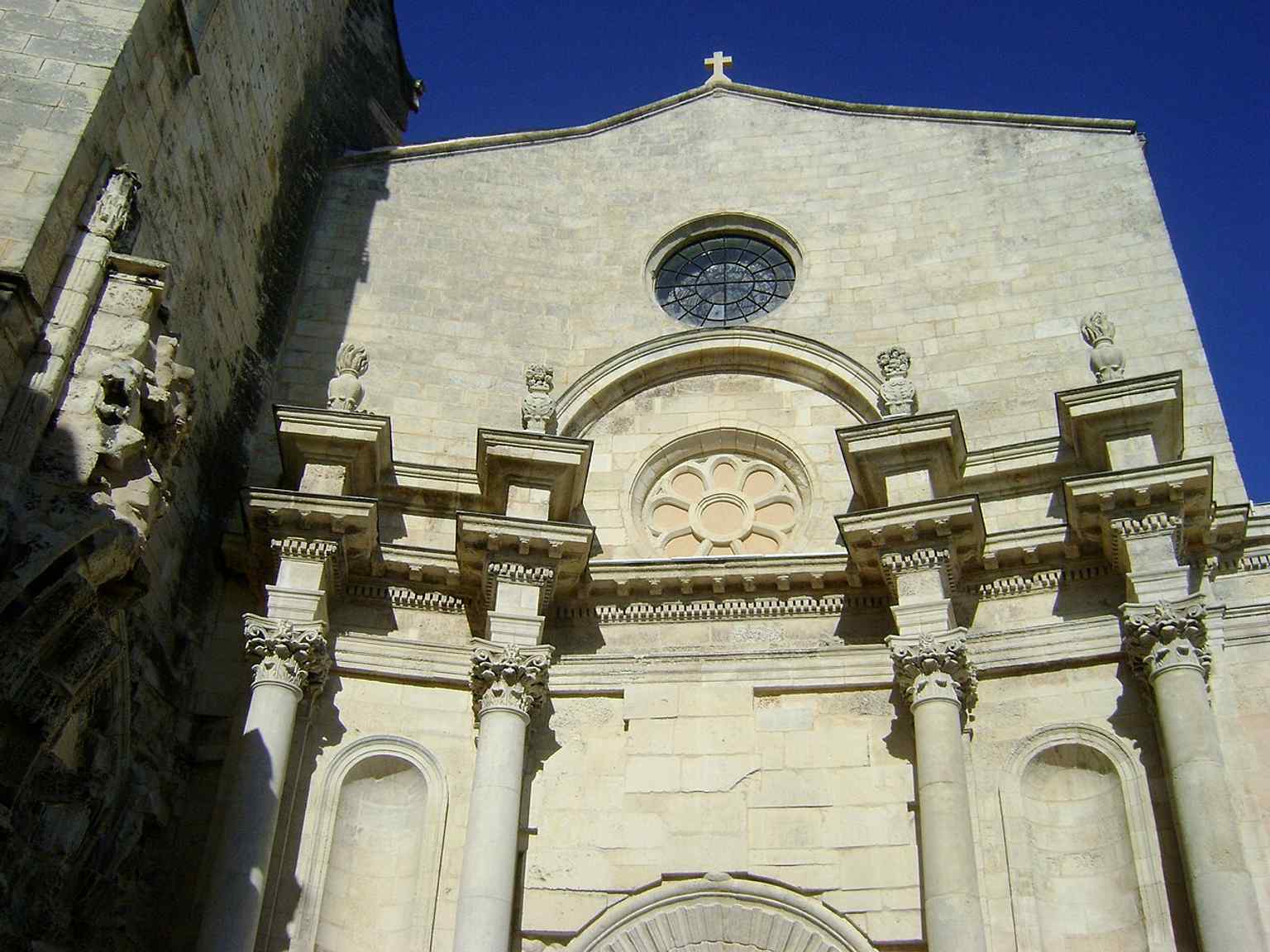
The main entrance portal, a key architectural feature from the church’s post-fire rebuilding in the late 17th century.Photo: Guiguilacagouille, Wikimedia Commons, CC BY-SA 3.0. Cropped & resized. 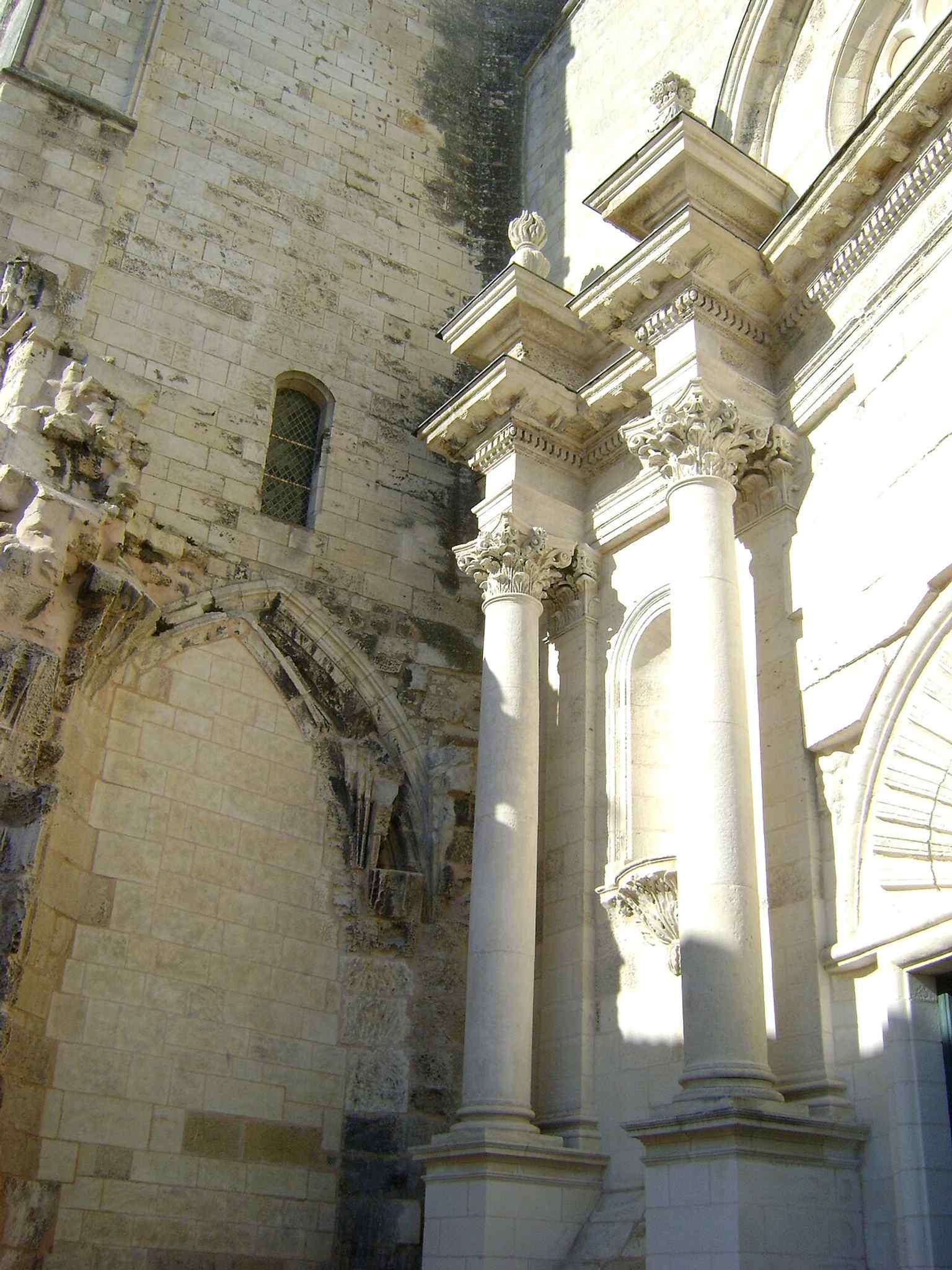
A close-up of the portal’s sculpted stonework, ideal for highlighting the church’s ornate historical façade.Photo: Guiguilacagouille, Wikimedia Commons, CC BY-SA 3.0. Cropped & resized. 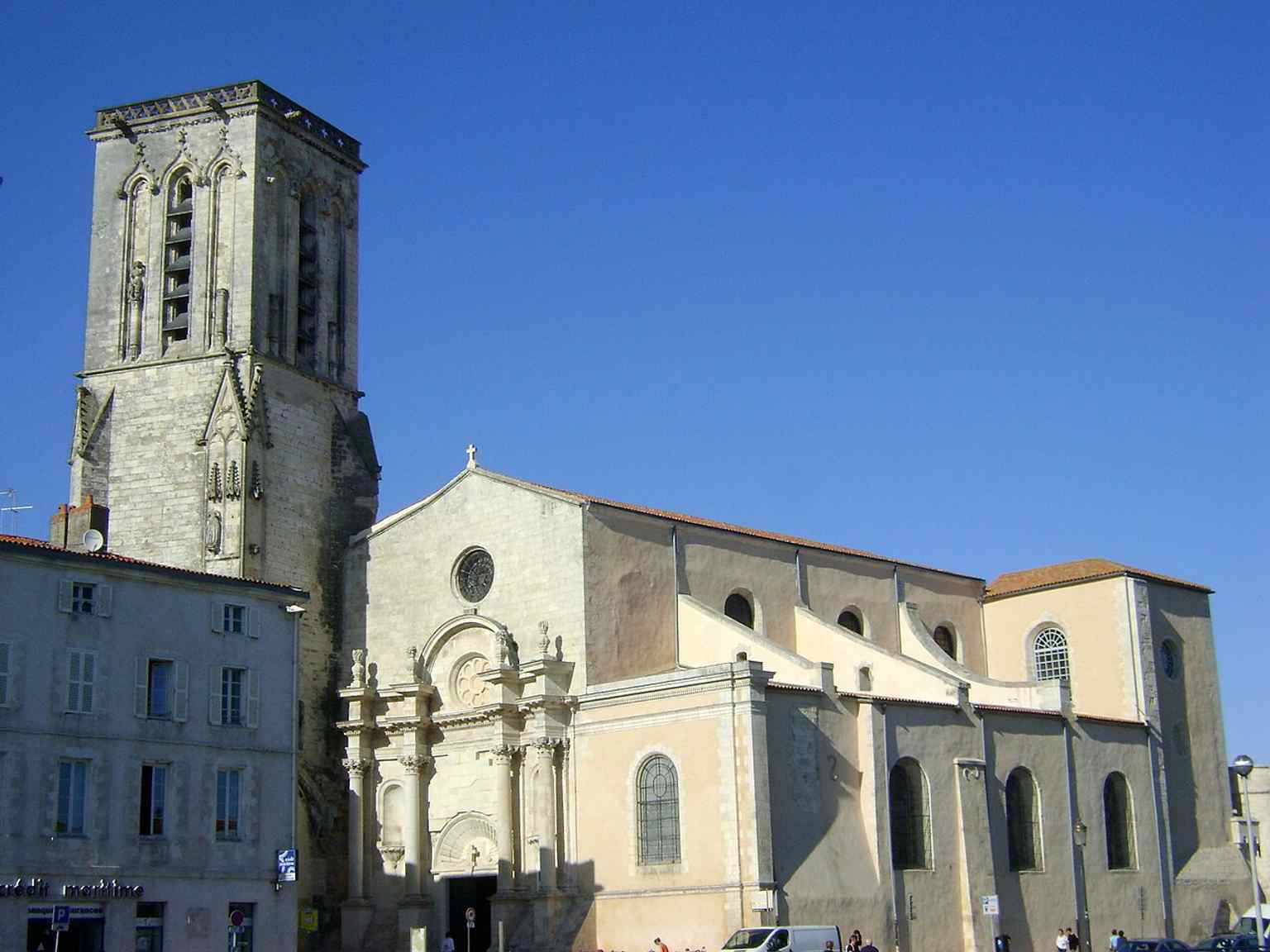
A broader façade view that helps show the church as a substantial urban landmark, even though it sits slightly set back from the street.Photo: Guiguilacagouille, Wikimedia Commons, CC BY-SA 3.0. Cropped & resized. 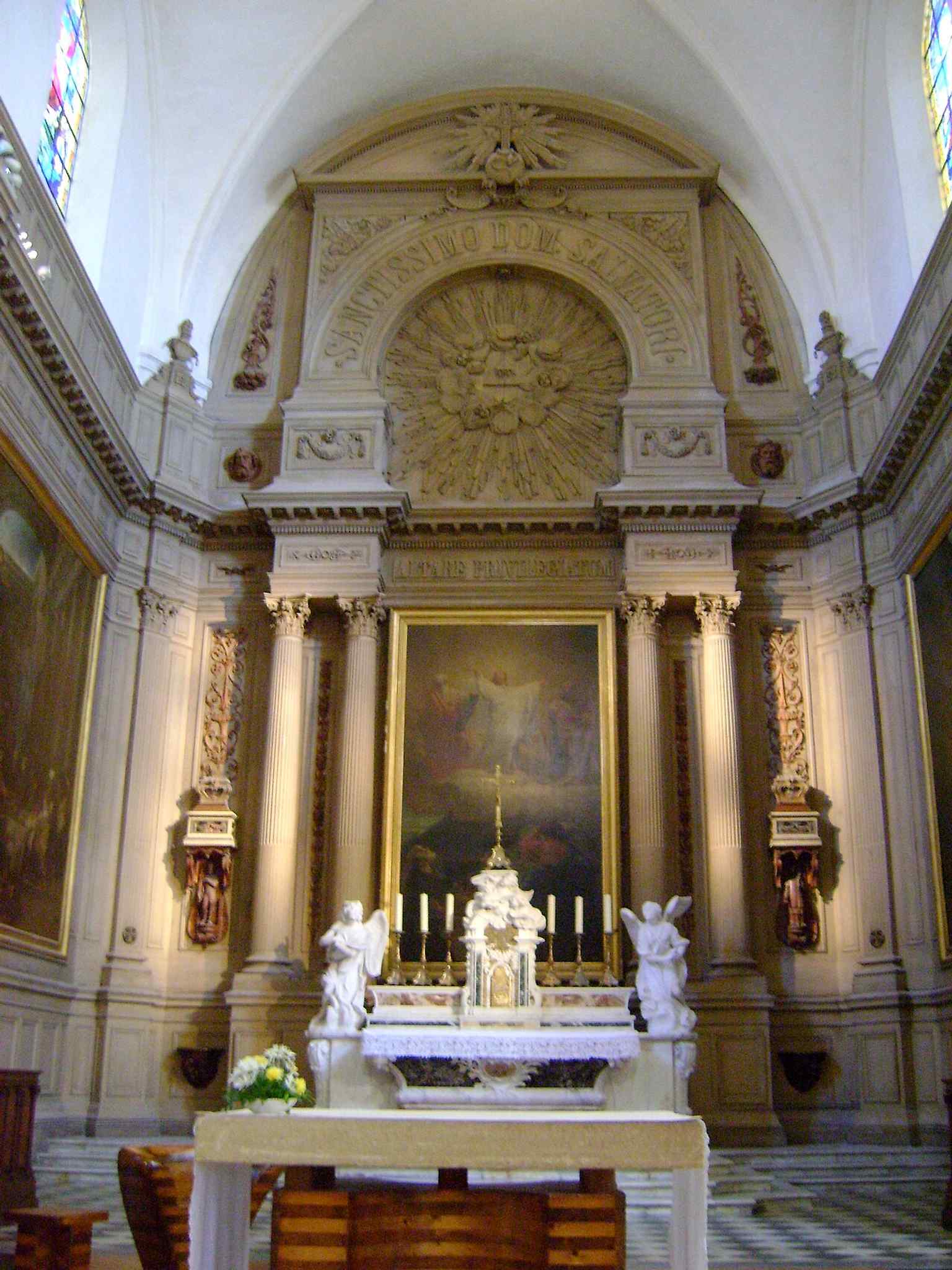
The chancel with its altar area, where the church’s restored interior hosts major artworks and liturgical furnishings.Photo: Guiguilacagouille, Wikimedia Commons, CC BY-SA 3.0. Cropped & resized. 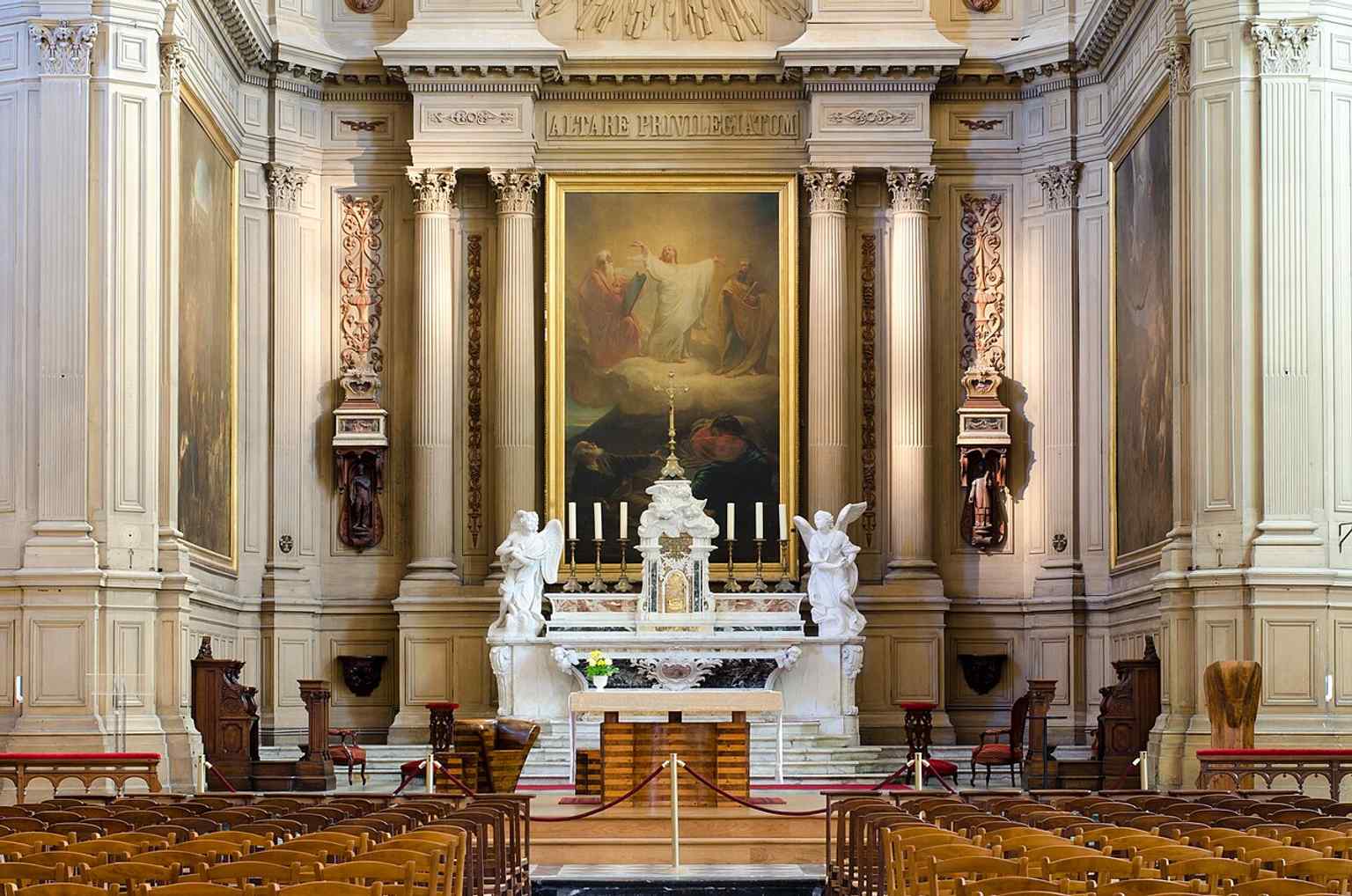
A clear view into the choir, where the 18th-century marble high altar and later paintings anchor the church’s interior history.Photo: Arseni Mourzenko, Wikimedia Commons, CC BY-SA 3.0. Cropped & resized. 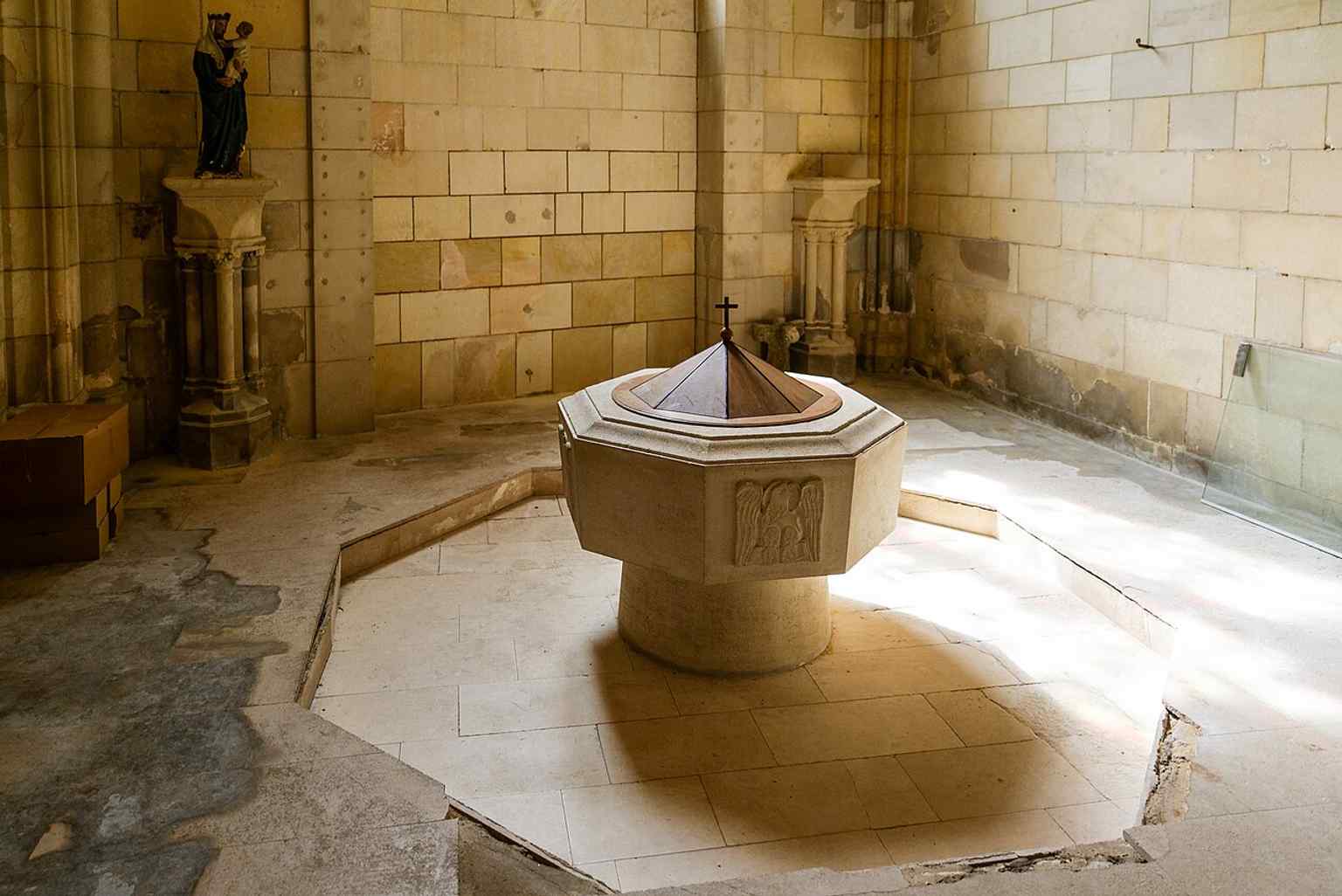
The baptismal fonts in the tower base, matching the source’s description of the clocher’s ground floor as the baptismal space.Photo: François de Dijon, Wikimedia Commons, CC BY-SA 4.0. Cropped & resized. 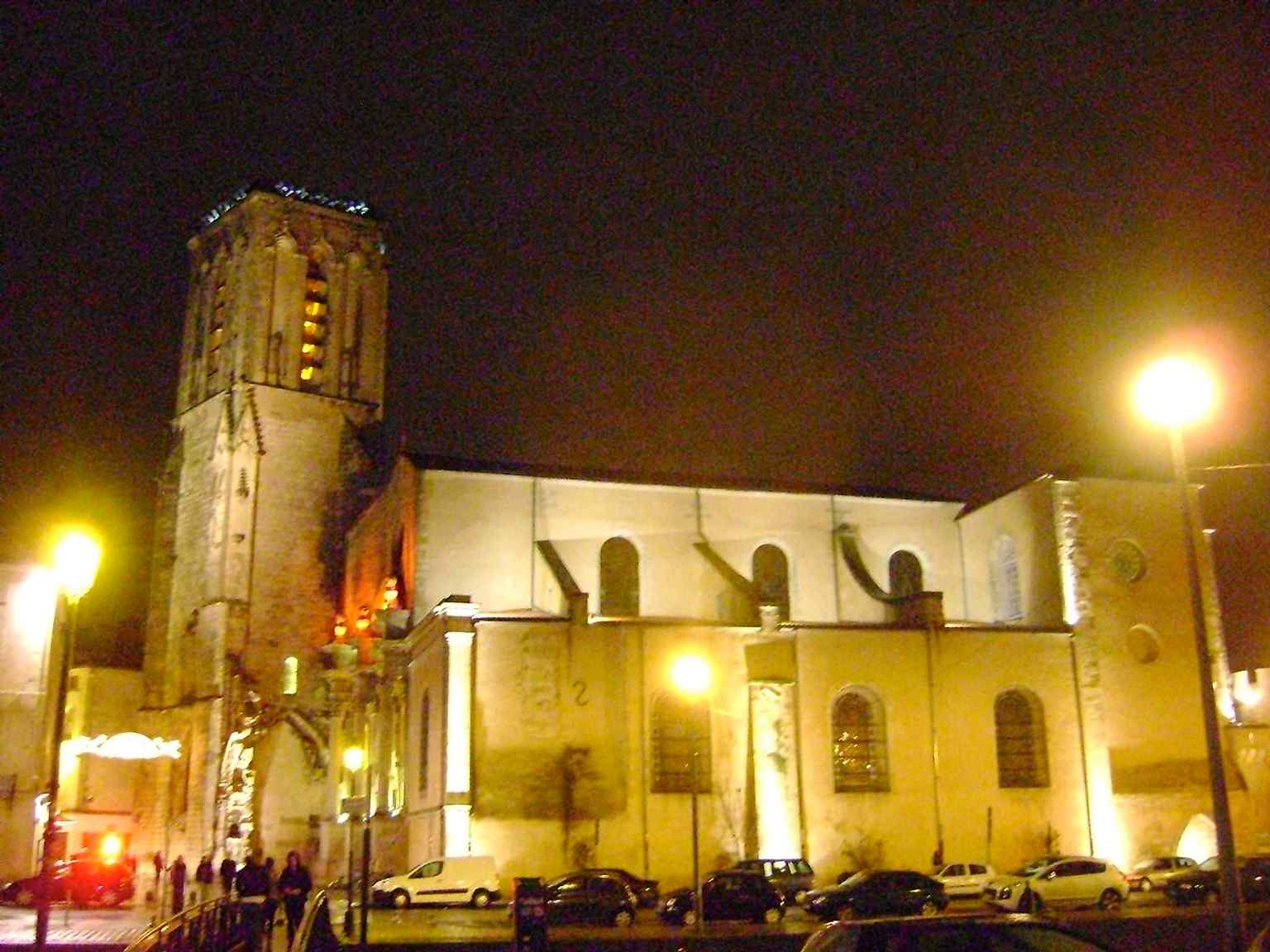
Night view of Saint-Sauveur, useful for the church’s more recent life and its renewed presence in the city after restoration.Photo: Guiguilacagouille, Wikimedia Commons, CC BY-SA 3.0. Cropped & resized. 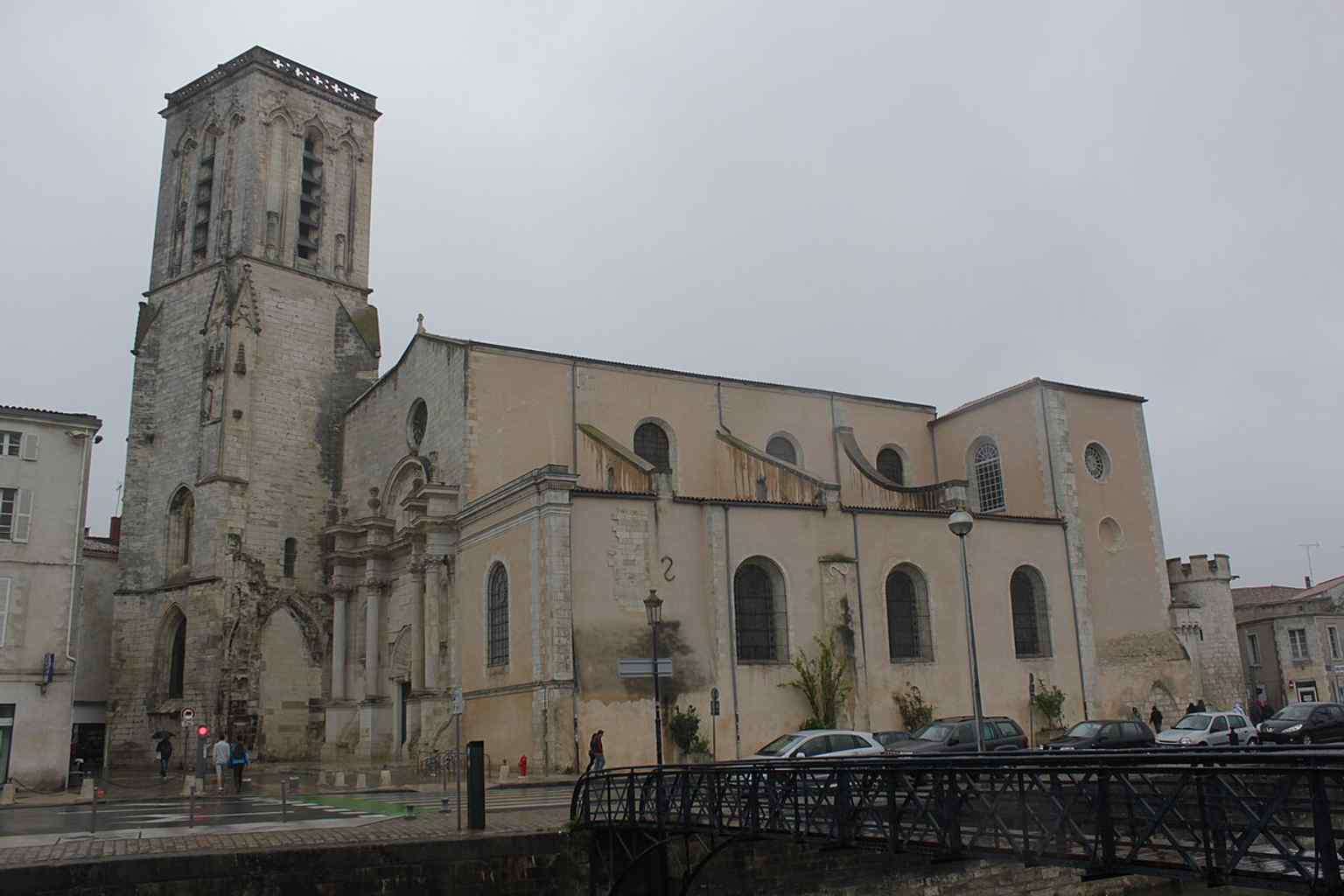
A historical view of the church when it was still identified as Saint-Sauveur-Sainte-Madeleine, before later rebuilding and restoration phases.Photo: Llann Wé², Wikimedia Commons, CC BY-SA 3.0. Cropped & resized. 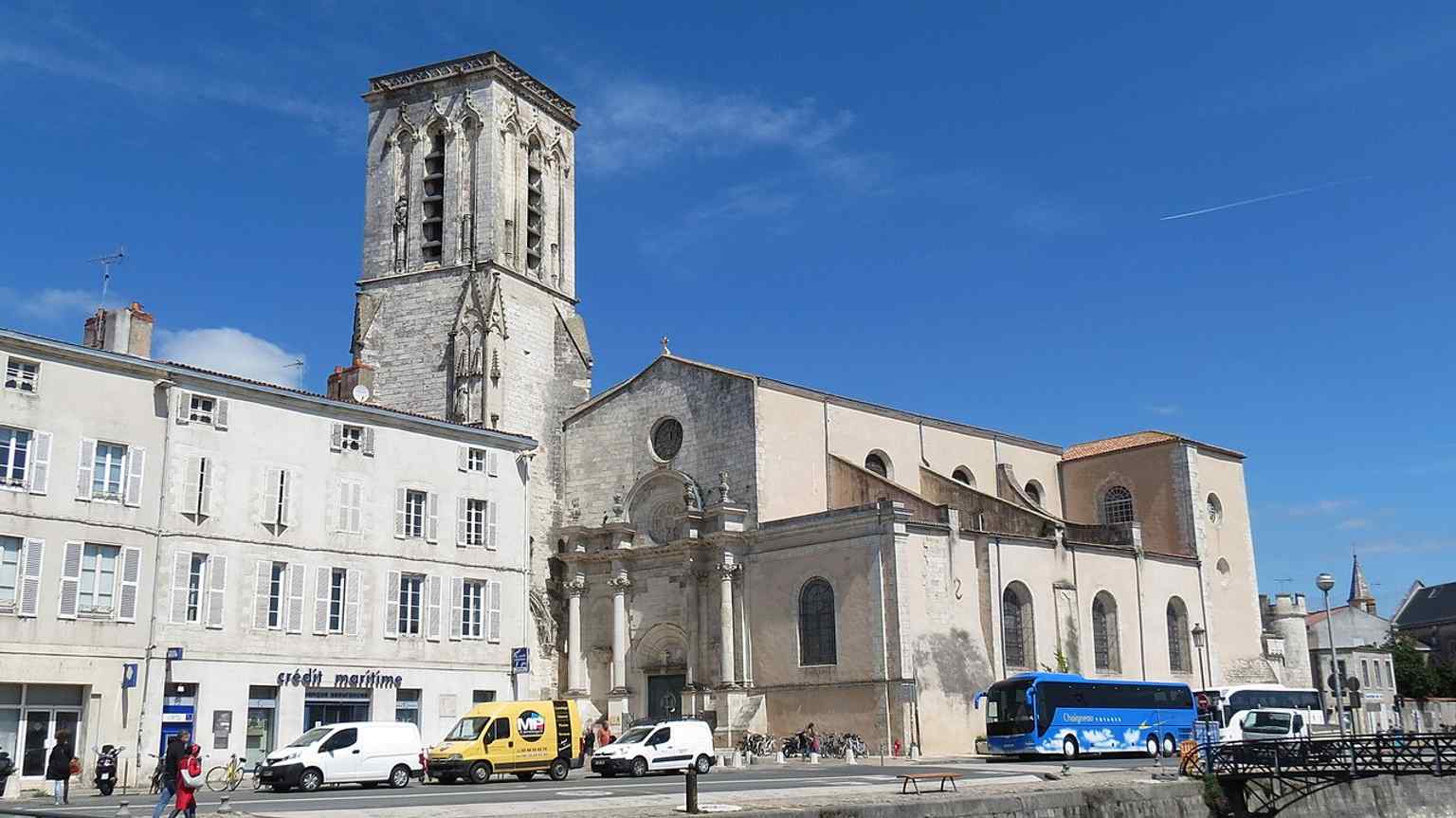
A documentary-style view that shows the church in its urban context, useful for explaining its relationship to the old harbor district.Photo: Johan Allard, Wikimedia Commons, CC BY-SA 4.0. Cropped & resized. On your right, look for a pale stone facade with a central arched doorway, a tall gabled front, and two empty niches set beneath a carved garland. This place carries one of La…Read moreShow less
Open dedicated page →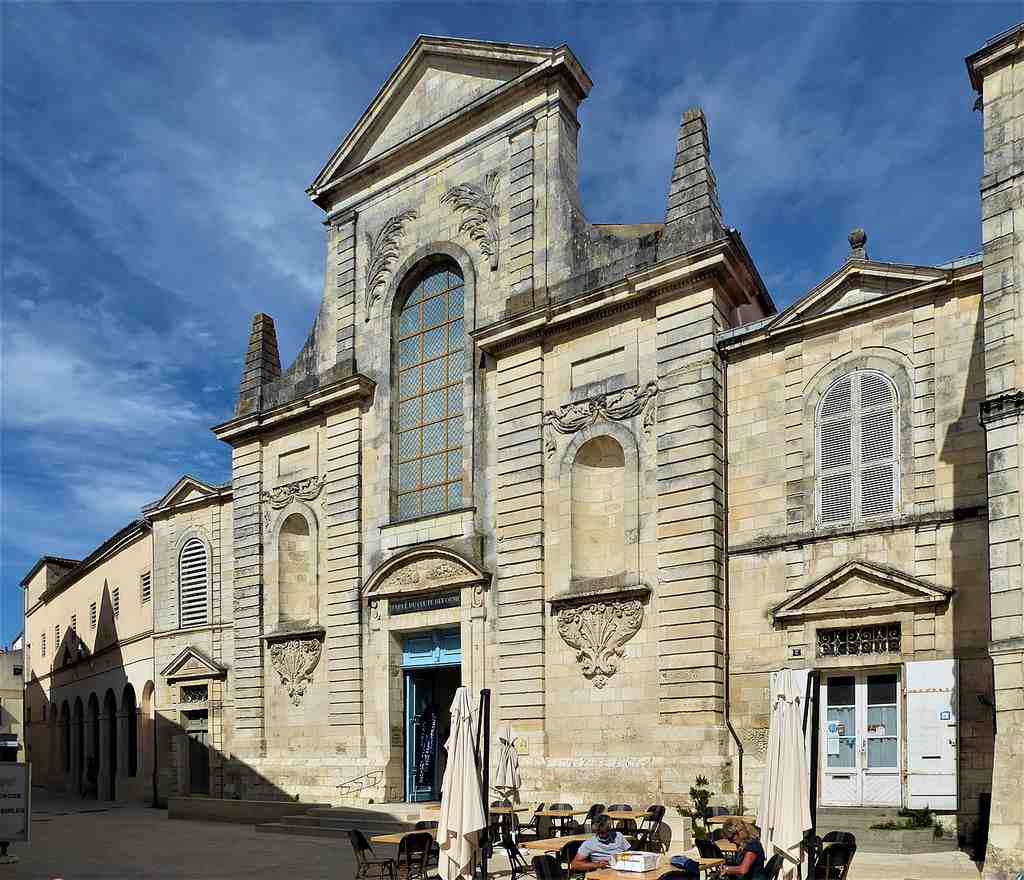
Temple protestant de La RochellePhoto: Chris06, Wikimedia Commons, CC BY-SA 4.0. Cropped & resized. On your right, look for a pale stone facade with a central arched doorway, a tall gabled front, and two empty niches set beneath a carved garland.
This place carries one of La Rochelle’s sharpest reversals. La Rochelle’s Protestant community was not a tiny fringe group meeting in borrowed corners. It was numerous, organized, and deeply woven into the city’s public life. By fifteen forty-six, the Reformation had already taken hold here, and in fifteen sixty-one Protestants opened La Rochelle’s first public worship hall on this very street.
That first room filled fast. Another hall, Gargoulleau, had to share the load, and between fifteen sixty-three and fifteen sixty-six it recorded one thousand six hundred and fifty-nine baptisms. That is not a footnote. That is a city changing its mind in public. La Rochelle became one of the major Protestant strongholds of France, and when the Edict of Nantes recognized certain Protestant rights in fifteen ninety-eight, the city stood as a protected stronghold, with several places of worship, including the Grand Temple, dedicated in sixteen oh three.
If Saint-Sauveur hinted at the Catholic answer to all this, here you are standing in the middle of the other half of the struggle.
After the blockade and surrender of sixteen twenty-eight, royal authorities moved quickly. The site went to Catholic orders, and Father Joseph celebrated mass here in front of the king. The shift was not abstract. Madame de Rohan, one of the great Protestant figures of the city, and her daughter Anne were taken away under guard to Niort and kept there until June of sixteen twenty-nine. A building changed hands, and so did lives.
What you see now mostly comes from the Catholic rebuilding that followed. The Recollect friars settled here, and in sixteen ninety-one they added a cloister and church. The facade still speaks the language of the Counter-Reformation, the Catholic effort to win hearts back after Protestant expansion: decorative palms, rich stone brackets, and those two niches, now empty, as if the statues stepped out and never returned. If you glance at the image on your screen, the facade’s formal, almost theatrical balance is easier to read there.
Then came another blow. In sixteen eighty-five, Louis the Fourteenth revoked the Edict of Nantes, and Protestants lost their legal places of worship. Many Huguenots, French Protestants, left La Rochelle for Holland, Germany, England, and the Atlantic world. Some eventually helped found New Rochelle near New York. By eighteen oh two, only about a thousand Protestants remained in the city.
And still, they found a way back. In seventeen ninety-three, a merchant named Sieur Ranson bought this confiscated former church on behalf of Protestant families. Efficient... though not immediate. The building still served as a meeting hall for the local Jacobins, the Revolution’s political club, until seventeen ninety-eight. Only then did it fully return to Reformed worship. Later, Protestants reshaped the interior again, adding woodwork, a pulpit, and eventually the large organ that still gives the place its voice.
So here is the question this facade leaves hanging: what happens when a whole city ties its faith to its identity, and then loses that fight?
Because belief alone never tells the full story in La Rochelle. Trade routes, exile, and the wider Atlantic were reshaping this city too. The Museum of the New World, about a four-minute walk from here, picks up that thread.
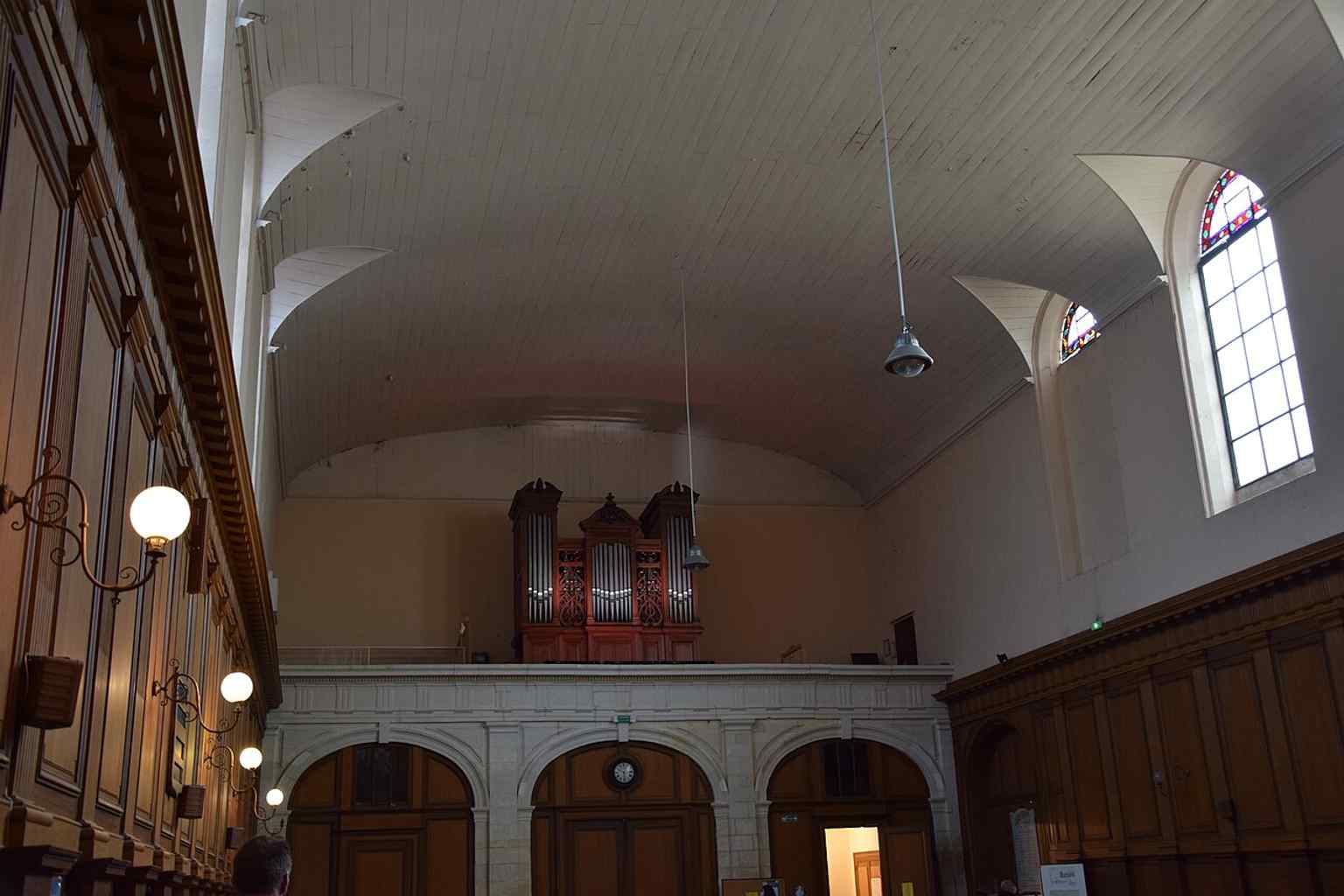
A clear modern view of the Protestant temple, showing the historic building still in use on Rue Saint-Michel.Photo: Chatsam, Wikimedia Commons, CC BY-SA 4.0. Cropped & resized. On your right is a pale stone town house with a tall arched gateway, a balanced central block, and side wings that fold inward around a private courtyard. This is the Museum of…Read moreShow less
Open dedicated page →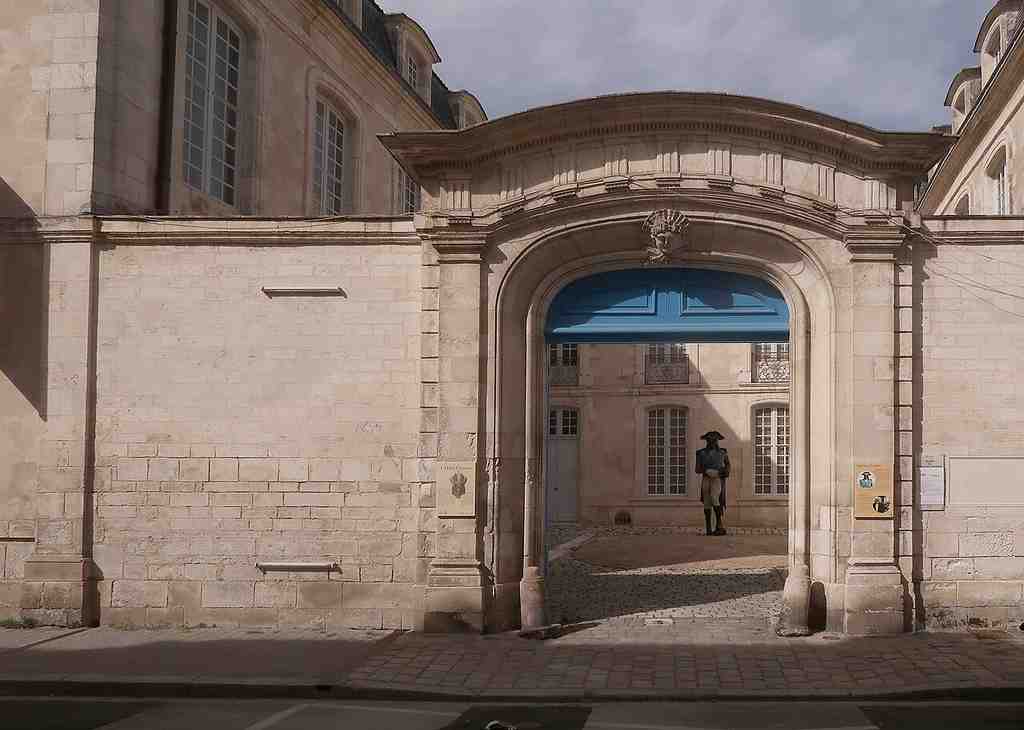
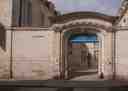
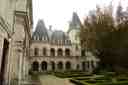
Museum of the New WorldPhoto: Ismoon, Wikimedia Commons, CC BY-SA 4.0. Cropped & resized. On your right is a pale stone town house with a tall arched gateway, a balanced central block, and side wings that fold inward around a private courtyard.
This is the Museum of the New World, housed inside the Hôtel de Fleuriau... an elegant eighteenth-century mansion with a story that refuses to stay elegant. La Rochelle made some of its fortune by looking far beyond France, across the Atlantic to New France, the Caribbean, and the growing worlds of trade, migration, and empire. The sea carried ships, goods, ideas, and ambition... and, just as surely, it carried coercion, extraction, and human suffering.
The man tied most closely to this address is Aimé-Benjamin Fleuriau. He returned to La Rochelle in seventeen fifty-five after making his fortune in Saint-Domingue, today’s Haiti, where he owned the Fleuriau plantation near Port-au-Prince: sugar cane fields, a sugar refinery, and enslaved people forced to make the whole machine run. In seventeen seventy-two he bought this mansion. Around seventeen eighty, he bought the neighboring property and expanded the house toward the garden, cutting new doorways from floor to floor so the old residence and the new addition worked as one. Even the architecture tells on him. The larger house is not just taste... it is profit turned into stone.
That matters because this museum does not pretend those profits were abstract. When La Rochelle opened it here in nineteen eighty-two, under mayor Michel Crépeau, with conservator Alain Parent shaping the project, it became one of the first museums in a French port city to directly address that port’s slave-trading past. Most tourists notice the symmetry first. Locals will tell you the bolder detail is inside the story the museum chose to tell: this house came from the same Atlantic system it now examines, and accuses.
That is the moral hinge of the place. Cities love polished versions of themselves. This one, to its credit, left some of the polish off. Inside, the galleries trace the “New World” from several angles: discovery and exploration on the ground floor; La Rochelle and the Antilles on the mezzanine level, including the slave trade, colonial goods, and the abolitions of slavery; then New France, the American War of Independence, Plains peoples, the rush to California, and photographs of Native American communities by Edward S. Curtis. In other words, not a souvenir shop with better lighting.
There is another layer here too: exchange. The Americas changed Europe’s imagination as much as Europe changed the Americas, and not for the better in every case. The museum’s paintings, maps, engravings, and decorative arts show fascination, greed, admiration, fantasy, and violence all mixed together... which is a very human recipe, unfortunately.
And here is the part worth carrying with you: La Rochelle’s pride in its maritime reach cannot be separated from the people whose labor paid for that reach. This museum says that plainly. It widens the city’s horizon, but it also sharpens its conscience.
From here, the route turns toward Saint-Louis Cathedral, about a three-minute walk away, where stone and ceremony will show how the city tried to impose a different kind of order after so much conflict. If you plan to come back inside, the museum is usually open most days except Tuesday, with a midday closure.
On your left, Saint-Louis Cathedral stands out as a broad stone church with a severe triangular pediment, tall paired columns, and, beside it, the older Gothic bell tower of…Read moreShow less
Open dedicated page →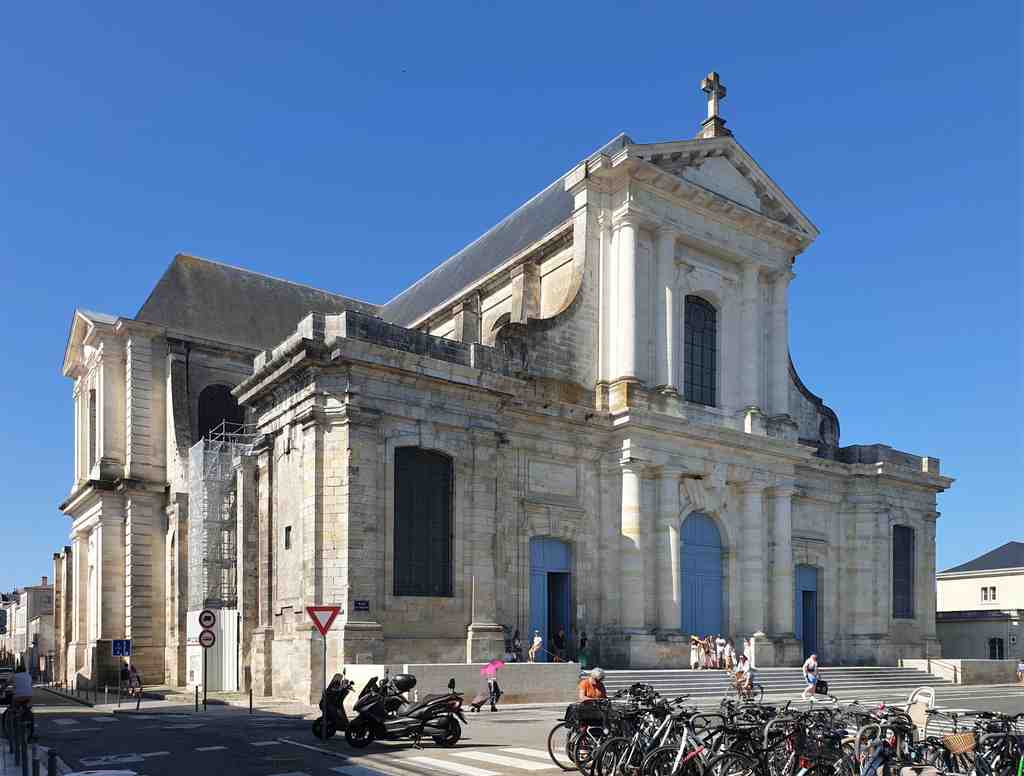
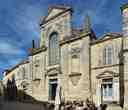
Saint-Louis Cathedral of La RochellePhoto: Chris06, Wikimedia Commons, CC BY-SA 4.0. Cropped & resized. On your left, Saint-Louis Cathedral stands out as a broad stone church with a severe triangular pediment, tall paired columns, and, beside it, the older Gothic bell tower of Saint-Barthélemy rising like a stubborn survivor.
This cathedral tells you what conquest looks like when a city stops shouting and starts rebuilding. Not peace, exactly... more a settlement imposed in masonry. After the siege of La Rochelle, Louis the Thirteenth became the emblem of a monarchy determined to reorder the city: weaken Protestant independence, strengthen Catholic institutions, and make royal authority visible in everyday life. Here, that policy took architectural form.
But the ground under your feet had a long memory. In the twelfth century, people built the parish church of Saint-Barthélemy here because La Rochelle had already outgrown one church. Centuries later, during the Wars of Religion, the city’s Protestant revolt turned violent. In fifteen sixty-eight, people sacked and demolished churches for building material to fortify the town. They spared the medieval bell tower beside the cathedral, not out of tenderness, but because it made a useful lookout and gun platform. Piety is remarkably flexible when walls need defending.
After Louis the Thirteenth took the city in sixteen twenty-eight, the monarchy confiscated the Grand Temple, the great Protestant preaching hall on Place de Verdun, and turned it into a Catholic cathedral. That first cathedral did not last. In sixteen eighty-seven, a celebratory bonfire for Louis the Fourteenth’s recovery sent flames into its roof, and the whole place burned. So La Rochelle needed a new statement... larger, calmer, and unmistakably official.
That statement began in seventeen forty-two. Bishop Augustin Roch de Menou de Charnizay pushed the project, Cardinal Fleury backed it, and the Crown granted three hundred thousand livres, roughly several million euros in modern value. Jacques Gabriel, the king’s chief architect, drew the plans, then died before the first stone was blessed on the eighteenth of June, seventeen forty-two. His son, Ange-Jacques Gabriel, carried the design forward. That father-and-son handoff suits this place: even its authorship feels dynastic.
Money ran out, of course. It usually does when ambition arrives dressed as grandeur. Work stalled in seventeen fifty, resumed in the seventeen seventies, and the cathedral finally opened for worship in seventeen eighty-four, still unfinished. The full building only reached completion in the nineteenth century, and even then the planned twin towers never appeared. What you see is both triumph and compromise.
If you glance at your screen, the interior image shows that discipline clearly: a long central hall, called the nave, with restrained classical lines and very little fuss. Inside, later layers softened the austerity. William Bouguereau, a son of La Rochelle, painted the Virgin Chapel dome in the eighteen seventies. And some windows, like the ones in the app, remind you that the building kept changing long after the first victory had been declared.
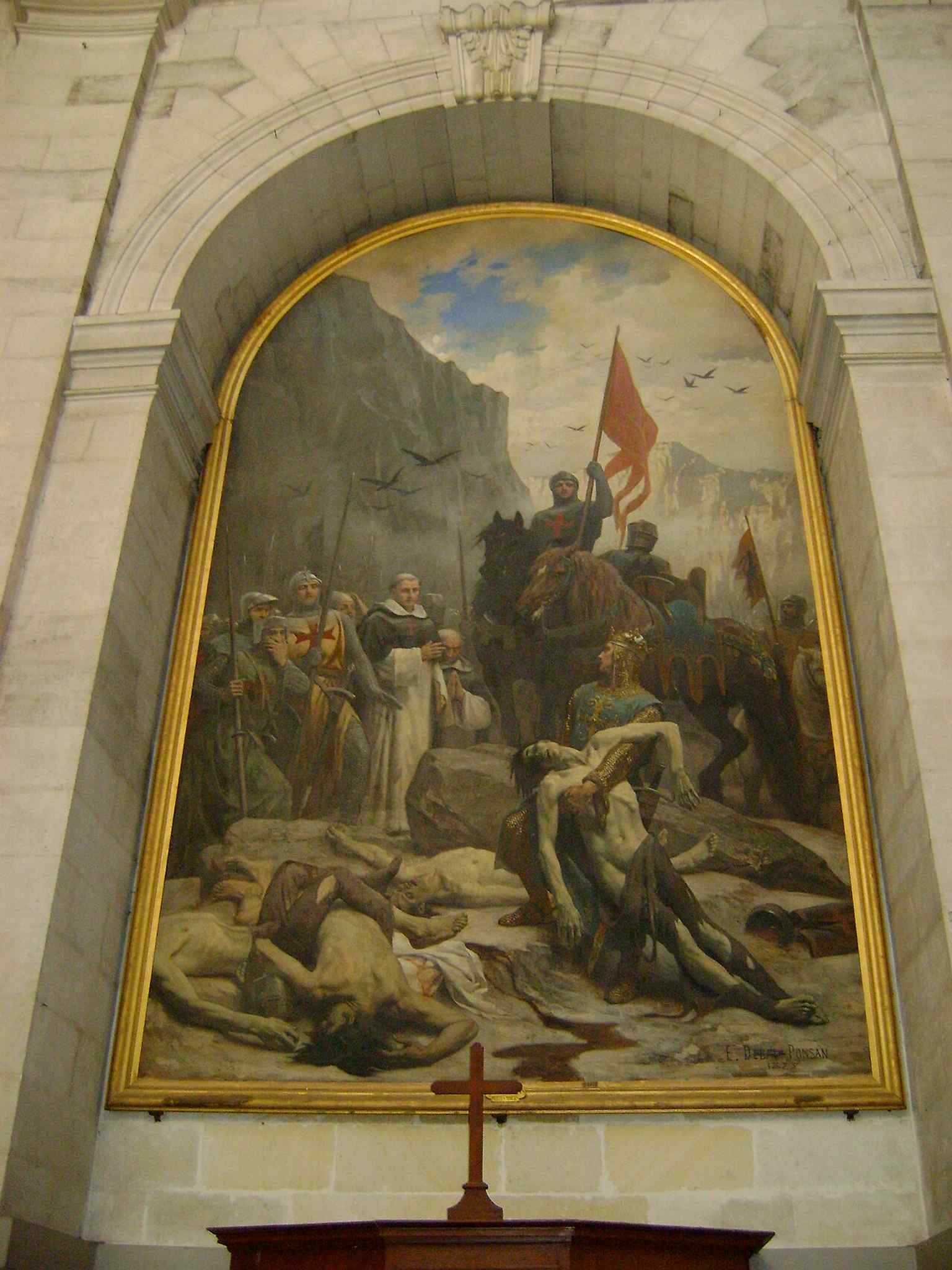
A wide interior view of the nave, whose sober classical lines reflect the cathedral’s long, stop-and-start construction history.Photo: Guiguilacagouille, Wikimedia Commons, CC BY-SA 3.0. Cropped & resized. So this cathedral is not just a church. It is a Catholic answer to a Protestant city, a royal answer to municipal independence, and a new skin stretched over older sacred ground. La Rochelle rarely erases anything cleanly; it builds over arguments.
And once faith had been reorganized, administration followed close behind. In a short walk, the Hôtel de l’Intendance will show you power in a less heavenly, and often more efficient, form.
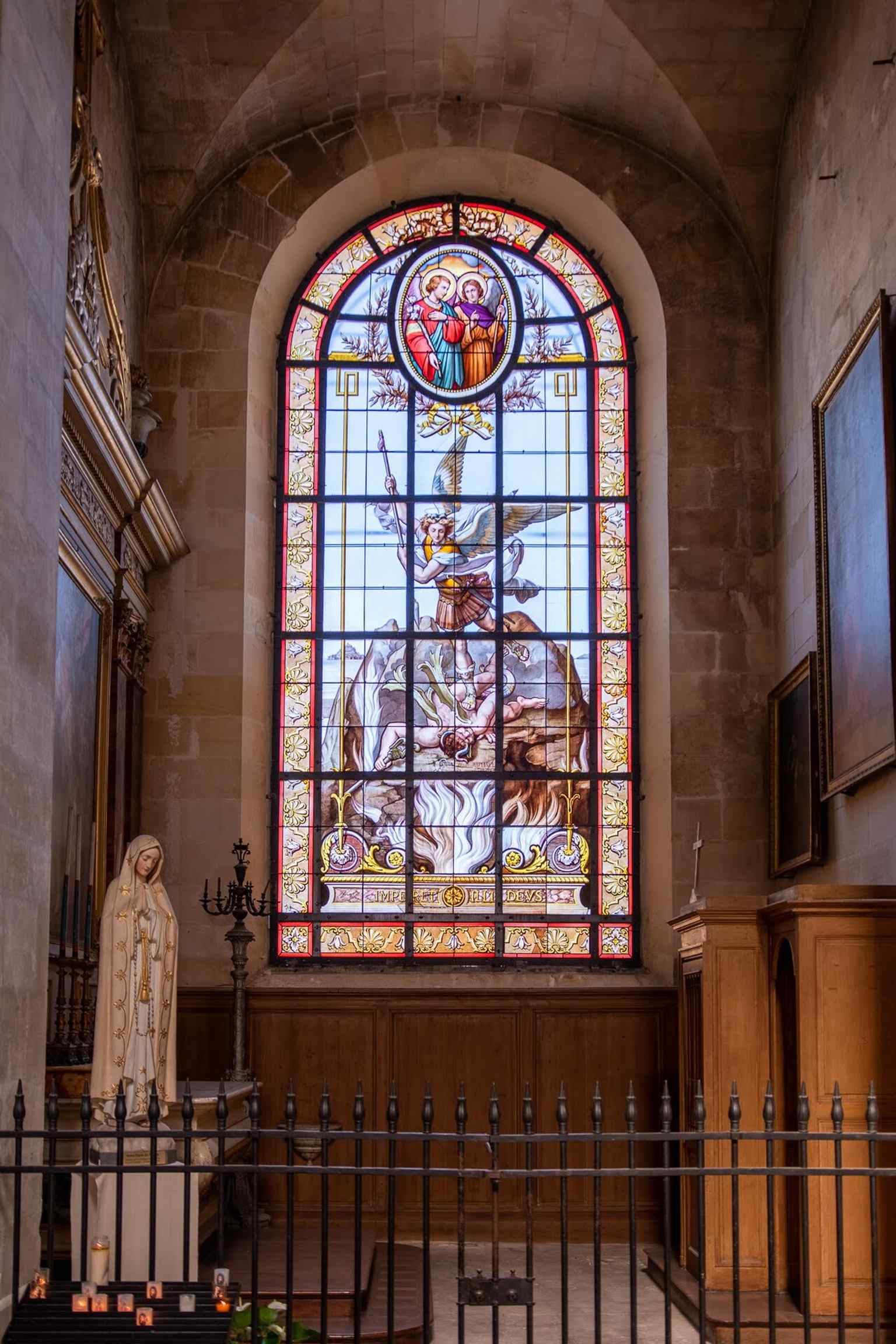
A close look at modern stained glass inside the cathedral, where later windows continue the building’s long layer-cake of art and restoration.Photo: Pveverdingen, Wikimedia Commons, CC BY-SA 4.0. Cropped & resized. 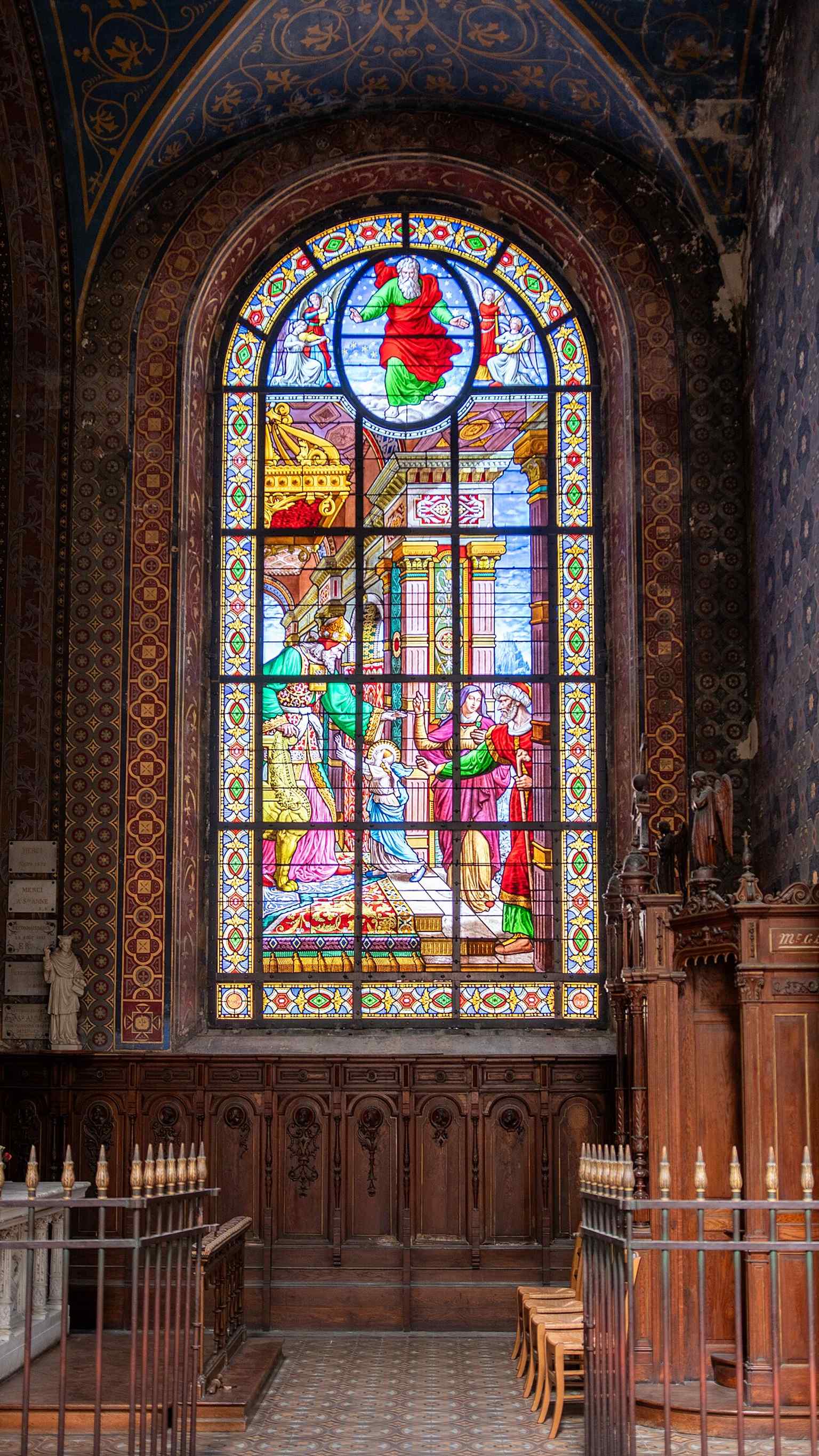
A larger stained-glass detail that helps show the cathedral’s colorful 19th- and 21st-century glazing inside the otherwise austere building.Photo: Pieter van Everdingen, Wikimedia Commons, CC BY-SA 4.0. Cropped & resized. On your right, look for a pale stone façade with a broad arched portal, carved pilasters, and a heraldic panel set above the entrance. This is where power stopped arriving by…Read moreShow less
Open dedicated page →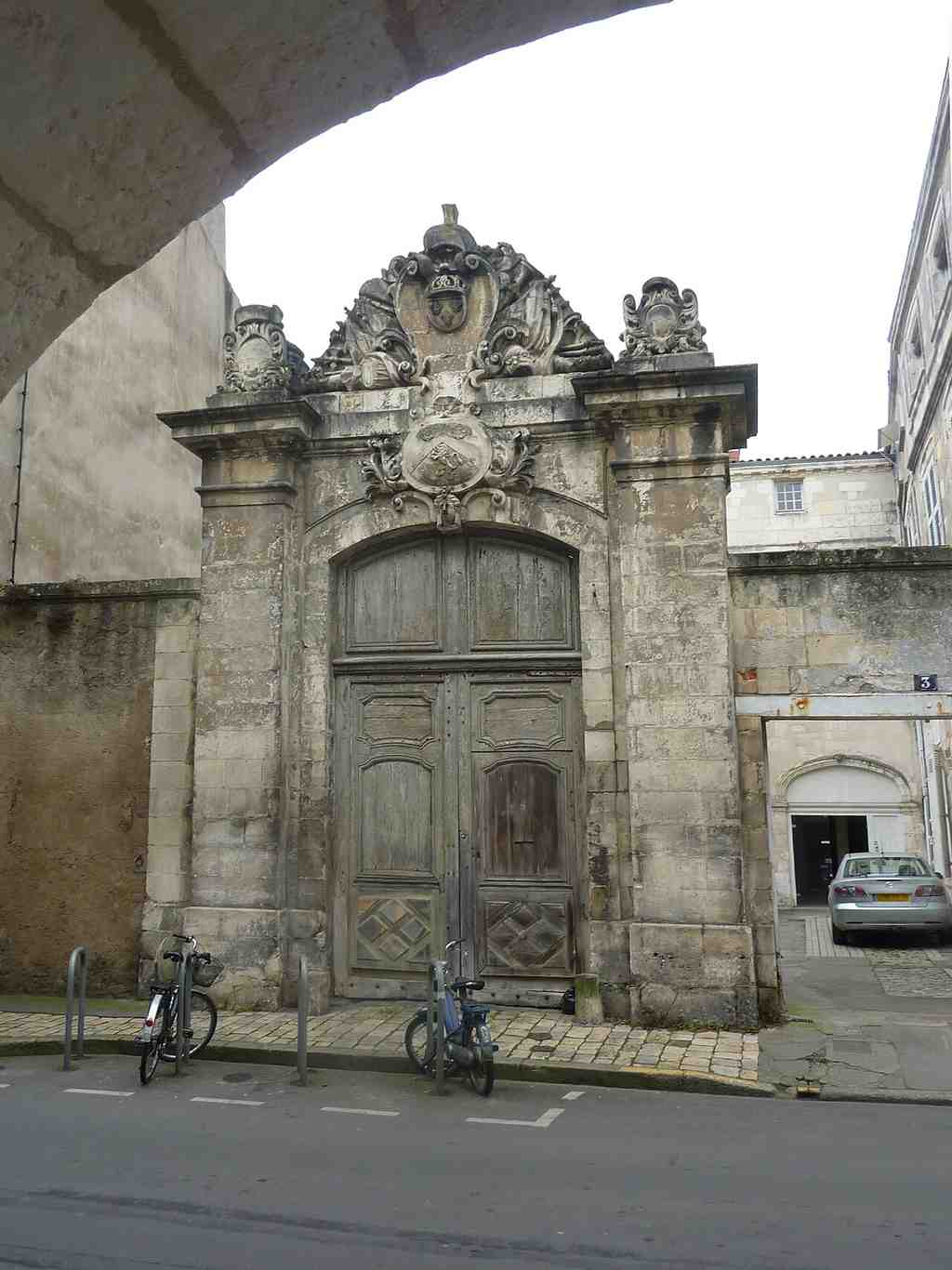
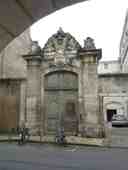
Hôtel de l'IntendancePhoto: Patrick Despoix, Wikimedia Commons, CC BY-SA 3.0. Cropped & resized. On your right, look for a pale stone façade with a broad arched portal, carved pilasters, and a heraldic panel set above the entrance.
This is where power stopped arriving by ship and started arriving in files. After seventeen seventeen, the crown split two big offices: the naval intendant stayed in Rochefort, while the intendant of the généralité - the king’s top civil administrator for the region - settled in La Rochelle. That shift planted centralized state power right inside the city’s streets.
Jérôme Bignon de Blanzy gives this place its human face. He served here from seventeen twenty-six to seventeen thirty-seven, and he was no provincial nobody; he was also the king’s librarian and a rising state official with a much larger court career. In seventeen twenty-nine, under Bignon, the city bought a large house here from Monsieur de Bonneuil because the rented residence on rue Fleuriau had become too cramped.
And here’s the part most people miss: this did not begin as a purpose-built palace of authority. It began as a practical fix. The grand portal, commissioned in seventeen thirty from the contractor Bonnichon and the sculptor Antoine the Third Ragon, gave that borrowed solution an official face. If you check the image in the app, you can see exactly how that entrance does the work of persuasion... stone first, legitimacy second.
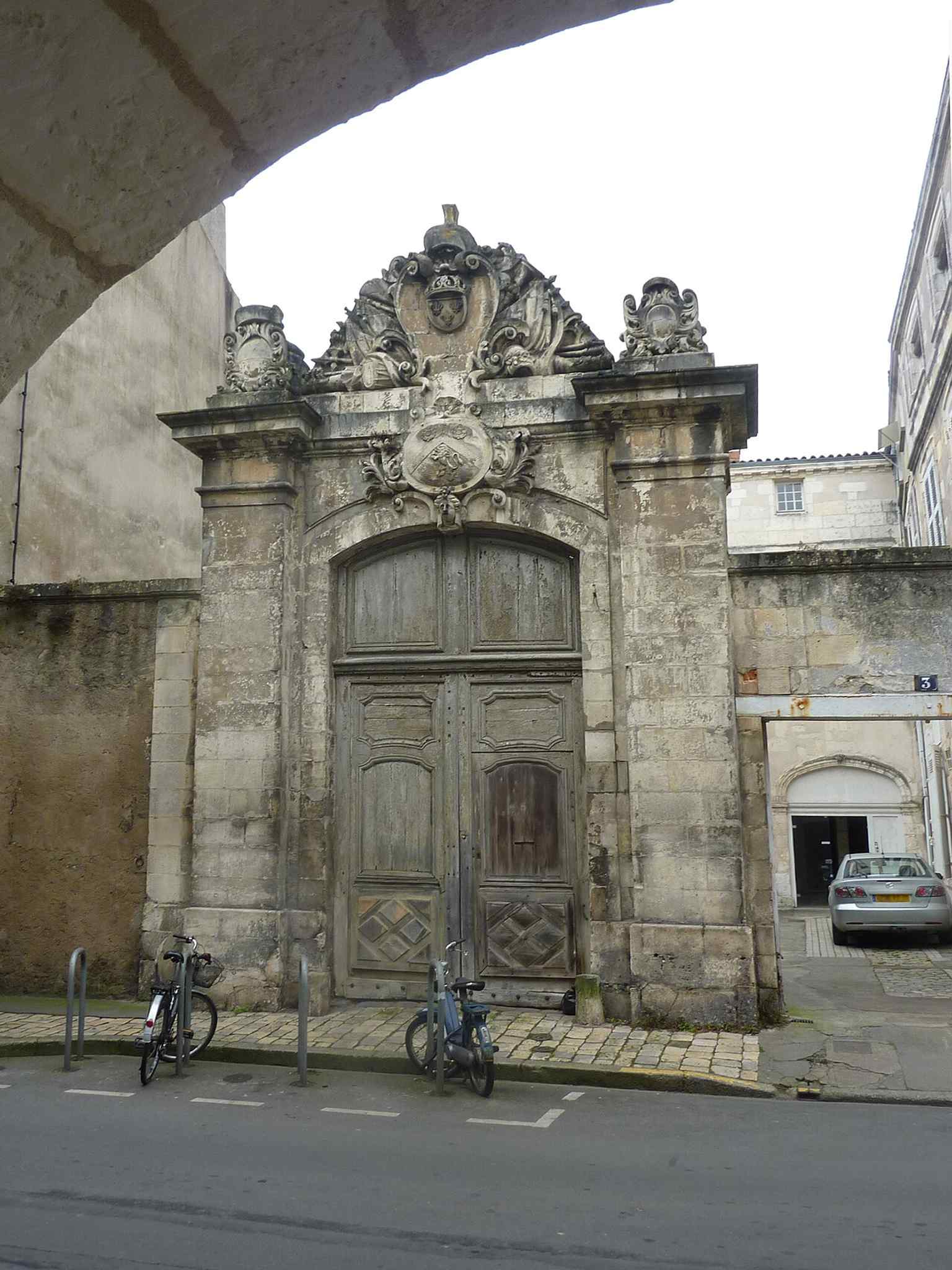
The entrance porch of the Hôtel de l’Intendance on rue Pernelle, the 1730 portal that first gave this former administrative house its official face of power.Photo: Patrick Despoix, Wikimedia Commons, CC BY-SA 3.0. Cropped & resized. Between seventeen thirty and seventeen fifty-nine, engineers and architects including Dubois, Gilles Nassivet, Dié Gendrier, and Matthieu Hue expanded and regularized the whole block - wings, stables, court, garden, the lot. Rule became orderly on paper, then orderly in masonry. Bureaucracy does love a neat layout.
After the Revolution, the building served as the prefecture, then a gendarmerie, before an entrepreneur broke it up. Even the portal carries a small lie: the arms above it were wrongly recut in the nineteenth century. Facades, it turns out, often remember rank more faithfully than truth.
France protected the building as a historic monument in nineteen twenty-five. From here, the city loosens its collar a little. In about nine minutes, Charruyer Park opens up another kind of public legacy.
On your left, Charruyer Park shows itself as a long green ribbon with curving pale gravel paths, tall tree canopies, and a raised earth-backed line that hides old stone ramparts.…Read moreShow less
Open dedicated page →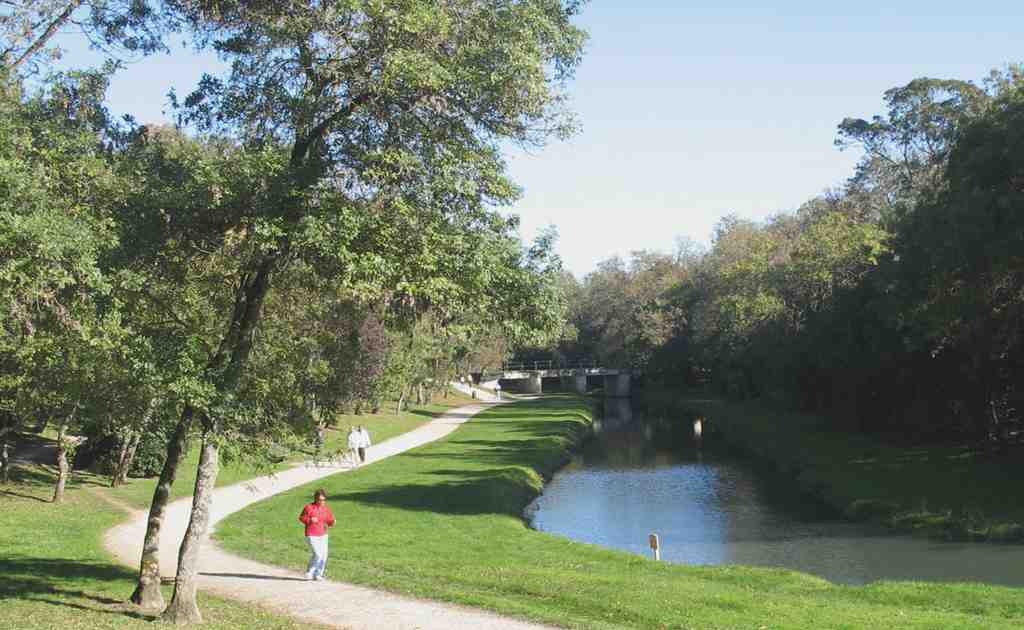
Charruyer ParkPhoto: Gilbert Bochenek, Wikimedia Commons, Public domain. Cropped & resized. On your left, Charruyer Park shows itself as a long green ribbon with curving pale gravel paths, tall tree canopies, and a raised earth-backed line that hides old stone ramparts.
This is La Rochelle doing something quietly radical. Instead of more walls, more drills, more guarded ground, the city made a park. And not by royal decree either... by the will of a woman named Adèle Charruyer.
Adèle Charruyer was the daughter of shipowner Étienne Charruyer, and her gift was more complicated than the tidy legend suggests. She did not simply hand over family land. In her handwritten will and codicil, dated the twenty-seventh of July and the twenty-fourth of August, eighteen eighty-one, she left one hundred thousand francs to the city, a substantial modern sum. La Rochelle used that money to buy, drain, clean up, and beautify these former military marshes at the western edge of the old defenses.
So this refuge began as wet, strategic ground at the foot of the city fortifications from sixteen eighty-five. Then, from the sixth of May, eighteen eighty-seven to the end of eighteen ninety, workers reshaped it into an English-style park, which means winding paths, irregular planting, and the polite illusion that nature just happened to arrange itself this well. It rarely does.
At first they called it Parc Monceau, a local nod to Paris. Then in eighteen eighty-eight, they gave Adèle her due and renamed it Parc Charruyer.
Here’s the question that slips in with the greenery: what happens to a city when land once reserved for defense becomes a place for strolling, children, and public rest? In La Rochelle, that change says a lot. Power does not only speak through cannons and customs houses. Sometimes it speaks through shade, benches, and the right to wander.
Two little streams, the Fétilly and the Lafond, run through the park on their way to the ocean. Hidden in this calm are scraps of the older city: the redoubt called Le Paté, a fortified outwork; the Porte des Deux-Moulins; Porte Neuve; and the old walls themselves, covered with earth so their upper edge could become the rempart path.
Even the park’s gentleness has had its skirmishes. Around the turn of the twentieth century, telephone workers hacked back branches threatening the wires. The cuts wounded the trees, disease crept in, and modern convenience left a botanical bill. Progress, as usual, charged interest.
Animals belonged here from the start, with aviaries early on and a small animal park developing after the war, officially created in nineteen fifty and later named for Charles-Édouard Beltrémieux, a museum conservator and former mayor. Today the park still shelters local breeds and even injured city wildlife... squirrels, hedgehogs, owls, birds.
When you’re ready, turn back toward stone and sea. The Lantern Tower, about eight minutes away, keeps an older, sharper memory of La Rochelle’s shoreline. And this park, helpfully, never closes.
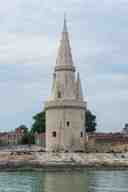
That tall pale-stone tower with a round lower drum, an octagonal Gothic spire, and a small lantern-like crown at the top is the Lantern Tower. This is one of La Rochelle’s three…Read moreShow less
Open dedicated page →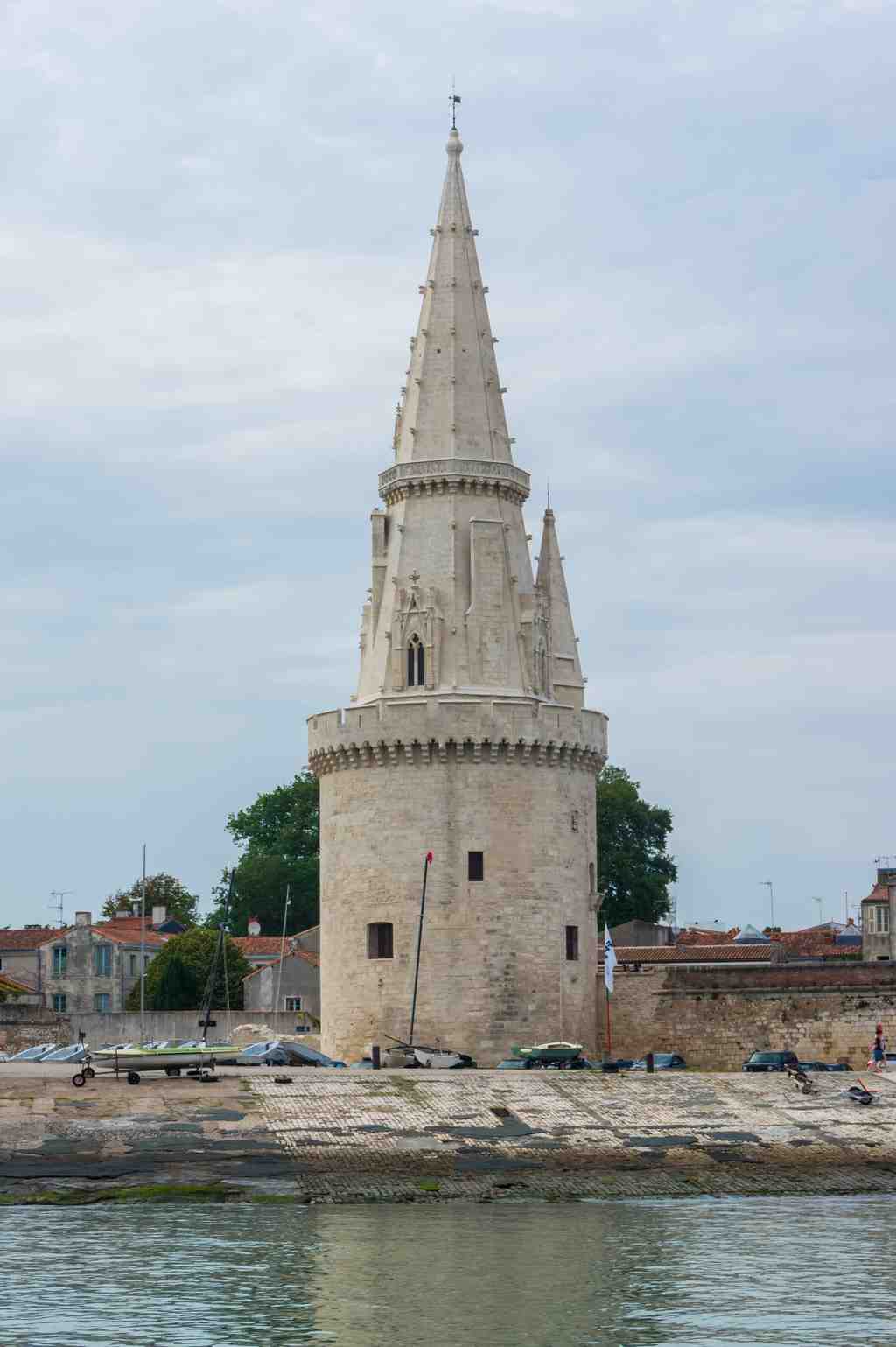
Lantern TowerPhoto: Jebulon, Wikimedia Commons, CC0. Cropped & resized. That tall pale-stone tower with a round lower drum, an octagonal Gothic spire, and a small lantern-like crown at the top is the Lantern Tower.
This is one of La Rochelle’s three great harbor towers, but it tells a stranger story than most people expect. It does not simply guard the port you see today. It marks an older shoreline, from a harbor that has largely vanished. Before the Vieux-Port took over, La Rochelle’s primitive port lay farther north, along the Lafond stream, in the defensive world watched by Château Vauclair. In that earlier map of the city, this tower stood right at the water’s edge.
The first version here appears in records as early as twelve oh nine. The tower you see now rose much later, from fourteen forty-five to fourteen sixty-eight, when builders wrapped a new structure around the older one. A mayor named Jehan Mérichon pushed the project through and paid for its completion from his own pocket... which is one way to leave your name in stone. He finished a tower that worked as both lookout and signal: the little lantern above served as a beacon and an amer, a fixed seamark sailors could line up with to navigate.
Now take a good look at the base, then let your eyes climb to that spire. Can you picture the water once pressing much closer, and ships being stopped here before they entered the city’s protection?
Originally, this was the Tour du Garrot. That name came from the lifting gear used to remove or secure ships’ weapons before they could pass inside. La Rochelle welcomed commerce, but it preferred merchants to arrive with fewer cannon.
Then the tower kept changing jobs, and each new role left a different kind of scar. In fifteen sixty-eight, imprisoned priests gave it the grim nickname Tour des Prêtres. After the revocation of the Edict of Nantes in sixteen eighty-five, authorities used it to jail Protestants. In seventeen ninety-three, they locked up Vendéen insurgents here too. And inside, prisoners filled the stone with more than six hundred graffitis between the sixteenth and nineteenth centuries: names, prayers, complaints, and ship portraits carved by French, Spanish, Dutch, and English captives. If you look at the graffito image in the app, you’ll see the sort of human record this tower keeps better than any official archive.
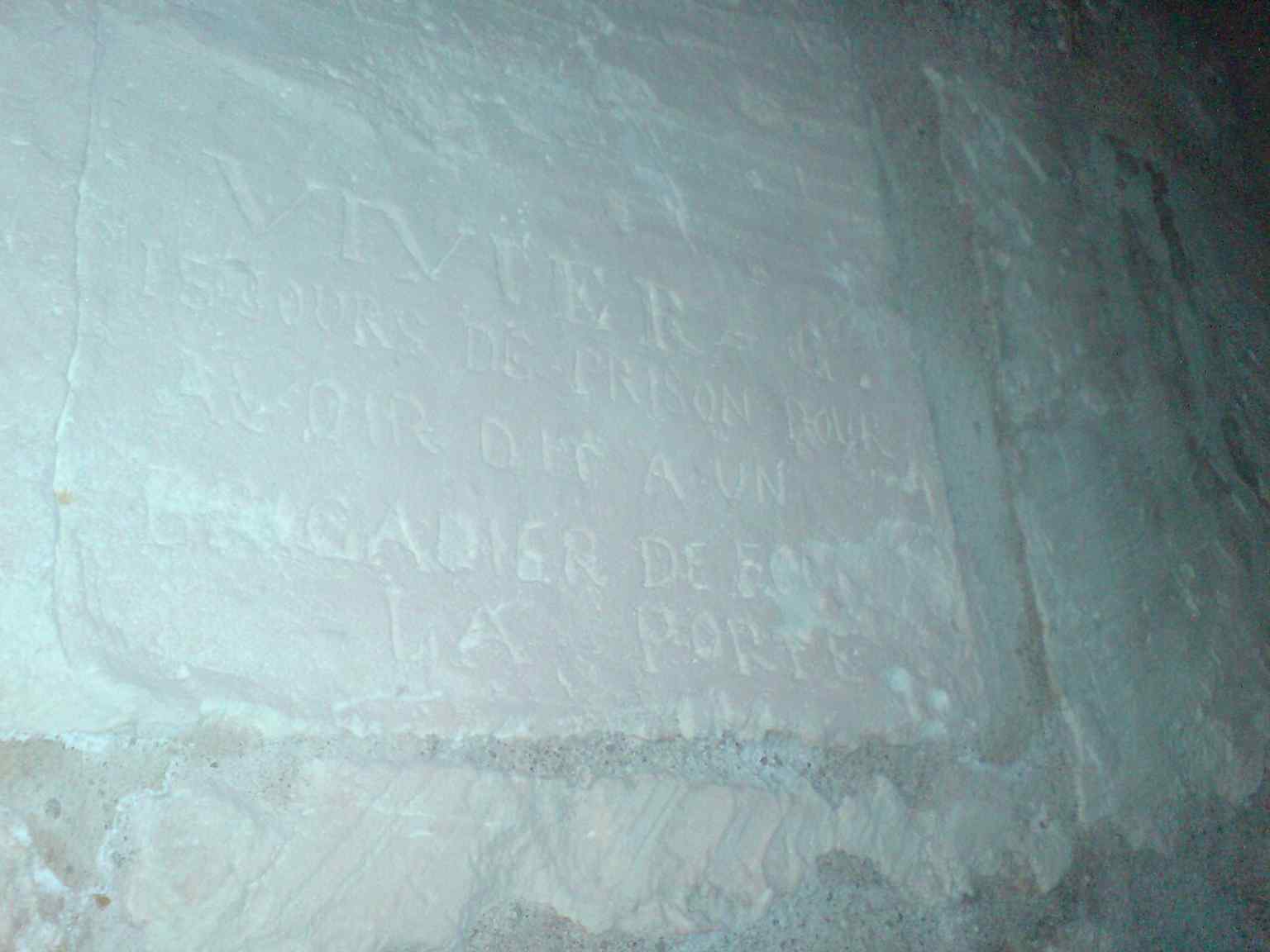
A prison graffito carved by a captive sailor, one of more than 600 inscriptions left inside the tower over centuries of confinement.Photo: Sébastien Thébault, Wikimedia Commons, CC BY-SA 3.0. Cropped & resized. Here’s the part locals quietly enjoy pointing out: when the city’s fortifications were razed in sixteen twenty-nine, this tower survived. Then, in sixteen eighty-nine, engineers folded it into a new line of defenses. That is why it still stands while so much of the medieval seafront is gone. This tower is not just preserved; it adapted.
It nearly failed, though. The lantern collapsed in sixteen thirty-two after poor maintenance. Restorers later rebuilt the upper part, especially from nineteen hundred to nineteen fourteen, with Juste Lisch and then Albert Ballu giving it back much of its medieval profile. If you check the before-and-after image, you can catch the tower under scaffolding during the two thousand fifteen restoration. Up near the crown, two recreated gargoyles now honor Cabu and Wolinski, the cartoonists killed in the Charlie Hebdo attack... an unexpectedly modern note on a very old sentinel.
If you want to go inside later, it generally opens every day from ten to twelve forty-five and again from two to six thirty. From here, head on to the Chain Tower, where harbor defense becomes brutally simple: a chain stretched across the water, and no ship argued with that.
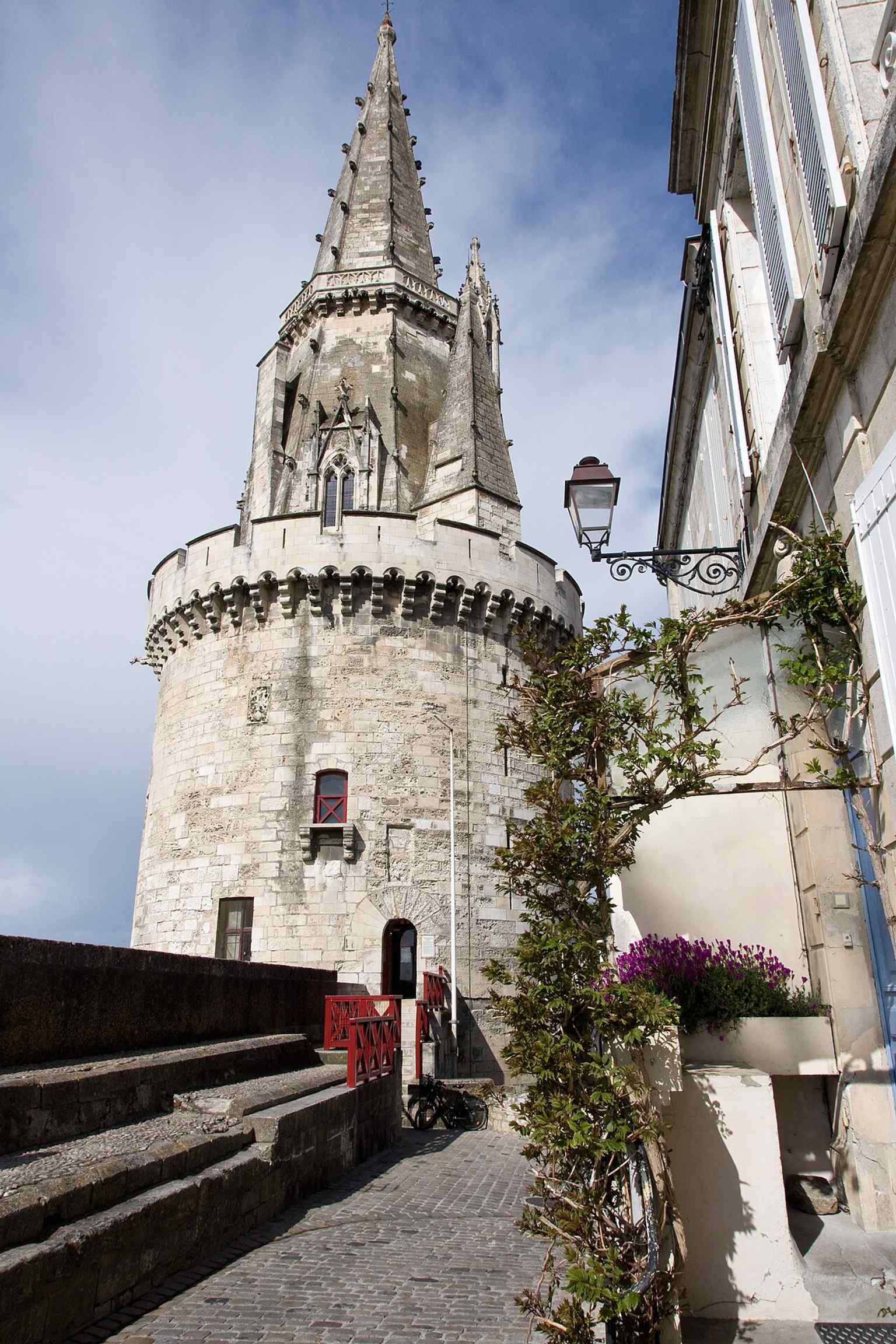
A strong full-height view of the Lantern Tower, the 55-meter medieval sentinel that once guarded the old port of La Rochelle.Photo: Jean-Christophe BENOIST, Wikimedia Commons, CC BY 3.0. Cropped & resized. 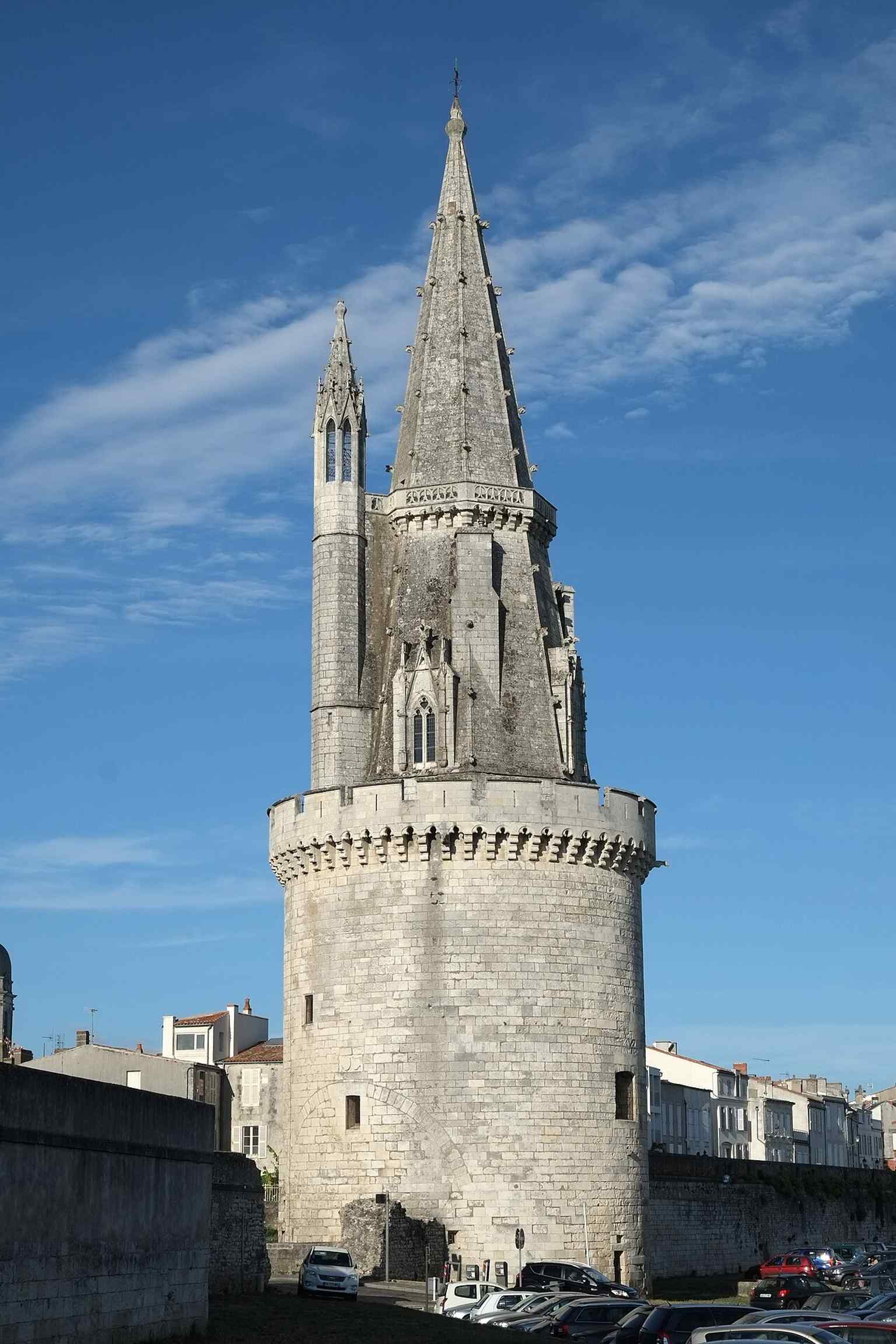
The tower rising above the waterfront, useful for showing how it stands at the edge of the historic harbor.Photo: Patrick Despoix, Wikimedia Commons, CC BY-SA 3.0. Cropped & resized. 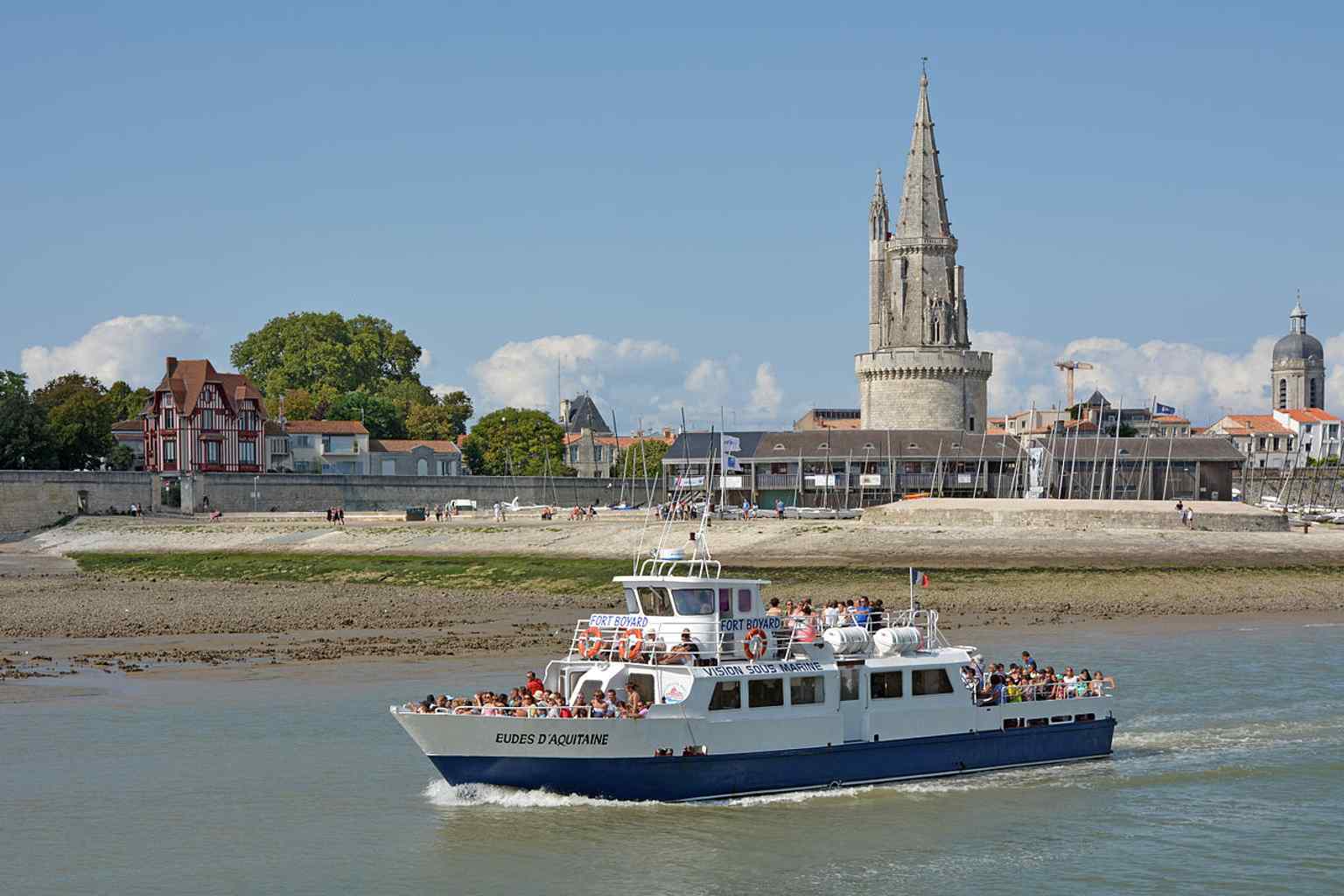
The Lantern Tower beside the entrance to the old harbor, matching its original role as a maritime lookout and port controller.Photo: Pline, Wikimedia Commons, CC BY-SA 3.0. Cropped & resized. 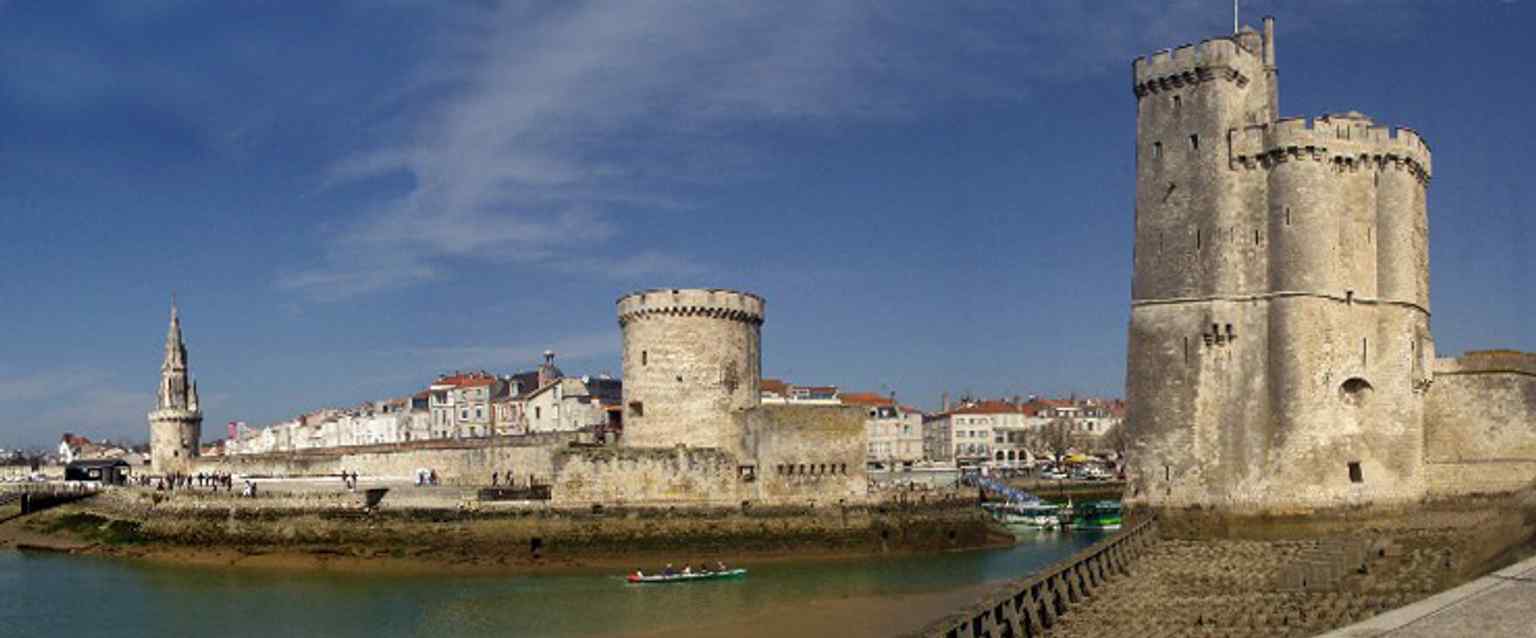
The famous trio of La Rochelle towers together — Lantern Tower, Chain Tower, and Saint-Nicolas Tower — as medieval seafront defenses.Photo: M.Romero Schmidtke, Wikimedia Commons, Public domain. Cropped & resized. 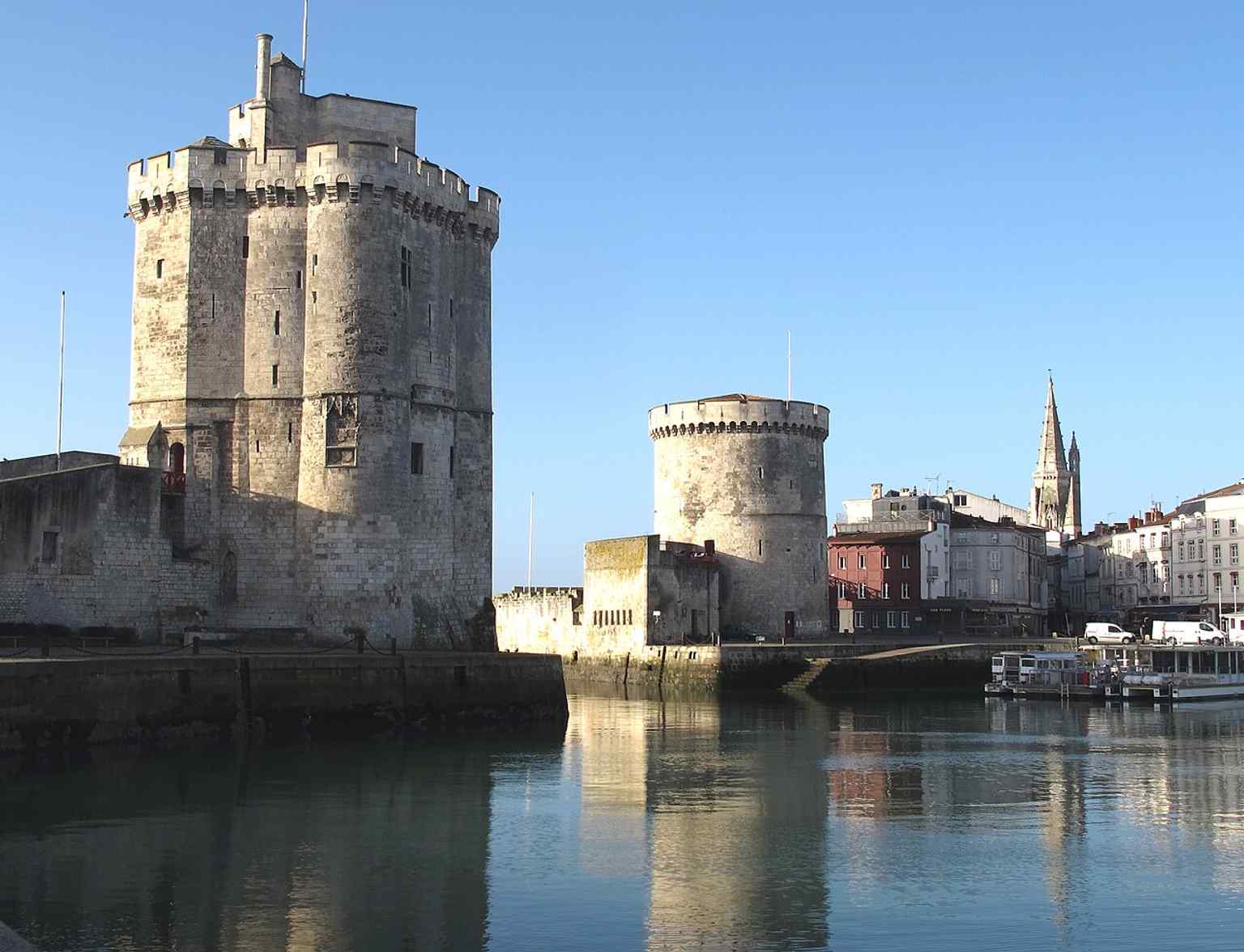
A wider view of the three La Rochelle towers, helping place the Lantern Tower in the city’s fortified harbor front.Photo: Gilbert Bochenek, Wikimedia Commons, CC BY 3.0. Cropped & resized. 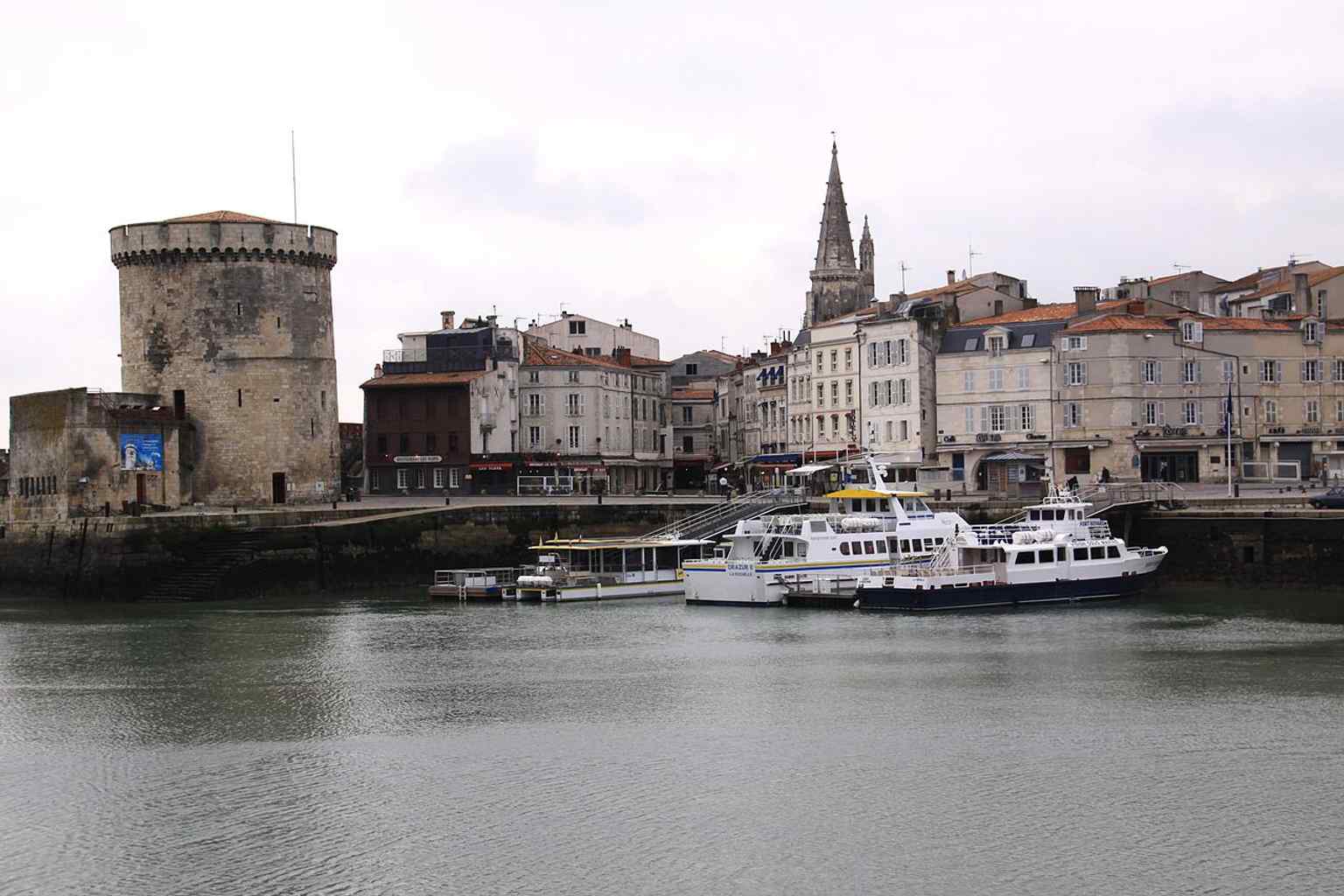
The Lantern Tower visible across the basin, showing its relationship to the harbor and the neighboring Chain Tower.Photo: Jean-Pierre Bazard Jpbazard, Wikimedia Commons, CC BY-SA 3.0. Cropped & resized. 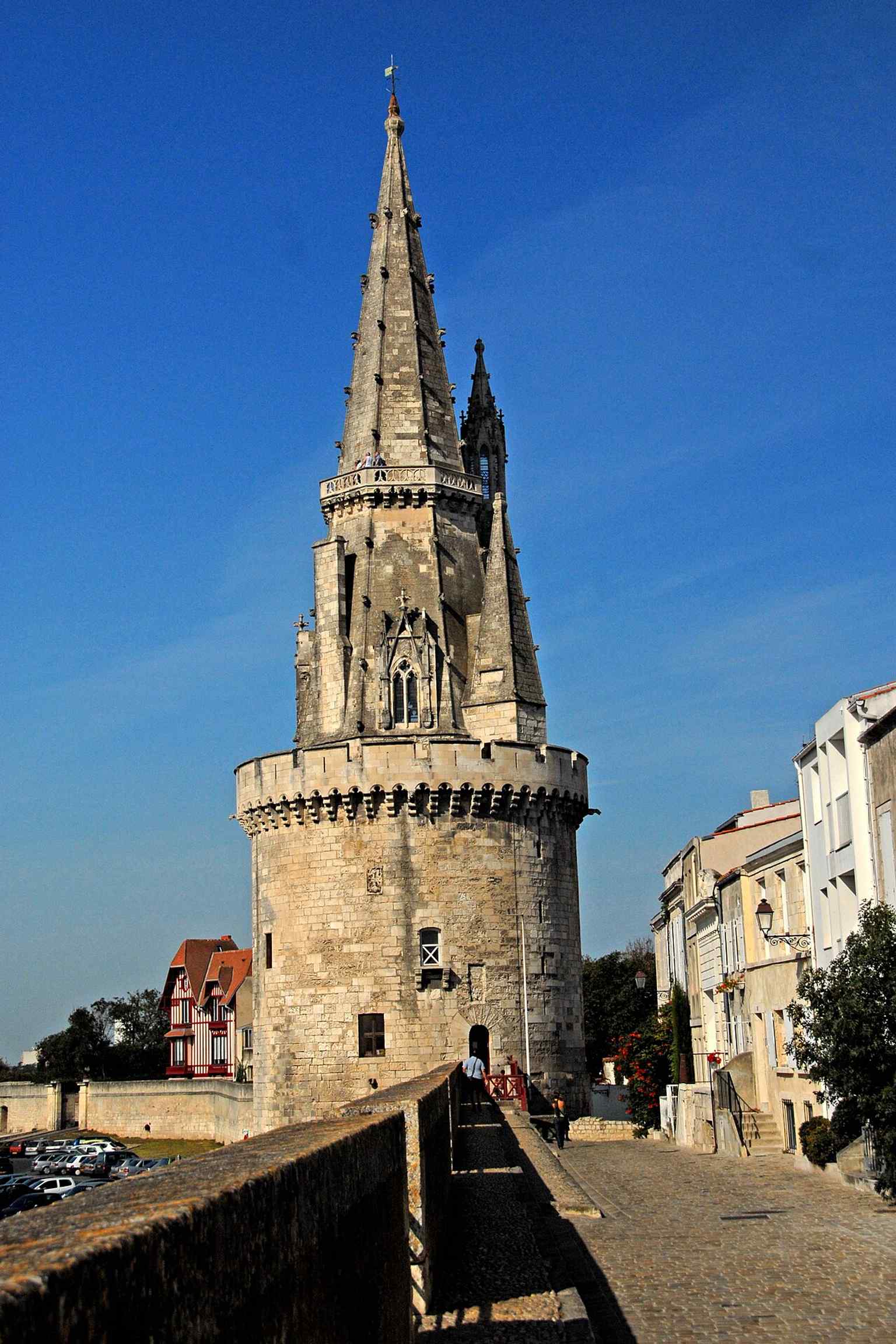
Viewed from the rampart walk, this image helps explain the tower’s layered circulation and its connection to the city walls.Photo: Jochen Jahnke 16:13, 20. Jan. 2008 (CET), Wikimedia Commons, CC BY-SA 3.0. Cropped & resized. 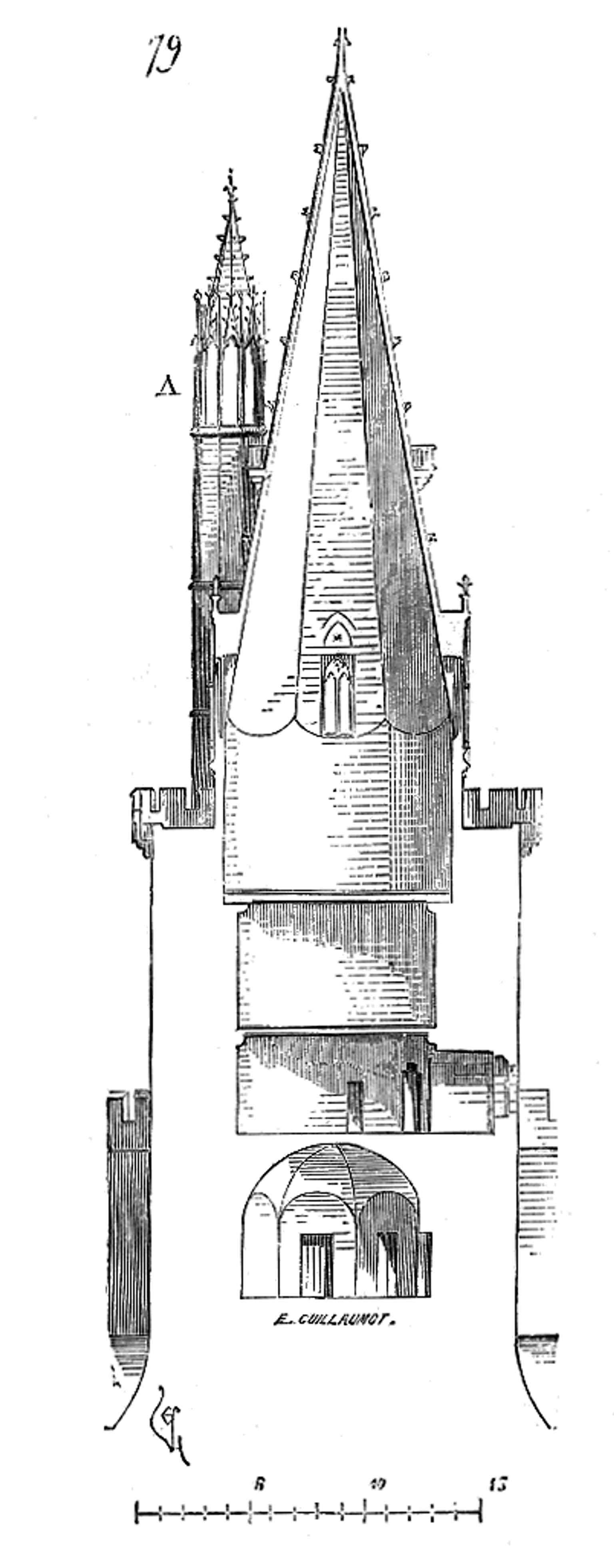
Viollet-le-Duc’s cutaway drawing reveals the tower’s internal structure, including the lantern and the stairway leading upward.Photo: Eugène Viollet le Duc, Wikimedia Commons, Public domain. Cropped & resized. 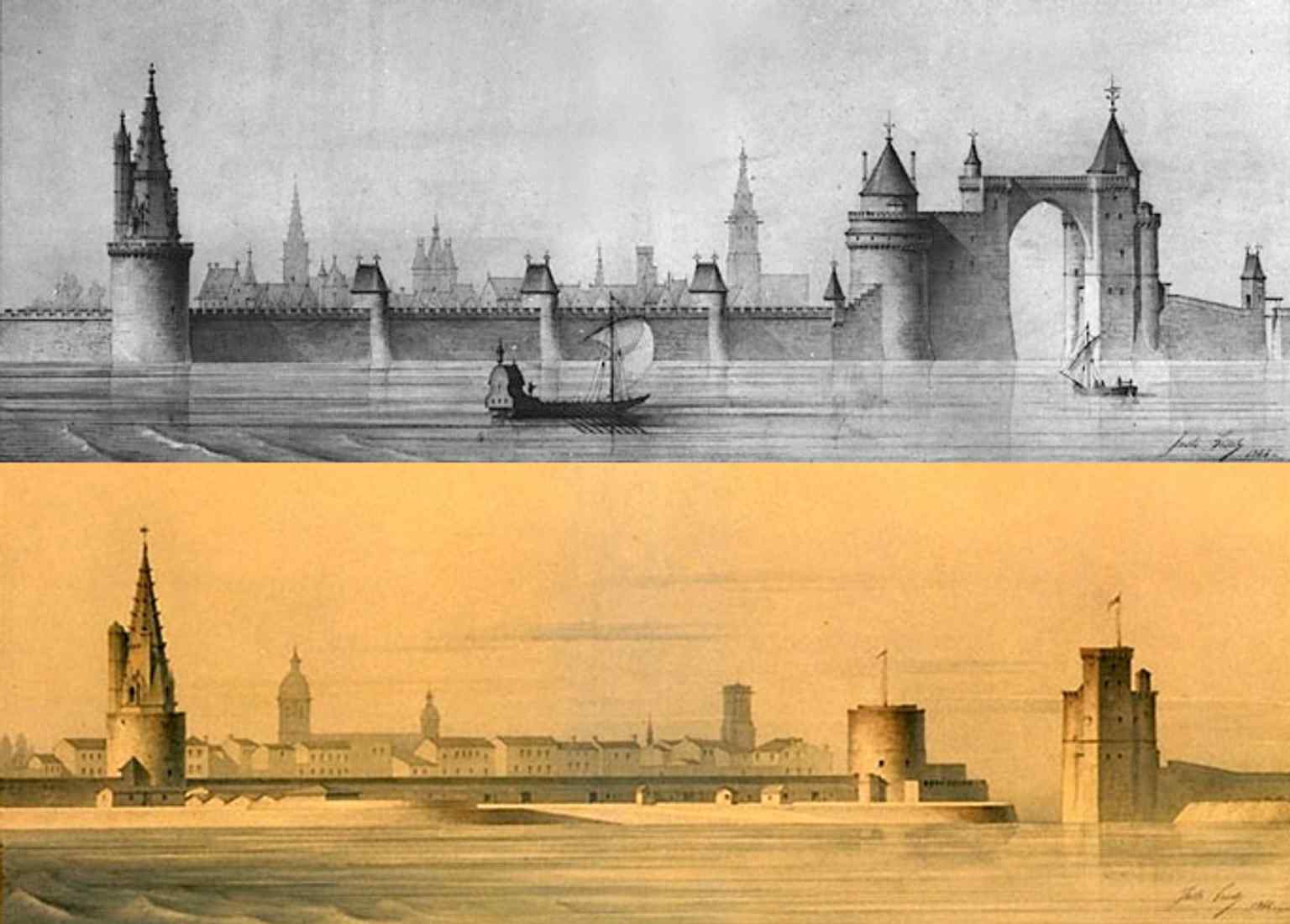
A 19th-century reconstruction by Juste Lisch, reflecting the restoration campaign that returned the tower to a more medieval appearance.Photo: Montage d'après deux dessins de Juste Lisch par Gilbertus, Wikimedia Commons, Public domain. Cropped & resized. 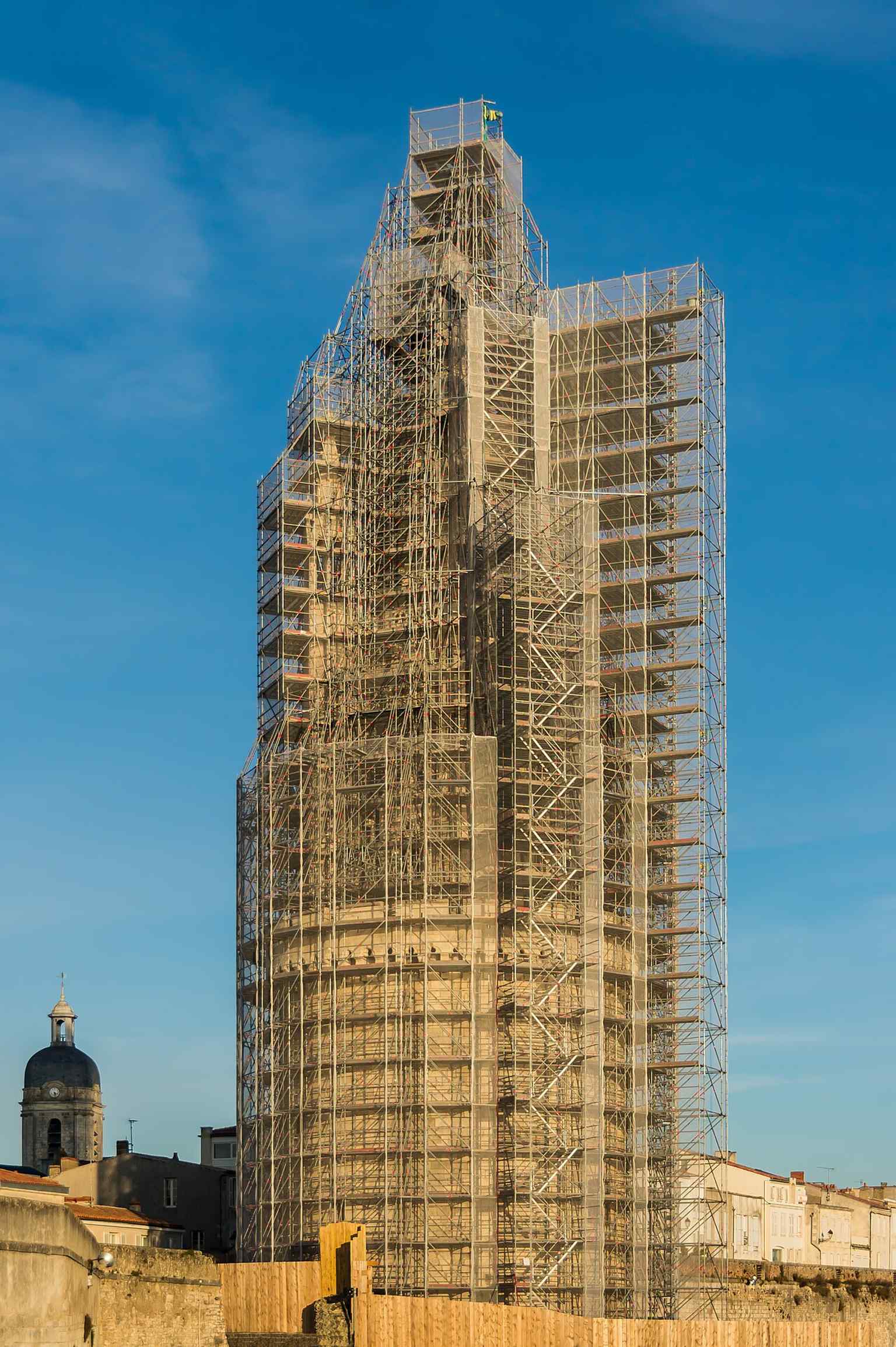
The tower under scaffolding during restoration in 2015, echoing the major conservation work that preserved its medieval profile.Photo: Jebulon, Wikimedia Commons, CC0. Cropped & resized. 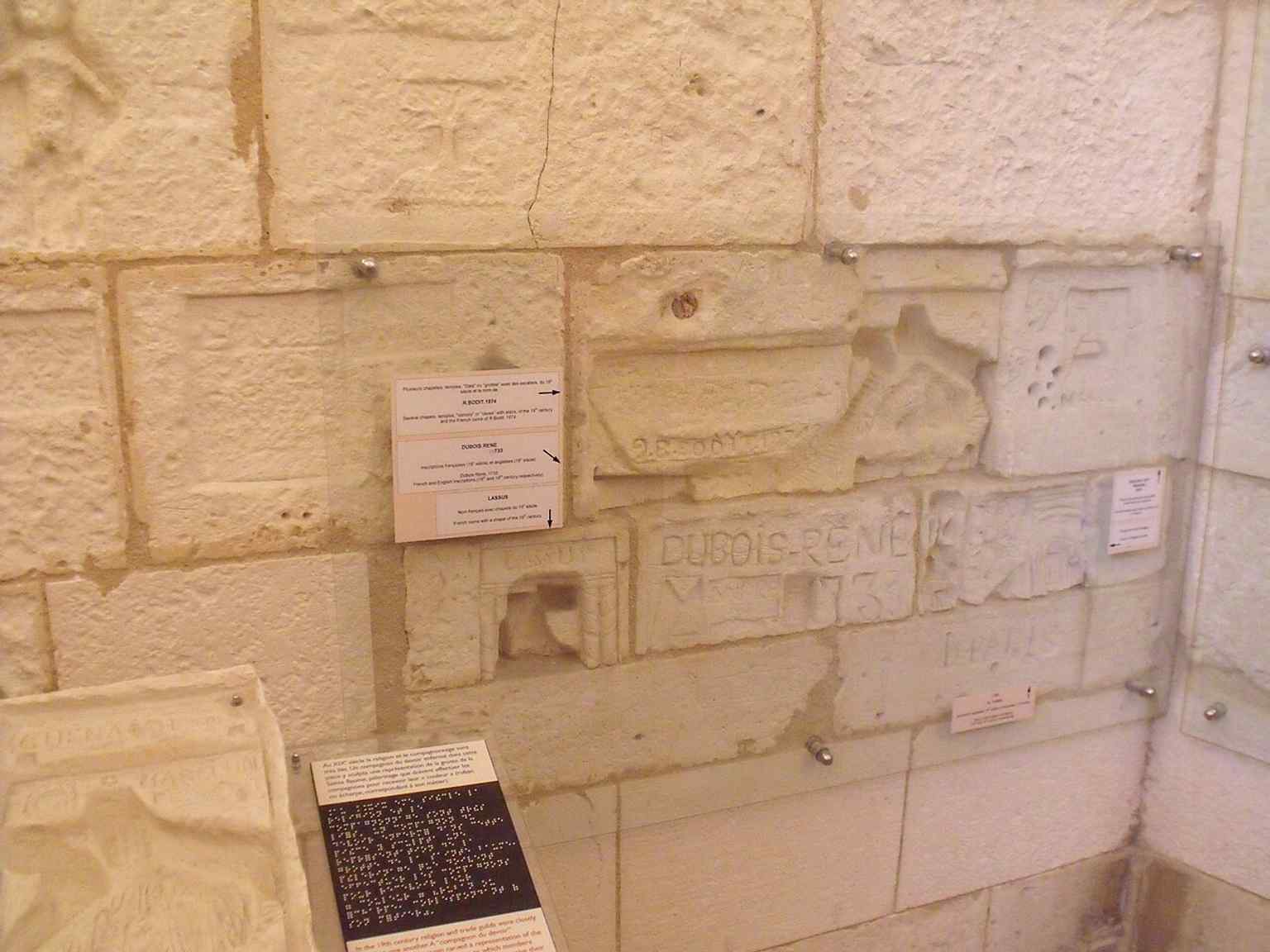
One of the tower’s graffiti-filled interior walls, where prisoners recorded ships, names, and memories in the stone.Photo: B25es, Wikimedia Commons, CC BY-SA 3.0. Cropped & resized. 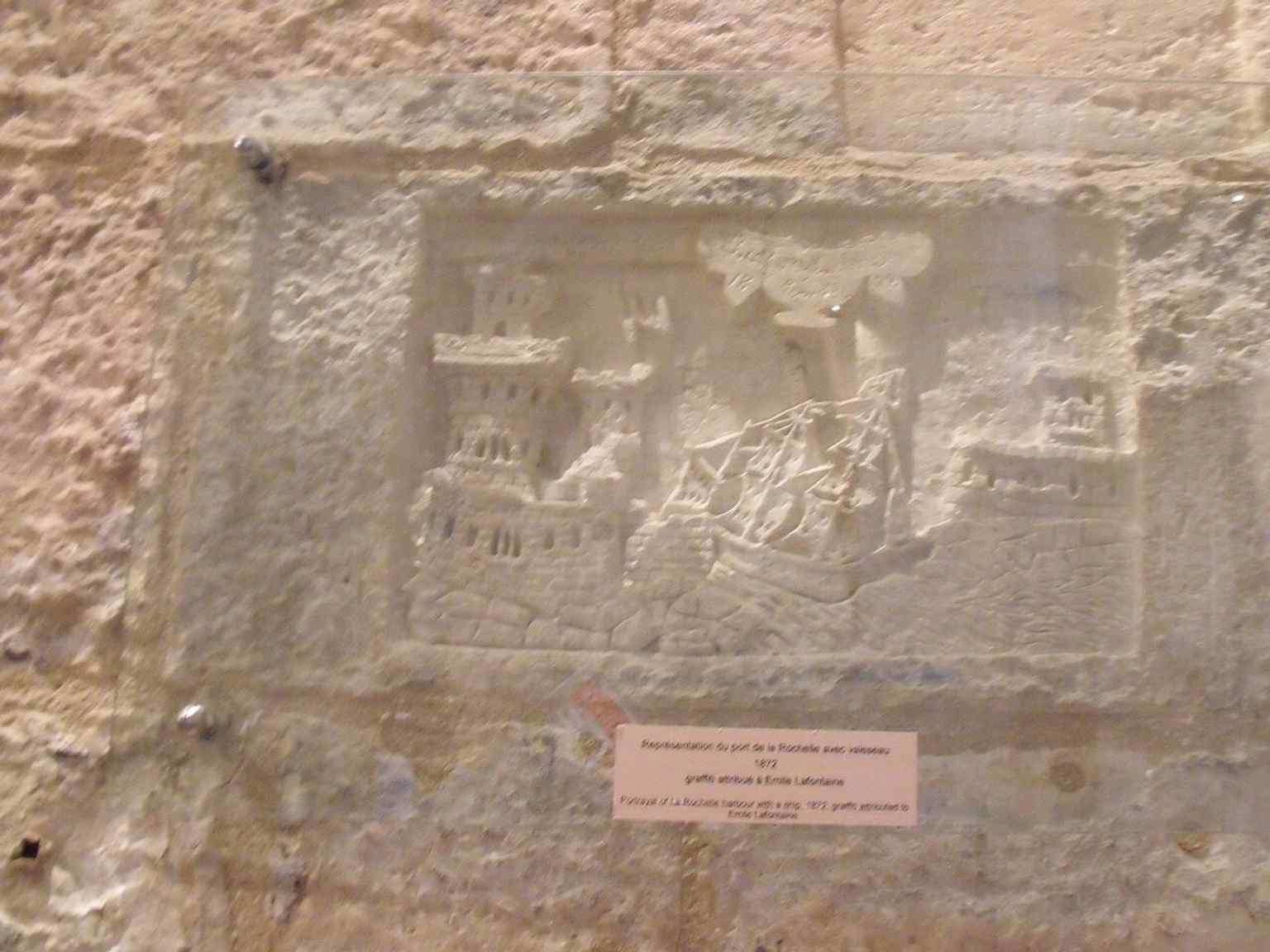
Another graffiti chamber from the tower’s prison days, illustrating how the walls became an archive of sailors’ captivity.Photo: B25es, Wikimedia Commons, CC BY-SA 3.0. Cropped & resized. 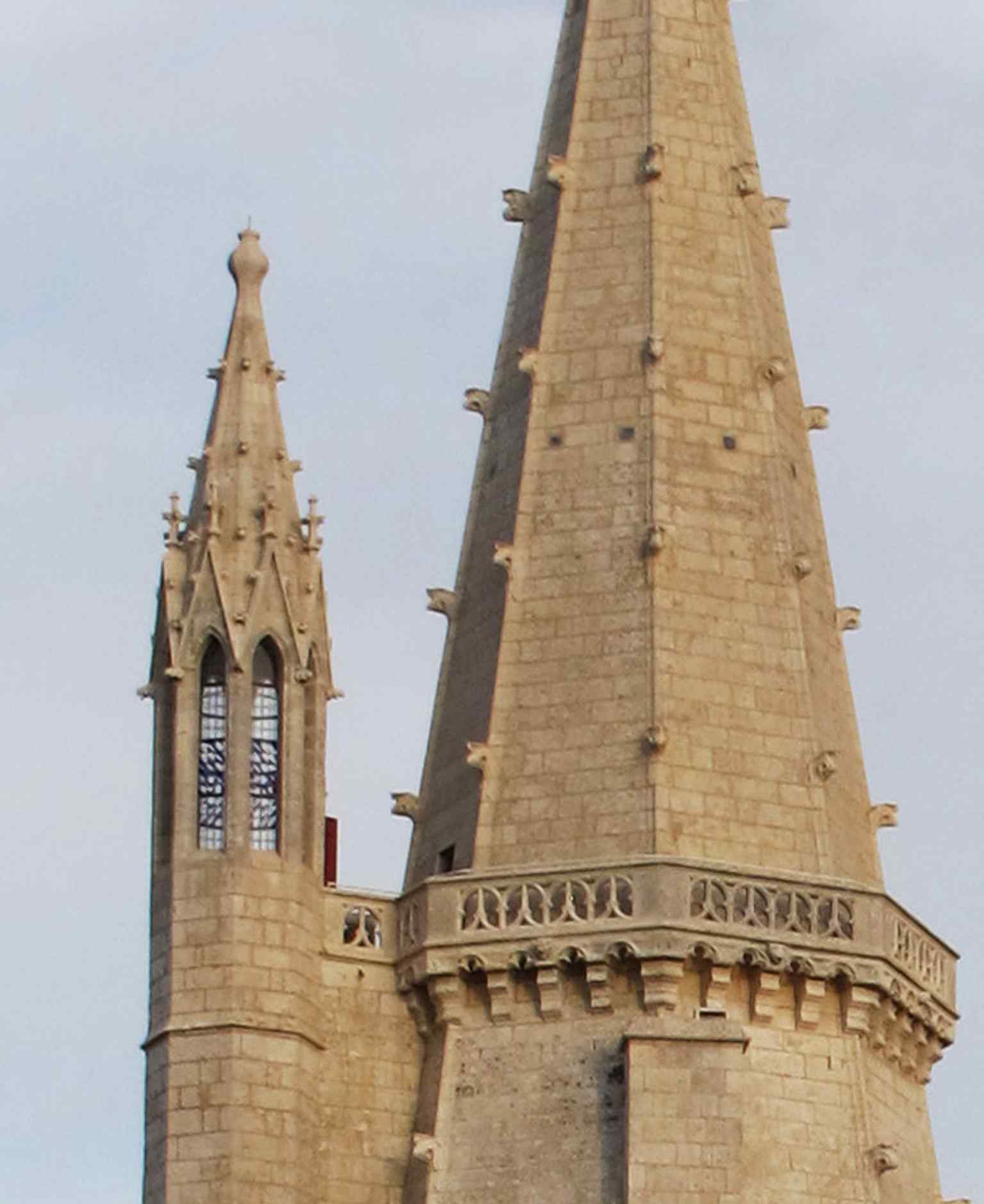
A close view of the reconstructed lantern, the feature that once served as a beacon and maritime landmark.Photo: Gilbertus, Wikimedia Commons, CC BY-SA 4.0. Cropped & resized. 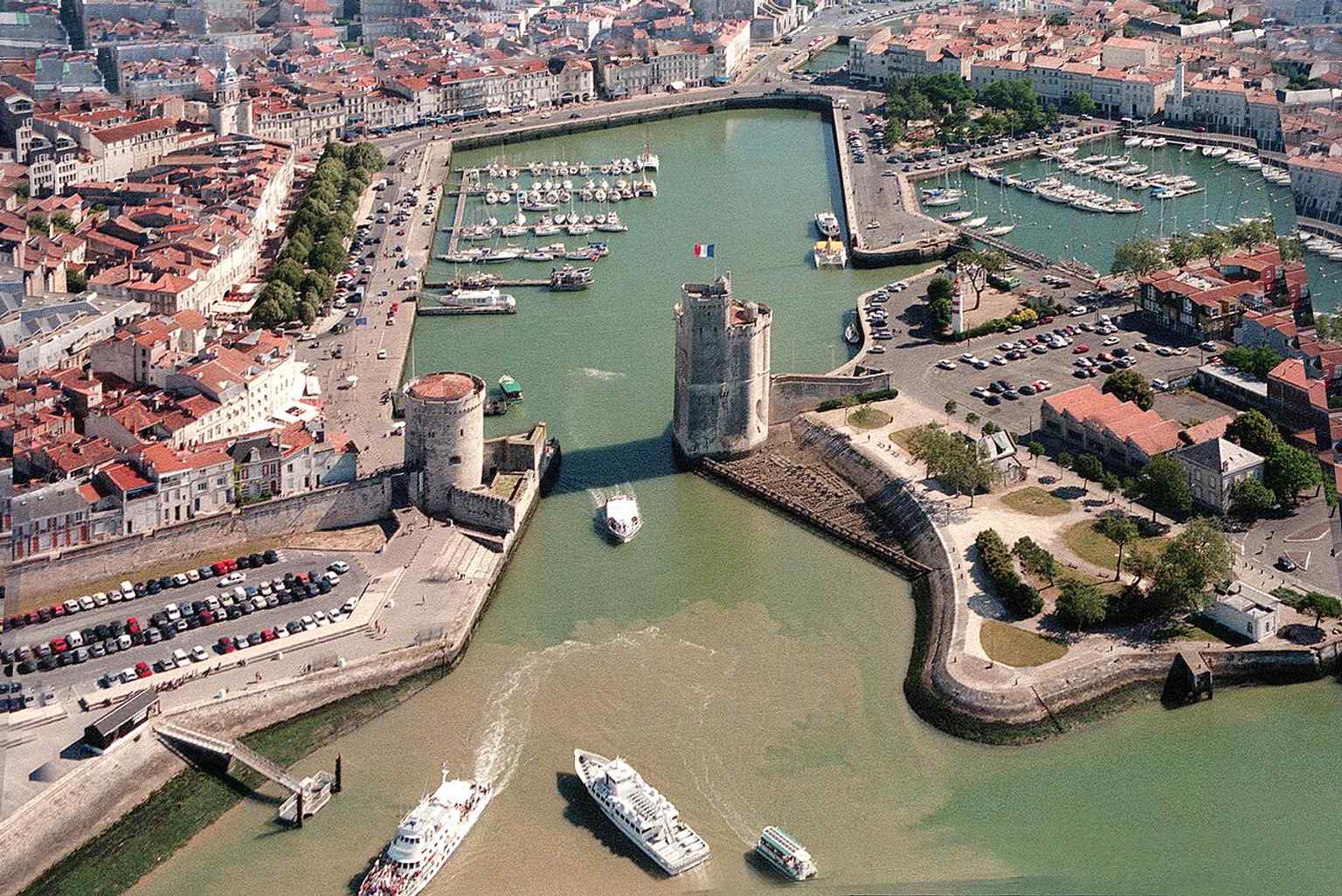
A wider harbor scene with the other historic towers, useful for situating the Lantern Tower within La Rochelle’s fortified waterfront.Photo: Jacques DASSIÉ, Wikimedia Commons, CC BY-SA 4.0. Cropped & resized. On your right stands a broad round tower of pale stone, thick and muscular, with restored machicolations, or defensive stone overhangs, at the top and a strangely clipped roofline…Read moreShow less
Open dedicated page →On your right stands a broad round tower of pale stone, thick and muscular, with restored machicolations, or defensive stone overhangs, at the top and a strangely clipped roofline that hints it once rose higher.
This is the Chain Tower, the harbor’s old bouncer. Together with Saint-Nicolas across the water, it formed the grand gate of La Rochelle’s Vieux-Port. And not metaphorically, either: a heavy iron chain stretched from this side to the other, and when the city wanted the port closed, the sea stopped being a highway and became a locked door. Nothing says confidence quite like putting a barrier across the water.
Here’s the detail most people miss. There were actually two Chain Towers here. The smaller one housed the capstan, a powerful winch used to haul the chain tight. The larger one, the tower you’re looking at, held the captain, his family, and the garrison. A two-level gallery linked the two. So this wasn’t just a tower. It was a little machine for controlling who entered, who paid, and who waited outside.
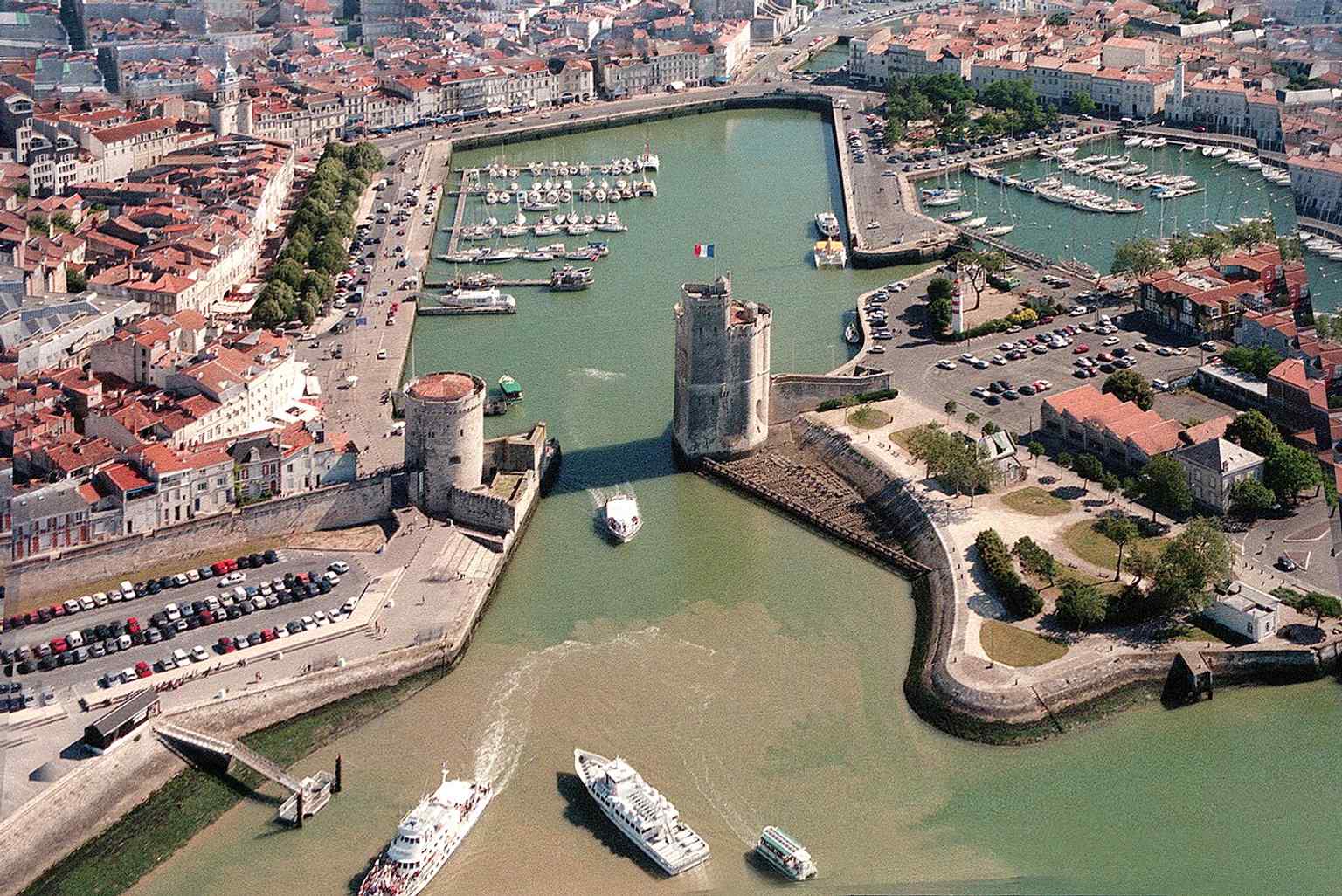
If you glance at the image on your screen showing this tower with Saint-Nicolas, you can see how the trick worked. Between those two masses of stone, La Rochelle could turn commerce on or off.
A broad composition with the Chain Tower and Saint-Nicolas together, perfect for the story of the chain stretched between the two towers.Photo: Jacques DASSIÉ, Wikimedia Commons, CC BY-SA 4.0. Cropped & resized. That power impressed kings. In fourteen seventy-two, Louis the Eleventh climbed up here, looked out over the city’s wealth, and scratched words into a windowpane with the diamond on his ring: “Oh, the great folly.” He meant his own political mistake in letting this valuable port slip into his brother’s hands. It is a wonderfully royal scene: a king standing in a tower, staring at prosperity, and realizing he had blundered.
The men posted here took the job very seriously because the city made sure they did. The mayor appointed the captain every year. He swore loyalty in person and had to live here with his family, without sleeping elsewhere at night, so he could answer any threat at once. He also collected port dues and managed the chain. So yes, the harbor gate came with paperwork. Medieval cities loved a receipt.
This tower also kept sharper memories. During the Protestant stronghold years, La Rochelle stored weapons here and even held part of the prize cargo seized by Huguenot privateers. The embalmed body of François de Coligny, seigneur d’Andelot, rested here for years after his death, turning the tower into a chamber of mourning as well as defense.
Then came the blast that changed its silhouette. In sixteen fifty-one, during the Fronde, royal troops attacked the harbor towers. As defenders fled toward Saint-Nicolas, they ignited the powder inside. The explosion tore off the roof, smashed the upper works, and left this place open to the sky for nearly three centuries. That blunt top you see now is part restoration, part scar.
One more thing to look for, low and easy to overlook: the original chain itself was found in the harbor in the nineteenth century, and part of it can still be seen at the foot of the tower. Stone tells the big story here, but iron delivers the punchline.
If you check the aerial image in the app, the full composition becomes clear: Lantern Tower behind, Saint-Nicolas opposite, and this tower gripping the mouth of the port. That wider view matters, because the next stop is the harbor itself, where all this authority had to face the messy business of ships, trade, ambition, and departure.
The entrance to the old harbor in one frame, useful for showing how the Chain Tower sits at the seaward gate of La Rochelle.Photo: Jebulon, Wikimedia Commons, CC0. Cropped & resized. If you want to come back inside later, the tower is generally open daily from ten to twelve forty-five, then from two to six-thirty.
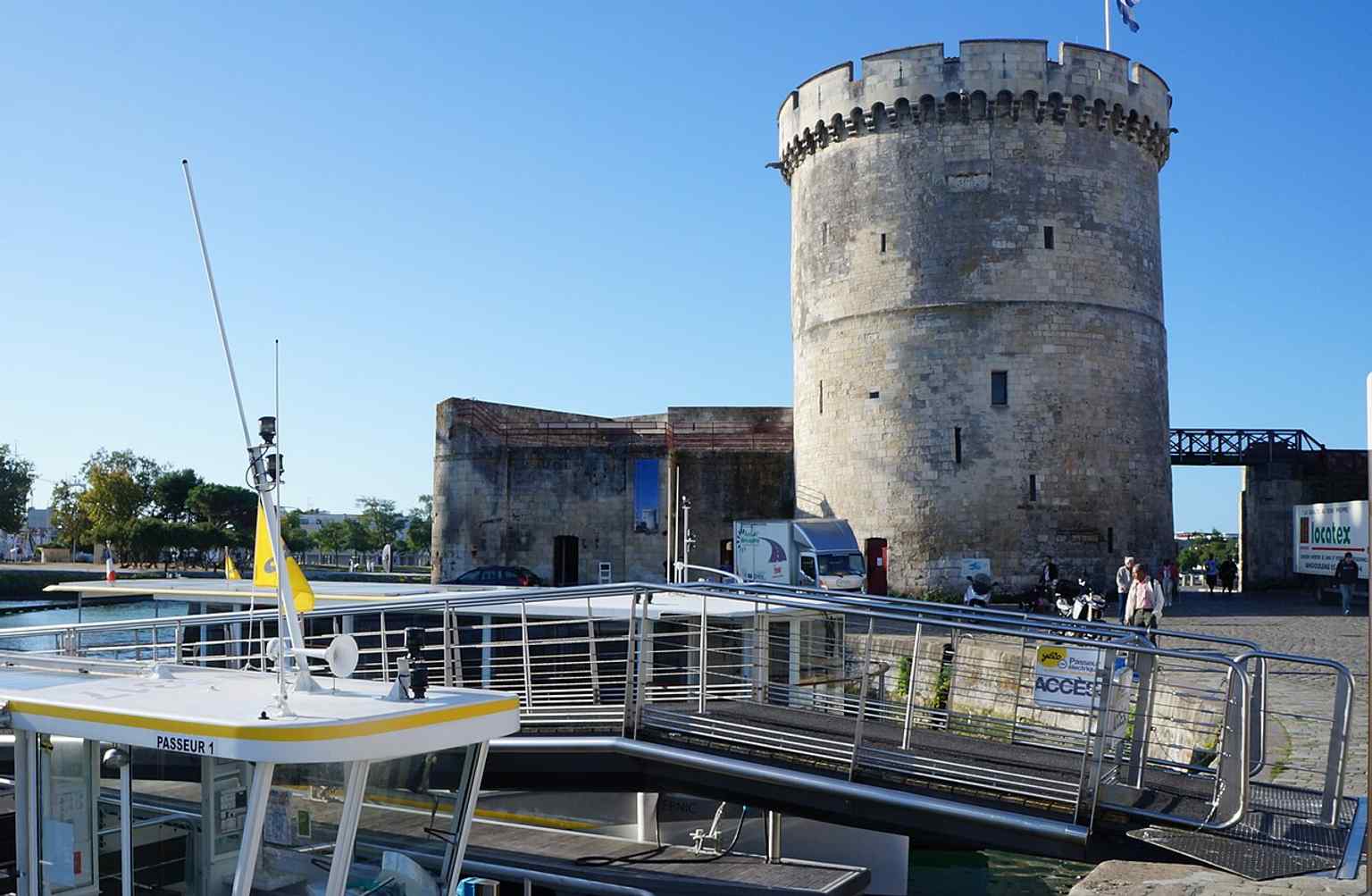
The Chain Tower seen from the waterfront, a strong image for explaining its role as the port’s defensive threshold.Photo: Pierre André, Wikimedia Commons, CC BY-SA 4.0. Cropped & resized. 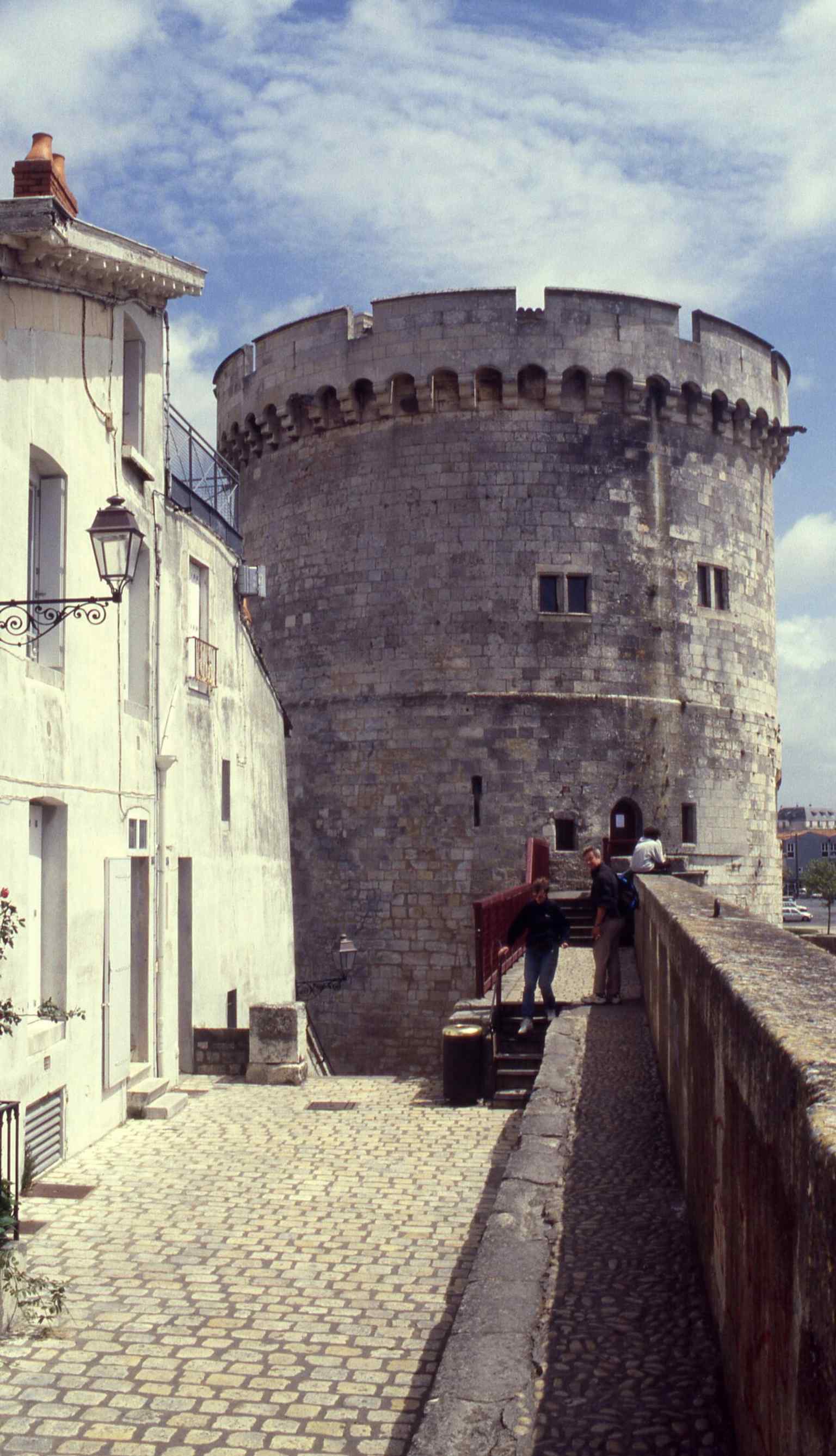
An older view of the Chain Tower from 2002, useful for evoking the monument before recent tourism-focused changes.Photo: Smiley.toerist, Wikimedia Commons, CC BY-SA 4.0. Cropped & resized. 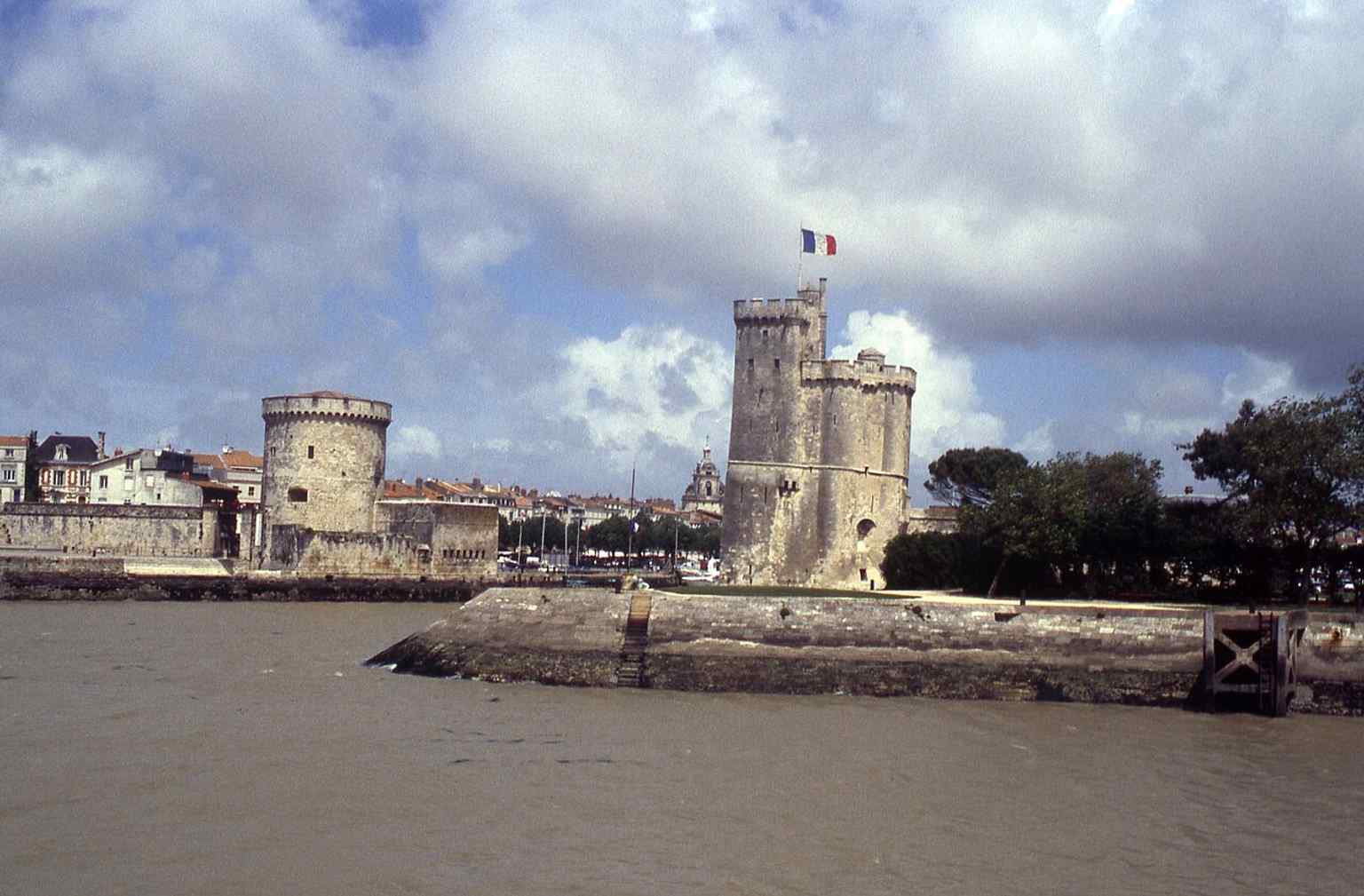
A historic photo of the harbor entrance, showing the Chain Tower in its everyday setting before the current visitor experience.Photo: Smiley.toerist, Wikimedia Commons, CC BY-SA 4.0. Cropped & resized. 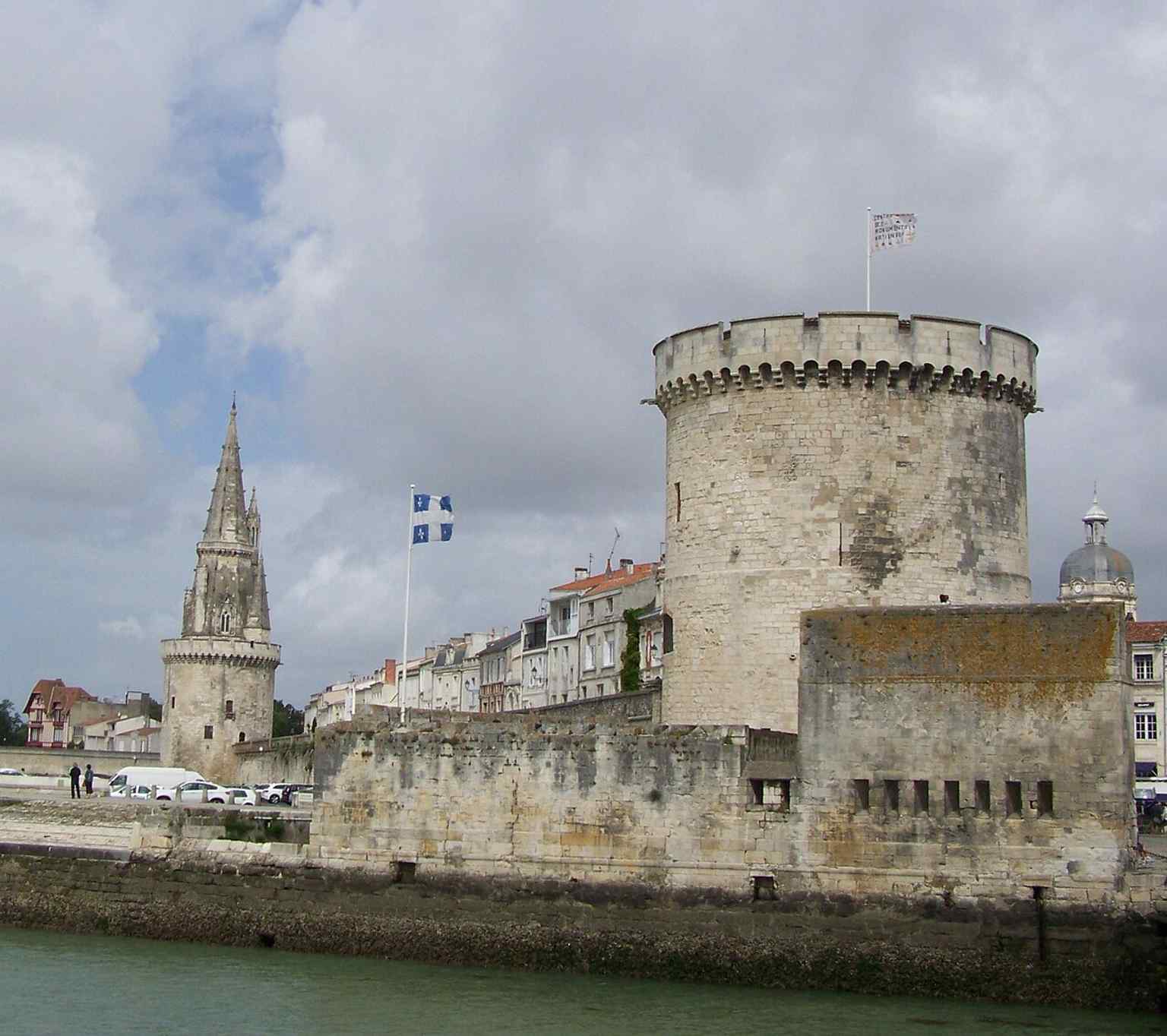
The Chain Tower with the Lantern Tower, recalling the three fortifications named in the source text and the surviving seafront defenses.Photo: Aoudot25, Wikimedia Commons, CC BY-SA 3.0. Cropped & resized. 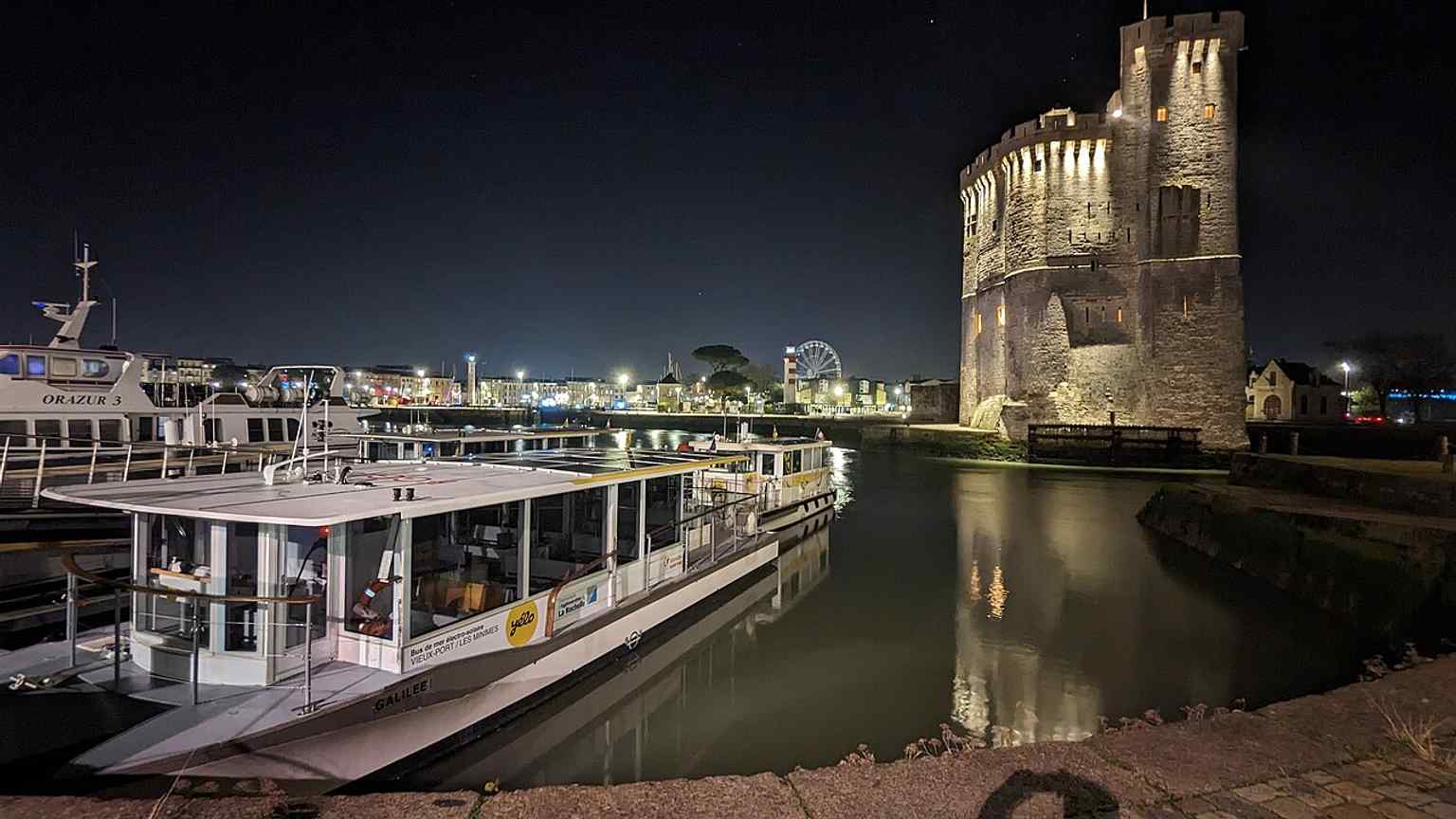
The alignment lights near the harbor entrance, a small but telling detail of the modern seafront around the Chain Tower.Photo: Duesseljan, Wikimedia Commons, CC0. Cropped & resized. Here, the whole city gathers itself into one basin. In front of you is La Rochelle’s oldest port, and also its neatest summary: towers for control, water for trade, channels for…Read moreShow less
Open dedicated page →Here, the whole city gathers itself into one basin.
In front of you is La Rochelle’s oldest port, and also its neatest summary: towers for control, water for trade, channels for survival, and now masts, cafés, museum ships, and people admiring the view as if this place had always been this agreeable. It took quite a lot of effort, argument, hunger, mud, and engineering to become agreeable.
This harbor replaced an earlier port that sat inland near Château Vauclair, on the town’s old ditches. That first harbor proved too shallow, too awkward, and too vulnerable to silting for the growing trade in wine and salt. So from the thirteenth century onward, the people of La Rochelle cut this basin open toward the Atlantic instead. That decision changed everything. Between the twelfth and fourteenth centuries, La Rochelle grew into an important Atlantic port with ties to the Templars, and later one of the great French ports during the Hundred Years’ War and the age of Atlantic expansion.
If you glance at your screen, the aerial view shows the harbor’s full cast in one frame: Saint Nicholas Tower, the Chain Tower, and the Lantern Tower, all holding the entrance like a stone handshake. Beautiful, yes... but never innocent. Those towers defended the channel, closed it when needed, and from the Renaissance into the eighteenth century they also held Huguenot prisoners and foreign sailors. This port welcomed the world and inspected it at the gate.
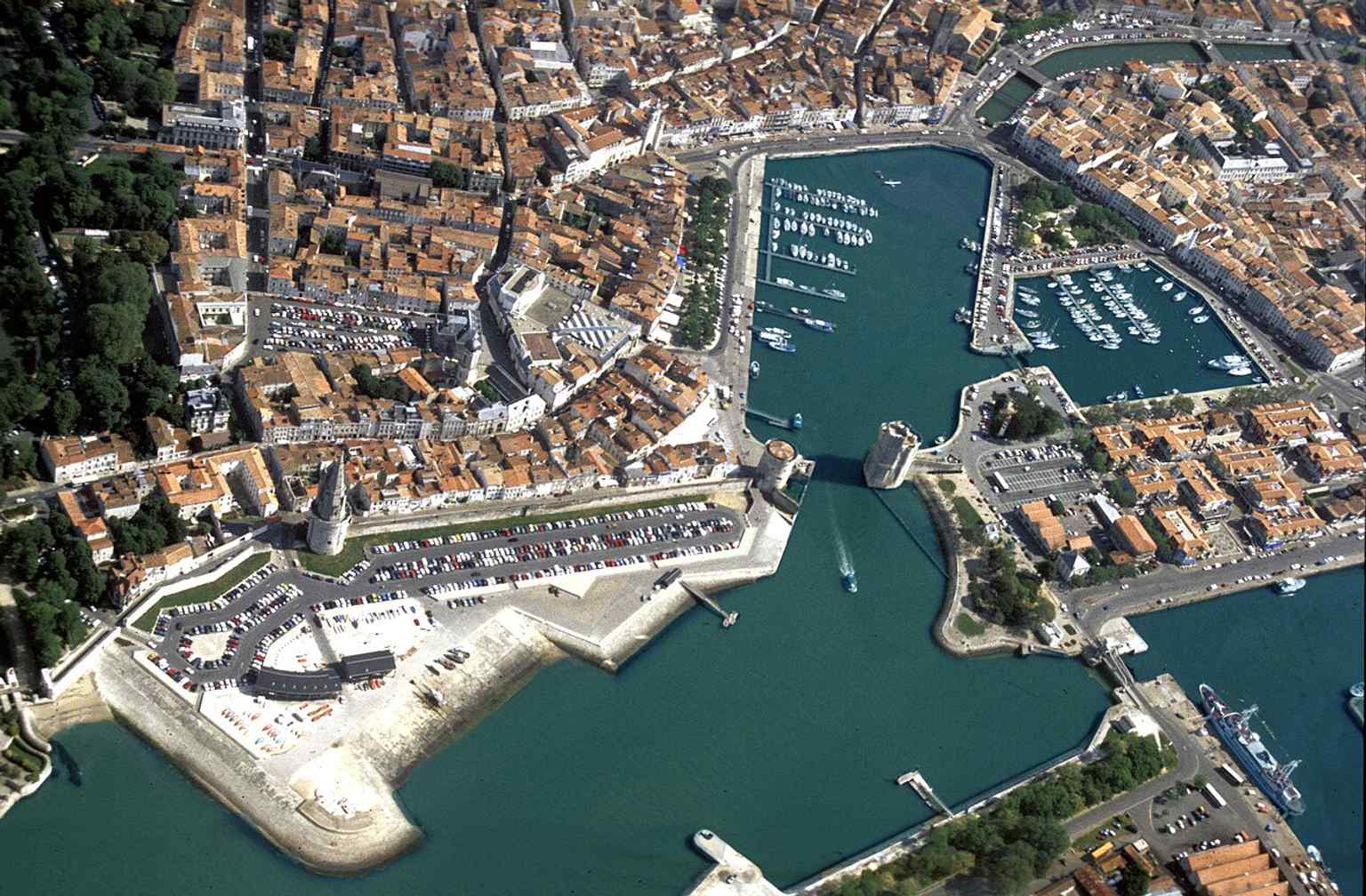
An aerial sweep of the Old Port showing the Saint-Nicolas, Chain, and Lantern towers together—the fortified entrance that once controlled access to the harbor.Photo: Jacques DASSIÉ, Wikimedia Commons, CC BY-SA 4.0. Cropped & resized. It also carried a darker cargo. In the second half of the eighteenth century, La Rochelle tied much of its economy to the slave trade. In seventeen eighty-four, thirteen of the kingdom’s fifty-two slave-trading expeditions left from here, and every one of those thirteen ships carried enslaved people to the colonies. So when you look across this water, you are looking at elegance and profit, but also at a system that implicated clerks, notaries, laborers, shipyards, and merchants all around the port. The Museum of the New World prepared us for that truth. Here, it lands harder.
The sea made La Rochelle rich, and it repeatedly tried to ruin it. Richelieu’s siege in sixteen twenty-seven and sixteen twenty-eight cut off the harbor and starved the city into surrender. Later, silting nearly did the job more quietly. Around seventeen thirty, Monsieur de Tigné complained that ships of only fifty to sixty tons could barely enter. Cardinal Fleury sent nearly two hundred thousand livres to clear the port... roughly several million euros in modern value, which is one way to say that mud was taken very seriously.
And people kept fighting that mud. In nineteen eighty-nine, Mayor Michel Crépeau even saved the dredger T-D-six from the scrapyard for one symbolic franc, because this harbor’s machinery mattered too. Memory, here, includes the tools.
Today the Vieux-Port holds about three hundred twenty berths and belongs to a much larger marina system stretching to Les Minimes. Fishing boats gave way to pleasure craft, museum vessels, and racing yachts. Off toward the old fishing basin, the trawler Manuel Joël tells a more intimate story: built in nineteen fifty-four in La Rochelle for Mister Tarand, crewed by six men, she worked the waters south and west of Ireland and later the Bay of Biscay before restoration gave her a second life.
And that may be the real genius of this port. It never became just one thing. Fortress, market, prison gate, slaving port, fishing harbor, yacht basin, museum backdrop... all of it remains legible at once.
Ports display wealth in public. The next stop shows how people turned that wealth into a face they could live behind. Head on toward the Henri the Second House, about seven minutes inland.
The gateway to the Old Port, with the historic Grosse Horloge nearby—this is the medieval waterfront entrance at the heart of La Rochelle’s maritime heritage.Photo: No machine-readable author provided. CaptainHaddock assumed (based on copyright claims)., Wikimedia Commons, CC BY-SA 3.0. Cropped & resized. 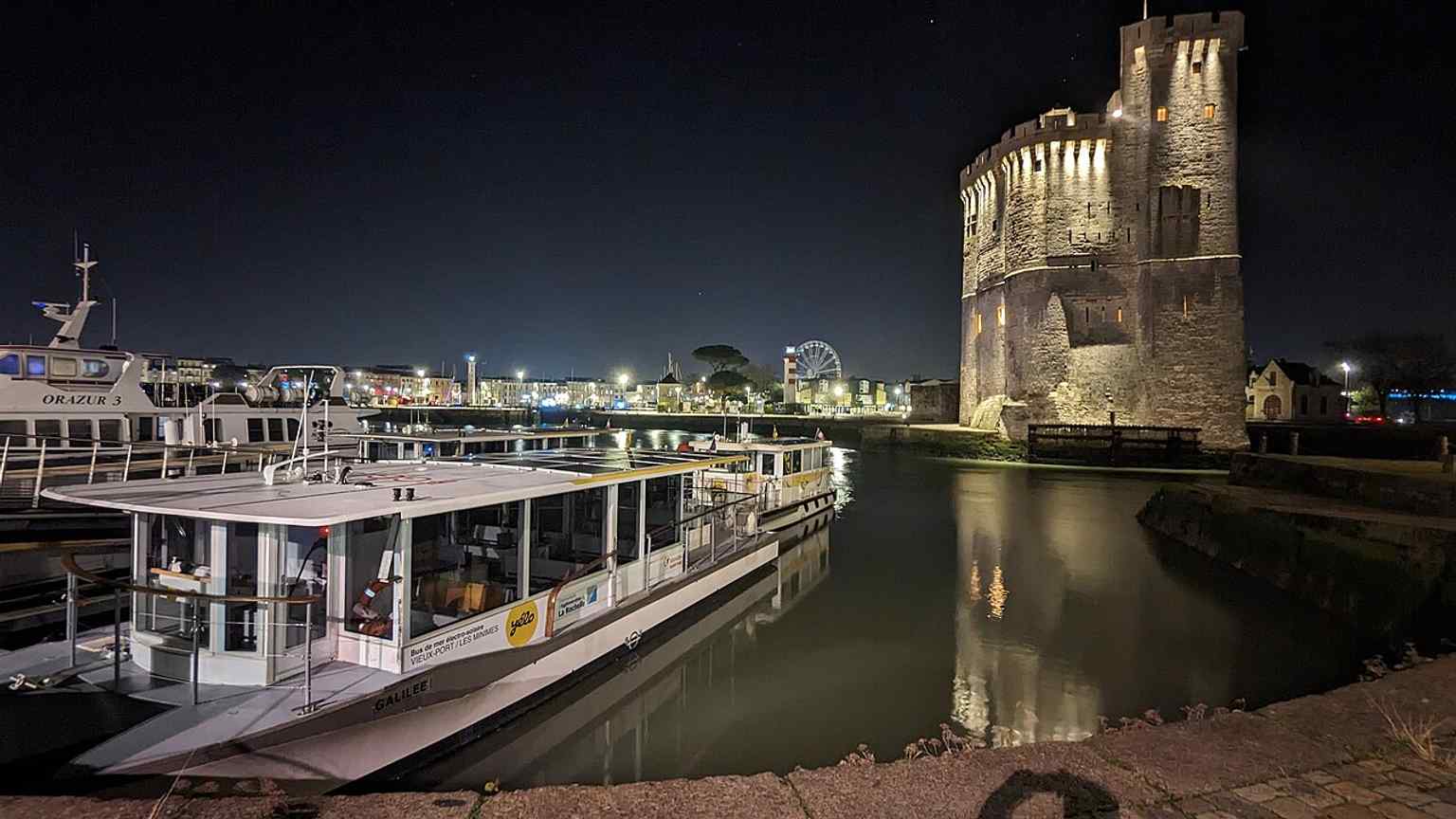
The alignment lighthouses of La Rochelle mark the harbor approach, echoing the port’s long-running need to guide ships safely into the Old Port channel.Photo: Duesseljan, Wikimedia Commons, CC0. Cropped & resized. On your right, look for a pale stone Renaissance facade with stacked arcaded galleries, two pavilions of uneven height, and little grimacing diablotins carved into the ornament.…Read moreShow less
Open dedicated page →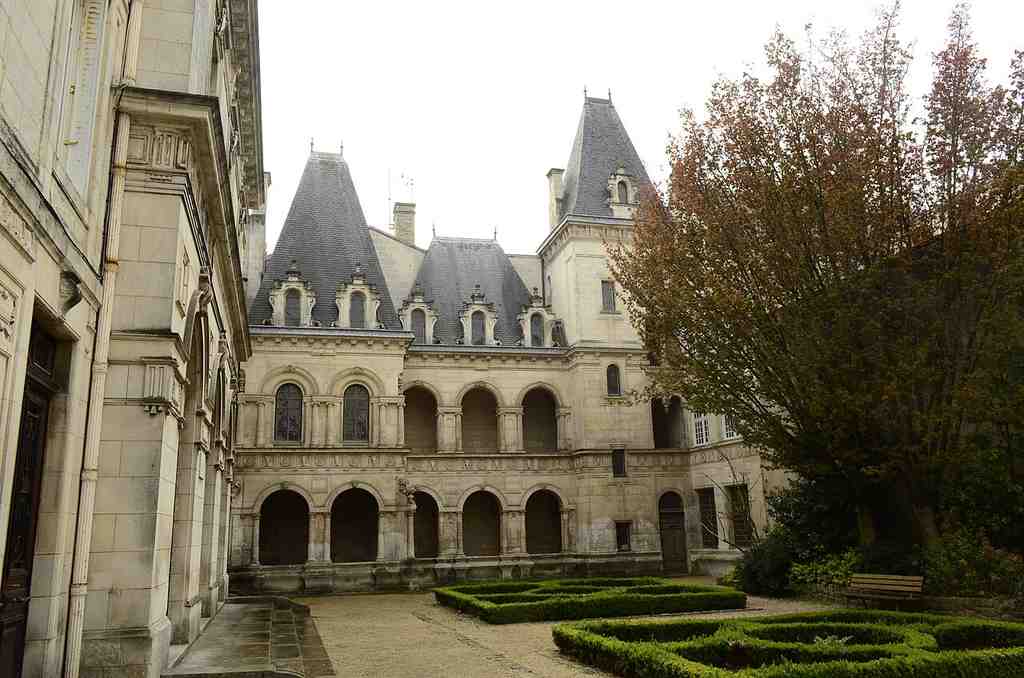
Henri II House (La Rochelle)Photo: Gestoso, Wikimedia Commons, CC BY-SA 3.0. Cropped & resized. On your right, look for a pale stone Renaissance facade with stacked arcaded galleries, two pavilions of uneven height, and little grimacing diablotins carved into the ornament.
This is the Henri Two House... except it is also the Hôtel Pontard, and also the House of Diane de Poitiers. Which is a very La Rochelle trick: give one building three identities and let everyone argue politely for centuries.
Hugues Pontard, the king’s prosecutor, raised it around fifteen fifty-five, probably with plans by Léonard de La Réau, on the site of an older residence linked to Jean Chaudrier. Pontard wanted status written in stone. And he got it... sort of. What you see is famously less a deep, comfortable home than a theatrical front: two galleries with barely any depth, arranged to fool the eye into reading noble grandeur. A trompe-l’oeil, in plain English, is architecture playing dress-up.
If you glance at the image in the app, you can really see that stage-set quality in the facade’s flat elegance. It performs certainty. The family behind it had rather less. Before this house even rose, Pontard had already spent time in the Conciergerie in Paris in fifteen forty-five and fifteen forty-six for protecting people accused of heresy. In other words, the fault line we traced at the Protestant temple had already reached his doorstep.
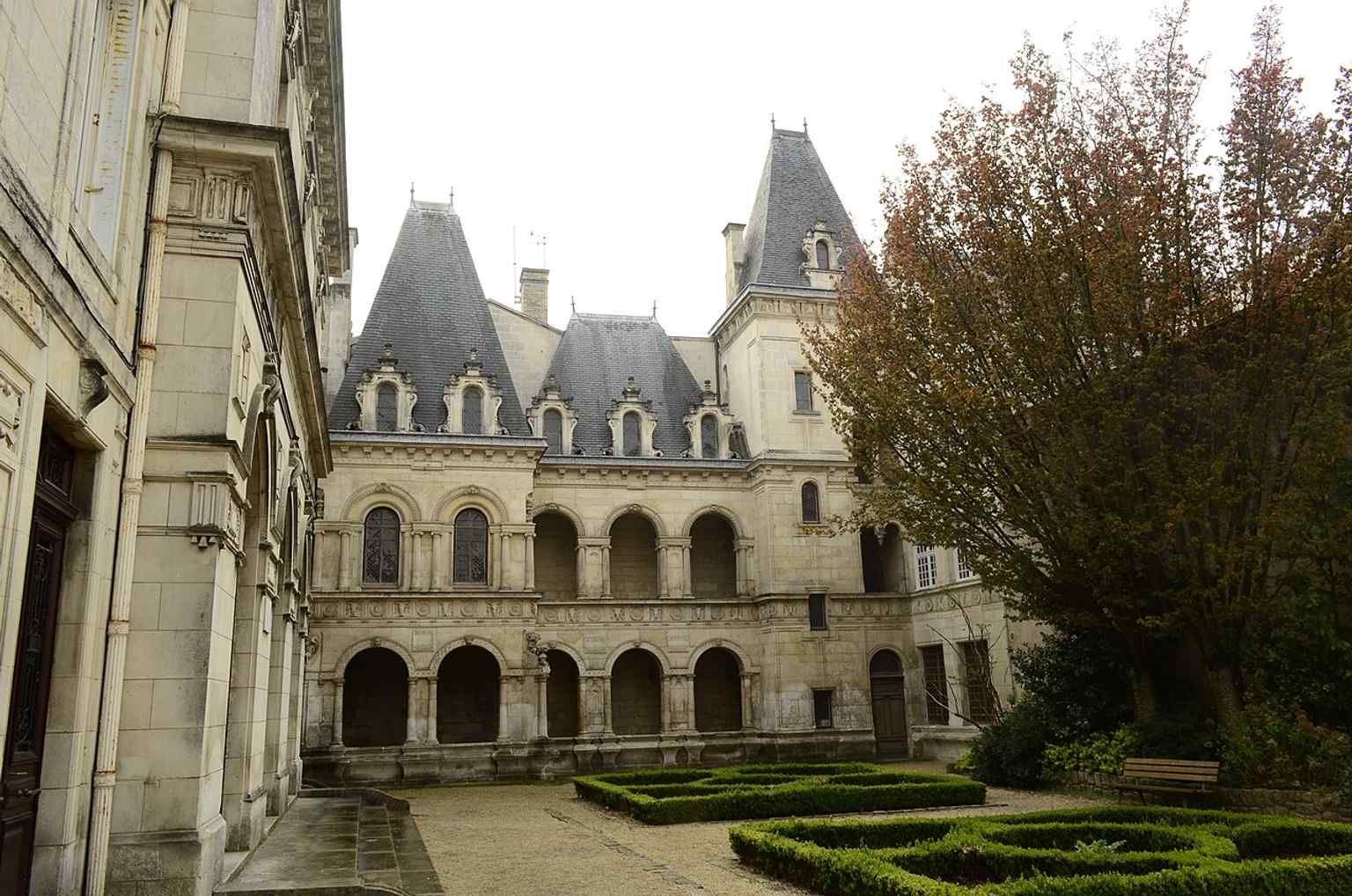
Another exterior view of the same landmark, showing the decorative Henri II / Diane de Poitiers house often described as more of a theatrical facade than a deep residence.Photo: Gestoso, Wikimedia Commons, CC BY-SA 3.0. Cropped & resized. Then his son François Pontard pushed things further. At just twenty-seven, he became mayor in fifteen sixty-seven, and by January fifteen sixty-eight he helped pull La Rochelle into the Protestant camp, welcoming Condé, Jeanne d’Albret, and the young Henri of Navarre. After the Peace of Longjumeau, the governor banished him. So yes... the handsome facade concealed a family balancing ambition, belief, and danger.
Later this address turned inn, finance office, city seat, history collection, and since two thousand thirteen, the Centre Intermondes for contemporary artists from around the world. If you check the front view on your screen, the ornament almost looks too polished to trust. That may be the point.
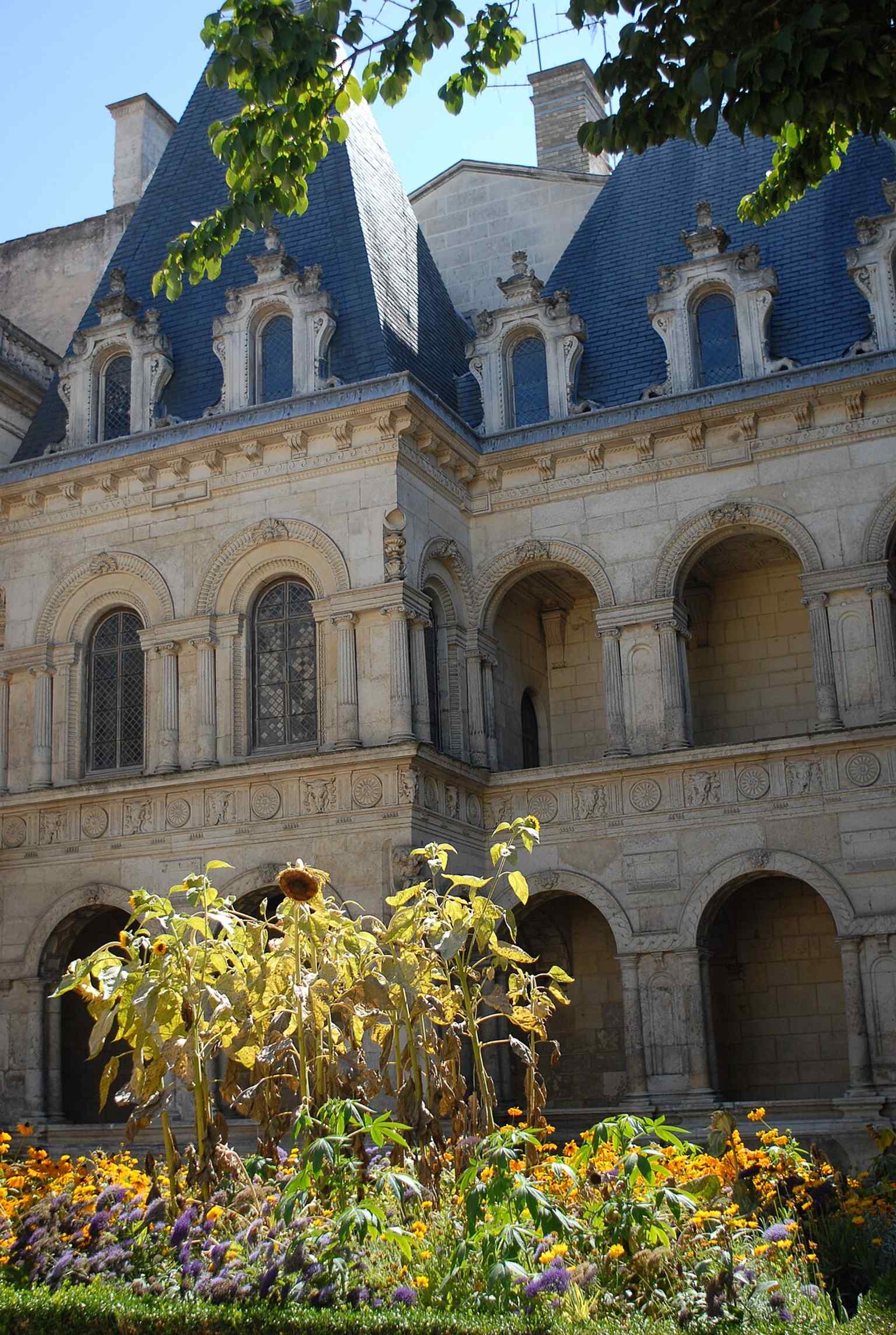
A clear front view of the Henri II House in La Rochelle, the Renaissance facade built around 1555 and protected as a historic monument since 1897.Photo: Nathalie Boudet, Wikimedia Commons, CC BY-SA 3.0. Cropped & resized. From here, we head toward the Musée des Beaux-Arts, where taste and memory get arranged a little more officially. And conveniently, this exterior is accessible at any hour.
On your left, look for a pale stone, rectangular palace front with tall regular windows and a formal arched portal framed by classical pilasters. This building is a fine example…Read moreShow less
Open dedicated page →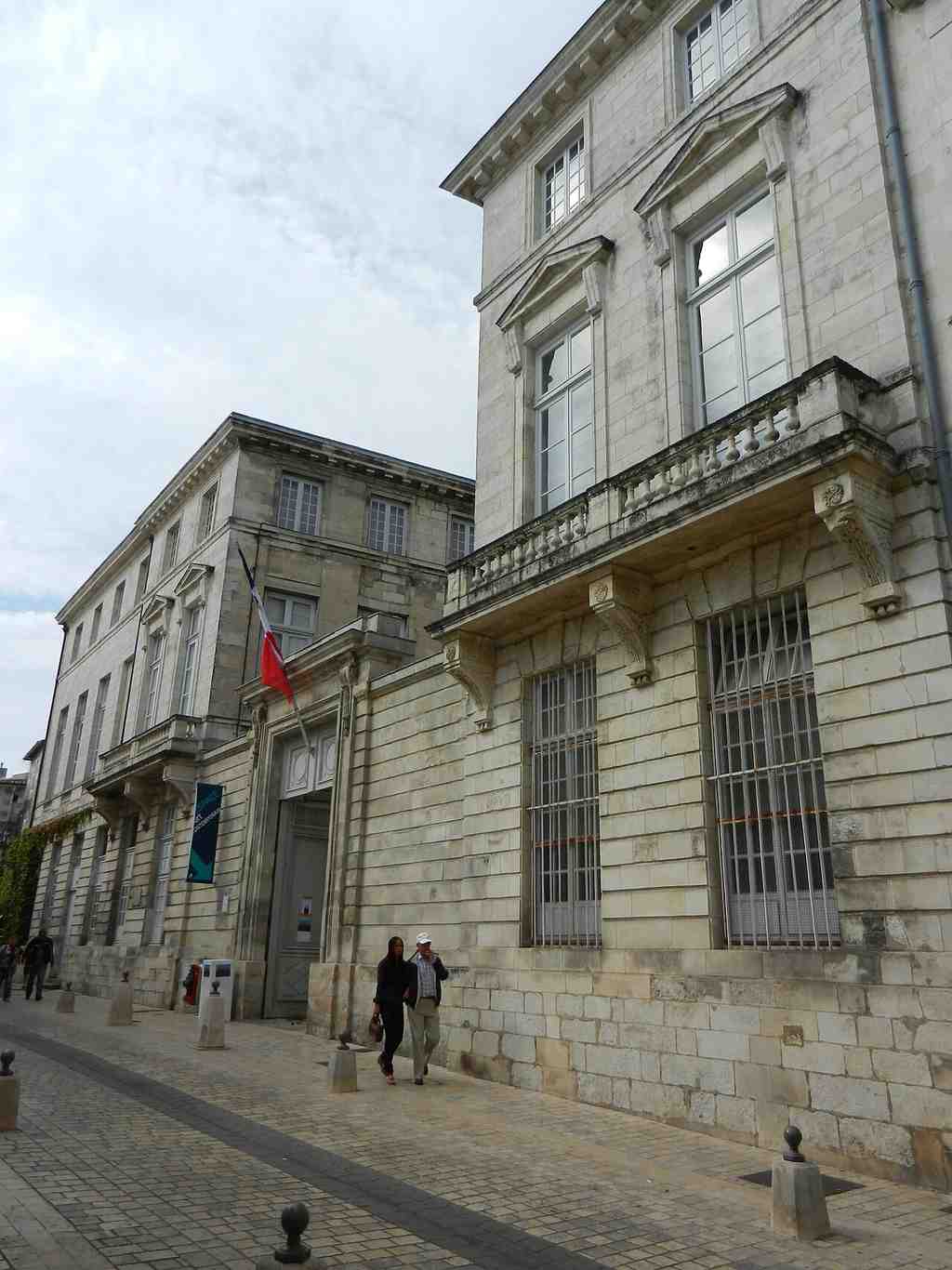
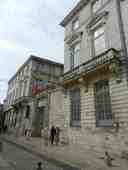
Musée des Beaux-Arts de La RochellePhoto: ROZE Sébastien, Wikimedia Commons, CC BY-SA 3.0. Cropped & resized. On your left, look for a pale stone, rectangular palace front with tall regular windows and a formal arched portal framed by classical pilasters.
This building is a fine example of a city refusing to waste a good address. It began as a grand private house in the early seventeenth century. In sixteen hundred, Paul Legoux, treasurer to the House of Navarre, bought the property. Before that, an earlier residence here, called the Grand-Logis or Palais-Royal, welcomed heavyweight guests: Sully in sixteen oh four, Condé in sixteen fifteen, Louis the Thirteenth in sixteen twenty-eight, and Anne of Austria in sixteen thirty-two. People described it as the finest, most comfortable, and best-aired house in La Rochelle... which proves real-estate bragging is an old profession.
Then the building changed loyalties. In sixteen seventy-three it became a seminary, a school for training clergy. In sixteen ninety-six, Bishop Henri de Laval installed the bishopric here, making it the bishop’s official residence. Later, between seventeen sixty-nine and seventeen seventy-four, François-Joseph-Emmanuel de Crussol d’Uzès ordered a full rebuild. Architect Gilles Nassivet drew the plans, and François Chapuy carried them out. What you see now comes from that moment: a neoclassical palace, meaning calm, balanced, and very sure of itself. If you glance at the image on your screen, the entrance makes that point nicely
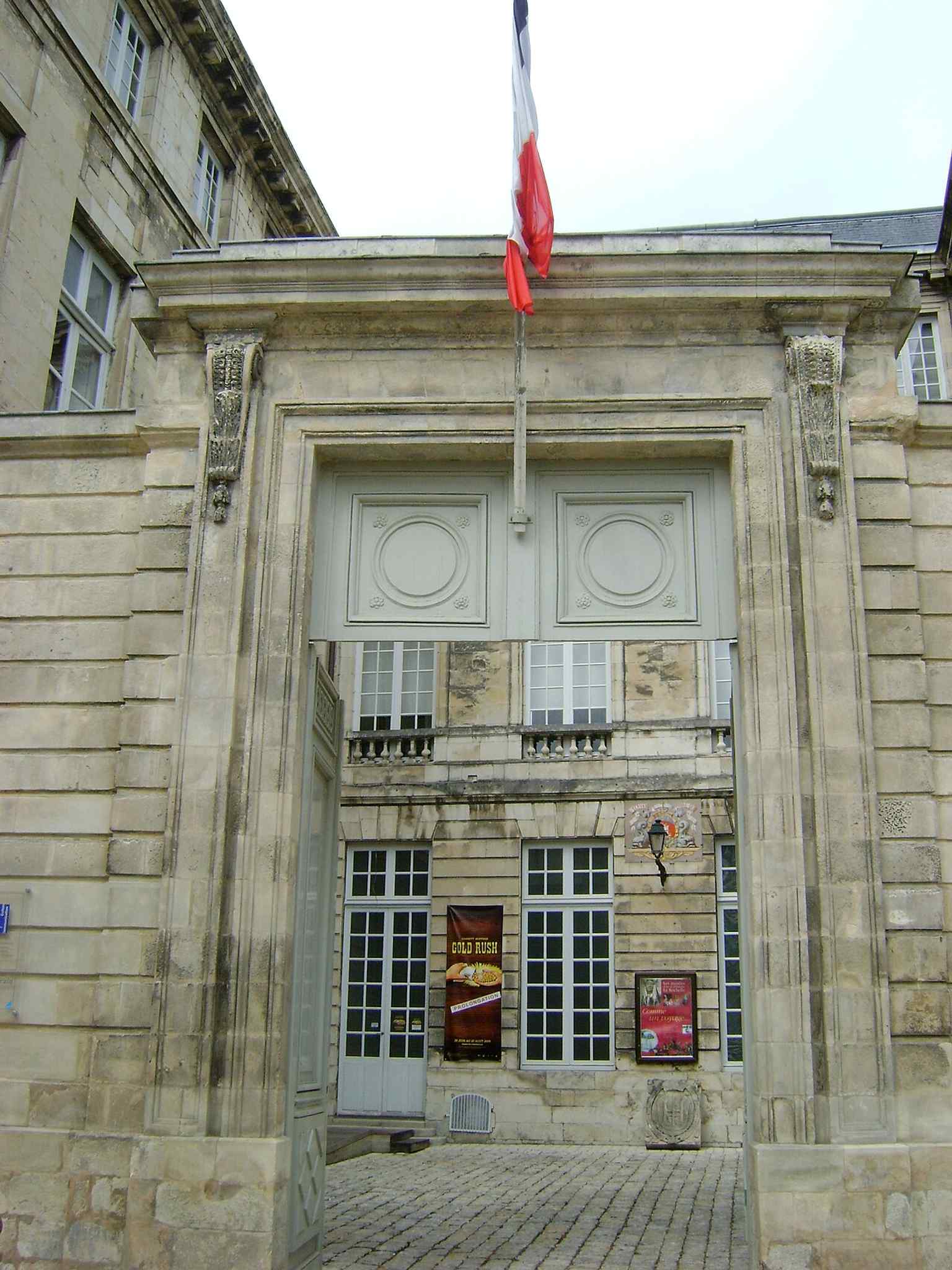
The museum’s entrance portal on rue Gargoulleau, set in the 18th-century episcopal palace that now houses La Rochelle’s fine arts museum.Photo: Guiguilacagouille, Wikimedia Commons, CC BY-SA 3.0. Cropped & resized. The Revolution changed the owner again. The city took over, and in seventeen ninety-five the municipal library moved in. Then, in eighteen forty-five, the fine arts museum settled on the second floor above the books. That layering matters. This place did not simply become a museum; it inherited earlier roles of power, learning, and public order.
And La Rochelle kept editing the story. The library left in nineteen ninety-eight for the Michel-Crépeau media library. Contemporary art moved into the space in nineteen ninety-nine. Stone fragments from vanished buildings ended up here too, in a collection of carved stone fragments, so even lost architecture found a second life indoors.
The museum itself began early, with local citizens. In eighteen forty-one, the Société des Amis des Arts started buying works; by eighteen forty-four, the museum existed. Its first curators, the painters Édouard Pinel and Tibulle Mary Furcy de Lavault, shaped a collection that felt unmistakably Rochelais. More recently, from two thousand eight to two thousand eighteen, community groups helped choose and arrange displays themselves. A small museum, perhaps, but not a timid one.
Since a structural alert in two thousand eighteen, the building has been under major repair and rethinking. Still, the museum never really went silent. It kept acquiring works and lending them to places like the Louvre and museums farther afield in Europe.
That may be the real lesson here: a city curates itself the way this building changed hands, room by room, purpose by purpose. Next, we go looking for something older than all this careful arrangement... Château Vauclair, where La Rochelle’s deeper beginnings still murmur underneath the later city.
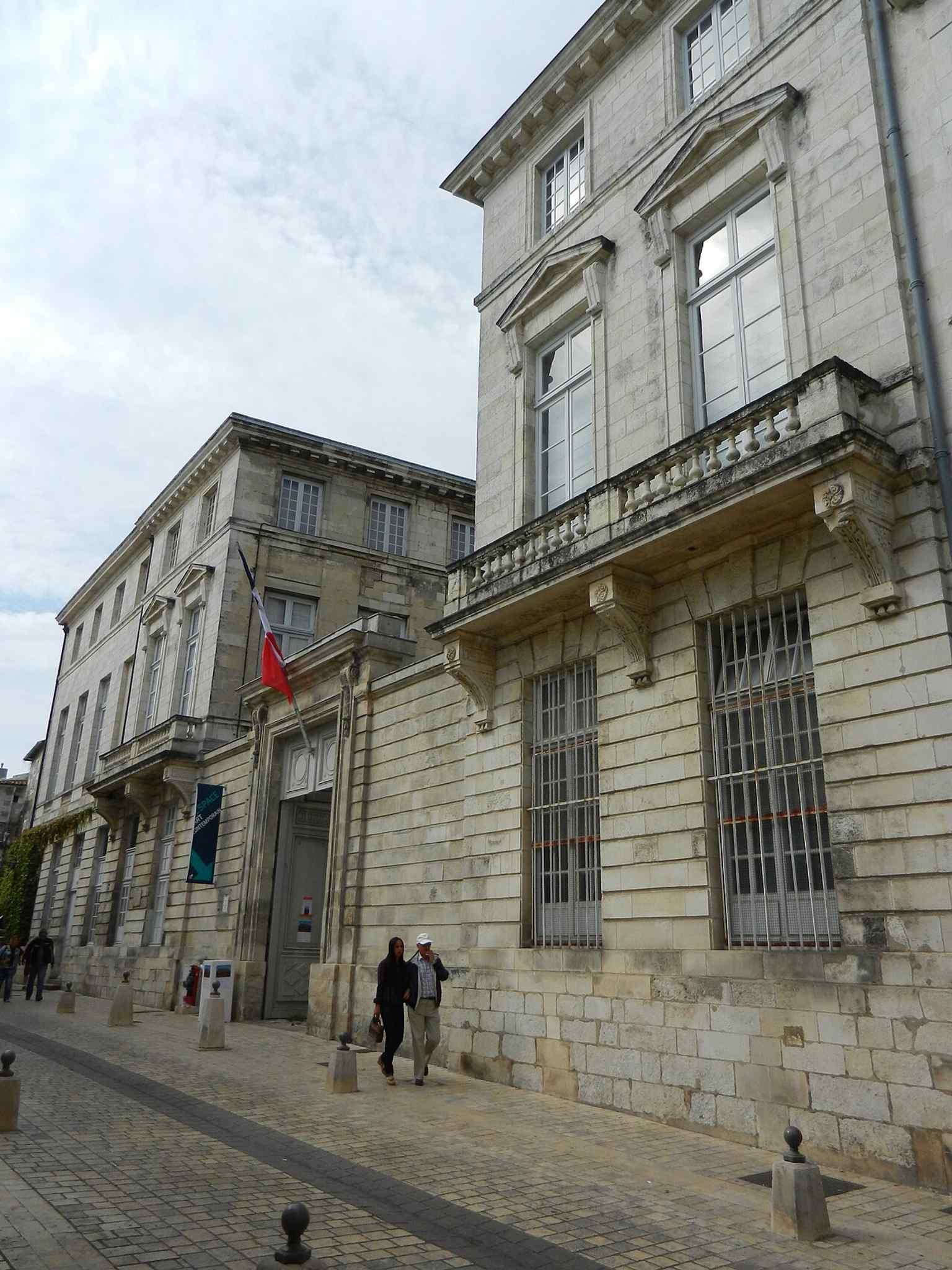
A wider view of the former episcopal palace of La Rochelle, the historic building later adapted for the Musée des Beaux-Arts.Photo: ROZE Sébastien, Wikimedia Commons, CC BY-SA 3.0. Cropped & resized. Look for the rough pale limestone curve of a tower fragment, a thick rounded wall with narrow slit-like openings - one stubborn piece of masonry left from a castle that otherwise…Read moreShow less
Open dedicated page →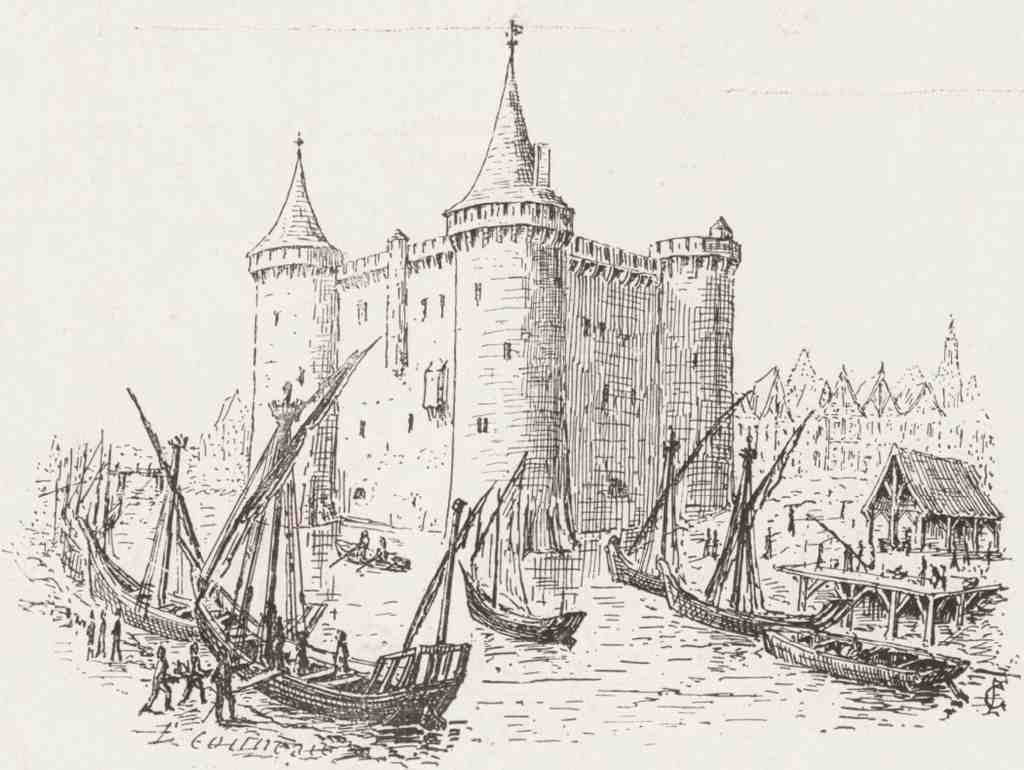
Château VauclairPhoto: Émile Couneau, Wikimedia Commons, Public domain. Cropped & resized. Look for the rough pale limestone curve of a tower fragment, a thick rounded wall with narrow slit-like openings - one stubborn piece of masonry left from a castle that otherwise vanished.
This is Château Vauclair... or rather, the place where La Rochelle’s missing stronghold still presses its shape into the city. Henri the Second of England, husband of Eleanor of Aquitaine, ordered it here in the late twelfth century to command the town’s first harbor, the old port on the Lafond watercourse. Long before the postcard harbor took center stage, power gathered here.
Vauclair covered more than a hectare. Imagine four massive corner towers, walls linking them with a crenellated parapet - those tooth-like battlements soldiers could hide behind - and deep moats circling the whole thing. Its parade ground stood where Saint-Louis Cathedral rises now. So yes, one of the city’s grand churches occupies what had been a military yard. La Rochelle never did keep its categories tidy.
This fortress was not just for troops. In twelve twenty, Henry the Third of England asked the mayor to receive his sister, Jeanne, and her guard here. So Vauclair served as a princely guesthouse too: part barracks, part residence, part reminder of who held the keys.
The sharpest story belongs to Jean Chaudrier, the mayor in thirteen seventy-two. After the Treaty of Brétigny, the English held La Rochelle, and as long as they held this castle, the city could not really turn French. Chaudrier invited the English captain, Philippe Mancel, to dinner, then showed him a sealed document, pretending it ordered a review of the garrison. Mancel could not read. Awkward way to run a fortress, honestly. He drew his men out, the gate stayed open, and the Rochelais took the castle without a direct assault.
Then came the real point: the townspeople demanded not only their liberties, but the castle’s destruction. Its stones went into the new port defenses, especially the wall of the Gabut. People even coined a saying: over the Mauclerc bridge passed Château Vauclair. A fortress became building material... control turned into civic protection.
If you check the image on your screen, you can see the surviving tower remnant that still breaks the surface of that story. Excavations in the nineteen ninety-five to nineteen ninety-seven parking works uncovered foundations and decorated floor tiles marked with French lilies and English leopards - small, human traces of rulers changing over a very contested patch of ground.
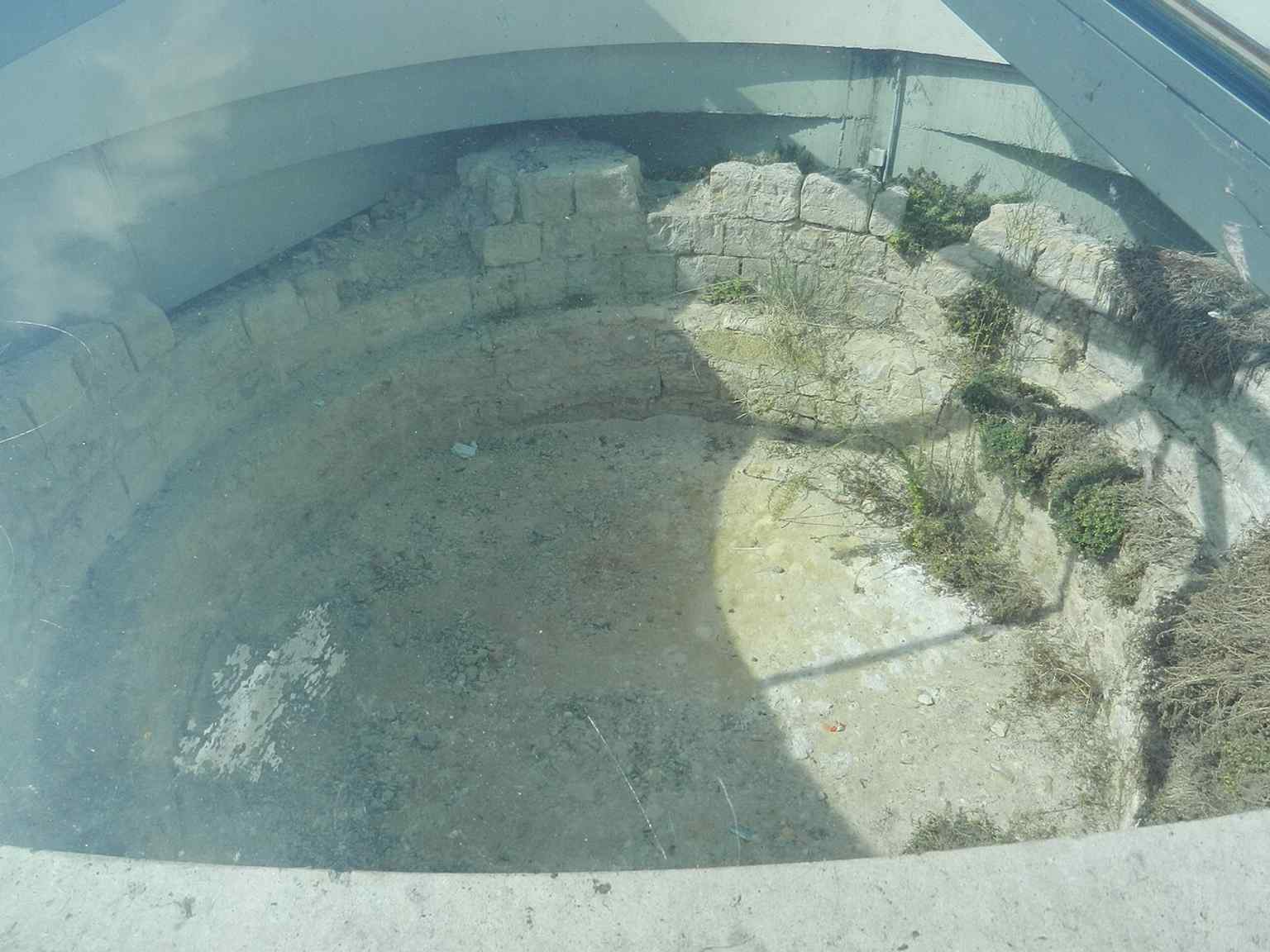
A surviving tower fragment of Château Vauclair, the last visible trace of the fort that once guarded La Rochelle’s old harbor and was later demolished after the 1372 siege.Photo: ROZE Sébastien, Wikimedia Commons, CC BY-SA 3.0. Cropped & resized. The last towers, damaged in the siege of fifteen seventy-three, later collapsed. So we end our walk not with a monument in full, but with an absence.
If the most important place in a city is one that no longer stands, how does that change the way you remember it?
Hold La Rochelle in layers now: harbor, walls, faith, trade, prisons, paintings, and here, a missing castle still shaping the map. That feels about right for this city.
If you want practical details, the site-related access here is generally closed on Monday and Sunday, and open Tuesday through Saturday from ten to one and three to six.

Frequently asked questions
How do I start the tour?
After purchase, download the AudaTours app and enter your redemption code. The tour will be ready to start immediately - just tap play and follow the GPS-guided route.
Do I need internet during the tour?
No! Download the tour before you start and enjoy it fully offline. Only the chat feature requires internet. We recommend downloading on WiFi to save mobile data.
Is this a guided group tour?
No - this is a self-guided audio tour. You explore independently at your own pace, with audio narration playing through your phone. No tour guide, no group, no schedule.
How long does the tour take?
Most tours take 60–90 minutes to complete, but you control the pace entirely. Pause, skip stops, or take breaks whenever you want.
What if I can't finish the tour today?
No problem! Tours have lifetime access. Pause and resume whenever you like - tomorrow, next week, or next year. Your progress is saved.
What languages are available?
All tours are available in 50+ languages. Select your preferred language when redeeming your code. Note: language cannot be changed after tour generation.
Where do I access the tour after purchase?
Download the free AudaTours app from the App Store or Google Play. Enter your redemption code (sent via email) and the tour will appear in your library, ready to download and start.
If you don't enjoy the tour, we'll refund your purchase. Contact us at [email protected]
Checkout securely with 






.JPG)


.%20Postcard%2C%20c.%201910.jpg)


.JPG)
.JPG)


.jpg)


.jpg)
.jpg)


.JPG)


-France.JPG)


.JPG)


