
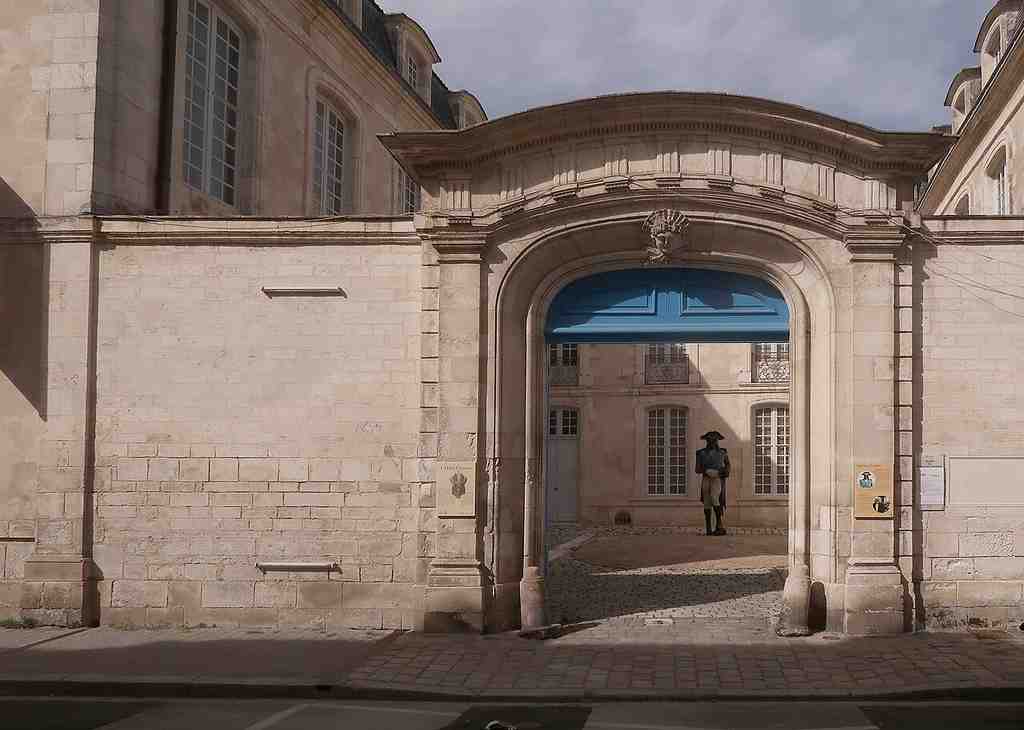
On your right is a pale stone town house with a tall arched gateway, a balanced central block, and side wings that fold inward around a private courtyard.
This is the Museum of the New World, housed inside the Hôtel de Fleuriau... an elegant eighteenth-century mansion with a story that refuses to stay elegant. La Rochelle made some of its fortune by looking far beyond France, across the Atlantic to New France, the Caribbean, and the growing worlds of trade, migration, and empire. The sea carried ships, goods, ideas, and ambition... and, just as surely, it carried coercion, extraction, and human suffering.
The man tied most closely to this address is Aimé-Benjamin Fleuriau. He returned to La Rochelle in seventeen fifty-five after making his fortune in Saint-Domingue, today’s Haiti, where he owned the Fleuriau plantation near Port-au-Prince: sugar cane fields, a sugar refinery, and enslaved people forced to make the whole machine run. In seventeen seventy-two he bought this mansion. Around seventeen eighty, he bought the neighboring property and expanded the house toward the garden, cutting new doorways from floor to floor so the old residence and the new addition worked as one. Even the architecture tells on him. The larger house is not just taste... it is profit turned into stone.
That matters because this museum does not pretend those profits were abstract. When La Rochelle opened it here in nineteen eighty-two, under mayor Michel Crépeau, with conservator Alain Parent shaping the project, it became one of the first museums in a French port city to directly address that port’s slave-trading past. Most tourists notice the symmetry first. Locals will tell you the bolder detail is inside the story the museum chose to tell: this house came from the same Atlantic system it now examines, and accuses.
That is the moral hinge of the place. Cities love polished versions of themselves. This one, to its credit, left some of the polish off. Inside, the galleries trace the “New World” from several angles: discovery and exploration on the ground floor; La Rochelle and the Antilles on the mezzanine level, including the slave trade, colonial goods, and the abolitions of slavery; then New France, the American War of Independence, Plains peoples, the rush to California, and photographs of Native American communities by Edward S. Curtis. In other words, not a souvenir shop with better lighting.
There is another layer here too: exchange. The Americas changed Europe’s imagination as much as Europe changed the Americas, and not for the better in every case. The museum’s paintings, maps, engravings, and decorative arts show fascination, greed, admiration, fantasy, and violence all mixed together... which is a very human recipe, unfortunately.
And here is the part worth carrying with you: La Rochelle’s pride in its maritime reach cannot be separated from the people whose labor paid for that reach. This museum says that plainly. It widens the city’s horizon, but it also sharpens its conscience.
From here, the route turns toward Saint-Louis Cathedral, about a three-minute walk away, where stone and ceremony will show how the city tried to impose a different kind of order after so much conflict. If you plan to come back inside, the museum is usually open most days except Tuesday, with a midday closure.




