

Odense Highlights Audio Tour: Hans Christian Andersen's Fairytale Path
Beneath the charming cobblestones of Odense lies a graveyard of forgotten rebellions and royal scandals waiting to be unearthed. This self guided audio tour pulls you away from the tourist path to reveal the raw, unpolished history hiding in plain sight. Navigate through the echoing halls of Grey Friars Monastery, the creative grit of Brandt’s, and the shifting temporal layers of the TIME Museum. What dark secret forced a king to abandon his own throne in the dead of night? Who still paces the cloisters of the monastery long after the bells have stopped ringing? Why did a specific local merchant choose to hide his gold in a box filled with salt? Trace the footsteps of ghosts and rebels across this ancient city. Feel the weight of centuries shifting beneath your feet as you experience Odense not as a postcard, but as a living mystery. Start your journey and uncover the truth.
Tour preview
About this tour
- scheduleDuration 100–120 minsGo at your own pace
- straighten4.2 km walking routeFollow the guided path
- location_on
- wifi_offWorks offlineDownload once, use anywhere
- all_inclusiveLifetime accessReplay anytime, forever
- location_onStarts at The City Bridge
Stops on this tour
lock_open 3 free previews · 12 unlock with purchase
Look for a long steel bridge with a gently rising span, separate side-by-side paths, and a tall white pylon standing above the railway. This is Byens Bro, the City Bridge, and…Read moreShow less
Open dedicated page →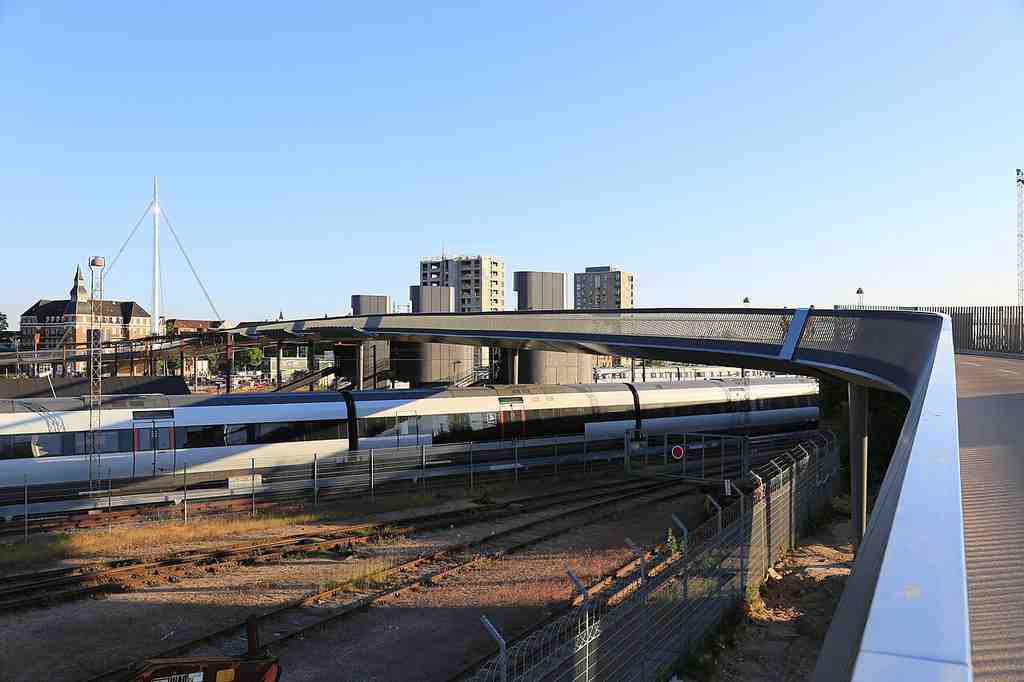
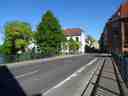
The City BridgePhoto: Kåre Thor Olsen, Wikimedia Commons, CC BY-SA 4.0. Cropped & resized. Look for a long steel bridge with a gently rising span, separate side-by-side paths, and a tall white pylon standing above the railway.
This is Byens Bro, the City Bridge, and it tells you something important about Odense right away... when the city meets a barrier, it tends to answer with a passage. Here, that passage changed what the station area could be. Instead of the rail yard splitting town from harbor, this bridge turned the gap into a hinge.
It opened on the twenty-ninth of May, twenty fifteen: one hundred thirty-five meters long, stretched across fifteen railway tracks, with stairs and elevators down to three platforms. Take a second and follow the bridge with your eyes... walkers on one side, cyclists on the other. It feels neatly choreographed, almost like Odense saying, “Sure, we can all get along if we keep our lanes.” If you want a clearer view of that layout, the image on your screen shows the parallel paths and the station towers well.
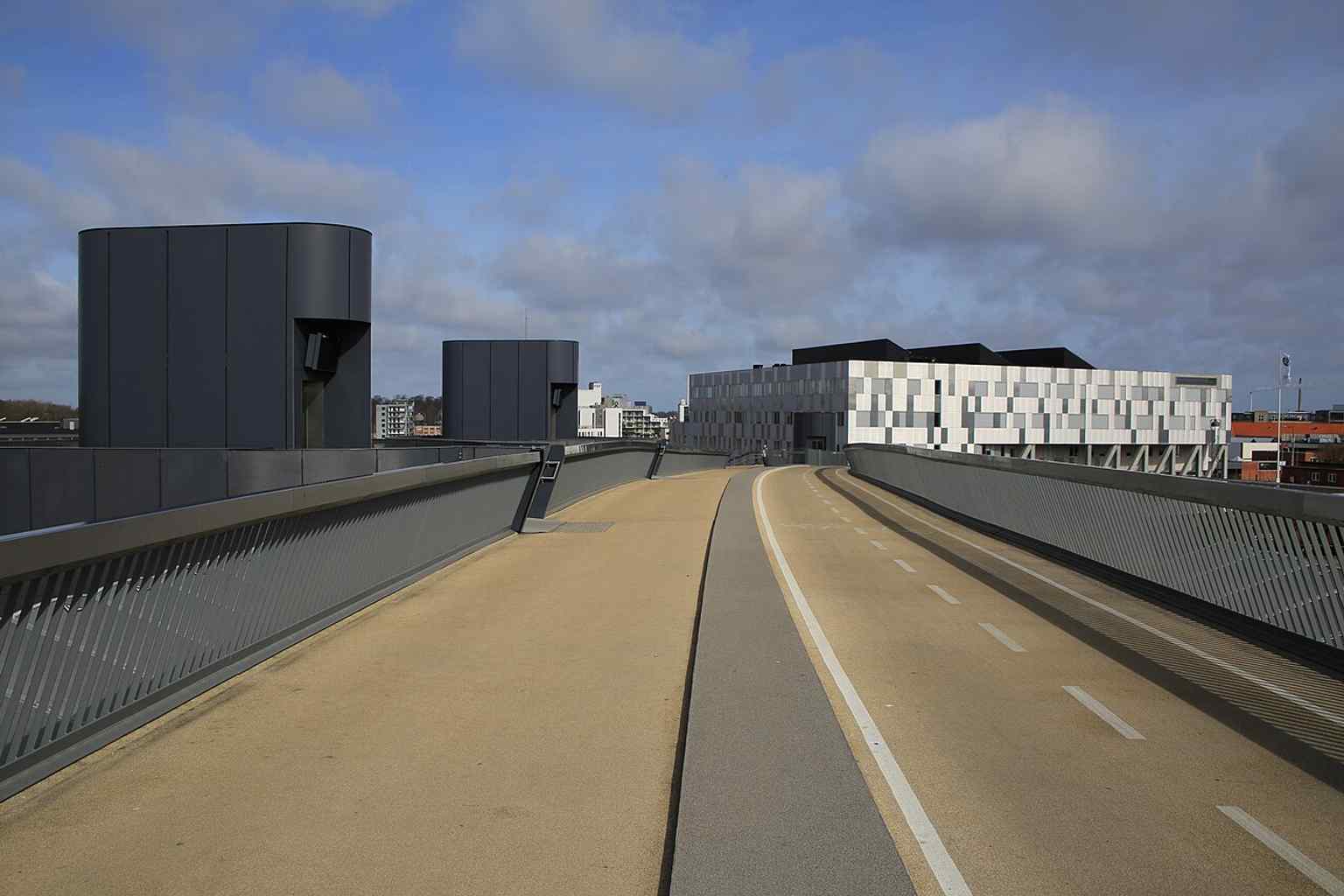
View north across Byens Bro showing the separate pedestrian and cycle lanes, plus the stair and lift towers to platforms 5/6 and 7/8.Photo: Kåre Thor Olsen, Wikimedia Commons, CC BY-SA 4.0. Cropped & resized. Project leader Poul-Ivan Ikkala said the real headache hid underneath that calm design. The hard part was not drawing the bridge. It was getting above fifteen active tracks without shutting down train traffic. So the city and D-S-B, the rail operator, only closed tracks when absolutely necessary. Meanwhile, builders from Bladt Industries poured about three thousand four hundred tons of concrete, set about four hundred thirty-five tons of steel, and raised that forty-meter pylon.
The architects, Gottlieb Paludan and Public Arkitekter, gave Odense the structure. Artist Anita Jørgensen gave it a pulse, folding in Auroraholes, a monumental light work, from the start rather than tacking art on later. Even the name came from locals: more than thirteen hundred people entered a contest, and Povl Edvard Hansen won it.
At the opening, Jane Jegind rode across with Klaus Bondam from the Cyclist Federation, even though some paving, elevators, and cycle parking still lagged behind. That feels very Odense to me... connection first, polish after.
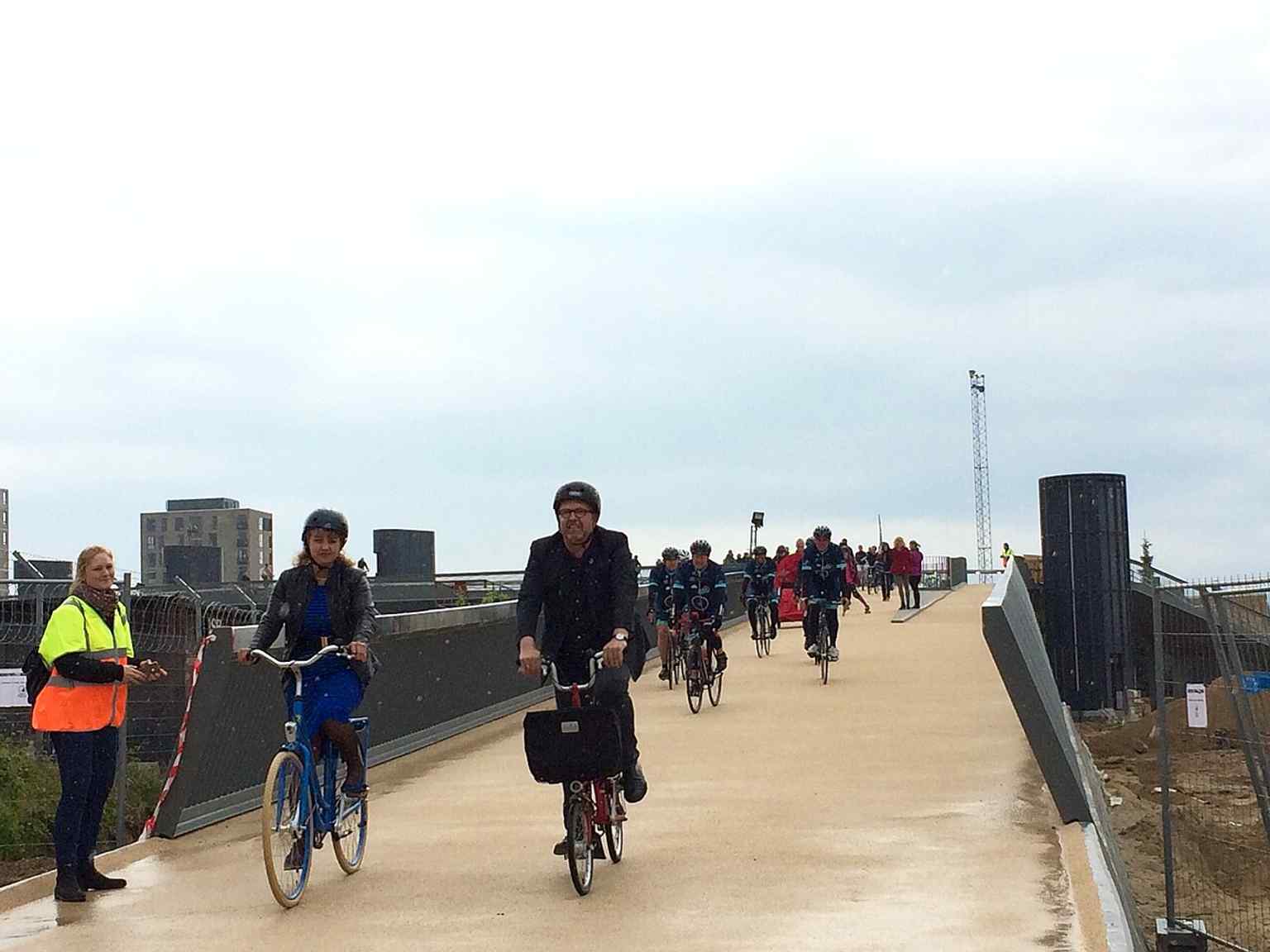
Jane Jegind and Klaus Bondam riding across the bridge at the 29 May 2015 opening, marking the moment Byens Bro first came into public use.Photo: Kristian Bang, Wikimedia Commons, CC0. Cropped & resized. Next, we trade rails for clipped paths and older ideas of order in the King’s Garden, about a five-minute walk away. And convenient little detail: this bridge stays open twenty-four hours a day.
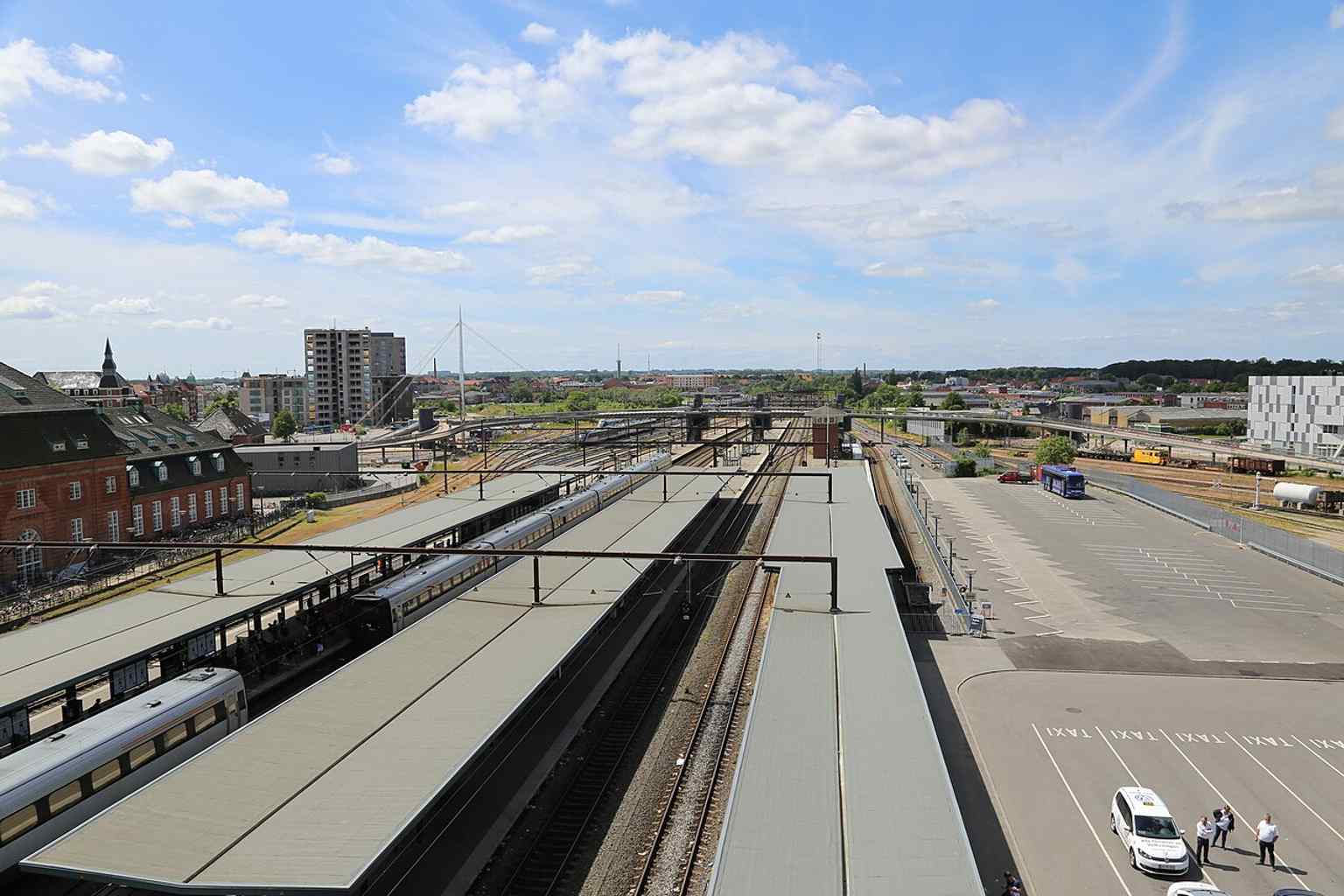
Odense station platforms leading toward Byens Bro — the bridge was built to connect pedestrians and cyclists across the railway yard.Photo: Kåre Thor Olsen, Wikimedia Commons, CC BY-SA 4.0. Cropped & resized. 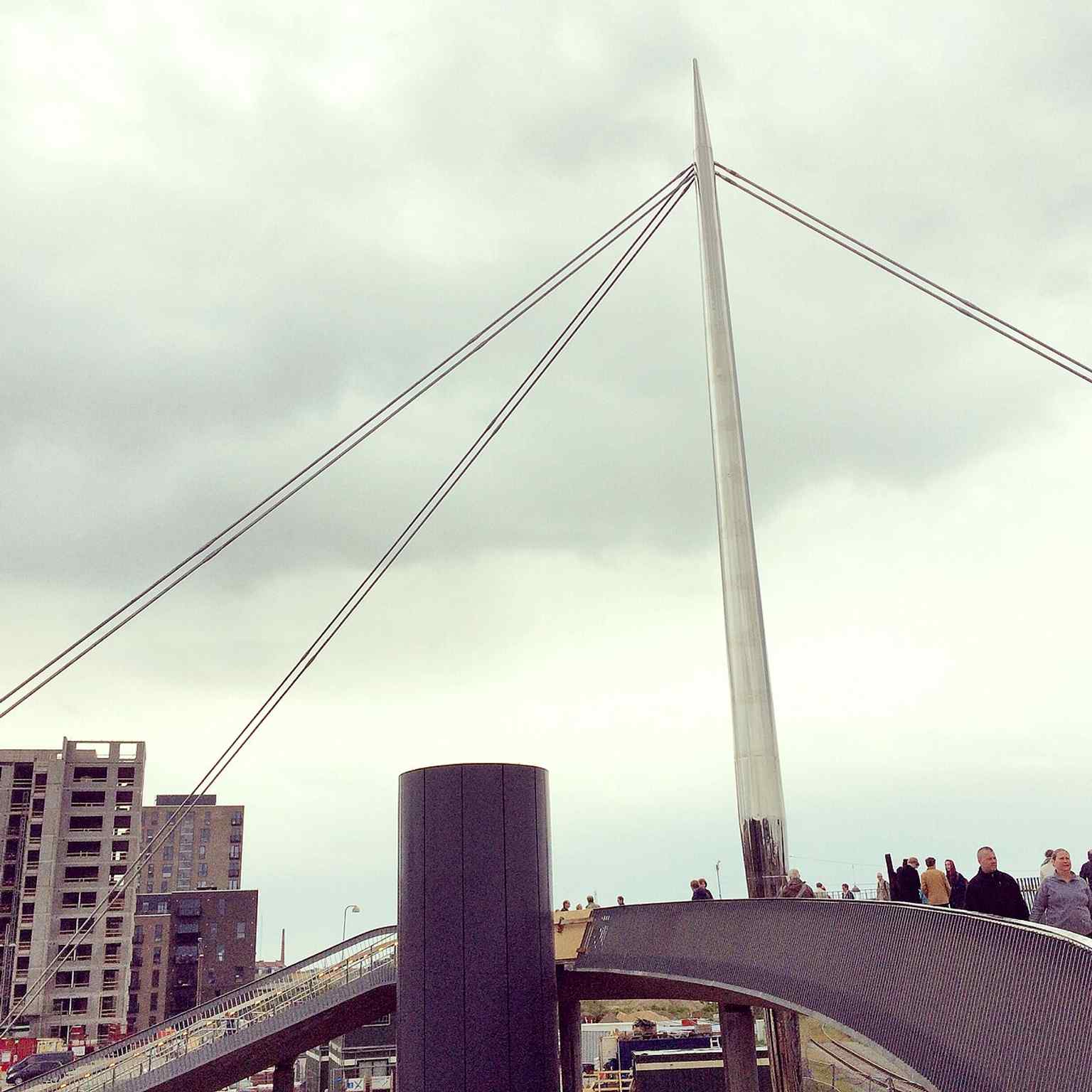
The bridge at its opening with the pylon visible — a key part of the 40-meter steel landmark that spans 15 railway tracks.Photo: Kristian Bang, Wikimedia Commons, CC0. Cropped & resized. 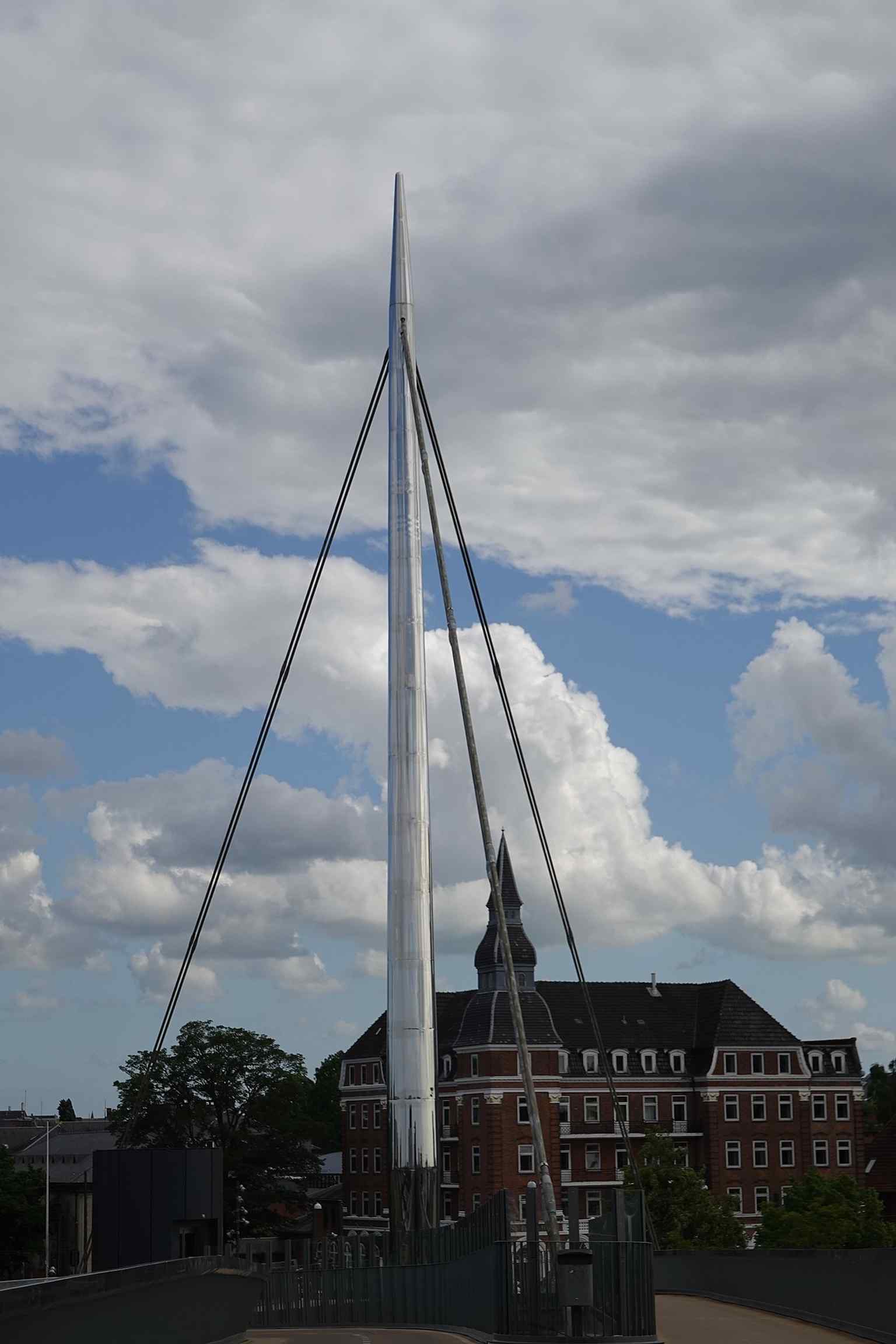
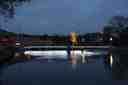
The bridge’s artistic side in 2022, echoing the lighting art connected to Byens Bro’s identity and award-winning design.Photo: Smiley.toerist, Wikimedia Commons, CC BY-SA 4.0. Cropped & resized. Ahead of you is a formal green space framed by straight edges and curving paths, with the pale mass of Odense Castle behind it and a mounted statue marking one of its historic…Read moreShow less
Open dedicated page →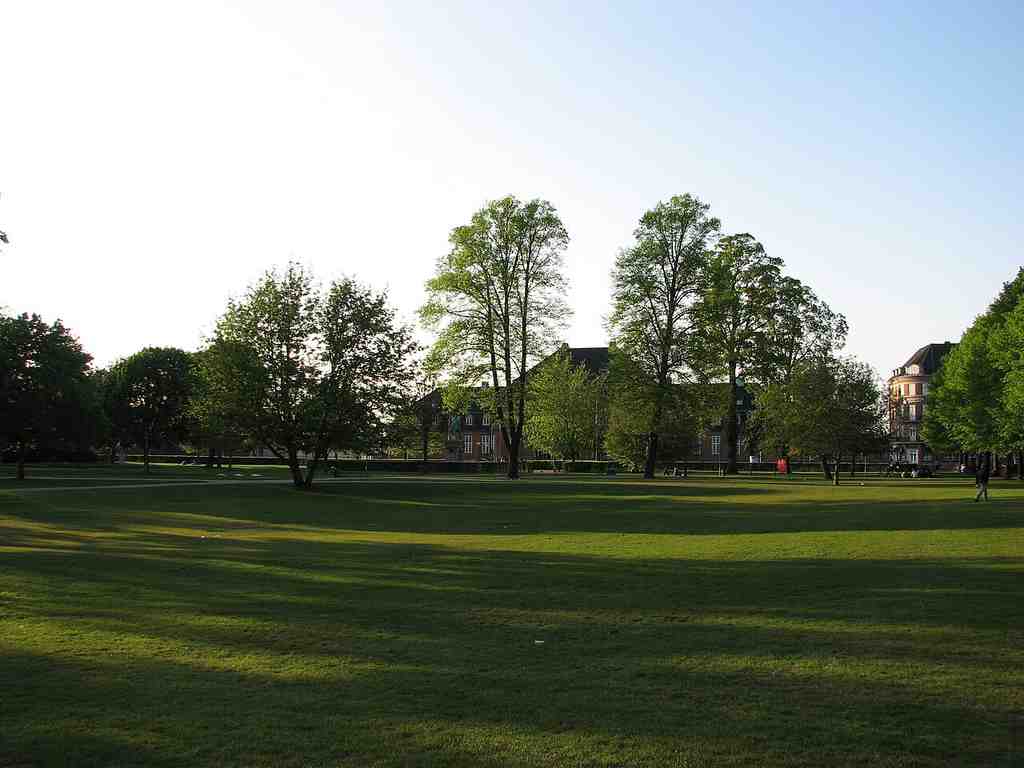
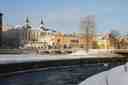
The King's Garden (Odense)Photo: Kåre Thor Olsen, Wikimedia Commons, CC BY-SA 3.0. Cropped & resized. Ahead of you is a formal green space framed by straight edges and curving paths, with the pale mass of Odense Castle behind it and a mounted statue marking one of its historic entrances.
This is Kongens Have, the King’s Garden... and it began as a carefully controlled piece of royal stagecraft. Around seventeen twenty, the people shaping the grounds around the castle followed French ideas and laid out what gardeners call an axis garden: a plan organized around a strong central line, with balanced, symmetrical paths branching from it like a ruler had settled an argument. Very tidy, very noble, very sure of itself.
About a century later, Odense changed the mood. Gardeners reshaped the place in the English romantic style, which traded straight lines for curved walks and a gentler, more wandering feeling. Same ground, different manners. That little shift tells you a lot about this city: Odense likes design, but it also likes to loosen its collar.
For a long time, ordinary people could not simply stroll in. A fence ringed the garden until Odense Municipality bought it in nineteen oh seven. Then, in nineteen oh nine, the city removed the fence and added electric lamps. That was more than practical housekeeping. It turned a royal enclosure into public rhythm, a place people could cross, meet, sing, protest, and pause.
One person tied firmly to this spot is King Christian the Ninth, or rather his rider statue near the entrance by the old station. In nineteen twelve, Odense citizens raised the money themselves, and the local sculptor Aksel Hansen gave the king his bronze form. I like that detail. A royal image, paid for by townspeople, greeting travelers at the edge of a public park... that is Odense in miniature.
There are other layers here too. In front of the castle stands Frederik the Seventh, whose statue first faced the city from Flakhaven in eighteen sixty-eight before moving here in nineteen eighty-seven. On the first of September, nineteen forty, during the German occupation, thirty-five thousand citizens gathered here for a demonstration of shared song. Later came modern additions, including NineNow in nineteen ninety-three, a sound sculpture of nine half-buried metal discs that make the garden feel just a touch more contemporary than its royal bones suggest. Parks, like people, can wear more than one century at once.
Notice how this garden still directs movement, just more gently now. The lines, curves, statues, and old trees all funnel attention toward the building that once gave this place its meaning: the castle. We’ll head there next. And handy little note: the garden is open all day, every day.
On your right, look for the long white plastered facade, the dark pitched roof, and the centered triangular pediment that gives Odense Castle its calm, official face. This…Read moreShow less
Open dedicated page →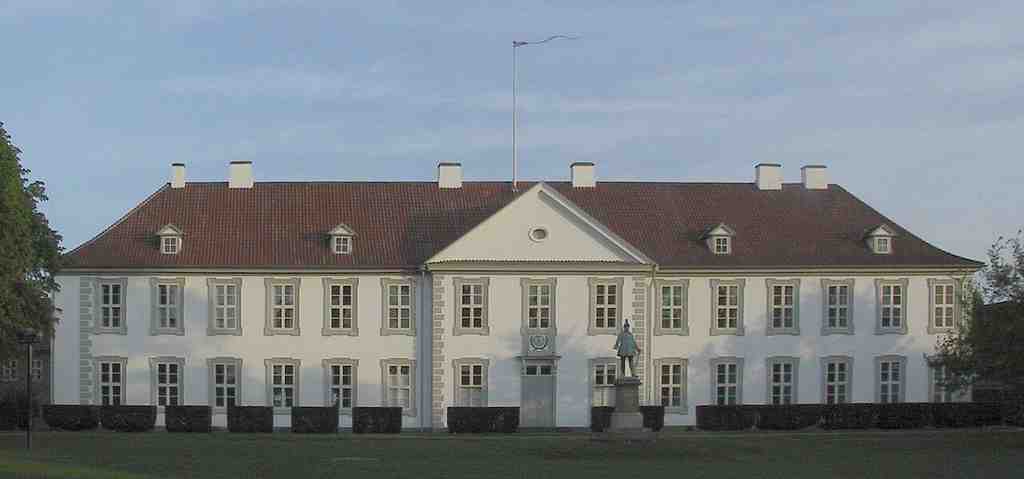
Odense CastlePhoto: Wikimedia Commons contributor, Wikimedia Commons, CC BY-SA 3.0. Cropped & resized. On your right, look for the long white plastered facade, the dark pitched roof, and the centered triangular pediment that gives Odense Castle its calm, official face.
This building likes to introduce itself as an eighteenth-century palace... but that is only the top layer. The story here starts much earlier, back in the thirteen hundreds and even before that, when the Johanniters of Odense began growing a religious complex on this site. The Johanniters were a Christian order with monks, property, and practical duties too, including care for the sick, and by the fifteen hundreds this had become one of the most important Johanniter centers in Denmark.
That older place is easy to miss now. Most visitors see the smooth white front and think “royal residence,” neat and simple. Local tip: the real surprise is that the familiar castle sits on the footprint of a major medieval monastery, largely invisible unless you know where to look. In the older wings, parts of the fifteenth-century growth still survive, and traces like bricked-up windows and old arches remain tucked into the building fabric like stitched scars.
After the Reformation in fifteen thirty-six, the Crown took the monastery, renamed it Odensegaard, and moved power straight into the cloister. That tells you a lot about Odense: one set of authorities leaves, another arrives, and they keep using the same ground. The last monks stayed on for a while, but they now shared space with the king’s man here, Claus Daa, the first lensmand, which means a feudal royal governor. Religion, administration, noble privilege... all packed into one address.
In the fifteen seventies, King Frederik the Second decided the old monastery needed a royal upgrade for family stopovers on the road across Denmark. Builders added an extra floor to all three wings. The west wing held royal rooms, the east wing housed the governor, and the south wing handled the kitchen. Efficient, practical, a little like turning a monastery into a state guesthouse with very important dinner plans.
Then war chewed through the place. During the Swedish wars in the seventeen hundreds, Swedish troops occupied the castle and burned the furniture for firewood. When they left, the place stood empty and stripped. Later, after absolute monarchy began in sixteen sixty, the county governor moved in, and the castle kept serving as the island’s administrative brain.
If you glance at the image in the app, you can see that white north-facing main building that King Frederik the Fourth ordered after deciding the older place was not quite grand enough for him. Architect Johan Cornelius Krieger rebuilt this front from the early seventeen twenties, with a great dining hall called Rosen and apartments for the king and queen. Frederik the Fourth liked the new garden... and in seventeen thirty he came here ill, weakened, and died in the castle on the twelfth of October.
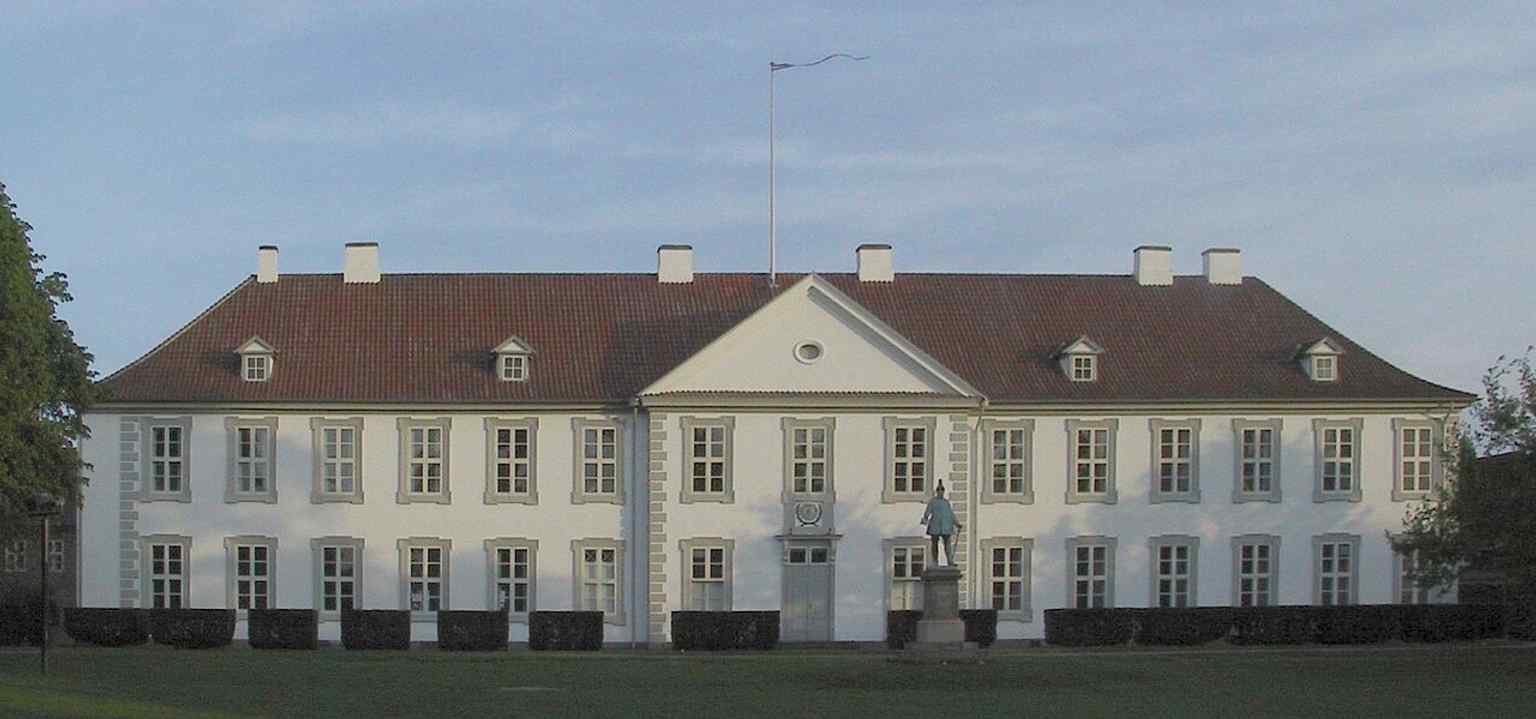
Historic view of Odense Palace in Kongens Have, showing the white main building that became the city’s administrative center after the Reformation.Photo: Unknown, Wikimedia Commons, CC BY-SA 3.0. Cropped & resized. There is another life here I like to remember. H. C. Andersen’s mother worked at the castle after her husband died. She gathered herbs for a pharmacy, helped in the kitchen, and washed clothes in brutally hard conditions. Her labor kept this polished machine running. And that thread matters. In Odense, the distance between servant’s work and a public stage could be wider than a moat... and sometimes, somehow, still crossed.
Soon we leave rooms of governors, kings, and hidden staircases for a different kind of authority: performance in the open, where a city watches itself. Odense Theatre is about a three-minute walk from here.
And one practical note: this stop is part of the cityscape all day, so you can return whenever it suits your wanderings.

Show 12 more stopsShow fewer stopsexpand_moreexpand_less
On your left, look for a pale stone-and-plaster façade with a broad symmetrical front, tall arched windows, and a sculpted pediment above the entrance. This is Odense Teater,…Read moreShow less
Open dedicated page →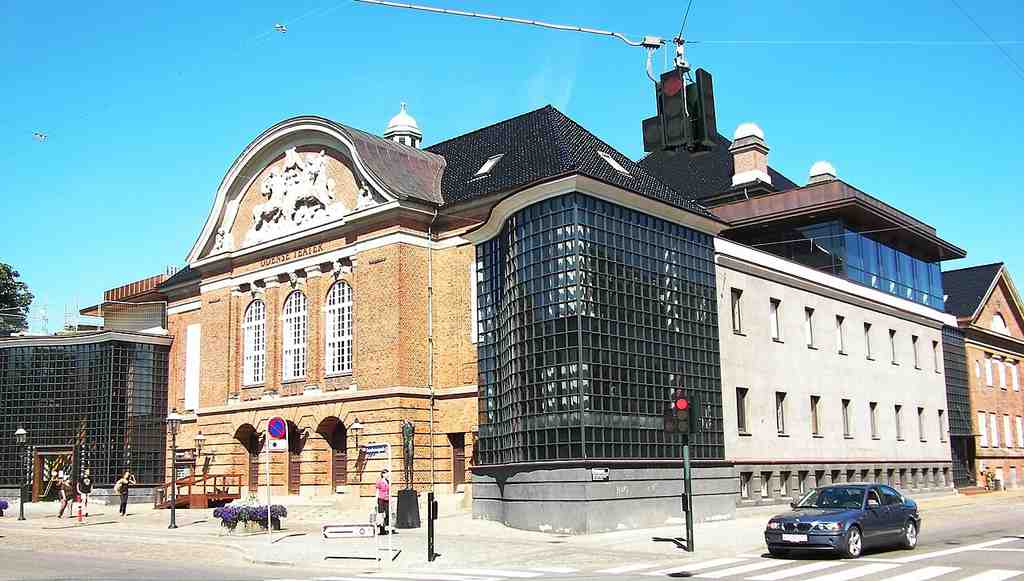
Odense TheatrePhoto: Henrik Sendelbach, Wikimedia Commons, CC BY-SA 3.0. Cropped & resized. On your left, look for a pale stone-and-plaster façade with a broad symmetrical front, tall arched windows, and a sculpted pediment above the entrance.
This is Odense Teater, and it carries itself like someone who knows the spotlight suits it. Since nineteen fourteen, the company has lived here on Jernbanegade in a New Baroque building designed by Niels Jacobsen... New Baroque meaning a style that borrows the grand curves, ceremony, and confidence of older palace architecture. If you glance at the image in the app, that pediment detail shows the house dressing for the role beautifully.
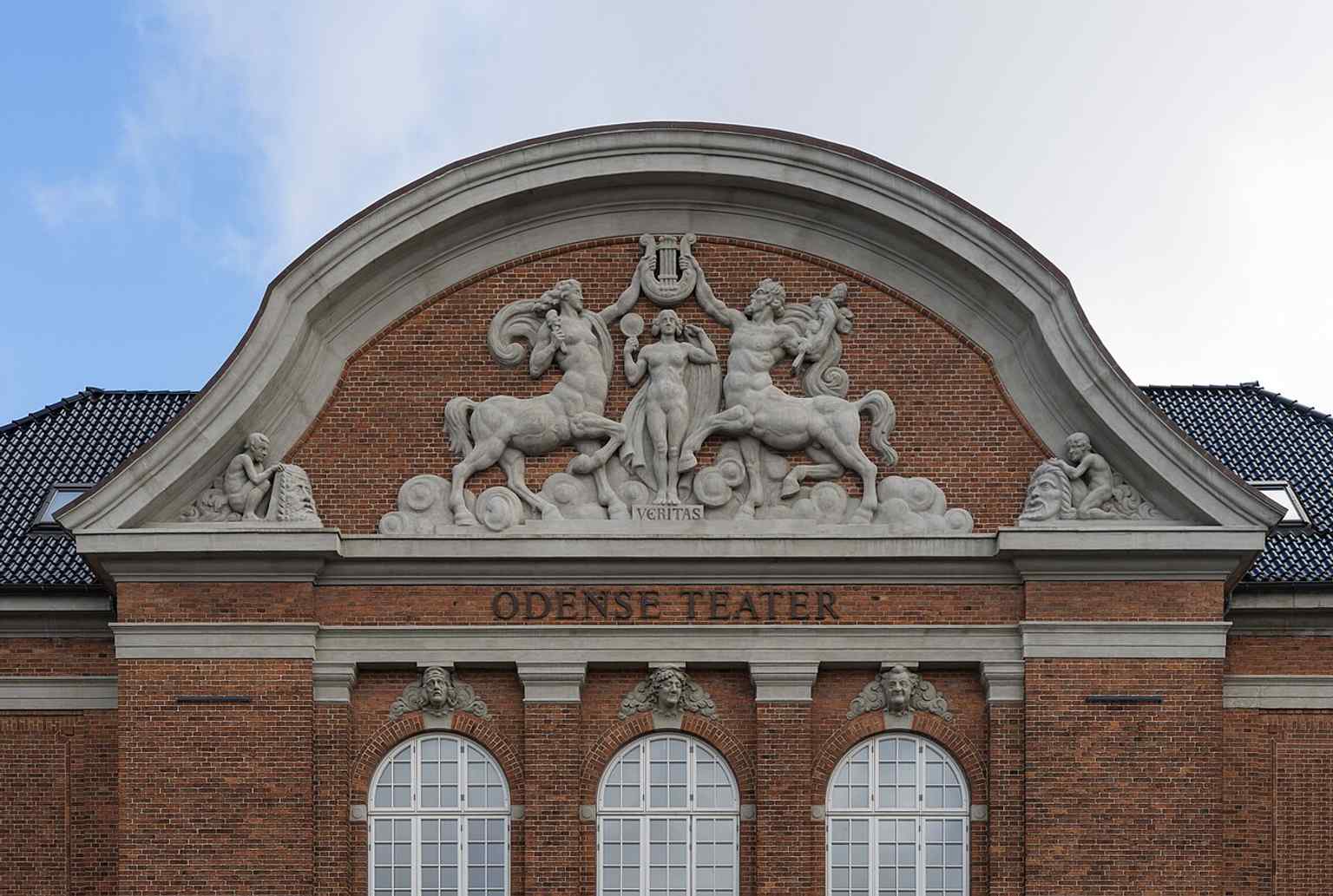
The pediment detail on the theatre façade, part of the New Baroque building designed by Niels Jacobsen when the company moved here in 1914.Photo: Jebulon, Wikimedia Commons, CC0. Cropped & resized. But the most interesting thing about this theatre is that it has already changed costumes once. Its earlier home stood at Sortebrødre Torv, in the old Comediehus from seventeen ninety-five. That first address gave Odense an unusually early cultural life outside Copenhagen, and it drew everyone from local crowds to Crown Prince Frederik, the man who later became Frederik the Seventh. Then the theatre moved here, south of the King’s Garden, and the city restaged itself around it. That is reinvention of place in a nutshell: old stories in new rooms, a familiar institution learning a fresh posture, and a city discovering that moving a stage can move an identity too.
One young boy felt that pull especially hard. In eighteen twelve, Hans Christian Andersen appeared at the old theatre as an extra... not the star, not even close, just a body in the background. But sometimes that is how a life begins in public. He stood near the edge of the scene, looked toward the center, and never quite stopped doing that. Long before he became a writer known around the world, Odense gave him a rehearsal space for ambition.
This theatre also nudged European drama forward. On the fourteenth of November, eighteen seventy-seven, it hosted the world premiere of Henrik Ibsen’s Samfundets Støtter, or Pillars of Society, the play many people count as his first modern realistic drama. In plain terms, Odense got the premiere before Copenhagen did by a few days. The provincial town beat the capital to opening night... not bad.
Today, as one of Denmark’s three regional stages, Odense Teater still has a public duty to be wide-ranging: classics, new drama, children’s work, music, dance. It runs five stages, from the roughly five-hundred-seat Store Scene to smaller rooms of eighty and fifty seats, and one of its spaces now lives over at Odeon, which we’ll meet later. It even trained actors here for decades; under Helge Rungwald, the theatre founded the first acting school outside Copenhagen in nineteen forty-one.
So standing here, you are not just outside a theatre. You are outside a machine for trying on selves. In Odense, performance is rarely only entertainment... it is practice for becoming someone new. When you are ready, St. Hans Church is about a four-minute walk away, and it will show you another kind of stage altogether.
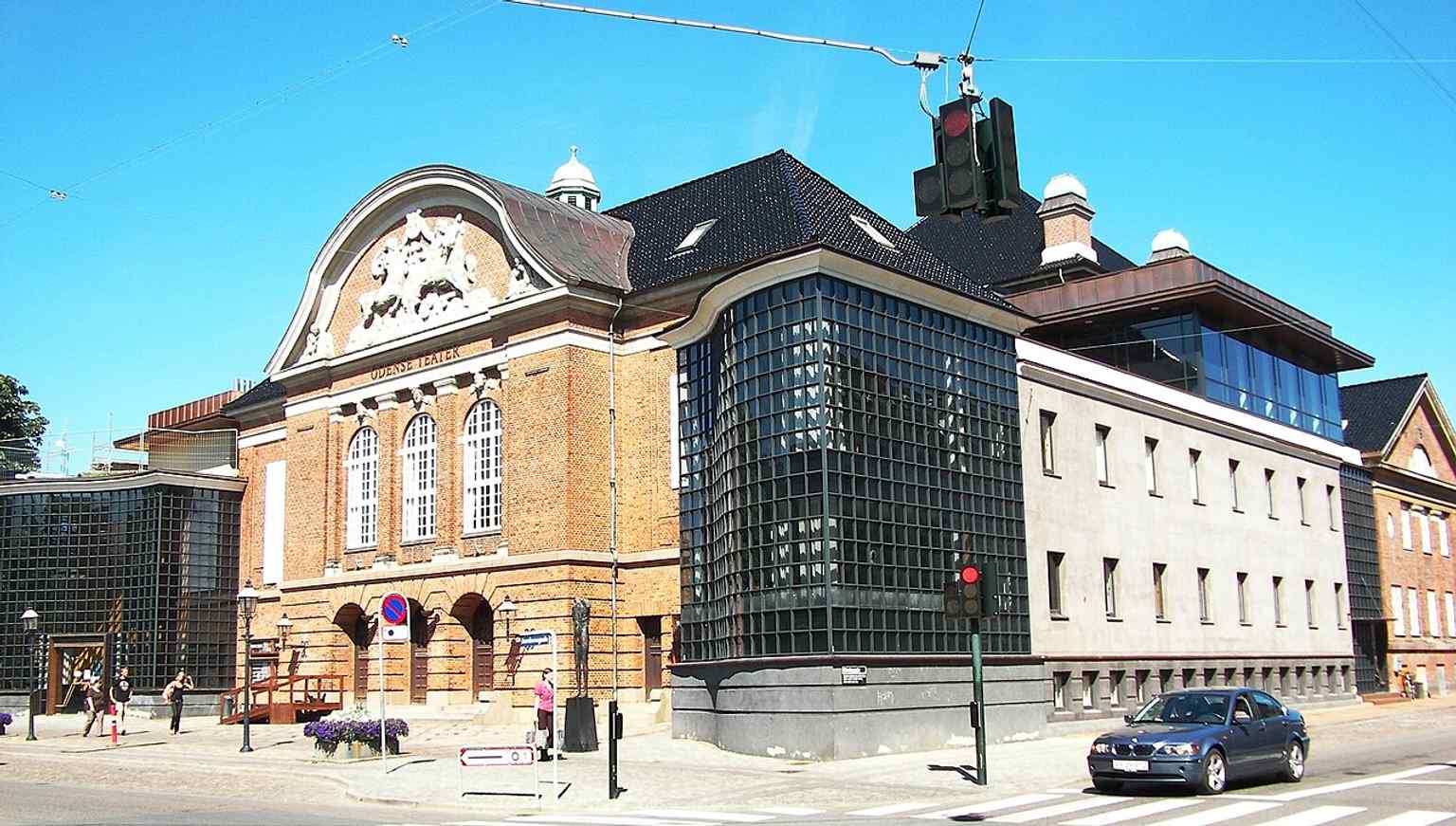
Front view of Odense Teater, the 1914 theatre house on Jernbanegade that became one of Denmark’s three regional stages.Photo: Henrik Sendelbach, Wikimedia Commons, CC BY-SA 3.0. Cropped & resized. 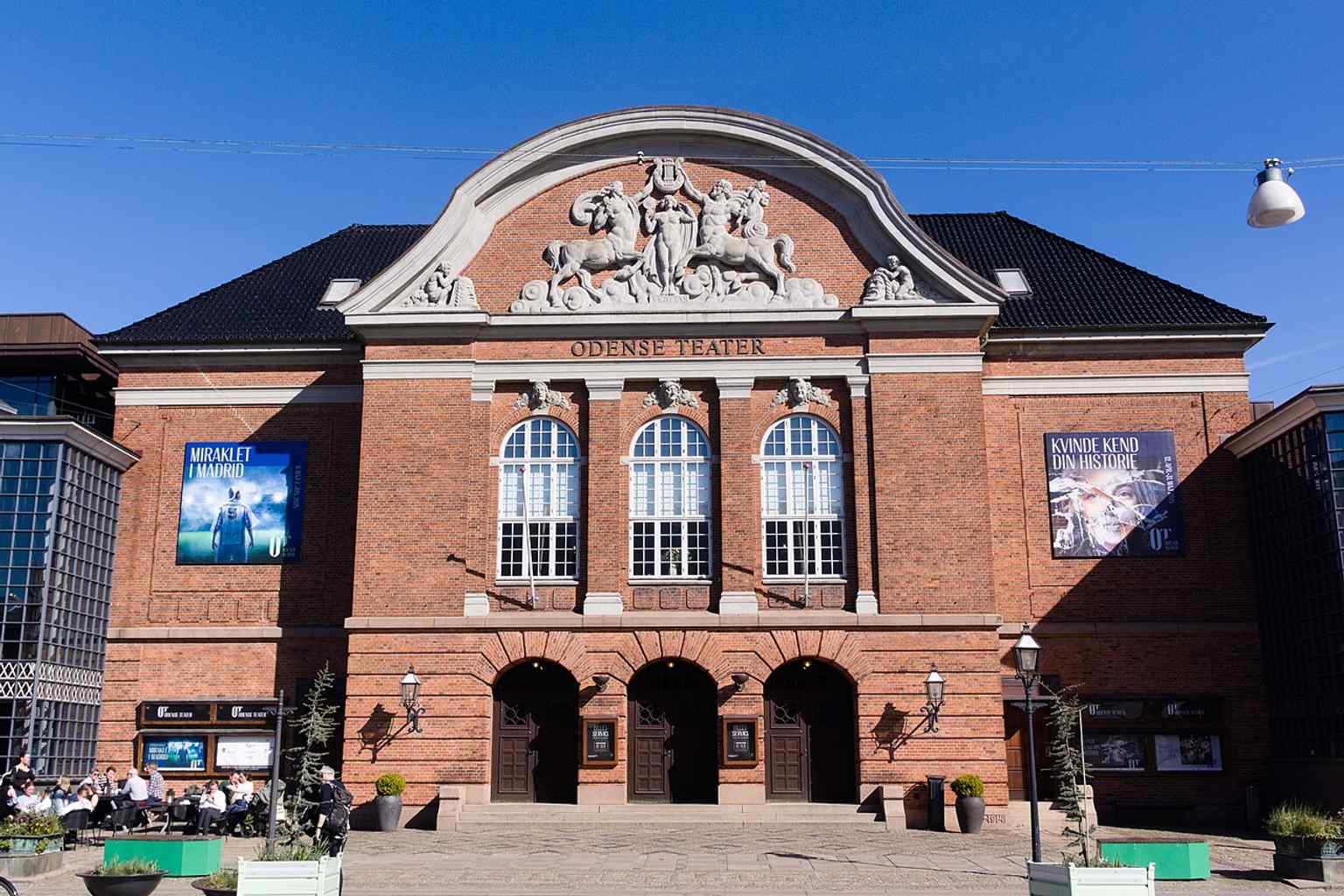
A recent exterior view of Odense Teater, showing the historic building that still anchors the theatre’s home near Kongens Have.Photo: Charlie Graven, Wikimedia Commons, CC BY-SA 4.0. Cropped & resized. On your right, St. Hans Church is easy to spot by its red brick walls, broad stepped gables, and tall pointed windows set into a simple medieval shape. From back here, the…Read moreShow less
Open dedicated page →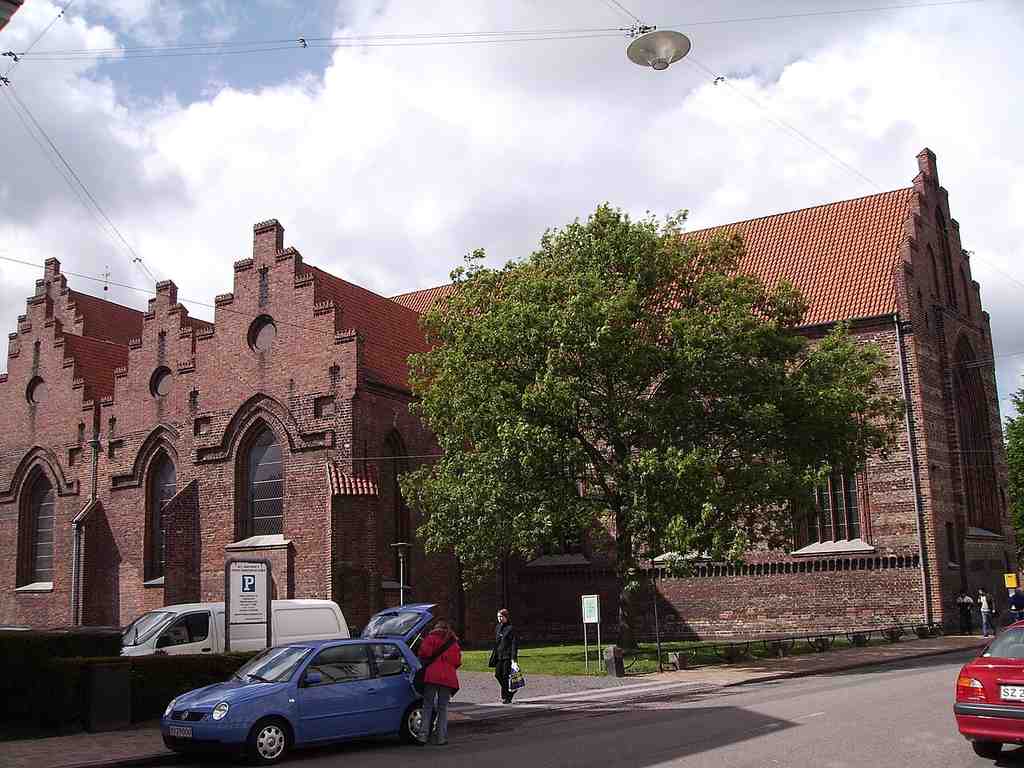
St. Hans Church (Odense)Photo: Scm, Wikimedia Commons, CC BY-SA 3.0. Cropped & resized. On your right, St. Hans Church is easy to spot by its red brick walls, broad stepped gables, and tall pointed windows set into a simple medieval shape.
From back here, the church feels sturdy and a little plainspoken... which suits its story. St. Hans reaches back to the Middle Ages; people mention it in a surviving source in twelve ninety-five, and by thirteen twenty-nine they also name the St. Hans monastery here. Church and monastery worked as one house until the Reformation in fifteen thirty-six ended the Johanniter order’s monastic life in Odense. Their practical side mattered too: the nearby rectory once served as a hospital, and it is now considered the only surviving Johanniter hospital in Denmark. Not bad for a place that keeps its profile so modest.
But this stop turns history inward. In eighteen oh five, Hans Christian Andersen entered this church not as a genius, not as a statue, not as a museum subject... just as a fragile infant. His parents, the shoemaker Hans Christian Andersen and Anne Marie Andersdatter, had already baptized him at home, which families sometimes did when a newborn seemed especially vulnerable. Then, on the second day of Easter, they carried him here for the church’s formal recognition of that baptism. Inside the entrance room, a memorial plaque records that moment with almost tender precision.
Out front stands the sculpture that keeps the family story close to the ground: Anne Marie walking to church with her newborn son, two ducks beside her, pointing ahead to The Ugly Duckling. It is sweet, and a little heartbreaking, because her life grew hard after her husband died in eighteen sixteen. She struggled with poverty and drink, and she died in the poorhouse called Doctors Boder in eighteen thirty-three, even though her famous son tried to help her.
So here is the question to carry onward: if you met that child only in this moment... home-baptized, carried in by anxious parents... what future would you dare predict for him?
When you are ready, head on to Odeon, about six minutes away.
In front of you is a broad facade of pale brick and glass, shaped in sharp modern angles and stamped with the large ODEON sign. This place tells you something important about…Read moreShow less
Open dedicated page →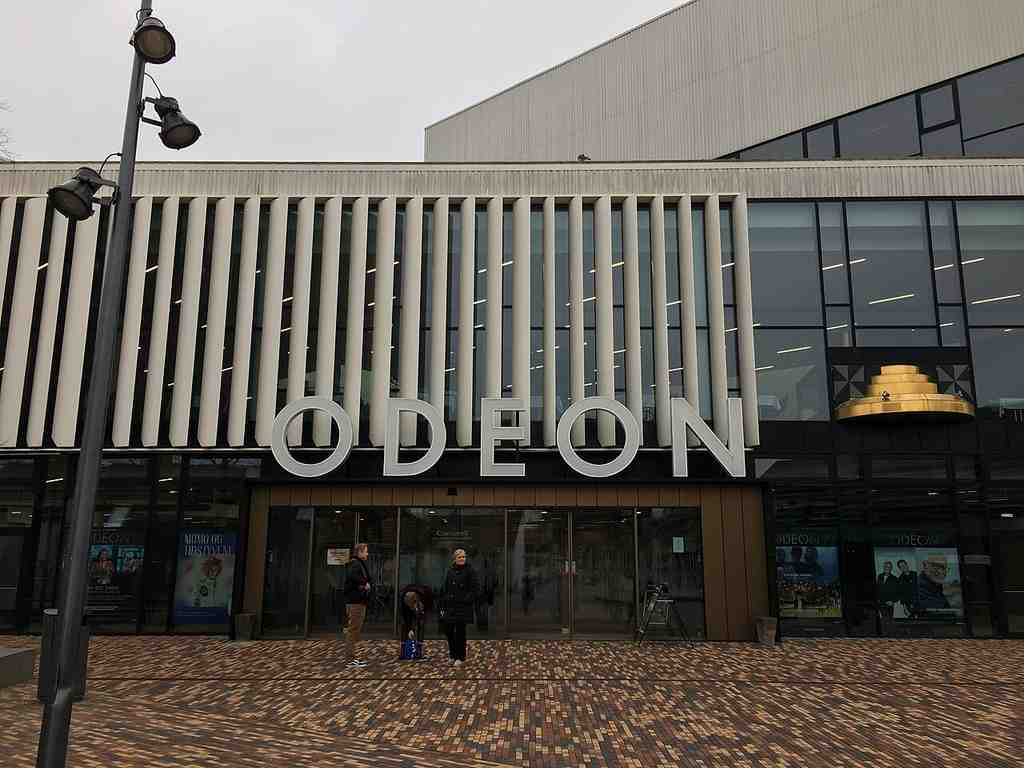
OdeonPhoto: Toxophilus, Wikimedia Commons, CC BY-SA 4.0. Cropped & resized. In front of you is a broad facade of pale brick and glass, shaped in sharp modern angles and stamped with the large ODEON sign.
This place tells you something important about Odense. Earlier in the walk, power gathered behind gates, church walls, and formal institutions. Here, the city takes that same energy and opens the doors wide... less throne room, more living room. Culture in Odense has been moving from something controlled by the few to something designed for the many to enter, use, study, and argue over a little in the café.
ODEON did not simply appear with a fancy name and a ribbon. Odense Kommune asked the public to help name it, collected more than six hundred suggestions, narrowed them to three, and then sent the final choice to a vote. Locals like that detail because it means this major building began as a public conversation, not a top-down decree. Even the name points back to Odense and works neatly in Danish and English... a tidy little civic handshake.
Architect C. F. Møller gave the city a building that could do several jobs at once. ODEON covers thirty-two thousand square meters, rises through nine levels including a two-level parking basement, and opened on the first of March, twenty seventeen after construction began in June twenty fourteen. Inside are twenty-nine meeting and conference rooms, a café, a restaurant, music training, acting training, and Odense Teater’s extra stage. Facing Hans Mules Gade, the complex even includes forty-two youth apartments, which feels very Odense to me: art house on one side, everyday life on the other.
If you check the image on your screen, you can see the foyer where public life really starts, with the open round stage called Byens Scene right in the middle of the ground floor. That stage is seven meters across and small enough for acoustic concerts, talks, mini-exhibitions, and the sort of performance that makes you stop for five minutes and somehow stay for forty.
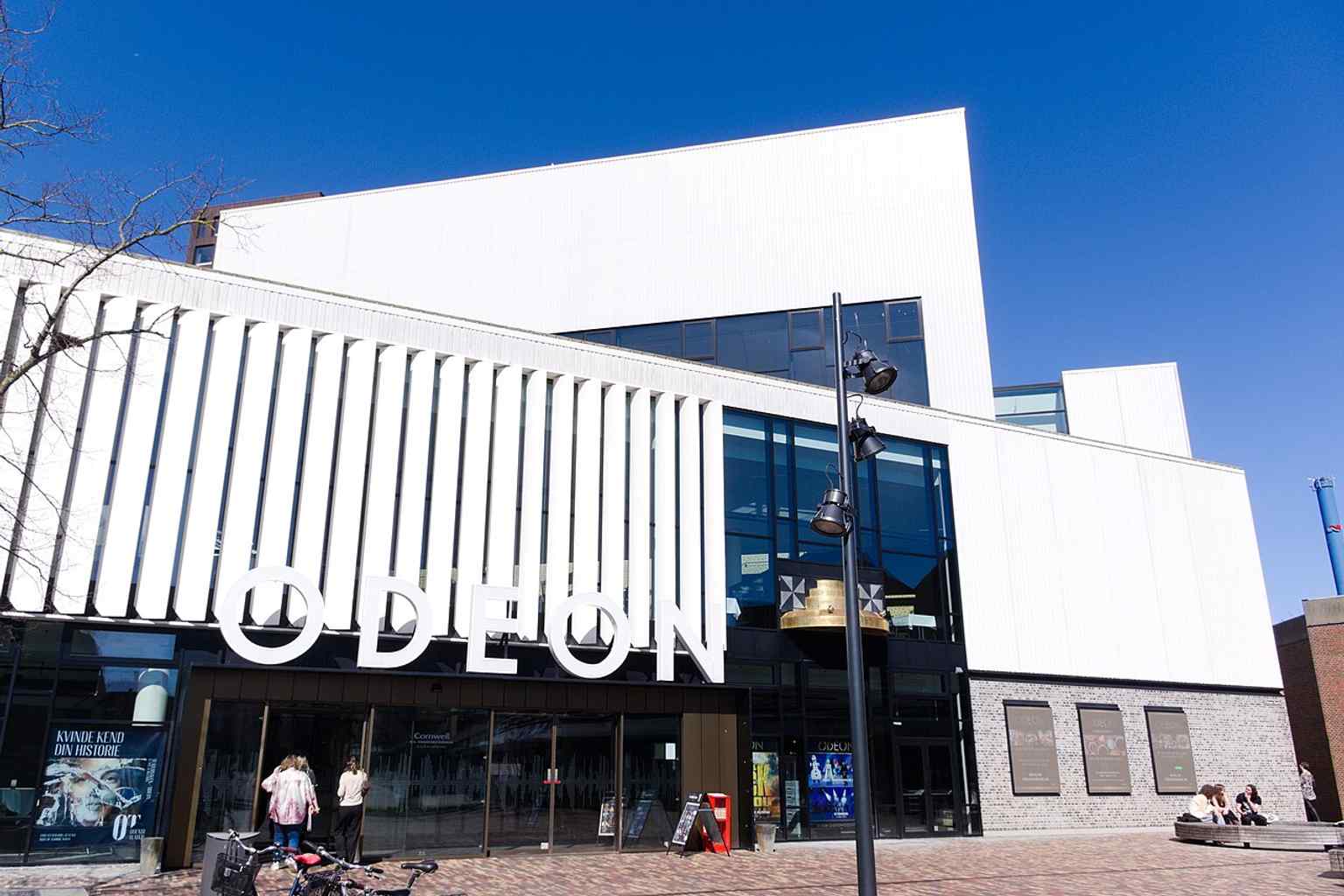
ODEON’s entrance foyer, where the building’s public life begins and where events, café culture, and the open Byens Scene all connect.Photo: Charlie Graven, Wikimedia Commons, CC BY-SA 4.0. Cropped & resized. The big human moment came before the building even finished. During the topping-out in twenty fifteen, guitarist Steffen Schackinger played with the Odense Symphony Orchestra here for ODEON’s very first concert, turning a construction site into a temporary cultural arena. That is Odense in a nutshell: a place crossing from blueprint to performance without waiting for perfection. Artist Henrik Plenge Jakobsen added another signature at the opening by gifting ODEON its own carillon, a bell instrument, tying the building to contemporary art, not just stage machinery and conference schedules.
And ODEON has stayed flexible. The main hall seats one thousand seven hundred and forty in its green chairs, but staff can remove the rows and make room for two thousand five hundred standing guests. A black-box theater - meaning a simple, adaptable performance room - took over work once done at Sukkerkogeriet. In later years, ODEON hosted everything from a Jeff Beal concert of House of Cards music to the Reumert theater awards, and in twenty twenty-four it won regional honors for best cultural experience. Not bad for a building young enough to still smell new in city memory.
From here, Andersen’s old streets are right beside you, where lived memory starts to gather. ODEON is generally open Monday through Saturday from ten A-M to five P-M, and closed Sunday.
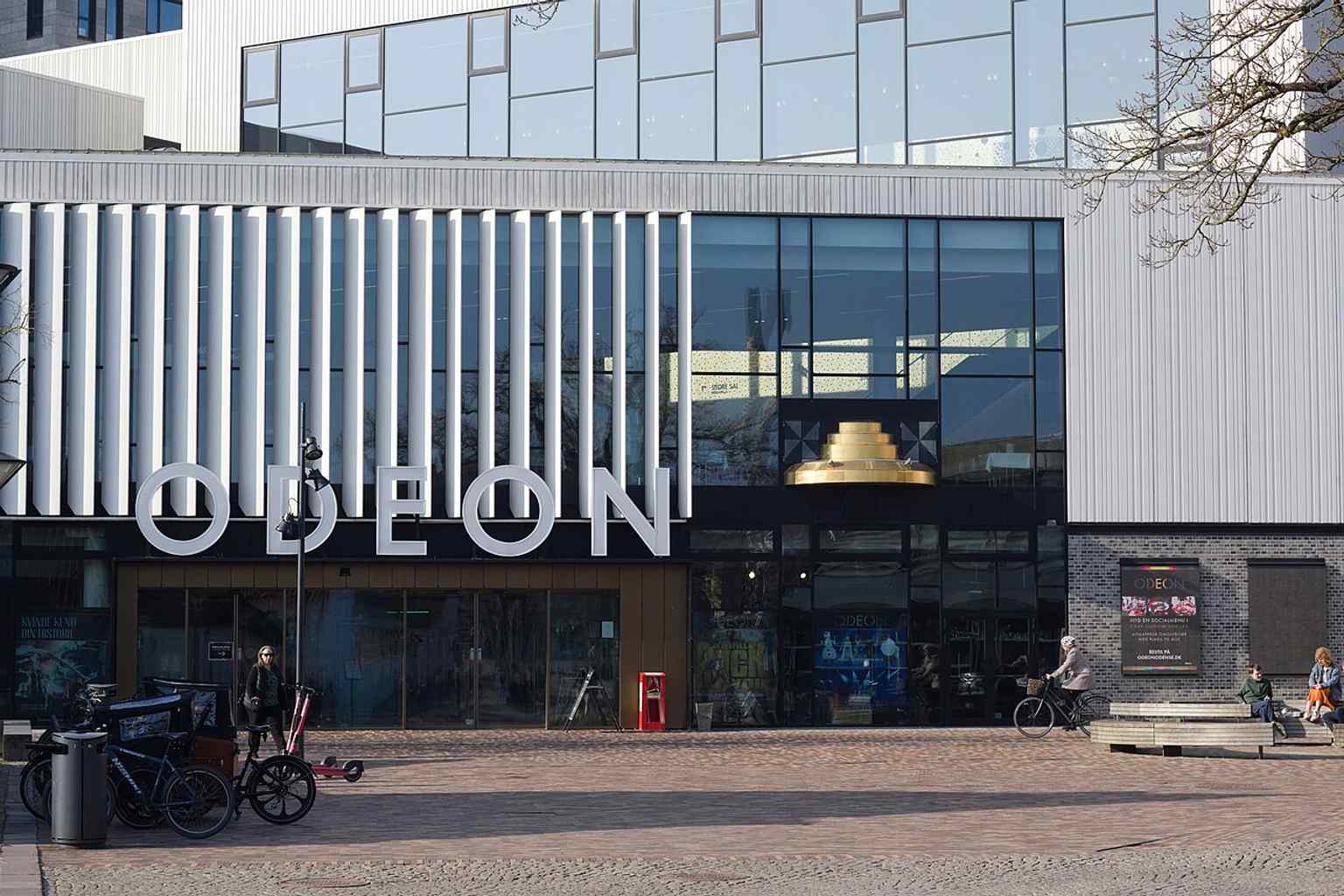
A wide view of ODEON’s modern facade in central Odense, the 32,000 m² music and theatre center that opened in 2017.Photo: Charlie Graven, Wikimedia Commons, CC BY-SA 4.0. Cropped & resized. In front of you is a low museum of glass and latticed timber, arranged in rounded forms and tucked under green roofs that make it look part pavilion, part secret garden. This is…Read moreShow less
Open dedicated page →In front of you is a low museum of glass and latticed timber, arranged in rounded forms and tucked under green roofs that make it look part pavilion, part secret garden.
This is the hinge in Andersen’s story... the place where a poor child’s life becomes something larger, stranger, and carefully staged. Think of it as the H.C. Andersen museum quarter: not one neat answer, but a whole cluster of places that work together - the birthplace, the childhood home, the main museum, and even links to the city museum at Møntergården.
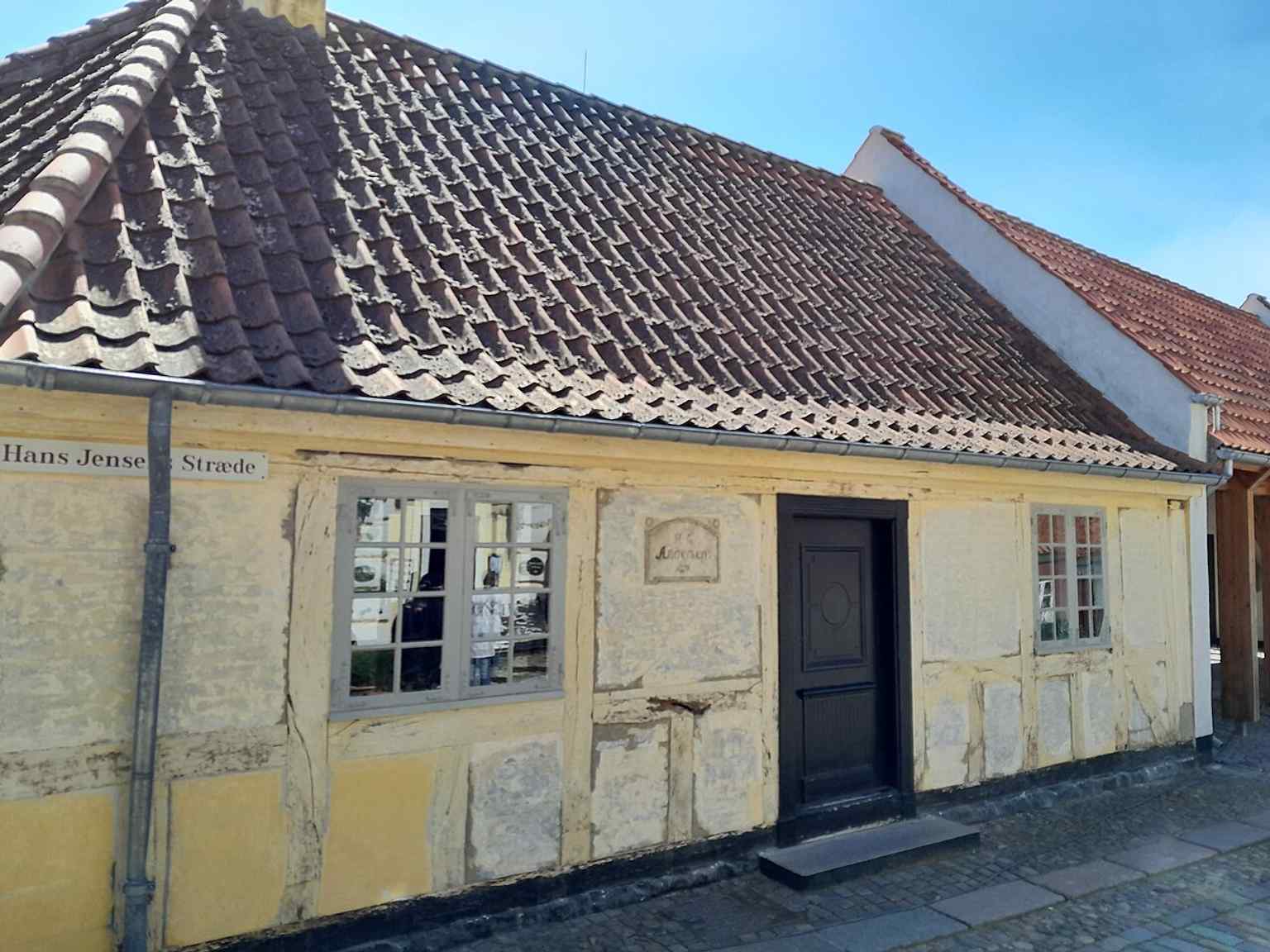
And that matters, because even Andersen’s beginning resists tidy packaging. The small yellow house long presented as his birthplace is thought to be the right one, but no one can prove it beyond doubt. Odense knew a good story when it saw one, though and in nineteen oh five the city bought that house, then reopened it as a museum in nineteen oh eight. If you want a look at it, check the image on your screen now.
From there, the collection kept growing. In the nineteen thirties, and again in the nineteen seventies, the museum gathered the things that pull Andersen back down from legend into human scale: original objects, letters, drawings, manuscripts. On your phone, you can see that quieter side of the museum here. At St. Hans, we met him as a vulnerable child; here, Odense turns that fragility into shared public memory.
The newest layer came when architect Kengo Kuma won the international competition in twenty sixteen. His idea did not treat Andersen like a statue with labels. Instead, the museum became a fairytale journey, with cylindrical forms above ground and much of the experience flowing into an underground labyrinth, shaped in part by The Tinderbox. Queen Margrethe the Second officially opened this new chapter in twenty twenty-one.
Next, the lens widens again at TID, the Museum of Odense, about a four-minute walk away, where Andersen’s world rejoins the city that made him. Practical note: if you plan to come back inside, the museum is generally open Tuesday through Sunday, ten to four.
The H.C. Andersen Museum on Claus Bergs Gade, part of the wider museum complex dedicated to the writer’s life and works.Photo: JakobHosp, Wikimedia Commons, CC BY 4.0. Cropped & resized. Look for a low, angular building of dark brick and glass, broken into longhouse-like sections, with sharp gabled rooflines that give this museum its modern profile. This is…Read moreShow less
Open dedicated page →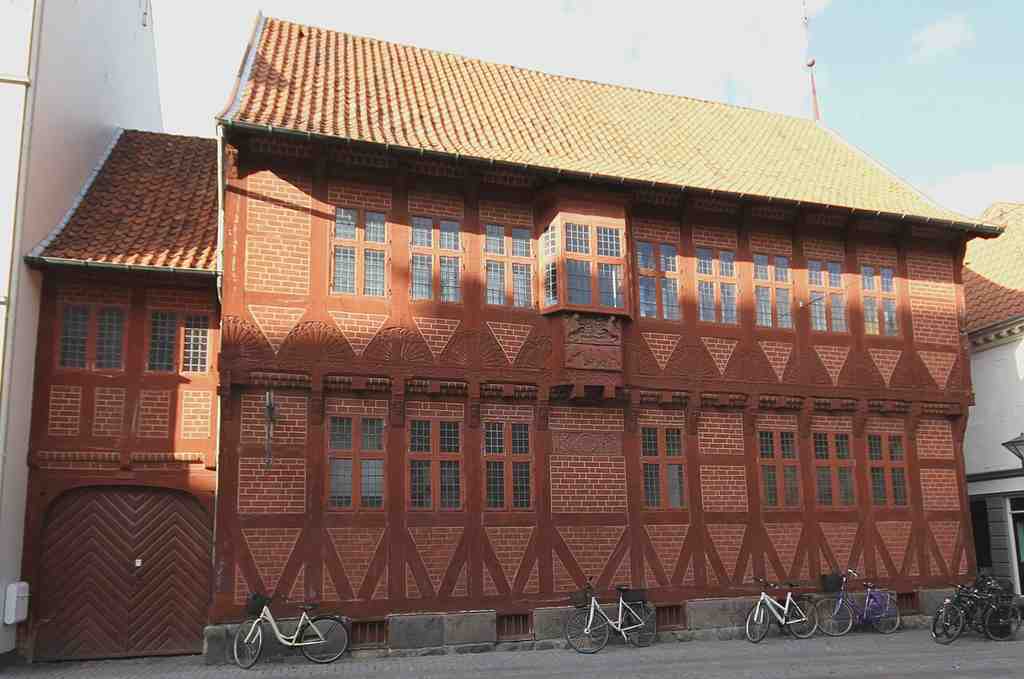
TIME - Museum of OdensePhoto: Kåre Thor Olsen, Wikimedia Commons, CC BY-SA 3.0. Cropped & resized. Look for a low, angular building of dark brick and glass, broken into longhouse-like sections, with sharp gabled rooflines that give this museum its modern profile.
This is TIME, the Museum of Odense... and it quietly makes a big point. After all the attention Hans Christian Andersen draws in this part of town, this place reminds us that a city does not stand on famous names alone. It stands on addresses, repairs, rent, storage rooms, kitchens, workshops, and the stubborn business of keeping people sheltered.
The museum spreads across a whole block between several streets, with its official address in Møntestræde, a narrow lane threading through the middle. That little street carries an old clue: around the early fourteen hundreds, a coin workshop stood there, and the lane kept the memory in its name. Money passed through. Power passed through. But so did ordinary need.
If one person gives this place its moral center, it may be Pernille Lykke. In sixteen seventeen, she founded a row of small almshouses here for five poor residents. An almshouse, in plain English, meant simple housing given as charity. Not a flashy donation... just a practical one. A bed, a roof, a fixed place in the city. Those homes stayed occupied until nineteen fifty-five, which means this block carried a living thread of social care for more than three centuries. That changes the picture, doesn’t it? Odense’s story is not only about genius blooming. It is also about people trying not to fall through the cracks.
This quarter also wears its status history right on the facade. The building called Møntergården dates from sixteen forty-six. Nobleman Falk Gøye and his wife Karen Bille used it as a town residence, the kind of winter base noble families kept when country manor life got a little too quiet. Their coats of arms marked the main entrance, and other family emblems appeared on the bay window. A city address could be as much a statement as a castle.
Then the tone shifted. In the seventeen hundreds, the house became a merchant’s yard. Caspar von Wessel, brother of the naval hero Tordenskjold, owned it for a time. Stables in the rear served residents and guests, and the grand residence edged toward something more workaday, half private, half public. By eighteen sixty, shops filled the ground floor, families lived upstairs, and thick plaster hid the old timber frame. From eighteen twenty-nine to eighteen ninety-nine, the place even ran as a brandy distillery. A noble house with a hard-working second act... that is Odense in a nutshell.
And then came the rescue. The city stepped in around nineteen hundred, and again in nineteen thirty, after pressure from preservation advocate Knud Lehn Petersen. Odense paid one hundred twenty-five thousand kroner, roughly a few million kroner in current value, to save and restore the place. Workers even used timber from the Royal Dockyard’s sea wall to rebuild the lower level in its old style.
The newest twist came before this modern building rose in twenty thirteen. Archaeologists opened the former parking lot and found a burn layer from the thirteen hundreds, evidence that buildings here had gone up in flames in the thirteenth century. So even the new museum had to pass through old fire before it could stand.
When you are ready, head to Frederiksbroen, about three minutes away. That bridge proves even plain infrastructure can show off a city’s character. If you want to come back inside here later, the museum is generally open Tuesday through Sunday from ten to four, and closed on Mondays.
Look for the low bridge with black cast-iron railings, a flat span, and repeating fleur-de-lis panels along the sides. Frederiksbroen looks polite, but in eighteen forty-four it…Read moreShow less
Open dedicated page →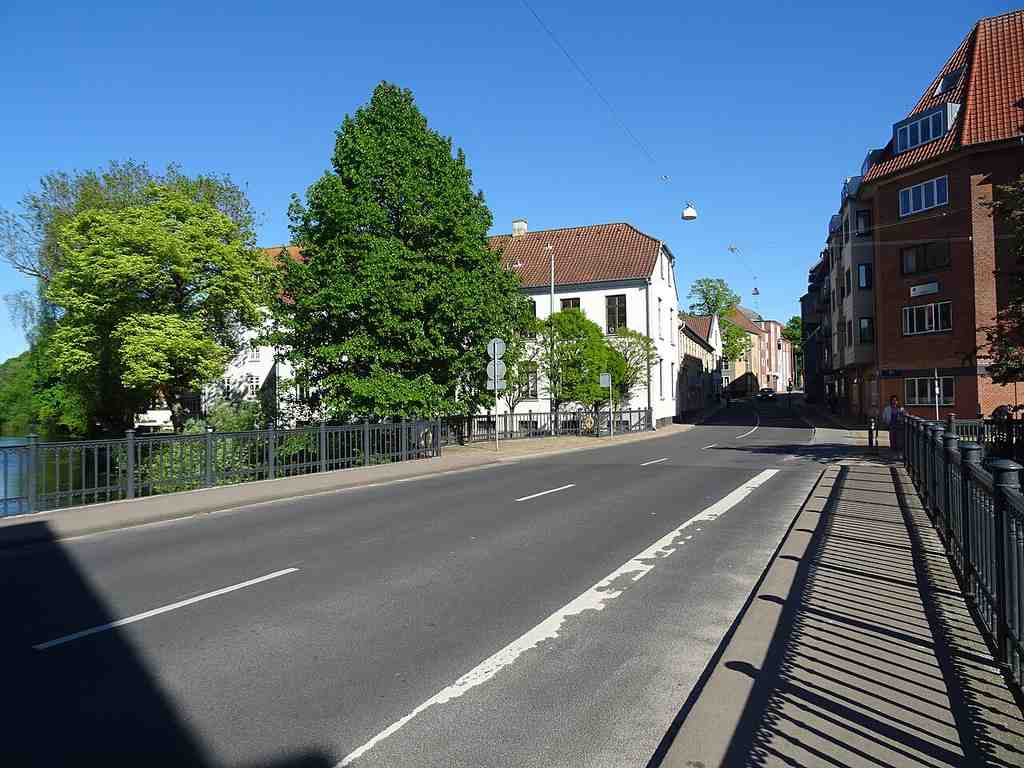
FrederiksbroenPhoto: Leif Jørgensen, Wikimedia Commons, CC BY-SA 4.0. Cropped & resized. Look for the low bridge with black cast-iron railings, a flat span, and repeating fleur-de-lis panels along the sides.
Frederiksbroen looks polite, but in eighteen forty-four it arrived like a little industrial fanfare. It became Denmark’s first cast-iron road bridge, carrying traffic over the Odense River and proving that civic engineering could be useful and handsome at the same time. M. P. Allerup, the local foundry owner who cast it, trusted his work enough to give the city a ten-year guarantee.
Most visitors never realize an older crossing stood roughly here first: Møglebro, probably raised around the year twelve hundred, a key link on the southern road.
Pause on the railing for a second. See how boldly decorative this working bridge is? If you check the close-up on your screen, you can spot the Odense fleur-de-lis in the ironwork.
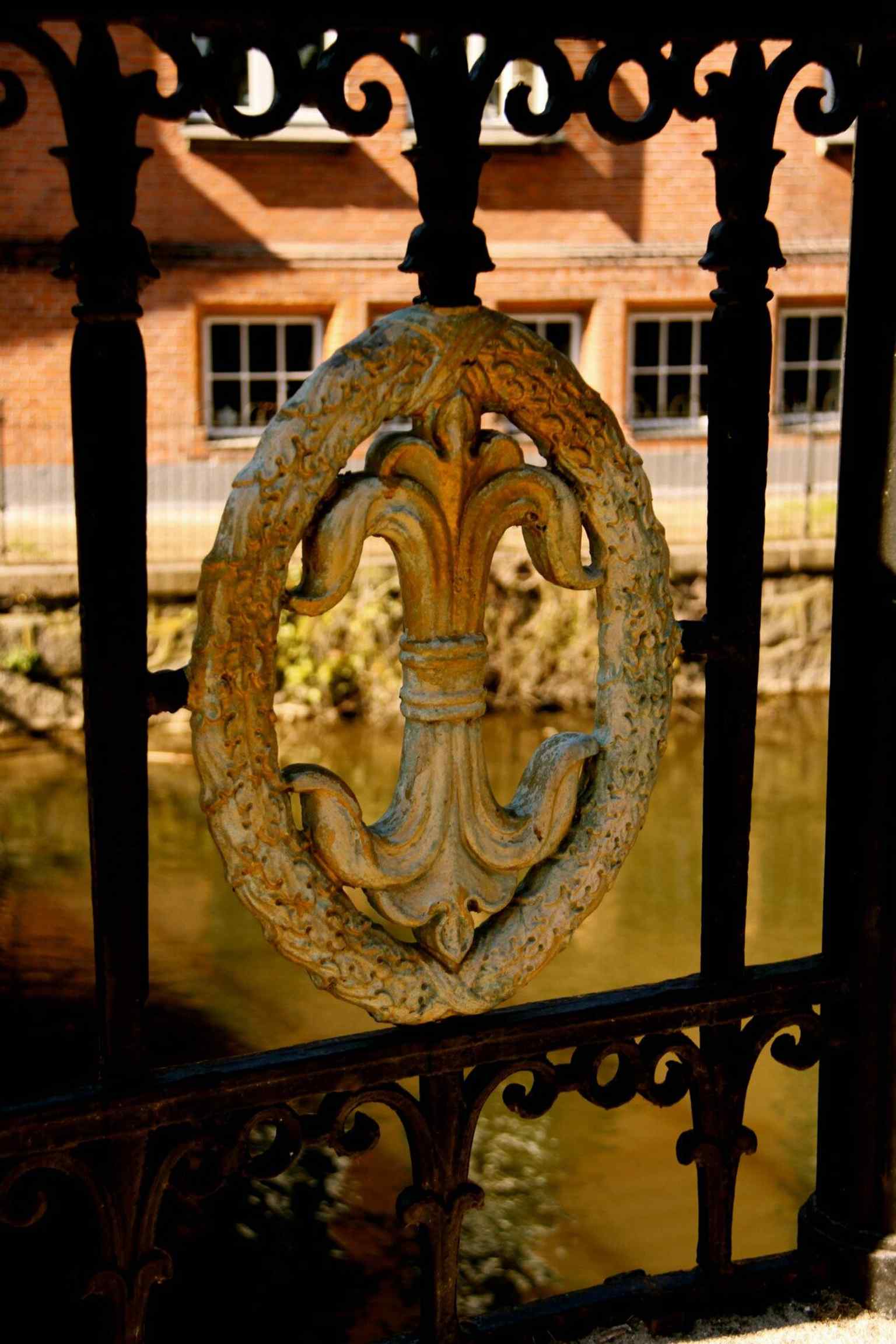
The Odense fleur-de-lis on Frederiksbroen’s ironwork, a close detail of the bridge’s characteristic cast-iron railing.Photo: Bo Jessen, Wikimedia Commons, CC0. Cropped & resized. The inauguration on the sixth of October, eighteen forty-four, turned into a royal procession. Crown Prince Frederik, later King Frederik the Seventh, and his father, King Christian the Eighth, rode across first, and the street south of the bridge took the name Frederiksgade. That is one way to open a bridge.
Allerup’s story adds a sharper note: he died just four years later, in eighteen forty-eight, while traveling between Odense and Copenhagen, and even his grave marker was cast iron. Today only the railing is original; the deck rests on reinforced concrete. So this bridge, like the City Bridge earlier, changed how Odense moved... only this one did it in iron lace.
Follow the river and the tone turns softer toward Fairy Garden, about six minutes away. Frederiksbroen is open all day, every day.
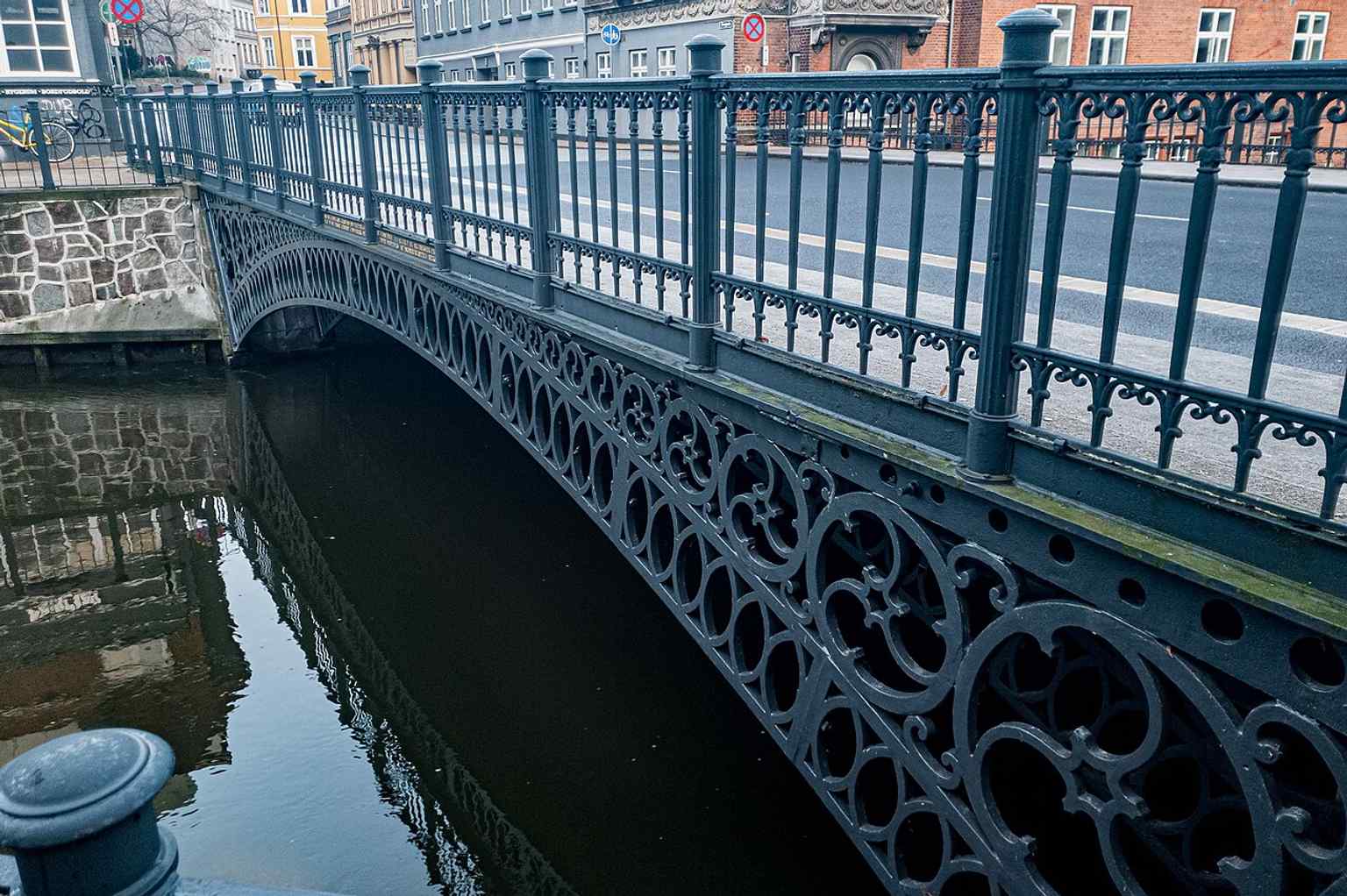
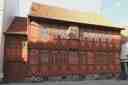
Frederiksbroen spanning Odense River in winter — the oldest cast-iron road bridge in Denmark, rebuilt in place of the former Møllebro site.Photo: Aske Uhd Pennerup, Wikimedia Commons, CC BY-SA 4.0. Cropped & resized. On your right, look for the low yellow-plastered house with a red-tile roof, small-paned windows, and two plain front doors pressed close to the street. This is H. C. Andersen’s…Read moreShow less
Open dedicated page →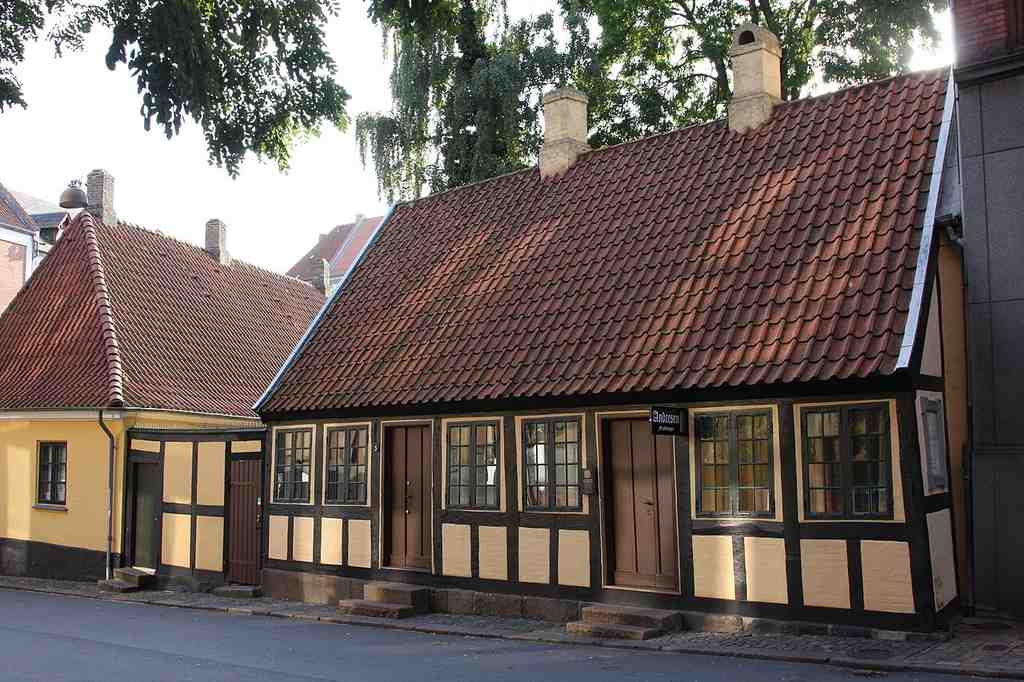
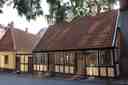
H.C. Andersen's Childhood HomePhoto: Kåre Thor Olsen, Wikimedia Commons, CC BY-SA 3.0. Cropped & resized. On your right, look for the low yellow-plastered house with a red-tile roof, small-paned windows, and two plain front doors pressed close to the street.
This is H. C. Andersen’s childhood home... and it is smaller than many people expect. The whole place covered about forty-two square meters, about the size of a modest studio apartment, yet in Andersen’s early years it held three apartments, and in eighteen oh nine the records counted six families here. That turns a “home” into a pressure cooker.
Hans Christian moved here in May of eighteen oh seven, when he was two, with his father Hans Andersen, a shoemaker, and his mother Anne Marie Andersdatter. In the next quarters lived the glove-maker’s apprentice Frantz Köcker and his family; at the other end, the hat-maker’s apprentice Phillip Schenk and his wife. The Andersens and the Köckers even shared an entrance hall, which is a polite architectural way of saying privacy was in very short supply.
So ask yourself... what kind of imagination grows when space, quiet, and certainty are all rationed?
Some of the answer begins in the kitchen. From there, a ladder led up to the loft, where a box of earth sat in the gutter with chives and parsley growing in it. That tiny scrap of green, balanced above cramped rooms, later fed Andersen’s imagination and found its way into the world of The Snow Queen. Even genius, it turns out, sometimes starts in a herb box.
But the hardship here was real. After Hans Andersen died in eighteen sixteen, young Hans Christian remembered lying on the floor trying to sleep while his father lay dead in the bed. Anne Marie later remarried a young shoemaker’s apprentice, Niels Jørgen Gundersen, but the family soon had to leave after the owner, Christian Huus, died and his widow sold the property.
The little house ahead of world fame was crowded, tense, grieving, and stubbornly alive. In about five minutes, we’ll step from these tight domestic rooms into the older silence of Grey Friars Monastery. If you want to come back inside later, the museum is closed on Mondays and usually opens from eleven AM to four PM the rest of the week.
On your right, look for a pale monastery block joined to a red-brick, chapel-like wing, with steep gables and tall pointed windows that give the whole place a quiet neo-Gothic…Read moreShow less
Open dedicated page →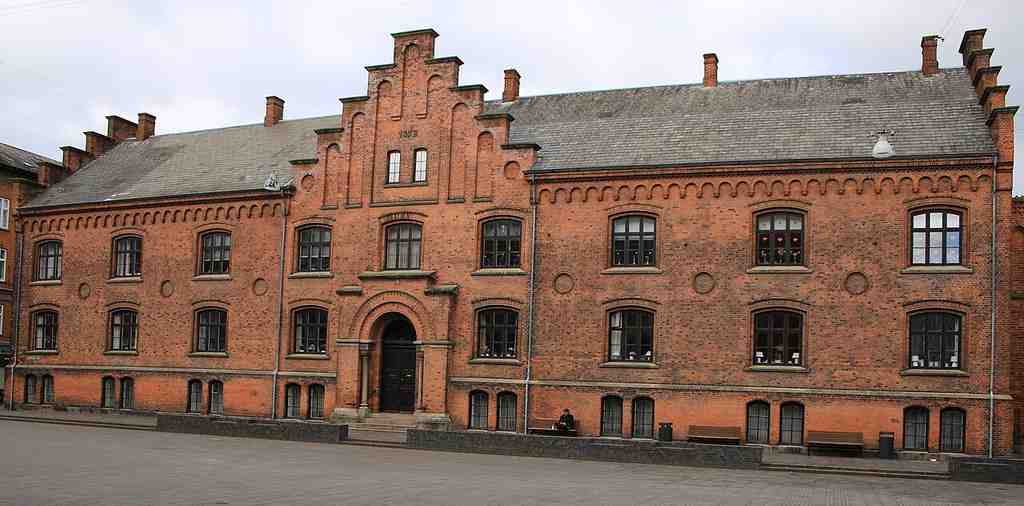
Grey Friars Monastery (Odense)Photo: Kåre Thor Olsen, Wikimedia Commons, CC BY-SA 4.0. Cropped & resized. On your right, look for a pale monastery block joined to a red-brick, chapel-like wing, with steep gables and tall pointed windows that give the whole place a quiet neo-Gothic outline.
Beneath that later skin sits one of Odense’s oldest and most loaded pieces of ground. The Franciscans of Gråbrødre were mendicant friars - monks who preached, begged, and lived from charity rather than from great private estates - yet their Odense house grew unusually large. By thirteen forty-three, this complex held two cloister courts, a church, and a cemetery. In other words, this was no minor back-lane monastery. It was a place where prayer, memory, and power kept bumping elbows.
King Erik Klipping gave the site in twelve seventy-nine, and the monastery was consecrated on the ninth of August that same year. Officially, he gave it so the royal family could be buried here. But locals who know the old story tend to tilt an eyebrow... Erik may also have been doing penance after persecuting the Franciscans during his quarrel with Archbishop Jakob Erlandsen. A whole monastery can make a very public apology.
Queen Christine gives this place its sharpest human face. She and King Hans chose burial here, and Roskilde’s clergy fought hard against it. The dispute climbed all the way to Pope Leo the Tenth, who finally ruled that Odense must respect their wishes. Christine then turned the church into a royal memorial, adding a grand burial choir, memorial tablets, a stone epitaph, and a great winged altarpiece by her court artist, Claus Berg of Lübeck. Prince Frans came here in fifteen eleven, Hans in fifteen thirteen, Christine in fifteen twenty-one, and Christian the Second in fifteen fifty-nine.
Then the script flipped. After the Reformation, Christian the Third took the monastery into the crown in fifteen thirty-six and closed it as a monastery in fifteen thirty-nine. The friars left; a hospital moved in. For around two hundred and fifty years, this place fed and sheltered the poor and sick of Funen.
That habit of reinvention is pure Odense. From monastic prestige to social care, the walk continues to Brandts in about seven minutes.
On your right, Brandts shows itself as a solid red-brick factory complex with tall rectangular windows and newer concrete-and-glass additions, including a striking glass link that…Read moreShow less
Open dedicated page →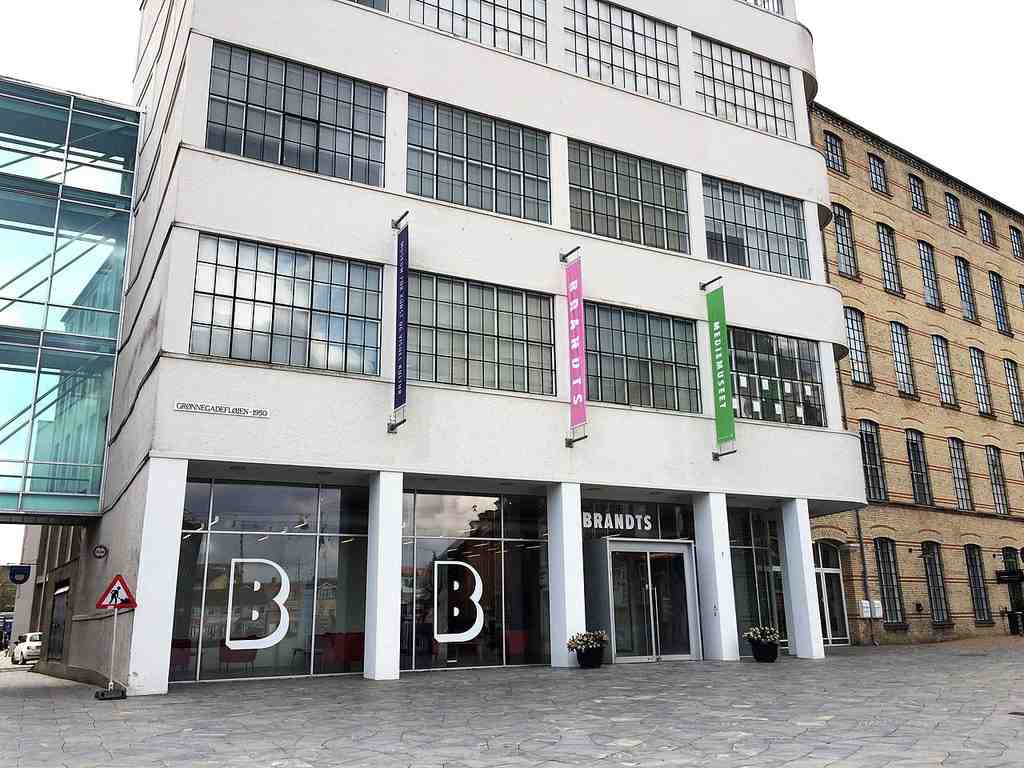
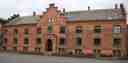
Brandt'sPhoto: Kristian Bang, Wikimedia Commons, CC0. Cropped & resized. On your right, Brandts shows itself as a solid red-brick factory complex with tall rectangular windows and newer concrete-and-glass additions, including a striking glass link that makes the old industrial shell easy to spot.
This is one of Odense’s clearest second acts. The Brandts factory-to-culture quarter began as a huge workplace with hundreds of workers, and its new life as an art center keeps alive not the machinery, but the memory of the people who gave this block its rhythm.
Around the turn of the twentieth century, this was Odense’s biggest workplace, and in the early nineteen hundreds more than six hundred people worked here. Picture bolts of cloth, handcarts moving through narrow passages, and a schedule that ruled family life as much as factory life. The site even had tracks for small wagons because this plot, tucked awkwardly into the city center, needed clever logistics just to move goods through.
Then came the hard part. Even when production peaked in nineteen seventy-three, pressure had already built: the oil crisis, rising wages, worn-out machinery, and foreign competition squeezed the business from all sides. Staff numbers dropped from about two hundred in nineteen seventy-one to one hundred and twenty by nineteen seventy-six. On the thirty-first of December, nineteen seventy-seven, after one hundred and eight years, the factory shut down. Most workers found new jobs fairly quickly, but a whole social world disappeared here, and that loss mattered every bit as much as the closure itself.
What happened next could have gone a dozen different ways. People proposed a technical school, a rehabilitation center, a shopping center, a supermarket with parking, a ballet stage, auction rooms, even complete demolition for housing. Odense had already seen enough tearing down to know how much a city can regret a shortcut.
One of the people who helped steer a different path was Søren Møller, the city alderman who began pushing the transformation in nineteen eighty-two, with director Villy Petersen chairing the group that kept the project moving. Their idea was bold for its time: save the factory, then fill it with independent cultural institutions that could attract attention far beyond Funen. During the rebuilding years, the place stayed alive. Café-Biografen opened before the full conversion finished. Students from the Funen Art Academy worked upstairs in dust, noise, and no heat, side by side with tradesmen. That’s not exactly a pampered artistic birth story... but it fit the place.
By January of nineteen eighty-seven, the art hall and the photography museum had officially moved in. Later, the separate institutions merged, and Brandts grew into Odense and Funen’s largest art museum, with more than eight thousand square meters across four floors. Inside you’ll find Danish and international art, photography, a collection spanning two hundred and fifty years of art seen from Funen, a café, and the island’s only art bookshop. Europe noticed fast: in nineteen eighty-eight, Brandts won European Museum of the Year, one of the first cultural institutions in Scandinavia to do it.
That’s the trick Odense keeps pulling off so well: a place once closed around production opens outward to the public and starts making meaning instead of cloth. Up next, Teater Momentum offers a leaner, sharper version of that same habit of reuse, about a six-minute walk from here.
If you want to come back inside later, Brandts is closed on Monday and open Tuesday through Sunday, with longer hours on Thursday.
On your left, look for a narrow pale street facade with tall rectangular openings and a recessed entrance, marked by the theater’s own name above the door. Teater Momentum is…Read moreShow less
Open dedicated page →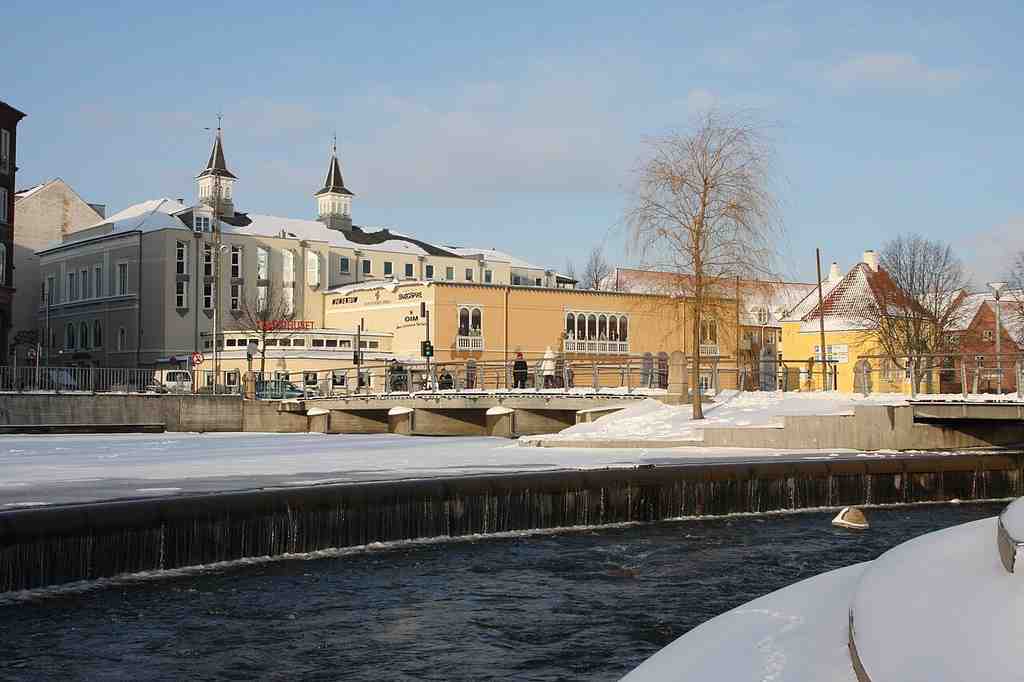
Teater MomentumPhoto: Kåre Thor Olsen, Wikimedia Commons, CC BY-SA 3.0. Cropped & resized. On your left, look for a narrow pale street facade with tall rectangular openings and a recessed entrance, marked by the theater’s own name above the door.
Teater Momentum is small, but this address has lived a very big life. Stand here a moment and you can almost feel the building changing costumes behind the same face. In eighteen ninety-five, architect Emil Schwanenflügel drew this place for Odense Sommerteater. That makes him a fine guide for this stop: one man put lines on paper, and more than a century later those lines still hold a public stage together. Not bad for a building that has been asked to reinvent itself again and again.
The first show here was a revue called Fra Flakhaven til Fruens Bøge, a lively mixed entertainment piece, and people remembered it especially because it introduced the song Vi sejler op ad åen. A song about the Odense River getting stuck in local memory from a theater seat... that tells you something about this city. It likes to turn ordinary movement into story.
By eighteen ninety-six, the house had already changed its name to Odense Folketeater. In nineteen thirty-four, it gained a dance restaurant called Rosenhaven. Then came a harder chapter. In nineteen forty-three, during the German occupation, authorities seized both buildings and turned them into Deutsches Haus, a soldiers’ home and cinema. After the war, in nineteen forty-five, the damaged complex briefly sheltered refugees. Then the place shifted again. Repairs brought it back, and in nineteen forty-eight it reopened as Folketeatret, nicknamed Flodbio, with five hundred and fifty seats. Same address, new purpose... over and over.
If you glance at the image in the app, you can see how modest the exterior is for a place with such a crowded memory. No grand palace front, no peacock strut. Just a working theater, the kind that gets on with the job.
Momentum itself began in two thousand and five and moved into this old performance house the following year. Its idea was, and still is, a little daring. Each season gets a new artistic director and a new acting team. They call the seasons Volumes, like chapters instead of products on a shelf. Volume One, in two thousand and seven to two thousand and eight, put Moqi Simon Trolin in charge and rooted all three productions in Odense, with themes like solidarity, fear, and the company itself. Later, Anne Zacho Søgaard opened Volume Four with a musical built from real stories from Odense bodegas, the city’s plainspoken bars. Then Jacob Stage’s Volume Nine quickly turned into an award story when Lige om lidt bliver alting meget sjovere won a Reumert, Denmark’s major theatre prize.
That may be the real charm here. Like Brandts, this place proves Odense does not throw away a useful shell if it can fill it with new life instead. By its twentieth Volume, Momentum had expanded into talks, concerts, poetry slams, guest performances, and TeaterUng, a free program for students, especially young people who feel outside the usual crowd. A small theater with a large heart... that’ll preach.
From here, let the walls fall away for the final stop: head toward Munke Mose, about a three-minute walk, where the city opens into water, paths, and breathing room. If you plan to return, Momentum keeps very limited public hours: Tuesday from eleven AM to three PM, and Thursday from eleven AM to three-thirty PM.
Look for the broad green park split by the dark ribbon of Odense Å, with pale gravel paths curving through it and a low pedestrian bridge as its clear marker. Munke Mose feels…Read moreShow less
Open dedicated page →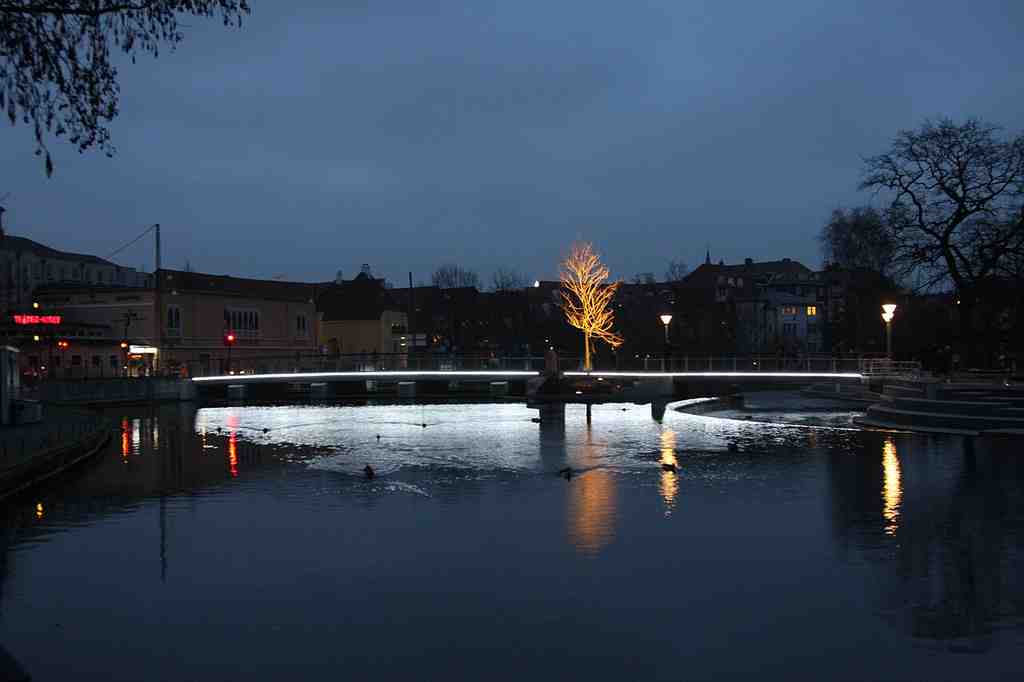
Monks MossPhoto: Kåre Thor Olsen, Wikimedia Commons, CC BY-SA 3.0. Cropped & resized. Look for the broad green park split by the dark ribbon of Odense Å, with pale gravel paths curving through it and a low pedestrian bridge as its clear marker.
Munke Mose feels wonderfully easy on the nerves... but this calm took planning, money, and a fair bit of civic backbone. When Odense Municipality bought the land in eighteen eighty-one from the Munke Mølle factories, the goal was simple: keep it from being built over. At that point, this was still marsh and meadow, used for grazing and hay. When the water rose, the whole area turned into a skating rink. Not a bad second career for a wet field.
People kept finding new uses for it. In eighteen ninety-four, Odense Boldklub got its first permanent football ground here and stayed until nineteen sixty-eight. Tennis and other ball games followed, so this became Odense’s early sports landscape. Skaters claimed it too. A pavilion raised in nineteen hundred for a hunting exhibition later served the skating club, until it came down in nineteen twenty and the place leaned fully into park life.
The real transformation arrived in nineteen twelve. The seed merchant Dæhnfeldt offered to pay two thirds of the cost, and the gardener Edv. Glæsel drew the plan. That mix of public will and private initiative shaped the open park you see now, and Dæhnfeldt still stands here as a statue. Even Havhesten, the Seahorse sculpture unveiled on the twentieth of July, nineteen thirty-nine, reached this park by a little detour; it had first been meant for somewhere else.
If you check the image in the app, you’ll catch that broad, composed sweep of green. What most people miss is the engineering hiding inside the peace. In two thousand and eight, workers rebuilt and lengthened the bridge from the city center. Under it, a sluice on the left controls water levels, and a fish passage on the right lets fish slip past the barrier. Saabyes Stryg tied that work together, so the river could carry life as well as reflection.
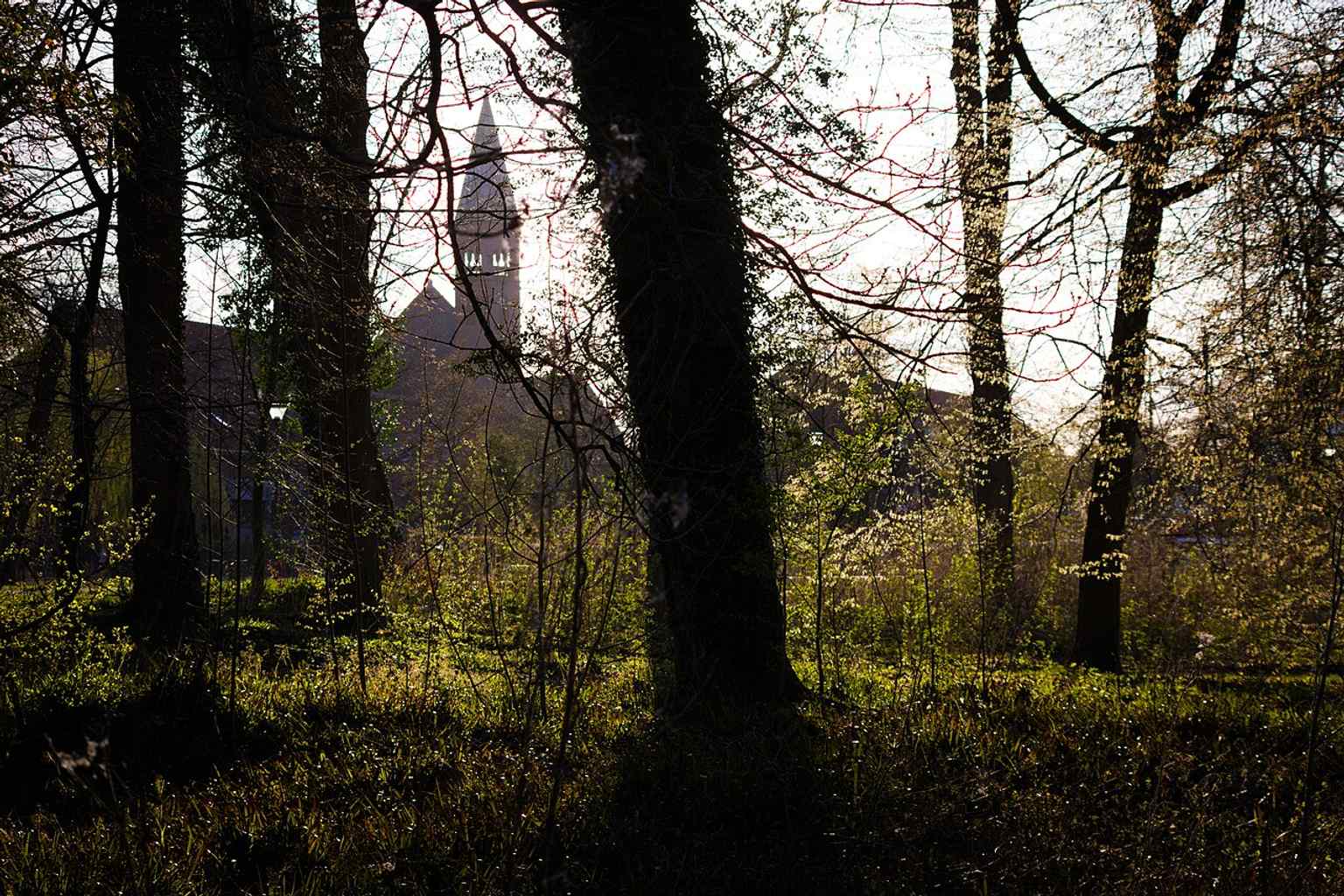
A wide view of Munke Mose, the central Odense park that grew out of former marshland and became a key city green space.Photo: Charlie Graven, Wikimedia Commons, CC BY-SA 4.0. Cropped & resized. This park still hosts May Day speeches, school-leavers, and, now and then, celebrations rowdy enough to attract the police. So before you finish, take in the water, the paths, and the bridge together... Odense never stopped being made. It simply kept opening space for more people to cross into the story.


Frequently asked questions
How do I start the tour?
After purchase, download the AudaTours app and enter your redemption code. The tour will be ready to start immediately - just tap play and follow the GPS-guided route.
Do I need internet during the tour?
No! Download the tour before you start and enjoy it fully offline. Only the chat feature requires internet. We recommend downloading on WiFi to save mobile data.
Is this a guided group tour?
No - this is a self-guided audio tour. You explore independently at your own pace, with audio narration playing through your phone. No tour guide, no group, no schedule.
How long does the tour take?
Most tours take 60–90 minutes to complete, but you control the pace entirely. Pause, skip stops, or take breaks whenever you want.
What if I can't finish the tour today?
No problem! Tours have lifetime access. Pause and resume whenever you like - tomorrow, next week, or next year. Your progress is saved.
What languages are available?
All tours are available in 50+ languages. Select your preferred language when redeeming your code. Note: language cannot be changed after tour generation.
Where do I access the tour after purchase?
Download the free AudaTours app from the App Store or Google Play. Enter your redemption code (sent via email) and the tour will appear in your library, ready to download and start.
If you don't enjoy the tour, we'll refund your purchase. Contact us at [email protected]
Checkout securely with 






.jpg)


