
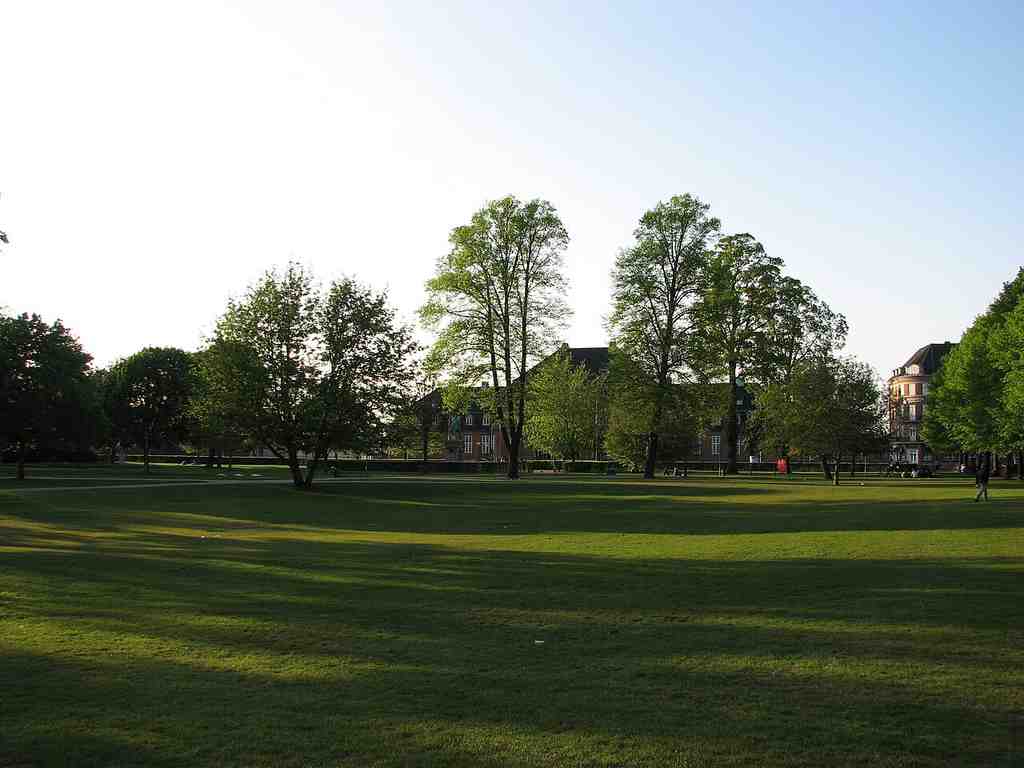
Ahead of you is a formal green space framed by straight edges and curving paths, with the pale mass of Odense Castle behind it and a mounted statue marking one of its historic entrances.
This is Kongens Have, the King’s Garden... and it began as a carefully controlled piece of royal stagecraft. Around seventeen twenty, the people shaping the grounds around the castle followed French ideas and laid out what gardeners call an axis garden: a plan organized around a strong central line, with balanced, symmetrical paths branching from it like a ruler had settled an argument. Very tidy, very noble, very sure of itself.
About a century later, Odense changed the mood. Gardeners reshaped the place in the English romantic style, which traded straight lines for curved walks and a gentler, more wandering feeling. Same ground, different manners. That little shift tells you a lot about this city: Odense likes design, but it also likes to loosen its collar.
For a long time, ordinary people could not simply stroll in. A fence ringed the garden until Odense Municipality bought it in nineteen oh seven. Then, in nineteen oh nine, the city removed the fence and added electric lamps. That was more than practical housekeeping. It turned a royal enclosure into public rhythm, a place people could cross, meet, sing, protest, and pause.
One person tied firmly to this spot is King Christian the Ninth, or rather his rider statue near the entrance by the old station. In nineteen twelve, Odense citizens raised the money themselves, and the local sculptor Aksel Hansen gave the king his bronze form. I like that detail. A royal image, paid for by townspeople, greeting travelers at the edge of a public park... that is Odense in miniature.
There are other layers here too. In front of the castle stands Frederik the Seventh, whose statue first faced the city from Flakhaven in eighteen sixty-eight before moving here in nineteen eighty-seven. On the first of September, nineteen forty, during the German occupation, thirty-five thousand citizens gathered here for a demonstration of shared song. Later came modern additions, including NineNow in nineteen ninety-three, a sound sculpture of nine half-buried metal discs that make the garden feel just a touch more contemporary than its royal bones suggest. Parks, like people, can wear more than one century at once.
Notice how this garden still directs movement, just more gently now. The lines, curves, statues, and old trees all funnel attention toward the building that once gave this place its meaning: the castle. We’ll head there next. And handy little note: the garden is open all day, every day.




