
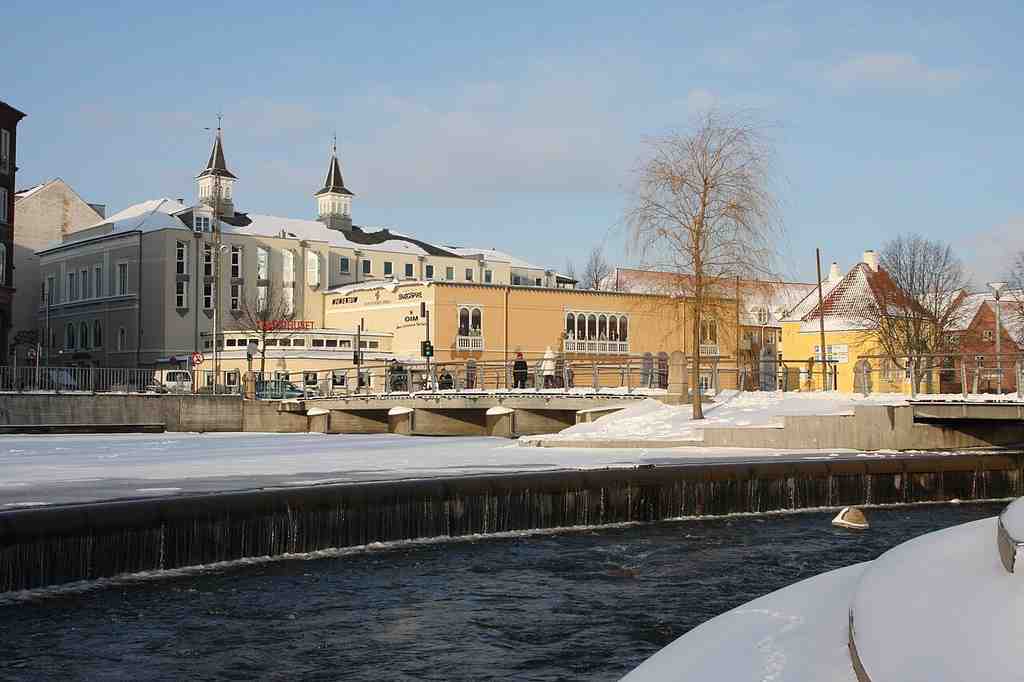
On your left, look for a narrow pale street facade with tall rectangular openings and a recessed entrance, marked by the theater’s own name above the door.
Teater Momentum is small, but this address has lived a very big life. Stand here a moment and you can almost feel the building changing costumes behind the same face. In eighteen ninety-five, architect Emil Schwanenflügel drew this place for Odense Sommerteater. That makes him a fine guide for this stop: one man put lines on paper, and more than a century later those lines still hold a public stage together. Not bad for a building that has been asked to reinvent itself again and again.
The first show here was a revue called Fra Flakhaven til Fruens Bøge, a lively mixed entertainment piece, and people remembered it especially because it introduced the song Vi sejler op ad åen. A song about the Odense River getting stuck in local memory from a theater seat... that tells you something about this city. It likes to turn ordinary movement into story.
By eighteen ninety-six, the house had already changed its name to Odense Folketeater. In nineteen thirty-four, it gained a dance restaurant called Rosenhaven. Then came a harder chapter. In nineteen forty-three, during the German occupation, authorities seized both buildings and turned them into Deutsches Haus, a soldiers’ home and cinema. After the war, in nineteen forty-five, the damaged complex briefly sheltered refugees. Then the place shifted again. Repairs brought it back, and in nineteen forty-eight it reopened as Folketeatret, nicknamed Flodbio, with five hundred and fifty seats. Same address, new purpose... over and over.
If you glance at the image in the app, you can see how modest the exterior is for a place with such a crowded memory. No grand palace front, no peacock strut. Just a working theater, the kind that gets on with the job.
Momentum itself began in two thousand and five and moved into this old performance house the following year. Its idea was, and still is, a little daring. Each season gets a new artistic director and a new acting team. They call the seasons Volumes, like chapters instead of products on a shelf. Volume One, in two thousand and seven to two thousand and eight, put Moqi Simon Trolin in charge and rooted all three productions in Odense, with themes like solidarity, fear, and the company itself. Later, Anne Zacho Søgaard opened Volume Four with a musical built from real stories from Odense bodegas, the city’s plainspoken bars. Then Jacob Stage’s Volume Nine quickly turned into an award story when Lige om lidt bliver alting meget sjovere won a Reumert, Denmark’s major theatre prize.
That may be the real charm here. Like Brandts, this place proves Odense does not throw away a useful shell if it can fill it with new life instead. By its twentieth Volume, Momentum had expanded into talks, concerts, poetry slams, guest performances, and TeaterUng, a free program for students, especially young people who feel outside the usual crowd. A small theater with a large heart... that’ll preach.
From here, let the walls fall away for the final stop: head toward Munke Mose, about a three-minute walk, where the city opens into water, paths, and breathing room. If you plan to return, Momentum keeps very limited public hours: Tuesday from eleven AM to three PM, and Thursday from eleven AM to three-thirty PM.




