
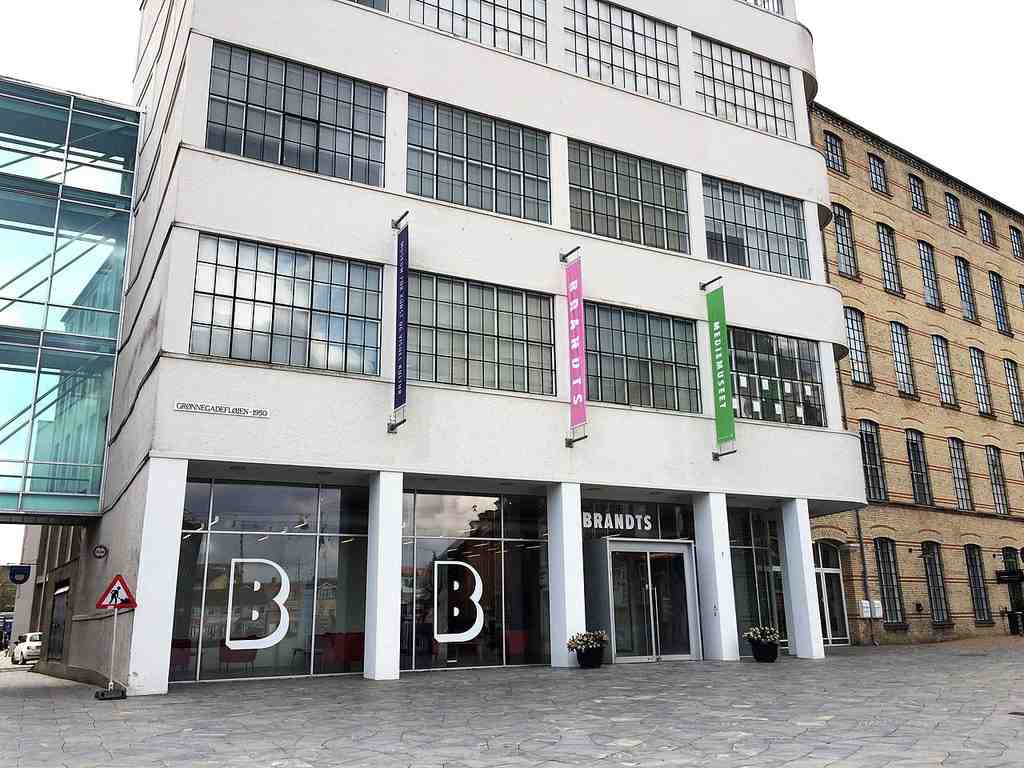
On your right, Brandts shows itself as a solid red-brick factory complex with tall rectangular windows and newer concrete-and-glass additions, including a striking glass link that makes the old industrial shell easy to spot.
This is one of Odense’s clearest second acts. The Brandts factory-to-culture quarter began as a huge workplace with hundreds of workers, and its new life as an art center keeps alive not the machinery, but the memory of the people who gave this block its rhythm.
Around the turn of the twentieth century, this was Odense’s biggest workplace, and in the early nineteen hundreds more than six hundred people worked here. Picture bolts of cloth, handcarts moving through narrow passages, and a schedule that ruled family life as much as factory life. The site even had tracks for small wagons because this plot, tucked awkwardly into the city center, needed clever logistics just to move goods through.
Then came the hard part. Even when production peaked in nineteen seventy-three, pressure had already built: the oil crisis, rising wages, worn-out machinery, and foreign competition squeezed the business from all sides. Staff numbers dropped from about two hundred in nineteen seventy-one to one hundred and twenty by nineteen seventy-six. On the thirty-first of December, nineteen seventy-seven, after one hundred and eight years, the factory shut down. Most workers found new jobs fairly quickly, but a whole social world disappeared here, and that loss mattered every bit as much as the closure itself.
What happened next could have gone a dozen different ways. People proposed a technical school, a rehabilitation center, a shopping center, a supermarket with parking, a ballet stage, auction rooms, even complete demolition for housing. Odense had already seen enough tearing down to know how much a city can regret a shortcut.
One of the people who helped steer a different path was Søren Møller, the city alderman who began pushing the transformation in nineteen eighty-two, with director Villy Petersen chairing the group that kept the project moving. Their idea was bold for its time: save the factory, then fill it with independent cultural institutions that could attract attention far beyond Funen. During the rebuilding years, the place stayed alive. Café-Biografen opened before the full conversion finished. Students from the Funen Art Academy worked upstairs in dust, noise, and no heat, side by side with tradesmen. That’s not exactly a pampered artistic birth story... but it fit the place.
By January of nineteen eighty-seven, the art hall and the photography museum had officially moved in. Later, the separate institutions merged, and Brandts grew into Odense and Funen’s largest art museum, with more than eight thousand square meters across four floors. Inside you’ll find Danish and international art, photography, a collection spanning two hundred and fifty years of art seen from Funen, a café, and the island’s only art bookshop. Europe noticed fast: in nineteen eighty-eight, Brandts won European Museum of the Year, one of the first cultural institutions in Scandinavia to do it.
That’s the trick Odense keeps pulling off so well: a place once closed around production opens outward to the public and starts making meaning instead of cloth. Up next, Teater Momentum offers a leaner, sharper version of that same habit of reuse, about a six-minute walk from here.
If you want to come back inside later, Brandts is closed on Monday and open Tuesday through Sunday, with longer hours on Thursday.




