

Graz Audio Tour: Echoes of Empire and Art in Innere Stadt
A royal crypt lies beneath Graz’s sunlit streets, while centuries-old scandals echo behind baroque walls. This city hides its fiercest secrets in plain sight. Uncover Graz on a self-guided audio tour that leads you from the enchanting Schauspielhaus to the ominous halls of the cathedral and the stately country house, slipping behind the scenes of stories most travelers miss. Which forbidden plot nearly toppled the city’s mightiest rulers on these cobblestones? What chilling secret draws visitors to the Cathedral’s shadowed corner each evening? Why do strange marks appear on the golden columns of the country house at dawn? Experience Graz surging with energy as you chase legends, haunt hidden passageways, and unravel mysteries that shaped the city. Each step transforms the familiar into electric possibility and historic drama. Start the tour now and let the buried truths of Graz rise up beneath your feet.
Tour preview
About this tour
- scheduleDuration 80–100 minsGo at your own pace
- straighten3.2 km walking routeFollow the guided path
- location_onLocationFeldkirchen bei Graz, Austria
- wifi_offWorks offlineDownload once, use anywhere
- all_inclusiveLifetime accessReplay anytime, forever
- location_onStarts at Lendplatz
Stops on this tour
lock_open 3 free previews · 10 unlock with purchase
Lendplatz appears as a long stone-paved square edged by pale stucco town houses, and in its quieter southern section a tall baroque stone column carries a small figure of Mary…Read moreShow less
Open dedicated page →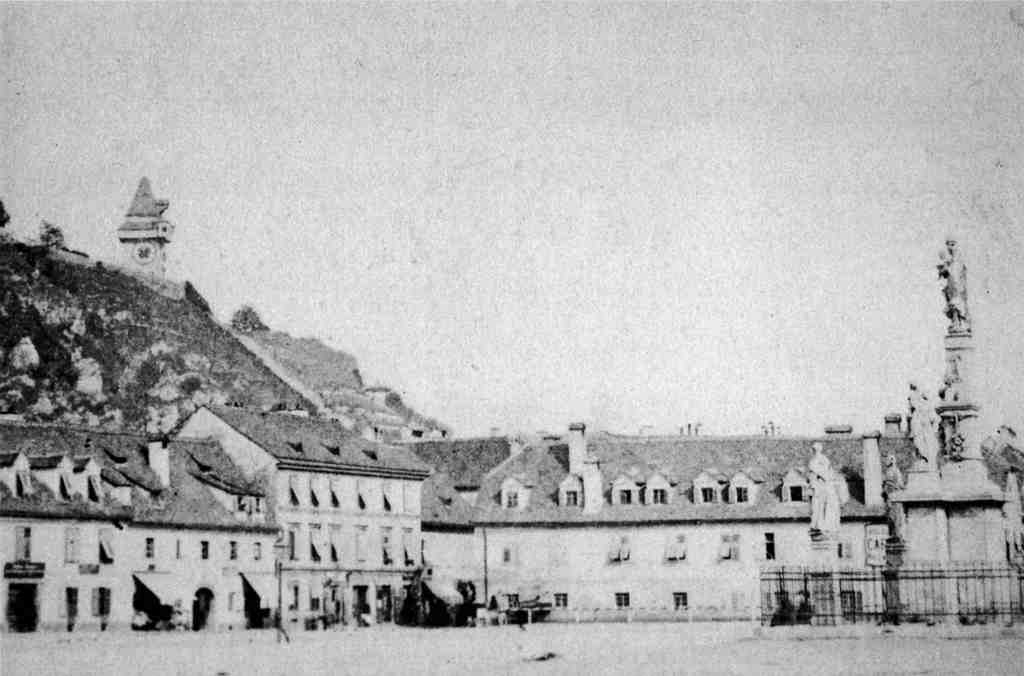
LendplatzPhoto: Unknown author, Wikimedia Commons, Public domain. Cropped & resized. Lendplatz appears as a long stone-paved square edged by pale stucco town houses, and in its quieter southern section a tall baroque stone column carries a small figure of Mary with the Christ Child.
That column is a fine place to begin, because Lendplatz has always been a place of work, movement, and survival. The name “Lend” comes from Anlenden, the act of bringing a boat to shore. The Mur flowed close by as Graz’s working river, but its water level changed too wildly for reliable mills, so people pushed mills and workshops onto smaller streams and man-made canals instead.
As Graz secured the riverbanks in the sixteenth and seventeenth centuries, the suburb beyond the old centre grew quickly. The Bürgerspital, the city’s civic hospital, sold off large stretches of its land here because rents and building plots earned more than farming them. That decision shaped this square. Lendplatz formed as a planned, sack-like widening between Mariahilferstraße and Wiener Straße. A historian named Fritz Popelka described it, rather charmingly, as a village street square made large enough for cattle markets. Even its slanted line remembers the landscape that came before: its axis meets Mariahilferstraße at about one hundred and twenty degrees because an arm of the Mur still ran here into the mid-seventeenth century. Builders set the eastern row of houses along that channel, and by around seventeen hundred the square stood enclosed on all sides.
But this was not elegant Graz. Lendplatz belonged to craftsmen, small traders, and the poor. Nearby lay Sigmundstadl, one of the city’s harshest quarters, a colony of shabby huts. In sixteen seventy-nine, officials counted three hundred and twenty-three beggars in this area. Neglected children formed bands. Prostitutes and drifters found shelter here. A report from sixteen fifty-five warned that even the road toward Calvary Hill was unsafe in daylight because robbers, runaway Jesuits - members of a Catholic teaching order - and students on the run gathered in the upper Lend.
Disease followed poverty. In the seventeenth and eighteenth centuries, plague and dysentery struck hard here. In sixteen eighty, about four thousand people in Graz fell ill with plague, and roughly three quarters of them died, in a city of only around fifteen thousand. Out of that fear came vows, and out of those vows came the plague column you see today. The statue of Mary and Child on top is usually attributed to Andreas Marx, sculptor to the Eggenberg court. Street widening forced the city to move the column to this southern position in eighteen forty-five.
Trade, though, kept returning. Inns settled here on the north-south route. Cattle markets filled the square. A market regulation from seventeen ninety-one mentions charcoal sold here for locksmiths, blacksmiths, and tinsmiths. Goods were sold directly from wagons: wood, charcoal, fruit, and above all cabbage. In autumn of eighteen seventy-seven, as many as two hundred cabbage wagons lined the eastern side. In eighteen sixty-one, the city shifted its annual fairs here from Hauptplatz, and after eighteen eighty-six even the rag markets stayed until nineteen twenty-two.
In the app, you can see how Keplerstraße slices through Lendplatz and turns the northern half into a transport corridor. A second view shows the calmer southern section, where the market square still feels like a proper room in the city. That split remains part of Lendplatz’s character, along with its farmers’ market, which has continued here since nineteen forty-five, and Graz’s central fire brigade, which has stood on this square since eighteen seventy-seven.
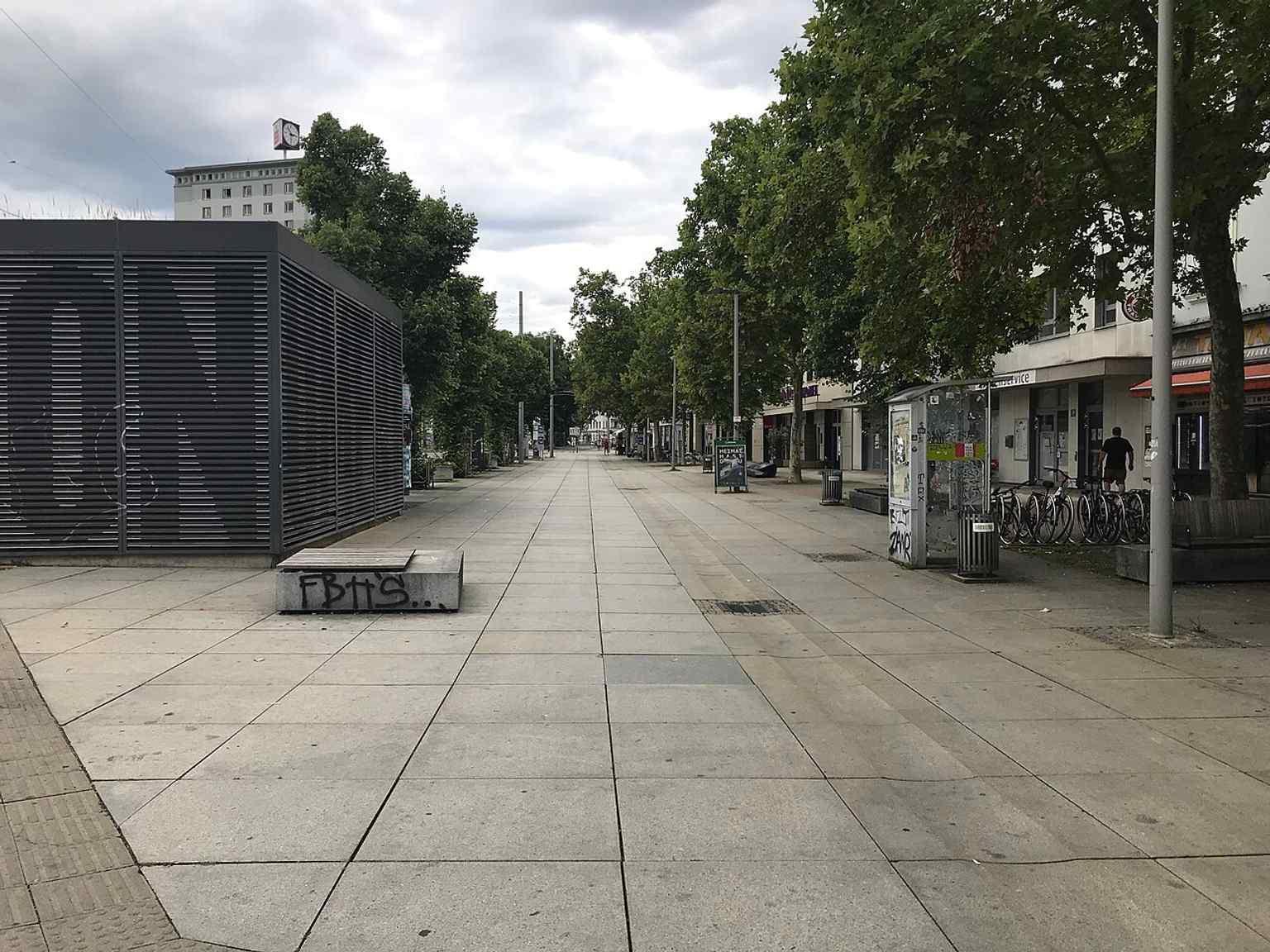
The busier northern half of Lendplatz, showing how the plaza is split by Keplerstraße and used as a transport corridor.Photo: Antimuonium, Wikimedia Commons, CC BY-SA 4.0. Cropped & resized. Lendplatz still carries the practical soul of a place shaped by trade, hardship, and stubborn continuity.
When you’re ready, continue on toward Schloßbergplatz.
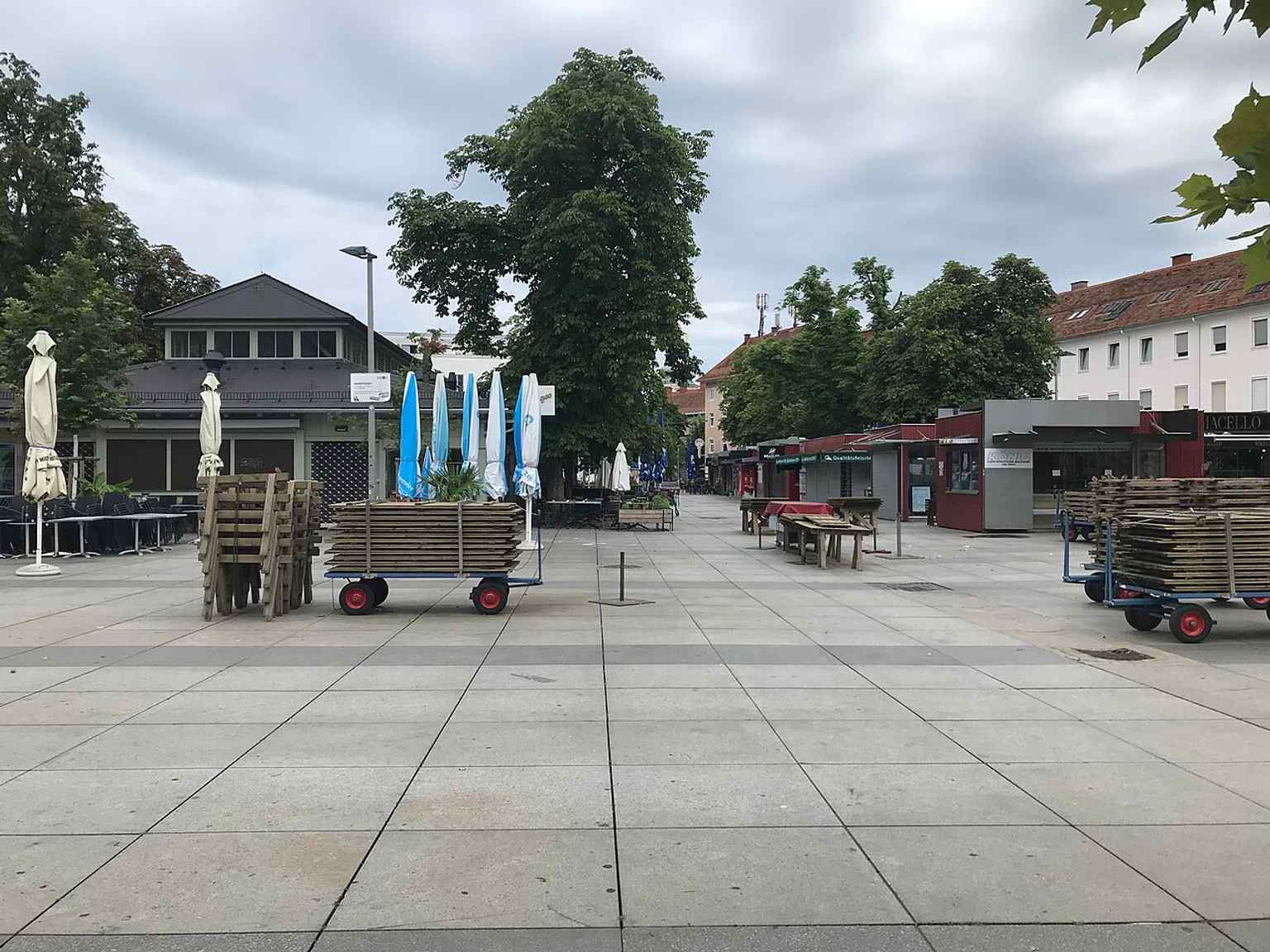
The calmer southern half of Lendplatz, where the market area now mixes a central square, trees, market stalls and cafés.Photo: Antimuonium, Wikimedia Commons, CC BY-SA 4.0. Cropped & resized. On your right, look for a pale Baroque palace with a heavy round-arched stone portal, tall windows capped by curved brow-like hoods, and a carved sandstone coat of arms above the…Read moreShow less
Open dedicated page →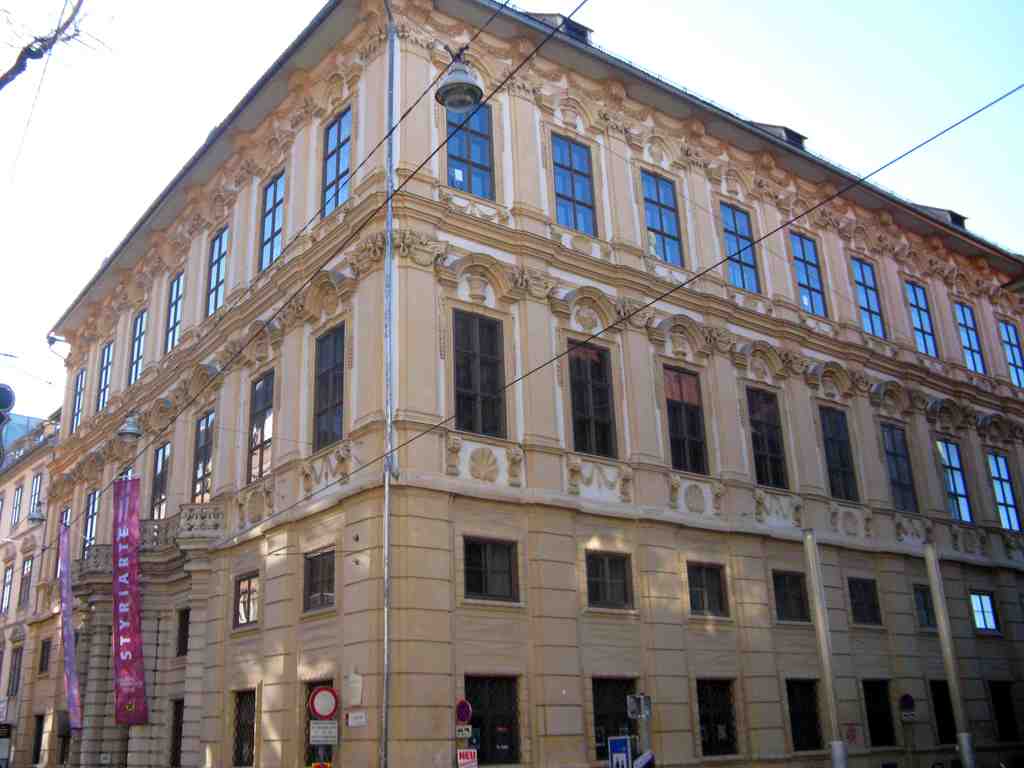
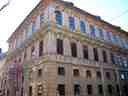
Palais AttemsPhoto: Andi oisn, Wikimedia Commons, CC BY-SA 3.0. Cropped & resized. On your right, look for a pale Baroque palace with a heavy round-arched stone portal, tall windows capped by curved brow-like hoods, and a carved sandstone coat of arms above the entrance.
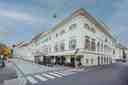
This is Palais Attems, widely regarded as the most important aristocratic palace in Styria, and it wears that title with very little need for boasting. Count Ignaz Maria Attems, whose family came from Friuli in northern Italy, patiently bought up six town houses here between the late sixteen hundreds and the early seventeen hundreds. Then he asked the architect Johann Joachim Carlone to turn that patchwork of houses into a true city palace. Carlone worked from about seventeen oh two, drawing on grand palaces from Genoa, and by seventeen sixteen Graz had acquired a residence that announced ambition in stone.
Even from where you stand, you can read the message. The lower level forms a sturdy base, with windows framed in rough-cut rusticated stone. Above that, the upper storeys become more elegant, divided by tall pilasters, those flat decorative columns attached to the wall, and dressed with stucco vases and curved window crowns. The great portal on Sackstrasse pushes outward like a stage entrance. If you glance at the details around it on your screen, you can see how richly the stone was handled, right down to the family alliance coat of arms of Attems and Wurmbrand above the arch. That coat of arms mattered. It told every visitor that this house was not merely comfortable. It was dynastic, political, and carefully choreographed. Over the portal sits a stone-balustraded balcony, and behind those doors the count assembled what became the greatest private art collection in Styria: paintings, tapestries, weapons, armour, and a substantial library. Later generations kept adding to it. Count Franz Dismas Attems enriched the interiors with wall panelling and tiled stoves between the seventeen thirties and seventeen fifties. His son, Ignaz Maria the Second, returned from travels across Europe with yet more art, and completed the Rococo furnishing. Aristocrats, one gathers, rarely believed they had quite enough ceiling painting.
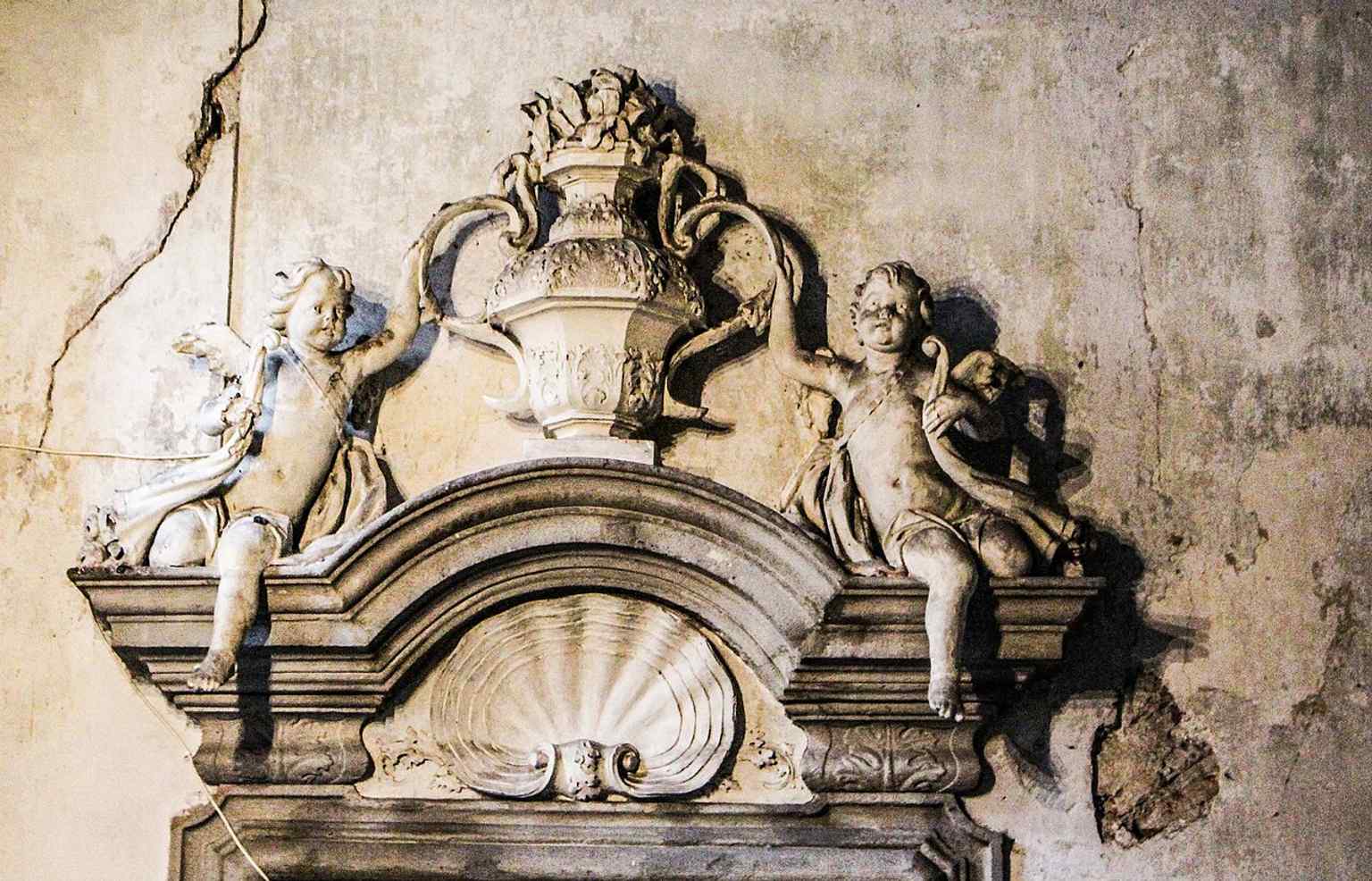
A closer façade detail from the Sackstraße side, where the ornate portal and sculpted stonework mark the representative entrance.Photo: FOSO-ART, Wikimedia Commons, CC BY-SA 3.0 at. Cropped & resized. You cannot see the full sequence from the street, but the interior was designed to impress from the first step. If you open the image in the app, you can look into the ground-floor vestibule, where delicate stucco spreads across the ceiling and twin staircases rise with pierced stone balustrades and lanterns. Upstairs, the state rooms became famous. One ceiling celebrated the apotheosis, the glorification, of the House of Attems. Another room, the so-called Monkey Hall, featured bronze half-figures of monkeys emerging from the ceiling around painted scenes of Apollo and the arts. Nearby stood the Bird Room, alive with mythological scenes and birds of every kind.
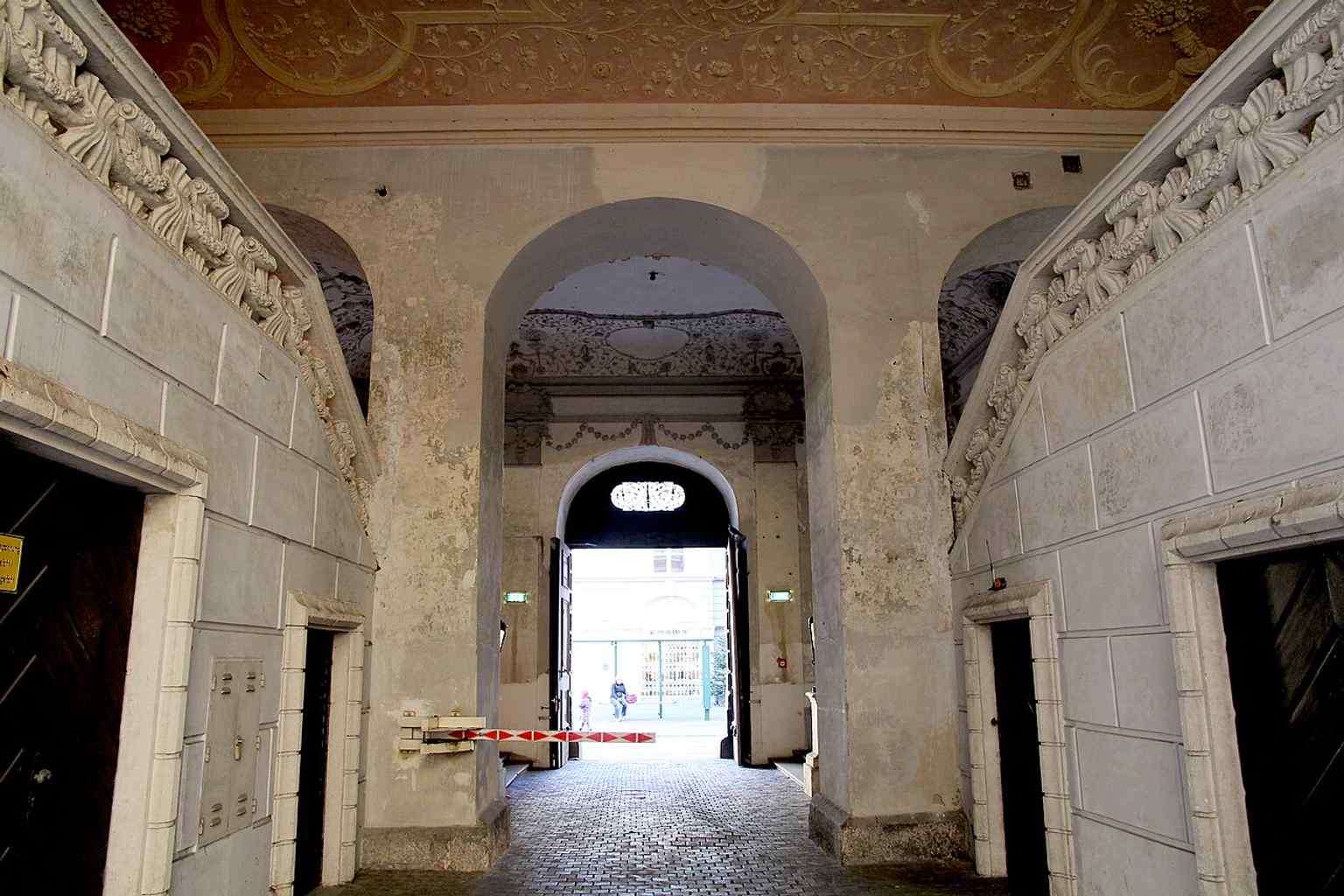
Ground-floor interior looking toward Sackstraße, illustrating the palace’s entrance sequence and the richly finished lower level.Photo: E.mil.mil, Wikimedia Commons, CC BY-SA 3.0 at. Cropped & resized. Then history lost its manners. After the First World War, the family declined. In nineteen thirty-three, some gallery rooms finally opened to the public, but the Second World War brought disaster. Bomb damage in nineteen forty-five struck the palace, and many treasures vanished through plunder or forced sale. Even the servants’ liveries were stolen. By the late nineteen fifties the palace stood empty, and in the early nineteen sixties the family sold it to the state of Styria. Careful restoration followed, first outside, then within, over many years.
Today the building serves culture again, housing offices for festivals and literary life rather than powdered footmen and family ceremony.
Palais Attems reminds you how grandeur can survive, even after its treasures do not.
When you are ready, continue gently on toward Schloßbergplatz.
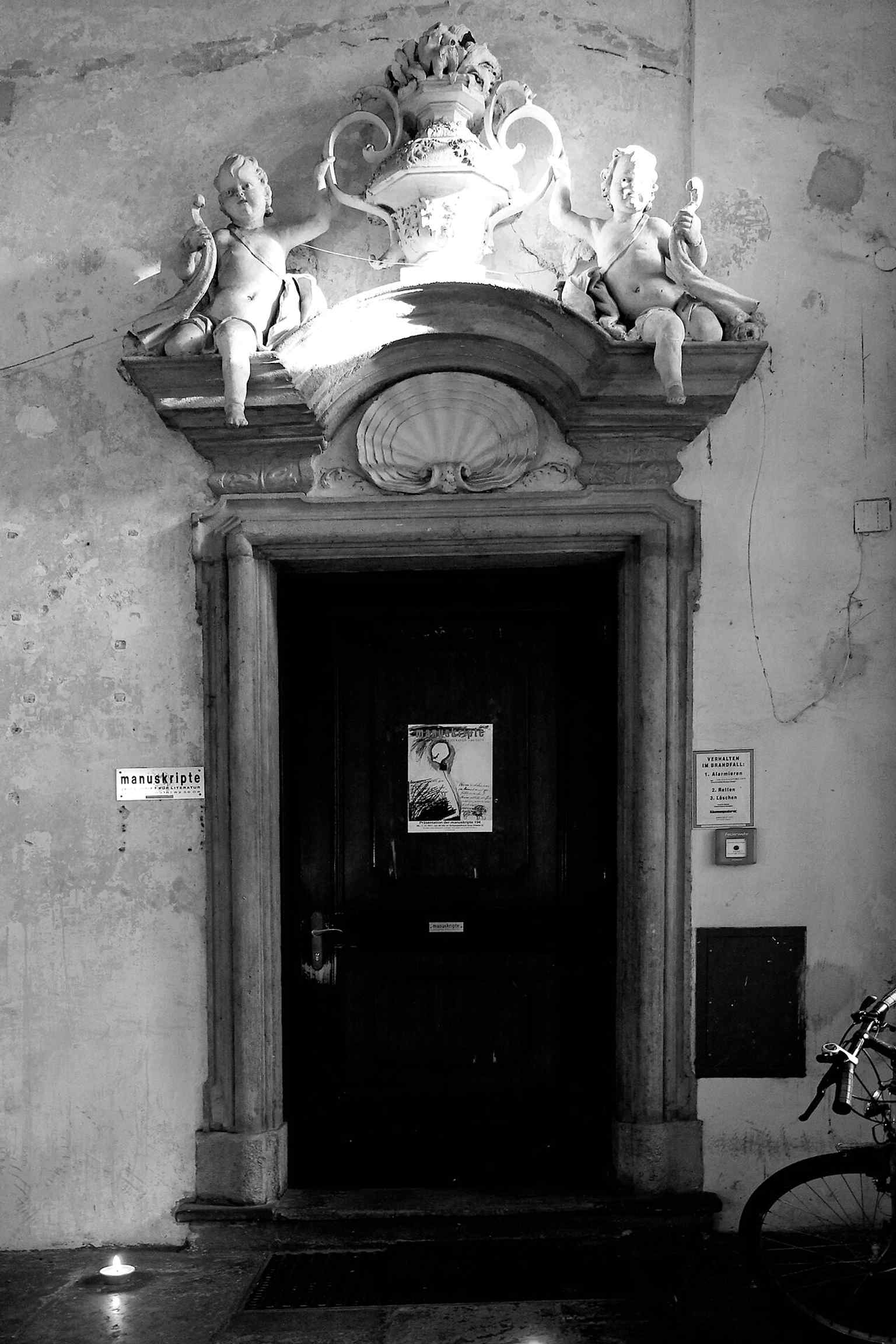
A close look at an Erdgeschoss detail, matching the source’s emphasis on sumptuous interior ornament and stucco work.Photo: E.mil.mil, Wikimedia Commons, CC BY-SA 3.0 at. Cropped & resized. 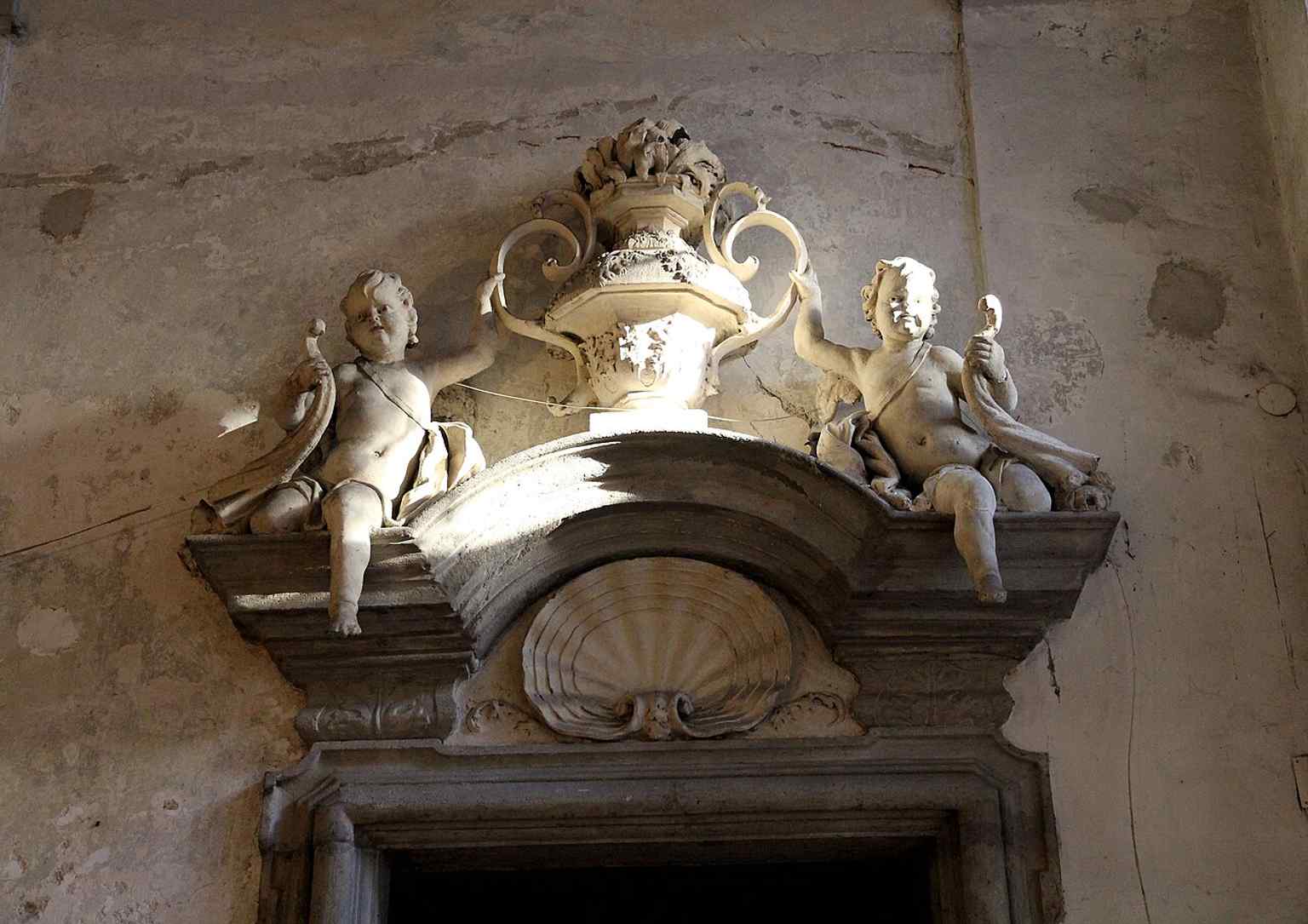
Another ground-floor detail that helps show the decorative craftsmanship used throughout the palace interiors.Photo: E.mil.mil, Wikimedia Commons, CC BY-SA 3.0 at. Cropped & resized. 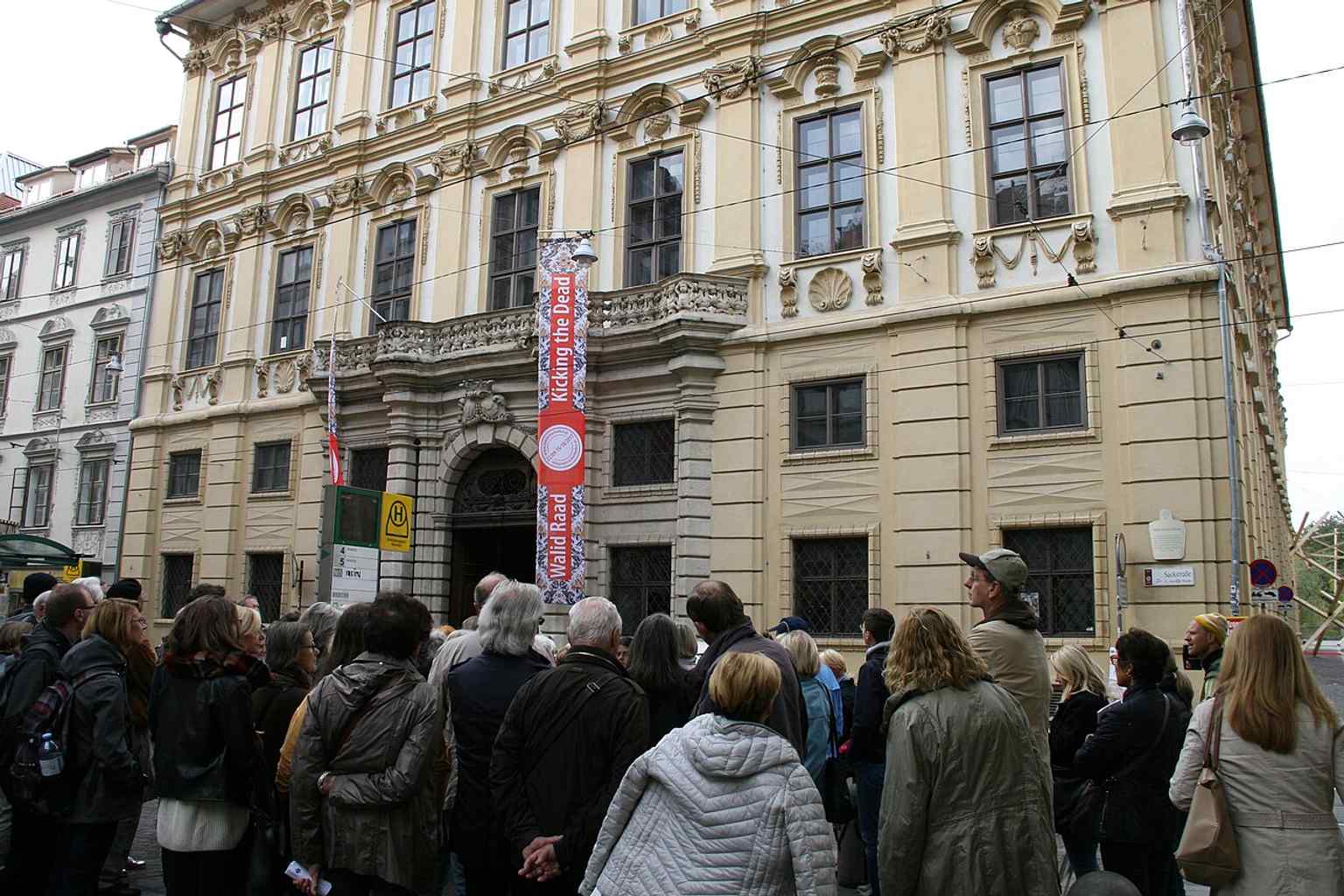
A guided-tour style historical image of the former Palais Attems, fitting the building’s role as a landmark in Graz’s old town.Photo: Martgraz, Wikimedia Commons, CC BY-SA 4.0. Cropped & resized. 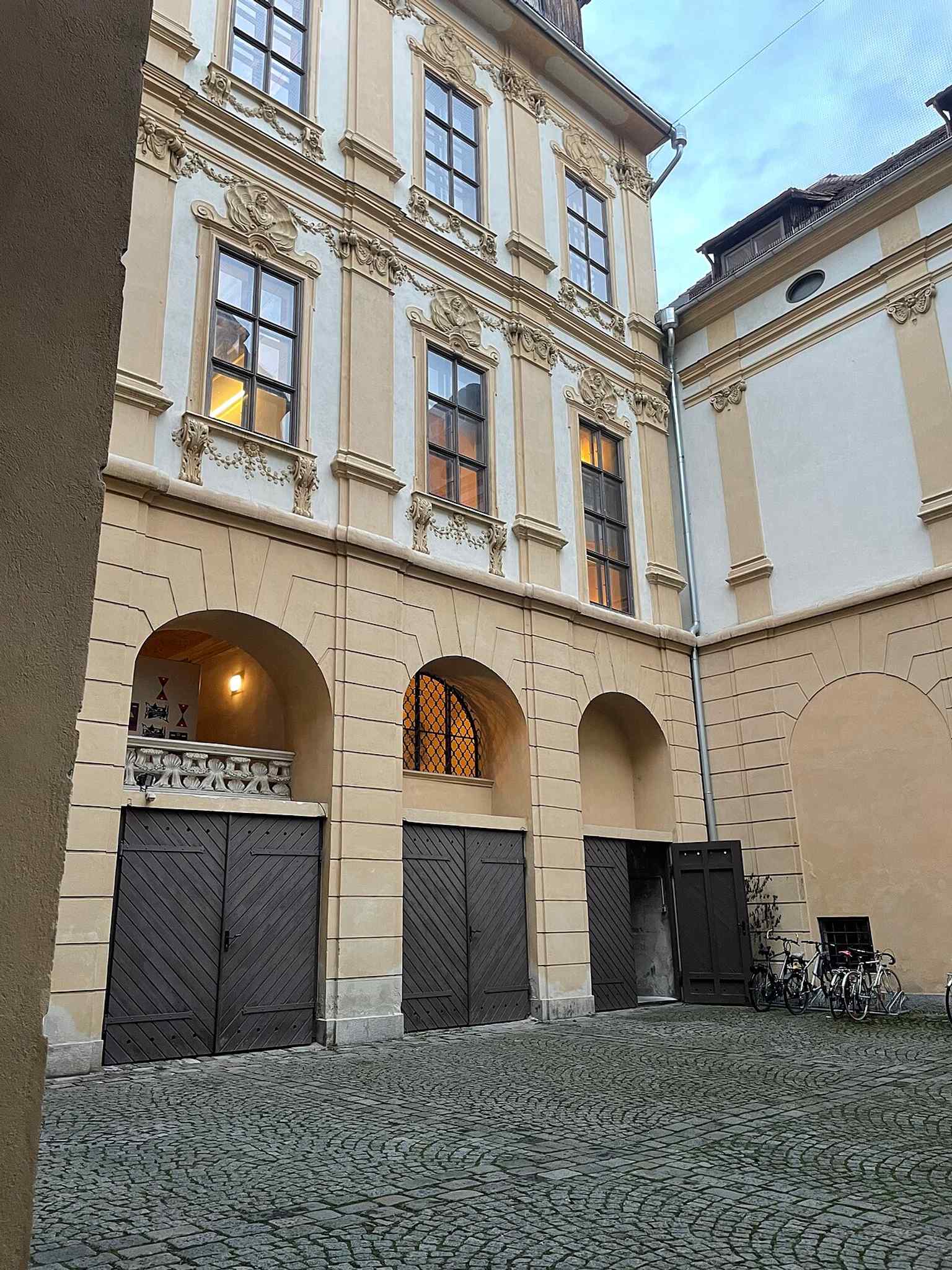
Recent courtyard view showing the palace today and its preserved Baroque enclosure around the interior court.Photo: 0Lucky Luke, Wikimedia Commons, CC BY-SA 4.0. Cropped & resized. 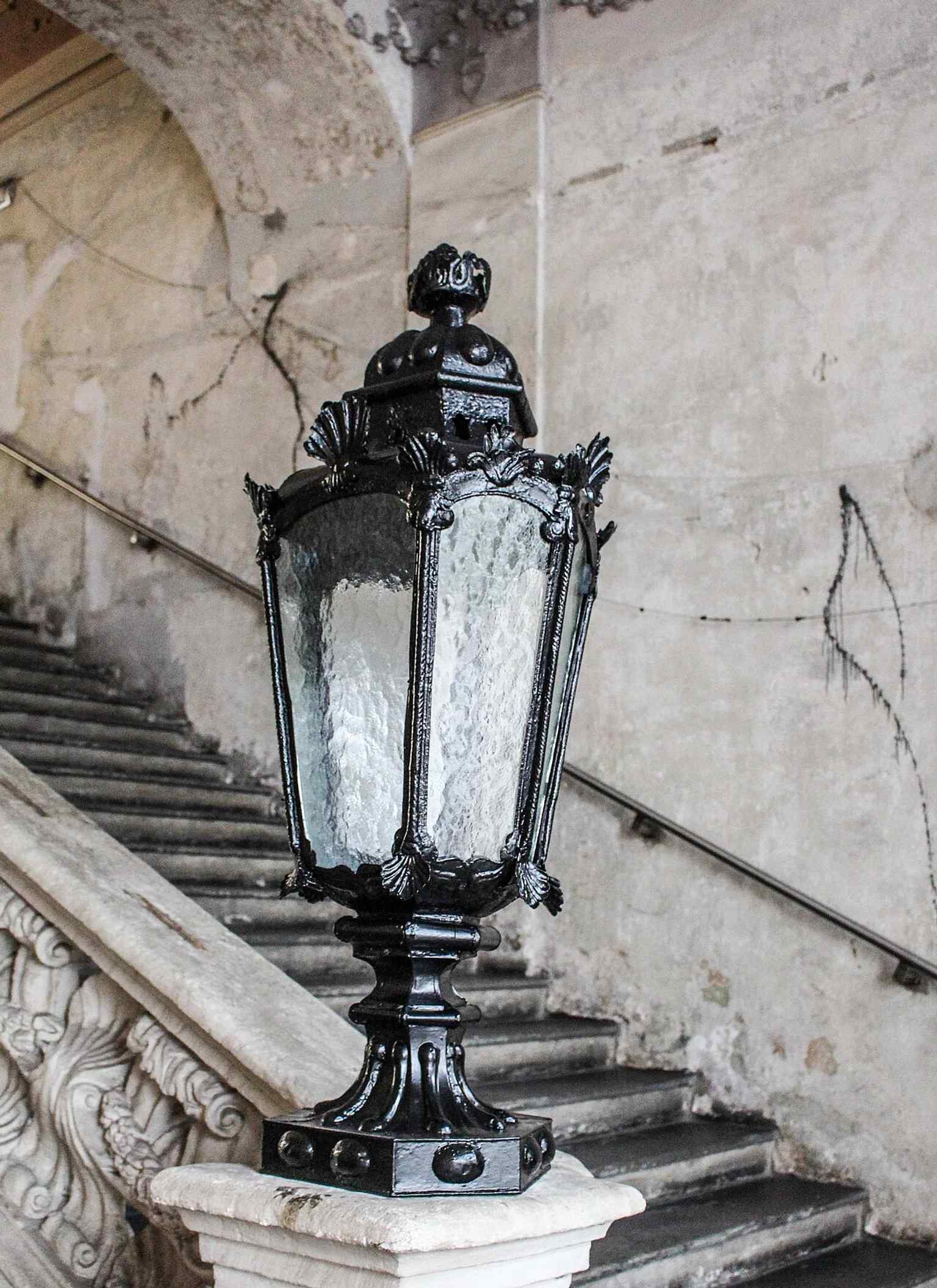
Architectural detail from the palace exterior, likely part of the elaborate Baroque decoration that distinguishes the façade.Photo: FOSO-ART, Wikimedia Commons, CC BY-SA 3.0 at. Cropped & resized. 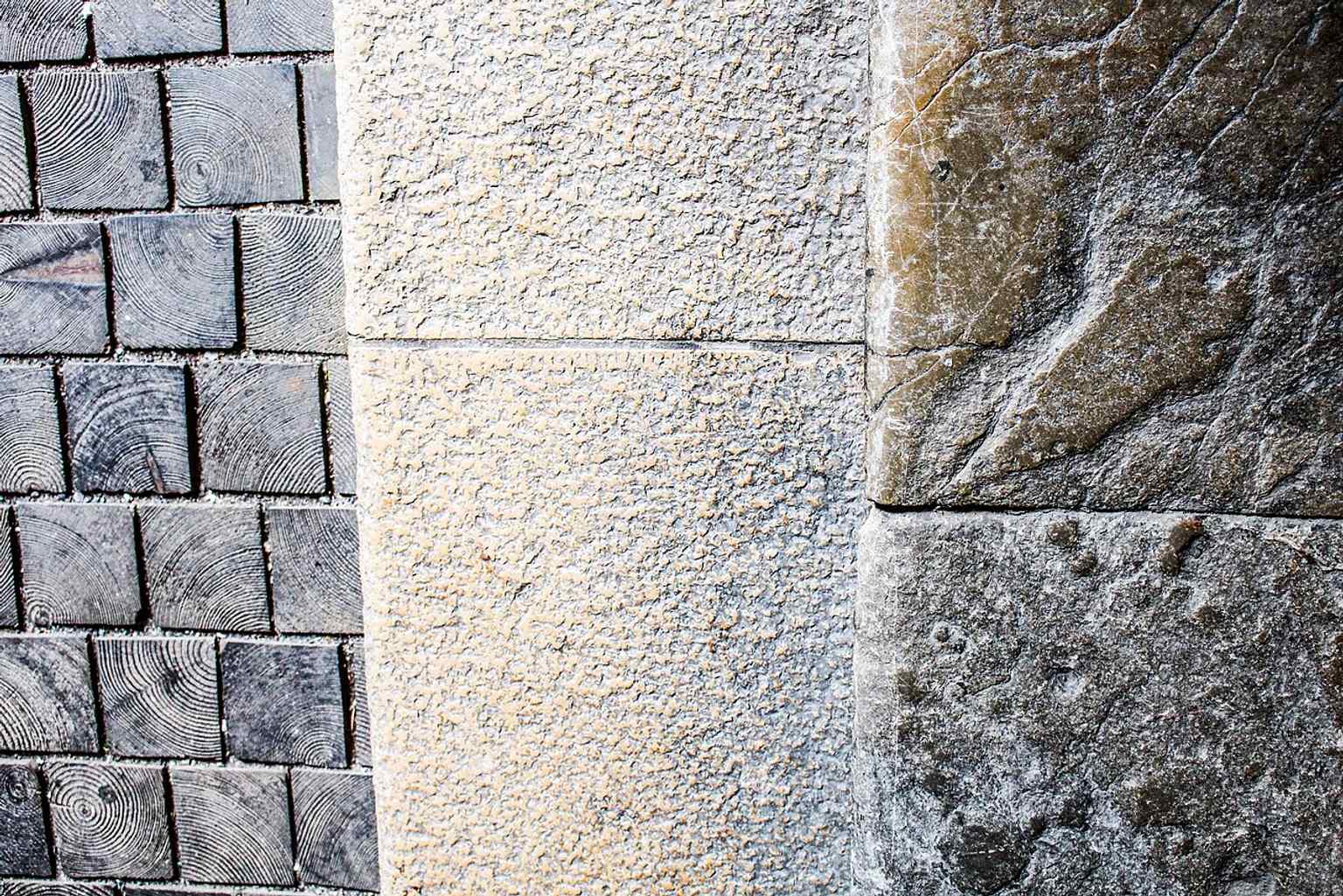
Facade detail showing the decorative surface treatment that links the palace to northern Italian Baroque influences.Photo: FOSO-ART, Wikimedia Commons, CC BY-SA 3.0 at. Cropped & resized. 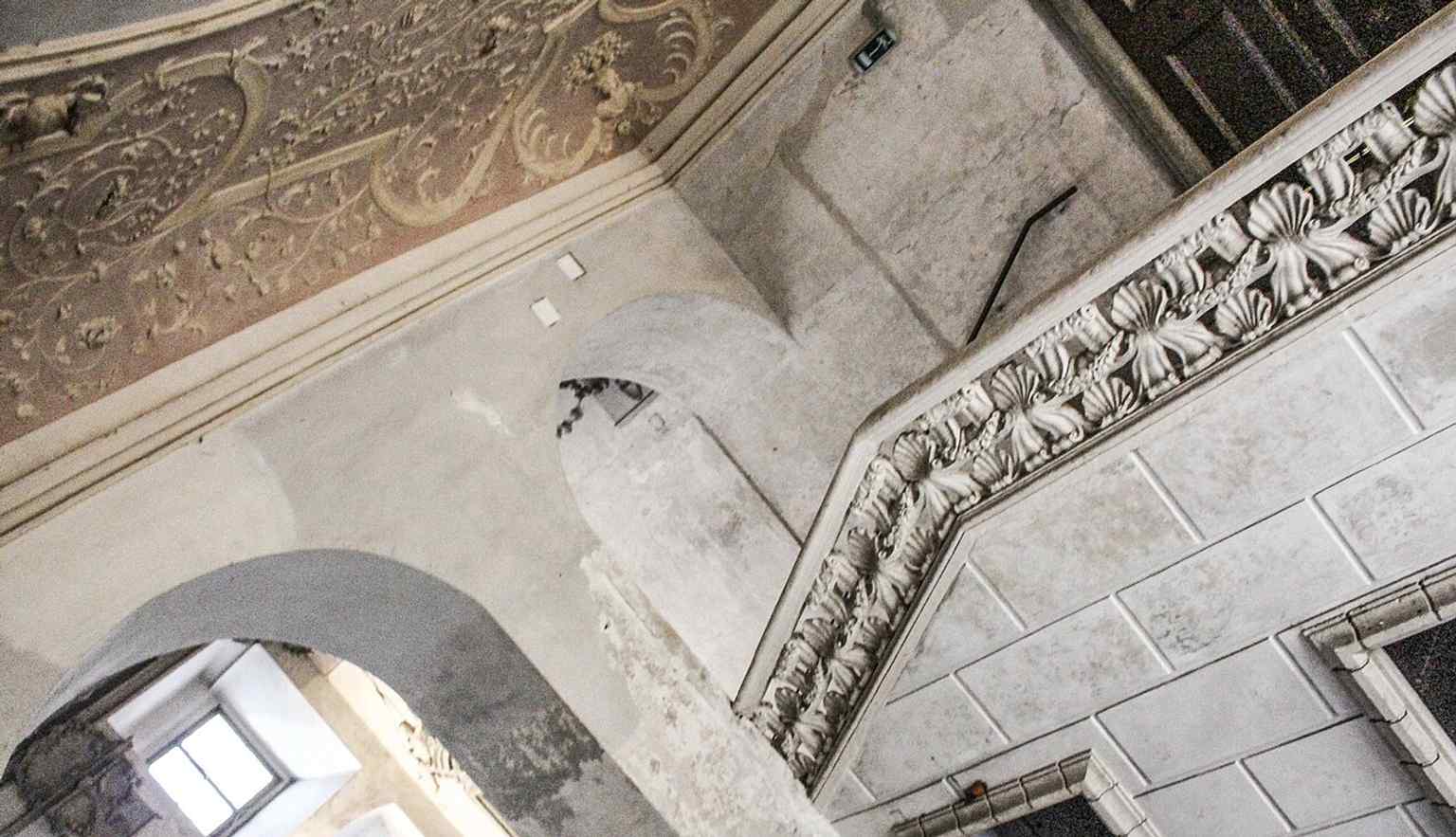
An additional close-up of palace decoration, helping illustrate the varied sculptural and stucco details across the building.Photo: FOSO-ART, Wikimedia Commons, CC BY-SA 3.0 at. Cropped & resized. You can spot Schloßbergplatz by its long paved open space pressed against a near-vertical rock face, with the pale stone Kriegssteig climbing the hill in sharp stages. This…Read moreShow less
Open dedicated page →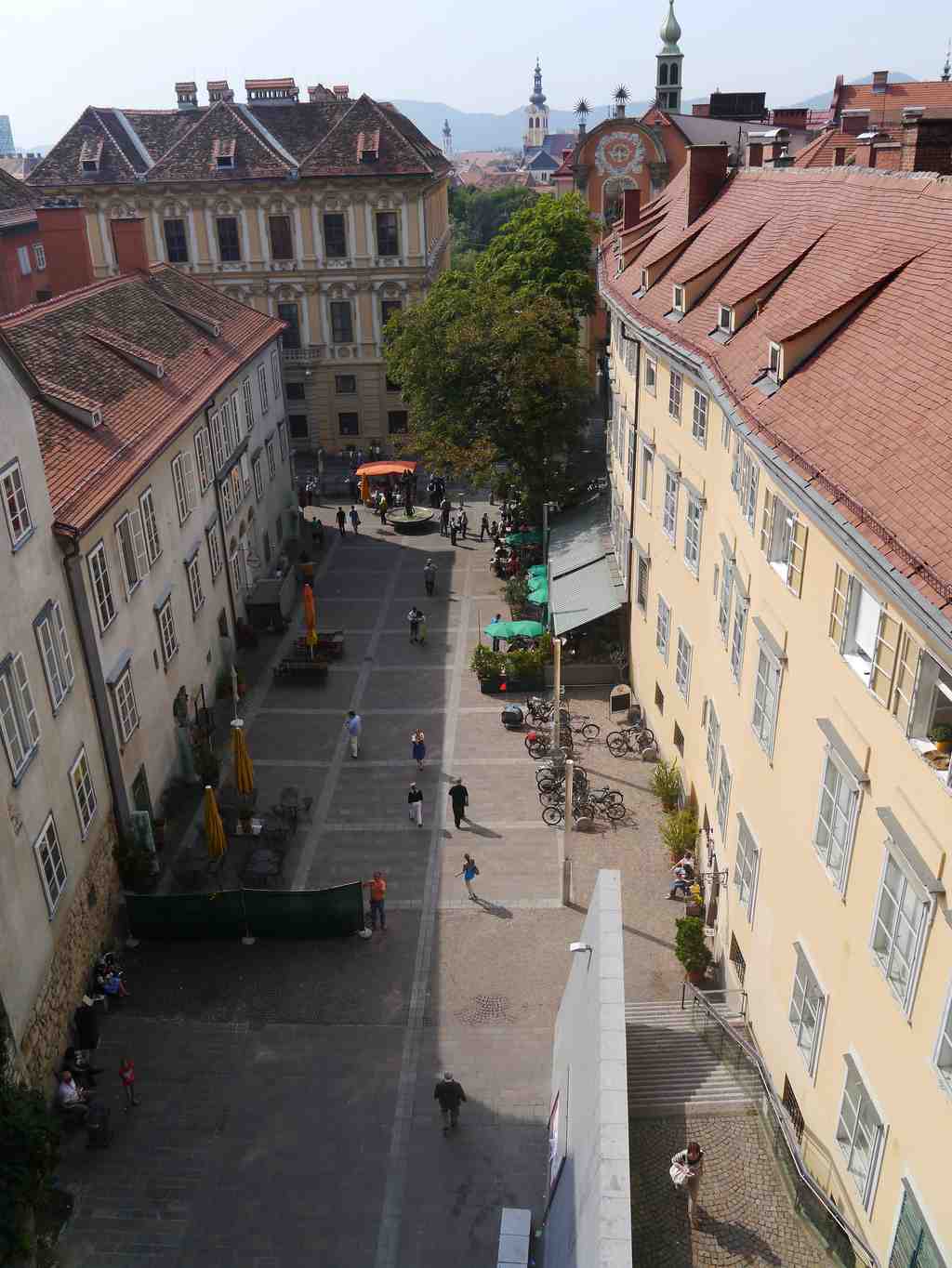
SchloßbergplatzPhoto: Zairon, Wikimedia Commons, CC BY-SA 3.0. Cropped & resized. You can spot Schloßbergplatz by its long paved open space pressed against a near-vertical rock face, with the pale stone Kriegssteig climbing the hill in sharp stages.
This square makes sense only when you read it as a former edge. For centuries, Graz ended here. At least since the thirteenth century, a city wall ran down from the Uhrturm on the Schloßberg to the Reinerhof below, then continued west toward the Mur. On the inner side of that wall, Sackstraße simply stopped. The name “Sack” here means a dead end, a street closed like the bottom of a bag. Then, in the fourteenth century, the city broke a gate through the wall, the First Sack Gate, so traffic could pass north. Later views show a plain square tower with a hipped roof guarding it.
The open ground in front of that wall could not be built over, because the land belonged to the ruling prince. That is why this place feels stretched and oddly linear even now. If you glance at the broad view in the app, you can see how the square lies like a narrow apron at the foot of the hill.
Names changed as the place changed. In sixteen twenty-five, the city assigned it as a fish market. A few decades later, the trade moved on. Records then call it Haffnerplätzl, later Schlosserpläzl, and for a long time Ursulinenplatz, after the Ursuline convent nearby. Only in nineteen twenty-nine did the city settle on Schloßbergplatz, named for the hill itself. And yes, Graz keeps the old sharp s in the name: Schloßbergplatz, not Schlossbergplatz. A small local act of stubbornness; one rather respects it.
After the fire of sixteen seventy devastated this area, builders reshaped the square. The long former post office rose along the north side; later people called it the Alte Münze, the Old Mint, because it served as the imperial mint for a time. At the western end, the Ursulines built their bastion, a projecting defensive platform, and then their church and convent. Near the corner, Ignaz Maria Count Attems commissioned the grand palace you have just seen, and in seventeen oh five he secured permission to remove the old Sack Gate entirely. At that point, the square lost its military purpose for good.
Its most dramatic addition came in the twentieth century. The Kriegssteig, the “War Stair,” began as an idea around nineteen oh three, but war delayed the work. Engineers, soldiers from Infantry Regiment number twenty-seven, and Russian prisoners of war carved the route into the slope, and the stair finally opened on the first of June, nineteen eighteen. It still carries that uneasy name, though some locals prefer Felsensteig, the Rock Stair, or Russensteig, recalling the forced labourers. The app photo gives a fine sense of its severity and elegance.
During the Second World War, forced labourers cut tunnels into the mountain from this very square. The system eventually reached six point three kilometres, with twenty entrances and enough space to shelter up to fifty thousand people during air raids, while also housing a command centre and a hospital. Today those same tunnels lead to the Schloßberglift, the slide, the fairytale railway, and the passage through the hill to the east side: the mountain has kept its cavities, but changed their purpose.
Schloßbergplatz is the place where Graz turned a hard frontier into a public threshold. When you are ready, continue on and let the city draw you onward.
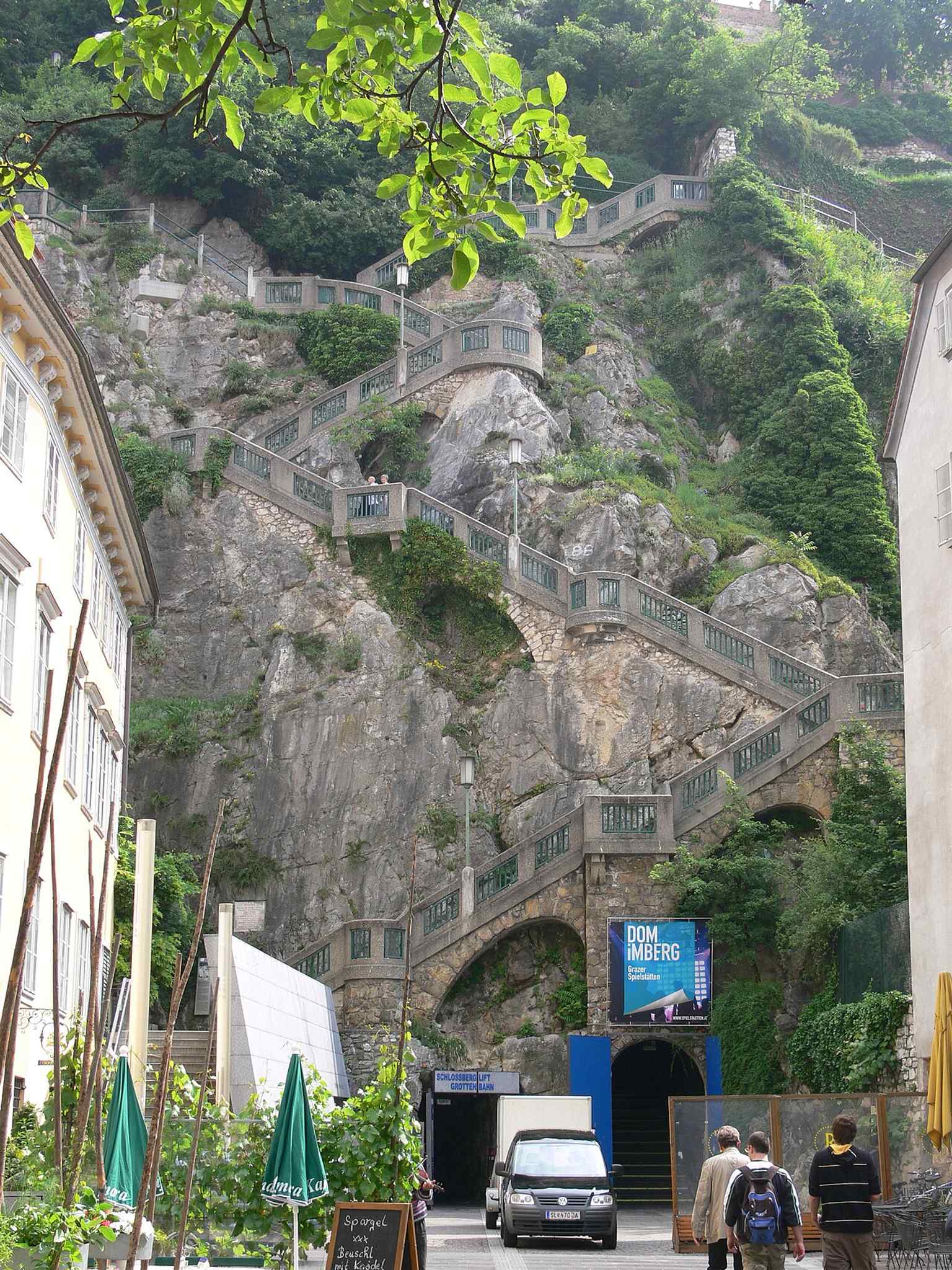
The staircase and Schlossberglift entrance on Schloßbergplatz, where today visitors access the mountain, rutsche, and the famous underground route.Photo: Photo: Andreas Praefcke, Wikimedia Commons, CC BY 3.0. Cropped & resized. 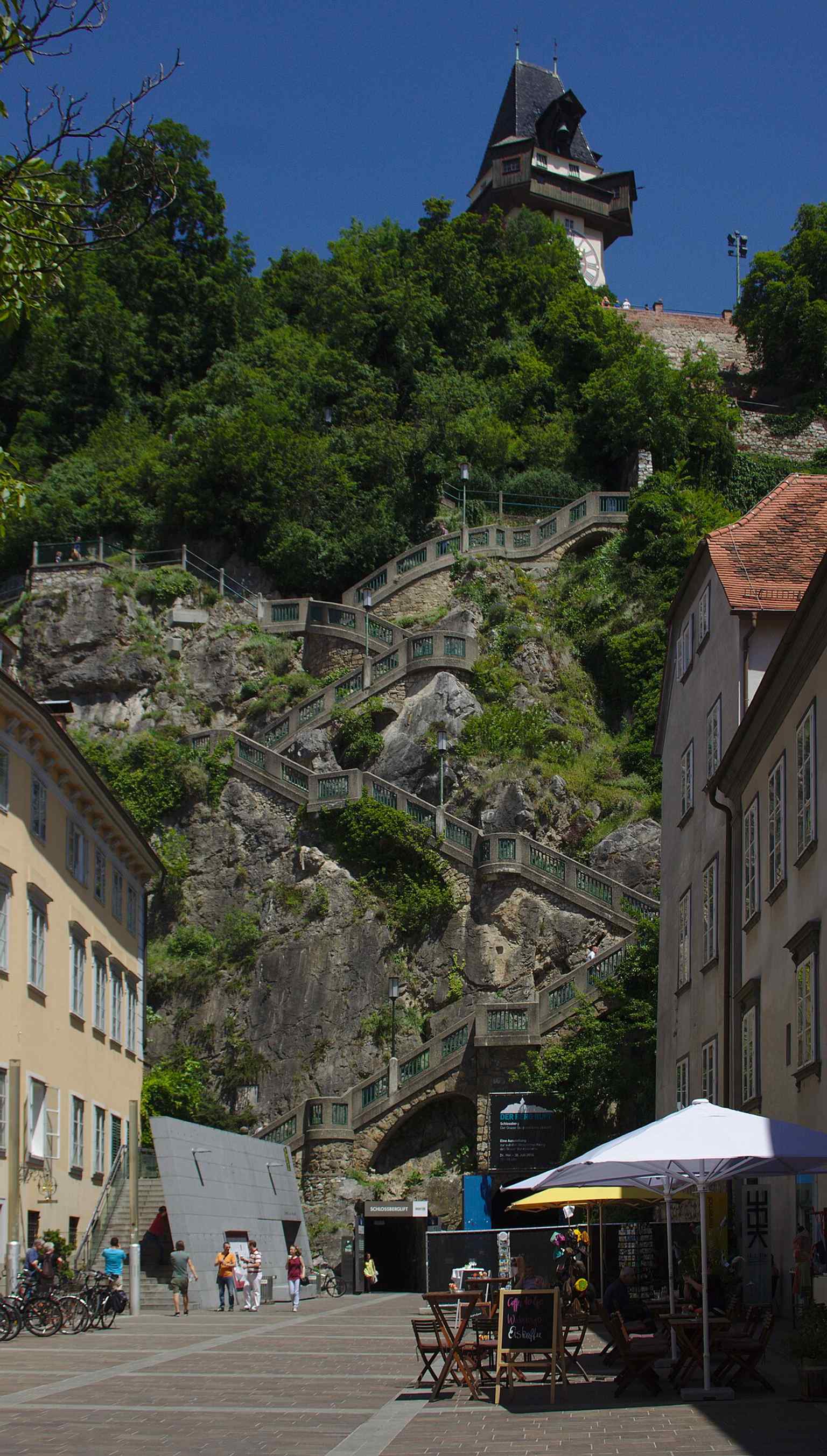
A close look at the Kriegssteig steps and retaining walls, showing the engineered stair system built through the hill.Photo: Tokfo, Wikimedia Commons, CC0. Cropped & resized. 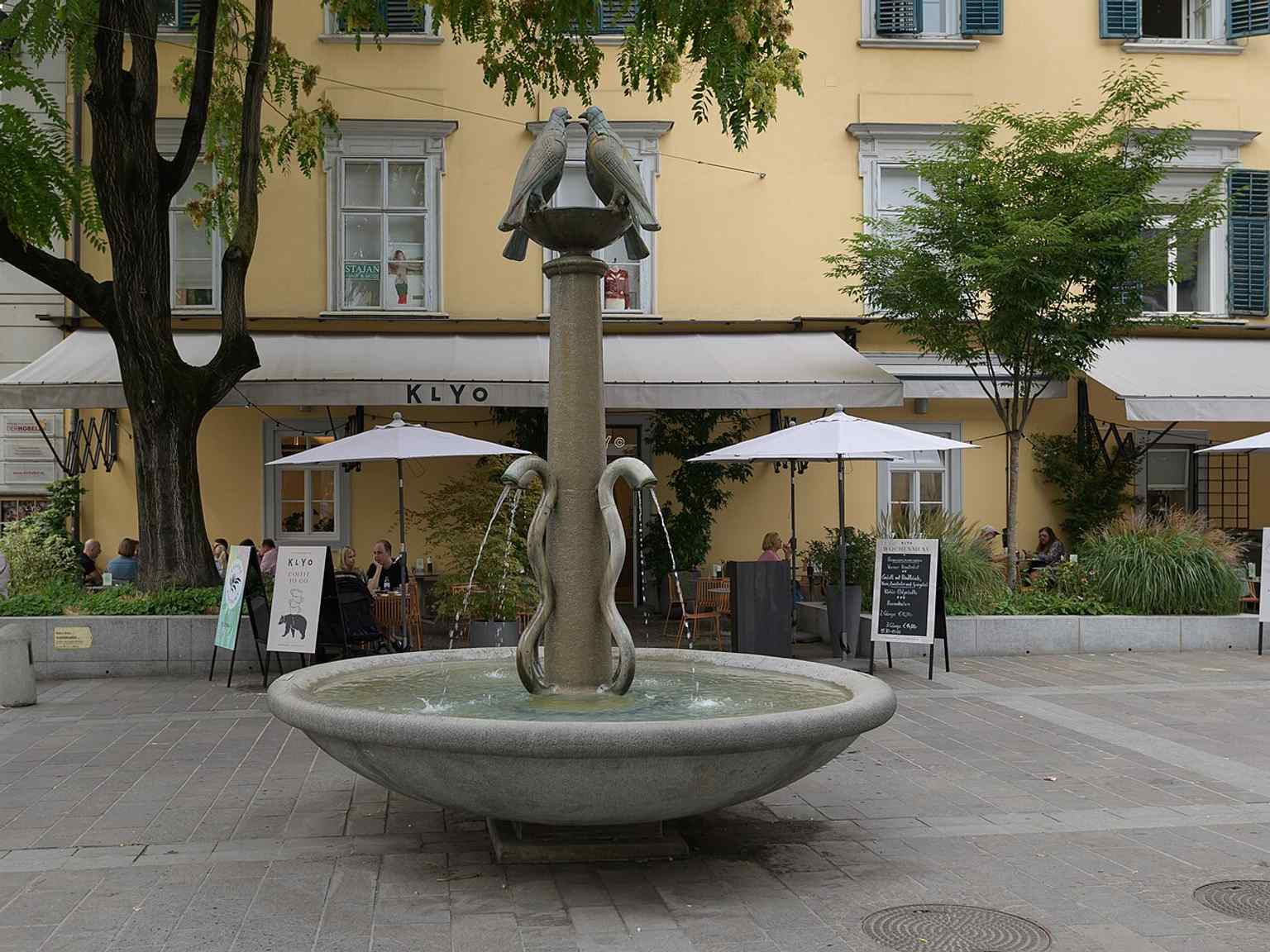
The Taubenbrunnen, a postwar fountain from 1947–49 that recalls an older well once associated with the Ursulines.Photo: Isiwal, Wikimedia Commons, CC BY-SA 4.0. Cropped & resized. 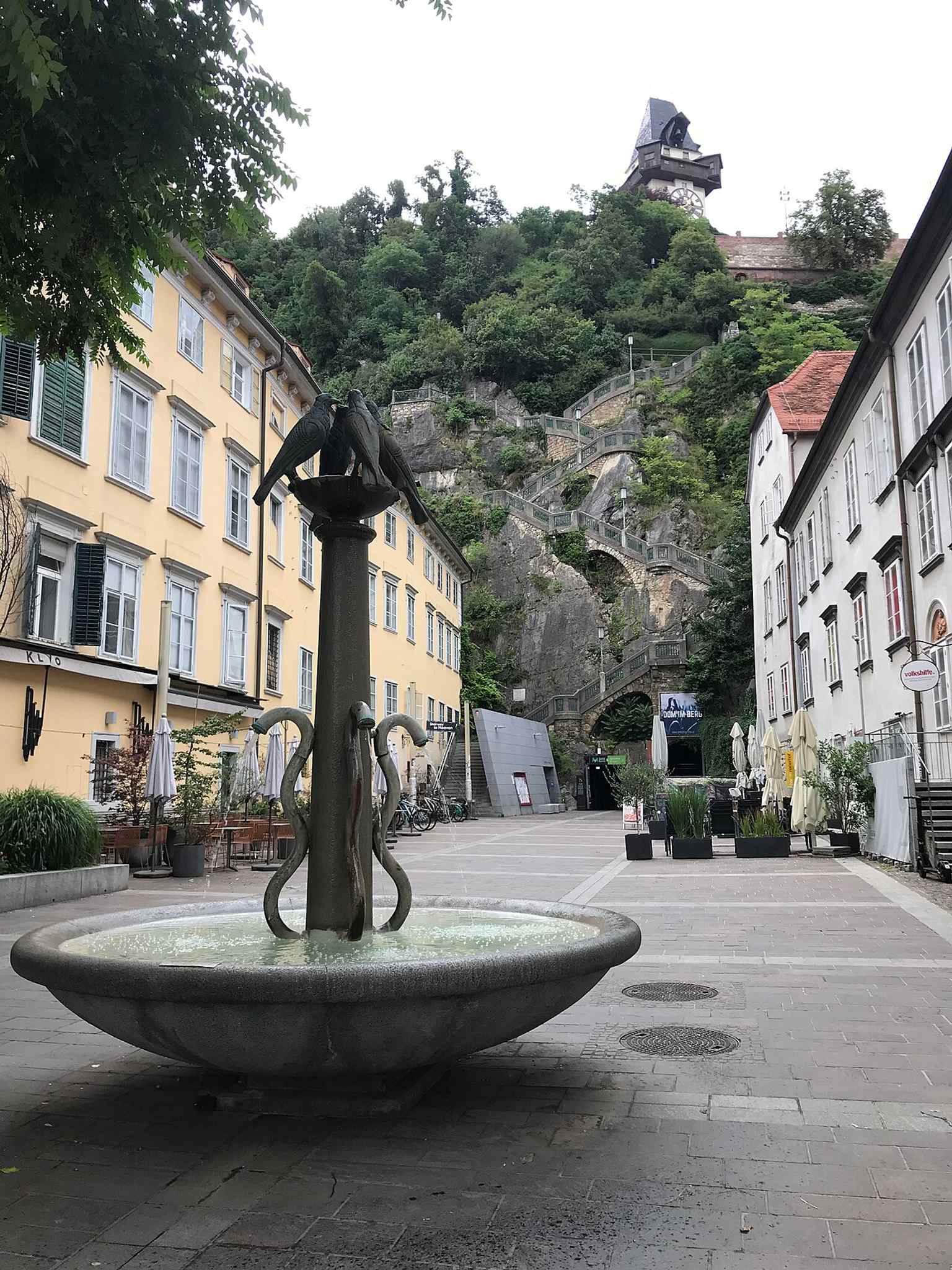
A recent view of Schloßbergplatz that helps show its present-day look as a pedestrian urban space in Graz.Photo: Antimuonium, Wikimedia Commons, CC BY-SA 4.0. Cropped & resized.
Show 10 more stopsShow fewer stopsexpand_moreexpand_less
On your left, look for a pale stone building with a broad, symmetrical neo-Baroque façade, tall arched windows, and an ornate central portal beneath a sculpted roofline. This is…Read moreShow less
Open dedicated page →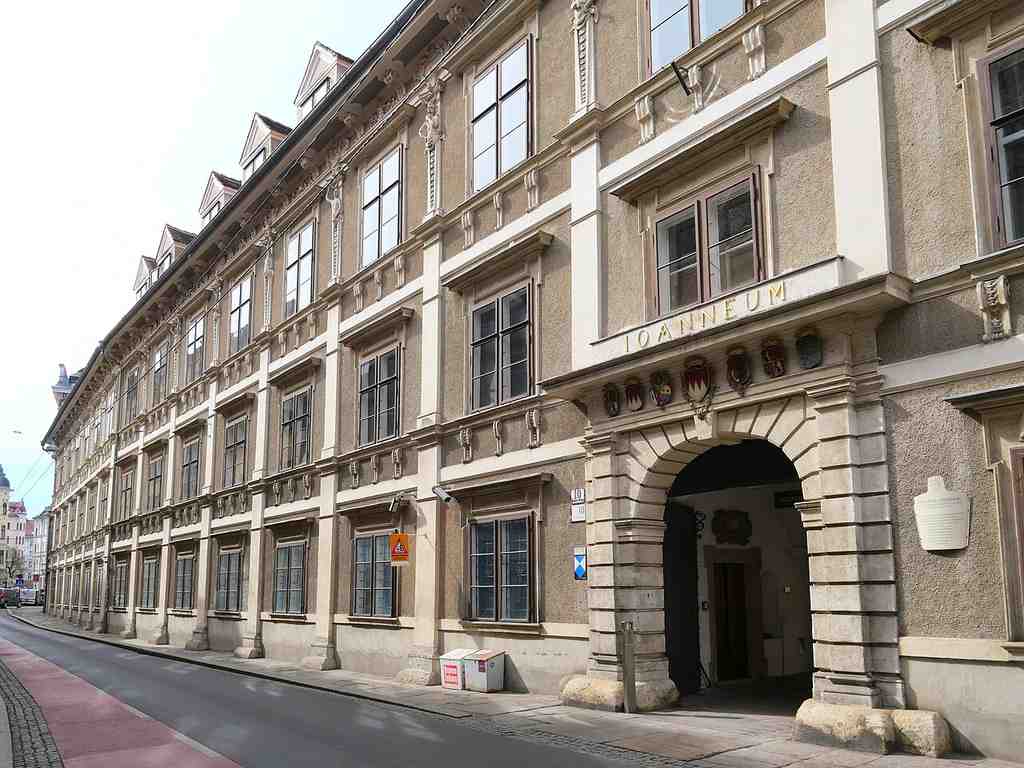
Universalmuseum JoanneumPhoto: Herbert Ortner, Wikimedia Commons, CC BY 4.0. Cropped & resized. On your left, look for a pale stone building with a broad, symmetrical neo-Baroque façade, tall arched windows, and an ornate central portal beneath a sculpted roofline.
This is the Universalmuseum Joanneum, one of the great intellectual engines of Graz. Archduke Johann founded it in eighteen eleven, and he did not imagine a museum in the narrow sense. He wanted a place that would collect the world, study it, and teach from it. So from the beginning, this was both a museum and a school, built around his remarkable natural science collections.
That early ambition changed this city. Friedrich Mohs worked here and devised the Mohs hardness scale, the simple ranking geologists still use to test minerals from talc to diamond. Franz Unger, later called a father of paleobotany, taught here as well, helping students read the history of vanished plants from fossils. In other words, this was not merely a cabinet of curiosities. It was a workshop for thinking.
The courtyard view in the Lesliehof hints at the Joanneum’s earlier life as a scholarly enclave. Before long, the collections outgrew that home. Space became tight, and between eighteen ninety and eighteen ninety-five, Graz answered with this new building on Neutorgasse. Architect August Gunolt gave it the confident language of Viennese neo-Baroque design: formal, grand, and perfectly suited to a museum that wanted to announce its civic importance. You can take a look at that exterior in the app as well. Inside this newer building, Graz once gathered its cultural history collections, decorative arts, medieval works, and the State Picture Gallery. In nineteen forty-one, that gallery split into two branches: the Alte Galerie for art up to about eighteen hundred, and the Neue Galerie for more recent work. That division tells you something rather charming about museums: even when they preserve the past, they are always reorganising their view of it.
The Joanneum grew far beyond these walls. Today it stretches across fourteen sites in Graz and wider Styria, making it the oldest museum in Austria and, after Vienna’s Kunsthistorisches Museum, the second largest, as well as the largest universal museum in Central Europe. It cares for around four point nine million objects with roughly five hundred staff, ranging from coins and fossils to photographs, films, paintings, armour, and scientific specimens.
Beneath your feet lies one of its cleverest modern chapters. Between two thousand and ten and two thousand and thirteen, the old and new Joanneum buildings were restored and linked underground to form the Joanneumsviertel, a shared museum quarter. That project brought the Neue Galerie, the multimedia collections, and a redesigned natural history museum into a single connected world. Fittingly, for the museum’s two hundredth anniversary, scientists even named a newly recognised mineral Joanneumite in its honour.
If you plan to go in, the museum is generally open from Tuesday to Friday, from nine in the morning until five in the afternoon, and closed on Mondays, Saturdays, and Sundays.
For all its scale, this place still follows Archduke Johann’s original rule: collect, preserve, research, and share.
When you are ready, continue on toward the Franciscan Monastery.
On your left, look for a pale stone church front joined tightly to lower monastery buildings, with a tall square tower topped by a rounded onion dome as its unmistakable…Read moreShow less
Open dedicated page →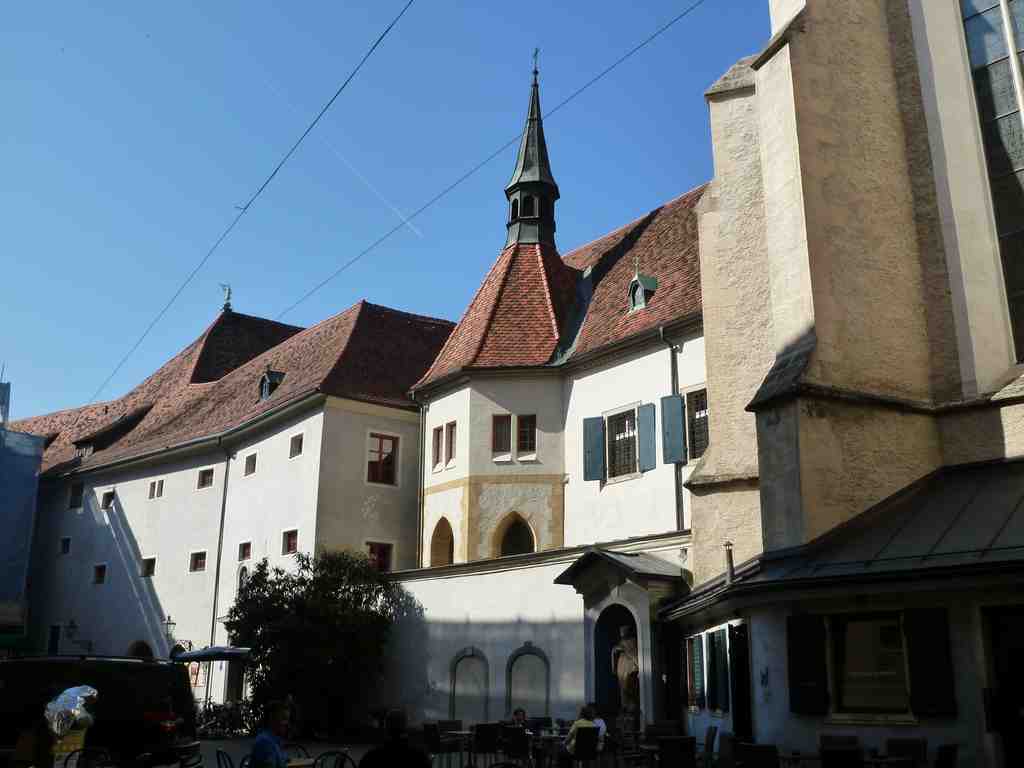
Franciscan Monastery GrazPhoto: E.mil.mil, Wikimedia Commons, CC BY 3.0. Cropped & resized. On your left, look for a pale stone church front joined tightly to lower monastery buildings, with a tall square tower topped by a rounded onion dome as its unmistakable marker.
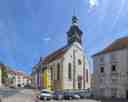
This Franciscan monastery has stood by the Mur for so long that it feels less like a single building than a settled habit of the city. The first Franciscan brothers arrived in Graz around the year twelve thirty or twelve thirty-nine. We even know the names of two of them: Albert and Marchward. They belonged to the Order of Friars Minor, which simply means the “lesser brothers” - men who aimed to live humbly, with very little, in service to ordinary people. Their house here became the first religious foundation of its kind within Graz itself.
The church beside the convent began as a plain, towerless mendicant church - that is, a church for an order that lived on alms rather than land and wealth. A papal indulgence, granted by Pope Alexander the Fourth in either twelve fifty-seven or twelve seventy-seven, helped raise funds for the building. In the early fourteen hundreds, the brothers added a longer, elevated choir at the east end, the part of the church reserved for clergy and liturgical singing. Then, after fifteen fifteen, they reshaped the church into a three-aisled Gothic hall church, financed by donations, and finished the work by fifteen nineteen.
The tower you notice now came later, between sixteen thirty-six and sixteen forty-three. It was not built merely to look handsome. It served as a Wehrturm, a defensive tower, part of a city edge that once needed watching. The accompanying image shows the loopholes and stern masonry that hint at that tougher side of the monastery. Around seventeen forty, builders replaced the original pointed roof with the onion dome you see today, giving the tower a softer silhouette without erasing its vigilance.
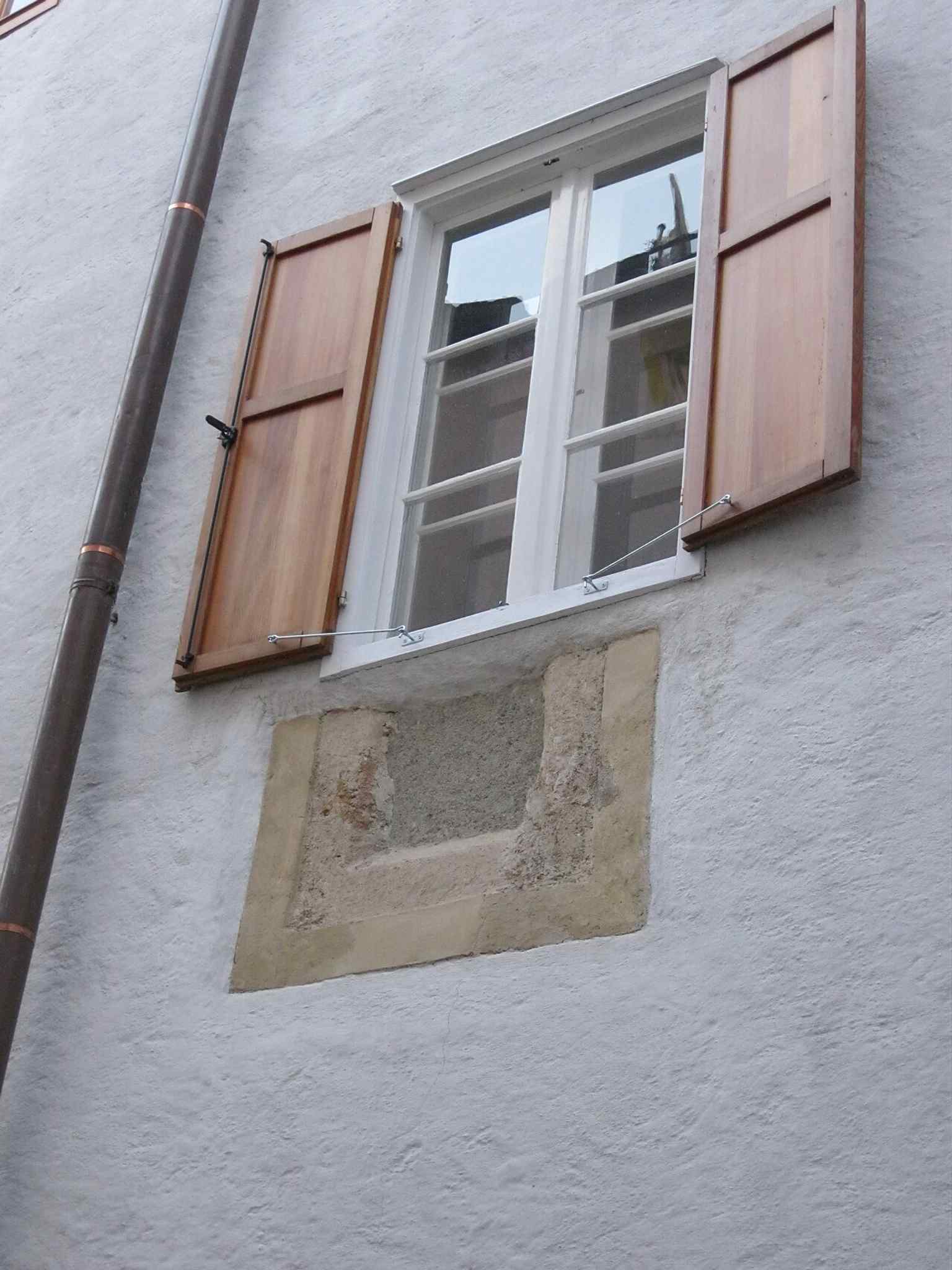
The wall’s loopholes and masonry hint at the building’s defensive past, including the former Wehrturm mentioned in the history.Photo: Hubertl, Wikimedia Commons, CC BY-SA 4.0. Cropped & resized. This place survived a surprisingly close call in the reign of Emperor Joseph the Second. Around seventeen eighty-five, many monasteries faced closure if rulers judged them unproductive. The Franciscans here escaped that fate by taking on parish work. Their church, dedicated to the Assumption of Mary, had already become a parish church in seventeen eighty-three, and that practical service helped save the whole community.
There is another treasure here, though you would not guess it from the street. The monastery library began in fourteen sixty-three and later became the central repository for the older book collections of the Viennese Franciscan province. If you fancy a look, the app shows shelves of it here. The collection holds about thirteen thousand titles up to the seventeenth century, including eight hundred and eighteen incunabula - books printed in the earliest age of printing - along with parchment leaves of the Vulgate from around the year nine hundred, and even fragments of Parzival and Willehalm in Middle High German. Quite a formidable memory for a house founded on poverty.
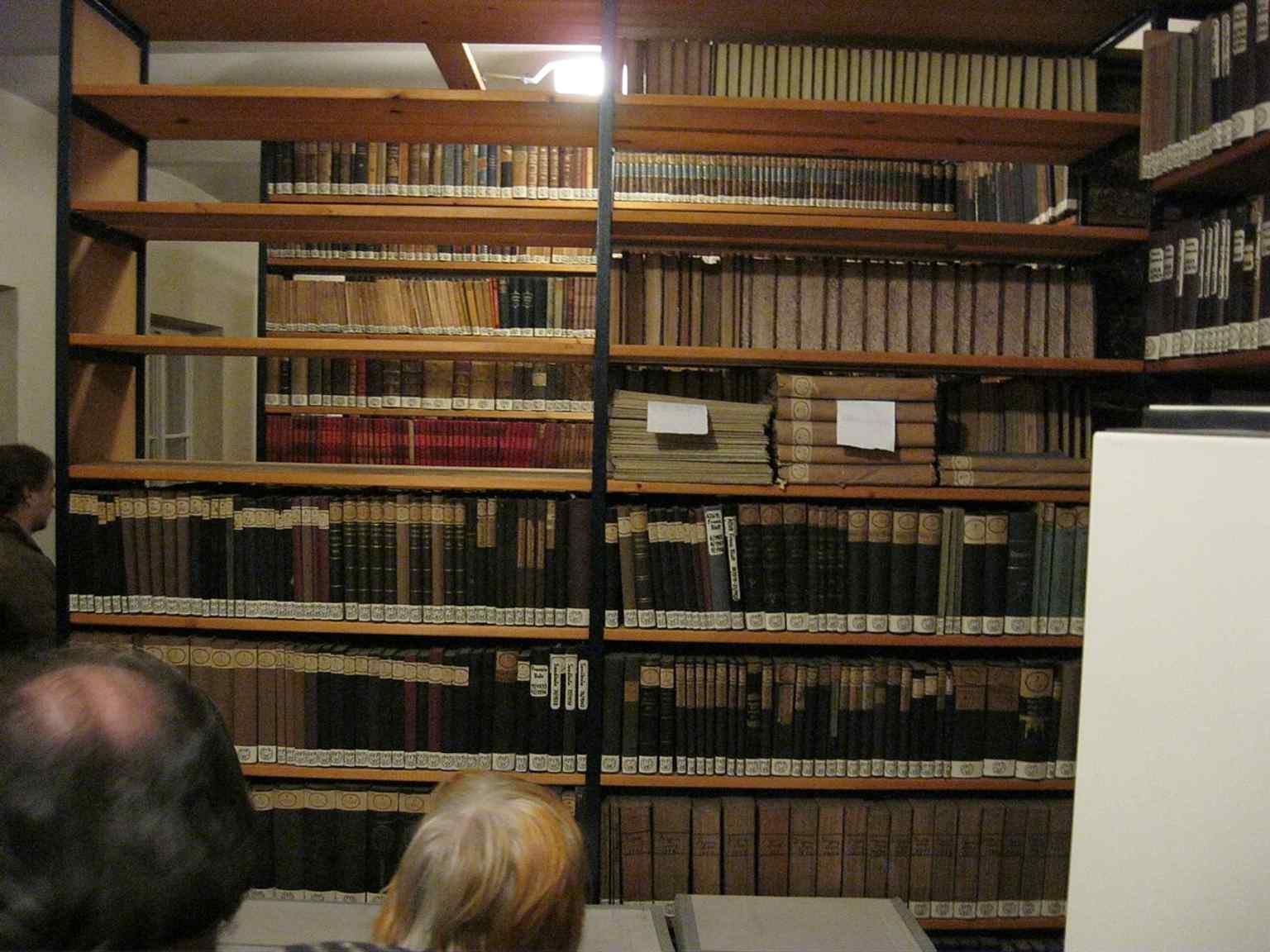
The monastery library holds one of Styria’s most valuable book collections, with rare early prints and manuscripts gathered from several Franciscan houses.Photo: Hubertl, Wikimedia Commons, CC BY-SA 4.0. Cropped & resized. Even the ground plan keeps a little mystery. It sits at an odd angle to the nearby streets, perhaps because the site once lay on a small island between branches of the Mur; another theory says the church aligns with the sunrise on the feast day of Saint Francis, the fourth of October. Either way, the friars left Graz a building that does not quite obey the grid, and is more interesting for it.
If you plan to return, the monastery is generally open daily from seven AM until four forty-five PM.
A house of humility, learning, and quiet endurance - not a bad legacy at all. When you are ready, continue on toward the Graz Country House.
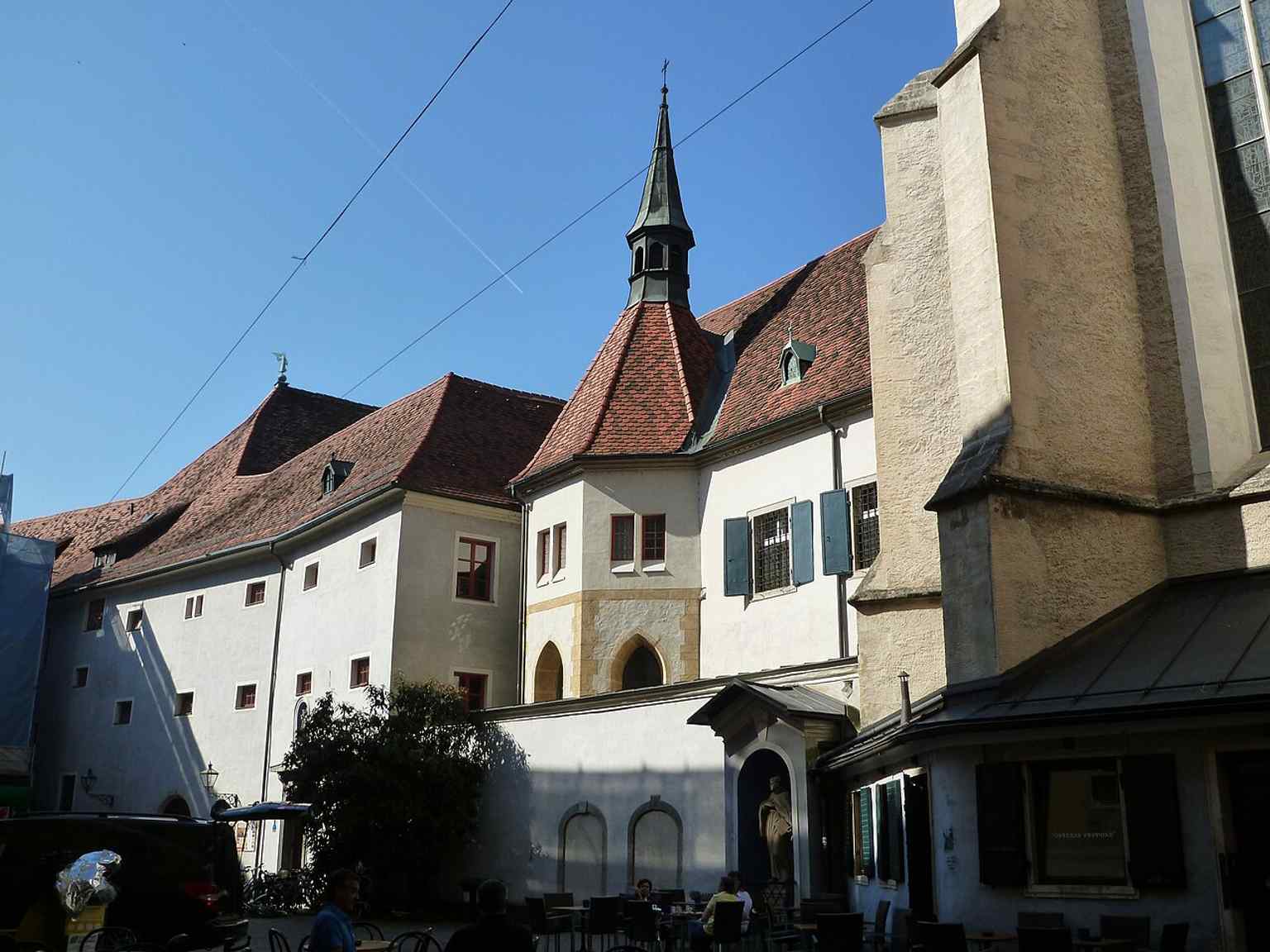
The monastery’s sunlit east side shows how the church and convent are tightly woven into Graz’s old city wall system.Photo: E.mil.mil (talk), Wikimedia Commons, CC BY 3.0. Cropped & resized. 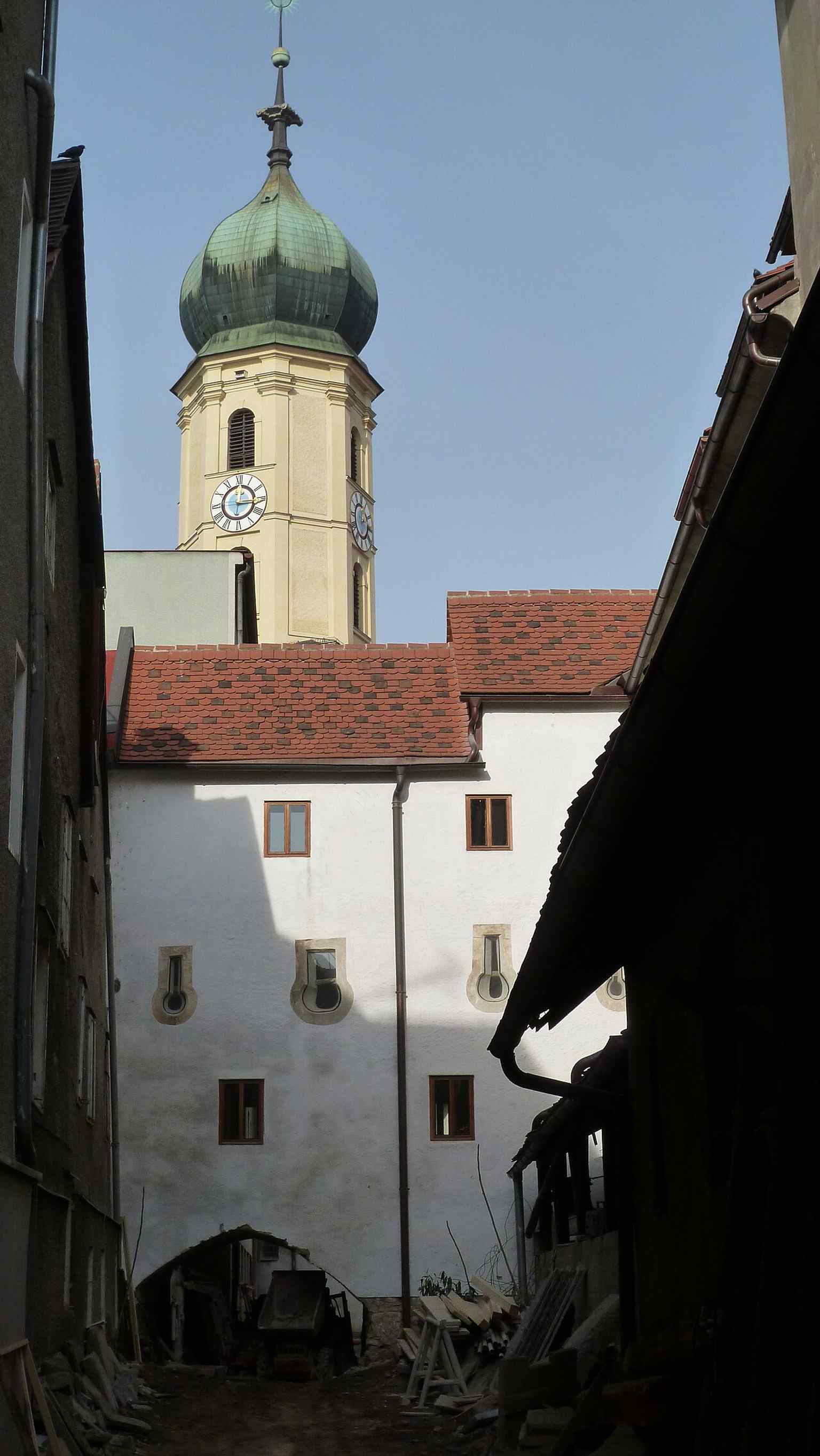
A wider view of the convent and former fortifications, matching the monastery’s location beside surviving sections of the medieval city wall.Photo: E.mil.mil (talk), Wikimedia Commons, CC BY-SA 3.0 at. Cropped & resized. 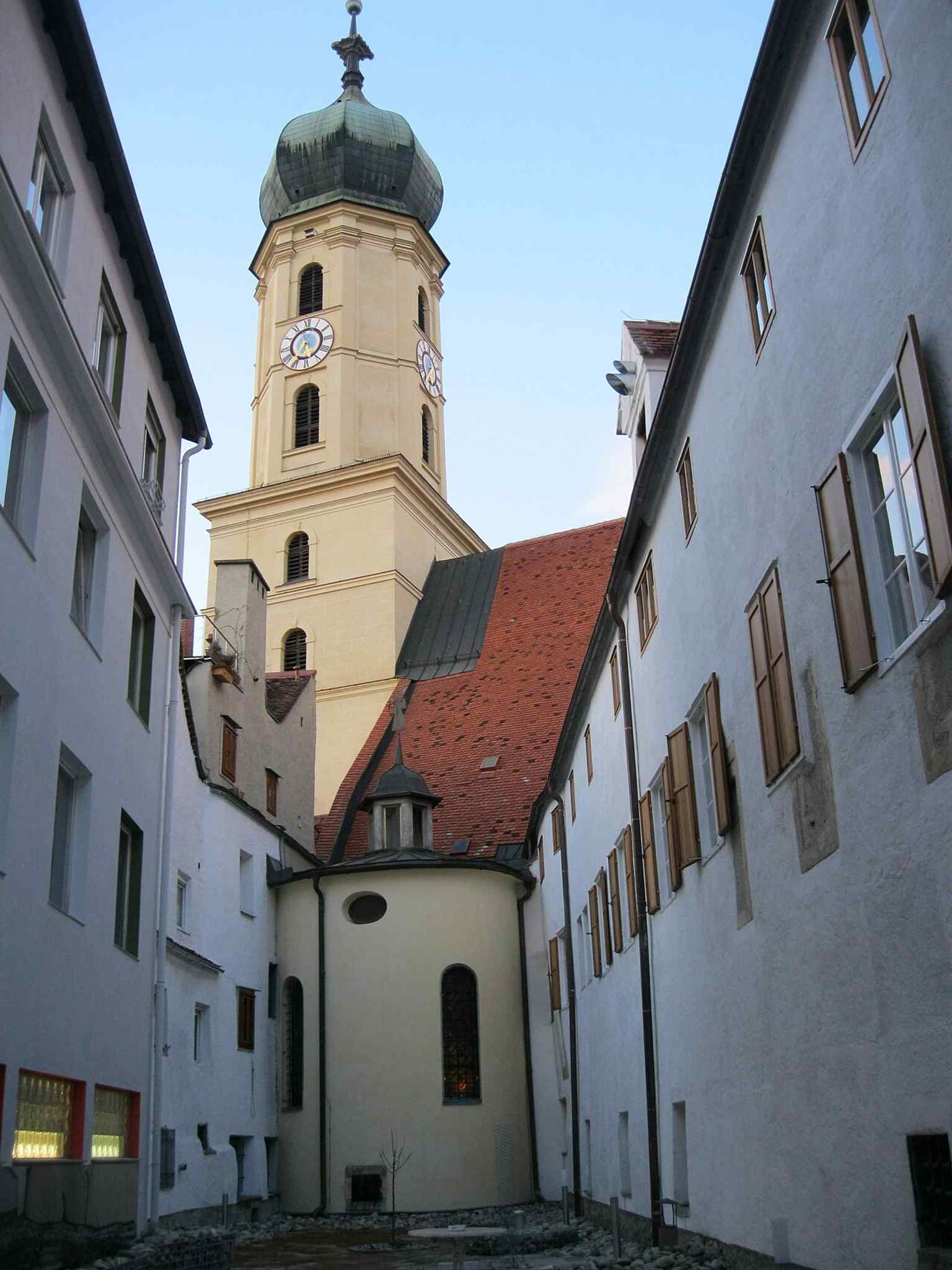
The back side of the monastery beside the old city wall recalls how this Franciscan site once stood on the edge of the medieval city.Photo: Hubertl, Wikimedia Commons, CC BY-SA 4.0. Cropped & resized. 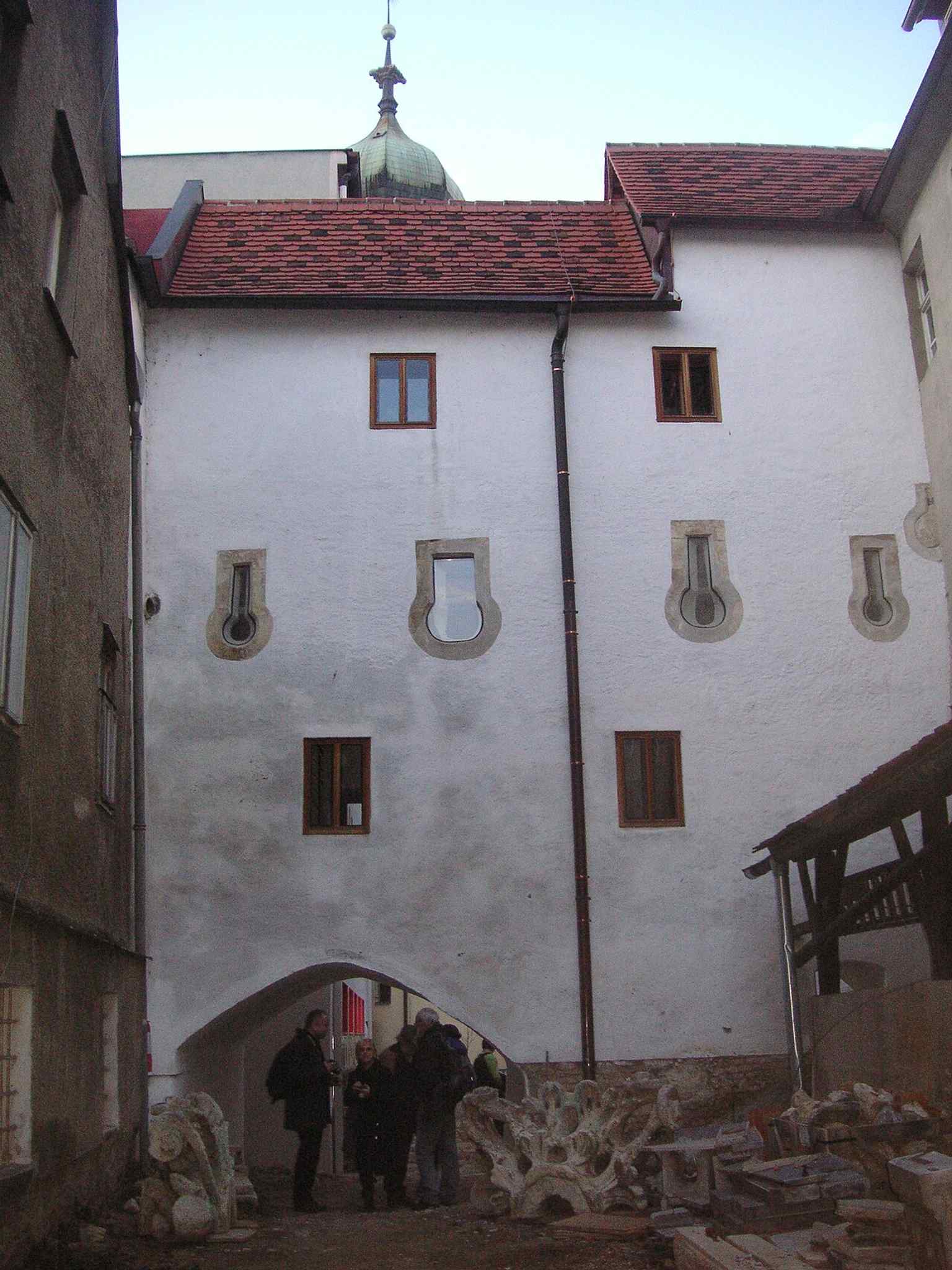
The former defensive tower at the rear of the complex reflects the 17th-century fortification role of the monastery.Photo: Liuthalas (talk), Wikimedia Commons, CC BY-SA 3.0 at. Cropped & resized. 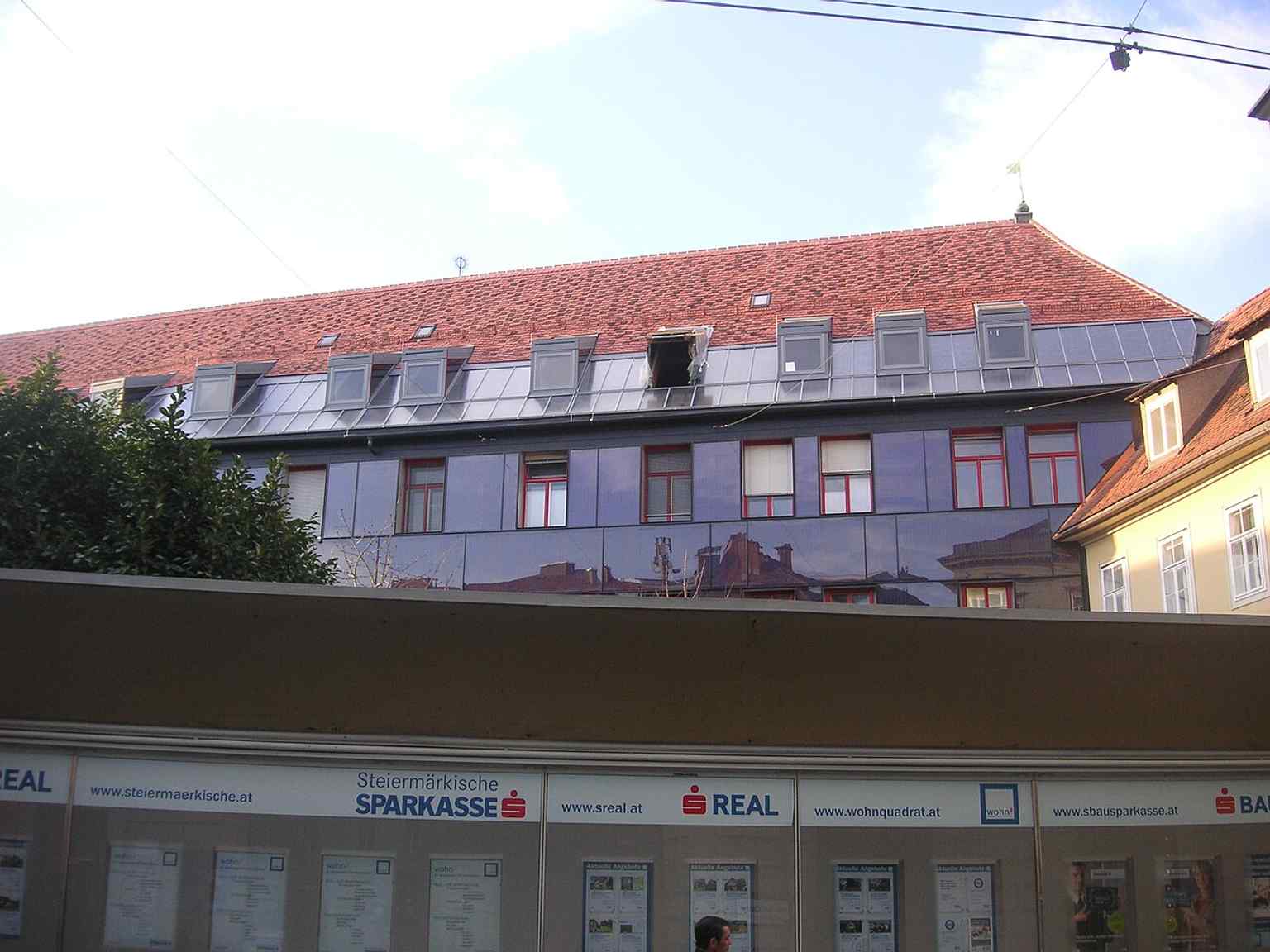
Modern solar panels on the long facade show the monastery’s recent technical upgrades, added without fully covering the old sundial.Photo: Liuthalas (talk), Wikimedia Commons, CC BY-SA 3.0 at. Cropped & resized. 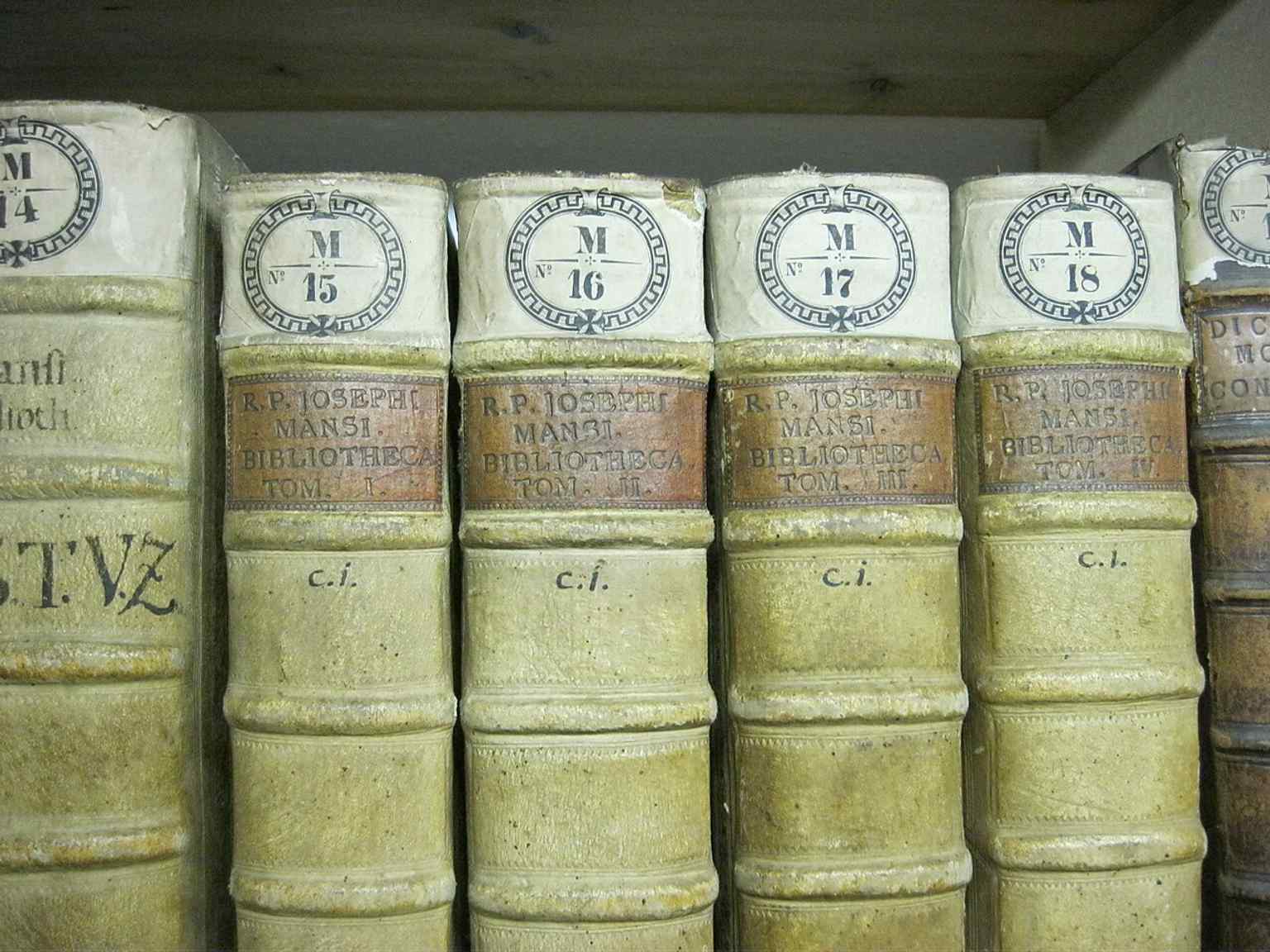
Rows of carefully preserved shelves and cases underline the library’s role as the central archive for the Austrian Franciscan province.Photo: Hubertl, Wikimedia Commons, CC BY-SA 4.0. Cropped & resized. 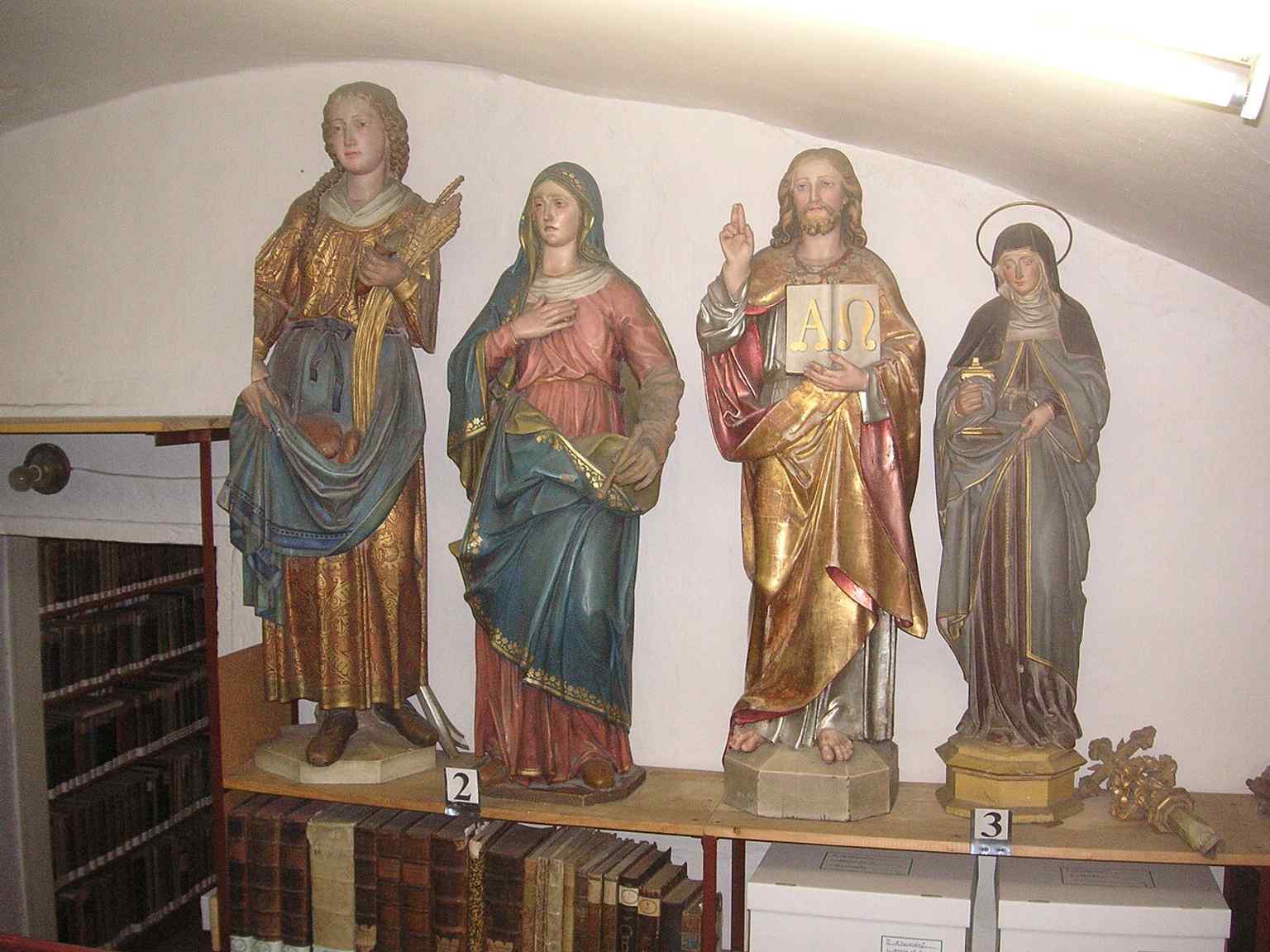
Statues in the library add a devotional layer to a room that safeguards thousands of rare theological and historical volumes.Photo: Liuthalas (talk), Wikimedia Commons, CC BY-SA 3.0 at. Cropped & resized. 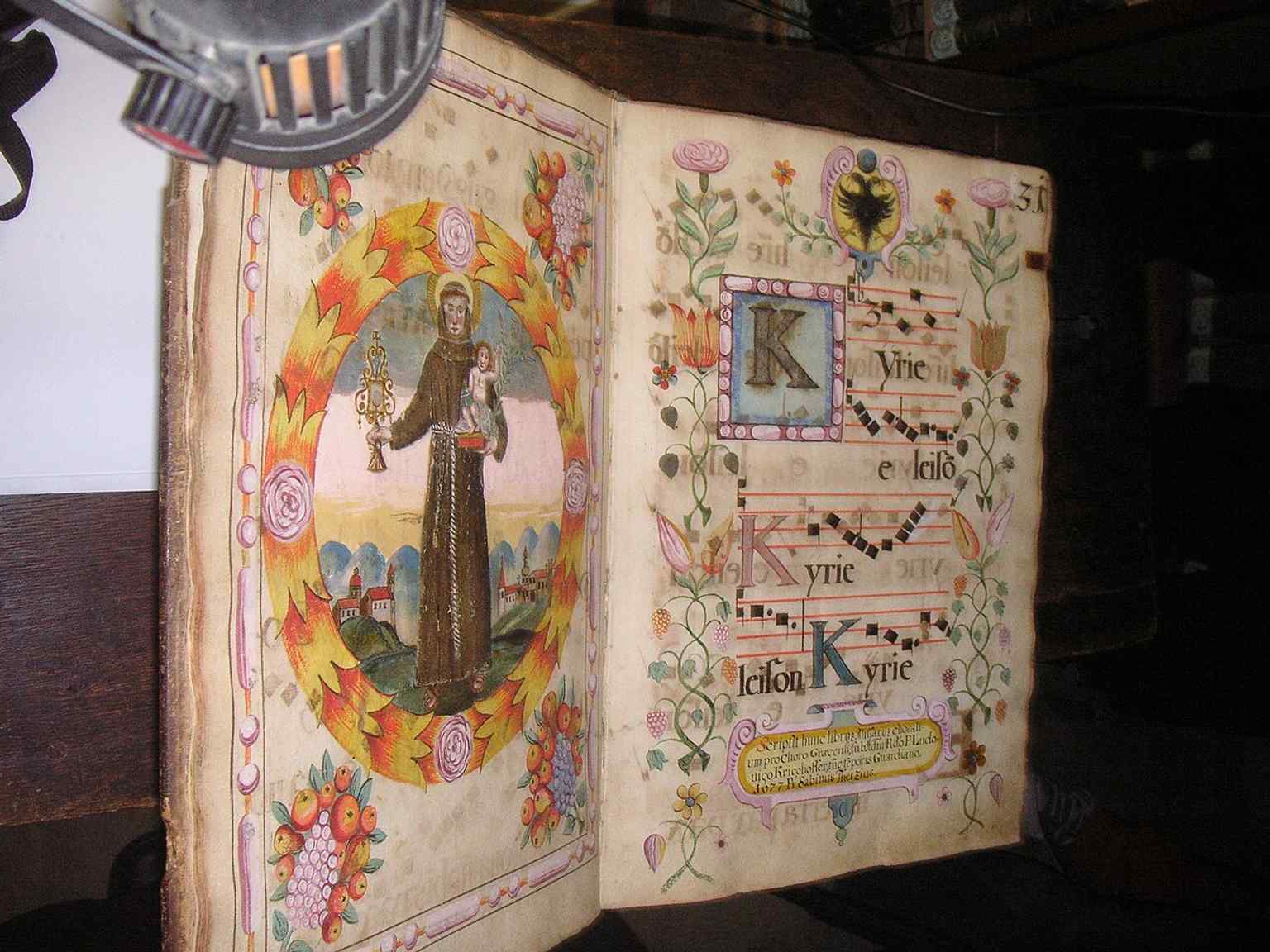
A close look at a book in the Franciscan library connects to the convent’s long scholarly tradition, which reaches back to the 15th century.Photo: Liuthalas (talk), Wikimedia Commons, CC BY-SA 3.0 at. Cropped & resized. 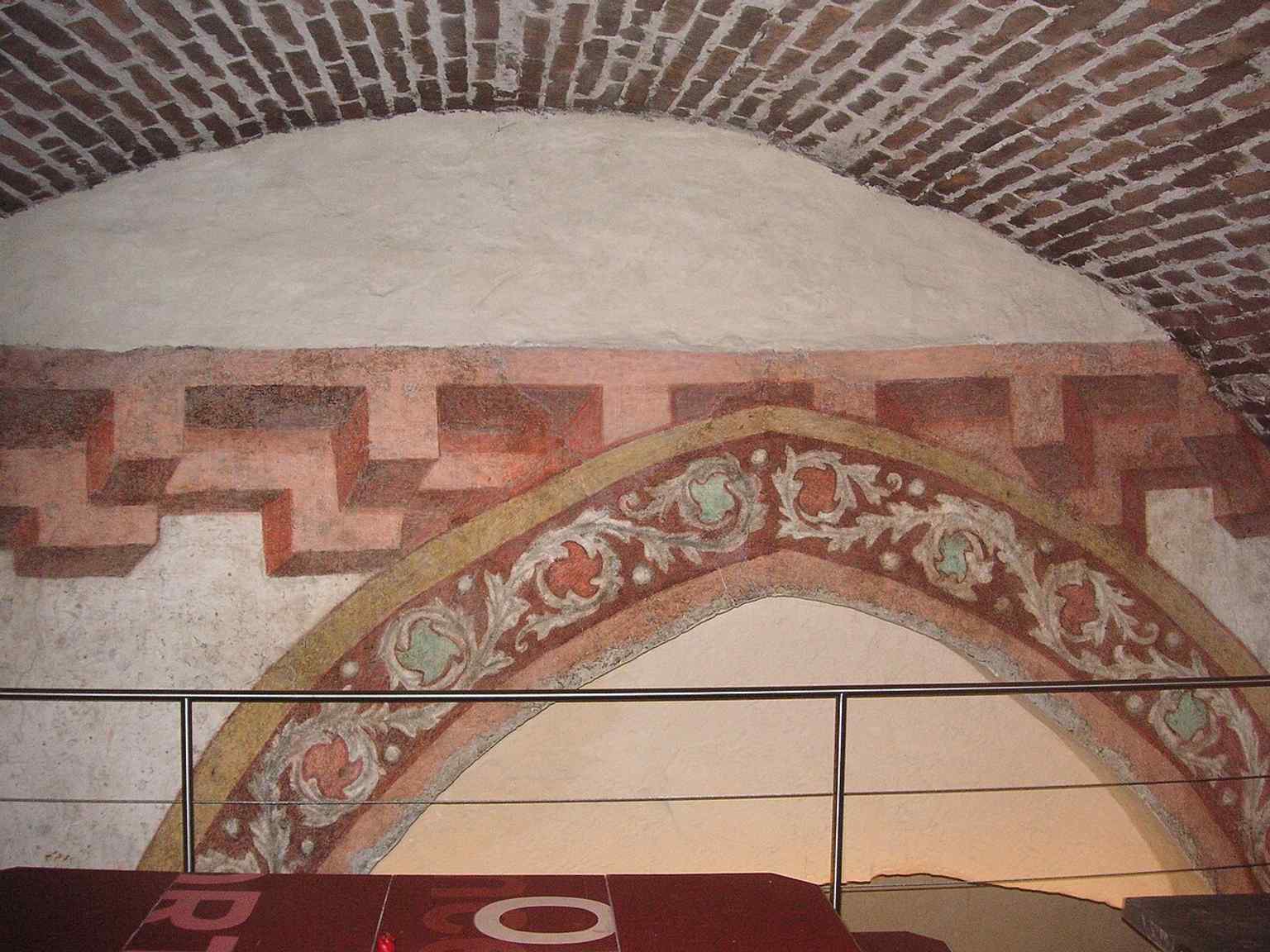
Frescoes in the cellar reveal hidden historic layers beneath the monastery, beyond the public church and library spaces.Photo: Liuthalas (talk), Wikimedia Commons, CC BY-SA 3.0 at. Cropped & resized. 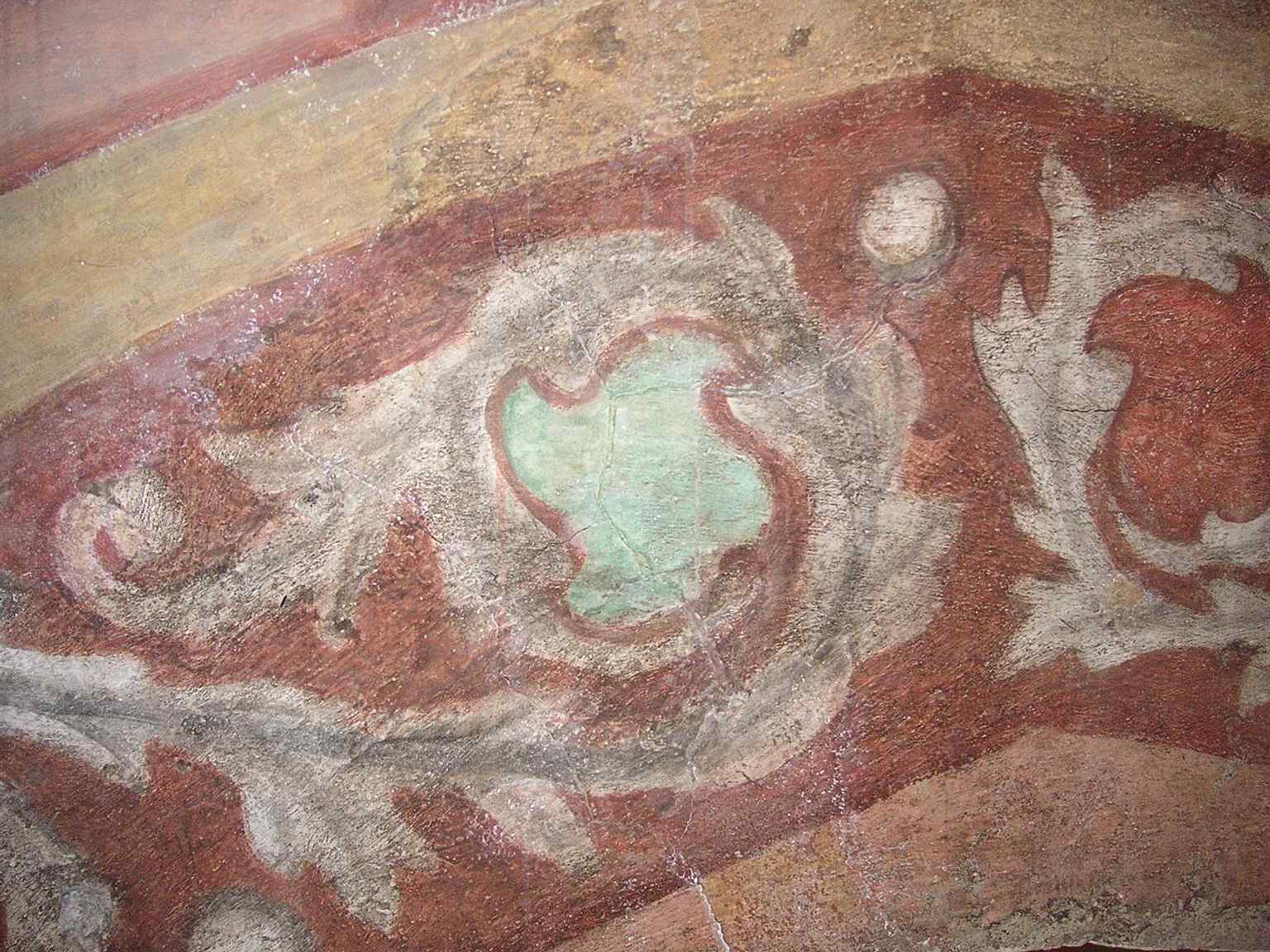
A close-up of cellar frescoes highlights the preserved decorative details tucked away inside the Franciscan complex.Photo: Liuthalas (talk), Wikimedia Commons, CC BY-SA 3.0 at. Cropped & resized. 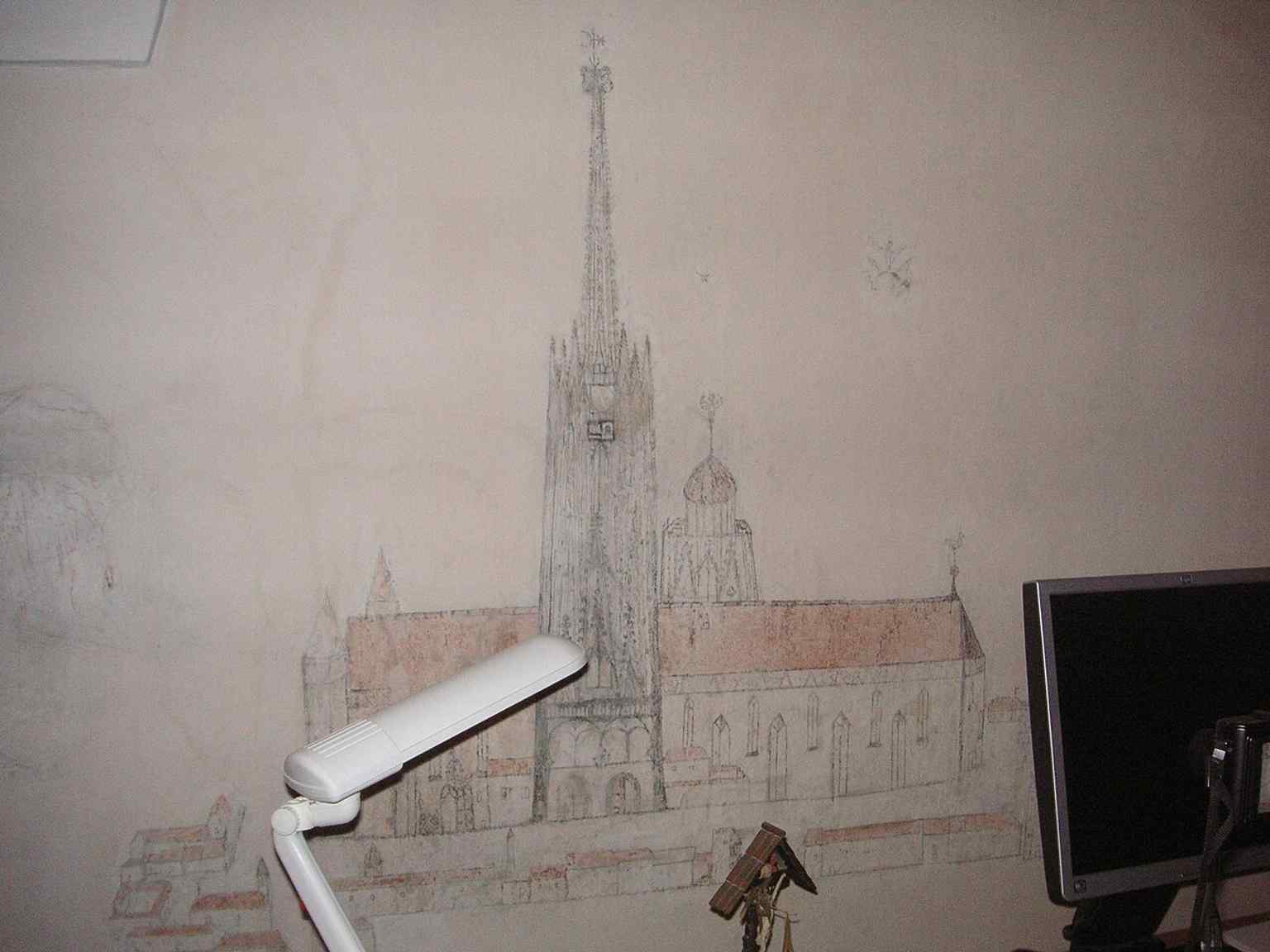
The painted workroom shows that the convent still contains lived-in monastic spaces, not just church and library rooms.Photo: Liuthalas (talk), Wikimedia Commons, CC BY-SA 3.0 at. Cropped & resized. 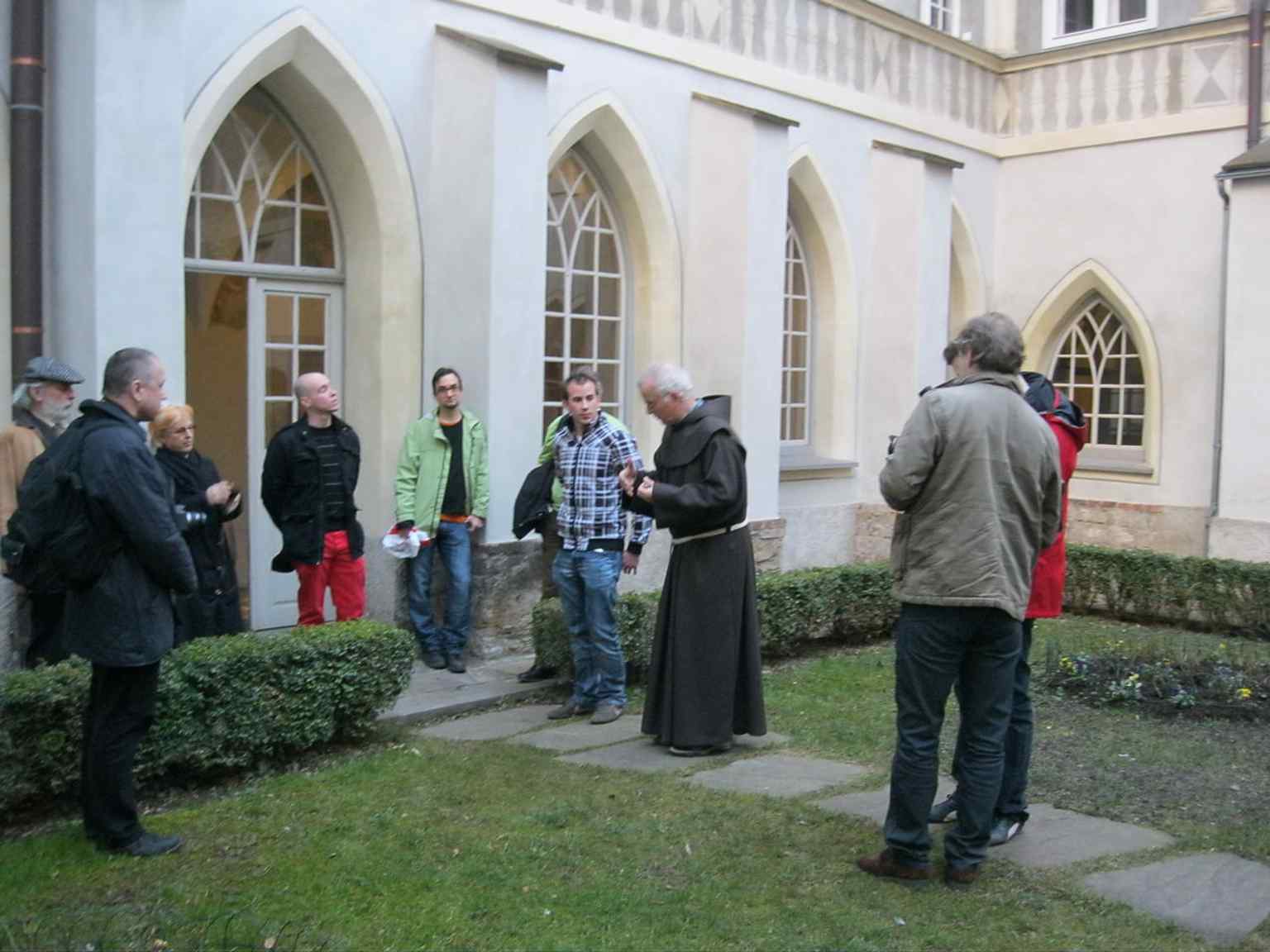
A 2012 documentation photo of the protected monastery offers a clear record of the Franciscan complex as a heritage monument.Photo: Hubertl, Wikimedia Commons, CC BY-SA 4.0. Cropped & resized. 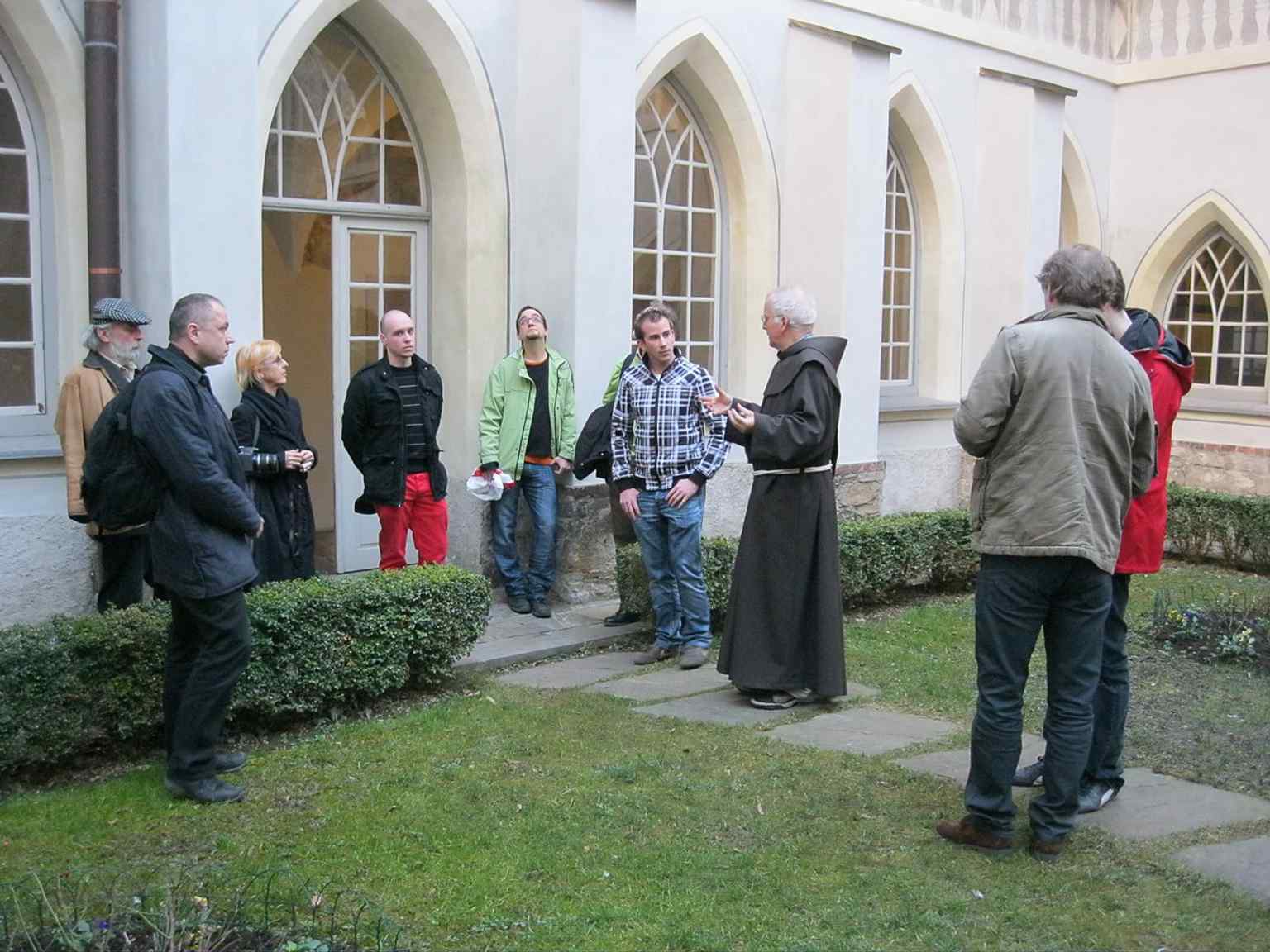
Another 2012 heritage survey view helps document the monastery as Graz’s first Franciscan settlement and an important protected site.Photo: Hubertl, Wikimedia Commons, CC BY-SA 4.0. Cropped & resized. On your left is a pale stone Renaissance façade with round-arched windows, a broad arched portal, and a balcony with a stone balustrade above the entrance. This is the Graz…Read moreShow less
Open dedicated page →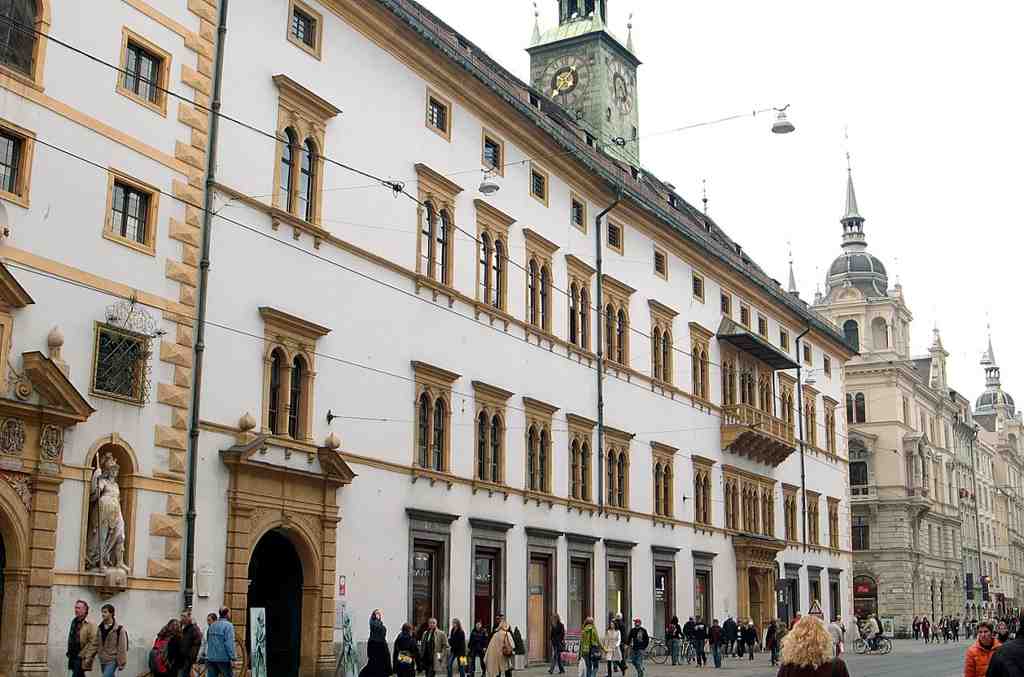
Graz country housePhoto: Chb, Wikimedia Commons, CC BY-SA 3.0. Cropped & resized. On your left is a pale stone Renaissance façade with round-arched windows, a broad arched portal, and a balcony with a stone balustrade above the entrance.
This is the Graz Country House, the Landhaus, and it carries itself with the confidence of a building that helped invent civic grandeur in Graz. Between fifteen twenty-seven and fifteen thirty-one, local builders began shaping this complex into something far more ambitious than the ordinary town houses that stood here before. Then, from fifteen fifty-seven, the Italian architect Domenico dell’Allio gave the main wing on Herrengasse its lasting character. The result became the first Renaissance building in the Styrian capital, and still one of the most important Renaissance civic buildings in Central Europe.
Its story is political as much as architectural. In fourteen ninety-four, the Styrian estates - that is, the regional body of nobles, clergy, and town representatives - bought property here for their offices and a chapel. They soon needed more room. By the mid-sixteenth century, those estates had openly taken on a Protestant identity, while the Catholic rulers held their own power nearby at the Burg. So this was not merely office space. It was a statement in stone: orderly, learned, Italianate, and unmistakably self-assured.
Even from out here, you can read some of that ambition. The round-arched portal dates to the Renaissance, and above it sits a balcony on heavy stone brackets, with a copper canopy whose underside carries painted grotesques from the restoration of eighteen ninety. Near the entrance hangs one of the building’s most charmingly stern details, the Rumortafel, a copper plaque from fifteen eighty-eight that forbade “rumoring and fighting” under threat of punishment. Apparently, even distinguished assemblies needed reminding not to behave like tavern brawlers.
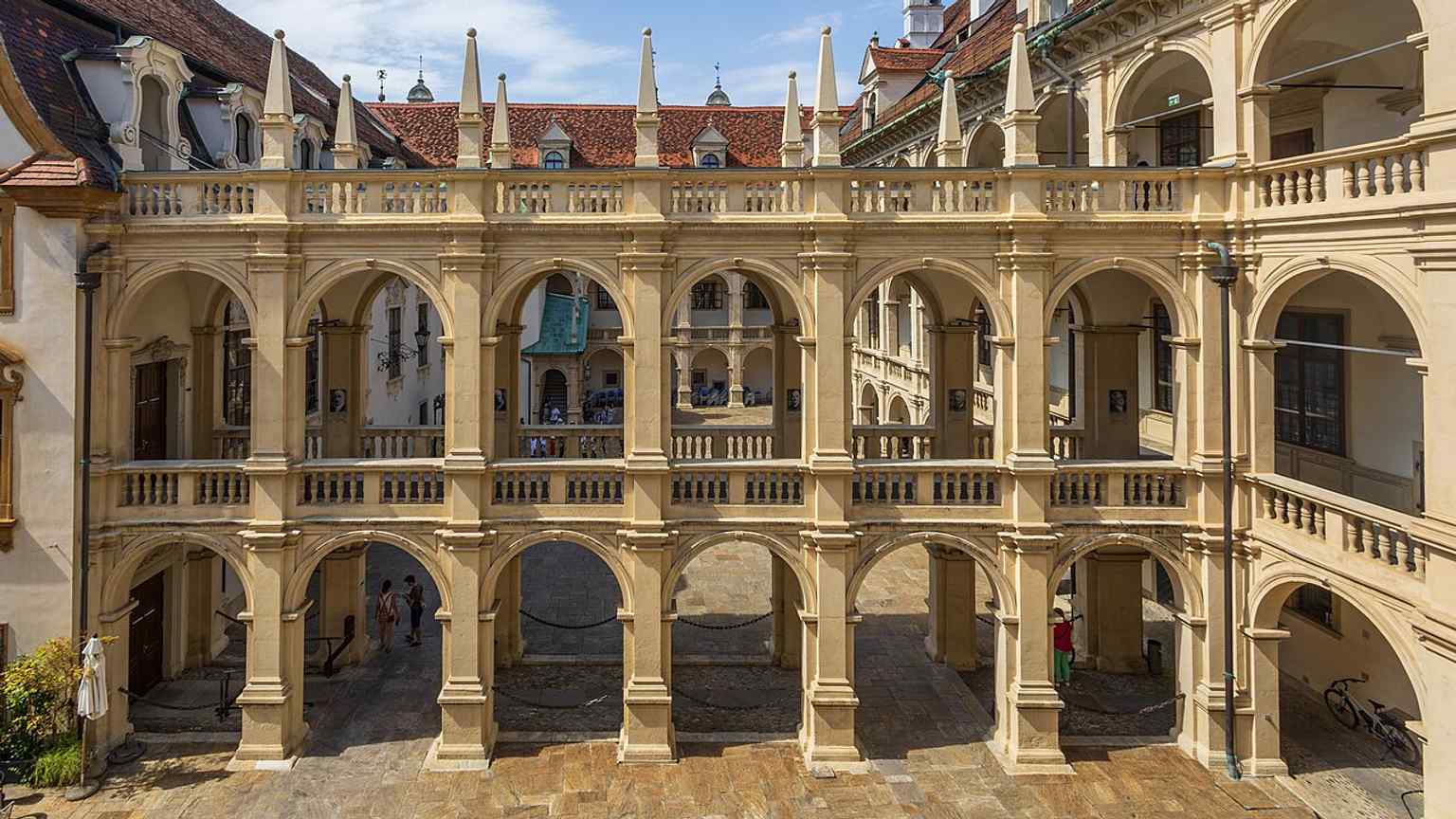
What the street cannot fully reveal is the marvel behind this façade. The courtyard picture shows the great courtyard: three storeys of arcades, with rhythmic arches, flat classical supports called pilasters, and galleries that seem to turn stone into lacework. That airy court remains one of the Landhaus’s defining spaces. Today it hosts events, but its proportions still whisper of power, ceremony, and careful control.
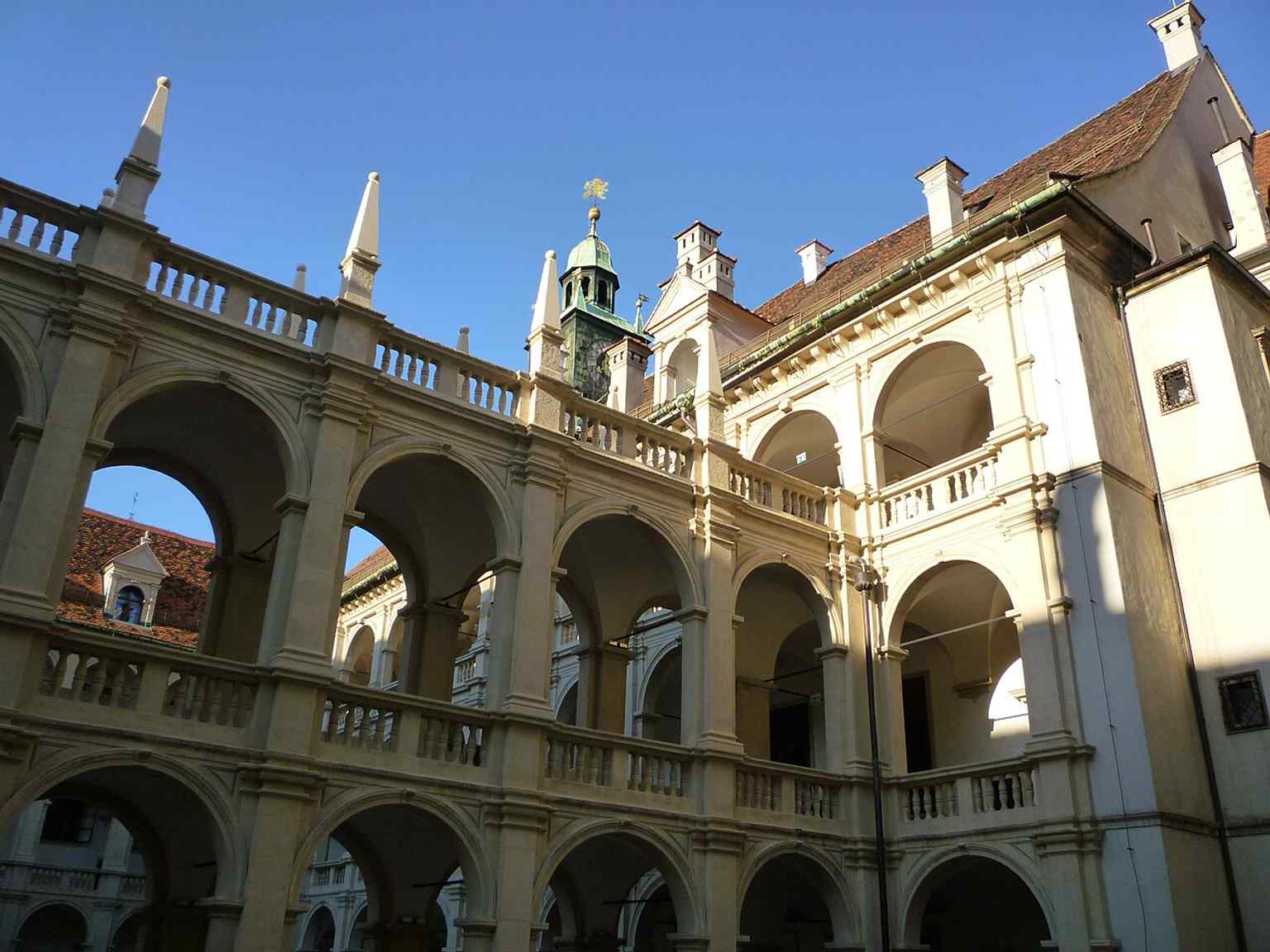
The great arcaded courtyard, one of the Landhaus’s defining features, where Renaissance arches frame the open space used for events today.Photo: Uoaei1, Wikimedia Commons, CC BY-SA 3.0 at. Cropped & resized. At the courtyard’s centre stands an extraordinary fountain from fifteen ninety. If you’d like a closer look, the app shows its bronze canopy supported by baluster forms, satyr figures, and dolphin bodies, all crowned by an armoured warrior. It is a splendid example of Mannerism - a late Renaissance style that delighted in elegance, invention, and just a touch of theatrical excess.
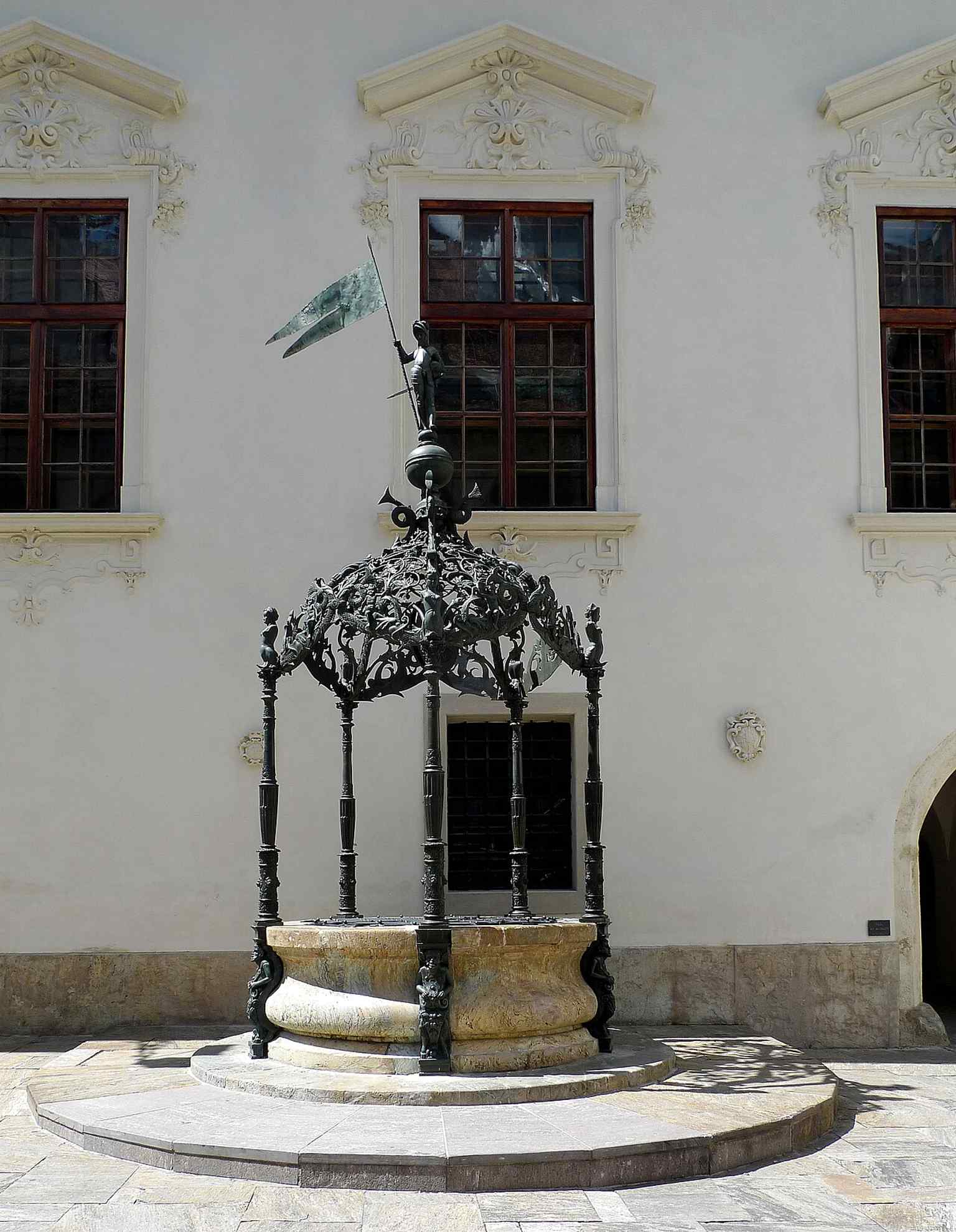
The Landhaus fountain in the courtyard — one of the notable bronze works in Graz, linked in the source text to a 1590 mannerist design.Photo: E.mil.mil, Wikimedia Commons, CC BY-SA 3.0 at. Cropped & resized. The complex kept growing over centuries: a Knight’s Hall in the earlier wings, a chapel added in the seventeenth century, and the Baroque Landstube, which now serves as the chamber of the Styrian parliament. Up above, the copper-clad roof turret still carries the Styrian panther, and its bell, cast in the sixteen-eighties, survived every wartime order to melt down metal.
The exterior is accessible at all hours, so you can always return for another unhurried look.
The Landhaus is Graz in concentrated form: disciplined, political, and unexpectedly graceful.
When you’re ready, continue toward the Hauptplatz, where the city’s public life spreads into the open.
A wide city-center view with the armory, Graz Country House, and town hall side by side — a useful overview of the historic Herrengasse ensemble.Photo: Matthias Süßen, Wikimedia Commons, CC BY-SA 4.0. Cropped & resized. 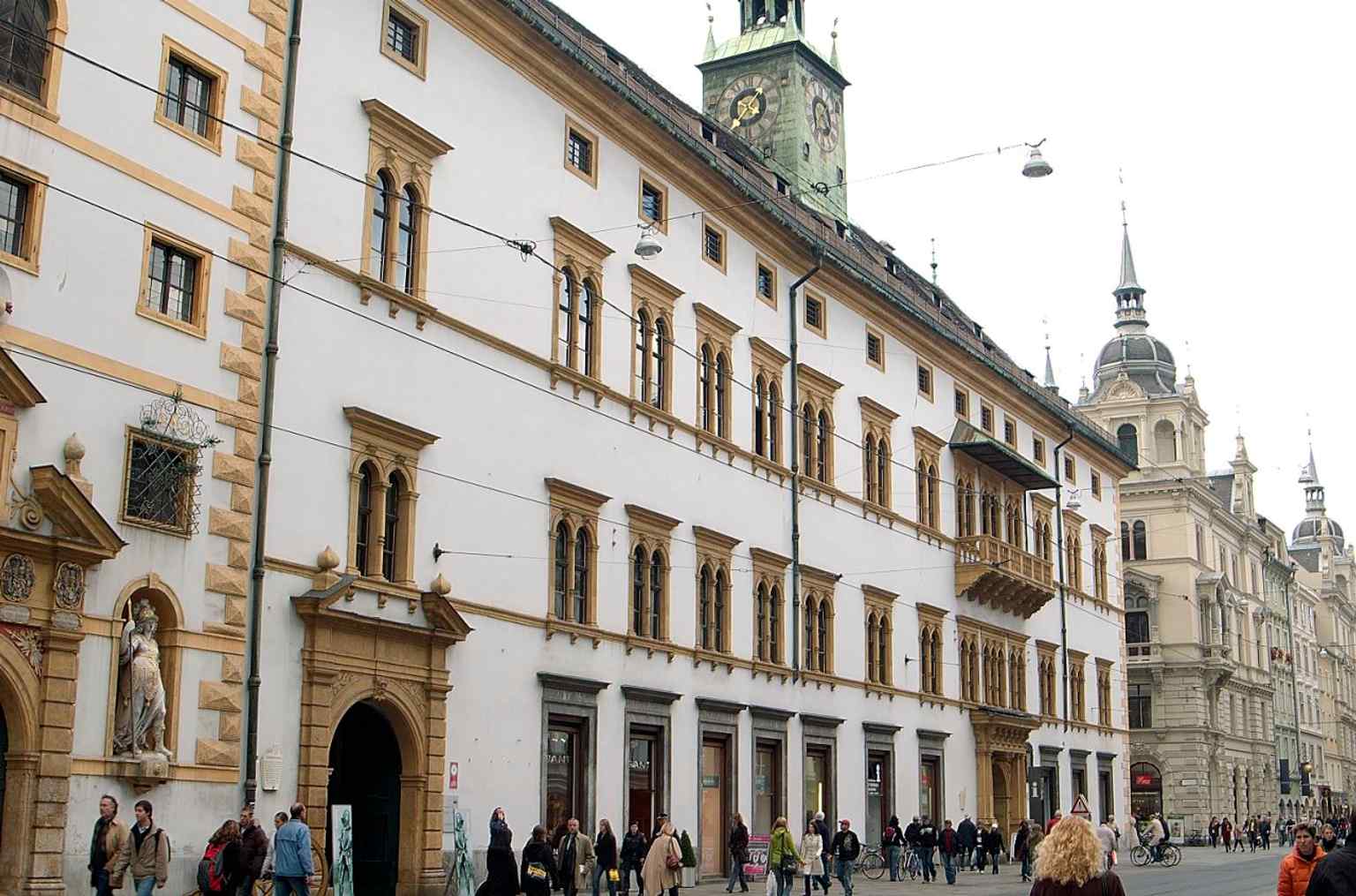
The Landhaus complex in its urban setting, showing the armory on the left and the country house in the middle, matching its role as part of Graz’s historic civic core.Photo: Chb, Wikimedia Commons, CC BY-SA 3.0. Cropped & resized. 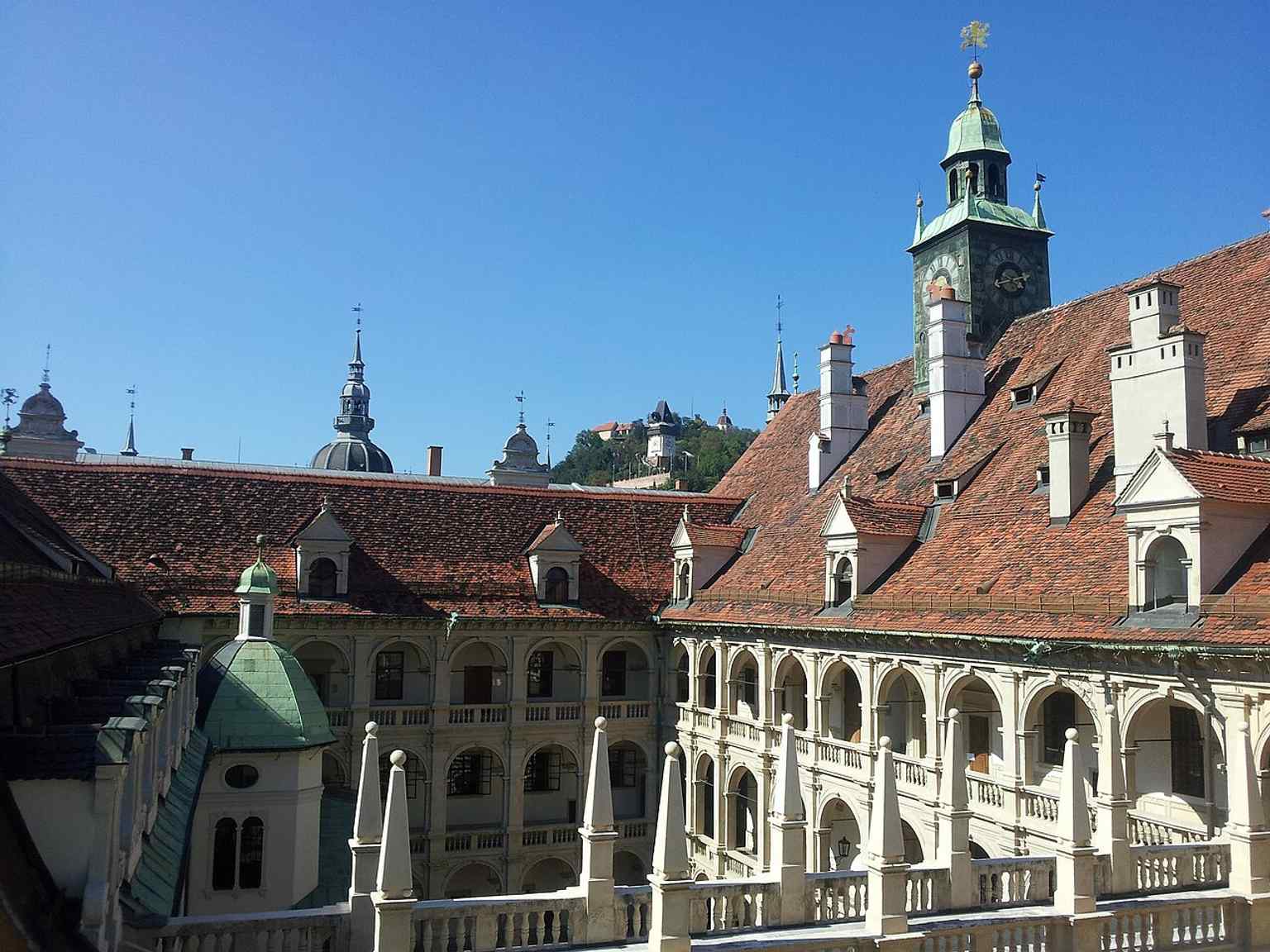
Seen from the Zeughaus, this angle highlights how the Country House forms part of a larger Renaissance civic complex around the courtyards.Photo: Gugganij, Wikimedia Commons, CC BY-SA 3.0 at. Cropped & resized. 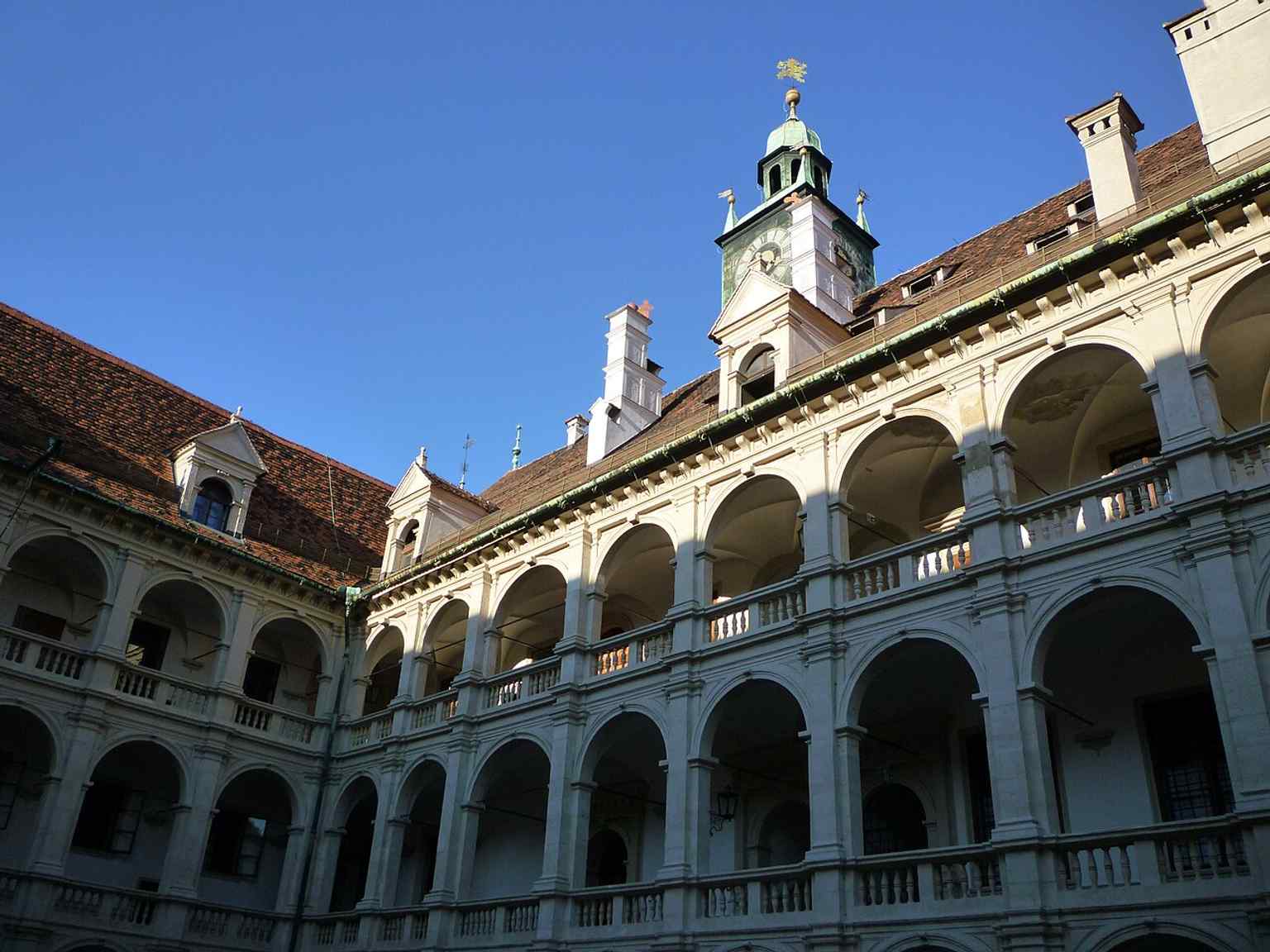
Another view into the main courtyard, useful for showing the three-storey arcades that make the Graz Country House so distinctive.Photo: Uoaei1, Wikimedia Commons, CC BY-SA 3.0 at. Cropped & resized. 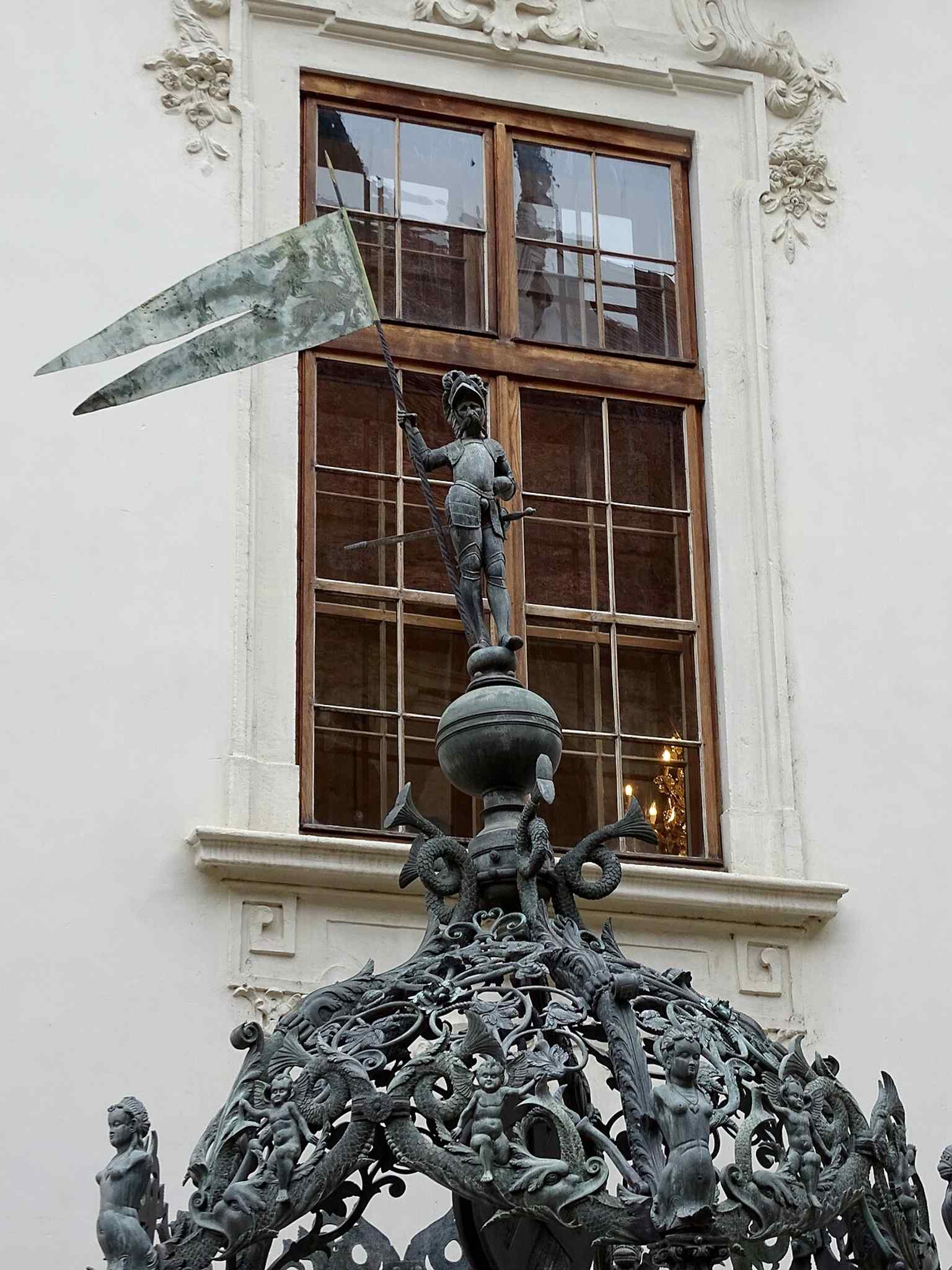
A close-up of the armored figure atop the courtyard fountain, echoing the source’s description of the fountain laurel crowned by a warrior.Photo: Liuthalas, Wikimedia Commons, CC BY-SA 4.0. Cropped & resized. 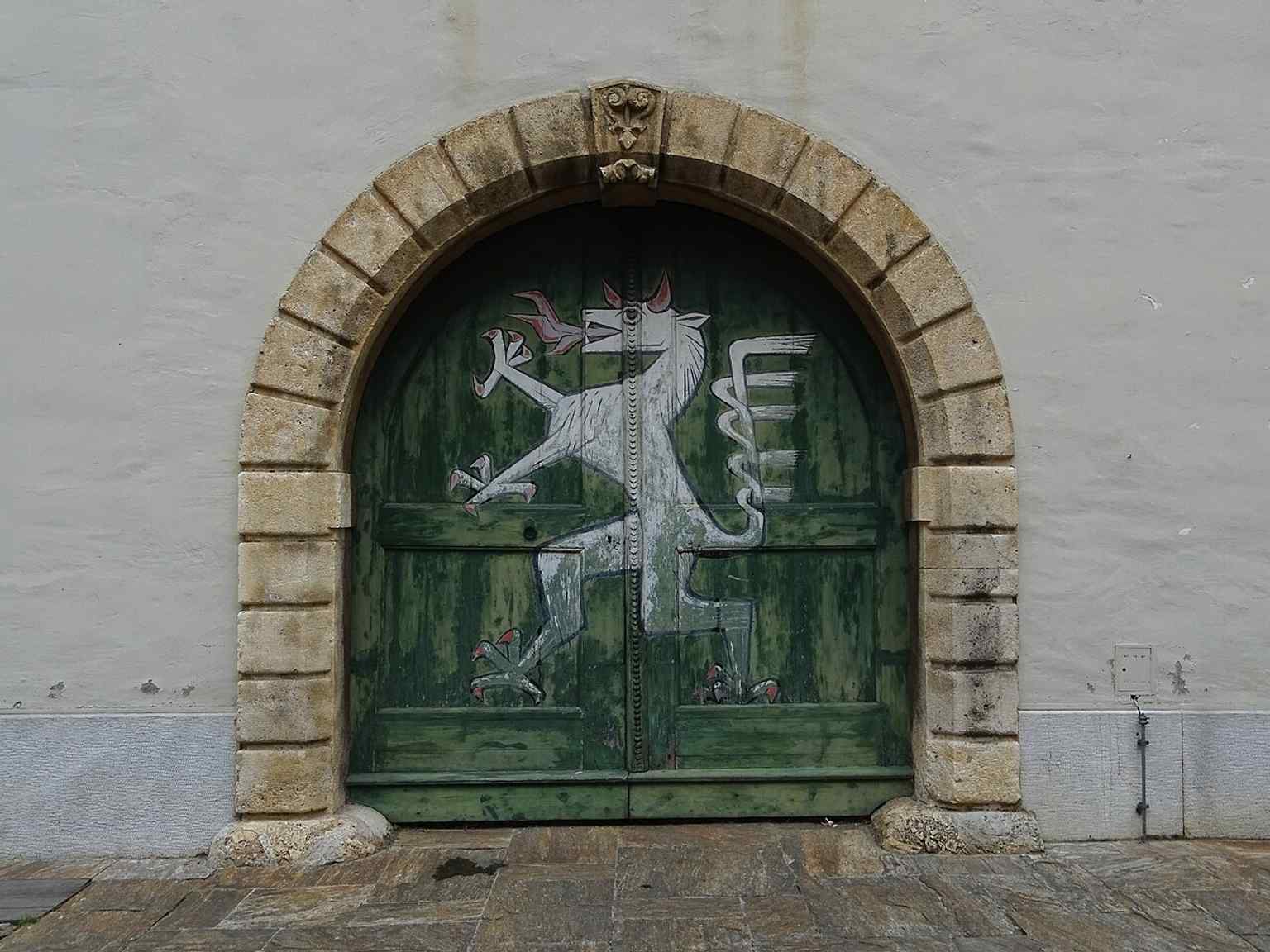
The steirischen Panther over a courtyard portal, a recurring regional symbol also mentioned in the building’s façades and roof details.Photo: Liuthalas, Wikimedia Commons, CC BY-SA 4.0. Cropped & resized. 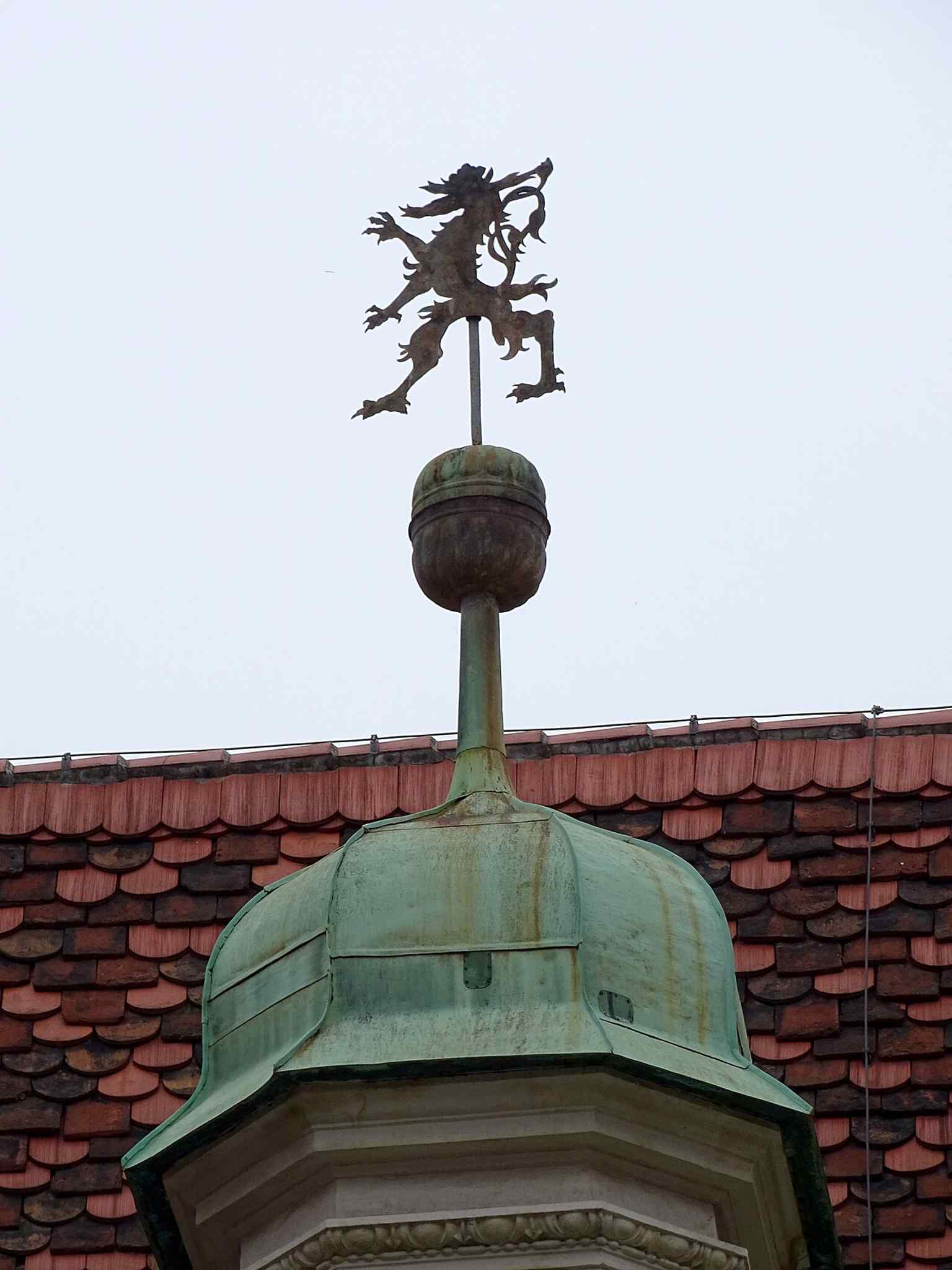
The Panther on the chapel roof, a small but striking detail that reflects the Landhaus complex’s layered Renaissance and later additions.Photo: Liuthalas, Wikimedia Commons, CC BY-SA 4.0. Cropped & resized. 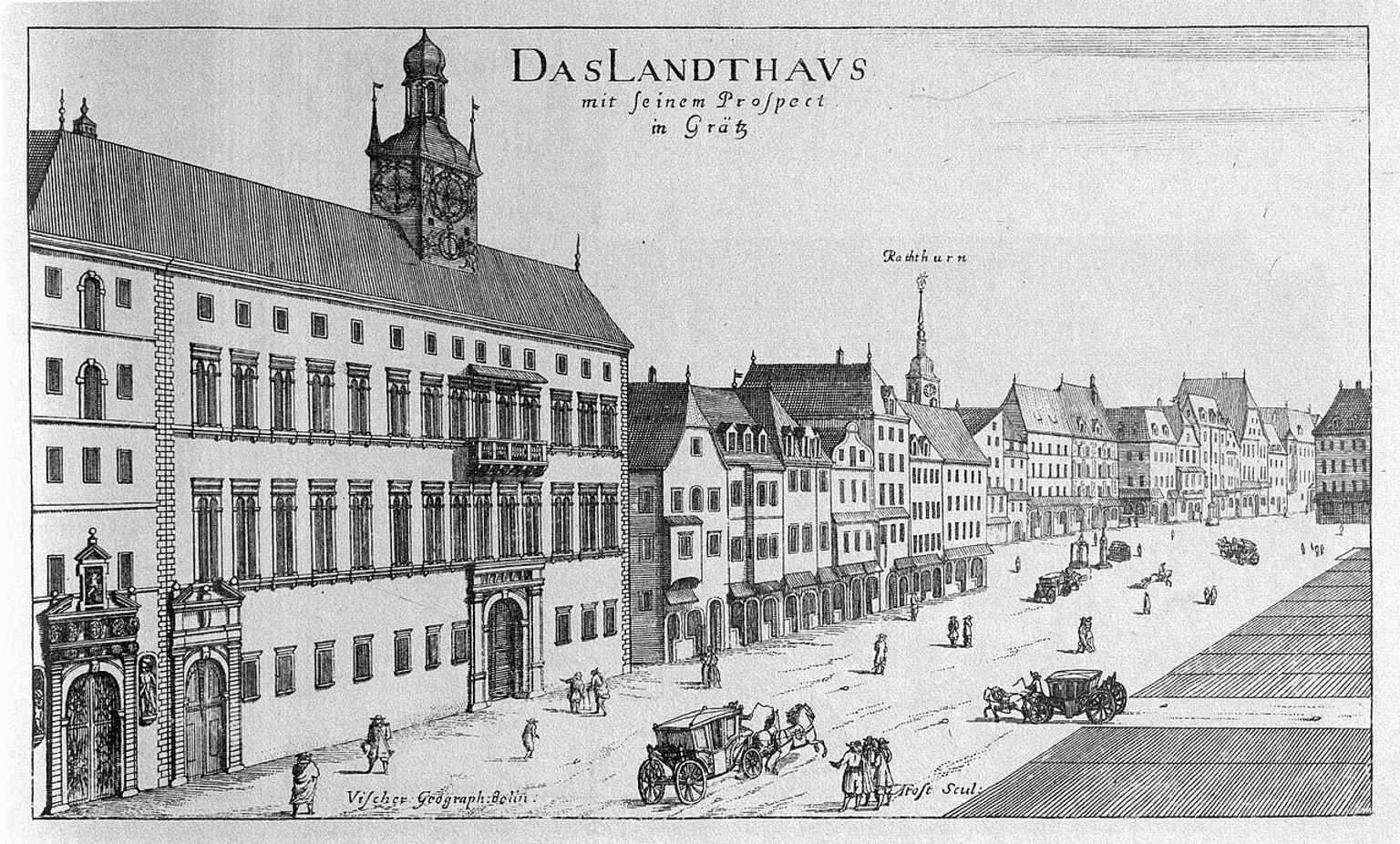
An early engraved view of Graz’s Landhaus from 1681, valuable for showing how the Renaissance complex was documented centuries ago.Photo: Georg Matthäus Vischer, Wikimedia Commons, Public domain. Cropped & resized. 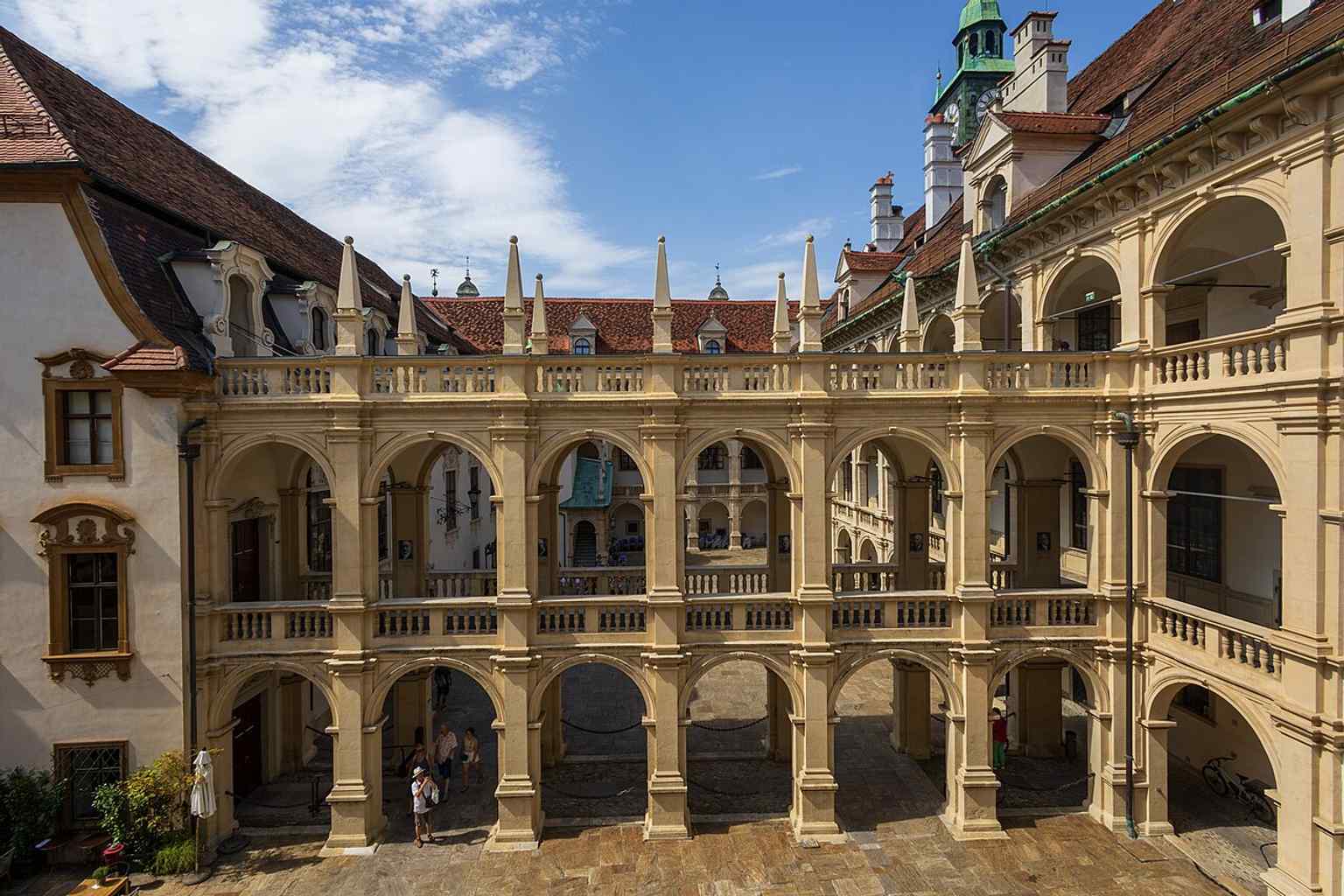
A clean modern exterior view of the Country House, useful for introducing the building’s Renaissance façade and Herrengasse presence.Photo: Matthias Süßen, Wikimedia Commons, CC BY-SA 4.0. Cropped & resized. 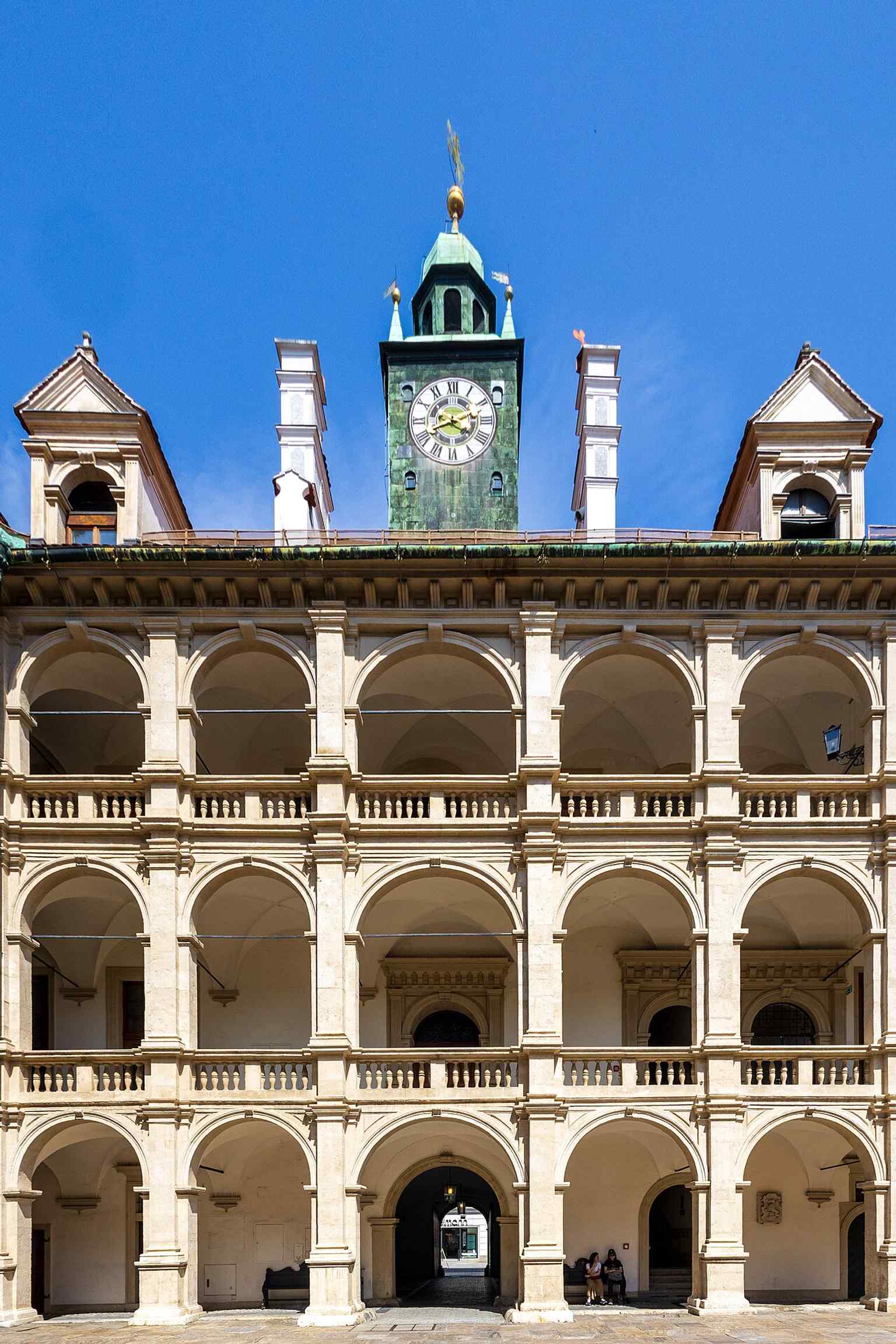
The courtyard-side exterior of the Landhaus, showing the monument as a whole rather than just one façade.Photo: Matthias Süßen, Wikimedia Commons, CC BY-SA 4.0. Cropped & resized. 
Contemporary art installed in the Zeughaushof, showing how the Landhaus courtyards are still used as exhibition spaces today.Photo: Liuthalas, Wikimedia Commons, CC BY-SA 4.0. Cropped & resized. On your left, look for a broad trapezoidal stone square edged by stucco-faced historic houses, with the pale monumental Town Hall and the bronze Archduke Johann fountain as its…Read moreShow less
Open dedicated page →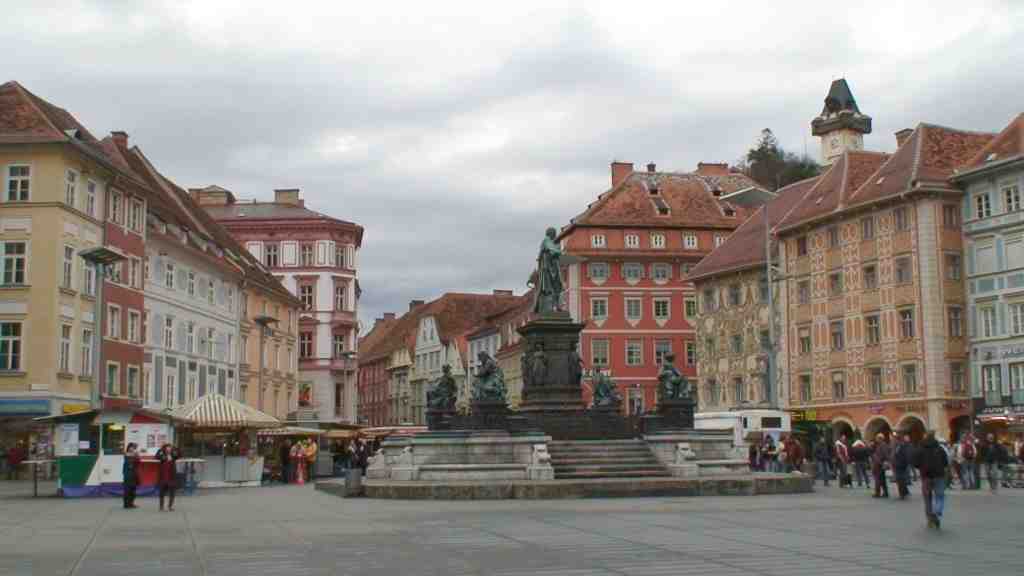
Main SquarePhoto: Mgrueter, Wikimedia Commons, Public domain. Cropped & resized. On your left, look for a broad trapezoidal stone square edged by stucco-faced historic houses, with the pale monumental Town Hall and the bronze Archduke Johann fountain as its clearest markers.
This is the Hauptplatz, the Main Square, and in many ways it is the heart that taught Graz how to beat. Around eleven sixty, Duke Otakar the Third laid out this space as the city’s central market. That makes it not merely old, but foundational: the historic and urban centre from which Graz organised itself. Five streets still branch away from it like spokes from a hub: Sporgasse, Herrengasse, Schmiedgasse, Murgasse, and Sackstraße.
The shape matters. The square began as a much larger trapezoid and once stretched as far as today’s Landhausgasse. Then, around fifteen fifty, builders raised a new Renaissance town hall and nearly cut the square in half. Cities rarely shrink their main stage without reason, and here the reason was power: trade still mattered, of course, but civic government wanted a more commanding presence. The present Town Hall took on its grand late historicist face between eighteen eighty-nine and eighteen ninety-three, giving the square, as contemporaries said, a new monumental accent.
If you let your gaze drift around the edges, you are looking at layers rather than a single period. Many of these houses hide medieval or late Gothic cores behind later fronts. Their façades speak several languages at once: late Gothic, Baroque, Biedermeier, and late nineteenth-century historicism. Some carry elaborate stucco work, those moulded plaster decorations that catch light and shadow, and some display statues of the Virgin Mary, small public signs of popular devotion woven into everyday architecture.
At the centre stands the Archduke Johann fountain, unveiled in eighteen seventy-eight. For a closer look at its composition, the close-up of the fountain shows it rather well. Sculptor Franz Pönninger gave Johann an over-life-size bronze figure and set him above four allegorical river figures: the Mur, the Enns, the Drau, and the Sann. It is a confident piece of nineteenth-century civic theatre, and quite right for a square that always preferred to gather everything in one place.
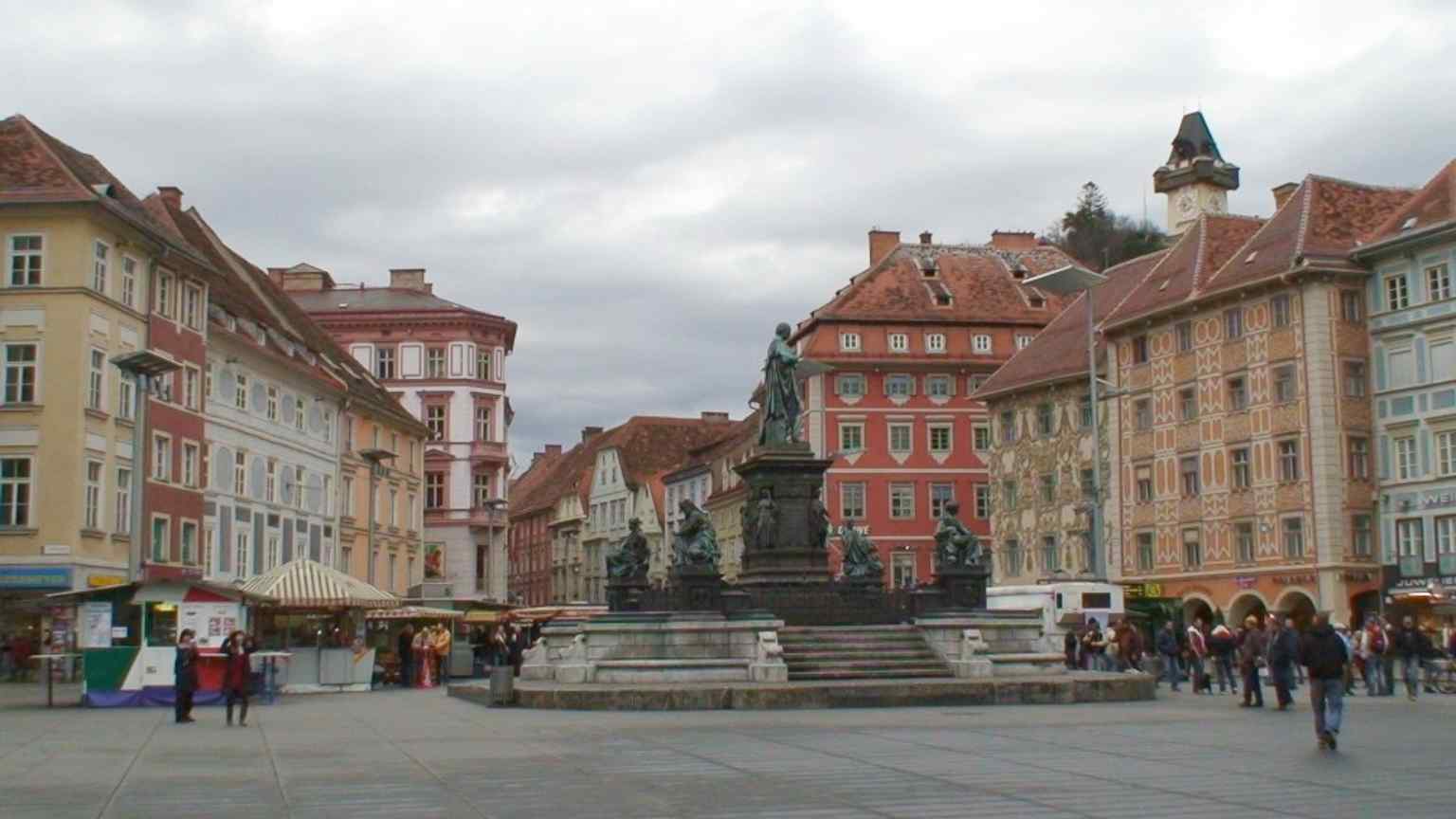
The Erzherzog-Johann-Brunnen anchors Graz’s Main Square, the historic market place laid out in the 12th century and still the center of the square today.Photo: Mgrueter, Wikimedia Commons, Public domain. Cropped & resized. Names tell their own story. For a long time, people simply called this space “on the square.” The name Hauptplatz first appears in chronicles in sixteen sixty-five. In the nineteenth century, some called it Hauptwachplatz because the main guard occupied the Town Hall. Then came the ugliest renaming of all: from nineteen thirty-eight to nineteen forty-five, the Nazi regime called it Adolf-Hitler-Platz. After the war, Graz restored the older name, and with it, a measure of dignity.
For generations, nearly every tram line in Graz crossed here. If you glance at the historical tram photograph in the app, you can see how firmly the square served as the city’s transport stage as well as its market. Only the Neutor line, opened in twenty twenty-five, finally changed that old pattern.
The Hauptplatz is Graz in miniature: trade, politics, devotion, spectacle, and daily movement, all pressed into one civic room.
When you are ready, continue on and let the city lead you from its public heart toward its more solemn voices.
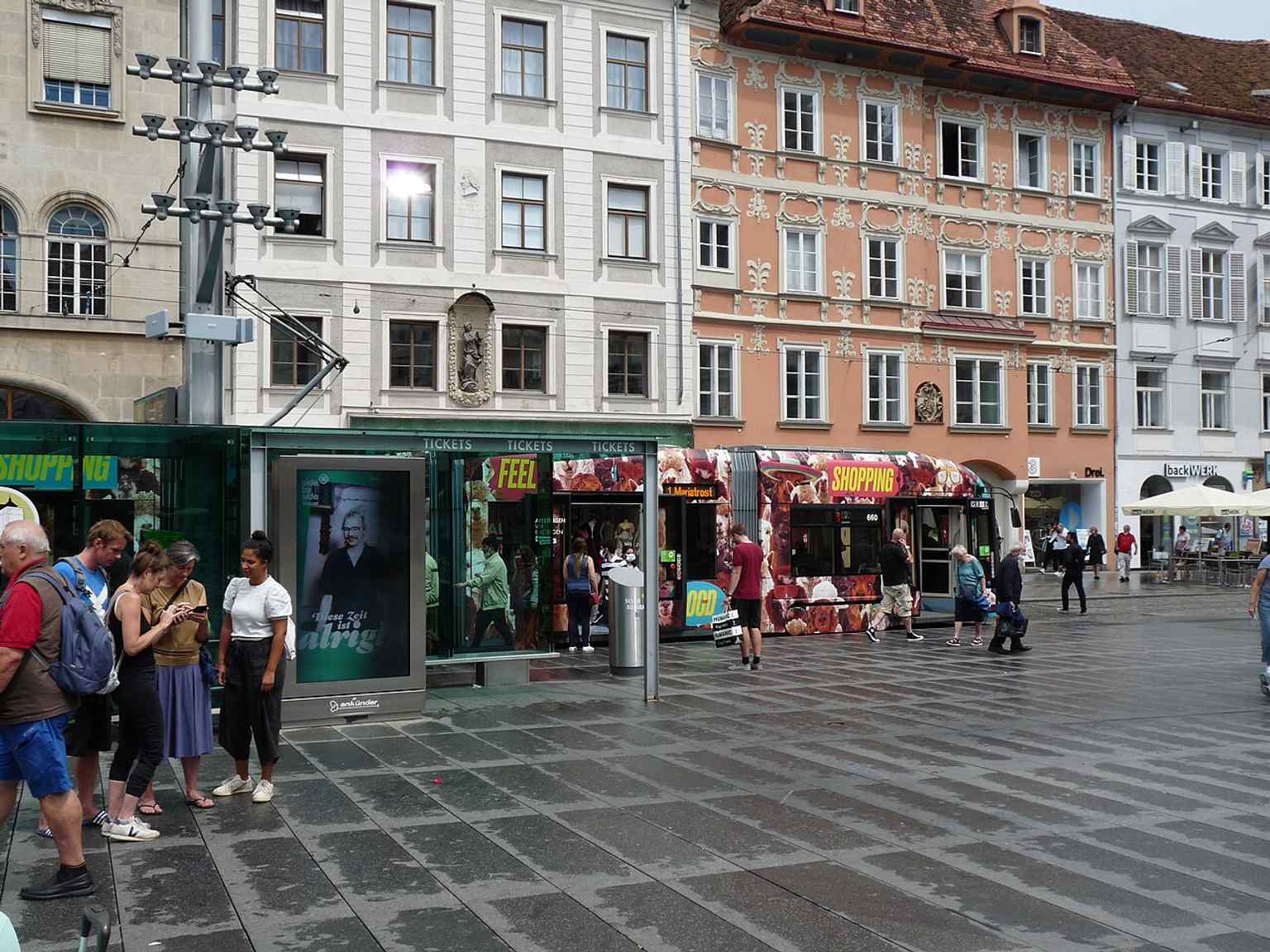
Modern trams passing through Graz Main Square show how this medieval market place remains a busy urban crossroads.Photo: Smiley.toerist, Wikimedia Commons, CC BY-SA 4.0. Cropped & resized. 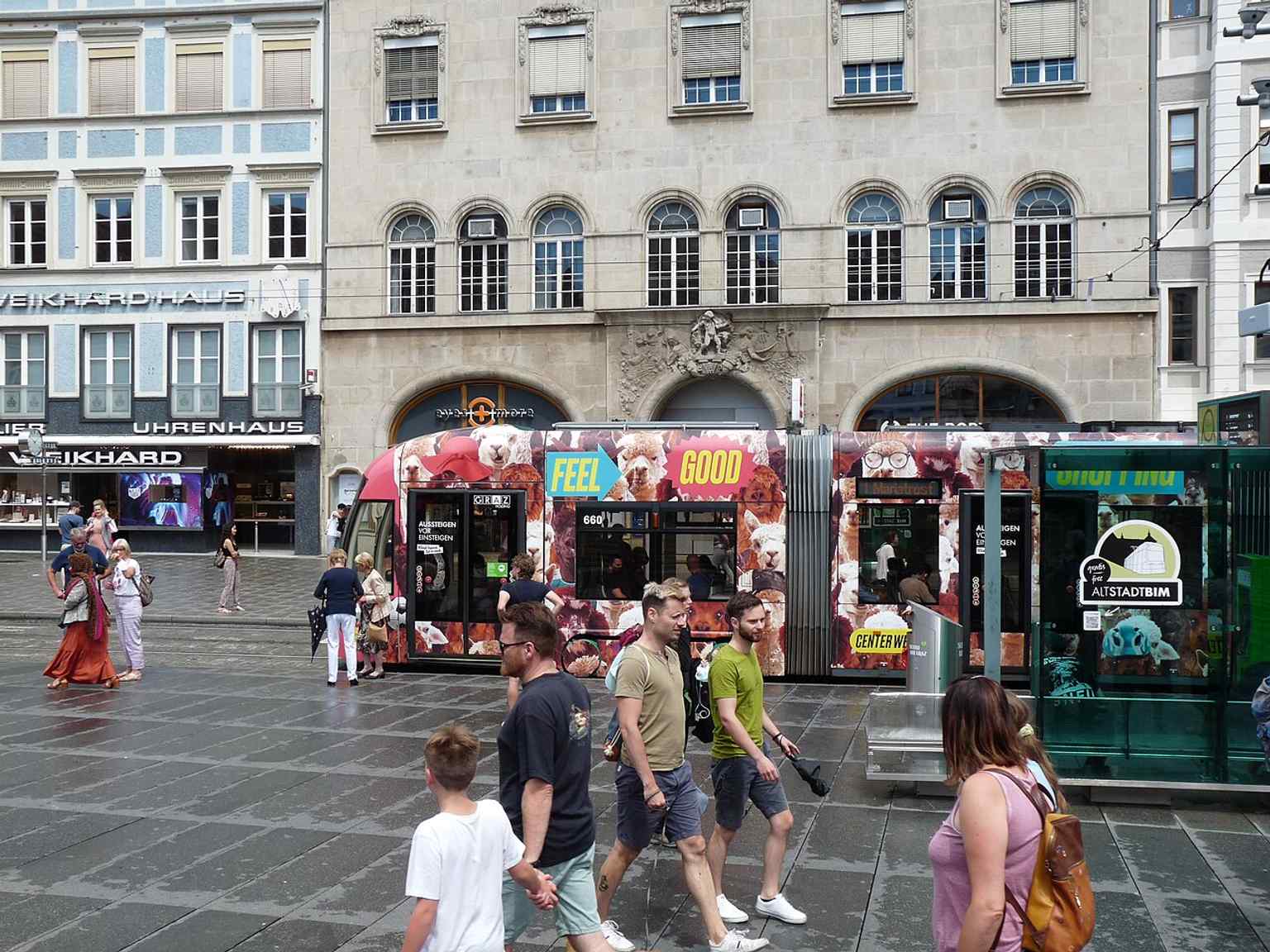
Another view of tram traffic on Hauptplatz, illustrating the square’s function as a central stop shared by nearly all tram lines.Photo: Smiley.toerist, Wikimedia Commons, CC BY-SA 4.0. Cropped & resized. On your right, look for the pale stone façade above a broad stair, with a slender round tower rising behind it and the oval dome of the burial chapel joined to the church. This…Read moreShow less
Open dedicated page →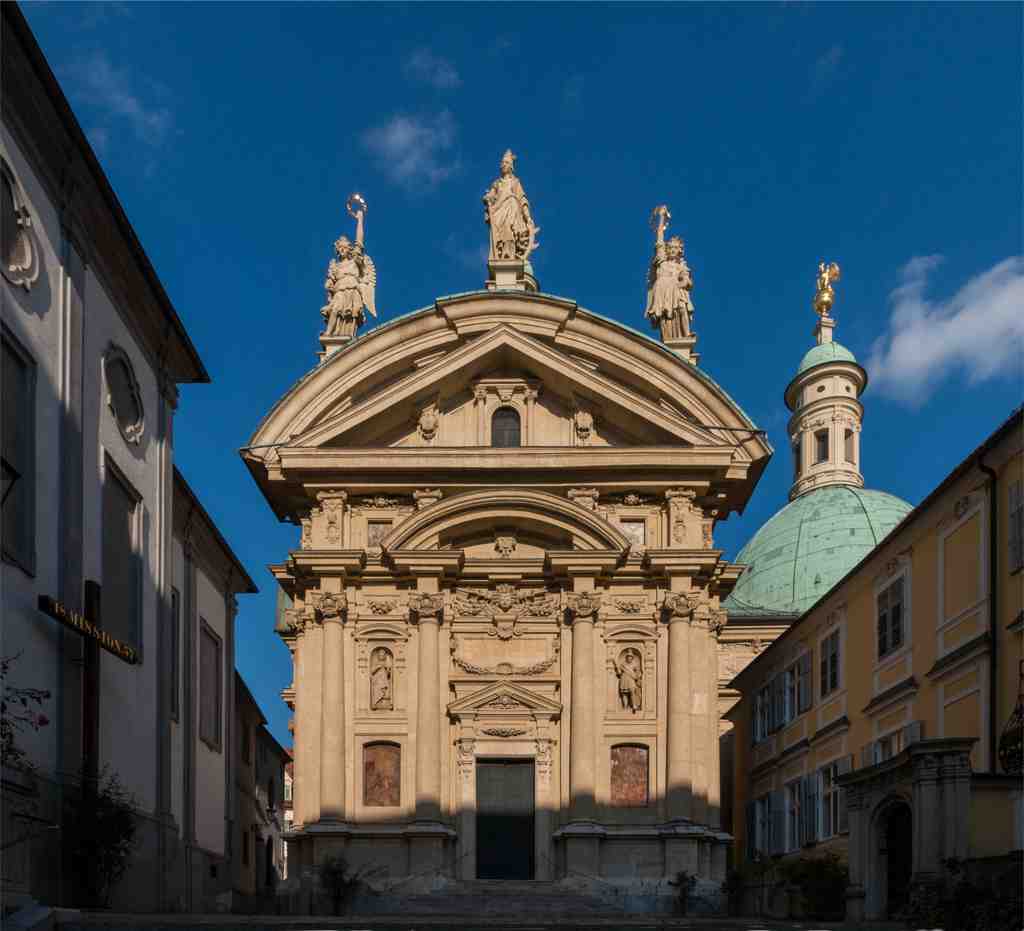
Mausoleum of Emperor Ferdinand IIPhoto: Marco Almbauer, Wikimedia Commons, Public domain. Cropped & resized. On your right, look for the pale stone façade above a broad stair, with a slender round tower rising behind it and the oval dome of the burial chapel joined to the church.
This is the Mausoleum of Emperor Ferdinand the Second, though what stands before you is not a single building so much as a carefully staged union of two. At the front is the Church of Saint Catherine. Attached to it is the emperor’s burial chapel, built for Ferdinand and his family. Work began in sixteen fourteen, when Ferdinand chose this site beside the cathedral, on ground that had once held an older cemetery chapel dedicated to Saint Catherine. He handed the task to his court artist, Giovanni Pietro de Pomis, an Italian master who painted, designed, and oversaw the whole enterprise.
De Pomis gave the complex a very deliberate meaning. The church follows a cross-shaped plan, an open declaration of Christian faith. The burial chapel takes an oval form, meant to symbolize resurrection. That oval was no small matter. The chapel’s dome is considered the first of its kind outside Italy, a bold import from the south. And there is a charming Graz connection here: Johannes Kepler, who once lived and taught in this city, helped work out the mathematics of the ellipse. The side view in the app makes the idea wonderfully clear: a church and a tomb joined into one ceremonial composition. The style is Mannerist, a style poised between the balance of the Renaissance and the drama of the Baroque. You can feel that in the façade. It is disciplined, but it also performs. Saint Catherine once presided over the front in stone, flanked by angels, while panels and figures around her told the story of those she converted. That was not simply pious decoration. Catherine was the patron saint of learning, which linked this place to Graz’s Jesuit university, and her story also suited Ferdinand’s Counter-Reformation message, the Catholic effort to reclaim souls and authority in a divided age.
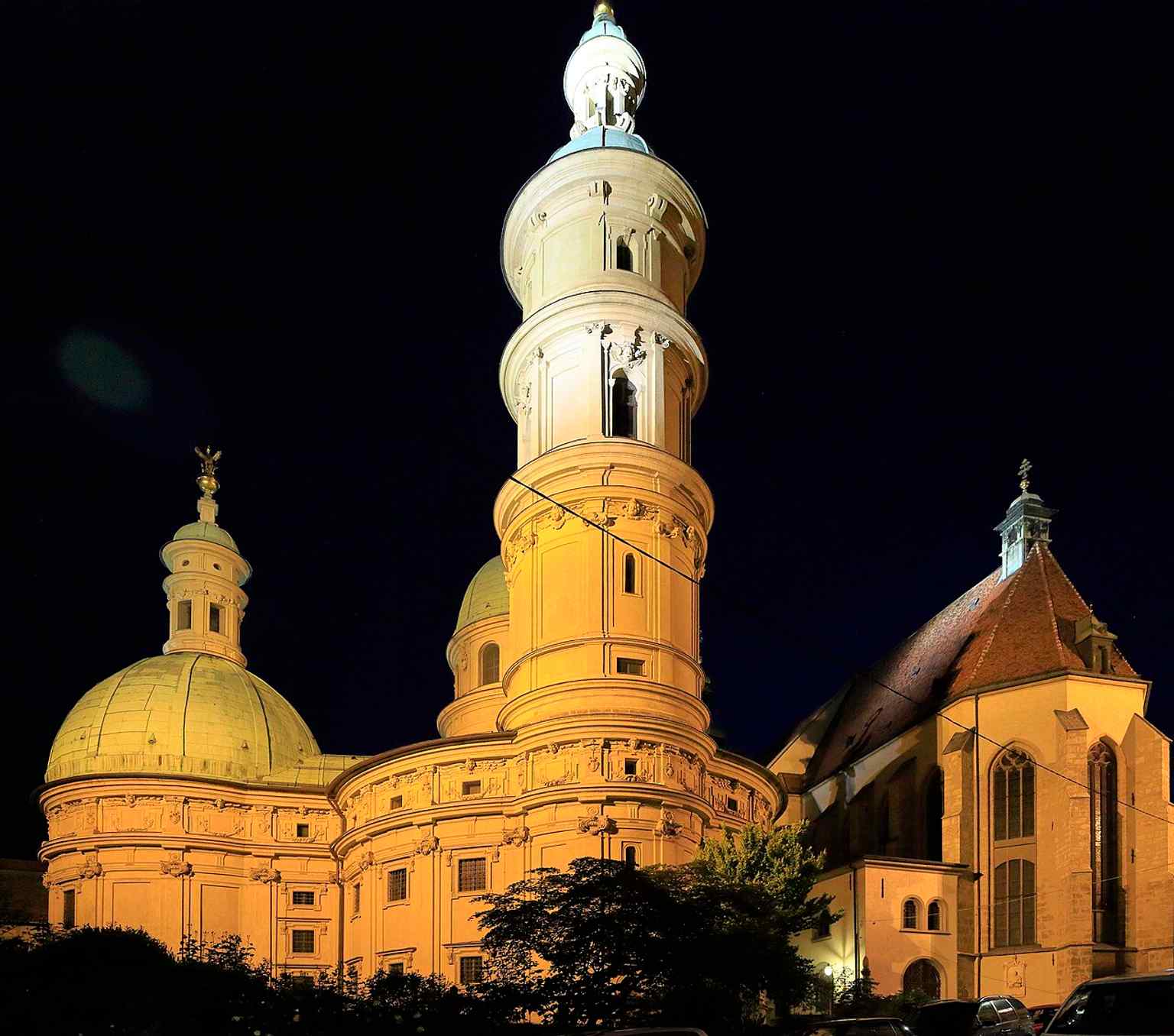
A side view from Burggasse showing the Katharinenkirche attached to the grave chapel, reflecting the complex’s two-part design built between 1614 and 1714.Photo: Falk2, Wikimedia Commons, CC BY-SA 4.0. Cropped & resized. And yet, for all its confidence, this project moved in fits and starts. Ferdinand rose to become emperor and shifted his court to Vienna. Attention wandered. Money slowed. Building stopped and started again. De Pomis died in sixteen thirty-three before he could finish the work. Pietro Valnegro took over, completed the graceful campanile, the bell tower, and later generations carried the scheme forward. Only in seventeen fourteen, a full century after the first plans, did the entire complex finally reach completion.
Take a look at the interior image in the app and you will see how later artists clothed the inside in Baroque splendour. Johann Bernhard Fischer von Erlach helped shape that later phase, and the church’s central hall, the nave, became a painted celebration of Habsburg triumph.
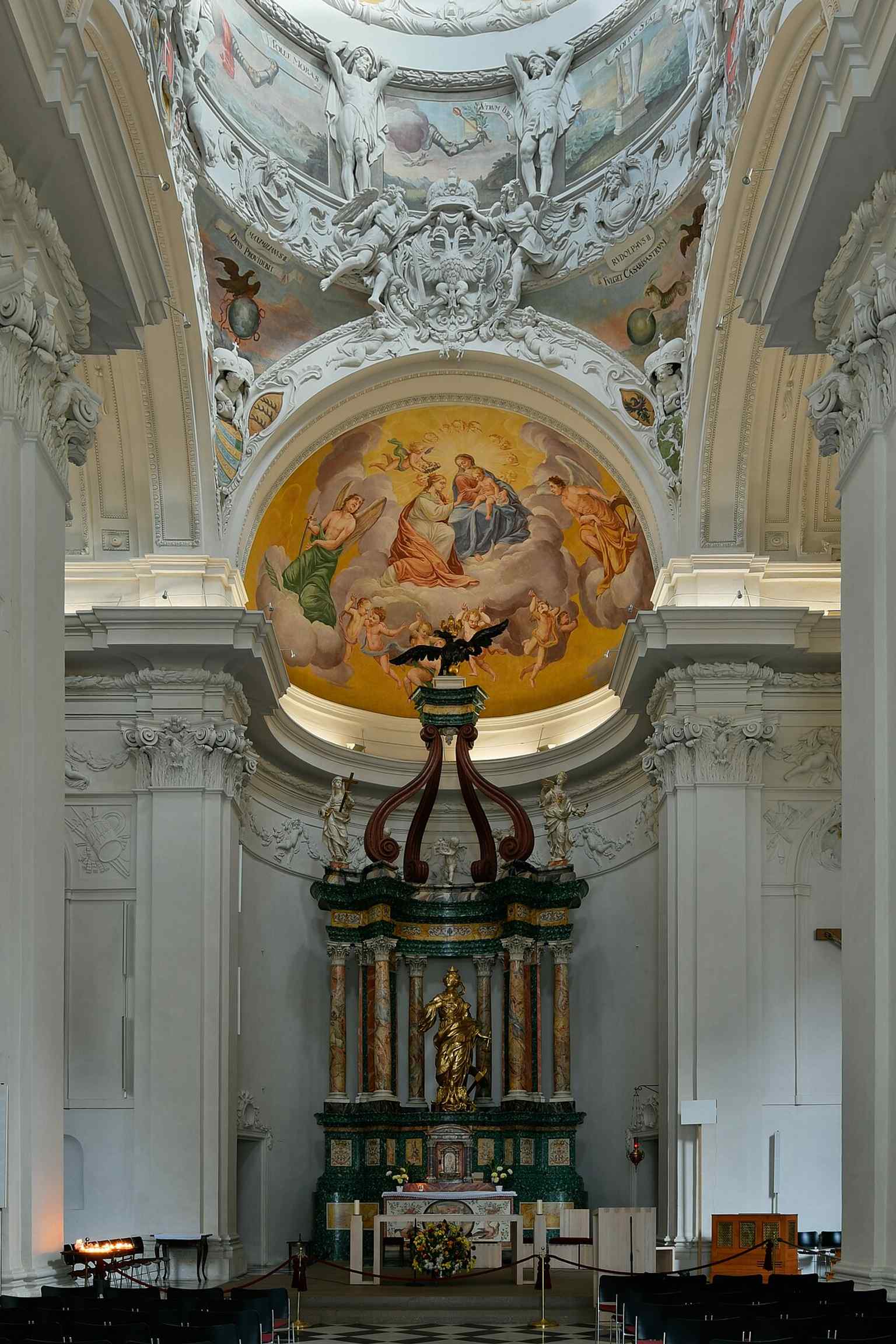
Inside the Katharinenkirche, the richly decorated nave and altar space reflect the Baroque redesign carried out after decades of interruption.Photo: Isiwal, Wikimedia Commons, CC BY-SA 4.0. Cropped & resized. Beneath the chapel lies the crypt, where Ferdinand the Second rests in a wall tomb beside members of his family, making this the largest Habsburg mausoleum ever built. If you plan to look inside later, it is usually open from Tuesday to Sunday, from nine in the morning until six in the evening, and closed on Mondays.
Here, the Habsburgs turned death into a statement of power. When you are ready, continue to the cathedral beside it, where that same world speaks in a quieter voice.
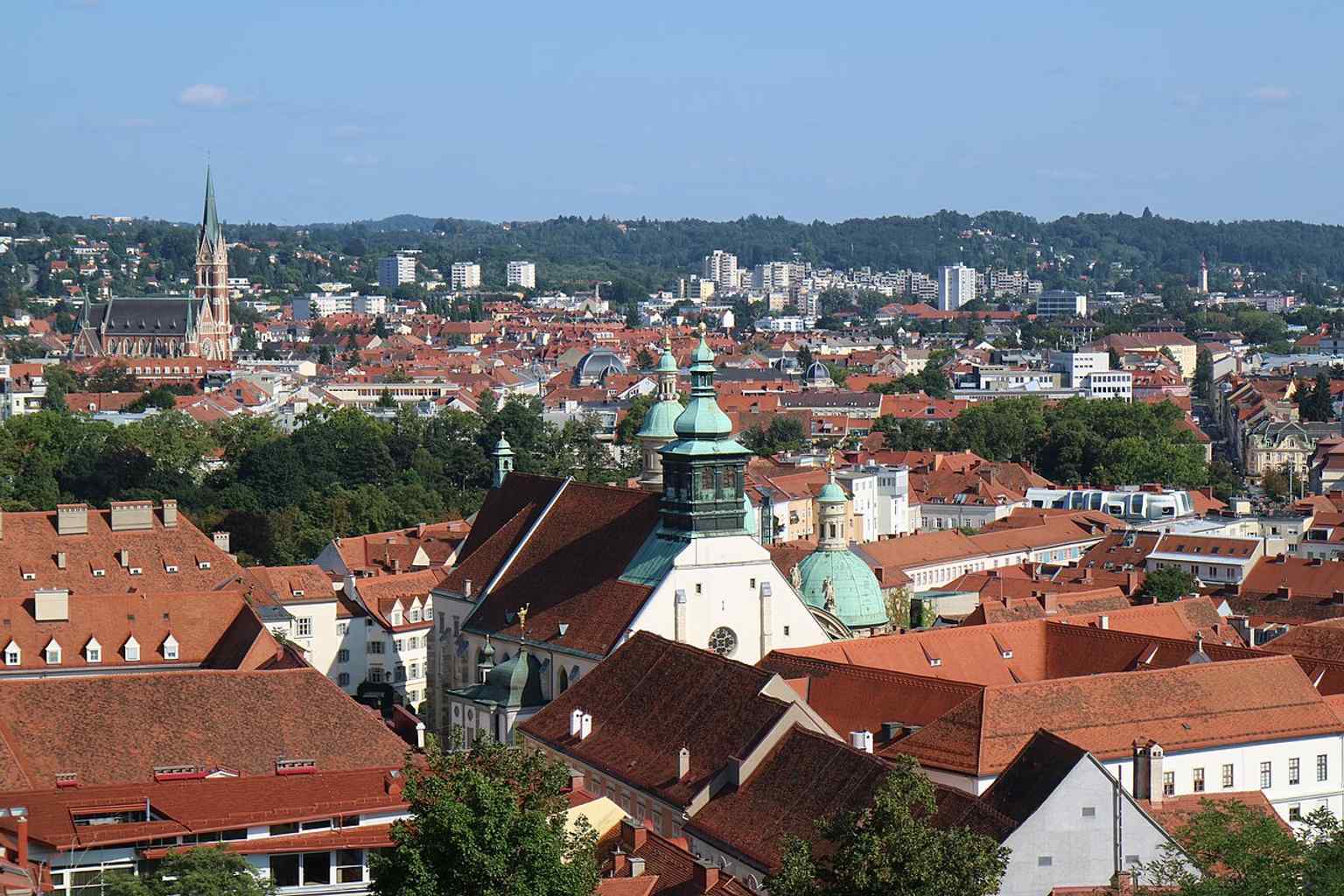
A classic skyline view of Graz’s city crown, with the Cathedral, the Mausoleum, and the Katharinenkirche all visible together.Photo: Clemens Stockner, Wikimedia Commons, CC BY-SA 4.0. Cropped & resized. 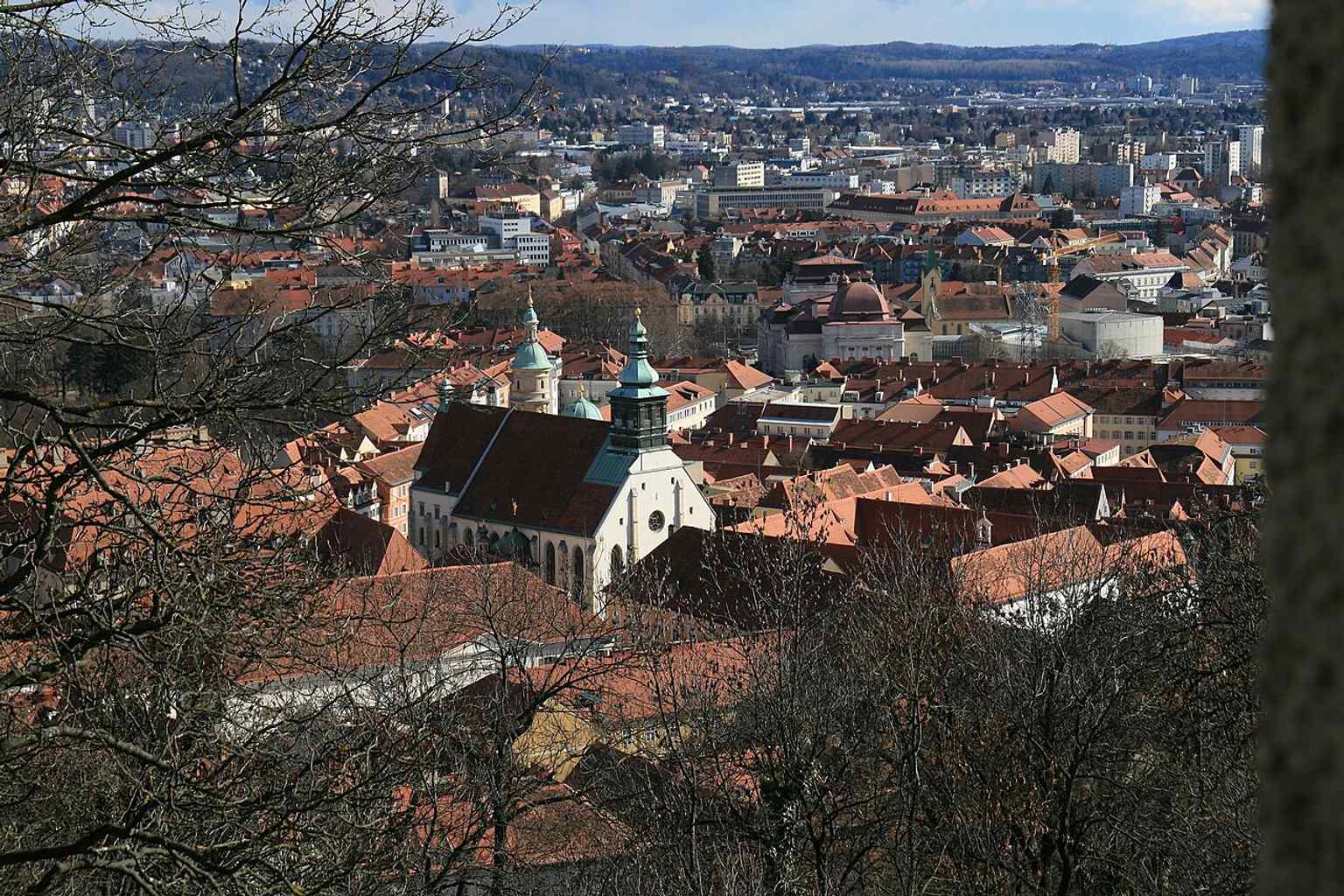
Seen from Schlossberg, the Cathedral and the twin-domed Mausoleum show how Ferdinand II’s tomb became part of Graz’s landmark silhouette.Photo: Manfred Werner - Tsui, Wikimedia Commons, CC BY-SA 3.0. Cropped & resized. 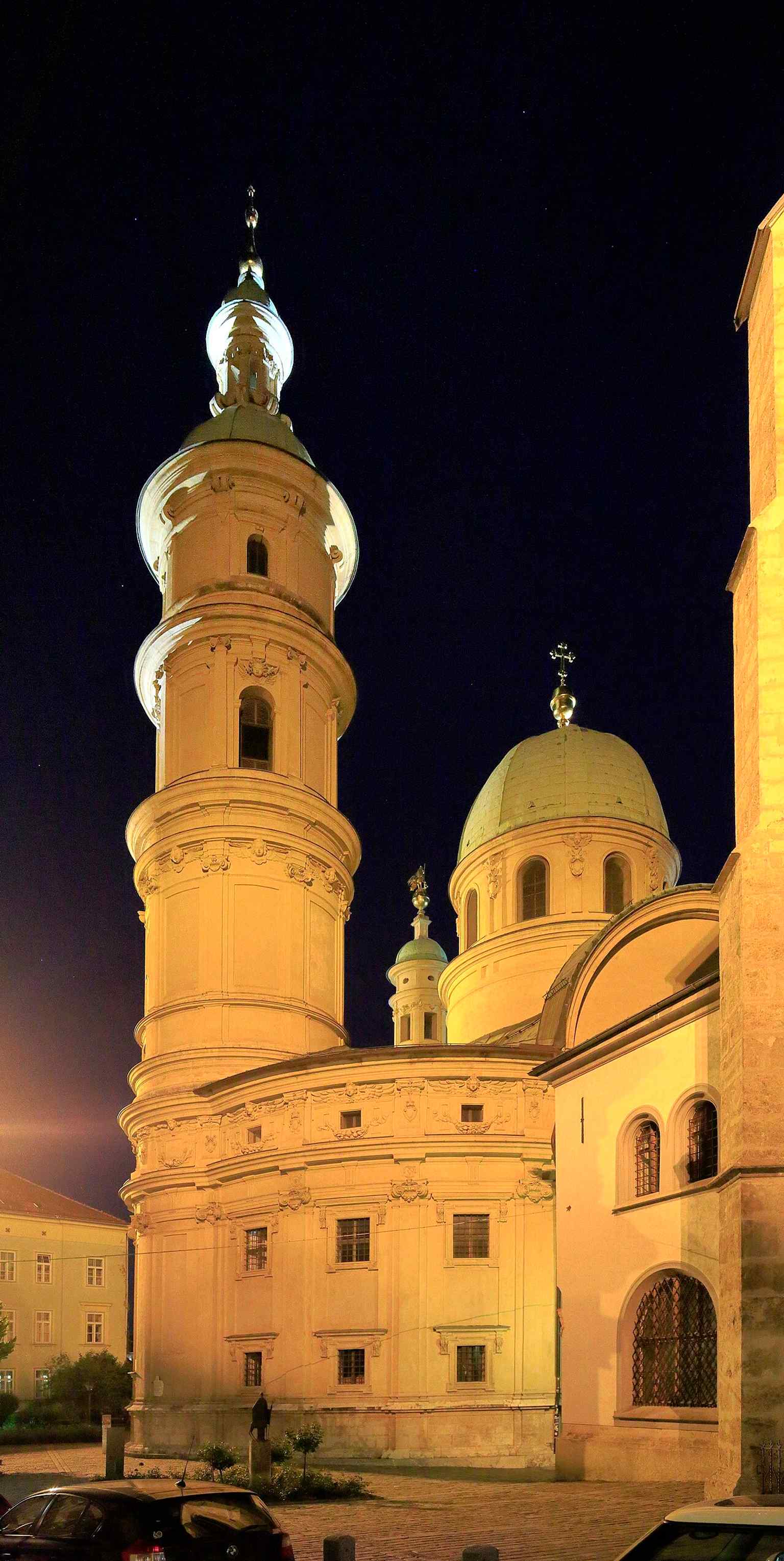
The west side view highlights the smaller mausoleum dome beside the church, a key clue to the building’s unusual dual structure.Photo: Falk2, Wikimedia Commons, CC BY-SA 4.0. Cropped & resized. 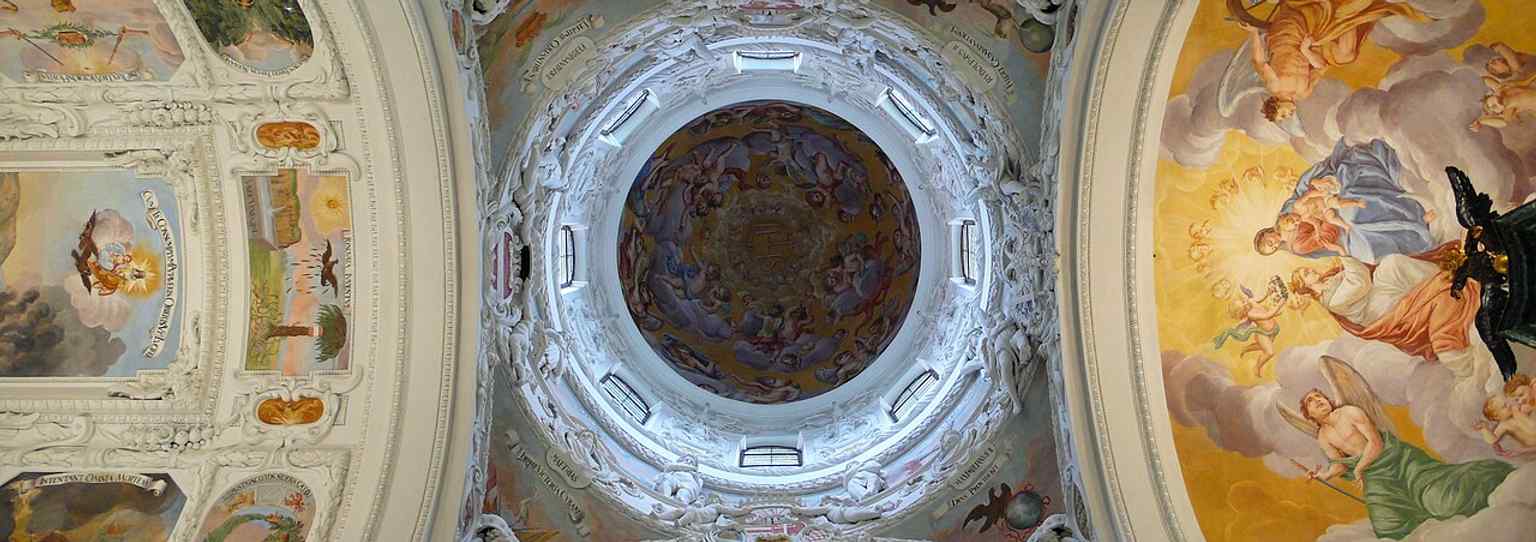
The broad front approach with the grand staircase gives a strong sense of the Mausoleum’s ceremonial character as a Habsburg memorial.Photo: HatschiKa, Wikimedia Commons, CC BY-SA 3.0 at. Cropped & resized. 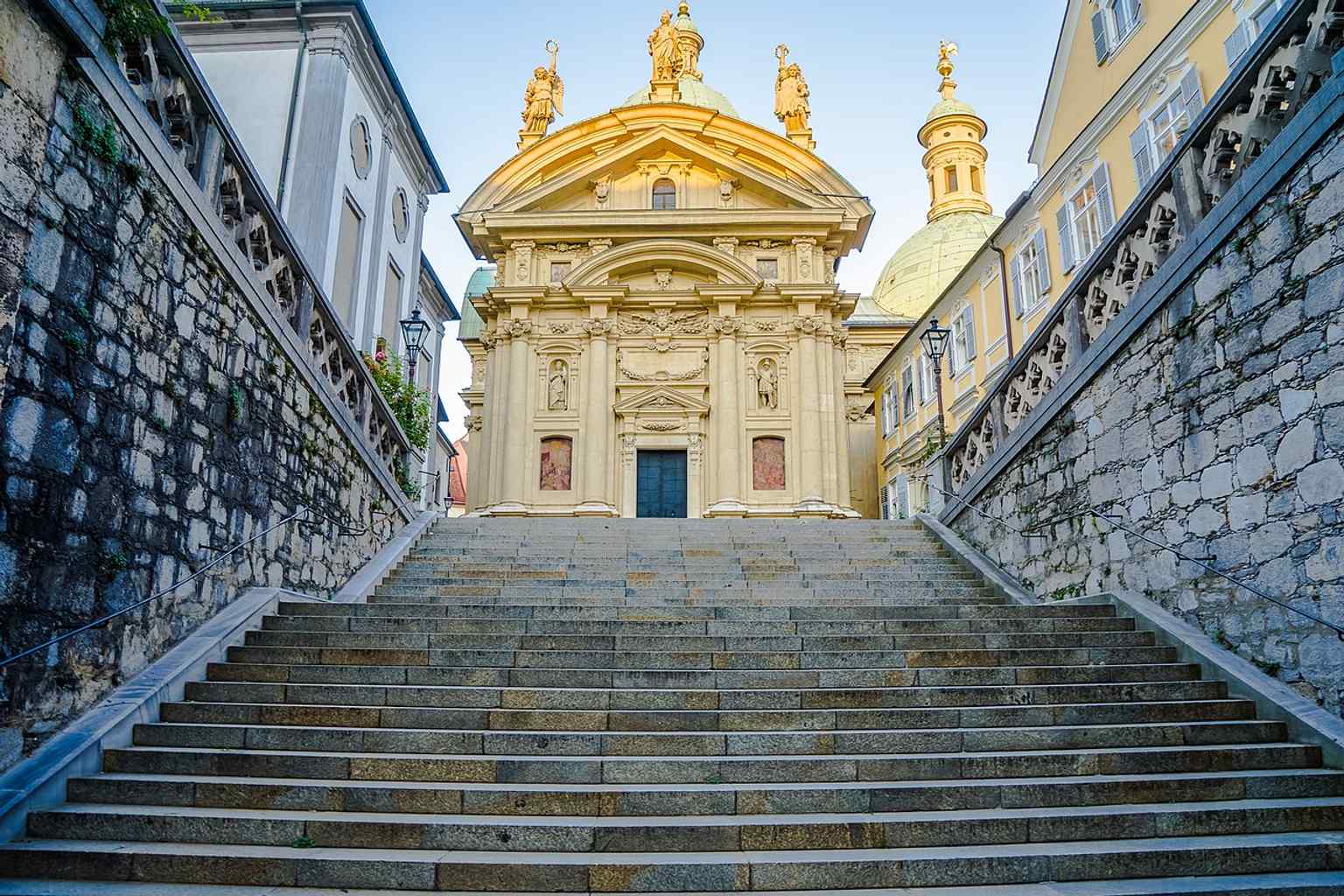
The staircase in warm evening light emphasizes the monumental entrance, leading up to one of Austria’s most important Mannerist church complexes.Photo: Petermeir, Wikimedia Commons, CC BY-SA 4.0. Cropped & resized. 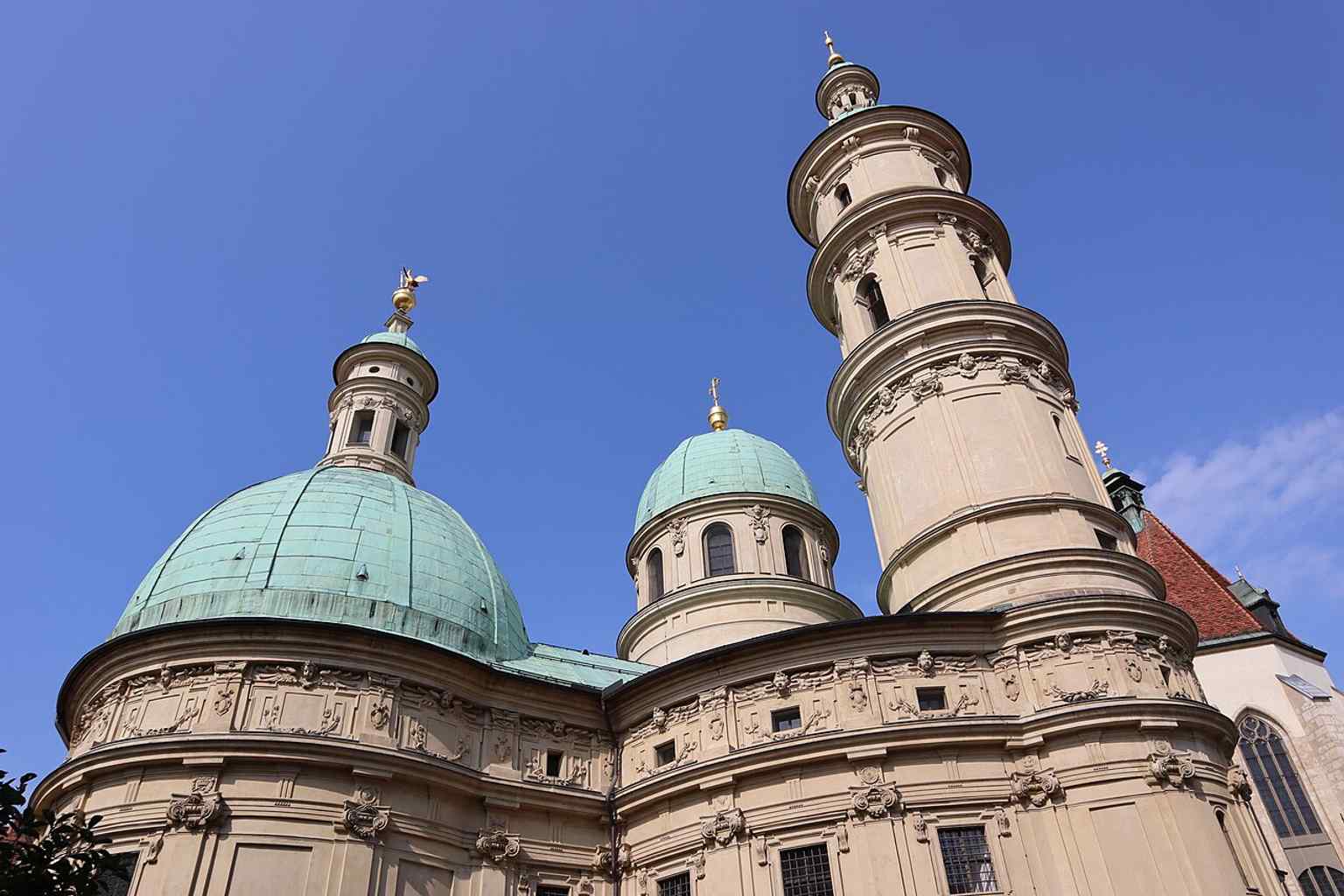
A front-facing exterior view that clearly shows the church façade and the attached mausoleum, useful for orienting visitors on the site.Photo: Anna Saini, Wikimedia Commons, CC BY-SA 4.0. Cropped & resized. 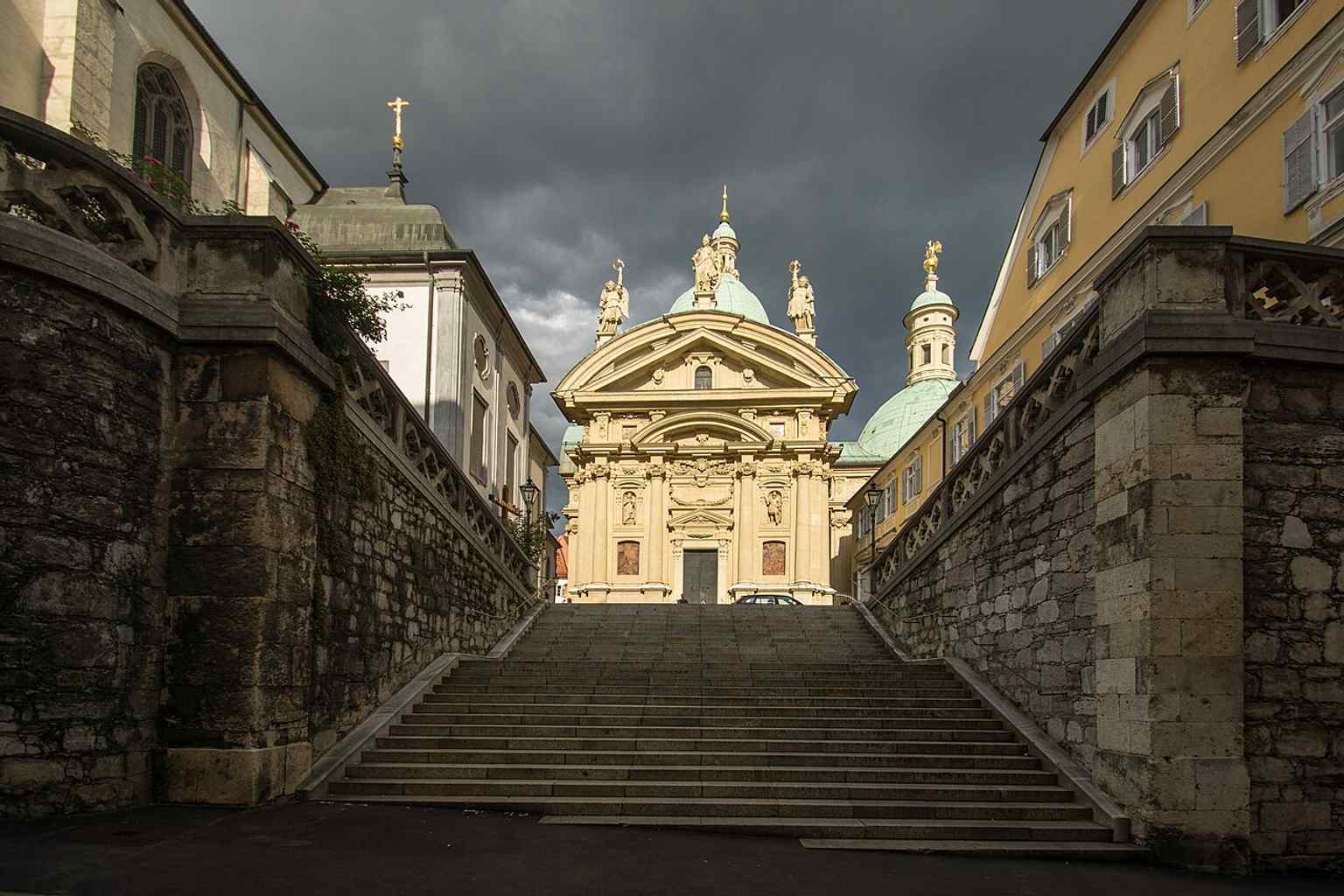
The entrance façade and stairway capture the building’s representative front, where Catholic and dynastic symbolism meets in stone.Photo: Pedro J Pacheco, Wikimedia Commons, CC BY-SA 3.0 at. Cropped & resized. 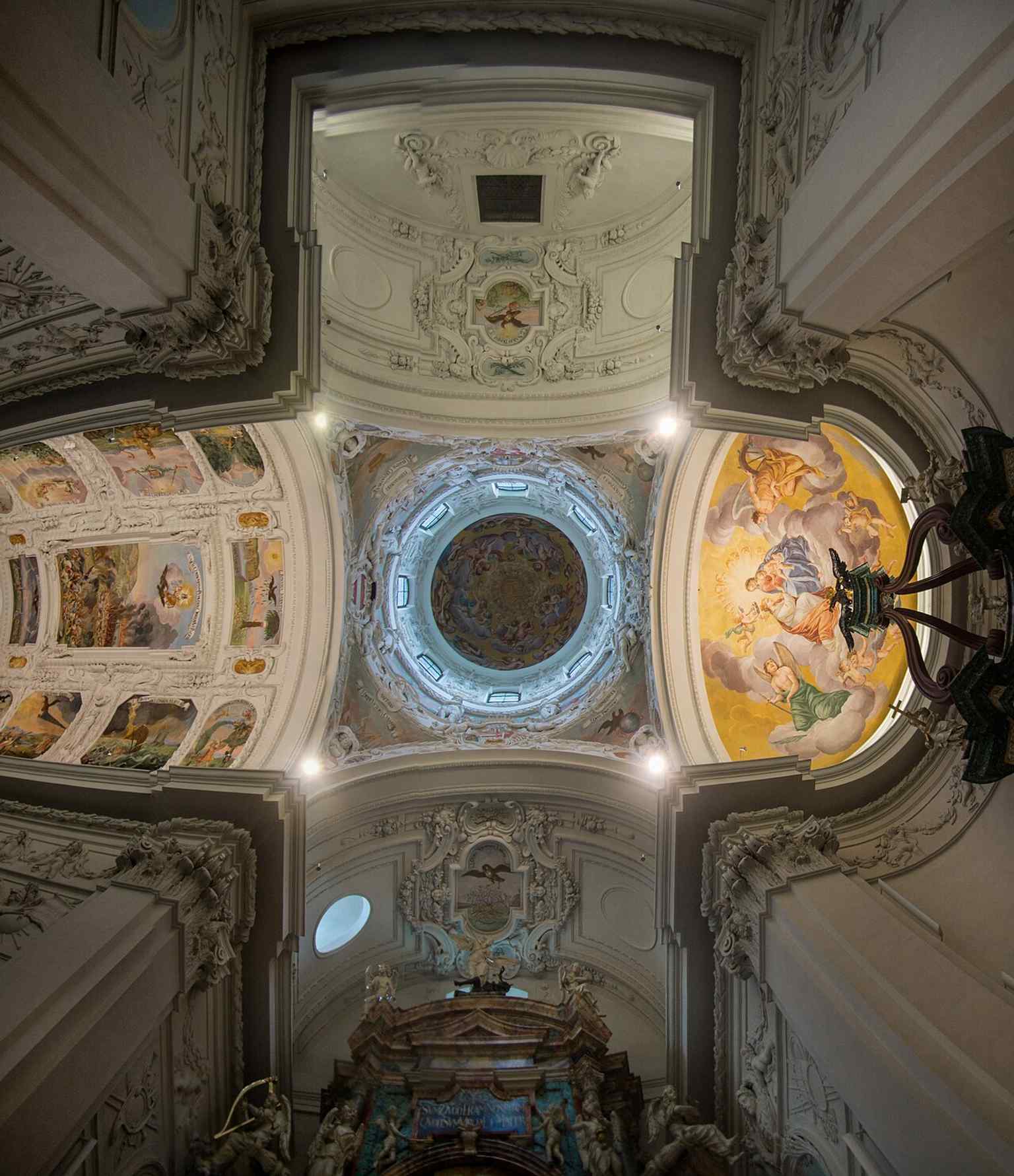
A close look at the dome roof, where the Mausoleum’s cupola once symbolized the Habsburg claim to imperial power.Photo: Pedro J Pacheco, Wikimedia Commons, CC BY-SA 3.0 at. Cropped & resized. On your right, look for the pale stone cathedral with its broad, solid Gothic body, a narrower choir braced by buttresses, and a richly carved west portal marked with imperial…Read moreShow less
Open dedicated page →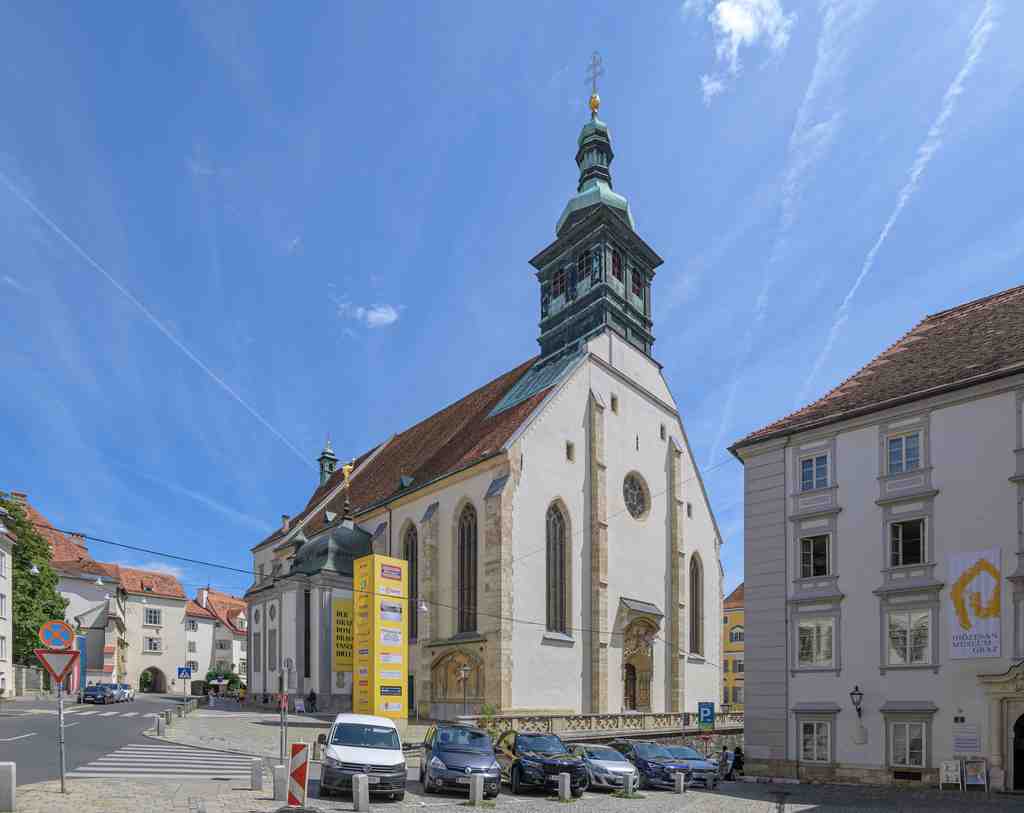
Graz CathedralPhoto: Isiwal, Wikimedia Commons, CC BY-SA 4.0. Cropped & resized. On your right, look for the pale stone cathedral with its broad, solid Gothic body, a narrower choir braced by buttresses, and a richly carved west portal marked with imperial symbols.
Graz Cathedral has a curious honesty about it. From out here, it looks stern, almost restrained, as if it prefers not to boast. And yet this is one of the most important artistic and historical buildings in Graz, and indeed in all of Styria. It stands on slightly raised ground, just beyond the line of the old medieval city, where planners once imagined it as a kind of church-fortress. That elevated setting still gives it a quiet authority.
The church is dedicated to Saint Aegidius, and a much older church stood here by at least the twelfth century. A document mentions it in the year eleven seventy-four, and Graz had a named parish priest by eleven eighty-one. But the building before you belongs to Emperor Frederick the Third. In fourteen thirty-eight, as he began work on the nearby castle, he also set this church in motion. His personal motto, A-E-I-O-U, appears here several times, carved or painted into the fabric of the place, along with dates that chart the work. The west portal carries fourteen fifty-six, and scholars generally take fourteen sixty-four as the year the cathedral reached completion.
Do have a look at that portal. It still speaks the language of Gothic craftsmanship: vertical, ceremonial, carefully layered. Above it, Frederick placed his A-E-I-O-U and a cluster of coats of arms, including the double-headed imperial eagle, Austria, Styria, and Portugal, a nod to his wife, Eleonore of Portugal. It is a small human touch in a very political façade.
What makes this cathedral especially fascinating is the contrast between outside and inside. The exterior is largely plain now, but it was once painted much more vividly. One of the few surviving traces is the famous plague fresco on the south wall, linked to the year fourteen eighty, when Graz suffered three calamities at once: plague, war, and locusts. The close-up view shows one of the surviving exterior frescoes more clearly than you can from here.
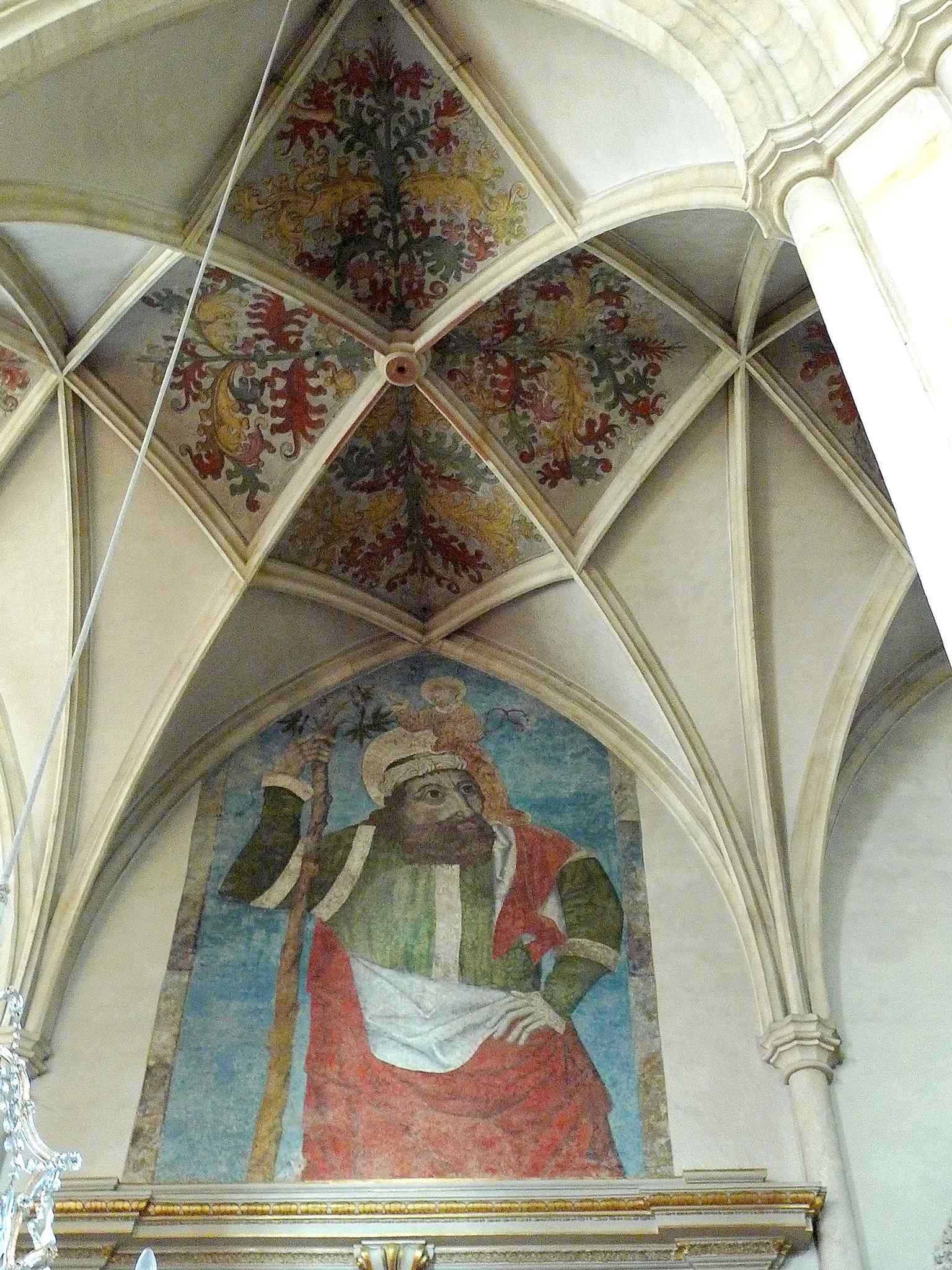
Saint Christopher fresco on the cathedral exterior, one of the few surviving traces of the building’s former painted façades.Photo: E.mil.mil (talk), Wikimedia Commons, CC BY-SA 3.0 at. Cropped & resized. The building did not remain frozen in Frederick’s age. The Jesuits took over in fifteen seventy-seven and reshaped the interior for the Catholic revival after the Reformation. They opened sightlines toward the high altar, added chapels, and filled the church with baroque drama. If you glance at the app, the high altar shows that change splendidly: Saint Aegidius stands at the centre, with the Coronation of Mary above, in a grand ensemble created in the seventeen thirties.
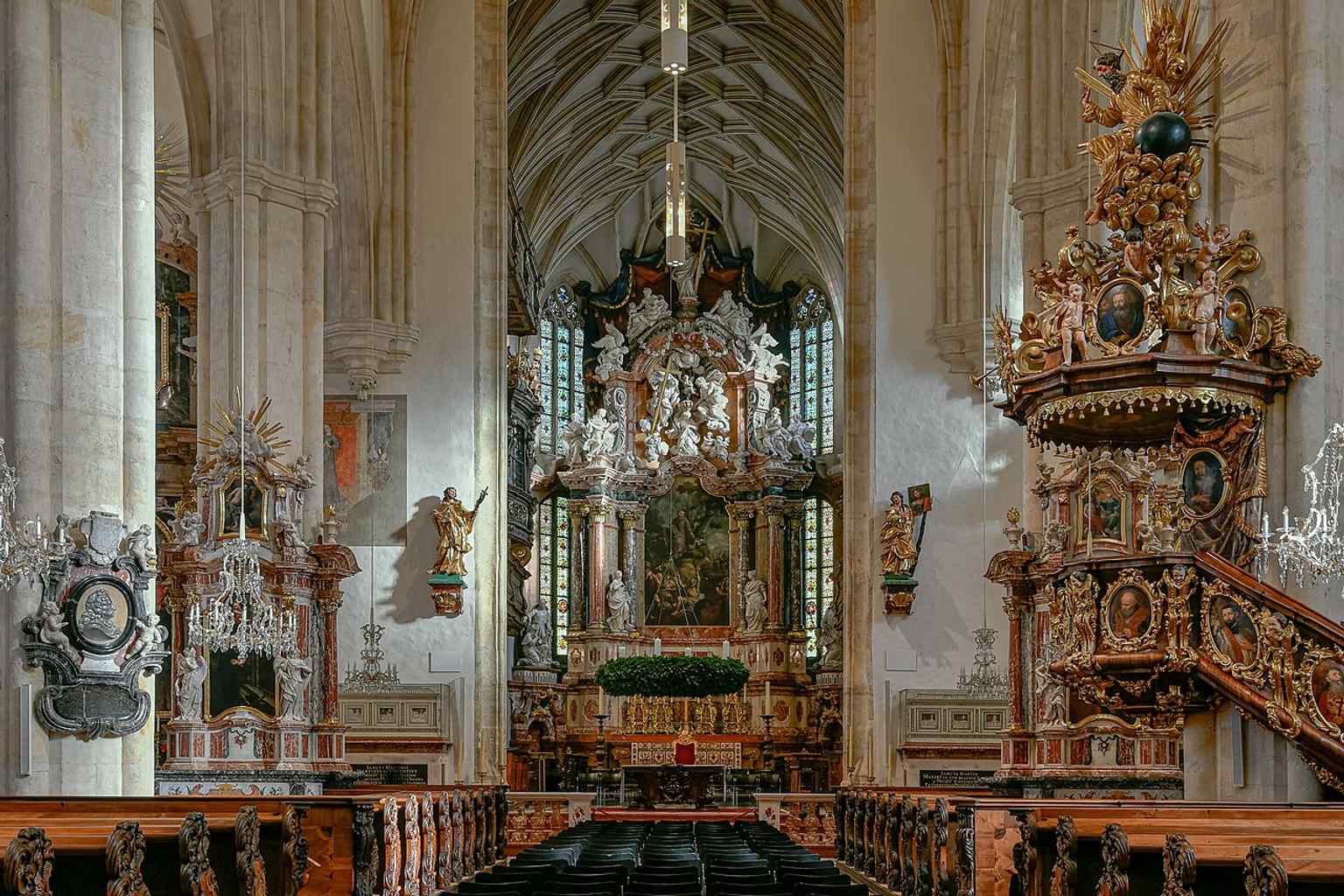
The baroque high altar, built in 1730–1733, with Saint Aegidius in the center and Mary’s coronation above.Photo: Isiwal, Wikimedia Commons, CC BY-SA 4.0. Cropped & resized. In seventeen eighty-six, when Graz became a bishop’s seat, this church rose to cathedral rank. More recently, a major restoration from twenty seventeen to twenty twenty-three renewed the building, completed the organ project, and refreshed the cathedral for another long chapter.
If you plan to step inside later, the cathedral generally opens from eight AM on most days, from eleven AM on Tuesdays, and closes in the early evening.
This cathedral is Graz at its most layered: imperial, Jesuit, episcopal, and quietly enduring. When you are ready, continue on toward the Schauspielhaus, where the city’s sacred gravity gives way to the drama of the stage.
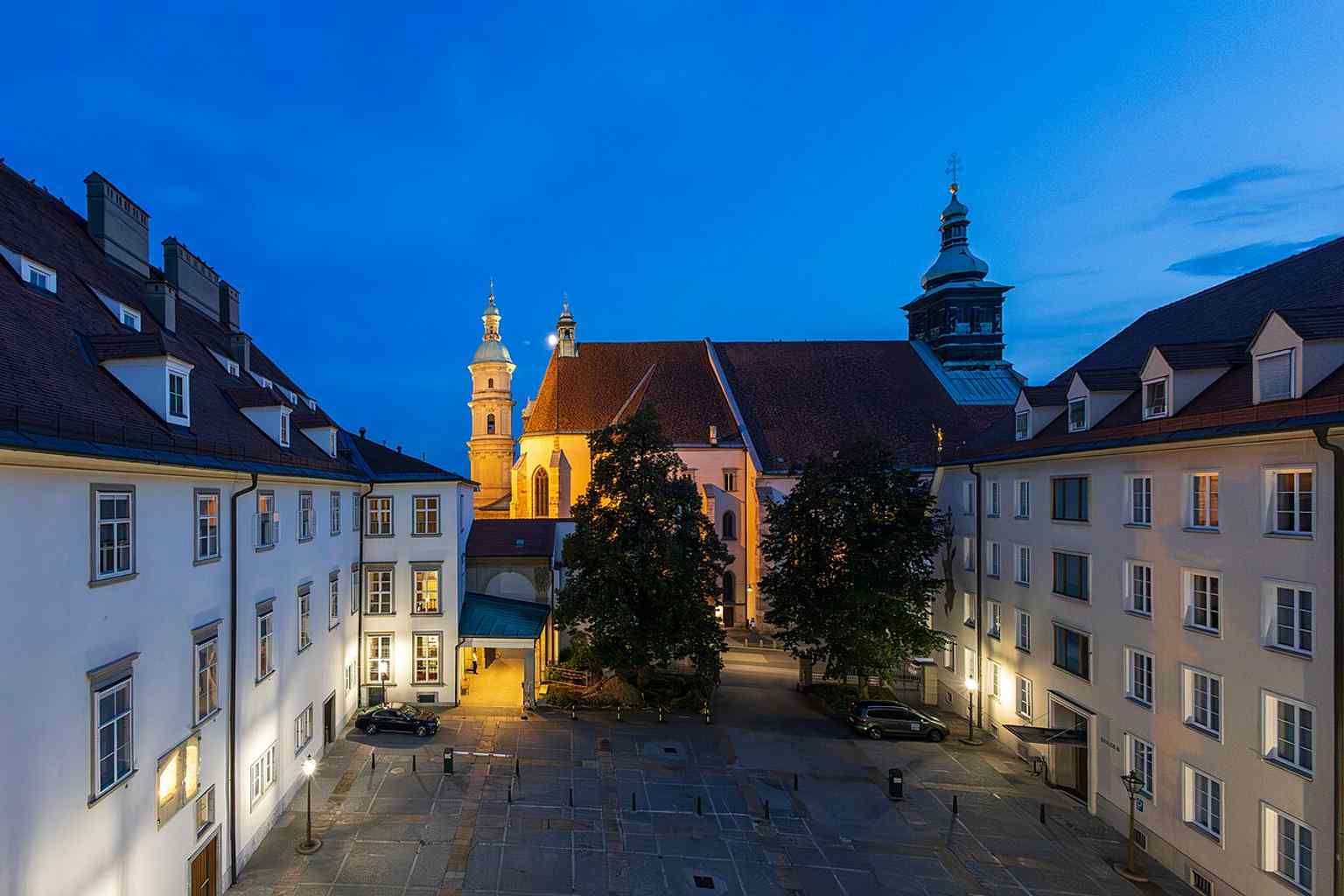
View from the Graz Castle toward the cathedral, showing how the Dom sits above the old city on elevated ground.Photo: Matthias Süßen, Wikimedia Commons, CC BY-SA 4.0. Cropped & resized. 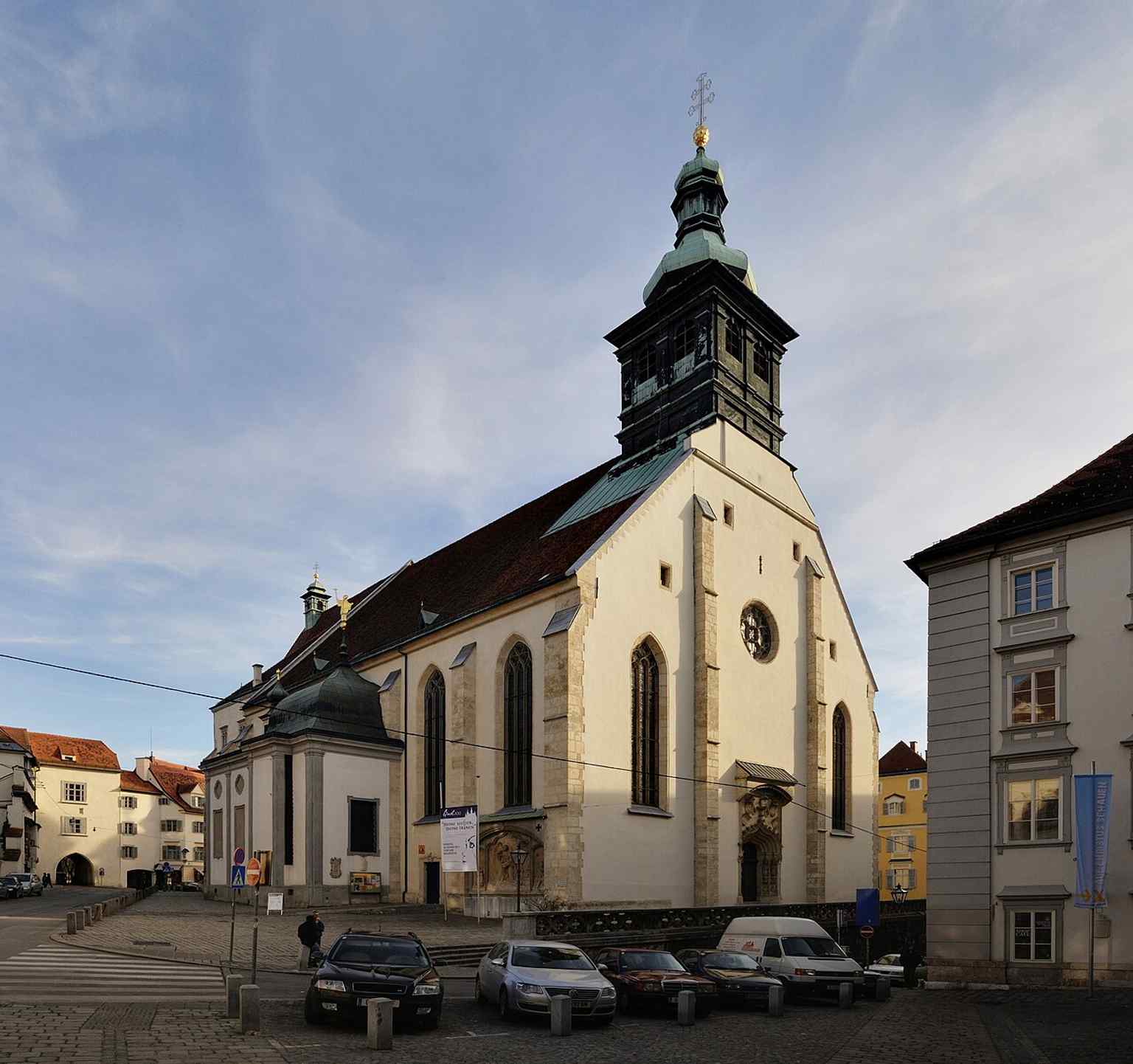
The cathedral’s broad, sober exterior in full view — a good introduction to the late Gothic church from 15th-century Graz.Photo: Taxiarchos228, Wikimedia Commons, CC BY 3.0. Cropped & resized. 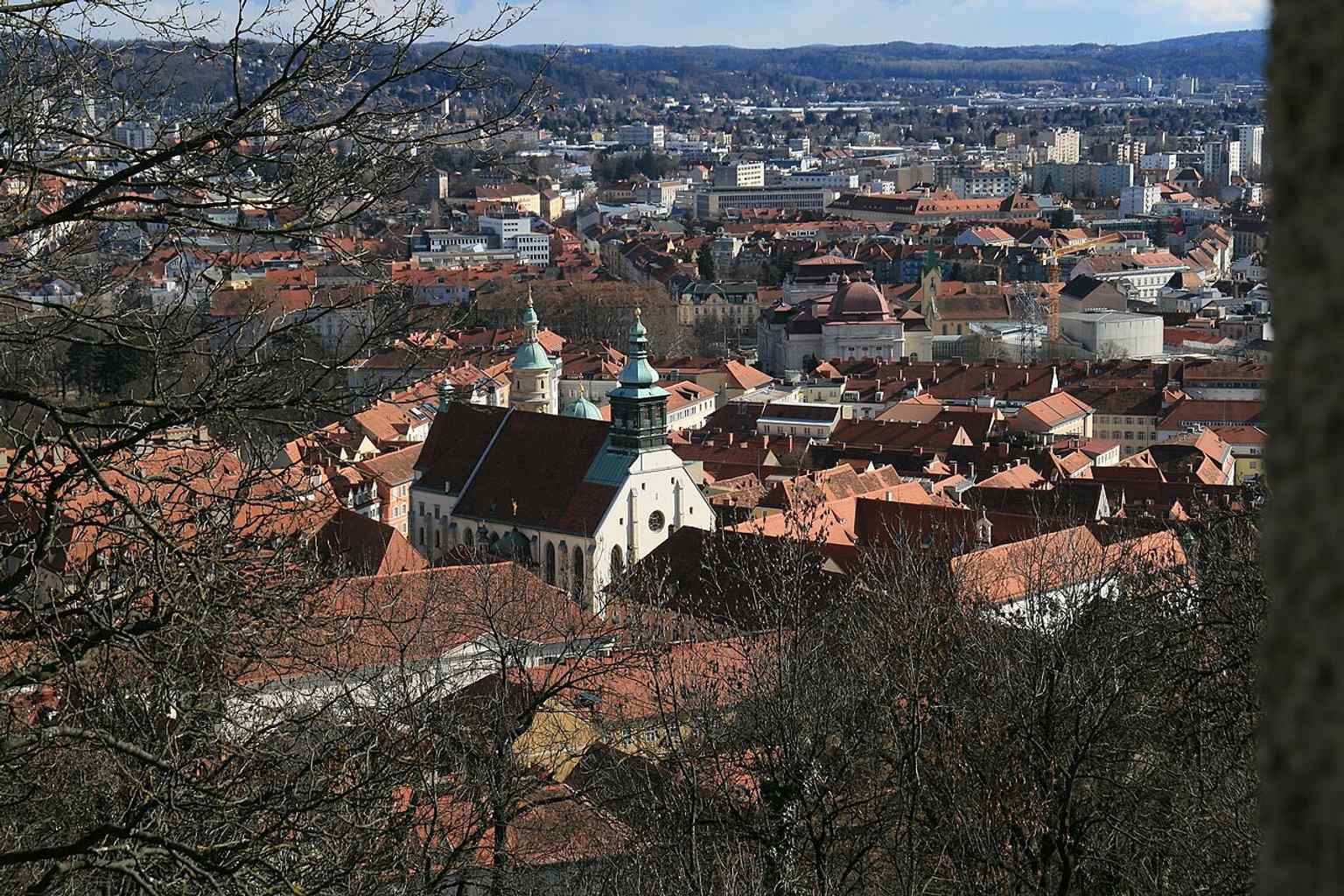
From Schloßberg, the cathedral appears beside St. Catherine’s Church and Ferdinand II’s mausoleum, part of Graz’s landmark ensemble.Photo: Manfred Werner - Tsui, Wikimedia Commons, CC BY-SA 3.0. Cropped & resized. 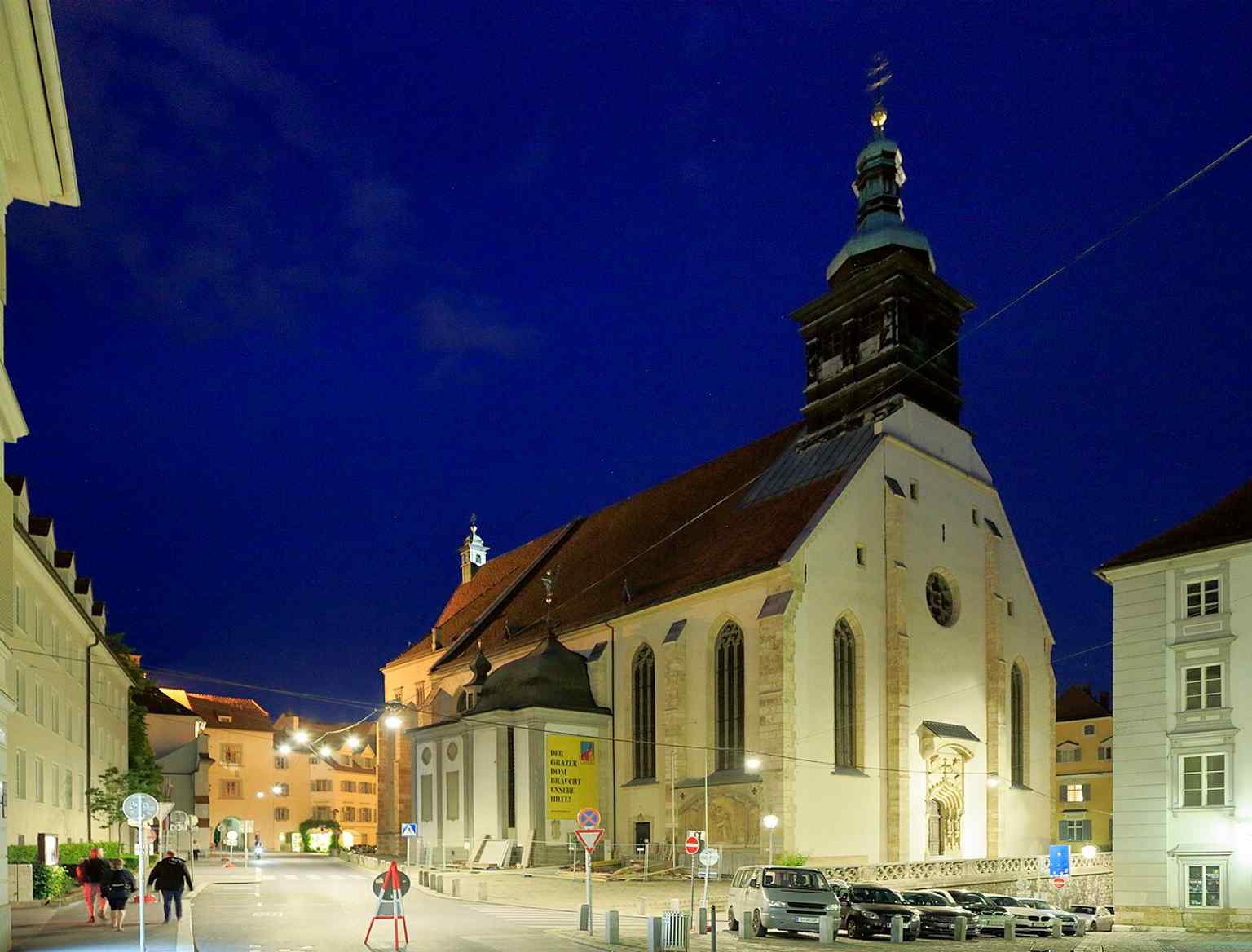
A dramatic street-level view from Hofgasse and Bürgergasse, where the cathedral rises from the historic center.Photo: Falk2, Wikimedia Commons, CC BY-SA 4.0. Cropped & resized. 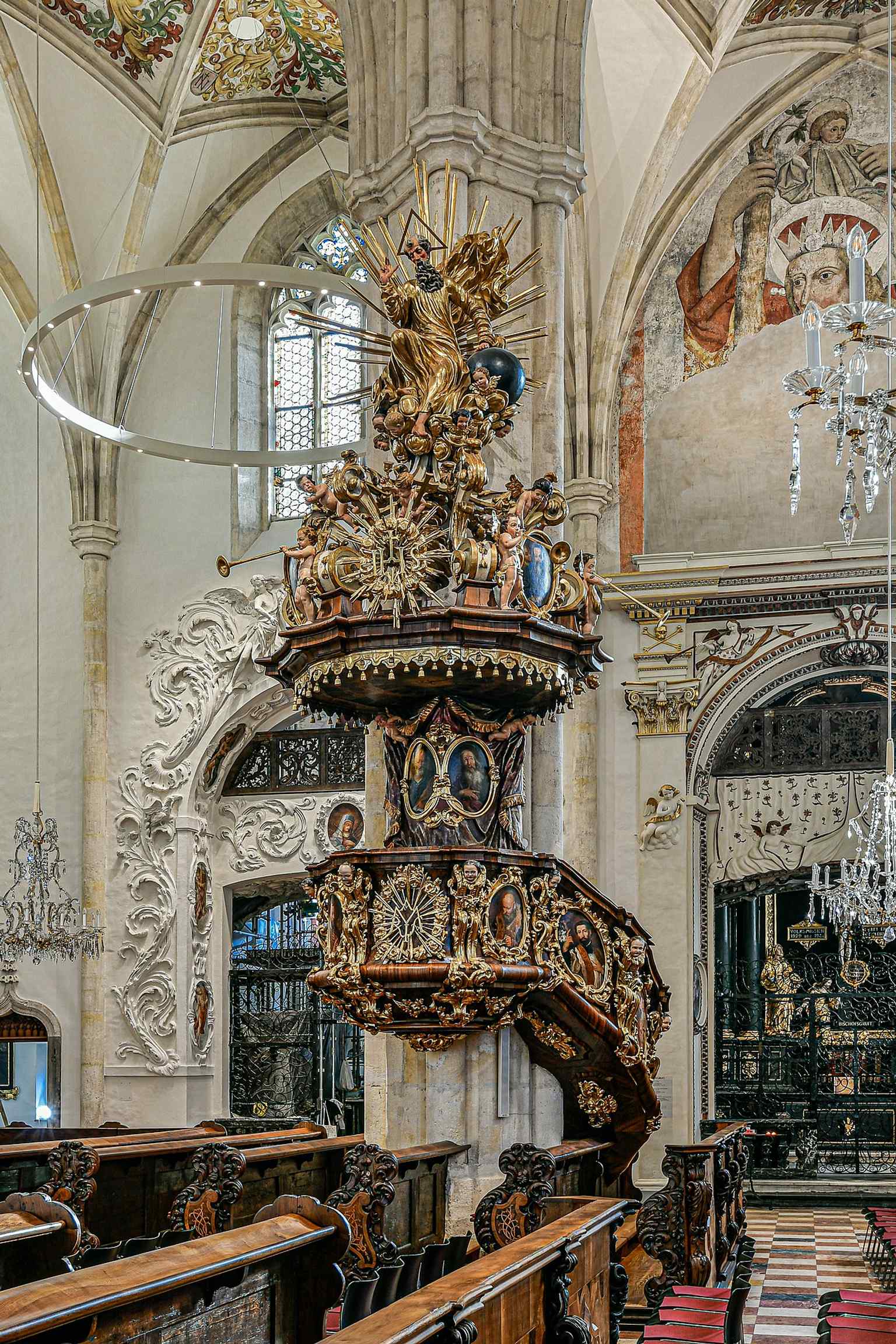
The ornate 1710 pulpit, a strong example of the Jesuit-era baroque interior that reshaped the cathedral.Photo: Isiwal, Wikimedia Commons, CC BY-SA 4.0. Cropped & resized. 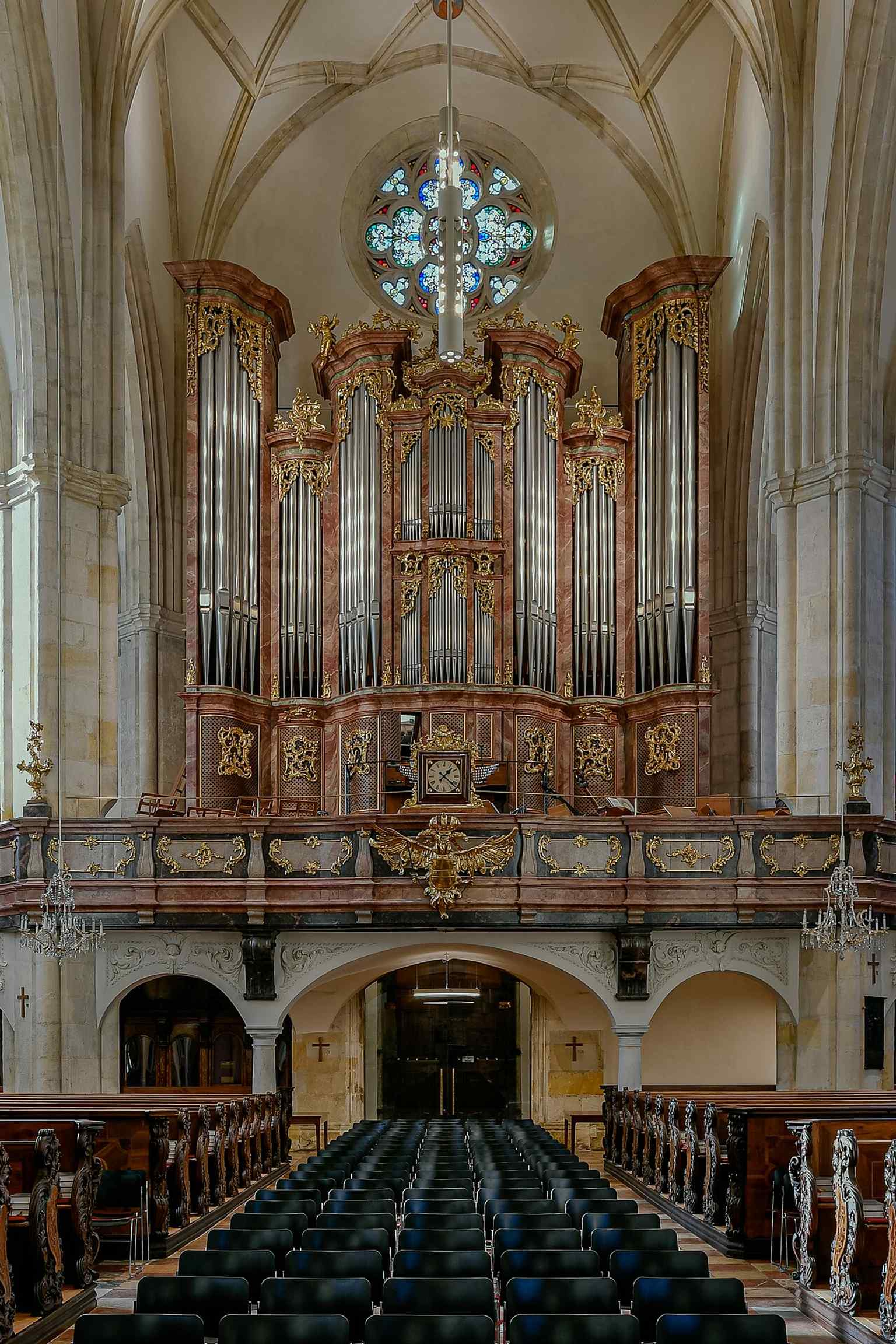
The west gallery and organ loft, where the 1687 baroque gallery now carries the rebuilt cathedral organ.Photo: Isiwal, Wikimedia Commons, CC BY-SA 4.0. Cropped & resized. 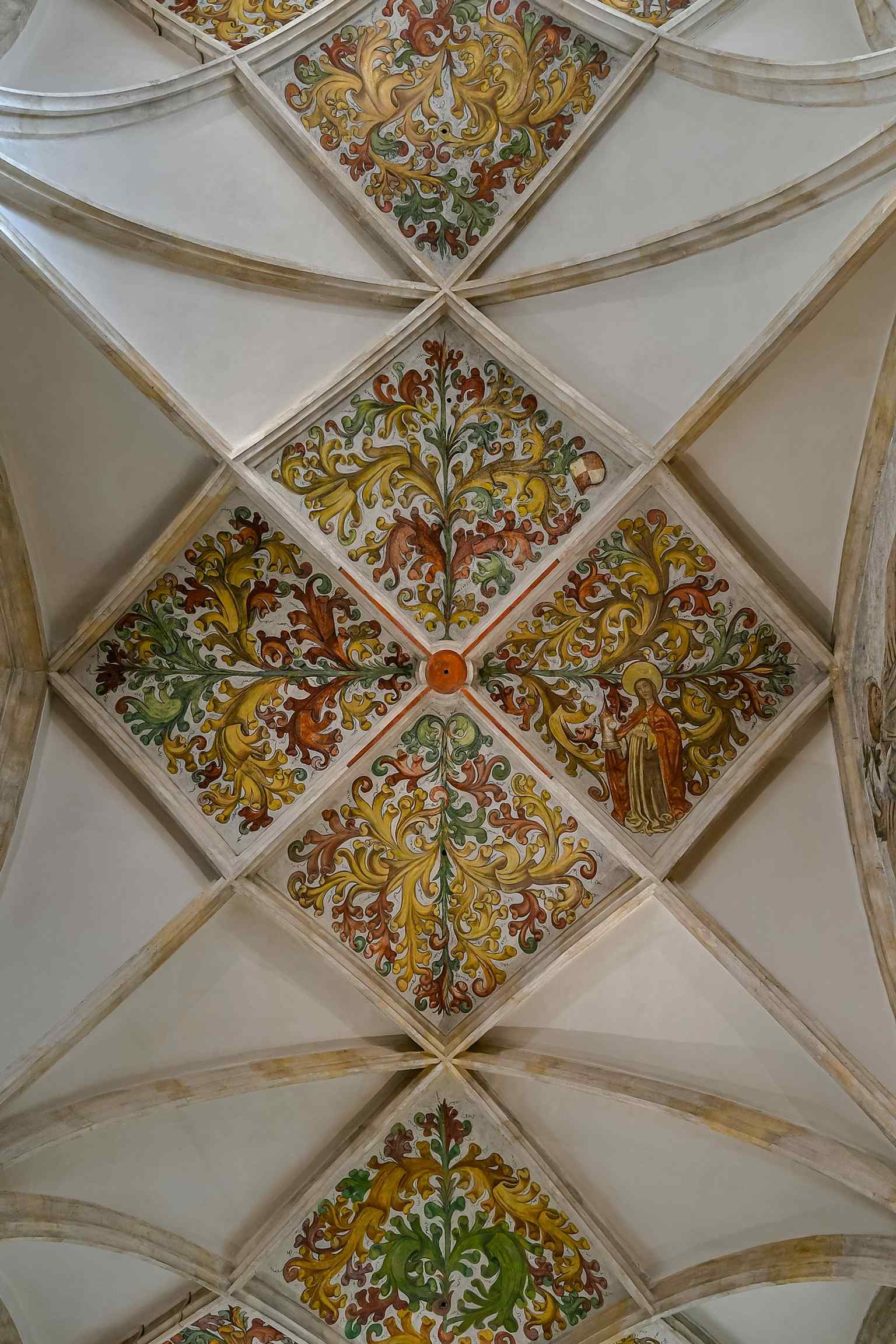
Late Gothic vault painting survives here: tendril and flower frescoes dated 1464 in the side aisle.Photo: Isiwal, Wikimedia Commons, CC BY-SA 4.0. Cropped & resized. 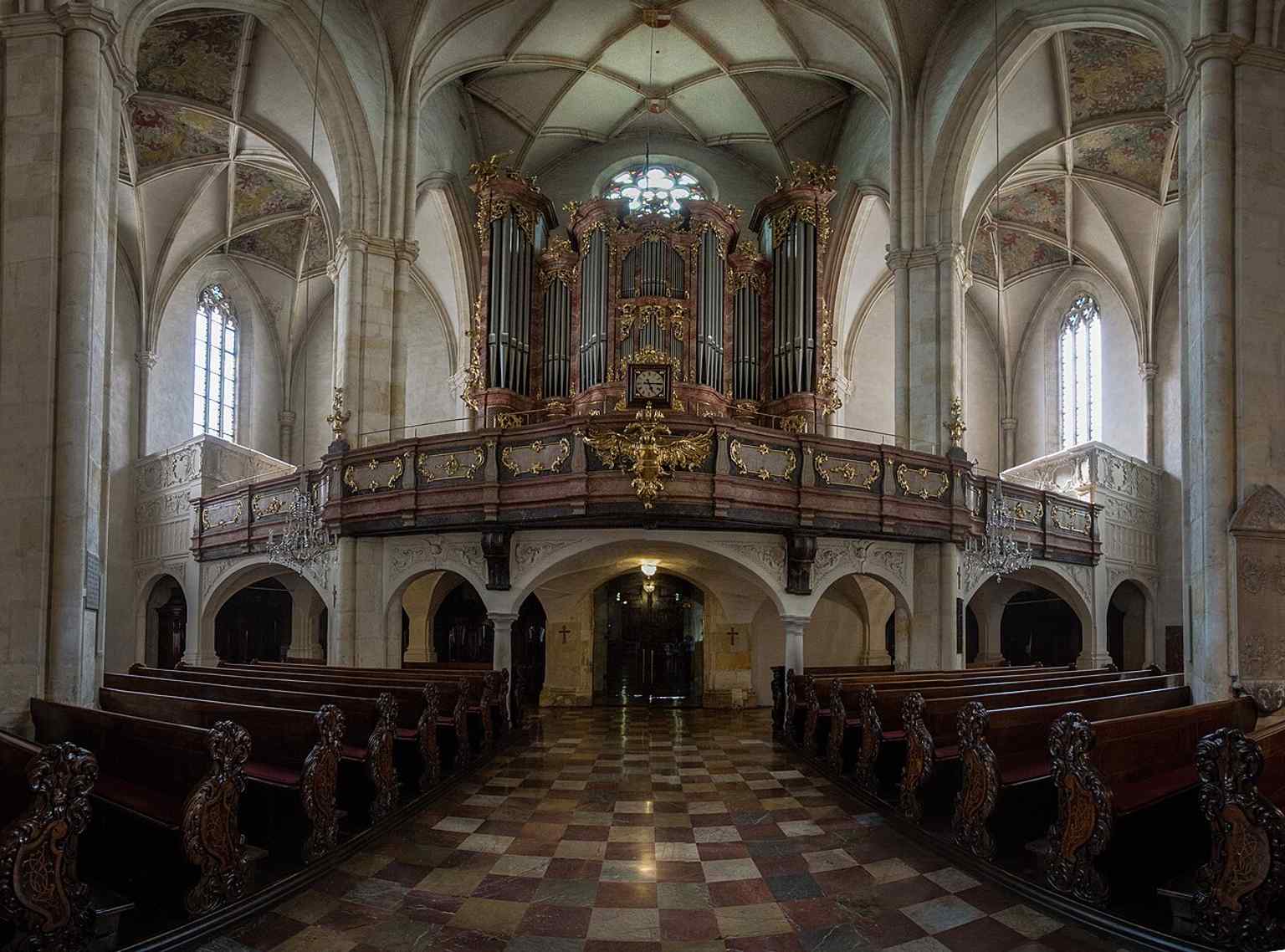
The cathedral organ in close-up, matching the major 2022–2023 rebuild that completed the recent renovation.Photo: Pedro J Pacheco, Wikimedia Commons, CC BY-SA 3.0 at. Cropped & resized. On your right stands a pale, three-storey classical theatre block, with rows of arches carried by pillars, a projecting balcony, and a dignified triangular crown above the main…Read moreShow less
Open dedicated page →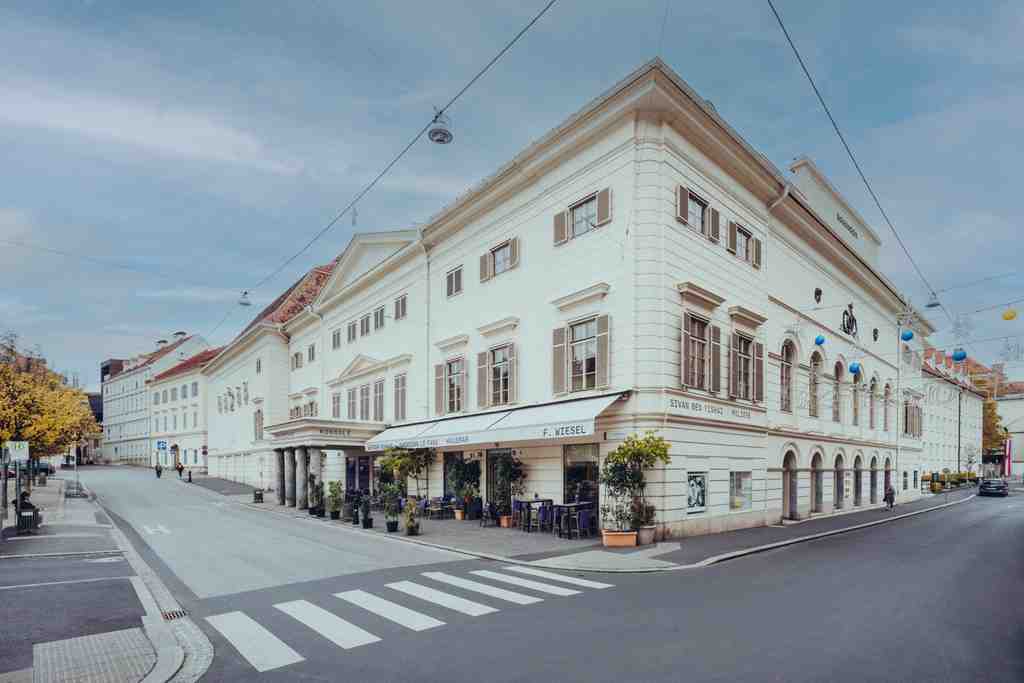
Schauspielhaus GrazPhoto: Grazschauspiel, Wikimedia Commons, CC BY-SA 4.0. Cropped & resized. On your right stands a pale, three-storey classical theatre block, with rows of arches carried by pillars, a projecting balcony, and a dignified triangular crown above the main front.
This is the Schauspielhaus Graz, the city’s great house of spoken theatre, and its story begins with a rather earnest argument. In seventeen seventy, Count Orsini and the police president urged the Styrian estates to support a proper theatre, declaring that well-ordered drama could teach morals, courtesy, and language. A fine ambition, and not entirely wrong. After financial delays, builders finally broke ground on the twenty-fourth of October, seventeen seventy-four, and Joseph Hueber designed the first theatre here. It opened on the ninth of September, seventeen seventy-six.
That first building faced Hofgasse more directly, with a long ten-window front, four entrance doors, and balconies above the door pairs. But the house did not pass quietly from century to century. In eighteen twenty-three, fire struck. The estates decided not to abandon theatre, but to rebuild it on the same site. Money, however, proved awkward in an age of inflation. They scraped funds together by selling the last provincial cannons stored in Trieste to the King of Naples, drawing on a spa fund from Rohitsch, and advancing money from the estates’ deposit fund. It is a wonderfully improvised way to rescue a stage: part artillery, part mineral water, part administrative courage.
The rebuilt theatre reopened on the fourth of October, eighteen twenty-five, the name day of Emperor Franz the First. Theatre director Stöger drew the plans, Peter von Nobile in Vienna refined them, Professor Meißner designed a warm-air heating system to reduce fire risk, and Adam Roller supplied the stage machinery. In other words, they treated the theatre as both a temple of art and a machine.
If you look closely at the building itself, you can still read that layered history. Along the Hofgasse side, cast-iron masks of comedy and tragedy sit beside a lyre, a neat declaration of purpose. On the Freiheitsplatz side, a building inscription recalls seventeen seventy-six, and five sandstone coats of arms commemorate the provincial patrons. If you open the exterior image in the app, you can see how the present façade still carries that restrained, late-classical confidence. The twentieth century brought another crisis. In nineteen fifty-three, authorities closed the theatre for structural safety reasons. Then, in nineteen sixty-four, Graz reopened it with Hamlet, starring Helmuth Lohner, after preserving the historic shell and adding a new stage house. Since then, the Schauspielhaus has remained devoted to spoken drama. Today it works not only with the main stage, House One, with about five hundred and forty seats, but also with smaller venues, including House Two and House Three. House Three, shown here, makes this theatre feel wonderfully intimate when it wants to whisper rather than proclaim. More recently, the house has kept one foot in tradition and the other in experiment. Under Andrea Vilter’s leadership, beginning in the twenty twenty-three to twenty twenty-four season, it has brought research into the repertoire, revived neglected women playwrights, and earned fresh recognition, including a Nestroy Prize for Von einem Frauenzimmer in twenty twenty-four.
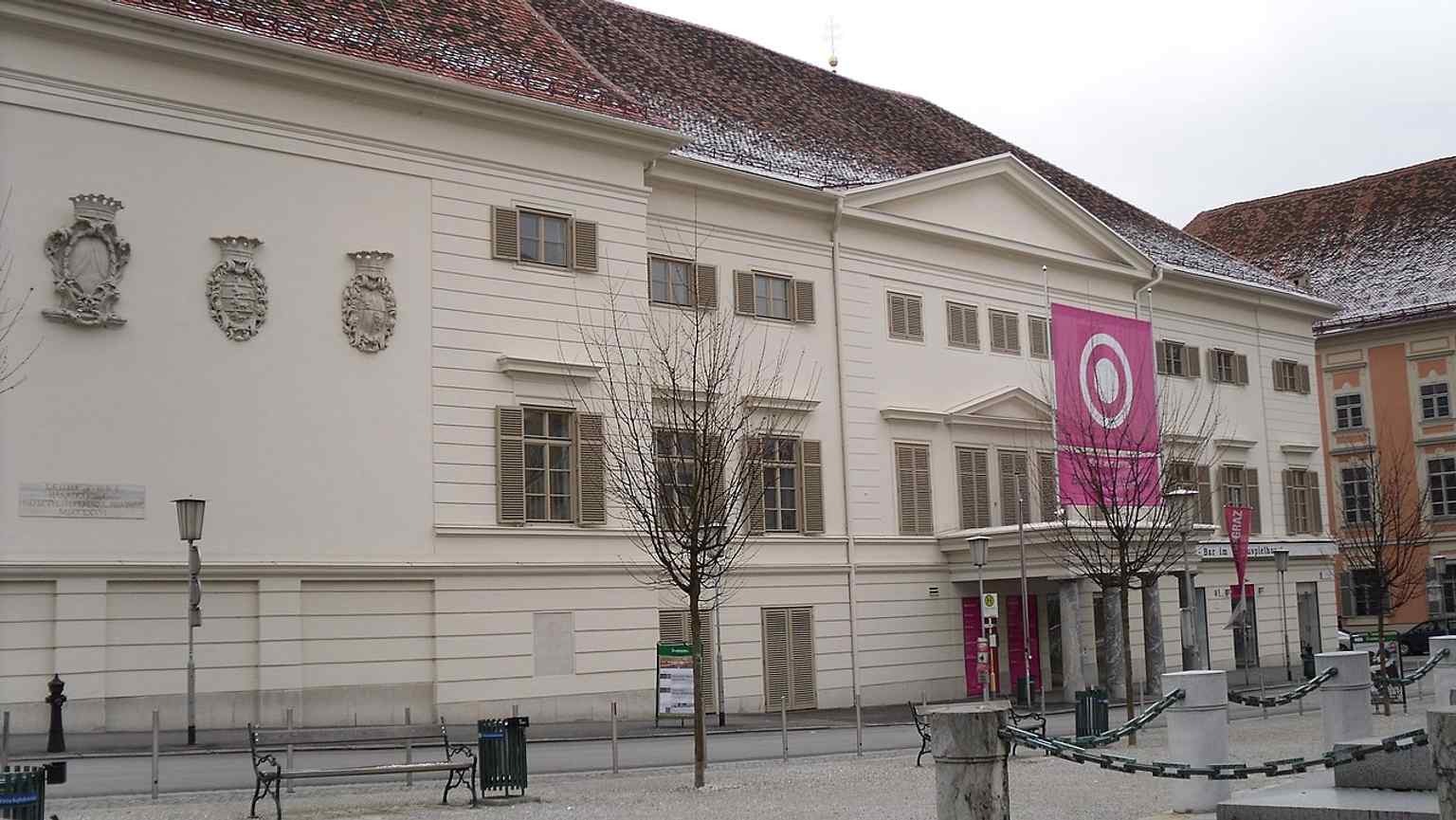
The main façade of the Schauspielhaus Graz, the historic theatre that was rebuilt after the 1823 fire and later renamed after World War I.Photo: Seha bs, Wikimedia Commons, CC BY 3.0. Cropped & resized. If you plan to return indoors, the theatre is generally open from nine in the morning until eleven thirty at night from Monday to Saturday, and closed on Sunday.
This theatre has survived fire, reinvention, and changing tastes because Graz never stopped believing that words spoken on a stage still matter.
When you are ready, continue on toward Forum Stadtpark, where the city’s cultural pulse grows a little more restless.
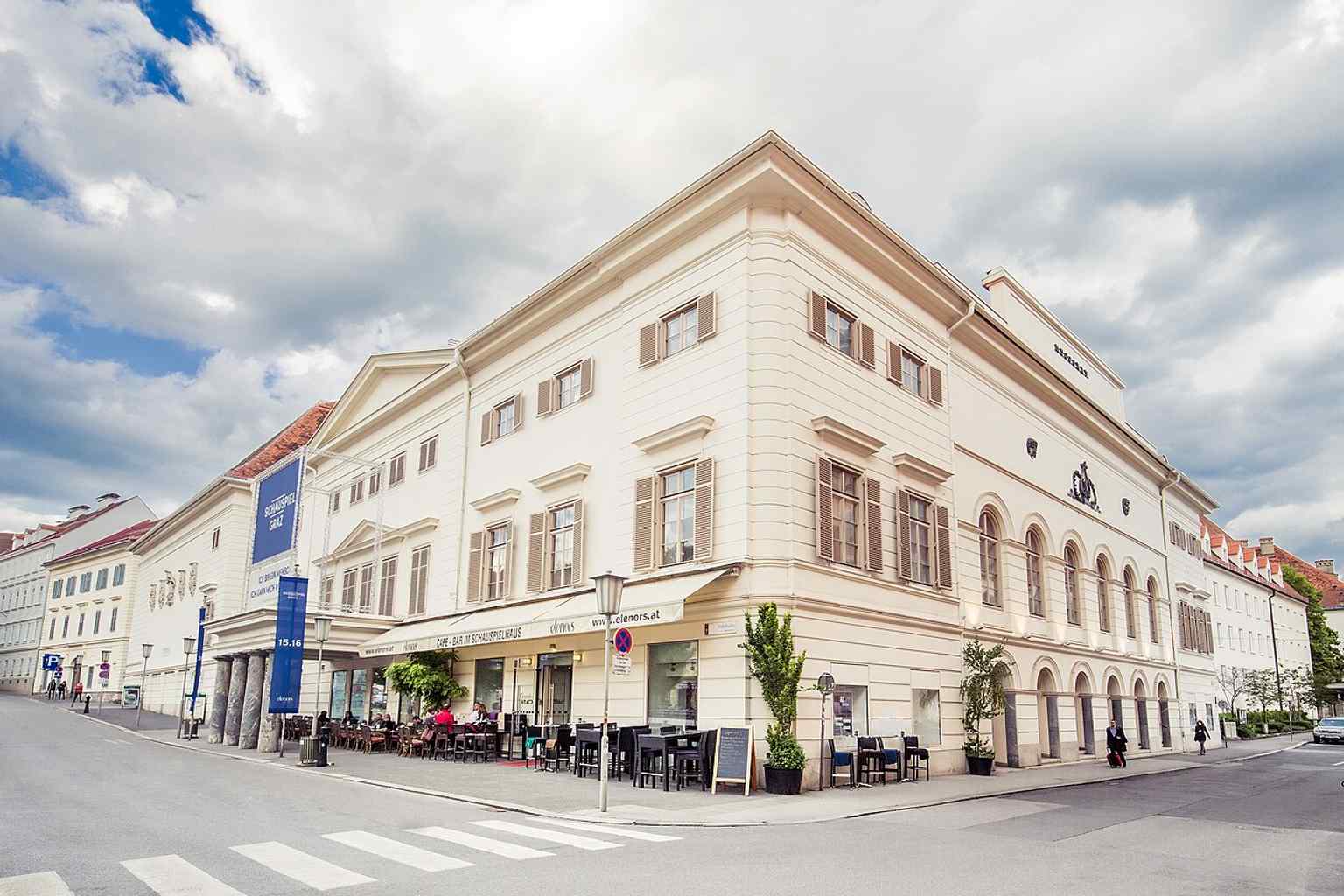
A clear modern view of the theatre’s exterior, linking today’s building to its long history on Freiheitsplatz and Hofgasse.Photo: Lupi Spuma, Wikimedia Commons, CC BY-SA 4.0. Cropped & resized. 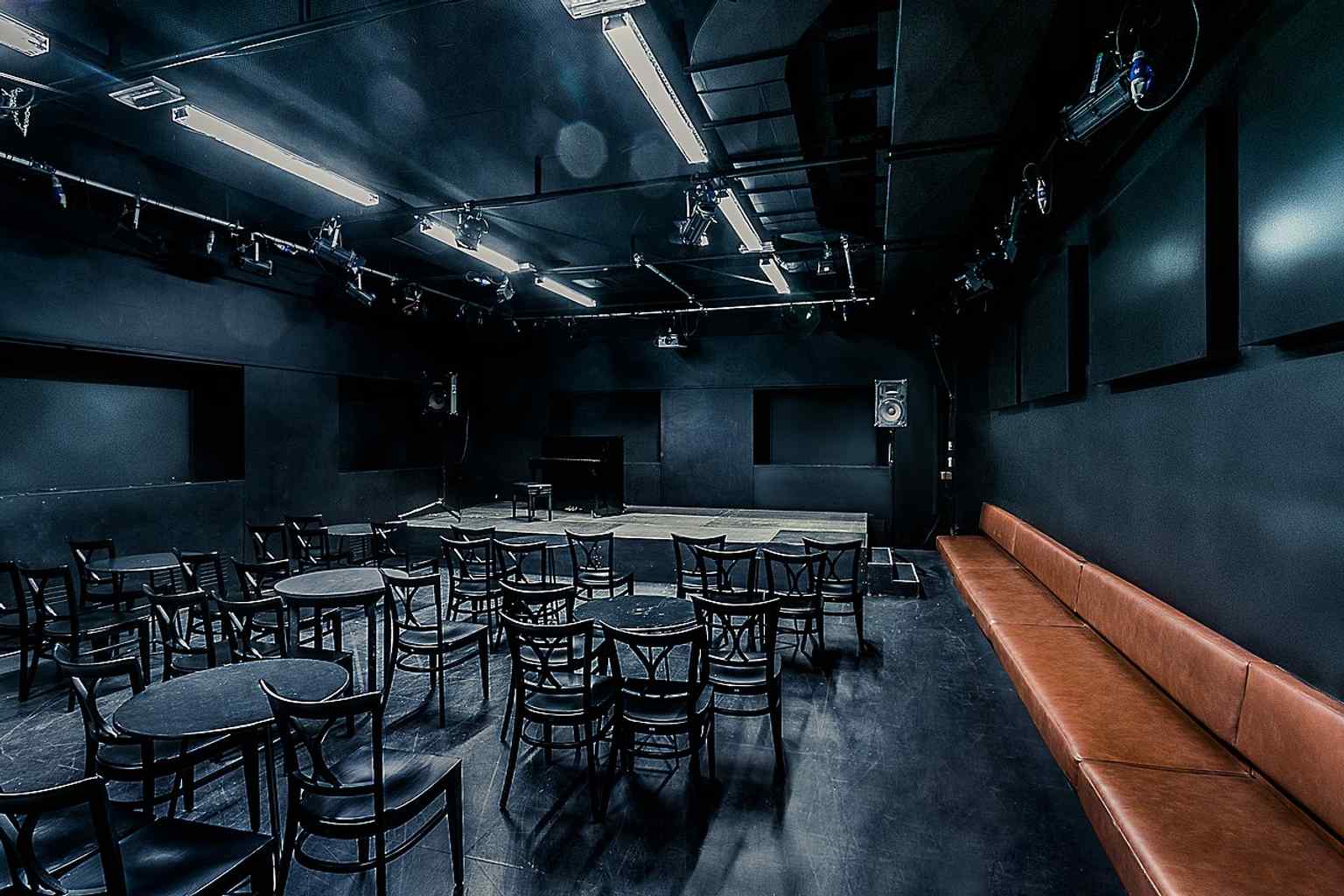
House Three, one of the smaller performance spaces in the Schauspielhaus Graz, showing how the theatre now uses multiple stages.Photo: Lupi Spuma, Wikimedia Commons, CC BY-SA 4.0. Cropped & resized. 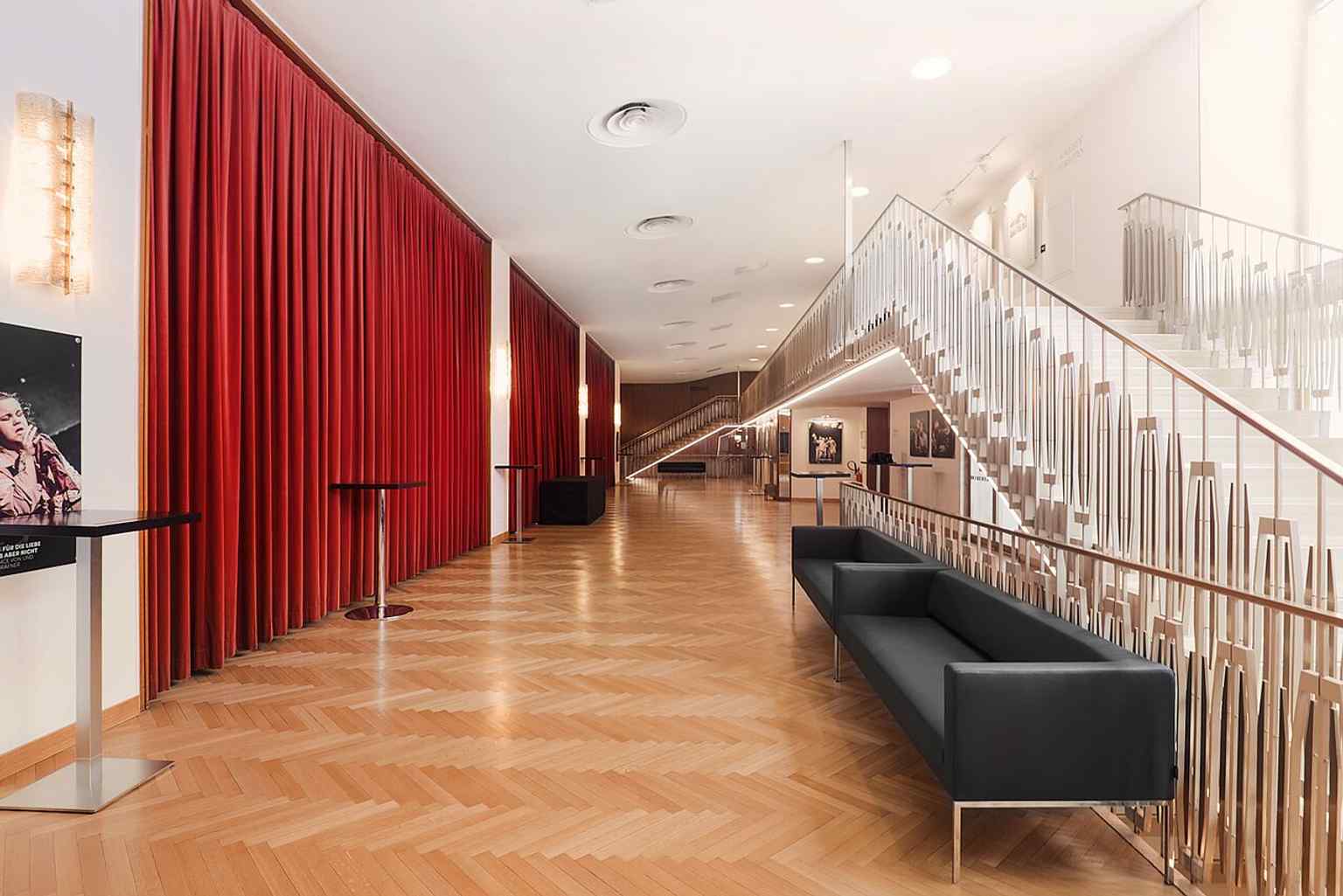
The first-floor foyer, part of the renewed public areas updated during the major refurbishments around 1999 and 2000.Photo: Lupi Spuma, Wikimedia Commons, CC BY-SA 4.0. Cropped & resized. 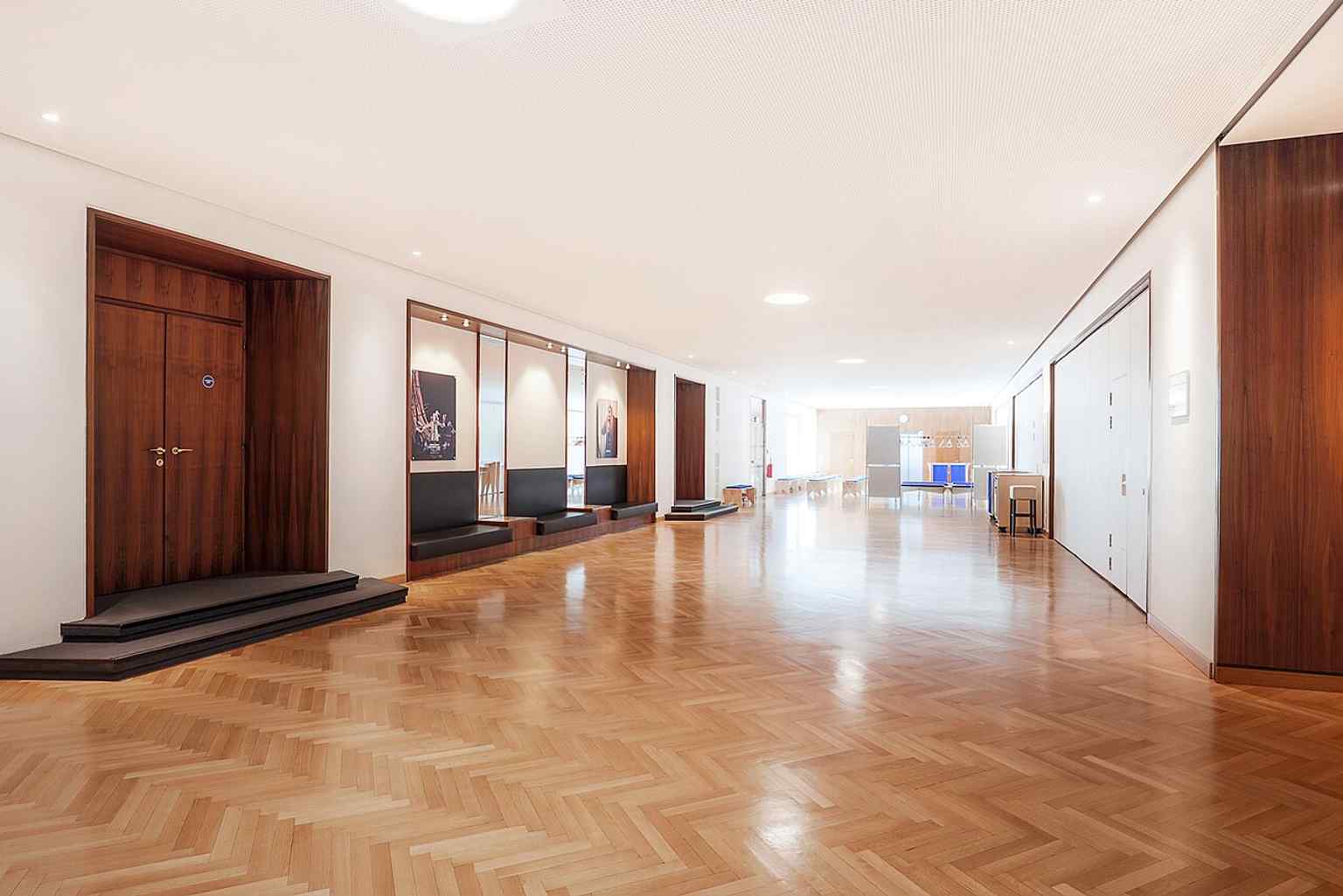
The third-floor foyer, a good view of the theatre’s layered interior circulation spaces and modern audience areas.Photo: Lupi Spuma, Wikimedia Commons, CC BY-SA 4.0. Cropped & resized. 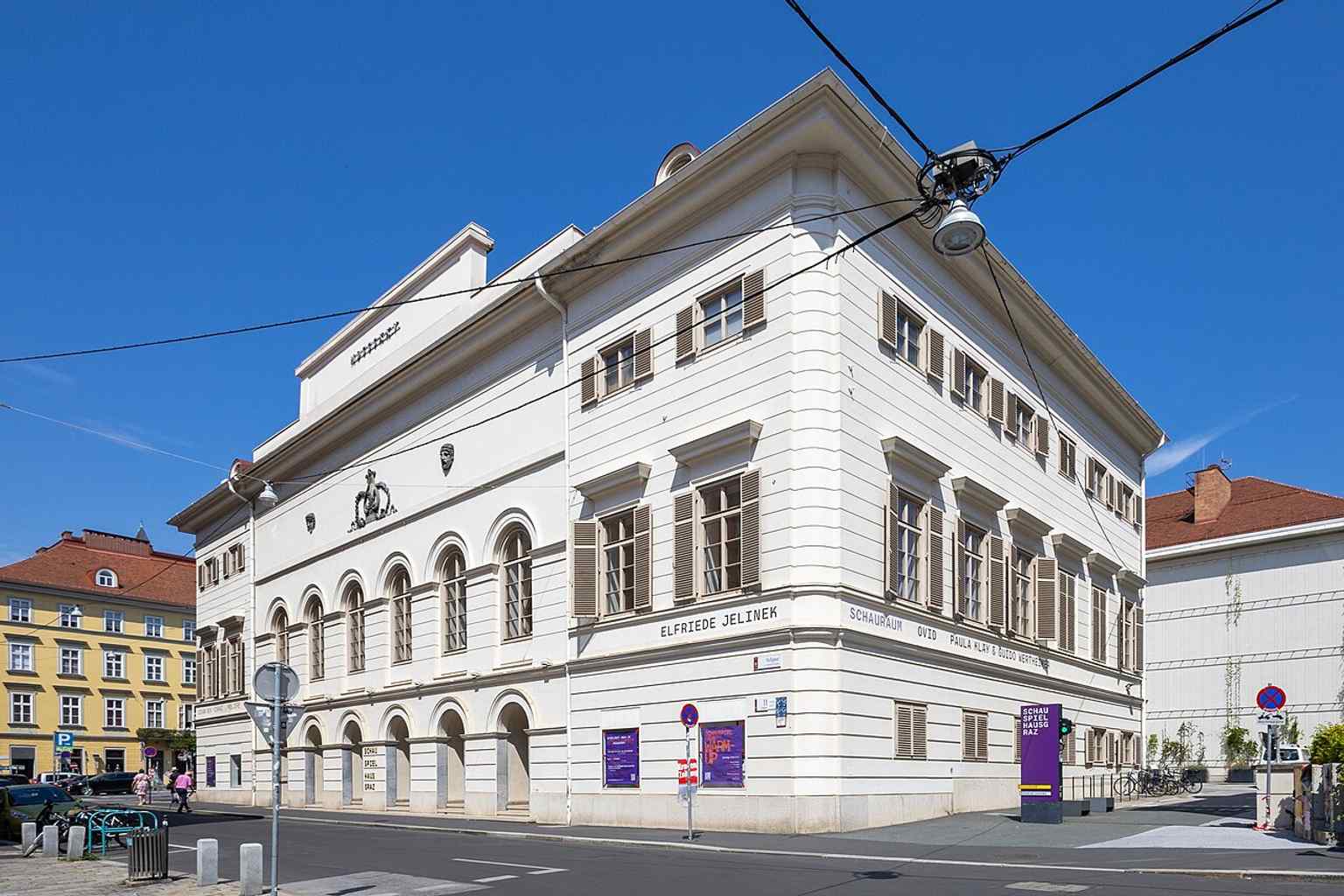
A 2024 interior view from the Schauspielhaus Graz, reflecting the theatre’s current artistic life under Andrea Vilter’s leadership.Photo: Matthias Süßen, Wikimedia Commons, CC BY-SA 4.0. Cropped & resized. Look for a low, pale building with a long T-shaped body, crowned by a bright white upper storey of steel and horizontal slats that projects slightly beyond the older base. Forum…Read moreShow less
Open dedicated page →Look for a low, pale building with a long T-shaped body, crowned by a bright white upper storey of steel and horizontal slats that projects slightly beyond the older base.
Forum Stadtpark is not simply a building. It is an argument, carried on for decades, about who art belongs to and what it ought to do.
The story begins in the summer of nineteen fifty-eight, when a small group of Graz artists asked the city for space. They wanted this empty park café as a permanent home for exhibitions and events. The city first said no and even decided to demolish the place. That might have been the end of it, but the press objected, politicians joined in, and several artists’ groups pushed back. The city granted a deadline to raise the money, the supporters managed it, and on the fifteenth of January, nineteen fifty-nine, the association formally came into being. By November nineteen sixty, the house opened with an exhibition called Bekenntnis und Konfrontation, or Confession and Confrontation. A bold title, and quite an honest one.
From the beginning, the Forum worked across disciplines. Writers, architects, painters, musicians and scientists all rubbed shoulders here. That word “interdisciplinary” simply means people from different fields thinking and making things together, rather than staying in tidy little boxes. The Forum still believes contemporary art should not hide from public life. It should meet social questions head on, draw energy from friction, and answer with ideas, images, sound and performance.
The scene in the park presents the building as a deliberate cultural marker rather than a grand monument. That is part of its character. The park has carried a building ban since eighteen sixty-seven, so when the house needed more room, it could not spread outward. During the major rebuilding around two thousand, the architects kept the T-shaped plan and added an upper level instead. That white top section, with its steel frame and horizontal slats, became a kind of sign: open, modern, slightly restless.
A view from Graz’s Stadtpark, placing Forum Stadtpark in its original setting beside the park and the historic Uhrturm backdrop.Photo: Trainimal, Wikimedia Commons, CC BY-SA 4.0. Cropped & resized. Inside, this place has served as exhibition hall, concert venue, theatre, cinema, lecture room, club and debate chamber. In nineteen seventy-five, Xao Seffcheque and Carl Lugus started the Musiclub in the basement, giving local and international musicians a stage. The Forum also helped launch the avant-garde festival Steirischer Herbst, and its literature section gave birth to the journal manuskripte, which grew into one of the important literary magazines in the German-speaking world.
There was a period in the nineteen sixties and seventies when the house gained a rather elite reputation, a stronghold for progressive art and literature. Then, in the nineteen nineties, the leadership deliberately reopened it to younger artists and fresher ideas. Today it still runs as an independent association, with around one hundred and fifty to two hundred events a year, many of them free, and with a clear concern not only for art itself but for the conditions behind it: who gets heard, who gets paid, and how creative work is actually sustained.
If you want to come back inside, the house is usually open Tuesday to Friday from ten in the morning until three in the afternoon, and closed on Monday, Saturday and Sunday. Forum Stadtpark reminds Graz that culture is often strongest when it stays curious, unruly and hospitable. When you are ready, continue into the park itself, where the city’s quieter voice begins to speak.
Ahead of you stretches a broad park of curving gravel paths and double tree-lined avenues, with the dark cast-iron Stadtpark fountain standing out as its most distinctive…Read moreShow less
Open dedicated page →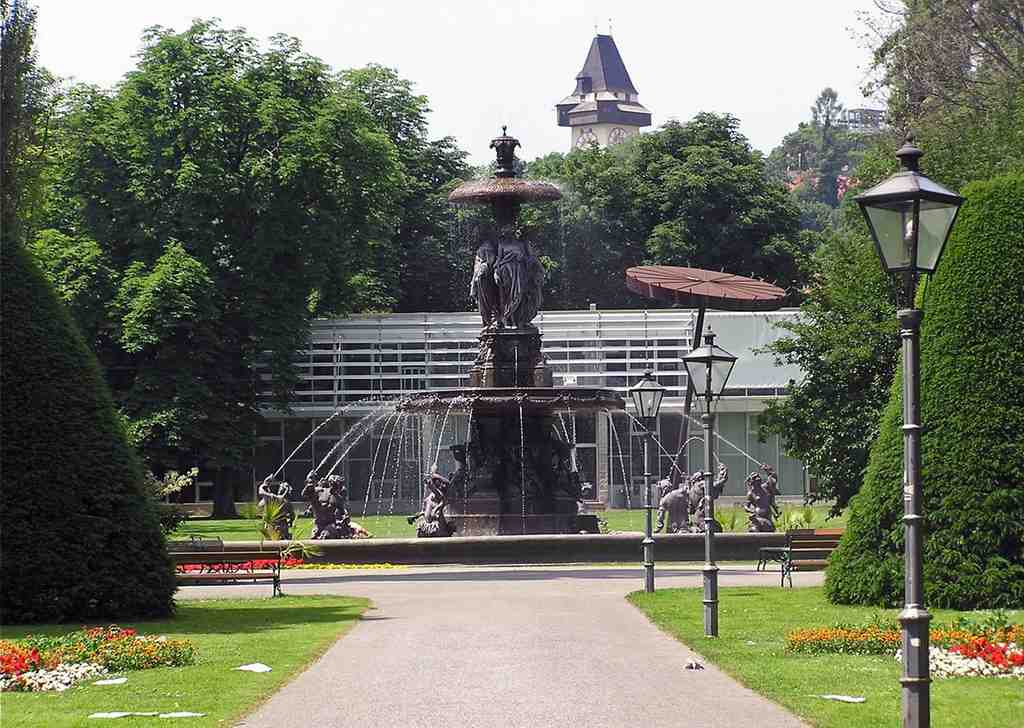
Graz City ParkPhoto: gugganij, Wikimedia Commons, CC BY-SA 3.0. Cropped & resized. Ahead of you stretches a broad park of curving gravel paths and double tree-lined avenues, with the dark cast-iron Stadtpark fountain standing out as its most distinctive marker.
Graz City Park looks gentle now, but it began as something rather stern. Until the late nineteenth century, this ground formed the glacis - the open, cleared strip in front of the city walls where soldiers needed an unobstructed view. In eighteen sixty-eight, after years of negotiation, Graz finally struck a land swap with the military administration. The city took over about twelve point six hectares of this obsolete defensive land, and the military received the Feliferhof as a shooting ground, a deal supported by thirty-six thousand gulden in private interest-free loans - roughly the value of several hundred thousand euros today.
Mayor Moritz Ritter von Franck saw more than vacant land here. In late eighteen sixty-eight he presented a plan for a public park, a grand Kursalon - that is, a pleasure hall for concerts and social life - and even a water supply. He also helped create the Verein zur Stadtverschönerung, the City Beautification Association, which carried the project forward for decades. In eighteen seventy, the first spade went into the soil and a ceremonial tree was planted. That mattered for more than beauty. People hoped the new greenery would improve public health at a time when local mortality had risen above Vienna’s.
By the end of eighteen seventy-two, the first layout was complete, shaped mainly by the painter Ernst Matthèy-Guenet. He and the association chose the style of an English garden: informal, winding, and natural-looking, though carefully planned. Those double avenues followed old embankments. The park eventually gathered six hundred cast-iron benches, nearly one thousand nine hundred and eighty-nine trees, and a small army of cast-iron lamp posts, their old nineteenth-century steles still preserved even after electrification in the nineteen seventies.
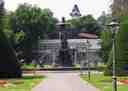
The overview helps you picture the scale of that transformation: a former military buffer becoming a green civic landscape. At the heart of the park stands its great theatrical flourish, the Stadtpark fountain. Graz bought it in eighteen seventy-four after Vienna declined the offer. The city paid thirty thousand gulden - again, a sum worth several hundred thousand euros today - in ten yearly instalments. Five railway wagons delivered the fountain to Graz, and Mayor Wilhelm Kienzl turned it on for the first time on the fourth of October, eighteen seventy-four, the name day of Emperor Franz Joseph the First. The sculptor Jean-Baptiste-Jules Klagmann designed the figures, and the metal founder Antoine Durenne cast them. Each hollow figure weighs about a thousand kilograms, the upper canopy about three tonnes, and the whole composition about thirty-three tonnes. A major restoration finished in twenty twenty-five, giving new life to the cracked basin and the heavy ironwork.
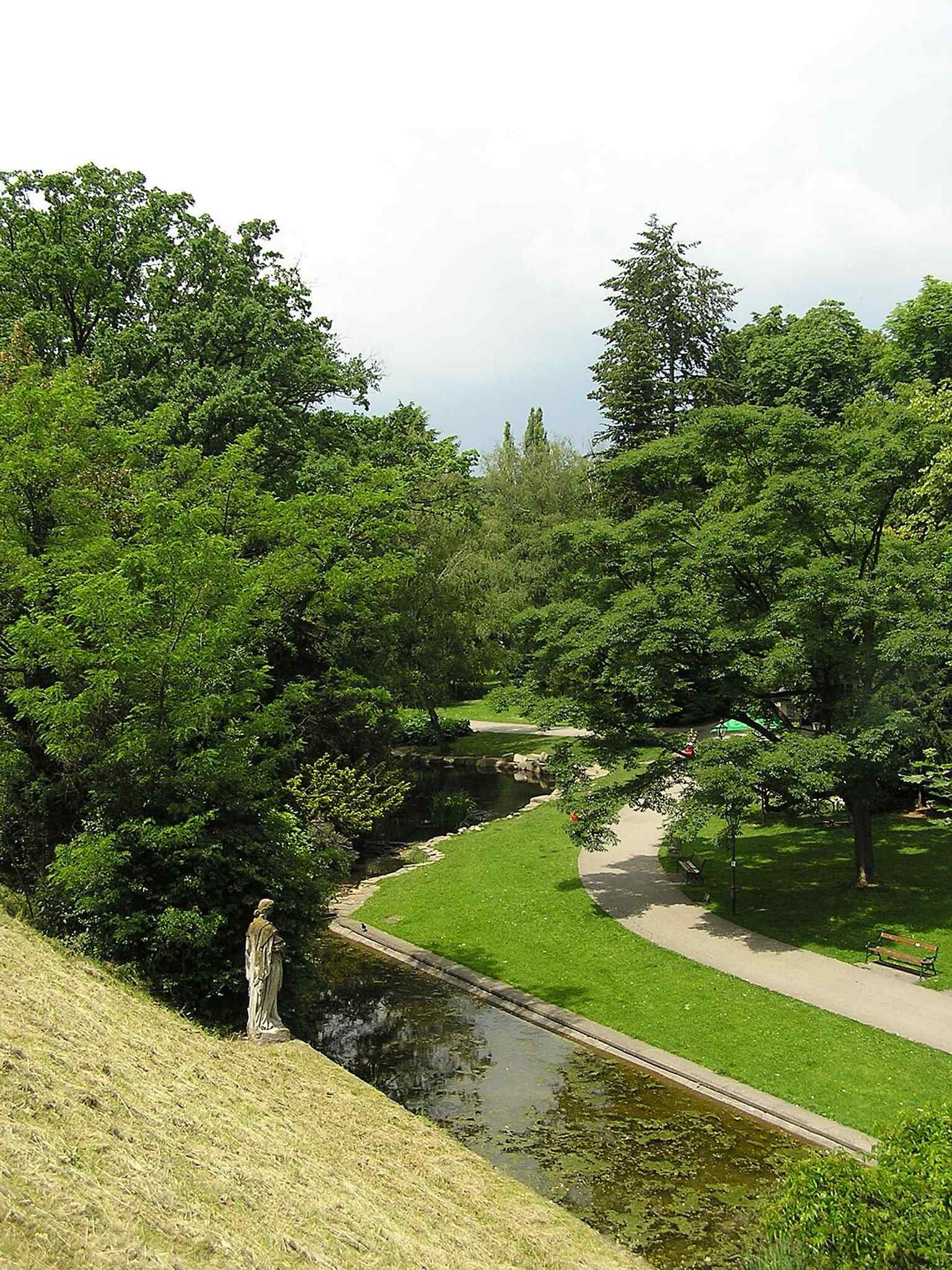
The park seen from the Burggarten, a good overview of the landscaped grounds that replaced the old fortification zone.Photo: gugganij, Wikimedia Commons, CC BY-SA 3.0. Cropped & resized. Over time, the park also became an open-air gallery of Styrian memory. Busts and monuments honour figures such as Johannes Kepler, Robert Stolz, and Peter Rosegger. On your phone, the Kepler monument offers a fine example of that quieter layer of history. So this park is not merely a place between streets, but Graz turning an old line of defence into a landscape of culture, health, and civic pride.
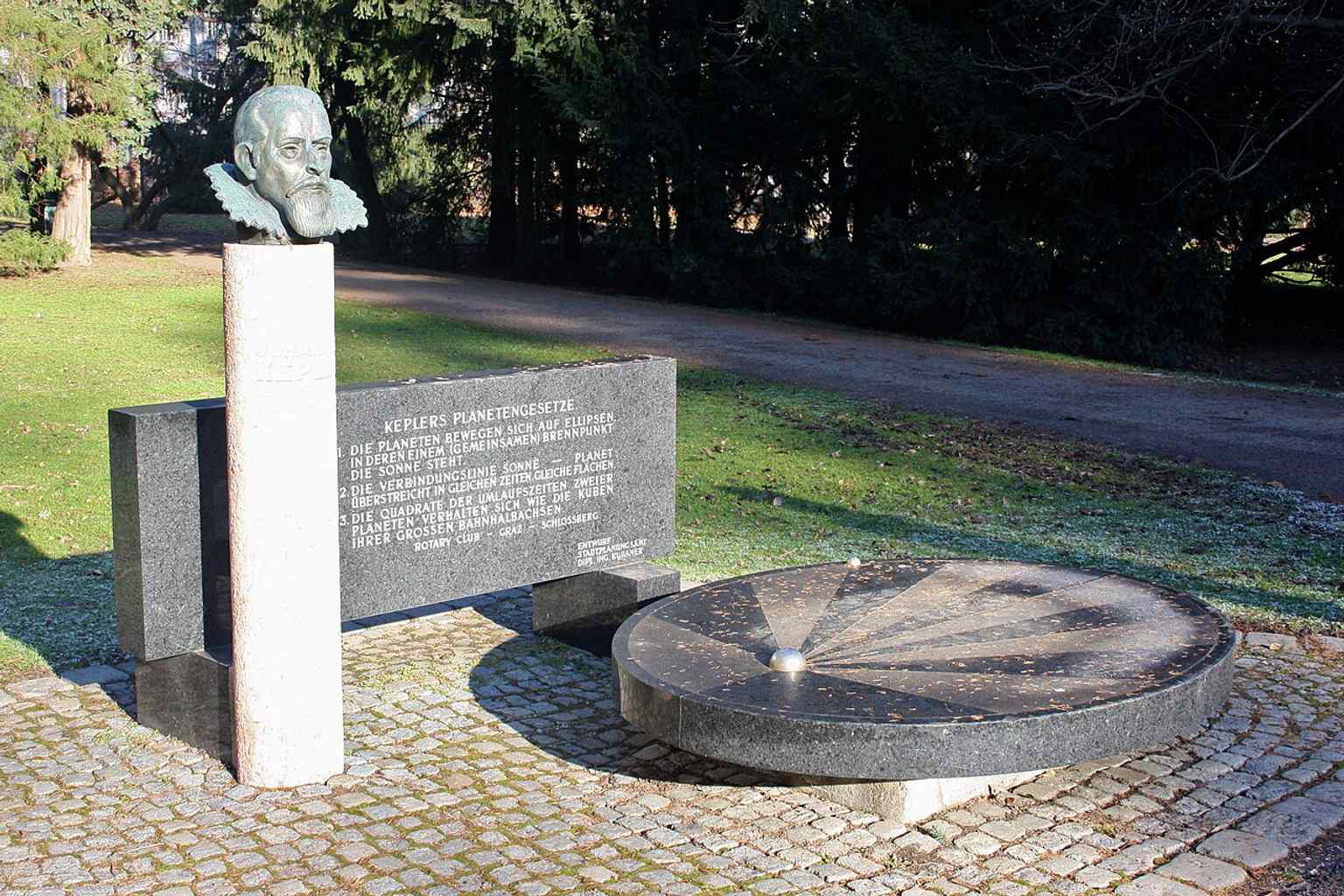
The Kepler monument in the park, part of the open-air gallery of Styrian cultural history added in the 20th century.Photo: Funke, Wikimedia Commons, CC BY-SA 3.0 at. Cropped & resized. When you are ready, continue toward the Opera House; if practicalities matter, the app lists hours here as nine in the morning to seven-thirty in the evening, shorter on Saturday, and closed on Sunday.
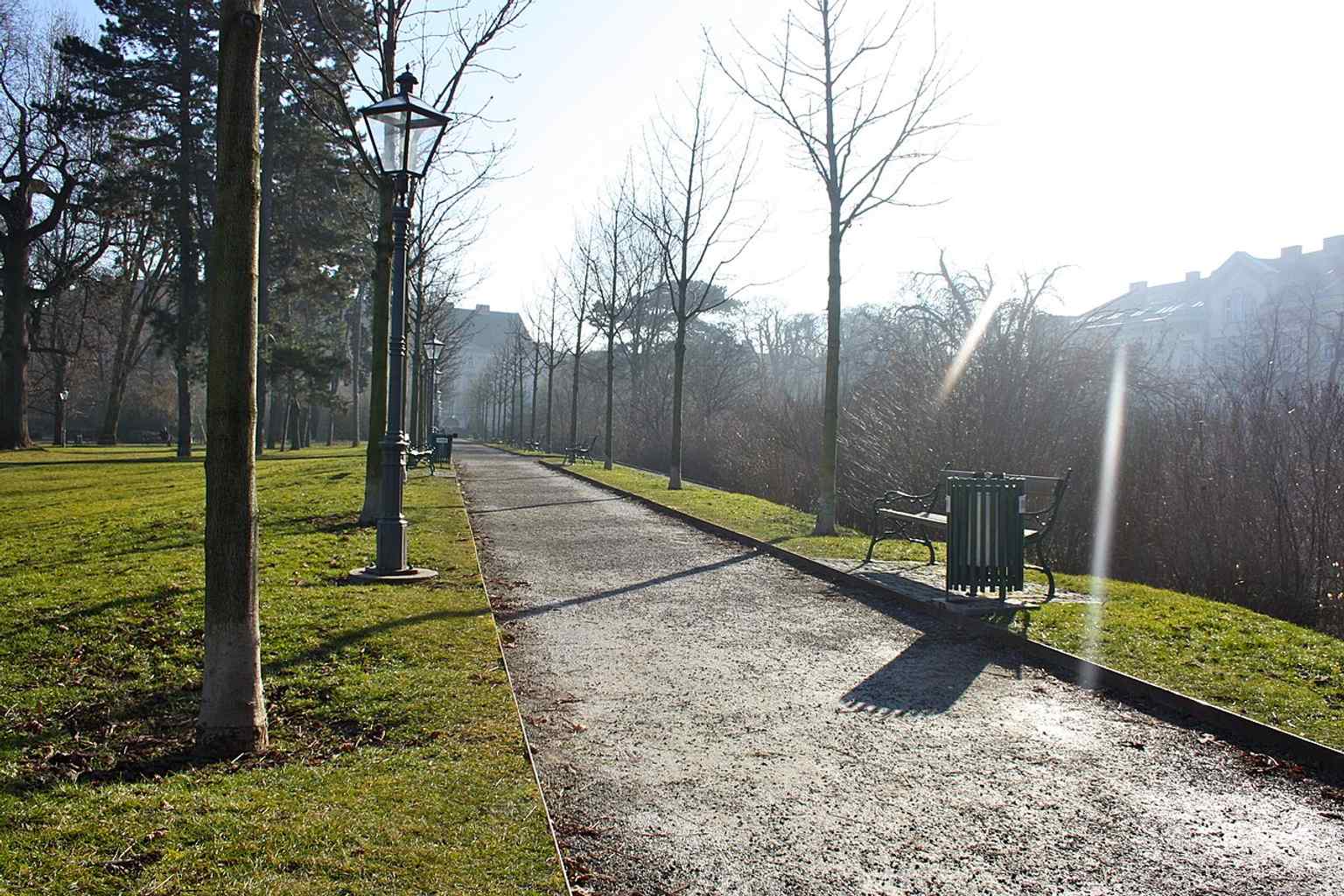
Montclair-Allee in the city park, one of the double avenues laid out to give the park its English-garden character.Photo: Funke, Wikimedia Commons, CC BY-SA 3.0 at. Cropped & resized. 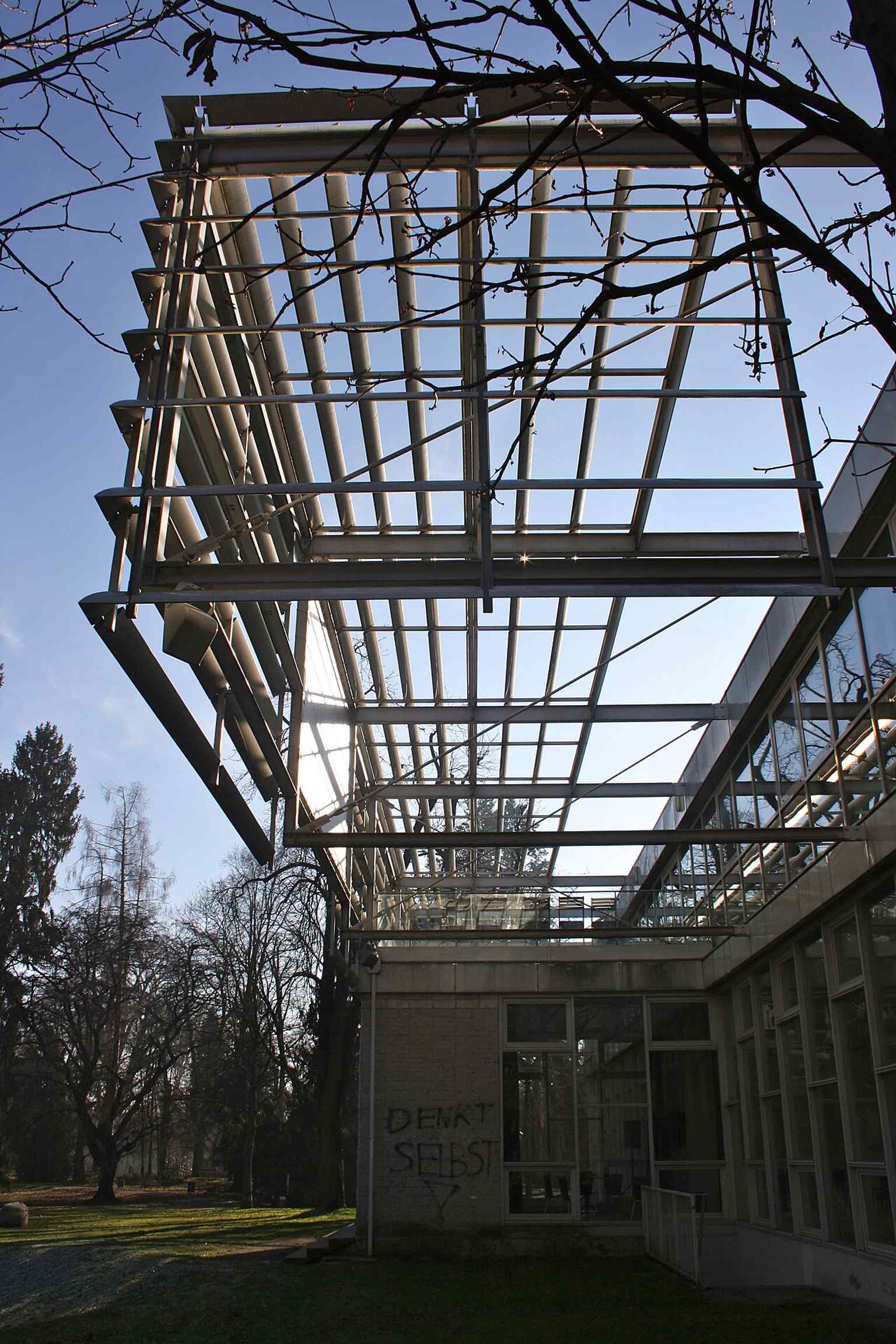
Forum Stadtpark, which grew out of the former Stadtpark café near the center of the park.Photo: Funke, Wikimedia Commons, CC BY-SA 3.0 at. Cropped & resized. 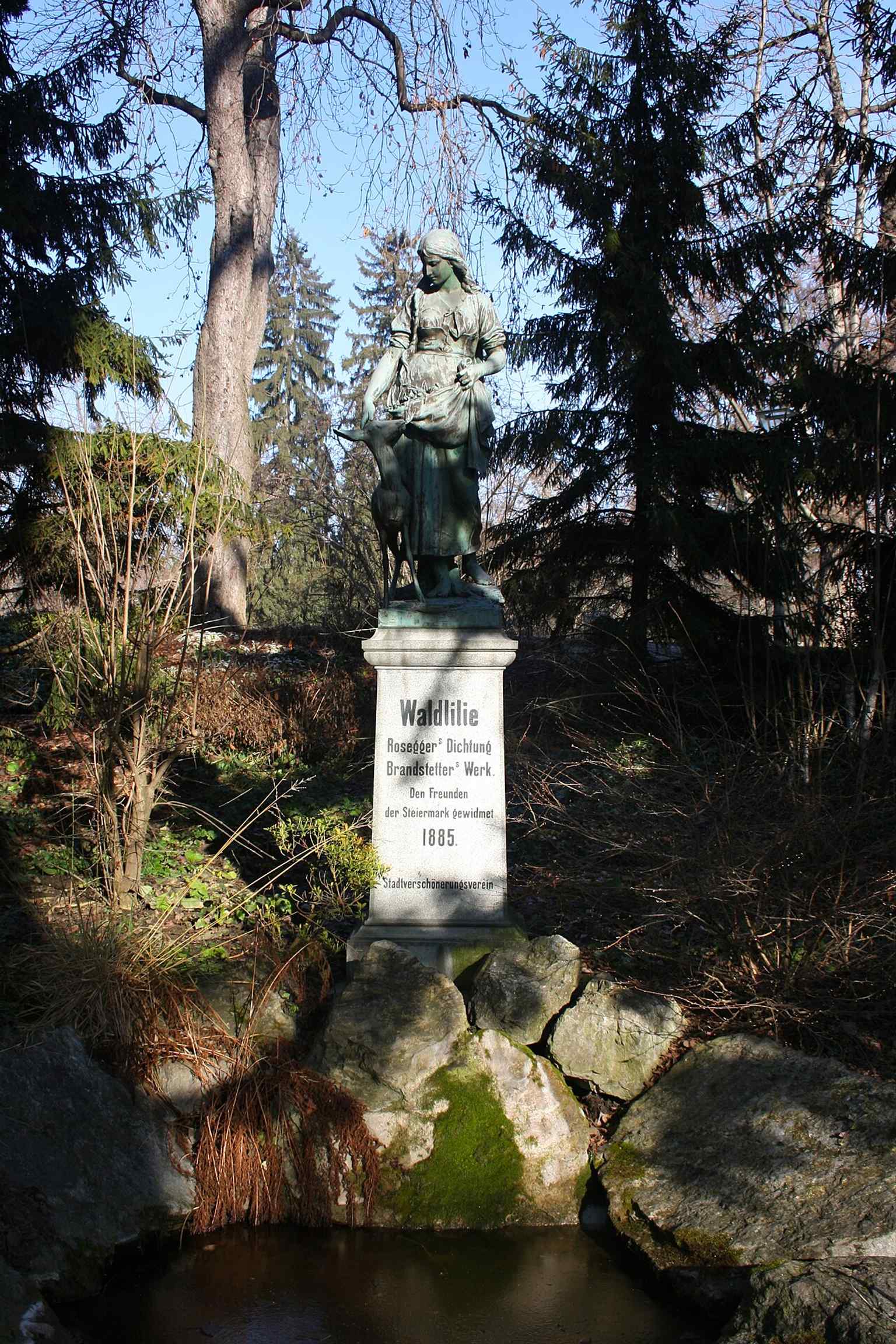
Hans Brandstetter’s Waldlilie, a monument to Peter Rosegger, showing how the park became a showcase for regional cultural figures.Photo: Funke, Wikimedia Commons, CC BY-SA 3.0 at. Cropped & resized. 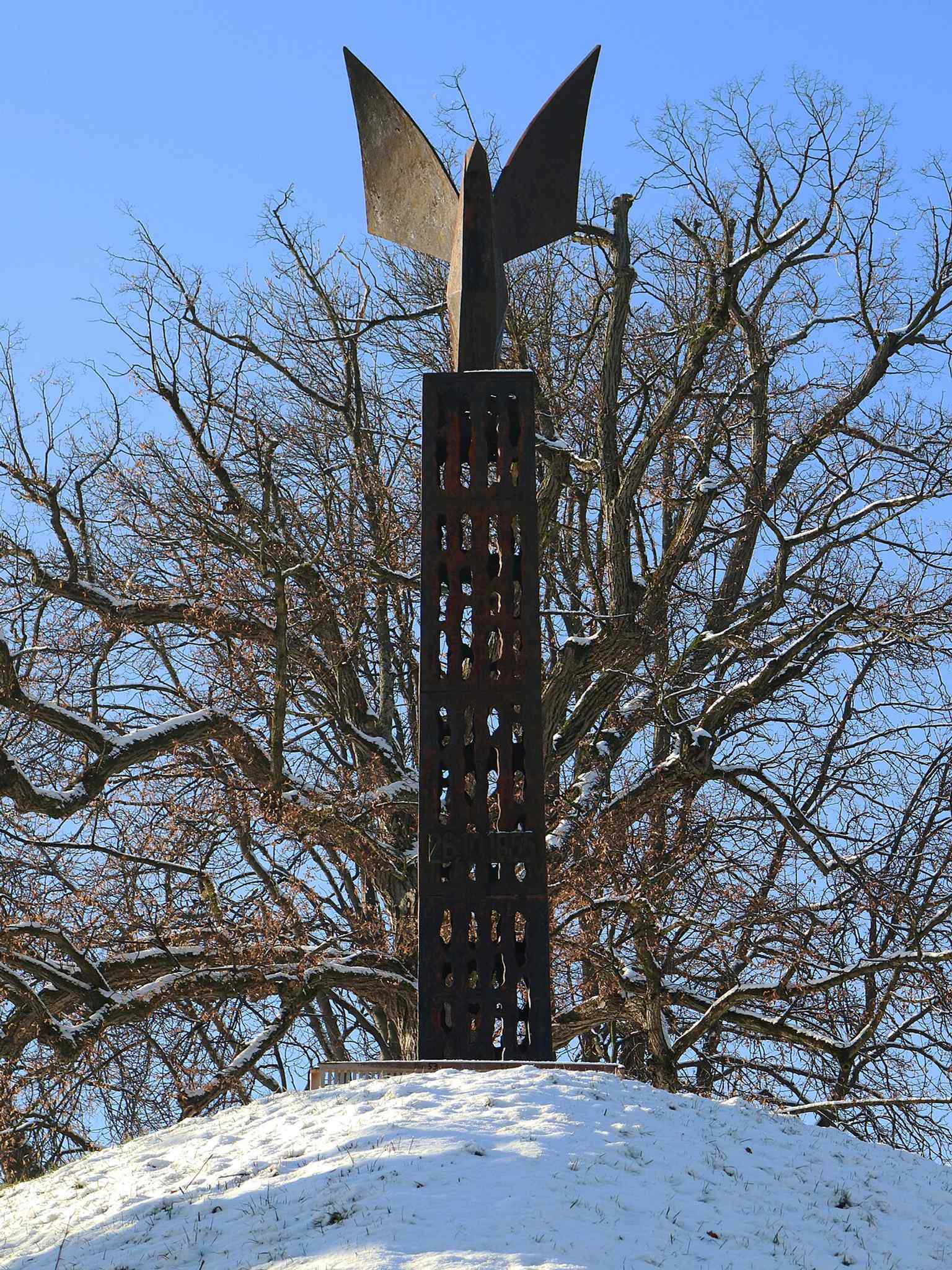
A close view of the Freedom Eagle, useful for showing the park’s role as a setting for public art and memorials.Photo: Clemens Stockner, Wikimedia Commons, CC BY-SA 4.0. Cropped & resized. 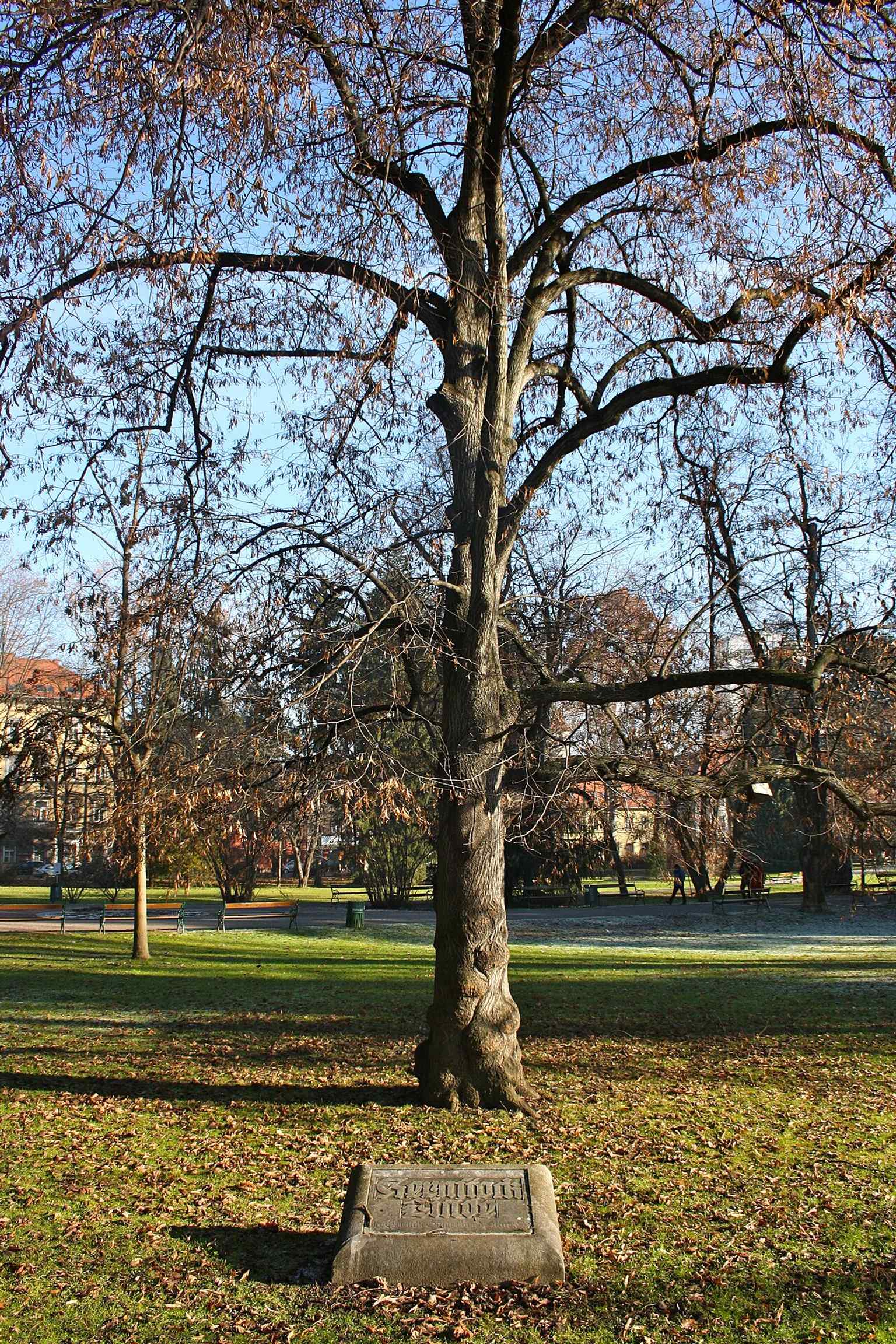
The Kernstock Linden tree, one of the named plantings that reflect the park’s long botanical and memorial layers.Photo: Funke, Wikimedia Commons, CC BY-SA 3.0 at. Cropped & resized. 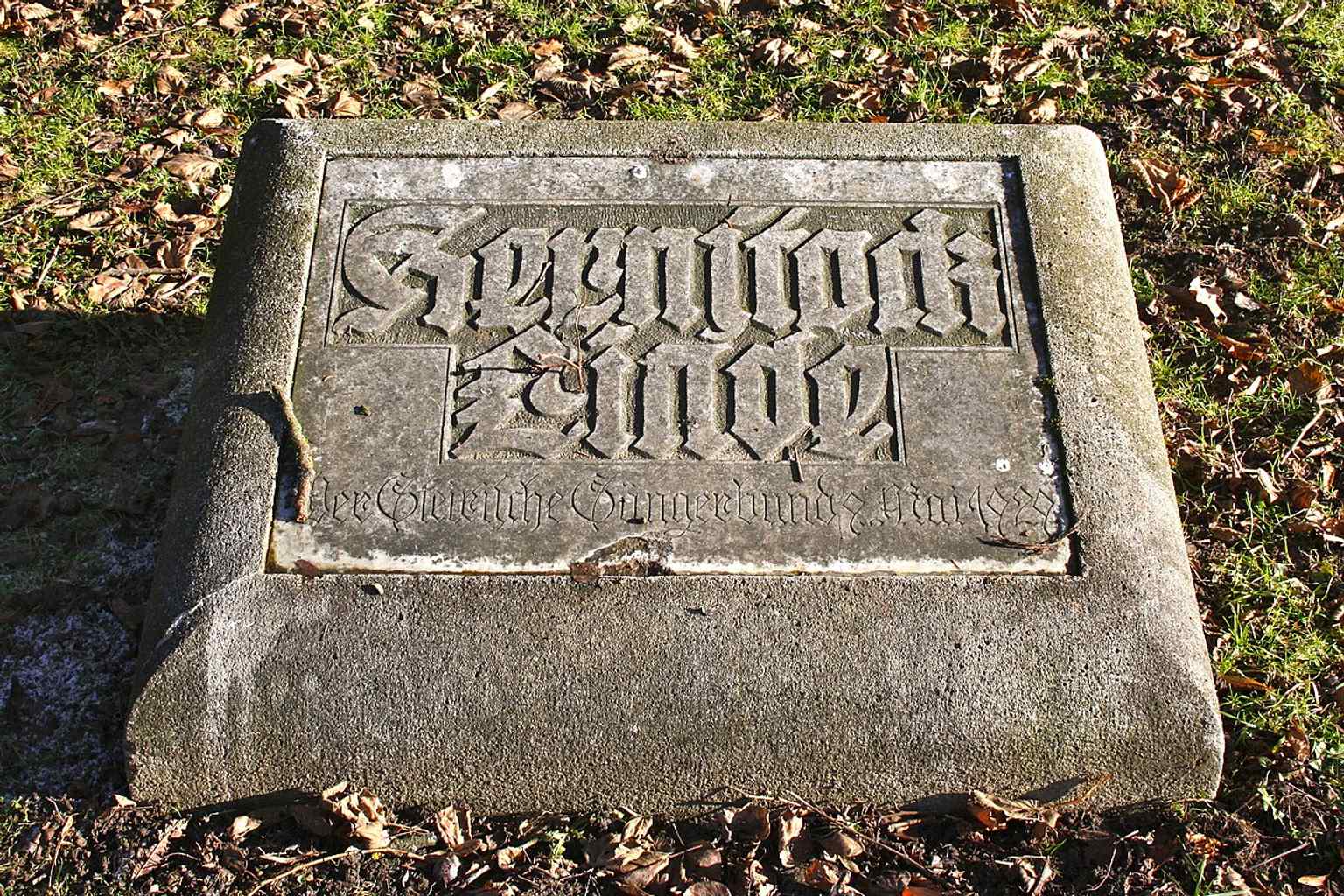
The plaque at the Kernstock Linden tree, a small but telling detail of the park’s commemorative landscape.Photo: Funke, Wikimedia Commons, CC BY-SA 3.0 at. Cropped & resized. On your left stands a pale stone theatre with an octagonal dome over the entrance, a rounded roof over the audience hall, and a tall mansard-roofed stage block lifting behind…Read moreShow less
Open dedicated page →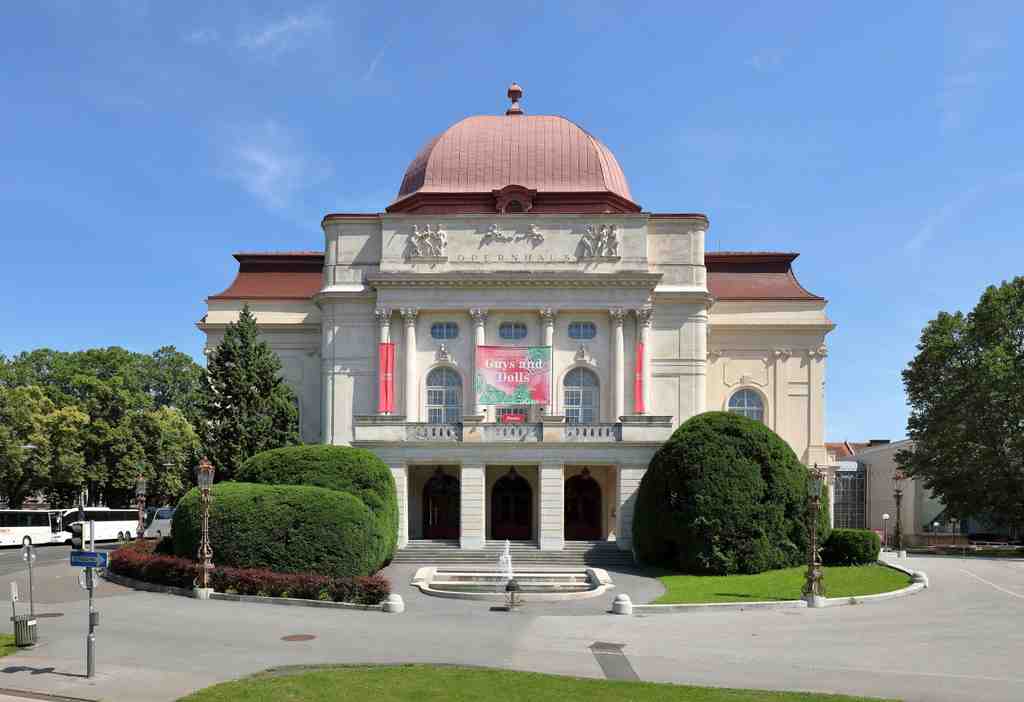
Graz Opera HousePhoto: C.Stadler/Bwag, Wikimedia Commons, CC BY-SA 4.0. Cropped & resized. On your left stands a pale stone theatre with an octagonal dome over the entrance, a rounded roof over the audience hall, and a tall mansard-roofed stage block lifting behind it.
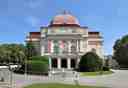
This is the Graz Opera House, opened in eighteen ninety-nine, and after the Vienna State Opera it remains the second-largest opera house in Austria. The Viennese theatre architects Ferdinand Fellner and Hermann Helmer designed it in the neo-Baroque style, part of what historians call Historicism, the nineteenth-century habit of borrowing the grandeur of earlier centuries and reshaping it for modern life.
Graz wanted more than a serviceable stage. By the eighteen nineties, the city had outgrown its older theatres. The Landständisches Theater stood where the Schauspielhaus stands now, and the immediate predecessor of this opera was the Thalia, an unusual twelve-sided circus building adapted for performances. Neither could meet modern technical demands, so the city council commissioned a new municipal theatre and treated it as a prestige project, a declaration that Graz intended to appear cultured, modern, and confident within the Habsburg world.
Construction began in eighteen ninety-eight during the jubilee marking fifty years of Emperor Franz Joseph the First’s reign. On the sixteenth of September, eighteen ninety-nine, builders laid the final stone. That same evening the house opened as the Grazer Stadttheater with Schiller’s Wilhelm Tell. The next day came the first opera, Wagner’s Lohengrin, conducted by Karl Muck. A brisk opening, and an ambitious one.
The building itself is arranged with almost theatrical clarity. In front, the entrance hall welcomes and displays. In the middle, the auditorium gathers the audience. Behind, the stage house rises higher than everything else. That separation followed practical rules as well as artistic logic: fire regulations required a safer division between audience and stage. Fellner and Helmer even gave each section its own roof, so the whole structure reads like a sequence of functions turned into stone.
The image in the app makes the sculpted triangle above the entrance easier to read. In that pediment, Apollo, god of music and beauty, appears among figures of the performing arts. It is a very direct announcement: this is a house for spectacle, sound, and drama.
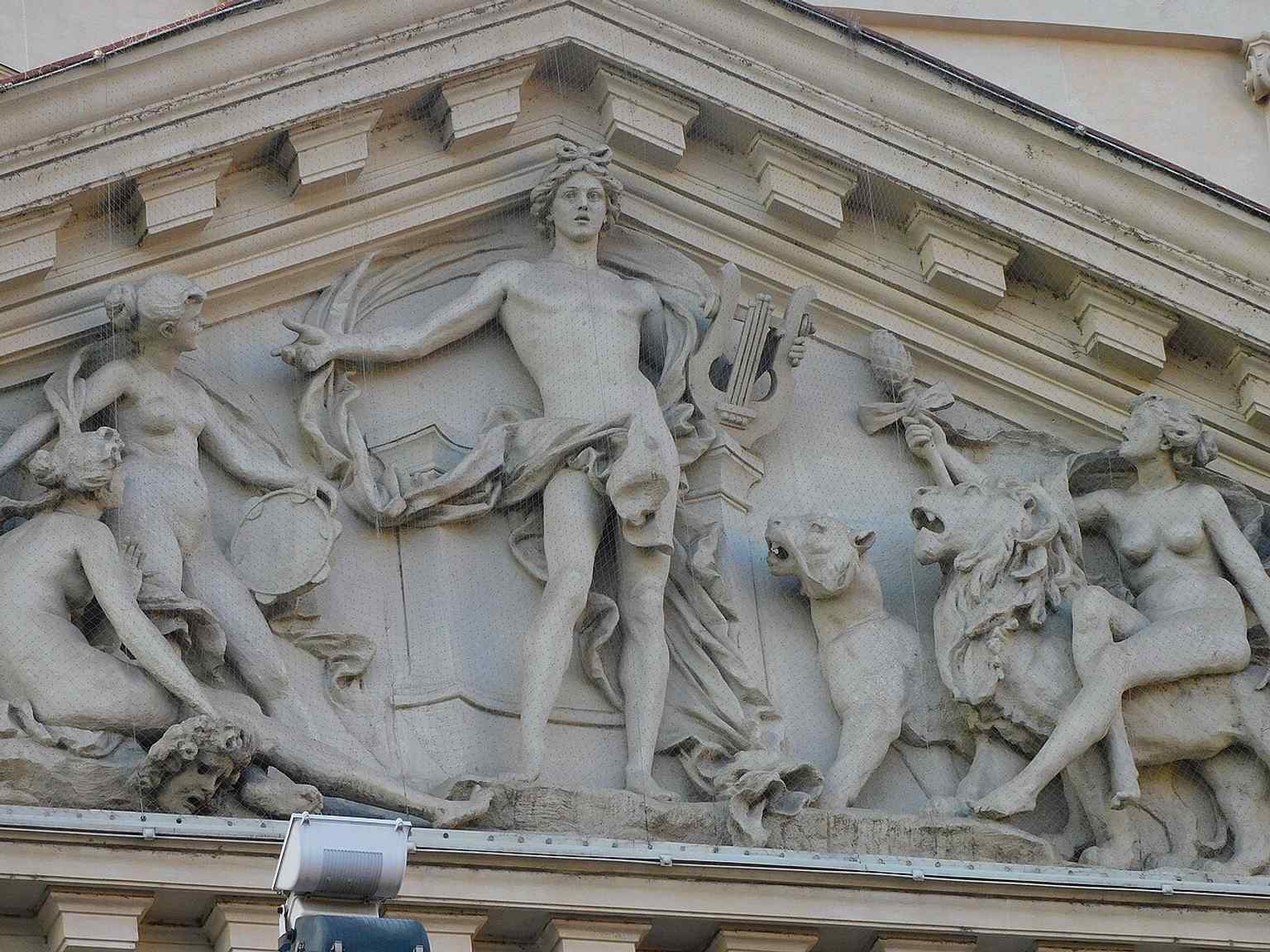
The south tympanum with Apollo and attendant figures — a sculptural program that links the building to music and the performing arts.Photo: Turko Wilhelm, Wikimedia Commons, CC BY-SA 4.0. Cropped & resized. One important feature, however, is gone. The original front had a temple-like portico, meaning a grand porch of six columns supporting a decorated gable. A bomb in nineteen forty-four destroyed the upper foyer and that columned front. During the rebuilding, Graz did not reconstruct it, and that decision still provokes debate. Buildings, like opera lovers, can be wonderfully stubborn.
Inside, the mood turns opulent. The auditorium, if you care to look at the interior image, curves in a horseshoe shape around the stage. White, gold, and red dominate the room, with balconies, boxes, and elaborate plaster decoration framing roughly one thousand four hundred seats. Ceiling paintings even refer to Lohengrin, Wilhelm Tell, and Faust, tying the decoration to the repertoire that announced the house to the world.
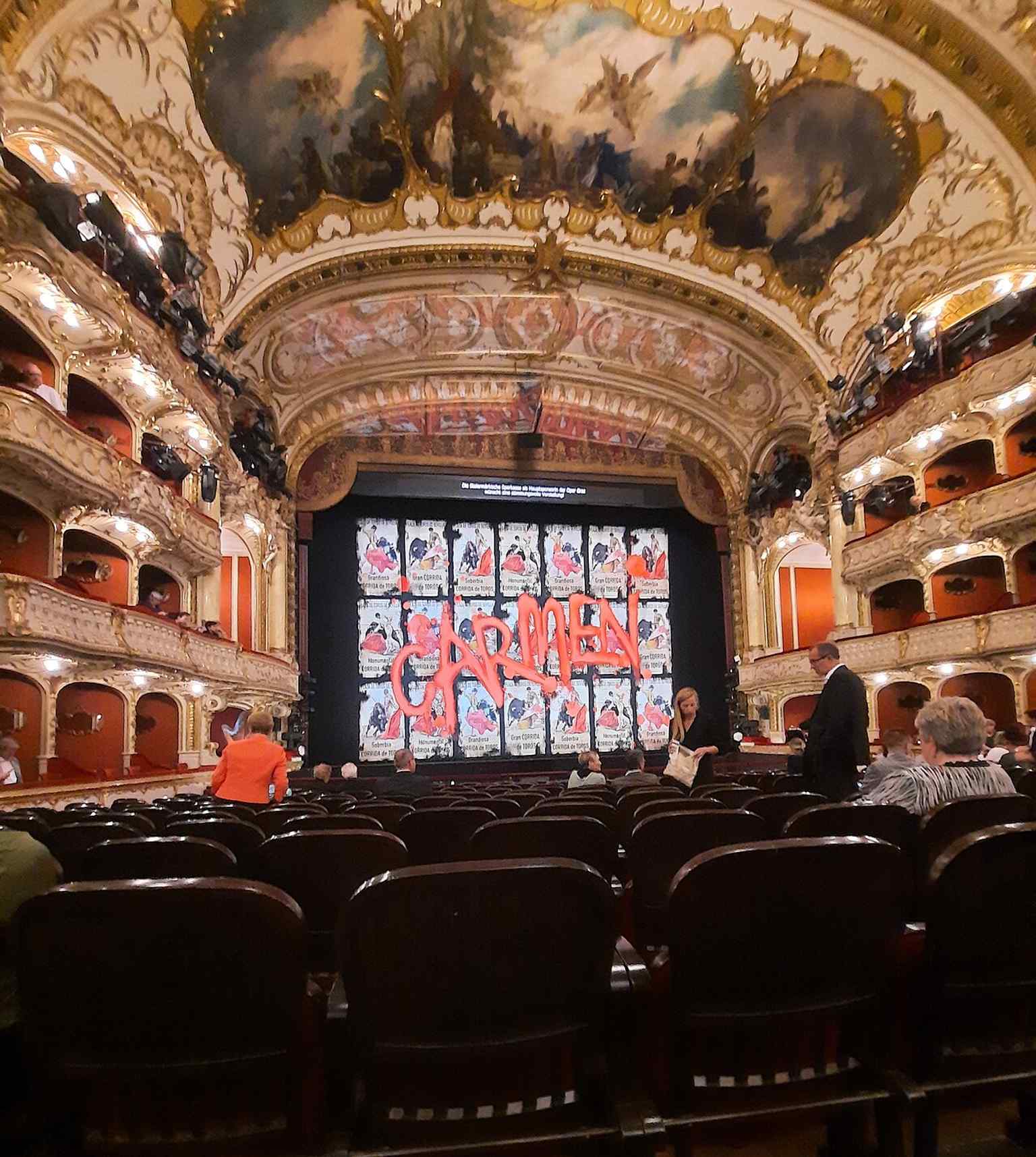
The auditorium before a performance, with the horseshoe layout and richly decorated seating area that gives the house its opulent character.Photo: Peter Christian Riemann, Wikimedia Commons, CC BY-SA 4.0. Cropped & resized. And it has remained very much alive. Opera, ballet, operetta, and musicals still share this stage, and the Graz Philharmonic calls it home. That, in the end, is the real measure of the place: not only grandeur, but continued use, a civic building still doing exactly what it was meant to do.
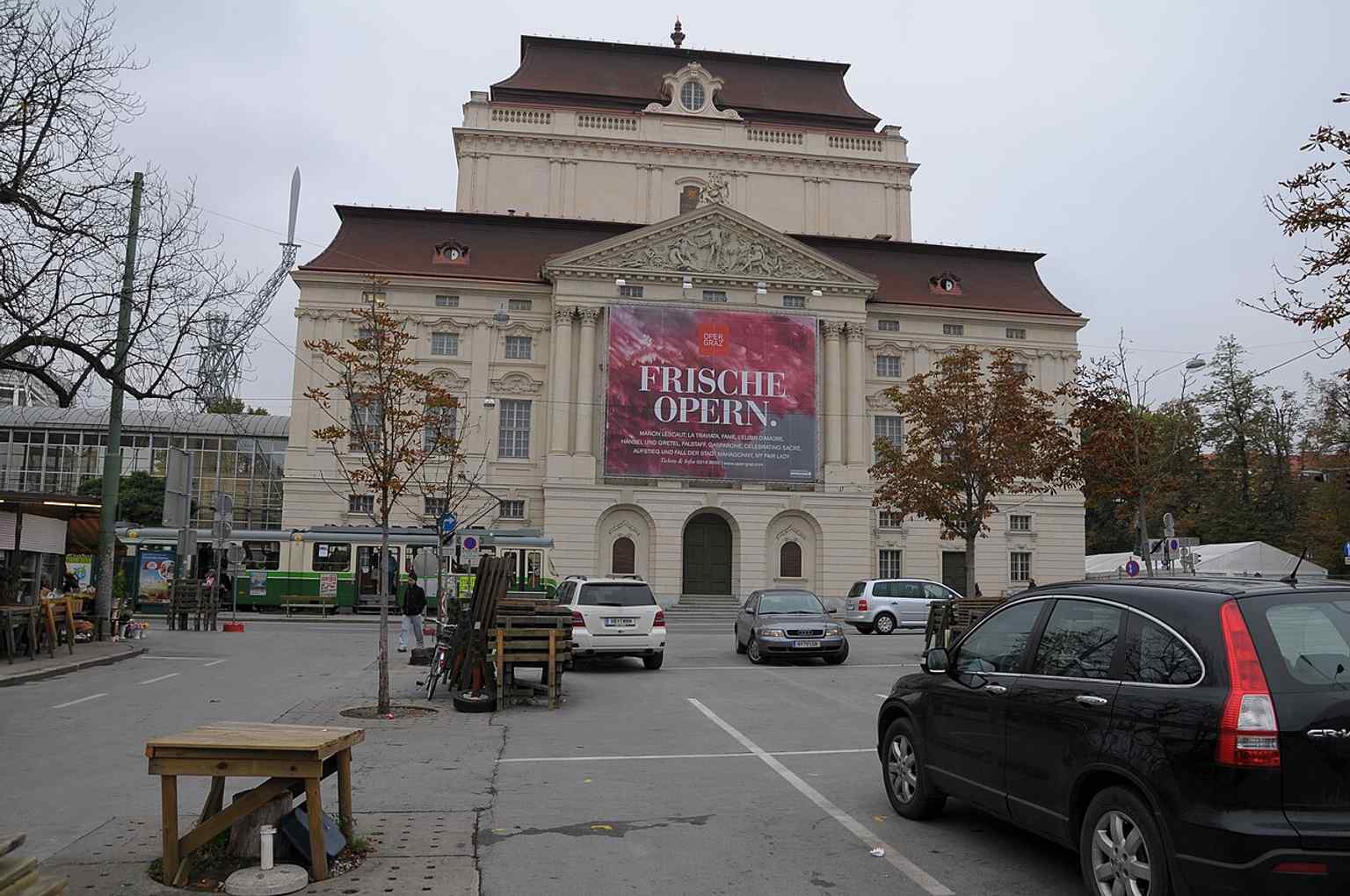
The rear façade facing Kaiser-Josef-Platz, showing how the opera house is a freestanding building with a representative back side as well as a grand front.Photo: Altura, Wikimedia Commons, CC BY-SA 3.0 at. Cropped & resized. 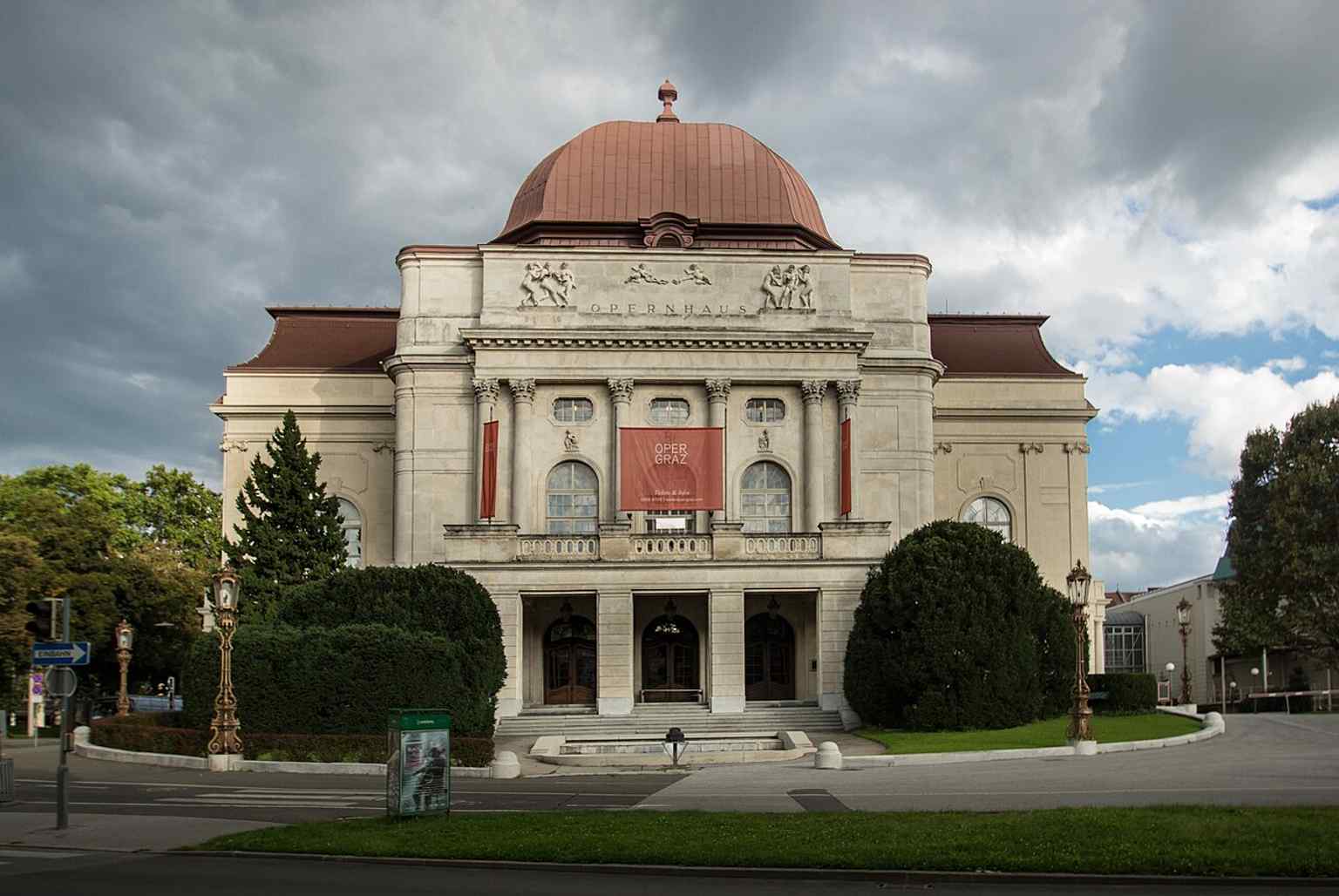
A broad exterior view that highlights the theatre’s monumental, historicist presence in the centre of Graz.Photo: Pedro J Pacheco, Wikimedia Commons, CC BY-SA 3.0 at. Cropped & resized. 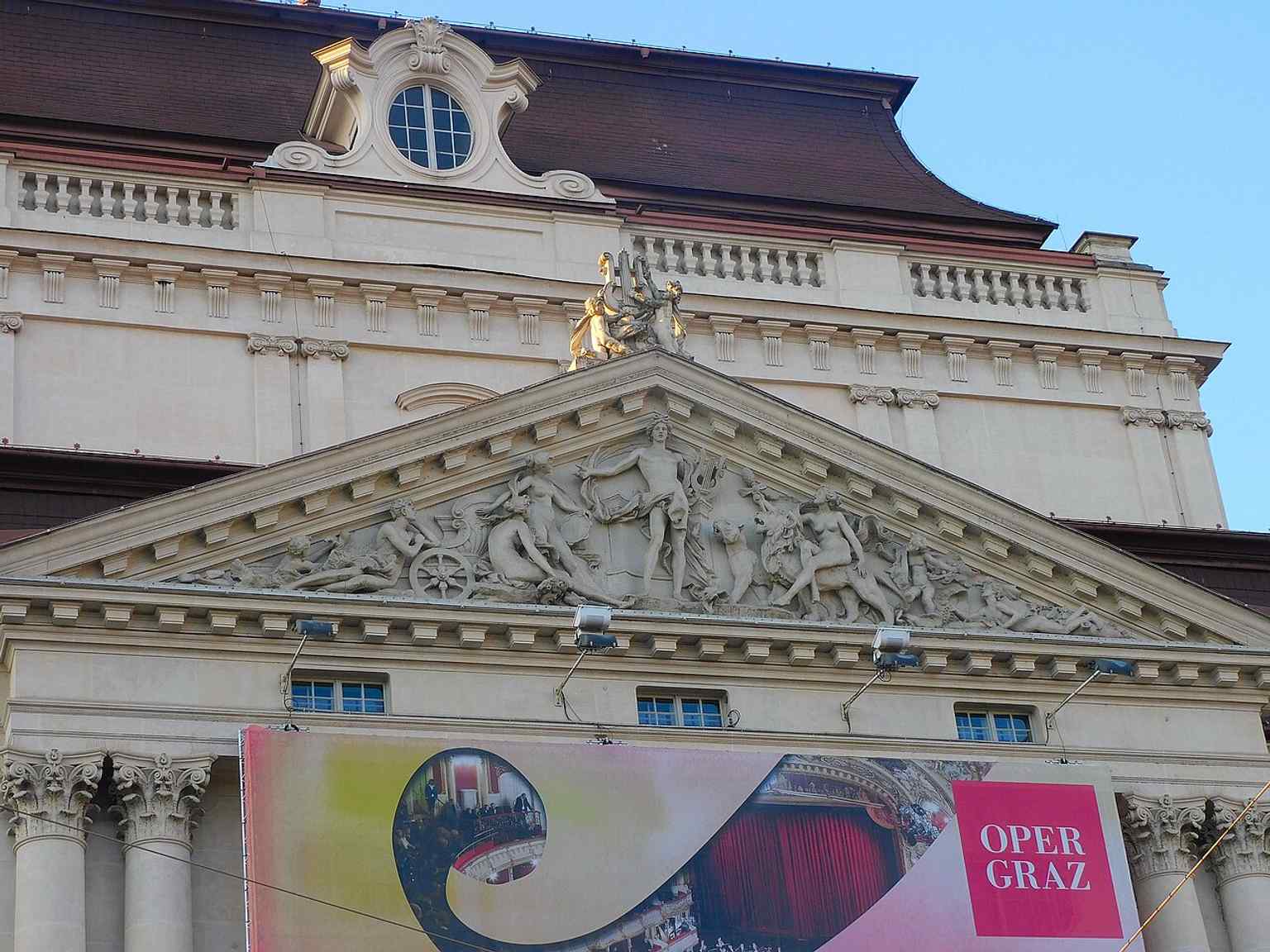
The Apollo relief on the south tympanum, a striking example of the opera house’s symbolic façade decoration.Photo: Turko Wilhelm, Wikimedia Commons, CC BY-SA 4.0. Cropped & resized. 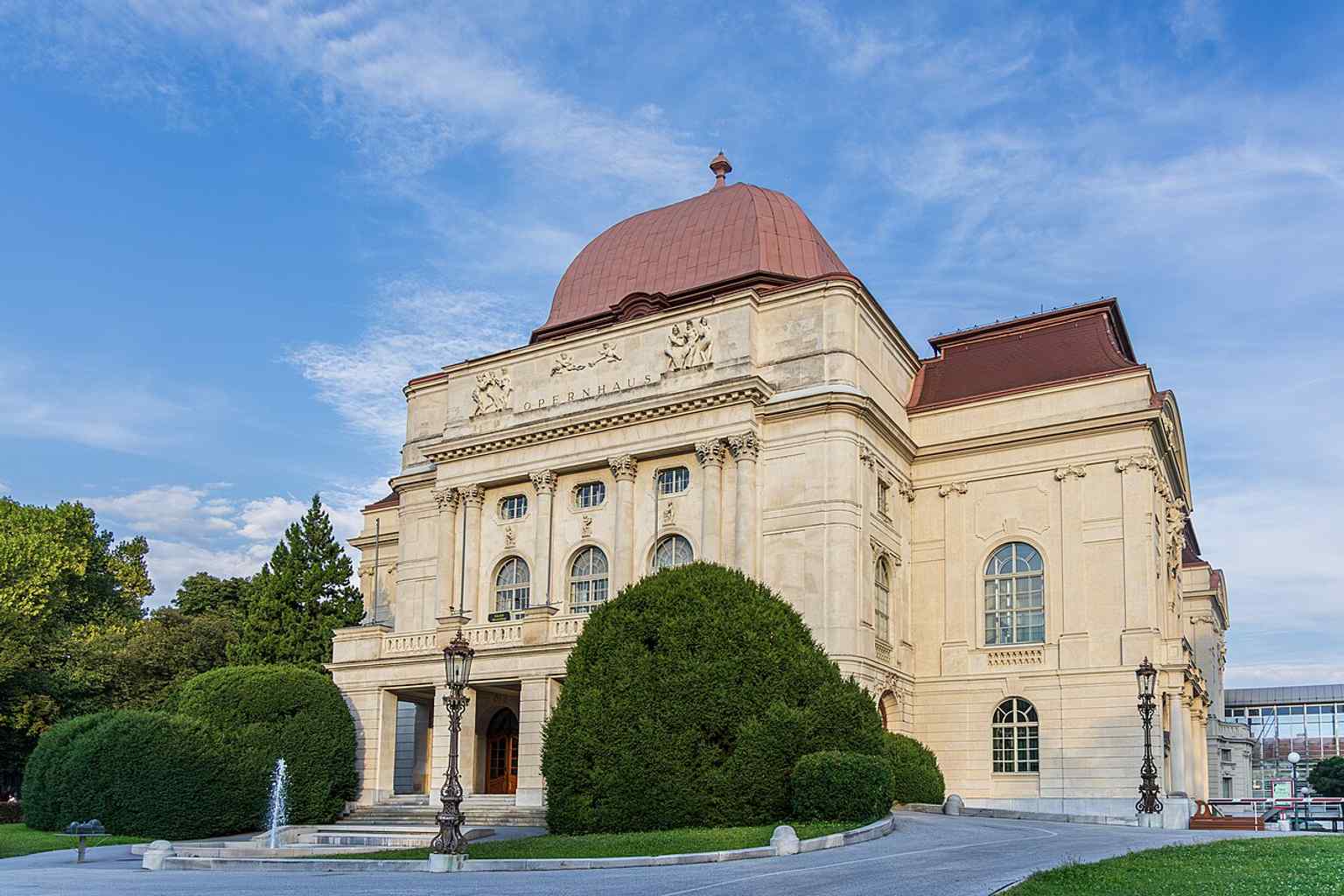
A recent exterior view of the opera house, useful for showing the building’s preserved historic appearance in the city today.Photo: Matthias Süßen, Wikimedia Commons, CC BY-SA 4.0. Cropped & resized. 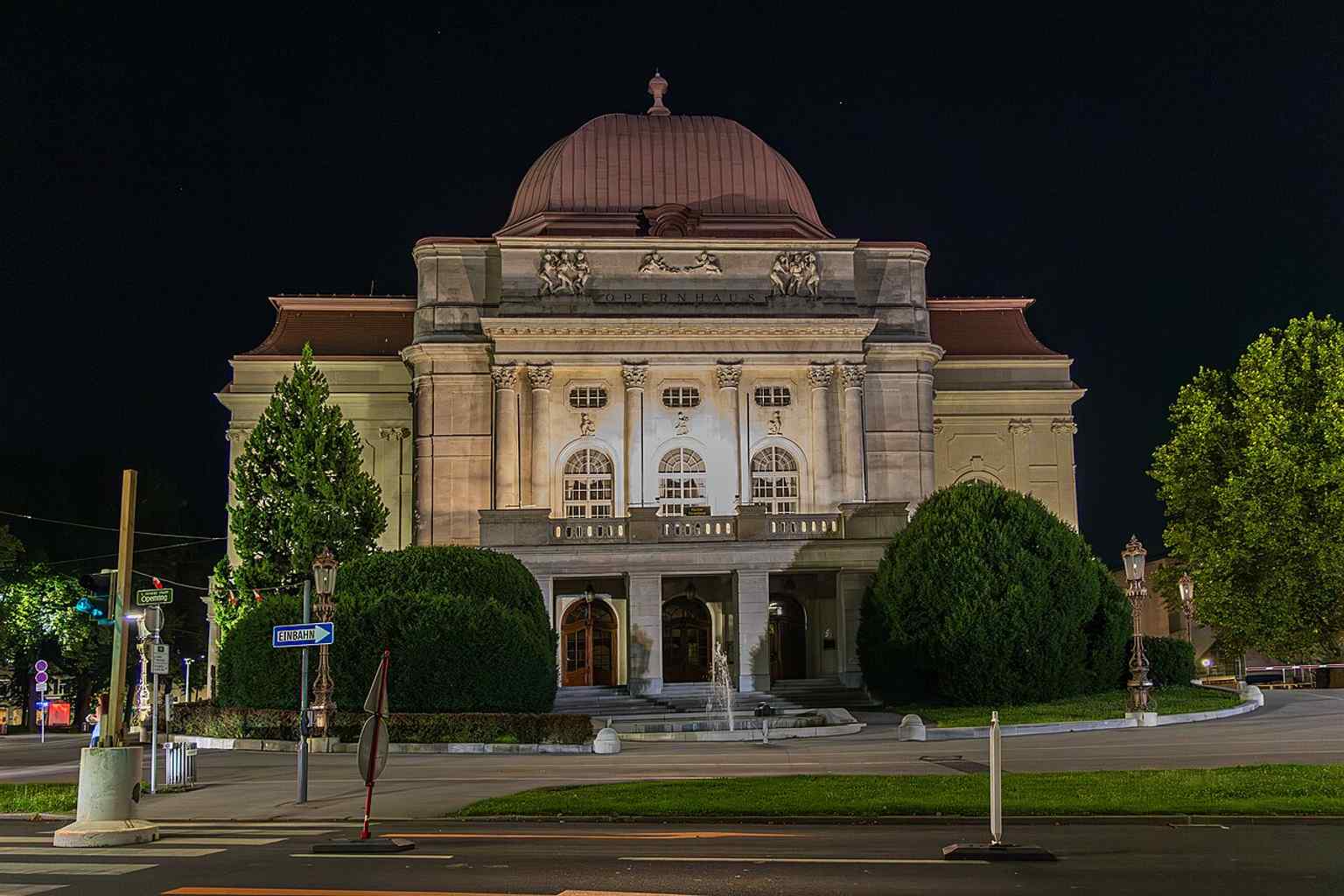
Another modern façade view of Graz Opera House, reflecting its role as one of Austria’s most important opera venues.Photo: Matthias Süßen, Wikimedia Commons, CC BY-SA 4.0. Cropped & resized.
Frequently asked questions
How do I start the tour?
After purchase, download the AudaTours app and enter your redemption code. The tour will be ready to start immediately - just tap play and follow the GPS-guided route.
Do I need internet during the tour?
No! Download the tour before you start and enjoy it fully offline. Only the chat feature requires internet. We recommend downloading on WiFi to save mobile data.
Is this a guided group tour?
No - this is a self-guided audio tour. You explore independently at your own pace, with audio narration playing through your phone. No tour guide, no group, no schedule.
How long does the tour take?
Most tours take 60–90 minutes to complete, but you control the pace entirely. Pause, skip stops, or take breaks whenever you want.
What if I can't finish the tour today?
No problem! Tours have lifetime access. Pause and resume whenever you like - tomorrow, next week, or next year. Your progress is saved.
What languages are available?
All tours are available in 50+ languages. Select your preferred language when redeeming your code. Note: language cannot be changed after tour generation.
Where do I access the tour after purchase?
Download the free AudaTours app from the App Store or Google Play. Enter your redemption code (sent via email) and the tour will appear in your library, ready to download and start.
If you don't enjoy the tour, we'll refund your purchase. Contact us at [email protected]
Checkout securely with 






%20IMG%202898.jpg)


.jpg)


.jpg)


.jpg)


