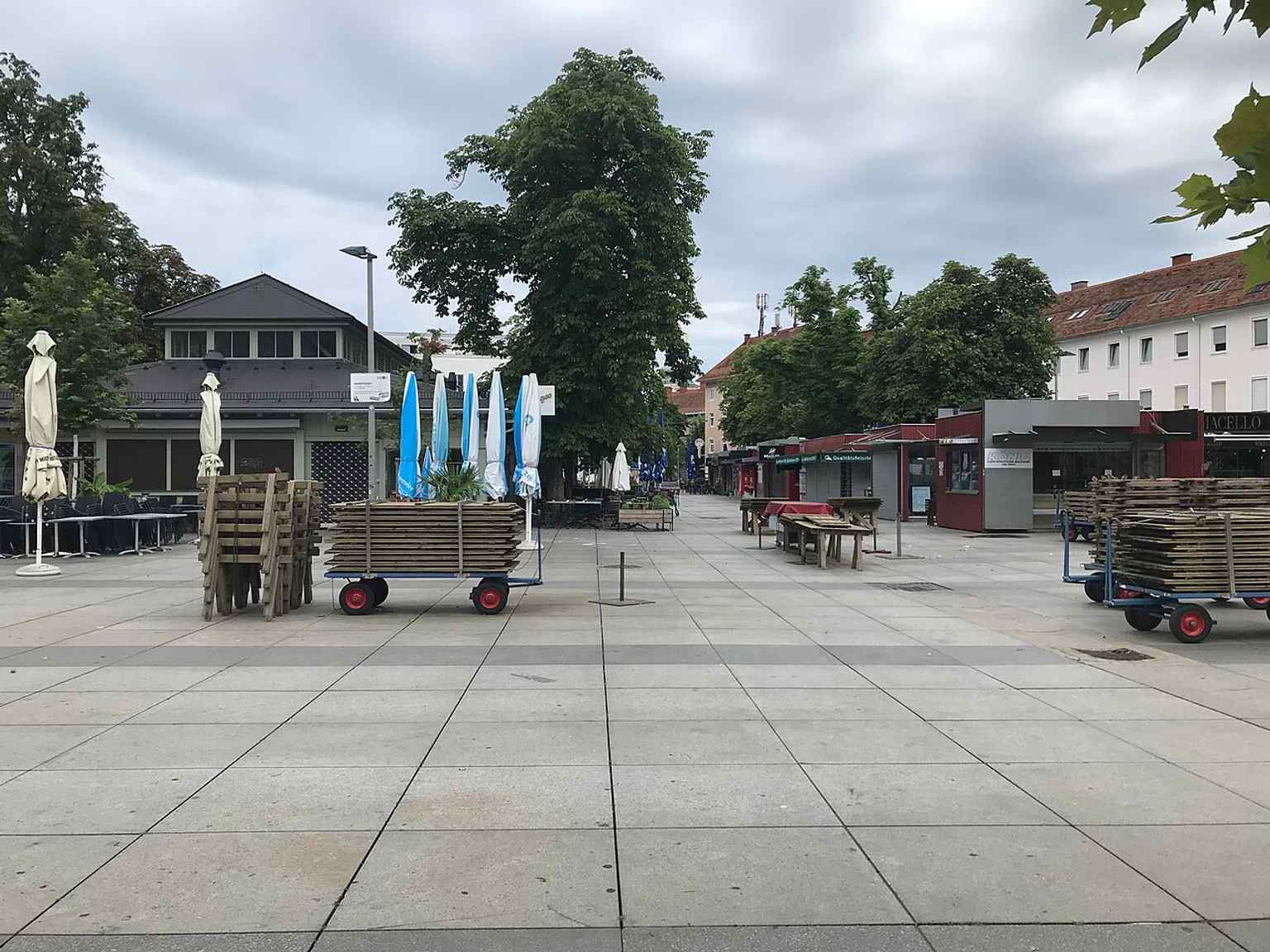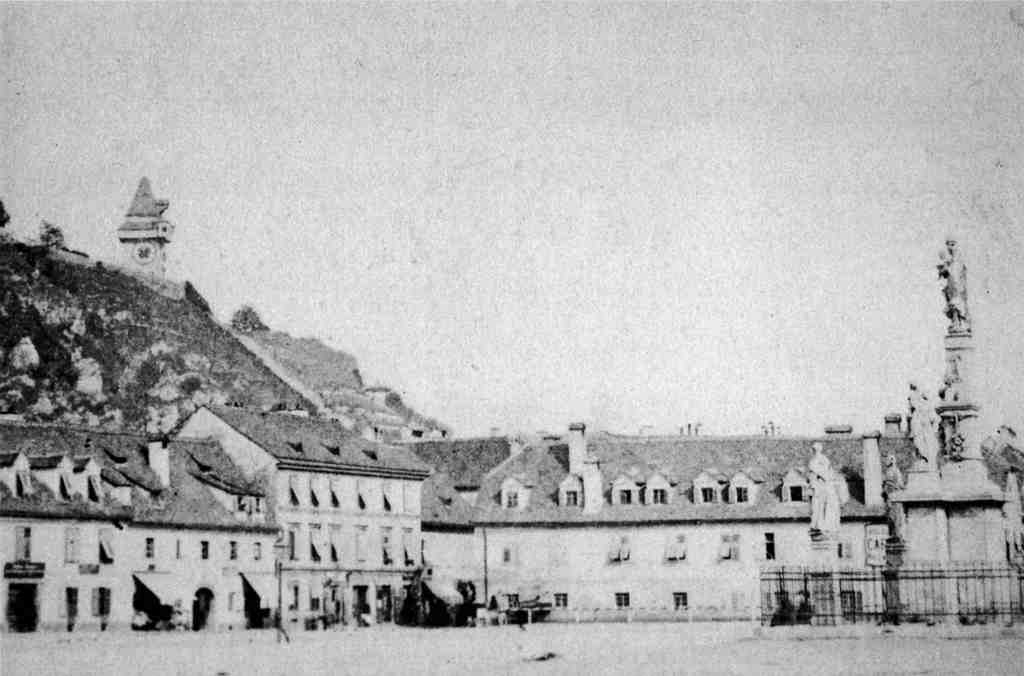
Lendplatz appears as a long stone-paved square edged by pale stucco town houses, and in its quieter southern section a tall baroque stone column carries a small figure of Mary with the Christ Child.
That column is a fine place to begin, because Lendplatz has always been a place of work, movement, and survival. The name “Lend” comes from Anlenden, the act of bringing a boat to shore. The Mur flowed close by as Graz’s working river, but its water level changed too wildly for reliable mills, so people pushed mills and workshops onto smaller streams and man-made canals instead.
As Graz secured the riverbanks in the sixteenth and seventeenth centuries, the suburb beyond the old centre grew quickly. The Bürgerspital, the city’s civic hospital, sold off large stretches of its land here because rents and building plots earned more than farming them. That decision shaped this square. Lendplatz formed as a planned, sack-like widening between Mariahilferstraße and Wiener Straße. A historian named Fritz Popelka described it, rather charmingly, as a village street square made large enough for cattle markets. Even its slanted line remembers the landscape that came before: its axis meets Mariahilferstraße at about one hundred and twenty degrees because an arm of the Mur still ran here into the mid-seventeenth century. Builders set the eastern row of houses along that channel, and by around seventeen hundred the square stood enclosed on all sides.
But this was not elegant Graz. Lendplatz belonged to craftsmen, small traders, and the poor. Nearby lay Sigmundstadl, one of the city’s harshest quarters, a colony of shabby huts. In sixteen seventy-nine, officials counted three hundred and twenty-three beggars in this area. Neglected children formed bands. Prostitutes and drifters found shelter here. A report from sixteen fifty-five warned that even the road toward Calvary Hill was unsafe in daylight because robbers, runaway Jesuits - members of a Catholic teaching order - and students on the run gathered in the upper Lend.
Disease followed poverty. In the seventeenth and eighteenth centuries, plague and dysentery struck hard here. In sixteen eighty, about four thousand people in Graz fell ill with plague, and roughly three quarters of them died, in a city of only around fifteen thousand. Out of that fear came vows, and out of those vows came the plague column you see today. The statue of Mary and Child on top is usually attributed to Andreas Marx, sculptor to the Eggenberg court. Street widening forced the city to move the column to this southern position in eighteen forty-five.
Trade, though, kept returning. Inns settled here on the north-south route. Cattle markets filled the square. A market regulation from seventeen ninety-one mentions charcoal sold here for locksmiths, blacksmiths, and tinsmiths. Goods were sold directly from wagons: wood, charcoal, fruit, and above all cabbage. In autumn of eighteen seventy-seven, as many as two hundred cabbage wagons lined the eastern side. In eighteen sixty-one, the city shifted its annual fairs here from Hauptplatz, and after eighteen eighty-six even the rag markets stayed until nineteen twenty-two.
In the app, you can see how Keplerstraße slices through Lendplatz and turns the northern half into a transport corridor. A second view shows the calmer southern section, where the market square still feels like a proper room in the city. That split remains part of Lendplatz’s character, along with its farmers’ market, which has continued here since nineteen forty-five, and Graz’s central fire brigade, which has stood on this square since eighteen seventy-seven.
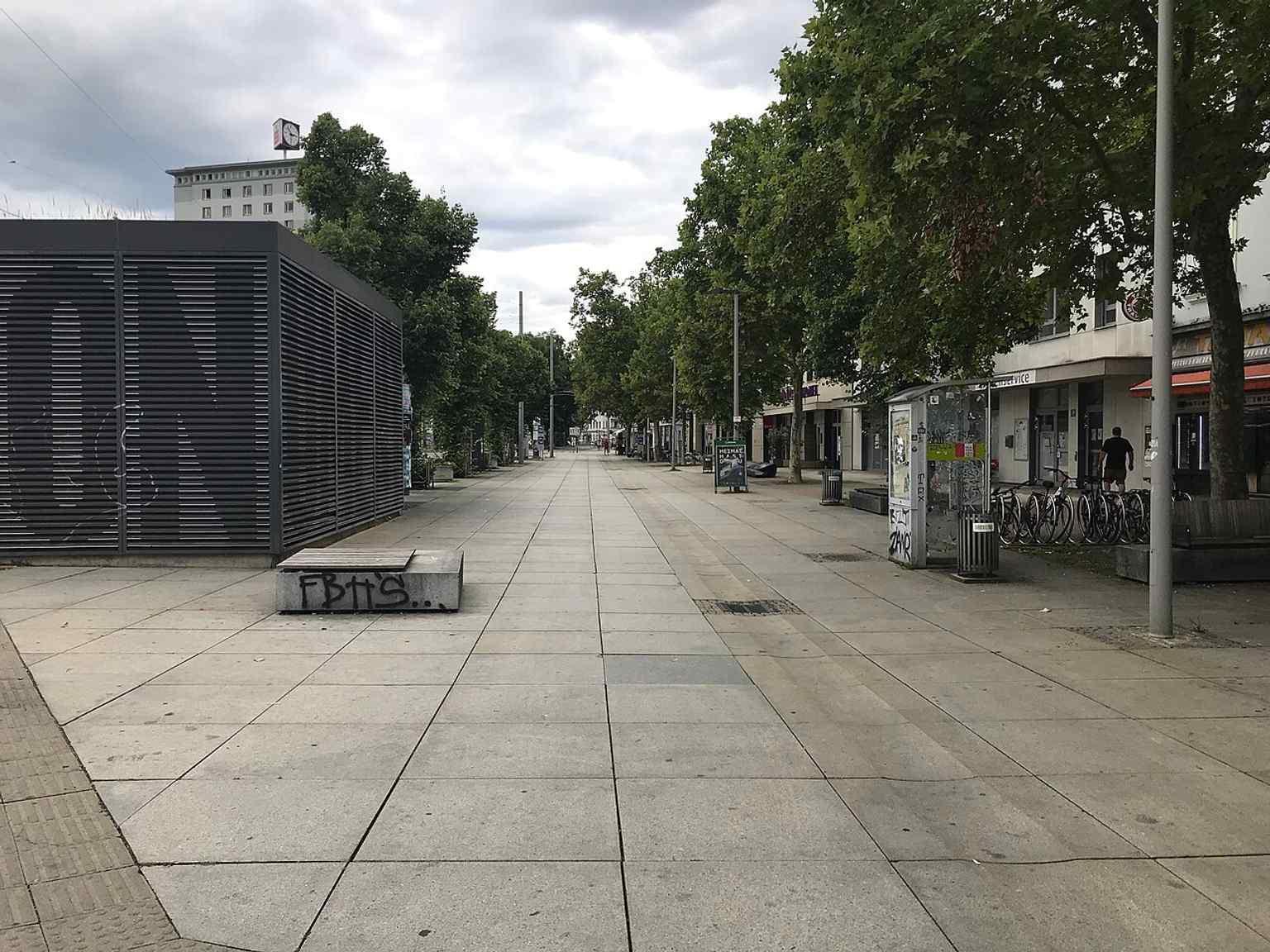
Lendplatz still carries the practical soul of a place shaped by trade, hardship, and stubborn continuity.
When you’re ready, continue on toward Schloßbergplatz.