
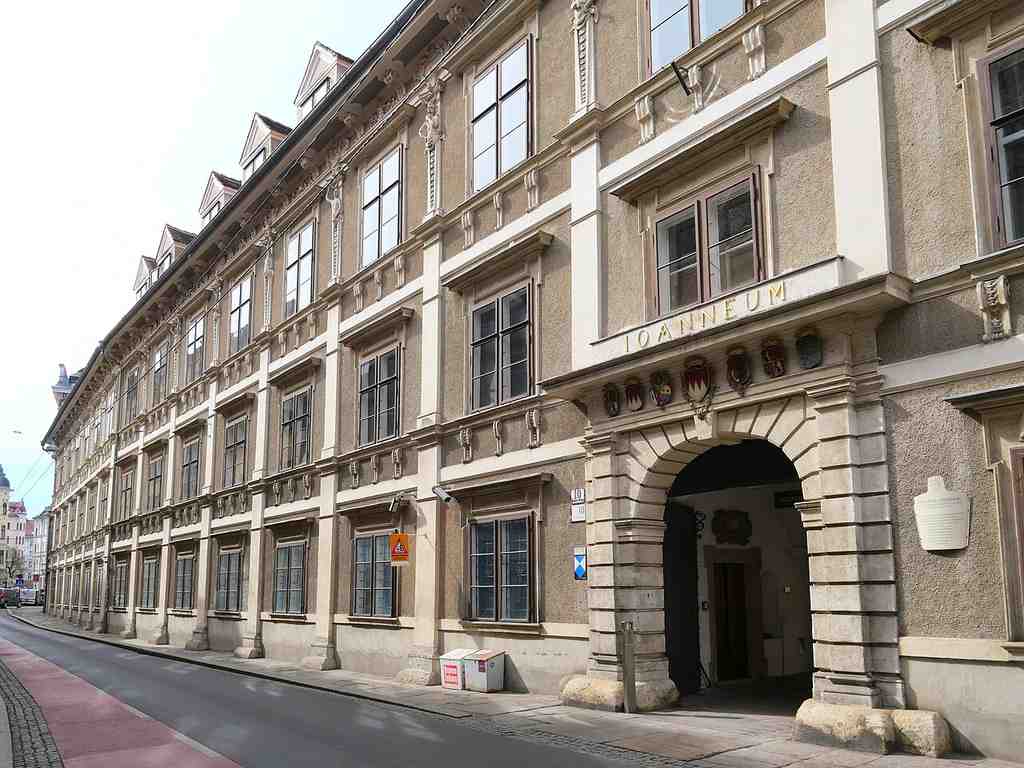
On your left, look for a pale stone building with a broad, symmetrical neo-Baroque façade, tall arched windows, and an ornate central portal beneath a sculpted roofline.
This is the Universalmuseum Joanneum, one of the great intellectual engines of Graz. Archduke Johann founded it in eighteen eleven, and he did not imagine a museum in the narrow sense. He wanted a place that would collect the world, study it, and teach from it. So from the beginning, this was both a museum and a school, built around his remarkable natural science collections.
That early ambition changed this city. Friedrich Mohs worked here and devised the Mohs hardness scale, the simple ranking geologists still use to test minerals from talc to diamond. Franz Unger, later called a father of paleobotany, taught here as well, helping students read the history of vanished plants from fossils. In other words, this was not merely a cabinet of curiosities. It was a workshop for thinking.
The courtyard view in the Lesliehof hints at the Joanneum’s earlier life as a scholarly enclave. Before long, the collections outgrew that home. Space became tight, and between eighteen ninety and eighteen ninety-five, Graz answered with this new building on Neutorgasse. Architect August Gunolt gave it the confident language of Viennese neo-Baroque design: formal, grand, and perfectly suited to a museum that wanted to announce its civic importance. You can take a look at that exterior in the app as well. Inside this newer building, Graz once gathered its cultural history collections, decorative arts, medieval works, and the State Picture Gallery. In nineteen forty-one, that gallery split into two branches: the Alte Galerie for art up to about eighteen hundred, and the Neue Galerie for more recent work. That division tells you something rather charming about museums: even when they preserve the past, they are always reorganising their view of it.
The Joanneum grew far beyond these walls. Today it stretches across fourteen sites in Graz and wider Styria, making it the oldest museum in Austria and, after Vienna’s Kunsthistorisches Museum, the second largest, as well as the largest universal museum in Central Europe. It cares for around four point nine million objects with roughly five hundred staff, ranging from coins and fossils to photographs, films, paintings, armour, and scientific specimens.
Beneath your feet lies one of its cleverest modern chapters. Between two thousand and ten and two thousand and thirteen, the old and new Joanneum buildings were restored and linked underground to form the Joanneumsviertel, a shared museum quarter. That project brought the Neue Galerie, the multimedia collections, and a redesigned natural history museum into a single connected world. Fittingly, for the museum’s two hundredth anniversary, scientists even named a newly recognised mineral Joanneumite in its honour.
If you plan to go in, the museum is generally open from Tuesday to Friday, from nine in the morning until five in the afternoon, and closed on Mondays, Saturdays, and Sundays.
For all its scale, this place still follows Archduke Johann’s original rule: collect, preserve, research, and share.
When you are ready, continue on toward the Franciscan Monastery.




