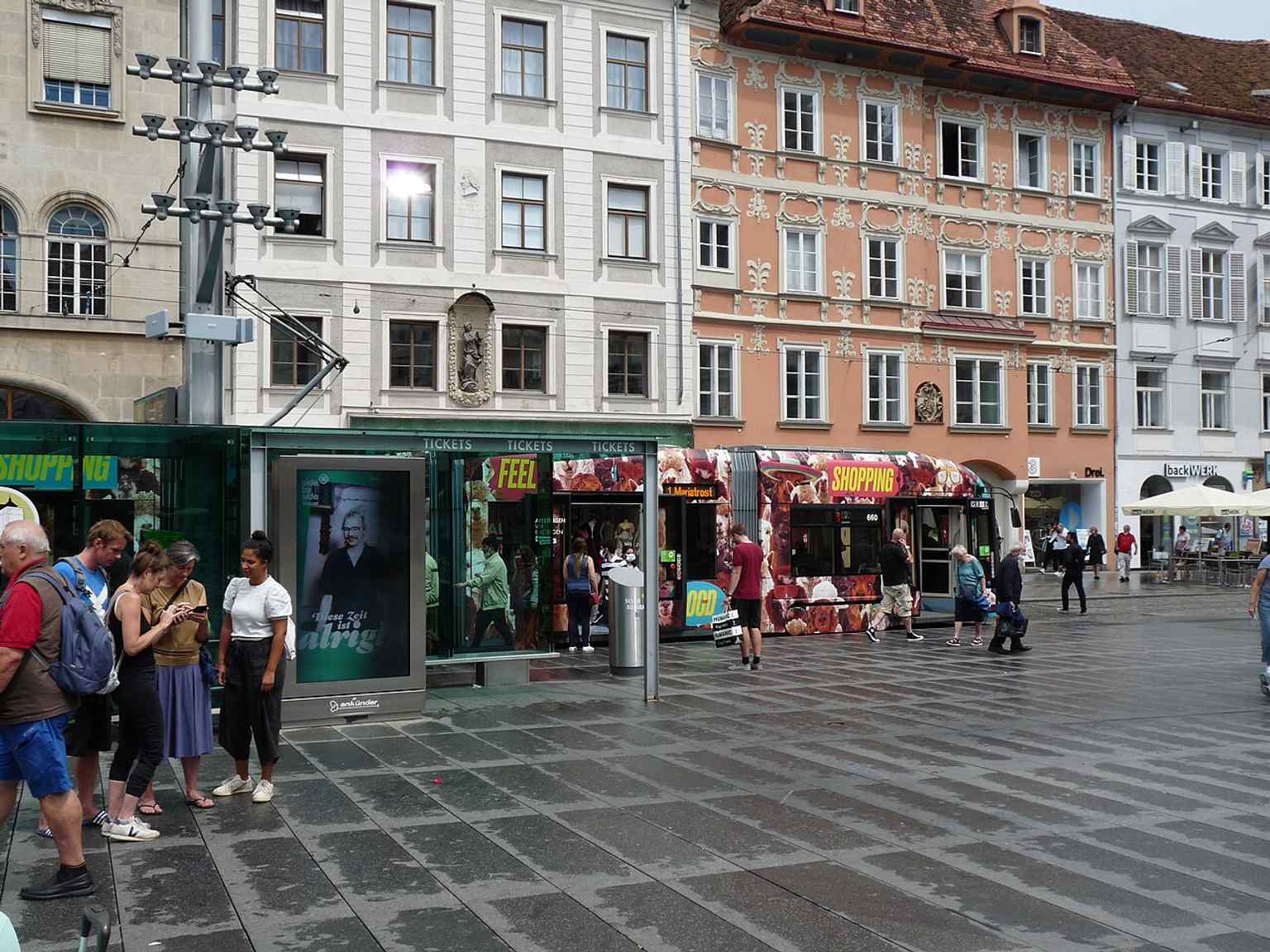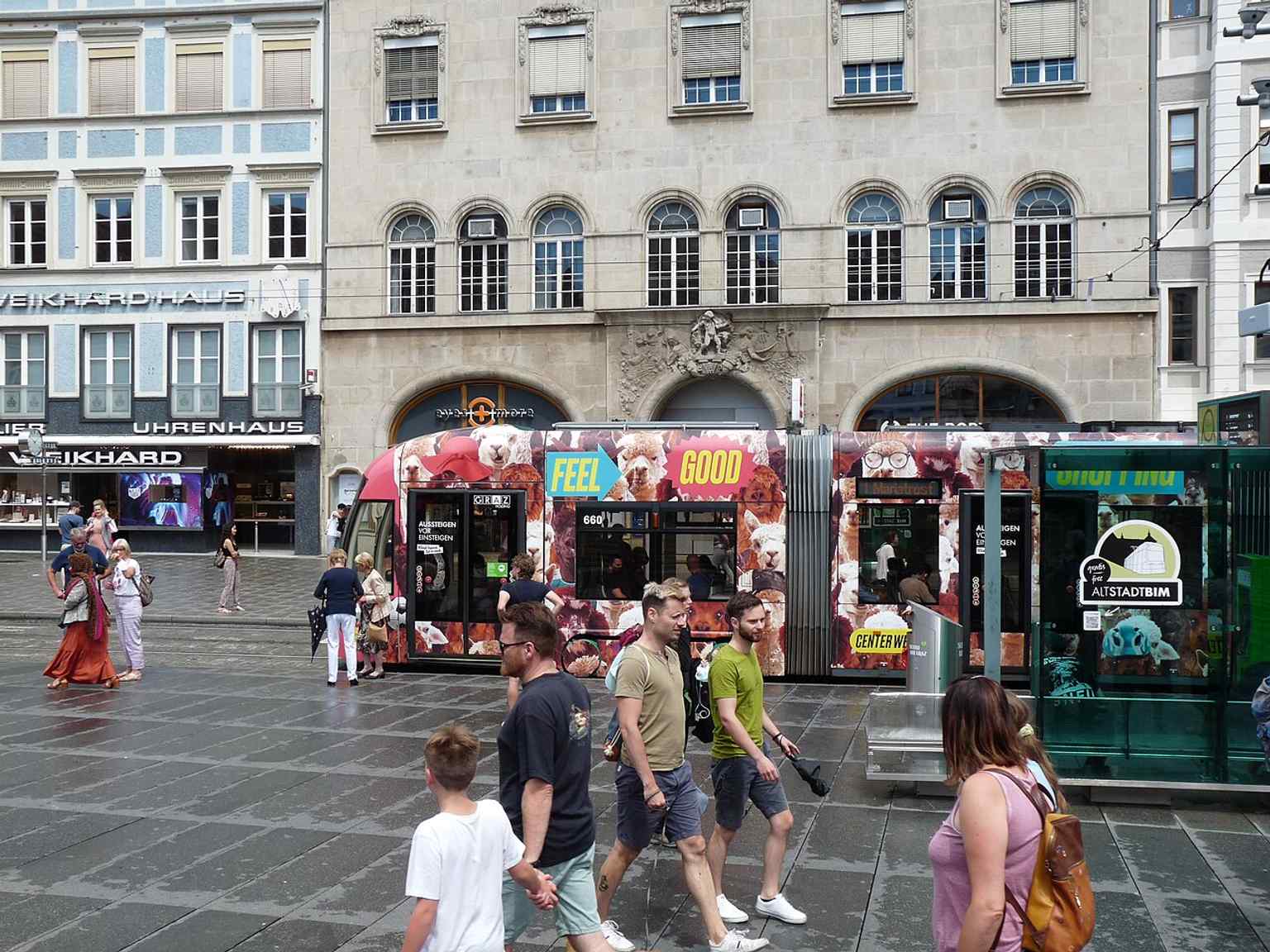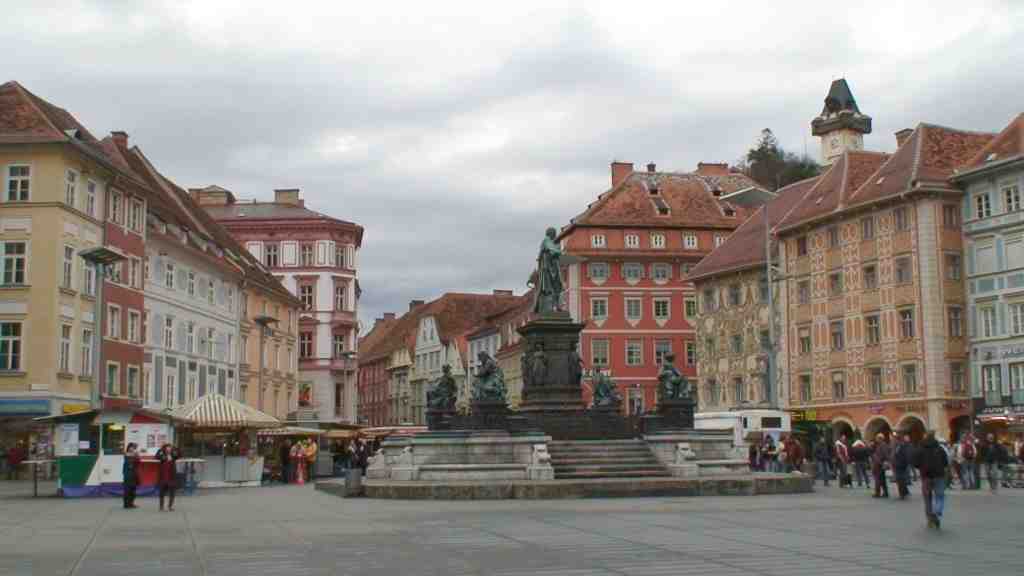
On your left, look for a broad trapezoidal stone square edged by stucco-faced historic houses, with the pale monumental Town Hall and the bronze Archduke Johann fountain as its clearest markers.
This is the Hauptplatz, the Main Square, and in many ways it is the heart that taught Graz how to beat. Around eleven sixty, Duke Otakar the Third laid out this space as the city’s central market. That makes it not merely old, but foundational: the historic and urban centre from which Graz organised itself. Five streets still branch away from it like spokes from a hub: Sporgasse, Herrengasse, Schmiedgasse, Murgasse, and Sackstraße.
The shape matters. The square began as a much larger trapezoid and once stretched as far as today’s Landhausgasse. Then, around fifteen fifty, builders raised a new Renaissance town hall and nearly cut the square in half. Cities rarely shrink their main stage without reason, and here the reason was power: trade still mattered, of course, but civic government wanted a more commanding presence. The present Town Hall took on its grand late historicist face between eighteen eighty-nine and eighteen ninety-three, giving the square, as contemporaries said, a new monumental accent.
If you let your gaze drift around the edges, you are looking at layers rather than a single period. Many of these houses hide medieval or late Gothic cores behind later fronts. Their façades speak several languages at once: late Gothic, Baroque, Biedermeier, and late nineteenth-century historicism. Some carry elaborate stucco work, those moulded plaster decorations that catch light and shadow, and some display statues of the Virgin Mary, small public signs of popular devotion woven into everyday architecture.
At the centre stands the Archduke Johann fountain, unveiled in eighteen seventy-eight. For a closer look at its composition, the close-up of the fountain shows it rather well. Sculptor Franz Pönninger gave Johann an over-life-size bronze figure and set him above four allegorical river figures: the Mur, the Enns, the Drau, and the Sann. It is a confident piece of nineteenth-century civic theatre, and quite right for a square that always preferred to gather everything in one place.
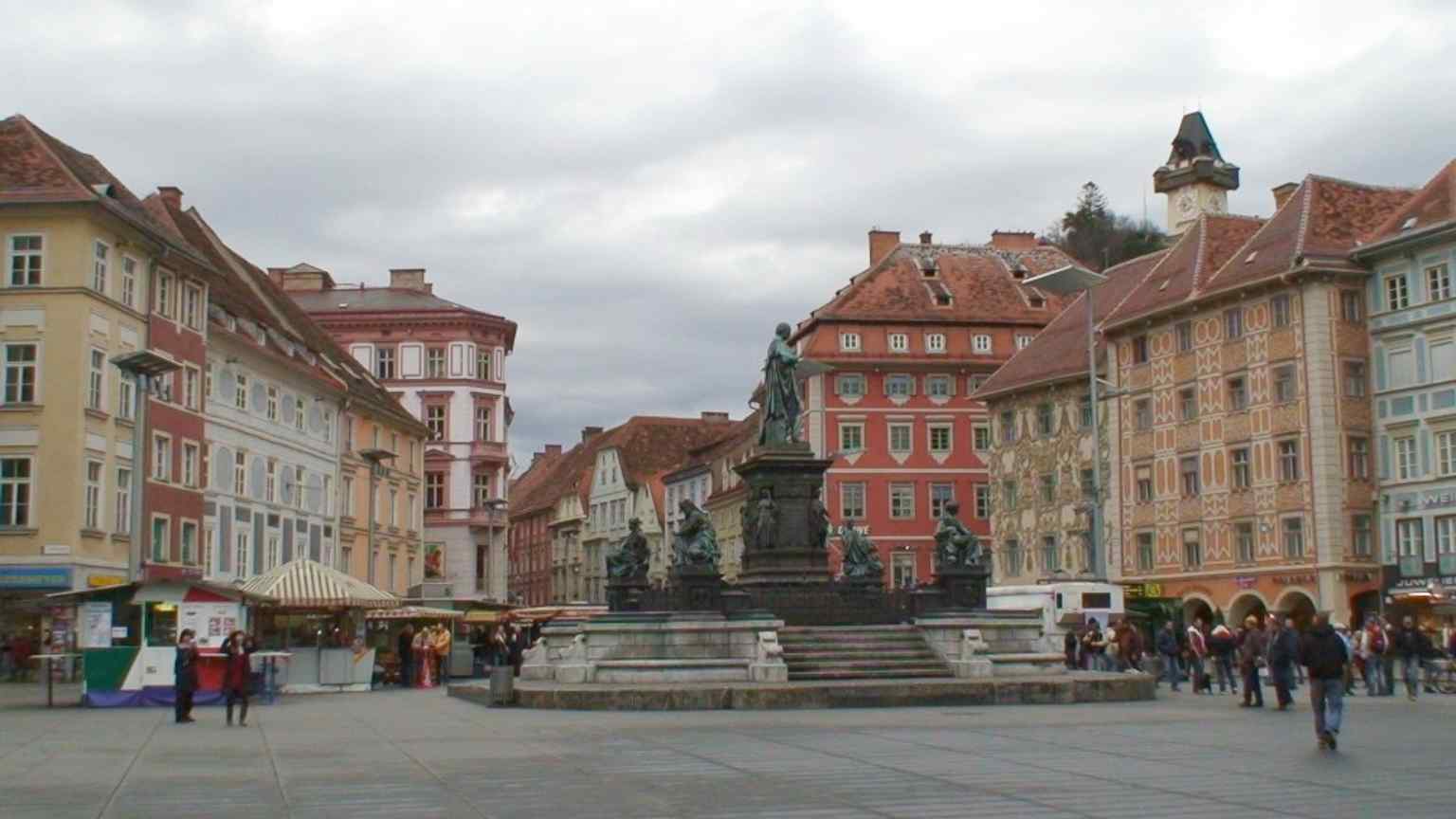
Names tell their own story. For a long time, people simply called this space “on the square.” The name Hauptplatz first appears in chronicles in sixteen sixty-five. In the nineteenth century, some called it Hauptwachplatz because the main guard occupied the Town Hall. Then came the ugliest renaming of all: from nineteen thirty-eight to nineteen forty-five, the Nazi regime called it Adolf-Hitler-Platz. After the war, Graz restored the older name, and with it, a measure of dignity.
For generations, nearly every tram line in Graz crossed here. If you glance at the historical tram photograph in the app, you can see how firmly the square served as the city’s transport stage as well as its market. Only the Neutor line, opened in twenty twenty-five, finally changed that old pattern.
The Hauptplatz is Graz in miniature: trade, politics, devotion, spectacle, and daily movement, all pressed into one civic room.
When you are ready, continue on and let the city lead you from its public heart toward its more solemn voices.