

Chester Highlights Audio Tour: Historic Treasures
Beneath the pristine red sandstone of Chester lies a history soaked in blood and betrayal. Two thousand years of Roman conquest, medieval rebellion, and hushed scandals have left their mark on every shadow. Unlock these secrets with this self-guided audio tour. Wander beyond the standard maps to uncover the forgotten dramas and hidden corners that most travelers carelessly walk past. Why was a desperate monarch trapped within the walls of the castle as his kingdom burned? What sinister secret remains buried deep beneath the foundations of the Old Dee Bridge? How did a seemingly quiet museum exhibit spark a century of local superstition? Trace the arc of power and pain through these ancient streets. Feel the crushing weight of empires and the echoes of long-lost revolutions as you move through time. Transform your walk into a chilling investigation of the past. Begin your journey into the darkness now.
Tour preview
About this tour
- scheduleDuration 100–120 minsGo at your own pace
- straighten4.2 km walking routeFollow the guided path
- location_onLocationChester, United Kingdom
- wifi_offWorks offlineDownload once, use anywhere
- all_inclusiveLifetime accessReplay anytime, forever
- location_onStarts at Phoenix Tower, Chester
Stops on this tour
lock_open 3 free previews · 12 unlock with purchase
Look for the red sandstone half-round tower built into the wall, topped by a steep slate roof and marked by the carved phoenix plaque above the doorway. This is Phoenix Tower,…Read moreShow less
Open dedicated page →Look for the red sandstone half-round tower built into the wall, topped by a steep slate roof and marked by the carved phoenix plaque above the doorway.
This is Phoenix Tower, though it has also answered to Newton Tower and, with a certain royal swagger, King Charles’ Tower. Its story likely begins in the thirteenth century, but the detail that really sticks is over the door: in sixteen thirteen, two Chester guilds, the Painters and Stationers and the Barbers and Chandlers, repaired the place after it had fallen into rough shape and even lost the lead from its roof. They set that phoenix plaque here as a calling card for the Painters’ emblem... tasteful branding, seventeenth-century style.
During the siege of Chester in sixteen forty-five, the tower carried a gun on each storey and took damage in the fighting. A plaque claims King Charles the First stood here on the twenty-fourth of September, watching his troops lose at Rowton Heath. Historians are not entirely convinced. One argues the king more likely watched from Chester Cathedral, partly because a captain beside him was reportedly killed by a stray shot. That does rather sharpen the debate.
By the eighteen hundreds, the city leaned into the royal legend and promoted the tower as a tourist sight, even after it had grown shabby. If you fancy it, have a look at the before-and-after image in the app; it neatly shows how the tower shifted from stark Victorian lookout to polished heritage landmark.
It is usually only open on Saturdays and Sundays from eleven fifty-nine A-M to five P-M. For a small tower, it has had a remarkably eventful life.
Take your last look at the phoenix, and when you’re ready, we can continue on to the Water Tower.
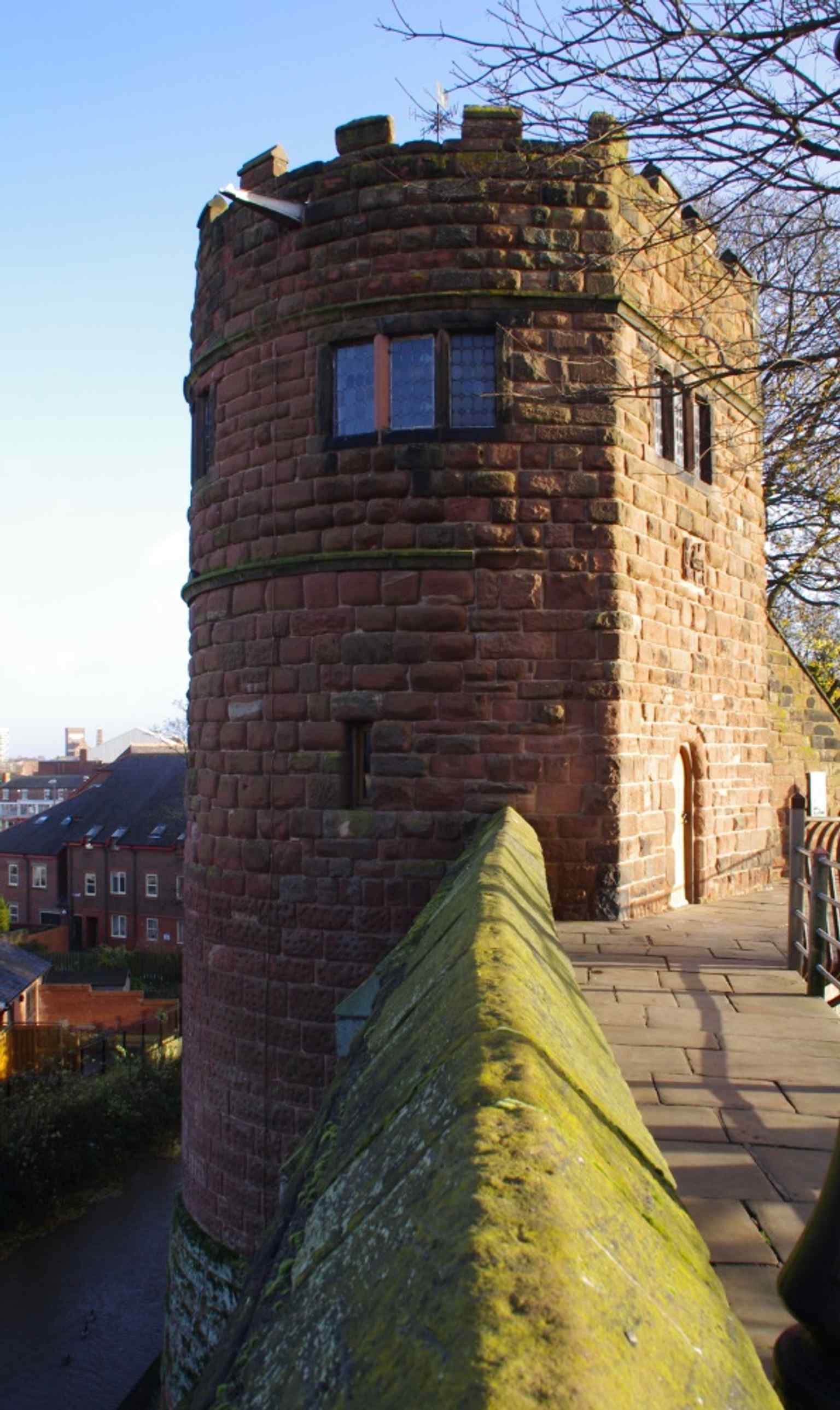
A clear view of Phoenix Tower on Chester’s city walls, the Grade I listed tower at the northeast corner.Photo: Simon Armstrong, Wikimedia Commons, CC BY-SA 3.0. Cropped & resized. 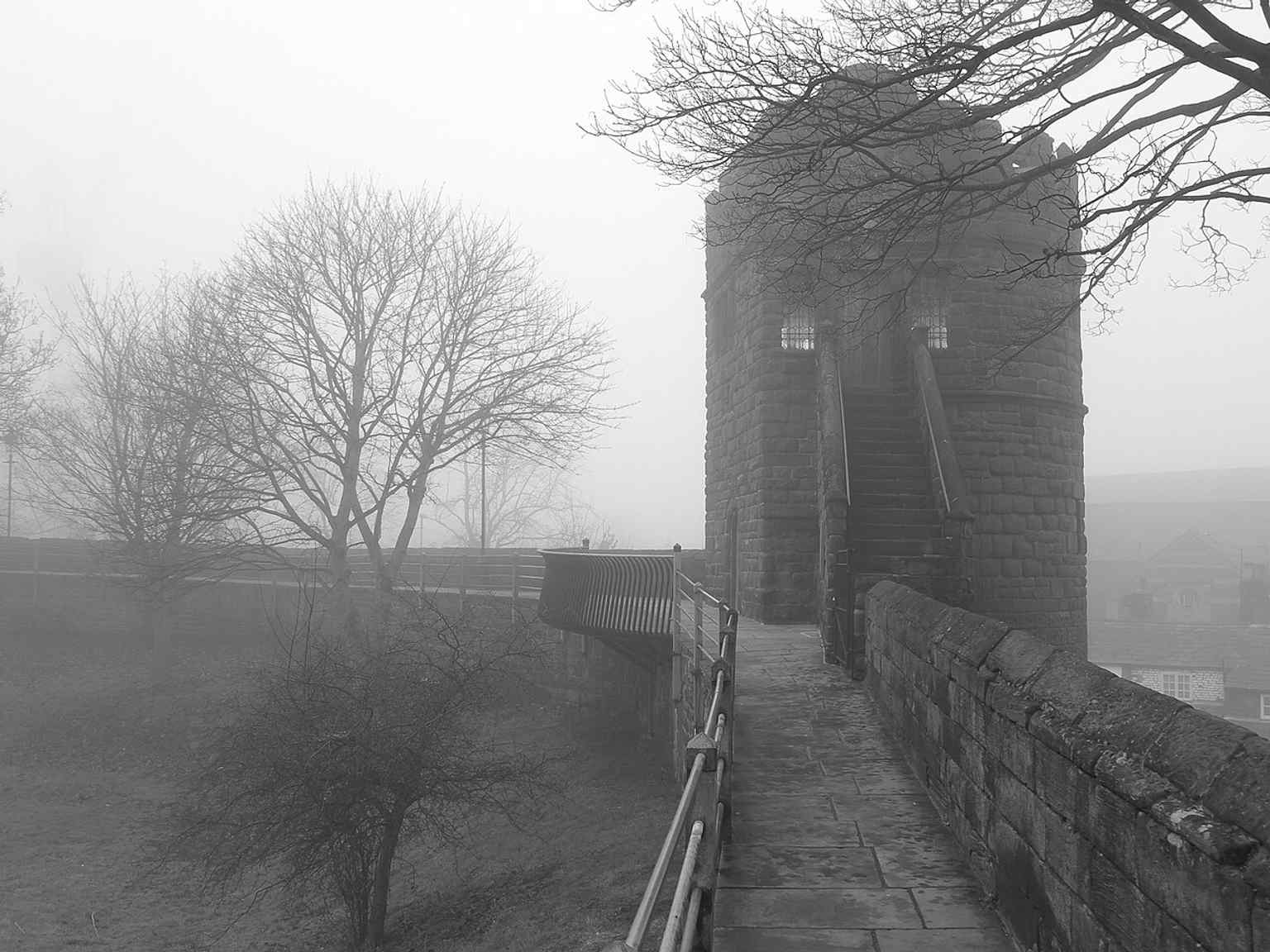
A wider view of Chester’s walls with Phoenix Tower set into the northeast corner, helping place it in the city fortifications.Photo: Tom Axford 1, Wikimedia Commons, CC BY-SA 4.0. Cropped & resized. 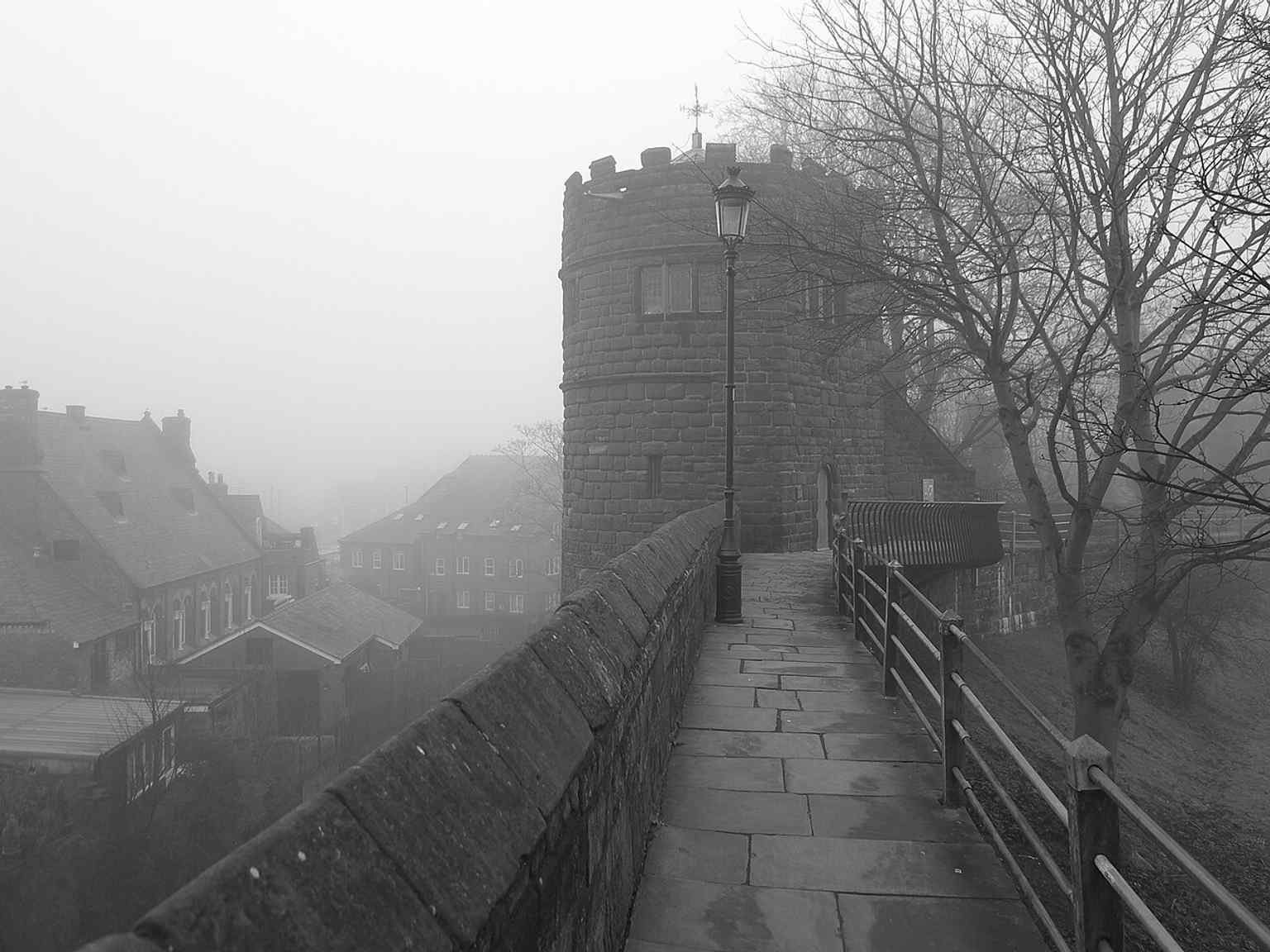
A moody black-and-white view of the tower on the walls, evoking its long history and wartime damage.Photo: Tom Axford 1, Wikimedia Commons, CC BY-SA 4.0. Cropped & resized. Ahead of you is a rough sandstone tower with a round lower drum, a squarer upper turret, and a crenellated spur wall marching back to the city walls. This started life as the New…Read moreShow less
Open dedicated page →Ahead of you is a rough sandstone tower with a round lower drum, a squarer upper turret, and a crenellated spur wall marching back to the city walls.
This started life as the New Tower, though by the seventeenth century everyone sensibly called it the Water Tower, and the City Assembly rather hopelessly tried to correct them. John de Helpston designed it between thirteen twenty-two and thirteen twenty-five, when this spot stood in the River Dee itself. From here, guards watched shipping, defended Chester's port, and made sure merchants paid their customs dues... medieval tax enforcement with a good view.
Its shape is satisfyingly odd: a circular base, then a square turret above, with two octagonal chambers stacked inside, and even a tiny latrine tucked into the angle by the wall. That spur wall links the tower to Bonewaldesthorne's Tower, and the battlements - the tooth-like gaps along the top, called crenellations - may be the only surviving medieval example on Chester's walls. The app has a photo of the medieval toilet if you want proof that military architecture still had to solve ordinary human logistics.
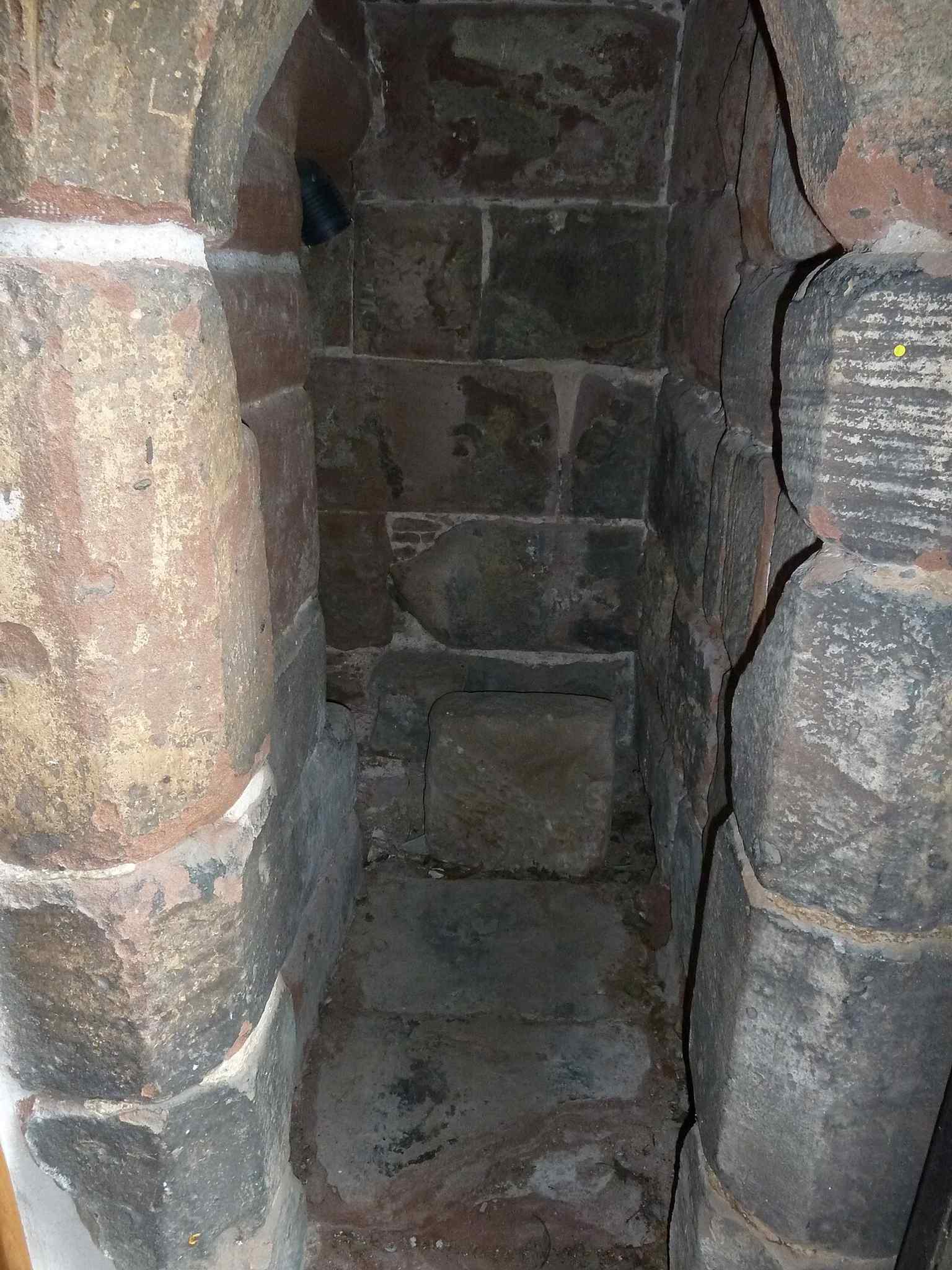
A medieval toilet inside the Water Tower — a rare survival that hints at the building’s everyday medieval practicality.Photo: Worm That Turned, Wikimedia Commons, CC BY-SA 3.0. Cropped & resized. By the end of the sixteenth century, the Dee had silted up, leaving the tower stranded about two hundred yards inland. If you like, check the comparison in the app; it shows how this former river outwork became part of a much more managed city setting.
In sixteen thirty-nine, the city renovated it, then turned parts of the wall into gun ports, and Civil War fighting damaged it. After that, it slipped into life as a storehouse, and by seventeen twenty-eight someone dismissed it as "useless and neglected"... a bit harsh, honestly. In eighteen thirty-eight, the Chester Mechanics' Institution opened a museum here; Grosvenor Museum later took over and reopened it to the public in nineteen sixty-two. Since two thousand and sixteen, it has housed the history-of-medicine museum, Sick to Death.
If you want to go in, it is usually closed on Monday, open Tuesday and Wednesday from ten to three, and Thursday to Sunday from ten to four.
This tower is Chester's old river sentry, stranded on land but still stubbornly impressive.
When you're ready, we can head on to Watergate.
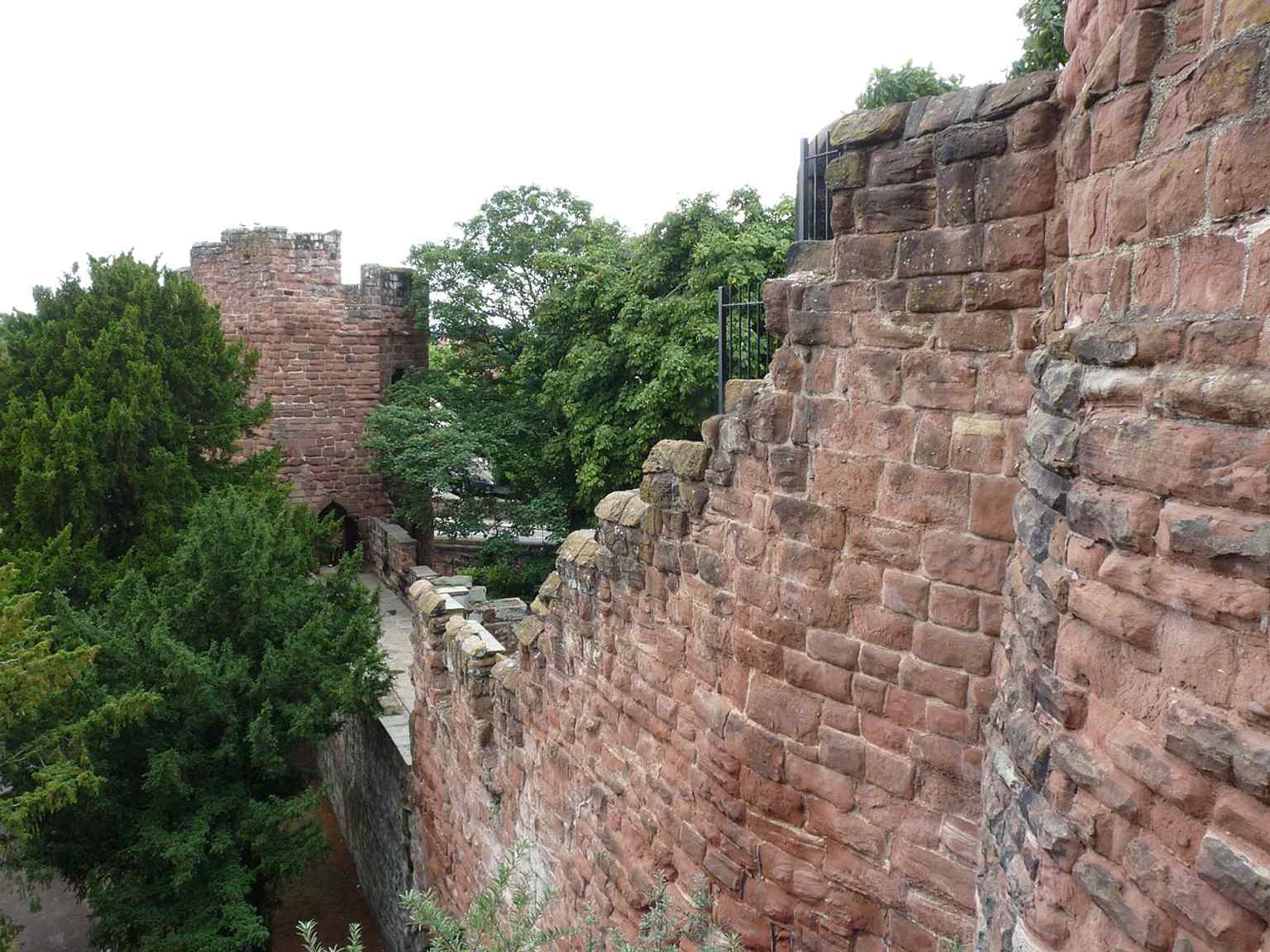
The spur wall leading up to the Water Tower — the same medieval link that connects it to Bonewaldesthorne’s Tower.Photo: Chris McKenna, Wikimedia Commons, CC BY-SA 3.0. Cropped & resized. 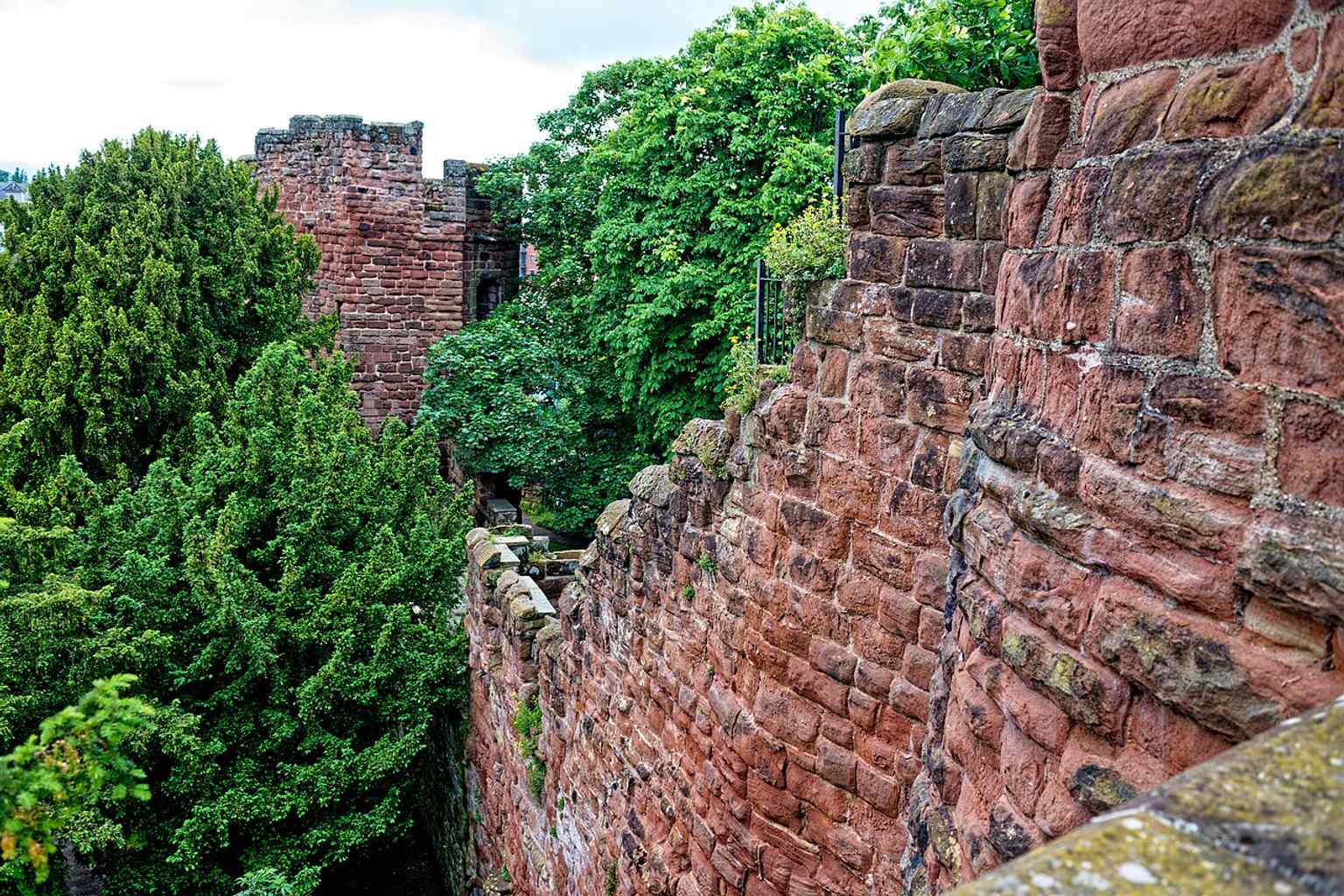
Seen from Bonewaldesthorne’s Tower, this shows the spur wall relationship that made the Water Tower part of Chester’s city-wall defence.Photo: Tilman2007, Wikimedia Commons, CC BY-SA 4.0. Cropped & resized. 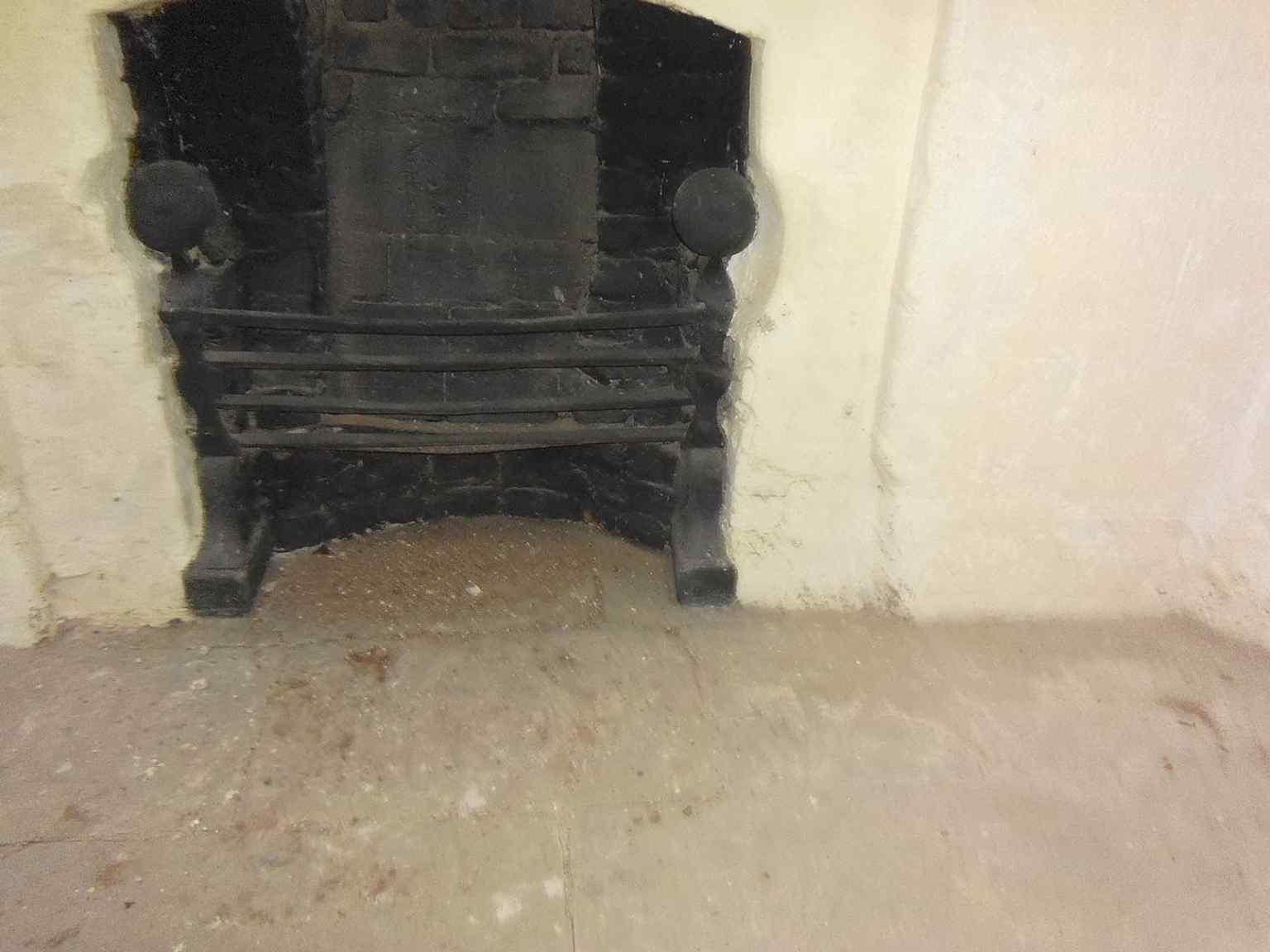
A downstairs fireplace inside the tower, one of the domestic details from its later use as a museum and storehouse.Photo: Worm That Turned, Wikimedia Commons, CC BY-SA 3.0. Cropped & resized. 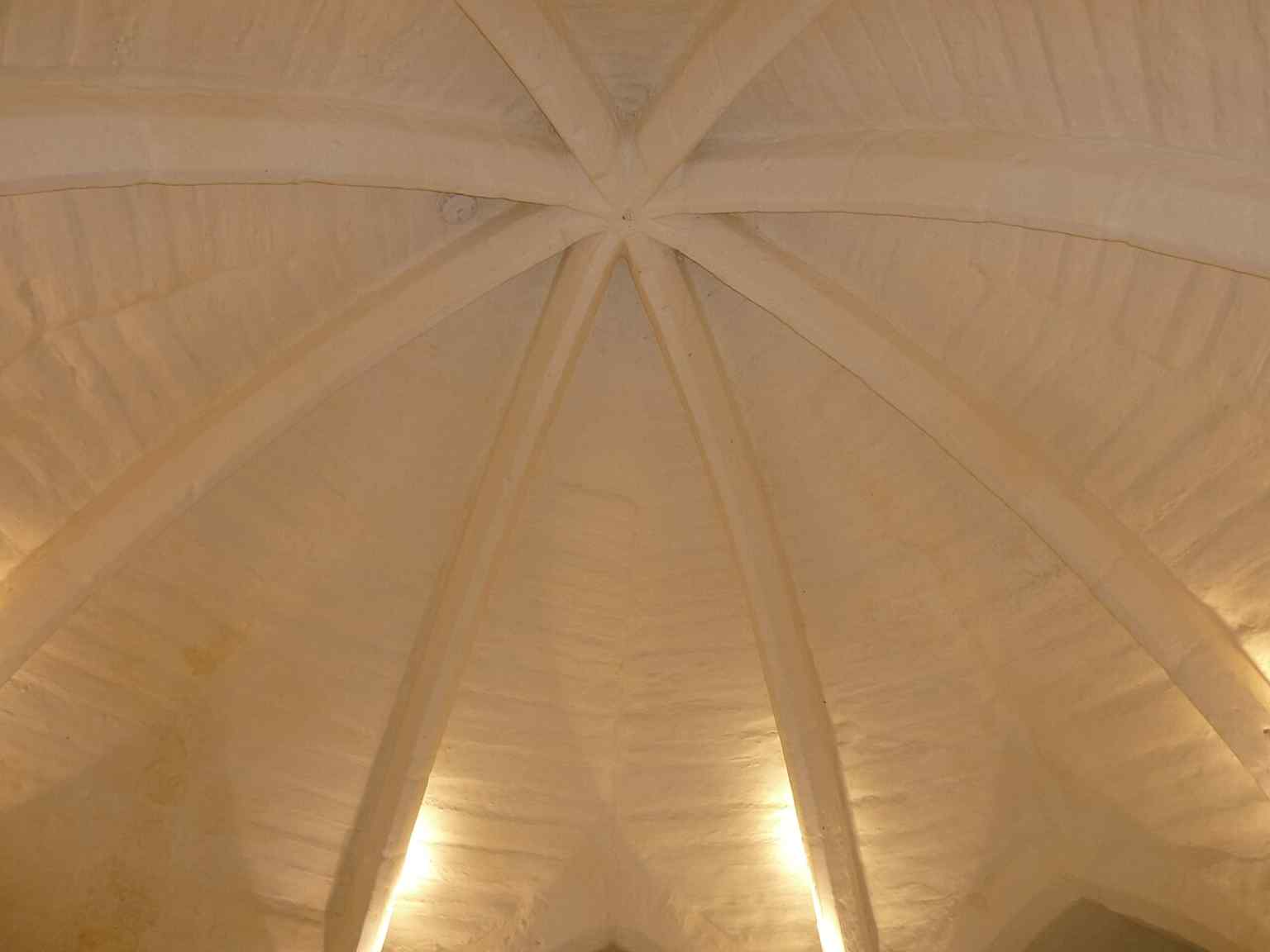
The arched ceiling in the lower chamber, showing the thick sandstone structure of the medieval tower.Photo: Worm That Turned, Wikimedia Commons, CC BY-SA 3.0. Cropped & resized. 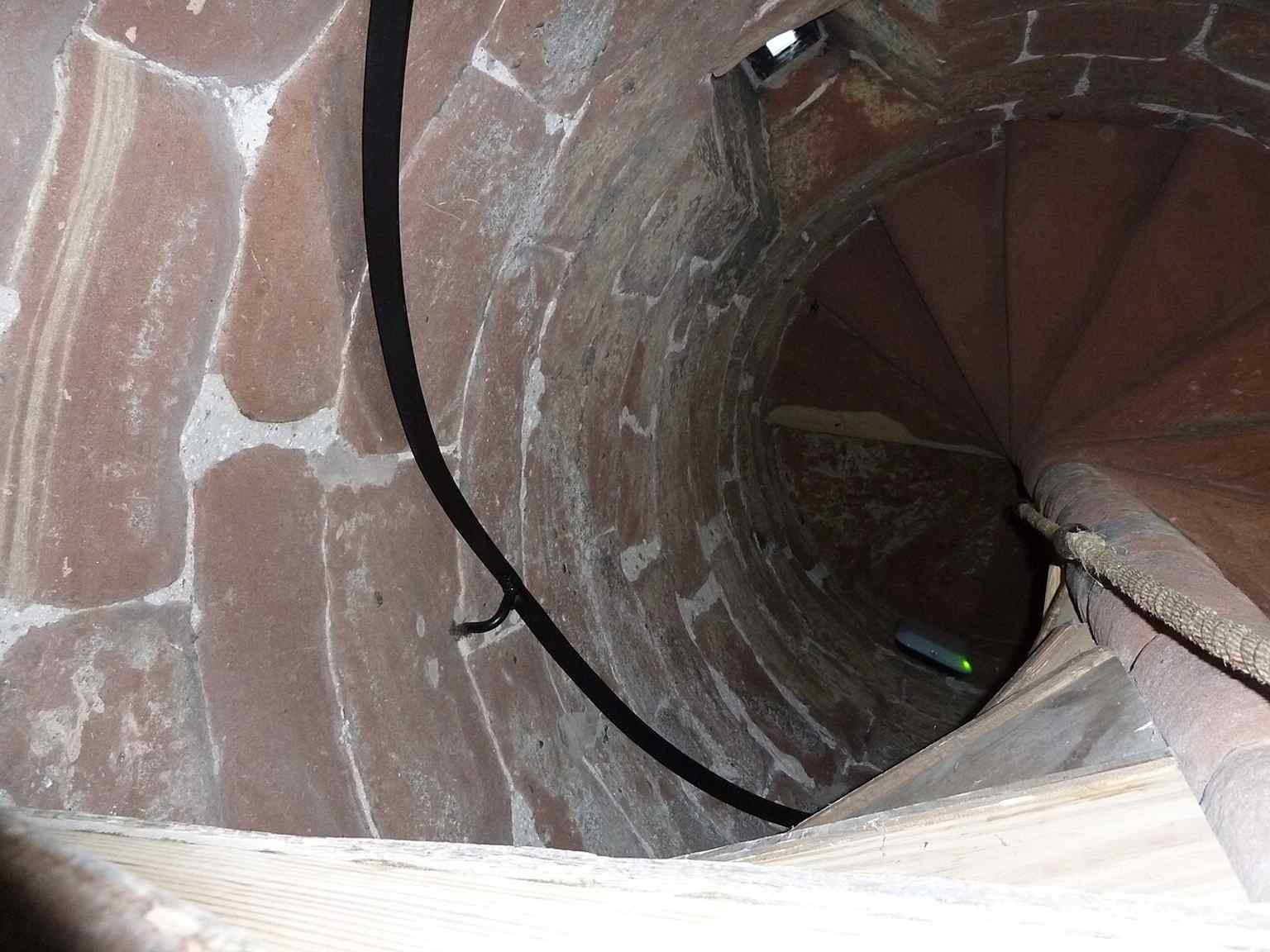
The ground-floor stairwell illustrates the narrow vertical circulation inside the tower’s two-stage interior.Photo: Worm That Turned, Wikimedia Commons, CC BY-SA 3.0. Cropped & resized. 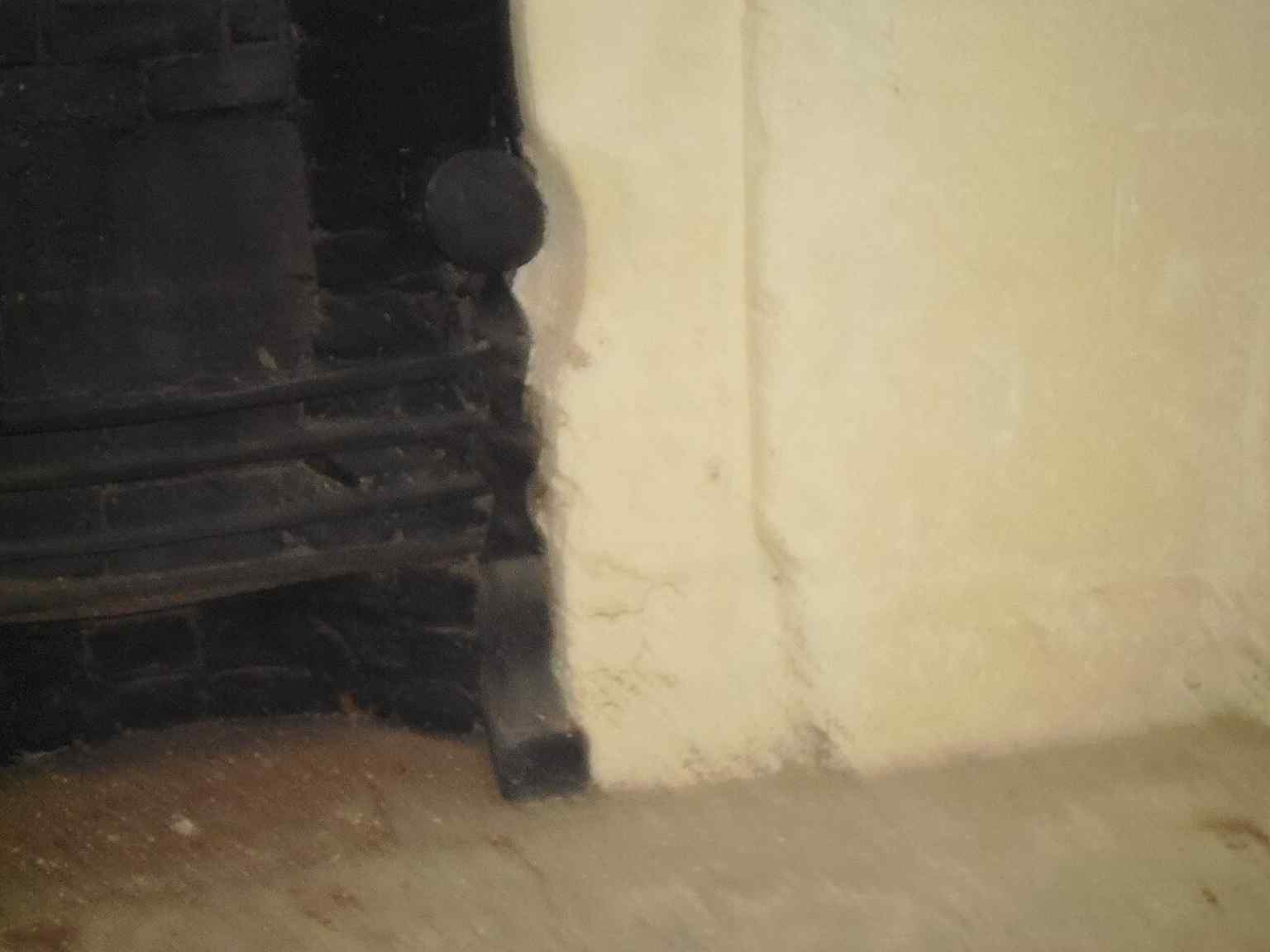
Close detail of the fireplace, highlighting how the tower was adapted and reused long after its defensive role faded.Photo: Worm That Turned, Wikimedia Commons, CC BY-SA 3.0. Cropped & resized. 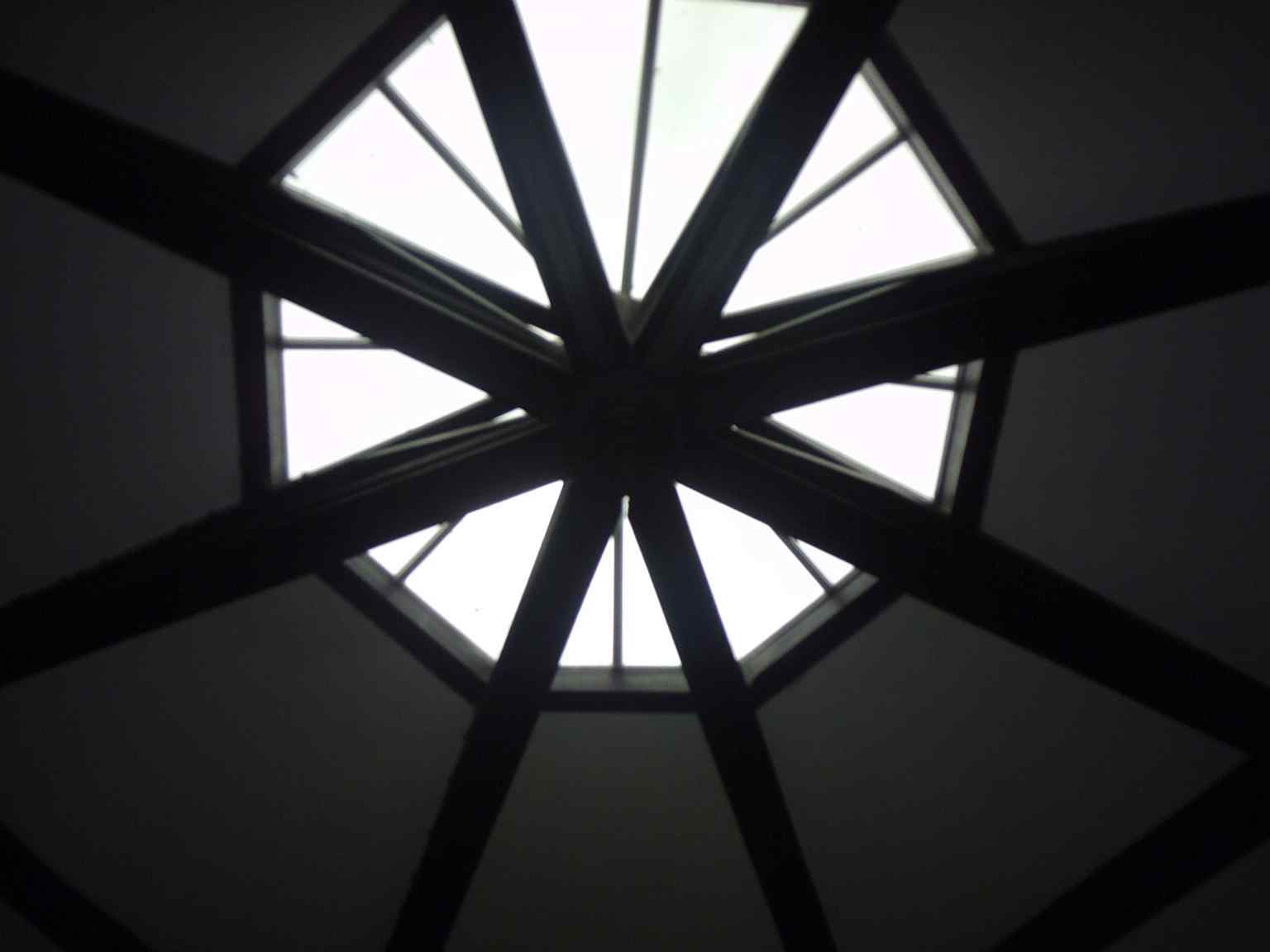
The skylight and exposed beams reveal the tower’s interior roof structure above the older stone chambers.Photo: Worm That Turned, Wikimedia Commons, CC BY-SA 3.0. Cropped & resized. 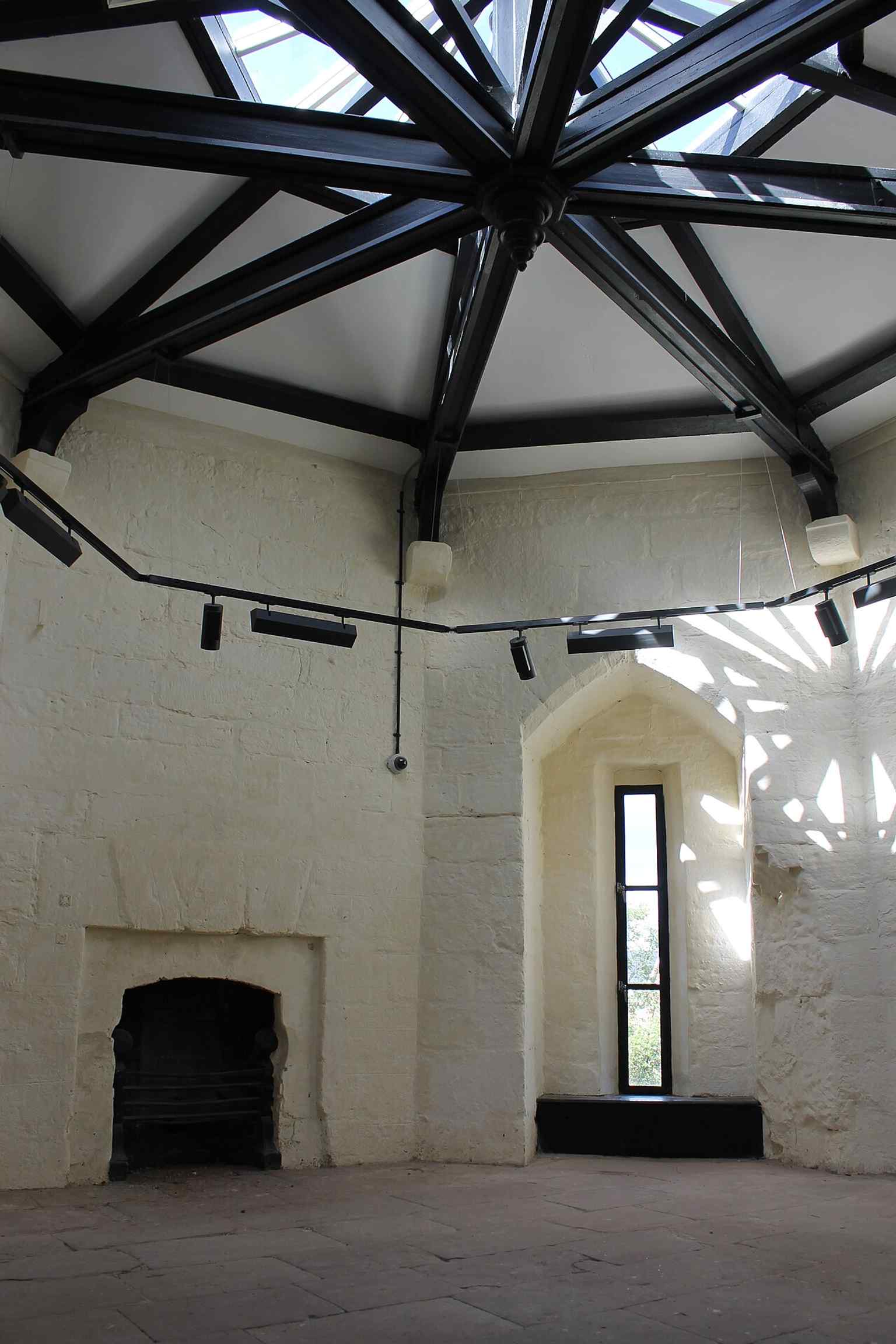
The upstairs room inside the tower, part of the later museum spaces opened by the Chester Mechanics’ Institution in 1838.Photo: Mum's taxi, Wikimedia Commons, CC BY-SA 3.0. Cropped & resized. 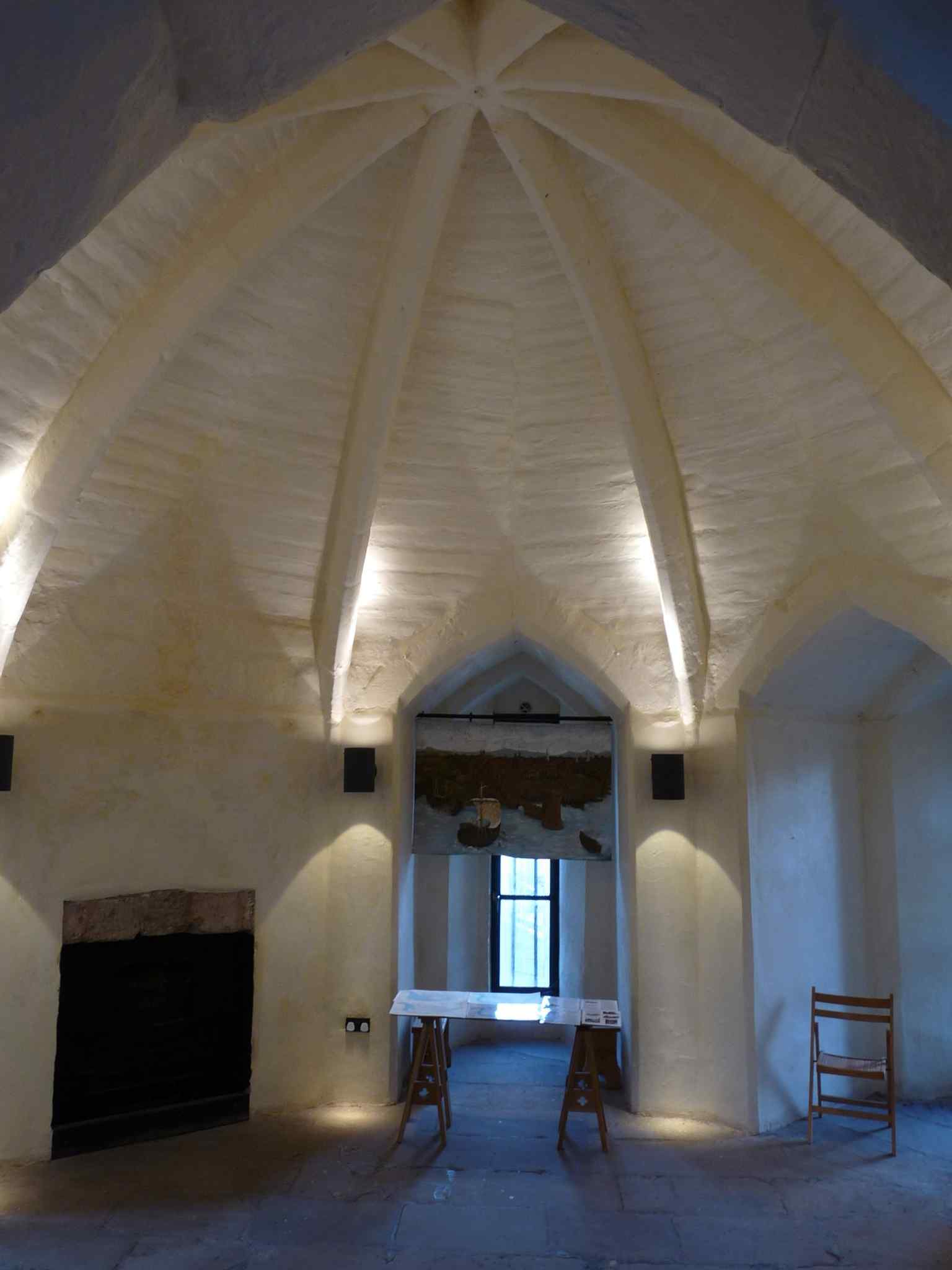
The wall-level chamber inside the tower, showing the layered interior layout behind the city walls.Photo: Chris McKenna, Wikimedia Commons, CC BY-SA 3.0. Cropped & resized. 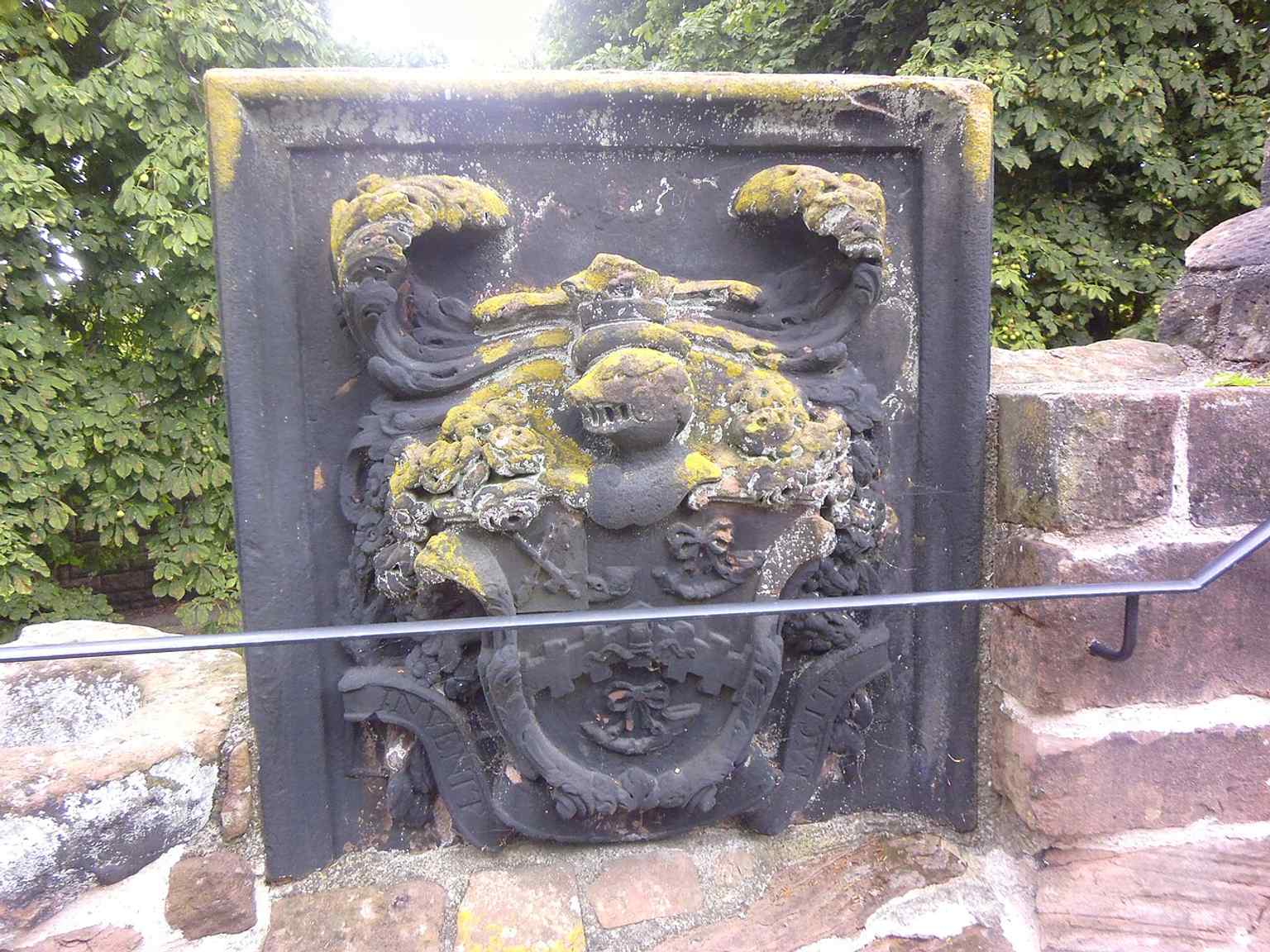
A coat of arms on the spur wall, a decorative survival on the medieval stonework linking the two towers.Photo: Worm That Turned, Wikimedia Commons, CC BY-SA 3.0. Cropped & resized. Look for a red sandstone arch spanning the road, topped with a balustraded parapet, and marked by a small stone drinking fountain set into one side. Watergate does a very Chester…Read moreShow less
Open dedicated page →Look for a red sandstone arch spanning the road, topped with a balustraded parapet, and marked by a small stone drinking fountain set into one side.
Watergate does a very Chester job: part city wall, part pedestrian shortcut, and far grander than a mere way over the A five forty-eight. Chester City Council commissioned it between seventeen eighty-eight and seventeen ninety, after the medieval gate here took damage during the siege of Chester. Joseph Turner designed the replacement in ashlar, meaning neatly cut stone blocks, with a basket arch made from rusticated voussoirs... the wedge-shaped stones of an arch, given a roughened face for extra swagger. Even the practical bits dress well in this city.
If you check the image on your screen, you can see how it still reads as wall first, bridge second. And on the north abutment, there is a drinking fountain dated eighteen fifty-seven, now dry but still politely hanging on. It is Grade One listed, which is Britain saying, very firmly, do not mess this up.
There’s also a moderately priced nearby spot that usually opens from noon into late evening.
A small gateway, but a very confident one.
Take a moment here, and when you’re ready, we can carry on to the next stop.
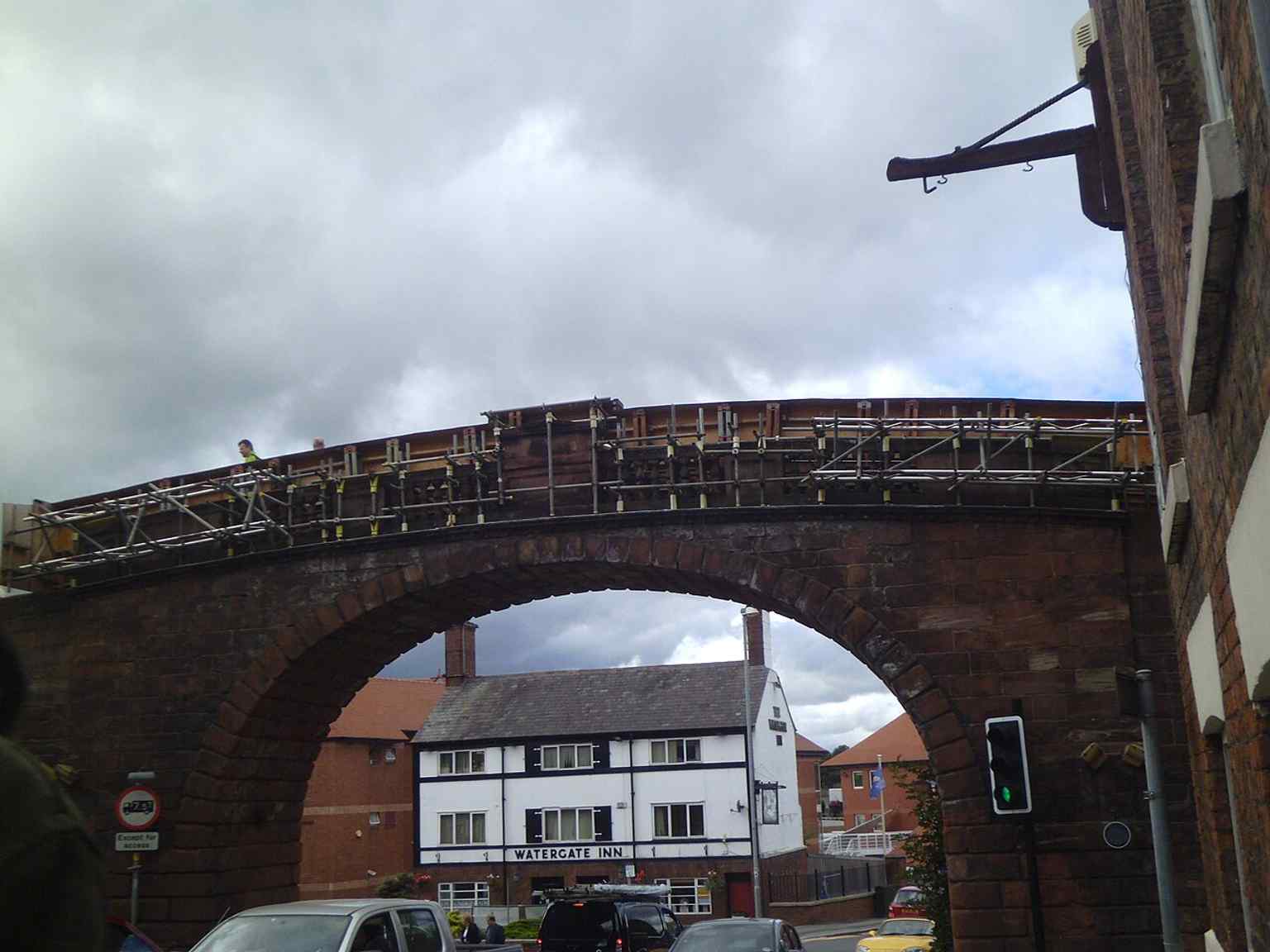
A clear front view of Watergate as it spans the road, showing the gateway that replaced the medieval gate after Chester’s siege-era damage.Photo: Worm That Turned, Wikimedia Commons, CC BY-SA 3.0. Cropped & resized. 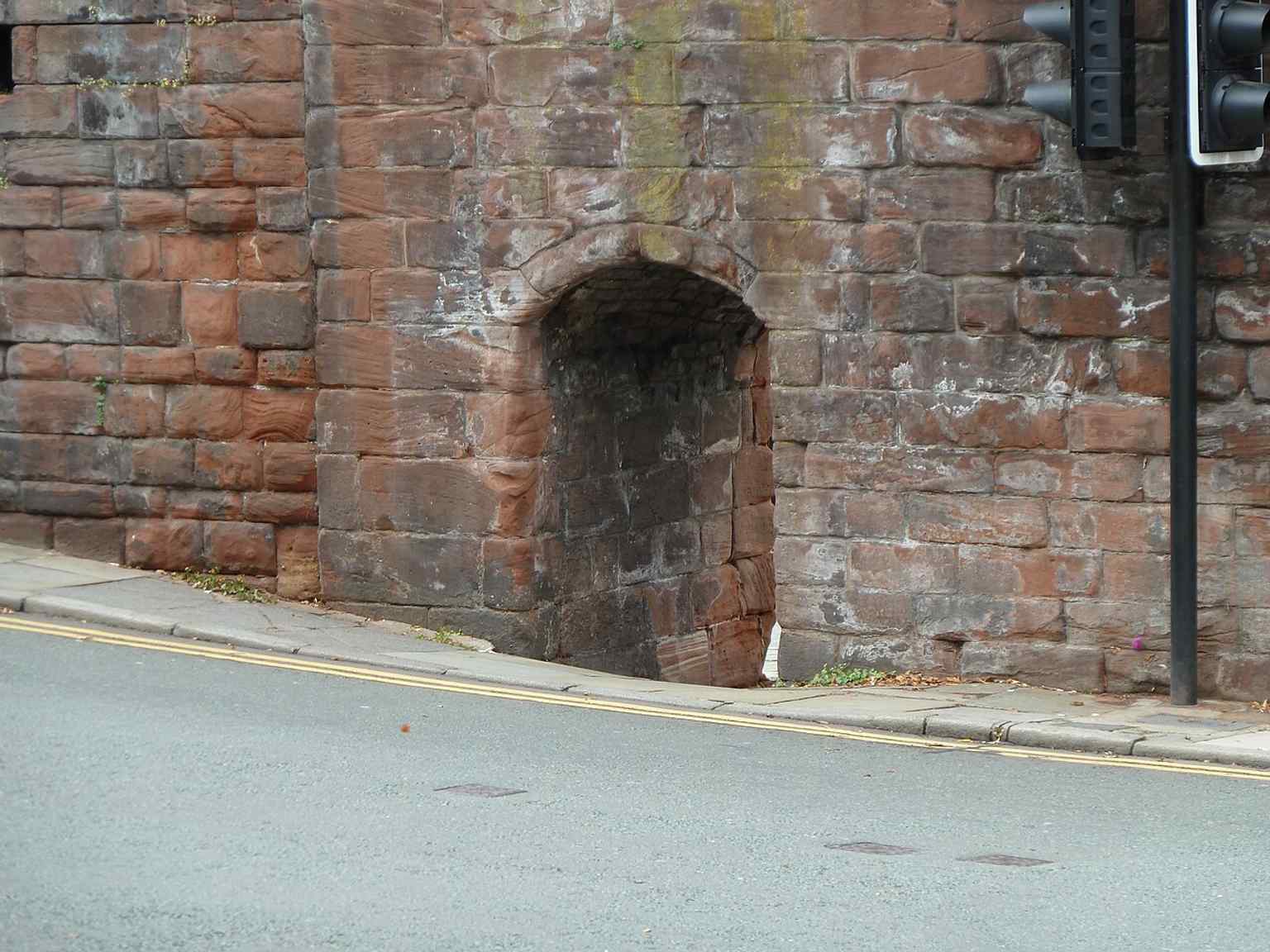
The pedestrian exit highlights how the gate still carries people over the road, just as part of Chester’s historic walls.Photo: Worm That Turned, Wikimedia Commons, CC BY-SA 3.0. Cropped & resized. 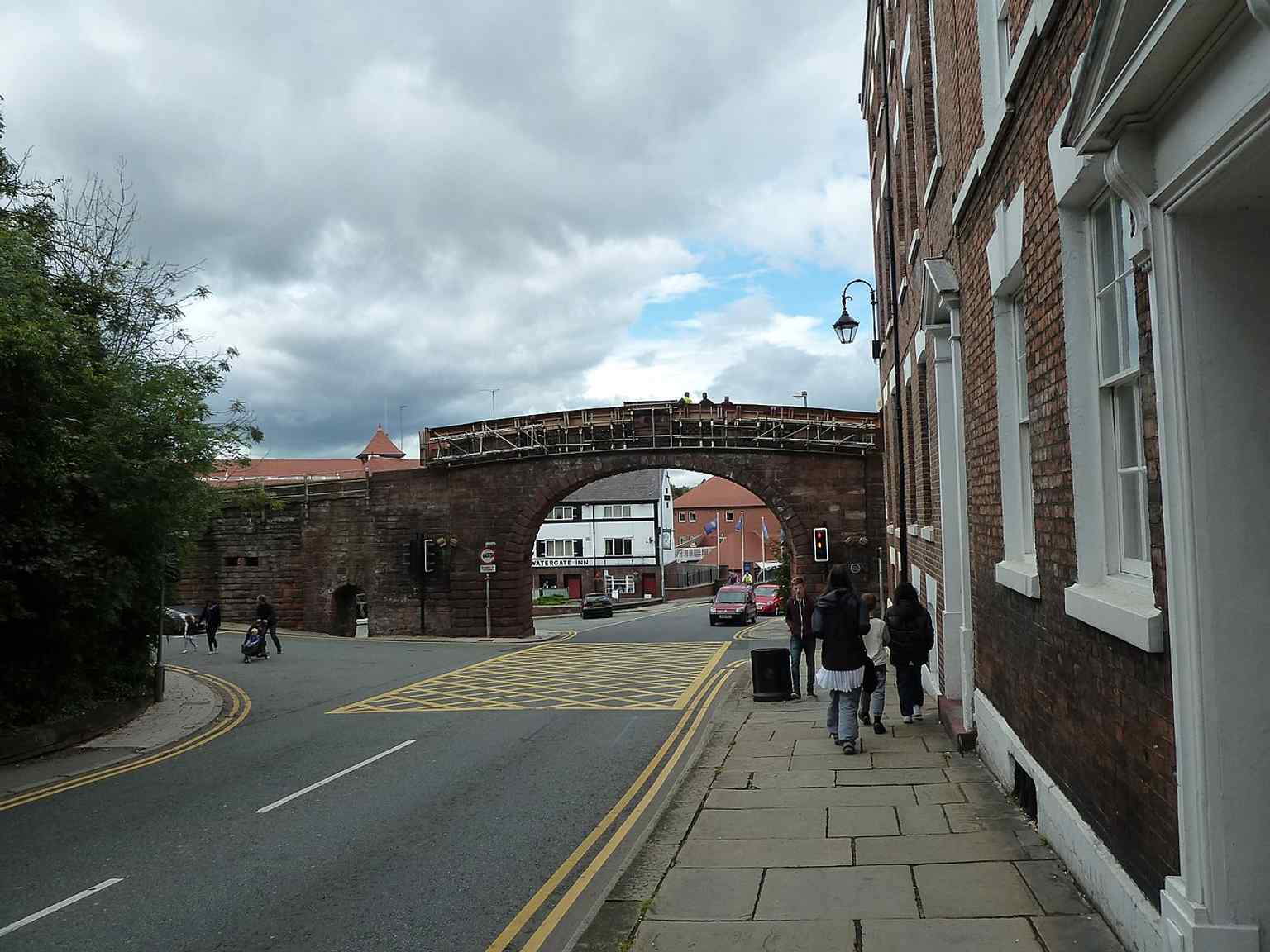
Seen from up the road, Watergate stands out as a Grade I listed part of Chester’s walls rather than just a traffic bridge.Photo: Worm That Turned, Wikimedia Commons, CC BY-SA 3.0. Cropped & resized. 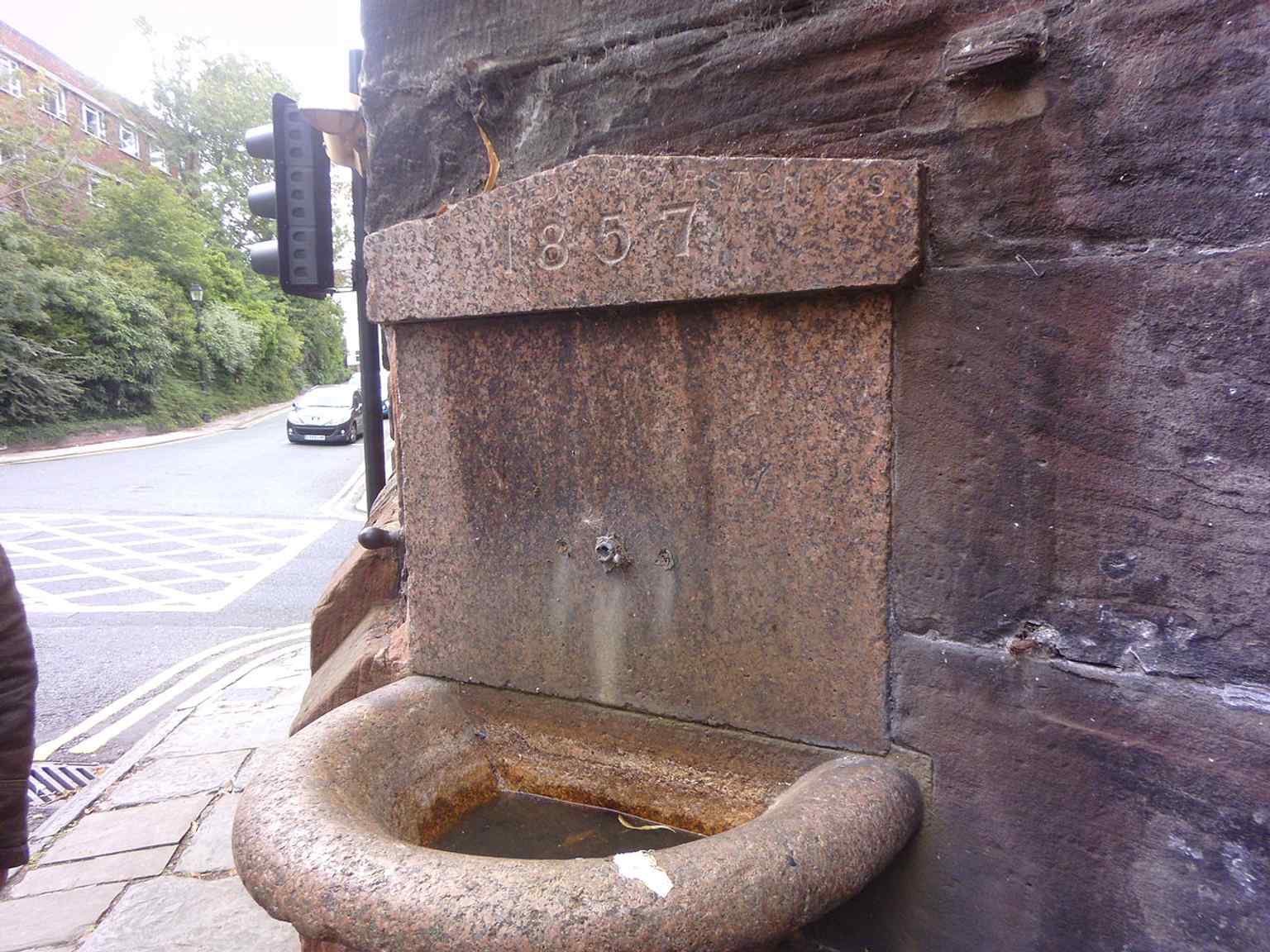
Another view of the fountain, showing the stonework detail on the gate’s edge and the Victorian date associated with it.Photo: Worm That Turned, Wikimedia Commons, CC BY-SA 3.0. Cropped & resized. 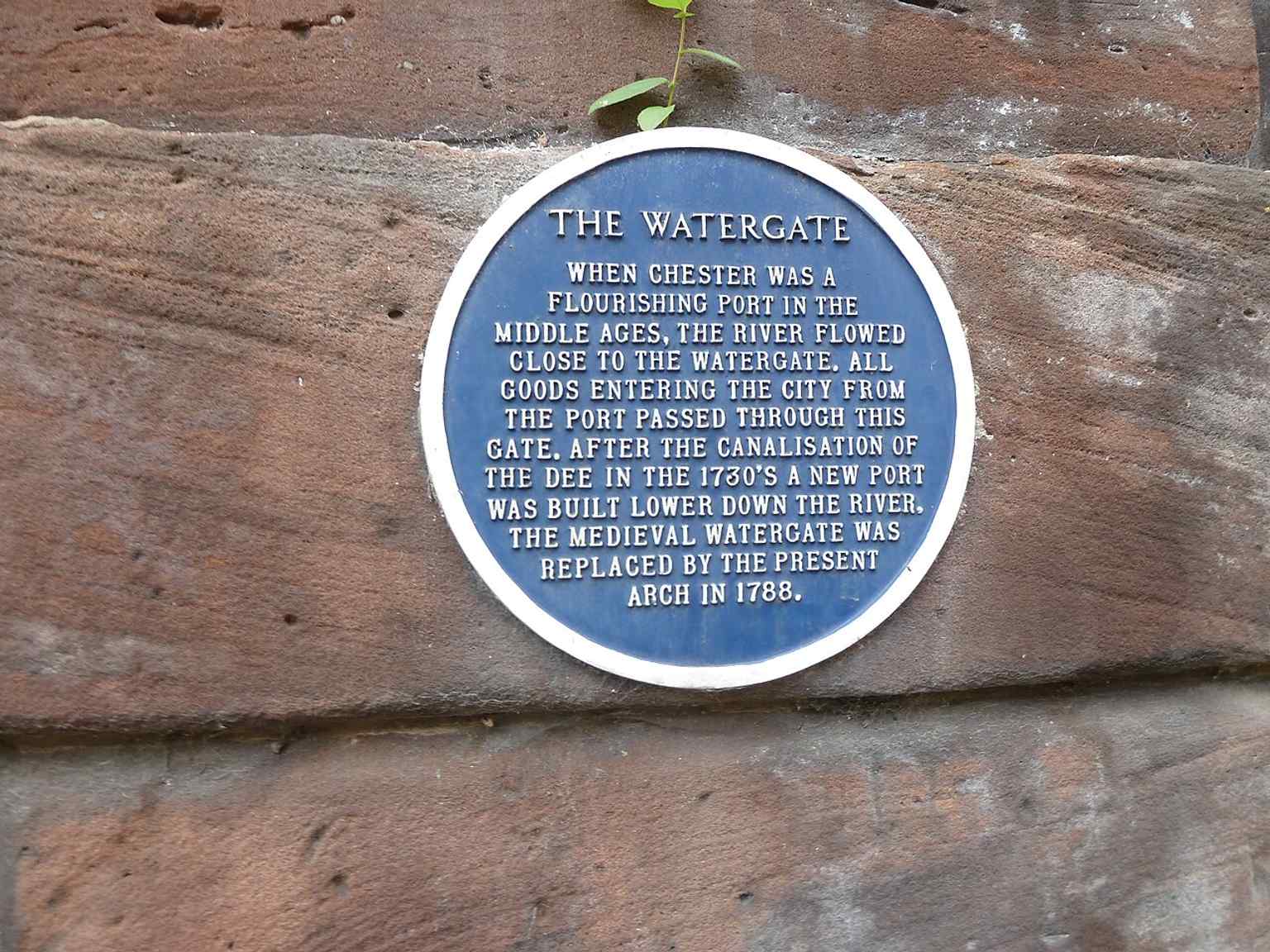
The blue plaque records Watergate’s heritage status, helping explain its place as a protected landmark in Chester.Photo: Worm That Turned, Wikimedia Commons, CC BY-SA 3.0. Cropped & resized. 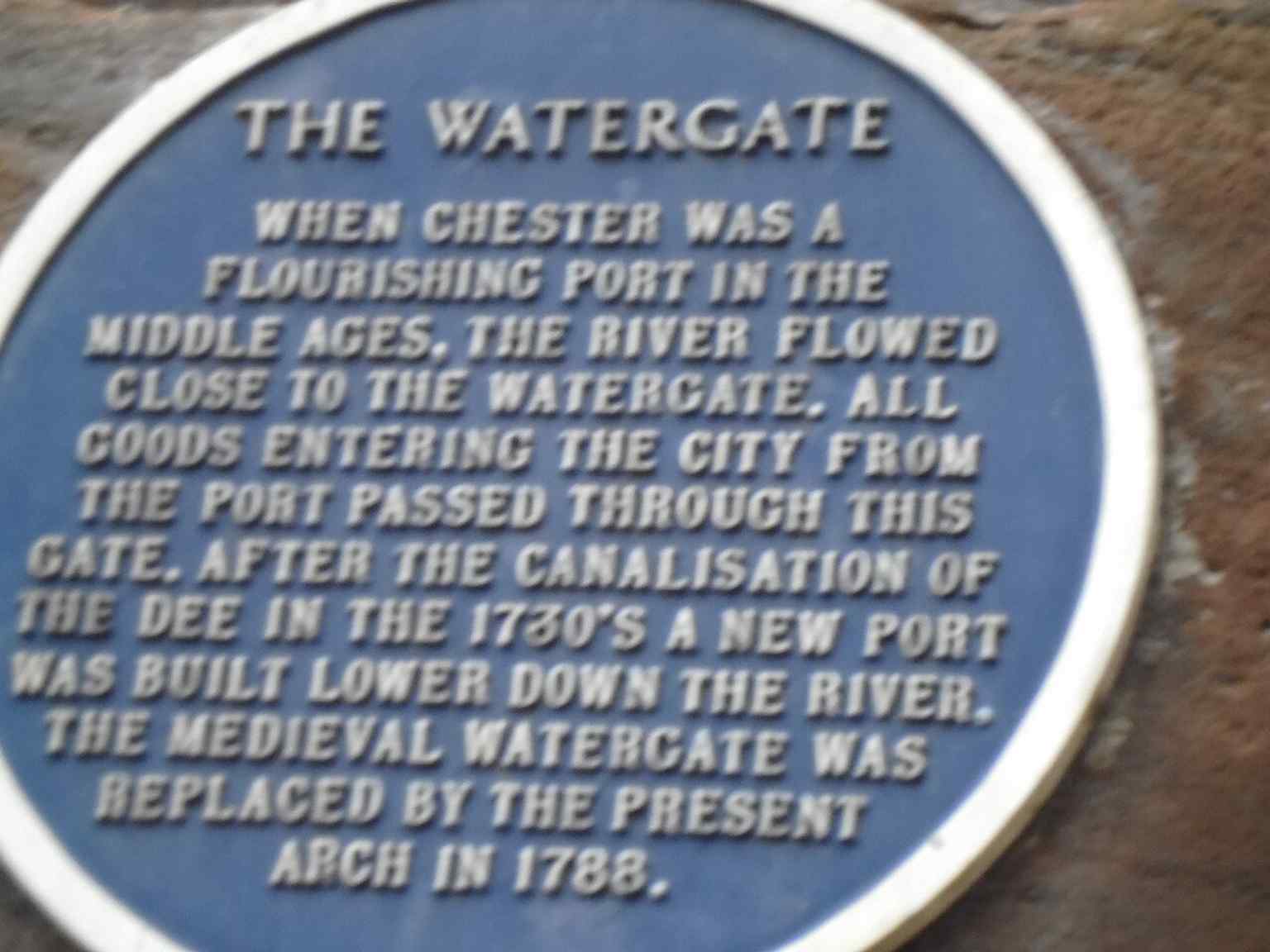
A closer look at the blue plaque from below, adding context to this Grade I listed gateway on the city walls.Photo: Worm That Turned, Wikimedia Commons, CC BY-SA 3.0. Cropped & resized. 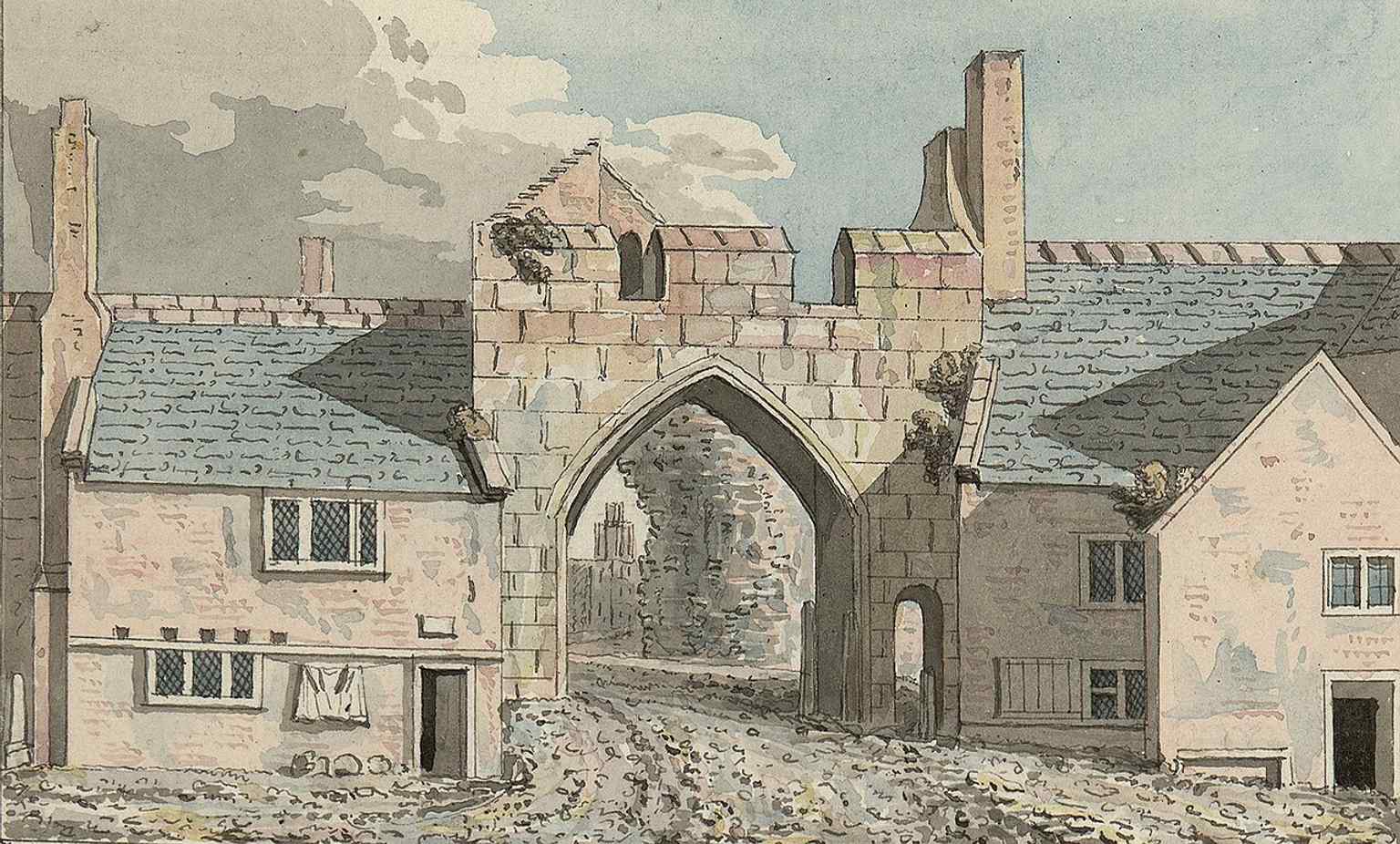
An early engraved view from Thomas Pennant’s 1781 tour, giving a historical impression of Water Gate before modern photography.Photo: Thomas Pennant, Wikimedia Commons, Public domain. Cropped & resized. 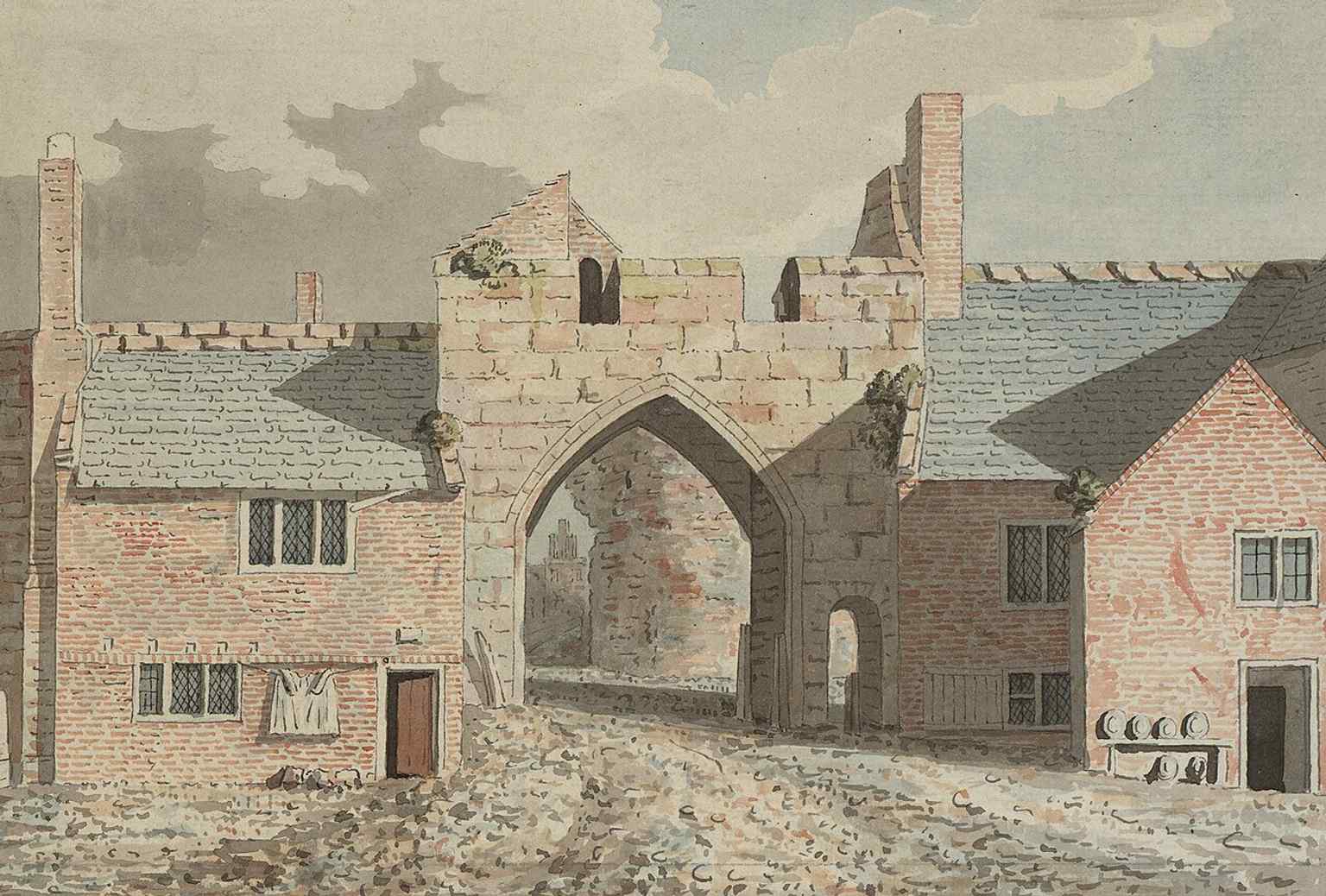
Another period illustration of Water Gate from Pennant’s extra-illustrated volumes, linking the site to 18th-century Chester.Photo: Thomas Pennant, Wikimedia Commons, Public domain. Cropped & resized.
Show 12 more stopsShow fewer stopsexpand_moreexpand_less
Look for dark timber framing above a stone ground floor, a raised covered walkway running along the building line, and stairways dipping down into lower shops beneath the…Read moreShow less
Open dedicated page →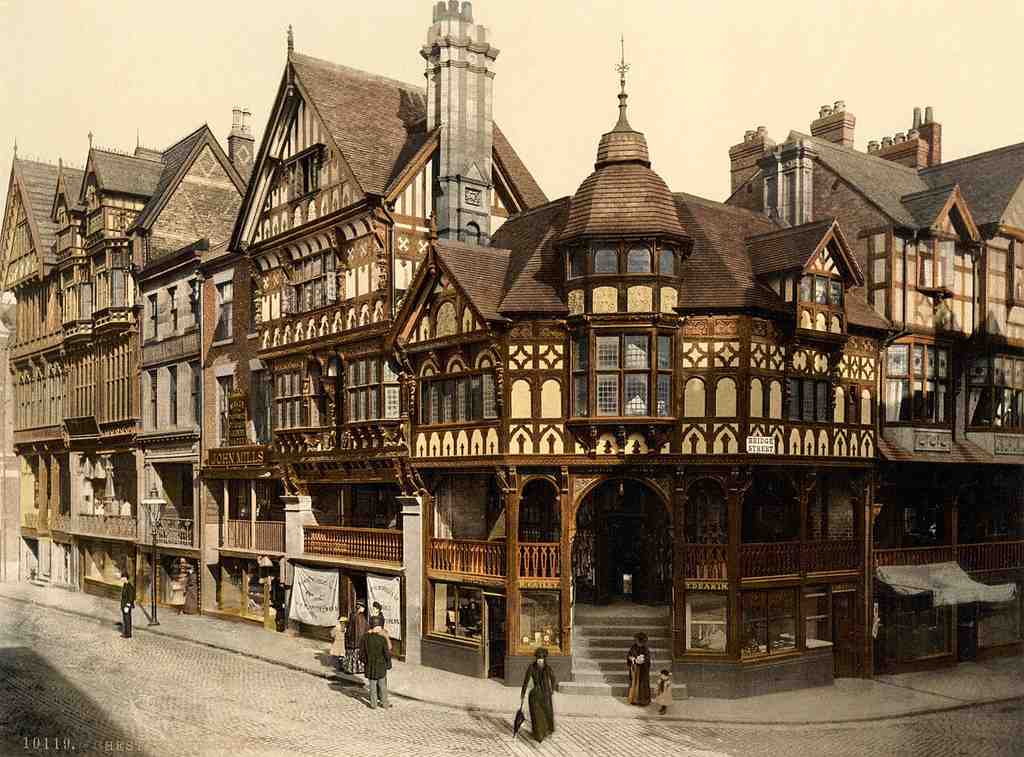
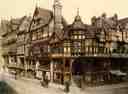
Chester RowsPhoto: Detroit Publishing Co., under license from Photoglob Zürich, Wikimedia Commons, Public domain. Cropped & resized. Look for dark timber framing above a stone ground floor, a raised covered walkway running along the building line, and stairways dipping down into lower shops beneath the street.
This is one of Chester’s cleverest ideas... a shopping street stacked in layers. At ground level, you’ve got one set of premises, and above them, set back behind a covered walkway, another. That upper passage is the Row. It runs along the four main streets that spread from Chester Cross: Watergate Street, Eastgate Street, Bridge Street, and part of Northgate Street. Chester didn’t just build shops. It built a whole second street in midair, because apparently one street was not ambitious enough.
No one can say with complete confidence how the Rows began, and that mystery is part of their charm. One theory says medieval builders worked over heaps of Roman rubble left from the old fortress city, Deva Victrix. They set buildings back on that higher ground, left a path in front, then later dug storage spaces underneath. Another theory points to the great fire of twelve seventy-eight, which destroyed almost the whole town inside the walls. After that disaster, people may have lined the lower levels in stone to make them more fire-resistant and, while they were at it, created a neat two-level system for trade.
If you glance at the image on your screen, you can see how that split-level world works: the upper walkway, the shopfronts behind it, and the steep links down to the street. Those lower spaces are often called undercrofts. That just means vaulted storage rooms or cellars beneath the buildings, often lined in stone. About twenty medieval stone undercrofts still survive in Chester, even though much of what you see at Row level today was rebuilt later. The undercrofts kept valuable goods safe; the halls above handled daily life and trade; and the upper room, called a solar, gave the family a bit of private space. Medieval mixed-use development, in other words, but with more oak beams and fewer estate agents.
The Rows were already here by the thirteen hundreds, and the earliest clear use of the word “Row” for an elevated walkway appears in thirteen fifty-six. Some stretches stayed continuous; others didn’t. In Lower Bridge Street, wealthy owners gradually enclosed sections to make larger private rooms. Fashion, as usual, got involved and spoiled the pattern a little.
Writers noticed them too. Daniel Defoe admired the galleries in the seventeen twenties because they sheltered pedestrians, though he complained they made the shops dark and uneven. Fair enough. Another writer, George Borrow, spun a wonderfully dramatic story that merchants used the upper levels to protect goods from Welsh raiders. It’s colorful, though historians treat that one with a raised eyebrow.
If you want a good example of what survives from the medieval world, have a look at the image of Three Old Arches on your phone. Its stone front is often called the earliest identified shopfront in England... which is the sort of record Chester enjoys collecting.
That’s the real magic here: not one building, but an entire city center still wearing its medieval logic in public.
The walkways themselves are accessible around the clock, even though the shops, cafés, and offices keep their own hours.
Take a moment with the layers of this place, and when you’re ready, we can head on to the next stop.
Look for the dark timber-framed frontage with its long covered gallery above the street-level arcade and a projecting gabled face - a very Chester disguise for the Roman fortress…Read moreShow less
Open dedicated page →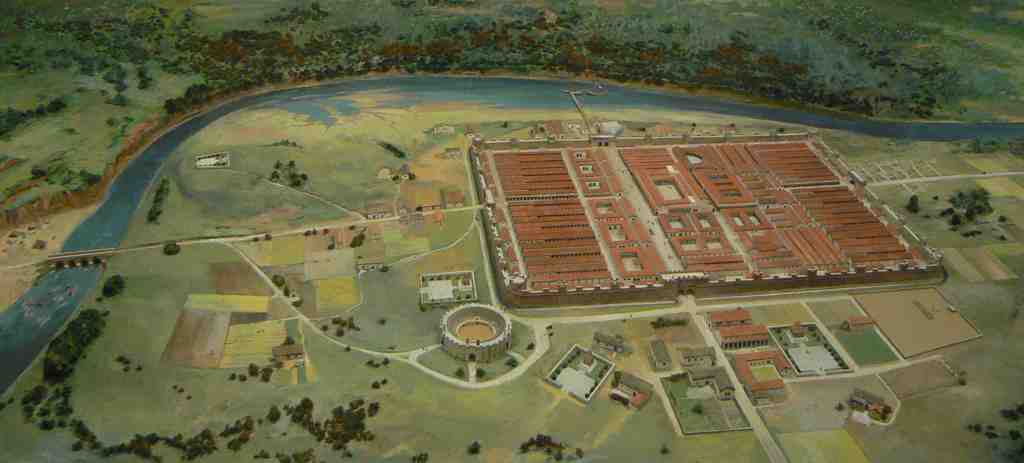
Deva VictrixPhoto: Łukasz Nurczyński, Wikimedia Commons, CC BY-SA 4.0. Cropped & resized. Look for the dark timber-framed frontage with its long covered gallery above the street-level arcade and a projecting gabled face - a very Chester disguise for the Roman fortress story underneath.
Deva Victrix does not announce itself with one neat ruin or heroic arch. Instead, it hides in plain sight, folded into the street plan and buildings around you. Nearly two thousand years ago, this was one of the most important military bases in Roman Britain. In the mid-seventies A-D, the legion called Legio the Second Adiutrix came here as Rome pushed north against the Brigantes. They chose this sandstone bluff for a reason: it overlooked the River Dee, controlled a crossing point, and gave access to the sea. Efficient, strategic, and not remotely sentimental... very Roman.
They laid out the fortress in the classic Roman style: a rectangle with rounded corners, like a playing card, with four gates and room for barracks, granaries, baths, and headquarters. It covered about twenty-five hectares, making it the largest fortress built in Britain at that time. At first the soldiers worked in timber. Later, Legio the Twentieth Valeria Victrix rebuilt the place in stone, and that victorious title, Victrix, attached itself to the name. Deva probably came from the River Dee itself, or from the Latin for goddess, which is rather elegant for a place designed to house thousands of armed men.
And this was not just a fort. A civilian settlement grew around it - traders, families, retired soldiers, the usual supporting cast for empire. That settlement stayed on after Rome lost its grip, and over centuries it turned into Chester. Even the name Chester comes from castrum, the Latin word for fort. So the modern city did not replace Deva... it grew out of it.
Deva also had ideas above its station. Archaeologists found evidence of a very strange elliptical building near the center of the fortress, unlike anything in any other Roman legionary base. It had a central courtyard, a water feature, and a ring of wedge-shaped rooms. Nobody can say for certain what it did. One theory says temple, another says grand administrative showpiece. Some scholars think the governor Agricola may have imagined Deva as a future capital of Roman Britain. That sounds ambitious, but the clues are there: the fortress was oversized, unusually elaborate, and Agricola's own name appeared on lead piping from the site. If you glance at the app, the reconstruction of that odd elliptical building helps make sense of the mystery.
This stretch of the city kept changing long after the legions left. If you fancy it, check the before-and-after image in the app; Bridge Street keeps the same medieval bones while the shopfront polish changes around them.
By the late fourth or early fifth century, the army faded away, but the defenses lingered, the people stayed, and Chester kept going - which is a decent definition of survival.
If you want to explore the indoor interpretation here later, it generally opens Tuesday to Saturday from eleven to five, and stays closed on Sunday and Monday.
That is Deva's real trick: a fortress that never quite stopped being a city.
Take a moment here, and when you're ready, we can continue to the next stop.
On your right, Storyhouse shows itself as a long red-brick Art Deco frontage with a smooth curved corner and tall vertical window bands, tied to a larger modern extension…Read moreShow less
Open dedicated page →On your right, Storyhouse shows itself as a long red-brick Art Deco frontage with a smooth curved corner and tall vertical window bands, tied to a larger modern extension behind.
This began as Chester’s Odeon cinema, which opened on the third of October, nineteen thirty-six. Architect Robert Bullivant designed it under Harry Weedon’s direction, and it held more than sixteen hundred people... serious cinema ambition for Chester. Most Odeons of that era wore ceramic tiles, but this one used red brick so it would sit more politely beside the cathedral and the Victorian town hall. Even glamour, it seems, can read the room.
By nineteen seventy-six, operators split the big auditorium into three screens, then added two more in nineteen ninety-one. The clever part is that much of the main interior survived, including the proscenium arch, the framed opening between stage and audience in a traditional theatre. Historic England gave the building Grade Two listed status in nineteen eighty-nine, recognizing it as worth protecting. Then the Odeon closed in two thousand and seven, and for a while this place simply waited.
That closure mattered because Chester lost more than a cinema. The Gateway Theatre had also closed in two thousand and seven, after council leaders planned a new theatre as part of the Northgate redevelopment. Then the financial crisis of two thousand and eight stopped that project. For a stretch, the city had no professional theatre and no city-centre cinema... a slightly awkward gap for a place that has been staging public entertainment since Roman times.
The revival started in two thousand and twelve, when Cheshire West and Chester Council chose to transform this derelict Odeon. Architects Bennetts Associates and theatre planners Charcoalblue soon realized the old shell could not hold a modern theatre by itself, so they added a new extension after demolishing the neighboring office block. An archaeological survey even uncovered Roman roads on the site. In Chester, even the groundwork has a backstory. If you fancy a quick look, the side-by-side in the app shows the old Odeon keeping its elegant curve while gaining a whole new life.
Storyhouse opened in May two thousand and seventeen with Alex Clifton’s new version of The Beggar’s Opera. Queen Elizabeth the Second and Meghan, Duchess of Sussex, gave it an official opening in June two thousand and eighteen. Today it folds together a theatre, cinema, library, and restaurant. The main auditorium can switch from an eight-hundred-seat proscenium layout to a five-hundred-seat thrust stage, where the acting space pushes out into the audience. There is also a smaller Garrett Theatre, and the library runs through the old cinema building instead of hiding in one separate room. If you glance at your screen, image three shows that unusual mix of books, public space, and cinema shell.
The project cost thirty-seven million pounds, brought in more than a million visitors in its first year, and turned a closed cinema into one of Chester’s boldest reinventions.
If you want to come back inside later, Storyhouse usually opens from eight in the morning to eleven at night, and from nine-thirty on Sundays.
Storyhouse proves that preservation and reinvention can get along just fine. Take your time here, and when you’re ready, we can continue to the cathedral.
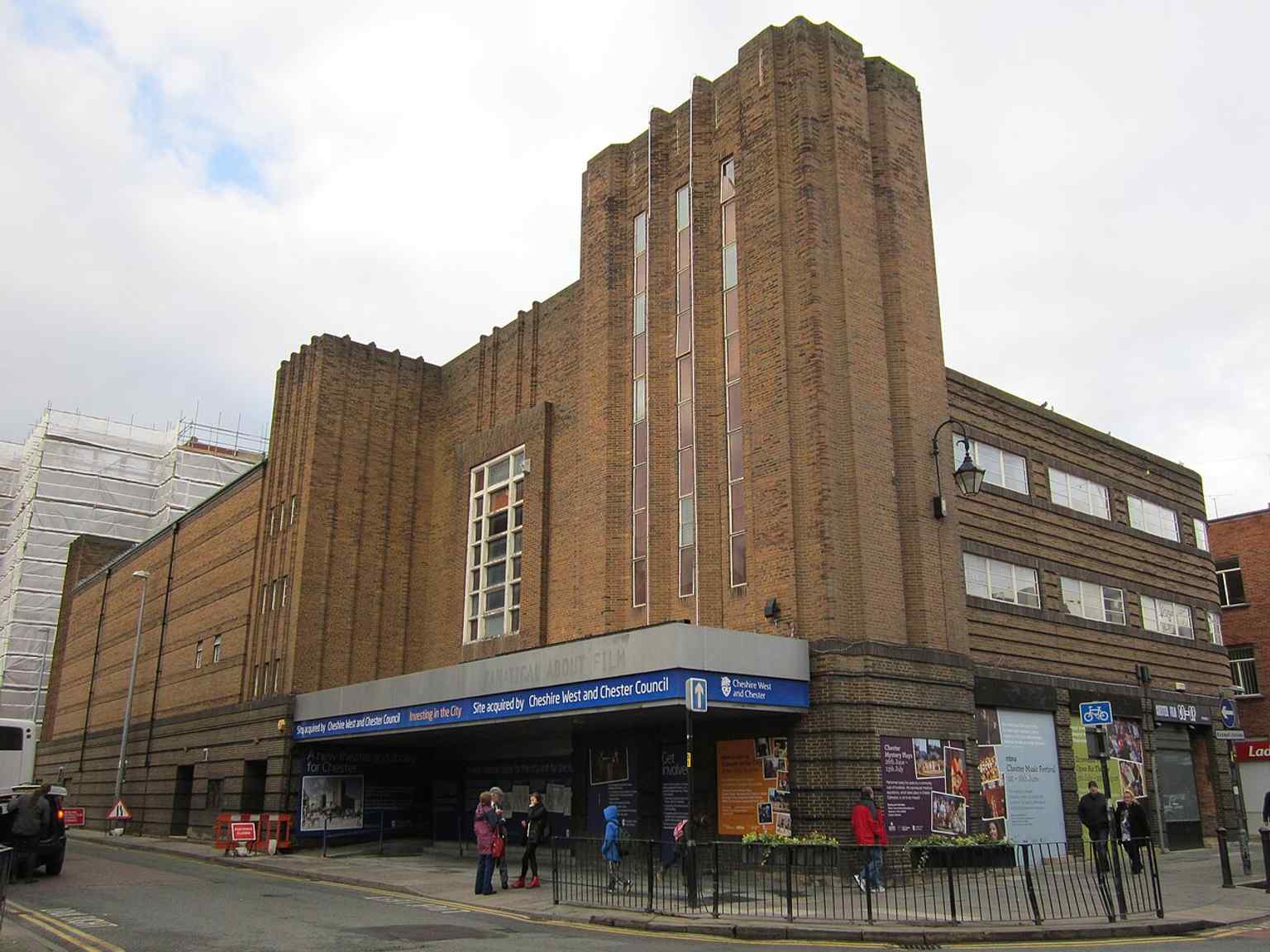
The former Odeon Cinema before its Storyhouse transformation — this 1936 Art Deco building is the heart of Chester’s cultural hub.Photo: Rept0n1x, Wikimedia Commons, CC BY-SA 3.0. Cropped & resized. 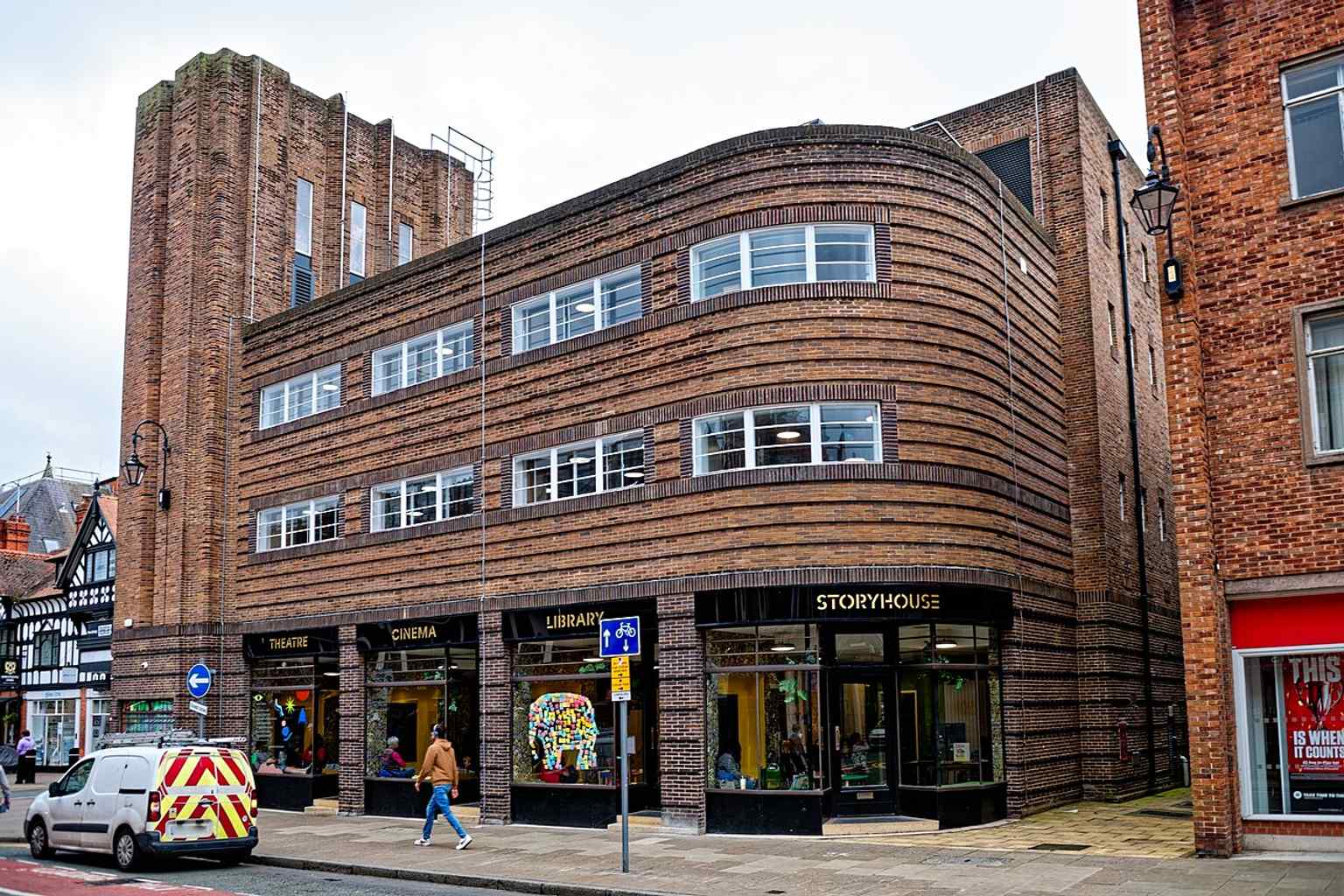
A clear modern view of the listed Odeon frontage, showing the original cinema shell that Storyhouse reused and extended.Photo: Tilman2007, Wikimedia Commons, CC BY-SA 4.0. Cropped & resized. On your left, look for the huge red sandstone church with a broad traceried window, a central tower, and sharp battlemented turrets. This is Chester Cathedral, the mother church…Read moreShow less
Open dedicated page →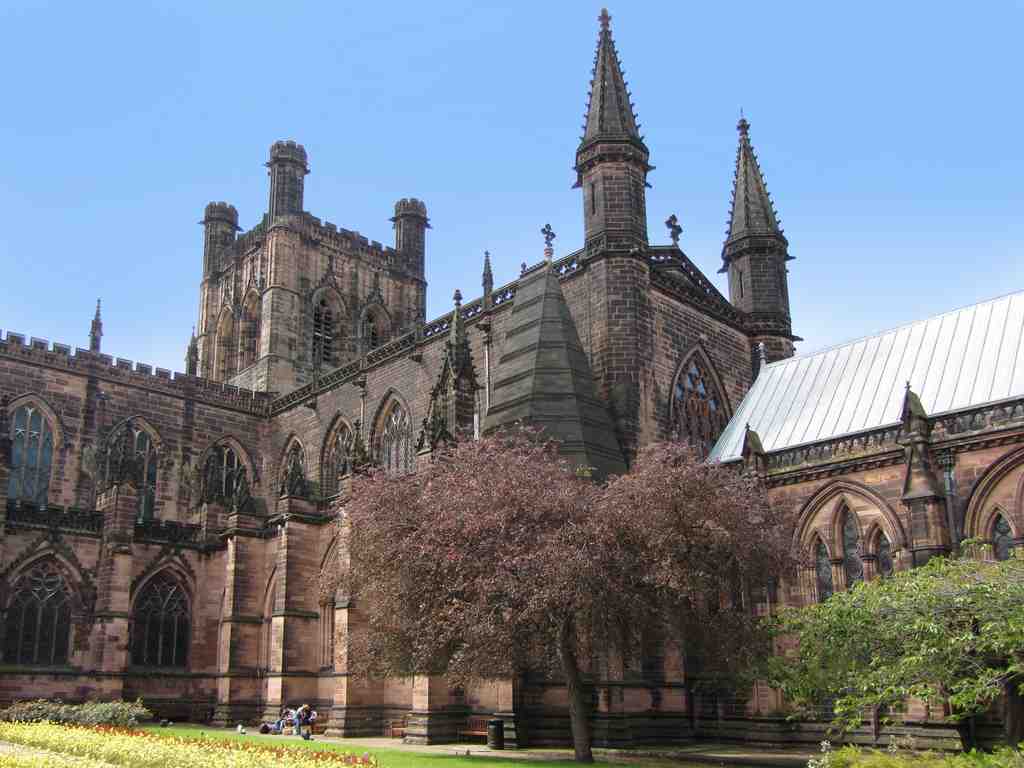
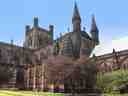
Chester CathedralPhoto: Stephen Hamilton, Wikimedia Commons, CC BY-SA 3.0. Cropped & resized. On your left, look for the huge red sandstone church with a broad traceried window, a central tower, and sharp battlemented turrets.
This is Chester Cathedral, the mother church of the Diocese of Chester, but it began life as something older and more monastic: the abbey church of Saint Werburgh. People may have worshipped on this site since Roman times, and that long memory matters here. In the early tenth century, when Chester fortified itself against Viking attack, Saint Werburgh’s remains were brought here, probably under the care of Aethelflaed, Lady of the Mercians. So before this became a cathedral of bishops, it was already a place of relics, prayer, and local identity.
The abbey itself took shape in ten ninety-three, when Hugh Lupus, Earl of Chester, founded a Benedictine monastery here with monks from Bec in Normandy, helped by Saint Anselm. Much of what you see now came later, though. The building grew from Norman into Gothic over centuries, which is why Chester Cathedral contains almost the full sweep of English medieval architecture, from heavy Norman masonry to Perpendicular Gothic, the later style that loves strong vertical lines and big window grids.
If you glance at the image in the app, you can see one of Chester’s quirks clearly: the building is gloriously uneven. One west tower stays low and Norman, the other was started in the early sixteen hundreds and never properly finished after the monastery’s closure interrupted the work. Cathedrals like to pretend they are orderly; this one keeps the paperwork and the contradictions visible.
Then came the Reformation, and things got rough. In fifteen thirty-eight, Henry the Eighth’s dissolution of the monasteries shut the abbey, and Saint Werburgh’s shrine was desecrated. Just three years later, Henry turned the former abbey into a Church of England cathedral and changed its dedication to Christ and the Blessed Virgin Mary. Efficient, if not exactly sentimental.
The stone itself tells another story. Chester used local New Red Sandstone, beautiful for carving but sadly a bit crumbly. Magnificent, yes, but not especially stoic. By the nineteenth century, the place looked badly weathered, so the Victorian architect George Gilbert Scott restored it on a huge scale, adding turrets and refacing large sections. Admirers called it rescue; critics called it rebuilding with a straight face. Both had a point.
Inside are some remarkable survivals. The choir stalls from around thirteen eighty are famous for their misericords, tiny carved ledges that let monks lean during long services without technically sitting down... a very medieval compromise. And if you open the shrine image on your phone, you’ll see Saint Werburgh’s shrine, dismantled at the Reformation and reassembled in the nineteenth century, a neat summary of this cathedral’s habit of surviving history by refusing to stay broken.
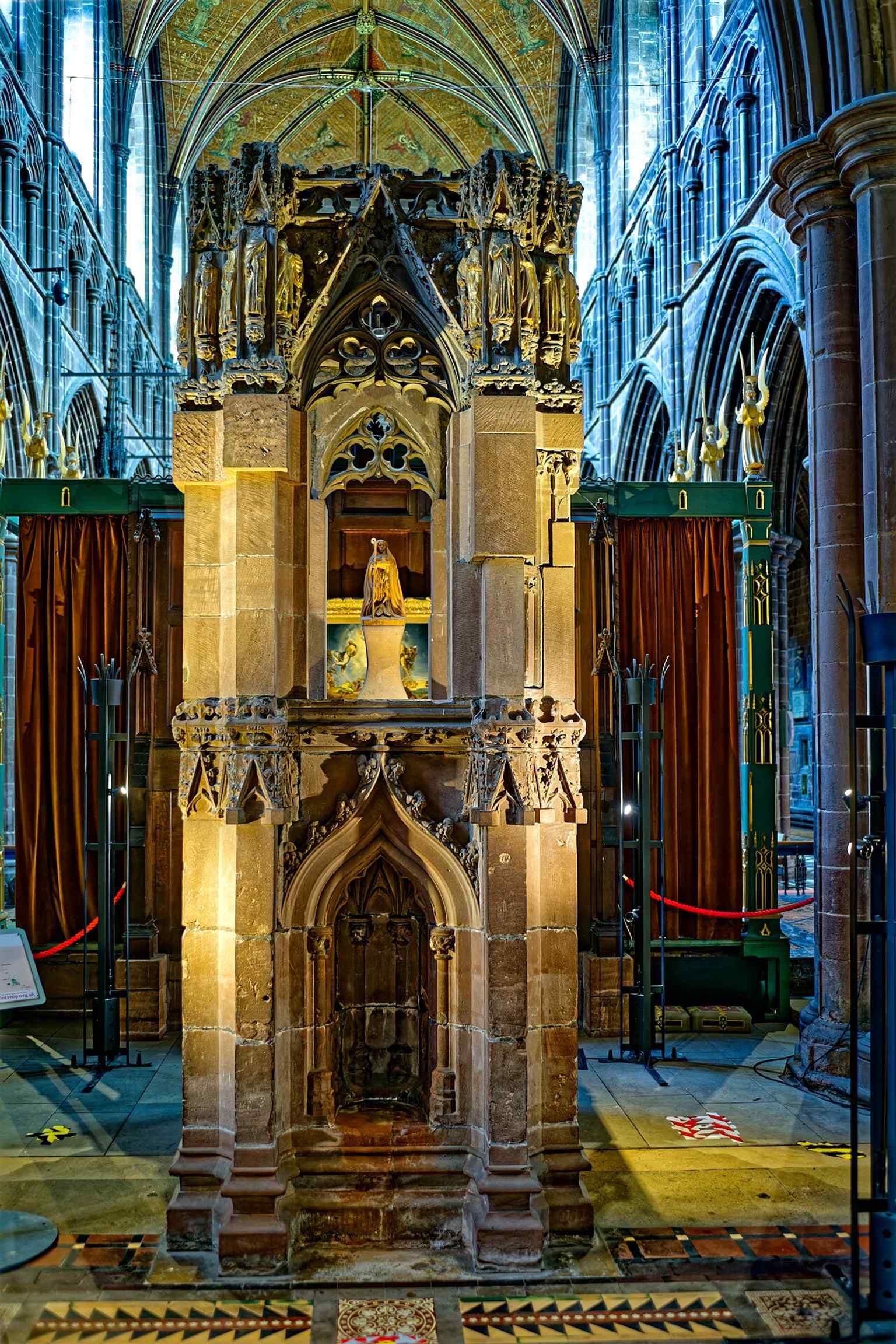
Saint Werburgh’s shrine was dismantled at the Reformation and later reassembled, making it a powerful reminder of the cathedral’s turbulent history.Photo: Tilman2007, Wikimedia Commons, CC BY-SA 4.0. Cropped & resized. This place is also very much alive: worship still happens daily, and Chester’s choral tradition stretches back about nine hundred years.
If you want to go inside later, the cathedral is open daily from nine thirty A-M to six P-M.
Chester Cathedral feels less like a single building than a thousand years of argument, faith, loss, and repair held together in stone.
Take a moment here, and when you’re ready, we can wander on to Eastgate.
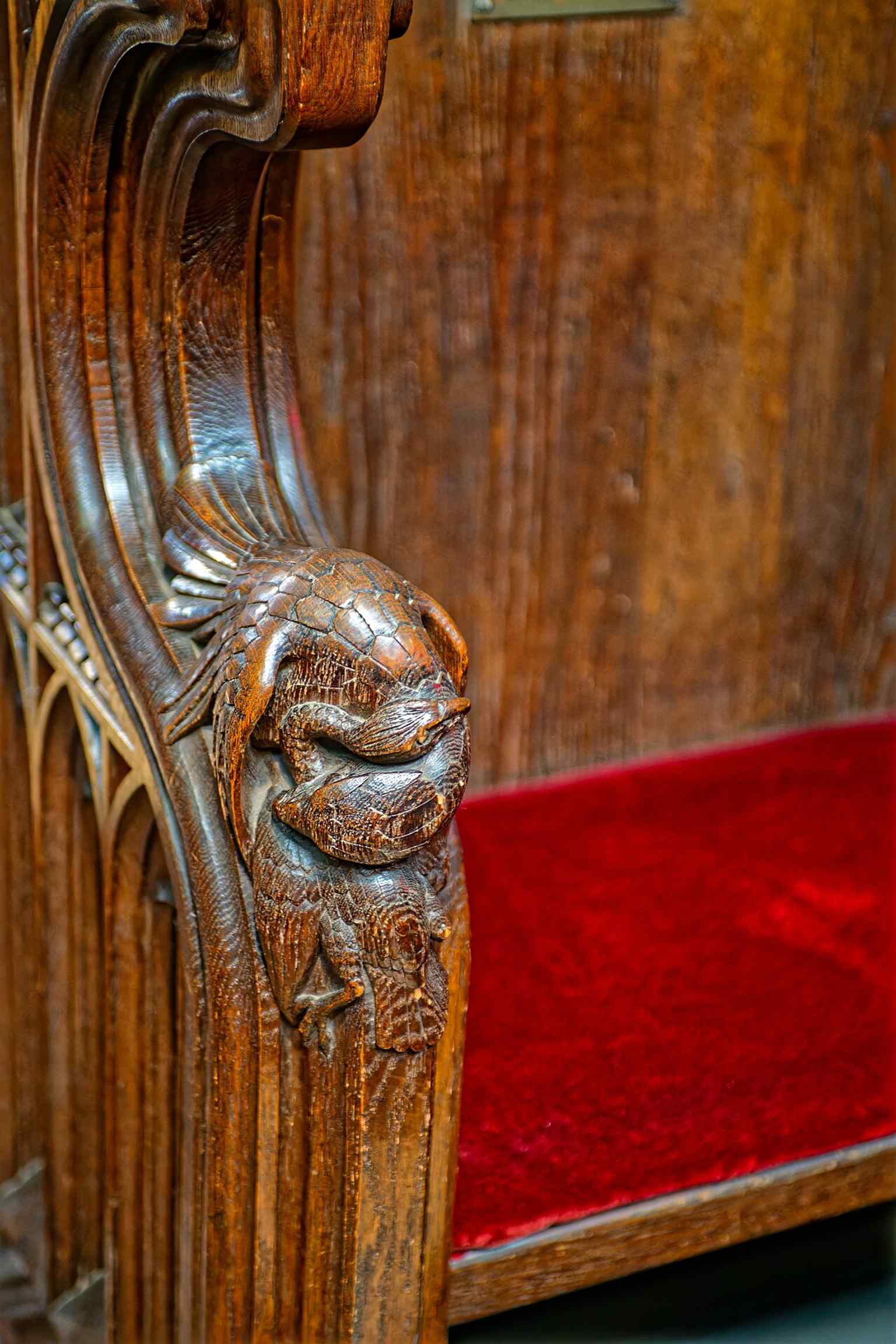
The celebrated choir stalls, carved around 1380, are among Chester Cathedral’s greatest treasures and are famous for their richly detailed misericords.Photo: Tilman2007, Wikimedia Commons, CC BY-SA 4.0. Cropped & resized. 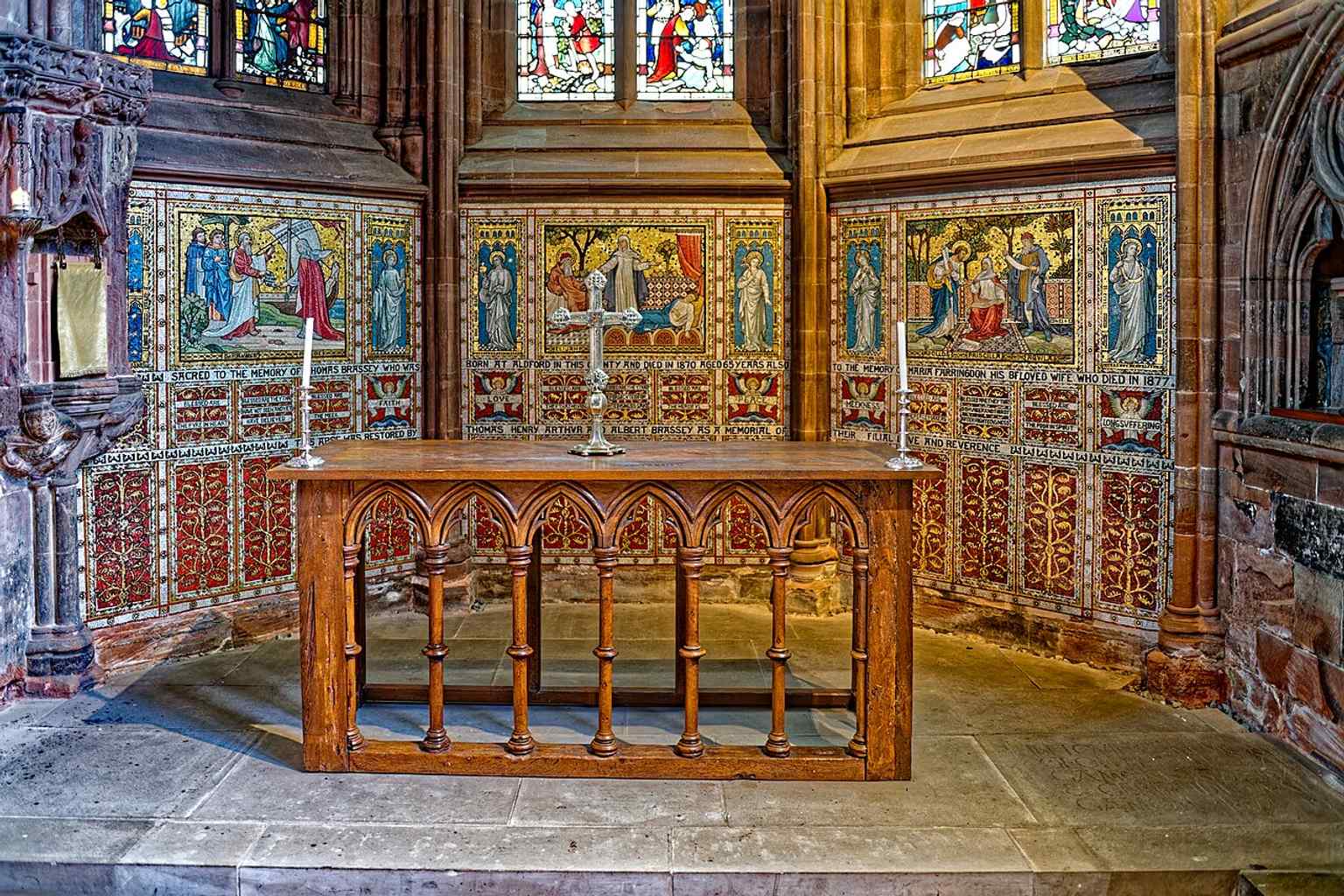
The Lady Chapel dates from the 13th century and houses the shrine of Saint Werburgh, the cathedral’s much-venerated medieval saint.Photo: Tilman2007, Wikimedia Commons, CC BY-SA 4.0. Cropped & resized. Ahead of you is a red sandstone gateway with one broad central arch, two smaller side arches, and a delicate iron clock tower above it capped by a copper dome. This is Eastgate,…Read moreShow less
Open dedicated page →Ahead of you is a red sandstone gateway with one broad central arch, two smaller side arches, and a delicate iron clock tower above it capped by a copper dome.
This is Eastgate, and Chester has been using this spot as an entrance for an absurdly long time. Long before the clock turned it into a local celebrity, this was the eastern gate of the Roman fortress of Deva Victrix, founded around the year seventy-four or seventy-five. The road through here ran toward Manchester and then across the Pennines to York, so this was never some decorative little opening in a wall. It was the front door for soldiers, traders, carts, gossip, and trouble.
The first Roman gate stood with a timber tower guarding it. Around the second century, the Romans upgraded to stone, because empires do love making things heavier. Later, in the medieval period, Chester replaced that Roman gate with a much taller fortress-like gateway, probably in the early fourteen hundreds, with corner turrets that may have borrowed ideas from Caernarfon Castle. Excavations even uncovered part of one flanking turret in pale cream sandstone, which stood out against Chester’s usual red stone like someone turning up to a black-tie dinner in beige.
What you see now belongs to a different age entirely. In seventeen sixty-eight, when city walls had stopped being useful for defense and started becoming pleasant walkways, the old medieval gate had become a traffic nuisance. So Richard Grosvenor, the first Earl Grosvenor, paid for a new gateway, and his surveyor, Mister Hayden, designed this elegant three-arched version in red sandstone. Look at the big central arch and the two smaller side arches: it is practical, balanced, and just grand enough to remind you that Chester enjoyed doing infrastructure with style.
If you could examine the stone closely, you’d find coats of arms carved into the keystones and long Latin-heavy inscriptions recording mayors, patrons, and dates. The city was not shy about credit.
Then came the flourish on top. In the late eighteen nineties, Chester wanted a memorial for Queen Victoria’s diamond jubilee. Architect John Douglas first designed a stone tower that would have cost one thousand pounds, about a hundred and fifty thousand pounds today, but a model showed it would steal too much daylight from nearby buildings. So he pivoted to something lighter: this openwork iron pavilion carrying a clock on all four sides. Its mechanism came from J. B. Joyce and Company of Whitchurch, and for decades a technician traveled here every week just to wind it. Efficient? Not especially. Admirably committed? Absolutely.
Take a quick look at the comparison in the app if you like; the cameras and street scene change, but Eastgate Clock barely blinks.
And if you want a closer view of the ironwork, the detail image on your screen shows Douglas’s airy design beautifully.
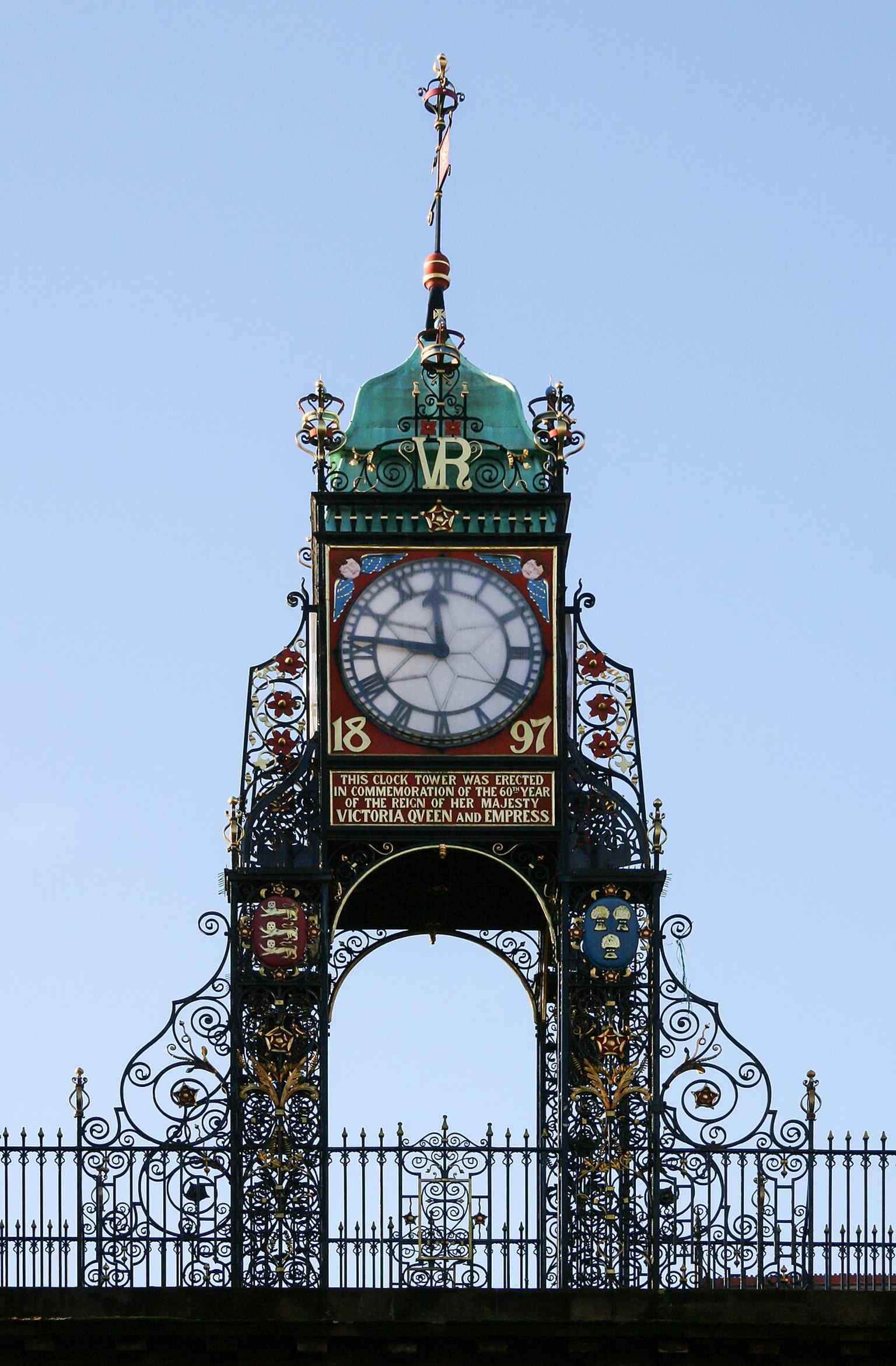
A close-up of the clock face and ironwork, illustrating John Douglas’s openwork design and the four-sided clock that made it so famous.Photo: Photograph by Mike Peel (www.mikepeel.net)., Wikimedia Commons, CC BY-SA 4.0. Cropped & resized. The clock opened on the twenty-seventh of May, eighteen ninety-nine, Queen Victoria’s eightieth birthday. It carries gilded dates, the initials V-R for Victoria Regina, and that lovely copper ogee cupola - an S-curved roof shape - above. After souvenir hunters stole the clock hands, the city finally glazed the faces in nineteen eighty-eight, which is one way to say, politely, enough of that. It is often described as one of England’s most photographed clocks, which is not a bad silver medal.
Fittingly for a city gate that never quite stopped being useful, Eastgate is open twenty-four hours a day, every day.
For all its Victorian flair, this is still Chester’s ancient front door.
When you’re ready, we can head on to the next stop.
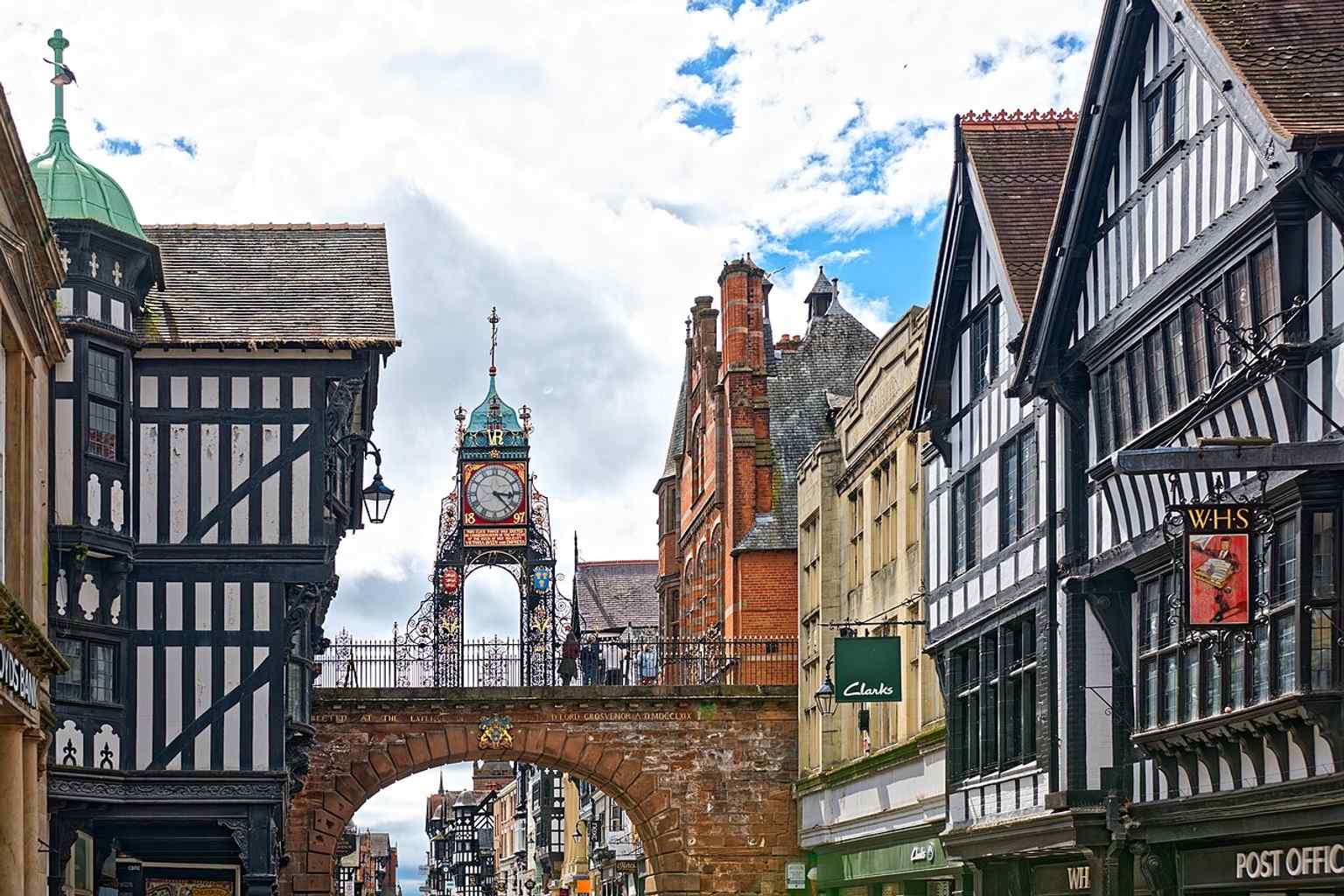
A crisp modern view of Eastgate and the clock, showing the three-arched gateway carrying the city walls walkway above Chester’s busiest historic entrance.Photo: Tilman2007, Wikimedia Commons, CC BY-SA 4.0. Cropped & resized. 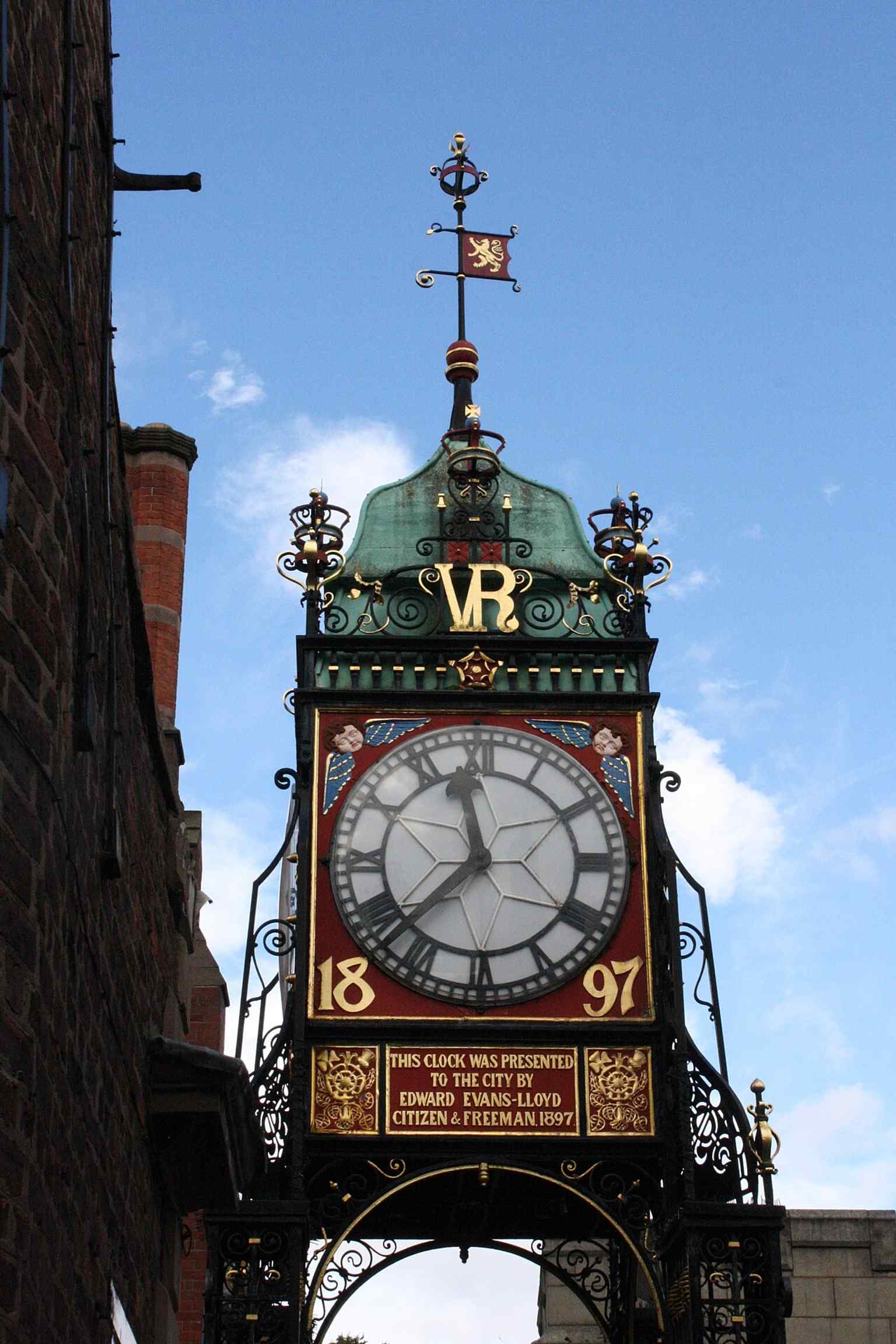
The south face of the clock, showing the ornate Victorian details and the copper cupola that crowns the tower.Photo: Emdee314, Wikimedia Commons, CC BY-SA 3.0. Cropped & resized. 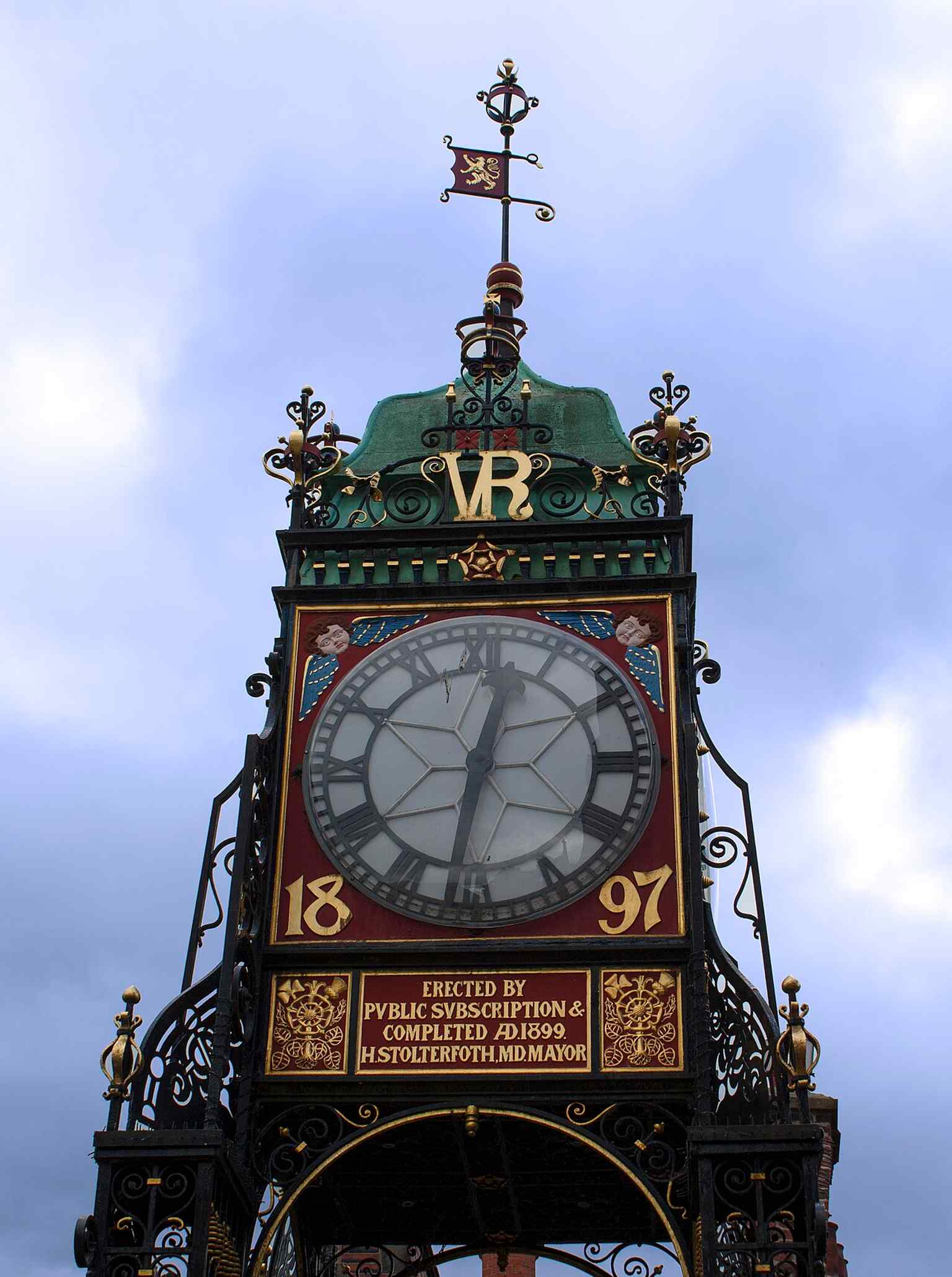
An intimate close-up of Eastgate Clock, ideal for revealing the decorative iron support and the polished clock face that made it a local icon.Photo: Stedent, Wikimedia Commons, CC BY-SA 3.0. Cropped & resized. 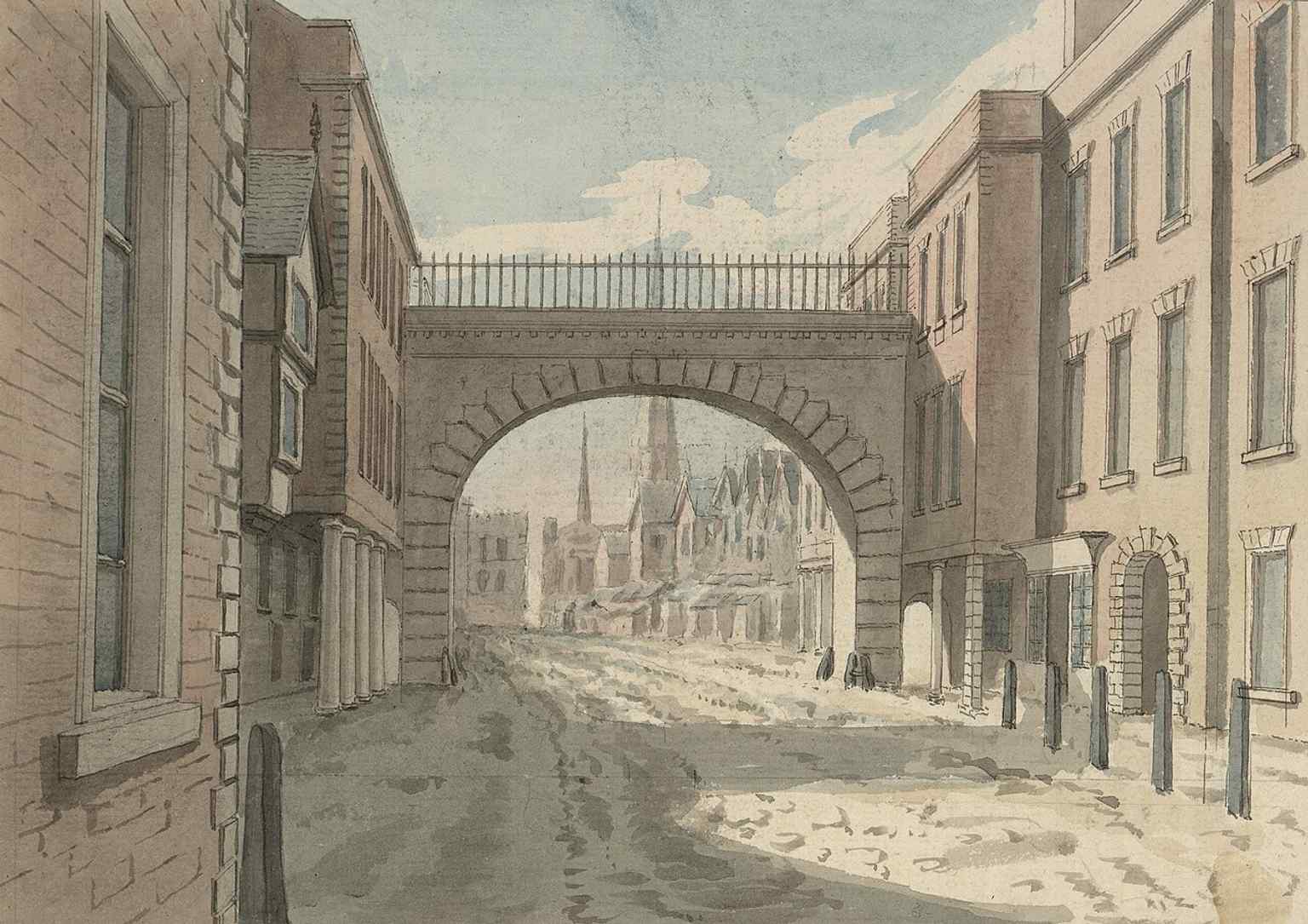
A historic illustration of Eastgate from Thomas Pennant’s 18th-century travel volume, echoing the era when the gateway was rebuilt as an elegant arch.Photo: Thomas Pennant, Wikimedia Commons, Public domain. Cropped & resized. On your right, St John the Baptist's Church is a long sandstone church with pointed arched windows, a broad rectangular body, and a broken tower stump at the west end. This place…Read moreShow less
Open dedicated page →On your right, St John the Baptist's Church is a long sandstone church with pointed arched windows, a broad rectangular body, and a broken tower stump at the west end.
This place has the solid, slightly stubborn look of a survivor... and that is exactly what it is. The Anglo-Saxons founded a church here in the late seventh century, and tradition says King Aethelred started it in the year six hundred and eighty-nine. They chose a powerful site too: outside Chester's walls, high on a cliff above the River Dee, where the building could watch the river traffic and the city at once.
St John's once stood at the center of royal theater. In the year nine hundred and seventy-three, after his coronation at Bath, King Edgar came to Chester and traveled up the Dee to this church by barge. The Anglo-Saxon Chronicle says six tributary kings rowed him. A later monk insisted it was eight. Medieval historians, like modern sports fans, were not always shy about improving the numbers. Here, Edgar held a royal council, turning this church into a stage for power as much as prayer.
Then came its brief moment at the top. In ten seventy-five, Bishop Peter moved the seat of Lichfield here, making St John's Chester's cathedral. That promotion did not last long. By ten ninety-five, his successor had moved the bishop's seat to Coventry, and St John's lost the headline role. Even so, builders kept enlarging it through the thirteenth century, and the church became one of Cheshire's finest examples of Norman and early medieval work.
Its history, though, is not exactly serene. In thirteen eighty-six, Owain Glyndwr gave evidence here in the Scrope versus Grosvenor dispute, a Court of Chivalry case over who had the right to use a coat of arms... proof that heraldry could start arguments of heroic size. In fourteen sixty-eight, the central tower collapsed. After the Dissolution in the sixteenth century, people demolished much of the east end, and the huge medieval church shrank into the parish church you see today. The nave - the main central hall of the church - survived, though not without drama: the northwest tower partly fell in fifteen seventy-two, then collapsed further in fifteen seventy-four and destroyed the western bays.
During the siege of Chester in sixteen forty-five, Parliamentary troops turned the church into a garrison and gun platform, firing at the city and its walls. That is a rough career change for a former cathedral. Victorian restorers later stepped in, especially R. C. Hussey, and after another tower collapse in eighteen eighty-one, John Douglas rebuilt the porch and added the northeast belfry tower in eighteen eighty-six.
If you check the before-and-after image, you can see how the long south side still feels unmistakably medieval, even though the stone looks cleaner and the setting much tidier than it did a century ago. And if you want a glimpse inside, look at image nine on your screen; that painted pillar hints at how much Norman and medieval fabric still survives beyond these walls.
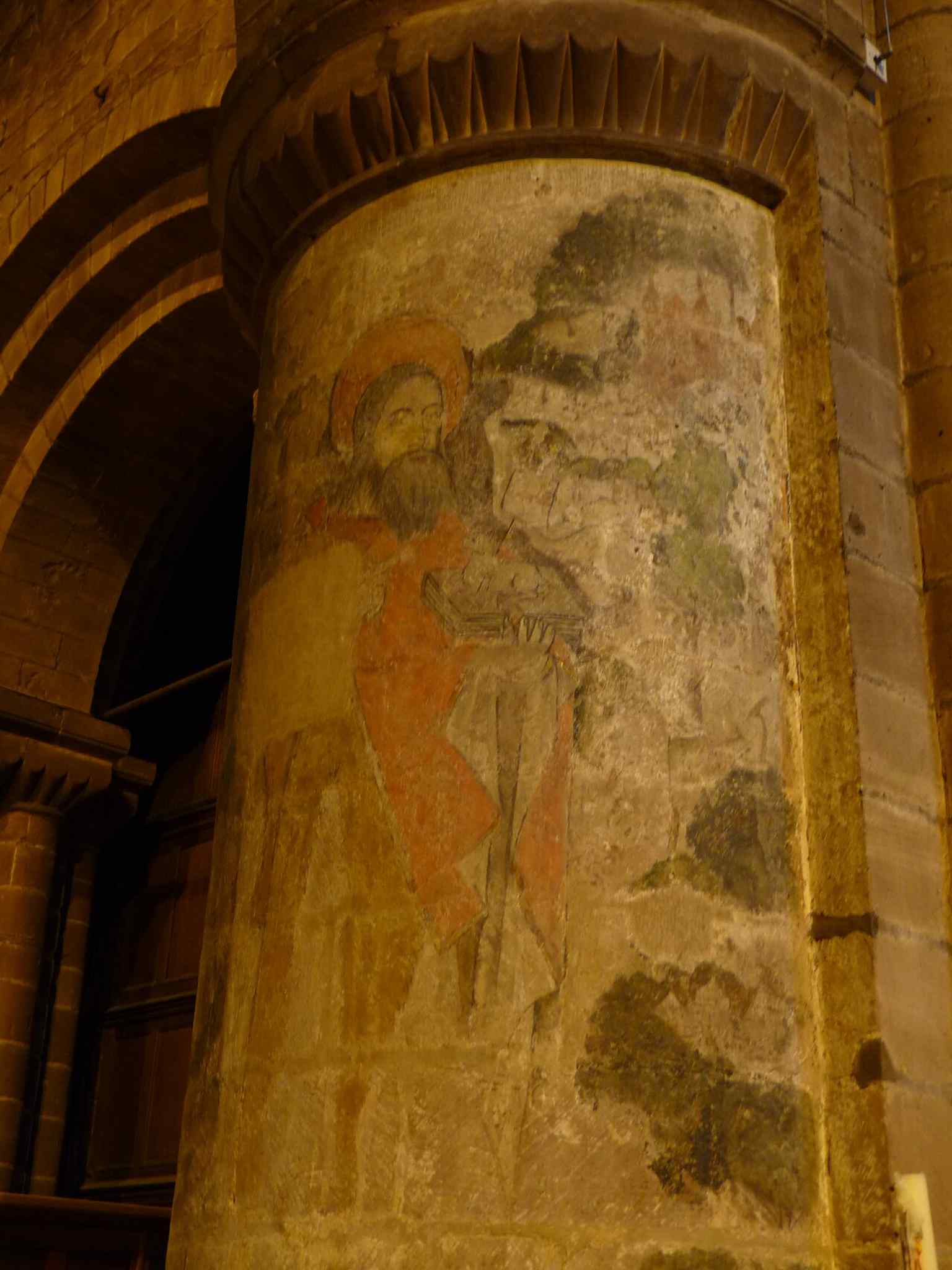
A painted medieval pillar in the nave, showing that much of St John’s interior preserves Norman and later medieval work despite Victorian restoration.Photo: Chris McKenna, Wikimedia Commons, CC BY-SA 3.0. Cropped & resized. Today, St John's is a Grade One listed building, still an active parish church, and historian Alec Clifton-Taylor counted it among England's best parish churches. If you want to come back and go inside, it usually opens from eleven to three Monday to Friday, ten to four on Saturday, and stays closed on Sunday.
St John's feels less like one building than a whole stack of English history in stone.
Take a last look here, and when you're ready, we can head on to the Roman amphitheatre.
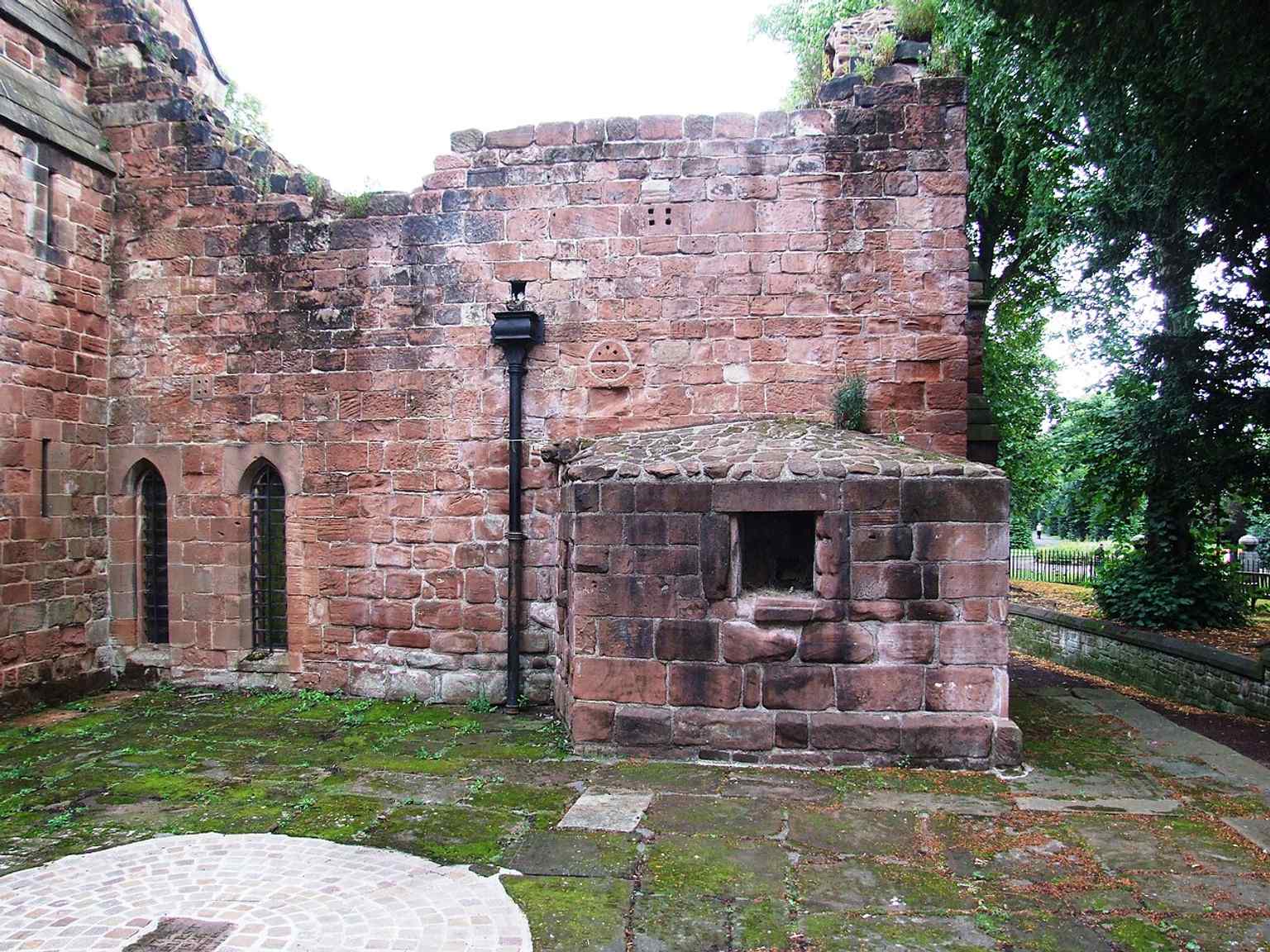
Sandstone walls and the south side of the church, part of the surviving medieval fabric that makes St John’s one of Cheshire’s best Romanesque churches.Photo: RLamb, Wikimedia Commons, CC BY-SA 3.0. Cropped & resized. 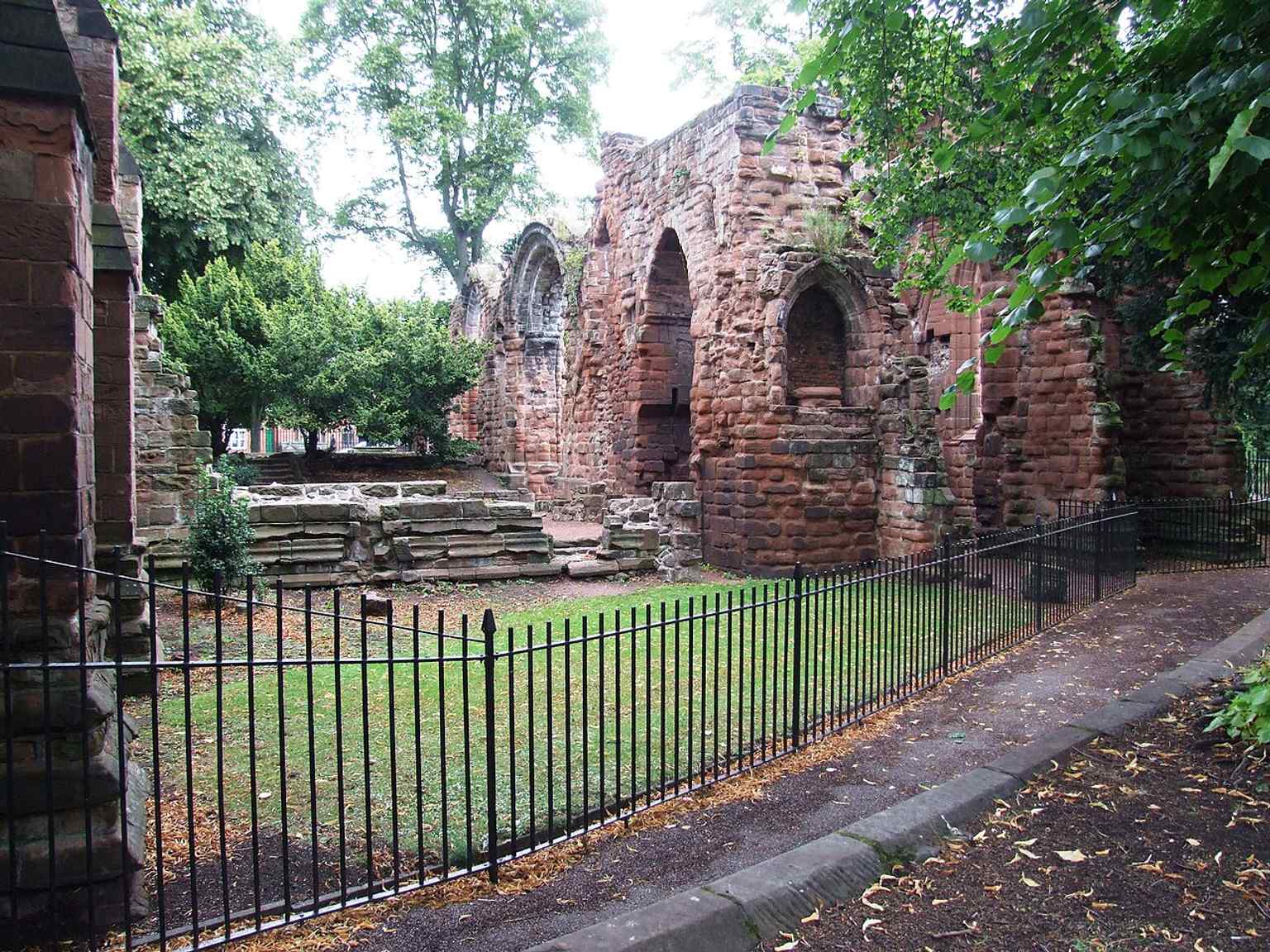
Looking toward the ruined east end, this image shows how much of the larger medieval church was lost after the Dissolution.Photo: RLamb, Wikimedia Commons, CC BY-SA 3.0. Cropped & resized. 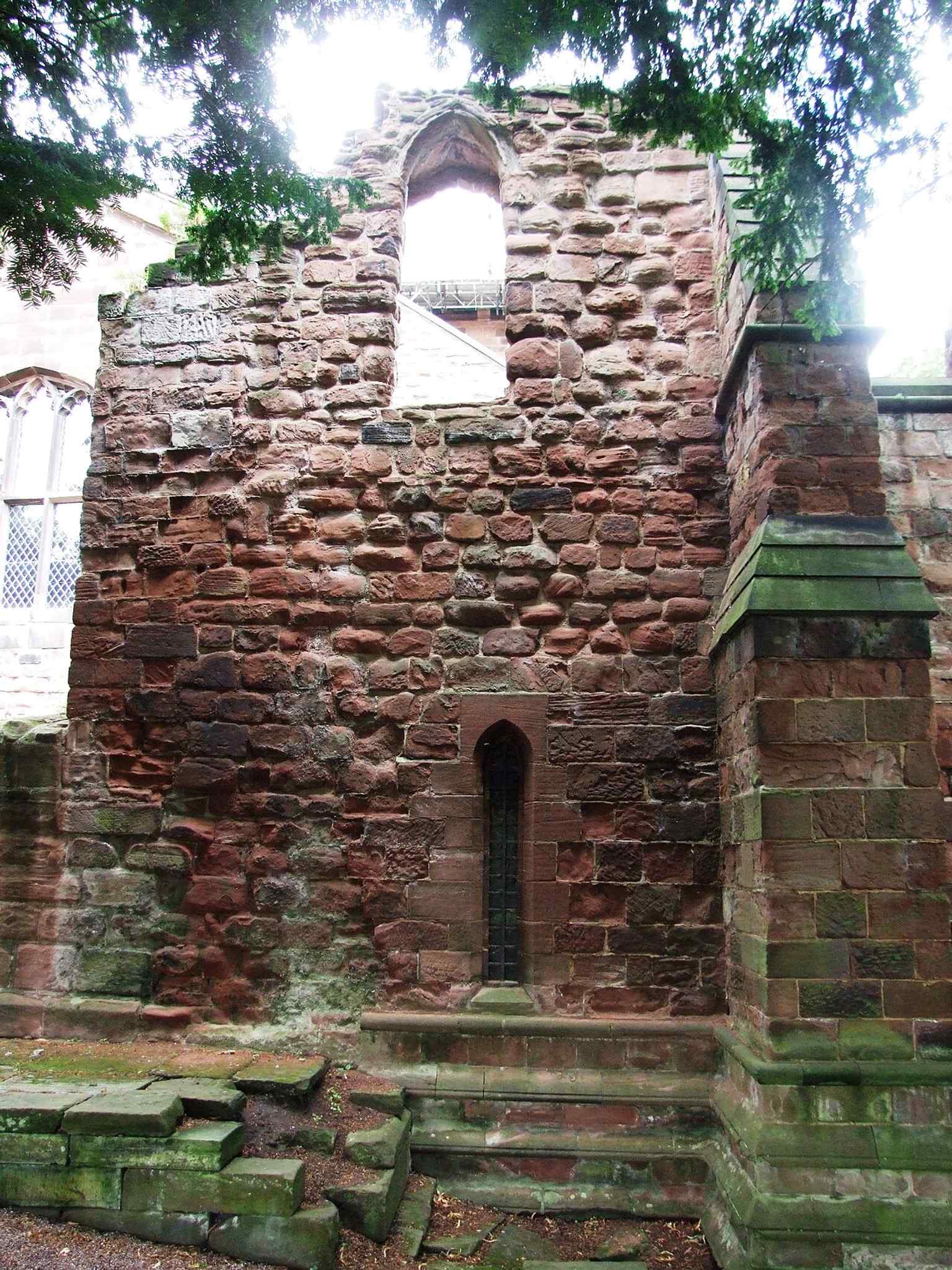
The south side beside the remains of the former east end, a striking reminder that the present parish church sits inside a much larger ruined shell.Photo: RLamb, Wikimedia Commons, CC BY-SA 3.0. Cropped & resized. 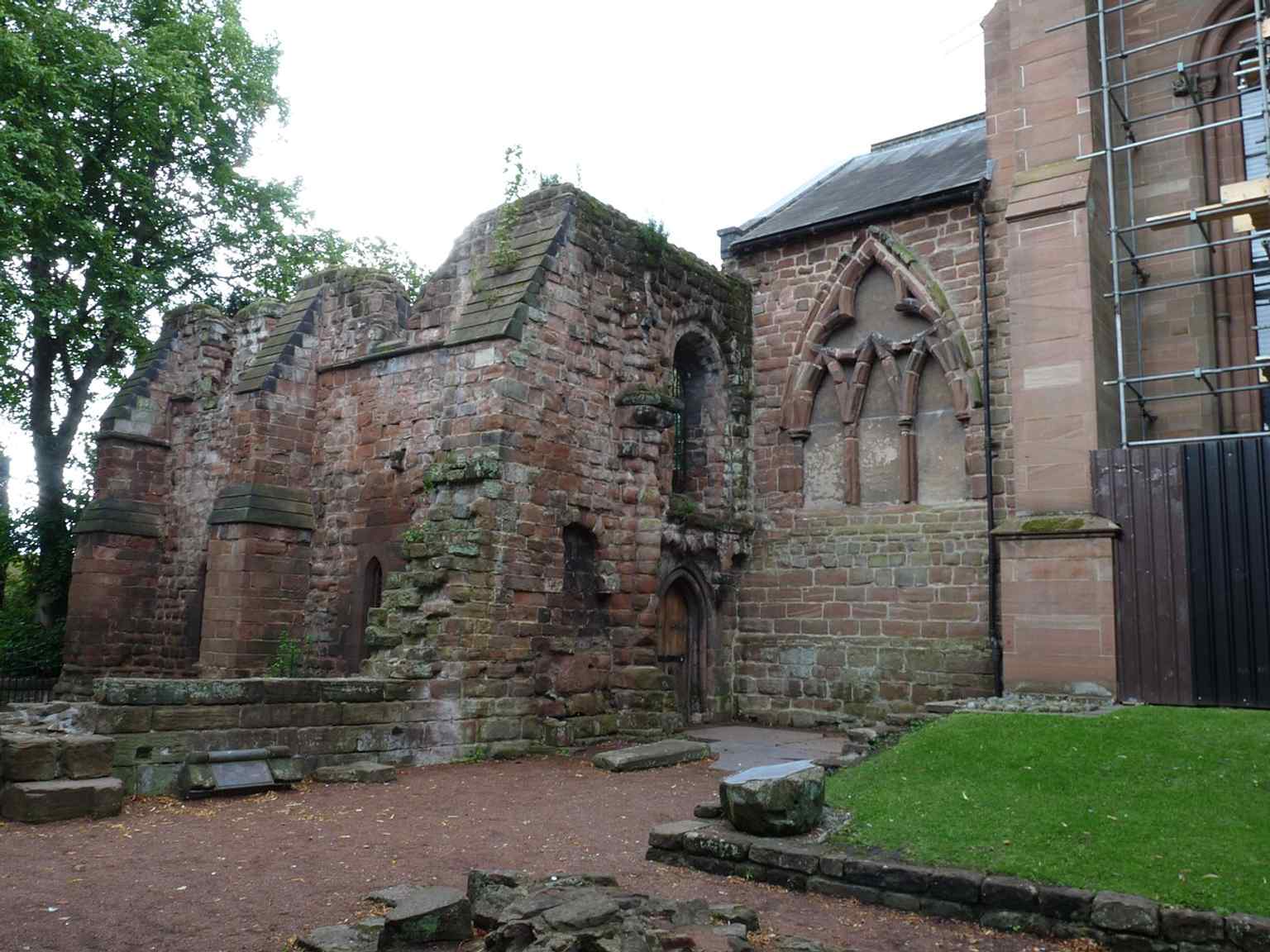
The ruined eastern remains beyond the present church, evidence of the post-Dissolution demolition that reduced St John’s from cathedral to parish church.Photo: Chris McKenna, Wikimedia Commons, CC BY-SA 3.0. Cropped & resized. 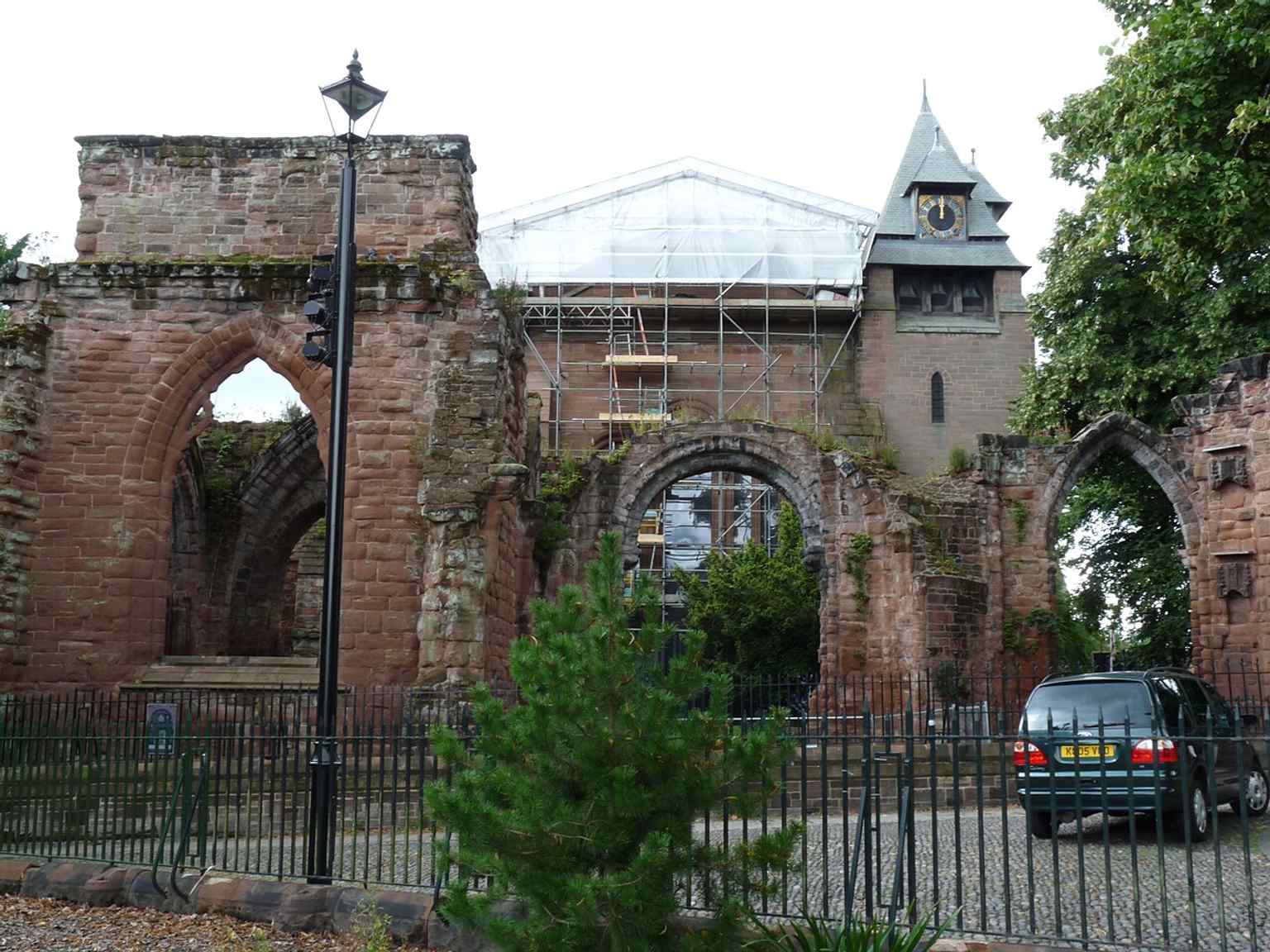
A close look at the former east end ruins, where the medieval building once continued much farther east before later collapse and demolition.Photo: Chris McKenna, Wikimedia Commons, CC BY-SA 3.0. Cropped & resized. 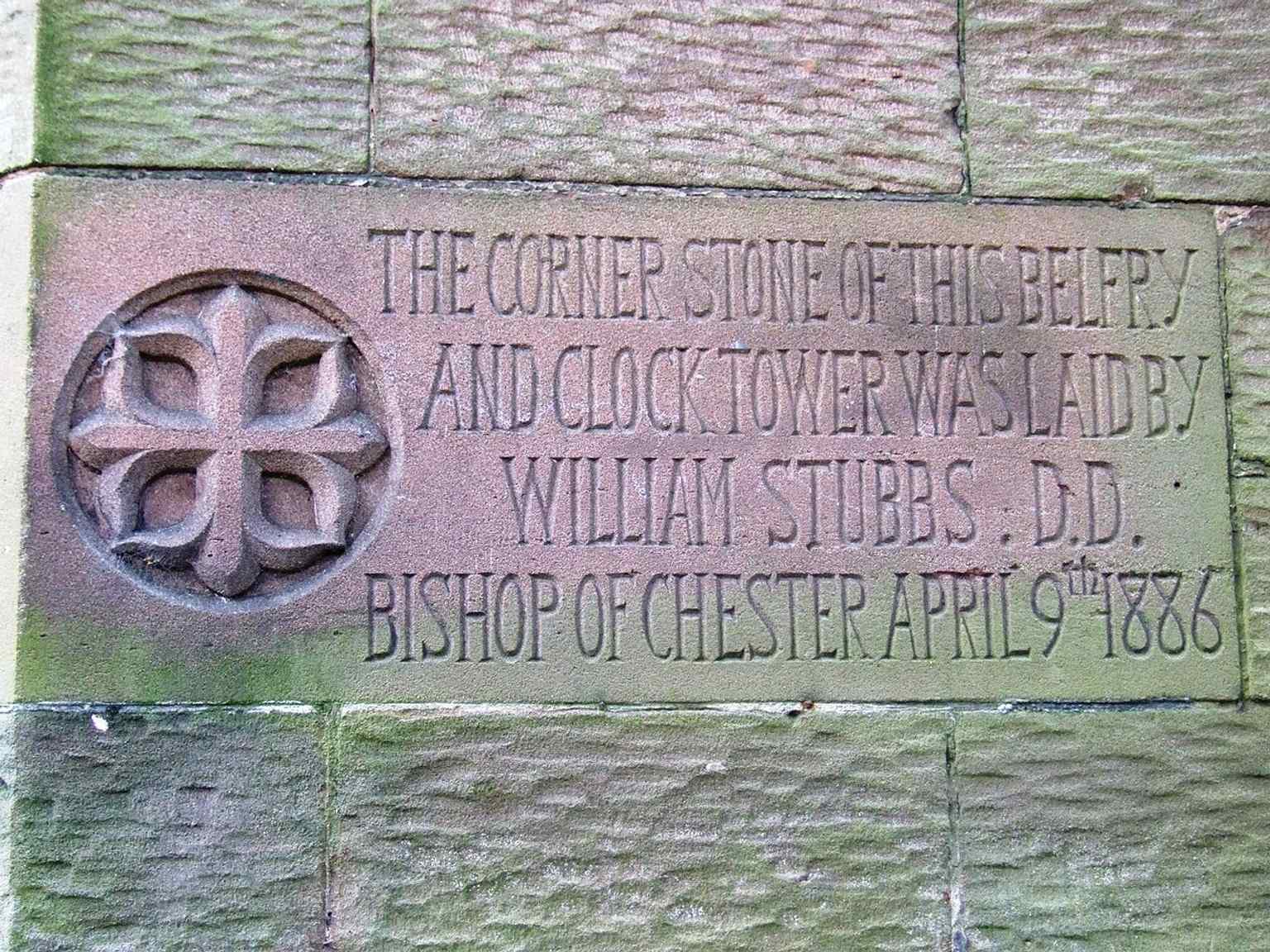
A dedication tablet near the bell tower, a small but important trace of the church’s later parish history after its cathedral status was lost.Photo: RLamb, Wikimedia Commons, CC BY-SA 3.0. Cropped & resized. 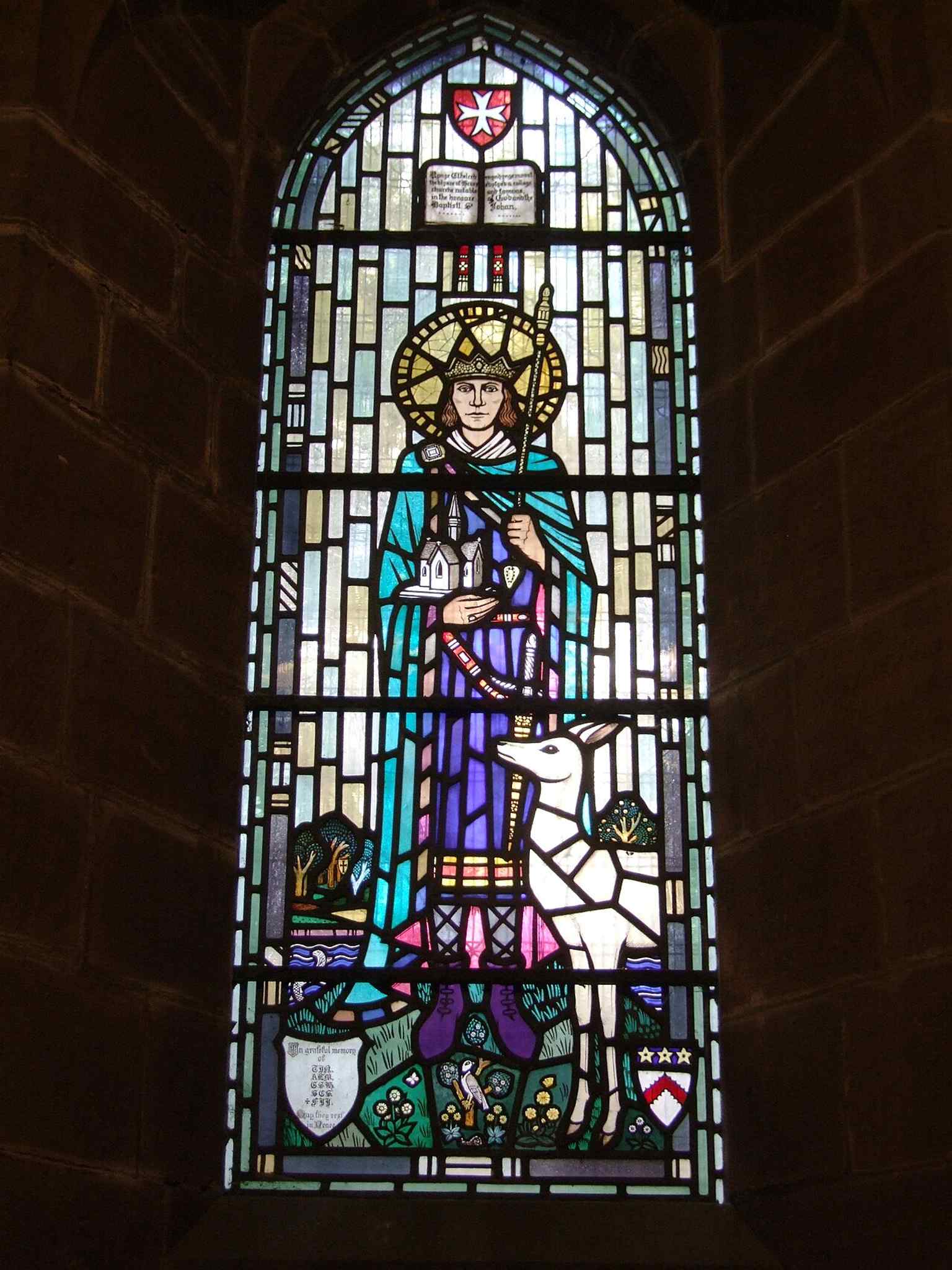
St Ethelred in stained glass, linking the church to its legendary late-7th-century foundation by King Æthelred.Photo: RLamb, Wikimedia Commons, CC BY-SA 3.0. Cropped & resized. 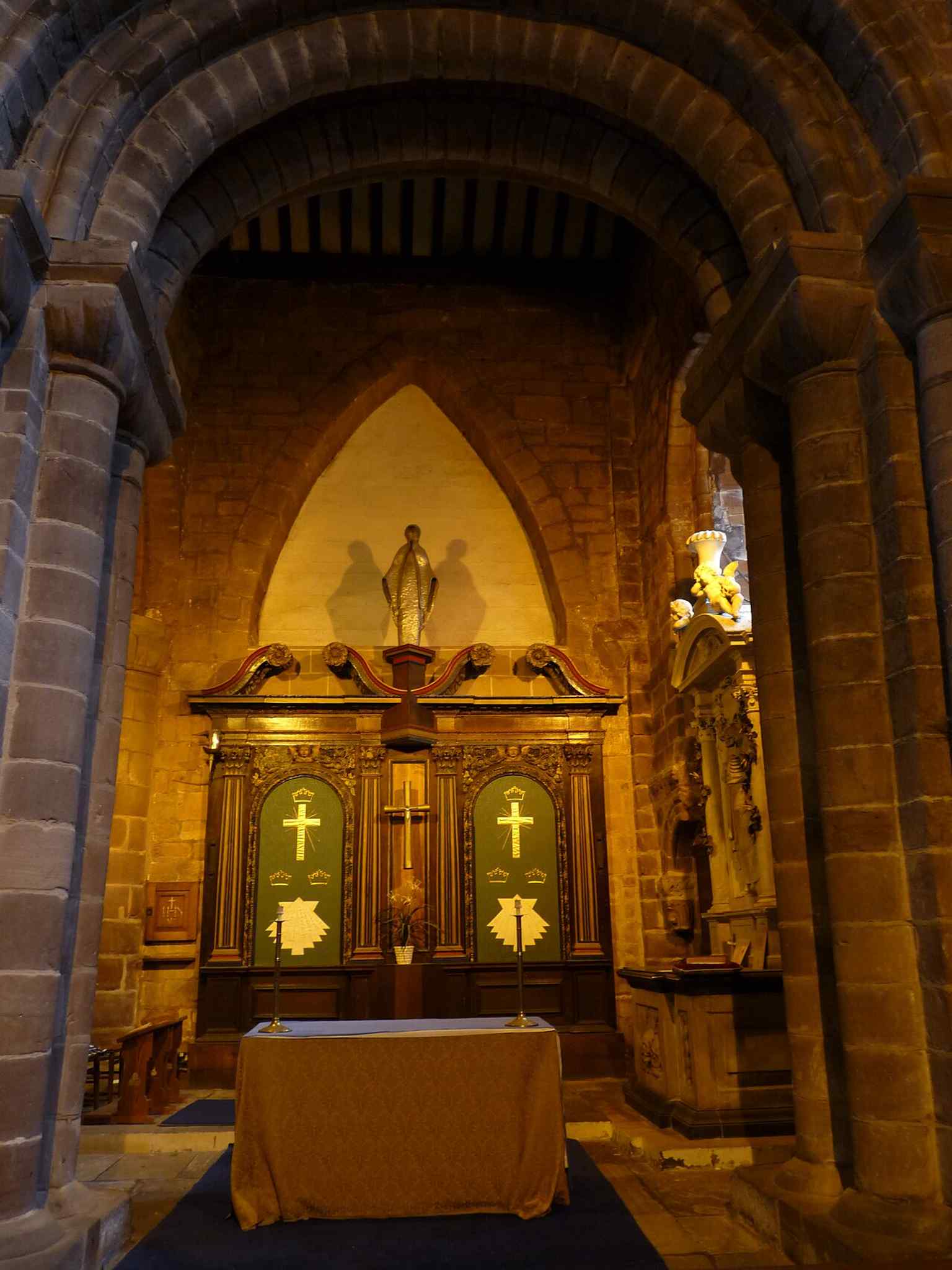
The Lady Chapel, extended in 1925, where later devotional changes sit beside the church’s older medieval structure.Photo: Chris McKenna, Wikimedia Commons, CC BY-SA 3.0. Cropped & resized. 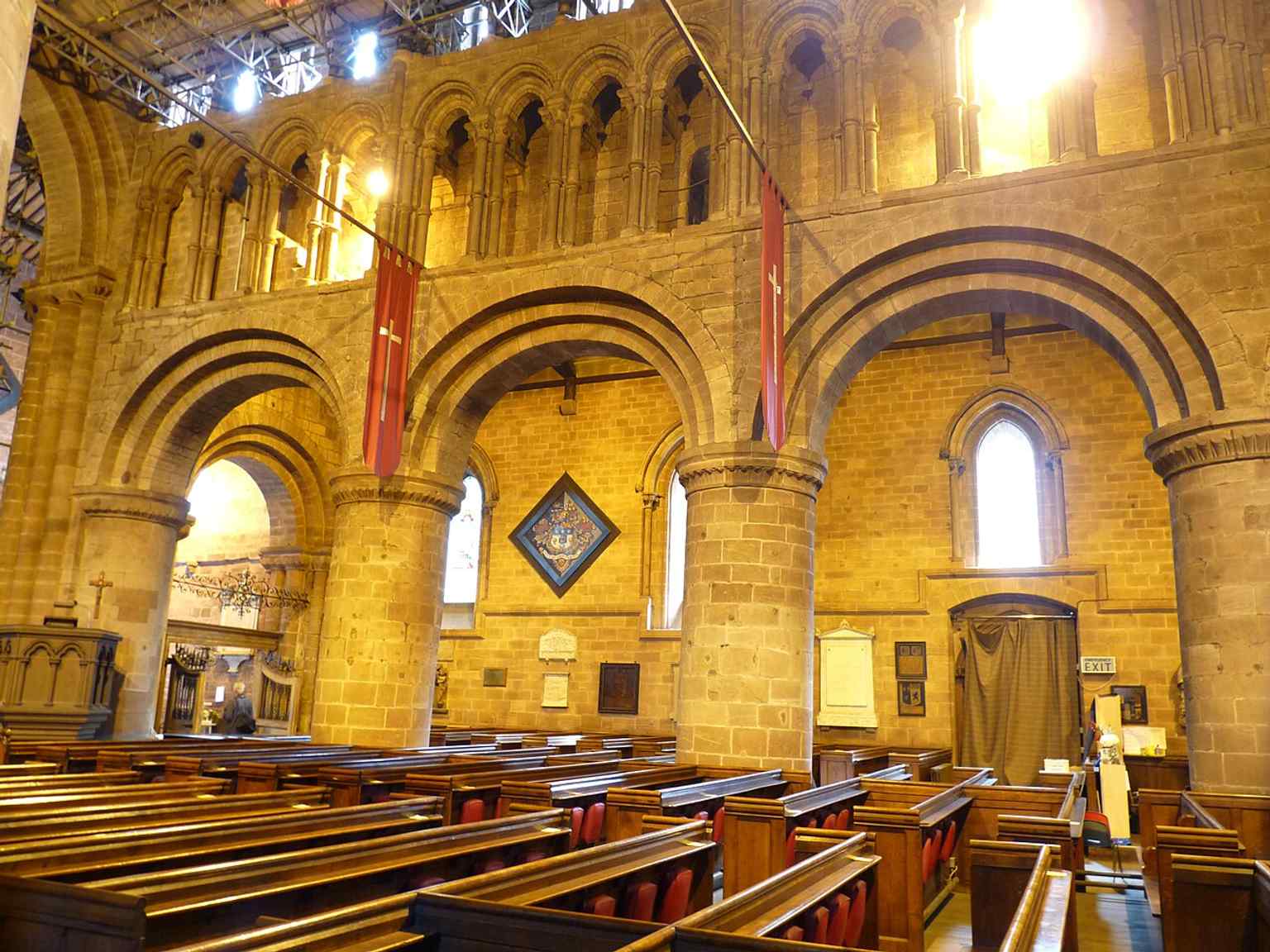
The south side of the nave, useful for showing the broad interior plan of nave and aisles that survived from the medieval church.Photo: Chris McKenna, Wikimedia Commons, CC BY-SA 3.0. Cropped & resized. 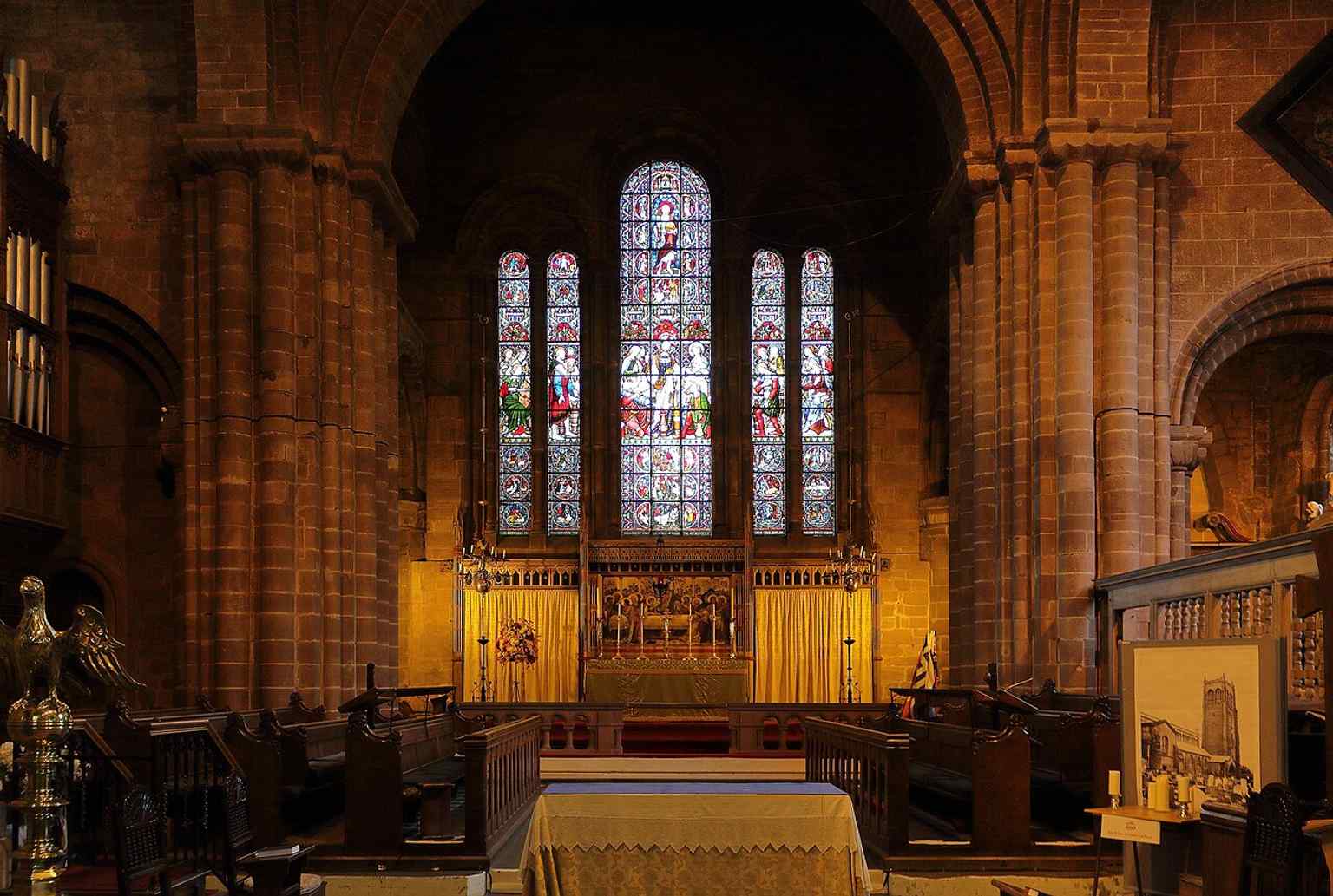
The chancel with altar and east window, highlighting the restored liturgical east end inside a church whose original eastern arm is now largely ruined.Photo: Rodhullandemu, Wikimedia Commons, CC BY-SA 4.0. Cropped & resized. On your right, look for a broad sunken oval of pale stone and grass, framed by curved seating banks and a long mural wall that hints at the missing half of the arena. This is…Read moreShow less
Open dedicated page →On your right, look for a broad sunken oval of pale stone and grass, framed by curved seating banks and a long mural wall that hints at the missing half of the arena.
This is Chester Roman Amphitheatre, the largest Roman amphitheatre yet uncovered in Britain... which is an impressive title, even if only half of it is currently showing. The Romans planted it here in the first century, beside the fortress of Deva Victrix, and they did not think small. At its fullest, this was a stone ellipse about forty feet high, roughly three hundred and twenty feet long and two hundred and eighty-six feet wide, with room for around eight thousand spectators.
For years, people liked to imagine this place mainly as a training ground for soldiers. Very noble, very disciplined, very tidy. The evidence says otherwise. Archaeologists found signs that point to spectacle: cockfighting, bull baiting, boxing, wrestling, and almost certainly gladiatorial combat. The Greek poet Oppian even described Roman cockfights as solemn ritual contests, meant to remind men to imitate the fighting spirit of the bird. So yes... moral instruction, Roman style.
The first version here seems to have gone up under Legio Two Adiutrix in the late seventies. When that legion moved on in eighty-six, Legio Twenty Valeria Victrix rebuilt it. Then, after time away working on Hadrian’s Wall, they returned around two hundred and seventy-five and rebuilt it again. Recent digs changed one long-held idea too: what people thought was an earlier wooden amphitheatre turned out to be a wooden grillage, basically a foundation support under the seating. In other words, archaeologists had to tell a very old theory, “thanks, but no.”
Around the arena stood the practical machinery of entertainment: dungeons, stables, food stalls, and at the north entrance a shrine to Nemesis, the goddess of retribution. That unusually ambitious setup has led some historians to wonder whether Chester might have become the capital of Roman Britain if Rome had pushed on into Ireland. It never happened, but the ambition is written all over the scale of this place.
After around three hundred and fifty, the amphitheatre slipped into disuse. People scavenged its stone, the bowl filled with rubbish and soil, and later generations used the depression for bear baiting and public executions. Then it vanished from memory almost completely until nineteen twenty-nine, when work near Dee House uncovered a long curved wall. That discovery kicked off decades of excavation, argument, fundraising, and road-diverting heroics by the Chester Archaeological Society.
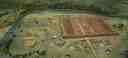
If you glance at the aerial image on your screen, you can see the odd truth of the site: only the northern half is exposed, while the southern half still lies under later buildings. And if you want a quick sense of how much the site’s presentation changed, have a look at the before-and-after comparison in the app.
One of the smartest modern touches is that mural along the wall, commissioned in two thousand and ten, which recreates the lost seating and completes the oval your eyes can’t quite finish on their own. The site is open twenty-four hours a day, so there’s no need to rush your Roman contemplation.
For a ruin, it still knows how to hold a crowd.
When you’re ready, we can continue on to the Grosvenor Museum.
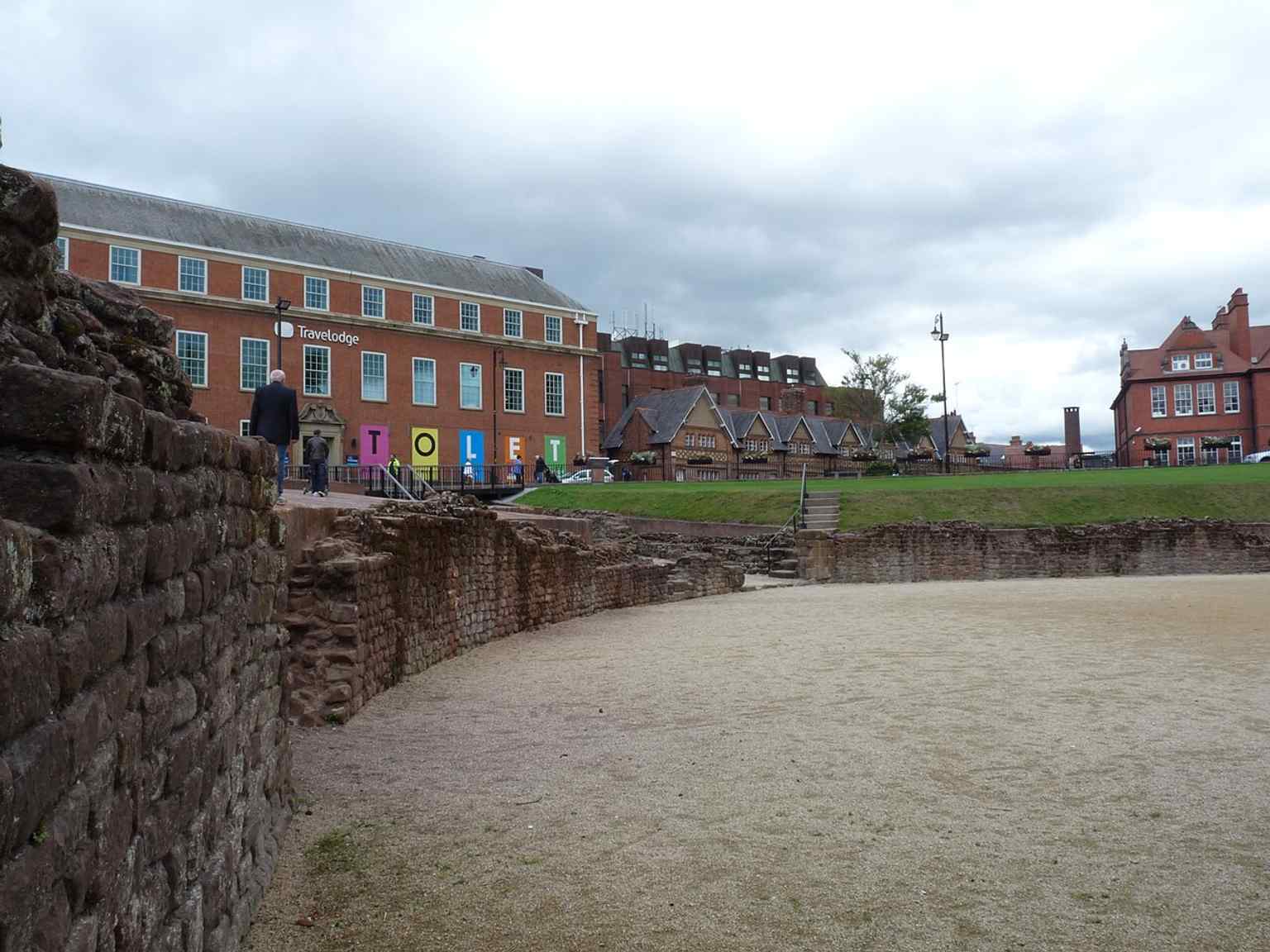
Looking across the western edge of the excavated arena floor, a good angle for explaining the curved seating bank and the exposed northern side.Photo: Chris McKenna, Wikimedia Commons, CC BY-SA 3.0. Cropped & resized. 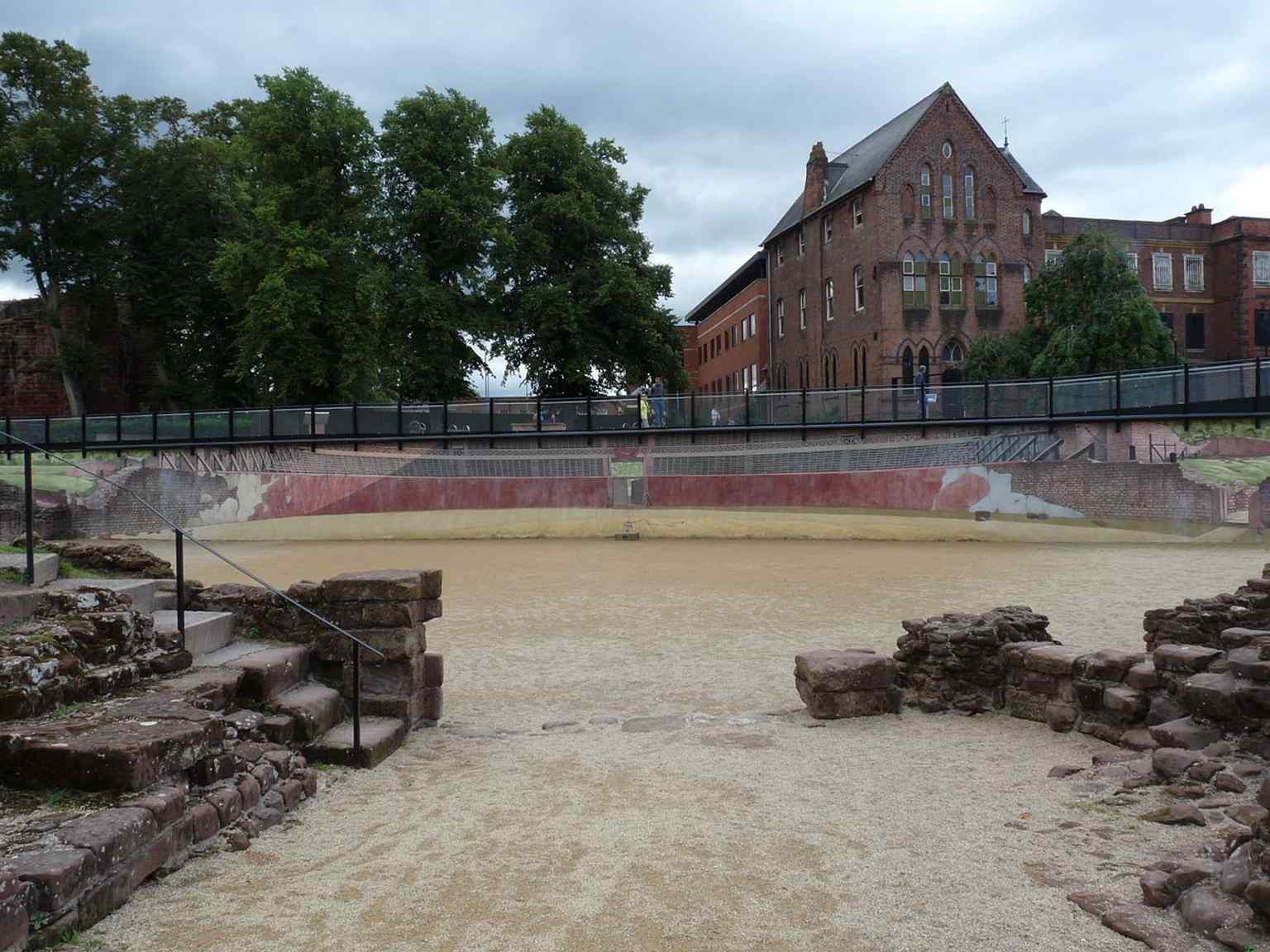
View south from the arena entrance down the steps, highlighting the sunken arena level and the modern access route into the ruins.Photo: Chris McKenna, Wikimedia Commons, CC BY-SA 3.0. Cropped & resized. 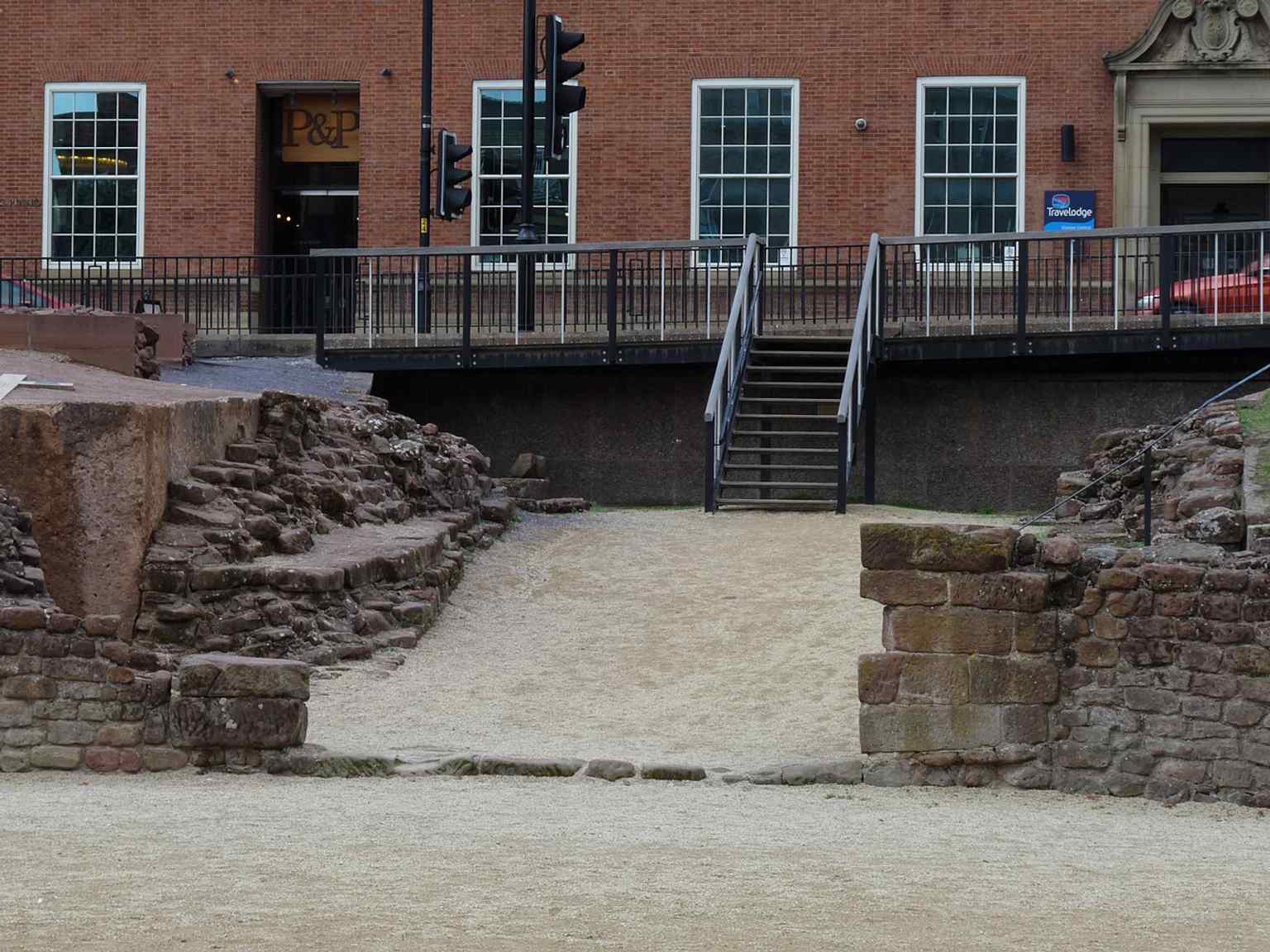
The modern stairway down to the arena floor, a clear detail of how visitors enter the excavated amphitheatre today.Photo: Chris McKenna, Wikimedia Commons, CC BY-SA 3.0. Cropped & resized. In front of you stands a dark bronze queen on a square pale stone pedestal and granite base, crowned and holding an orb and sceptre. Queen Victoria has been presiding over this…Read moreShow less
Open dedicated page →In front of you stands a dark bronze queen on a square pale stone pedestal and granite base, crowned and holding an orb and sceptre.
Queen Victoria has been presiding over this forecourt of Chester Castle, in front of the Crown Court, since the seventeenth of October, nineteen oh three. Wilbraham Egerton, the first Earl Egerton, unveiled her, but the money came from public subscription, with about a third raised in Chester and the rest across the county... a civic whip-round on an imperial scale. Frederick William Pomeroy sculpted her, fresh from creating the Duke of Westminster’s effigy in Chester Cathedral. Foundry workers at Hollinshead and Burton in Thames Ditton cast the bronze, while Harry Beswick designed the stonework and Haswell and Sons of Chester cut it.
Look at the way she is dressed: coronation robes, a lace head-dress, and the Imperial Crown... no danger of mistaking this for off-duty Victoria. The pedestal carries the arms of the city and county, a reminder that this memorial was meant to speak for both. If you glance at the detail image on your screen, those formal Victorian touches show up nicely.
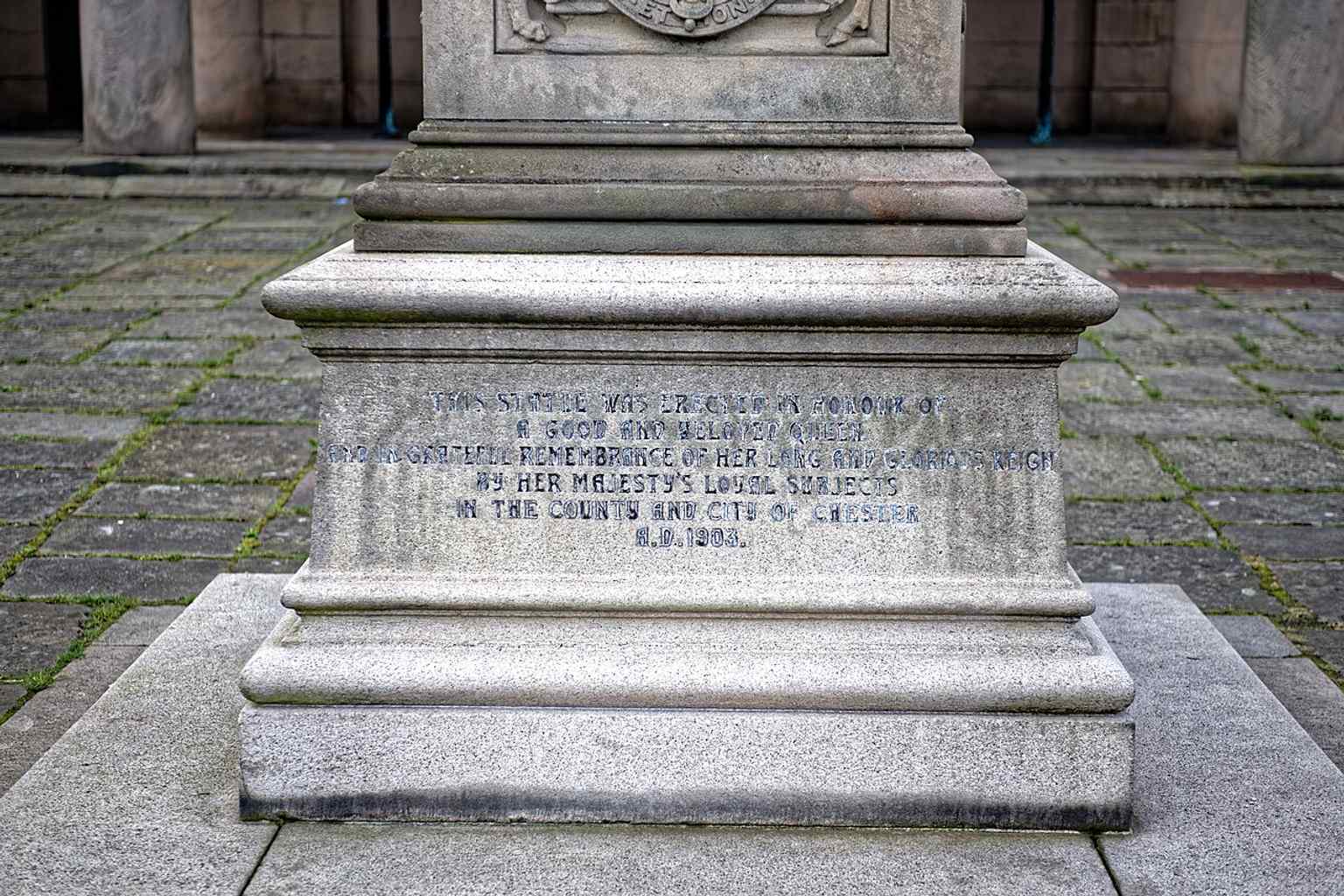
A closer view of the statue and pedestal, showing the listed memorial in Chester Castle’s forecourt and its formal Victorian styling.Photo: Tilman2007, Wikimedia Commons, CC BY-SA 4.0. Cropped & resized. Over fifteen years, the statue itself has barely changed, but the square around it feels tidier and more carefully presented now. Take a quick look at the comparison in the app if you like. In nineteen eighty-five, it gained Grade Two listed status, meaning it is nationally important and specially protected.
This forecourt is open all day, every day, and Victoria seems perfectly content with the arrangement. A small monument, but a very confident one. When you’re ready, we can wander on to the next stop.
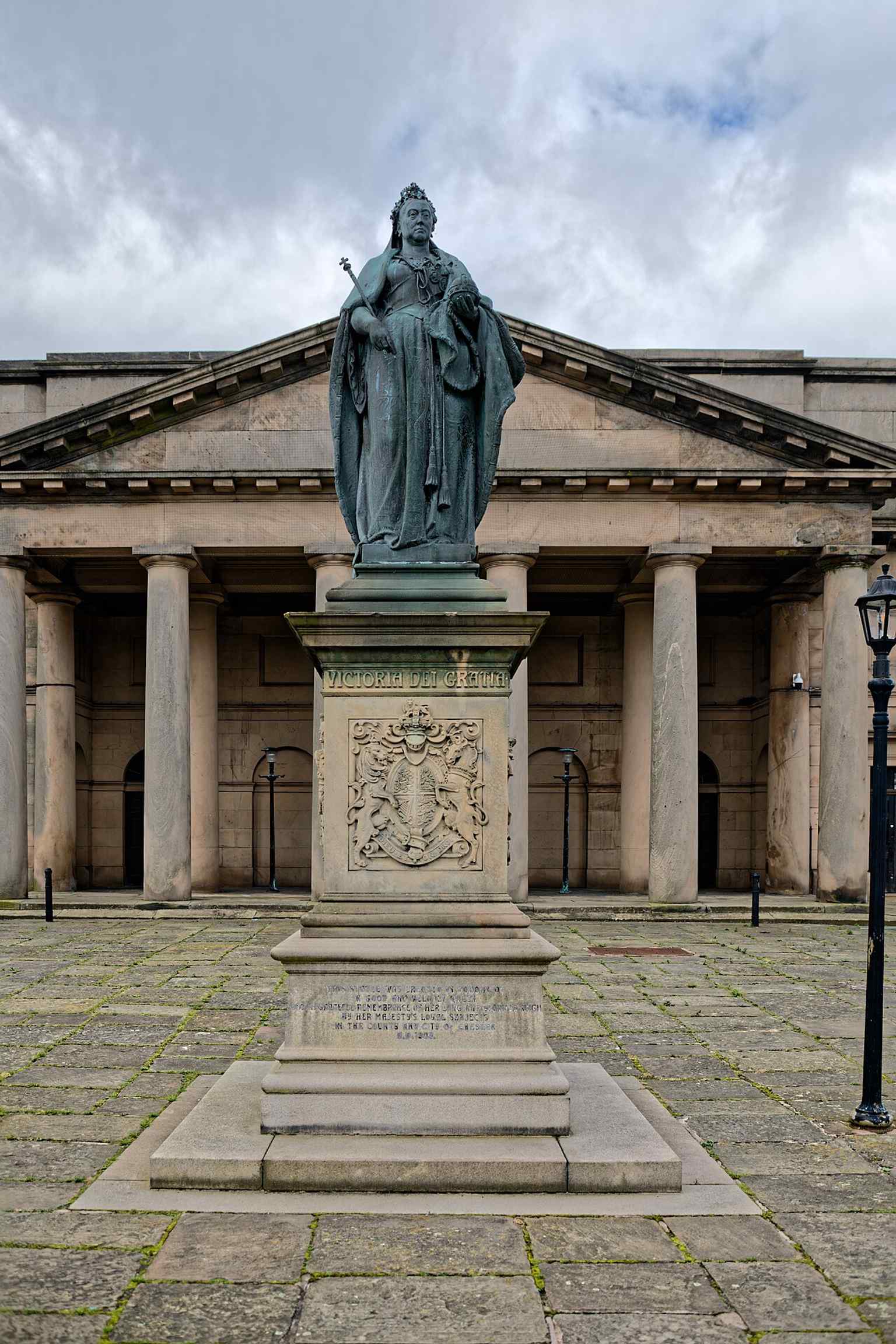
Queen Victoria’s bronze statue in Castle Square, standing in front of Chester Crown Court exactly where it was unveiled in 1903.Photo: Tilman2007, Wikimedia Commons, CC BY-SA 4.0. Cropped & resized. On your right is a red sandstone church with a square three-stage tower, a line of clerestory windows above the main roof, and a sturdy two-storey porch built into its side. This…Read moreShow less
Open dedicated page →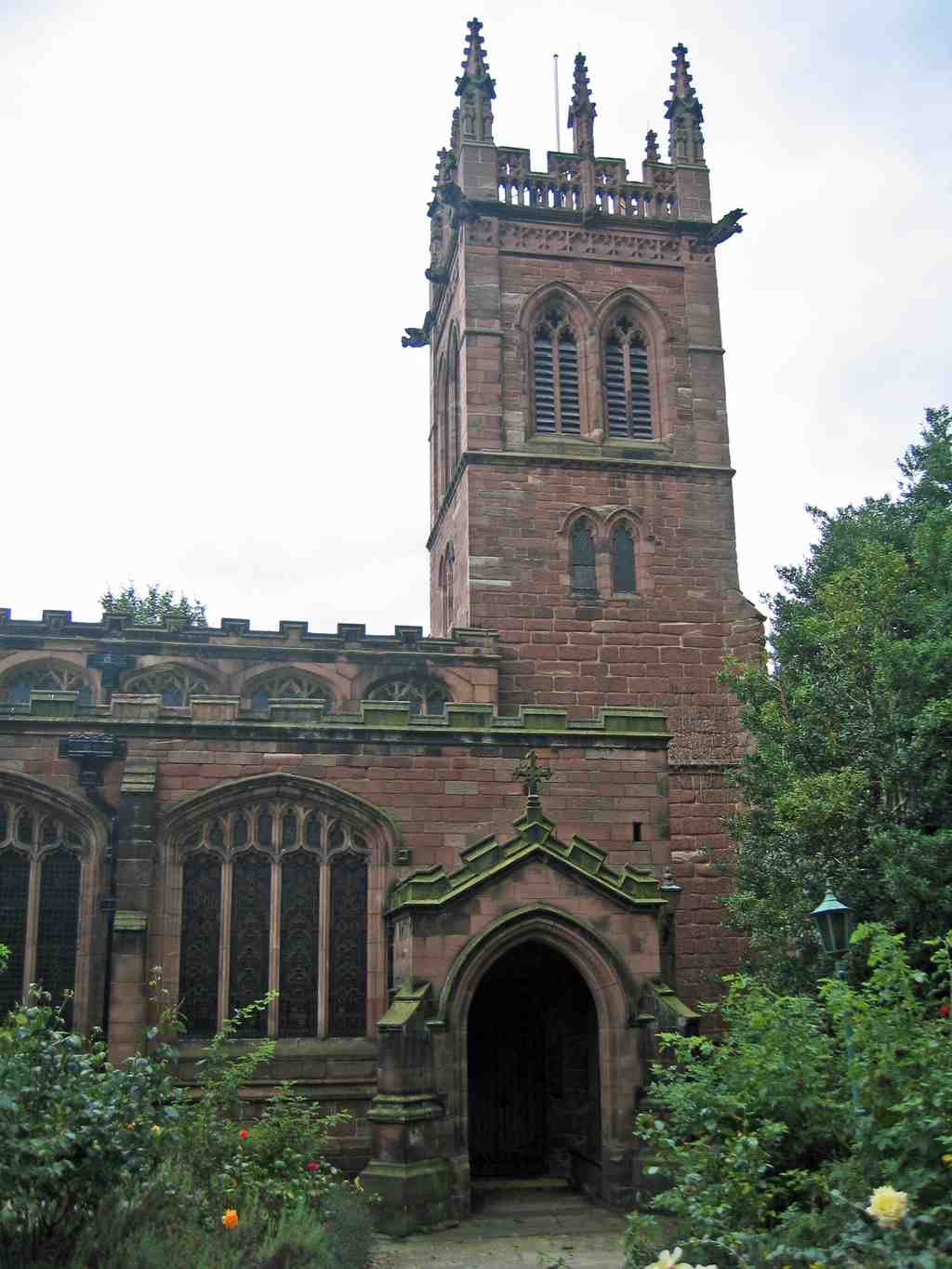
St Mary's Creative SpacePhoto: Peter I. Vardy, Wikimedia Commons, Public domain. Cropped & resized. On your right is a red sandstone church with a square three-stage tower, a line of clerestory windows above the main roof, and a sturdy two-storey porch built into its side.
This is St Mary’s Creative Space, once St Mary-on-the-Hill, a church perched above the narrow lane that drops toward the River Dee and tucked right beside Chester Castle. The first church here served the castle in Norman times, but most of what you see now grew in the fourteenth and fifteenth centuries. So yes... it has been adapting for a very long time.
The building took some hard knocks. In the Civil War, damage in sixteen forty-five weakened the south chapel, which finally collapsed in sixteen sixty-one. People rebuilt it in sixteen ninety-three. Then, during the Jacobite rising of seventeen forty-five, Lord Cholmondeley had the top stage of the tower demolished to clear a line of fire. Nothing says “sacred architecture” quite like military practicality.
If you glance at your screen, the wider view shows just how tightly this church and the castle share the ridge line. Later restorers tried to steady and dignify the place again: James Harrison worked on it in the eighteen sixties, J. P. Seddon followed in the eighteen nineties, and the north porch was rebuilt in memory of Randle Holme the Third, from Chester’s famous family of heraldic artists and record-keepers.
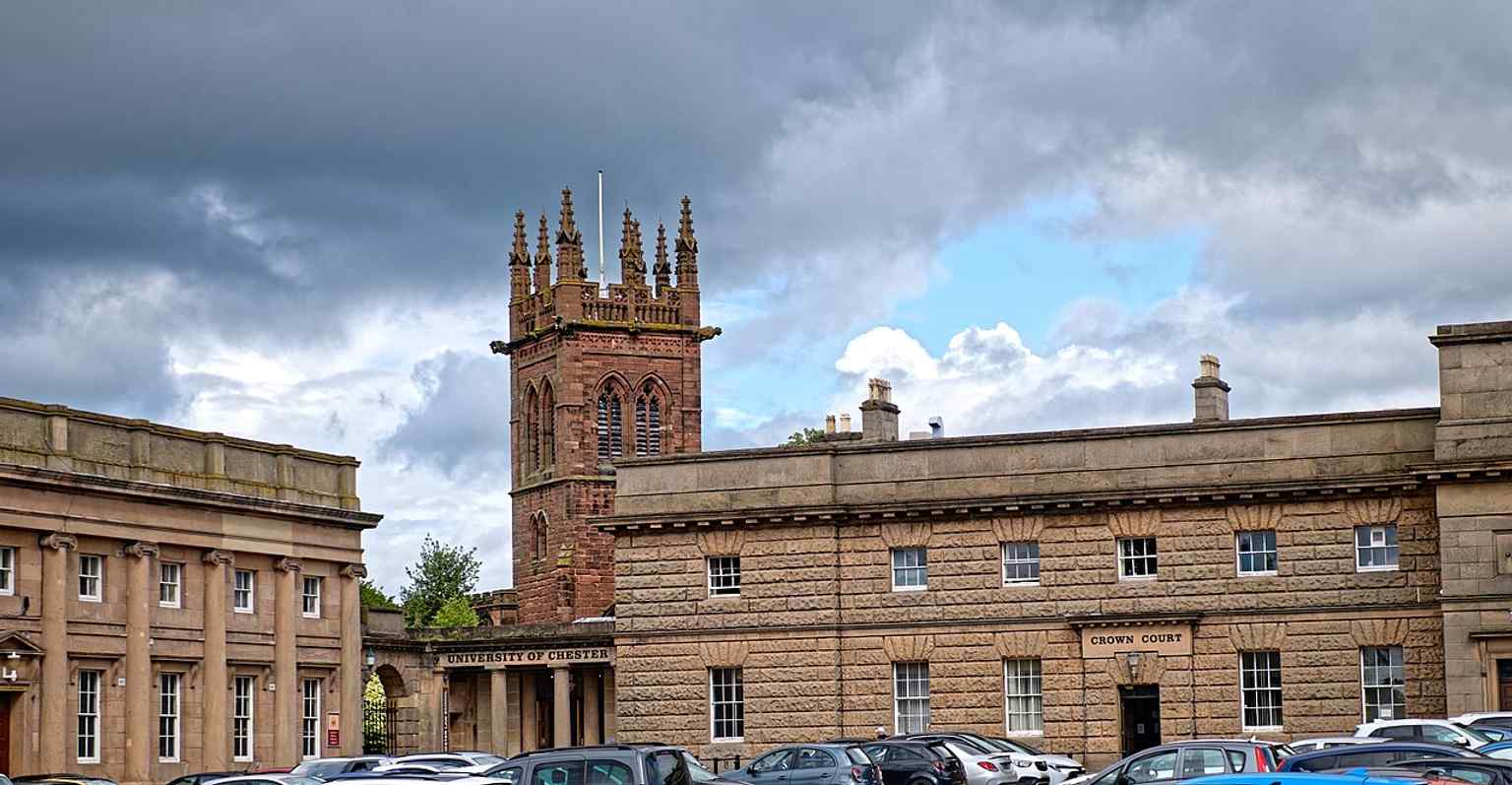
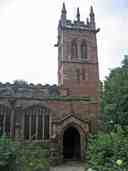
A clear view from Castle Square of the old church beside Chester Castle, emphasizing its close relationship to the castle and hilltop setting.Photo: Tilman2007, Wikimedia Commons, CC BY-SA 4.0. Cropped & resized. Inside, the pews and furnishings are gone, because the church closed in nineteen seventy-two and became an educational center in the nineteen seventies. Now it hosts concerts, exhibitions, and performances, with Chester Music Society and Theatre in the Quarter keeping the old building very much alive. And it still carries its past: seventy-two monuments and cenotaphs survive inside. One of the strangest belongs to Philip Oldfield, a barrister who died in sixteen sixteen; his effigy lies above, while a skeleton mirrors his pose below... subtle, it is not. You can see that monument on your phone here.
It’s a fine Chester habit: when a church can no longer serve one community, it finds another.
Take a look at the stonework, and when you’re ready, we can continue on to the Old Dee Bridge.
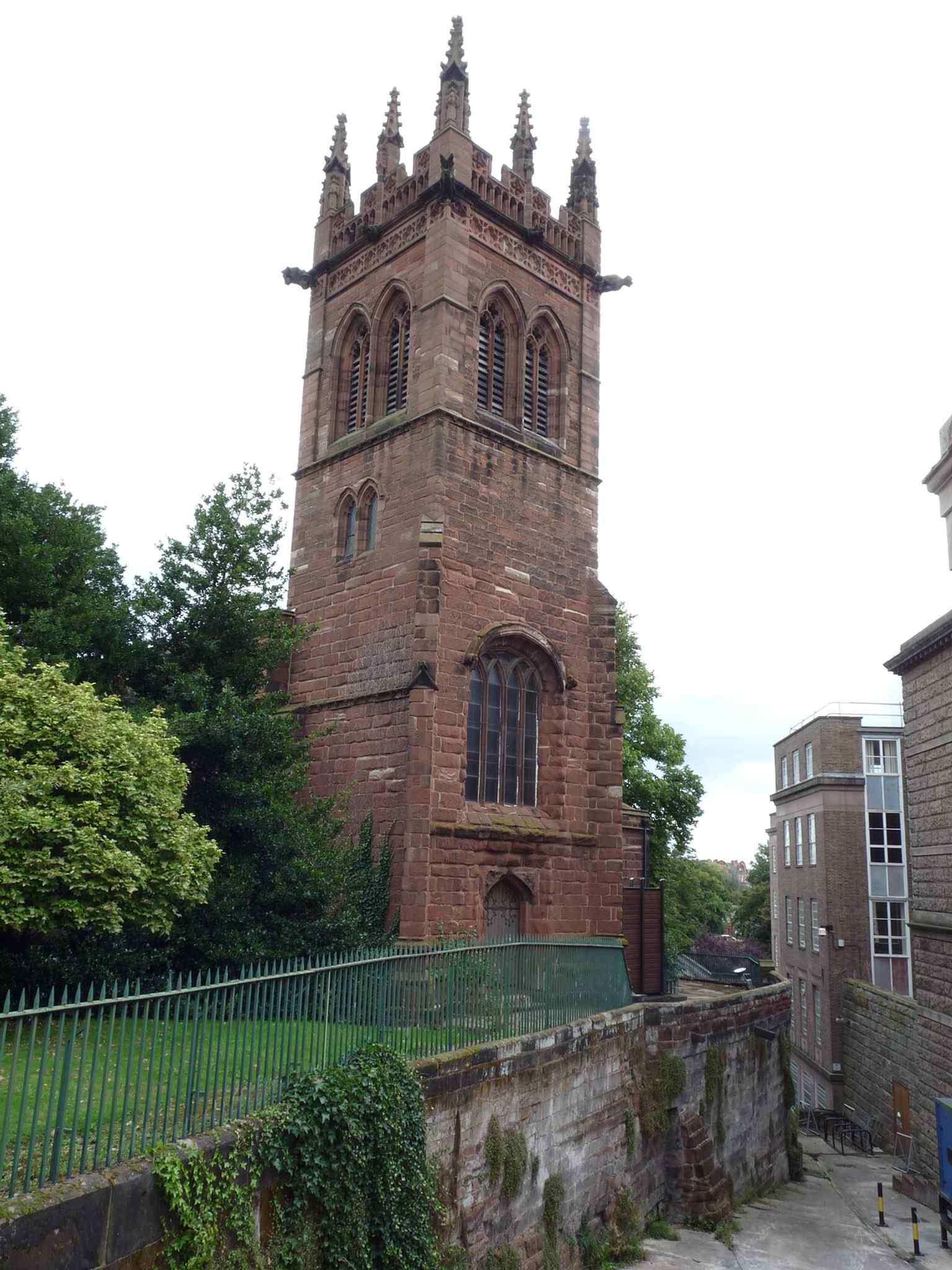
The west tower of St Mary’s Creative Space, seen from the narrow passage by Chester Castle — this former church has stood here since the medieval period.Photo: Chris McKenna, Wikimedia Commons, CC BY-SA 3.0. Cropped & resized. 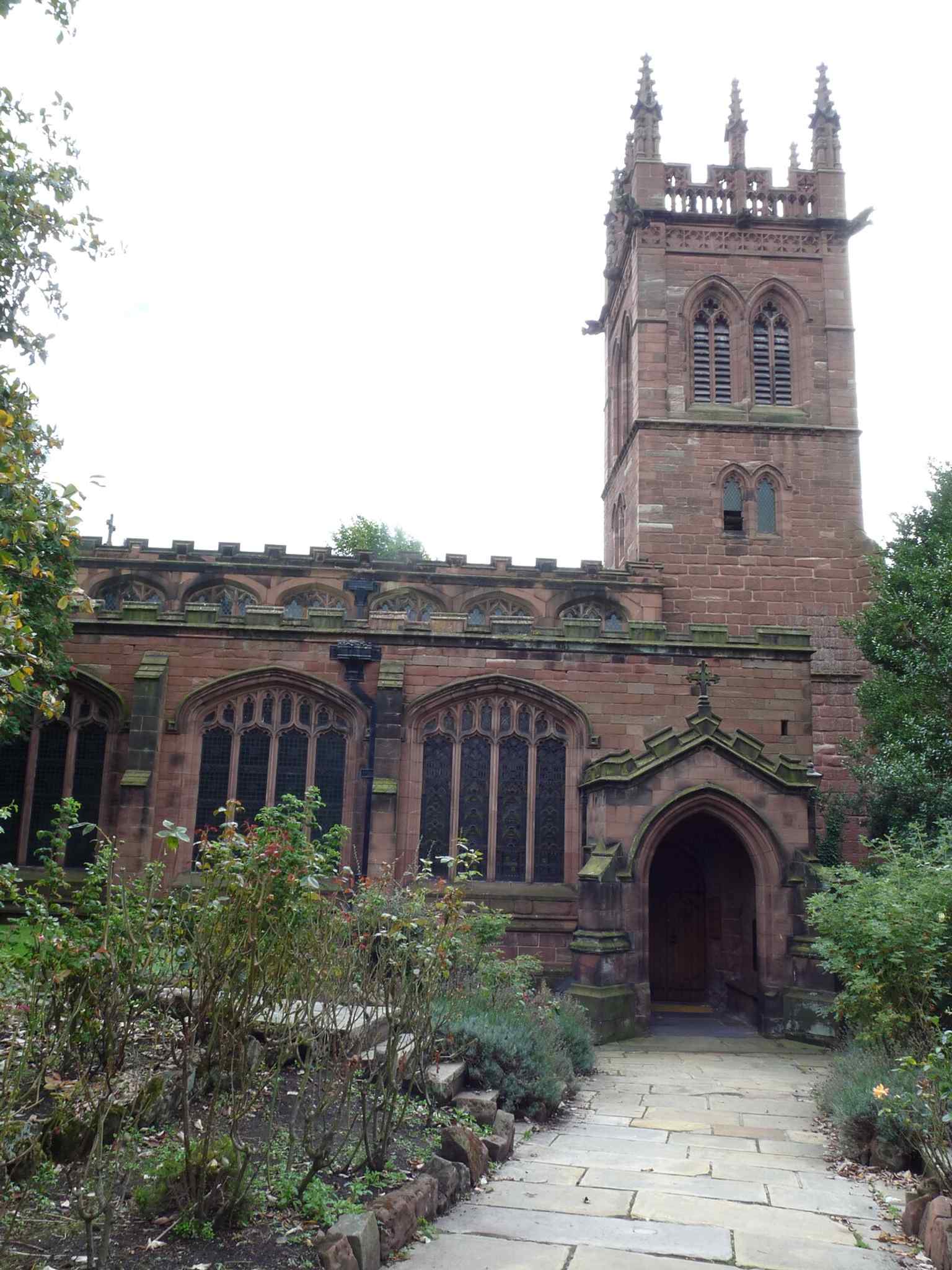
The entrance and tower from St Mary’s Hill, showing the Grade I listed building that was converted into a creative venue in the 1970s.Photo: Chris McKenna, Wikimedia Commons, CC BY-SA 3.0. Cropped & resized. On your right, look for a low red sandstone bridge with seven uneven arches and sturdy triangular cutwaters projecting into the River Dee. This is the Old Dee Bridge, the oldest…Read moreShow less
Open dedicated page →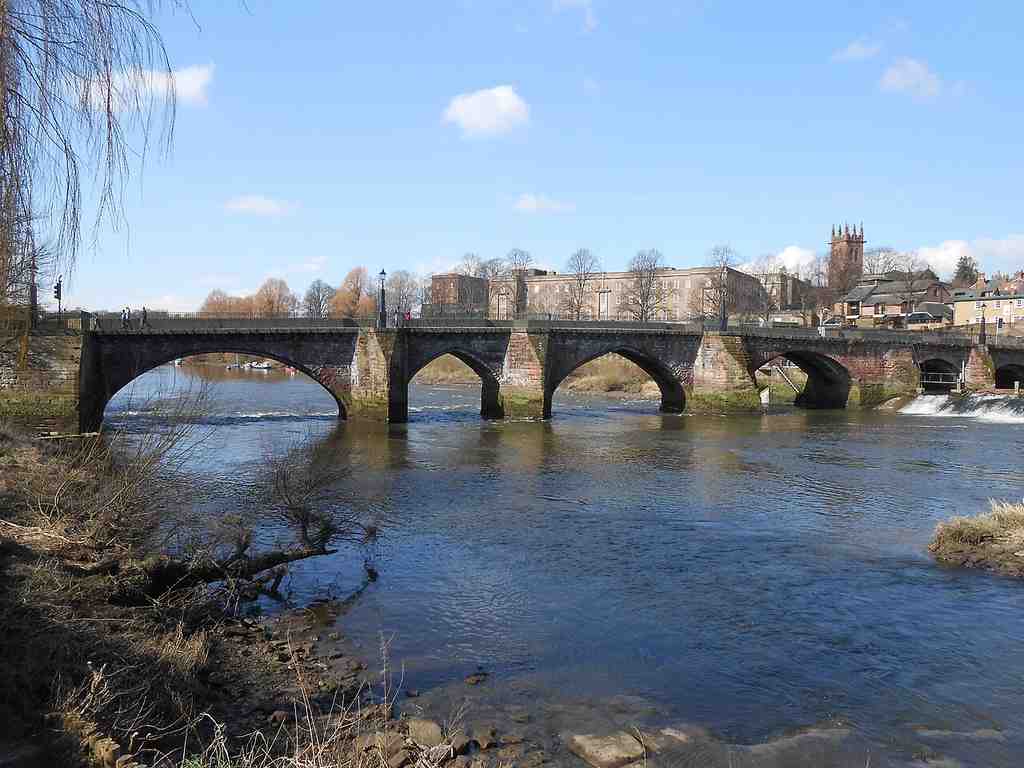
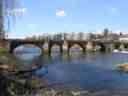
Old Dee BridgePhoto: Rept0n1x, Wikimedia Commons, CC BY-SA 3.0. Cropped & resized. On your right, look for a low red sandstone bridge with seven uneven arches and sturdy triangular cutwaters projecting into the River Dee.
This is the Old Dee Bridge, the oldest bridge in Chester, and it has earned every wrinkle. The Romans first established a crossing here, probably with stone piers carrying a timber roadway. By the time Queen Ethel-flaed of Mercia ruled, between nine eleven and nine eighteen, that Roman bridge had vanished and people relied on a ferry instead... which is a polite way of saying the infrastructure situation had gone downhill.
By ten eighty-six, the Domesday Book records a bridge here again, and the Provost of Chester Castle could call up one man from every hide of land in Cheshire to help rebuild the city walls and the bridge. Medieval local government had a very direct way of recruiting volunteers. A causeway led to the crossing, and a manuscript says Hugh d'Avranches, the first Earl of Chester, also arranged watermills here on the Dee.
The river kept testing the bridge. In twelve seventy-nine to twelve eighty, floodwater swept away the timber superstructure. Repairs followed, then more repairs, and in thirteen fifty-seven Edward the Black Prince ordered Chester's mayor and citizens to rebuild their section "with all speed." The great late medieval rebuilding that followed gave us most of the bridge you see now.
Look closely and you are seeing local red sandstone shaped into arches of different sizes. The two northern arches once crossed the leat, a man-made channel feeding the mills, and the southernmost arch replaced a medieval drawbridge. A defensive gatehouse stood on the bridge from around thirteen ninety-nine to fourteen oh seven, until people demolished it in seventeen eighty-one. Then Thomas Harrison widened the bridge in eighteen twenty-five and eighteen twenty-six, adding a footway on the upstream side before the newer Grosvenor Bridge took some of the pressure off.
If you want, have a quick look at the comparison image in the app; the bridge barely changes, while the riverside scene around it shifts noticeably. If you glance at the detail photo on your screen, the stonework shows just how practical and hard-wearing this late medieval rebuild really is.
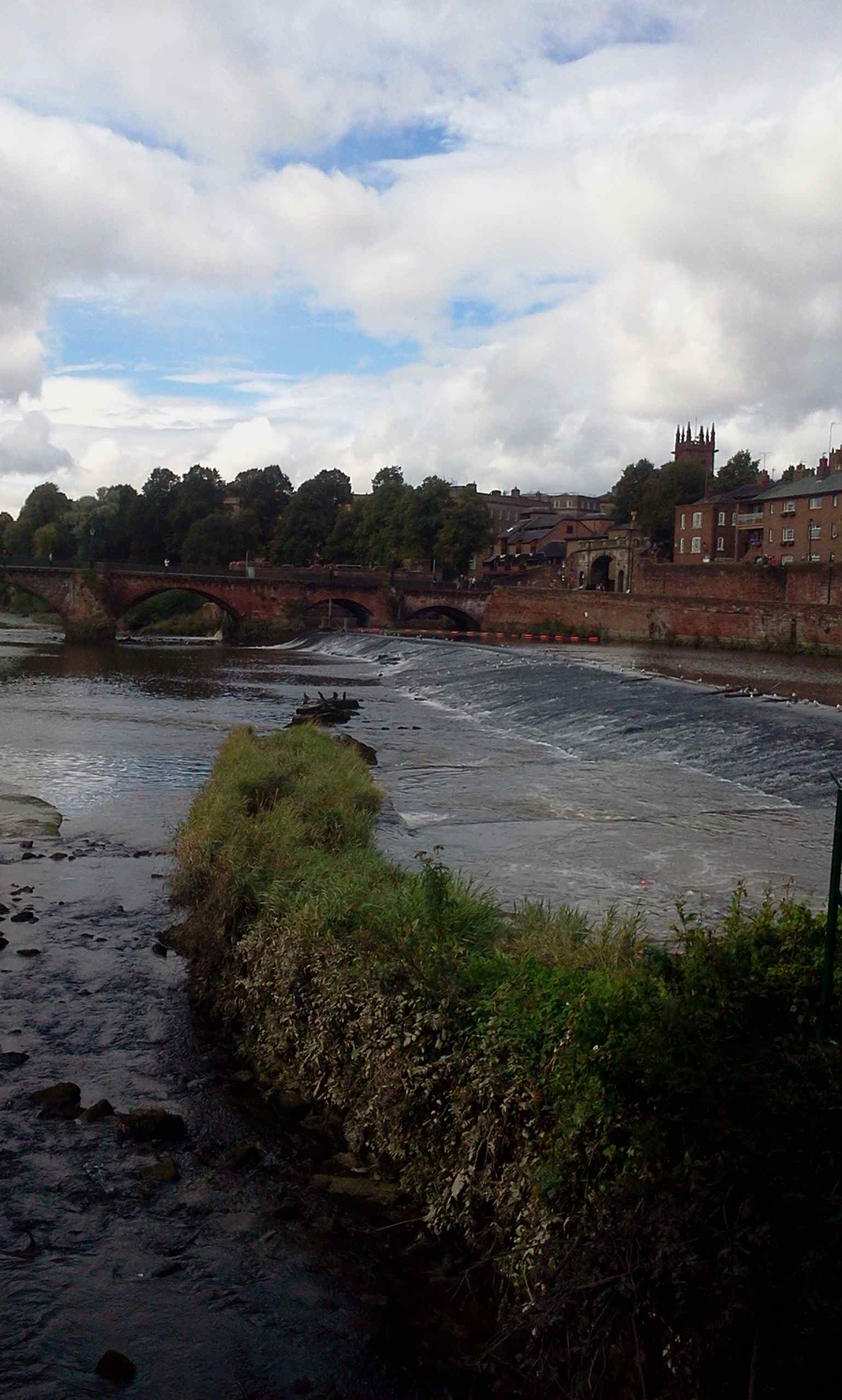
A tighter view of the bridge fabric, useful for showing the stonework of the present structure rebuilt in the late 14th century.Photo: Keith Hobbs, Wikimedia Commons, CC BY-SA 3.0. Cropped & resized. It is protected both as a Grade One listed building and as a scheduled monument, and the crossing stays open all day, every day. For all the rebuilding, it still does the same job with admirable stubbornness.
Take a moment by the river, and when you're ready, we can continue on to Chester Castle.
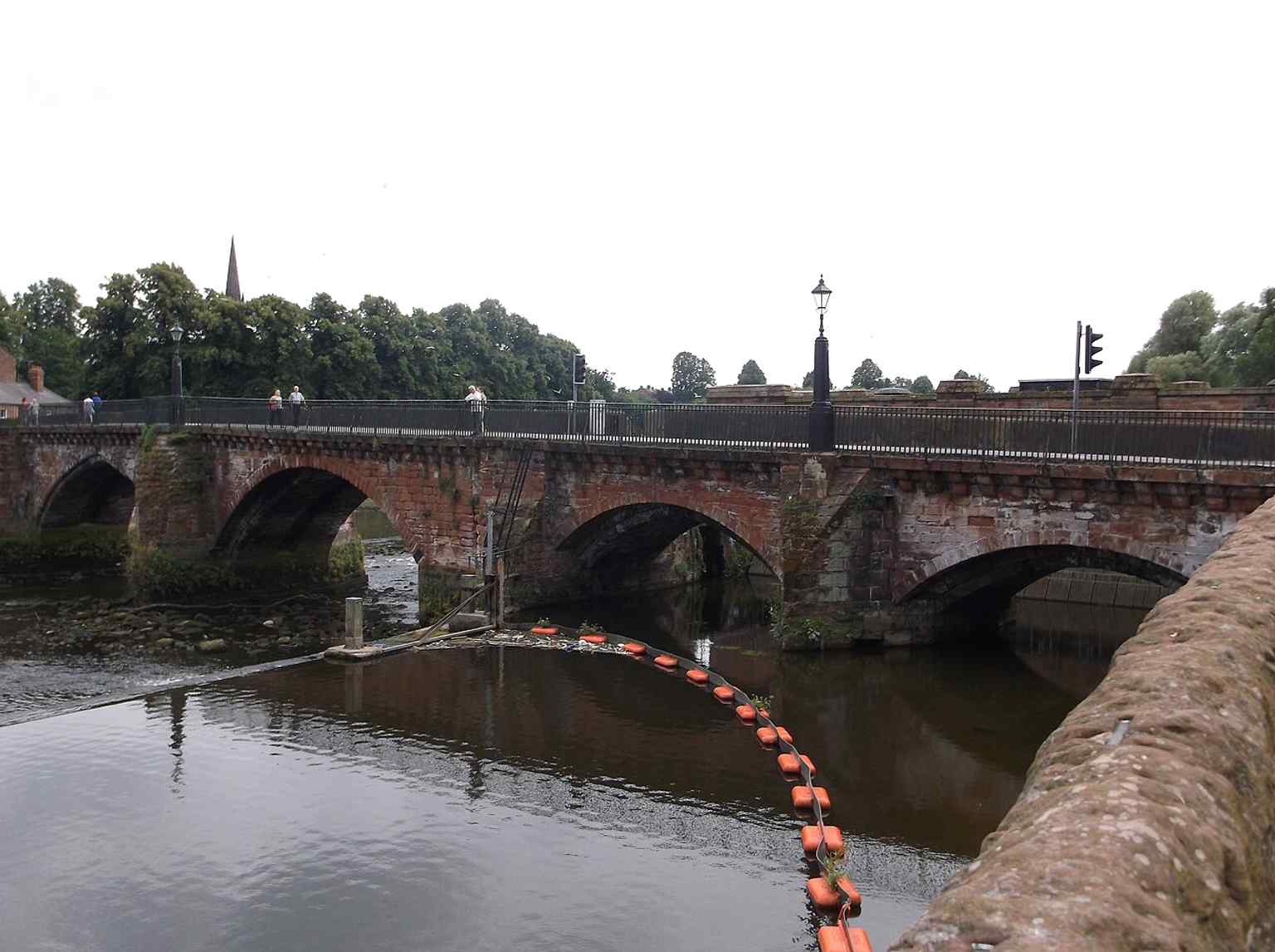
Classic view of Old Dee Bridge by Bridgegate, showing the surviving medieval crossing that links Chester to Handbridge.Photo: Harry Mitchell, Wikimedia Commons, CC BY-SA 3.0. Cropped & resized. 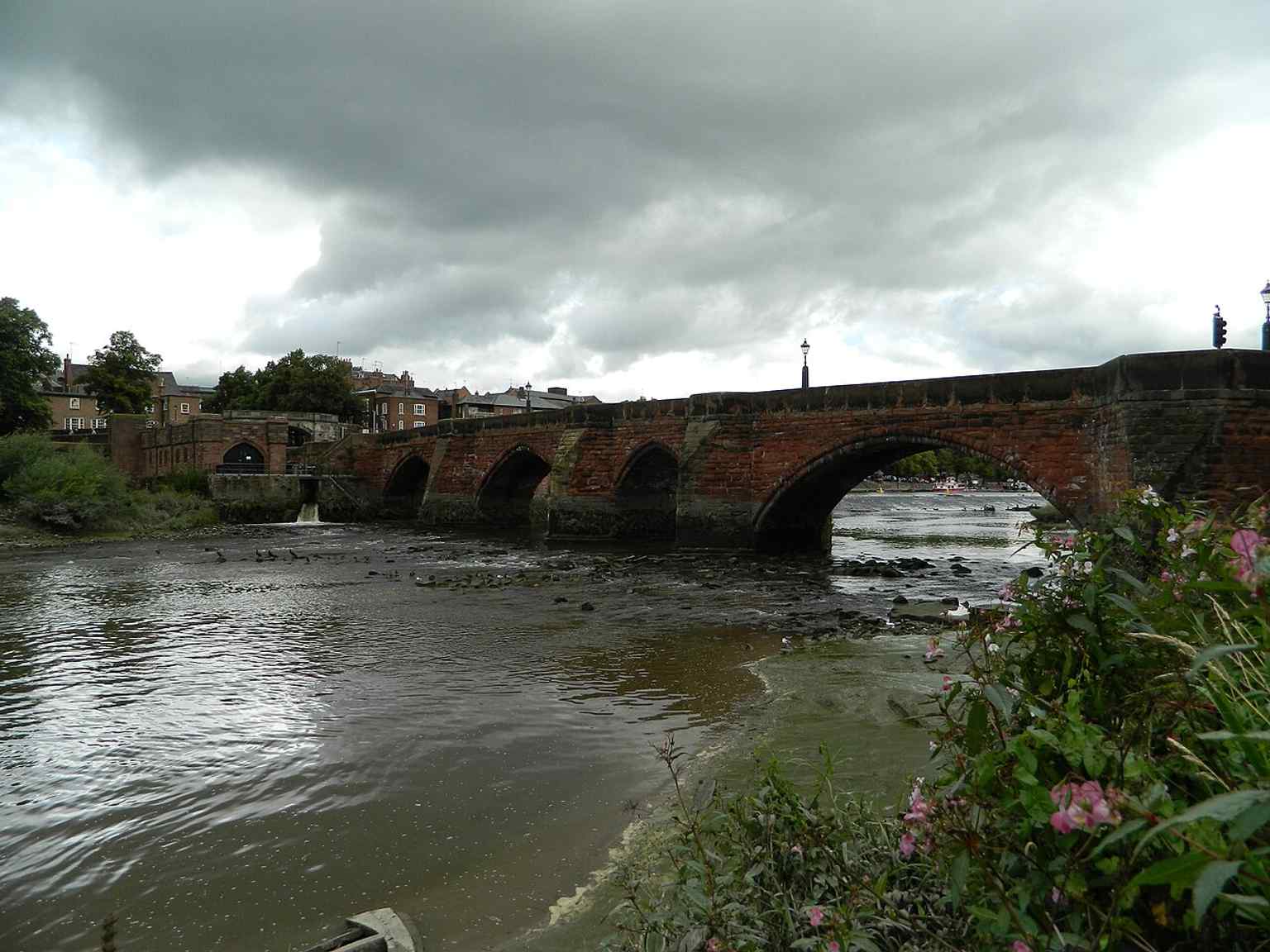
A clear side view of the bridge over the River Dee, useful for showing its red sandstone structure and multiple arches.Photo: Bazonka, Wikimedia Commons, CC BY-SA 3.0. Cropped & resized. 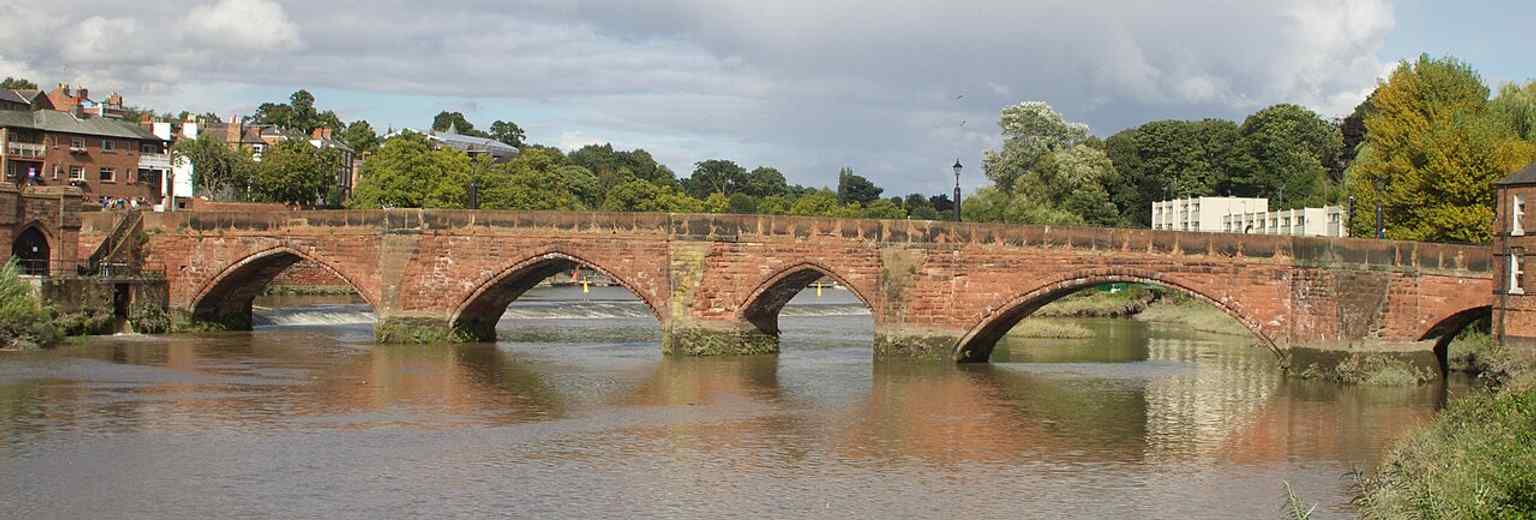
A wider river view that captures the whole bridge span, helping explain how it crosses the Dee and once served the city’s approach.Photo: Stepped, Wikimedia Commons, CC BY-SA 3.0. Cropped & resized. 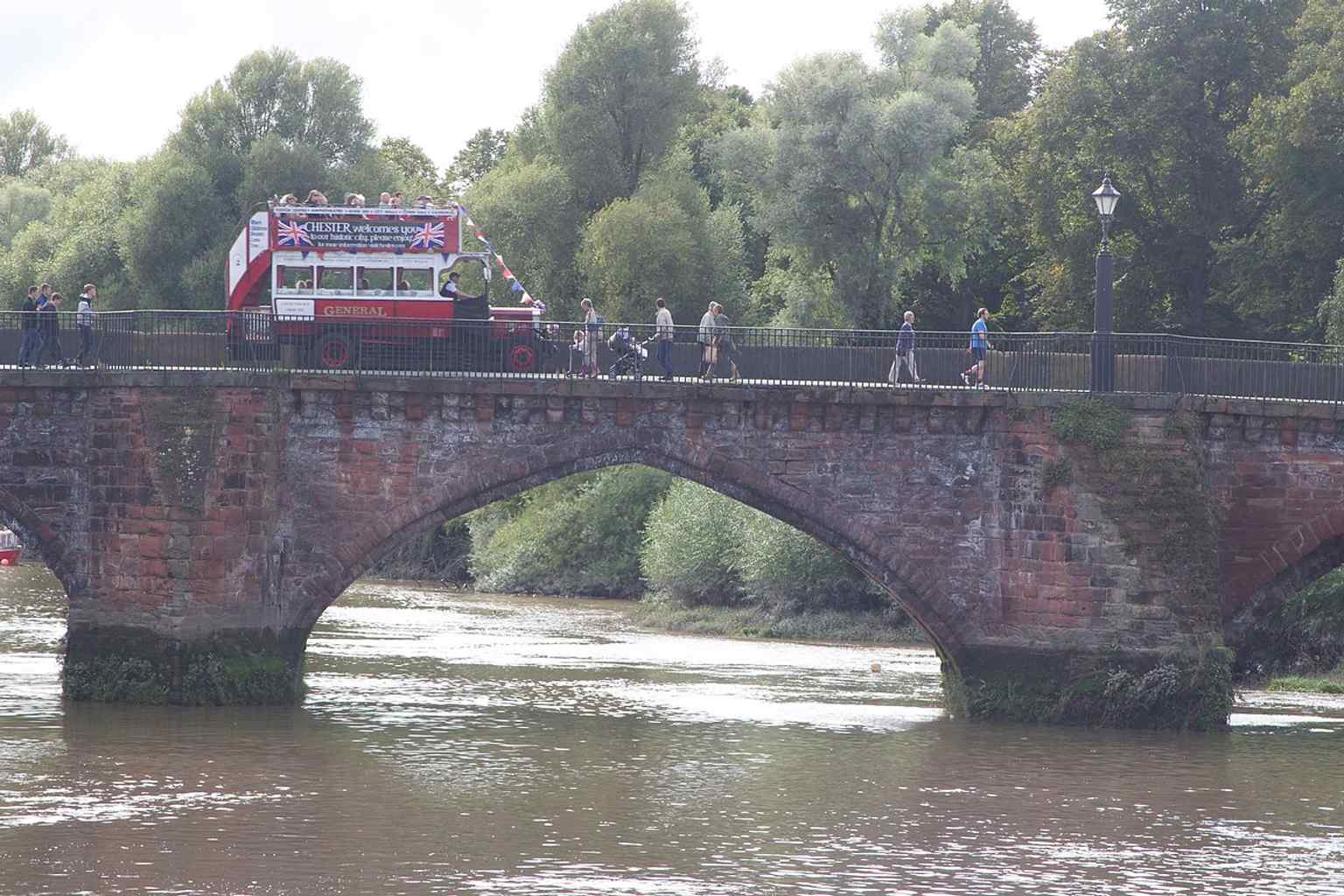
Upstream view of the bridge, a good angle for showing the line of arches and the later widening added for traffic.Photo: Stepped, Wikimedia Commons, CC BY-SA 3.0. Cropped & resized. 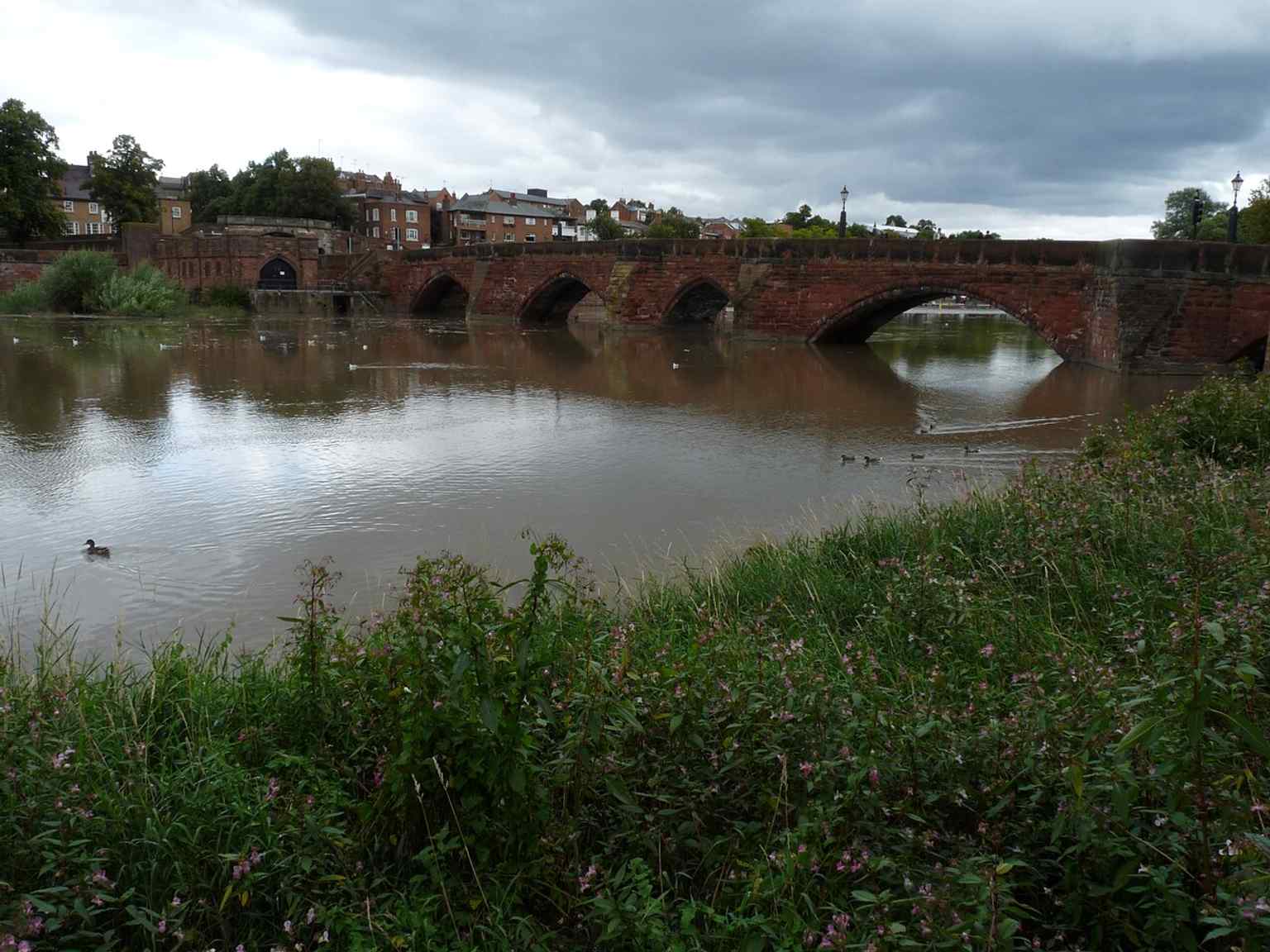
View from Edgar’s Field on the south bank, looking toward the bridge from the Handbridge side mentioned in the tour text.Photo: Chris McKenna, Wikimedia Commons, CC BY-SA 3.0. Cropped & resized. 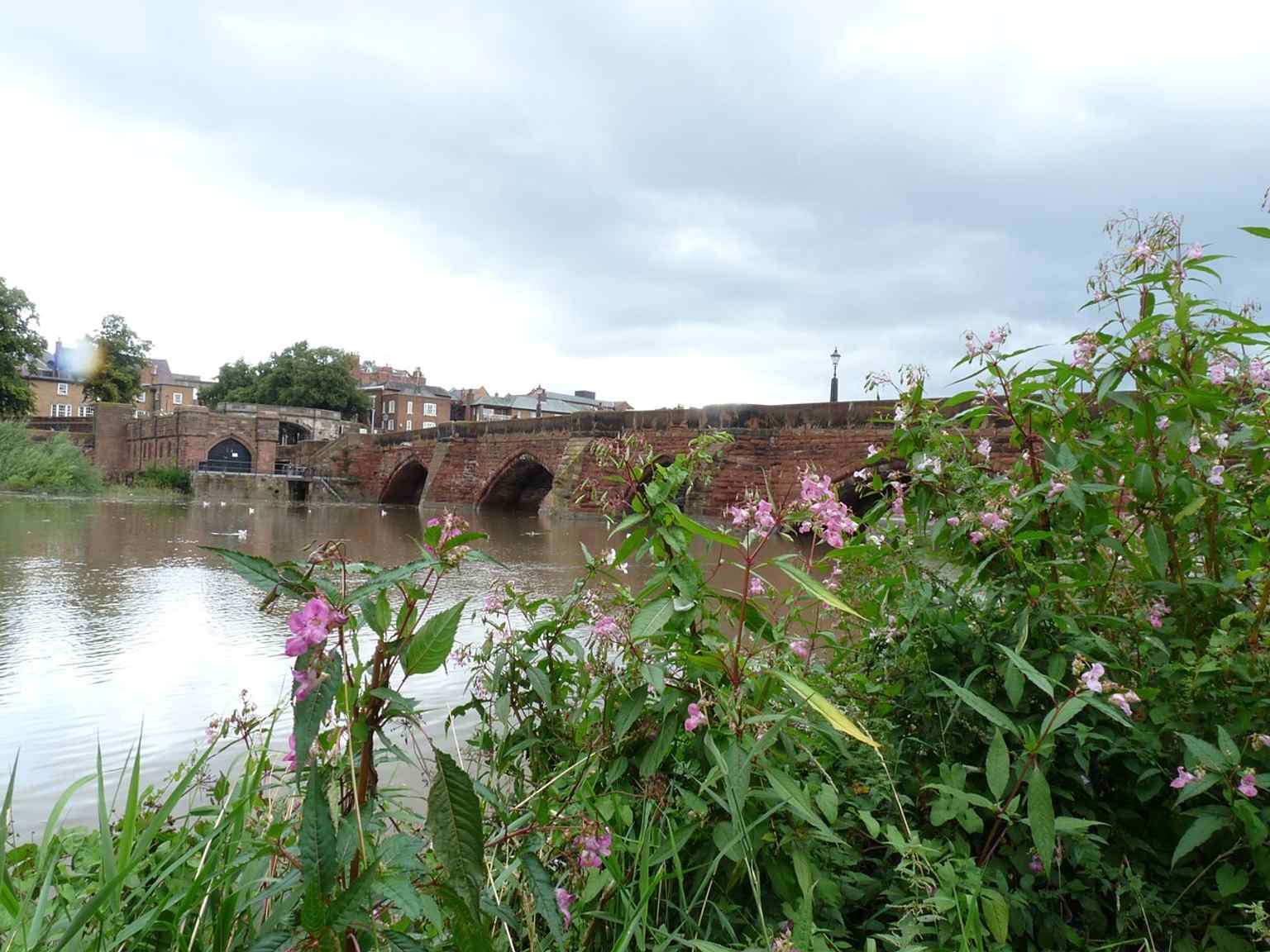
South-bank view that emphasizes the bridge’s approach over the Dee and its role as the route into Chester.Photo: Chris McKenna, Wikimedia Commons, CC BY-SA 3.0. Cropped & resized. In front of you is a pale sandstone gateway shaped like a classical temple, with a heavy flat-topped entablature resting on widely spaced Doric columns and flanked by two…Read moreShow less
Open dedicated page →In front of you is a pale sandstone gateway shaped like a classical temple, with a heavy flat-topped entablature resting on widely spaced Doric columns and flanked by two lodge-like wings.
This is Chester Castle... though the first thing it shows you is not medieval menace, but Thomas Harrison’s grand eighteenth-century confidence. Very Chester, really: even the fortress arrives dressed for court.
The story starts in about ten seventy, when Hugh d’Avranches, the second Earl of Chester, planted a Norman castle here on high ground above the River Dee. The first version was a motte-and-bailey fort, meaning a raised mound with enclosed yards around it, and it probably had a wooden tower. Wood, of course, burns, rots, and generally behaves like wood. So in the twelfth century they replaced it with stone, including the Flag Tower, and they built the gateway tower now called the Agricola Tower.
That tower carried more than soldiers. On its first floor sits the chapel of Saint Mary de Castro, with Norman details still surviving inside, and later conservation uncovered early thirteenth-century wall paintings showing the Visitation and miracles of the Virgin Mary. If you glance at your screen, the Norman core survives best in the motte and Halfmoon Tower, which give you a feel for the older castle tucked behind the neoclassical front.
The fortress grew tougher under Henry the Third and Edward the First. Builders added an outer bailey, a larger defended enclosure, then a new gate with two half-drum towers and a drawbridge over a moat eight meters deep. They also created royal chambers, stables, and a new chapel. So this place was not just a fort. It was a small machine for power.
It could also be a machine for misery. Prisoners held here included Richard the Second, Eleanor Cobham, and Andrew de Moray, one of the heroes of Stirling Bridge. Outside the gate stood the Gloverstone, where condemned criminals passed from castle authority to city authority before execution. Medieval bureaucracy could be alarmingly efficient.
During the Civil War, Royalists held Chester Castle, and Parliamentary forces battered at it in sixteen forty-three, then again in sixteen forty-five, before the whole city endured siege. After that, the castle served as a prison, a court, and a tax office. By the late eighteenth century, the prison had become so grim that the reformer John Howard publicly condemned it. That criticism pushed change. Harrison designed a new prison, finished in seventeen ninety-two, then reshaped the site with this monumental entrance, a new Shire Hall, barracks, and armoury. Architectural historian Nikolaus Pevsner later called it one of the strongest Greek Revival monuments in England, which is a learned way of saying Harrison went all in.
If you want a sense of the lost medieval bulk, have a look at the old engraving on your phone. Much vanished, but not the authority. The former Shire Hall now houses the Crown Court, and the old barracks hold the Cheshire Military Museum. In the nineteenth century the castle became the depot for the Cheshire Regiment, and in nineteen twenty-five the chapel in the Agricola Tower was reconsecrated for regimental use.
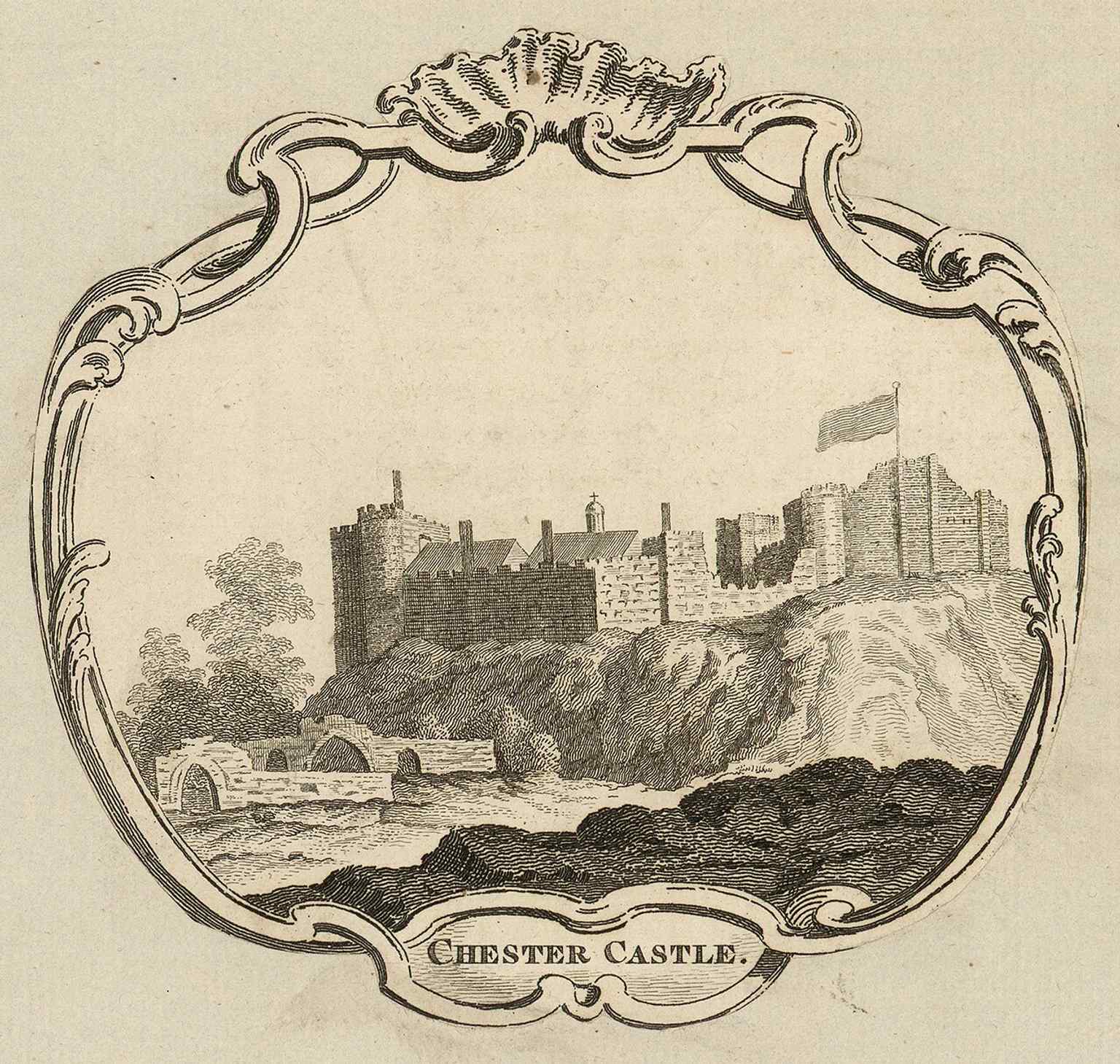
An early engraving of Chester Castle from Pennant’s era, capturing the site before much of the medieval fabric was lost.Photo: Thomas Pennant, Wikimedia Commons, Public domain. Cropped & resized. So Chester Castle has worn many uniforms: Norman stronghold, royal prison, courthouse, barracks, museum. It turns out power likes good real estate.
If you plan to go inside the visitor areas, they usually open only on Saturdays and Sundays, from eleven in the morning until three in the afternoon.
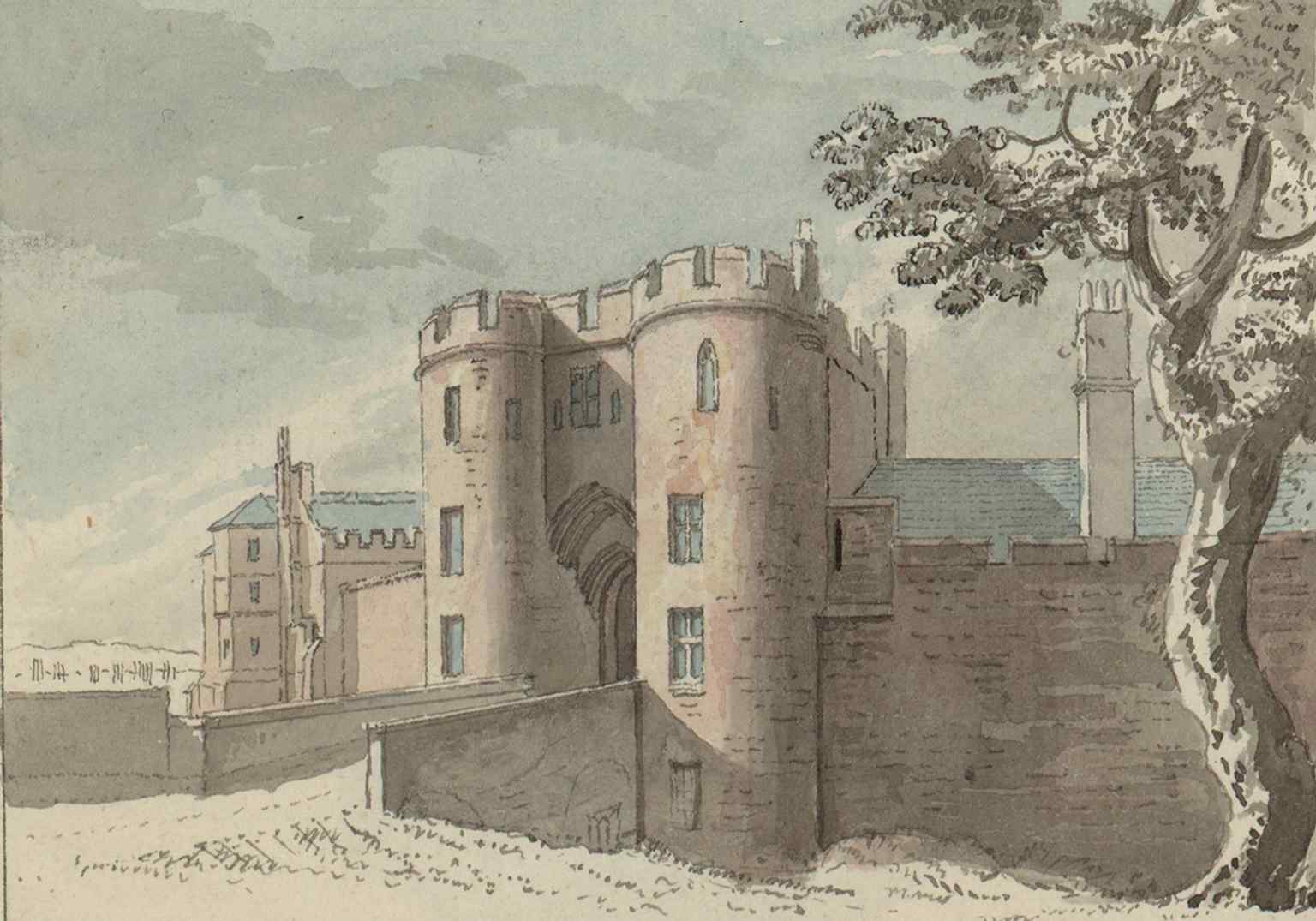
An old view of the castle gate, echoing the fortified entrances that once controlled access to the outer bailey.Photo: Thomas Pennant, Wikimedia Commons, Public domain. Cropped & resized.
Frequently asked questions
How do I start the tour?
After purchase, download the AudaTours app and enter your redemption code. The tour will be ready to start immediately - just tap play and follow the GPS-guided route.
Do I need internet during the tour?
No! Download the tour before you start and enjoy it fully offline. Only the chat feature requires internet. We recommend downloading on WiFi to save mobile data.
Is this a guided group tour?
No - this is a self-guided audio tour. You explore independently at your own pace, with audio narration playing through your phone. No tour guide, no group, no schedule.
How long does the tour take?
Most tours take 60–90 minutes to complete, but you control the pace entirely. Pause, skip stops, or take breaks whenever you want.
What if I can't finish the tour today?
No problem! Tours have lifetime access. Pause and resume whenever you like - tomorrow, next week, or next year. Your progress is saved.
What languages are available?
All tours are available in 50+ languages. Select your preferred language when redeeming your code. Note: language cannot be changed after tour generation.
Where do I access the tour after purchase?
Download the free AudaTours app from the App Store or Google Play. Enter your redemption code (sent via email) and the tour will appear in your library, ready to download and start.
If you don't enjoy the tour, we'll refund your purchase. Contact us at [email protected]
Checkout securely with 






.JPG)
.JPG)


.JPG)


