
Look for the dark timber-framed frontage with its long covered gallery above the street-level arcade and a projecting gabled face - a very Chester disguise for the Roman fortress story underneath.
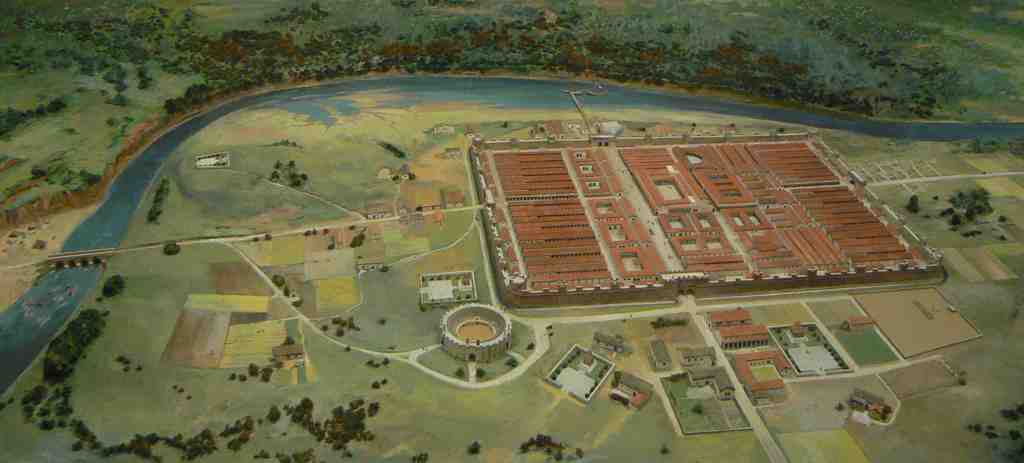
Deva Victrix does not announce itself with one neat ruin or heroic arch. Instead, it hides in plain sight, folded into the street plan and buildings around you. Nearly two thousand years ago, this was one of the most important military bases in Roman Britain. In the mid-seventies A-D, the legion called Legio the Second Adiutrix came here as Rome pushed north against the Brigantes. They chose this sandstone bluff for a reason: it overlooked the River Dee, controlled a crossing point, and gave access to the sea. Efficient, strategic, and not remotely sentimental... very Roman.
They laid out the fortress in the classic Roman style: a rectangle with rounded corners, like a playing card, with four gates and room for barracks, granaries, baths, and headquarters. It covered about twenty-five hectares, making it the largest fortress built in Britain at that time. At first the soldiers worked in timber. Later, Legio the Twentieth Valeria Victrix rebuilt the place in stone, and that victorious title, Victrix, attached itself to the name. Deva probably came from the River Dee itself, or from the Latin for goddess, which is rather elegant for a place designed to house thousands of armed men.
And this was not just a fort. A civilian settlement grew around it - traders, families, retired soldiers, the usual supporting cast for empire. That settlement stayed on after Rome lost its grip, and over centuries it turned into Chester. Even the name Chester comes from castrum, the Latin word for fort. So the modern city did not replace Deva... it grew out of it.
Deva also had ideas above its station. Archaeologists found evidence of a very strange elliptical building near the center of the fortress, unlike anything in any other Roman legionary base. It had a central courtyard, a water feature, and a ring of wedge-shaped rooms. Nobody can say for certain what it did. One theory says temple, another says grand administrative showpiece. Some scholars think the governor Agricola may have imagined Deva as a future capital of Roman Britain. That sounds ambitious, but the clues are there: the fortress was oversized, unusually elaborate, and Agricola's own name appeared on lead piping from the site. If you glance at the app, the reconstruction of that odd elliptical building helps make sense of the mystery.
This stretch of the city kept changing long after the legions left. If you fancy it, check the before-and-after image in the app; Bridge Street keeps the same medieval bones while the shopfront polish changes around them.
By the late fourth or early fifth century, the army faded away, but the defenses lingered, the people stayed, and Chester kept going - which is a decent definition of survival.
If you want to explore the indoor interpretation here later, it generally opens Tuesday to Saturday from eleven to five, and stays closed on Sunday and Monday.
That is Deva's real trick: a fortress that never quite stopped being a city.
Take a moment here, and when you're ready, we can continue to the next stop.




