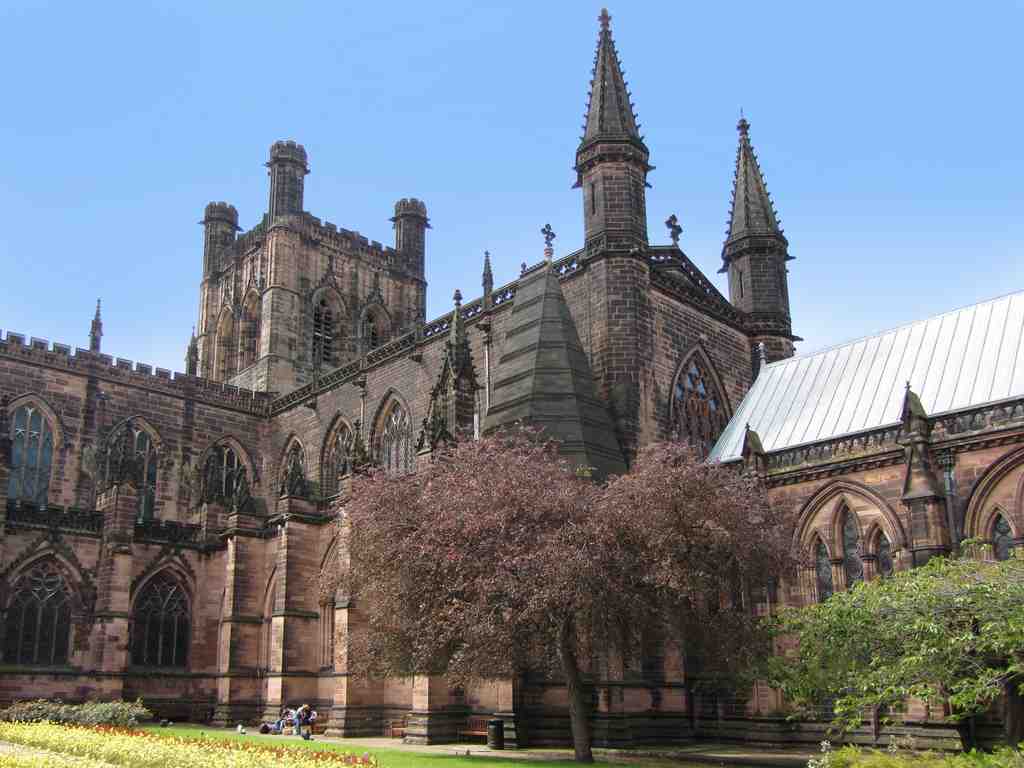
On your left, look for the huge red sandstone church with a broad traceried window, a central tower, and sharp battlemented turrets.
This is Chester Cathedral, the mother church of the Diocese of Chester, but it began life as something older and more monastic: the abbey church of Saint Werburgh. People may have worshipped on this site since Roman times, and that long memory matters here. In the early tenth century, when Chester fortified itself against Viking attack, Saint Werburgh’s remains were brought here, probably under the care of Aethelflaed, Lady of the Mercians. So before this became a cathedral of bishops, it was already a place of relics, prayer, and local identity.
The abbey itself took shape in ten ninety-three, when Hugh Lupus, Earl of Chester, founded a Benedictine monastery here with monks from Bec in Normandy, helped by Saint Anselm. Much of what you see now came later, though. The building grew from Norman into Gothic over centuries, which is why Chester Cathedral contains almost the full sweep of English medieval architecture, from heavy Norman masonry to Perpendicular Gothic, the later style that loves strong vertical lines and big window grids.
If you glance at the image in the app, you can see one of Chester’s quirks clearly: the building is gloriously uneven. One west tower stays low and Norman, the other was started in the early sixteen hundreds and never properly finished after the monastery’s closure interrupted the work. Cathedrals like to pretend they are orderly; this one keeps the paperwork and the contradictions visible.
Then came the Reformation, and things got rough. In fifteen thirty-eight, Henry the Eighth’s dissolution of the monasteries shut the abbey, and Saint Werburgh’s shrine was desecrated. Just three years later, Henry turned the former abbey into a Church of England cathedral and changed its dedication to Christ and the Blessed Virgin Mary. Efficient, if not exactly sentimental.
The stone itself tells another story. Chester used local New Red Sandstone, beautiful for carving but sadly a bit crumbly. Magnificent, yes, but not especially stoic. By the nineteenth century, the place looked badly weathered, so the Victorian architect George Gilbert Scott restored it on a huge scale, adding turrets and refacing large sections. Admirers called it rescue; critics called it rebuilding with a straight face. Both had a point.
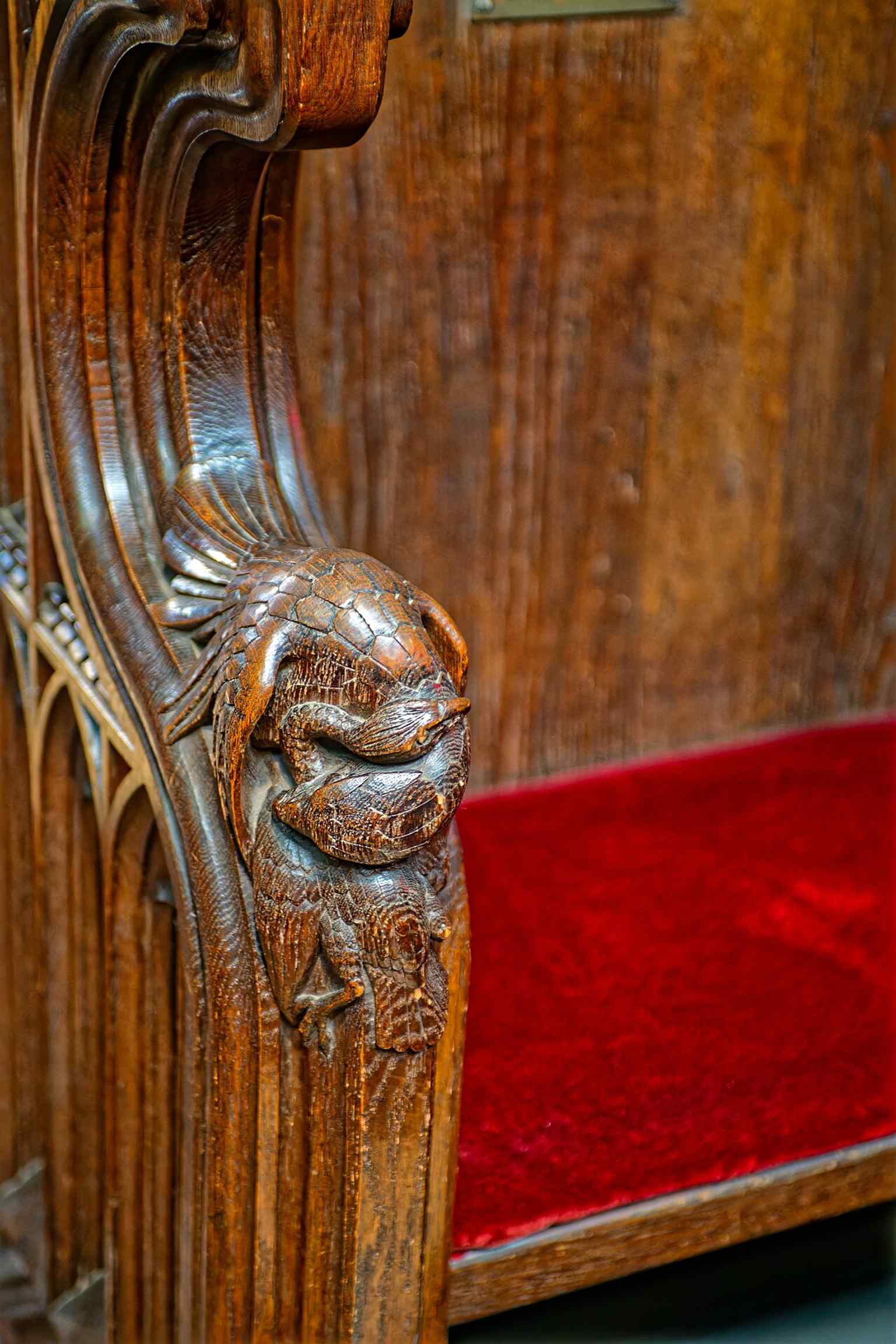
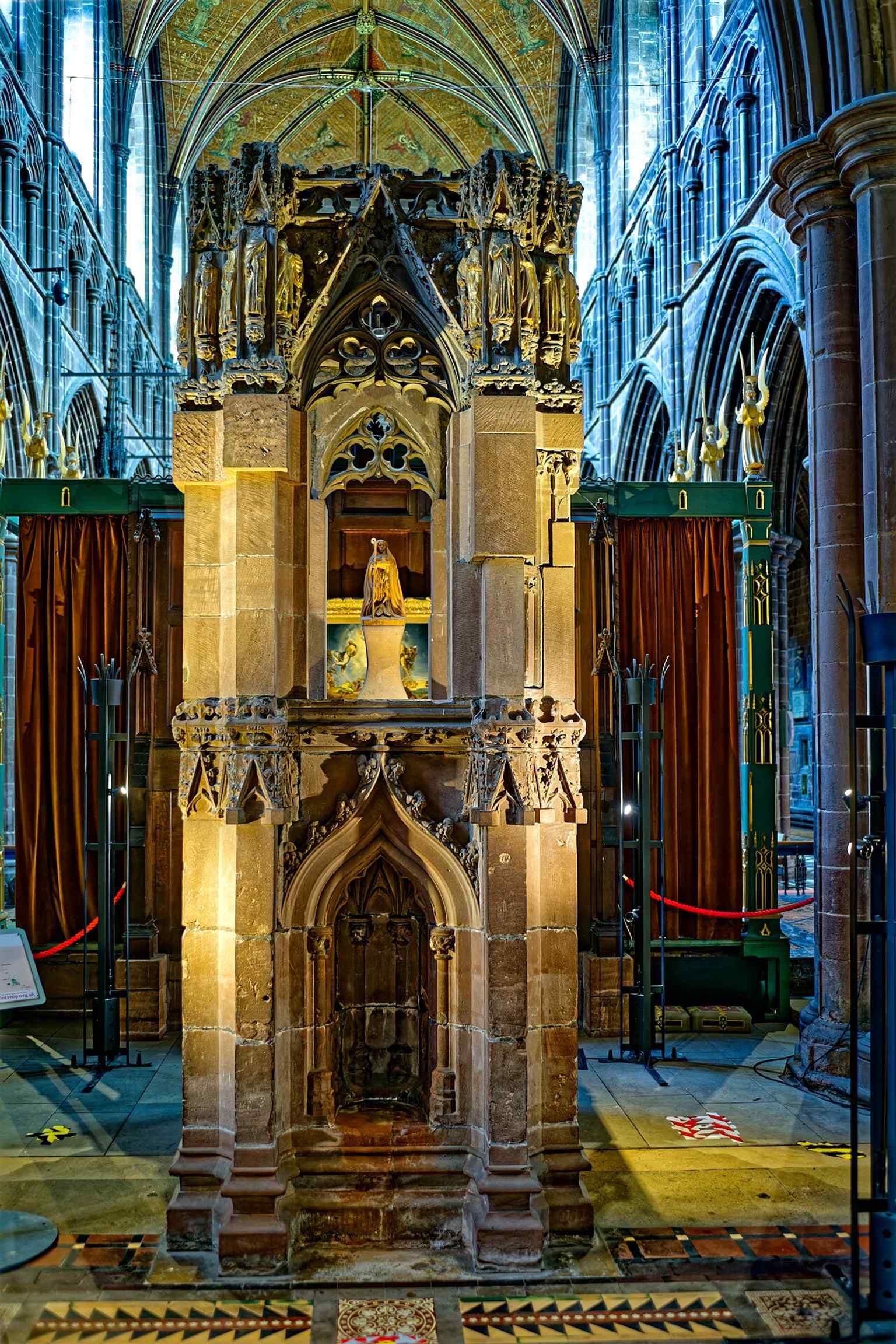
Inside are some remarkable survivals. The choir stalls from around thirteen eighty are famous for their misericords, tiny carved ledges that let monks lean during long services without technically sitting down... a very medieval compromise. And if you open the shrine image on your phone, you’ll see Saint Werburgh’s shrine, dismantled at the Reformation and reassembled in the nineteenth century, a neat summary of this cathedral’s habit of surviving history by refusing to stay broken.
This place is also very much alive: worship still happens daily, and Chester’s choral tradition stretches back about nine hundred years.
If you want to go inside later, the cathedral is open daily from nine thirty A-M to six P-M.
Chester Cathedral feels less like a single building than a thousand years of argument, faith, loss, and repair held together in stone.
Take a moment here, and when you’re ready, we can wander on to Eastgate.