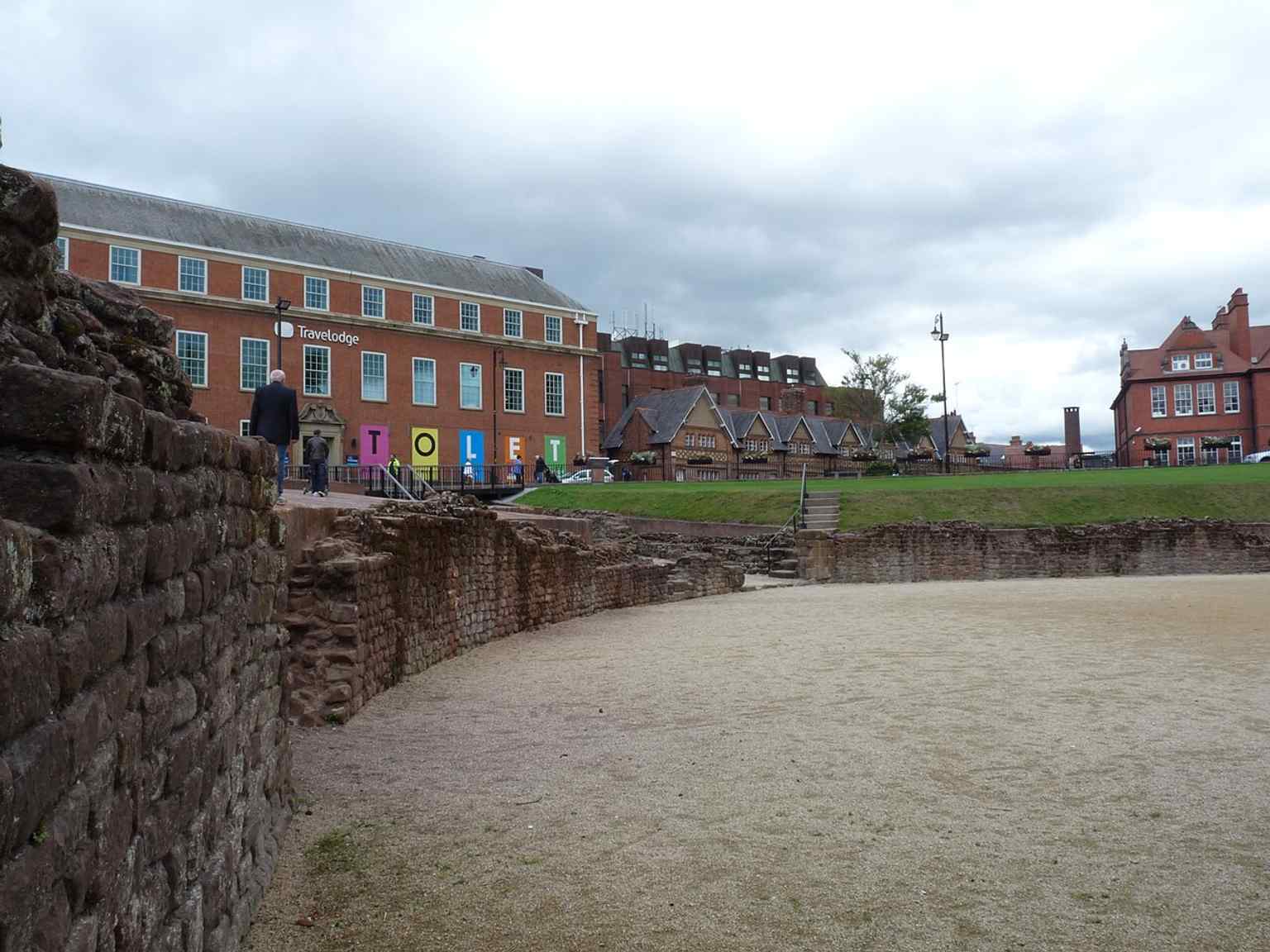
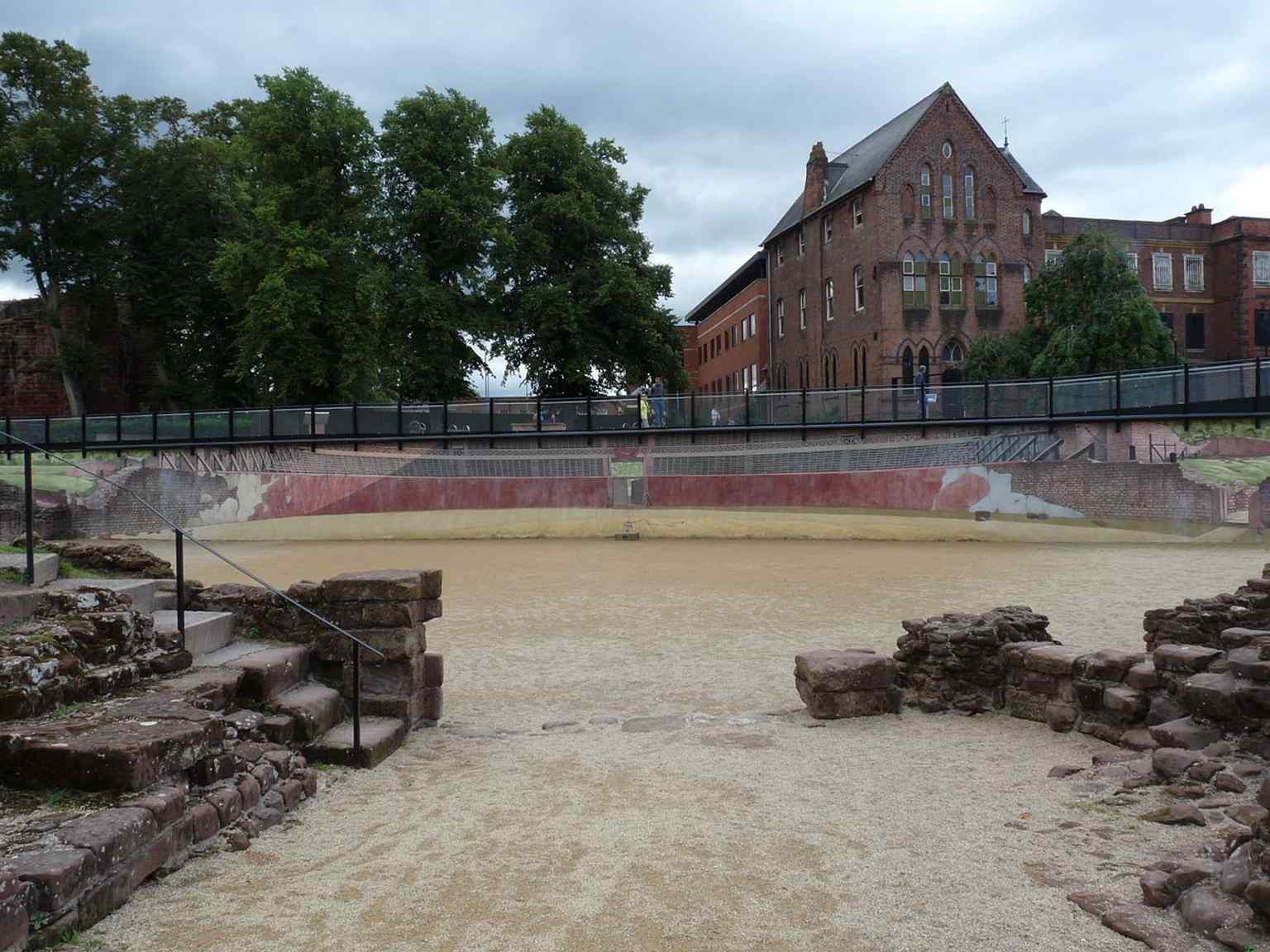
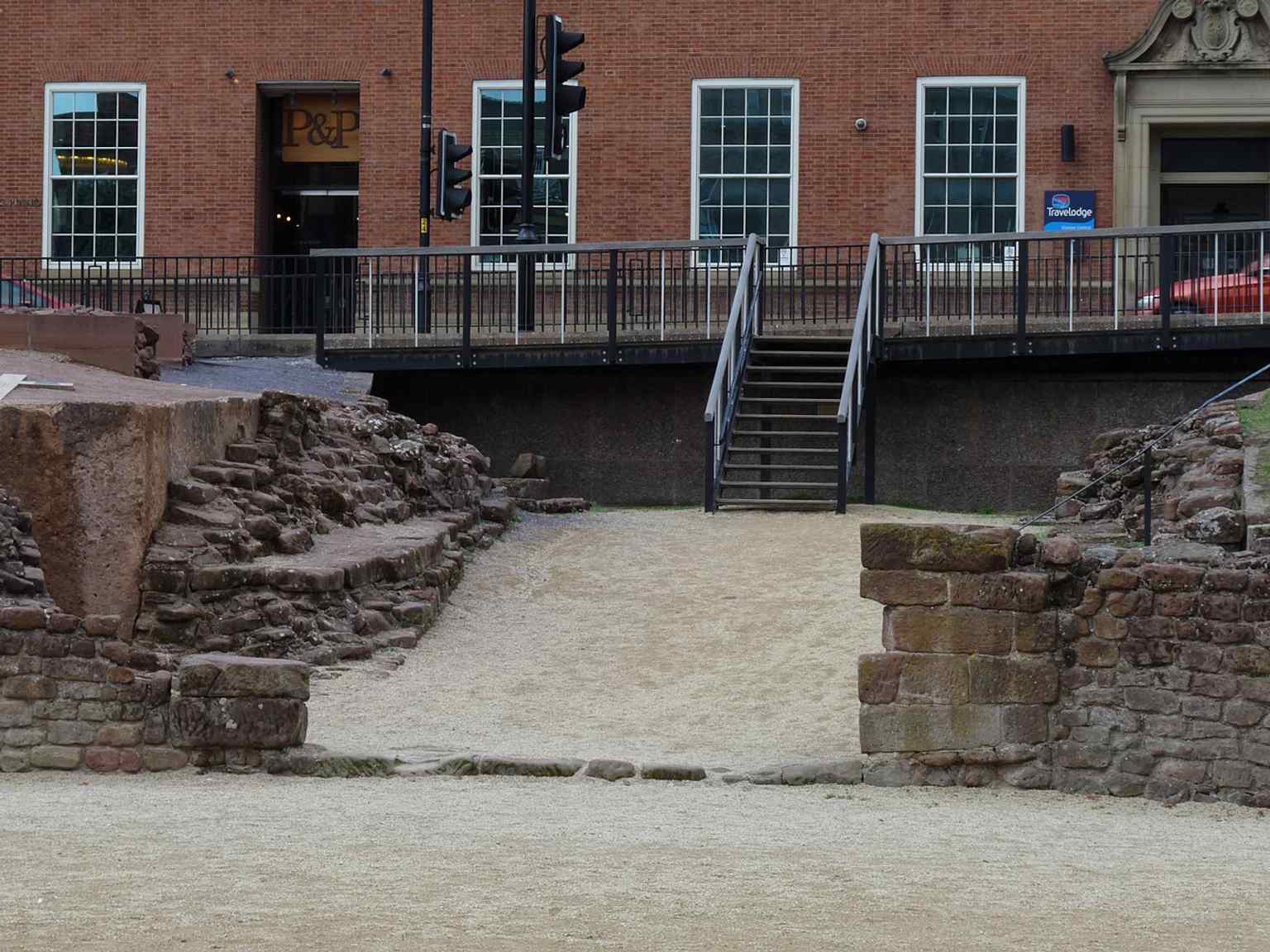
On your right, look for a broad sunken oval of pale stone and grass, framed by curved seating banks and a long mural wall that hints at the missing half of the arena.
This is Chester Roman Amphitheatre, the largest Roman amphitheatre yet uncovered in Britain... which is an impressive title, even if only half of it is currently showing. The Romans planted it here in the first century, beside the fortress of Deva Victrix, and they did not think small. At its fullest, this was a stone ellipse about forty feet high, roughly three hundred and twenty feet long and two hundred and eighty-six feet wide, with room for around eight thousand spectators.
For years, people liked to imagine this place mainly as a training ground for soldiers. Very noble, very disciplined, very tidy. The evidence says otherwise. Archaeologists found signs that point to spectacle: cockfighting, bull baiting, boxing, wrestling, and almost certainly gladiatorial combat. The Greek poet Oppian even described Roman cockfights as solemn ritual contests, meant to remind men to imitate the fighting spirit of the bird. So yes... moral instruction, Roman style.
The first version here seems to have gone up under Legio Two Adiutrix in the late seventies. When that legion moved on in eighty-six, Legio Twenty Valeria Victrix rebuilt it. Then, after time away working on Hadrian’s Wall, they returned around two hundred and seventy-five and rebuilt it again. Recent digs changed one long-held idea too: what people thought was an earlier wooden amphitheatre turned out to be a wooden grillage, basically a foundation support under the seating. In other words, archaeologists had to tell a very old theory, “thanks, but no.”
Around the arena stood the practical machinery of entertainment: dungeons, stables, food stalls, and at the north entrance a shrine to Nemesis, the goddess of retribution. That unusually ambitious setup has led some historians to wonder whether Chester might have become the capital of Roman Britain if Rome had pushed on into Ireland. It never happened, but the ambition is written all over the scale of this place.
After around three hundred and fifty, the amphitheatre slipped into disuse. People scavenged its stone, the bowl filled with rubbish and soil, and later generations used the depression for bear baiting and public executions. Then it vanished from memory almost completely until nineteen twenty-nine, when work near Dee House uncovered a long curved wall. That discovery kicked off decades of excavation, argument, fundraising, and road-diverting heroics by the Chester Archaeological Society.
If you glance at the aerial image on your screen, you can see the odd truth of the site: only the northern half is exposed, while the southern half still lies under later buildings. And if you want a quick sense of how much the site’s presentation changed, have a look at the before-and-after comparison in the app.
One of the smartest modern touches is that mural along the wall, commissioned in two thousand and ten, which recreates the lost seating and completes the oval your eyes can’t quite finish on their own. The site is open twenty-four hours a day, so there’s no need to rush your Roman contemplation.
For a ruin, it still knows how to hold a crowd.
When you’re ready, we can continue on to the Grosvenor Museum.