
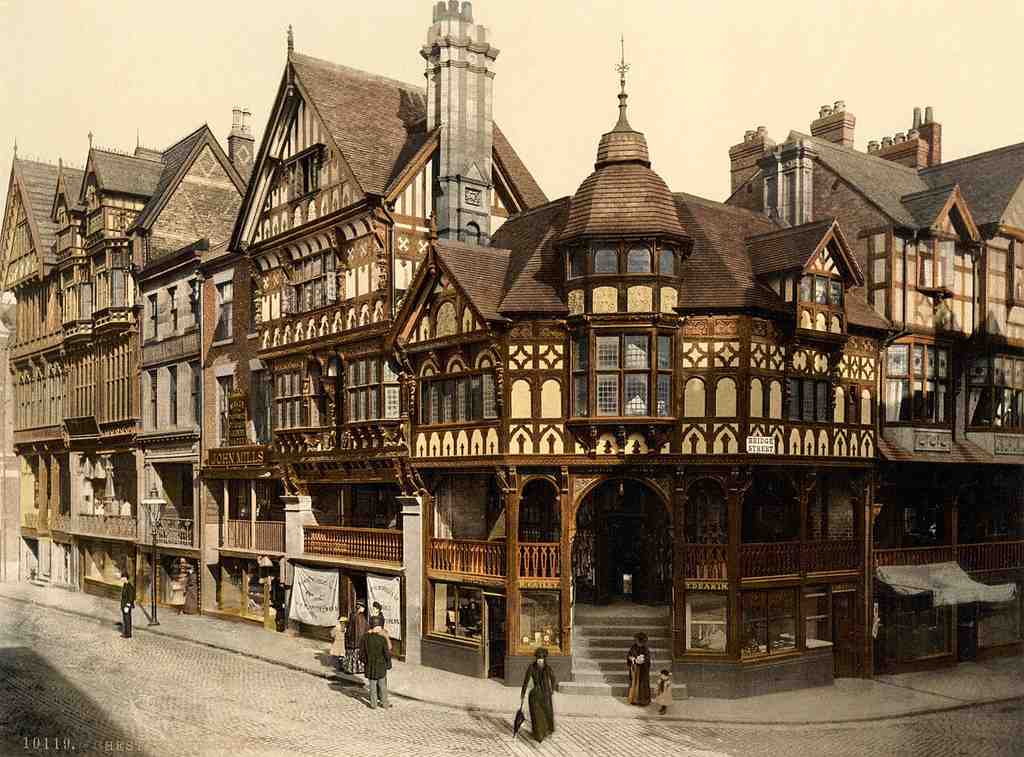
Look for dark timber framing above a stone ground floor, a raised covered walkway running along the building line, and stairways dipping down into lower shops beneath the street.
This is one of Chester’s cleverest ideas... a shopping street stacked in layers. At ground level, you’ve got one set of premises, and above them, set back behind a covered walkway, another. That upper passage is the Row. It runs along the four main streets that spread from Chester Cross: Watergate Street, Eastgate Street, Bridge Street, and part of Northgate Street. Chester didn’t just build shops. It built a whole second street in midair, because apparently one street was not ambitious enough.
No one can say with complete confidence how the Rows began, and that mystery is part of their charm. One theory says medieval builders worked over heaps of Roman rubble left from the old fortress city, Deva Victrix. They set buildings back on that higher ground, left a path in front, then later dug storage spaces underneath. Another theory points to the great fire of twelve seventy-eight, which destroyed almost the whole town inside the walls. After that disaster, people may have lined the lower levels in stone to make them more fire-resistant and, while they were at it, created a neat two-level system for trade.
If you glance at the image on your screen, you can see how that split-level world works: the upper walkway, the shopfronts behind it, and the steep links down to the street. Those lower spaces are often called undercrofts. That just means vaulted storage rooms or cellars beneath the buildings, often lined in stone. About twenty medieval stone undercrofts still survive in Chester, even though much of what you see at Row level today was rebuilt later. The undercrofts kept valuable goods safe; the halls above handled daily life and trade; and the upper room, called a solar, gave the family a bit of private space. Medieval mixed-use development, in other words, but with more oak beams and fewer estate agents.
The Rows were already here by the thirteen hundreds, and the earliest clear use of the word “Row” for an elevated walkway appears in thirteen fifty-six. Some stretches stayed continuous; others didn’t. In Lower Bridge Street, wealthy owners gradually enclosed sections to make larger private rooms. Fashion, as usual, got involved and spoiled the pattern a little.
Writers noticed them too. Daniel Defoe admired the galleries in the seventeen twenties because they sheltered pedestrians, though he complained they made the shops dark and uneven. Fair enough. Another writer, George Borrow, spun a wonderfully dramatic story that merchants used the upper levels to protect goods from Welsh raiders. It’s colorful, though historians treat that one with a raised eyebrow.
If you want a good example of what survives from the medieval world, have a look at the image of Three Old Arches on your phone. Its stone front is often called the earliest identified shopfront in England... which is the sort of record Chester enjoys collecting.
That’s the real magic here: not one building, but an entire city center still wearing its medieval logic in public.
The walkways themselves are accessible around the clock, even though the shops, cafés, and offices keep their own hours.
Take a moment with the layers of this place, and when you’re ready, we can head on to the next stop.




