

Catania Audio Tour: Legends, Learning and Lava Stones
A city scorched by lava and shaped by miracles, Catania hides stories beneath its sunlit stones that most travelers never hear. Headphones on for this self-guided audio tour and unlock a world of rebellious saints, vanished secrets, and centuries-old rivalries. Step away from the guidebook and uncover the real tales swirling through Catania’s volcanic streets. Who broke the cathedral’s silence with a midnight act that changed the city’s fate forever? Which ancient artifact at Basilica Maria Santissima dell'Elemosina is said to protect — or doom — its keepers? And just what happened after a forbidden experiment in the halls of the University of Catania? Trace the aftermath of eruptions, walk where power shifted with a whisper, and feel the heartbeat of a city where the ordinary collides with the extraordinary. Curiosity flickers brighter than Mount Etna’s fires. Press play and plunge into Catania’s hidden drama now.
Tour preview
About this tour
- scheduleDuration 70–90 minsGo at your own pace
- straighten2.2 km walking routeFollow the guided path
- location_on
- wifi_offWorks offlineDownload once, use anywhere
- all_inclusiveLifetime accessReplay anytime, forever
- location_onStarts at Biscari Museum
Stops on this tour
lock_open 3 free previews · 9 unlock with purchase
On your right, the Cathedral of Sant'Agata stands in pale marble with a tall three-tiered facade of granite columns, oval windows, and marble saints gathered above the central…Read moreShow less
Open dedicated page →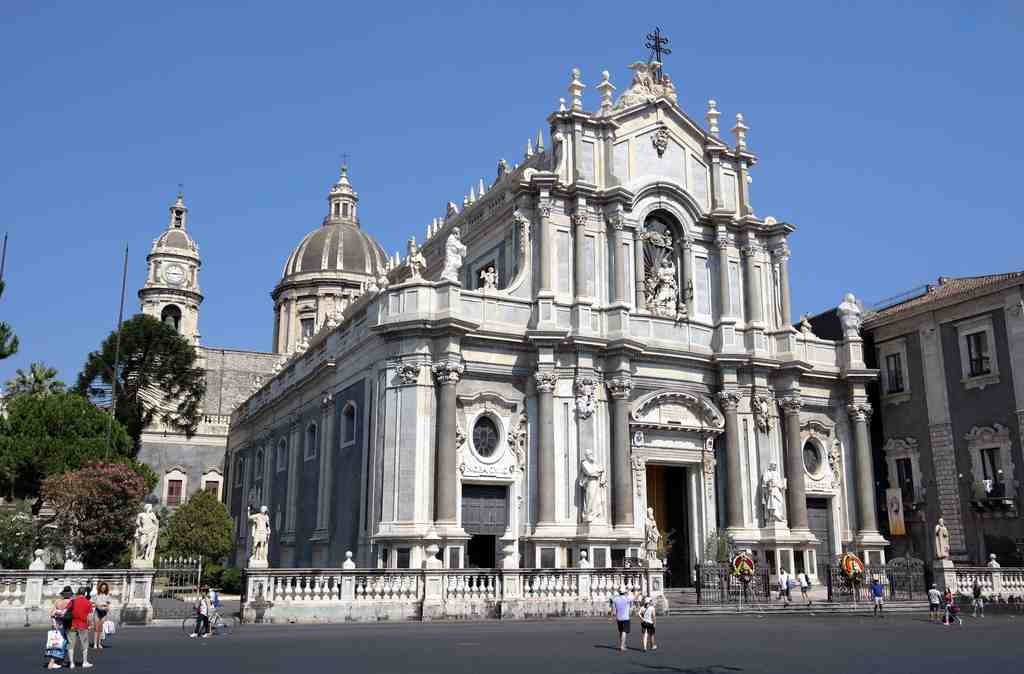
Cathedral of Sant'AgataPhoto: Luca Aless, Wikimedia Commons, CC BY-SA 4.0. Cropped & resized. On your right, the Cathedral of Sant'Agata stands in pale marble with a tall three-tiered facade of granite columns, oval windows, and marble saints gathered above the central doorway.
This is the heart of Catania... not only its cathedral, but the city’s memory in stone. It is dedicated to Saint Agatha, the young martyr who became Catania’s patron, and almost everything about this place feels shaped by love for her. The church you see carries many lives at once: Norman strength, Baroque drama, and a touch of Neoclassical order. In its earliest form, it served as an ecclesia munita, a fortified church, part sanctuary and part stronghold.
The story begins in the late eleventh century, when Count Roger and Bishop Angerio raised the first cathedral here over the ruins of the Roman Achillian Baths. Even then, builders folded older fragments into the new church, reusing stone and pieces from pagan temples and Roman remains, as if Catania never really throws its past away... it absorbs it.
Saint Agatha’s own story deepened the bond. In the year ten forty, the Byzantine general George Maniaces carried her relics away to Constantinople. For eighty-six years, Catania lived without them. Then, in eleven twenty-six, two former Byzantine soldiers, Gisliberto from France and Goselmo from Calabria, stole the relics back. Legend says Agatha herself appeared to Gisliberto in a dream and told him to bring her home. When the relics finally returned on the seventeenth of August, they entered the cathedral to a city overflowing with joy. That homecoming still echoes in Catania’s summer celebrations.
But this cathedral also knows grief. In eleven sixty-nine, a catastrophic earthquake brought down the roof during the feast of Saint Agatha, killing Archbishop Giovanni d’Aiello and many of the faithful gathered inside. Then, in sixteen ninety-three, the great earthquake of the Val di Noto shattered almost everything again. Only the Norman apses and parts of the older structure survived. What rose afterward is the church in front of you now, shaped inside by Girolamo Palazzotto and given this splendid facade by Giovanni Battista Vaccarini.
If you look closely at the oval windows, you may notice mysterious letters tied to an old local legend: N-O-P-A-Q-V-I-E. People connected them to a warning said to have saved Catania when Emperor Frederick the Second threatened destruction: “Do not offend the homeland of Agatha, for she avenges wrongs.”
And if you’d like a glimpse past the doors, take a look at the image on your screen: the main altar sits deep in the Norman apse, where the medieval core still steadies the later splendor. Another image shows that same Romanesque heart beneath the decoration, a quiet survivor after centuries of collapse and rebuilding.
If you plan to step inside later, the cathedral usually opens from seven fifteen AM to twelve thirty PM and again from four PM to seven PM, with Sunday morning opening from seven forty-five AM. This cathedral feels like Catania’s vow to remember, rebuild, and remain faithful. When you’re ready, we’ll step toward the stones beneath it, where the Achillian Baths still keep Roman Catania close.
Look to your left for the descending stone ramp and the narrow arched entry that slips below Piazza del Duomo into the underground baths. This is one of Catania’s most secretive…Read moreShow less
Open dedicated page →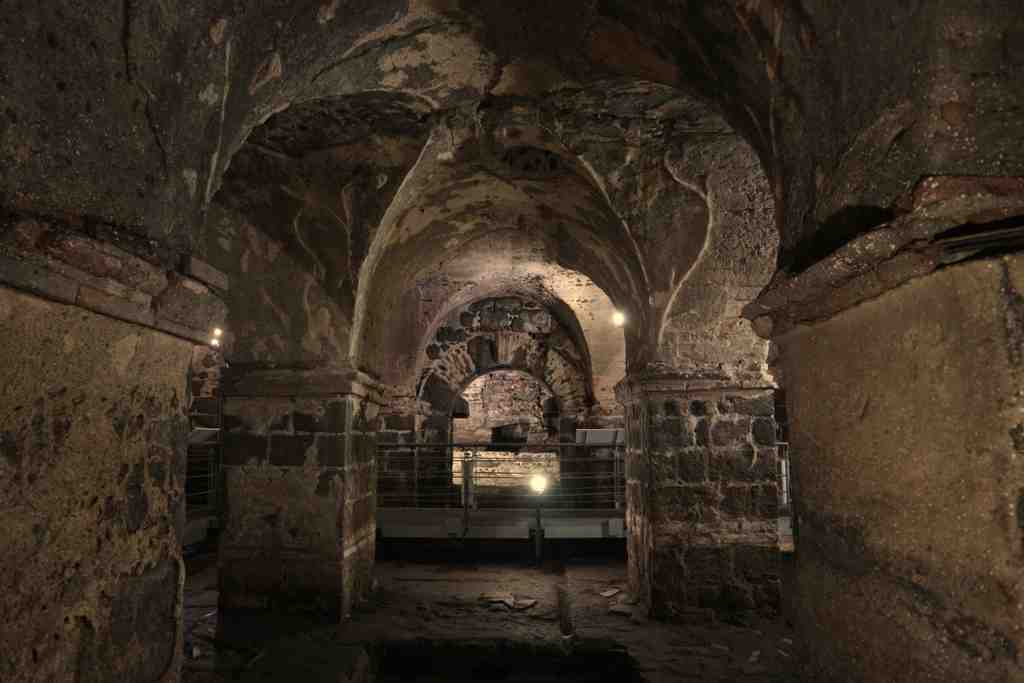
Achillian BathsPhoto: Daniele Napolitano, Wikimedia Commons, CC BY-SA 4.0. Cropped & resized. Look to your left for the descending stone ramp and the narrow arched entry that slips below Piazza del Duomo into the underground baths.
This is one of Catania’s most secretive places: a Roman bath complex, mostly hidden below the square, with the surviving section dating from about the fourth or fifth century after Christ, and perhaps even earlier. What people visit today is only a small fragment of something much larger, a place that once stretched under much of this part of the city.
Its name, Achillian Baths, comes from a Greek inscription carved on a long slab of pale Lunense marble. The inscription survives in fragments and now rests at Castello Ursino. But Catania loved a better story: locals once said the baths took their name from a gigantic lost statue of Achilles found in the depths below. It is the kind of legend a city keeps because it feels too good to let go.
The baths changed over time. Scholars believe officials resized the complex around the year four hundred thirty-four to save wood for the heating system under the floors. Then, in the year ten eighty-eight, Bishop Ansgerio chose this very area for the cathedral and monastery. The sacred city rose above the Roman one.
What lies down there is hauntingly elegant. If you glance at your screen, you can see the surviving chamber: a cold room, or frigidarium, with a vaulted ceiling carried by four square pillars. A long corridor leads in, and beyond it runs a careful system of basins, channels, and filters that managed the water. There was even an S-shaped channel feeding the complex. On another image, you can see part of that waterwork more clearly.
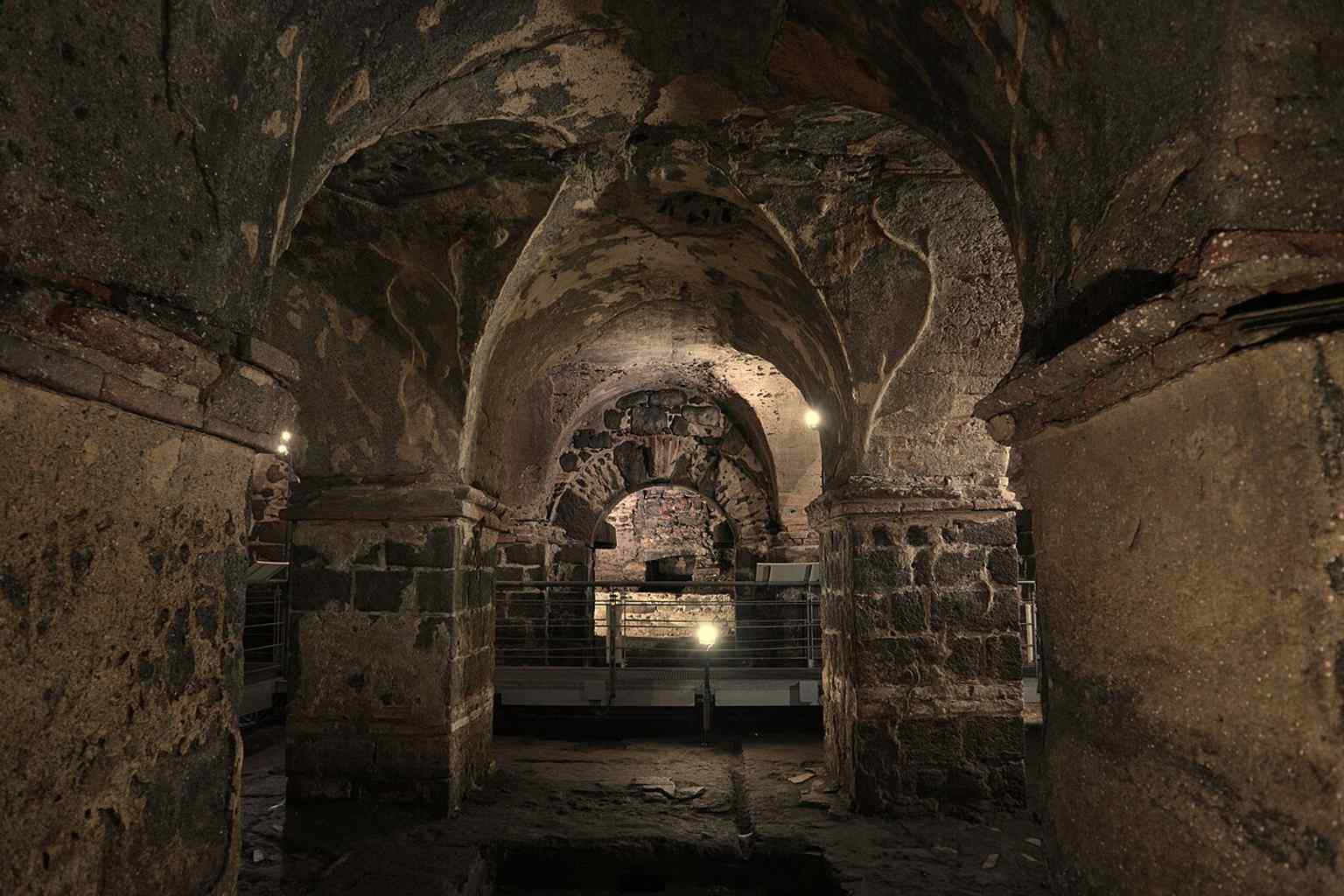
A view inside the Achillian Baths, where the underground Roman complex survives beneath Piazza del Duomo and was once threatened by flooding from the Amenano.Photo: Daniele Napolitano, Wikimedia Commons, CC BY-SA 4.0. Cropped & resized. Once, the floors shone with marble cut into patterned pieces, and the ceiling carried painted stucco with little cupids, vines, and grapes. In the eighteenth century, the French artist Jean Houël entered by torchlight, felt the strange beauty of the place, and convinced himself he had found a temple of Bacchus instead of baths.
The baths nearly vanished for good. Earthquakes buried them deeper, and after the eruption of sixteen sixty-nine and the earthquake of sixteen ninety-three, Prince Biscari dug through almost five meters of mud, lava fragments, and rubble to find them again. He had to stop when the tunnels ran too close beneath the cathedral and the old Senate building. Then the underground Amenano River caused fresh trouble: after a restoration in nineteen ninety-seven, the water suddenly rose and swallowed the walkways. Only after a huge steel plate reinforced the piazza in two thousand and six did the site finally find some peace.
If you hope to go inside later, the baths usually open in short morning hours, with Tuesday and Thursday also reopening in mid-afternoon.
Here, Catania feels layered like memory itself. When you’re ready, continue on to Elephant Palace.
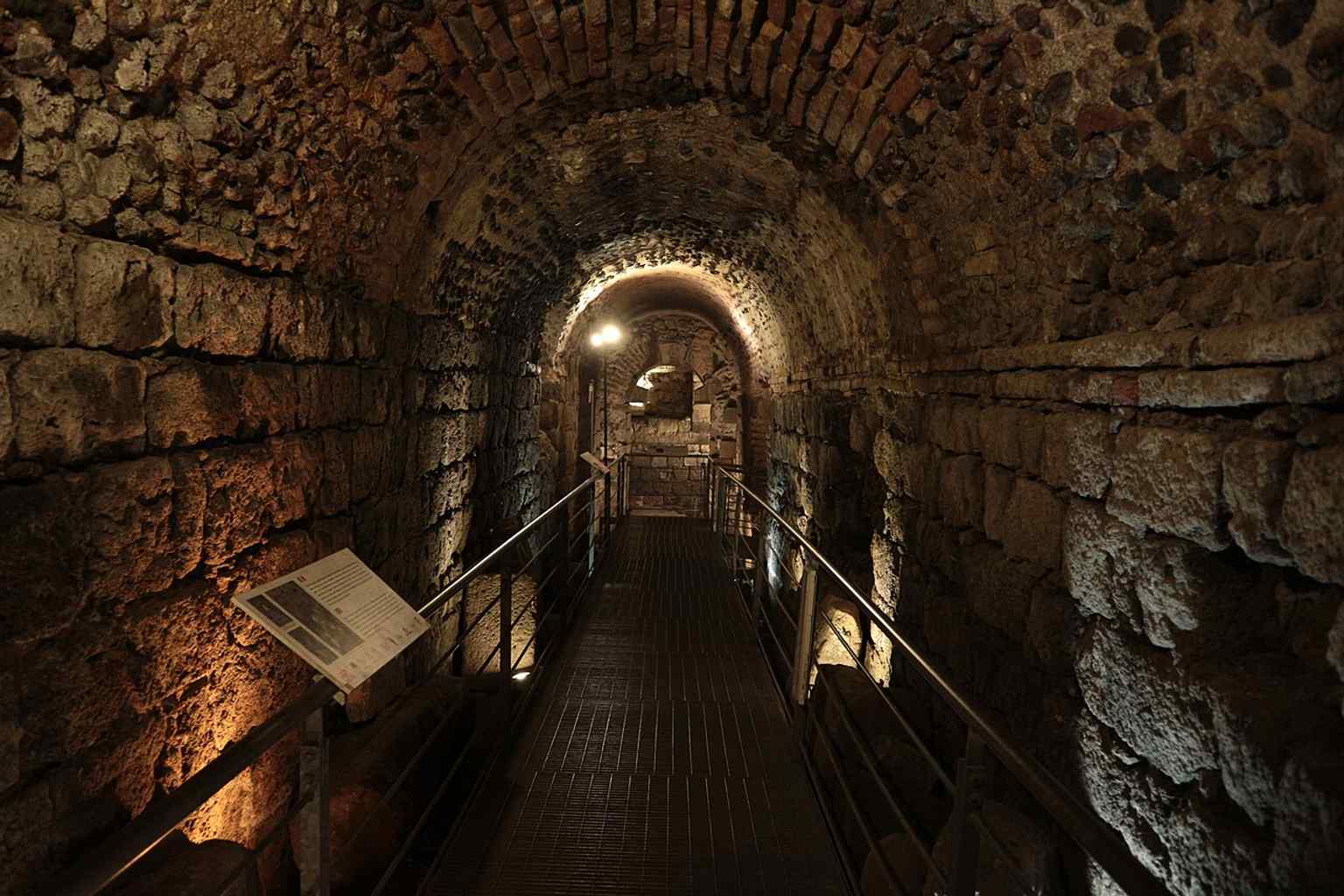
A closer look at the bath interiors, showing the weathered architectural surfaces that echo the site’s long history of damage, burial, and repeated reopening.Photo: Daniele Napolitano, Wikimedia Commons, CC BY-SA 4.0. Cropped & resized. 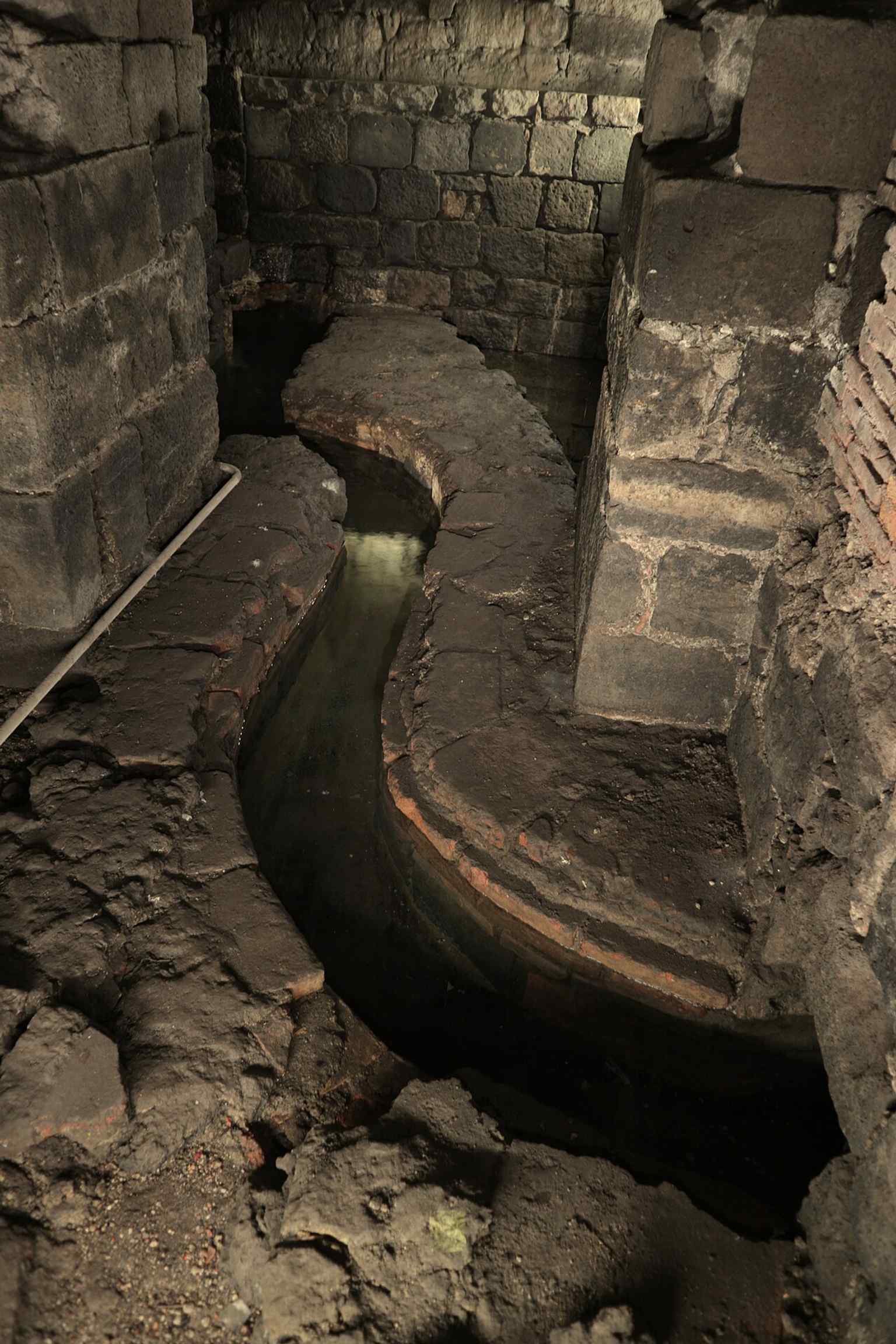
The drainage and water-management remains of the baths — a fitting detail for a site shaped by channels, filtration, and the unpredictable underground river.Photo: Daniele Napolitano, Wikimedia Commons, CC BY-SA 4.0. Cropped & resized.
Show 9 more stopsShow fewer stopsexpand_moreexpand_less
On your right, look for a pale limestone façade above a wide staircase, its surface folding in soft baroque curves and ending in a little bell crown topped by an iron cross.…Read moreShow less
Open dedicated page →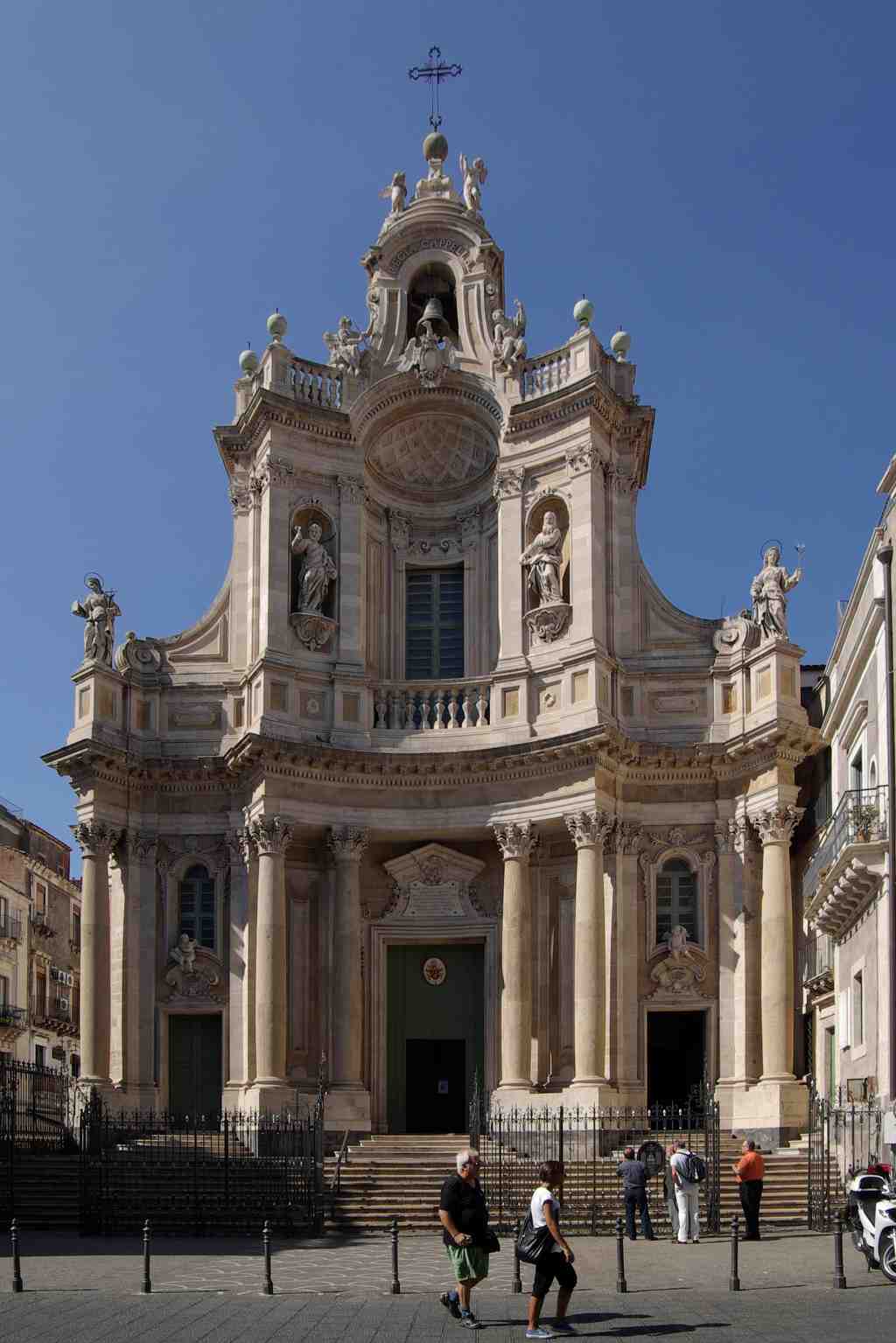
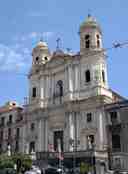
Basilica Maria Santissima dell'ElemosinaPhoto: Berthold Werner, Wikimedia Commons, CC BY-SA 3.0. Cropped & resized. On your right, look for a pale limestone façade above a wide staircase, its surface folding in soft baroque curves and ending in a little bell crown topped by an iron cross.
This is the Basilica della Collegiata, formally the Basilica di Maria Santissima dell'Elemosina, and under all that elegance lives a very stubborn story. Long before this church, people worshipped here in a pagan temple to Proserpina. Then early Christians raised a small church to Mary, and over time devotion gathered around a tender title: dell'Elemosina, which people often took to mean charity or alms.
But the heart of that name comes from something older and more intimate: a Byzantine image of the Virgin Eleusa, meaning the Merciful One. In fourteen eighty-two, Albanian refugees fleeing the Ottoman advance carried that icon into Sicily. Legend says they stopped near Catania, hung it on a fig tree, and when they tried to leave, the branches had wrapped around it so tightly they could not take it back. People read that as Mary choosing this land for herself. The original icon stayed elsewhere, later in Biancavilla, but this church placed a faithful copy on its high altar and tied its whole identity to that miracle.
Then power stepped in. Sicilian kings living at Castello Ursino chose this church as their private royal chapel. That title, Regia Cappella, royal chapel, still clings proudly to the building. It gained privileges so broad that it almost acted like its own little diocese, and that set off centuries of bitter rivalry with the cathedral. At one point, churchmen even argued over who had the right to hold a bishop’s staff during ceremonies. Catania could turn dignity into a full-contact sport.
Then came the earthquake of sixteen ninety-three, which leveled the church along with much of the city. During the rebuilding, the designers turned the whole church around so it would face the new main street, today’s Via Etnea. If you glance at the image on your screen, you can really see Stefano Ittar’s trick: the façade swells and dips like the pipes of a giant organ. Those statues above you, including Saint Agatha and Saint Apollonia, give the stone a kind of watchful life.
Even rebuilding had drama. A neighboring baron fought the bell tower in court, insisting the bells disturbed his household peace. He lost, appealed, and kept fighting until his death finally let the project breathe again.
Inside, the church opens into three aisles, marble altars, and a long choir for the canons. If you peek at the interior image, you’ll see how Giuseppe Sciuti later filled the vault with sweeping biblical scenes, turning the ceiling into a theater of light and mercy.
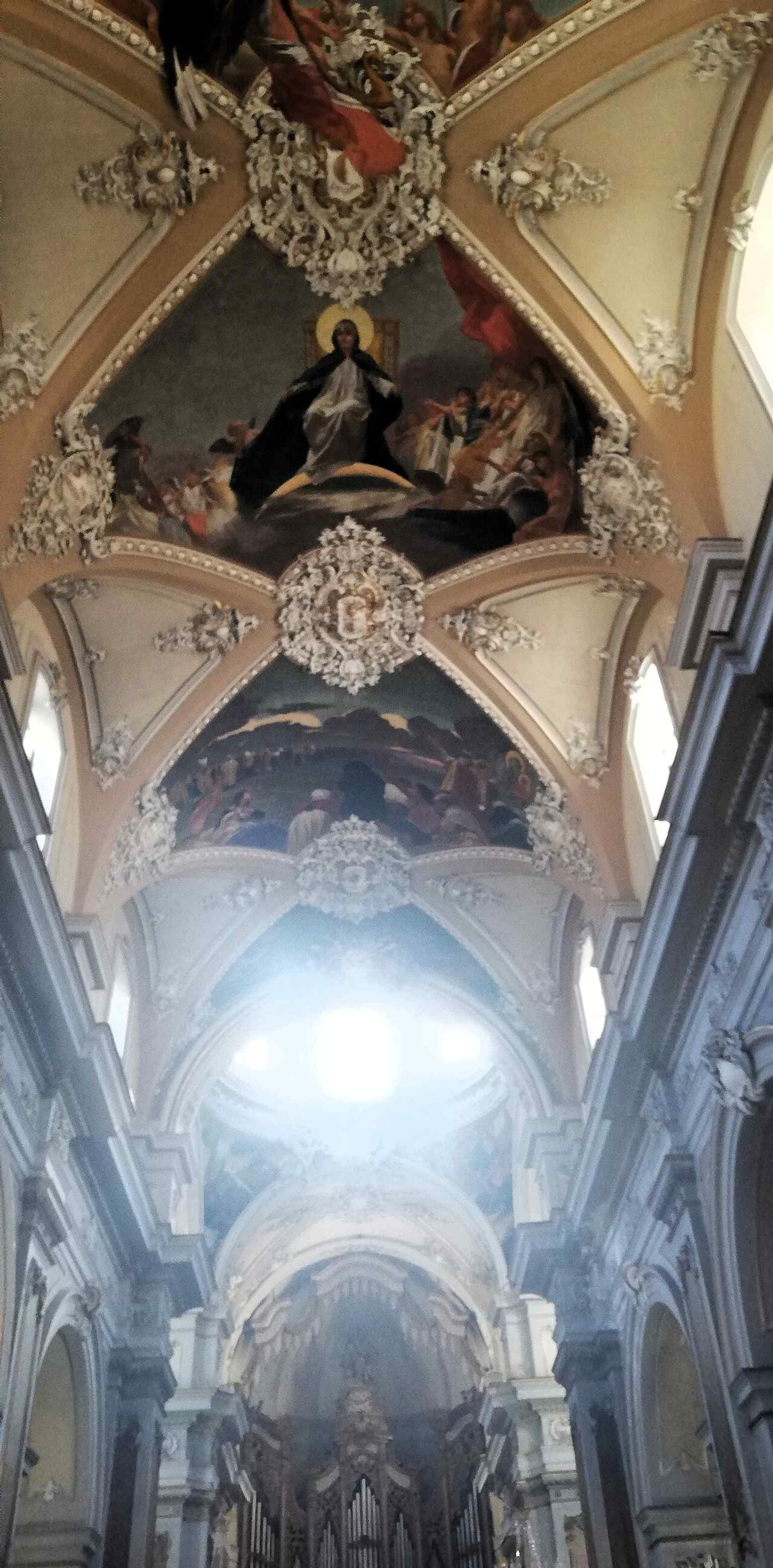
One of the vault fresco views, recalling Giuseppe Sciuti’s late-19th-century cycle that fills the church with biblical scenes.Photo: Effems, Wikimedia Commons, CC BY-SA 4.0. Cropped & resized. If you want to step inside later, it usually opens Tuesday through Sunday, from nine to noon and again from four to eight, and stays closed on Monday.
This church feels like Catania itself: wounded, proud, devout, and beautifully unwilling to give up. When you’re ready, continue on and let the next stone in the city tell you its piece of the story.
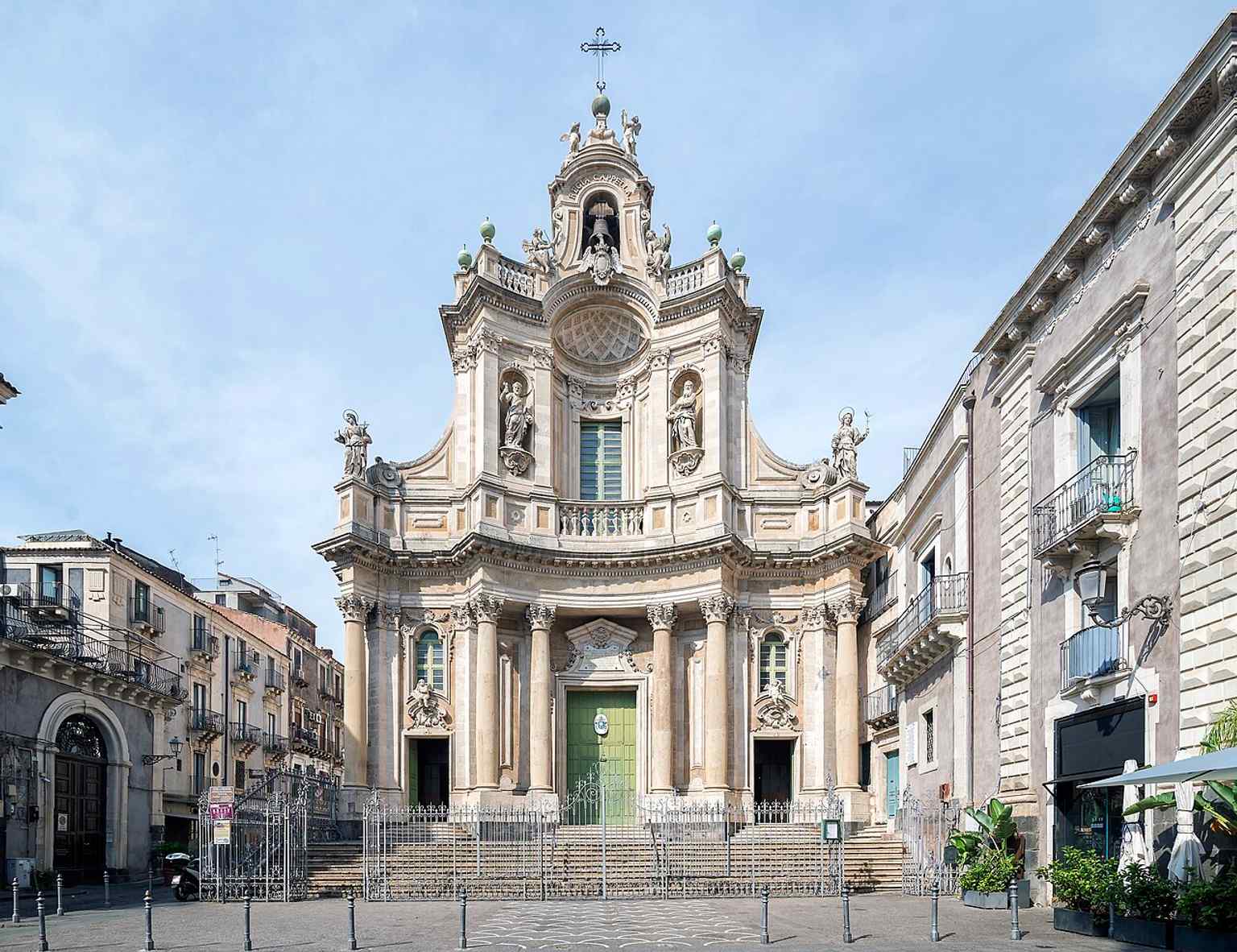
The main Baroque façade on Via Etnea, with the statues of Saints Agatha, Apollonia, Peter and Paul mentioned in the church’s description.Photo: Dariolp83, Wikimedia Commons, CC BY-SA 4.0. Cropped & resized. 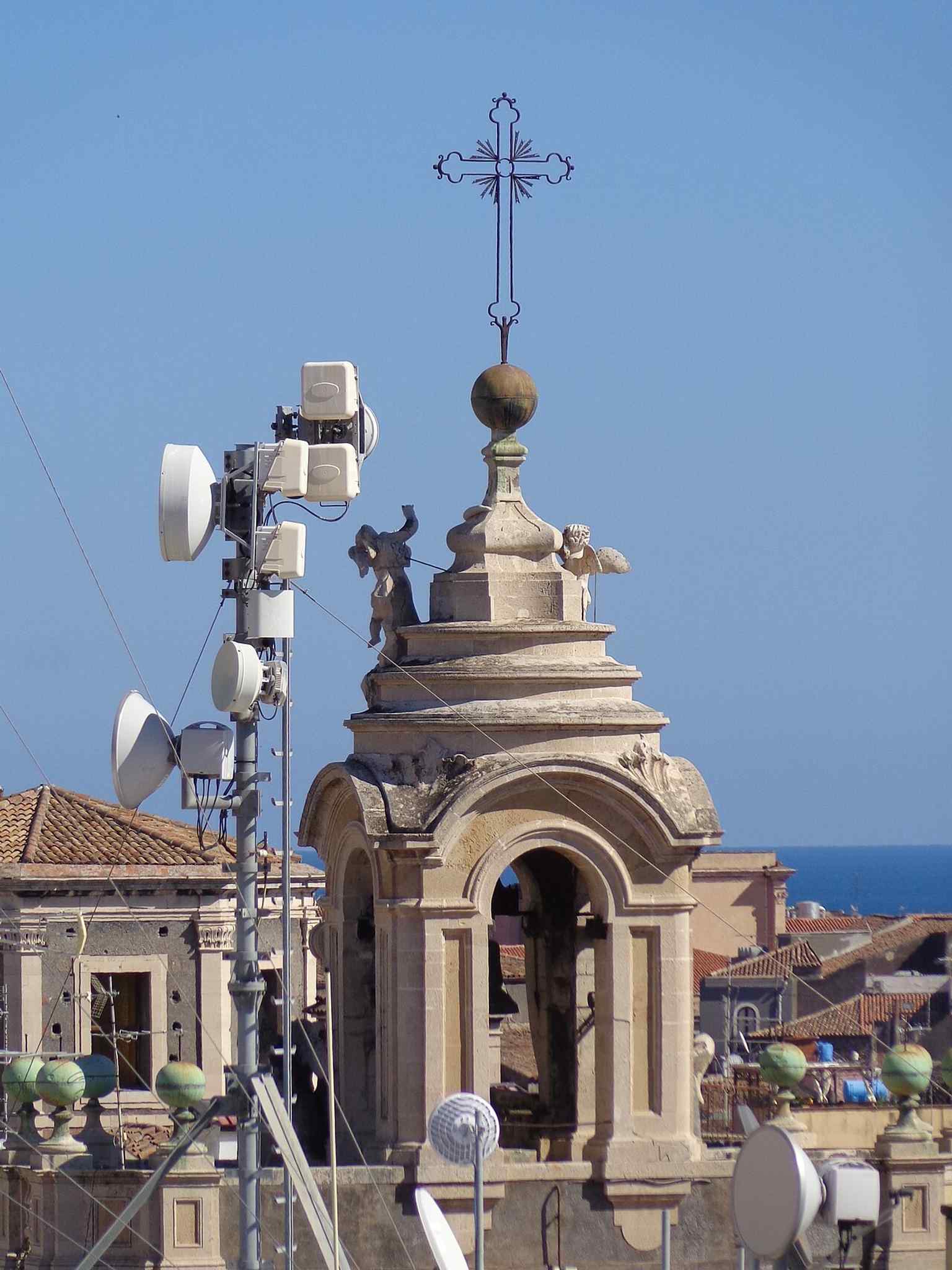
The bell tower seen from San Giuliano’s dome shows how the church’s profile became part of Catania’s skyline.Photo: Effems, Wikimedia Commons, CC BY-SA 4.0. Cropped & resized. 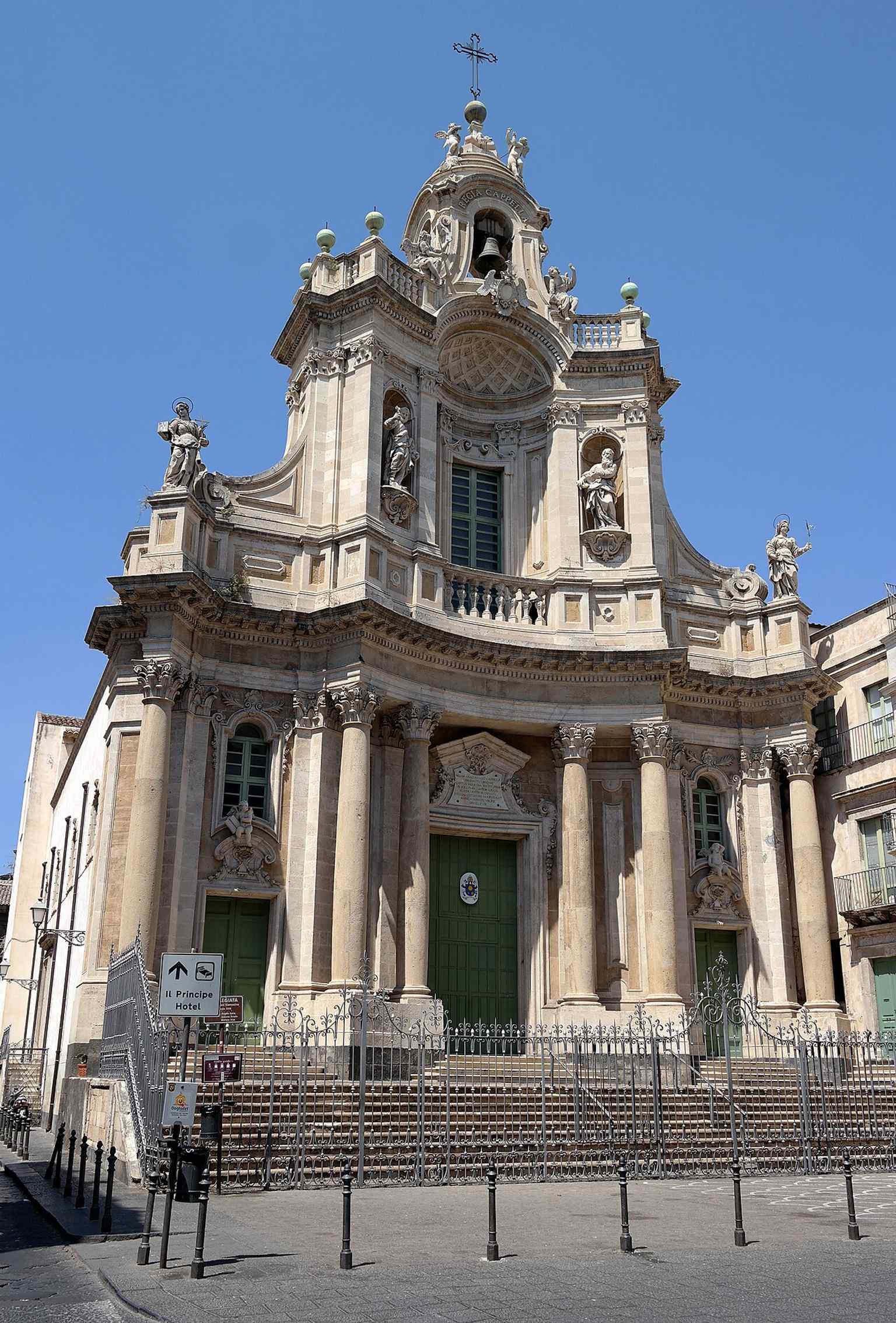
A modern frontal view that emphasizes the rebuilt basilica’s position on Via Etnea, the axis created after the 1693 earthquake.Photo: Luca Aless, Wikimedia Commons, CC BY-SA 4.0. Cropped & resized. 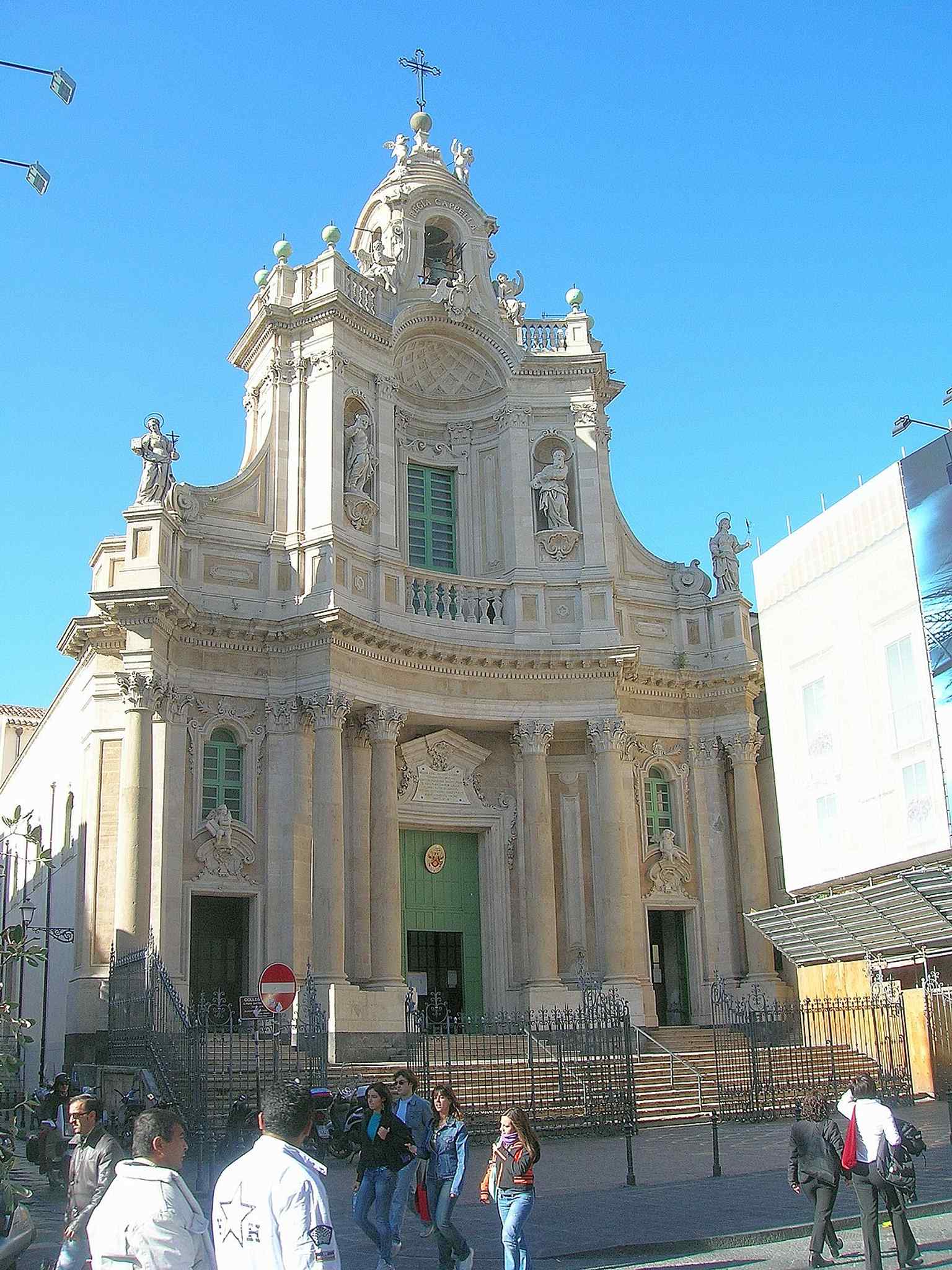
A tall view of the Collegiata’s façade and bell gables, ideal for the church’s monumental street presence.Photo: Carlo Pelagalli, Wikimedia Commons, CC BY-SA 3.0. Cropped & resized. 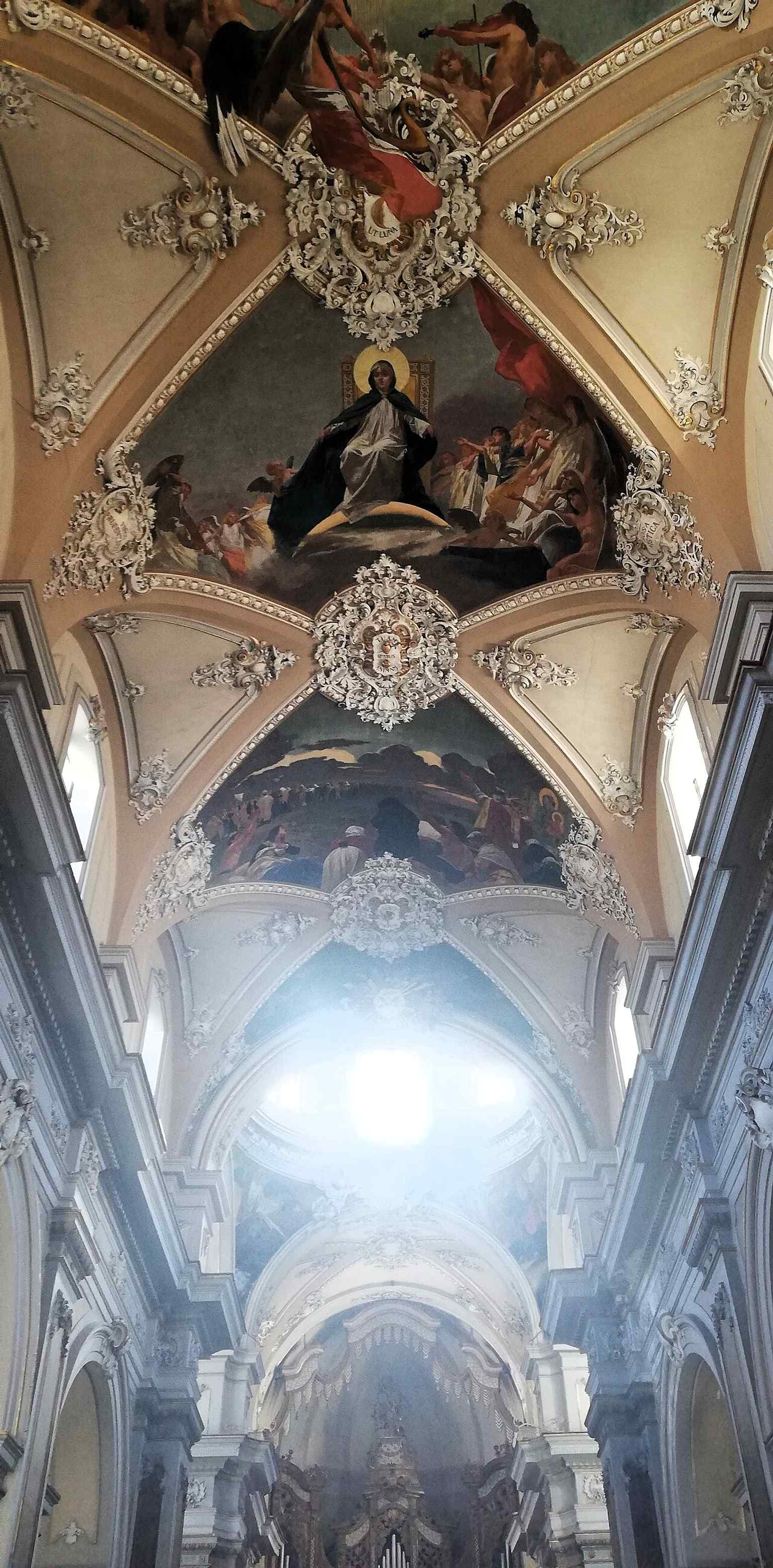
Another vault fresco detail, showing how Sciuti transformed the ceiling into a dramatic painted theology of light, sin, and salvation.Photo: Effems, Wikimedia Commons, CC BY-SA 4.0. Cropped & resized. 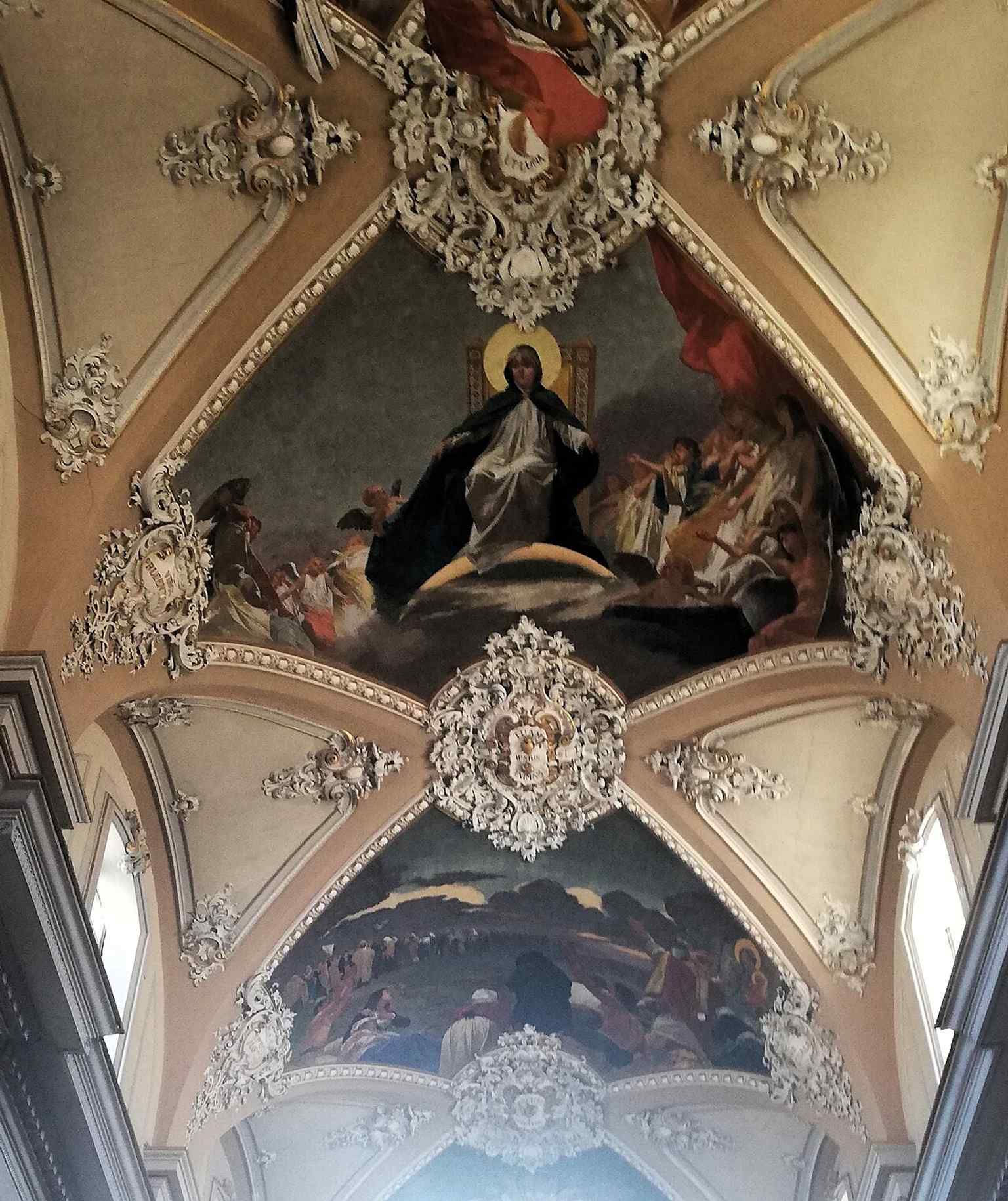
An interior view with the nave and altar area, evoking the basilica’s three-aisle plan and richly marbled sacred space.Photo: Effems, Wikimedia Commons, CC BY-SA 4.0. Cropped & resized. 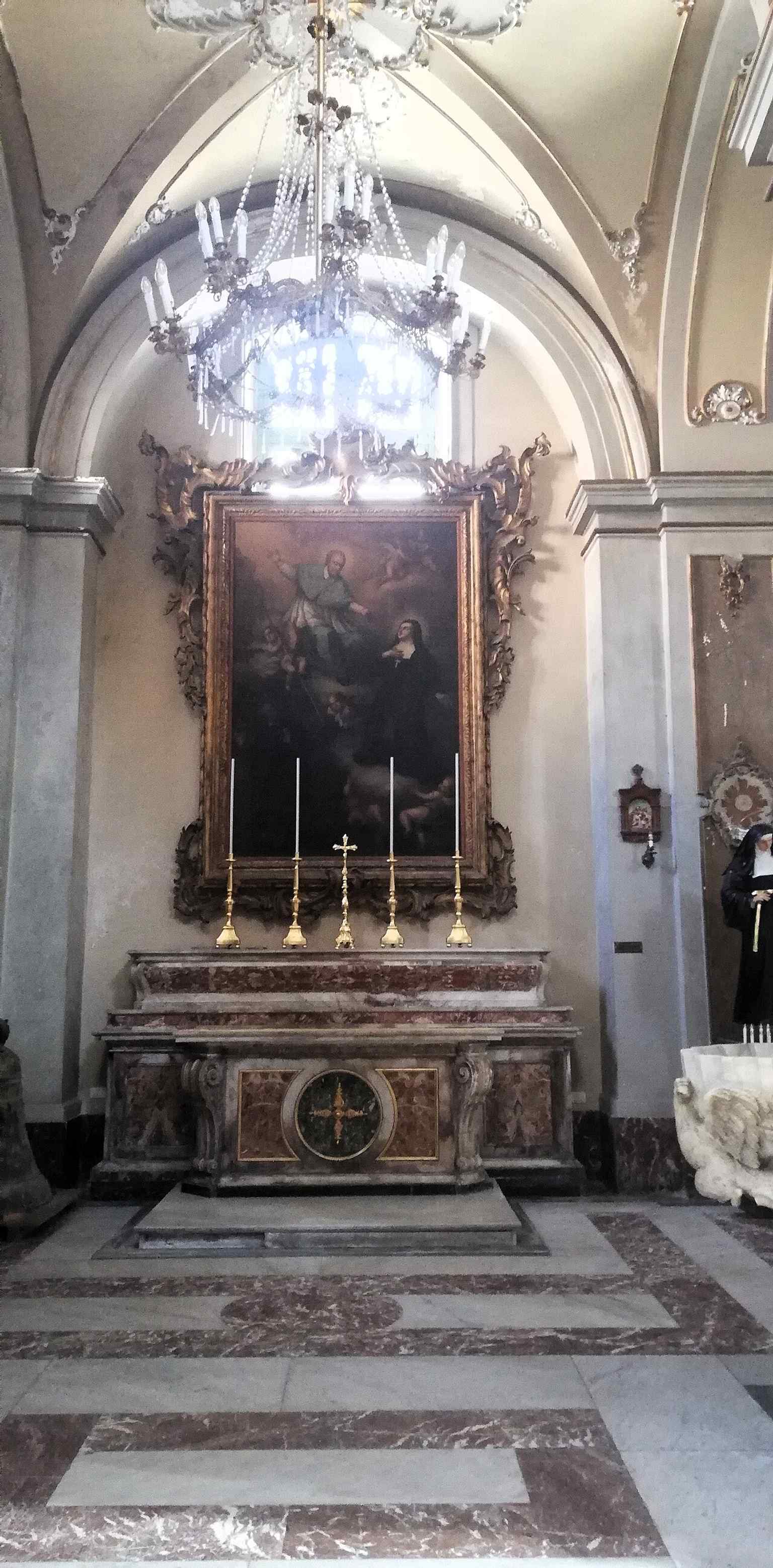
A different interior angle that helps show the lengthened central apse and the church’s ceremonial scale.Photo: Effems, Wikimedia Commons, CC BY-SA 4.0. Cropped & resized. 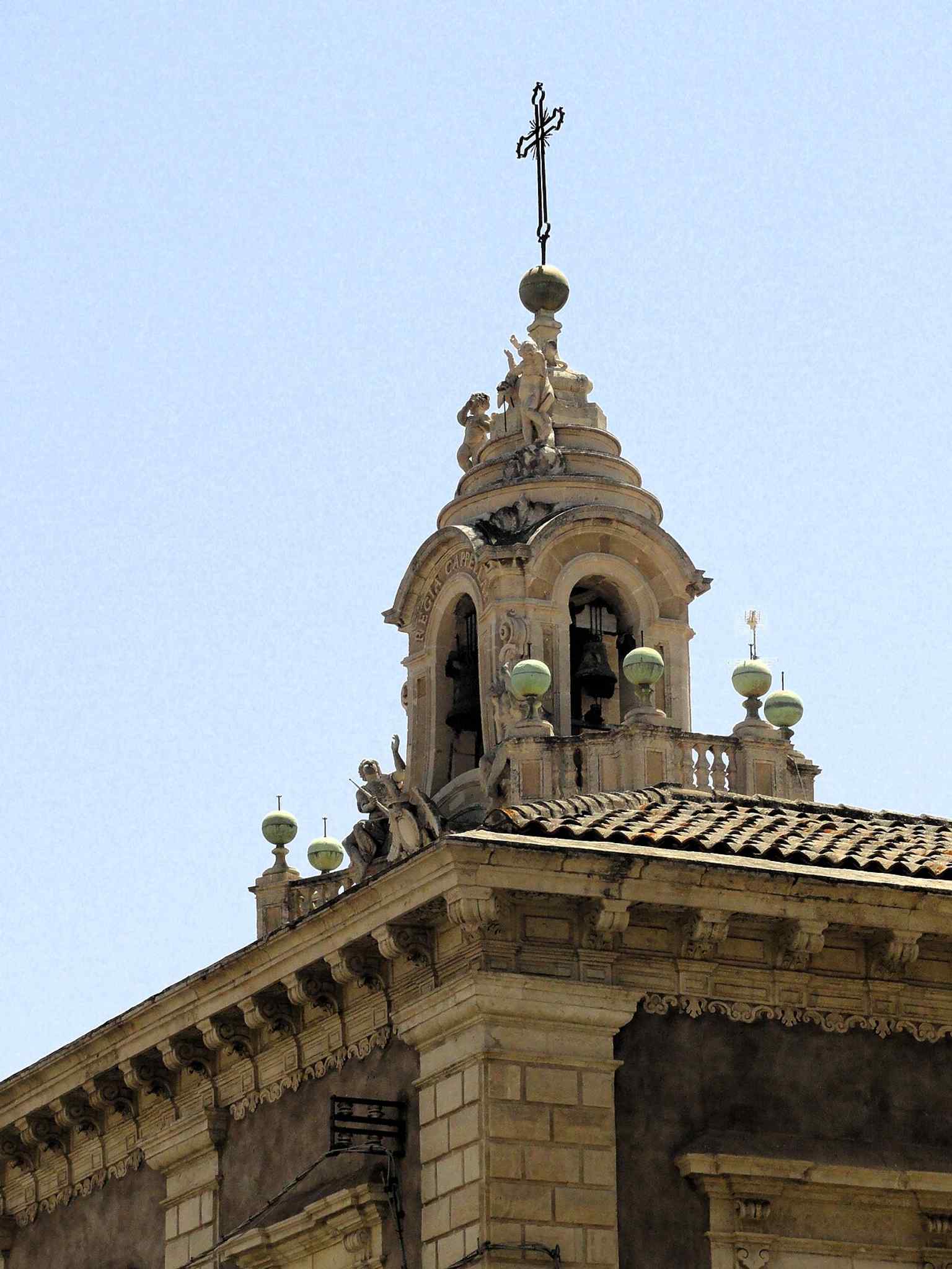
Interior detail from the basilica’s nave, useful for the marble-and-gold atmosphere described in the source text.Photo: Effems, Wikimedia Commons, CC BY-SA 4.0. Cropped & resized. 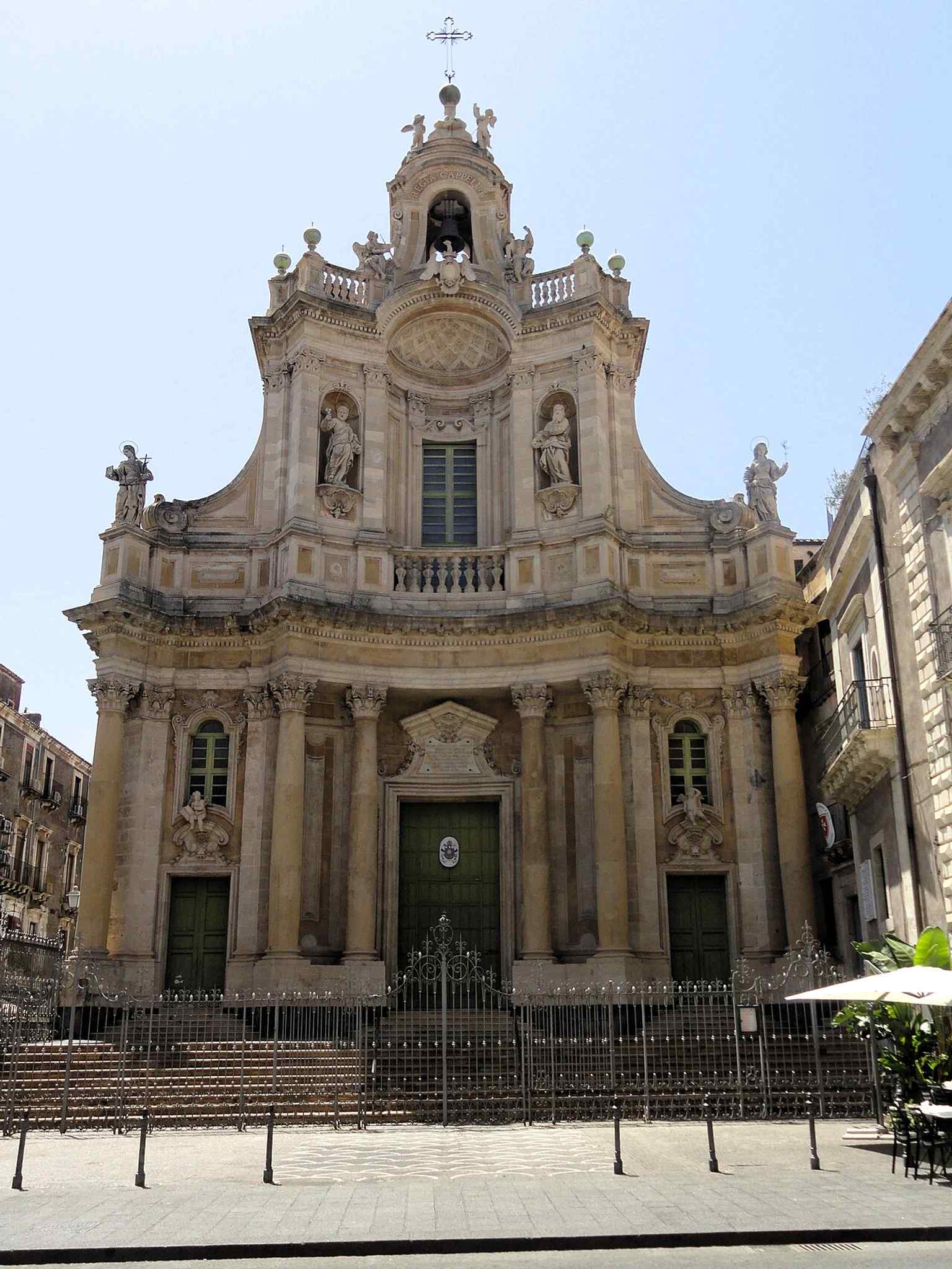
A further interior perspective, likely near the choir or altar zone, reflecting the basilica’s layered chapels and decorations.Photo: Effems, Wikimedia Commons, CC BY-SA 4.0. Cropped & resized. On your right, look for the long pale-stone palace with a broad arched entrance, rows of wrought-iron balconies, and a balanced Baroque façade facing the square. This is the…Read moreShow less
Open dedicated page →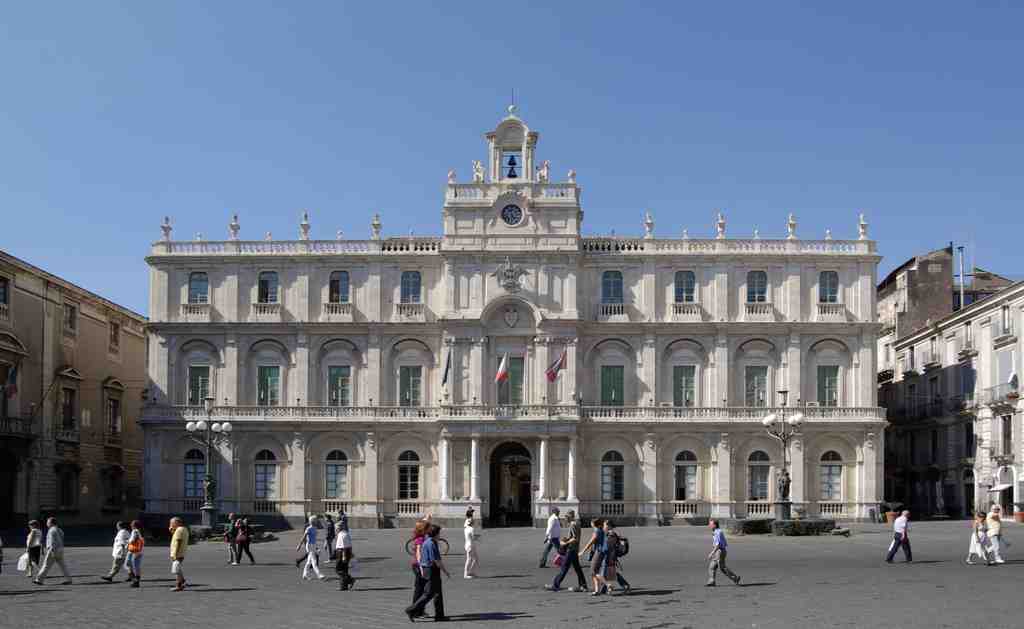
University of CataniaPhoto: Berthold Werner, Wikimedia Commons, CC BY-SA 3.0. Cropped & resized. On your right, look for the long pale-stone palace with a broad arched entrance, rows of wrought-iron balconies, and a balanced Baroque façade facing the square.
This is the University of Catania, the oldest university in Sicily, and its story begins with a city asking to be taken seriously. In fourteen thirty-four, a Catanian named Pietro Rizzari pushed the civic senate to petition King Alfonso the Fifth. The king agreed that Catania could found a studium generale... a university allowed to grant legally recognized degrees. Ten years later, Pope Eugenius the Fourth confirmed it, and by the end of fourteen forty-five, public lessons had begun.
Those first classes did not happen here. They began near the cathedral, where law, medicine, theology, philosophy, mathematics, and the liberal arts were taught. In fourteen forty-nine, the first degree went to Antonio Mantello of Syracuse. For a long stretch, this university held a rare privilege in the Kingdom of Sicily: it alone could grant certain degrees. Students from Palermo often had to come here to finish what they started there. Imagine the pride of that... families sending sons across the island because Catania had the authority to say, yes, you are now learned.
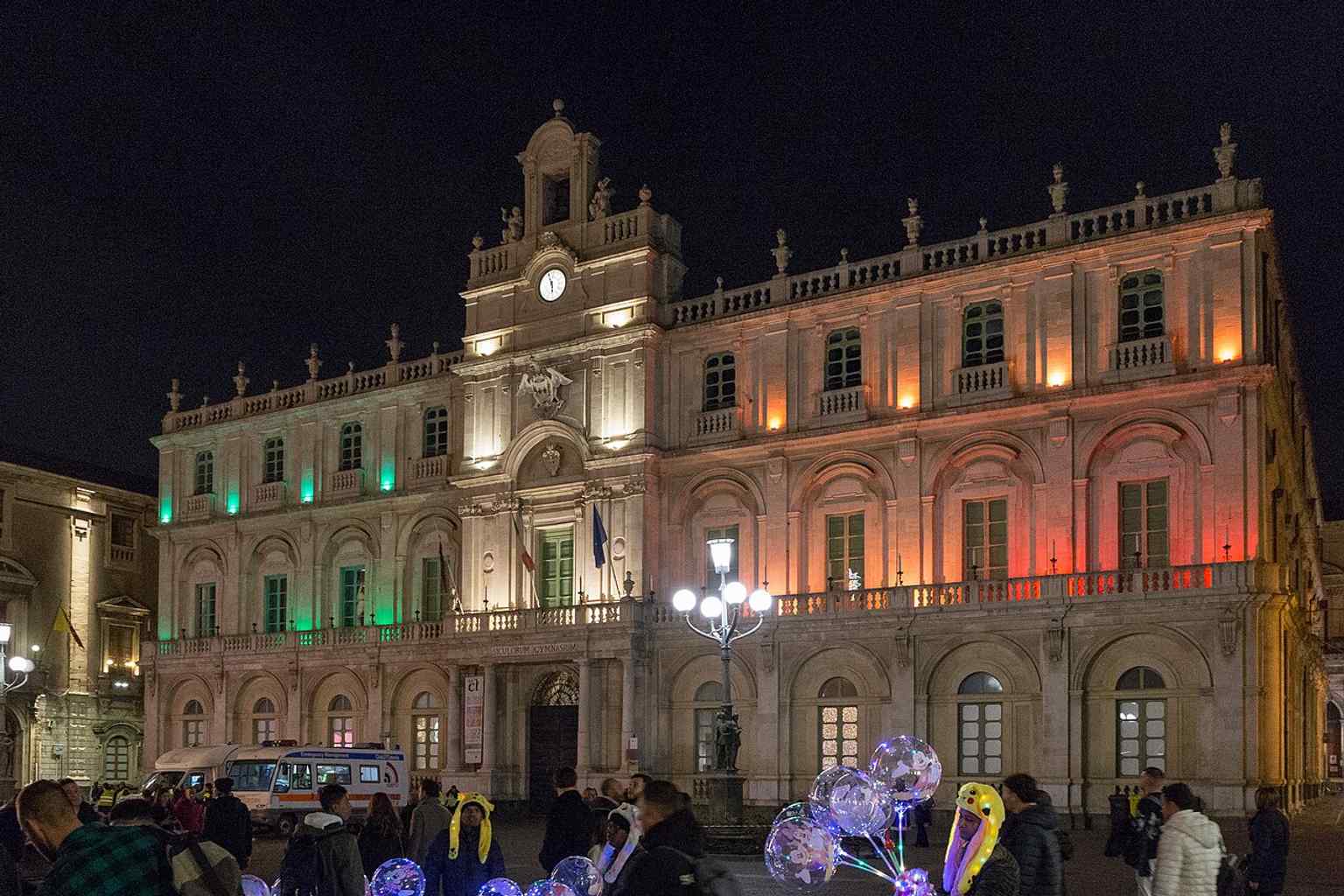
Then came disaster. The earthquake of sixteen ninety-three shattered the earlier university building. But Catania did what Catania so often does: it rebuilt. Work on this new palace began in sixteen ninety-six, and great architects shaped it, especially Giovanni Battista Vaccarini and the Battaglia brothers. The image in your app shows how the façade stretches with that calm, formal dignity that helped define the city after the quake.
Inside, hidden from the square, Vaccarini gave the palace a striking black-and-white stone courtyard, grand staircases, and an Aula Magna, the main ceremonial hall, dressed in frescoes. The second image helps you notice that post-earthquake Sicilian Baroque confidence in the building’s lines and rhythm.
The university’s life kept changing. In the late seventeen hundreds, student numbers climbed to around two thousand, and new chairs, meaning official teaching posts, opened in law, medicine, and even botany. In the eighteen hundreds, enrollment fell so sharply that by eighteen sixty-seven there were only one hundred forty-three students. Local leaders stepped in, supported the university, and helped restore its rank by eighteen eighty-five.
That stubborn survival matters. Today, this institution reaches far beyond this square, but this palace still feels like its heart... a place where centuries of ambition, loss, and renewal keep speaking.
This palace keeps Catania’s oldest promise: that learning belongs in the center of city life. When you’re ready, continue toward Elephant Palace for the next chapter.
On your left, look for a long baroque facade of pale limestone and warm stucco, three stories high, with a granite-columned central portal and small elephant sculptures set above…Read moreShow less
Open dedicated page →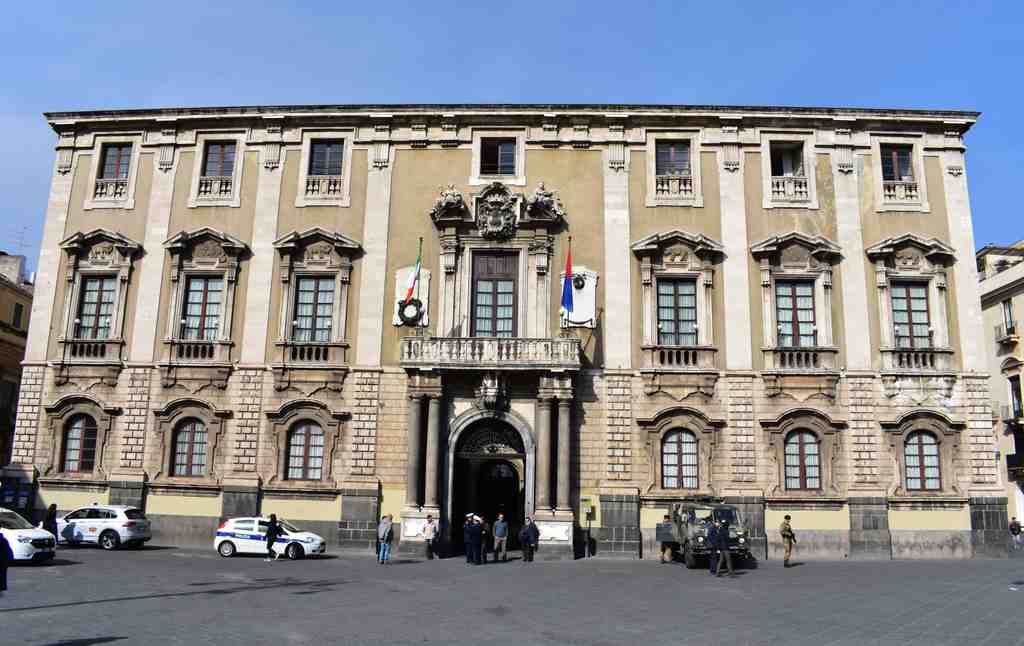
Elephant PalacePhoto: Francesco Lombardi, Wikimedia Commons, CC BY-SA 4.0. Cropped & resized. On your left, look for a long baroque facade of pale limestone and warm stucco, three stories high, with a granite-columned central portal and small elephant sculptures set above the grand balconies.
This is Palazzo degli Elefanti, Catania’s city hall... and its name carries a little local affection. Before this palace took shape, the city’s leaders met in an older Aragonese building called the Loggia Senatoria, a place so important that the Sicilian parliament gathered there several times between the thirteenth and sixteenth centuries. Then the earthquake of sixteen ninety-three struck and erased that older seat of power.
Catania’s civic leaders did not want a modest replacement. They wanted a palace that could stand proudly in Piazza Duomo and answer, almost face to face, the religious authority across from it, especially the Seminary of the Clerics. So the new town hall began as a political statement as much as an office.
Master builder Giovan Battista Longobardo started the work, but in seventeen oh one the public money ran dry, and the project stopped with only the first level completed. Years later, in seventeen thirty-two, the city gave the unfinished palace to a young architect, Giovanni Battista Vaccarini. He brought with him a dramatic baroque vision inspired by Bernini, the great Roman master, and he added the detail that changed everything: elephant sculptures above the balconies on the noble floor, the palace’s main ceremonial level. Those carvings, together with the lava-stone elephant fountain, the Liotru, in the square, led the people of Catania to stop calling this the Palazzo Senatorio and start calling it the Elephant Palace instead.
Take in the front of it now. The lower level feels firm and protective, with stone cut into raised blocks that catch the light and shadow. Higher up, the building softens into elegant white limestone trim and warmer plaster surfaces. At the main entrance, pairs of granite columns lift the central balcony, and above it stand two figures, Justice and Faith, with the city’s coat of arms between them... a whole philosophy of government in one small stage set.
Inside, the grand staircase gives you a taste of the ceremonial world beyond this facade; Stefano Ittar added it in the nineteenth century, and it turns a municipal building into something almost theatrical.
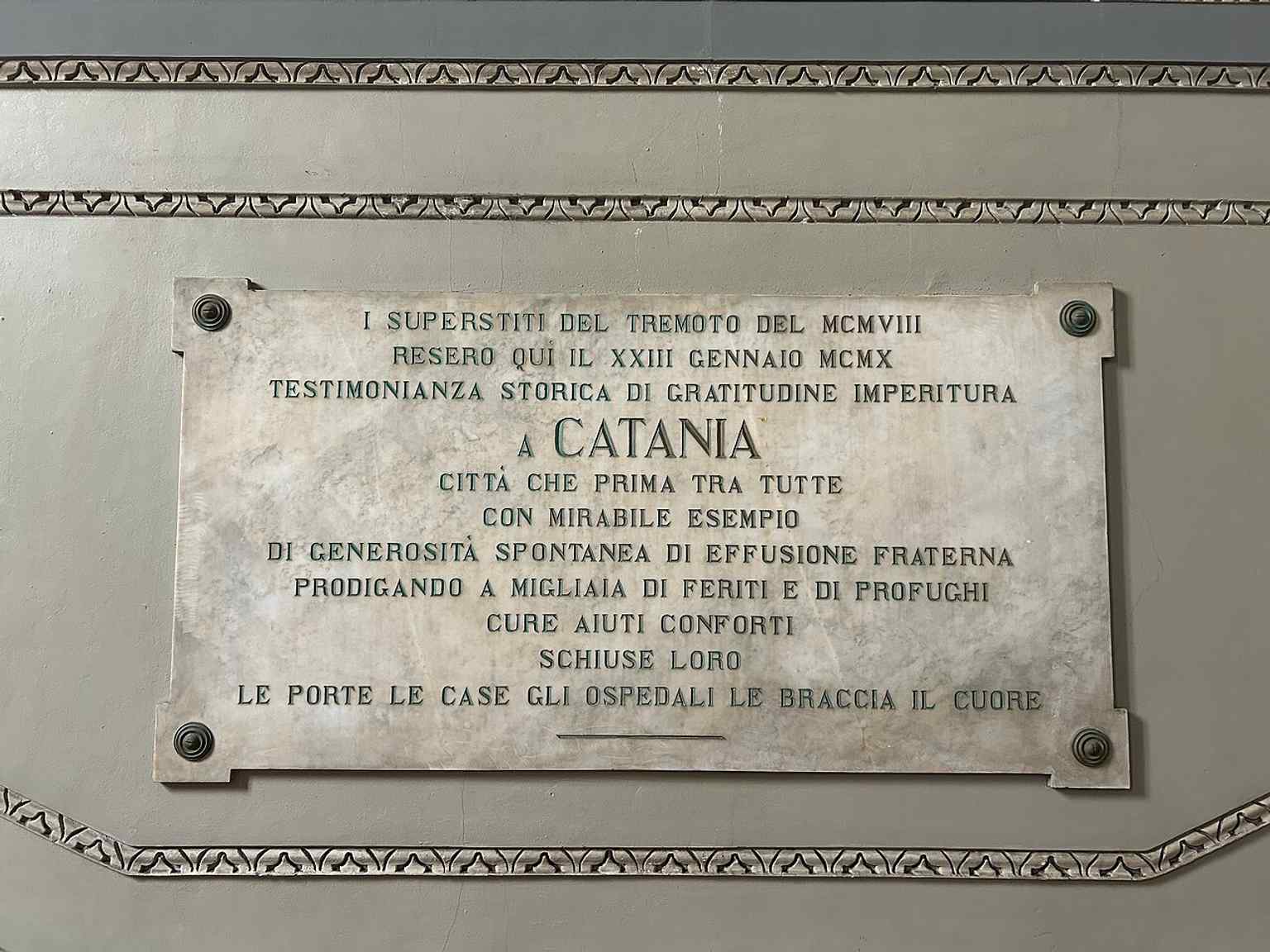
The grand staircase itself — one of the palace’s key ceremonial spaces and a highlight of the 19th-century interior makeover.Photo: GiovanniPen, Wikimedia Commons, CC BY-SA 4.0. Cropped & resized. But this palace also carries grief. On the fourteenth of December, nineteen forty-four, young protesters furious about forced conscription set the town hall on fire. Many believed the war should already have been over for Sicily, and they could not bear the thought of being sent north to fight again. The flames destroyed municipal archives, museum objects, furniture, and books... centuries of the city’s memory gone in a single terrible night. Catania restored the rooms and reopened them on the same date in nineteen fifty-two. You can see that careful rebirth in one of the interior images in the app.
An interior view that helps convey the palace’s restored historic rooms after the 1944 fire.Photo: Pymouss, Wikimedia Commons, CC BY-SA 4.0. Cropped & resized. And deeper inside the courtyard, the palace protects another fierce memory: the Pietra del Malconsiglio, a lava block tied to a bloody ambush of rebels in fifteen sixteen, later rescued from neglect thanks to schoolchildren from Librino in two thousand and fourteen. Even here, the city keeps choosing remembrance over ruin.
If you’d like to return and go inside, the palace generally opens daily from nine in the morning, with later closing on weekends.
Palazzo degli Elefanti feels like Catania’s public heart, scarred, proud, and still speaking.
When you’re ready, continue on to the Greek-Roman Theatre, where the city’s story slips from civic power into ancient performance.
A broad view of Elephant Palace on Piazza Duomo, showing the baroque civic façade that was rebuilt after the 1693 earthquake.Photo: Pymouss, Wikimedia Commons, CC BY-SA 4.0. Cropped & resized. 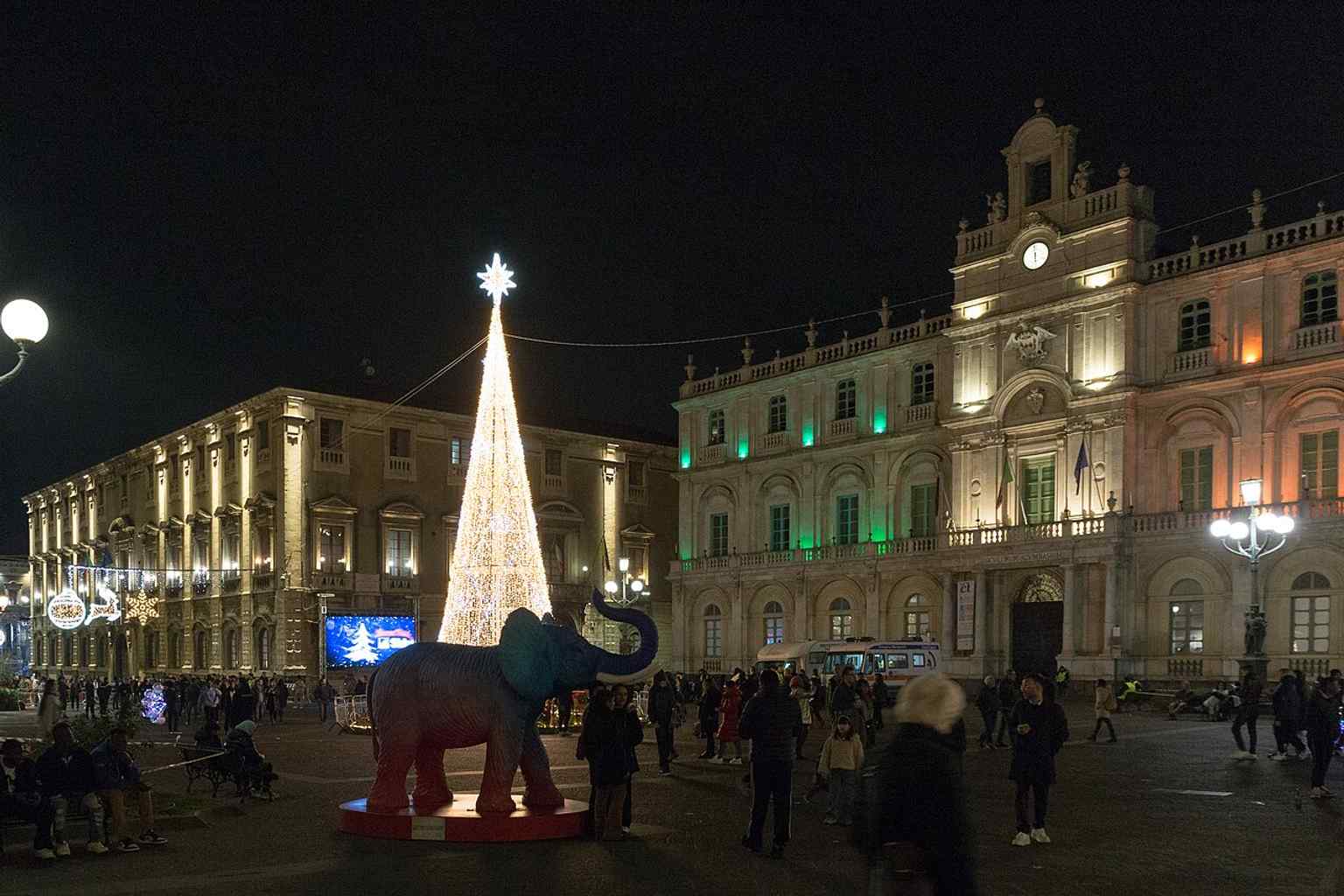
Elephant Palace beside the University building — a useful comparison of Catania’s civic and academic baroque landmarks.Photo: Pymouss, Wikimedia Commons, CC BY-SA 4.0. Cropped & resized. 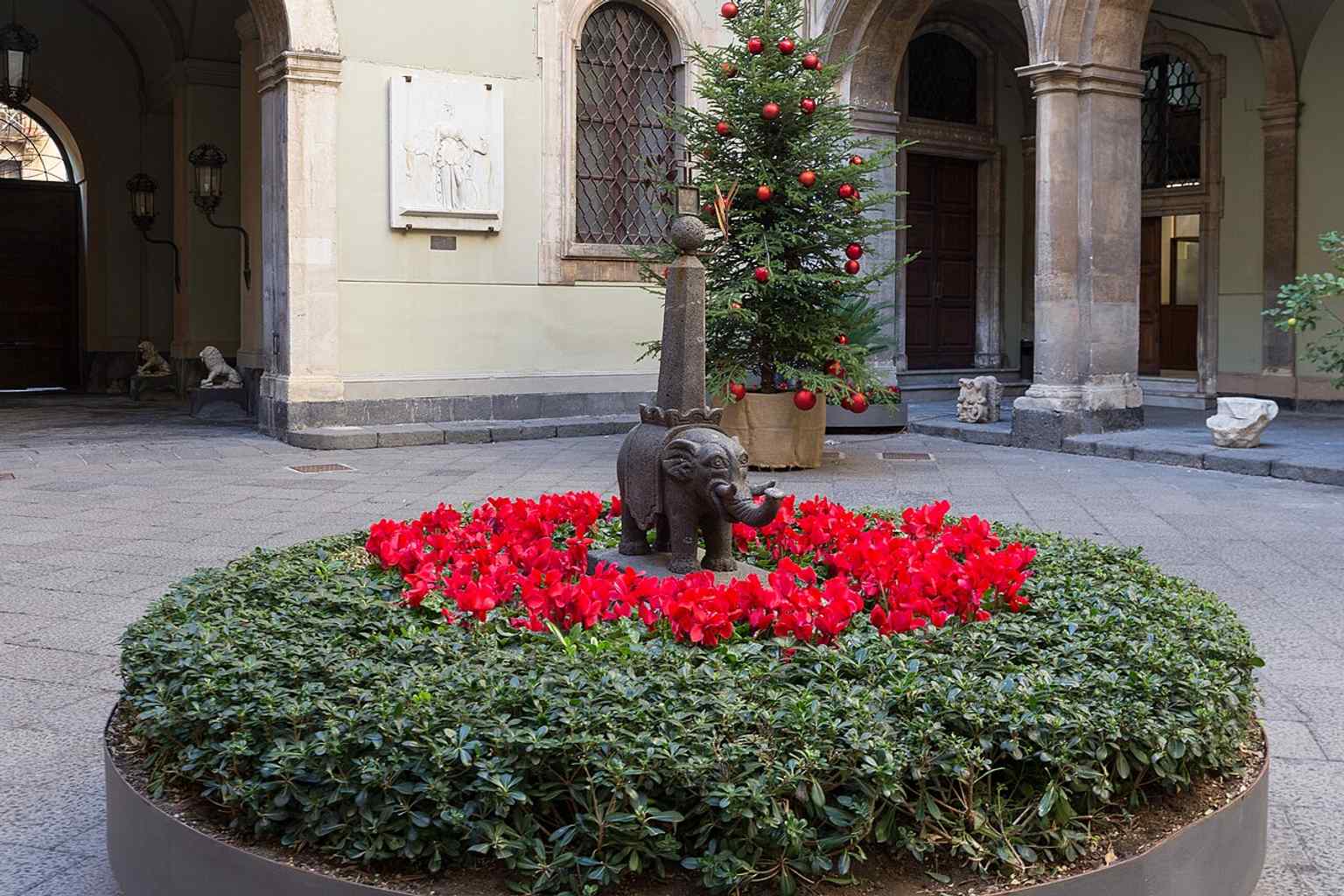
A crisp modern view of the palace frontage, useful for introducing the building as Catania’s current town hall.Photo: Pymouss, Wikimedia Commons, CC BY-SA 4.0. Cropped & resized. 
A recent full-height view of Elephant Palace, ideal for showing its three-level façade and strong urban presence.Photo: Effems, Wikimedia Commons, CC BY-SA 4.0. Cropped & resized. 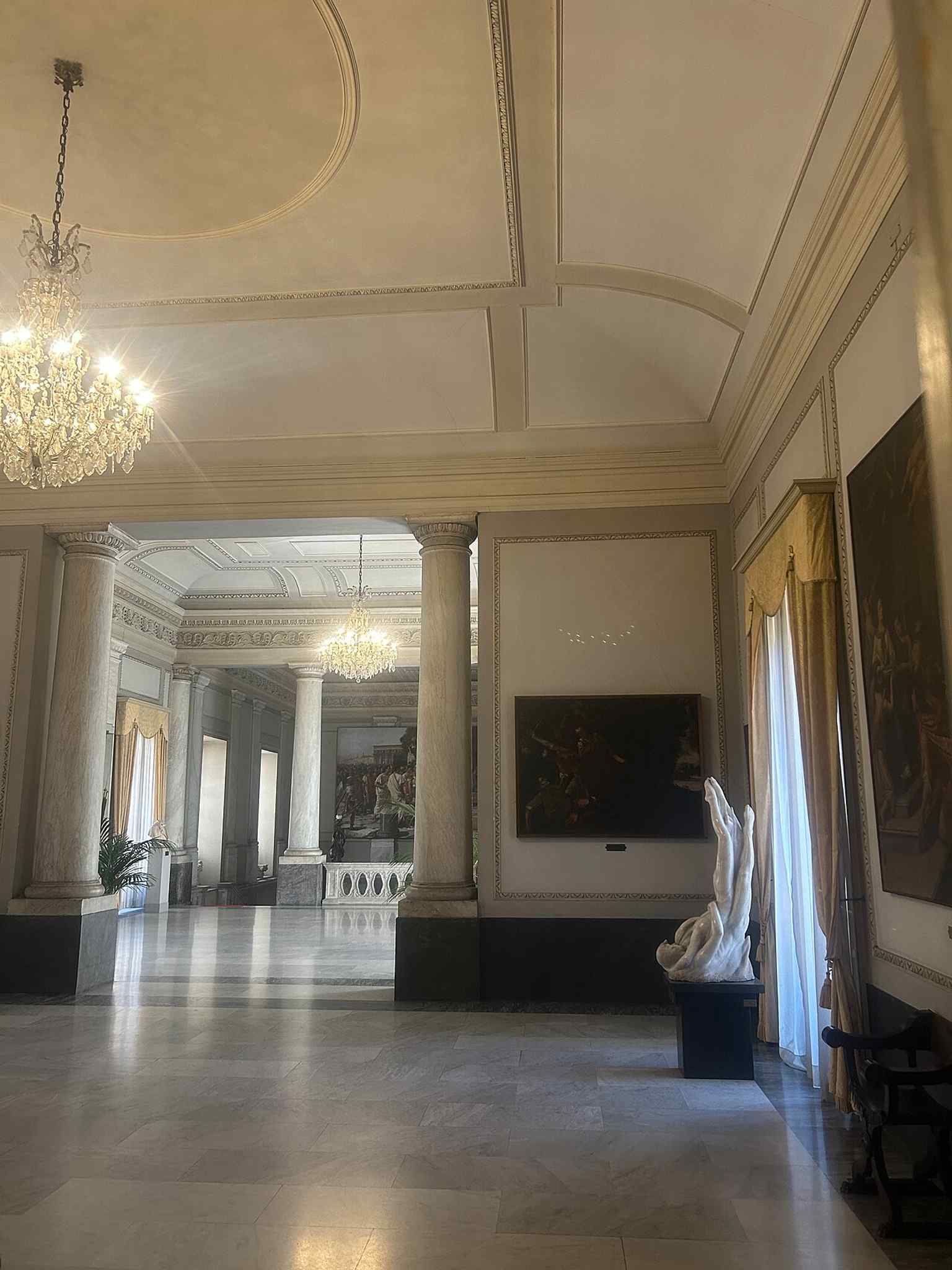
The main stair landing at the entrance, a later 19th-century addition by Stefano Ittar that connects the exterior to the ceremonial interior.Photo: GiovanniPen, Wikimedia Commons, CC BY-SA 4.0. Cropped & resized. 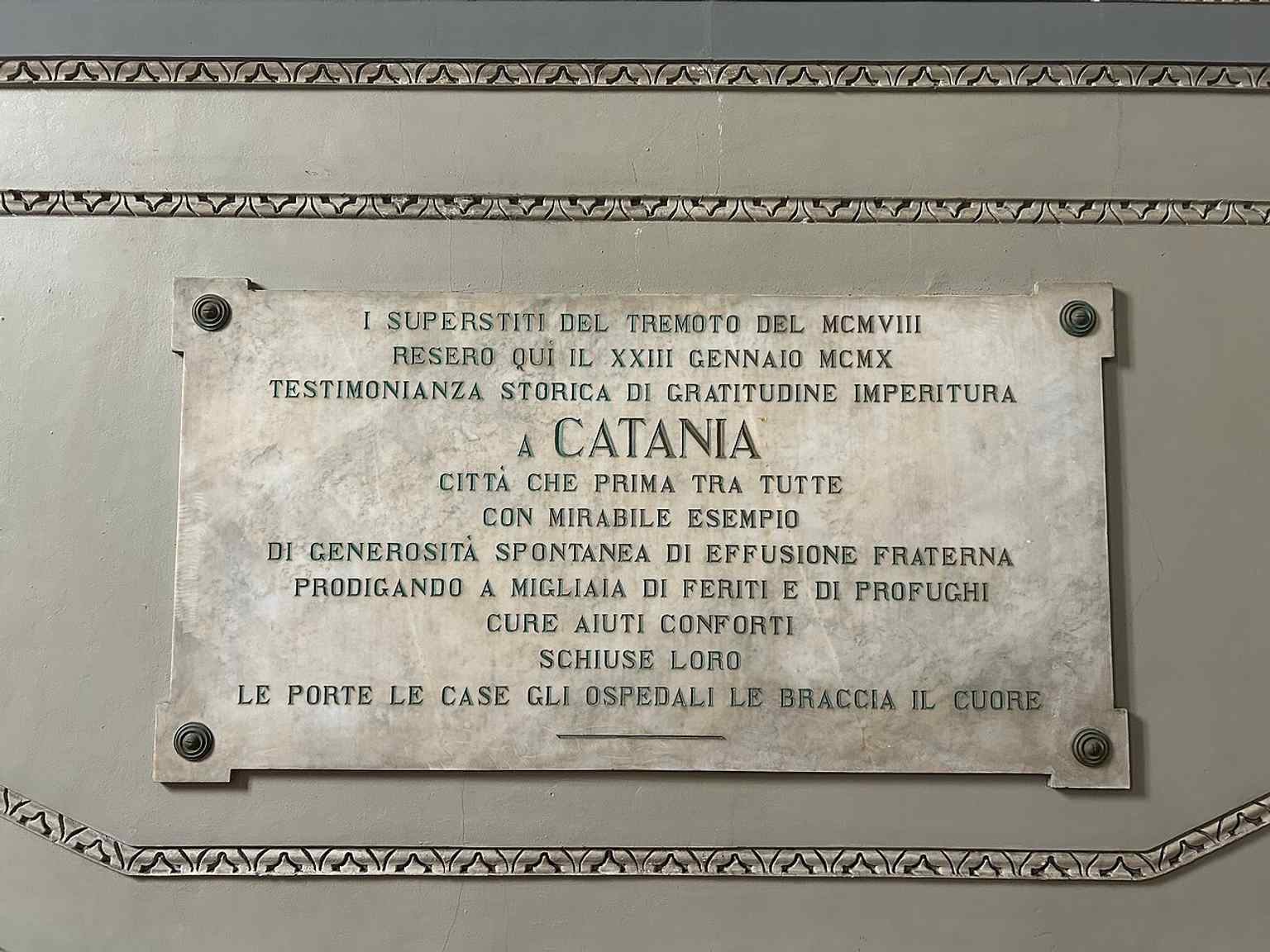
The commemorative plaque on the staircase, a small but telling detail from the palace’s layered civic history.Photo: GiovanniPen, Wikimedia Commons, CC BY-SA 4.0. Cropped & resized. 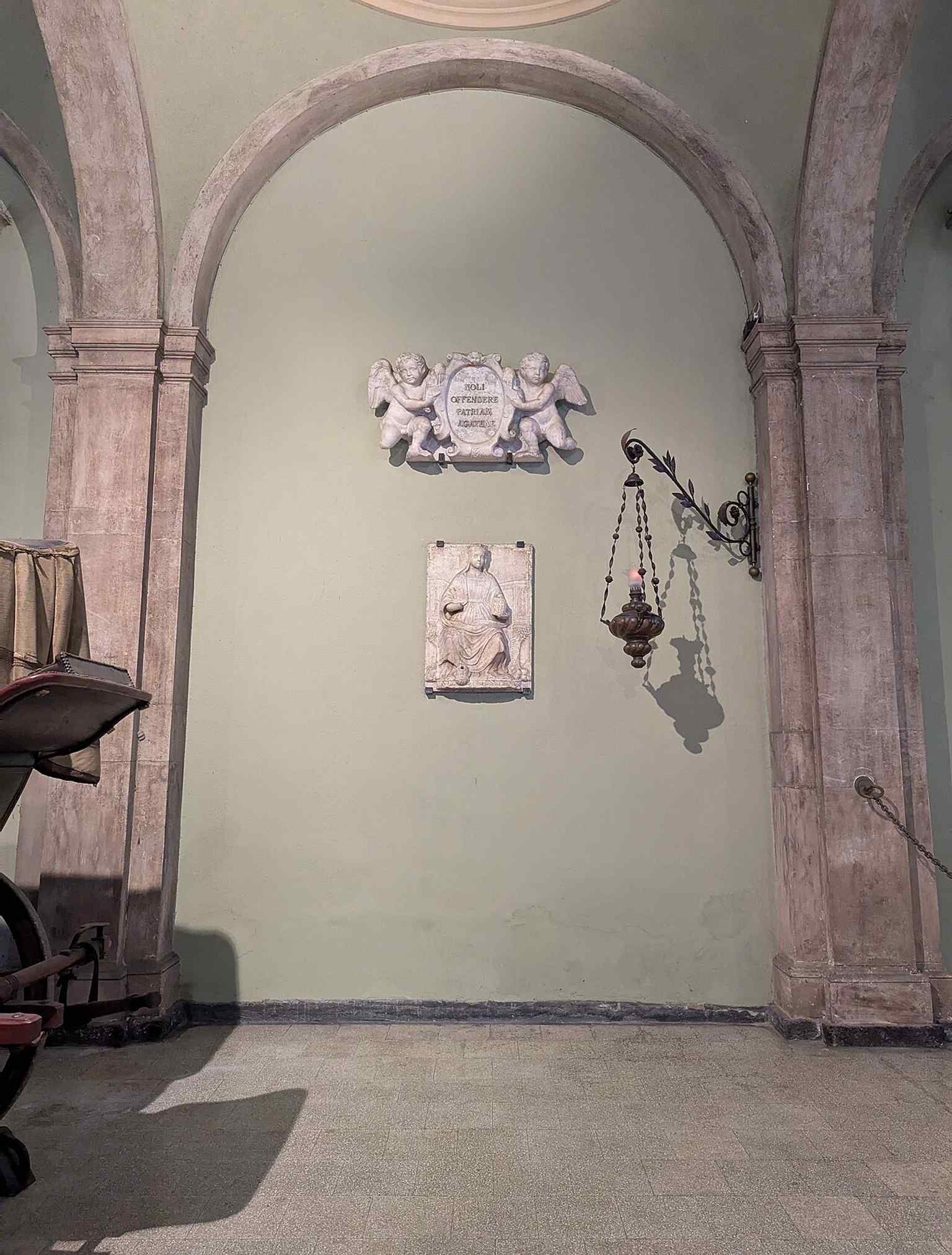
The atrium inside Elephant Palace, showing the public interior where the city’s political life still unfolds.Photo: Ivan Ruggiero, Wikimedia Commons, CC BY-SA 4.0. Cropped & resized. 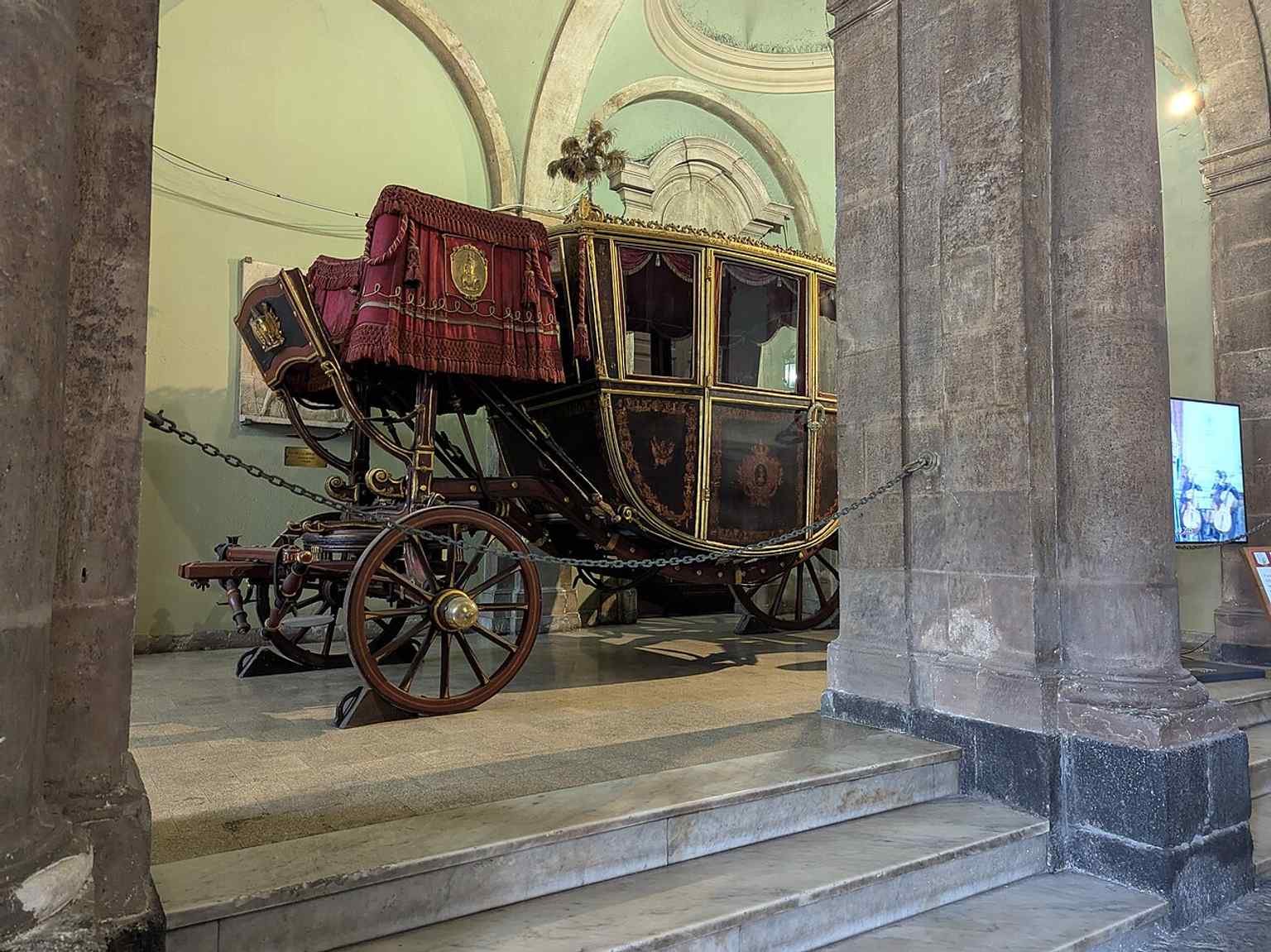
Another atrium view, useful for capturing the palace’s internal volume and municipal atmosphere.Photo: Ivan Ruggiero, Wikimedia Commons, CC BY-SA 4.0. Cropped & resized. 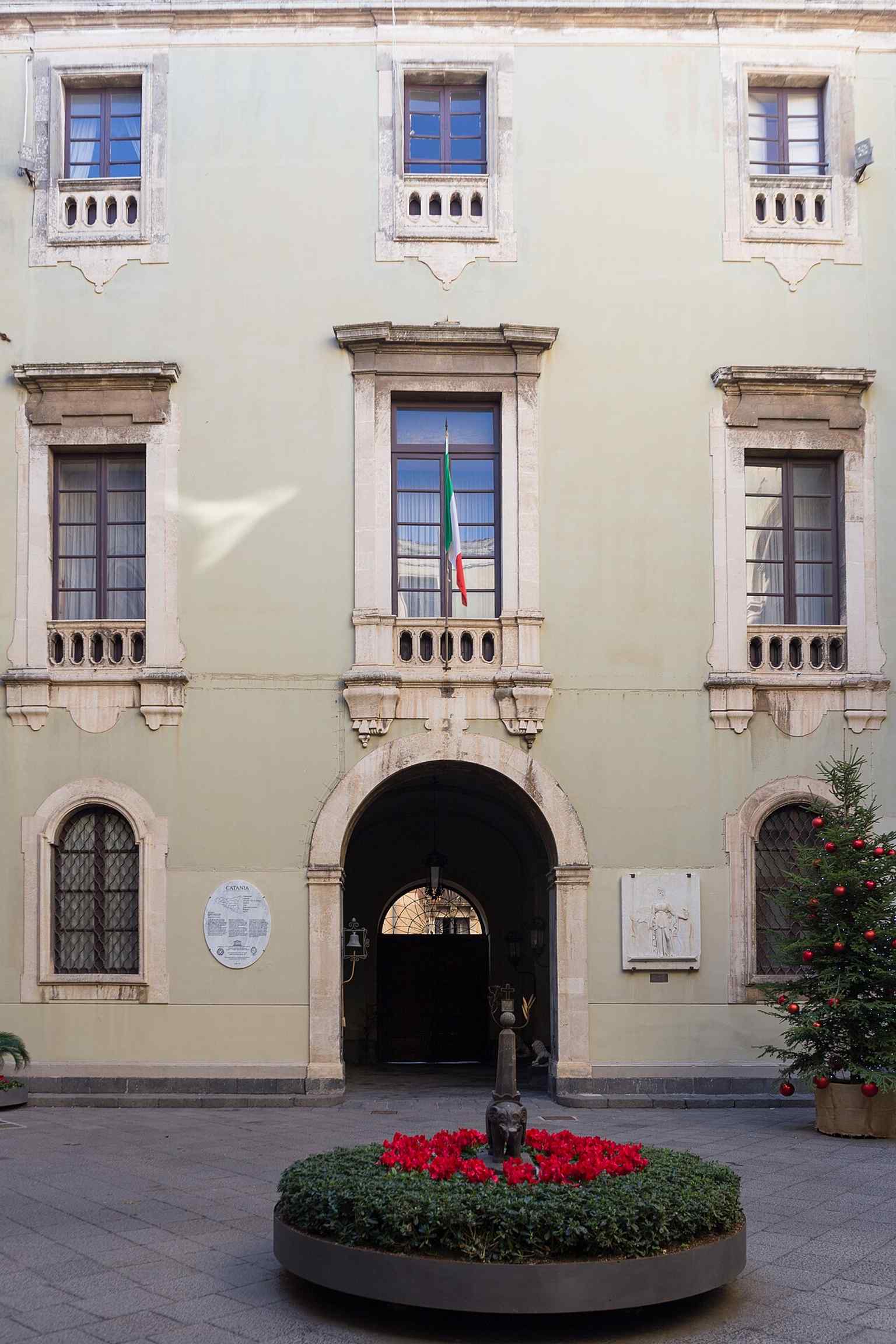
A second interior angle, adding variety to the sequence of the palace’s furnished civic spaces.Photo: Pymouss, Wikimedia Commons, CC BY-SA 4.0. Cropped & resized. 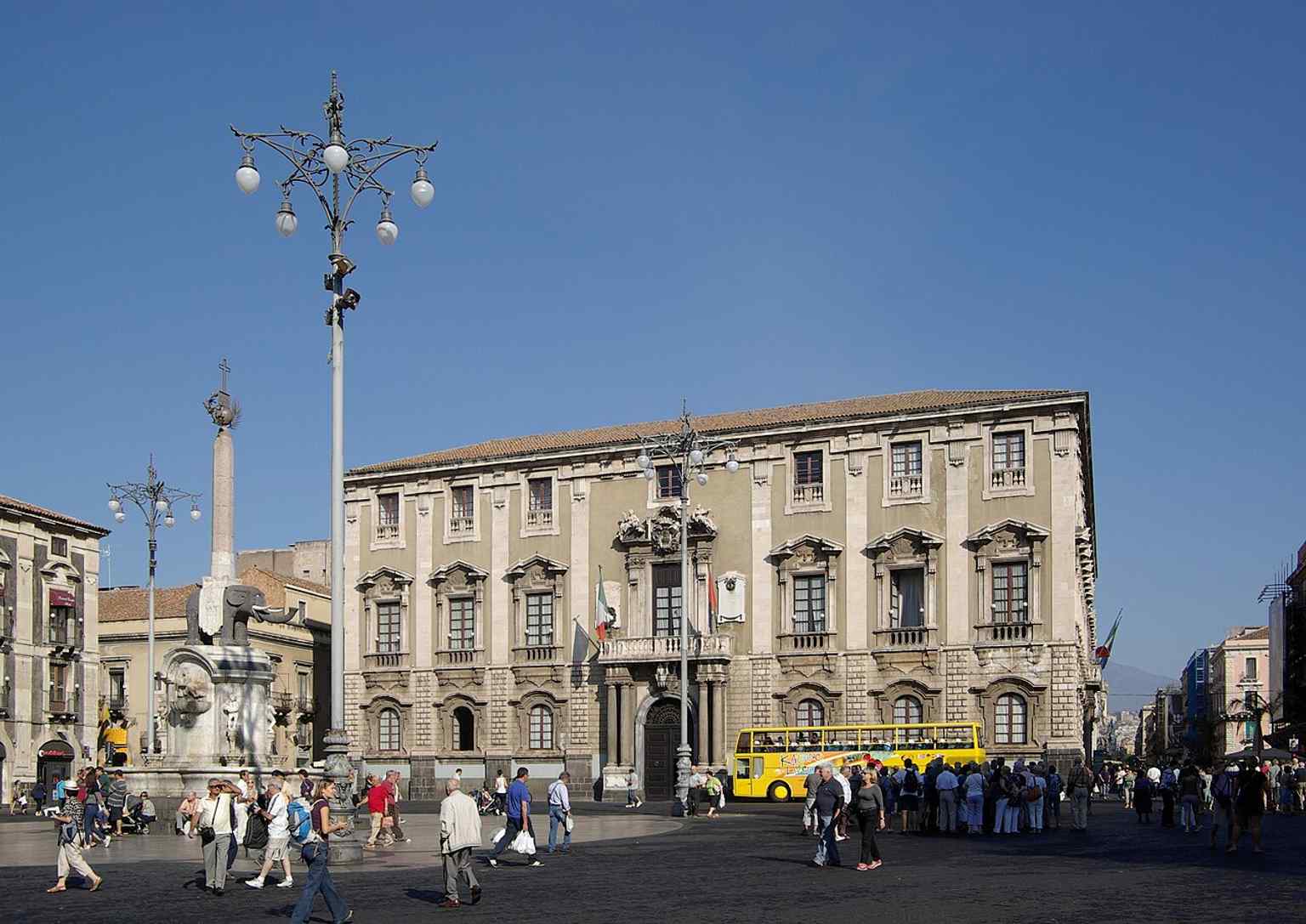
A detail of the elephant-themed civic setting in front of the palace, echoing the Liotru symbol that gave the building its name.Photo: Berthold Werner, Wikimedia Commons, CC BY-SA 3.0. Cropped & resized. 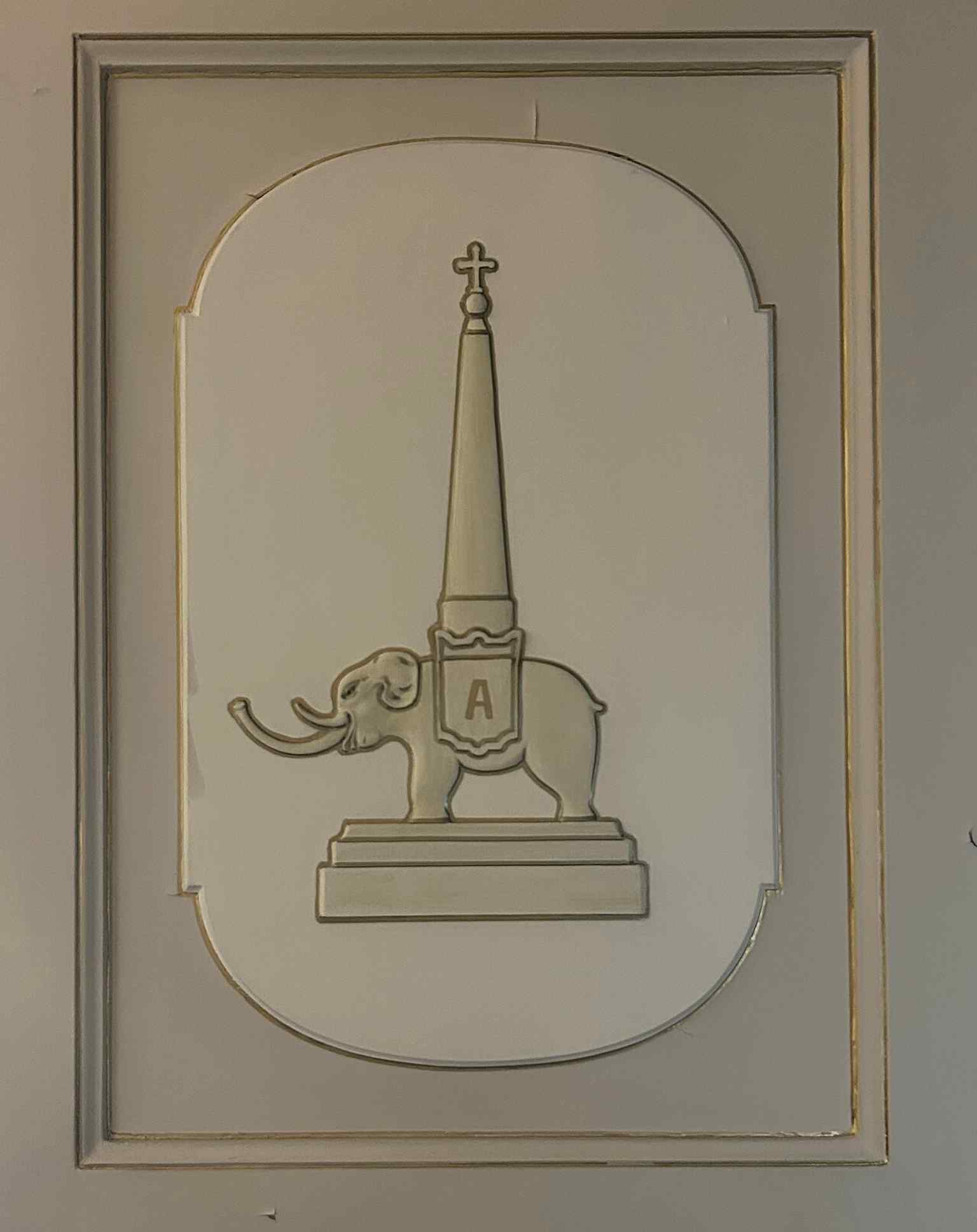
A carved elephant motif on a wooden door, a subtle reminder of the symbol that defines the palace’s identity.Photo: GiovanniPen, Wikimedia Commons, CC BY-SA 4.0. Cropped & resized. On your right, look for the theater’s dark lava-stone arches and broad semicircular sweep of seating, with fragments of old houses still clinging to the ancient curve like a…Read moreShow less
Open dedicated page →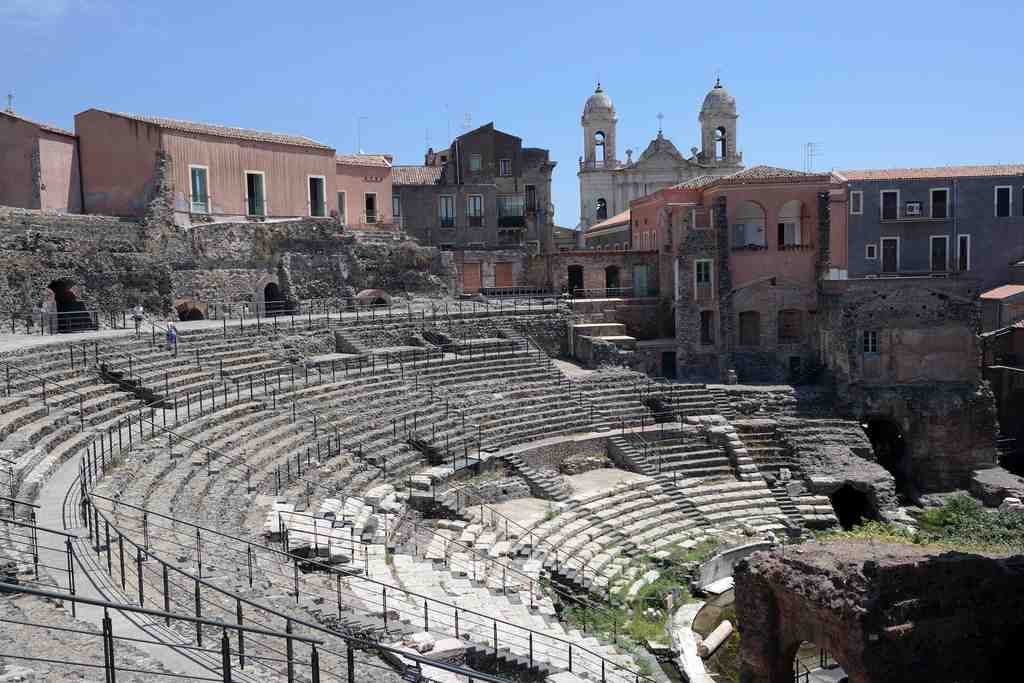
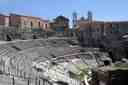
Greek-Roman Theatre of CataniaPhoto: Luca Aless, Wikimedia Commons, CC BY-SA 4.0. Cropped & resized. On your right, look for the theater’s dark lava-stone arches and broad semicircular sweep of seating, with fragments of old houses still clinging to the ancient curve like a second skin.
This place carries two lives at once. Catania still calls it Tiatru grecu, the Greek theater, even though most of what you see took shape in the second century under Rome. That old name survived because memory here is stubborn and affectionate. Long before archaeologists cleared these ruins, people believed the theater named in classical texts had to be this very one... the place where Alcibiades is said to have spoken in four fifteen B-C, trying to persuade the people of Katane to join Athens against Syracuse.
For a long time, nobody could prove it. Then excavators found something precious: massive sandstone blocks marked with Greek letters, part of an earlier theater with a more rectangular Hellenistic layout. Those remains likely belong to the Greek building from the fourth century B-C, and maybe even to the theater where Alcibiades made his pitch. I love that detail... not because it solves every mystery, but because it lets the argument stay alive.
Rome did not start from nothing here. After Augustus made Catania a Roman colony in the first century, builders repaired the older structure, replacing missing sandstone with squared lava-stone blocks and adding an early stage and seating. Then, in the second century, they turned it into something grand. They reshaped it into the sweeping half-circle you can still read from outside, enlarged the stage, added two heavy side towers with stairways, and dressed the front in costly marble. Inside, the orchestra - the round performance floor - stretched about twenty-two meters across and once gleamed with inlaid stone in circles set inside squares. The seating bowl, called the cavea, reached nearly ninety-eight meters wide, with twenty-one rows divided into wedges by black lava stairways. White marble seats against black stone steps... it must have looked astonishing. If you glance at the image in the app, you can catch that powerful curve of the ruin within the city fabric.
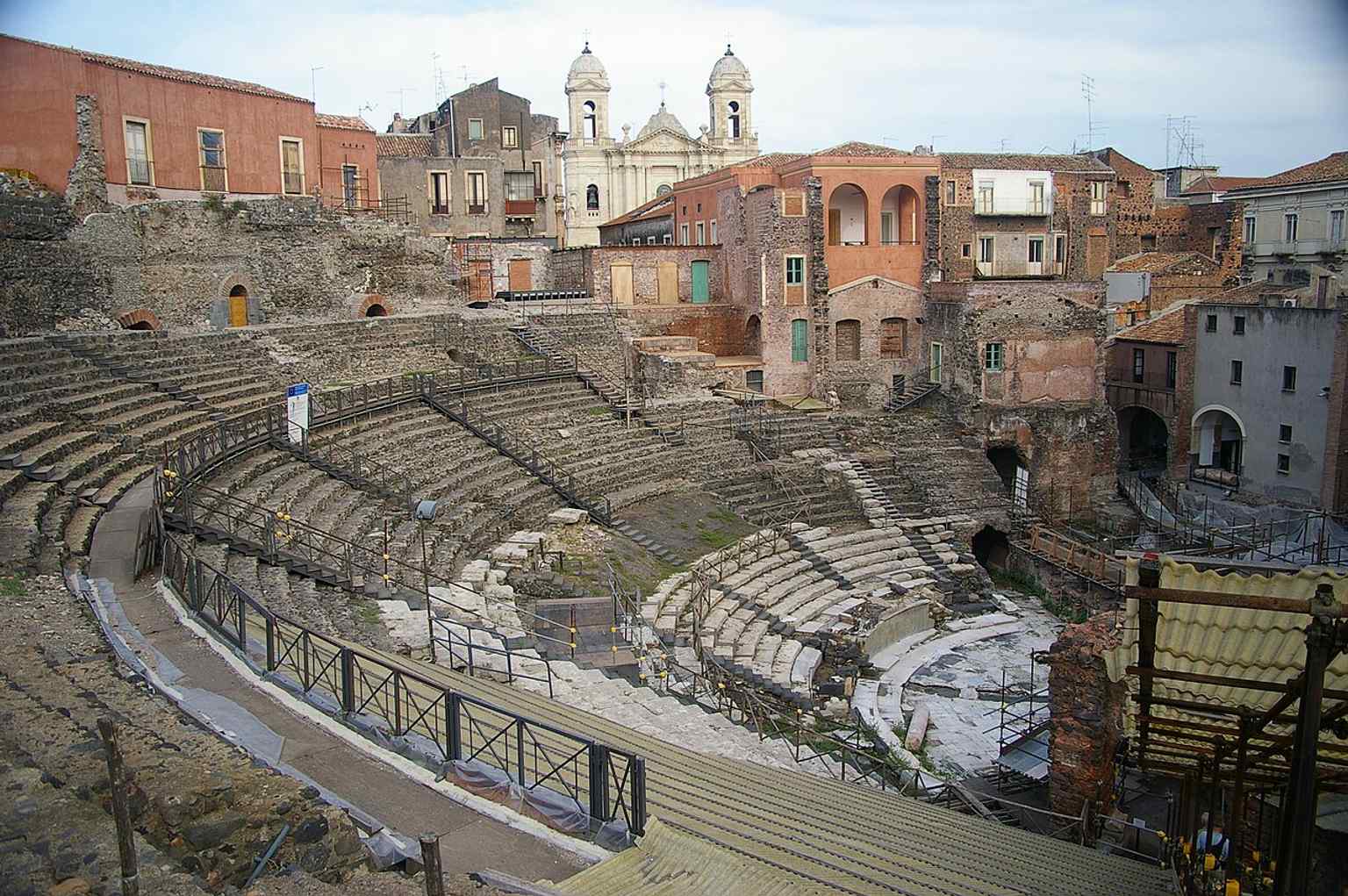
The ruined Greek-Roman Theatre of Catania, where Roman rebuilding in the 2nd century turned an older Greek site into the monument still visible today.Photo: Louisvhn, Wikimedia Commons, Public domain. Cropped & resized. And then came the long unmaking. In the eleventh century, Count Roger ordered workers to strip fine marble, columns, and even lava blocks from the theater to help build the Cathedral of Sant’Agata. So some of the beauty lost here quietly reappeared in the church we visited earlier. By the sixth and seventh centuries, the theater had already slipped out of use. Families settled into it. Corridors turned into rooms. The orchestra even served as a cattle butcher’s yard. Later, people filled the neighborhood with stories about buried treasure and secret tunnels running toward seats of power. Archaeologists never found those passages, but the tale says something true: generations knew this place held more than it showed.
What moves me most is how human the recovery was. Bombing in the Second World War tore open the crowded quarter above the theater, and archaeologist Guido Libertini used those painful gaps to uncover the ancient seats. Later teams kept excavating, but they did something gentler too: they chose to preserve some younger houses built over the monument, so the theater could tell the story of Roman Catania and of the families who lived here centuries later.
If you want to visit inside later, the site generally opens every day from nine in the morning to seven in the evening.
This theater feels less like a ruin than a city learning to remember itself.
When you’re ready, continue on toward the Church of Saint Francis of Assisi at the Immaculate Conception.
On your right, look for a pale limestone façade with a broad lava-stone staircase, three dark doorways, and two square towers topped with little domes and weather vanes. This…Read moreShow less
Open dedicated page →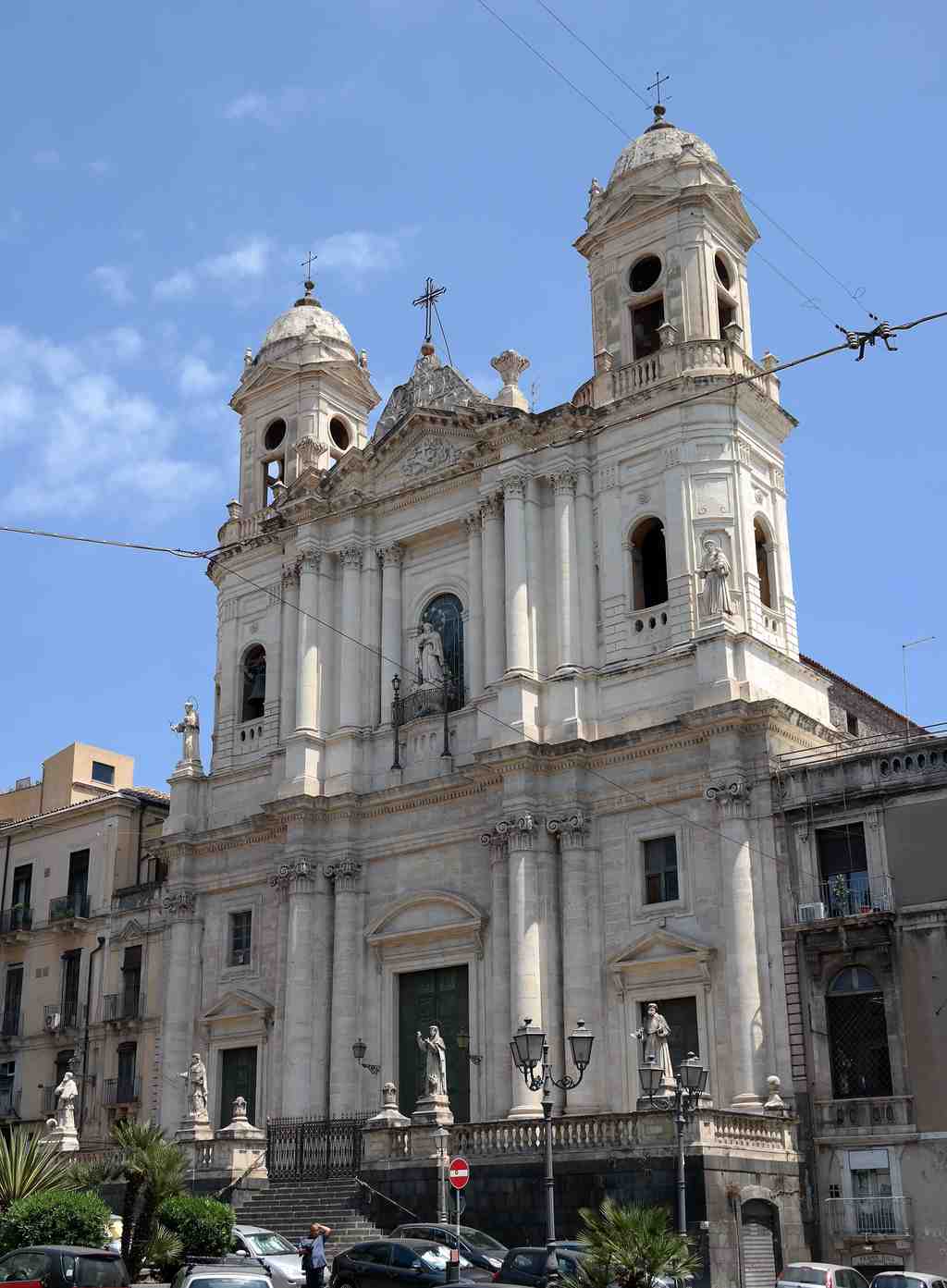
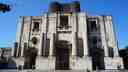
Church of St. Francis of Assisi at the Immaculate ConceptionPhoto: Luca Aless, Wikimedia Commons, CC BY-SA 4.0. Cropped & resized. On your right, look for a pale limestone façade with a broad lava-stone staircase, three dark doorways, and two square towers topped with little domes and weather vanes.
This church carries many lives inside it... and not all of them began as Christian stories. Long before the Franciscans arrived, this ground held a pagan temple dedicated to Demeter, the goddess of grain and fertility. So even at the very start, this was sacred ground, layered with prayer after prayer.
The Franciscans first settled in Catania in the mid-thirteenth century. Then, in thirteen twenty-nine, Queen Eleonora of Anjou gave this place its defining heartbeat. She sponsored a new church and convent as a vow of thanks to the Virgin Mary after the danger of an Etna eruption. And her story is tender and heartbreaking. She had lost her husband, King Frederick the Third, and two of her children. After that, she stepped away from courtly splendor, withdrew to a small villa near Belpasso, and gave her last years to prayer and penance.
When Eleonora died in thirteen forty-one, people carried her body here in solemn procession. For more than three centuries, her great marble tomb stood inside as a symbol of royal power and private sorrow held together. Then the earthquake of sixteen ninety-three struck Catania with terrifying force. The original Gothic church and convent fell. The roof crashed down onto Eleonora's tomb and shattered it. Only a fragment survived, and old local stories whisper that the friars hid her remains within the rebuilt walls to protect them.
If you want a fuller sense of the front, take a quick look at the image on your screen. You can really see how the rebuilt church presents itself: the staircase of Etna stone, the iron gate, the balustrade, and the statues standing guard above the pillars.
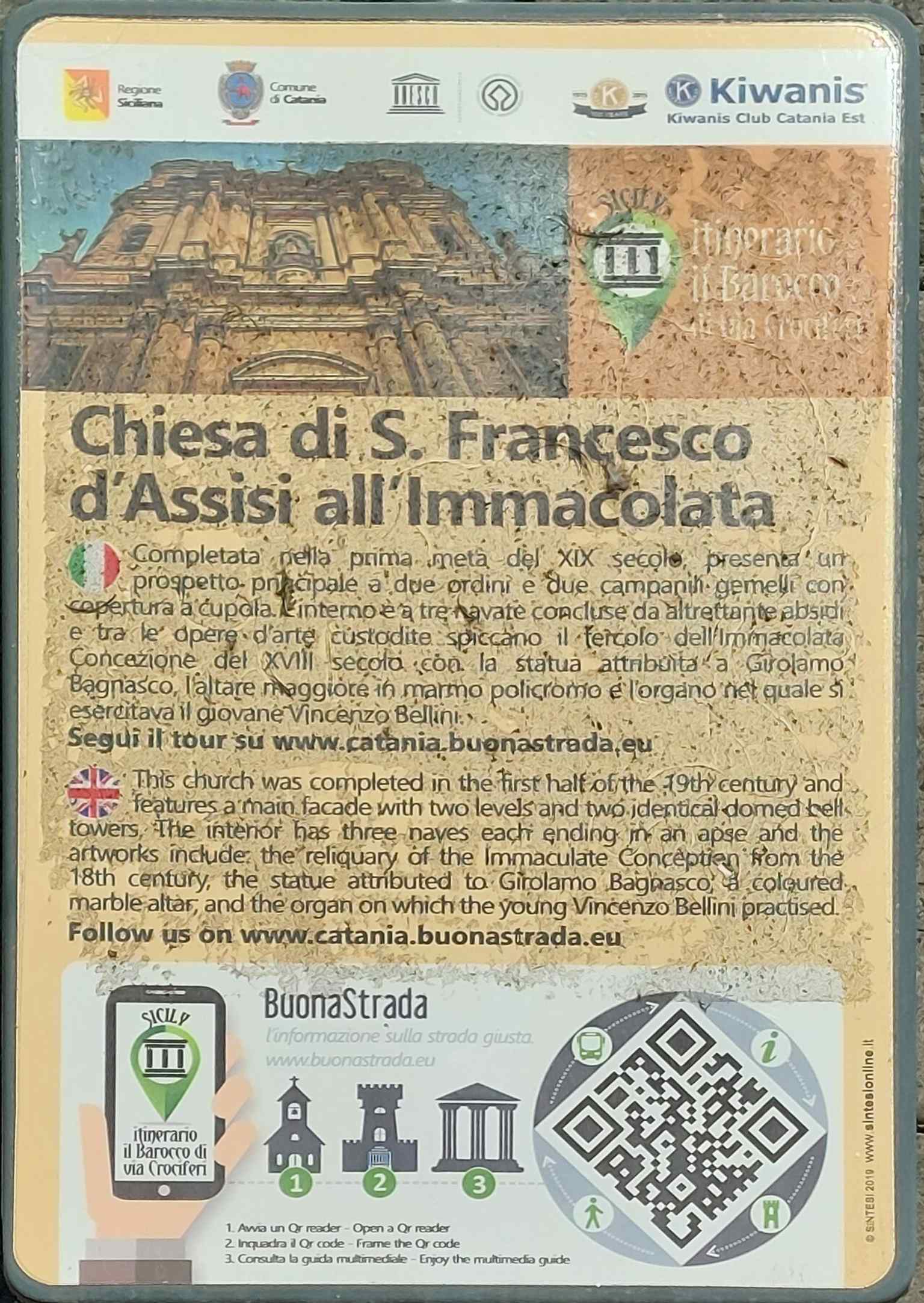
A clear front view of San Francesco all’Immacolata in the heart of Catania, the church rebuilt after the devastating 1693 earthquake.Photo: Ysogo, Wikimedia Commons, CC BY-SA 4.0. Cropped & resized. What you see now belongs to that long reconstruction, in the dramatic Baroque style Catania embraced after disaster. Notice how the church rises with dignity rather than haste: the rows of attached half-columns, the three façade statues, and the pediment, the triangular crown at the top, carved with the symbols of Saint Francis. The whole exterior feels like a city telling itself, we are still here.
Inside, the devotion grows even deeper. Around sixteen twenty-four, Catania's senate named the Immaculate Conception the city's co-patron beside Saint Agatha. The Immaculate Conception means Mary's conception without original sin, a belief held very dearly in Catholic tradition. A lay brotherhood called the Confraternity of the Slaves of the Immaculate paid for major feasts here and gained burial rights in the crypt below, placing themselves completely under Mary's protection.
And there is one more intimate thread. If you peek at the interior photo in the app, imagine a child hearing his future in that space. Young Vincenzo Bellini, who lived nearby, practiced on the church's gilded wooden organ here before Europe knew his name. Before the opera houses, there was this church... this room... this beginning.
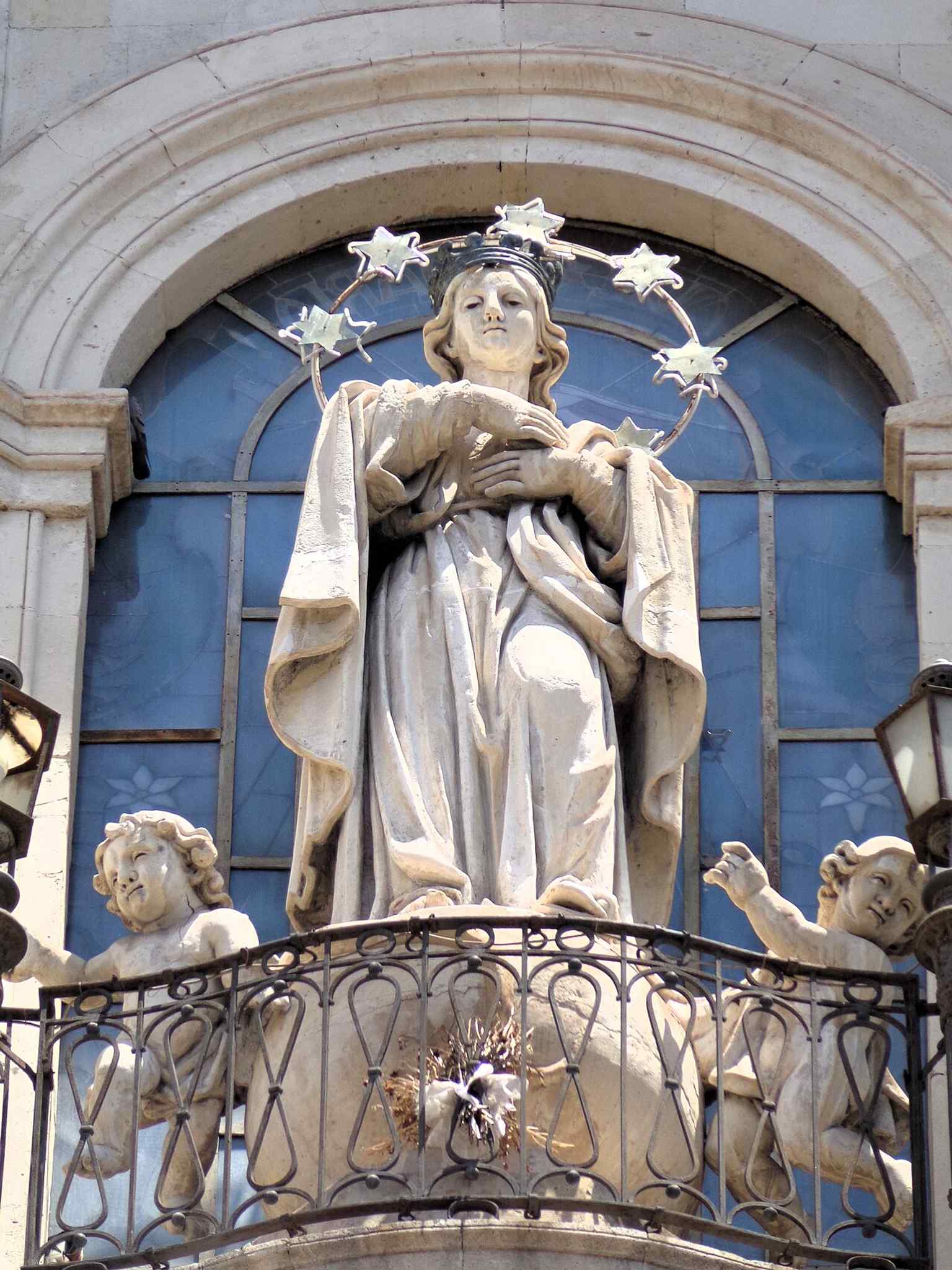
An interior view that captures the nave and the church’s richly decorated baroque atmosphere, where the Franciscan story unfolds.Photo: Effems, Wikimedia Commons, CC BY-SA 4.0. Cropped & resized. This church gathers Catania's grief, faith, and music into one faithful body of stone.
When you're ready, continue on toward the Jesuit College.
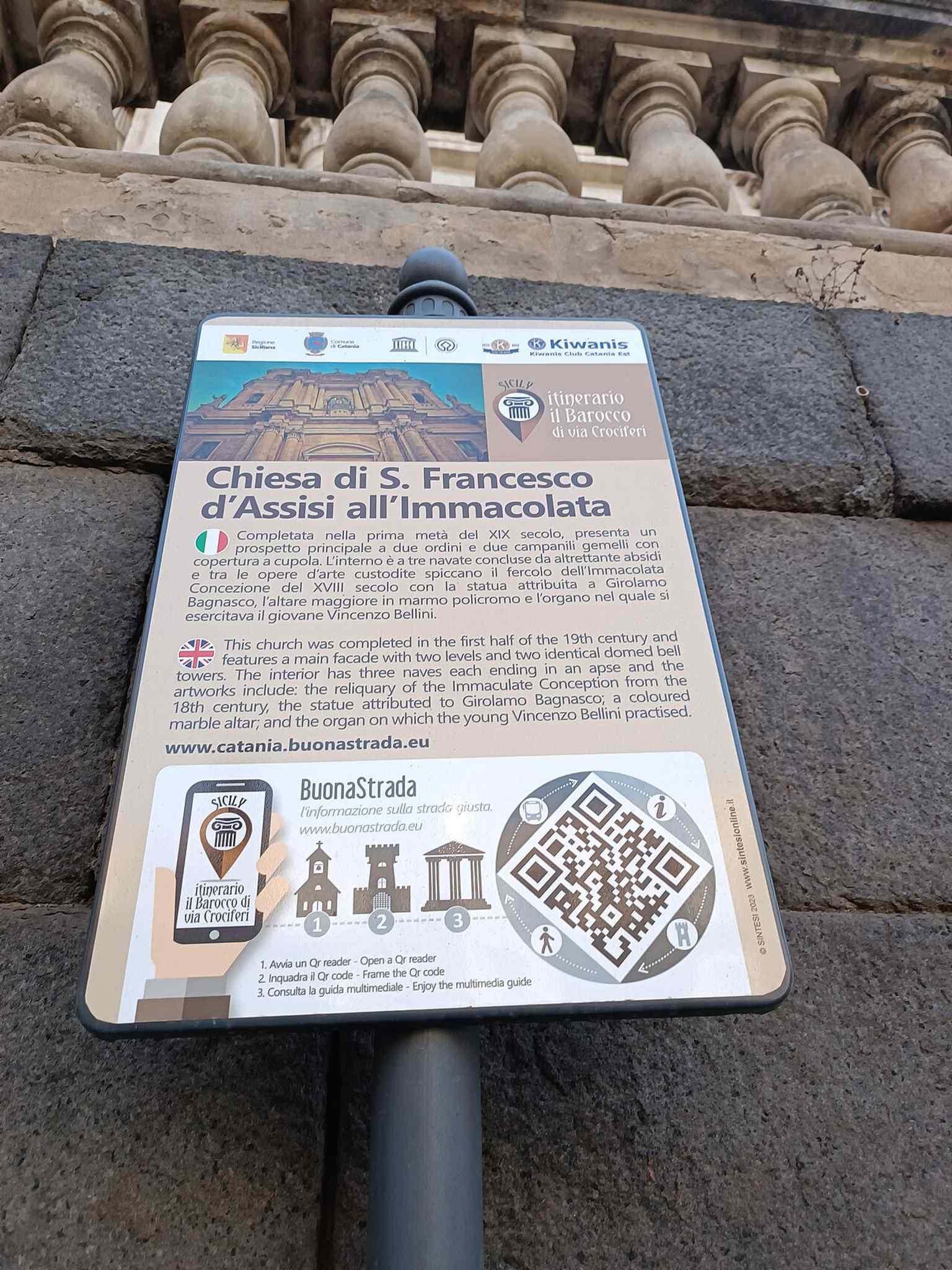
The church façade in full, showing the late-Baroque reconstruction that replaced the original medieval building lost in the Val di Noto quake.Photo: Viaggiamocela, Wikimedia Commons, CC BY-SA 4.0. Cropped & resized. 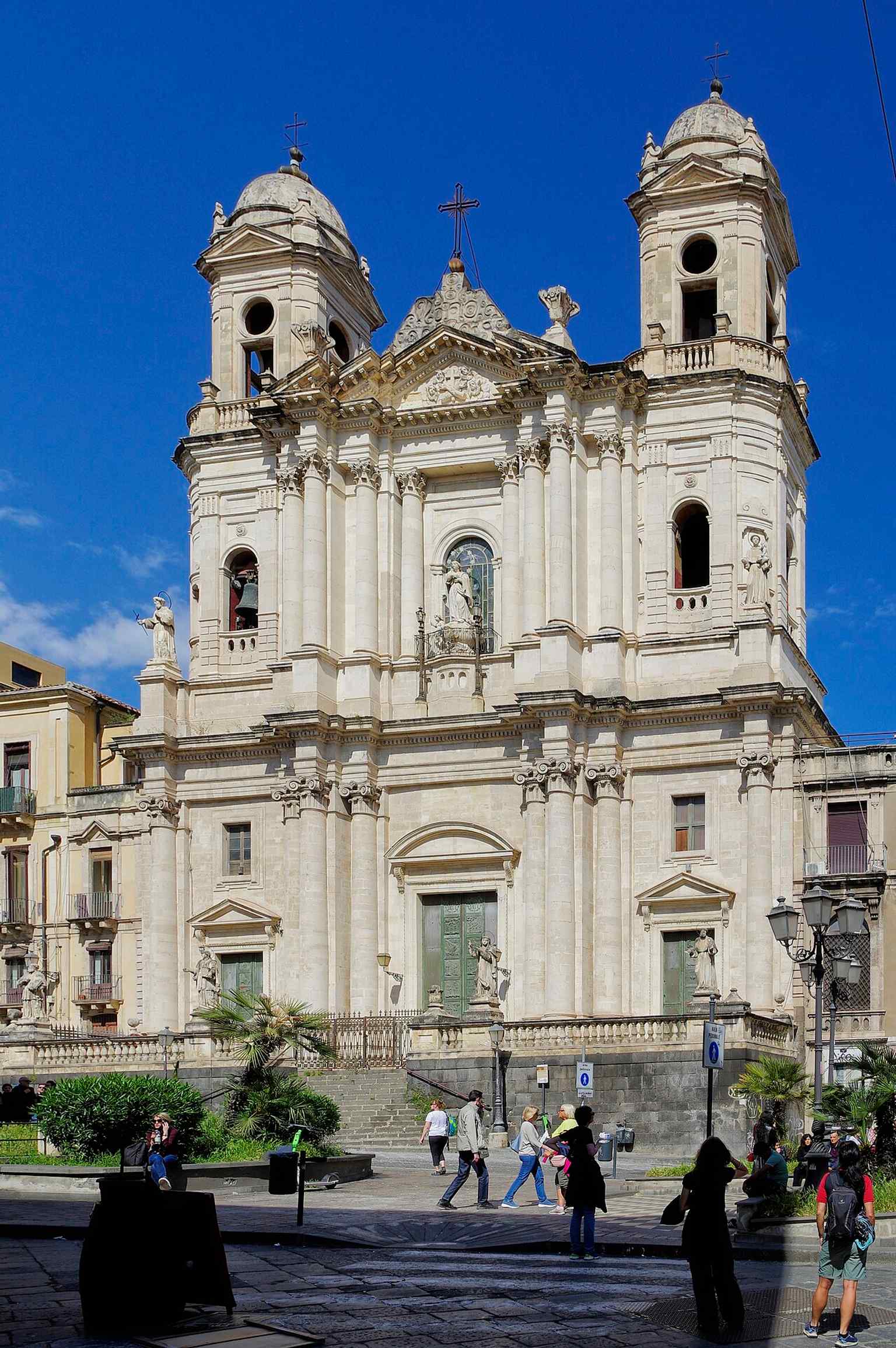
A dramatic black-and-white exterior view that emphasizes the monumental façade and its twin towers over Piazza San Francesco.Photo: Berthold Werner, Wikimedia Commons, CC BY-SA 4.0. Cropped & resized. 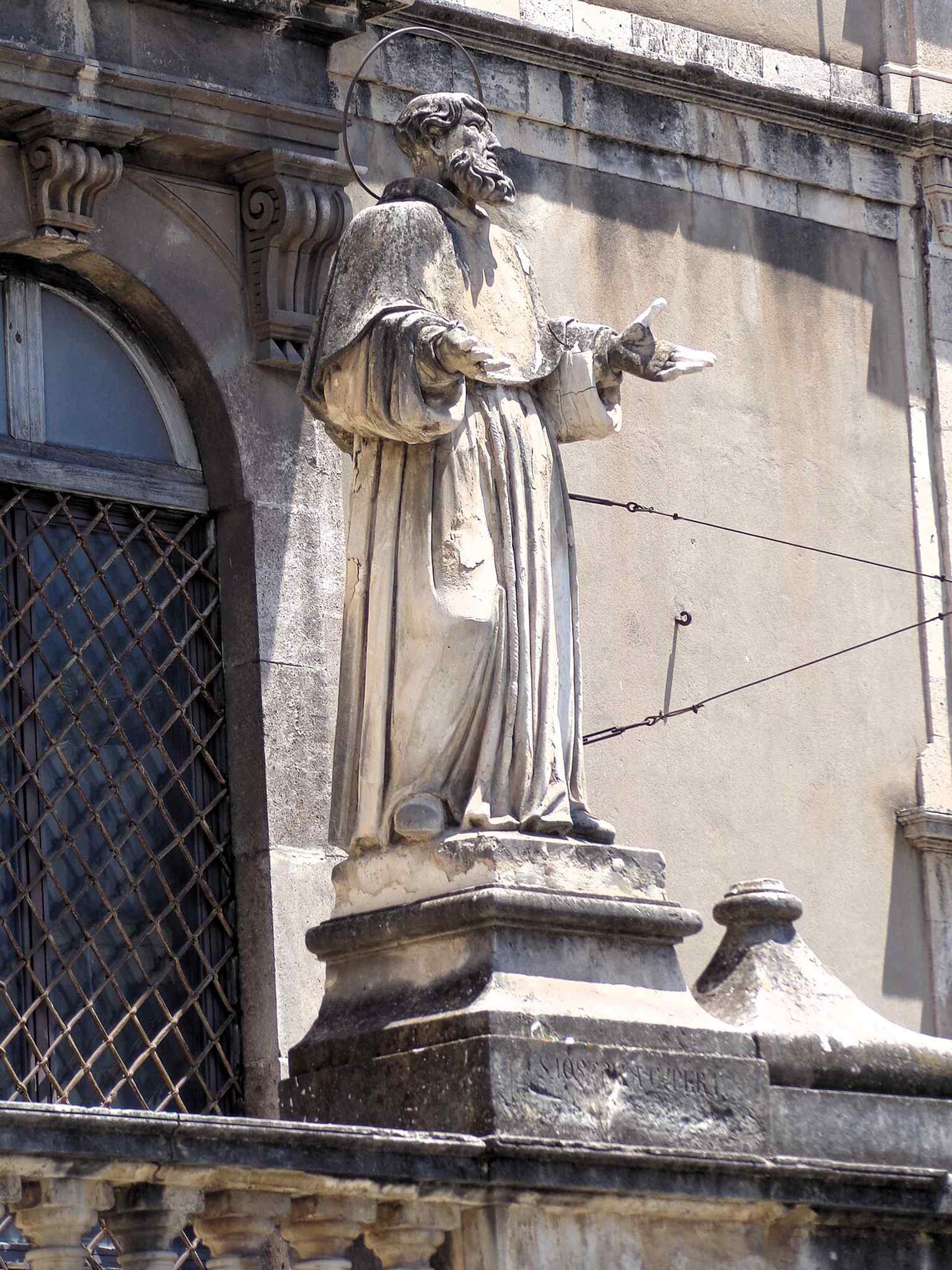
Another sharp exterior angle on the church, useful for showing its broad façade and urban setting in central Catania.Photo: Effems, Wikimedia Commons, CC BY-SA 4.0. Cropped & resized. 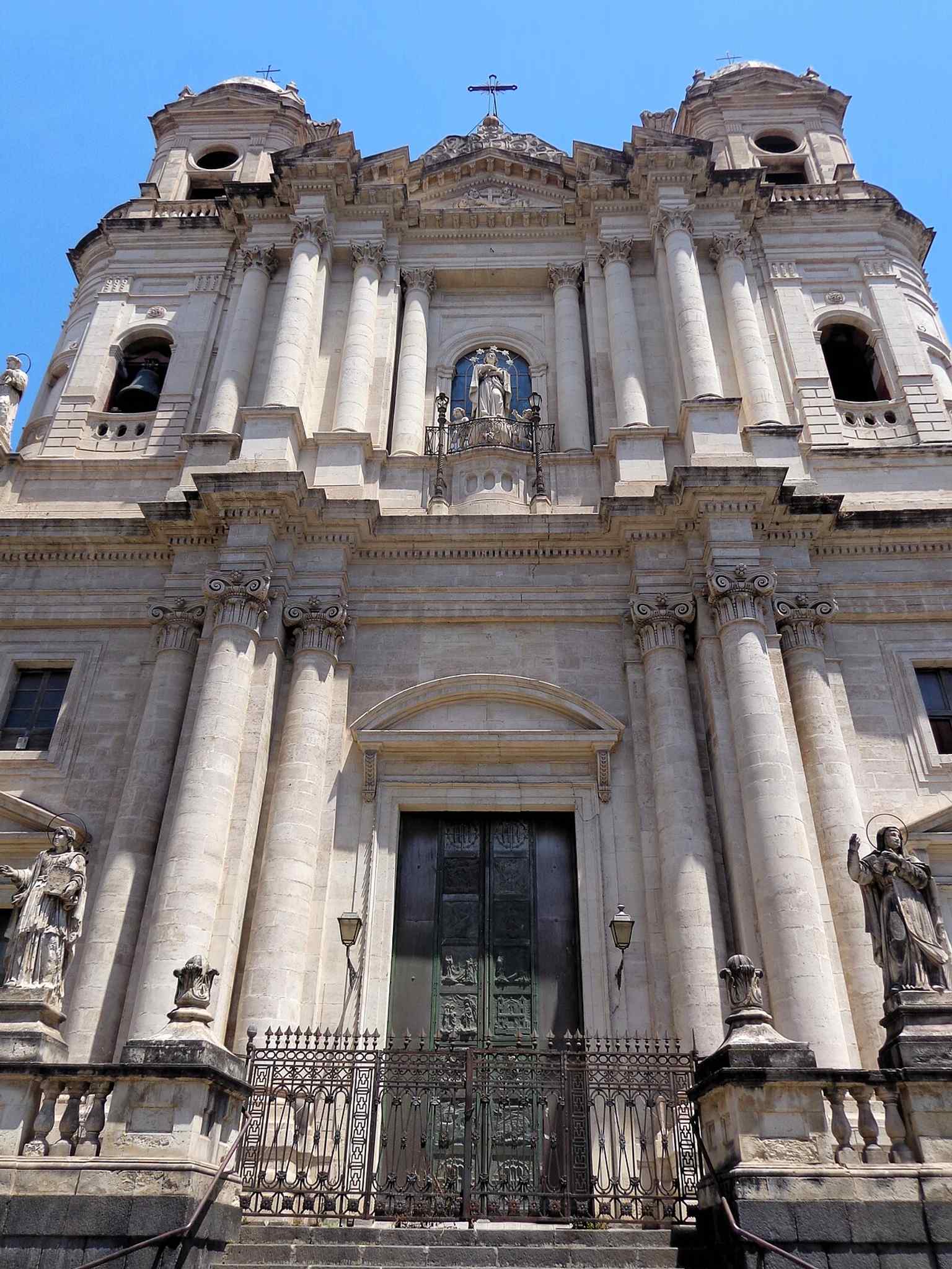
The side view of the church helps reveal the long basilica body behind the ornate front, reflecting the layered rebuilds over centuries.Photo: Effems, Wikimedia Commons, CC BY-SA 4.0. Cropped & resized. 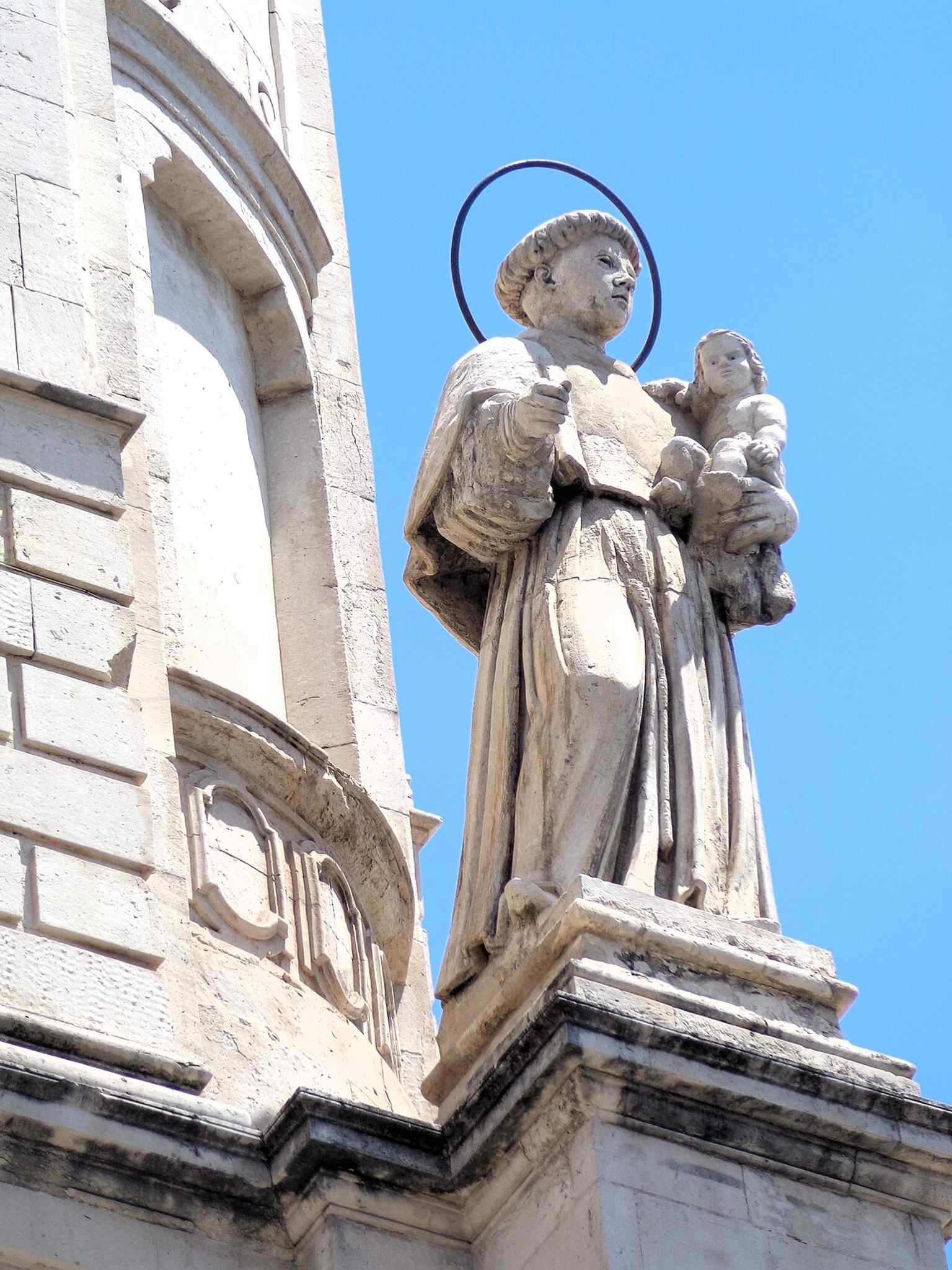
Inside the basilica: a good view for explaining the three-nave layout and the sculpted, devotional interior spaces.Photo: Effems, Wikimedia Commons, CC BY-SA 4.0. Cropped & resized. 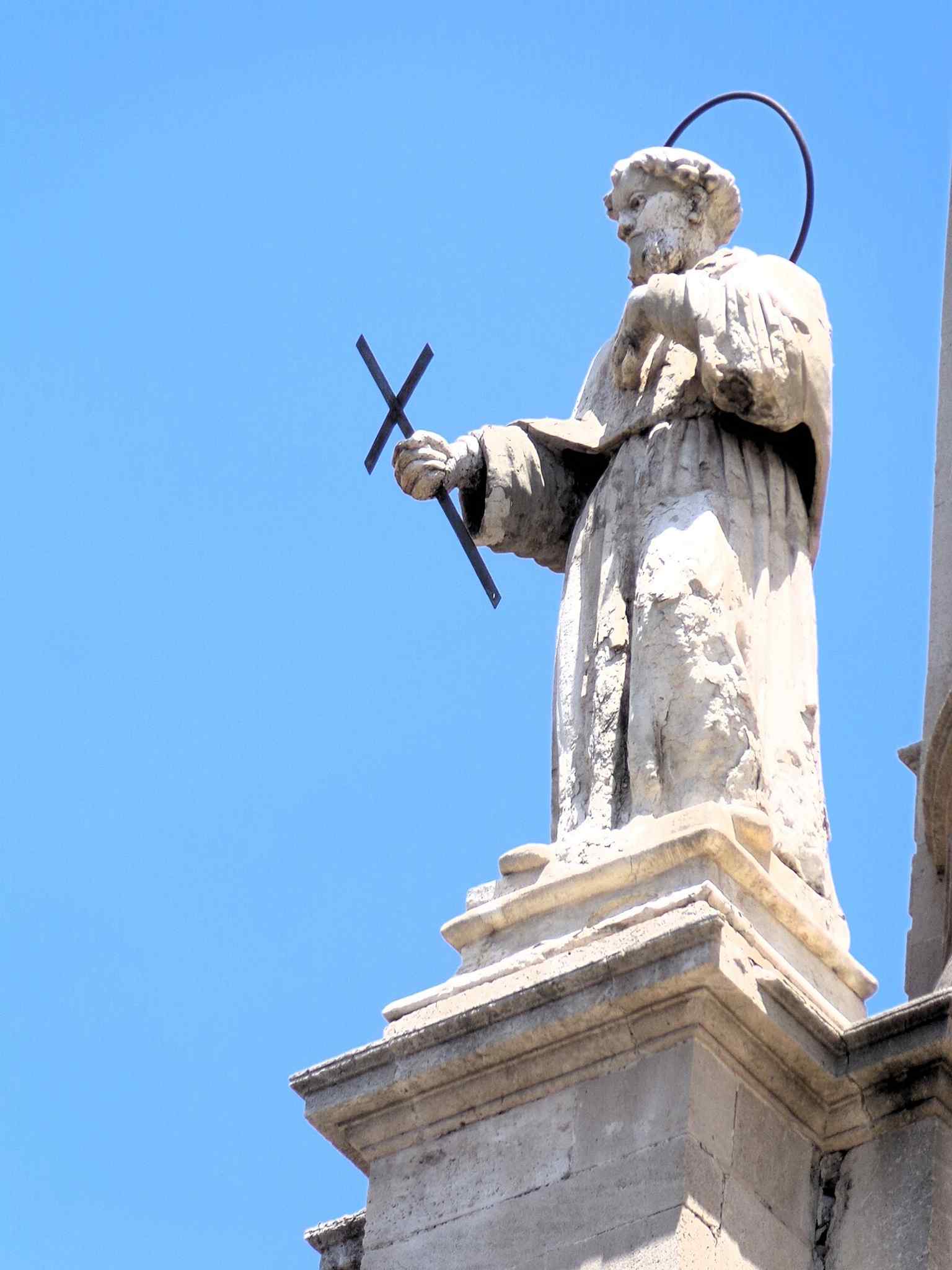
A closer interior detail, ideal for highlighting the church’s decorative program and the craftsmanship of its altars and stuccoes.Photo: Effems, Wikimedia Commons, CC BY-SA 4.0. Cropped & resized. 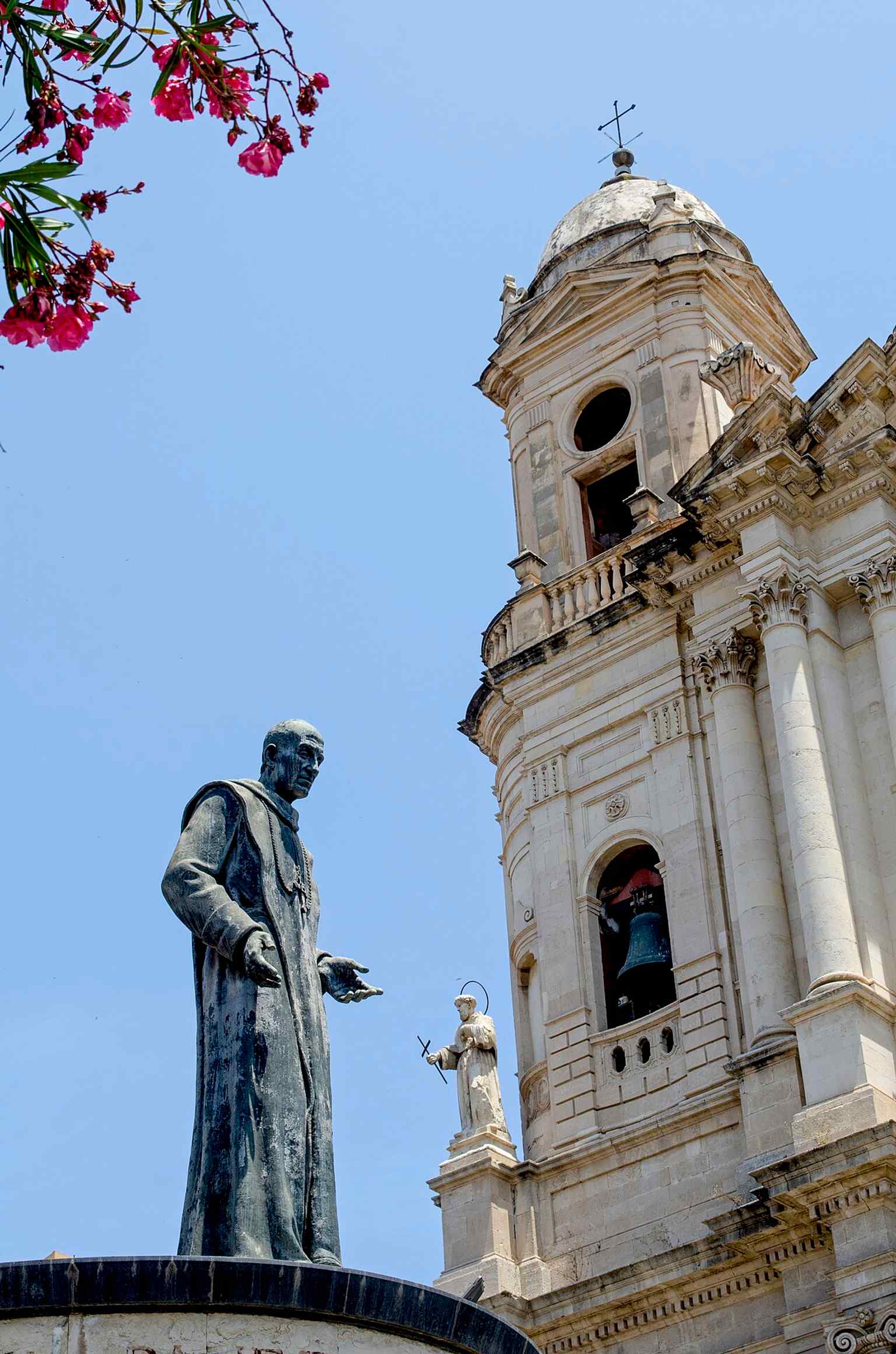
An interior perspective that can help connect the church to its famous devotion to the Immaculate Conception and its historic cult.Photo: Effems, Wikimedia Commons, CC BY-SA 4.0. Cropped & resized. 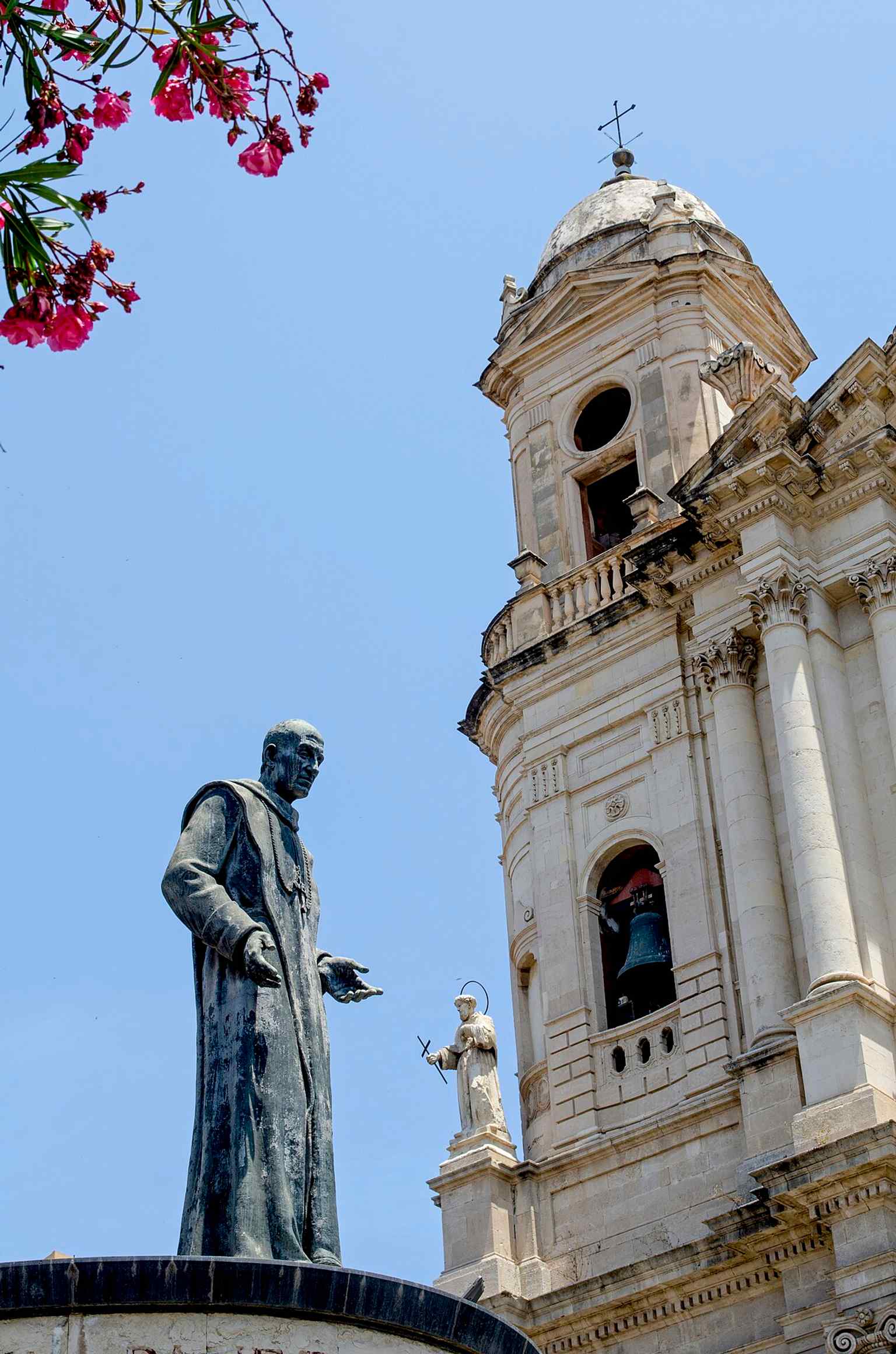
The church together with the monument to Cardinal Giuseppe Benedetto Dusmet, adding a civic-religious layer to the site’s public square.Photo: Mauripri, Wikimedia Commons, CC BY-SA 4.0. Cropped & resized. On your left, look for a pale stone Baroque façade set above a short staircase, with tall rectangular windows and a broad central entrance that gives the whole building a solemn,…Read moreShow less
Open dedicated page →On your left, look for a pale stone Baroque façade set above a short staircase, with tall rectangular windows and a broad central entrance that gives the whole building a solemn, palace-like face.
This is the Jesuit College, one of the grandest homes the Society of Jesus ever created in Sicily. It stands on Via dei Crociferi like a careful, disciplined host... elegant, reserved, and a little proud. Since two thousand and two, UNESCO, the United Nations Educational, Scientific and Cultural Organization, has recognized it as part of the late Baroque towns of the Val di Noto.
Its story begins with disappointment. After the terrible earthquake of sixteen ninety-three, the Jesuits hoped to rebuild in a more prestigious part of the city, near what is now Piazza dell'Università. They had already bought houses there. But private citizens challenged boundaries, lawsuits multiplied, and the whole plan collapsed. So Father Francesco Maria Bonincontro had to give up that dream and return here, to the older site in Via dei Crociferi, which felt like a painful compromise.
And yet... what rose from that setback became extraordinary.
From the late sixteen nineties until about seventeen fifty-seven, master builders and architects worked here in layers across four decades. Alonzo di Benedetto guided early foundations. Angelo Italia shaped the church façade next door and likely set the college's overall scheme. Later came Stefano Masuccio, Francesco Battaglia, and others whose names survive only faintly in records. That long timeline matters, because this building is not the vision of one mind. It is a conversation across generations.
The image in your app shows the ceremonial front and the stairs lifting you toward it. But the real secret lies inside: four courtyards, including a cloister, an inner court for quiet walking, with a covered gallery carried by columns. One courtyard once had a floor of black and white pebbles laid in stripes, in a style loved by the Roman architect Borromini. Another image on your screen gives you a hint of those details.
There is a tender little twist in the story too. When the Cathedral of Sant'Agata closed for restoration between seventeen ninety-five and the early eighteen hundreds, major religious ceremonies moved to the neighboring Church of San Francesco Borgia, part of this same Jesuit complex. Because of that accident of timing, the composer Vincenzo Bellini, Catania's beloved son, received baptism here in eighteen oh one, in the shadow of this college.
Then the mood changed. In seventeen sixty-seven, the Bourbon rulers expelled the Jesuits from Sicily. Officials seized the building and even confiscated its great library, one of the richest in the city. Thankfully, the books survived. In seventeen seventy-nine, royal authorities used them to form the core of a new academic library, and many of those volumes still live on in Catania's library collections.
After that, the college kept serving the city in new ways. It became a school for trades, then in eighteen thirty-four a charitable hospice for poor boys and abandoned children. Some learned crafts here. Some worked in an in-house print shop. Some even played in a musical band hired for public ceremonies. In the twentieth century, from nineteen sixty-eight to two thousand and nine, art students filled these rooms instead, giving the old Jesuit discipline a new creative pulse.
So this façade is more than beautiful stone; it is a vessel for prayer, teaching, loss, music, books, and stubborn civic memory.
When you're ready, continue on toward the Rotonda Thermal Baths, where Catania's older layers begin to show through again.
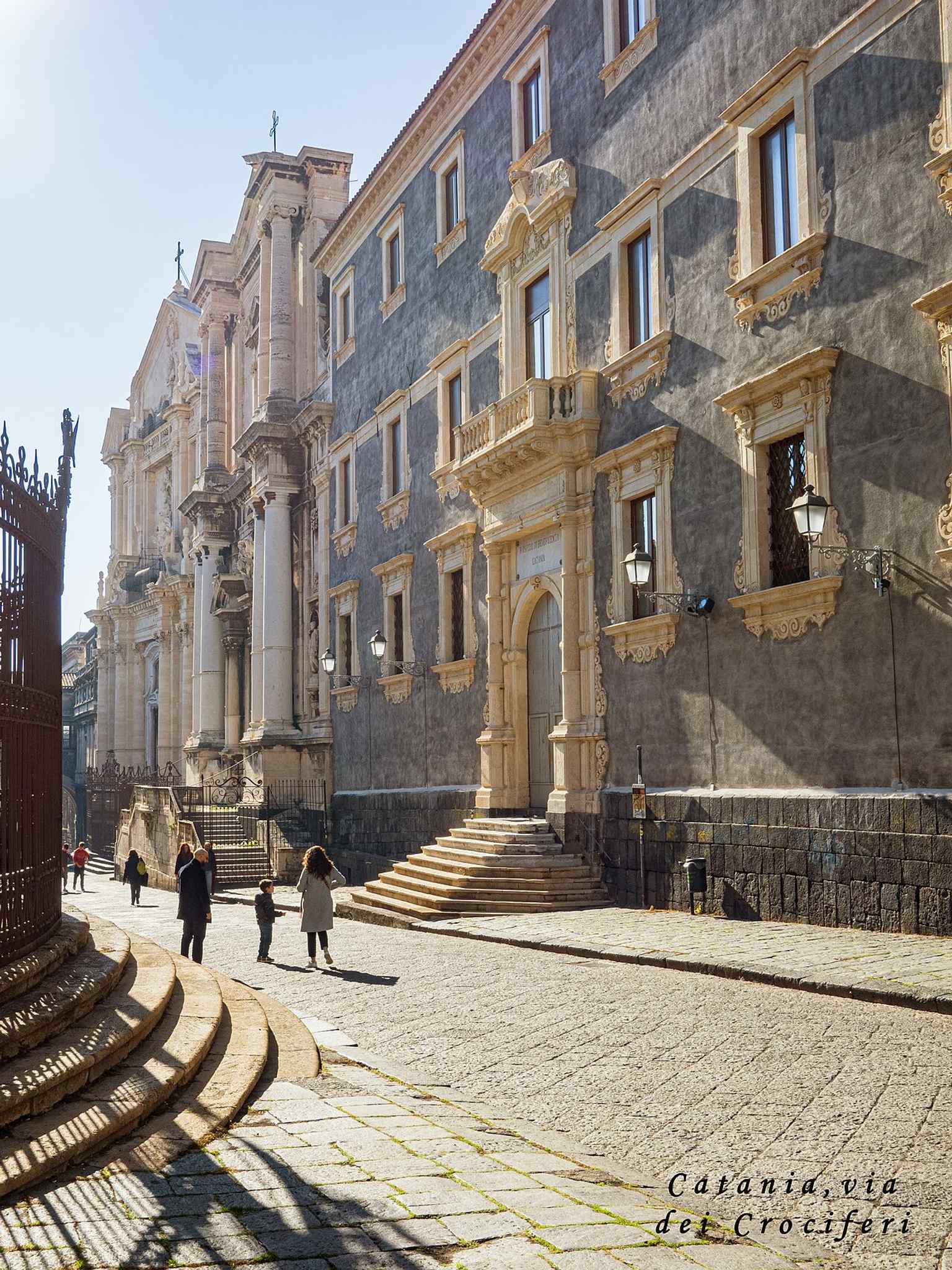
A wide view of Via Crociferi showing the Jesuit College among Catania’s UNESCO-listed late Baroque monuments.Photo: Pasquale Relvini, Wikimedia Commons, CC BY-SA 4.0. Cropped & resized. 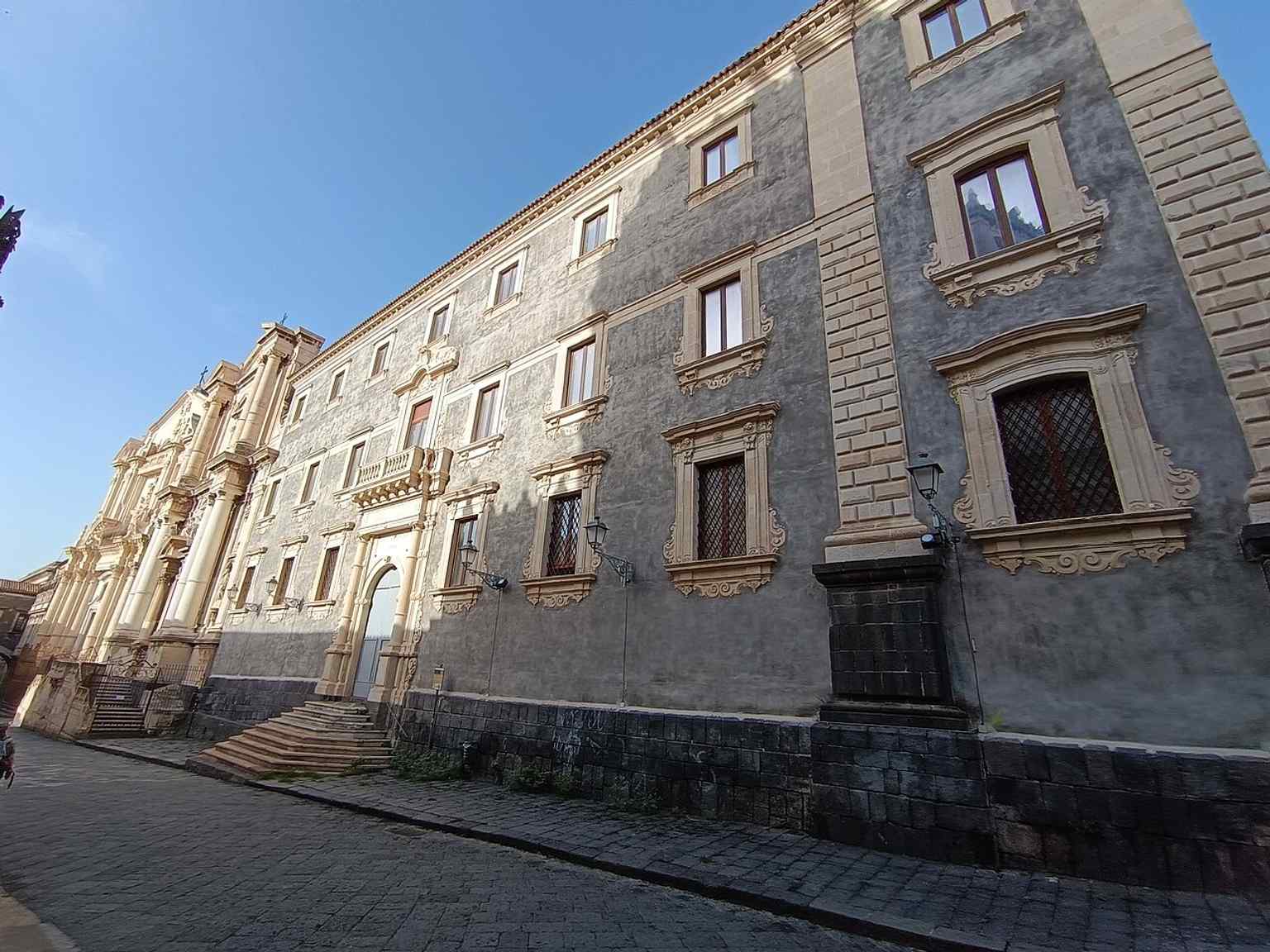
A closer look at the Collegio dei Gesuiti, the 18th-century complex that later housed Catania’s School of Arts.Photo: Viaggiamocela, Wikimedia Commons, CC BY-SA 4.0. Cropped & resized. 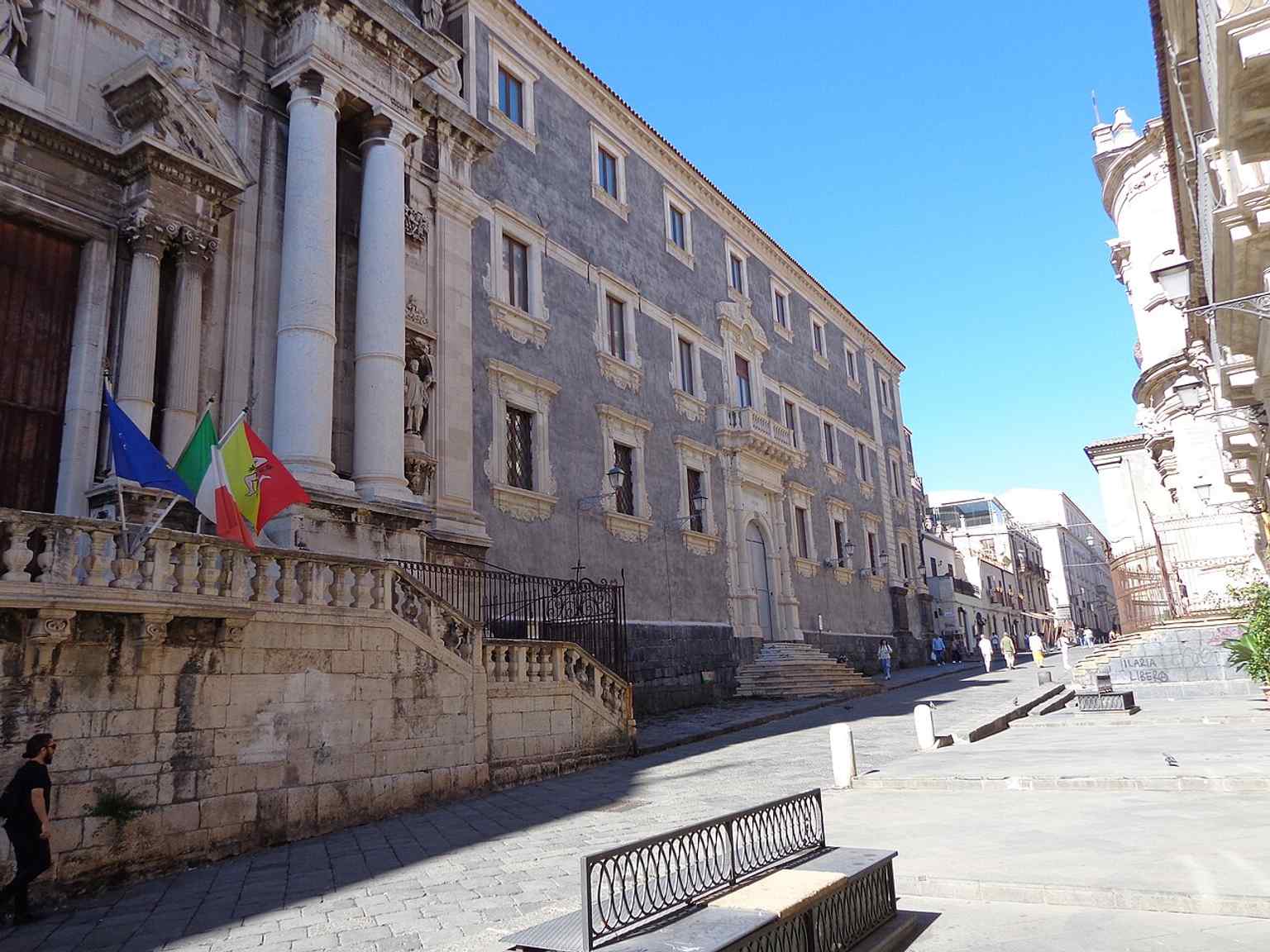
Architectural details of the Jesuit College, part of the sprawling complex with courtyards and cloisters mentioned in the source text.Photo: Viaggiamocela, Wikimedia Commons, CC BY-SA 4.0. Cropped & resized. 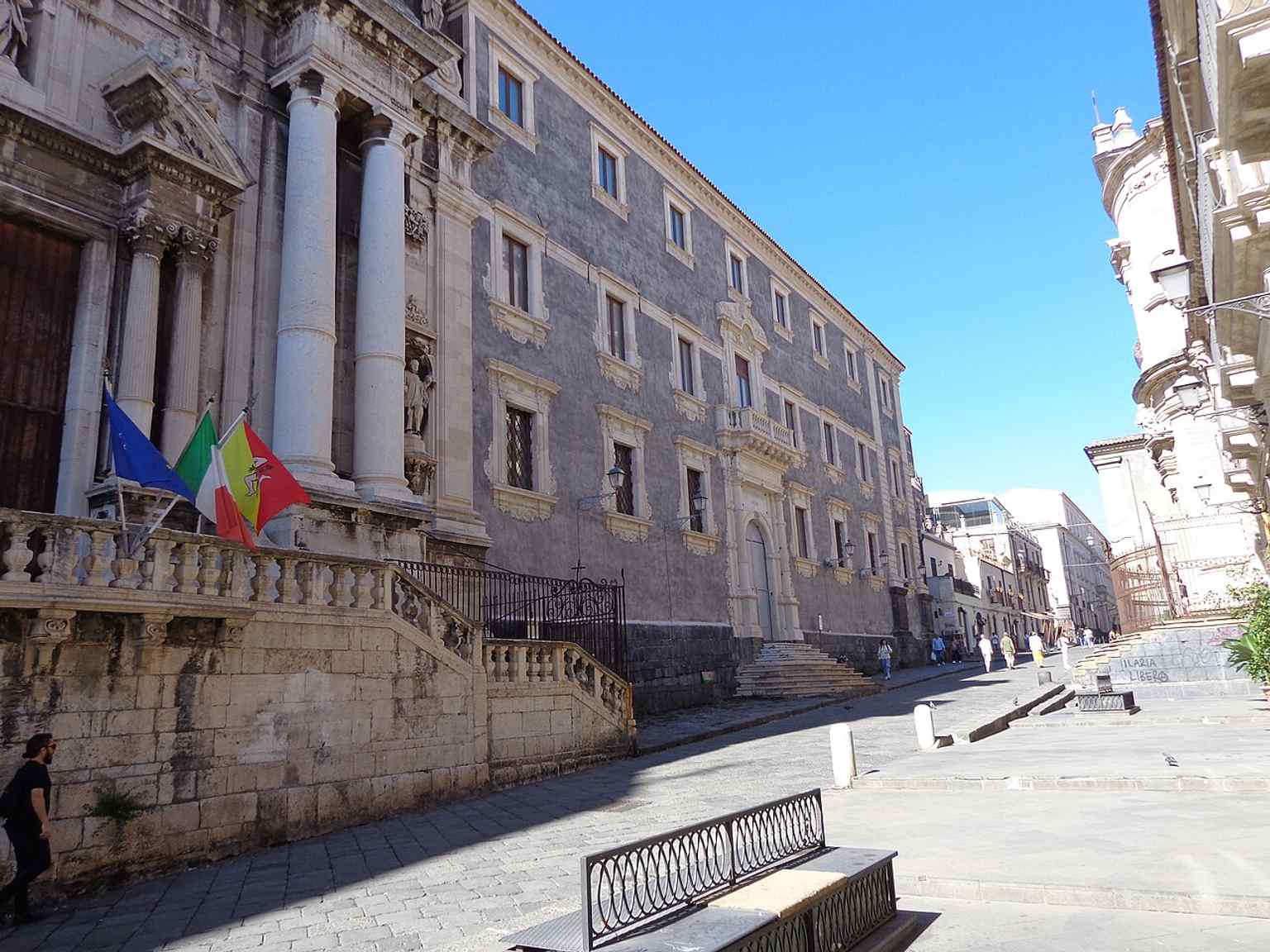
San Francesco Borgia beside the Jesuit College — this neighboring church is part of the same Jesuit complex where Vincenzo Bellini was baptized.Photo: Effems, Wikimedia Commons, CC BY-SA 4.0. Cropped & resized. Look to your right for a square stone building wrapped around a great round dome, with a dark lava-stone pointed portal that hints at many different lives. This place began as a…Read moreShow less
Open dedicated page →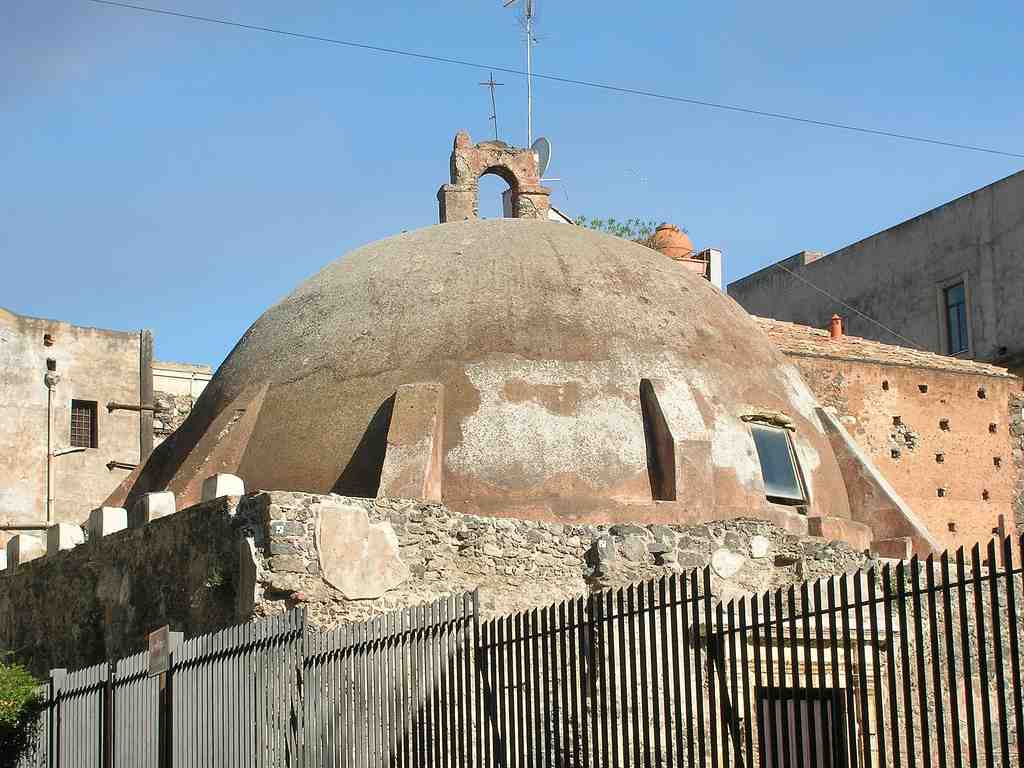
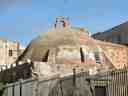
Round Thermal BathsPhoto: Effems, Wikimedia Commons, CC0. Cropped & resized. Look to your right for a square stone building wrapped around a great round dome, with a dark lava-stone pointed portal that hints at many different lives.
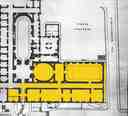
This place began as a Roman bath complex in the first and second centuries after Christ... one of the many bathhouses that served ancient Catania near the theater district. Under your feet and around these walls, Romans once moved from cool rooms to warm ones to hot ones. Archaeologists found traces of heated floors here - little supports that held up the pavement so hot air could pass beneath it - and even scraps of mosaic.
Then the story turned. Near the end of the sixth century, in the Byzantine age, people reshaped the ruined baths into a church: Santa Maria della Rotonda. That name, Rotonda, comes from the building’s unusual heart - a circular hall set inside a square shell, all covered by a broad dome. It feels almost like two buildings learning to live inside one body.
For centuries, Catania loved a grander legend. Many locals insisted this was an ancient Pantheon, even a model for the famous one in Rome. Some went further and said Saint Peter himself came here in the year forty-four and consecrated it to the Virgin Mary. None of that turned out to be true, but the legend tells you something tender and very human: the city wanted this place to feel sacred, ancient, and deeply its own.
History left harder marks too. After the earthquake of eleven sixty-nine, builders changed the church’s direction and opened the Gothic doorway in lava stone. In the sixteenth century, they shifted the orientation again and added a Renaissance portal in limestone. Around the church, among the old bath ruins, a cemetery grew and stayed in use for centuries. Imagine that change: a place once devoted to bathing, conversation, and the care of the living became, little by little, a resting place for the dead.
In nineteen forty-three, bombing damaged this site. A few years later, the archaeologist Guido Libertini tried to uncover the Roman layers, but he did it brutally. Workers lowered floors, stripped church fittings, and even destroyed many frescoes to expose the ancient walls. Later excavations, especially from two thousand and four to two thousand and eight, and again in two thousand and fifteen, found tombs, nine bath rooms, a great water reservoir, and the old Roman entrance court. Since twenty sixteen, local volunteers have helped keep the site open and alive again.
If you go inside during opening hours, it is usually closed on Monday, open from nine to five Tuesday through Saturday, and from nine to one on Sunday.
The Rotonda holds Roman comfort, Byzantine prayer, medieval burial, and modern rescue all in one quiet embrace.
When you’re ready, continue on toward San Nicolò l’Arena, where Catania’s scale turns grand again.
On your left, look for a huge pale-stone church with a broad unfinished facade, three tall portals, and eight massive columns that stop abruptly halfway up. San Nicolò l’Arena…Read moreShow less
Open dedicated page →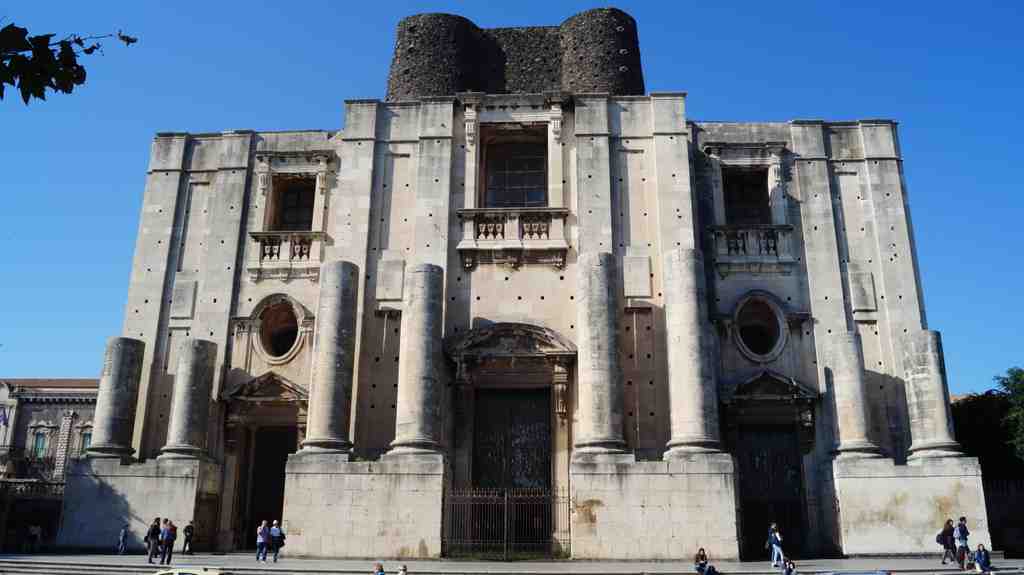
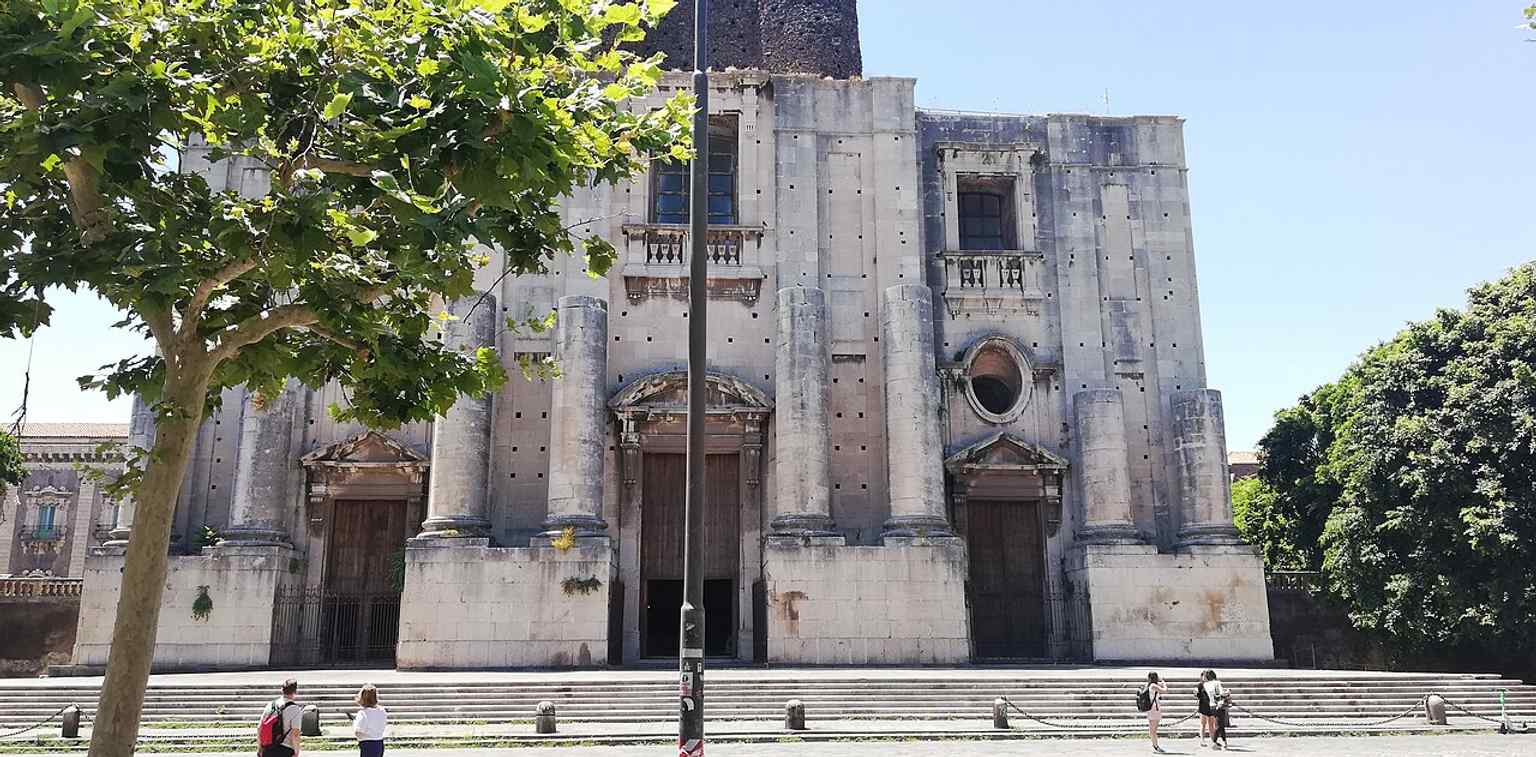
Church of San Nicolò l'ArenaPhoto: Nicolò Arena, Wikimedia Commons, CC BY-SA 4.0. Cropped & resized. On your left, look for a huge pale-stone church with a broad unfinished facade, three tall portals, and eight massive columns that stop abruptly halfway up.
San Nicolò l’Arena has a way of feeling unfinished and immense at the same time... and that is exactly its story. This is the largest church in Sicily, spreading over more than one thousand five hundred square meters, with a dome that rises to about sixty-six meters. It belongs to the Benedictines, the monks who came down from Nicolosi and carried with them both their devotion to Saint Nicholas of Bari and a name tied to the land itself: arena, or rena, the reddish sand that marked their earlier home.
Their move into Catania came from fear as much as faith. In the sixteen hundreds, eruptions from Etna and raids in the countryside pushed the monks to seek safety inside the city walls. They opened an earlier church here in the late sixteen hundreds, but then Etna answered again. In sixteen sixty-nine, lava pushed into the western side of Catania, swallowed the Bastion of Tindaro, and overwhelmed the original church. The heat burned the earth so fiercely that it seemed to return that same red sand to the monks, as if the mountain had written their old name back onto the land.
So they began again. In sixteen eighty-seven, the Roman architect Giovanni Battista Contini drew up a new church, grand and deliberate, with Saint Peter’s in Rome as a model. He imagined a Latin cross plan - that means a long main body crossed by shorter arms - three aisles, a great dome, and space enough for crowds of pilgrims. Then disaster interrupted them again. The earthquake of sixteen ninety-three shattered southeastern Sicily, and for nearly thirty years the monks argued over whether to rebuild here or move everything to Montevergine hill.
They stayed... and the building site became one of Catania’s longest stories. Andrea Amato, Antonio Amato, Francesco Battaglia, Stefano Ittar, and Carmelo Battaglia Santangelo all shaped it over time. Ittar finally raised the great dome in the seventeen eighties. The image in the app shows how the interior swallows distance, making even monumental altars seem almost small inside that vast white space.
The vast interior under the dome, where the monumental scale makes the altars and chapels look almost tiny.Photo: Effems, Wikimedia Commons, CC BY-SA 4.0. Cropped & resized. And then there is the facade before you, which tells a more human truth. The project changed five times. In the end, the monks spent generously on the comfort and splendor of their monastery and struggled to finish this outer face. In seventeen ninety-seven, a legal fight with the stone suppliers stopped the work for good. That is why those columns remain cut off, like a sentence abandoned mid-thought. If you look at the image in the app, that incompleteness becomes especially clear.
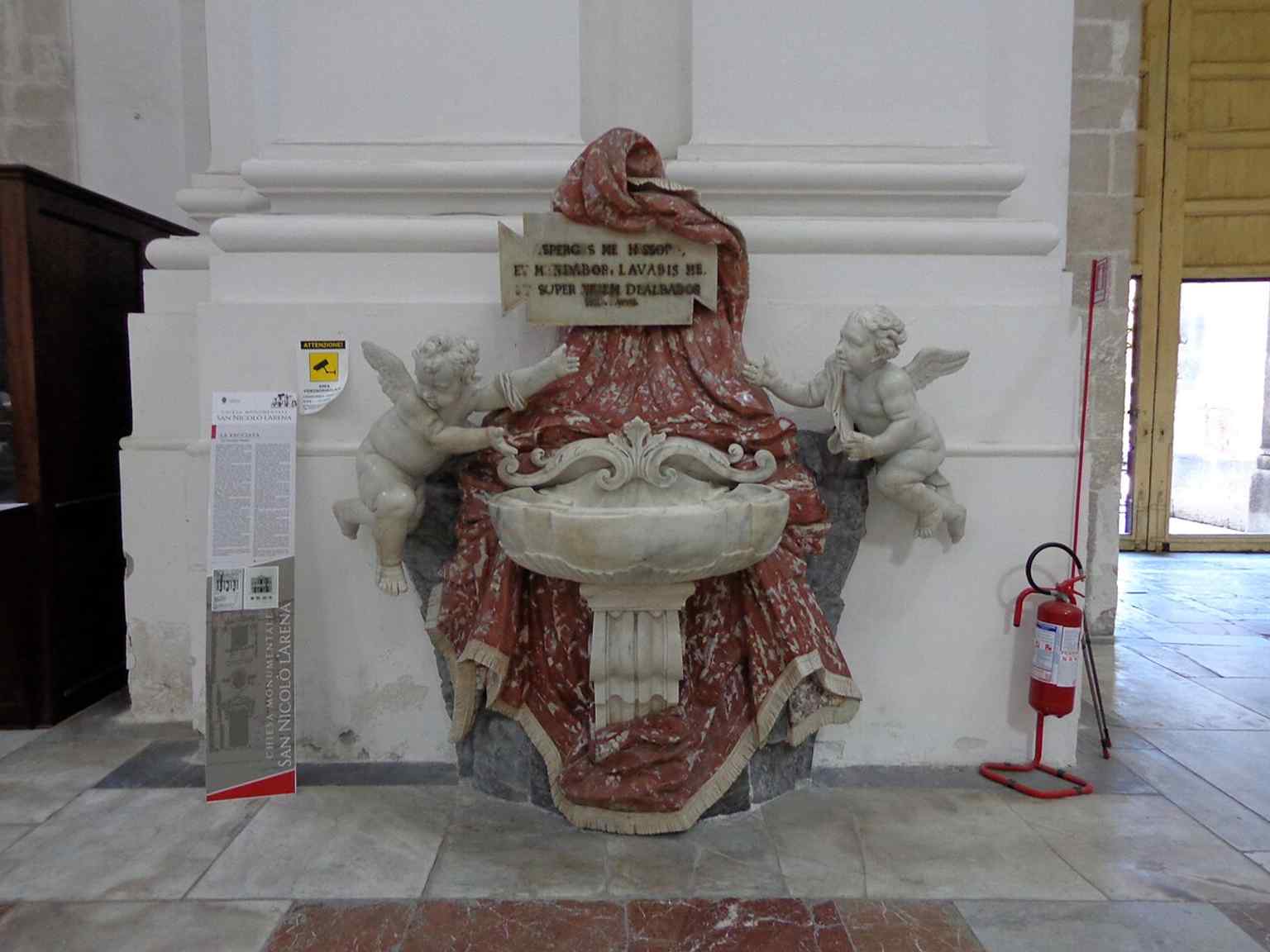
A different exterior perspective that emphasizes the unfinished facade and the church’s imposing classical lines.Photo: Effems, Wikimedia Commons, CC BY-SA 4.0. Cropped & resized. Inside, the Benedictines filled the chapels with precious marbles from across Italy, built a giant organ with two thousand three hundred seventy-eight pipes that could be played by three organists at once, and even installed a meridian line - a marble strip used to track the sun with astonishing precision. Later centuries treated the church harshly. The Italian state confiscated monastic property in eighteen sixty-six, and bombing in the summer of nineteen forty-three tore through the building, badly damaging the right transept, the arm of the church that crosses the main hall. Still, it survived, and in the twentieth century it also became the city’s military memorial.
If you want to step inside later, the church generally opens daily from nine in the morning to five thirty in the afternoon.
San Nicolò l’Arena stands here like Catania itself: wounded, stubborn, and breathtakingly large-hearted. When you’re ready, continue on to the libraries, where the city gathers its memory in a quieter voice.
A broad exterior angle that helps show the massive footprint of the building and its urban setting in central Catania.Photo: Effems, Wikimedia Commons, CC BY-SA 4.0. Cropped & resized. 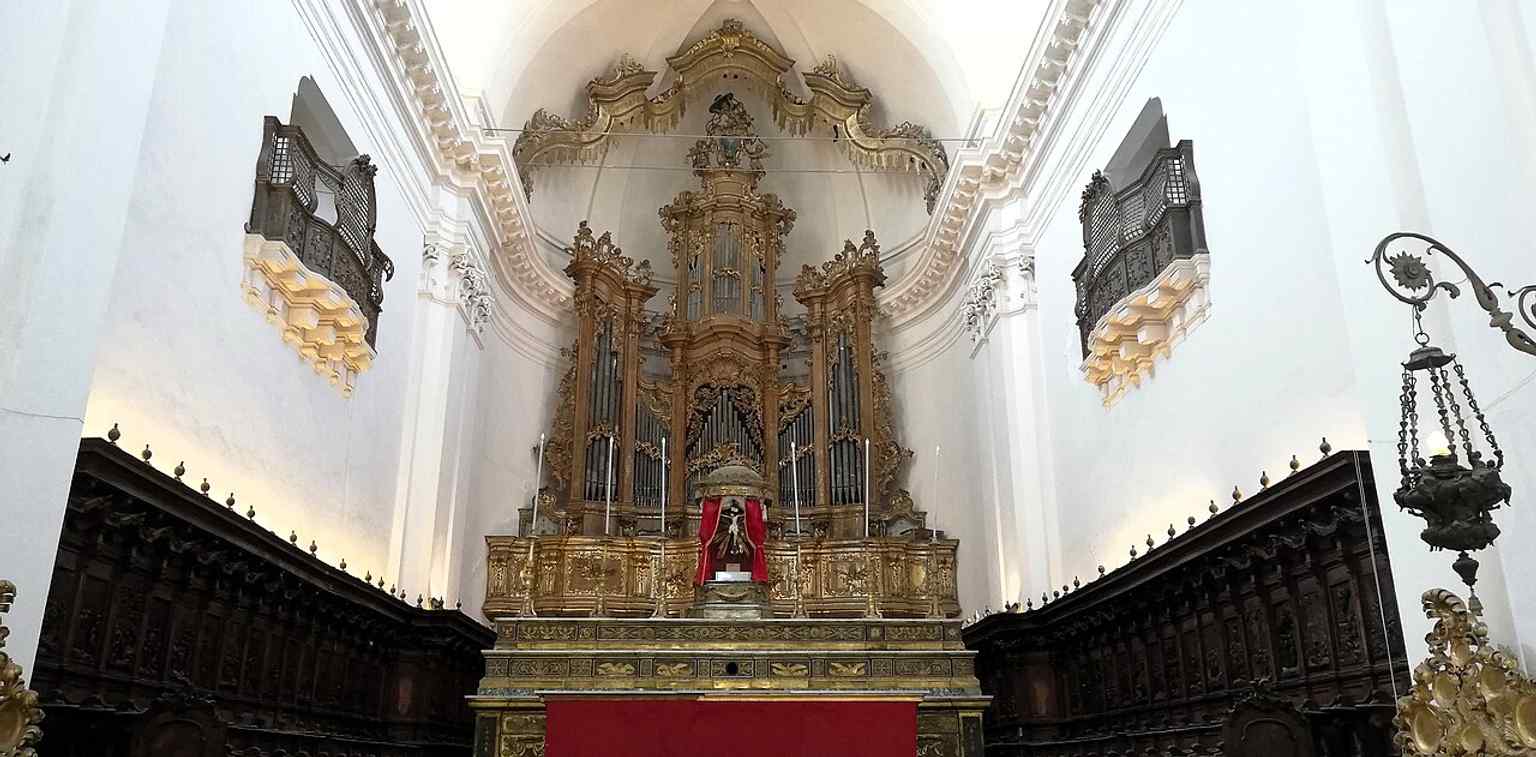
Another strong outside view of the church, useful for showing how its vast mass rises above Piazza Dante.Photo: Effems, Wikimedia Commons, CC BY-SA 4.0. Cropped & resized. 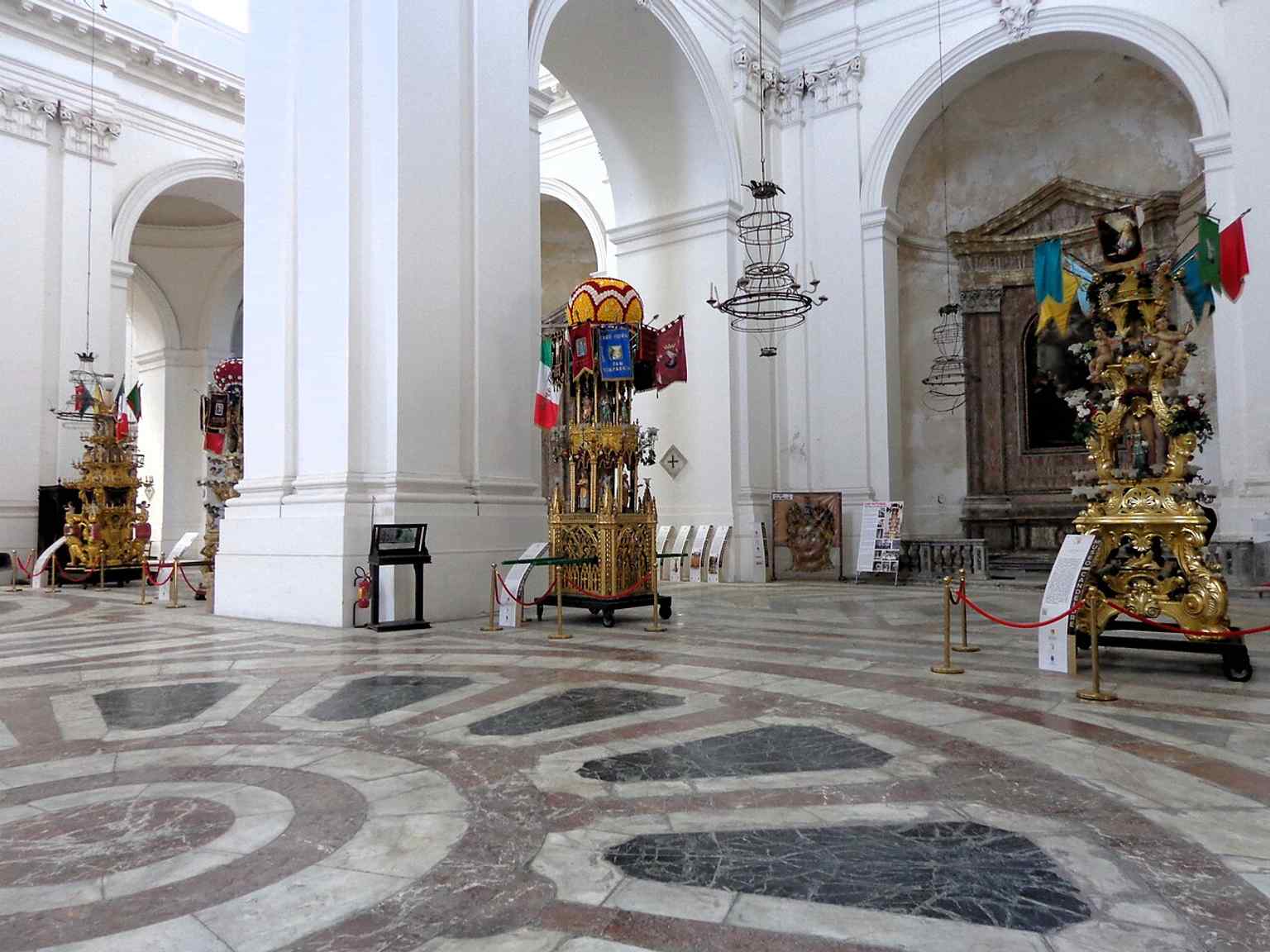
The building from a wider, more architectural angle — good for conveying the scale of the nave and facade together.Photo: Effems, Wikimedia Commons, CC BY-SA 4.0. Cropped & resized. 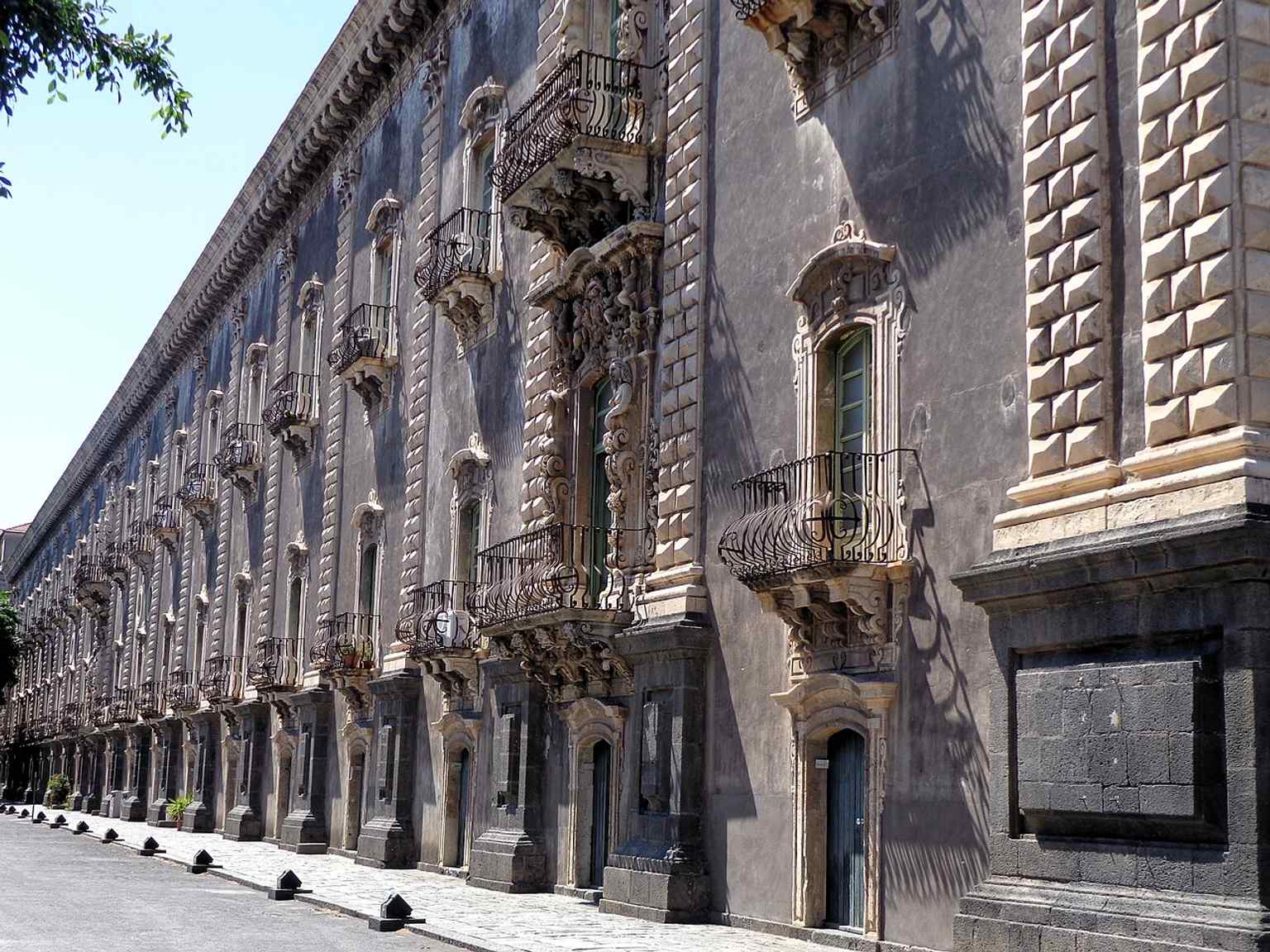
A strong interior perspective that helps tell the story of the rebuilding and the grand Baroque-Catanese spatial effect.Photo: Effems, Wikimedia Commons, CC BY-SA 4.0. Cropped & resized. 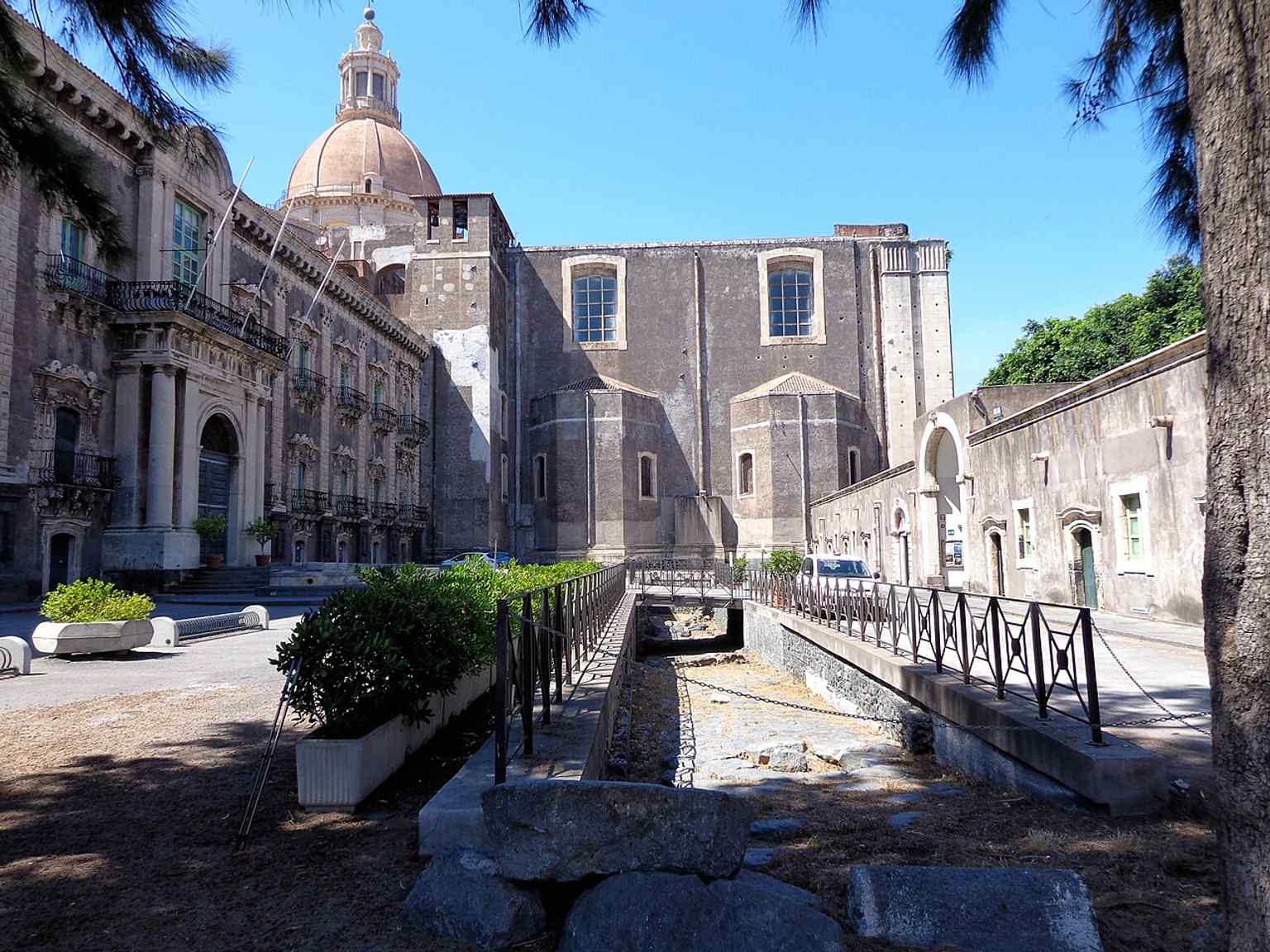
A detailed view inside the church, ideal for highlighting the marble-rich chapels and the refined decorative program funded by the Benedictines.Photo: Effems, Wikimedia Commons, CC BY-SA 4.0. Cropped & resized. 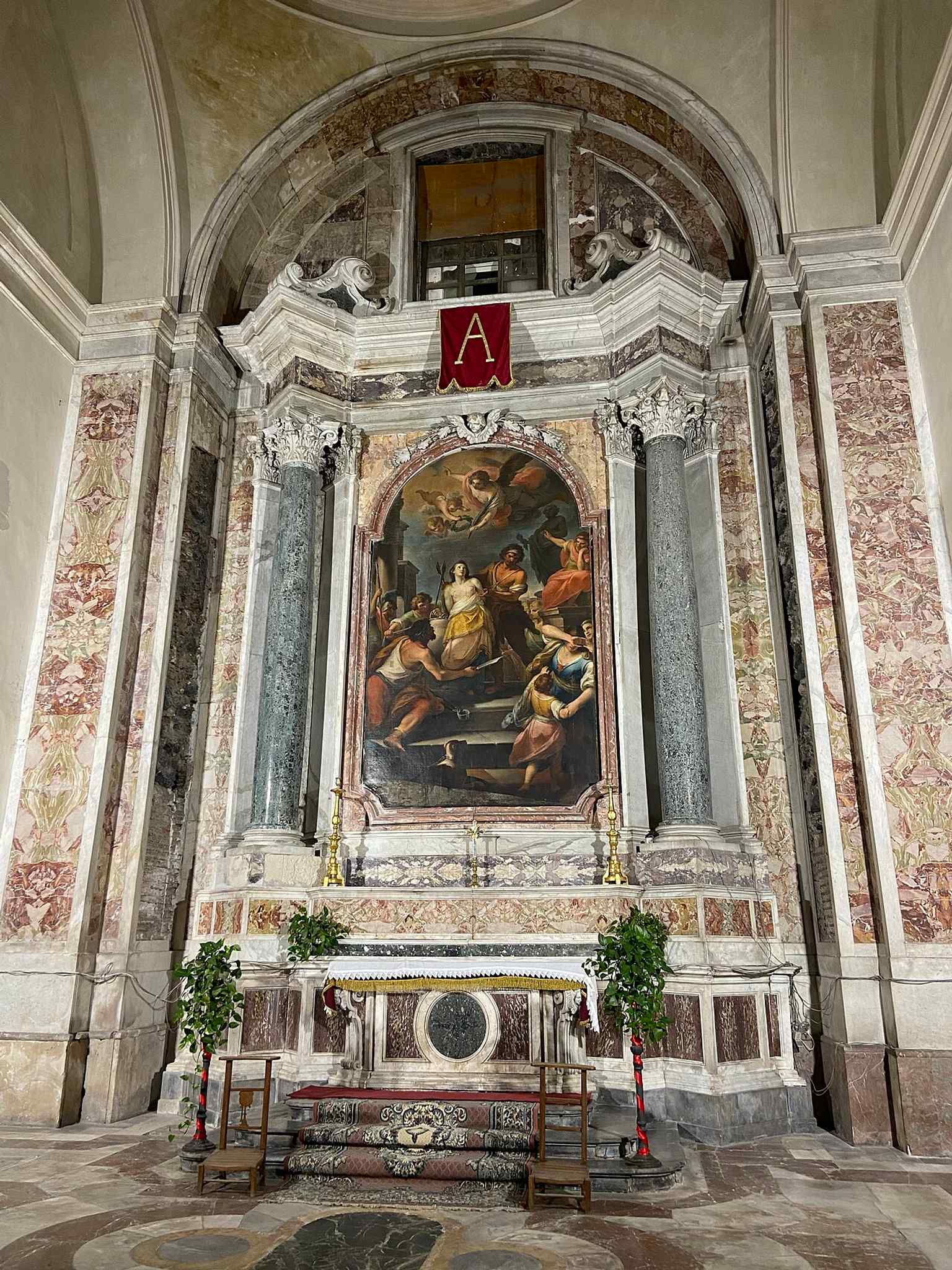
A panoramic detail that may help illustrate the vast interior axis and the scale of the nave leading toward the high altar.Photo: Effems, Wikimedia Commons, CC BY-SA 4.0. Cropped & resized. 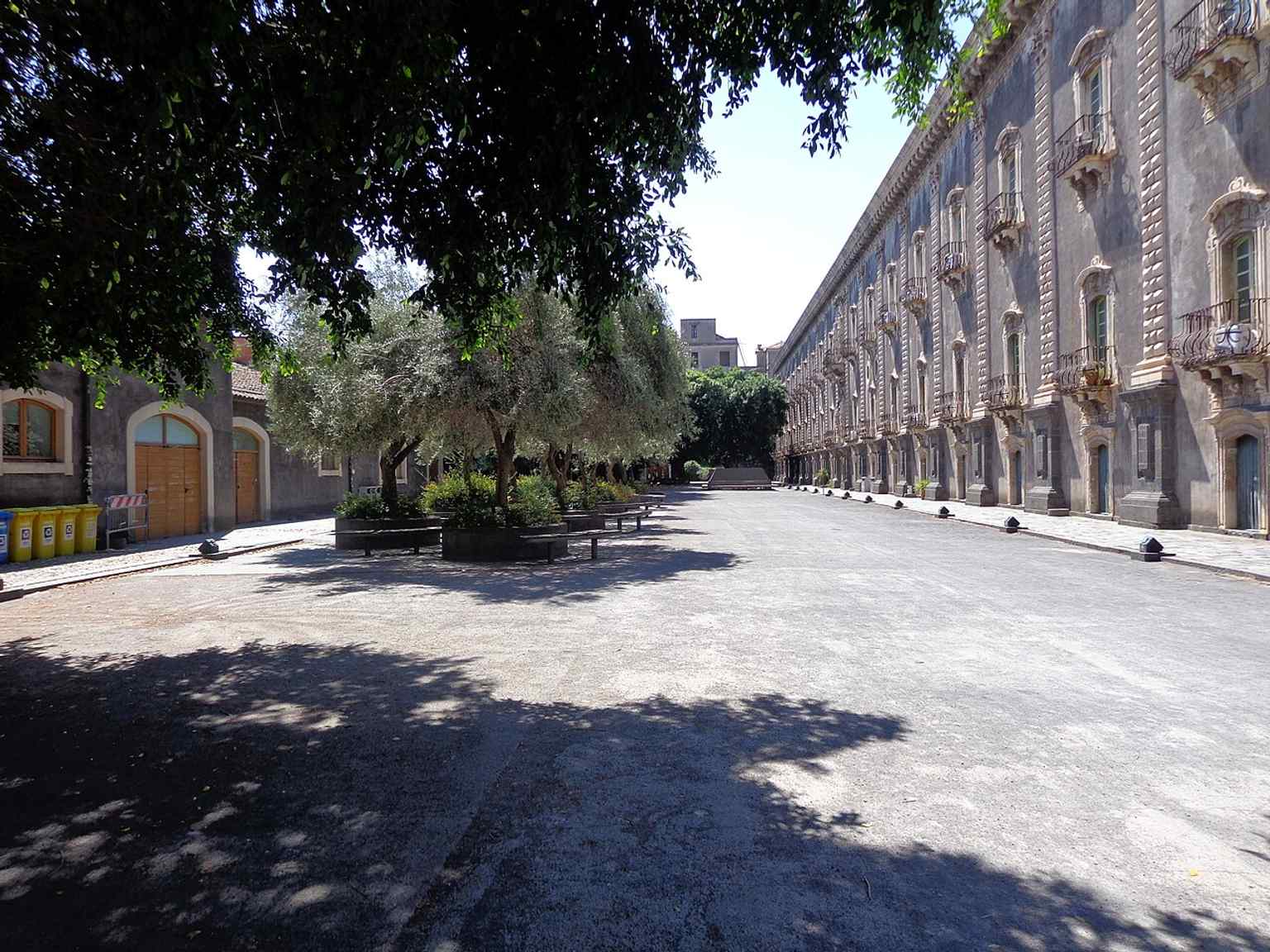
A closer interior detail that can support stories about the precious altars, choir, and the richly ornamented sacred spaces.Photo: Effems, Wikimedia Commons, CC BY-SA 4.0. Cropped & resized. 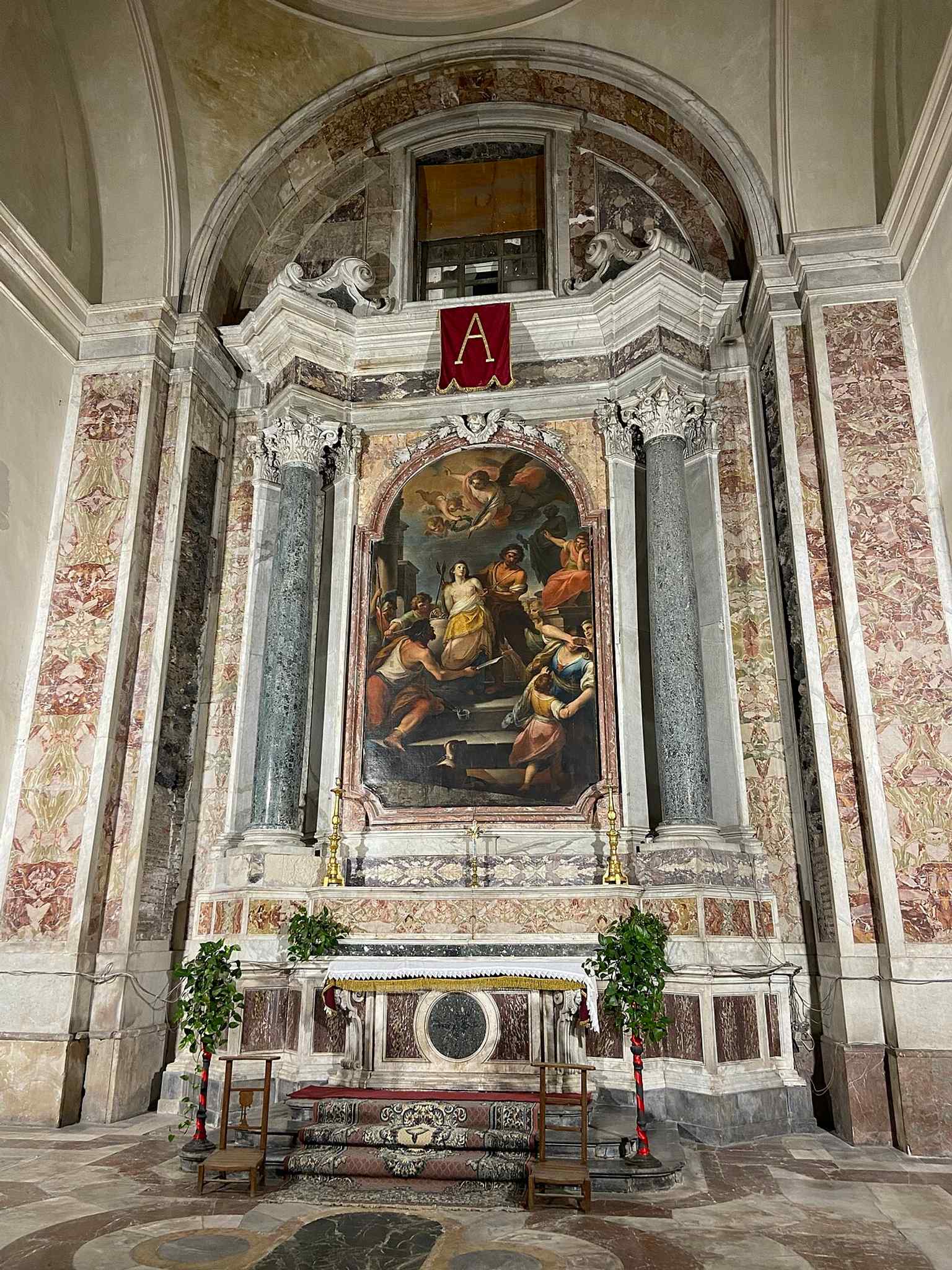
One of the side altars of San Nicolò l’Arena, reflecting the church’s many chapel artworks commissioned by Benedictine patrons.Photo: RiriRocker05, Wikimedia Commons, CC BY-SA 4.0. Cropped & resized. On your right, look for the long pale-stone monastery wing with its tall rectangular doorway, rows of high windows, and the solemn, oversized scale of the old Benedictine complex.…Read moreShow less
Open dedicated page →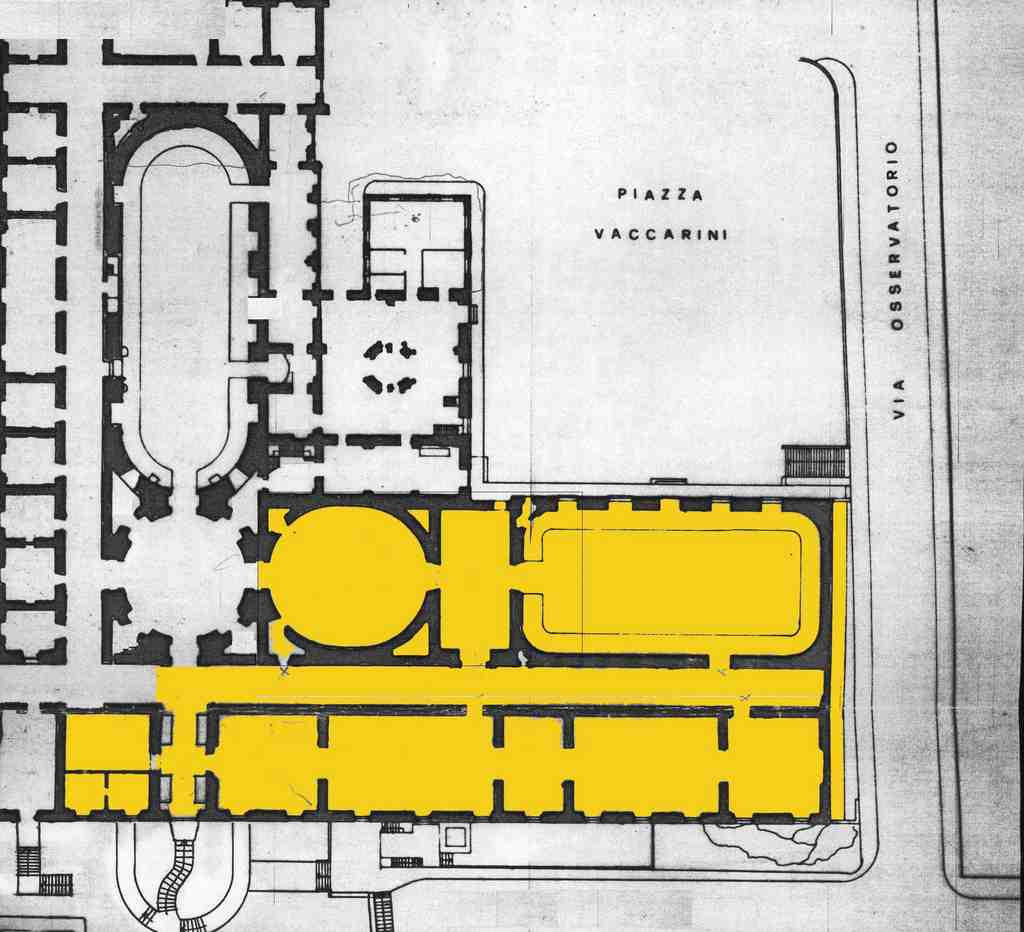
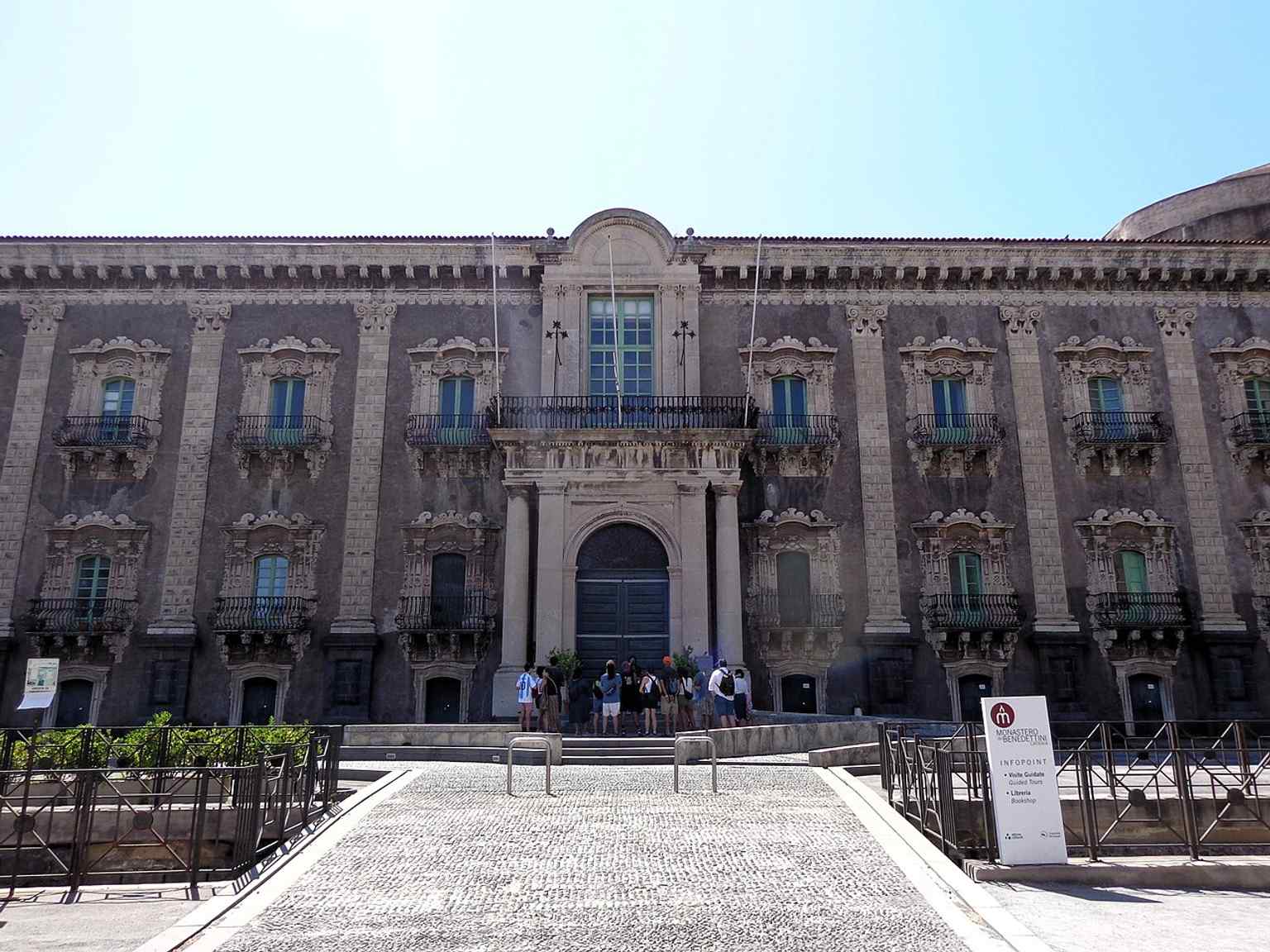
Biblioteche riunite Civica and A. Ursino RecoveryPhoto: Rita angela carbonaro, Wikimedia Commons, CC BY-SA 3.0. Cropped & resized. On your right, look for the long pale-stone monastery wing with its tall rectangular doorway, rows of high windows, and the solemn, oversized scale of the old Benedictine complex.
This final stop feels less like a building and more like a promise Catania kept with its own memory. The Biblioteche Riunite, the combined Civic Library and the A. Ursino Recupero Library, took shape in nineteen thirty-one, when the city joined two great collections under one roof. But their roots reach much deeper... into the life of the Benedictine monastery around you.
The oldest heart of this place began in fifteen seventy-eight, when the monks moved down from Nicolosi on Mount Etna and carried their books with them, along with a relic called the Holy Nail, in a solemn procession into the city. For Benedictines, collecting books was not a hobby. It was part of their calling: to preserve learning, to copy texts by hand, to keep memory alive when memory could so easily vanish.
And vanish it nearly did. In the earthquake of sixteen ninety-three, part of the collection was lost. Yet only fifteen days later, the monks built a wooden shelter for the rescued books and opened a place for surviving scholars to read. I love that image... a wounded city, and in the middle of it, people making room for books.
In the eighteenth century, the library grew grand again. The image shows the Sala Vaccarini, the great historic library hall designed by Giovan Battista Vaccarini, with painted ceilings, warm wood shelving, and those graceful curved corners that guide your eye from wall to wall. It is one of the few rooms in the monastery that still keeps its original character almost intact.
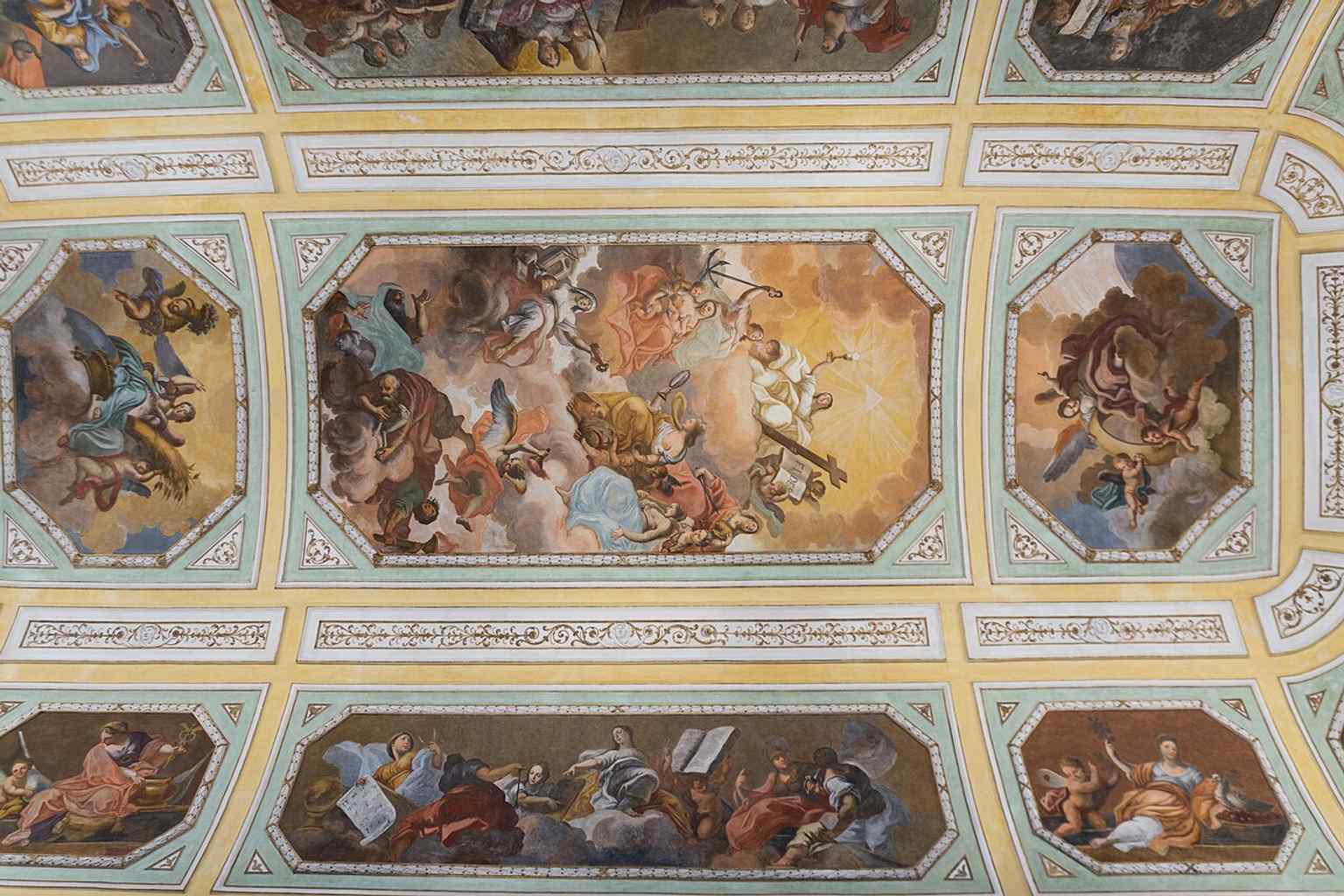
The Sala Vaccarini, the historic Benedictine library hall designed by Giovanni Battista Vaccarini and still preserving its original character.Photo: Pymouss, Wikimedia Commons, CC BY 4.0. Cropped & resized. This library also carries the lives of fiercely human people. Federico De Roberto, the novelist who wrote I Viceré, worked here from a small writing desk that still survives in the Sala Guttadauro. He did not treat the job as an honorific title. He wrote letters, pushed the city, demanded funds, and fought to reopen the library after it had remained inaccessible for more than twenty years. If you want a face to go with that stubborn devotion, the app shows his desk.
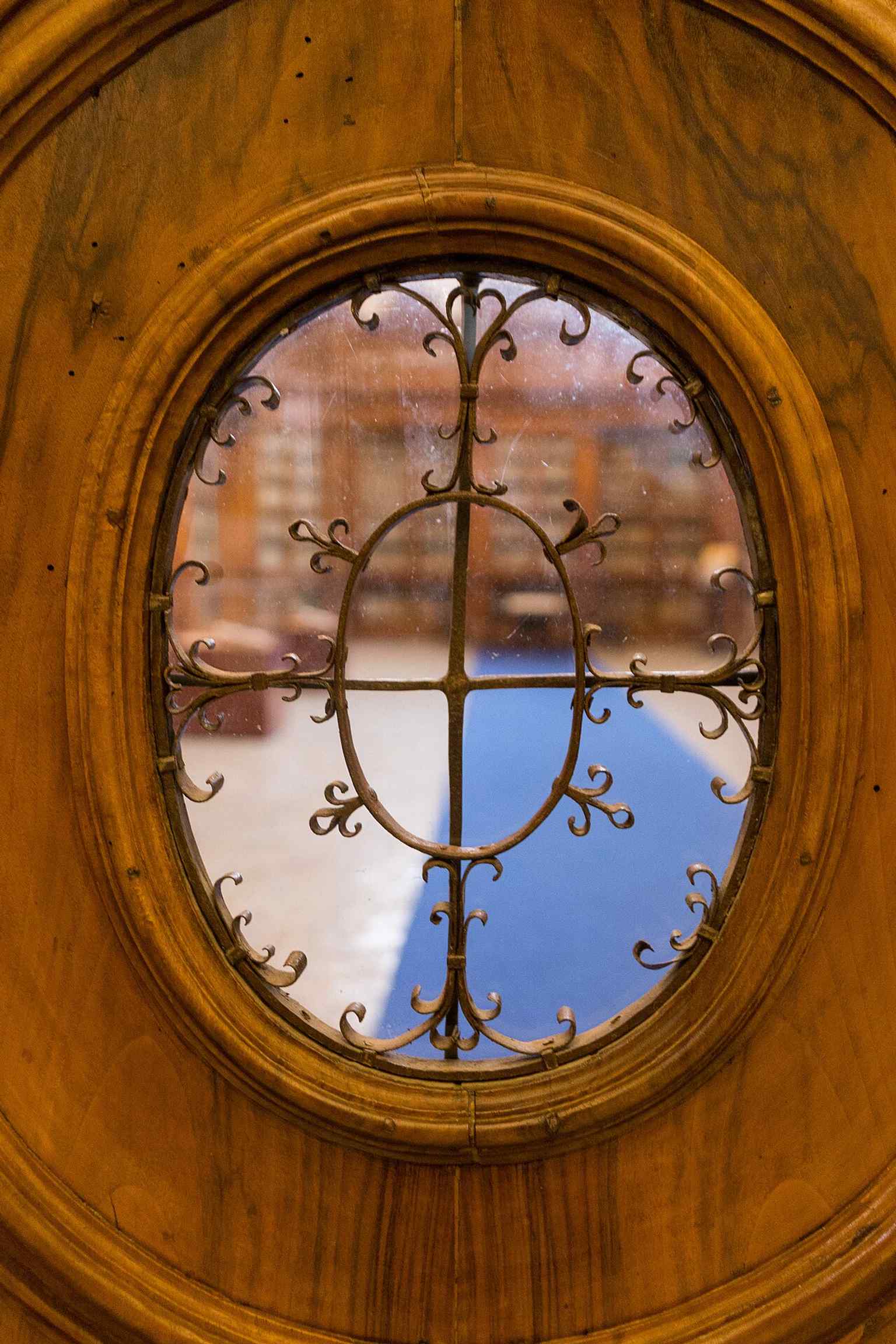
Federico De Roberto’s writing desk, a personal relic tied to his role as honorary librarian and his long campaign to reopen and support the library.Photo: Pymouss, Wikimedia Commons, CC BY 4.0. Cropped & resized. Then there is the poet Mario Rapisardi. After his death, the city preserved not just his books, but his chair, his desk, his letters, even the private atmosphere of his study. There is a quiet irony here: Rapisardi argued bitterly against the Church, yet his personal library found its permanent home inside a former Benedictine monastery.
The Ursino Recupero collection added another voice, with Sicilian books, local newspapers, manuscripts, opera librettos, and hundreds of rare sixteenth-century editions. Together, these libraries now hold more than two hundred seventy thousand volumes, including illuminated manuscripts, early printed books from the first age of printing, and even herbals, books of dried or painted plants. Their most precious treasure may be a Latin Bible from the thirteenth or fourteenth century, attributed to Pietro Cavallini, often counted among the most beautiful illuminated Bibles in the world.
And this story did not end in the past. After two thousand nine, when funding nearly collapsed, director Rita Angela Carbonaro kept the library alive almost alone, for years, sometimes without pay, rather than let this inheritance die.
If you want to return inside, the library generally opens Monday through Friday from nine in the morning to noon, and it closes on weekends.
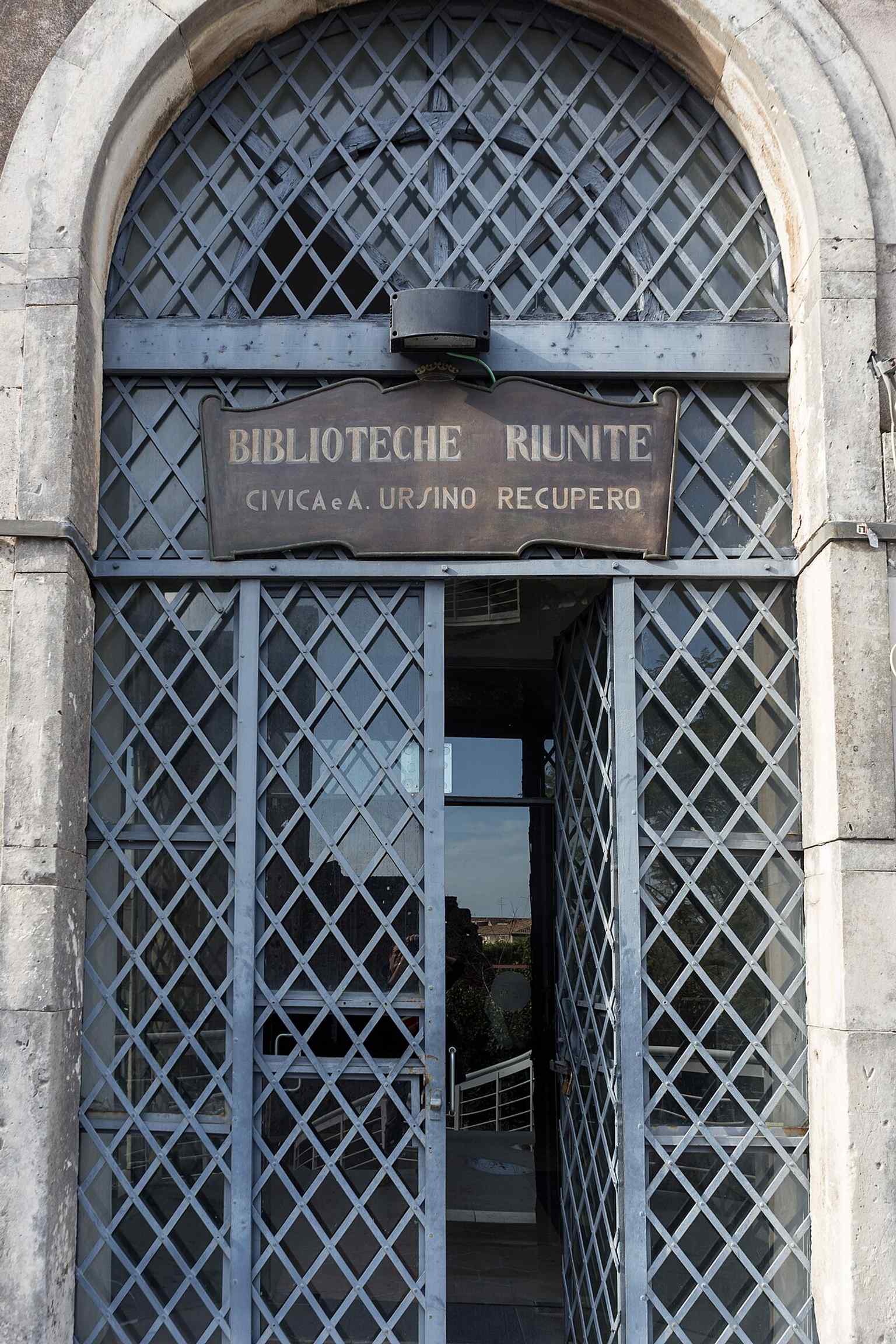
A clear view of the library’s entrance in the former Monastery of San Nicolò l’Arena, where the 1931 merger brought two major collections together under one roof.Photo: Pymouss, Wikimedia Commons, CC BY 4.0. Cropped & resized. 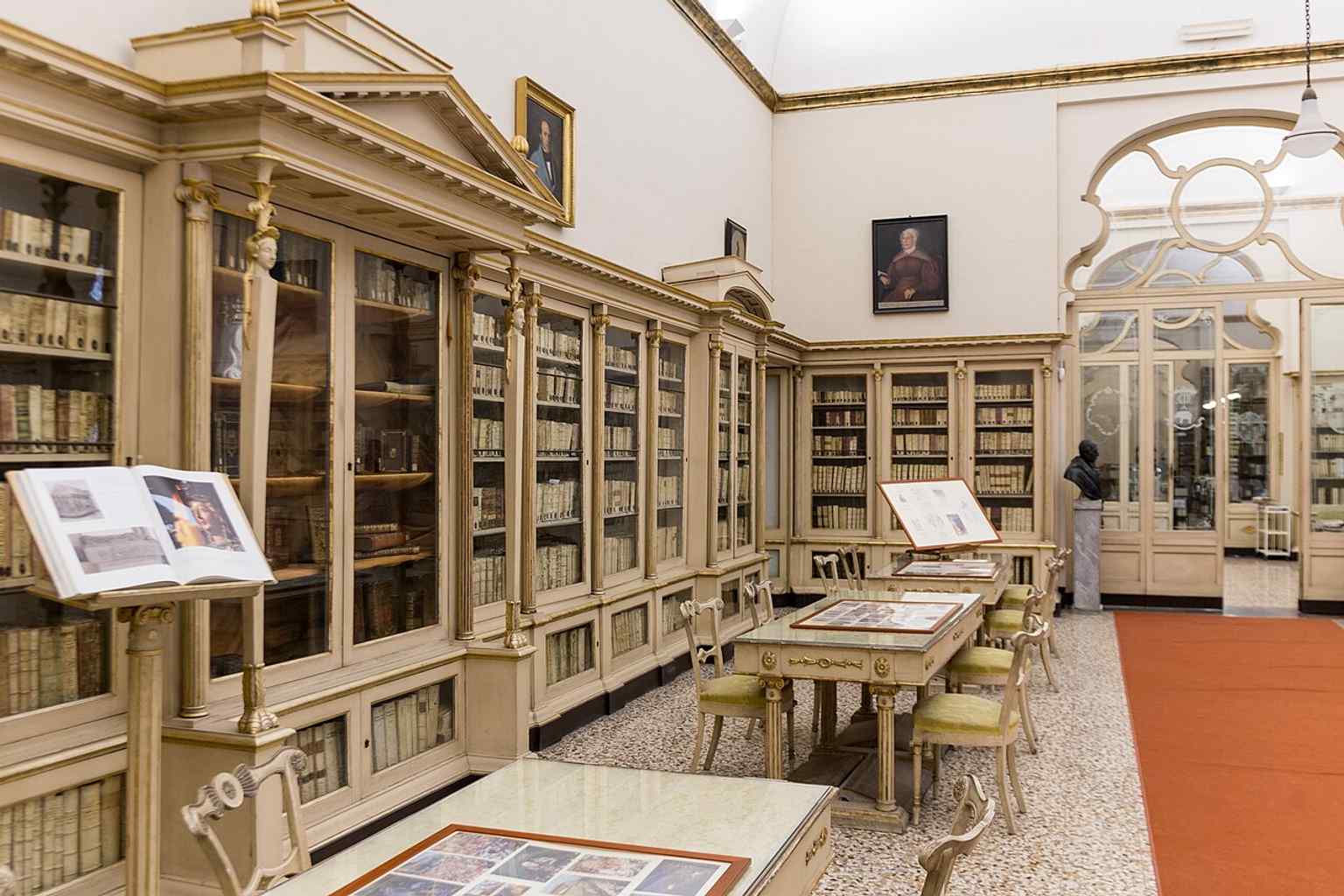
The reading room in active use today, showing the long, light-filled library spaces described in the history of the Benedictine holdings.Photo: Pymouss, Wikimedia Commons, CC BY 4.0. Cropped & resized. 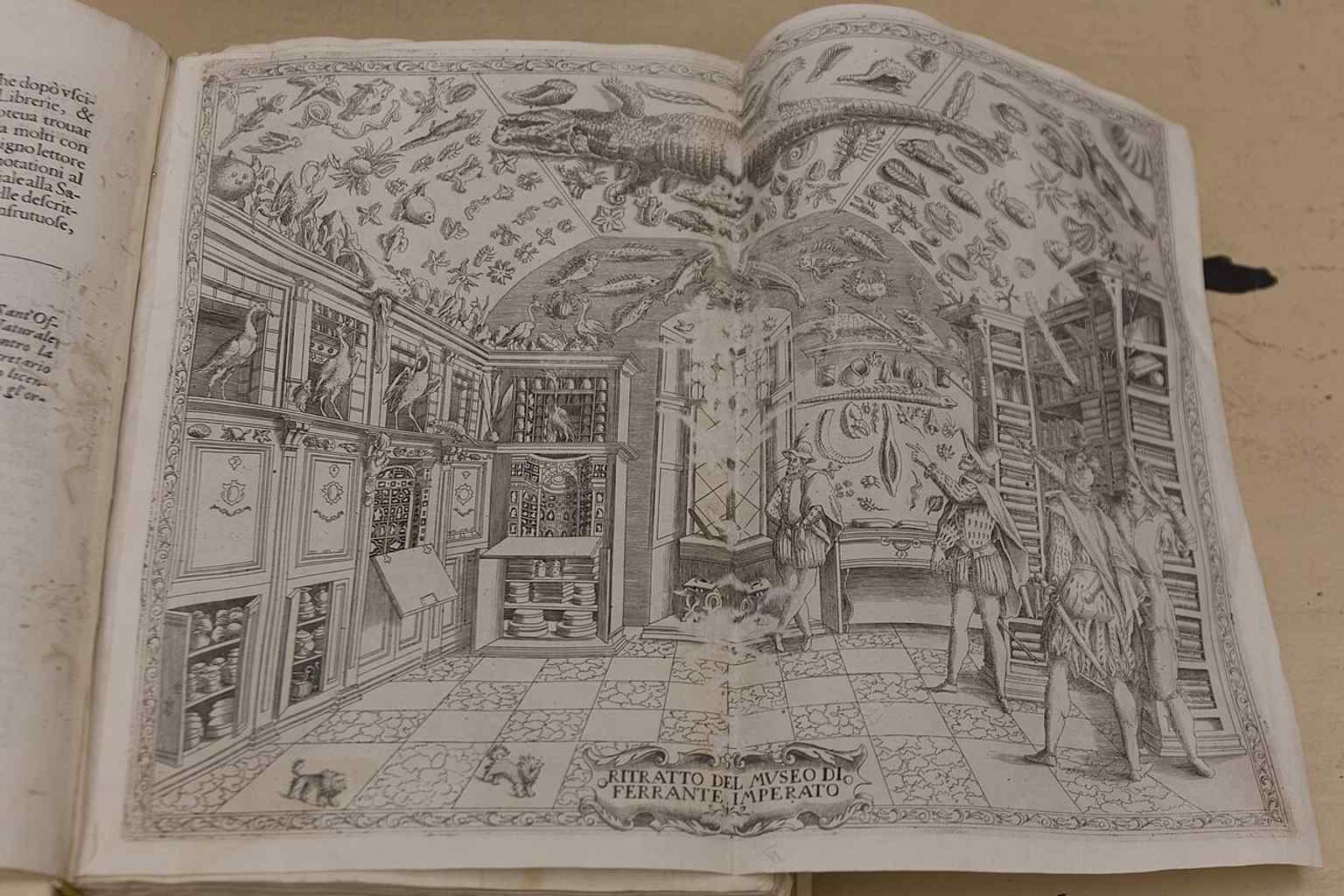
Another reading-room angle with the historic shelving and study tables that keep the old monastic library functioning as a modern public archive.Photo: Pymouss, Wikimedia Commons, CC BY 4.0. Cropped & resized. 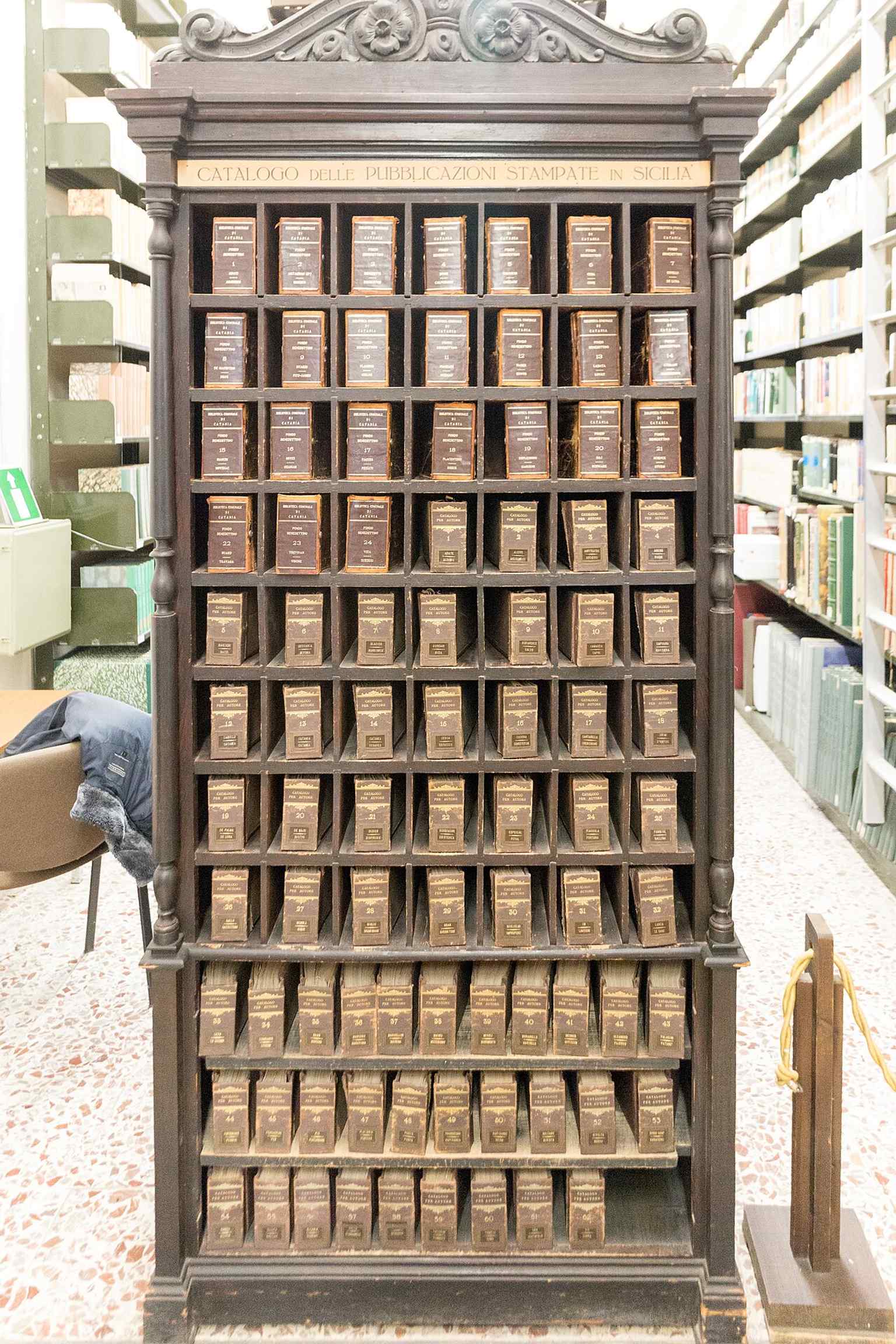
A closer look at the reading room’s book stacks and displays, echoing the library’s rich holdings in natural history and antiquarian studies.Photo: Pymouss, Wikimedia Commons, CC BY 4.0. Cropped & resized. 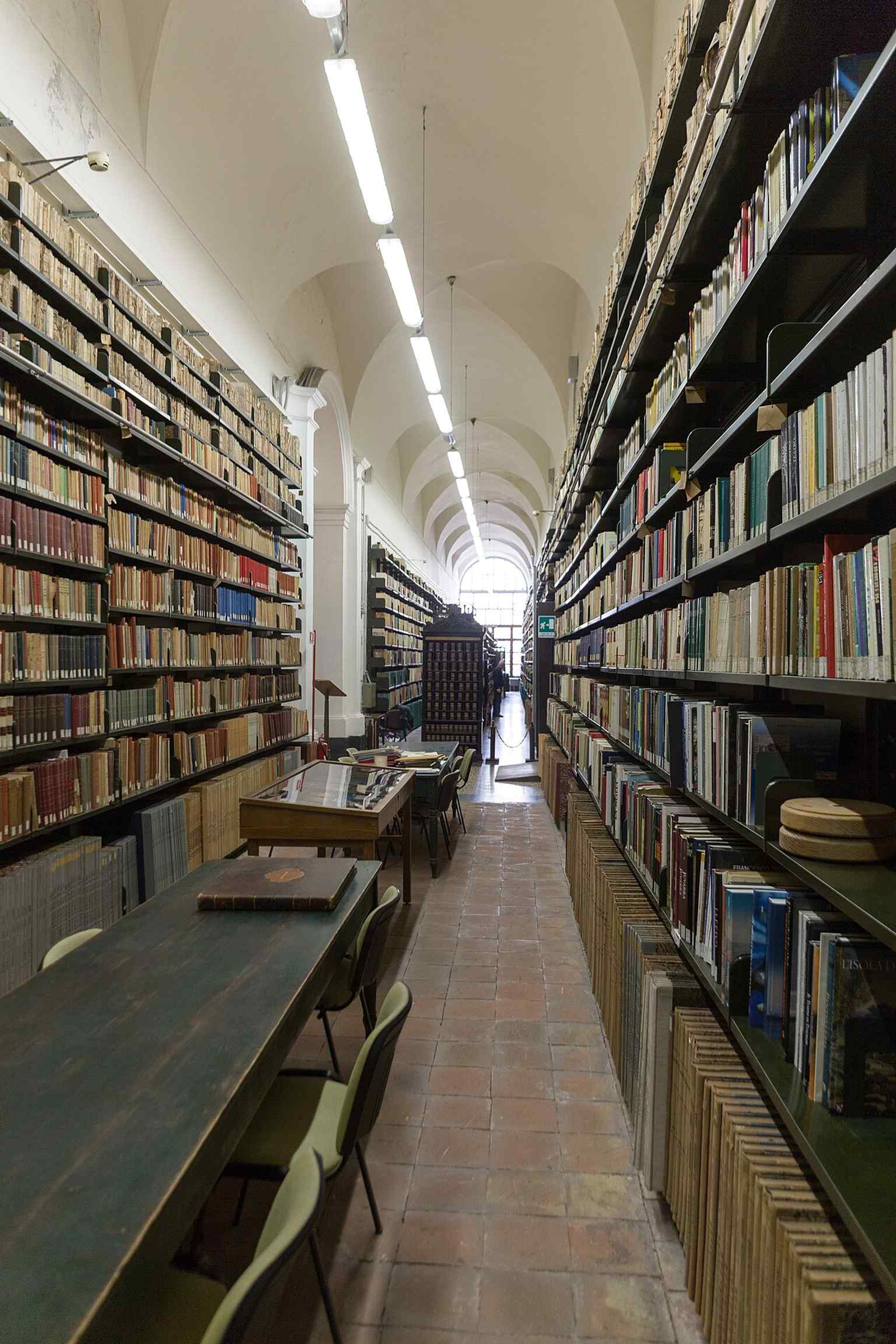
The Corridoio dell’Elefante, one of the distinctive monastic spaces now part of the library complex.Photo: Pymouss, Wikimedia Commons, CC BY 4.0. Cropped & resized. 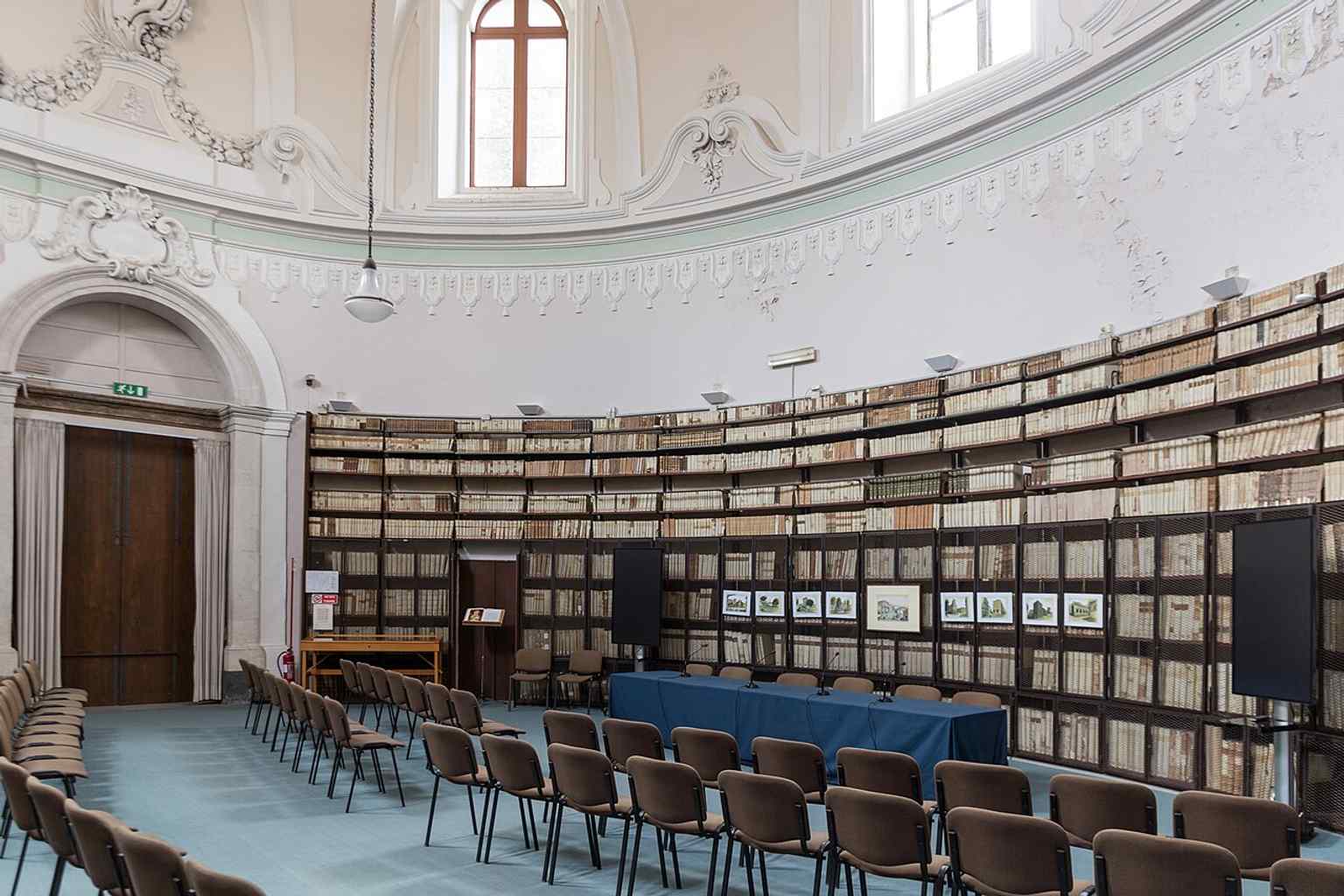
A second view of the Corridoio dell’Elefante, linking the library to the wider Benedictine monastery and its monumental interiors.Photo: Pymouss, Wikimedia Commons, CC BY 4.0. Cropped & resized. 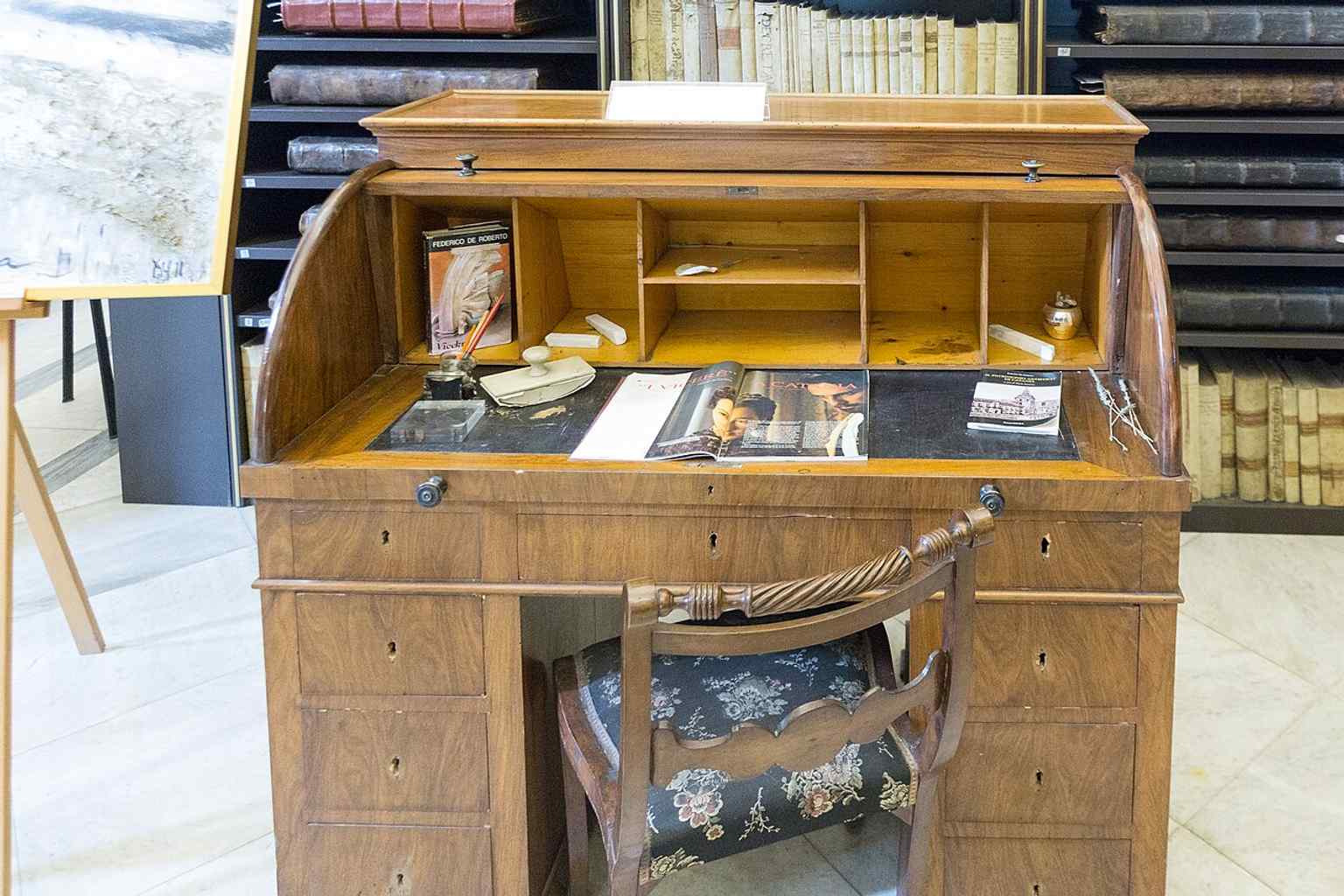
The small refectory, also called the Sala rotonda, one of the original monastery rooms incorporated into the library.Photo: Pymouss, Wikimedia Commons, CC BY 4.0. Cropped & resized. 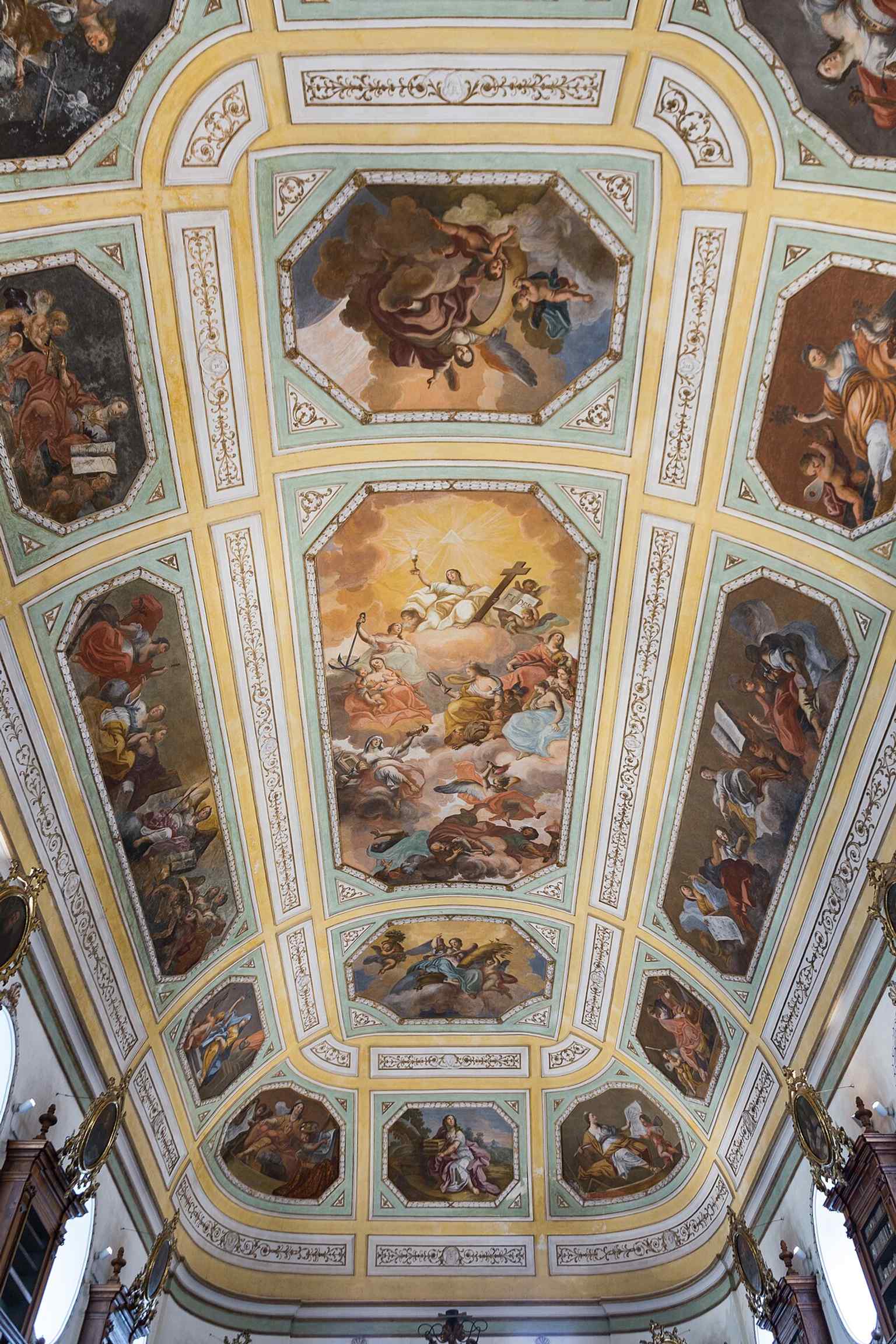
Another angle on the refectory space, helping show how the former monastic rooms were adapted for library use.Photo: Pymouss, Wikimedia Commons, CC BY 4.0. Cropped & resized. 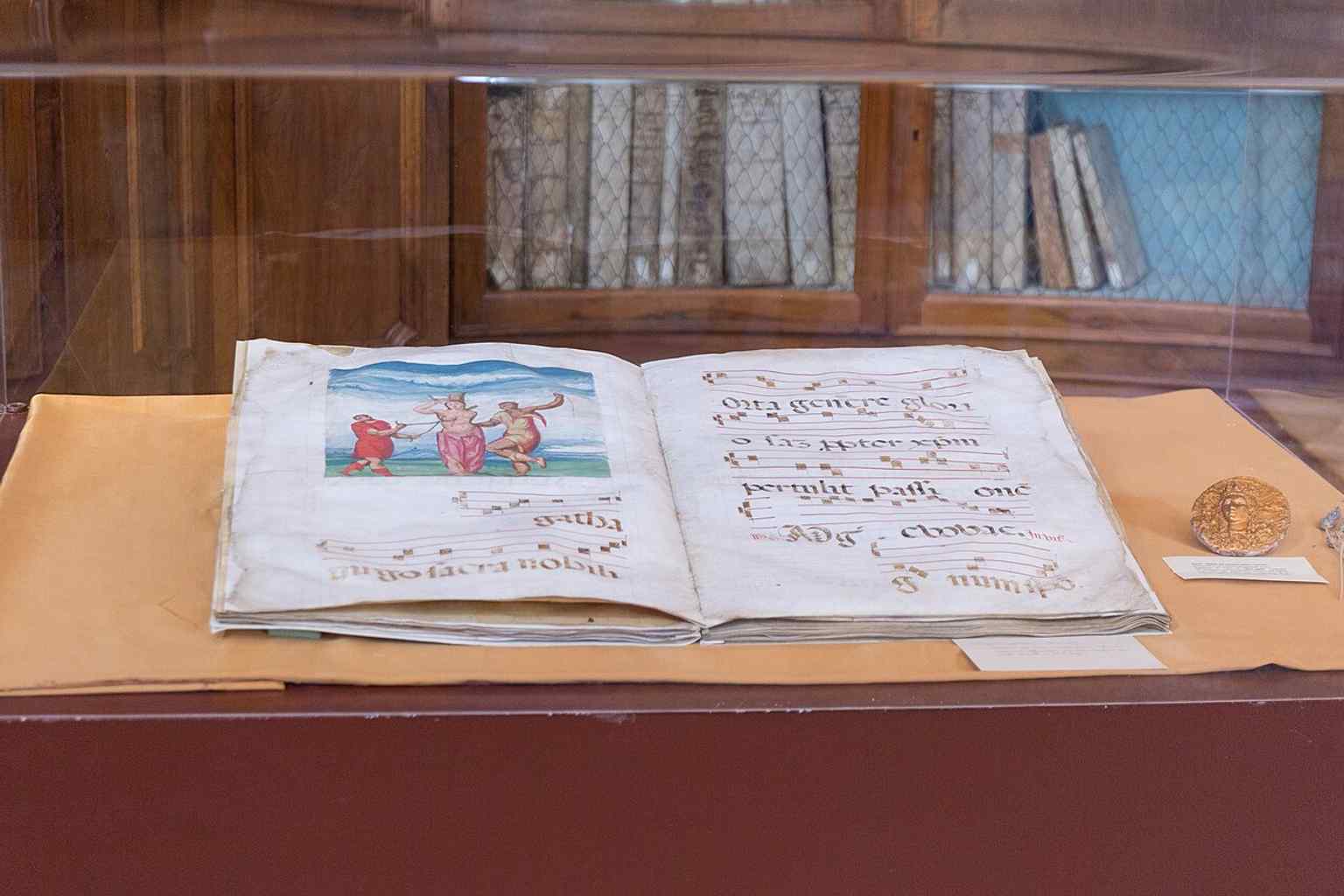
A closer view of the Sala Vaccarini’s ornate architecture, recalling the hall’s painted ceiling, wood shelving, and rare-book collections.Photo: Pymouss, Wikimedia Commons, CC BY 4.0. Cropped & resized. 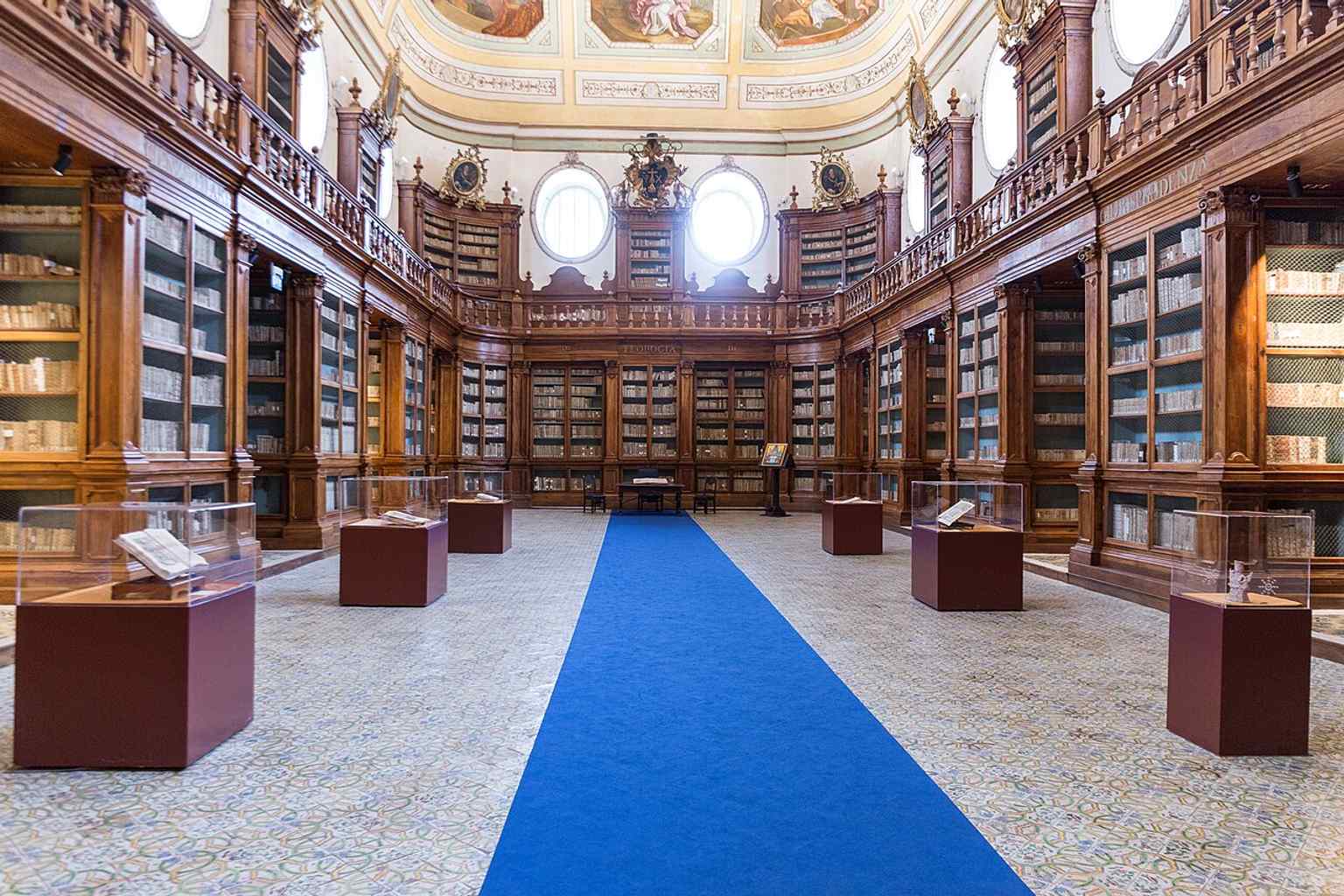
The monumental Sala Vaccarini from another perspective, emphasizing the curving shelves and the elegance of the eighteenth-century layout.Photo: Pymouss, Wikimedia Commons, CC BY 4.0. Cropped & resized. 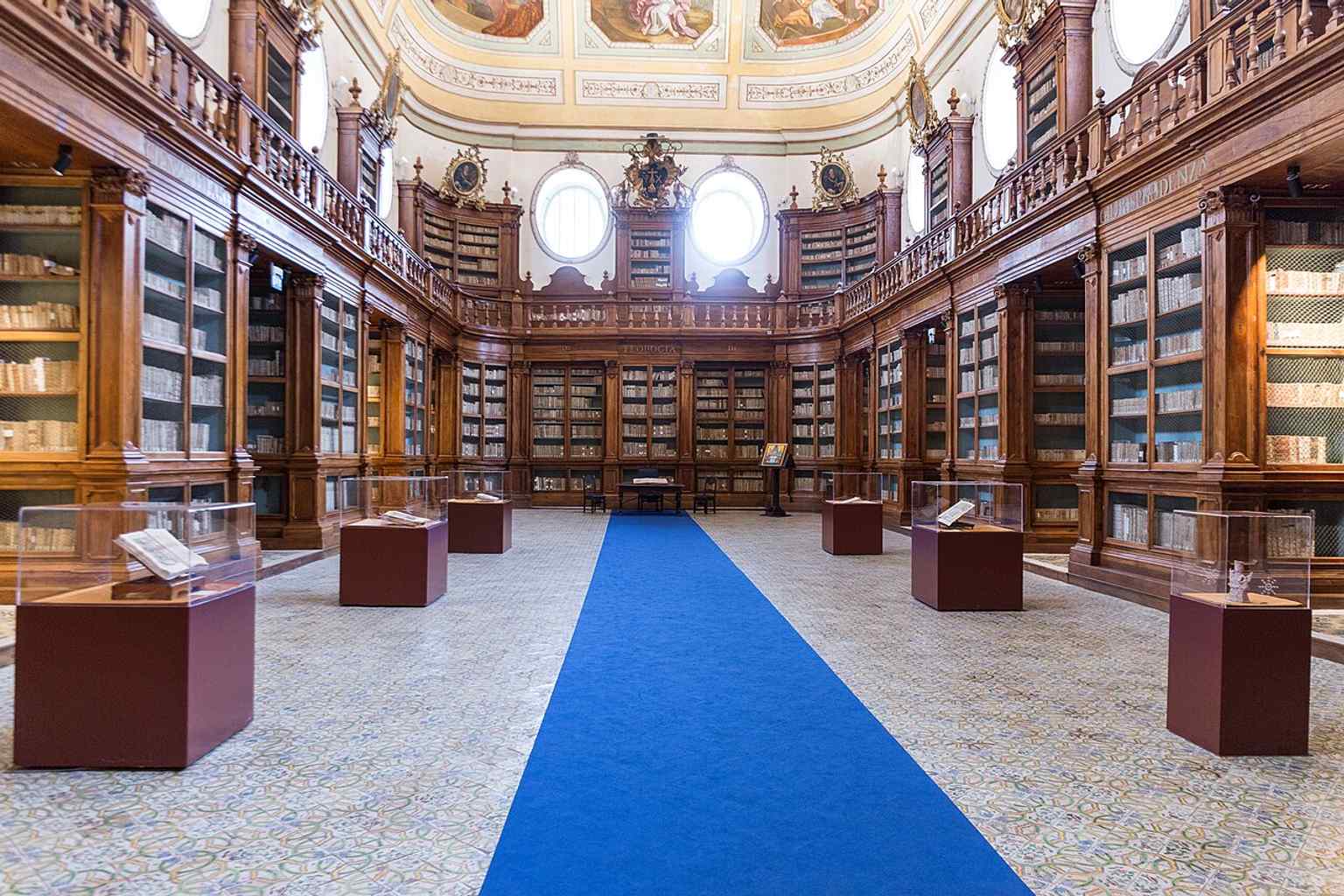
A broad view of the Sala Vaccarini that highlights how the old monastic library survives almost intact inside the monastery.Photo: Pymouss, Wikimedia Commons, CC BY 4.0. Cropped & resized. 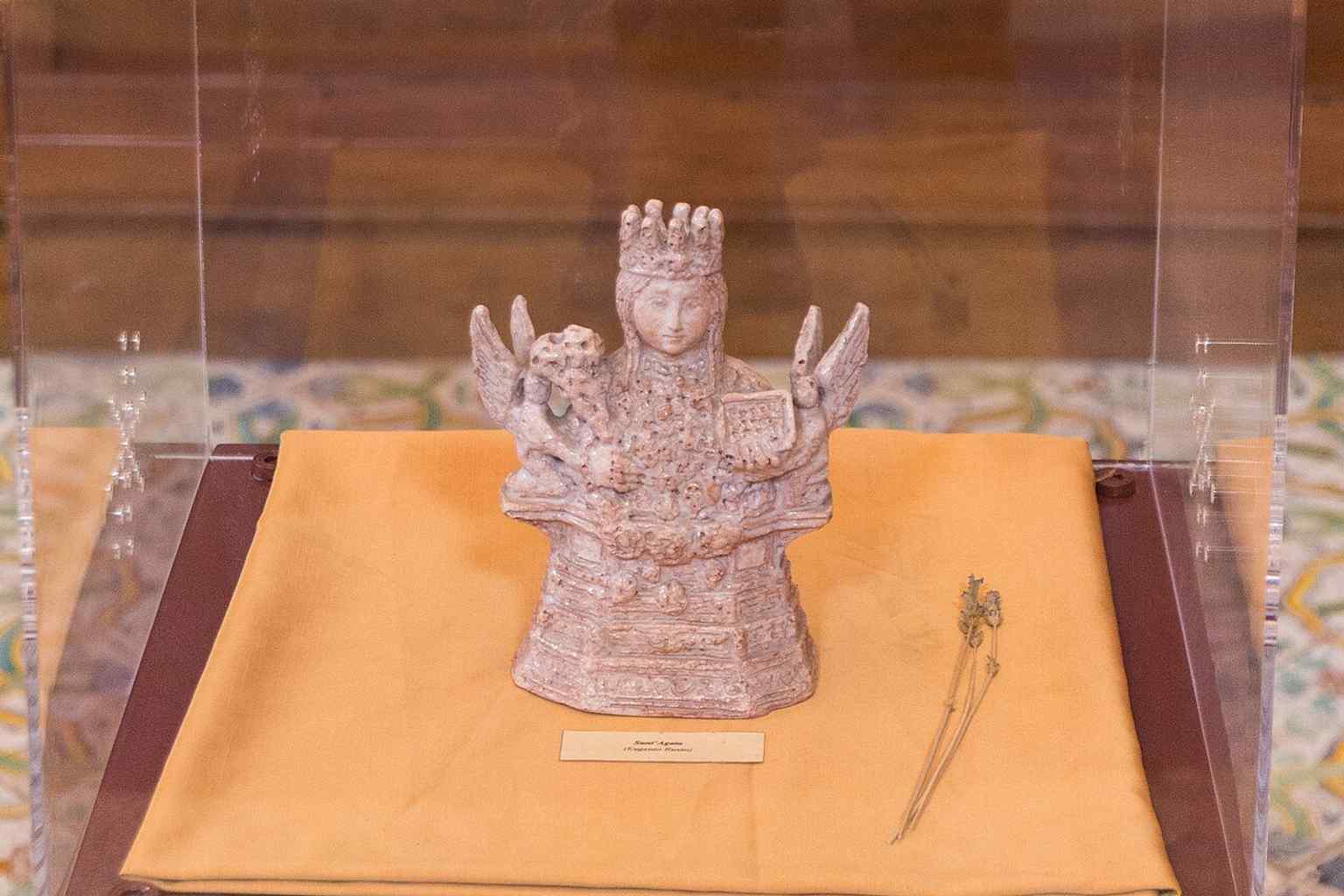
An intimate view of the historic book-lined interior, ideal for illustrating the library’s role as a keeper of rare manuscripts and printed treasures.Photo: Pymouss, Wikimedia Commons, CC BY 4.0. Cropped & resized.
Frequently asked questions
How do I start the tour?
After purchase, download the AudaTours app and enter your redemption code. The tour will be ready to start immediately - just tap play and follow the GPS-guided route.
Do I need internet during the tour?
No! Download the tour before you start and enjoy it fully offline. Only the chat feature requires internet. We recommend downloading on WiFi to save mobile data.
Is this a guided group tour?
No - this is a self-guided audio tour. You explore independently at your own pace, with audio narration playing through your phone. No tour guide, no group, no schedule.
How long does the tour take?
Most tours take 60–90 minutes to complete, but you control the pace entirely. Pause, skip stops, or take breaks whenever you want.
What if I can't finish the tour today?
No problem! Tours have lifetime access. Pause and resume whenever you like - tomorrow, next week, or next year. Your progress is saved.
What languages are available?
All tours are available in 50+ languages. Select your preferred language when redeeming your code. Note: language cannot be changed after tour generation.
Where do I access the tour after purchase?
Download the free AudaTours app from the App Store or Google Play. Enter your redemption code (sent via email) and the tour will appear in your library, ready to download and start.
If you don't enjoy the tour, we'll refund your purchase. Contact us at [email protected]
Checkout securely with 






.jpg)


