
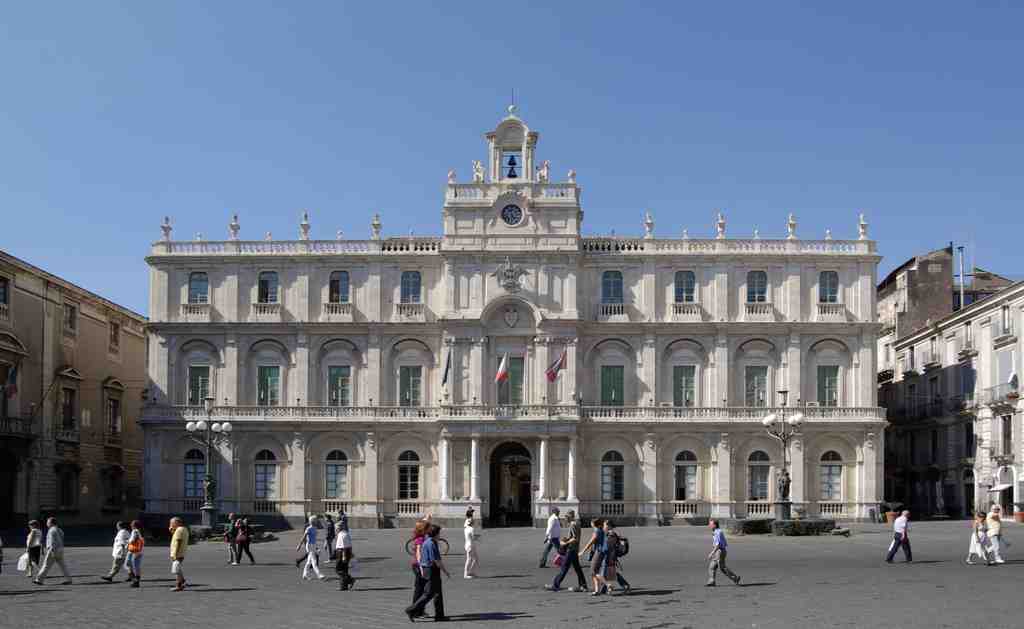
On your right, look for the long pale-stone palace with a broad arched entrance, rows of wrought-iron balconies, and a balanced Baroque façade facing the square.
This is the University of Catania, the oldest university in Sicily, and its story begins with a city asking to be taken seriously. In fourteen thirty-four, a Catanian named Pietro Rizzari pushed the civic senate to petition King Alfonso the Fifth. The king agreed that Catania could found a studium generale... a university allowed to grant legally recognized degrees. Ten years later, Pope Eugenius the Fourth confirmed it, and by the end of fourteen forty-five, public lessons had begun.
Those first classes did not happen here. They began near the cathedral, where law, medicine, theology, philosophy, mathematics, and the liberal arts were taught. In fourteen forty-nine, the first degree went to Antonio Mantello of Syracuse. For a long stretch, this university held a rare privilege in the Kingdom of Sicily: it alone could grant certain degrees. Students from Palermo often had to come here to finish what they started there. Imagine the pride of that... families sending sons across the island because Catania had the authority to say, yes, you are now learned.
Then came disaster. The earthquake of sixteen ninety-three shattered the earlier university building. But Catania did what Catania so often does: it rebuilt. Work on this new palace began in sixteen ninety-six, and great architects shaped it, especially Giovanni Battista Vaccarini and the Battaglia brothers. The image in your app shows how the façade stretches with that calm, formal dignity that helped define the city after the quake.
Inside, hidden from the square, Vaccarini gave the palace a striking black-and-white stone courtyard, grand staircases, and an Aula Magna, the main ceremonial hall, dressed in frescoes. The second image helps you notice that post-earthquake Sicilian Baroque confidence in the building’s lines and rhythm.
The university’s life kept changing. In the late seventeen hundreds, student numbers climbed to around two thousand, and new chairs, meaning official teaching posts, opened in law, medicine, and even botany. In the eighteen hundreds, enrollment fell so sharply that by eighteen sixty-seven there were only one hundred forty-three students. Local leaders stepped in, supported the university, and helped restore its rank by eighteen eighty-five.
That stubborn survival matters. Today, this institution reaches far beyond this square, but this palace still feels like its heart... a place where centuries of ambition, loss, and renewal keep speaking.
This palace keeps Catania’s oldest promise: that learning belongs in the center of city life. When you’re ready, continue toward Elephant Palace for the next chapter.




