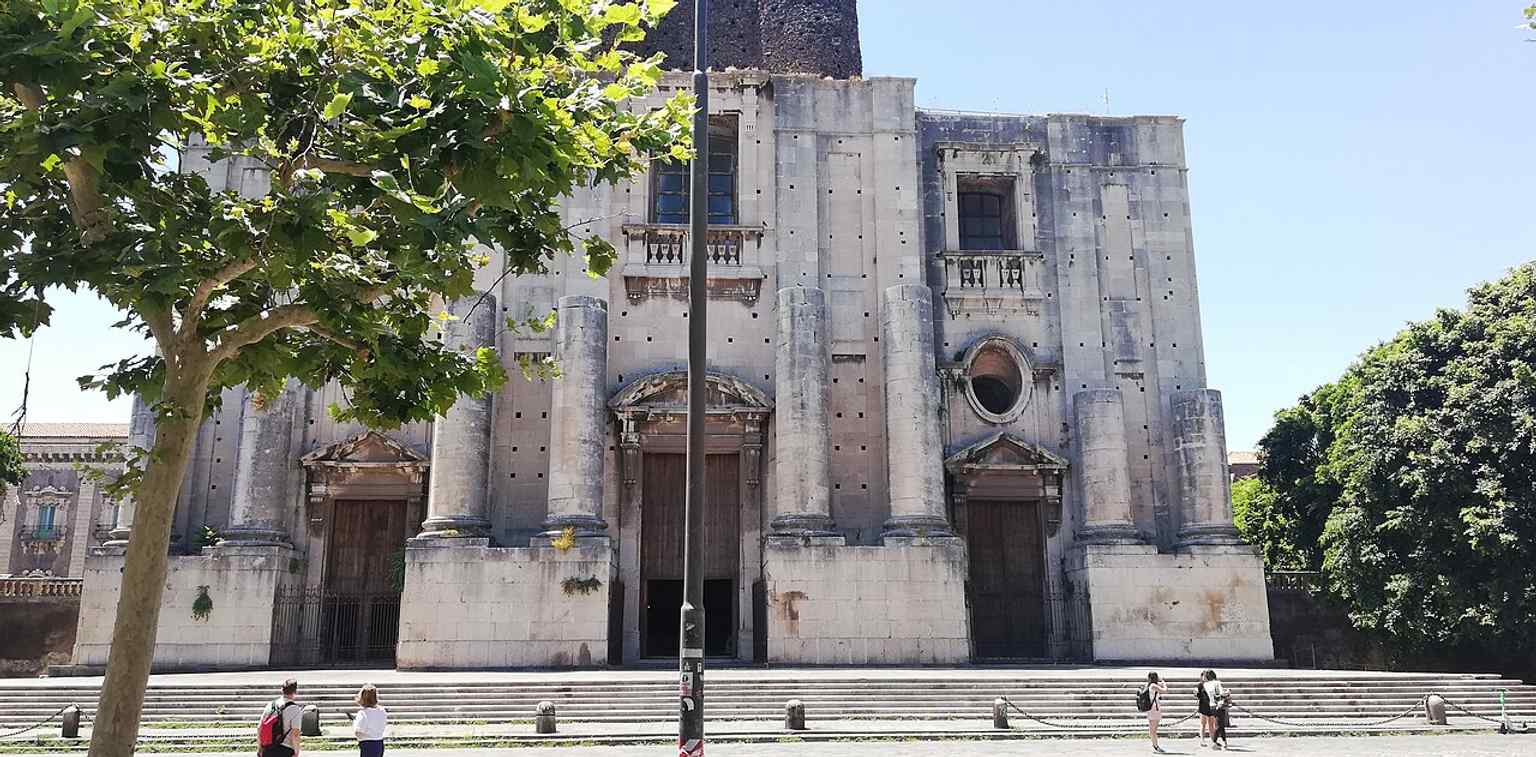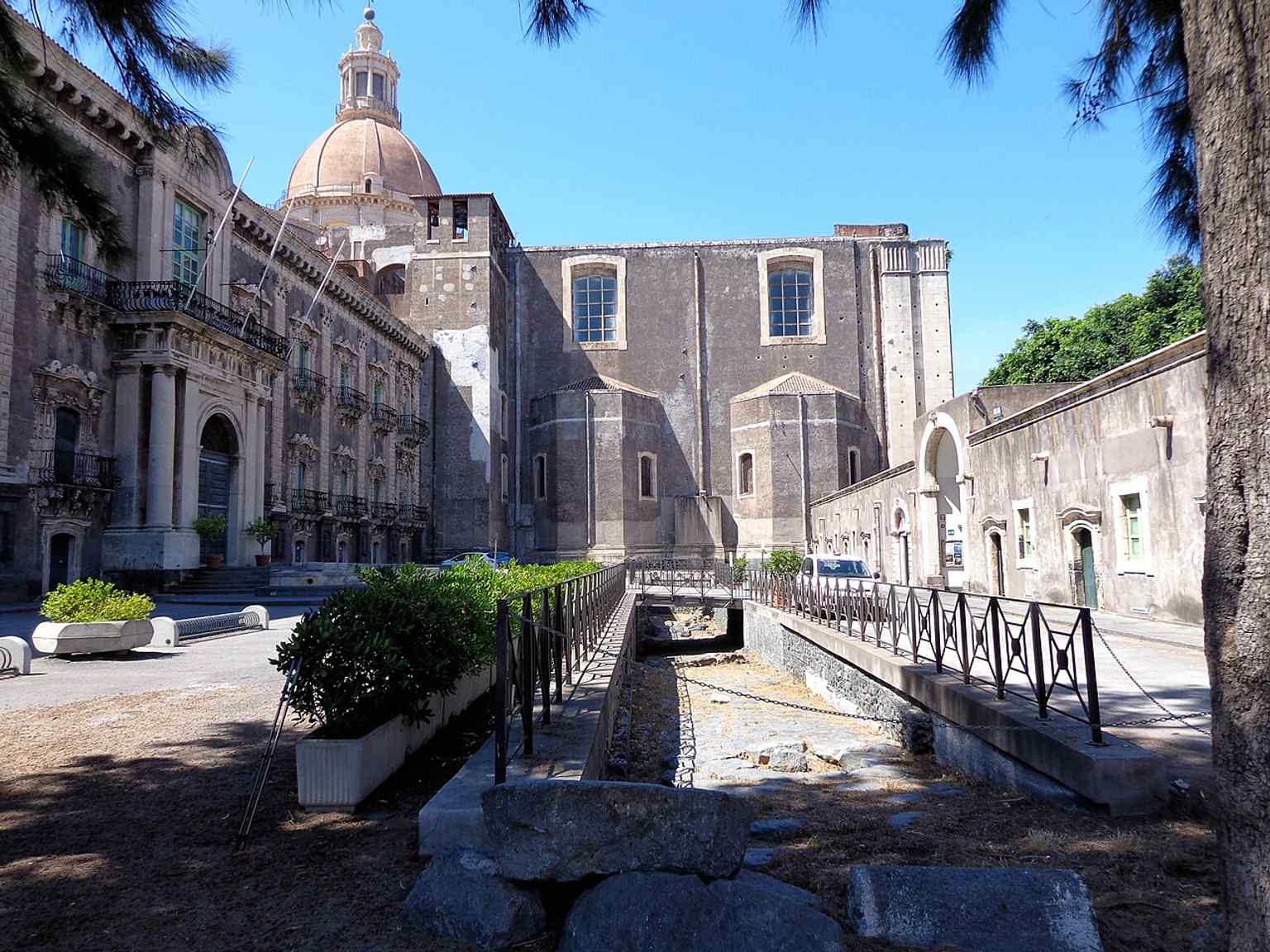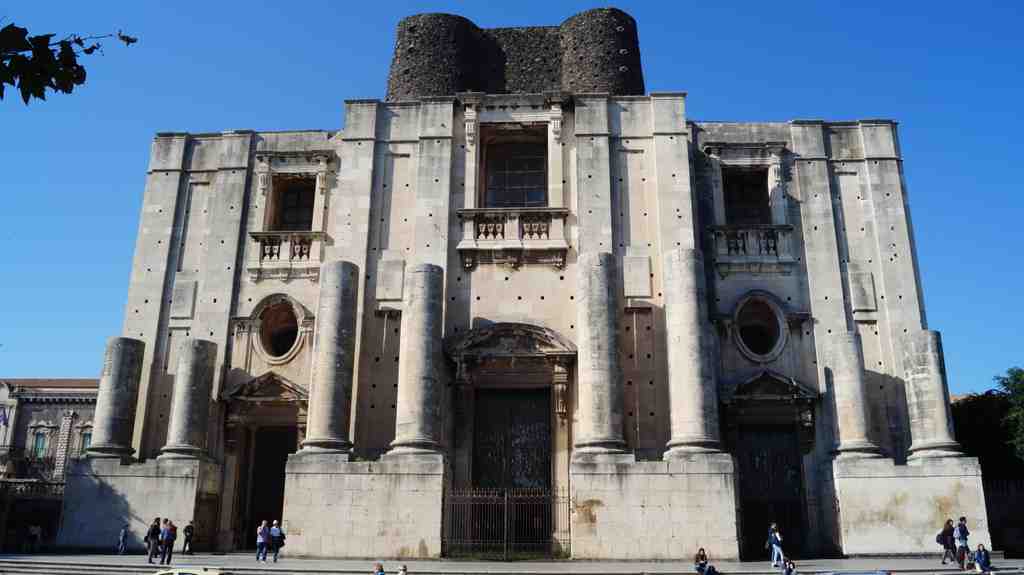
On your left, look for a huge pale-stone church with a broad unfinished facade, three tall portals, and eight massive columns that stop abruptly halfway up.
San Nicolò l’Arena has a way of feeling unfinished and immense at the same time... and that is exactly its story. This is the largest church in Sicily, spreading over more than one thousand five hundred square meters, with a dome that rises to about sixty-six meters. It belongs to the Benedictines, the monks who came down from Nicolosi and carried with them both their devotion to Saint Nicholas of Bari and a name tied to the land itself: arena, or rena, the reddish sand that marked their earlier home.
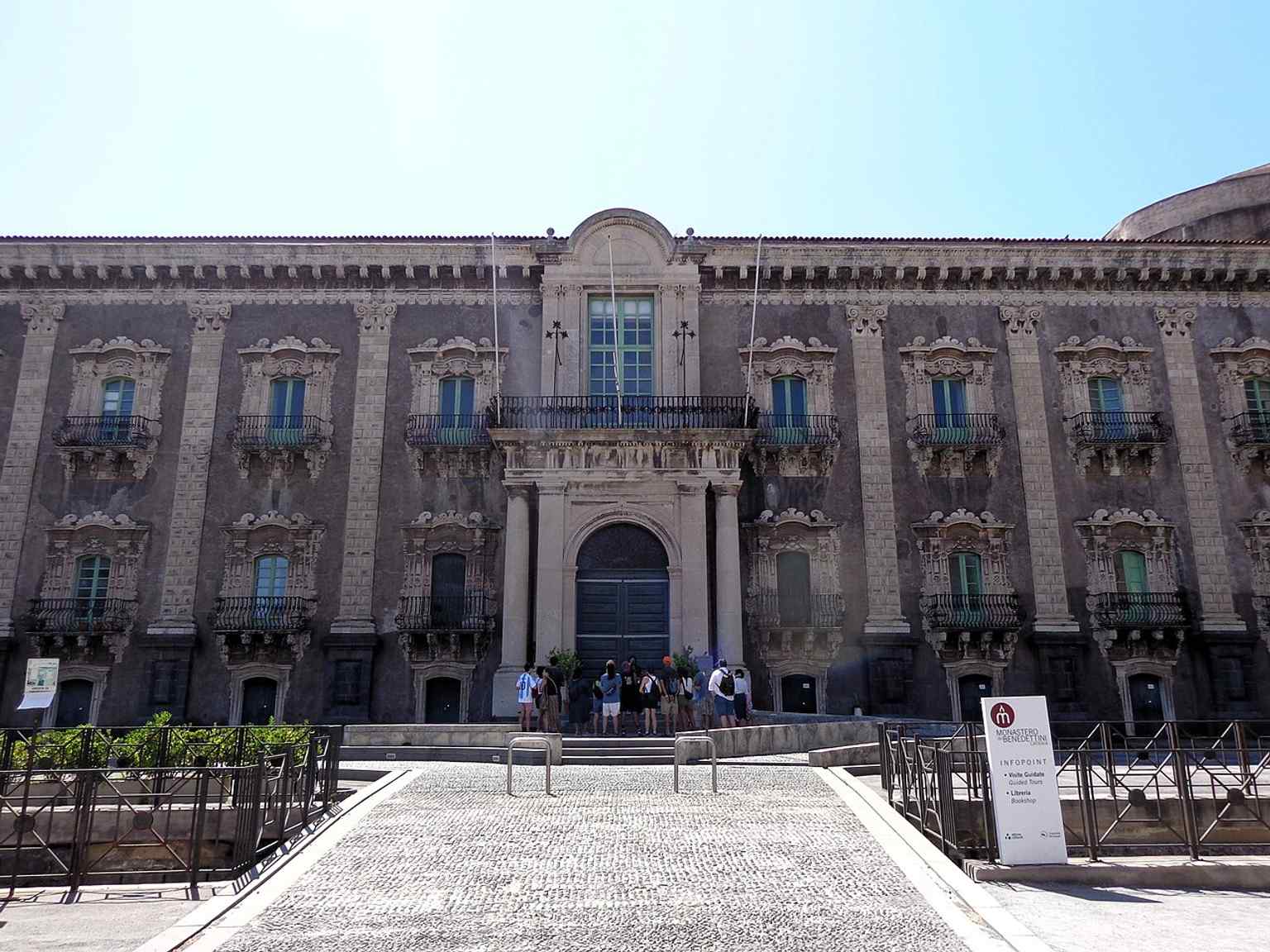
Their move into Catania came from fear as much as faith. In the sixteen hundreds, eruptions from Etna and raids in the countryside pushed the monks to seek safety inside the city walls. They opened an earlier church here in the late sixteen hundreds, but then Etna answered again. In sixteen sixty-nine, lava pushed into the western side of Catania, swallowed the Bastion of Tindaro, and overwhelmed the original church. The heat burned the earth so fiercely that it seemed to return that same red sand to the monks, as if the mountain had written their old name back onto the land.
So they began again. In sixteen eighty-seven, the Roman architect Giovanni Battista Contini drew up a new church, grand and deliberate, with Saint Peter’s in Rome as a model. He imagined a Latin cross plan - that means a long main body crossed by shorter arms - three aisles, a great dome, and space enough for crowds of pilgrims. Then disaster interrupted them again. The earthquake of sixteen ninety-three shattered southeastern Sicily, and for nearly thirty years the monks argued over whether to rebuild here or move everything to Montevergine hill.
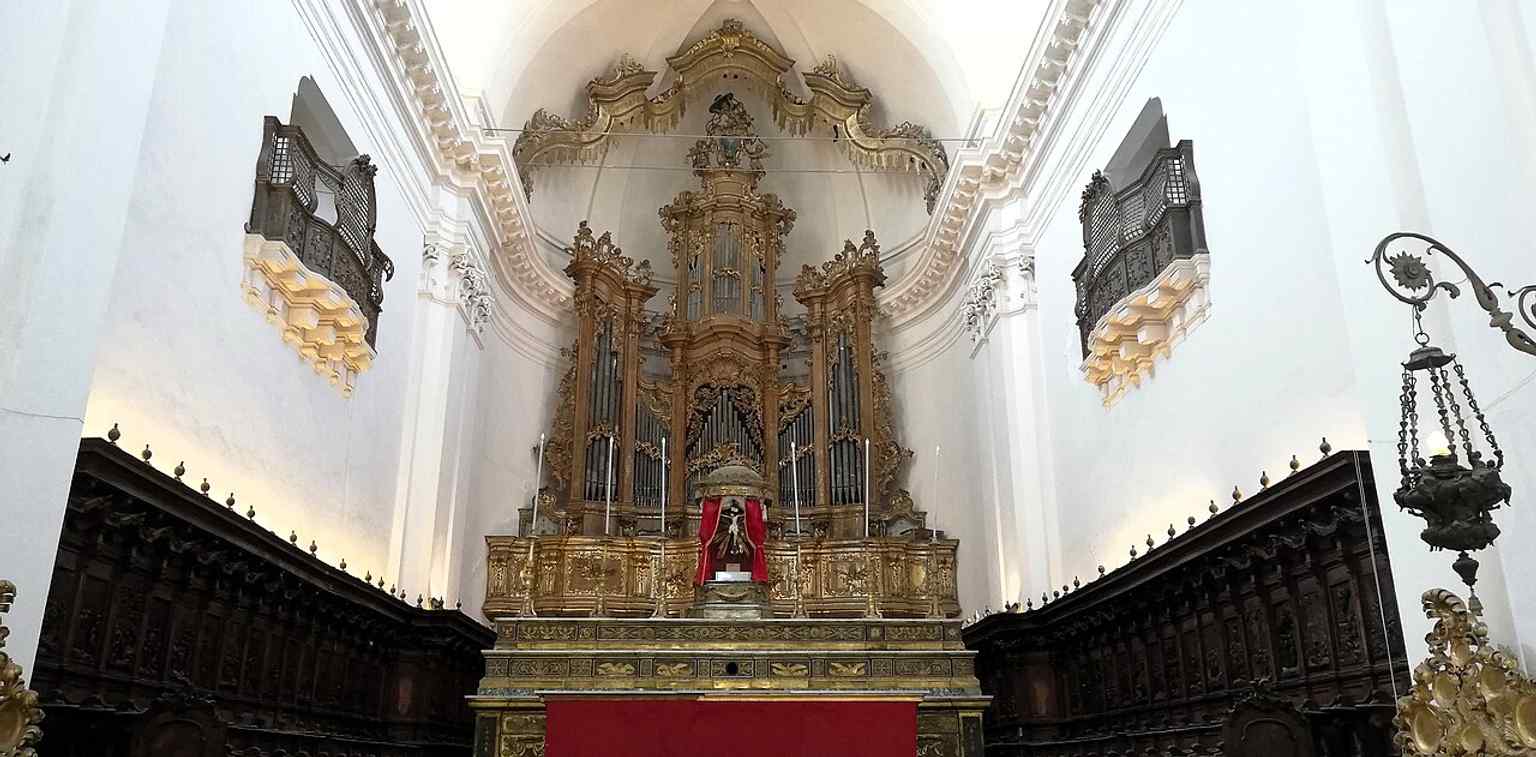
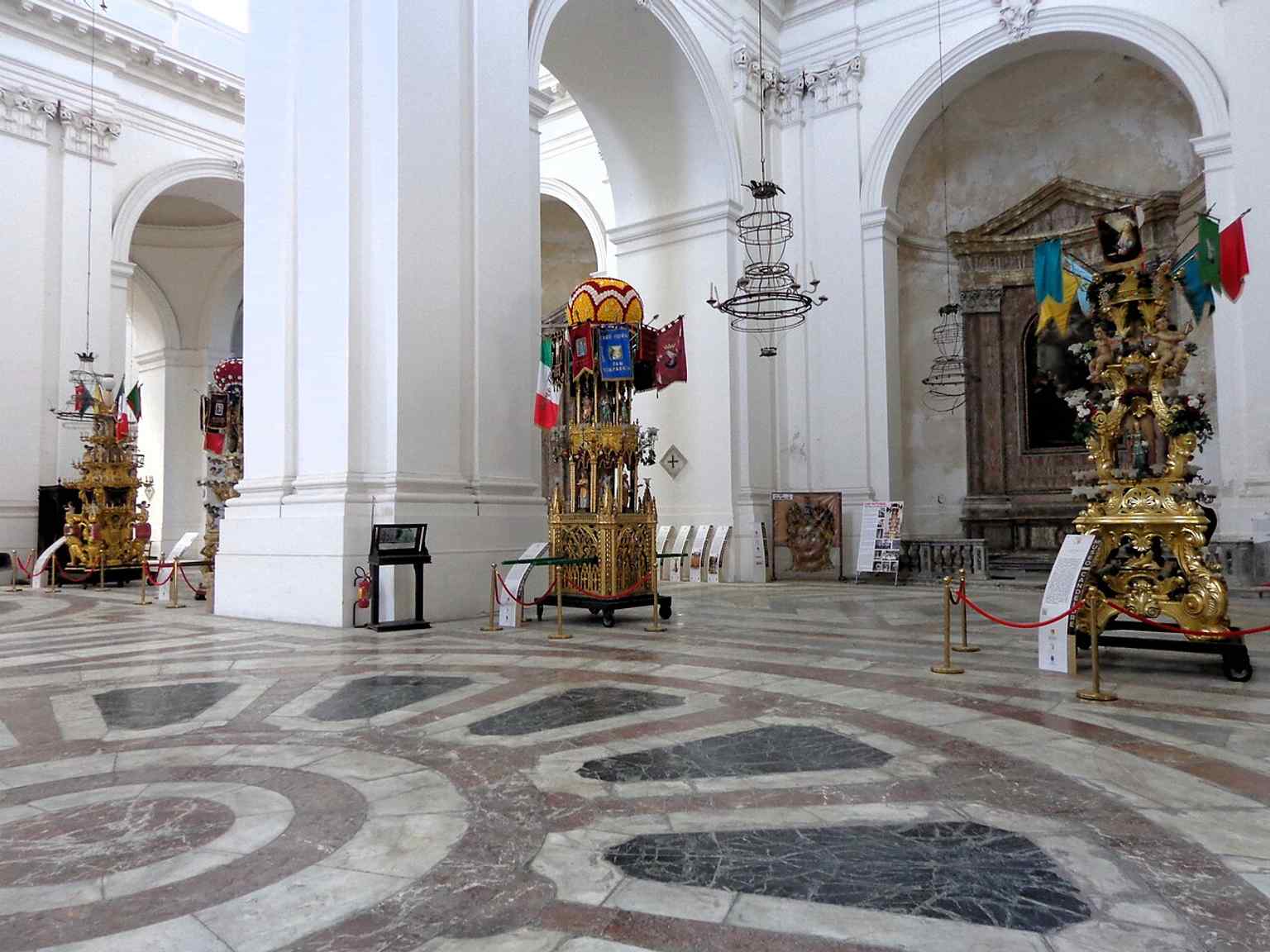
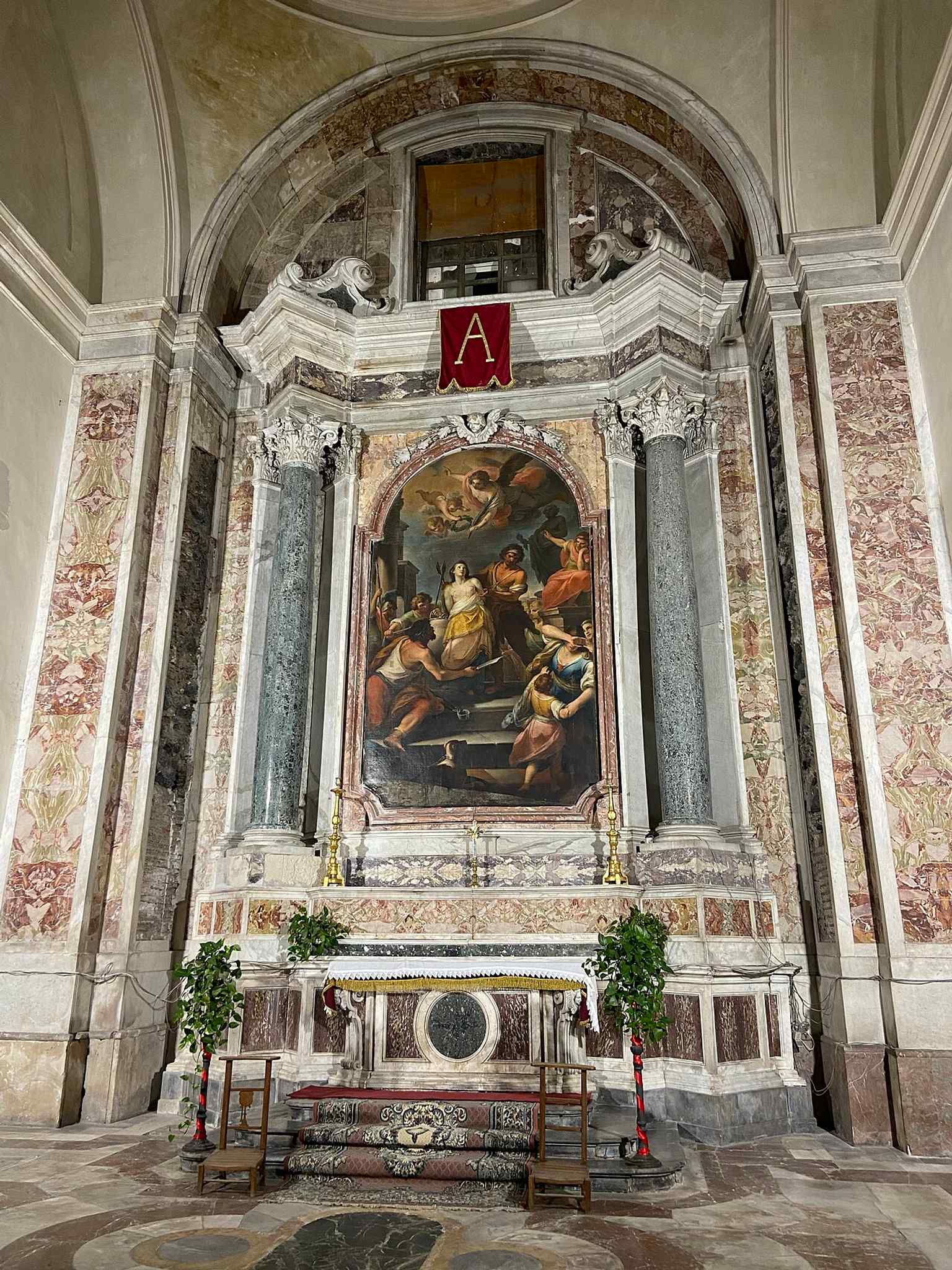
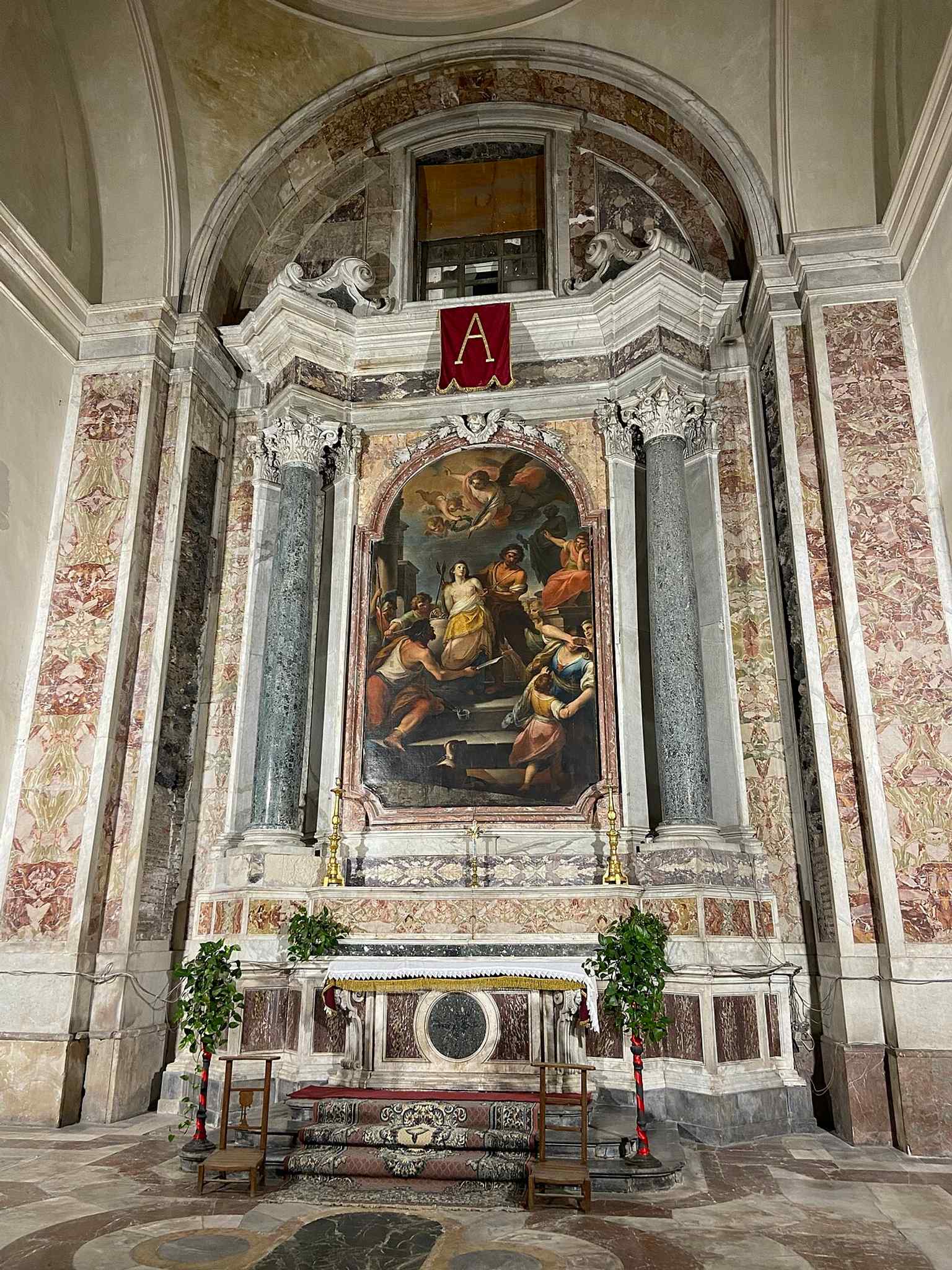
They stayed... and the building site became one of Catania’s longest stories. Andrea Amato, Antonio Amato, Francesco Battaglia, Stefano Ittar, and Carmelo Battaglia Santangelo all shaped it over time. Ittar finally raised the great dome in the seventeen eighties. The image in the app shows how the interior swallows distance, making even monumental altars seem almost small inside that vast white space.
And then there is the facade before you, which tells a more human truth. The project changed five times. In the end, the monks spent generously on the comfort and splendor of their monastery and struggled to finish this outer face. In seventeen ninety-seven, a legal fight with the stone suppliers stopped the work for good. That is why those columns remain cut off, like a sentence abandoned mid-thought. If you look at the image in the app, that incompleteness becomes especially clear.
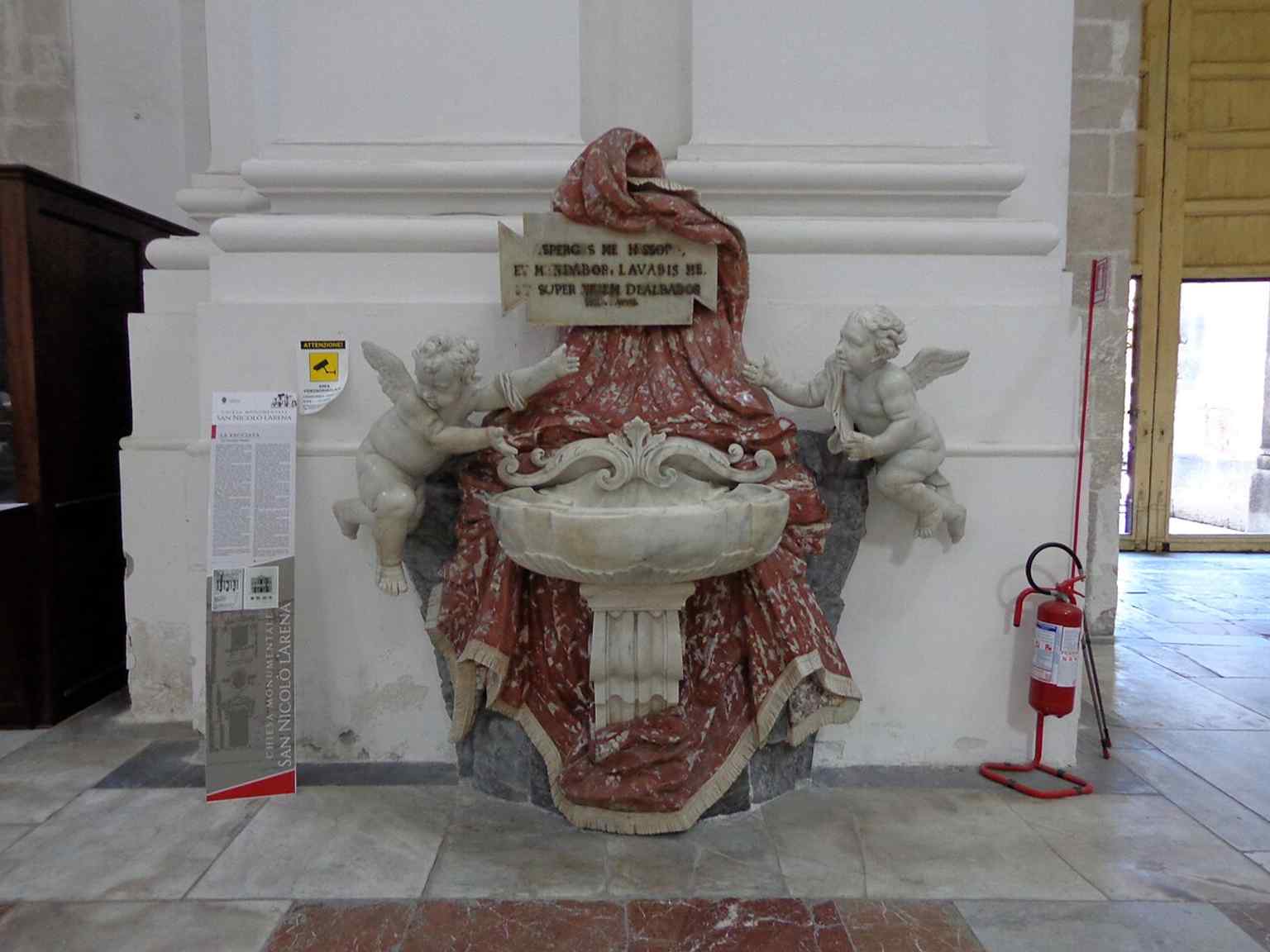
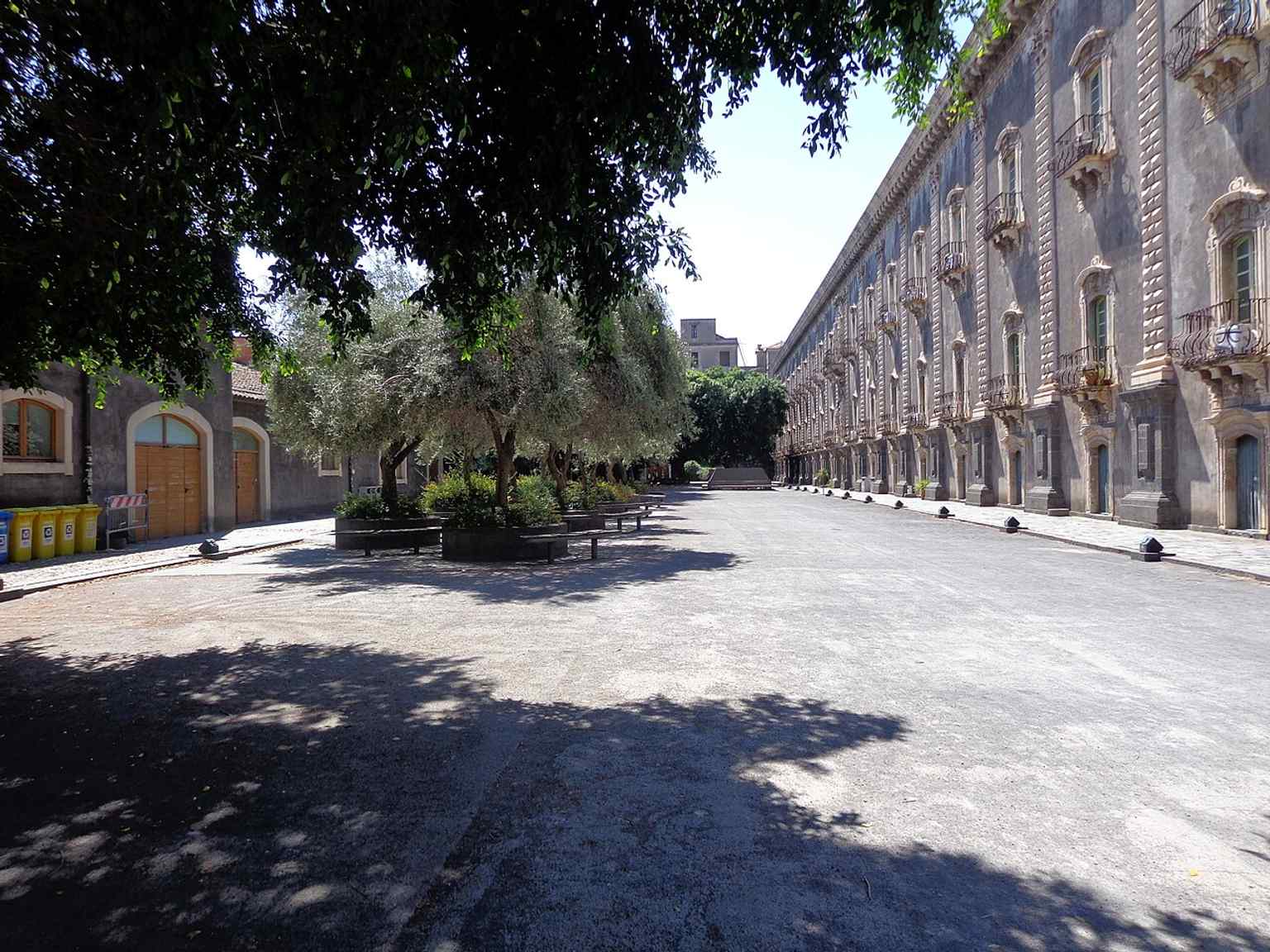
Inside, the Benedictines filled the chapels with precious marbles from across Italy, built a giant organ with two thousand three hundred seventy-eight pipes that could be played by three organists at once, and even installed a meridian line - a marble strip used to track the sun with astonishing precision. Later centuries treated the church harshly. The Italian state confiscated monastic property in eighteen sixty-six, and bombing in the summer of nineteen forty-three tore through the building, badly damaging the right transept, the arm of the church that crosses the main hall. Still, it survived, and in the twentieth century it also became the city’s military memorial.
If you want to step inside later, the church generally opens daily from nine in the morning to five thirty in the afternoon.
San Nicolò l’Arena stands here like Catania itself: wounded, stubborn, and breathtakingly large-hearted. When you’re ready, continue on to the libraries, where the city gathers its memory in a quieter voice.