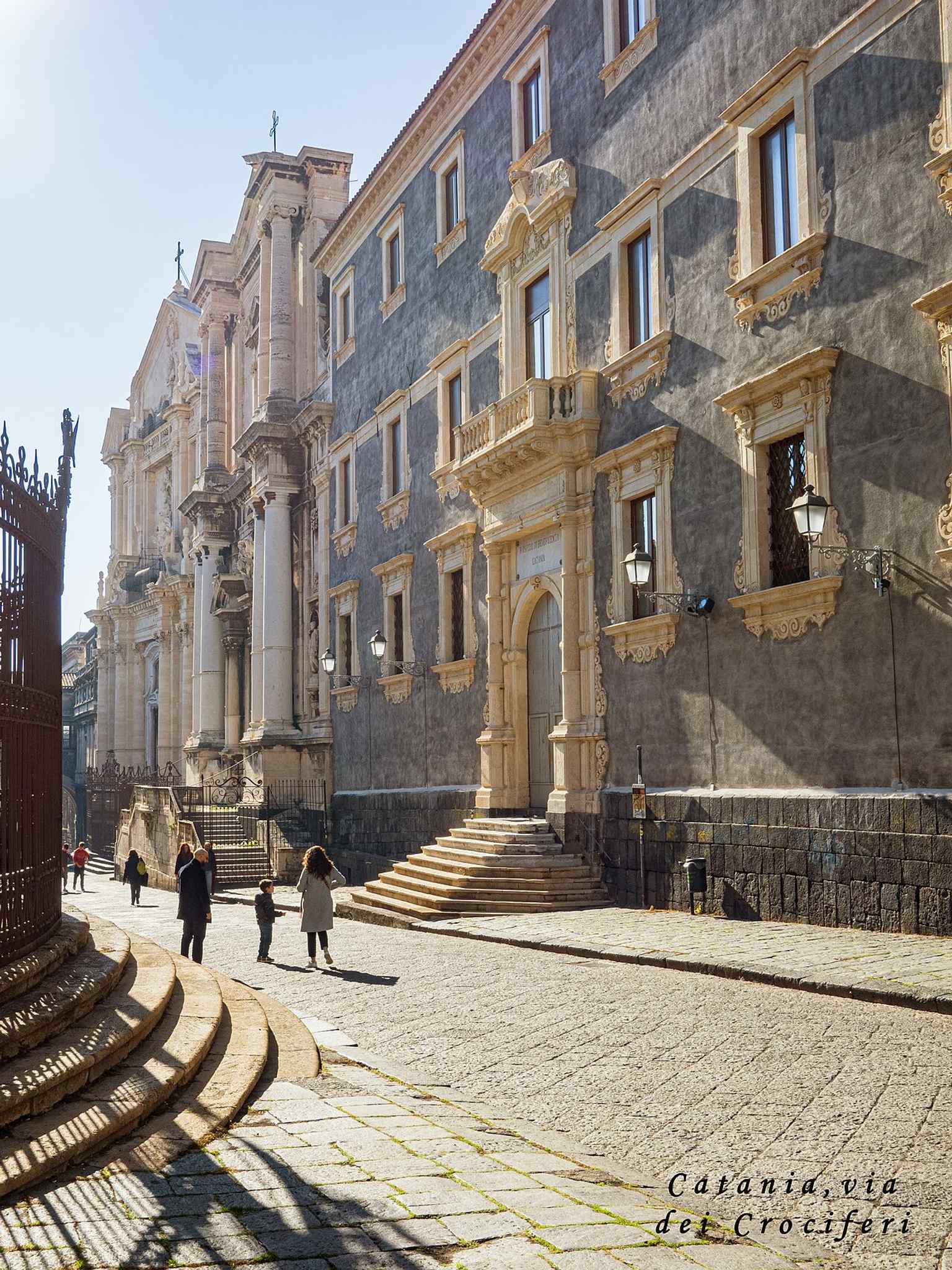
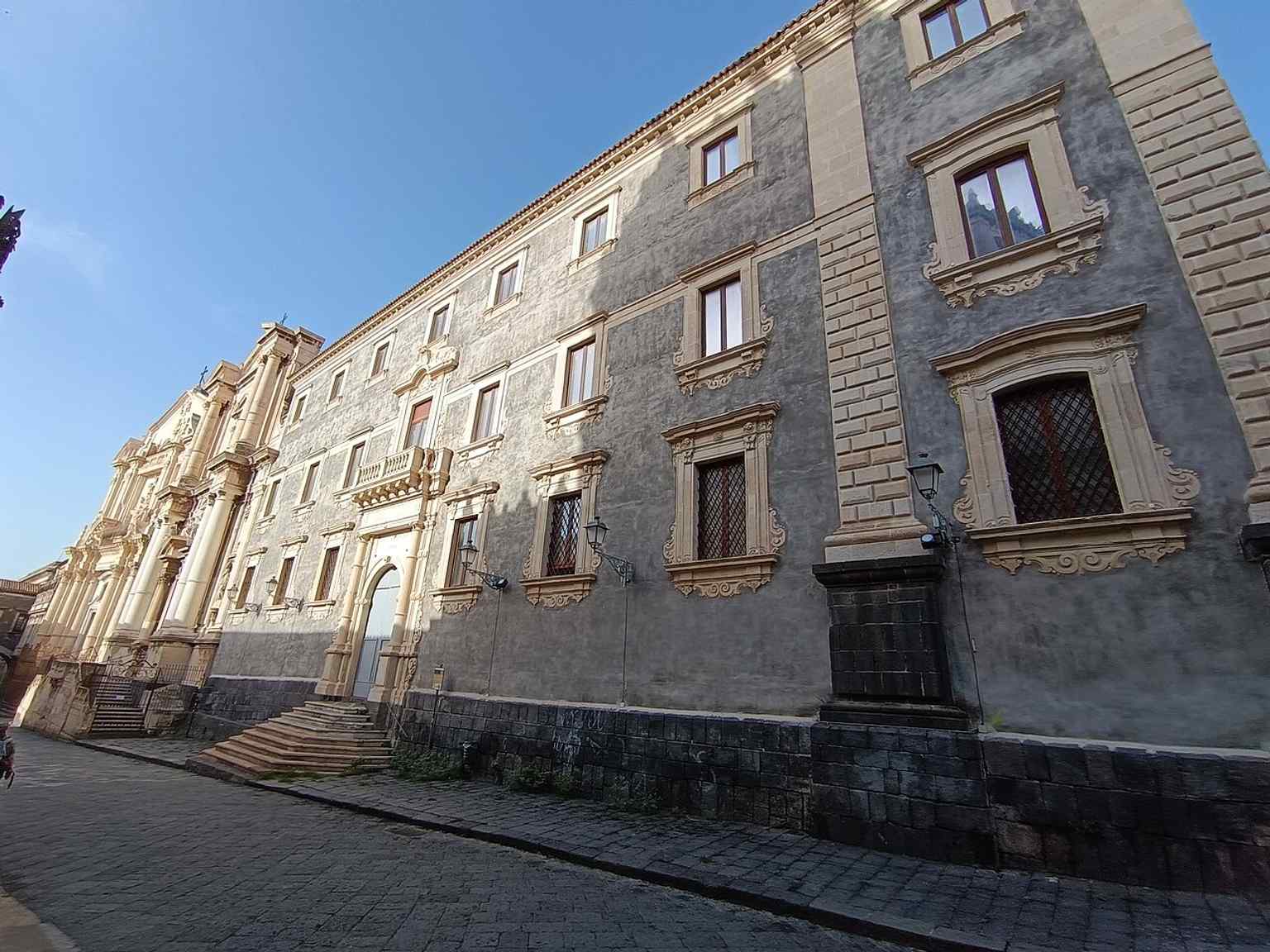
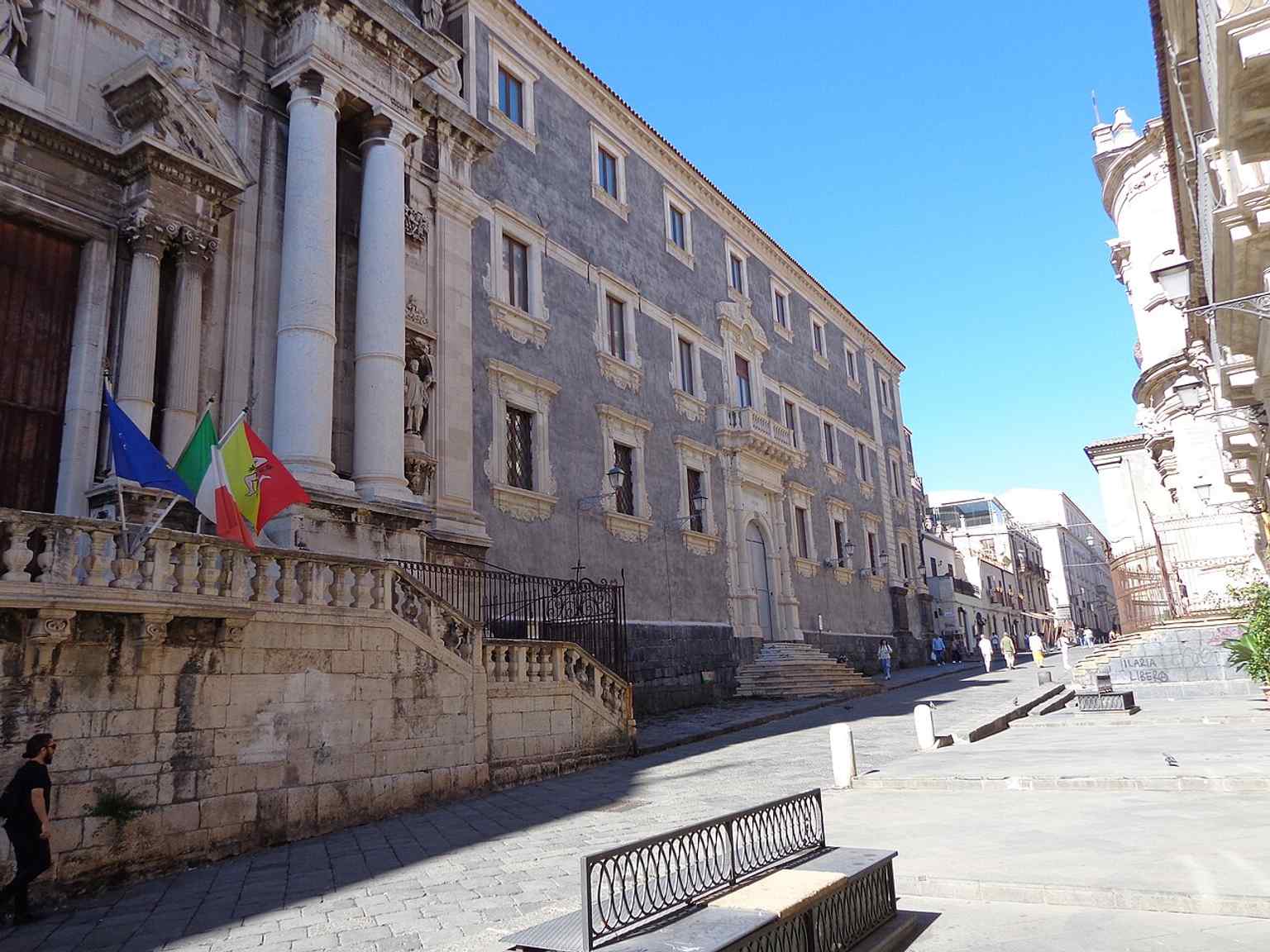
On your left, look for a pale stone Baroque façade set above a short staircase, with tall rectangular windows and a broad central entrance that gives the whole building a solemn, palace-like face.
This is the Jesuit College, one of the grandest homes the Society of Jesus ever created in Sicily. It stands on Via dei Crociferi like a careful, disciplined host... elegant, reserved, and a little proud. Since two thousand and two, UNESCO, the United Nations Educational, Scientific and Cultural Organization, has recognized it as part of the late Baroque towns of the Val di Noto.
Its story begins with disappointment. After the terrible earthquake of sixteen ninety-three, the Jesuits hoped to rebuild in a more prestigious part of the city, near what is now Piazza dell'Università. They had already bought houses there. But private citizens challenged boundaries, lawsuits multiplied, and the whole plan collapsed. So Father Francesco Maria Bonincontro had to give up that dream and return here, to the older site in Via dei Crociferi, which felt like a painful compromise.
And yet... what rose from that setback became extraordinary.
From the late sixteen nineties until about seventeen fifty-seven, master builders and architects worked here in layers across four decades. Alonzo di Benedetto guided early foundations. Angelo Italia shaped the church façade next door and likely set the college's overall scheme. Later came Stefano Masuccio, Francesco Battaglia, and others whose names survive only faintly in records. That long timeline matters, because this building is not the vision of one mind. It is a conversation across generations.
The image in your app shows the ceremonial front and the stairs lifting you toward it. But the real secret lies inside: four courtyards, including a cloister, an inner court for quiet walking, with a covered gallery carried by columns. One courtyard once had a floor of black and white pebbles laid in stripes, in a style loved by the Roman architect Borromini. Another image on your screen gives you a hint of those details.
There is a tender little twist in the story too. When the Cathedral of Sant'Agata closed for restoration between seventeen ninety-five and the early eighteen hundreds, major religious ceremonies moved to the neighboring Church of San Francesco Borgia, part of this same Jesuit complex. Because of that accident of timing, the composer Vincenzo Bellini, Catania's beloved son, received baptism here in eighteen oh one, in the shadow of this college.
Then the mood changed. In seventeen sixty-seven, the Bourbon rulers expelled the Jesuits from Sicily. Officials seized the building and even confiscated its great library, one of the richest in the city. Thankfully, the books survived. In seventeen seventy-nine, royal authorities used them to form the core of a new academic library, and many of those volumes still live on in Catania's library collections.
After that, the college kept serving the city in new ways. It became a school for trades, then in eighteen thirty-four a charitable hospice for poor boys and abandoned children. Some learned crafts here. Some worked in an in-house print shop. Some even played in a musical band hired for public ceremonies. In the twentieth century, from nineteen sixty-eight to two thousand and nine, art students filled these rooms instead, giving the old Jesuit discipline a new creative pulse.
So this façade is more than beautiful stone; it is a vessel for prayer, teaching, loss, music, books, and stubborn civic memory.
When you're ready, continue on toward the Rotonda Thermal Baths, where Catania's older layers begin to show through again.