
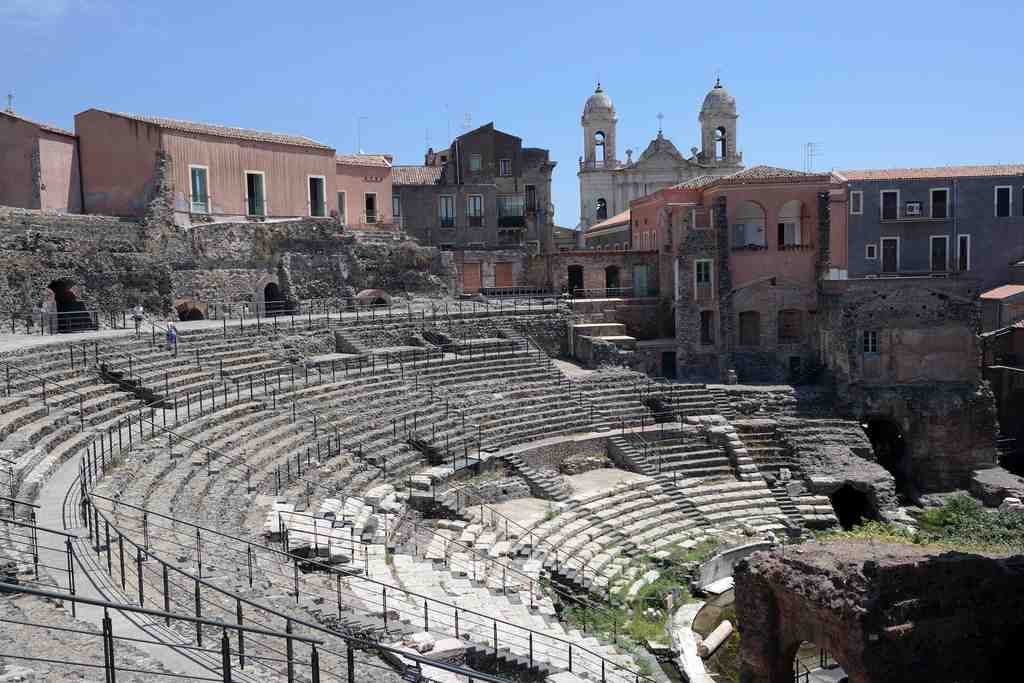
On your right, look for the theater’s dark lava-stone arches and broad semicircular sweep of seating, with fragments of old houses still clinging to the ancient curve like a second skin.
This place carries two lives at once. Catania still calls it Tiatru grecu, the Greek theater, even though most of what you see took shape in the second century under Rome. That old name survived because memory here is stubborn and affectionate. Long before archaeologists cleared these ruins, people believed the theater named in classical texts had to be this very one... the place where Alcibiades is said to have spoken in four fifteen B-C, trying to persuade the people of Katane to join Athens against Syracuse.
For a long time, nobody could prove it. Then excavators found something precious: massive sandstone blocks marked with Greek letters, part of an earlier theater with a more rectangular Hellenistic layout. Those remains likely belong to the Greek building from the fourth century B-C, and maybe even to the theater where Alcibiades made his pitch. I love that detail... not because it solves every mystery, but because it lets the argument stay alive.
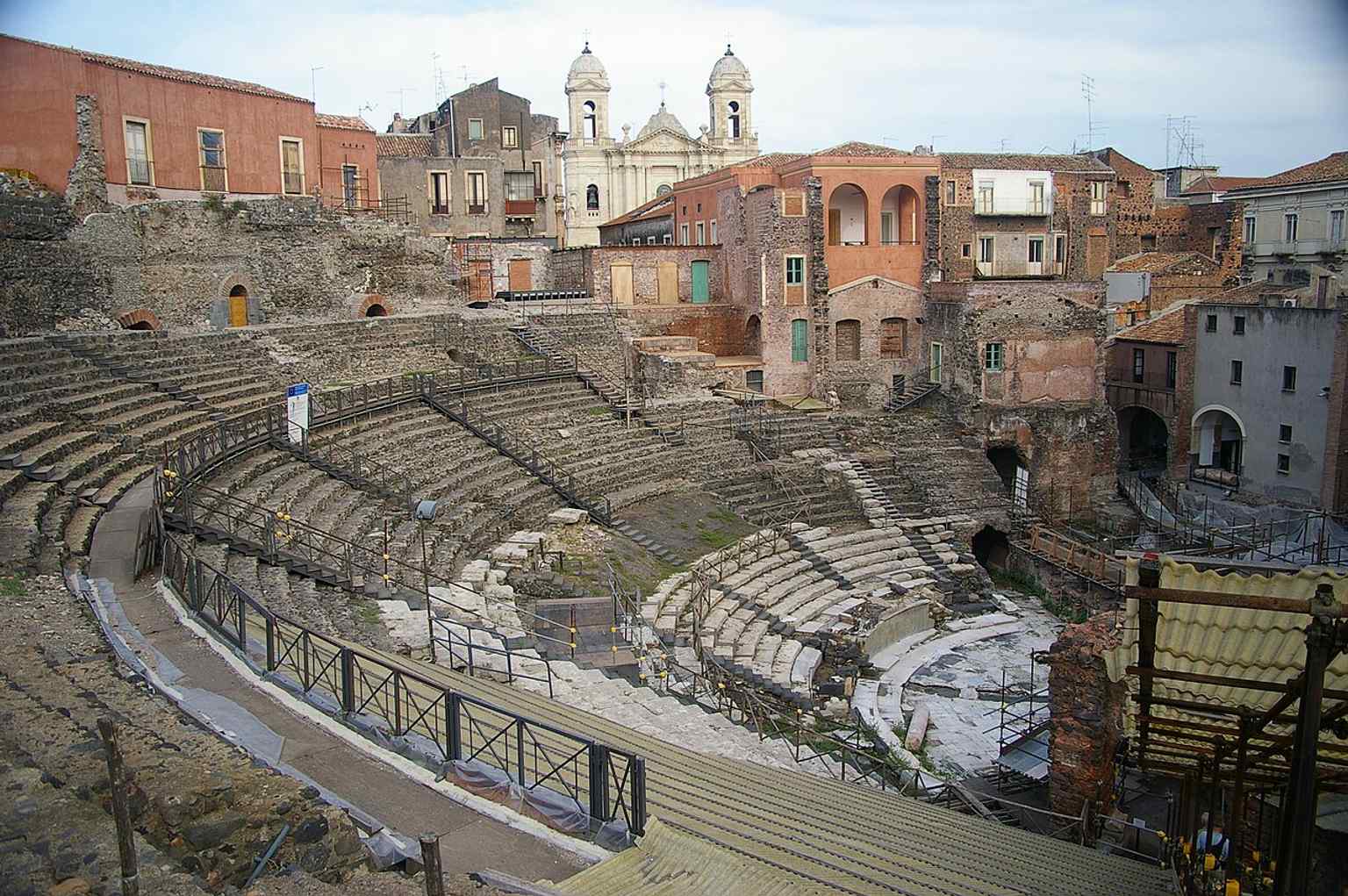
Rome did not start from nothing here. After Augustus made Catania a Roman colony in the first century, builders repaired the older structure, replacing missing sandstone with squared lava-stone blocks and adding an early stage and seating. Then, in the second century, they turned it into something grand. They reshaped it into the sweeping half-circle you can still read from outside, enlarged the stage, added two heavy side towers with stairways, and dressed the front in costly marble. Inside, the orchestra - the round performance floor - stretched about twenty-two meters across and once gleamed with inlaid stone in circles set inside squares. The seating bowl, called the cavea, reached nearly ninety-eight meters wide, with twenty-one rows divided into wedges by black lava stairways. White marble seats against black stone steps... it must have looked astonishing. If you glance at the image in the app, you can catch that powerful curve of the ruin within the city fabric.
And then came the long unmaking. In the eleventh century, Count Roger ordered workers to strip fine marble, columns, and even lava blocks from the theater to help build the Cathedral of Sant’Agata. So some of the beauty lost here quietly reappeared in the church we visited earlier. By the sixth and seventh centuries, the theater had already slipped out of use. Families settled into it. Corridors turned into rooms. The orchestra even served as a cattle butcher’s yard. Later, people filled the neighborhood with stories about buried treasure and secret tunnels running toward seats of power. Archaeologists never found those passages, but the tale says something true: generations knew this place held more than it showed.
What moves me most is how human the recovery was. Bombing in the Second World War tore open the crowded quarter above the theater, and archaeologist Guido Libertini used those painful gaps to uncover the ancient seats. Later teams kept excavating, but they did something gentler too: they chose to preserve some younger houses built over the monument, so the theater could tell the story of Roman Catania and of the families who lived here centuries later.
If you want to visit inside later, the site generally opens every day from nine in the morning to seven in the evening.
This theater feels less like a ruin than a city learning to remember itself.
When you’re ready, continue on toward the Church of Saint Francis of Assisi at the Immaculate Conception.





