
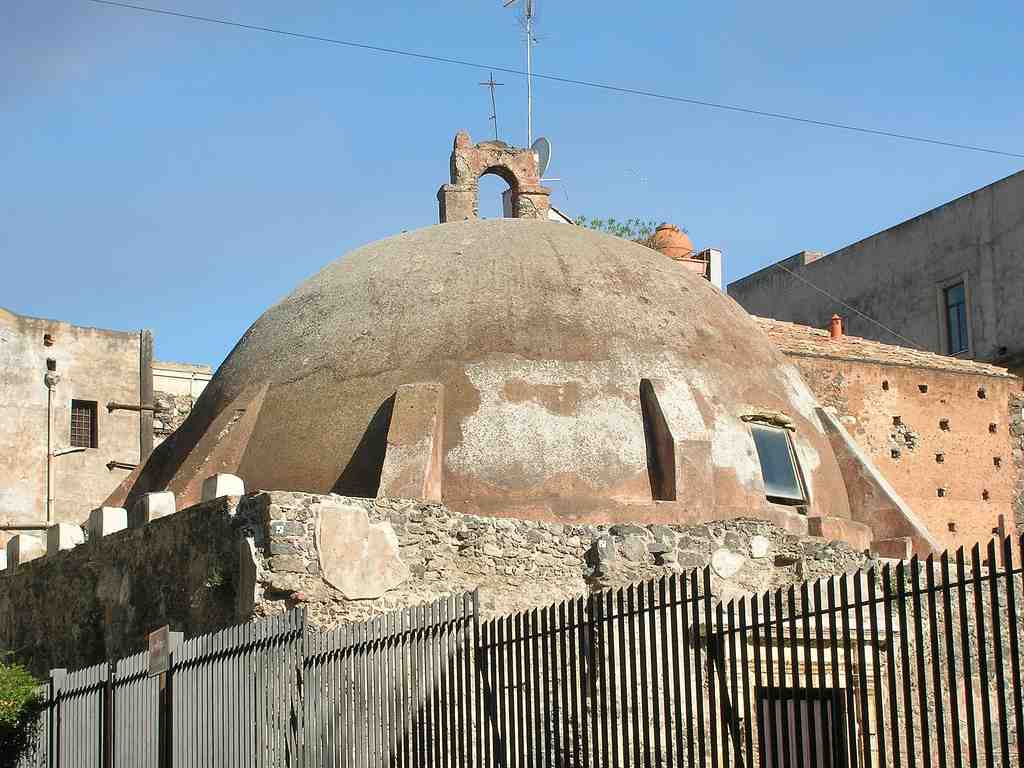
Look to your right for a square stone building wrapped around a great round dome, with a dark lava-stone pointed portal that hints at many different lives.
This place began as a Roman bath complex in the first and second centuries after Christ... one of the many bathhouses that served ancient Catania near the theater district. Under your feet and around these walls, Romans once moved from cool rooms to warm ones to hot ones. Archaeologists found traces of heated floors here - little supports that held up the pavement so hot air could pass beneath it - and even scraps of mosaic.
Then the story turned. Near the end of the sixth century, in the Byzantine age, people reshaped the ruined baths into a church: Santa Maria della Rotonda. That name, Rotonda, comes from the building’s unusual heart - a circular hall set inside a square shell, all covered by a broad dome. It feels almost like two buildings learning to live inside one body.
For centuries, Catania loved a grander legend. Many locals insisted this was an ancient Pantheon, even a model for the famous one in Rome. Some went further and said Saint Peter himself came here in the year forty-four and consecrated it to the Virgin Mary. None of that turned out to be true, but the legend tells you something tender and very human: the city wanted this place to feel sacred, ancient, and deeply its own.
History left harder marks too. After the earthquake of eleven sixty-nine, builders changed the church’s direction and opened the Gothic doorway in lava stone. In the sixteenth century, they shifted the orientation again and added a Renaissance portal in limestone. Around the church, among the old bath ruins, a cemetery grew and stayed in use for centuries. Imagine that change: a place once devoted to bathing, conversation, and the care of the living became, little by little, a resting place for the dead.
In nineteen forty-three, bombing damaged this site. A few years later, the archaeologist Guido Libertini tried to uncover the Roman layers, but he did it brutally. Workers lowered floors, stripped church fittings, and even destroyed many frescoes to expose the ancient walls. Later excavations, especially from two thousand and four to two thousand and eight, and again in two thousand and fifteen, found tombs, nine bath rooms, a great water reservoir, and the old Roman entrance court. Since twenty sixteen, local volunteers have helped keep the site open and alive again.
If you go inside during opening hours, it is usually closed on Monday, open from nine to five Tuesday through Saturday, and from nine to one on Sunday.
The Rotonda holds Roman comfort, Byzantine prayer, medieval burial, and modern rescue all in one quiet embrace.
When you’re ready, continue on toward San Nicolò l’Arena, where Catania’s scale turns grand again.




