
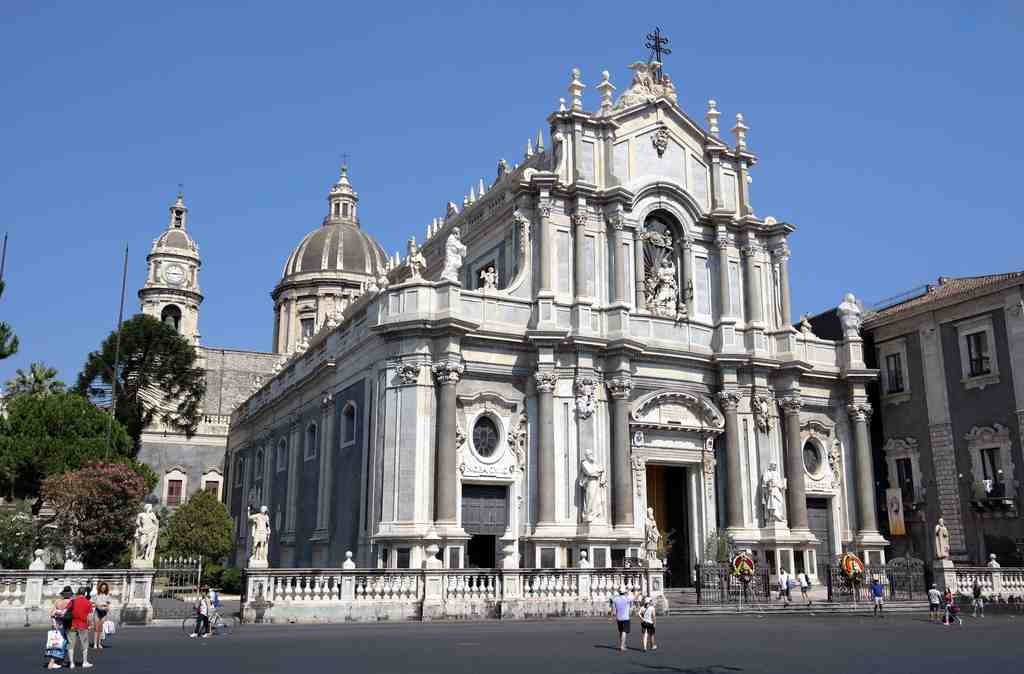
On your right, the Cathedral of Sant'Agata stands in pale marble with a tall three-tiered facade of granite columns, oval windows, and marble saints gathered above the central doorway.
This is the heart of Catania... not only its cathedral, but the city’s memory in stone. It is dedicated to Saint Agatha, the young martyr who became Catania’s patron, and almost everything about this place feels shaped by love for her. The church you see carries many lives at once: Norman strength, Baroque drama, and a touch of Neoclassical order. In its earliest form, it served as an ecclesia munita, a fortified church, part sanctuary and part stronghold.
The story begins in the late eleventh century, when Count Roger and Bishop Angerio raised the first cathedral here over the ruins of the Roman Achillian Baths. Even then, builders folded older fragments into the new church, reusing stone and pieces from pagan temples and Roman remains, as if Catania never really throws its past away... it absorbs it.
Saint Agatha’s own story deepened the bond. In the year ten forty, the Byzantine general George Maniaces carried her relics away to Constantinople. For eighty-six years, Catania lived without them. Then, in eleven twenty-six, two former Byzantine soldiers, Gisliberto from France and Goselmo from Calabria, stole the relics back. Legend says Agatha herself appeared to Gisliberto in a dream and told him to bring her home. When the relics finally returned on the seventeenth of August, they entered the cathedral to a city overflowing with joy. That homecoming still echoes in Catania’s summer celebrations.
But this cathedral also knows grief. In eleven sixty-nine, a catastrophic earthquake brought down the roof during the feast of Saint Agatha, killing Archbishop Giovanni d’Aiello and many of the faithful gathered inside. Then, in sixteen ninety-three, the great earthquake of the Val di Noto shattered almost everything again. Only the Norman apses and parts of the older structure survived. What rose afterward is the church in front of you now, shaped inside by Girolamo Palazzotto and given this splendid facade by Giovanni Battista Vaccarini.
If you look closely at the oval windows, you may notice mysterious letters tied to an old local legend: N-O-P-A-Q-V-I-E. People connected them to a warning said to have saved Catania when Emperor Frederick the Second threatened destruction: “Do not offend the homeland of Agatha, for she avenges wrongs.”
And if you’d like a glimpse past the doors, take a look at the image on your screen: the main altar sits deep in the Norman apse, where the medieval core still steadies the later splendor. Another image shows that same Romanesque heart beneath the decoration, a quiet survivor after centuries of collapse and rebuilding.
If you plan to step inside later, the cathedral usually opens from seven fifteen AM to twelve thirty PM and again from four PM to seven PM, with Sunday morning opening from seven forty-five AM. This cathedral feels like Catania’s vow to remember, rebuild, and remain faithful. When you’re ready, we’ll step toward the stones beneath it, where the Achillian Baths still keep Roman Catania close.




