
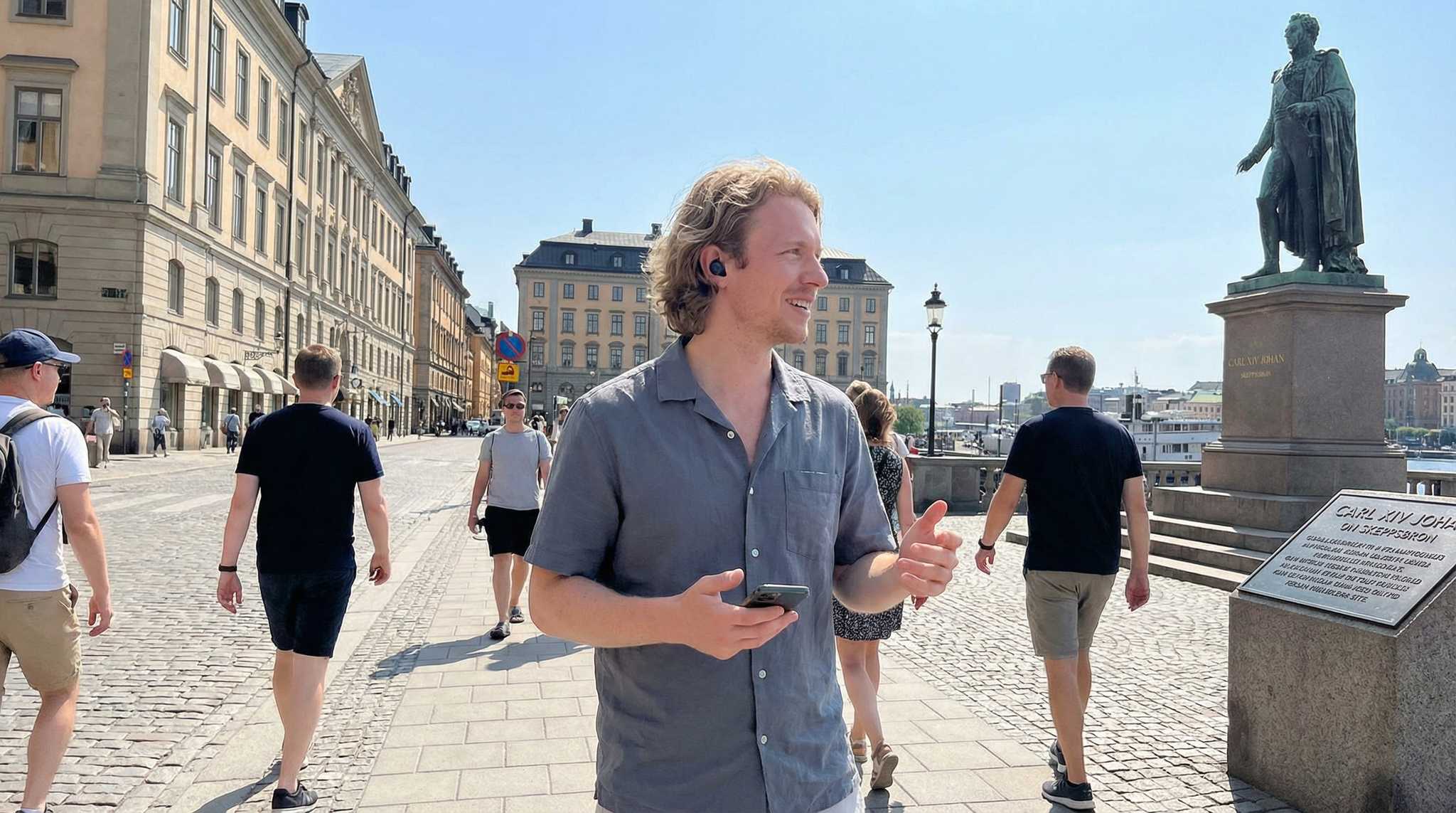
Stockholm Audio Tour: Historic Heart
Stockholm hides a heartbeat beneath the bright grid of Sergels torg, where modern glare masks old power plays and quiet danger. This self guided audio tour leads through central streets to Stockholm City Hall, Klara Church, and nearby corners most visitors rush past. Hear the city speak through rebellions, scandals, political battles, and forgotten moments tucked behind stone and glass. What crisis once pushed the city to the edge, within sight of the halls where decisions were made at Stockholm City Hall? What secret grief lingers in the shadow of Klara Church after the city was cut and rebuilt? Why does Sergels torg connect to a strangely specific night of sirens, speeches, and a single missing banner? Move from square to spire to waterfront, following echoes that turn familiar views into charged scenes. Leave with Stockholm sharper, darker, and thrillingly alive. Press play and chase the pulse beneath Sergels torg.
Tour preview
About this tour
- scheduleDuration 100–120 minsGo at your own pace
- straighten4.4 km walking routeFollow the guided path
- location_on
- wifi_offWorks offlineDownload once, use anywhere
- all_inclusiveLifetime accessReplay anytime, forever
- location_onStarts at Klara Church
Stops on this tour
lock_open 3 free previews · 11 unlock with purchase
Take a look at the striking red brick building before you, shaped like a traditional Latin cross with one long main section intersected by a shorter crossway, and topped with a…Read moreShow less
Open dedicated page →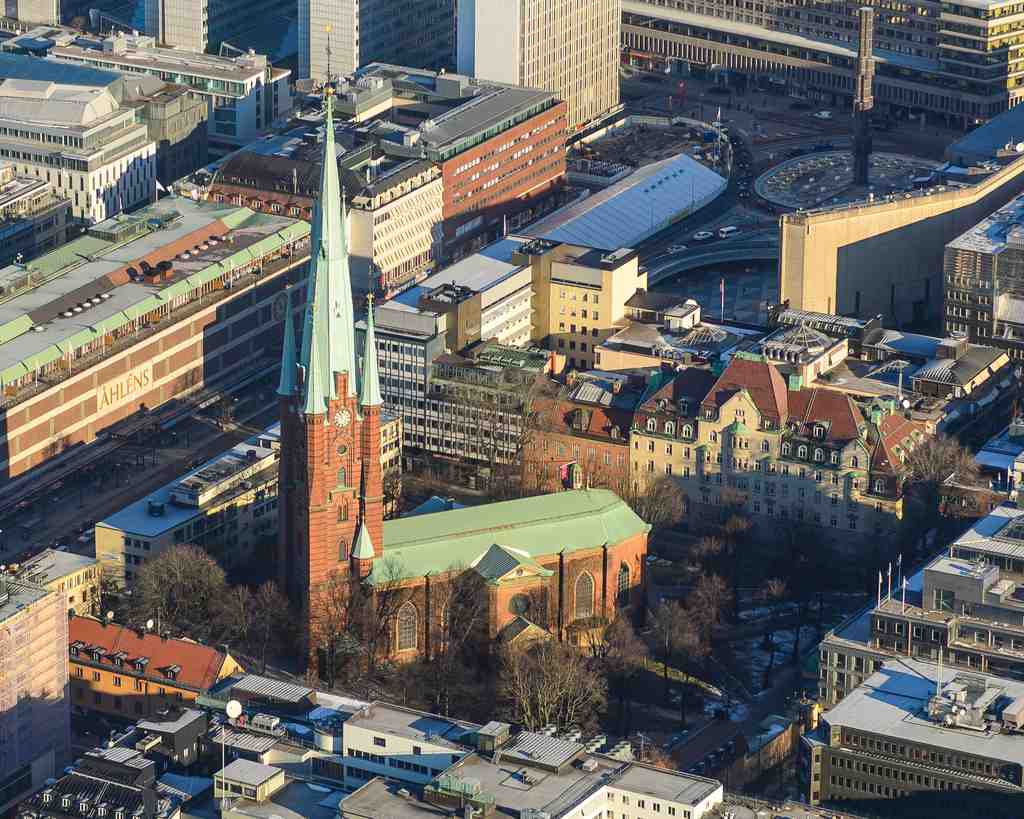
Klara ChurchPhoto: Arild Vågen, Wikimedia Commons, CC BY-SA 3.0. Cropped & resized. Take a look at the striking red brick building before you, shaped like a traditional Latin cross with one long main section intersected by a shorter crossway, and topped with a towering, green copper spire flanked by four smaller corner turrets. Cities like Stockholm are rarely built on empty land. Instead, they are forged through a brutal process of tearing down the old to make way for the new. Every modern street or square usually sits on top of buried ambitions, ruined fortunes, and centuries of erased history. Look at your screen to see an aerial view of how the modern city has completely swallowed this historic ground.
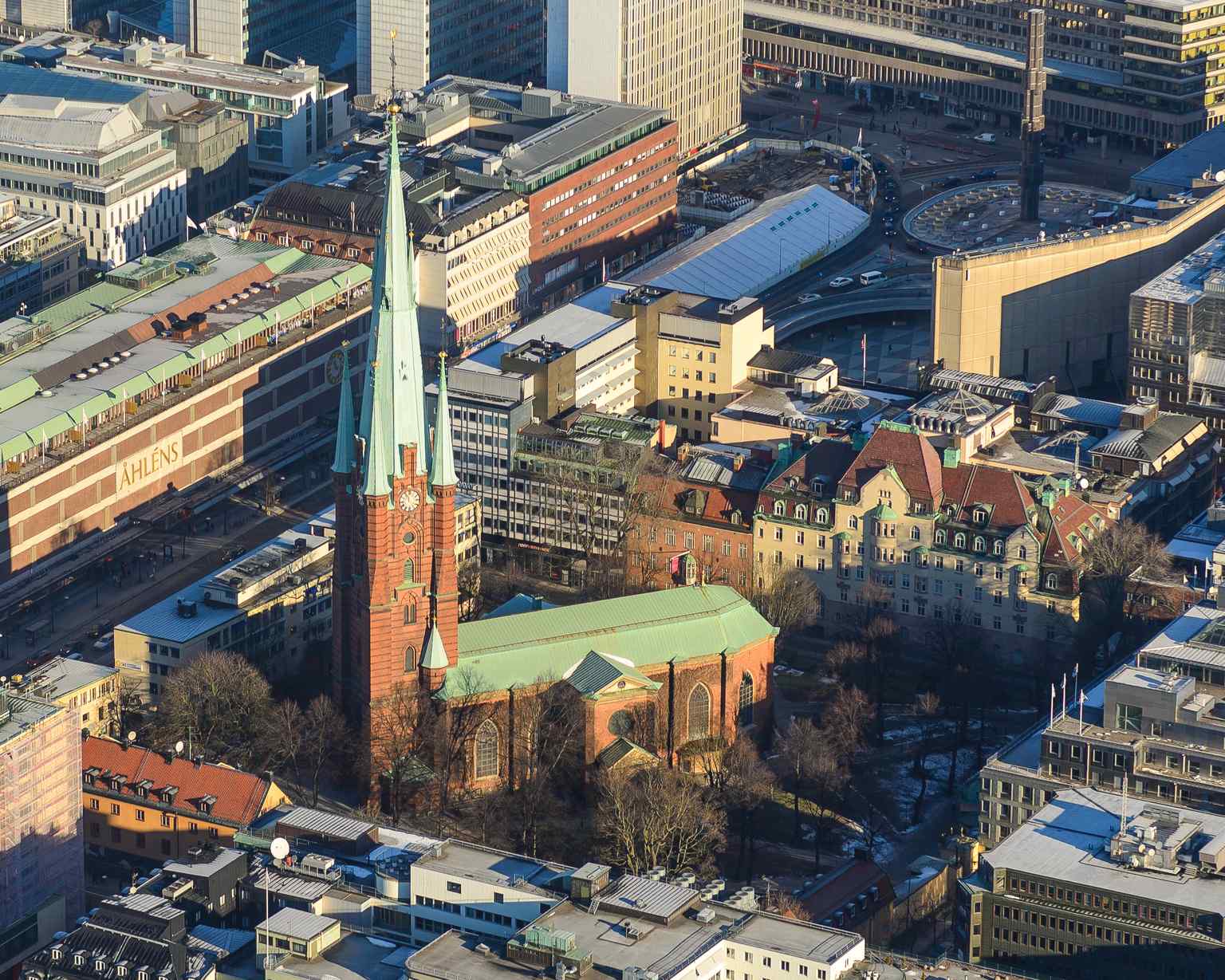
An aerial view highlights Klara Church's prominent position on Norrmalm, situated on grounds that once housed the powerful Sankta Klara nunnery.Photo: Arild Vågen, Wikimedia Commons, CC BY-SA 3.0. Cropped & resized. Here, in the 1280s, King Magnus Ladulås donated land to found the Sankta Klara nunnery, an incredibly powerful religious institution. By 1335, his own daughter, Princess Rikissa, became the abbess, the female superior in charge of the community of nuns. The convent grew to own vast tracts of land across what is now Östermalm, Södermalm, and beyond. It was a true empire of prayer and property.
But then came King Gustav Vasa in the 1520s, a monarch defined by his ruthless pragmatism and a sharp eye for seizing wealth to secure his own throne. When he led the Reformation, the convent's enormous riches became its death sentence. In 1527, Gustav Vasa ordered the total demolition of the nunnery and its church. His official excuse was military defense, claiming that foreign enemies might use the sturdy brick buildings to fire cannons at his castle. But quite conveniently, destroying the convent also allowed the crown to confiscate all of its vast, profitable estates. The surviving nuns were forced out to care for the city's sick, only to be pushed even further away when the King complained that the powerful stench of their patients was blowing toward his royal palace.
Decades later, his son Johan the third ordered a new church built on the very same spot, hiring the brilliant Dutch architect Hendrik van Huwen. Over the centuries, a parade of masterful creators poured their genius into this structure. When a catastrophic fire ripped through the area in 1751, an architect named Carl Hårleman drafted complete plans to rebuild it just twenty days after the flames died down, though he tragically died before the work was finished. The church you see today, with its 116 meter tower making it the second tallest in Scandinavia, is a monument to those who rebuilt from the ashes. Check your app for a glimpse of the beautifully restored sanctuary inside.
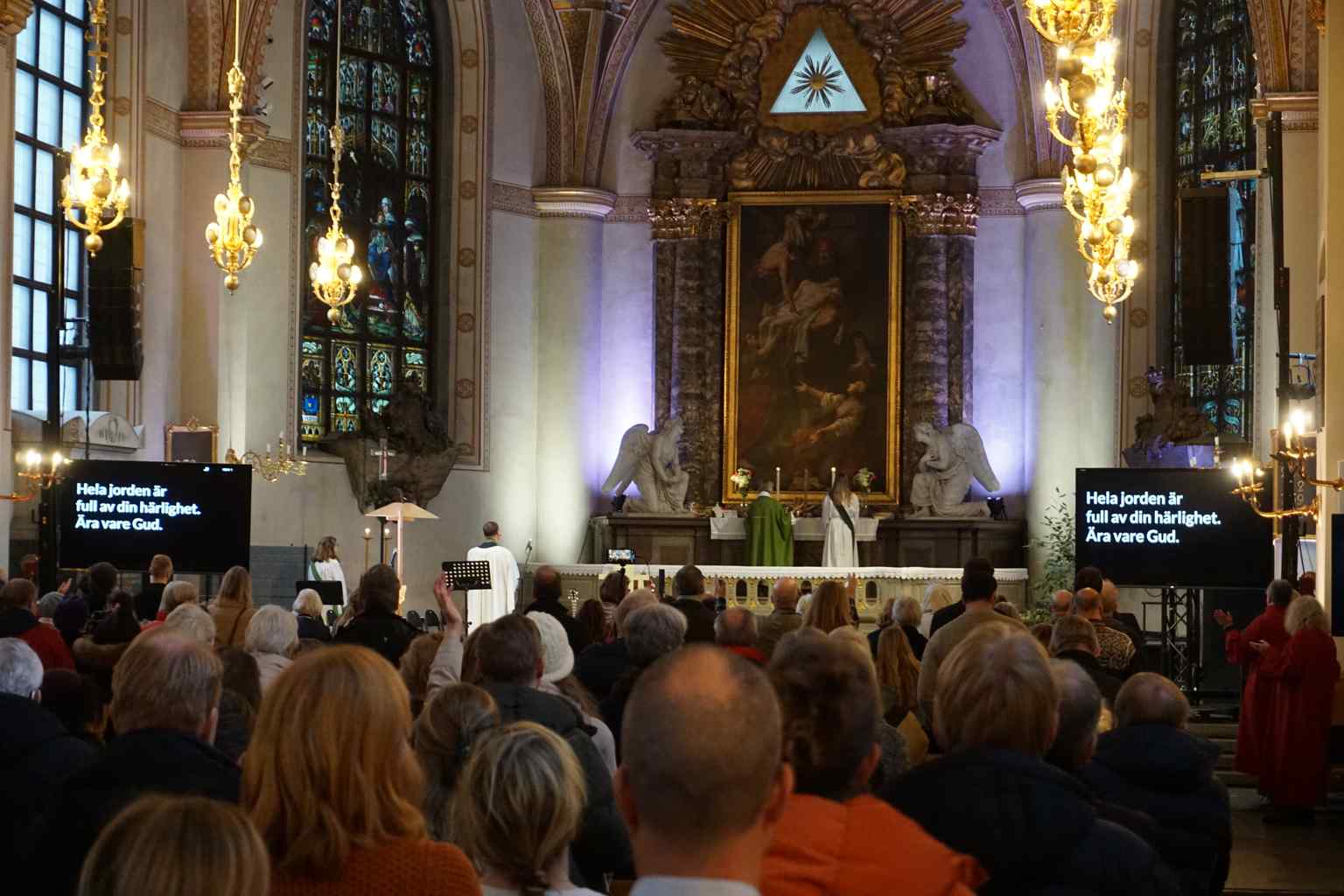
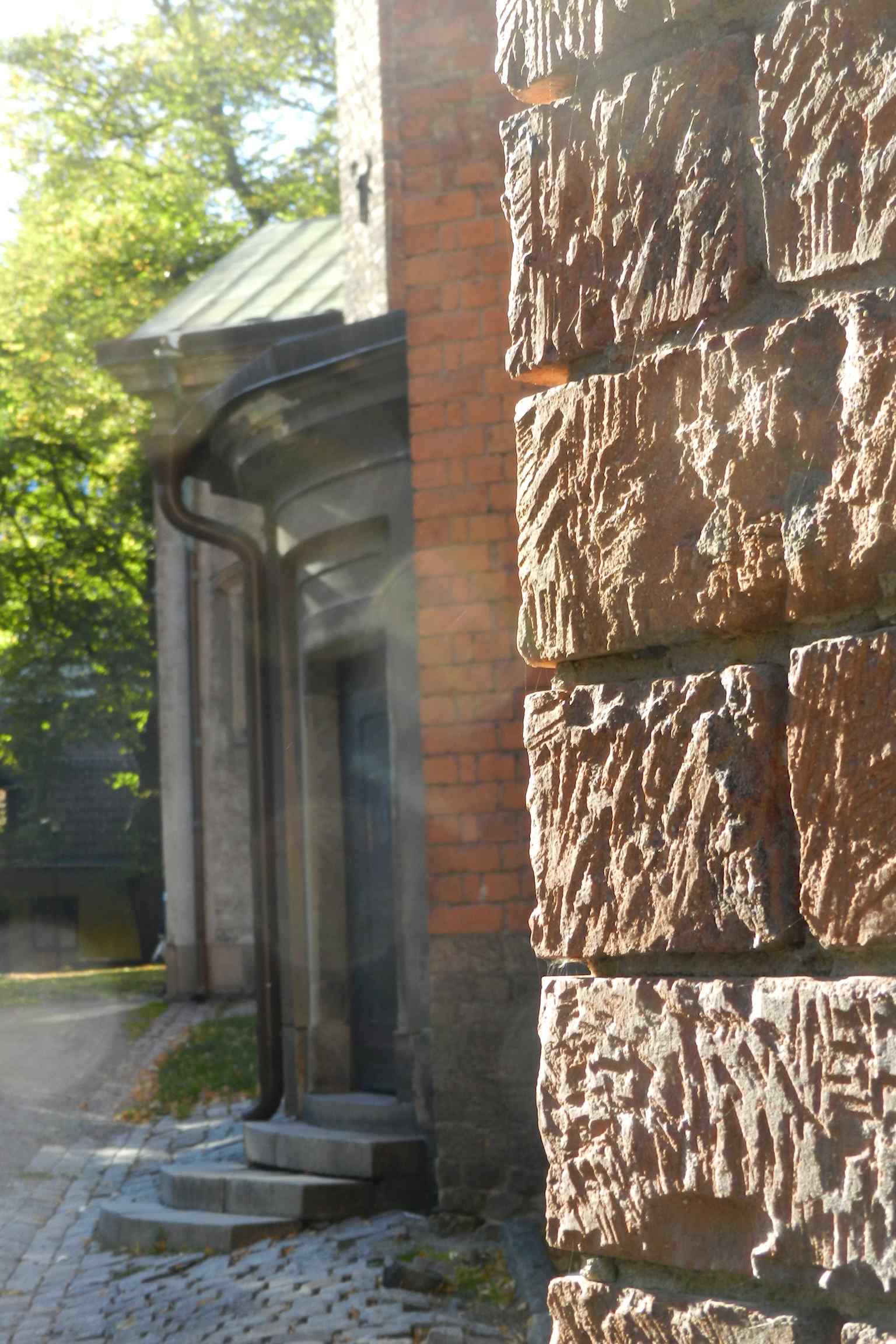
The interior, restored by Agi Lindegren, is actively used for services by the EFS association, central to the church's extensive social work with the needy.Photo: Atleett, Wikimedia Commons, CC0. Cropped & resized. It makes you wonder how many ancient scars are hidden beneath the modern concrete we walk on every day. If you want to step inside, the church is generally open daily from ten in the morning to five in the evening, with slightly adjusted hours on Thursdays and Saturdays. Now, let us head toward Sergels torg, which is just a four minute walk away.
Klara Church is the second-tallest church in Sweden and Scandinavia, standing at 116 meters with its distinctive copper spire.Photo: Zquid, Wikimedia Commons, CC BY-SA 4.0. Cropped & resized. 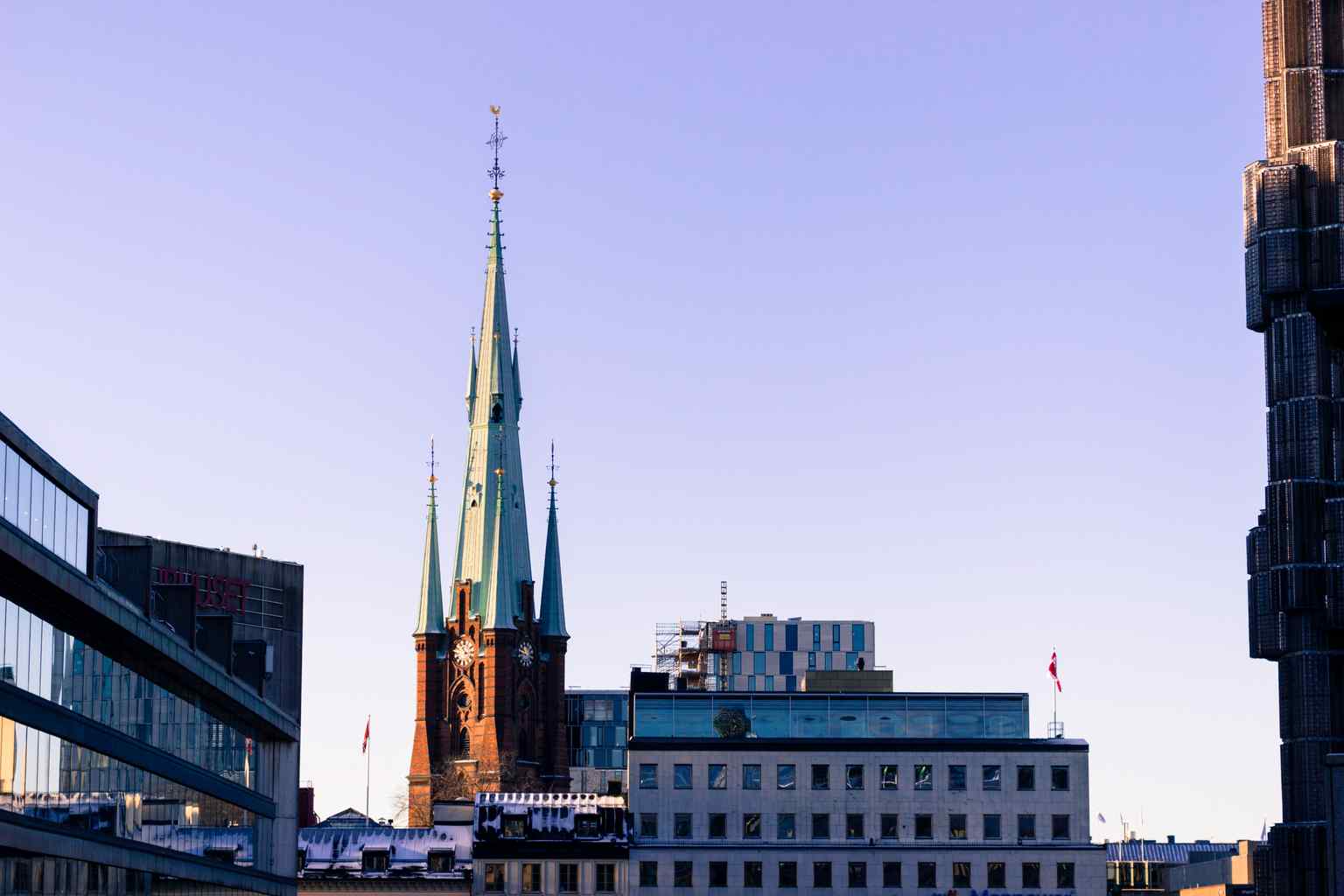
The church's 116-meter high tower, reconstructed after the devastating 1751 fire, features a distinctive copper-clad spire.Photo: Bene Riobó, Wikimedia Commons, CC BY-SA 4.0. Cropped & resized. 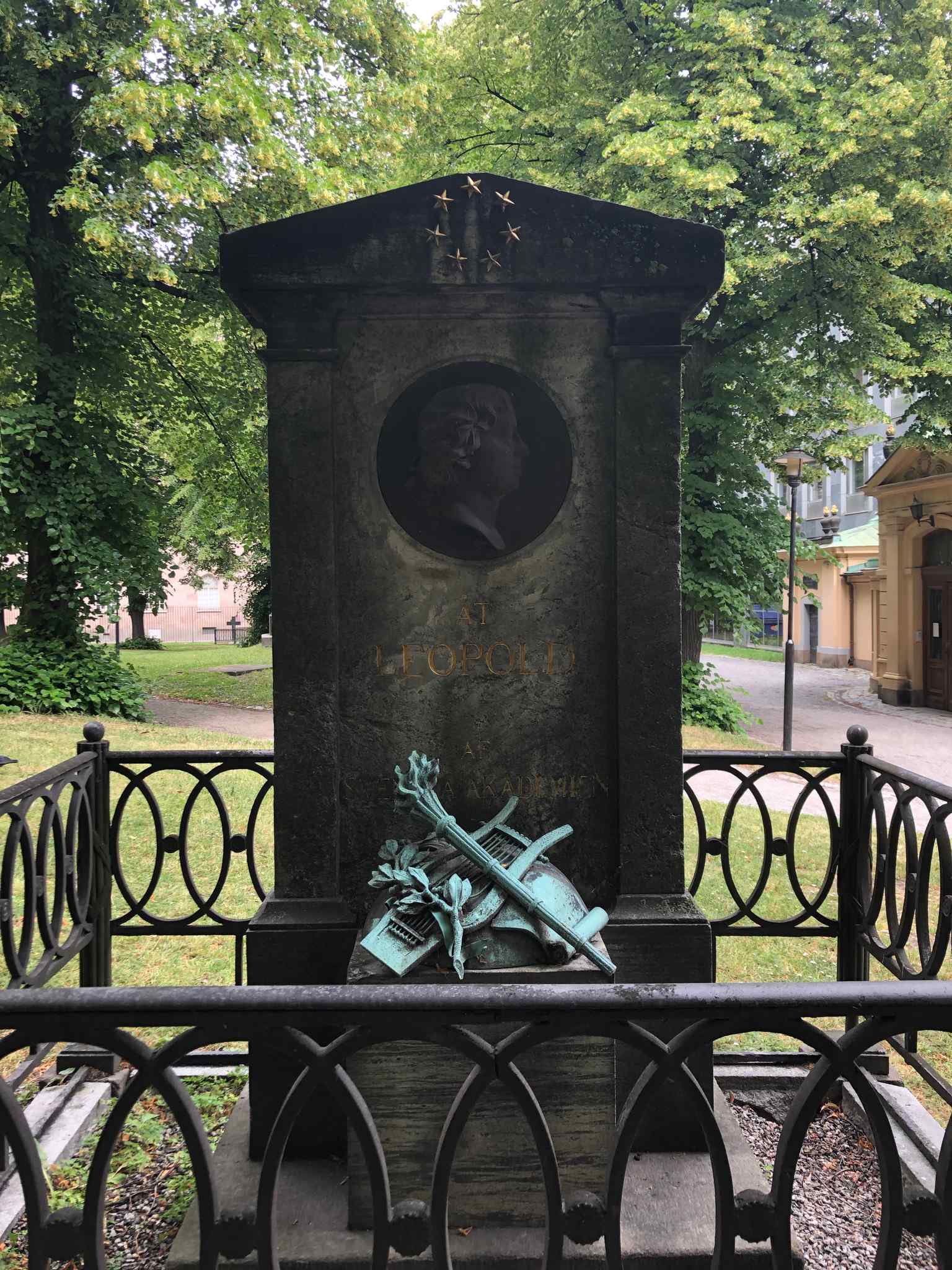
The churchyard is the final resting place for many notable figures, including Carl Gustaf af Leopold, though some graves, like Bellman's, have a more complex history.Photo: Mkallgren, Wikimedia Commons, CC BY-SA 4.0. Cropped & resized. Look down into this vast, sunken plaza paved entirely in striking black and white marble and slate triangles, watched over by a towering obelisk made of stacked glass prisms.…Read moreShow less
Open dedicated page →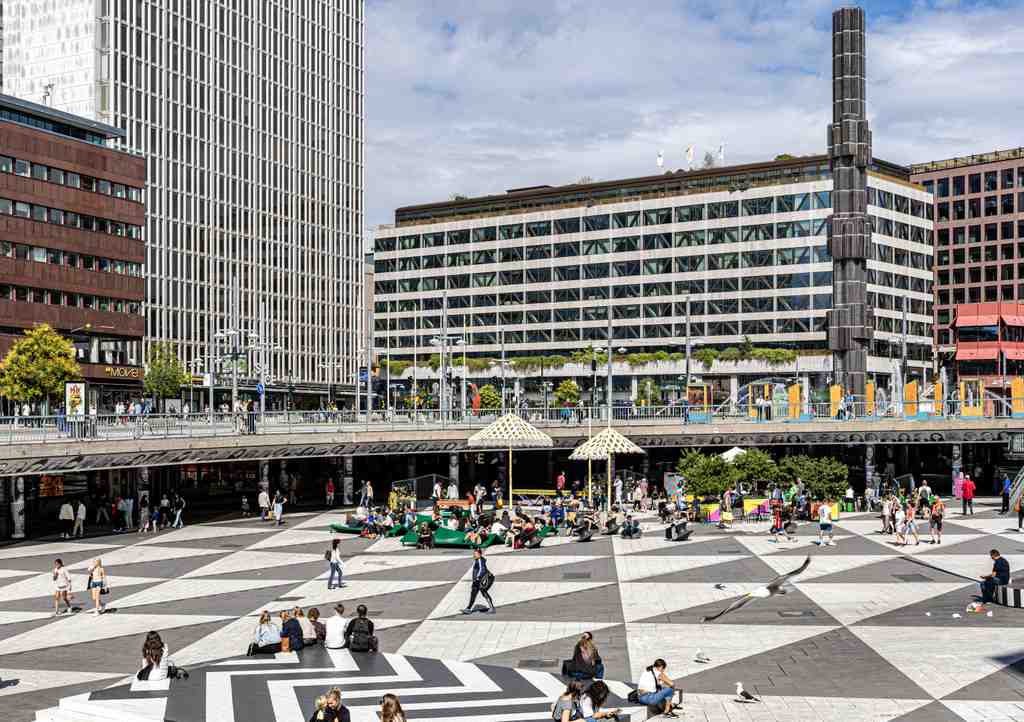
Sergels torgPhoto: user:dcastor, Wikimedia Commons, CC BY-SA 4.0. Cropped & resized. Look down into this vast, sunken plaza paved entirely in striking black and white marble and slate triangles, watched over by a towering obelisk made of stacked glass prisms.
Jörgen Kjaersgaard, the architect who designed this space, had a breathtaking dream for it. He envisioned a sweeping black and white canvas that, every evening, would be flooded by a thin, glowing sheet of water. The marble and slate were meant to sparkle like a vast mirror under city spotlights, turning a concrete basin into pure magic.
But budgets tightened, and that poetic vision was quietly scrapped. Instead, we got the dry, stark plaza you see today, locally known as Plattan, or The Slab. It is a little less romantic, isn't it? Take a look at your screen for a close-up of that original pattern Kjaersgaard designed. He actually had to sit by powerlessly in the 1990s as his iconic triangles were slapped onto cheap silk ties and commercial souvenirs, because the courts ruled that generic graphic shapes could not be copyrighted.
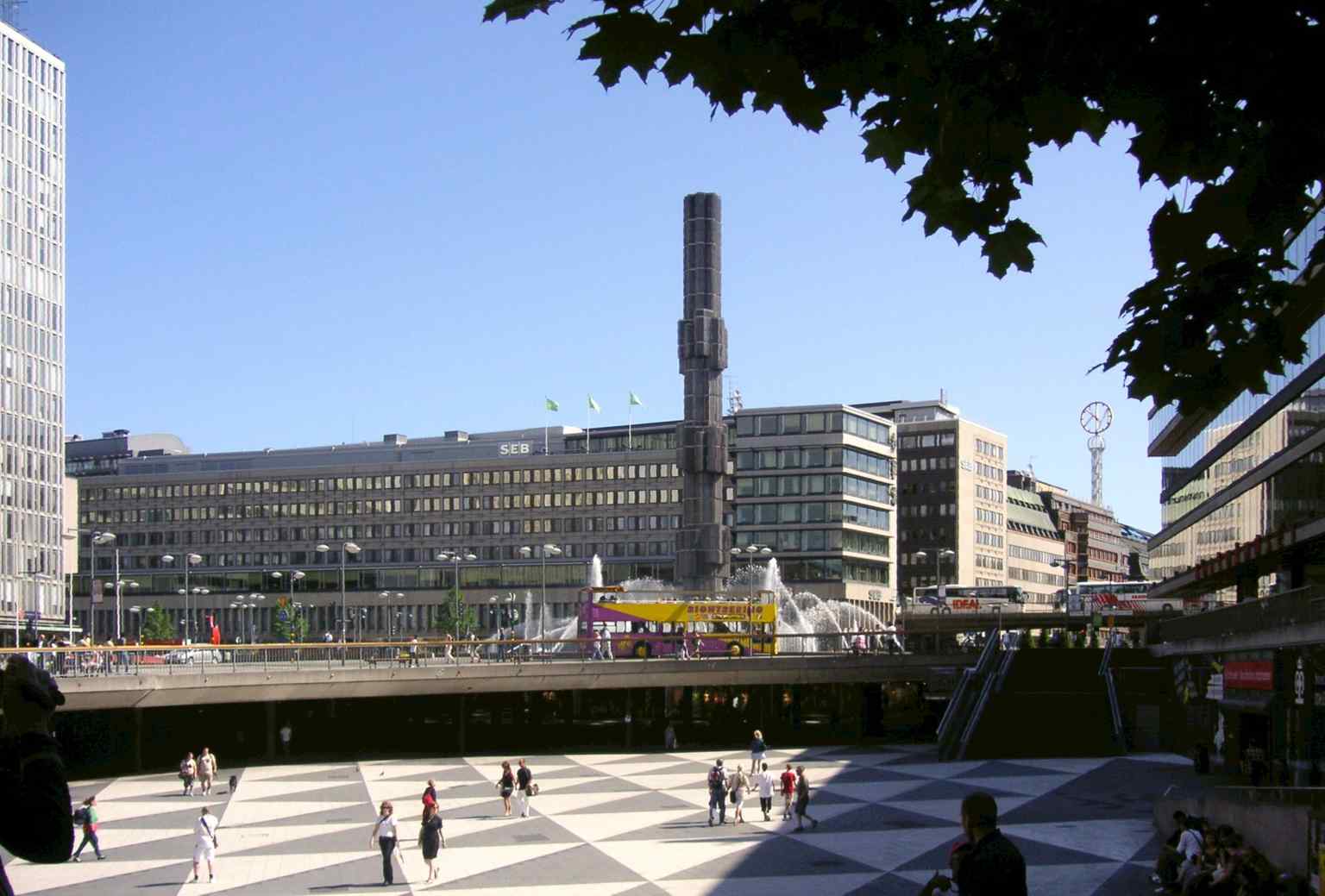
The detailed black and white triangular pattern on 'Plattan,' designed by Jörgen Kjaersgaard, was originally intended to be covered by a thin film of water each evening.Photo: Holger.Ellgaard, Wikimedia Commons, CC BY-SA 3.0. Cropped & resized. Imagine looking out over this sunken square, not at dry stone, but at a shimmering, living mirror of water reflecting the city lights... How does that change the feeling of this space for you?
The soaring glass pillar in the center suffered a similar fate. The sculptor, Edvin Öhrström, built it from sixty thousand handmade glass prisms. His grand plan was to have water cascading down its sides. But Stockholm is a windy city. They quickly realized the wind would just whip the water off the glass and drench any pedestrians walking by. So, the waterfall idea was abandoned.
There is a deeper irony built into these stones. The square is named after Johan Tobias Sergel, a brilliant eighteenth-century sculptor. For generations, his historic studio stood right near here. But in 1953, the city bulldozers tore it down to make way for this very plaza. They wiped away a piece of the city's artistic soul for the sake of ruthless modern progress, and then named the concrete replacement after him as a kind of civic apology.
Over the last couple of decades, the city actually had to rip up and rebuild much of the leaking concrete deck underneath us, though they carefully preserved the iconic surface. You can check out a before and after image in your app to see how the plaza looked before and after those major structural renovations.
It leaves you wondering about the heavy gap between a creator's sweeping dreams and the stark reality of what actually gets built. Let's leave these dry stones behind and head toward our next stop, Jacob's Church, which is just about a seven-minute walk from here.
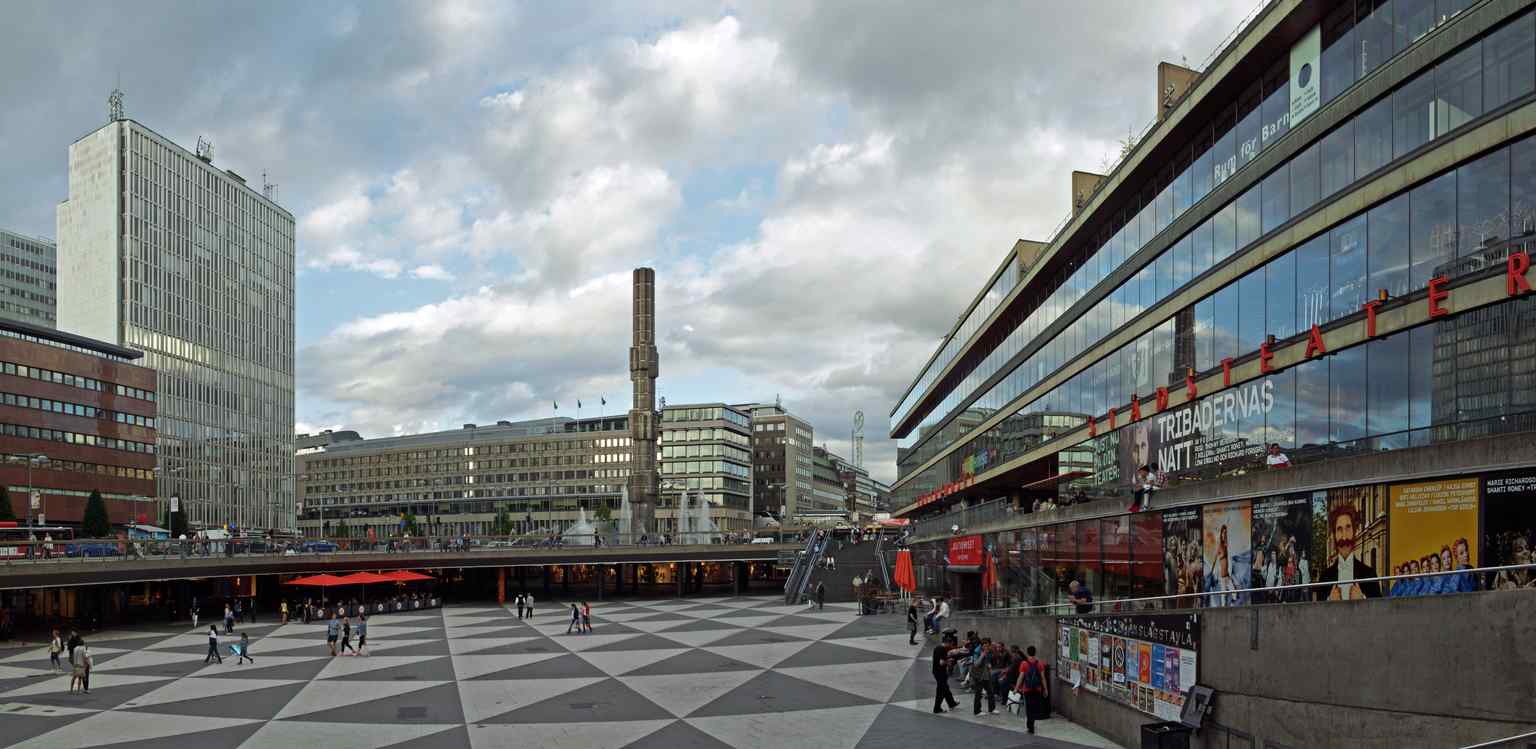
An iconic view of Sergels torg, known as 'Plattan,' showcasing its distinctive black and white triangular pattern designed by Jörgen Kjaersgaard.Photo: kallerna, Wikimedia Commons, CC BY-SA 3.0. Cropped & resized. 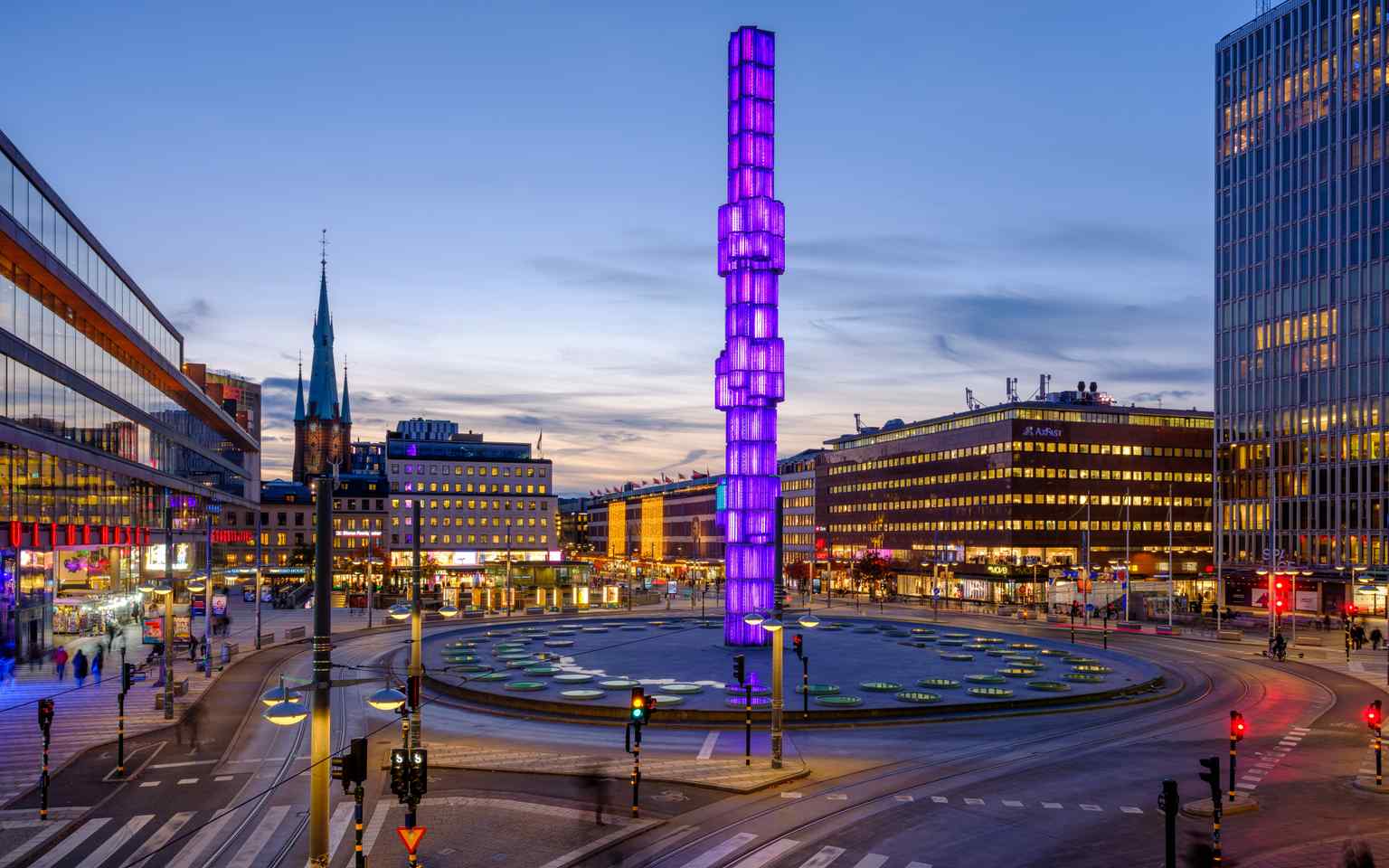
The Sergelfontänen, with its superellipse shape proposed by artist Piet Hein, stands as a central feature of the modern Sergels torg.Photo: ArildV, Wikimedia Commons, CC BY-SA 4.0. Cropped & resized. 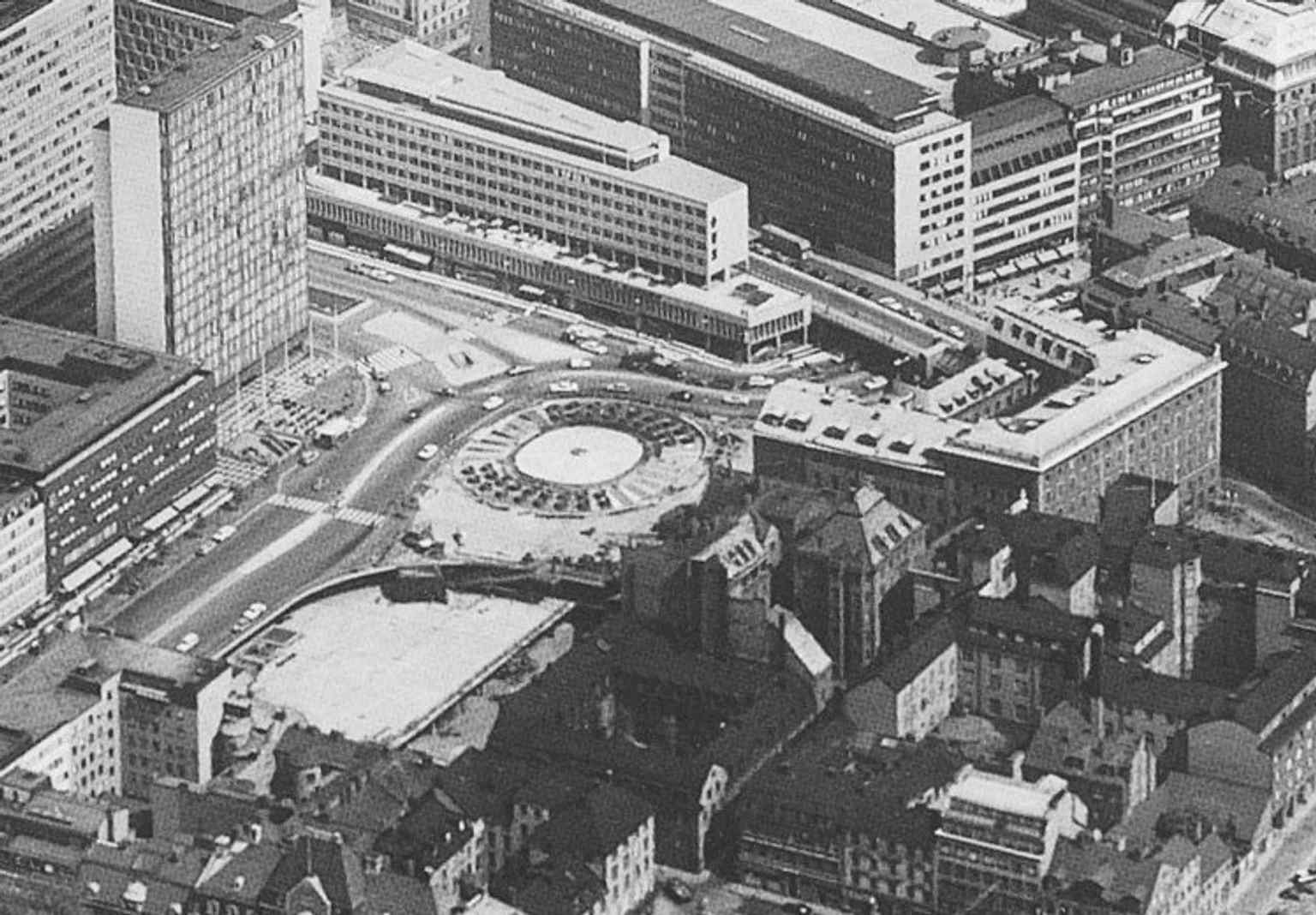
A historical view of Nedra Norrmalm in 1967, showing the area before the final construction of Sergels torg, where the ground level was 10 meters higher than 'Plattan' today.Photo: Klaratunneln_1967.jpg: Erik Claesson derivative work: Ankara (talk), Wikimedia Commons, Public domain. Cropped & resized. 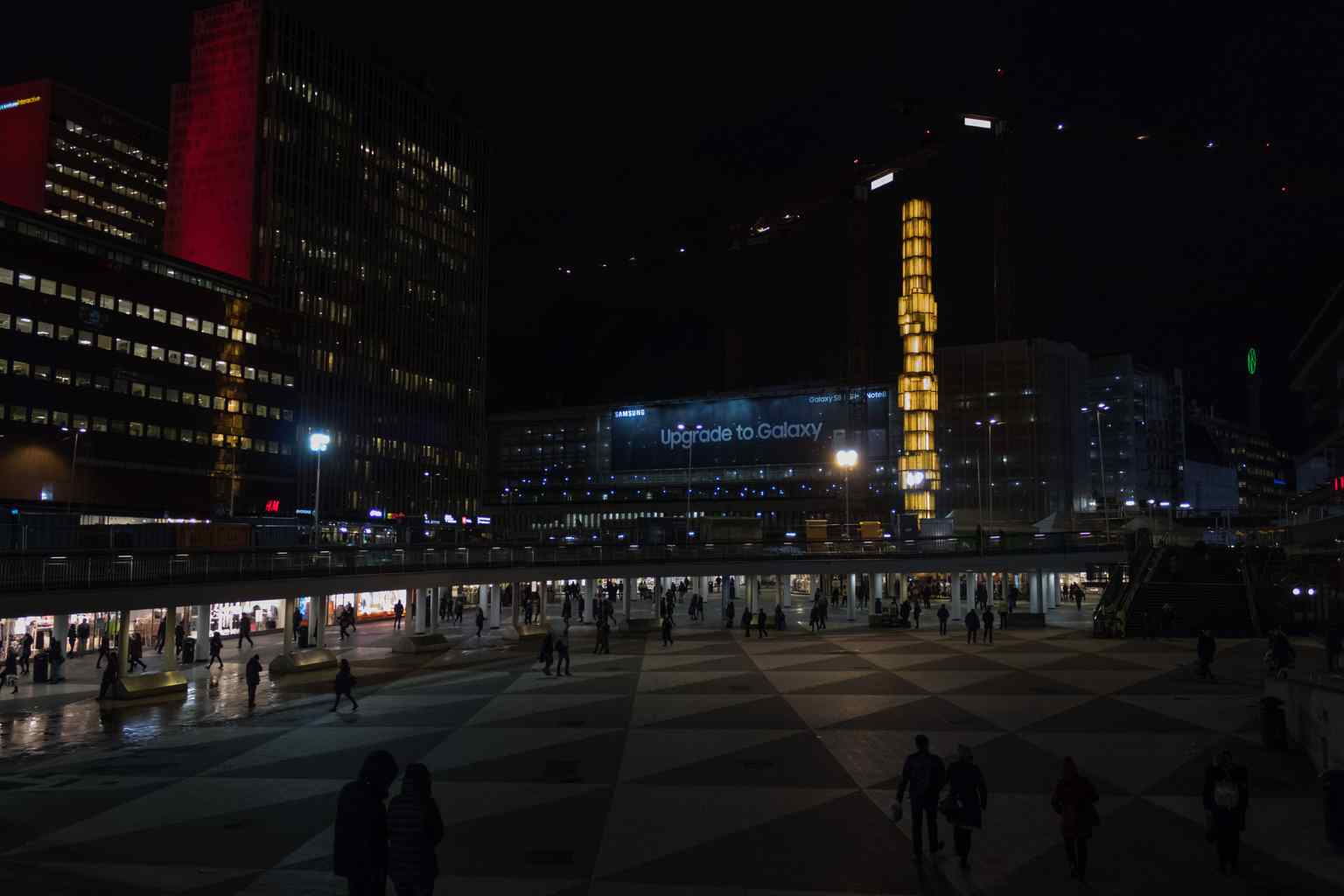
A striking night view of Sergels torg, where the glass obelisk and surrounding buildings are illuminated, creating a vibrant central hub after dark.Photo: Pierre Goiffon, Wikimedia Commons, CC BY-SA 4.0. Cropped & resized. 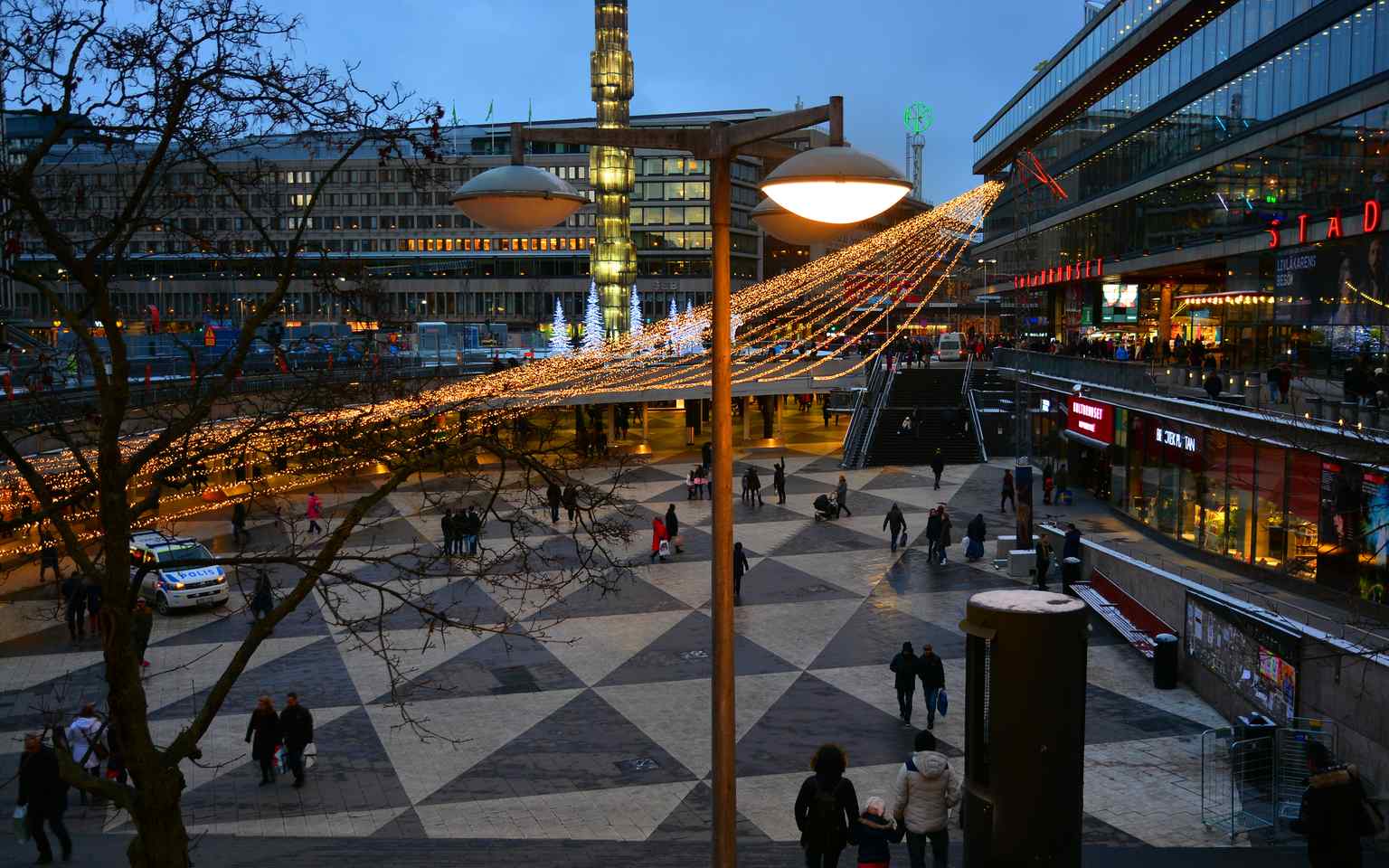
Sergels torg adorned with festive Christmas lights, highlighting the square's seasonal transformation into a magical public space during winter.Photo: Esquilo, Wikimedia Commons, CC BY-SA 3.0. Cropped & resized. Look to your right for the striking bright red building with its sweeping green copper roof and a prominent central tower topped by a rounded cupola and gold clocks. This is…Read moreShow less
Open dedicated page →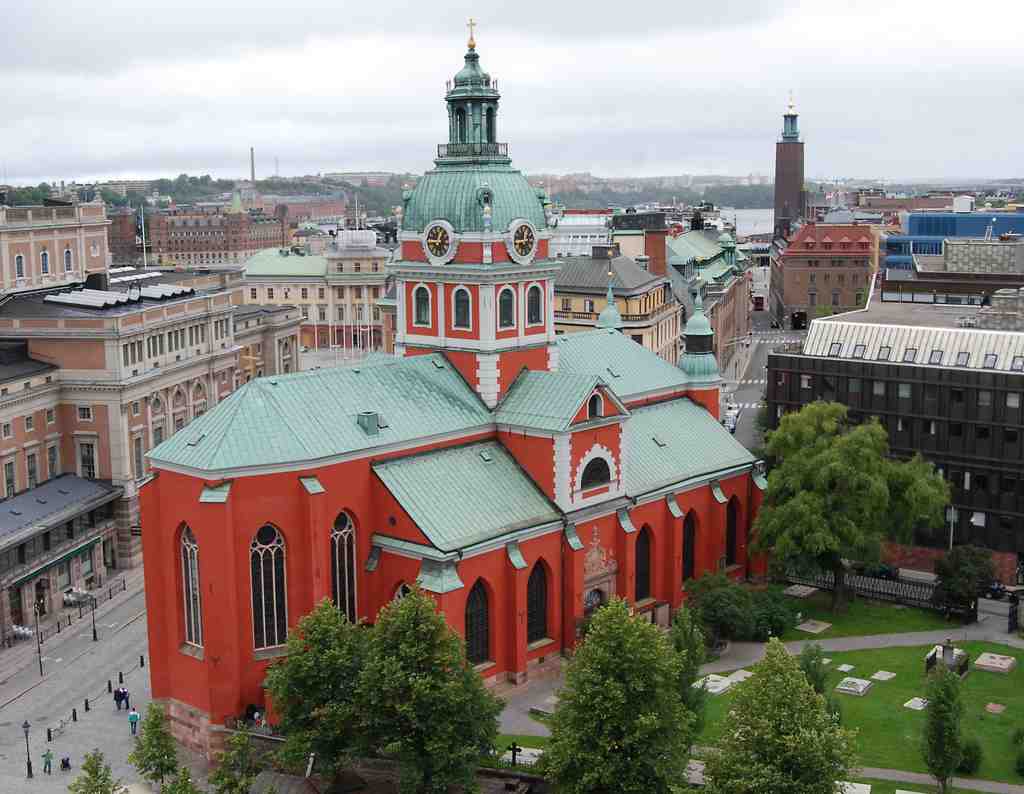
Jacob's ChurchPhoto: Larske, Wikimedia Commons, CC BY-SA 3.0. Cropped & resized. Look to your right for the striking bright red building with its sweeping green copper roof and a prominent central tower topped by a rounded cupola and gold clocks. This is Jacob's Church, and its story is a perfect example of what happens when unchecked power collides with artistic vision.
The site's history stretches back to a small chapel in the early 1300s. But that medieval building did not survive the heavy hand of King Gustav Vasa in the 1520s. You might recall his desperate need for building materials to secure his grip on the country. Vasa did not just tax his people, he looked at the city's sacred spaces and saw a very convenient, pre-cut quarry. He ordered the original church completely demolished, carting off its bricks to reinforce his defensive city walls and his royal stronghold. To him, a church was simply a pile of useful rocks.
For decades, the site was just an empty scar of royal ambition. It was not until 1580 that his son, Johan III, tried to reverse his father's ruthless pragmatism and ordered a magnificent new church. He wanted a vibrant red brick monument. But grand decrees are easy to make and hard to execute. The project dragged on for over sixty years. Brilliant craftsmen like the master stonemasons Heinrich Blume and Markus Hebel poured their lives into this building. Hebel spent years carving the incredibly detailed southern portal, the grand entranceway, carefully fitting oversized stone sculptures of saints into the tight spaces between the heavy exterior support walls.
The creators faced more than just royal delays. In 1723, a massive lightning strike turned the tower into a blazing inferno. Miraculously, the massive stone vaults inside, the arched ceilings holding up the roof, stood firm. They caught the burning rubble, saving the church's precious interior from total destruction. That disaster led to the creation of the elegant green tower you see today, a brilliant architectural pivot out of near tragedy.
By the way, that deep red color was actually quite controversial. In the 1700s, when gray and white classical buildings were the trend, officials literally painted over the red to hide what they considered an ugly, outdated style. It was only in the 1960s that restorers boldly brought back Johan III's vibrant original vision.
Over the years, those resilient walls have nurtured incredible talent. It was even home to a man living an extraordinary double life. Set Svanholm was the church's dedicated musical director, quietly leading the choir here, while simultaneously traveling the globe as one of the world's most famous Wagnerian opera singers.
If you want to step inside to see the interior that survived the fire, the church is usually open on weekday afternoons from Tuesday through Friday, staying open a bit later on Fridays.
We are now moving from the realm of plundered churches into an era where the city's aristocrats began erecting their own lavish statements. Our next stop, The Hereditary Prince's Palace, is about a four-minute walk away.

Show 11 more stopsShow fewer stopsexpand_moreexpand_less
On your left, you will spot a grand, pale yellow palace resting on a rust-red base, featuring tall classical columns and a central roofline crowned by stone lions flanking a royal…Read moreShow less
Open dedicated page →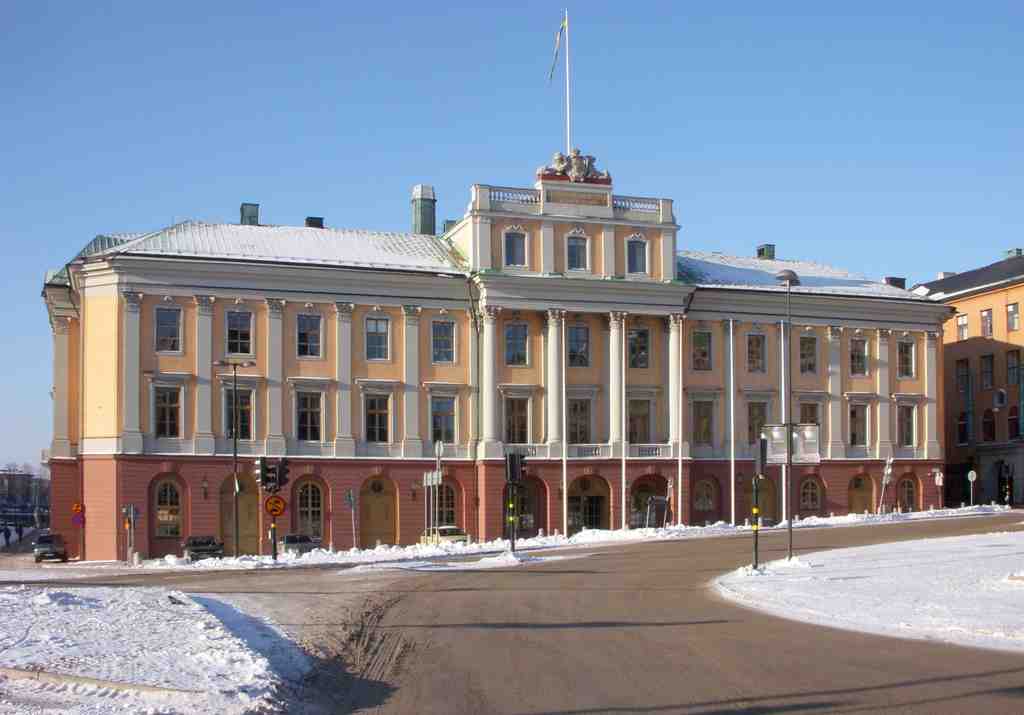
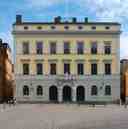
The Hereditary Prince's PalacePhoto: Holger.Ellgaard, Wikimedia Commons, CC BY-SA 3.0. Cropped & resized. On your left, you will spot a grand, pale yellow palace resting on a rust-red base, featuring tall classical columns and a central roofline crowned by stone lions flanking a royal coat of arms.
This is the Hereditary Prince's Palace. It was built in the late eighteenth century for Princess Sofia Albertina, the sister of King Gustav the Third. Following her mother's death, Sofia needed a residence that reflected her status and, more importantly, her independence. Some at court called her the princess with the heart of ice, though others simply saw a sharp, pragmatic woman refusing to be a pawn in royal marriage schemes. Instead of marrying, she spent years living abroad as the ruling abbess of a sovereign German abbey.
To build her power base here in Stockholm, she hired Erik Palmstedt. He was a brilliant architect responsible for shaping the royal aesthetics of the city during this era, possessing a rare talent for turning heavy stone into elegant, sweeping classical lines. Palmstedt was tasked with a tricky job. He had to absorb an older, awkward seventeenth-century mansion on the site into a massive new palace that perfectly mirrored the Royal Opera House across the square.
The resulting design perfectly captures the dynamic of the era. Palmstedt poured his genius into creating these flawless, refined facades with their smooth surfaces and delicate, antique details. In return, Sofia Albertina got exactly what she wanted, a towering monument to her own ambition. To ensure no one ever forgot whose vision this was, she demanded an inscription be placed right near the roofline, proudly declaring in Latin that Sophia Albertina built this.
You can actually see how remarkably Palmstedt's elegant exterior has held up over the centuries if you check out the before and after image in your app.
After Sofia's death, the palace passed down through a string of royal heirs before the government purchased it in 1902 for two and a quarter million kronor, which is roughly one hundred and fifty million kronor today. It eventually became the headquarters for the Ministry for Foreign Affairs. And with state power comes state secrets. During the Cold War, the palace became the stage for one of the most damaging spy scandals in Swedish history. A Soviet spy named Stig Wennerström was placed right inside the political department here as an expert on military disarmament. The security police already suspected him, but the foreign minister brushed off the concerns, assuming Wennerström would not have access to anything sensitive. Naturally, Wennerström spent months sitting comfortably in these elegant rooms, photographing mountains of highly classified documents before his dramatic arrest.
Take a moment to admire the clean lines and perfectly balanced windows of Palmstedt's masterpiece. When you are ready, we will make our way toward Stockholm City Hall, which is about an eleven minute walk from here.
Before you stands a massive dark red brick complex organized around wide internal courtyards, anchored by a soaring square tower in the corner. This is Stockholm City Hall. It…Read moreShow less
Open dedicated page →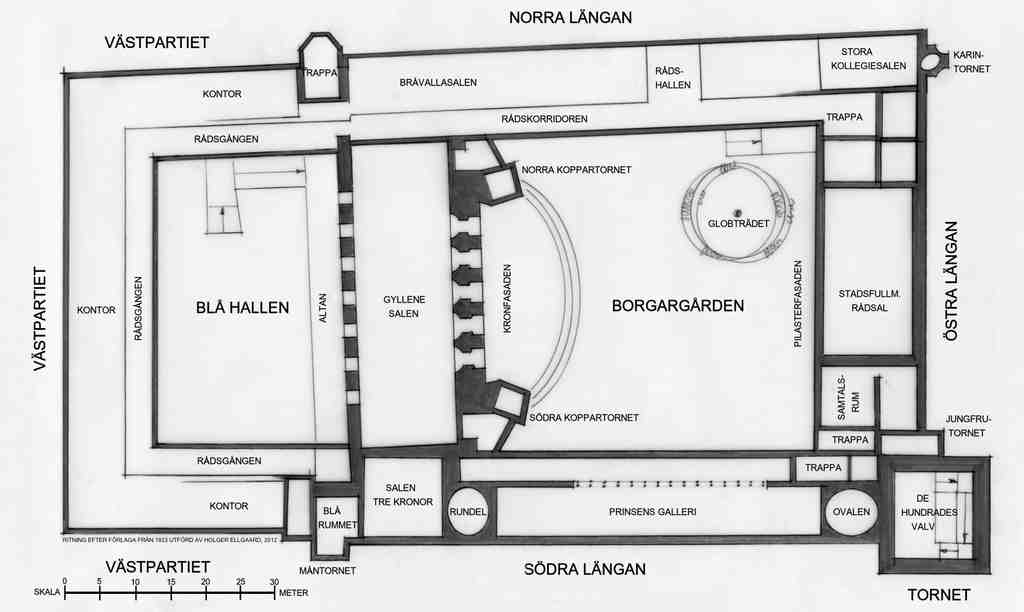
Stockholm City HallPhoto: Holger.Ellgaard, Wikimedia Commons, CC BY-SA 3.0. Cropped & resized. Before you stands a massive dark red brick complex organized around wide internal courtyards, anchored by a soaring square tower in the corner. This is Stockholm City Hall. It looks like it has been here for centuries, but it actually opened in nineteen twenty three.
The lead architect, Ragnar Östberg, had a rather romantic vision. He looked at the water lapping against the shore and saw Venice. He drew direct inspiration from the Doge's Palace and the famous bell tower of Saint Mark, blending Italian Renaissance elegance with Nordic grit. Earlier, we talked about the lost vision of Sergels Torg, where grand architectural dreams were swallowed by compromise. But here, Östberg's monumental vision survived intact. It is an awe-inspiring achievement of civic ambition, demanding fifteen years and roughly eight million bricks to complete. Over one million of those bricks were carefully shaped by hand.
Yet, building a masterpiece of this scale rarely comes without a heavy toll on the mortals who dare to shape it. Östberg was the obsessive conductor, but he relied heavily on a team of brilliant minds. One of them was a highly gifted young architect named Elis Benckert. Benckert was entrusted with the monumental task of designing the interiors and furnishings. But the relentless pressure and his own internal struggles proved too much. In a quiet, devastating tragedy, Benckert took his own life on New Year's Eve in nineteen twelve. The loss of this doomed creator halted interior work for years, a dark shadow cast over the city's gleaming new monument.
Eventually, the work resumed, and the result is staggering. Inside, you will find the famous Blue Hall. Funny enough, it is not blue at all. Östberg loved the raw texture of the hammered red brick so much that he abandoned the blue plaster entirely. This very hall is where the Nobel Prize banquet is held each year, hosting the world's most brilliant minds. Just above it is the Golden Hall, a dazzling space lined with over eighteen million pieces of gold leaf and colored glass mosaic.
If you want to step inside and see these spaces, the building is open to visitors every day from eight thirty in the morning until four thirty in the afternoon.
Look up at the top of that one hundred and six meter tower. It is crowned with three golden crowns, an ancient symbol of the Swedish realm. They angle outward, looking across the water toward our next destination. We are heading to the ancient burial grounds of Riddarholmen, where royals and creators alike find their final rest. The Riddarholm Church is about a ten minute walk away, so let us keep moving.
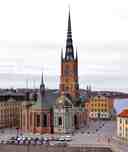
Look to your left and you will spot Riddarholm Church, a massive red brick structure defined by its tall, square tower topped with a striking, see-through cast-iron spire. This…Read moreShow less
Open dedicated page →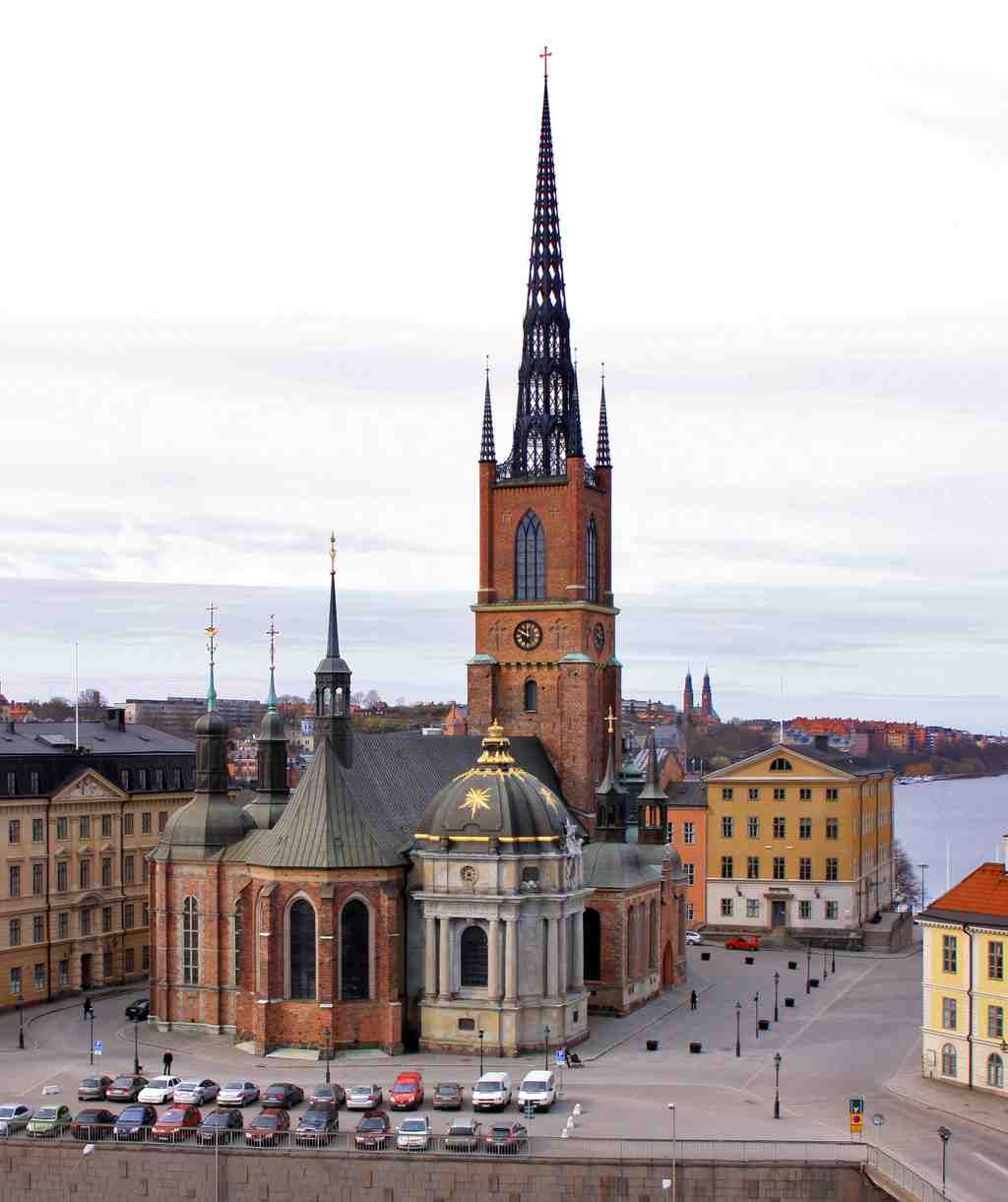
Riddarholm ChurchPhoto: Albabos, Wikimedia Commons, CC BY 3.0. Cropped & resized. Look to your left and you will spot Riddarholm Church, a massive red brick structure defined by its tall, square tower topped with a striking, see-through cast-iron spire.
This is the oldest preserved building in Stockholm. It started in the late thirteenth century as a humble Catholic abbey for Franciscan monks. But over the centuries, it transformed into a grand theater of memory, serving as the final resting place for nearly every Swedish monarch from 1632 to 1950.
Kings have always known that where you are buried is just as important as how you ruled. In the 1570s, King Johan III was eager to project a deep, ancient legitimacy for his reign. He commissioned a brilliant Dutch sculptor to build two magnificent Renaissance monuments right in front of the high altar, claiming they covered the remains of medieval kings, including Magnus Ladulås. For over four hundred years, everyone believed him. Then came 2011. Modern carbon dating on the skeletons beneath the monument revealed they belonged to people who died over a century after King Magnus. Johan had essentially orchestrated a majestic historical illusion just to bolster his own royal pedigree.
The church itself has seen its share of dramatic transformation. In 1835, lightning struck the tower, sparking a fire that raged for three days and completely destroyed the towering wooden spire. Take a look at your screen for a 1630s drawing showing that original, soaring wooden needle before the flames took it. When it came time to rebuild, the crown chose to embrace the industrial age. Sculptors and architects designed the delicate, black gothic web of cast iron you see today. You can check out the before and after image on your app to see how this iron crown has stood enduringly over the shifting skyline.
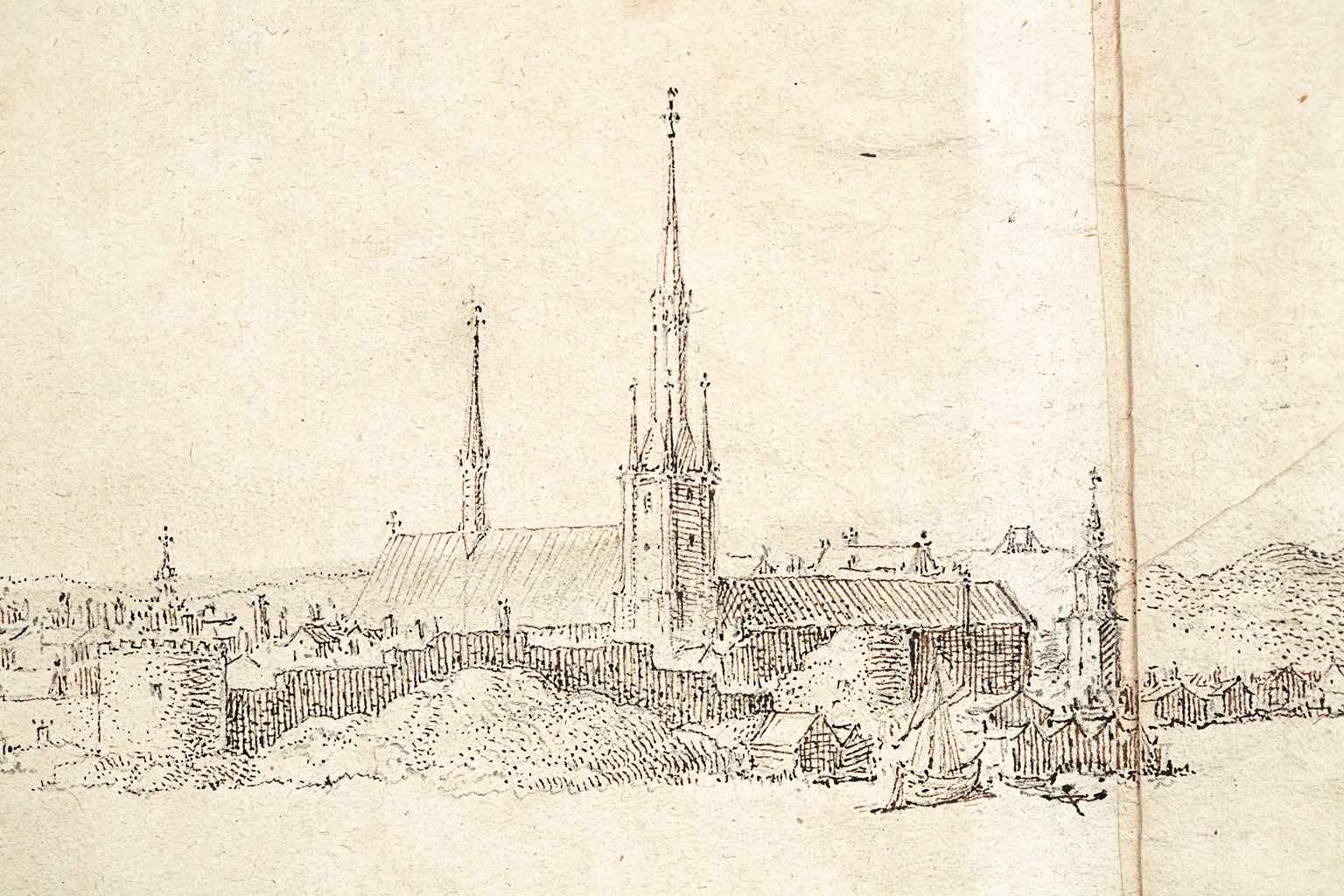
This 1630s drawing of Stockholm from Kungsklippan shows Riddarholm Church with its original tall wooden spire, which stood for over two centuries before being destroyed by fire.Photo: Unknown authorUnknown author, Wikimedia Commons, Public domain. Cropped & resized. But perhaps the heaviest toll exacted by royal ambition rests inside the church's burial vaults. King Karl XIV Johan wanted a resting place fit for a Roman emperor. After his death, his son ordered a colossal, sixteen-ton sarcophagus made of Garberg granite, a brutally hard rock, from a quarry the royal family owned in central Sweden. It took the quarrymen eight grueling years to carve the stone. The intense, unyielding work and the thick stone dust permanently ruined the lungs of several stonemasons. Once finished, the sarcophagus was so heavy they had to wait four years for a winter cold enough to freeze the lakes solid. Finally, nearly two hundred men dragged the mammoth stone over the ice in temperatures of thirty-six degrees below zero. The king achieved his eternal glory, but it was shaped by the broken lungs and frozen hands of the craftsmen he ruled.
While the monarchs spent centuries building these grand monuments to secure their immortality in death, the kingdom's aristocrats were busy securing their power in life. We are now going to walk over to The Palace of the House of Nobility, just three minutes away, to see where the real administrative muscle of the Swedish empire flexed its strength.
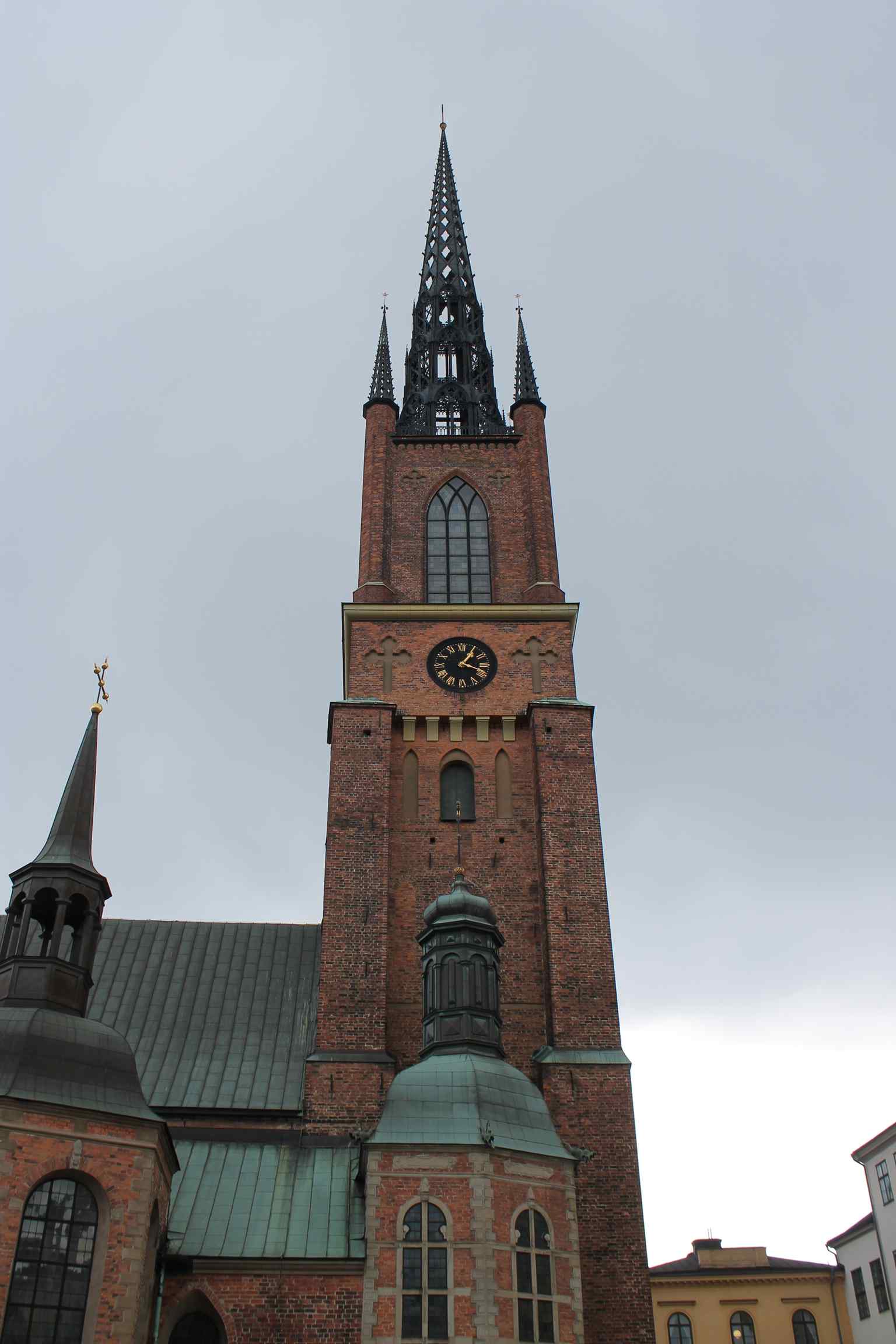
This detailed view captures the church's characteristic openwork cast-iron spire, added between 1838–1841 after a lightning strike destroyed the previous wooden one.Photo: John Samuel, Wikimedia Commons, CC BY-SA 4.0. Cropped & resized. Look to your left, where you will see a grand rectangular palace built from pale sandstone and red brick, topped by a unique curved double roof with four distinct obelisks at its…Read moreShow less
Open dedicated page →
The Palace of the House of NobilityPhoto: Frankie Fouganthin, Wikimedia Commons, CC BY 4.0. Cropped & resized. Look to your left, where you will see a grand rectangular palace built from pale sandstone and red brick, topped by a unique curved double roof with four distinct obelisks at its corners. This is the Palace of the House of Nobility.
The land you are standing near was originally bought by the immensely powerful nobleman, Axel Oxenstierna. He initially planned to build his own private residence right here. But realizing the prime location, he sold it in 1641 for three thousand riksdaler. That was a staggering fortune, easily equivalent to millions of dollars today. The plan was to create a grand administrative seat for the Swedish nobility.
To match the monumental ego of the ruling class, they needed a genius. Enter Simon de la Vallee. He was a brilliant French master builder brought in to design an absolute masterpiece. But designing for the elite in seventeenth century Stockholm was a dangerous game. The price of ambition in this era was often fatal. The high stakes world of royal and noble architecture was a maze of massive pressure, volatile egos, and deadly rivalries.
In July 1641, workers began the grueling task of digging the foundation. They had to haul enormous mounds of earth straight out into the water to expand the harbor edge. The project was moving forward. Then, the ambitious dream turned into a nightmare.
Simon de la Vallee's time as the visionary leader came to a horrific and bloody end. In November 1642, a bitter dispute broke out in a nearby public square. The architect was brutally attacked and stabbed in the open street. He lingered for eight agonizing days before dying from his catastrophic injuries. And the man who drove the blade into him? It was Colonel Erik Oxenstierna. In a dark twist of fate, the killer was a direct relative of Axel Oxenstierna, the very man who commissioned the entire project.
The murder of their star architect completely paralyzed the construction. When de la Vallee died, only the foundation had been laid out. For the next five years, the site sat practically abandoned as Sweden plunged deeper into foreign wars.
It took a revolving door of replacement architects and bitter personal feuds to finish the building decades later. If you check your screen, you can see a photo from 1918 showing the spectacular interior hall, completely covered in thousands of noble family crests. Over exactly a century, the timeless Dutch Baroque elegance of the House of Nobility has remained a steadfast anchor amidst the shifting urban landscape of modern Stockholm, which you can see for yourself in the comparison picture on your app.
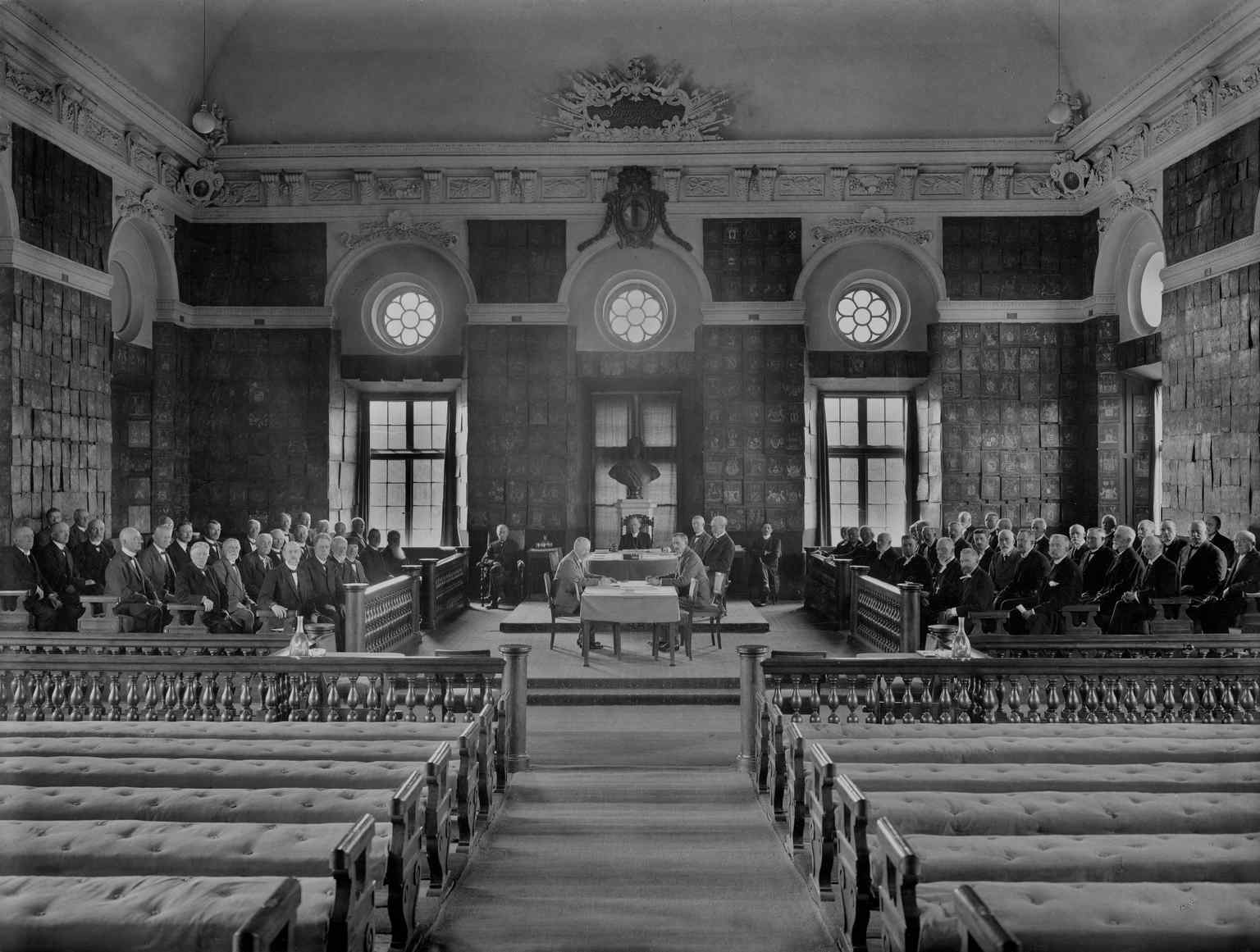
A historic photo from 1918 capturing the General Synod of the Church of Sweden, demonstrating the Riddarhuspalatset's continued use for important gatherings in its grand interior spaces.Photo: Unknown authorUnknown author, Wikimedia Commons, Public domain. Cropped & resized. If you ever want to step inside, keep in mind they keep a very tight schedule, opening only on weekdays between eleven in the morning and noon. The brutal murder of its first creator left a wake of legal and financial chaos that haunted this project for years. Let us leave this beautiful but blood-stained origin story behind and take a quick two minute walk to Bondeska Palace.
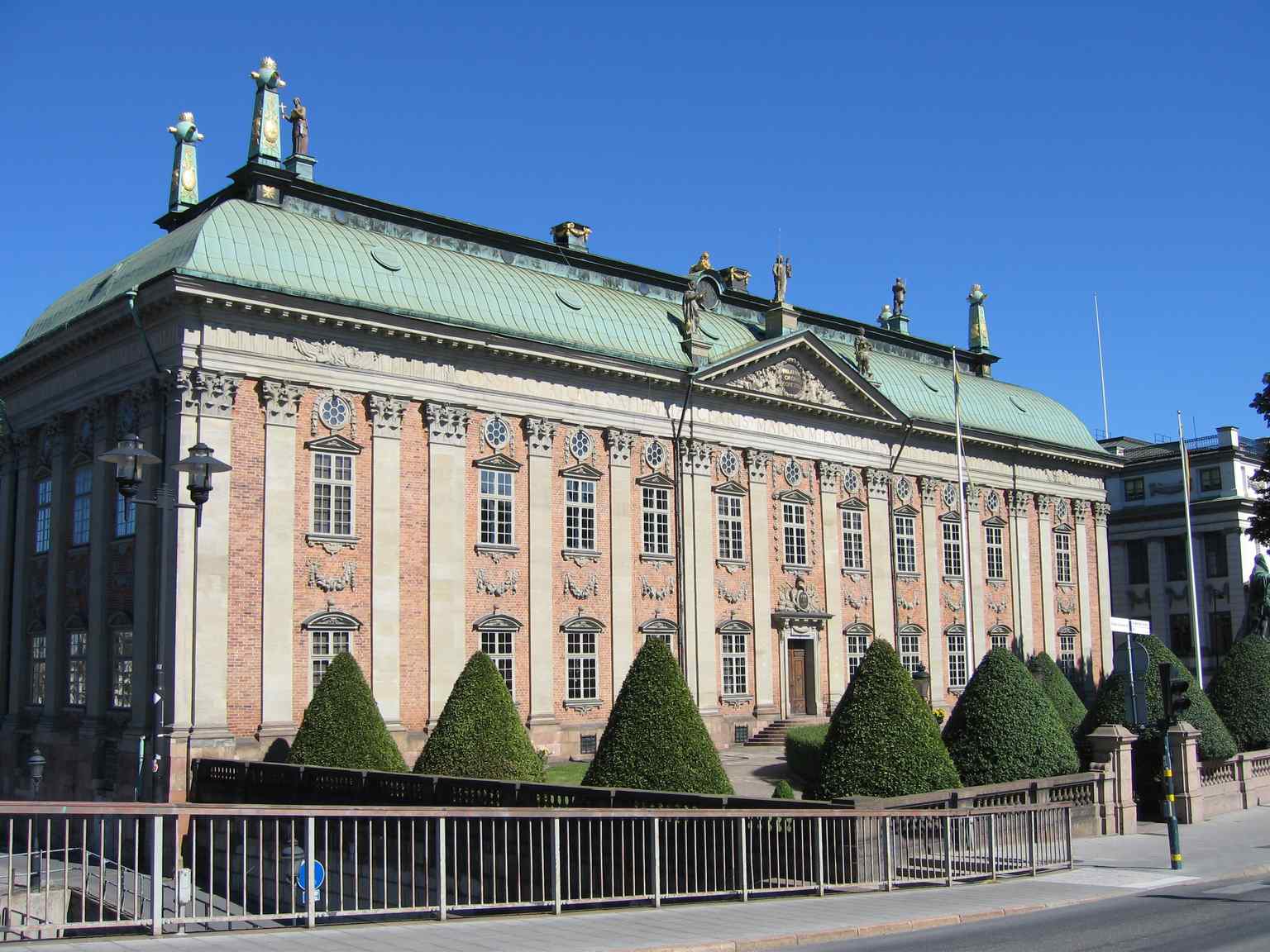
This exterior view highlights the palace's classic late Renaissance style, completed between 1641 and 1674 by a succession of architects, including Simon de la Vallée and his son Jean.Photo: Allsong, Wikimedia Commons, Public domain. Cropped & resized. 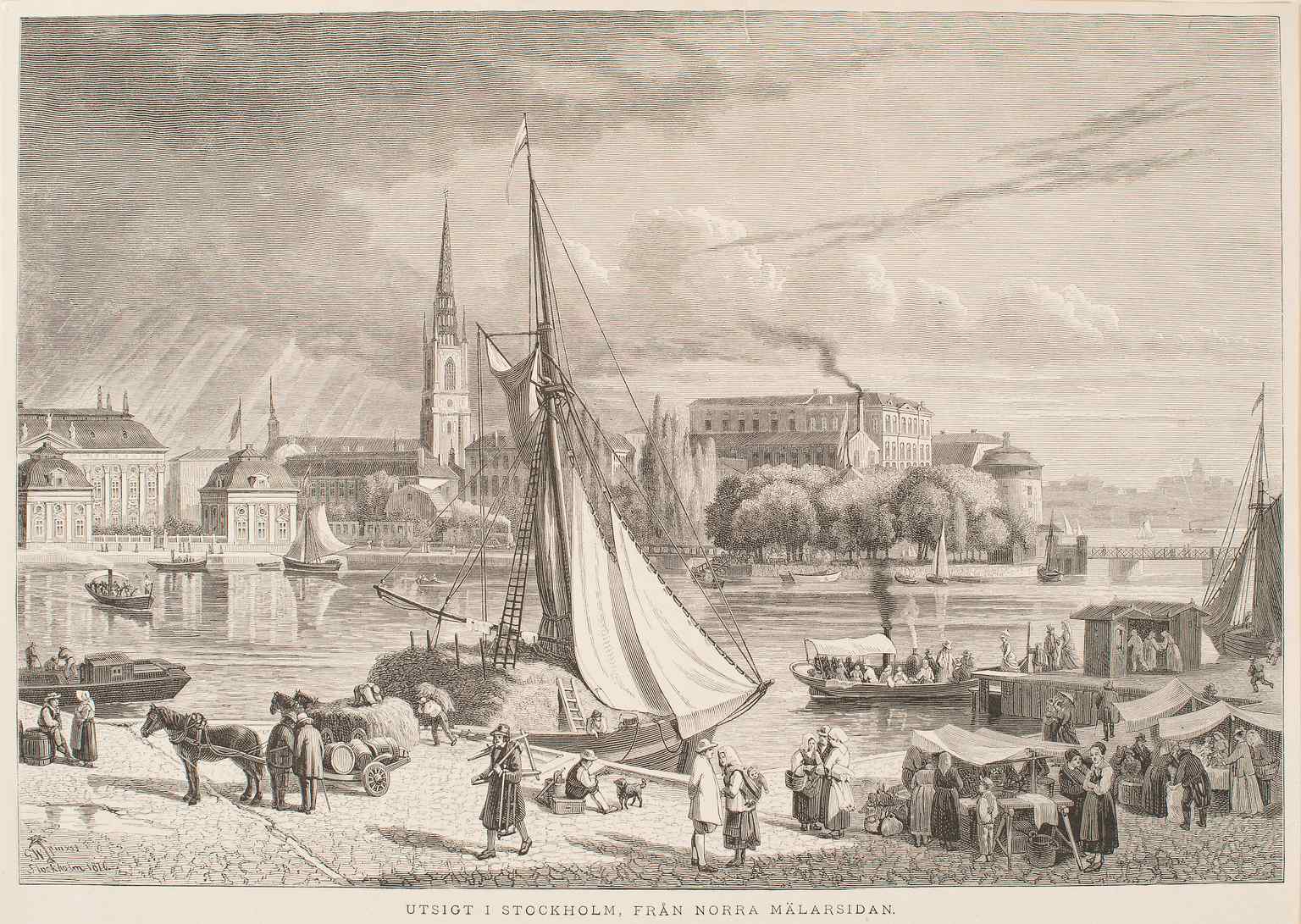
An 1876 print depicting the Riddarhuspalatset from the water, recalling its early construction in 1641 when excavated earth was transported "to sea" to fill the surrounding harbor.Photo: Gustaf Wilhelm Palm, Wikimedia Commons, Public domain. Cropped & resized. 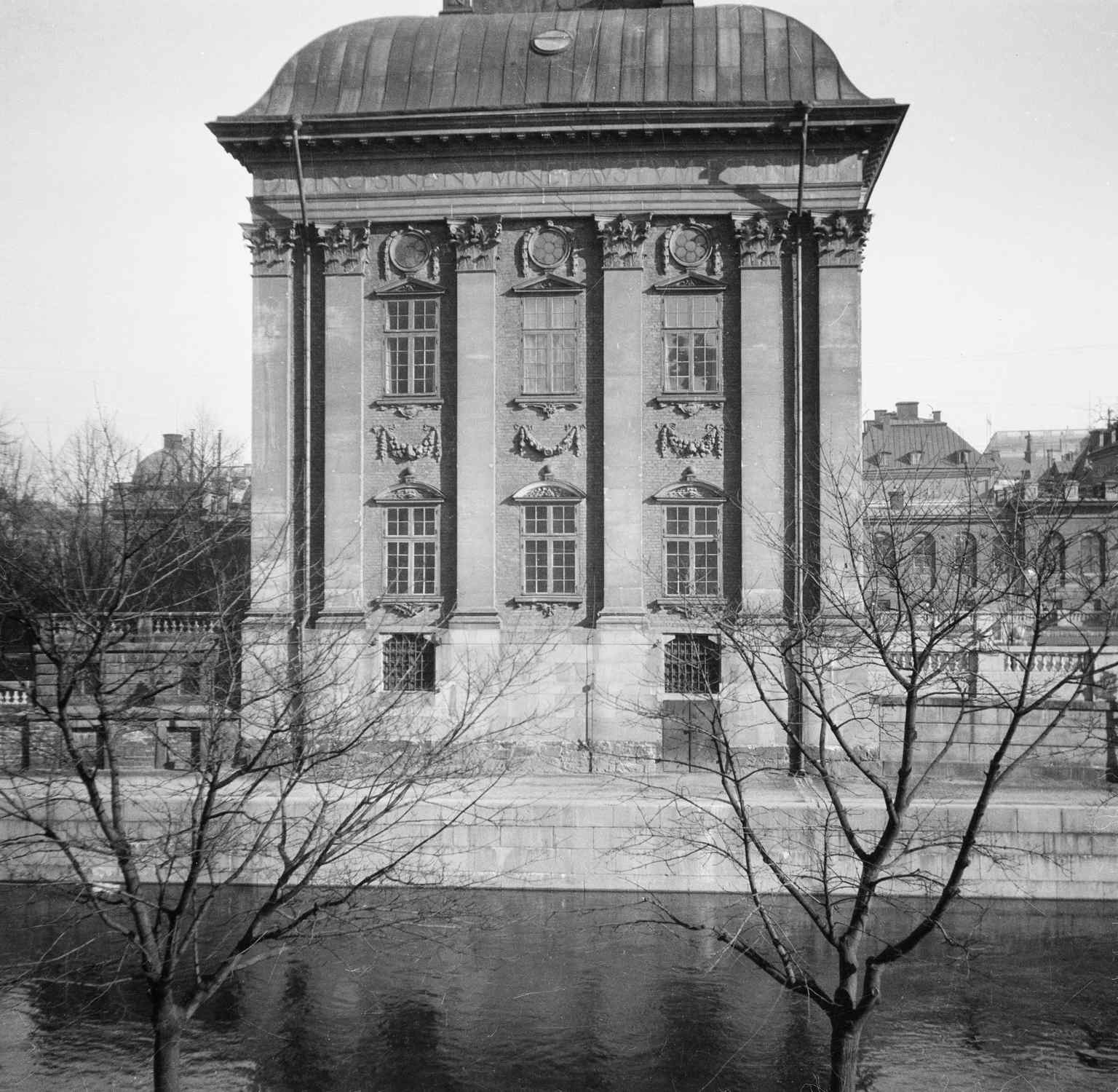
This 1908 exterior shot shows the palace with direct contact to Riddarhustorget, as it was during the Fersen Murder in 1810, where Axel von Fersen was lynched by a mob.Photo: Unknown authorUnknown author, Wikimedia Commons, Public domain. Cropped & resized. 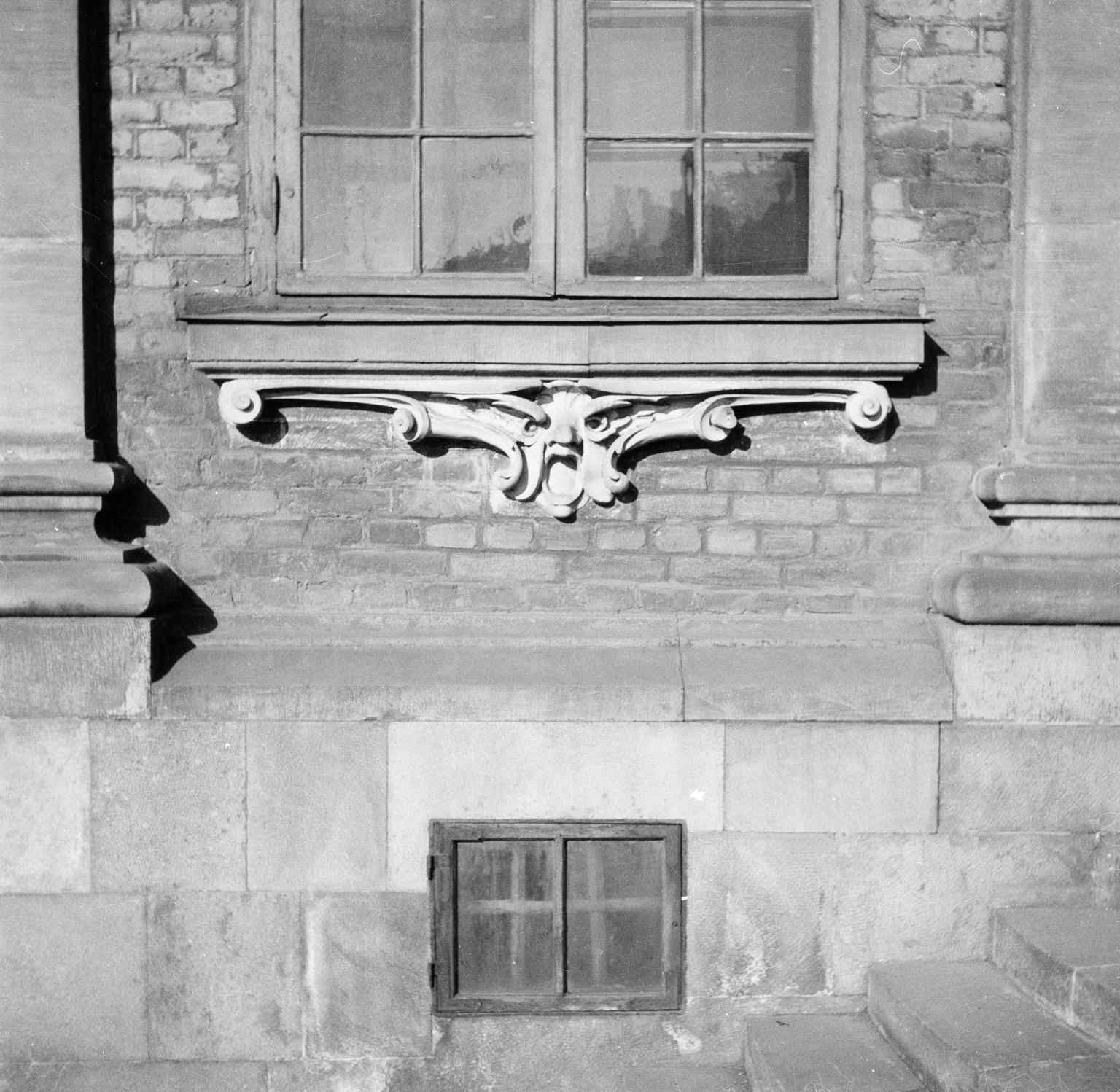
An exterior detail from 1908, showcasing the building's façade, which features light Gotland sandstone, local brick, and Corinthian pilasters.Photo: Unknown authorUnknown author, Wikimedia Commons, Public domain. Cropped & resized. On your left sits Bondeska Palace, an imposing white stone building with a symmetrical H shape layout, featuring a deep courtyard framed by two prominent wings and a classical…Read moreShow less
Open dedicated page →On your left sits Bondeska Palace, an imposing white stone building with a symmetrical H shape layout, featuring a deep courtyard framed by two prominent wings and a classical triangular roof structure over the main entrance.
This was built in the 1660s for Gustaf Bonde. He held the title of Lord High Treasurer, making him essentially the chief financial officer of the Swedish Empire. Now, you might assume the man in charge of the nation's ledger would be a model of fiscal restraint. You would be wrong. At the time, the Swedish state debt was skyrocketing. Yet Bonde decided this was the perfect moment to pour astronomical sums of money into a private residence.
In his testament, Bonde explicitly stated that he did not build this massive palace for his own comfort. He built it for the honor and power of his family name. He desperately needed to manifest undeniable authority. The result was so extravagant that even King Charles the Second of England reportedly remarked that Paris scarcely had a building as beautiful.
But the price of ambition is steep, and the creators who brought this vanity project to life were the ones left holding the bill. Bonde hired two of the era's most brilliant architects, Nicodemus Tessin the Elder and Jean de la Vallée. They designed a masterpiece, but the money simply was not there.
In 1667, the very year Bonde died, the project descended into a bitter legal battle. Jean de la Vallée sued Bonde's estate for unpaid labor, demanding two thousand six hundred and sixty six riksdaler. That was the old Swedish currency, and this was a staggering sum, easily equivalent to hundreds of thousands of dollars today. The architect who built the Lord High Treasurer's palace had to take his wealthy, dead client to court just to get his wages. The rather ironic payoff to this bitter dispute is that de la Vallée's incredibly detailed original blueprints were filed as evidence in the lawsuit, which is the only reason historians still have them today.
Take a glance at your app to see a view of how the stately entrance courtyard is flanked by those southern wings, perfectly designed to intimidate anyone coming to collect a debt.
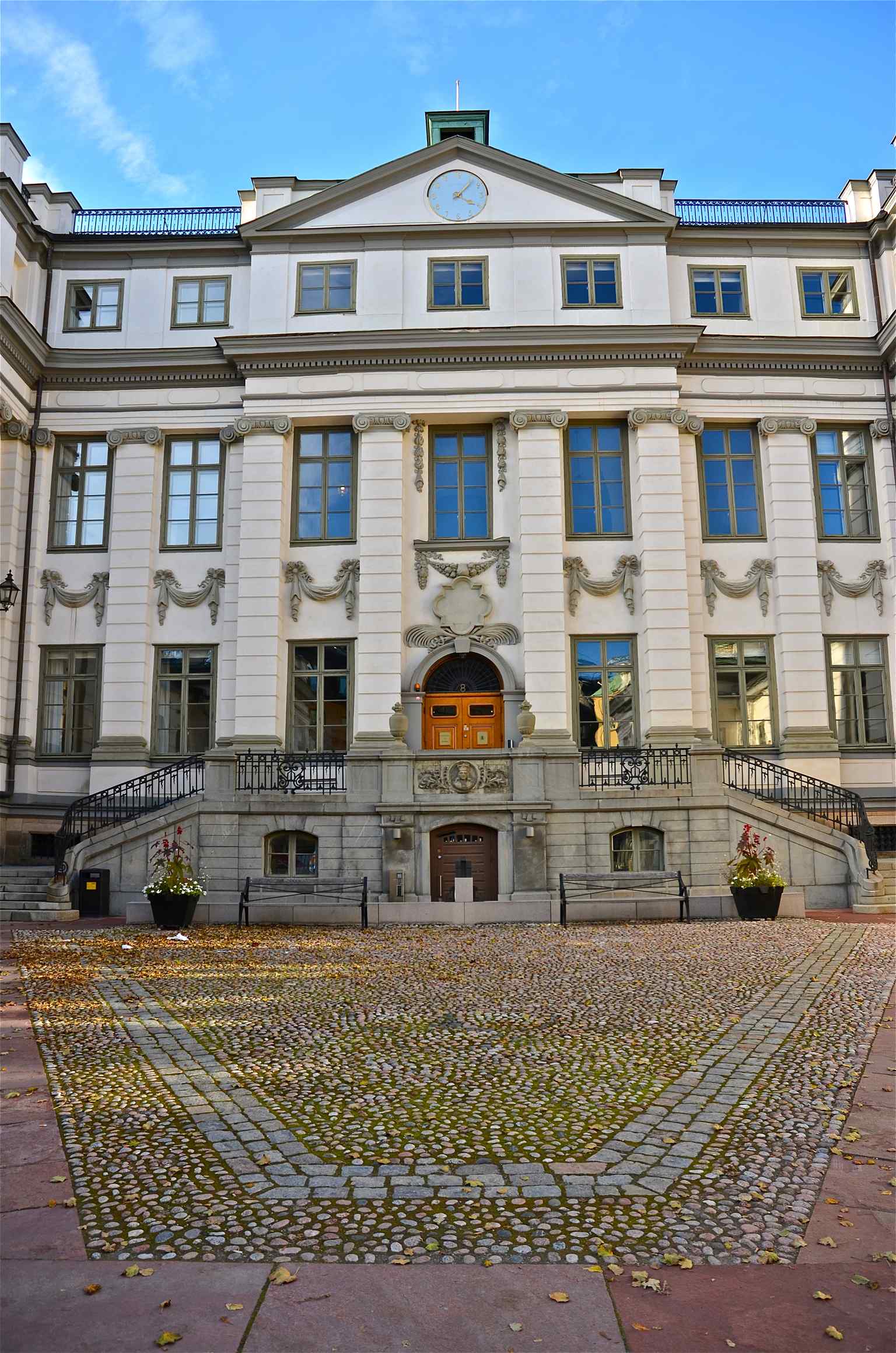
The stately entrance courtyard is flanked by the palace's two southern wings, originally designed to impress visitors and underscore the Bonde family's prominence.Photo: Zeke530, Wikimedia Commons, CC BY-SA 3.0. Cropped & resized. The Bonde family's finances eventually collapsed entirely. They were forced to rent the palace out, and ultimately sell it to the city. For nearly two centuries, the building served as Stockholm's City Hall and courthouse. Today, it houses the Supreme Court of Sweden. It feels incredibly fitting that a building born from unpaid bills and a massive lawsuit is now the highest legal authority in the land.
Bonde's desperate need to project power financially ruined his descendants, but he left behind a spectacular piece of architecture. Let us turn toward the ultimate symbol of that kind of royal power. Stockholm Palace is about a nine minute walk from here.
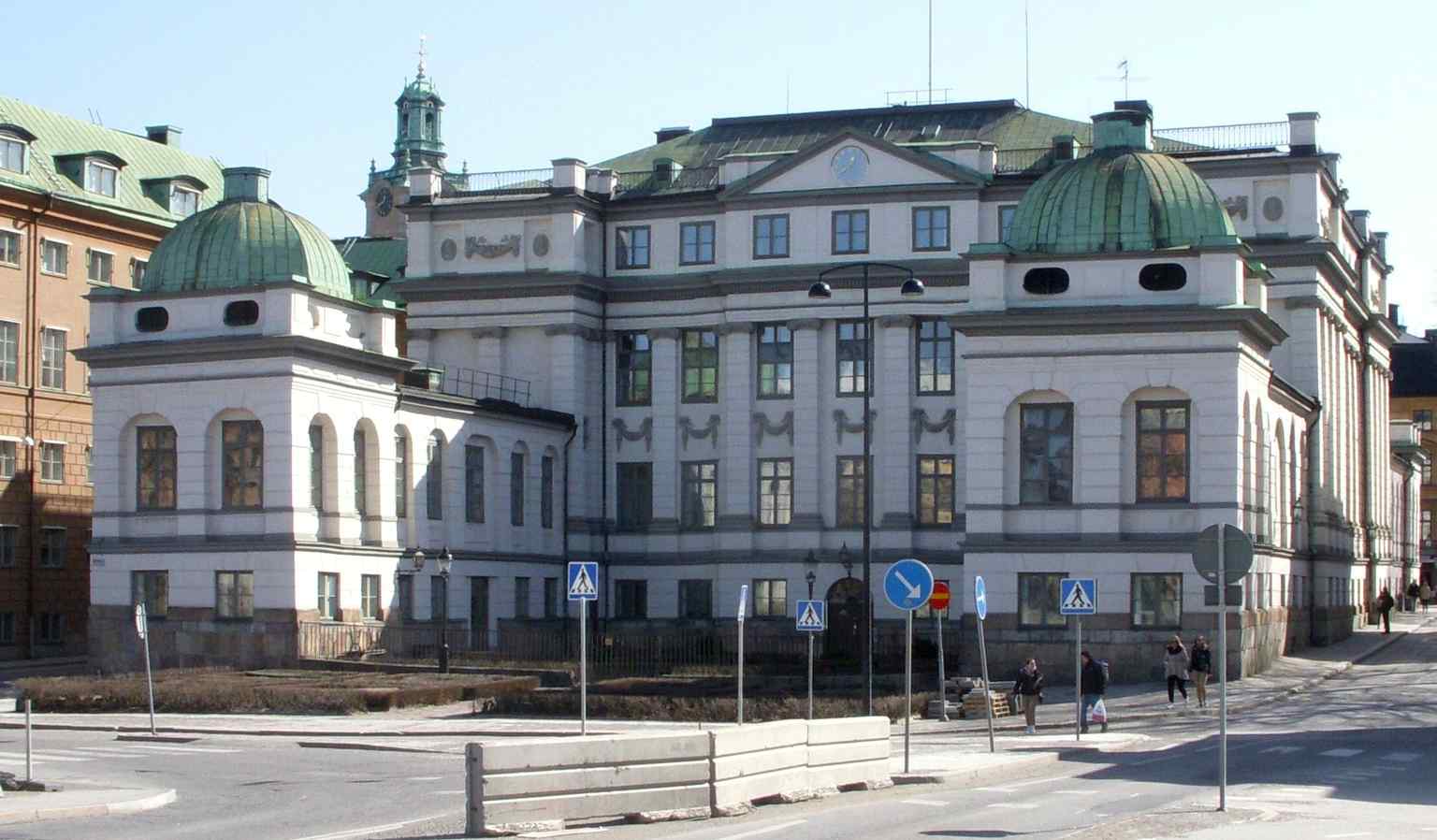
From the north, one can appreciate the palace's 'H' shape and the baroque garden; its northern wing pavilions still retain their original domes, having survived the 1710 fire that destroyed the main roof.Photo: Holger.Ellgaard, Wikimedia Commons, CC BY-SA 3.0. Cropped & resized. 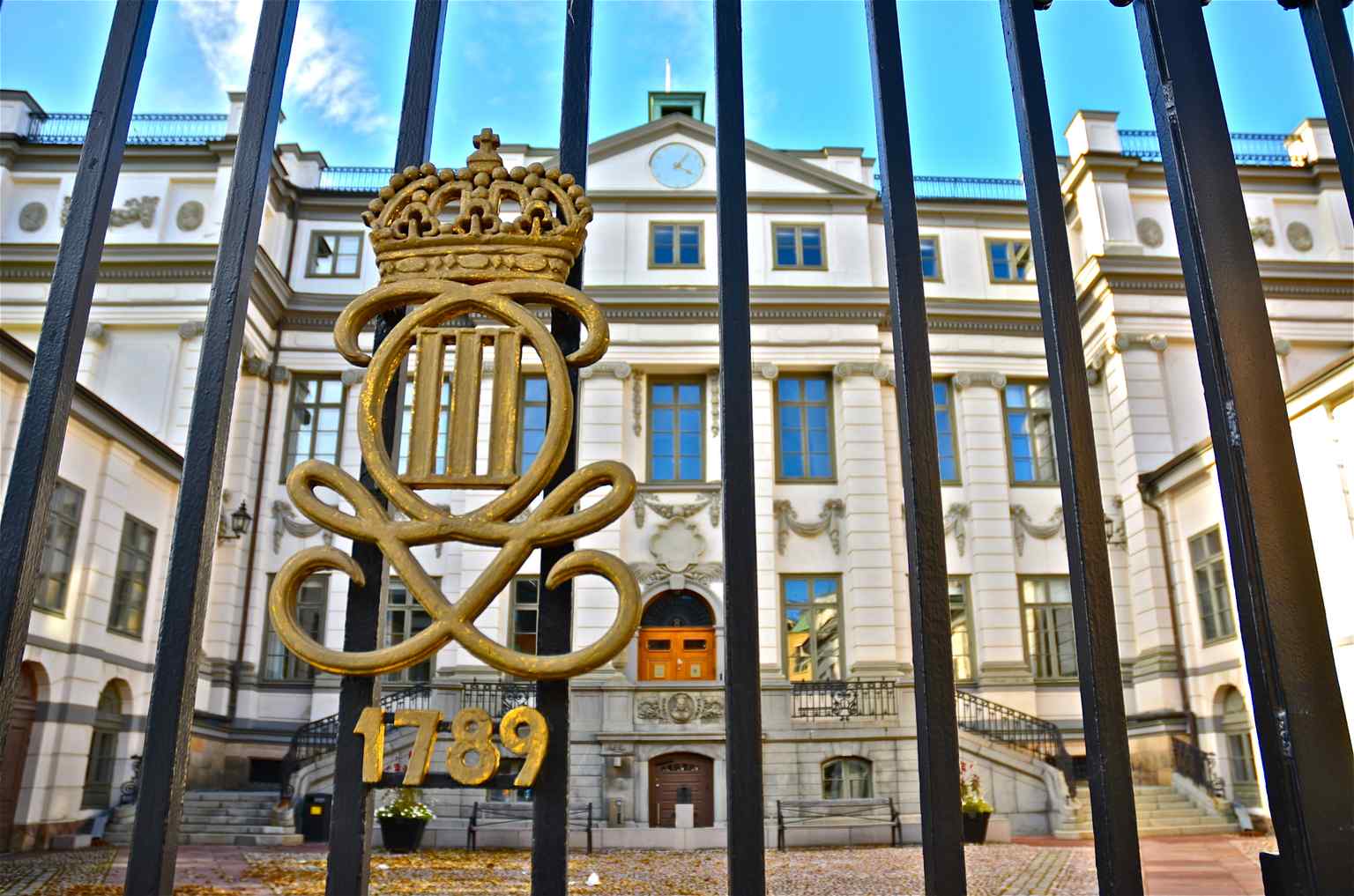
This intricate detail from the palace's facade reflects the grandeur that inspired admiration even from abroad; England's King Charles II reportedly said Paris scarcely had a building as beautiful.Photo: Frankie Fouganthin, Wikimedia Commons, CC BY-SA 3.0. Cropped & resized. Right in front of you sits the Stockholm Palace, a colossal, rectangular block of earthen-colored brick and sandstone defined by its seemingly endless, uniform rows of windows.…Read moreShow less
Open dedicated page →Right in front of you sits the Stockholm Palace, a colossal, rectangular block of earthen-colored brick and sandstone defined by its seemingly endless, uniform rows of windows.
For centuries, this exact spot was home to Tre Kronor Castle, a thirteenth-century fortress built to defend the lake, famous for its towering central spire topped with three crowns. But the massive palace you see today is the ultimate phoenix rising from ashes.
On May seventh, 1697, a catastrophic fire broke out in the attic. At the time, the recently deceased King Charles the Eleventh was lying in state inside. The evacuation was sheer panic. The teenage King Charles the Twelfth and the royal family sprinted down the stairs just steps ahead of terrified servants frantically hauling the dead king's body away from the flames. The blaze consumed the castle in half an hour.
An investigation revealed a shocking level of negligence. The fire marshal had sent one watchman on a personal errand, while the other had simply wandered off to get a snack. As you might expect, the crown was not forgiving. The fire marshal was sentenced to run the gauntlet, a brutal military punishment of running between rows of soldiers striking him, and he did not survive his injuries.
From that smoking ruin, a brilliant architect named Nicodemus Tessin the Younger was tasked with building a modern marvel. He was wildly ambitious. Take a look at your screen to see a painting of Tessin and his successor overseeing the monumental work. To achieve his vision, Tessin recruited a colony of elite French craftsmen to bring the highly ornate Rococo aesthetic to Sweden. These artisans were Catholic, and because practicing their faith publicly in Lutheran Sweden carried severe penalties, they lived and worked in a strict, isolated community near the French embassy. Their incredible artistry fundamentally modernized the city, even as the soaring cost of royal wars halted construction for almost two decades.
When the palace finally opened, it became a theater for intense political drama. In 1756, Queen Louisa Ulrika was so desperate to overthrow the parliament and restore absolute monarchy that she secretly pried forty-four diamonds out of her own crown, replacing them with cut glass. She pawned the real diamonds to foreign bankers to fund a coup. The plot collapsed before it even started, her closest supporters were executed, and the humiliated queen was forced to buy back her own jewels.
Between the relentless ambitions of the crown and the crushing weight of history, it is no wonder people say the palace is haunted. The most famous resident is the White Lady, a ghost said to appear before a royal death, jingling a heavy ring of keys.
Despite the drama, the palace stands as an enduring anchor of the city. You can check out the before and after image on your app to see how its commanding presence has remained virtually unchanged since the 1930s. If you want to explore the massive interior, it is open daily from 10 AM to 4 PM.
Now, let us walk to a much smaller palace built in this royal shadow... Tessinska palatset is just a four-minute walk away.
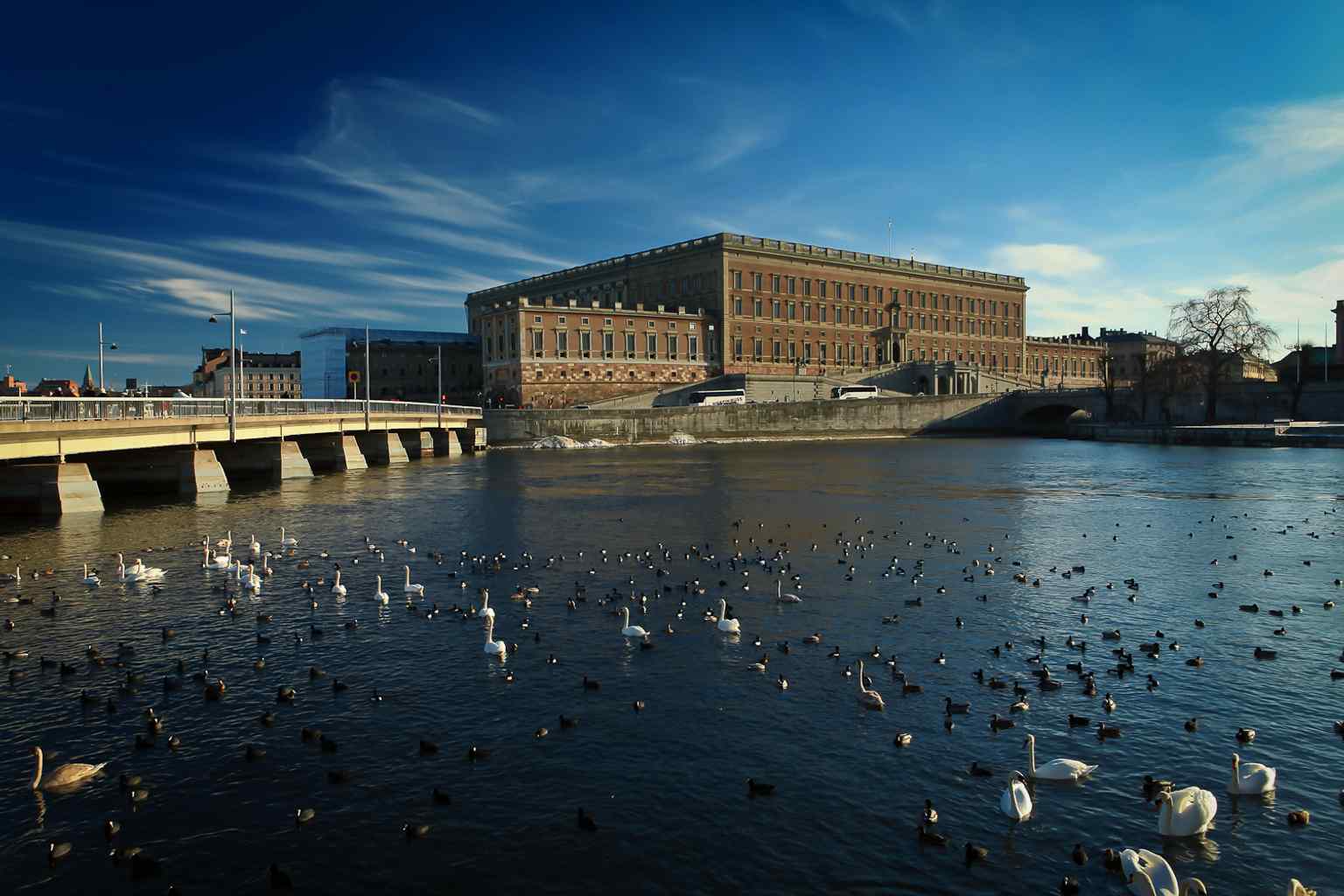
The palace stands majestically by Norrström, reflecting its strategic location in Stadsholmen, where the original Tre Kronor Castle was built in the 13th century to defend Lake Mälaren.Photo: Irina Jonsson, Wikimedia Commons, CC BY-SA 3.0. Cropped & resized. 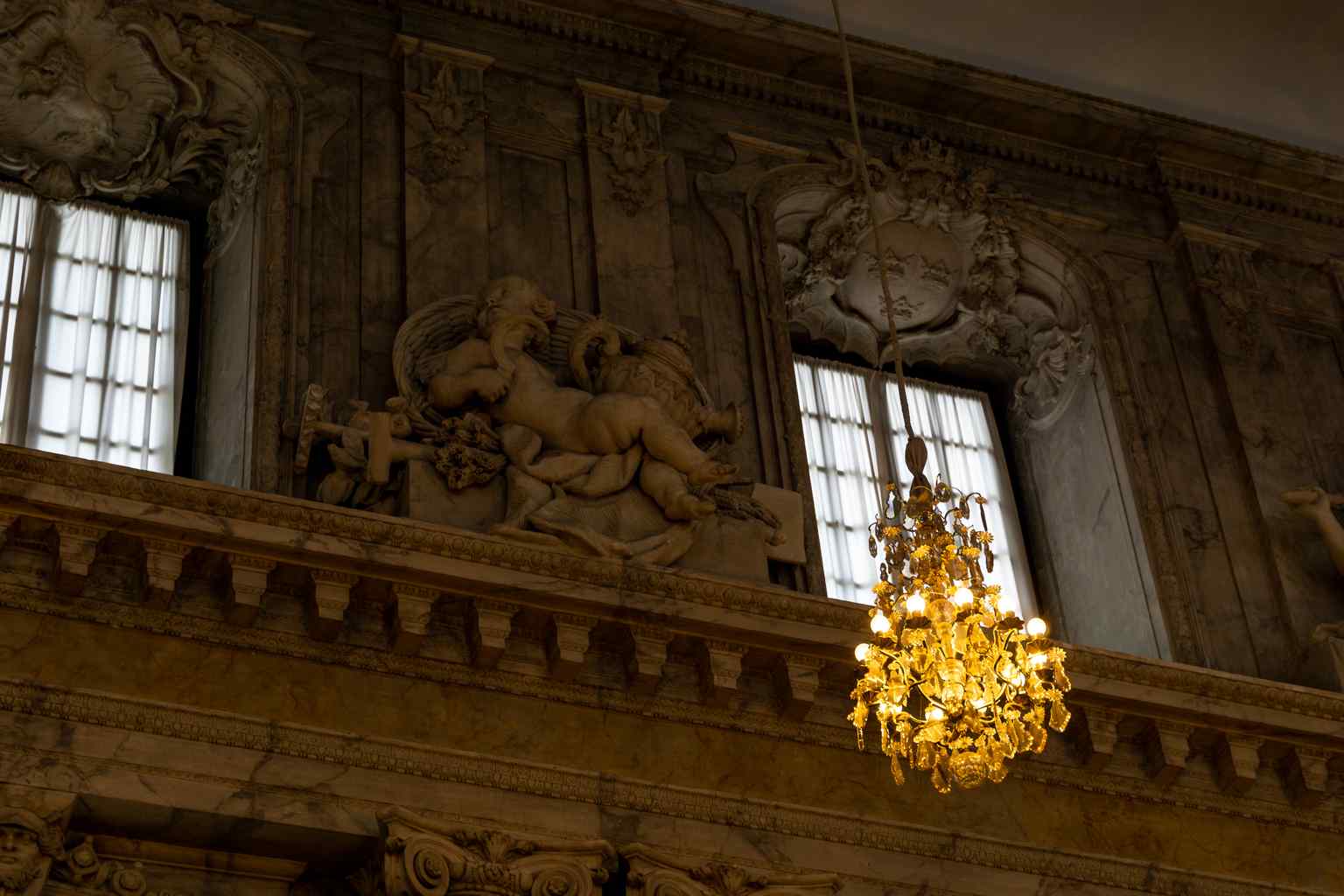
The grand Hall of State, a two-story room introduced for the Riksdag of 1755 and designed by Carl Hårleman, notably houses the Silver Throne of Queen Christina.Photo: Rainer Halama, Wikimedia Commons, CC BY-SA 4.0. Cropped & resized. 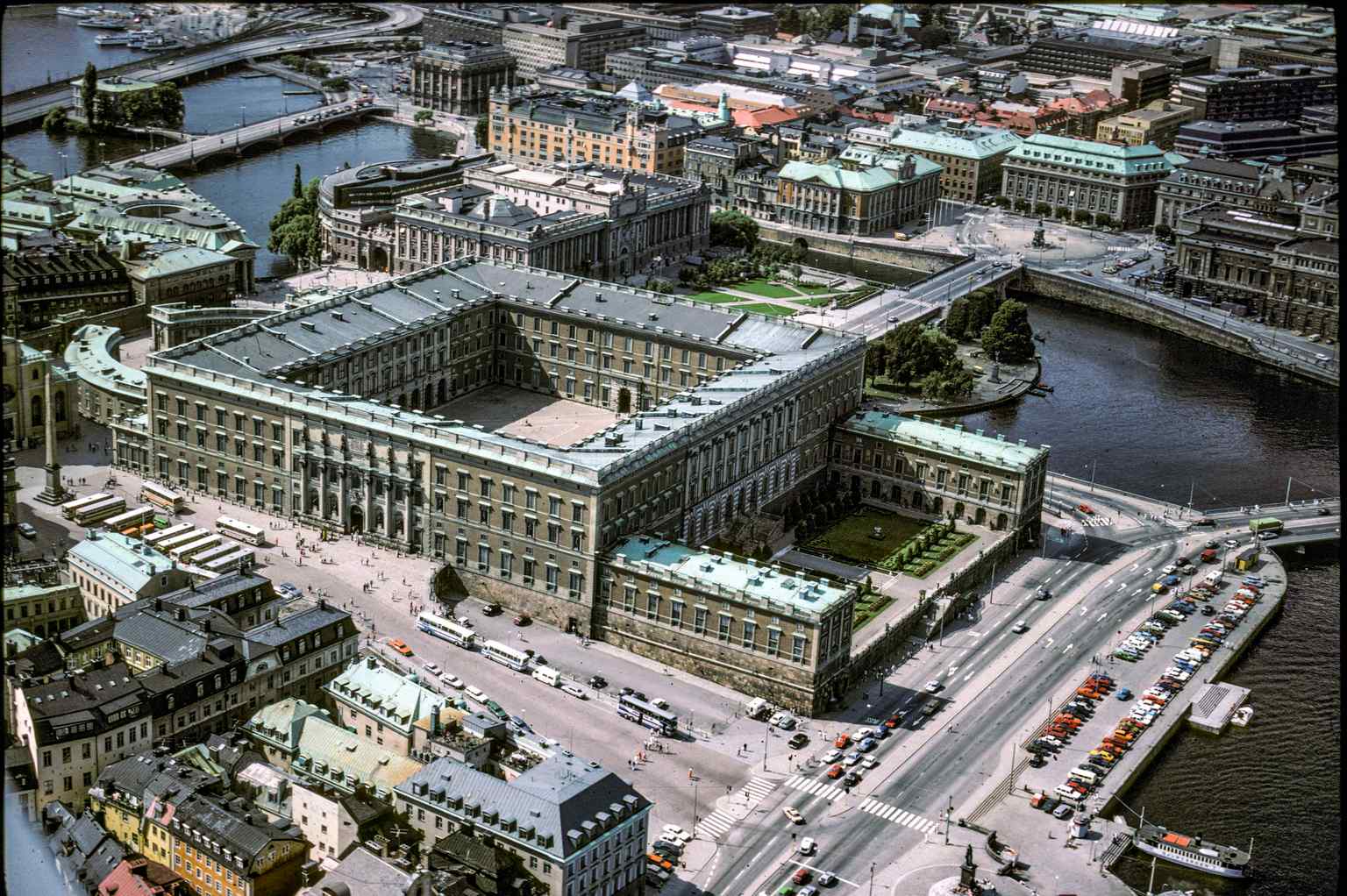
An aerial perspective of Stockholm Palace, highlighting its immense scale and how its four rows enclose the Inner Courtyard, centrally located in Gamla stan.Photo: L.G.foto, Wikimedia Commons, CC BY-SA 4.0. Cropped & resized. Look to your right for a rectangular building with a textured grey stone ground floor and smooth yellow upper stories, easily identifiable by the two sculpted stone figures…Read moreShow less
Open dedicated page →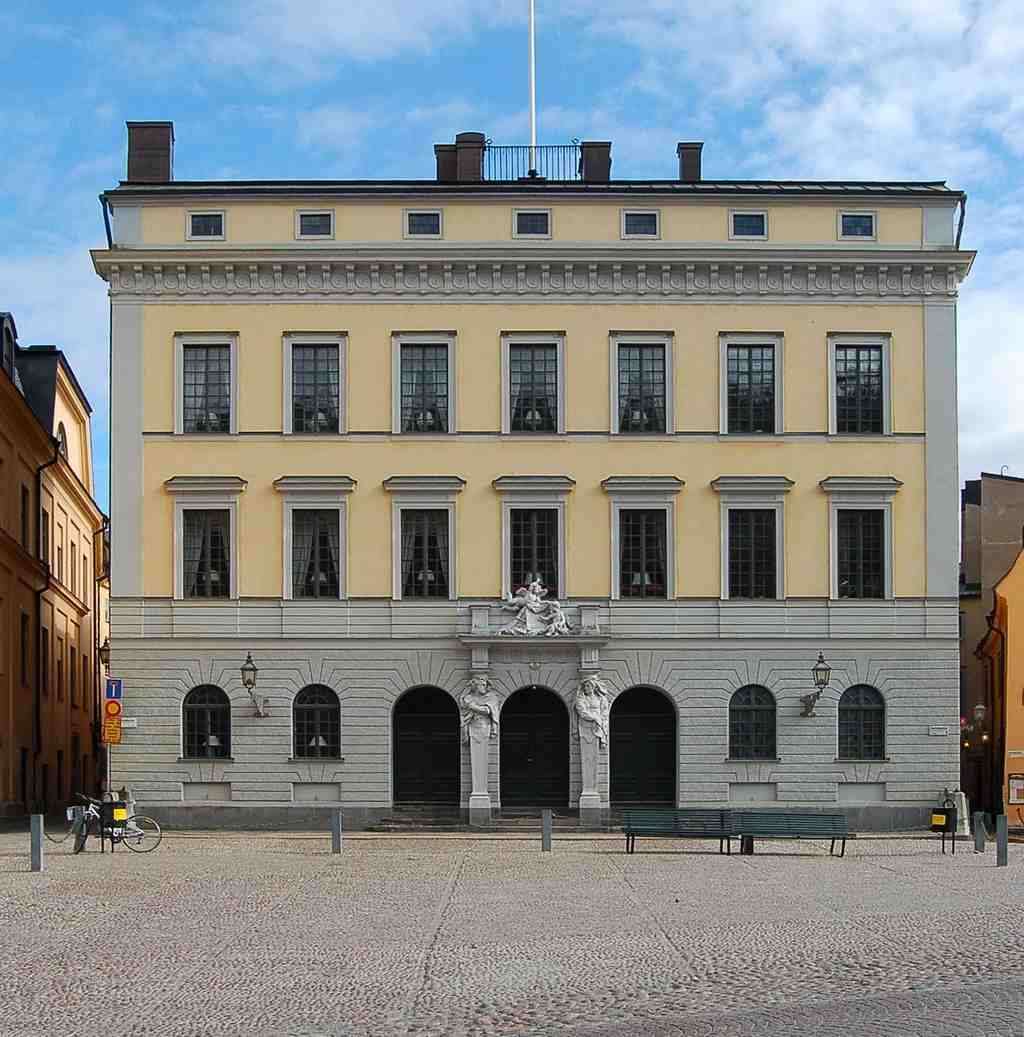
Tessinska palatsetPhoto: FriskoKry, Wikimedia Commons, CC BY-SA 3.0. Cropped & resized. Look to your right for a rectangular building with a textured grey stone ground floor and smooth yellow upper stories, easily identifiable by the two sculpted stone figures standing guard on either side of the central doorway.
This is Tessin Palace. Back in 1692, Nicodemus Tessin the Younger was thirty eight years old and at the absolute peak of his career. He was the royal architect to King Karl the Eleventh, the man responsible for shaping the grand vision of Stockholm. Naturally, the kingdom's top architect needed a home that matched his status.
He bought this plot of land right across from the royal castle. There was just one problem. The plot was small and awkwardly shaped. For an architect obsessed with classical rules and perfect symmetry, this was a nightmare. But Tessin was brilliant. He employed a classic French layout called entre cour et jardin, a term meaning simply between courtyard and garden. By placing a small forecourt, the main house, and the garden all on a single straight axis, he created an illusion of total order out of an uneven patch of dirt.
Take a look at the first image on your screen to see how Tessin styled the exterior. He rejected French tastes for the outside, preferring the more restrained Roman Baroque style of Michelangelo. Notice those two carved male figures flanking the door. These are known as atlantes, a type of structural column shaped like a man, and here they use their sheer stone strength to hold up the architectural elements above the entrance.
Now check the second image to see his garden trickery. Tessin used forced perspective, narrowing the garden walls and adding a fake colonnade at the very back, making the tiny, irregular space look vast and perfectly symmetrical.
But brilliance often comes with a heavy price. When Tessin died, his son Carl Gustaf inherited the masterpiece. Carl Gustaf wanted to transform the palace into the cultural epicenter of Stockholm. He hired architects for lavish upgrades and bought world class art in Paris, laying the foundation for Sweden's National Museum. It also completely bankrupted him. Drowning in debt and locked in a bitter political conflict with the royal family, Carl Gustaf was forced into the heartbreak of selling his father's magnificent creation in 1755.
The man who bought it, a wealthy merchant named Gustaf Kierman, fared even worse. Just a few years later, a rival political faction took power. They used Kierman as a scapegoat for a financial crisis, stripped him of his wealth, and sentenced him to a brutal diet of bread and water before throwing him into a fortress prison. He died there a broken man.
The state eventually bought the property for three hundred thousand copper dalers, an old currency that equals roughly sixteen million Swedish krona today. By the late 1700s, it became the headquarters for the city's police chief, who turned this elegant palace into the dark center of a massive political spy network monitoring the citizens of Stockholm.
It seems the walls of this architectural triumph have always harbored a bit of tragedy and ruthless ambition. Speaking of heavy legacies and the burdens passed down by the powerful, let us move on. Your next stop, Axel Oxenstierna's Palace, is just a three minute walk away.
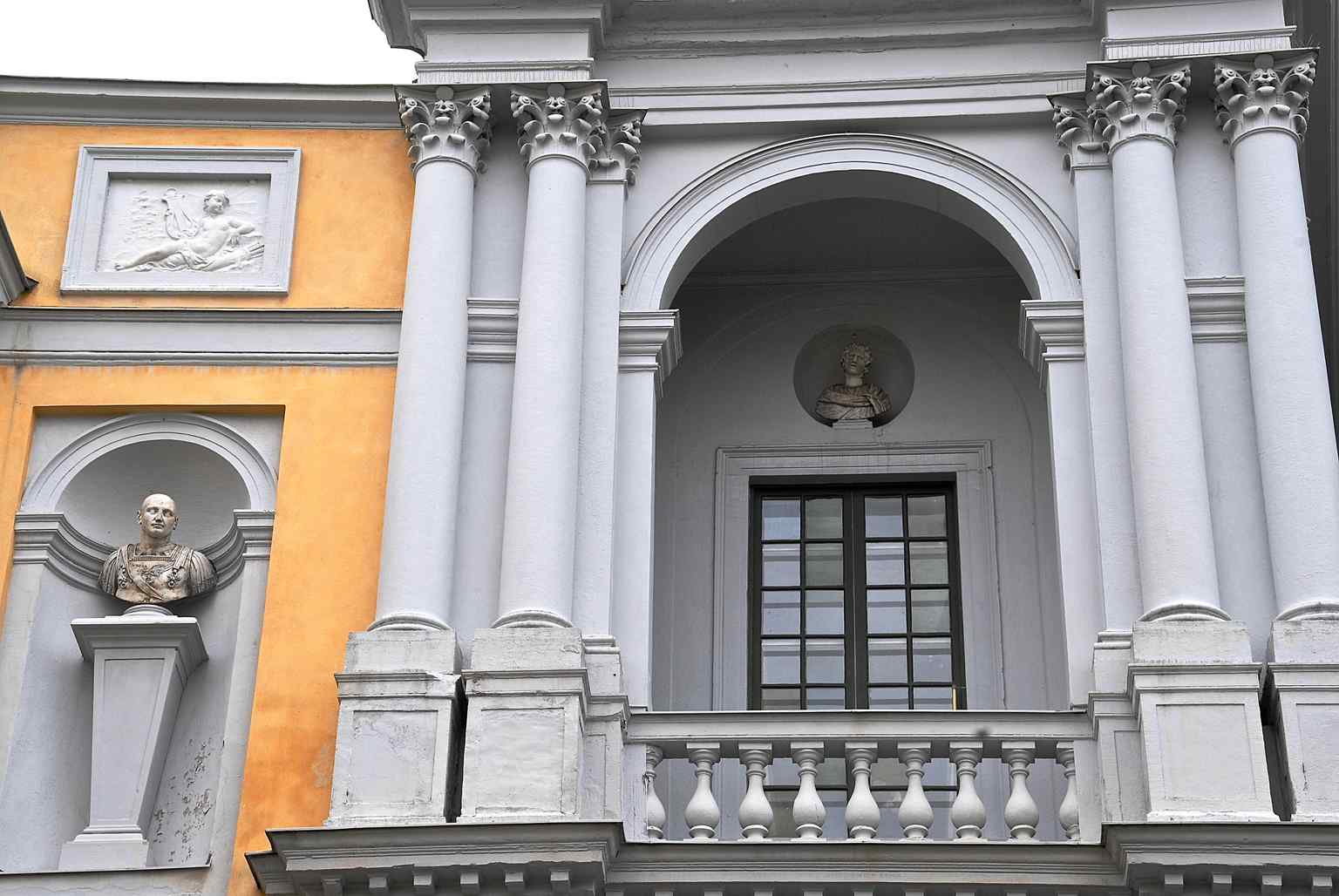
The palace's facade with its warm yellow smooth plaster on the upper floors and rusticized grey ground floor, reflecting Tessin's Roman-inspired Baroque design.Photo: Frankie Fouganthin, Wikimedia Commons, CC BY-SA 3.0. Cropped & resized. 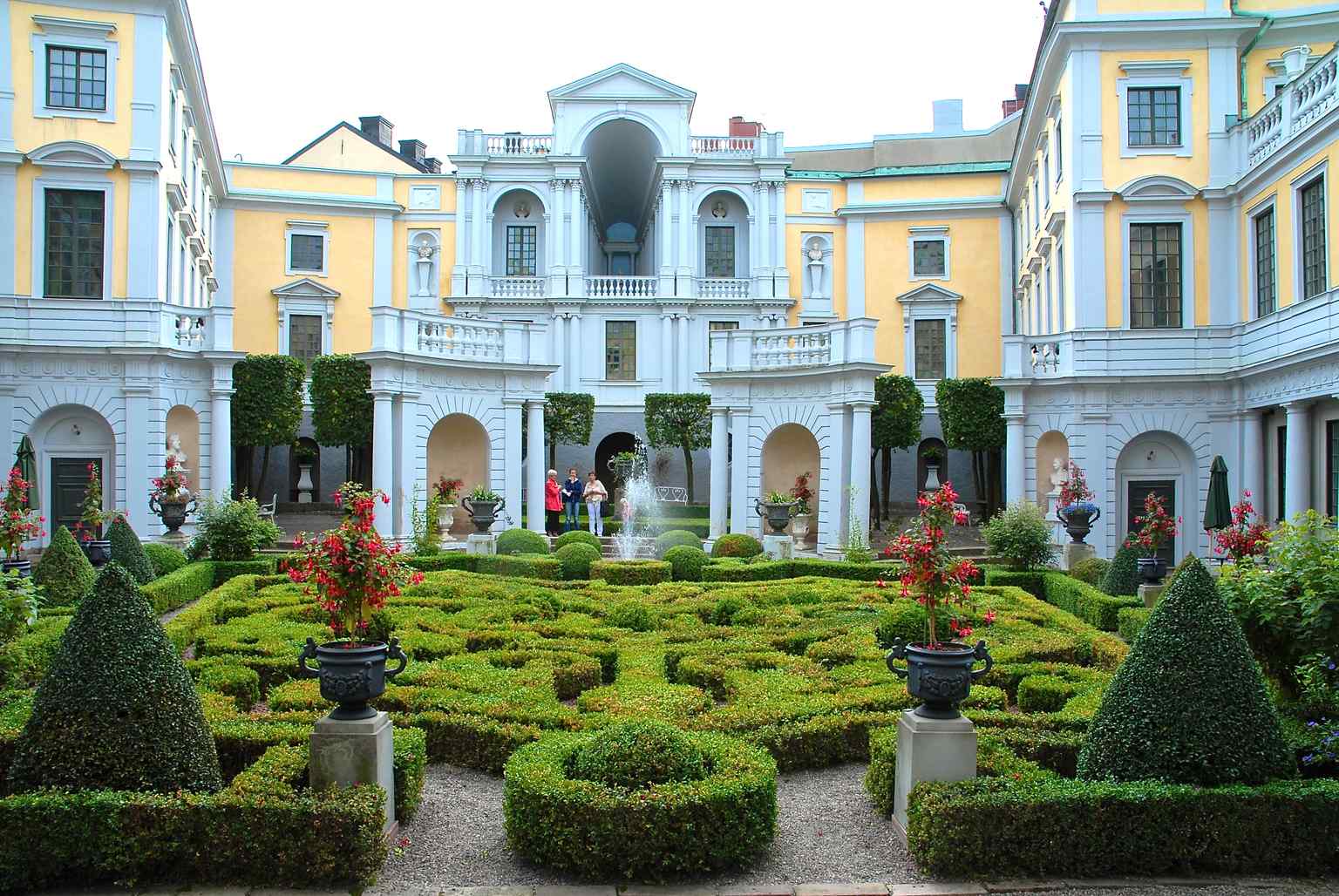
A view of the palace's garden, designed with French influences admired by Tessin, showing the meticulous layout and central fountain.Photo: Frankie Fouganthin, Wikimedia Commons, CC BY-SA 3.0. Cropped & resized. 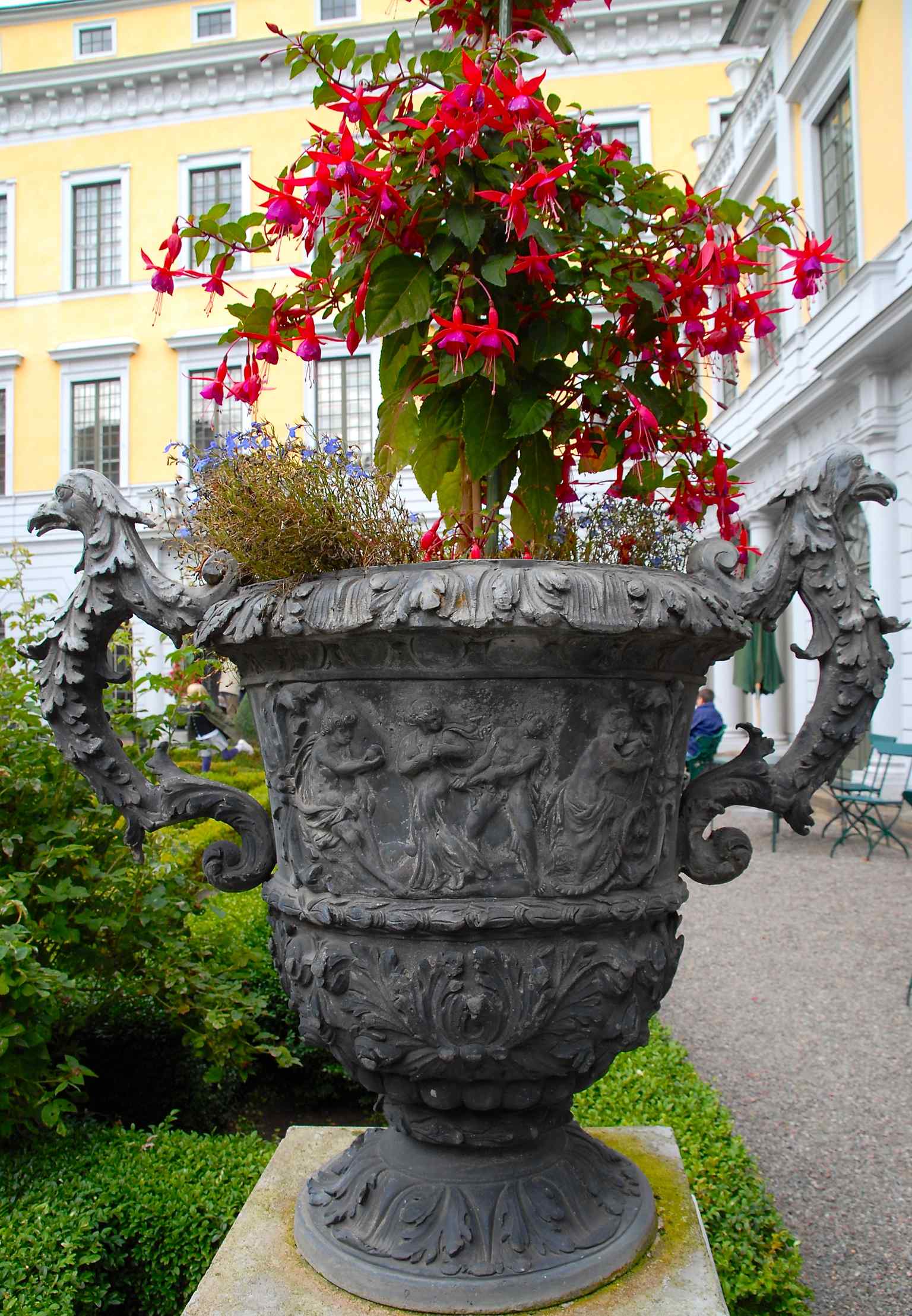
An ornate garden vase, typical of the Baroque aesthetics found within the palace's meticulously planned gardens.Photo: Frankie Fouganthin, Wikimedia Commons, CC BY-SA 3.0. Cropped & resized. Take a look at this tall rectangular building with its rust red plaster walls, alternating rows of large and small windows, and a heavy grey sandstone base featuring deeply arched…Read moreShow less
Open dedicated page →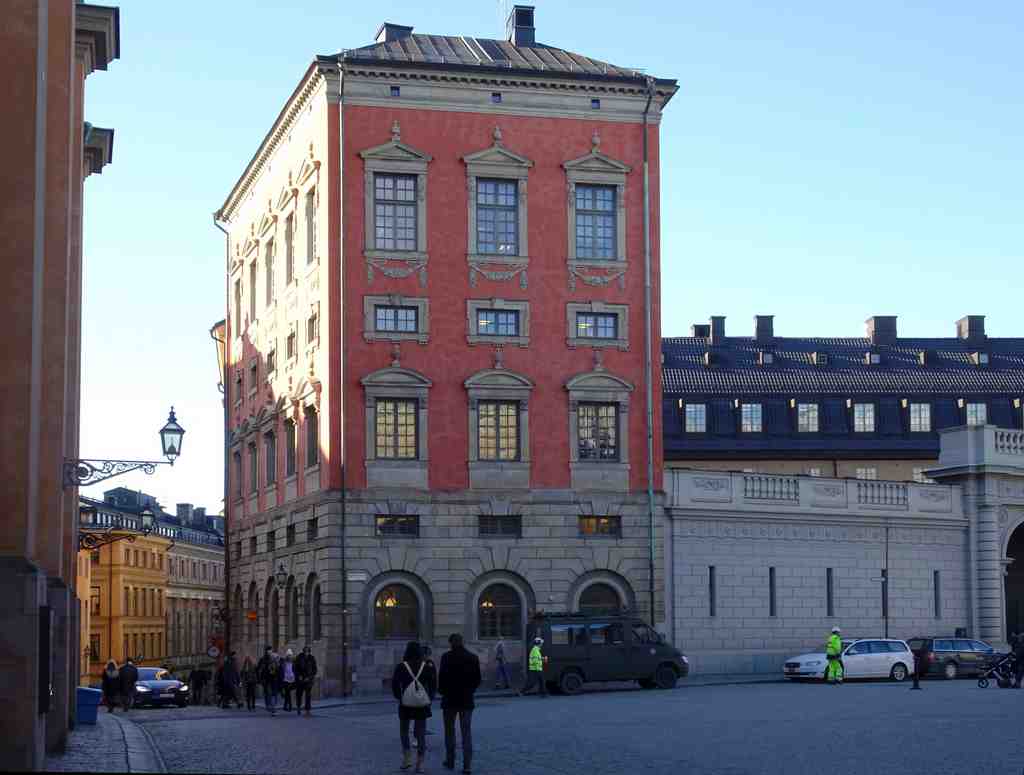
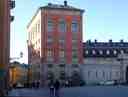
Axel Oxenstierna's PalacePhoto: Holger.Ellgaard, Wikimedia Commons, CC BY-SA 4.0. Cropped & resized. Take a look at this tall rectangular building with its rust red plaster walls, alternating rows of large and small windows, and a heavy grey sandstone base featuring deeply arched doorways. This is Axel Oxenstierna's Palace. Or rather, a fragment of it.
If you check your app, you can see a seventeenth century illustration showing the grand, sprawling complex this was supposed to be. What stands before you was meant to be merely the southern wing.
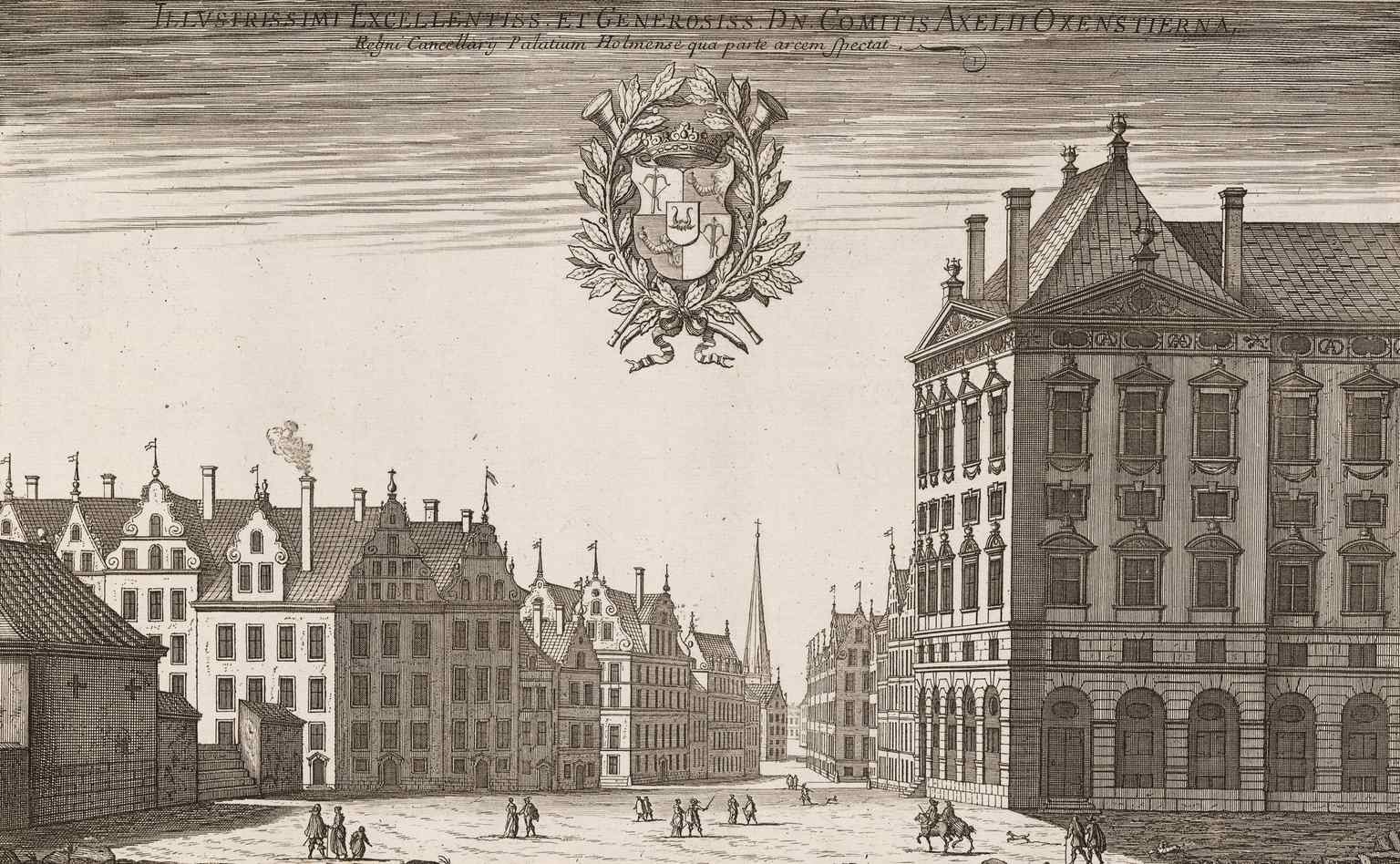
An illustration from 1670, depicting Axel Oxenstierna's Palace as part of a grander, uncompleted plan by Jean de la Vallée. The palace was never fully built due to the untimely deaths of Axel and his son.Photo: Marot, Jean, ca 1619-1679(Gravör), Dahlbergh, Erik, 1625-1703(Medarbetare), Wikimedia Commons, Public domain. Cropped & resized. The story of why it stopped here is soaked in blood and bitter irony.
The man who designed this was Jean de la Vallee. He became the royal architect not through a joyful promotion, but because he had to pick up the pieces after a brutal tragedy. His father, Simon de la Vallee, was the brilliant architect who was murdered in the streets, a brutal crime we learned about earlier. Jean now found himself designing a palace for Chancellor Axel Oxenstierna, the head of the very family connected to his father's tragic death.
The father was gone, murdered by a member of the very family that young Jean would eventually have to work for. Jean took up his father's mantle. When Chancellor Oxenstierna commissioned this palace in 1653, Jean designed a masterpiece. It is considered Stockholm's first building in Roman Mannerism, an architectural style that takes strict classical rules and deliberately bends them for dramatic, almost playful effect.
You can see that dramatic bending in the windows. Because the lot sits on a slant, Jean used a forced perspective, cutting the window niches at an angle into the facade. It tricks the eye into thinking the building aligns perfectly with the street. Notice too the windows themselves. Between the tall, grand floors are rows of smaller, squarer windows. These mark what are known as mezzanines, low intermediate floors tucked between the main levels. At five stories high, it towered over the typical two story stone houses of its day.
But a curse seemed to hang over the project. Just a year after construction began, Axel Oxenstierna died. His son Erik inherited the vast project, only to die of illness two years later at the age of thirty two. The grand vision you saw on your screen died with them. The Oxenstierna family never even lived here.
Instead, this unfinished, imposing shell became the home of the world's first central bank, rising from the ashes of a spectacular financial disaster. Before this bank, Swedes had to lug around massive copper coins that could weigh up to forty pounds each. A man named Johan Palmstruch revolutionized things by printing Europe's first paper money, but he printed far more than he could actually back up in his vaults. When the public panicked and demanded their copper, the bank collapsed, and Palmstruch was sentenced to death. He was later pardoned, but the government took over the banking system, moving it right into this empty, sturdy palace to reassure the public.
The creators of this city poured their lives, and sometimes lost them, building monuments for ambitious men whose grand designs were ultimately cut short by fate.
Let us keep walking now, deeper into the heart of the old town. Our next stop is the Stock Exchange Building, just a minute away.
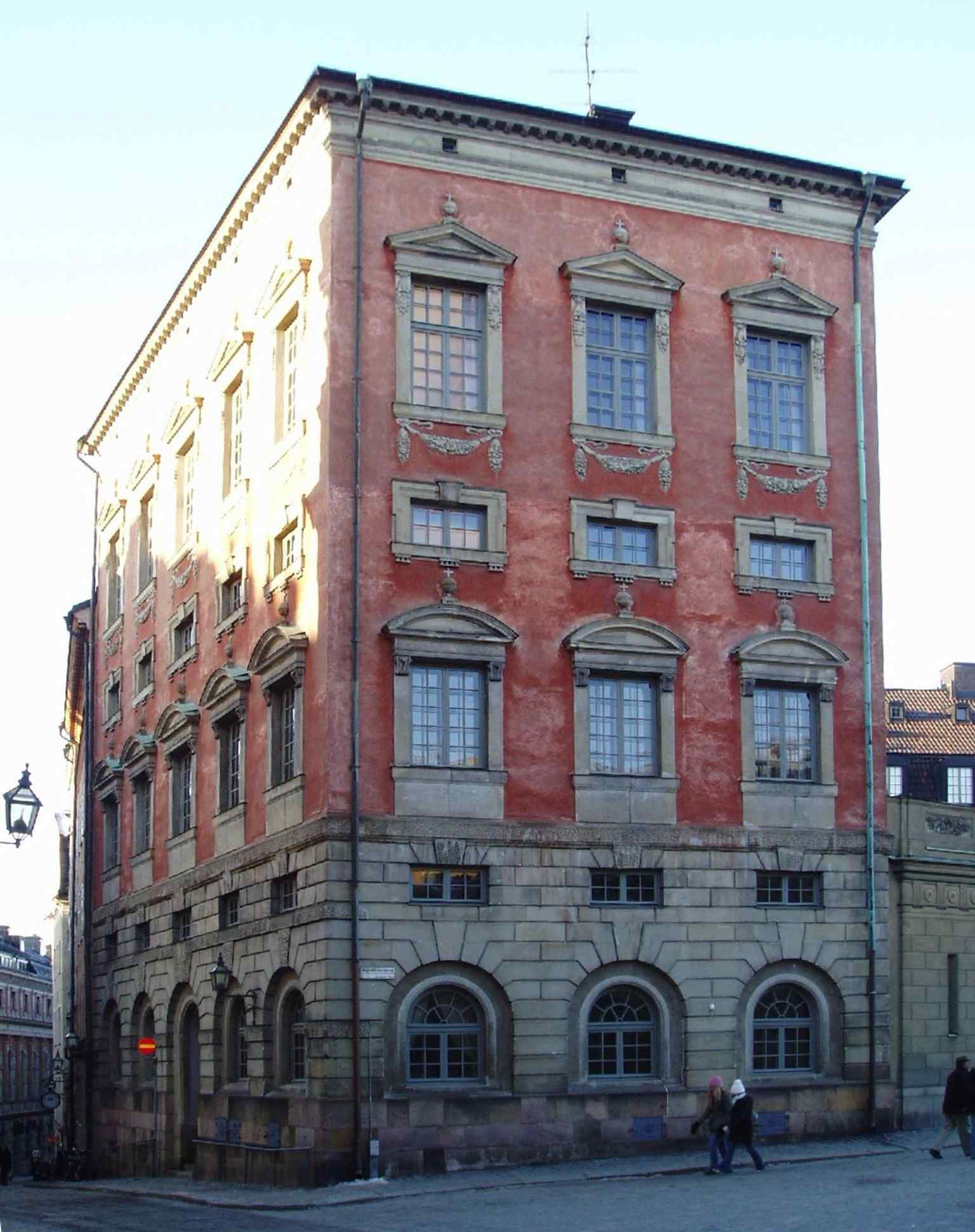
The well-preserved exterior of Axel Oxenstierna's Palace, Stockholm's first palace built in Roman Mannerism, which became a state monument in 1935.Photo: Udo Schröter, Wikimedia Commons, CC BY-SA 3.0. Cropped & resized. On your right, you will see a grand, peach-colored stone building featuring an elegant pillared portico and a distinctive green-domed clock tower perched on its roof. It looks…Read moreShow less
Open dedicated page →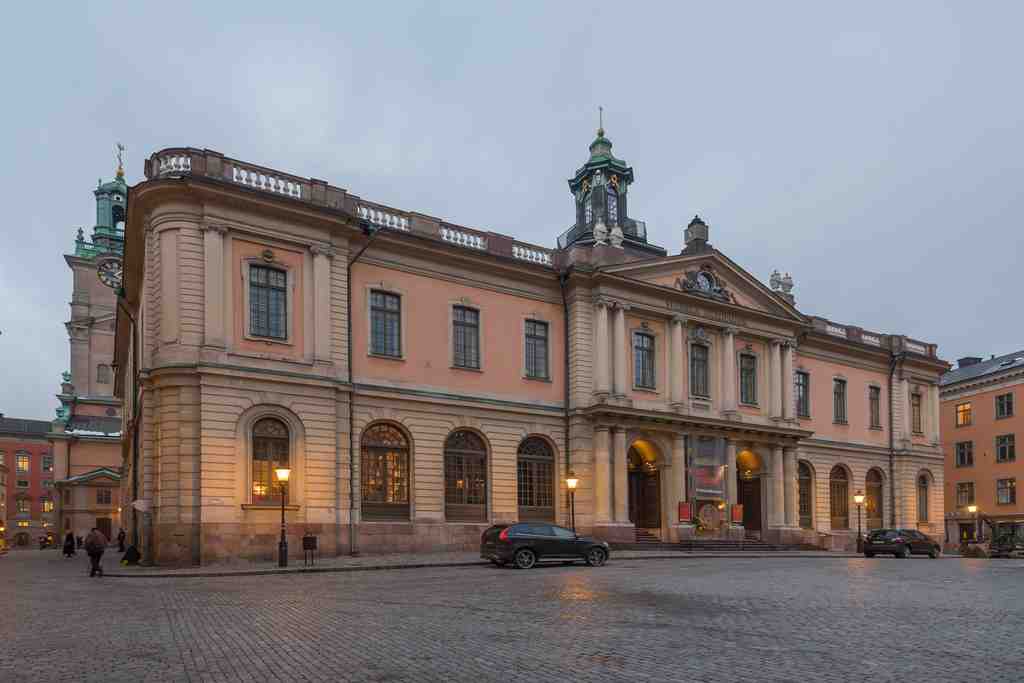
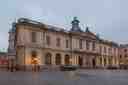
Stock Exchange BuildingPhoto: Arild Vågen, Wikimedia Commons, CC BY-SA 4.0. Cropped & resized. On your right, you will see a grand, peach-colored stone building featuring an elegant pillared portico and a distinctive green-domed clock tower perched on its roof.
It looks like a pinnacle of Enlightenment elegance, built in the 1770s to host balls for the royal family and house the city's Stock Exchange. But take a look at the exterior picture on your screen. This refined example of classicism, an architectural style striving for the symmetry and harmony of ancient Rome, hides a profoundly dark history.
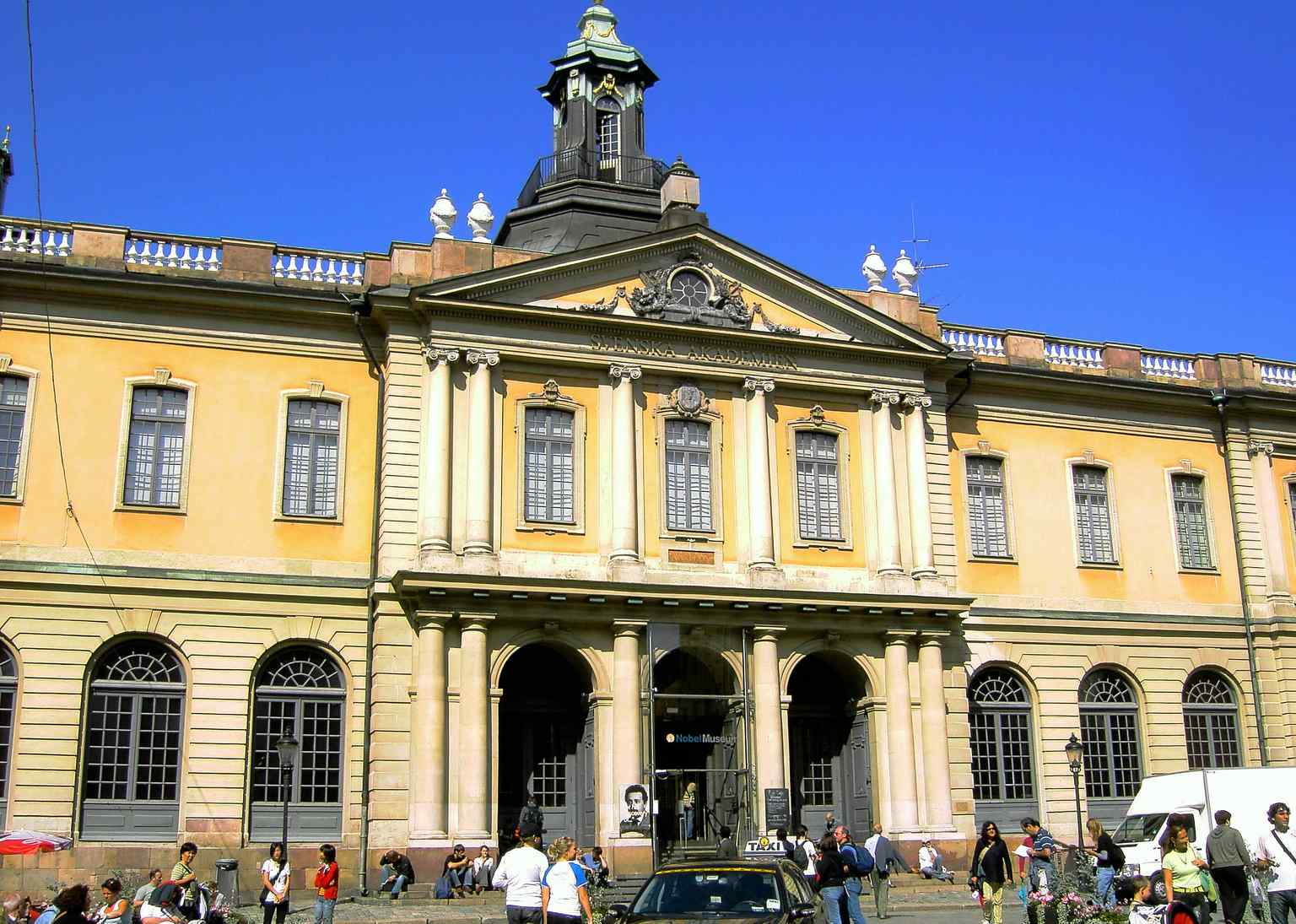
This exterior view of Börshuset, built 1773–1778, now houses the Nobel Museum and the Swedish Academy, transforming a site historically associated with medieval punishments into a center of culture.Photo: Mastad, Wikimedia Commons, CC BY-SA 3.0. Cropped & resized. Before this beautiful structure stood here, the site was occupied by the old Town Hall. It was far from a peaceful place of civic duty. Beneath the ground lay a terrifying network of damp, cramped dungeons and torture chambers. Prisoners languished in the dark in cells that locals gave grim, sarcastic nicknames, like The Flea, The White Mare, and The New Cold. Rulings were made inside, and brutal punishments were executed immediately at the whipping post right outside the doors.
But the horror reached its absolute peak in November 1520. This very spot was the epicenter of the Stockholm Bloodbath. When political power plays turn ruthless, this is the price of ambition. A newly crowned king, seeking to crush any resistance, ordered the mass execution of the Swedish nobility and prominent citizens. Laws and death sentences were proclaimed directly from the old Town Hall, and the gruesome massacre unfolded mere steps from where the Stock Exchange's current entrance is located.
By the late eighteenth century, the city wanted to erase that bloody history with graceful architecture. Yet, the intense human struggles within these walls never truly vanished. The upper floors now belong to the Swedish Academy, the prestigious group that evaluates brilliant, and sometimes doomed, literary creators to award the Nobel Prize in Literature. They secured this space in 1914 thanks to an eccentric heiress who casually donated 500,000 kronor, which is roughly 30 million kronor today, simply because a famous author charmed her into it.
Even recently, the building was consumed by a destructive power struggle. In 2018, deep internal rifts over a scandal connected to the MeToo movement culminated in a furious three-hour meeting in the opulent rooms upstairs. It resulted in the Academy's leader stepping down on the very stone steps outside, and the famous white double doors remained shut as the Nobel Prize was postponed for a year. If you pull up the second image on your app, you can see the modern Academy at work inside these historic rooms. It is a place of immense literary prestige, but still a stage for fierce ambition.

Annie Ernaux, the 2022 Nobel Prize in Literature winner, attends a press conference inside Börshuset, illustrating the building's current role as the prestigious home of the Swedish Academy.Photo: Frankie Fouganthin, Wikimedia Commons, CC BY-SA 4.0. Cropped & resized. The blood and the scandals may be masked by peach stone and gold trim, but the memories linger. Direct your attention fully to the cobblestones right in front of us, as we step into the heart of Stortorget, the great square itself, just a short walk ahead.
It is hard to imagine a more peaceful European scene. But this square, the oldest in Stockholm, has a way of hiding its scars. That carved stone well you see was designed by Erik…Read moreShow less
Open dedicated page →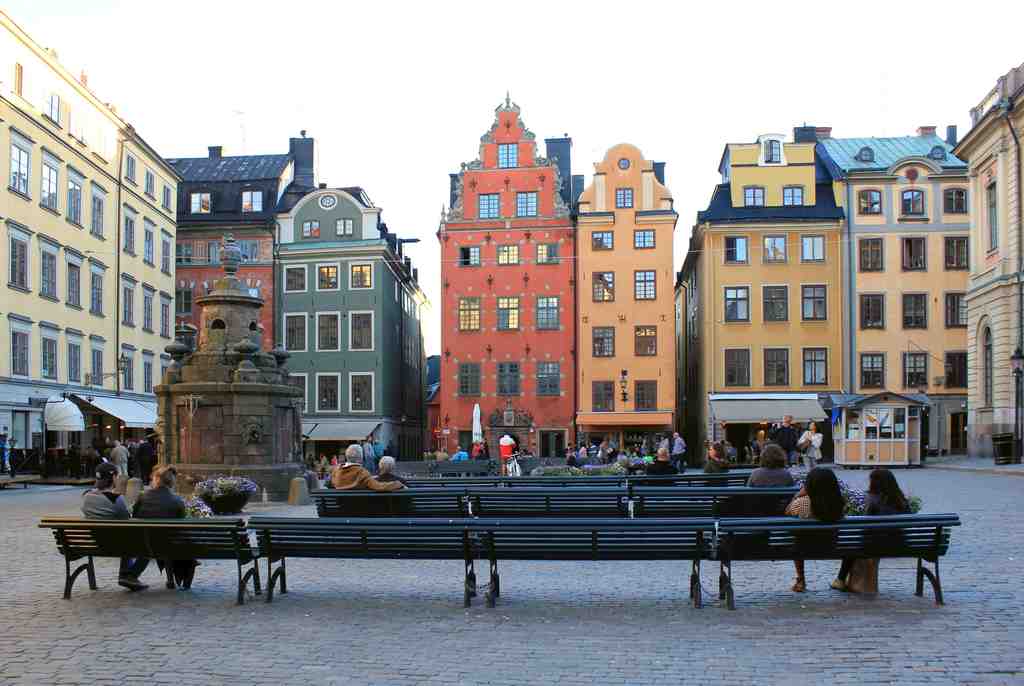
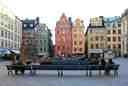
StortorgetPhoto: Øyvind Holmstad, Wikimedia Commons, CC BY-SA 3.0. Cropped & resized. Welcome to Stortorget, an open cobblestone plaza anchored on the left by a tiered, carved stone well and framed by tall, vividly colored townhouses, including a striking red building with a stepped roofline.
It is hard to imagine a more peaceful European scene. But this square, the oldest in Stockholm, has a way of hiding its scars. That carved stone well you see was designed by Erik Palmstedt in the late eighteenth century. We saw his elegant work earlier on the Hereditary Prince's Palace. For centuries, people have gathered at this monument to draw water and share gossip, an entirely ordinary act of recreation right on top of a site of unimaginable trauma.
Because in November of 1520, this exact spot was the stage for the Stockholm Bloodbath. The Danish King Christian the Second wanted to permanently crush his political rivals. Despite promising an amnesty, he locked down the city and accused his enemies of blasphemy, a severe crime against the church. Over three days, his executioners systematically beheaded and hanged some ninety people right where you are standing. It is said that a heavy downpour of rain mixed with the victims' blood, turning the gutters into red rivers that flowed down into the narrow streets of the old town.
The memory of that massacre still haunts the architecture. Take a look at your phone for a photo of the red building with the stepped roofline, known as the Schantzska huset. Local legend insists there are exactly ninety-four white stones set around its windows, placed there to memorialize the victims of the Bloodbath. The myth even warns that if a stone is ever removed, the ghost of that victim will rise to haunt the square. Historians will dryly point out the house was built long before the massacre, but the fact that the legend persists tells you everything about the psychological shadow left by the king's ruthless hunger for power.
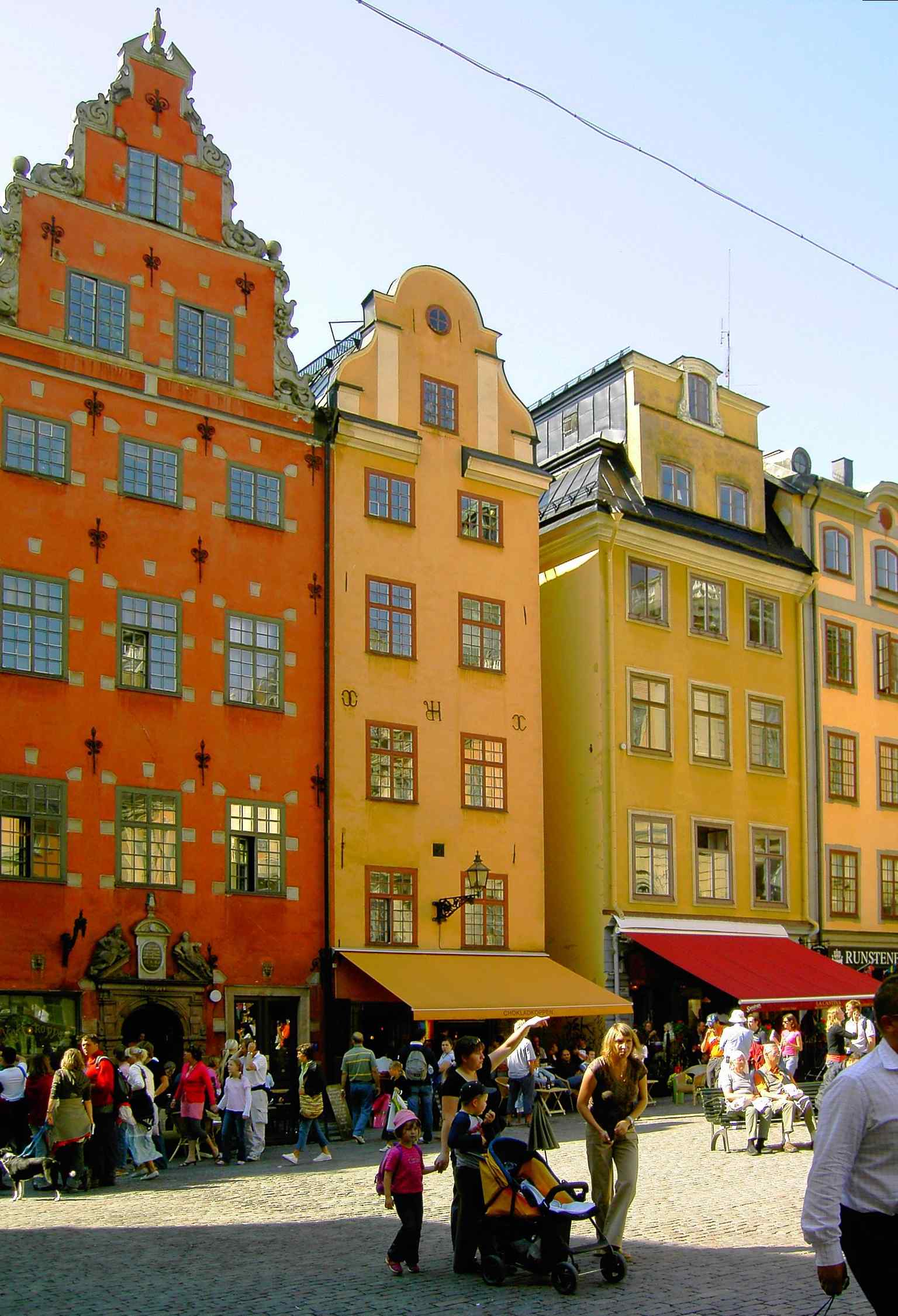
The striking Schantzska huset at Number 18-20, identifiable by its stepped gable and the 82 white stones, which local myth says represent the victims of the Stockholm Bloodbath.Photo: Mastad, Wikimedia Commons, CC BY-SA 3.0. Cropped & resized. You can see another piece of this morbid folklore if you look at the second image on your screen, showing a cannonball lodged in the corner wall of Number Seven. The story goes it was fired at King Christian during the siege. The reality? It was almost certainly shoved into the masonry by an early builder with a flair for dramatic decoration.
And that is the real story of Stortorget. It is a constant tug of war between absolute rulers trying to impose their will through violence, and the brilliant citizens who actually built the city. This square was home to people like Carl Wilhelm Scheele, the master chemist who discovered oxygen, and the master stonemasons who carved these intricate portals. They lived here, worked here, and reclaimed the space from the tyrants.
Look closely at that well designed by Palmstedt. It stands quiet now, but imagine the chaos and history that have unfolded on these very cobblestones beneath your feet. Now, let us head to our final stop, Tyska kyrkan, just a minute walk away, to explore how the people of this city found a sense of spiritual resilience in the aftermath of it all.
You will spot the German Church immediately by its towering, slender green copper spire rising from a square brick base, crowned at the very top by a glinting golden rooster.…Read moreShow less
Open dedicated page →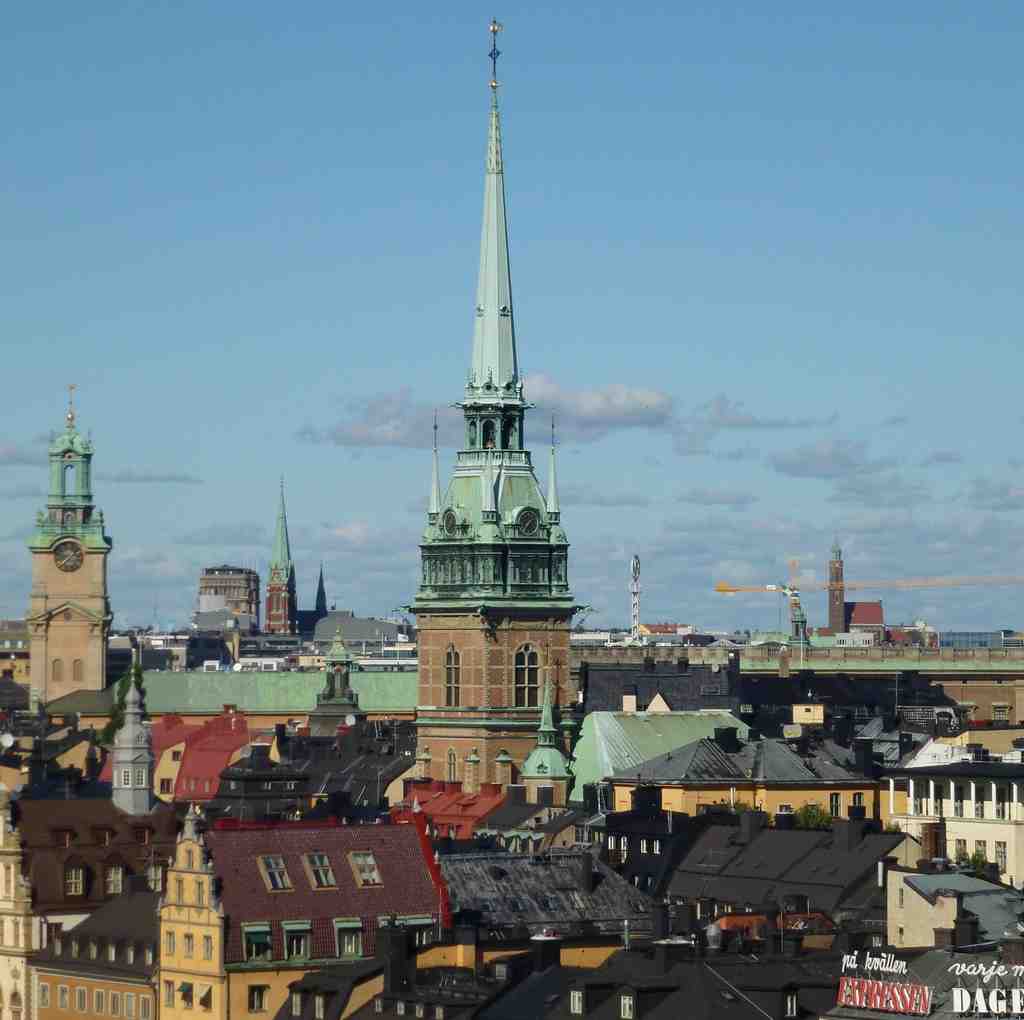
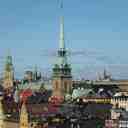
Tyska kyrkan, StockholmPhoto: Holger.Ellgaard, Wikimedia Commons, CC BY-SA 3.0. Cropped & resized. You will spot the German Church immediately by its towering, slender green copper spire rising from a square brick base, crowned at the very top by a glinting golden rooster.
This is Saint Gertrude's, though everyone just calls it the German Church. It actually started in the 1300s as a guild house for German merchants before being transformed into a place of worship.
The men who shaped Stockholm were often pushed to build higher and grander, constantly chasing the favor of wealthy patrons and aggressive kings. But pushing the limits of engineering often invited catastrophe. Take the famous architect Nicodemus Tessin the Elder. In 1673, he designed a magnificent, pompous tower for this very church. It was a bit too ambitious. Just a few years later, they realized that whenever the church bells rang, the entire tower swayed so violently in the wind that it threatened to snap and crush the street below. They had to frantically strap the masonry with massive iron anchors just to hold it together.
Tessin's ill-fated tower eventually burned down in 1759, but the true trial for this building came on an October night in 1878. Around two in the morning, another massive fire swallowed the replacement tower. As the flames weakened the structure, the burning spire collapsed. The church's massive bronze bells, weighing several tons, plummeted straight down.
The crowds gathered in the streets braced for the end. They knew that if the heavy bells crashed through the ceiling, the flaming debris would turn the priceless 1600s interior into an inferno.
But the bells did not break through. Centuries earlier, a brilliant master mason named Hans Ferster had constructed the church's stellar vaults, which are complex, star-shaped arched ceilings built from brick. Ferster was not a famous royal architect, but his engineering was absolutely flawless. Much like the miracle we saw earlier at Jacob's Church, his medieval-style brickwork caught the multi-ton bells and held firm against the crushing weight and the blazing fire. Because Ferster's ceiling refused to yield, the brand-new Stockholm fire department had just enough time to drag in their steam engines and save the church.
The tower was rebuilt once more in 1886 by architect Julius Raschdorff, giving us this towering ninety-six-meter spire. And it received a new carillon, a playable set of tower bells, funded by a wealthy patron. Decades later, that patron's daughter, the formidable Countess Wilhelmina von Hallwyl, decided the bells sounded a bit out of tune. Rather than complain, she simply paid out of her own pocket to have all the bells recast from scratch so they would ring in perfect harmony.
If you want to see the stunning interior that Hans Ferster's brilliant masonry saved, the church is open Friday through Sunday from 11 AM to 3 PM.
Look up at that towering spire one last time. It has survived disastrous ambition, devastating fires, and the sheer weight of falling bronze. It stands today as the highest point in the old town, a perfect, enduring monument to the creators who built this city to last.

Frequently asked questions
How do I start the tour?
After purchase, download the AudaTours app and enter your redemption code. The tour will be ready to start immediately - just tap play and follow the GPS-guided route.
Do I need internet during the tour?
No! Download the tour before you start and enjoy it fully offline. Only the chat feature requires internet. We recommend downloading on WiFi to save mobile data.
Is this a guided group tour?
No - this is a self-guided audio tour. You explore independently at your own pace, with audio narration playing through your phone. No tour guide, no group, no schedule.
How long does the tour take?
Most tours take 60–90 minutes to complete, but you control the pace entirely. Pause, skip stops, or take breaks whenever you want.
What if I can't finish the tour today?
No problem! Tours have lifetime access. Pause and resume whenever you like - tomorrow, next week, or next year. Your progress is saved.
What languages are available?
All tours are available in 50+ languages. Select your preferred language when redeeming your code. Note: language cannot be changed after tour generation.
Where do I access the tour after purchase?
Download the free AudaTours app from the App Store or Google Play. Enter your redemption code (sent via email) and the tour will appear in your library, ready to download and start.
If you don't enjoy the tour, we'll refund your purchase. Contact us at [email protected]
Checkout securely with 






.jpg)


.jpg)
