
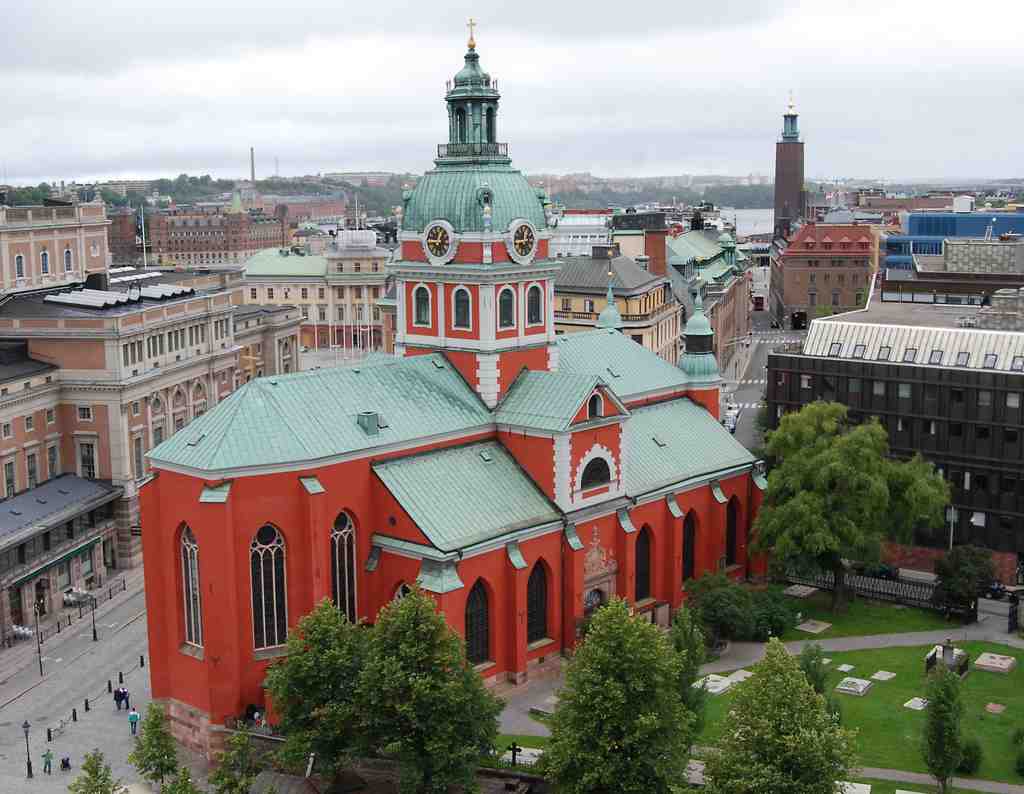
Look to your right for the striking bright red building with its sweeping green copper roof and a prominent central tower topped by a rounded cupola and gold clocks. This is Jacob's Church, and its story is a perfect example of what happens when unchecked power collides with artistic vision.
The site's history stretches back to a small chapel in the early 1300s. But that medieval building did not survive the heavy hand of King Gustav Vasa in the 1520s. You might recall his desperate need for building materials to secure his grip on the country. Vasa did not just tax his people, he looked at the city's sacred spaces and saw a very convenient, pre-cut quarry. He ordered the original church completely demolished, carting off its bricks to reinforce his defensive city walls and his royal stronghold. To him, a church was simply a pile of useful rocks.
For decades, the site was just an empty scar of royal ambition. It was not until 1580 that his son, Johan III, tried to reverse his father's ruthless pragmatism and ordered a magnificent new church. He wanted a vibrant red brick monument. But grand decrees are easy to make and hard to execute. The project dragged on for over sixty years. Brilliant craftsmen like the master stonemasons Heinrich Blume and Markus Hebel poured their lives into this building. Hebel spent years carving the incredibly detailed southern portal, the grand entranceway, carefully fitting oversized stone sculptures of saints into the tight spaces between the heavy exterior support walls.
The creators faced more than just royal delays. In 1723, a massive lightning strike turned the tower into a blazing inferno. Miraculously, the massive stone vaults inside, the arched ceilings holding up the roof, stood firm. They caught the burning rubble, saving the church's precious interior from total destruction. That disaster led to the creation of the elegant green tower you see today, a brilliant architectural pivot out of near tragedy.
By the way, that deep red color was actually quite controversial. In the 1700s, when gray and white classical buildings were the trend, officials literally painted over the red to hide what they considered an ugly, outdated style. It was only in the 1960s that restorers boldly brought back Johan III's vibrant original vision.
Over the years, those resilient walls have nurtured incredible talent. It was even home to a man living an extraordinary double life. Set Svanholm was the church's dedicated musical director, quietly leading the choir here, while simultaneously traveling the globe as one of the world's most famous Wagnerian opera singers.
If you want to step inside to see the interior that survived the fire, the church is usually open on weekday afternoons from Tuesday through Friday, staying open a bit later on Fridays.
We are now moving from the realm of plundered churches into an era where the city's aristocrats began erecting their own lavish statements. Our next stop, The Hereditary Prince's Palace, is about a four-minute walk away.




