
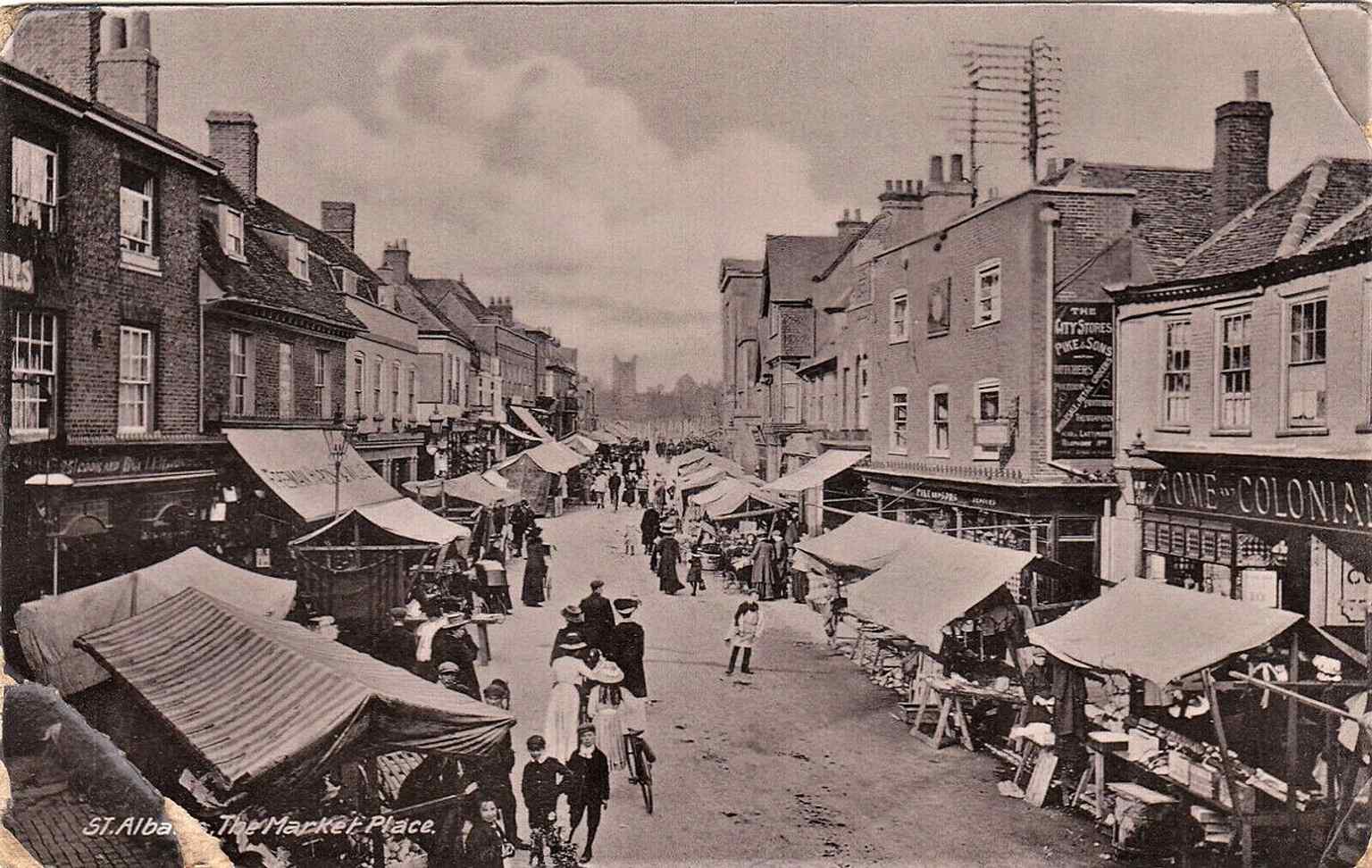
Look for the broad stone-paved run of Market Place and St Peter’s Street, framed by brick-and-stucco frontages and anchored by the Clock Tower at one end.
This open stretch is one of the oldest heartbeats in St Albans. More than nine centuries ago, Abbot Ulsinus set up a market here to bring money to the abbey and to give a new town its center, and that thread never really snapped. After Canterbury’s market closed in twenty twenty-two, St Albans was often described as one of England’s oldest markets, and one of the oldest street markets still trading on its original site.
That matters because this was never just a place to buy supper. It was where power showed its face in public. The abbey controlled tolls here; kings like Henry the Second and Richard the First confirmed those rights; later, the town’s mayor checked prices, weights, and measures. So this long street worked like a public stage... with vegetables at one end and authority at the other, and sometimes both in the same pair of hands.
In the medieval market, traders grouped themselves by what they sold: meat in one area, fish in another, wheat, leather, wool, even pudding. By at least the late twelve hundreds, Wednesday and Saturday had settled in as market days, a rhythm that still holds. Nearby civic buildings came and went, crosses rose and fell, pumps appeared and disappeared, but the market kept returning, like a tune this city never forgot.
And here’s the human side of it. In fifteen forty-one, a man named Raynold Carte, who held the lease for market rents, landed in the pillory here on a market day for an unstated offence. Not tucked away, not handled privately... right out in front of everyone, from an hour before opening until an hour after closing. That tells you a lot about this place. It sold bread and ale, yes, but it also handed out shame, settled arguments, and reminded people who claimed the right to run the street.
Over time, the market adapted without losing its address. Women and girls once sold straw plait by the yard near the Clock Tower, feeding the local hat trade. In the eighteen hundreds, carts, animals, grain, hay, and even the occasional portable steam engine passed through. Queen Victoria rode through on a Saturday in eighteen forty-one and noted how crowded the town felt on market day. If you want a quick visual of that long change, have a look at the before-and-after image in the app; it shows the shift from the looser market spread of nineteen sixty-six to the denser pedestrian layout of recent years.
Even the recent past fits the pattern. The market closed briefly in March twenty twenty during the pandemic, then reopened in a reduced form, with traders helping shape its survival. By twenty twenty-four, the National Association of British Market Authorities named it Best Large Outdoor Market. Not bad for a place that has spent centuries being argued over, regulated, rebuilt, and still stubbornly useful.
So here’s the question I’d leave you with: after all this time, what is this market really preserving... trade, weekly routine, civic control, or simply the habit of people coming together in public?
Whatever your answer, this is no relic. It is an old bargain still being renewed between buying, gathering, and being governed in plain sight. From here, The Cock is about a four-minute walk away. If you want to catch the market in full swing another time, it trades on Wednesdays and Saturdays from nine in the morning until half past four in the afternoon.





.jpg)