
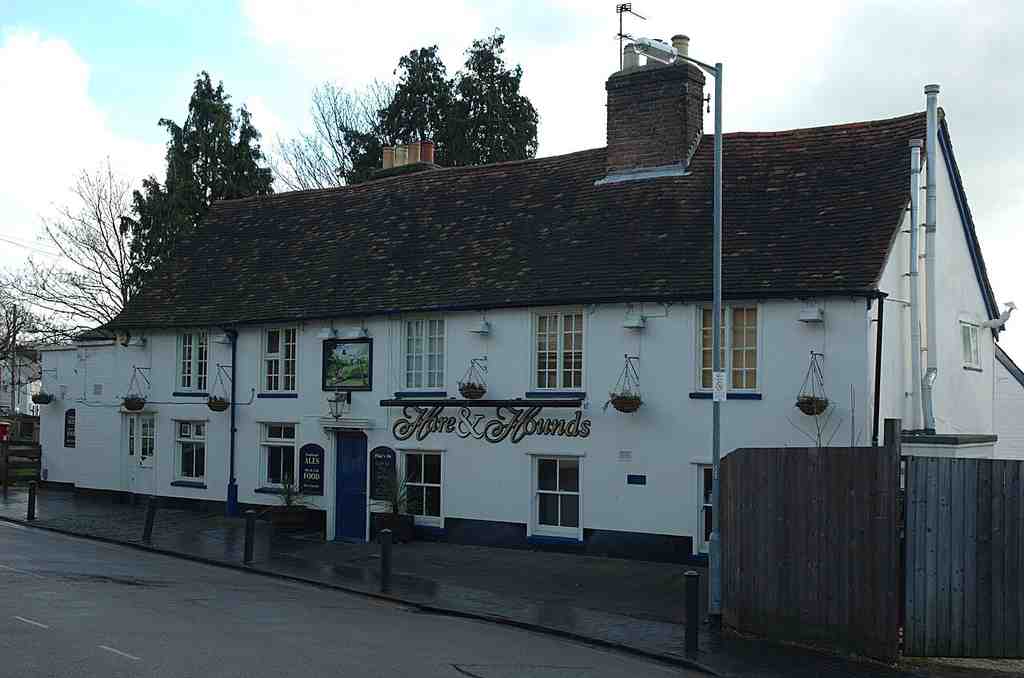
Look for the long, low pub with a plastered timber-framed front, a pitched roof, and a stout central brick chimney anchoring the building.
The Hare and Hounds keeps its age rather coyly. Officially, it is a Grade Two listed public house, dated to the seventeenth century or earlier, yet later research by Wessex Archaeology in twenty seventeen suggested something even more tantalising: parts of its fabric may be older than that modest listing admits. Above the main block sits a queen-strut roof, a timber roof frame with two upright braces supporting the ridge, a form common in the seventeenth and early eighteenth centuries. That great brick chimney through the western bays likely belongs to the earliest core of the house.
It did not arrive all at once. Builders added two bays to the east in the late eighteenth or early nineteenth century, pushed out a south extension in the late nineteenth, and then tucked on a single-storey extension between nineteen twenty-four and nineteen thirty-seven. In the picture, you can sense the long, accumulated shape for yourself.
Even its birth date carries a small argument. One account places it on St Albans maps by sixteen fifty; archaeology can only confirm it by seventeen twenty-one. Either way, this was already an old house by the early eighteenth century, standing detached on the edge of Sopwell Lane and marking the coach road into town, where travellers paused before pressing on.
More recently, it won a festive pub prize in twenty eighteen, reopened after a six-figure reinvention in twenty twenty-three, and by autumn twenty twenty-four it was seeking consent for careful repair work, which tells you something important: old buildings survive because people keep choosing them. If you fancy returning later, it is a moderately priced pub and opens daily from noon.
The Hare and Hounds feels less like a relic than a place still negotiating its next chapter.
When you are ready, let the road draw you onward into the heart of St Albans.




