
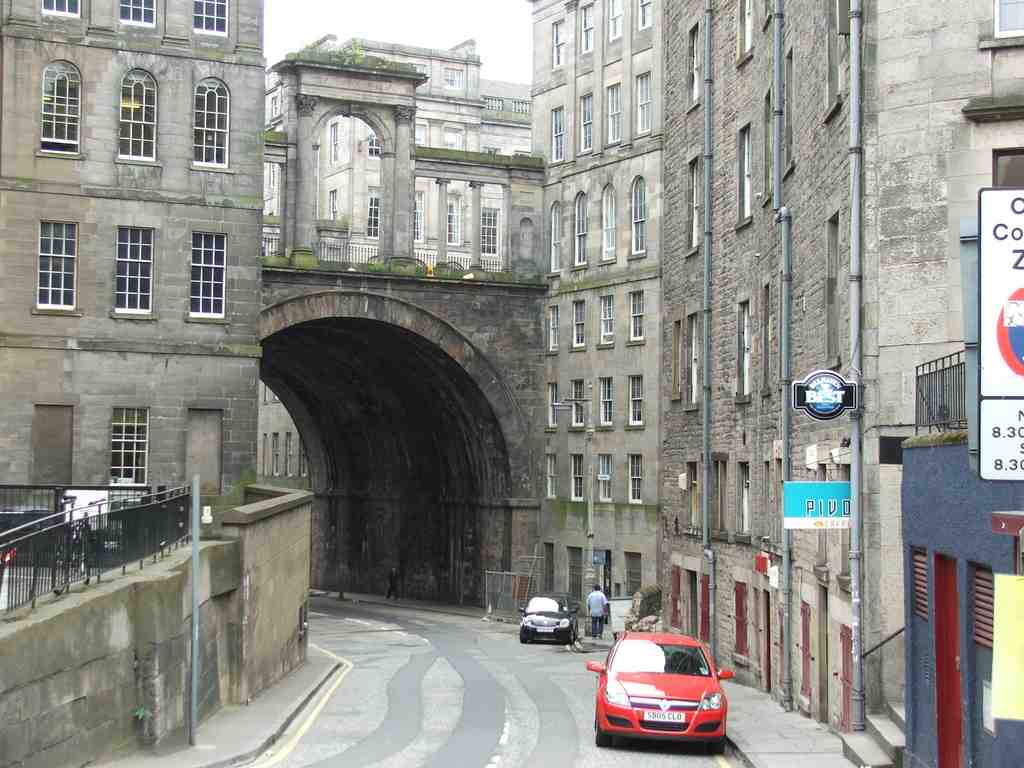
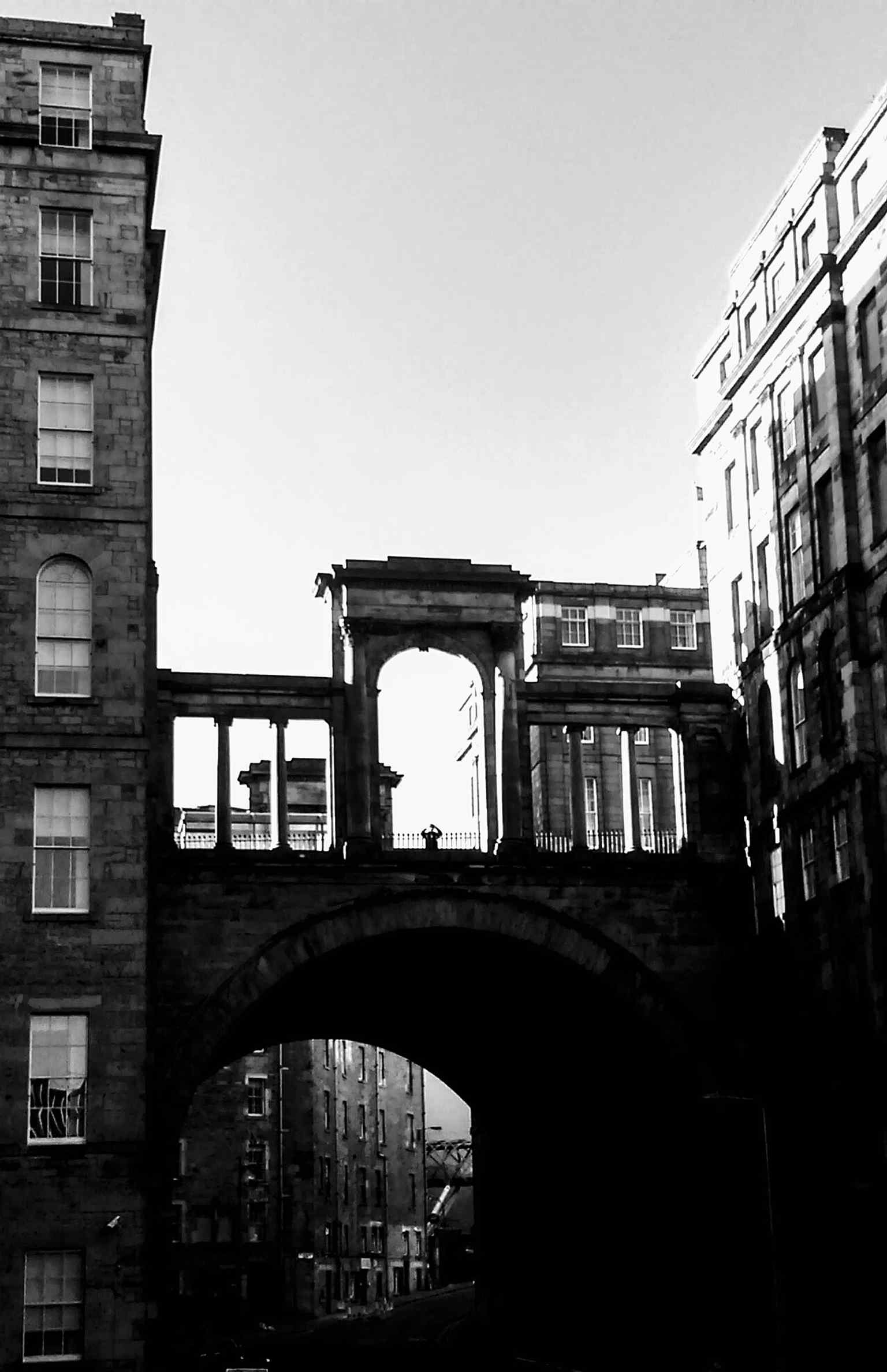
Look for the pale stone bridge with its broad semicircular arch and open classical screens, where Corinthian columns make the roadway feel almost like a Roman gateway.
Regent Bridge tells a very Edinburgh story: elegant improvement above, disturbance below. In the early eighteen hundreds, city leaders wanted a grander entrance for travellers arriving from the London road. The old approach squeezed through narrow medieval streets, and men of influence thought that unworthy of a capital growing north and east into the New Town. So Sir John Marjoribanks, the Lord Provost, revived a bold plan in eighteen fourteen: cut a direct route from Calton Hill into Princes Street, open the slopes for development, and make access to a new jail on the hill easier as well.
That ambition demanded more than neat drawings. It demanded blasting solid rock, demolishing buildings at the east end of Princes Street, and bridging a ravine about fifty feet deep. Robert Stevenson, the engineer better known now for lighthouses and as Robert Louis Stevenson’s grandfather, studied the scheme and argued for something important: do not block the views. Because of that, Archibald Elliot shaped the bridge with open colonnades and triumphal arches instead of a heavy solid wall. If you check the image on your screen, you can see how that classical openness gives the structure its unusual dignity.
But the hardest obstacle was not technical. It was human.
The road sliced through the Old Calton Burial Ground. This is one of the clearest examples of the displaced dead of Edinburgh’s improvements: the city promised order, speed and grandeur, and overrode an older sanctity to get them. When the Society of Incorporated Trades of Calton learned that the route would cut their graveyard in two, they fought it. To keep the project alive, the city paid compensation of three thousand three hundred pounds - a sum worth several hundred thousand pounds now - and granted land for a new cemetery. Only then did workers and grieving families begin the grim task of moving more than a hundred graves. Soil and human remains travelled away under white palls for reburial in New Calton Burial Ground.
Most people hurry across here and never realise that Waterloo Place still awkwardly divides the old cemetery because of that compromise. The hidden city beneath Edinburgh becomes brutally tangible at this point: not just forgotten closes and buried foundations, but bodies, names and loyalties shifted to clear a path for progress.
Some monuments stayed. David Hume’s Roman-style mausoleum remained in place, though its quiet setting changed forever. And if you look at the plaque shown on your phone, you’ll see the official memory the city chose to preserve: the bridge completed for Prince Leopold’s ceremonial entry in eighteen nineteen. The inscription honours triumph. It says nothing of the graves.
So here is the question this bridge leaves hanging in the air: when a city declares improvement necessary, whose claim should weigh more heavily - the future it imagines, or the dead it asks to move aside?
Carry that thought with you to St Mary’s Cathedral, about five minutes away. After a place where the city disturbed its dead to ease the road for the living, a building devoted to sanctuary and belonging may sound rather different. And, fittingly for a bridge, this one never closes; it is open at all hours.





