
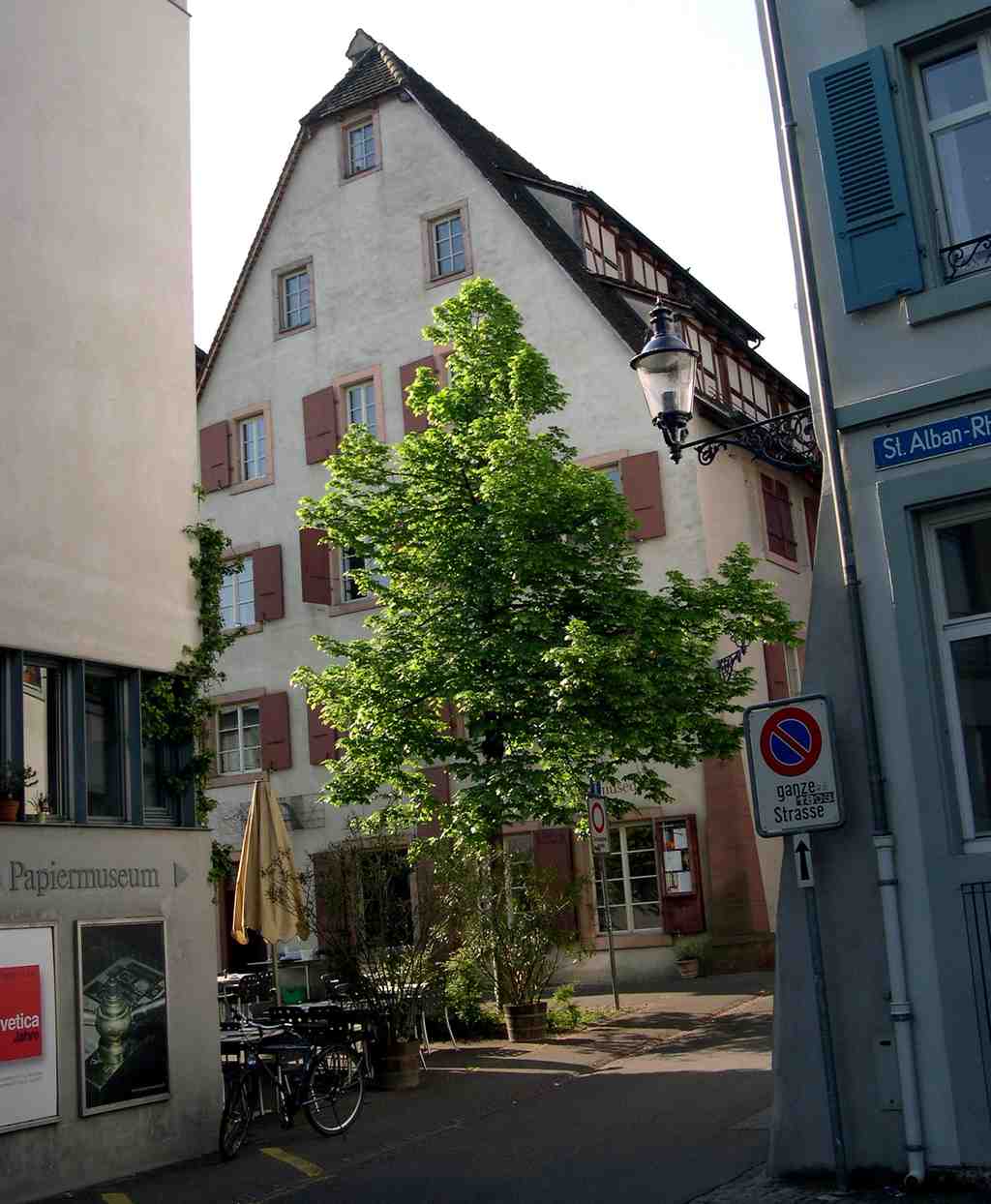
On your right, look for a pale stone-and-plaster mill with a steep tiled roof and a broad wooden waterwheel set beside the canal.
This is the Basel Paper Mill, and it tells a wonderfully practical truth: before a city can become famous for ideas, it needs paper. Paper, writing, and printing formed the working floorboards under Basel’s scholarship, religion, trade, and reform. Before a sermon could spread, before a scholar could argue, before a law could stick, somebody had to make the sheet, mix the ink, set the type, and bind the book. Big thoughts, humble fibers.
This building began life as a corn mill owned by Klingental Abbey until fourteen twenty-eight. Then, in fourteen fifty-three, Anton Gallizian converted it into a paper mill here on the St. Alban pond, a commercial canal that had already powered work in this part of Basel since the thirteenth century. Gallizian’s family worked the trade until fifteen twenty-one, when political change pushed them out, and the Thüring family expanded the mill after that. In seventeen seventy-eight, bookseller and publisher Johann Christoph Imhof-Burckhardt bought the place, and ten years later he replaced part of it with a two-story structure. So even the building itself kept changing jobs... mill, factory, warehouse, museum. Basel has a habit of hanging on by changing shape.
If you glance at the image in the app, you can see that careful restoration: not a stage set, but a working memory in timber, masonry, and water power.
The human thread I’d keep in your pocket here belongs to Walter F. Tschudin. He was a chemist at Sandoz from nineteen thirty-seven to nineteen sixty-three, and somewhere along the way he fell hard for the history of papermaking. In nineteen fifty-eight he published a major study of Basel’s mills, their owners, their watermarks, and even the marks used on bundles of paper. He also collected tools, machines, and documents piece by piece, long before this museum had a home. In a sense, this museum started as a collector’s rescue mission in exile, with its early paper history collection stored over on Augustinergasse.
What you see now opened here on the nineteenth of September, nineteen eighty, after the Christoph Merian Foundation restored the old mill. Later renovations in twenty ten and twenty eleven expanded and reorganized the museum, and today the Gallizian Mill holds workshops, while the neighboring buildings add a café, shop, and more working spaces. One highlight is a Fourdrinier machine from nineteen sixty-four - that’s an industrial paper machine that makes a continuous ribbon of paper instead of one sheet at a time.
And the old mechanics still matter. In twenty twenty-two, the mill renovated its waterwheel with a new oak transmission beam measuring four point three metres. They needed oak about three hundred years old to take the strain, and finding it proved tricky because the reconstruction of Notre-Dame in Paris had already tightened the market for ancient timber. Even conservation has supply-chain drama.
So the vats, presses, beams, and wheel here are not just equipment. They are survivors of labor. They remember the anonymous hands that made Basel legible.
As you leave, here’s the question to carry forward: when a city is praised for its writers, printers, scholars, and reformers, who deserves more of the credit - the famous names, or the workers who made thought printable in the first place?
Up ahead, the story shifts from craft to stone: head on to St. Alban Gate, about five minutes away, where survival meant walls, defense, and rebuilding after disaster. If you want to come back inside, the museum is closed on Mondays and otherwise opens from late morning, with a shorter afternoon opening on Saturdays.




