
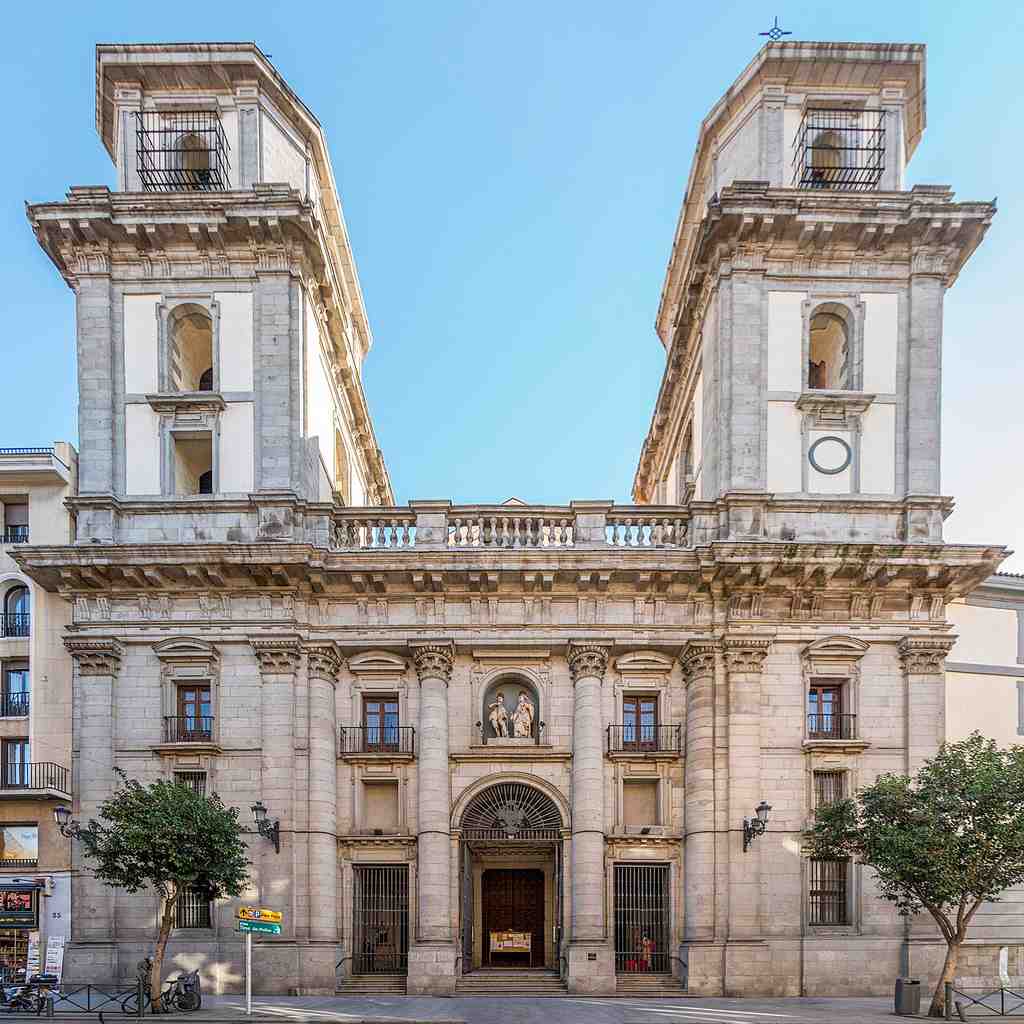
On your left, look for the dark granite facade with four tall Corinthian columns, two square towers capped by octagonal spires, and the stone figures of San Isidro and Santa María de la Cabeza set above the entrance.
From where you stand, this is more than a church front... it is authority dressed for public view. The facade has the confidence of a palace, not the shyness of a neighborhood chapel. In Madrid, belief often came with architecture that could organize a crowd, impress a ruler, and remind everyone who spoke for heaven in the city.
That ambition began next door with the old Colegio Imperial, the Imperial College of the Jesuits. They did not separate education from devotion; they wanted to form minds and souls together, which is a very efficient arrangement if you hope to guide a capital. Before this grand church rose here, the site held a smaller Jesuit chapel dedicated to Saints Peter and Paul, opened in the sixteenth century and later expanded with the college. Then María of Austria, daughter of Emperor Charles the Fifth, left her fortune to the Society of Jesus and ordered something much more commanding.
Pedro Sánchez drew the design around sixteen twenty. Work started two years later, and after Sánchez died, Francisco Bautista and Melchor de Bueras carried it on until sixteen sixty-four. The Jesuits dedicated it first to Saint Francis Xavier. If you ever go inside, the plan follows the Gesù in Rome: one great nave, meaning the main central hall, side chapels, a crossing, and a dome. And that dome mattered. Bautista created an early lightweight timber-and-plaster dome, a clever cost-saving shell that other Madrid builders quickly copied. Practicality, dressed up as grandeur... Madrid likes that trick.
Then power shifted again. In seventeen sixty-seven, King Carlos the Third expelled the Jesuits from Spain. The church changed roles and changed identity with them. It became the Collegiate Church of San Isidro, and the body of Madrid’s patron saint moved here from San Andrés, along with the relics of his wife, Santa María de la Cabeza. Ventura Rodríguez later redesigned the sanctuary as a kind of sacred stage set, with San Isidro’s silver chest above and her urn below, framed by saints and painting. Devotion here was arranged like ceremony, meant to be seen from a distance and remembered.
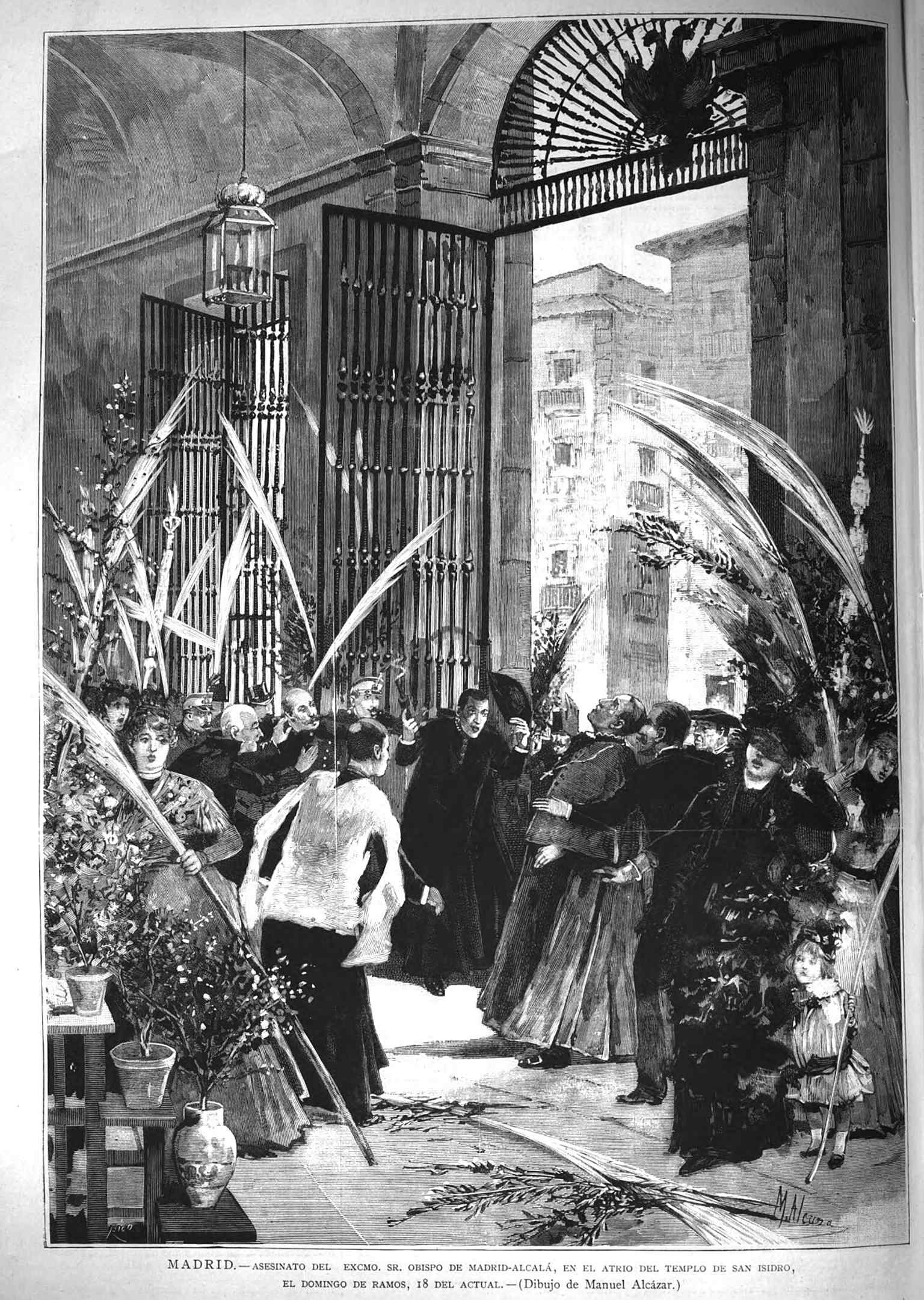
And then... one of the darkest episodes landed right on these steps. In eighteen eighty-six, the first bishop of Madrid, Narciso Martínez Izquierdo, came here to celebrate Palm Sunday Mass. He had already faced a cholera epidemic and the death of King Alfonso the Twelfth, and his reforms had made enemies. As he climbed the stairs, the priest Cayetano Galeote shot him three times. He died the next day. If you want a glimpse of how shocking that felt, take a look at the image in the app.
The church suffered again in nineteen thirty-six, when fire destroyed major paintings, the high altarpiece, and the lantern of the dome. Later reports said the whole roof vanished, but that turned out to be wrong; investigators found that much of the roofing survived. Javier Barroso led the long restoration and finally completed the upper sections of the towers, which had stood unfinished since the seventeenth century. So even the skyline you see now is partly a twentieth-century act of repair.
For a long stretch, from eighteen eighty-five until nineteen ninety-three, this served as Madrid’s temporary cathedral... a role it surrendered only when Almudena finally took over, which we’ll meet later. And if Plaza Mayor gave public ritual its stage, places like this gave it doctrine, discipline, and blessing.
That is the pattern to notice in Madrid: faith was rarely private here; it was built to be seen, heard, and obeyed, and when you’re ready, continue about seven minutes to Plaza de la Villa, and if you want to return inside later, public visiting hours are limited, usually Tuesday and Friday evenings and Sunday late morning.





