
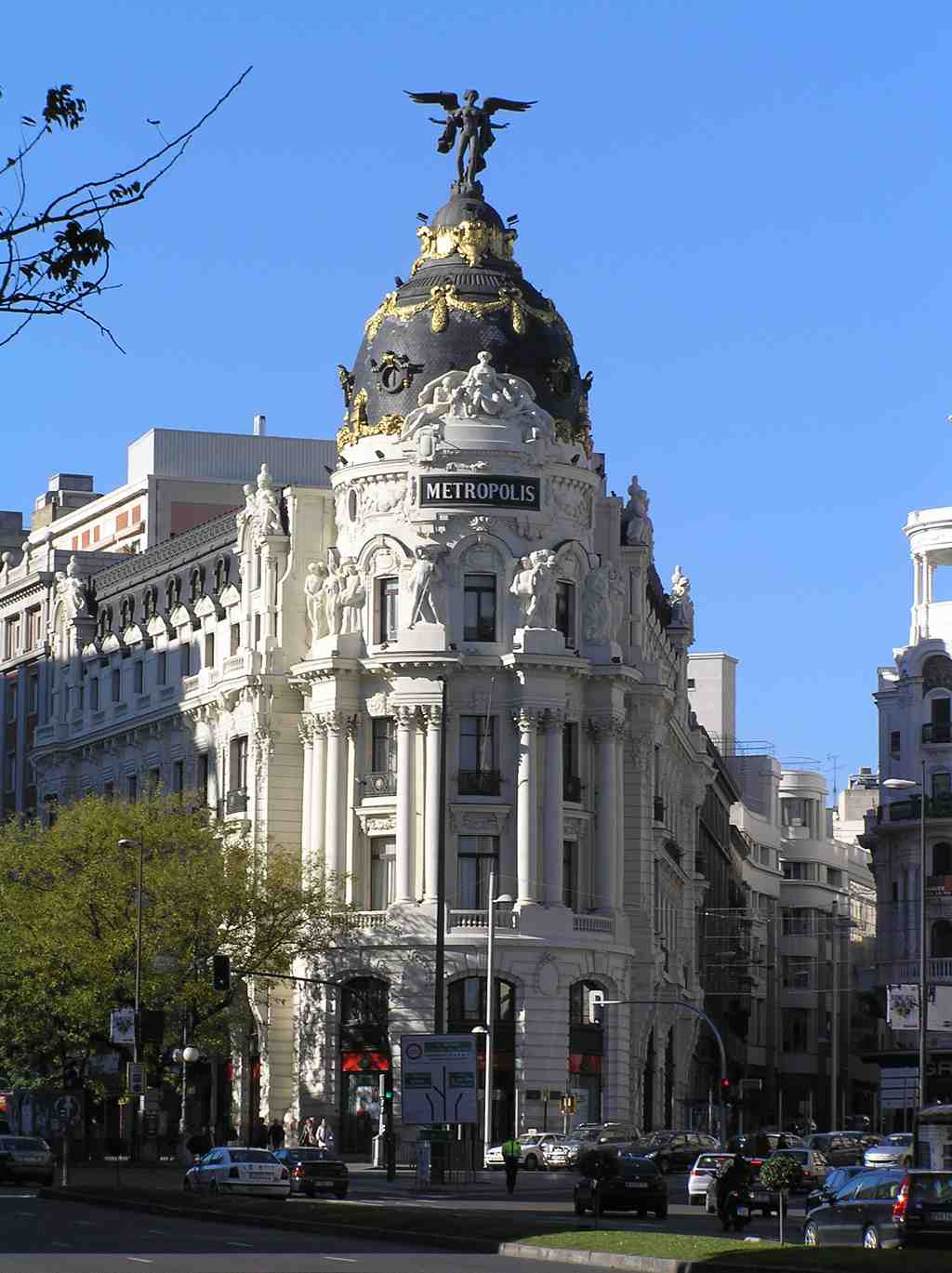
On your left rises a white stone corner palace with a rounded tower, a black slate dome, and a gold-winged statue poised high above the traffic.
This is the Metropolis Building, and it tells you exactly where Madrid is headed now in our walk: into money, engineering, speed, and a little bit of showmanship. It looks as if Paris sent Madrid a very elegant hatbox... and Madrid said, “Perfect, put it on the busiest corner you’ve got.” The style is French-inspired eclecticism, with neobaroque flourishes, Corinthian columns, and those upper roof levels tucked into mansards - the sloped attic floors you see in old French city palaces.
But here’s the part locals love to point out. For all that ornament, this was one of Madrid’s early reinforced-concrete buildings. The owners wanted modern strength: concrete in the outer supports, floors, and dome meant wider rooms, bigger openings, fewer interior columns, and better fire resistance. Rather fitting for an insurance company that sold fire insurance. After everything this city had already learned from loss and rebuilding, that was not a small concern. The clever bit is that they hid that modern skeleton behind a costume of classical stone and sculpture, so the building could feel respectable, established, almost old-fashioned at first glance.
The story starts with demolition. To create this new urban corner during the making of Gran Vía, Madrid cleared away an earlier building nicknamed the Casa del Ataúd - the Coffin House - because the plot was so narrow. Even then, change did not arrive politely. Neighbors and businesses fought the demolitions in court, and construction could not begin until June of nineteen oh seven. The French architects Jules and Raymond Février won the design competition, but the Spanish architect Luis Esteve Fernández-Caballero carried the project through on site and finished it in nineteen ten. The building opened on the twenty-first of January, nineteen eleven.
Look up at the figures along the facade. Commerce, Agriculture, Industry, and Mining stand there like a stone balance sheet of the age. If you want a closer look at the sculptural program and that handsome contrast between pale stone, dark slate, and bronze railings, glance at the image on your screen.
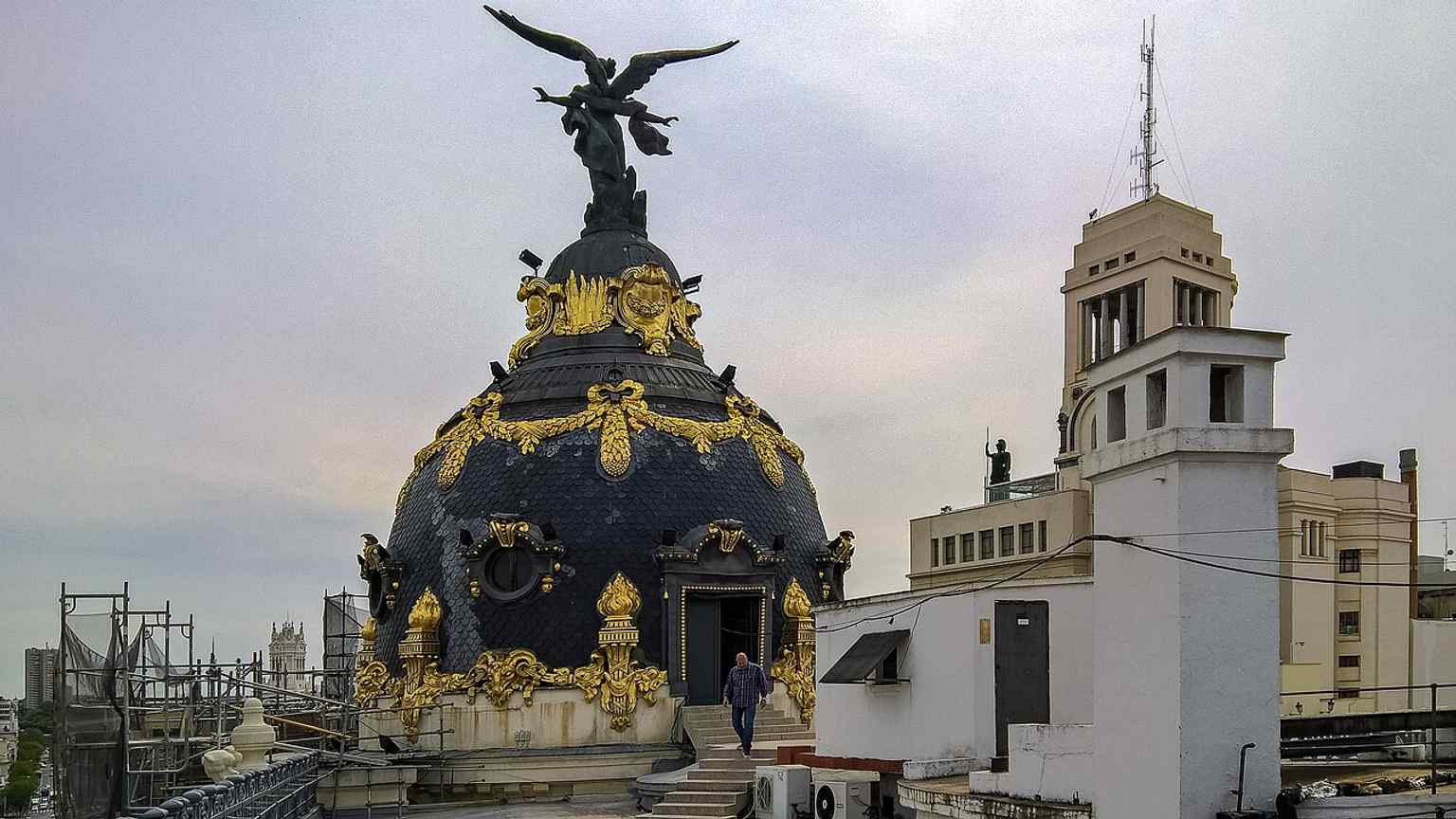
Now lift your eyes to the dome. That black slate cap with gold details is often called Pompier style - “firefighter” in French - because it resembles an old French fireman’s helmet. Originally, the top carried La Unión y el Fénix, the first owner’s emblem: a phoenix with a human figure by René de Saint-Marceaux. When the Metrópolis insurance company took over in nineteen seventy-five, they replaced it with the winged Victory you see now, by Federico Coullaut-Valera. The old phoenix did not vanish; it moved to Paseo de la Castellana. Madrid rarely throws away its symbols... it just reassigns them.
One more layer: restorers cleaned the soot and pigeon stains, re-gilded the dome, and even tracked down the original stained-glass makers, Maumejean. If you check the restoration photo in the app, you can see how much care that glittering crown demands. Recently, the inside has entered yet another chapter, mixing private and hospitality uses.
Most people say Gran Vía begins here, but technically this address is Alcalá thirty-nine; Gran Vía number one is the Grassy building. That’s Madrid for you: even its starting lines have a flourish.
When you’re ready, head on toward Cibeles Square, about seven minutes away, where beauty, traffic, and civic pride all shake hands in the middle of the street. You can admire this exterior at any hour, since the site is always accessible from outside.





.jpg)
