
Cadiz Highlights Audio Tour: Historic Treasures of the Old City
Beneath the sun-drenched facade of Cádiz lies a city built on the bones of empires, where three thousand years of rebellion and maritime scandal pulse through narrow limestone veins. Navigate these ancient streets with an immersive self-guided audio tour that reveals the gritty, untold history hidden behind iconic landmarks. Unlock secrets that standard maps conveniently ignore. Why did a desperate naval blockade turn the Roman Theatre into a final fortress of defiance? What nameless shadow haunts the silent alcoves of the Church of Saint Lawrence the Martyr? Which disgraced bishop once smuggled forbidden gold directly beneath the altar of the Holy Cross Cathedral? Traverse the shifting layers of time as you chase ghosts across sun-baked plazas. Feel the weight of forgotten battles and the electric charge of past revolutions. Cádiz transforms from a simple port into an unfolding drama. Press play and unearth the city that history tried to bury.
Tour preview
About this tour
- scheduleDuration 110–130 minsGo at your own pace
- straighten4.5 km walking routeFollow the guided path
- location_on
- wifi_offWorks offlineDownload once, use anywhere
- all_inclusiveLifetime accessReplay anytime, forever
- location_onStarts at Monument to the Constitution of 1812
Stops on this tour
lock_open 3 free previews · 13 unlock with purchase
Look for a pale stone monument with a broad curved base, a tall central column, and carved female figures acting like columns beneath the block at the top. This is Cádiz making…Read moreShow less
Open dedicated page →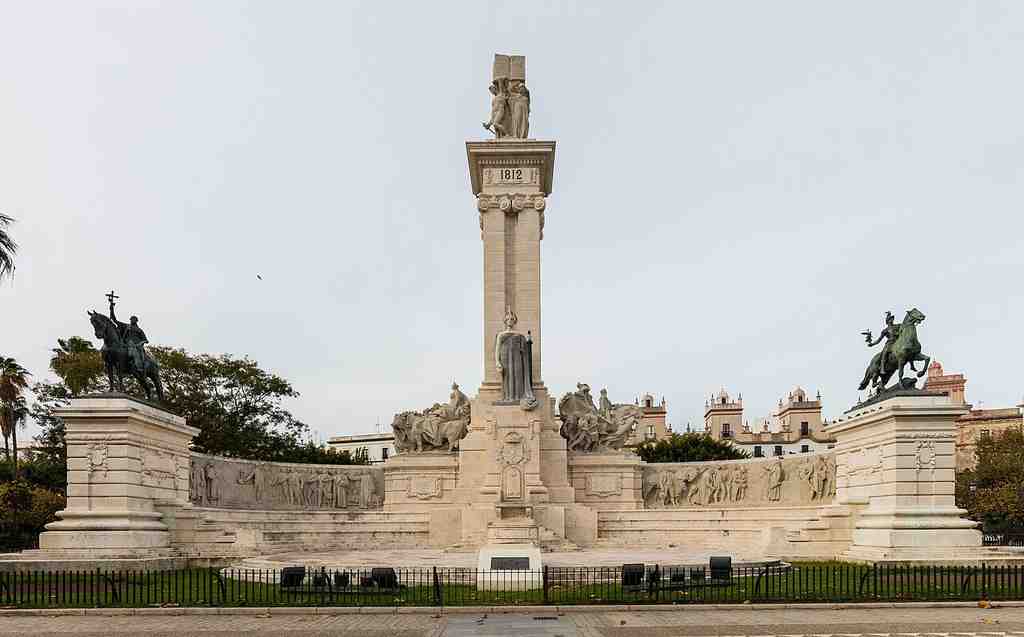
Monument to the Constitution of 1812Photo: Diego Delso, Wikimedia Commons, CC BY-SA 4.0. Cropped & resized. Look for a pale stone monument with a broad curved base, a tall central column, and carved female figures acting like columns beneath the block at the top.
This is Cádiz making a very public point. And not a modest one. The Monument to the Constitution of eighteen twelve, also called the Monument of the Cortes, marks the hundredth anniversary of the constitution drafted here during the Napoleonic wars. In nineteen twelve, architect Modesto López Otero and sculptor Aniceto Marinas turned that memory into this grand, almost palace-like piece of theater in stone.
If you study the monument, you can see how carefully it tells its story. Reliefs recall the resistance of Cádiz during the War of Independence, when the city held out while much of Spain struggled under French invasion. Around them stand allegorical figures, meaning human figures that represent ideas rather than real people: War, Peace, Agriculture, Industry, and Citizenship. Near the top are caryatids, carved women used as supporting columns, holding up the sculpted reference to the constitutional code itself. It is solemn, yes... but also a little defiant.
That matters, because many monuments and squares honoring this constitution across Spanish America later vanished or changed meaning after King Ferdinand the Seventh restored absolutist rule. Some survived, like Plaza Matriz in Montevideo and the Plaza de la Constitución in St. Augustine, Florida. Cádiz, naturally, kept the argument in full view.
As a bonus, this square is always open, so the monument never really clocks out.
It still stands here as a stone declaration that ideas can outlast the people who fear them. Take a moment with it, and when you’re ready, we can continue to the next stop.
On your left, look for a wide semicircle of pale stone seating cut into the ground, edged with rough oyster-stone blocks and marked by a surviving curved wall that reveals the old…Read moreShow less
Open dedicated page →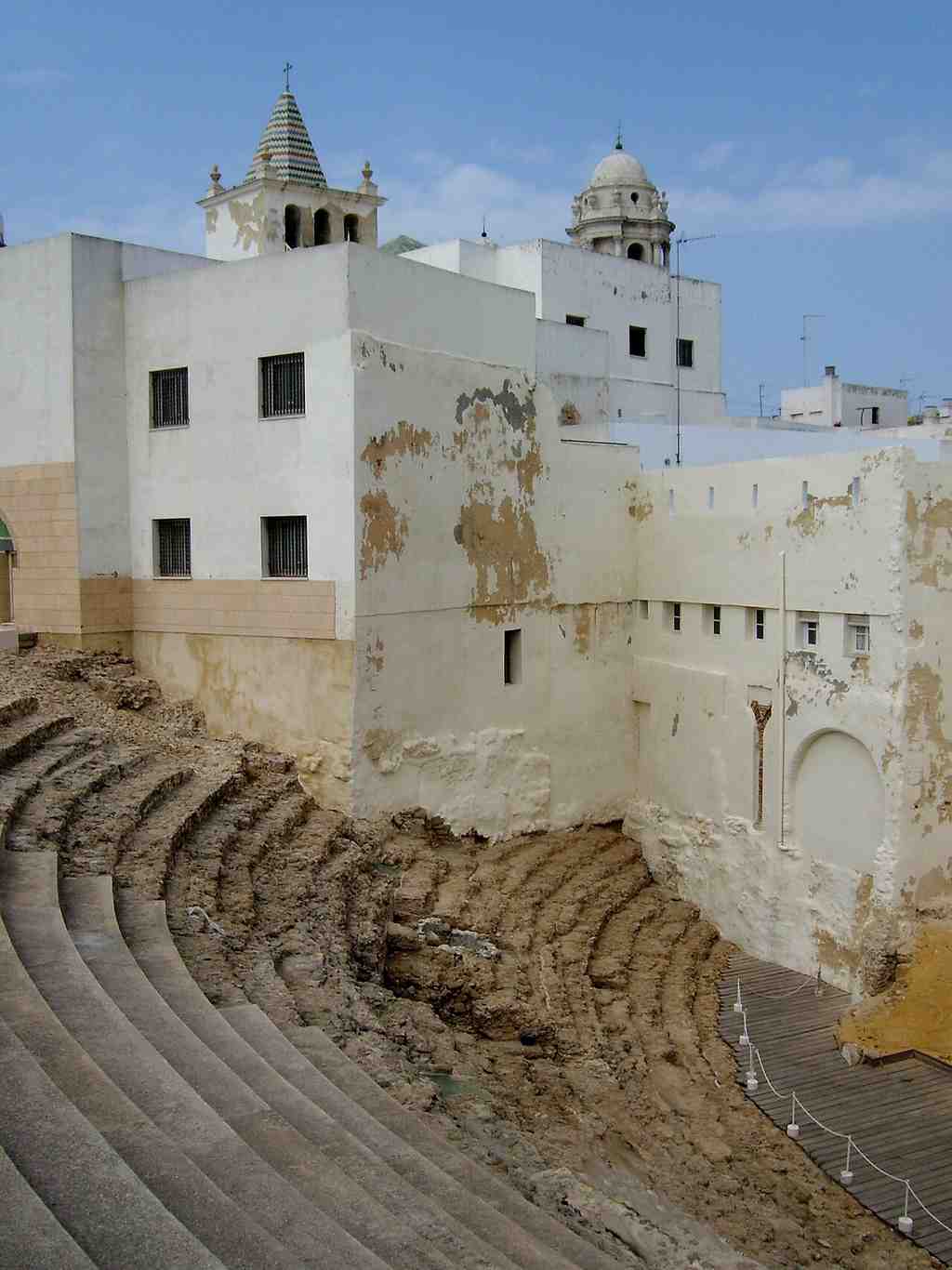
Roman Theatre of CadizPhoto: Peejayem, Wikimedia Commons, CC BY-SA 3.0. Cropped & resized. On your left, look for a wide semicircle of pale stone seating cut into the ground, edged with rough oyster-stone blocks and marked by a surviving curved wall that reveals the old Roman cavea, the seating bowl.
This is the Roman Theatre of Cádiz, also called the Theatre of Balbus, and for a very long time it played a superb trick on the city... it hid in plain sight. Archaeologists only identified it in nineteen eighty, when they were digging for the medieval Castle of the Villa and unexpectedly hit something much older. People had noticed underground galleries here before, but no one knew what building they belonged to. Then, all at once, Cádiz found itself staring at one of the great public monuments of Roman Hispania.
And not a modest one, either. This theatre measured about one hundred and eighteen meters across and held around ten thousand spectators. For a city of roughly fifty thousand people, that is a serious crowd. It ranks as the second largest Roman theatre in Hispania, just behind Córdoba, and as one of the oldest known on the Iberian Peninsula. The Romans did not exactly think small when they wanted to impress the neighbors.
The driving force here was the Balbus family, local power players from Gades. Balbus the Younger helped expand the city with a new district, the Neápolis, and this theatre formed part of that grand urban plan, built in imitation of Rome itself. Ancient writers actually mentioned it by name. Strabo wrote about the enlarged city, and Cicero heard reports from Cádiz colorful enough to survive two thousand years. In one letter, the governor Asinius Pollio says Balbus staged his own autobiographical play here, reserved the first fourteen rows for the equites, the wealthy knight class, rewarded one actor with a knight’s ring... and ordered another actor executed for being too ugly. Roman public entertainment could turn savage with very little notice.
If you imagine the full building, the social map becomes clear. The best seats sat closest to the stage: the proedria, a few front rows for magistrates, priests, and the top tier of society. Behind that came the ima cavea and media cavea, the lower and middle seating for well-off citizens and the general public. Higher still, the summa cavea held those furthest from status and from the action. Even leisure came with assigned rank. Very Roman.
What survives here is only a portion, but it tells the story well. Builders used Roman concrete, lime mortar, marble, and piedra ostionera, that local oyster-rich stone you see all over Cádiz. They carved the theatre into the natural slope of the ground, then ran vaulted passages under the seats. Those passages are called vomitoria, meaning entrances and exits for crowds, not evidence of a catastrophic snack break. Some original ramps and unfinished steps still reveal changes made while the theatre was being built.
Later, the theatre fell out of use in late Roman times. People stripped stone from it, reused parts as storage and housing, and Muslim builders raised an alcazaba, a fortified citadel, over the ruins. After Alfonso the Tenth took the city, he expanded that fortress into the medieval castle. That is why so much of the theatre still lies under the buildings of El Pópulo, including the Posada del Mesón, the Casa de Estopiñán, and other later structures layered over the Roman shell.
If you want more, the interpretation center usually opens Monday through Saturday from eleven to five, and Sunday from ten to two.
This place is a reminder that Cádiz did not merely inherit history; it kept building on top of it.
Take a moment here, and when you’re ready, we can continue to the Admiral’s House.
Show 13 more stopsShow fewer stopsexpand_moreexpand_less
On your right, look for a tall almagra-red façade framed with pale stone, a grand two-tiered marble doorway, and twin rooftop lookout towers. This is the Admiral’s House, and it…Read moreShow less
Open dedicated page →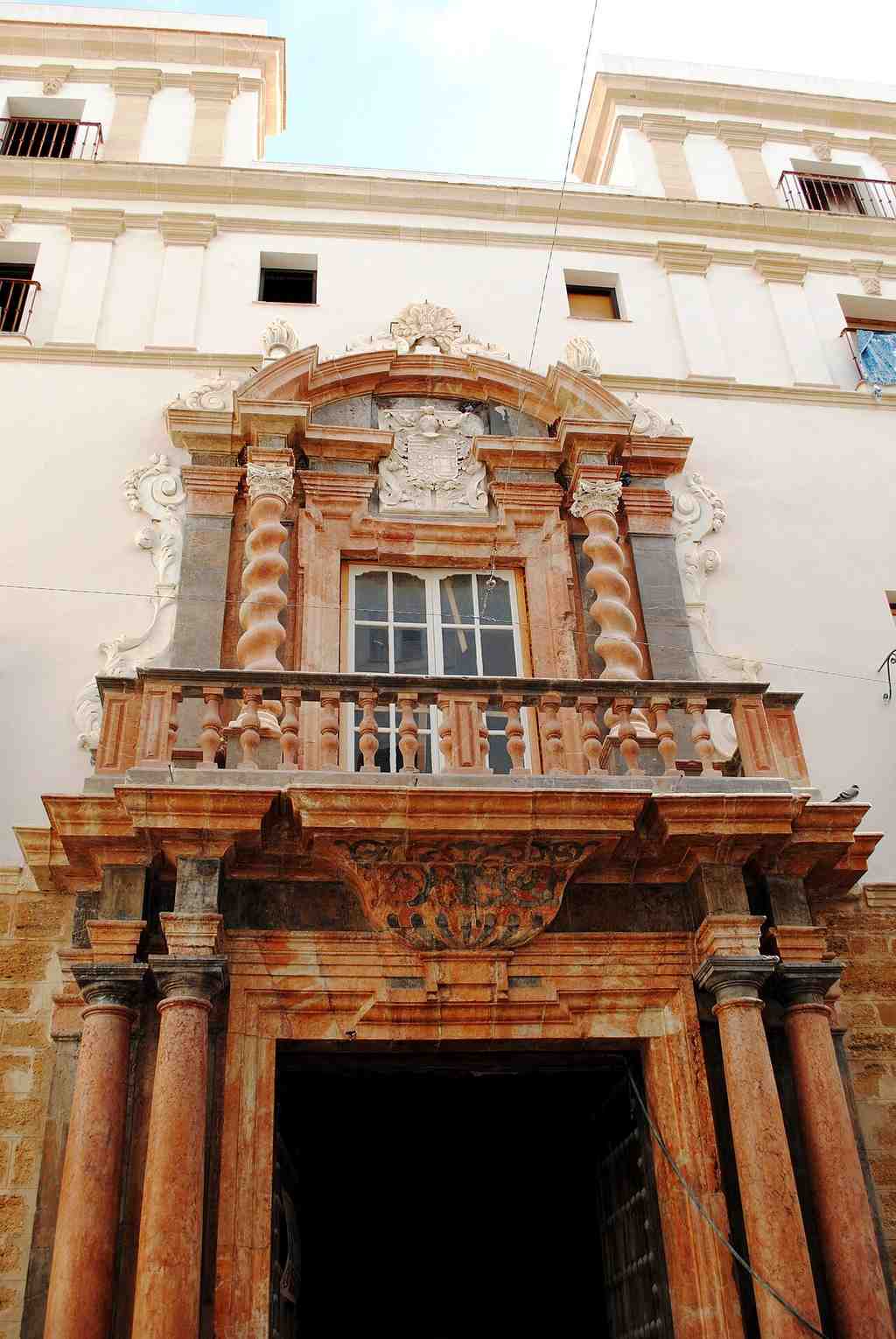
Admiral's House (Cadiz)Photo: HombreDHojalata, Wikimedia Commons, CC BY-SA 3.0. Cropped & resized. On your right, look for a tall almagra-red façade framed with pale stone, a grand two-tiered marble doorway, and twin rooftop lookout towers.
This is the Admiral’s House, and it tells you exactly what Cádiz did with Atlantic trade money: it turned it into architecture with absolutely no interest in modesty. Good for it. In the late seventeenth century, the family of Diego de Barrios, an admiral of the Fleet of the Indies, commissioned this house-palace here on the little square of San Martín. It grew out of the city’s trade with the Americas, when Cádiz handled fortunes large enough to make even stone feel ambitious.
The style is Baroque, which, in plain English, means drama, movement, and decoration that refuses to sit quietly. The star of the show is the portal. It came from Genoa in Italy, carved in red and white marble in the workshop of the Andreoli family, then assembled here by the master builder García Narváez. If you glance at the app image, you can see how that portal practically pushes itself forward like a nobleman who expects to be noticed.
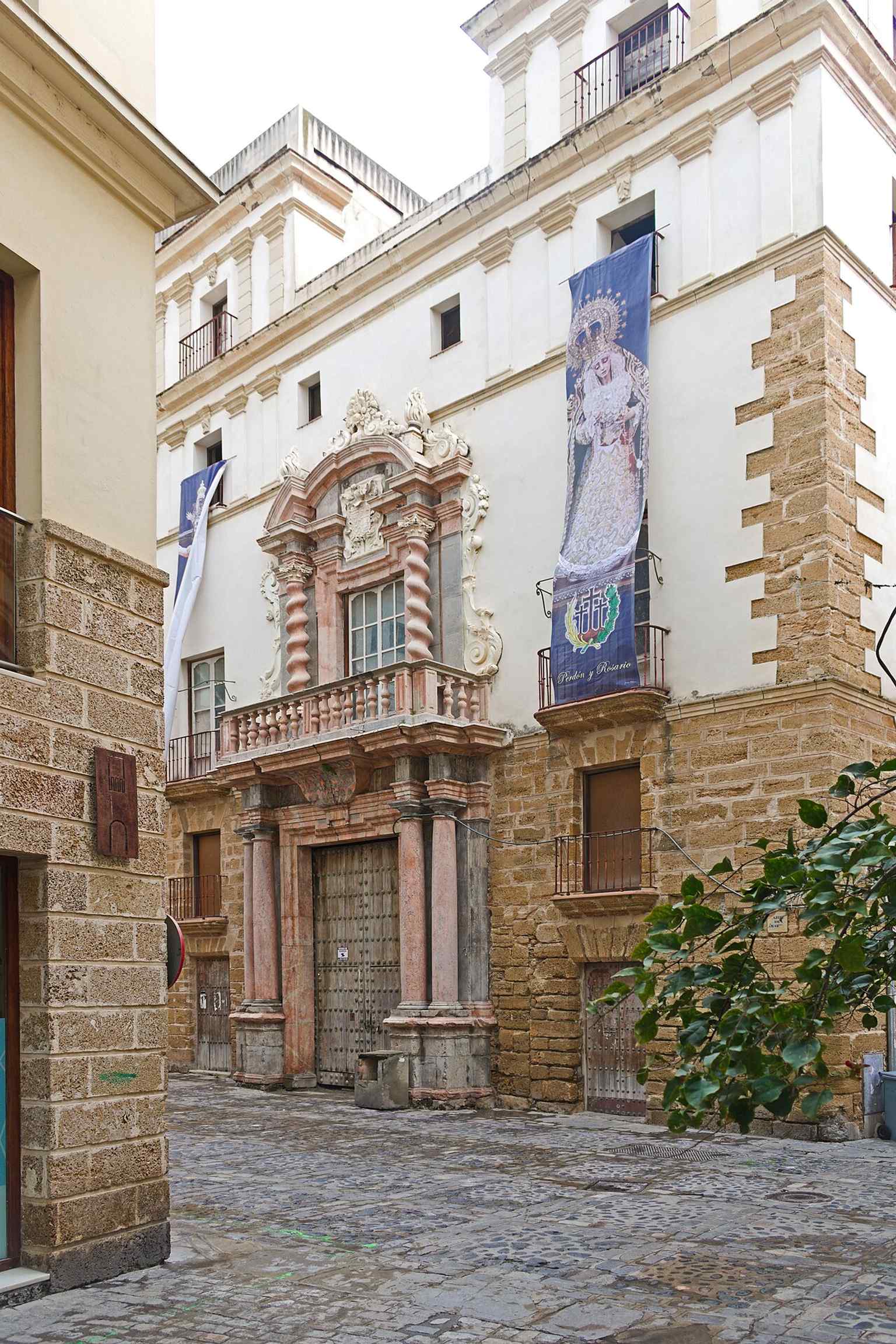
The Baroque façade of Casa del Almirante in Cádiz, built for the family of Diego de Barrios and noted for its monumental Genoese marble portal.Photo: Ymblanter, Wikimedia Commons, CC BY-SA 4.0. Cropped & resized. Look closely at its two levels. Down below, the entrance is flanked by paired Tuscan columns - the Tuscan order is the plain, sturdy classical style, though here even “plain” feels rather dressed up. Above that, a balcony sits inside a frame of Solomonic columns, the twisted corkscrew kind, topped by a curved broken pediment - that split, arched crown - holding the family coat of arms. And above the whole composition, those two rectangular mirador towers rise at the ends of the roofline. They were lookout towers, useful in a port city where wealth arrived by sea and people liked to keep an eye on it.
The house itself worked like a machine for commerce and status. The ground floor stored goods. The mezzanine handled offices. The grand main floor housed the family. The top floor went to servants. Efficient, hierarchical, and very honest about it.
You can’t step inside at the moment, but the interior still matters. At its center sits a rectangular patio, slightly off to the right of the entrance, with galleries resting on arches and reddish Genoese marble columns. In one side of that patio stood two white marble wellheads, each octagonal, some panels carved with masks. Even the wells had better tailoring than most buildings. From the patio, a monumental staircase rises in two flights under an oval dome set on pendentives - those curved triangular supports that let a round dome sit over a square space. The steps are marble, the handrail turned mahogany, and upstairs the main salon still preserves a painted family coat of arms on the ceiling.
The façade also uses ostionera stone, Cádiz’s shell-rich local stone, on the lower sections and corners, while the rest is plastered and painted that deep reddish almagra color. So the whole building becomes a conversation between local material and imported luxury... which is Cádiz in a nutshell, really.
You can admire the exterior at any hour, though the house itself remains closed pending possible restoration as a hotel.
In Cádiz, even a doorway could serve as a résumé.
Take a moment with that marble swagger, and when you’re ready, we’ll head on to the next stop.
In front of you rises a pale stone cathedral with a broad curved façade, twin bell towers, and that unmistakable golden-tiled dome lifting above the roofline. This is Cádiz…Read moreShow less
Open dedicated page →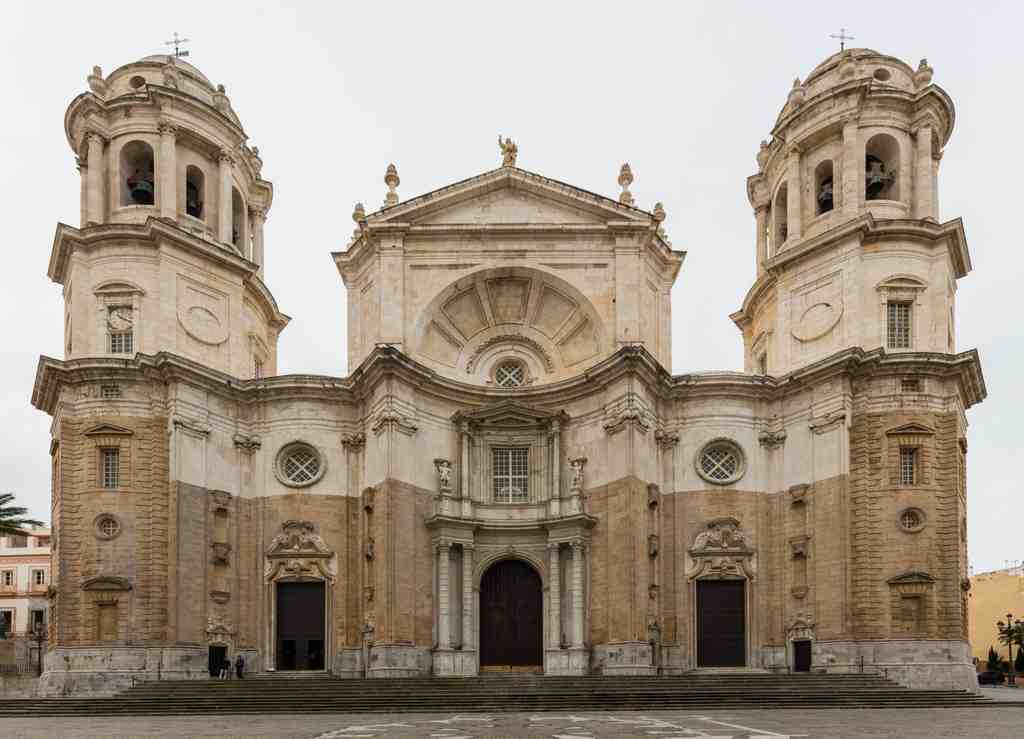
Cathedral of the Holy Cross (Cadiz)Photo: Diego Delso, Wikimedia Commons, CC BY-SA 4.0. Cropped & resized. In front of you rises a pale stone cathedral with a broad curved façade, twin bell towers, and that unmistakable golden-tiled dome lifting above the roofline.
This is Cádiz Cathedral, formally the Holy and Apostolic Cathedral Church of Cádiz... though locals usually call it the New Cathedral, because Cádiz had already done the cathedral business once before. Apparently one was not enough.
The city began this one in seventeen twenty-two, after two things became impossible to ignore. First, the older cathedral had aged badly. Second, Cádiz had grown very rich and very important after the Casa de Contratación, the Spanish trade office for the Americas, moved here from Seville in seventeen seventeen. A city handling that much Atlantic business wanted a cathedral with proper swagger.
The trouble is, swagger costs money. A lot of money. And this project took one hundred and sixteen years. Vicente Acero drew the first plans, then left in seventeen thirty-nine. Gaspar Cayón took over, then Torcuato Cayón, then Miguel Olivares, then Manuel Machuca y Vargas, and finally Juan Daura carried it to completion in eighteen thirty-eight. So what you see in front of you is a long architectural relay race, and nobody handed over exactly the same baton.
That explains the mixture of styles. The lower drama of the main façade belongs to the Baroque taste, full of movement with concave and convex curves... those inward and outward sweeps that make stone feel almost theatrical. Later phases brought Rococo touches and then a calmer Neoclassical order. If you glance at the image in the app, you can see that blend clearly in the full front view. It is not confusion, exactly; it is a century of changing fashion, economic strain, French invasion, and Spain losing power in the Americas, all written into one building.
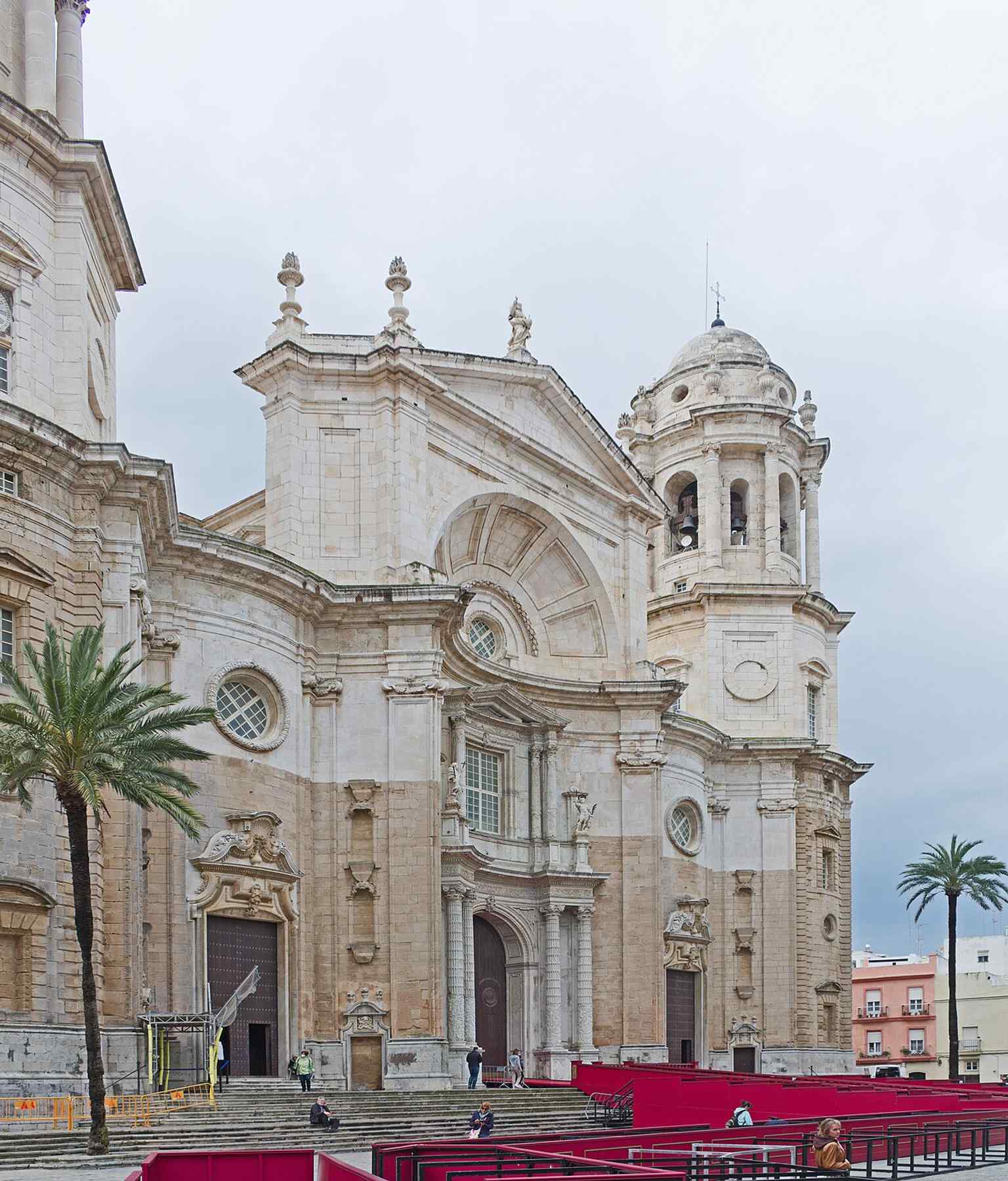
The façade seen in full, highlighting the cathedral’s mix of styles shaped by more than a century of changing architects.Photo: Ymblanter, Wikimedia Commons, CC BY-SA 4.0. Cropped & resized. And then there is the dome. Cádiz loves that dome. It sits over the crossing, the point where the long main body of the church meets the shorter arms, and outside it is covered in golden tiles that catch the eye from all over the city. The cathedral stands so close to the sea that people called it Santa Cruz sobre el Mar, Holy Cross over the Sea, or sometimes over the Waters. From the waterfront, it looks almost like it rose out of trade, salt, and sunlight itself.
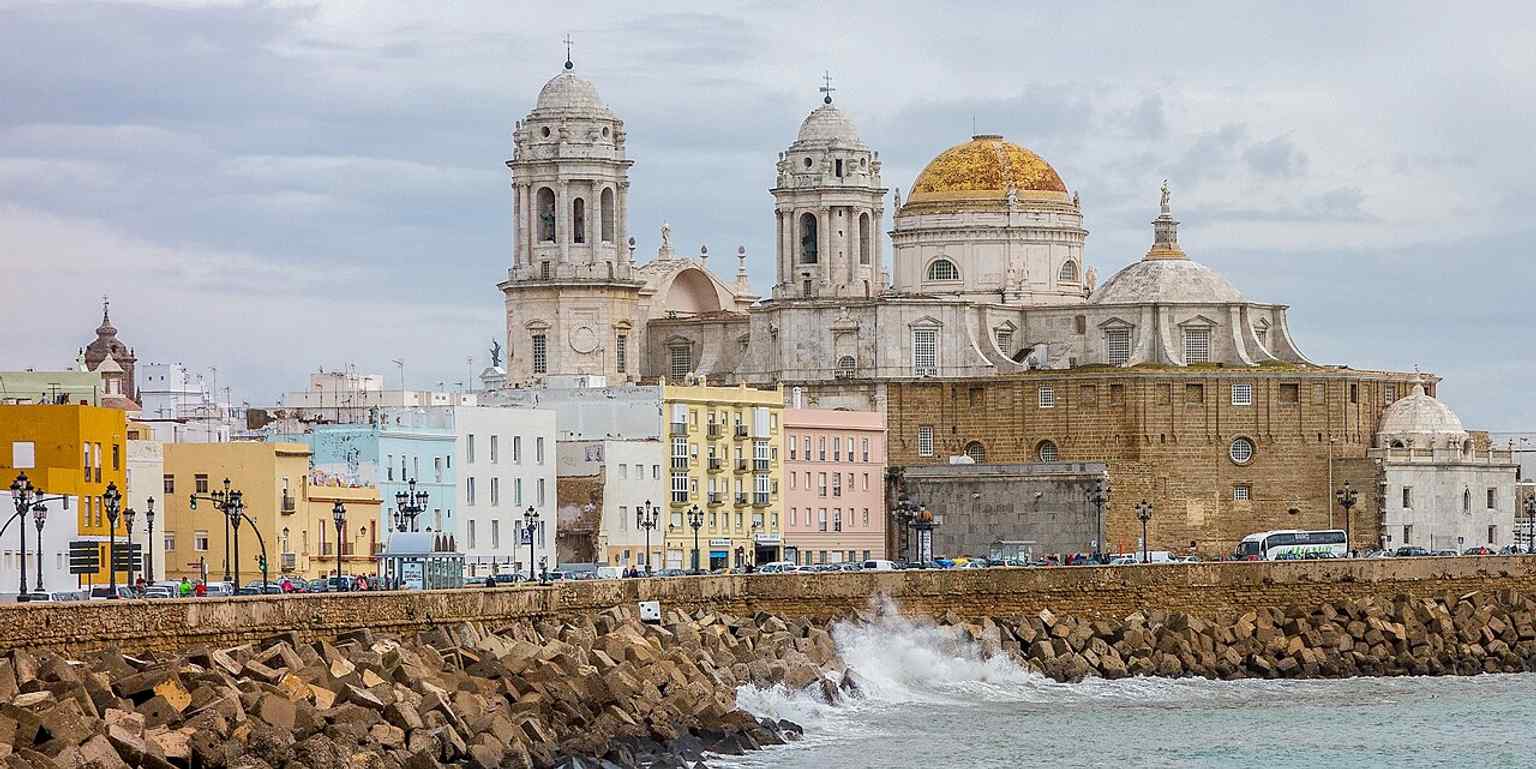
The cathedral viewed from the quay, emphasizing how closely this landmark rises above the waterfront and city promenade.Photo: Solundir, Wikimedia Commons, CC BY-SA 3.0. Cropped & resized. Look up at the towers too. They climb to around fifty-four meters from the ground, unusually tall for the time. The Bourbon rulers generally disliked bell towers that high because enemies could use them as easy targets. Cádiz, being Cádiz, went ahead anyway. The clock tower finished in the eighteen forties, and the clock itself arrived in eighteen fifty-one.
There is one more wrinkle. Sea air and long delays damaged the stone, especially the exterior oyster stone and limestone, so the cathedral has needed long restoration campaigns. Even grandeur, it turns out, needs maintenance.
This cathedral is Cádiz in one building: ambitious, maritime, elegant, and slightly stubborn.
Take one last look at that golden dome, and when you're ready, we can wander on to Santa Cruz, the older cathedral just nearby.
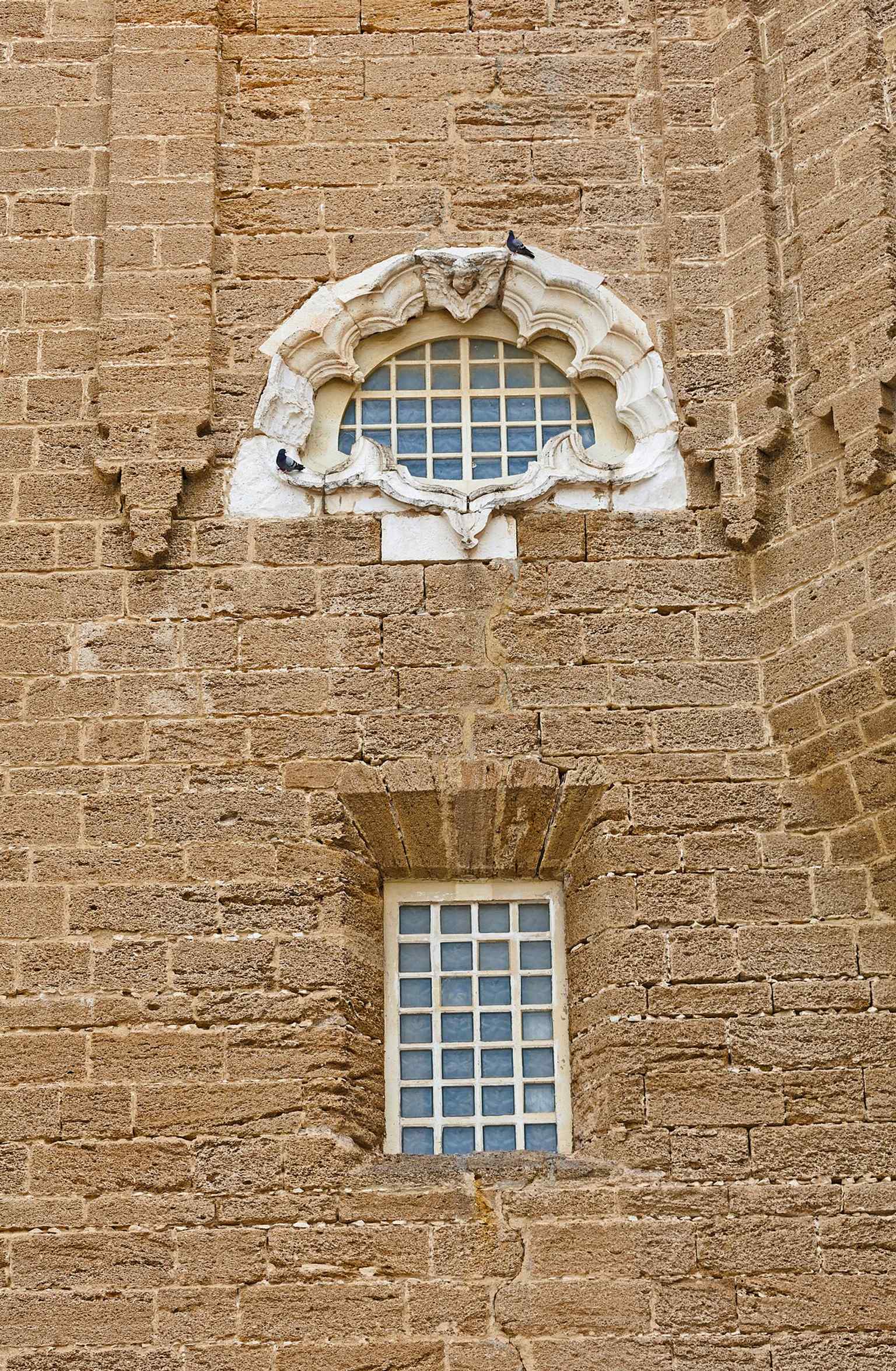
The west-side windows and exterior stonework, part of a building whose fabric has suffered from sea air and long restoration efforts.Photo: Ymblanter, Wikimedia Commons, CC BY-SA 4.0. Cropped & resized. 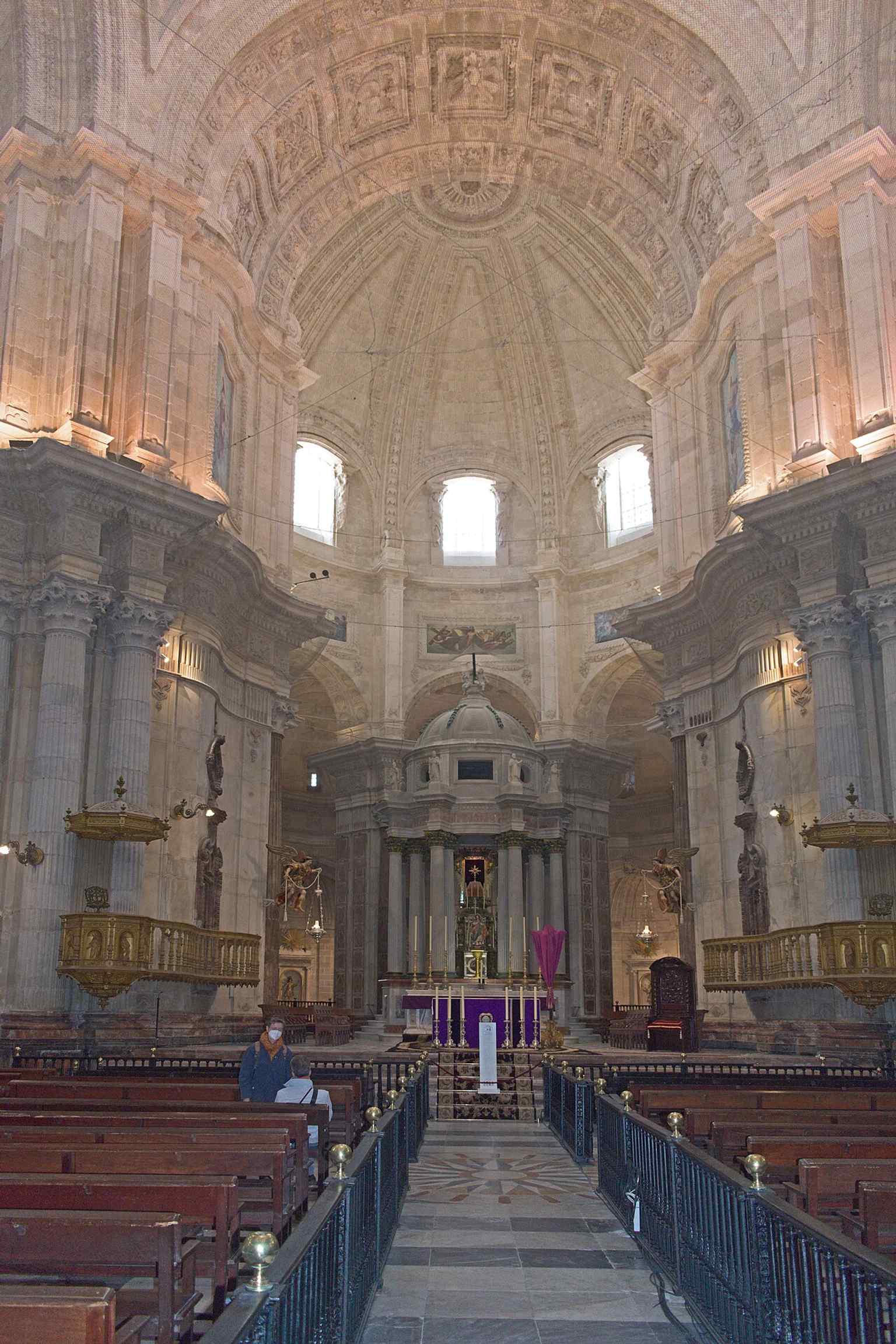
The apse interior, showing the temple’s neoclassical order and the scale of the space behind the altar.Photo: Ymblanter, Wikimedia Commons, CC BY-SA 4.0. Cropped & resized. 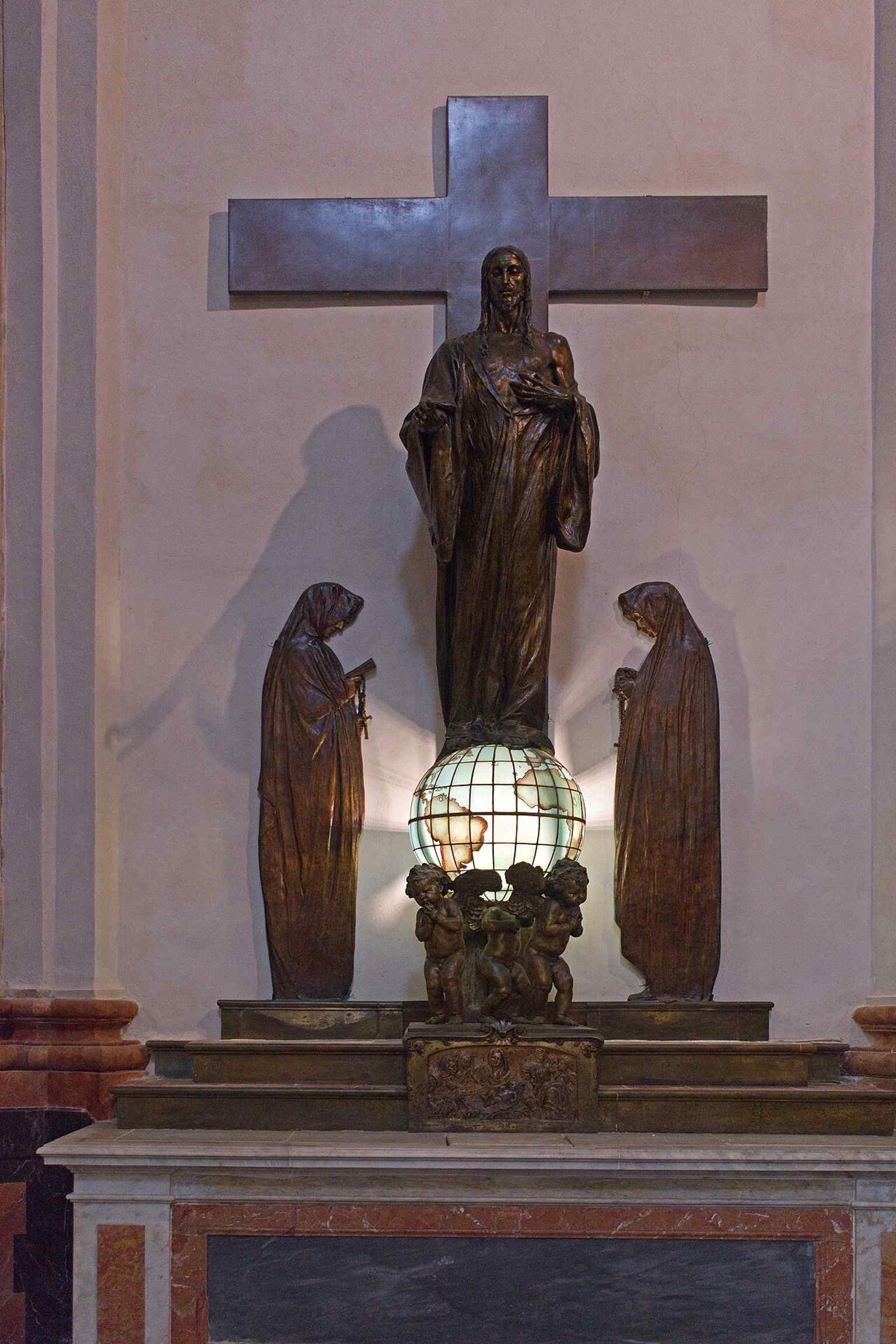
A devotional artwork inside the cathedral, reflecting the rich collection of paintings and religious objects housed in its chapels.Photo: Ymblanter, Wikimedia Commons, CC BY-SA 4.0. Cropped & resized. 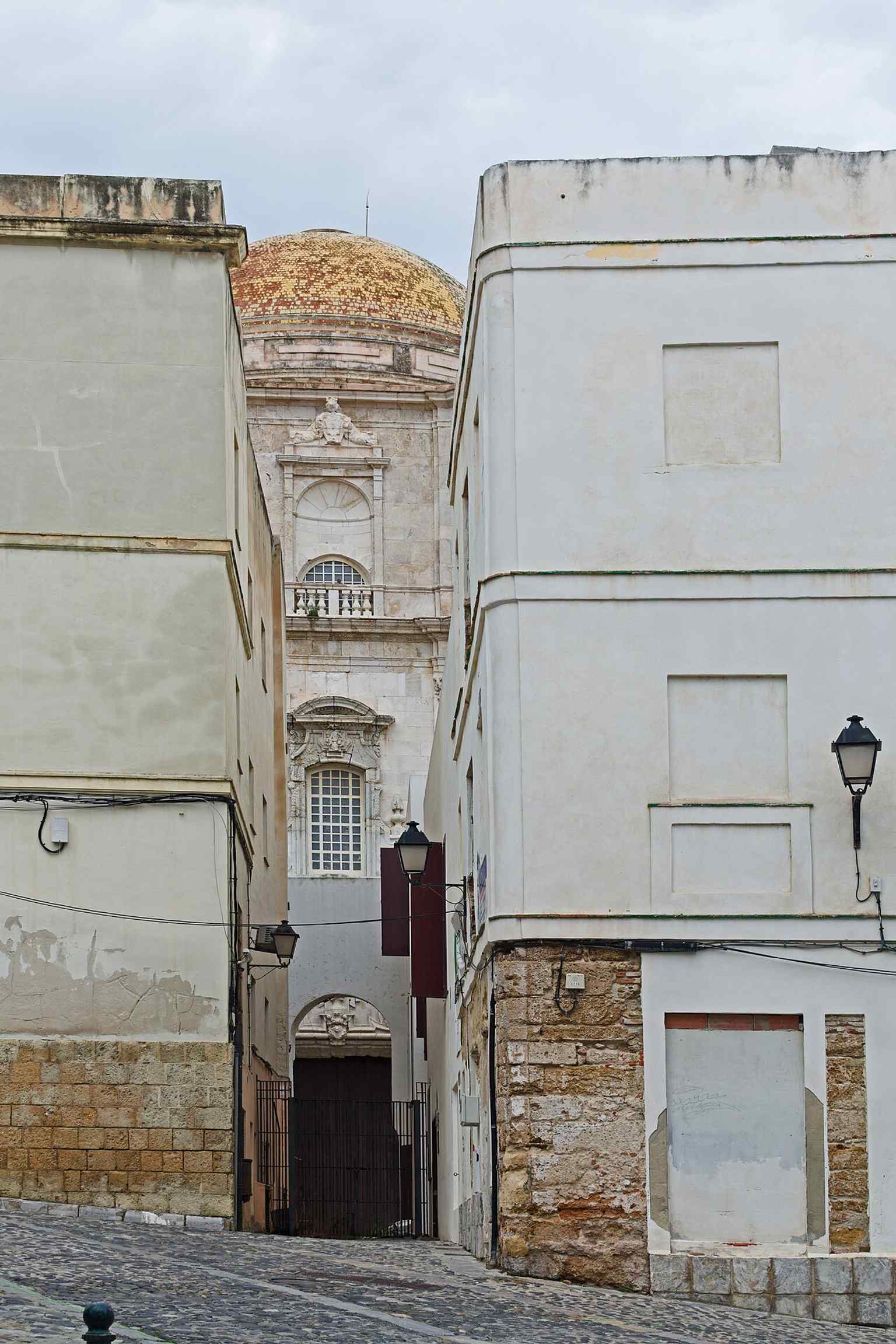
The cathedral beside the Arco del Obispo, a useful context shot for its setting in Cádiz’s historic center near the old cathedral.Photo: Ymblanter, Wikimedia Commons, CC BY-SA 4.0. Cropped & resized. 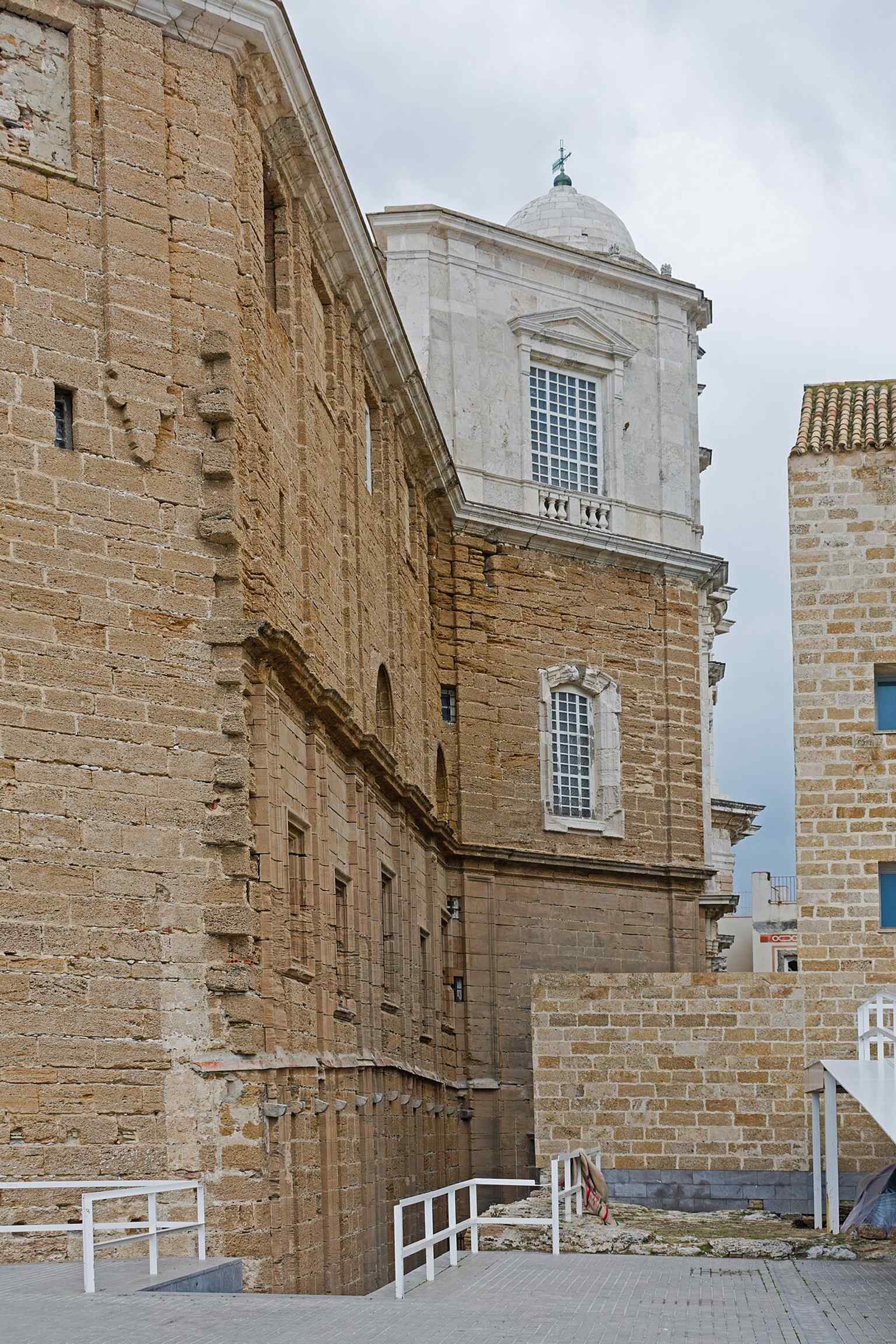
A street-level view from Avenida Campo del Sur, showing how visible the cathedral is from across the historic seafront.Photo: Ymblanter, Wikimedia Commons, CC BY-SA 4.0. Cropped & resized. 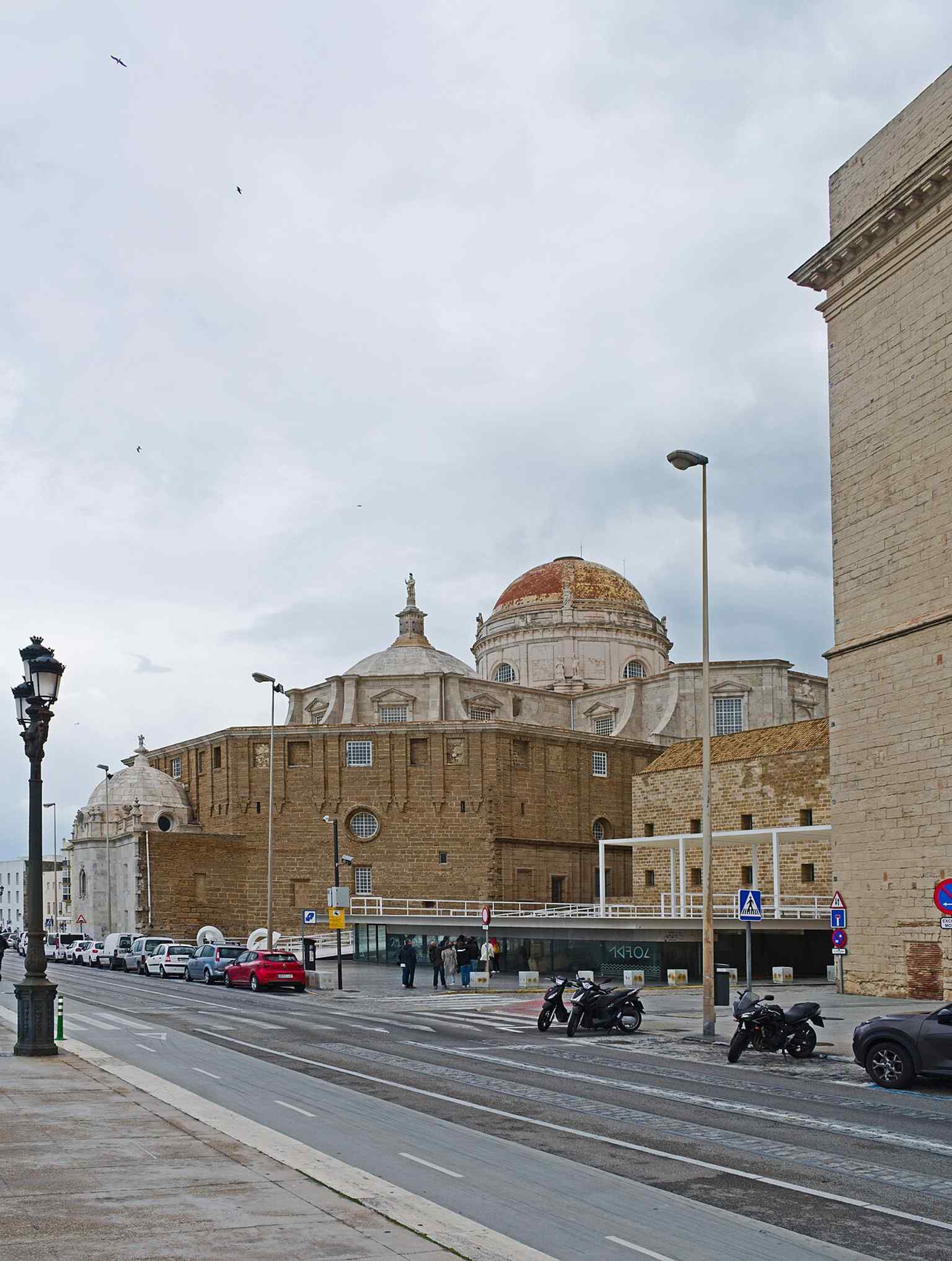
Another seafront perspective that underlines the cathedral’s relationship with Cádiz’s coastline and open sky.Photo: Ymblanter, Wikimedia Commons, CC BY-SA 4.0. Cropped & resized. 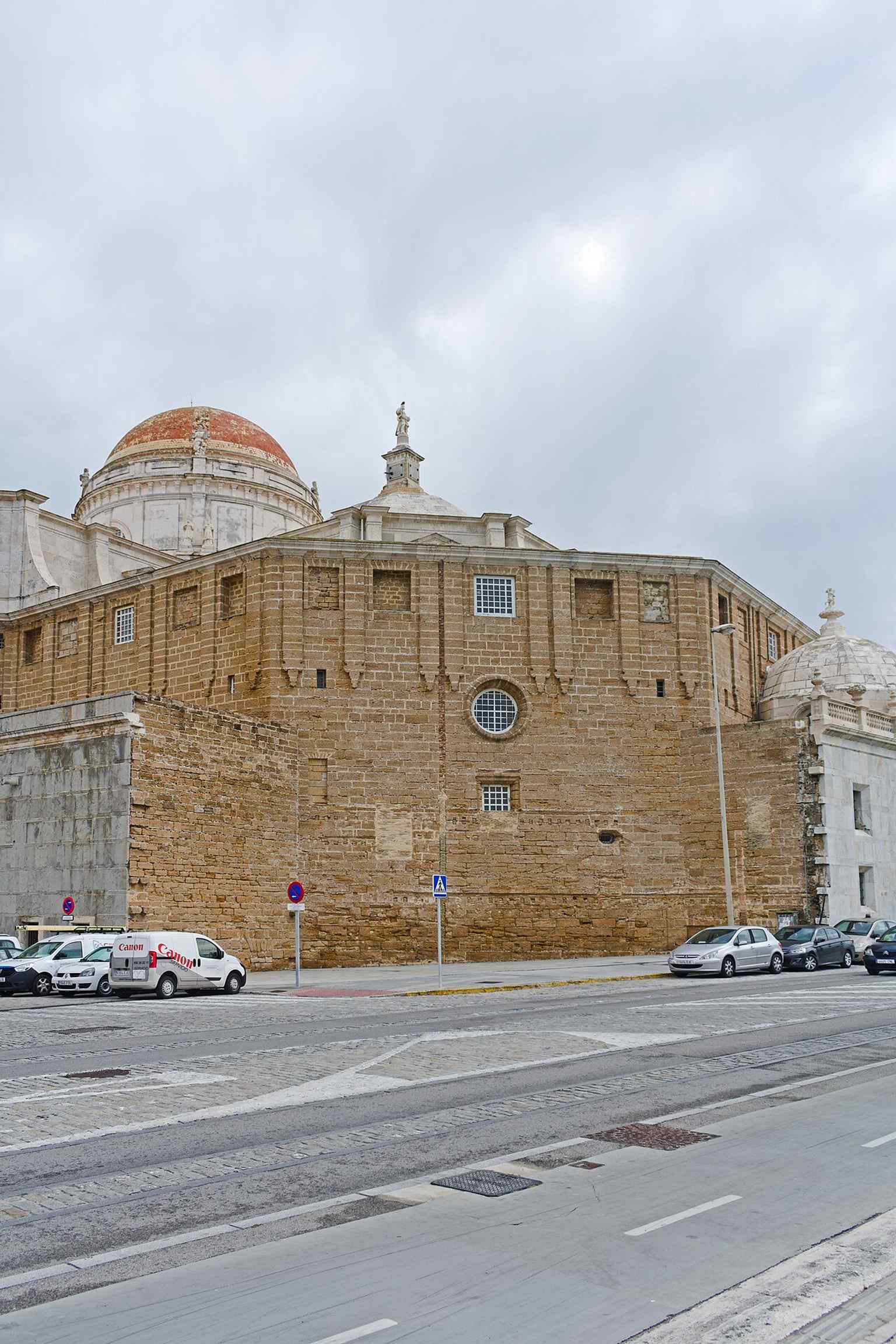
A different angle from the Avenida Campo del Sur, helping show the cathedral’s massive scale from multiple viewpoints.Photo: Ymblanter, Wikimedia Commons, CC BY-SA 4.0. Cropped & resized. On your right, Santa Cruz is easy to spot by its pale stone walls, its broad rectangular body, and the separate bell tower topped with a polychrome tiled spire. This is Cádiz’s…Read moreShow less
Open dedicated page →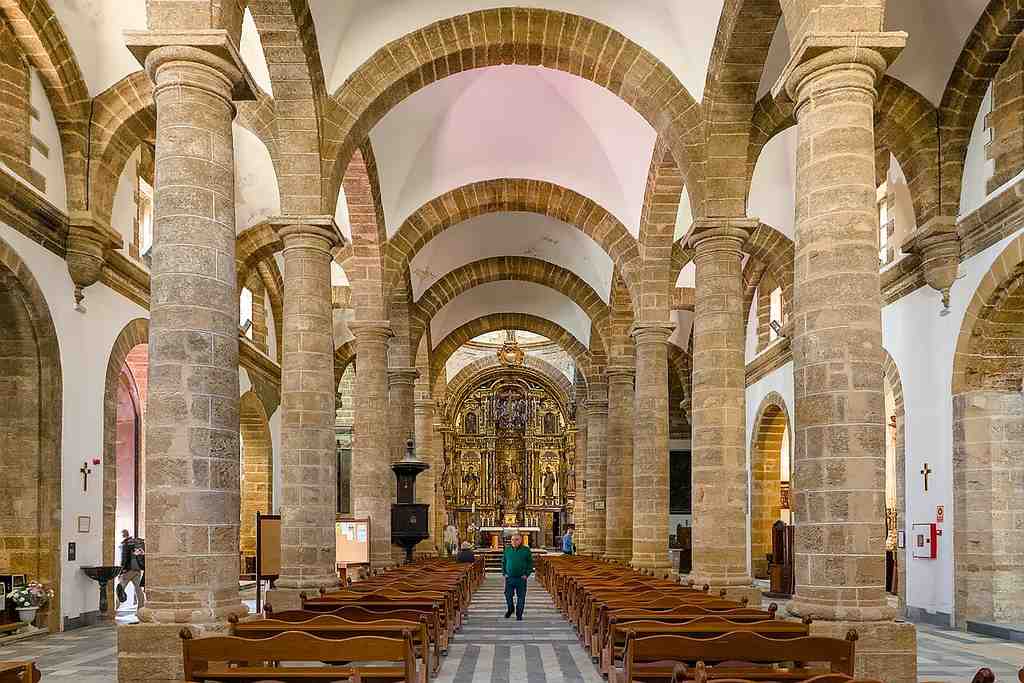
Church of Santa Cruz (Cadiz)Photo: Benjamin Smith, Wikimedia Commons, CC BY-SA 4.0. Cropped & resized. On your right, Santa Cruz is easy to spot by its pale stone walls, its broad rectangular body, and the separate bell tower topped with a polychrome tiled spire.
This is Cádiz’s old cathedral... a building with a long memory and, frankly, more lives than seems fair for one church. King Alfonso the Tenth of Castile, known as Alfonso the Wise, ordered a church here around the years twelve sixty-two to twelve sixty-three, after the Christian conquest of the city. He chose a site layered with older faiths and older stones: first an Islamic mosque, and possibly even earlier remains linked to a paleochristian or Visigothic temple... or land tied to Roman Gades. In Cádiz, the past rarely leaves politely.
Alfonso even meant this to be his burial place. History declined the invitation. He died and ended up buried in Seville instead.
For centuries, this church served as the city’s cathedral. Then came disaster in fifteen ninety-six, when an Anglo-Dutch fleet under Charles Howard and Robert Devereux attacked, invaded, and sacked Cádiz. The fire left this church almost destroyed. Only the entrance arch and the ribbed vault of the baptistery chapel survived. A ribbed vault, by the way, is that stone webbing you see in some older church ceilings, where the arches cross like the bones of an umbrella.
The rebuilding began soon after. In fifteen ninety-seven, the diocese gave the work to Ginés Martín de Aranda, and the final design came from the military engineer Cristóbal de Rojas. That detail feels very Cádiz: when things get serious, call the engineer. The church was finished in sixteen oh two, consecrated on the fifteenth of June that year, and opened for worship in sixteen oh three.
What you see now belongs mainly to that rebuilding: a Mannerist and Baroque church, meaning a style that is more controlled and geometric than high Renaissance work, but with some of the drama and richness Baroque loved. Inside, it has three aisles, the long parallel spaces of the church, divided by sturdy Tuscan columns and broad rounded arches. Over the crossing sits a hemispherical dome on pendentives, those curved triangular supports that let a round dome rest over a square space.
If you check your screen, the tower in image two shows one of the church’s most distinctive features: the separate bell tower, capped with bright tiled surfaces that give the whole complex a little extra swagger. And image three hints at the devotional art preserved inside after all that destruction and rebuilding.
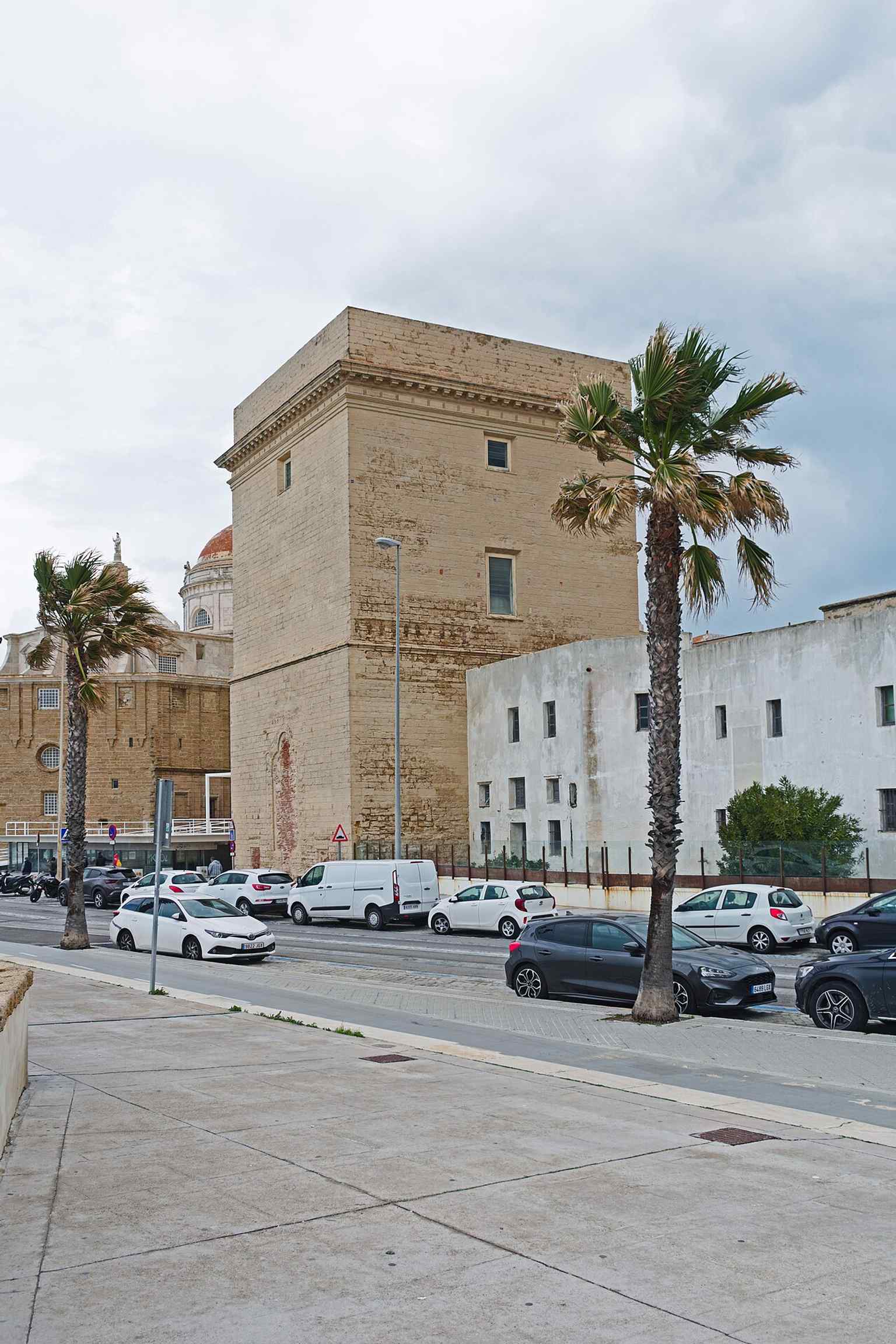
The Torre del Sagrario, a separate tower linked to the cathedral complex, reflecting the church’s later Baroque additions and polychrome tilework.Photo: Ymblanter, Wikimedia Commons, CC BY-SA 4.0. Cropped & resized. In eighteen thirty-eight, the bishop’s seat moved to the New Cathedral, and Santa Cruz became what it remains now: a parish church, still in active worship, and still very much alive.
Santa Cruz feels less like a relic than a survivor.
Take a moment here, and when you’re ready, we can continue toward the market square.
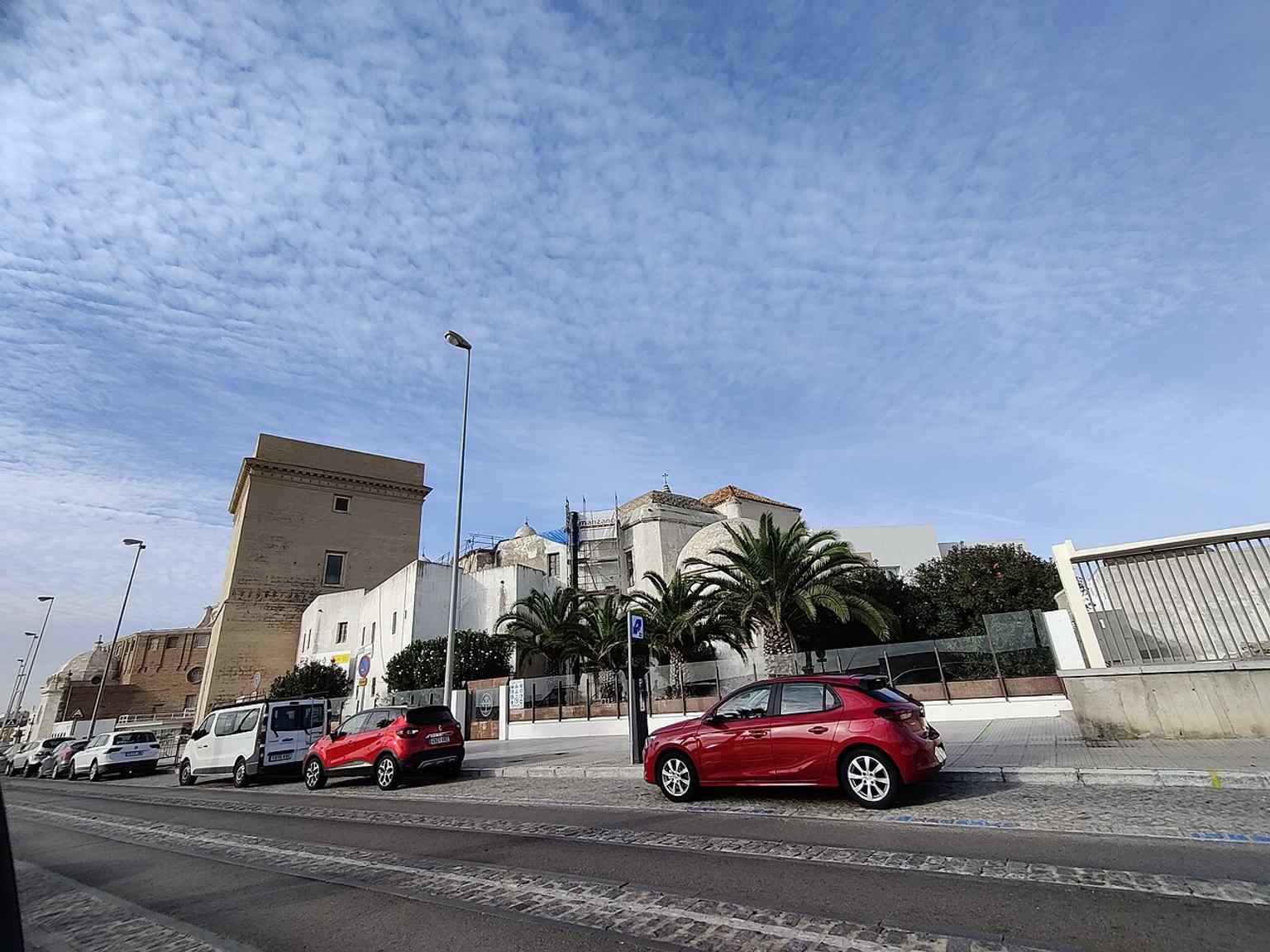
The present-day parish church of Santa Cruz in Cádiz, formerly the Old Cathedral, showing the main building that became a parish church in 1838.Photo: El Pantera, Wikimedia Commons, CC BY-SA 4.0. Cropped & resized. 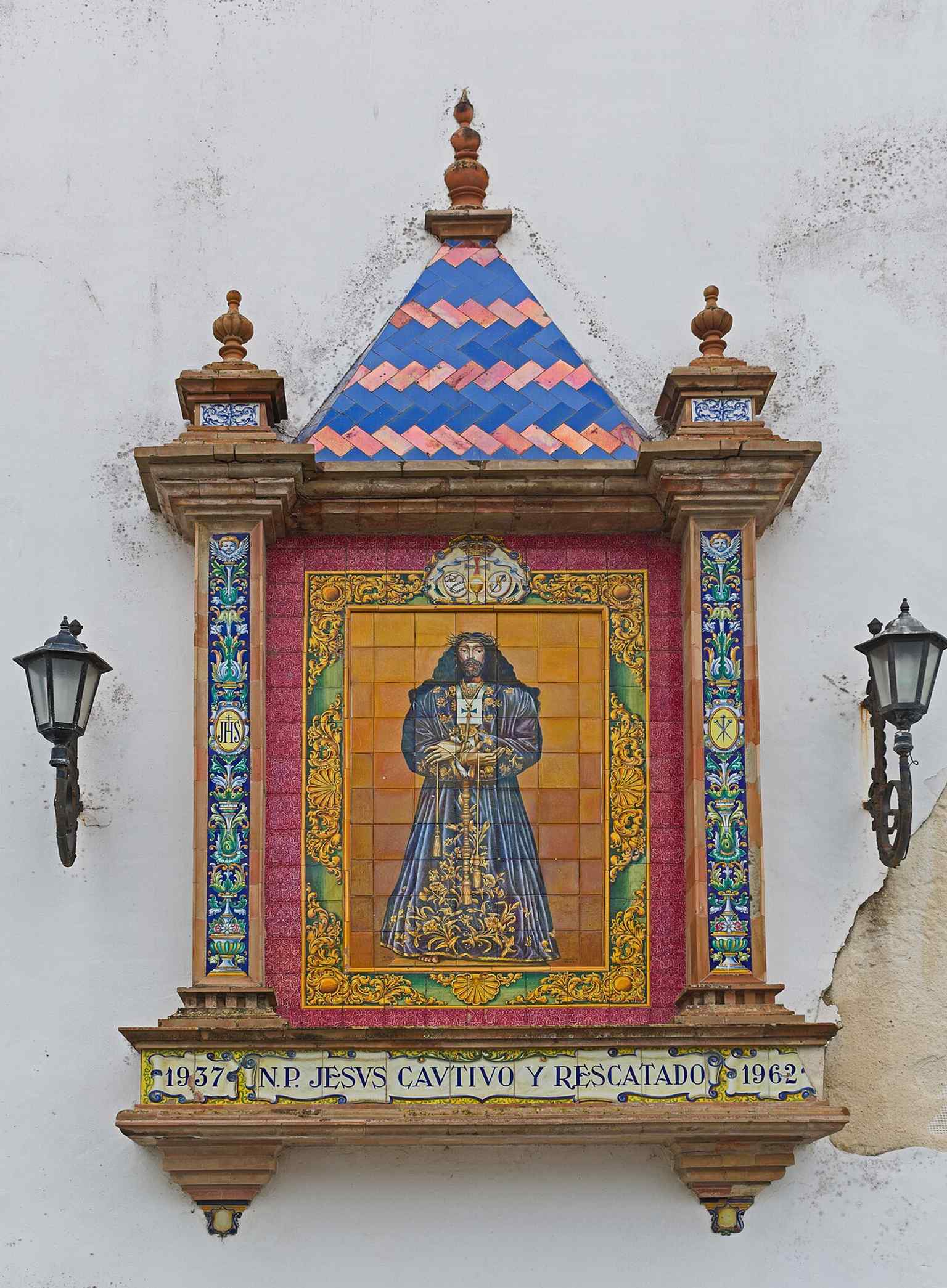
A wall relief of Christ inside the Church of Santa Cruz, a good example of the devotional artworks preserved after the church’s reconstruction.Photo: Ymblanter, Wikimedia Commons, CC BY-SA 4.0. Cropped & resized. On your right, the market appears as a pale stone quadrangle with open arcades, sturdy Doric columns, and a long neoclassical façade wrapped around Plaza de la Libertad. Cádiz…Read moreShow less
Open dedicated page →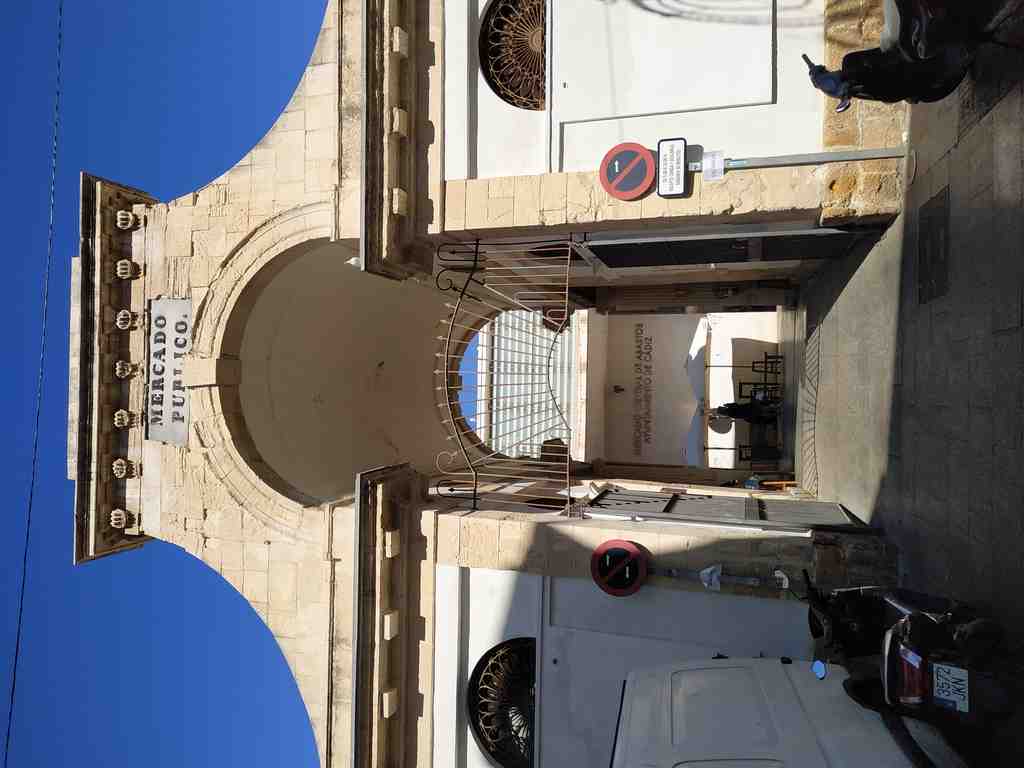
Market square (Cadiz)Photo: Vanbasten 23, Wikimedia Commons, CC BY-SA 3.0. Cropped & resized. On your right, the market appears as a pale stone quadrangle with open arcades, sturdy Doric columns, and a long neoclassical façade wrapped around Plaza de la Libertad.
Cádiz did not place its central food market here by accident. Architect Torcuato Benjumeda designed it as a porticoed square on the former garden of a convent, after that land changed hands in the early nineteenth century. The market opened in eighteen thirty-eight, and then... for about a century, the city mostly expected it to keep doing its job without much pampering.
In the nineteen twenties, Mayor Ramón de Carranza pushed a program of “great works” across Cádiz, from the Alameda Apodaca to the revived monument to the Cortes, and this market got its turn. Juan Talavera y Heredia, an architect from Seville, began work in December nineteen twenty-six. He kept Benjumeda’s original Doric columns, each about four meters high. Doric means the plain, solid classical style - less fuss, more backbone. The trouble came from old cisterns still in use exactly where new foundations needed to go. Exterior work finished in November nineteen twenty-seven, and the whole project wrapped up by the end of nineteen twenty-nine.
Glance at the app image for the exterior as it reads today. The interior photo shows the twenty-first-century remake, when restaurant spaces helped turn the market into a tourist draw as well as a local one. Carranza even hired a veterinarian to inspect produce, and vendors had to wear white with sleeve covers... hygienic, yes, but also famous enough to inspire a Carnival tango.
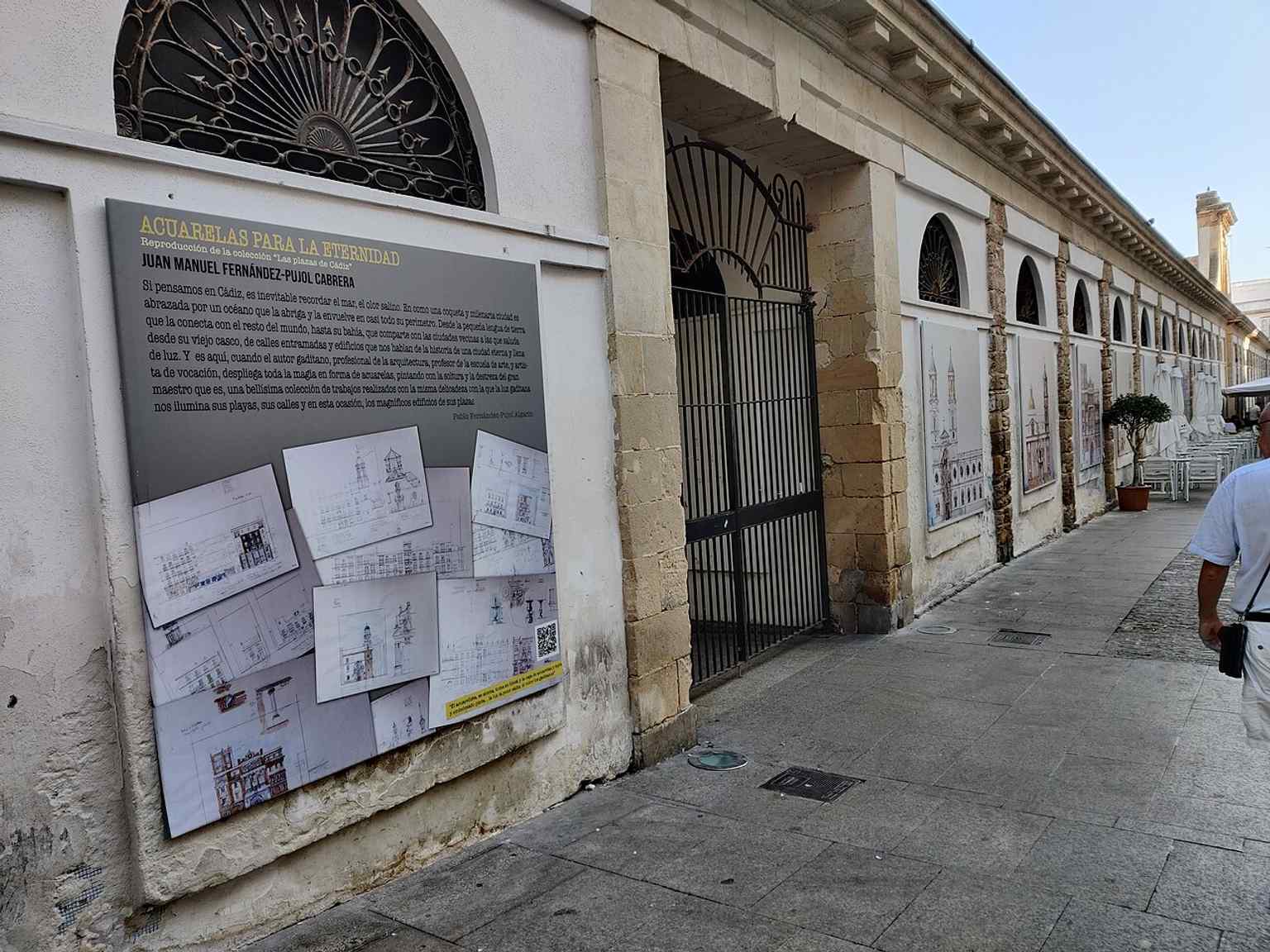
The busy façade of Cádiz’s market today, on the site of the 1838 Mercado de la Libertad that was later remodelled in the 1920s.Photo: El Pantera, Wikimedia Commons, CC BY-SA 4.0. Cropped & resized. If you return later, it’s inexpensive and generally open daily, with evening hours on many nights. This market shows Cádiz turning everyday necessity into civic pride. When you’re ready, we can head on to Saint Lawrence.
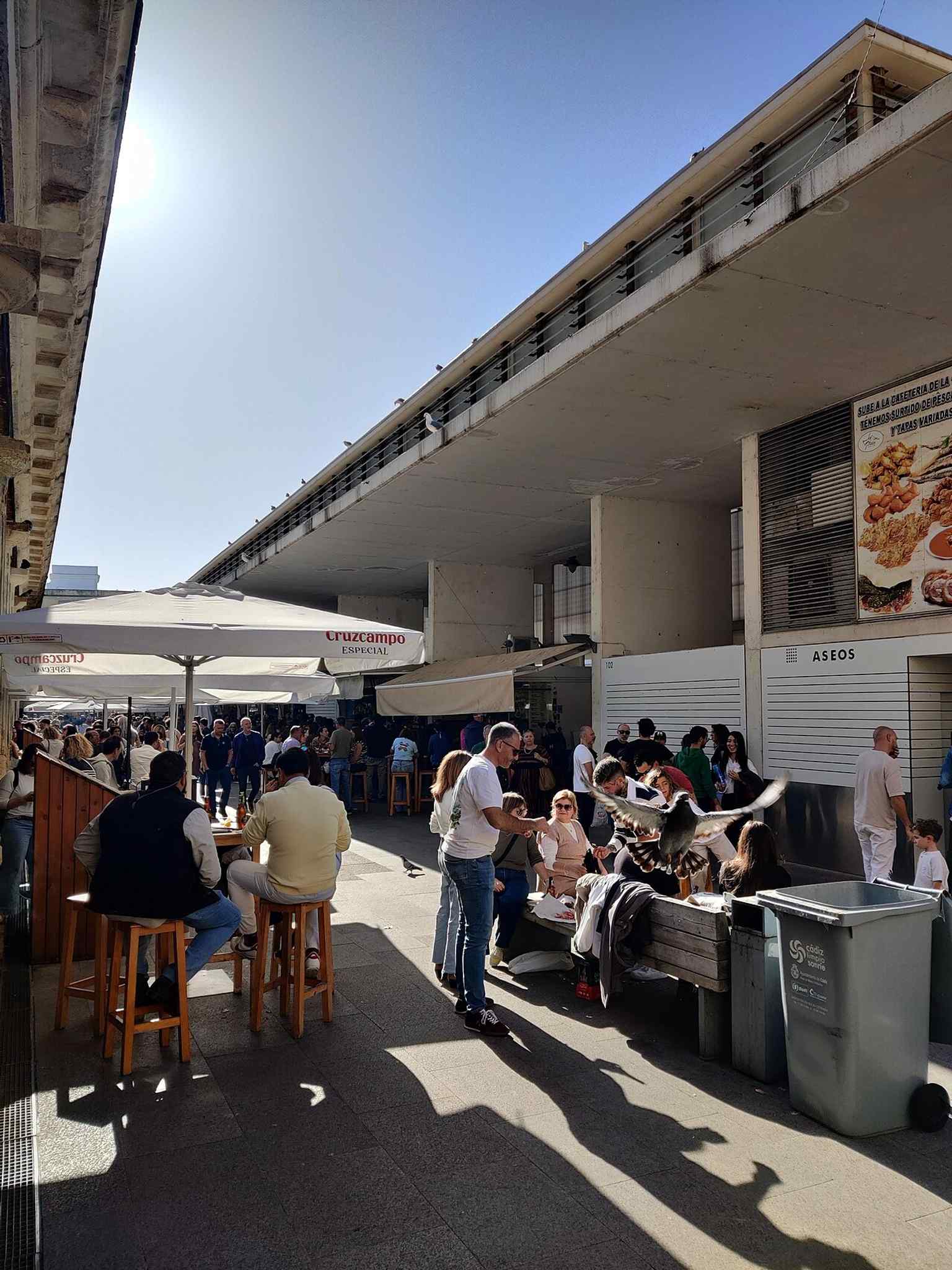
The renovated market interior, linked to the 21st-century makeover that added restaurant spaces and turned it into a tourist attraction.Photo: El Pantera, Wikimedia Commons, CC BY-SA 4.0. Cropped & resized. On your left, look for a warm stone Baroque church with an oval shape, a compact façade framed by Ionic pilasters - flat columns attached to the wall - and memorial plaques set…Read moreShow less
Open dedicated page →On your left, look for a warm stone Baroque church with an oval shape, a compact façade framed by Ionic pilasters - flat columns attached to the wall - and memorial plaques set between them.
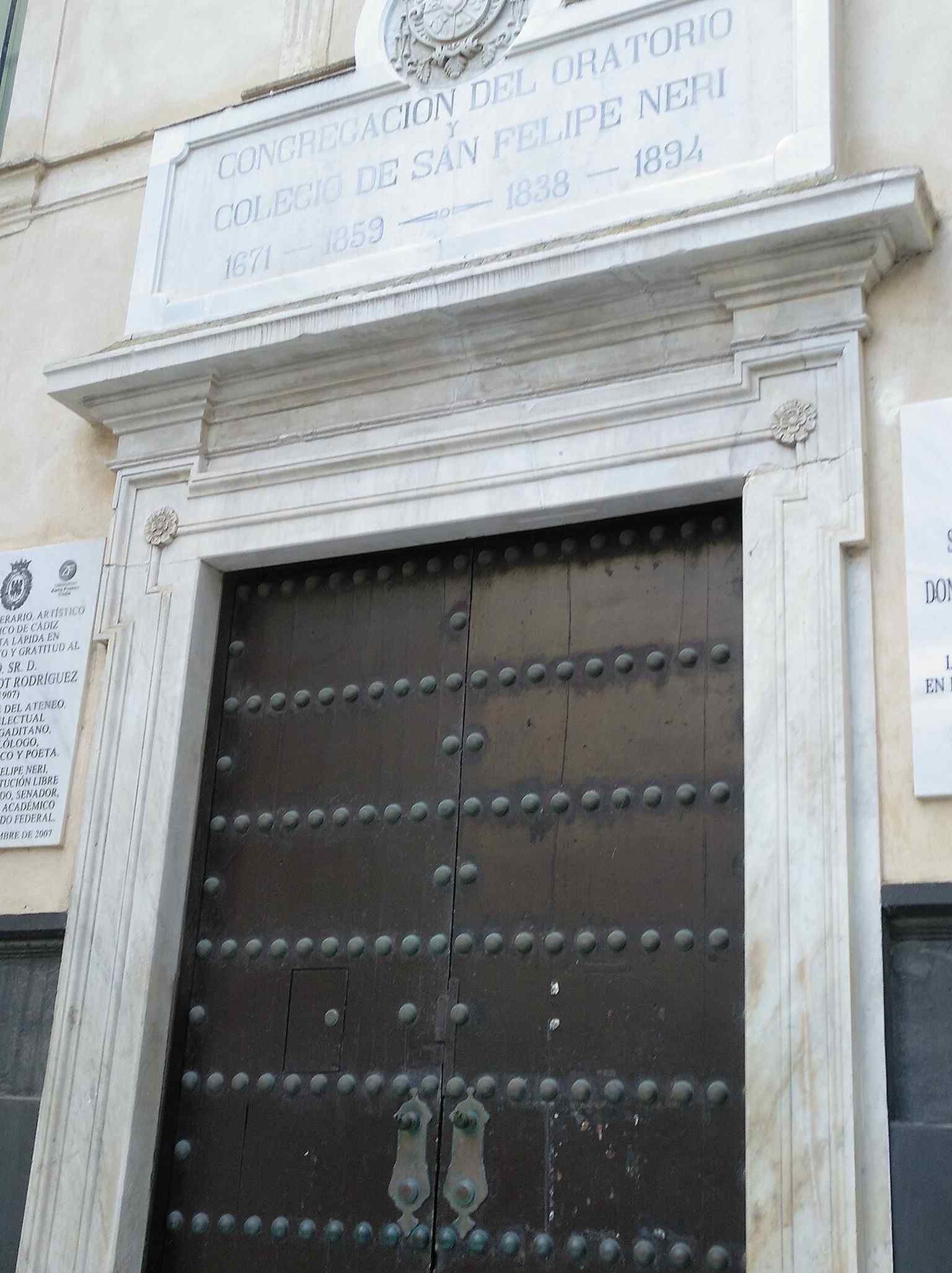
This is the Oratory of Saint Philip Neri, and for such a modest exterior, it carries a startling amount of Spanish history. Blas Díaz started it in sixteen eighty-five and completed this elliptical church by seventeen nineteen. That oval plan was unusual for a church, but it gave the interior a strong sense of gathering, which turned out to be very useful indeed. During the Napoleonic invasion, Spain’s Cortes Generales met here from eighteen eleven, and in eighteen twelve they proclaimed the first Spanish constitution... liberal enough to make defenders of absolute monarchy very uncomfortable.
The building had already survived a serious shock. The Lisbon earthquake of seventeen fifty-five damaged it, even from across the border, and in seventeen sixty-four Pedro Luis Gutiérrez de San Martín rebuilt the dome, a timber shell with two sections and eight windows. If you glance at your screen, image three gives a clear view of that rebuilt exterior.
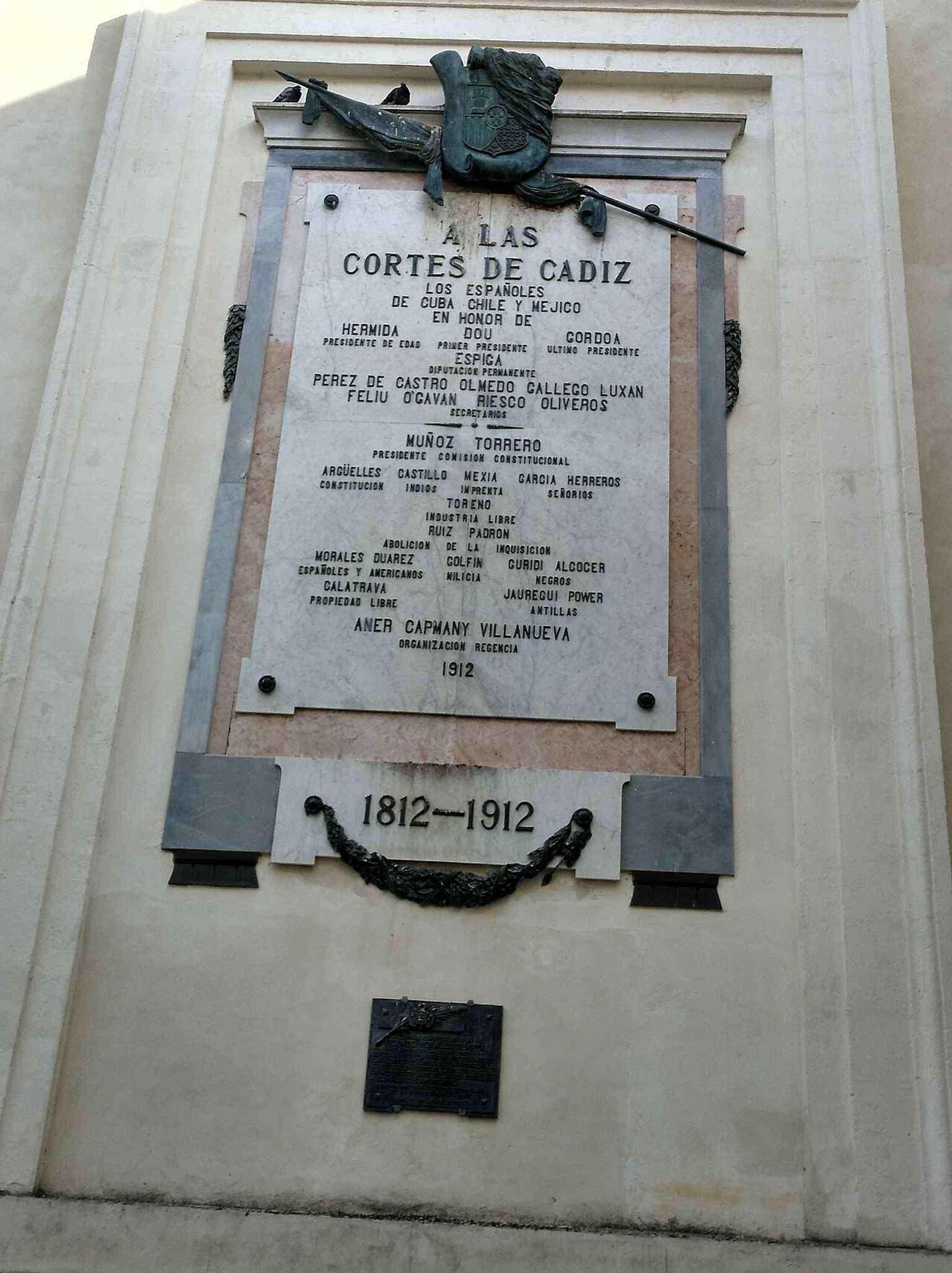
The Oratory of Saint Philip Neri seen from outside, a landmark rebuilt after the 1755 Lisbon earthquake and tied to the Cortes of Cádiz.Photo: Axel Cotón Gutiérrez, Wikimedia Commons, CC BY-SA 4.0. Cropped & resized. Those plaques outside were added especially in nineteen twelve, marking the constitution’s centenary and honoring the doceañistas, the liberal deputies linked to eighteen twelve. Inside, seven richly decorated chapels ring the oval hall, including the Sagrario Chapel by the Genoese brothers Bernardo and Francesco Maria Schiaffino, plus a Rococo main altarpiece with Murillo’s Immaculate Conception.
This church is both sanctuary and parliament in stone.
Take a moment here, and when you’re ready, we can continue toward the Palace of the Marquises of Recaño.
The Baroque facade of Oratory of Saint Philip Neri in Cádiz, where the Spanish Cortes met in 1811 and the Constitution of 1812 was proclaimed.Photo: Axel Cotón Gutiérrez, Wikimedia Commons, CC BY-SA 4.0. Cropped & resized. 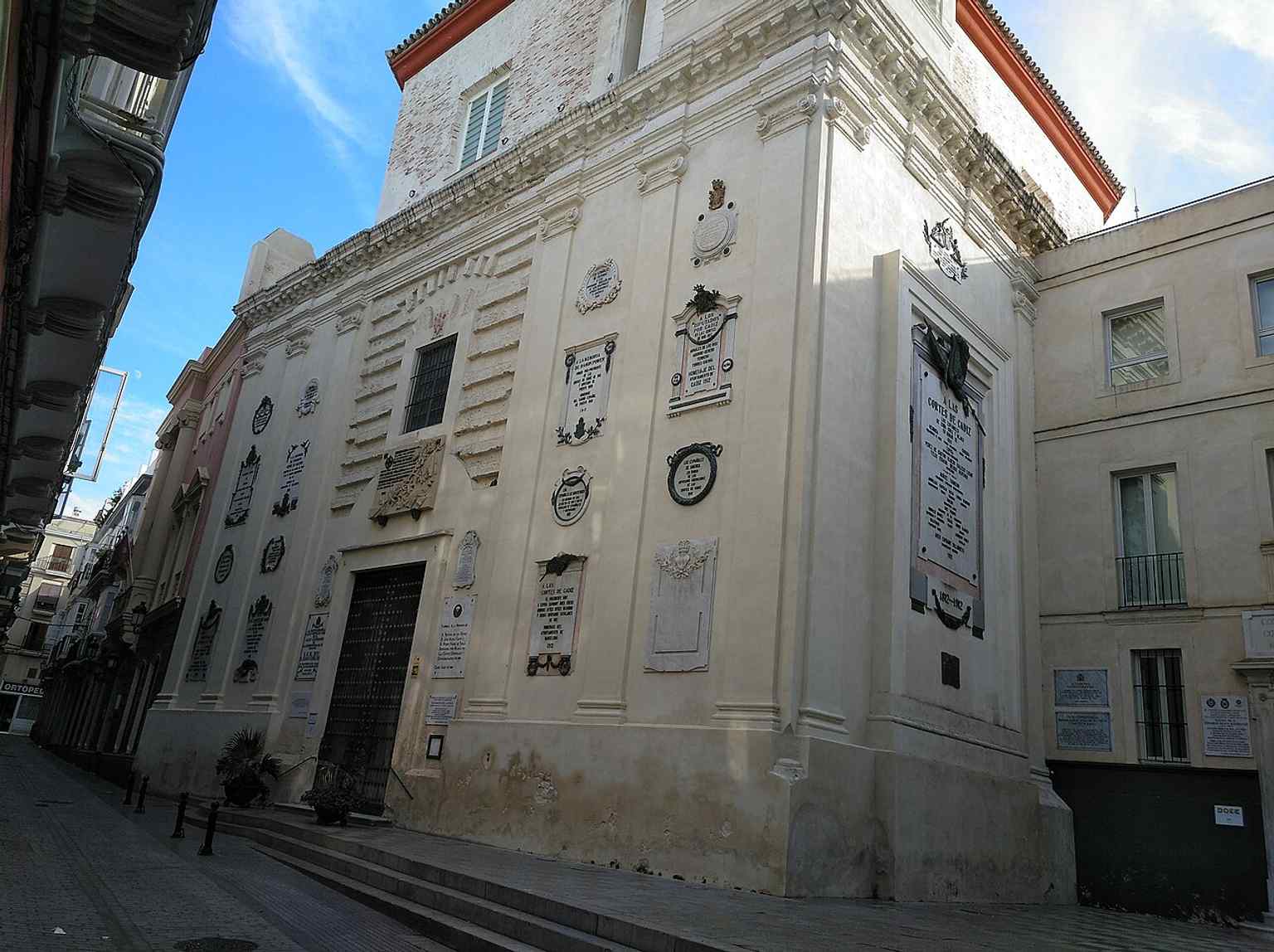
A clear view of the church exterior in Cádiz, the historic setting of Spain’s liberal 1812 Constitution.Photo: Axel Cotón Gutiérrez, Wikimedia Commons, CC BY-SA 4.0. Cropped & resized. Look for the warm stone façade with its tall white marble doorway, rows of iron balconies, and the slender corner watchtower that marks the Palace of the Marquises of Recaño.…Read moreShow less
Open dedicated page →Look for the warm stone façade with its tall white marble doorway, rows of iron balconies, and the slender corner watchtower that marks the Palace of the Marquises of Recaño.
This house has the posture of a man standing on tiptoe... which, in Cádiz real estate, was a sensible ambition. Around seventeen thirty, the Genoese patrician Bernardo Recaño, first Marquis of Casa Recaño, commissioned it here on one of the highest points in the old city. He followed the local formula for a merchant palace, the kind used by the cargadores a Indias, traders whose fortunes rode the Atlantic routes to the Americas. Business happened on the lower levels, the owner lived on the grand main floor, servants stayed higher up... and above all of that rose the lookout tower.
That tower is the star of the show. It became known as the Torre Tavira, and because it stood higher than any other tower in Cádiz, the city chose it in seventeen seventy-eight as the official watchpoint over the port. The tower took the name of Antonio Tavira, the first man assigned to keep watch there. Imagine that job for a second: scanning the horizon for incoming ships, delays, danger, profit. In a trading city, that was not idle gazing; it was economic intelligence.
If you glance at the image on your screen, you can see how the palace and tower work together, almost like a dignified townhouse that secretly decided to grow a periscope.
A full view of the Casa-Palacio de los Marqueses de Recaño, showing the historic Cádiz palace and its tower-mirador, the Torre de Tavira.Photo: Axel Cotón Gutiérrez, Wikimedia Commons, CC BY-SA 4.0. Cropped & resized. The entrance gives away the building’s ambitions. The main portal is white marble set into rougher oyster stone, with Tuscan columns, a split curved pediment, and a balcony above it like a little stage. If you want a closer look at that doorway, check the image in the app. Baroque architecture loved this sort of flourish. Baroque, in plain English, means a style that leaned into movement, ornament, and a bit of controlled drama.
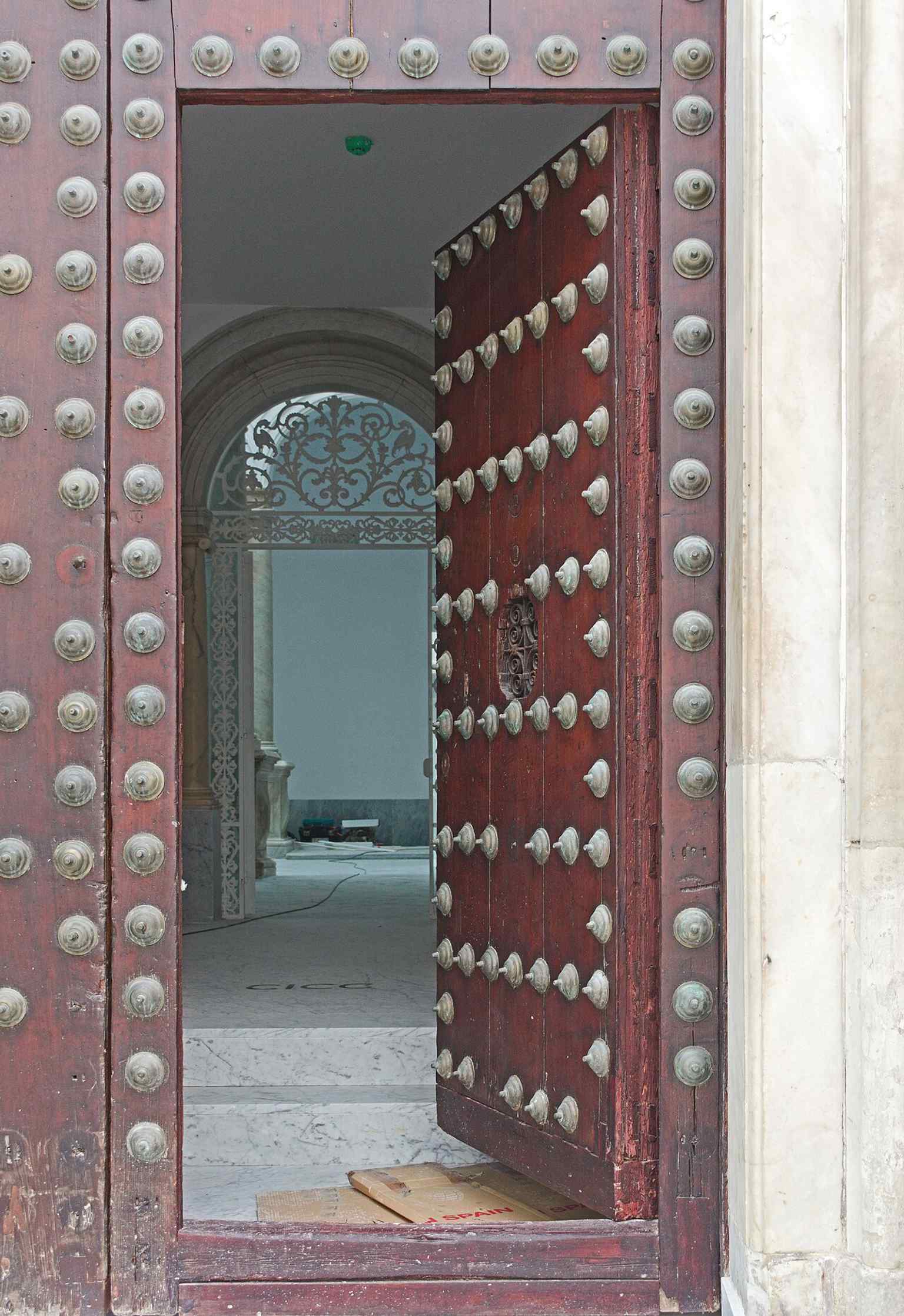
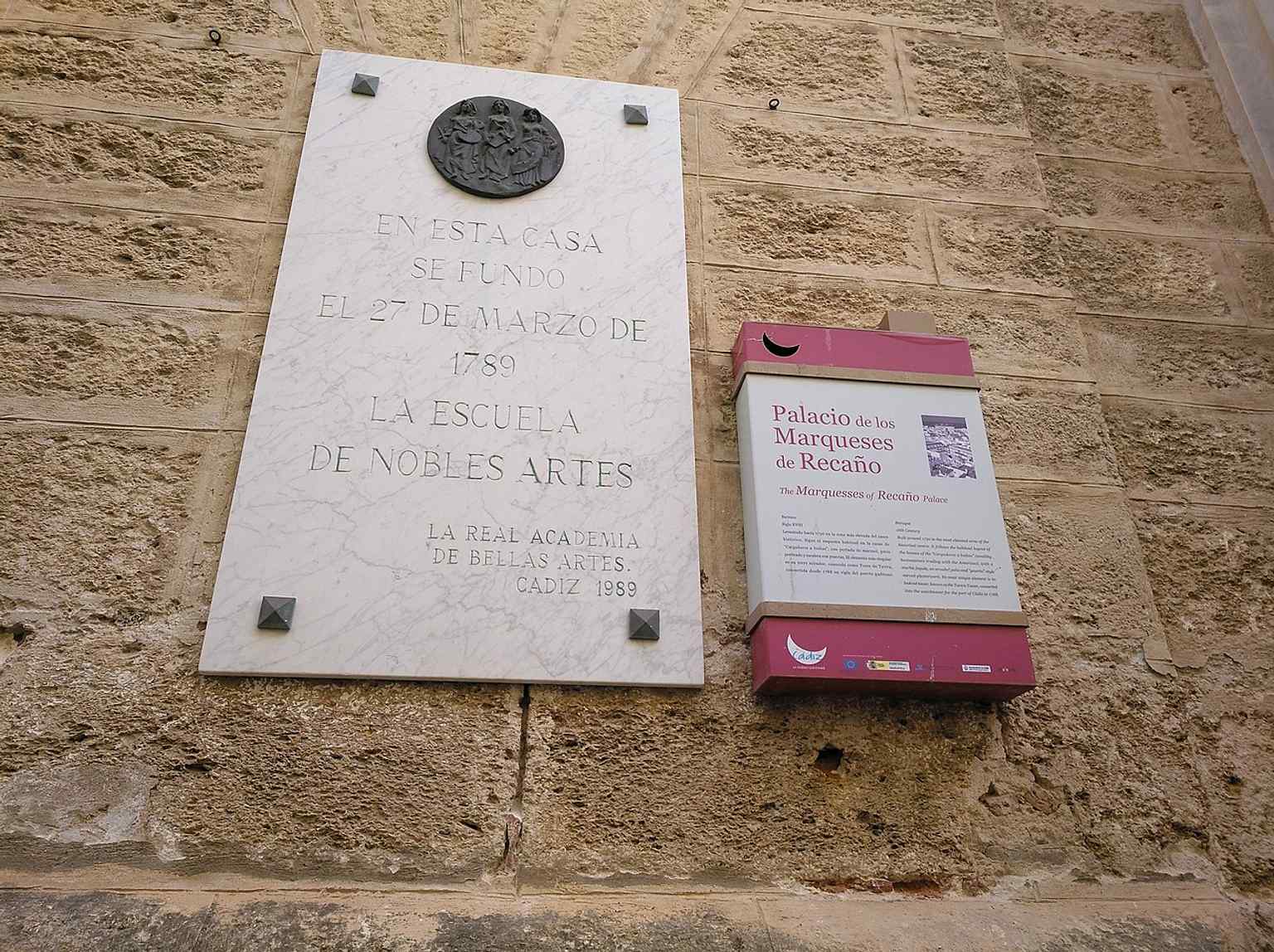
The main entrance of the Recaño Palace, with the stone portal that leads into the house-palace and toward the Torre de Tavira.Photo: Ymblanter, Wikimedia Commons, CC BY-SA 4.0. Cropped & resized. And this palace did not settle for one career. In seventeen eighty-seven, Cádiz moved its Free School of Drawing, Arithmetic, and Geometry here. That later became the School of Fine Arts, which stayed until eighteen thirty-eight. In eighteen twelve, during the year of the Constitution, Spain’s Supreme Court held its first seat in this very building before moving on to Madrid. Later it served as a teacher-training school, and later still the Sisters of Charity used it for a school of their own. Some buildings age quietly; this one kept updating its résumé.
Inside, the palace is organized around a central courtyard with eight Tuscan marble columns. White decorative moldings stand out against reddish walls, and the main staircase rises under plaster vaults crowded with flowers, fruit clusters, curling leaves, and little angel heads. Even the iron screen beyond the entrance was designed to impress before a visitor reached the patio.
The city owns the palace now, and after restoration it became the Museum of Carnival, which feels exactly right for Cádiz: a noble house turned over to satire, costume, music, and mischief. In two thousand and five, Andalusia protected it as a monument, and fairly so.
If you want to go inside later, the museum generally opens every day from ten in the morning to eight in the evening. For a palace built to watch ships, it ended up keeping watch over a remarkable slice of Spanish history. Take a moment here, and when you’re ready, we can continue on to Mora Palace.
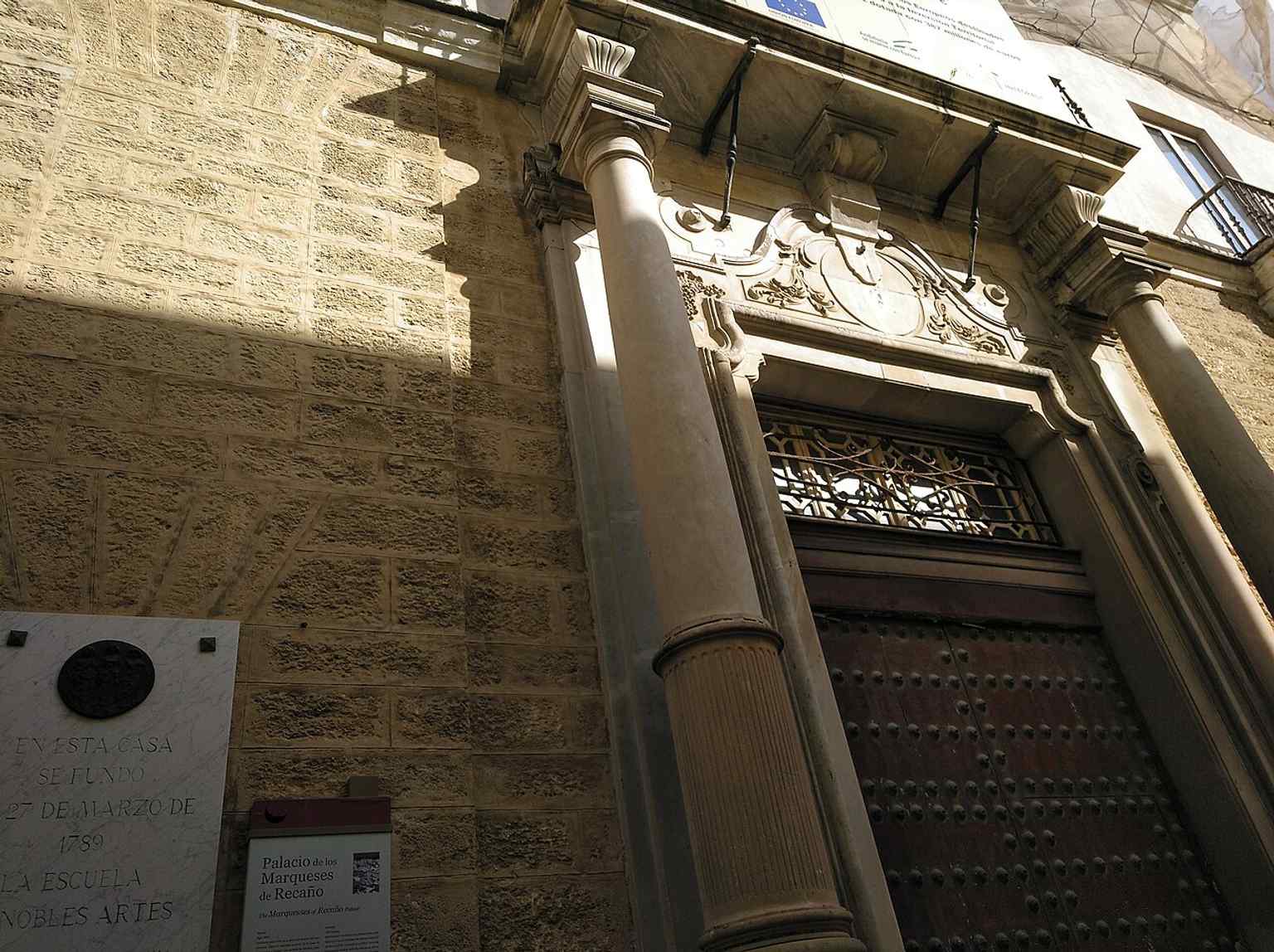
Another exterior view of the Recaño Palace, useful for showing the building’s noble façade in the old center of Cádiz.Photo: Axel Cotón Gutiérrez, Wikimedia Commons, CC BY-SA 4.0. Cropped & resized. Look for a broad three-story facade faced with marble, centered on a round-arched doorway and a grand balcony with double columns, plus the striking atlantes, carved male figures,…Read moreShow less
Open dedicated page →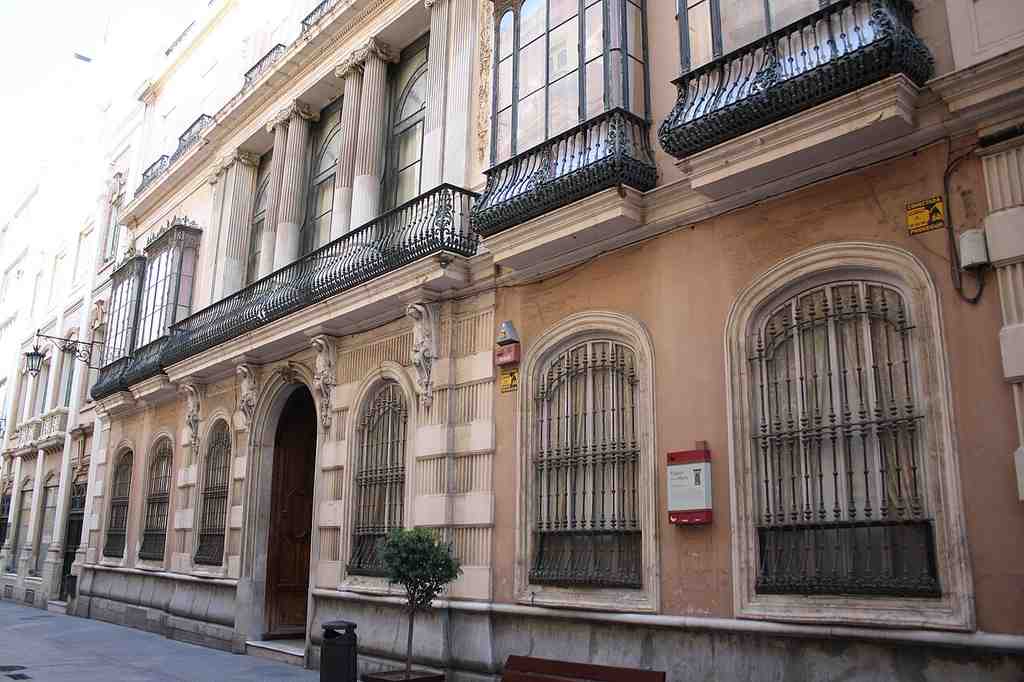
Mora PalacePhoto: Arooran Thanabalasingam, Wikimedia Commons, CC BY-SA 3.0 ES. Cropped & resized. Look for a broad three-story facade faced with marble, centered on a round-arched doorway and a grand balcony with double columns, plus the striking atlantes, carved male figures, holding up the balcony above.
This is Mora Palace, one of Cádiz’s great nineteenth-century houses, and it does not exactly do modesty. It prefers marble. A lot of marble. Architect Juan de la Vega y Correa designed it in the mid-nineteenth century in the Isabeline style, the fashionable look of Queen Isabel the Second’s era, and the result is a city mansion that feels almost theatrical without tipping into nonsense.
From where you’re standing, the facade tells the whole story. It rises in three main levels with an attic above, organized in three vertical sections. The center gets the drama: that rounded entrance arch, then the balcony over it with paired marble columns. Under the balcony, those atlantes do the heavy lifting... literally in stone. They’re sculpted male figures used as supports, because plain brackets would apparently have been far too ordinary. Flanking the center, you can spot four large miradores, enclosed projecting windows, two on each side. Their craftsmanship mattered then, and it still shows now.
And the luxury did not stop at the front door. The family had columns, brackets, and other decorative pieces shipped from Carrara in Italy, the same place famous for its high-quality marble. Inside, the house revolves around a main patio, a rear patio, and a garden. Wide galleries with balustrades run around the upper floors, and a marble staircase leads to the formal rooms above. Over the central patio sits a montera, basically a large glazed roof that floods the interior with light. The whole effect blends French Empire taste, grand, symmetrical, and polished, with the more mixed-and-matched flair of eclectic architecture.
The palace opened officially on the thirtieth of September, eighteen sixty-two, when the Moreno de Mora family threw a ball here for Queen Isabel the Second and her husband, Francisco de Asís. Not a bad housewarming party. Even more remarkable, the place still preserves its original furnishings from that era, especially in the Salón Regio, the main reception room, where the furniture was designed for that inauguration. The house also keeps paintings by artists including Bianchi, Juan de Arellano, Eugenio Lucas Velázquez, and Zurbarán, sculptures by Pagani and other Milanese artists, a notable clock collection, a small library once used by the Hispano-American Academy in Cádiz, and a chapel with a Virgin of El Rocío carving that is about a century older than the mansion itself.
Since nineteen eighty-one, Mora Palace has held protected heritage status, and through generations, from the Moreno de Mora family to the Aramburu, Carranza, Picardo, and Pries families, it has remained a residence... which somehow makes all this splendor feel even more personal.
If you want to see the interior, the palace usually opens free on Wednesdays from eleven AM to noon.
Let this facade have the last word: Cádiz knew how to turn domestic life into ceremony.
When you’re ready, we can continue on to the Museum of Cádiz.
On your right, the Museum of Cádiz shows a pale stone neoclassical facade, stretched in a long, balanced rectangle with tall windows and a formal central entrance. Juan Daura…Read moreShow less
Open dedicated page →On your right, the Museum of Cádiz shows a pale stone neoclassical facade, stretched in a long, balanced rectangle with tall windows and a formal central entrance.
Juan Daura opened this building in eighteen thirty-eight on land taken from the old Convent of San Francisco, and it started life as the Provincial Museum of Fine Arts. Cádiz then gave the museum a bit of a wandering career, moving it through places like Callejón del Tinte and the Paseo de Canalejas before it finally settled here in nineteen thirty-five. Inside, it splits into three sections: archaeology, fine arts, and ethnography. The standouts are quite a cast... Phoenician anthropoid sarcophagi, meaning human-shaped coffins, including the female one people call the Dama de Cádiz; Roman finds from ancient Gades and Baelo Claudia; and Baroque paintings by Zurbarán, Murillo, Rubens, and Alonso Cano. If you look at your screen, the Dama’s face feels strangely calm across the centuries. Another image shows the Zurbarán room, with works brought from the Carthusian monastery in Jerez. It usually opens Tuesday through Saturday from nine to nine, Sunday until three, and closes on Monday. This place holds Cádiz in layers, not just in one story. Take a moment here, and when you’re ready, we can head on to Mina Square.
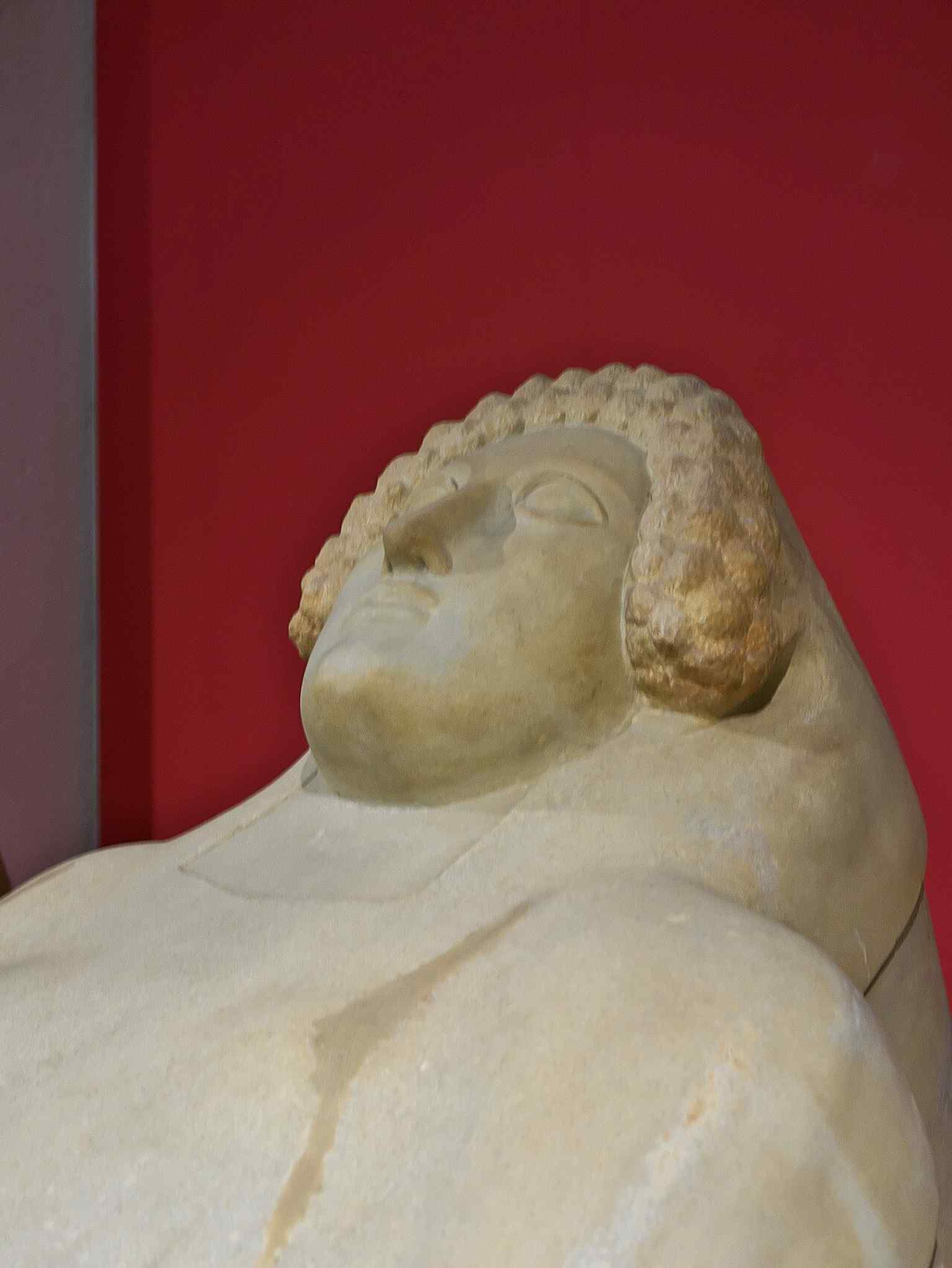
The celebrated “Dama de Cádiz” head from a Phoenician anthropoid sarcophagus, one of the museum’s signature archaeological treasures.Photo: Jl FilpoC, Wikimedia Commons, CC BY-SA 4.0. Cropped & resized. 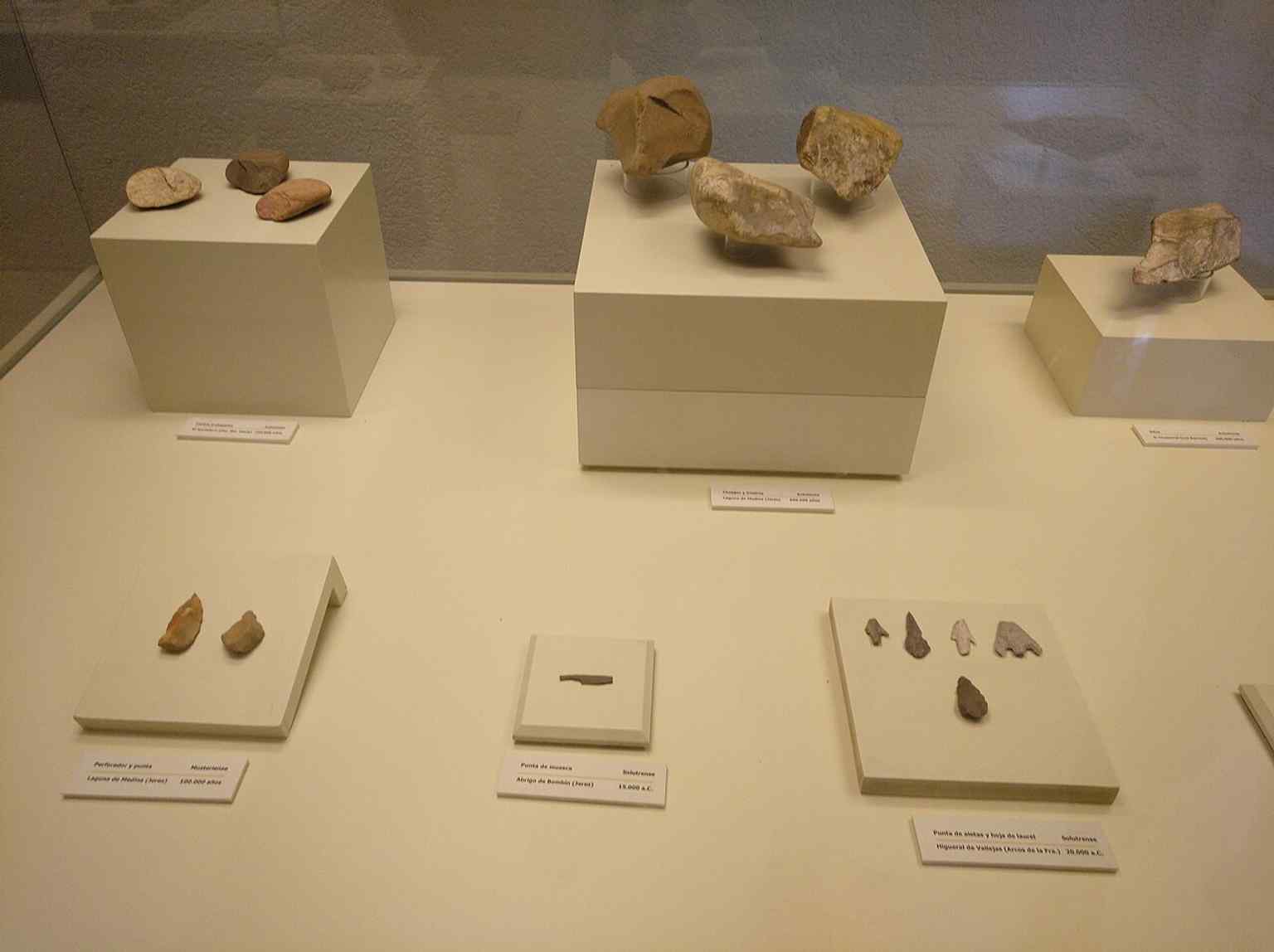
The neoclassical facade of the Museum of Cádiz, the institution that settled here in 1935 after moving through earlier addresses in the city.Photo: Axel Cotón Gutiérrez, Wikimedia Commons, CC BY-SA 4.0. Cropped & resized. 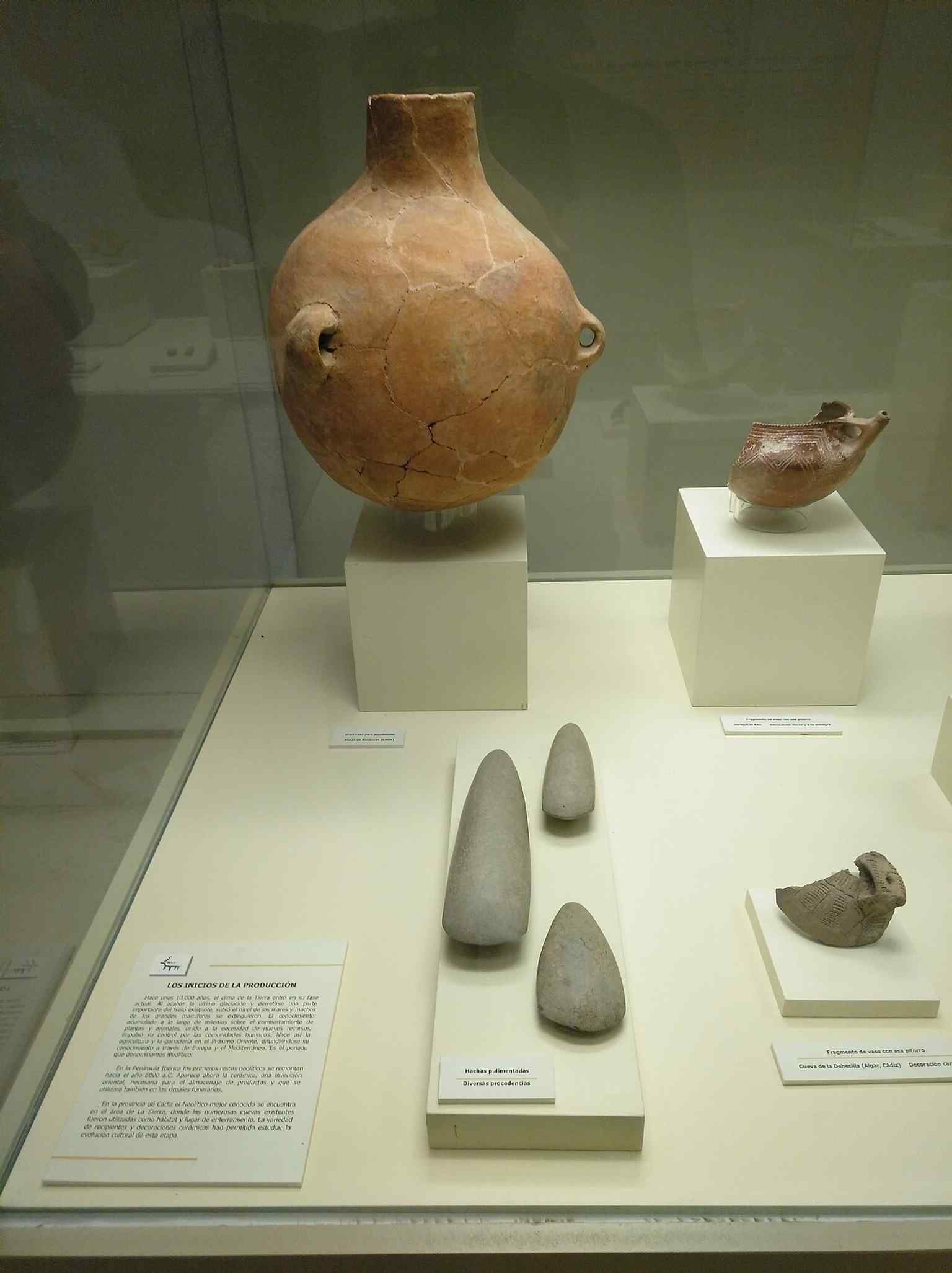
Another clear view of the museum building, linking the current home of Cádiz’s provincial museum to its 19th-century origins.Photo: Axel Cotón Gutiérrez, Wikimedia Commons, CC BY-SA 4.0. Cropped & resized. 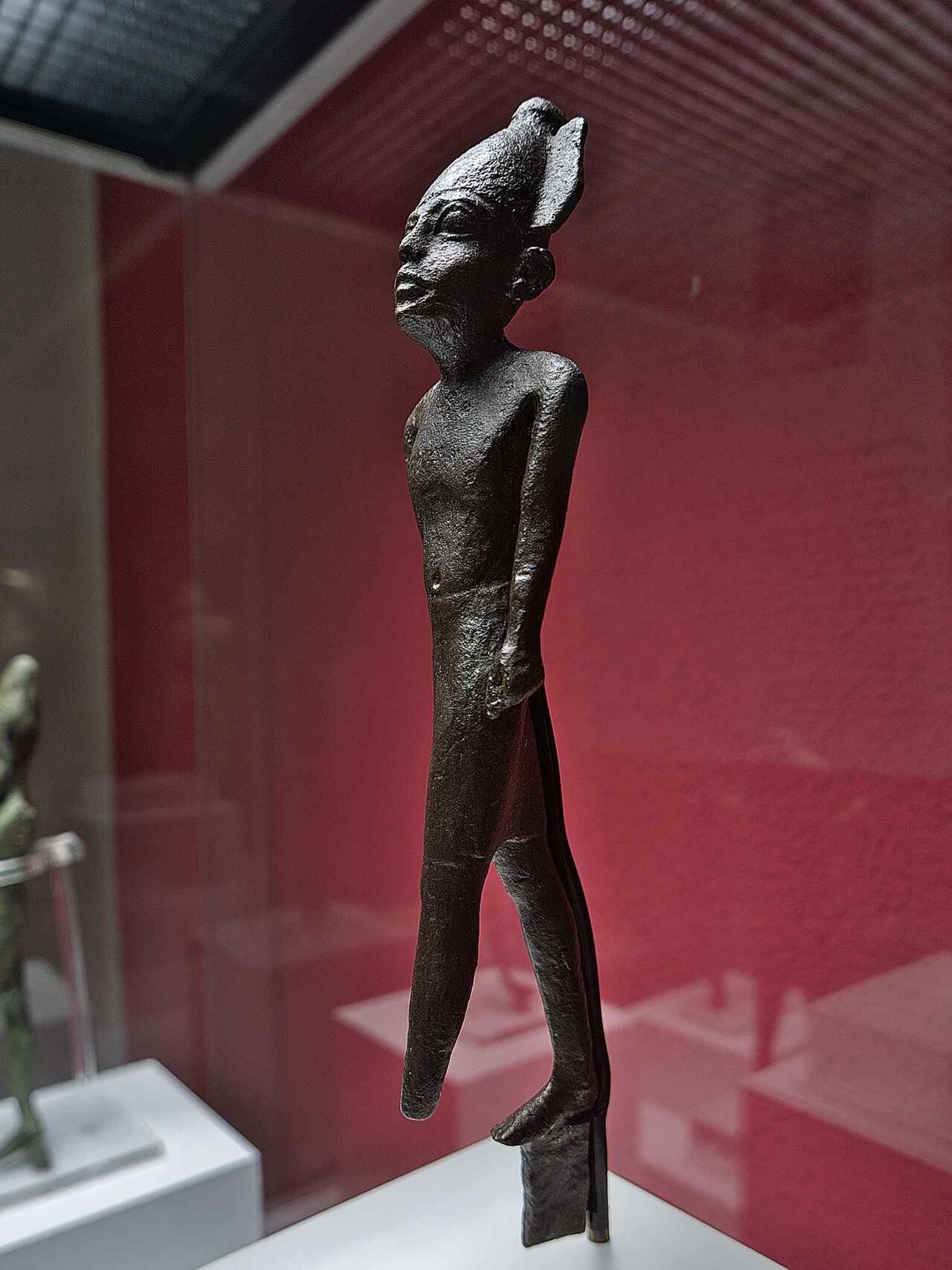
A Phoenician bronze figure of Melqart linked to Sancti Petri, reflecting Cádiz’s ancient religious and commercial world.Photo: Jl FilpoC, Wikimedia Commons, CC BY-SA 4.0. Cropped & resized. 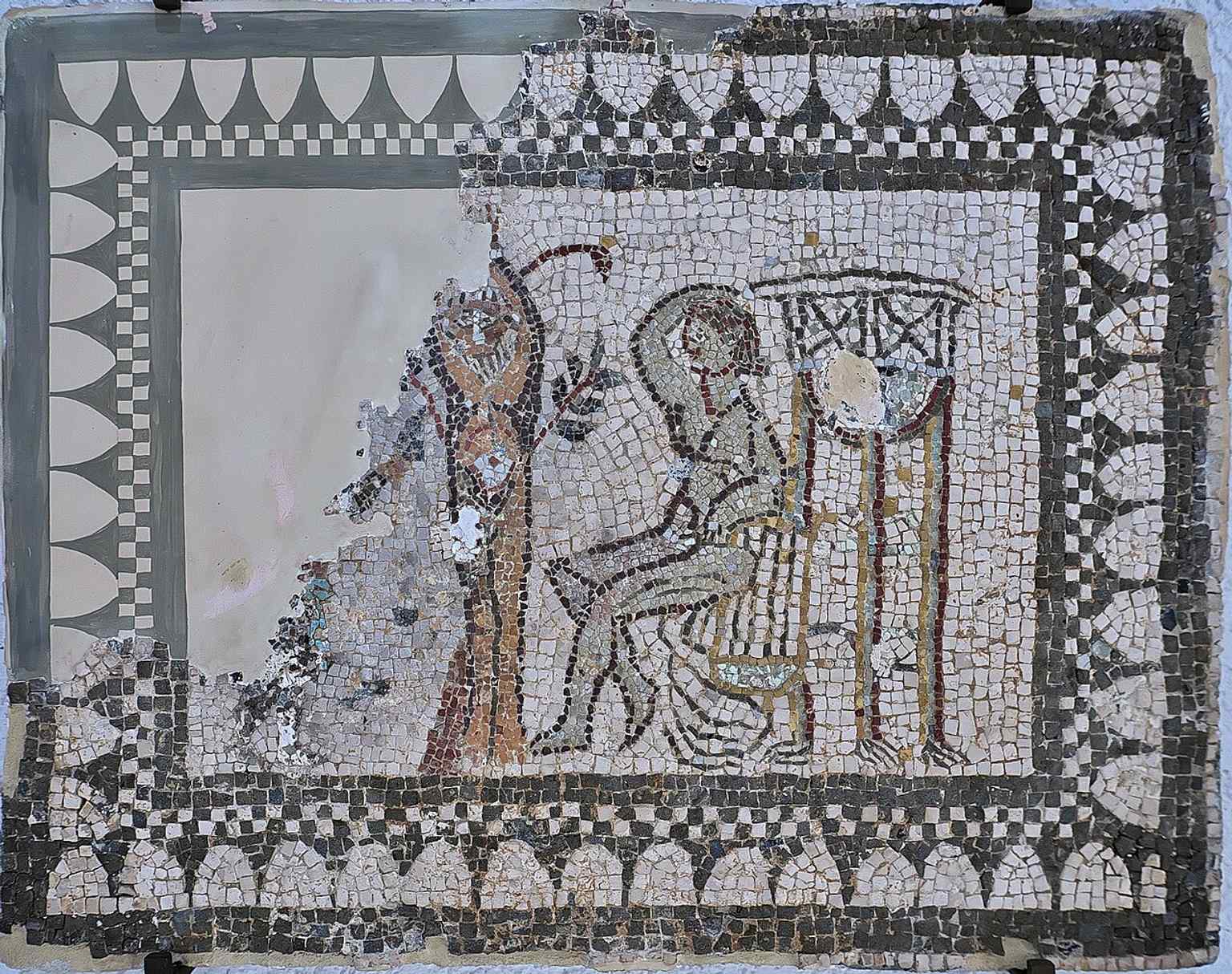
Roman floor mosaic with Apollo and Marsyas, showing the museum’s rich archaeological holdings from ancient Gades.Photo: Jl FilpoC, Wikimedia Commons, CC BY-SA 4.0. Cropped & resized. 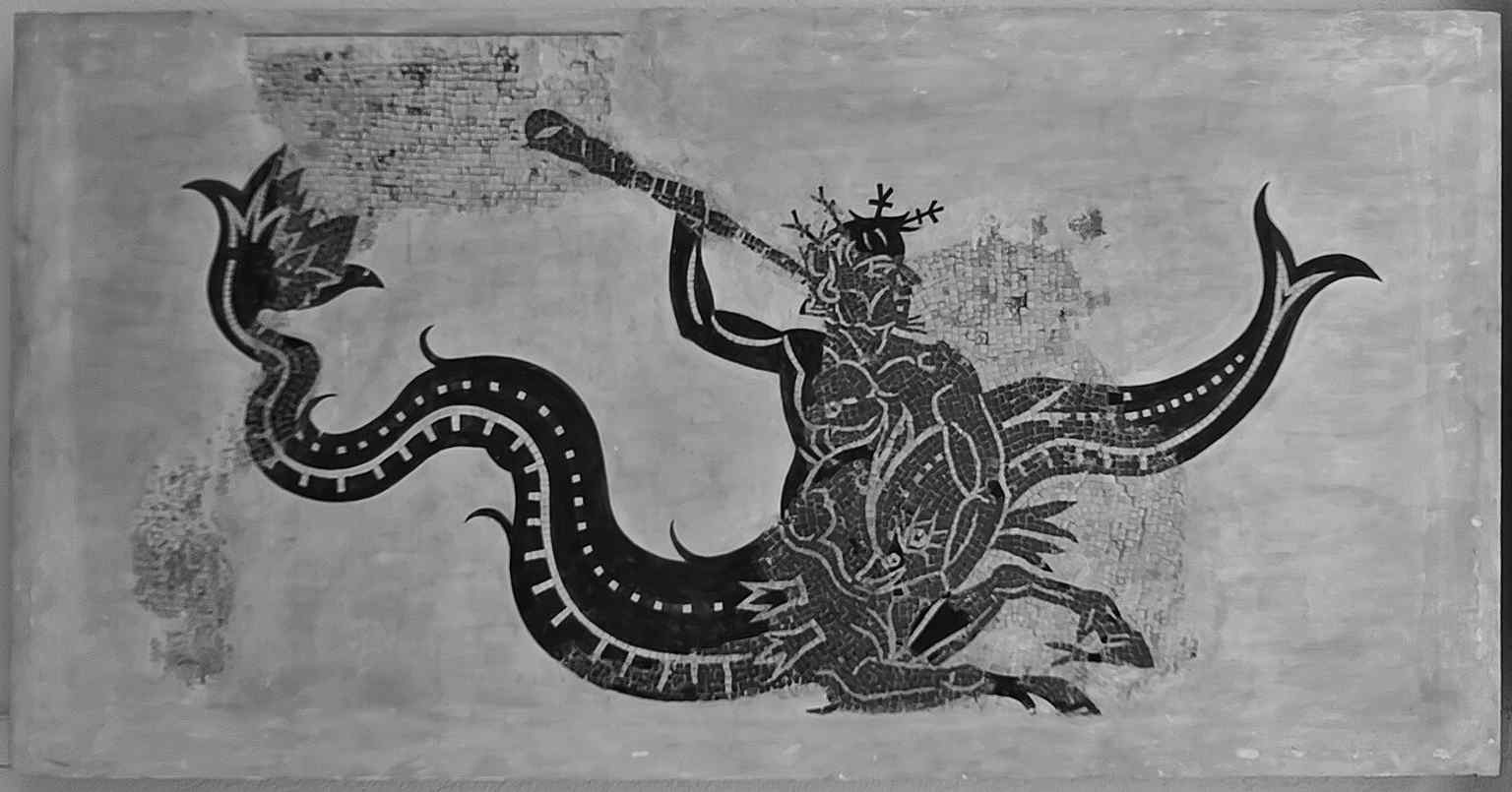
A Roman triton-and-dolphin mosaic from Paterna de Rivera, a striking example of the mosaics preserved in the archaeological section.Photo: Jl FilpoC, Wikimedia Commons, CC BY-SA 4.0. Cropped & resized. 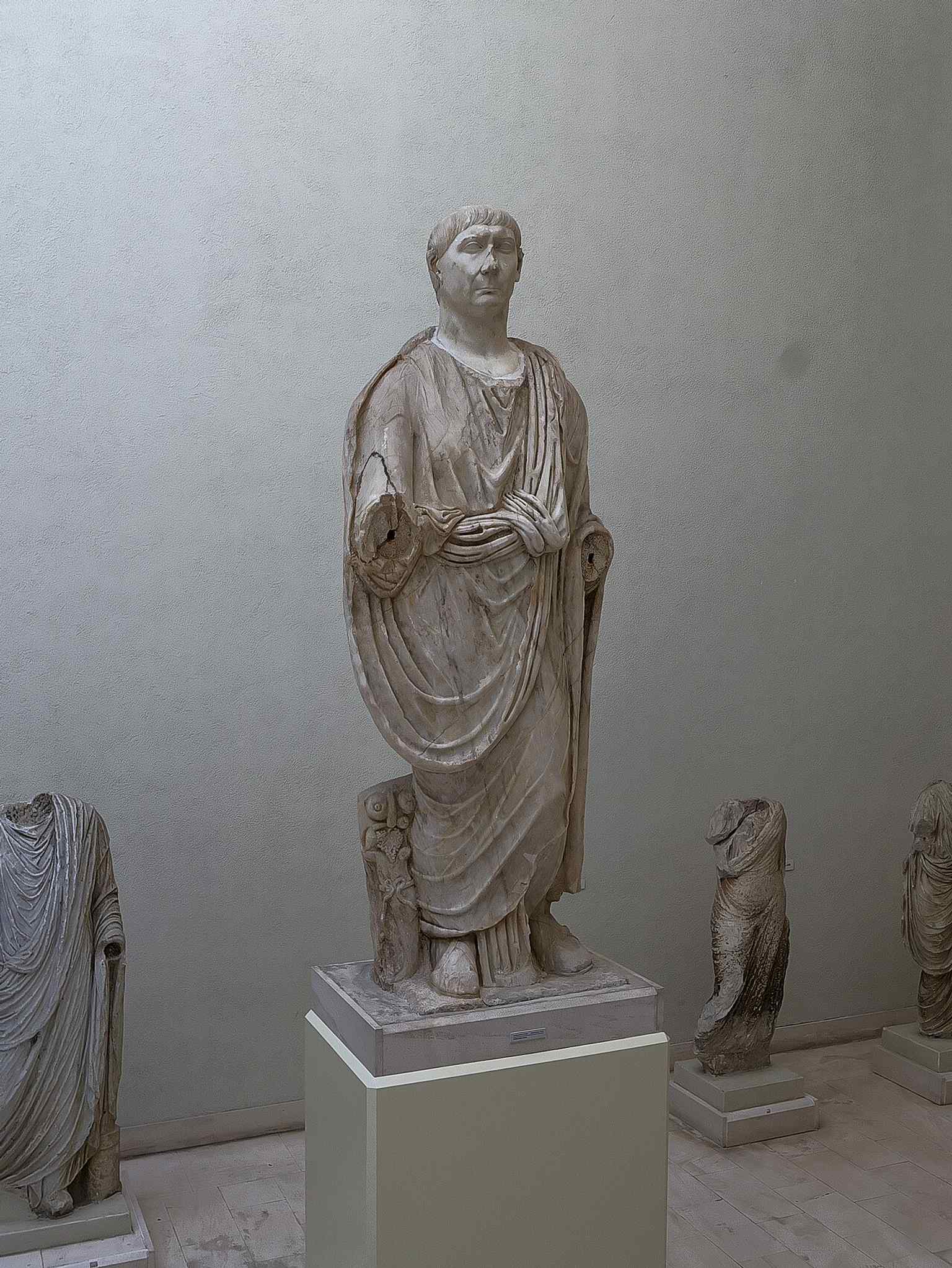
The colossal statue of Trajan, assembled from reused marble pieces and brought from Baelo Claudia.Photo: Jl FilpoC, Wikimedia Commons, CC BY-SA 4.0. Cropped & resized. 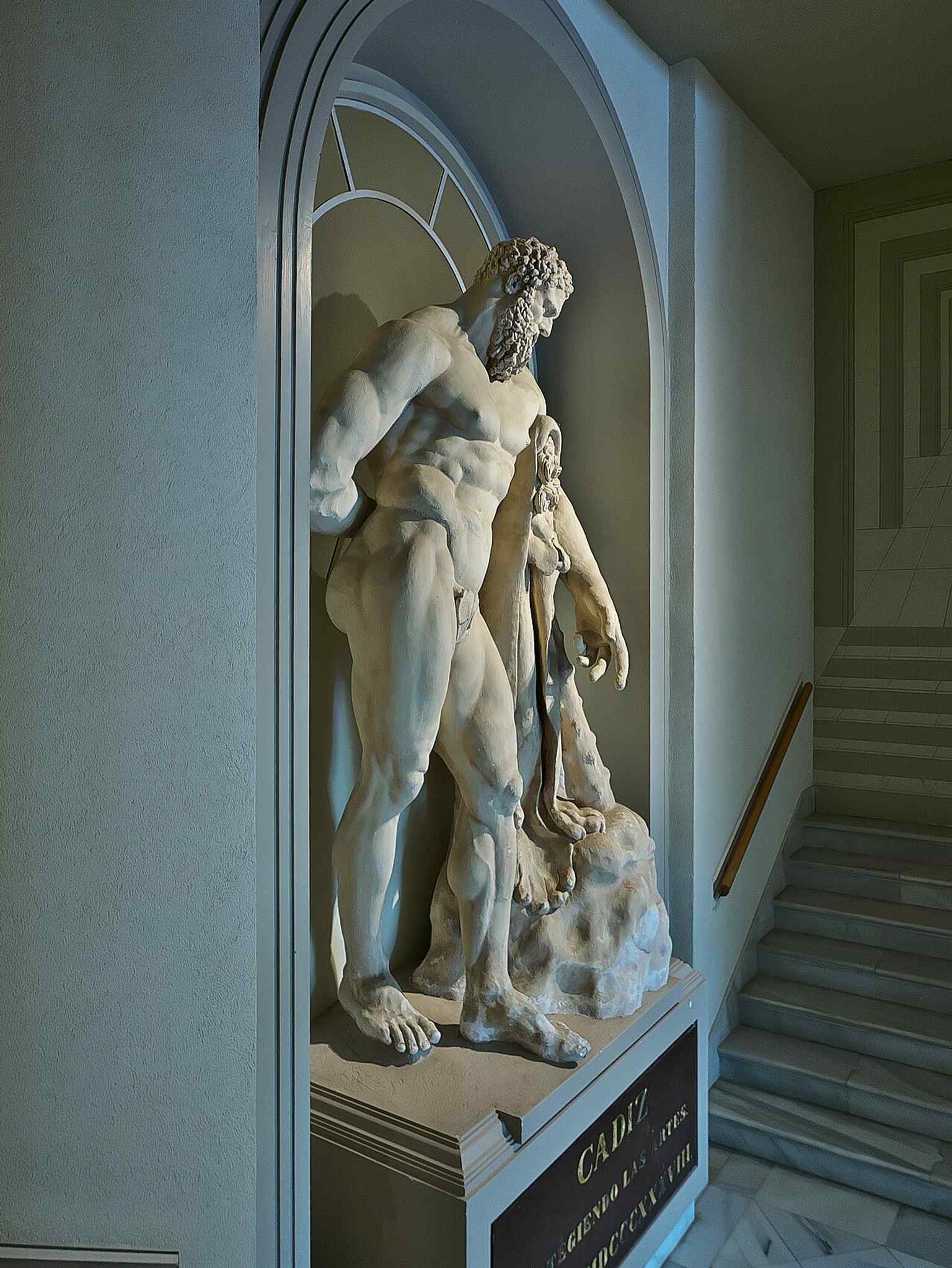
A plaster cast of the Farnese Hercules, echoing the museum’s classical sculpture displays and mythological themes.Photo: Jl FilpoC, Wikimedia Commons, CC BY-SA 4.0. Cropped & resized. 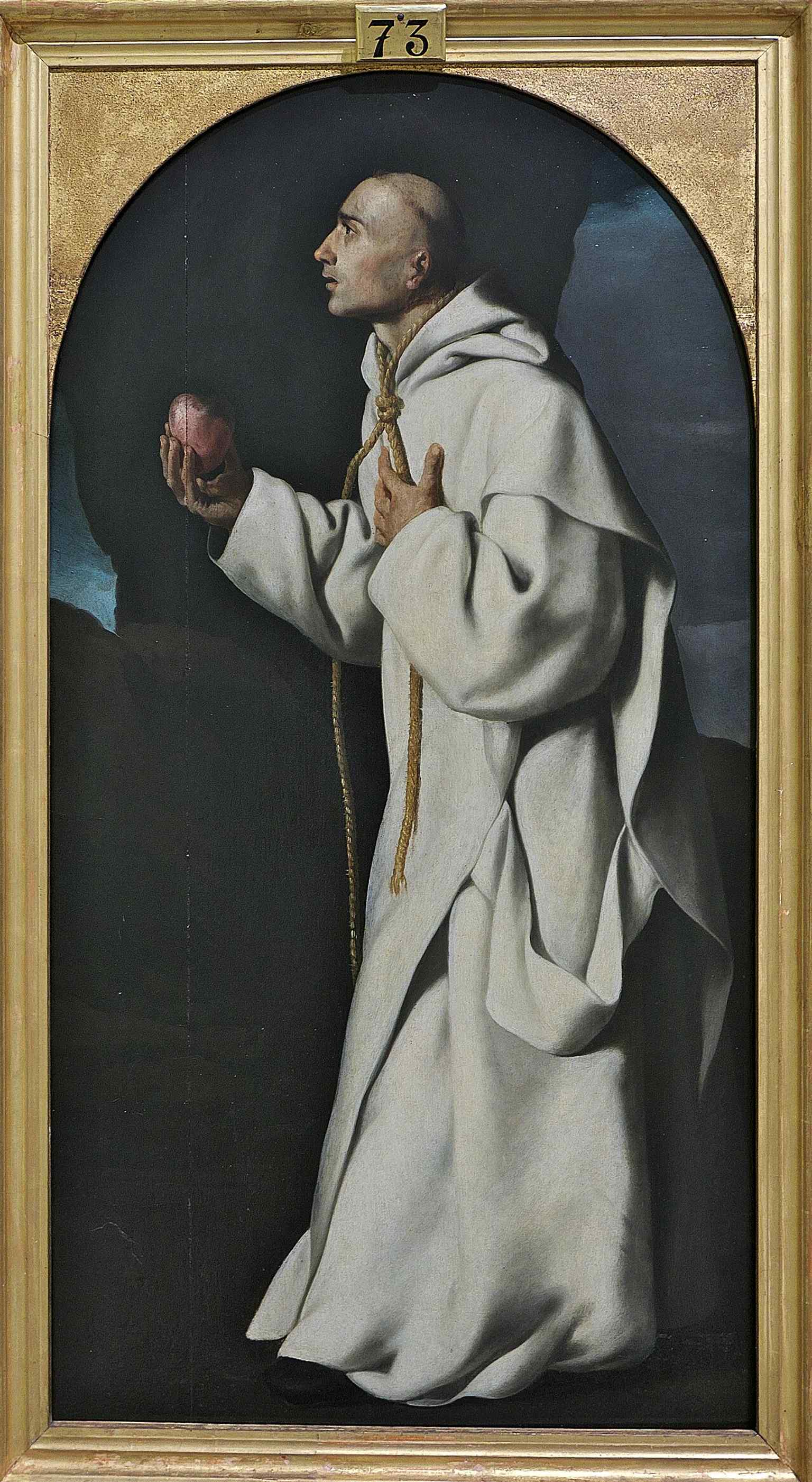
Zurbarán’s Beato John de Houghton, one of the masterpieces from the Cartuja de Jerez series now preserved in Cádiz.Photo: Jl FilpoC, Wikimedia Commons, CC BY-SA 4.0. Cropped & resized. 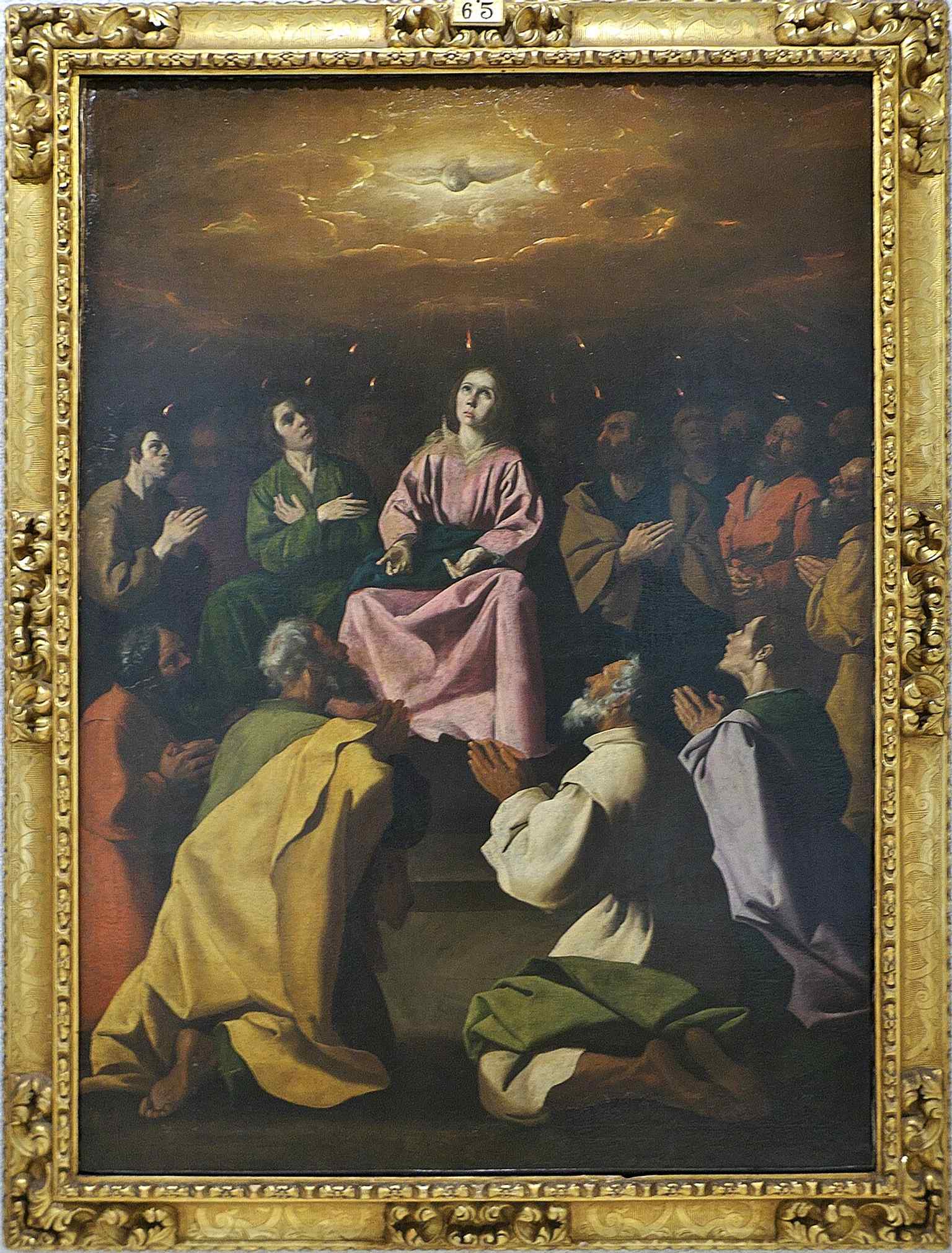
Zurbarán’s Pentecost, notable because it came from the Consulado de Cargadores a Indias rather than the Cartuja series.Photo: Jl FilpoC, Wikimedia Commons, CC BY-SA 4.0. Cropped & resized. 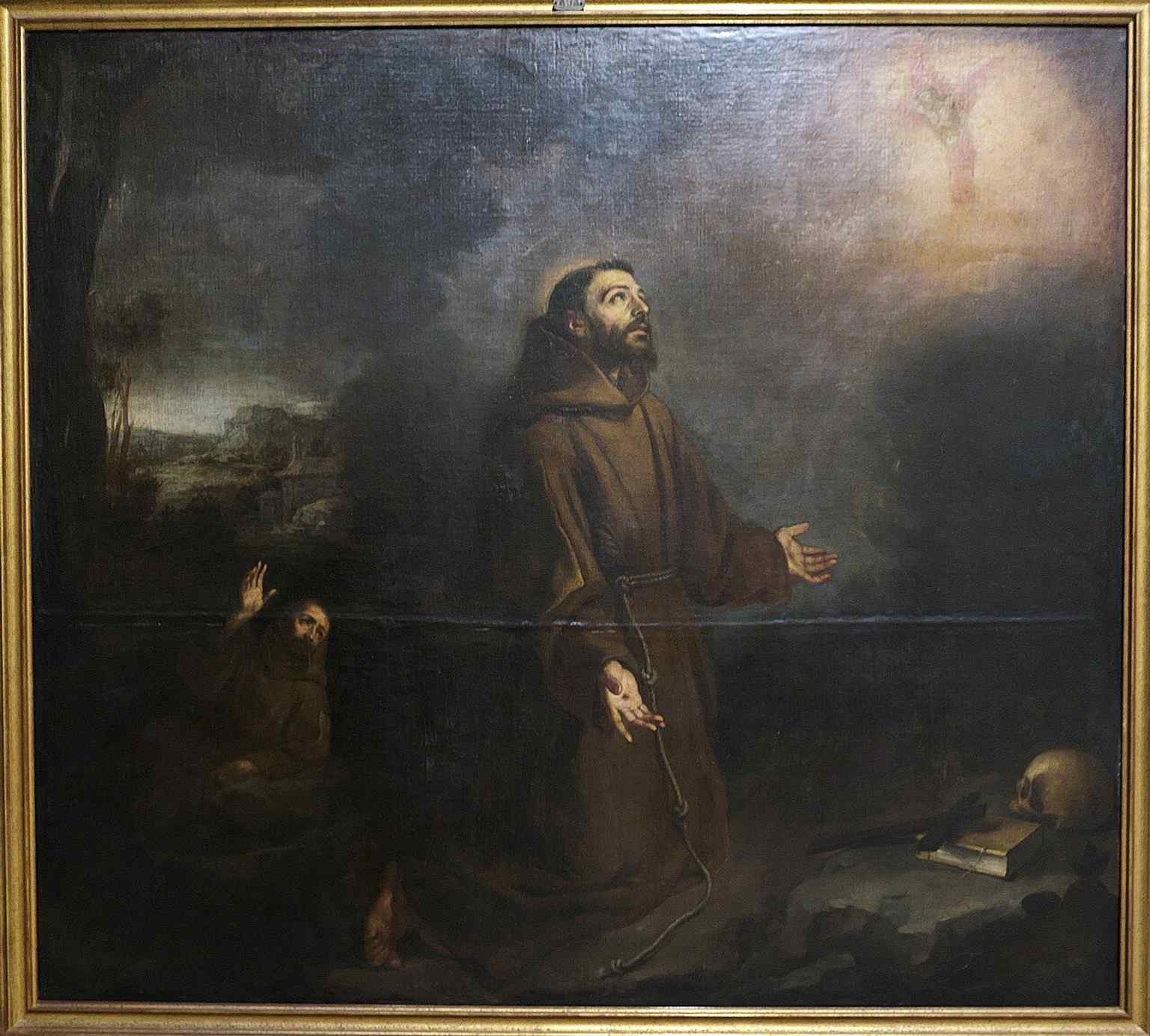
Murillo’s Stigmatisation of Saint Francis, part of the museum’s celebrated Baroque painting rooms.Photo: Jl FilpoC, Wikimedia Commons, CC BY-SA 4.0. Cropped & resized. 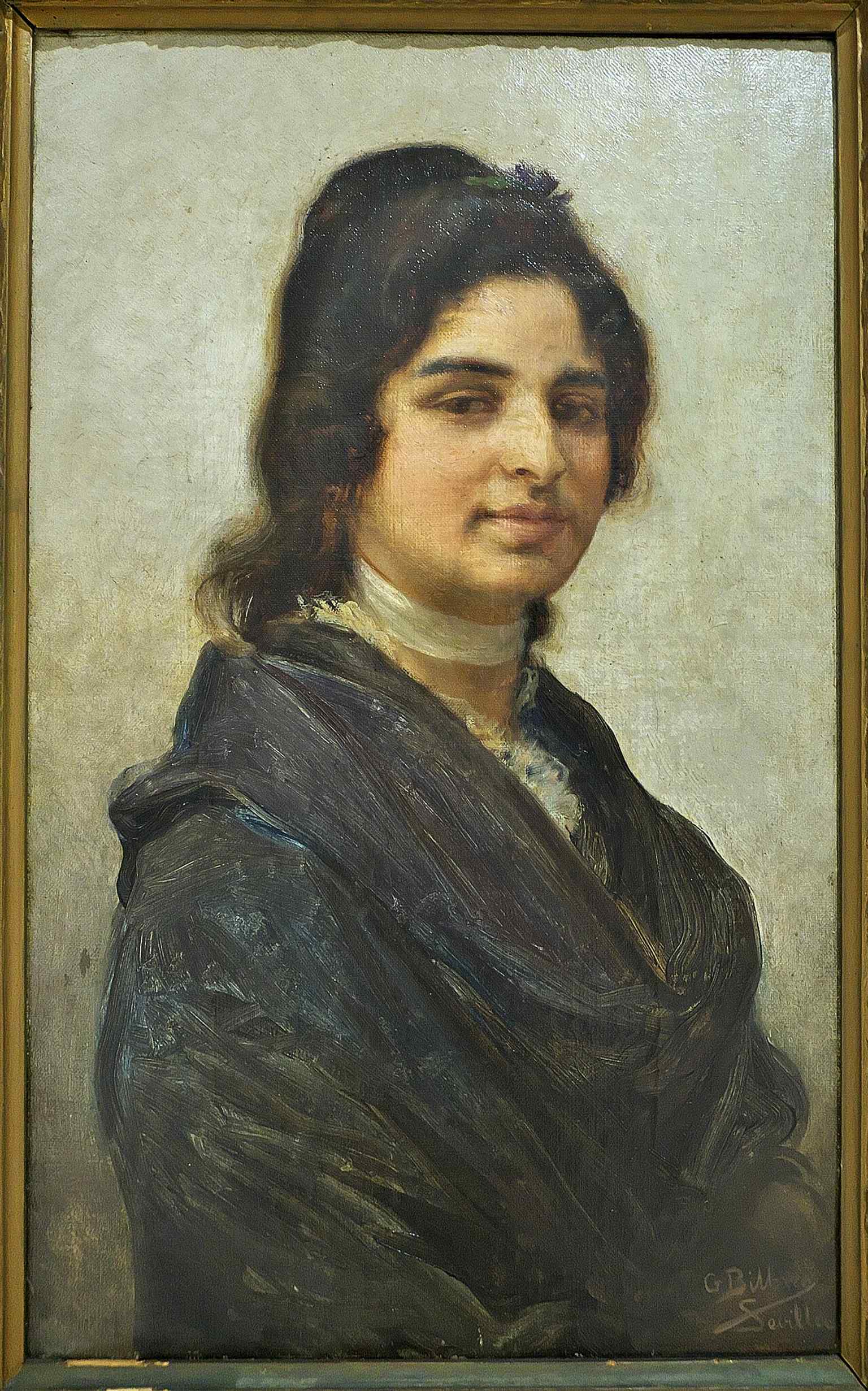
Gracia, a cigar worker by Gonzalo Bilbao, bringing the museum into the modern era with a vivid social portrait.Photo: Jl FilpoC, Wikimedia Commons, CC BY-SA 4.0. Cropped & resized. 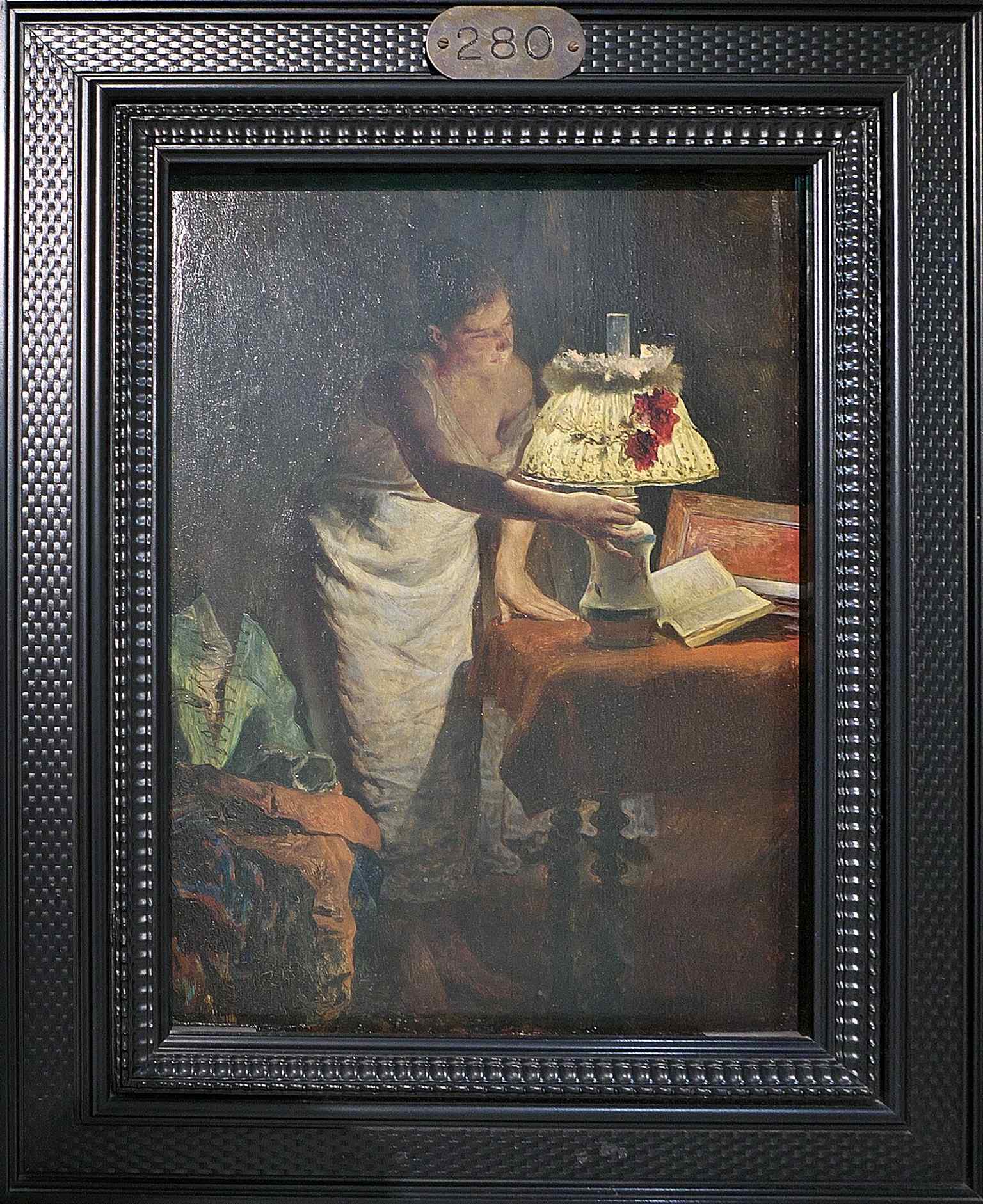
Buenas noches by José Jiménez Aranda, an early 20th-century work that broadens the museum beyond antiquities and Baroque art.Photo: Jl FilpoC, Wikimedia Commons, CC BY-SA 4.0. Cropped & resized. In front of you is a formal square edged by pale stone townhouses, laid out in a tidy geometric shape with diagonal paths crossing toward a raised circular center crowned by a…Read moreShow less
Open dedicated page →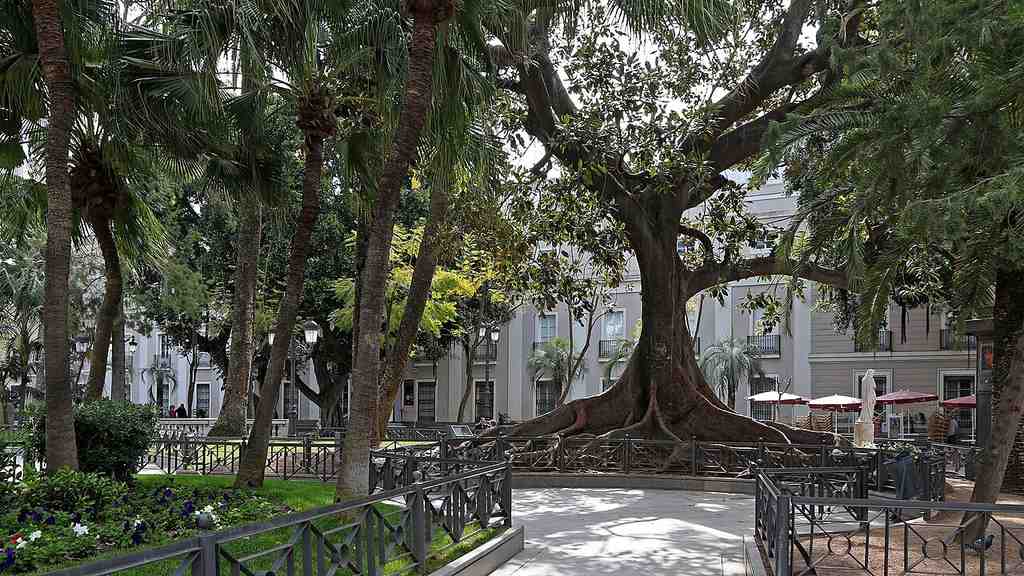
Mina SquarePhoto: Banja-Frans Mulder, Wikimedia Commons, CC BY 3.0. Cropped & resized. In front of you is a formal square edged by pale stone townhouses, laid out in a tidy geometric shape with diagonal paths crossing toward a raised circular center crowned by a tall lamppost.
Plaza de Mina looks calm now, but it began with a very practical act of urban recycling. In eighteen thirty-eight, Cádiz opened up the old orchard and infirmary of the Convent of San Francisco and turned the whole area into a public square. The city wanted breathing room... and, frankly, a bit of elegance. Architect Torcuato Benjumeda started the plan, then Juan Daura carried it forward, giving the square its distinctive layout: a near-perfect square, four diagonal walks meeting in the middle, and gardens tucked between them like green wedges.
The work moved quickly, though not cheaply. By late eighteen forty-two, the bill had reached one hundred seventy-eight thousand two hundred seventy-two reales and twenty maravedíes... roughly the equivalent of hundreds of thousands of euros in modern terms, depending on how you measure it. Cádiz paid for it with demolition materials from the old public infirmary and with help from the neighbors themselves. So yes, this place is polished, but it was also a community effort. Cities love a grand plan; they love it even more when someone else helps pay.
At the center once stood a statue of General Espoz y Mina, a hero of the Peninsular War against Napoleon. That statue has vanished, but the name stuck... mostly. Officially this used to be Plaza del General Espoz y Mina, and over time people did what people always do: they trimmed it down to Plaza de Mina. During the Franco era, the city tried renaming it Plaza del Generalísimo Franco in nineteen thirty-seven, but locals kept calling it Mina anyway. Cádiz can be politely stubborn.
If you glance around the edges, the square doubles as a catalog of nineteenth-century taste. Many of the houses are Isabeline in style, meaning they belong to the decorative, slightly theatrical architecture fashionable during the reign of Queen Isabella the Second. You’ll also spot late neoclassical restraint and a few baroque echoes hanging on. Number three carries a plaque marking the birthplace of Manuel de Falla, born here in eighteen seventy-six. At number twelve, the geologist José Macpherson was born. This square has quietly housed musicians, scientists, political clubs, and one famously fine hotel, Francia y París.
The museum building nearby ties directly into the square’s origin story too. Daura used former Franciscan land to raise the neoclassical building that now houses part of the Museum of Cádiz and the Academy of Fine Arts. If you want a quick visual check, take a look at the image on your screen and you’ll see how the square’s ordered paths and surrounding façades still hold that nineteenth-century sense of civic pride.
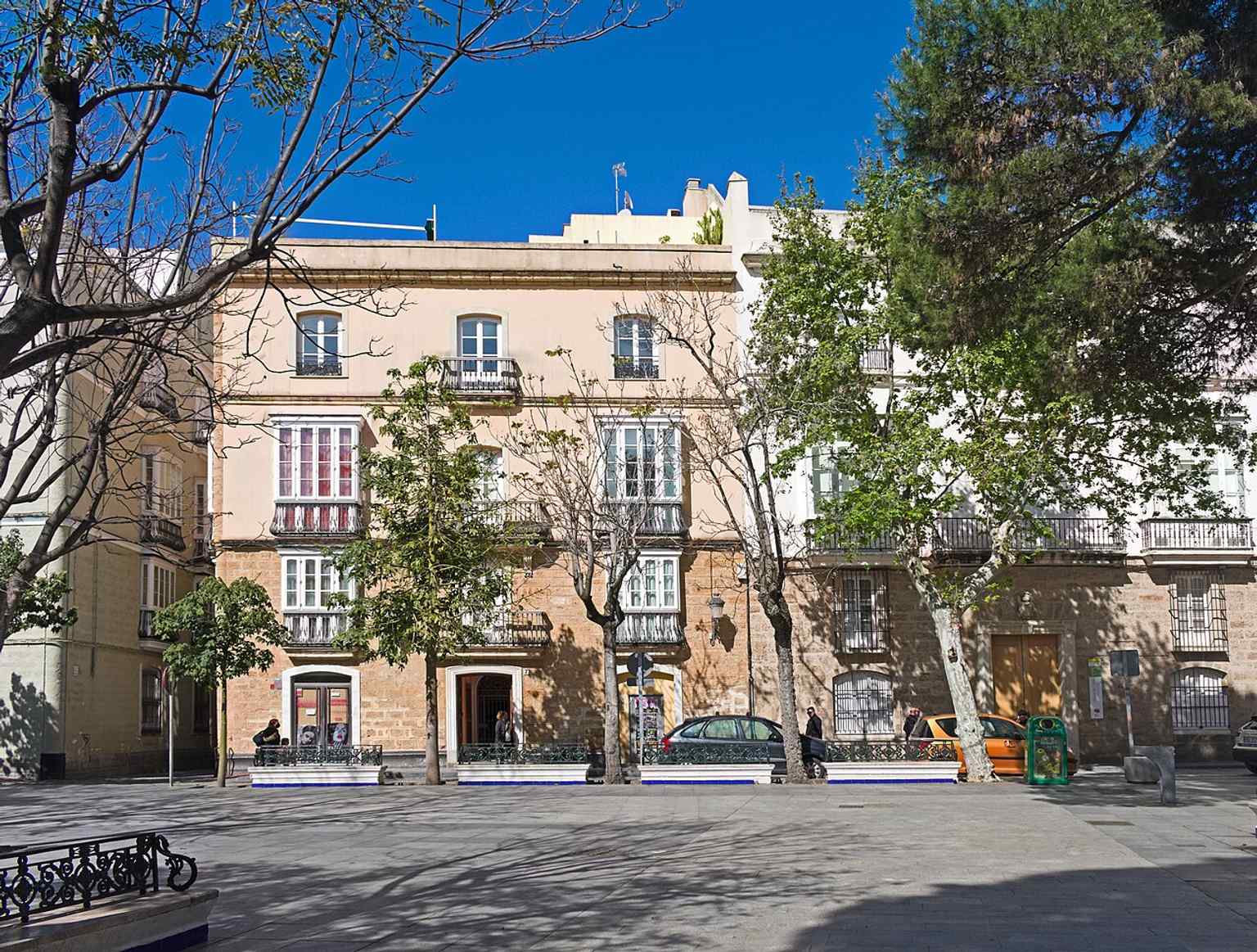
A street-level view of Plaza de Mina in Cádiz, the historic square created in 1838 on former Franciscan orchard land and later reshaped around its central garden.Photo: Ymblanter, Wikimedia Commons, CC BY-SA 4.0. Cropped & resized. And then there’s the greenery. After Genovés Park, this is one of Cádiz’s richest corners for tree species: plane trees, magnolias, jacarandas, Indian laurel, Canary palms, even the striking bunya-bunya. The square also has four white marble figures representing the seasons, each on a cylindrical pedestal. In a wonderfully human detail, after their restoration in two thousand twenty, Summer and Autumn ended up swapped from the logical seasonal order.
This is one of those Cádiz places where planning, politics, memory, and botany all decided to share the same address.
And because it’s a public square, Mina is open all day and all night.
Take a last look around, and when you’re ready, we can wander on to Alameda Apodaca.
Look for a long stone-and-garden promenade with a slightly broken, linear layout, circular and rectangular planted spaces, and glossy ceramic benches and iron lampposts that give…Read moreShow less
Open dedicated page →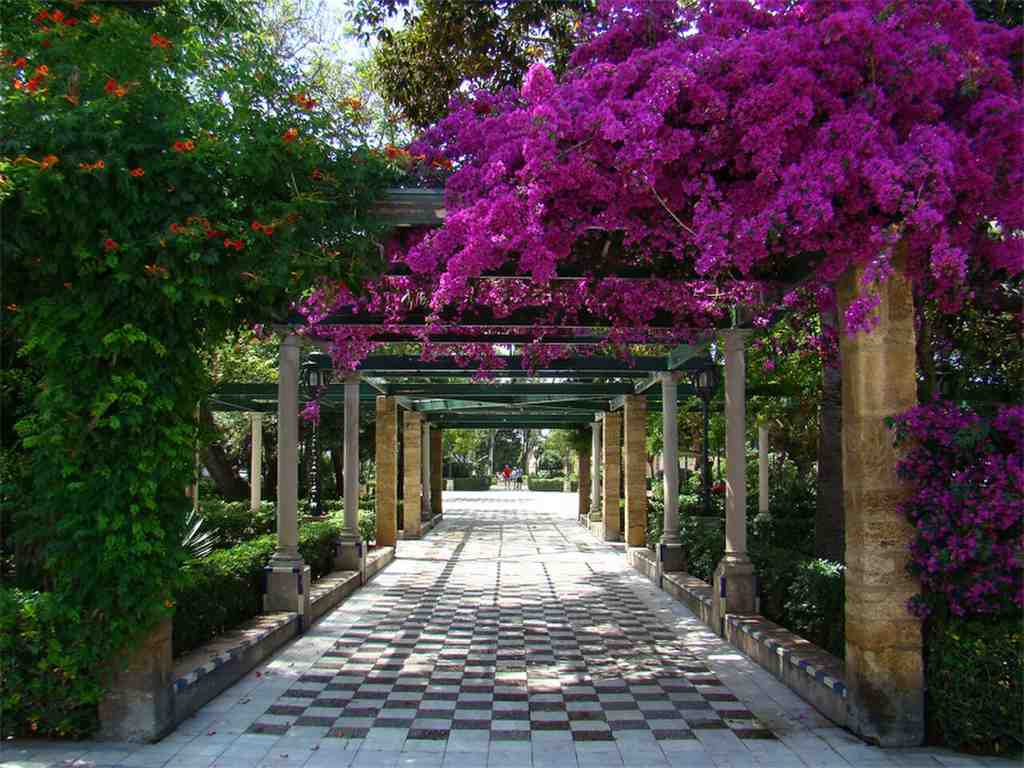
Alameda ApodacaPhoto: Tango7174, Wikimedia Commons, CC BY-SA 4.0. Cropped & resized. Look for a long stone-and-garden promenade with a slightly broken, linear layout, circular and rectangular planted spaces, and glossy ceramic benches and iron lampposts that give it a distinctly Andalusian flourish.
This is the Alameda many people still call Apodaca, though its official names changed on the twenty-ninth of November, two thousand and twenty-one: the eastern stretch became Alameda Clara Campoamor, and the western side Alameda Hermanas Carvia Bernal. Cádiz, like any old city with opinions, does not always give up familiar names quickly.
The ground here had a life long before these polished garden rooms appeared. People knew this area as Caletilla de Rota even before the city wall rose nearby. In sixteen seventeen, Cádiz created an early promenade here, broader than what you see now. Then, between seventeen fifty and seventeen fifty-four, the city laid out a formal walk with three lanes divided by rows of trees. By eighteen thirty-six, Manuel Bayo, with Juan de la Vega directing the work, turned it into a proper garden promenade split into three parts: an upper salon, a lower salon, and a narrower strip between them.
What really shaped the Alameda you see now came later, in nineteen twenty-six and nineteen twenty-seven. Architect Juan Talavera y Heredia, the same mind behind works in Seville’s Murillo Gardens, remade the promenade in the Regionalist style - that means a design language that borrowed local Andalusian ingredients and arranged them with a bit of ceremony. Here, that shows up in glazed ceramic tile, or azulejo, and in the wrought-iron benches and lamp standards. If you glance at the image on your screen, you can catch those details up close in the tile and fountain work.
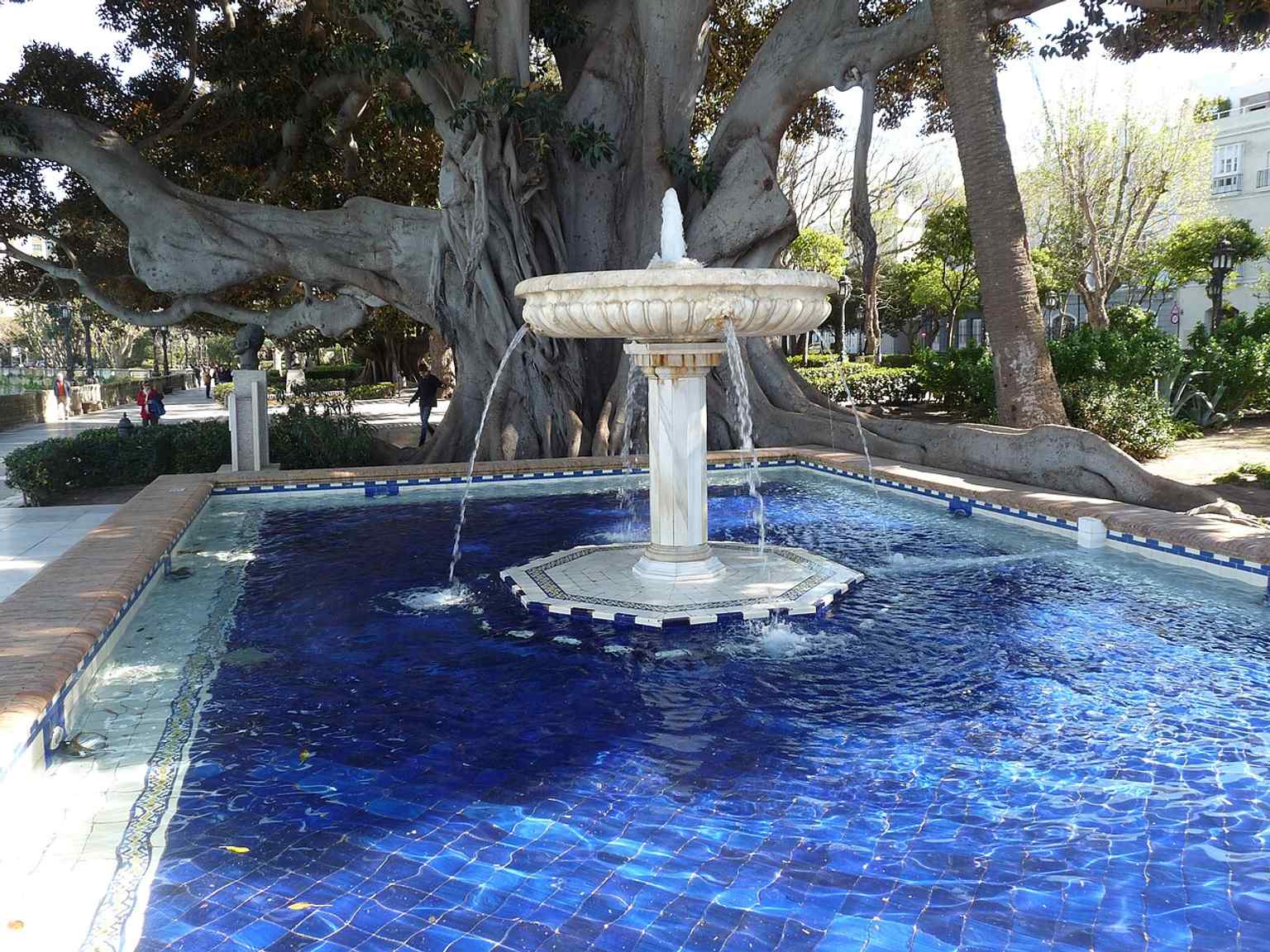
Azulejo and fountain details that reflect the Regionalist makeover of the Alameda by Juan Talavera in the 1920s.Photo: Smiley.toerist, Wikimedia Commons, CC BY-SA 4.0. Cropped & resized. The layout feels almost like a chain of outdoor rooms: little circular spaces, rectangular salons, and planted parterres - formal flower beds - all organized around the monument to Claudio López Bru, the second Marquis of Comillas. Sculptor Antonio Parera Saurina created it, and the monument opened in nineteen twenty-two. Beneath it sits a crypt that once served as a library, which is a very Cádiz detail: even the monuments have a second job.
The planting matters just as much as the stone and iron. Along the seaward side stand some of the promenade’s great characters, especially the huge ficus macrophylla trees brought from Australia and planted in the early twentieth century. Have a look at the close-up in the app and you’ll see why they dominate the scene with such confidence. Around them, the Alameda also holds ombús, a cherimoya tree, twin fountains with bronze boys carrying fish, and a whole cast of busts honoring figures from former Spanish colonies, including José Martí, José Rizal, Rubén Darío, and Juan Pablo Duarte.
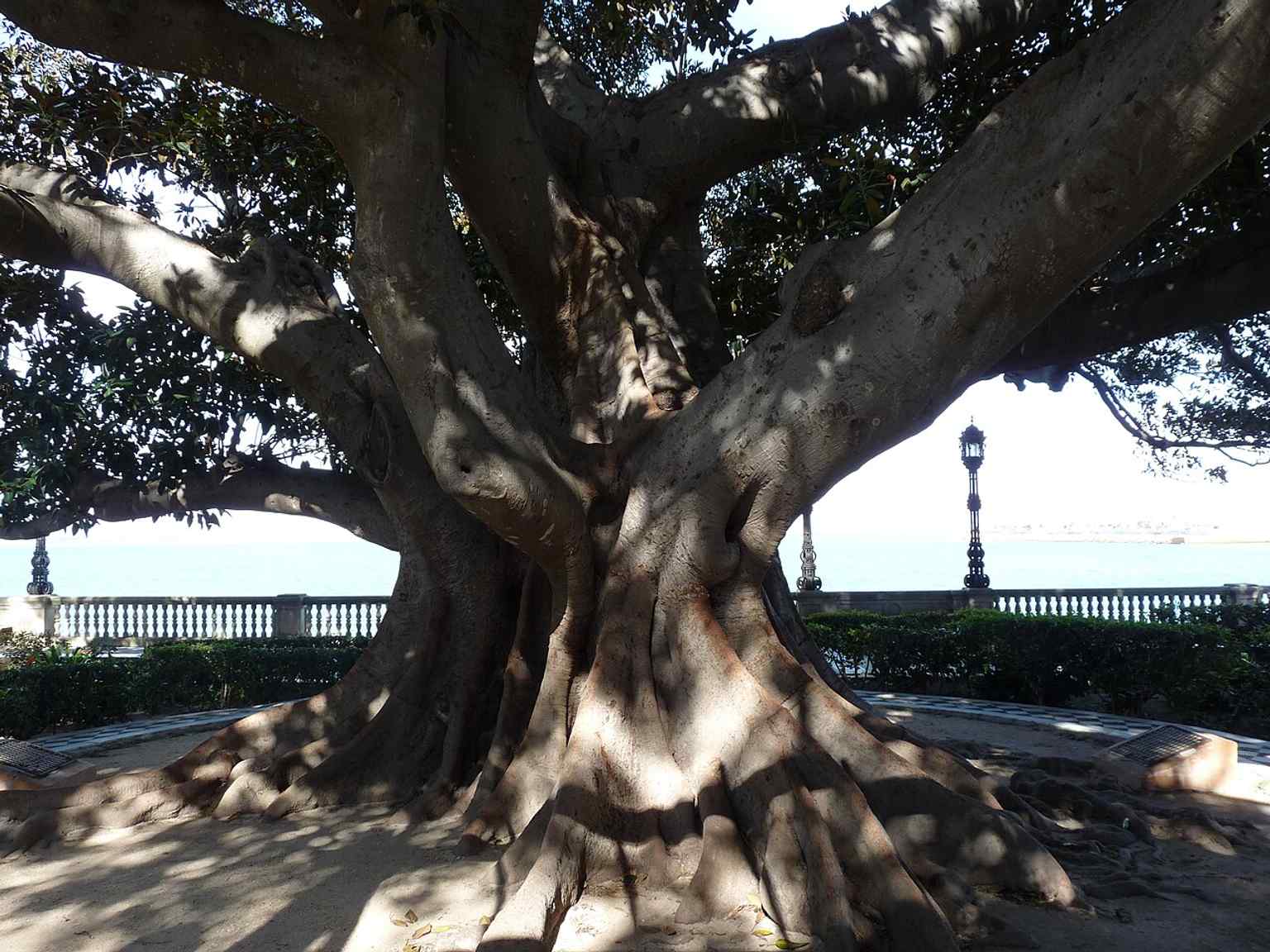
A close look at the Alameda’s giant ficus macrophylla, one of the exotic trees planted along the seaside promenade in the early 20th century.Photo: Smiley.toerist, Wikimedia Commons, CC BY-SA 4.0. Cropped & resized. No wonder Andalusia added these gardens to its General Catalogue of Historic Heritage in two thousand and four.
This promenade shows Cádiz at its most elegant and slightly theatrical.
Take your time here, and when you’re ready, we can continue toward the Baluarte de la Candelaria.
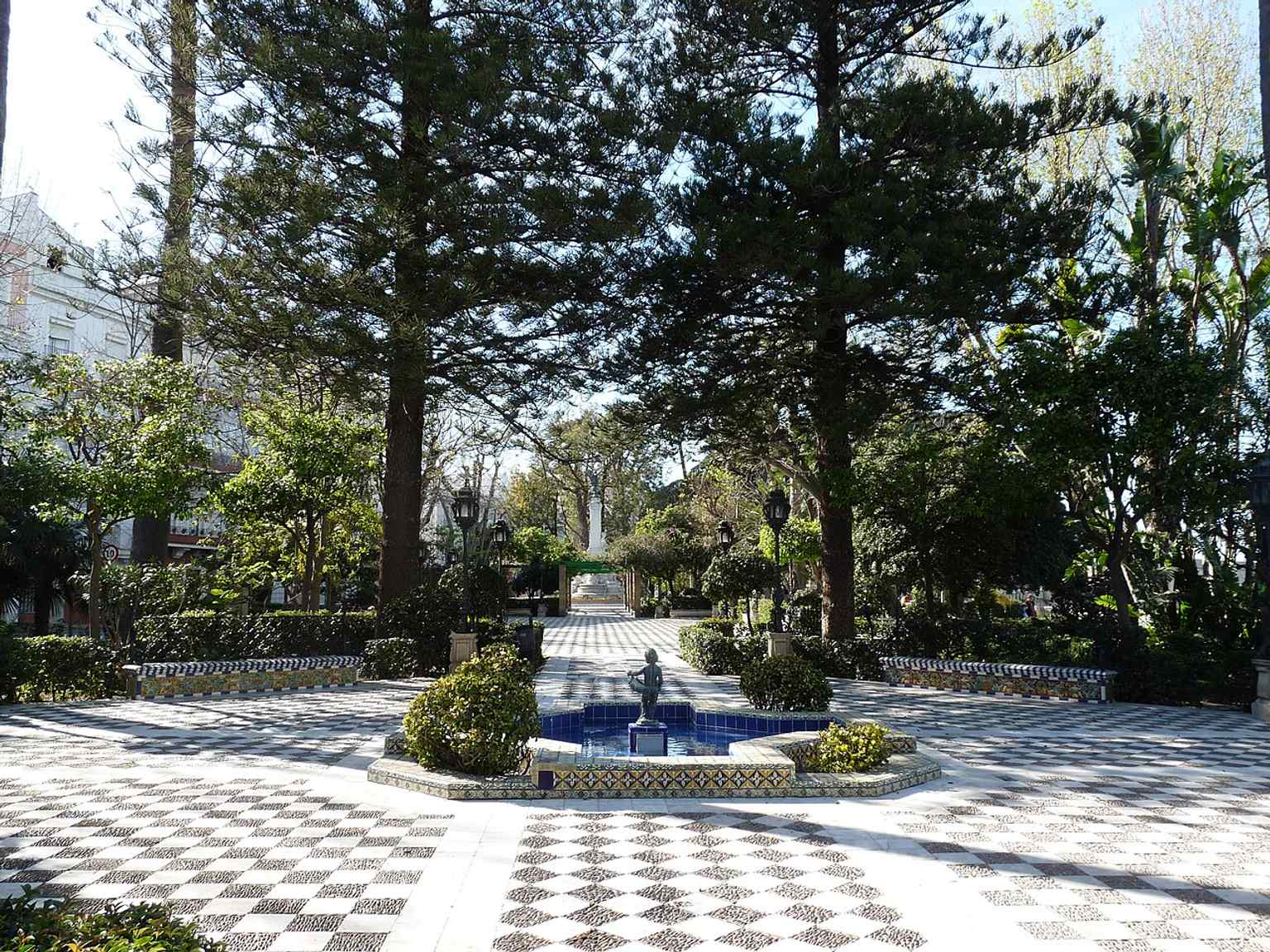
One of the Alameda Apodaca fountains, part of the elegant garden promenade that runs beside Cádiz’s historic city wall.Photo: Smiley.toerist, Wikimedia Commons, CC BY-SA 4.0. Cropped & resized. 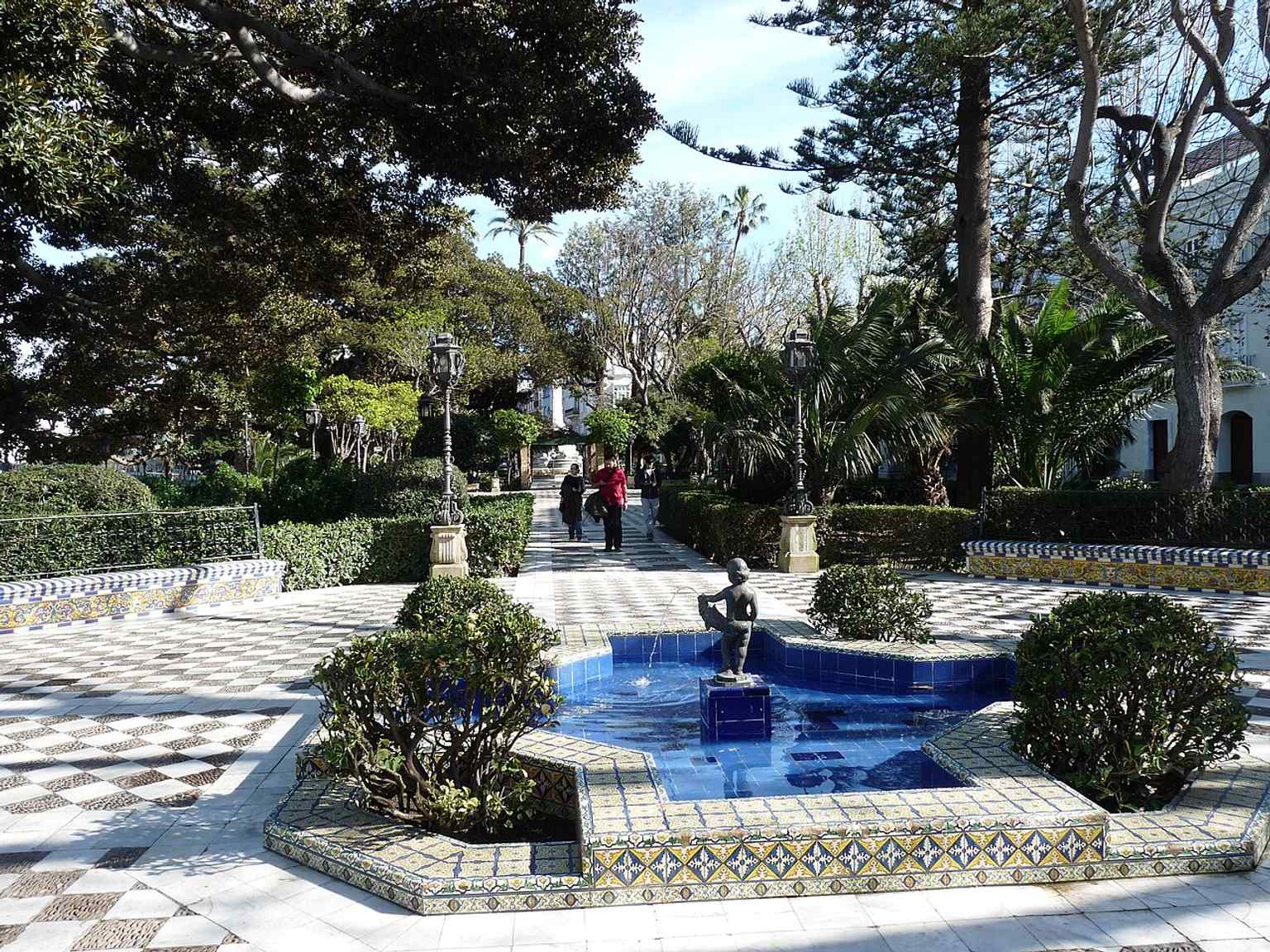
A second view of the Alameda’s fountain-lined walk, showing the landscaped promenade that links the wall and the seafront.Photo: Smiley.toerist, Wikimedia Commons, CC BY-SA 4.0. Cropped & resized. Ahead of you is a low stone bastion with angular sea walls and a squat central block, its ramparts jutting out like a wedge into the water. In sixteen seventy-two, Governor…Read moreShow less
Open dedicated page →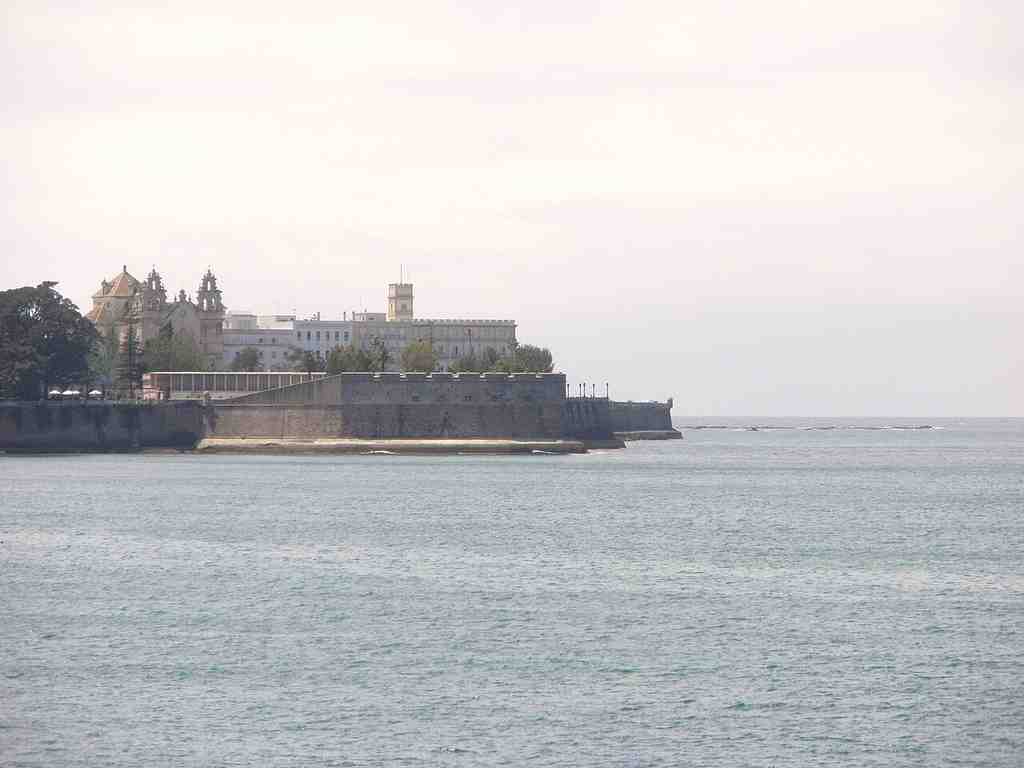
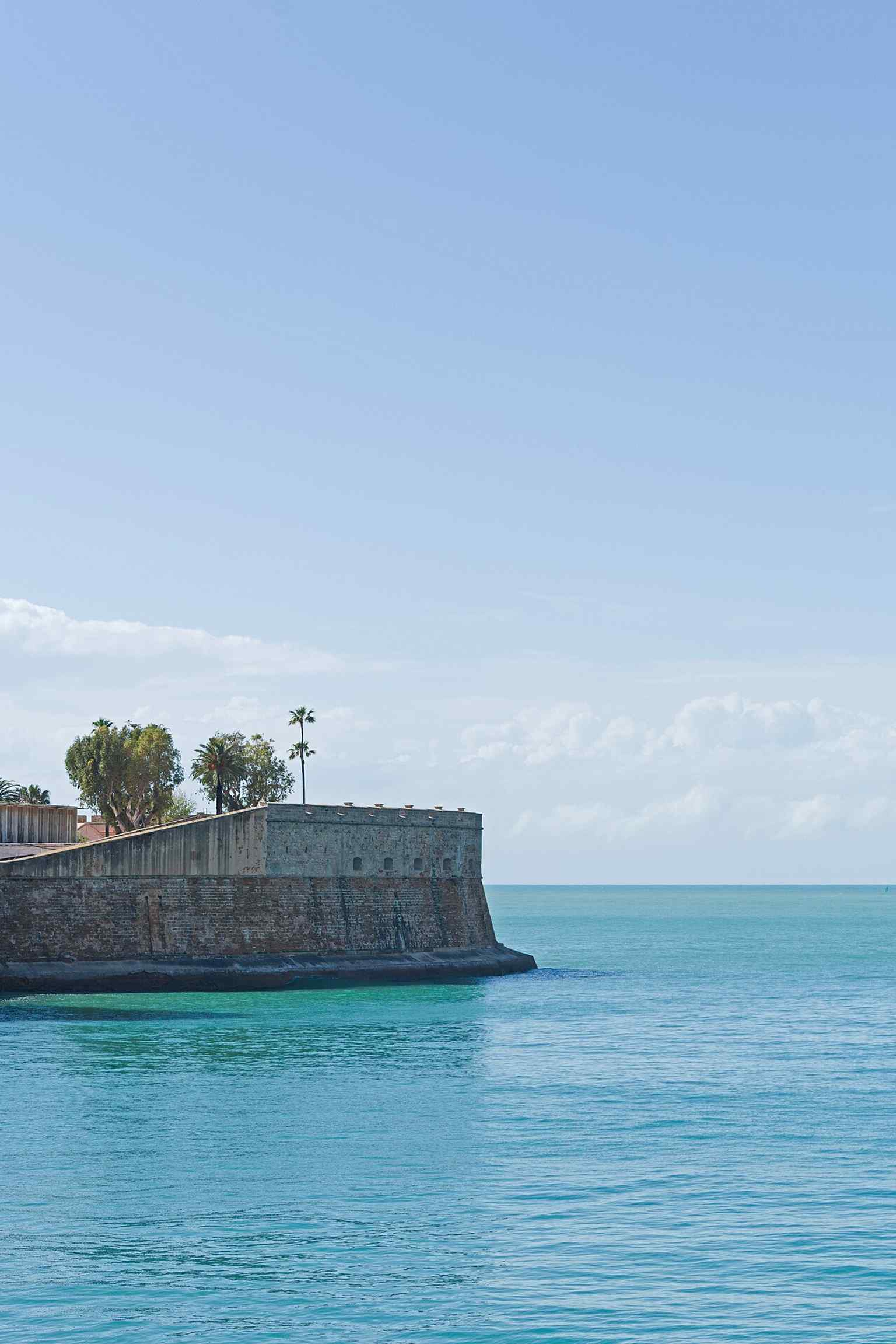
Baluarte de la Candelaria (Cádiz)Photo: Emilio J. Rodríguez Posada, Wikimedia Commons, CC BY-SA 3.0. Cropped & resized. Ahead of you is a low stone bastion with angular sea walls and a squat central block, its ramparts jutting out like a wedge into the water.
In sixteen seventy-two, Governor Diego Caballero de Illescas chose this raised point of land because it could watch the harbor entrance and answer fast. He gave Cádiz a fort whose thick outer wall worked as a breakwater, a sea barrier that took the force of the waves while shielding the approach to the port. On your screen, the aerial view shows that defensive shape beautifully. From here, cannons controlled the channel... a firm hint to unwelcome visitors.
An elevated view of the bastion from Alameda Apodaca, highlighting the strong sea-facing walls that made it both a fortress and a breakwater.Photo: Ymblanter, Wikimedia Commons, CC BY-SA 4.0. Cropped & resized. The bastion later served as a barracks, an engineers’ depot, and even a dovecote for the army’s pigeon post... quaint until you remember it was military communications. After restoration, it reopened as a cultural space, briefly under the name Sea Museum, and now hosts exhibitions. It is usually open Tuesday through Saturday, from ten A-M to nine P-M, and closed Monday and Sunday. This fort spent centuries guarding Cádiz, and now it guards memory instead. When you’re ready, we can continue toward the Gran Teatro Falla.
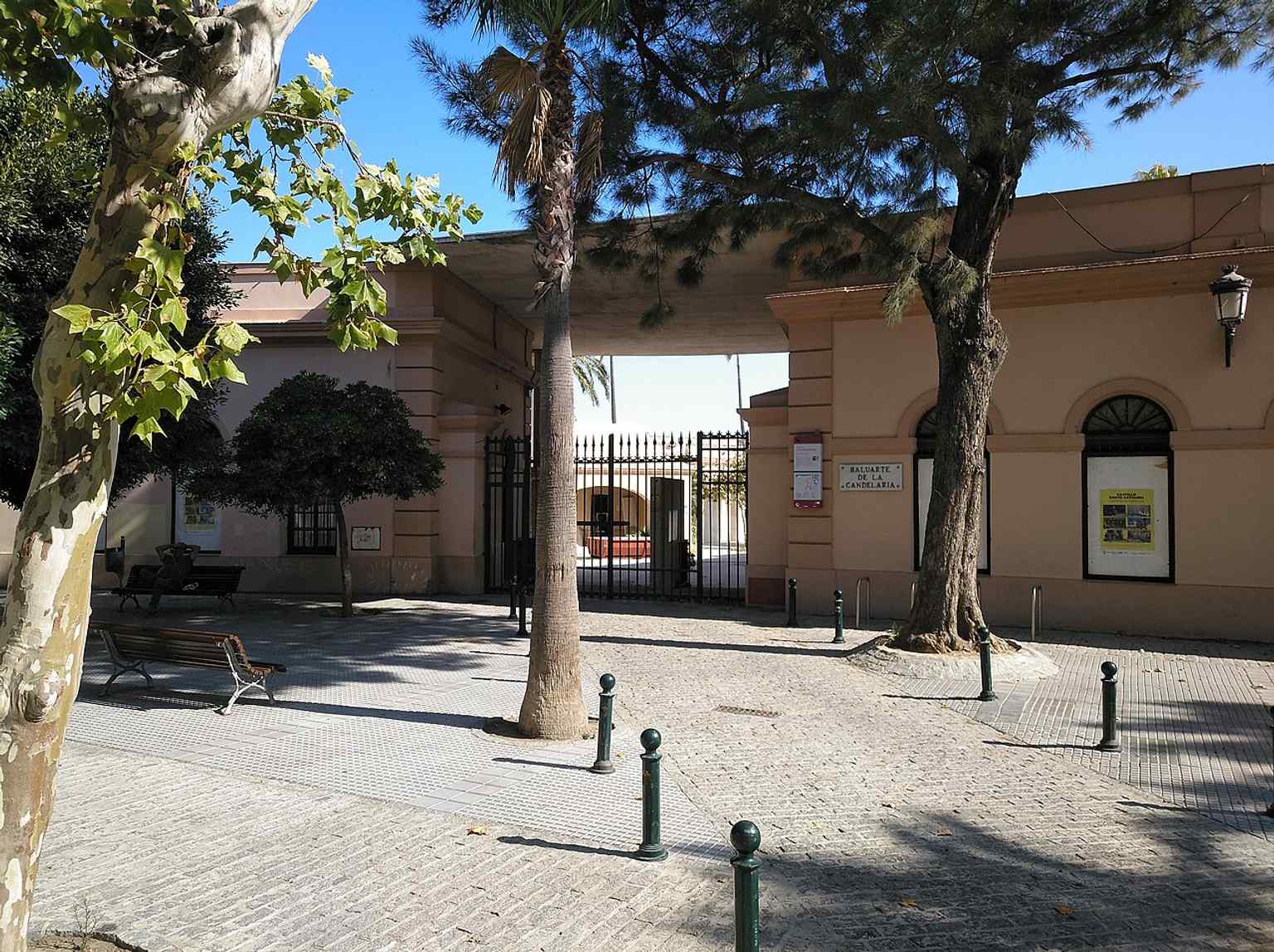
A clear view of Baluarte de la Candelaria, the 17th-century Cádiz fort built to guard the harbor approach and break the Atlantic waves.Photo: Axel Cotón Gutiérrez, Wikimedia Commons, CC BY-SA 4.0. Cropped & resized. 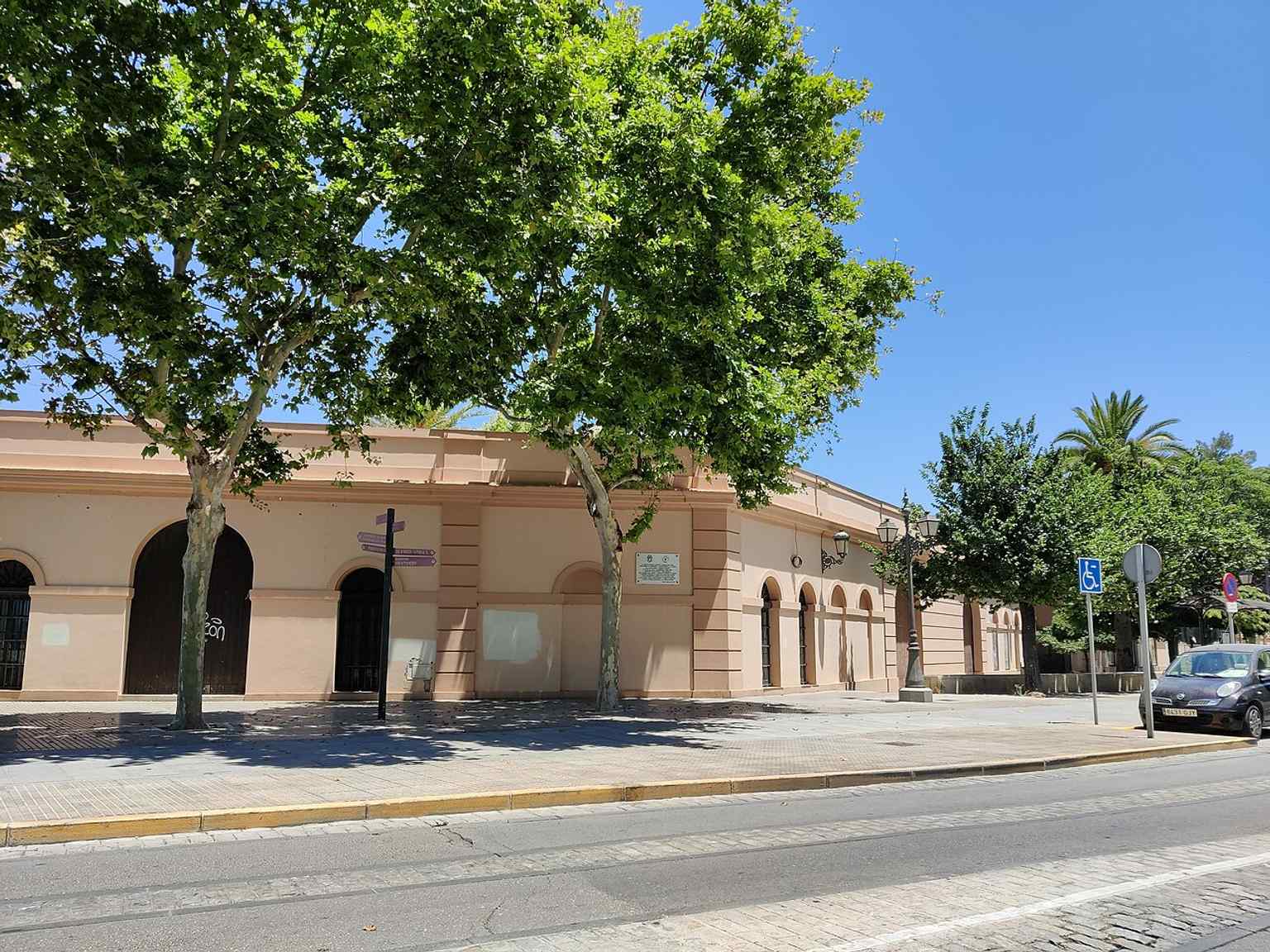
The seafront bastion of the Candelaria, showing how this fortified point once controlled the entrance channel to Cádiz’s port.Photo: El Pantera, Wikimedia Commons, CC BY-SA 4.0. Cropped & resized. On your left rises a red-brick theater with three large horseshoe arches, striped red-and-white arch bands, and a sturdy corner tower that makes it look like a very cultured…Read moreShow less
Open dedicated page →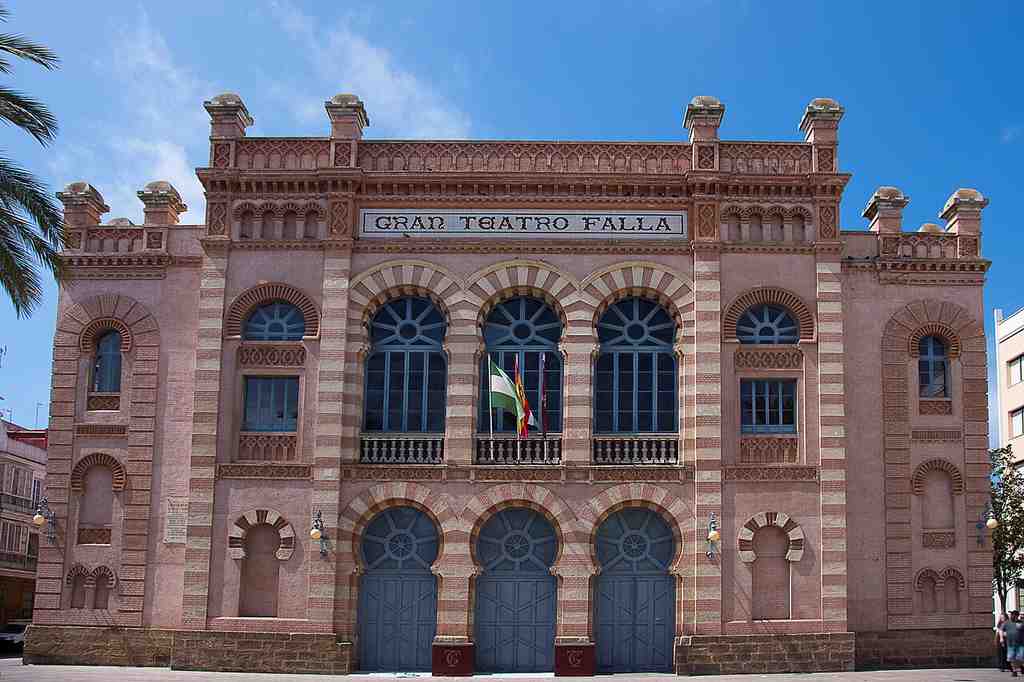
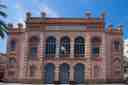
Gran Teatro FallaPhoto: Anual, Wikimedia Commons, CC BY-SA 4.0. Cropped & resized. On your left rises a red-brick theater with three large horseshoe arches, striped red-and-white arch bands, and a sturdy corner tower that makes it look like a very cultured fortress.
Gran Teatro Falla earned that dramatic face the hard way. Architects Adolfo Morales de los Ríos and Adolfo del Castillo Escribano began work in eighteen eighty-four on the site of an earlier wooden theater from eighteen seventy-one. That first building burned in eighteen eighty-one... which is a brisk and rather rude ending for a theater. In eighteen eighty-six, Cádiz City Hall took control of the project, but money kept running short, so the work stalled again and again. Municipal architect Juan Cabrera de la Torre eventually reshaped much of the original plan, and the building finally reached the finish line in nineteen oh five. It opened on the twelfth of January, nineteen ten, with a symphony by Barbieri.
The style is neo-Mudéjar, a revival style that borrows from historic Islamic architecture in Spain. Those horseshoe arches come from the Cordoban emiral tradition, and the red brick recalls Almohad building. If you want a clean look at the façade’s symmetry, glance at the app image now. Inside, the theater follows a horseshoe plan too, wrapping its seats around the stage. It holds one thousand two hundred and fourteen people, spread through stalls, boxes, the amphitheater, and the “paradise” gallery... the highest seats, named with more optimism than legroom.
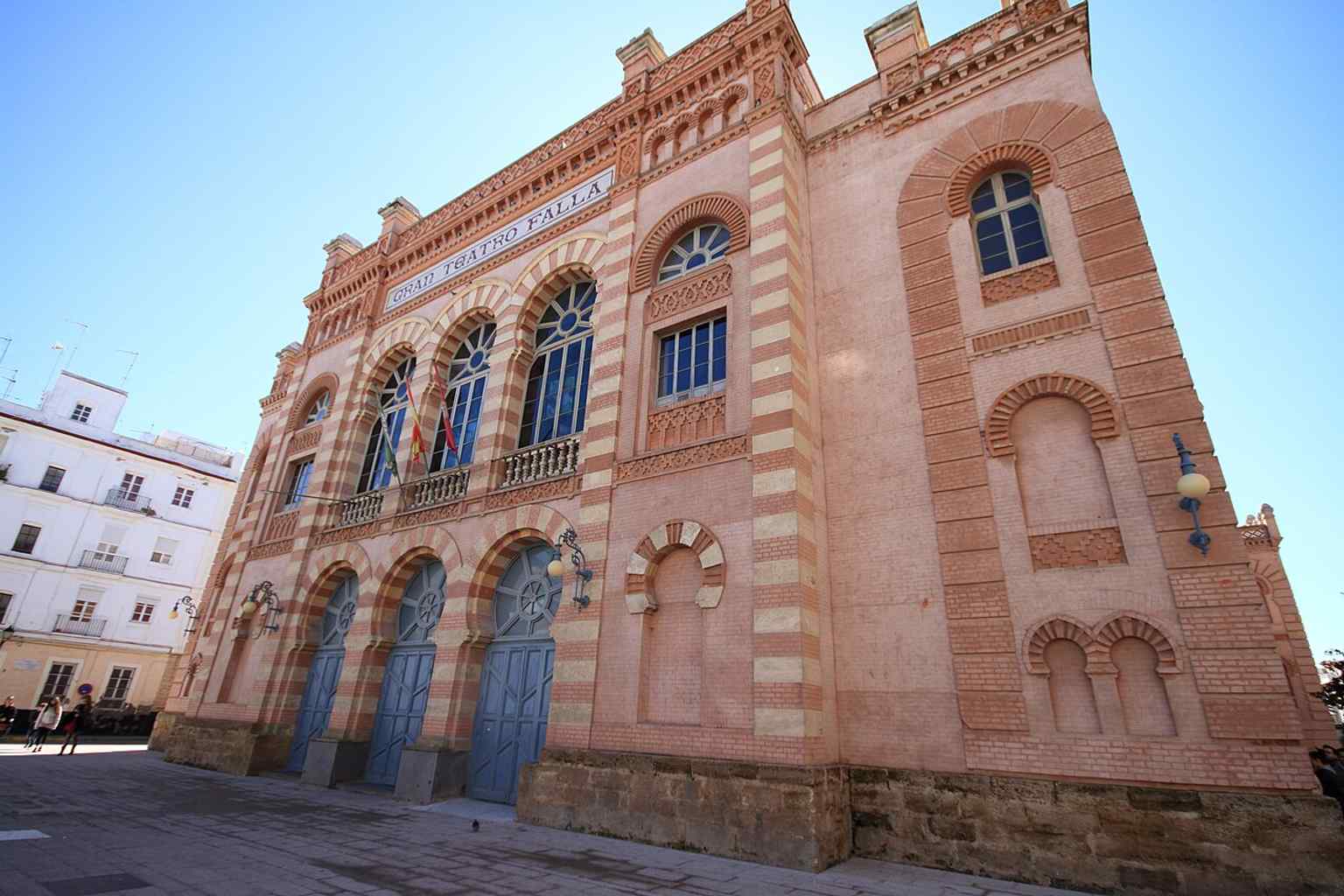
A clear frontal view of the Gran Teatro Falla, matching its distinctive red-brick Neomudéjar façade in Plaza Fragela.Photo: PEPE GADEIRAS, Wikimedia Commons, CC BY-SA 4.0. Cropped & resized. Until nineteen twenty-six, it was simply the Gran Teatro. Then Cádiz renamed it for Manuel de Falla, the city’s beloved composer. A year later, Carnival claimed the stage, and it has never really let go. Every year, the Official Carnival Groups Contest, C-O-A-C, fills this place with choirs, chirigotas, comparsas, and cuartetos: comic singers, lyrical rivals, and masters of cheerful verbal mischief. For a glimpse of that crush inside, check the interior photo in the app. Beyond Carnival, the theater also hosts concerts, drama, the Ibero-American Theater Festival, and the Alcances documentary festival.
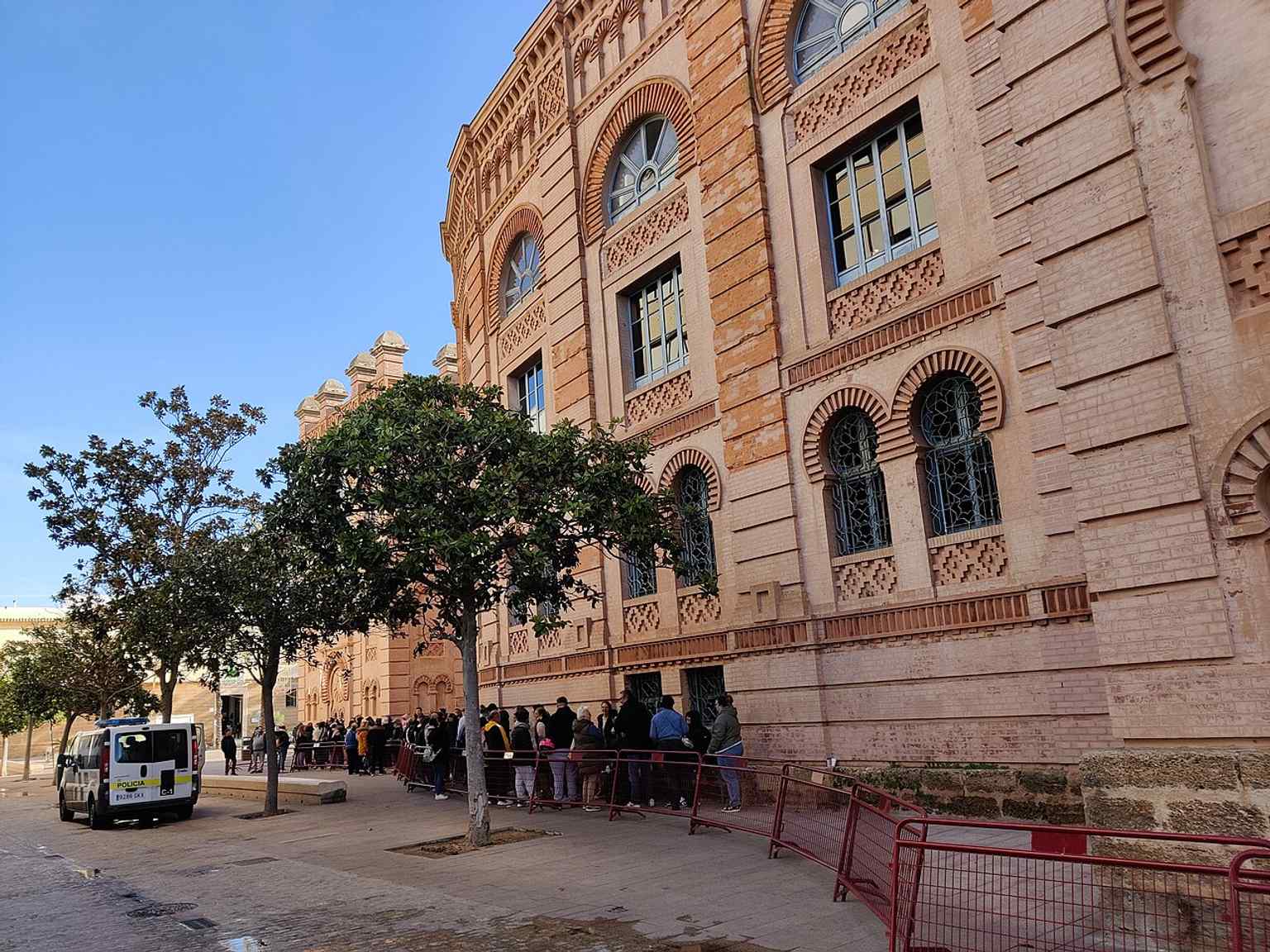
A queue for entry inside the theater, giving a sense of the busy interior during Carnival season when the COAC fills the building.Photo: El Pantera, Wikimedia Commons, CC BY-SA 4.0. Cropped & resized. If you’re planning a visit inside, the theater generally opens every day from eight in the morning to ten at night.
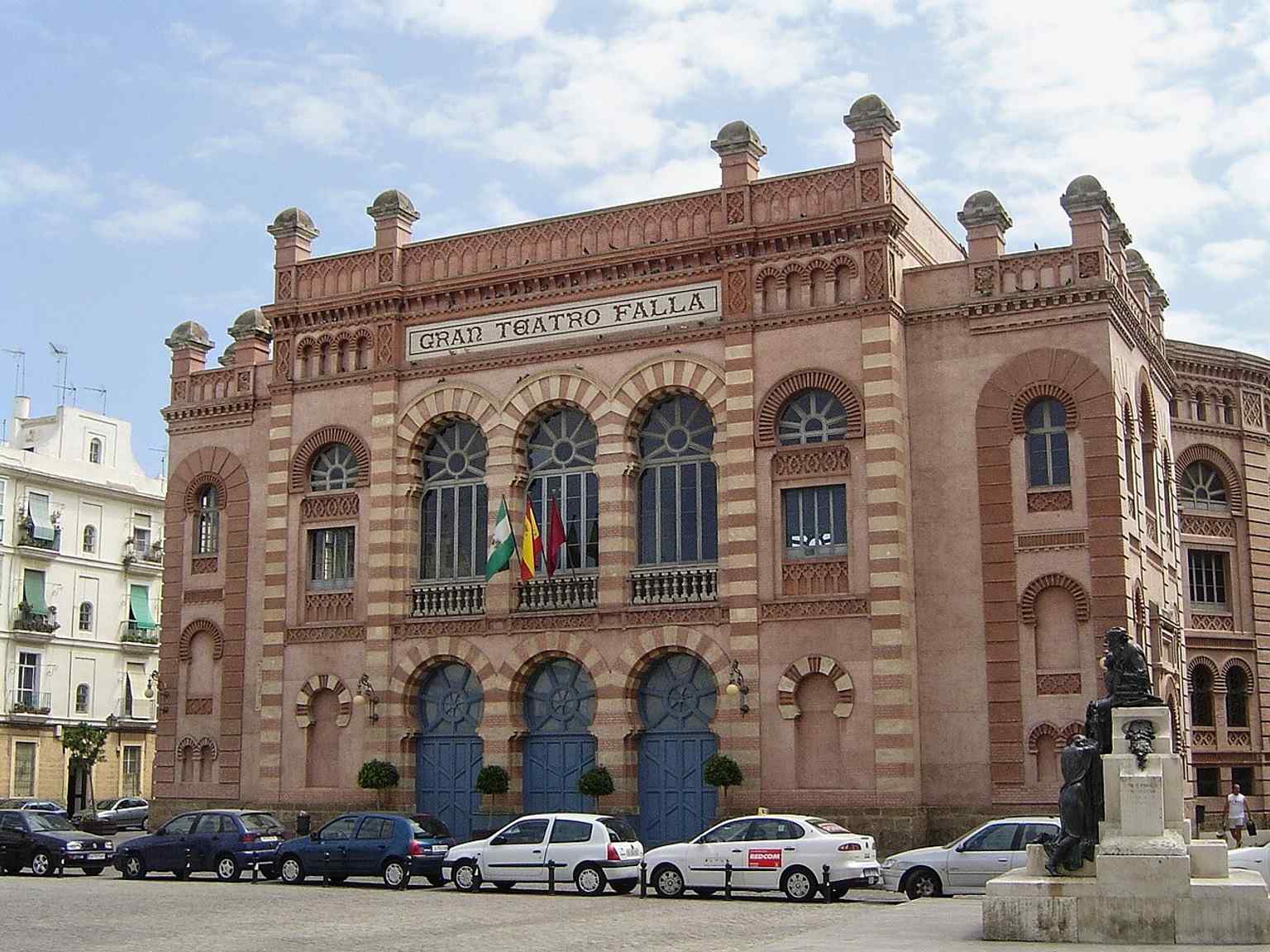
A straightforward exterior view of the Gran Teatro Falla, the Cádiz landmark known for hosting the city’s Carnival and major concerts.Photo: Unknown, Wikimedia Commons, CC BY-SA 3.0. Cropped & resized. 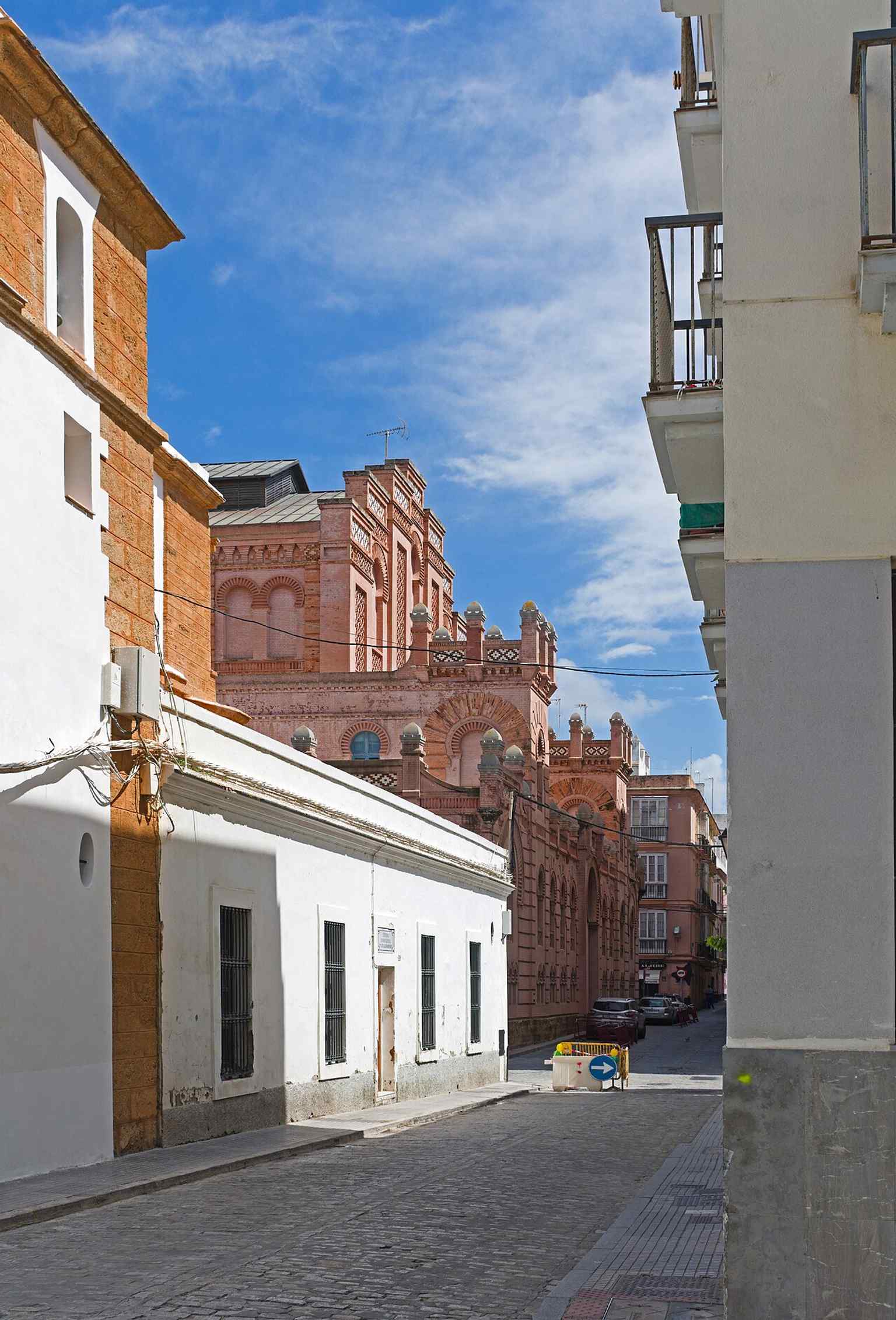
The theater on Calle Benito Pérez Galdós, showing its urban setting near the university and neighboring historic buildings in Cádiz.Photo: Ymblanter, Wikimedia Commons, CC BY-SA 4.0. Cropped & resized. 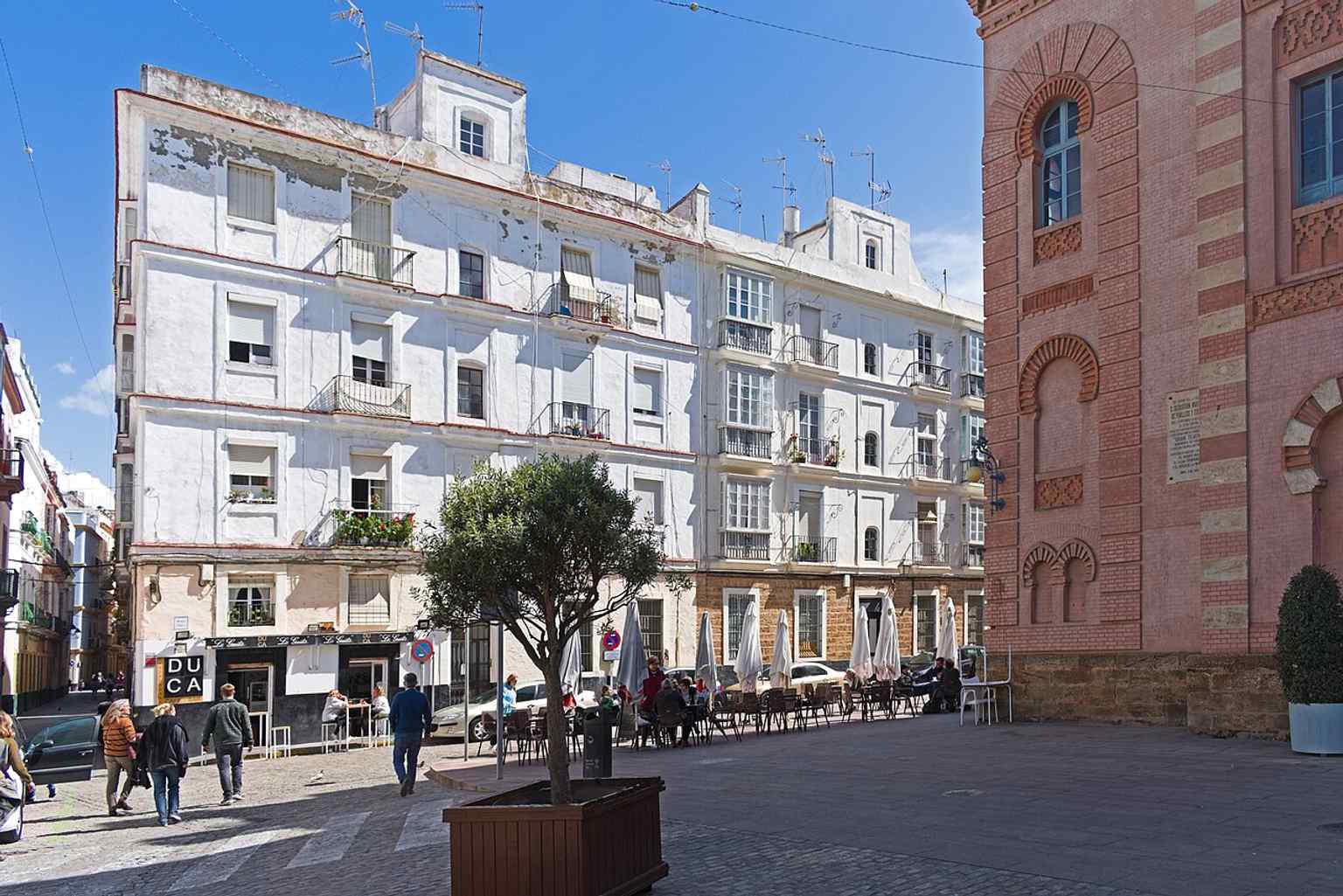
A wider view from Plaza de Falla, the square in front of the theater where centenary projections and public events have taken place.Photo: Ymblanter, Wikimedia Commons, CC BY-SA 4.0. Cropped & resized. 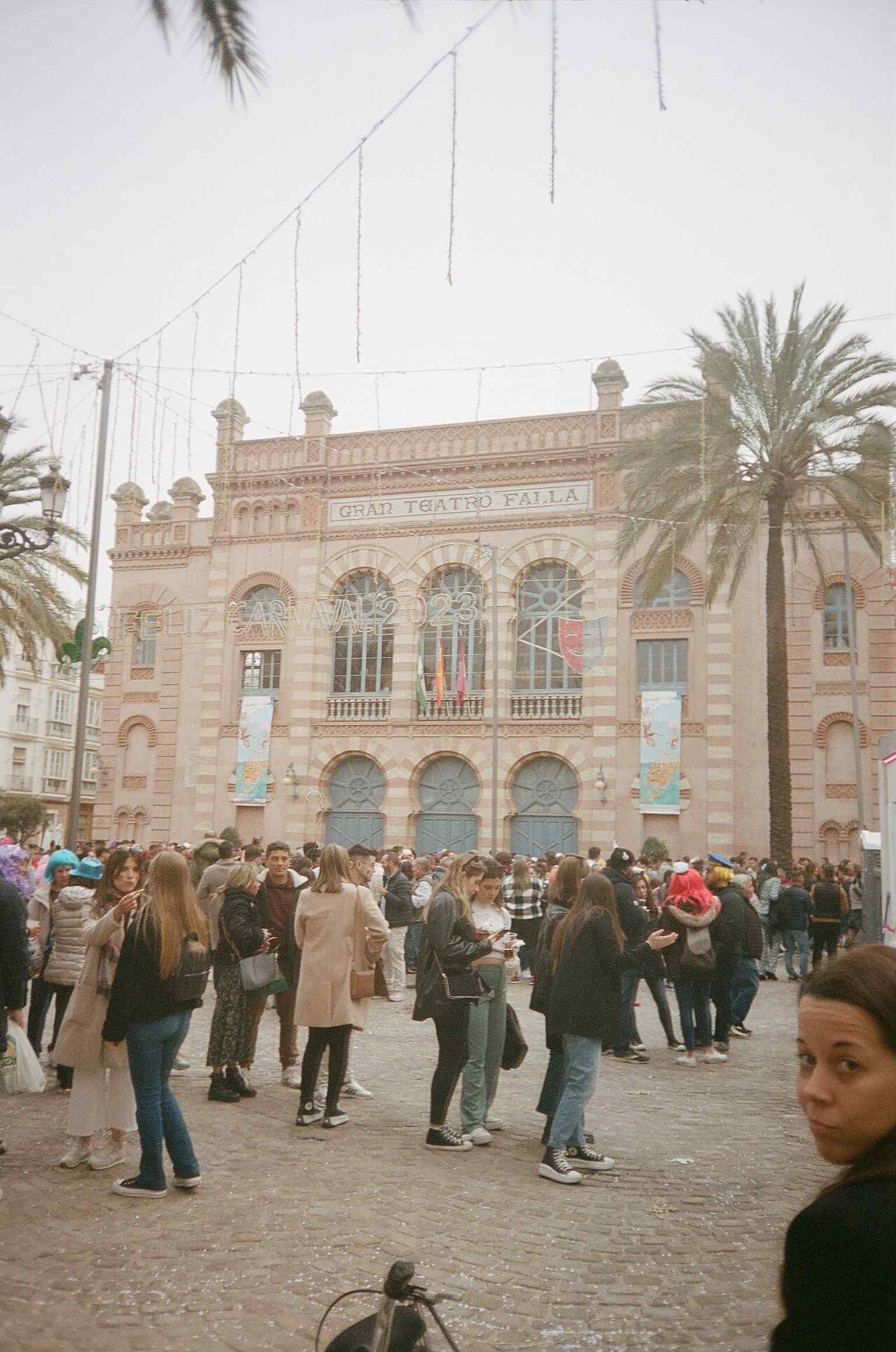
The Gran Teatro Falla dressed for Carnival — a fitting image for the venue that hosts the famous COAC every February.Photo: AsierSaeFer, Wikimedia Commons, CC0. Cropped & resized.
Frequently asked questions
How do I start the tour?
After purchase, download the AudaTours app and enter your redemption code. The tour will be ready to start immediately - just tap play and follow the GPS-guided route.
Do I need internet during the tour?
No! Download the tour before you start and enjoy it fully offline. Only the chat feature requires internet. We recommend downloading on WiFi to save mobile data.
Is this a guided group tour?
No - this is a self-guided audio tour. You explore independently at your own pace, with audio narration playing through your phone. No tour guide, no group, no schedule.
How long does the tour take?
Most tours take 60–90 minutes to complete, but you control the pace entirely. Pause, skip stops, or take breaks whenever you want.
What if I can't finish the tour today?
No problem! Tours have lifetime access. Pause and resume whenever you like - tomorrow, next week, or next year. Your progress is saved.
What languages are available?
All tours are available in 50+ languages. Select your preferred language when redeeming your code. Note: language cannot be changed after tour generation.
Where do I access the tour after purchase?
Download the free AudaTours app from the App Store or Google Play. Enter your redemption code (sent via email) and the tour will appear in your library, ready to download and start.
If you don't enjoy the tour, we'll refund your purchase. Contact us at [email protected]
Checkout securely with 






%20-%20IMG%2020221114%20160419.jpg)


%2001.jpg)
%2002.jpg)
%2003.jpg)
%2001.jpg)

%2002.jpg)


.jpg)


.jpg)


