
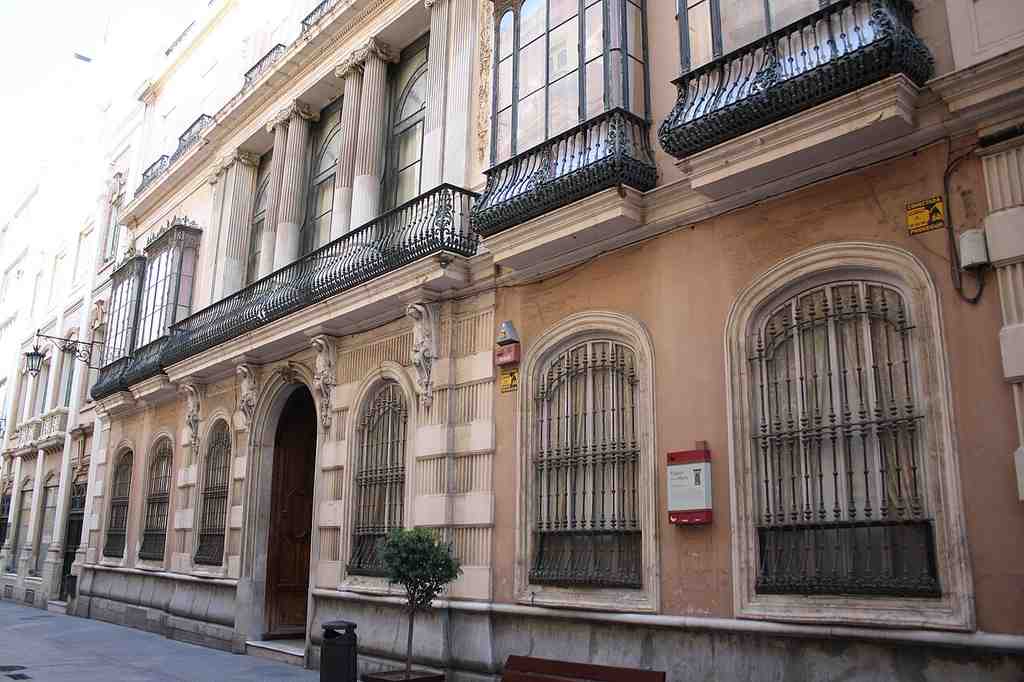
Look for a broad three-story facade faced with marble, centered on a round-arched doorway and a grand balcony with double columns, plus the striking atlantes, carved male figures, holding up the balcony above.
This is Mora Palace, one of Cádiz’s great nineteenth-century houses, and it does not exactly do modesty. It prefers marble. A lot of marble. Architect Juan de la Vega y Correa designed it in the mid-nineteenth century in the Isabeline style, the fashionable look of Queen Isabel the Second’s era, and the result is a city mansion that feels almost theatrical without tipping into nonsense.
From where you’re standing, the facade tells the whole story. It rises in three main levels with an attic above, organized in three vertical sections. The center gets the drama: that rounded entrance arch, then the balcony over it with paired marble columns. Under the balcony, those atlantes do the heavy lifting... literally in stone. They’re sculpted male figures used as supports, because plain brackets would apparently have been far too ordinary. Flanking the center, you can spot four large miradores, enclosed projecting windows, two on each side. Their craftsmanship mattered then, and it still shows now.
And the luxury did not stop at the front door. The family had columns, brackets, and other decorative pieces shipped from Carrara in Italy, the same place famous for its high-quality marble. Inside, the house revolves around a main patio, a rear patio, and a garden. Wide galleries with balustrades run around the upper floors, and a marble staircase leads to the formal rooms above. Over the central patio sits a montera, basically a large glazed roof that floods the interior with light. The whole effect blends French Empire taste, grand, symmetrical, and polished, with the more mixed-and-matched flair of eclectic architecture.
The palace opened officially on the thirtieth of September, eighteen sixty-two, when the Moreno de Mora family threw a ball here for Queen Isabel the Second and her husband, Francisco de Asís. Not a bad housewarming party. Even more remarkable, the place still preserves its original furnishings from that era, especially in the Salón Regio, the main reception room, where the furniture was designed for that inauguration. The house also keeps paintings by artists including Bianchi, Juan de Arellano, Eugenio Lucas Velázquez, and Zurbarán, sculptures by Pagani and other Milanese artists, a notable clock collection, a small library once used by the Hispano-American Academy in Cádiz, and a chapel with a Virgin of El Rocío carving that is about a century older than the mansion itself.
Since nineteen eighty-one, Mora Palace has held protected heritage status, and through generations, from the Moreno de Mora family to the Aramburu, Carranza, Picardo, and Pries families, it has remained a residence... which somehow makes all this splendor feel even more personal.
If you want to see the interior, the palace usually opens free on Wednesdays from eleven AM to noon.
Let this facade have the last word: Cádiz knew how to turn domestic life into ceremony.
When you’re ready, we can continue on to the Museum of Cádiz.




