
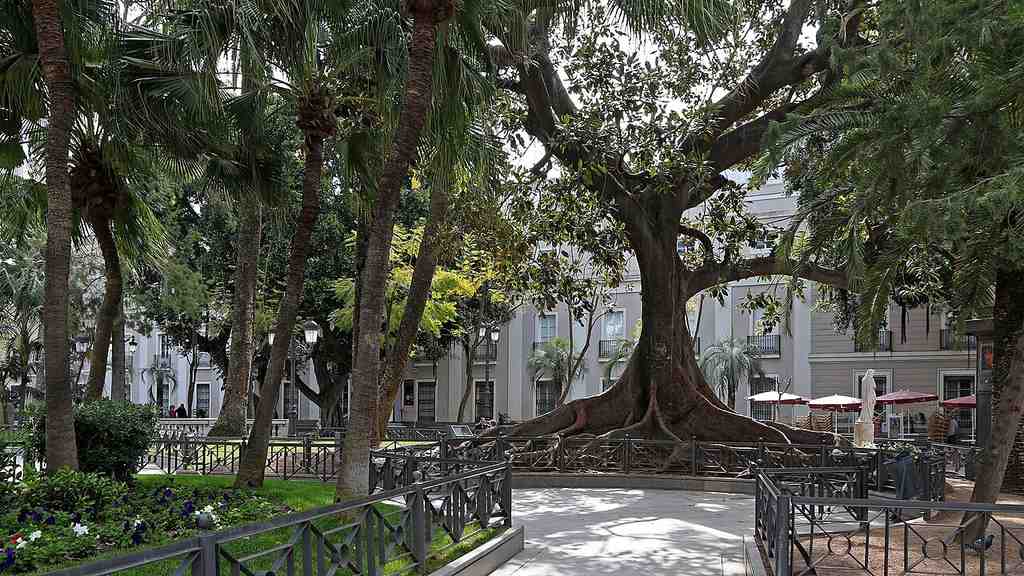
In front of you is a formal square edged by pale stone townhouses, laid out in a tidy geometric shape with diagonal paths crossing toward a raised circular center crowned by a tall lamppost.
Plaza de Mina looks calm now, but it began with a very practical act of urban recycling. In eighteen thirty-eight, Cádiz opened up the old orchard and infirmary of the Convent of San Francisco and turned the whole area into a public square. The city wanted breathing room... and, frankly, a bit of elegance. Architect Torcuato Benjumeda started the plan, then Juan Daura carried it forward, giving the square its distinctive layout: a near-perfect square, four diagonal walks meeting in the middle, and gardens tucked between them like green wedges.
The work moved quickly, though not cheaply. By late eighteen forty-two, the bill had reached one hundred seventy-eight thousand two hundred seventy-two reales and twenty maravedíes... roughly the equivalent of hundreds of thousands of euros in modern terms, depending on how you measure it. Cádiz paid for it with demolition materials from the old public infirmary and with help from the neighbors themselves. So yes, this place is polished, but it was also a community effort. Cities love a grand plan; they love it even more when someone else helps pay.
At the center once stood a statue of General Espoz y Mina, a hero of the Peninsular War against Napoleon. That statue has vanished, but the name stuck... mostly. Officially this used to be Plaza del General Espoz y Mina, and over time people did what people always do: they trimmed it down to Plaza de Mina. During the Franco era, the city tried renaming it Plaza del Generalísimo Franco in nineteen thirty-seven, but locals kept calling it Mina anyway. Cádiz can be politely stubborn.
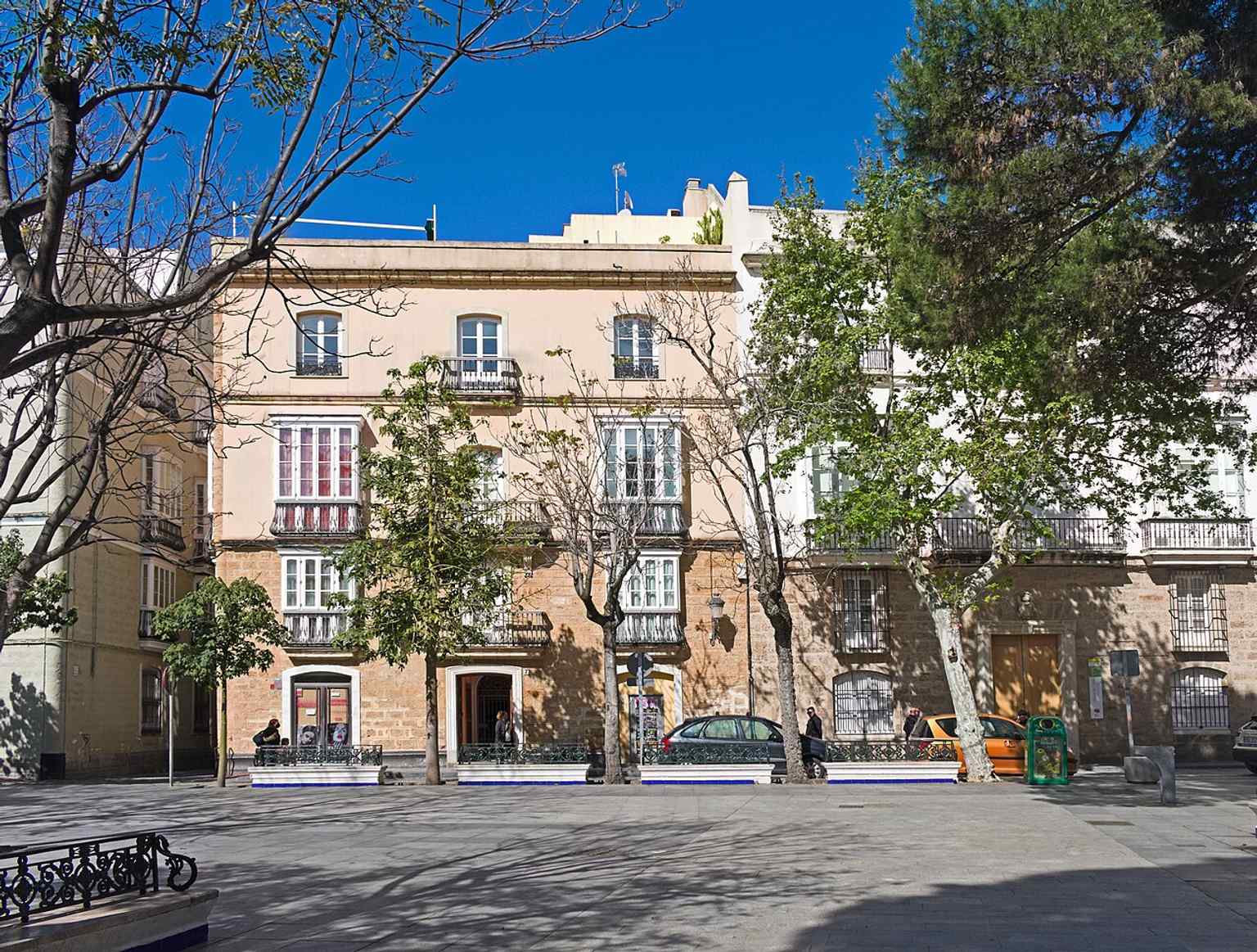
If you glance around the edges, the square doubles as a catalog of nineteenth-century taste. Many of the houses are Isabeline in style, meaning they belong to the decorative, slightly theatrical architecture fashionable during the reign of Queen Isabella the Second. You’ll also spot late neoclassical restraint and a few baroque echoes hanging on. Number three carries a plaque marking the birthplace of Manuel de Falla, born here in eighteen seventy-six. At number twelve, the geologist José Macpherson was born. This square has quietly housed musicians, scientists, political clubs, and one famously fine hotel, Francia y París.
The museum building nearby ties directly into the square’s origin story too. Daura used former Franciscan land to raise the neoclassical building that now houses part of the Museum of Cádiz and the Academy of Fine Arts. If you want a quick visual check, take a look at the image on your screen and you’ll see how the square’s ordered paths and surrounding façades still hold that nineteenth-century sense of civic pride.
And then there’s the greenery. After Genovés Park, this is one of Cádiz’s richest corners for tree species: plane trees, magnolias, jacarandas, Indian laurel, Canary palms, even the striking bunya-bunya. The square also has four white marble figures representing the seasons, each on a cylindrical pedestal. In a wonderfully human detail, after their restoration in two thousand twenty, Summer and Autumn ended up swapped from the logical seasonal order.
This is one of those Cádiz places where planning, politics, memory, and botany all decided to share the same address.
And because it’s a public square, Mina is open all day and all night.
Take a last look around, and when you’re ready, we can wander on to Alameda Apodaca.





